 2020, Vol. 36


2. 中国科学院大学, 北京 100049;
3. 中国地质大学, 北京 100083;
4. 中国科学院青藏高原地球科学卓越创新中心, 北京 100101
2. University of Chinese Academy of Sciences, Beijing 100049, China;
3. China University of Geosciences, Beijing 100083, China;
4. CAS Center for Excellence in Tibetan Plateau Earth Sciences, Beijing 100101, China
蛇绿岩是代表大洋中脊(MOR型)、上俯冲带(SSZ型)或者是被动大陆边缘(CM型)等环境的大洋岩石圈残片,自下而上由岩石圈地幔橄榄岩和上部洋壳堆晶岩、岩墙群、熔岩及深海沉积物(如硅质岩)等几个部分组成(Anonymous, 1972; Nicolas and Boudier, 2003; Dilek and Furnes, 2011, 2014; 龚小晗, 2017)。研究蛇绿岩对探讨古洋盆演化机制、岩浆活动、地球化学过程以及古板块边界划分均有一定指示意义(Choi et al., 2008; Dilek and Furnes, 2011; Whattam and Stern, 2011)。普兰地幔橄榄岩体位于雅鲁藏布江缝合带西段,是雅鲁藏布江蛇绿岩带的重要组成部分,其成因研究对于探讨新特提斯洋演化具有直接指示意义。目前有关该岩体成因的认识主要有:1)形成于慢速-超慢速扩张脊(周文达, 2015; 周文达等, 2015);2)先形成于中脊环境,后在俯冲过程中受到了熔体交代作用影响(徐向珍等, 2011; 王泽利等, 2012; 熊发挥等, 2013, 2015);3)形成于俯冲带环境(Xu et al., 2015);4)形成于被动大陆边缘(刘飞等, 2013)。以上认识主要是依据造岩矿物和全岩地球化学特征等得出的,有关副矿物铬尖晶石的系统研究相对较少。
铬尖晶石,(Mg, Fe2+)(Al, Cr, Fe3+)2O4,作为一种重要的金属氧化物,常见于镁铁质、超镁铁质岩中(Irvine, 1965),是蛇绿岩型地幔橄榄岩中的典型矿物(Irvine, 1965; Dick and Bullen, 1984)。尽管镁铁、超镁铁质岩中铬尖晶石的含量仅为1%~2%(Irvine, 1965; 鲍佩声等, 1999),经济价值不大,但其阳离子种类繁多、性质差异大(Arai, 1992),对外界物理化学环境的变化十分敏感,因而可以直接指示地幔橄榄岩的成岩条件,如氧逸度、环境压力、部分熔融程度、岩石冷却速率等(Irvine, 1967; Dick and Bullen, 1984; Ozawa, 1984, 1989; Arai, 1992; Hellebrand et al., 2001; 陈灵等, 2013),并且铬尖晶石相较橄榄石更为难熔、抗蚀变(Barnes and Roeder, 2001; Ahmed et al., 2005),故可作为一种重要的岩石学成因指示剂,广泛用于地幔岩成因研究,约束地幔橄榄岩的演化过程(Irvine, 1965, 1967; Dick and Bullen, 1984; Arai, 1992)。
本文以铬尖晶石为研究对象,综合理解地幔岩石部分熔融作用、熔体-岩石反应、尖晶石-橄榄石/辉石成分“再平衡”等理论(Bhanot et al., 2017; ünlü et al., 2017),通过详细的岩相学观察、矿物学分析、化学成分分析等,探讨地幔橄榄岩中铬尖晶石的成因,并进一步约束普兰地幔橄榄岩的构造演化过程。
1 区域地质背景雅鲁藏布江缝合带是青藏高原规模最大、最为年轻的缝合带,其北为拉萨地体,南为喜马拉雅造山带,缝合带南北宽约15km,东西长超过2000km(Yin and Harrison, 2000),是研究冈瓦纳古陆裂解、探讨新特提斯洋演化等基础地质问题的重要研究对象(吴福元等, 2014)。雅鲁藏布江蛇绿岩带是缝合带的重要鉴别标志,主要由东波、普兰、萨嘎、昂仁、日喀则、泽当、罗布莎等地的蛇绿岩体组成,其中普兰蛇绿岩体位于该带西段南部(图 1a)。

|
图 1 青藏高原地质简图(a, 据Liu et al., 2010; 熊发挥等, 2011)和普兰蛇绿岩地质简图(b, 据河北省地质调查院, 2005a①, b②修改) Fig. 1 Geological sketch map of Tibetan Plateau (a, after Liu et al., 2010; Xiong et al., 2011) and geological diagram of Purang ophiolites (b) |
① 河北省地质调查院. 2005a.普兰县幅地质图(1/25万)
② 河北省地质调查院. 2005b.姜叶马幅地质图(1/25万)
普兰蛇绿岩体地理位置位于拉昂错以西,普兰县城以北35km处,坐标:东经80°40′~81°16′,北纬30°30′~30°51′。岩体东西延伸70km,南北宽约20km,面积约为650km2,是雅鲁藏布江缝合带中出露面积最大、也是最为新鲜的蛇绿岩岩体(龚小晗, 2017)。岩体整体上呈北西-南东向展布,主要由地幔橄榄岩以及南东侧的变质辉长岩体组成。北西侧为新近系-第四系沉积物,北东侧与白垩系混杂岩呈断层接触,南西侧与古近系混杂岩呈断层接触(图 1b)。
2 地幔橄榄岩岩相学特征野外观察表明普兰蛇绿岩缺失堆晶岩、岩墙群、熔岩等端员,岩性以方辉橄榄岩和含单斜辉石方辉橄榄岩为主,岩体呈北西-南东向展布,与区域构造方向一致。方辉橄榄岩与含单斜辉石方辉橄榄岩呈黄褐色,整体较为新鲜,新鲜面可见密集分布的辉石颗粒(图 2a, b),辉石以斜方辉石为主,含少量单斜辉石,局部蛇纹石化严重,可见蛇纹石化形成的网脉以及辉石、橄榄石假象等。二辉橄榄岩大部分分布在岩体的北部,少部分呈透镜状分布在方辉橄榄岩体内,赋存其中的铬尖晶石颜色相对较浅。纯橄岩岩体以透镜体的形式分布于方辉橄榄岩体内,与方辉橄榄岩呈渐变过渡,岩体规模由数厘米至数米不等,赋存的铬尖晶石呈自形星点状分布,颜色较深、含量较低(< 2%),局部密集分布呈浸染状。

|
图 2 普兰地幔橄榄岩野外特征(a、b)及正交偏光镜下显微照片(c-f) (a)辉长岩体侵入至方辉橄榄岩体内;(b)方辉橄榄岩野外特征;(c)方辉橄榄岩,橄榄石受应力变形呈粒状、铬尖晶石呈他形分布;(d)方辉橄榄岩,发生韧性变形的辉石/橄榄石颗粒定向包绕辉石碎斑晶,构成眼球状构造;(e)含单斜辉石方辉橄榄岩,半自形斜方辉石斑晶包裹着自形的铬尖晶石以及他形的单斜辉石;(f)方辉橄榄岩,半自形-他形斜方辉石斑晶边缘局部呈港湾状.Ol-橄榄石;Cpx-单斜辉石;Opx-斜方辉石;Spl-尖晶石 Fig. 2 Field photos (a, b) and microphotographs (c-f) of Purang mantle peridotites |
地幔橄榄岩主要由橄榄石、斜方辉石和少量的单斜辉石、铬尖晶石组成。岩体受挤压应力破碎,可见残碎斑结构,糜棱结构,部分岩石蛇纹石化网脉发育,构成网状结构。橄榄石多发生应力变形碎成颗粒状分布,扭折带、波状消光等现象较为明显(图 2c, d)。辉石也受应力作用发生晶形变化、解理同步弯曲,局部可见受部分熔融作用影响形成的港湾状边界(图 2e, f),岩体辉石含量差异较大,暗示后期可能存在硅质熔体交代作用。铬尖晶石主要以副矿物形式存在(图 3)。

|
图 3 铬尖晶石显微照片与背反射图像 (a、d、g、h) Ⅰ类铬尖晶石呈自形棕褐色分布于辉石中;(b、e、i) Ⅱ类铬尖晶石呈棕色他形分布于地幔橄榄岩中;(c、f) Ⅲ类铬尖晶石呈棒状、蠕虫状与辉石交生在一起 Fig. 3 Photomicrographs and back-scattered electron images of the chromian spinels |
铬尖晶石广泛存在于普兰地幔橄榄岩中,因赋存岩体的不同特征存在较大差异。前人研究表明铬尖晶石晶形受岩石部分熔融程度影响可呈现系统的变化,如Leblanc et al. (1980a)研究得出了新喀里多尼亚地幔橄榄岩在部分熔融过程中铬尖晶石形态系统变化的规律,即随着岩石部分熔融程度的提高,铬尖晶石形态呈现这样的变化规律:半自形、细粒(二辉橄榄岩体)→他形、粗粒(含单斜辉石方辉橄榄岩)→他形、蠕虫状(方辉橄榄岩)→半自形-自形、粗粒(纯橄岩)(Leblanc, 1980a)。通过镜下观察,综合矿物赋存岩相、自形程度、粒径大小、颜色(单偏光镜下)等几个因素,可初步将普兰地幔橄榄岩中的铬尖晶石分为以下几类:
Ⅰ类铬尖晶石赋存于少量方辉橄榄岩及透镜状纯橄岩体中,单偏光镜下尖晶石呈深褐色-黑色四边形、八边形自形分布,粒径小于100μm。铬尖晶石或包裹于斜方辉石之中,或杂乱分布于辉石、橄榄石之间(图 3a, d, g, h);Ⅱ类铬尖晶石赋存于方辉橄榄岩、含单斜辉石方辉橄榄岩以及少量二辉橄榄岩中,呈浅棕色-棕色,赋存岩体由二辉橄榄岩→含单斜辉石方辉橄榄岩→方辉橄榄岩变化的同时,铬尖晶石颜色逐渐变深,呈半自形或他形分布,粒径多大于100μm,少数可达500μm,尖晶石杂乱分布,部分铬尖晶石中包裹有橄榄石或者单斜辉石等矿物(图 3b, e);Ⅲ类铬尖晶石赋存于二辉橄榄岩及少量含单斜辉石方辉橄榄岩中,含量较低,呈浅棕色-棕色,铬尖晶石呈水滴状、短棒状、蠕虫状分布,与辉石交生在一起,构成后成合晶结构,粒径多在200μm左右(图 3c, f)。由于Ⅱ类铬尖晶石赋存的岩相构成了普兰地幔橄榄岩的主体,所以普兰地幔橄榄岩铬尖晶石以Ⅱ类铬尖晶石为主,Ⅰ类铬尖晶石次之,Ⅲ类铬尖晶石最少。
4 分析测试方法矿物化学成分及扫面分析是在中国科学院青藏高原研究所大陆碰撞与高原隆升重点实验室利用JEOL JXA-8230电子探针完成的。工作条件:束斑直径为5μm;加速电压15kV,加速电流20nA。所有测试数据均进行了ZAF校正处理。元素峰的测量时间为10s,上下背景的测量时间分别5s。所使用的标样如下:氧化铬(Cr)、钠长石(Na)、橄榄石(Mg)、赤铁矿(Fe)、透辉石(Si, Ca)、正长石(K)、蔷薇辉石(Mn)、金红石(Ti)、氧化镍(Ni)、刚玉(Al)。铬尖晶石Fe3+/Fe2+的相对含量是根据Droop (1987)提出的公式计算所得。
铬尖晶石-辉石的显微组构是在澳大利亚Macquarie大学GEMOC中心通过扫描电镜(SEM)-电子背散射衍射(EBSD)进行分析的。操作条件为:工作距离15~21mm,样品台平面与水平方向夹角为70°,电压20kV,电流强度8.2nA。EBSD花样图案通过垂直入射的电子束作用在薄片上产生,并由数字CCD相机记录。运用牛津仪器公司生产的CHANNEL 5软件按照晶体取向处理和标定获得的图像,采集步长依据颗粒平均尺寸不同从1μm到40μm。数据处理包括由标定的颗粒向邻近的未标定颗粒外推以及去除平均直径小于5像素的颗粒(龚小晗, 2017)。
5 铬尖晶石成分特征铬尖晶石的化学成分主要包括Al2O3、Cr2O3、Fe2O3、MgO、FeO等,其中Cr#、Mg#、TiO2是铬尖晶石几个最为重要的化学指标(Kamenetsky et al., 2001):尖晶石的Cr#与其单偏光镜下的颜色呈正相关关系(Kamenetsky et al., 2001);尖晶石中TiO2可以用于指示岩石是否存在交代作用(Seyler et al., 2007);尖晶石的Cr#-Mg#图解可以用来初步判断岩石的赋存环境(Arai, 1992):如洋中脊环境地幔橄榄岩的铬尖晶石具有低Cr#(< 0.6)的特征(Dick and Bullen, 1984),俯冲环境的铬尖晶石由于经历了高程度的部分熔融,其化学成分表现为高Cr#(>0.6)、低TiO2的特点(Dick and Bullen, 1984)。
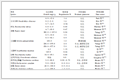
前人根据铬尖晶石的成分及演化特征将铬尖晶石分为三类:富铝系列、富铬系列、富铝-富铬系列,其中富铝成分系列以富铝、富镁(Cr#变化于0.09~0.65、Mg#变化于0.46~0.84)为特征,典型代表为萨尔托海、贺根山的DTG蛇绿岩体中的尖晶石;富铬成分系列以富铬(Cr#变化于0.55~0.87)为特征,典型代表为东巧、大道尔吉蛇绿岩体中的尖晶石(鲍佩声等, 1999)。普兰地幔橄榄岩铬尖晶石Cr#(0.17~0.72)变化范围大(表 1、表 2),涵盖了前两类铬尖晶石的范围(图 4),符合富铝-富铬系列的特征,类似的特征在罗布莎、东波、泽当都有发现(熊发挥等, 2013; 鲍佩声等, 2015; Xiong et al., 2016),前人认为这反映了橄榄岩更为复杂的多期熔融历史(鲍佩声, 2009),有学者用早期洋中脊环境形成贫铬富铝的尖晶石,晚期俯冲体系流体作用形成富铬尖晶石来解释(Zhou et al., 1996, 2014; Xiong et al., 2017),也有学者用洋底水平滑动产生的推覆作用或蛇绿岩侵位时的构造混杂作用所导致的不同地区的洋壳及地幔挤到了一起来解释(史仁灯, 2005)。
|
表 1 Ⅰ类铬尖晶石及辉石主量元素特征(wt%) Table 1 Major elements composition of Type Ⅰ spinels and pyroxenes (wt%) |
|
|
表 2 Ⅱ类及Ⅲ类铬尖晶石主量元素特征(wt%) Table 2 Major elements composition of Type Ⅱ and Type Ⅲ spinels (wt%) |

|
图 4 尖晶石成分与演化趋势图解 (a、b)铬尖晶石成分演化趋势;(c、d)铬尖晶石化学成分与构造环境判别图(底图据Kamenetsky et al., 2001; Dubois-Côté et al., 2005).文献数据徐向珍等, 2011; 周文达, 2015; 龚小晗, 2017. MORB-洋中脊玄武岩;ARC-岛弧岩浆岩;OIB-洋岛玄武岩;LIP-大火成岩省 Fig. 4 Composition and evolution trend diagrams of the spinels |
对铬尖晶石成分的进一步分析表明尖晶石特征差异明显,根据Cr#可将铬尖晶石分为高Cr#(>0.6)和低Cr#(< 0.6)两类,类似的特征在铬尖晶石的Cr2O3-Al2O3图解及FeO-MgO图解中均有体现(图 4a, b)。同时三种镜下特征不同的铬尖晶石在化学成分上同样表现为明显的差异性:Ⅰ类铬尖晶石Cr#较高(>0.6),介于0.66~0.72之间,平均值~0.70,Mg#变化于0.43~0.57之间;Ⅱ类铬尖晶石Cr#为0.17~0.42,低于Ⅰ类铬尖晶石,Mg#为0.63~0.77;Ⅲ类铬尖晶石Cr#为0.17~0.28,低于Ⅰ类铬尖晶石,Mg#为0.67~0.77(表 1、表 2)。
6 讨论 6.1 铬尖晶石成因探究地幔橄榄岩作为原始地幔发生不同程度部分熔融作用抽取出熔体后的残留相,其化学成分可用于揭示地幔部分熔融程度以及地幔交代等作用(O'Hara, 1968; Bottinga and Allègre, 1978; 鲍佩声, 2009; 徐夕生和邱检生, 2010; 张宏飞和高山, 2012)。在部分熔融过程中,铬尖晶石中的铬是相容元素,优先留在残留相,铝是不相容元素,优先进入熔体相(Dick and Bullen, 1984),所以随着岩石部分熔融程度的提高,地幔橄榄岩副矿物铬尖晶石的Cr#会相应升高(鲍佩声等, 1999)。
熔体-岩石反应也会影响地幔橄榄岩成分尤其是赋存其中矿物的化学组分(Zhou et al., 1996; Pearce et al., 2000; Dare et al., 2009),如造成铬尖晶石和单斜辉石中TiO2的富集(Edwards and Malpas, 1995; Zhou et al., 2005)。前人研究表明:铬尖晶石与MORB熔体相互作用会导致TiO2的富集,但并不影响铬尖晶石的Cr#(Pearce et al., 2000; Choi et al., 2008);铬尖晶石与玻安质熔体反应会使铬尖晶石同时富TiO2、富Cr#(Zhou et al., 1996; Zhou et al., 2005; Choi et al., 2008; Xiong et al., 2017)。因而铬尖晶石成分可以用于约束岩石部分熔融程度及熔体-岩石相互作用(Irvine, 1965; Dick and Bullen, 1984; 鲍佩声等, 1999; Hellebrand et al., 2001)。
Ⅰ类铬尖晶石呈自形-半自形棕褐色赋存于少量方辉橄榄岩及部分纯橄岩中,寄主岩石多呈透镜状分布于普兰岩体中。岩石以高温韧性变形为主,铬尖晶石无定向分布,表明其并非机械混入。对铬尖晶石成分扫面结果显示:1)富Cr颗粒与铬尖晶石形态吻合,且明显富Ti,表明尖晶石形成受到了熔体影响;2)富Ca、贫Mg颗粒(单斜辉石)定向分布,单斜辉石与斜方辉石构成出溶结构系,表明岩体经历了高温成分再平衡;3)斜方辉石出溶方向存在少量出溶形成的富Cr颗粒,但含量明显低于铬尖晶石,表明斜方辉石铬的释放不足以再结晶形成铬尖晶石。
高Cr#(~0.70)、高FeO(~20%)的特征暗示Ⅰ类尖晶石经历了高程度的部分熔融,且可能经历了磁铁矿矿化(图 4、图 5a)。地幔橄榄岩斜方辉石中的Al2O3含量与岩石的部分熔融程度呈负相关关系(Dick, 1977),同样可以用于指示岩石的部分熔融程度。岩体经历高温再平衡之后,包裹铬尖晶石的斜方辉石具有极低的Al2O3含量,暗示岩石所经历的高程度部分熔融作用。然而赋存辉石的Mg#甚至高于普兰难熔纯橄岩相辉石的Mg#(图 5c, d),这表明岩石不止经历了高程度的部分熔融,同时可能受到富镁熔体的影响。对寄主方辉橄榄岩的研究表明其具有高的全岩FeOT含量(~9%),暗示了铬尖晶石形成过程受到了富硅熔体影响(Herzberg, 2004; 龚小晗, 2017)。尖晶石高TiO2(0.10%~0.11%)的特征表明熔体-岩石反应影响了铬尖晶石的形成,对寄主岩石与辉石的分析表明存在富硅、富镁熔体作用,这与尖晶石富Cr#、富TiO2的成分演化趋势相吻合,也与前人对普兰纯橄岩体母岩浆性质的反演结果一致(Su et al., 2019)。因此可推测Ⅰ类铬尖晶石形成经历了高程度的部分熔融,又受到了富硅、富镁玻安质熔体的影响。

|
图 5 铬尖晶石及辉石化学成分 (a)尖晶石TiO2-Cr#成分图解;(b)尖晶石Cr#-橄榄石Mg#图解,铬尖晶石矿物特征见背反射图像;(c)单斜辉石的Mg#-Al2O3成分图解;(d)斜方辉石的Mg#-Al2O3成分图解,辉石矿物特征见背反射图像.底图分别引自Arai, 1992; Pearce et al., 2000.文献数据徐向珍等, 2011; 龚小晗, 2017. MORB-洋中脊玄武岩;IAT-岛弧拉斑玄武岩;BON-玻安岩;OSMA-地幔橄榄岩橄榄石-尖晶石阵列;FMM-富集的洋中脊地幔 Fig. 5 Chemistry component of chromian spinels and pyroxenes |
Ⅱ类铬尖晶石呈半自形-他形棕色赋存于二辉橄榄岩及方辉橄榄岩中,其寄主岩石构成了普兰岩体的主体。“舌状橄榄石”、“港湾状单斜辉石”的广泛分布表明寄主岩石主要受到了部分熔融作用的影响(图 2、图 3b, e),寄主岩石岩性暗示一种低-中等程度的部分熔融,地幔橄榄岩主量元素FeO-MgO图解、MgO-Al2O3图解指示普兰二辉橄榄岩及方辉橄榄岩的部分熔融程度为9%~25%(徐向珍等, 2011; 熊发挥等, 2013; 周文达, 2015),基于全岩稀土元素特征模拟重建的普兰地幔橄榄岩部分熔融程度为10%~25%(周文达, 2015; 龚小晗, 2017)。铬尖晶石化学成分同样可以用于指示岩石部分熔融程度、熔体-岩石相互作用(Dick and Bullen, 1984; Pearce et al., 2000)。据Hellebrand et al. (2001)提出的公式,借助Ⅱ类尖晶石的Cr#可得普兰地幔橄榄岩经历的部分熔融程度范围为8%~20%,这与尖晶石Cr#-Mg#图解、Cr#(Spl)-Fo(Ol)图解的结果相符(图 4d、图 5a, b),也与寄主岩石岩性、全岩主量元素、稀土元素推测的部分熔融程度相符,表明Ⅱ类铬尖晶石主要受到了部分熔融作用的影响,铬尖晶石的TiO2含量 < 0.6%,说明熔体-岩石反应对尖晶石组分的改造十分有限(Dick and Bullen, 1984; Seyler et al., 2003),即Ⅱ类铬尖晶石主要为部分熔融成因,可能遭受了极轻微的熔体交代影响。
普兰地幔橄榄岩Ⅲ类铬尖晶石与辉石构成后成合晶结构,类似的结构在其它地幔岩体中也曾发现,如日本的Nikanbetsu地幔橄榄岩、西班牙的地幔捕虏体、阿尔卑斯造山带橄榄岩中的Lanzo岩体(Takahashi, 2001; Piccardo et al., 2007; Shimizu et al., 2008)。有关这种后成合晶结构的解释并不唯一,以Leblanc为代表的研究者认为是方辉橄榄岩中斜方辉石在部分熔融过程中,释放出晶格中的Cr形成铬尖晶石并与未完全反应殆尽的辉石组成,属部分熔融残余成因(Leblanc, 1980b; 鲍佩声, 2009; 王泽利等, 2012);另一种观点认为是方辉橄榄岩中的辉石出溶形成的(Basu and MacGregor, 1975)。但构成后成合晶的辉石中Cr2O3的含量相较其它样品并未出现明显亏损(表 3),且考虑到幔源包体中斜方辉石的Cr2O3含量以及构成后成合晶的辉石、铬尖晶石的体积比后可以发现斜方辉石中的Cr2O3并不足以通过部分熔融或是高温出溶形成铬尖晶石,Ⅰ类铬尖晶石的面分析结果同样证明了这一点,这表明以上两种解释并不适用于这类铬尖晶石。
|
|
表 3 地幔橄榄岩及幔源包体中斜方辉石Cr2O3含量(wt%) Table 3 The Cr2O3 content of orthopyroxenes in mantle peridotites and mantle-derived xenoliths (wt%) |
Norlander et al. (2002)认为尖晶石构成的后成合晶结构可能是矿物分解的结果。运用EBSD(Electron Back Scattered Diffraction)对构成后生合晶结构的矿物进行空间拓扑结构分析表明组成后成合晶的各矿物结晶方位大致相同(图 6o),具体表现为斜方辉石和单斜辉石具有一致的结晶学优选方位,它们的[100]平行于尖晶石的[111],表明其是由同一矿物分解而来(Suhr et al., 2008)。基于“石榴子石+橄榄石=斜方辉石+单斜辉石+尖晶石”反应(Takahashi, 2001)来重建石榴子石组分,通过成分对比、尤其是单斜辉石与地幔石榴子石的稀土元素特征对比(图 6p),表明是含有辉石固溶体的超硅石榴子石减压分解形成了尖晶石和辉石所组成的后成合晶结构,成分与大陆岩石圈地幔石榴子石相橄榄岩中的石榴子石类似(Schulze, 2003; Gong et al., 2016; 龚小晗, 2017)。综上,可以推测Ⅲ类铬尖晶石形成于石榴子石相橄榄岩上涌向尖晶石相地幔橄榄岩过渡的过程中,石榴子石发生减压分解,形成了铬尖晶石和辉石后成合晶。

|
图 6 铬尖晶石成分面分析 (a) Ⅰ类铬尖晶石背反射照片;(b-h) Ⅰ类铬尖晶石元素分布特征;(i) Ⅲ类铬尖晶石背反射照片(PL1420);(j-n) Ⅲ类铬尖晶石元素分布特征;(o)后成合晶中Opx、Cpx、Spl等的结晶学优选方位,空间拓扑结构分析表明不同矿物相具有一致的结晶方位(PL1210);(p)后成合晶结构矿物组合中单斜辉石的稀土元素特征,其与大陆岩石圈地幔捕虏体中石榴子石的稀土元素特征范围显示出高度的一致性.(o、p)龚小晗, 2017 Fig. 6 Elemental distribution mapping of the chromian spinels |
蛇绿岩作为一套下部地幔橄榄岩-堆晶岩-上部熔岩的岩石组合(Coleman, 1971; Nicolas and Boudier, 2003; Dilek and Furnes, 2014),被认为是古大洋岩石圈的残片(Dilek and Furnes, 2014)。大洋自胚胎期开始张开,经历扩张、成熟、衰退,最终在遗迹期闭合,呈现旋回形式(Torsvik et al., 1996),不同阶段形成的蛇绿岩呈现不同的特征:大陆裂解初期形成的地幔橄榄岩为洋-陆过渡带的大陆岩石圈地幔属性,如希腊北部的Dinaride蛇绿岩体(Faul and Garapi, 2014),同期陆壳伸展裂解会导致地幔物质上涌(Saccani et al., 2015),上涌过程会发生矿物减压相变,如石榴子石相变为尖晶石相(Pan et al., 2018),类似现象在中亚造山带的Daheigou地区(Pan et al., 2018)、巴伐利亚的辛斯特地区(Špaček et al., 2018)都有出现,同时也伴随着岩石减压熔融,如Daheigou地幔岩单斜辉石的筛状变晶结构(Pan et al., 2018);大洋扩张、成熟、衰退期的地幔橄榄岩则多为大洋岩石圈地幔属性,如智利Taitao的MOR蛇绿岩,西藏罗布莎、日喀则以及阿曼等地的SSZ型蛇绿岩(Le Moigne et al., 1996; Wang et al., 2000; Dilek and Furnes, 2014)。
地幔橄榄岩在形成过程中受部分熔融作用影响,在不同的构造区域主导部分熔融的因素存在差异(徐夕生和邱检生, 2010)。热点附近以温度增高主导的部分熔融为主;俯冲带以岩石脱水造成的部分熔融为主,且矿物的脱水作用与岩石部分熔融作用相互促进(Zheng et al., 2016),也有研究表明符合年轻的洋壳以及高剪应力导致的高温条件的俯冲带同样可以发生无水部分熔融(Peacock et al., 1994)。减压熔融多发生在裂谷、大洋中脊等伸展构造主导地区的地幔岩石上升过程(Winter, 2014; 陈灵, 2016),期间压力变化会导致矿物相由不稳定向稳定变化,如石榴子石相-尖晶石相的变化、对应的标志如地幔橄榄岩中石榴子石退变形成的后成合晶结构。Robinson and Wood (1998)以洋中脊玄武岩-地幔岩为原材料完成的地幔橄榄岩尖晶石-石榴子石相转换实验表明:在MORB-地幔岩中,石榴子石向尖晶石转换的临界条件为固相线温度1470℃,压力为28kbar,深度约为85km;Walter et al.(2002)运用原位X射线分析技术得出1575℃时,不变点的压力为25.1±1.2kbar(Walter et al., 2002; 周金城和王孝磊, 2005),远低于龚小晗等测得的普兰稳定石榴子石相地幔橄榄岩的P-T条件(龚小晗, 2017),为普兰地幔橄榄岩石榴子石-尖晶石相变提供了理论基础。
三种不同成因类型的铬尖晶石尤其是石榴子石退变质形成的铬尖晶石出现在同一岩体中,指示普兰地幔橄榄岩复杂的成因历史。其中Ⅰ类铬尖晶石(Cr#>0.6)赋存的纯橄岩呈透镜状分布,暗示普兰地幔岩局部经历了高程度部分熔融事件;Ⅱ类铬尖晶石(Cr# < 0.6)赋存岩相构成了普兰蛇绿岩的主体,暗示普兰地幔岩整体经历了低-中等程度的部分熔融,类似于洋中脊环境;Ⅲ类铬尖晶石蕴含的大陆岩石圈地幔属性暗示普兰岩体可能经历了以碱性岩组合和双峰式火成岩组合为特征的威尔逊旋回初期的大陆裂解阶段(钱青和王焰, 1999; 王焰等, 2000)。依据板块构造理论、蛇绿岩成因机制以及铬尖晶石的岩相学和化学成分特征,推测普兰地幔橄榄岩至少经历两个连续的过程:一是根据呈现超硅石榴子石假象的尖晶石-辉石后成合晶,推测岩体经历了石榴子石相向尖晶石相转变的过程,可能发生在威尔逊旋回大陆裂解阶段,地幔岩石底辟上升、压力降低、减压熔融的过程;二是岩体经历了不同程度的部分熔融及熔体-岩石作用,指示地幔岩石在持续上升过程中由于减压而不断地发生部分熔融作用,形成了Ⅱ类铬尖晶石,随后在局部高度部分熔融事件以及富硅、富镁玻安质熔体的作用下形成了Ⅰ类铬尖晶石(图 7)。

|
图 7 铬尖晶石成因示意图(据Shimizu et al., 2008修改) Fig. 7 Schematic illustration showing the genesis of chromian spinels (after Shimizu et al., 2008) |
普兰地幔橄榄岩副矿物铬尖晶石Cr#(0.17~0.72)分布范围较大、其成分演化符合富铝-富铬系列的特征。根据岩相学观察、化学成分分析对比可将其分为三类:Ⅰ类铬尖晶石:自形分布,高Cr#、富TiO2,为部分熔融作用+玻安岩熔体交代成因;Ⅱ类铬尖晶石:半自形-他形分布,低Cr#、贫TiO2,为部分熔融改造成因;Ⅲ类铬尖晶石:呈棒状、蠕虫状与辉石交生在一起构成后成合晶结构,为高硅石榴子石退变分解成因。
综合分析表明普兰地幔橄榄岩体可能经历了威尔逊旋回早期大陆岩石圈地幔橄榄岩上涌退变、减压熔融的过程,岩体主体经历了低-中等程度的部分熔融,类似于大洋中脊环境,局部岩体发生了高程度的部分熔融作用,受到了富硅、富镁玻安质熔体的影响。
致谢 感谢两位匿名审稿人提出的极其宝贵的意见,让本文质量得到了提高!编辑部老师严谨求实的治学态度、细致入微的相应指导,不仅提高了文章质量,也给笔者上了人生中极为重要的一课,在此衷心表示感谢!同时也感谢中国科学院青藏高原研究所大陆碰撞与高原隆升重点实验室谢静老师、岳雅慧老师在实验过程中给予笔者无私的帮助!
Ahmed HA, Arai S, Abdel-Aziz YM and Rahimi A. 2005. Spinel composition as a petrogenetic indicator of the mantle section in the Neoproterozoic Bou Azzer ophiolite, Anti-Atlas, Morocco. Precambrian Research, 138(3-4): 225-234 DOI:10.1016/j.precamres.2005.05.004 |
Anonymous. 1972. Penrose field conference on ophiolites. Geotimes, 17: 14-15 |
Arai S. 1992. Chemistry of chromian spinel in volcanic rocks as a potential guide to magma chemistry. Mineralogical Magazine, 56(383): 173-184 DOI:10.1180/minmag.1992.056.383.04 |
Bao PS, Wang XB, Peng GY and Chen FY. 1999. China Chromite Deposit. Beijing: Science Press, 1-45 (in Chinese)
|
Bao PS. 2009. Further discussion on the genesis of the podiform chromite deposits in the ophiolites:Questioning about the rock/melt interaction metallogeny. Geological Bulletin of China, 28(12): 1741-1761 (in Chinese with English abstract) |
Bao PS, Su L, Wang J and Zhai QG. 2015. The Yarlung Zangbo River Ophiolite. Beijing: Geological Publishing House, 1-30 (in Chinese)
|
Barnes SJ and Roeder PL. 2001. The range of spinel compositions in terrestrial mafic and ultramafic rocks. Journal of Petrology, 42(12): 2279-2302 DOI:10.1093/petrology/42.12.2279 |
Basu AR and MacGregor ID. 1975. Chromite spinels from ultramafic xenoliths. Geochimica et Cosmochimica Acta, 39(6-7): 937-945 DOI:10.1016/0016-7037(75)90039-3 |
Bhanot KK, Downes H, Petrone CM and Humphreys-Williams E. 2017. Textures in spinel peridotite mantle xenoliths using micro-CT scanning:Examples from Canary Islands and France. Lithos, 276: 90-102 DOI:10.1016/j.lithos.2016.08.004 |
Bottinga Y and Allègre CJ. 1978. Partial melting under spreading ridges. Philosophical Transactions of the Royal Society A, 288(1355): 501-525 |
Chen L, Chu FY, Zhu JH, Dong YH, Yu X, Wang W and Li ZG. 2013. Impact of geological structure on mantle partial melting beneath SWIR:Evidence from spinel composition in abyssal peridotite. Journal of Jilin University (Earth Science Edition), 43(1): 102-109 (in Chinese with English abstract) |
Chen L. 2016. Element geochemistry of peridotites from the Southwest Indian Ridge: Implications for mantle dynamics. Ph. D. Dissertation. Hangzhou: Zhejiang University, 4-25 (in Chinese with English summary)
|
Choi SH, Shervais JW and Mukasa SB. 2008. Supra-subduction and abyssal mantle peridotites of the Coast Range ophiolite, California. Contributions to Mineralogy and Petrology, 156(5): 551-576 DOI:10.1007/s00410-008-0300-6 |
Coleman RG. 1971. Plate tectonic emplacement of upper mantle peridotites along continental edges. Journal of Geophysical Research, 76(5): 1212-1222 DOI:10.1029/JB076i005p01212 |
Dare SAS, Pearce JA, McDonald and Styles MT. 2009. Tectonic discrimination of peridotites using fO2-Cr# and Ga-Ti-FeⅢ systematics in chrome-spinel. Chemical Geology, 261(3-4): 199-216 DOI:10.1016/j.chemgeo.2008.08.002 |
Dick HJB. 1977. Partial melting in the Josephine Peridotite; Ⅰ, the effect on mineral composition and its consequence for geobarometry and geothermometry. American Journal of Science, 227(7): 801-832 |
Dick HJB and Bullen T. 1984. Chromian spinel as a petrogenetic indicator in abyssal and Alpine-type peridotites and spatially associated lavas. Contributions to Mineralogy and Petrology, 86(1): 54-76 DOI:10.1007/BF00373711 |
Dilek Y and Furnes H. 2011. Ophiolite genesis and global tectonics:Geochemical and tectonic fingerprinting of ancient oceanic lithosphere. GSA Bulletin, 123(3-4): 387-411 DOI:10.1130/B30446.1 |
Dilek Y and Furnes H. 2014. Ophiolites and their origins. Elements, 10(2): 93-100 DOI:10.2113/gselements.10.2.93 |
Droop GTR. 1987. A general equation for estimating Fe3+ concentrations in ferromagnesian silicates and oxides from microprobe analyses, using stoichiometric criteria. Mineralogical Magazine, 51(361): 431-435 DOI:10.1180/minmag.1987.051.361.10 |
Dubois-Côté V, Hébert R, Dupuis C, Wang CS, Li YL and Dostal J. 2005. Petrological and geochemical evidence for the origin of the Yarlung Zangbo ophiolites, southern Tibet. Chemical Geology, 214(3-4): 265-286 DOI:10.1016/j.chemgeo.2004.10.004 |
Edwards SJ and Malpas J. 1995. Multiple origins for mantle harzburgites:Examples from the Lewis Hills, Bay of Islands ophiolite, Newfoundland. Canadian Journal of Earth Sciences, 32(7): 1046-1057 DOI:10.1139/e95-086 |
Faul UH, Garapi G and Lugovi B. 2014. Subcontinental rift initiation and ocean-continent transitional setting of the Dinarides and Vardar zone:Evidence from the Krivaja-Konjuh Massif, Bosnia and Herzegovina. Lithos, 202-203: 283-299 DOI:10.1016/j.lithos.2014.05.026 |
Gong XH, Shi RD, Griffin WL, Huang QS, Xiong Q, Chen SS, Zhang M and O'Reilly SY. 2016. Recycling of ancient subduction-modified mantle domains in the Purang ophiolite (southwestern Tibet). Lithos, 262: 11-26 DOI:10.1016/j.lithos.2016.06.025 |
Gong XH. 2017. The Purang peridotite massif (Southwest Tibet): Provenances and evolution. Ph. D. Dissertation. Beijing: University of Chinese Academy of Sciences, 1-195 (in Chinese with English summary)
|
Hellebrand E, Snow JE, Dick HJB and Hofmann AW. 2001. Coupled major and trace elements as indicators of the extent of melting in Mid-Ocean-Ridge peridotites. Nature, 410(6829): 677-681 DOI:10.1038/35070546 |
Herzberg C. 2004. Geodynamic information in peridotite petrology. Journal of Petrology, 45(12): 2507-2530 DOI:10.1093/petrology/egh039 |
Irvine TN. 1965. Chromian spinel as a petrogenetic indicator:Part 1. Theory. Canadian Journal of Earth Sciences, 2(6): 648-672 DOI:10.1139/e65-046 |
Irvine TN. 1967. Chromian spinel as a petrogenetic indicator:Part 2. Petrologic applications. Canadian Journal of Earth Sciences, 4(1): 71-103 DOI:10.1139/e67-004 |
Kamenetsky VS, Crawford AJ and Meffre S. 2001. Factors controlling chemistry of magmatic spinel:An empirical study of associated olivine, Cr-spinel and melt inclusions from primitive rocks. Journal of Petrology, 42(4): 655-671 DOI:10.1093/petrology/42.4.655 |
Le Moigne J, Lagabrielle Y, Whitechurch H, Girardeau J, Bourgois J and Maury RC. 1996. Petrology and geochemistry of the ophiolitic and volcanic suites of the Taitao Peninsula-Chile triple junction area. Journal of South American Earth Sciences, 9(1-2): 43-58 DOI:10.1016/0895-9811(96)00026-0 |
Leblanc M. 1980a. Chromite growth, dissolution and deformation from a morphological view point:SEM investigations. Mineralium Deposita, 15(2): 201-210 |
Leblanc M. 1980b. Essai sur la genese des corps podiformes de chromitite dans les peridotites ophiolitiques:Etude des chromites de Nouvelle-Caledonie et comparaison avec celles de Mediterranee orientale. Ophiolites, 37(5): 691-701 |
Liu CZ, Wu FY, Wilde SA, Yu LJ and Li JL. 2010. Anorthitic plagioclase and pargasitic amphibole in mantle peridotites from the Yungbwa ophiolite (southwestern Tibetan Plateau) formed by hydrous melt metasomatism. Lithos, 114(3-4): 413-422 DOI:10.1016/j.lithos.2009.10.008 |
Liu F, Yang JS, Chen SY, Liang FH, Niu XL, Li ZL and Lian DY. 2013. Ascertainment and environment of the OIB-type basalts from the Dongbo ophiolite in the western part of Yarlung Zangbo Suture Zone. Acta Petrologica Sinica, 29(6): 1909-1932 (in Chinese with English abstract) |
Nicolas A and Boudier F. 2003. Where ophiolites come from and what they tell us. In: Dilek Y and Newcomb S (eds.). Ophiolite Concept and the Evolution of Geological Thought. Geological Society, London, Special Publications, 373: 137-152
|
Norlander BH, Whitney DL, Teyssier C and Vanderhaeghe O. 2002. Partial melting and decompression of the Thor-Odin dome, Shuswap metamorphic core complex, Canadian Cordillera. Lithos, 61(3-4): 103-125 DOI:10.1016/S0024-4937(02)00075-0 |
O'Hara MJ. 1968. Are ocean floor basalts primary magma?. Nature, 220(5168): 683-686 DOI:10.1038/220683a0 |
Ozawa K. 1984. Olivine-spinel geospeedometry:Analysis of diffusion-controlled Mg-Fe2+ exchange. Geochimica et Cosmochimica Acta, 48(12): 2597-2611 DOI:10.1016/0016-7037(84)90308-9 |
Ozawa K. 1989. Stress-induced Al-Cr zoning of spinel in deformed peridotites. Nature, 338(6211): 141-144 DOI:10.1038/338141a0 |
Pan SK, Zheng JP, Yin ZW, Griffin WL, Xia MZ, Lin AB and Zhang H. 2018. Spongy texture in mantle clinopyroxene records decompression-induced melting. Lithos, 320-321: 144-154 DOI:10.1016/j.lithos.2018.08.035 |
Peacock SM, Rushmer T and Thompson AB. 1994. Partial melting of subducting oceanic crust. Earth and Planetary Science Letters, 121(1-2): 227-244 DOI:10.1016/0012-821X(94)90042-6 |
Pearce JA, Barker PF, Edwards SJ, Parkinson IJ and Leat PT. 2000. Geochemistry and tectonic significance of peridotites from the South Sandwich arc-basin system, South Atlantic. Contributions to Mineralogy and Petrology, 139(1): 36-53 DOI:10.1007/s004100050572 |
Piccardo GB, Zanetti A and Müntener O. 2007. Melt/peridotite interaction in the Southern Lanzo peridotite:Field, textural and geochemical evidence. Lithos, 94(1-4): 181-209 DOI:10.1016/j.lithos.2006.07.002 |
Qian Q and Wang Y. 1999. Geochemical characteristics of bimodal volcanic suites from different tectonic settings. Geology-Geochemistry, 27(4): 29-32 (in Chinese with English abstract) |
Robinson JAC and Wood BJ. 1998. The depth of the spinel to garnet transition at the peridotite solidus. Earth and Planetary Science Letters, 164(1-2): 277-284 DOI:10.1016/S0012-821X(98)00213-1 |
Saccani E, Dilek Y, Marroni M and Pandolfi L. 2015. Continental margin ophiolites of Neotethys:Remnants of Ancient Ocean-Continent Transition Zone (OCTZ) lithosphere and their geochemistry, mantle sources and melt evolution patterns. Episodes, 38(4): 230-249 DOI:10.18814/epiiugs/2015/v38i4/82418 |
Schulze DJ. 2003. A classification scheme for mantle-derived garnets in kimberlite:A tool for investigating the mantle and exploring for diamonds. Lithos, 71(2-4): 195-213 DOI:10.1016/S0024-4937(03)00113-0 |
Seyler M, Cannat M and Mével C. 2003. Evidence for major-element heterogeneity in the mantle source of abyssal peridotites from the Southwest Indian Ridge (52° to 68°E). Geochemistry, Geophysics, Geosystems, 4(2): 9101 |
Seyler M, Lorand JP, Dick HJB and Drouin M. 2007. Pervasive melt percolation reactions in ultra-depleted refractory harzburgites at the Mid-Atlantic Ridge, 15°20'N:ODP Hole 1274A. Contributions to Mineralogy and Petrology, 153(3): 303-319 DOI:10.1007/s00410-006-0148-6 |
Shi RD. 2005. Comment on the progress in and problems on ophiolite study. Geological Review, 51(6): 681-693 (in Chinese with English abstract) |
Shimizu YH, Arai S, Morishita T and Ishida Y. 2008. Origin and significance of spinel-pyroxene symplectite in lherzolite xenoliths from Tallante, SE Spain. Mineralogy and Petrology, 94(1-2): 27-43 DOI:10.1007/s00710-008-0004-7 |
Spacek P, Ackerman L and Habler G. 2018. Garnet breakdown, symplectite formation and melting in basanite-hosted peridotite xenoliths from Zinst Bavaria, Bohemian Massif. Journal of Petrology, 54(8): 1691-1723 |
Su BX, Zhou MF, Jing JJ, Robinson RT, Chen C, Xiao Y, Liu X, Shi RD, Lenaz D and Hu Y. 2019. Distinctive melt activity and chromite mineralization in Luobusa and Purang ophiolites, southern Tibet:Constraints from trace element compositions of chromite and olivine. Science Bulletin, 64(2): 108-121 DOI:10.1016/j.scib.2018.12.018 |
Suhr G, Kelemen P and Paulick H. 2008. Microstructures in Hole 1274A peridotites, ODP Leg 209, Mid-Atlantic Ridge:Tracking the fate of melts percolating in peridotite as the lithosphere is intercepted. Geochemistry, Geophysics, Geosystems, 9(3): Q03012 |
Takahashi N. 2001. Origin of plagioclase lherzolite from the Nikanbetsu peridotite complex, Hokkaido, Northern Japan:Implications for incipient melt migration and segregation in the partially molten upper mantle. Journal of Petrology, 42(1): 39-54 DOI:10.1093/petrology/42.1.39 |
Torsvik TH, Smethurst MA, Meert JG, van der Voo R, McKerrow WS, Brasier MD, Sturt BA and Walderhaug HJ. 1996. Continental break-up and collision in the Neoproterozoic and Palaeozoic:A tale of Baltica and Laurentia. Earth-Science Reviews, 40(3-4): 229-258 DOI:10.1016/0012-8252(96)00008-6 |
ünlü T, Akıska S, Varol E, Öztürk C and Mutlu H. 2017. Whole rock and spinel compositions of serpentinized peridotites from the Divriǧi-Sivas region, eastern Turkey:Implications for their tectonic setting. Journal of African Earth Sciences, 135: 125-139 DOI:10.1016/j.jafrearsci.2017.08.017 |
Walter M, Katsura T, Kubo A, Shinmei T, Nishikawa O, Ito E, Lesher C and Funakoshi K. 2002. Spinel-garnet lherzolite transition in the system CaO-MgO-Al2O3-SiO2 revisited:An in situ X-ray study. Geochimica et Cosmochimica Acta, 66(12): 2109-2121 DOI:10.1016/S0016-7037(02)00845-1 |
Wang CS, Liu ZF and Hébert R. 2000. The Yarlung-Zangbo paleo-ophiolite, southern Tibet:Implications for the dynamic evolution of the Yarlung-Zangbo Suture Zone. Journal of Asian Earth Sciences, 18(6): 651-661 DOI:10.1016/S1367-9120(00)00033-X |
Wang Y, Qian Q, Liu L and Zhang Q. 2000. Major geochemical characteristics of bimodal volcanic rocks in different geochemical environments. Acta Petrologica Sinica, 16(2): 169-173 (in Chinese with English abstract) |
Wang ZL, Liu JG, Li XP, Kong FM and Wang LJ. 2012. Mineralogy of spinel in the eastern Purang ultramafic rocks, Xizang (Tibet) and its geological implication. Geological Review, 58(6): 1038-1045 (in Chinese with English abstract) |
Whattam SA and Stern RJ. 2011. The 'subduction initiation rule':A key for linking ophiolites, intra-oceanic forearcs, and subduction initiation. Contributions to Mineralogy and Petrology, 162(5): 1031-1045 DOI:10.1007/s00410-011-0638-z |
Winter JD. 2014. Principles of Igneous and Metamorphic Petrology:Pearson New International Edition. 2nd Edition. Harlow: Pearson Education Limited, 165-191
|
Wu FY, Liu CZ, Zhang LL, Zhang C, Wang JG, Ji WQ and Liu XC. 2014. Yarlung Zangbo ophiolite:A critical updated view. Acta Petrologica Sinica, 30(2): 293-325 (in Chinese with English abstract) |
Xiong FH, Yang JS, Liang FH, Ba DZ, Zhang J, Xu XZ, Li Y and Liu Z. 2011. Zircon U-Pb ages of the Dongbo ophiolite in the western Yarlung Zangbo Suture Zone and their geological significance. Acta Petrologica Sinica, 27(11): 3223-3238 (in Chinese with English abstract) |
Xiong FH, Yang JS, Liu Z, Guo GL, Chen SY, Xu XZ, Li Y and Liu F. 2013. High-Cr and high-Al chromitite found in western Yarlung-Zangbo suture zone in Tibet. Acta Petrologica Sinica, 29(6): 1878-1908 (in Chinese with English abstract) |
Xiong FH, Yang JS, Li Y, Liu Z, Guo GL, Zhou WD, Chen SY, Li YB, Xu XZ and Niu XL. 2015. Tectonic setting of Dongbo ophiolite in the western portion of the Yarlung Zangbo Suture Zone, Tibet. Acta Geoscientia Sinica, 36(1): 30-39 (in Chinese with English abstract) |
Xiong Q, Griffin WL, Zheng JP, O'Reilly SY, Pearson NJ, Xu B and Belousova EA. 2016. Southward trench migration at ca.130~120Ma caused accretion of the Neo-Tethyan forearc lithosphere in Tibetan ophiolites. Earth and Planetary Science Letters, 438: 57-65 DOI:10.1016/j.epsl.2016.01.014 |
Xiong Q, Henry H, Griffin WL, Zheng JP, Satsukawa T, Pearson NJ and O'Reilly SY. 2017. High- and low-Cr chromitite and dunite in a Tibetan ophiolite:Evolution from mature subduction system to incipient forearc in the Neo-Tethyan Ocean. Contributions to Mineralogy and Petrology, 172(6): 45 DOI:10.1007/s00410-017-1364-y |
Xu XS and Qiu JS. 2010. Igneous Petrology. Beijing: Science Press, 280-283 (in Chinese)
|
Xu XZ, Yang JS, Guo GL and Li JY. 2011. Lithological research on the Purang mantle peridotite in western Yarlung-Zangbo suture zone in Tibet. Acta Petrologica Sinica, 27(11): 3179-3196 (in Chinese with English abstract) |
Xu ZQ, Dilek Y, Yang JS, Liang FH, Liu F, Ba DZ, Cai ZH, Li GW, Dong HW and Ji SC. 2015. Crustal structure of the Indus-Tsangpo suture zone and its ophiolites in southern Tibet. Gondwana Research, 27(2): 507-524 DOI:10.1016/j.gr.2014.08.001 |
Yin A and Harrison TM. 2000. Geologic evolution of the Himalayan-Tibetan orogen. Annual Review of Earth and Planetary Sciences, 28: 211-280 DOI:10.1146/annurev.earth.28.1.211 |
Zhang HF and Gao S. 2012. Geochemistry. Beijing: Geological Publishing House, 62-63 (in Chinese)
|
Zheng YF, Chen RX, Xu Z and Zhang SB. 2016. The transport of water in subduction zones. Science China (Earth Sciences), 59(4): 651-682 DOI:10.1007/s11430-015-5258-4 |
Zhou JC and Wang XL. 2005. Experimental and Theoretical Petrology. Beijing: Geological Publishing House, 101-113 (in Chinese)
|
Zhou MF, Robinson PT, Malpas J and Li ZJ. 1996. Podiform chromitites in the luobusa ophiolite (Southern Tibet):Implications for melt-rock interaction and chromite segregation in the upper mantle. Journal of Petrology, 37(1): 3-21 DOI:10.1093/petrology/37.1.3 |
Zhou MF, Robinson PT, Malpas J, Edwards SJ and Qi L. 2005. REE and PGE geochemical constraints on the formation of dunites in the Luobusa ophiolite, Southern Tibet. Journal of Petrology, 46(3): 615-639 |
Zhou MF, Robinson PT, Su BX, Gao JF, Li JW, Yang JS and Malpas J. 2014. Compositions of chromite, associated minerals, and parental magmas of podiform chromite deposits:The role of slab contamination of asthenospheric melts in suprasubduction zone environments. Gondwana Research, 26(1): 262-283 DOI:10.1016/j.gr.2013.12.011 |
Zhou WD, Yang JS, Zhao JH, Xiong FH, Ma CQ, Xu XZ, Liang FH and Liu F. 2014. Mineralogical study and the origin discussion of Purang ophiolite peridotites, western part of Yarlung-Zangbo Suture Zone (YZSZ), Southern Tibet. Acta Petrologica Sinica, 30(8): 2185-2203 (in Chinese with English abstract) |
Zhou WD. 2015. Petrogenesis of peridotites from the purang ophiolite in western part of Yarlung-Zangbo suture zone, Southern Tibet. Master Degree Thesis. Wuhan: China University of Geosciences (Wuhan), 1-100 (in Chinese with English summary)
|
Zhou WD, Yang JS, Zhao JH, Ma CQ, Xiong FH, Xu XZ, Chen YH and Tian YZ. 2015. Petrogenesis of peridotites from the Purang ophiolite in the western part of Yarlung Zangbo suture zone, southern Tibet:A new perspective. Geology in China, 42(5): 1354-1378 (in Chinese with English abstract) |
鲍佩声, 王希斌, 彭根永, 陈方远. 1999. 中国铬铁矿床. 北京: 科学出版社, 1-45.
|
鲍佩声. 2009. 再论蛇绿岩中豆荚状铬铁矿的成因——质疑岩石/熔体反应成矿说. 地质通报, 28(12): 1741-1761. DOI:10.3969/j.issn.1671-2552.2009.12.008 |
鲍佩声, 苏犁, 王军, 翟庆国. 2015. 雅鲁藏布江蛇绿岩. 北京: 地质出版社, 1-30.
|
陈灵, 初凤友, 朱继浩, 董彦辉, 余星, 王巍, 李正刚. 2013. 西南印度洋中脊地质构造对地幔部分熔融的影响:深海橄榄岩尖晶石成分证据. 吉林大学学报(地球科学版), 43(1): 102-109. |
陈灵. 2016.西南印度洋中脊橄榄岩元素地球化学及其地幔动力学意义.博士学位论文.杭州: 浙江大学, 4-25
|
龚小晗. 2017.西藏普兰地幔橄榄岩的构造属性与演化.博士学位论文.北京: 中国科学院大学, 1-195
|
刘飞, 杨经绥, 陈松永, 梁凤华, 牛晓露, 李兆丽, 连东洋. 2013. 雅鲁藏布江缝合带西段东波蛇绿岩OIB型玄武岩的厘定及其形成环境. 岩石学报, 29(6): 1909-1932. |
钱青, 王焰. 1999. 不同构造环境中双峰式火山岩的地球化学特征. 地质地球化学, 27(4): 29-32. |
史仁灯. 2005. 蛇绿岩研究进展、存在问题及思考. 地质论评, 51(6): 681-693. DOI:10.3321/j.issn:0371-5736.2005.06.010 |
王焰, 钱青, 刘良, 张旗. 2000. 不同构造环境中双峰式火山岩的主要特征. 岩石学报, 16(2): 169-173. |
王泽利, 刘建国, 李旭平, 孔凡梅, 王立军. 2012. 西藏普兰超镁铁岩体东部铬尖晶石矿物学特征及其地质意义. 地质论评, 58(6): 1038-1045. DOI:10.3969/j.issn.0371-5736.2012.06.004 |
吴福元, 刘传周, 张亮亮, 张畅, 王建刚, 纪伟强, 刘小驰. 2014. 雅鲁藏布蛇绿岩——事实与臆想. 岩石学报, 30(2): 293-325. |
熊发挥, 杨经绥, 梁凤华, 巴登珠, 张健, 徐向珍, 李源, 刘钊. 2011. 西藏雅鲁藏布江缝合带西段东波蛇绿岩中锆石U-Pb定年及地质意义. 岩石学报, 27(11): 3223-3238. |
熊发挥, 杨经绥, 刘钊, 郭国林, 陈松永, 徐向珍, 李源, 刘飞. 2013. 西藏雅鲁藏布江缝合带西段发现高铬型和高铝型豆荚状铬铁矿体. 岩石学报, 29(6): 1878-1908. |
熊发挥, 杨经绥, 李源, 刘钊, 郭国林, 周文达, 陈松永, 李毅兵, 徐向珍, 牛晓露. 2015. 西藏雅鲁藏布江缝合带西段东波蛇绿岩的构造背景特征. 地球学报, 36(1): 30-39. |
徐夕生, 邱检生. 2010. 火成岩岩石学. 北京: 科学出版社, 280-283.
|
徐向珍, 杨经绥, 郭国林, 李金阳. 2011. 雅鲁藏布江缝合带西段普兰蛇绿岩中地幔橄榄岩的岩石学研究. 岩石学报, 27(11): 3179-3196. |
张宏飞, 高山. 2012. 地球化学. 北京: 地质出版社, 62-63.
|
周金城, 王孝磊. 2005. 实验及理论岩石学. 北京: 地质出版社, 101-113.
|
周文达, 杨经绥, 赵军红, 熊发挥, 马昌前, 徐向珍, 梁凤华, 刘飞. 2014. 西藏雅鲁藏布江缝合带西段普兰蛇绿岩地幔橄榄岩矿物学研究和成因探讨. 岩石学报, 30(8): 2185-2203. |
周文达. 2015.西藏雅江缝合带西段普兰蛇绿岩地幔橄榄岩成因研究.硕士学位论文.武汉: 中国地质大学, 1-100
|
周文达, 杨经绥, 赵军红, 马昌前, 熊发挥, 徐向珍, 陈艳虹, 田亚洲. 2015. 西藏雅江缝合带西段普兰蛇绿岩地幔橄榄岩成因:一种新认识. 中国地质, 42(5): 1354-1378. DOI:10.3969/j.issn.1000-3657.2015.05.013 |