 2020, Vol. 36


2. 中国地质调查局地学文献中心文献数据室, 北京 100083
2. Literature and Data Department, Geosciences Documentation Center of China Geological Survey, Beijing 100083, China
克拉通是指地壳中早已固结,并在至少自古生代以来的地质历史时期里长期保持稳定、很少受到破坏的部分,一般形成于前寒武系(翟明国,2008;Pearson,2009)。成熟的克拉通具有面积大、厚度大、密度低、含水量低和地温梯度低的岩石圈(Pollack,1986),它能较好地记录早期地球演化的进程,并浮于软流圈之上。克拉通基本不会发生岩石圈变形或其他大规模岩浆作用,由此克拉通上可以保留很多后续较新的地质作用记录,对克拉通的研究具有不可忽视的重要意义(Wilde et al., 2001, 2003)。然而近期研究表明,克拉通可能并不像过去所认为的那样稳定,而是会发生减薄甚至破坏(翟明国,2008;朱日祥等,2012),如华北克拉通东部,有关其减薄的机制仍存在诸多争议。
华北克拉通减薄的机制目前主要有两种观点较为流行:①拆沉作用(Gao et al., 1993, 2002, 2004;邓晋福等, 1994, 1996, 2000, 2003, 2006, 2009, 2015a, b;高山和金振民,1997;Deng et al., 1998;吴福元和孙德有,1999; 吴福元等,2003;许文良等, 2004, 2006, 2009;Xu et al., 2006a, b);②机械-热侵蚀作用(Fan and Menzies, 1992;徐义刚, 1998, 1999, 2004, 2006;徐义刚等,2009;Xu,2001;Xu et al., 2004, 2008),以及与之相似的熔体-橄榄岩相互作用(Zhang et al., 2004, 2007, 2008;张宏福和杨岳衡,2007)和岩石圈地幔水化模型(Niu,2005)。这两种观点是对减薄过程的各有侧重(朱日祥,2018),即前者着重于物理过程,强调自上而下地由挤压造山变质形成的密度较大的下地壳和岩石圈地幔向下运动进入软流圈中引发大规模岩浆上涌,能让地壳岩石圈下沉的岩性只有榴辉岩,而榴辉岩一般产于汇聚大陆板块边界的超高压变质造山带中(Gao et al., 1993);后者则侧重于化学过程,着重于从下向上的由软流圈上涌带来的大量热量对岩石圈底部进行烘烤软化,软化的岩石圈不断从上覆的岩石圈地幔剥离,而引发软流圈的大规模上涌的一个可以模拟的条件是加入大量的水(Xia et al., 2013;夏群科和郝艳涛,2013),由此强调了华北克拉通的减薄与贯穿早白垩世的古太平洋向华北克拉通下方俯冲有关(吴福元和孙德有,1999;Niu,2005;Zheng et al., 2007, 2009)。虽然两种模型侧重点不同,但都不约而同地强调了华北克拉通减薄是壳幔物质相互作用的结果。
华北克拉通东部的早白垩世西石门杂岩体是与克拉通减薄密切相关的一套岩石组合,本文通过对其进行详细的地质调查和矿物学、岩石学、地球化学、年代学的综合研究,揭示了西石门杂岩体的成因,并借此探讨白垩纪华北克拉通东部岩石圈减薄机制。
1 地质概况 1.1 研究区地质概况研究区位于华北克拉通东部,太行山造山带的中南段(罗照华等, 1997, 1999),向西为以太行山造山带为主的华北克拉通中部地块,向南为磁县-大名断层,南约500km后进入中国中部中央造山带,北侧为赞皇隆起带,东侧不出50km即进入广袤的华北平原凹陷区(蔡本俊等,1987)。
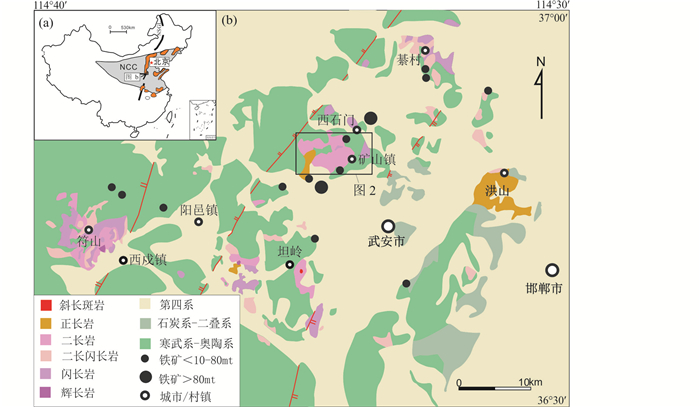
研究区内广泛发育燕山期基性-中性-碱性岩浆岩,总体的出露面积约为350km2,多呈岩株、岩盖小规模产出,受NNE-NE向深大断裂控制分为三个岩浆岩带呈串珠状分布。如图 1所示,自东向西的三个岩浆岩带分别为:东部的碱性洪山杂岩体、中部的中酸性武安杂岩体和西部的基性-中性符山杂岩体。区内岩浆岩的形成时代约为148~120Ma,三个岩浆岩带内均有铁矿床发育,体现了本区岩浆岩与铁矿成矿的密切关系(章百明等,1996;陈永健等,2014)。
|
图 1 华北克拉通燕山期岩浆岩分布简图(a)和研究区区域地质简图(b)(据苏尚国等,2017) Fig. 1 Sketch map showing the distribution of Yanshanian igneous rocks in North China Craton(a) and sketch geological map of study area(b)(after Su et al., 2017) |
位于中部的武安杂岩体规模较大,其主体自北向南由綦村岩体、西石门杂岩体、坦岭杂岩体以及固镇杂岩体4个规模较小的杂岩体组成,各杂岩体呈岩盖、岩株状产出,岩性为一系列中酸性岩(Sun et al., 2014, 2015;Zhang et al., 2015;Liu et al., 2016)。二长闪长岩和二长岩构成了武安杂岩体的主要岩性,颜色多见淡粉色、淡灰色,中细粒结构和似斑状结构共存;杂岩体还发育有闪长岩和正长岩,结构上也有中细粒和似斑状之分,这两种岩性皆可见脉状产出于二长岩之中(Chen et al., 2008;Shen et al., 2013, 2015)。武安杂岩体的不同岩性之间常为渐变过渡,部分岩性之间接触接线截然。杂岩体内部含多种包体,其中围岩捕掳体、片麻质包体和MME最为常见,前两者的具体岩性包括变质石英砂岩、奥陶系灰岩等;MME的大小不一,从小于1cm到大于10cm不等,多为闪长质包体,少数为正长质包体(Li et al., 2013;Li and Santosh, 2014)。
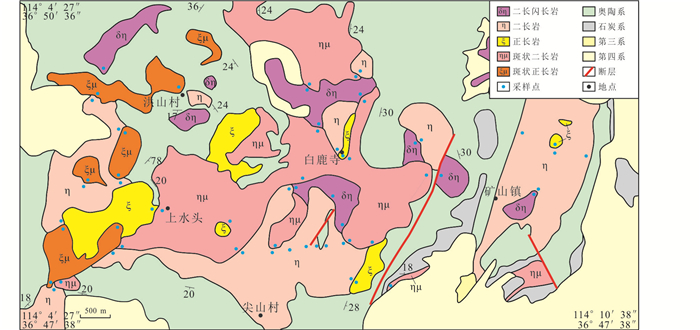
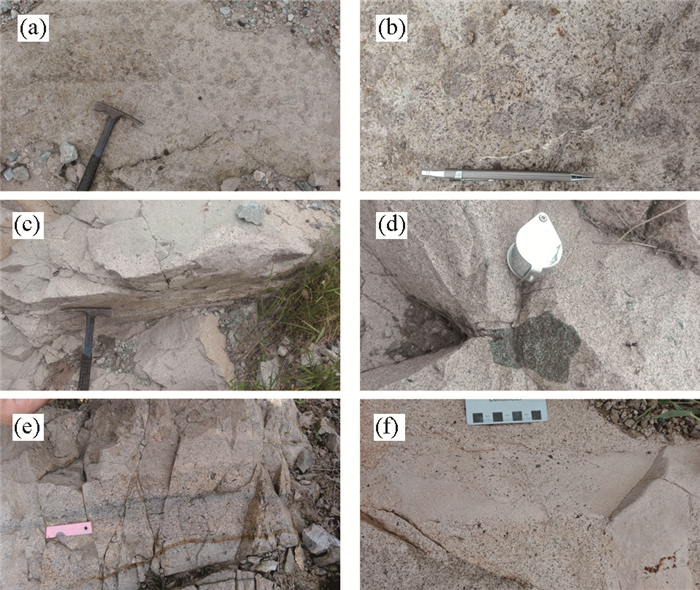
1.2 西石门杂岩体岩相学特征西石门杂岩体是武安杂岩体中出露面积最大、铁矿储量最高的杂岩体,杂岩体呈岩株状产出,此外,岩株旁还可见个别岩墙和小岩体。杂岩体与同属中部岩带的綦村、坦岭等杂岩体共同呈北北东向产出,出露面积约35km2。杂岩体主体的岩性为二长闪长岩-二长岩-正长岩,并被晚期闪长质和长英质脉体穿插,各岩性的地表特征及各侵入岩之间关系见图 2。根据野外调查结果,从岩石结构上,可以清晰地将杂岩体分为具等粒结构的和具不等粒结构的两组组合,且后者切穿前者(图 3e)。不同的结构和清晰的侵入关系,指示了西石门杂岩体显然不是单一岩浆活动所形成的单元。王涛等(2017)将由2个以上年龄基本相同且具有成因联系的单元构成的复式岩基称为岩套(或序列),故本文将西石门杂岩体中被侵入的、具等粒结构的岩性组合定义为早期岩套,将侵入其他岩性的、具不等粒结构的岩性组合定义为晚期岩套。
|
图 2 河北武安市西石门杂岩体地质图 Fig. 2 The geological map of Xishimen Complex in Wuan, Hebei Province |
|
图 3 西石门杂岩体中各侵入体之间的侵入关系 (a、b)二长闪长岩与二长岩不均匀混合;(c)正长岩侵入二长岩;(d)二长岩中的暗色包体;(e)斑状角闪二长岩侵入二长岩,流线发育;(f)正长岩脉侵入斑状角闪正长岩中 Fig. 3 The intrusive relationship of igneous rocks in the Xishimen Complex (a, b)inhomogeneous mixing of monzodiorite and monzonite; (c)syenite intrudes into monzonite; (d)MME in monzonite; (e)porphyry amphibolite monzonite intrudes into monzonite and the linearflowage structure; (f)syenite veins intrudes into porphyry amphibolite syenite |
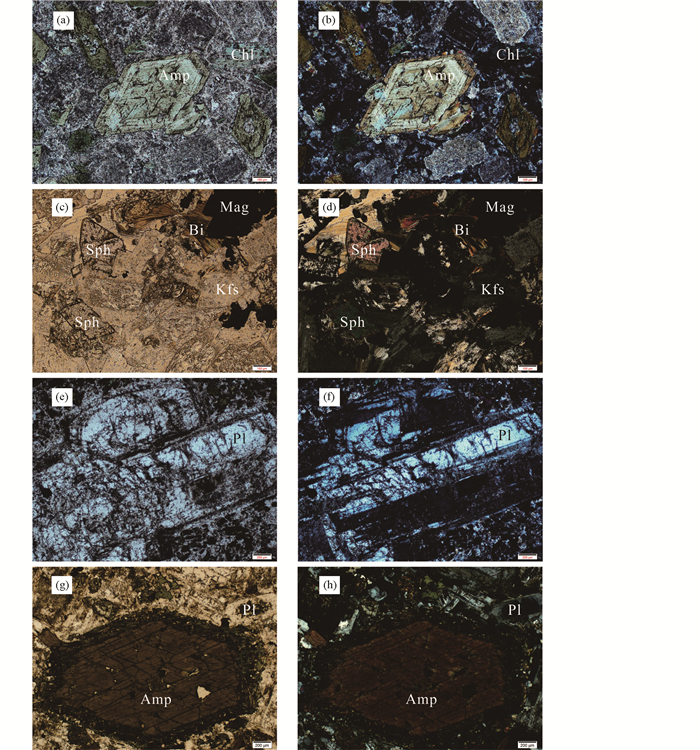
早期岩套为具等粒结构的二长闪长岩-二长岩-正长岩;晚期岩套为以斜长石、角闪石为斑晶的具似斑状结构的斑状二长岩-斑状正长岩,此外还出露正长岩脉体。根据野外地质调查和分析测试结果,后者的侵位时间确实较前者稍晚,杂岩体中广泛发育有岩浆侵入的现象(图 3)。西石门杂岩体中的包体成分复杂,既包括太古代片麻岩和元古代砂岩等包体,也包括先存暗色岩浆岩和极富铁质的岩石。杂岩体的岩相学特征见图 4。
|
图 4 西石门杂岩体各岩体岩相学特征 (a、b)二长闪长岩(样品6077),角闪石晶体发育明显环带;(c、d)二长岩(样品KS0816-1),其中局部轻微富集榍石、磁(钛)铁矿等副矿物;(e、f)斑状斜长二长岩(样品B6298-1),斑晶斜长石边缘发育有微斜长石;(g、h)斑状角闪正长岩(样品TW2832),斑晶角闪石边缘发育了主要成分为黑云母、钠长石、浅闪石和磁铁矿的反应边.矿物缩写:Amp-角闪石;Bi-黑云母;Chl-绿泥石;Kfs-钾长石;Mag-磁铁矿;Pl-斜长石;Sph-榍石 Fig. 4 The petrographs of igneous rocks in Xishimen Complex (a, b)the zoned amphibole crystals in monzodiorite(Sample 6077);(c, d)accessory minerals such as sphalerite and magnetite/titanium are enriched locally in monzonite(Sample KS0816-1);(e, f)the microcline on the margin of porphyry plagioclase crystals in porphyry plagioclase monzonite(Sample B6298-1);(g, h)the reaction edges consist of biotite, albite, endenite and magnetite around the porphyric amphibolite crystals in porphyry amphibolite syenite(Sample TW2832). Minerals abbreviation:Amp-amphibole; Bi- Biotite; Chl- Chlorite; Kfs-k-feldspar; Mag-magnetite; Pl-Plagioclase; Sph-Sphene |
早期岩套的共同特点是具等粒结构,故也可以称为等粒结构岩套,岩性主要包括二长闪长岩、二长岩和正长岩。
二长闪长岩呈深灰色,细粒结构,块状构造。角闪石含量约5%~15%,为浅黄色-褐色,他形粒状,颗粒大小为0.2×0.4mm~0.7×0.8mm,主要成分为韭闪石质普通角闪石和韭闪石,部分颗粒周围见Fe质析出;斜长石含量约50%~60%,呈自形-半自形板状,颗粒大小为0.2×0.4mm~0.6×0.8mm,主要成分为中长石,含有少量拉长石,牌号范围为An31Ab66Or3~An52Ab46Or2。钾长石含量约25%~30%,多呈不规则状形成于斜长石之间,分布不均匀;钛铁氧化物不足1%,粒径多小于0.1mm,零星分布。
二长岩呈灰色,细粒结构,块状构造。角闪石含量约5%~10%,为浅黄色-褐色,他形粒状,颗粒大小为0.3×0.5mm~0.6×0.8mm,主要成分为韭闪石质普通角闪石和浅闪石,部分晶体发育有暗化边结构;斜长石含量约45%~55%,呈自形-半自形板状,颗粒大小为0.4×0.5mm~0.8×1mm,主要成分为中长石,还含有少量奥长石和钙长石,牌号范围为An21Ab78Or1~An51Ab46Or3。钾长石含量约35%~45%,分布也不均匀;钛铁氧化物不足1%,粒径多小于0.1mm,零星分布。
正长岩呈淡红色,中粗粒结构,块状构造,由钾长石、斜长石、石英、角闪石组成,含极少量磁铁矿、磷灰石。钾长石含量约50%~60%,呈半自形板状,颗粒大小为0.1×0.2mm~0.6×0.8mm,主要成分为透长石,牌号范围为An0Ab3Or97~An1Ab27Or72;斜长石含量约25%~35%,呈半柱状结构,颗粒大小为0.2×0.4mm~0.5×0.7mm,主要成分为钠长石,并含有少量奥长石和中长石,牌号范围为An1Ab98Or1~An48Ab51Or1;石英含量约5%,呈他形粒状,颗粒大小为0.1×0.1mm~0.3×0.4mm;角闪石含量约5%,呈半自形长柱状,颗粒大小为0.1×0.1mm~0.3×0.5mm,少部分为他形粒状,正长岩中角闪石的种类范围较广,主要为韭闪石、韭闪石质普通角闪石和浅闪石质普通角闪石,以及少量浅闪石。部分地区的正长岩强烈高岭土化。
1.2.2 晚期岩套岩相学特征晚期岩套的共同特点是具似斑状结构,故也可以称为似斑状结构岩套,岩性主要包括斑状二长岩和斑状正长岩,其中各岩性又因主要斑晶不同具体命名也不同,当以角闪石为主时称为斑状角闪二长岩和斑状角闪正长岩,当以斜长石为主时称为斑状斜长二长岩。
斑状二长岩呈灰白色,似斑状结构,块状构造。斑晶为角闪石、斜长石。角闪石呈长柱状,自形-半自形,颗粒大小为2×3mm~6×10mm,含量约8%~10%,个别见晶体连生,主要成分为韭闪石、含铁韭闪石、韭闪石质普通角闪石、浅闪石质普通角闪石和含铁韭闪石质普通角闪石以及少量的浅闪石,边缘见反应边(图 4g, h),反应边的主要成分为黑云母、钠长石、浅闪石和磁铁矿;斜长石呈板状、粒状,自形-半自形,颗粒大小为2×3mm~5×7mm,含量约2%~8%,主要成分为拉长石、中长石、奥长石和少量钠长石,牌号范围为An6Ab93Or1~An66Ab34Or0。角闪石与斜长石斑晶可以同时存在,两者的相对含量导致岩石名称非常复杂,此研究将所有含斑晶的二长岩全部归为斑状二长岩。基质为显晶质,由辉石、角闪石、钾长石、斜长石、石英和磁铁矿、钛铁物等组成,矿物粒度较细,总体不超过0.8mm。辉石含量约5%~8%,半自形粒状结构;角闪石含量约15%~25%,成分上全部属于硅质浅闪石;石英约5%~10%,他形粒状结构;钾长石含量约25%~30%,半自形-他形,粒状结构,主要成分为透长石;斜长石含量约35%~40%,自形-半自形,粒状结构,主要成分为中长石、钠长石以及少量奥长石、拉长石,牌号范围为An1Ab98Or1~An52Ab44Or3;磁铁矿/钛铁矿约2%,他形粒状结构。岩石整体风化程度弱,但遭受不同程度的钠化改造,蚀变程度一般。
斑状正长岩呈淡红色,似斑状结构,绝大部分斑晶为角闪石,极少出现斜长石斑晶,岩石具块状构造,基质由钾长石、斜长石、石英、角闪石组成,含极少量磁铁矿、磷灰石。角闪石斑晶呈自形长柱状,颗粒大小为0.6×1.5mm~6×10.5mm,含量约10%;极少数呈斑晶状的斜长石粒径可达6×8mm。基质中角闪石呈半自形长柱状,颗粒大小为0.1×0.2mm~0.3×0.5mm,含量约5%。钾长石含量约45%~55%,呈半自形板状,颗粒大小为0.1×0.3mm~0.6×1.0mm;斜长石含量约30%~35%,主要成分为中长石,呈半自形板状,颗粒大小为0.2×0.4mm~0.6×0.8mm;石英含量约5%,呈他形粒状,粒径约0.1~0.2mm。
除上述主要岩性的岩石外,研究区还出露少量正长岩脉切穿上述所有岩性。正长岩脉主体呈淡红色,细粒结构,块状构造,由钾长石、斜长石、石英组成,含少量角闪石,其中部分角闪石呈斑晶状产出,此外还含极少量磁铁矿、磷灰石。钾长石含量约50%~55%,呈半自形板状,颗粒大小为0.1×0.2mm~0.3×0.6mm;斜长石含量约30%~40%,呈半自形板状,颗粒大小为0.1×0.2mm~0.2×0.5mm;石英含量约10%,呈他形粒状,粒径约0.1~0.2mm;角闪石含量约5%,呈半自形长柱状,颗粒大小为0.1×0.1mm~0.1×0.2mm,弱绿泥石化、绿帘石化,部分地区角闪石呈斑晶状,颗粒大小为1.0×1.5mm~8.0×10.5mm,含量可达1%。岩石整体风化蚀变程度较低。含角闪石斑晶的正长岩脉与不含斑晶的正长岩脉之间为过渡关系,前者应当是正长岩脉在前进中较富流体的头部冷凝结晶形成的。
在西石门地区,上述这些岩性之间侵入关系时而明显时而难辨,这可能与它们的侵位年龄非常接近,侵位和冷却时间过于相近而引起的岩浆混合有关,在一些地区也观察到了岩浆混合的现象(霍延安等,2019)。但总体而言具有等粒结构的岩套略早于具似斑状结构的岩套,它们最后共同呈一整体被正长质岩脉穿插(图 3f)。
2 样品及实验分析方法全岩主微量分析测试在河北廊坊市更新地质有限公司完成。除FeO外的主量元素检测标准为GB/T14506.28-2010,使用检测仪器为Axiosmax X射线荧光光谱仪,FeO含量为滴定法测得。全岩微量元素分析采用ICP-MS溶液法分析。详细样品分析过程以及ICP测试条件见Qi et al.(2000)。
全岩Sr-Nd同位素和Pb同位素分析测试在中国地质大学(北京)科学研究院同位素实验室完成。首先称量0.1~0.2g全岩粉末样品,使用混合酸(HF+HNO3+HClO4)溶样,待样品完全溶解后蒸干,加入6mol/L的HCl溶液,将样品转化为氯化物蒸干。再用0.5mol/L HCl溶解,使用Rb-Sr和Sm-Nd交换柱进行元素分离提纯和元素提取。最后用ISOPROBE-T热电离质谱仪完成元素比值测定。Pb同位素详细的分析测试方法见Taylor et al.(2015),标准值自Wu et al.(2017)。
锆石U-Pb分析测试在北京离子探针中心SHRIMP Ⅱ上完成。详细分析方法见Williams(1998)。测试时一次流O2-强度为3~5nA,测试束斑直径为25~30μm。标样为M257(U=840×10-6)和TEM年龄为417Ma(Black et al., 2003),分别用于锆石U含量和年龄校正。试验所得数据的后期处理使用SQUID(Ludwig et al., 2001)和ISOPLOT完成。
锆石Lu-Hf同位素分析测试在内蒙古自治区地质调查院分析测试中心完成。测试仪器为多接收电感耦合等离子体质谱仪(NeptunePlus)和激光剥蚀系统(GeoLasHD193nm)。实验使用载气是He,剥蚀直径为32μm,标准锆石为GJ-1和Plešovice。锆石标样GJ-1的176Hf/177Hf加权平均值为0.282007±0.000025(2σ)。计算εHf(t)值时,采用的Hf同位素标准值为球粒陨石176Lu/177Hf=0.036,176Hf/177Hf=0.283(Blichert-Toft and Albarède,1997);计算地幔模式年龄时,采用的标准为亏损地幔现今值176Hf/177Hf=0.253,176Lu/177Hf=0.038;计算地壳模式年龄则采用176Hf/177Hf=0.015(Griffin et al., 2000)。
单矿物化学成分电子探针分析测试在中国冶金地质总局山东测试中心完成。实验所用的电子探针仪器型号为(JEOL)JXA-8230。测试分析电压、电流和检出角分别为15kV、20nA和40°,分析束斑为1~9μm,使用ZAF法校正。主量元素的峰值积分时间和背景积分时间分别为10s和5s;微量元素的峰值积分时间和背景积分时间分别为20s和10s。实验标准矿物为美国SPI矿物、金属标准以及中国国家标样GSB。
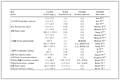
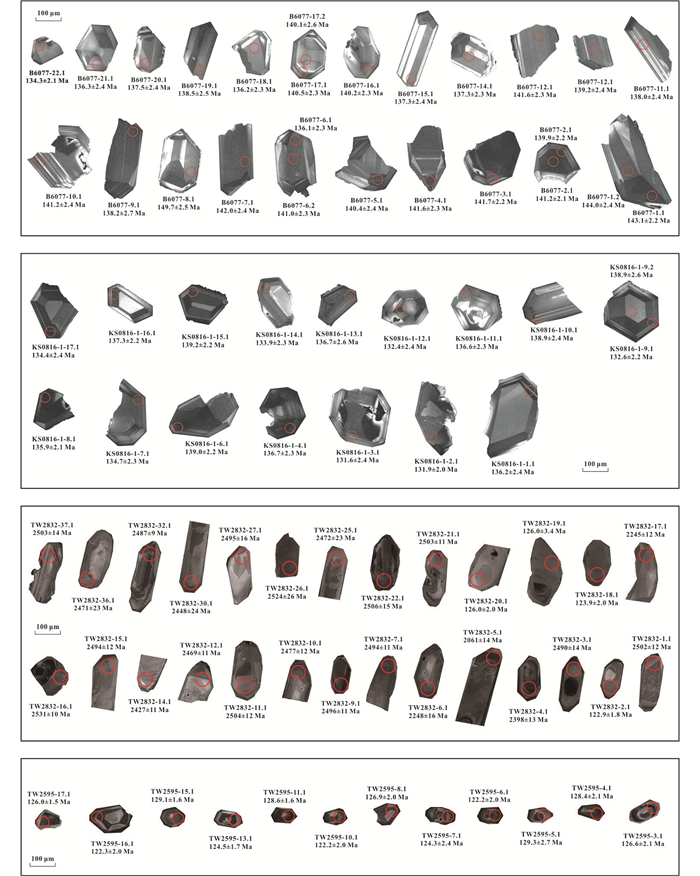
3 西石门杂岩体年代学特征西石门杂岩体的岩性较为复杂,选取其中的样品B6077(二长闪长岩)作为二长闪长岩代表、样品KS0816-1(二长岩)作为二长岩代表、样品TW2595(斑状角闪二长岩)作为斑状二长岩代表、样品TW2832(斑状角闪正长岩)作为斑状正长岩代表进行锆石U-Pb年代学测试。具体的测试结果见表 1,锆石CL图像见图 5,所得的U-Pb协和曲线图见图 6。
|
表 1 西石门杂岩体锆石SHRIMP U-Pb测试结果 Table 1 SHRIMP U-Pb isotope data of the Xishimen Complex |


|
图 5 西石门杂岩体锆石CL图像 Fig. 5 Cathodoluminescence images of zircons in the Xishimen Complex |

|
图 6 西石门杂岩体相关样品的锆石U-Pb协和图 (a)二长闪长岩(样品B6077);(b)二长岩(样品KS0816-1);(c)斑状正长岩(样品TW2832);(d)斑状二长岩(样品TW2595) Fig. 6 U vs. Pb concordia diagrams of zircons in the Xishimen Complex (a)Monzodiorite (Sample B6077);(b)monzolite (Sample KS0816-1);(c)porphyry syenite (Sample TW2832;(d)porphyry monzonite (Sample TW2595) |
根据镜下观察和测试结果,相关样品中的锆石可以分为3类。第一类锆石发育较明的显震荡环带,呈半自形-自形粒状、短柱状、长柱状,长轴长多不超过100μm,Th/U值较高(0.57~4.86),总体具有源生岩浆锆石的特征;第二类锆石Pb丢失严重,呈他形粒状,在CL图像下呈现出明显的元素交换通道和交代增生边,这一类锆石受后期热液改造蚀变强烈,改造之前的特征已不明显;第三类锆石也发育了较明显的震荡环带,但呈现出他形-半自形椭球状,粒度较第一类锆石明显增大,多数大于50×120μm,Th/U值较低(0.09~0.85),这一部分锆石属于捕获锆石或继承锆石。
3.1 早期岩套锆石SHRIMP U-Pb年代学从二长闪长岩获取了22颗锆石共26个数据点,都属于岩浆锆石,所获得的206Pb/238U平均加权年龄为139.52±0.92Ma(MSWD=1.10),代表了二长闪长岩的侵位年龄。从二长岩获取了17颗锆石共17个数据点,都属于岩浆锆石,所获得的206Pb/238U平均加权年龄为135.6±1.1Ma(MSWD=1.3),代表了二长岩的侵位年龄。根据霍延安等(2019)研究,在与西石门杂岩体紧邻的固镇杂岩体中正长岩的206Pb/238U平均加权年龄为131.7±1.2Ma(MSWD=1.2),同时还存在大量2300~2700Ma的捕获和继承锆石,前者代表了正长岩的侵位年龄。从二长闪长岩-二长岩-正长岩岩石年龄逐渐变小,这与中酸性岩浆的演化过程是一致的,暗示西石门杂岩体中由不同岩性组成的早期岩套可能具有一定程度的同源性。但在后续研究中,对来自西石门杂岩体和邻近的坦岭、固镇等杂岩体的多个二长闪长岩和二长岩样品进行过多次多种手段的测年分析,都未能从中找到年龄较大的捕获或继承锆石,又暗示了正长岩源区可能与二长闪长岩-二长岩源区不一致。
3.2 晚期岩套锆石SHRIMP U-Pb年代学从斑状二长岩获取了27颗锆石共27个数据点,其中有4颗锆石的206Pb/238U年龄较小,平均加权年龄为124.4±2.1Ma(MSWD=0.53),该年龄与西石门杂岩体其他岩性的年龄在误差范围内有连续性,应当是斑状正长岩侵位的真正年龄;其余锆石年龄较大,都属于捕获或继承锆石,且同样集中在约2400~2600Ma的范围内,故同样使用207Pb/206Pb年龄标记这部分锆石的年龄。从斑状正长岩获取了12颗锆石共12个数据点,都属于岩浆锆石,所获得的206Pb/238U平均加权年龄为126.1±1.6Ma(MSWD=1.8),代表了斑状正长岩的侵位年龄。此外,在邻区坦岭杂岩体的斑状二长岩-斑状正长岩中都发现了大量年龄约2000~2600Ma的继承和捕获锆石(刘璐璐等, 2017, 2019),指示晚期岩套各岩性源区具有相似性,即同样都有古老的陆壳基底参与。与早期岩套的年龄139.52±0.92Ma~131.7±1.2Ma相比,晚期岩套的年龄126.1±1.6Ma~124.4±2.1Ma总体较小。
4 西石门杂岩体地球化学特征 4.1 主量元素地球化学特征西石门杂岩体各岩性的主量元素测试结果见表 2所示。如图 7中所示,杂岩体岩性总体为一套二长闪长岩-二长岩-正长岩的岩石组合,根据TAS分区对野外地质调查中不易区分的二长闪长岩和二长岩进行区分,但二长岩与正长岩、斑状二长岩与斑状正长岩主要依靠镜下观察鉴别命名。
|
|
表 2 西石门杂岩体岩全岩主量元素(wt%)和微量元素(×10-6)分析测试结果 Table 2 Contents of major(wt%) and trace(×10-6)elements of the Xishimen Complex |

|
图 7 西石门杂岩体TAS图解(底图据Wilson,1989) (1)橄榄辉长岩;(2)辉长岩;(3)辉长闪长岩;(4)闪长岩;(5)花岗闪长岩;(6)花岗岩;(7)副长石辉长岩;(8)二长辉长岩;(9)二长闪长岩;(10)二长岩;(11/15)正长岩;(12)副长石岩;(13)副长石二长闪长岩;(14)副长石二长正长岩;(16)副长石正长岩 Fig. 7 TAS diagram of the Xishimen Complex(after Wilson, 1989) (1)olivine gabbro; (2)gabbro; (3)gabbro diorite; (4)diorite; (5)granodiorite; (6)granite; (7)parafeldspar gabbro; (8)monzogabbro; (9)monzodiorite; (10)monzolite; (11/15)syenite; (12)parafeldspar diorite; (13)parafeldspar monzonite; (14)parafeldspar syenite; (16)parafeldspar syenite |
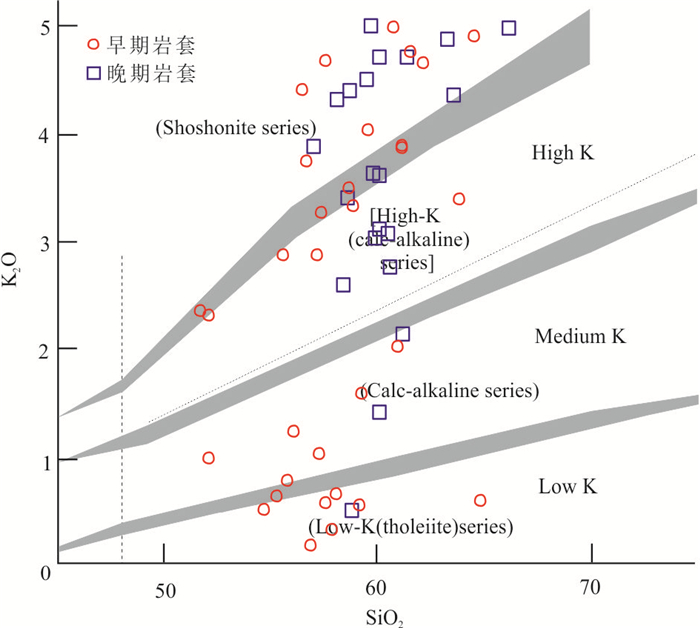
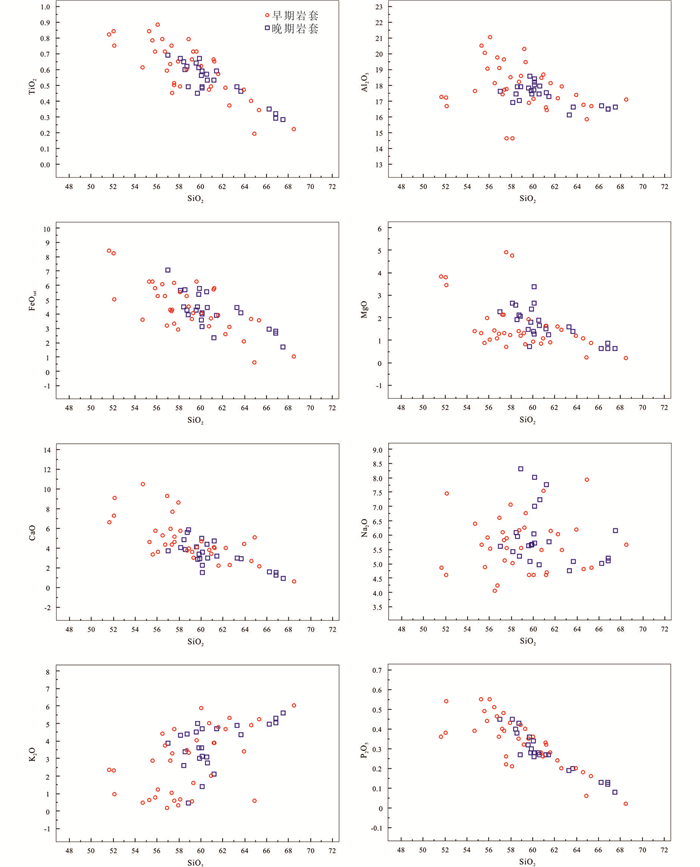
杂岩体中晚期岩套的酸性程度较早期岩套的酸性程度稍高,晚期岩套的SiO2含量范围为57.00%~67.51%,MgO含量范围为0.61%~3.37%,(Na2O+K2O)含量范围为8.02%~11.75%(图 8),A/CNK范围为0.72~1.05;早期岩套的SiO2含量范围为51.72%~68.56%,MgO含量范围为0.17%~4.88%,(Na2O+K2O)含量范围为5.62%~11.65%,A/CNK范围为0.56~1.24。在哈克图解(图 9)中,除了Na2O、K2O外,两个岩套都表现出相似的相关性和较连续的岩浆分离结晶演化过程,指示由不同岩性组成的西石门杂岩体具有一定的同源性,同时较低的MgO含量指示成岩岩浆主体来源于地壳物质。
|
图 8 西石门杂岩体SiO2-K2O图解(底图据Miller et al., 1999) Fig. 8 The SiO2 vs. K2O diagram of the Xishimen Complex(after Miller et al., 1999) |
|
图 9 西石门杂岩体主量元素哈克图解 Fig. 9 The Harker diagrams of the Xishimen Complex |
值得一提的是,西石门杂岩体中Na2O、K2O含量的异常与区域内普遍遭受的钠化和钾化蚀变作用有关。钠化、钾化作用在露头上表现为岩石颜色发白,在镜下表现为斜长石斑晶普遍钠长石化、绢云母化,角闪石斑晶普遍绿帘石化、黑云母化。钠化和钾化蚀变导致整个杂岩体全碱含量升高,但由于未在岩石中发现碱性矿物共生组合,故不能将杂岩体定义为碱性杂岩体。此外,钾化蚀变还会导致杂岩体整体钾质含量升高,使杂岩体显示出了目前如高钾钙碱性岩石系列一样的地球化学特征,部分样品甚至出现了钾玄岩系列的地球化学特征(图 8),但钾化作用的具体程度难以模拟,在研究杂岩体来源和演化时须谨慎。
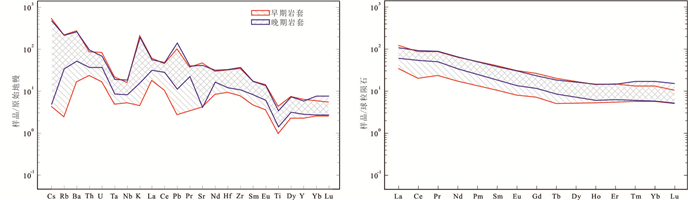
4.2 微量元素地球化学特征西石门杂岩体各岩性的微量元素测试结果见表 2所示,不同岩套不同岩性所得的稀土和微量元素配分图(图 10)具有相似的特征。在稀土元素配分图中,整个杂岩体总体表现出轻微右倾性的轻稀土富集的特征,ΣREE为62.76×10⁻⁶~212.5×10⁻⁶,(La/Yb)N值为3.34~16.56,不仅各岩性之间稀土元素的配分没有很大差异,在早期岩套和晚期岩套之间元素配分也没有很大差异:早期岩套的ΣREE为62.76×10-6~217.5×10-6,(La/Yb)N值为3.34~11.25,晚期岩套的ΣREE为137.5×10-6~214.7×10-6,(La/Yb)N值为5.12~16.56;这种相似性暗示了两者的同源性。大部分样品中Eu异常表现得不明显,为0.69~1.34,仅个别样品δEu低至0.48,这既可能指示形成杂岩体的岩浆未经过斜长石的结晶分异过程,也可能仅仅指示岩浆上侵时氧逸度较高。杂岩体整体Sr/Y值较低,早期岩套中绝大多数样品的Sr/Y值范围为7.75~38.33,仅有2个样品的Sr/Y值较高为52.19~65.49;晚期岩套中绝大多数样品的Sr/Y值范围为3.22~48.2,仅有1个样品Sr/Y值较高为59.74。在微量元素配分图解中,不同岩性的岩石都明显亏损Ta、Nb、Ti,轻微亏损Y,轻微富集Ba,显示了壳源物质与岩浆源区具有一定程度的联系。
|
图 10 西石门杂岩体原始地幔标准化微量元素蛛网图(标准化值据McDonough and Sun, 1995)和球粒陨石标准化稀土元素配分图(标准化值据Sun and McDonough, 1989) Fig. 10 Primitive mantle-normalized trace element spider diagrams (normalization values after McDonough and Sun, 1995) and Chondrite-normalized REE patterns (normalization values after Sun and McDonough, 1989) of Xishimen Complex |
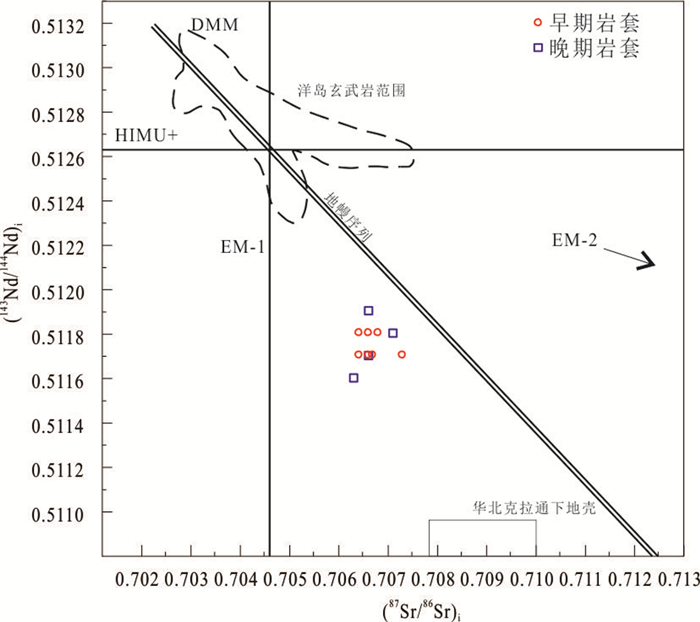
西石门杂岩体的全岩Sr-Nd同位素数据结果见表 3,相关图解见图 11。根据不同岩性分别使用相应的代表年龄进行计算,结果显示西石门杂岩体总体(87Sr/86Sr)i范围较低且集中,为0.7063~0.7073,其中晚期岩套的(87Sr/86Sr)i为0.7063~0.7071,早期岩套的(87Sr/86Sr)i为0.7064~0.7073,总体较前者略高。(143Nd/144Nd)i总体范围较窄为0.5116~0.5118,εNd(t)的范围为-12.7738~-18.0488,其中晚期岩套的εNd(t)为-18.0488~-12.7738,早期岩套的εNd(t)为-16.9346~-14.9763,变化范围较前者稍小。
|
|
表 3 西石门杂岩体Sr、Nd同位素数据 Table 3 Sr, Nd isotope data of the Xishimen Complex |


|
图 11 西石门杂岩体(87Sr/86Sr)i-(143Nd/144Nd)i图解(底图据Zindler and Hart, 1986) 华北克拉通下地壳数据引自Jahn et al., 1999 Fig. 11 (87Sr/86Sr)i vs.(143Nd/144Nd)i correlation diagram of the Xishimen Complex(after Zindler and Hart, 1986) Data of lower crust of North China Craton from Jahn et al., 1999 |
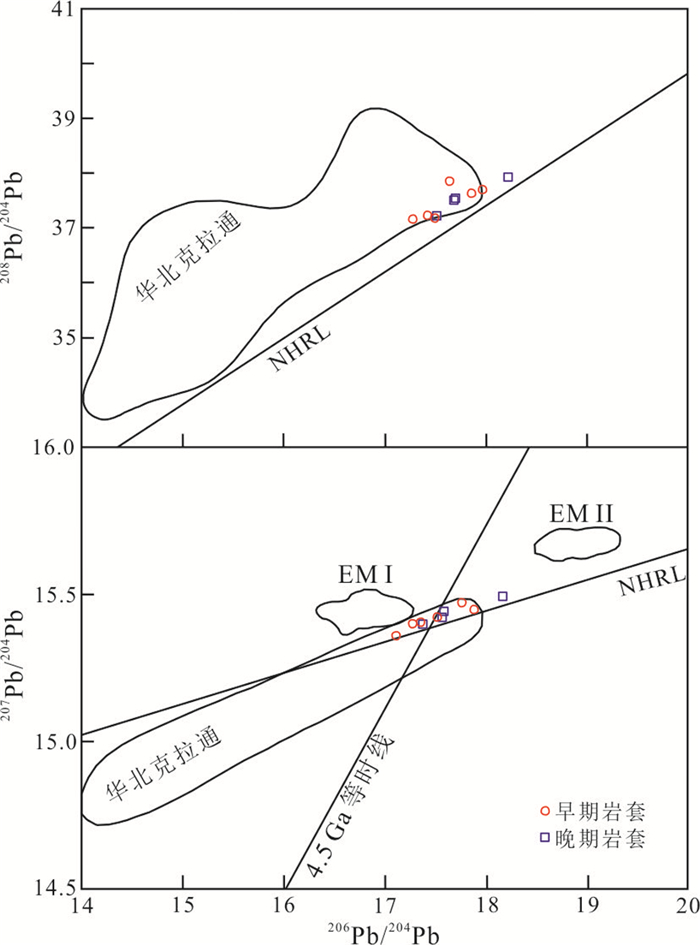
西石门杂岩体的全岩Pb同位素测试结果见表 4,相关图解见图 12。同样地,不论是早期岩套还是晚期岩套,Pb同位素比值变化范围都较窄,其中206Pb/204Pb范围为17.1204~18.1739,207Pb/204Pb范围为15.3609~15.4940,208Pb/204Pb范围为37.4326~38.2946。
|
|
表 4 西石门杂岩体的Pb同位素数据 Table 4 Pb isotope data of Xishimen Complex |
|
图 12 西石门杂岩体208Pb/204Pb-206Pb/204Pb和207Pb/204Pb-206Pb/204Pb图解(底图据Zindler and Hart, 1986) 华北克拉通数据引自Ying et al., 2010 Fig. 12 208Pb/204Pb vs. 206Pb/204Pb and 207Pb/204Pb vs. 206Pb/204Pb correlation diagrams of the Xishimen Complex(after Zindler and Hart, 1986) Data of North China Craton from Ying et al., 2010 |
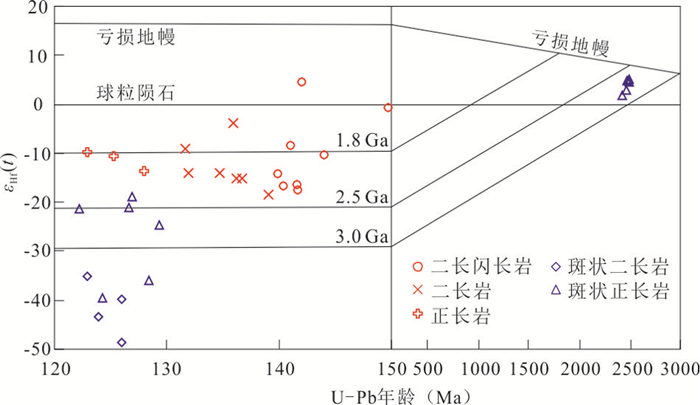
对已经获得U-Pb年龄的部分锆石样品进行了进一步的Hf同位素原位测试,获得的结果如表 5和图 13所示。对于年龄较小的锆石样品,使用206P/238U年龄计算;对于年龄较大的锆石样品,使用207Pb/206Pb年龄计算。由于西石门杂岩体的正长岩中未能发现岩浆锆石,故采用了邻区固镇杂岩体的正长岩(样品ZZ0726-2)数据作为分析样本。
|
|
表 5 西石门杂岩体锆石Hf同位素测试结果 Table 5 Zircon Hf isotopes of the Xishimen Complex |
|
图 13 西石门杂岩体锆石Hf同位素同位素特征 Fig. 13 Zircon Hf isotope characteristics of the Xishimen Complex |
二长闪长岩中锆石的176Hf/177Hf范围为0.282196~0.2828240,计算获得εHf(t)=-17.5~4.7,tDM1=1577~730Ma,tDM2=2597~957Ma。二长岩中锆石的176Hf/177Hf范围为0.282171~0.282602,计算获得εHf(t)=-18.4~-3.6,tDM1=1580~1068Ma,tDM2=2672~1557Ma。正长岩中锆石的176Hf/177Hf范围为0.282317~0.282429,计算获得εHf(t)=-13.5~-9.8,tDM1=1289~1398Ma,tDM2=2008~2301Ma。斑状二长岩中较年轻锆石的176Hf/177Hf范围为0.281322~0.281703,计算获得εHf(t)=-48.6~-35.2,tDM1=2644~2171Ma,tDM2=4866~3890Ma;年龄较大锆石的176Hf/177Hf范围为0.281303~0.281370,计算获得εHf(t)=1.9~5.1,tDM1=2677~2600Ma,tDM2=2888~2708Ma。斑状正长岩中锆石176Hf/177Hf范围为0.281576~0.282161,计算获得εHf(t)=-36.6~-19.0,tDM1=2324~1585Ma,tDM2=4216~2708Ma。
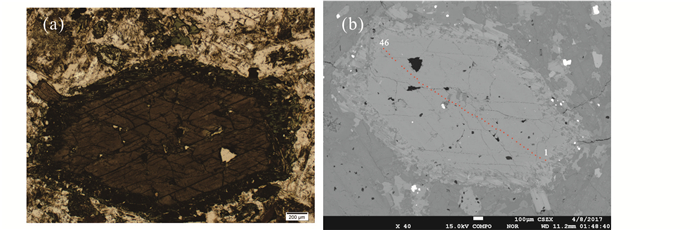
5 西石门杂岩体中的角闪石研究西石门杂岩体各岩性中普遍发育有角闪石。在早期岩套中,角闪石晶体与其他造岩矿物粒度差异有限,总体表现为平衡结晶的关系。在晚期岩套中,角闪石晶体可呈斑晶状产出,这些斑状角闪石往往保留有较好的环带(图 14),显然是早期岩浆房的产物,同时在基质中也有大量粒度较小但与周围造岩矿物呈平衡结晶关系的角闪石晶体。总之,广泛发育的角闪石为直接研究岩体的演化和侵位提供了良好的研究对象(Leake et al., 1997)。为了反演杂岩体的侵位过程,基于Ridolfi et al.(2010)的角闪石单矿物温压计对角闪石结晶的平衡温度、压力条件进行估算,该温压计对估算火成岩中的角闪石形成条件具有广泛的适应性。根据西石门杂岩体中角闪石的电子探针分析测试结果,计算所得的角闪石平衡结晶环境如表 6、图 15所示。
|
图 14 斑状角闪二长岩中的斑晶角闪石 (a)样品PM3-3b1中编号为1的角闪石斑晶,单偏镜照片;(b)同一颗角闪石斑晶的背散射照片,照片中红点表示电子探针测点位置,数字表示测点号.测试结果见表 6 Fig. 14 Porphyry amphibole in porphyry amphibole monzonite (a)monopolarized micrograph of No. 1 amphibole phenocryst in Sample PM3-3b1;(b)backscattered micrograph of the same amphibole phenocryst, red dots in the photo indicate the location of the electron probe, and the numbers indicate the series of measurement. The results are shown in Table 6 |
|
|
表 6 西石门杂岩体角闪石元素含量(wt%)及形成环境计算结果 Table 6 Chemical composition(wt%) and forming condition of hornblende from the Xishimen elements |
|
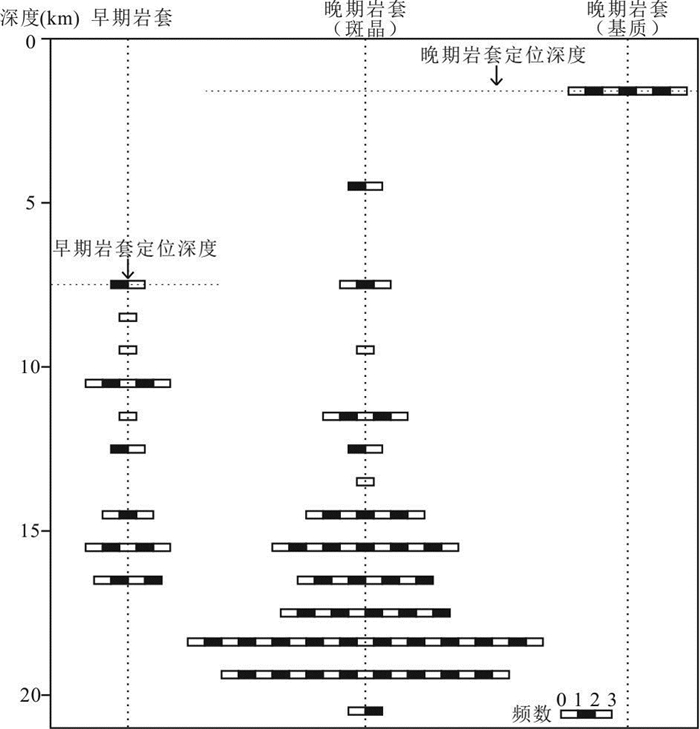
图 15 西石门杂岩体角闪石结晶深度频数统计图 Fig. 15 The histogram of the crystallization depth of amphibole in the Xishimen Complex |
早期岩套中的角闪石在Ridolfi et al. (2010)分类中属于镁质普通角闪石和镁质绿钠闪石。根据计算,可以归纳出早期岩套中角闪石主要集中形成于两个物理化学环境下:①温度较高、压力较大、氧逸度较高、平衡融体含水量也较高,即T=942.22~970.47℃、P=372.05~442.57MPa、lg(fO2)=-10.47~-10.06、H2Omelt=4.84%~6.52%,指示的形成深度为14.05~16.71km;②温度较低、压力较低、氧逸度较低、平衡融体含水量也较低,即T=883.66~940.51℃、P=194.95~339.04MPa、lg(fO2)=-11.34~-9.94、H2Omelt=3.33%~5.42%,指示的形成深度为7.36~12.80km。同一岩性中记录的两个物理化学环境,指示了岩浆上侵过程中经历了多个大规模结晶阶段,即岩浆曾在多级岩浆房中停留的阶段,而后者(环境②)可能指示了早期岩套的最终定位环境。
5.2 晚期岩套中的角闪石晚期岩套中的斑晶角闪石在Ridofli et al. (2010)分类中属于镁质普通角闪石、镁质绿钠闪石和钙镁质韭闪石。根据计算,可以归纳出晚期岩套中的斑晶角闪石主要集中形成于3个物理化学环境下:③温度较高、压力较大、氧逸度较高、平衡融体含水量也较高,即T=933.24~985.60℃、P=375.75~553.87MPa、lg(fO2)=-11.50~-9.87、H2Omelt=4.34%~7.57%,指示的形成深度为14.19~20.92 km,这个环境条件与早期岩套中角闪石集中形成的环境①相似;④温度中等、压力中等、氧逸度中等、平衡融体含水量也中等,即T=872.35~935.12℃、P=191.80~349.24MPa、lg(fO2)=-12.15~-9.87、H2Omelt=3.74%~5.84%,指示的形成深度为7.24~13.19km,这个环境条件与早期岩套中角闪石集中形成的环境②相似;⑤温度较低、压力较小、氧逸度较低、平衡融体含水量也较低,即T=819.24~820.65℃、P=108.06~111.00MPa、lg(fO2)=-12.52~-12.35、H2Omelt=3.10%~3.23%,指示的形成深度为4.08~4.19km,这个环境条件与早期岩套中角闪石集中形成的环境无法对应。晚期岩套斑晶角闪石中记录的3个角闪石集中形成环境都可以与早期岩套中角闪石记录的环境大致对应,前者的高温、高压、高氧、富水环境(环境③)和中温、中压、中氧、含水环境较(环境④)后者的范围略宽。
晚期岩套中的基质角闪石在Ridofli et al. (2010)分类中以镁质绿钠闪石为主。斑状角闪二长岩中基质角闪石的成分范围较集中,这可能是岩浆冷却时快速结晶的结果。根据计算,斑状角闪二长岩中的基质角闪石的主要集中形成于一个物理化学环境下:⑥温度较低、压力较低、氧逸度较低、平衡融体含水量也较低,即T=642.34~700.47℃、P=26.81~40.72MPa、lg(fO2)=-14.97~-13.63、H2Omelt=1.75%~3.62%,指示的形成深度为1.01~1.54km。晚期岩套基质角闪石中记录的低温、低压、低氧、低水环境(环境⑥)代表了杂岩体整体最后定位的环境,指示杂岩体最终定位于浅成部位。
所有角闪石测点的深度频数统计图如图 15所示。不同岩性中相同的角闪石集中形成环境的记录,指示整个西石门杂岩体经历了复杂而又相似的岩浆演化定位过程。
6 讨论 6.1 岩浆侵位时间西石门杂岩体的岩性复杂,根据TAS图解对杂岩体的岩性进行了分类(图 7),其主要为二长闪长岩、二长岩和正长岩。同时根据野外地质调查的结果,杂岩体中即使是相同的岩性也存在很大的结构差异,故可再根据杂岩体的结构,将其细分为具等粒结构的二长闪长岩、二长岩、正长岩及具似斑状结构的斑状二长闪长岩和斑状二长岩,这些岩性之间具有或明或暗的接触关系(图 3),总体而言具有相同结构的岩性之间的侵入接触关系比具不同结构的岩性之间的关系更难以判断,且具似斑状结构的岩石较具等粒结构的岩石侵位时间稍晚,即如前所述的晚期岩套确实晚于早期岩套。
精确的锆石SHRIMP U-Pb测试结果也与上述野外地质现象相符合。杂岩体中二长闪长岩年龄为139.52±0.92Ma,二长岩年龄为135.6±1.1Ma,正长岩年龄为131.7±1.2Ma,它们共同组成了早期岩套,并表现出了随着岩浆酸性程度增加年龄变小的趋势。斑状二长岩年龄为126.1±1.6Ma,斑状正长岩年龄为124.4±2.1Ma,它们组成了晚期岩套,并同样地表现出了随着岩浆酸性程度增加年龄变小的趋势,晚期岩套中还保留有大量年龄大于2000Ma的捕获和继承锆石。由此得出,西石门杂岩体中,早期岩套的侵位时间为139.52±0.92Ma~131.7±1.2Ma,平均年龄为135.6Ma,晚期岩套的侵位时间为126.1±1.6Ma~124.4±2.1Ma,平均年龄为125.3Ma。西石门杂岩体的整体侵位时间为139.52±0.92Ma~124.4±2.1Ma,这与华北克拉通东部岩浆活动到达顶峰的时间一致(Griffin et al., 1998;朱日祥等,2012;Li et al., 2012;Jin et al., 2015;Niu,2015)。
值得注意的是,尽管早期岩套与晚期岩套具有明显不同的结构,但它们在主量元素、微量元素或Sr-Nd、Pb和锆石Hf同位素测试结果中,均没有表现出特别明显的差异,相反却都表现出了相近的岩浆演化关系和一定程度的同源性。
6.2 岩浆的源区和演化有关华北克拉通早白垩世壳幔相互作用的引发机制一直广受争议,但不论是拆沉引发抑或是俯冲板片、地幔对流失稳等引发,在这一时期内华北克拉通减薄以及在自山西至山东约1000km、500000km2的范围内留下了大量的火成岩体是不争的事实,而且这些火成岩体或多或少都经历了壳幔相互作用(赵越,2004;Parfenov et al., 2011;Wang et al., 2011)。由于仅在晚期岩套中发现了捕获和继承锆石,可以假设其总体来源与早期岩套不同,显然是以古老的壳源物质为基础,并且可能代表了新一次深部岩浆(热)事件或构造运动。换句话说,在早期岩套已经侵位成为固结或半固结状态之后,新形成的晚期岩浆才开始侵入,它们两者可能难以发生岩浆混合作用。
在(87Sr/86Sr)i-(143Nd/144Nd)i图解(图 11)中,西石门杂岩体的早期岩套和晚期岩套几乎重叠在一起,都落在了EMI型地幔与华北下地壳之间,故合理的推论是这两个岩套的岩浆源区都是来自EMI型地幔与华北下地壳的混合,即西石门杂岩体两期岩浆活动的源区都是来自EMI型地幔与华北下地壳的混合。另一方面,在208Pb/204Pb-206Pb/204Pb和207Pb/204Pb-206Pb/204Pb图解(图 12)中,西石门杂岩体中绝大部分的样品却都落在了华北克拉通范围内,两种同位素的结果出现了矛盾。上述壳幔物质混合成岩的推论与杂岩体中SiO2(51.20%~68.56%)、MgO(0.17%~4.88%)、Cr(大部分为2.08×10⁻⁶~37.4×10⁻⁶)、Ni(大部分为0.88×10⁻⁶~37.4×10⁻⁶)含量较低,富集LREE、亏损HFSE以及(87Sr/86Sr)i较高(0.7063~0.7073)、(143Nd/144Nd)i较低(0.5116~0.5118)的情况是一致的。
结合西石门杂岩体中各岩性的侵位形成时机以及捕获或继承锆石的产出情况,可以假设在约139.52~131.7Ma时,壳源物质参与杂岩体的组建的程度有限,杂岩体的主要物质来源仍然是富集地幔;直到约126.1~124.4Ma时,壳源物质才更直接地大量参与了杂岩体的组建,并在晚期岩套中留下了大量的捕获或继承锆石。但是,这样的假设与上文中西石门杂岩体中两套岩套源区一致的推论相矛盾,因为壳源物质参与程度的不同必然导致各岩性的同位素组成出现差异,特别是在先形成的以二长闪长岩-二长岩-正长岩为主的早期岩套与后形成的以斑状二长闪长岩-斑状正长岩为主的晚期岩套之间,然而这种差异并未在同位素组成中体现出来。
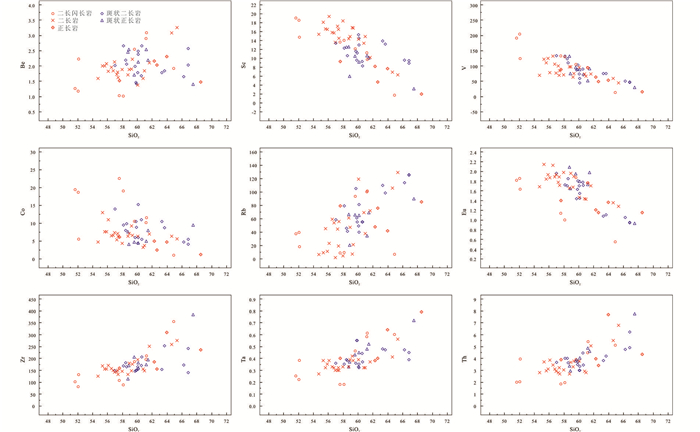
故一个更为合理的解释是,西石门杂岩体中同位素的组成不能指示成岩物质来源于典型EMI型地幔与华北克拉通下地壳混合,同时在晚期岩套中才出现的大量捕获和继承锆石也不能指示华北克拉通下地壳物质直接大量参与了杂岩体的组装。杂岩体实际上的岩浆源区的地球化学特征应当介于典型EMI型地幔与华北克拉通下地壳之间一个较狭窄的区域,譬如白垩纪富集岩石圈地幔、大别山白垩纪花岗岩、华北克拉通埃达克岩(Chen et al., 2013)等理论端元,这个区域的形成可能与华北克拉通自中生代以来长期遭受多方向的碰撞挤压和俯冲有关(Nie et al., 1990;Ren et al., 2002;Oxman,2003;Zhou and Li, 2017;郑永飞等,2018)。在这个狭窄的区域内,壳幔物质趋于混合均匀,但在外界物理化学条件变化(如俯冲板片脱水、岩石圈拆沉后上弹等)时,不同端元仍会发生部分熔融,先形成了二长闪长质-二长质岩浆,并因源区石榴子石的存在在演化时富集LREE、亏损HFSE。这个演化过程在SiO2-微量元素图解(图 16)中,表现为在二长闪长岩-二长岩中,SiO2与Sc和V都表现出了连续的负相关性,指示二长岩应当是二长闪长岩岩浆演化的结果。而尽管正长质岩石也表现出了SiO2与Sc和V的负相关性,但它与二长闪长岩-二长岩的SiO2含量并不连续,同样指示正长质岩石来源与二长闪长岩-二长岩不同。在上述整个过程中,尽管不同岩浆活动时部分熔融程度不同,但半封闭岩石圈地幔环境内同位素组成范围已经较小,因此就算各端元部分熔融程度差别很大,也不会对所产生岩浆的同位素组成造成显著的影响。由此可以在相近的地质年代中于同一区域内形成仅在晚期岩套中包含大量捕获和继承锆石,而在其他具相近同位素组成的中酸性岩石中没有捕获或继承锆石的现象。
|
图 16 西石门杂岩体SiO2-微量元素图解 Fig. 16 SiO2 vs. minor elements diagrams of the Xishimen Complex |
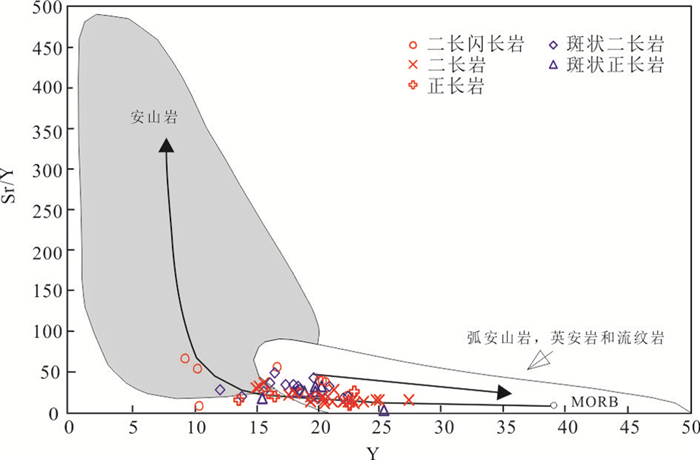
邓晋福等(2004)指出,地幔橄榄岩的局部熔融只能产生玄武岩,在含水条件下只能产生拉斑玄武岩或高镁闪长岩,即钙碱性安山岩岩浆不能直接来源于地幔橄榄岩,并进一步指出,钙碱性安山岩岩浆的来源与榴辉岩,即加厚陆壳相关。值得注意的是在所有的西石门杂岩体样品中,有两件二长闪长岩样品B6872和B6872-2显示出了较明显的低SiO2(57.64%~58.14%)、富Cr(208×10-6~223×10-6)、富Ni(54.5×10⁻⁶~63.3×10⁻⁶)、较高Sr/Y比(52.19~65.49),同时低MgO(4.74%~4.88%)、轻微富集轻稀土元素((La/Yb)N=7.33~7.43)的特征(图 17)。与此同时,不论是在早期岩套还是在晚期岩套中,都未出现明显的负Eu异常,这标志着一个加厚陆壳的存在(邓晋福等,1996)。但它们与一般由板片俯冲产生的埃达克岩特征相比,更加富K2O、87Sr/86Sr>0.704,这些特征都与一般的埃达克岩不符,而与“C型埃达克岩”(张旗等,2001)更接近,暗示西石门杂岩体中早期岩套与晚期岩套都可能与区域内太平洋板片的俯冲关联较弱,它们应当是陆内岩浆作用的产物,是软流圈地幔上侵到加厚陆壳底部导致岩石圈底部基性岩部分熔融形成的。陆内岩浆作用的开始时间早于早期岩套的定位时间139.5Ma,所产生的二长闪长质岩浆在中途岩浆房发生了些许的辉石和角闪石结晶分异从而形成了二长质岩浆,这些二长质岩浆断续灌入西石门杂岩体中,从而形成了现在在露头尺度上或明或暗的接触关系。直到约126.1Ma时,另一次强烈的地质运动才产生了晚期岩套。
|
图 17 西石门杂岩体Y-Sr/Y图解(底图据Defant and Drummond, 1990) Fig. 17 Y vs. Sr/Y diagram of Xishimen Complex(after Defant and Drummond, 1990) |
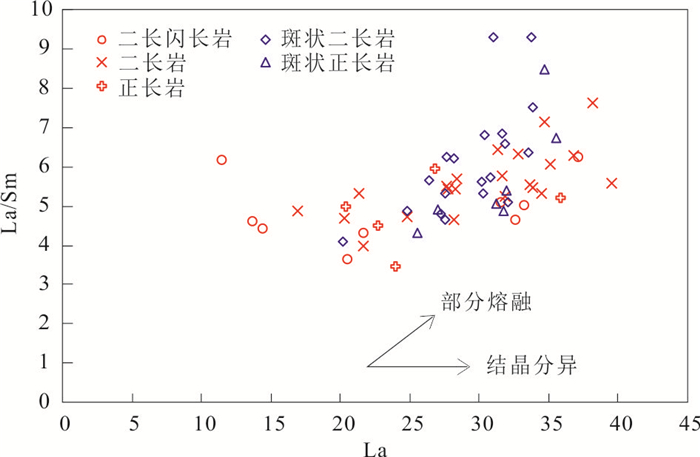
La-La/Sm图解常用于判别岩浆之间的演化关系(韩吟文和马振东,2003),在西石门杂岩体的La-La/Sm图解(图 18)中,早期岩套和晚期岩套都分别表现出了明显的与部分熔融相关的倾斜趋势,指示西石门杂岩体中不同的岩浆成分与部分熔融程度关系更紧密,且其中早期岩套整体趋势较晚期岩套平坦,可能指示早期岩套的分离结晶程度较晚期岩套稍高。根据哈克图解(图 9),早期岩套中CaO、TiO2、MgO、FeOT和P2O5都随SiO2降低,这可能指示早期岩套不仅发生了辉石和角闪石的结晶分异,还发生了钛铁矿和磷灰石的分异。
|
图 18 西石门杂岩体La-La/Sm图解 Fig. 18 La vs. La/Sm diagram of Xishimen Complex |
西石门杂岩体中一个显而易见的“矛盾”在于,具有相同成分、相近源区和相似岩浆演化过程的多期中酸性岩浆在西石门这同一个区域内产出了两种结构不同的岩套——具等粒结构的早期岩套和具似斑状结构的晚期岩套。一般而言,控制岩浆岩不同结构的关键因素在于岩浆就位时的“过冷度”,即岩浆侵入就位的过程中岩浆温度与围岩温度的差(Burgisser and Bergantz, 2011)。
在西石门地区的各类岩石中普遍发育有角闪石,根据角闪石形成的物理化学环境判断,形成西石门杂岩体的多源岩浆都经历了多个中途侵位结晶阶段。在早期岩套中,角闪石的大量晶出集中在①T=942.22~970.47℃、P=372.05~442.57MPa和②T=883.66~940.51℃、P=194.95~339.04MPa两个环境中,根据计算所得到的深度分别为14.05~16.71km和7.36~12.80km两处,前者指示了早期岩套岩浆上侵过程中中途经历的深部岩浆房,后者则指示了早期岩套最终的定位深度,即7.36km的中深部。在晚期岩套中,角闪石的大量晶出主要集中在③T=933.24~985.60℃、P=375.75~553.87MPa,④T=872.35~935.12℃、P=191.80~349.24MPa和⑤T=642.34~820.65℃、P=26.81~111.00MPa三个环境中,根据计算所得到的深度分别为14.19~20.92km、7.24~13.19km和1.01~4.19km三处,前两者也应当指示了晚期岩套岩浆上侵过程中中途经历的深部岩浆房,最后的深度同样指示了晚期岩套最终的定位深度,即1.01km的浅部。即早期岩套的最终定位深度不浅于7.36km,晚期岩套的最终定位深度不浅于1.01km。
尽管角闪石没有直接的证据记录两次中深部和浅部成岩阶段的时间,但锆石SHRIMP U-Pb年龄已经明确指示早期岩套的侵位时间为139.5~131.7Ma,平均年龄为约135.6Ma,晚期岩套的侵位时间为126.1~124.4Ma,平均年龄为约125.3Ma。这两个不同结构、不同侵位时间的岩套在西石门地区产出在同一个杂岩体中,指示在约10.3Ma的时间范围内,当时的西石门杂岩体所处的岩浆房被整体由7.36km的中深部快速抬升至1.01km的浅部,抬升了6.35km。即在早期岩套定位完成之后,华北克拉通东部发生了大规模的抬升作用,使当时的西石门杂岩体由7.36km的中深处上移至1.01km的浅处,与此同时新的二长质和正长质岩浆灌入并定位形成了晚期岩套,最终杂岩体整体冷却后被正长岩岩脉切穿。同时,晚期岩套中残留的大量捕获和继承锆石也是晚期岩浆快速上升的证据。
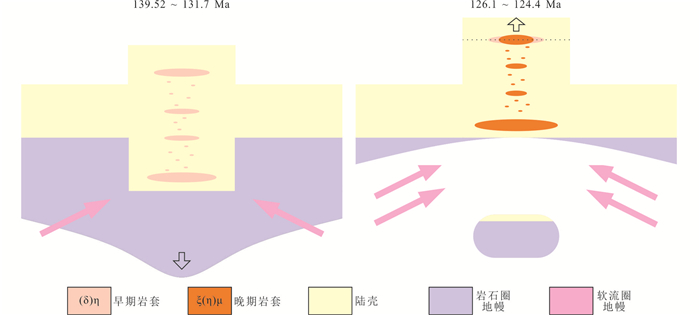
结合晚期岩套中含有大量壳源物质的正长质岩浆的出现,引发这次抬升运动的原因很可能是深部岩石圈拆沉引发的浅部岩石圈上弹从而引起的减压熔融作用。华北克拉通在侏罗纪-白垩纪期间岩石圈至少减薄了120km(Menzies et al., 1993;邓晋福等,2000),此时也正是华北克拉通岩浆活动的顶峰,上涌的软流圈地幔会破坏岩石圈底部密度较高的部分(Hirschmann et al., 2009;Green et al., 2010),导致其拆沉脱离上部岩石圈后,上部岩石圈由于平均密度减少会在地幔浮力作用下向上回弹,回弹过程中静岩压力逐步减小,引发地壳岩石圈发生大规模的减压熔融作用。此时由于陆内岩浆活动减弱,新形成的二长闪长质岩浆非常稀少,先存岩浆房中残余的岩浆整体进一步向二长质岩浆演化。上涌的软流圈地幔还导致晚期岩套的Pb同位素组成整体较早期岩套的Pb同位素组成略微更靠近EMI型地幔,也导致正长岩中(87Sr/86Sr)i较高(0.7067)、εNd(t)较低,同样更接近于EMI型地幔。伴随回弹引发的岩浆快速上升让晚期岩浆快速侵位至浅部位置,使得西石门杂岩体出现了具似斑状结构的晚期岩套,并在其中保留了很多尚未来得及溶解的捕获和继承锆石。华北克拉通东部早白垩世岩石圈减薄模式见图 19。
|
图 19 华北克拉通东部早白垩世岩石圈减薄模式图 Fig. 19 The lithospheric thinning model in eastern North China Craton during Early Cretaceous |
(1) 根据西石门杂岩体形成时代和岩石结构特征将其划分为两套岩石组合,先侵位的具等粒结构的早期岩套和后侵位的具似斑状结构的晚期岩套。早期岩套由二长闪长岩-二长岩-正长岩系列组成,锆石U-Pb年龄为139.5~131.7Ma(平均135.6 Ma);后者由斑状二长岩-斑状正长岩系列组成,年龄为126.1~124.4Ma(平均125.3Ma),此外这些岩石中还存在大量年龄约2500Ma的继承锆石。
(2) 早期岩套岩石成分为SiO2=51.72%~68.56%、MgO=0.17%~4.88%,部分样品表现出埃达克岩的特征;晚期岩套岩石成分为SiO2=57.00%~67.51%、MgO=0.61%~3.37%。此外,两套岩石的微量、稀土元素和同位素组成也很相似,但晚期岩套岩石中锆石具有更负的εHf(t),显示其具有更多的壳源物质组成。
(3) 角闪石温度计、压力计指示,早期岩套定位的温度、压力条件为T=883.66℃、P=194.95MPa,相当于7.36km深处。晚期岩套定位的温度、压力条件为T=642.34℃、P=26.81MPa,相当于1.01km深处。结合两者的侵位时间差,说明在约10.3Myr内,地壳被快速抬升了6.35km。
(4) 早白垩世华北克拉通东部软流圈上涌,造成中国东部大规模岩浆活动。在约135.6Ma时陆内岩浆作用开始影响研究区,软流圈地幔上涌促使地壳物质熔融、混合形成了早期岩套,同时大规模的岩浆活动及地壳褶皱变形导致陆壳加厚。之后岩石圈地幔发生拆沉作用,地壳快速抬升。在约125.3Ma后,软流圈地幔继续上涌,回弹的陆壳开始发生大规模的熔融形成了晚期岩套。据此认为拆沉作用是中生代华北克拉通岩石圈减薄的主要机制。
Black LP, Kamo SL, Allen CM, Aleinikoff JN, Davis DW, Korsch RJ and Foudoulis C. 2003. TEMORA 1:A new zircon standard for Phanerozoic U-Pb geochronology. Chemical Geology, 200(1-2): 155-170 DOI:10.1016/S0009-2541(03)00165-7 |
Blichert-Toft J and Albarède F. 1997. The Lu-Hf isotope geochemistry of chondrites and the evolution of the mantle-crust system. Earth and Planetary Science Letters, 148(1): 243-258 |
Burgisser A and Bergantz GW. 2011. A rapid mechanism to remobilize and homogenize highly crystalline magma bodies. Nature, 471(7337): 212-215 DOI:10.1038/nature09799 |
Cai BJ, Li XZ, Wei SP, Cui YH and He JS. 1987. Features of the Middle Ordovician evaporites and its control over the endogenic iron (sulfur) deposits in Han-Xing district, Hebei. Bulletin of Institute of Geomechanics, CAGS, (2): 1-84 (in Chinese with English abstract) |
Chen B, Tian W, Jahn BM and Chen ZC. 2008. Zircon SHRIMP U-Pb ages and in-situ Hf isotopic analysis for the Mesozoic intrusions in South Taihang, North China Craton:Evidence for hybridization between mantle-derived magmas and crustal components. Lithos, 102(1-2): 118-137 DOI:10.1016/j.lithos.2007.06.012 |
Chen B, Jahn BM and Suzuki K. 2013. Petrological and Nd-Sr-Os isotopic constraints on the origin of high-Mg adakitic rocks from the North China Craton:Tectonic implications. Geology, 41(1): 91-94 |
Chen YJ, Su SG, He YS, Li SG, Hou JG, Feng SC and Cao K. 2014. Fe isotope compositions and implications on mineralization of Xishimen iron deposit in Wuan, Hebei. Acta Petrologica Sinica, 30(11): 3443-3454 (in Chinese with English abstract) |
Defant MJ and Drummond MS. 1990. Derivation of some modern arc magmas by melting of young subducted lithosphere. Nature, 347(6294): 662-665 DOI:10.1038/347662a0 |
Deng JF, Mo XX, Zhao HL, Luo ZH and Du YS. 1994. Lithosphere root/de-rooting and activation of the East China continent. Geoscience, 8(3): 349-356 (in Chinese with English abstract) |
Deng JF, Liu HX, Zhao HL, Luo ZH, Guo ZF and Li YW. 1996. Yanshanian igneous rocks and orogeny model in Yanshan-Liaoning area. Geoscience, 10(2): 137-148 (in Chinese with English abstract) |
Deng JF, Zhao HL, Luo ZH, Guo ZF and Mo XX. 1998. Mantle plumes and lithosphere motion in East Asia. In: Flower MFJ, Chung SL, Lo CH and Lee TY (eds.). Mantle Dynamics and Plate Interactions in East Asia, Volume 27. Washington, DC: American Geophysical Union, 59-65 https: //www.researchgate.net/publication/285677647_Mantle_plumes_and_lithosphere_motion_in_East_Asia
|
Deng JF, Zhao GC, Zhao HL, Luo ZH, Dai SQ and Li KM. 2000. Yanshanian igneous petrotectonic assemblage and orogenic-deep processes in East China. Geological Review, 46(1): 41-48 (in Chinese with English abstract) |
Deng JF, Su SG, Zhao HL, Mo XX, Xiao QH, Zhou S, Liu C and Zhao GC. 2003. Deep processes of Mesozoic Yanshanian lithosphere thinning in North China. Earth Science Frontiers, 10(3): 41-50 (in Chinese with English abstract) |
Deng JF, Luo ZH, Su SG, Mo XX, Yu BS, Lai XY and Chen HW. 2004. Rock Genesis, Tectonic Setting and Mineralization. Beijing: Geological Publishing House, 26-28 (in Chinese)
|
Deng JF, Su SG, Liu C, Zhao GC, Zhao XG, Zhou S and Wu ZX. 2006. Discussion on the lithospheric thinning of the North China Craton:Delamination? Or thermal erosion and chemical metasomatism?. Earth Science Frontiers, 13(2): 105-119 (in Chinese with English abstract) |
Deng JF, Feng YF, Liu C, Xiao QH, Su SG, Zhou S and Gao YG. 2009. Yanshanian (Jurassic-Cretaceous) orogenic processes, magma sources and metallogenesis as well as coal formation in the Taihangshan-Yanshan-West Liaoning region. Geology in China, 36(3): 623-633 (in Chinese with English abstract) |
Deng JF, Feng YF, Di YJ, Liu C, Xiao QH, Su SG, Zhao GC, Meng F, Ma S and Yao T. 2015a. Magmatic are and ocean-continent transition:Discussion. Geological Review, 61(3): 473-484 (in Chinese with English abstract) |
Deng JF, Feng YF, Di YJ, Liu C, Xiao QH, Su SG, Zhao GC, Meng F and Che RF. 2015b. The intrusive spatial-temporal evolutional framework in the Paleo-Asian Tectonic Domain. Geological Review, 61(6): 1211-1224 (in Chinese with English abstract) |
Fan WM and Menzies MA. 1992. Destruction of aged lower lithosphere and accretion of asthenosphere mantle beneath eastern China. Geotectonica et Metallogenia, 16(2): 171-180 |
Gao S, Ling WL, Qiu YM, Lian Z, Hartmann G and Simon K. 1993. Contrasting geochemical and Sm-Nd isotopic compositions of Archean metasediments from the Kongling high-grade terrain of the Yangtze Craton:Evidence for cratonic evolution and redistribution of REE during crustal anatexis. Geochimica et Cosmochimica Acta, 63(13-14): 2071-2088 |
Gao S and Jin ZM. 1997. Delamination and its geodynamical significance for the crust mantle evolution. Geological Science and Technology Information, 16(1): 1-9 (in Chinese with English abstract) |
Gao S, Rudnick RL, Carlson RW, McDonough WF and Liu YS. 2002. Re-Os evidence for replacement of ancient mantle lithosphere beneath the North China Craton. Earth and Planetary Science Letters, 198(3-4): 307-322 DOI:10.1016/S0012-821X(02)00489-2 |
Gao S, Rudnick RL, Yuan HL, Liu XM, Liu YS, Xu WL, Ling WL, Ayers J, Wang XC and Wang QH. 2004. Recycling lower continental crust in the North China Craton. Nature, 432(7019): 892-897 DOI:10.1038/nature03162 |
Green DH, Hibberson WO, Kovács I and Rosenthal A. 2010. Water and its influence on the lithosphere-asthenosphere boundary. Nature, 467(7314): 448-451 DOI:10.1038/nature09369 |
Griffin WL, Andi Z, O'Reilly SY and Ryan CG. 1998. Phanerozoic evolution of the lithosphere beneath the Sino-Korean Craton. In: Flower MFJ, Chung SL, Lo CH and Lee TY (eds.). Mantle Dynamics and Plate Interactions in East Asia, Volume 27. Washington, DC: American Geophsical Union, 107-126 https: //www.researchgate.net/publication/262151856_Phanerozoic_evolution_of_the_lithosphere_beneath_the_Sino-Korean_Craton
|
Griffin WL, Pearson NJ, Belousova E, Jackson SE, van Achterbergh E, O'Reilly SY and Shee SR. 2000. The Hf isotope composition of cratonic mantle:LAM-MC-ICPMS analysis of zircon megacrysts in kimberlites. Geochimica et Cosmochimica Acta, 64(1): 133-147 DOI:10.1016/S0016-7037(99)00343-9 |
Han YW and Ma ZD. 2003. Geochemistry. Beijing: Geological Publishing House, 203-204 (in Chinese)
|
Hirschmann MM, Tenner T, Aubaud C and Withers AC. 2009. Dehydration melting of nominally anhydrous mantle:The primacy of partitioning. Physics of the Earth and Planetary Interiors, 176(1-2): 54-68 DOI:10.1016/j.pepi.2009.04.001 |
Huo YA, Su SG, Yang YB and Gu DP. 2019. The evidence for lithospheric thinning of Mesozoic North China Craton:Taking Guzhen intrusive complex as an example. Acta Petrologica Sinica, 35(4): 989-1014 (in Chinese with English abstract) DOI:10.18654/1000-0569/2019.04.02 |
Jahn BM, Wu FY, Lo CH and Tsai CH. 1999. Crust-mantle interaction induced by deep subduction of the continental crust:Geochemical and Sr-Nd isotopic evidence from post-collisional mafic-ultramafic intrusions of the northern Dabie Complex, central China. Chemical Geology, 157(1-2): 119-146 DOI:10.1016/S0009-2541(98)00197-1 |
Jin ZL, Zhang ZC, Hou T, Santosh M and Han L. 2015. Genetic relationship of high-Mg dioritic pluton to iron mineralization:A case study from the Jinling skarn-type iron deposit in the North China Craton. Journal of Asian Earth Sciences, 113: 957-979 DOI:10.1016/j.jseaes.2015.03.039 |
Leake BE, Woolley AR, Arps CES, Birch WD, Gilbert MC, Grice JD, Hawthorne FC, Kato A, Kisch HJ, Krivovichev VG, Linthout K, Laird J, Mandarino JA, Maresch WV, Nickel EH, Schumacher JC, Smith DC, Stephenson NCN, Ungaretti L, Whittaker EJW and Guo YZ. 1997. Nomenclature of amphiboles:Report of the Subcommittee on Amphiboles of the International Mineralogical Association, Commission on New Minerals and Mineral Names. The Canadian Mineralogist, 35: 219-246 |
Li JW, Bi SJ, Selby D, Chen L, Vasconcelos P, Thiede D, Zhou MF, Zhao XF, Li ZK and Qiu HN. 2012. Giant Mesozoic gold provinces related to the destruction of the North China Craton. Earth and Planetary Science Letters, 349-350: 26-37 DOI:10.1016/j.epsl.2012.06.058 |
Li SR, Santosh M, Zhang HF, Shen JF, Dong GC, Wang JZ and Zhang JQ. 2013. Inhomogeneous lithospheric thinning in the central North China Craton:Zircon U-Pb and S-He-Ar isotopic record from magmatism and metallogeny in the Taihang Mountains. Gondwana Research, 23(1): 141-160 DOI:10.1016/j.gr.2012.02.006 |
Li SR and Santosh M. 2014. Metallogeny and craton destruction:Records from the North China Craton. Ore Geology Reviews, 56: 376-414 DOI:10.1016/j.oregeorev.2013.03.002 |
Liu LL, Su SG, Hou JG and Xie YC. 2017. Genesis of Tanling plagioporphyry in Wu'an, Hebei:The remobilizing mechanism of frozen magma chambers. Acta Petrologica Sinica, 33(1): 204-220 (in Chinese with English abstract) |
Liu LL, Su SG, Yang RN, Luo ZH and Cui XL. 2019. Characteristics and research significance of matrix minerals in Tanling polyphenocryst plagioporphyry, Wu'an, Hebei Province. Earth Science Frontiers, 26(1): 286-299 (in Chinese with English abstract) |
Liu Y, Dai TG, Qiu L and Xia SH. 2016. Three-dimensional numerical simulation of ore-forming processes of the Fushan skarn iron deposit in Handan-Xingtai ore cluster, North China:Implication for tectonic effects on skarn-iron mineralization. Journal of Geochemical Exploration, 169: 144-156 DOI:10.1016/j.gexplo.2016.07.022 |
Ludwig C, Kessler C, Steinforc AJ and Ludwig W. 2001. Versatile high performance digital SQUID electronics. IEEE Transactions on Applied Superconductivity, 11(1): 1122-1125 DOI:10.1109/77.919545 |
Luo ZH, Deng JF, Zhao GC and Cao YQ. 1997. Characteristics of magmatic activities and orogenic process of Taihangshan intraplate orogen. Earth Science (Journal of China University of Geosciences), 22(3): 279-284 (in Chinese with English abstract) |
Luo ZH, Deng JF and Han XQ. 1999. On Characteristics of Magmatic Activities and Orogenic Process of Taihangshan Intraplate Orogen. Beijing: Geological Publishing House (in Chinese)
|
McDonough WF and Sun SS. 1995. The composition of the Earth. Chemical Geology, 120(3-4): 223-253 DOI:10.1016/0009-2541(94)00140-4 |
Menzies MA, Fan WM and Zhang M. 1993. Palaeozoic and Cenozoic lithoprobes and the loss of > 120km of Archaean lithosphere, Sino-Korean Craton, China. In:Prichard HM, Alabaster T, Harris NBW and Neary CR (eds.). Magmatic Processes and Plate Tectonics. Geological Society, London, Special Publications, 76(1):71-81 https://pure.royalholloway.ac.uk/portal/en/publications/palaeozoic-and-cenozoic-lithoprobes-and-the-loss-of-120km-of-archaean-lithosphere-sinokorean-craton-china(be18839f-c43d-469d-a0ed-cb1bd7b9f169).html
|
Miller C, Schuster R, Klötzli U, Frank W and Purtscheller F. 1999. Post-collisional potassic and ultrapotassic magmatism in SW Tibet:Geochemical and Sr-Nd-Pb-O isotopic constraints for mantle source characteristics and petrogenesis. Journal of Petrology, 40(9): 1399-1424 DOI:10.1093/petroj/40.9.1399 |
Nie SY, Rowley DB and Ziegler AM. 1990. Constraints on the locations of Asian microcontinents in Palaeo-Tethys during the Late Palaeozoic. In:McKerrow WS and Scotese CR (eds.). Palaeozoic Palaeogeography and Biogeography. Geological Society, London, Memoirs, 12(1):397-409 http://cn.bing.com/academic/profile?id=e8fd16866e6a54f8f5dbfa1c13c7201d&encoded=0&v=paper_preview&mkt=zh-cn
|
Niu YL. 2005. Generation and evolution of basaltic magmas:Some basic concepts and a new view on the origin of Mesozoic-Cenozoic basaltic volcanism in Eastern China. Geological Journal of China Universities, 11(1):9-46 http://en.cnki.com.cn/Article_en/CJFDTotal-GXDX200501001.htm
|
Oxman VS. 2003. Tectonic evolution of the Mesozoic Verkhoyansk-Kolyma belt (NE Asia). Tectonophysics, 365(1-4): 45-76 DOI:10.1016/S0040-1951(03)00064-7 |
Parfenov LM, Nokleberg WJ, Berzin NA, Badarch G, Dril SI, Gerel O, Goryachev NA, Khanchuk AI, Kuz'min MI, Obolenskiy AA, Prokopiev AV, Ratkin VV, Rodionov SM, Scotese CR, Shpikerman VI, Timofeev VF, Tomurtogoo O and Yan HQ. 2011. Tectonic and Metallogenic Model for Northeast Asia. Reston, Virginia: U.S. Geological Survey
|
Pearson DG. 2009. The age of continental roots. Lithos, 48(1-4): 171-194 |
Pollack. 1986. Cratonization and thermal evolution of the mantle. Earth and Planetary Science Letters, 80(1-2): 175-182 DOI:10.1016/0012-821X(86)90031-2 |
Qi L, Hu J and Gregoire DC. 2000. Determination of trace elements in granites by inductively coupled plasma mass spectrometry. Talanta, 51(3): 507-513 DOI:10.1016/S0039-9140(99)00318-5 |
Ren JY, Tamaki K, Li ST and Zhang JX. 2002. Late Mesozoic and Cenozoic rifting and its dynamic setting in eastern China and adjacent areas. Tectonophysics, 344(3-4): 175-205 DOI:10.1016/S0040-1951(01)00271-2 |
Ridolfi F, Renzulli A and Puerini M. 2010. Stability and chemical equilibrium of amphibole in calc-alkaline magmas:An overview, new thermobarometric formulations and application to subduction-related volcanoes. Contributions to Mineralogy and Petrology, 160(1): 45-66 DOI:10.1007/s00410-009-0465-7 |
Shen JF, Santosh M, Li SR, Zhang HF, Yin N, Dong GC, Wang YJ, Ma GG and Yu HJ. 2013. The Beiminghe skarn iron deposit, eastern China:Geochronology, isotope geochemistry and implications for the destruction of the North China Craton. Lithos, 156-159: 218-229 DOI:10.1016/j.lithos.2012.11.003 |
Shen JF, Li SR, Santosh M, Dong GC, Wang YJ, Liu HM, Peng ZD and Zhang ZY. 2015. Zircon U-Pb geochronology of the basement rocks and dioritic intrusion associated with the Fushan skarn iron deposit, southern Taihang Mountains, China. Journal of Asian Earth Sciences, 113: 1132-1142 DOI:10.1016/j.jseaes.2015.01.009 |
Su SG, Jian DC, Xie YC, Luo ZH, Jiang JY, Liu LL, Huo YA, Cui XL, Zhang B, Gu DP and Wang Y. 2017. The practice of the-matic geological mapping in medium-large scale for intermediate-basic intrusive rocks:A case study of the Wu'an iron ore concentration area, Hebei Province. Geological Bulletin of China, 36(11): 1987-1998 (in Chinese with English abstract) |
Sun SS and McDonough WF. 1989. Chemical and isotopic systematics of oceanic basalts:Implications for mantle composition and processes. In:Saunders AD and Norry MJ (eds.). Magmatism in the Ocean Basins. Geological Society, London, Special Publications, 42(1):313-345
|
Sun Y, Xiao L, Zhu D, Wu T, Deng XD, Bai M and Wen G. 2014. Geochemical, geochronological, and Sr-Nd-Hf isotopic constraints on the petrogenesis of the Qicun intrusive complex from the Handan-Xingtai district:Implications for the mechanism of lithospheric thinning of the North China Craton. Ore Geology Reviews, 57: 363-374 DOI:10.1016/j.oregeorev.2013.09.007 |
Sun Y, Xiao L, Zhan QY, Wu JX, Zhu D, Huang W, Bai M and Zhang YH. 2015. Petrogenesis of the Kuangshancun and Hongshan intrusive complexes from the Handan-Xingtai district:Implications for iron mineralization associated with Mesozoic magmatism in the North China Craton. Journal of Asian Earth Sciences, 113: 1162-1178 DOI:10.1016/j.jseaes.2015.08.003 |
Taylor RN, Ishizuka O, Michalik A, Milton JA and Croudace IW. 2015. Evaluating the precision of Pb isotope measurement by mass spectrometry. Journal of Analytical Atomic Spectrometry, 30(1): 198-213 DOI:10.1039/C4JA00279B |
Wang T, Zheng YD, Zhang JJ, Zeng LS, Donskaya T, Guo L and Li JB. 2011. Pattern and kinematic polarity of Late Mesozoic extension in continental NE Asia:Perspectives from metamorphic core complexes. Tectonics, 30(6): TC6007 |
Wilde SA, Valley JW, Peck WH and Graham CM. 2001. Evidence from detrital zircons for the existence of continental crust and oceans on the Earth 4.4Gyr ago. Nature, 409(6817): 175-178 |
Wilde SA, Zhou XH, Nemchin AA and Sun M. 2003. Mesozoic crust-mantle interaction beneath the North China Craton:A consequence of the dispersal of Gondwanaland and accretion of Asia. Geology, 31(9): 817-820 DOI:10.1130/G19489.1 |
Williams IS. 1998. U-Th-Pb Geochronology by Ion microprobe. In:McKibben MA, Shanks Ⅲ WC and Ridley WI (eds.). Applications of Microanalytical Techniques to Understanding Mineralizing Processes. Littleton:Society of Economic Geologists, 7:1-35
|
Wilson M. 1989. Igneous Petrogenesis. Dordrecht: Springer
|
Wang T, Tong Y, Guo L, Zhang JJ, Su SG, Jiao JG and Wang LX. 2017. Methodology and thematic studies of geological mapping of intrusions. Geological Bulletin of China, 36(11): 1953-1962 (in Chinese with English abstract) |
Wu FY and Sun DY. 1999. The Mesozoic magmatism and lithospheric thinning in eastern China. Journal of Changchun University of Science and Technology, 29(4): 313-318 (in Chinese with English abstract) |
Wu FY, Ge WC, Sun DY and Guo CL. 2003. Discussions on the lithospheric thinning in eastern China. Earth Science Frontiers, 10(3): 51-60 (in Chinese with English abstract) |
Wu GL, Zhu JM, Tan DC, Han GL, Zhang LX and Ren K. 2017. Accurate and precise determination of lead isotope composition in selected geochemical reference materials. Acta Geochimica, 36(3): 421-425 DOI:10.1007/s11631-017-0181-3 |
Xia QK, Liu J, Liu SC, Kovács I, Feng M and Dang L. 2013. High water content in Mesozoic primitive basalts of the North China Craton and implications on the destruction of cratonic mantle lithosphere. Earth and Planetary Science Letters, 361: 85-97 DOI:10.1016/j.epsl.2012.11.024 |
Xia QK and Hao YT. 2013. The distribution of water in the continental lithospheric mantle and its implications for the stability of continents. Chinese Science Bulletin, 58(32): 3879-3889 DOI:10.1007/s11434-013-5949-1 |
Xu WL, Wang QH, Wang DY, Pei FP and Gao S. 2004. Processes and mechanism of Mesozoic lithospheric thinning in eastern North China Craton:Evidence from Mesozoic igneous rocks and deep-seated xenoliths. Earth Science Frontiers, 11(3): 309-317 (in Chinese with English abstract) |
Xu WL, Wang QH, Wang DY, Guo JH and Pei FP. 2006a. Mesozoic adakitic rocks from the Xuzhou-Suzhou area, eastern China:Evidence for partial melting of delaminated lower continental crust. Journal of Asian Earth Sciences, 27(4): 454-464 DOI:10.1016/j.jseaes.2005.03.010 |
Xu WL, Gao S, Wang QH, Wang DY and Liu YS. 2006b. Mesozoic crustal thickening of the eastern North China Craton:Evidence from eclogite xenoliths and petrologic implications. Geology, 34(9): 721-724 DOI:10.1130/G22551.1 |
Xu WL, Yang CH, Yang DB, Pei FP, Wang QH and Ji WQ. 2006. Mesozoic high-Mg diorites in eastern North China Craton:Constraints on the mechanism of lithospheric thinning. Earth Science Frontiers, 13(2): 120-129 (in Chinese with English abstract) |
Xu WL, Yang DB, Pei FP, Wang F and Wang W. 2009. Mesozoic lithospheric mantle modified by delaminated lower continental crust in the North China Craton:Constraints from Compositions of amphiboles from peridotite xenoliths. Journal of Jilin University (Earth Science Edition), 39(4): 606-617 (in Chinese with English abstract) |
Xu YG. 1998. Melt-rock interaction in the upper mantle and the evolution of continental mantle. Earth Science Frontiers, 5(Suppl.1): 76-85 (in Chinese with English abstract) |
Xu YG. 1999. Roles of thermo mechanic and chemical erosion in continental lithospheric thinning. Bulletin of Mineralogy, Petrology and Geochemistry, 18(1): 3-7 (in Chinese with English abstract) |
Xu YG. 2001. Thermo-tectonic destruction of the archaean lithospheric keel beneath the Sino-Korean Craton in China:Evidence, timing and mechanism. Physics and Chemistry of the Earth, Part A:Solid Earth and Geodesy, 26(9-10): 747-757 DOI:10.1016/S1464-1895(01)00124-7 |
Xu YG. 2004. Lithospheric thinning beneath North China:A temporal and spatial perspective. Geological Journal of China Universities, 10(3): 324-331 (in Chinese with English abstract) |
Xu YG, Huang XL, Ma JL, Wang YB, Iizuka Y, Xu JF, Wang Q and Wu XY. 2004. Crust-mantle interaction during the tectono-thermal reactivation of the North China Craton:Constraints from SHRIMP zircon U-Pb chronology and geochemistry of Mesozoic plutons from western Shandong. Contributions to Mineralogy and Petrology, 147(6): 750-767 DOI:10.1007/s00410-004-0594-y |
Xu YG. 2006. Using basalt geochemistry to constrain Mesozoic-Cenozoic evolution of the lithosphere beneath North China Craton. Earth Science Frontiers, 13(2): 93-104 (in Chinese with English abstract) |
Xu YG, Blusztajn J, Ma JL, Suzuki K, Liu JF and Hart SR. 2008. Late Archean to Early Proterozoic lithospheric mantle beneath the western North China Craton:Sr-Nd-Os isotopes of peridotite xenoliths from Yangyuan and Fansi. Lithos, 102(1-2): 25-42 DOI:10.1016/j.lithos.2007.04.005 |
Xu YG, Li HY, Pang CJ and He B. 2009. On the timing and duration of the destruction of the North China Craton. Chinese Science Bulletin, 54(19): 3379-3396 |
Ying JF, Zhang HF and Tang YJ. 2010. Lower crustal xenoliths from Junan, Shandong Province and their bearing on the nature of the lower crust beneath the North China Craton. Lithos, 119(3-4): 363-376 DOI:10.1016/j.lithos.2010.07.015 |
Zhai MG. 2008. Lower crust and lithospheric mantle beneath the North China Craton before the Mesozoic lithospheric disruption. Acta Petrologica Sinica, 24(10): 2185-2204 (in Chinese with English abstract) |
Zhang BM, Ma GX, Bi FK and Zhao GL. 1996. Magmatism associated metallogenic series and metallogenic model of the main metallogenic zones in Hebei. Journal of Geology and Mineral Resources, North China, 11(3): 351-360 (in Chinese with English abstract) |
Zhang HF, Ying FJ, Xu P and Ma YG. 2004. Mantle olivine xenocrysts entrained in Mesozoic basalts from the North China craton:Implication for replacement process of lithospheric mantle. Chinese Science Bulletin, 49(9): 961-966 DOI:10.1007/BF03184019 |
Zhang HF and Yang YH. 2007. Emplacement age and Sr-Nd-Hf isotopic characteristics of the diamondiferous kimberlites from the eastern North China Craton. Acta Petrologica Sinica, 23(2): 285-294 (in Chinese with English abstract) |
Zhang HF, Goldstein SL, Zhou XH, Sun M, Zheng JP and Cai Y. 2008. Evolution of subcontinental lithospheric mantle beneath eastern China:Re-Os isotopic evidence from mantle xenoliths in Paleozoic kimberlites and Mesozoic basalts. Contributions to Mineralogy and Petrology, 155(3): 271-293 DOI:10.1007/s00410-007-0241-5 |
Zhang JQ, Li SR, Santosh M, Wang JZ and Li Q. 2015. Mineral chemistry of high-Mg diorites and skarn in the Han-Xing Iron deposits of South Taihang Mountains, China:Constraints on mineralization process. Ore Geology Reviews, 64: 200-214 DOI:10.1016/j.oregeorev.2014.07.007 |
Zhang Q, Wang Y and Wang YL. 2001. Preliminary study on the components of the lower crust in East China Plateau during Yanshanian Period:Constraints on Sr and Nd isotopic compositions of adakite-like rocks. Acta Petrologica Sinica, 17(4): 505-513 (in Chinese with English abstract) |
Zhao Y, Xu G, Zhang SH, Yang ZY, Zhang YQ and Hu JM. 2004. Yanshanian Movement and conversion of tectonic regimes in East Asia. Earth Science Frontiers, 11(3): 319-328 (in Chinese with English abstract) |
Zheng JP, Griffin WL, O'Reilly SY, Yu CM, Zhang HF, Pearson N and Zhang M. 2007. Mechanism and timing of lithospheric modification and replacement beneath the eastern North China Craton:Peridotitic xenoliths from the 100Ma Fuxin basalts and a regional synthesis. Geochimica et Cosmochimica Acta, 71(21): 5203-5225 DOI:10.1016/j.gca.2007.07.028 |
Zheng TY, Zhao L and Zhu RX. 2009. New evidence from seismic imaging for subduction during assembly of the North China Craton. Geology, 37(5): 395-398 DOI:10.1130/G25600A.1 |
Zheng YF, Xu Z, Zhao ZF and Dai LQ. 2018. Mesozoic mafic magmatism in North China:Implications for thinning and destruction of cratonic lithosphere. Science China (Earth Sciences), 61(4): 353-385 DOI:10.1007/s11430-017-9160-3 |
Zhou JB and Li L. 2017. The Mesozoic accretionary complex in Northeast China:Evidence for the accretion history of Paleo-Pacific subduction. Journal of Asian Earth Sciences, 145: 91-100 DOI:10.1016/j.jseaes.2017.04.013 |
Zhu RX, Xu YG, Zhu G, Zhang HF, Xia QK and Zheng TY. 2012. Destruction of the North China Craton. Science China (Earth Sciences), 55(10): 1565-1587 DOI:10.1007/s11430-012-4516-y |
Zhu RX. 2018. Review of the achievements of major research plan on "Destruction of North China Craton". Bulletin of National Natural Science Foundation of China, 32(3): 282-290 (in Chinese with English abstract) |
Zindler A and Hart S. 1986. Chemical geodynamics. Annual Review of Earth and Planetary Sciences, 14: 493-571 DOI:10.1146/annurev.ea.14.050186.002425 |
蔡本俊, 李席珍, 魏寿彭, 崔云昊, 何金水. 1987. 邯邢地区中奥陶统蒸发岩特征及其对内生铁(硫)矿床的控制. 中国地质科学院地质力学研究所所刊, (2): 1-84. |
陈永健, 苏尚国, 何永胜, 李曙光, 侯建光, 冯少憧, 曹珂. 2014. 河北武安西石门铁矿床Fe同位素特征及其成矿指示意义. 岩石学报, 30(11): 3443-3454. |
邓晋福, 莫宣学, 赵海玲, 罗照华, 杜杨松. 1994. 中国东部岩石圈根/去根作用与大陆"活化"——东亚型大陆动力学模式研究计划. 现代地质, 8(3): 349-356. |
邓晋福, 刘厚祥, 赵海玲, 罗照华, 郭正府, 李玉文. 1996. 燕辽地区燕山期火成岩与造山模型. 现代地质, 10(2): 137-148. |
邓晋福, 赵国春, 赵海玲, 罗照华, 戴圣潜, 李凯明. 2000. 中国东部燕山期火成岩构造组合与造山-深部过程. 地质论评, 46(1): 41-48. DOI:10.3321/j.issn:0371-5736.2000.01.006 |
邓晋福, 苏尚国, 赵海玲, 莫宣学, 肖庆辉, 周肃, 刘翠, 赵国春. 2003. 华北地区燕山期岩石圈减薄的深部过程. 地学前缘, 10(3): 41-50. DOI:10.3321/j.issn:1005-2321.2003.03.003 |
邓晋福, 罗照华, 苏尚国, 莫宣学, 于炳松, 赖兴运, 谌宏伟. 2004. 岩石成因、构造环境与成矿作用. 北京: 地质出版社, 26-28.
|
邓晋福, 苏尚国, 刘翠, 赵国春, 赵兴国, 周肃, 吴宗絮. 2006. 关于华北克拉通燕山期岩石圈减薄的机制与过程的讨论:是拆沉, 还是热侵蚀和化学交代?. 地学前缘, 13(2): 105-119. DOI:10.3321/j.issn:1005-2321.2006.02.009 |
邓晋福, 冯艳芳, 刘翠, 肖庆辉, 苏尚国, 周肃, 高延光. 2009. 太行-燕辽地区燕山期造山过程、岩浆源区与成矿作用. 中国地质, 36(3): 623-633. DOI:10.3969/j.issn.1000-3657.2009.03.009 |
邓晋福, 冯艳芳, 狄永军, 刘翠, 肖庆辉, 苏尚国, 赵国春, 孟斐, 马帅, 姚图. 2015a. 岩浆弧火成岩构造组合与洋陆转换. 地质论评, 61(3): 473-484. |
邓晋福, 冯艳芳, 狄永军, 刘翠, 肖庆辉, 苏尚国, 赵国春, 孟斐, 车如风. 2015b. 古亚洲构造域侵入岩时-空演化框架. 地质论评, 61(6): 1211-1224. |
高山, 金振民. 1997. 拆沉作用(delamination)及其壳-幔演化动力学意义. 地质科技情报, 16(1): 1-9. |
韩吟文, 马振东. 2003. 地球化学. 北京: 地质出版社, 203-204.
|
霍延安, 苏尚国, 杨誉博, 顾大鹏. 2019. 中生代华北克拉通岩石圈减薄的证据——以河北武安固镇杂岩体为例. 岩石学报, 35(4): 989-1014. |
刘璐璐, 苏尚国, 侯建光, 谢玉淳. 2017. 河北武安坦岭多斑斜长斑岩的成因:冻结岩浆房活化机制. 岩石学报, 33(1): 204-220. |
刘璐璐, 苏尚国, 杨睿娜, 罗照华, 崔晓亮. 2019. 河北武安坦岭多斑斜长斑岩中基质矿物特征及其研究意义. 地学前缘, 26(1): 286-299. |
罗照华, 邓晋福, 赵国春, 曹永清. 1997. 太行山造山带岩浆活动特征及其造山过程反演. 地球科学(中国地质大学学报), 22(3): 279-284. |
罗照华, 邓晋福, 韩秀卿. 1999. 太行山造山带岩浆活动及其造山过程反演. 北京: 地质出版社.
|
苏尚国, 简东川, 谢玉淳, 罗照华, 蒋俊毅, 刘璐璐, 霍延安, 崔晓亮, 张波, 顾大鹏, 王玉. 2017. 中基性侵入岩中-大比例尺专题地质填图实践——以河北武安铁矿集区填图试点为例. 地质通报, 36(11): 1987-1998. DOI:10.3969/j.issn.1671-2552.2017.11.009 |
王涛, 童英, 郭磊, 张建军, 苏尚国, 焦建刚, 王连训. 2017. 侵入岩填图方法体系及专题研究. 地质通报, 36(11): 1953-1962. DOI:10.3969/j.issn.1671-2552.2017.11.006 |
吴福元, 孙德有. 1999. 中国东部中生代岩浆作用与岩石圈减薄. 长春科技大学学报, 29(4): 313-318. |
吴福元, 葛文春, 孙德有, 郭春丽. 2003. 中国东部岩石圈减薄研究中的几个问题. 地学前缘, 10(3): 51-60. DOI:10.3321/j.issn:1005-2321.2003.03.004 |
夏群科, 郝艳涛. 2013. 大陆岩石圈地幔中水的分布和大陆稳定性. 科学通报, 58(34): 3489-3500. |
许文良, 王清海, 王冬艳, 裴福萍, 高山. 2004. 华北克拉通东部中生代岩石圈减薄的过程与机制:中生代火成岩和深源捕虏体证据. 地学前缘, 11(3): 309-317. DOI:10.3321/j.issn:1005-2321.2004.03.029 |
许文良, 杨承海, 杨德彬, 裴福萍, 王清海, 纪伟强. 2006. 华北克拉通东部中生代高Mg闪长岩——对岩石圈减薄机制的制约. 地学前缘, 13(2): 120-129. DOI:10.3321/j.issn:1005-2321.2006.02.010 |
许文良, 杨德彬, 裴福萍, 王枫, 王微. 2009. 华北克拉通中生代拆沉陆壳物质对岩石圈地幔的改造:来自橄榄岩捕虏体中角闪石的成分制约. 吉林大学学报(地球科学版), 39(4): 606-617. |
徐义刚. 1998. 上地幔熔体-岩石相互作用与大陆地幔演化. 地学前缘, 5(增1): 76-85. |
徐义刚. 1999. 岩石圈的热-机械侵蚀和化学侵蚀与岩石圈减薄. 矿物岩石地球化学通报, 18(1): 3-7. |
徐义刚. 2004. 华北岩石圈减薄的时空不均一特征. 高校地质学报, 10(3): 324-331. DOI:10.3969/j.issn.1006-7493.2004.03.003 |
徐义刚. 2006. 用玄武岩组成反演中-新生代华北岩石圈的演化. 地学前缘, 13(2): 93-104. DOI:10.3321/j.issn:1005-2321.2006.02.008 |
徐义刚, 李洪颜, 庞崇进, 何斌. 2009. 论华北克拉通破坏的时限. 科学通报, 54(14): 1974-1989. |
翟明国. 2008. 华北克拉通中生代破坏前的岩石圈地幔与下地壳. 岩石学报, 24(10): 2185-2204. |
章百明, 马国玺, 毕伏科, 赵国良. 1996. 河北主要成矿区带与岩浆作用有关的矿床成矿系列及成矿模式. 华北地质矿产杂志, 11(3): 351-360. |
张宏福, 杨岳衡. 2007. 华北克拉通东部含金刚石金伯利岩的侵位年龄和Sr-Nd-Hf同位素地球化学特征. 岩石学报, 23(2): 285-294. |
张旗, 王焰, 王元龙. 2001. 燕山期中国东部高原下地壳组成初探:埃达克质岩Sr、Nd同位素制约. 岩石学报, 17(4): 505-513. |
赵越, 徐刚, 张拴宏, 杨振宇, 张岳桥, 胡建民. 2004. 燕山运动与东亚构造体制的转变. 地学前缘, 11(3): 319-328. DOI:10.3321/j.issn:1005-2321.2004.03.030 |
郑永飞, 徐峥, 赵子福, 戴立群. 2018. 华北中生代镁铁质岩浆作用与克拉通减薄和破坏. 中国科学(地球科学), 48(4): 379-414. |
朱日祥, 徐义刚, 朱光, 张宏福, 夏群科, 郑天愉. 2012. 华北克拉通破坏. 中国科学(地球科学), 42(8): 1135-1159. |
朱日祥. 2018. "华北克拉通破坏"重大研究计划结题综述. 中国科学基金, 32(3): 282-290. |