 2019, Vol. 35


2. 中国科学院地球科学研究院, 北京 100029;
3. 中国科学院大学地球与行星科学学院, 北京 100049;
4. 桂林理工大学地球科学学院, 桂林 541004;
5. 桂林有色地质矿产研究院, 桂林 541004
2. Innovation Academy for Earth Science, Chinese Academy of Sciences, Beijing 100029, China;
3. College of Earth and Planetary Science, University of Chinese Academy of Sciences, Beijing 100049, China;
4. College of Earth Science, Guilin University of Technology, Guilin 541004, China;
5. Guilin Research Institute of Geology for Mineral Resources, Guilin 541004, China
拉萨地体位于羌塘和喜马拉雅地体之间,先后经历了洋壳俯冲、拉萨-羌塘碰撞、印-亚陆陆碰撞,形成了该带多期次的岩浆作用和多类型成矿作用,是国际矿床学和岩石学研究的热点地区(Yin and Harrison, 2000; 潘桂棠等, 2006; Zhu et al., 2011; Hou et al., 2015)。拉萨地体自南向北大致可划分出三条成矿带,分别为位于南部拉萨地体的中新世冈底斯Cu-Mo-Au成矿带(郑有业等, 2004; Hou et al., 2015)、主要集中于冈底斯弧背断垄带的古新世-始新世念青唐古拉Pb-Zn-Ag-Fe-Cu-Mo-W多金属矿带(唐菊兴等, 2012, 2014; 高一鸣等, 2011; Li et al., 2014; 高顺宝, 2015; Zhao et al., 2016; Zheng et al., 2015; 徐净, 2017; Jiang et al., 2018)、以及位于北部拉萨地体北缘的白垩纪班公湖-怒江Cu-Au成矿带(吕丽娜, 2012; Li et al., 2016; Geng et al., 2016)。
日阿窄铅多金属矿床位于南部拉萨地体的中新世斑岩Cu-Mo-Au铜矿带,是否意味着在斑岩Cu-Mo-Au矿带亦有寻找铅锌多金属矿床的潜力?其形成时代是中新世还是古新世,是否是北边的古新世-始新世念青唐古拉Pb-Zn-Ag-Fe-Cu-Mo-W多金属矿带的向南延伸,是否暗示了南部的斑岩Cu-Mo-Au矿带在局部具有像北边的念青唐古拉多金属成矿带那样的由于古老地体的重融的岩浆源区?为在该区进一步深入研究与壳源相关的铅锌多金属矿化的成矿潜力和区域成矿规律提供依据。
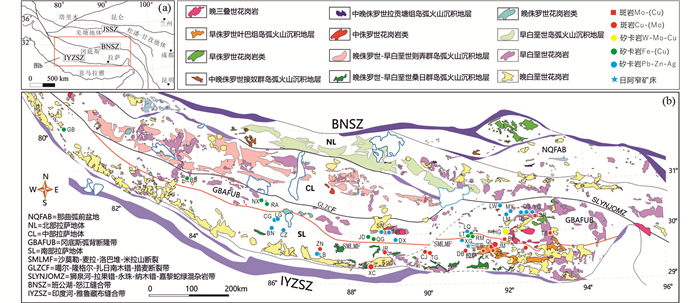
1 区域地质背景新生代以来,青藏高原造山带的构造演化及隆升是全球瞩目的构造事件,形成了青藏高原“世界屋脊”(Dewey and Burke, 1973; Allégre et al., 1984; Yin and Harrison, 2000)。从北往南,青藏高原被金沙江缝合带(JSSZ)和班公-怒江缝合带(BNSZ)依次分割为松潘-甘孜地体、羌塘地体和拉萨地体(Yin and Harrison, 2000)(图 1a)。日阿窄矿床所处的区域地质背景位于冈底斯弧背断垄带中段南部边缘地带,处于沙莫勒-麦拉-洛巴堆-米拉山断裂带南侧,属于冈底斯巨型斑岩Cu-Mo-Au成矿带东段的一部分(图 1b)。研究区地层隶属滇藏地层大区冈底斯-腾冲地层区拉萨-察隅地层分区(潘桂棠等, 2006)。地层以前震旦系念青唐古拉群变质岩为基底。侏罗系-白垩系属火山弧间盆地沉积和岛弧型火山岩组合,由碎屑岩夹碳酸盐岩、凝灰岩和中酸性火山岩组成。晚白垩世至始新世为岛弧型火山岩和俯冲-碰撞型中酸性侵入岩形成的主要时期,地层为厚度巨大的碱性、中酸性火山岩、火山碎屑岩夹少量碎屑岩组合。此外,古近系林子宗群,上白垩统塔克拉组、楚木龙组,下白垩统多尼组,上侏罗-下白垩统林布宗组,上侏罗统多底沟组等地层亦在区内零星出露。
|
图 1 青藏高原构造分区简图(a)和拉萨地体地质简图(b)(据Zhu et al., 2011修改) 矿床缩写:YG-亚贵拉;DS-洞中松多;DL-洞中拉;SR-沙让;MY-蒙亚啊;LM-龙马拉;LW-拉屋;TB-汤不拉;HG-哈海港;BP-帮浦;RM-热玛;JL-加拉普;LT-列廷冈;XG-新嘎果;LQ-勒青拉;CB-吹败子;JM-甲玛;QL-驱龙;LK-拉抗俄;DB-达布;CJ-冲江;TG-厅宫;JR-吉如;XC-雄村;ZN-朱诺;LB-罗布真;CZ-查孜;BN-北纳;CG-查个勒;LG-龙根;DX-德新;NR-纳如松多;SN-斯弄多;JD-加多捕勒;QG-恰功;NX-尼雄;RA-日啊;BB-帮布勒;GB-哥布弄巴 Fig. 1 The Lhasa Terrane in the context of the Tibetan Plateau (a) and simplified geologic map of the Lhasa Terrane showing major tectonic subdivisions, magmatic intrusions, and the position of the study area (b) (modified after Zhu et al., 2011) Mineral deposit Abbreviations: YG-Yaguila; DS-Dongzhongsongduo; DL-Dongzhongla; SR-Sharang; MY-Mengya'a; LM-Longmala; LW-Lawu; TB-Tangbula; HG-Hahaigang; BP-Bangpu; RM-Rema; JL-Jialapu; LT-Lietinggang; XG-Xingaguo; LQ-Leqingla; CB-Chuibaizi; JM-Jiama; QL-Qulong; LK-Lakang'e; DB-Dabu; CJ-Chongjiang; TG-Tinggong; JR-Jiru; XC-Xiongcun; ZN-Zhunuo; LB-Luobuzhen; CZ-Chazi; BN-Beina; CG-Chagele; LG-Longgen; DX-Dexin; NR-Narusongduo; SN-Sinongduo; JD-Jiaduobule; QG-Qiagong; NX-Nixiong; RA-Ri'a; BB-Bangbule; GB-Gebunongba |
矿区出露的地层较为单一,仅有上侏罗统多底沟组、上侏罗统-下白垩统林布宗组、下白垩统楚木龙组及第四系(图 2)。多底沟组主要出露于矿区中部以及北东一带,岩性为一套碳酸盐类岩石,厚度大于600m,可见珊瑚、海绵、复足类、有孔虫及双壳类化石,与上覆林布宗组地层呈整合接触。矿区范围内碳酸盐类普遍变质成微晶灰岩、大理岩。林布宗组地层主要为黑-深灰色凝灰质细砂岩、板岩、变质粉砂岩,夹碳质片岩及劣质煤层(216°∠38°),厚度大于1000m,其中砂板岩类主要分布在矿区北部,而碳质片岩、片岩类主要分布在矿区南部以及西南角。楚木龙组主要出露于矿区西侧,岩性为灰白色中厚层石英砂岩夹片岩(232°∠48°),厚度大于100m,与下伏林布宗组呈整合接触。第四系主要为残坡积的砾石、砂、粉砂及腐植土组成的松散堆积层。

|
图 2 西藏日阿窄Pb多金属矿床矿区地质图 Fig. 2 Geological map of the Riazhai Pb polymetallic deposit |
矿区内褶皱构造不明显,断裂构造发育,主要为北东-南西、北西-南东向、南北向断裂构造。北东-南西向断层位于矿区中部,为压扭性断层,出露长度大于800m,其走向40°~220°,倾向130°,倾角75°。北西-南东向断层展布于矿区中部靠西侧,其上盘为林布宗组地层,下盘为林布宗组地层及花岗闪长岩,断层破碎带延长大于3km,破碎带宽数米至十余米,倾向北东,倾角57°~73°。南北向断层分布于矿区南部,其上盘为楚木龙组地层,下盘为楚木龙组地层及花岗闪长岩,出露长度大于500m,宽度小于1.5~3.5m,倾向275°,倾角大于65°。
岩浆岩主要出露于矿区中部、东南部,在区内在出露4.50km2,总体上呈北东-南西向展布,岩体西北部与上侏罗统多底沟组及白垩统楚木龙组地层呈侵入接触,为复式杂岩体,主要由花岗闪长岩、斑状花岗岩、石英斑岩等组成。
矿区东北部发现了一条长约600m的铅锌多金属矿体(I号),厚0.5~4.0m,估计Pb+Zn品位3%~15%。中部发现两条铜矿化体,Ⅱ号矿化体长约120m,厚1.0m左右,估计铜品位0.2%~1.5%;Ⅲ矿化体长约160m,厚0.8~1.2m,估计铜品位0.1%~1%。
3 样品及分析方法 3.1 样品特征本次研究的样品主要采自矿区广泛出露的花岗闪长岩以及钻孔中的斑状花岗岩以及石英斑岩,其采样位置见图 2。
花岗闪长岩呈灰白色,较新鲜,主要由斜长石(约35%~40%)、石英(约20%~25%)、钾长石(约15%~20%)、角闪石(约15%~20%)及黑云母(约5%~10%)组成(图 3a, b)。斜长石和角闪石矿物粒度一般为1.5~3.5mm,个别达5.0~7.0mm;黑云母较细粒,通常0.5~1mm。角闪石部分被绿泥石以及少量的黑云母交代,岩石总体蚀变不强。副矿物主要有榍石、锆石、磷灰石以及少量的磁铁矿等。

|
图 3 西藏日阿窄矿床代表性的岩浆岩手标本及对应的正交偏光镜下显微照片 (a、b)新鲜花岗闪长岩;(c、d)绿泥石化的斑状花岗岩;(e、f)发育黄铁矿化以及裂隙面辉钼矿化的石英斑岩.矿物缩写:Qz-石英;Pl-斜长石;Kfs-钾长石;Hbl-角闪石;Bt-黑云母;Ttn-榍石;Chl-绿泥石;Ep-绿帘石;Ser-绢云母;Py-黄铁矿;Moly-辉钼矿 Fig. 3 Representative hand specimen photographs and photomicrographs of magmatic rocks from the Riazhai deposit (a, b) fresh granodiorite; (c, d) chlorite porphyritic granite; (e, f) disseminated and fissured structure pyrite and molybdenite in quartz porphyry. Mineral abbreviations: Qz-quartz; Pl-plagioclase, Kfs-K-feldspar; Hbl-hornblende; Bt-biotite; Ttn-titanite; Chl-chlorite; Ep-epidote; Ser-sericite; Py-pyrite; Moly-molybdenite |
斑状花岗岩呈灰白-灰绿色,显示较强的热液蚀变特征,似斑状花岗结构,主要由斜长石和钾长石大斑晶以及较细粒的斜长石、钾长石、石英、黑云母、绿泥石等组成(图 3c, d)。斑晶大小为2~5mm,主要为斜长石(10%~15%)和钾长石(5%~10%),以及少量的黑云母(1%~3%)但多被绿泥石化。基质粒度为0.1~0.2mm,由钾长石(30%~40%)、斜长石(5%~10%)和石英(25%~30%)组成。岩石的热液蚀变较为强烈,常见斜长石斑晶有部分绢云母化和绿帘石化,以及黑云母的绿泥石化等。
石英斑岩呈灰白色,斑状结构,块状构造。斑晶主要为石英(15%~20%)和斜长石(5%~10%),粒度一般在0.5~2mm之间,杂乱分布,局部以聚斑状产出。长石斑晶呈半自形板状,多强烈绢云母化。基质(65%~75%)主要由长英质组成,粒度一般 < 0.1mm。岩石中多发育浸染状以及裂隙面状黄铁矿和少量的辉钼矿(图 3e, f)。
3.2 分析方法 3.2.1 主微量元素分析岩石主量元素、微量元素和稀土元素测试在加拿大安大略湖Activation Laboratories完成(王翠云等, 2012)。主量元素采用FUS-ICP(fusion-Inductively Coupled Plasma)方法获得,检测限为0.01%,其中FeO采用滴定法获得,检测限为0.1%。稀土元素采用FUS-MS(fusion-Mass Spectrometry)方法获得,检测限在0.002×10⁻⁶~0.05×10⁻⁶之间。微量元素Hf、Nb、Mo、In、Sn、Cs、Ba、Bi、Ta、W、Tl、Th、U、Co、Ga、Ge、Rb、Y采用FUS-MS方法获得,检测限在0.01×10⁻⁶~5×10⁻⁶之间。微量元素Zr、Sc、Be、V、Sr采用FUS-ICP方法获得,检测限在1×10⁻⁶~5×10⁻⁶之间。元素S(检测限为0.001%)以及微量元素Ag、Cd、Cu、Ni、Pb、Zn(检测限在0.5×10⁻⁶~5×10⁻⁶之间)采用TD-ICP(Total Digestion-Inductively Coupled Plasma)方法获得。元素F采用FUS-ISE(fusion-Ion Selective Electrode)方法获得,检测限为0.01%。元素Cl(检测限为0.01%)和As、Sb(检测限为0.2×10⁻⁶和0.5×10⁻⁶)采用INAA(Instrumental Neutron Activation Analysis)方法获得。
3.2.2 锆石SHRIMP U-Pb定年分析锆石的挑选在河北省区域地质矿产调查研究所实验室完成,制靶以及阴极发光照片均在北京离子探针中心完成。将挑选的锆石颗粒用环氧树脂固定于样品靶上,然后将锆石清洗、烘干、研磨抛光,直至露出锆石新截面。后对锆石靶进行透射光、反射光以及阴极发光图像采集。结合图像选择晶型较为完整,发育较好岩浆环带的锆石,同时尽量避开锆石裂隙和包裹体,进行SHRIMP锆石U-Pb定年。SHRIMP U-Pb锆石定年北京离子探针中心SHRIMP Ⅱ上完成,详细分析流程和原理见宋彪等(2002)。采用RSES参考锆石TEM(417Ma)进行Pb/U的分馏校正;采用SL13标样(572Ma)标定样品及TEM的U、Th、Pb含量。数据处理采样Ludwing SQUID及ISOPLT程序(Ludwig, 2003)。
3.2.3 Sr-Nd-Pb同位素分析岩浆岩全岩Rb-Sr、Sm-Nd同位素测试在中国科学院地球化学研究所矿床地球化学国家重点实验室完成。称取50~100mg的粉末样品,利用HF+HNO3+HClO4混合酸将其溶解,后分离提纯。同位素分析采用ISOPROBE-T热表面电离质谱仪,Sr同位素国际标准样品NBS987测试值为86Sr/88Sr=0.710255±7,Nd同位素国际标注样品JNdi-1测试值为0.512096±5。实验室流程本底:Rb=2×10-10g,Sr=2×10-10g,Sm和Nd小于50pg。
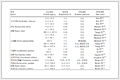
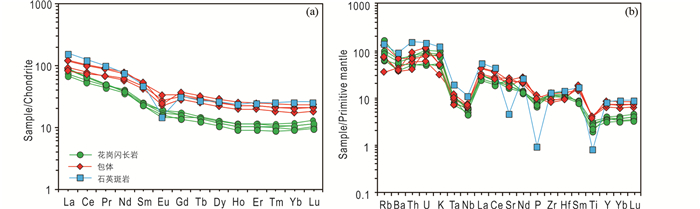
4 分析测试结果 4.1 主微量元素特征日阿窄岩浆岩的全岩主微量分析结果见表 1。花岗闪长岩(5个)SiO2含量变化于62.10%~68.03%(均值64.92%),Na2O含量介于2.88%~3.46%之间(均值3.23%),K2O含量为1.41%~2.94%(均值2.15%)。在TAS图中大致落到了花岗闪长岩区域(图 4a);在SiO2-K2O图解中,样品显示钙碱性系列岩石特征(图 4b)。Al2O3含量较为集中,介于15.94%~16.94%之间(平均16.43%),铝饱和指数A/CNK集中于0.90~1.06,在A/CNK-A/NK图解中整体显示准铝质特征(1个样品显示过铝质特征)(图 4c)。花岗闪长岩的MgO含量为1.29%~2.54%(均值1.93%),FeOT含量为3.45%~5.83%(均值4.59%),计算的Mg#值为39.9~45.7(均值42.6)。样品的稀土总量(∑REE)相对较低,变化于85.42×10⁻⁶~100.8×10⁻⁶(均值94.73×10⁻⁶),LREE/HREE比值在6.60~8.84之间,(La/Yb)N为6.97~9.89,显示重稀土相对轻稀土略微亏损的右倾配分模式(图 5a)。相对较弱的Eu负异常(δEu=0.80~0.97)表明岩浆形成过程中斜长石的分离结晶作用不明显。原始地幔标准化的微量元素蛛网图显示高场强元素Nb、Ta明显亏损,Ti、P相对亏损特征,以及大离子亲石元素Rb、Th、U、K的相对富集特征(图 5b),结合相对低(La/Yb)N(6.97~9.89)和Sr/Y(18.93~31.25)比值,暗示了典型弧岩浆岩特征,而非埃达克岩特征。
|
表 1 西藏日阿窄矿床岩浆岩主量元素(wt%)与微量元素(×10-6)分析结果 Table 1 Major oxides (wt%) and trace elements (×10-6) of magmatic rocks in the Riazhai deposit |

|
图 4 西藏日阿窄矿床岩浆岩地球化学图解 (a)TAS图解(Willson et al., 1989);(b)SiO2-K2O图解(Peccerillo and Taylor, 1976);(c)A/CNK-A/NK图解(Maniar and Piccoli, 1989; Chappell and White, 1992);(d)K2O-Na2O图解(Collins et al., 1982);(e)SiO2-P2O5散点图及(f)SiO2-Th散点图(Chappell and White, 1992) Fig. 4 Geochemical plots for magmatic rocks in the Riazhai deposit (a) TAS diagram (Willson et al., 1989); (b) K2O vs. SiO2 diagram (Peccerillo and Taylor, 1976); (c) A/NK vs. A/CNK diagram (Maniar and Piccoli, 1989; Chappell and White, 1992); (d) K2O vs. Na2O diagram (Collins et al., 1982); (e) SiO2 vs. P2O5 diagram and (f) SiO2 vs. Th diagram (Chappell and White, 1992) |
|
图 5 西藏日阿窄矿床岩浆岩球粒陨石标准化稀土元素配分图(a)和原始地幔标准化微量元素蛛网图(b)(标准化值据Sun and McDonough, 1989) Fig. 5 Chondrite-normalized REE patterns (a) and primitive mantle-normalized trace element patterns (b) of the Riazhai magmatic rocks (normalization values after Sun and McDonough, 1989) |
花岗闪长岩中镁铁质包体(4个)的SiO2含量为53.43%~57.69%(均值54.94%),Na2O含量为3.51%~4.82%(均值4.20%),K2O含量为0.92%~2.43%(均值1.62%),Al2O3含量为16.49%~17.84%之间(平均17.35%),铝饱和指数A/CNK集中于0.84~0.91,MgO含量相对集中,为3.21%~3.84%(均值3.59%),Mg#值变化较大,介于25.0~44.8之间(均值37.9)。在侵入岩TAS图解、SiO2-K2O图解以及A/CNK-A/NK图解中显示闪长岩-正长闪长岩、钙碱性-高钾钙碱性以及准铝质系列岩浆岩特征(图 4a-c)。样品的∑REE略微高于花岗闪长岩,为130.8×10⁻⁶~171.7×10⁻⁶,(La/Yb)N比值为3.98~6.00,显示轻重稀土分异相对不明显以及中等负Eu异常(δEu=0.55~0.80)的右倾球粒陨石标准化配分模式(图 5a)。原始地幔标准化微量元素蛛网图显示与花岗闪长岩一致的特征,显示相对富集Rb、Th、U、K,亏损Nb、Ta、Ti、P特征(图 5b)。
石英斑岩(1个)的SiO2含量较高,为76.44%,Na2O与K2O含量相对较高,分别为3.20%和3.68%,Al2O3含量较低,为12.02%,铝饱和指数A/CNK为1.02,MgO含量较低(0.15%)。在侵入岩TAS图解、SiO2-K2O图解以及A/CNK-A/NK图解中显示高钾钙碱性过铝质花岗岩特征(图 4a)。石英斑岩具有和镁铁质包体相似的稀土总量(190.8×10⁻⁶)和稀土配分模式,但是相对更亏损Eu异常(δEu=0.38)(图 5a)。微量元素蛛网图显示高场强元素Nb、Ta、Ti、P以及大离子亲石元素Ba、Sr强烈亏损,相对富集大离子亲石元素Rb、Th、U、K(图 5b)。
4.2 锆石SHRIMP U-Pb年龄本次分析的岩浆岩中的锆石自形程度一般,长柱状或短柱状,但以短柱状为主,颗粒大小长约100~300μm,长宽比为1:1~3:1。锆石内部结构一致,具振荡环带。锆石的阴极发光图像显示清晰且平直的生长环带,均为典型的岩浆成因锆石(Hoskin and Black, 2000)。
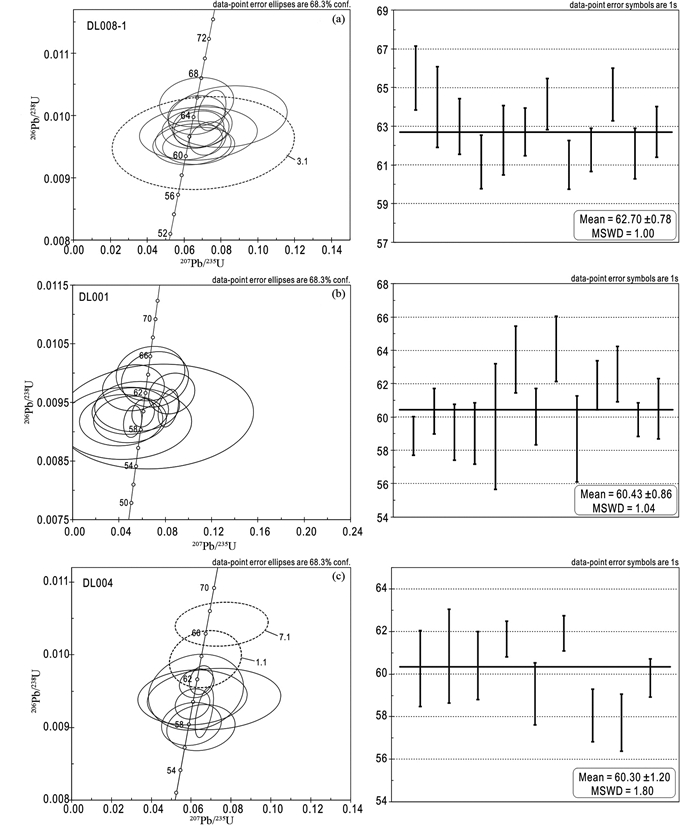
SHRIMP锆石U-Pb测年结果详见表 2。花岗闪长岩(DL008-1)中的13颗锆石的Th含量变化于27.65×10⁻⁶~91.74×10⁻⁶之间,U含量变化于61.56×10⁻⁶~131.1×10⁻⁶之间,Th/U比值为0.45~0.77,平均为0.56。206Pb/238U年龄集中于61.0~65.5Ma,12颗锆石的加权平均年龄为62.70±0.78Ma(MSWD=1.00)(由于锆石普通铅含量过高,206Pbc=4.46,故排除锆石点3.1)(图 6a)。斑状花岗岩(DL001)中的13颗锆石的Th和U含量显示较大的变化,其中Th含量变化于39.96×10⁻⁶~495.7×10⁻⁶之间,U含量变化于69.88×10⁻⁶~829.2×10⁻⁶之间,Th/U比值为0.57~1.20,平均为0.78。206Pb/238U年龄集中于59.2~65.2Ma,13颗锆石的加权平均年龄为60.43±0.86Ma(MSWD=1.04)(图 6b)。石英斑岩(DL004)中的11颗锆石的Th含量变化于32.16×10⁻⁶~277.7×10⁻⁶之间,U含量变化于52.52×10⁻⁶~507.2×10⁻⁶之间,Th/U比值为0.48~0.79,平均为0.62。206Pb/238U年龄集中于57.7~66.8Ma,9颗锆石的加权平均年龄为60.30±1.20Ma(MSWD=1.80)(由于锆石普通铅含量过高,206Pbc=2.24~3.17,锆石点1.1和点7.1被删除)(图 6c)。
|
|
表 2 西藏日阿窄矿床岩浆岩SHRIMP锆石U-Pb年代学分析 Table 2 Zircon SHRIMP U-Pb data of the Riazhai magmatic rocks |


|
图 6 西藏日阿窄矿床花岗闪长岩(a)、斑状花岗岩(b)和石英斑岩(c)锆石U-Pb谐和图 Fig. 6 Zircon U-Pb concordant diagrams of the granodiorite (a), porphyritic granite (b) and quartz porphyry (c) from in the Riazhai deposit |
日阿窄矿床岩浆岩全岩的Sr-Nd同位素分析结果列于表 3。
|
|
表 3 西藏日阿窄矿床花岗岩全岩Rb-Sr及Sm-Nd同位素特征 Table 3 Whole rock Sr-Nd isotopic compositions of the Riazhai granitoids |


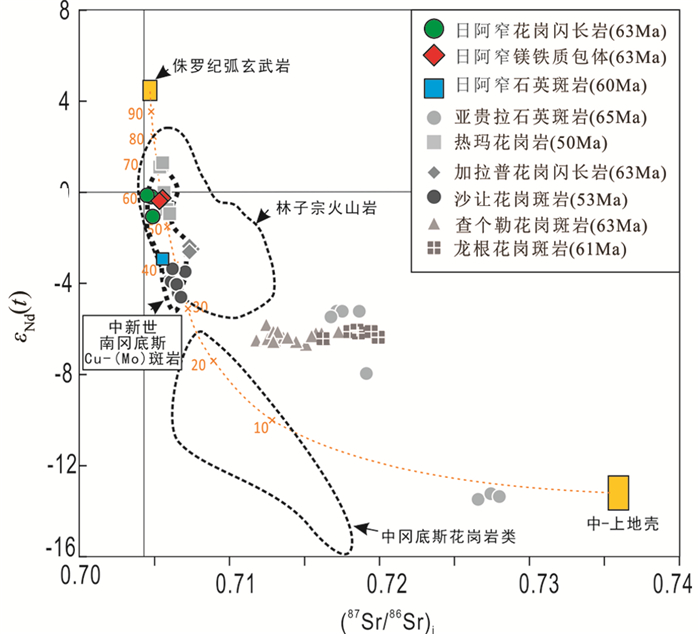
从表上可以看出,花岗闪长岩的87Sr/86Sr为0.7051~0.7052,计算的初始锶(87Sr/86Sr)i为0.7046~0.7049,143Nd/144Nd为0.512554~0.512599,计算的εNd(t)值为-1.1~-0.2。花岗闪长岩中的镁铁质包体的87Sr/86Sr为0.705393~0.705825,计算的初始锶(87Sr/86Sr)i为0.7054~0.7056,143Nd/144Nd为0.512596~0.512603,计算的εNd(t)值为-0.4~-0.2。石英斑岩的87Sr/86Sr为0.7081,计算的初始锶(87Sr/86Sr)i为0.7056,143Nd/144Nd为0.512456,计算的εNd(t)值为-2.9。
5 讨论 5.1 日阿窄花岗岩类岩石成因花岗岩存在近20种成因类型划分方案,目前应用较为广泛应属于花岗岩ISMA型划分方案(吴福元等, 2007)。Chappell and White (1974)按岩浆源区性质提出了I和S型花岗岩,即I型花岗岩指源岩为未经风化作用的火成岩熔融形成的花岗岩,而S型花岗岩通常认为是由地壳中变质沉积岩深熔作用形成。随着进一步的研究,I型花岗岩可能形成于以下三种模式:(1)与或者无幔源镁铁质岩浆相互作用的镁铁质下地壳部分熔融形成(Chappell and White, 2001; Petford and Atherton, 1996);(2)幔源玄武岩或玄武质安山岩在浅成壳源岩浆房中的同化混染和结晶分异作用形成(Grove et al., 1997);及(3)沉积物质与可变量的幔源岩浆的重造作用形成(Kemp et al., 2007)。日阿窄花岗闪长岩中含较多的角闪石和黑云母,未见白云母和堇青石等富铝矿物(图 3a, b),其SiO2含量(62.10%~68.03 %)显示较低的分异程度,铝饱和指数A/CNK集中于0.90~1.06,具有I型花岗岩特征(Chappell and White, 1992; Wu et al., 2017; 图 4c)。研究显示,磷灰石(P2O5)在偏铝质和弱过铝质中(A/CNK < 1.1)岩浆中容易达到饱和,而在强过铝质熔体中具有高的溶解性(Wolf and London, 1994),因此随着岩浆的结晶分异(SiO2、Ba、Rb增加),P2O5的含量在强过铝质S型花岗质岩浆中增加,而在I型花岗质岩浆中降低(Chappell and White, 1992),因此岩浆岩中的P2O5、Th、Ba、Rb等元素可能是判别I型和S型花岗岩的有效标志(Chappell and White, 1992; Chappell, 1999; Wu et al., 2003; 吴福元等, 2007; Xu et al., 2016)。日阿窄花岗闪长岩的Th、P2O5与SiO2等协变图解显示其具有I型花岗岩特征(图 4d-f)。
由于不相容元素对具有相似的地球化学性质,如Th和U,以及Nb和Ta,因此Th/U比值和Nb/Ta比值在岩浆形成后的过程中变化较小或者基本保持不变,所以可以用来指示岩浆源区特征。通常,Th/U比值在原始地幔中为4,在地壳中为3.8~6;而Nb/Ta比值在与壳源相关的岩浆中为11~12,在与幔源相关的岩浆为17.5±2(Atherton and Petford, 1993; Green, 1995; Rudnick and Gao, 2014)。日阿窄花岗闪长岩的Th/U值为3.04~4.15(均值3.54),Nb/Ta值为7.95~12.42(均值10.25),相对来说更加显示壳源岩浆的特征。样品的Rb/Sr比值(0.08~0.31)介于上地壳(112/350=0.32)和下地壳(12/230=0.05)的Rb/Sr比值之间(Taylor and McClennan, 1985; Rudnick and Gao, 2014),同样也暗示了在壳源物质的参与在岩浆形成过程中的重要性。Sr-Nd同位素组成,尤其是Nd同位素受蚀变等因素影响较小,广泛被应用于判断岩浆的源区特征。日阿窄花岗闪长岩的初始锶(87Sr/86Sr)i为0.7046~0.7049,εNd(t)值为-1.1~-0.2,Nd同位素模式年龄为0.9~1.0Ga,显示其岩浆源区可能为受幔源岩浆影响的新生镁铁质下地壳物质(Petford and Atherton, 1996; Hou et al., 2004, 2015)。这一点也与花岗闪长岩的Mg#值相对应(39.6~45.7)。实验岩石学的研究表明,不论下地壳熔融程度如何,其产物的Mg#通常小于40,而与幔源相关的岩浆的Mg#值一般大于50(Atherton and Petford, 1993; Rapp and Watson, 1995),因此,日阿窄花岗闪长岩很可能具有少量新生幔源物质地加入。在中-上地壳(Hou et al., 2015)与侏罗纪玄武岩(新生幔源组分代表,Zhu et al., 2008)演化线上(图 7),日阿窄花岗闪长岩显示其新生幔源组分为50%~60%。相较而言,日阿窄镁铁质包体与其寄主花岗闪长岩显示相似的Sr-Nd同位素组成(87Sr/86Sr)i=0.7052~0.7056,εNd(t)=-0.4~-0.2,tDM=1.1~1.2Ga),而石英斑岩具有较低的εNd(t)值(-2.9),暗示花岗闪长岩与其包体具有相似的来源,而石英斑岩相对显示更多的壳源组分特征(图 7)。
|
图 7 西藏日阿窄矿床岩浆岩εNd(t)-(87Sr/86Sr)i组成 数据来源:侏罗纪弧玄武岩(新生地幔组分):(87Sr/86Sr)i=0.7046, Sr=679×10-6, εNd(i)=4.52及Nd=23×10-6(Zhu et al., 2008);中-上地壳:(87Sr/86Sr)i=0.7359,Sr=26.7×10-6,εNd(t)=-13.1及Nd=11.8×10-6(Hou et al., 2015);中部拉萨地体花岗岩来自莫宣学等(2005);冈底斯中新世斑岩铜钼矿床来自Hou et al. (2015);林子宗群火山岩来自Mo et al. (2007) Fig. 7 The εNd(t) vs. (87Sr/86Sr)i diagram for Riazhai magmatic rocks Data source: the Jurassic arc basalt (e.g., the juvenile mantle components) of (87Sr/86Sr)i=0.7046, Sr=679×10-6, εNd(i)=4.52, and Nd=23×10-6 from Zhu et al. (2008); the middle-upper crust of (87Sr/86Sr)i=0.7359, Sr=26.7×10⁻⁶, εNd(t)=-13.1, and Nd=11.8×10⁻⁶ from Hou et al. (2015); granitoids of central Gangdese belt from Mo et al. (2005); Miocene Gangdese Cu-(Mo) porphyry from Hou et al. (2015); and Linzizong volcanics from Mo et al. (2007) |
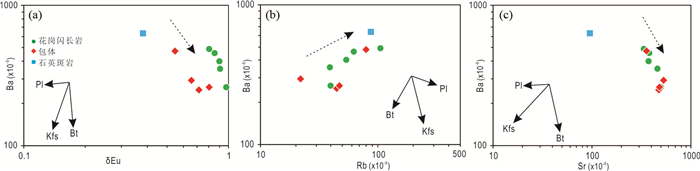
日阿窄花岗闪长岩、镁铁质包体以及石英斑岩均显示高场强元素Nb、Ta、Ti、P的亏损,暗示了在岩浆演化过程中可能发生了金红石、钛铁矿以及磷灰石等的分离结晶(图 5b; Rollinson, 1993; Foley et al., 2000)。相较而言,石英斑岩具有更加强烈的Eu负异常(δEu=0.38)和Sr、Ba的亏损(图 5a-b),表明石英斑岩可能发生了斜长石等富Eu矿物在源区残留或同时发生了分离结晶作用。在Ba与Rb、δEu协变图解中,花岗闪长岩及其包体均未显示斜长石、钾长石的结晶分异趋势,而可能发生了一定程度的黑云母的分离(图 8a-c)。研究表明,石榴子石可容纳大量的重稀土元素如Yb、Y以及Lu,而角闪石则相对更加易于富集中稀土Dy(Green, 1980; Sisson, 1994),因此当石榴子石为主要结晶分离相时,形成的岩浆具有倾斜的HREE配分模式;而当角闪石为主要源区残留相时,形成的熔体具有较为平坦的HREE配分模式(高永丰等, 2003);而且石榴子石的分离会导致岩浆La/Yb,Dy/Yb比值的明显升高,而角闪石的分离则更容易导致其Dy/Yb比值的减小。日阿窄花岗闪长岩及其包体显示较为平坦的HREE配分模式,未见Yb,Lu异常,暗示了源区岩浆可能以角闪石的分离结晶为主;同时结合SiO2-Dy/Yb以La/Yb-Dy/Yb协变图解(图 9a-c)可知,在岩浆演化过程中石榴子石也发生了一定程度的分离结晶。
|
图 8 西藏日阿窄矿床岩浆岩Ba-δEu (a)、Ba-Rb (b)以及Ba-Sr (c)图解(据Eby, 1990; Janoušek et al., 2004; Wu et al., 2003) Fig. 8 The Ba vs. δEu (a), Ba vs. Rb (b), and Ba vs. Sr (c) diagrams of Riazhai magmatic rocks (after Eby, 1990; Janoušek et al., 2004; Wu et al., 2003) |

|
图 9 西藏日阿窄矿床岩浆岩源区组成与演化特征 Fig. 9 The composition of source and evolution for the Riazhai magmatic rocks |
日阿窄铅多金属矿床矿区内岩浆岩高精度SHRIMP锆石U-Pb年代学揭示花岗闪长岩形成于62.70±0.78Ma,斑状花岗岩以及石英斑岩的形成略晚,分别为60.43±0.86Ma和60.30±1.20Ma。该时期对应于印度与欧亚大陆同碰撞初期新特提斯洋板片发生回撤(Hou et al., 2015; Zheng et al., 2015; Wang et al., 2016; Xu et al., 2019)。因此,综上认为在新特提斯洋板片发生回撤时引起地幔软流圈上涌而诱发新生镁铁质下地壳部分熔融形成的岩浆,在经历了一定程度的金红石、钛铁矿、磷灰石、黑云母、石榴子石以及角闪石与少量的斜长石或钾长石的分离结晶后形成了花岗闪长岩。花岗闪长岩中的镁铁质包体与花岗闪长岩显示相似的源区特征,由于缺乏准确的年代学,故只能推测其可能是由于同源岩浆的结晶分异作用形成(Dodge and Kistler, 1990),而非幔源岩浆注入发生岩浆混合作用形成(Griffin et al., 2002)。石英斑岩与花岗闪长岩具有相似的源区性质,但显示更多的壳源组分的加入与更强的结晶分异作用,推测为岩浆房进一步发生斜长石或钾长石结晶分异的产物。
5.2 冈底斯斑岩铜矿带古新世Pb-Zn成矿作用日阿窄铅多金属矿床位于南部拉萨地体的中新世斑岩Cu-Mo-Au矿带,该成矿带是我国著名的斑岩成矿带,发现了一系列大型-超大型斑岩Cu±Mo±Au矿床,如驱龙斑岩Cu-Mo矿床(郑有业等, 2004)、朱诺斑岩Cu矿(郑有业等, 2006)、雄村(唐菊兴等, 2010)。日阿窄铅多金属矿床岩浆岩高精度SHRIMP锆石U-Pb年代学揭示其形成于古新世(63~60Ma)。岩相学特征以及化学分析显示花岗闪长岩较新鲜(LOI=0.21%~0.51%),而斑状花岗岩和石英斑岩发育较强烈的蚀变(如绿帘石化、绿泥石化和绢云母化,图 3c, d)(LOI=2.11%),尤其是石英斑岩中发育少量的浸染状和裂隙脉状黄铁矿和辉钼矿(图 3e, f),表明偏向中酸性的斑状花岗岩和石英斑岩可能与Pb多金属矿化密切相关,这也与花岗岩的成矿专属性一致(李洪昌和唐先礼, 1987; 王登红等, 2014)。因此,是否意味着在斑岩Cu-Mo-Au矿带亦有寻找古新世铅锌多金属矿床的潜力?
日阿窄矿区的北部(沙莫勒-麦拉-洛巴堆-米拉山断裂带以北)属于冈底斯弧背断垄带,是我国重要的念青唐古拉Pb-Zn-Ag-Fe-Cu-Mo-W多金属矿带(唐菊兴等, 2014; 高一鸣等, 2011; Li et al., 2014; 高顺宝, 2015; Zhao et al., 2016; Zheng et al., 2015; 徐净, 2017)。大量的研究表明,其成岩、成矿活动集中于古新世-始新世(50~65Ma)(表 4),如该成矿带东段(90°E附近)的亚贵拉Pb-Zn-Ag-Mo矽卡岩矿床(65.2±1.5Ma; Xu et al., 2019)、沙让斑岩Mo矿床(52.25±0.31Ma; Zhao et al., 2014)、蒙亚啊Pb-Zn-Ag矽卡岩矿床(54.6±0.4Ma; 付强等, 2015)、龙马拉Fe-Pb-Zn矽卡岩矿床(53±3.7Ma; Wang et al., 2015)、哈海港W-Mo矽卡岩矿床(63.2±3.2Ma; Li et al., 2014);成矿带中部(89°E附近)的加多捕勒Fe-Cu矽卡岩矿床(50.9±1.8Ma; 于玉帅等, 2011)、恰功Fe±Pb矽卡岩矿床(51.46±0.58Ma;未发表数据)、纳如松多Pb-Zn-Ag矿床(57.81±0.66Ma; 纪献华, 2013);以及该成矿带西部(80°E左右)的哥布弄巴Fe-Cu矽卡岩矿床(59.22±0.61Ma; 高顺宝, 2015)(图 1b)。此外,日阿窄矿区北侧(约91°E; 图 1b)亦分布着大量的Fe-Pb-Zn多金属矿床,如列廷冈Fe-Cu±Mo矽卡岩矿床(62.28±0.66Ma; 杨毅等, 2014)、新嘎果Fe-Pb-Zn矽卡岩矿床(56.5±1.3Ma; Wang et al., 2016)、勒青拉Fe-Pb-Zn矽卡岩矿床(63.1±0.4Ma; Wang et al., 2016)、加拉普Fe矽卡岩矿床(63.4±0.5Ma; 付强, 2013)以及热玛Fe矽卡岩矿床(49.7±1.0Ma; Zheng et al., 2015)。因此,位于冈底斯斑岩Cu-Mo成矿带的日阿窄Pb多金属矿床极有可能是念青唐古拉Pb-Zn-Ag-Fe-Cu-Mo-W多金属矿带向南西的延伸带。这样的推论也得到发育于南冈底斯斑岩Cu-Mo成矿带上的其他一些Pb-Zn多金属矿床的证实(86°~87°E),如罗布真铅锌矿(Sun et al., 2017)、查个勒Pb-Zn±Mo矿床(61.49±0.42Ma; 高顺宝, 2015)、诺仓Pb-Zn矿床(Jiang et al., 2018)以及龙根矽卡岩型Pb-Zn矿床(61.4±1.2Ma; 段志明等, 2014)。
|
|
表 4 西藏念青唐古拉成矿带Fe-Cu-Pb-Zn矿床矿区成岩-成矿时代 Table 4 The geochronology for magmatic rocks and mineralization of Fe-Cu-Pb-Zn deposits in the Nyainqentanglha polymetallic metallogenic belt, Tibet |
此外,念青唐古拉多金属成矿带上的古新世-始新世与铁铜铅锌相关的岩浆岩Sr-Nd同位素特征显示(表 3、图 7):日阿窄花岗闪长岩及镁铁质包体的Sr-Nd同位素特征与其邻区的热玛Fe矽卡岩矿床的成矿岩浆岩的值相似(0.7054~0.7075; -0.9~+1.3; Zheng et al., 2015; 图 1b、图 7)。日阿窄石英斑岩的Sr-Nd同位素特征与加拉普Fe矽卡岩矿床(0.7074~0.7075; -2.6~-2.3; 付强, 2013)和沙让斑岩Mo矿床(0.7061~0.7071; -3.6~-3.4; Zhao et al., 2016),结合已经在石英斑岩中发现的辉钼和黄铁矿化,进一步指示了日阿窄石英斑岩可能具有形成Mo矿化的潜力。相较而言,日阿窄矿区的岩浆岩的Sr-Nd同位素特征与冈底斯中新世斑岩Cu(-Mo)矿床相似,显示其岩浆岩源区为新生的镁铁质下地壳(Hou et al., 2004)。相比念青唐古拉成矿带与冈底斯斑岩成矿带上现已报道的古新世-始新世铅锌多金属矿床(如:亚贵拉、查个勒、龙根等)(图 9),日阿窄Pb多金属矿床显示更高的εNd(t)值和更低的初始锶值,表明在沙莫勒-麦拉-洛巴堆-米拉山断裂带以南的冈底斯斑岩Cu-Mo成矿带上有更多的新生地壳物质的参与,可能与Fe-Cu相关的多金属成矿作用关系密切。这些Sr-Nd同位素结果也与Hou et al. (2015)对拉萨地体进行Hf同位素填图的结果一致。因此,整体来看,从沙莫勒-麦拉-洛巴堆-米拉山断裂带以北的亚贵拉-沙让-蒙亚啊Pb-Zn-Ag-Mo多金属矿集区往南到热玛-列廷冈-加拉普-新嘎果Fe-Cu-Zn多金属矿集区,Sr-Nd同位素显示更多的幔源物质的加入。综上我们初步认为拉萨地体南部的冈底斯斑岩Cu-Mo-Au成矿带(沙莫勒-麦拉-洛巴堆-米拉山断裂南侧附近)可能具有寻找与Fe-Cu相关的多金属矿床的潜力,应该加强对该成矿带Fe-Cu相关的多金属矿床的找矿勘查。
6 结论(1) 高精度SHRIMP锆石U-Pb年代学揭示日阿窄Pb多金属矿床花岗闪长岩(62.70±0.78Ma)、斑状花岗岩(60.43±0.86Ma)以及石英斑岩(60.30±1.20Ma)是南冈底斯古新世岩浆活动的产物。
(2) 花岗闪长岩及其包体为新生镁铁质下地壳(约50%~60%)部分熔融的产物,其经历了黑云母、角闪石、石榴子石等的结晶分异。石英斑岩与花岗闪长岩具有相似的源区性质,但有更多的壳源组分的加入,推测为同一岩浆房进一步发生斜长石或钾长石结晶分异的产物。
(3) 日阿窄Pb多金属矿床位于冈底斯中新世斑岩成矿带,结合该带已报道的古新世Pb-Zn多金属矿床,提出可能是北部念青唐古拉多金属成矿带古新世-始新世岩浆成矿作用的向南延伸,认为拉萨地体南部的冈底斯斑岩Cu-Mo-Au成矿带可能具有发育与Fe-Cu相关的多金属矿床的潜力。
Allégre CJ, Courtillot V, Tapponnier P, Hirn A, Mattauer M, Coulon C, Jaeger JJ, Achache J, Schärer U, Marcoux J, Burg JP, Girardeau J, Armijo R, Gariépy C, Göpel C, Li TD, Xiao XC, Chang CF, Li GQ, Lin BY, Teng JW, Wang NW, Chen GM, Han TL, Wang XB, Den WM, Sheng HB, Cao YG, Zhou J, Qiu HR, Bao PS, Wang SC, Wang BX, Zhou YX and Xu RH. 1984. Structure and evolution of the Himalaya-Tibet orogenic belt. Nature, 307(5946): 17-22 DOI:10.1038/307017a0 |
Atherton MP and Petford N. 1993. Generation of sodium-rich magmas from newly underplated basaltic crust. Nature, 362(6416): 144-146 DOI:10.1038/362144a0 |
Chappell BW and White AJR. 1974. Two contrasting granite types. Pacific Geology, 8(2): 173-174 |
Chappell BW and White AJR. 1992. I- and S-type granites in the Lachlan Fold Belt. Earth and Environmental Science Transactions of the Royal Society of Edinburgh, 83(1-2): 1-26 DOI:10.1017/S0263593300007720 |
Chappell BW. 1999. Aluminium saturation in I- and S-type granites and the characterization of fractionated haplogranites. Lithos, 46(3): 535-551 DOI:10.1016/S0024-4937(98)00086-3 |
Chappell BW and White AJR. 2001. Two contrasting granite types:25 years later. Australian Journal of Earth Sciences, 48(4): 489-499 DOI:10.1046/j.1440-0952.2001.00882.x |
Collins WJ, Beams SD, White AJH and Chappell BW. 1982. Nature and origin of A-type granites with particular reference to southeastern Australia. Contributions to Mineralogy and Petrology, 80(2): 189-200 DOI:10.1007/BF00374895 |
Dewey JF and Burke KCA. 1973. Tibetan, Variscan, and Precambrian basement reactivation:Products of continental collision. Journal of Geology, 81(6): 683-692 DOI:10.1086/627920 |
Dodge FCW and Kistler RW. 1990. Some additional observations on inclusions in the granitic rocks of the Sierra Nevada. Journal of Geophysical Research:Solid Earth, 95(B11): 17841-17848 DOI:10.1029/JB095iB11p17841 |
Duan ZM, Li GM, Li YX, Wang BD, Zhang H, Huang Y, Guo L and Duan YY. 2014. Geochronology and geochemical characteristics of ore-bearing porphyry in Longgen lead-zinc deposit of middle-Gangdese metallogenic belt, Tibet. Mineral Deposits, 33(3): 625-638 (in Chinese with English abstract) |
Duan ZM, Li GM, Wang BX, Li YX, Huang Y, Guo L and Duan YY. 2015. Geochronology and its geological significance of the ore-bearing porphyry in Chagele lead-zinc deposit in middle-Gangdese metallogenic belt, Tibet. Journal of Jilin University (Earth Science Edition), 45(6): 1667-1690 (in Chinese with English abstract) |
Eby GN. 1990. The A-type granitoids:A review of their occurrence and chemical characteristics and speculations on their petrogenesis. Lithos, 26(1-2): 115-134 DOI:10.1016/0024-4937(90)90043-Z |
Fei F. 2014. Tibet Leqingla and Mengyaa Pb-Zn deposit metallogenic characteristics of the contrast. Master Degree Thesis. Beijing: China University of Geosciences (in Chinese with English summary)
|
Foley SF, Barth MG and Jenner GA. 2000. Rutile/melt partition coefficients for trace elements and an assessment of the influence of rutile on the trace element characteristics of subduction zone magmas. Geochimica et Cosmochimica Acta, 64(5): 933-938 DOI:10.1016/S0016-7037(99)00355-5 |
Fu Q. 2013. Mineralization of skarn Fe (Cu) deposits in the North Gangdese belt, Tibet. Master Degree Thesis. Beijing: China University of Geosciences (in Chinese with English summary)
|
Fu Q, Huang KX, Zheng YC, Yang ZS and Duan LF. 2015. Ar-Ar age of muscovite from skarn orebody of the Mengya'a lead-zinc deposit in Tibet and its geodynamic significance. Acta Geologica Sinica, 89(3): 569-582 (in Chinese with English abstract) |
Gao SB. 2015. Copper-iron polymetal metallogenesis regularity and election of target areas in the western of Gangdise Metallogenic Belt, Tibet. Ph. D. Dissertation. Wuhan: China University of Geosciences (in Chinese with English summary)
|
Gao YF, Hou ZQ and Wei RH. 2003. Neogene porphyries from Gangdese:Petrological, geochemical characteristics and geodynamic significances. Acta Petrologica Sinica, 19(3): 418-428 (in Chinese with English abstract) |
Gao YM, Chen YC, Tang JX, Li C, Li XF, Gao M and Cai ZC. 2011. Re-Os dating of molybdenite from the Yaguila porphyry molybdenum deposit in Gongbo'gyamda area, Tibet, and its geological significance. Geological Bulletin of China, 30(7): 1027-1036 (in Chinese with English abstract) |
Geng QR, Zhang Z, Peng ZM, Guan JL, Zhu XP and Mao XC. 2016. Jurassic-Cretaceous granitoids and related tectono-metallogenesis in the Zapug-Duobuza arc, western Tibet. Ore Geology Reviews, 77: 163-175 DOI:10.1016/j.oregeorev.2016.02.018 |
Green TH. 1980. Island arc and continent-building magmatism:A review of petrogenic models based on experimental petrology and geochemistry. Tectonophysics, 63(1-4): 367-385 DOI:10.1016/0040-1951(80)90121-3 |
Green TH. 1995. Significance of Nb/Ta as an indicator of geochemical progresses the crust-mantel system. Chemical Geology, 120(3-4): 347-359 DOI:10.1016/0009-2541(94)00145-X |
Griffin WL, Wang X, Jackson SE, Pearson NJ, O'Reilly SY, Xu XS and Zhou XM. 2002. Zircon chemistry and magma mixing, SE China:In-situ analysis of Hf isotopes, Tonglu and Pingtan igneous complexes. Lithos, 61(3-4): 237-269 DOI:10.1016/S0024-4937(02)00082-8 |
Grove TL, Donnelly-Nolan JM and Housh T. 1997. Magmatic processes that generated the rhyolite of Glass Mountain, Medicine Lake volcano, N. California. Contributions to Mineralogy and Petrology, 127(3): 205-223 DOI:10.1007/s004100050276 |
Hoskin PWO and Black LP. 2000. Metamorphic zircon formation by solid-state recrystallization of protolith igneous zircon. Journal of metamorphic Geology, 18(4): 423-439 |
Hou ZQ, Gao YF, Qu XM, Rui ZY and Mo XX. 2004. Origin of adakitic intrusives generated during mid-Miocene east-west extension in southern Tibet. Earth and Planetary Science Letters, 220(1-2): 139-155 DOI:10.1016/S0012-821X(04)00007-X |
Hou ZQ, Duan LF, Lu YJ, Zheng YC, Zhu DC, Yang ZM, Yang ZS, Wang BD, Pei YR, Zhao ZD and McCuaig TC. 2015. Lithospheric architecture of the Lhasa terrane and its control on ore deposits in the Himalayan-Tibetan orogen. Economic Geology, 110(6): 1541-1575 DOI:10.2113/econgeo.110.6.1541 |
Huang KX, Zheng YC, Zhang S, Li W, Sun QZ, Li QY and Hou ZQ. 2012. LA-ICP-MS zircon U-Pb dating of two types of porphyry in the Yaguila mining area, Tibet. Acta Petrologica et Mineralogica, 31(3): 348-360 (in Chinese with English abstract) |
Huang LH. 2017. Geochemical characteristics and genesis of enlightenment of Hahaigang W-Mo polymetallic deposit in Tibet. Master Degree Thesis. Beijing: China University of Geosciences (in Chinese with English summary)
|
Janoušek V, Finger F, Roberts M, Fryda J, Pin C and Dolejš D. 2004. Deciphering the petrogenesis of deeply buried granites:Whole-rock geochemical constraints on the origin of largely undepleted felsic granulites from the Moldanubian Zone of the Bohemian Massif. Earth and Environmental Science Transactions of the Royal Society of Edinburgh, 95(1-2): 141-159 DOI:10.1017/S0263593300000985 |
Ji XH. 2013. Study on geology, geochemistry and genesis of Narusongduo lead-zinc deposit, Tibet. Master Degree Thesis. Beijing: China University of Geosciences (in Chinese with English summary)
|
Jiang JS, Zheng YY, Gao SB, Zhang YC, Huang J, Liu J, Wu S, Xu J and Huang LL. 2018. The newly-discovered late cretaceous igneous rocks in the Nuocang district:Products of ancient crust melting trigged by Neo-Tethyan slab rollback in the western Gangdese. Lithos, 308-309: 294-315 DOI:10.1016/j.lithos.2018.03.009 |
Kemp AIS, Hawkesworth CJ, Foster GL, Paterson BA, Woodhead JD, Hergt JM, Gray CM and Whitehouse MJ. 2007. Magmatic and crustal differentiation history of granitic rocks from Hf-O isotopes in zircon. Science, 315(5814): 980-983 DOI:10.1126/science.1136154 |
Li FQ, Gao M, Tang WQ and Liang T. 2010. U-Pb zircon LA-ICP-MS age of the Yaguila molybdenum-bearing intrusion in Tibet and its geological significance. Geology in China, 37(6): 1566-1574 (in Chinese with English abstract) |
Li HC and Tang XL. 1987. Characteristics of the small acid and intermediate-acid intrusive bodies in Diwastace of Nanling region and their relation to lead-zinc deposits. Geotectonica et Metallogenia, 11(3): 77-82 (in Chinese with English abstract) |
Li JX, Qin KZ, Li GM, Evans NJ, Zhao JX, Cao MJ and Huang F. 2016. The Nadun Cu-Au mineralization, central Tibet:Root of a high sulfidation epithermal deposit. Ore Geology Reviews, 78: 371-387 DOI:10.1016/j.oregeorev.2016.04.019 |
Li XF, Wang CZ, Mao W, Xu QH and Liu YH. 2014. The fault-controlled skarn W-Mo polymetallic mineralization during the main India-Eurasia collision:Example from Hahaigang deposit of Gangdese metallogenic belt of Tibet. Ore Geology Reviews, 58: 27-40 DOI:10.1016/j.oregeorev.2013.10.006 |
Li YX, Xie YL, Chen W, Tang YW, Li GM, Zhang L, Liu YF and Liu XM. 2011. U-Pb age and geochemical characteristics of zircon in monzogranite porphyry from Qiagong deposit, Tibet, and geological implication. Acta Petrologica Sinica, 27(7): 2023-2033 (in Chinese with English abstract) |
Liu B, Dong SL, Li GM and Zhang H. 2010. Geochemical characteristics and age geological significance of geochemistry of Sinongduo Pb-Zn deposit in Tibet. Mineral Deposits, 29(Suppl.): 472-473 (in Chinese) |
Ludwig KR. 2003. Isoplot 3.00: A Geochronological Toolkit for Microsoft Excel. Berkeley: Geochronology Center Special Publication, 1-70
|
Lü LN. 2012. Metallogenic model of rich iron and copper (gold) deposits in western part of Bangong Co-Nujiang metallogenic belt, Tibet. Ph. D. Dissertation. Beijing: Chinese Academy of Geological Sciences (in Chinese with English summary)
|
Maniar PD and Piccoli PM. 1989. Tectonic Discrimination of Granitoids. GSA Bulletin, 101(5): 635-643 DOI:10.1130/0016-7606(1989)101<0635:TDOG>2.3.CO;2 |
Mo XX, Dong GC, Zhao ZD, Zhou S, Wang LL, Qiu RZ and Zhang FQ. 2005. Spatial and temporal distribution and characteristics of granitoids in the Gangdese, Tibet and implication for crustal growth and evolution. Geological Journal of China Universities, 11(3): 281-290 |
Mo XX, Hou ZQ, Niu YL, Dong GC, Qu XM, Zhao ZD and Yang ZM. 2007. Mantle contributions to crustal thickening during continental collision:Evidence from Cenozoic igneous rocks in southern Tibet. Lithos, 96(1-2): 225-242 DOI:10.1016/j.lithos.2006.10.005 |
Pan GT, Mo XX, Hou ZQ, Zhu DC, Wang LQ, Li GM, Zhao ZD, Geng QR and Liao ZL. 2006. Spatial-temporal framework of the Gangdese Orogenic Belt and its evolution. Acta Petrologica Sinica, 22(3): 521-533 (in Chinese with English abstract) |
Peccerillo A and Taylor SR. 1976. Geochemistry of eocene calc-alkaline volcanic rocks from the Kastamonu area, northern Turkey. Contributions to Mineralogy and Petrology, 58(1): 63-81 DOI:10.1007/BF00384745 |
Petford N and Atherton M. 1996. Na-rich partial melts from newly underplated basaltic crust:The Cordillera Blanca batholith, Peru. Journal of Petrology, 37(6): 1491-1521 DOI:10.1093/petrology/37.6.1491 |
Rapp RP and Watson EB. 1995. Dehydration melting of metabasalt at 8~32kbar:Implications for continental growth and crust-mantle recycling. Journal of Petrology, 36(4): 891-931 DOI:10.1093/petrology/36.4.891 |
Rollinson HR. 1993. A terrane interpretation of the Archaean Limpopo Belt. Geological Magazine, 130(6): 755-765 DOI:10.1017/S001675680002313X |
Rudnick RL and Gao S. 2014. Composition of the continental crust. In: Holland HD and Turekian KK (eds.). Treatise on Geochemistry, Volume 4. Amsterdam: Elsevier, 1-51
|
Sisson TW. 1994. Hornblende-melt trace-element partitioning measured by ion microprobe. Chemical Geology, 117(1-4): 331-344 DOI:10.1016/0009-2541(94)90135-X |
Song B, Zhang YH and Liu DY. 2002. Introduction to the naissance of SHRIMP and its contribution to isotope geology. Journal of Chinese Mass Spectrometry Society, 23(1): 58-62 (in Chinese with English abstract) |
Sun SS and McDonough WF. 1989. Chemical and isotopic systematics of oceanic basalts:Implications for mantle composition and processes. In:Saunders AD and Norry MJ (eds.). Magmatism in the Ocean Basins. Geological Society, London, Special Publication, 42(1):313-345
|
Sun X, Zheng YY, Li M, Ouyang HT, Liu QQ, Jing XK, Sun GP and Song QJ. 2017. Genesis of Luobuzhen Pb-Zn veins:Implications for porphyry Cu systems and exploration targeting at Luobuzhen-Dongshibu in western Gangdese belt, southern Tibet. Ore Geology Reviews, 82: 252-267 DOI:10.1016/j.oregeorev.2016.11.016 |
Tang JX, Li FJ, Li ZJ, Zhang L, Tang XQ, Deng Q, Lang XH, Huang Y, Yao XF and Wang Y. 2010. Time limit for formation of main geological bodies in Xiongcun copper-gold deposit, Xietongmen County, Tibet:Evidence from zircon U-Pb ages and Re-Os age of molybdenite. Mineral Deposits, 29(3): 461-475 (in Chinese with English abstract) |
Tang JX, Duo J, Liu HF, Lang XH, Zhang JS, Zheng WB and Ying LJ. 2012. Minerogenetic series of ore deposits in the eastern part of the Gangdise metallogenic belt. Acta Geoscientica Sinica, 33(4): 393-410 (in Chinese with English abstract) |
Tang JX, Wang LQ, Zheng WB and Zhong KH. 2014. Ore deposits metallogenic regularity and prospecting in the eastern section of the gangdese metallogenic belt. Acta Geologica Sinica, 88(12): 2545-2555 (in Chinese with English abstract) |
Taylor SR and McClennan SM. 1985. The Continental Crustal:Its Composition and Evolution. London: Blackwell: 57-72
|
Wang CY, Li XF, Xiao R, Bai YP, Yang F, Mao W and Jiang SK. 2012. Elements mobilization of mineralized porphyry rocks during hydrothermal alteration at Zhushahong porphyry copper deposit, Dexing district, South China. Acta Petrologica Sinica, 28(12): 3869-3886 (in Chinese with English abstract) |
Wang DH, Chen ZY, Huang F, Wang CH, Zhao Z, Chen ZH, Zhao Z and Liu XX. 2014. Discussion on metallogenic specialization of the magmatic rocks and related issues in the Nanling Region. Geotectonica et Metallogenia, 38(2): 230-238 (in Chinese with English abstract) |
Wang LQ, Tang JX, Deng J, Kang HR, Lin X, Cheng WB, Li Z and Zhang Z. 2015. The Longmala and Mengya'a skarn Pb-Zn deposits, Gangdese region, Tibet:Evidence from U-Pb and Re-Os geochronology for formation during early India-Asia collision. International Geology Review, 57(14): 1825-1842 DOI:10.1080/00206814.2015.1029540 |
Wang LQ, Cheng WB, Tang JX, Kang HR, Zhang Y and Li Z. 2016. U-Pb geochronology, geochemistry, and H-O-S-Pb isotopic compositions of the Leqingla and Xin'gaguo skarn Pb-Zn polymetallic deposits, Tibet, China. Journal of Asian Earth Sciences, 115: 80-96 DOI:10.1016/j.jseaes.2015.09.018 |
Wang YF. 2017. Ore-forming intrusion chronology and geochemistry of the Jiaduobule skarn Fe-Cu deposit in Tibet. Master Degree Thesis. Beijing: China University of Geosciences (in Chinese with English summary)
|
Willson MF, Irvine AK and Walsh NG. 1989. Vertebrate dispersal syndromes in some Australian and New Zealand plant communities, with geographic comparisons. Biotropica, 21(2): 133-147 DOI:10.2307/2388704 |
Wolf MB and London D. 1994. Apatite dissolution into peraluminous haplogranitic melts:An experimental study of solubilities and mechanisms. Geochimica et Cosmochimica Acta, 58(19): 4127-4145 DOI:10.1016/0016-7037(94)90269-0 |
Wu FY, Jahn BM, Wilde SA, Lo CH, Yui TF, Lin Q, Ge WC and Sun DY. 2003. Highly fractionated Ⅰ-type granites in NE China (I):Geochronology and petrogenesis. Lithos, 66(3-4): 241-273 DOI:10.1016/S0024-4937(02)00222-0 |
Wu FY, Li XH, Yang JH and Zheng YF. 2007. Discussions on the petrogenesis of granites. Acta Petrologica Sinica, 23(6): 1217-1238 (in Chinese with English abstract) |
Wu FY, Liu XC, Ji WQ, Wang JM and Yang L. 2017. Highly fractionated granites:Recognition and research. Science China (Earth Sciences), 60(7): 1201-1219 DOI:10.1007/s11430-016-5139-1 |
Xin CL, Du WD, Zhang YP, Wei M and Chen SW. 2013. A preliminary study of the geologic characteristics and genesis of the Dongzhongsongduo lead-zinc polymetallic deposit, Tibet. Journal of Lanzhou University (Natural Sciences, 49(1): 24-31 (in Chinese with English abstract) |
Xu J, Zheng YY, Sun X and Shen YH. 2016. Geochronology and petrogenesis of Miocene granitic intrusions related to the Zhibula Cu skarn deposit in the Gangdese belt, southern Tibet. Journal of Asian Earth Sciences, 120: 100-116 DOI:10.1016/j.jseaes.2016.01.026 |
Xu J. 2017. Metallogenic mechanism and regularity of Fe-Cu-Pb-Zn skarn deposits in Nyainqêntanglha, Tibet. Ph. D. Dissertation. Wuhan: China University of Geosciences (in Chinese with English summary)
|
Xu J, Zheng YY, Sun X, Li XF and Mao GZ. 2019. Genesis of the Yaguila Pb-Zn-Ag-Mo skarn deposit in Tibet:Insights from geochronology, geochemistry, and fluid inclusions. Journal of Asian Earth Sciences, 172: 83-100 DOI:10.1016/j.jseaes.2018.08.007 |
Yang Y, Duo J, Liu HF, Zhang JS, Wang LQ, Zhang Z and Hu ZH. 2014. Re-Os dating of molybdenite from the Lietinggang iron polymetallic deposit of Tibet and its geological significance. Geology in China, 41(5): 1554-1564 (in Chinese with English abstract) |
Yang Y. 2015. The study on geological characteristics of Lietinggang iron polymetallic deposit, Tibet and metallogenic regularity of typical deposit in the North Gangdese metallogenic belt. Ph. D. Dissertation. Chengdu: Chengdu Univerisity of Technology (in Chinese with English summary)
|
Yin A and Harrison TM. 2000. Geologic evolution of the Himalayan-Tibetan orogen. Annual Review of Earth and Planetary Sciences, 28: 211-280 DOI:10.1146/annurev.earth.28.1.211 |
Yu YS, Yang ZS, Duo J, Hou ZQ, Tian SH, Meng XJ, Liu HF, Zhang JS, Wang HP and Liu YC. 2011. Age and petrogenesis of magmatic rocks from Jiaduobule skarn Fe-Cu deposit in Tibet:Evidence from zircon SHRIMP U-Pb dating, Hf isotope and REE. Mineral Deposits, 30(3): 420-434 (in Chinese with English abstract) |
Zhao JX, Qin KZ, Li GM, Li JX, Xiao B, Chen L, Yang YH, Li C and Liu YS. 2014. Collision-related genesis of the Sharang porphyry molybdenum deposit, Tibet:Evidence from zircon U-Pb ages, Re-Os ages and Lu-Hf isotopes. Ore Geology Reviews, 56: 312-326 DOI:10.1016/j.oregeorev.2013.06.005 |
Zhao JX, Li GM, Evans NJ, Qin KZ, Li JX and Zhang XN. 2016. Petrogenesis of Paleocene-Eocene porphyry deposit-related granitic rocks in the Yaguila-Sharang ore district, central Lhasa terrane, Tibet. Journal of Asian Earth Sciences, 129: 38-53 DOI:10.1016/j.jseaes.2016.08.004 |
Zheng YC, Fu Q, Hou ZQ, Yang ZS, Huang KX, Wu CD and Sun QZ. 2015. Metallogeny of the northeastern Gangdese Pb-Zn-Ag-Fe-Mo-W polymetallic belt in the Lhasa terrane, southern Tibet. Ore Geology Reviews, 70: 510-532 DOI:10.1016/j.oregeorev.2015.04.004 |
Zheng YY, Xue YX, Cheng LJ, Fan ZH and Gao SB. 2004. Finding, characteristics and significances of Qulong superlarge porphyry copper (molybdenum) deposit, Tibet. Earth Science (Journal of China University of Geosciences), 29(1): 103-108 (in Chinese with English abstract) |
Zheng YY, Gao SB, Zhang DQ, Fan ZH, Zhang GY and Ma GT. 2006. The discovery of the Zhunuo porphyry copper deposit in Tibet and its significance. Earth Science Frontiers, 13(4): 233-239 (in Chinese with English abstract) |
Zhu DC, Pan GT, Chung SL, Liao ZL, Wang LQ and Li GM. 2008. SHRIMP zircon age and geochemical constraints on the origin of Lower Jurassic volcanic rocks from the Yeba Formation, southern Gangdese, South Tibet. International Geology Review, 50(5): 442-471 DOI:10.2747/0020-6814.50.5.442 |
Zhu DC, Zhao ZD, Niu YL, Mo XX, Chung SL, Hou ZQ, Wang LQ and Wu FY. 2011. The Lhasa Terrane:Record of a microcontinent and its histories of drift and growth. Earth and Planetary Science Letters, 301(1-2): 241-255 DOI:10.1016/j.epsl.2010.11.005 |
段志明, 李光明, 李应栩, 王保弟, 张晖, 黄勇, 郭琳, 段瑶瑶. 2014. 中冈底斯成矿带龙根铅锌矿床含矿斑岩年代学与地球化学特征. 矿床地质, 33(3): 625-638. DOI:10.3969/j.issn.0258-7106.2014.03.012 |
段志明, 李光明, 王保弟, 李应栩, 黄勇, 郭琳, 段瑶瑶. 2015. 西藏中冈底斯成矿带查个勒铅锌矿床含矿斑岩年代学及其地质意义. 吉林大学学报(地球科学版), 45(6): 1667-1690. |
费凡.2014.西藏勒青拉与蒙亚啊Pb-Zn矿床成矿特征对比.硕士学位论文.北京: 中国地质大学
|
付强. 2013.西藏冈底斯北部矽卡岩型铁(铜)矿床成矿作用研究.硕士学位论文.北京: 中国地质大学
|
付强, 黄克贤, 郑远川, 杨竹森, 段连峰. 2015. 西藏蒙亚啊铅锌矿床矽卡岩型矿体白云母Ar-Ar年代学研究及其地球动力学意义. 地质学报, 89(3): 569-582. |
高顺宝. 2015.西藏冈底斯西段铜铁多金属成矿作用与找矿方向.博士学位论文.武汉: 中国地质大学
|
高永丰, 侯增谦, 魏瑞华. 2003. 冈底斯晚第三纪斑岩的岩石学、地球化学及其地球动力学意义. 岩石学报, 19(3): 418-428. |
高一鸣, 陈毓川, 唐菊兴, 李超, 李新法, 高明, 蔡志超. 2011. 西藏工布江达地区亚贵拉铅锌钼矿床辉钼矿Re-Os测年及其地质意义. 地质通报, 30(7): 1027-1036. DOI:10.3969/j.issn.1671-2552.2011.07.004 |
黄克贤, 郑远川, 张松, 李为, 孙清钟, 李秋耘, 侯增谦. 2012. 西藏亚贵拉矿区两期岩体LA-ICP-MS锆石U-Pb定年及地质意义. 岩石矿物学杂志, 31(3): 348-360. DOI:10.3969/j.issn.1000-6524.2012.03.005 |
黄礼恒. 2017.西藏哈海岗钨钼多金属矿床地球化学特征及成因启示.硕士学位论文.北京: 中国地质大学
|
纪现华. 2013.西藏纳如松多铅锌矿床地质地球化学特征与成因机制研究.硕士学位论文.北京: 中国地质大学
|
李奋其, 高明, 唐文清, 梁婷. 2010. 西藏亚贵拉含钼岩体锆石LA-ICP-MS年龄和地质意义. 中国地质, 37(6): 1566-1574. DOI:10.3969/j.issn.1000-3657.2010.06.003 |
李洪昌, 唐先礼. 1987. 南岭地区地洼期酸性、中酸性小岩体特征及其与铅锌矿的关系. 大地构造与成矿学, 11(3): 77-82. |
李应栩, 谢玉玲, 陈伟, 唐燕文, 李光明, 张丽, 刘云飞, 柳小明. 2011. 西藏恰功铁矿二长花岗斑岩锆石的U-Pb年代学与地球化学特征及意义. 岩石学报, 27(7): 2023-2033. |
刘波, 董随亮, 李光明, 张晖. 2010. 西藏斯弄多铅锌矿岩体地球化学特征及年龄地质意义. 矿床地质, 29(增): 472-473. |
吕立娜. 2012.西藏班公湖-怒江成矿带西段富铁与铜(金)矿床模型.博士学位论文.北京: 中国地质科学院.
|
莫宣学, 董国臣, 赵志丹, 周肃, 王亮亮, 邱瑞照, 张风琴. 2005. 西藏冈底斯带花岗岩的时空分布特征及地壳生长演化信息. 高校地质学报, 11(3): 281-290. DOI:10.3969/j.issn.1006-7493.2005.03.001 |
潘桂棠, 莫宣学, 侯增谦, 朱弟成, 王立全, 李光明, 赵志丹, 耿全如, 廖忠礼. 2006. 冈底斯造山带的时空结构及演化. 岩石学报, 22(3): 521-533. |
宋彪, 张玉海, 刘敦一. 2002. 微量原位分析仪器SHRIMP的产生与锆石同位素地质年代学. 质谱学报, 23(1): 58-62. DOI:10.3969/j.issn.1004-2997.2002.01.011 |
唐菊兴, 黎风佶, 李志军, 张丽, 唐晓倩, 邓起, 郎兴海, 黄勇, 姚晓峰, 王友. 2010. 西藏谢通门县雄村铜金矿主要地质体形成的时限:锆石U-Pb、辉钼矿Re-Os年龄的证据. 矿床地质, 29(3): 461-475. DOI:10.3969/j.issn.0258-7106.2010.03.008 |
唐菊兴, 多吉, 刘鸿飞, 郎兴海, 张金树, 郑文宝, 应立娟. 2012. 冈底斯成矿带东段矿床成矿系列及找矿突破的关键问题研究. 地球学报, 33(4): 393-410. DOI:10.3975/cagsb.2012.04.02 |
唐菊兴, 王立强, 郑文宝, 钟康惠. 2014. 冈底斯成矿带东段矿床成矿规律及找矿预测. 地质学报, 88(12): 2545-2555. |
王翠云, 李晓峰, 肖荣, 白艳萍, 杨锋, 毛伟, 蒋松坤. 2012. 德兴朱砂红斑岩铜矿热液蚀变作用及元素地球化学迁移规律. 岩石学报, 28(12): 3869-3886. |
王登红, 陈振宇, 黄凡, 王成辉, 赵芝, 陈郑辉, 赵正, 刘新星. 2014. 南岭岩浆岩成矿专属性及相关问题探讨. 大地构造与成矿学, 38(2): 230-238. |
王彦锋. 2017.西藏加多捕勒矽卡岩型铁铜矿床成矿岩体识别及地球化学特征.硕士学位论文.北京: 中国地质大学
|
吴福元, 李献华, 杨进辉, 郑永飞. 2007. 花岗岩成因研究的若干问题. 岩石学报, 23(6): 1217-1238. DOI:10.3969/j.issn.1000-0569.2007.06.001 |
辛存林, 都卫东, 张育平, 魏明, 陈世伟. 2013. 西藏洞中松多铅锌多金属矿床地质特征及成因. 兰州大学学报(自然科学版), 49(1): 24-31. DOI:10.3969/j.issn.0455-2059.2013.01.006 |
徐净. 2017.西藏念青唐古拉古近纪矽卡岩型铁铜铅锌矿床成因机制与成矿模式.博士学位论文.武汉: 中国地质大学
|
杨毅, 多吉, 刘鸿飞, 张金树, 王立强, 张志, 胡正华. 2014. 西藏列廷冈铁多金属矿床辉钼矿Re-Os定年及其地质意义. 中国地质, 41(5): 1554-1564. DOI:10.3969/j.issn.1000-3657.2014.05.012 |
杨毅. 2015.西藏列廷冈铁多金属矿地质特征及冈底斯北缘成矿规律研究.博士学位论文.成都: 成都理工大学
|
于玉帅, 杨竹森, 多吉, 侯增谦, 田世洪, 孟祥金, 刘鸿飞, 张金树, 王海平, 刘英超. 2011. 西藏加多捕勒铁铜矿成矿岩体时代与成因:锆石U-Pb年龄、Hf同位素与稀土元素证据. 矿床地质, 30(3): 420-434. DOI:10.3969/j.issn.0258-7106.2011.03.004 |
郑有业, 薛迎喜, 程力军, 樊子珲, 高顺宝. 2004. 西藏驱龙超大型斑岩铜(钼)矿床:发现、特征及意义. 地球科学-中国地质大学学报, 29(1): 103-108. DOI:10.3321/j.issn:1000-2383.2004.01.018 |
郑有业, 高顺宝, 张大全, 樊子辉, 张刚阳, 马国桃. 2006. 西藏朱诺斑岩铜矿床发现的重大意义及启示. 地学前缘, 13(4): 237-243. |