 2019, Vol. 35


2. 核工业二七〇研究所, 南昌 330200
2. Research Institute No. 270, CNNC, Nanchang 330200, China
华南是我国主要铀矿产区之一,按赋矿围岩主要划分为花岗岩型、火山岩型和碳硅泥岩型三类铀矿床,前人研究表明,这些不同类型的铀矿床主要形成于白垩纪-第三纪(约140~50Ma)(Hu et al., 2008;Hu and Zhou, 2012;胡瑞忠等,2015)。相山铀矿田作为我国目前最大的火山岩型铀矿田,从二十世纪五十年代发现至今,诸多学者对该铀矿田进行了相关基础研究,取得了许多重要认识:(1)赋矿围岩主要是由基底变质岩部分熔融形成的、具有类似A型花岗岩地球化学特征的火山-次火山岩构成(范洪海等,2001;Yang et al., 2011;杨水源等,2012;陈正乐等,2013;郭福生等,2016);(2)晚期侵入的石英闪长玢岩中存在幔源岩浆混入的印记(Yu et al., 2019);(3)区内的铀矿床主要为中低温热液脉型,形成于早白垩世(约98.6~115Ma),铀成矿作用与该时期岩石圈伸展作用而引发的区域深大断裂构造及幔源岩浆的上升、脱CO2作用密切相关(范洪海等,2003;Hu et al., 2008, 2009;黄锡强等,2008;郭建等,2014;李海东等,2017;王勇剑等,2018)。此外,前人也对该矿田的成矿流体开展了研究,但多聚焦于成矿流体来源方面,提出了包括:(1)大气降水来源(陈迪云等,1993;孙占学等,2001)、(2)岩浆残余热液与大气降水混合的热液来源(邵飞等,2008)、(3)地幔流体来源(Jiang et al., 2006)和(4)由富幔源CO2的大气降水构成的混合热液来源(Hu et al., 2008, 2009;严斌等, 2013, 2014)等不同的观点,而在成矿流体的性质和演化特征方面的研究还相对薄弱。
前人采用脉石矿物流体包裹体和稳定同位素的方法对相山铀矿田的成矿流体特征及演化进行了研究,但多聚焦于矿田内的单个铀矿床(Hu et al., 2009;严冰等, 2013, 2014;郭建等,2014)。结合前人研究成果(胡宝群等,2016),笔者对矿田西部居隆庵铀矿床和北部沙洲铀矿床的矿石类型、铀矿物特征进行了对比分析,发现两矿床存在较大差异:居隆庵铀矿床的矿石类型主要为铀-萤石型,铀矿物主要包括沥青铀矿、钛铀矿及铀钍石等,矿床规模较大;而沙洲铀矿床的矿石类型以铀-赤铁矿型为主,少部分为铀-萤石型,铀矿物主要为沥青铀矿、钛铀矿等,矿床规模较小。造成上述差别的原因是否与形成这两个铀矿床的成矿流体的性质不同有关?已有的研究表明,一些不活泼的稀土元素和微量元素的比值(Zr/Hf、Y/Ho)在地质体中通常保持不变,但在不同性质的流体中,Zr、Hf等不活泼元素因其活化迁移能力不同而导致其比值不同(Bau,1991;Bau and Dulski, 1996;Schwinn and Markl, 2005;EI-Feky,2011;Migdisov et al., 2016)。因此,不同流体产物(如矿石)中的这些元素比值的差异有可能记录和反映了流体性质的差异。鉴于此,本文拟对比研究居隆庵铀矿床和沙洲铀矿床的矿物组合、新鲜和蚀变围岩以及矿石的稀土、微量元素特征的异同,以进一步揭示其矿化过程中流体的迁移规律和成矿流体的异同。
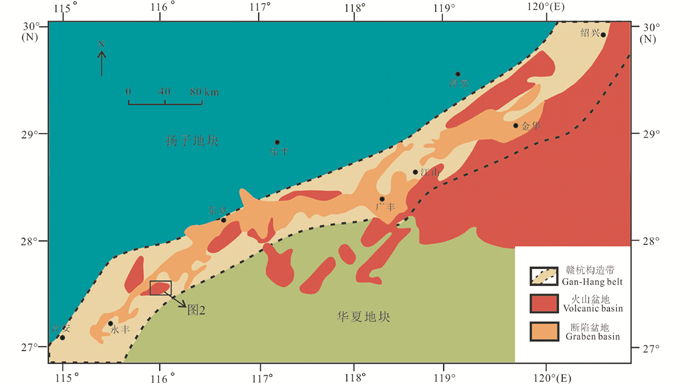
1 地质背景 1.1 区域地质背景相山铀矿田位于赣-杭构造带西南段的江西省抚州境内(图 1),区域上受NE向德兴-遂川深大断裂和NNE向宜黄-安远断裂共同控制。
|
图 1 赣-杭构造带地质简图(据余心起等,2006修改) Fig. 1 Geological sketch map of the Gan-Hang Belt, Southeast China(modified after Yu et al., 2006) |
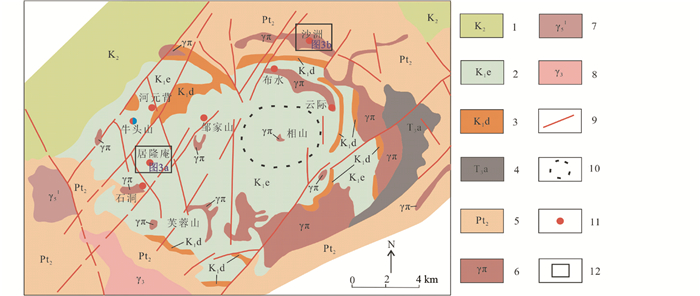
相山地区的地层具有基底和盖层二元结构:基底为中元古代-晚元古代震旦系变质岩(胡恭任和章邦桐,1998;Guo et al., 2018),由一套中-浅变质岩组成,主要包括炭质千枚岩及少量角闪岩等。盖层为早白垩世火山盆地产物(杨水源等,2012;陈正乐等,2013),包括打鼓顶组紫红色砂岩、粉砂岩夹流纹质晶屑凝灰岩、熔结凝灰岩、流纹英安岩;鹅湖岭组紫红色凝灰质粉砂岩、细砂岩、熔结凝灰岩和碎斑熔岩,以及在火山活动晚期沿火山环状断裂侵入的次火山岩。矿田内断裂构造发育,包括EW向的基底断裂构造与NE、NW或NNW向的盖层断裂构造。基底断裂构造主要分布在矿田的北部,如EW向的芜头-沙洲断裂等;盖层断裂构造主要发育于矿田西部地区,如NE向的邹家山-石洞、河元背-小陂断裂等(陈正乐等,2011;窦小平等,2015)。铀矿床主要分布于矿田的西部和北部,矿田的东部和南部仅出露部分铀矿点。矿田西部的代表性矿床包括河元背、居隆庵、邹家山等铀矿床,北部包括横涧、云际、沙洲等铀矿床(图 2)。前人对矿田内铀矿床进行了沥青铀矿U-Pb同位素定年研究,获得西部铀矿床成矿年龄为98.6Ma,北部铀矿床成矿年龄为115.2Ma (范洪海等,2003)。
|
图 2 相山铀矿田区域地质图(据谢国发等,2014修改) 1-白垩纪砂砾岩红层;2-晶玻屑凝灰岩、碎斑熔岩;3-熔结凝灰岩、流纹英安岩;4-砂砾岩、砂岩;5-千枚岩、片岩;6-燕山期花岗斑岩;7-印支期花岗岩;8-加里东期花岗岩;9-断裂;10-推测火山颈;11-铀矿床;12-研究区 Fig. 2 Simplified geologic map of the Xiangshan ore-field (modified after Xie et al., 2014) 1-Cretaceous red sandy conglomerate; 2-crystal fragment and vitroclastic tuff, porphyroclastic lava; 3-ignimbrites, rhyodacite; 4-conglomerate, sandstone; 5-phyllite, schist; 6-Yanshanian porphyritic granite; 7-Indosinian granite; 8-Caledonian granite; 9-fault; 10-deduced volcanic plug; 11-uranium deposits; 12-study area |
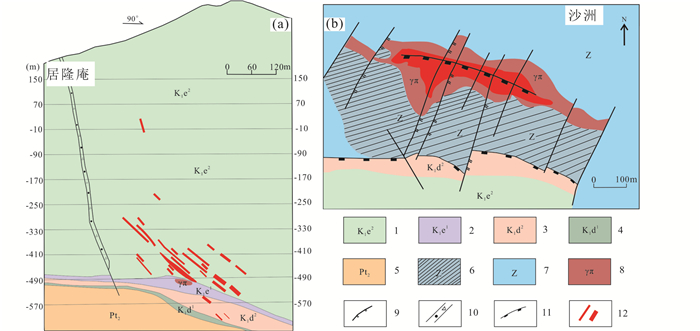
居隆庵铀矿床分布于矿田西部菱形块体内,矿区出露的岩石以早白垩世火山岩为主,包括打鼓顶组下段熔结凝灰岩、上段流纹英安岩及鹅湖岭组下段砂岩、上段碎斑熔岩,其中碎斑熔岩分布范围最广,也是该铀矿床主要的赋矿围岩。矿体受两组平行NE向和NW向断裂控制,呈细脉状赋存于碎斑熔岩与流纹英安岩接触界面处和碎斑熔岩中(图 3a)。热液铀矿化分为两期,成矿早期为铀-赤铁矿型,形成品位低的贫矿石,未见独立铀矿物,铀主要以分散吸附状态被赤铁矿所吸附;主成矿期为铀-萤石型,矿石品位较高,是矿区主要的矿石类型,矿石呈紫黑色的细脉状,主要铀矿物为沥青铀矿、钛铀矿,少量为铀石,脉石矿物主要为黄铁矿、萤石及方解石等。
|
图 3 居隆庵铀矿床(a, 据邱林飞等,2012)和沙洲铀矿床地质简图(b, 据王蕾等,2008) 1-碎斑熔岩;2-晶玻屑凝灰岩;3-流纹英安岩;4-熔结凝灰岩;5-千枚岩、片岩;6-推覆体变质岩;7-基底变质岩;8-花岗斑岩;9-张性断裂;10-断裂破碎带;11-火山环状断裂;12-铀矿体 Fig. 3 Geological map of cross-section in the Julong'an uranium deposits (a, modified after Qiu et al., 2012) and simplified geologic map of the Shazhou uranium deposits (b, modified after Wang et al., 2008) 1-porphyroclastic lava; 2-crystal fragment and vitroclastic tuff; 3-rhyodacite; 4-ignimbrites; 5-phyllite, schist; 6-metamorphic rock nappe; 7-basement metamorphic rock; 8-granite porphyry; 9-extension fracture; 10-fracture zone; 11-volcanic ring fracture; 12-uranium ore body |
沙洲铀矿床位于矿田北部,矿区出露的岩石主要包括元古代浅变质岩及火山活动后期侵入于元古代浅变质岩的花岗斑岩。矿体主要以脉状产于花岗斑岩体内,其展布受一系列走向为280°~330°、倾向南西、倾角60°~80°平行张性破裂带控制,由于部分构造裂隙之间的相互交错,因而矿体存在局部膨大、分支复合等现象(图 3b)。矿区内的铀矿化主要为铀-赤铁矿型,少量为晚期铀-萤石型。矿石矿物以钛铀矿、沥青铀矿为主,脉石矿物包括赤铁矿、少量黄铁矿及萤石等。
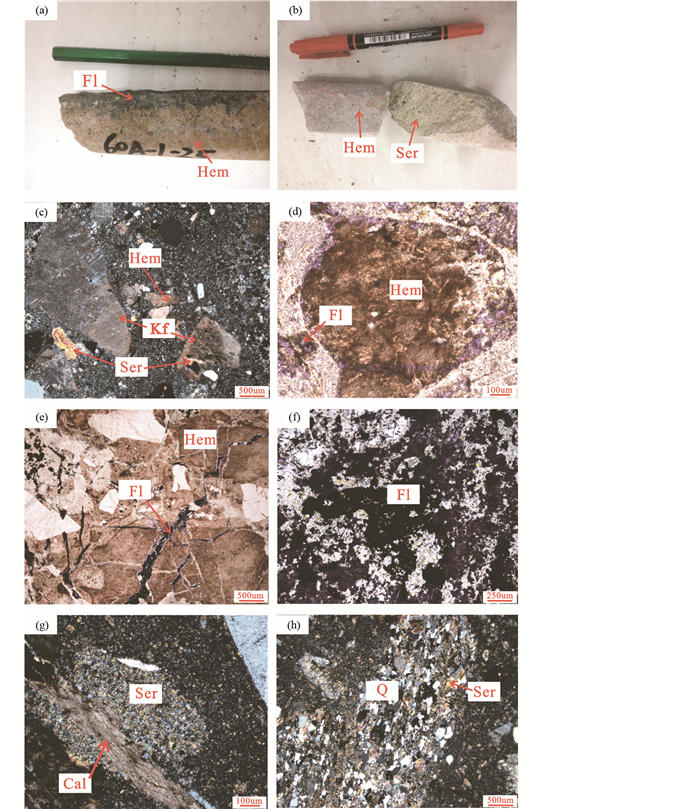
2 围岩蚀变特征居隆庵铀矿床中主要发育赤铁矿化(红化)、绢云母化、萤石化和碳酸盐化等蚀变(图 4a,b,e,g)。赤铁矿呈云雾状分布于钾长石中使其呈现红色(图 4c),斜长石多发生绢云母化蚀变(图 4c)。萤石呈浅紫色和紫黑色两种类型,浅紫色萤石呈浸染状分布于赤铁矿周围(图 4d);紫黑色萤石呈细脉状穿插赤铁矿(图 4e)或呈浸染状分布于矿石中(图 4f),与铀矿物共生。方解石呈脉状穿插早期斜长石蚀变形成的绢云母(图 4g),绢云母与微晶石英相交织(图 4h)。依据矿物间的穿插关系并结合前人的研究成果(邱林飞等,2012),可将该铀矿床的热液蚀变作用划分为三个阶段,即成矿早期形成赤铁矿化(红化)和绢云母化,成矿期形成紫黑色萤石和铀矿化,成矿后期形成方解石、浅紫色萤石等。
|
图 4 居隆庵铀矿床围岩蚀变特征 (a)赤铁矿化;(b)赤铁矿化与绢云母化;(c)钾长石发生绢云母化;(d)浅紫色萤石分布于赤铁矿四周;(e)紫黑色萤石脉穿插赤铁矿;(f)紫黑色萤石化;(g)方解石脉穿插绢云母;(h)绢云母胶结微晶石英. Hem-赤铁矿;Kf-钾长石;Fl-萤石;Ser-绢云母;Cal-方解石;Q-石英 Fig. 4 Wall rock alteration characteristics of the Julong'an uranium deposit (a) hematitization; (b) hematitization and sericitization; (c) sericitization of K-feldspar; (d) pale-purple fluorite marginal staining with hematite; (e) dark-purple fluorite interspersed with hematite; (f) dark-purple fluoritization; (g) calcite interspersed with sericite; (h) sericite-cemented microcrystalline quartz. Hem-hematite; Kf-potash feldspar; Fl-fluorite; Ser-sericite; Cal-calcite; Q-quartz |
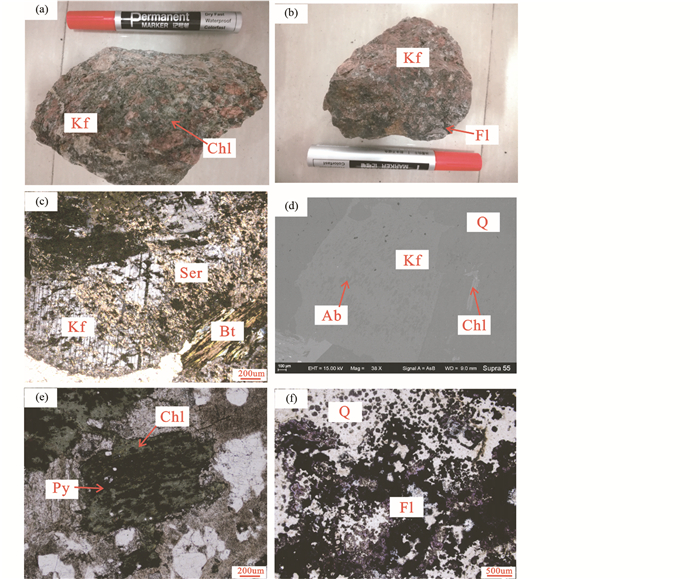
沙洲铀矿床的围岩蚀变以钠长石化、绿泥石化(图 5a,d)等碱性蚀变为主,萤石化等酸性蚀变相对较弱。钠长石化和绿泥石化蚀变作用均发育于成矿前期,钾长石多发生粘土化蚀变(图 5c),部分钾长石发生钠长石化蚀变(图 5d),绿泥石主要由黑云母蚀变形成,蚀变过程中同时形成黄铁矿(图 5e);紫黑色萤石呈微粒团簇状分布,与铀矿物共生(图 5b, f)。
|
图 5 沙洲铀矿床围岩蚀变特征 (a)绿泥石化;(b)紫黑色萤石化;(c)钾长石绢云母化;(d)钾长石钠长石化;(e)黑云母绿泥石化;(f)紫黑色萤石化. Bt-黑云母;Chl-绿泥石;Ab-钠长石;Py-黄铁矿 Fig. 5 Wall rock alteration characteristics of the Shazhou uranium deposit (a) chloritization; (b) dark-purple fluoritization; (c) sericitization of K-feldspar; (d) albitization of K-feldspar; (e) chloritization of biotite; (f) dark-purple fluoritization. Bt-biotite; Chl-chlorite; Ab-albite; Py-pyrite |
本研究分别对居隆庵铀矿床和沙洲铀矿床中的新鲜围岩、蚀变围岩及矿石进行了系统采样,共采集了18件样品。居隆庵铀矿床采集的样品均为钻孔样;沙洲铀矿床样品采自堆石场。对选取的样品进行清洗、烘干,粉碎研磨至200目以下的粉末,将粉末放在80℃烘箱内烘干,称取50mg烘干后的样品在高压溶样罐中,加入1.5mL浓HF和1mL浓HNO3,然后放在135℃电热板上溶解后蒸干至湿盐状,去除样品中过量的HF,最后加入1mL 2N HNO3。所有样品的微量和稀土元素测定均在南京大学内生金属矿床成矿机制研究国家重点实验室完成,利用电感耦合-等离子质谱仪(ICP-MS)进行测定,仪器型号为Finnigan MAT Element-2,分析精度优于10%,大部分元素精度优于5%,详细的实验流程参照高剑锋等(2003)。
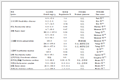
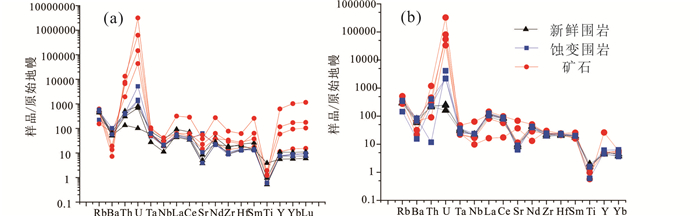
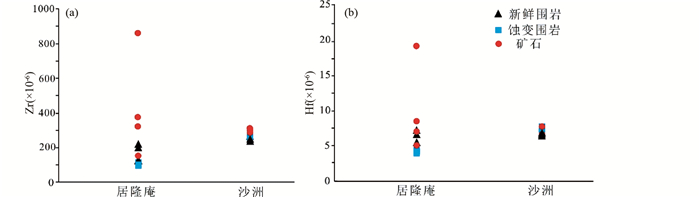
4 分析结果居隆庵铀矿床和沙洲铀矿床中新鲜围岩、蚀变围岩、矿石的微量元素及稀土元素含量分别列于表 1和表 2中。结果显示,两矿床中新鲜围岩、蚀变围岩及矿石总体上均显示了Ba、Nb、Sr、Ti等元素相对亏损以及U、Th、Nd、Sm等元素相对富集的特征(图 6)。但Zr、Hf在两个铀矿床的不同类型样品中显示了不同的变化特征。在居隆庵铀矿床中,从新鲜围岩到蚀变围岩再到矿石,Zr含量呈先降低再升高的变化趋势(即由新鲜围岩的104×10-6~213×10-6降低到蚀变围岩的98.5×10⁻⁶~118×10-6,再增加到矿石的152×10-6~867×10-6);Hf含量在新鲜和蚀变围岩中差别不大,分别为3.92×10⁻⁶~4.49×10⁻⁶和4.13×10⁻⁶ ~7.11×10⁻⁶,但矿石的Hf含量为5.10×10⁻⁶~19.1×10⁻⁶,明显高于新鲜和蚀变围岩(表 1、图 7)。而在沙洲铀矿床中,新鲜和蚀变围岩及矿石的Zr含量(分别为216×10-6~251×10-6、223×10-6~277×10-6和277×10-6~335×10-6)和Hf含量(分别为6.21×10⁻⁶~6.73×10⁻⁶、6.70×10⁻⁶~7.00×10⁻⁶和6.54×10⁻⁶~7.47×10⁻⁶)均未显示明显变化(表 2、图 7)。
|
表 1 居隆庵铀矿床新鲜围岩、蚀变围岩及矿石微量、稀土元素特征(×10-6) Table 1 Characteristics of trace and rare earth elements in fresh wall rocks, altered wall rocks and ores in the Julong'an uranium deposit (×10-6) |
|
|
表 2 沙洲铀矿床新鲜围岩、蚀变围岩及矿石微量、稀土元素特征(×10-6) Table 2 Characteristics of trace and rare earth elements in fresh wall rocks, altered wall rocks and ores in the Shazhou uranium deposit (×10-6) |
|
图 6 居隆庵铀矿床(a)与沙洲铀矿床(b)原始地幔标准化微量元素蛛网图(标准化值据McDonough and Sun, 1995) Fig. 6 Primitive mantle-normalized trace element spider diagrams of the Julong'an uranium deposit (a) and the Shazhou uranium deposit (b) (normalization values after McDonough and Sun, 1995) |
|
图 7 居隆庵和沙洲铀矿床Zr(a)和Hf(b)图解 Fig. 7 Diagrams of Zr (a) and Hf (b) from the Julong'an and Shazhou uranium deposits |
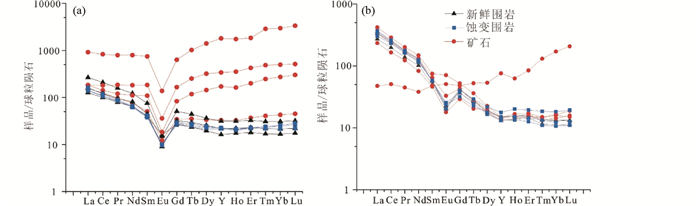
在居隆庵铀矿床中,新鲜和蚀变围岩∑REE含量分别为155×10-6~310×10-6和165×10-6~179×10-6;而矿石样品的∑REE含量(200×10-6~2884×10-6)明显高于两类围岩。新鲜和蚀变围岩样品的稀土配分曲线为右倾型,而矿石样品则多呈左倾型(图 8a)。从新鲜围岩到蚀变围岩再到矿石,LREE/HREE比值(分别为6.91~7.79、6.22~6.74、4.84~0.81)呈逐渐降低的变化特征,暗示随蚀变和矿化作用的增强,其轻重稀土分馏程度呈不断降低的变化趋势。新鲜围岩、蚀变围岩和矿石均显示Eu负异常特征,其δEu值分别为0.23~0.46、0.28~0.33和0.19~0.29(表 1、图 8a)。在沙洲铀矿床中,新鲜和蚀变围岩样品的∑REE含量分别为275×10-6~346×10-6和316×10-6~350×10-6,略低于矿石样品的∑REE含量(152×10-6~405×10-6)。仅1个矿石样品(SZ-1-G)由于含有较高比例的萤石,其LREE/HREE为0.83,显示左倾型稀土元素配分模式,与Jiang et al.(2006)在该矿床中所分析的紫黑色萤石相似;其余围岩和矿石样品的稀土元素配分曲线均为右倾型,对应的LREE/HREE比值分别为13.0~16.6(新鲜围岩)、12.6~18.6(蚀变围岩)和12.6~15.3(矿石)(表 2、图 8b)。从新鲜围岩到蚀变围岩再到矿石,δEu值总体由低到高变化(0.42~1.12)(图 8b)。
|
图 8 居隆庵铀矿床(a)与沙洲铀矿床(b)稀土元素分布图(标准化值据Sun and McDonough, 1989) Fig. 8 Chondrite-normalized REE patterns of the Julong'an uranium deposit (a) and Shazhou uranium deposit (b) (normalization values after Sun and McDonough, 1989) |
研究表明,热液与岩石相互作用过程中,岩石中的微量元素将会发生一定程度的迁移(Alderton et al., 1980;Fayek and kyser, 1997)。影响岩石中微量元素活化迁移的因素主要包括:与岩石相互作用的流体的物理化学性质及岩石中含微量元素矿物在特定流体作用下的蚀变或溶解(Fourcade and Allegre, 1981;Noyes et al., 1983)。如:在碱性、富F的流体中,一般地质环境下相对稳定的、富高场强元素的副矿物(如锆石)易发生蚀变或溶解,高场强元素活动性会显著提高(Jiang et al., 2005)。
已有研究表明,当围岩与富F热液流体相互作用时,围岩中富含Zr、Hf的副矿物(如锆石)易发生蚀变,岩石中的Zr、Hf被释放而进入流体中,并以ZrF2(OH)2和HfF2(OH)2络合物形式随流体迁移(Salvi et al., 2000;Migdisov et al., 2011;Rezaei Azizi et al., 2017)。
在居隆庵铀矿床中,蚀变围岩中有少许萤石,但矿石中均含有较多的萤石,暗示形成该矿床的蚀变及矿化热液流体可能富含F。当围岩受到富F热液的作用而发生蚀变时,围岩中主要赋存于锆石中的Zr和Hf被淋滤并进入热液流体中,使蚀变围岩相对亏损Zr和Hf;当该富F、Zr和Hf的热液流体由于温度降低并演化到成矿阶段时,Zr和Hf将随萤石的结晶而卸载并与铀矿物和萤石等一起沉淀到矿石中,导致形成的矿石富含Zr和Hf。因此,在居隆庵铀矿床中,从新鲜围岩到蚀变围岩到矿石,Zr、Hf含量呈先降低后升高变化特征(图 7),可能主要与富F流体对围岩的交代及流体的演化有关。
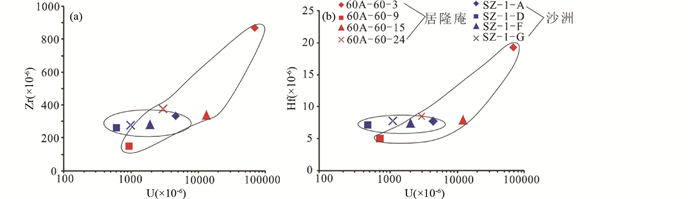
在沙洲铀矿床中,矿石的Zr、Hf含量与新鲜和蚀变围岩的相似(图 7),这明显有别于居隆庵铀矿床中矿石的Zr、Hf含量明显高于新鲜和蚀变围岩的特征,这可能与沙洲铀矿床成矿流体中F含量相对较低有关,也与沙洲铀矿床中的萤石含量明显低于居隆庵铀矿床的地质现象相吻合。如图 9所示,与沙洲铀矿床中的矿石相比,居隆庵铀矿床中矿石的U含量明显富集,并且U含量与Zr、Hf含量呈正相关关系;而沙洲铀矿床中矿石的Zr、Hf含量并没有比围岩明显富集,矿石的U品位也较低。这些特征暗示流体中Zr、Hf含量升高,其U含量也升高。结合富F流体能搬运富集Zr、Hf的特性,可以认为富F流体也有利于U的搬运富集。
|
图 9 居隆庵和沙洲铀矿床矿石中U与Zr(a)和Hf(b)图解 Fig. 9 Diagrams of U against Zr (a) and Hf (b) of ores in the Julong'an and Shazhou uranium deposits |
一般来说,热液流体中的REE主要与阴离子(如F-、CO32-)结合成络合物的形式进行迁移。在中高温条件下(T>250℃),热液流体中LREE与F-、CO32-结合形成的络合物比HREE的相应络合物更稳定(Migdisov et al., 2009, 2016);与之相反,在中低温条件下(T < 250℃),热液流体中HREE与F-、CO32-结合形成的络合物比LREE的相应络合物更稳定(Wood,1990;Migdisov and Williams-Jones, 2007),即HREE更易随热液迁移,并最终因温度降低或因阴离子浓度降低(如因形成萤石或方解石)而沉淀进入有关矿物中,从而造成HREE在矿石中相对富集。此外,Möller et al.(1998)和Veklser et al. (2005)的实验研究表明,流体如果显示Y的正异常,反映流体中Y和REE是以F的络合物占主导。
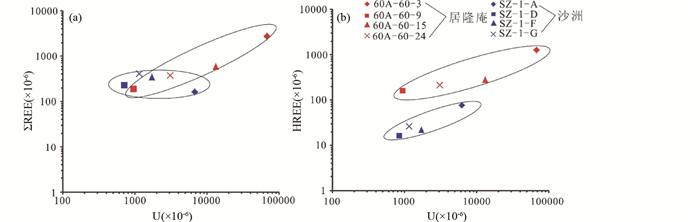
研究显示,相山铀矿田中包括居隆庵和沙洲矿床在内的大多数铀矿床属于中低温(140~240℃)热液矿床(黄锡强等,2008;郭建等,2014;李海东等,2017;王勇剑等,2018)。而且,居隆庵铀矿床的矿石显示了HREE明显富集和弱的Y正异常(YN=0.995~1.15)的特征(表 1、图 8a),表明其成矿热液中的REE和Y主要是以F的络合物形式进行运移的。Robinson(1984)的实验也表明U(Ⅵ)在热液中主要以UO2F3-、UO2(CO3)22-等铀酰络阴离子形式运移,少量以UO2(SO4)22-等形式运移。居隆庵矿床铀成矿期主要发育紫黑色萤石化,碳酸盐化主要见于成矿后期,所以,居隆庵铀矿床的成矿热液中的U主要应是以UO2F3-的形式进行运移的。此外,由图 10可知,居隆庵铀矿床矿石中∑REE、∑HREE与U具有明显的正相关关系,暗示居隆庵铀矿床矿石中的U和REE是在同一期流体中以F的络合物形式共同运移并最终一起沉淀的。
|
图 10 居隆庵和沙洲铀矿床中矿石的U与∑REE(a)和HREE(b)变量图解 Fig. 10 Diagrams of U against ∑REE(a) and HREE(b)of ore in the Julong'an and Shazhou uranium deposits |
沙洲铀矿床中多数矿石铀品位较低,除样品SZ-1-G外的多数矿石样品的HREE与新鲜围岩、蚀变围岩相比仅显示轻微富集的特征(图 8b),明显不同于居隆庵铀矿床的矿石中HREE显著富集的特征(图 10b),这可能是由于形成沙洲铀矿床成矿流体相对贫F所致。前已叙及,沙洲铀矿床铀成矿期仅发育少量紫黑色萤石,对含紫黑色萤石相对较集中的个别矿石(样品SZ-1-G)的分析表明,其HREE、U也相对富集(图 8b、图 10),暗示形成沙洲铀矿床的成矿热液中也存在REEF2+和UO2F3-形式的络合离子,但其规模相对有限。图 10还显示,沙洲铀矿床中矿石样品的U含量明显低于居隆庵铀矿床,这可能也与其成矿流体相对贫F有关。该铀矿床成矿流体中是否存在铀的其他络合物,还有待今后进一步研究。
5.3 Eu异常特征矿物容纳不同微量元素的能力与微量元素的离子价态和半径有关。REE3+由于价态相同半径相近,矿物对其吸纳程度是类似的,但Eu在较还原条件下可呈现+2价,价态变化会引起离子半径的巨大差异(Shannon,1976),导致Eu与其它REE之间发生分异(Brugger et al., 2006),从而在岩石或矿石中产生Eu异常。此外,岩石或矿石中的Eu异常也可以继承自源区的Eu异常(Sverjensky,1984)。Bau (1991)的实验研究表明,热液流体的Eu3+/Eu2+氧化还原电位随着温度的升高而快速增大。在较高的温度(T>200~250℃)下,流体中Eu3+被还原为Eu2+,而在中低温环境中(T < 200~250℃),除极强还原条件外,Eu3+在流体中占主导(Schwinn and Markl, 2005)。如前文所述,居隆庵铀矿床的矿石中Eu呈现明显负异常的特征,成矿温度为中低温(T=140~240℃),稍低于Eu2+稳定存在的温度(T=200~250℃),说明成矿流体中应是以Eu3+占主导,因此温度并非是造成居隆庵铀矿床中矿石Eu负异常的主要原因。居隆庵铀矿床中矿石与围岩均显示相似的Eu负异常的特征,可能主要是流体汲取了围岩中的稀土元素及铀而最终成为成矿流体,从而继承了围岩的Eu负异常特征所致。
沙洲铀矿床新鲜和蚀变围岩呈显著的Eu负异常,而矿石则显示了较弱Eu负异常和正异常的特征(表 2)。与新鲜及蚀变围岩相比,矿石中Eu相对富集,这可能与流体性质及其与围岩之间相互作用有关。如前所述,沙洲铀矿床矿化蚀变作用主要为碱交代,成矿热液主要为中低温碱性流体。流体在对围岩交代过程中,围岩中Eu相对富集的斜长石较易于发生蚀变而释放出Eu2+和其它REE3+进入流体中,导致流体具有Eu相对于相邻的Sm和Gd富集的特征。当该热液流体演化为成矿流体并发生沉淀而形成矿石时,由于继承了流体中大部分的Eu正异常特征,从而使矿石呈现较弱的Eu负异常至弱正异常特征。
6 结论综上所述,相山铀矿田西部的居隆庵铀矿床和北部的沙洲铀矿床显示了不同的围岩蚀变和矿化特征,暗示形成两矿床的成矿流体具有不同的性质和演化特征。在两矿床中,新鲜围岩、蚀变围岩和矿石间的Zr、Hf和稀土元素组成等均显示了明显不同的变化特征,表明形成居隆庵铀矿床的成矿流体相对富F,成矿流体中的U与REE均主要以F的络合物形式运移;而形成沙洲铀矿床的成矿流体相对贫F,其矿石品位较低原因也可能也与此有关。
致谢 本文野外工作中得到核工业二七〇研究所相关人员的帮助,室内实验分析测试得到了魏文芳的帮助,论文撰写过程中与师兄高爽、余志强交流收获颇丰;审稿过程中两位匿名审稿人提出了很多宝贵意见;在此一并表示诚挚的感谢。
Alderton DHM, Pearce JA and Potts PJ. 1980. Rare earth element mobility during granite alteration:Evidence from Southwest England. Earth Planetary Science Letters, 49(1): 149-165 DOI:10.1016/0012-821X(80)90157-0 |
Bau M. 1991. Rare-earth element mobility during hydrothermal and metamorphic fluid-rock interaction and the significance of the oxidation state of europium. Chemical Geology, 93(3-4): 219-230 DOI:10.1016/0009-2541(91)90115-8 |
Bau M and Dulski P. 1996. Distribution of yttrium and rare-earth elements in the Penge and Kuruman iron-formations, Transvaal Supergroup, South Africa. Precambrian Research, 79(1-2): 37-55 DOI:10.1016/0301-9268(95)00087-9 |
Brugger J, Etschmann B, Chu YS, Harland C, Vogt S, Ryan C and Jones H. 2006. The oxidation state of europium in hydrothermal scheelite:In situ measurement by xanes spectroscopy. Canadian Mineralogist, 44(5): 1079-1087 DOI:10.2113/gscanmin.44.5.1079 |
Chen DY, Zhou WB, Zhou LM, Wu BL, Tan JH and Sun ZX. 1993. Isotope geology of the Xiangshan uranium ore field. Mineral Deposits, 12(4): 370-377 (in Chinese with English abstract) |
Chen ZL, Yang N, Wang PA, Gong HL, Han FB, Zhou YG, Shao F, Tang XS, Xu JS and Yu JF. 2011. Analysis of the tectonic stress field in the Xiangshan uranium ore field, Linchuan area, Jiangxi, China. Geological Bulletin of China, 30(4): 514-531 (in Chinese with English abstract) |
Chen ZL, Wang Y, Zhou YG, Han FB, Wang PA, Gong HL, Shao F, Tang XS and Xu JS. 2013. SHIMPR U-Pb dating of zircons from volcanic-intrusive complexes in the Xiangshan uranium ore field, Jiangxi Province, and its geological implications. Geology in China, 40(1): 217-231 (in Chinese with English abstract) |
Dou XP, Shi YH, Wu ZH, Xiong C, Wang SS and Sun CB. 2015. Rules of structural ore controlling of the Xiangshan uranium ore field in Jiangxi Province. Geology and Exploration, 51(5): 879-887 (in Chinese with English abstract) |
El-Feky MG. 2011. Mineralogical, REE-geochemical and fluid inclusion studies on some uranium occurrences, Gabal Gattar, Northeastern Desert, Egypt. Acta Geochimica, 30(4): 430-443 |
Fan HH, Ling HF, Shen WZ, Wang DZ, Liu CS and Jiang YH. 2001. Nd-Sr-Pb isotope geochemistry of the volcanic-intrusive complex at Xiangshan, Jiangxi Province. Acta Petrologica Sinica, 17(3): 395-402 (in Chinese with English abstract) |
Fan HH, Ling HF, Wang DZ, Liu CS, Shen WZ and Jiang YH. 2003. Study on metallogenetic mechanism of Xiangshan uranium ore field. Uranium Geology, 19(4): 208-213 (in Chinese with English abstract) |
Fayek M and Kyser TK. 1997. Characterization of multiple fluid-flow events and rare-earth-element mobility associated with formation of unconformity-type uranium deposits in the Athabasca Basin, Saskatchewan. Canadian Mineralogist, 35: 627-658 |
Fourcade S and Allegre CJ. 1981. Trace elements behavior in granite genesis:A case study the calc-alkaline plutonic association from the Querigut Complex (Pyrénées, France). Contributions to Mineralogy and Petrology, 76(2): 177-195 DOI:10.1007/BF00371958 |
Gao JF, Lu JJ, Lai MY, Liu YP and Pu W. 2003. Analysis of trace elements in rock samples using HR-ICP-MS. Journal of Nanjing University (Natural Sciences), 39(6): 844-850 (in Chinese with English abstract) |
Guo FS, Yang QK, Meng XJ, Xie CF, Shi G, Chen LQ, Jiang ZP, Zeng T and Luo NH. 2016. Geochemical characteristics and petrogenesis of the acidic volcano-intrusive complexes, Xiangshan, Jiangxi Province. Acta Geologica Sinica, 90(4): 769-784 (in Chinese with English abstract) |
Guo FS, Shi G, Yang QK, Zhang WL, Xie CF, Zhou WP and Zhang JW. 2018. Timing of metamorphism and provenance of the metamorphic basement of the Xiangshan uranium ore field, Jiangxi Province, China. Acta Geologica Sinica, 92(1): 34-55 DOI:10.1111/1755-6724.13493 |
Guo J, Li ZL, Li XZ, Nie JT and Wang J. 2014. Mineralization fluid features of Zoujiashan uranium deposit in Xiangshan ore field, Jiangxi Province. Uranium Geology, (5): 263-270 (in Chinese with English abstract) |
Hu BQ, Wang Q, Qiu LF, Sun ZX, Wang Y, Lv GX and Hu RQ. 2016. Geochemistry of alkali metasomatized rocks of Zoujiashan uranium ore-deposit in Xiangshan ore-field. Geotectonica et Metallogenia, 40(2): 377-385 (in Chinese with English abstract) |
Hu GR and Zhang BT. 1998. Neodymium isotope composition and source materials of the meta-basement in central Jiangxi Province. Acta Petrologica et Mineralogica, 17(1): 35-40 (in Chinese with English abstract) |
Hu RZ, Bi XW, Zhou MF, Peng JT, Su WC, Liu S and Qi HW. 2008. Uranium metallogenesis in South China and its relationship to crustal extension during the Cretaceous to Tertiary. Economic Geology, 103(3): 583-598 DOI:10.2113/gsecongeo.103.3.583 |
Hu RZ, Burnard PG, Bi XW, Zhou MF, Peng JT, Su WC and Zhao JH. 2009. Mantle-derived gaseous components in ore-forming fluids of the Xiangshan uranium deposit, Jiangxi Province, China:Evidence from He, Ar and C isotopes. Chemical Geology, 266(1-2): 86-95 DOI:10.1016/j.chemgeo.2008.07.017 |
Hu RZ and Zhou MF. 2012. Multiple Mesozoic mineralization events in South China:An introduction to the thematic issue. Mineralium Deposita, 47(6): 579-588 DOI:10.1007/s00126-012-0431-6 |
Hu RZ, Mao JW, Hua RM and Fan WM. 2015. Intra-Continental Mineralization of South China Craton. Beijing: Science Press, 1-903 (in Chinese with English abstract)
|
Huang LY. 2018. Characteristics and metallogenic significance of alteration in Shazhou uranium deposit, Xiangshan ore-field. Master Degree Thesis. Nanchang:East China University of Technology |
Huang XQ, Chen ZL, Wang PA, Yang N and Zhi J. 2008. Fluid inclusion study of the Shazhou uranium orefield in the Xiangshan deposit, Jiangxi Province. Journal of Geomechanics, 14(2): 82-91 (in Chinese with English abstract) |
Jiang SY, Wang RC, Xu XS and Zhao KD. 2005. Mobility of high field strength elements (HFSE) in magmatic-, metamorphic-, and submarine-hydrothermal systems. Physics and Chemistry of the Earth, Parts A/B/C, 30(17-18): 1020-1029 DOI:10.1016/j.pce.2004.11.004 |
Jiang YH, Ling FH, Jiang SY, Shen WZ, Fan HH and Ni P. 2006. Trace element and Sr-Nd isotope geochemistry of fluorite from the Xiangshan uranium deposits, South China. Economic Geology, 101: 1613-1622 DOI:10.2113/gsecongeo.101.8.1613 |
Li HD, Pan JY, Liu WQ, Jiang WB, Li J, Liang YY, Xie Q and Lu Y. 2017. Mineral characteristics and geological significance of chlorite from the Julong'an uranium deposit in Le'an, Jiangxi Province. Acta Petrologica et Mineralogica, 36(4): 535-548 (in Chinese with English abstract) |
McDonough WF and Sun SS. 1995. The composition of the Earth. Chemical Geology, 120: 223-253 DOI:10.1016/0009-2541(94)00140-4 |
Migdisov AA and Williams-Jones AE. 2007. An experimental study of the solubility and speciation of neodymium (Ⅲ) fluoride in F-bearing aqueous solutions. Geochimica et Cosmochimica Acta, 71: 3056-3069 DOI:10.1016/j.gca.2007.04.004 |
Migdisov AA, Williams-Jones AE and Wagner T. 2009. An experimental study of the solubility and speciation of the rare earth elements (Ⅲ) in fluoride-and chloride-bearing aqueous solutions at temperatures up to 300℃. Geochimica et Cosmochimica Acta, 73: 7087-7109 DOI:10.1016/j.gca.2009.08.023 |
Migdisov AA, Williams-Jones AE, Van HV and Salvi S. 2011. An experimental study of the solubility of baddeleyite (ZrO2) in fluoride-bearing solutions at elevated temperature. Geochimica et Cosmochimica Acta, 75: 7426-7434 DOI:10.1016/j.gca.2011.09.043 |
Migdisov AA, Williams-Jones AE, Brugger J and Caporuscio FA. 2016. Hydrothermal transport, deposition and fractionation of the REE:Experimental data and thermodynamic calculations. Chemical Geology, 439: 13-42 DOI:10.1016/j.chemgeo.2016.06.005 |
Möller P, Bau M, Dulski P and Luders V. 1998. REE and yttrium fractionation in fluorite and their bearing on fluorite formation. Proceedings of the 9th Quadrennial IAGOD Symposium, 575-592
|
Noyes HJ, Frey FA and Wones DR. 1983. A tale of two plutons:Geochemical evidence bearing on the origin and differentiation of the red lake and eagle peak plutons, central Sierra Nevada, California. Journal of Geology, 91(5): 487-509 DOI:10.1086/628801 |
Qiu LF, Ou GX, Zhang M and Zhang JF. 2012. Characteristics and origin of ore-forming fluid of Julong'an uranium deposit in Xiangshan uranium ore field. Mineral Deposits, 31(2): 271-281 (in Chinese with English abstract) |
Rezaei Azizi M, Abedini A, Alipour S, Niroomand S, Sasmaz A and Talaei B. 2017. Rare earth element geochemistry and tetrad effects in fluorites:A case study from the Qahr-Abad deposit, Iran. Neues Jahrbuch für Geologie und Paläontologie-Abhandlungen, 283(3): 255-273 DOI:10.1127/njgpa/2017/0639 |
Romberger SB. 1984. Transport and deposition of uranium in hydrothermal systems at temperatures up to 300℃:Geological implications. Uranium Geochemistry, Mineralogy, Geology, Exploration and Resources: 12-17 |
Salvi S, Fontan F, Monchoux P, Williamsjones AE and Moine B. 2000. Hydrothermal mobilization of high field strength elements in alkaline igneous systems:Evidence from the Tamazeght Complex (Morocco). Economic Geology, 95(3): 559-576 |
Schwinn G and Markl G. 2005. REE systematics in hydrothermal fluorite. Chemical Geology, 216(3-4): 225-248 DOI:10.1016/j.chemgeo.2004.11.012 |
Shannon RD. 1976. Revised effective ionic radii and systematic studies of interatomic distances in halides and chalcogenides. Acta Crystallographica Section A, 32(5): 751-767 DOI:10.1107/S0567739476001551 |
Shao F, Chen XM, Xu HL, Huang HM, Tang XS, Zou MQ, He XM and Li M. 2008. Metallogenic model of the Xiangshan uranium ore field, Jiangxi Province. Journal of Geomechanics, 14(1): 65-73 (in Chinese with English abstract) |
Sun SS and McDonough WF. 1989. Chemical and isotopic systematics of oceanic basalts:Implications for mantle composition. Logical Society London Spec Pub, 42(1): 313-345 DOI:10.1144/GSL.SP.1989.042.01.19 |
Sun ZX, Li XL, Shi WJ, Zhou WB and Liu JH. 2001. Isotope geochemistry of oxygen and hydrogen of the Xiangshan uranium ore-field, South China. Geology and Prospecting, 24(1): 20-23 (in Chinese with English abstract) |
Sverjensky DA. 1984. Europium redox equilibria in aquous solution. Earth and Planetary Science Letters, 67: 70-78 DOI:10.1016/0012-821X(84)90039-6 |
Veklser IV, Dorfman AM, Kamenetsky M, Dulski P and Dingwell D. 2005. Partitioning of lanthanides and Y between immiscible silicate and fluoride melts, fluorite and cryolite and the origin of the lanthanide tetrad effect in igneous systems. Geochimica et Cosmochimica Acta, 69: 2847-2860 DOI:10.1016/j.gca.2004.08.007 |
Wang L, Zhang SM, Jiang ZP and Guo GL. 2008. The study of fluid inclusion of Shazhou deposit in Xiangshan uranium ore-field. Geotectonica et Metallogenia, 32(4): 500-508 (in Chinese with English abstract) |
Wang YJ, Lin JR, Hu ZH, Wang F, Pang YQ and Gao F. 2018. Characteristics of chlorite in Yunji deposit of Xiangshan uranium ore-field and its geological implication. Uranium Geology, 34(3): 27-32 (in Chinese with English abstract) |
Wood SA. 1990. The aqueous geochemistry of the rare-earth elements and yttrium, review of available low-temperature data for inorganic complexes and the inorganic REE speciation of nature waters. Chemical Geology, 82: 159-186 DOI:10.1016/0009-2541(90)90080-Q |
Xie GF, Yao YJ, Hu ZH and Ji GP. 2014. Distribution feature of uranium deposit in the west of Xiangshan volcanic basin. Uranium Geology, 6: 328-334 (in Chinese with English abstract) |
Yan B, Yan H, Zhou L, Wang T, Xu GM and Cao Y. 2013. Isotope characteristics of C, O, H and S in Xiangshan uranium ore-field, Jiangxi Province. Journal of Mineralogy and Petrology, 33(3): 47-53 (in Chinese with English abstract) |
Yan B, Yan H, Wei WF, Cao Y and Li J. 2014. Helium-Argon isotopic characters and geological significance of the Shazhou uranium deposit, Xiangshan ore-field, Jiangxi Province. Geological Review, 60(3): 624-634 (in Chinese with English abstract) |
Yang SY, Jiang SY, Jiang YH, Zhao KD and Fan HH. 2011. Geochemical, zircon U-Pb dating and Sr-Nd-Hf isotopic constraints on the age and petrogenesis of an Early Cretaceous volcanic-intrusive complex at Xiangshan, Southeast China. Mineralogy and Petrology, 101(1-2): 21-48 DOI:10.1007/s00710-010-0136-4 |
Yang SY, Jiang SY, Zhao KD, Jiang YH and Fan HH. 2012. Zircon U-Pb geochronology, geochemistry and Sr-Nd-Hf isotopic compositions of the rhyolite porphyry from the Zhoujiaoshan deposit in Xiangshan uranium ore field, Jiangxi Province, Southeast China. Acta Petrologica Sinica, 28(12): 3915-3928 (in Chinese with English abstract) |
Yu XQ, Wu GG, Shu LS, Yan TZ, Zhang D and Di YJ. 2006. The Cretaceous tectonics of the Gan-Hang belt, southeastern China. Earth Science Frontiers, 13(3): 31-43 (in Chinese with English abstract) |
Yu ZQ, Chen WF, Chen PR, Wang KX, Fang QC, Tang XS and Ling HF. 2019. Chemical composition and Sr isotopes of apatite in the Xiangshan A-type volcanic-intrusive complex, Southeast China:New insight into petrogenesis. Journal of Asian Earth Sciences, 172: 66-82 DOI:10.1016/j.jseaes.2018.08.019 |
陈迪云, 周文斌, 周鲁民, 吴伯林, 谭敬华, 孙占学. 1993. 相山铀矿田同位素地质学特征. 矿床地质, 12(4): 370-377. |
陈正乐, 杨农, 王平安, 宫红良, 韩凤彬, 周永贵, 邵飞, 唐湘生, 徐金山, 喻建发. 2011. 江西临川地区相山铀矿田构造应力场分析. 地质通报, 30(4): 515-531. |
陈正乐, 王永, 周永贵, 韩凤彬, 王平安, 宫红良, 邵飞, 唐湘生, 徐金山. 2013. 江西相山火山-侵入杂岩体锆石SHRIMP定年及地质意义. 中国地质, 40(1): 217-231. DOI:10.3969/j.issn.1000-3657.2013.01.015 |
窦小平, 时燕华, 吴赞华, 熊超, 万双双, 孙崇波. 2015. 江西相山铀矿田构造控矿规律研究. 地质与勘探, 51(5): 879-887. |
范洪海, 凌洪飞, 沈渭洲, 王德滋, 刘昌实, 姜耀辉. 2001. 相山火山-侵入杂岩Nd-Sr-Pb同位素地球化学特征. 岩石学报, 17(3): 395-402. |
范洪海, 凌洪飞, 王德滋, 刘昌实, 沈渭洲, 姜耀辉. 2003. 相山铀矿田成矿机理研究. 铀矿地质, 19(4): 208-213. DOI:10.3969/j.issn.1000-0658.2003.04.003 |
高剑峰, 陆建军, 赖鸣远, 林雨萍, 濮巍. 2003. 岩石样品中微量元素的高分辨率等离子质谱分析. 南京大学学报(自然科学), 39(6): 844-850. |
郭福生, 杨庆坤, 孟祥金, 谢财富, 时国, 陈留勤, 蒋振频, 曾涛, 罗能辉. 2016. 江西相山酸性火山-侵入杂岩体地球化学特征与岩石成因. 地质学报, 90(4): 769-784. DOI:10.3969/j.issn.0001-5717.2016.04.012 |
郭建, 李子颖, 李秀珍, 聂江涛, 王健. 2014. 相山铀矿田邹家山矿床成矿流体特征. 铀矿地质, (5): 263-270. DOI:10.3969/j.issn.1000-0658.2014.05.002 |
胡宝群, 王倩, 邱林飞, 孙占学, 王运, 吕古贤, 胡荣泉. 2016. 相山矿田邹家山铀矿床碱交代矿化蚀变岩地球化学. 大地构造与成矿学, 40(2): 377-385. |
胡恭任, 章邦桐. 1998. 赣中变质基底的Nd同位素组成和物质来源. 岩石矿物学杂志, 17(1): 35-40. |
胡瑞忠, 毛景文, 华仁民, 范蔚茗. 2015. 华南陆块陆内成矿作用. 北京: 科学出版社, 1-903.
|
黄罗昱. 2018.相山铀矿田沙洲矿床蚀变特征及成矿意义.硕士学位论文.南昌: 东华理工大学
|
黄锡强, 陈正乐, 王平安, 杨农, 郅剑. 2008. 江西相山铀矿田沙洲矿床流体包裹体研究. 地质力学学报, 14(2): 82-91. |
李海东, 潘家永, 刘文泉, 江卫兵, 李俊, 梁园园, 谢强, 鲁彦. 2017. 江西乐安居隆庵铀矿床绿泥石特征及地质意义. 岩石矿物学杂志, 36(4): 535-548. DOI:10.3969/j.issn.1000-6524.2017.04.007 |
邱林飞, 欧光习, 张敏, 张建锋. 2012. 相山居隆庵矿床铀成矿流体特征及其来源探讨. 矿床地质, 31(2): 271-281. DOI:10.3969/j.issn.0258-7106.2012.02.008 |
邵飞, 陈晓明, 徐恒力, 黄辉明, 唐相生, 邹茂卿, 何晓梅, 李梅. 2008. 江西省相山铀矿田成矿模式探讨. 地质力学学报, 14(1): 65-73. DOI:10.3969/j.issn.1006-6616.2008.01.006 |
孙占学, 李学礼, 史维浚, 周文斌, 刘金辉. 2001. 华南相山铀矿田的氢氧同位素地球化学研究. 地质与勘探, 37(3): 20-23. |
王蕾, 张树明, 蒋振频, 郭国林. 2008. 相山铀矿田沙洲矿床流体包裹体研究. 大地构造与成矿学, 32(4): 500-508. DOI:10.3969/j.issn.1001-1552.2008.04.014 |
王勇剑, 林锦荣, 胡志华, 王峰, 庞雅庆, 高飞. 2018. 相山铀矿田云际矿床绿泥石特征及其地质意义. 铀矿地质, 34(3): 27-32. |
谢国发, 姚亦军, 胡志华, 吉高萍. 2014. 相山火山盆地西部铀矿床分布特征. 铀矿地质, 30(6): 329-334. |
严冰, 严寒, 周莉, 王腾, 许国明, 曹阳. 2013. 江西相山火山岩型铀矿C、O、H、S同位素特征及意义. 矿物岩石, 33(3): 47-53. DOI:10.3969/j.issn.1001-6872.2013.03.008 |
严冰, 严寒, 魏文风, 曹阳, 李健. 2014. 江西相山沙洲铀矿床He、Ar同位素特征及其地质意义. 地质论评, 60(3): 624-634. |
杨水源, 蒋少涌, 赵葵东, 姜耀辉, 范洪海. 2012. 江西相山铀矿田邹家山矿床中流纹斑岩的锆石U-Pb年代学、岩石地球化学与Sr-Nd-Hf同位素组成. 岩石学报, 28(12): 3915-3928. |
余心起, 吴淦国, 舒良树, 颜铁增, 张达, 狄永军. 2006. 白至纪时期赣杭构造带的伸展作用. 地学前缘, 13(3): 32-42. |