 2019, Vol. 35


2. 河北省区域地质调查院, 廊坊 065000;
3. 中国地质大学地球科学与资源学院, 北京 100083;
4. 成都理工大学地球科学学院, 成都 610059
2. Regional Geological Survey Institute of Hebei Province, Langfang 065000, China;
3. School of Earth Science and Resource, China University of Geosciences, Beijing 100083, China;
4. College of Earth Science, Chengdu University of Technology, Chengdu 610059, China
暗色微粒包体又称镁铁质微粒包体(mafic microgranular enclaves, 缩写为MMEs),在中酸性岩浆中普遍存在,它们携带着丰富的地球深部动力学信息,是探索岩浆作用的深部过程以及起源、成因演化的理想研究对象(Didier and Barbarin, 1991; Barbarin, 2005; Kumar and Rino, 2006; Słaby and Martin, 2008)。暗色包体一般认为有如下几种成因机制:(1)来自花岗岩原岩熔融留下来的耐火残留体(Chappell et al., 1987; Chen et al., 1989; Chappel and White, 1992; White et al., 1999);(2)同源岩浆早阶段的析离体(Noyes et al., 1983; Chappell et al., 1987; Dahlquist, 2002; Donaire et al., 2005; Ilbeyli and Pearce, 2005; Shellnutt et al., 2010);(3)围岩捕掳体(Dahlquist, 2002; Donaire et al., 2005);(4)注入长英质岩浆中的镁铁质岩浆固结而成(Vernon, 1984; Dorais et al., 1990; Blundy and Sparks, 1992; Wiebe et al., 1997; Kadioǧlu and Güleç, 1999; Perugini et al., 2003; Barbarin, 2005; Hawkesworth and Kemp, 2006; Kocak, 2006; Feeley et al., 2008; Chen et al., 2009; Kocak et al., 2011; Liu et al., 2013)。继在拉萨地体北部唐江穷果岩体中发现一种由同源岩浆不同期次(经历了不同程度分离结晶作用)混合成因的暗色包体后(陈伟等, 2018),我们在该地区晚白垩世桑心日岩体也发现了类似成因的暗色包体,因此认为该类岩石成因的暗色包体应该在自然界中可能广泛存在,应该将其与其他类型的暗色包体区分出来,这样更有利于理解岩浆在侵位、成岩过程中发生的矿物分离结晶作用及相关的岩石地球化学变化规律,这对丰富暗色包体的成因和探索岩浆作用的深部过程具有重要的科学意义。
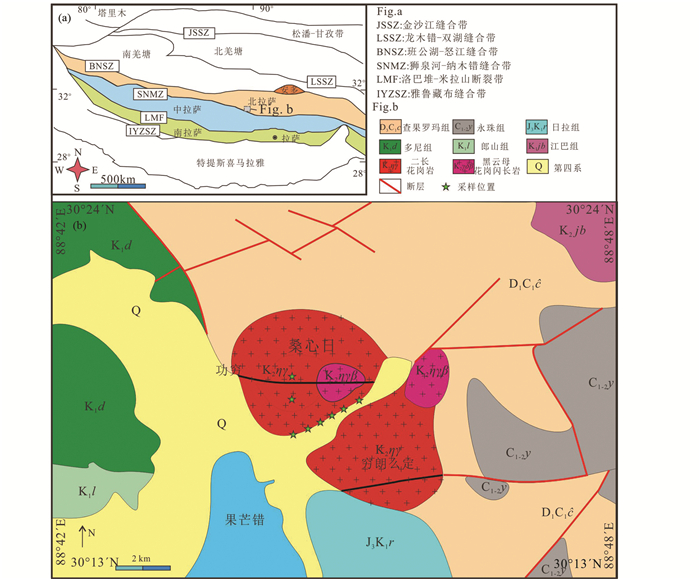
1 地质背景 1.1 区域地质背景青藏高原-喜马拉雅造山带主体自南向北依次可以划分为喜马拉雅地体、拉萨地体和羌塘地体,三个地体的界线分别是雅鲁藏布江缝合带和班公湖-怒江缝合带(Girardeau et al., 1985; Zhang, 2004; Zhang et al., 2004, 2007, 2012, 2014, 2017; Shi et al., 2008; 潘桂棠等, 2004)。其中拉萨地体一般分为北、中、南三个地块,分别被狮泉河-纳木错蛇绿混杂岩带和洛巴堆-米拉山断裂带分隔(图 1a)(Zhu et al., 2013; 潘桂棠等, 2004),一般认为,南部拉萨地块以新生地壳为特征(Zhu et al., 2011)。中拉萨地块由于发育新元古代奥长花岗岩和变质岩(Hu et al., 2005; Dong et al., 2011),以及代表岩浆侵位年龄的锆石具有非常负的锆石εHf(t)值,因此,Zhu et al. (2011)认为中拉萨地块可能是一个以元古代甚至太古宙为基底的条带状微陆块。北拉萨地块可能是发育多期岩浆作用的新生地壳(朱弟成等, 2012),包括早白垩世石英闪长岩、英云闪长岩、花岗闪长岩,晚白垩世二长花岗岩、钾长花岗岩,始新世正长花岗岩、浅成的流纹斑岩等。在北拉萨地块中段雄梅地区出露的地层从老至新主要有达尔东组(D1d)、查果罗玛组(D1C1c)、永珠组(C1-2y)、接奴群(J2-3J)、日拉组(J3K1r)、则弄群(K1Z)和多尼组(K1d)等(曲永贵等, 2011)。在北拉萨地块与桑心日岩体同期的晚白垩世岩浆作用形成于板内加厚下地壳减薄环境,岩石的热源来自加厚下地壳拆沉作用引起的软流圈地幔上涌,源区可能为拆沉下地壳或者为由拆沉作用引起的壳-幔混合作用有关的岩浆活动(孙渺等, 2018)。
|
图 1 青藏高原构造单元划分(a, 据Zhang et al., 2012; Zhu et al., 2012修改)和桑心日岩体地质简图(b, 据曲永贵等, 2011修改;穿过岩体的断裂用黑色线条表示) Fig. 1 Tectonic units of the Tibet (a, revised after Zhang et al., 2012; Zhu et al., 2012) and geologic map of the Sangxinri pluton (b, modified after Qu et al., 2002; the fault across the pluton is marked by black line) |
桑心日岩体位于北拉萨地块中段的雄梅地区,在雄梅镇的东南约20km处。岩体形态呈不规则椭圆状,东西向长轴长约9km,南北向短轴长约8km,面积约46km2。桑心日岩体为一复式岩体,岩体主体为二长花岗岩,在主岩体的中东部侵入晚期次的花岗闪长岩。岩体主要侵入于下泥盆统-下石炭统查果罗玛组地层中(图 1b),在岩体与围岩接触部位普遍发育有矽卡岩化和大理岩化。岩体内节理、脉岩较发育,脉岩以酸性岩脉为主,宽度从几厘米至几十厘米不等,分布无规律。暗色闪长质包体主要产于二长花岗岩中,自岩体中心到边缘普遍发育,形状多为椭球状,大小一般在几厘米到几十厘米。此外,紧邻桑心日岩体南侧出露一套与其对应的岩体-穷郎么定岩体,该岩体应该与桑心日岩体为一整体,被后期北东向断裂所错断。在图 1b中,除了与桑心日岩体接触的查果罗玛组地层外,还出露有石炭纪的永珠组、上侏罗统-下白垩统的日拉组、下白垩统多尼组、下白垩统郎山组以及上白垩统江巴组火山岩。区域上断裂发育,除了上文提到的北东向的断裂外,还发育有近东西向和北西向两组断裂,其中东西向的断裂将桑心日岩体切穿。
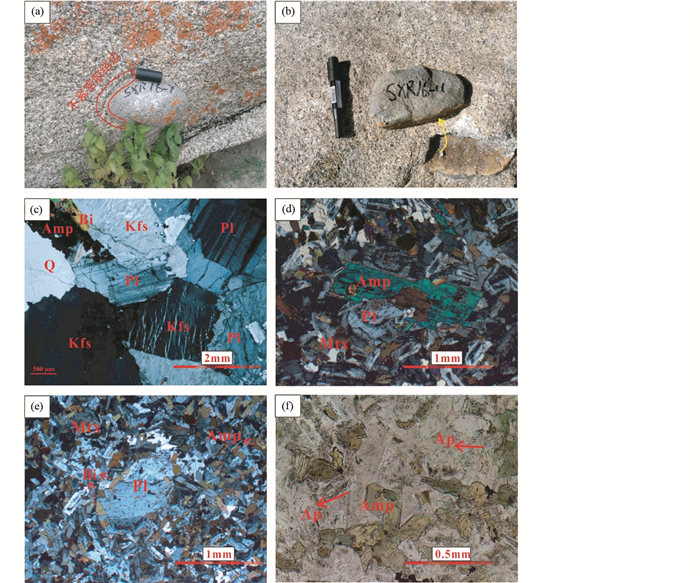
桑心日寄主岩呈半自形中粗粒花岗结构,块状构造(图 2a, b)。矿物成份由斜长石、钾长石、石英、黑云母及少量的角闪石组成。斜长石自形程度好,呈板状、柱状,粒度介于2~6mm,聚片双晶发育,有的具环带状构造,含量~35%;钾长石呈板状,具条纹状构造,粒度2~5mm,含量~25%;石英呈他形粒状,粒度2~5mm,含量~25%;黑云母呈半自形-自形,片状,棕褐色-黄褐色多色性,粒度2~4mm,含量~10%,个别见绿泥石化;普通角闪石自形程度较好,呈现绿色-棕黄色多色性,粒度1~2mm,含量~5%(图 2c)。
|
图 2 桑心日岩体寄主岩(a-c)及暗色包体(a、b、d-f)手标本照片及薄片镜下照片 Pl-斜长石;Bi-黑云母;Amp-角闪石;Ap-磷灰石;Q-石英;Mtx-基质 Fig. 2 Pictures of the hand specimens and thin sections of the host rock (a-c) and MMEs (a, b, d-f) from Sangxinri pluton Pl-plagioclase; Bi-biotite; Amp-amphibole; Ap-apatite; Q-quartz; Mtx-matrix |
暗色包体呈灰黑色,多呈椭球状,大小介于几厘米到几十厘米之间,通常在暗色包体和寄主岩的接触面上形成一个风化间隙面(图 2a, b),应为岩石烘烤边形成的弱抗风化界面。暗色包体呈斑状结构,块状构造。斑晶主要为角闪石和斜长石(图 2d, e)。角闪石斑晶含量约为5%,自形程度好,粒度介于1~2mm(图 2d)。斜长石斑晶含量约为5%,自形程度好,粒度介于1~3mm之间,未见岩浆混合作用形成典型的长石环带结构,斜长石斑晶中常包裹有角闪石和黑云母等暗色矿物(图 2e)。基质在高倍镜(100倍)下鉴定矿物颗粒多小于0.2mm,属于微粒结构,主要由斜长石~55%、钾长石~5%、石英~5%、角闪石~15%、黑云母~20%组成(图 2d, e)(除样品SXR16-02为花岗闪长岩外)。另外,可见针状磷灰石,长度一般小于0.1mm,含量较少,忽略不计(图 2f)。
2 分析方法 2.1 锆石U-Pb定年锆石的分选在河北廊坊欣航测绘院完成。锆石U-Pb同位素定年选取新鲜的全岩样品。样品粉碎后,经磁分选和重液分离出单颗粒锆石,然后在双目镜下手工挑选出颗粒较大、晶形完好的锆石制靶,经透射光、反射光及阴极发光(CL)研究之后,对选定的锆石颗粒进行了LA-ICP-MS锆石U-Pb定年。
锆石LA-ICP-MS测试在中国地质大学(武汉)地质过程与矿产资源国家重点实验室完成,分析测试仪器为Agilent 7500a,激光剥蚀系统为Geolas 2005,分析利用激光斑束直径32μm,剥蚀深度为20~40μm。采用标准锆石91500(~1064Ma)作为校正外标,GJ-1(~599Ma)作为监控样,以合成硅酸岩玻璃NIST610标示仪器的运行状态,以29Si为内标校正锆石微量元素含量。对分析数据的离线处理(样品和空白信号的选择、仪器灵敏度漂移校正、元素含量及U-Th-Pb同位素比值和年龄计算等)采用ICPMSDataCal 9.0软件完成,详细的仪器操作条件与数据处理方法见Liu et al.(2008, 2010a, b)。年龄结果处理(包括协和图的绘制与加权平均年龄计算等)利用Isoplot 3.0软件完成(Ludwig, 2003)。
2.2 地球化学测试主量、微量元素分析在广州澳实矿物实验室进行。主量元素采用碱熔法制成玻璃饼,测试采用X射线荧光光谱法(XRF),在荷兰帕纳科Axios X荧光仪完成,分析误差优于3%。微量元素测定采用电感耦合等离子体质谱法(ICP-MS),将样品研磨并用酸溶法(HF+HNO3)制成溶液,然后在NexIon 300x ICP-MS等离子质谱仪上进行测定,测试中采用标准样品对仪器状态和数据质量进行监控,含量大于10×10-6元素分析误差小于5%,而含量小于10×10-6的元素误差小于10%。
2.3 锆石原位Lu-Hf同位素测试锆石Hf同位素测试是在中国地质科学院地质研究所大陆构造与动力学实验室完成,所用仪器为Neptune Plus多接收等离子质谱和Compex pro.193nm紫外激光剥蚀系统(LA-MC-ICP-MS),实验过程中采用He作为剥蚀物质载气,剥蚀直径采用32μm,测定时使用国际上通用的锆石标样GJ-1作为参考物质,分析点与U-Pb定年分析点为同一位置。相关仪器运行条件及详细分析流程见侯可军等(2007)。分析过程中锆石标准GJ1的176Hf/177Hf测试加权平均值为0.282015±8(2σ,n=10),与文献报道值(Elhlou et al., 2006; 侯可军等, 2007)在误差范围内完全一致。
3 实验结果 3.1 锆石定年寄主花岗岩中锆石呈灰白色,半透明,大部分呈短柱状-长柱状,半自形-自形,长轴为30~120μm,长短轴比介于1:1~1:4之间(图 3a),阴极发光图像显示出较清晰的震荡环带;暗色包体中锆石呈灰白色,半透明-不透明,短柱状-长柱状,晶体自形程度良好,长轴为30~100μm,长短轴比介于1:1~1:3之间(图 3b),阴极发光图像显示出较清晰的震荡环带。寄主花岗岩和暗色包体均具有较高的Th/U比值,分别为0.46~1.16和0.52~1.16(表 1),清晰的岩浆锆石震荡环带和较高的Th/U比值说明寄主花岗岩和暗色包体中的锆石均为岩浆锆石。寄主花岗岩的有效测试点21个,介于70.0~74.4Ma之间,加权平均年龄为71.8±0.6Ma(图 3a);暗色包体有效测试点15个,介于71.8~79.6Ma之间,加权平均年龄75.6±1.2Ma(图 3b),暗色包体的年龄较寄主岩早了近4Ma。

|
图 3 桑心日岩体寄主花岗岩(a)及暗色包体(b)锆石LA-ICP-MS U-Pb定年谐和图 Fig. 3 Cathodoluminescene (CL) images and U-Pb concordia diagrams of the host rock (a) and MMEs (b) from Sangxinri pluton |
|
表 1 桑心日岩体及暗色包体锆石LA-ICP-MS U-Pb定年数据 Table 1 LA-ICP-MS zircon U-Pb dating results of MMEs and host rock from Sangxinri pluton |
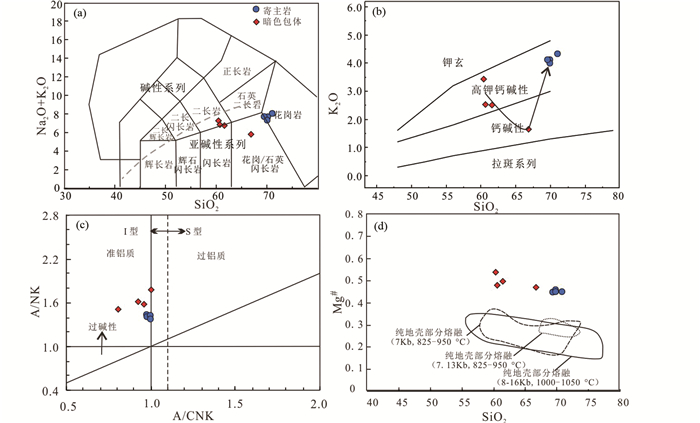
桑心日岩体寄主岩的SiO2含量介于69.49%~70.98%(表 2),暗色包体的SiO2含量介于60.37%~66.83%之间,属于中性岩。寄主岩较暗色包体具有相对低的Na2O含量,寄主岩的Na2O含量介于3.37%~3.75%之间,暗色包体介于3.90%~4.39%之间。寄主岩K2O含量较暗色包体高,介于4.05%~4.37%之间,暗色包体的介于1.65%~3.44%之间。寄主岩中的K2O均较Na2O含量高,K2O/Na2O值均大于1,介于1.15~1.19之间,暗色中的K2O均较Na2O含量低,K2O/Na2O值均低于1,介于0.38~0.88之间。在SiO2-ALK侵入岩定名图解上,寄主岩投入到花岗岩的范围(图 4a),结合薄片中矿物显微观察结果,综合定名为二长花岗岩;暗色包体投图到二长岩-花岗闪长岩的范围(图 4a),结合岩相学观察的结果暗色包体样品SXR16-05、SXR16-09和SXR16-11属于二长玢岩,样品SXR16-02属于花岗闪长玢岩。
|
|
表 2 桑心日岩体及暗色包体主量(wt%)、微量(×10-6)元素数据 Table 2 Whole-rock major (wt%) and trace (×10-6) element data of MMEs and host rock from Sangxinri pluton |
|
图 4 桑心日岩体及暗色包体ALK-SiO2 (a, 据Middlemost, 1994)、K2O-SiO2 (b, 据Peccerillo and Taylor, 1976)、A/NK-A/CNK (c, 据Maniar and Piccoli, 1989)及Mg# -SiO2图解(d) 图(d)中低钾玄武岩在7kbar、1000~1050℃条件下部分熔融范围据Rapp and Watson, 1995;中-高钾玄武岩在7kbar、825~950℃条件下部分熔融范围据Sisson et al., 2005;泥质在7~13kbar、82~950℃条件下部分熔融范围范围据Patiño Douce and Johnston, 1991 Fig. 4 ALK vs. SiO2 (a, after Middlemost, 1994), K2O vs. SiO2 (b, after Peccerillo and Taylor, 1976), A/CNK vs. A/NK (c, after Maniar and Piccoli, 1989) and Mg# vs. SiO2 (d) diagrams for MMEs and host rock from Sangxinri pluton In Fig. 4d, also shown are the fields of pure crustal partial melts obtained in experimental studies by dehydration melting of low-K basaltic rocks at 8~16kbar and 1000~1050℃ (Rapp and Watson, 1995), of moderately hydrous (1.7%~2.3% H2O) mediumto high-K basaltic rocks at 7kbar and 825~950℃ (Sisson et al., 2005) and of pelitic rocks at 7~13kbar and 825~950℃ (Patiño Douce and Johnston, 1991) |
在SiO2-K2O图解上,除暗色包体SXR16-02属于钙碱性,其他样品均投到高钾钙碱性范围内(图 4b)。寄主岩和暗色包体A/CNK(铝饱和指数)值介于0.81~1.00之间,为准铝质(图 4c)。寄主花岗闪长岩和暗色包体具有较高的Mg指数值,介于45~54之间,指示岩浆作用过程中有地幔物质的参与(图 4d)。
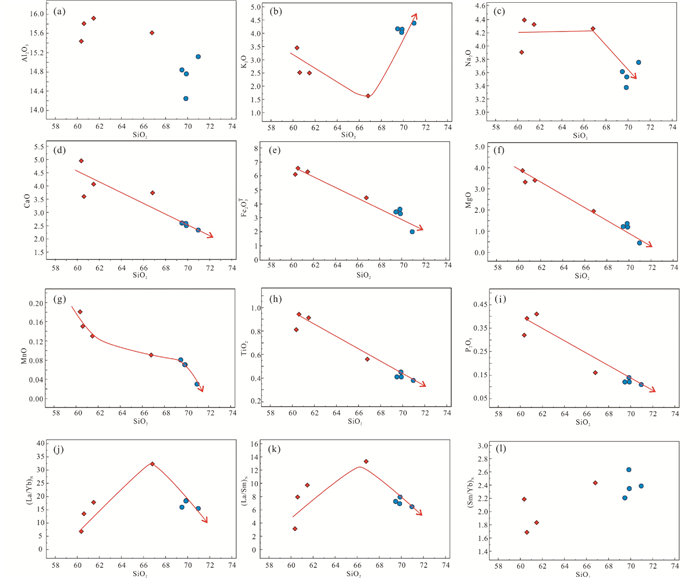
桑心日岩体寄主岩SiO2含量变化范围较小,介于69.49%~70.98%之间,暗色包体的3件样品的SiO2相对集中,介于60.37%~61.51%,另外1件样品SiO2为66.83%,应为暗色包体向寄主花岗岩过渡演化的中间产物。虽然寄主花岗岩和暗色包体SiO2总体变化范围较窄,但在Harker图解中,各元素含量及元素对的比值与SiO2变化趋势明显。在Harker图解中,寄主花岗岩和暗色包体的K2O与SiO2呈先降低后升高的趋势(图 5b);寄主花岗岩和暗色包体的CaO、MgO、Fe2O3T、MnO、TiO2和P2O5与SiO2呈明显的负相关关系(图 5d-i);寄主花岗岩和暗色包体的(La/Yb)N和(La/Sm)N与SiO2呈先升高后下降的趋势(图 5j, k)。暗色包体与寄主岩之间存在明显不同的演化趋势(图 5b, c, e-g, i-k),指示暗色包体和寄主岩之间经历了不同的演化过程。
|
图 5 桑心日岩体及暗色包体Harker图解 Fig. 5 Harker diagrams of the Sangxinri pluton and MMEs |
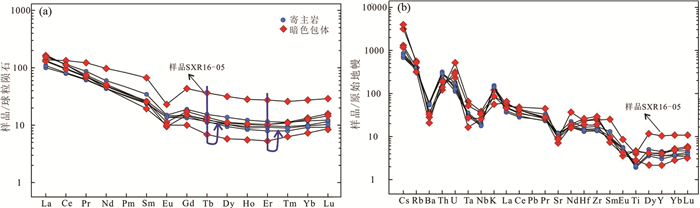
在稀土元素配分图解上,桑心日寄主岩显示轻稀土元素富集,重稀土元素亏损的右倾模式,Eu呈弱的负异常(图 6a),(La/Yb)N值介于11.0~13.3之间,Eu/Eu*介于0.57~0.73之间。暗色包体的稀土元素较寄主花岗岩有明显区别,暗色包体的稀土元素含量变化较大,最基性样品SXR16-05具有最高的稀土含量,随着基性程度的降低稀土元素明显下降,尤其中稀土元素明显下降,暗色包体中最偏酸性的样品SXR16-02具有最低的中稀土,指示暗色包体从基性向酸性端元演化时稀土元素含量逐渐降低(图 6a)。另外,暗色包体具有较明显的Eu的负异常,介于0.41~0.68,最基性样品SXR16-05具有最负的Eu异常,说明暗色包体Eu的负异常继承于母岩浆,而非受到岩浆分异演化的影响。总体来讲,暗色包体的稀土元素含量变化范围要大于寄主岩,偏基性端元的暗色包体稀土元素要高于寄主岩,偏酸性端元的暗色包体要低于寄主岩,暗色包体和寄主岩的稀土元素含量呈先降低后升高的特点(图 6a)。桑心日寄主岩和暗色包体具有基本一致的微量元素组成,具有典型的弧岩浆岩的特征,富集Rb、Cs及K等大离子亲石元素和Th及U,亏损Nb、Ta及Ti等高场强元素(图 6b)。此外,暗色包体较寄主岩具有更明显的Ba及Sr的负异常。
|
图 6 桑心日岩体及暗色包体球粒陨石标准化稀土元素配分图(a)和原始地幔标准化微量元素蛛网图(b)(标准化值据Sun and McDonough, 1989) Fig. 6 Chondrite-normalized REE diagram (a) and primitive mantle-normalized trace element diagram (b) of the Sangxinri pluton and MMEs (normalization values after Sun and McDonough, 1989) |
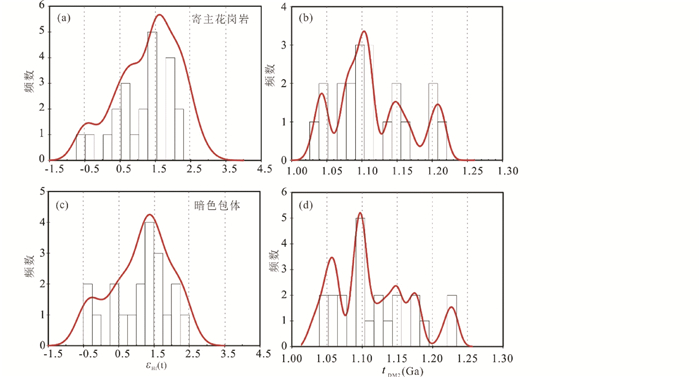
锆石原位Hf同位素分析结果见表 3,由表可见寄主花岗岩的176Yb/177Hf、176Lu/177Hf、176Hf/177Hf值分别介于0.022514~0.064567,0.000694~0.001730和0.282714~0.282801之间,根据原位锆石的实际年龄计算(对于未获得协和年龄的测试点用加权平均年龄计算),获得Hf同位素初始比值εHf(t)介于-0.51~2.53之间,概率直方图峰值约为1.5(图 7a),采用平均地壳176Lu/177Hf值计算(Griffin et al., 2000),获得Hf同位素二阶段模式年龄tDM2为1.01~1.21Ga,概率直方图tDM2值较为分散,计算平均值为1.10Ga(图 7b)。暗色包体的176Yb/177Hf、176Lu/177Hf、176Hf/177Hf值分别介于0.022514~0.043076、0.000694~0.001297和0.282714~0.282794之间,根据原位锆石的实际年龄计算,获得Hf同位素初始比值εHf(t)介于-0.51~2.40之间,概率直方图峰值约为1.5(图 7c),采用平均地壳176Lu/177Hf值计算(Griffin et al., 2000),获得Hf同位素二阶段模式年龄tDM2为1.01~1.21Ga,平均价值为1.11Ga(图 7d)。寄主闪长岩和暗色包体在误差范围内几乎具有一致的Lu-Hf同位素特征,指示它们来自相同的源区。
|
|
表 3 桑心日岩体寄主花岗闪长岩和暗色包体锆石Lu-Hf同位素组成 Table 3 Zircon Lu-Hf isotopic compositions of the Sangxinri pluton and MMEs |
|
图 7 桑心日岩体及暗色包体锆石原位Hf同位素εHf(t)(a、c)和tDM2概率统计直方图(b、d) Fig. 7 Frequency histograms of εHf(t) (a, c) and tDM2 of the zircon in-situ Hf isotopes (b, d) for the Sangxinri pluton and MMEs |
桑心日岩体中暗色包体的成因不同于现有的成因模式,如残留体、捕掳体、同源岩浆早期析离体以及岩浆混合形成的包体。首先,残留体模式形成的暗色包体一般残留体的年龄明显要较寄主岩老,而桑心日包体的年龄仅比寄主岩早约4Ma(图 3a, b、表 1),它们应该属于同一个岩浆事件的产物,而非源区与熔融岩浆的关系。另外,在一般的残留体模式中,暗色包体经历过部分熔融作用后里面暗色矿物会定向排列,呈现残留堆晶结构(Chappell et al., 1987, 2000; White et al., 1999),这与桑心日包体薄片镜下观察斑状结构不吻合(图 2d, e)。并且在该模式下,熔融岩浆(寄主岩)的稀土元素会明显高于暗色包体的,因为稀土元素整体属于不相容元素,倾向在液相中富集,这与我们的地球化学数据不一致(图 6a)。因此,桑心日包体的岩石成因不同于残留体的暗色包体。
从成岩年龄上讲(图 3、表 1),桑心日包体似乎符合同源岩浆早阶段的析离体模式,暗色包体与寄主岩同时,或略早于寄主岩。但与残留体模式类似,同源岩浆早阶段的析离体一般也会有暗色矿物会定向排列,呈现堆积结构,这与桑心日暗色包体的矿物结构不一致。而且,早阶段形成的矿物结晶程度好,矿物颗粒均匀,这也与暗色包体的斑状结构不一致。同样,在早阶段的析离体模式中,稀土元素属于不相容元素,优先进入液相中,而非早期结晶矿物,暗色包体的稀土元素应该较寄主岩的低,这也与桑心日暗色包体稀土元素测试结果不一致(图 6a),因此桑心日暗色包体也不属于早期析离体。
桑心日暗色包体也不同于围岩捕掳体。一般岩浆在上升侵位过程中容易捕掳围岩地层的碎块,这些碎块一般呈不规则的块状,而且围岩地层一般远早于岩浆上侵结晶的年龄(图 1b),这些特征明显不同于桑心日包体。而且,寄主岩和暗色包体一致的锆石原位Hf同位素特征也指示它们应该属于同源岩浆,而非不同来源的捕掳体。
在岩浆作用过程中越来越多岩浆混合型的暗色包体被发现,这种类型的暗色是指一种更基性更富铁镁质的岩浆注入到中酸性岩浆中。岩浆混合形成的暗色包体在反应壳-幔混合,反演岩浆深部作用中起到了重要的作用。但桑心日包体似乎也与该类型的包体不一致。首先,岩浆混合型的暗色包体与寄主岩形成的温度都较高,岩浆熔体的流变性好,包体一般呈球状,椭球状,暗色包体甚至可以发生拉伸、流动构造,而且两种流变性好的岩浆在冷却结晶过程中可以很牢固的胶结在一起。这些特点均与桑心日包体不甚规则的边部和与围岩之间明显间隙面特点不一致。其次,岩浆混合作用中暗色包体作为同期或稍后期的岩浆注入到较早的岩浆中,暗色包体的年龄与寄主岩同期或稍晚于寄主岩。而桑心日包体却较寄主岩老4Myr(图 3),并且我们认为在同一实验室同一台质谱仪同一时间段内连续两个样品年龄测量结果的外部误差可以最小化,样品间的年龄差是可信的。
暗色包体和寄主岩体之间的化学扩散作用会改变暗色包体的地球化学成分(Baker, 1989; Allen, 1991; Holden et al., 1991; Lesher, 1994),但一般也很难评估地球化学扩散作用发生位置和对暗色包体化学成分的改变程度。有学者认为在较大的暗色包体中心部分不受到寄主岩化学扩散作用的影响(Didier, 1987; Jiang et al., 2010)。对于桑心日暗色包体,根据野外暗色包体的形态及与寄主岩的接触关系,它们可能是在半塑性状态下被寄主包裹,在这样的物化条件下,暗色包体的地球化学组成可能已经处于封闭状态,很难与寄主岩发生化学扩散作用。另外,实验地球化学数据表明碱金属元素(K、Na)的化学扩散作用要明显快于其他化学组(Johnston and Wyllie, 1988),因此如果暗色包体和寄主岩之间发生了化学扩散作用,碱金属元素会优先达到化学平衡状态,而桑心日暗色包体与寄主岩之间的K2O、Na2O含量不同且无线性演化关系(图 5b, c)。另外对于暗色包体和寄主岩的稀土、微量元素也会发生化学扩散平衡作用(Shellnutt et al., 2010参考文献见该文),而桑心日暗色包体稀土、微量元素与寄主的差别较大,也指示它们之间应该没有发生过明显的化学扩散作用。因此,暗色包体与寄主岩一致的锆石原位Hf同位素组成不是由于化学扩散作用造成的,进而指示它们属于同源岩浆。
综合以上岩相学、地球化学、同位素证据,桑心日暗色包体的成因与以上几种暗色包体成因均不一致。相近的锆石年龄和一致的锆石原位Lu-Hf同位素上讲,暗色包体和寄主岩应该属于同源岩浆,暗色包体的结晶年龄略早于寄主岩。从暗色包体的野外特征,如凹凸不平边界,桑心日暗色包体最可能成因模式为同源母岩浆早阶段抽离形成的岩浆在半塑性状态下被晚阶段抽离的岩浆所裹挟一起侵入到近地表。
4.2 岩浆侵位及演化岩浆在次生岩浆房(Secondary Magma Chamber)侵入到近地表过程,矿物结晶分离作用会对岩浆成分造成明显的改变(Elburg, 1996)。相近的锆石U-Pb年龄和一致的Lu-Hf同位素组成指示暗色包体和寄主岩来源于同源岩浆。但它们却具有明显不同的主、微量元素,暗色包体更偏基性,更富CaO、MgO、Fe2O3T和Na2O,而贫K2O。在Harker图解上,暗色包体和寄主岩具有明显不同的演化趋势(图 5b, j, k),说明它们经历了不同的岩浆演化过程。在Harker图解上,暗色包体K2O、CaO、MgO、Fe2O3T都随着SiO2升高而降低,说明岩浆经历了含钾铁镁质矿物的结晶分离。
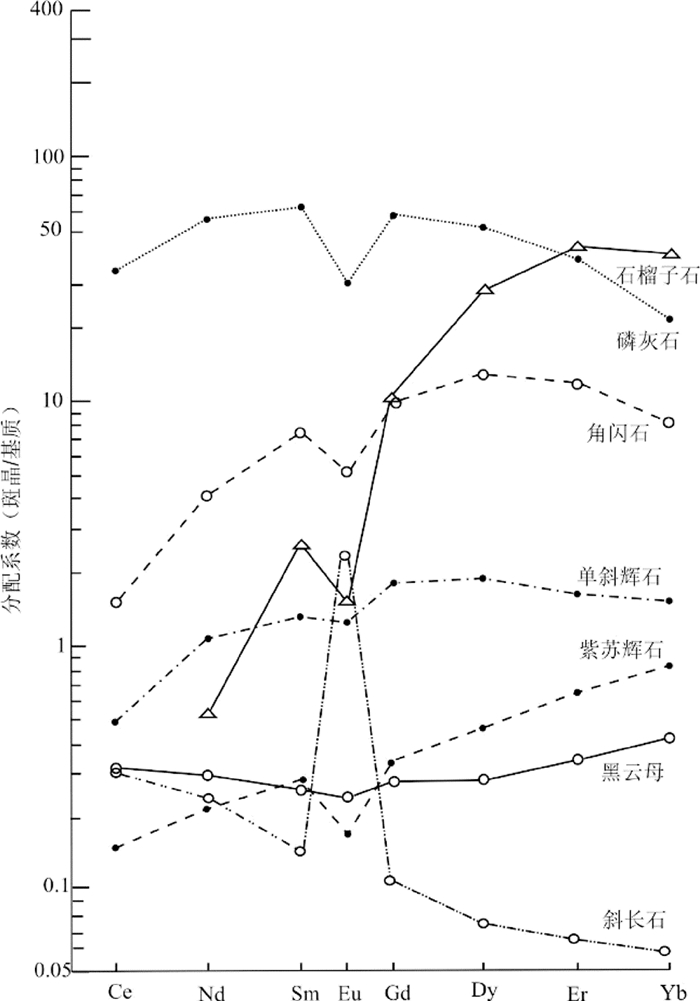
一般情况下,由于稀土元素为不相容元素,随着岩浆的演化,酸性程度越高稀土元素含量越高,这与桑心日暗色包体稀土元素组成特点相反。在稀土元素配分图(图 6a)中,基性程度越高(样品SXR16-5)稀土元素含量越高,随着岩浆的演化稀土元素含量降至最低(样品SXR16-2),尤其中稀土元素发生了显著的降低。在英安质岩浆矿物结晶分离作用过程中,在众多矿物中,只有角闪石对几乎所有稀土元素的分配系数都是大于1的(图 8),角闪石的结晶分异作用会造成母岩浆稀土元素整体的大幅度下降,尤其是中稀土元素含量的显著下降,因为中稀土元素在角闪石/熔体具有较高的分配系数,角闪石的分离结晶会对中稀土元素含量造成显著的影响(陈伟等, 2018)。Harker图解中,(La/Yb)N和(La/Sm)N与SiO2成反比也说明随着岩浆的演化(矿物的分离结晶作用),中、重稀土发生了显著的下降。这也与岩相学观察的结果,暗色包体中出现角闪石斑晶(~5%)现象相一致(图 2d),指示暗色包体经经历过角闪石的分离结晶。Harker图解中,暗色包体的K2O与SiO2成明显的负相关关系,说明角闪石的分离结晶带出K元素,指示母岩浆在早阶段主要经历的含钾角闪石的分离结晶作用。
|
图 8 稀土元素在英安质和流纹质岩浆中主要造岩矿物和副矿物中的矿物-熔体分配系数(各矿物分配系数据Arth, 1976; Fujimaki et al., 1984) Fig. 8 Distribution coefficients of the major rock forming minerals and accessory minerals/melt in the dacite and rhyolite (distribution coefficients of rock forming minerals are after Arth, 1976; Fujimaki et al., 1984) |
随着岩浆的演化,岩浆从花岗闪长岩(偏酸性端元的暗色包体)向花岗岩(寄主岩)方向演化,K2O随着SiO2升高而升高(图 5b),Na2O、CaO、MgO、Fe2O3T、MnO、TiO2、P2O5、(La/Yb)N和(La/Sm)N随着SiO2升高而降低(图 5c-k)。在稀土元素配分图中,随着岩浆的演化,稀土元素含量明显升高(图 6a),说明分配系数较小的矿物在分离结晶过程中占据了主导地位。在Harker图解上,K2O的升高,Na2O和CaO降低说明可能有斜长石的分离结晶,斜长石从岩浆房中分离结晶出去,会导致Na2O和CaO含量的降低和K2O相对含量的升高,因为斜长石对于除Eu以外的稀土元素的分配系数都小于1,所以随着斜长石的结晶分离,剩余岩浆中稀土元素含量会变高。由于在英安-流纹质岩浆中,Eu在斜长石/熔体中的分配系数大于1,所以斜长石的分离结晶作用会导致Eu的负异常加剧,但在稀土元素配分图(图 6a)上未见Eu的负异常加剧,甚至有变弱的趋势,造成这种现象可能的原因为其他副矿物的分离结晶,如磷灰石。在Harker图解上,P2O5随着SiO2升高而降低,说明岩浆演化过程中有磷灰石分离结晶。磷灰石对于稀土元素具有较高的分配系数,所以少量的磷灰石分离结晶都会对稀土元素含量造成较大的影响,相对于Eu,磷灰石对于Sm和Gd的分配系数更高,所以磷灰石分离结晶过程中会带出相对多的Sm和Gd,从而消弱了Eu的负异常(图 8)。Fe2O3T、MgO、MnO和TiO2随着SiO2升高而降低,说明岩浆演化过程中有含钛、铁矿物,如金红石、磁铁矿或者钛铁矿的结晶分离。因此,岩浆从暗色包体向寄主岩演化过程中可能主要经历了斜长石和少量副矿物磷灰石、金红石、磁铁矿或者钛铁矿的结晶分离作用。
综合以上岩相学、年代学、元素地球化学和同位素地球化学证据,认为桑心日暗色包体和寄主岩来源于同源母岩浆,初始岩浆在母岩浆房中经历了不同程度的角闪石结晶分离作用,并沿早期较弱的构造裂隙侵入到地壳的某一层位,并快速冷凝形成斑状的暗色包体,随着构造活动进一步加剧,经过进一步分异的母岩浆大规模上侵,并将早先侵位处于半塑性状态的暗色包体侵吞、裹挟至近地表。桑心日暗色包体最可能的成因模式可以解释为同源岩浆不同期次间的物理混合。
5 结论(1) 桑心日暗色包体最可能的成因模式为同源岩浆早阶段抽离形成的岩浆在半塑性状态下被晚阶段抽离的岩浆所裹挟一起侵入到近地表,该成因模式介于捕掳体和岩浆混合模式之间,为一种新的暗色包体成岩模式。
(2) 结晶分离作用在桑心日岩体和暗色包体成岩过程中起主要的作用,其中暗色包体是初始岩浆在母岩浆房中经历了角闪石的结晶分离作用形成的,而寄主岩是母岩浆经过进一步斜长石结晶分离形成的。
Allen CM. 1991. Local equilibrium of mafic enclaves and granitoids of the Turtle Pluton, Southeast California:Mineral, chemical, and isotopic evidence. American Mineralogist, 76: 574-588 |
Arth JG. 1976. Behavior of trace elements during magmatic processes:A summary of theoretical models and their applications. Journal of Research of the U.S. Geological Survey, 4(1): 41-47 |
Baker DR. 1989. Tracer versus trace element diffusion:Diffusional decoupling of Sr concentration from Sr isotope composition. Geochimica et Cosmochimica Acta, 53(11): 3015-3023 DOI:10.1016/0016-7037(89)90177-4 |
Barbarin B. 2005. Mafic magmatic enclaves and mafic rocks associated with some granitoids of the central Sierra Nevada batholith, California:Nature, origin, and relations with the hosts. Lithos, 80(1-4): 155-177 DOI:10.1016/j.lithos.2004.05.010 |
Blichert-Toft J and Albarède F. 1997. The Lu-Hf isotope geochemistry of chondrites and the evolution of the mantle-crust system. Earth and Planetary Science Letters, 148(1-2): 243-258 DOI:10.1016/S0012-821X(97)00040-X |
Blundy JD and Sparks RSJ. 1992. Petrogenesis of mafic inclusions in granitoids of the Adamello Massif, Italy. Journal of Petrology, 33(5): 1039-1104 DOI:10.1093/petrology/33.5.1039 |
Chappell BW, White AJR and Wyborn D. 1987. The importance of residual source material (restite) in granite petrogenesis. Journal of Petrology, 28(6): 1111-1138 DOI:10.1093/petrology/28.6.1111 |
Chappell BW and White AJR. 1992. I-and S-type granites in the Lachlan fold belt. Earth and Environmental Science Transactions of the Royal Society of Edinburgh, 83(1-2): 1-26 DOI:10.1017/S0263593300007720 |
Chappell BW, White AJR, Williams IS, Wyborn D and Wyborn LAI. 2000. Lachlan fold belt granites revisited:High-and low-temperature granites and their implications. Australian Journal of Earth Sciences, 47(1): 123-138 DOI:10.1046/j.1440-0952.2000.00766.x |
Chen B, Chen ZC and Jahn BM. 2009. Origin of mafic enclaves from the Taihang Mesozoic orogen, North China craton. Lithos, 110(1-4): 343-358 DOI:10.1016/j.lithos.2009.01.015 |
Chen W, Song Y, Qu XM, Sun M, Ding JX and Ma XD. 2018. MMEs in the Tangjiangqiongguo pluton in the north Lhasa block formed by magma mixing of different episodes of the same sourced magma: A new petrogenetic model for the MMEs. Earth-science, http://kns.cnki.net/kcms/detail/42.1874.P.20180704.1739.006.html (in Chinese)
|
Chen YD, Price RC and White AJR. 1989. Inclusions in three S-type granites from southeastern Australia. Journal of Petrology, 30(5): 1181-1218 DOI:10.1093/petrology/30.5.1181 |
Dahlquist JA. 2002. Mafic microgranular enclaves:Early segregation from metaluminous magma (Sierra de Chepes), Pampean Ranges, NW Argentina. Journal of South American Earth Sciences, 15(6): 643-655 DOI:10.1016/S0895-9811(02)00112-8 |
Didier J. 1987. Contribution of enclave studies to the understanding of origin and evolution of granitic magmas. Geologische Rundschau, 76(1): 41-50 DOI:10.1007/BF01820572 |
Didier J and Barbarin B. 1991. Enclaves and Granite Petrology, Developments in Petrology. Amsterdam:Elsevier: 1-625 |
Donaire T, Pascual E, Pin C and Duthou JL. 2005. Microgranular enclaves as evidence of rapid cooling in granitoid rocks:The case of the Los Pedroches granodiorite, Iberian Massif, Spain. Contributions to Mineralogy and Petrology, 149(3): 247-265 DOI:10.1007/s00410-005-0652-0 |
Dong X, Zhang ZM, Santosh M, Wang W, Yu F and Liu F. 2011. Late Neoproterozoic thermal events in the northern Lhasa terrane, South Tibet:Zircon chronology and tectonic implications. Journal of Geodynamics, 52(5): 389-405 DOI:10.1016/j.jog.2011.05.002 |
Dorais MJ, Whitney JA and Roden MF. 1990. Origin of mafic enclaves in the Dinkey Creek Pluton, Central Sierra Nevada batholith, California. Journal of Petrology, 31(4): 853-881 DOI:10.1093/petrology/31.4.853 |
Elburg MA. 1996. Evidence of isotopic equilibration between microgranitoid enclaves and host granodiorite, Warburton granodiorite, Lachlan Fold Belt, Australia. Lithos, 38(1-2): 1-22 DOI:10.1016/0024-4937(96)00003-5 |
Elhlou S, Belousova E, Griffin WL, Pearson NJ and O'Reilly SY. 2006. Trace element and isotopic composition of GJ-red zircon standard by laser ablation. Geochimica et Cosmochimica Acta, 70(18): A158 |
Feeley TC, Wilson LF and Underwood SJ. 2008. Distribution and compositions of magmatic inclusions in the Mount Helen dome, Lassen volcanic center, California:Insights into magma chamber processes. Lithos, 106(1-2): 173-189 DOI:10.1016/j.lithos.2008.07.010 |
Fujimaki H, Tatsumoto M and Aoki KI. 1984. Partition coefficients of Hf, Zr, and REE between phenocrysts and groundmasses. Journal of Geophysical Research:Solid Earth, 89(S02): B662-B672 DOI:10.1029/JB089iS02p0B662 |
Girardeau J, Mercier JCC and Wang XB. 1985. Petrology of the mafic rocks of the Xigaze ophiolite, Tibet. Contributions to Mineralogy and Petrology, 90(4): 309-321 DOI:10.1007/BF00384710 |
Griffin WL, Pearson NJ, Belousova E, Jackson SE, van Achterbergh E, O'Reilly SY and Shee SR. 2000. The Hf isotope composition of cratonic mantle:LAM-MC-ICPMS analysis of zircon megacrysts in kimberlites. Geochimica et Cosmochimica Acta, 64(1): 133-147 DOI:10.1016/S0016-7037(99)00343-9 |
Griffin WL, Wang X, Jackson SE, Pearson NJ, O'Reilly SY, Xu XS and Zhou XM. 2002. Zircon chemistry and magma mixing, SE China:In-situ analysis of Hf isotopes, Tonglu and Pingtan igneous complexes. Lithos, 61(3-4): 237-269 DOI:10.1016/S0024-4937(02)00082-8 |
Hawkesworth CJ and Kemp AIS. 2006. Using hafnium and oxygen isotopes in zircons to unravel the record of crustal evolution. Chemical Geology, 226(3-4): 144-162 DOI:10.1016/j.chemgeo.2005.09.018 |
Holden P, Halliday AN, Stephens WE and Henney PJ. 1991. Chemical and isotopic evidence for major mass transfer between mafic enclaves and felsic magma. Chemical Geology, 92(1-3): 135-152 DOI:10.1016/0009-2541(91)90053-T |
Hou KJ, Li YH, Zou TR, Qu XM, Shi YR and Xie GQ. 2007. Laser ablation-MC-ICP-MS technique for Hf isotope microanalysis of zircon and its geological applications. Acta Petrologica Sinica, 23(10): 2595-2604 (in Chinese with English abstract) |
Hu DG, Wu ZH, Jiang W, Shi YR, Ye PS and Liu QS. 2005. SHRIMP zircon U-Pb age and Nd isotopic study on the Nyainqêntanglha Group in Tibet. Science in China (Series D), 48(9): 1377-1386 DOI:10.1360/04yd0183 |
Ilbeyli N and Pearce JA. 2005. Petrogenesis of igneous enclaves in plutonic rocks of the central Anatolian crystalline complex, Turkey. International Geology Review, 47(10): 1011-1034 DOI:10.2747/0020-6814.47.10.1011 |
Jiang YH, Ling HF, Jiang SY, Fan HH, Shen WZ and Ni P. 2005. Petrogenesis of a Late Jurassic peraluminous volcanic complex and its high-Mg, potassic, quenched enclaves at Xiangshan, Southeast China. Journal of Petrology, 46(6): 1121-1154 DOI:10.1093/petrology/egi012 |
Jiang YH, Jin GD, Liao SY, Zhou Q and Zhao P. 2010. Geochemical and Sr-Nd-Hf isotopic constraints on the origin of Late Triassic granitoids from the Qinling orogen, central China:Implications for a continental arc to continent-continent collision. Lithos, 117(1-4): 183-197 DOI:10.1016/j.lithos.2010.02.014 |
Johnston AD and Wyllie PJ. 1988. Interaction of granitic and basic magmas:Experimental observations on contamination processes at 10kbar with H2O. Contributions to Mineralogy and Petrology, 98(3): 352-362 DOI:10.1007/BF00375185 |
Kadioǧlu YK and Güleç N. 1999. Types and genesis of the enclaves in central Anatolian granitoids. Geological Journal, 34(3): 243-256 DOI:10.1002/(ISSN)1099-1034 |
Kocak K. 2006. Hybridization of mafic microgranular enclaves:Mineral and whole-rock chemistry evidence from the Karamadazı granitoid, Central Turkey. International Journal of Earth Sciences, 95(4): 587-607 DOI:10.1007/s00531-006-0090-x |
Kocak K, Zedef V and Kansun G. 2011. Magma mixing/mingling in the Eocene Horoz (Nigde) granitoids, Central southern Turkey:Evidence from mafic microgranular enclaves. Mineralogy and Petrology, 103(1-4): 149-167 DOI:10.1007/s00710-011-0165-7 |
Kumar S and Rino V. 2006. Mineralogy and geochemistry of microgranular enclaves in Palaeoproterozoic Malanjkhand granitoids, central India:Evidence of magma mixing, mingling, and chemical equilibration. Contributions to Mineralogy and Petrology, 152(5): 591-609 DOI:10.1007/s00410-006-0122-3 |
Lesher CE. 1994. Kinetics of Sr and Nd exchange in silicate liquids:Theory, experiments, and applications to uphill diffusion, isotopic equilibration, and irreversible mixing of magmas. Journal of Geophysical Research:Solid Earth, 99(B5): 9585-9604 DOI:10.1029/94JB00469 |
Liu L, Qiu JS and Li Z. 2013. Origin of mafic microgranular enclaves (MMEs) and their host quartz monzonites from the Muchen pluton in Zhejiang Province, Southeast China:Implications for magma mixing and crust-mantle interaction. Lithos, 160-161: 145-163 DOI:10.1016/j.lithos.2012.12.005 |
Liu YS, Hu ZC, Gao S, Günther D, Xu J and Gao CG. 2008. In situ analysis of major and trace elements of anhydrous minerals by LA-ICP-MS without applying an internal standard. Chemical Geology, 257(1-2): 34-43 DOI:10.1016/j.chemgeo.2008.08.004 |
Liu YS, Gao S, Hu ZC, Gao CG, Zong KQ and Wang DB. 2010a. Continental and oceanic crust recycling-induced melt-peridotite interactions in the Trans-North China Orogen:U-Pb dating, Hf isotopes and trace elements in zircons from mantle xenoliths. Journal of Petrology, 51(1-2): 537-571 DOI:10.1093/petrology/egp082 |
Liu YS, Hu ZC, Zong KQ, Gao CG, Gao S, Xu J and Chen HH. 2010b. Reappraisement and refinement of zircon U-Pb isotope and trace element analyses by LA-ICP-MS. Chinese Science Bulletin, 55(15): 1535-1546 DOI:10.1007/s11434-010-3052-4 |
Ludwig KR. 2003. User's Manual for ISOPLOT 3.00: A Geochronological Toolkit for Microsoft Excel. Berkeley CA: Berkeley Geochronology Center, Special Publication, 1-71
|
Maniar PD and Piccoli PM. 1989. Tectonic discrimination of granitoids. Geological Society of America Bulletin, 101(5): 635-643 DOI:10.1130/0016-7606(1989)101<0635:TDOG>2.3.CO;2 |
Middlemost EAK. 1994. Naming materials in the magma/igneous rock system. Earth-Science Reviews, 37(3-4): 215-224 DOI:10.1016/0012-8252(94)90029-9 |
Noyes HJ, Frey FA and Wones DR. 1983. A tale of two plutons:Geochemical evidence bearing on the origin and differentiation of the Red Lake and Eagle Peak plutons, Central Sierra Nevada, California. The Journal of Geology, 91(5): 487-509 DOI:10.1086/628801 |
Pan GT, Ding J, Yao DS and Wang LQ. 2004. Geological Map (1:1500000) of Qinghai-Xizang (Tibetan) Plateau and Adjacent Areas. Chengdu: Chengdu Cartographic Publishing House (in Chinese)
|
Patiño Douce AE and Johnston AD. 1991. Phase equilibria and melt productivity in the pelitic system:Implications for the origin of peraluminous granitoids and aluminous granulites. Contributions to Mineralogy and Petrology, 107: 202-218 DOI:10.1007/BF00310707 |
Peccerillo A and Taylor SR. 1976. Geochemistry of Eocene calc-alkaline volcanic rocks from the Kastamonu area, Northern Turkey. Contributions to Mineralogy and Petrology, 58(1): 63-81 DOI:10.1007/BF00384745 |
Perugini D, Poli G, Christofides G and Eleftheriadis G. 2003. Magma mixing in the Sithonia plutonic complex, Greece:Evidence from mafic microgranular enclaves. Mineralogy and Petrology, 78(3-4): 173-200 DOI:10.1007/s00710-002-0225-0 |
Qu YG, Wang YS and Duan JX. 2011. The Regional Geological Survey Report of the People's Republic of China (1:250000 Duoba). Wuhan: China University of Geosciences Press (in Chinese)
|
Rapp RP and Watson EB. 1995. Dehydration melting of metabasalt at 8~32kbar:Implications for continental growth and crust-mantle recycling. Journal of Petrology, 36(4): 891-931 DOI:10.1093/petrology/36.4.891 |
Shellnutt JG, Jahn BM and Dostal J. 2010. Elemental and Sr-Nd isotope geochemistry of microgranular enclaves from peralkaline A-type granitic plutons of the Emeishan large igneous province, SW China. Lithos, 119(1-2): 34-46 DOI:10.1016/j.lithos.2010.07.011 |
Shi RD, Yang JS, Xu ZQ and Qi XX. 2008. The Bangong Lake ophiolite (NW Tibet) and its bearing on the tectonic evolution of the Bangong-Nujiang suture zone. Journal of Asian Earth Sciences, 32(5-6): 438-457 DOI:10.1016/j.jseaes.2007.11.011 |
Sisson TW, Ratajeski K, Hankins WB and Glazner AF. 2005. Voluminous granitic magmas from common basaltic sources. Contributions to Mineralogy and Petrology, 148(6): 635-661 DOI:10.1007/s00410-004-0632-9 |
Słaby E and Martin H. 2008. Mafic and felsic magma interaction in granites:The Hercynian Karkonosze Pluton (Sudetes, Bohemian Massif). Journal of Petrology, 49(2): 353-391 |
Söderlund U, Patchett PJ, Vervoort JD and Isachsen CE. 2004. The 176Lu decay constant determined by Lu-Hf and U-Pb isotope systematics of precambrian mafic intrusions. Earth and Planetary Science Letters, 219(3-4): 311-324 DOI:10.1016/S0012-821X(04)00012-3 |
Sun M, Chen W, Qu XM, Ma XD and Ding JS. 2018. Petrogenesis of the Late Cretaceous Jiangba volcanic rocks and its indications for the thinning of the thickened crust in Xiongmei area, Tibet. Earth Science, 43(9): 3234-3251 (in Chinese with English abstract) |
Sun SS and McDonough WF. 1989. Chemical and isotopic systematics of oceanic basalts: Implications for mantle composition and processes. In: Saunders AD and Norry MJ (eds.). Magmatism in the Ocean Basins. Geological Society, London, Special Publications, 42(1): 313-345
|
Vernon RH. 1984. Microgranitoid enclaves in granites-globules of hybrid magma quenched in a plutonic environment. Nature, 309(5967): 438-439 DOI:10.1038/309438a0 |
White RV, Tarney J, Kerr AC, Saunders AD, Kempton PD, Pringle MS and Klaver GT. 1999. Modification of an oceanic plateau, Aruba, Dutch Caribbean:Implications for the generation of continental crust. Lithos, 46(1): 43-68 |
Wiebe RA, Smith D, Sturm M, King EM and Seckler MS. 1997. Enclaves in the Cadillac mountain granite (Coastal Maine):Samples of hybrid magma from the base of the chamber. Journal of Petrology, 38(3): 393-423 DOI:10.1093/petroj/38.3.393 |
Zhang KJ. 2004. Secular geochemical variations of the Lower Cretaceous siliciclastic rocks from central Tibet (China) indicate a tectonic transition from continental collision to back-arc rifting. Earth and Planetary Science Letters, 229(1-2): 73-89 DOI:10.1016/j.epsl.2004.10.030 |
Zhang KJ, Xia BD, Wang GM, Li YT and Ye HF. 2004. Early Cretaceous stratigraphy, depositional environments, sandstone provenance, and tectonic setting of central Tibet, western China. GSA Bulletin, 116(9-10): 1202-1222 |
Zhang KJ, Zhang YX, Li B and Zhong LF. 2007. Nd isotopes of siliciclastic rocks from Tibet, western China:Constraints on provenance and pre-Cenozoic tectonic evolution. Earth and Planetary Science Letters, 256(3-4): 604-616 DOI:10.1016/j.epsl.2007.02.014 |
Zhang KJ, Zhang YX, Tang XC and Xia B. 2012. Late Mesozoic tectonic evolution and growth of the Tibetan Plateau prior to the Indo-Asian collision. Earth-Science Reviews, 114(3-4): 236-249 DOI:10.1016/j.earscirev.2012.06.001 |
Zhang KJ, Xia B, Zhang YX, Liu WL, Zeng L, Li JF and Xu LF. 2014. Central Tibetan Meso-Tethyan oceanic plateau. Lithos, 210-211: 278-288 DOI:10.1016/j.lithos.2014.09.004 |
Zhang KJ, Li QH, Yan LL, Zeng L, Lu L, Zhang YX, Hui J, Jin X and Tang XC. 2017. Geochemistry of limestones deposited in various plate tectonic settings. Earth-Science Reviews, 167: 27-46 DOI:10.1016/j.earscirev.2017.02.003 |
Zhu DC, Zhao ZD, Niu YL, Dilek Y and Mo XX. 2011. Lhasa terrane in southern Tibet came from Australia. Geology, 39(8): 727-730 DOI:10.1130/G31895.1 |
Zhu DC, Zhao ZD, Niu YL, Wang Q, Dilek Y, Dong GC and Mo XX. 2012. Origin and Paleozoic Tectonic Evolution of the Lhasa Terrane. Geological Journal of China Universities, 18(1): 1-15 (in Chinese with English abstract) |
Zhu DC, Zhao ZD, Niu YL, Dilek Y, Hou ZQ and Mo XX. 2013. The origin and pre-Cenozoic evolution of the Tibetan Plateau. Gondwana Research, 23(4): 1429-1454 DOI:10.1016/j.gr.2012.02.002 |
陈伟, 宋扬, 曲晓明, 孙渺, 丁吉顺, 马旭东. 2018.北拉萨块体唐江穷果岩体中由同源岩浆不同期次之间混合产生的暗色包体: 一种新的暗色包体岩石成因.地球科学, http://kns.cnki.net/kcms/detail/42.1874.P.20180704.1739.006.html
|
侯可军, 李延河, 邹天人, 曲晓明, 石玉若, 谢桂青. 2007. LA-MC-ICP-MS锆石Hf同位素的分析方法及地质应用. 岩石学报, 23(10): 2595-2604. DOI:10.3969/j.issn.1000-0569.2007.10.025 |
潘桂棠, 丁俊, 姚冬生, 王立全. 2004. 青藏高原及邻区地质图 1:1500000:说明书. 成都: 成都地图出版社.
|
曲永贵, 王永胜, 段建祥. 2011. 中华人民共和国区域地质调查报告多巴区幅(比例尺1:250000). 武汉: 中国地质大学出版社.
|
孙渺, 陈伟, 曲晓明, 马旭东, 丁吉顺. 2018. 西藏雄梅地区晚白垩世江巴组火山岩岩石成因及对加厚地壳减薄的指示. 地球科学, 43(9): 3234-3251. |
朱弟成, 赵志丹, 牛耀龄, 王青, Dilek Y, 董国臣, 莫宣学. 2012. 拉萨地体的起源和古生代构造演化. 高校地质学报, 18(1): 1-15. DOI:10.3969/j.issn.1006-7493.2012.01.001 |