 2019, Vol. 35


2. 西南交通大学地球科学与环境工程学院, 成都 611756;
3. 中国地质科学院矿产资源研究所, 北京 100037;
4. 中国地质大学地球科学与资源学院, 北京 100083;
5. 西藏天圆矿业资源开发有限公司, 日喀则 857000
2. Faculty of Geosciences and Environmental Engineering, Southwest Jiaotong University, Chengdu 611756, China;
3. Institute of Mineral Resources, Chinese Academy of Geological Sciences, Beijing 100037, China;
4. College of Earth Sciences and Resources, China University of Geosciences, Beijing 100083, China;
5. Tibet Tianyuan Mineral Exploration Co. Ltd., Shigatse 857000, China
西藏冈底斯铜矿带位于我国青藏高原拉萨地体南缘,是一条特殊的铜矿带,因为其不仅分布有与中生代新特提斯洋壳俯冲相关的斑岩型矿床,还分布有与新生代印度-欧亚大陆碰撞造山环境相关的斑岩型矿床(Hou et al., 2009, 2015b; Tafti et al., 2009; Lang et al., 2014)。目前在该成矿带发现产于碰撞造山环境的斑岩型矿床有甲玛、驱龙、邦铺、朱诺、冲江、厅宫、白容、沙让、吉如等(侯增谦等, 2003; 郑有业等, 2007; 张刚阳等, 2008; Hou et al., 2009; 唐菊兴等, 2009; Zheng et al., 2015);产于俯冲构造环境的仅有雄村斑岩型铜金矿床(Tafti et al., 2009; Lang et al., 2014)。由于矿床数量众多,研究者更多的关注于冈底斯铜矿带内新生代时期产于碰撞造山环境的斑岩型矿床,对它们的空间分布特征、地球动力学背景、含矿斑岩的源区进行了系统的解剖(Hou et al., 2009, 2013, 2015a, b)。但对于中生代与新特提斯洋壳俯冲相关的斑岩型矿床研究还相对薄弱、成矿理论不够完善、且找矿勘查也一直遭遇瓶颈。尽管前人对于雄村矿集区的成矿作用的研究也有所涉及(Tafti et al., 2009; Lang et al., 2014; Tang et al., 2015; Yin et al., 2017),但主要的研究工作侧重于单个矿床的研究。为了全面厘定矿集区的岩浆与成矿作用的关系,本文对雄村矿集区新发现的3号矿体的含矿斑岩开展了锆石U-Pb定年、岩石地球化学和Sr-Nd-Pb-Hf同位素地球化学研究,同时结合前期的研究成果,深化对矿集区含矿岩体成因、地球动力学背景及冈底斯成矿带岩浆作用与成矿关系的认识,为下一步矿区找矿工作部署和区域找矿突破提供重要的理论依据。
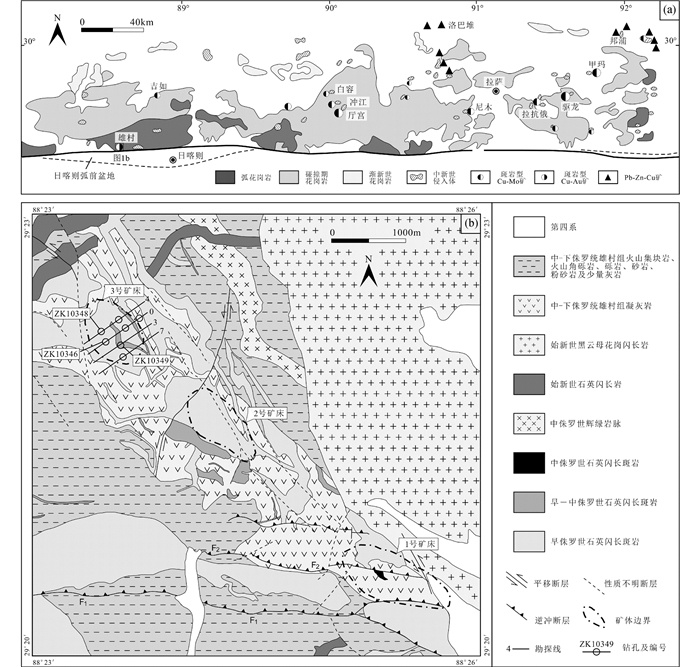
1 区域及矿床地质冈底斯铜矿带位于拉萨地体南缘,长约400km,宽约50km。带内已发现数个形成于碰撞造山环境中的大型-超大型铜矿床,如甲玛、驱龙、白容、冲江、厅宫等,这些矿床与中新世埃达克质斑岩体关系密切(图 1a)。另外在冈底斯铜矿带上还存在与新特提斯洋壳俯冲相关的斑岩型成矿作用——雄村铜金矿床。雄村矿集区位于西藏冈底斯铜矿带南缘,其南侧紧邻日喀则弧前盆地(图 1a)。矿集区出露的地层为中-下侏罗统雄村组火山-沉积岩(图 1b)(丁枫等, 2012; Lang et al., 2019),其岩性组合主要为火山集块岩、火山角砾岩、凝灰岩,其间夹少量的砂岩、粉砂岩和灰岩。矿集区内主要的侵入岩形成时代为侏罗纪和始新世(图 1b)。侏罗纪侵入体包括早侏罗世石英闪长斑岩(181~175Ma; Lang et al., 2014)、早-中侏罗世石英闪长斑岩(~174Ma; 郎兴海等, 2014)、中侏罗世石英闪长斑岩(167~161Ma; Lang et al., 2014)和辉绿岩脉(165Ma; Lang et al., 2018);始新世侵入体主要包括矿区东侧的黑云母花岗闪长岩(47Ma; 唐菊兴等, 2010)、石英闪长岩和少量的煌斑岩脉(47Ma; Lang et al., 2017)。矿集区构造较为发育,主要为东西向、北东-南西向、北西-南东向断层构造(图 1b),以及位于矿区南部的褶皱构造。
|
图 1 冈底斯斑岩铜矿带地质图(a, 据Yang et al., 2009)及雄村矿集区地质图(b, 据Tang et al., 2015) Fig. 1 Geological map of Gangdese porphyry copper belt (a, after Yang et al., 2009) and Geological map of Xiongcun district (b, after Tang et al., 2015) |
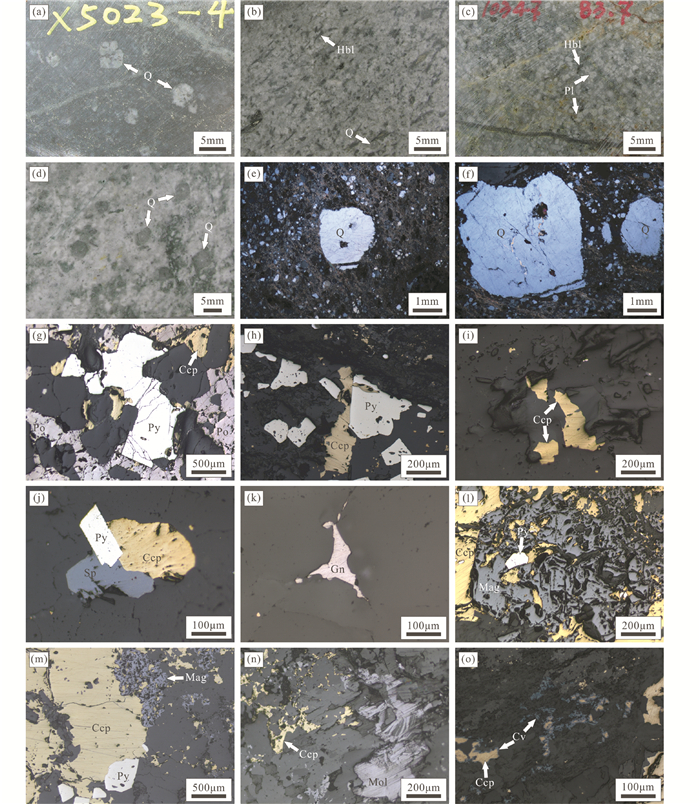
矿集区内1、2、3号矿体呈北西向近等距展布,平面上为近椭圆状(图 1b)。1号矿体Cu、Au、Ag金属量分别为1.04×10⁶t @ 0.48%、143.31t @ 0.66g/t、900.43t @ 4.19g/t,其蚀变类型为钾硅酸盐岩化、绢英岩化和青磐岩化,矿化呈浸染状或脉状产出,主要金属矿物为黄铜矿、黄铁矿、磁黄铁矿以及少量的毒砂、方铅矿、辉钼矿和闪锌矿等(图 2g-k),缺乏磁铁矿、硬石膏等表征高氧逸度的矿物。2号矿体Cu、Au、Ag金属量分别为1.34×10⁶t @ 0.35%、76.34t @ 0.22g/t、193.78t @ 1.3g/t,其蚀变类型包含钾硅酸盐岩化、钠化-钙化、绢英岩化和青磐岩化,主要金属矿物为黄铜矿、黄铁矿、磁铁矿以及少量的辉钼矿、方铅矿和闪锌矿等(图 2l-o),非金属矿物中可见硬石膏。3号矿体的围岩蚀变、矿物组合特征与2号矿体一致,主成矿元素为铜,伴生金、银,平均品位分别为0.26%、0.11g/t和1.2g/t。
|
图 2 雄村矿集区含矿斑岩和矿石的手标本及镜下照片 (a)中侏罗世石英闪长斑岩(1号矿体含矿斑岩);(b)早侏罗世石英闪长斑岩(2号矿体含矿斑岩);(c)早侏罗世石英闪长斑岩(3号矿体含矿斑岩);(d)早-中侏罗世石英闪长斑岩(不含矿斑岩);(e)早侏罗世石英闪长斑岩(3号矿体含矿斑岩)显微照片;(f)早-中侏罗世石英闪长斑岩显微照片;(g-k) 1号矿体典型金属矿物;(l-o) 2、3号矿体典型金属矿物. Ccp-黄铜矿;Py-黄铁矿;Po-磁黄铁矿;Sp-闪锌矿;Gn-方铅矿;Mag-磁铁矿;Mol-辉钼矿;Cv-铜蓝;Q-石英;Pl-斜长石;Hbl-角闪石 Fig. 2 Hand specimen photos and microphotographs of ore-bearing porphyry and ore in the Xiongcun district (a) Middle Jurassic quartz diorite porphyry (ore-bearing porphyry of the No.1 deposit); (b) Early Jurassic quartz diorite porphyry (ore-bearing porphyry of the No.2 deposit); (c) Early Jurassic quartz diorite porphyry (ore-bearing porphyry of the No.3 deposit); (d) Early-Middle Jurassic quartz diorite porphyry (barren porphyry); (e) microphotograph of Early Jurassic quartz diorite porphyry (ore-bearing porphyry of the No.3 deposit); (f) microphotograph of Early-Middle Jurassic quartz diorite porphyry; (g-k) typical metallic mineral assemblages of No.1 deposit; (l-o) typical metallic mineral assemblages of No.2 and No.3 deposits. Ccp-chalcopyrite; Py-pyrite; Ccp-chalcopyrite; Po-pyrrhotite; Sp-sphalerite; Gn-galena; Mag-magnetite; Mol-molybdenite; Cv-covellite; Q-quartz; Pl-plagioclase; Hbl-hornblende |
雄村矿集区共发育有三期侏罗纪石英闪长斑岩(图 1b):早侏罗世石英闪长斑岩(图 2b, c)、早-中侏罗世石英闪长斑岩(图 2d)和中侏罗世石英闪长斑岩(图 2a)。其中早侏罗世石英闪长斑岩为2号、3号矿体的含矿斑岩,中侏罗世石英闪长斑岩为1号矿体的含矿斑岩,前人对1、2号矿体中的这两类含矿斑岩进行了详细描述(Lang et al., 2014; Tang et al., 2015; Yin et al., 2017),此处不再复述。早-中侏罗世石英闪长斑岩为矿集区非含矿斑岩(图 1b),以含大量粗粒石英斑晶而区分于含矿斑岩(图 2d, f, 郎兴海等, 2014),可见其侵入早侏罗世石英闪长斑岩(图 1b)。3号矿体含矿早侏罗世石英闪长斑岩蚀变强烈,蚀变弱的岩石为灰白色,斑状结构,斑晶含量约10%~15%,主要由细粒斜长石、角闪石和眼球状(浑圆状)石英组成(图 2c, e),石英斑晶粒径为1~3mm不等,角闪石和斜长石蚀变强烈;基质具有微粒-细粒结构,主要由石英、斜长石、黑云母和少量的角闪石构成,斜长石常发生绢云母蚀变;副矿物可见锆石、磷灰石和磁铁矿。本次研究的3号矿体含矿早侏罗世石英闪长斑岩样品均采自于钻孔岩芯,采集样品时尽量选择新鲜、蚀变较弱的岩芯,以保证样品化学分析的可靠性。
3 分析方法 3.1 锆石U-Pb定年锆石的分选在廊坊市科大岩石矿物分选技术服务有限公司完成,首先对样品进行破碎、淘洗、电磁与重液分选,之后在双目镜下挑选出粒度大、晶型好、裂隙与包裹体较少的锆石备用。锆石的制靶及照相在北京锆年领航科技有限公司完成,首先将挑选的锆石置于环氧树脂内,对其进行抛光清洗,露出锆石表面,制成靶样。之后对锆石进行阴极发光及透反射光图像的采集。参照锆石阴极发光及透反射光图像,选择锆石颗粒表面无裂隙、内部环带清晰、无包裹体的位置作为U-Pb定年的测试点。锆石U-Pb同位素测试在中国地质大学(北京)成矿过程与矿产资源国家重点实验室进行。U-Pb同位素测试中所用激光剥蚀系统为Geolas 193,ICP-MS为Thermo Fisher X-SeriesⅡ型四级杆等离子质谱仪。激光束斑直径为32μm,剥蚀频率为8Hz,并利用He气作为剥蚀物质的载气,Ar气作为补偿气。测试中采用每隔5个测试点测定两个锆石91500(Wiedenbeck et al., 1995)对样品进行校正,并用锆石Plesovice(Sláma et al., 2008),观察仪器状态和测试的重现性。详细实验操作步骤可见侯可军等(2009)。利用ICPMSDataCal(Ver7.2)软件处理信号,协和图解采用Isoplot 4.0处理。
3.2 Hf同位素分析锆石Hf同位素测试是在北京科荟测试技术有限公司Neptune plus多接收等离子质谱及配套的ESI NWR193紫外激光剥蚀系统(LA-MC-ICP-MS)上进行的,实验过程中采用He作为剥蚀物质载气,剥蚀直径采用50μm,测定时使用锆石国际标样GJ-1作为参考物质,分析点与U-Pb定年分析点为同一位置。相关仪器运行条件及详细分析流程见侯可军等(2007)。分析过程中锆石标准GJ-1的176Hf/177Hf测试加权平均值为0.282007±0.000007,与文献报道值(Morel et al., 2008)在误差范围内完全一致。
3.3 主微量元素分析主量、微量元素分析在西南冶金地质测试中心进行。主量元素测试采用X射线荧光光谱法(XRF),在荷兰帕纳科Axios X荧光仪完成,采用GBW07211和GBW07108为分析标样,分析结果显示误差优于3%。微量元素测定采用电感耦合等离子体质谱法(ICP-MS),在NexIon 300x ICP-MS仪器上完成,将样品研磨并用酸溶法制成溶液,然后在等离子质谱仪上进行测定,并用GBW07103和GBW07104为分析标样,分析结果显示含量大于10×10-6的元素分析误差小于5%,而含量小于10×10-6的元素分析误差小于10%。
3.4 Sr-Nd-Pb同位素分析全岩Sr-Nd-Pb同位素测定在南京大学内生金属矿床成矿机制研究国家重点实验室完成。利用HF-HNO3混合酸来完全溶解200mg的粉末样品,采用Bio-Rad50WX8阳离子交换树脂将Sr、Nd、Pb分离提纯。提纯后的Sr溶液采用Thermo Finnigan公司的Triton TI热电离质谱仪(TIMS)进行分析,提纯后的Nd和Pb溶液采用Thermo Neptune Plus多接受等离子体质谱仪(MC-ICP-MS)进行分析,详细的分离和测试流程见濮魏等(2005)。在实验过程中标样NBS987 Sr的87Sr/86Sr测定值为0.710239±0.000002(1σ)、JNdi-1 Nd的143Nd/144Nd测得值为0.512128±0.000004(1σ)、NIST-981 Pb的206Pb/204Pb、207Pb/204Pb、208Pb/204Pb的测定值分别为16.9318±0.0003(1σ)、15.4858±0.0003(1σ)、36.6819±0.0008(1σ),标样测定值与文献报道值在误差范围内一致(Weis et al., 2006)。
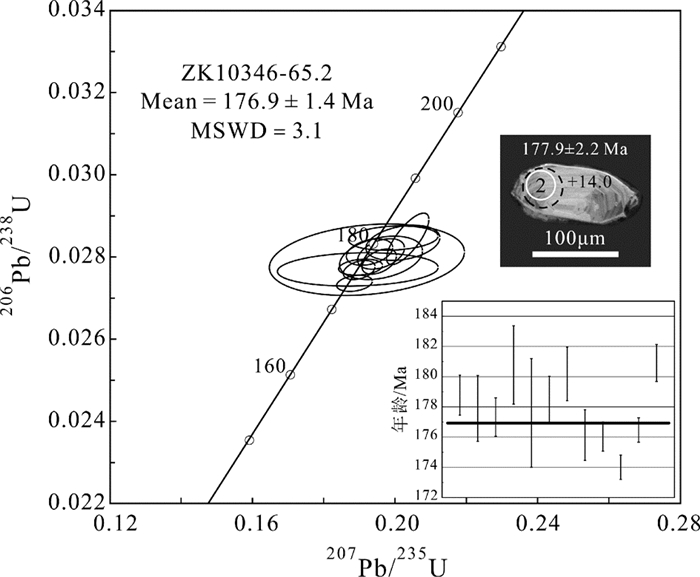
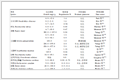
4 分析结果 4.1 锆石U-Pb年龄3号矿体含矿斑岩样品(ZK10346-65.2)锆石多为自形-半自形晶体,呈短柱状或长柱状,锆石粒径在80~150μm之间,长宽比1:1~2:1,锆石阴极发光图像显示具有明显震荡环带(图 3)。锆石的Th与U含量分别为26.1×10⁻⁶~156×10-6和57.9×10⁻⁶~303×10-6,Th/U比值在0.36~0.84,表明它们均属于典型的岩浆锆石(Hoskin and Black, 2000)。本次实验共测定了12个有效数据点,206Pb/238U年龄分布较集中,在174.0~180.9Ma之间变化(表 1),在锆石U-Pb谐和图中均落在谐和线上(图 3),206Pb/238U年龄加权平均值为176.9±1.4Ma(MSWD=3.1),该年龄值代表了含矿斑岩的成岩年龄。
|
图 3 雄村矿集区3号矿体含矿斑岩LA-ICP-MS锆石U-Pb年龄谐和图 Fig. 3 LA-ICP-MS zircon U-Pb concordia diagram of ore-bearing porphyry from the No.3 deposit in the Xiongcun district |
|
表 1 雄村矿集区3号矿体含矿斑岩LA-ICP-MS锆石U-Pb测试结果 Table 1 LA-ICP-MS zircon U-Pb analysis data of ore-bearing porphyry from the No.3 deposit in the Xiongcun district |
雄村矿集区1、2、3号矿体含矿斑岩的锆石Hf同位素结果列于表 2。含矿斑岩的锆石176Lu/177Hf值较低(均值分别为0.0015、0.0013、0.0017),表明锆石在形成后具有极低的放射性成因Hf积累,因此所测定的176Hf/177Hf值可以代表锆石结晶时体系的Hf同位素组成(Amelin et al., 2000)。1号矿体含矿斑岩锆石εHf(t)值变化范围为10.4~15.3,平均值为13.5;Hf同位素单阶段模式年龄(tDM1)和二阶段模式年龄(tDM2)分别介于189~385Ma和205~515Ma之间(表 2)。2号矿体含矿斑岩锆石εHf(t)值变化范围为11.8~15.2,平均值为13.7;Hf同位素单阶段模式年龄(tDM1)和二阶段模式年龄(tDM2)分别介于208~340Ma和223~437Ma之间(表 2)。3号矿体含矿斑岩锆石εHf(t)值变化范围为9.9~14.5(表 2),平均值为12.5;Hf同位素单阶段模式年龄(tDM1)和二阶段模式年龄(tDM2)分别介于254~436Ma和294~588Ma之间(表 2)。
|
|
表 2 雄村矿集区含矿斑岩锆石Lu-Hf同位素测试结果 Table 2 Lu-Hf isotopic compositions of zircons of ore-bearing porphyries in the Xiongcun district |
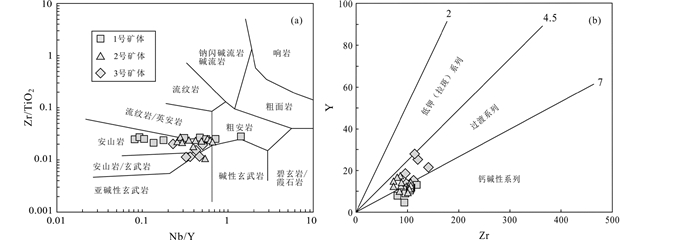
雄村矿集区1、2、3号矿体含矿石英闪长斑岩的主微量元素含量列于表 3中。1号矿体含矿石英闪长斑岩的SiO2含量介于63.07%~69.70%之间,Al2O3含量介于12.69%~17.71%之间,MgO含量介于0.58%~2.97%之间,Mg#值介于10~40之间(表 3)。2号矿体含矿石英闪长斑岩的SiO2含量介于55.81%~67.32%之间,Al2O3含量介于14.71%~19.74%之间,MgO含量介于0.93%~3.11%之间,Mg#值介于21~55之间(表 3)。3号矿体含矿石英闪长斑岩的SiO2含量介于50.87%~65.50%之间,Al2O3含量介于16.66%~21.76%之间,MgO含量介于1.32%~3.21%之间,Mg#值介于23~44之间(表 3)。Nb/Y-Zr/TiO2图解可以有效判断遭受热液蚀变的岩石类型,在Nb/Y-Zr/TiO2图解上,雄村矿集区含矿斑岩样品主要落在安山岩区域附近(图 4a),这与野外观察和镜下鉴定结果一致;在Zr-Y判别图解上,所有样品落在钙碱性区域及钙碱性向低钾(拉斑)系列过渡的区域(图 4b),表明岩石属于钙碱性系列。
|
|
表 3 雄村矿集区含矿斑岩主量元素(wt%)和微量元素(×10-6)分析数据表 Table 3 Major (wt%) and trace (×10-6) elements analyses of ore-bearing porphyries in the Xiongcun district |
|
图 4 雄村矿集区含矿斑岩Zr/TiO2-Nb/Y(a, 据Winchester and Floyd, 1977)和Y-Zr(b, 据Barrett and MacLean, 1994)图解 Fig. 4 Zr/TiO2 vs. Nb/Y (a, after Winchester and Floyd, 1977) and Y vs. Zr(b, after Barrett and MacLean, 1994)diagrams of ore-bearing porphyries in the Xiongcun district |
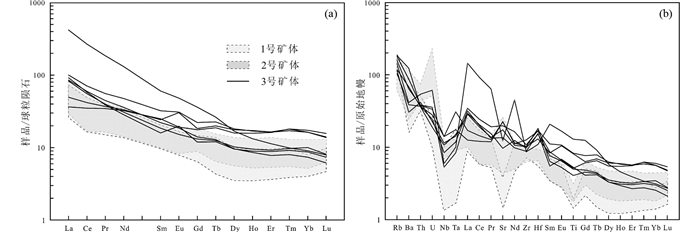
雄村矿集区1、2、3号矿体含矿石英闪长斑岩稀土元素总量较低,介于32.59×10⁻⁶~80.04×10⁻⁶、33.60×10⁻⁶~90.81×10⁻⁶、69.14×10⁻⁶~371.1×10⁻⁶之间(表 3),(La/Yb)N分别介于3.98~9.37、3.33~7.92、2.09~46.14之间。球粒陨石标准化稀土元素配分模式图显示(图 5a),轻重稀土分馏明显,呈右倾趋势。δEu分别介于0.85~1.08、0.64~1.25、0.90~1.42,3号矿体含矿斑岩Eu总体异常不明显,仅2个样品显示出Eu的正异常。
|
图 5 雄村矿集区矿体含矿斑岩球粒陨石标准化稀土元素配分图(a)和原始地幔标准化微量元素蛛网图(b)(标准化值据Sun and McDonough, 1989) 1号矿体据Tang et al. (2015),2号矿体据Yin et al. (2017) Fig. 5 Chondrite-normalized REE distribution patterns (a) and primitive mantle-normalized trace element spidergrams (b) of ore-bearing porphyries in the Xiongcun district (normalization values after Sun and McDonough, 1989) |
雄村矿集区含矿石英闪长斑岩微量元素分析结果见表 3,原始地幔标准化蛛网图显示出其分配模式整体向右倾斜(图 5b),相对富集大离子亲石元素(LILEs:如Rb、Ba和Hf)和相对亏损高场强元素(HFSEs:如Nb和Ta)。
4.4 Sr-Nd-Pb同位素特征雄村矿集区1、2、3号矿体含矿石英闪长斑岩Sr-Nd-Pb同位素测试结果列于表 4,所测得样品具有相对较低的(87Sr/86Sr)i比值和相对较高的εNd(t)值。2号矿体含矿斑岩样品(87Sr/86Sr)i比值变化范围为0.70400~0.70509,3号矿体含矿斑岩样品(87Sr/86Sr)i比值变化范围为0.70311~0.70430;1、2、3号矿体含矿斑岩εNd(t)值分别介于4.5~5.9、5.5~5.9、5.4~5.6。Pb同位素比值变化较小(表 4),2号矿体含矿斑岩206Pb/204Pb、207Pb/204Pb、208Pb/204Pb比值分别在18.460~18.857、15.573~15.622、38.584~38.948之间变化;3号矿体含矿斑岩206Pb/204Pb、207Pb/204Pb、208Pb/204Pb比值分别在18.432~18.506、15.553~15.565、38.448~38.503之间变化。
|
|
表 4 雄村矿集区含矿斑岩Sr-Nd-Pb同位素测试结果 Table 4 Sr-Nd-Pb isotopic compositions of ore-bearing porphyries in the Xiongcun district |


本文获得3号矿体含矿斑岩的年龄为176.9±1.4Ma,黄勇(2013)报道3号矿体的辉钼矿Re-Os年龄为172Ma以及侵入3号矿体含矿斑岩中的非含矿斑岩年龄为171Ma,Lang et al. (2014)报道2号矿体含矿斑岩的结晶年龄为181~175Ma,辉钼矿Re-Os年龄为172Ma。考虑到2、3号矿体的含矿斑岩均为早侏罗世石英闪长斑岩且成矿时代和矿化特征一致,我们认为2、3号矿体是同期斑岩成矿作用的产物。而1号矿体含矿斑岩的侵位时间为167~161Ma,矿化作用发生的时间为161.5Ma(辉钼矿Re-Os年龄,Lang et al., 2014),明显晚于2、3号矿体。综合矿集区三个矿体的含矿斑岩特征和锆石U-Pb年龄、矿化特征以及辉钼矿Re-Os年龄,表明雄村矿集区存在两期矿化事件,早期矿化事件发生在约172Ma,与早侏罗世(181~175Ma)石英闪长斑岩相关,该期成矿作用形成了矿集区2、3号矿体。晚期成矿作用发生在161.5Ma,成矿岩体为中侏罗世(167~161Ma)石英闪长斑岩,该期成矿作用形成了矿集区1号矿体。
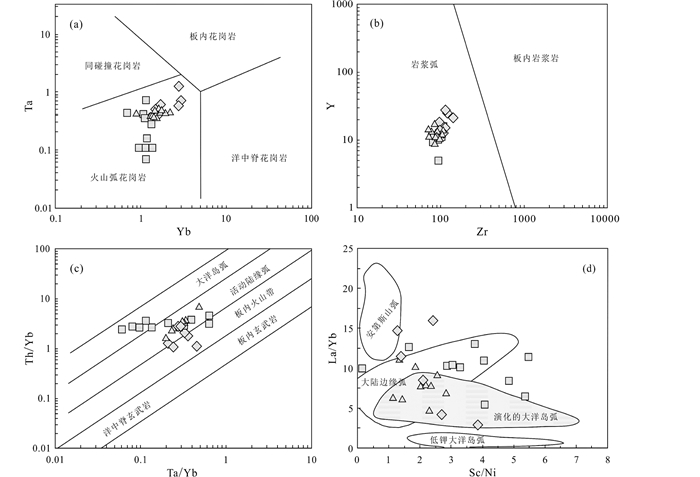
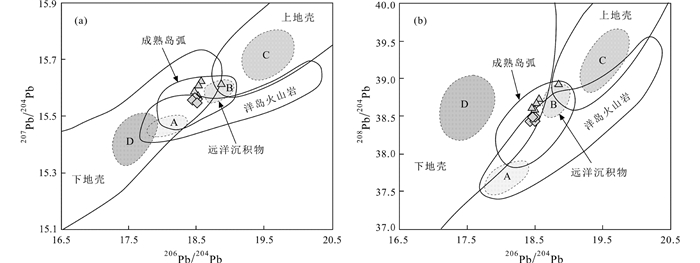
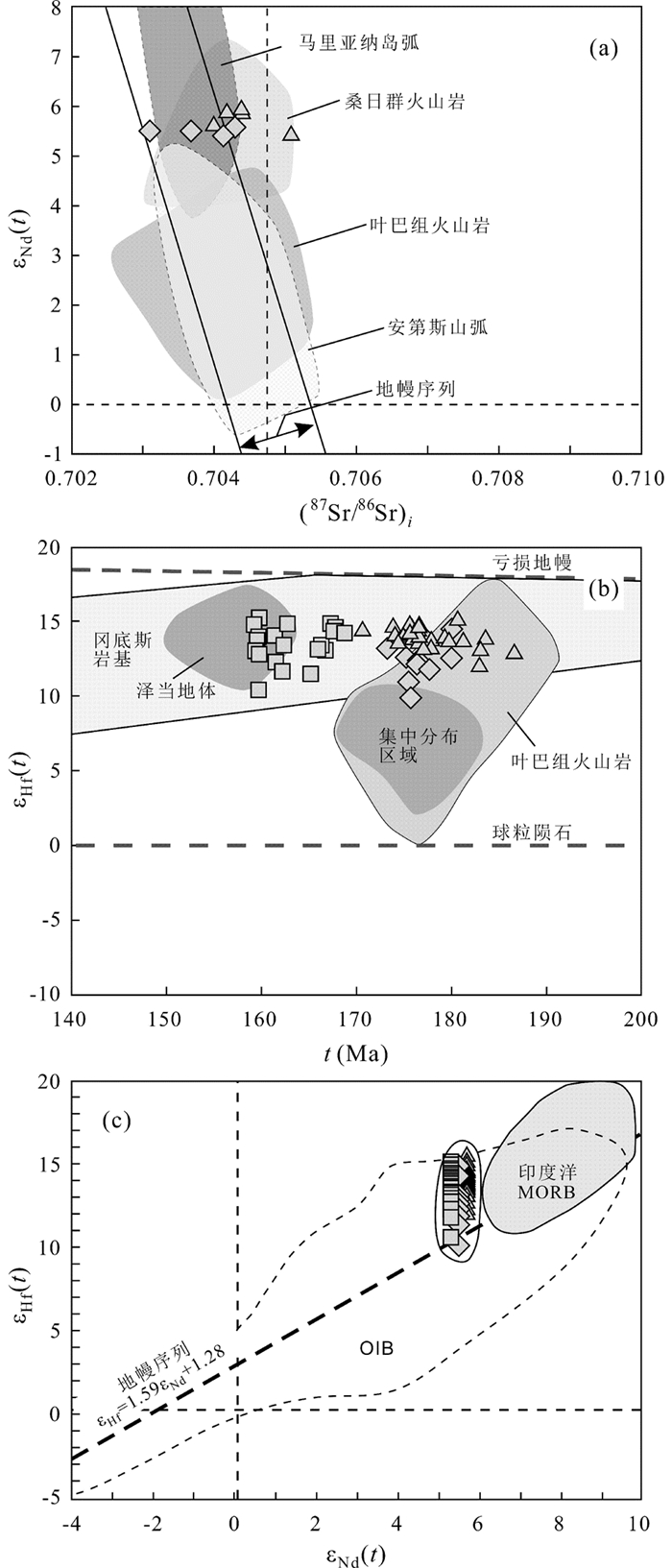
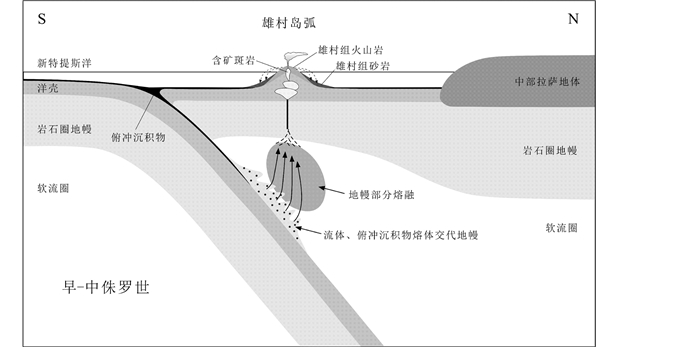
5.2 构造背景探讨雄村矿集区含矿斑岩体微量元素原始地幔标准化蛛网图显示出相对富集大离子亲石元素(LILEs:如Rb、Ba)和亏损高场强元素(HFSEs:如Nb、Ta)(图 5b),这一特征与俯冲带岛弧岩浆岩地球化学特征相似(Pearce, 1982; Keppler, 1996)。在Ta-Yb和Y-Zr图解中(图 6a, b),雄村矿集区含矿斑岩样品均投点于火山弧花岗岩区域,表明含矿斑岩形成于火山弧环境。此外,在Th/Yb-Ta/Yb和La/Yb-Sc/Ni图解中(图 6c, d),雄村矿集区含矿斑岩样品主要落在大洋岛弧或大陆边缘弧环境区域,进一步表明雄村矿集区含矿斑岩形成于岩浆弧环境。同时,近年来在拉萨地体南缘陆续报道了晚三叠世-侏罗纪时期的弧岩浆岩,如汤白岩体(Guo et al., 2013; 王旭辉等, 2018)、努玛岩体(Meng et al., 2016a)、南木林花岗岩体(Ma et al., 2017)、曲水辉长岩(Meng et al., 2016b)以及东噶辉长岩(Wang et al., 2017)等。因此,拉萨地体南缘晚三叠世-侏罗纪时期岩浆岩形成于与新特提斯洋壳北向俯冲相关的岩浆弧环境这一观点已经得到了地质学家们的普遍认可(Guo et al., 2013; Lang et al., 2014; Kang et al., 2014; Tang et al., 2015; Meng et al., 2016a, b; Wang et al., 2016; Ma et al., 2017; 宋扬等, 2019)。此外,雄村矿集区含矿岩体显示出较强的大洋岛弧属性(图 6c, d)。在207Pb/204Pb-206Pb/204Pb和208Pb/204Pb-206Pb/204Pb图解中(图 7),雄村矿集区含矿斑岩同样落在成熟岛弧或大洋岛弧区域,暗示其可能形成于大洋岛弧构造背景。在拉萨地体南缘是否存在洋内俯冲系统近年来成为地质学家们关注的焦点(Aitchison et al., 2000; McDermid et al., 2002; 韦栋梁等, 2007; 黄丰等, 2015; Kang et al., 2014; Tang et al., 2015; Yin et al., 2017; Lang et al., 2018, 2019; Ma et al., 2017)。在喜马拉雅造山带的西段Kohistan和Ladakh地区,已经识别出了著名的白垩纪Kohistan-Dras大洋岛弧(Bignold and Treloar, 2003; Bignold et al., 2006; Jagoutz et al., 2009; Dhuime et al., 2007)。Allégre et al.(1984)认为在喜马拉雅造山带的中段和东段,同样应该存在洋内俯冲作用,在随后的研究中,一些学者在喜马拉雅造山带的东段泽当地区也识别出了一套中-晚侏罗世的洋内弧系统(Aitchison et al., 2000; McDermid et al., 2002)。在拉萨地体南缘的雄村一带,近年来新发现的早-中侏罗世岩浆岩也显示出较强的大洋岛弧属性(Ma et al., 2017)。雄村矿集区含矿斑岩显示出强亏损的Hf同位素组分(图 8b),类似于泽当地体岩浆岩Hf同位素组成。同时雄村矿集区含矿斑岩及拉萨地体最南缘的桑日群火山岩显示出较高的εNd(t)值(图 8a),类似于马里亚纳大洋岛弧岩浆岩,而不同于安第斯山弧岩浆岩和叶巴组火山岩。沉积岩相对于岩浆岩而言,其地球化学行为受热液蚀变作用的影响更小且更稳定,因此能够更好的判断古构造环境(Li et al., 2015),Lang et al. (2019)在雄村矿集区识别出一套早-中侏罗世砂岩,其碎屑锆石年龄集中分布于161~243Ma之间,缺乏相邻地块(如中部拉萨地体,高喜马拉雅)含有的古老碎屑锆石颗粒,结合其高的TiO2、Fe2O3*+MgO和Al2O3/SiO2值以及微量元素化学图解,认为其形成于大洋岛弧环境。此外,以Cu、Au为主成矿元素的斑岩型矿床常常形成大洋岛弧环境,如西南太平斑岩Cu-Au矿带;以Cu、Mo为主成矿元素的斑岩型矿床常常形成于陆缘弧环境,如安第斯斑岩Cu-Mo矿带(Kesler, 1973)。雄村矿集区的成矿元素以Cu、Au为主而非Cu、Mo,其成矿元素类似于西太平洋斑岩型Cu-Au矿床(Cooke et al., 2007; Glen et al., 2007; Kreuzer et al., 2015),指示它们更可能形成于大洋岛弧构造背景。综上所述,我们认为其雄村矿集区含矿斑岩形成的构造背景为新特提斯洋壳北向俯冲相关的大洋岛弧环境而非陆缘弧环境(图 9)。
|
图 6 雄村矿集区含矿斑岩Ta-Yb(a, 据Pearce et al., 1984)、Y-Zr(b,据Pearce et al., 1984)、Th/Yb-Ta/Yb(c, 据Gorton and Schandl, 2000)和La/Yb-Sc/Ni(d, 据Bailey, 1981)图解 Fig. 6 Ta vs. Yb (a, after Pearce et al., 1984), Y vs. Zr (b, after Pearce et al., 1984), Th/Yb vs. Ta/Yb (c, after Gorton and Schandl, 2000) and La/Yb vs. Sc/Ni (d, after Bailey, 1981) diagrams of the ore-bearing porphyries in the Xiongcun district |
|
图 7 雄村矿集区含矿斑岩207Pb/204Pb-206Pb/204Pb (a)和208Pb/204Pb-206Pb/204Pb (b)图解(据Zartman and Haines, 1988) A、B、C、D分别代表地幔、造山带、上地壳和下地壳的平均值 Fig. 7 207Pb/204Pb vs. 206Pb/204Pb (a) and 208Pb/204Pb vs. 206Pb/204Pb (b) diagrams of the ore-bearing porphyries in the Xiongcun district (after Zartman and Haines, 1988) Dashed lines enclose probable average values (A=mantle; B=orogene; C=upper crust; and D=lower crust) |
|
图 8 雄村矿集区含矿斑岩εNd(t)-(87Sr/86Sr)i (a)、εHf(t)-t (b)和εHf(t)-εNd(t) (c)图解 马里亚纳岛弧岩浆岩据Lin et al. (1990);安第斯山弧岩浆岩据Pankhurst et al. (1999);桑日群火山岩据Kang et al. (2014);叶巴组火山岩据Wei et al. (2017);泽当地体岩浆岩据Zhang et al. (2014);冈底斯岩基据Ji et al. (2009)和Wu et al. (2010);印度洋MORB据Chauvel and Blichert-Toft (2001)和Ingle et al. (2003) Fig. 8 εNd(t) vs. (87Sr/86Sr)i (a), εHf(t) vs. t (b), and εHf(t) vs. εNd(t) (c) diagrams of the ore-bearing porphyries in the Xiongcun district Magmatic rocks in Marianas are from Lin et al. (1990); magmatic rocks in Andes arc are from Pankhurst et al. (1999); Sangri Group volcanic rocks are from Kang et al. (2014); Yeba Formation volcanic rocks are from Wei et al. (2017); magmatic rocks in the Zedong terrane are from Zhang et al. (2014); Gangdese batholiths are from Ji et al. (2009) and Wu et al. (2010); Indian Ocean MORB are from Chauvel and Blichert-Toft (2001) and Ingle et al. (2003) |
|
图 9 雄村矿集区含矿斑岩构造背景及成岩模式图(据Tang et al., 2015修改) Fig. 9 Cartoon showing tectonic setting and petrogenesis of the ore-bearing porphyries in the Xiongcun district (after Tang et al., 2015) |
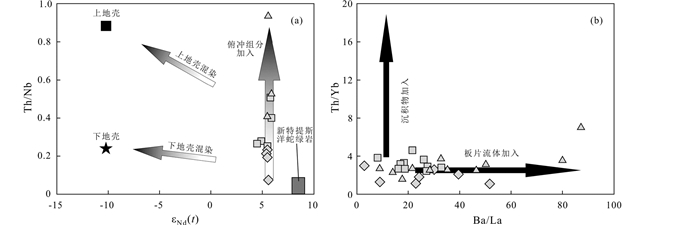
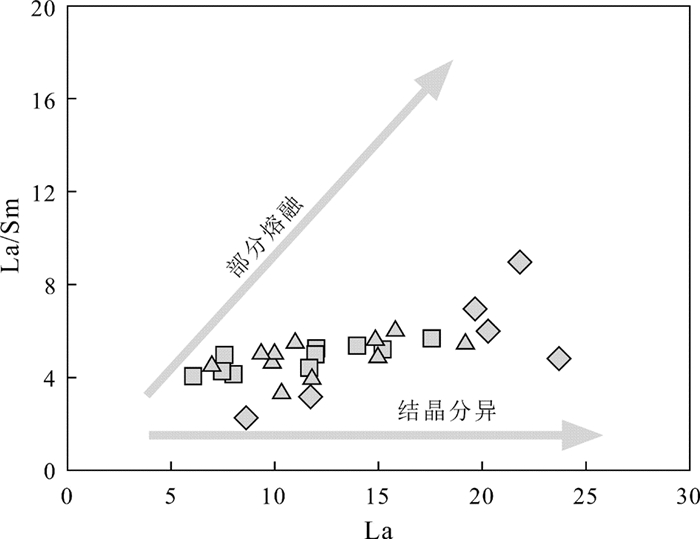
在大洋岛弧环境,由于缺乏大陆地壳,岩浆不可能起源于地壳或在上升的过程中被地壳物质混染。雄村矿集区含矿斑岩显示出均一的εNd(t)值(图 10a),进一步证实了岩浆在上升过程中未受到地壳物质的混染。因此其源区主要由两个来源:地幔楔和俯冲的洋壳。俯冲洋壳对源区的贡献又包括俯冲洋壳释放的流体、俯冲沉积物、洋壳直接部分熔融加入岩浆源区。俯冲洋壳直接部分熔融的形成的岩浆通常形成高Sr(>400×10-6)低Y(< 18×10-6)、Yb(< 1.9×10⁻⁶)的埃达克岩(Defant and Drummond, 1990)。雄村矿集区含矿斑岩Sr含量在30×10-6~550×10-6之间变化(Tang et al., 2015; Yin et al., 2017)。表明他们不可能直接来源于洋壳的部分熔融。含矿斑岩的Sr-Nd-Hf同位素结果显示它们具有低的(87Sr/86Sr)i比值和相对较高的εNd(t)、εHf(t)值,在εNd(t)-(87Sr/86Sr)i图解中(图 8a),含矿斑岩体主要位于地幔演化序列中,在εHf(t)-t图解中(图 8b),它们主要落在亏损地幔附近,在εHf(t)-εNd(t)图解中(图 8c),它们主要位于印度洋洋中脊玄武岩(MORB)附近。综合Sr-Nd-Hf同位素结果,表明岩浆源区主要起源于亏损地幔的部分熔融。在洋壳俯冲的构造环境,俯冲洋壳释放的流体或上覆沉积物熔体对地幔橄榄岩的交代是诱发其部分熔融的最为重要的机制。俯冲沉积物熔体交代源区会使得地幔中Nb、Th、Nd的含量显著增加;反之,俯冲洋壳释放的流体交代源区会使得地幔中Ba、Sr和Pb的含量显著增加(Kelemen et al., 2003; Castillo and Newhall, 2004)。雄村矿集区含矿斑岩体具有显著变化的Sr(30×10-6~550×10-6)、Ba(113×10-6~862×10-6)含量(表 3, Tang et al., 2015; Yin et al., 2017),暗示是俯冲板片释放的流体对岩浆源区发生了交代作用。在Th/Yb-Ba/La图解中(图 10b),变化较大的Ba/La比值进一步支持了地幔橄榄岩受到俯冲板片释放流体的交代的观点。此外,雄村矿集区含矿斑岩样品缺少Eu的负异常,甚至部分样品显示出Eu的正异常,暗示流体参与交代地幔源区,因为斜长石是Eu的主要携带矿物,在富水的条件下,斜长石的分异结晶作用将受到明显的抑制作用,其结晶晚于角闪石和石榴子石,造成残留熔体缺少Eu的负异常,甚至出现正异常(Müntener et al., 2001; Grove et al., 2002)。另外含矿斑岩具有较高的Th含量(2.8×10⁻⁶~6.3×10⁻⁶),接近全球俯冲沉积物的平均值(6.9×10⁻⁶, Plank and Langmuir, 1998),并显著高于原始地幔Th的含量(0.09×10⁻⁶, Sun and McDonough, 1989),表明俯冲沉积物对源区的也具有显著的贡献。同时在207Pb/204Pb-206Pb/204Pb和208Pb/204Pb-206Pb/204Pb图解中(图 7),雄村矿集区含矿斑岩样品靠近远洋沉积物区域,进一步暗示了俯冲沉积物熔体交代地幔也是必不可少的。综上,笔者认为是新特提斯洋壳在早-中侏罗世甚至更早时期发生北向俯冲作用,俯冲洋壳释放的流体和俯冲沉积物熔体同时交代了地幔橄榄岩,进而发生部分熔融形成母岩浆(图 9)。此外,含矿斑岩显示出变化较大的Mg#值(10~55)和Cr(1.5×10⁻⁶~34×10-6)、Ni(0.8×10⁻⁶~57×10-6)含量(表 3),暗示母岩浆在上升侵位过程经历了铁镁质矿物的结晶分异作用,这一观点也被La/Sm-La图解所支持(图 11)。因此笔者认为,母岩浆起源于地幔部分熔融后经历了结晶分异作用,最终上升侵位于近地表形成了雄村矿集区含矿石英闪长斑岩(图 9)。
|
图 10 雄村矿集区含矿斑岩Th/Nb-εNd(t)(a, 据Wei et al., 2017)和Th/Yb-Ba/La(b, 据Woodhead et al., 2001)图解 Fig. 10 Th/Nb vs. εNd(t) (a, after Wei et al., 2017) and Th/Yb vs. Ba/La (b, after Woodhead et al., 2001) diagrams of the ore-bearing porphyries in the Xiongcun district |
|
图 11 雄村矿集区含矿斑岩La/Sm-La图解 Fig. 11 La/Sm vs. La diagram of the ore-bearing porphyries in the Xiongcun district |
斑岩型矿床,无论形成于俯冲构造环境(陆缘弧或大洋岛弧)还是碰撞造山构造环境,一个最重要的特征就是常成群、成带分布(Cooke et al., 2005; Singer et al., 2005; Hou et al., 2009; Sillitoe, 2010),即一个斑岩型矿床的发现,往往可能在区域上寻找到更多的斑岩型矿床。近年来在拉萨地体南缘相继报道了与新特提斯洋早期(晚三叠世-中侏罗世)俯冲作用相关的长英质弧岩浆岩,如汤白岩体(Guo et al., 2013; 王旭辉等, 2018)、雄村岩体(唐菊兴等, 2010; Lang et al., 2014)、努玛岩体(Ji et al., 2009)、南木林岩体(Zhu et al., 2011)、大竹卡岩体(Ji et al., 2009)、若措岩体(郎兴海等, 2017; Wang et al., 2019)、卡如岩体、塔玛岩体、卧布岩体、宗噶岩体等(邹银桥等, 2017; Zou et al., 2017)。然而目前仅在雄村矿集区发现了与新特提斯洋早期俯冲作用相关的斑岩型矿床。那么目前未发现其他斑岩型矿床的原因是除雄村岩体外其他岩体都不具斑岩型矿化条件呢?还是目前的勘探程度不够呢?
雄村矿集区含矿斑岩体具有较高的εNd(t)(>4.5)、εHf(t)(>10)值(图 8),其岩浆起源于亏损地幔的部分熔融。近年来,一些学者在拉萨地体的南缘发现了含孔雀石化和石英-硫化物的晚三叠世-中侏罗世中-酸性斑岩体,如若措岩体(郎兴海等, 2017; Wang et al., 2019)、汤白岩体(白云等, 2019)、卡如岩体、塔玛岩体、卧布岩体、宗噶岩体(邹银桥等, 2017; Zou et al., 2017),同时这些岩体也显示出高εHf(t)值(>10;邹银桥等, 2017; Zou et al., 2017; Wang et al., 2019),类似于雄村矿集区的含矿斑岩。这一现象表明在拉萨地体南缘具有亏损Nd-Hf同位素组成(εHf(t)>10,εNd(t)>4.5)的晚三叠世-中侏罗世岩体有利于形成斑岩型铜矿床(Hou et al., 2015a)。斑岩型矿床通常形成于近地表 1~5km(Cooke et al., 2005; Sillitoe, 2010),地壳的抬升和剥蚀会部分或全部破坏形成时代较老的斑岩型铜矿,使之难于保存下来。在雄村矿集区除侏罗纪含矿斑岩体外,还存在一套同时期的火山-沉积岩(图 1b),该矿集区含矿斑岩体侵入同时期的火山-沉积岩中,其中一个重要的原因可能是该套火山沉积岩起到了一个良好的盖层作用,有效保护了雄村斑岩铜金矿床被剥蚀。近年来在拉萨地体南缘发现的剥露的矿化斑岩体,其经济意义不大的可能原因就是它们已经遭受了强烈的剥蚀作用。但是在拉萨地体的南缘除有侏罗纪侵入体报道外,还报道了一套早-中侏罗世火山岩,即桑日群火山岩(Kang et al., 2014; 黄丰等, 2015)。该套火山岩显示出较高的εNd(t)(>4)值(图 8a),表明其起源亏损地幔部分熔融(Kang et al., 2014),同时也被认为形成于大洋岛弧环境(Kang et al., 2014; 黄丰等, 2015),邹银桥等(2017)在桑日群比马组火山岩中已发现多处铜矿化和石英-绿帘石脉体。上述信息表明桑日群火山岩及其中同时代的侵入体也具有较大的斑岩型矿化潜力,同时该套火山岩的存在有效的保护了下伏岩体免受剥蚀,因此在拉萨地体南缘寻找与新特提斯洋俯冲相关的斑岩型矿床的重点区域应该是侏罗纪岩体被同期火山岩覆盖的区域。另外,值得注意的是笔者在雄村矿集区西北部的洞嘎普-则莫多拉一带识别出了保存较完整的侏罗纪火山机构(洞嘎普火山机构),围绕火山机构存在多处Cu-Au-Ag-Pb-Zn岩石-土壤地球化学异常(郎兴海等, 2012),显示出明显的火山机构控矿特征,目前雄村矿集区发现的1、2、3号矿体就位于洞嘎普火山机构旁侧,因此在区域找矿过程中也应重视侏罗纪古火山口的识别及其与成矿关系的研究。
6 结论(1) 雄村矿集区存在两期矿化作用,早期矿化事件发生在约172Ma,与早侏罗世(181~175Ma)石英闪长斑岩相关,形成了矿集区2、3号矿体;晚期成矿作用发生在161.5Ma,成矿岩体为中侏罗世(167~161Ma)石英闪长斑岩,形成了矿集区1号矿体。
(2) 雄村矿集区形成于新特提斯洋壳北向俯冲的大洋岛弧环境而非陆缘弧环境。含矿斑岩起源于亏损地幔的部分熔融,且源区同时受到了俯冲洋壳释放的流体和俯冲沉积物熔体的交代。
(3) 拉萨地体南缘具有亏损Nd-Hf同位素组成(εHf(t)>10,εNd(t)>4.5)的侏罗纪斑岩体有利于形成斑岩型矿化,寻找与新特提斯洋俯冲相关的斑岩型矿床的重点区域应该是侏罗纪岩体被同期火山岩覆盖的区域。
Aitchison JC, Zhu BD, Davis AM, Liu JB, Luo H, Malpas JG, McDermid IRC, Wu HY, Ziabrev SV and Zhou MF. 2000. Remnants of a cretaceous intra-oceanic subduction system within the Yarlung-Zangbo suture (southern Tibet). Earth and Planetary Science Letters, 183(1-2): 231-244 DOI:10.1016/S0012-821X(00)00287-9 |
Allégre CJ, Courtillot V, Tapponnier P, Hirn A, Mattauer M, Coulon C, Jaeger JJ, Achache J, Schärer U, Marcoux J, Burg JP, Girardeau J, Armijo R, Gariépy C, Göpel C, Li TD, Xiao XC, Chang CF, Li GQ, Lin BY, Teng JW, Wang NW, Chen GM, Han TL, Wang XB, Den WM, Sheng HB, Cao YG, Zhou J, Qiu HR, Bao PS, Wang SC, Wang BX, Zhou YX and Xu RH. 1984. Structure and evolution of the himalaya-tibet orogenic belt. Nature, 307(5946): 17-22 DOI:10.1038/307017a0 |
Amelin Y, Lee DC and Halliday AN. 2000. Early-Middle Archaean crustal evolution deduced from Lu-Hf and U-Pb isotopic studies of single zircon grains. Geochimica et Cosmochimica Acta, 64(24): 4205-4225 DOI:10.1016/S0016-7037(00)00493-2 |
Bai Y, Lang XH, Wang XH, Cui ZW, Xie FW, Deng YL, Li ZJ, Lou YM, Han P, Yin Q, Wang ZZ, Dong SY, Zhang Z, Zhang JS and Jiang K. 2019. Zircon U-Pb geochronology and geological implication of Early Jurassic ore-bearing porphyry from the Tangbai area on the southern margin of Gangdise, Tibet. Geological Bulletin of China, 38(4): 509-521 (in Chinese with English abstract) |
Bailey JC. 1981. Geochemical criteria for a refined tectonic discrimination of orogenic andesites. Chemical Geology, 32(1-4): 139-154 DOI:10.1016/0009-2541(81)90135-2 |
Barrett TJ and MacLean WH. 1994. Chemostratigraphy and hydrothermal alteration in exploration for VHMS deposits in greenstones and younger volcanic rocks. In: Lentz DR (ed.). Alteration and Alteration Processes Associated with Ore-Forming Systems. Canada: Geological Association of Canada, Short Course Notes 11, 433-467
|
Bignold SM and Treloar PJ. 2003. Northward subduction of the Indian plate beneath the Kohistan island arc, Pakistan Himalaya:New evidence from isotopic data. Journal of the Geological Society, 160(3): 377-384 DOI:10.1144/0016-764902-068 |
Bignold SM, Treloar PJ and Petford N. 2006. Changing sources of magma generation beneath intra-oceanic island arcs:An insight from the juvenile Kohistan island arc, Pakistan Himalaya. Chemical Geology, 233(1-2): 46-74 DOI:10.1016/j.chemgeo.2006.02.008 |
Castillo PR and Newhall CG. 2004. Geochemical constraints on possible subduction components in lavas of Mayon and Taal volcanoes, southern Luzon, Philippines. Journal of Petrology, 45(6): 1089-1108 DOI:10.1093/petrology/egh005 |
Chauvel C and Blichert-Toft J. 2001. A hafnium isotope and trace element perspective on melting of the depleted mantle. Earth and Planetary Science Letters, 190(3-4): 137-151 DOI:10.1016/S0012-821X(01)00379-X |
Cooke DR, Hollings P and Walshe JL. 2005. Giant porphyry deposits:Characteristics, distribution, and tectonic controls. Economic Geology, 100(5): 801-818 DOI:10.2113/gsecongeo.100.5.801 |
Cooke DR, Wilson AJ, House MJ, Wolfe RC, Walshe JL, Lickfold V and Crawford AJ. 2007. Alkalic porphyry Au-Cu and associated mineral deposits of the Ordovician to Early Silurian Macquarie Arc, New South Wales. Australian Journal of Earth Sciences, 54(2-3): 445-463 DOI:10.1080/08120090601146771 |
Defant MJ and Drummond MS. 1990. Derivation of some modern arc magmas by melting of young subducted lithosphere. Nature, 347(6294): 662-665 DOI:10.1038/347662a0 |
Dhuime B, Bosch D, Bodinier JL, Garrido CJ, Bruguier O, Hussain SS and Dawood H. 2007. Multistage evolution of the Jijal ultramafic-mafic complex (Kohistan, N Pakistan):Implications for building the roots of island arcs. Earth and Planetary Science Letters, 261(1-2): 179-200 DOI:10.1016/j.epsl.2007.06.026 |
Ding F, Lang XH, Hu ZH, Yang HH, Wang ZZ and Zhang L. 2012. The genesis of mineralized tuff of No. Ⅰ ore body in the Xiongcun porphyry copper-gold metallogenic ore district, Tibet:Evidence from geochemistry and Sr-Nd-Pb isotopes. Acta Geoscientica Sinica, 33(4): 546-558 (in Chinese with English abstract) |
Glen RA, Crawford AJ and Cooke DR. 2007. Tectonic setting of porphyry Cu-Au mineralisation in the Ordovician-early Silurian Macquarie arc, Eastern Lachlan Orogen, New South Wales. Australian Journal of Earth Sciences, 54(2-3): 465-479 DOI:10.1080/08120090701221672 |
Gorton MP and Schandl ES. 2000. From continents to island arcs:A geochemical index of tectonic setting for Arc-related and within-plate felsic to intermediate volcanic rocks. The Canadian Mineralogist, 38(5): 1065-1073 DOI:10.2113/gscanmin.38.5.1065 |
Grove TL, Parman SW, Bowring SA, Price RC and Baker MB. 2002. The role of an H2O-rich fluid component in the generation of primitive basaltic andesites and andesites from the Mt. Shasta region, N California. Contributions to Mineralogy and Petrology, 142(4): 375-396 DOI:10.1007/s004100100299 |
Guo LS, Liu YL, Liu SW, Cawood PA, Wang ZH and Liu HF. 2013. Petrogenesis of Early to Middle Jurassic granitoid rocks from the Gangdese belt, Southern Tibet:Implications for early history of the Neo-Tethys. Lithos, 179: 320-333 DOI:10.1016/j.lithos.2013.06.011 |
Hoskin PWO and Black LP. 2000. Metamorphic zircon formation by solid state recrystallization of protolith igneous zircon. Journal of Metamorphic Geology, 18(4): 423-439 |
Hou KJ, Li YH, Zou TR, Qu XM, Shi YR and Xie GQ. 2007. Laser ablation-MC-ICP-MS technique for Hf isotope microanalysis of zircon and its geological applications. Acta Petrologica Sinica, 23(10): 2595-2604 (in Chinese with English abstract) |
Hou KJ, Li YH and Tian YR. 2009. In situ U-Pb zircon dating using laser ablation-multi ion counting-ICP-MS. Mineral Deposits, 28(4): 481-492 (in Chinese with English abstract) |
Hou ZQ, Qu XM, Wang SX, Du AD, Gao YF and Huang W. 2004. Re-Os age for molybdenite from the Gangdese porphyry copper belt on Tibetan Plateau:Implication for geodynamic setting and duration of the Cu mineralization. Science in China (Series D), 47(3): 221-231 DOI:10.1360/01YD0487 |
Hou ZQ, Yang ZM, Qu XM, Meng XJ, Li ZQ, Beaudoin G, Rui ZY, Gao YF and Zaw K. 2009. The Miocene Gangdese porphyry copper belt generated during post-collisional extension in the Tibetan Orogen. Ore Geology Reviews, 36(1-3): 25-51 DOI:10.1016/j.oregeorev.2008.09.006 |
Hou ZQ, Zheng YC, Yang ZM, Rui ZY, Zhao ZD, Jiang SH, Qu XM and Sun QZ. 2013. Contribution of mantle components within juvenile lower-crust to collisional zone porphyry Cu systems in Tibet. Mineralium Deposita, 48(2): 173-192 DOI:10.1007/s00126-012-0415-6 |
Hou ZQ, Yang ZM, Lu YJ, Kemp A, Zheng YC, Li QY, Tang JX, Yang ZS and Duan LF. 2015a. A genetic linkage between subduction-and collision-related porphyry Cu deposits in continental collision zones. Geology, 43(3): 247-250 DOI:10.1130/G36362.1 |
Hou ZQ, Duan LF, Lu YJ, Zheng YC, Zhu DC, Yang ZM, Yang ZS, Wang BD, Pei YR, Zhao ZD and McCuaig TC. 2015b. Lithospheric architecture of the Lhasa terrane and its control on ore deposits in the Himalayan-Tibetan Orogen. Economic Geology, 110(6): 1541-1575 DOI:10.2113/econgeo.110.6.1541 |
Huang F, Xu JF, Chen JL, Kang ZQ and Dong YH. 2015. Early Jurassic volcanic rocks from the Yeba Formation and Sangri Group:Products of continental marginal arc and intra-oceanic arc during the subduction of Neo-Tethys Ocean?. Acta Petrologica Sinica, 31(7): 2089-2100 (in Chinese with English abstract) |
Huang Y. 2013. Geology and metallogeny of xiongcun porphyry copper-gold deposit, Xietongmen country, Tibet. Ph. D. Dissertation. Chengdu: Chengdu University of Technology, 1-185 (in Chinese)
|
Ingle S, Weis D, Doucet S and Mattielli N. 2003. Hf isotope constraints on mantle sources and shallow-level contaminants during Kerguelen hot spot activity since~120Ma. Geochemistry, Geophysics, Geosystems, 4(8): 1068 |
Jagoutz OE, Burg JP, Hussain S, Dawood H, Pettke T, Iizuka T and Maruyama S. 2009. Construction of the Granitoid crust of an Island arc part Ⅰ:Geochronological and geochemical constraints from the plutonic Kohistan (NW Pakistan). Contributions to Mineralogy and Petrology, 158(6): 739-755 DOI:10.1007/s00410-009-0408-3 |
Ji WQ, Wu FY, Chung SL, Li JX and Liu CZ. 2009. Zircon U-Pb geochronology and Hf isotopic constraints on petrogenesis of the Gangdese batholith, southern Tibet. Chemical Geology, 262(3-4): 229-245 DOI:10.1016/j.chemgeo.2009.01.020 |
Kang ZQ, Xu JF, Wilde SA, Feng ZH, Chen JL, Wang BD, Fu WC and Pan HB. 2014. Geochronology and geochemistry of the Sangri Group volcanic rocks, southern Lhasa terrane:Implications for the early subduction history of the Neo-Tethys and Gangdese magmatic arc. Lithos, 200-201: 157-168 DOI:10.1016/j.lithos.2014.04.019 |
Kelemen PB, Hanghøj K and Greene AR. 2003. One view of the geochemistry of subduction-related magmatic arcs, with an emphasis on primitive andesite and lower crust. In: Holland HD and Turekian KK (eds.). Treatise on Geochemistry. Amsterdam: Elsevier, 1-70
|
Keppler H. 1996. Constraints from partitioning experiments on the composition of subduction-zone fluids. Nature, 380(6571): 237-240 DOI:10.1038/380237a0 |
Kesler SE. 1973. Copper, molybdenum and gold abundances in porphyry copper deposits. Economic Geology, 68(1): 106-112 |
Kreuzer OP, Miller AVM, Peters KJ, Payne C, Wildman C, Partington GA, Puccioni E, McMahon ME and Etheridge MA. 2015. Comparing prospectivity modelling results and past exploration data:A case study of porphyry Cu-Au mineral systems in the Macquarie Arc, Lachlan Fold Belt, New South Wales. Ore Geology Reviews, 71: 516-544 DOI:10.1016/j.oregeorev.2014.09.001 |
Lang XH, Tang JX, Li ZJ, Dong SY, Ding F, Wang ZZ, Zhang L and Huang Y. 2012. Geochemical evaluation of exploration prospect in the Xiongcun copper-gold district and peripheral areas, Xietongmen County, Tibet. Geology and Exploration, 48(1): 12-23 (in Chinese with English abstract) |
Lang XH, Tang JX, Li ZJ, Huang Y, Ding F, Yang HH, Xie FW, Zhang L, Wang Q and Zhou Y. 2014. U-Pb and Re-Os geochronological evidence for the Jurassic porphyry metallogenic event of the Xiongcun district in the Gangdese porphyry copper belt, southern Tibet, PRC. Journal of Asian Earth Sciences, 79: 608-622 DOI:10.1016/j.jseaes.2013.08.009 |
Lang XH, Tang JX, Xie FW, Li ZJ, Huang Y, Ding F, Yang HH, Zhou Y and Wang Q. 2014. Geochronology and geochemistry of the southern porphyry in the Xiongcun district, Tibet and its geological implications. Geotectonica et Metallogenia, 38(3): 609-620 (in Chinese with English abstract) |
Lang XH, Tang JX, Yin Q, Cui ZW, Huang Y, Zhang JS, Gao YM, Li ZJ, Ding F, Xie FW, Yang ZY and Zeng M. 2017. Geochemistry and genesis of Eocene lamprophyres in the Xiongcun porphyry copper-gold district, southern margin of the Lhasa terrane, Tibet, China. Geochemical Journal, 51(2): 123-142 |
Lang XH, Wang XH, Cui ZW, Deng YL, Xie FW and Yin Q. 2017. Zircon U-Pb geochronology, geological implications for the Early Jurassic Ruocuo ore-bearing porphyry in the south bank of the Yarlung Zangbo River, Tibet. Journal of Mineralogy and Petrology, 37(4): 74-87 (in Chinese with English abstract) |
Lang XH, Wang XH, Tang JX, Deng YL, Cui ZW, Yin Q and Xie FW. 2018. Composition and age of Jurassic diabase dikes in the Xiongcun porphyry copper-gold district, southern margin of the Lhasa terrane, Tibet, China:Petrogenesis and tectonic setting. Geological Journal, 53(5): 1973-1993 DOI:10.1002/gj.v53.5 |
Lang XH, Liu D, Deng YL, Tang JX, Wang XH, Yang ZY, Cui ZW, Feng YX, Yin Q, Xie FW, Huang Y and Zhang JS. 2019. Detrital zircon geochronology and geochemistry of Jurassic sandstones in the Xiongcun district, southern Lhasa subterrane, Tibet, China:Implications for provenance and tectonic setting. Geological Magazine, 156(4): 683-701 DOI:10.1017/S0016756818000122 |
Li CS, Arndt NT, Tang QY and Ripley EM. 2015. Trace element indiscrimination diagrams. Lithos, 232: 76-83 DOI:10.1016/j.lithos.2015.06.022 |
Lin PN, Stern RJ, Morris J and Bloomer SH. 1990. Nd-and Sr-isotopic compositions of lavas from the northern Mariana and southern Volcano arcs:Implications for the origin of island arc melts. Contributions to Mineralogy and Petrology, 105(4): 381-392 DOI:10.1007/BF00286826 |
Müntener O, Kelemen PB and Grove TL. 2001. The role of H2O during crystallization of primitive arc magmas under uppermost mantle conditions and genesis of igneous pyroxenites:An experimental study. Contributions to Mineralogy and Petrology, 141(6): 643-658 DOI:10.1007/s004100100266 |
Ma XX, Xu ZQ, Meert J and Santosh M. 2017. Early Jurassic intra-oceanic arc system of the Neotethys Ocean:Constraints from andesites in the Gangdese magmatic belt, south Tibet. Island Arc, 26(5): e12202 DOI:10.1111/iar.2017.26.issue-5 |
McDermid IRC, Aitchison JC, Davis AM, Harrison TM and Grove M. 2002. The Zedong terrane:A Late Jurassic intra-oceanic magmatic arc within the Yarlung-Tsangpo suture zone, southeastern Tibet. Chemical Geology, 187(3-4): 267-277 DOI:10.1016/S0009-2541(02)00040-2 |
Meng YK, Dong HW, Cong Y, Xu ZQ and Cao H. 2016a. The early-stage evolution of the Neo-Tethys Ocean:Evidence from granitoids in the middle Gangdese batholith, southern Tibet. Journal of Geodynamics, 94-95: 34-49 DOI:10.1016/j.jog.2016.01.003 |
Meng YK, Xu ZQ, Santosh M, Ma XX, Chen XJ, Guo GL and Liu F. 2016b. Late Triassic crustal growth in southern Tibet:Evidence from the Gangdese magmatic belt. Gondwana Research, 37: 449-464 DOI:10.1016/j.gr.2015.10.007 |
Morel MLA, Nebel O, Nebel-Jacobsen YJ, Miller JS and Vroon PZ. 2008. Hafnium isotope characterization of the GJ-1 zircon reference material by solution and laser-ablation MC-ICPMS. Chemical Geology, 255(1-2): 231-235 DOI:10.1016/j.chemgeo.2008.06.040 |
Pankhurst RJ, Weaver SD, Hervé F and Larrondo P. 1999. Mesozoic-Cenozoic evolution of the North Patagonian batholith in Aysen, southern Chile. Journal of the Geological Society, 156(4): 673-694 DOI:10.1144/gsjgs.156.4.0673 |
Pearce JA. 1982. Trace element characteristics of lavas from destructive plate boundaries. In: Thorpe RS (ed.). Andesites, Orogenic Andesites and Related Rocks. Chichester: Wiley, 528-548
|
Pearce JA, Harris NBW and Tindle AG. 1984. Trace element discrimination diagrams for the tectonic interpretation of granitic rocks. Journal of Petrology, 25(4): 956-983 DOI:10.1093/petrology/25.4.956 |
Plank T and Langmuir CH. 1998. The chemical composition of subducting sediment and its consequences for the crust and mantle. Chemical Geology, 145(3-4): 325-394 DOI:10.1016/S0009-2541(97)00150-2 |
Pu W, Gao JF, Zhao KD, Ling HF and Jiang SY. 2005. Separation method of Rb-Sr, Sm-Nd using DCTA and HIBA. Journal of Nanjing University (Natural Sciences), 41(4): 445-450 (in Chinese with English abstract) |
Sillitoe RH. 2010. Porphyry copper systems. Economic Geology, 105(1): 3-41 |
Singer DA, Berger VI, Menzie WD and Berger BR. 2005. Porphyry copper deposit density. Economic Geology, 100(3): 491-514 |
Sláma J, Košler J, Condon DJ, Crowley JL, Gerdes A, Hanchar JM, Horstwood MSA, Morris GA, Nasdala L, Norberg N, Schaltegger U, Schoene B, Tubrett MN and Whitehouse MJ. 2008. Plešovice zircon-a new natural reference material for U-Pb and Hf isotopic microanalysis. Chemical Geology, 249(1-2): 1-35 DOI:10.1016/j.chemgeo.2007.11.005 |
Sun SS and McDonough WF. 1989. Chemical and isotopic systematics of oceanic basalts: Implications for mantle composition and processes. In: Saunders AD and Norry MJ (eds.). Magmatism in the Ocean Basins. Geological Society, London, Special Publications, 42(1): 313-345
|
Song Y, Zeng QG, Liu HY, Liu ZB, Li HF and Dexi YZ. 2019. An innovation perspective for the evolution of Bangong-Nujiang Ocean:Also discussing the Paleo-and Neo-Tethys conversion. Acta Petrologica Sinica, 35(3): 625-641 (in Chinese with English abstract) DOI:10.18654/1000-0569/2019.03.02 |
Tafti R, Mortensen JK, Lang JR, Rebagliati M and Oliver JL. 2009. Jurassic U-Pb and Re-Os ages for the newly discovered Xietongmen Cu-Au porphyry district, Tibet, PRC:Implications for metallogenic epochs in the southern Gangdese belt. Economic Geology, 104(1): 127-136 |
Tang JX, Chen YC, Wang DH, Wang CH, Xu YP, Qu WJ, Huang W and Huang Y. 2009. Re-Os dating of molybdenite from the Sharang porphyry molybdenum deposit in Gongbo'gyamda County, Tibet and its geological significance. Acta Geologica Sinica, 83(5): 698-704 (in Chinese with English abstract) |
Tang JX, Li FJ, Li ZJ, Zhang L, Tang XQ, Deng Qi, Lang XH, Huang Y, Yao XF and Wang Y. 2010. Time limit for formation of main geological bodies in Xiongcun copper-gold deposit, Xietongmen County, Tibet:Evidence from zircon U-Pb ages and Re-Os age of molybdenite. Mineral Deposits, 29(3): 461-475 (in Chinese with English abstract) |
Tang JX, Lang XH, Xie FW, Gao YM, Li ZJ, Huang Y, Ding F, Yang HH, Zhang L, Wang Q and Zhou Y. 2015. Geological characteristics and genesis of the Jurassic No. Ⅰ porphyry Cu-Au deposit in the Xiongcun district, Gangdese porphyry copper belt, Tibet. Ore Geology Reviews, 70: 438-456 DOI:10.1016/j.oregeorev.2015.02.008 |
Wang C, Ding L, Zhang LY, Kapp P, Pullen A and Yue YH. 2016. Petrogenesis of Middle-Late Triassic volcanic rocks from the Gangdese belt, southern Lhasa terrane:Implications for early subduction of Neo-Tethyan oceanic lithosphere. Lithos, 262: 320-333 DOI:10.1016/j.lithos.2016.07.021 |
Wang RQ, Qiu JS, Yu SB and Zhao JL. 2017. Crust-mantle interaction during Early Jurassic subduction of Neo-Tethyan oceanic slab:Evidence from the Dongga gabbro-granite complex in the southern Lhasa subterrane, Tibet. Lithos, 292-293: 262-277 DOI:10.1016/j.lithos.2017.09.018 |
Wang XH, Lang XH, Deng YL, Cui ZW, Lou YM and Han P. 2018. Zircon U-Pb geochronology, geochemistry and tectonic implications of the Tangbai porphyritic granite pluton in southern margin of Gangdese, Tibet. Geological Journal of China Universities, 24(1): 41-55 (in Chinese with English abstract) |
Wang XH, Lang XH, Tang JX, Deng YL and Cui ZW. 2019. Early-Middle Jurassic (182~170Ma) Ruocuo adakitic porphyries, southern margin of the Lhasa terrane, Tibet:Implications for geodynamic setting and porphyry Cu-Au mineralization. Journal of Asian Earth Sciences, 173: 336-351 DOI:10.1016/j.jseaes.2019.01.042 |
Wei DL, Xia B, Zhou GQ, Yan J, Wang R and Zhong LF. 2007. Geochemistry and Sr-Nd isotope characteristics of tonalites in Zêtang, Tibet:New evidence for intra-Tethyan subduction. Science in China (Series D), 50(6): 836-846 DOI:10.1007/s11430-007-0034-8 |
Wei YQ, Zhao ZD, Niu YL, Zhu DC, Liu D, Wang Q, Hou ZQ, Mo XX and Wei JC. 2017. Geochronology and geochemistry of the Early Jurassic Yeba Formation volcanic rocks in southern Tibet:Initiation of back-arc rifting and crustal accretion in the southern Lhasa Terrane. Lithos, 278-281: 477-490 DOI:10.1016/j.lithos.2017.02.013 |
Weis D, Kieffer B, Maerschalk C, Barling J, de Jong J, Williams GA, Hanano D, Pretorius W, Mattielli N, Scoates JS, Goolaerts A, Friedman RM and Mahoney JB. 2006. High-precision isotopic characterization of USGS reference materials by TIMS and MC-ICP-MS. Geochemistry, Geophysics, Geosystems, 7(8): Q08006 |
Wiedenbeck M, Allé P, Corfu F, Griffin WL, Meier M, Oberli F, Von Quadt A, Roddick JC and Spiegel W. 1995. Three natural zircon standards for U-Th-Pb, Lu-Hf, trace element and REE analyses. Geostandards Newsletter, 19(1): 1-23 DOI:10.1111/ggr.1995.19.issue-1 |
Winchester JA and Floyd PA. 1977. Geochemical discrimination of different magma series and their differentiation products using immobile elements. Chemical Geology, 20: 325-343 DOI:10.1016/0009-2541(77)90057-2 |
Woodhead JD, Hergt JM, Davidson JP and Eggins SM. 2001. Hafnium isotope evidence for 'conservative' element mobility during subduction zone processes. Earth and Planetary Science Letters, 192(3): 331-346 DOI:10.1016/S0012-821X(01)00453-8 |
Wu FY, Ji WQ, Liu CZ and Chung SL. 2010. Detrital zircon U-Pb and Hf isotopic data from the Xigaze fore-arc basin:Constraints on Transhimalayan magmatic evolution in southern Tibet. Chemical Geology, 271(1-2): 13-25 DOI:10.1016/j.chemgeo.2009.12.007 |
Yang ZM, Hou ZQ, White NC, Chang ZS, Li ZQ and Song YC. 2009. Geology of the post-collisional porphyry copper-molybdenum deposit at Qulong, Tibet. Ore Geology Reviews, 36(1-3): 133-159 DOI:10.1016/j.oregeorev.2009.03.003 |
Yin Q, Lang XH, Cui ZW, Yang ZY, Xie FW and Wang XH. 2017. Geology and geochemistry constraints on the genesis of the No. 2 porphyry copper-gold deposit in the Xiongcun district, Gangdese porphyry copper belt, Tibet, China. Applied Ecology and Environmental Research, 15(3): 477-508 DOI:10.15666/aeer |
Zartman RE and Haines SM. 1988. The plumbotectonic model for Pb isotopic systematics among major terrestrial reservoirs:A case for bi-directional transport. Geochimica et Cosmochimica Acta, 52(6): 1327-1339 DOI:10.1016/0016-7037(88)90204-9 |
Zhang GY, Zheng YY, Gong FZ, Gao SB, Qu WJ, Pang YC, Shi YR and Yin SY. 2008. Geochronologic constraints on magmatic intrusions and mineralization of the Jiru porphyry copper deposit, Tibet, associated with continent-continent collisional process. Acta Petrologica Sinica, 24(3): 473-479 (in Chinese with English abstract) |
Zhang LL, Liu CZ, Wu FY, Ji WQ and Wang JG. 2014. Zedong terrane revisited:An intra-oceanic arc within Neo-Tethys or a part of the Asian active continental margin?. Journal of Asian Earth Sciences, 80: 34-55 DOI:10.1016/j.jseaes.2013.10.029 |
Zheng YC, Fu Q, Hou ZQ, Yang ZS, Huang KX, Wu CD and Sun QZ. 2015. Metallogeny of the northeastern Gangdese Pb-Zn-Ag-Fe-Mo-W polymetallic belt in the Lhasa terrane, Southern Tibet. Ore Geology Reviews, 70: 510-532 DOI:10.1016/j.oregeorev.2015.04.004 |
Zheng YY, Zhang GY, Xu RK, Gao SB, Pang YC, Cao L, Du AD and Shi YR. 2007. Geochronologic constraints on magmatic intrusions and mineralization of the Zhunuo porphyry copper deposit in Gangdese, Tibet. Chinese Science Bulletin, 52(22): 3139-3147 DOI:10.1007/s11434-007-0406-7 |
Zhu DC, Zhao ZD, Niu YL, Mo XX, Chung SL, Hou ZQ, Wang LQ and Wu FY. 2011. The Lhasa terrane:Record of a microcontinent and its histories of drift and growth. Earth and Planetary Science Letters, 301(1-2): 241-255 DOI:10.1016/j.epsl.2010.11.005 |
Zou YQ, Chen XL, Huang WT, Zhang J, Liang HY, Xu JF and Chen L. 2017. Identification of an Early-Middle Jurassic oxidized magmatic belt, south Gangdese, Tibet, and geological implications. Science Bulletin, 62(12): 888-898 DOI:10.1016/j.scib.2017.05.026 |
Zou YQ, Chen XL, Huang WT, Zhang J, Liang HY, Xu JF and Chen L. 2017. Magmatic properties and metallogenic analyses of magmatism triggered by early Neo-Tethys subduction in South Gangdese, Tibet. Geochimica, 46(6): 497-510 (in Chinese with English abstract) |
白云, 郎兴海, 王旭辉, 崔志伟, 谢富伟, 邓煜霖, 李志军, 娄渝明, 韩鹏, 尹青, 王子正, 董树义, 张忠, 张金树, 姜楷. 2019. 西藏冈底斯南缘汤白矿区早侏罗世含矿斑岩锆石U-Pb定年及其地质意义. 地质通报, 38(4): 509-521. |
丁枫, 郎兴海, 胡正华, 杨欢欢, 王子正, 张丽. 2012. 西藏雄村铜金矿Ⅰ号矿体赋矿凝灰岩成因探讨:来自岩石地球化学、Sr-Nd-Pb同位素地球化学特征的证据. 地球学报, 33(4): 546-558. DOI:10.3975/cagsb.2012.04.15 |
侯可军, 李延河, 邹天人, 曲晓明, 石玉若, 谢桂青. 2007. LA-MC-ICP-MS锆石Hf同位素的分析方法及地质应用. 岩石学报, 23(10): 2595-2604. DOI:10.3969/j.issn.1000-0569.2007.10.025 |
侯可军, 李延河, 田有荣. 2009. LA-MC-ICP-MS锆石微区原位U-Pb定年技术. 矿床地质, 28(4): 481-492. DOI:10.3969/j.issn.0258-7106.2009.04.010 |
侯增谦, 曲晓明, 王淑贤, 高永丰, 杜安道, 黄卫. 2003. 西藏高原冈底斯斑岩铜矿带辉钼矿Re-Os年龄:成矿作用时限与动力学背景应用. 中国科学(D辑), 33(7): 609-618. |
黄丰, 许继峰, 陈建林, 康志强, 董彦辉. 2015. 早侏罗世叶巴组与桑日群火山岩:特提斯洋俯冲过程中的陆缘弧与洋内弧?. 岩石学报, 31(7): 2089-2100. |
黄勇. 2013.西藏谢通门县雄村斑岩铜金矿床地质特征及成因研究.博士学位论文.成都: 成都理工大学, 1-185
|
郎兴海, 唐菊兴, 李志军, 董树义, 丁枫, 王子正, 张丽, 黄勇. 2012. 西藏谢通门县雄村铜金矿区及其外围的找矿前景地球化学评价. 地质与勘探, 48(1): 12-23. |
郎兴海, 唐菊兴, 谢富伟, 李志军, 黄勇, 丁枫, 杨欢欢, 周云, 王勤. 2014. 西藏雄村矿区南部玢岩的地质年代学、岩石地球化学及其地质意义. 大地构造与成矿学, 38(3): 609-620. |
郎兴海, 王旭辉, 崔志伟, 邓煜霖, 谢富伟, 尹青. 2017. 西藏雅鲁藏布江南岸若措早侏罗世含矿斑岩的锆石U-Pb年龄及地质意义. 矿物岩石, 37(4): 74-87. |
濮巍, 高剑峰, 赵葵东, 凌洪飞, 蒋少涌. 2005. 利用DCTA和HIBA快速有效分离Rb-Sr、Sm-Nd的方法. 南京大学学报(自然科学), 41(4): 445-450. |
宋扬, 曾庆高, 刘海永, 刘治博, 李海峰, 德西央宗. 2019. 班公湖-怒江洋形成演化新视角:兼论西藏中部古-新特提斯转换. 岩石学报, 35(3): 625-641. |
唐菊兴, 陈毓川, 王登红, 王成辉, 许远平, 屈文俊, 黄卫, 黄勇. 2009. 西藏工布江达县沙让斑岩钼矿床辉钼矿铼-锇同位素年龄及其地质意义. 地质学报, 83(5): 698-704. DOI:10.3321/j.issn:0001-5717.2009.05.010 |
唐菊兴, 黎风佶, 李志军, 张丽, 唐晓倩, 邓起, 郎兴海, 黄勇, 姚晓峰, 王友. 2010. 西藏谢通门县雄村铜金矿主要地质体形成的时限:锆石U-Pb、辉钼矿Re-Os年龄的证据. 矿床地质, 29(3): 461-475. DOI:10.3969/j.issn.0258-7106.2010.03.008 |
王旭辉, 郎兴海, 邓煜霖, 崔志伟, 娄渝明, 韩鹏. 2018. 西藏冈底斯南缘汤白斑状花岗岩锆石U-Pb年代学、地球化学及地质意义. 高校地质学报, 24(1): 41-55. |
韦栋梁, 夏斌, 周国庆, 闫俊, 王冉, 钟立峰. 2007. 西藏泽当英云闪长岩的地球化学和Sr-Nd同位素特征:特提斯洋内俯冲的新证据. 中国科学(D辑), 37(4): 442-450. |
张刚阳, 郑有业, 龚福志, 高顺宝, 屈文俊, 庞迎春, 石玉若, 殷世艳. 2008. 西藏吉如斑岩铜矿:与陆陆碰撞过程相关的斑岩成岩成矿时代约束. 岩石学报, 24(3): 473-479. |
郑有业, 张刚阳, 许荣科, 高顺宝, 庞迎春, 曹亮, 杜安道, 石玉若. 2007. 西藏冈底斯朱诺斑岩铜矿床成岩成矿时代约束. 科学通报, 52(21): 2542-2548. DOI:10.3321/j.issn:0023-074x.2007.21.013 |
邹银桥, 陈喜连, 黄文婷, 张健, 梁华英, 许继峰, 陈玲. 2017. 冈底斯带南部新特提斯洋早期俯冲有关岩浆特征与成矿分析. 地球化学, 46(6): 497-510. DOI:10.3969/j.issn.0379-1726.2017.06.001 |