 2019, Vol. 35


2. 中国地质大学(北京)地球科学与资源学院, 北京 100083
2. School of Earth Science and Resources, China University of Geosciences, Beijing 100083, China
胶东地区是我国重要的矿产集中区之一,前人关于胶东地区中生代成矿的研究主要集中于金矿(Deng et al., 2000, 2003, 2019; 邓军等, 2005; Goldfarb and Santosh, 2014; 杨立强等, 2014),因金与其他多金属矿床在时间与空间上的特征,胶东中生代成矿被认为与华南、华北板块碰撞和太平洋俯冲作用过程有关,可能具有成因上的联系,但缺乏足够的证据(邓军等, 2006; 张田和张岳桥, 2007; 宋明春等, 2015; Pirajno and Zhou, 2015; 丁正江等, 2015b; Yang and Santosh, 2015; Dai et al., 2016; Zhao et al., 2016; Wang et al., 2018a, 2019)。
矽卡岩中特征矿物与岩浆流体密切相关,不同阶段特征矿物的流体包裹体研究可反应流体特征(Xu et al., 2016; 赵一鸣等, 2017; Chen et al., 2007, 2017)。稳定同位素中氢和氧同位素指示流体来源,碳、氢、氧和硫指示物质来源,是研究矿床成因的重要方法(Taylor, 1974; Ohmoto and Rye, 1979; 郑永飞, 2001; 郭保健等, 2005; White, 2013; Wang et al., 2018b)。邢家山矿床是胶东地区迄今为止发现的大型矽卡岩型钼矿床,前人对矿床地质特征和成矿年龄等方面进行了研究(刘善宝等, 2011; 丁正江等, 2012, 2015a; 薛玉山等, 2014; 文博杰等, 2015),然缺乏对成矿流体的详细研究和对成矿机制的解析。本次通过流体包裹体和稳定同位素的研究,解析成矿流体、物质来源和形成机制。
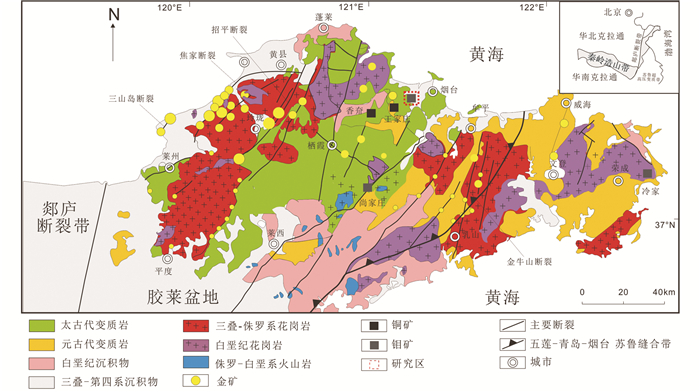
1 区域地质胶东半岛位于华北板块东部边缘,由北部的胶北隆起、中部的胶莱盆地以及南部的苏鲁超高压变质带组成(图 1; Tan et al., 2012; 丁正江等, 2012; 薛玉山等, 2014; Deng et al., 2015; 潘素珍等, 2015; Song et al., 2017)。华北板块以太古代至早古生代变质岩为基底(Cheng et al., 2017),自中生代以来,受到太平洋板块俯冲的影响(Pirajno and Zhou, 2015; 丁正江等, 2015b),经历了明显的岩石圈减薄(Wu et al., 2005; Zhu et al., 2012; Zhai, 2014),岩浆活动和地壳变形(孙丰月等, 2011; Yang and Santosh, 2015; Dai et al., 2016; Zhao et al., 2016)。
|
图 1 胶东地区区域地质简图及多金属矿区分布图(据丁正江等, 2015b; Deng and Wang, 2016修改) Fig. 1 Geological sketch map showing major polymetallic deposits in the Jiaodong Peninsula (modified after Ding et al., 2015b; Deng and Wang, 2016) |
研究区内地层主要为早元古代粉子山群和晚元古代震旦系蓬莱群,粉子山群为中级变质岩系碎屑岩和碳酸岩的组合,蓬莱群为浅变质岩系碎屑岩和碳酸岩组合。构造以褶皱和断裂为主,断裂常叠加于早期褶皱之上,褶皱构造主要有无角山背斜、蟹子顶向斜、河西背斜、张格庄向斜等,断裂构造主要为下官乐沟断裂、吴阳泉断裂和门楼-福山断裂等。研究区内侵入岩发育,幸福山岩体和王家庄岩体与成矿关系密切,幸福山岩体岩性为中细粒二长花岗岩,王家庄岩体岩性为石英闪长玢岩。胶东地区中生代大规模成矿(Zhou and Lü, 2000;丁正江等, 2015b; Deng et al., 2019),金矿储量达到4500t,分布区域广泛,矿化类型多样(Deng et al., 2003, 2015; 邓军等, 2006; Goldfarb and Santosh, 2014; 张炳林等, 2017)。胶东已发现邢家山矽卡岩型钼矿、香夼矽卡岩型铜铅锌矿、王家庄热液脉型铜锌矿、冷家斑岩型钼矿、尚家庄斑岩钼矿和热液脉型银铅锌矿等多种类型多金属矿床(李杰等, 2013; 成少博等, 2014; 杨立强等, 2014; 丁正江等, 2015b; Song et al., 2017)。
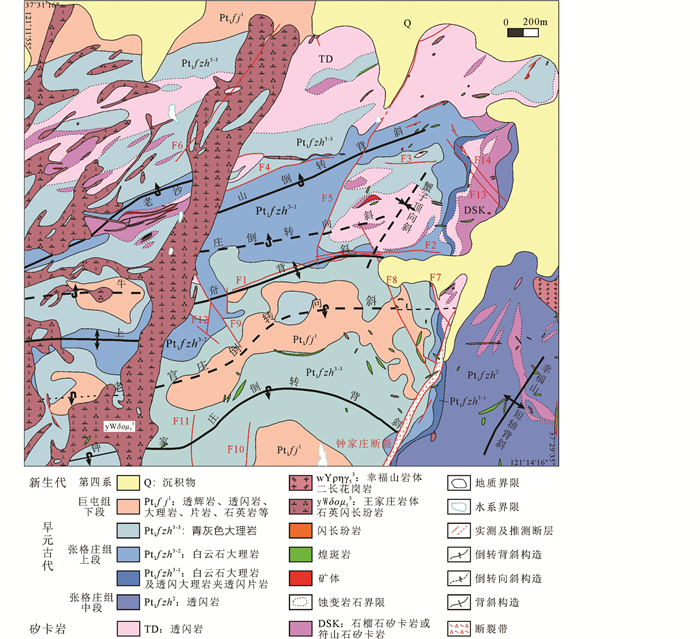
2 矿床地质邢家山矿床位于胶东半岛中部福山地区,属于北部隆起区。矿床辉钼矿Re-Os年龄为158.70±2.06Ma,形成于燕山早期(丁正江等, 2012)。地层为早元古代粉子山群张格庄组和巨屯组,以大理岩、变粒岩、透闪岩和片岩等低变质岩为主。区内岩浆活动主要集中于中生代形成的幸福山和王家庄岩体,幸福山岩体侵入年龄为157Ma,与邢家山矿床在时间和空间上联系紧密,为其成矿母岩(刘善宝等, 2011; 丁正江等, 2015a)。构造发育,以东西向褶皱和压扭性断裂为主,其中蟹子顶向斜和钟家庄断裂为矿床主要的控矿构造(图 2; 柳振江等, 2010; 薛玉山等, 2014)。
|
图 2 邢家山钼矿床矿区地质图(据丁正江等, 2015a修改) Fig. 2 Geological map of the Xingjiashan Mo deposit (modified after Ding et al., 2015a) |
邢家山矿床赋存于早元古代粉子山群张格庄组,以大理岩、白云石大理岩和透闪岩为主,据岩石组合分为三段:下段白云石大理岩,以层厚、裂隙少、结构致密且透气性差为特征;中段透闪岩、变粒岩和大理岩,是主要赋矿岩层;上段以白云石大理岩为主,分布广泛(薛玉山等, 2014; 丁正江等, 2015a)。
矿区东南侧幸福山-无角山一带出露营盘单元幸福山岩体,为钼矿成矿母岩。处于东西向和北东向两个构造体系的复合部位,岩枝和岩脉发育。岩性为二长花岗岩,似斑状结构,块状构造,斑晶由石英、斜长石、钾长石及少量角闪石组成,基质由钾长石、石英、斜长石和黑云母组成。通过锆石U-Pb测得年龄157Ma左右,为晚侏罗世岩浆活动的产物(丁正江等, 2015a)。
矿区内断裂及褶皱构造发育。上夼背斜、老沙山倒转背斜、老官庄倒转向斜和钟家庄倒转背斜受南北向水平挤压。幸福山短轴背斜位于矿区东南部,东北向,长约4km,宽约2km,背斜中心部位有幸福山岩体沿其横向张裂隙侵入。蟹子顶向斜东北向,长约4.8km,属横跨褶曲,是矿床的主要控矿构造之一。钟家庄断裂位于幸福山背斜与蟹子顶向斜之间,为北东向压扭性断裂。区内构造具有多期次活动的特点,且常有断裂横跨叠加与褶皱之上,共同控制矿体的形成(图 2; 薛玉山等, 2014)。
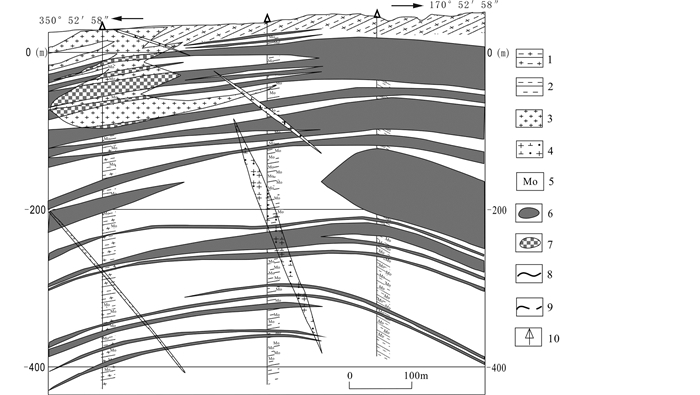
3 矿体地质 3.1 矿体与矿石特征矿体产于幸福山岩体内部及外接触带中。已探明钼矿体17个,多为隐伏矿体,埋藏较浅。矿体多呈似层状,产状与地层基本一致(图 3)。矿体以老官庄断裂为界分为南矿段和北矿段,北矿段的9号和西矿段6号为主要钼矿体。9号钼矿体呈似层状,赋存于张格庄组中段和上段地层中,受构造影响产状变化较大,矿体平均品位0.11%。6号钼矿体呈透镜状,赋存于张格庄组上段地层中,平均品位0.28%。矿体形态受到幸福山褶皱、钟家庄断裂和蟹子顶向斜的影响(丁正江等, 2012, 2015a; 薛玉山等, 2014)。
|
图 3 邢家山钼矿71勘探线地质剖面图(据丁正江等, 2012修改) 1-透闪透辉变粒岩;2-透辉矽卡岩;3-斑状中细粒含黑云二长花岗岩(幸福山岩体);4-石英闪长玢岩脉;5-钼矿化;6-矽卡岩型矿体;7-蚀变斑状花岗岩型矿体;8-地质界线;9-花岗岩与地层界线;10-钻孔 Fig. 3 Geological section of the 71 exploration line of the Xingjiashan Mo deposit (modified after Ding et al., 2012) |
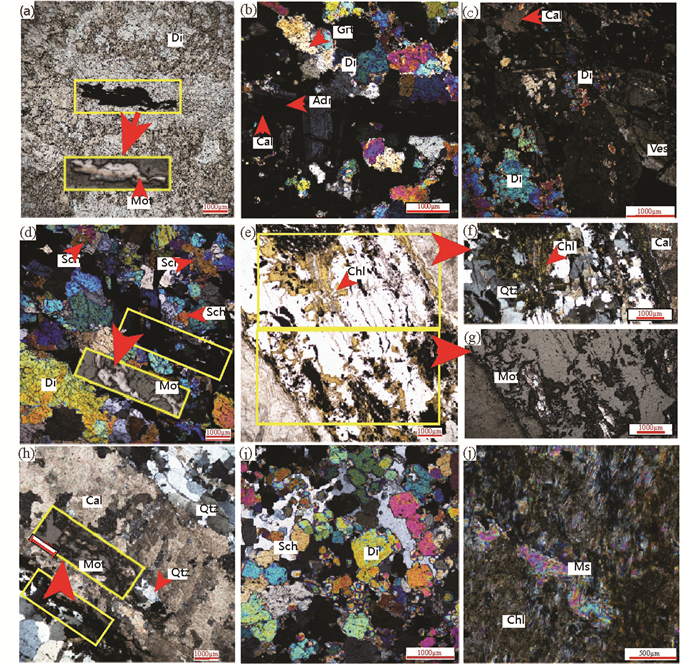
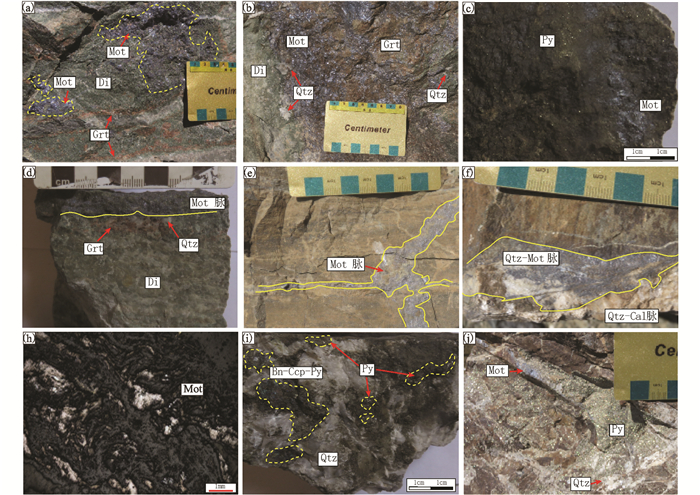
邢家山矿床的矿石矿物为辉钼矿、黄铁矿、黄铜矿、磁黄铁矿和白钨矿等(图 4、图 5)。脉石矿物主要为透辉石、透闪石、石榴石、石英和方解石。可见块状斑铜矿、黄铜矿和黄铁矿(图 5i),浸染状黄铁矿。辉钼矿是矿区内最主要的金属硫化物,沿透辉石和石榴石等脉石矿物的晶粒间隙呈浸染状分布,属于矽卡岩阶段(Ⅰ+Ⅱ阶段)形成(图 4a),或沿岩石裂隙呈脉状填充,多为片状构造,多呈单矿物脉,在主成矿期大量出现(图 5e),或产于石英脉边部或填充在石英间隙中(图 4e-h、图 5f)。
|
图 4 邢家山钼矿床不同阶段矿物组合 (a)辉钼矿、石榴石、透辉石共生产出;(b)石榴石、透辉石共生,可见钙铁榴石环带,被晚期方解石交代;(c)方解石、符山石与透辉石矿物共生;(d)白钨矿、辉钼矿共生产出于透辉石矽卡岩中;(e-g)石英、辉钼矿脉状共生产出,脉体边缘为方解石;(h)石英-方解石呈脉状切穿石英-辉钼矿脉;(i)透辉石、白钨矿共生;(j)白云母化与绿泥石化蚀变.Grt-石榴石;Di-透辉石;Mot-辉钼矿;Adr-钙铁榴石;Cal-方解石;Ves-符山石;Sch-白钨矿;Qtz-石英;Ms-白云母;Chl-绿泥石化 Fig. 4 Mineral assemblages of different stages in the Xingjiashan Mo deposit |
|
图 5 邢家山矿床矿石组构 (a、b)矽卡岩中发育块状辉钼矿;(c)黄铁矿与辉钼矿接触产出;(d)辉钼矿脉穿过矽卡岩;(e)辉钼矿脉穿过围岩;(f)石英-方解石脉穿过石英-辉钼矿脉;(h)褶皱状辉钼矿;(i)石英-斑铜-黄铜-黄铁矿脉;(j)石英-黄铁-辉钼矿脉.Py-黄铁矿;Bn-斑铜矿;Ccp-黄铜矿 Fig. 5 Ore fabrics in the Xingjiashan Mo deposit |
围岩蚀变强烈,类型多样。从岩体中心向外,蚀变具有分带性。主要为矽卡岩化、钾化和硅化。接触带发育矽卡岩化,早期发育透辉石化和硅灰石化,晚期发育绿泥石化、绿帘石化和绢云母化等(图 4j)。各蚀变带关系较为模糊,呈现出内矽卡岩化-矽卡岩化-碳酸盐化和硅化的规律。
3.2 成矿期次根据矿物共生组合特征和野外观察,成矿过程分为4个阶段。早矽卡岩阶段(Ⅰ阶段)主要为石榴子石和透辉石无水硅酸盐矿物。晚矽卡岩阶段(Ⅱ阶段)为自形-半自形含水类硅酸盐矿物透闪石、符山石等(图 4c、图 5a, b)。矽卡岩阶段(Ⅰ+Ⅱ阶段)主要为白钨矿化、黄铁矿化及少量辉钼矿化(图 4d)。石英-硫化物阶段(Ⅲ)是主成矿阶段,有大量石英、辉钼矿、黄铁矿和黄铜矿等矿物沉淀(图 5e, f)。石英-碳酸盐阶段(Ⅳ阶段)见碳酸盐脉,切穿石英-硫化物脉和围岩(图 4h)。
4 样品和分析方法本次研究的测试样品采自邢家山地表和坑道,制成薄片、探针片和包裹体片。
包裹体成分分析通过中国地质科学院矿产资源研究所Renishaw System-2000显微共焦激光拉曼光谱仪,完成对邢家山矿床各成矿阶段单个包裹体的成分分析。仪器激发激光波长514.53nm,激光功率20mW,激光束斑最小直径1μm,光谱分辨率1~2cm-1。
流体包裹体测温实验在中国地质科学院矿产资源研究所国家重点实验室流体包裹体室完成,英产LinkamTHMSG600显微冷热台,最低-196℃,最高+600℃,精度达±0.1℃,本次测温范围-100℃~+600℃。对邢家山矿床不同阶段具有代表性的样品中的各类流体包裹体进行详细的显微测温分析,根据流体的均一温度、冰点及子矿物的熔化温度通过Steele-MacInnis et al. (2012)发表的软件中算出其盐度和密度(Roedder and Bodnar, 1980; Steele-MacInnis et al., 2012; Li and Li, 2013; Li et al., , 2014)。
在中国科学院地质与地球物理研究所稳定同位素地球化学实验室进行了石榴子石和石英的氢氧同位素分析、方解石碳氧同位素分析和辉钼矿、黄铜矿、黄铁矿硫同位素分析。氢氧同位素测定使用质谱型号为:MAT-252,所报数据为国际标准V-SMOW,分析误差在0.2‰以内;碳氧同位素测定使用质谱型号为MAT-253所报数据均为相对国际标准VPDB之值,内部标准监测显示δ13C和δ18O的标准偏差分别优于0.15‰和0.20‰;硫同位素测定使用质谱型号为Delta-S,数据为相对国际标准CDT值,分析误差在0.2‰以内(李铁军, 2013; Feng et al., 2014; Wang et al., 2018a)。
5 结果 5.1 流体包裹体 5.1.1 流体包裹体岩相学特征根据显微镜下岩相学观察,流体包裹体形态一般呈菱形、椭圆形、长条形及不规则形,偶可见负晶型包裹体。包裹体大小差异较大,较大包裹体直径可达20μm,较小包裹体直径小于1μm,大部分集中在4~10μm。包裹体中气液比变化较大,透闪石和石榴子石相比集中在10%~70%之间,透闪石中发育含子矿物包裹体,在升温过程中,子矿物有早于和晚于包裹体气相和液相均一。石英中包裹体相比集中在5%~55%之间,在含子矿物包裹体中,子矿物晚于气泡消失。方解石相比集中在5%~40%之间。
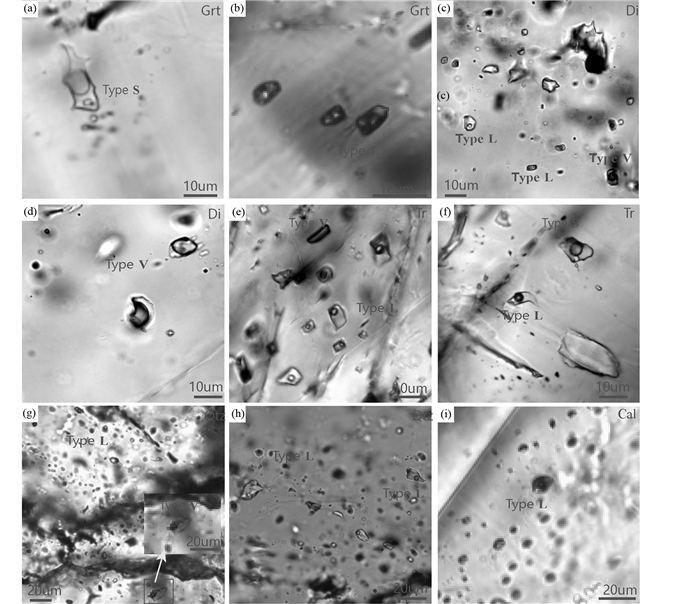
室温下的相态和包裹体成分,划分为富液体包裹体(L型)、富气体包裹体(V型)和含子矿物包裹体(S型)(图 6; Qiu et al., 2017)。L型包裹体在各阶段特征矿物中普遍发育,V型包裹体在透辉石、石榴子石和透闪石中普遍发育,S型包裹体石榴子石和透闪石中普遍发育,石英中少量发育。
|
图 6 邢家山矿床流体包裹体显微照片 (a) Ⅰ阶段石榴子石中含子矿物包裹体(S型);(b) Ⅰ阶段石榴子石中液体包裹体(L型);(c) Ⅰ阶段透辉石中液体包裹体(L型);(d) Ⅰ阶段透闪石中气体包裹体(V型);(e) Ⅱ阶段透闪石中气体包裹体(V型)和液体包裹体(L型);(f) Ⅱ阶段透闪石中液体包裹体(L型)和含子矿物包裹体(S型);(g) Ⅲ阶段石英中液体包裹体(L型)和含子矿物包裹体(S型);(h) Ⅲ阶段石英中液体包裹体(L型);(i) Ⅳ阶段方解石中液体包裹体(L型) Fig. 6 Microphotographs of fluid inclusions of quartz in the Xingjiashan Mo deposit |
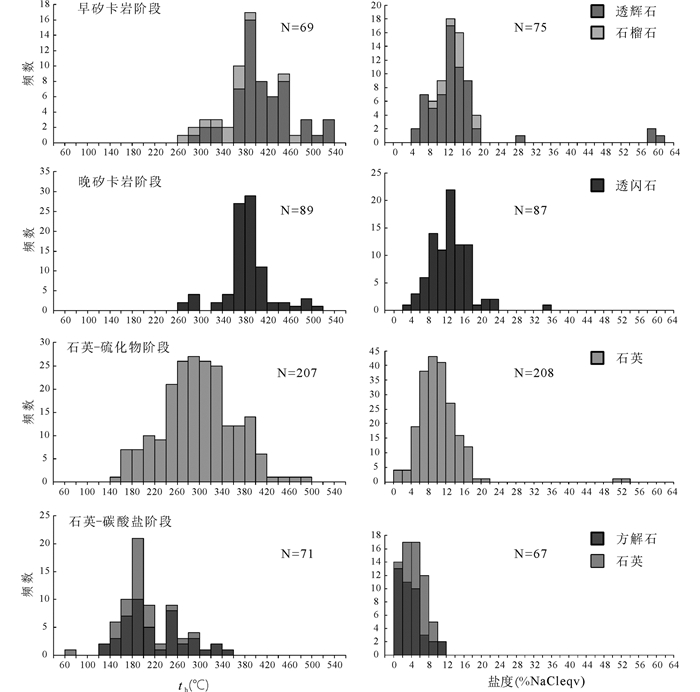
Ⅰ阶段寄主矿物为透辉石(L和V型)和石榴子石(L、V和S型)。均一温度范围在273.7~532.6℃之间,主要集中在375~450℃之间,平均为399.6℃。冰点温度在-3.4~-17.0℃之间。盐度范围在6.01%~20.22% NaCleqv之间,平均为13.55%。密度范围在0.40~1.06g/cm3之间(图 7)。
|
图 7 邢家山钼矿成矿流体均一温度和盐度直方图 Fig. 7 Histograms showing homogenization temperature and salinity in the Xingjiashan Mo deposit |
Ⅱ阶段寄主矿物为透闪石(L、V和S型)。均一温度范围在191.3~495.1℃之间,主要集中在375~425℃之间,平均为373.8℃。冰点温度范围在-2.7~-21.6℃之间,子矿物熔化温度为270.2℃、502.0℃、494.8℃、512.8℃、157.0℃、495.7℃。盐度范围在4.49%~61.51% NaCleqv之间,平均为15.52% NaCleqv。密度范围在0.48~1.25g/cm3之间,平均为0.77g/cm3(图 7)。
Ⅲ阶段寄主矿物石英(L和V型)中包裹体显示完全均一温度范围在154.1~443.2℃之间,主要集中在225~400℃之间,平均为293.5℃。冰点温度范围在-0.7~-18.0℃之间,子矿物熔化温度为426.1℃。盐度范围在1.22%~31.04% NaCleqv之间,平均为10.69% NaCleqv。密度范围在0.58~1.00g/cm3之间(图 7)。
Ⅳ阶段寄主矿物石英和方解石中的L和V型包裹体显示均一温度范围在73.4~267.3℃之间,主要集中在150~200℃之间,平均为178.4℃。冰点温度范围在-0.7~-18.0℃之间,子矿物熔化温度为426.1℃。盐度范围在1.74%~9.98% NaCleqv之间,平均为4.49% NaCleqv,密度范围0.80~1.01g/cm3之间(图 7)。
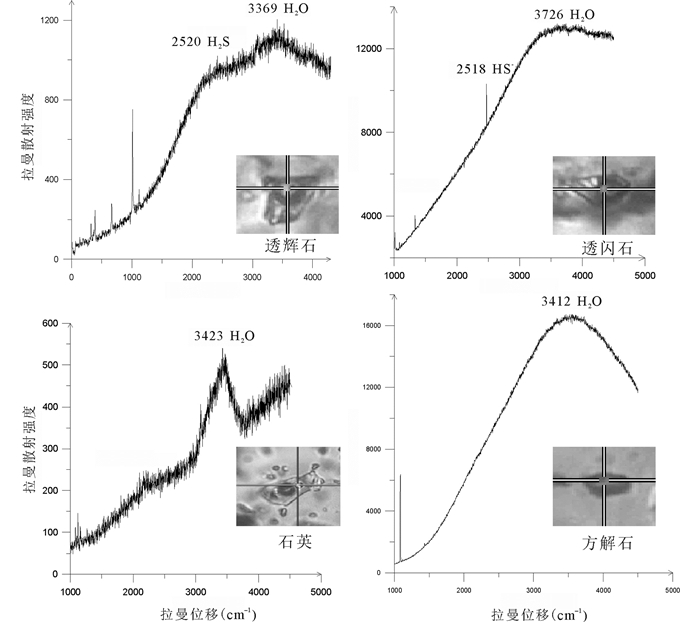
5.1.3 流体包裹体成分分析根据显微激光拉曼光谱分析,早矽卡岩阶段透辉石中L型包裹体成分峰值显示H2O和H2S,晚矽卡岩阶段透闪石中L型包裹体成分峰值显示H2O和HS-,石英-硫化物阶段L型包裹体主要成分为H2O,石英-碳酸盐阶段方解石中流体包裹体H2O峰值较宽泛,其他成分峰值不明显(图 8)。流体早期可能属于H2O-NaCl-H2S流体体系,晚期演化至成分较单一的H2O-NaCl流体体系。
|
图 8 邢家山钼矿包裹体激光拉曼探针分析谱图 Fig. 8 Laser Raman spectrum of fluid inclusions in the Xingjiashan Mo deposit |
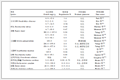
邢家山钼矿床矽卡岩阶段3件石榴石样品δD值位于-50.3‰~-58.3‰之间,δ18O的值位于6.4‰~7.3‰之间。石英-硫化物阶段2件石英样品δD的值为-54.4‰和-58.0‰,δ18O的值为12.1‰和13.2‰。石英-碳酸盐阶段1件石英样品δD和δ18O值分别为-55.5‰和13.1‰。根据热液矿物-水体系的氧同位素分馏方程(Clayton et al., 1972; 郑永飞, 2001):
δ18OH2O‰=δ18OGrt‰-1.27×(1000000/T2)+3.65
δ18OH2O‰=δ18OQtz‰-3.38×(1000000/T2)+3.40
结合流体包裹体显微测温结果,矽卡岩阶段3件石榴石样品δ18OH2O值的变化范围在7.00‰~8.18‰之间,石英硫化物2件石英中流体包裹体的δ18OH2O值分别为4.87‰和5.90‰,石英-碳酸盐阶段1件石英中流体包裹体的δ18OH2O值为0.04‰(表 1)。
|
表 1 邢家山钼矿氢氧同位素测试结果 Table 1 The H-O isotopic compositions in the Xingjiashan Mo deposit |
邢家山2件石英-硫化物阶段样品δ13CV-PDB为-1.18‰和-1.16‰,δ18OV-SMOW为6.70‰和7.75‰。7件石英-碳酸盐阶段样品δ13CV-PDB范围在-3.35‰~-0.73‰之间,δ18OV-SMOW范围在5.93‰~8.42‰之间(表 2)。
|
|
表 2 邢家山钼矿碳氧同位素测试结果 Table 2 The C-O isotopic compositions in the Xingjiashan Mo deposit |
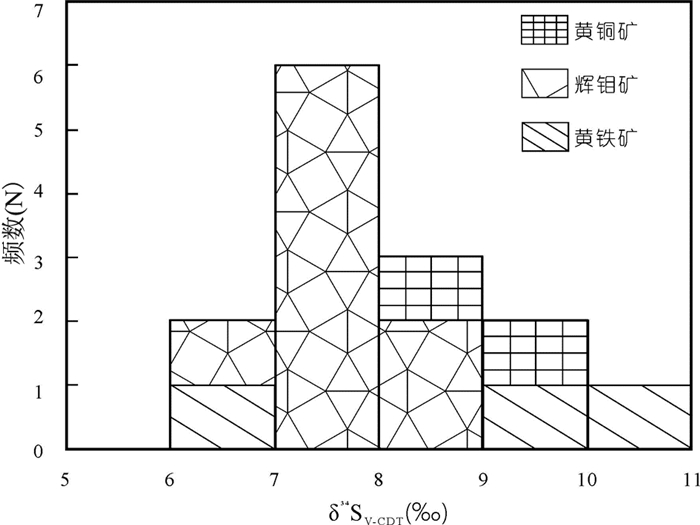
矽卡岩阶段中6件辉钼矿矿石硫化物的δ34S变化范围为6.5‰~8.2‰,平均值7.5‰。石英-硫化物阶段9件样品,矿石硫化物变化范围为7.1‰~10.8‰,其中3件黄铁矿δ34S范围为6.8‰~10.8‰,平均值9.1‰。2件黄铜矿δ34S为8.5‰和9.5‰,4件辉钼矿为7.1‰~8.5‰,平均值7.8‰(表 3)。
|
|
表 3 邢家山钼矿硫同位素测试结果 Table 3 The S isotopic compositions in the Xingjiashan Mo deposit |
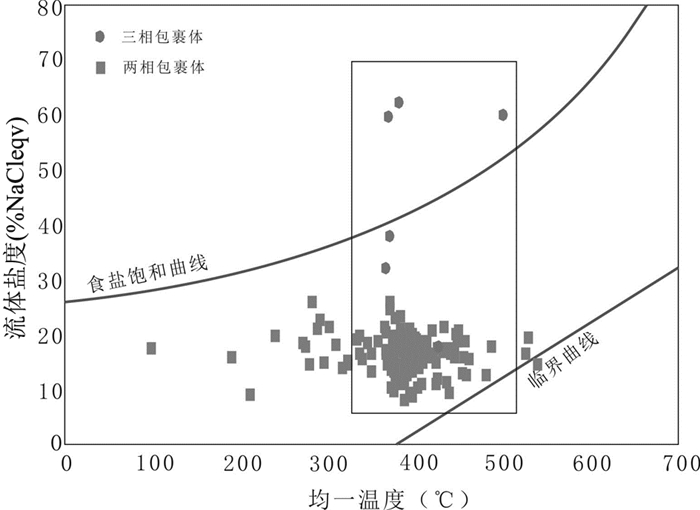
邢家山矿床流体包裹体类型单一,主要为气液两相包裹体,偶见含子矿物包裹体,成矿流体属于NaCl-H2O体系,流体早期及成矿阶段出现H2S还原性气体,晚期流体趋向于单一H2O组成。各阶段包裹体中同时形成的不同相比的包裹体几乎同时均一。晚矽卡岩阶段流体均一温度相似的情况下盐度相差较多,均一温度350~450℃之间的包裹体盐度范围10%~70% NaCleqv(图 9)。辉钼矿产状多样。这一系列现象反映了流体的沸腾(卢焕章和单强, 2015; Wang et al., 2014a; Guo et al., 2019)。
|
图 9 邢家山钼矿包裹体Ⅱ阶段盐度-均一温度图(底图据Canet et al., 2011) Fig. 9 Salinity and homogenization temperature of fluid inclusion of Ⅱ stage in the Xingjiashan Mo deposit (after Canet et al., 2011) |
早矽卡岩阶段中流体包裹体显示早期流体中高温、高盐度、低密度的特征(375~450℃;14% NaCleqv;0.7g/cm3),晚矽卡岩阶段流体的温度有所降低,盐度变化不明显(15% NaCleqv)。随着流体演化过程的进行在石英-硫化物阶段显示出中高温、中低盐度、中低密度的特征(225~400℃;10% NaCleqv;0.8g/cm3),此阶段温度的变化范围较大,盐度快速下降。在Ⅳ阶段流体包裹体表现出成矿作用后的特征,流体成分简单,表现出低温、低盐度、密度接近于1g/cm3的特征。
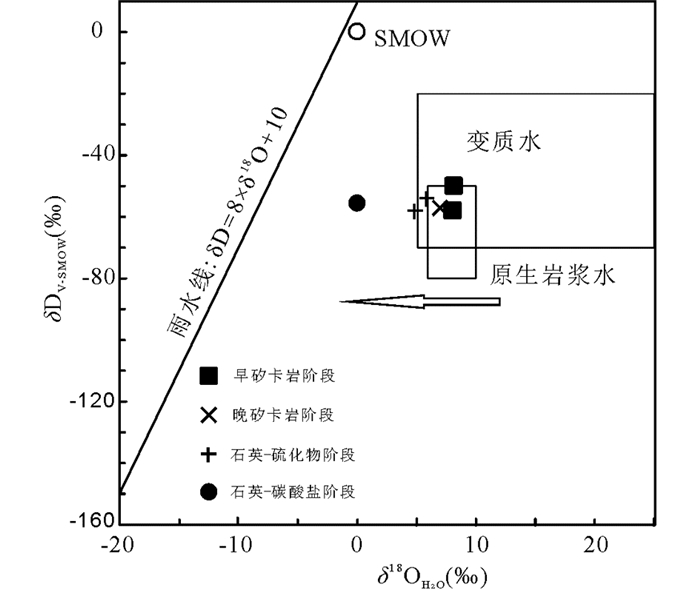
对不同阶段特征矿物进行H-O同位素分析,δD和δ18OH2O范围分别为-58.32‰~-50.32‰和0.04‰~8.18‰,δ18OH2O值从矽卡岩阶段到石英-碳酸盐阶段有明显降低的趋势。H-O同位素图解主要显示岩浆水特征,成矿早期至晚期逐渐向大气降水线偏移(图 10; Driesner and Seward, 2000; Wang et al., 2016a; Liu et al., 2018; Zhang et al., 2018),反应了流体可能早期主要为岩浆水,随着成矿作用的进行不断演化,流体上升接近地表,有大气降水的混入。同时流体包裹体在石英-碳酸盐阶段显示温度178.4℃、盐度4.9% NaCleqv、密度0.921g/cm3和成分单一,符合晚期混有大气降水的特征。
|
图 10 邢家山钼矿氢氧同位素图解(底图据Wang et al., 2015) Fig. 10 δD vs. δ18OH2O diagram of the Xingjiashan Mo deposit (after Wang et al., 2015) |
硫同位素有三个不同的储库(Rollinson, 1993; Hoefs, 2009; White, 2013; Wang et al., 2018a):岩浆来源δ34S值约为0‰,主要为还原态S;海水来源,δ34S值约为20‰,主要SO42-;显示为负值的强还原沉积硫,前两种比较稳定。根据前人研究,总结大量金属矿床的硫同位素组成发现绝大多数δ34S集中-4‰~+10‰之间,接近幔源硫的特征,主要来源于岩浆热液(周涛发等, 2017; Zhang et al., 2018, 2019)。邢家山矿床多金属硫化物δ34S变化范围为6.5‰~10.8‰,呈现较明显的塔式分布(图 11; White, 2013; Ma et al., 2019),不同金属矿物中硫无明显差别,可能具有相似的硫来源,同阶段辉钼矿、黄铁矿和黄铜矿之间δ34S值变化不大,未显示出一定规律,可能有一定的分馏现象。对比硫同位素储库,邢家山矿床δ34S总体范围接近于岩浆硫,硫源主要来源于岩浆。
|
图 11 邢家山钼矿硫同位素组成 Fig. 11 Histogram of δ34S of sulfides from the Xingjiashan Mo deposit |
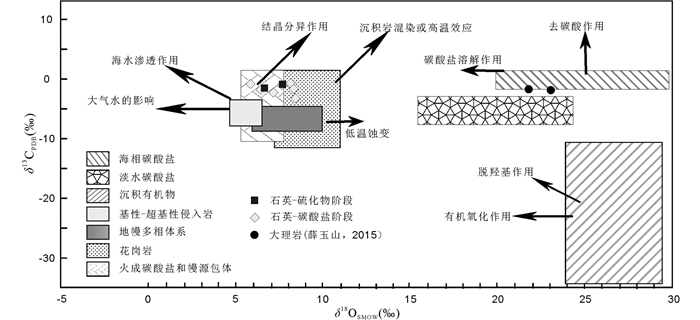
邢家山Ⅲ、Ⅳ阶段9件方解石样品δ13CV-PDB值为-3.35‰~-0.73‰,变化范围较小,表明碳可能来自深部地幔(图 12; Ohmoto and Rye, 1979; Ray et al., 2000; Wang et al., 2015; Liu et al., 2015; Liu and Hou, 2017; Ding et al., 2018; Gao et al., 2018)。方解石样品δ13CV-PDB变化范围窄,且大于有机质的碳同位素组成,可排除有机质为方解石提供碳的途径。δ18OV-SMOW值为5.93‰~8.50‰,变化范围较小。碳氧同位素组成投点位于火成碳酸盐和幔源包体及花岗岩碳的范围内,说明成矿流体的碳质主要来源于岩浆。结合前人大理岩样品数据,投点接近于海相碳酸盐区域,指示大理岩与成矿碳质来源不同,大理岩中碳质主要来源于碳酸盐地层。综上所述,流体中碳质应主要来源于深部岩浆。
|
图 12 邢家山钼矿碳氧同位素图解(底图据Ray et al., 2000; Wang et al., 2014b) Fig. 12 δC vs. δ18OH2O diagram of the Xingjiashan Mo deposit (after Ray et al., 2000; Wang et al., 2014b) |
矽卡岩型矿床是我国主要的矿床类型之一,已知矿种有铜、铁、铅锌、钨、锡和钼等,大部分分布在中国东部,是环太平洋成矿带的重要组成部分,形成时代从元古宙至新生代,主要集中在中生代侏罗纪(徐志刚等, 2008; 赵一鸣等, 2017; 毛景文等, 2018; Deng et al., 2018; Shi et al., 2019),其形成于中酸性岩体的侵入密切相关(Meinert et al., 2005)。根据已有的大量有关成矿流体特征及来源的研究,物质来源对于不同类型矿床物质来源存在岩浆、岩浆地层混合或只来源于地层的争议,一般根据C-O、S-Pb及非传统同位素指示(Gemmell et al., 1992; Ishihara et al., 2000; Zhao et al., 2003; Zhang et al., 2013; 田坎等, 2018; Wang et al., 2018a)。矽卡岩型矿床矿物中同位素组成及捕获的流体包裹体能够很好地反应成矿过程中流体的特征(池国祥和赖健清, 2009; 卢焕章等, 2018),氢同位素大部分低于岩浆热液氢同位素组成,其影响因素一般为大气降水等(Taylor, 1974; 向君峰等, 2012; Roedder and Bodnar, 1980; 赵一鸣等, 2017; 刘畅等, 2018; 邓明国等, 2018)。本次研究主要针对成矿流体,成矿流体主要为岩浆水,后期有大气降水的加入,表现出高温高盐度的特征,符合矽卡岩型矿床的典型流体特征。
邢家山矿床的形成与中生代幸福山岩体有关,受蟹子顶向斜和钟家庄断裂的控制成矿,岩浆上涌与围岩接触发生反应,形成矽卡岩。早期成矿流体氢同位素显示岩浆流体的特征,流体包裹体显示中高温中高盐度的特征,含有还原性气体,此时期大量成矿;随后流体不断运移,有大气降水的加入,温度和盐度不断降低,流体演变为低温低盐度,流体包裹体类型趋向单一的H2O-NaCl组成。
影响邢家山矿床的矿质聚集因素包含多方面(Woodland and Koch, 2003; Selby et al., 2000; 邓军等, 2012; Wang et al., 2014b, 2016a, b)。流体早期氢氧同位素(-58.35‰~-50.32‰)显示主要为岩浆水;流体沸腾是引起成矿物质沉淀的重要因素之一(Bodnar, 1983; Taylor, 1974; Canet et al., 2011; Goldfarb and Groves, 2015; Zhang et al., 2016),高温高压条件下,尤其临界-超临界条件下,金属离子以稳定的络合物形式存在,在温度压力突然变化下会发生流体的沸腾,从而促使金属元素沉淀富集(Yao et al., 2018; Korges et al., 2017; 邓明国等, 2018; 柏中杰等, 2019)。邢家山矿床包裹体类型多样,同一阶段相近温度下盐度变化范围大,矽卡岩阶段单相包裹体与两相包裹体共存,含子晶包裹体与液相包裹体共存(图 4a, d, e),在晚矽卡岩阶段,相近的均一温度下盐度差距较大,符合流体沸腾的特征;成矿期包裹体实验显示,流体早期至晚期温度逐渐降低,压力逐渐减小,由含强还原性气体流体向单一流体转变也显示了与大气水的混合。流体沸腾是邢家山矿质沉淀的重要影响因素,流体混合、物理条件变化和氧化还原性质改变等也为邢家山矿床矿物沉淀提供了条件。
7 结论(1) 邢家山矿床成矿阶段划分为四个阶段:Ⅰ早矽卡岩阶段、Ⅱ晚矽卡岩阶段,Ⅲ石英-硫化物阶段和Ⅳ石英-碳酸盐阶段。主成矿阶段为石英-硫化物阶段。
(2) 邢家山矿床成矿流体气体成分含有还原性H2S。成矿流体总体属于H2O-NaCl流体体系,气体包裹体、液体包裹体和含子矿物包裹体大量共存,相近温度下盐度变化较大,流体沸腾现象较明显,流体的沸腾作用应为该矿床矿物沉淀的主要原因。
(3) 邢家山矿床属于典型的矽卡岩型矿床,从Ⅰ阶段到Ⅳ阶段,成矿流体具有由中高温中高盐度向低温低盐度方向演化的趋势。
(4) C-H-O同位素结果显示成矿流体以岩浆水为主,后期有大气降水的加入。硫同位素δ34S值为6.5‰~10.8‰,显示了成矿物质岩浆来源的特征。
致谢 谨以此文恭祝翟裕生院士九十华诞,感谢翟老师多年来给予的悉心教导。实验过程中得到中国地质科学院矿产资源研究所和中国科学院地质与地球物理研究所老师的支持和帮助,感谢评审专家们提出的宝贵意见。
Bai ZJ, Zhong H and Zhu WG. 2019. Redox state of mantle-derived magma and constraints on the genesis of magmatic deposits. Acta Petrologica Sinica, 35(1): 204-214 (in Chinese with English abstract) |
Bodnar RJ. 1983. A method of calculating fluid inclusion volumes based on vapor bubble diameters and P-V-T-X properties of inclusion fluids. Economic Geology, 78(3): 535-542 DOI:10.2113/gsecongeo.78.3.535 |
Canet C, Franco SI, Prol-Ledesma RM, González-Partida E and Villanueva-Estrada RE. 2011. A model of boiling for fluid inclusion studies:Application to the Bolaños Ag-Au-Pb-Zn epithermal deposit, Western Mexico. Journal of Geochemical Exploration, 110(2): 118-125 DOI:10.1016/j.gexplo.2011.04.005 |
Chen YJ, Chen HY, Zaw K, Pirajno F and Zhang ZJ. 2007. Geodynamic settings and tectonic model of skarn gold deposits in China:An overview. Ore Geology Reviews, 31(1-4): 139-169 DOI:10.1016/j.oregeorev.2005.01.001 |
Chen YJ, Wang P, Li N, Yang YF and Pirajno F. 2017. The collision-type porphyry Mo deposits in Dabie Shan, China. Ore Geology Reviews, 81(2): 405-430 |
Cheng SB, Xue YS, Liu ZJ, Zhu BL and Wang FJ. 2014. Geochemical characteristics and genetic mechanism of Shangjiazhuang molybdenum deposit in East Shandong. Mineral Deposits, 33(Suppl): 177-178 (in Chinese) |
Cheng SB, Liu ZJ, Wang QF, Wang FJ, Xue YS, Xu L, Wang JP and Zhu BL. 2017. Mineralization age and geodynamic background for the Shangjiazhuang Mo deposit in the Jiaodong gold province, China. Ore Geology Reviews, 80: 876-890 DOI:10.1016/j.oregeorev.2016.08.018 |
Chi GX and Lai JQ. 2009. Roles of fluid inclusions in study of mineral deposits. Mineral Deposits, 28(6): 850-855 (in Chinese with English abstract) |
Clayton RN, O'Neil JR and Mayeda TK. 1972. Oxygen isotope exchange between quartz and water. Journal of Geophysical Research:Atmospheres, 77(17): 3057-3067 DOI:10.1029/JB077i017p03057 |
Dai LQ, Zheng YF and Zhao ZF. 2016. Termination time of peak decratonization in North China:Geochemical evidence from mafic igneous rocks. Lithos, 240-243: 327-336 DOI:10.1016/j.lithos.2015.11.014 |
Deng J, Zhai YS, Wang JP, Yang LQ, Fan Y and Sun ZS. 2000. Shear alteration, mass transfer and gold mineralization:An example from Jiaodong ore deposit concentrating area, Shandong, China. Journal of China University of Geosciences, 11(3): 281-287 |
Deng J, Yang LQ, Sun ZS, Wang JP, Wang QF, Xin HB and Li XJ. 2003. A metallogenic model of gold deposits of the Jiaodong granite-greenstone belt. Acta Geologica Sinica, 77(4): 537-546 |
Deng J, Wang QF, Yang LQ and Gao BF. 2005. An analysis of the interior structure of the gold hydrothermal metallogenic system of the northwestern Jiaodong Peninsula, Shandong Province. Earth Science (Journal of China University of Geosciences), 30(1): 102-108 (in Chinese with English abstract) |
Deng J, Yang LQ, Ge LS, Wang QF, Zhang J, Gao BF, Zhou YH and Jiang SQ. 2006. Research advances in the Mesozoic tectonic regimes during the formation of Jiaodong ore cluster area. Progress in Natural Science, 16(5): 513-518 (in Chinese) |
Deng J, Wang QF and Li GJ. 2012. Style and process of the superimposed mineralization in the Sanjiang Tethys. Acta Petrologica Sinica, 28(5): 1349-1361 (in Chinese with English abstract) |
Deng J, Wang CM, Bagas L, Carranza EJM and Lu YJ. 2015. Cretaceous-Cenozoic tectonic history of the Jiaojia Fault and gold mineralization in the Jiaodong Peninsula, China:Constraints from zircon U-Pb, illite K-Ar, and apatite fission track thermochronometry. Mineralium Deposita, 50(8): 987-1006 DOI:10.1007/s00126-015-0584-1 |
Deng J and Wang QF. 2016. Gold mineralization in China:Metallogenic provinces, deposit types and tectonic framework. Gondwana Research, 36: 219-274 |
Deng J, Wang CM, Bagas L, Santosh M and Yao EY. 2018. Crustal architecture and metallogenesis in the south-eastern North China Craton. Earth-Science Reviews, 182: 251-272 |
Deng J, Yang LQ, Li RH, Groves DI, Santosh M, Wang ZL, Sai SX and Wang SR. 2019. Regional structural control on the distribution of world-class gold deposits:An overview from the Giant Jiaodong gold province, China. Geological Journal, 54(1): 378-391 DOI:10.1002/gj.v54.1 |
Deng MG, Chen W, Wang XW, Liu FX, Guan SJ, Lu YX, Yu HJ and Zhao F. 2018. Fluid inclusion and ore genesis of the Luziyuan distal skarn Pb-Zn-Fe (-Cu) poly-metallic deposit, West Yunnan, SW China. Acta Petrologica Sinica, 34(5): 1239-1257 (in Chinese with English abstract) |
Ding H, Ge WS, Dong LH, Zhang LL, Chen XD, Liu Y and Nie JJ. 2018. Genesis of the Weiquan Ag-polymetallic deposit in East Tianshan, China:Evidence from zircon U-Pb geochronology and C-H-O-S-Pb isotope systematics. Acta Geologica Sinica, 92(3): 1100-1122 DOI:10.1111/acgs.2018.92.issue-3 |
Ding ZJ, Sun FY, Liu JH, Liu DH, Li BL, Zhang PJ, Qian Y and Li J. 2012. Re-Os dating of molybdenites from the Xingjiashan molybdenum-tungsten deposit in Jiaodong Peninsula, China and its geological significance. Acta Petrologica Sinica, 28(9): 2721-2732 (in Chinese with English abstract) |
Ding ZJ, Sun FY, Li GH, Ji P and Kong Y. 2015a. Accurate zircon U-Pb dating of Early Yanshanian molybdenum-tungsten mother rocks in Xingjiashan area of Jiaodong Peninsula and its significance. Geology in China, 42(2): 556-569 (in Chinese with English abstract) |
Ding ZJ, Sun FY, Liu FL, Liu JH, Peng QM, Ji P, Li BL and Zhang PJ. 2015b. Mesozoic geodynamic evolution and metallogenic series of major metal deposits in Jiaodong Peninsula, China. Acta Petrologica Sinica, 31(10): 3045-3080 (in Chinese with English abstract) |
Driesner T and Seward TM. 2000. Experimental and simulation study of salt effects and pressure/density effects on oxygen and hydrogen stable isotope liquid-vapor fractionation for 4~5 molal aqueous NaCl and KCl solutions to 400℃. Geochimica et Cosmochimica Acta, 64(10): 1773-1784 DOI:10.1016/S0016-7037(99)00435-4 |
Feng LJ, Li C, Huang J, Chang HJ and Chu XL. 2014. A sulfate control on marine mid-depth euxinia on the early Cambrian (ca. 529~521Ma) Yangtze platform, South China. Precambrian Research, 246: 123-133 |
Gao HJ, Zhang YM, Gu XX and Li JL. 2018. Ore genesis of the Xiyi Pb-Zn deposit, western Yunnan Province, China:Geologic, fluid inclusion, and isotopic (C-H-O-S-Pb) evidence. Geological Journal, 53(3): 1165-1185 DOI:10.1002/gj.v53.3 |
Gemmell JB, Zantop H and Meinert LD. 1992. Genesis of the aguilar zinc-lead-silver deposit, argentina:Contact metasomatic vs. sedimentary exhalative. Economic Geology, 87(8): 2085-2112 |
Goldfarb RJ and Santosh M. 2014. The dilemma of the Jiaodong gold deposits:Are they unique. Geoscience Frontiers, 5(2): 139-153 |
Goldfarb RJ and Groves DI. 2015. Orogenic gold:Common or evolving fluid and metal sources through time. Lithos, 233: 2-26 DOI:10.1016/j.lithos.2015.07.011 |
Guo BJ, Li YF, Wang ZG and Ye HS. 2005. Type, metallogenetic regularities, mineralization model and prospecting proposal in the Xiong'ershan district. Geology and Prospecting, 41(5): 43-47 (in Chinese with English abstract) |
Guo LN, Liu SS, Hou L, Wang JT, Shi MF, Zhang QM, Nie F, Yang YF and Peng ZM. 2019. Fluid inclusion and H-O isotope geochemistry of the Phapon gold deposit, NW Laos:Implications for fluid source and ore genesis. Journal of Earth Science, 30(1): 80-94 DOI:10.1007/s12583-018-0866-5 |
Hoefs J. 2009. Stable Isotope Geochemistry. New York: Springer-Verlag, 40-60
|
Ishihara S, Jin MS and Sasaki A. 2000. Source diversity of ore sulfur from Mesozoic-Cenozoic mineral deposits in the Korean Peninsula region. Resource Geology, 50(4): 203-212 DOI:10.1111/rge.2000.50.issue-4 |
Korges M, Weis P, Lüders V and Laurent O. 2017. Depressurization and boiling of a single magmatic fluid as a mechanism for tin-tungsten deposit formation. Geology, 46(1): 75-78 |
Li G and Li ZB. 2013. Measurement and modeling of vapor-liquid equilibria for the octane + sulfuric acid + water + ethanol system. Journal of Chemical and Engineering Data, 58(7): 2044-2050 DOI:10.1021/je400238j |
Li J, Song MC, Wang MY, Li SY, Zhou ML, Ni SJ, Zhang CJ, Ding ZJ and Yue YP. 2013. The molybdenite Re-Os age and genetic analysis of the Shangjiazhuang Mo deposit in Jiaodong area. Geology in China, 40(5): 1612-1621 (in Chinese with English abstract) |
Li J, Mao SD and Zheng HF. 2014. Raman spectroscopic quantitative study of NaCl-CaCl2-H2O system at high temperatures and pressures. Spectroscopy and Spectral Analysis, 34(7): 1747-1753 |
Li TJ. 2013. Progress in the application of oxygen isotopes in the study of petrogenesis. Rock and Mineral Analysis, 32(6): 841-849 (in Chinese with English abstract) |
Liu C, Zhao Z, Lu LN, Zeng ZL, Liu CH and Xu H. 2018. Metallogenic fluid study of the Yanqian skarn type tungsten deposit in eastern Nanling Region. Acta Geologica Sinica, 92(12): 2485-2507 (in Chinese with English abstract) |
Liu SB, Wang DH, Chen YC, Zhou HQ, Qu WJ and Wang CH. 2011. Geological characteristics and molybdenite Re-Os age of the Xingjiashan W-Mo deposit in Yantai area, Jiaodong Peninsula, Shandong Province. Geological Bulletin of China, 30(8): 1294-1302 (in Chinese with English abstract) |
Liu Y, Zhu ZM, Chen C, Zhang SP, Sun X, Yang ZS and Liang W. 2015. Geochemical and mineralogical characteristics of weathered ore in the Dalucao REE deposit, Mianning-Dechang REE Belt, western Sichuan Province, southwestern China. Ore Geology Reviews, 71: 437-456 DOI:10.1016/j.oregeorev.2015.06.009 |
Liu Y and Hou ZQ. 2017. A synthesis of mineralization styles with an integrated genetic model of carbonatite-syenite-hosted REE deposits in the Cenozoic Mianning-Dechang REE metallogenic belt, the eastern Tibetan Plateau, southwestern China. Journal of Asian Earth Sciences, 137: 35-79 DOI:10.1016/j.jseaes.2017.01.010 |
Liu Y, Chakhmouradian AR, Hou ZQ, Song WL and Kynicky J. 2018. Development of REE mineralization in the giant Maoniuping deposit (Sichuan, China): Insights from mineralogy, fluid inclusions, and trace-element geochemistry. Mineralium Deposita, doi: 10.1007/s00126-018-0836-y
|
Liu ZJ, Wang JP, Zheng DW, Liu JJ, Liu J and Fu C. 2010. Exploration prospect and post-ore denudation in the northwestern Jiaodong gold province, China:Evidence from apatite fission track thermochronology. Acta Petrologica Sinica, 26(12): 3597-3611 (in Chinese with English abstract) |
Lu HZ and Shan Q. 2015. Composition of ore forming fluids in metal deposits and fluid inclusion. Acta Petrologica Sinica, 31(4): 1108-1116 (in Chinese with English abstract) |
Lu HZ, Chi GX, Zhu XQ, Guha J, Archambault G and Wang ZG. 2018. Geological characteristics and ore forming fluids of orogenic gold deposits. Geotectonica et Metallogenia, 42(2): 244-265 (in Chinese with English abstract) |
Ma XL, Wang KY, Li SD, Shi KT, Wang WY and Yang H. 2019. Geology, fluid inclusion, and H-O-S-Pb isotopic study of the Shenshan skarn Fe-Cu deposit, southern Great Xing'an Range, northeast China. Journal of Geochemical Exploration, 200: 167-180 DOI:10.1016/j.gexplo.2019.02.008 |
Mao JW, Xie GQ, Yuan SD, Liu P, Meng XY, Zhou ZH and Zheng W. 2018. Current research progress and future trends of porphyry-skarn copper and granite-related tin polymetallic deposits in the Circum Pacific metallogenic belts. Acta Petrologica Sinica, 34(9): 2501-2517 |
Meinert LD, Dipple GM and Nicolescu S. 2005. World skarn deposits. In: Hedenquist JW, Thompson JFH, Goldfarb RJ and Richards JP (eds.). Economic Geology 100th Anniversary Volume. Littleton, Colorado: Society of Economic Geologists, 299-336
|
Ohmoto H and Rye RO. 1979. Isotopes of sulfur and carbon. In:Barnes HL (ed.). Geochemistry of hydrothermal Ore Deposits. 2nd Edition. New York: John Wiley and Sons, 509-567
|
Pan SZ, Wang FY, Zheng YP, Duan YL, Liu L, Deng XG, Song XH, Sun YN, Ma CJ and Li YQ. 2015. Crustal velocity structure beneath Jiaodong Peninsula and its tectonic implications. Chinese Journal of Geophysics, 58(9): 3251-3263 (in Chinese with English abstract) |
Pirajno F and Zhou TF. 2015. Intracontinental porphyry and porphyry-skarn mineral systems in eastern China:Scrutiny of a special case "Made-in-China". Economic Geology, 110(3): 603-629 |
Qiu KF, Marsh E, Yu HC, Pfaff K, Gulbransen C, Gou ZY and Li N. 2017. Fluid and metal sources of the Wenquan porphyry molybdenum deposit, Western Qinling, NW China. Ore Geology Reviews, 86: 459-473 DOI:10.1016/j.oregeorev.2017.02.035 |
Ray JS, Ramesh R, Pande K, Trivedi JR, Shukla PN and Patel PP. 2000. Isotope and rare earth element chemistry of carbonatite-alkaline complexes of Deccan volcanic province:Implications to magmatic and alteration processes. Journal of Asian Earth Sciences, 18(2): 177-194 DOI:10.1016/S1367-9120(99)00030-9 |
Roedder E and Bodnar RJ. 1980. Geologic pressure determinations from fluid inclusion studies. Annual Review of Earth and Planetary Sciences, 8: 263-301 DOI:10.1146/annurev.ea.08.050180.001403 |
Rollinson HR. 1993. Using Geochemical Data:Evaluation, Presentation, Interpretation. Longman: Scientific and Technical Limited, 1-351
|
Selby D, Nesbitt BE, Muehlenbachs K and Prochaska W. 2000. Hydrothermal alteration and fluid chemistry of the Endako porphyry molybdenum deposit, British Columbia. Economic Geology, 95(1): 183-202 DOI:10.2113/gsecongeo.95.1.183 |
Shi KX, Wang CM, Bagas L, Du B, Yang LF and Chen Q. 2019. Genesis of the Hanwang Fe deposit in Neoarchean granite-greenstone succession of the eastern North China Craton. Ore Geology Reviews, 105: 387-403 DOI:10.1016/j.oregeorev.2019.01.003 |
Song MC, Song YX, Li J and Li SY. 2015. Metallogenic series of gold and nonferrous metal deposits related to Cretaceous granites in eastern Shandong Peninsula, China. Geotectonica et Metallogenia, 39(5): 828-843 (in Chinese with English abstract) |
Song MC, Wang SS, Yang LX, Li J, Li SY and Ding ZJ. 2017. Metallogenic epoch of nonferrous metallic and silver deposits in the Jiaodong Peninsula, China and its geological significance. Acta Geologica Sinica, 91(4): 1305-1325 |
Steele-MacInnis M, Lecumberri-Sanchez P and Bodnar RJ. 2012. HokieFlincs_H2O-NaCl:A Microsoft Excel spreadsheet for interpreting microthermometric data from fluid inclusions based on the PVTX properties of H2O-NaCl. Computers & Geosciences, 49: 334-337 |
Sun FY, Ding ZJ, Liu DH, Zhang PJ and Yu XF. 2011. Discussion on the porphyry metallogenic system in North Fushan area, Jiaodong Peninsula. Gold, 32(1): 14-19 (in Chinese with English abstract) |
Tan J, Wei JH, Audétat A and Pettke T. 2012. Source of metals in the Guocheng gold deposit, Jiaodong Peninsula, North China Craton:Link to Early Cretaceous mafic magmatism originating from Paleoproterozoic metasomatized lithospheric mantle. Ore Geology Reviews, 48: 70-87 DOI:10.1016/j.oregeorev.2012.02.008 |
Taylor HP. 1974. The application of oxygen and hydrogen isotope studies to problems of hydrothermal alteration and ore deposition. Economic Geology, 69(6): 843-883 DOI:10.2113/gsecongeo.69.6.843 |
Tian K, Zheng YY, Gao SB, Wu DH and Jiang XJ. 2018. Fluid source and evolution of the Bangbule skarn Pb-Zn-Cu-Fe deposit in Tibet:Constraints from fluid inclusions and stable isotopes. Geotectonica et Metallogenia, 42(6): 1027-1045 (in Chinese with English abstract) |
Wang CM, Deng J, Carranza EJM and Lai XR. 2014a. Nature, diversity and temporal-spatial distributions of sediment-hosted Pb-Zn deposits in China. Ore Geology Reviews, 56: 327-351 DOI:10.1016/j.oregeorev.2013.06.004 |
Wang CM, Zhang D, Wu GG, Santosh M, Zhang J, Xu YG and Zhang YY. 2014b. Geological and isotopic evidence for magmatic-hydrothermal origin of the Ag-Pb-Zn deposits in the Lengshuikeng district, east-central China. Mineralium Deposita, 49(6): 733-749 DOI:10.1007/s00126-014-0521-8 |
Wang CM, Deng J, Santosh M, Carranza EJM, Gong QJ, Guo CY, Xia R and Lai XR. 2015. Timing, tectonic implications and genesis of gold mineralization in the Xincheng gold deposit, China:C-H-O isotopes, pyrite Rb-Sr and zircon fission track thermochronometry. Ore Geology Reviews, 65: 659-673 DOI:10.1016/j.oregeorev.2014.04.022 |
Wang CM, Bagas L, Lu YJ, Santosh M, Du B and McCuaig C. 2016a. Terrane boundary and spatio-temporal distribution of ore deposits in the Sanjiang Tethyan Orogen:Insights from zircon Hf-isotopic mapping. Earth-Science Reviews, 156: 39-65 DOI:10.1016/j.earscirev.2016.02.008 |
Wang CM, Lu YJ, He XY, Wang QH and Zhang J. 2016b. The Paleoproterozoic diorite dykes in the southern margin of the North China Craton:Insight into rift-related magmatism. Precambrian Research, 227: 26-46 |
Wang CM, Bagas L, Chen JY, Yang LF, Zhang D, Du B and Shi KX. 2018a. The genesis of the Liancheng Cu-Mo deposit in the Lanping Basin of SW China:Constraints from geology, fluid inclusions, and Cu-S-H-O isotopes. Ore Geology Reviews, 92: 113-128 DOI:10.1016/j.oregeorev.2017.11.012 |
Wang CM, Bagas L, Deng J and Dong MM. 2018b. Crustal architecture and its controls on mineralisation in the North China Craton. Ore Geology Reviews, 98: 109-125 DOI:10.1016/j.oregeorev.2018.05.016 |
Wang CM, He XY, Carranza EJM and Cui CM. 2019. Paleoproterozoic volcanic rocks in the southern margin of the North China Craton, central China: Implications for the Columbia supercontinent. Geoscience Frontiers, doi: 10.1016/j.gsf.2018.10.007
|
Wen BJ, Fan HR, Hu FF, Yang KF, Liu X, Cai YC, Sun ZF and Sun ZF. 2015. The genesis of pegmatite-type molybdenum mineralization in Sanshandao, and their implications for molybdenum deposit in Jiaodong, East China. Acta Petrologica Sinica, 31(4): 1002-1014 (in Chinese with English abstract) |
White WM. 2013. Geochemistry. Chichester: John Wiley & Sons, Ltd
|
Woodland AB and Koch M. 2003. Variation in oxygen fugacity with depth in the upper mantle beneath the Kaapvaal Craton, southern Africa. Earth and Planetary Science Letters, 214(1-2): 295-310 DOI:10.1016/S0012-821X(03)00379-0 |
Wu FY, Lin JQ, Wilde SA, Zhang XO and Yang JH. 2005. Nature and significance of the Early Cretaceous giant igneous event in eastern China. Earth and Planetary Science Letters, 233(1-2): 103-119 DOI:10.1016/j.epsl.2005.02.019 |
Xiang JF, Pei RF, Ye HS, Wang CY and Tian ZH. 2012. Source and evolution of the ore-forming fluid in the Nannihu-Sandaozhuang Mo (W) deposit:Constraints from C-H-O stable isotope data. Geology in China, 39(6): 1778-1789 (in Chinese with English abstract) |
Xu J, Ciobanu CL, Cook NJ, Zheng YY, Sun X and Wade BP. 2016. Skarn formation and trace elements in garnet and associated minerals from Zhibula copper deposit, Gangdese belt, southern Tibet. Lithos, 262: 213-231 DOI:10.1016/j.lithos.2016.07.010 |
Xu ZG, Chen YC, Wang DH, Chen ZH and Li HM. 2008. Scheme of the Classification of the Minerogenetic Units in China. Beijing: Geological Publishing House, 1-138 (in Chinese)
|
Xue YS, Liu ZJ, Cheng SB and Zhu BL. 2014. Geological-geochemical characteristics of the Xingjiashan Mo deposit in Jiaodong and their geological significance. Geology in China, 41(2): 540-561 (in Chinese with English abstract) |
Yang LQ, Deng J, Wang ZL, Zhang L, Guo LN, Song MC and Zheng XL. 2014. Mesozoic gold metallogenic system of the Jiaodong gold province, eastern China. Acta Petrologica Sinica, 30(9): 2447-2467 (in Chinese with English abstract) |
Yang QY and Santosh M. 2015. Early Cretaceous magma flare-up and its implications on gold mineralization in the Jiaodong Peninsula, China. Ore Geology Reviews, 65: 626-642 DOI:10.1016/j.oregeorev.2014.01.004 |
Yao XF, Liu JJ, Tang JX, Zheng WB and Zhang Z. 2018. Fluid evolution and ore-forming processes of the Jiama Cu deposit, Tibet:Evidence from fluid inclusions. Acta Geologica Sinica, 92(1): 127-143 DOI:10.1111/acgs.2018.92.issue-1 |
Zhai MG. 2014. Multi-stage crustal growth and cratonization of the North China Craton. Geoscience Frontiers, 5(4): 457-469 DOI:10.1016/j.gsf.2014.01.003 |
Zhang BL, Shan W, Li DP, Xiao BJ, Wang ZL and Zhang RZ. 2017. Hydrothermal alteration in the Dayingezhuang gold deposit, Jiaodong, China. Acta Petrologica Sinica, 33(7): 2256-2272 (in Chinese with English abstract) |
Zhang FF, Wang YH, Liu JJ and Wang JC. 2018. Ore genesis and hydrothermal evolution of the Wulandele Mo deposit, Inner Mongolia, Northeast China:Evidence from geology, fluid inclusions and H-O-S-Pb isotopes. Ore Geology Reviews, 93: 181-199 DOI:10.1016/j.oregeorev.2017.12.021 |
Zhang J, Chen YJ, Pirajno F, Deng J, Chen HY and Wang CM. 2013. Geology, C-H-O-S-Pb isotope systematics and geochronology of the Yindongpo gold deposit, Tongbai Mountains, central China:Implication for ore genesis. Ore Geology Reviews, 53: 343-356 DOI:10.1016/j.oregeorev.2013.01.017 |
Zhang J, Chen YJ, Su QW, Zhang X, Xiang SH and Wang QS. 2016. Geology and genesis of the Xiaguan Ag-Pb-Zn orefield in Qinling orogen, Henan Province, China:Fluid inclusion and isotope constraints. Ore Geology Reviews, 76: 79-93 DOI:10.1016/j.oregeorev.2016.01.003 |
Zhang P, Kou LL, Zhao Y, Bi ZW, Sha DM, Li ZM and Han RP. 2019. Fluid inclusions, H-O, S, Pb, and noble gas isotope studies of the Baiyun gold deposit in the Qingchengzi orefield, NE China. Journal of Geochemical Exploration, 200: 37-53 DOI:10.1016/j.gexplo.2019.01.016 |
Zhang T and Zhang YQ. 2007. Geochronological sequence of Mesozoic intrusive magmatism in Jiaodong Peninsula and its tectonic constraints. Geological Journal of China Universities, 13(2): 323-336 (in Chinese with English abstract) |
Zhao R, Wang QF, Liu XF, Wang W and Pan RG. 2016. Architecture of the Sulu crustal suture between the North China Craton and Yangtze Craton:Constraints from Mesozoic granitoids. Lithos, 266-267: 348-361 DOI:10.1016/j.lithos.2016.10.018 |
Zhao YM, Dong YG, Li DX and Bi CS. 2003. Geology, mineralogy, geochemistry, and zonation of the Bajiazi dolostone-hosted Zn-Pb-Ag skarn deposit, Liaoning Province, China. Ore Geology Reviews, 23(3-4): 153-182 DOI:10.1016/S0169-1368(03)00034-9 |
Zhao YM, Feng CY and Li DX. 2017. New progress in prospecting for skarn deposits and spatial-teporal distribution of skarn deposits in China. Mineral Deposits, 36(3): 519-543 (in Chinese with English abstract) |
Zheng YF. 2001. Theoretical modeling of stable isotope systems and its applications to geochemistry of hydrothermal ore deposits. Mineral Deposits, 20(1): 57-70, 85 (in Chinese with English abstract) |
Zhou TF, Fan Y, Wang SW and White NC. 2017. Metallogenic regularity and metallogenic model of the Middle-Lower Yangtze River Valley Metallogenic Belt. Acta Petrologica Sinica, 33(11): 3353-3372 (in Chinese with English abstract) |
Zhou TH and Lü GX. 2000. Tectonics, granitoids and Mesozoic gold deposits in East Shandong, China. Ore Geology Reviews, 16(1-2): 71-90 DOI:10.1016/S0169-1368(99)00023-2 |
Zhu G, Jiang DZ, Zhang BL and Chen Y. 2012. Destruction of the eastern North China Craton in a backarc setting:Evidence from crustal deformation kinematics. Gondwana Research, 22(1): 86-103 |
柏中杰, 钟宏, 朱维光. 2019. 幔源岩浆氧化还原状态及对岩浆矿床成矿的制约. 岩石学报, 35(1): 204-214. |
成少博, 薛玉山, 柳振江, 朱保霖, 王福江. 2014. 胶东尚家庄钼矿床地球化学特征及成因机制. 矿床地质, 33(增): 177-178. |
池国祥, 赖健清. 2009. 流体包裹体在矿床研究中的作用. 矿床地质, 28(6): 850-855. DOI:10.3969/j.issn.0258-7106.2009.06.013 |
邓军, 王庆飞, 杨立强, 高帮飞. 2005. 胶东西北部金热液成矿系统内部结构解析. 地球科学-中国地质大学学报, 30(1): 102-108. DOI:10.3321/j.issn:1000-2383.2005.01.014 |
邓军, 杨立强, 葛良胜, 王庆飞, 张静, 高帮飞, 周应华, 江少卿. 2006. 胶东矿集区形成的构造体制研究进展. 自然科学进展, 16(5): 513-518. DOI:10.3321/j.issn:1002-008X.2006.05.001 |
邓军, 王长明, 李龚建. 2012. 三江特提斯叠加成矿作用样式及过程. 岩石学报, 28(5): 1349-1361. |
邓明国, 陈伟, 王学武, 刘凤祥, 管申进, 卢映祥, 余海军, 赵发. 2018. 滇西芦子园远程矽卡岩Pb-Zn-Fe(Cu)多金属矿床流体包裹体初探及矿床成因探讨. 岩石学报, 34(5): 1239-1257. |
丁正江, 孙丰月, 刘建辉, 刘殿浩, 李碧乐, 张丕建, 钱烨, 李杰. 2012. 胶东邢家山钼钨矿床辉钼矿Re-Os同位素测年及其地质意义. 岩石学报, 28(9): 2721-2732. |
丁正江, 孙丰月, 李国华, 纪攀, 孔彦. 2015a. 胶东邢家山地区燕山早期钼钨成矿母岩锆石U-Pb年龄及其意义. 中国地质, 42(2): 556-569. |
丁正江, 孙丰月, 刘福来, 刘建辉, 彭齐鸣, 纪攀, 李碧乐, 张丕建. 2015b. 胶东中生代动力学演化及主要金属矿床成矿系列. 岩石学报, 31(10): 3045-3080. |
郭保健, 李永峰, 王志光, 叶会寿. 2005. 熊耳山Au-Ag-Pb-Mo矿集区成矿模式与找矿方向. 地质与勘探, 41(5): 43-47. DOI:10.3969/j.issn.0495-5331.2005.05.009 |
李杰, 宋明春, 王美云, 李世勇, 周明岭, 倪师军, 张成江, 丁正江, 岳跃破. 2013. 胶东尚家庄钼矿床Re-Os同位素年龄及其地质意义. 中国地质, 40(5): 1612-1621. DOI:10.3969/j.issn.1000-3657.2013.05.024 |
李铁军. 2013. 氧同位素在岩石成因研究的新进展. 岩矿测试, 32(6): 841-849. DOI:10.3969/j.issn.0254-5357.2013.06.002 |
刘畅, 赵正, 陆丽娜, 曾载淋, 刘翠辉, 许虹. 2018. 南岭东段岩前矽卡岩型钨矿成矿流体研究. 地质学报, 92(12): 2485-2507. DOI:10.3969/j.issn.0001-5717.2018.12.008 |
刘善宝, 王登红, 陈毓川, 周会青, 曲文俊, 王成辉. 2011. 胶东半岛烟台地区邢家山钨钼矿床地质特征及其辉钼矿Re-Os同位素测年. 地质通报, 30(8): 1294-1302. DOI:10.3969/j.issn.1671-2552.2011.08.016 |
柳振江, 王建平, 郑德文, 刘家军, 刘俊, 付超. 2010. 胶东西北部金矿剥蚀程度及找矿潜力和方向——来自磷灰石裂变径迹热年代学的证据. 岩石学报, 26(12): 3597-3611. |
卢焕章, 单强. 2015. 金属矿床的成矿流体成分和流体包裹体. 岩石学报, 31(4): 1108-1116. |
卢焕章, 池国祥, 朱笑青, Guha J, Archambault G, 王中刚. 2018. 造山型金矿的地质特征和成矿流体. 大地构造与成矿学, 42(2): 244-265. |
毛景文, 谢桂青, 袁顺达, 刘鹏, 孟旭阳, 周振华, 郑伟. 2018. 环太平洋成矿带斑岩-矽卡岩型铜矿和与花岗岩有关的锡多金属矿研究现状与展望. 岩石学报, 34(9): 2501-2517. |
潘素珍, 王夫运, 郑彦鹏, 段玉玲, 刘兰, 邓晓果, 宋向辉, 孙一男, 马策军, 李怡靑. 2015. 胶东半岛地壳速度结构及其构造意义. 地球物理学报, 58(9): 3251-3263. |
宋明春, 宋英昕, 李杰, 李世勇. 2015. 胶东与白垩纪花岗岩有关的金及有色金属矿床成矿系列. 大地构造与成矿学, 39(5): 828-843. |
孙丰月, 丁正江, 刘殿浩, 张丕建, 于晓飞. 2011. 初论胶东福山北部地区斑岩成矿系统. 黄金, 32(1): 14-19. DOI:10.3969/j.issn.1001-1277.2011.01.004 |
田坎, 郑有业, 高顺宝, 伍登浩, 姜晓佳. 2018. 西藏帮布勒矽卡岩型Pb-Zn-Cu-Fe矿床流体来源及演化:来自流体包裹体及稳定同位素的制约. 大地构造与成矿学, 42(6): 1027-1045. |
文博杰, 范宏瑞, 胡芳芳, 杨奎锋, 刘玄, 蔡亚春, 孙之夫, 孙宗锋. 2015. 胶西北三山岛伟晶岩型脉状钼矿化成因及对胶东钼成矿的指示意义. 岩石学报, 31(4): 1002-1014. |
向君峰, 裴荣富, 叶会寿, 王春毅, 田志恒. 2012. 南泥湖-三道庄钼(钨)矿床成矿流体的碳氢氧同位素研究及其启示. 中国地质, 39(6): 1778-1789. DOI:10.3969/j.issn.1000-3657.2012.06.023 |
徐志刚, 陈毓川, 王登红, 陈郑辉, 李厚民. 2008. 中国成矿区带划分方案. 北京: 地质出版社, 1-322.
|
薛玉山, 柳振江, 成少博, 朱保霖. 2014. 胶东邢家山大型钼矿地质地球化学特征及成因意义. 中国地质, 41(2): 540-561. DOI:10.3969/j.issn.1000-3657.2014.02.017 |
杨立强, 邓军, 王中亮, 张良, 郭林楠, 宋明春, 郑小礼. 2014. 胶东中生代金成矿系统. 岩石学报, 30(9): 2447-2467. |
张炳林, 单伟, 李大鹏, 肖丙建, 王中亮, 张瑞忠. 2017. 胶东大尹格庄金矿床热液蚀变作用. 岩石学报, 33(7): 2256-2272. |
张田, 张岳桥. 2007. 胶东半岛中生代侵入岩浆活动序列及其构造制约. 高校地质学报, 13(2): 323-336. DOI:10.3969/j.issn.1006-7493.2007.02.015 |
赵一鸣, 丰成友, 李大新. 2017. 中国矽卡岩矿床找矿新进展和时空分布规律. 矿床地质, 36(3): 519-543. |
郑永飞. 2001. 稳定同位素体系理论模式及其矿床地球化学应用. 矿床地质, 20(1): 57-70, 85. DOI:10.3969/j.issn.0258-7106.2001.01.007 |
周涛发, 范裕, 王世伟, White NC. 2017. 长江中下游成矿带成矿规律和成矿模式. 岩石学报, 33(11): 3353-3372. |