 2019, Vol. 35


斑岩型矿床是世界上铜、金、钼的重要储库(Sillitoe,2010),其成矿作用过程是矿床学家研究的热点(Richards,2015;Qiu et al., 2016a;Mao et al., 2017;Deng et al., 2018a;Yang and Cooke, 2019)。前人普遍认为含矿岩浆的氧化状态是决定斑岩成矿与否的关键因素之一(Shen et al., 2015;Sun et al., 2015; Qiu et al., 2016b;Meng et al., 2018;Yang et al., 2018),但也有少量学者认为岩浆结晶分异程度(Blevin,2004)和岩浆演化过程中的物理化学条件(张德会等,2001;Zajacz et al., 2013)也决定岩浆的成矿潜力。那么成矿岩体和非成矿岩体岩浆结晶过程的物理化学条件是否一致?岩浆结晶条件对岩浆成矿潜力具有怎样的制约?这一系列问题亟待解决。黑云母在岩浆岩中分布较为广泛,锆石也具有较高的封闭温度(≥850℃),故而黑云母和锆石化学成分能很好地记录岩浆冷却结晶时的物理化学条件(固结压强、结晶温度、氧逸度等)(David and Hans, 1965;Watson and Harrison, 2005;Bi et al., 2009;Kumar and Pathak, 2010;沈阳等,2018;向坤等,2018)。前人研究显示,元素不均匀分配是成矿元素最终富集成矿的关键因素(张德会,2001;Richards,2015; Deng and Wang, 2016;Yang et al., 2016b; Deng et al., 2019),而氧逸度等物理化学条件的变化则制约着成矿元素在熔体相、矿物相与流体相之间的分配(张德会,2015;Yang et al., 2016c),如:(1)随温度和压力升高,金在流体和熔体中溶解度都增大(Botcharnikov et al., 2010),但温度对金溶解度的影响远比压力大(王水龙等,2014;Jégo et al., 2016);(2)在不含Cl和S的岩浆体系中,金的溶解度随氧逸度升高而增大(Zajacz et al., 2013);(3)而在含Cl或S的体系中,随Cl-浓度或S2-浓度升高,金溶解度和分配系数都增大(Zajacz et al., 2012;王水龙等,2014)。
金沙江-哀牢山富碱斑岩成矿带是我国重要的铜、金、铅、锌等金属资源产区(Lu et al., 2013;Deng et al., 2014a;Yang et al., 2015;Mao et al., 2017;Zhou et al., 2018)。北衙金矿床位于该成矿带的中段,已探明的金储量超过370t(云国土资储备字[2017] 42号),伴生的铜、铅锌、铁、银、硫也达到大-中型规模(He et al., 2015;Zhou et al., 2018),是金沙江成矿带内已发现的规模最大的新生代富碱斑岩型金多金属矿床(He et al., 2016;Deng et al., 2017a;Zhou et al., 2018)。前人针对北衙矿床的年代学、岩相学和地球化学、成矿流体及物质来源等方面的研究显示二长花岗斑岩体和黑云母二长花岗斑岩体具有相似年代学、同位素地球化学特征(徐受民,2006;和文言,2014;Deng et al., 2015;He et al., 2017;王建华,2017;Zhou et al., 2018),但仅二长花岗斑岩体与北衙金矿床存在密切的成因关系(和中华等,2013;和文言,2014;Deng et al., 2015;Mao et al., 2017)。目前北衙中酸性岩浆岩含矿性差异的原因尚不明确,北衙富碱岩浆结晶时物理化学条件及其成矿效应等方面的研究也缺乏矿物化学方面的证据。为此,本文以北衙金矿岩浆岩中黑云母、锆石为研究对象,利用岩相学和地球化学方法,约束富碱岩浆结晶的物理化学条件,剖析岩浆来源及岩浆分异程度,进而探讨富碱岩浆的成矿效应。
1 地质背景金沙江-哀牢山富碱斑岩带是我国华南两大富碱斑岩带之一(涂光炽,1989;和文言,2014;Mao et al., 2017),分布于欧亚板块与印度板块结合部位的东段(Deng et al., 2014b, 2018b),呈北北西至近南北向展布。该富碱斑岩带的北段靠近松潘-甘孜地体,中段位于扬子板块西缘(图 1a)。在喜马拉雅期陆-陆斜向碰撞造山→陆内伸展体制转换的独特构造背景下(杨立强等,2011;Deng et al., 2014a, 2017a;和文言,2014;Mao et al., 2017),该富碱斑岩带内发育一系列成矿时间集中于41~35Ma左右的富碱斑岩型矿床,自南向北依次为纳日贡玛钼矿床、玉龙铜钼矿床、北衙金矿床、马厂箐铜矿床、哈播铜钼矿床等(Deng et al., 2014a, 2017b;Lu et al., 2013;He et al., 2016),形成我国重要的铜(钼)、金(铅锌)成矿带(邓军等,2012;Deng et al., 2014a;Yang et al., 2014;Mao et al., 2017)。

|
图 1 金沙江-哀牢山富碱斑岩带区域构造及矿床分布图(据He et al., 2017) Fig. 1 Regional tectonic map of the Jinshajiang-Ailaoshan alkali-rich porphyry belt, showing the distribution of Cenozoic deposits (after He et al., 2017) |
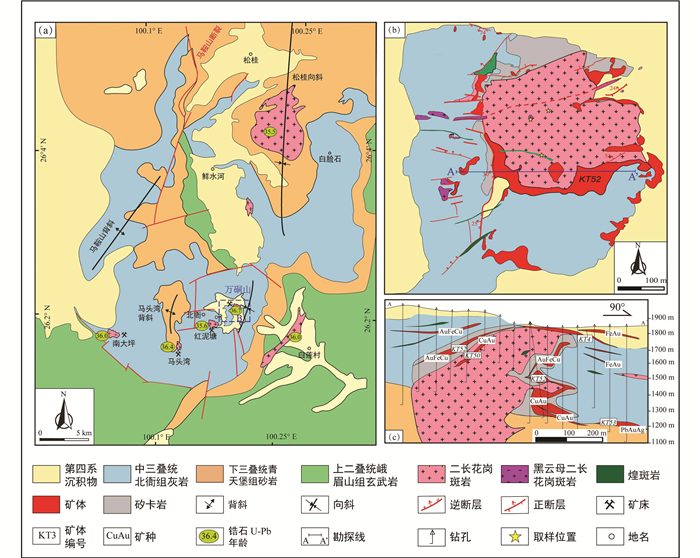
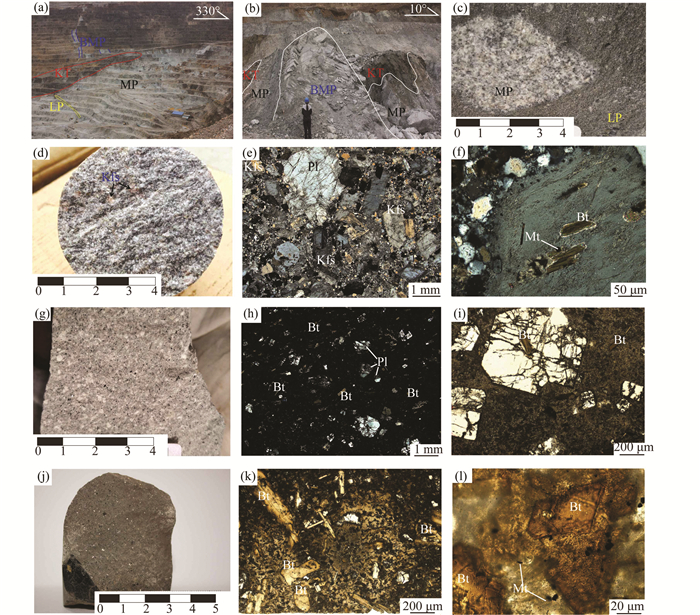
位于金沙江-哀牢山成矿带中段的北衙金矿床(图 1b,Deng et al., 2017b; He et al., 2017),总体受控于北北东向北衙向斜构造,并以北衙向斜轴部为界分为东西两矿带:东带包括锅盖山、笔架山、桅杆坡矿段,西带包括万硐山、红泥塘、金沟坝矿段(图 2a;鲍新尚等,2017)。区内出露的地层有上二叠统峨眉山组玄武岩、下三叠统青天堡组砂岩、中三叠统北衙组碳酸盐岩以及第四系粘土,其中中三叠统的北衙组碳酸盐岩是主要的赋矿层位(图 2b)。矿区岩浆岩分布广泛,以新生代富碱斑岩为主,岩性主要是二长花岗斑岩、黑云二长花岗斑岩和煌斑岩(和文言,2014;Liu et al., 2015)。野外观察显示煌斑岩脉体穿切二长花岗斑岩体(图 3a),黑云母二长花岗斑岩体穿切二长花岗斑岩体(图 3b)。三类岩体成岩年代相近,均在36~34Ma(和文言,2014),但岩相学和地球化学、成矿流体及物质来源的研究表明北衙矿床只与二长花岗斑岩体具有密切成因关系(和中华等,2013;和文言,2014;Deng et al., 2015; Liu et al., 2015; He et al., 2016)。
|
图 2 北衙金矿床矿区地质图(a)、万硐山矿段地质图(b)及勘探线剖面图(c)(据He et al., 2017) Fig. 2 Simplified geological map of the Beiya Au deposit (a), geological map of the Wangdongshan district (b) and representative cross section of Beiya deposit (c) showing the spatial relations among different strata units, intrusions, skarn and orebodies (after He et al., 2017) |
|
图 3 北衙金矿二长花岗斑岩、黑云母二长花岗斑岩和煌斑岩野外露头及镜下显微特征 (a)万硐山采场二长花岗斑岩体、黑云母二长花岗斑岩体和煌斑岩体分布;(b)黑云母二长花岗斑岩体侵入到二长花岗斑岩内;(c)煌斑岩中包裹二长花岗斑岩;(d)二长花岗斑岩手标本;(e)二长花岗斑岩(+);(f)钾长石斑晶内部发育黑云母;(g)黑云母二长花岗斑岩手标本;(h)黑云母二长花岗斑岩(+);(i)钾长石斑晶内部发育黑云母;(j)煌斑岩手标本;(k)煌斑岩(-);(l)云母和星点状分布的磁铁矿. MP-二长花岗斑岩;BMP-黑云母二长花斑岩;LP-煌斑岩;Kfs-钾长石;Pl-斜长石;Bt-黑云母;Mt-磁铁矿;KT-矿体 Fig. 3 The field outcrops, hand specimen and microscopic characteristics of the monzogranite porphyry, biotite monzogranite porphyry and lamprophyre from the Beiya Au deposit |
北衙矿区发育9处斑岩体,除红泥塘东侧岩体为隐伏岩体外,其它8处岩体均出露地表,出露总面积0.34km2(和文言,2014)。岩体大部分呈近南北走向,分布于北衙向斜两翼,与围岩多呈不规则状侵入接触及断层接触(Liu et al., 2015;鲍新尚等,2017)。区内喜马拉雅山期的岩浆岩包括二长花岗斑岩、黑云母二长花岗斑岩和煌斑岩,具体岩相学特征如下:
二长花岗斑岩呈灰白色,斑状结构(图 3d)。斑晶含量50%~60%,主要为钾长石、斜长石与石英(图 3e),含有少量的黑云母(图 3f)和角闪石。钾长石斑晶(35%~45%)呈自形-半自形板柱状,可见卡斯巴双晶,粒度1.0~5.0mm;斜长石斑晶(30%~35%)呈自形条状,粒径3~5mm;石英斑晶表面干净,粒度0.5~2.0mm,多溶蚀为似圆状和港湾状,含量约为5%~10%;暗色矿物含量10%~15%,以角闪石为主,黑云母较少。基质呈隐晶质,主要为钾长石和石英。副矿物有磷灰石、锆石、榍石、磁铁矿,局部可见黄铁矿化、褐铁矿化、方铅矿化和闪锌矿化。
黑云母二长花岗斑岩呈白色、灰白色,斑状结构(图 3g)。斑晶主要包括钾长石(40%)、斜长石(40%)、黑云母(15%),石英斑晶较少(图 3h)。镜下钾长石斑晶呈自形-半自形短柱状,粒度为1~3mm。黑云母斑晶呈长条状自形晶,粒径较小,部分可见一组极完全解理,棕黄-深褐色,多色性明显。基质主要由钾长石和斜长石组成。在万硐山采场西侧发育两条岩脉(图 3a),穿插于二长花岗斑岩体及北衙组碳酸盐岩,呈近东西向展布,出露长约172m,宽8~20m,东端穿插于二长花岗斑岩体中,接触界线清楚。
煌斑岩呈黄绿色,具煌斑结构(图 3c, i)。斑晶主要为黑云母和辉石(图 3j, k),含量分别为20%~30%、20%~35%,隶属于辉石云斜煌斑岩(和文言等,2014)。在万硐山采场中发育近东西向展布的煌斑岩脉,其穿切二长花岗斑岩体(图 3a)。
3 分析方法与结果 3.1 样品与测试分析将万硐山矿段中较为新鲜的二长花岗斑岩、黑云母二长花岗斑岩和煌斑岩样品制作光薄片,并在显微镜下挑选新鲜的黑云母做电子探针测试。探针片喷碳与样品测试工作在中国冶金地质总局山东局测试中心完成。黑云母成分采用日本电子JOEL公司生产的JXA-8230型电子探针分析仪分析测试,实验中的加速电压为15kV,束流为10×10-9A,束斑大小为5μm,测试的主量元素包括Na2O、MgO、Al2O3、SiO2、CaO、K2O、FeO、MnO、TiO2、P2O5、F、Cl等,主量元素的检出限约为0.01%,F的检出限约为0.11%,Cl的检出限约为0.02%,标样矿物分别为Si(翡翠)、Ti(金红石)、Al(钇铝榴石)、Fe(橄榄石)、Mn(蔷薇辉石)、Mg(橄榄石)、Ca(辉石)、Na(硬玉)、K(透长石)、P(磷灰石)、F(萤石)、Cl(铍方钠石)。
在万硐山矿段二长花岗斑岩样品(WDS14-6-2-1)和黑云母二长花岗斑岩(76ZK17-1)样品中,用常规的重选和磁选方法从全岩粉末样品中挑选出锆石单矿物颗粒,并用环氧树脂粘制成样品靶。结合光学显微镜和扫描电子显微镜,进行透、反射照相和阴极发光(CL),选择震荡环带较为发育并且无裂隙和包体的部位。在天津地质矿产研究所同位素实验室完成锆石微量元素含量的测试,分析所用仪器为Finnigan Neptune型MC-IPS-MS及与之配套的Newwave UP213激光剥蚀系统。分析所用激光斑束的直径为35μm,频率为10Hz,能量密度约为2.5J/cm2。激光剥蚀过程中采用氦气作为载气。LA-MC-ICP-MS激光剥蚀采用单点剥蚀的方式。锆石微量元素含量利用SRM 610参考玻璃作为外标、Si作为内标的方法进行定量计算(Liu et al., 2008)。
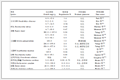
3.2 黑云母主量元素特征14个黑云母测试数据显示氧化物质量分数之和介于93.02%~97.06%,在误差允许的范围之内。按照黑云母的阳离子总数8、阴离子负电价23的理论值计算了黑云母的Fe2+、Fe3+(林文蔚和彭丽君,1994),并以22个氧原子为基础计算出黑云母的阳离子数及部分参数(表 1)。
|
表 1 北衙二长花岗斑岩、黑云二长花岗斑岩和煌斑岩中黑云母电子探针成分(wt%)及相关参数 Table 1 Results of the electron microprobe analyses (wt%) of representative primary biotities from the Beiya monzogranite porphyry, biotite monzogranite porphyry and lamprophyre |
本次研究的黑云母斑晶呈黄褐色、自形较好(图 3),多色性明显,表现出岩浆成因的黑云母特征(Nachit et al., 2005;唐攀等,2017)。此外,三类岩浆岩中黑云母Fe2+/(Mg+Fe2+)比值较均一(标准差为0.01),表明测试的黑云母均未遭受后期流体改造(Stone,2000);黑云母CaO的质量分数大多数低于检测限,显示出无钙或贫钙特征,表明其不受或很少受绿泥石化和碳酸盐化影响(Kumar and Pathak, 2010)。北衙三类岩浆岩中黑云母都属于镁质黑云母(图 4a),但各岩相中黑云母的主量元素组分存在一定差异。

|
图 4 北衙金矿二长花岗斑岩、黑云母二长花岗斑岩和煌斑岩中黑云母化学成分图 (a)黑云母分类图解(Foster,1960);(b)MgO-FeOT/(FeOT+MgO)图解(Elliott,2001);(c)FeOT-Al2O3图解;(d)MgO-MnO图解 Fig. 4 Chemical compositions of biotites from Beiya monzogranite porphyry, biotite monzogranite porphyry and lamprophyre (a) classification diagram of biotite (Foster, 1960); (b) the diagram of MgO vs. FeOT/(FeOT+MgO) (Elliott, 2001); (c) the diagram of FeOT vs. Al2O3; (d) the diagram of MgO vs. MnO relation |
二长花岗斑岩中黑云母具有相对较低的TiO2(1.54%~2.32%,均值1.94%)、Al2O3(图 4c;12.86%~12.90%,均值12.88%)含量和较高的MgO(14.99%~15.54%,均值15.30%)、F(2.11%~2.16%,均值2.13%)、Cl(0.13%~0.14%,均值0.14%)含量。以22个氧原子为单位计算的阳离子数中AlⅥ为0.04~0.09(均值0.07);利用阳离子数中Mg、Mn和Fe2+获得Mg#为0.65~0.66(均值0.66),Fe2+/(Mg+Fe2+)比值为0.33~0.35(均值0.34)。
黑云母二长花岗斑岩中黑云母具有中等TiO2含量(3.21%~4.09%,均值3.70%),较高的Al2O3含量(13.75%~14.44%,均值14.16%)和较低的MgO(12.04%~12.41%,均值12.26%,图 4d)、F(0.17%~0.48%,均值0.34%)、Cl(0.05%~0.10%,均值0.07%)含量。阳离子数中AlⅥ为0.08~0.17(均值0.12);Mg#为0.58~0.60(均值0.59),Fe2+/(Mg+Fe2+)比值为0.40~0.42(均值0.41)。
煌斑岩中黑云母具有中高的TiO2含量(3.60%~4.65%,均值3.98%),较高的Al2O3(13.66%~13.68%,均值13.67%)、MgO(15.62%~16.32%,均值16.15%)含量和较低的F(0.53%~0.78%,均值0.63%)、Cl(0.04%~0.06%,均值0.05%)含量。阳离子数中AlⅥ较低,为0.02~0.05(均值0.03);Mg#和Fe2+/(Mg+Fe2+)比值依次为0.72~0.74和0.26~0.27。
3.3 锆石微量元素特征锆石中可能含有独居石、磷灰石、榍石等矿物,这些以包裹体形式存在的含REE的矿物会影响锆石中REE含量(Zou et al., 2019)。因此本文选择La含量小于0.11×10⁻⁶和Pr含量小于0.30×10⁻⁶(表 2)的锆石开展数据分析,以此提高分析结果的可靠性。北衙二长花岗斑岩中锆石的稀土总量(∑REE)为733.3×10⁻⁶~859.7×10⁻⁶(表 2),轻重稀土比值(LREE/HREE)介于0.04~0.05之间(均值0.05),Ti含量为8.85×10-6~29.50×10-6,Ce异常范围是23.79~94.93(均值38.77)。但黑云母二长花岗斑岩中锆石具有较低的Ti含量(9.03×10-6~15.67×10-6)和Ce异常(13.20~16.83,均值14.89)。
|
|
表 2 北衙金矿二长花岗斑岩和黑云母二长花岗斑岩中锆石微量元素(×10-6)及相关参数 Table 2 Zircon trace element data (×10-6)from the Beiya monzogranite porphyry and biotite monzogranite porphyry |
锆石晶体中Ti易与Zr4+和Si4+类质呈同象的形式存在,且锆石结晶的温度对Ti含量及元素置换具有一定的制约(Watson et al., 2006;Shen et al., 2015),故而可利用锆石中的Ti计算锆石饱和温度(log(Ti) = 6.01±0.03-(5080±30)/T(K),Watson and Harrison, 2005)。结果显示二长花岗斑岩中锆石饱和温度为784~921℃(均值843℃),稍高于黑云母二长花岗斑岩中锆石饱和温度(786~845℃;均值807℃)。
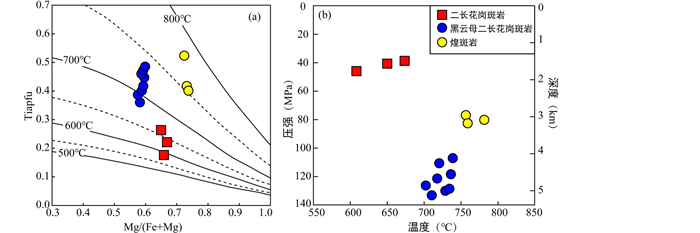
4 讨论 4.1 岩浆结晶物理化学条件 4.1.1 估算岩浆结晶温度和侵位深度黑云母中Ti含量对温度变化较敏感,可作为黑云母结晶温度高低的评价指标(Douce,1993;Henry et al., 2005)。北衙成矿的二长花岗斑岩中黑云母的TiO2含量(均值1.94%)低于黑云母二长花岗斑岩(均值3.70%)和煌斑岩(均值3.98%),暗示成矿的二长花岗斑岩的黑云母结晶温度更低。通过黑云母的Ti温度计(T = {[ln(Ti)+2.3594+1.7283×(XMg)3]/4.6482×10-9}0.333;其中XMg = 0.275~1.000,Ti = 0.040~0.600,T = 400~800℃为准确的校正范围;Henry et al., 2005;郭耀宇等,2015)获得二长花岗斑岩的黑云母结晶温度为608~672℃(均值644℃,图 5a),而黑云母二长花岗斑岩和煌斑岩的黑云母结晶温度分别是703~739℃(均值723℃)和757~782℃(均值766℃),进一步说明二长花岗斑岩具有更低的黑云母结晶温度。
|
图 5 北衙金矿二长花岗斑岩、黑云母二长花岗斑岩和煌斑岩中黑云母的Ti-Mg/(Mg+Fe)图解(a,据Henry et al., 2005)和温度-压强图解(b) Fig. 5 The Ti vs. Mg/(Mg+Fe) diagram (a, Henry et al., 2005) and temperature vs. pressure diagram (b) of the biotites from Beiya monzogranite porphyry, biotite monzogranite porphyry and lamprophyre |
黑云母的全铝含量(AlT,黑云母中铝阳离子总数)可用于估算岩浆固结压强(P(×100MPa) = 3.03×AlT-6.53(±0.33);Uchida et al., 2007)。结果显示二长花岗斑岩固结压强为39~46MPa(均值42MPa,表 2),整体低于黑云母二长花岗斑岩(107~133MPa,均值122MPa)和煌斑岩(77~83MPa,均值80MPa)(图 5b)。与黑云母二长花岗斑岩相比,煌斑岩具有较高的黑云母结晶温度和较低的固结压强(图 5b),暗示煌斑岩快速上侵。同时,采用P = ρgH(ρ = 2700kg/m3,g = 9.8m/s2)换算出二长花岗斑岩体侵位深度为1.46~1.74km(均值1.58km),整体低于黑云母二长花岗斑岩体(4.03~5.02km,均值4.60km)和煌斑岩体(2.53~2.72km,均值2.63km)的侵位深度。二长花岗斑岩中黑云母全铝含量估算的岩体侵位深度和矽卡岩中石榴石发育的含石盐子晶的三相包裹体的捕获深度(~2km)(和文言,2014;He et al., 2017),暗示二长花岗斑岩体侵位后流体发生沸腾。同时,周云满等(2018)使用地质重建法估算北衙金矿成矿深度为0.7~2.2km(其中矿体分布最大垂深0.91km),与黑云母、角闪石矿物化学组分估算的岩体侵位深度(1.2~2.4km,均值1.8km;Bao et al., 2018)一致。
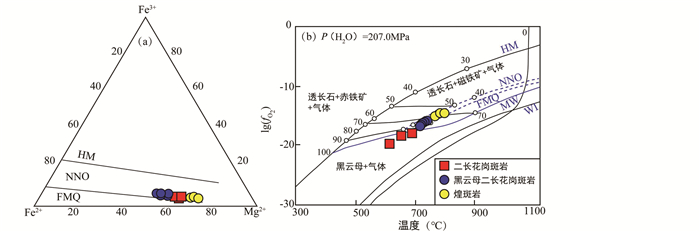
4.1.2 氧化状态除岩浆结晶温度和侵位深度外,岩浆的氧逸度也是影响岩浆演化过程的关键因素(Richards,2015;Meng et al., 2018)。黑云母Fe2+/(Fe2++Mg)比值均一是氧化态岩浆的重要标志(郭耀宇等,2015),二长花岗斑岩、黑云母二长花岗斑岩和煌斑岩中黑云母Fe2+/(Fe2++Mg)比值标准差为0.01,三类岩浆岩中黑云母均落在Ni-NiO与Fe2O3-Fe3O4两条缓冲线之间(图 6a,Carmichael,1991),表明三类岩体整体氧逸度相差不大。
|
图 6 北衙金矿二长花岗斑岩、黑云母二长花岗斑岩和煌斑岩中黑云母Fe3+-Fe2+-Mg2+图解(a)和温度-lg(fO2)图解(b)(据David and Hans, 1965) Fig. 6 The Fe3+-Fe2+-Mg2+ diagram (a) and temperature vs. lg(fO2) diagram (b) of the biotites from Beiya monzogranite porphyry, biotite monzogranite porphyry and lamprophyre (after David and Hans, 1965) |
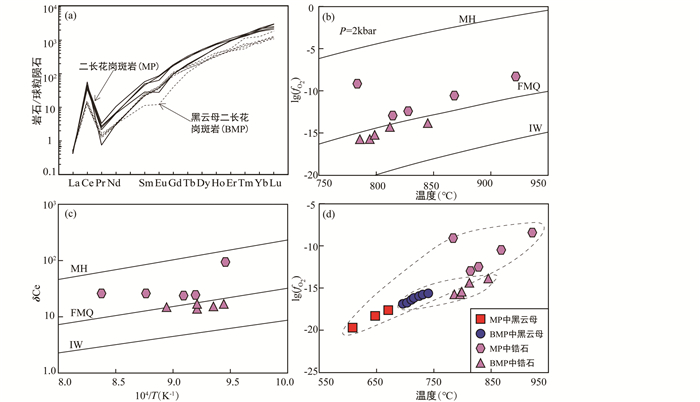
David and Hans(1965)通过研究与磁铁矿、钾长石共生的黑云母中Fe3+、Fe2+和Mg2+原子的百分数,提出在P(H2O)=207.0MPa的条件下基于黑云母稳定度[100×Fe/(Fe+Mg)]的lg(fO2)-T图解(图 6b),结合黑云母Ti温度计作为与黑云母平衡的岩浆温度,可用于估算岩体的氧逸度(lg(fO2) = 10.9-27000/T(K);David and Hans, 1965)。二长花岗斑岩体的氧逸度lg(fO2)变化范围是-19.70~-17.63(均值-18.5),低于黑云母二长花岗斑岩体(-16.74~-15.75,均值-16.2)和煌斑岩体(-15.29~-14.67,均值-15.1)。但锆石微量元素组分(图 7a)估算的锆石结晶时二长花岗斑岩体的氧逸度lg(fO2)为-12.94~-8.33(均值-10.67;图 7b,c),高于黑云母二长花岗斑岩体(-15.80~-13.88,均值-15.00)。岩浆结晶过程中,岩浆的高氧逸度导致S以SO42-形式存在,从而抑制了铜、金以硫化物的形式晶出(Richards,2015;Qiu and Deng, 2017;Meng et al., 2018),间接提高了熔体或流体中铜、金等成矿元素的含量。因此,具有高氧逸度的二长花岗斑岩体更具有成矿潜力。除此之外,在岩浆演化过程中,先晶出锆石,后晶出黑云母,因此二长花岗斑岩中锆石组分估算的氧逸度比黑云母组分估算的氧逸高,表明二长花岗斑岩体在演化过程中氧化程度下降(图 7d),但氧逸度发生改变的原因需要进一步开展工作研究。
|
图 7 北衙金矿二长花岗斑岩、黑云母二长花岗斑岩的岩浆氧化状态 (a)锆石稀土元素球粒陨石标准化配分图(Boynton,1984);(b)斑岩体lg(fO2)与锆石结晶温度的图解(Trail et al., 2011);(c)锆石Ce异常-104/T图解(Trail et al., 2011);(d)斑岩体lg(fO2)与锆石、黑云母的结晶温度的图解 Fig. 7 Magmatic oxidation states of Beiya Au deposit estimated by zircons and biotites (a) chondrite-normalized REE patterns (normalized values after Boynton, 1984); (b) zircon lg(fO2) vs. temperature (Trail et al., 2011); (c) linear relations for zircon Ce anomaly vs. 104/T (Trail et al., 2011); (d) lg(fO2) vs. temperature of zircons and biotites. MH: magnetite-hematite buffer curve; FMQ: fayalite-magnetite-quartz buffer curve; IW: iron-wustite |
黑云母的主量元素特征可以指示花岗岩的源区性质和成因类型(David and Hans, 1965;Bi et al., 2009)。北衙二长花岗斑岩和黑云母二长花岗斑岩均形成于36~34Ma(和文言,2014),具有相似的微量及稀土配分特征(和文言,2014;Liu et al., 2015;孙诺,2015),暗示北衙二长花岗斑岩和黑云母二长花岗斑岩形成于相同的源区(和文言,2014;Liu et al., 2015;Mao et al., 2017)。幔源黑云母具有较高的MgO含量(>15%;阳珊等,2014);而壳源黑云母具有较低的MgO含量(<6%;阳珊等,2014)。二长花岗斑岩和黑云母二长花岗斑岩中黑云母均具有中等的MgO含量(14.99%~15.54%;12.04%~12.41%),而煌斑岩中黑云母具有较高的MgO含量(15.62%~16.32%),暗示二长花岗斑岩体和黑云母二长花岗斑岩体的源区为壳幔混源,煌斑岩的源区以幔源为主(图 4b),此结果与北衙花岗质斑岩具有不均一的εHf(t)同位素组成(-6~+4)相一致(和文言,2014)。
I型花岗岩中黑云母相对富镁,具有较高的Mg#(0.384~0.626)和较低的AlⅥ(0.144~0.224)(Abdel-Rahman,1994;徐克勤和涂光炽,1986)。而S型花岗岩中黑云母相对富铝,具有较高的AlⅥ(0.353~0.561)和较低的Mg#(徐克勤和涂光炽,1986)。二长花岗斑岩和黑云母二长花岗斑岩中黑云母均为镁质黑云母(图 4a),且二长花岗斑岩和黑云母二长花岗斑岩中黑云母均具有较低的AlⅥ(二长花岗斑岩:0.04~0.09;黑云母二长花岗斑岩:0.08~0.17)和较高的Mg#(二长花岗斑岩:0.65~0.66;黑云母二长花岗斑岩:0.58~0.60),表明二长花岗斑岩和黑云母二长花岗斑岩属于I型花岗岩。
4.3 岩浆分异程度二长花岗斑岩体的锆石结晶温度(784~921℃)比黑云母二长花岗斑岩体(786~845℃)高,但二长花岗斑岩体的黑云母结晶温度(608~672℃)比黑云母二长花岗斑岩体(703~739℃)低,暗示二长花岗斑岩体的结晶温度范围更广,结晶分异作用可能更充分。为此,本文利用和文言(2014)和孙诺(2015)二长花岗斑岩、黑云母二长花岗斑岩和煌斑岩的主微量数据计算三类岩体的结晶分异程度。
二长花岗斑岩的轻重稀土比值(LREE/HREE = 6.64~15.1,均值10.5)和La/Yb比值(9.18~39.8,均值21.4)明显低于黑云母二长花岗斑岩(11.31~13.61,均值12.27;23.47~25.00,均值24.04)和煌斑岩(13.00~18.24,均值16.76;35.98~66.27,均值52.19),表明二长花岗斑岩的轻重稀土分馏程度最低。轻重稀土分馏程度的差异暗示二长花岗斑岩、黑云母二长花岗斑岩和煌斑岩经历了不同程度的结晶分异作用。
二长花岗斑岩分异指数为90.32~96.65,明显高于黑云母二长花岗斑岩(85.18~93.92)和煌斑岩(68.18~80.68,图 8a),显示更高的分异演化程度。同时,岩浆都是向贫MgO方向演化,而且MgO含量的变化比SiO2含量更显著(韩吟文和马振东,2003)。二长花岗斑岩的MgO含量(0.11%~0.33%)低于黑云母二长花岗斑岩样品(0.85%~1.14%)和煌斑岩(2.35%~5.59%),结合二长花岗斑岩的Rb/Sr值(0.33~0.67)整体高于黑云母二长花岗斑岩(0.20~0.37)和煌斑岩(0.12~0.28,图 8b),进一步说明二长花岗斑岩体的分异结晶程度更为强烈(Blevin,2002)。

|
图 8 北衙金矿二长花岗斑岩体、黑云母二长花岗斑岩体和煌斑岩体的岩浆分异程度 (a)SiO2-分异系数图解;(b)SiO2-Rb/Sr图解.数据来源:和文言(2014);孙诺(2015) Fig. 8 Magma differentiation degree of monzogranite porphyry, biotite monzogranite porphyry and lamprophyre from the Beiya Au deposit (a)SiO2 vs. DI diagram; (b)SiO2 vs. Rb/Sr diagram. Data sources: He (2014); Sun (2015) |
前人研究显示,铜、金的溶解度随着温度升高而增大(胡正国,1989;Botcharnikov et al., 2010;Yang et al., 2016a)。二长花岗斑岩的锆石结晶温度(均值843℃)高于黑云母二长花岗斑岩的锆石结晶温度(均值807℃),表明岩浆结晶初期二长花岗斑岩体中金具有较高的溶解度。同时,相比黑云母二长花岗斑岩,北衙二长花岗斑岩较高的锆石氧逸度(图 7b-d)抑制了金以硫化物的形式沉淀,有利于金在岩浆早期的聚集(Sun et al., 2004;Zajacz et al., 2013),最终提高二长花岗斑岩的成矿潜力。
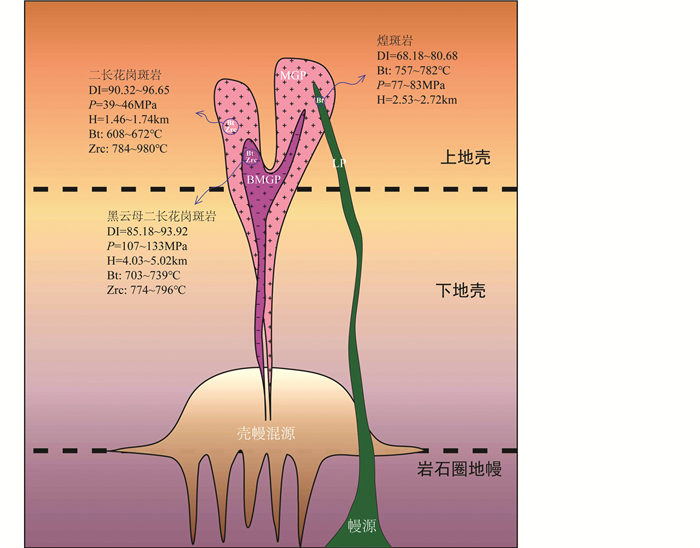
除此之外,成矿的二长花岗斑岩中黑云母的F含量(2.11%~2.16%)明显高于黑云母二长花岗斑岩(0.17%~0.48%)和煌斑岩(0.53%~0.78%),表明二长花岗斑岩体的粘度比黑云母二长花岗斑岩体粘度小(张德会等,2004),故而二长花岗斑岩体具有较浅的侵位深度(1.46~1.74km),且黑云母二长花岗斑岩或煌斑岩穿插于二长花岗斑岩体内(图 9)。二长花岗斑岩体的侵位深度与石榴石中包含石盐子晶的三相包裹体的捕获深度(~2km)近似,也暗示了二长花岗斑岩体就位后,发生了流体沸腾作用。同时,岩浆侵位深度大不仅造成母岩浆中出溶的流体几乎没有能量形成裂隙(张德会,2001),还导致流体很难发生对金属富集有重要影响的不混溶作用(Robb,2005),这可能也是黑云母二长花岗斑岩体不成矿的原因之一。
|
图 9 北衙金矿二长花岗斑岩体、黑云母二长花岗斑岩体和煌斑岩体侵位模式图 Fig. 9 Cartoons illustrating the emplacement progress of monzogranite porphyry, biotite monzogranite porphyry and lamprophyre from the Beiya Au deposit |
(1) 黑云母和锆石化学成分的差异反映其形成时物理化学条件的差异。北衙二长花岗斑岩中黑云母具有最低的TiO2含量(二长花岗斑岩、黑云母二长花岗斑岩、煌斑岩依次对应1.94%、3.70%、3.98%),指示二长花岗斑岩具有最低的黑云母结晶温度(644℃、723℃、766℃),结合二长花岗斑岩的锆石结晶温度(均值843℃)高于黑云母二长花岗斑岩(均值807℃),表明二长花岗斑岩结晶温度范围更广。同时,二长花岗斑岩中黑云母具有最低的全铝含量(2.28~2.31、2.51~2.59、2.41~2.46),指示二长花岗斑岩具有最小的固结压强(42MPa、122MPa、80MPa)和最浅的侵位深度(1.46~1.74km、4.03~5.02km、2.53~2.72km)。
(2) 北衙成矿二长花岗斑岩体具有较高的锆石结晶温度和氧逸度,高温有利于提高金在熔体中溶解度,而高氧逸度又抑制了金以硫化物形式沉淀,从而增强了二长花岗斑岩体中金的浓度。除此之外,北衙二长花岗斑岩具有最浅的侵位深度。高压条件下岩浆中出溶的流体几乎没有能量形成裂隙,对金属富集有重要影响的流体不混溶作用也很难发生。因此,岩浆氧逸度和侵位深度的差异是黑云母二长花岗斑岩体和煌斑岩体未成矿的原因。
致谢 感谢云南黄金集团和中华教授级高级工程师,杨锐和王从明工程师对野外工作的帮助。感谢张瑞刚、王晨光在制作光薄片和实验过程中给予的帮助。
翟裕生院士在区域矿床的成矿规律、矿产勘查以及矿床学理论研究等方面做出了杰出贡献,恰逢翟先生九十大寿,谨以此文表示热烈祝贺,并表达对翟先生的敬仰之情。
Abdel-Rahman AFM. 1994. Nature of biotites from alkaline, calc-alkaline, and peraluminous magmas. Journal of Petrology, 35(2): 525-541 DOI:10.1093/petrology/35.2.525 |
Bao XS, He WY and Gao X. 2017. The Beiya gold deposit:Constrainition of water-rich magmas to mineralization. Acta Petrologica Sinica, 33(7): 2175-2188 (in Chinese with English abstract) |
Bao XS, Yang LQ, He WY and Gao X. 2018. Importance of magmatic water content and oxidation state for porphyry-style Au mineralization:An example from the giant Beiya Au deposit, SW China. Minerals, 8(10): 441 DOI:10.3390/min8100441 |
Bi XW, Hu RZ, Hanley JJ, Mungall JE, Peng JT, Shang LB, Wu KX, Yan S, Li HL and Hu XY. 2009. Crystallization conditions (T, P, fO2) from mineral chemistry of Cu-and Au-mineralized alkaline intrusions in the Red River-Jinshajiang alkaline igneous belt, western Yunnan Province, China. Mineralogy and Petrology, 96(1-2): 43-58 DOI:10.1007/s00710-009-0047-4 |
Blevin PL. 2002. The petrographic and compositional character of variably K-enriched magmatic suites associated with Ordovician porphyry Cu-Au mineralization in the Lachlan fold belt, Australia. Mineralium Deposita, 37(1): 87-99 DOI:10.1007/s00126-001-0232-9 |
Blevin PL. 2004. Redox and compositional parameters for interpreting the granitoid metallogeny of eastern Australia:Implications for gold-rich ore systems. Resource Geology, 54(3): 241-252 DOI:10.1111/rge.2004.54.issue-3 |
Botcharnikov RE, Linnen RL and Holtz F. 2010. Solubility of Au in Cl-and S-bearing hydrous silicate melts. Geochimica et Cosmochimica Acta, 74(8): 2396-2411 DOI:10.1016/j.gca.2009.09.021 |
Boynton WV. 1984. Cosmochemistry of the rare earth elements:Meteorite studies. Developments in Geochemistry, 2: 63-114 DOI:10.1016/B978-0-444-42148-7.50008-3 |
Carmichael ISE. 1991. The redox states of basic and silicic magmas:A reflection of their source regions?. Contributions to Mineralogy and Petrology, 106(2): 129-141 DOI:10.1007/BF00306429 |
David RW and Hans PE. 1965. Stability of biotite:Experiment, theory, and application. American Mineralogist, 50(9): 1228-1272 |
Deng J, Wang CM and Li GJ. 2012. Style and process of the superimposed mineralization in the Sanjiang Tethys. Acta Petrologica Sinica, 28(5): 1349-1361 (in Chinese with English abstract) |
Deng J, Wang QF, Li GJ, Li CS and Wang CM. 2014a. Tethys tectonic evolution and its bearing on the distribution of important mineral deposits in the Sanjiang region, SW China. Gondwana Research, 26(2): 419-437 DOI:10.1016/j.gr.2013.08.002 |
Deng J, Wang QF, Li GJ and Santosh M. 2014b. Cenozoic tectono-magmatic and metallogenic processes in the Sanjiang region, southwestern China. Earth-Science Reviews, 138: 268-299 DOI:10.1016/j.earscirev.2014.05.015 |
Deng J, Wang QF, Li GJ, Hou ZQ, Jiang CZ and Danyushevsky L. 2015. Geology and genesis of the giant Beiya porphyry-skarn gold deposit, northwestern Yangtze Block, China. Ore Geology Reviews, 70: 457-485 DOI:10.1016/j.oregeorev.2015.02.015 |
Deng J and Wang QF. 2016. Gold mineralization in China:Metallogenic provinces, deposit types and tectonic framework. Gondwana Research, 36: 219-274 DOI:10.1016/j.gr.2015.10.003 |
Deng J, Wang QF and Li GJ. 2017a. Tectonic evolution, superimposed orogeny, and composite metallogenic system in China. Gondwana Research, 50: 216-266 DOI:10.1016/j.gr.2017.02.005 |
Deng J, Liu XF, Wang QF, Dilek K and Yang LQ. 2017b. Isotopic characterization and petrogenetic modeling of early cretaceous mafic diking:Lithospheric extension in the North China craton, eastern Asia. GSA Bulletin, 129(11-12): 1379-1407 DOI:10.1130/B31609.1 |
Deng J, Wang CM, Bagas L, Santosh M and Yao EY. 2018a. Crustal architecture and metallogenesis in the south-eastern North China Craton. Earth-Science Reviews, 182: 251-272 DOI:10.1016/j.earscirev.2018.05.001 |
Deng J, Wang CM, Zi JW, Xia R and Li Q. 2018b. Constraining subduction-collision processes of the Paleo-Tethys along the Changning-Menglian Suture:New zircon U-Pb ages and Sr-Nd-Pb-Hf-O isotopes of the Lincang Batholith. Gondwana Research, 62: 75-92 DOI:10.1016/j.gr.2017.10.008 |
Deng J, Yang LQ, Li RH, Groves DI, Santosh M, Wang ZL, Sai SX and Wang SR. 2019. Regional structural control on the distribution of world-class gold deposits:An overview from the Giant Jiaodong Gold Province, China. Geological Journal, 54(1): 378-391 DOI:10.1002/gj.v54.1 |
Douce AEP. 1993. Titanium substitution in biotite:An empirical model with applications to thermometry, O2 and H2O barometries, and consequences for biotite stability. Chemical Geology, 108(1-4): 133-162 DOI:10.1016/0009-2541(93)90321-9 |
Elliott BA. 2001. Crystallization conditions of the Wiborg rapakivi batholith, SE Finland:An evaluation of amphibole and biotite mineral chemistry. Mineralogy and Petrology, 72(4): 305-324 DOI:10.1007/s007100170021 |
Foster MD. 1960. Interpretation of the composition of trioctahedral micas. US Geological Survey Professional Paper. Washington DC: US Geological Survey, 11-49
|
Guo YY, He WY, Li ZC, Ji XZ, Han Y, Fang WK and Yin C. 2015. Petrogenesis of Ge'erkuohe porphyry granitoid, western Qinling:Constraints from mineral chemical characteristics of biotites. Acta Petrologica Sinica, 31(11): 3380-3390 (in Chinese with English abstract) |
Han YW and Ma ZD. 2003. Geochemistry. Beijing: Geological Publishing House, 268-301 (in Chinese)
|
He WY. 2014. The Beiya giant gold-polymetallic deposit:Magmatism and metallogenic model. Beijing: China University of Geosciences
|
He WY, Mo XX, Yu XH, Dong GC, He ZH, Huang XF, Li XW and Jiang LL. 2014. Genesis and geodynamic settings of lamprophyres from Beiya, western Yunnan:Constraints from geochemistry, geochronology and Sr-Nd-Pb-Hf isotopes. Acta Petrologica Sinica, 30(11): 3287-3300 (in Chinese with English abstract) |
He WY, Mo XX, He ZH, White NC, Chen JB, Yang KH, Wang R, Yu XH, Dong GC and Huang XF. 2015. The geology and mineralogy of the Beiya skarn gold deposit in Yunnan, Southwest China. Economic Geology, 110(6): 1625-1641 DOI:10.2113/econgeo.110.6.1625 |
He WY, Mo XX, Yang LQ, Xing YL, Dong GC, Yang Z, Gao X and Bao XS. 2016. Origin of the Eocene porphyries and mafic microgranular enclaves from the Beiya porphyry Au polymetallic deposit, western Yunnan, China:Implications for magma mixing/mingling and mineralization. Gondwana Research, 40: 230-248 DOI:10.1016/j.gr.2016.09.004 |
He WY, Yang LQ, Brugger J, McCuaig TC, Lu YJ, Bao XS, Gao XQ, Lu YG and Xing YL. 2017. Hydrothermal evolution and ore genesis of the Beiya giant Au polymetallic deposit, western Yunnan, China:Evidence from fluid inclusions and H-O-S-Pb isotopes. Ore Geology Reviews, 90: 847-862 DOI:10.1016/j.oregeorev.2016.10.035 |
He ZH, Zhou YM, He WY, Su GS, Li WH and Yang SW. 2013. Genetic types and metallogenic regularity of Beiya superlarge gold-polymetallic deposit, northwestern Yunnan. Mineral Deposits, 32(2): 244-258 (in Chinese with English abstract) |
Henry DJ, Guidotti CV and Thomson JA. 2005. The Ti-saturation surface for low-to-medium pressure metapelitic biotites:Implications for geothermometry and Ti-substitution mechanisms. American Mineralogist, 90(2-3): 316-328 DOI:10.2138/am.2005.1498 |
Hu ZG. 1989. A review on experimental study of the formation of hydrothermal gold deposit. Geological Science and Technology Information, 8(4): 75-80 (in Chinese with English abstract) |
Jégo S, Nakamura M, Kimura JI, Iizuka Y, Chang Q and Zellmer GF. 2016. Is gold solubility subject to pressure variations in ascending arc magmas?. Geochimica et Cosmochimica Acta, 188: 224-243 DOI:10.1016/j.gca.2016.05.034 |
Kumar S and Pathak M. 2010. Mineralogy and geochemistry of biotites from Proterozoic granitoids of western Arunachal Himalaya:Evidence of bimodal granitogeny and tectonic affinity. Journal of the Geological Society of India, 75(5): 715-730 DOI:10.1007/s12594-010-0058-0 |
Lin WW and Peng LJ. 1994. The estimation of Fe3+ and Fe2+ contents in amphibole and biotite from EMPA data. Journal of Changchun University of Earth Sciences, 24(2): 155-162 (in Chinese with English abstract) |
Liu B, Liu H, Zhang CQ, Mao ZH, Zhou YM, Huang H, He ZH and Su GS. 2015. Geochemistry and geochronology of porphyries from the Beiya gold-polymetallic orefield, western Yunnan, China. Ore Geology Reviews, 69: 360-379 DOI:10.1016/j.oregeorev.2015.03.004 |
Liu YS, Hu ZC, Gao S, Günther D, Xu J, Gao CG and Chen HH. 2008. In situ analysis of major and trace elements of anhydrous minerals by LA-ICP-MS without applying an internal standard. Chemical Geology, 257(1-2): 34-43 DOI:10.1016/j.chemgeo.2008.08.004 |
Loader MA, Wilkinson JJ and Armstrong RN. 2017. The effect of titanite crystallization on Eu and Ce anomalies in zircon and its implications for the assessment of porphyry Cu deposit fertility. Earth and Planetary Science Letters, 472: 107-119 DOI:10.1016/j.epsl.2017.05.010 |
Lu YJ, Kerrich R, Kemp AIS, McCuaig TC, Hou ZQ, Hart CJR, Li ZX, Cawood PA, Bagas L, Yang ZM, Cliff J, Belousova EA, Jourdan F and Evans NJ. 2013. Intracontinental Eocene-Oligocene porphyry Cu mineral systems of Yunnan, western Yangtze Craton, China:Compositional characteristics, sources, and implications for continental collision metallogeny. Economic Geology, 108(7): 1541-1576 DOI:10.2113/econgeo.108.7.1541 |
Mao JW, Zhou YM, Liu H, Zhang CQ, Fu DG and Liu B. 2017. Metallogenic setting and ore genetic model for the Beiya porphyry-skarn polymetallic Au orefield, western Yunnan, China. Ore Geology Reviews, 86: 21-34 DOI:10.1016/j.oregeorev.2017.02.003 |
Meng XY, Mao JW, Zhang CQ, Zhang DY and Liu H. 2018. Melt recharge, fO2-T conditions, and metal fertility of felsic magmas:Zircon trace element chemistry of Cu-Au porphyries in the Sanjiang orogenic belt, Southwest China. Mineralium Deposita, 53(5): 649-663 DOI:10.1007/s00126-017-0768-y |
Nachit H, Ibhi A, Abia EH and Ohoud MB. 2005. Discrimination between primary magmatic biotites, re-equilibrated biotites and neo-formed biotites. Comptes Rendus Géoscience, 337(16): 1415-1420 DOI:10.1016/j.crte.2005.09.002 |
Qiu KF, Taylor RD, Song YH, Yu HC, Song KR and Li N. 2016a. Geologic and geochemical insights into the formation of the Taiyangshan porphyry copper-molybdenum deposit, Western Qinling Orogenic Belt, China. Gondwana Research, 35: 40-58 DOI:10.1016/j.gr.2016.03.014 |
Qiu KF, Deng J, Taylor RD, Song KR, Song YH, Li QZ and Goldfarb RJ. 2016b. Paleozoic magmatism and porphyry Cu-mineralization in an evolving tectonic setting in the North Qilian Orogenic Belt, NW China. Journal of Asian Earth Sciences, 122: 20-40 DOI:10.1016/j.jseaes.2016.02.007 |
Qiu KF and Deng J. 2017. Petrogenesis of granitoids in the Dewulu skarn copper deposit:Implications for the evolution of the Paleotethys Ocean and mineralization in western Qinling, China. Ore Geology Reviews, 90: 1078-1098 DOI:10.1016/j.oregeorev.2016.09.027 |
Richards JP. 2015. The oxidation state, and sulfur and Cu contents of arc magmas:Implications for metallogeny. Lithos, 233: 27-45 DOI:10.1016/j.lithos.2014.12.011 |
Robb L. 2005. Introduction to Ore-forming Processes. Malden: Blackwell Publishing, 1-386
|
Shen P, Hattori K, Pan HD, Jackson S and Seitmuratova E. 2015. Oxidation condition and metal fertility of granitic magmas:Zircon trace-element data from porphyry Cu deposits in the central Asian Orogenic Belt. Economic Geology, 110(7): 1861-1878 DOI:10.2113/econgeo.110.7.1861 |
Shen Y, Zheng YC, Ma R, Zhang AP, Xu PY, Wu CD and Wang ZX. 2018. Mineralogical characteristics of hornblendes and biotites in ore-forming porphyry from Machangqing Cu-Mo deposit in Yunnan Province and their significance. Mineral deposits, 37(4): 797-815 (in Chinese with English abstract) |
Sillitoe RH. 2010. Porphyry copper systems. Economic Geology, 105(1): 3-41 DOI:10.2113/gsecongeo.105.1.3 |
Stone D. 2000. Temperature and pressure variations in suites of Archean felsic plutonic rocks, Berens River area, Northwest Superior Province, Ontario, Canada. The Canadian Mineralogist, 38(2): 455-470 DOI:10.2113/gscanmin.38.2.455 |
Sun N. 2015. The metallogenic model of the typical deposits in Jinsha River-Ailaoshan alkali-rich porphyry belt. Ph. D. Dissertation. Beijing: China University of Geosciences (in Chinese with English summary)
|
Sun WD, Arculus RJ, Kamenetsky VS and Binns RA. 2004. Release of gold-bearing fluids in convergent margin magmas prompted by magnetite crystallization. Nature, 431(7011): 975-978 DOI:10.1038/nature02972 |
Sun WD, Huang RF, Li H, Hu YB, Zhang CC, Sun AJ, Zhang LP, Ding X, Li CY, Zartman RE and Ling MM. 2015. Porphyry deposits and oxidized magmas. Ore Geology Reviews, 65: 97-131 DOI:10.1016/j.oregeorev.2014.09.004 |
Tang P, Tang JX, Zheng WB, Leng QF and Lin B. 2017. Progress in study of mineral chemistry of magmatic and hydrothermal biotites. Mineral Deposits, 36(4): 935-950 (in Chinese with English abstract) |
Trail D, Watson EB and Tailby ND. 2011. The oxidation state of Hadean magmas and implications for early Earth's atmosphere. Nature, 480(7375): 79-82 DOI:10.1038/nature10655 |
Tu GC. 1989. On the alkali-rich intrusive rocks. Mineral Resources and Geology, 3(3): 1-4 (in Chinese with English abstract) |
Uchida E, Endo S and Makino M. 2007. Relationship between solidification depth of granitic rocks and formation of hydrothermal ore deposits. Resource Geology, 57(1): 47-56 DOI:10.1111/rge.2007.57.issue-1 |
Wang JH. 2017. The study of alkali-rich porphyry on polymetallic metallogenic system in Beiya gold deposit, Heqing, western Yunnan. Ph. D. Dissertation Kunming: Kunming University of Science and Technology (in Chinese with English summary)
|
Wang SL, Shang LB, Bi XW and Fan WL. 2014. Gold property in silicate melts and fluids and its gold distribution behaviors between melts and coexisting fluids. Advances in Earth Science, 29(6): 683-690 (in Chinese with English abstract) |
Watson EB and Harrison TM. 2005. Zircon thermometer reveals minimum melting conditions on earliest earth. Science, 308(5723): 841-844 DOI:10.1126/science.1110873 |
Watson EB, Wark DA and Thomas JB. 2006. Crystallization thermometers for zircon and rutile. Contributions to Mineralogy and Petrology, 151: 413-433 DOI:10.1007/s00410-006-0068-5 |
Whalen JB and Chappell BW. 1988. Opaque mineralogy and mafic mineral chemistry of I-and S-type granites of the Lachlan fold belt, southeast Australia. American Mineralogist, 73(3-4): 281-296 |
Xiang K, Xue CD, Xie ZP and Lai RJ. 2019. Petrogenesis of the late Yanshanian Laba granite in northwestern Yunnan Province and its metallogenic implications:Evidence from mineral chemistry of biotites and amphiboles. Acta Petrologica et Mineralogica, 38(01): 34-46 (in Chinese with English abstract) |
Xu KQ and Tu GC. 1986. Relationship between Granitic Rocks and Mineralization. Nanjing: Science and Technology of Jiangsu Press, 1-645 (in Chinese)
|
Xu SM, Mo XX, Zeng PS, Zhang WH, Zhao HB and Zhao HD. 2006. Characteristics and origin of alkali-rich porphyries from Beiya in western Yunnan. Geoscience, 20(4): 527-535 (in Chinese with English abstract) |
Yang LQ, Deng J, Zhao K and Liu JT. 2011. Tectono-thermochronology and gold mineralization events of orogenic gold deposits in Ailaoshan orogenic belt, Southwest China:Geochronological constraints. Acta Petrologica Sinica, 27(9): 2519-2532 (in Chinese with English abstract) |
Yang LQ, Deng J, Dilek Y, Qiu KF, Ji XZ, Li N, Taylor RD and Yu JY. 2015. Structure, geochronology, and petrogenesis of the Late Triassic Puziba granitoid dikes in the Mianlue Suture Zone, Qinling Orogen, China. GSA Bulletin, 127(11-12): 1831-1854 DOI:10.1130/B31249.1 |
Yang LQ, Deng J, Dilek Y, Meng JY, Gao X, Santosh M, Wang D and Yan H. 2016a. Melt source and evolution of I-type granitoids in the SE Tibetan Plateau:Late Cretaceous magmatism and mineralization driven by collision-induced transtensional tectonics. Lithos, 245: 258-273 DOI:10.1016/j.lithos.2015.10.005 |
Yang LQ, Deng J, Guo LN, Wang ZL, Li XZ and Li JL. 2016b. Origin and evolution of ore fluid, and gold-deposition processes at the giant Taishang gold deposit, Jiaodong Peninsula, eastern China. Ore Geology Reviews, 72: 585-602 DOI:10.1016/j.oregeorev.2015.08.021 |
Yang LQ, Deng J, Wang ZL, Guo LN, Li RH, Groves DI, Danyushevsky LV, Zhang C, Zheng XL and Zhao H. 2016c. Relationships between gold and pyrite at the Xincheng gold deposit, Jiaodong Peninsula, China:Implications for gold source and deposition in a brittle epizonal environment. Economic Geology, 111(1): 105-126 DOI:10.2113/econgeo.111.1.105 |
Yang LQ, He WY, Gao X, Xie SX and Yang Z. 2018. Mesozoic multiple magmatism and porphyry-skarn Cu-polymetallic systems of the Yidun Terrane, Eastern Tethys:Implications for subduction-and transtension-related metallogeny. Gondwana Research, 62: 144-162 DOI:10.1016/j.gr.2018.02.009 |
Yang S, Jiang ZP, Yuan XL, Wang F, Zhang Q and Yu Z. 2014. Mineralogy of ore-hosting intrusions of the Shapinggou molybdenum deposit in Jinzhai County of Anhui Province and its implications for petrogenesis and mineralization. Acta Petrologica et Mineralogica, 33(2): 243-254 (in Chinese with English abstract) |
Yang ZM, Hou ZQ, Xu JF, Bian XF, Wang GR, Yang ZS, Tian SH, Liu YC and Wang ZL. 2014. Geology and origin of the post-collisional Narigongma porphyry Cu-Mo deposit, southern Qinghai, Tibet. Gondwana Research, 26(2): 536-556 DOI:10.1016/j.gr.2013.07.012 |
Yang ZM and Cooke DR. 2019. Porphyry copper deposits in China. In: The Editorial Committee of the Mineral Deposits of China (ed.). Mineral Deposits of China. Beijing: Society of Economic Geologists, 22: 1-55
|
Zajacz Z, Candela PA, Piccoli PM, Wälle M and Sanchez-Valle C. 2012. Gold and copper in volatile saturated mafic to intermediate magmas:Solubilities, partitioning, and implications for ore deposit formation. Geochimica et Cosmochimica Acta, 91: 140-159 DOI:10.1016/j.gca.2012.05.033 |
Zajacz Z, Candela PA, Piccoli PM, Sanchez-Valle C and Wälle M. 2013. Solubility and partitioning behavior of Au, Cu, Ag and reduced S in magmas. Geochimica et Cosmochimica Acta, 112: 288-304 DOI:10.1016/j.gca.2013.02.026 |
Zhang DH, Zhang WH and Xu JG. 2001. Exsolution and evolution of magmatic hydrothermal fluids and their constraints on the porphyry ore-forming system. Earth Science Frontiers, 8(3): 193-202 (in Chinese with English abstract) |
Zhang DH, Zhang WH and Xu JG. 2004. The ore fluid geochemistry of F-rich silicate melt-hydrous fluid system and its metallogeny:The current status and problems. Earth Science Frontiers, 11(2): 479-490 (in Chinese with English abstract) |
Zhang DH. 2015. Geochemistry of Ore-forming Processes. Beijing: Geological Publishing House, 149-165 (in Chinese)
|
Zhou YM, Zhang CQ, He ZH, Liu H, Zhou GW, Sun J and Liu B. 2018. Geological characteristics and ore-controlling factors of the Beiya gold-polymetallic ore deposit, northwestern Yunnan Province. Acta Geologica Sinica, 92(5): 1841-1861 DOI:10.1111/acgs.2018.92.issue-5 |
Zhou YM, Zhang CQ, He ZH, Liu B and Wang LD. 2018. The characteristics marks of metallogenesis of Beiya gold-polymetallic deposit in the Northwest Yunnan Province. Contributions to Geology and Mineral Resources Research, 33(1): 1-14 (in Chinese with English abstract) |
Zou XY, Qin KZ, Han XL, Li GM, Evans NJ, Li ZZ and Yang W. 2019. Insight into zircon REE oxy-barometers:A lattice strain model perspective. Earth and Planetary Science Letters, 506: 87-96 DOI:10.1016/j.epsl.2018.10.031 |
鲍新尚, 和文言, 高雪. 2017. 滇西北衙金矿床富水岩浆对成矿的制约. 岩石学报, 33(7): 2175-2188. |
邓军, 王长明, 李龚健. 2012. 三江特提斯叠加成矿作用样式及过程. 岩石学报, 28(5): 1349-1361. |
郭耀宇, 和文言, 李在春, 戢兴忠, 韩愉, 房维科, 殷超. 2015. 西秦岭格尔括合花岗闪长斑岩岩石成因:黑云母矿物学特征约束. 岩石学报, 31(11): 3380-3390. |
韩吟文, 马振东. 2003. 地球化学. 北京: 地质出版社, 268-301.
|
和文言. 2014.滇西北衙超大型金多金属矿床岩浆作用与成矿模式.博士学位论文.北京: 中国地质大学
|
和文言, 莫宣学, 喻学惠, 董国臣, 和中华, 黄雄飞, 李小伟, 姜丽莉. 2014. 滇西北衙煌斑岩的岩石成因及动力学背景:年代学、地球化学及Sr-Nd-Pb-Hf同位素约束. 岩石学报, 30(11): 3287-3300. |
和中华, 周云满, 和文言, 苏纲生, 李万华, 杨绍文. 2013. 滇西北衙超大型金多金属矿床成因类型及成矿规律. 矿床地质, 32(2): 244-258. DOI:10.3969/j.issn.0258-7106.2013.02.002 |
胡正国. 1989. 热液金矿床形成条件的实验研究综述. 地质科技情报, 8(4): 75-80. |
林文蔚, 彭丽君. 1994. 由电子探针分析数据估算角闪石、黑云母中的Fe3+、Fe2+. 长春地质学院学报, 24(2): 155-162. |
沈阳, 郑远川, 马睿, 张爱萍, 徐培言, 吴昌炟, 王梓轩. 2018. 云南马厂箐铜钼矿成矿岩体的角闪石和黑云母矿物学特征及其意义. 矿床地质, 37(4): 797-815. |
孙诺. 2015.金沙江-哀牢山富碱斑岩成矿带典型矿床成矿模式.博士学位论文.北京: 中国地质大学
|
唐攀, 唐菊兴, 郑文宝, 冷秋锋, 林彬. 2017. 岩浆黑云母和热液黑云母矿物化学研究进展. 矿床地质, 36(4): 935-950. |
涂光炽. 1989. 关于富碱侵入岩. 矿产与地质, 3(3): 1-4. |
王建华. 2017.滇西鹤庆北衙富碱斑岩金多金属成矿系统研究.博士学位论文.昆明: 昆明理工大学
|
王水龙, 尚林波, 毕献武, 樊文苓. 2014. 硅酸盐熔体和流体中金的性质及行为研究进展. 地球科学进展, 29(6): 683-690. |
徐克勤, 涂光炽. 1986. 花岗岩地质和成矿关系. 南京: 江苏科学技术出版社, 1-645.
|
徐受民, 莫宣学, 曾普胜, 张文洪, 赵海滨, 赵寒冬. 2006. 滇西北衙富碱斑岩的特征及成因. 现代地质, 20(4): 527-535. DOI:10.3969/j.issn.1000-8527.2006.04.002 |
向坤, 薛传东, 谢志鹏, 来瑞娟. 2019. 滇西北拉巴燕山晚期花岗岩岩石成因及其成矿指示——黑云母和角闪石矿物化学证据. 岩石矿物学杂志, 38(1): 34-46. |
杨立强, 邓军, 赵凯, 刘江涛. 2011. 哀牢山造山带金矿成矿时序及其动力学背景探讨. 岩石学报, 27(9): 2519-2532. |
阳珊, 姜章平, 袁晓玲, 王枫, 张青, 遇祯. 2014. 安徽金寨县沙坪沟钼矿成矿岩体矿物学特征及其成岩成矿意义. 岩石矿物学杂志, 33(2): 243-254. DOI:10.3969/j.issn.1000-6524.2014.02.003 |
张德会, 张文淮, 许国建. 2001. 岩浆热液出溶和演化对斑岩成矿系统金属成矿的制约. 地学前缘, 8(3): 193-202. DOI:10.3321/j.issn:1005-2321.2001.03.023 |
张德会, 张文淮, 许国建. 2004. 富F熔体-溶液体系流体地球化学及其成矿效应——研究现状及存在问题. 地学前缘, 11(2): 479-490. DOI:10.3321/j.issn:1005-2321.2004.02.018 |
张德会. 2015. 成矿作用地球化学. 北京: 地质出版社, 149-165.
|
周云满, 张长青, 和中华, 刘博, 王利东. 2018. 滇西北衙金多金属矿床成矿作用特征标志. 地质找矿论从, 33(1): 1-14. |