 2019, Vol. 35


2. 成都理工大学地球科学学院, 成都 610059;
3. 中国地质大学地球科学与资源学院, 北京 100083;
4. 四川省地质矿产勘查开发局化探队, 德阳 618000;
5. 中国冶金地质总局内蒙古地质勘察院, 呼和浩特 010000
2. College of Earth Sciences, Chengdu University of Technology, Chengdu 610059, China;
3. School of Earth Sciences and Resources, China University of Geosciences, Beijing 100083, China;
4. Geochemistry Exploration Brigade of Sichuan Bureau of Exploration and Development of Geology and Minerals Resources, Deyang 618000, China;
5. Institute of The Inner Mongolia Geologic Exploration, China Metallurgical Geology Bureau, Hohhot 010000, China
位于藏北阿里地区的班公湖-怒江结合带西段是西藏地质工作程度较低的地区之一(李光明等, 2011),也是青藏高原一条重要的铜多金属成矿带。班公湖-怒江成矿带被认为是继冈底斯成矿带之后又一条具有巨大找矿潜力的铜铁多金属成矿带,该条带西段相继发现了尕尔穷、嘎拉勒等大型矽卡岩型铜金矿床以及多龙矿集区铁格隆南、多不杂等超大型斑岩-高硫浅成低温热液型铜金矿床(Geng et al., 2016; 李志军等, 2017; 唐菊兴等, 2016, 2017; 王立强等, 2017; Lin et al., 2017; Song et al., 2018)。近年来,分布在班公湖-怒江结合带两侧的白垩纪火山岩和岩浆岩引起了广泛的关注,被认为是班公湖-怒江特提斯洋(后简称:“班-怒洋”)双向俯冲成岩事件的响应(Li et al., 2014; 冉皞等, 2015; Zhu et al., 2011, 2016);也有学者认为拉萨地块中北部的早白垩世火山岩和岩浆岩是与狮泉河-永珠缝合带所代表的洋盆关闭有关(康志强等, 2008)。与班-怒洋俯冲有关的侏罗纪岩浆岩和火山岩主要发生在班-怒结合带的北缘(Guynn et al., 2006; 曲晓明等, 2009; 王勇等, 2017)。目前,伴随新一轮班公湖-怒江成矿带基础地质填图工作的进一步开展,在狮泉河-永珠蛇绿岩带以南的革吉地区识别出了分布较为广泛的具有陆缘岩浆属性的中-晚侏罗世岩浆岩及火山岩(曲晓明等, 2009; 康志强等, 2010; Zhu et al., 2011; 张志等, 2013; 王勇等, 2017; Wang et al., 2018)。革吉地区由于基础地质研究程度较低,缺乏高精度的地球化学及同位素数据,该地区岩浆岩和火山岩的形成时代和成因及地球动力学背景等不清,影响了对该地区区域地质背景和狮泉河-永珠缝合带构造演化的认识。本文在1:5万区域地质调查基础上,通过对革吉北部帕阿花岗闪长岩岩基进行岩相学、岩石学研究、锆石LA-ICP-MS U-Pb定年、全岩主微量元素分析以及锆石Hf同位素分析等来探讨该岩基的形成时限、岩浆源区特征、演化过程和成因类型及形成演化的地球动力学背景。
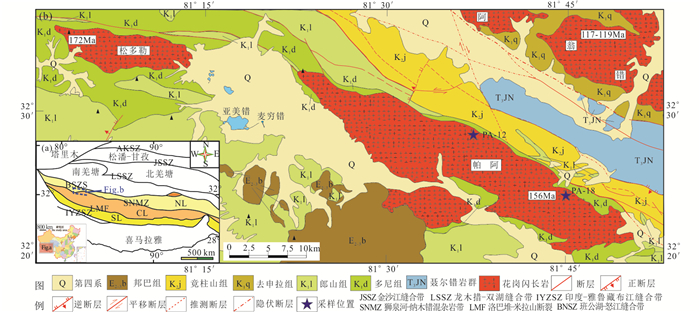
1 地质背景及样品特征 1.1 地质背景研究区位于藏北阿里地区革吉县境内,尕尔穷-嘎拉勒铜多矿集区南东方向约35km,江玛赛登铜金矿区南东方向20km,大地构造位置上隶属于班公湖-怒江结合带西段南缘(图 1a)。据1:25万区域地质调查革吉县幅(四川省地质调查院, 2003①)显示,研究区内出露地层主要为:古近系邦巴组(E2-3b)的碱性-强碱性火山岩和火山角砾岩;上白垩统竟柱山组(K2j)的紫红色、灰绿色砾岩、砂岩、泥岩和灰岩;下白垩统去申拉组(K1q)的中基性火山岩、砾岩、岩屑石英砂岩,局部夹生物碎屑灰岩;郎山组(K1l)的结晶灰岩、砂质灰岩、生物碎屑灰岩,底部砂岩、砾岩;多尼组(K1d)的砂岩、泥岩夹砾岩、灰岩透镜体,局部夹少量中酸性火山岩;上白垩统-侏罗系聂尔错岩群(T3JN)的灰、灰绿色变质砂岩、粉砂岩和板岩等(图 1b)。区域构造活动较强烈,主要发育北西向和北西西向两组主要断裂及其次级断裂。研究区内侵入岩和火山岩发育,其中岩浆岩主要为早白垩世中粗粒、中粒和细粒花岗闪长岩,火山岩主要有火山角砾岩。前人对区域范围内的侵入岩研究主要集中在尕尔穷-嘎拉勒铜多矿集区内,侵入岩锆石U-Pb年龄主要集中在80~110Ma(曲晓明等, 2009; 吕立娜等, 2011; 姚晓峰等, 2012, 2013; 张志等, 2013)。在帕阿花岗闪长岩岩基向西延伸25km处的乃不扎康巴流纹斑岩中锆石LA-ICP-MS U-Pb年龄为151.6±1.2Ma(王勇等, 2017)。
① 四川省地质调查院. 2003. 1/250000革吉县幅区域地质调查报告
|
图 1 研究区地质简图(据四川省地质调查院, 2003修编) Fig. 1 Simplified geological map of the Pa'a granodiorite batholith and its adjacent area |
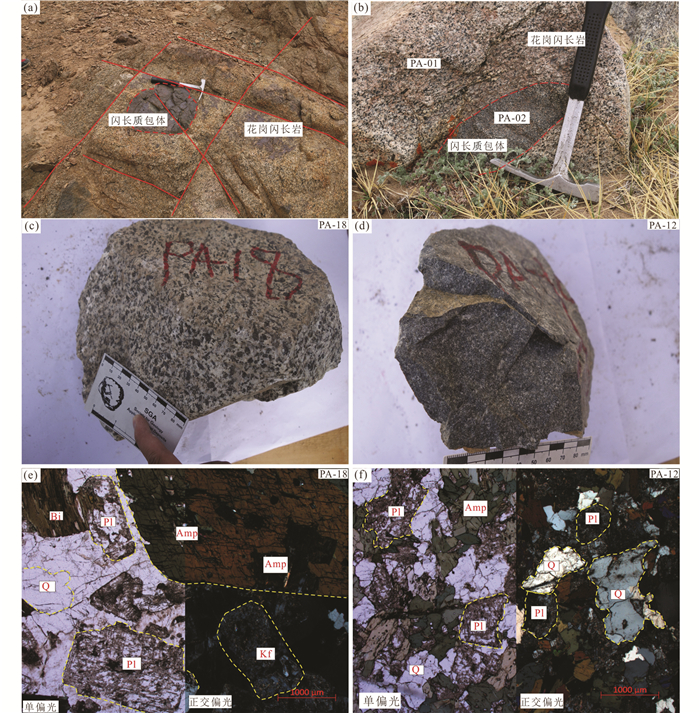
帕阿花岗闪长岩岩基,位于狮泉河蛇绿混杂岩带的东延方向,平面上呈长椭圆状NW-SE向平行于狮泉河断裂带展布,向西逐渐转变为E-W向,长轴约50km,平均宽度约10km,出露面积约500km2,其北面有NW向的聂尔错断裂和吓拉错断裂穿过,与NW向延伸的阿翁错复式花岗闪长岩岩基相距约25km。帕阿岩基主体为单个花岗闪长岩侵入体,但具明显的分带性,发育有边缘相、过渡相及中央相(四川省地质调查院, 2003),岩体中同样发育暗色浑圆状闪长质包体,包体与寄主岩石的接触界线较为多样,包体与寄主岩石的接触带上,往往可见浅色的长英质晕圈(图 2a)。闪长质包体中可见石英和长石斑晶,粒度明显较暗色矿物粗。此外,还见小面积出露的石英闪长岩与花岗闪长岩呈超动侵入接触关系。据以往地质资料(四川省地质调查院, 2003)揭示帕阿花岗闪长岩的K-Ar年龄为113Ma,其围岩原划归为早白垩世多尼组(K1d)和郎山组(K1l)。本次野外研究也发现帕阿岩基与围岩呈明显的侵入接触关系,表现为围岩多尼组碎屑岩角岩化、郎山组碳酸盐岩发生大理岩化,岩体边缘出现细粒冷凝边,岩体与围岩接触界线截然,故地层可能并不是原划归的多尼组和朗山组。
|
图 2 帕阿花岗闪长岩及其中闪长质包体手标本和显微照片 (a)帕阿岩体遭受后期剪节理破坏;(b)帕阿中粗粒花岗闪长岩中发育椭圆状闪长质包体;(c)花岗闪长岩,中粗粒花岗结构;(d)闪长质包体,斑状结构,斑晶为长石,基质为暗色矿物;(e)花岗闪长岩,长石可见高岭土化;(f)闪长质包体,可见长石和角闪石捕掳晶.Amp-角闪石;Bi-黑云母;Kf-钾长石;Pl-斜长石;Q-石英 Fig. 2 Hand specimen photographs and microphotographs of the Pa'a granodiorite and its dirorite inclusions (a) Pa'a granodiorite bodies damaged by later joint; (b) elliptical diorite inclusions in the coarse-mudium grained granodiorite; (c) granodiorite with medium-coarse grained granitoid texture; (d) diorite inclusions with porphyritic texture; (e) granodiorite, and feldspar with kaolinization; (f) diorite inclusions with feldspar and amphibole minerals. Amp-amphibole; Bi-biotite; Kf-potash feldspar; Pl-plagioclase; Q-quartz |
本文测试样品采自帕阿岩基的北侧,岩石类型为寄主花岗闪长岩(图 2a-c)和暗色闪长质包体(图 2a, b, d)。花岗闪长岩为灰白色,中-粗粒,半自形粒状结构,块状构造,矿物组成为:斜长石(30%~35%)、石英(20%~25%)、角闪石(15%~20%)、钾长石(10%~15%)、云母(< 5%)等组成(图 2c, e);斜长石呈自形-半自形板状,粒度一般为0.1~1.5mm,核部可见高岭土化、绢云母化,环带结构发育,聚片双晶发育;钾长石含量较少,半自形-他形板状,核部见高岭土化,发育卡式双晶,角闪石呈自形板状或长柱状,粒度一般为2mm×15mm;角闪石可见两组解理,解理夹角约56°(图 2e)。
闪长质包体主要呈圆形、椭圆形发育在寄主岩石中。矿物组成主要为斜长石(45%~55%),普通角闪石(20%~30%),钾长石(5%~10%),石英(10%~15%)以及不透明矿物(< 5%),包体中可见长石斑晶,其粒度明显大于细粒暗色矿物(图 2d, f)。
2 分析测试方法本文选择帕阿岩基采集寄主花岗闪长岩(PA-18)和闪长质包体(PA-12),并挑选锆石进行LA-ICP-MS U-Pb定年和Hf同位素测试。另采集了9件岩石样品进行全岩主量元素和微量元素测试,包括帕阿岩基寄主花岗闪长岩样品5件(PA01-01~05)和闪长质包体4件(PA02-01~04)。所有样品均在河北省地质测绘院实验室依次进行光薄片、探针片等的磨制加工和单矿物挑选及全岩粉末的制备。
锆石制靶及阴极发光显微照相(CL图像)在北京锆年领航科技有限公司完成。锆石LA-ICP-MS U-Pb同位素定年和锆石原位微区Hf同位素测试均在中国地质调查局西安地质调查中心自然资源部岩浆作用成矿与找矿重点实验室完成。激光剥蚀系统为GeoLas Pro,ICP-MS为Agilent 7700X。测试数据的校正、处理和年龄计算等采用软件Glitter 4.4(van Achterbergh et al., 2001)完成,详细仪器参数和测试过程可参见李艳广等(2015)。锆石U-Pb年龄谐和图绘制和年龄权重平均计算均采用Isoplot/Ex_ver. 3(Ludwig, 2003)完成。锆石Hf同位素测试利用Neptune型多接收等离子体质谱仪和Geolas Pro型激光剥蚀系统联用的方法完成,详细测试流程可参照Meng et al. (2014)和侯可军等(2007)。
全岩样品主量和微量元素含量分析测定在核工业北京地质研究院分析测试研究中心完成。全岩主量元素测定使用AB-104L、AL-104、AxiosmAX X射线荧光光谱仪完成,检测方法依据GB/T 14506.14—2010和GB/T 14506.28—2010。微量元素、稀土元素分析使用ELEMENT XR等离子体质谱分析仪完成,检测方法依据GB/T 14506.30—2010。详细的样品处理过程、分析精度和准度参见Liu et al. (2008)。
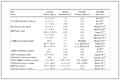
3 测试结果锆石U-Pb定年结果、锆石Hf同位素结果、全岩主量微量和稀土元素测试结果数据分别见表 1、表 2和表 3所示。
|
表 1 革吉地区帕阿岩基锆石LA-ICP-MS U-Pb定年结果 Table 1 LA-ICP-MS zircon U-Pb analytical data of the Pa'a batholith, Geji area |
|
|
表 2 革吉地区帕阿岩基锆石Hf同位素特征 Table 2 Zircon Hf isotopic data of Pa'a batholith from Geji area |
|
|
表 3 革吉地区帕阿岩基主量元素(wt%)、稀土和微量元素含量(×10-6)分析结果 Table 3 Major elements (wt%) and trace elements (×10-6) of Pa'a batholith, Geji area |
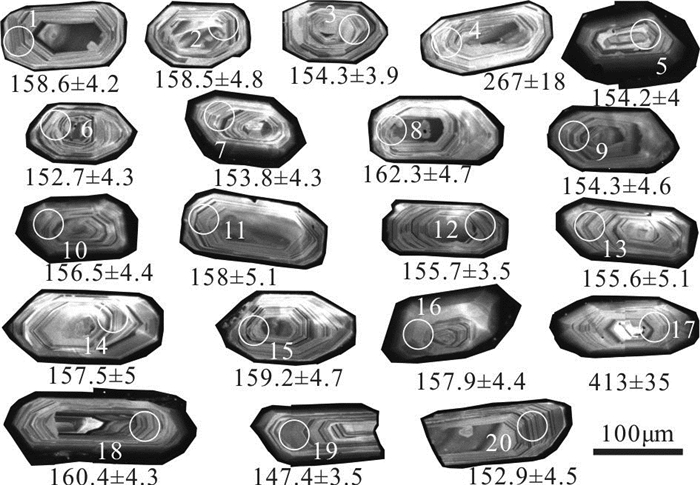
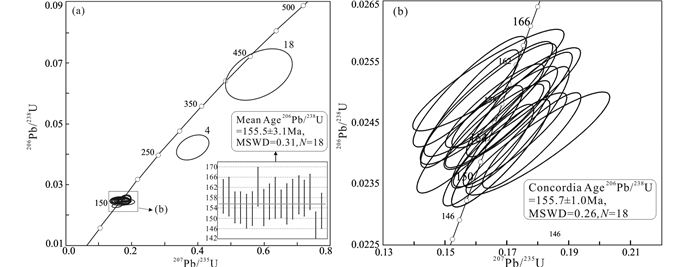
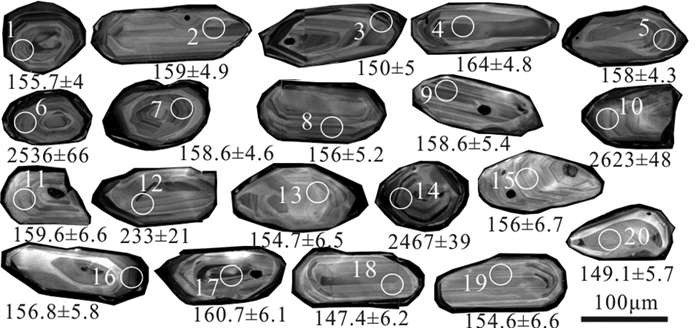
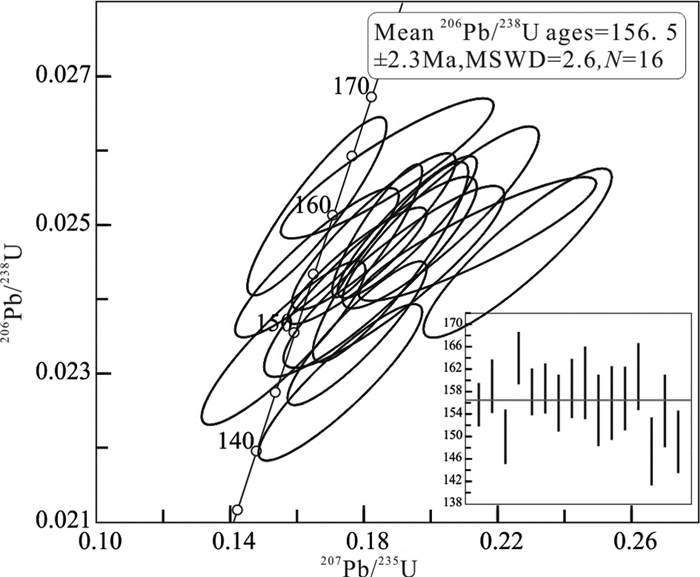
帕阿岩基的花岗闪长岩(PA-18)和闪长质包体(PA-12)中的锆石阴极发光图像特征和详细的锆石U-Pb同位素测试结果见图 3、图 4、图 5、图 6和表 1所示。
|
图 3 帕阿岩基寄主花岗闪长岩(PA-18)锆石颗粒阴极发光(CL)图像特征 Fig. 3 Cathodoluminescence (CL) images of zircon grains from granodiorite (PA-18) in Pa'a batholith |
|
图 4 帕阿岩基寄主花岗闪长岩(PA-18)锆石LA-ICP-MS U-Pb测年结果 Fig. 4 Zircon 206Pb/238U concordia diagram of zircon from granodiotite (PA-18) in Pa'a batholith |
|
图 5 帕阿岩基闪长质包体(PA-12)锆石颗粒CL图像特征 Fig. 5 Cathodoluminescence (CL) images of zircon grains from diorite inclusions (PA-12) from Pa'a batholith |
|
图 6 帕阿岩基闪长质包体(PA-12)锆石LA-ICP-MS U-Pb年代学测试结果 Fig. 6 Zircon 206Pb/238U concordia diagram of zircon from diorite inclusions (PA-12) in Pa'a batholith |
帕阿花岗闪长岩基的2件测试样品中的锆石多为浅灰色-灰色,自形到半自形晶型,长柱状-短柱状,长轴约50~200μm,短轴约为60~100μm,长宽比为1:1~3:1,并可见清晰的岩浆振荡环带(图 3、图 5),绝大部分锆石颗粒未观察到有继承核的存在,仅在闪长质包体的2颗锆石中疑似存在锆石继承核(测点6和14所在锆石颗粒)。花岗闪长岩样品(PA-18)中锆石测点的Th和U含量分别为134×10-6~543×10-6和192×10-6~466×10-6,相应的Th/U比值为0.60~1.17(表 1);闪长质包体(PA-12)中锆石Th和U含量分别为80×10-6~394×10-6和95.5×10⁻⁶~345×10-6,相应的Th/U比值为0.76~1.37,上述特征表明这些锆石具有典型的岩浆成因(Hoskin and Schaltegger, 2003)。
花岗闪长岩样品(PA-18)的18颗锆石的206Pb/238U年龄介于152.7~162.3Ma之间,测点均位于U-Pb谐和线或其附近,得到206Pb/238U的谐和线年龄为155.7±1.0Ma(MSWD=0.26,N=18)(图 4b),年龄加权平均值为155.5±3.1Ma(MSWD=0.31)(图 4a),另有2颗锆石206Pb/238U年龄值为267.04±18Ma(测点4)和413.03±35Ma(测点18)。闪长质包体样品(PA-12)也获得相近的年龄,16颗锆石的206Pb/238U年龄值介于147.4~160.7Ma之间,测点均位于U-Pb谐和线或其附近,得出的年龄加权平均值156.5±2.3Ma(MSWD=2.6)(图 6),其中测点6、10和14的年龄较老,207Pb/235U年龄分别为2584.03±26.08Ma、2581.46±20.04Ma和2488.08±18.04Ma。
3.2 Hf同位素特征帕阿岩基之寄主花岗闪长岩(PA-18)选取8个有效锆石U-Pb年龄分析点进行Hf同位素分析,结果显示176Yb/177Hf=0.022350~0.048632,176Lu/177Hf=0.000586~0.001216,176Hf/177Hf比值为0.282412~0.282500(表 2)。所有分析点176Lu/177Hf比值均小于0.002,指示了这些锆石形成以后,没有明显的放射性成因Hf的积累(吴福元等, 2007),可用所测定的初始176Hf/177Hf比值来代表锆石形成时的176Hf/177Hf比值。εHf(t)值为-9.4~-6.3,对应的Hf同位素地壳模式年龄(tDMC)为1.32~1.48Ga(表 2)。
闪长质包体(PA-12)选取6个有效锆石U-Pb年龄分析点进行Hf同位素分析,结果显示176Yb/177Hf=0.014564~0.026864,176Lu/177Hf=0.000439~0.000776,176Hf/177Hf比值为0.282368~0.282432(表 2)。所有分析点176Lu/177Hf比值均小于0.002,亦指示没有明显的放射性成因Hf的积累。εHf(t)值为-10.9~-8.6,对应的Hf同位素地壳模式年龄(tDMC)为1.44~1.56Ga(表 2)。
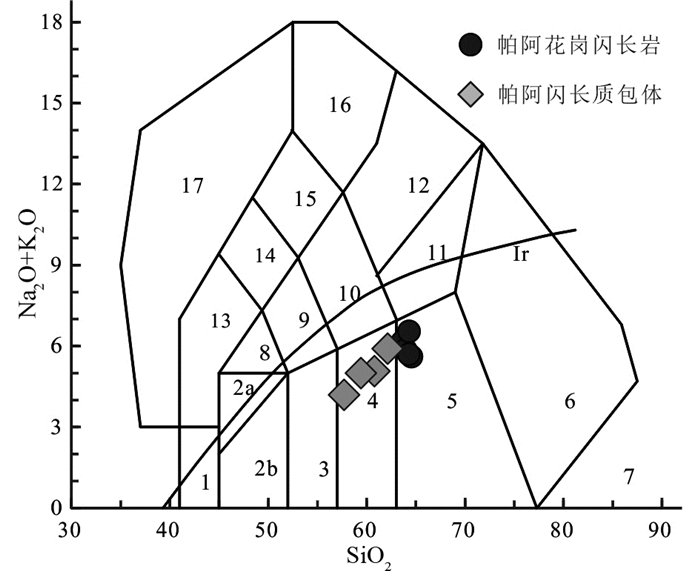
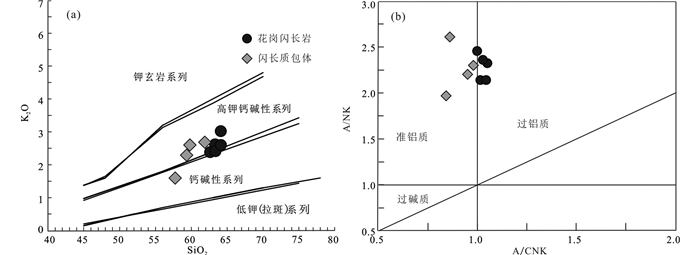
3.3 全岩地球化学特征帕阿花岗闪长岩岩基的岩石地球化学结果(表 3)显示,帕阿花岗岩类主微量元素存在一定的成分变化。5件寄主花岗闪长岩的主量元素中SiO2(62.64%~64.95%,均值63.78%)、Al2O3(15.60%~16.39%,均值15.95%)、较高的Na2O+K2O(4.84%~5.54%,均值5.09%)含量,K2O/Na2O为0.92~1.20之间,MgO(2.33%~2.86%,均值2.46%)含量,Mg#为47.2~50.4(平均48.7),TiO2(0.44%~0.51%,均值0.49%)含量低,Fe2O3T(8.07%~9.53%,均值8.84%)含量,CaO(4.3%~5.98%,均值4.97%)含量,P2O5(0.09%~0.10%,均值0.10%)含量,具有高硅富铝富碱的特征。在TAS图解上落入花岗闪长岩区域内(图 7)。在SiO2-K2O岩石系列判别图解上,寄主花岗闪长岩属于高钾钙碱性系列(图 8a)。其中Al2O3含量15.87%~16.39%,铝饱和指数A/CNK值为0.91~1.04,A/NK介于2.14~2.46之间,具有过铝质花岗闪长岩特征(图 8b)。
|
图 7 帕阿花岗闪长岩及闪长质包体TAS分类图解(据Middlemost, 1994) 3-辉长闪长岩;4-闪长岩;5-花岗闪长岩 Fig. 7 TAS diagram of granodiorites and diorite inclusions from Pa'a batholith (after Middlemost, 1994) |
|
图 8 帕阿岩基地球化学判别图解 (a)岩浆岩SiO2-K2O图解(Peccerillo and Taylor, 1976);(b) A/CNK-A/NK图解(Le Maitre, 2002) Fig. 8 Discrimination diagrams of the Pa'a granodiorite batholith (a) SiO2 vs. K2O discrimination diagram of magmatic rocks (Peccerillo and Taylor, 1976); (b) A/CNK vs. A/NK discrimination diagram (Le Maitre, 2002) |
4件闪长质包体的主量元素中SiO2含量57.82%~61.99%,属于中性岩类。P2O5含量介于0.10%~0.20%,Mg#为45.4~55.0,二者均略高于寄主花岗闪长岩;K2O含量为1.62%~2.70%,Na2O+K2O含量3.89%~6.10%,K2O/Na2O为0.61~1.12,在TAS判别图解中所有样品均落入闪长岩区域(图 7),在岩浆岩SiO2-K2O判别图解中,与寄主岩体一样,3件样品均位于高钾钙碱性系列边缘,1件落入钙碱性系列(图 8a)。Al2O3含量介于15.17%~17.94%,与寄主花岗闪长岩相近,铝饱和指数A/CNK值介于0.84~1.00,A/NK值介于1.86~2.93,与寄主花岗闪长岩不同,属于准铝质岩类(图 8b)。
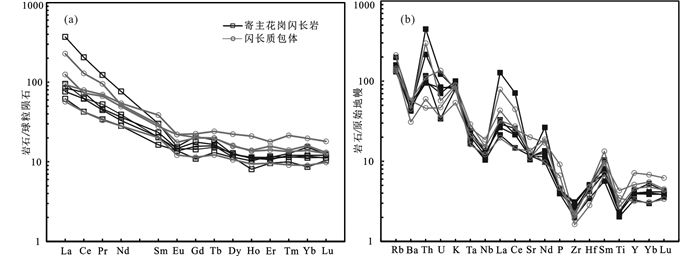
帕阿岩基的全岩微量元素结果显示:微量元素具有相似的配分特征,但具体含量差别较大(表 3)。寄主花岗闪长岩全稀土元素(∑REE)分布值为70.22×10⁻⁶~280×10-6,LREE=60.56×10⁻⁶~266.8×10⁻⁶。在球粒陨石标准化稀土元素配分图中(图 9a),具有明显的右倾特征,(La/Yb)N为6.27~20.2,轻重稀土元素分异程度高(LREE/HREE=5.11~8.54),4件样品δEu=0.61~0.85,显示弱Eu负异常,1件样品Eu几乎无异常,δEu=1.01。闪长质包体的全稀土元素(∑REE)分布值为68.59×10-6~187.4×10-6,LREE=59.34×10-6~172.3×10-6,略低于寄主花岗闪长岩;LREE/HREE=5.58~11.5,δEu=0.71~0.92,4件闪长质包体均显示弱Eu负异常。在球粒陨石标准化稀土元素配分图(图 9a)中,寄主花岗闪长岩和闪长岩包体均呈现明显的右倾型。均具有富集轻稀土元素(LREE),亏损重稀土元素(HREE)的特征,除1件花岗闪长岩样品(PA01-03)δEu几乎无异常外,其余样品Eu均呈弱负异常。在微量元素蜘蛛网图中(图 9b),寄主花岗闪长岩和闪长质包体均显示出富集大离子亲石元素(Rb、K、U、Th等),亏损高场强元素的特征,具有Nb、Ta、Sr、Ti等元素的负异常。
|
图 9 帕阿花岗闪长岩和闪长质包体球粒陨石标准化稀土元素配分曲线(a)和原始地幔标准化微量元素蛛网图(标准化值据Sun and McDonough, 1989) Fig. 9 Chondrite-normalized REE patterns (a) and primitive mantle-normalized trace element patterns (b) for the Pa'a granodiorite and diorite inclusions (normalization values after Sun and McDonough, 1989) |
近年在中拉萨地块,发现晚侏罗世存在一期广泛的中酸性岩浆活动(表 4),这一时期的岩浆事件,一种观点认为是班-怒洋壳低角度向南俯冲形成的(闫晶晶, 2016; Cao et al., 2016; Wang et al., 2018);另一种观点认为是狮泉河洋即Slainajap洋洋壳南向俯冲到古老拉萨地块下,由幔源岩浆提供热量诱发古老拉萨下地壳部分熔融并混合之后经历一定程度的分离结晶作用形成的(康志强等, 2008; 杜德道, 2012; 王勇等, 2017)。
|
|
表 4 北拉萨地块中北部西段晚侏罗世岩浆岩的年龄数据汇总表 Table 4 The age data summary of Late Jurassic magmatic rocks in the western segment of central Lhasa Terrane |
本文锆石U-Pb定年结果显示帕阿岩基的寄主花岗闪长岩和其中的暗色闪长质包体的形成年龄为晚侏罗世(~156Ma),而闪长质包体中存在3颗年龄值大约2.4Ga的年龄信息,结合CL图像和区域构造演化,可能指示在岩浆上涌过程中捕获的北拉萨地体北缘古老结晶基底。前人研究也表明革吉地区存在中-晚侏罗世岩浆活动,主要包括在班-怒结合带西段嘎拉勒矿区的闪长岩(锆石U-Pb年龄155.8Ma, 张志等, 2013)和狮泉河地区的花岗闪长岩(锆石U-Pb年龄159Ma, 曲晓明等, 2009),革吉县盐湖地区的流纹岩(146Ma)和英安岩(160Ma)(Zhu et al., 2011);革吉北部乃不扎康巴流纹斑岩(锆石U-Pb年龄151.6Ma, 王勇等, 2017)。此外,在嘎拉勒矿区北侧的嘎拉勒和改则花岗闪长岩锆石U-Pb年龄分别155.6Ma和142.15Ma(杜德道等, 2011);嘎拉勒矿区以北亦发育156Ma的石英闪长岩和172Ma的花岗闪长岩,革吉躬琼左波地区发育145Ma钾长花岗岩、146Ma晶屑凝灰岩和147Ma的石英斑岩(王勇等, 2017)。岩石地球化学特征揭示上述岩浆岩及火山岩均亏损Nb、Ta、Ti等高场强元素,富集大离子亲石元素,并具有负的εHf(t)值。在岩石学特征方面,晚侏罗世岩浆岩中发育黑云母和角闪石等暗色矿物,并在部分岩浆岩中发育有暗色的闪长质包体。本文研究帕阿岩基寄主花岗闪长岩和暗色闪长质包体的锆石U-Pb年龄相一致,且元素地球化学特征和εHf(t)均相似。上述特征指示革吉地区中-晚侏罗世岩浆岩可能与俯冲作用过程密切相关。
据以往地质资料(四川省地质调查院,2003)和本文作者在野外地质填图过程中发现,帕阿花岗闪长岩基与围岩为侵入接触关系,岩体的时代应该比围岩时代要晚,而围岩原被划归的下白垩统多尼组,可能该套围岩地层的具体归属和定名存在疑义,尚需进一步详细的工作。
4.2 岩石成因类型根据花岗岩源区性质,可以将花岗岩分为I、S、M和A型(Collins et al., 1982; White and Chappell, 1983; Whalen, 1985; Whalen et al., 1987; Chappell and White, 1992)。Ⅰ型花岗岩是由火山岩或变火山岩为岩浆源区,主要是未风化的岩浆岩熔融形成,属于活动大陆边缘产物,特征矿物为角闪石,K2O/Na2O比值一般低于1,铝饱和指数(A/CNK) < 1.1(Clemens, 2003; Chappell et al., 2012);S型花岗岩岩浆源区为变沉积岩,在S型花岗岩中,特征性矿物为堇青石、石榴石和夕线石,K2O/Na2O比值一般高于1,铝饱和指数(A/CNK)>1.1,岩石元素组成更富Al(Chappell and White, 1974; Loiselle and Wones, 1979; Pitcher, 1997; 吴福元等, 2007)。
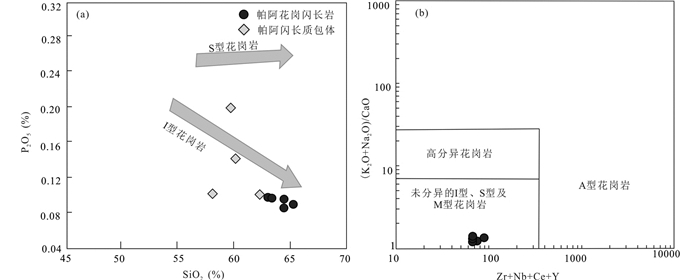
本文测试的5件花岗闪长岩在镜下可见明显的角闪石,样品的K2O/Na2O为0.92~1.20。在SiO2-K2O岩石系列判别图解上,属于高钾钙碱性系列(图 8a);铝饱和指数(A/CNK)为0.91~1.04,A/NK比值介于2.14~2.46之间,表现出过铝质花岗闪长岩特征(图 8b)。由于磷灰石在含铝较高的岩浆中溶解度更高(Wolf and Wyllie, 1994),因此在岩浆分异过程中随着SiO2含量的增加,P2O5含量会增加,Ⅰ型花岗岩则表现出相反的趋势(Chappell, 1999);在SiO2-P2O5图解上,花岗闪长岩均显示典型Ⅰ型花岗岩特征(图 10a),在(Zr+Nb+Ce+Y)-(Na2O+K2O)/CaO图解中,花岗闪长岩全部落入未分异花岗岩区域(图 10b)。综合研究认为,帕阿岩基寄主花岗闪长岩为过铝质高钾钙碱性Ⅰ型花岗岩。
|
图 10 革吉地区帕阿岩基花岗闪长岩岩和闪长质包体成因判别图(据Whalen et al., 1987) (a) SiO2-P2O5图解;(b) (Zr+Nb+Ce+Y)-(Na2O+K2O)/CaO图解 Fig. 10 Discrimination diagrams for the genetic types of the Pa'a granodiorite and diorite inclusion (after Whalen et al., 1987) |
基性岩浆分离结晶过程中,随着温度的降低,不相容元素如稀土元素,含量会出现增加的趋势,帕阿岩基寄主花岗闪长岩∑REE含量(70.22×10⁻⁶~280×10-6)和闪长质包体∑REE含量(68.59×10⁻⁶~187.4×10⁻⁶)总体差别不大,帕阿岩基寄主花岗闪长岩不可能属于幔源玄武质岩浆强烈分离结晶作用形成;幔源岩浆注入沉积物并熔融形成的花岗岩,一般具有较宽泛的εHf(t)值(高达10个ε单位)(Kemp et al., 2007; 李献华等, 2009),寄主花岗闪长岩εHf(t)值介于-9.4~-6.3,变化范围较小,故也不可能存在大量幔源岩浆注入沉积物熔融成因模式(Clemens, 2003; Kemp et al., 2007; Collins and Richards, 2008)。
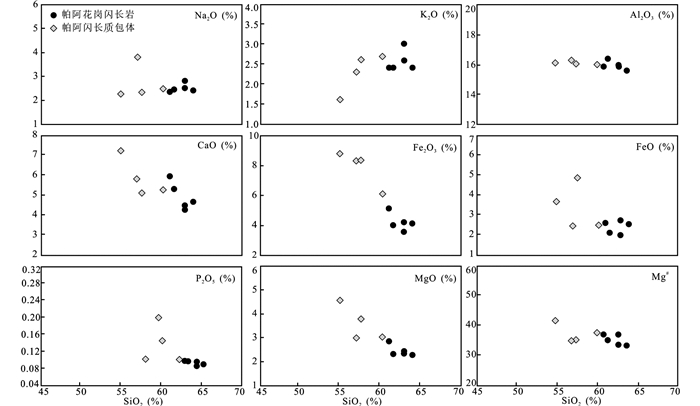
帕阿岩基寄主花岗闪长岩中普遍发育闪长质包体(图 2b),这是钙碱性花岗岩侵入体中的普遍现象(Barbarin, 2005)。帕阿岩基寄主花岗闪长岩中包体矿物组成未发现镁铁质矿物,另具有典型的细粒半自形-他形粒状结构,不存在镁铁质矿物常见的堆晶结构(图 2),因此这些闪长岩包体不可能是早期镁铁质矿物堆晶。且帕阿岩基中闪长质包体中绝大部分锆石为岩浆锆石,仅有3个年龄大于2.4Ga的锆石颗粒,且CL图像不具备特征的核幔结构(图 5),且包体中主体锆石年龄值与寄主花岗闪长岩中锆石年龄值基本相一致(表 1),因此排除包体是继承锆石或围岩捕虏体的可能,很可能是岩浆结晶残留体。原始地幔标准化微量元素图解与球粒陨石标准化稀土元素图解中(图 9),闪长质包体和寄主花岗闪长岩具有较相似的曲线特征,均富集大离子亲石元素,亏损高场强元素的特征,具有Nb、Ta、Sr、Ti等元素的负异常,富集轻稀土元素,亏损重稀土元素,δEu负异常较弱;在Harker图解(图 11)中,随着SiO2含量增加,Na2O、K2O含量线性递增,CaO、FeO、Fe2O3、MgO、Mg#均显示出线性递减的趋势,指示岩浆混合作用的存在(Zorpi et al., 1991; Karsli et al., 2007; Kaygusuz and Aydınçakır, 2009; 张招崇等, 2009);由于锆石具有相对较高的Lu-Hf封闭温度,Hf同位素比值不会随后期部分熔融或分离结晶而变化,故εHf(t)值能代表岩浆源区成分特征,不同εHf(t)值能够指示多种岩浆混合作用(Kemp et al., 2007; Zhu et al., 2009a, 2011; Ravikant et al., 2011),而闪长质包体εHf(t)值为(-10.9~-8.6)和寄主花岗闪长岩εHf(t)值(-9.4~-6.3)在误差范围内基本一致,暗示二者岩浆来自相近的源区。
|
图 11 帕阿岩基寄主花岗闪长岩和闪长质包体哈克图解 Fig. 11 Harker diagrams for the major element of the Pa'a granodiorite and diorite inclusion |
结合前人已发表北拉萨地体晚侏罗世中酸性岩浆岩锆石εHf(t)数据(姜昕等, 2010; Zhu et al., 2011; Cao et al., 2016; 闫晶晶, 2016; 王勇等, 2017; Wang et al., 2018),帕阿岩基寄主花岗闪长岩和闪长质包体中锆石颗粒εHf(t)均为负值(寄主花岗闪长岩-9.4~-6.3、闪长质包体-10.9~-8.6)、地壳模式年龄分别为(1.6~1.8Ga)和(1.44~1.56Ga)。同时,花岗闪长质包体中存在大于2.4Ga的古老锆石残余,帕阿岩基北侧发育一条蛇绿混杂岩带,带内蛇纹石化方辉橄榄岩的锆石年龄为152±3Ma(Li et al., 2018)。综合研究认为帕阿花岗闪长岩基主体系古老地壳基底部分熔融的产物,存在少量的地幔物质的加入。
4.4 构造意义北拉萨地块西段发育较广泛的晚侏罗世-早白垩世中酸性岩浆活动,前人认为在晚侏罗世(165~145Ma)班-怒洋壳存在低角度南向俯冲,板片熔融交代地幔楔,形成εHf(t)值较低(-16~-7)的钙碱性Ⅰ型花岗岩,之后在早白垩世(145~130Ma)由于板片的断离,诱发地幔物质的加入,形成相对具有较高εHf(t)值(-8~0)的岩浆事件(Cao et al., 2016; Wang et al., 2018);此外,也有研究者认为这一时期的岩浆活动,与Slainajap洋洋壳南向俯冲到古老拉萨地块之下有关(康志强等, 2008; 杜德道, 2012; 王勇等, 2017)。
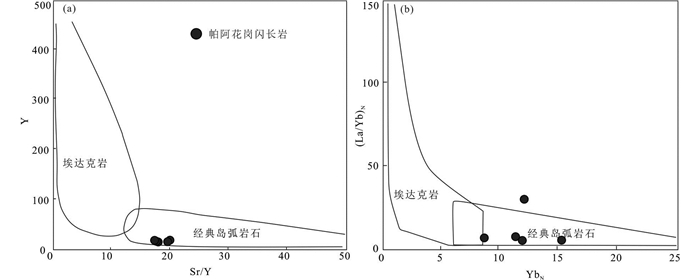
本文所获得帕阿岩基位于班-怒结合带西段南缘,与北拉萨地块西部相邻,寄主花岗闪长岩和闪长质包体锆石U-Pb年龄值均为~156Ma,为晚侏罗世。岩石学、岩相学、地球化学、Hf同位素特征表明,帕阿岩基原始岩浆来源洋壳俯冲背景下的古老下地壳重熔,并存在少量地幔物质的加入。在Sr/Y-Y判别图解中,寄主花岗闪长岩全部落入经典岛弧岩石区域内(图 12a),在YbN-(La/Yb)N判别图解中,寄主花岗闪长岩仅有一件样品落入埃达克岩和经典岛弧岩石叠加区域。帕阿岩基寄主花岗闪长岩在Sr/Y-Y判别图解和YbN-(La/Yb)N判别图解中均落入经典岛弧岩石区域中(图 12a, b)。综合研究认为帕阿花岗闪长岩基可能为弧背景下古老下地壳部分重熔形成的Ⅰ型花岗岩,详细的构造环境尚需要进一步研究。
|
图 12 帕阿岩基Sr/Y-Y判别图解(a)和YbN-(La/Yb)N图解(据Defant and Drummond, 1990) Fig. 12 Discrimination diagrams of Sr/Y vs. Y (a) and YbN vs. (La/Yb)N (b) for granodiorite batholith (after Defant and Drum mond, 1990) |
考虑到帕阿岩基与阿翁错花岗闪长岩基的相对位置(阿翁错岩基位于帕阿岩基北约25km处,二者走向均为NW向),且阿翁错花岗闪长岩基(锆石U-Pb年龄~117Ma,李宝龙等未刊数据)主体位于班-怒结合带内,即便拉萨地块在早白垩世发生了60%的缩短(Murphy et al., 1997),如此短的距离也难以形成如此宽阔的Slainajap洋盆,因为岛弧型岩浆岩的产生洋壳一般需要洋壳俯冲120~150km(Crosson and Owens, 1987),那么恢复出来的古Slainajap洋洋盆的宽度至少应该大于250km。此外,作者在帕阿岩基北侧发现一条东西向延伸的蛇绿混杂岩带是狮泉河蛇绿混杂岩带的东延部分(Li et al., 2018),故将北拉萨地块中生代岩浆活动归结为Slainajap洋洋壳南向俯冲是不恰当的(Zhu et al., 2008)。
基于班公湖蛇绿岩(167.0±1.4Ma)和东巧蛇绿岩(187.8±3.7Ma)的年代学和地球化学研究揭示班-怒洋在侏罗纪已存在(Shi et al., 2007; 夏斌等, 2008)。,那么在中拉萨和北拉萨地体广泛发育的侏罗-白垩纪与岛弧有关的岩浆岩和火山岩的成因有二种。其一为新特提斯洋岩石圈的北向低角度或平板俯冲(Coulon et al., 1986; Ding et al., 2003; Kapp et al., 2007);其二是班-怒洋岩石圈的南向俯冲(Zhu et al., 2008, 2009a, 2011; 张亮亮等, 2010, 2011; 张晓倩等, 2010; Chen et al., 2014; Wang et al., 2014; Wu et al., 2015; Cao et al., 2016)。需要强调的是,低角度北向俯冲模型的建立条件是南拉萨地体中早白垩世火山岩的缺失(Kapp et al., 2007);低角度或平板俯冲的一个重要特征就是从海岸带到大陆块内部存在宽泛的钙碱性弧岩浆带和早白垩世岩浆岩的时代从南拉萨到北拉萨地体从老变新(Coney and Reynolds, 1977; Livaccari et al., 1981; Gutscher et al., 1999; Cao et al., 2016)。然而,近年来的研究成果揭示早白垩世火山岩广泛分布在整个拉萨地体,且年龄并不支持从老到新的变化规律(朱弟成等, 2008; Zhu et al., 2009b, 2011; Ji et al., 2009; 曲晓明等, 2009; Pullen et al., 2011; Cao et al., 2016)。随着研究的逐渐深入,大量的地球化学数据(Zhu et al., 2011, 2016; Wu et al., 2015; Cao et al., 2016; Wang et al., 2016)和年代学资料(曲晓明等, 2009; Zhu et al., 2009a, c, 2011, 2016; 陈越等, 2010; 张亮亮等, 2011; Wang et al., 2014)揭示在拉萨地体北缘发育广泛与俯冲相关的岩浆岩,这一特征与班-怒洋盆岩石圈南向俯冲的时空结构相吻合。
近年来,在革吉北部地区的松多勒和强弄花岗闪长岩的锆石年龄分别为172Ma和156Ma(Wang et al., 2018),乃不扎康巴流纹斑岩的锆石年龄为151.6Ma(王勇等, 2017)。拉萨地体北缘侏罗纪与岛弧相关的岩浆岩和火山岩广泛发育(表 4),同时,在研究区帕阿岩基北侧出露NW向延伸蛇绿混杂岩带(向西延伸方向转变为东西向,可能与狮泉河蛇绿混杂岩带相连),带内蛇纹石化辉橄岩的锆石U-Pb年龄为152±3Ma(Li et al., 2018),很可能指示为班-怒洋向南俯冲后,进入弧-陆碰撞阶段,在靠近南部陆地一侧的弧后盆地和弧间盆地演化而成的一系列小洋盆,帕阿岩基可能为班-怒洋洋壳南向俯冲的产物,
5 结论(1) 帕阿岩基寄主花岗闪长岩和闪长质包体的锆石U-Pb年龄分别为155.7Ma和156.5Ma,表明二者侵位时代为晚侏罗世。
(2) 帕阿岩基寄主花岗闪长岩具有高硅富碱的特征,属于过铝质高钾钙碱性系列Ⅰ型花岗岩,具有弧岩浆岩的特征。帕阿岩基很可能起源于班-怒洋南向俯冲引起拉萨地块古老结晶基底的重熔,并伴有少量地幔物质的混入。
感谢 中国地质调查局西安地质调查中心李艳广老师在实验测试方面给予的帮助。同时特别感谢匿名审稿人对本文提出了宝贵的具有建设性的修改意见。
Barbarin B. 2005. Mafic magmatic enclaves and mafic rocks associated with some granitoids of the central Sierra Nevada batholith, California:Nature, origin, and relations with the hosts. Lithos, 80(1-4): 155-177. DOI:10.1016/j.lithos.2004.05.010 |
Blichert TJ and Albarède F. 1997. The Lu-Hf geochemistry of chondrites and the evolution of the mantle-crust system. Earth and Planetary Science Letters, 148: 243-258. DOI:10.1016/S0012-821X(97)00040-X |
Cao MJ, Qin KZ, Li GM, Li JX, Zhao JX, Evans NJ and Hollings P. 2016. Tectono-magmatic evolution of Late Jurassic to Early Cretaceous granitoids in the west central Lhasa subterrane, Tibet. Gondwana Research, 39: 386-400. DOI:10.1016/j.gr.2016.01.006 |
Chappell BW and White AJR. 1974. Two contrasting granite types. Pacific Geology, 8(2): 173-174. |
Chappell BW and White AJR. 1992. Ⅰ-and S-type granites in the Lachlan fold belt. Earth and Environmental Science Transactions of the Royal Society of Edinburgh, 83(1-2): 1-26. DOI:10.1017/S0263593300007720 |
Chappell BW. 1999. Aluminium saturation in Ⅰ-and S-type granites and the characterization of fractionated haplogranites. Lithos, 46(3): 535-551. DOI:10.1016/S0024-4937(98)00086-3 |
Chappell BW, Bryant CJ and Wyborn D. 2012. Peraluminous Ⅰ-type granites. Lithos, 153: 142-153. DOI:10.1016/j.lithos.2012.07.008 |
Chen Y, Zhu DC, Zhao ZD, Zhang LL, Liu M, Yu F, Guan Q and Mo XX. 2010. Geochronology, geochemistry and petrogenesis of the Bamco andesites from the northern Gangdese, Tibet. Acta Petrologica Sinica, 26(7): 2193-2206. |
Chen Y, Zhu DC, Zhao ZD, Meng FY, Wang Q, Santosh M, Wang LQ, Dong GC and Mo XX. 2014. Slab breakoff triggered ca. 113Ma magmatism around Xainza area of the Lhasa Terrane, Tibet. Gondwana Research, 26(2): 449-463. DOI:10.1016/j.gr.2013.06.005 |
Clemens JD. 2003. S-type granitic magmas-petrogenetic issues, models and evidence. Earth-Science Reviews, 61(1-2): 1-18. DOI:10.1016/S0012-8252(02)00107-1 |
Collins WJ, Beams SD, White AJR and Chappell BW. 1982. Nature and origin of A-type granites with particular reference to southeastern Australia. Contributions to Mineralogy and Petrology, 80(2): 189-200. DOI:10.1007/BF00374895 |
Collins WJ and Richards SW. 2008. Geodynamic significance of S-type granites in circum-Pacific orogens. Geology, 36(7): 559-562. DOI:10.1130/G24658A.1 |
Coney PJ and Reynolds SJ. 1977. Cordilleran Benioff zones. Nature, 270(5636): 403-406. DOI:10.1038/270403a0 |
Coulon C, Maluski H, Bollinger C and Wang S. 1986. Mesozoic and Cenozoic volcanic rocks from central and southern Tibet:30Ar-40Ar dating, petrological characteristics and geodynamical significance. Earth and Planetary Science Letters, 79(3-4): 281-302. DOI:10.1016/0012-821X(86)90186-X |
Crosson RS and Owens TJ. 1987. Slab geometry of the Cascadia subduction zone beneath Washington from earthquake hypocenters and teleseismic converted waves. Geophysical Research Letters, 14(8): 824-827. DOI:10.1029/GL014i008p00824 |
Defant MJ and Drummond MS. 1990. Derivation of some modern arc magmas by melting of young subducted lithosphere. Nature, 347(6294): 662-665. DOI:10.1038/347662a0 |
Ding L, Kapp P, Zhong DL and Deng WM. 2003. Cenozoic volcanism in Tibet:Evidence for a transition from oceanic to continental subduction. Journal of Petrology, 44(10): 1833-1865. DOI:10.1093/petrology/egg061 |
Du DD, Qu XM, Wang GH, Xin HB and Liu ZB. 2011. Bidirectional subduction of the Middle Tethys oceanic basin in the west segment of Bangonghu-Nujiang suture, Tibet:Evidence from zircon U-Pb LAICPMS dating and petrogeochemistry of arc granites. Acta Petrologica Sinica, 27(7): 1993-2002. |
Du DD. 2012. Geochemical characteristics and implications for tectonic settings of the middle segment and western segment of Bangong Lake-Nu River suture, the Tibet Plateau. Master Degree Thesis. Beijing: China University of Geosciences, 1-52 (in Chinese with English summary)
|
Geng QR, Zhang Z, Peng ZM, Guan JL, Zhu XP and Mao XC. 2016. Jurassic-Cretaceous granitoids and related tectono-metallogenesis in the Zapug-Duobuza arc, western Tibet. Ore Geology Reviews, 77: 163-175. DOI:10.1016/j.oregeorev.2016.02.018 |
Griffin WL, Pearson NJ, Belousova E, Jackson SE, Achterbergh EV, O'Reilly SY and Shee SR. 2000. The Hf isotope compositon of cratonic mantle:LAM-MC-ICP-MS analysis of zircon magacrysts in kimberlites. Geochimica et Cosmochimica Acta, 64(1): 133-147. DOI:10.1016/S0016-7037(99)00343-9 |
Griffin WL, Wang X, Jackson SE, Pearspm NJ, O'Reilly SY, Xu XS and Zhou XM. 2002. Zircon chemistry and magma mixing, SE China:In-situ analysis of Hf isotopes, Tonglu and Pingtan igneous complexes. Lithos, 61(3-4): 237-269. DOI:10.1016/S0024-4937(02)00082-8 |
Gutscher MA, Olivet JL, Aslanian D, Eissen JP and Maury R. 1999. The "lost inca plateau":Cause of flat subduction beneath Peru?. Earth and Planetary Science Letters, 171(3): 335-341. DOI:10.1016/S0012-821X(99)00153-3 |
Guynn JH, Kapp P, Pullen A, Heizler M, Gehrels G and Ding L. 2006. Tibetan basement rocks near Amdo reveal "missing" Mesozoic tectonism along the Bangong suture, central Tibet. Geology, 34(6): 505-508. DOI:10.1130/G22453.1 |
Hoskin PWO and Schaltegger U. 2003. The composition of zircon and igneous and metamorphic petrogenesis. Reviews in Mineralogy and Geochemistry, 53(1): 27-62. |
Hou KJ, Li YH, Zou TR, Qu XM, Shi YR and Xie GQ. 2007. Laser ablation-MC-ICP-MS technique for Hf isotope microanalysis of zircon and its geological applications. Acta Petrologica Sinica, 23(10): 2595-2604. |
Ji WQ, Wu FY, Chung SL, Li JX and Liu CZ. 2009. Zircon U-Pb geochronology and Hf isotopic constraints on petrogenesis of the Gangdese batholith, southern Tibet. Chemical Geology, 262(3-4): 229-245. DOI:10.1016/j.chemgeo.2009.01.020 |
Jiang X, Zhao ZD, Zhu DC, Zhang FQ, Dong GC, Mo XX and Guo TY. 2010. Zircon U-Pb geochronology and Hf isotopic geochemistry of Jiangba, Bangba, and Xiongba granitoids in western Gangdese, Tibet. Acta Petrologica Sinica, 26(7): 2155-2164. |
Kang ZQ, Xu JF, Dong YH and Wang BD. 2008. Cretaceous volcanic rocks of Zenong Group in north-middle Lhasa block:Products of southward subducting of the Slainajap ocean?. Acta Petrologica Sinica, 24(2): 303-314. |
Kang ZQ, Xu JF, Wang BD and Chen JL. 2010. Qushenla formation volcanic rocks in north Lhasa block:Products of Bangong Co-Nujiang Tethy's southward subduction. Acta Petrologica Sinica, 26(10): 3106-3116. |
Kapp P, DeCelles PG, Gehrels GE, Heizler M and Ding L. 2007. Geological records of the Lhasa-Qiangtang and Indo-Asian collisions in the Nima area of Central Tibet. GSA Bulletin, 119(7-8): 917-933. DOI:10.1130/B26033.1 |
Karsli O, Chen B, Aydin F and Şen C. 2007. Geochemical and Sr-Nd-Pb isotopic compositions of the Eocene Dölek and Sariçiçek Plutons, Eastern Turkey:Implications for magma interaction in the genesis of high-K calc-alkaline granitoids in a post-collision extensional setting. Lithos, 98(1-4): 67-96. DOI:10.1016/j.lithos.2007.03.005 |
Kaygusuz A and Aydınçakır E. 2009. Mineralogy, whole-rock and Sr-Nd isotope geochemistry of mafic microgranular enclaves in Cretaceous Dagbasi granitoids, Eastern Pontides, NE Turkey:Evidence of magma mixing, mingling and chemical equilibration. Chemie der Erde-Geochemistry, 69(3): 247-277. DOI:10.1016/j.chemer.2008.08.002 |
Kemp AIS, Hawkesworth CJ, Foster GL, Paterson BA, Woodhead JD, Hergt JM, Gray CM and Whitehouse MJ. 2007. Magmatic and crustal differentiation history of granitic rocks from Hf-O isotopes in zircon. Science, 315(5814): 980-983. DOI:10.1126/science.1136154 |
Le Maitre RW. 2002. Igneous Rocks: A Classification and Glossary of Terms: Recommendations of the International Union of Geological Sciences, Subcommission on the Systematics of Igneous Rocks. 2nd Edition. Cambridge: Cambridge University Press, 33-39
|
Li BL, Song Y, Peng B, Gong FZ, Yang SG and Zhou L. 2018. Discovery of ophiolitic mélange in the north region of Geji County, Northwest Tibet and its zircon U-Pb age. Acta Geologica Sinica, 92(5): 2032-2033. DOI:10.1111/acgs.2018.92.issue-5 |
Li GM, Duan ZM, Liu B, Zhang H, Dong SL and Zhang L. 2011. The discovery of Jurassic accretionary complexes in Duolong area, northern Bangong Co-Nujiang suture zone, Tibet, and its geologic significance. Geological Bulletin of China, 30(8): 1256-1260. |
Li JX, Qin KZ, Li GM, Richards JP, Zhao JX and Cao MJ. 2014. Geochronology, geochemistry, and zircon Hf isotopic compositions of Mesozoic intermediate-felsic intrusions in central Tibet:Petrogenetic and tectonic implications. Lithos, 198-199: 77-91. DOI:10.1016/j.lithos.2014.03.025 |
Li XH, Li WY, Wang XC, Li QL, Liu Y and Tang GQ. 2009. Role of mantle-derived magma in genesis of Early Yanshanian granites in the Nanling Range, South China:In situ zircon Hf-O isotopic constraints. Science in China (Series D), 52(9): 1262-1278. DOI:10.1007/s11430-009-0117-9 |
Li YG, Wang SS, Liu MW, Meng E, Wei XY, Zhao HB and Jin MQ. 2015. U-Pb dating study of baddeleyite by LA-ICP-MS:Technique and application. Acta Geologica Sinica, 89(12): 2400-2418. |
Li ZJ, Zhao RD, He ZX, Zhang Z, Li PR, You M, He S, Guo QQ and Ou J. 2017. Source of ore-forming materials in the Galale copper-gold deposit of Tibet:Evidence from geochemical characteristics of sulfur, lead, carbon and hydrogen-oxygen isotopes. Acta Geoscientica Sinica, 38(5): 651-658. |
Lin B, Tang JX, Chen YC, Song Y, Hall G, Wang Q, Yang C, Fang X, Duan JL, Yang HH, Liu ZB, Wang YY and Feng J. 2017. Geochronology and genesis of the Tiegelongnan porphyry Cu(Au) deposit in Tibet:Evidence from U-Pb, Re-Os dating and Hf, S, and H-O isotopes. Resource Geology, 67(1): 1-21. DOI:10.1111/rge.2017.67.issue-1 |
Liu YS, Hu ZC, Gao S, Günther D, Xu J, Gao CG and Chen HH. 2008. In situ analysis of major and trace elements of anhydrous minerals by LA-ICP-MS without applying an internal standard. Chemical Geology, 257(1-2): 34-43. DOI:10.1016/j.chemgeo.2008.08.004 |
Livaccari RF, Burke K and Şengör AMC. 1981. Was the Laramide orogeny related to subduction of an oceanic plateau?. Nature, 289(5795): 276-278. DOI:10.1038/289276a0 |
Loiselle MC and Wones DR. 1979. Characteristics and origin of anorogenic granites. Geological of Society of America, 11(7): 468. |
Ludwig KR. 2003. ISOPLOT 3.00: A Geochronological Toolkit for Microsoft Excel. Berkeley, CA: Berkeley Geochronology Center, 1-70
|
Lü LN, Cui YB, Song L, Zhao YY, Qu XM and Wang JP. 2011. Geochemical characteristics and zircon LA-ICP-MS U-Pb dating of Galale skarn gold (copper) deposit, Tibet and its significance. Earth Science Frontiers, 18(5): 224-242. |
Meng E, Liu FL, Liu PH, Liu CH, Yang H, Wang F, Shi JR and Cai J. 2014. Petrogenesis and tectonic significance of Paleoproterozoic meta-mafic rocks from central Liaodong Peninsula, northeast China:Evidence from zircon U-Pb dating and in situ Lu-Hf isotopes, and whole-rock geochemistry. Precambrian Research, 247: 92-109. DOI:10.1016/j.precamres.2014.03.017 |
Middlemost EAK. 1994. Naming materials in the magma/igneous rock system. Earth-Science Reviews, 37(3-4): 215-224. DOI:10.1016/0012-8252(94)90029-9 |
Murphy MA, Yin A, Harrison TM, Dürr SB, Chen Z, Ryerson FJ, Kidd WSF, Wang X and Zhou X. 1997. Did the Indo-Asian collision alone create the Tibetan Plateau?. Geology, 25(8): 719-722. DOI:10.1130/0091-7613(1997)025<0719:DTIACA>2.3.CO;2 |
Peccerillo A and Taylor SR. 1976. Geochemistry of Eocene calc-alkaline volcanic rocks from the Kastamonu area, Northern Turkey. Contributions to Mineralogy and Petrology, 58(1): 63-81. DOI:10.1007/BF00384745 |
Pitcher WS. 1997. The Nature and Origin of Granite. 2nd Edition. London: Chapman & Hall: 1-386.
|
Pullen A, Kapp P, Gehrels GE, Ding L and Zhang QH. 2011. Metamorphic rocks in central Tibet:Lateral variations and implications for crustal structure. GSA Bulletin, 123(3-4): 585-600. DOI:10.1130/B30154.1 |
Qu XM, Wang RJ, Xin HB, Zhao YY and Fan XT. 2009. Geochronology and geochemistry of igneous rocks related to the subduction of the Tethys oceanic plate along the Bangong Lake arc zone, the western Tibetan Plateau. Geochimica, 38(6): 523-535. |
Ran H, Wang GH, Liang X, Zheng YL and Jiumi DJ. 2015. The Late Jurassic diorite in Rongma area, southern Qiangtang Terrane, Tibetan Plateau:Product of northward subduction of the Bangong Co-Nujiang River Tethys ocean. Geological Bulletin of China, 34(5): 815-825. |
Ravikant V, Wu FY and Ji WQ. 2011. U-Pb age and Hf isotopic constraints of detrital zircons from the Himalayan foreland Subathu sub-basin on the Tertiary palaeogeography of the Himalaya. Earth and Planetary Science Letters, 304(3-4): 356-368. DOI:10.1016/j.epsl.2011.02.009 |
Shi RD. 2007. SHRIMP dating of the Bangong Lake SSZ-type ophiolite:Constraints on the closure time of ocean in the Bangong Lake-Nujiang River, northwestern Tibet. Chinese Science Bulletin, 52(7): 936-941. DOI:10.1007/s11434-007-0134-z |
Song Y, Yang C, Wei SG, Yang HH, Fang X and Lu HT. 2018. Tectonic control, reconstruction and preservation of the Tiegelongnan porphyry and epithermal overprinting Cu (Au) deposit, Central Tibet, China. Minerals, 8(9): 398. DOI:10.3390/min8090398 |
Söderlund U, Patchett PJ, Vervoort JD and Isachsen CE. 2004. The 176Lu decay constant determined by Lu-Hf and U-Pb isotope systematics of Precambrian mafic intrusions. Earth and Planetary Science Letters, 219(3-4): 311-324. DOI:10.1016/S0012-821X(04)00012-3 |
Sun SS and McDonough WF. 1989. Chemical and isotopic systematics of oceanic basalts: Implications for mantle composition and processes. In: Saunders AD and Norry MJ (eds.). Magmatism in the Ocean Basins. Geological Society, London, Special Publication, 42(1): 313-345 https://www.researchgate.net/publication/231575101_Chemical_and_isotopic_systematics_of_oceanic_basalts_Implications_for_mantle_composition_and_processes
|
Tang JX, Song Y, Wang Q, Lin B, Yang C, Guo N, Fang X, Yang HH, Wang YY, Gao K, Ding S, Zhang Z, Duan JL, Chen HQ, Su DK, Feng J, Liu ZB, Wei SG, He W, Song JL, Li YB and Wei LJ. 2016. Geological characteristics and exploration model of the Tiegelongnan Cu (Au-Ag) deposit:The first ten million tons metal resources of a porphyry-epithermal deposit in Tibet. Acta Geoscientica Sinica, 37(6): 663-690. |
Tang JX, Wang Q, Yang HH, Gao X, Zhang ZB and Zou B. 2017. Mineralization, exploration and resource potential of porphyry-skarn-epithermal copper polymetallic deposits in Tibet. Acta Geoscientica Sinica, 38(5): 571-613. |
van Achterbergh E, Ryan CG, Jackson SE and Griffin WL. 2001. Data reduction software for LA-ICP-MS. In: Sylvester PJ (ed.). Laser-Ablation-ICPMS in the Earth Sciences: Principles and Applications. Ottawa, Ontario, Canada: Mineralogical Association of Canada, 239-243
|
Wang BD, Wang LQ, Chung SL, Chen JL, Yin FG, Liu H, Li XB and Chen LK. 2016. Evolution of the Bangong-Nujiang Tethyan Ocean:Insights from the geochronology and geochemistry of mafic rocks within ophiolites. Lithos, 245: 18-33. DOI:10.1016/j.lithos.2015.07.016 |
Wang LQ, Wang Y, Danzhen WX, Li BL, Li Z, Li S, Fan Y, Li W and Gong FZ. 2017. A tentative discussion on metallogeny of the main magmatic-hydrothermal ore deposits in the western Bangong Co-Nujiang metallogenic belt, Tibet. Acta Geoscientica Sinica, 38(5): 615-626. |
Wang Q, Zhu DC, Zhao ZD, Liu SA, Chung SL, Li SM, Liu D, Dai JG, Wang LQ and Mo XX. 2014. Origin of the ca. 90Ma magnesia-rich volcanic rocks in SE Nyima, central Tibet:Products of lithospheric delamination beneath the Lhasa-Qiangtang collision zone. Lithos, 198-199: 24-37. DOI:10.1016/j.lithos.2014.03.019 |
Wang Y, Wang LQ, Danzhen WX, Li Z and Li S. 2017. The discovery of Late Jurassic rhyolite porphyry in Geji area, southern Bangong Co-Nujiang suture zone, Tibet:Constraints from zircon U-Pb geochronology, geochemistry and Hf isotopes. Acta Geoscientica Sinica, 38(5): 723-733. |
Wang Y, Tang JX, Wang LQ, Duan JL, Danzhen WX, Li S and Li Z. 2018. Petrogenesis of Jurassic granitoids in the west central Lhasa subterrane, Tibet, China:The Geji example. International Geology Review, 60(9): 1155-1171. DOI:10.1080/00206814.2017.1375438 |
Whalen JB. 1985. Geochemistry of an island-arc plutonic suite:The Uasilau-yau Yau intrusive complex, New Britain, P.N.G. Journal of Petrology, 26(3): 603-632. DOI:10.1093/petrology/26.3.603 |
Whalen JB, Currie KL and Chappell BW. 1987. A-type granites:Geochemical characteristics, discrimination and petrogenesis. Contributions to Mineralogy and Petrology, 95(4): 407-419. DOI:10.1007/BF00402202 |
White AJR and Chappell BW. 1983. Granitoid types and their distribution in the Lachlan Fold Belt, Southeastern Australia. Geological Society of America Memoirs, 159: 21-34. DOI:10.1130/MEM159 |
Wolf MB and Wyllie PJ. 1994. Dehydratiom-melting of amphibolite at 10kbar:The effects of temperature and time. Contributions to Mineralogy and Petrology, 115(4): 369-383. DOI:10.1007/BF00320972 |
Wu FY, Li XH, Yang JH and Zheng YF. 2007. Discussions on the petrogenesis of granites. Acta Petrologica Sinica, 23(6): 1217-1238. |
Wu H, Li C, Xu MJ and Li XK. 2015. Early Cretaceous adakitic magmatism in the Dachagou area, northern Lhasa terrane, Tibet:Implications for slab roll-back and subsequent slab break-off of the lithosphere of the Bangong-Nujiang Ocean. Journal of Asian Earth Sciences, 97: 51-66. DOI:10.1016/j.jseaes.2014.10.014 |
Xia B, Xu LF, Wei ZQ, Zhang YQ, Wang R, Li JF and Wang YB. 2008. SHRIMP zircon dating of gabbro from the Donqiao ophiolite in Tibet and its geological implication. Acta Geologica Sinica, 82(4): 528-531. |
Yan JJ. 2016. Chronology and geochemistry of magmatic rocks of the Xuru Tso batholith in Central Lhasa Terrane, Tibet. Master Degree Thesis. Beijing: China University of Geosciences, 1-60 (in Chinese with English summary)
|
Yao XF, Tang JX, Li ZJ, Deng SL, Ding S, Hu ZH and Zhang Z. 2012. Magma origin of two plutons from Gaerqiong copper-gold deposit and it's geological significance, western Bangonghu-Nujiang metallogenic belt, Tibet:Implication from Hf isotope characteristics. Journal of Jilin University (Earth Science Edition), 42(Suppl.2): 188-197. |
Yao XF, Tang JX, Li ZJ, Deng SL, Ding S, Hu ZH and Zhang Z. 2013. The redefinition of the ore-forming porphyry's age in Gaerqiong skarn-type gold-copper deposit, western Bangong Lake-Nujiang River metallogenic belt, Xizang (Tibet). Geological Review, 59(1): 193-200. |
Zhang LL, Zhu DC, Zhao ZD, Dong GC, Mo XX, Guan Q, Liu M and Liu MH. 2010. Petrogenesis of magmatism in the Baerda region of northern Gangdese, Tibet:Constraints from geochemistry, geochronology and Sr-Nd-Hf isotopes. Acta Petrologica Sinica, 26(6): 1871-1888. |
Zhang LL, Zhu DC, Zhao ZD, Liao ZL, Wang LQ and Mo XX. 2011. Early Cretaceous granitoids in Xainza, Tibet:Evidence of slab break-off. Acta Petrologica Sinica, 27(7): 1938-1948. |
Zhang XQ, Zhu DC, Zhao ZD, Wang LQ, Huang JC and Mo XX. 2010. Petrogenesis of the Nixiong pluton in Coqen, Tibet and its potential significance for the Nixiong Fe-rich mineralization. Acta Petrologica Sinica, 26(6): 1793-1804. |
Zhang Z, Tang JX, Yao XF, Song JL and He L. 2013. The discovery and the tectonic implications of the Late Jurassic arc-related diorite in the Ga'erqiong-Galale copper-gold concentrated area, Tibet. Acta Mineralogica Sinica, 33(S2): 872-873. |
Zhang ZC, Dong SY, Huang H, Ma LT, Zhang DY, Zhang S and Xue CJ. 2009. Geology and geochemistry of the Permian intermediate-acid intrusions in the southwestern Tianshan, Xinjiang, China:Implications for petrogenesis and tectonics. Geological Bulletin of China, 28(12): 1827-1839. |
Zhu DC, Pan GT, Mo XX, Wang LQ, Liao ZL, Zhao ZD, Dong GC and Zhou CY. 2006. Late Jurassic-Early Cretaceous geodynamic setting in middle-northern Gangdese:New insights from volcanic rocks. Acta Petrologica Sinica, 22(3): 534-546. |
Zhu DC, Pan GT, Chung SL, Liao ZL, Wang LQ and Li GM. 2008. SHRIMP zircon age and geochemical constraints on the origin of Lower Jurassic volcanic rocks from the Yeba Formation, southern Gangdese, south Tibet. International Geology Review, 50(5): 442-471. DOI:10.2747/0020-6814.50.5.442 |
Zhu DC, Mo XX, Zhao ZD, Xu JF, Zhou CY, Sun CG, Wang LQ, Chen HH, Dong GC and Zhou S. 2008. Zircon U-Pb geochronology of Zenong Group volcanic rocks in Coqen area of the Gangdese, Tibet and tectonic significance. Acta Petrologica Sinica, 24(3): 401-412. |
Zhu DC, Mo XX, Niu YL, Zhao ZD, Wang LQ, Liu YS and Wu FY. 2009a. Geochemical investigation of Early Cretaceous igneous rocks along an east-west traverse throughout the central Lhasa Terrane, Tibet. Chemical Geology, 268(3-4): 298-312. DOI:10.1016/j.chemgeo.2009.09.008 |
Zhu DC, Chung SL, Mo XX, Zhao ZD, Niu YL, Song B and Yang YH. 2009b. The 132Ma Comei-Bunbury large igneous province:Remnants identified in present-day southeastern Tibet and southwestern Australia. Geology, 37(7): 583-586. DOI:10.1130/G30001A.1 |
Zhu DC, Zhao ZD, Pan GT, Lee HY, Kang ZQ, Liao ZL, Wang LQ, Li GM, Dong GC and Liu B. 2009c. Early Cretaceous subduction-related adakite-like rocks of the Gangdese belt, southern Tibet:Products of slab melting and subsequent melt-peridotite interaction?. Journal of Asian Earth Sciences, 34(3): 298-309. DOI:10.1016/j.jseaes.2008.05.003 |
Zhu DC, Zhao ZD, Niu YL, Mo XX, Chung SL, Hou ZQ, Wang LQ and Wu FY. 2011. The Lhasa terrane:Record of a microcontinent and its histories of drift and growth. Earth and Planetary Science Letters, 301(1-2): 241-255. DOI:10.1016/j.epsl.2010.11.005 |
Zhu DC, Li SM, Cawood PA, Wang Q, Zhao ZD, Liu SA and Wang LQ. 2016. Assembly of the Lhasa and Qiangtang terranes in central Tibet by divergent double subduction. Lithos, 245: 7-17. DOI:10.1016/j.lithos.2015.06.023 |
Zorpi MJ, Coulon C and Orsini JB. 1991. Hybridization between felsic and mafic magmas in calc-alkaline granitoids:A case study in northern Sardinia, Italy. Chemical Geology, 92(1-3): 45-86. DOI:10.1016/0009-2541(91)90049-W |
陈越, 朱弟成, 赵志丹, 张亮亮, 刘敏, 于枫, 管琪, 莫宣学. 2010. 西藏北冈底斯巴木错安山岩的年代学、地球化学及岩石成因. 岩石学报, 26(7): 2193-2206. |
杜德道, 曲晓明, 王根厚, 辛洪波, 刘治博. 2011. 西藏班公湖-怒江缝合带西段中特提斯洋盆的双向俯冲:来自岛弧型花岗岩锆石U-Pb年龄和元素地球化学的证据. 岩石学报, 27(7): 1993-2002. |
杜德道. 2012.西藏班公湖-怒江缝合带(中段和西段)的花岗岩地球化学特征及其构造环境.硕士学位论文.北京: 中国地质大学, 1-52 http://cdmd.cnki.com.cn/Article/CDMD-11415-1012364864.htm
|
侯可军, 李延河, 邹天人, 曲晓明, 石玉若, 谢桂青. 2007. LA-MC-ICP-MS锆石Hf同位素的分析方法及地质应用. 岩石学报, 23(10): 2595-2604. DOI:10.3969/j.issn.1000-0569.2007.10.025 |
姜昕, 赵志丹, 朱弟成, 张凤琴, 董国臣, 莫宣学, 郭铁鹰. 2010. 西藏冈底斯西部江巴、邦巴和雄巴岩体的锆石U-Pb年代学与Hf同位素地球化学. 岩石学报, 26(7): 2155-2164. |
康志强, 许继峰, 董彦辉, 王保弟. 2008. 拉萨地块中北部白垩纪则弄群火山岩:Slainajap洋南向俯冲的产物?. 岩石学报, 24(2): 303-314. |
康志强, 许继峰, 王保弟, 陈建林. 2010. 拉萨地块北部去申拉组火山岩:班公湖-怒江特提斯洋南向俯冲的产物?. 岩石学报, 26(10): 3106-3116. |
李光明, 段志明, 刘波, 张晖, 董随亮, 张丽. 2011. 西藏班公湖-怒江结合带北缘多龙地区侏罗纪增生杂岩的特征及意义. 地质通报, 30(8): 1256-1260. DOI:10.3969/j.issn.1671-2552.2011.08.012 |
李献华, 李武显, 王选策, 李秋立, 刘宇, 唐国强. 2009. 幔源岩浆在南岭燕山早期花岗岩形成中的作用:锆石原位Hf-O同位素制约. 中国科学(D辑), 39(7): 872-887. |
李艳广, 汪双双, 刘民武, 孟恩, 魏小燕, 赵慧博, 靳梦琪. 2015. 斜锆石LA-ICP-MS U-Pb定年方法及应用. 地质学报, 89(12): 2400-2418. DOI:10.3969/j.issn.0001-5717.2015.12.015 |
李志军, 赵润东, 何子轩, 张志, 李丕蓉, 尤孟, 何珊, 郭奇奇, 欧俊. 2017. 西藏嘎拉勒铜金矿床成矿物质来源探讨——来自硫、铅、碳和氢氧同位素地球化学特征的证据. 地球学报, 38(5): 651-658. |
吕立娜, 崔玉斌, 宋亮, 赵元艺, 曲晓明, 王江朋. 2011. 西藏嘎拉勒夕卡岩型金(铜)矿床地球化学特征与锆石的LA-ICP-MS定年及意义. 地学前缘, 18(5): 224-242. |
曲晓明, 王瑞江, 辛洪波, 赵元艺, 樊兴涛. 2009. 西藏西部与班公湖特提斯洋盆俯冲相关的火成岩年代学和地球化学. 地球化学, 38(6): 523-535. DOI:10.3321/j.issn:0379-1726.2009.06.002 |
冉皞, 王根厚, 梁晓, 郑艺龙, 久米多吉. 2015. 青藏高原南羌塘荣玛晚侏罗世闪长岩:班公湖-怒江特提斯洋向北俯冲产物. 地质通报, 34(5): 815-825. DOI:10.3969/j.issn.1671-2552.2015.05.002 |
唐菊兴, 宋扬, 王勤, 林彬, 杨超, 郭娜, 方向, 杨欢欢, 王艺云, 高轲, 丁帅, 张志, 段吉琳, 陈红旗, 粟登逵, 冯军, 刘治博, 韦少港, 贺文, 宋俊龙, 李彦波, 卫鲁杰. 2016. 西藏铁格隆南铜(金银)矿床地质特征及勘查模型——西藏首例千万吨级斑岩-浅成低温热液型矿床. 地球学报, 37(6): 663-690. |
唐菊兴, 王勤, 杨欢欢, 高昕, 张泽斌, 邹兵. 2017. 西藏斑岩-矽卡岩-浅成低温热液铜多金属矿成矿作用、勘查方向与资源潜力. 地球学报, 38(5): 571-613. |
王立强, 王勇, 旦真王修, 李宝龙, 李壮, 李申, 范源, 李威, 龚福志. 2017. 班公湖-怒江成矿带西段主要岩浆热液型矿床成矿特征初探. 地球学报, 38(5): 615-626. |
王勇, 王立强, 旦真王修, 李壮, 李申. 2017. 西藏班公湖-怒江结合带南缘革吉地区晚侏罗世流纹斑岩的成因——锆石U-Pb定年、地球化学和Hf同位素约束. 地球学报, 38(5): 723-733. |
吴福元, 李献华, 杨进辉, 郑永飞. 2007. 花岗岩成因研究的若干问题. 岩石学报, 23(6): 1217-1238. DOI:10.3969/j.issn.1000-0569.2007.06.001 |
夏斌, 徐力峰, 韦振权, 张玉泉, 王冉, 李建峰, 王彦斌. 2008. 西藏东巧蛇绿岩中辉长岩锆石SHRIMP定年及其地质意义. 地质学报, 82(4): 528-531. |
闫晶晶. 2016.西藏中拉萨地块许如错岩体年代学和地球化学.硕士学位论文.北京: 中国地质大学, 1-60 http://cdmd.cnki.com.cn/Article/CDMD-11415-1016184641.htm
|
姚晓峰, 唐菊兴, 李志军, 邓世林, 丁帅, 胡正华, 张志. 2012. 班怒带西段尕尔穷铜金矿两套侵入岩源区及其地质意义——来自Hf同位素特征的指示. 吉林大学学报(地球科学版), 42(增2): 188-197. |
姚晓峰, 唐菊兴, 李志军, 邓世林, 丁帅, 胡正华, 张志. 2013. 班公湖-怒江带西段尕尔穷矽卡岩型铜金矿含矿母岩成岩时代的重新厘定及其地质意义. 地质论评, 59(1): 193-200. DOI:10.3969/j.issn.0371-5736.2013.01.021 |
张亮亮, 朱弟成, 赵志丹, 董国臣, 莫宣学, 管琪, 刘敏, 刘美华. 2010. 西藏北冈底斯巴尔达地区岩浆作用的成因:地球化学、年代学及Sr-Nd-Hf同位素约束. 岩石学报, 26(6): 1871-1888. |
张亮亮, 朱弟成, 赵志丹, 廖忠礼, 王立全, 莫宣学. 2011. 西藏申扎早白垩世花岗岩类:板片断离的证据. 岩石学报, 27(7): 1938-1948. |
张晓倩, 朱弟成, 赵志丹, 王立全, 黄建村, 莫宣学. 2010. 西藏措勤尼雄岩体的岩石成因及其对富Fe成矿作用的潜在意义. 岩石学报, 26(6): 1793-1804. |
张志, 唐菊兴, 姚晓峰, 宋俊龙, 何林. 2013. 西藏尕尔穷-嘎拉勒铜金矿集区中侏罗世晚期岛弧闪长岩的厘定及其构造意义. 矿物学报, 33(S2): 872-873. |
张招崇, 董书云, 黄河, 马乐天, 张东阳, 张舒, 薛春纪. 2009. 西南天山二叠纪中酸性侵入岩的地质学和地球化学:岩石成因和构造背景. 地质通报, 28(12): 1827-1839. DOI:10.3969/j.issn.1671-2552.2009.12.015 |
朱弟成, 潘桂堂, 莫宣学, 王立全, 廖忠礼, 赵志丹, 董国臣, 周长勇. 2006. 冈底斯中北部晚侏罗世-早白垩世地球动力学环境:火山岩约束. 岩石学报, 22(3): 534-546. |
朱弟成, 莫宣学, 赵志丹, 许继峰, 周长勇, 孙晨光, 王立全, 陈海红, 董国臣, 周肃. 2008. 西藏冈底斯带措勤地区则弄群火山岩锆石U-Pb年代学格架及构造意义. 岩石学报, 24(3): 401-412. |