 2019, Vol. 35


滇西地区属于青藏高原的东缘,金沙江-哀牢山-红河断裂带及邻区广泛展布了新生代钾质富碱斑岩,这些富碱斑岩的分布严格受到断裂带的控制,它们的形成时代与岩石成因被认为是揭示金沙江-哀牢山-红河断裂带的走滑断裂构造的演化历史、探索高原东缘对印度与欧亚大陆碰撞挤压的响应(侯增谦等, 2006b),以及为同期的含矿斑岩成矿作用规律等研究都具有重要的研究意义(Hou et al., 2017; Xu et al., 2016; 陈喜峰等, 2015; 温利刚等, 2017),因此,富碱斑岩成为研究区域构造-岩浆-成矿过程、大陆碰撞机制和深部过程的关键。已有的岩石学和矿床学研究多集中于该断裂带的中部,南部较少,本文重点针对哀牢山-红河断裂带南段的云南哈尼-红河地区的富碱斑岩,开展了系统研究工作。
已有研究对富碱斑岩的成因给出了不同的解释。研究表明滇西富碱斑岩的源区具有EMⅡ型富集地幔端元的特征,导致地幔富集的原因是在洋壳消减过程中,部分海水和大洋沉积物与地幔增生楔发生交代作用形成的(程锦等, 2007)。也有研究针对富碱斑岩的埃达克岩地球化学特征,认为富碱斑岩是由于碰撞导致深部软流圈物质上涌,使加厚下地壳发生部分熔融形成的(侯增谦等, 2006a)。富碱斑岩的形成环境被认为类似于东非大裂谷的陆内裂谷环境(谢应雯等, 1999),也有人认为金沙江-哀牢山-红河断裂带不是典型的裂谷环境,应为总体挤压、局部拉张的构造环境(曾普胜等, 2002; 吕伯西和钱祥贵, 2000),还有学者认为富碱斑岩形成时间早于断裂带的走滑时间,与断裂带的走滑和高原东缘的块体逃逸无关(Chen et al., 2017a)。因此,有关富碱斑岩的成因和源区性质仍存在争议。
本文选择研究程度较低的哀牢山-红河断裂带南端的绿春-金平一带的富碱斑岩,进行了系统的锆石U-Pb年龄、锆石微量元素与Hf同位素、岩石主量和微量元素、Sr-Nd同位素的研究,为揭示研究区富碱斑岩的性质、源区和构造成因提供新的证据。
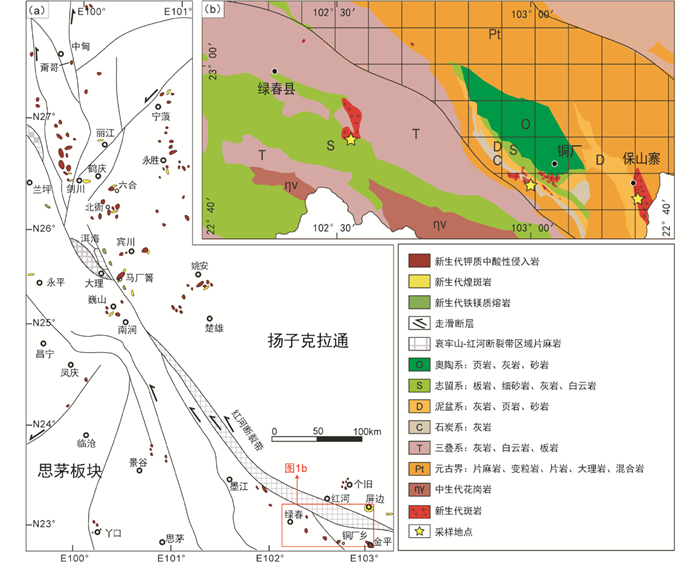
1 地质背景与岩石特征滇西地处青藏高原东南缘,是特提斯-喜马拉雅构造域的一部分(黄汲清等, 1984)。通常认为,金沙江-哀牢山在石炭世为古特提斯洋的一部分,并在早二叠世达到最大规模,在晚三叠世-早侏罗世早期由于陆-陆碰撞、弧-陆碰撞或弧-弧碰撞而关闭,如今的金沙江缝合带代表了古特提斯洋的闭合。从三叠纪末到白垩纪,雅鲁藏布江地带扩张并形成中特提斯大洋,比雅鲁藏布江带稍晚,在侏罗纪,怒江一带发生张裂,扩张形成另一个中特提斯洋。从侏罗纪末,中特提斯洋壳板块向北俯冲消减,最终闭合,形成了班公-怒江缝合带和雅鲁藏布江缝合带(黄汲清等, 1984; 莫宣学和潘桂棠, 2006; 谢建华等, 2005)。在青藏高原东缘,由于东部受到扬子克拉通的影响金沙江和怒江边界缝合带改变了方向并且转向南方穿过滇西。哀牢山-红河剪切带位于青藏高原东部,地理位置上穿过云南省,延伸进入越南境内,再从河内附近延伸到南海,延伸超过1000km。哀牢山-红河断裂带西侧为思茅-印支板块,东侧为扬子克拉通板块。新生代由于印度-欧亚板块的碰撞,特提斯缝合带受挤压力的影响开始走滑,哀牢山-红河断裂带也开始演化(Schärer et al., 1994; Zheng et al., 2013; 孙珍等, 2003; 谢建华等, 2005),同时(约35Ma)发育了一套始新世到渐新世的碱性岩浆岩带。本文在哀牢山-红河断裂带东南端(图 1a),在野外地质调查的基础上,采集了绿春、铜厂和保山寨附近出露的新生代富碱斑岩。
|
图 1 哀牢山-红河断裂带新生代富碱斑岩地质图 (a)扬子克拉通西部和思茅板块构造格架图(据Huang et al., 2010; 曾普胜等, 2002修改); (b)研究区地质简图(据云南省地质局第二区域地质测量大队, 1973①修改) Fig. 1 Geological map of the Cenozoic alkali-rich porphyries in Ailaoshan-Red River shear zone (a) tectonic framework of the western Yangtze Craton and Simon Block (modified after Huang et al., 2010; Zeng et al., 2002); (b) simplified geological map of study area |
① 云南省地质局第二区域地质测量大队. 1973.元阳幅(F-48Ⅶ)金平幅(F-48-Ⅷ)1:20万区域地质调查报告
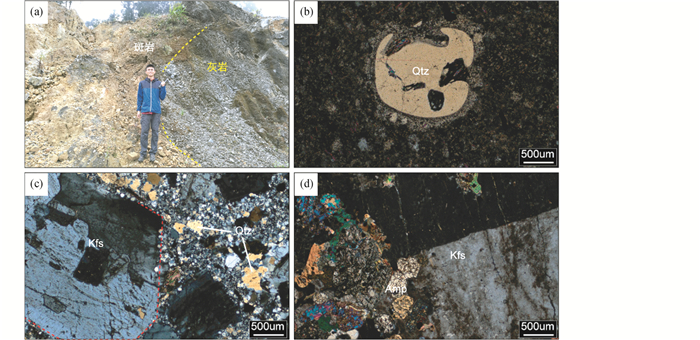
本文对红河哈尼族彝族自治州内的几处新生代富碱斑岩进行了野外采样,采样点如图 1b所示。本文结合镜下鉴定(图 2)和元素测试结果,将富碱斑岩分成三类,其中花岗斑岩(TCX1602、TCX1604、LC1606),斑晶为石英和钾长石(15%~20%),石英被熔蚀成港湾状(图 2b),基质主要为角闪石(10%~15%)和黑云母(5%);正长斑岩(LC1602、LC1605、LC1607)的斑晶为正长石(65%~75%)和半自形角闪石(15%~20%),基质为小颗粒的石英和长石;石英二长斑岩(BSZ1602-1606、TCX1605、LC1601)的斑晶为自形程度较高的钾长石(65%~75%),石英(15%~20%)呈他形,基质为小颗粒的石英和正长石。
|
图 2 哀牢山-红河断裂带新生代富碱斑岩的野外产状(a)与镜下照片(b-d) (a)斑岩与灰岩的接触带;(b)花岗斑岩(TCX1604);(c)石英二长斑岩(BSZ1604);(d)正长斑岩(LC1605).镜下照片为正交偏光;Kfs-钾长石;Qtz-石英;Amp-角闪石 Fig. 2 The occurrence of field (a) and microscopic photos (b-d) of Cenozoic alkali-rich porphyries in Ailaoshan-Red River shear zone (a) the contact zones of porphyries and limestone; (b) granite porphyries (TCX1604); (c) quartz monazite porphyries (BSZ1604); (d) syenite porphyries (LC1605). Under cross-polarized light; Kfs-K-feldspar; Qtz-quartz; Amp-amphibole |
本文所有样品的主量元素和微量元素分别在中国地质大学(北京)国家重点实验室和中国科学院海洋研究所大洋岩石圈与地幔动力学实验室测试分析完成的,分别使用的是Leeman Labs. Inc公司制造的Prodigy型全谱直读型发射光谱仪(ICP-OES)和Agilent 7900 ICP-MS测试仪器,微量元素样品详细处理过程、分析精密度和准确度详见(Liu et al., 2008)。Sr-Nd同位素的分析实验同样在中国地质大学(北京)国家重点实验室完成上机测试,使用多接受等离子体质谱仪(MC-ICP-MS)测试,根据锆石U-Pb定年获得的年龄,校正测试出的样品的(87Sr/86Sr)i值和εNd(t)值。计算亏损地幔的Nd模式年龄(tDM)参考(Depaolo, 1981),143Nd/144Nd和147Sm/144Nd的初始值分别取0.51315和0.2137。
锆石的单矿物挑选是由河北廊坊宇能公司完成,流程主要是先将岩石破碎到80目,之后洗净烘干,通过电磁法和双目镜手动挑选法挑选出锆石。锆石制靶工作是由北京凯德正科技有限公司完成,锆石CL图像是由北京锆石领航科技有限公司完成。锆石U-Pb定年和锆石微量元素分析是在中国科学院海洋研究所大洋岩石圈与地幔动力学实验室完成,主要应用激光剥蚀电感耦合等离子体质谱仪(LA-ICP-MS)原位分析技术。激光剥蚀系统为Photo-machines EXCITE 193nm,激光器型号为Agilent 7900,激光斑束直径为35μm,载气为He,工作电压为1.35kV。实验过程采用NIST610、GJ-1、PLE和91500外标控制的方法,每隔5个样品点分别用两个91500标准样品进行校正。分析数据的离线处理选用的是ICP-MS Data Cal 97(Liu et al., 2010),29Si作为内标用于锆石稀土元素的校正,普通Pb校正则采用(Andersen, 2002),使用Isoplot/Ex, version 3.0(Ludwig, 2003)绘制锆石U-Pb年龄谐和图并计算MSWD。考虑到所测得的年龄均小于1000Ma,因此采用岩浆锆石的206Pb/238U年龄。锆石原位Hf同位素的测定在中国地质大学(武汉)地质过程与矿产资源国家重点实验室Neptune Plus型MC-ICP-MS上完成,选择已经测过年龄的锆石进行原位Hf测定,激光束斑为44μm,剥蚀频率为8Hz,具体方法及仪器参数详见(Hu et al., 2012)。实验获得的数据采用ICP-MS Data Cal软件(Liu et al., 2010)进行处理。εHf计算采用176Lu衰变常数为1.865×10⁻¹¹a-1(Scherer et al., 2001),球粒陨石现今值176Hf/177Hf=0.282772和176Lu/177Hf=0.0332(Blichert-Toft and Albarède, 1997);二阶段亏损地幔Hf模式年龄(tDM2)计算采用现今亏损地幔值176Hf/177Hf=0.28325和176Lu/177Hf=0.0384(Vervoort and Blichert-Toft, 1999),大陆平均地壳176Lu/177Hf=0.015(Griffin et al., 2000)。仪器操作及数据处理方法详见(Liu et al., 2008, 2010)。
通过以上测试,本文共获得13件全岩主、微量元素及3件Sr-Nd同位素分析结果(表 1),并且测得了3件锆石U-Pb年龄(表 2)和Hf同位素成分(表 3)以及锆石微量元素分析结果(表 4、表 5、表 6)。
|
表 1 研究区富碱斑岩主量元素(wt%)、微量元素(×10-6)与Sr-Nd同位素成分 Table 1 Whole-rock major (wt%) and trace elements (×10-6), Sr-Nd isotopic compositions of the alkali-rich porphyries in the studied area |
|
|
表 2 花岗斑岩、石英二长斑岩和正长斑岩的锆石LA-ICP-MS U-Pb定年结果 Table 2 Zircon LA-ICP MS U-Pb data of the granite porphyries, quartz monazite porphyries and syenite porphyries |
|
|
表 3 研究区斑岩的锆石Hf同位素成分 Table 3 Zircon Hf isotopic data of the porphyries in the study area |
|
|
表 4 石英二长斑岩(BSZ1605)中锆石微量元素组成(×10-6) Table 4 The trace element (×10-6) composition of zircon in quartz monazite porphyries (BSZ1605) |
|
|
表 5 正长斑岩(LC1605)中锆石微量元素组成(×10-6) Table 5 The trace element (×10-6) composition of zircon in syenite porphyries (LC1605) |
|
|
表 6 花岗斑岩(TCX1604)中锆石微量元素组成(×10-6) Table 6 The trace element (×10-6) composition of zircon in granite porphyries (TCX1604) |
阴极发光图像(CL)表明本文的锆石均发育岩浆锆石的典型震荡环带。对BSZ1605(石英二长斑岩)、LC1605(正长斑岩)和TCX1604(花岗斑岩)3件样品的60颗锆石进行微量元素分析和U-Pb年龄测试,其中选取年龄谐和的47颗锆石进行了原位Hf同位素的分析,分析结果见表 2、表 3和表 4-表 6。
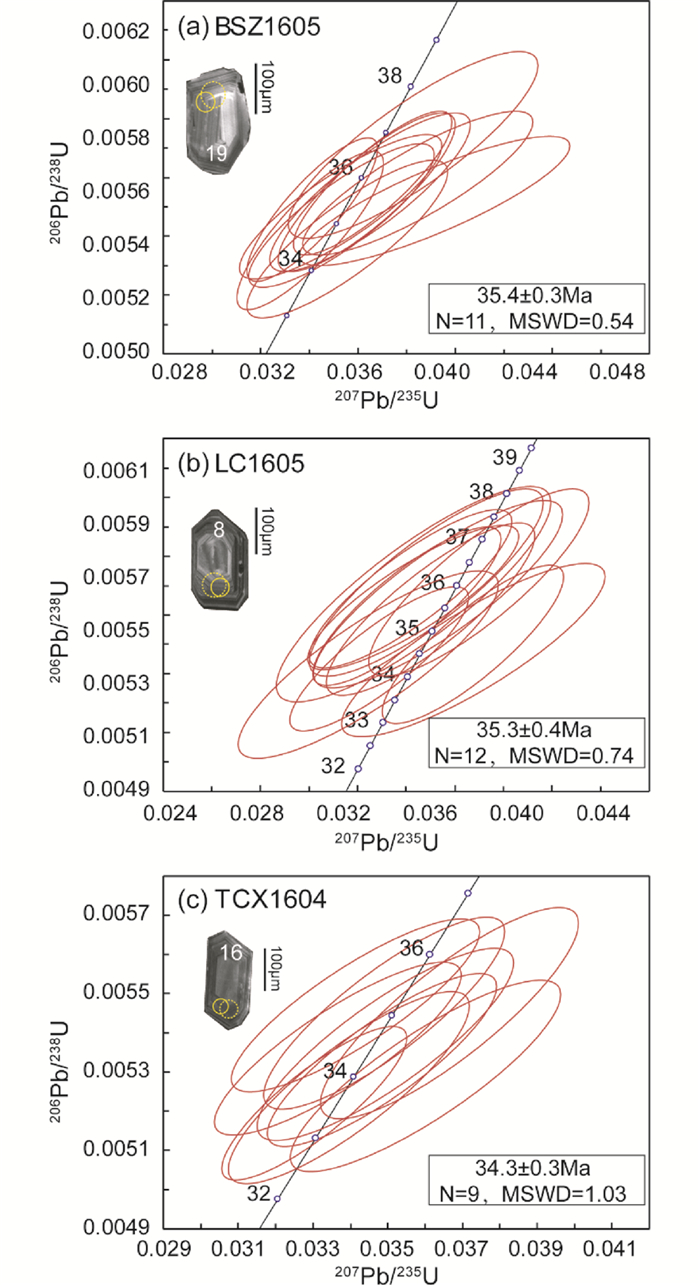
石英二长斑岩(BSZ1605)共测定了20颗锆石,其中11颗锆石谐和度较高(图 3a),获得206Pb/238U加权平均年龄为35.48±0.39Ma (MSWD=0.54)。11个点原位Hf同位素测试给出εHf(t)值为+0.28~+3.55;正长斑岩(LC1605)测定的20颗锆石获得12颗谐和度较高年龄(图 3b),获得206Pb/238U加权平均年龄为35.36±0.43Ma (MSWD=0.74),其中16个原位Hf同位素测试获得εHf(t)值为-3.1~+1.0;花岗斑岩(TCX1604)测定的20颗锆石中9颗锆石谐和度较高(图 3c),获得206Pb/238U加权平均年龄为34.36±0.39Ma (MSWD=1.03),其16个原位Hf同位素测试给出εHf(34Ma)值为-6.4~+2.6。在岩石中还发现部分早期的捕获锆石。
|
图 3 石英二长斑岩(a)、正长斑岩(b)和花岗斑岩(c)的锆石U-Pb年龄谐和图 Fig. 3 Zircon U-Pb concordia diagrams of the quartz monzonite porphyries (a), syenite porphyries (b) and granite porphyries (c) |
经测试分析发现3件样品中的锆石微量元素均存在不同程度Eu异常,其Eu/Eu*值分别为0.70~0.95 (BSZ1605)、0.25~0.46 (LC1601)和0.50~0.66 (TCX1608)。Hf、Th、U和Pb在锆石中含量较高,皆以类质同象形式存在,其中Th/U比值大于0.1常用来判定岩浆锆石(Hoskin and Schaltegger, 2003)。本文3件样品的Th/U值分别为0.15~0.64 (BSZ1605)、0.67~1.13 (LC1605)和0.22~0.84 (TCX1604),均为岩浆锆石。
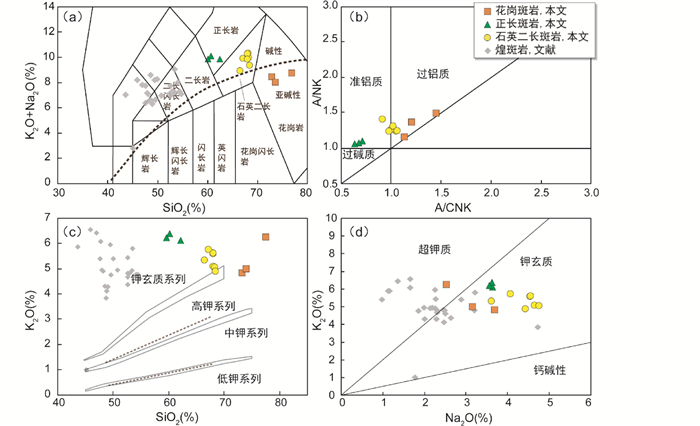
3.2 全岩元素和Sr-Nd同位素地球化学本文划分的三类富碱斑岩,具有不同的元素特征,在侵入岩的TAS图解中落入不同的岩石类型区域(图 4a-d)。花岗斑岩的SiO2含量变化为73.33%~77.59%,Al2O3为12.67%~15.83%,Na2O为2.55%~3.70%,K2O为4.80%~6.23%,全碱总量为8.13%~8.77%,K2O/Na2O值为1.30~2.45,岩石为过铝质岩石,属于钾玄质和超钾质亚碱性花岗斑岩。正长斑岩的SiO2含量变化为60.13%~62.12%,TiO2含量为0.56%~0.60%,Al2O3含量为13.41%~13.88%,为准铝质岩石,Na2O含量为3.57%~3.63%,K2O含量为6.13%~6.38%,全碱含量为9.76%~10.00%,K2O/Na2O值为1.69~1.76,属于钾玄质碱性正长斑岩。石英二长斑岩的SiO2含量变化为66.55%~68.59%,A/CNK介于准铝质和过铝质之间,Na2O为3.62%~4.76%,K2O为4.87%~5.70%,属于钾玄质碱性石英二长斑岩(图 4a-c)。对三类富碱斑岩和区域煌斑岩做哈克图解得到,TiO2、Fe2O3T、MgO和CaO与SiO2呈负相关,而Al2O3和Na2O与SiO2呈正相关(图 5a-f),表明正长斑岩可能经历了橄榄石、辉石和钛铁氧化物的分离结晶过程,富碱斑岩与煌斑岩的元素成分具有演化关系。
|
图 4 岩体主量元素成分图 (a)硅-碱图(Wilson, 1989);(b) ACNK图解;(c)硅-钾图(Peccerillo and Taylor, 1976);(d)钾-钠图.煌斑岩数据据陈福川等, 2015; 管涛等, 2006; 王治华等, 2010; 图 5、图 6、图 8、图 9同此图 Fig. 4 The diagrams of major elements of rocks (a) total alkalis vs. silica after (Wilson, 1989); (b) ANK vs. ACNK, and (c) potassium vs. silica after (Peccerillo and Taylor, 1976); (d) potassium vs. sodium. Data of lamprophyre from Chen et al., 2015; Guan et al., 2006; Wang et al., 2010; also in Fig. 5, Fig. 6, Fig. 8 and Fig. 9 |

|
图 5 岩体Haker图解 正长斑岩数据引自Chen et al., 2017a Fig. 5 Harker diagram for rocks Data of syenite porphyries from Chen et al., 2017a |
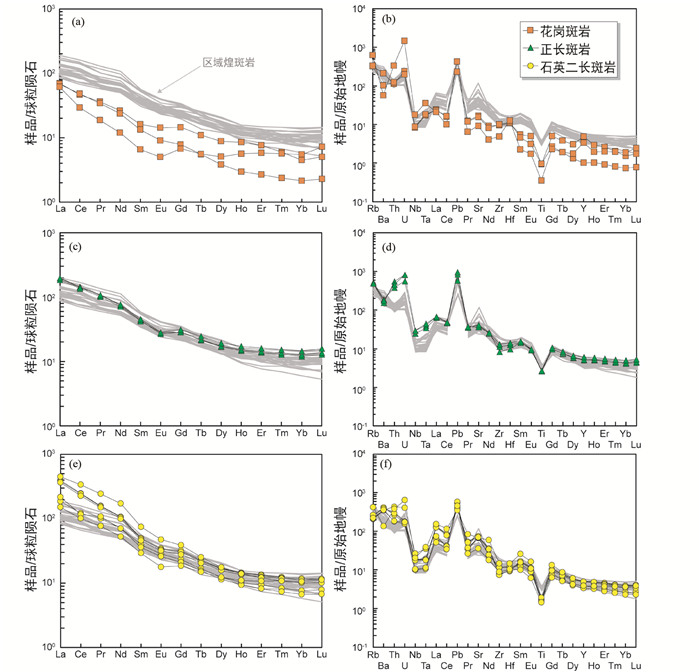
对三类岩石的稀土元素和微量元素分别进行球粒陨石和原始地幔标准化作图(图 6),从图中可以看出,三类岩石具有相似的微量元素配分模式图,都具有轻稀土富集、重稀土亏损的特征,都具有轻重稀土中等分馏特征((La/Yb)N分别为16~32、13~16、14~45);都显示弱的负Eu异常(0.75~0.93、0.75~0.81、0.77~0.94),在微量元素方面也都具有大离子亲石元素Rb、Sr、Ba和Pb富集、高场强元素(Zr、Hf、Nb、Ta、Ti、P)亏损的特征。花岗斑岩∑REE=46.4×10-6~72.2×10-6,平均61.6×10-6,稀土含量最低(正长斑岩平均201.8×10-6,石英二长斑岩平均277.6×10-6),并且低于区域煌斑岩。正长斑岩和石英二长斑岩稀土含量(∑REE=194.7×10-6~206.2×10-6和147.5×10-6~449.8×10-6)和配分模式图与区域煌斑岩相似,说明其源区具有相似性。三类岩石具有均一的Sr-Nd同位素组成,87Sr/86Sr值为0.7067~0.7078,εNd(t)为-3.8~-3.7,Nd模式年龄一致(0.98~1.14Ga)。
|
图 6 三类斑岩的球粒陨石标准化稀土元素配分图和原始地幔标准化微量元素蛛网图(标准化值据Sun and McDonough, 1989) Fig. 6 Chondrite-normalized REE patterns and primitive mantle-normalized trace-elements spidergrams of the porphyries in this study (normalization values after Sun and McDonough, 1989) |
本文测定的石英二长斑岩、正长斑岩和花岗斑岩的锆石U-Pb年龄为34~35Ma,与前人研究结果一致(Chen et al., 2017a; Deng et al., 2015; He et al., 2016; 贾儒雅等, 2016)。青藏高原自印度-欧亚板块碰撞(60~55Ma)以来发生的岩浆活动可以分为三期,35Ma处于第二期岩浆活动峰期(侯增谦等, 2006a)。同时哀牢山-红河断裂带发生走滑(Searle et al., 2010; 孙珍等, 2003),并且新生代岩浆活动严格的受断裂带控制(Chen et al., 2017b),但是,前人大量的研究把走滑发生的时间限定在了31~21Ma(Liu et al., 2012; Wu et al., 2017; 曹淑云等, 2009; 陈文寄等, 1996; 吴海威等, 1989; 张进江等, 2006)。所以从时间看,本文的富碱斑岩岩体侵入明显早于哀牢山-红河断裂带走滑时间。新生代岩浆活动受断裂带控制可能是因为断裂带切穿了岩石圈(Wang et al., 2001),使得岩浆容易沿断裂带裂隙上涌。
4.2 岩石成因及源区性质本文三类富碱斑岩具有不同的元素地球化学特征,它们的岩浆源区不同,以下进行详细的阐述。
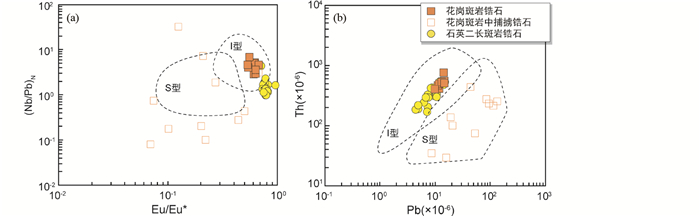
通过锆石微量元素投图(图 7a, b),花岗斑岩和石英二长斑岩属于I型花岗岩,但是花岗斑岩中捕获锆石均为S型,说明花岗斑岩和石英二长斑岩的源区岩石为正变质岩,但是花岗斑岩混染了古老泥质地壳物质。
|
图 7 锆石微量元素判别I型花岗岩和S型花岗岩图解(底图据Wang et al., 2012a) Fig. 7 Selected plots of trace element concentrations and ratios in zircons from I-type and S-type granitoids (base maps after Wang et al., 2012a) |
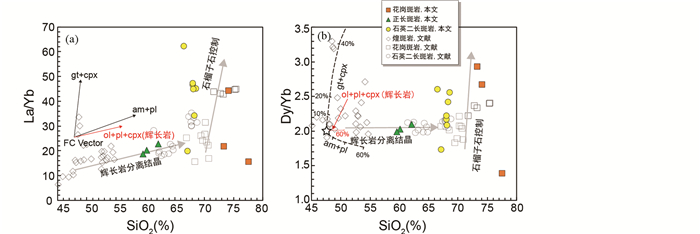
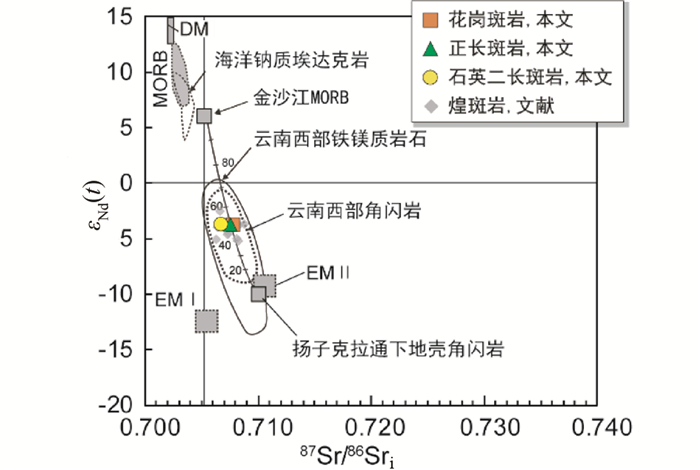
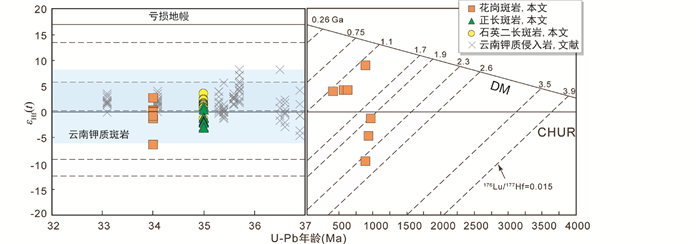
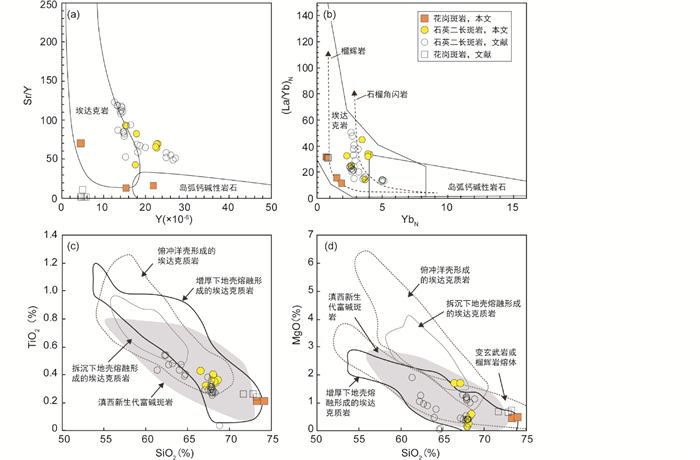
花岗斑岩具有高的SiO2含量(73.33%~77.59%)、Al2O3含量(12.67%~15.83%),具有强过铝质特征(A/CNK比值大于1.1),低的Fe2O3、MgO、Ni和Cr的含量,显示壳源花岗岩特征。根据张旗(2010)花岗岩分类,低Sr含量(194.1×10-6~356.2×10-6)和低Yb含量(0.36×10-6~0.93×10-6)应该属于喜马拉雅型花岗岩,低的Yb和Y含量(4.63×10-6~21.96×10-6),轻重稀土分馏程度La/Yb的值和重稀土分馏程度Dy/Yb值(图 8a, b)说明其源区存在石榴石,弱Eu负异常(0.76~0.94)说明源区没有或存在少量斜长石以及结晶过程中斜长石分异不明显,指示其源岩可能为含石榴石和少量斜长石的高压麻粒岩相,形成压力在0.8~1.5GPa之间(Xiong et al., 2005; 张旗等, 2008)。通过锆石Ti饱和温度计得出的温度是625~750℃(计算方法据Ferry and Watson, 2007)。前人得到滇西下地壳捕虏体富含石榴石(周晔等, 2017),推测其深度为45~51km。从同位素角度看,其Sr同位素的初始比值(0.707542)略高于现代大洋玄武岩(0.706),εNd(t)值为-3.8(图 9),锆石εHf(t)为(-7.1~+1.9),表明花岗岩主要来源于加厚的富钾的铁镁质下地壳,岩石具有新元古代的Nd和Hf同位素模式年龄(0.78~1.33Ga)(图 10),可能代表了早期扬子克拉通周缘的古老俯冲带物质的部分熔融,造成的物质再循环作用,与Hou et al. (2017)的研究结果是吻合的。
|
图 8 La/Yb-SiO2协变图解(a)和Dy/Yb-SiO2协变图解(b) gt+cpx、am+pl和ol+pl+cpx(辉长岩)的分离结晶方向取自Davidson (2007),gt+cpx、ol+pl+cpx(辉长岩)和am+pl分离结晶模式取自Macpherson (2008).文献数据:石英二长斑岩(刘金宇等, 2017; 贾儒雅等, 2016; Lu et al., 2013),花岗斑岩(Chen et al., 2017a; He et al., 2016) Fig. 8 Variations of La/Yb vs. SiO2 (a) and Dy/Yb vs. SiO2 (b) Fractional crystallization (FC) vectors of gt+cpx, am+pl and ol+pl+cpx (gabbro) in Fig. 8a from Davidson (2007). FC models (showing percent crystallization) of gt+cpx, ol+pl+cpx (gabbro) and am+pl in Fig. 8b after Macpherson (2008). Literature data: quartz monazite porphyries (Liu et al., 2017; Jia et al., 2016; Lu et al., 2013), granite porphyries (Chen et al., 2017a; He et al., 2016) |
|
图 9 富碱斑岩(87Sr/86Sr)i和εNd(t)协变图 云南西部富钾铁镁质岩石数据来自Guo et al. (2005),Huang et al. (2010),Li et al. (2002),Xu et al. (2001);云南西部角闪岩数据来邓万明等(1998),赵欣等(2004);BSE、MORB、DM、EMⅠ和EMⅡ地幔源区数据来自Zindler and Hart (1986) Fig. 9 (87Sr/86Sr)i vs. εNd(t) diagram of the alkali-rich porphyries The field for western Yunnan potassic mafic rocks is from Guo et al. (2005), Huang et al. (2010), Li et al. (2002), Xu et al. (2001). The field for western Yunnan amphibolite is from Deng et al. (1998), Zhao et al. (2004). Mantle source reservoirs BSE, MORB, DM, EMⅠ and EMⅡ are from Zindler and Hart (1986) |
|
图 10 锆石εHf(t)同位素和U-Pb年龄协变图 灰色区域代表扬子克拉通主要地壳增长阶段(Sun et al., 2009; Wang et al., 2012b; Zhao et al., 2010); 云南钾质侵入岩数据来自Lu et al. (2013) Fig. 10 Variation of εHf(t) isotope vs. U-Pb ages of the zircons in this study The grey fields represent episodes of major crustal growth in the Yangtze Craton (Sun et al., 2009; Wang et al., 2012b; Zhao et al., 2010); Data of Yunnan potassium intrusive rocks is from Lu et al., 2013 |
石英二长斑岩SiO2含量为66.55%~68.59%,高Al2O3(15.92%~16.87%)、高Sr(755.7×10⁻⁶~1590×10-6)、低Yb(1.14×10⁻⁶~1.99×10⁻⁶)和Y(15.31×10⁻⁶~22.99×10⁻⁶)含量,以及高的Sr/Y比值(43~93)和(La/Yb)N比值(14~45),在Sr/Y-Y图解(图 11a)中部分既没有落入埃达克岩区域,也没有落入典型岛弧区域,但是(La/Yb)N-YbN图解里落入了埃达克岩范围,所以部分样品没有严格符合埃达克岩的定义(Defant and Drummond, 1990),所以本文认为石英二长斑岩具有非典型的埃达克质岩石特征(张旗等, 2006)。根据SiO2-MgO图和SiO2-TiO2图,石英二长斑岩落入增厚下地壳区域,说明石英二长斑岩和花岗斑岩源区一致,低的Yb和高Sr含量和弱Eu负异常表明其源区残留相为石榴子石(图 8)(Martin et al., 2005)、少量(无)斜长石,通过熔融模拟曲线,其源区可能为石榴角闪岩相,还有根据锆石Ti饱和温度计算得的温度为595~646℃与花岗斑岩温度相似,表明石英二长斑岩来源于加厚的铁镁质下地壳,类似于花岗斑岩的成因,不同在于花岗斑岩可能混入了古老的长英质成分。
|
图 11 研究区富碱斑岩的埃达克岩判别图 (a) Y-Sr/Y图解(Defant and Drummond, 1993);(b) YbN-(La/Yb)N图解(Martin, 1999);(c) SiO2-TiO2图解(Huang et al., 2009); (d) SiO2-MgO图解(Wang et al., 2006).文献数据:石英二长斑岩(刘金宇等, 2017; 贾儒雅等, 2016); 花岗斑岩(Chen et al., 2017a) Fig. 11 Adakite discrimination diagrams of alkali-rich porphyry in the study area (a) Y vs. Sr/Y (Defant and Drummond, 1993); (b) YbN vs. (La/Yb)N (Martin, 1999); (c) SiO2 vs. TiO2 (Huang et al., 2009) and (d) SiO2 vs. MgO (Wang et al., 2006). Literature data: quartz monazite porphyries (Liu et al., 2017; Jia et al., 2016); granite porphyries (Chen et al., 2017a) |
正长斑岩属于钾玄岩系列(图 4c),钾玄质岩石通常被认为是岛弧和碰撞带与伸展环境有关的典型岩石(Morrison, 1980; Gill, 2010),并且通常认为是来自富集的岩石圈地幔的部分熔融(Müller and Groves, 1993; Wyman and Kerrich, 1993),其富集原因可能是俯冲板片衍生的流体或熔体的交代作用(Rogers et al., 1998; Turner et al., 1993),通过实验表明含水流体(或熔体)和地幔橄榄岩之间的反应可以产生一种混合的金云母辉石岩,这种含金云母地幔的部分熔融会产生钾质岩浆(Jiang et al., 2012; Wyllie and Sekine, 1982),并且三江富碱斑岩及其他钾质、钾玄质岩石通常相对亏损高场强元素(Nb、Ta和Ti),具有正的Pb异常,也暗示了俯冲交代作用的存在(Hofmann, 2014; Thirlwall et al., 1994)。
正长斑岩SiO2含量为59.57%~62.12%,前人研究表明,一般地幔不能直接产生SiO2含量大于57%的硅酸盐(Baker et al., 1995; Lloyd et al., 1985),但是根据Condamine and Médard (2014)的1GPa含金云母地幔的熔融实验表明,原始的富含二氧化硅(SiO2=52%~64%)的钾质岩浆可以通过熔融交代的含金云母的橄榄岩直接生产。高MgO(3.95%~5.39%)、高TFe2O3(5.45%~6.16%)、高Cr(187.05×10⁻⁶~299.24×10⁻⁶)和高Ni含量(58.16×10⁻⁶~97.08×10⁻⁶),也表明正长斑岩应是地幔来源的。高Sr说明其残留相没有斜长石,高Yb说明残留相不含石榴石,因此,岩石可能来源于含金云母的辉石岩源区的部分熔融,前人在马关地区发现了含金云母的尖晶石二辉橄榄岩包体说明研究区存在类似的地幔源区物质(魏启荣, 2009)。岩石的Ti饱和温度为787~841℃,明显高于上述的另外两类岩石,进一步说明其为幔源岩石。从微量元素和稀土元素成分看,正长斑岩与区域上同时代产出的煌斑岩(陈福川等, 2015; 管涛等, 2006; 王治华等, 2010)具有相似的成分特征(图 6c, d),正长斑岩与区域煌斑岩具有演化关系(图 5)且都分布于辉长岩分离结晶的演化线上(图 8),正长斑岩的Sr-Nd同位素和εHf(t)值也与煌斑岩相似(图 9),这些综合特征表明正长斑岩的源区和煌斑岩相似,它们都是来自于交代过的富集岩石圈地幔。
4.3 动力学背景扬子克拉通岩石圈地幔发生过两次主要的富集交代作用,第一次在新元古代早期,扬子克拉通南北缘发生双向大洋俯冲,在大陆岩石圈地幔中产生了交代域(Li et al., 2008; Wang et al., 2009),第二次为晚古生代古特提斯洋分支古金沙江洋的西向俯冲,俯冲板块流体与大陆岩石圈发生交代作用(洪涛等, 2015)。因为富碱斑岩的Nb/U(0.4~3.8),上地壳Nb/U大约6.9,全球俯冲沉积物的Nb/U平均值5.3(Plank and Langmuir, 1998),MORB和OIB的Nb/U比值约为47(Ionov et al., 1997),俯冲带流体Nb/U比值约0.22(Ayers, 1998),表明地幔源区是由板块衍生含水流体交代形成的,地幔中的金云母可能是板块流体交代的结果(Ionov et al., 1997)。多次的交代作用使得加厚的下地壳和岩石圈地幔具有均一且相似的EMⅡ端元的同位素特征(图 9)和相似的Hf同位素特征(图 10)。到了三叠纪晚期,思茅板块沿着金沙江缝合带西部与扬子克拉通对接为一体,使扬子克拉通西部变为陆内环境。从55Ma到37Ma,印度-欧亚板块的持续碰撞,使得金沙江缝合带的岩石圈增厚,从下地壳捕虏体得知始新世-渐新世地壳厚度至少为50km(赵欣等, 2004)。37~32Ma三江地区发生应力变化,富碱斑岩处于后碰撞环境,岩石圈地幔的拆沉导致软流圈地幔上涌(Thompson and Connolly, 1995),温度升高使得交代富集的岩石圈地幔和加厚的钾质下地壳发生熔融,沿着地壳裂隙上升侵位,形成不同类型的富碱斑岩。通过以上分析,新生代钾质岩浆虽然产在板内环境,但具有弧岩浆特征就不难理解了,也就是莫宣学提出的“岩浆滞后效应”(Mo et al., 1991)。
5 结论(1) 哀牢山-红河断裂带南段的花岗斑岩、正长斑岩和石英二长斑岩的锆石U-Pb年龄分别为34.36±0.39Ma、35.36±0.43Ma和35.48±0.39Ma,其产出时代与整个三江地区岩浆活动高峰期一致。
(2) 花岗斑岩和石英二长岩来源于加厚的下地壳的部分熔融,正长斑岩是富集岩石圈地幔部分熔融的产物。
(3) 印度板块对欧亚板块的持续汇聚,导致滇西三江地区处于整体挤压局部拉张的构造环境,在新生代发生下地壳加厚、岩石圈拆沉,导致软流圈地幔上涌,富集岩石圈地幔和下地壳发生部分熔融,沿着先前缝合带和构造软弱带侵入到地壳浅部形成富碱斑岩。
致谢 感谢审稿人李小伟老师和陈建林老师提出了宝贵的修改意见,感谢编辑部俞良军老师认真指导使本文更加完善。
Andersen T. 2002. Correction of common lead in U-Pb analyses that do not report 204Pb. Chemical Geology, 192(1-2): 59-79. DOI:10.1016/S0009-2541(02)00195-X |
Ayers J. 1998. Trace element modeling of aqueous fluid-peridotite interaction in the mantle wedge of subduction zones. Contributions to Mineralogy and Petrology, 132(4): 390-404. DOI:10.1007/s004100050431 |
Baker MB, Hirschmann MM, Ghiorso MS and Stolper EM. 1995. Compositions of near-solidus peridotite melts from experiments and thermodynamic calculations. Nature, 375(6529): 308-311. DOI:10.1038/375308a0 |
Blichert-Toft J and Albarède F. 1997. The Lu-Hf isotope geochemistry of chondrites and the evolution of the mantle-crust system. Earth and Planetary Science Letters, 148(1-2): 243-258. DOI:10.1016/S0012-821X(97)00040-X |
Cao SY, Liu JL, Leiss B, Vollbrecht A, Zou YX and Zhao CQ. 2009. Timing of initiation of left-lateral slip along the Ailao Shan-Red River shear zone:Microstructural, texture and thermochronological evidence from high temperature mylonites in Diancang Shan, SW China. Acta Geologica Sinica, 83(10): 1388-1400. |
Chen B, Long XP, Wilde SA, Yuan C, Wang Q, Xia XP and Zhang ZF. 2017a. Delamination of lithospheric mantle evidenced by Cenozoic potassic rocks in Yunnan, SW China:A contribution to uplift of the eastern Tibetan Plateau. Lithos, 284-285: 709-729. DOI:10.1016/j.lithos.2017.05.019 |
Chen FC, Wang QF, Li LJ and Zhao Y. 2015. 40Ar-39Ar chronological and geochemical characteristics of Zhenyuan lamprophyres in Ailaoshan belt, western Yunnan. Acta Petrologica Sinica, 31(11): 3203-3216. |
Chen WJ, Li Q and Wang YP. 1996. Miocene diachronic uplift along the Ailao Mountains-Red River left-lateral strike-slip shear zone. Geological Review, 42(5): 385-390. |
Chen XF, Zeng PS, Zhang XT, Xu WR and Wan DF. 2015. Petrology and geochemistry of the Zhuopan alkaline complex in Yongping, Yunnan Province:Constraints on petrogenesis and tectonic setting. Acta Petrologica Sinica, 31(9): 2597-2608. |
Chen XY, Liu JL, Qi YC, Fan WK, Wang K, Zhang Y and Chen W. 2017b. Miocene structural evolution and exhumation of the Ximeng dome in Yunnan, southeastern Tibet:Implications for intraplate deformation during extrusion of the Sundaland block. Journal of Asian Earth Sciences, 141: 194-212. DOI:10.1016/j.jseaes.2016.08.013 |
Cheng J, Xia B and Zhang YQ. 2007. Petrological and geochemical characteristics of Yao'an alkaline complex in Yunnan province. Geotectonica et Metallogenia, 31(1): 118-125. |
Condamine P and Médard E. 2014. Experimental melting of phlogopite-bearing mantle at 1GPa:Implications for potassic magmatism. Earth and Planetary Science Letters, 397: 80-92. DOI:10.1016/j.epsl.2014.04.027 |
Davidson J, Turner S, Handley H, Macpherson C and Dosseto A. 2007. Amphibole "sponge" in arc crust?. Geology, 35(9): 787-790. DOI:10.1130/G23637A.1 |
Defant MJ and Drummond MS. 1990. Derivation of some modern arc magmas by melting of young subducted lithosphere. Nature, 347(6294): 662-665. DOI:10.1038/347662a0 |
Defant MJ and Drummond MS. 1993. Mount St. Helens:Potential example of the partial melting of the subducted lithosphere in a volcanic arc. Geology, 21(6): 547-550. DOI:10.1130/0091-7613(1993)021<0547:MSHPEO>2.3.CO;2 |
Deng J, Wang QF, Li GJ, Hou ZQ, Jiang CZ and Danyushevsky L. 2015. Geology and genesis of the giant Beiya porphyry-skarn gold deposit, northwestern Yangtze Block, China. Ore Geology Reviews, 70: 457-485. DOI:10.1016/j.oregeorev.2015.02.015 |
Deng WM, Huang X and Zhong DL. 1998. Petrological characteristics and genesis of cenozoic alkali-rich porphyry in West Yunnan, China. Scientia Geologica Sinica, 33(4): 412-425. |
DePaolo DJ. 1981. A neodymium and strontium isotopic study of the mesozoic calc-alkaline granitic batholiths of the Sierra Nevada and Peninsular ranges, California. Journal of Geophysical Research:Solid Earth, 86(B11): 10470-10488. DOI:10.1029/JB086iB11p10470 |
Ferry JM and Watson EB. 2007. New thermodynamic models and revised calibrations for the Ti-in-zircon and Zr-in-rutile thermometers. Contributions to Mineralogy and Petrology, 154(4): 429-437. DOI:10.1007/s00410-007-0201-0 |
Gill R. 2010. Igneous Rocks and Processes:A Practical Guide. Chichester: Wiley-Blackwell: 375-376.
|
Griffin WL, Pearson NJ, Belousova E, Jackson SE, van Achterbergh E, O'Reilly SY and Shee SR. 2000. The Hf isotope composition of cratonic mantle:LAM-MC-ICPMS analysis of zircon megacrysts in kimberlites. Geochimica et Cosmochimica Acta, 64(1): 133-147. DOI:10.1016/S0016-7037(99)00343-9 |
Guan T, Huang ZL, Xu C, Zhang ZL, Yan ZF and Chen M. 2006. 40Ar-39Ar dating and geochemical characteristics of lamprophyres in the Baimazhai nickel deposit, Yunnan Province. Acta Petrologica Sinica, 22(4): 873-883. |
Guo ZF, Hertogen J, Liu JQ, Pasteels P, Boven A, Punzalan L, He HY, Luo XJ and Zhang WH. 2005. Potassic magmatism in western Sichuan and Yunnan provinces, SE Tibet, China:Petrological and geochemical constraints on petrogenesis. Journal of Petrology, 46(1): 33-78. DOI:10.1093/petrology/egh061 |
He WY, Mo XX, Yang LQ, Xing YL, Dong GC, Yang Z, Gao X and Bao XS. 2016. Origin of the Eocene porphyries and mafic microgranular enclaves from the Beiya porphyry Au polymetallic deposit, western Yunnan, China:Implications for magma mixing/mingling and mineralization. Gondwana Research, 40: 230-248. DOI:10.1016/j.gr.2016.09.004 |
Hofmann AW. 2014. Sampling mantle heterogeneity through oceanic basalts: Isotopes and trace elements. In: Holland HD and Turekian KK (eds.). Treatise on Geochemistry. 2nd Edition. Oxford: Elsevier, 67-101
|
Hong T, You J, Wu C and Xu XW. 2015. Archean-Paleoproterozoic zircons from a granite porphyry in the Taohua area, western Yunnan and their constrain on the basement of western margin of Yangtze plate. Acta Petrologica Sinica, 31(9): 2583-2596. |
Hoskin PWO and Schaltegger U. 2003. The composition of zircon and igneous and metamorphic petrogenesis. Reviews in Mineralogy and Geochemistry, 53(1): 27-62. |
Hou ZQ, Pan GT, Wang AJ, Mo XX, Tian SH, Sun XM, Ding L, Wang EQ, Gao YF, Xie YL, Zeng PS, Qin KZ, Xu JF, Qu XM, Yang ZP, Yang ZS, Fei HC, Meng XJ and Li ZQ. 2006a. Metallogenesis in Tibetan collisional orogenic belt:Ⅱ. Mineralization in late-collisional transformation setting. Mineral Deposits, 25(5): 521-543. |
Hou ZQ, Qu XM, Yang ZS, Meng XJ, Li ZQ, Yang ZM, Zheng MP, Zheng YY, Nie FJ, Gao YF, Jiang SH and Li GM. 2006b. Metallogenesis in Tibetan collisional orogenic belt Ⅲ. Mineralization in post-collisional extension setting. Mineral Deposits, 25(6): 629-651. |
Hou ZQ, Zhou Y, Wang R, Zheng YC, He WY, Zhao M, Evans NJ and Weinberg RF. 2017. Recycling of metal-fertilized lower continental crust:Origin of non-arc Au-rich porphyry deposits at cratonic edges. Geology, 45(6): 563-566. DOI:10.1130/G38619.1 |
Hu ZC, Liu YS, Gao S, Liu WG, Zhang W, Tong XR, Lin L, Zong KQ, Li M, Chen HH, Zhou L and Yang L. 2012. Improved in situ Hf isotope ratio analysis of zircon using newly designed X skimmer cone and jet sample cone in combination with the addition of nitrogen by laser ablation multiple collector ICP-MS. Journal of Analytical Atomic Spectrometry, 27(9): 1391-1399. DOI:10.1039/c2ja30078h |
Huang JQ, Chen GM and Chen BW. 1984. Preliminary analysis of the Tethyshimalayan tectonic domain. Acta Geologica Sinica, 58(1): 1-17. |
Huang XL, Xu YG, Lan JB, Yang QJ and Luo ZY. 2009. Neoproterozoic adakitic rocks from Mopanshan in the western Yangtze Craton:Partial melts of a thickened lower crust. Lithos, 112(3-4): 367-381. |
Huang XL, Niu YL, Xu YG, Chen LL and Yang QJ. 2010. Mineralogical and geochemical constraints on the petrogenesis of post-collisional potassic and ultrapotassic rocks from western Yunnan, SW China. Journal of Petrology, 51(8): 1617-1654. DOI:10.1093/petrology/egq032 |
Ionov DA, Griffin WL and O'Reilly SY. 1997. Volatile-bearing minerals and lithophile trace elements in the upper mantle. Chemical Geology, 141(3-4): 153-184. DOI:10.1016/S0009-2541(97)00061-2 |
Jia RY, Liao SY, Liu Z and Ye CL. 2016. Petrogenesis and tectonic implications of the Eocene Weishan pluton from western Yunnan. Geology in China, 43(1): 132-141. |
Jiang YH, Liu Z, Jia RY, Liao SY, Zhou Q and Zhao P. 2012. Miocene potassic granite-syenite association in western Tibetan Plateau:Implications for shoshonitic and high Ba-Sr granite genesis. Lithos, 134-135: 146-162. DOI:10.1016/j.lithos.2011.12.012 |
Li XH, Zhou HW, Zhong SL, Lo CH, Wei GJ, Liu Y and Lee CY. 2002. Geochemical and Sr-Nd isotopic characteristics of Late Paleogene ultrapotassic magmatism in southeastern Tibet. International Geology Review, 44(6): 559-574. DOI:10.2747/0020-6814.44.6.559 |
Li ZX, Bogdanova SV, Collins AS, Davidson A, De Waele B, Ernst RE, Fitzsimons ICW, Fuck RA, Gladkochub DP, Jacobs J, Karlstrom KE, Lu S, Natapov LM, Pease V, Pisarevsky SA, Thrane K and Vernikovsky V. 2008. Assembly, configuration, and break-up history of Rodinia:A synthesis. Precambrian Research, 160(1-2): 179-210. DOI:10.1016/j.precamres.2007.04.021 |
Liu JL, Tang Y, Tran MD, Cao SY, Zhao L, Zhang ZC, Zhao ZD and Chen W. 2012. The nature of the Ailao Shan-Red River (ASRR) shear zone:Constraints from structural, microstructural and fabric analyses of metamorphic rocks from the Diancang Shan, Ailao Shan and Day Nui Con Voi massifs. Journal of Asian Earth Sciences, 47: 231-251. DOI:10.1016/j.jseaes.2011.10.020 |
Liu JY, Deng J, Li GJ, Xiao CH, Meng FJ, Chen FC, Wu W and Zhang QW. 2017. Petrogenesis and tectonic significance of the Lianhuashan intrusion in the Lanping Basin, western Yunnan:Constraints from bulk element composition, zircon U-Pb geochronology and Hf isotopic compositions. Acta Petrologica Sinica, 33(7): 2115-2128. |
Liu YS, Hu ZC, Gao S, Gunther D, Xu J, Gao CG and Chen HH. 2008. In situ analysis of major and trace elements of anhydrous minerals by LA-ICP-MS without applying an internal standard. Chemical Geology, 257(1-2): 34-43. DOI:10.1016/j.chemgeo.2008.08.004 |
Liu YS, Gao S, Hu ZC, Gao CG, Zong KQ and Wang DB. 2010. Continental and oceanic crust recycling-induced melt-peridotite interactions in the Trans-North China orogen:U-Pb dating, Hf isotopes and trace elements in zircons from mantle xenoliths. Journal of Petrology, 51(1-2): 537-571. DOI:10.1093/petrology/egp082 |
Lloyd FE, Arima M and Edgar AD. 1985. Partial melting of a phlogopite-clinopyroxenite nodule from south-west Uganda:An experimental study bearing on the origin of highly potassic continental rift volcanics. Contributions to Mineralogy and Petrology, 91(4): 321-329. DOI:10.1007/BF00374688 |
Lü BX and Qian XG. 2000. The Tectonic type of cenozoic alkaline magmatic rock series in Three-River area, West Yunnan. Yunnan Geology, 19(3): 232-243. |
Lu YJ, Kerrich R, Campbell McCuaig T, Li ZX, Hart CJR, Cawood PA, Hou ZQ, Bagas L, Cliff J, Belousova EA and Tang SH. 2013. Geochemical, Sr-Nd-Pb, and zircon Hf-O isotopic compositions of Eocene-Oligocene shoshonitic and potassic adakite-like felsic intrusions in western Yunnan, SW China:Petrogenesis and tectonic Implications. Journal of Petrology, 54(7): 1309-1348. DOI:10.1093/petrology/egt013 |
Ludwig KR. 2003. ISOPLOT 3.00:A geochronological toolkit for microsoft excel. Berkeley: Berkeley Geochronology Center Special Publication.
|
Macpherson CG. 2008. Lithosphere erosion and crustal growth in subduction zones:Insights from initiation of the nascent East Philippine Arc. Geology, 36(4): 311-314. DOI:10.1130/G24412A.1 |
Martin H. 1999. Adakitic magmas:Modern analogues of Archaean granitoids. Lithos, 46(3): 411-429. |
Martin H, Smithies RH, Rapp R, Moyen JF and Champion D. 2005. An overview of adakite, tonalite-trondhjemite-granodiorite (TTG), and sanukitoid:Relationships and some implications for crustal evolution. Lithos, 79(1-2): 1-24. |
Mo XX, Lu FX and Deng JF. 1991. Volcanism in Sanjiang Tethyan orogenic belt:New facts and concepts. Journal of China University of Geosciences, 2(1): 58-74. |
Mo XX and Pan GT. 2006. From the Tethys to the formation of the Qinghai-Tibet Plateau:Constrained by tectono-magmatic events. Earth Science Frontiers, 13(6): 43-51. |
Morrison GW. 1980. Characteristics and tectonic setting of the shoshonite rock association. Lithos, 13(1): 97-108. DOI:10.1016/0024-4937(80)90067-5 |
Müller D and Groves DI. 1993. Direct and indirect associations between potassic igneous rocks, shoshonites and gold-copper deposits. Ore Geology Reviews, 8(5): 383-406. DOI:10.1016/0169-1368(93)90035-W |
Peccerillo A and Taylor SR. 1976. Geochemistry of eocene calc-alkaline volcanic rocks from the Kastamonu area, Northern Turkey. Contributions to Mineralogy and Petrology, 58(1): 63-81. DOI:10.1007/BF00384745 |
Plank T and Langmuir CH. 1998. The chemical composition of subducting sediment and its consequences for the crust and mantle. Chemical Geology, 145(3-4): 325-394. DOI:10.1016/S0009-2541(97)00150-2 |
Rogers NW, James D, Kelley SP and De Mulder M. 1998. The generation of potassic lavas from the eastern Virunga Province, Rwanda. Journal of Petrology, 39(6): 1223-1247. DOI:10.1093/petroj/39.6.1223 |
Schärer U, Zhang LS and Tapponnier P. 1994. Duration of strike-slip movements in large shear zones:The Red River belt, China. Earth and Planetary Science Letters, 126(4): 379-397. DOI:10.1016/0012-821X(94)90119-8 |
Scherer E, Münker C and Mezger K. 2001. Calibration of the lutetium-hafnium clock. Science, 293(5530): 683-687. DOI:10.1126/science.1061372 |
Searle MP, Yeh MW, Lin TH and Chung SL. 2010. Structural constraints on the timing of left-lateral shear along the Red River shear zone in the Ailao Shan and Diancang Shan Ranges, Yunnan, SW China. Geosphere, 6(4): 316-338. DOI:10.1130/GES00580.1 |
Sun SS and McDonough WF. 1989. Chemical and isotopic systematics of oceanic basalts: Implications for mantle composition and processes. In: Saunders AD and Norry MJ (eds.). Magmatism in the Ocean Basins. Geological Society, London, Special Publications, 42(1): 313-345
|
Sun WH, Zhou MF, Gao JF, Yang YH, Zhao XF and Zhao JH. 2009. Detrital zircon U-Pb geochronological and Lu-Hf isotopic constraints on the Precambrian magmatic and crustal evolution of the western Yangtze Block, SW China. Precambrian Research, 172(1-2): 99-126. DOI:10.1016/j.precamres.2009.03.010 |
Sun Z, Zhong ZH, Zhou D, Qiu XL and Wu SM. 2003. Deformation mechanism of Red River fault zone during Cenozoic and experimental evidences related to Yinggehai basin formation. Journal of Tropical Oceanography, 22(2): 1-9. |
Thirlwall MF, Smith TE, Graham AM, Theodorou N, Hollings P, Davidson JP and Arculus RJ. 1994. High field strength element anomalies in arc lavas:Source or process. Journal of Petrology, 35(3): 819-838. DOI:10.1093/petrology/35.3.819 |
Thompson AB and Connolly JAD. 1995. Melting of the continental crust:Some thermal and petrological constraints on anatexis in continental collision zones and other tectonic settings. Journal of Geophysical Research:Solid Earth, 100(B8): 15565-15579. DOI:10.1029/95JB00191 |
Turner S, Hawkesworth C, Liu JQ, Rogers N, Kelley S and Van Calsteren P. 1993. Timing of Tibetan uplift constrained by analysis of volcanic rocks. Nature, 364(6432): 50-54. DOI:10.1038/364050a0 |
Vervoort JD and Blichert-Toft J. 1999. Evolution of the depleted mantle:Hf isotope evidence from juvenile rocks through time. Geochimica et Cosmochimica Acta, 63(3-4): 533-556. DOI:10.1016/S0016-7037(98)00274-9 |
Wang JH, Yin A, Harrison TM, Grove M, Zhang YQ and Xie GH. 2001. A tectonic model for Cenozoic igneous activities in the eastern Indo-Asian collision zone. Earth and Planetary Science Letters, 188(1-2): 123-133. DOI:10.1016/S0012-821X(01)00315-6 |
Wang Q, Xu JF, Jian P, Bao ZW, Zhao ZH, Li CF, Xiong XL and Ma JL. 2006. Petrogenesis of adakitic porphyries in an extensional tectonic setting, Dexing, South China:Implications for the genesis of porphyry copper mineralization. Journal of Petrology, 47(1): 119-144. DOI:10.1093/petrology/egi070 |
Wang Q, Zhu DC, Zhao ZD, Guan Q, Zhang XQ, Sui QL, Hu ZC and Mo XX. 2012a. Magmatic zircons from I-, S-and A-type granitoids in Tibet:Trace element characteristics and their application to detrital zircon provenance study. Journal of Asian Earth Sciences, 53: 59-66. DOI:10.1016/j.jseaes.2011.07.027 |
Wang XC, Li XH, Li WX and Li ZX. 2009. Variable involvements of mantle plumes in the genesis of Mid-Neoproterozoic basaltic rocks in South China:A review. Gondwana Research, 15(3-4): 381-395. DOI:10.1016/j.gr.2008.08.003 |
Wang XC, Li XH, Li ZX, Li QL, Tang GQ, Gao YY, Zhang QR and Liu Y. 2012b. Episodic Precambrian crust growth:Evidence from U-Pb ages and Hf-O isotopes of zircon in the Nanhua Basin, central South China. Precambrian Research, 222-223: 386-403. DOI:10.1016/j.precamres.2011.06.001 |
Wang ZH, Guo XD, Ge LS, Chen X, Xu T and Fan JJ. 2010. Geochemical characteristics and genesis of lamprophyre in the Daping gold ore district, Yunnan Province. Acta Petrologica et Mineralogica, 29(4): 355-366. |
Wei QR. 2009. Study on Cenozoic High-K Magmatic Rozles and Deepderived Xenoliths in Eastern Qinghai-Tibet Plateau. Wuhan: China University of Geosciences Press: 1-98.
|
Wen LG, Zhao ZF, Zeng PS, Shi QY, Yan JR and Ye B. 2017. The effectiveness of alteration anomalies from remote sensing to porphyry copper deposits:A case study of the Baoxingchang porphyry copper-molybdenum deposit in Yunnan province. Geology and Exploration, 53(3): 547-557. |
Wilson M. 1989. Igneous Petrogenesis. London: Unwin Hyman: 1-416.
|
Wu HW, Zhang LS and Ji SC. 1989. The Red River-Ailaoshan fault zone:A Himalayan large sinistral strike-slip intracontinental shear zone. Scientia Geologica Sinica, 24(1): 1-8. |
Wu WB, Liu JL, Zhang LS, Qi YC and Ling CY. 2017. Characterizing a middle to upper crustal shear zone:Microstructures, quartz c-axis fabrics, deformation temperatures and flow vorticity analysis of the northern Ailao Shan-Red River shear zone. Journal of Asian Earth Sciences, 139: 95-114. DOI:10.1016/j.jseaes.2016.12.026 |
Wyllie PJ and Sekine T. 1982. The formation of mantle phlogopite in subduction zone hybridization. Contributions to Mineralogy and Petrology, 79(4): 375-380. DOI:10.1007/BF01132067 |
Wyman DA and Kerrich R. 1993. Archean shoshonitic lamprophyres of the Abitibi Subprovince, Canada:Petrogenesis, age, and tectonic setting. Journal of Petrology, 34(6): 1067-1109. DOI:10.1093/petrology/34.6.1067 |
Xie JH, Xia B, Zhang YH and Wang XC. 2005. Study on formation and evolution of the South China Sea. Advances in Marine Science, 23(2): 212-218. |
Xie YW, Zhang YQ, Zhong SL and Li XH. 1999. Trace element characteristics of the Cenozoic high-K alkaline magmatic rock series in the eastern Erhai, Yunnan Province. Acta Petrologica Sinica, 15(1): 75-82. |
Xiong XL, Adam J and Green TH. 2005. Rutile stability and rutile/melt HFSE partitioning during partial melting of hydrous basalt:Implications for TTG genesis. Chemical Geology, 218(3-4): 339-359. DOI:10.1016/j.chemgeo.2005.01.014 |
Xu Y, Bi XW, Hu RZ, Chen YW, Liu HQ and Xu LL. 2016. Geochronology and geochemistry of Eocene potassic felsic intrusions in the Nangqian basin, eastern Tibet:Tectonic and metallogenic implications. Lithos, 246-247: 212-227. DOI:10.1016/j.lithos.2016.01.003 |
Xu YG, Menzies MA, Thirlwall MF and Xie GH. 2001. Exotic lithosphere mantle beneath the western Yangtze craton:Petrogenetic links to Tibet using highly magnesian ultrapotassic rocks. Geology, 29(9): 863-866. DOI:10.1130/0091-7613(2001)029<0863:ELMBTW>2.0.CO;2 |
Zeng PS, Mo XX and Yu XH. 2002. Nd, Sr and Pb isotopic characteristics of the alkaline-rich porphyries in western Yunnan and its compression strike-slip setting. Acta Petrologica et Mineralogica, 21(3): 231-241. |
Zhang JJ, Zhong DL, Sang HQ and Zhou Y. 2006. Structural and geochronological evidence for multiple episodes of deformation since paleocene along the Ailao Shan-Red River shear zone, southeastern Asia. Chinese Journal of Geology, 41(2): 291-310. |
Zhang Q, Wang Y, Li CD, Wang YL, Jin WJ and Jia XQ. 2006. Granite classification on the basis of Sr and Yb contents and its implications. Acta Petrologica Sinica, 22(9): 2249-2269. |
Zhang Q, Wang Y, Xiong XL and Li CD. 2008. Adakite and Granite:Challenge and Opprotunity. Beijing: China Land Press: 1-344.
|
Zhang Q, Jin WJ, Li CD and Wang YL. 2010. Revisiting the new classification of granitic rocks based on whole-rock Sr and Yb contents:Index. Acta Petrologica Sinica, 26(4): 985-1015. |
Zhao X, Yu XH, Mo XX, Zhang J and Lü BX. 2004. Petrological and geochemical characteristics of cenozoic alkali-rich porphyries and xenoliths hosted in western Yunnan Province. Geoscience, 18(2): 217-228. |
Zhao XF, Zhou MF, Li JW, Sun M, Gao JF, Sun WH and Yang JH. 2010. Late Paleoproterozoic to Early Mesoproterozoic Dongchuan Group in Yunnan, SW China:Implications for tectonic evolution of the Yangtze Block. Precambrian Research, 182(1-2): 57-69. DOI:10.1016/j.precamres.2010.06.021 |
Zheng YF, Xiao WJ and Zhao GC. 2013. Introduction to tectonics of China. Gondwana Research, 23(4): 1189-1206. DOI:10.1016/j.gr.2012.10.001 |
Zhou Y, Hou ZQ, Zheng YC, Xu B, Wang R and Luo CH. 2017. Granulite xenoliths in Liuhe area:Evidence for composition and genetic mechanism of the lower crust from the Neoproterozoic to Cenozoic. Acta Petrologica Sinica, 33(7): 2143-2160. |
Zindler A and Hart S. 1986. Chemical geodynamics. Annual Review of Earth and Planetary Sciences, 14: 493-571. DOI:10.1146/annurev.ea.14.050186.002425 |
曹淑云, 刘俊来, Leiss B, Vollbrecht A, 邹运鑫, 赵春强. 2009. 哀牢山-红河剪切带左行走滑作用起始时间约束——点苍山高温糜棱岩的显微构造与热年代学证据. 地质学报, 83(10): 1388-1400. DOI:10.3321/j.issn:0001-5717.2009.10.003 |
陈福川, 王庆飞, 李龚健, 赵岩. 2015. 滇西哀牢山镇沅煌斑岩40Ar-39Ar年代学和地球化学特征. 岩石学报, 31(11): 3203-3216. |
陈文寄, 李齐, 汪一鹏. 1996. 哀牢山-红河左旋走滑剪切带中新世抬升的时间序列. 地质论评, 42(5): 385-390. DOI:10.3321/j.issn:0371-5736.1996.05.001 |
陈喜峰, 曾普胜, 张雪亭, 徐文荣, 万大幅. 2015. 云南永平卓潘碱性杂岩体岩石学和地球化学特征及成因研究. 岩石学报, 31(9): 2597-2608. |
程锦, 夏斌, 张玉泉. 2007. 云南姚安碱性杂岩体的岩石学和地球化学特征. 大地构造与成矿学, 31(1): 118-125. DOI:10.3969/j.issn.1001-1552.2007.01.014 |
邓万明, 黄萱, 钟大赉. 1998. 滇西新生代富碱斑岩的岩石特征与成因. 地质科学, 33(4): 412-425. DOI:10.3321/j.issn:0563-5020.1998.04.004 |
管涛, 黄智龙, 许成, 张振亮, 严再飞, 陈觅. 2006. 云南白马寨镍矿区煌斑岩40Ar-39Ar定年和地球化学特征. 岩石学报, 22(4): 873-883. |
洪涛, 游军, 吴楚, 徐兴旺. 2015. 滇西桃花花岗斑岩中新太古代-古元古代锆石年龄信息:对扬子板块西缘基底时代的约束. 岩石学报, 31(9): 2583-2596. |
侯增谦, 潘桂棠, 王安建, 莫宣学, 田世洪, 孙晓明, 丁林, 王二七, 高永丰, 谢玉玲, 曾普胜, 秦克章, 许继峰, 曲晓明, 杨志明, 杨竹森, 费红彩, 孟祥金, 李振清. 2006a. 青藏高原碰撞造山带:Ⅱ.晚碰撞转换成矿作用. 矿床地质, 25(5): 521-543. |
侯增谦, 曲晓明, 杨竹森, 孟祥金, 李振清, 杨志明, 郑绵平, 郑有业, 聂凤军, 高永丰, 江思宏, 李光明. 2006b. 青藏高原碰撞造山带:Ⅲ.后碰撞伸展成矿作用. 矿床地质, 25(6): 629-651. |
黄汲清, 陈国铭, 陈炳蔚. 1984. 特提斯-喜马拉雅构造域初步分析. 地质学报, 58(1): 1-17. |
贾儒雅, 廖世勇, 刘铮, 叶春林. 2016. 滇西始新世巍山岩体的岩石学成因及构造意义. 中国地质, 43(1): 132-141. DOI:10.3969/j.issn.1000-3657.2016.01.010 |
刘金宇, 邓军, 李龚健, 肖昌浩, 孟富军, 陈福川, 吴伟, 张琦玮. 2017. 滇西兰坪盆地莲花山岩体成因与构造意义:岩石地球化学、锆石U-Pb年代学及Hf同位素约束. 岩石学报, 33(7): 2115-2128. |
吕伯西, 钱祥贵. 2000. 滇西三江地区新生代碱性系列岩浆岩构造类型. 云南地质, 19(3): 232-243. |
莫宣学, 潘桂棠. 2006. 从特提斯到青藏高原形成:构造-岩浆事件的约束. 地学前缘, 13(6): 43-51. DOI:10.3321/j.issn:1005-2321.2006.06.007 |
孙珍, 钟志洪, 周蒂, 丘学林, 吴世敏. 2003. 红河断裂带的新生代变形机制及莺歌海盆地的实验证据. 热带海洋学报, 22(2): 1-9. DOI:10.3969/j.issn.1009-5470.2003.02.001 |
王治华, 郭晓东, 葛良胜, 陈祥, 徐涛, 范俊杰. 2010. 云南大坪金矿区煌斑岩的地球化学特征及成因探讨. 岩石矿物学杂志, 29(4): 355-366. DOI:10.3969/j.issn.1000-6524.2010.04.002 |
魏启荣. 2009. 青藏东缘新生代高钾岩系及其深源包体的研究——以云南马关和六合地区为例. 武汉: 中国地质大学出版社: 1-98.
|
温利刚, 赵志芳, 曾普胜, 史青云, 闫洁茹, 叶蓓. 2017. 遥感蚀变异常信息对斑岩型铜矿床的有效性——以云南宝兴厂斑岩型铜钼矿床为例. 地质与勘探, 53(3): 547-557. |
吴海威, 张连生, 嵇少丞. 1989. 红河-哀牢山断裂带——喜山期陆内大型左行走滑剪切带. 地质科学, 24(1): 1-8. DOI:10.3321/j.issn:0563-5020.1989.01.001 |
谢建华, 夏斌, 张宴华, 王喜臣. 2005. 南海形成演化探究. 海洋科学进展, 23(2): 212-218. DOI:10.3969/j.issn.1671-6647.2005.02.013 |
谢应雯, 张玉泉, 钟孙霖, 李献华. 1999. 云南洱海东部新生代高钾碱性岩浆岩痕量元素特征. 岩石学报, 15(1): 75-82. |
曾普胜, 莫宣学, 喻学惠. 2002. 滇西富碱斑岩带的Nd、Sr、Pb同位素特征及其挤压走滑背景. 岩石矿物学杂志, 21(3): 231-241. DOI:10.3969/j.issn.1000-6524.2002.03.005 |
张进江, 钟大赉, 桑海清, 周勇. 2006. 哀牢山-红河构造带古新世以来多期活动的构造和年代学证据. 地质科学, 41(2): 291-310. DOI:10.3321/j.issn:0563-5020.2006.02.011 |
张旗, 王焰, 李承东, 王元龙, 金惟俊, 贾秀勤. 2006. 花岗岩的Sr-Yb分类及其地质意义. 岩石学报, 22(9): 2249-2269. |
张旗, 王焰, 熊小林, 李承东. 2008. 埃达克岩和花岗岩:挑战与机遇. 北京: 中国大地出版社: 1-344.
|
张旗, 金惟俊, 李承东, 王元龙. 2010. 再论花岗岩按照Sr-Yb的分类:标志. 岩石学报, 26(4): 985-1015. |
赵欣, 喻学惠, 莫宣学, 张瑾, 吕伯西. 2004. 滇西新生代富碱斑岩及其深源包体的岩石学和地球化学特征. 现代地质, 18(2): 217-228. DOI:10.3969/j.issn.1000-8527.2004.02.012 |
周晔, 侯增谦, 郑远川, 许博, 王瑞, 罗晨皓. 2017. 六合地区新元古代-新生代下地壳的成分与形成机制:来自麻粒岩包体的证据. 岩石学报, 33(7): 2143-2160. |