 2019, Vol. 35


2. 中国地质科学院地质研究所, 北京 100037
2. Institute of Geology, Chinese Academy of Geological Sciences, Beijing 100037, China
青藏高原是世界上规模最大、最年轻的高原,研究其演化历史对理解和认识板块构造和造山作用有着重要的意义。冈底斯岩浆弧位于青藏高原南部,形成在中生代新特提斯洋向北俯冲导致的安第斯型造山和新生代印度与欧亚大陆碰撞导致的喜马拉雅型造山过程中,是研究青藏高原构造演化的关键(莫宣学等,2005;Kapp et al., 2005, 2007;潘桂棠等,2006;Wen et al., 2008a, b;Zhu et al., 2008, 2015, 2018; Ji et al., 2009;Wu et al., 2010;Zhang et al., 2010a, b, 2013, 2014, 2015;董昕等,2012;Ma et al., 2013a, b;Palin et al., 2014;丁慧霞等,2015)。尽管前人对冈底斯岩浆弧大面积出露的中-新生代岩浆岩进行了深入研究,为冈底斯岩浆弧中-新生代岩浆作用和构造演化提供了重要信息,但对冈底斯岩浆弧深部的变质岩研究相对较少,影响了我们对冈底斯岩浆弧整个地壳物质组成,以及地壳生长和加厚过程与机制的深入了解。
在冈底斯岩浆弧东端林芝地区,由于新生代强烈的地壳抬升和剥蚀作用,使代表岩浆弧中下地壳组成的晚白垩世至始新世的中-高级变质岩出露到地表(董昕等, 2009, 2012;王金丽等,2009; Zhang et al., 2010a, b, 2013, 2014, 2015;Palin et al., 2014)。这些中-高级变质岩已经成为研究冈底斯岩浆弧形成与演化的窗口(Zhang et al., 2014)。本文对分布于米林-朗县地区里龙岩基根部的变质辉长岩,即石榴斜长角闪岩,进行了岩石学和锆石年代学研究,特别是使用新近发表的适用于基性岩石相平衡模拟的固溶体模型对石榴斜长角闪岩进行了相平衡模拟,限定了岩石的变质条件,为揭示冈底斯岩浆弧晚白垩世的岩浆与变质作用,以及地壳生长与加厚过程与机制提供了重要限定。
1 地质背景和样品青藏高原主要由四个地体组成,自北向南依次为松潘-甘孜地体、羌塘地体、拉萨地体和喜马拉雅带,它们之间的界线依次为金沙江缝合带、班公湖-怒江缝合带和印度-雅鲁藏布江缝合带(Yin and Harrison, 2000;许志琴等,2006)。冈底斯岩浆弧位于拉萨地体南部,是一条巨型的岩浆岩带。
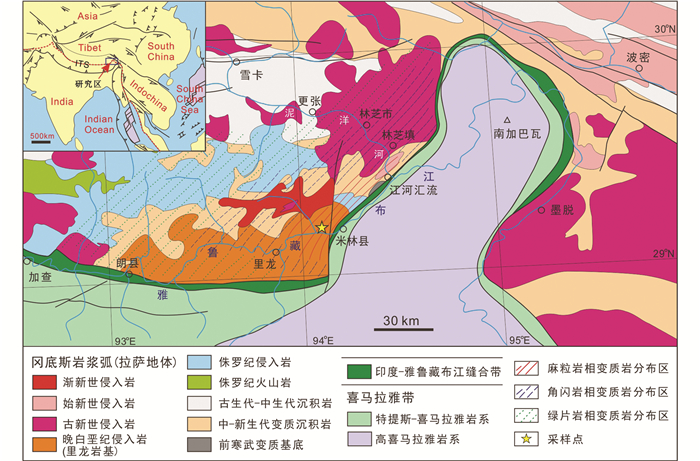
研究区位于冈底斯岩浆弧东端林芝地区(图 1),主要构造单元包括拉萨地体和喜马拉雅带,它们之间为印度-雅鲁藏布江缝合带。印度-雅鲁藏布江缝合带为一套蛇绿混杂岩,主要由低角闪岩相变质的超镁铁质岩、镁铁质岩、石英岩和白云母石英片岩组成,夹有少量大理岩,代表了新特提斯洋的残余部分(耿全如等, 2000, 2004;郑来林等,2003;张泽明等,2008;王二七等,2018)。研究区的喜马拉雅带包括特提斯-喜马拉雅和高喜马拉雅两个序列,它们之间的界线为藏南拆离系。特提斯-喜马拉雅序列主要由古生代-中生代的沉积岩组成,变质程度为绿片岩相到绿帘角闪岩相。高喜马拉雅序列由元古代至古生代的沉积岩系和不同类型的岩浆岩组成,经历了高压麻粒岩相变质作用(向华等,2013;刘凤麟和张立飞,2014),甚至可能达到了榴辉岩相变质作用(张泽明等,2007)。研究区内的拉萨地体主要由晚白垩世的里龙岩基和中-新生代的沉积岩,以及少量的侏罗纪、古新世、始新世和渐新世的侵入岩组成(图 1)。分布于里龙至林芝地区的这些岩浆岩和沉积岩普遍经历了角闪岩相至麻粒岩相变质作用。所形成的中高级变质岩以前被认为是拉萨地体前寒武纪结晶基底,被称之为念青唐古拉岩群(潘桂棠等,2004)或林芝岩群(尹光候等,2006)。目前的研究表明,这些岩石的变质作用发生在中-新生代,代表冈底斯岩浆弧的中-下地壳组成物质(王金丽等,2009;Zhang et al., 2010a, b, 2013, 2014, 2015;Guo et al., 2012;董昕等,2012;Ma et al., 2013a, b;董昕和张泽明,2015)。
|
图 1 冈底斯岩浆弧东端及东喜马拉雅构造结地质简图 ITS-印度雅鲁藏布江缝合带 Fig. 1 Simplified geological map of the eastern Gangdese magmatic arc and eastern Himalayan syntaxis |
里龙岩基位于米林至朗县地区,主要岩性包括辉长岩、闪长岩、花岗闪长岩和花岗岩,其岩浆结晶年龄为晚白垩世(100~85Ma)。里龙岩基由下部(北部)的辉长岩,中上部(南部)的闪长岩、紫苏花岗岩和花岗闪长岩组成,构成了一个约20km深的弧地壳剖面(Zhang et al., 2014)。里龙岩基根部的辉长岩经历了晚白垩世(77~68Ma)的高角闪岩相至麻粒岩变质作用,已经转变成了石榴斜长角闪岩,并经历了明显的部分熔融和混合岩化。本文所研究的石榴斜长角闪岩样品采自里龙岩基北部,为岩基根部的变质辉长岩(图 1)。
2 分析测试方法全岩主量元素化学成分分析在国家地质实验测试中心完成,采用XRF(X-ray fluorescence)方法进行测定,分析精度优于5%。矿物化学成分电子探针分析在中国地质科学院地质研究所完成,所用仪器为日本电子JEOL公司生产的电子探针显微分析仪(Electron Probe MicroAnalyzer),仪器型号:JXA-8100。实验条件为:加速电压15kV,束流2×10⁻⁸A,束斑直径5μm,摄谱时间10s。采用SPI标准矿物进行校正。
锆石LA-ICP-MS U-Pb定年和微量元素分析在武汉上谱分析科技有限责任公司完成。详细的仪器参数和分析流程见Zong et al.(2017)。所使用的ICP-MS仪器型号为Agilent 7700e,激光剥蚀系统由COMPexPro 102 ArF 193nm准分子激光器和MicroLas光学系统组成,激光束斑直径采用32μm。激光剥蚀过程中采用氦气作载气、氩气为补偿气以调节灵敏度,二者在进入ICP之前通过一个T型接头混合,激光剥蚀系统配置有信号平滑装置(Hu et al., 2015)。U-Pb同位素定年和微量元素含量处理中采用锆石标准91500和玻璃标准物质NIST610作外标分别进行同位素和微量元素分馏校正。单点分析数据包括大约20~30s空白信号和50s样品信号。采用ICPMSDataCal(10.7)软件对同位素比值数据进行处理,详细的仪器操作条件和数据处理方法见Liu et al.(2010)。使用ISOPLOT程序(Ludwig, 2003)进行锆石年龄计算及谐和图绘制。
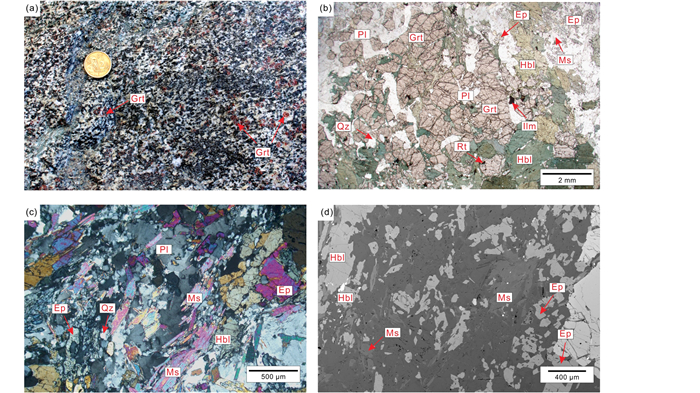
3 岩石学石榴斜长角闪岩呈斑状变晶结构,弱片麻状构造,主要由石榴石、角闪石、斜长石、绿帘石、白云母和石英,少量金红石和钛铁矿组成(图 2)。石榴石为变斑晶,粒度在0.5~2mm之间(图 2b)。石榴石多与斜长石和石英一起集中分布,构成部分熔融的浅色体(图 2a)。岩石中的白云母和角闪石定向分布,构成片麻理(图 2c)。
|
图 2 石榴斜长角闪岩的野外(a)和显微照片(b、c)及背散射图像(d) (a)石榴斜长角闪岩呈弱片麻状构造,石榴石多与斜长石和石英一起产出,构成部分熔融的浅色体;(b)石榴斜长角闪岩由石榴石变斑晶和变基质矿物角闪石、斜长石、石英、绿帘石、白云母和金红石组成;(c)石榴斜长角闪岩中的角闪石与白云母定向分布构成片麻理;(d)石榴斜长角闪岩中共生的角闪石、斜长石、石英、绿帘石和白云母.本文所采用的矿物代号:Grt-石榴石;Hbl-普通角闪石;Pl-斜长石;Ep-绿帘石;Ms-白云母;Qz-石英;Rt-金红石;Ilm-钛铁矿;Cpx-单斜辉石;Opx-斜方辉石;L-熔体;Prp-镁铝榴石;Grs-钙铝榴石;Alm-铁铝榴石;Sps-锰铝榴石;An-钙长石;Ab-钠长石;Or-钾长石 Fig. 2 Outcrop photo (a), photomicrographs (b, c) and back-scattered-electron image (d) of the garnet amphibolite |
石榴斜长角闪岩的化学成分为: SiO2=48.96%、TiO2=0.78%、Al2O3=20.75%、Fe2O3=3.09%、FeO=6.59%、MnO=0.23%、MgO=3.96%、CaO=8.30%、Na2O=4.44%、K2O=0.62%和P2O5=0.29%,为典型的基性变质岩,与Zhang et al.(2014)报道的里龙岩基下部变质辉长岩的化学成分一致。
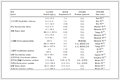
岩石中代表性矿物电子探针化学成分分析结果见表 1。石榴石主要由铁铝榴石、镁铝榴石和钙铝榴石组分组成,各端元组分分别为:铁铝榴石=0.50~0.57,镁铝榴石=0.22~0.29,钙铝榴石=0.17~0.18,锰铝榴石=0.03。石榴石显示出成分环带,表现为从幔部到边部镁铝榴石组分降低,铁铝榴石组分升高。斜长石的钙长石组分(An)为0.16~0.18,属于更长石。角闪石的Si阳离子数为6.22~6.30,Na阳离子数为0.65,Ca阳离子数为1.64,K阳离子数为0.11~0.13,Mg/(Mg+Fe2+)=0.55~0.57。根据Leake et al.(1997)的角闪石分类方法,所分析的角闪石为钙质角闪石类的镁钙闪石。白云母的Si阳离子数为3.13~3.17,Al阳离子数为2.65~2.67,Na阳离子数为0.11~0.24。
|
表 1 石榴斜长角闪岩代表性矿物化学成分的电子探针分析结果(wt%) Table 1 Microprobe analyses results of representative minerals of the garnet amphibolite (wt%) |
我们选择接近真实全岩成分的NCKFMASHTO(Na2O-CaO-K2O-FeOtotal-MgO-Al2O3-SiO2-H2O-TiO2-O(Fe2O3))体系进行相平衡模拟。流体组分设为纯H2O。相平衡模拟计算时采用实测的全岩化学成分,水含量通过岩石中含水矿物的体积和相应的水含量估算而来。视剖面图使用THERMOCALC软件3.45版本计算(Powell et al., 1998;2016年更新),内部一致性热力学数据库采用Holland and Powell(2011)发表的最新版ds62.txt,固溶体模型采用新近发表的适用于模拟基性岩高温变质作用的活度模型(Powell et al., 2014;Green et al., 2016)。
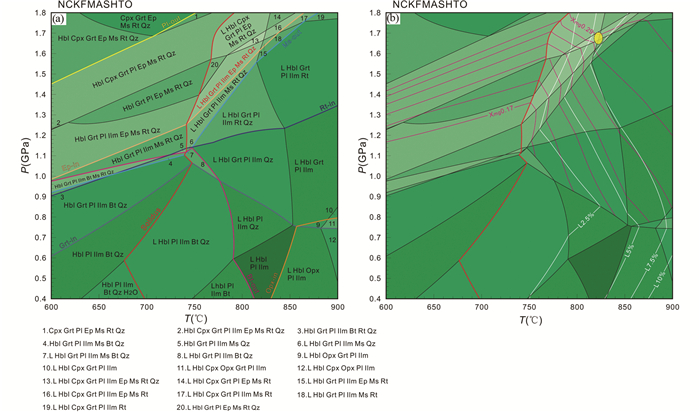
图 3为所计算的石榴斜长角闪岩的P-T视剖面图和石榴石的XMg(=Mg/(Mg+Ca+Fe2+))等值线及熔体含量等值线。在计算的600~900℃和0.4~1.8GPa温度与压力范围内,岩石的固相线出现在670~780℃温度区间,其中压力小于0.6GPa时为饱和水固相线,压力大于0.6GPa为干固相线。石榴石稳定于压力大于0.6~1.0GPa区域内;绿帘石和白云母稳定于压力相对较高(>0.9GPa)、温度相对较低(<870℃)的区域;黑云母在<810℃和<1.1GPa条件下稳定。金红石稳定于压力大于0.9~1.3GPa区域内;斜方辉石只在高温低压(>830℃、<0.8GPa)区域稳定,单斜辉石在压力较高(>1.2~1.7GPa)的区域以及温度较高、压力相对较低(>880℃、<0.9GPa)的区域出现。岩石观察到的共生矿物石榴石+角闪石+斜长石+绿帘石+白云母+石英+金红石+钛铁矿稳定于740~820℃和1.25~1.67GPa及熔体存在的温压条件下(图 3)。
|
图 3 石榴斜长角闪岩的P-T视剖面图(a)和计算的石榴石XMg与熔体(L)体积等值线(b) 模拟使用的全岩成分(mole%)为:SiO2=52.80、TiO2=0.63、Al2O3=13.19、FeO=8.45、MgO=6.37、CaO=9.04、Na2O=4.64、K2O=0.42、O=1.25;从二变域到八变域由渐次加深的绿色填充 Fig. 3 P-T pseudosections for the garnet amphibolite (a) and calculated isopleths of the XMg in garnet and isomodes of the melt (b) |
相平衡模拟显示,在固相线之下,石榴石XMg值与压力呈正相关关系,即压力越高,石榴石XMg值越高;在固相线之上,石榴石的XMg值与温度呈正相关关系,即随温度增加XMg增加。岩石中共生矿物组合位于固相线之上,因此,石榴石的最高XMg值应该可以限定岩石的峰期变质温度。石榴石核部具有最高的XMg(0.29),该等值线接近岩石共生矿物组合稳定域的温度和压力上限(图 3b黄色圆圈)。考虑到分析和计算误差,我们认为共生矿物组合稳定域的最高温度和压力条件应该是石榴斜长角闪岩的峰期变质作用条件,即~820℃和~1.67GPa。这一条件位于岩石的固相线之上,由熔体含量等值线(图 3b)可知,相应的熔体体积含量为5%~7%,表明石榴斜长角闪岩发生了明显的部分熔融。
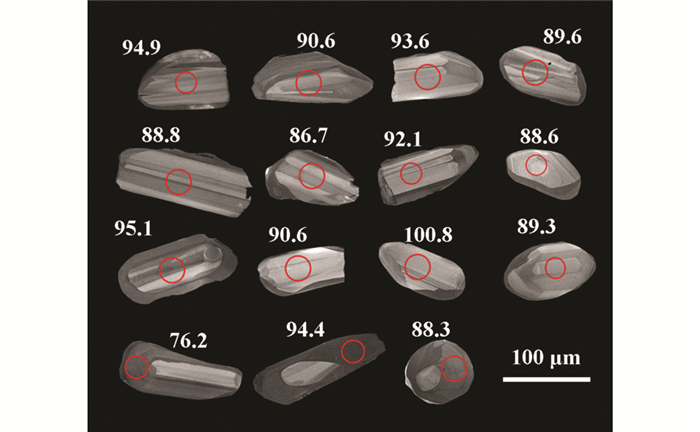
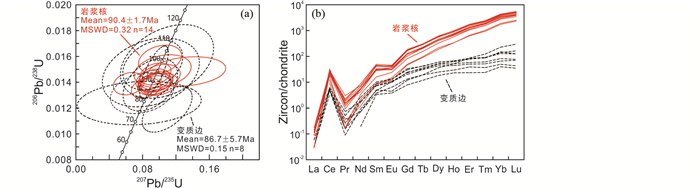
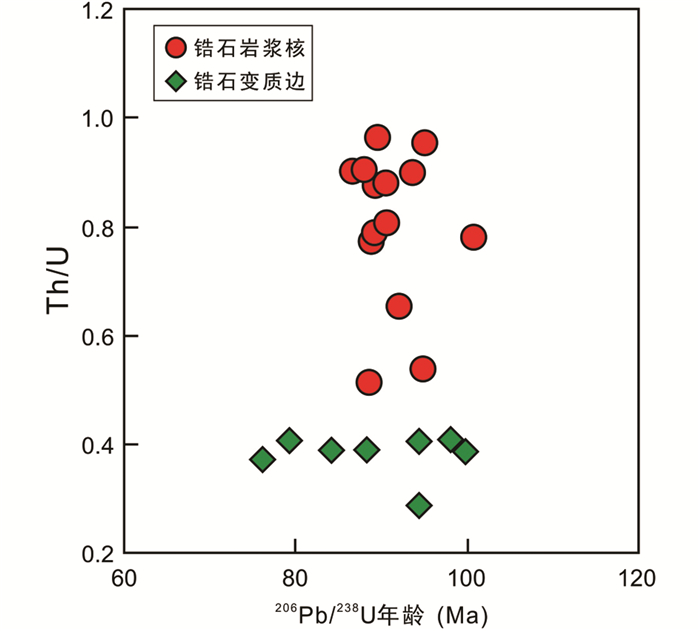
5 锆石U-Pb年代学石榴斜长角闪岩中锆石为无色透明,自形-半自形长柱状,长约90~200μm,长宽比约为1 1~2.5 1。锆石阴极发光图像显示,锆石具核边结构,核部具条带状环带,边部无环带(图 4)。锆石核部14个分析点获得的206Pb/238U年龄在101~87Ma之间(表 2),加权平均年龄为90.4±1.7Ma(MSWD=0.32)(图 5a)。锆石核部的Th/U值在0.51~0.95之间(表 2),稀土元素配分模式图显示出LREE亏损、HREE富集的特征,具Ce正异常和Eu负异常(图 5b),稀土元素总量较高,平均值为1150×10-6(表 3)。锆石边部8个分析点获得的206Pb/238U年龄在99~76Ma之间(表 2),加权平均年龄为86.7±5.7Ma(MSWD=0.15)(图 5a)。锆石边部Th/U值在0.29~0.40之间(表 2),稀土元素配分模式图显示出LREE亏损、HREE弱富集较平坦、不具或具轻微Eu负异常的特征(图 5b),稀土元素总量较低,平均值为58.5×10⁻⁶(表 3)。
|
图 4 石榴斜长角闪岩中锆石的阴极发光图像和分析点位置及相应年龄(Ma) Fig. 4 Cathodoluminescence images of zircons in the garnet amphibolite, showing locations of the analyzed spots and relevant ages (Ma) |
|
|
表 2 石榴斜长角闪岩中锆石U-Pb定年结果 Table 2 Zircon U-Pb dating data of the garnet amphibolite |
|
图 5 石榴斜长角闪岩锆石U-Pb谐和图(a)和锆石球粒陨石标准化稀土元素配分图(b,标准化值据Sun and McDonough, 1989) Fig. 5 Zircon U-Pb concordia diagram (a) and chondrite-normalized REE patterns (b, normalization values after Sun and McDonough, 1989) |
|
|
表 3 石榴斜长角闪岩中锆石的稀土元素含量(×10-6) Table 3 Rear earth element contents of zircons in the garnet amphibolite (×10-6) |
本次分析的锆石核部具条带状环带,且具有较高的Th/U值(图 6)和较高的HREE含量,与基性岩浆岩中结晶锆石的特点(吴元保和郑永飞,2004)相同。因此,锆石核部给出的年龄应为石榴斜长角闪岩的基性岩浆岩原岩结晶年龄。锆石边部无环带,具有较低的Th/U值(图 6)和较低的HREE含量,具有变质成因锆石的特点,所获得的年龄应为石榴斜长角闪岩的变质作用时间。
|
图 6 石榴斜长角闪岩中锆石年龄与Th/U比值 Fig. 6 Plot of age versus Th/U ratios of the zircon in the garnet amphibolite |
一般认为,冈底斯带的岩浆活动始于中三叠世,持续到中新世,而晚白垩世则是其作用峰期之一,由此在冈底斯岩浆弧东段形成了分布广泛的晚白垩世岩浆岩(莫宣学等,2005;Wen et al., 2008a, b;Ji et al., 2009;Zhang et al., 2010a, b, 2014;董昕等,2012;Ma et al., 2013a, b; Zhu et al., 2017, 2018),位于冈底斯岩浆弧东端的里龙岩基就是大规模晚白垩世岩浆作用的产物(Zhang et al., 2014)。Wen et al.(2008b)研究揭示,里龙岩基中上部的含绿帘石花岗闪长岩侵位年龄为83~80Ma,以高的La/Yb值和Sr/Y值以及较低的Y和HREE含量为特征,显示出埃达克质岩石的地球化学特征,认为是新生镁铁质下地壳部分熔融的产物。Zhang et al.(2010a)研究表明,里龙岩基中部的紫苏花岗岩形成于晚白垩世(~87Ma),为典型的镁质、钙碱性、准铝质紫苏花岗岩,认为是新特提斯洋洋中脊俯冲过程中俯冲洋壳部分熔融的产物。Ma et al.(2013a)对紫苏花岗岩的研究表明,其结晶年龄为100~89Ma,认为其是俯冲的新特提斯洋大洋岩石圈回卷导致软流圈物质上涌使洋壳发生部分熔融的产物。由此可见,对里龙岩基的成因还存在较大争议。最新的研究表明,冈底斯岩浆弧晚白垩世岩浆活动时间具有南部较早,而向北变年轻的特点,这可以用新特提斯洋洋中脊俯冲模式来解释(Zhu et al., 2018)。
Zhang et al.(2014)研究发现,里龙岩基根部的辉长岩形成在95~82Ma,经历了稍晚期(77~68Ma)的麻粒岩相变质作用和部分熔融,所估算的变质作用温压条件为830~900℃和0.9~1.3GPa,认为其麻粒岩相变质作用与岩浆本身的底垫和增生导致的地壳加厚有关。本文所研究的石榴斜长角闪岩是里龙岩基根部的变质辉长岩,所获得的~90Ma的原岩结晶年龄与以前报道的类似,但所获得的~86Ma的变质年龄比以前报道的更老。这表明里龙岩基底部经历了近同侵入期的变质作用。而且,本文获得了~820℃和~1.67GPa峰期变质作用条件,表明变质辉长岩经历了高压和高温麻粒岩相变质作用和明显的部分熔融,为冈底斯岩浆弧根部晚白垩世岩浆与变质作用提供了更加确切的证据。
6.2 对冈底斯岩浆弧地壳生长与加厚的意义弧岩浆作用被认为是后太古代以来大陆地壳生长的最主要方式(Hamilton et al., 1981, Hamilton, 1989;Davidson, 1992;Rudnick and Gao, 2003)。冈底斯岩浆弧经历了长期的中生代岩浆作用。全岩Sr和Nd同位素研究表明,冈底斯岩浆弧的中生代岩浆岩起源于亏损地幔或为新生的镁铁质下地壳部分熔融的产物,表明冈底斯岩浆弧在中生代经历了显著的新生地壳生长(莫宣学等,2005;Wen et al., 2008a, b;Ji et al., 2009;Zhu et al., 2011;Hou et al., 2015)。Zhu et al.(2011, 2013)认为冈底斯岩浆弧东段主要由新生地壳组成,地幔物质对地壳生长的贡献率可达80%~90%。Hou et al.(2015)对拉萨地体岩浆岩锆石的Hf同位素填图揭示,拉萨地体东南部的中、新生代岩浆岩中锆石的εHf(t)值均为正值,表明冈底斯岩浆弧东段为新生地壳,地幔物质对地壳生长的贡献率为80%~90%。本文和现有研究成果均表明,构成里龙岩基的各种岩石均显示出起源亏损地幔或俯冲洋壳的地球化学特征,为新生的大陆地壳(Wen et al., 2008b;Ma et al., 2013a;Zhang et al., 2014; Zheng et al., 2014)。
青藏高原南部及冈底斯岩浆弧具有双倍地壳厚度,但对这种巨厚地壳的形成机制与时限仍有争论。Zhu et al.(2017)认为冈底斯岩浆弧在晚白垩世(~70Ma)具有正常的地壳厚度,其地壳增厚主要发生在始新世(55~45Ma),其厚度从~37km增厚至~58km。而Ding et al.(2014)认为,在印度与欧亚大陆碰撞之前,拉萨地体南缘就已经存在一个安底斯型的山脉,其地壳厚度已经达到55km。Zhang et al.(2014)研究表明,里龙岩基中变质辉长岩的形成压力约为1.5GPa,相当于50km的地壳深度,为冈底斯岩浆弧晚白垩世地壳加厚提供了重要的变质作用证据。本研究表明,里龙岩基根部的石榴斜长角闪岩变质压力可达1.7GPa,表明岩浆弧地壳已经加厚到至少55km。如果里龙岩基辉长岩的原始侵位深度为20~30km,那么冈底斯岩浆弧在晚白垩世时期很可能加厚了25~35km。
大陆岩浆弧地壳加厚主要由两种机制,一是幔源岩浆的底侵和增生,另一种是地壳的挤压缩短和逆冲推覆。本文和现有研究表明,里龙岩基底部经历了近同侵入期的高压变质作用,很可能表明幔源岩浆的增生是导致岩浆弧地壳加厚的主要原因。另外,也有研究认为里龙岩基的埃达克质花岗闪长岩是加厚下地壳部分熔融的产物,认为平板俯冲导致的地壳缩短是地壳加厚的原因(Wen et al., 2008a)。
7 结论本文对冈底斯岩浆弧东端石榴斜长角闪岩进行了岩石学和年代学研究,得出主要结论如下:
(1) 石榴斜长角闪岩的共生矿物组合为石榴石+角闪石+斜长石+绿帘石+白云母+石英+金红石+钛铁矿,经历了高压和高温麻粒岩相变质作用和明显部分熔融,其峰期变质的温压条件为~820℃和~1.67GPa。
(2) 石榴斜长角闪岩的原岩为辉长岩,具有晚白垩世(~90Ma)的结晶年龄和近同期(~86 Ma)的变质年龄。
(3) 冈底斯岩浆弧东段经历了强烈的晚白垩世幔源岩浆作用,导致岩浆弧发生了显著的新生地壳生长和明显的地壳加厚,地壳厚度至少可达55km。
致谢 感谢张贵宾和张聪博士审阅全文,并提出重要修改意见。
Davidson JP. 1992. Continental and island arcs. In: Nierenberg WA (ed.). Encyclopedia of Earth System Science. New York: Academic Press, 615-626
|
Ding HX, Zhang ZM, Xiang H, Qi M, Gou ZB and Lei HC. 2015. The petrogenesis and tectonic significance of the Early Cretaceous volcanics from the northern Lhasa terrane, Tibet. Acta Petrologica Sinica, 31(5): 1247-1267. |
Ding L, Xu Q, Yue YH, Wang HQ, Cai FL and Li S. 2014. The Andean-type Gangdese Mountains:Paleoelevation record from the Paleocene-Eocene Linzhou Basin. Earth and Planetary Science Letters, 392: 250-264. DOI:10.1016/j.epsl.2014.01.045 |
Dong X, Zhang ZM, Wang JL, Zhao GC, Liu F, Wang W and Yu F. 2009. Provenance and formation age of the Nyingchi Group in the southern Lhasa terrane, Tibetan Plateau:Petrology and zircon U-Pb geochronology. Acta Petrologica Sinica, 25(7): 1678-1694. |
Dong X, Zhang ZM, Liu F, Wang W, Yu F, Lin YH, Jiang HY and He ZY. 2012. Genesis of the metamorphic rock from southeastern Lhasa terrane and the Mesozoic-Cenozoic orogenesis. Acta Petrologica Sinica, 28(6): 1765-1784. |
Dong X and Zhang ZM. 2015. Cambrian granitoids from the southeastern Tibetan Plateau:Research on petrology and zircon Hf isotope. Acta Petrologica Sinica, 31(5): 1183-1199. |
Geng QR, Pan GT, Liu YP and Zheng LL. 2000. The preliminary study of the ophiolitic melanges along the Yarlung Zangbo Grand Canyon, Xizang. Sedimentary Geology and Tethyan Geology, 20(1): 28-43. |
Geng QR, Pan GT, Zheng LL, Sun ZM, Ou CS and Dong H. 2004. Petrological characteristics and original settings of the Yarlung Tsangpo ophiolitic mélange in Namche Barwa, SE Tibet. Chinese Journal of Geology, 39(3): 388-406. |
Green ECR, White RW, Diener JFA, Powell R, Holland TJB and Palin RM. 2016. Activity-composition relations for the calculation of partial melting equilibria in metabasic rocks. Journal of metamorphic Geology, 34(9): 845-869. DOI:10.1111/jmg.2016.34.issue-9 |
Guo L, Zhang HF, Harris N, Parrish R, Xu WC and Shi ZL. 2012. Paleogene crustal anatexis and metamorphism in Lhasa terrane, eastern Himalayan syntaxis:Evidence from U-Pb zircon ages and Hf isotopic compositions of the Nyingchi Complex. Gondwana Research, 21(1): 100-111. DOI:10.1016/j.gr.2011.03.002 |
Hamilton W, Kröner A, Moorbath SE and Windley BF. 1981. Crustal evolution by arc magmatism.Philosophical Transactions of the Royal Society of London. Series A, Mathematical and Physical Sciences, 301(1461): 279-291. DOI:10.1098/rsta.1981.0111 |
Hamilton WB. 1989. Crustal geologic processes of the United States. In: Pakiser LC and Mooney WD (eds.). Geophysical Framework of the Continental United States. Geological Society of America, 172(1): 743-781
|
Holland TJB and Powell R. 2011. An improved and extended internally consistent thermodynamic dataset for phases of petrological interest, involving a new equation of state for solids. Journal of Metamorphic Geology, 29(3): 333-383. DOI:10.1111/jmg.2011.29.issue-3 |
Hoskin PWO and Schaltegger U. 2003. The composition of zircon and igneous and metamorphic petrogenesis. Reviews in Mineralogy and Geochemistry, 53(1): 27-62. |
Hou ZQ, Duan LF, Lu YJ, Zheng YC, Zhu DC, Yang ZM, Yang ZS, Wang BD, Pei YR, Zhao ZD and McCuaig TC. 2015. Lithospheric architecture of the Lhasa terrane and its control on ore deposits in the Himalayan-Tibetan orogen. Economic Geology, 110(6): 1541-1575. DOI:10.2113/econgeo.110.6.1541 |
Hu ZC, Zhang W, Liu YS, Gao S, Li M, Zong KQ, Chen HH and Hu SH. 2015. "Wave" signal-smoothing and mercury-removing device for laser ablation quadrupole and multiple collector ICPMS analysis:Application to lead isotope analysis. Analytical Chemistry, 87(2): 1152-1157. |
Ji WQ, Wu FY, Chung SL, Li JX and Liu CZ. 2009. Zircon U-Pb geochronology and Hf isotopic constraints on petrogenesis of the Gangdese batholith, southern Tibet. Chemical Geology, 262(3-4): 229-245. DOI:10.1016/j.chemgeo.2009.01.020 |
Kapp P, Yin A, Harrison TM and Ding L. 2005. Cretaceous-Tertiary shortening, basin development, and volcanism in central Tibet. GSA Bulletin, 117(7-8): 865-878. |
Kapp P, DeCelles PG, Gehrels GE, Heizler M and Ding L. 2007. Geological records of the Lhasa-Qiangtang and Indo-Asian collisions in the Nima area of central Tibet. GSA Bulletin, 119(7-8): 917-932. DOI:10.1130/B26033.1 |
Leake BE, Woolley AR, Arps CES, Birch WD, Gilbert MC, GriceJD, Hawthorne FC, Kato A, Kisch HJ, Krivovichev VG, Linthout K, Laird J, Mandarino JA, Maresch WV, Nickel EH, Rock NMS, Schumacher JC, Smith DC, Stephenson NCK, Ungaretti L, Whittaker EJW and Guo YZ. 1997. Nomenclature of amphiboles:Report of the subcommittee on amphiboles of the international mineralogical association, commission on new minerals and mineral names. American Mineralogist, 82(9-10): 1019-1037. |
Liu FL and Zhang LF. 2014. High-pressure granulites from Eastern Himalayan Syntaxis:P-T path, zircon U-Pb dating and geological implications. Acta Petrologica Sinica, 30(10): 2808-2820. |
Liu YS, Hu ZC, Zong KQ, Gao CG, Gao S, Xu J and Chen HH. 2010. Reappraisement and refinement of zircon U-Pb isotope and trace element analyses by LA-ICP-MS. Chinese Science Bulletin, 55(15): 1535-1546. DOI:10.1007/s11434-010-3052-4 |
Ludwig KR. 2003. ISOPLOT/Ex version 3.0:A Geochronological Toolkit for Microsoft Excel. Berkeley: Berkeley Geochronology Center Special Publications: 1-73.
|
Ma L, Wang Q, Wyman DA, Li ZX, Jiang ZQ, Yang JH, Gou GN and Guo HF. 2013a. Late Cretaceous (100~89Ma) magnesian charnockites with adakitic affinities in the Milin area, eastern Gangdese:Partial melting of subducted oceanic crust and implications for crustal growth in southern Tibet. Lithos, 175-176: 315-332. DOI:10.1016/j.lithos.2013.04.006 |
Ma L, Wang Q, Li ZX, Wyman DA, Jiang ZQ, Yang JH, Gou GN and Guo HF. 2013b. Early Late Cretaceous (ca.93Ma) norites and hornblendites in the Milin area, eastern Gangdese:Lithosphere-asthenosphere interaction during slab roll-back and an insight into early Late Cretaceous (ca. 100~80Ma) magmatic "flare-up" in southern Lhasa (Tibet). Lithos, 172-173: 17-30. DOI:10.1016/j.lithos.2013.03.007 |
Meng YK, Xu ZQ, Santosh M, Ma XX, Chen ZJ, Guo GL and Liu F. 2016. Late Triassic crustal growth in southern Tibet:Evidence from the Gangdese magmatic belt. Gondwana Research, 37: 449-464. DOI:10.1016/j.gr.2015.10.007 |
Mo XX, Dong GC, Zhao ZD, Zhou S, Wang LL, Qiu RZ and Zhang FQ. 2005. Spatial and temporal distribution and characteristics of granitoids in the Gangdese, Tibet and implication for crustal growth and evolution. Geological Journal of China Universities, 11(3): 281-290. |
Palin RM, Searle MP, St-Onge MR, Waters DJ, Roberts NMW, Horstwood MSA, Parrish RR, Weller OM, Chen S and Yang J. 2014. Monazite geochronology and petrology of kyanite-and sillimanite-grade migmatites from the northwestern flank of the eastern Himalayan syntaxis. Gondwana Research, 26(1): 323-347. DOI:10.1016/j.gr.2013.06.022 |
Pan GT, Wang LQ and Zhu DC. 2004. Thoughts on some important scientific problems in regional geological survey of the Qinghai-Tibet Plateau. Regional Geology of China, 23(1): 12-19. |
Pan GT, Mo XX, Hou ZQ, Zhu DC, Wang LQ, Li GM, Zhao ZD, Geng QR and Li ZL. 2006. Spatial-temporal framework of the Gangdese orogenic belt and its evolution. Acta Petrologica Sinica, 22(3): 521-533. |
Powell R, Holland T and Worley B. 1998. Calculating phase diagrams involving solid solutions via non-linear equations, with examples using THERMOCALC. Journal of Metamorphic Geology, 16(4): 577-588. DOI:10.1111/j.1525-1314.1998.00157.x |
Powell R, White RW, Green ECR, Holland TJB and Diener JFA. 2014. On parameterizing thermodynamic descriptions of minerals for petrological calculations. Journal of Metamorphic Geology, 32(3): 245-260. DOI:10.1111/jmg.2014.32.issue-3 |
Rudnick RL and Gao S. 2003. Composition of the continental crust. In: Holland HD and Turekian KK (eds.). Treatise on Geochemistry. Oxford: Elsevier, 1-64
|
Sun SS and McDonough WF. 1989. Chemical and isotopic systematics of oceanic basalts: Implications for mantle composition and processes. In: Saunders AD and Norry MJ (eds.). Magmatism in the Ocean Basins. Geological Society, London, Special Publication, 42(1): 313-345
|
Wang EQ, Meng K, Xu G, Fan C and Su Z. 2018. Cenozoic two-stage obduction of the Indian subcontinent:On the interaction between the Indian Ocean, Tethyan and Eurasian plates. Acta Petrologica Sinica, 34(7): 1867-1875. |
Wang JL, Zhang ZM, Dong X, Liu F, Wang W, Xu FJ and Shen K. 2009. Discovery of Late Cretaceous Garnet two-pyroxene granulite in the southern Lhasa terrane, Tibet and its tectonic significances. Acta Petrologica Sinica, 25(7): 1695-1706. |
Wen DR, Liu DY, Chung SL, Chu MF, Ji JQ, Zhang Q, Song B, Lee TY, Yeh MW and Lo CH. 2008a. Zircon SHRIMP U-Pb ages of the Gangdese batholith and implications for Neotethyan subduction in southern Tibet. Chemical Geology, 252(3-4): 191-201. DOI:10.1016/j.chemgeo.2008.03.003 |
Wen DR, Chung SL, Song B, Iizuka Y, Yang HJ, Ji JQ, Liu DY and Gallet S. 2008b. Late Cretaceous Gangdese intrusions of adakitic geochemical characteristics, SE Tibet:Petrogenesis and tectonic implications. Lithos, 105(1-2): 1-11. |
Wu FY, Ji WQ, Liu CZ and Chung SL. 2010. Detrital zircon U-Pb and Hf isotopic data from the Xigaze fore-arc basin:Constraints on Transhimalayan magmatic evolution in southern Tibet. Chemical Geology, 271(1-2): 13-25. DOI:10.1016/j.chemgeo.2009.12.007 |
Wu YB and Zheng YF. 2004. Genesis of zircon and its constraints on interpretation of U-Pb age. Chinese Science Bulletin, 49(15): 1554-1569. DOI:10.1007/BF03184122 |
Xiang H, Zhang ZM, Dong X, Qi M, Lin YH and Lei HC. 2013. High-pressure metamorphism and anatexis during the subduction of Indian continent:Phase equilibria modeling of the Namche Barwa complex, Eastern Himalayan Syntaxis. Acta Petrologica Sinica, 29(11): 3792-3802. |
Xu ZQ, Li HB and Yang JS. 2006. An orogenic plateau:The orogenic collage and orogenic types of the Qinghai-Tibet Plateau. Earth Science Frontiers, 13(4): 1-17. |
Yin A and Harrison TM. 2000. Geologic evolution of the Himalayan-Tibetan orogen. Annual Review of Earth and Planetary Sciences, 28: 211-280. DOI:10.1146/annurev.earth.28.1.211 |
Yin GH, Bao G, Yang SS and Hu QH. 2006. The granulites and ages of the Nyingchi Group Complex in the Nyingchi region, Xizang. Sedimentary Geology and Tethyan Geology, 26(3): 8-15. |
Zhang ZM, Zheng LL, Wang JL, Zhao ZD and Shi C. 2007. Garnet pyroxenite in the Namjagbarwa Group-complex in the eastern Himalayan tectonic syntaxis, Tibet, China:Evidence for subduction of the Indian continent beneath the Eurasian plate at 80~100km depth. Geological Bulletin of China, 26(1): 1-12. |
Zhang ZM, Wang JL, Zhao GC and Shi C. 2008. Geochronology and Precambrian tectonic evolution of the Namche Barwa complex from the eastern Himalayan syntaxis, Tibet. Acta Petrologica Sinica, 24(7): 1477-1467. |
Zhang ZM, Zhao GC, Santosh M, Wang JL, Dong X and Shen K. 2010a. Late Cretaceous charnockite with adakitic affinities from the Gangdese batholith, southeastern Tibet:Evidence for Neo-Tethyan mid-ocean ridge subduction?. Gondwana Research, 17(4): 615-631. DOI:10.1016/j.gr.2009.10.007 |
Zhang ZM, Zhao GC, Santosh M, Wang JL, Dong X and Liou JG. 2010b. Two-stages of granulite facies metamorphism in the eastern Himalayan syntaxis, South Tibet:Petrology, zircon geochronology and implications for the subduction of Neo-Tethys and the Indian continent beneath Asia. Journal of Metamorphic Geology, 28(7): 719-733. |
Zhang ZM, Dong X, Xiang H, Liou JG and Santosh M. 2013. Building of the deep Gangdese arc, South Tibet:Paleocene plutonism and granulite-facies metamorphism. Journal of Petrology, 54(12): 2547-2580. DOI:10.1093/petrology/egt056 |
Zhang ZM, Dong X, Xiang H, He ZY and Liou JG. 2014. Metagabbros of the Gangdese arc root, South Tibet:Implications for the growth of continental crust. Geochimica et Cosmochimica Acta, 143: 268-284. DOI:10.1016/j.gca.2014.01.045 |
Zhang ZM, Dong X, Xiang H, Ding HX, He ZY and Liou JG. 2015. Reworking of the Gangdese magmatic arc, southeastern Tibet:Post-collisional metamorphism and anatexis. Journal of Metamorphic Geology, 33(1): 1-21. DOI:10.1111/jmg.12107 |
Zheng LL, Geng QR, Ou CS and Wang XW. 2003. Geochemical characteristics and geological significance of boninite in Yaluzangbujiang ophiolitic mélanges in Najiabawa. Geological Bulletin of China, 22(11-12): 908-911. |
Zheng YC, Hou ZQ, Gong YL, Liang W, Sun QZ, Zhang S, Fu Q, Huang KX, Li QY and Li W. 2014. Petrogenesis of Cretaceous adakite-like intrusions of the Gangdese Plutonic Belt, southern Tibet:Implications for mid-ocean ridge subduction and crustal growth. Lithos, 190-191: 240-263. DOI:10.1016/j.lithos.2013.12.013 |
Zhu DC, Pan GT, Chung SL, Liao ZL, Wang LQ and Li GM. 2008. SHRIMP zircon age and geochemical constraints on the origin of Lower Jurassic volcanic rocks from the Yeba Formation, Southern Gangdese, South Tibet. International Geology Review, 50(5): 442-471. DOI:10.2747/0020-6814.50.5.442 |
Zhu DC, Zhao ZD, Niu YL, Mo XX, Chung SL, Hou ZQ, Wang LQ and Wu FY. 2011. The Lhasa terrane:Record of a microcontinent and its histories of drift and growth. Earth and Planetary Science Letters, 301(1-2): 241-255. DOI:10.1016/j.epsl.2010.11.005 |
Zhu DC, Zhao ZD, Niu YL, Dilek Y, Hou ZQ and Mo XX. 2013. The origin and pre-Cenozoic evolution of the Tibetan Plateau. Gondwana Research, 23(4): 1429-1454. DOI:10.1016/j.gr.2012.02.002 |
Zhu DC, Wang Q, Zhao ZD, Chung SL, Cawood PA, Niu YL, Liu SA, Wu FY and Mo XX. 2015. Corrigendum:Magmatic record of India-Asia collision. Scientific Reports, 5: 17236. DOI:10.1038/srep17236 |
Zhu DC, Wang Q, Cawood PA, Zhao ZD and Mo XX. 2017. Raising the Gangdese Mountains in southern Tibet. Journal of Geophysical Research:Solid Earth, 122(1): 214-223. DOI:10.1002/2016JB013508 |
Zhu DC, Wang Q, Chung SL, Cawood PA and Zhao ZD. 2018. Gangdese magmatism in southern Tibet and India-Asia convergence since 120Ma. Geological Society, London, Special Publications, 48
|
Zong KQ, Klemd R, Yuan Y, He ZY, Guo JL, Shi XL, Liu YS, Hu ZC and Zhang ZM. 2017. The assembly of Rodinia:The correlation of Early Neoproterozoic (ca.900Ma) high-grade metamorphism and continental arc formation in the southern Beishan Orogen, southern Central Asian Orogenic Belt (CAOB). Precambrian Research, 290: 32-48. DOI:10.1016/j.precamres.2016.12.010 |
丁慧霞, 张泽明, 向华, 祁敏, 苟正彬, 雷恒聪. 2015. 青藏高原拉萨地体北部早白垩世火山岩的成因及意义. 岩石学报, 31(5): 1247-1267. |
董昕, 张泽明, 王金丽, 赵国春, 刘峰, 王伟, 于飞. 2009. 青藏高原拉萨地体南部林芝岩群的物质来源与形成年代:岩石学与锆石U-Pb年代学. 岩石学报, 25(7): 1678-1694. |
董昕, 张泽明, 刘峰, 王伟, 于飞, 林彦蒿, 姜洪颖, 贺振宇. 2012. 拉萨地体东南部变质岩的成因与中-新生代造山作用. 岩石学报, 28(6): 1765-1784. |
董昕, 张泽明. 2015. 青藏高原东南部寒武纪花岗岩类:岩石学和锆石Hf同位素研究. 岩石学报, 31(5): 1183-1199. |
耿全如, 潘桂棠, 刘宇平, 郑来林. 2000. 雅鲁藏布大峡谷地区蛇绿混杂岩带初步研究. 沉积与特提斯地质, 20(1): 28-43. DOI:10.3969/j.issn.1009-3850.2000.01.002 |
耿全如, 潘桂棠, 郑来林, 孙志明, 欧春生, 董翰. 2004. 藏东南雅鲁藏布蛇绿混杂岩带的物质组成及形成环境. 地质科学, 39(3): 388-406. DOI:10.3321/j.issn:0563-5020.2004.03.009 |
刘凤麟, 张立飞. 2014. 喜马拉雅东构造结高压麻粒岩PT轨迹、锆石U-Pb定年及其地质意义. 岩石学报, 30(10): 2808-2820. |
莫宣学, 董国臣, 赵志丹, 周肃, 王亮亮, 邱瑞照, 张风琴. 2005. 西藏冈底斯带花岗岩的时空分布特征及地壳生长演化信息. 高校地质学报, 11(3): 281-290. DOI:10.3969/j.issn.1006-7493.2005.03.001 |
潘桂棠, 王立全, 朱弟成. 2004. 青藏高原区域地质调查中几个重大科学问题的思考. 地质通报, 23(1): 12-19. DOI:10.3969/j.issn.1671-2552.2004.01.007 |
潘桂棠, 莫宣学, 侯增谦, 朱弟成, 王立全, 李光明, 赵志丹, 耿全如, 廖忠礼. 2006. 冈底斯造山带的时空结构及演化. 岩石学报, 22(3): 521-533. |
王二七, 孟恺, 许光, 樊春, 苏哲. 2018. 印度陆块新生代两次仰冲事件及其构造驱动机制:论印度洋、特提斯和欧亚板块相互作用. 岩石学报, 34(7): 1867-1875. |
王金丽, 张泽明, 董昕, 刘峰, 于飞, 王伟, 徐方建, 沈昆. 2009. 西藏拉萨地体南部晚白垩世石榴石二辉麻粒岩的发现及其构造意义. 岩石学报, 25(7): 1695-1706. |
吴元保, 郑永飞. 2004. 锆石成因矿物学研究及其对U-Pb年龄解释的制约. 科学通报, 49(16): 1589-1604. DOI:10.3321/j.issn:0023-074X.2004.16.002 |
向华, 张泽明, 董昕, 祁敏, 林彦蒿, 雷恒聪. 2013. 印度大陆俯冲过程中的高压变质与深熔作用:东喜马拉雅构造结南迦巴瓦杂岩的相平衡模拟研究. 岩石学报, 29(11): 3792-3802. |
许志琴, 李海兵, 杨经绥. 2006. 造山的高原——青藏高原巨型造山拼贴体和造山类型. 地学前缘, 13(4): 1-17. DOI:10.3321/j.issn:1005-2321.2006.04.002 |
尹光候, 包钢, 杨淑胜, 胡清华. 2006. 西藏林芝地区林芝岩群麻粒岩及时代讨论. 沉积与特提斯地质, 26(3): 8-15. DOI:10.3969/j.issn.1009-3850.2006.03.002 |
张泽明, 郑来林, 王金丽, 赵旭东, 石超. 2007. 东喜马拉雅构造结南迦巴瓦岩群中的石榴辉石岩——印度大陆向欧亚板块之下俯冲至80~100km深度的证据. 地质通报, 26(1): 1-12. DOI:10.3969/j.issn.1671-2552.2007.01.002 |
张泽明, 王金丽, 赵国春, 石超. 2008. 喜马拉雅造山带东构造结南迦巴瓦岩群地质年代学和前寒武纪构造演化. 岩石学报, 24(7): 1477-1487. |
郑来林, 耿全如, 欧春生, 王小伟. 2003. 藏东南迦巴瓦地区雅鲁藏布江蛇绿混杂岩中玻安岩的地球化学特征和地质意义. 地质通报, 22(11-12): 908-911. |