 2019, Vol. 35


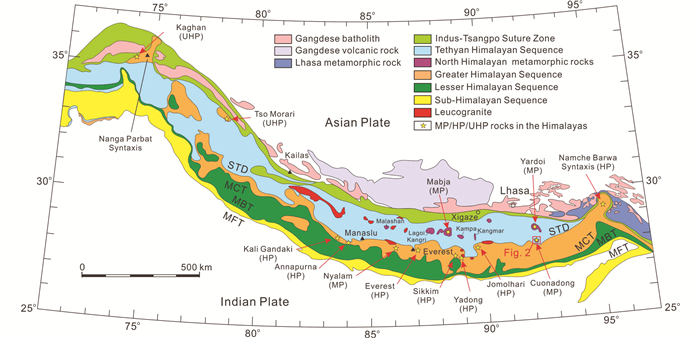
喜马拉雅造山带是印度与欧亚大陆碰撞作用的产物,是世界上最典型的碰撞造山带,是揭示造山带形成演化和检验板块构造理论的天然实验室(Yin and Harrison, 2000)。在喜马拉雅造山带核部出露有大量中-高级变质岩,这些变质岩产出在两条与造山带走向近平行的构造单元中,即南部的高喜马拉雅结晶岩系和北部的北喜马拉雅片麻岩穹窿核部(图 1)。这些岩石记录了印度与亚洲大陆碰撞过程中的变质、变形、地壳熔融和岩浆作用等信息,是研究喜马拉雅造山带形成演化与动力学的最佳对象。
目前,关于北喜马拉雅片麻岩穹窿的变质作用、岩浆作用、成矿作用及构造变形已经取得了许多重要成果:(1)变形、变质及动力学研究表明,北喜马拉雅片麻岩穹窿构造形态的形成与藏南拆离系(STD)的活动有关(Chen et al., 1990; Lee et al., 2004, 2006; Aoya et al., 2005, 2006; Quigley et al., 2006, 2008; 张进江等, 2007, 2011; Lee and Whitehouse, 2007; Wagner et al., 2010; Zhang et al., 2012; 付建刚等, 2018a, b);(2)年代学研究表明,除康玛穹窿核部花岗岩形成于早古生代(562~509Ma; Schärer et al., 1986; Lee et al., 2000)以外,其余穹窿核部花岗岩的形成时间为新生代(46~8Ma)(Schärer et al., 1986; Zhang et al., 2004; Aoya et al., 2005; Lee et al., 2006; Kawakami et al., 2007; Lee and Whitehouse, 2007; Aikman et al., 2008; 郭磊等, 2008; 曾令森等, 2009; King et al., 2011; Zeng et al., 2011; 张进江等, 2011; 高利娥等, 2011, 2013, 2017; Hou et al., 2012; Liu et al., 2014, 2016a, b);(3)成矿作用研究表明,发育有与北喜马拉雅片麻岩穹窿和淡色花岗岩在空间上相关的Sb-Au-Pb-Zn多金属和Nb-Ta-Sn-Be稀有金属成矿带(侯增谦等, 2003, 2006a, b; 李光明等, 2017; 王汝成等, 2017; 梁维等, 2018)。但是,目前有关片麻岩穹窿核部岩石的变质条件、变质时间、部分熔融及其与新生代花岗岩的成因关系还存在比较大的争议。如大部分研究认为穹窿核部变质岩经历了巴罗型中压区域变质作用,变质作用峰期在蓝晶石或夕线石带(Lee et al., 2000, 2004; Quigley et al., 2008; Ding et al., 2016a, b; Wang et al., 2018),但也有学者认为是接触变质作用产物,变质峰期仅达低角闪岩相(Aoya et al., 2006; Kawakami et al., 2007),还有学者认为穹窿核部经历了高温麻粒岩相变质作用和伴生的部分熔融(曾令森等, 2009; 高利娥等, 2011)。
近年来,在造山带东段错那洞片麻岩穹隆及其附近发现多个多金属和稀有金属矿床(王艺云等, 2012; 吴建阳等, 2015; Xie et al., 2017; Wang et al., 2017; Zhou et al., 2018),其中有些矿床可达大型或超大型规模(梁维等, 2013; 李光明等, 2017),引起了广泛关注。目前,已经对错那洞片麻岩穹隆的结构与组成、构造变形进行了初步研究(Fu et al., 2017, 2018; 张志等, 2017; 付建刚等, 2018a, b; 张林奎等, 2018),对其核部出露的新生代花岗岩进行了年代学、地球化学和成因研究(林彬等, 2016; 董汉文等, 2017; 高利娥等, 2017; 黄春梅等, 2018),对相关的金属和稀有金属矿床特征与成矿作用进行了初步探讨(王汝成等, 2017; 李光明等, 2017; 梁维等, 2018)。但是,对错那洞穹隆核部广泛分布的变质岩的变质作用条件、时间、构造机制,以及与淡色花岗岩成因和成矿作用之间的关系还缺少研究。
像其它北喜马拉雅片麻岩穹窿一样,错那洞片麻岩穹窿核部也产出有大量泥质变质岩。与其它成分的岩石相比,泥质变质岩对变质作用P-T条件和变质时间的变化反映更加灵敏。因此,我们选择错那洞穹窿核部的泥质变质岩,即石榴石蓝晶石十字石白云母片岩进行了岩石学、相平衡相模和锆石U-Pb年代学研究,以此限定了穹窿核部变质岩的变质作用条件、时间与演化过程,为揭示该穹窿的成因和成矿作用提供了重要信息。
1 地质背景位于青藏高原南部的喜马拉雅造山带形成在新生代印度与亚洲大陆的碰撞过程中。整个造山带长约2500km,呈弧形展布,由4个近平行的构造单元组成,从北到南依次为:特提斯喜马拉雅岩系、高喜马拉雅结晶岩系、低喜马拉雅岩系和次喜马拉雅单元(前陆盆地)。它们之间的界限分别为藏南拆离系(STD)、主中央逆冲断裂(MCT)和主边界逆冲断裂(MBT)(图 1; Hodges, 2000; Yin and Harrison, 2000)。
|
图 1 喜马拉雅造山带地质简图(据Yin and Harrison, 2000修改) 图中超高压(UHP)、高压(HP)和中压(MP)变质岩资料来源:Annapurna(Kohn and Corrie, 2011);Everest(Cottle et al., 2009b);Jomolhari(Regis et al., 2014);Kaghan(Kaneko et al., 2003);Kali Gandaki(Iaccarino et al., 2015);Mabja(Lee and Whitehouse, 2007);Namche Barwa Syntaxis(Zhang et al., 2015);Nyalam(Wang et al., 2015);Sikkim(Rubatto et al., 2013);Tso Morari(Donaldson et al., 2013);Yadong(Zhang et al., 2017a);Yardoi(Ding et al., 2016a, b; Wang et al., 2018)和Cuonadong(本文) Fig. 1 Simplified geological map of the Himalayan orogen (modified after Yin and Harrison, 2000) |
北喜马拉雅片麻岩穹窿呈串珠状断续分布于特提斯喜马拉雅岩系中部,自西向东包括马拉山、拉轨岗日、定日、康马、然巴、雅拉香波和错那洞穹窿(图 1)。这些穹窿总体上具有相似的结构特征,其核部由新生代的花岗岩和变质岩组成,边部为未变质或低级变质的特提斯沉积岩系。穹窿核部(花岗岩+变质岩)与边部特提斯沉积岩系之间为由韧性剪切带组成的拆离带(Zhang et al., 2012)。该拆离带多被认为是藏南拆离系的北向延伸,穹窿核部为特提斯沉积岩系中出露的高喜马拉雅结晶岩系(Chen et al., 1990; Hodges, 2000; Lee et al., 2000, 2004, 2006; Lee and Whitehouse, 2007; Zhang et al., 2012)。
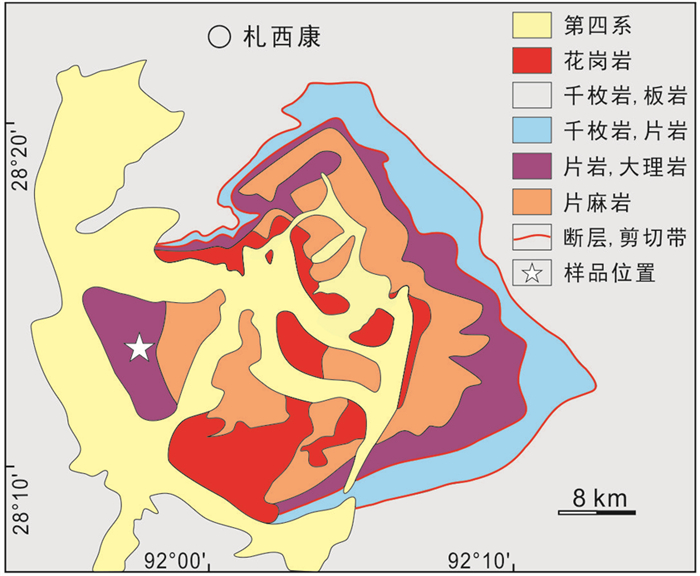
错那洞片麻岩穹窿位于北喜马拉雅片麻岩穹窿带的东端,出露面积约600km2,其北部为雅拉香波片麻岩穹窿(图 1)。错那洞穹窿被两条环状拆离断层分为三个岩石-构造单元(图 2, Fu et al., 2017, 2018)。上(外)拆离断层是韧脆性断层,位于较高构造层次,而下(内)拆离断层为塑性剪切带,处于下部构造层次。上拆离断层之上为低级变质(绿片岩相)的特提斯沉积岩系,由板岩、变质砂岩和千枚岩组成。这些岩石经历了明显的变形,变形面理限定了穹窿的形状。两个拆离断层之间的中部构造单元,由低-中级变质的片岩、片麻岩、大理岩和石英岩组成,并且显示出由外向内变质作用程度增加的趋势。下拆离带之下的构造单元位,即为穹窿核部,主要由中压角闪岩相变质的片岩、片麻岩和大理岩组成。该构造单元被广泛分布的淡色花岗岩侵入,并且大量发育花岗岩和伟晶岩脉体。研究表明,穹窿核部的正片麻岩具有早古生代(~497Ma)的原岩年龄(未发表数据),穹窿核部的淡色花岗岩为中新世(17~20Ma)含石榴石二云母花岗岩(董汉文等, 2017; 高利娥等, 2017; 黄春梅等, 2018)。本文所研究的泥质变质岩采自错那洞穹窿核部西侧,为石榴石蓝晶石十字石白云母片岩,其与片麻岩、大理岩和斜长角闪岩共生。
|
图 2 错那洞片麻岩穹窿地质简图(据Fu et al., 2018修改) Fig. 2 Geological map of the Cuonadong gneiss dome (modified after Fu et al., 2018) |
全岩化学成分分析在国家地质实验测试中心完成。主量元素分析采用X-ray荧光光谱法(Rigaku-3080),分析精度优于0.5%。矿物化学成分在中国地质科学院地质研究所使用JEOL JXA8100电子探针分析。分析条件是15kV加速电压,电子速电流为20nA,电子束斑为5μm。
锆石U-Pb同位素定年在武汉上谱分析科技有限责任公司完成。测试仪器为LA-ICP-MS,激光剥蚀系统为GeoLas 2005,ICP-MS为Agilent 7700。激光剥蚀斑束直径为24μm。在实验操作过程中,标样采用91500和GJ-1,其中监控标样GJ-1的平均值为602.3±2.6Ma(2σ, n=14),与推荐值(602.1±4.9Ma, Liu et al., 2010a; 599.8±1.7Ma, Jackson et al., 2004)一致。微量元素矫正以NIST610为外标,SiO2含量为内标进行矫正。锆石定年数据和微量元素数据处理均采用ICPMSDataCal(Liu et al., 2010b)程序,并采用软件对测试数据进行普通铅校正(Andersen, 2002),年龄计算及谐和图绘制采用ISOPLOT(Ludwig, 2003)软件完成。
3 岩相学和矿物化学所研究的石榴石蓝晶石十字石白云母片岩具斑状变晶结构和片状构造(图 3)。变斑晶为石榴石,自形-半自形,2.0~2.5mm,由较干净的核部和富含包裹体的边部组成。包裹体矿物为石英、斜长石和白云母。变基质为鳞片粒状变晶结构,由蓝晶石、十字石、白云母、斜长石、石英,及少量钛铁矿、金红石和电气石组成。岩相学观察表明,片岩中的矿物为平衡共生关系,其矿物组合为石榴石+蓝晶石+十字石+白云母+斜长石+石英+钛铁矿+金红石,为典型的中压角闪岩相泥质变质岩。

|
图 3 石榴石十字石蓝晶石白云母片岩显微照片 (a)片岩中的石榴石变斑晶,其边部含石英、斜长石和白云母包体,基质矿物由十字石、斜长石、石英、白云母、少量黑云母和钛铁矿组成.图中带箭头的红线为图 4中石榴石成分剖面的分析位置;(b、c)片岩中的蓝晶石、白云母和拉长的斜长石、石英定向排列构成面理.本文所采用的矿物代号:Alm-铁铝榴石;And-红柱石;Bt-黑云母;Crd-堇青石;Grs-钙铝榴石;Gt-石榴石;Ilm-钛铁矿;Kfs-钾长石;Ky-蓝晶石;Ms-白云母;Pl-斜长石;Prp-镁铝榴石;Qz-石英;Rt-金红石;Sil-夕线石;Spe-锰铝榴石;St-十字石;Liq-熔体 Fig. 3 Photomicrographs of the garnet-staurolite-kyanite mica schist |
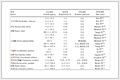
矿物化学分析表明,变斑晶石榴石具有明显的成分环带,其镁铝榴石、钙铝榴石、铁铝榴石和锰铝榴石组分分别在0.06~0.10、0.03~0.12、0.75~0.83和0.02~0.12之间变化(图 4、表 1)。从内核向外核,锰铝榴石和钙铝榴石组分降低,镁铝榴石增加,铁铝榴石基本不变,显示出生长环带特征;而石榴石边部具有可变的锰铝榴石和镁铝榴石组分,钙铝榴石组分向外逐渐降低,铁铝榴石组分在外边具有升高的趋势。片岩中的十字石具有较高的FeO含量(12.08%和12.26%)和较低的MgO含量(0.81%和0.86%;表 2)。岩石中的斜长石均为更长石,其钙长石(An)组分为0.18和0.20(表 2)。白云母的SiO2含量为47.51%和47.30%(Si=3.02和3.11;表 2)。

|
图 4 石榴石十字石蓝晶石白云母片岩中石榴石成分剖面 Fig. 4 Compositional profile of garnet in the garnet-staurolite-kyanite mica schist |
|
表 1 所研究岩石石榴石代表性化学成分表(wt%) Table 1 The representative garnet chemical compositions from the studied rock (wt%) |
|
|
表 2 所研究岩石十字石、斜长石和白云母化学成分表(wt%) Table 2 Chemical compositions of staurolite, plagioclase and muscovite from the studied rock (wt%) |
本文用相平衡模拟方法估算了岩石的变质作用条件。模拟使用Perple_X程序(Connolly, 2009, 2016年升级的6.7.4版)。相关矿物相的活度-成分关系模型为:石榴石-Gt(White et al., 2014),熔体-melt(White et al., 2014),黑云母Bi-(White et al., 2014),白云母Mica(White et al., 2014),绿泥石-Chl(White et al., 2014),钛铁矿-Ilm(White et al., 2007)和十字石-St(White et al., 2014)。模拟采用实测全岩成分,所选择的成分体系为接近泥质岩真实成分的MnO-Na2O-CaO-K2O-FeO-MgO-Al2O3-SiO2-H2O-TiO2-O2 (MnNCKFMASHTO)体系。
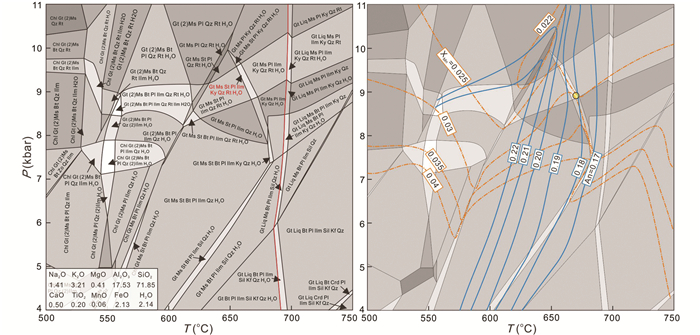
在模拟的4~11kbar和500~750℃条件范围内,石榴石和斜长石都稳定存在(图 5),白云母稳定存在在于除右下角(630~750℃和4~9kbar)的区域,黑云母稳定存在除在右上角(8~10kabr和600~750℃)的区域,十字石稳定在4~10kbar和500~685℃的区域内,蓝晶石稳定在7.5~10kbar和650~750℃的区域内,体系的固相线位于685~700℃之间。模拟结果表明,所观察到的片岩矿物组合Grt+St+Ky+Pl+Bt+Ms+Qz+Ilm+Rt稳定在8.8~9.7kbar和655~670℃的较小区域(图 5)。此外,石榴石外核最低的XMn(0.03)等值线和基质中斜长石最低的钙长石组分(0.18)等值线相交在矿物组合限定的P-T区域内,所给出的温度和压力条件为~670℃和~9.0kbar(图 5b中的黄色填充圈)。这应代表岩石的峰期变质条件。此变质温度明显低于岩石的固相线温度,表明岩石并没有发生部分熔融。
|
图 5 石榴石十字石蓝晶石白云母片岩的P-T视剖面图 红色字体表示所片岩的共生矿物组合;橘色虚线为石榴石XMn(=Mn/(Mn+Mg+Fe+Ca))等值线;蓝色实线为斜长石的钙长石组分(An)等值线;黄色小圈为矿物成分等值线相交得到的变质条件;红色实线为体系的固相线 Fig. 5 P-T pseudosections for the garnet-staurolite-kyanite mica schist |
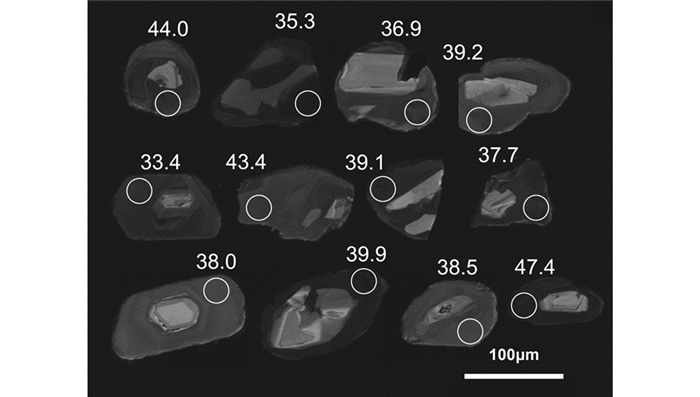
对所研究片岩中的锆石进行了U-Pb定年和微量元素分析,分析结果见表 3。锆石多为无色或淡黄色、半自形柱状,粒度约100~150μm。阴极发光图像显示锆石具有核-边结构(图 6)。锆石核部形状不规则,发光性较强,无环带或具震荡和不规则环带。锆石边部发光较弱,无环带或具有弱的补丁状环带(图 6)。对锆石边部的分析表明,其具有较低的Th/U值(0.002~0.019)和低的重稀土元素(REE)含量(25×10-6~576×10-6;表 3),具平坦或弱分异的重稀土元素(HREE)配分模式(图 7a)。锆石边部的U-Pb定年结果表明,其206Pb/238U年龄在47.4~28.8Ma之间变化(图 7b)。
|
|
表 3 锆石U-Pb定年及稀土元素分析结果(×10-6) Table 3 Zircon U-Pb dating data and rare earth element compositions (×10-6) |
|
图 6 石榴石十字石蓝晶石白云母片岩代表性锆石颗粒的阴极发光图像 圆圈为U-Pb定年位置,数字为相应年龄,单位为Ma Fig. 6 Cathodoluminescence images of the representing zircon grains from the garnet-staurolite-kyanite mica schist |

|
图 7 石榴石十字石蓝晶石白云母片岩中锆石的球粒陨石标准化稀土元素配分模式图(a, 标准化值据Sun and McDonough, 1989)和U-Pb年龄谐和图(b) Fig. 7 Chondrite-normalized REE patterns (a, normalization values after Sun and McDonough, 1989) and U-Pb concordia diagrams (b) of zircon from the garnet-staurolite-kyanite mica schist |
所研究片岩中的锆石具有核-边结构,核部为继承核,而边部应为岩石变质过程中形成的。这是因为锆石的边缘具有典型的变质锆石特征,如低的Th/U值(0.002~0.019)和低的稀土元素含量(25×10-6~576×10-6;表 3),平坦或弱分异的重稀土元素配分模式(图 7a)。这也是与石榴石同时生长的锆石特征(Rubatto, 2002; Corfu et al., 2003)。因此,锆石边部所获得的47~29Ma年龄代表岩石的变质作用时间,而且很可能表明该穹隆核部的变质作用持续了至少20Myr。
如上文所述,北喜马拉雅片麻岩穹隆核部的变质岩为高喜马拉雅结晶岩系的组成部分。近年来,越来越多的研究表明,在造山带东段高喜马拉雅结晶岩系经历了长期(>20~30Myr)持续的变质演化过程(Cottle et al., 2009a; Kali et al., 2010)。如聂拉木地区的40~14Ma(Wang et al., 2013),亚东的40~7Ma(Zhang et al., 2015)和雅拉香波的50~16Ma(Ding et al., 2016b)。这些明显不同于造山带西段高喜马拉雅结晶岩系超高压变质岩所经历了的快速俯冲与折返过程(< 10Myr, Guillot et al., 2008; Rehman et al., 2013)。
在造山带东段,大部分研究获得的高喜马拉雅结晶岩系的变质作用时间 < 40Ma(Lee and Whitehouse, 2007; Rubatto et al., 2013; Regis et al., 2014; 李旺超等, 2015; Wang et al., 2015; Zhang et al., 2015, 2017a, b; Walters and Kohn, 2017; Goscombe et al., 2018; Imayama et al., 2018)。但最近在高喜马拉雅结晶岩系上部构造层位的变质岩石中获得了较老的变质年龄。如在雅拉香波片麻岩穹隆获得了48~45Ma的变质时间(Zeng et al., 2011; 高利娥等, 2011; Ding et al., 2016a, b)。本研究进一步揭示,片麻岩穹隆核部岩石的变质作用很可能开始于~47Ma。由于这些变质岩石形成在印度大陆俯冲过程中,其变质作用时间可以约束印度与亚洲大陆的碰撞时间。因此,结合现有研究结果,我们支持已经有的结论,即印度与亚洲大陆在青藏高原东南部的初始碰撞时间为~50Ma(Ding et al., 2016a, b)。
6.2 错那洞穹窿核部的变质条件如上文所述,关于北喜马拉雅片麻岩穹窿核部变质岩的变质条件还存在比较大的争议。大部分学者认为穹窿核部的变质岩经历了在蓝晶石或夕线石稳定域的巴罗型中压区域变质作用,如康玛穹窿核部的变质条件为~625℃和8.6kbar(Lee et al., 2000),麻布加穹窿为~705℃和8.2kbar(Lee et al., 2004),康巴穹窿400~700℃(Quigley et al., 2008),Leo Pargil穹窿为530~630℃和7~8kbar(Langille et al., 2012)。但也有学者认为马拉山穹窿经历了低角闪岩相接触变质作用(~550℃和4.8kbar; Aoya et al., 2006; Kawakami et al., 2007),雅拉香波穹窿核部经历了高压和高温麻粒岩相变质作用(872~892℃和10~11kbar; 曾令森等, 2009; 高利娥等, 2011)。
本研究表明,错那洞穹窿核部的片岩具有典型的中压角闪岩相矿物组合(Grt+St+Ky+Pl+Ms+Qz+Ilm+Rt),相应的变质条件为670℃和8.8~9.0kbar。最近的岩石学和相平衡模拟研究也表明,雅拉香波片麻岩穹窿经历了位于蓝晶石稳定域的角闪岩相变质作用,其峰期变质条件为615~665℃和7~8kbar(Ding et al., 2016a, b),或为650℃和9kbar(Wang et al., 2018)。另外,最近的研究也表明马拉山片麻岩穹窿经历了中压角闪岩相变质作用(张进江等, 2011; Zhang et al., 2012)。结合现有的其它研究成果(Lee et al., 2000, 2004; Quigley et al., 2008; Langille et al., 2012),我们认为大多数北喜马拉雅片麻岩穹窿核部经历了类似的中压角闪岩相变质作用,其峰期变质温度均在670℃以下。对于变泥质岩石来说,这样温度在其部分熔融温度之下。野外观察也表明,这些变质泥质岩石并没有经历部分熔融和混合岩化。因此,片麻岩穹窿核部产出的淡色花岗岩并不是变泥质围岩部分熔融的产物。
6.3 北喜马拉雅片麻岩穹窿核部淡色岩石的成因现有研究多认为,北喜马拉雅片麻岩穹窿形成在南北向伸展过程中,其构造形态的形成与藏南拆离系活动有关(Lee et al., 2000, 2004, 2006; Quigley et al., 2006, 2008; Lee and Whitehouse, 2007; Wagner et al., 2010; Wang et al., 2018)。有研究认为,北喜马拉雅片麻岩穹窿的变质、混合岩化以及核部淡色花岗岩的侵入均同时发生在这种伸展环境下,并且岩石折返过程中的熔融导致混合岩化的发生,形成了混合岩,混合岩底辟上升是穹窿形成的重要机制(Lee et al., 2004)。尽管大多数研究都认为,北喜马拉雅片麻岩穹窿核部的新生代淡色花岗岩是变泥质岩石部分熔融的产物(曾令森等, 2009; Gao and Zeng, 2014; Liu et al., 2014; 高利娥等, 2017),但穹窿核部的变质岩石仅经历了角闪岩相变质作用,变泥质岩石并未发生部分熔融。这表明穹窿中的淡色花岗岩并不是其变泥质围岩原地部分熔融形成的,而应该是异地来源的。这与越来越多的研究结果是一致的,即喜马拉雅造山带的新生代花岗岩起源于高喜马拉雅结晶岩系下部构造层位高压麻粒岩的部分熔融(Kali et al., 2010; Groppo et al., 2010, 2012; Guilmette et al., 2011; Rubatto et al., 2013; Zhang et al., 2015, 2017a, b, 2018),所形成的岩浆在上升和侵位过程中经历了明显的分离结晶作用,是典型的高分异异地花岗岩(Liu et al., 2014, 2016a, b; 吴福元等, 2015)。
最新的研究表明,错那洞穹隆核部的淡色花岗岩也经历了高度演化(梁维等, 2018),而高度演化的岩浆有利于W、Sn和Be等稀有金属的富集与成矿(黄春梅等, 2018)。这可能是喜马拉雅淡色花岗岩富含金属和稀有金属矿物,并成矿的重要原因(王汝成等, 2017)。
6.4 印度大陆的低角度俯冲作用现有大多数研究认为,印度-亚洲大陆的碰撞发生在60~50Ma(Rowley, 1996; Clementz et al., 2011; Donaldson et al., 2013; Smit et al, 2014; Ding et al., 2016a, b; Hu et al., 2015, 2016a, b; 朱弟成等, 2017)。本研究也表明,印度与亚洲大陆的碰撞发生在~50Ma。但是,两大陆碰撞后印度向亚洲大陆之下的俯冲性质(是高角度俯冲还是低角度俯冲)还存在较大争议。在喜马拉雅造山带西段的Tso Morari和Kaghan地区存在有超高压变质岩(图 1),这表明印度大陆西北缘发生了高角度俯冲作用,俯冲深度>90km(O'Brien et al., 2001; Mukherjee and Sachan, 2001; Kaneko et al., 2003; Sachan et al., 2004; Leech et al., 2005; O'Brien, 2006; Guillot et al., 2008)。在造山带中-东段,俯冲的印度大陆下地壳岩石经历了中-高压变质作用(图 1),表明大陆的俯冲深度只有40~60km(Liu and Zhong, 1997; Lombardo and Rolfo, 2000; Ding et al., 2001; Groppo et al., 2007, 2010, 2012; Guillot et al., 2008; Zhang et al., 2010, 2015, 2017a, 2018; Guilmette et al., 2011; Sorcar et al., 2014)。本文和Ding et al.(2016a, b)的研究表明,高喜马拉雅结晶岩系上部构造层位,即俯冲的印度大陆上地壳仅经历了中压角闪岩相变质作用,表明俯冲深度只有25~30km,进一步证实在造山带中-东段印度大陆以低角度俯冲到亚洲大陆之下。
7 结论喜马拉雅造山带东段错那洞片麻岩穹隆中的变泥质岩——石榴石十字石蓝晶石白云母片岩经历了中压角闪岩相变质作用,其共生矿物组合为石榴石+蓝晶石+十字石+白云母+斜长石+石英+钛铁矿+金红石,峰期变质条件为~670℃和~9.0kbar。石榴石十字石蓝晶石白云母片岩的变质作用开始于47Ma,持续到至少29Ma。本研究表明,错那洞穹窿核部的变质岩是印度大陆上地壳平缓俯冲到亚洲大陆之下经历中压变质作用的产物。错那洞穹窿核部的变泥质岩石并没有经历高温变质与部分熔融,穹窿核部的新生代花岗岩应来源于更深部岩石的部分熔融。本研究进一步揭示,在喜马拉雅造山带东段,大陆的碰撞发生在~50Ma,碰撞后印度大陆平缓俯冲到亚洲大陆之下。
致谢 感谢中国地质科学院地质研究所张泽明研究员和中国地质大学(北京)赵志丹教授的指导与帮助。感谢中国地质大学(武汉)骆必继副教授和中国地质科学院地质研究所向华副研究员审阅全文,并提出重要修改意见。
Aikman AB, Harrison TM and Ding L. 2008. Evidence for early (>44Ma) Himalayan crustal thickening, Tethyan Himalaya, southeastern Tibet. Earth and Planetary Science Letters, 274(1-2): 14-23. DOI:10.1016/j.epsl.2008.06.038 |
Andersen T. 2002. Correction of common lead in U-Pb analyses that do not report 204Pb. Chemical Geology, 192(1-2): 59-79. DOI:10.1016/S0009-2541(02)00195-X |
Aoya M, Wallis SR, Terada K, Lee J, Kawakami T, Wang Y and Heizler M. 2005. North-south extension in the Tibetan crust triggered by granite emplacement. Geology, 33(11): 853-856. DOI:10.1130/G21806.1 |
Aoya M, Wallis SR, Kawakami T, Lee J, Wang Y and Maeda H. 2006. The Malashan gneiss dome in South Tibet:Comparative study with the Kangmar dome with special reference to kinematics of deformation and origin of associated granites. In:Law RD, Searlr MP and Godin L (eds.). Channel Flow, Ductile Extrusion and Exhumation in Continental Collision Zones. Geological Society, London, Special Publication, 268(1): 471-495. |
Chen Z, Liu Y, Hodges KV, Burchfiel BC, Royden LH and Deng C. 1990. The Kangmar Dome:A metamorphic core complex in southern Xizang (Tibet). Science, 250(4987): 1552-1556. DOI:10.1126/science.250.4987.1552 |
Clementz M, Bajpai S, Ravikant V, Thewissen JGM, Saravanan N, Singh IB and Prasad V. 2011. Early Eocene warming events and the timing of terrestrial faunal exchange between India and Asia. Geology, 39(1): 15-18. DOI:10.1130/G31585.1 |
Connolly JAD. 2009. The geodynamic equation of state:What and how. Geochemistry, Geophysics, Geosystems, 10(10): Q10014. |
Corfu F, Hanchar JM, Hoskin PWO and Kinny P. 2003. Atlas of zircon textures. Reviews in Mineralogy and Geochemistry, 53(1): 469-500. DOI:10.2113/0530469 |
Cottle JM, Searle MP, Horstwood MSA and Waters DJ. 2009a. Timing of midcrustal metamorphism, melting, and deformation in the Mount Everest region of Southern Tibet revealed by U(-Th)-Pb geochronology. The Journal of Geology, 117(6): 643-664. DOI:10.1086/605994 |
Cottle JM, Jessup MJ, Newell DL, Horstwood MSA, Noble SR, Parrish RR, Waters DJ and Searle MP. 2009b. Geochronology of granulitized eclogite from the Ama Drime Massif:Implications for the tectonic evolution of the South Tibetan Himalaya. Tectonics, 28(1): TC1002. |
Ding HX, Zhang ZM, Dong X, Tian ZL, Xiang H, Mu HC, Gou ZB, Shui XF, Li WC and Mao LJ. 2016a. Early Eocene (c. 50Ma) collision of the Indian and Asian continents:Constraints from the North Himalayan metamorphic rocks, southeastern Tibet. Earth and Planetary Science Letters, 435: 64-73. |
Ding HX, Zhang ZM, Hu KM, Dong X, Xiang H and Mu HC. 2016b. P-T-t-D paths of the North Himalayan metamorphic rocks:Implications for the Himalayan orogeny. Tectonophysics, 683: 393-404. DOI:10.1016/j.tecto.2016.06.035 |
Ding L, Zhong DL, Yin A, Kapp P and Harrison TM. 2001. Cenozoic structural and metamorphic evolution of the eastern Himalayan syntaxis (Namche Barwa). Earth and Planetary Science Letters, 192(3): 423-438. DOI:10.1016/S0012-821X(01)00463-0 |
Donaldson DG, Webb AAG, Menold CA, Kylander-Clark ARC and Hacker BR. 2013. Petrochronology of Himalayan ultrahigh-pressure eclogite. Geology, 41(8): 835-838. DOI:10.1130/G33699.1 |
Dong HW, Xu ZQ, Meng YK and Yi ZY. 2017. Geochronology of leucogranites in the Cuonadong dome, southern Tibet and limitation of the timing of the Southern Tibet Detachment System (STDS). Acta Petrologica Sinica, 33(12): 3741-3752. |
Fu JG, Li GM, Wang GH, Huang Y, Zhang LK, Dong SL and Liang W. 2017. First field identification of the Cuonadong dome in southern Tibet:Implications for EW extension of the North Himalayan gneiss dome. International Journal of Earth Science, 106(5): 1581-1596. DOI:10.1007/s00531-016-1368-2 |
Fu JG, Li GM, Wang GH, Zhang LK, Liang W, Zhang Z, Zhang XQ and Huang Y. 2018. Synchronous granite intrusion and E-W extension in the Cuonadong dome, southern Tibet, China:Evidence from field observations and thermochronologic results. International Journal of Earth Sciences, 107(6): 2023-2041. DOI:10.1007/s00531-018-1585-y |
Fu JG, Li GM, Wang GH, Zhang LK, Liang W, Zhang Z, Dong SL and Huang Y. 2018a. Timing of E-W extension deformation in North Himalaya:Evidences from Ar-Ar age in the Cuonadong Dome, South Tibet. Earth Science, 43(8): 2638-2650. |
Fu JG, Li GM, Wang GH, Huang Y, Zhang LK, Dong SL and Liang W. 2018b. Establishment of the North Himalayan double gneiss domes:Evidence from field identification of the Cuonadong dome, South Tibet. Geology in China, 45(4): 783-802. |
Gao LE, Zeng LS and Xie KJ. 2011. Eocene high grade metamorphism and crustal anatexis in the North Himalaya Gneiss Domes, Southern Tibet. Chinese Science Bulletin, 56(36): 3078-3090. |
Gao LE, Zeng LS, Hou KJ, Guo CL, Tang SH, Xie KJ, Hu GY and Wang L. 2013. Episodic crustal anatexis and the formation of Paiku composite leucogranitic pluton in the Malashan Gneiss Dome, Southern Tibet. Chinese Science Bulletin, 58(27): 2810-2822. |
Gao LE and Zeng LS. 2014. Fluxed melting of metapelite and the formation of Miocene high-CaO two-mica granites in the Malashan gneiss dome, southern Tibet. Geochimica et Cosmochimica Acta, 130: 136-155. DOI:10.1016/j.gca.2014.01.003 |
Gao LE, Gao JH, Zhao LH, Hou KJ and Tang SH. 2017. The Miocene leucogranite in the Nariyongcuo Gneiss Dome, southern Tibet:Products from melting metapelite and fractional crystallization. Acta Petrologica Sinica, 33(8): 2395-2411. |
Goscombe B, Gray D and Foster DA. 2018. Metamorphic response to collision in the Central Himalayan Orogen. Gondwana Research, 57: 191-265. DOI:10.1016/j.gr.2018.02.002 |
Groppo C, Lombardo B, Rolfo F and Pertusati P. 2007. Clockwise exhumation path of granulitized eclogites from the Ama Drime range (Eastern Himalayas). Journal of Metamorphic Geology, 25(1): 51-75. DOI:10.1111/jmg.2007.25.issue-1 |
Groppo C, Rubatto D, Rolfo F and Lombardo B. 2010. Early Oligocene partial melting in the Main Central Thrust Zone (Arun valley, eastern Nepal Himalaya). Lithos, 118(3-4): 287-301. DOI:10.1016/j.lithos.2010.05.003 |
Groppo C, Rolfo F and Indares A. 2012. Partial melting in the Higher Himalayan Crystallines of Eastern Nepal:The effect of decompression and implications for the 'channel flow' model. Journal of Petrology, 53(5): 1057-1088. DOI:10.1093/petrology/egs009 |
Guillot S, Mahéo G, de Sigoyer J, Hattori KH and Pêcher A. 2008. Tethyan and Indian subduction viewed from the Himalayan high-to ultrahigh-pressure metamorphic rocks. Tectonophysics, 451(1-4): 225-241. DOI:10.1016/j.tecto.2007.11.059 |
Guilmette C, Indares A and Hébert R. 2011. High-pressure anatectic paragneisses from the Namche Barwa, Eastern Himalayan syntaxis:Textural evidence for partial melting, phase equilibria modeling and tectonic implications. Lithos, 124(1-2): 66-81. |
Guo L, Zhang JJ and Zhang B. 2008. Structure, kinematics, geochronology and evolution of the North Himalayan Gneiss Dome. Progress in Natural Science, 18(6): 640-650. |
Hodges KV. 2000. Tectonics of the Himalaya and southern Tibet from two perspectives. Geological Society of America Bulletin, 112(3): 324-350. DOI:10.1130/0016-7606(2000)112<324:TOTHAS>2.0.CO;2 |
Hou ZQ, Lu QT, Wang AJ, Li XB, Wang ZQ and Wang EQ. 2003. Continental collision and related metallogeny:A case study of mineralization in Tibetan Orogen. Mineral Deposits, 22(4): 319-333. |
Hou ZQ, Mo XX, Yang ZM, Wang AJ, Pan GT, Qu XM and Nie FJ. 2006a. Metallogeneses in the collisional orogen of the Qinghai-Tibet Plateau:Tectonic setting, tempo-spatial distribution and ore deposit types. Geology in China, 33(2): 340-351. |
Hou ZQ, Qu XM, Yang ZS, Meng XJ, Li ZQ, Yang ZM, Zheng MP, Zheng YY, Nie FJ, Gao YF, Jiang SH and Li GM. 2006b. Metallogenesis in Tibetan collisional orogenic belt:Ⅲ. Mineralization in post-collisional extension setting. Mineral Deposits, 25(6): 629-651. |
Hou ZQ, Zheng YC, Zeng LS, Gao LE, Huang KX, Li W, Li QY, Fu Q, Liang W and Sun QZ. 2012. Eocene-Oligocene granitoids in Southern Tibet:Constraints on crustal anatexis and tectonic evolution of the Himalayan orogen. Earth and Planetary Science Letters, 349-350: 38-52. DOI:10.1016/j.epsl.2012.06.030 |
Hu XM, Garzanti E, Moore T and Raffi I. 2015. Direct stratigraphic dating of India-Asia collision onset at the Selandian (Middle Paleocene, 59±1Ma). Geology, 43(10): 859-862. DOI:10.1130/G36872.1 |
Hu XM, Garzanti E, Wang JG, Huang WT, An W and Webb A. 2016a. The timing of India-Asia collision onset:Facts, theories, controversies. Earth-Science Reviews, 160: 264-299. DOI:10.1016/j.earscirev.2016.07.014 |
Hu XM, Wang JG, BouDagher-Fadel M, Garzanti E and An W. 2016b. New insights into the timing of the India-Asia collision from the Paleogene Quxia and Jialazi formations of the Xigaze forearc basin, South Tibet. Gondwana Research, 32: 76-92. DOI:10.1016/j.gr.2015.02.007 |
Huang CM, Li GM, Zhang Z, Liang W, Huang Y, Zhang KL and Fu JG. 2018. Petrogenesis of the Cuonadong leucogranite in South Tibet:Constraints from bulk-rock geochemistry and zircon U-Pb dating. Earth Science Frontiers, 25(6): 182-195. |
Iaccarino S, Montomoli C, Carosi R, Massonne HJ, Langone A and Visonà D. 2015. Pressure-temperature-time-deformation path of kyanite-bearing migmatitic paragneiss in the Kali Gandaki valley (Central Nepal):Investigation of Late Eocene-Early Oligocene melting processes. Lithos, 231: 103-121. DOI:10.1016/j.lithos.2015.06.005 |
Imayama T, Takeshita T, Yi K and Fukuyama M. 2018. Early Oligocene partial melting via biotite dehydration melting and prolonged low-pressure-low-temperature metamorphism of the upper High Himalaya Crystalline Sequence in the far east of Nepal. In:Sharma R, Villa IM and Kumar S (eds.). Crustal Architecture and Evolution of the Himalaya-Karakoram-Tibet Orogen. Geological Society, London, Special Publication, 481: 1-27. DOI:10.1144/sp481.2 |
Jackson SE, Pearson NJ, Griffin WL and Belousova EA. 2004. The application of laser ablation-inductively coupled plasma-mass spectrometry to in situ U-Pb zircon geochronology. Chemical Geology, 211(1-2): 47-69. DOI:10.1016/j.chemgeo.2004.06.017 |
Kali E, Leloup PH, Arnaud N, Mahéo G, Liu DY, Boutonnet E, Van der Woerd J, Liu XH, Liu-Zeng J and Li HB. 2010. Exhumation history of the deepest central Himalayan rocks, Ama Drime range:Key pressure-temperature-deformation-time constraints on orogenic models. Tectonics, 29(2): TC2014. |
Kaneko Y, Katayama I, Yamamoto H, Misawa K, Ishikawa M, Rehman HU, Kausar AB and Shiraishi K. 2003. Timing of Himalayan ultrahigh-pressure metamorphism:Sinking rate and subduction angle of the Indian continental crust beneath Asia. Journal of Metamorphic Geology, 21(6): 589-599. DOI:10.1046/j.1525-1314.2003.00466.x |
Kawakami T, Aoya M, Wallis SR, Lee J, Terada K, Wang Y and Heizler M. 2007. Contact metamorphism in the Malashan Dome, North Himalayan gneiss domes, southern Tibet:An example of shallow extensional tectonics in the Tethys Himalaya. Journal of Metamorphic Geology, 25(8): 831-853. DOI:10.1111/j.1525-1314.2007.00731.x |
King J, Harris N, Argles T, Parrish R and Zhang HF. 2011. Contribution of crustal anatexis to the tectonic evolution of Indian crust beneath Southern Tibet. Geological Society of America Bulletin, 123(1-2): 218-239. DOI:10.1130/B30085.1 |
Kohn MJ and Corrie SL. 2011. Preserved Zr-temperatures and U-Pb ages in high-grade metamorphic titanite:Evidence for a static hot channel in the Himalayan orogen. Earth and Planetary Science Letters, 311(1-2): 136-143. DOI:10.1016/j.epsl.2011.09.008 |
Langille JM, Jessup MJ, Cottle JM, Lederer G and Ahmad T. 2012. Timing of metamorphism, melting and exhumation of the Leo Pargil dome, Northwest India. Journal of Metamorphic Geology, 30(8): 769-791
|
Lee J, Hacker BR, Dinklage WS, Wang Y, Gans P, Calvert A, Wan JL, Chen WJ, Blythe AE and McClelland W. 2000. Evolution of the Kangmar Dome, southern Tibet:Structural, petrologic, and thermochronologic constraints. Tectonics, 19(5): 872-896. DOI:10.1029/1999TC001147 |
Lee J, Hacker B and Wang Y. 2004. Evolution of North Himalayan gneiss domes: Structural and metamorphic studies in Mabja Dome, southern Tibet. Journal of Structural Geology, 26(12): 2297-2316
|
Lee J, McClelland W, Wang Y, Blythe A and McWilliams M. 2006. Oligocene-Miocene middle crustal flow in southern Tibet:Geochronology of Mabja Dome. In:Law R, Searle M and Godin L (eds.). Channel Flow, Ductile Extrusion and Exhumation of Lower-Mid Crust in Continental Collision Zone. Geological Society, London, Special Publication, 268(1): 445-469. |
Lee J and Whitehouse MJ. 2007. Onset of mid-crustal extensional flow in southern Tibet:Evidence from U/Pb zircon ages. Geology, 35(1): 45-48. DOI:10.1130/G22842A.1 |
Leech ML, Singh S, Jain AK, Klemperer SL and Manickavasagam RM. 2005. The onset of India-Asia continental collision:Early, steep subduction required by the timing of UHP metamorphism in the western Himalaya. Earth and Planetary Science Letters, 234(1-2): 83-97. DOI:10.1016/j.epsl.2005.02.038 |
Li GM, Zhang LK, Jiao YJ, Xia XB, Dong SL, Fu JG, Liang W, Zhang Z, Wu JY, Dong L and Huang Y. 2017. First discovery and implications of Cuonadong superlarge Be-W-Sn polymetallic deposit in Himalayan metallogenic belt, southern Tibet. Mineral Deposits, 36(4): 1003-1008. |
Li WC, Zhang ZM, Xiang H, Gou ZB and Ding HX. 2015. Metamorphism and anatexis of the Himalayan orogen:Petrology and geochronology of HP pelitic granulites from the Yadong area, Southern Tibet. Acta Petrologica Sinica, 31(5): 1219-1234. |
Liang W, Hou ZQ, Yang ZS, Li ZQ, Huang KX, Zhang S, Li W and Zheng YC. 2013. Remobilization and overprinting in the Zhaxikang Pb-Zn-Ag-Sb polymetal ore deposit, Southern Tibet:Implications for its metallogenesis. Acta Petrologica Sinica, 29(11): 3828-3842. |
Liang W, Zhang LK, Xia XB, Ma GT, Huang Y, Zhang Z, Fu JG, Cao HW, Miu HQ and Li GM. 2018. Geology and preliminary mineral genesis of the Cuonadong W-Sn polymetallic deposit, Southern Tibet, China. Earth Science, 43(8): 2742-2754. |
Lin B, Tang JX, Zheng WB, Leng QF, Lin X, Wang YY, Meng Z, Tang P, Ding S, Xu YF and Yuan M. 2016. Geochemical characteristics, age and genesis of Cuonadong leucogranite, Tibet. Acta Petrologica et Mineralogica, 35(3): 391-406. |
Liu XC, Wu FY, Yu LJ, Liu ZC, Ji WQ and Wang JG. 2016b. Emplacement age of leucogranite in the Kampa Dome, southern Tibet. Tectonophysics: 667, 163-175. |
Liu Y and Zhong DL. 1997. Petrology of high-pressure granulites from the eastern Himalayan syntaxis. Journal of Metamorphic Geology, 15(4): 451-466. DOI:10.1111/j.1525-1314.1997.00033.x |
Liu YS, Gao S, Hu ZC, Gao CG, Zong KQ and Wang DB. 2010a. Continental and oceanic crust recycling-induced melt-peridotite interactions in the Trans-North China Orogen:U-Pb dating, Hf isotopes and trace elements in zircons from mantle xenoliths. Journal of Petrology, 51(1-2): 537-571. DOI:10.1093/petrology/egp082 |
Liu YS, Hu ZC, Zong KQ, Gao CG, Gao S, Xu J and Chen HH. 2010b. Reappraisement and refinement of zircon U-Pb isotope and trace element analyses by LA-ICP-MS. Chinese Science Bulletin, 55(15): 1535-1546. DOI:10.1007/s11434-010-3052-4 |
Liu ZC, Wu FY, Ji WQ, Wang JG and Liu CZ. 2014. Petrogenesis of the Ramba leucogranite in the Tethyan Himalaya and constraints on the channel flow model. Lithos, 208-209: 118-136. DOI:10.1016/j.lithos.2014.08.022 |
Liu ZC, Wu FY, Ding L, Liu XC, Wang JG and Ji WQ. 2016a. Highly fractionated Late Eocene (~35Ma) leucogranite in the Xiaru dome, Tethyan Himalaya, South Tibet. Lithos, 240-243: 337-354. DOI:10.1016/j.lithos.2015.11.026 |
Lombardo B and Rolfo F. 2000. Two contrasting eclogite types in the Himalayas:Implications for the Himalayan orogeny. Journal of Geodynamics, 30(1-2): 37-60. DOI:10.1016/S0264-3707(99)00026-5 |
Ludwig KR. 2003. Isoplot/Ex, Version 3. 00: A Geochronological Toolkit for Microsoft Excel. Berkeley: Berkeley Geochronology Center Special Publication
|
Mukherjee BK and Sachan HK. 2001. Discovery of coesite from Indian Himalaya:A record of ultra-high pressure metamorphism in Indian Continental Crust. Current Science, 81(10): 1358-1361. |
O'Brien PJ, Zotov N, Law R, Khan MA and Jan MQ. 2001. Coesite in Himalayan eclogite and implications for models of India-Asia collision. Geology, 29(5): 435-438. DOI:10.1130/0091-7613(2001)029<0435:CIHEAI>2.0.CO;2 |
O'Brien PJ.2006.The age of deep, steep continental subduction in the NW Himalaya:Relating zircon growth to metamorphic history.Comment on: "The onset of India-Asia continental collision:Early, steep subduction required by the timing of UHP metamorphism in the western Himalaya" by Mary L.Leech, S.Singh, A.K.Jain, Simon L.Klemperer and R.M.Manickavasagam, Earth and Planetary Science Letters 234(2005)83-97.Earth and Planetary Science Letters, 245(3-4):814-816
|
Quigley M, Yu LJ, Liu XH, Wilson CJL, Sandiford M and Phillips D. 2006. 40Ar/39Ar thermochronology of the Kampa Dome, southern Tibet: Implications for tectonic evolution of the North Himalayan gneiss domes. Tectonophysics, 421(3-4): 269-297
|
Quigley MC, Yu LJ, Gregory C, Corvino A, Sandiford M, Wilson CJL and Liu XH. 2008. U-Pb SHRIMP zircon geochronology and T-t-d history of the Kampa Dome, southern Tibet. Tectonophysics, 446(1-4): 97-113. DOI:10.1016/j.tecto.2007.11.004 |
Regis D, Warren CJ, Young D and Roberts NMW. 2014. Tectono-metamorphic evolution of the Jomolhari massif:Variations in timing of syn-collisional metamorphism across western Bhutan. Lithos, 190-191: 449-466. DOI:10.1016/j.lithos.2014.01.001 |
Rehman HU, Kobayash K, Tsujimori T, Qtz T, Yamamoto H, Nakamura E, Kaneko Y, Khan T, Terabayashi M, Yoshida K and Hirajima T. 2013. Ion microprobe U-Th-Pb geochronology and study of micro-inclusions in zircon from the Himalayan high-and ultrahigh-pressure eclogites, Kaghan Valley of Pakistan. Journal of Asian Earth Sciences, 63: 179-196. DOI:10.1016/j.jseaes.2012.04.025 |
Rowley DB. 1996. Age of initiation of collision between India and Asia:A review of stratigraphic data. Earth and Planetary Science Letters, 145(1-4): 1-13. DOI:10.1016/S0012-821X(96)00201-4 |
Rubatto D. 2002. Zircon trace element geochemistry:Partitioning with garnet and the link between U-Pb ages and metamorphism. Chemical Geology, 184(1-2): 123-138. DOI:10.1016/S0009-2541(01)00355-2 |
Rubatto D, Chakraborty S and Dasgupta S. 2013. Timescales of crustal melting in the Higher Himalayan Crystallines (Sikkim, Eastern Himalaya) inferred from trace element-constrained monazite and zircon chronology. Contributions to Mineralogy and Petrology, 165(2): 349-372. DOI:10.1007/s00410-012-0812-y |
Sachan HK, Mukherjee BK, Ogasawara Y, Maruyama S, Ishida H, Muko A and Yoshioka N. 2004. Discovery of coesite from Indus suture zone (ISZ), Ladakh, India: Evidence for deep subduction. European Journal of Mineralogy, 16(2): 235-240
|
Schärer U, Xu RH and Allègre CJ. 1986. U-(Th)-Pb systematics and ages of Himalayan leucogranites, south Tibet. Earth and Planetary Science Letters, 77(1): 35-48. DOI:10.1016/0012-821X(86)90130-5 |
Smit MA, Hacker BR and Lee J. 2014. Tibetan garnet records Early Eocene initiation of thickening in the Himalaya. Geology, 42(7): 591-594. DOI:10.1130/G35524.1 |
Sorcar N, Hoppe U, Dasgupta S and Chakraborty S.. 2014. High-temperature cooling histories of migmatites from the High Himalayan Crystallines in Sikkim, India:Rapid cooling unrelated to exhumation?. Contributions to Mineralogy and Petrology, 167(2): 957. DOI:10.1007/s00410-013-0957-3 |
Sun SS and McDonough WF. 1989. Chemical and isotopic systematics of oceanic basalts:Implications for mantle composition and processes. In:Saunders AD and Norry MJ (eds.). Magmatism in the Ocean Basins. Geological Society, London, Special Publication, 42(1): 313-345. DOI:10.1144/GSL.SP.1989.042.01.19 |
Wagner T, Lee J, Hacker BR and Seward G. 2010. Kinematics and vorticity in Kangmar Dome, southern Tibet:Testing midcrustal channel flow models for the Himalaya. Tectonics, 29(6): TC6011. |
Walters JB and Kohn MJ. 2017. Protracted thrusting followed by late rapid cooling of the Greater Himalayan Sequence, Annapurna Himalaya, central Nepal:Insights from titanite petrochronology. Journal of Metamorphic Geology, 35(8): 897-917. DOI:10.1111/jmg.12260 |
Wang D, Sun X, Zheng YY, Wu S, Xia SL, Chang HF and Yu M. 2017. Two pulses of mineralization and genesis of the Zhaxikang Sb-Pb-Zn-Ag deposit in southern Tibet:Constraints from Fe-Zn isotopes. Ore Geology Reviews, 84: 347-363. DOI:10.1016/j.oregeorev.2016.12.030 |
Wang JM, Zhang JJ and Wang XX. 2013. Structural kinematics, metamorphic P-T profiles and zircon geochronology across the Greater Himalayan Crystalline Complex in south-central Tibet:Implication for a revised channel flow. Journal of Metamorphic Geology, 31(6): 607-628. DOI:10.1111/jmg.2013.31.issue-6 |
Wang JM, Rubatto D and Zhang JJ. 2015. Timing of partial melting and cooling across the greater himalayan crystalline complex (Nyalam, Central Himalaya):In-sequence thrusting and its implications. Journal of Petrology, 56(9): 1677-1702. DOI:10.1093/petrology/egv050 |
Wang JM, Wu FY, Rubatto D, Liu K, Zhang JJ and Liu XC. 2018. Early Miocene rapid exhumation in southern Tibet:Insights from P-T-t-D-magmatism path of Yardoi dome. Lithos, 304-307: 38-56. DOI:10.1016/j.lithos.2018.02.003 |
Wang RC, Wu FY, Xie L, Liu XC, Wang JM, Yang L, Lai W and Liu C. 2017. A preliminary study of rare-metal mineralization in the Himalayan leucogranite belts, South Tibet. Science China (Earth Sciences), 60(9): 1655-1663. DOI:10.1007/s11430-017-9075-8 |
Wang YY, Tang JX, Zheng WB, Lin B, Leng QF, Chen W, Ding S, Song JL and Xu YF. 2012. A tentative discussion on ore fabric and genesis of the Zhaxikang Zn-polymetallic deposit, Lhunze County, Tibet. Acta Geoscientica Sinica, 33(4): 681-692. |
White RW, Powell R and Holland TJB. 2007. Progress relating to calculation of partial melting equilibria for metapelites. Journal of Metamorphic Geology, 25(5): 511-527. DOI:10.1111/jmg.2007.25.issue-5 |
White RW, Powell R, Holland TJB, Johnson TE and Green ECR. 2014. New mineral activity-composition relations for thermodynamic calculations in metapelitic systems. Journal of Metamorphic Geology, 32(3): 261-286. DOI:10.1111/jmg.2014.32.issue-3 |
Wu FY, Liu ZC, Liu XC and Ji WQ. 2015. Himalayan leucogranite:Petrogenesis and implications to orogenesis and plateau uplift. Acta Petrologica Sinica, 31(1): 1-36. |
Wu JY, Li GM, Zhou Q, Dong SL, Xia XB and Li YX. 2015. A preliminary study of the metallogenic system in the Zhaxikang integrated exploration area, southern Tibet. Geology in China, 42(6): 1674-1683. |
Xie YL, Li LM, Wang BG, Li GM, Liu HF, Li YX, Dong SL and Zhou JJ. 2017. Genesis of the Zhaxikang epithermal Pb-Zn-Sb deposit in southern Tibet, China:Evidence for a magmatic link. Ore Geology Reviews, 80: 891-909. DOI:10.1016/j.oregeorev.2016.08.007 |
Yin A and Harrison TM. 2000. Geologic evolution of the Himalayan-Tibetan orogen. Annual Review of Earth and Planetary Sciences, 28: 211-280. DOI:10.1146/annurev.earth.28.1.211 |
Zeng LS, Liu J, Gao LE, Xie KJ and Wen L. 2009. Early Oligocene anatexis in the Yardoi gneiss dome, southern Tibet and geological implications. Chinese Science Bulletin, 54(1): 104. DOI:10.1007/s11434-008-0362-x |
Zeng LS, Gao LE, Xie KJ and Liu-Zeng J. 2011. Mid-Eocene high Sr/Y granites in the northern Himalayan gneiss domes:Melting thickened lower continental crust. Earth and Planetary Science Letters, 303(3-4): 251-266. DOI:10.1016/j.epsl.2011.01.005 |
Zhang HF, Harris N, Parrish R, Kelley S, Zhang L, Rogers N, Argles T and King J. 2004. Causes and consequences of protracted melting of the mid-crust exposed in the North Himalayan antiform. Earth and Planetary Science Letters, 228(1-2): 195-212. DOI:10.1016/j.epsl.2004.09.031 |
Zhang JJ, Guo L and Zhang B. 2007. Structure and kinematics of the Yalashangbo dome in the northern Himalayan dome Belt, China. Chinese Journal of Geology, 42(1): 16-30. |
Zhang JJ, Yang XY, Qi GW and Wang DC. 2011. Geochronology of the Malashan dome and its application in formation of the Southern Tibet detachment system (STDS) and Northern Himalayan gneiss domes (NHGD). Acta Petrologica Sinica, 27(12): 3535-3544. |
Zhang JJ, Santosh M, Wang XX, Guo L, Yang XY and Zhang B. 2012. Tectonics of the northern Himalaya since the India-Asia collision. Gondwana Research, 21(4): 939-960. DOI:10.1016/j.gr.2011.11.004 |
Zhang LK, Zhang Z, Li GM, Dong SL, Xia XB, Liang W, Fu JG and Cao HW. 2018. Rock assemblage, structural characteristics and genesis mechanism of the Cuonadong dome, Tethys Himalaya. Earth Science, 43(8): 2664-2683. |
Zhang Z, Zhang LK, Li GM, Liang W, Xia XB, Fu JG, Dong SL and Ma GT. 2017. The Cuonadong gneiss dome of North Himalaya:A new member of gneiss dome and a new proposition for the ore-controlling role of North Himalaya gneiss domes. Acta Geoscientica Sinica, 38(5): 754-766. |
Zhang ZM, Zhao GC, Wang JL, Dong X and Liou JG. 2010. Two stages of granulite facies metamorphism in the eastern Himalayan syntaxis, South Tibet:Petrology, zircon geochronology and implications for the subduction of Neo-Tethys and the Indian continent beneath Asia. Journal of Metamorphic Geology, 28(7): 719-733. |
Zhang ZM, Xiang H, Dong X, Ding HX and He ZY. 2015. Long-lived high-temperature granulite-facies metamorphism in the Eastern Himalayan orogen, south Tibet. Lithos, 212-215: 1-15. DOI:10.1016/j.lithos.2014.10.009 |
Zhang ZM, Xiang H, Dong X, Li WC, Ding HX, Gou ZB and Tian ZL. 2017a. Oligocene HP metamorphism and anatexis of the Higher Himalayan Crystalline Sequence in Yadong region, east-central Himalaya. Gondwana Research, 41: 173-187. DOI:10.1016/j.gr.2015.03.002 |
Zhang ZM, Xiang H, Ding HX, Dong X, Gou ZB, Tian ZL and Santosh M. 2017b. Miocene orbicular diorite in east-central Himalaya:Anatexis, melt mixing, and fractional crystallization of the Greater Himalayan Sequence. Geological Society American Bulletin, 129(7-8): 869-885. DOI:10.1130/B31586.1 |
Zhang ZM, Ding HX, Dong X, Tian ZL, Kang DY, Mu HC, Qin SK, Jiang YY and Li MM. 2018. High-temperature metamorphism, anataxis and tectonic evolution of a mafic granulite from the Eastern Himalayan orogen. Journal of Earth Science, 29(5): 1010-1025. DOI:10.1007/s12583-018-0852-y |
Zhou Q, Li WC, Qing CS, Lai Y, Li YX, Liao ZW, Wu JY, Wang SW, Dong L and Tian EY. 2018. Origin and tectonic implications of the Zhaxikang Pb-Zn-Sb-Ag deposit in northern Himalaya:Evidence from structures, Re-Os-Pb-S isotopes, and fluid inclusions. Mineralium Deposita, 53(4): 585-600. DOI:10.1007/s00126-017-0760-6 |
Zhu DC, Wang Q and Zhao ZD. 2017. Constraining quantitatively the timing and process of continent-continent collision using magmatic record:Method and examples. Science China (Earth Sciences), 60(6): 1040-1056. DOI:10.1007/s11430-016-9041-x |
董汉文, 许志琴, 孟元库, 易治宇. 2017. 藏南错那洞淡色花岗岩年代学研究及其对藏南拆离系活动时间的限定. 岩石学报, 33(12): 3741-3752. |
付建刚, 李光明, 王根厚, 张林奎, 梁维, 张志, 董随亮, 黄勇. 2018a. 北喜马拉雅E-W向伸展变形时限:来自藏南错那洞穹隆Ar-Ar年代学证据. 地球科学, 43(8): 2638-2650. |
付建刚, 李光明, 王根厚, 黄勇, 张林奎, 董随亮, 梁维. 2018b. 北喜马拉雅双穹隆构造的建立:来自藏南错那洞穹隆的厘定. 中国地质, 45(4): 783-802. |
高利娥, 曾令森, 谢克家. 2011. 北喜马拉雅片麻岩穹窿始新世高级变质和深熔作用的厘定. 科学通报, 56(36): 3078-3090. |
高利娥, 曾令森, 侯可军, 郭春丽, 唐索寒, 谢克家, 胡古月, 王莉. 2013. 藏南马拉山穹窿佩枯错复合淡色花岗岩体的多期深熔作用. 科学通报, 58(27): 2810-2822. |
高利娥, 高家昊, 赵令浩, 侯可军, 唐索寒. 2017. 藏南拿日雍错片麻岩穹窿中新世淡色花岗岩的形成过程:变泥质岩部分熔融与分离结晶作用. 岩石学报, 33(8): 2395-2411. |
郭磊, 张进江, 张波. 2008. 北喜马拉雅然巴穹隆的构造、运动学特征、年代学及演化. 自然科学进展, 18(6): 640-650. DOI:10.3321/j.issn:1002-008X.2008.06.006 |
侯增谦, 吕庆田, 王安建, 李晓波, 王宗起, 王二七. 2003. 初论陆-陆碰撞与成矿作用——以青藏高原造山带为例. 矿床地质, 22(4): 319-333. DOI:10.3969/j.issn.0258-7106.2003.04.001 |
侯增谦, 莫宣学, 杨志明, 王安建, 潘桂棠, 曲晓明, 聂凤军. 2006a. 青藏高原碰撞造山带成矿作用:构造背景、时空分布和主要类型. 中国地质, 33(2): 340-351. |
侯增谦, 曲晓明, 杨竹森, 孟祥金, 李振清, 杨志明, 郑绵平, 郑有业, 聂凤军, 高永丰, 江思宏, 李光明. 2006b. 青藏高原碰撞造山带:Ⅲ.后碰撞伸展成矿作用. 矿床地质, 25(6): 629-651. |
黄春梅, 李光明, 张志, 梁维, 黄勇, 张林奎, 付建刚. 2018. 西藏错那洞淡色花岗岩成因:来自全岩地球化学和锆石U-Pb年龄的约束. 地学前缘, 25(6): 182-195. |
李光明, 张林奎, 焦彦杰, 夏祥标, 董随亮, 付建刚, 梁维, 张志, 吴建阳, 董磊, 黄勇. 2017. 西藏喜马拉雅成矿带错那洞超大型铍锡钨多金属矿床的发现及意义. 矿床地质, 36(4): 1003-1008. |
李旺超, 张泽明, 向华, 苟正彬, 丁慧霞. 2015. 喜马拉雅造山带核部的变质作用与部分熔融:亚东地区高压泥质麻粒岩的岩石学与年代学研究. 岩石学报, 31(5): 1219-1234. |
梁维, 侯增谦, 杨竹森, 李振清, 黄克贤, 张松, 李为, 郑远川. 2013. 藏南扎西康大型铅锌银锑多金属矿床叠加改造成矿作用初探. 岩石学报, 29(11): 3828-3842. |
梁维, 张林奎, 夏祥标, 马国桃, 黄勇, 张志, 付建刚, 曹华文, 缪华清, 李光明. 2018. 藏南地区错那洞钨锡多金属矿床地质特征及成因. 地球科学, 43(8): 2742-2754. |
林彬, 唐菊兴, 郑文宝, 冷秋锋, 林鑫, 王艺云, 孟展, 唐攀, 丁帅, 徐云峰, 袁梅. 2016. 西藏错那洞淡色花岗岩地球化学特征、成岩时代及岩石成因. 岩石矿物学杂志, 35(3): 391-406. DOI:10.3969/j.issn.1000-6524.2016.03.002 |
王汝成, 吴福元, 谢磊, 刘小驰, 王佳敏, 杨雷, 赖文, 刘晨. 2017. 藏南喜马拉雅淡色花岗岩稀有金属成矿作用初步研究. 中国科学(地球科学), 47(8): 871-880. |
王艺云, 唐菊兴, 郑文宝, 林彬, 冷秋锋, 陈伟, 丁帅, 宋俊龙, 徐云峰. 2012. 西藏隆子县扎西康锌多金属矿床矿石组构研究及成因探讨. 地球学报, 33(4): 681-692. DOI:10.3975/cagsb.2012.04.28 |
吴福元, 刘志超, 刘小驰, 纪伟强. 2015. 喜马拉雅淡色花岗岩. 岩石学报, 31(1): 1-36. |
吴建阳, 李光明, 周清, 董随亮, 夏祥标, 李应栩. 2015. 藏南扎西康整装勘查区成矿体系初探. 中国地质, 42(6): 1674-1683. |
曾令森, 刘静, 高利娥, 谢克家, 文力. 2009. 藏南也拉香波穹隆早渐新世地壳深熔作用及其地质意义. 科学通报, 54(3): 373-381. |
张进江, 郭磊, 张波. 2007. 北喜马拉雅穹隆带雅拉香波穹隆的构造组成和运动学特征. 地质科学, 42(1): 16-30. DOI:10.3321/j.issn:0563-5020.2007.01.003 |
张进江, 杨雄英, 戚国伟, 王德朝. 2011. 马拉山穹窿的活动时限及其在藏南拆离系-北喜马拉雅片麻岩穹窿形成机制的应用. 岩石学报, 27(12): 3535-3544. |
张林奎, 张志, 李光明, 董随亮, 夏祥标, 梁维, 付健刚, 曹华文. 2018. 特提斯喜马拉雅错那洞穹隆的岩石组合、构造特征与成因. 地球科学, 43(8): 2664-2683. |
张志, 张林奎, 李光明, 梁维, 夏祥标, 付建刚, 董随亮, 马国桃. 2017. 北喜马拉雅错那洞穹隆:片麻岩穹隆新成员与穹隆控矿新命题. 地球学报, 38(5): 754-766. |
朱弟成, 王青, 赵志丹. 2017. 岩浆岩定量限定陆-陆碰撞时间和过程的方法和实例. 中国科学(地球科学), 47(6): 657-673. |