 2018, Vol. 34


2. 中国科学院地质与地球物理研究所兰州油气资源研究中心, 甘肃省油气资源研究重点实验室, 兰州 730000;
3. 中国地质调查局西安地质调查中心, 国土资源部岩浆作用成矿与找矿重点实验室, 西安 710054
2. Gansu Key Laboratory of Petroleum Resource Research, Institute of Geology and Geophysics, CAS, Lanzhou 730000, China;
3. MLR Key Lab of Genesis and Exploriation of Magmatic Ore Deposits, Xi'an Center of Geological Survey, CGS, Xi'an 710054, China
坡北二叠纪镁铁-超镁铁质杂岩体分布于塔里木板块东北缘,主体为辉长岩体,内含二十多个层状超镁铁质岩体,主要由纯橄榄岩、橄榄岩、辉石岩、橄长岩和辉长岩组成,具有堆晶结构和岩浆矿物韵律层等层状岩体特征,赋存大型铜镍硫化物矿床(苏本勋等, 2011; 柴凤梅等, 2013; Qin et al., 2011; Su et al., 2011, 2012a, b, 2013, 2015; Xia et al., 2013; Yang et al., 2014; Xue et al., 2016a)。坡北杂岩体主体辉长质岩体中角闪辉长岩锆石U-Pb年龄为274±4Ma(姜常义等, 2006)、辉长岩为276.1±1.9Ma(Xue et al., 2016a)。坡一超镁铁质岩体橄长岩锆石U-Pb年龄为269.9±1.7Ma(Xue et al., 2016a),辉长橄榄岩锆石SHRIMP U-Pb年龄为278±2Ma(李华芹等, 2006);坡十岩体中辉长岩锆石U-Pb年龄有289.0±13Ma(李华芹等, 2009)和284.0±2.2Ma(Qin et al., 2011);这些年龄与塔里木大火成岩省玄武岩及超镁铁质岩体年龄接近(Ao et al., 2010; Zhang et al., 2007a, 2010; Su et al., 2011; Yu et al., 2011; Xu et al., 2014)。
坡北镁铁-超镁铁质岩体微量元素与原始地幔相比,Nb、Ta、Ti、Zr和Hf高场强元素相对亏损,而Rb、Sr、U和Th大离子亲石元素和Pb富集;稀土元素球粒陨石标准化配分模式多为轻稀土亏损-平坦型;εNd(t)=-4.0~8.6,(87Sr/86Sr)i=0.7034~0.7094,位于OIB趋势的Sr-Nd同位素范围内(姜常义等, 2012; Xia et al., 2013)。γ(Os)与峨眉山溢流玄武岩及Noril’sk铜镍硫化物矿床相似(Xia et al., 2013; Yang et al., 2014),微量元素、Sr-Nd-Hf-O同位素显示岩浆地幔源区存在俯冲流体的改造或地壳物质混染作用(Su et al., 2011)。
坡北超镁铁质岩体与被侵入的辉长质岩体具有一致的微量元素和同位素组成特征(Ao et al., 2010; 颉炜等, 2011; 王亚磊等, 2013),微量元素、Sr-Nd-Os同位素揭示岩体成因可能有岛弧岩浆作用(Ao et al., 2010; 颉炜等, 2011)、碰撞造山后伸展环境岩浆作用(李华芹等, 2006, 2009; Xue et al., 2016a, b)或地幔柱岩浆作用(Zhou et al., 2009; Qin et al., 2011)等多种成因。坡一超镁铁质岩体稀有气体同位素组成揭示地幔柱作用的贡献(Zhang et al., 2017)。然而,坡北杂岩体内其他为数众多的超镁铁质岩体的形成是否存在地幔柱的贡献仍然需要稀有气体同位素的证据。
化学性质惰性的稀有气体的同位素组成在地球不同储库的差异极大,被广泛用于示踪幔源岩浆流体来源、源区特征、深部地幔(柱)信息和壳源混染等岩浆作用过程(Zhang et al., 2007b, 2009, 2013, 2017; Guo et al., 2017; Gilfillan and Ballentine, 2018)。本文对坡北杂岩体西端的坡一、坡十、坡四和坡十四等超镁铁质岩体的岩浆矿物进行了稀有气体同位素组成分析,以揭示这些超镁铁质岩体岩浆作用中地幔柱的可能贡献与岩石成因。
1 地质背景 1.1 区域地质坡北二叠纪镁铁-超镁铁质杂岩体位于塔里木板块东北缘的北山裂谷内。北山裂谷呈北东向展布,北部与中亚造山带中天山地块相邻,以中天山南缘断裂为界;南部与塔里木盆地和敦煌地块相邻,以隐伏的疏勒河断裂为界;西与库鲁克塔格隆起相邻,以北东向的红柳河断裂为界;东与Ashikelatage地块相邻,以星星峡-且末断裂为界(Chen et al., 2014, 2016)。
北山裂谷主要由前寒武纪结晶基底及沉积盖层组成。坡北地区前寒武纪结晶基底出露古元古界北山群及中元古界白湖群,北山群主要分布在东南部,为片麻岩、大理岩和混合岩等;白湖群为中-浅变质的片岩,以碎块状分布,与北山群及上覆古生代地层断裂接触。沉积盖层广泛分布石炭纪与二叠纪地层,下石炭统红柳园组为滨浅海相陆源碎屑岩-碳酸盐岩-火山岩建造,上石炭统干泉组和石板山组等为浅海-半深海相陆源碎屑岩-碳酸盐岩-硅质岩-中基性火山岩建造,二叠纪地层由下二叠统红柳河组、因尼卡拉塔格组和中二叠统骆驼沟组组成,红柳河组为海相基性-中基性火山碎屑岩-火山熔岩建造及碎屑岩,与该区镁铁-超镁铁质岩体群时代相近,因尼卡拉塔格组以砂岩及粉砂岩为主,局部地层含灰岩夹层,由于中二叠世火山活动减弱,骆驼沟组岩性主要为一套滨浅海相的碎屑岩-碳酸盐岩建造(Liu et al., 2016)。
岩浆作用包括华力西中晚期的中性-基性火山岩和花岗岩、二叠纪镁铁质-超镁铁质杂岩体等,如坡北、蚕头山、中坡山、罗东、红石山、漩涡岭和笔架山等众多二叠纪镁铁-超镁铁质杂岩体,在北山裂谷的西部呈东西向展布,其中坡北和红石山等岩体赋存大型铜镍硫化物矿床,是岩浆铜镍矿床重要的成矿潜力区(Ao et al., 2010; Qin et al., 2011; Su et al., 2011, 2012a; Yang et al., 2014; Zheng et al., 2014; Xue et al., 2016a)。
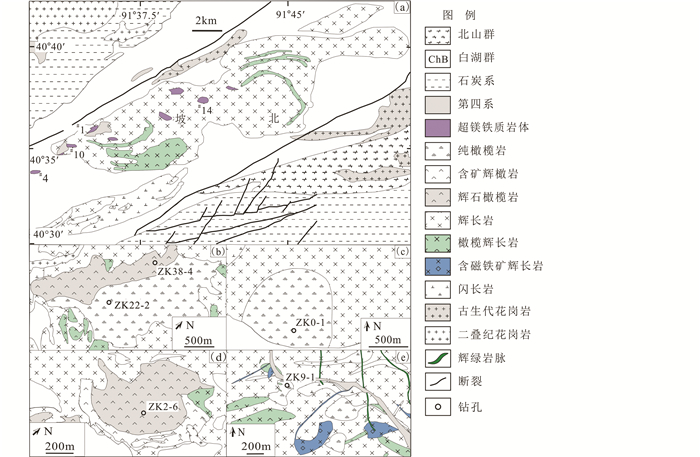
1.2 岩体地质坡北二叠纪镁铁-超镁铁质杂岩体呈北东向产出,长约36km,宽8km,出露面积约为180km2。在辉长质岩体内产出坡一、坡四、坡十等20余个超镁铁质岩体(图 1)。纯橄榄岩、辉石橄榄岩、橄长岩、橄榄辉长岩、辉长岩及闪长岩等主要岩相间界线明显或渐变,普遍发育堆晶结构和韵律性层理(Qin et al., 2011)。
|
图 1 坡北镁铁-超镁铁质杂岩体及超镁铁质岩体地质简图 (a)坡北镁铁-超镁铁质杂岩体;(b)坡一岩体(Xue et al., 2016a);(c)坡四岩体(据新疆地矿局第六地质大队, 2015①);(d)坡十岩体(苏本勋等, 2011);(e)坡十四岩体(刘月高, 2015) Fig. 1 Sketch geological maps of the Pobei mafic-ultramafic complex, western China (a) Pobei mafic ultramafic complex; (b) Pobei No.1 ultramafic intrusion (modified after Xue et al., 2016a); (c) Pobei No.4 ultramafic intrusion; (d) Pobei No.10 ultramafic intrusion (after Su et al., 2011); (e) Pobei No.14 ultramafic intrusion (after Liu, 2015) |
① 新疆地矿局第六地质大队. 2015.新疆坡北铜镍矿成矿规律与富矿定位预测报告
坡一和坡十超镁铁质岩体是主要的含矿岩体,含矿岩性主要为纯橄岩和辉橄岩,超基性岩相底部及边部赋存有厚大的镍铜硫化物矿体,矿石类型主要为稀疏浸染状,局部见有贯入式块状富矿体,矿石矿物主要有镍黄铁矿、黄铜矿、磁黄铁矿和磁铁矿(王亚磊等, 2013)。
2 样品和实验方法研究样品采集于坡北杂岩体西端的坡一、坡四、坡十和坡十四超镁铁质岩体的钻孔岩心,具体位置见图 1,其岩性主要为橄辉岩、辉石岩和辉长岩等。
在钻孔岩心观察基础上,选择不同岩相的新鲜岩石样品,切制薄片进行岩相学观察,确定岩石类型与蚀变程度。选择蚀变程度较弱的岩石样品破碎至40~60目,在双目体视镜下挑选出橄榄石、辉石和斜长石单矿物。将单矿物样品用0.3mol/L稀盐酸浸泡24h,以去除样品表面及裂缝中可能存在的次生碳酸盐及蚀变成分,用蒸馏水-超声波清洗至pH值为中性。最后用CH2Cl2清洗,以去除表面的有机质污染,在100℃下烘干样品备用。
稀有气体含量与同位素组成采用加热释气-质谱计法在中国科学院地质与地球物理研究所兰州油气资源中心完成测试。取0.3~1.3g单矿物样品装入样品管中,放入净化系统100℃加热-真空净化12h,以去除样品的吸附气。然后在1000℃加热样品5~6min,释出样品中稀有气体等挥发分。释出气体通过净化系统中的液氮冷阱-Getter、海绵钛炉、可控温活性炭冷阱吸附其中的水、烃类、CO2、N2和O2等活性气体,用海绵钛炉充分消除碳的化合物。剩余气体主要为稀有气体组分,导入分析系统用低温冷泵吸附,在低温冷泵不同温度条件下(10~475K)分别释放出He、Ne、Ar气体,用Noblesse SFT质谱计进行稀有气体同位素分析。
实验室标准气体采用兰州市皋兰山顶的大气,每测试三个样品后做一次大气标样稀有气体组成分析,进行仪器稳定性测试和数据校对。标样稀有气体组成为:4He=5.24×10-6,20Ne=16.8×10-6,40Ar=9310×10-6;3He/4He=1.1×10-6,20Ne/22Ne=10.45,21Ne/22Ne=0.025,40Ar/36Ar=295.98。
3 结果坡北杂岩体西端超镁铁质岩体中岩浆矿物的He、Ne和Ar含量和同位素组成及分析误差见表 1。He同位素比值以R/Ra表示(Ra=1.39×10-6,为大气3He/4He值)。坡北杂岩体西端四个超镁铁质岩体的He、Ne、Ar含量和同位素组成各具特征。
|
表 1 坡北杂岩体西端超镁铁杂岩体稀有气体丰度和同位素组成 Table 1 He, Ne and Ar abundances and isotopic compositions in the mafic-ultramafic intrusions at the western end of Pobei complex, West China |


坡北杂岩体西端超镁铁质岩体4He含量较高,变化于26×10-7~2801×10-7cm3.STP/g(STP为标准温度压力条件,下同,略),平均为611×10-7cm3/g。坡一岩体的4He含量最低(26×10-7~401×10-7cm3/g,平均为119×10-7cm3/g);坡四岩体4He含量最高(645×10-7~2801×10-7cm3/g,平均为1723×10-7cm3/g),坡十与坡十四岩体4He含量介于两者之间,平均分别为626×10-7cm3/g和706×10-7cm3/g。坡北超镁铁质杂岩体4He含量高于金川铜镍硫化物矿床超镁铁质岩体中岩浆矿物(0.03×10-7~330×10-7cm3/g,Zhang et al., 2013)以及峨眉山大火成岩省内攀西钒钛磁铁矿床(0.03×10⁻⁷~117.5×10⁻⁷cm3/g, Hou et al., 2011),较高的4He含量表明He泄露量相对较低。
3He为原始组分,没有放射性成因来源的3He。坡北杂岩体西端超镁铁质岩体的3He含量为3.1×10⁻⁷~32.5×10⁻⁷cm3/g,平均15.7×10-7cm3/g。3He含量远高于金川铜镍硫化物矿床超镁铁质岩体(平均0.17×10-7cm3/g, Zhang et al., 2013),与二叠纪峨眉山大火成岩省攀西地区钒钛磁铁矿矿床(0.01×10⁻⁷~76.4×10⁻⁷cm3/g, 平均为15.20×10⁻⁷cm3/g, Hou et al., 2011)相近。坡四岩体的3He含量(平均4.6×10⁻⁷cm3/g)低于其他岩体(平均17.9×10-7cm3/g)。
坡北杂岩体西端超镁铁质岩体3He/4He值为0.26~2.79Ra,辉石矿物中的3He/4He比值(平均1.76Ra)略高于橄榄石(1.08Ra)和斜长石(0.49Ra)。坡一岩体的3He/4He值高于坡四、坡十和坡十四岩体(3He/4He=0.26~0.75Ra,平均0.5Ra)。
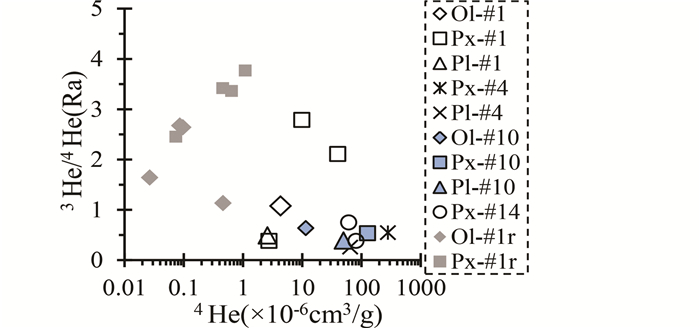
坡北杂岩体西端超镁铁质岩体3He/4He高于金川铜镍硫化物矿床超镁铁质岩体(0.01~0.83Ra, Zhang et al., 2013)及塔里木大火成岩省瓦吉里塔格的霞石岩(0.65~2.1Ra, 平均1.34Ra, 孔维亮等, 2017)。远高于大陆地壳的3He/4He值(2×10-8, Allègre et al., 1987),但均低于岛弧相关的火山岩流体(5.37±1.87Ra, Hilton et al., 2002)和岩石圈地幔(SCLM, 6.1Ra, Gautheron and Moreira, 2002)的3He/4He值。3He/4He值与4He含量在坡一岩体表现出正相关关系,其他岩体的相关性不明显(图 2)。
|
图 2 坡北杂岩体西端超镁铁质岩体3He/4He与4He含量相关图 岩体编号:#1-坡一岩体;#4-坡四岩体;#10-坡十岩体;#14-坡十四岩体;图 3-图 6岩体编号同此图.矿物缩写:Ol-橄榄石;Px-辉石;Pl-斜长石.坡一岩体文献数据(#1r)来源于Zhang et al. (2017) Fig. 2 Plot of 3He/4He ratios vs. 4He contents in the ultramafic intrusions at the western end of Pobei complex, western China |
坡北杂岩体西端超镁铁质岩体岩浆矿物的20Ne含量为0.37×10⁻⁷~143.8×10⁻⁷cm3/g,平均为21.71×10-7cm3/g,远高于金川铜镍硫化物矿床超镁铁质岩体的20Ne含量(0.01×10-7~0.05×10-7cm3/g, Zhang et al., 2013)。坡十四岩体的20Ne含量变化较大,为5.17×10⁻⁷~143.8×10⁻⁷cm3/g,平均为74.45×10-7cm3/g。
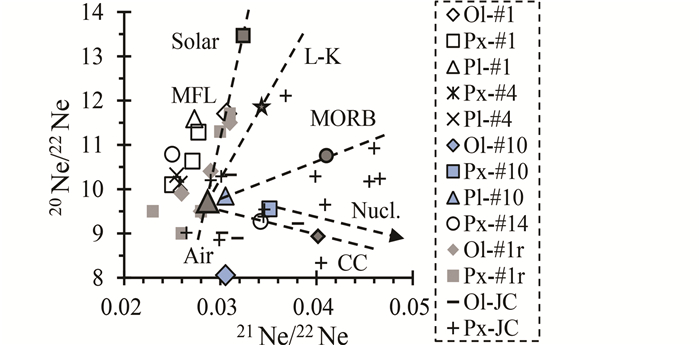
坡北杂岩体西端超镁铁质岩体具有较高的20Ne/22Ne值,集中分布于8.06~11.71,平均为10.27,高于大气值(9.8, Allègre et al., 1987; Sarda et al., 1988, 2000)和地壳值(Ozima and Podosek, 2002),略低于地幔值(12.5, Ballentine et al., 2005);接近于金川超镁铁质岩体的20Ne/22Ne值(8.56~12.2, Zhang et al., 2013)。坡北西端超镁铁质岩体21Ne/22Ne比值较低,为0.025~0.035,平均为0.031,与大气值相近(0.029, Kennedy et al., 1990),低于太阳风(0.033, Benkert et al., 1993)、地壳(0.047)和上地幔(0.074)(Ozima and Podosek, 2002; Sarda et al., 1988, 2000);与金川超镁铁质岩体20Ne/22Ne值(0.026~0.043, Zhang et al., 2013)接近。
在21Ne/22Ne-20Ne/22Ne图解中,坡北杂岩体西端超镁铁质岩体绝大多数样品21Ne/22Ne与20Ne/22Ne值落于大气Ne质量分馏线(MFL)附近,部分样品落于MORB和大陆地壳演化线(CC)之间(图 3)。
|
图 3 坡北杂岩体西端超镁铁质岩体21Ne/22Ne-20Ne/22Ne相关图 数据来源:坡一岩体文献数据(#1r)来自于Zhang et al. (2017);Air:大气(Allègre et al., 1987; Sarda et al., 1988);MORB:洋中脊玄武岩(Sarda et al., 1988);Solar:太阳风(Benkert et al., 1993);MFL:大气Ne质量分馏线(Sarda et al., 1988);CC:大陆地壳线(Ozima and Podosek, 2002);L-K:Loihi-Kilauea演化线(Honda et al., 1991);Nucl.:放射性成因组分(Kennedy et al., 1990);JC:金川岩体 Fig. 3 Plot of 20Ne/22 Ne vs. 21Ne/22Ne ratios in the ultramafic intrusions at the western end of Pobei complex, western China |
坡北杂岩体西端超镁铁质岩体岩浆矿物中40Ar含量变化于230.7×10⁻⁷~6409×10-7cm3/g,平均为2331×10-7cm3/g。40Ar含量明显高于金川超镁铁质岩体(0.43×10-7~1355×10-7cm3/g, Zhang et al., 2013),表明40Ar累积较高、泄露相对较低。坡十岩体40Ar含量最高,平均为4731×10-7cm3/g;坡四岩体的40Ar含量最低,平均为976.3×10-7cm3/g。
坡北杂岩体西端超镁铁质岩体40Ar/36Ar比值为295~598,远低于金川铜镍硫化物矿床(307~43285, 平均9430, Zhang et al., 2013)。其中坡四岩体40Ar/36Ar值(平均533)和坡十四岩体(平均351)明显高于坡一岩体(平均299)和坡十岩体(平均301.5)。40Ar/36Ar值略高于大气值(295.5),但远低于地壳值(1650~170000)、上地幔值(1000~64000)和下地幔值(295.5~8000, Allègre et al., 1987)。
4 讨论 4.1 坡北岩体稀有气体来源坡北杂岩体西端超镁铁质岩体岩浆矿物加热释出的稀有气体可能来源于:1)污染的大气来源稀有气体,包括吸附于矿物表面、裂隙与破裂包裹体中、以及实验过程污染的大气组分(Gautheron et al., 2006);2)与太阳风有关的宇宙成因稀有气体,主要保存在太阳辐射及受到地表流体交代的样品中(Kurz, 1986);3)U、Th和K等衰变形成的放射性成因稀有气体,保存在矿物空隙与结构缺陷中(Matsumoto et al., 2000);4)矿物结晶时捕获的稀有气体(Yamamoto et al., 2004),主要保存于矿物晶格缺陷以及流体包裹体中(Zhang et al., 2009)。
本文所用的样品均采自刚完钻的岩心样品,样品深度为地下59~2221m,未受到太阳的辐射,新鲜的岩石样品经稀盐酸浸泡-超声波清洗等样品前处理可以去除样品的蚀变组分及次生碳酸盐等。因此,可排除宇宙成因和地表流体交代来源的稀有气体。测试前100℃真空去气12h可去除实验系统及样品裂隙与破裂包裹体吸附的大气来源组分(Zhang et al., 2017)。由此可以推测,样品释出的稀有气体主要来源于矿物结晶时捕获的稀有气体,以及放射性成因稀有气体的累积,扣除放射性成因稀有气体后可以用来示踪流体的来源。
放射性成因的He和Ar含量与体系中U、Th和K含量及形成年龄有关。采用坡一和坡十超镁铁质岩体中辉石岩相和辉长岩相全岩U、Th含量(Ao et al., 2010; Song et al., 2011; 姜常义等, 2012; 颉炜等, 2011)及锆石U-Pb年龄(分别为269Ma与284Ma, Xue et al., 2016b; Qin et al., 2011),利用放射性成因4He*含量计算公式(Graham et al., 1987)进行计算:

|
其中t为时间。坡一与坡十超镁铁质岩体辉长岩相中放射性成因4He*含量的计算值分别是14.7×10⁻⁷~2737.2×10-7cm3/g和4.6×10-7~61.0×10-7cm3/g,平均分别为115.3×10-7cm3/g和19.6×10-7cm3/g;低于4He实测含量平均值(分别为25.9×10-7cm3/g和497.1×10-7cm3/g)。坡一岩体辉石岩相4He*含量的计算值为16.6×10-7~69.0×10-7cm3/g,平均33.2×10-7cm3/g,低于4He实测含量平均值181.0×10-7cm3/g。坡十岩体橄榄岩4He*含量的计算值为6.0×10-7~80.4×10-7cm3/g,平均20.6×10-7cm3/g,低于4He实测含量平均值690.4×10-7cm3/g。坡一与坡十岩体放射性成因40Ar*含量计算值分别为0.2×10-7~7.3×10-7cm3/g和0.3×10-7~3×10-7cm3/g,平均分别为1.6×10-7cm3/g和1.1×10-7cm3/g,也远小于40Ar实测含量平均值(2331×10-7cm3/g)。
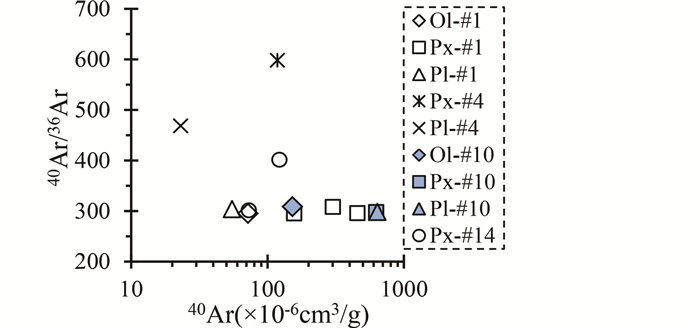
在封闭体系中放射性成因4He的积累会导致3He/4He值降低,3He/4He与4He含量呈负相关关系。坡北杂岩体西端各超镁铁质岩体中4He和40Ar含量较高,但3He/4He与4He含量、40Ar/36Ar与40Ar含量的相关性均不明显(图 2、图 4),说明放射性成因4He*和40Ar*的贡献较低。20Ne/22Ne与21Ne/22Ne指示坡十四和坡十辉石样品中具放射性成因21Ne*(图 3)。
|
图 4 坡北杂岩体西端超镁铁质岩体40Ar/36Ar-40Ar含量相关图 Fig. 4 Plot of 40Ar/36Ar ratios vs. 40Ar contents in the ultramafic intrusions at the western end of Pobei complex, western China |
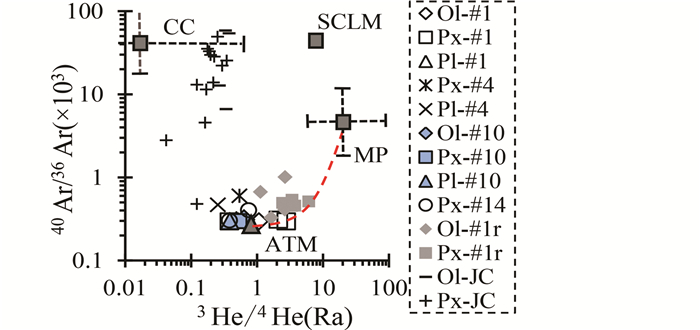
坡北杂岩体西端超镁铁质岩体3He/4He与40Ar/36Ar分布于大气(ATM)与地幔(柱)和大陆地壳(CC)端元之间(图 5)。多数样品的40Ar/36Ar值接近大气值,He、Ne和Ar同位素组成示踪表明存在明显的大气组分(图 3、图 5)。如前所述,所采用的样品前处理与实验方法可以排除样品处理与测试阶段大气来源组分的污染(Czuppon et al., 2009),因此,这些大气组分可能是在地幔岩浆源区及岩浆上升演化阶段混入的(Matsumoto et al., 2001; Gautheron et al., 2005)。
|
图 5 坡北杂岩体西端超镁铁质岩体3He/4He-40Ar/36Ar相关图 坡一文献数据(#1r)来自于Zhang et al. (2017); 金川岩体(JC)来自于Zhang et al. (2013); CC:大陆壳(Allègre et al., 1987);MP:地幔柱(Hilton et al., 2002);SCLM:岩石圈地幔(Dunai and Baur, 1995);ATM:大气圈(Allègre et al., 1987; Sarda et al., 1988) Fig. 5 Plot of 3He/4He vs. 40Ar/36Ar in the ultramafic intrusions at the western end of Pobei complex, western China |
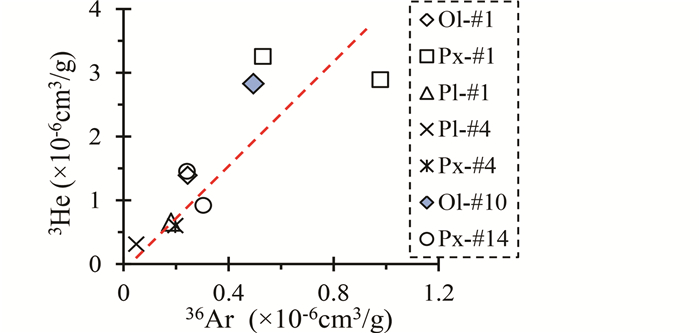
36Ar与3He为原始组分、没有放射性成因的积累,可用来揭示其来源。样品释出的36Ar和3He主要来源于大气与地幔,由于地幔中的36Ar几乎全部脱出,样品释出的36Ar主要为大气来源,而3He则主要为地幔来源(Ozima and Podosek, 2002)。大气中具有较高含量的Ar及可忽略的He含量,因此在样品处理与测试阶段混入的大气可以造成36Ar含量的明显增加而3He含量变化不大,其结果是导致36Ar与3He含量缺乏相关性;而地幔源区的大气混染往往体现出36Ar和3He正相关关系(Mastumoto et al., 2002; Su et al., 2014)。坡北杂岩体西端超镁铁质岩体36Ar和3He含量具有较好的正相关关系(图 6),表明大气组分主要是地幔源区的加入(Yamamoto et al., 2004; Czuppon et al., 2009)。
|
图 6 坡北西端超镁铁质岩体3He与36Ar含量相关图 Fig. 6 Plot of 3He vs. 36Ar contents in the ultramafic intrusions at the western end of Pobei mafic-ultramafic complex, western China |
坡北杂岩体西端超镁铁质岩体的3He/4He值与其他铜镍硫化物矿床超镁铁质岩体相比明显偏高(Hou et al., 2011; Zhang et al., 2013),但低于岩石圈地幔的3He/4He值(Dunai and Baur, 1995),表明存在壳源物质或放射性成因组分的贡献。前述根据U、Th和K含量及年龄计算的放射性成因4He*和40Ar*含量低,3He/4He和4He含量缺乏相关性也指示放射性成因4He*贡献低。普通壳源物质的加入除了导致3He/4He的降低,也引起21Ne/22Ne和40Ar/36Ar值的升高。坡北西端超镁铁质岩体的3He/4He、21Ne/22Ne值及40Ar/36Ar值较低,难以用普通壳源组分的加入来解释。
坡北杂岩体西端超镁铁质岩体稀有气体同位素组成揭示岩浆源区存在大气组分,而壳源组分的加入不引起21Ne/22Ne和40Ar/36Ar值的升高,需要特殊的机制。再循环洋壳通常饱和大气流体,具有相对较低的40Ar/36Ar值(350)和21Ne/22Ne值,其值与大气组分相似(Staudacher et al., 1989; Sarda et al., 2000; Yamamoto et al., 2004; Czuppon et al., 2009)。因此,俯冲再循环洋壳是携带大气及地壳组分进入坡北岩浆地幔源区的可能机制。坡北杂岩体轻稀土元素富集、Nb、Ta亏损的微量元素特征也证明岩浆地幔源区经历了俯冲物质的改造(Xia et al., 2013; Xue et al., 2016a, b)。坡一岩体富H2O的流体特征和位于有机质热成因范围的δ13CCO2和δ13CCH4值表明壳源组分中存在蚀变洋壳沉积物质,碳-氦同位素数据支持再循环洋壳物质的推论(Zhang et al., 2017)。
坡北杂岩体西端超镁铁质岩体地幔岩浆中混染地壳来源稀有气体的贡献有所不同,21Ne/22Ne值从坡十岩体(平均0.032)、坡十四岩体(0.030)、坡一岩体(0.028)到坡四岩体(0.026)逐步降低,20Ne/22Ne与21Ne/22Ne比值指示坡十四和坡十岩体中具壳源Ne或放射性成因21Ne*。3He/4He和40Ar/36Ar值指示壳源物质的贡献从坡四岩体(平均分别为0.4Ra和533.14)、坡十四岩体(0.517Ra和351.19)和坡十岩体(0.565Ra和301.46)到坡一岩体(1.37Ra和299.44)逐步降低,表明坡四、坡十四和坡十岩体受地壳混染程度高于坡一岩体。
坡一和坡十岩体年代学数据和He同位素混合模拟计算结果表明,坡一岩体岩石圈地幔和地壳比例分别为60.4%和39.5%,而坡十岩体岩石圈地幔和地壳比例分别为8.96%和91.04%,表明坡十岩体中壳源流体的贡献比较明显(图 5),这与γOs(t)和δ18O值示踪坡十岩体地壳物质的混染程度高于坡一岩体的结果一致(汤庆艳等, 2015)。
4.3 超镁铁质岩体成因坡北镁铁-超镁铁质杂岩体产出的塔里木板块东北缘在中-新元古代经历了全球Rodinia超大陆汇聚和裂解过程(张铭杰等, 2001; Zhang et al., 2007a, 2010, 2012; Tang et al., 2014, 2016),震旦纪至石炭纪发生了复杂的洋-陆转化,早泥盆世-早石炭世晚期古天山洋闭合、进入碰撞造山阶段,石炭纪晚期至二叠纪处于陆缘裂谷拉张环境。坡北镁铁-超镁铁质杂岩体形成的早二叠世(278~298Ma)被广泛地认为处于碰撞造山期和后碰撞伸展阶段陆内拉张环境(李华芹等, 2006, 2009; 颉炜等, 2011; Song et al., 2011; Zhang et al., 2011; Zheng et al., 2014; Chen et al., 2014, 2016; Xue et al., 2016a, b),或地幔柱环境(姜常义等, 2012; Zhou et al., 2009; Zhang et al., 2010; Qin et al., 2011; Liu et al., 2016),发育大规模岩浆活动和成矿作用(李华芹等, 2006, 2009; 汤庆艳等, 2015; Zheng et al., 2014; Chen et al., 2014, 2016)。
坡一超镁铁质岩体与其他岩体He、Ne和Ar同位素组成的变化趋势有所不同(图 3、图 5),表明其来源和成因可能不同。坡一超镁铁质岩体具较高的3He/4He值(Zhang et al., 2017),3He/4He和40Ar/36Ar分布于大气与地幔柱端元之间;21Ne/22Ne和20Ne/22Ne大部分落于Ne质量分馏线(MFL)与L-K线之间(图 3),也表明存在与太阳风相关的原始Ne或地幔柱来源Ne。揭示存在地幔柱作用的信息,坡一超镁铁质岩体岩浆作用可能叠加了地幔柱岩浆作用的贡献。
坡四、坡十与坡十四岩体较低的3He/4He和40Ar/36Ar值主要分布于大气与地壳和岩石圈地幔(SCLM)端元之间(图 5);21Ne/22Ne-20Ne/22Ne大部分落于大气与大陆地壳(CC)和核成因(Nucl.)混合线之间(图 3),表明有放射性成因Ne*和地壳Ne的加入,可能存在明显的大气、地壳及岩石圈地幔组分的贡献。因此,坡十等超镁铁质岩体可能为岩石圈地幔岩浆作用形成的,其中存在俯冲洋壳组分。
坡北杂岩体西端的坡一与坡十超镁铁质岩体的年龄相差约10Ma(李华芹等, 2006, 2009; Ao et al., 2010; Qin et al., 2011; Xue et al., 2016a, b)。3He/4He和40Ar/36Ar数据表明,坡一与坡十等超镁铁质岩体中地幔与地壳端元的贡献不同(图 5),成因也可能不同。扣除放射性成因4 He*含量后,坡一岩体和坡十岩体3He/4He值范围分别为2.30~4.60Ra和0.40~0.77Ra,平均分别为3.70Ra和0.57Ra,表明二者的来源可能有所不同。
Sr-Nd同位素组成及估算的岩浆初始液相线温度支持上述推论,坡一岩体Sr-Nd同位素趋向OIB范围,而坡十等岩体趋向于亏损地幔范围内(汤庆艳等, 2015)。坡一岩体橄榄石的初始结晶温度估算为1331℃,岩浆的初始液相线温度估算为1411℃(王亚磊等, 2013),岩浆地幔源区部分熔融的温度明显高于正常玄武岩浆起源温度,明显的热异常也支持深部地幔柱作用的贡献(Qin et al., 2011)。
坡北岩体岩石地球化学资料揭示岩浆源区是经受早期俯冲流体改造的岩石圈地幔(姜常义等, 2012)。坡一岩体流体组成以H2O为主,含有少量的H2和CO2,岩浆起源于相对富H2O、弱还原的流体环境,3He/4He与δ13CCO2值表明为地幔柱与沉积物或蚀变洋壳(AOC)组分混合(Zhang et al., 2017),支持上述大气组分及地壳物质来源于俯冲洋壳带入到岩浆地幔源区的推断。坡一岩体硫化物δ34S与δ33S同位素表明岩浆侵位前在深部与太古代地层发生同化混染作用(Liu et al., 2017)也支持上述推断。
5 结论(1) 坡北杂岩体西端超镁铁质岩体的橄榄石、辉石和斜长石具有低于地幔但明显高于地壳的3He/4He比值(0.26~2.79Ra),40Ar/36Ar值为295~598,较高的20Ne/22Ne和较低的21Ne/22Ne值分布于Ne质量分馏线(MFL)和L-K线之间。
(2) 坡北西端超镁铁质岩体稀有气体同位素组成特征揭示其来自于地幔(柱)、大气和地壳端元的贡献,而大气和地壳流体的加入可能来源于俯冲再循环洋壳带入到岩浆地幔源区。
(3) 坡北西端超镁铁质岩体岩石的成因不同,坡一岩体为地幔柱岩浆作用成因,其他三个岩体主要为俯冲流体交代的岩石圈地幔岩浆作用形成的。
致谢 研究工作得到陕西省自然科学基础研究计划(2017JM4002)、高等学校博士学科点专项科研基金项目(20120211110023)和甘肃省西部矿产资源重点实验室开放基金(WCRMGS-2014-04)资助;邓刚、王恒、王鹏、汤庆艳、张江伟、姚赟胜和李建平等在野外考察、实验分析及论文撰写中给予了指导和帮助;两位评审专家对论文提供了建设性修改建议;在此一并致以谢意。
Allègre CJ, Staudacher T and Sarda P. 1987. Rare gas systematics:Formation of the atmosphere, evolution and structure of the Earth's mantle. Earth and Planetary Science Letters, 81(2-3): 127-150. DOI:10.1016/0012-821X(87)90151-8 |
Ao SJ, Xiao WJ, Han CM, Mao QG and Zhang JE. 2010. Geochronology and geochemistry of Early Permian mafic-ultramafic complexes in the Beishan area, Xinjiang, NW China:Implications for Late Paleozoic tectonic evolution of the southern Altaids. Gondwana Research, 18(2-3): 466-478. DOI:10.1016/j.gr.2010.01.004 |
Ballentine CJ, Marty B, Lollar BS and Cassidy M. 2005. Neon isotopes constrain convection and volatile origin in the Earth's mantle. Nature, 433(7021): 33-38. DOI:10.1038/nature03182 |
Benkert JP, Baur H, Signer P and Wieler R. 1993. He, Ne and Ar from the solar wind and solar energetic particles in lunar ilmenites and pyroxenes. Journal of Geophysical Research, 98(E7): 13147-13162. DOI:10.1029/93JE01460 |
Chai FM, Xia F, Chen B, Lu HF, Wang H, Li J and Yan YP. 2013. Platinum group elements geochemistry of two mafic-ultramafic intrusions in the Beishan block, Xinjiang, NW China. Acta Geologica Sinica, 87(4): 474-485. |
Chen NH, Dong JJ, Yang SF, Chen JY, Li ZL and Ni NN. 2014. Restoration of geometry and emplacement mode of the Permian mafic dyke swarms in Keping and its adjacent areas of the Tarim Block, NW China. Lithos, 204: 73-82. DOI:10.1016/j.lithos.2014.05.020 |
Chen S, Guo ZJ, Qi JF, Zhang YY, Pe-Piper G and Piper DJW. 2016. Early Permian volcano-sedimentary successions, Beishan, NW China:Peperites demonstrate an evolving rift basin. Journal of Volcanology and Geothermal Research, 309: 31-44. DOI:10.1016/j.jvolgeores.2015.11.004 |
Czuppon G, Matsumoto T, Handler MR and Matsuda JI. 2009. Noble gases in spinel peridotite xenoliths from Mt Quincan, North Queensland, Australia:Undisturbed MORB-type noble gases in the subcontinental lithospheric mantle. Chemical Geology, 266(1-2): 19-28. DOI:10.1016/j.chemgeo.2009.03.029 |
Dunai TJ and Baur H. 1995. Helium, neon and argon systematics of the European subcontinental mantle:Implications for its geochemical evolution. Geochimica et Cosmochimica Acta, 59(13): 2767-2783. DOI:10.1016/0016-7037(95)00172-V |
Gautheron C and Moreira M. 2002. Helium signature of the subcontinental lithospheric mantle. Earth and Planetary Science Letters, 199(1-2): 39-47. DOI:10.1016/S0012-821X(02)00563-0 |
Gautheron C, Moreira M and Allègre C. 2005. He, Ne and Ar composition of the European lithospheric mantle. Chemical Geology, 217(1-2): 97-112. DOI:10.1016/j.chemgeo.2004.12.009 |
Gautheron C, Cartigny P, Moreira M, Harris JW and Allègre CJ. 2006. Reply to:"Recycled" volatiles in mantle derived diamonds:Evidence from nitrogen and noble gas isotopic data. Earth and Planetary Science Letters, 252(1-2): 220-222. DOI:10.1016/j.epsl.2006.09.026 |
Gilfillan SMV and Ballentine CJ. 2018. He, Ne and Ar 'snapshot' of the subcontinental lithospheric mantle from CO2 well gases. Chemical Geology, 480: 116-127. DOI:10.1016/j.chemgeo.2017.09.028 |
Graham DW, Jenkins WJ, Kurz MD and Batiza R. 1987. Helium isotope disequilibrium and geochronology of glassy submarine basalts. Nature, 326(6111): 384-386. DOI:10.1038/326384a0 |
Guo W, He HY, Hilton DR, Zheng YF, Su F, Liu Y and Zhu RX. 2017. Recycled noble gases preserved in podiform chromitites from Luobusa, Tibet. Chemical Geology, 469: 97-109. DOI:10.1016/j.chemgeo.2017.03.026 |
Hilton DR, Fischer TP and Marty B. 2002. Noble gases and volatile recycling at subduction zones. Reviews in Mineralogy and Geochemistry, 47(1): 319-370. DOI:10.2138/rmg.2002.47.9 |
Honda M, McDougall I, Patterson DB, Doulgeris A and Clague DA. 1991. Possible solar noble-gas component in Hawaiian basalts. Nature, 349(6305): 149-151. DOI:10.1038/349149a0 |
Hou T, Zhang ZC, Ye XR, Encarnacion J and Reichow MK. 2011. Noble gas isotopic systematics of Fe-Ti-V oxide ore-related mafic-ultramafic layered intrusions in the Panxi area, China:The role of recycled oceanic crust in their petrogenesis. Geochimica et Cosmochimica Acta, 75(22): 6727-6741. DOI:10.1016/j.gca.2011.09.003 |
Jiang CY, Cheng SL, Ye SF, Xia MZ, Jiang HB and Dai YC. 2006. Lithogeochemistry and petrogenesis of Zhongposhanbei mafic rock body, at Beishan region, Xinjiang. Acta Petrologica Sinica, 22(1): 115-126. |
Jiang CY, Guo NX, Xia MZ, Ling JL, Guo FF, Deng XQ, Jiang HB and Fan YZ. 2012. Petrogenesis of the Poyi maficultramafic layered intrusion, NE Tarim Plate. Acta Petrologica Sinica, 28(7): 2209-2223. |
Kennedy BM, Hiyagon H and Reynolds JH. 1990. Crustal neon:A striking uniformity. Earth and Planetary Science Letters, 98(3-4): 277-286. DOI:10.1016/0012-821X(90)90030-2 |
Kong WL, Zhang ZC and Cheng ZG. 2017. Noble gas isotopic characteristics and geological significance of Wajilitag nephelinites in Tarim large igneous province. Acta Petrologica et Mineralogica, 36(4): 581-592. |
Kurz MD. 1986. Cosmogenic helium in a terrestrial igneous rock. Nature, 320(6061): 435-439. DOI:10.1038/320435a0 |
Li HQ, Chen FW, Mei YP, Wu H, Cheng SL, Yang JQ and Dai YC. 2006. Isotopic ages of No.1 intrusive body in Pobei mafic-ultramafic belt of Xinjiang and their geological significance. Mineral Deposits, 25(4): 463-469. |
Li HQ, Mei YP, Qu WJ, Cai H and Du GM. 2009. SHRIMP zircon U-Pb and Re-Os dating of No.10 intrusive body and associated ores in Pobei mafic-ultramafic belt of Xinjiang and its significance. Mineral Deposits, 28(5): 633-642. |
Liu YG. 2015. Diagenesis-mineralization of copper-nickel deposits and prospecting indicators in Pobei area, Xinjiang. Ph. D. Dissertation. Wuhan: China University of Geosciences, 1-170 (in Chinese with English summary)
|
Liu YG, Lü XB, Wu CM, Hu XG, Duan ZP, Deng G, Wang H, Zhu XK, Zeng HD, Wang P, Wang W and Lu Q. 2016. The migration of Tarim plume magma toward the northeast in Early Permian and its significance for the exploration of PGE Cu-Ni magmatic sulfide deposits in Xinjiang, NW China:As suggested by Sr-Nd-Hf isotopes, sedimentology and geophysical data. Ore Geology Reviews, 72: 538-545. DOI:10.1016/j.oregeorev.2015.07.020 |
Liu YG, Li WY, Lü XB, Liu YR, Ruan BX and Liu X. 2017. Sulfide saturation mechanism of the Poyi magmatic Cu-Ni sulfide deposit in Beishan, Xinjiang, Northwest China. Ore Geology Reviews, 91: 419-431. DOI:10.1016/j.oregeorev.2017.09.013 |
Matsumoto T, Honda M, McDougall I, O'Reilly SY, Norman M and Yaxley G. 2000. Noble gases in pyroxenites and metasomatised peridotites from the Newer Volcanics, southeastern Australia:Implications for mantle metasomatism. Chemical Geology, 168(1-2): 49-73. DOI:10.1016/S0009-2541(00)00181-9 |
Matsumoto T, Chen YL and Matsuda JI. 2001. Concomitant occurrence of primordial and recycled noble gases in the Earth's mantle. Earth and Planetary Science Letters, 185(1-2): 35-47. DOI:10.1016/S0012-821X(00)00375-7 |
Matsumoto T, Pinti DL, Matsuda JI and Umino S. 2002. Recycled noble gas and nitrogen in the subcontinental lithospheric mantle:Implications from N-He-Ar in fluid inclusions of SE Australian xenoliths. Geochemical Journal, 36(3): 209-217. DOI:10.2343/geochemj.36.209 |
Ozima M and Podosek FA. 2002. Noble Gas Geochemistry. 2nd Edition. Cambridge: Cambridge University Press: 1-280.
|
Qin KZ, Su BX, Sakyi PA, Tang DM, Li XH, Sun H, Xiao QH and Liu PP. 2011. SIMS zircon U-Pb geochronology and Sr-Nd isotopes of Ni-Cu bearing mafic-ultramafic intrusions in eastern Tianshan and Beishan in correlation with flood basalts in tarim basin (NW China):Constraints on a ca. 280Ma mantle plume. American Journal of Science, 311(3): 237-260. DOI:10.2475/03.2011.03 |
Sarda P, Staudacher T and Allègre CJ. 1988. Neon isotopes in submarine basalts. Earth and Planetary Science Letters, 91(1-2): 73-88. DOI:10.1016/0012-821X(88)90152-5 |
Sarda P, Moreira M, Staudacher T, Schilling JG and Allègre CJ. 2000. Rare gas systematics on the southernmost Mid-Atlantic Ridge:Constraints on the lower mantle and the Dupal source. Journal of Geophysical Research:Solid Earth, 105(B3): 5973-5996. DOI:10.1029/1999JB900282 |
Song XY, Xie W, Deng YF, Crawford AJ, Zheng WQ, Zhou GF, Deng G, Cheng SL and Li J. 2011. Slab break-off and the formation of Permian mafic-ultramafic intrusions in southern margin of Central Asian orogenic belt, Xinjiang, NW China. Lithos, 127(1-2): 128-143. DOI:10.1016/j.lithos.2011.08.011 |
Staudacher T, Sarda P, Richardson SH, Allègre CJ, Sagna I and Dimitriev LV. 1989. Noble gases in basalt glasses from a Mid-Atlantic Ridge topographic high at 14°N:Geodynamic consequences. Earth and Planetary Science Letters, 96(1-2): 119-133. DOI:10.1016/0012-821X(89)90127-1 |
Su BX, Qin KZ, Sakyi PA, Liu PP, Tang DM, Malaviarachchi SPK, Xiao QH, Sun H, Dai YC and Hu Y. 2011. Geochemistry and geochronology of acidic rocks in the Beishan region, NW China:Petrogenesis and tectonic implications. Journal of Asian Earth Sciences, 41(1): 31-43. DOI:10.1016/j.jseaes.2010.12.002 |
Su BX, Qin KZ, Tang DM, Deng G, Xiao QH, Sun H, Lu HF and Dai YC. 2011. Petrological features and implications for mineralization of the Poshi mafic-ultramafic intrusion in Beishan area, Xinjiang. Acta Petrologica Sinica, 27(12): 3627-3639. |
Su BX, Qin KZ, Sakyi PA, Tang DM, Liu PP, Malaviarachchi SPK, Xiao QH and Sun H. 2012a. Geochronologic-petrochemical studies of the Hongshishan mafic-ultramafic intrusion, Beishan area, Xinjiang (NW China):Petrogenesis and tectonic implications. International Geology Review, 54(3): 270-289. DOI:10.1080/00206814.2010.543011 |
Su BX, Qin KZ, Sun H, Tang DM, Sakyi PA, Chu ZY, Liu PP and Xiao QH. 2012b. Subduction-induced mantle heterogeneity beneath Eastern Tianshan and Beishan:Insights from Nd-Sr-Hf-O isotopic mapping of Late Paleozoic mafic-ultramafic complexes. Lithos, 134-135: 41-51. DOI:10.1016/j.lithos.2011.12.011 |
Su BX, Qin KZ, Santosh M, Sun H and Tang DM. 2013. The Early Permian mafic-ultramafic complexes in the Beishan Terrane, NW China:Alaskan-type intrusives or rift cumulates?. Journal of Asian Earth Sciences, 66: 175-187. DOI:10.1016/j.jseaes.2012.12.039 |
Su BX, Qin KZ, Lu YH, Sun H and Sakyi PA. 2015. Decoupling of whole-rock Nd-Hf and zircon Hf-O isotopic compositions of a 284Ma mafic-ultramafic intrusion in the Beishan Terrane, NW China. International Journal of Earth Sciences, 104(7): 1721-1737. DOI:10.1007/s00531-015-1168-0 |
Su F, Xiao Y, He HY, Su BX, Wang Y and Zhu RX. 2014. He and Ar isotope geochemistry of pyroxene megacrysts and mantle xenoliths in Cenozoic basalt from the Changle-Linqu area in western Shandong. Chinese Science Bulletin, 59(4): 396-411. DOI:10.1007/s11434-013-0027-2 |
Tang QY, Li CS, Zhang MJ, Ripley EM and Wang QL. 2014. Detrital zircon constraint on the timing of amalgamation between Alxa and Ordos, with exploration implications for Jinchuan-type Ni-Cu ore deposit in China. Precambrian Research, 255: 748-755. DOI:10.1016/j.precamres.2014.08.015 |
Tang QY, Zhang MJ, Li WY, Yu M, Zhang ZW and Wang Y. 2015. Geodynamic setting and metallogenic potential of Permian large-sized mafic-ultramafic intrusions in Beishan area, Xinjiang, China. Geology in China, 42(3): 468-482. |
Tang QY, Zhang ZW, Li CS, Wang YL and Ripley EM. 2016. Neoproterozoic subduction-related basaltic magmatism in the northern margin of the Tarim Craton:Implications for Rodinia reconstruction. Precambrian Research, 286: 370-378. DOI:10.1016/j.precamres.2016.10.012 |
Wang YL, Zhang ZW, Zhang MJ, Zhang JW and Gao YB. 2013. Geodynamic setting of the Pobei mafic-ultramafic intrusion in Xinjiang. Acta Petrologica et Mineralogica, 32(5): 693-707. |
Xia MZ, Jiang CY, Li C and Xia ZD. 2013. Characteristics of a newly discovered Ni-Cu sulfide deposit hosted in the Poyi ultramafic intrusion, Tarim Craton, NW China. Economic Geology, 108(8): 1865-1878. DOI:10.2113/econgeo.108.8.1865 |
Xie W, Song XY, Nie XY and Cheng SL. 2011. Features of the mantle source and tectonic setting of the Poshi Ni-Cu sulfide-bearing intrusion, Xinjiang, China. Earth Science Frontiers, 18(3): 189-200. |
Xu YG, Wei X, Luo ZY, Liu HQ and Cao J. 2014. The Early Permian Tarim large igneous province:Main characteristics and a plume incubation model. Lithos, 204: 20-35. DOI:10.1016/j.lithos.2014.02.015 |
Xue SC, Qin KZ, Li CS, Tang DM, Mao YJ, Qi L and Ripley EM. 2016a. Geochronological, petrological, and geochemical constraints on Ni-Cu sulfide mineralization in the Poyi ultramafic-troctolitic intrusion in the northeast rim of the Tarim Craton, western China. Economic Geology, 111(6): 1465-1484. DOI:10.2113/econgeo.111.6.1465 |
Xue SC, Li CS, Qin KZ and Tang DM. 2016b. A non-plume model for the Permian protracted (266~286Ma) basaltic magmatism in the Beishan-Tianshan region, Xinjiang, western China. Lithos, 256-257: 243-249. DOI:10.1016/j.lithos.2016.04.018 |
Yamamoto J, Kaneoka I, Nakai S, Kagi H, Prikhod'ko VS and Arai S. 2004. Evidence for subduction-related components in the subcontinental mantle from low 3He/4He and 40Ar/36Ar ratio in mantle xenoliths from Far Eastern, Russia. Chemical Geology, 207(3-4): 237-259. DOI:10.1016/j.chemgeo.2004.03.007 |
Yang SH, Zhou MF, Lightfoot PC, Xu JF, Wang CY, Jiang CY and Qu WJ. 2014. Re-Os isotope and platinum-group element geochemistry of the Pobei Ni-Cu sulfide-bearing mafic-ultramafic complex in the northeastern part of the Tarim Craton. Mineralium Deposita, 49(3): 381-397. DOI:10.1007/s00126-013-0496-x |
Yu X, Yang SF, Chen HL, Chen ZQ, Li ZL, Batt GE and Li YQ. 2011. Permian flood basalts from the Tarim Basin, Northwest China:SHRIMP zircon U-Pb dating and geochemical characteristics. Gondwana Research, 20(2-3): 485-497. DOI:10.1016/j.gr.2010.11.009 |
Zhang CL, Li XH, Li ZX, Lu SN, Ye HM and Li HM. 2007a. Neoproterozoic ultramafic-mafic-carbonatite complex and granitoids in Quruqtagh of northeastern Tarim Block, western China:Geochronology, geochemistry and tectonic implications. Precambrian Research, 152(3-4): 149-169. DOI:10.1016/j.precamres.2006.11.003 |
Zhang CL, Xu YG, Li ZX, Wang HY and Ye HM. 2010. Diverse Permian magmatism in the Tarim Block, NW China:Genetically linked to the Permian Tarim mantle plume?. Lithos, 119(3-4): 537-552. DOI:10.1016/j.lithos.2010.08.007 |
Zhang CL, Li HK, Santosh M, Li ZX, Zou HB, Wang HY and Ye HM. 2012. Precambrian evolution and cratonization of the Tarim Block, NW China:Petrology, geochemistry, Nd-isotopes and U-Pb zircon geochronology from Archaean gabbro-TTG-potassic granite suite and Paleoproterozoic metamorphic belt. Journal of Asian Earth Sciences, 47: 5-20. DOI:10.1016/j.jseaes.2011.05.018 |
Zhang MJ, Wang TY, Gao JP and Li LM. 2001. Geochemical constraints on petrogenesis of Hashatubei ultramafic complex, Inner Mongolia. Acta Petrologica Sinica, 17(2): 206-214. |
Zhang MJ, Hu PQ, Niu YL and Su SG. 2007b. Chemical and stable isotopic constraints on the nature and origin of volatiles in the sub-continental lithospheric mantle beneath eastern China. Lithos, 96(1-2): 55-66. DOI:10.1016/j.lithos.2006.10.006 |
Zhang MJ, Niu YL and Hu PQ. 2009. Volatiles in the Mantle Lithosphere:Modes of Occurrence and Chemical Compositions. New York: Nova Science Publishers: 171-212.
|
Zhang MJ, Tang QY, Hu PQ, Ye XR and Cong YN. 2013. Noble gas isotopic constraints on the origin and evolution of the Jinchuan Ni-Cu-(PGE) sulfide ore-bearing ultramafic intrusion, western China. Chemical Geology, 339: 301-312. DOI:10.1016/j.chemgeo.2012.07.023 |
Zhang MJ, Tang QY, Cao CH, Li WY, Wang H, Li ZP, Yu M and Feng PY. 2017. The origin of Permian Pobei ultramafic complex in the northeastern Tarim craton, western China:Evidences from chemical and C-He-Ne-Ar isotopic compositions of volatiles. Chemical Geology, 469: 85-96. DOI:10.1016/j.chemgeo.2017.06.006 |
Zhang YY, Dostal J, Zhao ZH, Liu C and Guo ZJ. 2011. Geochronology, geochemistry and petrogenesis of mafic and ultramafic rocks from Southern Beishan area, NW China:Implications for crust-mantle interaction. Gondwana Research, 20(4): 816-830. DOI:10.1016/j.gr.2011.03.008 |
Zheng RG, Wu TR, Zhang W, Meng QP and Zhang ZY. 2014. Geochronology and geochemistry of Late Paleozoic magmatic rocks in the Yinwaxia area, Beishan:Implications for rift magmatism in the southern Central Asian Orogenic Belt. Journal of Asian Earth Sciences, 91: 39-55. DOI:10.1016/j.jseaes.2014.04.022 |
Zhou MF, Zhao JH, Jiang CY, Cao JF, Wang W and Yang SH. 2009. OIB-like, heterogeneous mantle sources of Permian basaltic magmatism in the western Tarim basin, NW China:Implications for a possible Permian large igneous province. Lithos, 113(3-4): 583-594. DOI:10.1016/j.lithos.2009.06.027 |
柴凤梅, 夏芳, 陈斌, 卢鸿飞, 王恒, 李军, 严玉圃. 2013. 新疆北山地区两个含铜镍镁铁-超镁铁质岩体铂族元素地球化学研究. 地质学报, 87(4): 474-485. DOI:10.3969/j.issn.0001-5717.2013.04.003 |
姜常义, 程松林, 叶书锋, 夏明哲, 姜寒冰, 代玉财. 2006. 新疆北山地区中坡山北镁铁质岩体岩石地球化学与岩石成因. 岩石学报, 22(1): 115-126. |
姜常义, 郭娜欣, 夏明哲, 凌锦兰, 郭芳放, 邓小芹, 姜寒冰, 范亚洲. 2012. 塔里木板块东北部坡-镁铁-超镁铁质层状侵入体岩石成因. 岩石学报, 28(7): 2209-2223. |
孔维亮, 张招崇, 程志国. 2017. 塔里木大火成岩省瓦吉里塔格霞石岩稀有气体同位素特征及其地质意义. 岩石矿物学杂志, 36(4): 581-592. DOI:10.3969/j.issn.1000-6524.2017.04.010 |
李华芹, 陈富文, 梅玉萍, 吴华, 程松林, 杨甲全, 代玉财. 2006. 新疆坡北基性-超基性岩带Ⅰ号岩体Sm-Nd和SHRIMP U-Pb同位素年龄及其地质意义. 矿床地质, 25(4): 463-469. DOI:10.3969/j.issn.0258-7106.2006.04.010 |
李华芹, 梅玉萍, 屈文俊, 蔡红, 杜国民. 2009. 新疆坡北基性-超基性岩带10号岩体SHRIMP U-Pb和矿石Re-Os同位素定年及其意义. 矿床地质, 28(5): 633-642. DOI:10.3969/j.issn.0258-7106.2009.05.009 |
刘月高. 2015.新疆坡北地区铜镍矿床成岩成矿作用与找矿标志研究.博士学位论文.武汉: 中国地质大学, 1-170
|
苏本勋, 秦克章, 唐冬梅, 邓刚, 肖庆华, 孙赫, 卢鸿飞, 代玉财. 2011. 新疆北山地区坡十镁铁-超镁铁岩体的岩石学特征及其对成矿作用的指示. 岩石学报, 27(12): 3627-3639. |
汤庆艳, 张铭杰, 李文渊, 余明, 张照伟, 汪扬. 2015. 新疆北山二叠纪大型镁铁-超镁铁质岩体的动力学背景及成矿潜力. 中国地质, 42(3): 468-482. DOI:10.3969/j.issn.1000-3657.2015.03.006 |
王亚磊, 张照伟, 张铭杰, 张江伟, 高永宝. 2013. 新疆坡北镁铁-超镁铁质岩体地球动力学背景探讨. 岩石矿物学杂志, 32(5): 693-707. DOI:10.3969/j.issn.1000-6524.2013.05.011 |
颉炜, 宋谢炎, 聂晓勇, 程松林. 2011. 新疆坡十铜镍硫化物含矿岩体岩浆源区特征及构造背景探讨. 地学前缘, 18(3): 189-200. |
张铭杰, 王廷印, 高军平, 李丽梅. 2001. 内蒙古哈沙图北超镁铁杂岩体成因的地球化学制约. 岩石学报, 17(2): 206-214. |