 2018, Vol. 34


造山带的形成演化包括早期大洋俯冲、闭合,大陆俯冲碰撞、折返,造山带隆升及垮塌等一系列过程(Zheng et al., 2013; Song et al., 2014),在其不同演化阶段都可以形成各类不同规模的岩浆响应(Pitcher, 1983; Zhao et al., 2012, 2013)。近年的研究发现,大洋地壳俯冲到一定深度时,洋壳发生部分熔融形成埃达克岩(Defant and Drummond, 1990; Castillo, 2012);深俯冲陆壳在峰期变质或早期折返阶段,会发生显著脱水乃至部分熔融产生岩浆作用(Zheng et al., 2011);同时,陆壳深俯冲作用可导致地壳加厚,也可能引发少量同俯冲岩浆作用(Zhang et al., 2015);深俯冲大陆地壳折返过程中发生不同尺度的部分熔融,可以形成大量的同折返岩浆岩(Zheng, 2012);碰撞/造山后加厚造山带拉张垮塌,可以导致地幔上涌减压熔融形成镁铁质岩,同时上涌的地幔加热地壳物质,产生大规模的花岗质岩浆活动(Liégeois et al., 1998; Turner et al., 1999; Bonin, 2004; Oyhantçabal et al., 2007; 赵子福和郑永飞, 2009;李曙光等, 2013; Song et al., 2014; Wang et al., 2014)。因此,深入研究大洋俯冲、闭合,大陆碰撞/深俯冲、折返及其造山带垮塌过程中的岩浆作用,对全面理解造山带的演化过程、岩浆形成机制、壳幔相互作用及大陆地壳生长和再造等方面具有重要意义。
南阿尔金造山带是一个典型的高压-超高压变质带,经历了洋壳俯冲、大洋闭合,大陆碰撞/深俯冲及其折返抬升等一系列过程(刘良等, 1999, 2007, 2013, 2015; Zhang et al., 2001; Liu et al., 2009, 2012; 曹玉亭等, 2009, 2010, 2013; 马中平等, 2009; 孙吉明等, 2012; 杨文强等, 2012; Wang et al., 2014;康磊, 2014)。目前,在该带发现~517Ma的洋壳俯冲型埃达克岩(康磊, 2014)、~500Ma的地壳加厚型埃达克岩(孙吉明等, 2012; Kang et al., 2014; 康磊, 2014)、峰期变质时代~500Ma的陆壳深俯冲作用形成的高压-超高压变质岩石(刘良等, 1999, 2007, 2013, 2015; Zhang et al., 2001; Liu et al., 2009, 2012; 曹玉亭等, 2009, 2013; Wang et al., 2011)、~450Ma同折返镁铁质和花岗质岩浆活动(马中平等,2009; 曹玉亭等, 2010; 杨文强等, 2012; 康磊等, 2013; Wang et al., 2014;康磊, 2014)和~400Ma的造山后A型花岗岩(吴锁平等, 2007;王超等, 2008)及双峰式火山岩(Kang et al., 2015)。其中~400Ma的岩浆作用主要分布于南阿尔金基性-超基性杂岩带东段,主要包括:板块碰撞后造山带块体均衡调整引起幔源岩浆上升,引发地壳熔融产生的A型花岗岩(吴才来等, 2014);与软流圈物质上涌及壳幔相互作用有关的A型花岗岩和双峰式火山岩(Kang et al., 2015);反映幔源岩浆底侵及壳幔相互作用的玉苏普阿勒克塔格岩体及其内钾玄质包体(王超等, 2008)。而该带西段地区仅有吐啦地区A型花岗岩活动的报道,吴锁平等(2007)将其解释为阿尔金断裂左行走滑构造同期活动的产物。
通过野外调查,作者在南阿尔金基性-超基性杂岩带西段识别出了古生代多期岩浆活动,本文将对新解体出的泥盆纪中基性杂岩体及其内花岗质细脉的野外地质特征、岩石学、地球化学和年代学进行研究,以期确定其形成时代、源区性质和岩石成因,为深入探讨南阿尔金俯冲碰撞杂岩带的演化过程提供进一步约束。
1 区域地质背景阿尔金造山带地处青藏高原东北缘,位于塔里木盆地与柴达木盆地之间。从北至南阿尔金造山带可划分为四个构造单元(图 1a, b):阿北地块、红柳沟-拉配泉蛇绿构造混杂岩带、米兰河-金雁山地块以及南阿尔金俯冲碰撞杂岩带(刘良等, 1999; 许志琴等, 1999; Zhang et al., 2001; Liu et al., 2012)。南阿尔金俯冲碰撞杂岩带又可划分为南阿尔金高压-超高压变质带和南阿尔金蛇绿构造混杂岩带(刘良等, 2015)。南阿尔金高压-超高压变质带位于阿尔金断裂带以北(图 1b),超高压榴辉岩峰期变质之后又经历了高压麻粒岩相和角闪岩相两期退变质作用,其峰期变质与高压麻粒岩相退变质时代分别为~500Ma和~450Ma(Liu et al., 2009, 2012; 刘良等, 2013)。

|
图 1 阿尔金造山带地质构造简图(a, b,据Wang et al., 2014)、塔什萨依地区地质简图(c)和地质剖面图(d) Fig. 1 Simplified geological maps of Altyn Tagh orogeny (a, b, after Wang et al., 2014) and Tashisayi area (c), and geological section map of Tashisayi area (d) |
南阿尔金蛇绿构造混杂岩带主要分布于阿尔金断裂附近,东起茫崖,西至阿帕,长约700km(图 1b),主要由早古生代蛇绿岩残片、镁铁-超镁铁质岩与震旦-早寒武纪复理石沉积物组成(刘良等, 1999, 2015)。近年来对南阿尔金蛇绿构造混杂岩带的研究取得了许多进展,主要体现在对南阿尔金洋盆的发育、俯冲、闭合三个时限的确定方面:南阿尔金迪木那里克地区火山角砾岩622.6±1.4Ma形成年龄的获得, 为南阿尔金古洋盆开启扩张时代的上限提供了较好约束(杨文强等, 2012);约马克其形成时代为500±1.9Ma的蛇绿岩型镁铁-超镁铁质洋壳(李向民等, 2009)和长沙沟形成时代为510.6±1.4Ma的蛇绿岩性质的辉石橄榄岩(郭金城等, 2014)的确定,表明该洋盆存在时限主体≥500Ma;南阿尔金黄土泉形成时代为517.3±1.7Ma的O型埃达克岩,为先期洋壳俯冲作用的时限提供了直接约束(康磊, 2014);而鱼目泉加厚地壳背景下形成的混合花岗岩时代为496.9±1.9Ma,表明此时南阿尔金洋盆已经闭合(孙吉明等, 2012)。此外,对于该带碰撞/造山后岩浆作用的研究也取得较大进展,马中平等(2009, 2011)于该带长沙沟-清水泉一带厘定出形成时代为~465Ma的非蛇绿岩性质的镁铁-超镁铁质层状侵入岩,表明南阿尔金地区在中晚奥陶纪已处于后碰撞伸展背景(Wang et al., 2014; 董洪凯等, 2014);而该带形成时代为~400Ma的A型花岗岩及局部的双峰式火山岩的发现,表明南阿尔金地区泥盆纪已处于造山后伸展背景(王超等, 2008; Wang et al., 2014; 吴才来等, 2014; Kang et al., 2015)。
2 样品产状与岩石学特征研究区位于塔什萨依玉石矿南侧,原1:20万且末一级水电站幅划为阿尔金岩群,主要由变质表壳岩、变质侵入体和变质基性火山岩系组成。我们通过野外地质调查,在该地区发现了一系列古生代侵入体,包括镁铁-超镁铁质岩体和中酸性岩体,以及少部分变砂岩、大理岩和斜长角闪岩,这些岩石变形变质较弱,与区内阿尔金岩群中的深变质岩系明显不同(Wang et al., 2013)。
本文三组辉长岩(16A-119、16A-79和16A-81)由北至南采于该剖面北部,辉长岩体北部侵入大理岩,南部与玄武岩呈断层接触关系(图 1d)。野外观察辉长岩(16A-79)为灰黑色, 辉长结构, 块状构造(图 2a, b);镜下观察其主要矿物组合为辉石(50%~60%)、斜长石(40%~50%)、黑云母(3%~5%)及其他副矿物如磁铁矿和锆石等(图 2d);辉石呈半自形-他形,粒径为0.3~0.8mm,少量辉石角闪石化;斜长石主要为拉长石,半自形板状,粒径为0.5~1mm,偶见斜长石包裹辉石。与样品(16A-79)相比,样品(16A-119)镜下可见斜长石包含辉石的包含结构(图 2e),斜长石粒径较大(1~8mm);辉石含量较高(55%~65%),较为自形。样品(16A-81)辉石含量较低(45%~55%),斜长石含量较高(45~55%),且辉石蚀变严重(图 2f)。

|
图 2 塔什萨依辉长岩、闪长岩及其内花岗质细脉野外产状及显微照片 (a、c)辉长岩野外露头;(b)闪长岩及其内花岗质脉野外露头;辉长岩(d-f)、闪长岩(g)和花岗质细脉(h)显微照片.Ksp-钾长石;Bi-黑云母;Py-辉石;Pl-斜长石;Q-石英;Amp-角闪石 Fig. 2 Field occurrence and microtextures of theTashisayi gabbro, diorite and granitic vein in diorite in South Altyn Tagh (a, c) field occurrence of the gabbro; (b) field occurrence of the diorite and granitic vein in diorite; Microtextures of gabbro (d-f), diorite (g) and granitic vein (h). Kfs-K-feldspar; Bi-biotite; Py-pyroxene; Pl-plagioclase; Q-quartz; Amp-amphibole |
闪长岩(16A-87)采于辉长岩体南侧,两者之间存在变砂岩和云母片岩(图 1d);花岗质细脉(16A-86)宽度约为1~15cm,呈细脉状断续赋存于闪长岩内部(图 2c)。闪长岩(16A-87)呈灰绿色,半自形粒状结构,块状构造,镜下观察主要矿物组合为角闪石(30%~35%)、斜长石(60%~70%)和石英(< 5%)(图 2g);角闪石呈他形或半自形柱状,弱定向分布;斜长石半自形-他形;石英呈他形填充于其他矿物颗粒间。花岗质细脉(16A-86)整体呈白色,花岗结构,块状构造,镜下观察主要矿物组合为石英(40%~50%)、钾长石(20%~30%)、斜长石(15%~25%)及少量黑云母(图 2h)。
3 样品处理和分析方法锆石的分离挑选工作在河北廊坊诚信地质服务有限公司完成,其它测试分析工作均在西北大学大陆动力学国家重点实验室完成。
全岩主量元素分析在XRF(Rugaku RIX 2100)仪上测定,微量元素分析在Elan 6100 DRC型ICP-MS上完成,样品测试中用标样BCR-2、BHVO-1和AGV-1进行监控。进行辉长岩锆石同位素研究时,首先在双目镜显微镜下对分离出来的锆石进行挑选,选出结晶好、无裂隙及包裹体的锆石,固定于环氧树脂上并抛光至锆石颗粒露出一半。锆石的阴极发光(CL)分析在装有Mono CL3+阴极发光装置系统的场发射扫描电镜上完成,而U-Pb年龄测定及微量元素分析均在连接Geolas 2005激光剥蚀系统的Agilient 7500a型ICP-MS上进行。测定过程中激光剥蚀斑束直径为44μm,每测定5个样品点测定1次91500、GJ-1和NIST610。
数据处理运用ICPMSData8.6程序,以标准锆石91500作外标进行同位素分馏校正,元素浓度校正以NIST610位外标,Si为内标。锆石年龄协和度及加权平均年龄的绘制运用Isoplot (ver3.0)。锆石原位Lu-Hf同位素测定在Nu Plasma (Wrexham,UK)多接收电感耦合等离子体质谱仪(MC-ICP-MS)上完成。分析过程中激光束斑直径为44μm,Hf同位素测点点位的选取标准为与U-Pb年龄点位重合或其旁点性相近处。锆石具体分析及数据处理方法见Yuan et al. (2008)。
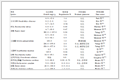
4 分析结果 4.1 全岩主微量地球化学特征 4.1.1 主量元素特征三组辉长岩(16A-119、16A-79和16A-81)的SiO2含量变化不大,介于50.40%~51.87%之间,属于基性岩范围(表 1)。三组样品TiO2含量介于0.29%~0.95%之间,Al2O3含量介于11.49%~19.12%之间,MgO含量介于7.22%~13.08%,Mg#介于68~80之间。在TAS图解中,样品全部落入亚碱性区域辉长岩范围之内(图 3a);根据SiO2-FeOT/MgO图解,可进一步将其划分为钙碱性系列岩石(图 3b)。对比MgO与其它氧化物或微量元素的关系发现,三组辉长岩样品之间存在明显的的演化趋势(图 4)。当发生结晶分异时,任何岩浆的分异演化都是由富MgO向贫MgO方向演化,而且MgO的变化比SiO2更显著,残余熔浆的固结指数(SI=100MgO/(MgO+FeO+Fe2O3+Na2O+K2O))会迅速降低(周长勇等, 2005; 曹花花, 2013),而辉长岩(16A-119)的固结指数较高(53~58),且其Mg#(78~80)高于幔源原始岩浆的Mg#(67~73)(Frey and Prinz, 1978),表明该样品形成过程中发生堆晶作用。辉长岩(16A-79、16A-81)固结指数SI较低(37~47),且其Mg#(68~73)与幔源原始岩浆Mg#相似,表明该样品堆晶作用不明显。
|
表 1 塔什萨依辉长岩、闪长岩和花岗质细脉主量(wt%)和微量(×10-6)元素分析结果 Table 1 Major (wt%) and trace (×10-6) element compositions of gabbro, diorites and granitic veins in Tashisayi area |

|
图 3 辉长岩、闪长岩及其内花岗质细脉TAS图解(a)、辉长岩和闪长岩SiO2-FeOT/MgO图解(b)和闪长岩及其内花岗质细脉A/NK-A/CNK图解(c)和SiO2-K2O图解(d) Fig. 3 TAS diagram (a) for the gabbro, diorite and granitic veins in diorite, SiO2 vs. FeOT/MgO diagram (b) for the gabbro and diorite, and A/NK vs. A/CNK diagram (c) and SiO2 vs. K2O diagram (d) for the diorite and granitic veins in diorite |

|
图 4 辉长岩、闪长岩和花岗质细脉Mg#对氧化物及微量元素图解和Cr-Ni图解 Fig. 4 Mg# vs. oxide and trace element, Cr vs. Ni plots of the gabbro, diorite and granitic veins |
与辉长岩相比,闪长岩具稍高的SiO2(52.3%~53.5%)和Al2O3(17.6%~17.8%)含量,稍低MgO含量(4.69%~4.96%)含量及Mg#(57~59)(表 1)。在哈克图解中,闪长岩和辉长岩具有一致的演化趋势(图 4)。TAS图解中,样品落入二长闪长岩范围内(图 3a),属于钙碱性-高钾钙碱性系列偏铝质岩石(图 3c, d)。花岗质细脉具较高的SiO2含量(72.4%~75.5%)和K2O/Na2O比值(2.33~2.56),较低的Al2O3含量(12.1%~13.5%)和Mg#(32~42)(表 1)。TAS图解中,样品落入花岗岩范围内(图 3a),属于钾玄岩系列偏铝质岩石(图 3c, d)。
4.1.2 微量元素特征塔什萨依辉长岩稀土元素总量(∑REE=36.9×10⁻⁶~83.1×10⁻⁶,表 1)较低,(La/Yb)N比值(3.25~5.86)较高,呈LREE富集、HREE亏损的右倾型配分形式(图 5a)。除辉长岩(16A-119-3)具有弱负Eu异常(δEu=0.81)外,其余辉长岩均显示正Eu异常(δEu=1.17~1.85),暗示存在较强的斜长石堆晶作用发生,与样品明显的Sr富集特征相一致(图 5b);与辉长岩(16A-79和16A-81)相比,辉长岩(16A-119)稀土元素总量较低。在微量元素蛛网图中,研究区辉长岩相对富集LILE(Rb、Ba、Sr),亏损HFSE(Nb、Ta、P、Ti)(图 5b),具岛弧岩浆特点。三组样品稀土元素配分曲线和微量元素蛛网图相似,暗示三组样品具有同源性。

|
图 5 辉长岩、闪长岩及其内花岗质细脉球粒陨石标准化稀土元素配分图(a、c)及原始地幔标准化微量元素蛛网图(b、d)(标准化值据Sun and McDonough, 1989) Fig. 5 Chondrite-normalized REE patterns (a, c) and primitive-mantle normalized spider diagrams (b, d) of the gabbro, diorite and granitic veins in diorite (normalization values after Sun and McDonough, 1989) |
塔什萨依闪长岩稀土元素总量为182×10-6~190×10-6,(La/Yb)N比值为8.85~8.90,具有负Eu异常(δEu=0.85~0.86)(表 1),呈LREE富集、HREE亏损的右倾型配分形式(图 5c)。与闪长岩相比,花岗质细脉稀土元素总量(∑REE=135×10-6~185×10-6,表 1)较低,负Eu异常和轻重稀土分馏更加显著(δEu=0.55~0.61,(La/Yb)N=14.47~16.14)(图 5c)。在微量元素蛛网图中,两者曲线特征相似,均相对富集LILE(Rb、Ba)、Th和U,亏损HFSE(Nb、Ta、P、Ti),而花岗质细脉的P和Ti更加亏损(图 5d),可能反映了磷灰石和钛铁矿的分离结晶作用。花岗质细脉稀土元素总量较闪长岩低,可能与花岗质细脉演化程度较高导致浅色矿物含量较高,尤其是石英含量较高有关,因为石英中稀土元素含量较低(凌锦兰等, 2014; 吴福元等, 2017)。此外,花岗质细脉和闪长岩的Nb/Ta比值不同(分别为~6和~17),其原因可能是低镁角闪石的分离结晶能够降低残余岩浆的Nb/Ta比值(Pfänder et al., 2007),其分离结晶作用可能使得花岗岩Nb/Ta比值降低。
4.2 LA-ICP-MS锆石U-Pb定年辉长岩(16A-79和16A-119)中锆石自形程度较好,多呈板柱状,两组样品锆石粒径多为100μm左右,有明显的岩浆震荡环带(图 6);样品锆石测点Th/U比值为0.40~0.81,均大于0.4(表 2),显示为岩浆锆石特征。LA-ICP-MS锆石U-Pb定年结果显示,2件辉长岩(16A-79和16A-119)测点的谐和度均较高,辉长岩(16A-79)206Pb/238U年龄集中于392~411Ma之间(表 2),加权平均年龄为400.7±2.5Ma(图 7a);辉长岩(16A-119)206Pb/238U年龄介于390~425Ma之间(表 2),主体年龄加权平均值为420.4±2.5Ma(图 7b)。

|
图 6 辉长岩、闪长岩及其内花岗质细脉锆石阴极发光CL图像 Fig. 6 CL image and U-Pb age of zircon from the gabbro, diorite and granitic vein in diorite |

|
图 7 辉长岩、闪长岩及其内花岗质细脉LA-ICP-MS锆石U-Pb年龄谐和图 Fig. 7 LA-ICP-MS zircon U-Pb age concordia diagrams of the gabbro, diorite and granitic veins in diorite |
|
|
表 2 塔什萨依辉长岩、闪长岩和花岗质细脉的LA-ICP-MS锆石U-Pb定年结果 Table 2 LA-ICP-MS zircon U-Pb dating data of gabbros, diorite and granitic vein in Tashisayi area |


闪长岩和花岗质细脉中锆石自形程度较差,样品锆石粒径多为100μm左右,有明显的岩浆震荡环带(图 6),显示为岩浆锆石特征。闪长岩锆石测点Th/U比值主体为0.41~2.60;花岗质细脉锆石测点Th/U比值介于0.14~1.02之间,主体大于0.4,以上Th/U比值均显示为岩浆锆石特征。在闪长岩和其内花岗质脉LA-ICP-MS锆石U-Pb定年结果中选择谐和度大于90的测点作为研究对象,闪长岩206Pb/238U年龄集中于392~423Ma之间(表 2),加权平均年龄为406.2±4.0Ma(图 7c);花岗质细脉206Pb/238U年龄介于377~429Ma之间(表 2),其年龄数据为一个连续渐变的序列,可能代表了岩浆持续结晶的过程,本文选取了较小年龄集中区的加权平均值(405.1±4.1Ma)代表其形成年龄(图 7d)。
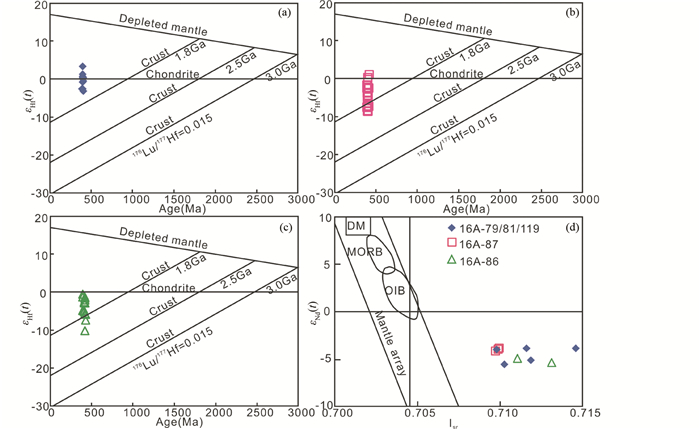
4.3 锆石Hf同位素特征本次研究对辉长岩(16A-79)、闪长岩和花岗质细脉均进行了锆石Hf同位素研究(表 3),结果显示所测点位176Lu/177Hf比值介于0.000431~0.004472之间,表明锆石中由176Lu衰变形成的放射性成因的177Hf含量很低,因而锆石中的176Hf/177Hf值可以近似代表其结晶时的Hf同位素体系(吴福元等,2007)。计算εHf(t)以及tDM2时采用各点对应的锆石U-Pb年龄。结果显示,该辉长岩锆石176Hf/177Hf比值介于0.282437~0.282629之间,εHf(t)=-3.17~3.49,一阶模式年龄tDM1为885~1147Ma;闪长岩的锆石176Hf/177Hf比值介于0.282298~0.282576之间,εHf(t)=-8.76~0.88,一阶模式年龄tDM1为1030~1390Ma,二阶段模式年龄tDM2为1350~1945Ma;花岗质细脉的锆石176Hf/177Hf比值介于0.282277~0.282545之间,εHf(t)=-10.10~-0.58,一阶模式年龄tDM1为1051~1491Ma,二阶段模式年龄tDM2为1419~2034Ma(图 8a-c; 表 3)。
|
图 8 辉长岩、闪长岩及其内花岗质细脉锆石Hf同位素εHf(t)-t图解及Sr-Nd同位素图解 Fig. 8 Zircon Hf isotopic εHf(t) vs. t and plots of the gabbro, diorite and granitic veins in diorite |
|
|
表 3 塔什萨伊辉长岩、闪长岩和花岗质细脉的锆石Hf同位素数据 Table 3 Lu-Hf isotopic compositions of zircons from gabbro, diorites and granitic veins in Tashisayi area |
全岩Sr-Nd同位素分析结果(表 4、图 8d)显示,辉长岩显示一个富集的同位素组成,ISr范围为0.7098~0.7146,εNd(t)值为-5.5~-3.9,单阶段模式年龄(tDM1)和二阶段模式年龄(tDM2)分别变化于1602~1946Ma和1460~1612Ma之间。闪长岩显示一个富集的同位素组成,ISr范围为0.7097~0.7100,εNd(t)值为-4.2~-3.9,单阶段模式年龄(tDM1)和二阶段模式年龄(tDM2)分别变化于1385~1428Ma和1466~1490Ma之间。花岗质细脉显示一个富集的同位素组成,ISr范围为0.7111~0.7131,εNd(t)值为-5.3~-4.9,单阶段模式年龄(tDM1)和二阶段模式年龄(tDM2)分别变化于1327~1388Ma和1546~1581Ma之间。
|
|
表 4 塔什萨伊辉长岩、闪长岩和花岗质细脉的全岩Sr-Nd同位素组成 Table 4 Sr-Nd isotopic compositions of gabbro, diorites and granitic vein in Tashisayi area |


塔什萨依闪长岩和辉长岩可能来自于同一源区,证据如下。首先,野外调查显示二者相距不远;其次,从哈克图解中,可以看闪长岩和辉长岩具有良好的一致性(图 4);再次,辉长岩和闪长岩具有相似的微量元素原始地幔标准化配分曲线(图 5);最后,闪长岩的ISr和εNd(t)值与辉长岩相似(图 8)。以上证据均表明闪长岩和辉长岩来源于同一地幔源区。此外,相对于辉长岩,闪长岩具有相对较高的MgO含量、Mg#、稀土元素总量及轻重稀土分馏程度,表明闪长岩演化程度稍高。
因闪长岩演化程度较辉长岩高,故可用辉长岩来示踪源区性质。塔什萨依辉长岩具有较低的SiO2含量(50.4%~51.9%),较高的MgO、Cr、Ni、Sc、Co含量及Mg#值(MgO=7.22%~13.1%、Cr=44.3×10⁻⁶~1358×10-6、Ni=19.9×10⁻⁶~165×10-6、Sc=21.8×10⁻⁶~36.0×10⁻⁶、Co=35.2×10⁻⁶~48.5×10⁻⁶、Mg#=65~80),这些地球化学特征具有幔源原始岩浆的属性(Sc=15×10-6~28×10-6、Co=27×10-6~80×10-6、Ni=90×10-6~670×10-6、Mg#=67~73;Frey and Prinz, 1978)。此外,塔什萨依辉长岩和闪长岩显示出富集LILE(Rb、Ba、Sr)和LREE,亏损HFSE(Nb、Ta、P、Ti)的地球化学特征,并具有高的La/Nb(1.53~3.27)、Ba/Nb(28.3~55.9)和Zr/Nb(6.64~13.2)比值以及低的Ce/Pb(2.45~6.19)比值,与岛弧火山岩的地球化学特征相似(Stern, 2002),而具有这种地球化学特征的基性岩的形成主要原因是其起源于岩石圈或软流圈的部分熔融,并在其形成过程中存在壳源物质的加入(Turner et al., 1992, 1996; Wang et al., 2004; Zhang et al., 2008, 2010, 2011; 杨文强等, 2012; Yan et al., 2016)。
塔什萨依辉长岩和闪长岩具较低的TiO2(0.29%~1.10%)和Fe2O3(5.79%~9.14%)含量,与实验获得的岩石圈来源的熔体特征相近(图 9, Falloon et al., 1988; Hirose and Kushiro, 1993);此外,二者高的ISr(0.709748~0.714594)低εNd(t)值(-5.1~-3.9)同样指示其来源于岩石圈地幔。样品HREE分馏微弱,不存在Y和Yb负异常,(La/Yb)N (3.25~8.90)和(Tb/Yb)N (1.13~1.34)比值较低,在(Tb/Yb)N-(La/Sm)N图解(图略)中,样品落在尖晶石稳定域,表明其起源于岩石圈尖晶石地幔橄榄岩的部分熔融(Watson and McKenzie, 1991; Wang et al., 2002)

|
图 9 辉长岩和闪长岩Fe2O3T-SiO2图解(据Falloon et al., 1988; Hirose and Kushiro, 1993) Fig. 9 Fe2O3T vs. SiO2 plot of the gabbro and diorite (after Falloon et al., 1988; Hirose and Kushiro, 1993) |
通常认为,很高的原始地幔标准化(Th/Nb)N比值(>1)、低的(Nb/La)N比值(< 1)和明显的Nb、Ta、Ti负异常是大陆玄武岩受到地壳物质混染的标志(Saunders et al., 1992; Kieffer et al., 2004),本文样品辉长岩和闪长岩高的(Th/Nb)PM比值(2.35~4.71,一个值为0.64除外)、低的(Nb/La)N比值(0.31~0.65)和明显的Nb、Ta、Ti负异常特征,指示样品形成过程中受到壳源物质的混染。(Th/Nb)PM-(La/Nb)PM图解可以区分这种混染物质来自于上地壳还是下地壳(Fitton et al., 1998a, b; Frey et al., 2002),上地壳富集La和Th元素,而下地壳相对亏损Th元素(Barth et al., 2000),由图 10可知,该辉长岩和闪长岩可能在形成过程中混染了中下地壳的物质。辉长岩和闪长岩锆石Hf同位素特征(εHf(t)分别为-3.15~3.37; -8.76~0.88)同样指示二者形成过程中存在外来物质的加入。因此,区内辉长岩和闪长岩在其岩浆演化过程中受到了地壳物质的混染。

|
图 10 辉长岩和闪长岩(Th/Nb)PM-(La/Nb)PM图解 UC-上地壳; MC-中地壳; LC-下地壳 Fig. 10 (Th/Nb)PM vs. (La/Nb)PM plot of the gabbro and diorite UC-Upper crust, MC-Middle crust, LC-lower crust |
本文中形成时代为约400~420Ma的辉长岩和闪长岩的Nb含量(2.13×10⁻⁶~17.40×10⁻⁶,多数大于5×10⁻⁶)高于岛弧玄武岩(< 1.2×10⁻⁶, Xia, 2014),暗示其可能来源于受软流圈交代的岩石圈地幔(Kepezhinskas et al., 1996; Hastie et al., 2011; Li et al., 2014);此外,二者Zr含量(21.64×10⁻⁶~198.0×10⁻⁶)和Zr/Y比值(2.41~6.78)与大陆玄武岩(>70×10-6; >3.4, Xia, 2014)相似,其地球化学特征和板内拉张环境产出的玄武岩类似,未发生明显堆晶作用的原始岩浆(16A-79、16A-81)和闪长岩均落入板内岩浆范围内,而不是岛弧玄武岩(图 11)。因此,区内辉长岩和闪长岩起源于板内伸展背景下受软流圈交代的岩石圈地幔的部分熔融,并在形成过程中受到壳源物质的混染。

|
图 11 辉长岩和闪长岩Zr-Zr/Y (据Pearce and Norry, 1979)和Y/15-La/10-Nb/8 (据Cabanis and Lecolle, 1989)图解 A-板内玄武岩;B-岛弧玄武岩;C-洋中脊玄武岩;1-钙碱性玄武岩;2-火山弧拉斑玄武岩;3-大陆弧后拉斑玄武岩;4-大陆玄武岩;5-N-MORB;6-E-MORB;7-大陆裂谷碱性玄武岩 Fig. 11 Zr va. Zr/Y (after Pearce and Norry, 1979) and Y/15-La/10-Nb/8 (after Cabanis and Lecolle, 1989) plots of the gabbro and diorite A-Within plate basalt; B-Island arc basalt; C-Mid-ocean ridge basalt; 1-Calc-alkaline basalt; 2-Volcanic-arc tholeiite; 3-Continental backarc tholeiite; 4-Continental basalt; 5-N-MORB; 6-E-MORB; 7-Alkaline basalt from inter-continental rift |
花岗质细脉的ISr值(0.711067~0.713137)和εNd(t)值(-5.3~-4.9)、εHf(t)值(-10.10~-0.58)、形成年代、稀土元素配分图、微量元素蛛网图与闪长岩相似,且花岗质细脉轻重稀土分馏程度较大,负Eu异常更加显著,结合两者野外关系(花岗质细脉呈条带状分布于闪长岩中),推测花岗质细脉可能为闪长岩部分熔融或分异的产物。然而其形成年龄与闪长岩相近,且花岗质细脉εHf(t)值分布较为分散,并在La/Sm-La图解(赵振华, 1982)和Rb-La/Y图解(Peccerillo et al., 2003)中,花岗质细脉投影点趋势为一条大致水平的直线(图略),表明其可能为闪长岩分异的产物。此外,从地球化学数据可以看出,闪长岩和花岗质细脉之间存在一个不连续的间隔,这可能由于低压条件下过渡组分的残余岩浆的分离结晶作用非常快,致使镁铁质端元和长英质端元之间的中间过渡成分常常出现组分上的跳跃(即Daly间隔)(Yoder, 1973; Clague, 1978; Peccerillo et al., 2003)。当然,该花岗质细脉较大的εHf(t)值范围和较高的K2O含量(5.15%~6.14%)及ISr值(0.711067~0.713137),不排除在其形成过程中可能存在少量壳源熔融物质的加入。
5.3 构造意义目前,通过对南阿尔金高压-超高压变质岩石及岩浆岩的研究,揭示了南阿尔金构造带经历了洋壳俯冲、大洋闭合,大陆碰撞/俯冲及其抬升折返等一系列过程。~450Ma的高压麻粒岩相退变质年龄的确定,表明此时陆壳深俯冲板片已经断离并折返,并伴随幔源岩浆上涌(马中平等, 2009, 2011; Wang et al., 2014; 董洪凯等, 2014)加热地壳物质产生花岗质岩石(曹玉亭等, 2010; 杨文强等, 2012; 康磊等, 2013; 康磊, 2014);幔源岩浆的持续上涌及底侵导致岩石圈减薄((Bonin, 2004; Oyhantçabal et al., 2007),进而导致~400Ma的A型花岗岩及双峰式火山岩的形成(吴锁平等, 2007; 王超等, 2008; Wang et al., 2014; 吴才来等, 2014; Kang et al., 2015)。前人通过对阿尔金南缘形成时代约~400Ma的A型花岗岩和双峰式火山岩的研究,认为其为伸展背景下幔源岩浆上涌及壳幔相互作用的产物(王超等, 2008; Wang et al., 2014; 吴才来等, 2014; Kang et al., 2015)。本文所研究的辉长岩和闪长岩的形成时代为400~420Ma,岩石地球化学及同位素特征表明其起源于受软流圈交代的岩石圈地幔的部分熔融,并经历了地壳混染和分离结晶作用,由此进一步证明了南阿尔金地区在早古生代末期存在造山后板内伸展背景下的幔源岩浆活动及壳幔相互作用。
6 结论(1) 定年结果显示,塔什萨依辉长岩形成时代约为400~420Ma,闪长岩及其内花岗质细脉形成时代一致,约为400Ma,三者均属于造山后岩浆作用的产物。
(2) 样品主微量元素特征、锆石Hf同位素和Sr-Nd同位素组成显示,塔什萨依辉长岩和闪长岩起源于造山后伸展背景下软流圈交代的岩石圈地幔的部分熔融,并经历了地壳混染和分离结晶作用;而闪长岩进一步分异形成花岗质细脉,并在其形成过程中可能伴随少量壳源熔融物质的加入。
(3) 南阿尔金泥盆纪辉长岩、闪长岩和花岗质细脉进一步证明了南阿尔金早古生代末期造山后板内伸展背景下的幔源岩浆活动及壳幔相互作用。
Barth MG, McDonough WF and Rudnick RL. 2000. Tracking the budget of Nb and Ta in the continental crust. Chemical Geology, 165(3-4): 197-213. DOI:10.1016/S0009-2541(99)00173-4 |
Bonin B. 2004. Do coeval mafic and felsic magmas in post-collisional to within-plate regimes necessarily imply two contrasting, mantle and crustal, sources? A review. Lithos, 78(1-2): 1-24. DOI:10.1016/j.lithos.2004.04.042 |
Cabanis B and Lecolle M. 1989. Le diagramme La/10-Y/15-Nb/8:Un outil pour la discrimination des series volcaniques et la mise en evidence des processus de mélange et/ou de contamination crustale. Compte Rendus de l'Académie des Sciences. Series Ⅱ. Mécanique, Physique, Chimie, Sciences de l'univers, Sciences de la Terre, 309(20): 2023-2029. |
Cao HH. 2013. Geochronology and geochemistry of the Late Paleozoic-Early Mesozoic igneous rocks in the eastern segment of the northern margin of the North China Block. Ph. D. Dissertation. Jilin: Jilin University, 1-130 (in Chinese with English summary)
|
Cao YT, Liu L, Wang C, Chen DL and Zhang AD. 2009. P-T path of Early Paleozoic pelitic high-pressure granulite from Danshuiquan area in Altyn Tagh. Acta Petrologica Sinica, 25(9): 2260-2270. |
Cao YT, Liu L, Wang C, Yang WQ and Zhu XH. 2010. Geochemical, zircon U-Pb dating and Hf isotope compositions studies for Tatelekebulake granite in South Altyn Tagh. Acta Petrologica Sinica, 26(11): 3259-3271. |
Cao YT, Liu L, Wang C, Kang L, Yang WQ, Liang S, Liao XY and Wang YW. 2013. Determination and implication of the HP pelitic granulite from the Munabulake area in the South Altyn Tagh. Acta Petrologica Sinica, 29(5): 1727-1739. |
Castillo PR. 2012. Adakite petrogenesis. Lithos, 134-135: 304-316. DOI:10.1016/j.lithos.2011.09.013 |
Clague DA. 1978. The oceanic basalt-trachyte association:An explanation of the Daly gap. Journal of Geology, 86(6): 739-743. DOI:10.1086/649740 |
Defant MJ and Drummond MS. 1990. Derivation of some modern arc magmas by melting of young subducted lithosphere. Nature, 347(6294): 662-665. DOI:10.1038/347662a0 |
Dong HK, Guo JC, Chen HY, Ti ZH, Liu G, Liu SL, Xue PY and Xin WW. 2014. Evolution characteristics of Ordovician intrusive rock in Changshagou of Altun Region. Northwestern Geology, 47(4): 73-87. |
Falloon TJ, Green DH, Hatton CJ and Harris KL. 1988. Anhydrous partial melting of a fertile and depleted peridotite from 2 to 30kb and application to basalt petrogenesis. Journal of Petrology, 29(6): 1257-1282. DOI:10.1093/petrology/29.6.1257 |
Fitton JG, Hardarson BS, Ellam RM and Rogers G. 1998a. Sr-, Nd-, and Pb-isotopic composition of volcanic rocks from the southeast Greenland Margin at 63°N:Temporal variation in crustal contamination during continental breakup. Proceedings of the Ocean Drilling Program:Scientific Results, 152: 351-357. |
Fitton JG, Saunders AD, Larsen LM, Hardarson BS and Norry MJ. 1998b. Volcanic rocks from the southeast Greenland Margin at 63°N:Composition, petrogenesis, and mantle sources. Proceedings of the Ocean Drilling Program:Scientific Results, 152: 331-350. |
Frey FA and Prinz M. 1978. Ultramafic inclusions from San Carlos, Arizona:Petrologic and geochemical data bearing on their petrogenesis. Earth and Planetary Science Letters, 38(1): 129-176. DOI:10.1016/0012-821X(78)90130-9 |
Frey FA, Weis D, Borisova AY and Xu G. 2002. Involvement of continental crust in the formation of the cretaceous Kerguelen Plateau:New perspectives from ODP leg 120 sites. Journal of Petrology, 43(7): 1207-1239. DOI:10.1093/petrology/43.7.1207 |
Guo JC, Xu XM, Chen HY, Li X, Dong HK and Ti ZH. 2014. Zircon U-Pb age and geological implications of ultramafic rocks in Changshagou, Altun area, Xinjiang Province. Northwestern Geology, 47(4): 170-177. |
Hastie AR, Mitchell SF, Kerr AC, Minifie MJ and Millar IL. 2011. Geochemistry of rare high-Nb basalt lavas: Are they derived from a mantle wedge metasomatised by slab melts? Geochimica et Cosmochimica Acta, 75(17): 5049-5072
|
Hirose K and Kushiro I. 1993. Partial melting of dry peridotites at high pressures:Determination of compositions of melts segregated from peridotite using aggregates of diamond. Earth and Planetary Science Letters, 114(4): 477-489. DOI:10.1016/0012-821X(93)90077-M |
Kang L, Liu L, Cao YT, Wang C, Yang WQ and Liang S. 2013. Geochemistry, zircon U-Pb age and its geological significance of the gneissic granite from the eastern segment of the Tatelekebulake composite granite in the south Altyn Tagh. Acta Petrologica Sinica, 29(9): 3039-3048. |
Kang L. 2014. Early Paleozoic multi-stage granitic magmatism and geological significance in the South Altyn Tagh HP-UHP metamorphic belt. Ph. D. Dissertation. Xi'an: Northwest University, 27-95 (in Chinese with English summary)
|
Kang L, Liu L, Wang C, Cao YT, Yang WQ, Wang YW and Liao XY. 2014. Geochemistry and zircon U-Pb dating of Changshagou adakite from the South Altyn UHPM terrane:Evidence of the partial melting of the lower crust. Acta Geologica Sinica, 88(5): 1454-1465. DOI:10.1111/1755-6724.12311 |
Kang L, Xiao PX, Gao XF, Xi RG and Yang ZC. 2015. Age, petrogenesis and tectonic implications of Early Devonian bimodal volcanic rocks in the South Altyn, NW China. Journal of Asian Earth Sciences, 111: 733-750. DOI:10.1016/j.jseaes.2015.06.004 |
Kepezhinskas P, Defant MJ and Drummond MS. 1996. Progressive enrichment of island arc mantle by melt-peridotite interaction inferred from Kamchatka xenoliths. Geochimica et Cosmochimica Acta, 60(7): 1217-1229. DOI:10.1016/0016-7037(96)00001-4 |
Kieffer B, Arndt N, Lapierre H, Bastien F, Bosch D, Pecher A, Yirgu G, Ayalew D, Weise D, Jerram DA, Keller F and Meugniot C. 2004. Flood and shield basalts from Ethiopia:Magmas from the African superswell. Journal of Petrology, 45(4): 793-834. DOI:10.1093/petrology/egg112 |
Liégeois JP, Navez J, Hertogen J and Black R. 1998. Contrasting origin of post-collisional high-K calc-alkaline and shoshonitic versus alkaline and peralkaline granitoids. The use of sliding normalization. Lithos, 45(1-4): 1-28. |
Li SG, He YS and Wang SJ. 2013. Process and mechanism of mountain-root removal of the Dabie Orogen:Constraints from geochronology and geochemistry of post-collisional igneous rocks. Chinese Science Bulletin, 58(35): 4411-4417. DOI:10.1007/s11434-013-6065-y |
Li SM, Zhu DC, Wang Q, Zhao ZD, Sui QL, Liu SA, Liu D and Mo XX. 2014. Northward subduction of Bangong-Nujiang Tethys:Insight from Late Jurassic intrusive rocks from Bangong Tso in western Tibet. Lithos, 205: 284-297. DOI:10.1016/j.lithos.2014.07.010 |
Li XM, Ma ZP, Sun JM, Xu XY, Lei YX, Wang LS and Duan XX. 2009. Characteristics and age study about the Yuemakeqi mafic-ultramagic rock in the southern Altyn Fault. Acta Petrologica Sinica, 25(4): 862-872. |
Ling JL, Zhao YF, Kang Z, Jiang CY, Song ZB, Zhao SX and Wang YG. 2014. Petrogenesis and mineralization of Niubiziliang mafic-ultramafic intrusion in the northern margin of Qaidam Block, NW China. Acta Petrologica Sinica, 30(6): 1628-1646. |
Liu L, Che ZC, Wang Y, Luo JH and Chen DL. 1999. The petrological characters and geotectonic setting of high-pressure metamorphic rock belts in Altun Mountains. Acta Petrologica Sinica, 15(1): 57-64. |
Liu L, Zhang AD, Chen DL, Yang JX, Luo JH and Wang C. 2007. Implications based on LA-ICP-MS zircon U-Pb ages of eclogite and its country rock from Jianggalesayi area, Altyn Tagh. Earth Science Frontiers, 14(1): 98-107. DOI:10.1016/S1872-5791(07)60004-9 |
Liu L, Wang C, Chen DL, Zhang AD and Liou JG. 2009. Petrology and geochronology of HP-UHP rocks from the South Altyn Tagh, northwestern China. Journal of Asian Earth Sciences, 35(3-4): 232-244. DOI:10.1016/j.jseaes.2008.10.007 |
Liu L, Wang C, Cao YT, Chen DL, Kang L, Yang WQ and Zhu XH. 2012. Geochronology of multi-stage metamorphic events:Constraints on episodic zircon growth from the UHP eclogite in the South Altyn, NW China. Lithos, 136-139: 10-26. DOI:10.1016/j.lithos.2011.09.014 |
Liu L, Cao YT, Chen DL, Zhang CL, Yang WQ, Kang L and Liao XY. 2013. New progresses on the HP-UHP metamorphism in the South Altyn Tagh and the North Qinling. China Science Bulletin, 58(22): 2113-2123. |
Liu L, Kang L, Cao YT and Yang WQ. 2015. Early Paleozoic granitic magmatism related to the processes from subduction to collision in South Altyn, NW China. Science China (Earth Sciences), 58(9): 1513-1522. DOI:10.1007/s11430-015-5151-1 |
Ma ZP, Li XM, Sun JM, Xu XY, Lei YX, Wang LS and Duan XX. 2009. Discovery of layered mafic-ultramafic intrusion in Changshagou, Altyn Tagh, and its geological implication:A pilot study on its petrological and geochemical characteristics. Acta Petrologica Sinica, 25(4): 793-804. |
Ma ZP, Li XM, Xu XY, Sun JM, Tang Z and Du T. 2011. Zircon LA-ICP-MS U-Pb isotopic dating for Qingshuiquan layered mafic-ultramafic intrusion southern Altun orogen, in northwestern China and its implication. Geology in China, 38(4): 1071-1078. |
Oyhantçabal P, Siegesmund S, Wemmer K, Frei R and Layer P. 2007. Post-collisional transition from calc-alkaline to alkaline magmatism during transcurrent deformation in the southernmost Dom Feliciano Belt (Braziliano-Pan-African, Uruguay). Lithos, 98(1-4): 141-159. DOI:10.1016/j.lithos.2007.03.001 |
Pearce JA and Norry MJ. 1979. Petrogenetic implications of Ti, Zr, Y, and Nb variations in volcanic rocks. Contributions to Mineralogy and Petrology, 69(1): 33-47. DOI:10.1007/BF00375192 |
Peccerillo A, Barberio MR, Yirgu G, Ayalew D, Barbieri M and Wu TW. 2003. Relationships between mafic and peralkaline silicic magmatism in continental rift settings:A petrological, geochemical and isotopic study of the Gedemsa volcano, central Ethiopian rift. Journal of Petrology, 44(11): 2003-2032. DOI:10.1093/petrology/egg068 |
Pfänder JA, Münker C, Stracke A and Mezger K. 2007. Nb/Ta and Zr/Hf in ocean island basalts:Implications for crust-mantle differentiation and the fate of Niobium. Earth and Planetary Science Letters, 254(1-2): 158-172. DOI:10.1016/j.epsl.2006.11.027 |
Pitcher WS. 1983. Granite type and tectonic environment. In: Hsu K (ed. ). Mountain Building Processes. London: Academic Press, 19-40
|
Saunders AD, Storey M, Kent RW and Norry MJ. 1992. Consequences of plume-lithosphere interactions. Geological Society, London, Special Publications, 68(1): 41-60. DOI:10.1144/GSL.SP.1992.068.01.04 |
Stern RJ. 2002. Subduction zones. Reviews of Geophysics, 40(4): 3-1. |
Song S, Niu Y, Su L, Zhang C and Zhang L. 2014. Continental orogenesis from ocean subduction, continent collision/subduction, to orogen collapse, and orogen recycling:The example of the North Qaidam UHPM belt, NW China. Earth-Science Reviews, 129(1): 59-84. |
Sun JM, Ma ZP, Tang Z and Li XM. 2012. LA-ICP-MS zircon dating of the Yumuquan magma mixing granite in the southern Altyn Tagh and its tectonic significance. Acta Geologica Sinica, 86(2): 247-257. |
Sun SS and McDonough WF. 1989. Chemical and isotopic systematics of oceanic basalts: Implications for mantle composition and processes. In: Saunders AD and Norry MJ (eds. ). Magmatism in the Ocean Basins. Geological Society, London, Special Publication, 42(1): 313-345
|
Turner S, Sandiford M and Foden J. 1992. Some geodynamic and compositional constraints on "postorogenic" magmatism. Geology, 20(10): 931. DOI:10.1130/0091-7613(1992)020<0931:SGACCO>2.3.CO;2 |
Turner S, Arnaud N, Liu J, Rogers N, Hawkesworth C, Harris N, Kelley S, Van Calsteren P and Deng W. 1996. Post-collision, shoshonitic volcanism on the Tibetan Plateau:Implications for Convective thinning of the lithosphere and the source of ocean island basalts. Journal of Petrology, 37(1): 45-71. DOI:10.1093/petrology/37.1.45 |
Turner SP, Platt JP, George RMM, Kelley SP, Pearson DG and Nowell GM. 1999. Magmatism associated with orogenic collapse of the Betic-Alboran Domain, SE Spain. Journal of Petrology, 40(6): 1011-1036. DOI:10.1093/petroj/40.6.1011 |
Wang C, Liu L, Zhang AD, Yang WQ and Cao YT. 2008. Geochemistry and petrography of Early Paleozoic Yusupuleke Tagh rapakivi-textured granite complex, South Altyn:An example for magma mixing. Acta Petrologica Sinica, 24(12): 2809-2819. |
Wang C, Liu L, Chen DL and Cao YT. 2011. Petrology, geochemistry, geochronology, and metamorphic evolution of garnet peridotites from South Altyn Tagh UHP terrane, northwestern China: Records related to crustal slab subduction and exhumation history. In: Dobrzhinetskaya L, Cuthbert S, Faryad W, Wallis S and Cuthbert S (eds. ). Ultrahigh-Pressure Metamorphism: 25 Years after the Discovery of Coesite and Diamond. London: Elsevier, 541-576
|
Wang C, Liu L, Yang WQ, Zhu XH, Cao YT, Kang L, Chen SF, Li RS and He SP. 2013. Provenance and ages of the Altyn Complex in Altyn Tagh:Implications for the Early Neoproterozoic evolution of northwestern China. Precambrian Research, 230: 193-208. DOI:10.1016/j.precamres.2013.02.003 |
Wang C, Liu L, Xiao PX, Cao YT, Yu HY, Meert JG and Liang WT. 2014. Geochemical and geochronologic constraints for Paleozoic magmatism related to the orogenic collapse in the Qimantagh-South Altyn region, northwestern China. Lithos, 202-203: 1-20. DOI:10.1016/j.lithos.2014.05.016 |
Wang K, Plank T, Walker JD and Smith EI. 2002. A mantle melting profile across the Basin and Range, SW USA. Journal of Geophysical Research: 107. DOI:10.1029/2001JB000209 |
Wang KL, Chung SL, O'Reilly SY, Sun SS, Shinjo R and Chen CH. 2004. Geochemical constraints for the genesis of post-collisional magmatism and the geodynamic evolution of the northern Taiwan region. Journal of Petrology, 45(5): 975-1011. DOI:10.1093/petrology/egh001 |
Watson S and McKenzie D. 1991. Melt generation by plumes:A study of Hawaiian volcanism. Journal of Petrology, 32(3): 501-537. DOI:10.1093/petrology/32.3.501 |
Wu CL, Gao YH, Lei M, Qin HP, Liu CH, Li MZ, Frost BR and Wooden JL. 2014. Zircon SHRIMP U-Pb dating, Lu-Hf isotopic characteristics and petrogenesis of the Palaeozoic granites in Mangya area, southern Altun, NW China. Acta Petrologica Sinica, 30(8): 2297-2323. |
Wu FY, Li XH, Yang JH and Zheng YF. 2007. Discussions on the petrogenesis of granites. Acta Petrologica Sinica, 23(6): 1217-1238. |
Wu FY, Liu XC, Ji WQ, Wang JM and Yang L. 2017. Highly fractionated granites:Recognition and research. Science China (Earth Sciences), 60(7): 1201-1219. DOI:10.1007/s11430-016-5139-1 |
Wu SP, Wu CL and Chen QL. 2007. Characteristics and tectonic setting of the Tula aluminous A-type granite at the south side of the Altyn Tagh fault, NW China. Geological Bulletin of China, 26(10): 1385-1392. |
Xia LQ. 2014. The geochemical criteria to distinguish continental basalts from arc related ones. Earth-Science Reviews, 139: 195-212. DOI:10.1016/j.earscirev.2014.09.006 |
Xu ZQ, Yang JS, Zhang JX, Jiang M, Li HB and Cui JW. 1999. A comparison between the tectonic units on the two sides of the Altun sinistral strike-slip fault and the mechanism of lithospheric shearing. Acta Geologica Sinica, 73(3): 193-205. |
Yan HY, Long XP, Wang XC, Li J, Wang Q, Yuan C and Sun M. 2016. Middle Jurassic MORB-type gabbro, high-mg diorite, calc-alkaline diorite and granodiorite in the Ando area, central Tibet:Evidence for a slab roll-back of the Bangong-Nujiang Ocean. Lithos, 264: 315-328. DOI:10.1016/j.lithos.2016.09.002 |
Yang WQ, Ding HB, Liu L, Xiao PX, Cao YT, Kang L, Liang S, Liao XY and Wang YW. 2012. Formation age of ore-bearing strata of the Dimunalike iron deposit in South Altun Mountains and its geological significance. Geological Bulletin of China, 31(12): 2090-2101. |
Yoder HS. 1973. Contemporaneous basaltic and rhyolitic magmas. American Mineralogist, 58: 153-171. |
Yuan HL, Gao S, Dai MN, Zong CL, Günther D, Fontaine GH, Liu XM and Diwu CR. 2008. Simultaneous determinations of U-Pb age, Hf isotopes and trace element compositions of zircon by excimer laser-ablation quadrupole and multiple-collector ICP-MS. Chemical Geology, 247(1-2): 100-118. DOI:10.1016/j.chemgeo.2007.10.003 |
Zhang HF, Yu H, Zhou DW, Zhang J, Dong YP and Zhang GW. 2015. The meta-gabbroic complex of Fushui in North Qinling orogen:A case of syn-subduction mafic magmatism. Gondwana Research, 28(1): 262-275. DOI:10.1016/j.gr.2014.04.010 |
Zhang JX, Zhang ZM, Xu ZQ, Yang JS and Cui JW. 2001. Petrology and geochronology of eclogites from the western segment of the Altyn Tagh, northwestern China. Lithos, 56(2-3): 187-206. DOI:10.1016/S0024-4937(00)00052-9 |
Zhang XH, Zhang HF, Tang YJ, Wilde SA and Hu ZC. 2008. Geochemistry of Permian bimodal volcanic rocks from central Inner Mongolia, North China:Implication for tectonic setting and Phanerozoic continental growth in Central Asian Orogenic Belt. Chemical Geology, 249(3-4): 262-281. DOI:10.1016/j.chemgeo.2008.01.005 |
Zhang XH, Zhang HF, Wilde SA, Yang YH and Chen HH. 2010. Late Permian to Early Triassic mafic to felsic intrusive rocks from North Liaoning, North China:Petrogenesis and implications for Phanerozoic continental crustal growth. Lithos, 117(1-4): 283-306. DOI:10.1016/j.lithos.2010.03.005 |
Zhang XH, Mao Q, Zhang HF, Zhai MG, Yang YH and Hu ZC. 2011. Mafic and felsic magma interaction during the construction of high-K calc-alkaline plutons within a metacratonic passive margin:The Early Permian Guyang batholith from the northern North China Craton. Lithos, 125(1-2): 569-591. DOI:10.1016/j.lithos.2011.03.008 |
Zhao ZF and Zheng YF. 2009. Remelting of subducted continental lithosphere:Petrogenesis of Mesozoic magmatic rocks in the Dabie-Sulu orogenic belt. Science in China (Series D), 52(9): 1295-1318. DOI:10.1007/s11430-009-0134-8 |
Zhao ZF, Zheng YF, Zhang J, Dai LQ, Li QL and Liu XM. 2012. Syn-exhumation magmatism during continental collision:Evidence from alkaline intrusives of Triassic age in the Sulu orogen. Chemical Geology, 328: 70-88. DOI:10.1016/j.chemgeo.2011.11.002 |
Zhao ZF, Dai LQ and Zheng YF. 2013. Postcollisional mafic igneous rocks record crust-mantle interaction during continental deep subduction. Scientific Reports, 3: 3413. DOI:10.1038/srep03413 |
Zhao ZH. 1982. Geochemistry research method of rare earth elements. Geology Geochemistry, (1): 28-35. |
Zheng YF, Xia QX, Chen RX and Gao XY. 2011. Partial melting, fluid supercriticality and element mobility in ultrahigh-pressure metamorphic rocks during continental collision. Earth-Science Reviews, 107(3-4): 342-374. DOI:10.1016/j.earscirev.2011.04.004 |
Zheng YF. 2012. Metamorphic chemical geodynamics in continental subduction zones. Chemical Geology, 328: 5-48. DOI:10.1016/j.chemgeo.2012.02.005 |
Zheng YF, Xiao WJ and Zhao GC. 2013. Introduction to tectonics of China. Gondwana Research, 23(4): 1189-1206. |
Zhou CY, Wu FY, Ge WC, Sun DY, Ahdel RAA, Zhang JH and Cheng RY. 2005. Age, geochemistry and petrogenesis of the cumulate gabbro in Tahe, northern Da Hinggan Mountain. Acta Petrologica Sinica, 21(3): 763-775. |
曹花花. 2013. 华北板块北缘东段晚古生代-早中生代火成岩的年代学与地球化学研究. 博士学位论文. 吉林: 吉林大学, 1-130
|
曹玉亭, 刘良, 王超, 陈丹玲, 张安达. 2009. 阿尔金淡水泉早古生代泥质高压麻粒岩及其P-T演化轨迹. 岩石学报, 25(9): 2260-2270. |
曹玉亭, 刘良, 王超, 杨文强, 朱小辉. 2010. 阿尔金南缘塔特勒克布拉克花岗岩的地球化学特征、锆石U-Pb定年及Hf同位素组成. 岩石学报, 26(11): 3259-3271. |
曹玉亭, 刘良, 王超, 康磊, 杨文强, 梁莎, 廖小莹, 王亚伟. 2013. 南阿尔金木纳布拉克地区高压泥质麻粒岩的确定及其地质意义. 岩石学报, 29(5): 1727-1739. |
董洪凯, 郭金城, 陈海燕, 提振海, 刘广, 刘思林, 薛鹏远, 邢伟伟. 2014. 新疆阿尔金地区长沙沟一带奥陶纪侵入岩及其演化特征. 西北地质, 47(4): 73-87. |
郭金城, 徐旭明, 陈海燕, 李先, 董洪凯, 提振海. 2014. 新疆阿尔金长沙沟超镁铁质岩锆石U-Pb年龄及其地质意义. 西北地质, 47(4): 170-177. |
康磊, 刘良, 曹玉亭, 王超, 杨文强, 梁莎. 2013. 阿尔金南缘塔特勒克布拉克复式花岗质岩体东段片麻状花岗岩的地球化学特征、锆石U-Pb定年及其地质意义. 岩石学报, 29(9): 3039-3048. |
康磊. 2014. 南阿尔金高压-超高压变质带早古生代多期花岗质岩浆作用及其地质意义. 博士学位论文. 西安: 西北大学, 27-95
|
李向民, 马中平, 孙吉明, 徐学义, 雷永孝, 王立社, 段星星. 2009. 阿尔金断裂南缘约马克其镁铁-超镁铁岩的性质和年代学研究. 岩石学报, 25(4): 862-872. |
李曙光, 何永胜, 王水炯. 2013. 大别造山带的去山根过程与机制:碰撞后岩浆岩的年代学和地球化学制约. 科学通报, 58(23): 2316-2322. |
凌锦兰, 赵彦锋, 康珍, 姜常义, 宋忠宝, 赵双喜, 王永刚. 2014. 柴达木地块北缘牛鼻子梁镁铁质-超镁铁质岩体岩石成因与成矿条件. 岩石学报, 30(6): 1628-1646. |
刘良, 车自成, 王焰, 罗金海, 陈丹玲. 1999. 阿尔金高压变质岩带的特征及其构造意义. 岩石学报, 15(1): 57-64. |
刘良, 张安达, 陈丹玲, 杨家喜, 罗金海, 王超. 2007. 阿尔金江尕勒萨依榴辉岩和围岩锆石LA-ICP-MS微区原位定年及其地质意义. 地学前缘, 14(1): 98-107. |
刘良, 曹玉亭, 陈丹玲, 张成立, 杨文强, 康磊, 廖小莹. 2013. 南阿尔金与北秦岭高压-超高压变质作用研究新进展. 科学通报, 58(22): 2113-2123. |
刘良, 康磊, 曹玉亭, 杨文强. 2015. 南阿尔金早古生代俯冲碰撞过程中的花岗质岩浆作用. 中国科学(地球科学), 45(8): 1126-1137. |
马中平, 李向民, 孙吉明, 徐学义, 雷永孝, 王立社, 段星星. 2009. 阿尔金山南缘长沙沟镁铁-超镁铁质层状杂岩体的发现与地质意义——岩石学和地球化学初步研究. 岩石学报, 25(4): 793-804. |
马中平, 李向民, 徐学义, 孙吉明, 唐卓, 杜涛. 2011. 南阿尔金山清水泉镁铁-超镁铁质侵入体LA-ICP-MS锆石U-Pb同位素定年及其意义. 中国地质, 38(4): 1071-1078. |
孙吉明, 马中平, 唐卓, 李向民. 2012. 阿尔金南缘鱼目泉岩浆混合花岗岩LA-ICP-MS测年与构造意义. 地质学报, 86(2): 247-257. |
王超, 刘良, 张安达, 杨文强, 曹玉亭. 2008. 阿尔金造山带南缘岩浆混合作用:玉苏普阿勒克塔格岩体岩石学和地球化学证据. 岩石学报, 24(12): 2809-2819. |
吴才来, 郜源红, 雷敏, 秦海鹏, 刘春花, 李名则, Frost BR, Wooden JL. 2014. 南阿尔金茫崖地区花岗岩类锆石SHRIMP U-Pb定年、Lu-Hf同位素特征及岩石成因. 岩石学报, 30(8): 2297-2323. |
吴福元, 李献华, 杨进辉, 郑永飞. 2007. 花岗岩成因研究的若干问题. 岩石学报, 23(6): 1217-1238. |
吴福元, 刘小驰, 纪伟强, 王佳敏, 杨雷. 2017. 高分异花岗岩的识别与研究. 中国科学(地球科学), 47(7): 745-765. |
吴锁平, 吴才来, 陈其龙. 2007. 阿尔金断裂南侧吐拉铝质A型花岗岩的特征及构造环境. 地质通报, 26(10): 1385-1392. DOI:10.3969/j.issn.1671-2552.2007.10.016 |
许志琴, 杨经绥, 张建新, 姜枚, 李海兵, 崔军文. 1999. 阿尔金断裂两侧构造单元的对比及岩石圈剪切机制. 地质学报, 73(3): 193-205. |
杨文强, 丁海波, 刘良, 校培喜, 曹玉亭, 康磊, 梁莎, 廖小莹, 王亚伟. 2012. 新疆阿尔金南部迪木那里克铁矿赋矿地层的形成时代及其地质意义. 地质通报, 31(12): 2090-2101. DOI:10.3969/j.issn.1671-2552.2012.12.020 |
赵子福, 郑永飞. 2009. 俯冲大陆岩石圈重熔:大别-苏鲁造山带中生代岩浆岩成因. 中国科学(D辑), 39(7): 888-909. |
赵振华. 1982. 稀土元素地球化学研究方法. 地质地球化学, (1): 28-35. |
周长勇, 吴福元, 葛文春, 孙德有, Abdel RAA, 张吉衡, 程瑞玉. 2005. 大兴安岭北部塔河堆晶辉长岩体的形成时代、地球化学特征及其成因. 岩石学报, 21(3): 763-775. |