 2018, Vol. 34


2. 中国科学院矿产资源研究重点实验室, 中国科学院地质与地球物理研究所, 北京 100029
2. Key Laboratory of Mineral Resources, Institute of Geology and Geophysics, Chinese Academy of Sciences, Beijing 100029, China
浅成低温热液型矿床是世界上贵金属及贱金属的主要来源,为全球提供超过8%的金、16%的银和部分铅锌(Sillitoe,1993;Simmons et al., 2005a)。这些矿床通常形成于低温(< 300±℃)、低压(10~50MPa)条件下,赋存于地壳浅表(0.3~1.5km),矿化方式有脉状、网脉状、角砾状和浸染状等(Lindgren,1933;Hedenquist et al., 2000;John,2011);地壳浅表环境发育的断裂构造为成矿流体的运移提供通道(毛景文等,2003;Simmons et al., 2005b;秦克章等,2006;陈衍景等,2007)。
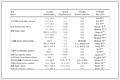
浅成低温热液型金矿床是当前国际矿床学界研究的热点之一。20世纪90年代以来,提出并沿用高硫型(High-sulfidation epithermal,HS)和低硫型(Low-sulfidation epithermal,LS)两种完全不同的金矿类型划分方案(表 1) (Hedenquist and Lowenstern, 1994;Hedenquist et al., 2000;Simmons et al., 2005b)。最近十几年,基于成矿理论发展及指导勘查找矿的实际需要,一种成矿条件和矿床特征介于高硫型(HS)和低硫型(LS)浅成低温热液型矿床之间的类型——中硫型浅成低温热液型矿床(Intermediate-sulfidation epithermal,IS)被划分出来(Hedenquist et al., 2000;Einaudi, et al., 2003),很快引起国内外矿床领域从事科研与勘查工作者的关注,并逐渐被普遍接收(Albinson et al., 2001;Sillitoe and Hedenquist, 2003;Rice et al., 2007;Findley,2010;Gamarra-Urrunaga et al., 2013;宋国学等,2015)。相比而言,针对HS型与LS型金多金属矿床特征、流体演化、矿床成因及成矿机制等研究已经相当深入,而关于IS型金多金属矿的研究则尚处于起步与逐渐成形阶段。
|
表 1 已有关于浅成低温热液矿床的分类方案(由老至新) Table 1 History of nomenclature for epithermal deposit types (from old to new) |
矿床类型的确定对于从事矿床研究和矿床勘察、开采的地质工作者来说尤为重要,直接决定着某一矿床研究思路、研究方法、勘查手段和开采技术的设计和选择。譬如本文关注的浅成低温热液矿床中HS型、IS型和LS型的划分在实际应用中表现的尤为明显。但是“IS型矿床”有无单独划分的必要?在中国是否存在?具有什么样矿床特征?许多地质工作者仍存疑惑,甚至持否定观点。本文基于对全球已报道确具IS型矿床特征的24处矿床实例的系统梳理比较,归纳总结了全球范围内IS型矿床的时空展布、地质特征、矿物组合特征、金属源区特征、IS型与HS型和LS型金多金属矿的主要区别,以及目前国际研究进展及难点,以期对我国与IS型浅成低温热液矿床相关的科研与野外勘查工作有所推动。
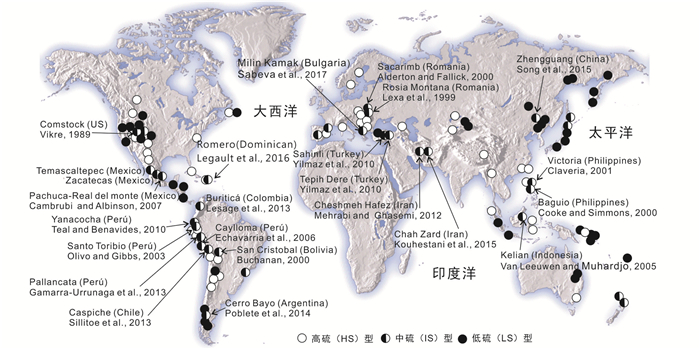
1 IS型浅成低温金多金属矿床存在么?中硫型浅成低温金多金属矿床是否存在?在国内多年来尚无典型实例,相当部分的矿床工作者对此问题持否定或者困惑的态度。针对浅成低温热液矿床的类型,国内较多地质工作者简单采用“明矾石-高硫型”和“冰长石-低硫型”或者“高硫化物-高硫型”和“贫硫化物-低硫型”来进行划分,而忽略了矿床自身具有的细节特征的差别和系统详细的矿物组合研究,因而也忽略了IS型浅成低温热液矿床的存在。在国外,这个问题也是目前浅成低温热液矿床重点研究的热点之一,不同的学者通过对不同区域浅成低温热液型矿床的研究(Hedenquist et al., 2000;John,2001;Albinson et al., 2001;Einaudi, et al., 2003;Sillitoe and Hedenquist, 2003;Rice et al., 2007;Camprubí and Albinson,2007;Findley,2010;Gamarra-Urrunaga et al., 2013;Corbett, 2002, 2009, 2013),用不同的地质证据证实了IS型矿床的存在(图 1),但对关于IS型矿床特征的主流认识仍存在差别。
|
图 1 世界范围内浅成低温热液型金多金属矿床分布(据John,2001; Arribas, 2004补充修改) Fig. 1 Distribution of epithermal gold poly-metallic deposits in the world, including HS, IS and LS deposits(modified after John, 2001; Arribas, 2004) |
早在20世纪70年代,在墨西哥的Fresnill (Santo Nino vein)矿中已经发现了IS型热液脉系的存在;此后在1980-1990期间,越来越多的IS型含矿脉系被发现(Gemmell, 1986;Hedenquist et al., 1987;Simmons et al., 1988;Eckberg,1999)。“IS型矿床”的概念最初由Hedenquist et al.(2000)提出(表 1),起初把IS型矿床划分为LS型矿床的亚类,具有黄铁矿、黝铜矿、砷黝铜矿、黄铜矿、低铁闪锌矿矿物组合,为富银-贱金属成矿体系,具有比LS型矿床更高的流体盐度。此后Einaudi et al.(2003)对此概念进行了补充(表 1),把IS型矿床作为与HS、LS型矿床相对应的独立矿床类型,认为IS型金多金属矿床区别于HS和LS型矿床的显著特征是发育贫铁闪锌矿、黝铜矿和砷黝铜矿组合,缺乏磁黄铁矿(Einaudi et al., 2003);并呈现金属矿物分带,顶部富金,深部富银,更深部以铁-铅-锌等贱金属为主(Arribas,2004)。Sillitoe and Hedenquist (2003)则将“IS型金多金属矿床”的范围进行了扩充,将Corbett(1994)和Corbett and Leach(1998)等曾认为是LS型浅成低温热液矿床的富碳酸盐-贱金属硫化物金多金属矿床也纳入“IS型金多金属矿床”范畴。针对以上认识,Corbett(2013)认为以浅色闪锌矿中的铁含量来区分HS型、IS型和LS型矿床并不符合事实,例如印度尼西亚Kelian矿床被评价为IS型矿床,但其中却发育的高温深色富铁闪锌矿以及磁黄铁矿(Sillitoe and Hedenquist, 2003)。Corbett(2013)认为由Hedenquist et al.(2000)、Einaudi et al.(2003)和Sillitoe and Hedenquist (2003)等人划定的“IS型金矿金属矿床”的范围过于宽泛,只有富碳酸盐-贱金属硫化物金多金属矿床才可被归为IS型矿床(表 1)。
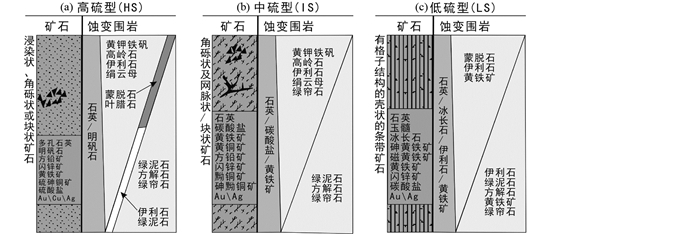
2 IS型金多金属矿床特征及与高硫型、低硫型矿床的对比同HS型与LS型浅成低温热液型金矿一样,IS型金矿在环太平洋成矿带、地中海-喜马拉雅成矿带和蒙古-鄂霍茨克成矿带等三大成矿带上均有产出;其中报道较多的区域有美国Comstock矿(John,2011)、墨西哥Pachuca-Real del monte矿(Camprubí and Albinson,2007)、哥伦比亚Buritica矿(Lesage et al., 2013)、伊朗北部Cheshmeh hafez矿(Mehrabi and Siani, 2012)、土耳其Sahinli矿(Yilmaz et al., 2010)、西班牙Palai-Islica矿(Carrillo Rosúa et al., 2003; Esteban-Arispe et al., 2016)和秘鲁Pallancata矿(Gamarra-Urrunaga et al., 2013)等(图 1);在我国,争光金矿是首例鉴别出的具IS型矿床特征的金矿(宋国学等,2015)。那么,IS型金矿具有什么样的矿床特征?其区别于HS、LS型金矿的典型标志是什么?在综合分析以往研究及勘查成果的基础上,总结如下(图 2、表 2):(1)IS型金矿通常形成于挤压岛弧及陆内伸展背景下(Findley,2010),LS型金矿则在挤压弧、陆内伸展及裂谷背景均可形成, HS型金铜矿则多产于岩浆弧和活动陆缘(Qin et al., 2002; Sillitoe and Hedenquist, 2003);(2)赋矿围岩为英安质-安山质火山岩地层(Sillitoe and Hedenquist, 2003;Mehrabi and Siani, 2012),而HS型金矿围岩主要为流纹质-英安质火山岩,LS型金矿围岩以具双峰式特征火山岩-侵入岩为主(Sillitoe and Hedenquist, 2003);(3)最常见的蚀变为绢云母化、伊利石化和青磐岩化,明矾石不发育,冰长石亦较少出现(Camprubi and Albinson, 2007;Poblete et al., 2014);HS型金矿大量发育明矾石、叶腊石,LS型金矿较为发育冰长石(图 2);(4)矿物组合方面,IS型金矿发育一套具有中等硫化状态的矿物——黄铁矿、黝铜矿、黄铜矿和低铁闪锌矿等(Camprubí and Albinson,2007),尤其发育较多黄铜矿(宋国学等,2015);LS型金矿发育黄铁矿、含砷黄铁矿、磁黄铁矿、毒砂和高铁闪锌矿等具较低硫化态的矿物组合,并普遍发育冰长石;HS型金矿则发育黄铁矿、硫砷铜矿、四方硫砷铜矿、砷黝铜矿、蓝辉铜矿、铜蓝、明矾石等具较高硫化态的矿物组合(Qin and Ishihara, 1998;张德全等,2003; Qin et al., 2002; Camprubí and Albinson,2007;Mitchell et al., 2011;李光明等,2015)(图 2);(5)IS型金矿大量硫化物发育(5%~20%)(Lesage et al., 2013),具Au-Zn-Pb-Cu-Ag矿化并伴生Mo、As、Sb等为特征(Findley,2010),富银和主要贱金属元素,具有高Ag/Au比值特征(10~1500)(Einaudi et al., 2003);HS型金矿富金-银,贫贱金属和碳酸盐,其硫化物含量普遍为10~90vol%(Hedenquist et al., 2000;缪宇等,2007);LS型金矿则富金-银和碳酸盐为特征,其硫化物含量普遍小于5vol%(Sillitoe and Hedenquist, 2003);(6)主矿体赋存在古地表下300~800m处(Camprubí and Albinson, 2007);(7)闪锌矿中的FeS含量1~20mol%(如Einaudi et al., 2003),HS型为0.01~1mol%,LS型为大于20mol%(Yilmaz et al., 2010);(8)成矿流体来自岩浆水及大气水混合,具中性、还原特征(Hedenquist et al., 2000;Einaudi et al., 2003;Chang et al., 2011;Mehrabi and Siani, 2012),减压沸腾或流体混合导致沉淀成矿(Gamarra-Urrunaga et al., 2013)。
|
图 2 IS型金多金属矿床矿石矿物、蚀变矿物组合特征空间分布简描及与HS、LS型矿床对比(据Sillitoe and Hedenquist, 2003修改) Fig. 2 Space distribution of ore minerals and altered minerals in IS type gold poly-metallic deposits, and comparison with HS and LS deposits (modified after Sillitoe and Hedenquist, 2003) |
|
|
表 2 高硫型、中硫型、低硫型浅成低温热液矿床特征 Table 2 Deposits characteristics of HS, IS, LS eipthermal deposits |
IS型浅成低温热液金矿时空上发育在岛弧区或活动大陆边缘,与浅地表的火山岩及相关的次火山岩体展布一致,赋存在同期或者较老的安山质-英安质火山岩或者沉积岩地层中(Simmons et al., 2005b);部分金矿体可赋存在火山机构中(Hedenquist et al., 2000)。除火山机构、火山-次火山体与IS型金矿具有密切的空间关系外,近期很多学者针对火山岩地层、浅成侵入岩、火山机构与IS型金矿的成因关系进行了工作。研究发现矿区内发育的火山岩地层可为金成矿作用提供大量的金属物质和硫元素,如Mehrabi and Siani(2012)认为伊朗Cheshmeh Hafez IS型金矿成矿所需的贱金属元素主要来自围岩火山岩地层;土耳其Sahinli/Tespih Dere IS型金矿稳定同位素亦显示次火山岩或者火山岩地层为成矿提供了所需的硫元素(Yilmaz et al., 2010);菲律宾Victoria IS型金矿以富贱金属硫化物和碳酸盐为特征,研究表明其成矿物质直接来自围岩英安岩,矿体受火山通道相控制(Claveria,2001)。也有部分学者研究发现一些IS型金矿与斑岩成矿系统时空上紧密共生(Sillitoe and Hedenquist, 2003),认为与火山活动近同期的浅成斑岩为IS型金矿提供了成矿流体和成矿所需物质;对美洲科迪勒拉地区部分典型斑岩铜金矿床的研究表明,IS型矿床常发育在斑岩型铜金成矿系统的外围(Camprubí and Albinson,2007;Sillitoe,2010),如秘鲁Caylloma IS型金矿形成于约18Ma,比火山岩围岩地层略晚2Myr,Echavarria et al.(2006)认为成矿作用与深部持续的岩浆活动密切相关;稳定同位素工作表明,哥伦比亚Buriticá IS型金矿成矿物质主要来自于深部斑岩侵入体(Lesage et al., 2013)。另外,和大多数HS型与LS型金矿一样(Qin et al., 2002;毛景文等,2003;陈衍景等,2007;缪宇等,2007),主流观点认为IS型金矿床内发育的火山机构及相关的放射性断裂为富金流体的运移和沉淀提供了流体通道和赋存空间(Hedenquist et al., 2000;Camprubí and Albinson,2007)。在时间上,IS型金矿的成矿作用通常比区域最年轻的火山岩晚0.5~3Myr(Echavarria et al., 2006);Sillitoe et al.(2013)认为智利Caspiche斑岩铜金-浅成低温热液Au成矿系统中,以富贱金属硫化物和碳酸盐为特征IS型金矿脉的发育,代表斑岩-浅成低温热液成矿系统成矿作用的终结。
4 IS型金多金属矿床富碳酸盐-贱金属热液成矿体系特征及其演化 4.1 富碳酸盐-贱金属热液成矿体系特征成矿系统中富碳酸盐及贱金属硫化物是相当部分IS型金-多金属矿床的鲜明特征之一。“富碳酸盐-贱金属热液成矿体系”的完整概念最早由Corbett(1994)在研究西南太平洋周边斑岩矿床与浅成低温热液矿床时提出,认为碳酸盐-金-贱金属成矿体系是在远离斑岩侵入体的部位,由岩浆热液与表层重碳酸气冷凝水相混合而形成。Handley and Bradshaw (1986)和Sillitoe(1989)在研究西南太平洋Porgra金矿床时也提到了这类成矿体系的存在,尽管不发育冰长石,当时普遍把这类矿床大多归类于冰长石-绢云母型金矿(Corbett, 1994, 2002)。Qin et al.(1995)研究发现得尔布干成矿带上的查干布拉根银铅锌矿具有碳酸盐-银-金-铅锌成矿组合。相比石英-闪锌矿-金-铜成矿体系,富碳酸盐-Au(贵金属)-贱金属成矿体系主要矿石矿物为碳酸盐>石英>黄铁矿>闪锌矿>方铅矿>黄铜矿>,以裂隙充填、脉状、网脉状和角砾岩形式产出(Corbett and Leach, 1998)。Sillitoe and Hedenquist(2003)通过对比全球发育的HS型、IS型及LS型浅成低温热液矿床发现,在墨西哥、秘鲁、玻利维亚、美国、菲律宾、印度尼西亚、中国台湾等地区发育的IS型金多金属矿以富贱金属硫化物为特征,且超过半数的矿床发育大量碳酸盐矿物。Albinson et al.(2001)认为热液体系中富银和贱金属元素是IS型矿床区别于HS型和LS型矿床的典型特征,富闪锌矿亦可以作为IS型金矿区别于LS型金矿的特征之一(Einaudi and Hedenquist, 2003;Findley,2010)。随着成矿理论的不断发展,以目前的浅成低温热液型成矿理论来重新认识,这种少量发育冰长石、富集碳酸盐与贱金属的热液成矿体系明显区别于LS型金矿(对应于冰长石-绢云母型金矿),而应归为具富碳酸盐-贱金属热液体系特征的IS型浅成低温热液型金矿系列(Sillitoe et al., 2013)。该类矿床在美洲的科迪勒拉区域亦很发育(Pinto-Vasquez,1993;Moncada et al., 2012;Gamarra-Urrunaga et al., 2013)。
4.2 流体特征为揭示IS型浅成低温热液型金矿与HS型、LS型矿床成矿流体特征及演化的差异,一些学者基于典型矿床对IS型金矿的包裹体类型、均一温度与盐度、气液相组分、氧化-还原性特征、流体端元组成等进行了研究工作。研究显示,IS型金矿成矿流体包裹体类型以液相为主,部分发育少量气相包裹体;均一温度为200~320℃,盐度为0~9%NaCleqv(Shamanian et al., 2004;Findley,2010;Velador,2010;Yilmaz et al., 2010;Gamarra-Urrunaga et al., 2013) (表 2);包裹体气相组分以H2O为主,其次为CO2、N2、CH4等(Velador,2010),在部分矿床中可呈现富CO2特征(Findley,2010),为中性-还原性流体(Shamanian et al., 2004;Velador,2010)。以上研究表明IS型金矿成矿流体特征与HS型金矿截然不同,与LS型金矿则较为接近(Findley,2010)。IS型浅成低温热液型金矿与斑岩型热液成矿系统的成因及时空关系仍在困扰我们(Hedenquist et al., 2000),主要是因为IS型金矿象LS型金矿一样往往远离斑岩热液成矿中心(Findley,2010;Velador,2010),且其矿床特征、成矿条件及流体特征处于HS型和LS型矿床之间过渡区域(Hedenquist et al., 2000)。本文的总结表明,IS型矿床流体的流体盐度却远高于HS和IS两个类型,最高可达23%NaCleqv(Shamanian et al., 2004;Findley,2010)。什么原因造成IS型矿床成矿流体中出现中-高盐度流体特征?Shamanian et al.(2004)在对伊朗Gandy和Abolhassani两个IS型矿床研究中对该问题进行了详细分析,发现成矿流体中可以识别出高盐度流体和中-低盐度流体,认为高盐度流体是岩浆流体的批次注入所形成的。Yilmaz et al.(2010)对土耳其Sahinli和Tespih Dere两个IS型矿床研究识别出低盐度和中-低盐度两阶段流体,认为这两种流体是由高盐度岩浆流体和地层水逐渐不断混合后形成的。显然关于IS型矿床的前期工作中大部分研究者并没有把这两种流体分离开来,而事实上含有高盐度流体这一特征可作为建立斑岩岩浆-热液体系与IS型浅成低温热液体系之间联系的证据之一。目前关于IS型浅成低温环境热液演化的认识尚未取得共识,通过对几个典型矿区的研究,较多的学者认为其成矿流体均有岩浆流体的参与(Hedenquist et al., 2000;Sillitoe and Hedenquist, 2003;Shamanian et al., 2004;Kouhestani et al., 2015),成矿流体(< 350℃)主要为低到中-低盐度,稳定同位素数据显示这些流体具有岩浆水与大气水混合特征(如Shamanian et al., 2004;Kouhestani et al., 2015),与HS型金矿中岩浆水占主导有所不同(Voudouris et al., 2013);如Shamanian et al.(2004)认为伊朗Gandy矿区热液角砾岩中发育的贵金属和贱金属是在高温富金属岩浆流体脉动注入过程中沉淀,流体稀释是主要的沉淀机制。也有部分学者认为成矿流体没有或者很少有岩浆流体的参与(如秘鲁PallancataIS型金矿),成矿流体主要由循环的大气降水与围岩发生反应而形成(Gamarra-Urrunaga et al., 2013)。
4.3 富CO2流体作用富CO2流体的识别为金矿床中Au元素的行为过程研究提供了新的途径(Phillips and Evans, 2004;Richards et al., 2006;卢焕章,2008;Findley,2010)。关于CO2在金成矿中的作用,Nature杂志有数篇讨论该问题的文章(如Nadenet and Shepherd, 1989),Phillips and Evans(2004)认为在含Au流体中CO2可以作为运移载体起缓冲剂的作用。富CO2流体作为成矿热液中碳的主要来源有三个:岩浆或地幔(Frezzotti et al., 2014)、沉积碳酸盐岩以及各类岩石中的有机碳(胡瑞忠等,1993;Yilmaz et al., 2010)。Mumm et al. (1997)在对非洲西部加纳境内Ashanti成矿带的金矿及Chi et al.(2006, 2009)对加拿大Red Lake绿岩带中的金矿的研究中,发现富CO2的流体的存在,认为富CO2流体来自下地壳麻粒岩相变质,富H2O流体来自角闪岩相到绿片岩相变质的围岩,两者发生混合,导致金和碳酸盐的沉淀。
目前针对富碳酸盐-贱金属热液体系的研究仍十分薄弱,其与深部岩浆的关系仍待揭示;富CO2、H2S等气相组分成矿流体的存在是否与成矿体系中碳酸盐及贱金属硫化物的发育有密切关系?解密这种成矿系统内富CO2、H2S流体成因及其与富集硫化物和碳酸盐矿物的联系,是认识富碳酸盐-贱金属热液体系IS型浅成低温热液矿床的关键所在。
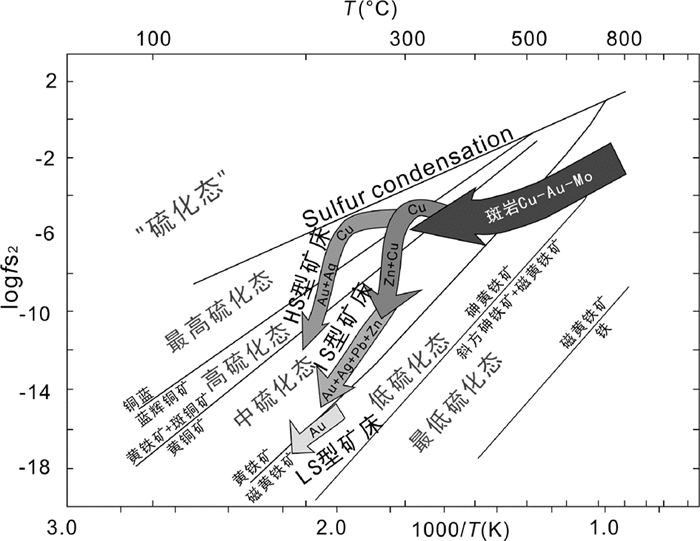
4.4 流体“硫化态”演化路径“硫化态”的概念是和氧化态一起配合使用的,最初在针对美国Reno Sales矿床成因的研究中提出并应用。实验模拟研究表明特定的矿物组合对应一定的fS2和温度区间,因此可以应用不同的矿物组合来定义相应的成矿温压环境和氧化还原环境(Einaudi et al., 2003),进而可以约束热液流体的演化路径。斑岩-浅成低温成矿系统中热液流体的演化路径可以用流体的氧化态进行描述,氧化态的特殊变化可以影响岩浆-流体中硫的化合态,进而影响流体迁移-沉淀金属物质的能力。在岩石学和矿床成因研究中“硫化态”与“氧化态”具有同样重要的应用。在前人研究的基础上,Einaudi et al.(2003)应用Cu-Fe-As-S成矿体系中矿物组合以及矿物生成时相互的化学反应,对斑岩Cu矿、斑岩相关热液脉系和浅成低温贵金属矿床等约30个矿床进行了硫化态研究。图 3表明硫化态分为五个级别,分别是最高硫化态、高硫化态、中硫化态、低硫化态和最低硫化态,相邻级别之间的界限均采用关键矿物的化学反应进行约束。Einaudi et al.(2003)认为作为富硫化物的IS型矿床除了不发育硫砷铜矿相关的矿物组合并具有较高的Ag/Au比值外,具有和HS型矿床相似的矿物组成,这两类矿床在时空上紧密相关并共生。斑岩铜矿的高氧化高温Cu-Au-Mo脉系、岩浆流体相关的中温Cu脉系和Cu-Zn脉系、HS型浅成低温Au-Ag脉系与IS型低温Au-Pb-Zn-Fe-Cu脉系共享相同的流体演化体系(图 3),此观点得到Rice et al.(2007)、Sillitoe(2008)和Mehrabi and Siani(2012)等人的支持。Camprubí and Albinson(2007)在研究墨西哥境内发育的多个IS型浅成低温热液矿床后,对Einaudi et al.(2003)的认识进行了补充,认为LS型矿床的流体演化可以有两种途径,其一是与高温岩浆流体、HS流体、IS流体具有同样的流体体系,为流体演化的末端;其二是与深部岩浆侵位加热地层水形成的深循环流体相关。
|
图 3 斑岩-浅成低温热液成矿系统中热液流体的温度和硫逸度相关演化图(据Einaudi et al., 2003修改) 区间范围由关键矿物组合的稳定域约束,流体的硫化态演化路径由金属矿物组合约束 Fig. 3 Diagram correlating temperature and sulfur fugacity for the sulfidation states of hydrothermal fluids in the environments of formation of porphyry and epithermal deposits(modified after Einaudi et al., 2003) The interval ranges were defined according to the stability fields of key minerals, with the general sulfidation paths determined by the metallic mineral |
浅成低温热液型矿床的成矿物质Au、Ag、Cu、Pb和Zn具有多源性,一种来自深部侵入体释放的岩浆流体(Sillitoe,1997;Findley,2010;Velador,2010;Kouhestani et al., 2015);另一种来源是循环到深部的地下水与源区岩石发生水岩反应,将源区岩石中的金属成矿元素萃取出来(丰成友等,2000;Nieto-Samaniego et al., 2007;Sillitoe,2008;Yilmaz et al., 2010;Mehrabi and Siani, 2012),且不同成矿阶段可能具不同来源(Qin et al., 1995;祁进平等, 2004, 2005)。Mosier et al.(1986)对世界上87个浅成低温热液型矿床进行了贵金属及贱金属的品位对比,发现形成于含有盐或封闭海水的碳酸盐岩-蒸发岩基底岩石之上的浅成低温热液矿区,其贱金属如Pb、Zn、Cu和Ag等的平均含量较高,并推测富贱金属区域主要位于秘鲁南部、日本北部、科罗拉多州西部等。Kouhestani et al.(2015)通过对伊朗境内具IS型-LS型特征的Chah Zard金矿H-O-S同位素的研究推测成矿物质以深部岩浆为主,并伴随浅表围岩地层的加入。重晶石Sr同位素示踪保加利亚Madjrovo浅成低温热液金矿脉物质来源,表明变质基底为成矿流体提供了大量成矿物质(Petersen et al., 2002)。对于成矿元素金的来源,有些学者认为是地壳岩石在碰撞或者岛弧迁移之后,沉入地幔的岩石圈板片部分熔融从而导致地幔中硫化物的氧化释放出金(Sillitoe,1997;Sun et al., 2004)。
相对于HS型、LS型矿床来说,关于IS型浅成低温热液矿床的金属物质的来源研究尚不深入。在伊朗Cheshmeh Hafez IS型金矿内,安山岩、粗面安山岩、安山质玄武岩和玄武岩中的贱金属含量很高,这种地球化学特征表明火山岩地层围岩可能是含矿脉系中贱金属的重要源区(Mehrabi and Siani, 2012)。墨西哥境内发育较多的IS型、LS型浅成低温热液型矿床,这些矿床普遍发育在地壳增生背景下的火山岩地层中(Campa and Coney, 1983)。Potra (2009)和Yilmaz et al.(2010)对其中典型IS型矿床的研究发现系统中C、S同位素具有较为单一的源区特征,认为C、S同位素是通过热液流体的循环或选择性地交代沉积地层提取出来的,进而推测成矿元素主要来自壳源地层。Sillitoe (2008)通过对美洲科迪勒拉地区的浅成低温热液型矿床的研究,提出在合适的氧化还原条件下地幔楔和上地壳可以贡献成矿需要的金属物质。综合认为,IS型浅成低温热液型矿床普遍受控于地壳增生加厚背景下的火山岩地层,热流体通过淋滤交代作用将成矿金属元素提取出来并运移至浅表成矿。
5.2 Au-Ag-贱金属迁移及沉淀机制IS型-LS型浅成低温环境中银和贱金属元素主要以氯络合物的形式迁移(Seward and Barnes, 1997; Pavlova and Borovikov, 2008;Mehrabi and Siani, 2012),这种络合物在相对还原、中性流体中运移银和贱金属元素的能力比金元素更强(Seward and Barnes, 1997);相反在300~350℃之间,浅成低温环境中Au(HS)2-络合物对于运移Au元素则更为有利(Benning and Seward, 1996),且金的溶解度与H2S的浓度呈正相关关系(Ohmoto et al., 1986;Seward and Barnes, 1997)。近期,对伊朗及墨西哥境内发育的IS型-LS型矿床富CO2流体的研究表明,CO2对Au在流体中的溶解度及运移同样具有较大影响(Simmons and Browne, 2000;Mehrabi and Siani, 2012)。
IS型金矿的金属沉淀机制主要为流体沸腾、流体混合、围岩硫化作用(Yilmaz et al., 2010;Mehrabi and Siani, 2012;Kouhestani,2015)。沸腾是流体自临界状态向超临界点以下转化突然减压所出现的一种特殊现象(Shamanian et al., 2004)。在500℃、0.5kbar的条件下,流体沸腾导致相分离并产生低盐度的蒸汽相与高盐度的卤水,此时金主要进入卤水相(Gammons and Williams-Jones, 1997)。IS型矿床中气相、液相包裹体的共存,包裹体中气液相体积比值的巨大变化,及成矿体系中冰长石、板片状方解石的发育均指示沸腾作用的存在(Ronacher et al., 2000;Kouhestani et al., 2015);而且成矿阶段石英及闪锌矿中气相、液相及次生包裹体的共存可推测有二次沸腾作用发生(Ronacher et al., 2000; Yilmaz et al., 2010)。成矿流体发生沸腾时往往形成沸腾面(Shamanian et al., 2004),可以通过脉系矿物组合、流体包裹体特征、包裹体的温度压力及角砾岩发育深度对沸腾面的深度进行估算(Hedenquist et al., 2000; Albinson et al., 2001;Mehrabi and Siani, 2012)。如在伊朗Cheshmeh Hafez IS型金矿区沸腾面为潜水面下340m(Mehrabi and Siani, 2012),在Chah Zard矿区为430~600m(Shamanian et al., 2004),而在科迪罗拉地区则约为500m(Hedenquist et al., 2000; Albinson et al., 2001);且流体中CO2和H2S浓度的升高会增大初始沸腾的深度(Cooke and Simmons, 2000)。典型矿床的矿物学、流体包裹体和稳定同位素研究表明,沸腾可能是导致IS型、LS型浅成低温热液型矿床贵金属和贱金属沉淀的主要原因(Yilmaz et al., 2010;Velador,2010),沸腾期间的去气(如H2S,CO2)作用可以促进银金矿和贱金属硫化物的沉淀(Velador,2010)。此外,流体混合亦是重要因素之一(Yilmaz et al., 2010;Velador,2010),如Shamanian et al.(2004)认为伊朗Gandy矿区热液角砾岩中发育的贵金属和贱金属矿化可能在沸腾条件下沉淀,而主要的贱金属硫化物在高温富金属岩浆流体脉动注入过程中通过与大气水混合而发生沉淀。另外,相关研究还指出围岩地层中大量磁铁矿及铁镁矿物的发育,使得流体与围岩相互作用时发生去硫化作用,认为围岩硫化作用也是促使金沉淀的机制之一(Kouhestani,2015)。
6 中硫型浅成低温热液金矿床特征矿物学研究近年来,随着分析手段和测试精度的突破,浅成低温热液型矿床中特征矿物和硫化物的研究在指示成矿精细过程方面发挥着越来越大的作用。
6.1 黄铁矿黄铁矿是金矿中最常见的金属矿物,它不仅与金的矿化有着密切联系,而且还是主要的载Au矿物(陈光远等, 1989, 卢焕章等,2013)。通过对黄铁矿的形态、物性、主成分及微量元素等标型特征的研究,可反映金矿床的不同成因(Palenik et al., 2004;Thomas et al., 2011),也是预测成矿远景地段、指导深部找矿的有效方法之一(陈光远等,1989)。黄铁矿可用于主量成分测试(电子探针原位)、同位素测年(Re-Os同位素)、包裹体测试(红外光谱)、微量元素分析(LA-ICP-MS)、硫同位素分析(SIMS原位测试)等工作(Palenik et al., 2004;Thomas et al., 2011;Cook et al., 2013;Deditius et al., 2014;Franchini et al., 2015;Chen et al., 2015)。目前研究表明浅成低温热液型矿床中的黄铁矿可富集Au、Ag、Cu、Pb、Zn、Co、Ni、As、Sb、Se、Te、Hg、Tl、Bi等元素(Reich et al., 2005;Cook et al., 2009;Deditius et al., 2014;Franchini et al., 2015)。伊朗Gandy IS型金矿中发育两种类型黄铁矿,一种是自形-半自形具贫As(小于0.02%)特征,与黄铜矿、闪锌矿及方铅矿共生;另一种是具胶状结构,通常由自形黄铁矿增生而来,边部增生部分具富As特征(大于6.4%),且As与Au元素含量呈正相关关系(Simon et al., 1999),表明金元素在后期富As流体中运移并沉淀。
6.2 闪锌矿闪锌矿是浅成低温热液矿床,特别是IS型金矿中大量发育的硫化物矿物,愈来愈多的工作表明闪锌矿中的FeS含量可以用来区分HS型、IS型及LS型矿床。IS型金矿中闪锌矿中的FeS含量1~20mol%(Shamanian et al., 2004;Yilmaz et al., 2010),LS型为20~40mol%,指示较还原性流体环境,HS型为0.01~1mol%,指示氧化性流体环境(Scott and Barnes, 1971;Czamanske,1974;Einaudi et al., 2003;Franchini et al., 2015)。但Corbett(2013)则对依靠闪锌矿中铁的含量来区分浅成低温热液矿床类型进行了质疑,认为在IS型矿床中同样存在着富铁的闪锌矿。作为浅成低温热液矿床中的常见矿物,有关闪锌矿的矿物学工作仍有待发掘。另外闪锌矿的颜色及FeS含量亦可以用来指示距离侵入体的远近,富FeS闪锌矿常发育在距侵入体较远的位置,闪锌矿呈棕色或者黑色(Findley,2010);同一闪锌矿晶体内随着由核部到边部FeS含量的变化,其颜色亦呈现环带特征(Findley,2010)。
6.3 黝铜矿黝铜矿是IS型矿床内发育的又一特征矿物,通过对与辉锑银矿、深红银矿、闪锌矿共生黝铜矿中Ag含量的测定,可以计算矿物沉淀的温度范围(Chutas and Sack, 2004),与辉锑银矿共生但未达到成分平衡的黝铜矿具有较低的Ag含量组成,并代表相对低温的沉淀环境。Findley(2010)通过对墨西哥Miguel Auza矿床不同部位发育的黝铜矿中Ag含量的研究表明,具高Ag黝铜矿的东矿区沉淀温度为250~390℃(平均340℃),而发育低Ag黝铜矿的Calvario矿区的最高沉淀温度仅为170℃。另外Miguel Auza矿床发育闪锌矿、方铅矿以及其他深红银矿、富银黝铜矿、辉锑银矿、脆银矿、辉锑铅银矿、硫锑铅银矿等多种富银矿物,Findley(2010)通过系统的电子探针分析表明,早期含砷黄铁矿的沉淀消耗掉流体中大量的As元素,导致成矿期贵金属沉淀的流体环境以贫As富Sb为特征。
6.4 冰长石与明矾石尽管冰长石和明矾石不是IS型矿床的特征矿物,但在某些典型矿床中亦可少量发育(Velador,2010;Poblete et al., 2014)。冰长石和明矾石均可以用来进行40Ar-39Ar年龄侧年(Findley,2010;Velador,2010;Arribas et al., 2011)。墨西哥Valdecaas矿床中冰长石40Ar-39Ar的年龄侧年结果为29~31Ma,略晚于区域火山岩中的正长石40Ar-39Ar年龄30~36Ma,代表成矿作用的形成时间(Velador,2010)。智利Cerror Bayo矿集区IS型-LS型金矿中冰长石40Ar-39Ar年龄分为三个期次,分别为144~142Ma、137~124Ma、114~111Ma,代表区域上发生三期次成矿事件(Poblete et al., 2014)。另外Findley(2010)对墨西哥Miguel Auza IS型矿床中发育的伊利石和绢云母进行了40Ar-39Ar年龄测试,分别为约46Ma和44~47Ma,代表了墨西哥境内普遍发育的IS型Ag-Au-贱金属浅成低温热液矿床的形成时代(Findley,2010)。Rice et al.(2007)对保加利亚Madjarovo Pb-Zn-Au-Ag矿床系统的明矾石Ar-Ar年代学研究指出,HS型矿化在32.7~32.1Ma发育在斑岩成矿系统的顶部正上方,而IS型矿化则在32.1~32.0Ma发育在HS型Au-Ag矿化外侧,两者在时空演化上具先后继承的关系。
现代新技术的发展和应用,使得通过系统成因矿物学的研究来揭示浅成低温热液型矿床的成矿机制成为可能。如LA-ICP-MS的硫化物微量元素丰度分布图像已被广泛应用于金矿的研究(Cook et al., 2013),通过结构的分带性识别不同期次的硫化物,可以为研究微量元素富集演化过程提供重要信息。近两年,黄铁矿的红外光谱包裹体研究、硫化物的SIMS原位硫同位素测试逐渐应用到金矿床中(Fiorentini et al., 2012;Xue et al., 2013;Large et al., 2013;Chen et al., 2015),使得利用成矿系统内不同阶段流体成分及硫同位素的变化对物质源区、流体演化及成矿过程的解剖成为现实。
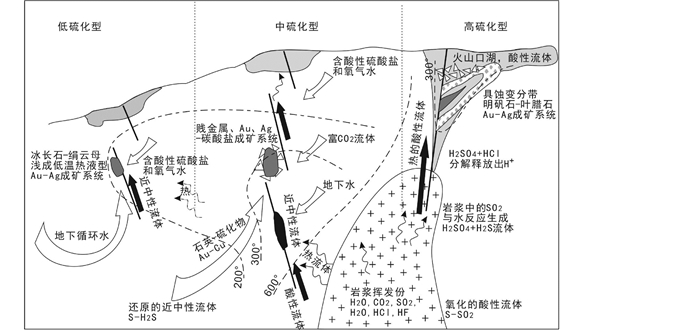
7 形成中硫型浅成低温热液金矿的控制因素IS型金矿床具有HS型到LS型矿床之间的过渡特征(Hedenquist,2000),在合适条件下IS型与HS型矿床或者LS型矿床可以相互共生(图 4)。John (2001)认为IS型与HS型矿床可以共存于斑岩型Cu (Au)矿床系统内,区别在于IS型矿床发育在HS型矿床的更外侧,形成温度更低(图 4)。此观点得到Sillitoe and Hedenquist(2003)和Rice et al.(2007)的支持,Sillitoe and Hedenquist(2003)认为IS型与HS型矿床可以赋存在同一成矿系统内,且都产出于挤压俯冲背景下,而LS型矿床则产出于伸展拉张背景下。Rice et al. (2007)通过对保加利亚Madjarovo Pb-Zn-Au-Ag矿床系统的年代学和成矿流体研究指出,HS型Au-Ag矿化在32.7~32.1Ma发育在斑岩成矿系统的顶部正上方,而IS型富贱金属矿化则在32.1~32.0Ma发育在HS型Au-Ag矿化外侧;流体氢氧同位素工作表明HS型矿化以岩浆水为主,而IS型矿化则有较多的大气水加入。不同于以上学者的观点,Camprubi and Albinson(2007)通过研究墨西哥境内发育的多个IS型浅成低温热液矿床后提出,IS型同样可以与LS型矿床在时空上密切共生。
|
图 4 IS、HS、LS型金多金属矿床成矿模型(据John, 2001;Cobett, 2002修改) Fig. 4 Geological models of IS, HS, LS type gold poly-metallic deposits (modified after John, 2001; Cobett, 2002) |
IS型矿床从构造背景、围岩性质、蚀变类型、脉系样式、矿化特征、成矿流体特征上与其它两种类型的确有很大区别。控制IS型浅成低温热液金矿形成的因素有:(1)在构造环境方面,IS型金-多金属矿床主要形成于板块汇聚边缘与俯冲作用相关的火山-岩浆弧以及陆缘弧环境(Hedenquist,2000;John,2001;Sillitoe and Hedenquist, 2003;Camprubí and Albinson,2007);(2)火山机构及断裂构造的发育为IS型浅成低温热液型矿床的就位提供重要作用,分支断裂和次级断裂更加有利且赋存主要矿体(Simmons et al., 2005b;祁进平等,2005)(图 4);(3)IS型金矿成矿过程所需的硫元素、金属元素及初始流体可来自火山岩地层或者同期浅部侵入岩体(Camprubí and Albinson,2007;Sillitoe,2010)或者深部的基底岩石(图 4);(4)成矿体系中发育具中性、还原性特征流体(Shamanian et al., 2004)(图 4);(5)流体源区或者外来流体富含CO2与H2S,成矿流体通过沸腾作用、流体混和作用或者围岩硫化作用使碳酸盐和载金矿物发生沉淀(如Yilmaz et al., 2010)(图 4);(6)地壳增生加厚背景下的火山岩地层可提供大量的Au、Ag及贱金属元素(如Cu、Pb、Zn、Fe)等(Sillitoe and Hedenquist, 2003)。
8 存在关键问题分析与研究展望(1) IS型金多金属矿已经成为国外的研究重点,目前这些矿床主要分布于环太平洋成矿带上,多与斑岩成矿系统相伴生,形成于板块汇聚边缘与俯冲作用相关的火山-岩浆弧以及陆缘弧环境;IS型矿床即可以与HS型矿床伴生,亦可与LS型矿床相伴生。在我国虽然浅成低温热液型矿床普遍发育,但有关IS型浅成低温金多金属矿的明确厘定及研究报道尚鲜见,截至目前仅有黑龙江省多宝山矿田的争光金矿被鉴别为IS型,我国针对IS型浅成低温金多金属矿的研究尚处于起步阶段。理论上而言,世界著名的三大成矿域(滨太平洋成矿域、古亚洲洋成矿域和特提斯-喜马拉雅成矿域)普遍发育斑岩型Cu-Au-(Mo)矿床和浅成低温热液型矿床,具有形成IS型矿床的成矿条件。
(2) IS型金多金属矿多以发育富碳酸盐-贱金属(Cu、Pb、Zn、Fe等)成矿体系为特征,这是目前多位研究该类型矿床学者的观点中可以统一的认识。目前尚未有文献对“富碳酸盐-贱金属”这种神秘的热液成矿体系进行详细报道,这种成矿体系是如何形成的?与斑岩型铜金成矿系统有无内在关系?流体中CO2、H2S及贱金属元素对Au的运移和沉淀有何影响?对这种特征石英-碳酸盐-贱金属热液体系的形成、演化及其对金成矿作用约束的研究,是认识IS型金多金属矿床成矿机制的关键所在。
(3) IS型浅成低温热液金矿以发育不同于HS型和LS型金矿的矿物组合为特征,包括黄铁矿、闪锌矿、方铅矿、黝铜矿、砷黝铜矿、黄铜矿、碳酸盐矿物等,尤其发育较多黄铜矿;同样可以发育少量的明矾石和冰长石。以上矿物内蕴含了稳定同位素C-S-H-O、放射性同位素Re-Os、微量元素、流体包裹体气液相成分、成矿元素Au-Ag等大量成因信息;未来系统的原位矿物学测试工作可以较好研究示踪浅成低温热液矿床成因,并揭示HS型、IS型、LS型等三种矿床成矿流体时空演化及成矿条件上的差异性。
(4) 以闪锌矿中FeS的含量多少作为区别IS型、HS型、LS型矿床的特征地化标志之一为不少学者所接受(1~20mol% FeS为IS型,HS型为0.01~1mol% FeS,LS型大于20mol% FeS),但从成矿系统、成矿过程和矿物形成的复杂性来考虑显然过于简单,且与已有关于闪锌矿的矿物学研究成果相矛盾。传统矿物学研究认为闪锌矿可形成于100°~400°的温度范围,认为高铁闪锌矿(15~22mol% FeS)通常形成于相对高温环境,通常富含Mn、Cu、Sn、In等元素,这显然与对LS型闪锌矿的认识相矛盾;而低温闪锌矿则相对贫铁(0~5mol% FeS),比较富含Cd、Pb、Sb等元素。因此关于“闪锌矿中FeS的含量”能否作为区分浅成低温热液矿床类型的标志仍需进一步工作。
(5) 以往发现的HS型及LS型浅成低温热液型金矿均赋存在火山岩地层中及其附近,IS型金矿亦不例外;虽然不少学者通过岩浆-流体研究认为地壳增生加厚背景下的深部火山岩地层重熔为流体提供了大量的Au、Ag及贱金属元素(如Cu、Pb、Zn、Fe)等,但是并不能解释为什么95%以上的浅成低温热液型矿床赋存在浅部地壳火山岩地层中。这些早期形成的火山岩地层或者次火山岩体是否为成矿流体提供了成矿物质?是否充当了浅成低温热液矿物沉淀的地球化学屏障(例如沉积火山岩地层可通过流体交代释放出Fe元素,进而促使富H2S流体沉淀出黄铁矿)?其具体过程是怎样的?以上问题可通过对比国内外IS型、HS型、LS型金矿的火山岩地层或者次火山岩体的地球化学特性(如贵金属Au-Ag、贱金属、硫-氟-氯等元素的含量)、流体蚀变对火山岩岩石的改造过程(元素的带入带出)等)进行研究。以上问题的解决可辅助揭示IS型矿床的成因机制和形成过程,并为同类型矿床的勘查工作提供支持。
致谢 感谢匿名审稿人提出的建设性修改建议。
Albino GV and Margolis J. 1991. Differing styles of adularia-sericite epithermal deposits-contrasts in geologic setting and mineralogy. Geological Society of America Abstracts with Program, 23(5): A230. |
Albinson T, Norman DI, Cole D and Chomiak B. 2001. Controls on formation of low-sulfidation epithermal deposits in Mexico: Constraints from fluid inclusion and stable isotope data. In: Albinson T and Nelson CE (eds. ). New Mines and Discoveries in Mexico and Central America. Littleton, CO, USA: Society of Economic Geologists, Inc., 8: 1-32
|
Alderton DHM and Fallick AE. 2000. The nature and genesis of gold-silver-tellurium mineralization in the Metaliferi Mountains of western Romania. Economic Geology and the Bulletin of the Society of Economic Geologists, 95(3): 495-515. |
Arribas A. 2004. Communication of epithermal deposits. In: UNESCO-SEG Course on Metallogeny. Mendoza, Argentina, 17-28
|
Arribas A, Arribas I, Draper G, Hall C, Kesler SE, McEwan C and Muntean JL. 2011. 40Ar/39Ar dating of alunite from the Pueblo Viejo gold-silver district, Dominican Republic. Economic Geology, 106(6): 1059-1070. DOI:10.2113/econgeo.106.6.1059 |
Ashley RP. 1982. Occurrence model for enargite-gold depositss. U.S. Geelogical Survey Open-File Report: 82-795-144-147. |
Benning LG and Seward TM. 1996. Hydrosulphide complexing of Au (I) in hydrothermal solutions from 150~400℃ and 500~1500bar. Geochimica et Cosmochimica Acta, 60(11): 1849-1871. DOI:10.1016/0016-7037(96)00061-0 |
Berger BR and Henley RW. 1989. Advances in the understanding of epithermal gold-silver deposits, with special reference to the western United States. In: Keays RR, Ramsay WHR and Groves DI (eds. ) The Geology of Gold Deposits: The Perspective in 1988. The Economic Geology Publishing Company, 6: 405-423
|
Bonham HF. 1986. Models for volcanic-hosted epithermal precious metal deposits: A review. In: Proceedings of the Symposium 5: Volcanism, Hydrothermal Systems and Related Mineralization. International Volcanological Congress. Hamilton, New Zealand: University of Auckland, Center Continuing Education, 13-17
|
Buchanan LJ. 1981. Precious metal deposits associated with volcanic environments in the Southwest. Arizona Geological Society Digest, 14: 237-262. |
Buchanan LJ. 2000. The geology of the San Cristobal deposit. In: Soc Mining Engineers Annual Meeting, Salt Lake City, Pocket Program. Society of Mining Engineers, 60
|
Campa MF and Coney PJ. 1983. Tectono-stratigraphic terranes and mineral resource distributions in Mexico. Canadian Journal of Earth Sciences, 20(6): 1040-1051. DOI:10.1139/e83-094 |
Camprubí A and Albinson T. 2007. Epithermal deposits in Mexico; update of current knowledge, and an empirical reclassification. In: Alaniz-álvarez SA and Nieto-Samaniego áF (eds. ). Geology of Mexico: Celebrating the Centenary of the Geological Society of Mexico. Special Paper-Geological Society of America, 422: 377-415
|
Carrillo Rosúa FJ, Morales Ruano S, Boyce AJ and Fallick AE. 2003. High and intermediate sulphidation environment in the same hydrothermal deposit: The example of Au-Cu Palai-Islica deposit, Carboneras (Almería). In: Eliopoulos DG (ed. ). Mineral Exploration and Sustainable Development: Proceedings of the Seventh Biennial SGA Meeting. Rotterdam: Millpress, 445-448
|
Chang ZS, Hedenquist JW, White NC, Cooke DR, Roach M, Deyell CL, Garcia J, Gemmell JB, McKnight S and Cuison AL. 2011. Exploration tools for linked porphyry and epithermal deposits:Example from the Mankayan intrusion-centered Cu-Au district, Luzon, Philippines. Economic Geology, 106(8): 1365-1398. DOI:10.2113/econgeo.106.8.1365 |
Chen GY, Shao W and Sun DS. 1989. Mineral Genesis of Jiaodong Gold Deposits and Its Implication for Prospecting. Chongqing:Chongqing Publishing House: 1-452. |
Chen L, Li XH, Li JW, Hofstra AH, Liu Y and Koenig AE. 2015. Extreme variation of sulfur isotopic compositions in pyrite from the Qiuling sediment-hosted gold deposit, West Qinling orogen, central China:An in situ SIMS study with implications for the source of sulfur. Mineralium Deposita, 50(6): 643-656. DOI:10.1007/s00126-015-0597-9 |
Chen YJ, Ni P, Fan HR, Pirajno F, Lai Y, Su WC and Zhang H. 2007. Diagnostic fluid inclusions of different types hydrothermal gold deposits. Acta Petrologica Sinica, 23(9): 2085-2108. |
Chi GX, Dubé B, Williamson K and Williams-Jones AE. 2006. Formation of the Campbell-Red Lake gold deposit by H2O-poor, CO2-dominated fluids. Mineralium Deposita, 40(6-7): 726-741. DOI:10.1007/s00126-005-0029-3 |
Chi GX, Liu YX and Dubé B. 2009. Relationship between CO2-dominated fluids, hydrothermal alterations and gold mineralization in the Red Lake greenstone belt, Canada. Applied Geochemistry, 24(4): 504-516. DOI:10.1016/j.apgeochem.2008.12.005 |
Chutas NI and Sack RO. 2004. Ore genesis at La Colorada Ag-Zn-Pb deposit in Zacatecas, Mexico. Mineralogical Magazine, 68(6): 923-937. DOI:10.1180/0026461046860231 |
Claveria RJR. 2001. Mineral paragenesis of the Lepanto copper and gold and the Victoria gold deposits, Mankayan mineral district, Philippines. Resource Geology, 51(2): 97-106. DOI:10.1111/rge.2001.51.issue-2 |
Cook NJ, Ciobanu CL and Mao JW. 2009. Textural control on gold distribution in As-free pyrite from the Dongping, Huangtuliang and Hougou gold deposits, North China Craton (Hebei Province, China). Chemical Geology, 264(1-4): 101-121. DOI:10.1016/j.chemgeo.2009.02.020 |
Cook NJ, Ciobanu CL, Meria D, Silcock D and Wade B. 2013. Arsenopyrite-pyrite association in an orogenic gold ore:Tracing mineralization history from textures and trace elements. Economic Geology, 108(6): 1273-1283. DOI:10.2113/econgeo.108.6.1273 |
Cooke DR, Simmons and S F. 2000. Characteristics and genesis of epithermal gold deposits. Reviews in Economic Geology, 13: 221-244. |
Corbett G. 2002. Epithermal gold for explorationists. AIG Journal:Applied Geoscientific Practice and Research in Australia: 1-26. |
Corbett G. 2009. Anatomy of porphyry-related Au-Cu-Ag-Mo mineralised systems: Some exploration implications. In: Australian Institute of Geoscientists North Queensland Exploration Conference. AIG Bulletin, 49: 33-46
|
Corbett GJ. 1994. Regional structural control of selected Cu/Au occurrences in Papua New Guinea. In: Proceedings of the Geology, Exploration and Mining Conference. Parkville: Australasian Institute of Mining and Metallurgy, 57
|
Corbett GJ and Leach TM. 1998. Southwest Pacific Rim Gold-Copper Systems: Structure, Alteration, and Mineralization. Littletion, CO, USA: Society of Economic Geologists Inc., 6: 240
|
Corbett GJ. 2013. Pacific rim epithermal Au-Ag. In: Proceedings of the World Gold Conference. Brisbane, Australia: Australasian Institute of Mining and Metallurgy
|
Czamanske GK. 1974. The FeS content of sphalerite along the chalcopyrite-pyrite-bornite sulfur fugacity buffer. Economic Geology, 69(8): 1328-1334. DOI:10.2113/gsecongeo.69.8.1328 |
Deditius AP, Reich M, Kesler SE, Utsunomiya S, Chryssoulis SL, Walshe J and Ewing RC. 2014. The coupled geochemistry of Au and As in pyrite from hydrothermal ore deposits. Geochimica et Cosmochimica Acta, 140: 644-670. DOI:10.1016/j.gca.2014.05.045 |
Echavarria L, Nelson E, Humphrey J, Chavez J, Escobedo L and Iriondo A. 2006. Geologic evolution of the caylloma epithermal vein district, southern Perú. Economic Geology, 101(4): 843-863. DOI:10.2113/gsecongeo.101.4.843 |
Eckberg E. 1999. A fluid inclusion and cathodoluminescense study of the Santo Niño and San Carlos vein systems in the Fresnillo Silver District. Senior Honors Thesis. Zacatecas, Mexico: Earth Science Department, Dartmouth College, 72
|
Einaudi MT, Hedenquist JW and Inan EE. 2003. Sulfidation state of fluids in active and extinct hydrothermal systems: Transitions from porphyry to epithermal environments. In: Simmons SF and Graham I (eds. ). Volcanic, Geothermal, and Ore-Forming Fluids: Rulers and Witnesses of Processes within the Earth. Littleton, CO, USA: Society of Economic Geologists Inc., 285-313
|
Esteban-Arispe I, Velasco F, Boyce AJ, Morales-Ruano S, Yusta I and Carrillo-Rosúa J. 2016. Unconventional non-magmatic sulfur source for the Mazarrón Zn-Pb-Cu-Ag-Fe epithermal deposit (SE Spain). Ore Geology Reviews, 72: 1102-1115. DOI:10.1016/j.oregeorev.2015.10.005 |
Feng CY, Xue CJ, Ji JS, Zhang LC and Li HQ. 2000. Geochemistry of the Xitan epithermal gold-silver deposit, East Tianshan Mountains. Mineral Deposits, 19(4): 322-329. |
Findley A. 2010. Structural, mineralogical and geochronological constraints of the Miguel Auza intermediate-sulfidation Ag-rich polymetallic mineralization deposit, Zacatecas, Mexico. Master Degree Thesis. Canada: Queen's University, 1-99
|
Fiorentini M, Beresford S, Barley M, Duuring P, Bekker A, Rosengren N, Cas R and Hronsky J. 2012. District to camp controls on the genesis of komatiite-hosted nickel sulfide deposits, Agnew-Wiluna greenstone belt, Western Australia:Insights from the multiple sulfur isotopes. Economic Geology, 107(5): 781-796. DOI:10.2113/econgeo.107.5.781 |
Franchini M, McFarlane C, Maydagán L, Reich M, Lentz DR, Meinert L and Bouhier V. 2015. Trace metals in pyrite and marcasite from the Agua Rica porphyry-high sulfidation epithermal deposit, Catamarca, Argentina:Textural features and metal zoning at the porphyry to epithermal transition. Ore Geology Reviews, 66: 366-387. DOI:10.1016/j.oregeorev.2014.10.022 |
Frezzotti ML, Huizenga JM, Compagnoni R and Selverstone J. 2014. Diamond formation by carbon saturation in C-O-H fluids during cold subduction of oceanic lithosphere. Geochimica et Cosmochimica Acta, 143: 68-86. DOI:10.1016/j.gca.2013.12.022 |
Gamarra-Urrunaga JE, Castroviejo R and Bernhardt HJ. 2013. Preliminary mineralogy and ore petrology of the intermediate-sulfidation Pallancata Deposit, Ayacucho, Peru. The Canadian Mineralogist, 51(1): 67-91. DOI:10.3749/canmin.51.1.67 |
Gammons CH and Williams-Jones AE. 1997. Chemical mobility of gold in the porphyry-epithermal environment. Economic Geology, 92(1): 45-59. DOI:10.2113/gsecongeo.92.1.45 |
Gemmell JB. 1986. The Santo Niño Vein, Fresnillo District, Zacatecas, Mexico: Geology, sulfide and sulfosalt mineralogy, and geochemistry. Ph. D. Dissertation. Dartmouth College, 244
|
Giles DL and Nelson CE. 1982. Principal features of epithermal lode gold deposits of the circum-Pacific. In: Circum Pacific Energy and Mineral Resources Conference. Honolulu, 273-278
|
Handley GA and Bradshaw PMD. 1986. The Porgera gold deposit, Papua New Guinea. In: Macdonald AJ, (ed. ). Gold. Willowdale, Ontario: Konsult Internat Inc., 416-424
|
Heald P, Foley NK and Hayba DO. 1987. Comparative anatomy of volcanic-hosted epithermal deposits; Acid-sulfate and adularia-sericite types. Economic Geology, 82(1): 1-26. DOI:10.2113/gsecongeo.82.1.1 |
Hedenquist JW. 1987. Mineralization associated with volcanic-related hydrothermal systems in the circum-Pacific basin. In: Transactions of the Fourth Circum-Pacific Energy and Mineral Resources Conference, Singapore. Tulsa, Oklahoma: American Association of Petroleum Geologists, 513-524
|
Hedenquist JW and Lowenstern JB. 1994. The role of magmas in the formation of hydrothermal ore deposits. Nature, 370(6490): 519-527. DOI:10.1038/370519a0 |
Hedenquist JW, Arribas RA and Gonzalez-Urien E. 2000. Exploration for epithermal gold deposits. SEG Reviews, 13: 245-277. |
Heinrich CA. 2007. Fluid-fluid interactions in magmatic-hydrothermal ore formation. Reviews in Mineralogy and Geochemistry, 65(1): 363-387. DOI:10.2138/rmg.2007.65.11 |
Hu RZ, Li CY, Ni SJ, Liu L and Yu JS. 1993. Research on CO2 sources of mineralizing hydrothermal fluids from granite-related U deposits in South China. Science in China (Series B), 23(2): 189-196. |
John DA. 2001. Miocene and Early Pliocene epithermal gold-silver deposits in the northern Great Basin, western United States:Characteristics, distribution, and relationship to magmatism. Economic Geology, 96(8): 1827-1853. DOI:10.2113/gsecongeo.96.8.1827 |
John DA. 2011. Epithermal gold-silver deposits of the Hauraki goldfield, New Zealand:An introduction. Economic Geology, 106(6): 915-919. DOI:10.2113/econgeo.106.6.915 |
Kouhestani H, Ghaderi M, Chang ZS and Zaw K. 2015. Constraints on the ore fluids in the Chah Zard breccia-hosted epithermal Au-Ag deposit, Iran:Fluid inclusions and stable isotope studies. Ore Geology Reviews, 65: 512-521. |
Large RR, Meffre S, Burnett R, Guy B, Bull S, Gilbert S, Goemann K and Danyushevsky L. 2013. Evidence for an intrabasinal source and multiple concentration processes in the formation of the carbon leader reef, Witwatersrand Supergroup, South Africa. Economic Geology, 108(6): 1215-1241. DOI:10.2113/econgeo.108.6.1215 |
Legault JM, Niemi J, Brett JS, Zhao SK, Han ZH and Plastow GC. 2016. Passive airborne EM and ground IPresistivity results over the Romero intermediate sulphidation epithermal gold deposits, Dominican Republic. Exploration Geophysics, 47(3): 191-200. DOI:10.1071/EG15089 |
Lesage G, Richards JP, Muehlenbachs K and Spell TL. 2013. Geochronology, geochemistry, and fluid characterization of the Late Miocene Buriticá gold deposit, antioquia department, colombia. Economic Geology, 108(5): 1067-1097. DOI:10.2113/econgeo.108.5.1067 |
Lexa J, Štohl J and Konečný V. 1999. The BanskáŠtiavnica ore district:Relationship between metallogenetic processes and the geological evolution of a stratovolcano. Mineralium Deposita, 34(5-6): 639-654. DOI:10.1007/s001260050225 |
Li GM, Zhang XN, Qin KZ, Sun XG, Zhao JX, Yin XB, Li JX and Yuan HS. 2015. The telescoped porphyry-high sulfidation epithermal Cu (-Au) mineralization of Rongna deposit in Duolong ore cluster at the southern margin of Qiangtang Terrane, Central Tibet:Integrated evidence from geology, hydrothermal alteration and sulfide assemblages. Acta Petrologica Sinica, 31(8): 2307-2324. |
Lindgren W. 1933. Mineral Deposits. 4th Edition. New York: McGraw Hill: 1-930.
|
Lu HZ. 2008. Role of CO2 fluid in the formation of gold deposits:Fluid inclusion evidences. Geochimica, 37(4): 321-328. |
Lu HZ, Zhu XQ, Shan G and Wang ZG. 2013. Hydrothermal evolution of gold-bearing pyrite and arsenopyrite from different types of gold deposits. Mineral Deposits, 32(4): 823-842. |
Mao JW, Zhang ZH, Yu JJ, Wang YT and Niu BG. 2003. Geodynamic settings of Mesozoic large-scale mineralization in North China and adjacent areas:Implication from the highly precise and accurate ages of metal deposits. Science in China (Series D), 46(8): 838-851. |
Mehrabi B and Siani MG. 2012. Intermediate sulfidation epithermal Pb-Zn-Cu (±Ag-Au) mineralization at Cheshmeh Hafez deposit, Semnan Province, Iran. Journal of the Geological Society of India, 80(4): 563-578. DOI:10.1007/s12594-012-0177-x |
Miao Y, Qin KZ, Xu YX, Fang TH, Ding KS and Xu XW. 2007. Geological and fluid inclusion characteristics of Meiling Cu-Au deposit in Kalatage ore belt, eastern Xinjiang, in comparison with typical Zijinshan-style HS-epithermal deposit. Mineral Deposits, 26(1): 79-88. |
Mitchell AHG, Myint W, Lynn K, Htay MT, Oo M and Zaw T. 2011. Geology of the high sulfidation Copper deposits, Monywa mine, Myanmar. Resource Geology, 61(1): 1-29. DOI:10.1111/rge.2011.61.issue-1 |
Moncada D, Mutchler S, Nieto A, Reynolds T, Rimstidt JD and Bodnar RJ. 2012. Mineral textures and fluid inclusion petrography of the epithermal Ag-Au deposits at Guanajuato, Mexico:Application to exploration. Journal of Geochemical Exploration, 114: 20-35. DOI:10.1016/j.gexplo.2011.12.001 |
Mosier DL, Menzie WD and Kleinhampl FJ. 1986. Geologic and grade-tonnage information on Tertiary epithermal precious-and base-metal vein districts associated with volcanic rocks. USGS Numbered Series, USGPO
|
Mumm AS, Oberthür T, Vetter U and Blenkinsop TG. 1997. High CO2 content of fluid inclusions in gold mineralisations in the Ashanti Belt, Ghana:A new category of ore forming fluids?. Mineralium Deposita, 32(2): 107-118. DOI:10.1007/s001260050078 |
Naden J and Shepherd TJ. 1989. Role of methane and carbon dioxide in gold deposition. Nature, 342(6251): 793-795. DOI:10.1038/342793a0 |
Nieto-Samaniego áF, Alaniz-álvarez SA and Camprubí A. 2007. Mesa Central of México: Stratigraphy, structure, and Cenozoic tectonic evolution. In: Alaniz-álvarez SA and Nieto-Samaniego áF (eds. ). Geology of México: Celebrating the Centenary of the Geological Society of México, Geological Society of America, Special Papers 422. The Geological Society of America, 41-70
|
Ohmoto H. 1986. Stable isotope geochemistry of ore deposits. Reviews in Mineralogy and Geochemistry, 16(1): 491-559. |
Olivo GR and Gibbs K. 2003. Paragenesis and mineral chemistry of alabandite (MnS) from the Ag-rich Santo Toribio epithermal deposit, Northern Peru. Mineralogical Magazine, 67(1): 95-102. DOI:10.1180/0026461036710087 |
Palenik CS, Utsunomiya S, Reich M, Kesler SE, Wang LM and Ewing RC. 2004. "Invisible" gold revealed:Direct imaging of gold nanoparticles in a Carlin-type deposit. American Mineralogist, 89(10): 1359-1366. DOI:10.2138/am-2004-1002 |
Pavlova GG and Borovikov AA. 2008. Physicochemical factors of formation of Au-As, Au-Sb, and Ag-Sb deposits. Geology of Ore Deposits, 50(6): 433-444. DOI:10.1134/S1075701508060020 |
Petersen S, Herzig PM, Hannington MD, Jonasson IR and Arribas A. 2002. Submarine gold mineralization near Lihir Island, New Ireland fore-arc, Papua New Guinea. Economic Geology, 97(8): 1795-1813. DOI:10.2113/gsecongeo.97.8.1795 |
Phillips GN and Evans KA. 2004. Role of CO2 in the formation of gold deposits. Nature, 429(6994): 860-863. DOI:10.1038/nature02644 |
Pinto-Vasquez J. 1993. Volcanic dome-associated precious and base metal epithermal mineralization at Pulacayo, Bolivia. Economic Geology, 88(3): 697-700. DOI:10.2113/gsecongeo.88.3.697 |
Poblete JA, Bissig T, Mortensen JK, Gabites J, Friedman R and Rodriguez M. 2014. The cerro bayo district, Chilean Patagonia:Late Jurassic to Cretaceous magmatism and protracted history of epithermal Ag-Au mineralization. Economic Geology, 109(2): 487-502. DOI:10.2113/econgeo.109.2.487 |
Potra A. 2009. Ore metal sources in tertiary mineral deposits of the Guerrero and Sierra Madre terranes, Mexico, as inferred from lead isotope studies. In: 2009 Portland GSA Annual Meeting. Geological Society of America
|
Qi JP, Chen YJ and Li QZ. 2004. The epithermal deposits in the northern margin of North China craton:Spatiotemporal distribution and tectonic setting. Journal of Mineralogy and Petrology, 24(3): 82-92. |
Qi JP, Chen YJ and Pirajno F. 2005. Geological characteristics and tectonic setting of the epithermal deposits in the northeast China. Journal of Mineralogy and Petrology, 25(2): 47-59. |
Qin KZ, Wang ZT and Pan LJ. 1995. Magmatism and metallogenic systematics of the Southern Ergun Mo, Cu, Pb, Zn and Ag belt, Inner Mongolia, China. Resource Geology Special Issue, (18): 159-169. |
Qin KZ and Ishihara S. 1998. On the possibility of porphyry copper mineralization in Japan. International Geology Review, 40(6): 539-551. DOI:10.1080/00206819809465223 |
Qin KZ, Sun S, Li JL, Fang TH, Wang SL and Liu W. 2002. Paleozoic epithermal Au and porphyry Cu deposits in North Xinjiang, China:Epochs, features, tectonic linkage and exploration significance. Resource Geology, 52(4): 291-300. DOI:10.1111/rge.2002.52.issue-4 |
Qin KZ, Li GM, Zhang Q, Li JX, Miao Y, Xiao B, Zhang TP, Duo J, Li JG and Lu Y. 2006. Metallogenic conditions and possible occurrences for epithermal gold mineralizations in Gangdese and Bangonghu belts, Tibet: In view of porphyry-epithermal Cu-Au metallogenetic systematics. In: Proceedings of the Eighth National Conference of Mineral Deposit. Beijing: Geological Publishing House, 666-670 (in Chinese)
|
Reich M, Kesler SE, Utsunomiya S, Palenik CS, Chryssoulis SL and Ewing RC. 2005. Solubility of gold in arsenian pyrite. Geochimica et Cosmochimica Acta, 69(11): 2781-2796. DOI:10.1016/j.gca.2005.01.011 |
Rice CM, McCoyd RJ, Boyce AJ and Marchev P. 2007. Stable isotope study of the mineralization and alteration in the Madjarovo Pb-Zn district, south-east Bulgaria. Mineralium Deposita, 42(7): 691-713. DOI:10.1007/s00126-007-0130-x |
Richards JP, Wilkinson D and Ullrich T. 2006. Geology of the Sari Gunay epithermal gold deposit, Northwest Iran. Economic Geology, 101(8): 1455-1496. DOI:10.2113/gsecongeo.101.8.1455 |
Ronacher E, Richards JP and Johnston MD. 2000. Evidence for fluid phase separation in high-grade ore zones at the Porgera gold deposit, Papua New Guinea. Mineralium Deposita, 35(7): 683-688. DOI:10.1007/s001260050271 |
Sabeva R, Mladenova V and Mogessie A. 2017. Ore petrology, hydrothermal alteration, fluid inclusions, and sulfur stable isotopes of the Milin Kamak intermediate sulfidation epithermal Au-Ag deposit in Western Srednogorie, Bulgaria. Ore Geology Reviews, 88: 400-415. DOI:10.1016/j.oregeorev.2017.05.013 |
Scott SD and Barnes HL. 1971. Sphalerite geothermometry and geobarometry. Economic Geology, 66(4): 653-669. DOI:10.2113/gsecongeo.66.4.653 |
Seward TM and Barnes HL. 1997. Metal transport by hydrothermal ore fluids. In:Barnes HL (ed.). Geochemistry of Hydrothermal Ore Deposits. New York:John Wiley & Sons, 3: 435-486. |
Shamanian GH, Hedenquist JW, Hattori KH and Hassanzadeh J. 2004. The gandy and abolhassani epithermal prospects in the Alborz magmatic arc, Semnan Province, Northern Iran. Economic Geology, 99(4): 691-712. DOI:10.2113/gsecongeo.99.4.691 |
Sillitoe R. 1993. Epithermal models: Genetic types, geometrical controls and shallow features. In: Kirkham RV, Sinclair WD, Thorpe RI and Duke JM (eds. ). Mineral Deposit Modeling. Geological Association of Canada, 40: 403-417
|
Sillitoe RH. 1977. Metallic mineralization affiliated to subaerial volcanism:A review. In:Heaton THE and Sheppard SMF (eds.). Volcanic Processes in Ore Genesis. Geological Society, London, Special Publication, 7: 99-116. |
Sillitoe RH. 1989. Gold deposits in Western Pacific island arcs:The magmatic connection. Economic Geology Monograph, 6: 274-291. |
Sillitoe RH. 1997. Characteristics and controls of the largest porphyry copper-gold and epithermal gold deposits in the circum-Pacific region. Australian Journal of Earth Sciences, 44(3): 373-388. DOI:10.1080/08120099708728318 |
Sillitoe RH and Hedenquist JW. 2003. Linkages between volcanotectonic settings, ore-fluid compositions, and epithermal precious metal deposits. In: Simmons SF and Graham I (eds. ). Volcanic, Geothermal, and Ore-forming Fluids: Rulers and Witnesses of Processes within the Earth. Littleton, Colo, USA: Society of Economic Geologists, 10: 315-343
|
Sillitoe RH. 2008. Major gold deposits and Belts of the North and South American Cordillera:Distribution, tectonomagmatic settings, and metallogenic considerations. Economic Geology, 103(4): 663-687. DOI:10.2113/gsecongeo.103.4.663 |
Sillitoe RH. 2010. Porphyry copper systems. Economic Geology, 105(1): 3-41. DOI:10.2113/gsecongeo.105.1.3 |
Sillitoe RH, Tolman J and Van Kerkvoort G. 2013. Geology of the caspiche porphyry gold-copper deposit, Maricunga Belt, Northern Chile. Economic Geology, 108(4): 585-604. DOI:10.2113/econgeo.108.4.585 |
Simmons SF, Gemmell JB and Sawkins FJ. 1988. The Santo Niño silver-lead-zinc vein, Fresnillo district, Zacatecas; Part Ⅱ, Physical and chemical nature of ore-forming solutions. Economic Geology, 83(8): 1619-1641. DOI:10.2113/gsecongeo.83.8.1619 |
Simmons SF and Browne PRL. 2000. Hydrothermal minerals and precious metals in the Broadlands-Ohaaki geothermal system:Implications for understanding low-sulfidation epithermal environments. Economic Geology, 95(5): 971-999. DOI:10.2113/gsecongeo.95.5.971 |
Simmons SF, White NC and John DA. 2005a. Geological characteristics of epithermal precious and base metal deposits. In: Hedenquist JW, Thompson JFH, Goldfarb RJ and Richards JP (eds. ). Economic Geology 100th Anniversary Volume. Littleton, CO, USA: Society of Economic Geologists, 485-522
|
Simmons SF, White NC and John DA. 2005b. Geological characteristics of epithermal precious and base metal deposits. In: Hedenquist JW, Thompson JFH, Goldfarb RJ and Richards JP (eds. ). Economic Geology 100th Anniversary. Littleton, CO, USA: Society of Economic Geologists, 100: 485-522
|
Simon G, Kesler SE, Russell N, Hall CM, Bell D and Pinero E. 1999. Epithermal gold mineralization in an old volcanic arc, the Jacinto deposit, Camagueey District, Cuba. Economic Geology, 94(4): 487-506. DOI:10.2113/gsecongeo.94.4.487 |
Song GX, Qin KZ, Wang L, Guo JH, Li ZZ, Tong KY, Zou XY and Li GM. 2015. Type, zircon U-Pb age and Paleo-volcano edifice of Zhengguang gold deposit in Duobaoshan orefield in Heilongjiang Province, NE-China. Acta Petrologica Sinica, 31(8): 2402-2416. |
Sun JG, Zhang Y, Han SJ, Men LJ, Li YX, Chai P and Yang F. 2013. Timing of formation and geological setting of low-sulphidation epithermal gold deposits in the continental margin of NE China. International Geology Review, 55(5): 608-632. DOI:10.1080/00206814.2012.729658 |
Sun WD, Arculus RJ, Kamenetsky VS and Binns RA. 2004. Release of gold-bearing fluids in convergent margin magmas prompted by magnetite crystallization. Nature, 431(7011): 975-978. DOI:10.1038/nature02972 |
Teal L and Benavides A. 2010. History and geologic overview of the Yanacocha mining district, Cajamarca, Peru. Economic Geology, 105(7): 1173-1190. DOI:10.2113/econgeo.105.7.1173 |
Thomas HV, Large RR, Bull SW, Maslennikov V, Berry RF, Fraser R, Froud S and Moye R. 2011. Pyrite and pyrrhotite textures and composition in sediments, laminated quartz veins, and reefs at Bendigo gold mine, Australia:Insights for ore genesis. Economic Geology, 106(1): 1-31. DOI:10.2113/econgeo.106.1.1 |
Van Leeuwen TM and Muhardjo. 2005. Stratigraphy and tectonic setting of the Cretaceous and Paleogene volcanic-sedimentary successions in Northwest Sulawesi, Indonesia:Implications for the Cenozoic evolution of Western and Northern Sulawesi. Journal of Asian Earth Sciences, 25(3): 481-511. DOI:10.1016/j.jseaes.2004.05.004 |
Velador JM. 2010. Timing and origin of intermediate sulfidation epithermal veins and geochemical zoning in the Fresnillo District, Mexico: Constrained by 40Ar/39Ar geochronology, fluid inclusions, gas analysis, stable isotopes, and metal ratios. Ph. D. Dissertation. Socorro, New Mexico: New Mexico Institute of Mining and Technology
|
Vikre PG. 1989. Ledge formation at the Sandstorm and Kendall gold mines, goldfield, Nevada. Economic Geology, 84(8): 2115-2138. DOI:10.2113/gsecongeo.84.8.2115 |
Voudouris PC, Melfos V, Spry PG, Kartal T, Schleicher H, Moritz R and Ortelli M. 2013. The Pagoni Rachi/Kirki Cu-Mo-Re-Au deposit, Northern Greece:Mineralogical and fluid inclusion constraints on the evolution of a telescoped porphyry-epithermal system. The Canadian Mineralogist, 51(2): 253-284. DOI:10.3749/canmin.51.2.253 |
Xue YX, Campbell I, Ireland TR, Holden P and Armstrong R. 2013. No mass-independent sulfur isotope fractionation in auriferous fluids supports a magmatic origin for Archean gold deposits. Geology, 41(7): 791-794. DOI:10.1130/G34186.1 |
Yilmaz H, Oyman T, Sonmez FN, Arehart GB and Billor Z. 2010. Intermediate sulfidation epithermal gold-base metal deposits in Tertiary subaerial volcanic rocks, Sahinli/Tespih Dere (Lapseki/Western Turkey). Ore Geology Reviews, 37(3-4): 236-258. DOI:10.1016/j.oregeorev.2010.04.001 |
Zhang DQ, She HQ, Li DX and Feng CY. 2003. The porphyry-epithermal metallogenic system in the Zijinshan region, Fujian Province. Acta Geologica Sinica, 77(2): 253-261. |
陈光远, 邵伟, 孙岱生. 1989. 胶东金矿成因矿物学与找矿. 重庆: 重庆出版社: 1-452.
|
陈衍景, 倪培, 范宏瑞, Pirajno F, 赖勇, 苏文超, 张辉. 2007. 不同类型热液金矿系统的流体包裹体特征. 岩石学报, 23(9): 2085-2108. |
丰成友, 薛春纪, 姬金生, 张连昌, 李华芹. 2000. 东天山西滩浅成低温热液金矿床地球化学. 矿床地质, 19(4): 322-329. |
胡瑞忠, 李朝阳, 倪师军, 刘莉, 于津生. 1993. 华南花岗岩型铀矿床成矿热液中∑CO2来源研究. 中国科学(B辑), 23(2): 189-196. |
李光明, 张夏楠, 秦克章, 孙兴国, 赵俊兴, 印贤波, 李金祥, 袁华山. 2015. 羌塘南缘多龙矿集区荣那斑岩-高硫型浅成低温热液Cu-(Au)套合成矿:综合地质、热液蚀变及金属矿物组合证据. 岩石学报, 31(8): 2307-2324. |
卢焕章. 2008. CO2流体与金矿化:流体包裹体的证据. 地球化学, 37(4): 321-328. |
卢焕章, 朱笑青, 单强, 王中刚. 2013. 金矿床中金与黄铁矿和毒砂的关系. 矿床地质, 32(4): 823-842. |
毛景文, 张作衡, 余金杰, 王义天, 牛宝贵. 2003. 华北及邻区中生代大规模成矿的地球动力学背景:从金属矿床年龄精测得到启示. 中国科学(D辑), 33(4): 289-299. |
缪宇, 秦克章, 许英霞, 方同辉, 丁奎首, 徐兴旺. 2007. 东疆卡拉塔格梅岭铜(金)矿床地质和流体包裹体特征及其与紫金山式铜金矿床的对比. 矿床地质, 26(1): 79-88. |
祁进平, 陈衍景, 李强之. 2004. 华北克拉通北缘浅成低温热液矿床:时空分布和构造环境. 矿物岩石, 24(3): 82-92. |
祁进平, 陈衍景, Pirajno F. 2005. 东北地区浅成低温热液矿床的地质特征和构造背景. 矿物岩石, 25(2): 47-59. |
秦克章, 李光明, 张旗, 李金祥, 缪宇, 肖波, 张天平, 多吉, 李金高, 陆彦. 2006. 西藏浅成低温金-银矿的成矿条件与可能产出区分析——从斑岩-浅成低温铜金成矿系统的角度. 见: 第八届全国矿床会议论文集. 北京: 地质出版社, 666-670
|
宋国学, 秦克章, 王乐, 郭继海, 李真真, 佟匡胤, 邹心宇, 李光明. 2015. 黑龙江多宝山矿田争光金矿床类型、U-Pb年代学及古火山机构. 岩石学报, 31(8): 2402-2416. |
张德全, 佘宏全, 李大新, 丰成友. 2003. 紫金山地区的斑岩-浅成热液成矿系统. 地质学报, 77(2): 253-261. |