 2018, Vol. 34


2. 广州海洋地质调查局, 广州 510075;
3. 中国科学院地理科学与资源研究所, 北京 100101;
4. 南京大学地球科学与工程学院, 内生金属矿床成矿机制研究国家重点实验室, 南京 210008
2. Guangzhou Marine Geological Survey, Guangzhou 510075, China;
3. Institute of Geographic Sciences and Natural Resources Research, Chinese Academy of Sciences, Beijing 100101, China;
4. State Key Laboratory for Mineral Deposits Research, School of Earth Sciences and Engineering, Nanjing University, Nanjing 210008, China
稀土元素(REE)和金属钇(Y)在现代工业中扮演的角色日益显著,但其在世界上面临着严重的资源短缺(Long et al., 2010; Service, 2010; Kynicky et al., 2012)。Kato et al. (2011)在大洋盆地中发现了大量的富稀土泥,因此人们把稀土资源的战略眼光转移到了深海沉积物中(Kato et al., 2011; Yasukawa et al., 2014; Emsbo et al., 2015)。关于富REY(REE+Y)沉积物的分析主要是通过矿物学(沈华悌, 1990;刘季花等, 1994)和地球化学(Kato et al., 2011; Kon et al., 2014; Emsbo et al., 2015;任江波等, 2015;朱克超等, 2015;王汾连等, 2016)的方法。然而在稀土元素物质来源和富集机制方面仍存有较大分歧:物质来源方面,Kato et al. (2011)研究了太平洋各区域的深海沉积物,认为热液活动和与热液相关的Fe的氢氧化物可能是太平洋富稀土沉积物的重要来源。但是,激光剥蚀质谱的结果表明,沉积物的稀土元素主要赋存在源于海水的磷灰石中(Kon et al., 2014)。同时,稀土元素还可能有大陆风尘的贡献(Yasukawa et al., 2014);富集机制方面,刘季花等(1994)发现稀土元素倾向于富集在含有大量沸石的粘土沉积物中。然而,稀土元素在钙十字沸石中富集的程度并不高,其本身不吸附海水中的稀土(Dubinin, 2000)。高含量的稀土元素可能来源于缺少稀释的低沉积速率沉积物(Kato et al., 2011),沸石在此情况也易于形成(Stonecipher, 1976)。稀土元素的富集应存在另一种机制,磷灰石组成的鱼骨头对深海沉积物的稀土的富集具有重要的作用(Arrhenius et al., 1957; Toyoda et al., 1990)。近期的大量地球化学证据表明,稀土元素可能与磷元素密切相关(Kon et al., 2014; Yasukawa et al., 2014; Emsbo et al., 2015;任江波等, 2015;朱克超等, 2015;王汾连等, 2016)。
太平洋各海域富稀土沉积物的地球化学特征分析已先后得到报道(Kon et al., 2014;任江波等, 2015;王汾连等, 2016;朱克超等, 2015)。但是,这些工作多集中于探讨稀土元素与矿物元素的相关关系方面。关于沉积物本身的地球化学特征、沉积环境及元素迁移和循环的分析工作有待进一步的深化,这些早期成岩作用的特征分析对于REY的来源和富集机制的研究同样有着至关重要的作用(Kang et al., 2014; Chen et al., 2015)。本文对西太平洋深水沉积物进行了长柱状高分辨率地质取样,分析了富稀土沉积物的主、微量和REY地球化学特征,以及底层水的稀土元素特征,旨在探讨:(1)富稀土沉积物的形成环境;(2)稀土元素的迁移和分馏情况;(3)富稀土沉积物的来源和富集机制。
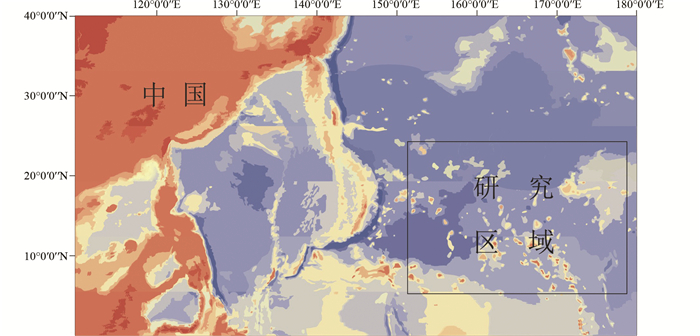
1 地质背景研究区位于西太平洋深水区域(图 1),海盆水深为5000~6500m,呈南东向展布。区域内浅表层沉积物多为上新世到晚白垩世的褐色沸石质远洋粘土,厚约0~40m;下覆地层为晚白垩世坎潘期到土伦期的褐色的白陶土岩和燧石岩。2015年广州海洋地质调查局“海洋六号”船对研究区开展了2个站位的柱状取样和1个站位的温盐深测量和海水取样(CTD),期岩心剖面岩性特征如下。
|
图 1 西太平洋研究区位置图 Fig. 1 Location of research area in the Western Pacific region |
GC1站位水深5652m,样品共厚800cm,岩心剖面从颜色、岩性区分为两段,上段:0~280cm,为褐色,颜色和质地均一,无味。表层沉积物含水率较高,呈弱粘性,沉积物手搓颗粒感较强;下段:280~800cm,含水率降低,呈强粘性,深褐色,颜色和质地均一,手搓略有颗粒感,现场涂片鉴定结果为含沸石粘土。
GC2站位水深5163m,岩芯长800cm,样品从颜色、岩性分为两段,上段:0~350cm,为褐色且质地均一,无味。表层沉积物含水率较高,呈弱粘性,沉积物手搓略有颗粒感;下段:350~800cm,含水率降低,呈强粘性。深褐色,颜色与质地均一,无味,手搓略有颗粒感,镜下可见一定量的鱼骨片,鉴定结果为含沸石粘土。
2 样品与分析方法对2个站位共66个沉积物样品进行了常量元素、微量元素和稀土元素分析,样品烘干粉碎并研磨至200目待测,沉积物主微量和REE分析流程:
主量元素:称取0.6g样品和6g的Li2B4O7-LiBO2-LiF混合熔剂(质量比为4.5:1:0.4),在铂-金合金坩埚内混匀于高频感应熔样机上制得熔融玻璃片,使用PANalytical X荧光光谱仪AXIOS XRF进行检测,检测限为0.01%~0.10%。
微量和稀土元素:称样约0.1g置于Teflon溶样罐中加入4mL 50%的HCl、10mL纯HF和2mL纯HClO4摇匀置于电热板加热蒸干溶液,之后加入4mL 50%的HCl摇匀至充分溶解,加超纯水冲洗加热至溶液澄清透亮约30min后,冷却并定容至25mL待测。
样品中的REY和微量元素测试在国土资源部海底矿产资源重点实验室电感耦合等离子质谱(ICP-MS)上完成,部分浓度较大元素(Cu、Co、Ni、Zn、Sr、Ba和V)使用等离子光谱(ICP-OES)进行测试,采用深海沉积物标准样品GBW07313、GBW07315和GBW07316进行监控,分析精度好于5%。
底层海水样品源于CTD海水取样,取样深度为5663m(距底50m),海水的REY分析流程:取40mL海水样品至离心管中。往每个样品中加入1mL镓(Ga)沉淀剂(5×10⁻⁶),震荡均匀。样品中加入体积约为400μL的NaOH,混匀后,过夜静置,之后离心5min(3000r·min-1),弃去上清液。加少量纯水润洗剩余固体,并加入0.5mL HNO3使其溶解,混匀后静置1h。之后转入5mL离心管中,用超纯水润洗三次,溶液均转移至离心管。最后加超纯水定容至4mL,待上机分析。
海水分析工作在国家海洋局第三海洋研究所完成,REE测试使用Thermo iCAP-Q电感耦合等离子体质谱仪(ICP-MS),实验中对实际海水样品进行加标回收实验,回收率的范围为107.16%~136.84%。
稀土元素含量使用澳大利亚后太古代页岩(PAAS)进行标准化(McLeannan, 1989),Ce/Ce*、Eu/Eu*和Y/Y*的计算参照(Bau and Dulski, 1996):Ce/Ce*=CeN/(1/2LaN+1/2PrN),Eu/Eu*=EuN/(1/2SmN+1/2GdN),Y/Y*=YN/(1/2DyN+1/2HoN),MREE/MREE*据(Chen et al., 2015):MREE/MREE*= 2×average (MREE)/(average (LREE) + average (HREE))。
3 分析结果样品分析结果已列入表 1、表 2和表 3中。沉积物样品主要由SiO2、Al2O3、Fe2O3、Na2O、MgO、K2O、CaO、MnO、TiO2和P2O5等氧化物组成,其中以来源于陆源碎屑的铝硅酸盐SiO2和Al2O3含量最高,平均值分别为48.62%(±2.79, n=66)和15.32%(±0.91, n=66),均随着剖面向下含量呈逐渐下降趋势。同样来自于碎屑矿物的TiO2、MgO和Na2O并未随着剖面深度发生较大变化,均值分别为:0.80%(±0.07, n=66)、3.08%(±0.76, n=66)和4.08%(±0.80, n=66)。与海洋自生组份相关的P2O5和CaO剖面上变化无明显规律,平均含量为:1.17%(±0.39, n=66)和2.20%(±0.52, n=66);与上地壳平均值(Taylor and McLennan, 1985)相比,沉积物中Co、Ni、Cu、Zn、V、Mo、U和Cd等微量元素较为富集,其中Co、Ni、Cu和Mo含量均远远大于上地壳,约为上地壳含量的5~20倍,总体上Ba>Cu>Ni>Sr>Zn>Co>V>Mo>Th>U>Cd;样品稀土元素总含量∑REY变化较大(554×10-6~1620×10-6),其中GC1剖面∑REY含量相对较小,平均值为730×10-6(±134, n=33),GC2剖面平均含量1038×10-6(±186, n=33)。轻稀土元素(La-Eu)总量(∑LREE)与重稀土元素(Gd-Lu)总量(∑HREE)比值变化较小,为0.96~1.55。采用(La/Yb)N、(La/Sm)N和(Sm/Yb)N分别代表轻稀土(LREE, La-Nd)、中稀土(MREE, Sm-Dy)和重稀土(HREE, Ho-Lu+Y)之间的比值关系,沉积物(La/Yb)N、(La/Sm)N和(Sm/Yb)N平均值分别为0.50(±0.05, n=66)、0.53(±0.05, n=66)和0.95(±0.04, n=66),中稀土和重稀土富集程度相似。两个柱状站位的Ce/Ce*值为0.19~0.54,平均值0.39(±0.07, n=66),强烈的Ce负异常。Eu/Eu*和Y/Y*变化范围较小,均值分别为0.95(±0.07, n=66)和1.04(±0.02, n=66),无Eu和Y的异常现象。
|
表 1 沉积物的主量元素分析结果(wt%) Table 1 Major elements concentration of sediment (wt%) |
|
|
表 2 沉积物微量元素测试结果(×10-6) Table 2 trace elements concentration of sediment (×10-6) |
|
|
表 3 沉积物(×10-6)及底层海水(×10-12)稀土元素测试结果 Table 3 REY concentration of sediment (×10-6) and bottom seawater (×10-12) |
底层海水样品∑REY含量为80.0×10⁻¹²,∑LREE/∑HREE值为0.77,较沉积物偏小,(La/Yb)N、(La/Sm)N和(Sm/Yb)N值分别为0.47、1.1和0.43,重稀土富集,轻稀土和中稀土较亏损,Eu/Eu*值为1.15,轻微的Eu正异常。Y/Y*值2.25,Y表现为正异常。
4 讨论 4.1 沉积物的形成环境沉积物的氧化还原环境影响着稀土元素的吸附和解吸附作用以及富稀土微粒的溶解,从而导致稀土元素的再分化(Elderfield and Sholkovitz, 1987; Sholkovitz et al., 1989; Haley et al., 2004; Bayon et al., 2011; Kim et al., 2012; Himmler et al., 2013; Soyol-Erdene and Huh, 2013),Chen et al. (2015)认为氧化还原作用对稀土元素在早期成岩时期的吸附作用有较大影响。
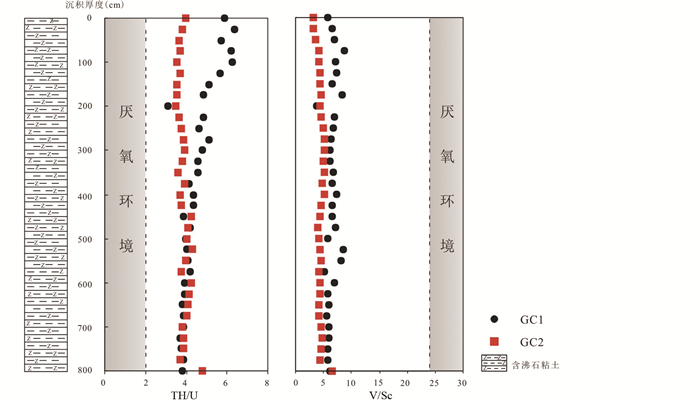
微量元素中的氧化还原敏感元素(如:Ni、U、V和Mo等)之间的比值关系是衡量沉积环境的重要信息(Yarincik et al., 2000; Guo et al., 2007)。例如:Th/U的比值常用于识别海洋沉积物的氧化还原环境,当Th/U>2时意味着氧化的沉积环境(Wignall and Twitchett, 1996; Kimura and Watanabe, 2001;邓义楠等, 2015a)。水体逐渐氧化,Th/U的值也会随之升高。V优先富集于处在厌氧或近于厌氧环境的沉积物中(Calvert and Pedersen, 1993),V/Sc>24(Kimura and Watanabe, 2001)表明海洋沉积物处于还原环境。GC1和GC2站位样品Th/U值为3.46~6.38,V/Sc值变化范围为:3.09~8.69,均处于氧化的沉积环境(图 2),意味着研究区域浅表层-较深层的样品可能均处于氧化或次氧化的沉积环境,样品孔隙水中的Mn和SO42-离子的变化特征也从侧面验证了这一结论(邓义楠等,内部讨论)。远洋低的生物生产率和底层海水受氧化的南极底流影响,或许是其沉积物的普遍氧化的重要原因。
|
图 2 沉积物岩性以及Th/U和V/Sc值变化特征 Fig. 2 Column and variations of Th/U and V/Sc values in sections |
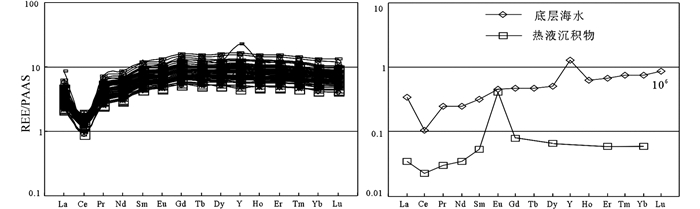
铕作为可变价元素,强还原或具海底热液活动的环境可使Eu3+被还原为Eu2+而出现Eu的正异常(Shields and Stille, 2001)。北太平洋洋中脊的热液沉积物显示出的明显Eu的正异常(图 3;German et al., 1999)。研究区沉积物的Eu/Eu*变化范围较小,均值为0.95,无Eu的异常现象,表明沉积物中富集的REY可能没有热液活动的参与,同时进一步证明沉积物未出现强的还原反应。
|
图 3 研究区沉积物和海水的REE的PAAS标准化配分曲线 热液沉积物源于东太平洋洋中脊(German et al., 1999) Fig. 3 PAAS shale-normalized REE distribution spectra of research area Data source: hydrothermal sediment of East Pacific Rise from German et al. (1999) |
微量元素Co、Ni、Cu和Mo在样品中含量相对于上地壳大量富集,V、Zn、Pb和Cd等元素也有不同程度的富集,上述元素在沉积物中的含量与氧化还原环境有关(Algeo and Maynard, 2004; Tribovillard et al., 2006)。研究区较氧化的沉积环境或许并不利于Ni、Cu、Co和Mo等元素的富集,这些自生的过渡元素可能与深海粘土中Mn的氧化相有关(Glasby, 1991;朱克超等, 2015),深海沉积物中富含粘土、Fe-Mn微粒和磷酸盐矿物等吸附能力较强的物质也许是其富含上述微量元素的主要原因。
4.2 稀土元素的迁移和分馏作用2个站位样品的REE的PAAS配分曲线(图 3)均为轻微向左倾斜,重稀土相对富集((La/Yb)N、(La/Sm)N和(Sm/Yb)N平均值分别为0.50、0.53和0.95),Ce(Ce/Ce*均值为0.39)的负异常,轻微的Gd富集等均符合海水的REE组合特征(Elderfield and Greaves, 1982),指示着富稀土沉积物中的稀土元素可能来源于海水(Kon et al., 2014; Chen et al., 2015)。
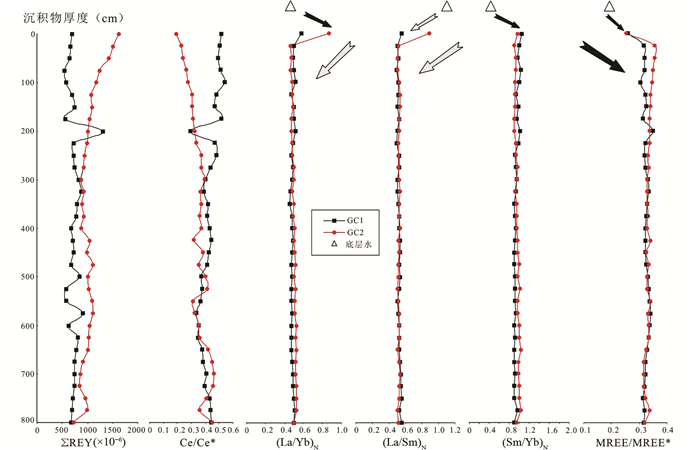
底层海水样品∑REY含量为80.0×10⁻¹²,轻稀土与重稀土比值(∑LREE/∑HREE)较小(0.77),重稀土较为富集。轻稀土、中稀土和重稀土之间的比值关系中,底层海水(La/Yb)N、(La/Sm)N和(Sm/Yb)N值分别为0.47、1.1和0.43,重稀土明显富集,轻稀土和中稀土较为亏损(图 4)。海水的稀土来源(如河流)常具有近似页岩的平坦的配分模型(LaN≈CeN≈PrN≈LuN)(Hoyle et al., 1984; Sholkovitz, 1992, 1993; Sholkovitz and Szymczak, 2000)。随着海水深度的增加,稀土的含量逐渐上升(Alibo and Nozaki, 1999)。有机质、Fe和Mn等微粒可大量吸附海水中的稀土元素,且稀土元素活性LREE>MREE>HREE,轻稀土更容易被微粒的吸附和清扫作用影响,导致海水重稀土富集的配分模式(Haley et al., 2004)。海洋中的稀土主要以碳酸盐络合物的形式存在,随着原子序数的上升络合物强度逐渐增强(Luo and Byrne, 2004; Tang and Johannesson, 2010)。底层海水显示出明显的重稀土富集,源于轻稀土易吸附于有机质微粒表面而重稀土在溶液中形成稳定的络合物(Sholkovitz et al., 1994)。
|
图 4 海水和沉积物中稀土元素的变化特征 Fig. 4 Variation characteristics of REY in seawater and marine sediment |
海水-沉积物界面(0cm)的(La/Yb)N与(Sm/Yb)N值在GC1和GC2站位中分别为0.58和0.87,以及1.05和0.97,均明显高于底层海水(图 4),而(La/Sm)N值较低(GC1和GC2的(La/Sm)N分别为0.55和0.89),表明海水-沉积物界面的轻稀土和中稀土含量出现了明显增加。稀土元素的分馏可能与微粒的沉降和分解有关(Haley et al., 2004; Chen et al., 2015)。有机质、铁和锰等富含轻稀土元素的微粒沉降到沉积物表层时发生分解,轻稀土和中稀土的活性高于重稀土(Haley et al., 2004; Sholkovitz et al., 1989),导致其优先从微粒中溶解迁移至沉积物孔隙水中。表层沉积物的吸附作用以及存在残留的微粒使最表层沉积物较为富集轻稀土和中稀土。
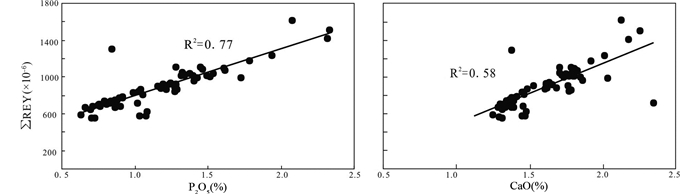
随深度增加,浅层-深层沉积物的(La/Yb)N和(La/Sm)N值骤然减小,在25cm之后趋于稳定,而(Sm/Yb)N基本保持不变(图 4),表明沉积物的中稀土和重稀土含量升高。较深层沉积物稀土元素的分馏可能与吸附作用有关。REY的吸附作用与沉积物中的有机质、Fe-Mn氢氧化物和生物作用下的磷酸盐等密切相关(Chen et al., 2015)。由于吸附作用,携带着富轻稀土元素的有机质或Fe-Mn微粒在氧化或次氧化环境的沉积物中发生再矿化(Sholkovitz et al., 1994; Tachikawa et al., 1997; Arraes-Mescoff et al., 2001; Bayon et al., 2004),沉积剖面向下,释放富轻稀土物质的分解作用减小,或许导致下层沉积物的MREE和HREE浓度升高;Bayon et al. (2011)认为Fe-Mn微粒可能优先释放MREE至沉积物的孔隙水中。Mn的氢氧化物胶体表面具有强的负电荷而易吸附轻稀土,而Fe则形成正电荷胶体吸附大量重稀土(Prakash et al., 2012),最终引起沉积物孔隙水中富中稀土,沉积物吸附孔隙水中的稀土元素可能形成富MREE的沉积物。研究区中稀土富集度(可用MREE/MREE*值代表)如图 4所示,在底层水中较亏损(0.19),至海水-沉积物界面中含量逐渐升高(GC1为0.26,GC2为0.25),浅表层沉积物中(0~25cm)迅速上升达稳定状态(MREE/MREE*平均值值=0.33,n=64),意味着中稀土在底层海水-沉积物系统中产生了逐渐富集的过程。但是,沉积物中富含的生物磷酸盐通过吸附和晶格替换作用也可造成中稀土(Haley et al., 2004; Bright et al., 2009; Chen et al., 2015)以及重稀土的富集。深层沉积物样品主要富集中稀土和重稀土,且稀土元素含量与P元素密切相关(图 5)而与Fe和Mn元素无明显相关关系,表明沉积物中富集的稀土元素受到磷酸盐的影响较大。
|
图 5 ∑REY与P2O5和CaO相关关系图 Fig. 5 Cross plots of ∑REY vs. P2O5 and CaO values |
综上所述,海洋中稀土元素的迁移和分馏主要受到有机质、磷酸盐和Fe-Mn微粒的分解和吸附等作用的综合影响。微粒的吸附和络合物的存在,造成底层海水富集重稀土。富含轻稀土和中稀土的微粒分解,导致海水-沉积物界面相对较富集轻稀土和中稀土。磷酸盐的吸附作用(可能出现重结晶作用)或许是引起较深层沉积物的中稀土和重稀土含量相对升高的直接原因。
4.3 稀土元素的富集机制及物质来源典型的太平洋深海粘土主要来源于亚洲内陆风尘物质(Glasby, 1991),故沉积物样品主要由陆源碎屑来源的SiO2和Al2O3组成。与海洋自生组份相关的P2O5和CaO含量虽较低(平均值分别为1.17%和2.20%),却与稀土元素的富集关系密切。P2O5与∑REY呈明显的正相关关系(图 2),相关系数可达0.77(n=66)。CaO和∑REY也呈一定的正相关关系(图 5),相关系数为0.58(n=66),表明深海沉积物中的P和Ca的含量是稀土元素富集的主要控制因素。
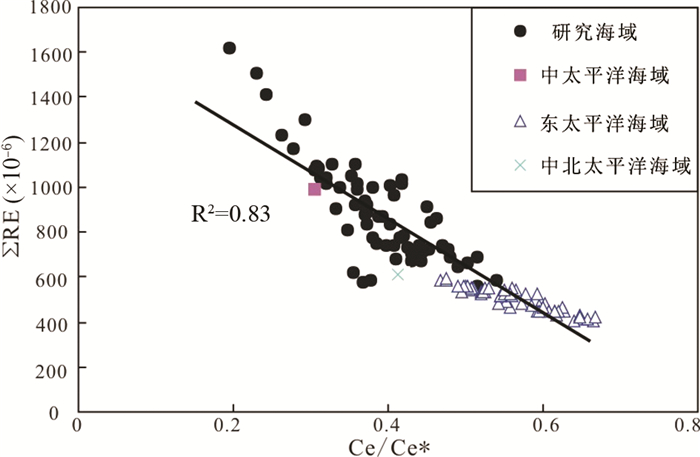
沉积物中Ce的异常常用于判断氧化还原情况(Shields and Stille, 2001; Haley et al., 2004;何高文等, 2011;邓义楠等, 2014; Guo et al., 2016),但陆源碎屑和热液输入的影响可能造成Ce/Ce*值不能有效反映沉积物真实的沉积环境(Nath et al., 1997;邓义楠等, 2014, 2015b)。近期,学者们发现,与海洋生物有关的有机质、磷酸盐或硅酸盐等物质是海洋沉积物中Ce的负异常的主要来源(Guo et al., 2007; Pi et al., 2013;邓义楠等, 2014, 2015b; Guo et al., 2016)。研究区沉积物Ce/Ce*平均值为0.39,与底层海水(Ce/Ce*=0.36)相似,具强烈的Ce负异常。沉积物中Ce/Ce*值的变化情况与∑REY呈相反的趋势(图 4)。与中太平洋(朱克超等, 2015)、中北太平洋(Kato et al., 2011)和东太平洋(任江波等, 2015)等其他海域沉积物进行对比,可知Ce/Ce*与∑REY呈明显的负相关关系(r=0.83,n=131,图 6),表明Ce的负异常亦可用于判断沉积物的总稀土含量。与生物相关的物质在海水中发生长期的物质交换而达到平衡状态(邓义楠等, 2014),具有类似海水的强Ce负异常。深海氧化的沉积物由高Ce/Ce*值的碎屑物质和低Ce/Ce*值的生物自生的有机质、磷酸盐和碳酸盐等组成,Ce的负异常主要由这些自生物质所提供(Guo et al., 2007; Pi et al., 2013;邓义楠等, 2014, 2015b; Guo et al., 2016)。因此,与生物相关的P和Ca等自生物质成为了沉积物稀土元素的主要赋存载体。
|
图 6 海水和沉积物中稀土元素的变化特征 数据来源:中太平洋据朱克超等(2015);中北太平洋据Kato et al. (2011);东太平洋据任江波等(2015) Fig. 6 Cross plots of ∑REY and Ce/Ce* values in Pacific Date source: Central Pacific from Zhu et al. (2015); Central-North Pacific from Kato et al. (2011); and Eastern Pacific from Ren et al. (2015) |
西太平洋深海沉积物富含稀土元素(∑REY平均值可达884×10-6,n=66),含量远高于底层海水(∑REY=80.0×10⁻¹²),其物质来源目前仍存在较大争议(Kato et al., 2011; Kon et al., 2014; Yasukawa et al., 2014)。海洋中的稀土元素的主要来源于河流(Greaves et al., 1994; Sholkovitz et al., 1999)和风成物质,热液活动也能提供一定量的稀土元素(Chen et al., 2015)。然而,沉积物中孔隙流体的输入已经成为海水稀土来源新的重要组成部分(Elderfield and Scholkovitz, 1987; Sholkovitz et al., 1989; Sholkovitz, 1992; Haley and Klinkhammer, 2003)。浅海及大陆架区域的再矿化的孔隙流体对海洋稀土元素的输入量已逾河流的十倍(Chen et al., 2015)。近期,Abbott et al. (2015)发现较深水的斜坡相沉积物亦可通过孔隙水释放大量的稀土元素至海水,而深水盆地相的孔隙水是否具有类似特征仍未可知。
研究区位于深海盆地相,海水-沉积物界面表现为轻稀土和中稀土的明显增加而深层沉积物则富含中稀土和重稀土,均与底层海水富重稀土及亏损轻稀土和中稀土的特征有较大区别(前文讨论)。沉积物在早期成岩作用时释放稀土元素至孔隙水中(Sholkovitz et al., 1989),斜坡相的沉积物孔隙水与底层海水配分模式相近是底层流体稀土来源的主要判断因素(Abbott et al., 2015)。大洋盆地沉积物的稀土配分模式不同于底层海水可能意味着深水区域孔隙流体并未给海水提供大量的稀土元素。笔者认为,深水沉积物REY的最终来源为海水,其通过扩散和微粒的分解作用使REY释放至孔隙水中,未出现再矿化的孔隙流体扩散至底层海水使沉积物充分吸附孔隙水中的稀土元素。
强吸附作用和宽的氧化或次氧化带(8m厚的沉积物均为氧化或次氧化环境)可能是深海沉积物稀土元素未消耗而得以富集的主要原因。沉积物的中稀土和重稀土元素富集可能是吸附作用的结果,且与生物作用相关的磷酸盐等密切相关。然而,活体生物中的稀土元素含量并不高,稀土元素的富集与其胶原蛋白基质在早期成岩作用中腐烂有关(Tütken et al., 2008)。胶原蛋白的腐烂在磷酸盐骨骼中产生大量的孔隙,导致纳米级的生物磷灰石在成岩流体中重结晶而大量吸附周围环境的稀土元素(Trueman et al., 2004)。吸附作用主要发生在早期成岩阶段,后期成岩阶段发生晶格替换而显示出中稀土的明显富集(Reynard et al., 1999)。沉积物样品的中稀土稍富集但不突出,表明其仍处于以吸附作用为主的早期成岩阶段。与此同时,浅海区域沉积物几毫米之下即为厌氧环境(Elderfield and Sholkovitz, 1987),导致沉积物中富集稀土元素的氧化物发生还原分解(Haley et al., 2004),释放出大量的稀土元素,其通过孔隙水向上输入到海水中。而大洋盆地处于较宽的氧化或次氧化环境(上文讨论),使上层海水带来的富稀土微粒能够充分的分解进入孔隙水中而被沉积物吸附。具有宽泛氧化环境或次氧化环境的深水区域或许能把稀土元素保留在沉积物中,辅以低的沉积速率(每千年几个毫米的沉积速率, 任江波等, 2015)和强的吸附作用,导致稀土元素积累而大量富集。
5 结论(1) 分析了西太平洋深海沉积物和底层海水的稀土和主微量元素地球化学特征,认为沉积物均处于氧化或次氧化的沉积环境;
(2) 太平洋稀土元素在海水和沉积物中的迁移和分馏与微粒的分解以及生物相关的物质吸附作用相关,沉积物相对富集中稀土和重稀土;
(3) 沉积物Ce的负异常可判断稀土元素含量,海洋自生的P和Ca是稀土元素的主要赋存载体。沉积物的REY主要来源于海水,稀土元素的富集是宽氧化或次氧化环境、低沉积速率以及强吸附能力的生物相关物质共同作用的结果。
致谢 样品分析和测试过程中得到了中国地质调查局广州海洋地质调查局张欣、王彦美、傅飘儿和于哲工程师的热心帮助;海洋六号船的工作人员协同完成了样品的采集和制备工作;在此表示最诚挚的谢意。
Abbott AN, Haley BA, McManus J and Reimers CE. 2015. The sedimentary flux of dissolved rare earth elements to the ocean. Geochimica et Cosmochimica Acta, 154: 186-200. DOI:10.1016/j.gca.2015.01.010 |
Algeo TJ and Maynard JB. 2004. Trace-element behavior and redox facies in core shales of Upper Pennsylvanian Kansas-type cyclothems. Chemical Geology, 206(3-4): 289-318. DOI:10.1016/j.chemgeo.2003.12.009 |
Alibo DS and Nozaki Y. 1999. Rare earth elements in seawater:Particle association, shale-normalization, and Ce oxidation. Geochimica et Cosmochimica Acta, 63(3-4): 363-372. DOI:10.1016/S0016-7037(98)00279-8 |
Arraes-Mescoff R, Roy-Barman M, Coppola L, Souhaut M, Tachikawa K, Jeandel C, Sempéré R and Yoro C. 2001. The behavior of Al, Mn, Ba, Sr, REE and Th isotopes during in vitro degradation of large marine particles. Marine Chemistry, 73(1): 1-19. DOI:10.1016/S0304-4203(00)00065-7 |
Arrhenius G, Bramlette MN and Picciotto E. 1957. Localization of radioactive and stable heavy nuclides in ocean sediments. Nature, 180(4576): 85-86. DOI:10.1038/180085a0 |
Bau M and Dulski P. 1996. Distribution of yttrium and rare-earth elements in the Penge and Kuruman iron-formations, Transvaal Supergroup, South Africa. Precambrian Research, 79(1-2): 37-55. DOI:10.1016/0301-9268(95)00087-9 |
Bayon G, German CR, Burton KW, Nesbitt RW and Rogers N. 2004. Sedimentary Fe-Mn oxyhydroxides as paleoceanographic archives and the role of aeolian flux in regulating oceanic dissolved REE. Earth and Planetary Science Letters, 224(3-4): 477-492. DOI:10.1016/j.epsl.2004.05.033 |
Bayon G, Birot D, Ruffine L, Caprais JC, Ponzevera E, Bollinger C, Donval JP, Charlou JL, Voisset M and Grimaud S. 2011. Evidence for intense REE scavenging at cold seeps from the Niger Delta margin. Earth and Planetary Science Letters, 312(3-4): 443-452. DOI:10.1016/j.epsl.2011.10.008 |
Bright CA, Cruse AM, Lyons TW, MacLeod KG, Glascock MD and Ethington RL. 2009. Seawater rare-earth element patterns preserved in apatite of Pennsylvanian conodonts?. Geochimica et Cosmochimica Acta, 73(6): 1609-1624. DOI:10.1016/j.gca.2008.12.014 |
Calvert SE and Pedersen TF. 1993. Geochemistry of recent oxic and anoxic marine sediments:Implications for the geological record. Marine Geology, 113(1-2): 67-88. DOI:10.1016/0025-3227(93)90150-T |
Chen JB, Algeo TJ, Zhao LS, Chen ZQ, Cao L, Zhang L and Li Y. 2015. Diagenetic uptake of rare earth elements by bioapatite, with an example from Lower Triassic conodonts of South China. Earth-Science Reviews, 149: 181-202. DOI:10.1016/j.earscirev.2015.01.013 |
Deng YN, Guo QJ, Zhu MY and Zhang JM. 2014. REE geochemistry of Kerogen from Early Cambrian black rock series in western Hunan. Earth Science (Journal of China University of Geosciences), 39(3): 283-292. |
Deng YN, Guo QJ, Zhu MY and Zhang JM. 2015a. Trace element geochemistry characteristics of Niutitang Formation from Lower Cambrian black rock series in western Hunan. Bulletin of Mineralogy, Petrology and Geochemistry, 34(2): 410-418. |
Deng YN, Guo QJ, Zhu MY, Liu J and Chen DH. 2015b. REE geochemical characteristics in organic matters and their indicative significance for Palaeoenvironmental analysis. Geological Review, 61(Supp1.): 622-623. |
Dubinin AV. 2000. Geochemistry of rare earth elements in oceanic phillipsites. Lithology and Mineral Resources, 35(2): 101-108. DOI:10.1007/BF02782672 |
Elderfield H and Greaves MJ. 1982. The rare earth elements in seawater. Nature, 296(5854): 214-219. DOI:10.1038/296214a0 |
Elderfield H and Sholkovitz ER. 1987. Rare earth elements in the pore waters of reducing nearshore sediments. Earth and Planetary Science Letters, 82(3-4): 280-288. DOI:10.1016/0012-821X(87)90202-0 |
Emsbo P, McLaughlin PI, Breit GN, Du Bray EA and Koenig AE. 2015. Rare earth elements in sedimentary phosphate deposits:Solution to the global REE crisis?. Gondwana Research, 27(2): 776-785. DOI:10.1016/j.gr.2014.10.008 |
German CR, Hergt J, Palmer MR and Edmond JM. 1999. Geochemistry of a hydrothermal sediment core from the OBS vent-field, 21oN East Pacific Rise. Chemical Geology, 155(1-2): 65-75. DOI:10.1016/S0009-2541(98)00141-7 |
Glasby GP. 1991. Mineralogy, geochemistry, and origin of Pacific Red clays:A review. New Zealand Journal of Geology and Geophysics, 34(2): 167-176. DOI:10.1080/00288306.1991.9514454 |
Greaves MJ, Statham PJ and Elderfield H. 1994. Rare earth element mobilization from marine atmospheric dust into seawater. Marine Chemistry, 46(3): 255-260. DOI:10.1016/0304-4203(94)90081-7 |
Guo QJ, Shields GA, Liu CQ, Strauss H, Zhu MY, Pi DH, Goldberg T and Yang XL. 2007. Trace element chemostratigraphy of two Ediacaran-Cambrian successions in South China:Implications for organosedimentary metal enrichment and silicification in the Early Cambrian. Palaeogeography, Palaeoclimatology, Palaeoecology, 254(1-2): 194-216. DOI:10.1016/j.palaeo.2007.03.016 |
Guo QJ, Deng YN, Hippler D, Franz G and Zhang JM. 2016. REE and trace element patterns from organic-rich rocks of the Ediacaran-Cambrian transitional interval. Gondwana Research, 36: 94-106. DOI:10.1016/j.gr.2016.03.012 |
Haley BA and Klinkhammer GP. 2003. Complete separation of rare earth elements from small volume seawater samples by automated ion chromatography:Method development and application to benthic flux. Marine Chemistry, 82(3-4): 197-220. DOI:10.1016/S0304-4203(03)00070-7 |
Haley BA, Klinkhammer GP and McManus J. 2004. Rare earth elements in pore waters of marine sediments. Geochimica et Cosmochimica Acta, 68(6): 1265-1279. DOI:10.1016/j.gca.2003.09.012 |
He GW, Sun XM, Yang SX, Zhu KC and Song CB. 2011. A comparison of REE geochemistry between polymetallic nodules and cobalt-rich crusts in the Pacific Ocean. Geology in China, 38(2): 462-472. |
Himmler T, Haley BA, Torres ME, Klinkhammer GP, Bohrmann G and Peckmann J. 2013. Rare earth element geochemistry in cold-seep pore waters of Hydrate Ridge, Northeast Pacific Ocean. Geo-Marine Letters, 33(5): 369-379. DOI:10.1007/s00367-013-0334-2 |
Hoyle J, Elderfield H, Gledhill A and Greaves M. 1984. The behaviour of the rare earth elements during mixing of river and sea waters. Geochimica et Cosmochimica Acta, 48(1): 143-149. DOI:10.1016/0016-7037(84)90356-9 |
Kang J, Jeong KS, Cho JH, Lee JH, Jang S and Kim SR. 2014. Post-depositional redistribution processes and their effects on middle rare earth element precipitation and the cerium anomaly in sediments in the South Korea Plateau, East Sea. Journal of Asian Earth Sciences, 82: 66-79. DOI:10.1016/j.jseaes.2013.11.019 |
Kato Y, Fujinaga K, Nakamura K, Takaya Y, Kitamura K, Ohta J, Toda R, Nakashima T and Iwamori H. 2011. Deep-sea mud in the Pacific Ocean as a potential resource for rare-earth elements. Nature Geoscience, 4(8): 535-539. DOI:10.1038/ngeo1185 |
Kim JH, Torres ME, Haley BA, Kastner M, Pohlman JW, Riedel M and Lee YJ. 2012. The effect of diagenesis and fluid migration on rare earth element distribution in pore fluids of the northern Cascadia accretionary margin. Chemical Geology, 291: 152-165. DOI:10.1016/j.chemgeo.2011.10.010 |
Kimura H and Watanabe Y. 2001. Oceanic anoxia at the Precambrian-Cambrian boundary. Geology, 29(11): 995-998. DOI:10.1130/0091-7613(2001)029<0995:OAATPC>2.0.CO;2 |
Kon Y, Hoshino M, Sanematsu K, Morita S, Tsunematsu M, Okamoto N, Yano N, Tanaka M and Takagi T. 2014. Geochemical characteristics of apatite in Heavy REE-rich deep-sea mud from Minami-Torishima area, southeastern Japan. Resource Geology, 64(1): 47-57. DOI:10.1111/rge.2014.64.issue-1 |
Kynicky J, Smith MP and Xu C. 2012. Diversity of rare earth deposits:The key example of China. Elements, 8(5): 361-367. DOI:10.2113/gselements.8.5.361 |
Liu JH, Zhang LJ and Liang HF. 1994. The REE geochemistry of sediments in core cc48 from the East Pacific Ocean. Oceanologia et Limnologia Sinica, 25(1): 15-22. |
Long KR, Van Gosen BS, Foley NK and Cordier D. 2010. The principal rare earth elements deposits of the United States: A summary of domestic deposits and a global perspective. In: Sinding-Larsen R and Wellmer FW (eds. ). Non-Renewable Resource Issues. Dordrecht: Springer, 131-155
|
Luo YR and Byrne RH. 2004. Carbonate complexation of yttrium and the rare earth elements in natural waters. Geochimica et Cosmochimica Acta, 68(4): 691-699. DOI:10.1016/S0016-7037(03)00495-2 |
McLennan SM. 1989. Rare earth elements in sedimentary rocks:Influence of provenance and sedimentary processes. Reviews in Mineralogy and Geochemistry, 21(1): 169-200. |
Nath BN, Bau M, Rao BR and Rao CM. 1997. Trace and rare earth elemental variation in Arabian Sea sediments through a transect across the oxygen minimum zone. Geochimica et Cosmochimica Acta, 61(12): 2375-2388. DOI:10.1016/S0016-7037(97)00094-X |
Pi DH, Liu CQ, Shields-Zhou GA and Jiang SY. 2013. Trace and rare earth element geochemistry of black shale and kerogen in the Early Cambrian Niutitang Formation in Guizhou Province, South China:Constraints for redox environments and origin of metal enrichments. Precambrian Research, 225: 218-229. DOI:10.1016/j.precamres.2011.07.004 |
Prakash LS, Ray D, Paropkari AL, Mudholkar AV, Satyanarayanan M, Sreenivas B, Chandrasekharam D, Kota D, Raju KAK, Kaisary S, Balaram V and Gurav T. 2012. Distribution of REEs and yttrium among major geochemical phases of marine Fe-Mn-oxides:Comparative study between hydrogenous and hydrothermal deposits. Chemical Geology, 312-313: 127-137. DOI:10.1016/j.chemgeo.2012.03.024 |
Ren JB, Yao HQ, Zhu KC, He GW, Deng XG, Wang HF, Liu JY, Fu PE and Yang SX. 2015. Enrichment mechanism of rare earth elements and yttrium in deep-sea mud of Clarion-Clipperton Region. Earth Science Frontiers, 22(4): 200-211. |
Reynard B, Lécuyer C and Grandjean P. 1999. Crystal-chemical controls on rare-earth element concentrations in fossil biogenic apatites and implications for paleoenvironmental reconstructions. Chemical Geology, 155(3-4): 233-241. DOI:10.1016/S0009-2541(98)00169-7 |
Service RF. 2010. Nations move to head off shortages of rare earths. Science, 327(5973): 1596-1597. DOI:10.1126/science.327.5973.1596 |
Shen HT. 1990. Rare earth elements in deep-sea sediments. Geochimica, 20(4): 340-348. |
Shields G and Stille P. 2001. Diagenetic constraints on the use of cerium anomalies as palaeoseawater redox proxies:An isotopic and REE study of Cambrian phosphorites. Chemical Geology, 175(1-2): 29-48. DOI:10.1016/S0009-2541(00)00362-4 |
Sholkovitz ER, Piepgras DJ and Jacobsen SB. 1989. The pore water chemistry of rare earth elements in Buzzards Bay sediments. Geochimica et Cosmochimica Acta, 53(11): 2847-2856. DOI:10.1016/0016-7037(89)90162-2 |
Sholkovitz ER. 1992. Chemical evolution of rare earth elements:Fractionation between colloidal and solution phases of filtered river water. Earth and Planetary Science Letters, 114(1): 77-84. DOI:10.1016/0012-821X(92)90152-L |
Sholkovitz ER. 1993. The geochemistry of rare earth elements in the Amazon River estuary. Geochimica et Cosmochimica Acta, 57(10): 2181-2190. DOI:10.1016/0016-7037(93)90559-F |
Sholkovitz ER, Landing WM and Lewis BL. 1994. Ocean particle chemistry:The fractionation of rare earth elements between suspended particles and seawater. Geochimica et Cosmochimica Acta, 58(6): 1567-1579. DOI:10.1016/0016-7037(94)90559-2 |
Sholkovitz ER, Elderfield H, Szymczak R and Casey K. 1999. Island weathering:River sources of rare earth elements to the Western Pacific Ocean. Marine Chemistry, 68(1-2): 39-57. DOI:10.1016/S0304-4203(99)00064-X |
Sholkovitz ER and Szymczak R. 2000. The estuarine chemistry of rare earth elements:Comparison of the Amazon, Fly, Sepik and the Gulf of Papua systems. Earth and Planetary Science Letters, 179(2): 299-309. DOI:10.1016/S0012-821X(00)00112-6 |
Soyol-Erdene TO and Huh Y. 2013. Rare earth element cycling in the pore waters of the Bering Sea Slope (IODP Exp. 323). Chemical Geology, 358: 75-89. DOI:10.1016/j.chemgeo.2013.08.047 |
Stonecipher SA. 1976. Origin, distribution and diagenesis of phillipsite and clinoptilolite in deep-sea sediments. Chemical Geology, 17: 307-318. DOI:10.1016/0009-2541(76)90044-9 |
Tachikawa K, Handel C and Dupré B. 1997. Distribution of rare earth elements and neodymium isotopes in settling particulate material of the tropical Atlantic Ocean (EUMELI site). Deep Sea Research Part Ⅰ:Oceanographic Research Papers, 44(11): 1769-1792. DOI:10.1016/S0967-0637(97)00057-5 |
Tang JW and Johannesson KH. 2010. Ligand extraction of rare earth elements from aquifer sediments:Implications for rare earth element complexation with organic matter in natural waters. Geochimica et Cosmochimica Acta, 74(23): 6690-6705. DOI:10.1016/j.gca.2010.08.028 |
Taylor SR and McLennan SM. 1985. The Continental Crust:Its Composition and Evolution:An Examination of the Geochemical Record Preserved in Sedimentary Rocks. London: Blackwell: 57-72.
|
Toyoda K., Nakamura Y and Masuda A. 1990. Rare earth elements of Pacific pelagic sediments. Geochimica et Cosmochimica Acta, 54(4): 1093-1103. DOI:10.1016/0016-7037(90)90441-M |
Tribovillard N, Algeo TJ, Lyons T and Riboulleau A. 2006. Trace metals as paleoredox and paleoproductivity proxies:An update. Chemical Geology, 232(1-2): 12-32. DOI:10.1016/j.chemgeo.2006.02.012 |
Trueman CNG, Behrensmeyer AK, Tuross N and Weiner S. 2004. Mineralogical and compositional changes in bones exposed on soil surfaces in Amboseli National Park, Kenya:Diagenetic mechanisms and the role of sediment pore fluids. Journal of Archaeological Science, 31(6): 721-739. DOI:10.1016/j.jas.2003.11.003 |
Tütken T, Vennemann TW and Pfretzschner HU. 2008. Early diagenesis of bone and tooth apatite in fluvial and marine settings:Constraints from combined oxygen isotope, nitrogen and REE analysis. Palaeogeography, Palaeoclimatology, Palaeoecology, 266(3-4): 254-268. DOI:10.1016/j.palaeo.2008.03.037 |
Wang FL, He GW, Sun XM, Yang Y and Zhao TP. 2016. The host of REE+Y elements in deep-sea sediments from the Pacific Ocean. Acta Petrologica Sinica, 32(7): 2057-2068. |
Wignall PB and Twitchett RJ. 1996. Oceanic anoxia and the End Permian Mass Extinction. Science, 272(5265): 1155-1158. DOI:10.1126/science.272.5265.1155 |
Yarincik KM, Murray RW, Lyons TW, Peterson LC and Haug GH. 2000. Oxygenation history of bottom waters in the Cariaco Basin, Venezuela, over the past 578, 000 years:Results from redox-sensitive metals (Mo, V, Mn, and Fe). Paleoceanography and Paleoclimatology, 15(6): 593-604. |
Yasukawa K, Liu HJ, Fujinaga K, Machida S, Haraguchi S, Ishii T, Nakamura K and Kato Y. 2014. Geochemistry and mineralogy of REY-rich mud in the eastern Indian Ocean. Journal of Asian Earth Sciences, 93: 25-36. DOI:10.1016/j.jseaes.2014.07.005 |
Zhu KC, Ren JB, Wang HF and Lu FF. 2015. Enrichment mechanism of REY and geochemical characteristics of REY-rich pelagic clay from the central Pacific. Earth Science (Journal of China University of Geosciences), 40(6): 1052-1060. DOI:10.3799/dqkx.2015.087 |
邓义楠, 郭庆军, 朱茂炎, 张俊明. 2014. 湘西寒武纪早期黑色岩系中干酪根的稀土元素地球化学特征. 地球科学-中国地质大学学报, 39(3): 283-292. |
邓义楠, 郭庆军, 朱茂炎, 张俊明. 2015a. 湘西下寒武统牛蹄塘组黑色岩系的微量元素地球化学特征. 矿物岩石地球化学通报, 34(2): 410-418. |
邓义楠, 郭庆军, 朱茂炎, 刘坚, 陈道华. 2015b. 有机质中稀土元素的地球化学特征对恢复古海洋环境的指示意义. 地质论评, 61(增): 622-623. |
何高文, 孙晓明, 杨胜雄, 朱克超, 宋成兵. 2011. 太平洋多金属结核和富钴结壳稀土元素地球化学对比及其地质意义. 中国地质, 38(2): 462-472. |
刘季花, 张丽洁, 梁洪峰. 1994. 太平洋东部CC48孔沉积物稀土元素地球化学研究. 海洋与湖沼, 25(1): 15-22. |
任江波, 姚会强, 朱克超, 何高文, 邓希光, 王海峰, 刘纪勇, 傅飘儿, 杨胜雄. 2015. 稀土元素及钇在东太平洋CC区深海泥中的富集特征与机制. 地学前缘, 22(4): 200-211. |
沈华悌. 1990. 深海沉积物中的稀土元素. 地球化学, 20(4): 340-348. |
王汾连, 何高文, 孙晓明, 杨阳, 赵太平. 2016. 太平洋富稀土深海沉积物中稀土元素赋存载体研究. 岩石学报, 32(7): 2057-2068. |
朱克超, 任江波, 王海峰, 陆红锋. 2015. 太平洋中部富REY深海粘土的地球化学特征及REY富集机制. 地球科学-中国地质大学学报, 40(6): 1052-1060. |