 2017, Vol. 33


2. 南华大学核资源工程学院, 衡阳 421001
2. School of Nuclear Resource Engineering, University of South China, Hengyang 421001, China
斑岩矿床是目前世界上最重要的矿床类型,该类型矿床的铜、钼、金产量分别占到了全世界产量的3/4、1/2和1/5(Sillitoe, 2010)。研究表明斑岩矿床的形成往往与洋壳俯冲和大陆碰撞构造背景下的浅成-超浅成岩浆活动有关(Sillitoe, 1973; Richards, 2009),因此与该类型矿床相关的岩浆岩的成因,含矿流体的出溶机制以及相应的找矿勘查标志一直是矿床学研究的热点和重点(Wilkinson, 2013; Xie et al., 2015; 毛景文等, 2014)。
多龙矿集区是近年来在我国西藏地区继玉龙、驱龙、雄村等大型、超大型斑岩矿床之后新发现的斑岩-浅成低温热液型铜金矿集区(曲晓明和辛洪波, 2006; 唐菊兴等, 2010; 杨志明等, 2008; Hou et al., 2003; Mao et al., 2014)。最新的勘查结果表明该矿集区铜的资源控制量超过1600万吨,金超过200吨,并有望成为世界级的铜金矿集区(唐菊兴等, 2014, 2016),同时该矿集区的发现也预示着该缝合带极有可能成为下一个重要的斑岩铜矿成矿带(曲晓明等, 2012)。
近年来,国内多个研究团队对多龙矿集区开展了大量的研究工作(曲晓明和辛洪波, 2006; 佘宏全等, 2006, 2009; 李光明等, 2007; 李金祥等, 2008; 祝向平等, 2011; 李玉彬等, 2012; 张志等, 2014; 杨超等, 2014; 方向等, 2015; 唐菊兴等, 2014, 2016; Li et al., 2011, 2013, 2014, 2016; Zhou et al., 2015; Zhu et al., 2015; Duan et al., 2016; Lin et al., 2017; Sun et al., 2017)。上述工作较为详细地厘定了矿集区的成岩成矿时限,初步论证了岩浆岩的源区特征和演化过程,同时也对矿集区内部分典型矿床(多不杂、铁格隆南等)的矿床地质特征、流体性质、成矿模型等问题开展了研究和讨论。虽然该地区工作程度较高,但对于岩浆岩的成因及其与成矿作用的相互关系以及对找矿勘查工作的指示意义仍缺乏系统和全面的讨论。因此本次工作在系统梳理前人工作基础上选择了与成矿作用具有紧密时空联系的岩浆岩为研究对象,在翔实野外地质调查基础上,开展了岩石地球化学、Sr-Nd-Hf同位素以及电子探针等实验工作,尝试探讨成岩成矿过程,成矿物质来源及其找矿勘查标志。
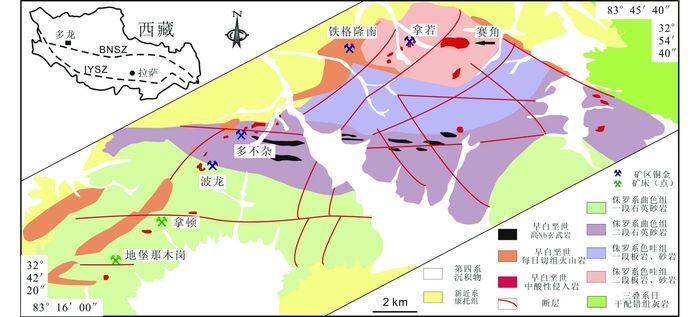
1 区域地质背景多龙矿集区位于班公湖-怒江缝合带(BNSZ)(以下简称班-怒带)北缘(图 1),该带西起班公湖,横跨西藏高原中部,经左贡扎玉进入云南,再往南进入泰国清迈和马来西亚的劳勿,整体延长3000km (李光明等, 2011)。区域岩石学研究认为,该缝合带的存在代表了已消失的班公湖-怒江洋盆(Zhu et al., 2013)。陈玉禄等(2005)在班-怒带中段发现了上三叠统确哈拉群与下伏岩系呈角度不整合接触,并且接触带中发现了可能代表古特提斯洋的蛇绿岩,因此推测该缝合带在晚三叠世之后打开,并认为该缝合带是在古特提斯洋基础上继承和发展起来的。鲍佩声等(2007)对洞错OIB类型的蛇绿岩进行的SHRIMP U-Pb锆石测年获得了132Ma的成岩年龄,该结果指示班-怒带俯冲作用持续到了早白垩世。朱弟成等(2006)、耿全如等(2011)和杜德道等(2011)对沿该缝合带南北分布的岩浆岩的地球化学特征和锆石U-Pb年代学的研究并结合最新的区域地质填图结果认为班公湖-怒江洋盆在白垩纪可能存在向南和向北的双向俯冲。
|
图 1 多龙矿集区地质简图(据西藏地质矿产开发局第五地质大队, 2010①修改) BNSZ:班公湖-怒江缝合带;IYSZ:雅鲁藏布江缝合带 Fig. 1 Simplified geologic map of the Duolong district and its position in Tibet, China BNSZ : Banggong-Nujiang suture zone; IYSZ : Indus-Yarlung suture zone |
① 西藏地质矿产开发局第五地质大队. 2010.多不杂铜矿普查结题报告
2 多龙矿集区地质特征多龙矿集区内出露地层主要为下三叠统日干配错组大理岩化灰岩、下侏罗统曲色组石英砂岩、色哇组砂质板岩、长石石英砂岩、下白垩统美日切组安山岩、第三系康托组泥岩、砂岩、砾岩和第四系(图 1)。矿集区内岩浆活动强烈并持续时间较长,早期(143Ma)为高Nb玄武岩(李金祥等, 2008),晚期(120~105Ma)侵入岩主要为花岗闪长斑岩、石英闪长玢岩和石英闪长岩等,火山岩则有玄武安山岩、安山岩等(Li et al., 2011)。此外,矿集区内断裂构造发育,有近EW向、NE向、NW向三组断裂构造,具多期次活动特征。其中,NE向断裂带控制了多不杂、波龙、荣那、拿若等矿床及地堡那木岗、拿顿等矿点的斑岩体和同期玄武安山岩、安山岩等火山岩的产出,为矿集区内主要的岩浆岩侵位通道和控矿构造(图 1)。
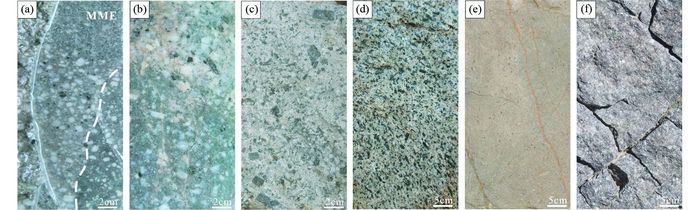
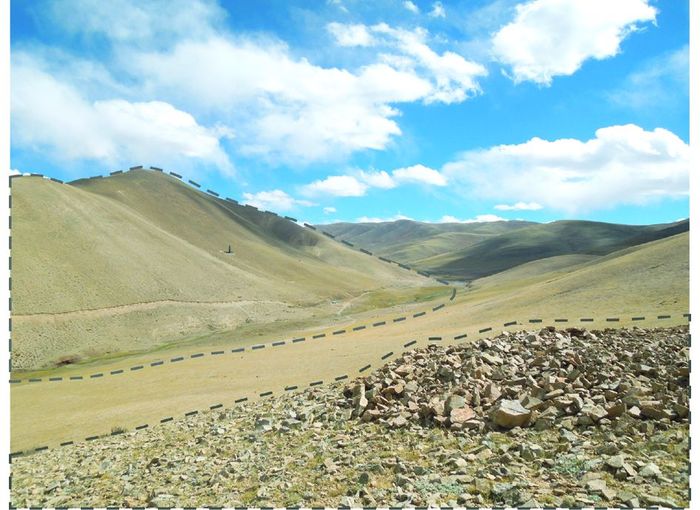
多龙矿集区内现已发现多不杂、波龙、拿若和荣那(铁格隆南)等四个大型-超大型矿床。钻孔编录结果显示上述矿床均发育多期含矿斑岩体(图 2a, b),岩性以闪长质和花岗闪长质为主,并可见少量暗色包体产出(图 2a)。此外,野外地质填图在多不杂和拿若矿床附近还发现有不含矿(热液蚀变矿物不发育、石英-硫化物脉不发育,并且Cu、Au品位远低于工业开采水平)的新鲜石英闪长玢岩和花岗闪长斑岩(图 2c、图 3),同时在赛角可见石英闪长岩呈较大规模产出(图 2d),该岩体内部普遍发育暗色包体(李兴奎等, 2015)。前人研究(李光明等, 2007; 祝向平等, 2011; Sun et al., 2017)表明多不杂、波龙和拿若等矿床蚀变和矿化特征与典型的斑岩型铜金矿床一致(Arancibia and Clark, 1996; Proffett, 2003),热液蚀变主要为钾长石化、绢英岩化、泥化、青磐岩化等类型,铜金矿化主要和钾化蚀变及相关的热液脉体(如石英-钾长石-磁铁矿-黄铜矿脉等)有关(佘宏全等, 2006; 李光明等, 2007; 张志等, 2014)。而荣那(铁格隆南)矿床则表现出更为完整的热液演化体系,由上到下表现为:高级泥化蚀变带、绢英岩化带和钾化带,矿化作用主要和高级泥化蚀变及相关产出的石英-硫化物脉体有关(杨超等, 2014; 李光明等, 2015; Lin et al., 2017)。
|
图 2 多龙矿集区岩浆岩手标本照片 (a)波龙矿床两期含矿石英闪长玢岩(白线分割)并发育暗色包体;(b)多不杂矿区早期含矿花岗闪长斑岩(上方)被晚期石英闪长玢岩(下方)侵入;(c)多不杂矿区不含矿的新鲜石英闪长玢岩;(d)赛角石英闪长岩;(e)拿顿玄武安山岩;(f)铁格隆南(荣那)矿区安山岩 Fig. 2 Features of igneous rocks at the Duolong district (a) two phases of economically mineralized quartz diorite porphyry (separated by dashed line) with the occurrence of MME, Bolong deposit; (b) granodiorite porphyry (upper part) was intruded by quartz diorite porphyry (lower part), Duobuza deposit; (c) fresh granodiorite porphyry with no alteration and mineralization, Duobuza deposit; (d) quartz diorite, Saijiao; (e) basaltic andesite, Nadun; (f) andesite, Tiegelongnan (Rongna) deposit |
|
图 3 拿若矿床含矿花岗闪长斑岩体(左上方虚线内)与不含矿的新鲜花岗闪长斑岩(右下方虚线内)的野外空间关系 Fig. 3 The spatial relationship between economically mineralized granodiorite porphyry (upper left) and fresh granodiorite porphyry lacks of alteration and mineralization (lower right), Naruo deposit |
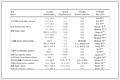
本次工作系统采集了多不杂、波龙和拿若斑岩型铜金矿中受蚀变影响较弱的含矿石英闪长玢岩、花岗闪长斑岩以及多不杂和拿若矿区内不含矿的新鲜石英闪长玢岩、花岗闪长斑岩,同时也采集了在赛角产出的石英闪长岩、拿顿矿点的玄武安山岩以及荣那矿床的安山岩(表 1)。现将相关具代表性的岩性特征简述如下:
|
表 1 岩浆岩样品采集位置与岩相学描述 Table 1 Sampling locations and petrological characteristics |
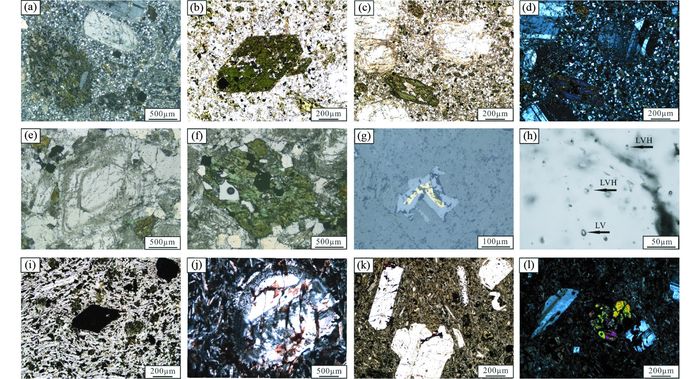
石英闪长玢岩:岩石呈灰绿色,班状结构、块状构造。斑晶主要为斜长石(约占25%),呈自形-半自形板状(0.2×0.3cm~0.4×1.2cm),聚片双晶及环带构造发育;角闪石(约占10%~15%),呈自形-半自形产出(0.3×0.4cm~0.3×1.5cm);石英(约占5%~10%),呈他形、浑圆状(0.2×0.3cm~0.4×0.5cm)。基质以石英、斜长石、黑云母、角闪石为主,具显微晶质结构。该岩性含矿岩体整体受后期蚀变影响较强,角闪石斑晶大多已被绿泥石和黑云母交代并呈交代假象结构产出(图 4a),而不含矿岩体则保持新鲜(图 4c, d)。
|
图 4 多龙矿集区典型岩浆岩镜下显微照片 (a)波龙矿床含矿石英闪长斑岩中角闪石被次生黑云母、次生绿泥石交代,单偏光;(b)拿若不含矿花岗闪长斑岩,单偏光;单偏光(c)与正交偏光(d)下多不杂不含矿石英闪长玢岩;(e)赛角石英闪长岩中斜长石斑晶周围角闪石已发生黑云母化蚀变,单偏光;(f)赛角石英闪长岩角闪石斑晶局部发生绿泥石化蚀变,单偏光;(g)赛角石英闪长岩中黄铜矿与磁铁矿共生,反射光;(h)赛角石英闪长岩石英颗粒中气相包裹体(LV)与含子晶多相包裹体(LVH)共存,单偏光;(i)拿顿玄武安山岩角闪石斑晶已全部暗化,单偏光;(j)拿顿玄武安山岩中浑圆状斜长石斑晶,正交偏光;单偏光(k)与正交偏光(l)下铁格隆南(荣那)安山岩斜长石斑晶与辉石斑晶共生 Fig. 4 Photomicrographs of igneous rocks at the Duolong district (a) economically mineralized quart diorite porphyry, igneous amphibole was replaced by secondary biotite and chlorite, Bolong deposit; (b) fresh granodiorite porphyry, Naruo; (c, d) fresh quartz diorite porphyry, Duobuza deposit; (e) amphibole crystals next to the plagioclase phenocryst were replaced by the secondary biotite, Saijiao quartz diorite; (f) amphibole phenocryst was partially replaced by chlorite, Saijiao quartz diorite; (g) chalcopyrite coexists with magnetite, Saijiao quartz diorite; (h) vapor-rich inclusions coexist with brine inclusions, Saijiao quartz diorite; (i) igenous amphibole phencryst was completely replaced by Fe-Ti oxides, basaltic andesite, Nadun; (j) rounded plagioclase phenocryst, basaltic andesite, Nadun; (k, l) plagioclase phenocrysts coexist with pyroxene phencrysts, andesite, Tiegelongnan (Rongna) |
花岗闪长斑岩:岩石呈肉红色,斑状结构、块状构造。斑晶主要为斜长石(约占20%~25%),呈自形-半自形板状(0.3×0.5cm~0.8×1.2cm),聚片双晶环带构造发育;角闪石(约占10%)晶型较好,多呈自形产出(0.3×0.4cm~0.6×0.8cm);石英(约占15%~20%),呈他形粒状或浑圆状(0.3×0.4cm~0.5×0.6cm),部分岩体还可见少量黑云母斑晶(5%)呈自形斑状产出(0.1×0.4cm~0.5×0.8cm)。基质主要为石英、斜长石、黑云母等矿物为主,表现为显微嵌晶结构。该岩性不含矿岩体镜下特征清晰(图 4b),而含矿岩体整体蚀变较强,钾长石化局部发育,角闪石斑晶大多已蚀变为绿泥石或黑云母。
石英闪长岩:肉红色,中细粒不等粒结构、块状构造(图 2d)。主要矿物为斜长石(约占50%),斜长石(0.2×0.3cm~1×3cm)呈自形-半自形板状,聚片双晶和环带构造发育,斜长石绢云母化蚀变较强烈;石英(约占15%),呈他形(0.1×0.3cm~1×3cm)充填于斜长石颗粒间;暗色矿物以角闪石(约占10%)为主,呈自形-半自形柱状(0.2×0.3cm~0.6×0.6cm),可见角闪石简单双晶,部分角闪石已黑云母化、绿泥石化(图 4e, f)。副矿物为少量的磁铁矿、黄铜矿、磷灰石、锆石、辉石等(图 4g)。
玄武安山岩:岩石灰褐色,斑状结构和气孔构造(图 2e)。斑晶主要为角闪石(约占5%),角闪石呈自形-半自形柱状(0.6×0.5cm~0.25×0.3cm),暗化边现象明显,部分斑晶甚至全部暗化(图 4i);斜长石(约占5%),斜长石呈他形浑圆状(0.08×0.2cm~2×2cm),斜长石斑晶边部通常遭受熔蚀而构成斑边文象交生结构(图 4j)。基质呈显微晶质结构,粗面结构和交织结构,表现为斜长石微晶呈半定向排列,并有少量单斜辉石、磁铁矿等矿物分布其中。
安山岩:岩石红褐色,斑状结构、块状构造(图 2f)。斑晶以斜长石、单斜辉石为主(约占30%~35%),斜长石呈自形-半自形板状(0.2×0.3cm~0.3×1cm, 图 4k),聚片双晶发育,部分斜长石具环带构造;单斜辉石呈半自形-他形短柱状(0.1×0.2cm~0.3×0.4cm)产出,局部可见辉石斑晶、斜长石斑晶构成聚斑结构(图 4l)。基质主要为斜长石,同时还有少量不规则状火山玻璃、磁铁矿和辉石等矿物分布,构成玻晶交织结构。
4 实验方法全岩主量及微量元素测试在国家地质实验测试中心完成。实验首先将新鲜的岩浆岩样品研磨成约200目的粉末,用于主量及微量元素测试。主量元素采用X射线荧光光谱法(XRF)测试,仪器型号为PW4400,分析误差 < 5%。对于微量元素的测定,称取试样于高压消解罐的Teflon内罐中,加入HF、HNO3装入钢套中,于190℃保温48h,取出冷却后,在电热板上蒸干赶尽HF,加入HNO3再次封闭溶样3h,溶液转入洁净塑料瓶中,使用ICP-MS测定,分析精度优于5%。
Rb-Sr和Sm-Nd同位素分析在南京大学现代分析中心的VG354质谱仪测试完成。实验标样结果为:87Sr/86Sr (标样NBS987) 0.710233±6;143Nd/144Nd (标样La Jolla)0.511863±6,Sr同位素比值采用87Sr/86Sr=0.1194进行质量分馏校正,Nd同位素比值测定采用143Nd/144Nd=0.7219进行标准化。计算εNd(t)和εSr(t)过程中(143Nd/144Nd)CHUR=0.512638,(147Sm/144Nd)CHUR=0.1967;(87Sr/86Sr)UR=0.7045,(87Rb/86Sr)UR=0.0827(Jacobsen and Wasserbury, 1984),详细的分析方法见王银喜等(2006)。
锆石Lu-Hf同位素是在中国地质科学院矿产资源研究所国土资源部成矿作用与资源评价重点实验室Neptune多接受等离子质谱和Newwave UP213紫外激光剥蚀系统(LA-MC-ICP-MS)上完成的。Hf测试点和U-Pb年龄测试点一致,测试时采用实验过程中采用He作为剥蚀物质载气,剥蚀直径为55μm,锆石国际标样GJ1作为参考物质,分析过程中标准锆石的176Hf/177Hf加权平均值为0.282015±62(2σ, n=11) 和Elhlou et al. (2006)值一致。
电子探针分析是在加拿大Laval大学电子探针实验室完成,仪器型号为CAMECA SX-100,分析条件为:加速电压15kV,束流100nA,束斑10μm。具体实验流程和标准请参考Dupuis and Beaudoin (2011)。
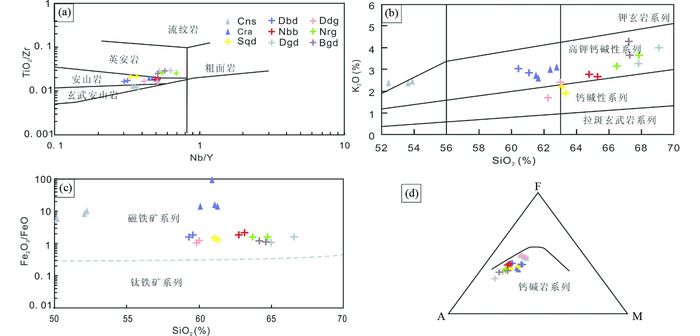
5 测试结果 5.1 岩浆岩地球化学特征拿顿玄武安山岩SiO2含量为50.11%~52.24%,K2O含量为2.25%~2.36%,Al2O3含量为16.79%~16.95%,MgO含量为2.61%~3.52%,Mg#为0.37~0.45(表 2)。荣那安山岩SiO2含量为60.06%~61.24%,K2O含量为2.55%~3.11%,Al2O3含量为15.6%~16.38%,MgO含量为2.03%~3.02%,Mg#为0.39~0.50。赛角石英闪长岩SiO2含量为61.49%~61.67%,K2O含量为1.84%~2.14%,Al2O3含量为16.82%~17.08%,MgO含量为2.43%~2.5%,Mg#为0.46。矿区内斑岩体SiO2含量为59.36%~67.83%,K2O含量为1.59%~4.22%,Al2O3含量为14.79%~17.12%,MgO含量为1.29%~3.21%,Mg#为0.36~0.48 (Sun et al., 2017)。在TiO2/Zr-Nb/Y分类图解中多龙矿集区火山岩落入玄武安山岩和安山岩范围,而侵入岩则在闪长岩和花岗闪长岩范围内(Winchester and Floyd, 1977),K2O-SiO2图解中大部分在高钾钙碱性和钙碱性系列(图 5a, b)。此外在磁铁矿系列-钛铁矿系列(Ishihara and Tani, 2004)与AFM图解中,所有岩石均落入磁铁矿系列与钙碱性系列区域中(图 5c, d)。
|
图 5 多龙矿集区岩石分类图解 (a) TiO2/Zr-Nb/Y图解;(b) K2O-SiO2图解;(c)磁铁矿-钛铁矿系列图解;(d) AFM图解.岩石名称缩写见表 1,如未特别说明,上述各岩体英文缩写为本文通用;本文讨论的多不杂和拿若矿床中含矿斑岩体和新鲜斑岩体主微量数据引自Sun et al., 2017 Fig. 5 Geochemical classification diagrams for igneous rocks at Duolong (a) TiO2/Zr vs. Nb/Y diagram; (b) K2O vs. SiO2 diagram; (c) magnetite/Ilmenite-series classification diagram; (d) AFM diagram. Whole rock geochemistry data of fresh and ore-bearing porphyries from Sun et al., 2017 |
|
|
表 2 多龙矿集区岩浆岩常量(wt%)和微量(×10-6)元素分析结果 Table 2 Major (wt%) and trace elements (×10-6) data for the igneous rocks of the Duolong district |
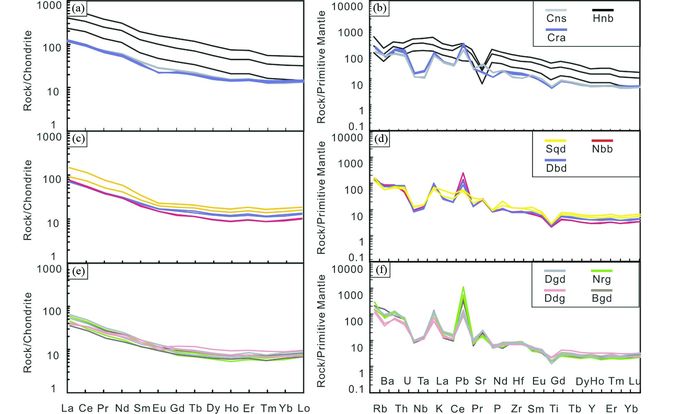
拿顿玄武安山岩∑REE含量较高,为165×10-6~173×10-6,δEu为0.9,(La/Yb)N为9.0~9.4;荣那安山岩∑REE含量为162×10-6~177×10-6,δEu为0.7~0.8,(La/Yb)N为8.4~9.2(表 2);赛角石英闪长岩∑REE含量为136×10-6~193×10-6,δEu为0.8~0.9,(La/Yb)N为6.4~8.7,矿区中斑岩体∑REE含量相对较少53×10-6~106×10-6,δEu为0.8~1.1,(La/Yb)N为4.3~8.6 (Sun et al., 2017)。多龙矿集区火山岩和侵入岩的球粒陨石标准化稀土元素配分图显示出右倾的富集轻稀土和相对亏损重稀土的配分模式,原始地幔标准化蛛网模式图上则表现出富集大离子亲石元素(LILE:如Rb、Ba、K、Pb、Sr)和相对亏损高场强元素(HFSE:如Nb、Ta、Hf、Ti、P)的特征(图 6)。上述特征和弧环境下形成的钙碱性岩浆岩特征相似(Wilson, 1989)。
|
图 6 多龙矿集区岩石球粒陨石标准化稀土元素配分图(a、c、e)与原始地幔标准化微量元素蛛网图(b、d、f)(标准化值据Sun and McDonough, 1989) 高Nb玄武岩(Hnb)数据孙嘉, 2015 Fig. 6 Chondrite-normalized rare earth element (REE) patterns, and (d), primitive mantle-normalized multielement diagrams (normalization values after Sun and McDonough, 1989) Data of high-Nb basalt (Hnb) from Sun, 2015 |
多龙矿集区内玄武安山岩具有明显偏高的放射性Nd和低(87Sr/86Sr)i比值,其εNd(t)值介于2.0~2.3,(87Sr/86Sr)i值为0.7050~0.7051,同时根据Nd同位素获得的模式年龄(tDM)为825~845Ma,并且εHf(t)值变化较大介于0~8.5之间(表 3、表 4)。矿集区内其他中酸性岩浆岩则具有相对较低的放射性Nd和高(87Sr/86Sr)i比值。石英闪长岩εNd(t)值介于0.8~0.9,(87Sr/86Sr)i值为0.7055~0.7056,模式年龄(tDM)为842~926Ma,εHf(t)值变化较大介于3.5~11.7之间。安山岩εNd(t)值介于-1.3~-0.4,(87Sr/86Sr)i值为0.7055~0.7063,模式年龄(tDM)为980~1102Ma,εHf(t)值变化较大介于1.5~5.1之间。闪长质和花岗闪长质岩体εNd(t)值介于-2.5~0,(87Sr/86Sr)i值为0.7058~0.7090,模式年龄(tDM)为1016~1691Ma。前人研究结果表明,该地区含矿和不含矿斑岩体变化于0~11.7之间(Li et al., 2013; Sun et al., 2017)。
|
|
表 3 多龙矿集区岩浆岩Sr-Nd同位素测试结果 Table 3 Sr-Nd isotope compositions of the igneous rocks of the Duolong district |


|
|
表 4 多龙矿集区岩浆岩锆石Hf同位素测试结果 Table 4 Hf isotope compositions of the igneous rocks of the Duolong district |


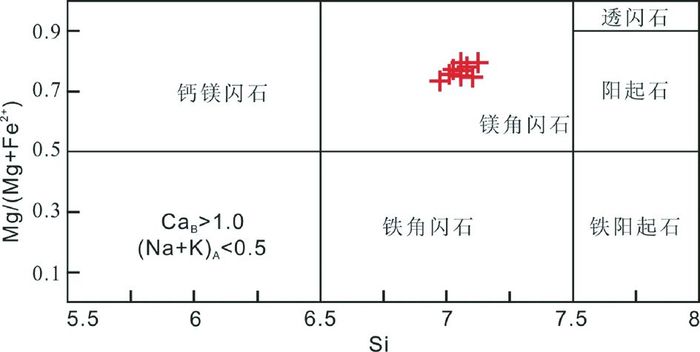
本次实验对产于荣那的安山岩和产于赛角的石英闪长岩的斜长石斑晶(表 5)、角闪石斑晶(表 6)开展了分析测试。安山岩斜长石斑晶An牌号变化范围在37~57。石英闪长岩斜长石斑晶An牌号变化范围在23~56。石英闪长岩角闪石SiO2变化范围在47%~48%之间,TiO2变化范围在1.2%~1.6%之间,Al2O3变化范围在5%~7%之间,MgO在14%~16%之间,所有测试点(Na+K) A≤0.5,Mg/(Mg+Fe2+)为0.7~0.8之间,Si为7,并投图于镁角闪石范围内(图 7),这也说明测试所得结果并未受后期热液蚀变影响。根据Ridolfi et al. (2010)公式计算所得角闪石结晶温度变化于784~814℃,压力为78~113MPa,氧逸度ΔNNO为1.1~2.1,根据Duan (2014)公式计算水溶解度为3.63%~4.44%。
|
图 7 赛角石英闪长岩角闪石分类图解(据Leake et al., 1997) Fig. 7 Classification of amphibole phenocrysts from Saijiao quartz diorite (after Leak et al., 1997) |
|
|
表 5 多龙矿集区赛角石英闪长岩(21)、荣那安山岩(51) 长石矿物成分分析结果(wt%) Table 5 EMPA analyses of plagioclase in the quartz diorite from Saijiao and in the andesite from Rongna (wt%) |
|
|
表 6 多龙矿集区赛角石英闪长岩角闪石分析测试结果(wt%) Table 6 EMPA analyses for amphibole in the quartz diorite from Saijiao (wt%) |
前人研究表明多龙铜金矿集区的形成与弧环境岩浆作用有关(Li et al., 2013, 2014, 2016)。对弧环境形成的中酸性岩浆岩,前人已经进行了大量细致研究工作,认为岩浆的成因机制主要包括:(1) 俯冲板片的部分熔融(Defant and Drummond, 1990; Yogodzinski et al., 2001; Martin et al., 2005; Castillo, 2012);(2) 地幔来源的玄武岩质岩浆的分离结晶(Annen and Sparks, 2002; Grove et al., 2003);(3) 地幔来源的玄武质岩浆和地壳来源的长英质岩浆的混合(Hildreth and Moorbath, 1988; Richards, 2003; Kemp et al., 2007; Yang et al., 2007; Chiaradia et al., 2011)。
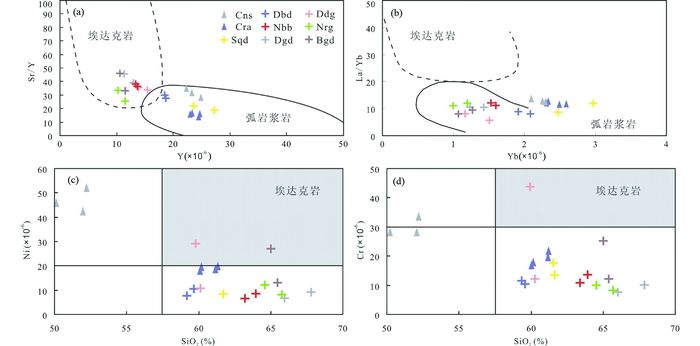
自Defant and Drummond (1990)定义并论证了埃达克岩的成因意义后,越来越多的学者注意到了这种岩石类型和斑岩型矿床可能存在某种程度的亲和性,并推论斑岩型矿床的含矿岩体可视为埃达克岩体(Oyarzun et al., 2001)。Richards and Kerrich (2007)在综合了大量前人研究的基础上给出了埃达克岩的地化特征识别标志:SiO2≥56%,Al2O3≥15%,MgO通常 < 3%,Mg#≈0.5,Sr≥400×10-6,Y≤18×10-6,Yb≤11.9×10⁻⁶,Ni≥20×10-6,Cr≥30×10-6,Sr/Y≥20,La/Yb≥20和(87Sr/86Sr)i≤0.7045。本次工作表明虽然Sr/Y-Y图解中部分斑岩体投图在埃达克岩中(图 8a),但La/Yb-Yb图解中多龙矿集区内岩浆岩全部落于正常岛弧火山岩区域(图 8b),此外Ni、Cr含量的投图结果表明矿区内大部分岩石的Ni、Cr含量均小于埃达克岩的特征值(图 8c, d),并且矿区内所有岩浆岩的(87Sr/86Sr)i均大于0.7045(图 9a),和典型的埃达克岩有明显差异。因此,我们认为本区出露岩体中并不存在“埃达克岩”,而只是普通弧环境下形成的钙碱性岩石。
|
图 8 多龙矿集区岩浆岩Sr/Y-Y (a)、La/Yb-Yb (b)、Ni-SiO2 (c)和Cr-SiO2 (d)图解(底图据Richards and Kerrich, 2007) Fig. 8 Sr/Y vs. Y (a), La/Yb vs. Yb (b), Ni vs. SiO2 (c) and Cr vs. SiO2 (d) classification diagrams for igneous rocks at the Duolong district (after Richards and Kerrich, 2007) |
|
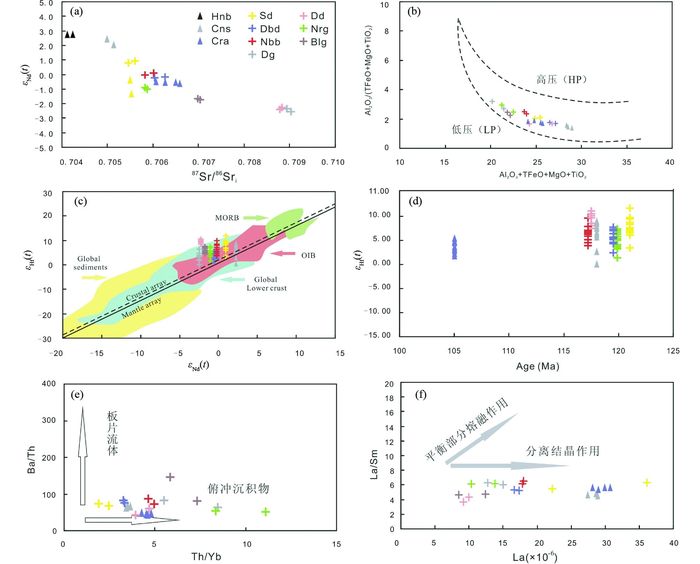
图 9 多龙矿集区岩浆岩地球化学图解 本文多不杂和拿若矿床含矿斑岩体和不含矿斑岩体Hf同位素数据引自Sun et al., 2017, 波龙含矿斑岩体Hf同位素数据引自Li et al., 2013, 年龄数据来源请参考表 3 Fig. 9 Geochemical diagrams for igneous rocks at the Duolong district (a) εNd(t) vs. 87Sr/86Sri; (b) Al2O3/(FeOT+MgO+TiO2) vs. (Al2O3+FeOT+MgO+TiO2); (c) εHf(t) vs. εNd(t) (Dobosi et al., 2003; Mantle array, Chauvel et al., 2008; Crustal array, Vervoort and Blichert-Toft, 1999); (d) εHf(t) vs. age; (e) Ba/Th vs. Th/Yb; (f) La/Sm vs. La |
Annen and Sparks (2002)和Grove et al. (2003)通过岩石学实验和热力学模拟计算证明玄武质岩浆的结晶分异可形成中酸性岩浆岩。本次工作表明多龙矿集区内拿顿玄武安山岩具有较高的εNd(t)值(2~2.3),并且该值和矿区内高Nb玄武岩(143Ma, 李金祥等, 2008) εNd(t)值接近(以120Ma重新计算所得值为2.7, 孙嘉, 2015),表明两者来源于相似的地幔源区,而矿区内其余的岩浆岩和地幔来源的高Nb玄武岩在Sr-Nd同位素特征差异较大(图 9a),说明了源区物质存在差异。但稀土元素表明,拿顿玄武安山岩稀土含量明显低于多龙矿集区产出的高Nb玄武岩(图 6a),因此拿顿玄武安山岩也不可能由高Nb玄武岩的分异结晶形成(Rollison, 1993)。
Rapp and Watson (1995)通过实验岩石学研究证明玄武质岩石发生部分熔融形成的岩浆岩Mg#值往往较低( < 0.4),而有地幔组分参与形成的岩浆岩Mg#值则偏高(>0.4)。前人研究和本次测试结果表明多龙矿集区岩浆岩Mg#值大部分大于0.4,表明岩浆岩形成过程中有地幔组分的参与。此外,由上文可知多龙矿集区内拿顿玄武安山岩和高Nb玄武岩具有相似的εNd(t)值,说明两者均来自于相似的地幔源区,本次测试工作同时表明拿顿玄武安山岩的εHf(t)值均大于0,并集中于5.8~8.5之间,矿区内同期产出的中酸性岩浆岩εHf(t)值也大部分高于5.8(图 9d),说明多龙矿集区内与成矿作用有关的岩浆岩的形成过程中均有地幔物质的参与。虽然该地区岩浆岩εHf(t)值整体偏高并显示出地幔端元的特征,但部分岩体中仍表现出较低的εNd(t)值,暗示了源区中可能还有地壳物质的加入(Murgulov et al., 2008)。对此,我们使用了εHf(t)-εNd(t)和(87Sr/86Sr)i-εNd(t)图解进行分析,投图结果显示矿区内大部分岩浆岩的源区落入OIB型地幔与下地壳的叠合范围内(图 9c),并且(87Sr/86Sr)i值和εNd(t)表现出良好的线性关系(图 9a),表明多龙矿集区岩浆岩的形成还有地壳组分的加入。此外,Patiño Douc (1999)通过实验岩石学证明在低压(P≤5kbar)和高压(P=12~15kbar)条件下形成的岩浆岩熔体在Al2O3/(FeOT+MgO+TiO2)-(Al2O3+FeOT+MgO+TiO2)协变关系图解上表现出不同的演化趋势,并且壳幔相互作用形成的熔体会位于高压和低压曲线之间,而本地区所有岩浆岩均落在高压和低压曲线之间(图 9b),也进一步证明该地区岩浆的起源受控于壳幔的相互作用,同时本地区中酸性侵入岩中暗色包体(MMEs)的普遍发育也暗示了与成矿作用有关的岩浆岩起源于壳幔混合作用(Yang et al., 2007; 马星华等, 2014, 图 2a)。需注意的是εHf(t)-εNd(t)图解还显示出该地区岩浆岩的Hf-Nd同位素存在一定的解耦关系,具体表现为Hf同位素整体变化范围一致,但εNd(t)值从2.3降低为-2.5。由于Sm与Nd同属稀土元素,而Lu和Hf分属于稀土和高场强元素,因此在岩浆作用和变质作用可能有Nd-Hf同位素的解耦现象出现(吴福元等, 2007),比如岩浆源区或变质过程中如果有石榴石的存在,Lu和Hf将分别进入石榴石和熔体相,这样会出现176Hf/177Hf高于143Nd/144Nd的现象(Schmitz et al., 2004)。但本地区岩浆岩稀土球粒陨石标准化配分图均呈“铲状”,表明矿区内轻稀土元素较富集而重稀土元素亏损不明显,因此源区不应存在石榴石的残留并可排除由此导致Hf-Nd同位素解耦的可能。前人研究同时表明由于Nd在沉积物熔体中可溶解,因此受沉积物交代的地幔楔会表现为εNd(t)值的降低(Hawkesworth et al., 1993; Pearce and Peate, 1995; Kessel et al., 2005; Plank and Langmuir, 1998)。多龙矿集区岩浆岩Ba/Th比值较低(41~166),而Th/Yb比值整体较高(>2) (图 9e),指示岩浆岩形成过程中有俯冲沉积物的加入,并且部分中酸性岩浆岩Th/Yb比值明显偏高(>5) 表明成岩过程中可能有更多沉积物的加入并由此造成了εHf(t)-εNd(t)的解耦现象。此外,La/Sm-La图解进一步表明该地区岩浆岩演化过程中发生了一定程度的分离结晶作用(图 9f)。
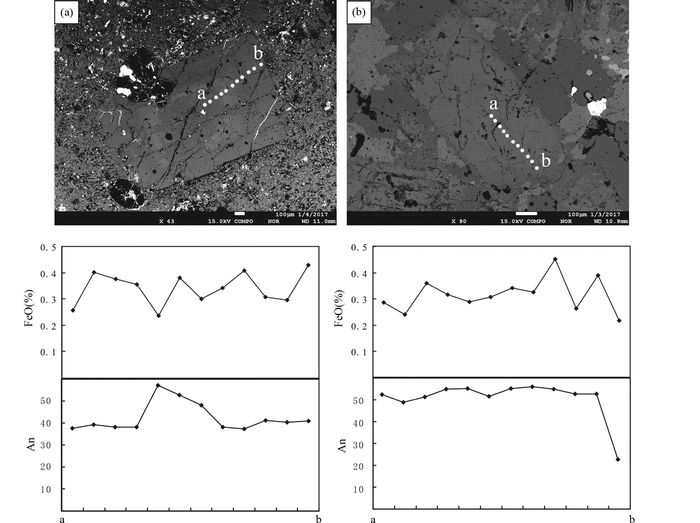
实验证实斜长石斑晶中微量元素(Fe、Sr)和An牌号的变化可有效指示岩浆的演化过程(Ginibre et al., 2007),前人对多龙矿集区斑岩体中斜长石的化学成分分析显示斜长石斑晶由核部到边部Fe含量表现出一定程度的升高暗示了岩浆演化过程中发生了基性岩的注入(Sun et al., 2017)。本次对赛角石英闪长岩和荣那安山岩开展的分析测试表明斜长石斑晶Fe含量呈现出相似的变化趋势,并且部分斜长石斑晶中An牌号也有明显的增加(图 10),说明上述岩体在演化过程中也发生了基性岩的注入。
|
图 10 铁格隆南(荣那)安山岩(a)和赛角石英闪长岩(b)的斜长石斑晶BSE照片及FeO成分和An牌号剖面变化图 Fig. 10 Representative BSE images and compositional variation of FeO and An number of plagioclase phenocrysts in andesite from Tiegelongnan (a) and quartz diorite from Saijiao (b) |
野外地质填图和实验测试结果均已证实斑岩矿床的形成符合正岩浆成矿模式(Orthomagmatic model, Burnham, 1979),即斑岩矿床为含矿流体由浅部岩浆房中出溶并富集而形成(Cloos, 2001; Zhang et al., 2006b; Proffet, 2009; Stern et al., 2011; Steinberger et al., 2013; 李万伦, 2011),因此归根结底斑岩矿床的形成主要与成矿岩浆的性质(成矿物质的来源和运移条件)、浅部岩浆房的特征(含矿流体出溶的温压条件)和岩浆房上部矿质富集环境(矿质沉淀所需的温压梯度)等三方面有关。在此,我们通过总结前人研究工作取得的重要认识并对比本文测试结果,就矿区内成矿岩浆的性质和浅部岩浆房的特征两方面问题开展讨论,以此厘清该地区成岩与成矿作用的相互关系。
成矿岩浆的性质:研究表明虽然斑岩型铜金矿在洋壳俯冲和陆内环境等不同构造背景中均有产出(Richards, 2011),但成矿岩浆的形成机制主要与壳幔混合作用有关(毛景文等, 2014; Richards, 2003),并且由于地壳中Cu的含量明显低于地幔来源的安山岩中Cu的含量(bulk continental crust, 27×10-6; Rudnick and Gao, 2003; primitive andesite, 145×10-6; Gill, 1981),因此多数研究认为Cu主要来源于地幔(Richards, 2011)。此外,McInnes et al. (1999)发现岛弧环境中产出的金矿石的Os同位素特征和地幔Os同位素特征一致,表明Au也主要来自地幔源区,而苦橄岩的橄榄石斑晶中存在自然金(Zhang et al., 2006a)也暗示金可以直接来自地幔。本次Nd-Hf同位素测试结果显示多龙矿集区内与成矿作用具有紧密时空联系的岩浆岩均有明显的地幔组分的特征,同时多不杂、波龙、拿若和荣那等矿床中辉钼矿Re含量相对较高(佘宏全等, 2009; 祝向平等, 2011; 方向等, 2015; Sun et al., 2017),也指示了成矿物质可能主要来源于地幔(Mao et al., 1999),前人研究结果和本文测试数据均指示与斑岩型铜金矿相关的成岩成矿物质主要来自于地幔源区。
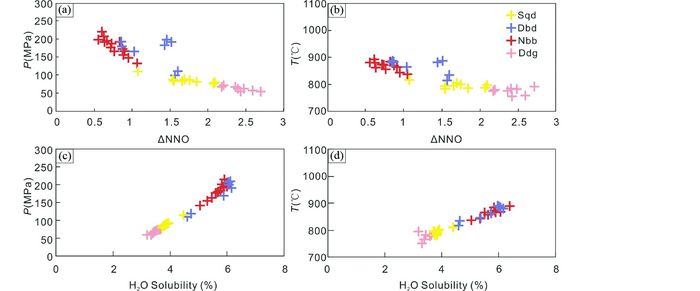
目前对于成矿物质从地幔源区释放后到上升至上地壳岩浆房期间的运移形式仍缺乏有效认识,但多数学者提出较高的氧逸度环境有利于斑岩型矿床的形成,因为S在较高的氧逸度环境中通常以硫酸盐或SO3形式存在,而不是S2-,这样就不会产生不混溶的硫化物使得Cu、Au等金属元素在运移过程中过早沉淀(Candela, 1992; Mungall, 2002)。此外,多位学者通过锆石计算岩浆氧逸度也发现岩浆的氧逸度越高成矿的可能性也越大(Ballard et al., 2002; Wang et al., 2014; Shen et al., 2015; Lu et al., 2016)。角闪石氧逸度计算结果表明该地区与成矿作用相关的中酸性侵入岩均具有较高的氧逸度(ΔNNO变化于0.6~2.7,n=30,图 11a, b),说明该地区的成矿作用也与高氧逸度的岩浆岩有关。但需特别注意的是闪长质和花岗闪长质岩浆中由于含矿流体出溶所发生的SO2去气作用(SO2 degassing)会导致岩体氧逸度明显升高(Dilles et al., 2014),而多龙矿集区内含矿斑岩体斑晶结晶温度变化于754~791℃(Sun et al., 2017),并且实验证明该温度范围内S在岩浆中主要以SO2的形式存在(Whitney, 1988; Field et al., 2005; Zajacz et al., 2012),暗示了随着含矿流体(含SO2)从岩浆中出溶导致了岩浆岩的氧逸度发生了改造,并表现为含矿斑岩体中角闪石斑晶计算所得的氧逸度要高于不含矿的新鲜斑岩体(前者ΔNNO>2.5,后者ΔNNO≤1.5,图 11a, b),因此多龙矿集区内成矿岩浆演化过程中实际的氧逸度值(ΔNNO)可能为0.5到1.5之间。
|
图 11 多龙矿集区岩浆岩中角闪石结晶压力、结晶温度与氧逸度、水溶解度关系图解 多不杂不含矿石英闪长玢岩,拿若不含矿花岗闪长斑岩和多不杂含矿石英闪长玢岩数据来自于Sun et al. (2017) Fig. 11 Pressure (a) and temperature (b) as function of oxidation stage (ΔNNO) and pressure (c) and temperature (d) as water solubility (wt%) in silicate melts for igneous rocks at the Duolong district |
由于斑岩矿床中铜、金等成矿元素的富集和沉淀过程需要大量热液流体的参与(芮宗瑶等, 1984; Ulrich et al., 1999),因此岩浆岩中水的含量变化也是控制斑岩矿床形成的重要因素(Richards et al., 2012)。本次岩相学观察结果显示多龙矿集区内与成矿作用相关的岩浆岩均普遍发育角闪石斑晶(H2O>4%, Burnham, 1979),并且岩浆岩稀土球粒陨石标准化配分图均呈“铲状”而Eu异常也不明显(δEu≈1,表 2),上述特征也说明与斑岩型铜金成矿作用相关的岩浆岩为富水岩浆所形成。此外,多位学者提出斑岩矿床成矿岩浆起源于高压富水环境,因此与斑岩成矿作用有关的岩浆岩具有较高的Sr/Y比值(Chiaradia et al., 2012; Loucks, 2014)。岩石地球化学测试结果显示该地区大部分中酸性侵入岩均有较高的Sr含量(>400×10-6),但该地区含矿和不含矿斑岩体与赛角石英闪长岩相比具有明显低的Y含量(前者10×10-6~18.3×10⁻⁶,后者23.1×10⁻⁶~26.8×10⁻⁶)。由于两者均为富水岩浆,并且源区同位素特征和岩浆起源的压力(图 9b)均十分相似,因此Sr/Y比值的变化不应由岩浆起源环境的压力差异所造成,本文推测斑岩体中Sr/Y比值的升高(准确地说应为Y含量的减少)可能与斑岩体形成过程中角闪石等矿物的结晶分异有关(Richards and Kerrich, 2007; Gao et al., 2009),因此不能单独用Sr/Y比值判断岩浆岩成矿性的好坏。
岩浆房的特征:Cline and Bodnar (1991)通过数值计算证明正常体积(60km3)和铜含量(56×10-6)的岩浆房在有利条件下均可形成中等规模的斑岩矿床(6Mt),这表明岩浆房的性质即含矿流体的出溶环境对斑岩矿床的形成起到了决定性的作用。Sun et al. (2017)通过对多不杂矿床和拿若矿床中含矿和不含矿斑岩体的角闪石斑晶对比发现,含矿斑岩体角闪石斑晶的结晶环境相较于该地区不含矿斑岩体表现为低温、低压的特征(前者754~791℃, 59~73MPa, n=8,后者816~892℃, 111~232MPa, n=22),并且含矿斑岩体的岩浆磁铁矿相比不含矿斑岩体的岩浆磁铁矿具有较低的V、Ti含量(前者受控于氧逸度,后者受控于温度)。实验表明斑岩矿床中Cu、Au的溶解度在中酸性硅酸盐熔体中明显受温度控制,表现为Cu、Au的溶解度随着温度的降低而降低(Zajacz et al., 2013),暗示了低温岩浆房中Cu、Au更容易进入流体相。同时,温度、压力,地球化学数据计算表明含矿斑岩角闪石斑晶所处岩浆房较之不含矿角闪石斑晶所处岩浆房水溶解度明显变小(图 11b, c),说明岩浆房在低温、低压环境中更容易发生水的出溶,因此侵位较浅的岩浆房更容易发生含矿流体的出溶并形成斑岩矿床。但要特别说明的是本次对赛角石英闪长岩的角闪石的结晶深度计算和未发表的流体包裹体计算数据表明该地区已经经历了一定程度的后期剥蚀(2.5~3.5km),因此需考虑不含矿斑岩体上部是否存在已被剥蚀的矿体。野外地质填图表明,含矿斑岩体底部虽然矿化程度较弱但受下部岩浆房中出溶流体的影响通常会发育一定的蚀变矿物组合并伴有少量热液脉体产出(Sillitoe, 1973),而手标本和镜下鉴定结果表明多不杂和拿若矿区内的不含矿斑岩体蚀变矿物和热液脉体均不发育,说明并不存在有成矿热液通过并在上部成矿的可能,因此该地区的含矿和不含矿对比为有效对比。
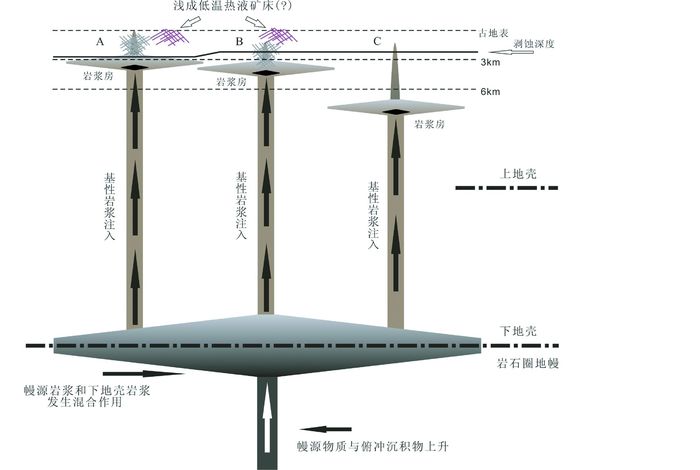
虽然上述研究对本地区含矿流体的出溶环境进行了有效限定,但对含矿流体出溶时所在岩浆房的直接观察仍鲜有报道,而本此研究则进一步表明产出于赛角的石英闪长岩很可能代表了已发生含矿流体出溶的“岩浆房”。首先,该岩体的年代学(121Ma, 李兴奎等, 2015)和岩石地球化学特征均与该地区斑岩体一致(图 9b, d),说明两者源区和演化过程相似。其次,岩相学观察显示石英闪长岩呈中细粒不等粒结构并明显可见有热液蚀变矿物产出,如原生角闪石被次生黑云母、绿泥石交代(图 4i, j),而镜下观察还发现该岩体内有黄铜矿呈他形晶粒状产出(图 4g),并且本次计算所得该岩体具较高的氧逸度(ΔNNO为1.1~2.1,n=9) 和较低的结晶温度和H2O溶解度(784~814℃, 3.63%~4.44%, n=9),这也与含矿斑岩体角闪石斑晶结晶温度和H2O溶解度接近(图 11),上述现象和计算数据表明该岩体可能已发生了含矿流体的出溶并伴有一定程度的交代作用。此外,赛角石英闪长岩的镜下特征也与前人对斑岩矿床下方岩浆房的岩石结构特征以及相应的蚀变矿物组合的描述十分相似(Sillitoe, 1973; Seedorff et al., 2008),这也进一步说明该岩体可能为具有“岩浆房”性质的岩体。但需注意的是角闪石计算表明该岩体剥蚀深度较浅(~3.5km),因此目前地表所能观察到的岩体可能仅仅代表了含矿流体出溶时所在岩浆房的顶部特征(图 12a)。多龙矿集区内与“岩浆房”类似的岩体与斑岩矿床共生的特征也说明了今后的找矿勘查工作中如果发现了具有“岩浆房”性质的岩体的存在可指示该地区具有良好的找矿前景,由于该类岩体相对于含矿斑岩产出范围较大并更易于识别,因此也可提高找矿勘查效率。但需特别指出的是能有效指示具有良好找矿前景的是指侵位较浅的“岩浆房”,因为如果侵位较深的“岩浆房”出露于地表则通常说明该地区已经历了较强的后期抬升剥蚀作用反而不具备良好的找矿潜力。此外,本文认为对于类似岩体侵位深浅的判别除了可通过角闪石温压计进行直接计算外还可通过石英中流体包裹体的产出类型进行快速判定,因为在低压岩浆房中出溶的含矿流体常常表现为含多个子晶的流体包裹体与富气相流体包裹体共存(Proffett, 2009),因此该现象的出现也可指示岩浆岩侵位于较浅深度,而赛角石英闪长岩石英颗粒中该现象普遍发育(图 4h),说明该方法简易可行。
|
图 12 多龙矿集区成岩与成矿作用演化模型图 成矿岩浆起源于幔源岩浆与下地壳岩浆的混合并伴有俯冲沉积物的加入,随后成矿岩浆上升至上地壳浅部并发生了一定程度基性岩浆的注入.由于金属元素和水在岩浆中的溶解度随温度和压力的降低而降低因此侵位浅的岩浆房(a、b)较侵位深的岩浆房(c)更容易发生成矿物质的出溶并最终形成具有经济价值的含矿斑岩体,同时含矿斑岩体附近可能还发育有浅成低温热液矿化.此外,由于受后期抬升剥蚀作用的影响,部分含矿斑岩体下方的岩浆房也可能出露于地表(a) Fig. 12 Schematic model showing the relation between magmatic processes and porphyry copper-gold ore formation The ore-forming magmas were sourced from mixing of mantle-derived mafic, and crust-derived felsic melts, as well as minor contribution of sediments. Subsequently, ore-forming magmas rise to the upper crust, which was accompanied by recharge of mafic magmas. Due to the fact that water and metal solubilities decrease with falling temperature and pressure, water and metals are more likely to be released from magma chamber that emplaced at shallow crustal levels (a, b), which eventually leads to the formation of economically ore-bearing porphyries and associated epithermal mineralization as well. In addition, part of the underlying magma chamber might be exposed at the surface due to the late stage uplifting process |
从上文对成岩与成矿作用相互关系的梳理和讨论可看出,斑岩型铜金矿的形成过程起始于大尺度范围的壳幔混合作用并完结于小尺度范围的近地表岩浆房中含矿流体的出溶(图 12),因此班公湖-怒江缝合带斑岩型铜金矿的找矿勘查工作可按不同的尺度范围并辅以相应的岩石学特征和岩石地球化学指标来进行,具体步骤如下:
(1) 对班公湖-怒江缝合带的岩浆岩开展Nd、Hf同位素填图并确认地幔组分相对较多的侵入岩分布区为成矿远景区。此外,由于成矿岩浆通常形成于壳幔混合作用并伴有暗色包体(MMEs)发育(Yang et al., 2007; 马星华等, 2014),因此岩浆岩中暗色包体的出现可作为该阶段找矿勘查的岩石学标志。
(2) 在成矿远景区内通过锆石、角闪石等矿物开展氧逸度填图进一步缩小找矿范围,并确立具有较高氧逸度的地区为重点找矿勘查区。同时,由于成矿岩浆通常为富水岩浆,因此中酸性岩浆岩中角闪石的出现可作为该阶段找矿勘查的岩石学标志(Burnham, 1979; Richards et al., 2012)。
(3) 在重点找矿勘查区内通过岩浆磁铁矿中V、Ti含量对斑岩体的含矿性进行快速判定,具有较低V、Ti含量的斑岩体通常为含矿性较好的斑岩体(Sun et al., 2017)。此外,富水(角闪石发育)、含矿质(黄铜矿呈他形晶状产出)、侵位浅(气相包裹体与多相包裹体共存)、并发育一定蚀变矿物(次生黑云母、绿泥石发育)的代表“岩浆房”岩体的存在也可指示较好的成矿潜力。
8 结论全岩地球化学和同位素特征表明该地区与成矿作用有关的岩浆岩起源于壳幔混合作用并有俯冲沉积物的加入,而岩浆在演化过程中还经历了一定的结晶分异作用和基性岩浆的注入。该地区成岩与成矿作用关系表现为,成矿物质主要来自于地幔源区,并在富水、高氧逸度环境下运移至上地壳岩浆房中出溶成矿。班公湖-怒江缝合带今后的找矿工作可分为以下几步:
(1) 通过Nd、Hf同位素确定地幔组分较多的侵入岩分布区为成矿远景区,该阶段岩石学标志为暗色包体(MMEs)的出现;
(2) 通过锆石、角闪石等矿物开展氧逸度填图并可将高氧逸度区域确立为重点找矿勘查区,而角闪石的产出则为该阶段找矿勘查的岩石学标志;
(3) 在重点找矿勘查区内通过岩浆磁铁矿中V、Ti含量对斑岩体的含矿性进行快速判定,具有较低V、Ti含量的斑岩体通常为含矿性较好的斑岩体。此外,富水(角闪石发育)、含矿质(黄铜矿呈他形晶粒状产出)、侵位浅(沸腾包裹体组合发育)、并发育一定蚀变矿物(次生黑云母、绿泥石发育)的代表“岩浆房”岩体的存在也可指示较好的成矿潜力。
致谢 在成文过程中得到了中国地质大学(北京)张招崇教授和杜杨松教授,中国地质科学院矿产资源研究所王晓霞、叶会寿、谢桂青、张长青、袁顺达等研究员的指导、帮助和鼓励;野外工作得到西藏地质调查院李玉彬博士的大量帮助;加拿大Laval大学Georges Beaudoin教授积极指导了本次研究工作并对部分实验给予了资助。中国地质科学院矿产资源研究所曲晓明研究员和另一位匿名审稿人仔细审阅了本文并提供了大量宝贵意见。在此一并致谢。| [] | Annen C, Sparks RSJ. 2002. Effects of repetitive emplacement of basaltic intrusions on thermal evolution and melt generation in the crust. Earth and Planetary Science Letters, 203(3-4): 937–955. DOI:10.1016/S0012-821X(02)00929-9 |
| [] | Arancibia ON, Clark AH. 1996. Early magnetite-amphibole-plagioclase alteration-mineralization in the Island copper porphyry copper-gold-molybdenum deposit, British Columbia. Economic Geology, 91(2): 402–438. DOI:10.2113/gsecongeo.91.2.402 |
| [] | Ballard JR, Palin MJ, Campbell IH. 2002. Relative oxidation states of magmas inferred from Ce(Ⅳ)/Ce(Ⅲ) in zircon:Application to porphyry copper deposits of northern Chile. Contributions to Mineralogy and Petrology, 144(3): 347–364. DOI:10.1007/s00410-002-0402-5 |
| [] | Bao PS, Xiao XC, Su L, Wang J. 2007. Petrological, geochemical and chronological constraints for the tectonic setting of the Dongco ophiolite in Tibet. Science in China (Series D), 50(5): 660–671. DOI:10.1007/s11430-007-0045-5 |
| [] | Blichert-Toft J, Albarède F. 1997. The Lu-Hf isotope geochemistry of chondrites and the evolution of the mantle-crust system. Earth and Planetary Science Letters, 148: 243–258. DOI:10.1016/S0012-821X(97)00040-X |
| [] | Burnham CW. 1979. Magmas and hydrothermal fluids. In:Barnes HL (ed.). Geochemistry of Hydrothermal Ore Deposits. 2nd Edition. New York:John Wiley and Sons, 71-136 |
| [] | Candela PA. 1992. Controls on ore metal ratios in granite-related ore systems:An experimental and computational approach. Transactions of the Royal Society of Edinburgh:Earth Sciences, 83(1-2): 317–326. DOI:10.1017/S0263593300007999 |
| [] | Castillo PR. 2012. Adakite petrogenesis. Lithos, 134-135: 304–316. DOI:10.1016/j.lithos.2011.09.013 |
| [] | Chauvel C, Lewin E, Carpentier M, Arndt NT, Marini JC. 2008. Role of recycled oceanic basalt and sediment in generating the Hf-Nd mantle array. Nature Geoscience, 1(1): 64–67. DOI:10.1038/ngeo.2007.51 |
| [] | Chen YL, Zhang KZ, Li GQ, Nimaciren, Zhao SR, Chen GR. 2005. Discovery of an uniformity between the Upper Triassic Quehala Group and its underlying rock series in the central segment of the Bangong Co-Nujiang junction zone, Tibet, China. Geological Bulletin of China, 24(7): 621–624. |
| [] | Chiaradia M, Müntener O, Beate B. 2011. Enriched basaltic andesites from mid-crustal fractional crystallization, recharge, and assimilation (Pilavo Volcano, Western Cordillera of Ecuador). Journal of Petrology, 52(6): 1107–1141. DOI:10.1093/petrology/egr020 |
| [] | Chiaradia M, Ulianov A, Kouzmanov K, Beate B. 2012. Why large porphyry cu deposits like high Sr/Y magmas?. Scientific Reports, 2: 685. DOI:10.1038/srep00685 |
| [] | Cline JS, Bodnar RJ. 1991. Can economic porphyry copper mineralization be generated by a typical calc-alkaline melt?. Journal of Geophysical Research:Solid Earth (1978~2012), 96(B5): 8113–8126. DOI:10.1029/91JB00053 |
| [] | Cloos M. 2001. Bubbling magma chambers, cupolas, and porphyry copper deposits. International Geology Review, 43(4): 285–311. DOI:10.1080/00206810109465015 |
| [] | Defant MJ, Drummond MS. 1990. Derivation of some modern arc magmas by melting of young subducted lithosphere. Nature, 347(6294): 662–665. DOI:10.1038/347662a0 |
| [] | Dilles JH, Kent AJR, Wooden JL, Tosdal RM, Koleszar A, Lee RG, Farmer LP. 2014. Zircon compositional evidence for sulfur-degassing from ore-forming arc magmas. Economic Geology, 110(1): 241–251. |
| [] | Dobosi G, Kempton PD, Downes H, Embey-Isztin A, Thirlwall M, Greenwood P. 2003. Lower crustal granulite xenoliths from the Pannonian Basin, Hungary, Part 2:Sr-Nd-Pb-Hf and O isotope evidence for formation of continental lower crust by tectonic emplacement of oceanic crust. Contributions to Mineralogy and Petrology, 144(6): 671–683. DOI:10.1007/s00410-002-0422-1 |
| [] | Du DD, Qu XM, Wang GH, Xin HB, Liu ZB. 2011. Bidirectional subduction of the Middle Tethys oceanic basin in the west segment of Bangonghu-Nujiang suture, Tibet:Evidence from zircon U-Pb LAICPMS dating and petrogeochemistry of arc granites. Acta Petrologica Sinica, 27(7): 1993–2002. |
| [] | Duan JL, Tang JX, Li YB, Liu SA, Wang Q, Yang C, Wang YY. 2016. Copper isotopic signature of the Tiegelongnan high-sulfidation copper deposit, Tibet:Implications for its origin and mineral exploration. Mineralium Deposita, 51(5): 591–602. DOI:10.1007/s00126-015-0624-x |
| [] | Duan XZ. 2014. A general model for predicting the solubility behavior of H2O-CO2 fluids in silicate melts over a wide range of pressure, temperature and compositions. Geochimica et Cosmochimica Acta, 125: 582–609. DOI:10.1016/j.gca.2013.10.018 |
| [] | Dupuis C, Beaudoin G. 2011. Discriminant diagrams for iron oxide trace element fingerprinting of mineral deposit types. Mineralium Deposita, 46(4): 319–335. DOI:10.1007/s00126-011-0334-y |
| [] | Elhlou S, Belousova E, Griffin WL, Pearson NJ, O'reilly SY. 2006. Trace element and isotopic composition of GJ-red zircon standard by laser ablation. Geochimica et Cosmochimica Acta, 70(18): A158. |
| [] | Fang X, Tang JX, Song Y, Yang C, Ding S, Wang YY, Wang Q, Sun XG, Li YB, Wei LJ, Zhang Z, Yang HH, Gao K, Tang P. 2015. Formation epoch of the south Tiegelong supelarge epithermal Cu (Au-Ag) deposit in Tibet and its geological implications. Acta Geoscientia Sinica, 36(2): 168–176. |
| [] | Field CW, Zhang L, Dilles JH, Rye RO, Reed MH. 2005. Sulfur and oxygen isotopic record in sulfate and sulfide minerals of early, deep, pre-main stage porphyry Cu-Mo and late main stage base-metal mineral deposits, Butte district, Montana. Chemical Geology, 215(1-4): 61–93. DOI:10.1016/j.chemgeo.2004.06.049 |
| [] | Gao J, Klemd R, Long LL, Xiong XM, Qian Q. 2009. Adakitic signature formed by fractional crystallization:An interpretation for the Neo-Proterozoic meta-plagiogranites of the NE Jiangxi ophiolitic mélange belt, South China. Lithos, 110(1-4): 277–293. DOI:10.1016/j.lithos.2009.01.009 |
| [] | Geng QR, Pan GT, Wang LQ, Peng ZM, Zhang Z. 2011. Tethyan evolution and metallogenic geological background of the Bangong Co-Nujiang Belt and the Qiangtang massif in Tibet. Geological Bulletin of China, 30(8): 1261–1274. |
| [] | Gill PJB. 1981. Orogenic Andesites and Plate Tectonics. New York: Springer-Verlag: 1-390. |
| [] | Ginibre C, Wörner G, Kronz A. 2007. Crystal zoning as an archive for magma evolution. Elements, 3(4): 261–266. DOI:10.2113/gselements.3.4.261 |
| [] | Griffin WL, Pearson NJ, Belousova E, Jackson SE, Achterbergh EV, O'Reilly SY, Shee SR. 2000. The Hf isotope composition of cratonic mantle:LAM-MC-ICPMS analysis of zircon megacrysts in kimberlites. Geochimica et Cosmochimica Acta, 64: 133–148. DOI:10.1016/S0016-7037(99)00343-9 |
| [] | Grove TL, Elkins-Tanton LT, Parman SW, Chatterjee N, Müntener O, Gaetani GA. 2003. Fractional crystallization and mantle-melting controls on calc-alkaline differentiation trends. Contributions to Mineralogy and Petrology, 145(5): 515–533. DOI:10.1007/s00410-003-0448-z |
| [] | Hawkesworth CJ, Gallagher K, Hergt JM, McDermott F. 1993. Mantle and slab contributions in ARC magmas. Annual Review of Earth and Planetary Sciences, 21: 175–204. DOI:10.1146/annurev.ea.21.050193.001135 |
| [] | Hildreth W, Moorbath S. 1988. Crustal contributions to arc magmatism in the Andes of central Chile. Contributions to Mineralogy and Petrology, 98(4): 455–489. DOI:10.1007/BF00372365 |
| [] | Hou ZQ, Ma HW, Zaw K, Zhang YQ, Wang MJ, Wang Z, Pan GT, Tang RL. 2003. The Himalayan Yulong porphyry copper belt:Product of large-scale strike-slip faulting in eastern Tibet. Economic Geology, 98(1): 125–145. |
| [] | Ishihara S, Tani K. 2004. Magma mingling/mixing vs. magmatic fractionation:Geneses of the shirakawa Mo-mineralized granitoids, central Japan. Resource Geology, 54(3): 373–382. |
| [] | Jacobsen SB, Wasserbury GJ. 1984. Sm-Nd isotopic evolution of chondrites and achondrites, Ⅱ. Earth and Planetary Science Letters, 67(2): 137–150. DOI:10.1016/0012-821X(84)90109-2 |
| [] | Kemp AIS, Hawkesworth CJ, Foster GL, Paterson BA, Woodhead JD, Hergt JM, Gray CM, Whitehouse MJ. 2007. Magmatic and crustal differentiation history of granitic rocks from Hf-O isotopes in zircon. Science, 315(5814): 980–983. DOI:10.1126/science.1136154 |
| [] | Kessel R, Schmidt MW, Ulmer P, Pettke T. 2005. Trace element signature of subduction-zone fluids, melts and supercritical liquids at 120~180km depth. Nature, 437(7059): 724–727. DOI:10.1038/nature03971 |
| [] | Leake BE, Woolley AR, Arps CES, Birch WD, Gilbert MC, Grice JD, Hawthorne FC, Kato A, Kisch HJ, Krivovichev VG, Linthout K, Laird J, Mandarino JA, Maresch WV, Nickel EH, Rock NMS, Schumacher JC, Smith DC, Stephenson NCN, Ungaretti L, Whittaker EJW, Guo YZ. 1997. Nomenclature of amphiboles:Report of the Subcommittee on Amphiboles of the International Mineralogical Association, Commission on New Minerals and Mineral Names. American Mineralogist, 82: 1019–1037. |
| [] | Li GM, Li JX, Qin KZ, Zhang TP, Xiao B. 2007. High temperature, salinity and strong oxidation ore-forming fluid at Duobuza gold-rich porphyry copper deposit in the Bangonghu tectonic belt, Tibet:Evidence from fluid inclusions. Acta Petrologica Sinica, 23(5): 935–952. |
| [] | Li GM, Duan ZM, Liu B, Zhang H, Dong SL, Zhang L. 2011. The discovery of Jurassic accretionary complexes in Duolong area, northern Bangong Co-Nujiang suture zone, Tibet, and its geologic significance. Geological Bulletin of China, 30(8): 1256–1260. |
| [] | Li GM, Zhang XN, Qin KZ, Sun XG, Zhao JX, Yin XB, Li JX, Yuan HS. 2015. The telescoped porphyry-high sulfidation epithermal Cu(-Au) mineralization of rongna deposit in Duolong ore cluster at the southern margin of Qiangtang Terane, Central Tibet:Integrated evidence from geology, hydrothermal alteration and sulfide assemblages. Acta Petrologica Sinica, 31(8): 2307–2324. |
| [] | Li JX, Li GM, Qin KZ, Xiao B. 2008. Geochemistry of porphyries and volcanic rocks and ore-forming geochronology of Duobuza gold-rich porphyry copper deposit in Bangonghu belt, Tibet:Constraints on metallogenic tectonic settings. Acta Petrologica Sinica, 24(3): 531–543. |
| [] | Li JX, Qin KZ, Li GM, Xiao B, Zhao JX, Chen L. 2011. Magmatic-hydrothermal evolution of the Cretaceous Duolong gold-rich porphyry copper deposit in the Bangongco metallogenic belt, Tibet:Evidence from U-Pb and 40Ar/39Ar geochronology. Journal of Asian Earth Sciences, 41(6): 525–536. DOI:10.1016/j.jseaes.2011.03.008 |
| [] | Li JX, Qin KZ, Li GM, Xiao B, Zhao JX, Cao MJ, Chen L. 2013. Petrogenesis of ore-bearing porphyries from the Duolong porphyry Cu-Au deposit, central Tibet:Evidence from U-Pb geochronology, petrochemistry and Sr-Nd-Hf-O isotope characteristics. Lithos, 160-161: 216–227. DOI:10.1016/j.lithos.2012.12.015 |
| [] | Li JX, Qin KZ, Li GM, Xiao B, Zhao JX, Chen L. 2014. Petrogenesis of cretaceous igneous rocks from the Duolong porphyry Cu-Au deposit, central Tibet:Evidence from zircon U-Pb geochronology, petrochemistry and Sr-Nd-Pb-Hf isotope characteristics. Geological Journal, 51(2): 285–307. |
| [] | Li WL. 2011. Advances in study of shallow fertile magma chambers below porphyry copper deposits. Mineral Deposits, 30(1): 149–155. |
| [] | Li XK, Li C, Sun ZM, Wu H. 2015. Zircon U-Pb geochronology, Hf isotope, and whole-rock geochemistry of diorite in the Saijiao Cu-Au deposit, Tibet, and its ore-forming significance. Geological Bulletin of China, 34(5): 908–918. |
| [] | Li XK, Li C, Sun ZM, Wang M. 2016. Origin and tectonic setting of the giant Duolong Cu-Au deposit, South Qiangtang Terrane, Tibet:Evidence from geochronology and geochemistry of Early Cretaceous intrusive rocks. Ore Geology Reviews, 80: 61–78. |
| [] | Li YB, Duo J, Zhong WT, Li YC, Qiangba WD, Chen HQ, Liu HF, Zhang JS, Zhang TP, Xu ZZ, Fan AH, Suolang WQ. 2012. An exploration model of the Duobuza porphyry Cu-Au deposit in Gaize County, northern Tibet. Geology and Exploration, 48(2): 274–287. |
| [] | Lin B, Tang JX, Chen YC, Song Y, Hall G, Wang Q, Yang C, Fang X, Duan JL, Yang HH, Liu ZB, Wang YY, Feng J. 2017. Geochronology and genesis of the tiegelongnan porphyry Cu(Au) deposit in Tibet:Evidence from U-Pb, Re-Os dating and Hf, S, and H-O isotopes. Resource Geology, 67(1): 1–21. DOI:10.1111/rge.2017.67.issue-1 |
| [] | Loucks RR. 2014. Distinctive composition of copper-ore-forming arc magmas. Australian Journal of Earth Sciences, 61(1): 5–16. DOI:10.1080/08120099.2013.865676 |
| [] | Lu YJ, Loucks RR, Fiorentini M, McCuaig TC, Evans NJ, Yang ZM, Hou ZQ, Kirkland CL, Parra-Avila LA, Kobussen A. 2016. Zircon compositions as a pathfinder for porphyry Cu±Mo±Au deposits. Society of Economic Geologists Special Publication, 19: 329–347. |
| [] | Ma XH, Wang ZQ, Wang C, Yan XL. 2014. Crust-mantle magma mixing and implications for the formation of high Sr/Y ore-bearing porphyries in non-arc environments:A case study and discussion. Acta Petrologica Sinica, 30(7): 2020–2030. |
| [] | Mao JW, Zhang ZC, Zhang ZH, Du AD. 1999. Re-Os isotopic dating of molybdenites in the Xiaoliugou W (Mo) deposit in the northern Qilian Mountains and its geological significance. Geochimica et Cosmochimica Acta, 63(11-12): 1815–1818. DOI:10.1016/S0016-7037(99)00165-9 |
| [] | Mao JW, Pirajno F, Lehmann B, Luo MC, Berzina A. 2014. Distribution of porphyry deposits in the Eurasian continent and their corresponding tectonic settings. Journal of Asian Earth Sciences, 79: 576–584. DOI:10.1016/j.jseaes.2013.09.002 |
| [] | Mao JW, Luo MC, Xie GQ, Liu J, Wu SH. 2014. Basic characteristics and new advances in research and exploration on porphyry copper deposits. Acta Geologica Sinica, 88(12): 2153–2175. |
| [] | Martin H, Smithies RH, Rapp R, Moyen JF, Champion D. 2005. An overview of adakite, tonalite-trondhjemite-granodiorite (TTG), and sanukitoid:Relationships and some implications for crustal evolution. Lithos, 79(1-2): 1–24. DOI:10.1016/j.lithos.2004.04.048 |
| [] | McInnes BIA, Mcbride JS, Evans NJ, Lambert DD, Andrew AS. 1999. Osmium isotope constraints on ore metal recycling in subduction zones. Science, 286(5439): 512–516. DOI:10.1126/science.286.5439.512 |
| [] | Mungall JE. 2002. Roasting the mantle:Slab melting and the genesis of major Au and Au-rich Cu deposits. Geology, 30(10): 915–918. DOI:10.1130/0091-7613(2002)030<0915:RTMSMA>2.0.CO;2 |
| [] | Murgulov V, O'Reilly SY, Griffin WL, Blevin PL. 2008. Magma sources and gold mineralisation in the mount Leyshon and tuckers igneous complexes, Queensland, Australia:U-Pb and Hf isotope evidence. Lithos, 101(3-4): 281–307. DOI:10.1016/j.lithos.2007.07.014 |
| [] | Oyarzun R, Márquez A, Lillo J, López I, Rivera S. 2001. Giant versus small porphyry copper deposits of Cenozoic age in northern Chile:Adakitic versus normal calc-alkaline magmatism. Mineralium Deposita, 36(8): 794–798. DOI:10.1007/s001260100205 |
| [] | Patiño Douc AE. 1999. What do experiments tell us about the relative contributions of crust and mantle to the origin of granitic magmas? In:Castro A, Fernandez C and Vigneresse JL (eds. ). Understanding Granites:Integrating New and Classical Techniques. Geological Society, London, Special Publications, 168: 55–75. DOI:10.1144/GSL.SP.1999.168.01.05 |
| [] | Pearce JA, Peate DW. 1995. Tectonic implications of the composition of volcanic arc magmas. Annual Review of Earth and Planetary Sciences, 23: 251–286. DOI:10.1146/annurev.ea.23.050195.001343 |
| [] | Plank T, Langmuir CH. 1998. The chemical composition of subducting sediment and its consequences for the crust and mantle. Chemical Geology, 145(3-4): 325–394. DOI:10.1016/S0009-2541(97)00150-2 |
| [] | Proffett JM. 2003. Geology of the Bajo de la alumbrera porphyry copper-gold deposit, argentina. Economic Geology, 98(8): 1535–1574. DOI:10.2113/gsecongeo.98.8.1535 |
| [] | Proffett JM. 2009. High Cu grades in porphyry Cu deposits and their relationship to emplacement depth of magmatic sources. Geology, 37(8): 675–678. DOI:10.1130/G30072A.1 |
| [] | Qu XM, Xin HB. 2006. Ages and tectonic environment of the Bangong Co porphyry copper belt in western Tibet, China. Geological Bulletin of China, 25(7): 729–799. |
| [] | Qu XM, Wang RJ, Dai JJ, Li YG, Qi X, Xin HB, Song Y, Du DD. 2012. Discovery of Xiongmei porphyry copper deposit in middle segment of Bangonghu-Nujiang suture zone and its significance. Mineral Deposits, 31(1): 1–12. |
| [] | Rapp RP, Watson EB. 1995. Dehydration melting of metabasalt at 8~32kbar:Implications for continental growth and crust-mantle recycling. Journal of Petrology, 36(4): 891–931. DOI:10.1093/petrology/36.4.891 |
| [] | Richards JP. 2003. Tectono-magmatic precursors for porphyry Cu-(Mo-Au) deposit formation. Economic Geology, 98(8): 1515–1533. DOI:10.2113/gsecongeo.98.8.1515 |
| [] | Richards JP, Kerrich R. 2007. Special paper:Adakite-like rocks:Their diverse origins and questionable role in metallogenesis. Economic Geology, 102(4): 537–576. DOI:10.2113/gsecongeo.102.4.537 |
| [] | Richards JP. 2009. Postsubduction porphyry Cu-Au and epithermal Au deposits:Products of remelting of subduction-modified lithosphere. Geology, 37(3): 247–250. DOI:10.1130/G25451A.1 |
| [] | Richards JP. 2011. Magmatic to hydrothermal metal fluxes in convergent and collided margins. Ore Geology Reviews, 40(1): 1–26. DOI:10.1016/j.oregeorev.2011.05.006 |
| [] | Richards JP, Spell T, Rameh E, Razique A, Fletcher T. 2012. High Sr/Y magmas reflect arc maturity, high magmatic water content, and porphyry Cu±Mo±Au potential:Examples from the Tethyan arcs of central and eastern Iran and western Pakistan. Economic Geology, 107(2): 295–332. DOI:10.2113/econgeo.107.2.295 |
| [] | Ridolfi F, Renzulli A, Puerini M. 2010. Stability and chemical equilibrium of amphibole in calc-alkaline magmas:An overview, new thermobarometric formulations and application to subduction-related volcanoes. Contributions to Mineralogy and Petrology, 160(1): 45–66. DOI:10.1007/s00410-009-0465-7 |
| [] | Rollison HR. 1993. Using Geochemical Data:Evaluation, Presentation, Interpretation. New York: Wiley & Sons: 1-352. |
| [] | Rudnick RL and Gao S. 2003. Composition of the continental crust. In:Holland HD, Turekian KK (eds.). Treatise on Geochemistry. Oxford:Elsevier |
| [] | Rui ZY, Huang CK, Qi GM, Xu Y, Zhang HT. 1984. Porphyry Copper (Gold) Deposits, China. Beijing: Geological Publishing House. |
| [] | Schmitz MD, Vervoort JD, Bowring SA, Patchett PJ. 2004. Decoupling of the Lu-Hf and Sm-Nd isotope systems during the evolution of granulitic lower crust beneath southern Africa. Geology, 32(5): 405–408. DOI:10.1130/G20241.1 |
| [] | Seedorff E, Barton MD, Stavast WJA, Maher DJ. 2008. Root zones of porphyry systems:Extending the porphyry model to depth. Economic Geology, 103(5): 939–956. DOI:10.2113/gsecongeo.103.5.939 |
| [] | She HQ, Li JW, Feng CY, Ma DF, Pan GT, Li GM. 2006. The high-temperature and hypersaline fluid inclusions and its implications to the metallogenesis in Duobuza porphyry copper deposit, Tibet. Acta Geologica Sinica, 80(9): 1434–1447. |
| [] | She HQ, Li JW, Ma DF, Li GM, Zhang DQ, Feng CY, Qu WJ, Pan GT. 2009. Molybdenite Re-Os and SHRIMP zircon U-Pb dating of Duobuza porphyry copper deposit in Tibet and its geological implications. Mineral Deposits, 28(6): 737–746. |
| [] | Shen P, Hattori K, Pan HD, Jackson S, Seitmuratova E. 2015. Oxidation condition and metal fertility of granitic magmas:Zircon trace-element data from porphyry cu deposits in the central Asian orogenic belt. Economic Geology, 110(7): 1861–1878. DOI:10.2113/econgeo.110.7.1861 |
| [] | Sillitoe RH. 1973. The tops and bottoms of porphyry copper deposits. Economic Geology, 68(6): 799–815. DOI:10.2113/gsecongeo.68.6.799 |
| [] | Sillitoe RH. 2010. Porphyry copper systems. Economic Geology, 105(1): 3–41. DOI:10.2113/gsecongeo.105.1.3 |
| [] | Steinberger I, Hinks D, Driesner T, Heinrich CA. 2013. Source plutons driving porphyry copper ore formation:Combining geomagnetic data, thermal constraints, and chemical mass balance to quantify the magma chamber beneath the Bingham Canyon deposit. Economic Geology, 108(4): 605–624. DOI:10.2113/econgeo.108.4.605 |
| [] | Stern CR, Skewes MA, Arévalo A. 2011. Magmatic evolution of the giant el teniente Cu-Mo deposit, central Chile. Journal of Petrology, 52(7-8): 1591–1617. DOI:10.1093/petrology/egq029 |
| [] | Söderlund U, Patchett PJ, Vervoort JD, Isachsen CE. 2004. The 176Lu decay constant determined by Lu-Hf and U-Pb isotope systematics of Precambrian mafic intrusions. Earth and Planetary Science Letters, 219(3-4): 311–324. DOI:10.1016/S0012-821X(04)00012-3 |
| [] | Sun J. 2015. Magmatism and Metallogenesis at Duolong Ore District, Tibet. Ph. D. Dissertation. Beijing:China University of Geosciences (Beijing), 1-198 (in Chinese with English abstract) |
| [] | Sun J, Mao JW, Beaudoin G, Duan XZ, Yao FJ, Ouyang HG, Wu Y, Li YB, Meng XY. 2017. Geochronology and geochemistry of porphyritic intrusions in the Duolong porphyry and epithermal cu-au district, central Tibet:Implications for the genesis and exploration of porphyry copper deposits. Ore Geology Reviews, 80: 1004–1019. DOI:10.1016/j.oregeorev.2016.08.029 |
| [] | Sun SS, McDonough WF. 1989. Chemical and isotopic systematics of oceanic basalts:Implications for mantle composition and processes. In:Sanders AD and Norry MJ (eds.). Magmatism in Ocean Basins. Geological Society, London, Special Publication, 42(1): 313–345. DOI:10.1144/GSL.SP.1989.042.01.19 |
| [] | Tang JX, Wang DH, Wang XW, Zhong KH, Ying LJ, Zheng WB, Li FJ, Guo N, Qin ZP, Yao XF, Li L, Wang Y, Tang XQ. 2010. Geological features and metallogenic model of the Jiama copper-polymetallic deposit in Tibet. Acta Geoscientia Sinica, 31(4): 495–506. |
| [] | Tang JX, Sun XG, Ding S, Wang Q, Wang YY, Yang C, Chen HQ, Li YB, Wei LJ, Zhang Z, Song JL, Yang HH, Duan JL, Gao K, Fang X, Tan JY. 2014. Discovery of the epithermal deposit of Cu (Au-Ag) in the Duolong ore concentrating area, Tibet. Acta Geoscientia Sinica, 35(1): 6–10. |
| [] | Tang JX, Song Y, Wang Q, Lin B, Yang C, Guo N, Fang X, Yang HH, Wang YY, Gao K, Ding S, Zhang Z, Duan JL, Chen HQ, Su DK, Feng J, Liu ZB, Wei SG, He W, Song JL, Li YB, Wei LJ. 2016. Geological characteristics and exploration model of the Tiegelongnan Cu (Au-Ag) deposit:The first ten million tons metal resources of a porphyry-epithermal deposit in Tibet. Acta Geoscientia Sinica, 37(6): 663–690. |
| [] | Ulrich T, Günther D, Heinrich CA. 1999. Gold concentrations of magmatic brines and the metal budget of porphyry copper deposits. Nature, 399(6737): 676–679. DOI:10.1038/21406 |
| [] | Vervoort JD, Blichert-Toft J. 1999. Evolution of the depleted mantle:Hf isotope evidence from juvenile rocks through time. Geochimica et Cosmochimica Acta, 63(3): 533–556. |
| [] | Wang R, Richards JP, Hou ZQ, Yang ZM, Gou ZB, DuFrane SA. 2014. Increasing magmatic oxidation state from Paleocene to Miocene in the eastern gangdese belt, Tibet:Implication for collision-related porphyry Cu-Mo±Au mineralization. Economic Geology, 109(7): 1943–1965. DOI:10.2113/econgeo.109.7.1943 |
| [] | Wang YX, Gu LX, Zhang ZZ, Wu CZ, Zhang KJ, Li HM, Yang JD. 2006. Geochronology and Nd-Sr-Pb isotops of the bimodal volcanic rocks of the Bogda rift. Acta Petrologica Sinica, 22(5): 1215–1224. |
| [] | Whitney JA. 1988. Composition and activity of sulfurous species in quenched magmatic gases associated with pyrrhotite-bearing silicic systems. Economic Geology, 83(1): 86–92. DOI:10.2113/gsecongeo.83.1.86 |
| [] | Wilkinson JJ. 2013. Triggers for the formation of porphyry ore deposits in magmatic arcs. Nature Geoscience, 6(11): 917–925. DOI:10.1038/ngeo1940 |
| [] | Wilson BM. 1989. Igneous Petrogenesis:A Global Tectonic Approach. Netherlands:Springer |
| [] | Winchester JA, Floyd PA. 1977. Geochemical discrimination of different magma series and their differentiation products using immobile elements. Chemical Geology, 20: 325–343. DOI:10.1016/0009-2541(77)90057-2 |
| [] | Wu FY, Li XH, Zheng YF, Gao S. 2007. Lu-Hf isotopic systematics and their applications in petrology. Acta Petrologica Sinica, 23(2): 185–220. |
| [] | Xie GQ, Mao JW, Wang RT, Ren T, Li JB, Dai JZ. 2015. Origin of Late Mesozoic granitoids in the newly discovered Zha-Shan porphyry Cu district, South Qinling, central China, and implications for regional metallogeny. Journal of Asian Earth Sciences, 103: 184–197. DOI:10.1016/j.jseaes.2014.09.018 |
| [] | Yang C, Tang JX, Wang YY, Yang HH, Wang Q, Sun XG, Feng J, Yin XB, Ding S, Fang X, Zhang Z, Li YB. 2014. Fluid and geological characteristics researches of southern Tiegelong epithemal porphyry Cu-Au deposit in Tibet. Mineral Deposit, 33(6): 1287–1305. |
| [] | Yang JH, Wu FY, Wilde SA, Xie LW, Yang YH, Liu XM. 2007. Tracing magma mixing in granite genesis:In situ U-Pb dating and Hf-isotope analysis of zircons. Contributions to Mineralogy and Petrology, 153(2): 177–190. |
| [] | Yang ZM, Hou ZQ, Song YC, Li ZQ, Xia DX, Pan FC. 2008. Qulong superlarge porphyry Cu deposit in Tibet:Geology, alteration and mineralization. Mineral Deposits, 27(3): 280–318. |
| [] | Yogodzinski GM, Lees JM, Churikova TG, Dorendorf F, Wöerner G, Volynets ON. 2001. Geochemical evidence for the melting of subducting oceanic lithosphere at plate edges. Nature, 409(6819): 500–504. DOI:10.1038/35054039 |
| [] | Zajacz Z, Candela PA, Piccoli PM, Sanchez-Valle C. 2012. The partitioning of sulfur and chlorine between andesite melts and magmatic volatiles and the exchange coefficients of major cations. Geochimica et Cosmochimica Acta, 89: 81–101. DOI:10.1016/j.gca.2012.04.039 |
| [] | Zajacz Z, Candela PA, Piccoli PM, Sanchez-Valle C, Wälle M. 2013. Solubility and partitioning behavior of Au, Cu, Ag and reduced S in magmas. Geochimica et Cosmochimica Acta, 112: 288–304. DOI:10.1016/j.gca.2013.02.026 |
| [] | Zhang Z, Chen YC, Tang JX, Li YB, Gao K, Wang Q, Li Z, Li JL. 2014. Alteration and vein systems of Duobuza gold_rich porphyry copper deposit, Tibet. Mineral Deposits, 33(6): 1268–1286. |
| [] | Zhang ZC, Mao JW, Wang FS, Pirajno F. 2006a. Native gold and native copper grains enclosed by olivine phenocrysts in a picrite lava of the Emeishan large igneous province, SW China. American Mineralogist, 91(7): 1178–1183. DOI:10.2138/am.2006.1888 |
| [] | Zhang ZC, Yan SH, Chen BL, Zhou G, He YK, Chai FM, He LX, Wan YS. 2006b. SHRIMP zircon U-Pb dating for subduction-related granitic rocks in the northern part of East Junggar, Xinjiang. Chinese Science Bulletin, 51(8): 952–962. DOI:10.1007/s11434-008-0952-7 |
| [] | Zhou X, Fei GC, Zhou Y, Wen CQ, Zhang Y, Yue XY. 2015. Chronology and crust-mantle mixing of ore-forming porphyry of the Bangongco:Evidence from zircon U-Pb age and Hf isotopes of the Naruo porphyry copper-gold deposit. Acta Geologica Sinica, 89(1): 217–228. DOI:10.1111/1755-6724.12406 |
| [] | Zhu DC, Pan GT, Mo XX, Wang LQ, Liao ZL, Zhao ZD, Dong GC, Zhou CY. 2006. Late Jurassic-Early Cretaceous geodynamic setting in middle-northern Gangdese:New insights from volcanic rocks. Acta Petrologica Sinica, 22(3): 534–546. |
| [] | Zhu DC, Zhao ZD, Niu YL, Dilek Y, Hou ZQ, Mo XX. 2013. The origin and pre-Cenozoic evolution of the Tibetan Plateau. Gondwana Research, 23(4): 1429–1454. DOI:10.1016/j.gr.2012.02.002 |
| [] | Zhu XP, Chen HA, Ma DF, Huang HX, Li GM, Li YB, Li YC. 2011. Re-Os dating for the molybdenite from Bolong porphyry copper-gold deposit in Tibet, China and its geological significance. Acta Petrologica Sinica, 27(7): 2159–2164. |
| [] | Zhu XP, Li GM, Chen HA, Ma DF, Huang HX. 2015. Zircon U-Pb, molybdenite Re-Os and k-feldspar 40Ar/39Ar dating of the bolong porphyry Cu-Au deposit, Tibet, China. Resource Geology, 65(2): 122–135. DOI:10.1111/rge.2015.65.issue-2 |
| [] | 鲍佩声, 肖序常, 苏梨, 王军. 2007. 西藏洞错蛇绿岩的构造环境:岩石学、地球化学和年代学制约. 中国科学(D辑), 37(3): 298–307. |
| [] | 陈玉禄, 张宽忠, 李关清, 尼玛次仁, 赵守仁, 陈国荣. 2005. 班公湖-怒江结合带中段上三叠统确哈拉群与下伏岩系角度不整合关系的发现及意义. 地质通报, 24(7): 621–624. |
| [] | 杜德道, 曲晓明, 王根厚, 辛洪波, 刘治博. 2011. 西藏班公湖-怒江缝合带西段中特提斯洋盆的双向俯冲:来自岛弧型花岗岩锆石U-Pb年龄和元素地球化学的证据. 岩石学报, 27(7): 1993–2002. |
| [] | 方向, 唐菊兴, 宋杨, 杨超, 丁帅, 王艺云, 王勤, 孙兴国, 李玉彬, 卫鲁杰, 张志, 杨欢欢, 高轲, 唐攀. 2015. 西藏铁格隆南超大型浅成低温热液铜(金、银)矿床的形成时代及其地质意义. 地球学报, 36(2): 168–176. DOI:10.3975/cagsb.2015.02.05 |
| [] | 耿全如, 潘桂棠, 王立全, 彭智敏, 张璋. 2011. 班公湖-怒江带、羌塘地块特提斯演化与成矿地质背景. 地质通报, 30(8): 1261–1274. |
| [] | 李光明, 李金祥, 秦克章, 张天平, 肖波. 2007. 西藏班公湖带多不杂超大型富金斑岩铜矿的高温高盐高氧化成矿流体:流体包裹体证据. 岩石学报, 23(5): 935–952. |
| [] | 李光明, 段志明, 刘波, 张晖, 董随亮, 张丽. 2011. 西藏班公湖-怒江结合带北缘多龙地区侏罗纪增生杂岩的特征及意义. 地质通报, 30(8): 1256–1260. |
| [] | 李光明, 张夏楠, 秦克章, 孙兴国, 赵俊兴, 印贤波, 李金祥, 袁华山. 2015. 羌塘南缘多龙矿集区荣那斑岩-高硫型浅成低温热液Cu-(Au)套合成矿:综合地质、热液蚀变及金属矿物组合证据. 岩石学报, 31(8): 2307–2324. |
| [] | 李金祥, 李光明, 秦克章, 肖波. 2008. 班公湖带多不杂富金斑岩铜矿床斑岩-火山岩的地球化学特征与时代:对成矿构造背景的制约. 岩石学报, 24(3): 531–543. |
| [] | 李万伦. 2011. 斑岩铜矿浅部富矿岩浆房研究进展. 矿床地质, 30(1): 149–155. |
| [] | 李兴奎, 李才, 孙振明, 吴浩. 2015. 西藏赛角铜金矿闪长岩LA-ICP-MS锆石U-Pb年龄、Hf同位素和地球化学特征及成矿意义. 地质通报, 34(5): 908–918. |
| [] | 李玉彬, 多吉, 钟婉婷, 李玉昌, 强巴旺堆, 陈红旗, 刘鸿飞, 张金树, 张天平, 徐志忠, 范安辉, 索朗旺钦. 2012. 西藏改则县多不杂斑岩型铜金矿床勘查模型. 地质与勘探, 48(2): 274–287. |
| [] | 马星华, 王志强, 王超, 鄢雪龙. 2014. 壳幔岩浆混合作用与陆内环境高Sr/Y斑岩的形成及成矿:实例与探讨. 岩石学报, 30(7): 2020–2030. |
| [] | 毛景文, 罗茂澄, 谢桂青, 刘军, 吴胜华. 2014. 斑岩铜矿床的基本特征和研究勘查新进展. 地质学报, 88(12): 2153–2175. |
| [] | 曲晓明, 辛洪波. 2006. 藏西班公湖斑岩铜矿带的形成时代与成矿构造环境. 地质通报, 25(7): 792–799. |
| [] | 曲晓明, 王瑞江, 代晶晶, 李佑国, 戚迅, 辛洪波, 宋杨, 杜德道. 2012. 西藏班公湖-怒江缝合带中段雄梅斑岩铜矿的发现及意义. 矿床地质, 31(1): 1–12. |
| [] | 芮宗瑶, 黄崇轲, 齐国明, 徐钰, 张洪涛. 1984. 中国斑岩铜(钼)矿床. 北京: 地质出版社. |
| [] | 佘宏全, 李进文, 丰成友, 马东方, 潘桂棠, 李光明. 2006. 西藏多不杂斑岩铜矿床高温高盐度流体包裹体及其成因意义. 地质学报, 80(9): 1434–1447. |
| [] | 佘宏全, 李进文, 马东方, 李光明, 张德全, 丰成友, 屈文俊, 潘桂棠. 2009. 西藏多不杂斑岩铜矿床辉钼矿Re-Os和锆石U-Pb SHRIMP测年及地质意义. 矿床地质, 28(6): 737–746. |
| [] | 孙嘉. 2015. 西藏多龙矿集区岩浆成因与成矿作用研究. 博士学位论文. 北京: 中国地质大学, 1-198 |
| [] | 唐菊兴, 王登红, 汪雄武, 钟康惠, 应立娟, 郑文宝, 黎枫佶, 郭娜, 秦志鹏, 姚晓峰, 李磊, 王友, 唐晓倩. 2010. 西藏甲玛铜多金属矿矿床地质特征及其矿床模型. 地球学报, 31(4): 495–506. |
| [] | 唐菊兴, 孙兴国, 丁帅, 王勤, 王艺云, 杨超, 陈红旗, 李彦波, 李玉彬, 卫鲁杰, 张志, 宋俊龙, 杨欢欢, 段吉琳, 高轲, 方向, 谭江云. 2014. 西藏多龙矿集区发现浅成低温热液型铜(金银)矿床. 地球学报, 35(1): 6–10. DOI:10.3975/cagsb.2014.01.02 |
| [] | 唐菊兴, 宋扬, 王勤, 林彬, 杨超, 郭娜, 方向, 杨欢欢, 王艺云, 高轲, 丁帅, 张志, 段吉琳, 陈红旗, 粟登逵, 冯军, 刘治博, 韦少港, 贺文, 宋俊龙, 李彦波, 卫鲁杰. 2016. 西藏铁格隆南铜(金银)矿床地质特征及勘查模型——西藏首例千万吨级斑岩-浅成低温热液型矿床. 地球学报, 37(6): 663–690. |
| [] | 王银喜, 顾连兴, 张遵忠, 吴昌志, 张开均, 李惠民, 杨杰东. 2006. 博格达裂谷双峰式火山岩地质年代学与Nd-Sr-Pb同位素地球化学特征. 岩石学报, 22(5): 1215–1224. |
| [] | 吴福元, 李献华, 郑永飞, 高山. 2007. Lu-Hf同位素体系及其岩石学应用. 岩石学报, 23(2): 185–220. |
| [] | 杨超, 唐菊兴, 王艺云, 杨欢欢, 王勤, 孙兴国, 冯军, 印贤波, 丁帅, 方向, 张志, 李玉彬. 2014. 西藏铁格隆南浅成低温热液型-斑岩型Cu-Au矿床流体及地质特征研究. 矿床地质, 33(6): 1287–1305. |
| [] | 杨志明, 侯增谦, 宋玉财, 李振清, 夏代详, 潘凤雏. 2008. 西藏驱龙超大型斑岩铜矿床:地质、蚀变与成矿. 矿床地质, 27(3): 280–318. |
| [] | 张志, 陈毓川, 唐菊兴, 李玉彬, 高轲, 王勤, 李壮, 李建力. 2014. 西藏多不杂富金斑岩铜矿床蚀变与脉体系统. 矿床地质, 33(6): 1268–1286. |
| [] | 朱弟成, 潘桂棠, 莫宣学, 王立全, 廖忠礼, 赵志丹, 董国臣, 周长勇. 2006. 冈底斯中北部晚侏罗世-早白垩世地球动力学环境:火山岩约束. 岩石学报, 22(3): 534–546. |
| [] | 祝向平, 陈华安, 马东方, 黄瀚霄, 李光明, 李玉彬, 李玉昌. 2011. 西藏波龙斑岩铜金矿床的Re-Os同位素年龄及其地质意义. 岩石学报, 27(7): 2159–2164. |