 2017, Vol. 33


中生代以来的一系列构造-岩浆事件,包括特提斯洋的关闭和板块的碰撞拼合,造就了地球上最高的高原(青藏高原)和最高的山脉(喜马拉雅山脉)(Liu et al., 2015; Niu, 2016; Wei et al., 2017; Yin and Harrison, 2000)。喜马拉雅构造带广泛的深熔作用及其形成的大规模淡色花岗岩,是对印度与欧亚两个巨型板块之间发生陆-陆碰撞和造山的响应(Weinberg, 2016)。
淡色花岗岩的暗色矿物(黑云母)含量低(一般低于5%),铝含量高,含有较多的过铝质矿物白云母、石榴石、电气石等,缺乏角闪石等富钙矿物(吴福元等, 2015; Wu and Chen, 2015)。有关喜马拉雅带淡色花岗岩的研究开始较早,且迄今在岩石学、地球化学、年代学、实验岩石学等方面取得不少成果。淡色花岗岩被认为是沉积岩来源的S型花岗岩的典型岩石,写入国内外许多经典教材中(于炳松等, 2012)。但是,最近的研究表明,喜马拉雅淡色花岗岩的成因可能较之前认为的更为复杂。其原岩不仅是变沉积岩(Harris et al., 1995; Harris and Massey, 1994; Inger and Harris, 1993; Patiño Douce and Harris, 1998),下地壳的角闪岩相变基性岩的部分熔融也有一定的贡献(Zeng et al., 2011; Hou et al., 2012);岩浆形成的部分熔融过程也可能不仅是白云母脱水熔融,黑云母的脱水熔融、水致云母熔融等方式都可以形成淡色花岗岩岩浆(Gao et al., 2017; Groppo et al., 2012; Price et al., 2001; Weinberg and Hasalová, 2015)。喜马拉雅淡色花岗岩中较为分散的Sr-Nd-Hf同位素成分,有关电气石淡色花岗岩中电气石的成因等问题(Guillot and Fort, 1995; Visonà and Lombardo, 2002; Yang et al., 2015),仍待深入研究。在淡色花岗岩的构造意义方面,岩浆形成时代与区域构造演化之间的耦合关系,深熔作用的热源问题以及熔融发生后岩浆作用对喜马拉雅造山带构造的发育等问题,也存在争议。
本文对高喜马拉雅东部错那地区出露的亚马荣岩体,开展了岩石学、地球化学、锆石年代学和原位Hf同位素研究,试图进一步揭示错那淡色花岗岩形成时代、岩浆演化的持续时间和过程,探讨岩石形成机制,为喜马拉雅淡色花岗岩的成因研究增加新证据。
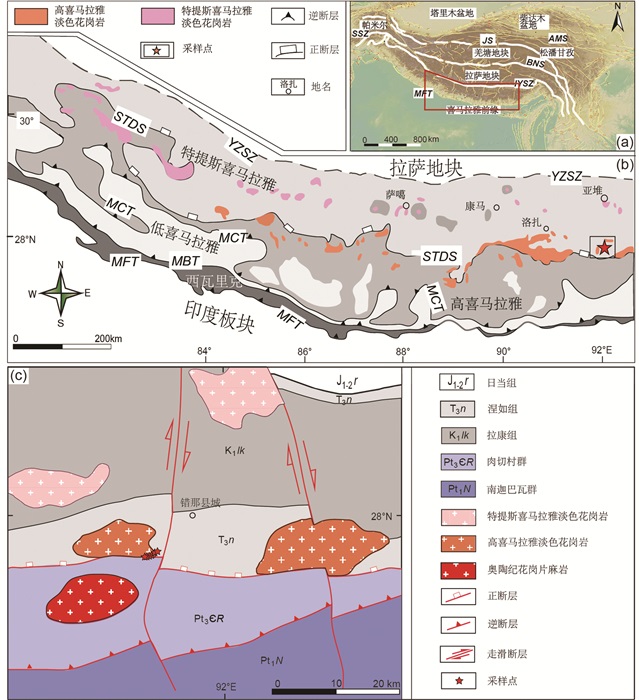
2 区域地质背景和样品喜马拉雅造山带呈向南凸出的东西向弧形展布,长2500km,宽300~500km,在北侧以印度-雅鲁藏布江缝合带(IYSZ)为界与拉萨地块分隔;在南侧则以喜马拉雅主前缘逆冲断层(MFT)为界与印度板块相望(Yin, 2006; 尹安, 2006; Yin and Harrison, 2000)。在喜马拉雅造山带内部,自北向南又分别以藏南拆离系(STDS)、主中央逆冲断层(MCT)和主边界逆冲断层(MBT)三条断层系将喜马拉雅造山带分为特提斯喜马拉雅带(THS,又叫北喜马拉雅带)、高喜马拉雅结晶岩系(HHCS)、低喜马拉雅岩系(LHS)、西瓦里克前陆盆地(又称次喜马拉雅,SHS)(图 1)。
|
图 1 青藏高原构造单元划分图(a)、喜马拉雅构造单元划分和淡色花岗岩分布图(b)和错那地区地质简图(c) AMS-阿尼玛卿-昆仑-木孜塔格缝合带;JS-金沙江缝合带;BNS-班公湖-怒江缝合带;SSZ-什约克缝合带;IYSZ-印度-雅鲁藏布江缝合带;STDS-藏南拆离系;MCT-主中央逆冲断层;MBT-主边界逆冲断层;MFT-主前缘逆冲断层 Fig. 1 Geological sketch map of tectonic outline of Tibet Plateau (a), geological map of tectonic outline of Himalayan orogenic belt and the distribution of the Himalayan leucogranites (b) and Simplified geologic map of Tsona area (c) AMS-Anyimaqen-Kunlun-Muztagh suture zone; JS-Jinsha suture zone; BNS-Bangong Nujiang suture zone; SSZ-Shyok suture zone; IYSZ-Indus Yalu suture zone; STDS-Southern Tibetan Detachment System; MCT-Main Central Thrust; MFT-Main Frontal Thrust |
在特提斯喜马拉雅带,沿东西向断续分布着一系列的片麻岩穹窿,不同的穹窿细节上有所差异,但总体特征类似,即核部由高级变质岩和侵入其中的花岗岩组成,边部为浅变质或者未变质的特提斯沉积岩系,两者之间为韧性拆离断层分割(Gao et al., 2013, 2016; Zeng et al., 2008, 2014; Zhang et al., 2004)。高喜马拉雅结晶岩系(HHCS)是原岩为古元古代-奥陶纪的高级变质岩,包括榴辉岩相-角闪岩相的片麻岩(变泥质岩和花岗质片麻岩)、变基性岩(榴辉岩、石榴辉石岩、石榴角闪岩)、钙硅酸盐和大理岩(Burchfiel, 1992; Yin, 2006)。记录了泛非期以来的岩浆活动和变质事件(黄春梅等, 2013)。在高喜马拉雅和特提斯喜马拉雅的交界,沿着STDS分布着大量的淡色花岗岩岩体(吴福元等, 2015)。
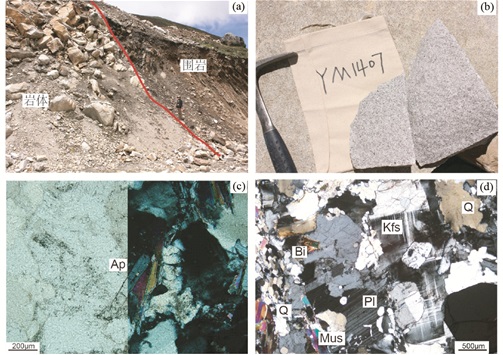
本文研究的错那地区位于高喜马拉雅和特提斯喜马拉雅交界处,藏南拆离系(STDS)的延伸段呈北东向横贯研究区。亚马荣岩体位于特提斯喜马拉雅沉积岩系中,围岩为上三叠统的曲龙共巴组,主要为被动大陆边缘稳定的浅海陆棚陆源的细碎屑岩。区域上不仅有新生代的淡色花岗岩,还有元古代、奥陶纪的侵入岩,岩石多为花岗片麻岩。新生代的错那淡色花岗岩岩体,岩性主体为二云母花岗岩,中细粒-中粗粒结构,部分样品可见云母层状定向排列(样品YM1411、YM1412)。矿物以长石、石英、云母为主,局部发育有石榴子石和电气石,主要成囊状或者脉状产出,或者与层状的云母层共生。岩石中还含有磷灰石、磷钇矿、独居石、锆石等副矿物(图 2)。
|
图 2 错那亚马荣淡色花岗野外及显微照片 (a)亚马荣淡色花岗岩野外产状;(b)亚马荣淡色花岗岩手标本照片;(c)磷灰石镜下照片;(d)典型镜下照片. Ap-磷灰石;Kfs-钾长石;Pl-斜长石;Q-石英;Bi-黑云母;Mus-白云母 Fig. 2 Field photographs and photomicrograph of the Yamarong leucogranites in Tsona area Yamarong leucogranites in Tsona area (a) field occurrence of Yamarong Leucogranites; (b) typical hand specimen photograph of Yamarong leucogranites; (c) photograph of apatite; (d) typical photomicrograph of Yamarong leucogranites. Ap-apatite; Kfs-K-feldspar; Pl-plagioclase; Q-quartz; Bi-biotite; Mus-muscovite |
野外采集的样品经过挑选,将较新鲜的样品送至河北省廊坊市区域地质矿产调查研究所实验室进行探针片磨制、200目粉末制备,以及锆石等单矿物的挑选。全岩的主、微量元素在中国地质大学(武汉)地质过程与矿产资源国家重点实验室(GPMR)完成。主量元素采用岛津波长扫描型X射线荧光光谱仪(XRF-1800) 测定,测试过程中设置有3个标准物质监控样,每12个样品测试一次重复样,测定精度优于5%。
微量元素采用电感耦合等离子体质谱仪(ICP-MS,Agilent 7700) 测定,测试过程中设置有4个标准物质监控样(AGV-2、BHVO-2、BCR-2、RGM-2) 和一个空白样,并且每6个样品选取一个重复样,测试精度优于5%~10%。微量元素的测试具体流程和原理、分析精度以及准确度见Liu et al. (2008b)。
3.2 锆石U-Pb年代学和Hf同位素将挑选出的锆石颗粒固定在环氧树脂靶上,经过打磨、抛光直至暴露出锆石颗粒中心,对其进行透射、反射和阴极发光(CL)照相,以便选出合适的锆石颗粒进行原位的U-Pb同位素和Hf同位素测定。
锆石U-Pb同位素和微量元素的测定是在GPMR利用激光剥蚀电感耦合等离子质谱(LA-ICP-MS)完成。ICP-MS型号为Agilent7500a,激光剥蚀系统为GeoLas2005,激光斑束直径为32μm。激光剥蚀过程中以氦气为载气,氩气为辅助气,具体的仪器操作过程和定年数据处理方法见(Liu et al., 2008a, 2010a),实验过程中采用Nist610、GJ-1和91500内标控制的方法,每隔6个样品点分别测试两个91500内标校正同位素分馏并检测仪器状态。U-Pb同位素数据采用ICPMSDataCal程序进行离线处理(Liu et al., 2010b),并采用Andersen (2002)对锆石进行普通Pb校正;锆石微量以29Si作为内标校正。
锆石的原位Hf同位素测定是在GPMR利用激光剥蚀多接受杯等离子质谱(LA-MC-ICP-MS)完成。激光剥蚀系统为GeoLas 2005,MC-ICP-MS为Neptune Plus。选取已经进行过U-Pb年代学测试的锆石并在同样位置进行Hf同位素比值测试,激光斑束固定为44μm,氦气为载气,脉冲频率为8Hz,具体的仪器操作条件和分析方法见(Hu et al., 2012)。数据分析的离线处理过程采用ICPMSDataCal完成。
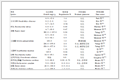
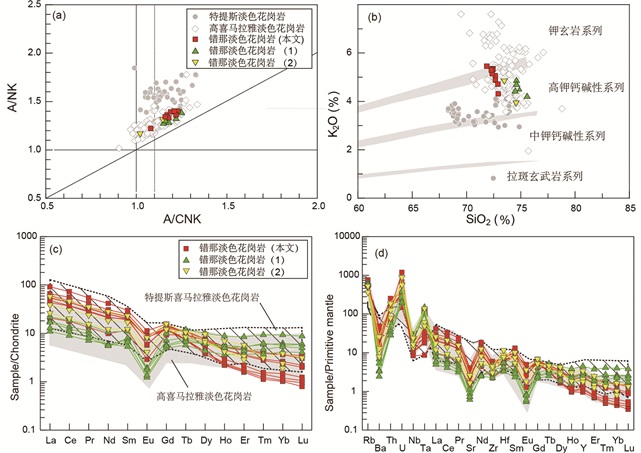
4 结果 4.1 主、微量元素错那地区的亚马荣淡色花岗岩具有较高的SiO2(71.85%~72.91%)和Al2O3(15.3%~15.67%)含量,较低的Fe2O3T(0.58%~0.90%)和CaO(0.72%~1.05%)含量,铝饱和指数(A/CNK)为1.08~1.22,绝大多数大于1.1,属于强过铝质岩石(表 1、图 3a)。Na2O含量为3.21%~4.18%,K2O含量相对较高(4.31%~5.45%),K2O/Na2O为1.05~1.70(表 1)。由SiO2-K2O图(图 3b)可知,亚马荣淡色花岗岩大多落在钾玄岩系列和高钾岩石系列的边界上,属于高钾岩石系列。亚马荣淡色花岗岩属于过铝质的高钾钙碱性花岗岩。
|
表 1 错那亚马荣淡色花岗岩全岩主量(wt%)和微量元素(×10-6)数据 Table 1 Bulk major (wt%) and trace (×10-6) elements compositions of the Yamarong leucograntes in Tsona |
|
图 3 错那亚马荣淡色花岗岩A/CNK-A/NK图解(a)、SiO2-K2O图解(b)、球粒陨石标准化稀土元素配分曲线图(c)和原始地幔标准化微量元素蛛网图(d) 球粒陨石数据据Boynton (1984);原始地幔数据据Sun and McDonough (1989).喜马拉雅淡色花岗岩数据来自Gao et al. (2017); Guo and Wilson (2012); Hou et al. (2012); Searle et al. (1997); Zeng et al. (2011); Zhang et al. (2004);错那淡色花岗岩(1) 数据来自Aikman et al. (2012b);错那淡色花岗岩(2) 数据来自王晓先等(2016) Fig. 3 A/CNK vs. A/NK diagram (a), SiO2 vs. K2O diagram (b), chondrite-normalized REE patterns (c) and primitive mantle-normalized trace element spider diagram (d) of Yamarong leucogranites in Tsona area |
亚马荣淡色花岗岩显示明显的Eu异常,δEu值为0.28~0.51,轻重稀土分异较强((La/Yb)N=5.63~65.0, 图 3c)。岩石富集大离子亲石元素(LILE)K、Rb、U、Pb;亏损高场强元素(HFSE)Nb、Ta、Ti、Hf、Zr(图 3d)。岩石的Rb/Sr比值为4.10~19.0,Rb含量为335×10-6~425×10-6,Sr含量为25×10-6~82×10-6;Sr/Ba比值为0.25~0.50,Ba含量为50×10-6~262×10-6(表 1)。
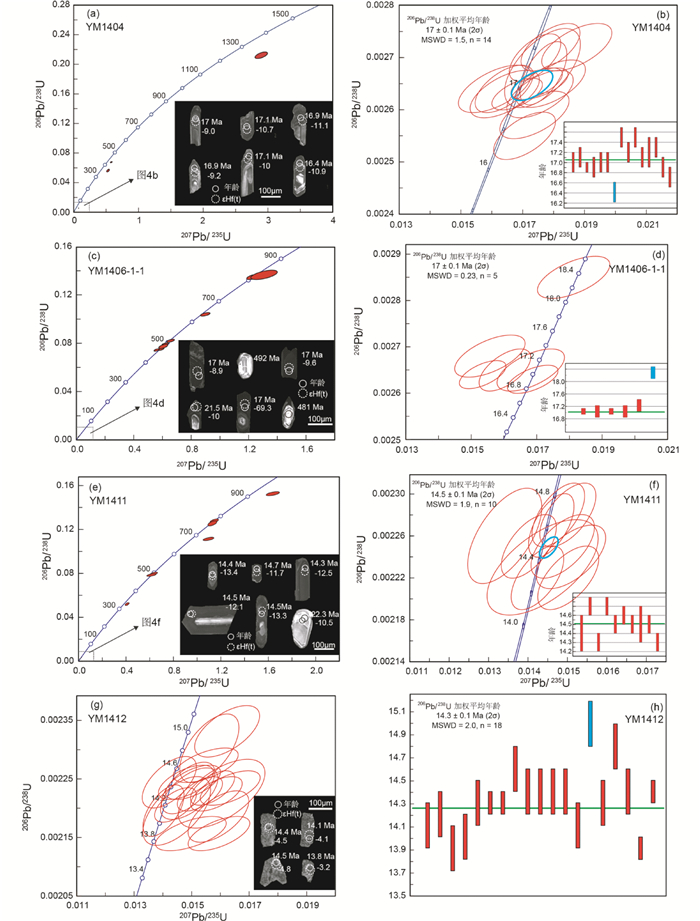
4.2 锆石U-Pb年代学、微量元素和Hf同位素本文对样品YM1404、YM1406-1-1、YM1411和YM1412进行了锆石U-Pb定年。从锆石阴极发光(CL)图像(图 4)中可以看出,锆石多具有继承锆石内核,内核呈浑圆状,颜色较亮;核外部分则具典型的岩浆韵律生长环带,环带多数较细密(样品YM1412除外),锆石粒度分布于60~100μm之间。亚马荣岩体的定年结果见表 2。4个样品经过Andersen (2002)普通铅校正、剔除继承锆石核的值以及偏离值后,其U-Pb谐和年龄图解和加权平均年龄图解见图 4。样品YM1404的206Pb/238U年龄介于16.4~17.5Ma,大多数年龄值在17Ma附近,剔除偏离值后得到的加权平均年龄为17Ma±0.1Ma(MSWD=1.5);样品YM1406-1-1的206Pb/238U年龄介于17.0~18.3Ma,6个测点中只有1个数值偏离17Ma(18.3Ma),剔除后加权平均年龄为17±0.1Ma(MSWD=0.2);样品YM1411的206Pb/238U年龄介于14.3~22.3Ma之间,剔除偏离值后的加权平均年龄为14.5±0.1Ma(MSWD=1.9);样品YM1412的206Pb/238U年龄介于13.9~15Ma之间,剔除偏离值后的加权平均年龄为14.3±0.1Ma(MSWD=2.0)。4个样品的年龄可分为两组,一组是以样品YM1404和YM1406-1-1为代表,平均年龄为17Ma;另一组是样品YM1411和YM1412为代表,平均年龄为14.4Ma。
|
图 4 错那亚马荣淡色花岗岩U-Pb年龄谐和图 Fig. 4 U-Pb concordia diagrams of the Yamarong leucogranites in Tsona area |
|
|
表 2 错那亚马荣淡色花岗岩锆石U-Pb年龄数据 Table 2 Zircon U-Pb isotope data of the Yamarong leucogranites in Tsona area |


对样品YM1404、YM1406-1-1和YM1411进行原位Hf同位素测定,测定结果见表 3。其中采用(176Lu/177Hf)CHUR=0.0332、(176Hf/177Hf)CHUR, 0=0.282772(Blichert-Toft and Albarède, 1997)、(176Lu/177Hf)DM=0.0384、(176Hf/177Hf)DM=0.28325(Griffin et al., 2000)计算出εHf(t)和Hf同位素相对于亏损地幔的二阶段模式年龄(tDM2)。亚马荣岩体的εHf(t)值可分为两部分,年龄为17Ma的样品εHf(t)集中在-12左右,年龄为14.4Ma的样品εHf(t)集中在-10左右。
|
|
表 3 错那亚马荣淡色花岗岩锆石Hf同位素数据 Table 3 Zircon Hf isotope data of the Yamarong leucogranites in Tsona area |


地壳深熔作用通常发生在峰期变质条件下或者地壳岩石的软弱时期(Weinberg, 2016),而深熔作用产生的熔体将影响地壳的稳定性,所以,厘定喜马拉雅淡色花岗岩岩浆作用的时空分布,对于造山带的演化极其重要。但喜马拉雅淡色花岗岩的时空跨度大(44~4Ma)、单个岩体持续时间长(Rubatto et al., 2013; Zeiger et al., 2015)等问题使得厘定工作变得困难。吴福元(2015)归纳出喜马拉雅淡色花岗岩大致发育在三个阶段:(1) 始喜马拉雅阶段(Eo-Himalayan: 44~26Ma),主要分布于特提斯喜马拉雅带中(Liu et al., 2014; Zeng et al., 2011, 2014),高喜马拉雅带中零星分布于Garhwal Himalaya、东尼泊尔的Arun构造窗以及锡金地区等(Weinberg, 2016);(2) 新喜马拉雅阶段(Neo-Himalayan: 26~13Ma),是喜马拉雅地区淡色花岗岩岩浆活动的高峰期,分布也最为广泛;(3) 后喜马拉雅阶段(Post-Himalayan: 13~7Ma),主要在库拉岗日、定结、然巴等地分布。
本文获得的错那亚马荣岩体的结晶年龄为17Ma和14.4Ma,结合Aikman et al. (2012a)的数据(~19Ma),反映出错那地区至少三期的岩浆活动,5Myr左右的岩浆持续时间,与区域内大多数淡色花岗岩的时间保持一致(Harrison et al., 1998; 黄春梅等, 2013; Leech, 2008; Searle et al., 1997)。
5.2 错那亚马荣淡色花岗岩岩石成因 5.2.1 锆石Ti温度计锆石的Ti温度计是Watson and Harrison (2005)根据锆石中Ti的含量进行计算的一种地质温度计,可较好获得锆石结晶时的岩浆温度,精度为±10℃(Watson et al., 2006),而影响Ti温度计准确度的是岩浆体系的TiO2和SiO2的活度(αTiO2和αSiO2)(Ferry and Watson, 2007)。对于淡色花岗岩岩浆而言,石英普遍存在,αSiO2接近于1;而通过显微镜下的观察和BSE能谱扫描,错那亚马荣岩体中发育有金红石,Aikman et al. (2012a)在对东喜马拉雅淡色花岗岩进行研究时,在错那和Arunachal的淡色花岗岩中也发现有金红石,所以可以设定错那亚马荣岩体的αTiO2≈1。另外,由于对于绝大多数的花岗质岩浆而言,锆石的溶解速度非常快(Harrison and Watson, 1983; Aikman et al., 2012a)。但是,在错那的淡色花岗岩中的锆石颗粒多数都具有继承锆石核,这表明深熔作用产生的岩浆处于锆饱和状态,岩浆温度初始下降时就伴随着锆石的结晶(Aikman et al., 2012a)。所以由锆石Ti温度计计算的出的温度可以近似于岩浆的最高温度。
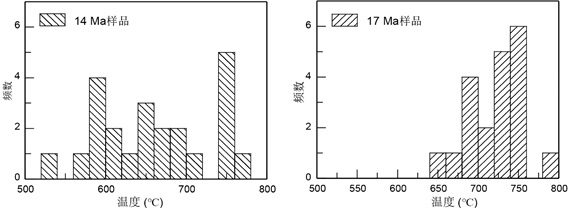
亚马荣岩体的锆石Ti温度计计算结果见表 2。通过锆石Ti温度的分布直方图(图 5)可以获得,时代为17Ma的淡色花岗岩的温度主要分布在690~740℃之间,其平均温度为721℃;时代为14Ma的淡色花岗岩的温度绝大多数集中在600~700℃之间,其平均温度为661℃。两个阶段之间70℃的温度差异,表明两个时代的淡色花岗岩具有不同的熔融机制,其中时代为17Ma的淡色花岗岩主要是由脱水熔融形成;水致熔融则是时代为14Ma的亚马荣岩体的主要熔融方式(Inger and Harris, 1992)。
|
图 5 错那亚马荣岩体两期淡色花岗岩的锆石Ti温度分布直方图 Fig. 5 Histogram of Ti-in-zircon temperature for Yamarong leucogranites of different times in Tsona |
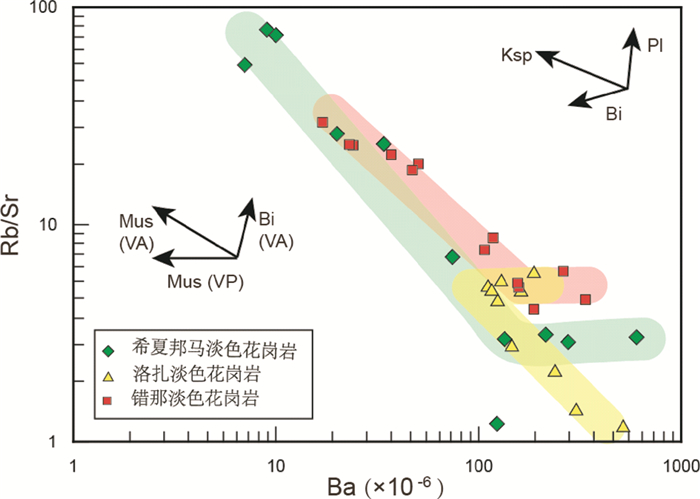
在黑云母或白云母存在的源岩发生部分熔融过程中,岩浆体系中水流体相的存在与否,决定了微量元素(尤其是非副矿物控制的微量元素)的行为(Harris and Inger, 1992)。在花岗质岩浆中,Rb、Sr和Ba的变化特征可以很好地限制熔融过程。一般而言,Rb主要赋存于云母类的矿物之中,Sr和Ba主要赋存在长石类矿物中,Rb在过铝质岩浆系统中对于长石来说是不相容元素。研究表明,与白云母脱水熔融相比,在水流体相存在的条件下,会有更多的斜长石参与熔融反应(Gao et al., 2017; Harris and Inger, 1992),生成的熔体具有较高的Sr、Ba和Ca,较低的Rb和Rb/Sr比值。从Rb/Sr-Ba图(图 6)可以看出,亚马荣淡色花岗岩的变化趋势平行于白云母脱水熔融矢量线和白云母含水熔融矢量线,表明控制亚马荣岩体岩浆形成的熔融方式有白云母脱水熔融和白云母含水熔融两种机制。另外,协变图解中白云母脱水熔融的矢量特点也可以由于钾长石的分离结晶导致(Inger and Harris, 1993),不过根据镜下观察,钾长石明显是晚期结晶相(图 2)。所以,图中的趋势不是分异作用所控制。相较于马拉山-吉隆地区,本文中的岩石含有相对较高的Rb/Sr比值,这可能和源区的Rb/Sr比值以及矿物组合有关。
|
图 6 错那亚马荣淡色花岗岩Rb/Sr-Ba图解 希夏邦马数据来自Searle et al. (2012);洛扎淡色花岗岩数据来自黄春梅等(2013);Guo et al. (2012);错那数据来自本文和王晓先等(2016) Fig. 6 Rb/Sr-Ba covariance diagram of the Yamarong leucogranites in Tsona |
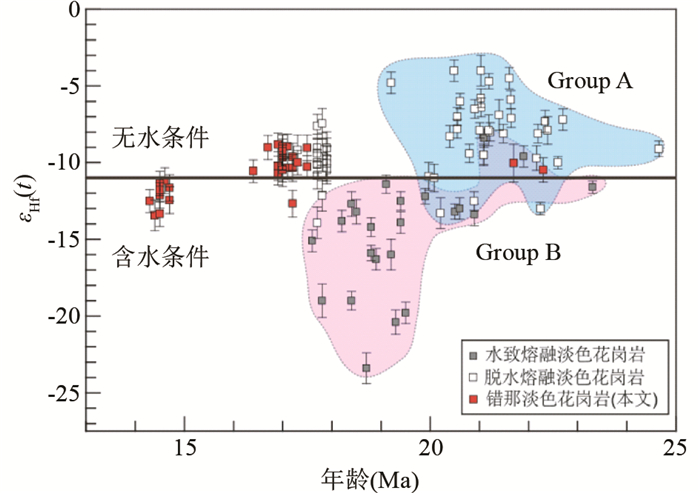
喜马拉雅淡色花岗岩的熔融方式并不单一,单个岩体可经历多种熔融过程(Groppo et al., 2012),不同熔融过程的叠加以及岩浆上侵中来自于围岩的同化混染等过程,致使全岩的地球化学特征的指示作用变弱。但是,由于单矿物是直接结晶自与其平衡的岩浆,可以反映出一些全岩地球化学特征无法反映的信息。错那亚马荣岩体的εHf(t)值随着早晚两期岩浆作用而不同,时代为17Ma的样品εHf(t)集中在-12左右,14Ma的样品集中在-10左右。两期不同的εHf(t)值可能反映了熔融方式的转换,或者源区性质的差异。Gao et al. (2017)在对马拉山-吉隆地区的花岗岩研究中,识别出两组不同熔融方式产生的淡色花岗岩(Group A和Group B),其中Group B是含水熔融形成,具有较负的εHf(t),Group A是脱水熔融形成,具有较高的εHf(t)值(图 7),与本文的εHf(t)特征一致。结合上文中的锆石Ti温度计结果和Rb/Sr-Ba协变关系图解,本文认为错那地区有两种熔融机制。水致熔融时,可以溶解更多的包含在造岩矿物中的锆石,这些锆石都具有非常负的εHf(t),从而降低了淡色花岗岩岩浆的εHf(t)值。对于水致熔融的流体来源,Hopkinson et al. (2014)通过对不丹地区的研究,认为诱发喜马拉雅水致熔融的流体可能来自于低喜马拉雅的物质。但是,低喜马拉雅的物质在泛非期和始新世的变质作用中经历过脱水作用,不太可能保存有大量的水(Harrison and Wielicki, 2016)。考虑到东喜马拉雅(91°E)地区的构造特点,Yin et al. (2009)推测东构造结Siang Window内的白垩纪-古近纪的磨拉石建造可以延伸到错那之下,此磨拉石建造较LHS含有更多的水,由此,Harrison and Wielicki (2016)认为此磨拉石建造在逆冲过程中会释放大量的水,这些水流体穿过MCT进入HHCS而触发深熔作用,不过,此种模型不能解释早期17Ma的脱水熔融现象,为什么流体仅仅在14Ma时才穿透MCT进入HHCS?Gao and Zeng (2014)通过对马拉山地区的研究认为,诱发水致熔融的流体可能与藏南E-W向的伸展有关。藏南发育有一系列的E-W向的伸展构造,而喜马拉雅带上的伸展构造的时间恰恰是14Ma左右,错那淡色花岗岩则刚好发育在一处E-W向伸展构造附近,且14Ma的样品具有明显的定向等变形构造。所以,本文认为,错那淡色花岗岩14Ma时的熔融方式的转换,可能与E-W向伸展作用有关。结合以上Rb/Sr-Ba变化关系和锆石Ti温度计,错那亚马荣岩体的年龄为17~14Ma,其形成过程中存在两种熔融机制,早期(~17Ma)为脱水熔融,晚期为水致熔融,熔融机制在14Ma左右发生转变,其转变原因可能与东西向伸展构造有关。
|
图 7 错那亚马荣锆石εHf(t)-年龄图解 图中水致熔融数据引自Gao et al. (2017);脱水熔融数据引自Gao et al. (2017);黄春梅等(2013) Fig. 7 Zircon εHf(t) values versus U-Pb diagram |
(1) 错那亚马荣岩体的结晶年龄为17~14Ma,结合前人研究,错那地区深熔作用时间至少持续5Ma。
(2) 锆石Ti温度计、Rb/Sr-Ba协变关系和εHf(t)成分变化表明,错那地区存在脱水熔融和水致熔融两种熔融方式。
(3) 触发熔融方式转变的原因可能和东西向伸展作用的启动有关。
致谢 野外工作中闫晶晶等同学给予了大量帮助;室内测试分析中得到刘勇胜老师、陈海红老师、刘硕老师、秦虹老师、朱文萍老师、宗克清老师和孙义伟同学的帮助;董国臣老师和高利娥老师进行了详细的审稿并提出了宝贵的修改意见;在此一并表示感谢。| [] | Aikman AB, Mark Harrison T, Hermann J. 2012a. Age and thermal history of Eo-and Neohimalayan granitoids, eastern Himalaya. Journal of Asian Earth Sciences, 51: 85–97. DOI:10.1016/j.jseaes.2012.01.011 |
| [] | Aikman AB, Mark Harrison T, Hermann J. 2012b. The origin of Eo-and Neo-himalayan granitoids, Eastern Tibet. Journal of Asian Earth Sciences, 58: 143–157. DOI:10.1016/j.jseaes.2012.05.018 |
| [] | Andersen T. 2002. Correction of common lead in U-Pb analyses that do not report 204Pb. Chemical Geology, 192(1-2): 59–79. DOI:10.1016/S0009-2541(02)00195-X |
| [] | Blichert-Toft J, Albarède F. 1997. The Lu-Hf isotope geochemistry of chondrites and the evolution of the mantle-crust system. Earth and Planetary Science Letters, 148(1-2): 243–258. DOI:10.1016/S0012-821X(97)00040-X |
| [] | Boynton WV. 1984. Cosmochemistry of the rare earth elements:Meteorite studies. In:Henderson P (ed). Rare Earth Element Geochemistry. Amsterdam:Elsevier |
| [] | Burchfiel BC. 1992. The south tibetan detachment system, himalayan orogen:Extension contemporaneous with and parallel to shortening in a collisional mountain belt. Geological Society of America Specal Paper, 269: 1–41. DOI:10.1130/SPE269 |
| [] | Ferry JM, Watson EB. 2007. New thermodynamic models and revised calibrations for the Ti-in-zircon and Zr-in-rutile thermometers. Contributions to Mineralogy and Petrology, 154(4): 429–437. DOI:10.1007/s00410-007-0201-0 |
| [] | Gao LE, Zeng LS, Hou KJ, Guo CL, Tang SH, Xie KJ, Hu GY, Wang L. 2013. Episodic crustal anatexis and the formation of Paiku composite leucogranitic pluton in the Malashan Gneiss Dome, Southern Tibet. Chinese Science Bulletin, 58(28-29): 3546–3563. DOI:10.1007/s11434-013-5792-4 |
| [] | Gao LE, Zeng LS. 2014. Fluxed melting of metapelite and the formation of Miocene high-CaO two-mica granites in the Malashan gneiss dome, southern Tibet. Geochimica et Cosmochimica Acta, 130: 136–155. DOI:10.1016/j.gca.2014.01.003 |
| [] | Gao LE, Zeng LS, Gao JH, Shang Z, Hou KJ, Wang Q. 2016. Oligocene crustal anatexis in the Tethyan Himalaya, southern Tibet. Lithos, 264: 201–209. DOI:10.1016/j.lithos.2016.08.038 |
| [] | Gao LE, Zeng LS, Asimow PD. 2017. Contrasting geochemical signatures of fluid-absent versus fluid-fluxed melting of muscovite in metasedimentary sources:The Himalayan leucogranites. Geology, 44(11): 39–42. |
| [] | Griffin WL, Pearson NJ, Belousova E, Jackson SE, van Achterbergh E, O'Reilly SY, Shee SR. 2000. The Hf isotope composition of cratonic mantle:LAM-MC-ICPMS analysis of zircon megacrysts in kimberlites. Geochimica et Cosmochimica Acta, 64(1): 133–147. DOI:10.1016/S0016-7037(99)00343-9 |
| [] | Groppo C, Rolfo F, Indares A. 2012. Partial melting in the Higher Himalayan Crystallines of Eastern Nepal:The effect of decompression and implications for the 'Channel Flow' Model. Journal of Petrology, 53(5): 1057–1088. DOI:10.1093/petrology/egs009 |
| [] | Guillot S, Fort PL. 1995. Geochemical constraints on the bimodal origin of High Himalayan leucogranites. Lithos, 35: 221–234. DOI:10.1016/0024-4937(94)00052-4 |
| [] | Guo ZF, Wilson M. 2012. The Himalayan leucogranites:Constraints on the nature of their crustal source region and geodynamic setting. Gondwana Research, 22(2): 360–376. DOI:10.1016/j.gr.2011.07.027 |
| [] | Harris NBW, Inger S. 1992. Trace element modelling of pelite-derived granites. Contributions to Mineralogy and Petrology, 110(1): 46–56. DOI:10.1007/BF00310881 |
| [] | Harris N, Massey J. 1994. Decompression and anatexis of Himalayan metapelites. Tectonics, 13(6): 1537–1546. DOI:10.1029/94TC01611 |
| [] | Harris N, Ayres M, Massey J. 1995. Geochemistry of granitic melts produced during the incongruent melting of muscovite:Implications for the extraction of Himalayan leucogranite magmas. Journal of Geophysical Research, 100(B8): 15767–15777. DOI:10.1029/94JB02623 |
| [] | Harrison TM, Watson EB. 1983. Kinetics of zircon dissolution and zirconium diffusion in granitic melts of variable water content. Contributions to Mineralogy and Petrology, 84(1): 66–72. DOI:10.1007/BF01132331 |
| [] | Harrison TM, Grove M, Lovera OM, Catlos EJ. 1998. A model for the origin of Himalayan anatexis and inverted metamorphism. Journal of Geophysical Research:Solid Earth, 103(B11): 27017–27032. DOI:10.1029/98JB02468 |
| [] | Harrison TM, Wielicki MM. 2016. From the Hadean to the Himalaya:4. 4Ga of felsic terrestrial magmatism. American Mineralogist, 101(6): 1348–1359. |
| [] | Hopkinson TN, Warren CJ, Harris NBW, Hammond S and Parrish RR. 2014. Chemical evolution of Himalayan leucogranites based on an integrated zircon O, U-Pb, Hf study of zircons. In:Montomoli C (ed.). Proceedings for the 29th Himalaya-Karakoram-Tibet Workshop. Lucca, Italy |
| [] | Hou ZQ, Zheng YC, Zeng LS, Gao LE, Huang KX, Li W, Li QY, Fu Q, Liang W, Sun QZ. 2012. Eocene-Oligocene granitoids in southern Tibet:Constraints on crustal anatexis and tectonic evolution of the Himalayan orogen. Earth and Planetary Science Letters, 349-350: 38–52. DOI:10.1016/j.epsl.2012.06.030 |
| [] | Hu ZC, Liu YS, Gao S, Liu WG, Yang L, Zhang W, Tong XR, Lin L, Zong KQ, Li M, Chen HH, Zhou L, Yang L. 2012. Improved in situ Hf isotope ratio analysis of zircon using newly designed X skimmer cone and Jet sample cone in combination with the addition of nitrogen by laser ablation multiple collector ICP-MS. Journal of Analytical Atomic Spectrometry, 27(9): 1391–1399. DOI:10.1039/c2ja30078h |
| [] | Huang CM, Zhao ZD, Zhu DC, Liu D, Huang Y, Dung MC, Hu ZC, Zheng JP. 2013. Geochemistry, zircon U-Pb chronology and Hf isotope of Luozha leucogranite, southern Tibet:Implication for petrogenesis. Acta Petrologica Sinica, 29(11): 3689–3702. |
| [] | Inger S, Harris NBW. 1992. Tectonothermal evolution of the High Himalayan Crystalline Sequence Langtang Valley northern Nepal. Journal of Metamorphic Geology, 10(3): 439–452. DOI:10.1111/jmg.1992.10.issue-3 |
| [] | Inger S, Harris N. 1993. Geochemical constraints on leucogranite magmatism in the Langtang Valley Nepal Himalaya. Journal of Petrology, 34(2): 345–368. DOI:10.1093/petrology/34.2.345 |
| [] | Leech ML. 2008. Does the Karakoram fault interrupt mid-crustal channel flow in the western Himalaya?. Earth and Planetary Science Letters, 276(3-4): 314–322. DOI:10.1016/j.epsl.2008.10.006 |
| [] | Liu D, Zhao ZD, Zhu DC, Niu YL, Widom E, Teng FZ, DePaolo DJ, Ke S, Xu JF, Wang Q, Mo XX. 2015. Identifying mantle carbonatite metasomatism through Os-Sr-Mg isotopes in Tibetan ultrapotassic rocks. Earth and Planetary Science Letters, 430: 458–469. DOI:10.1016/j.epsl.2015.09.005 |
| [] | Liu YS, Hu ZC, Gao S, Guenther D, Xu J, Gao CG, Chen HH. 2008a. In situ analysis of major and trace elements of anhydrous minerals by LA-ICP-MS without applying an internal standard. Chemical Geology, 257(1-2): 34–43. DOI:10.1016/j.chemgeo.2008.08.004 |
| [] | Liu YS, Zong KQ, Kelemen PB, Gao S. 2008b. Geochemistry and magmatic history of eclogues and ultramafic rocks from the Chinese continental scientific drill hole:Subduction and ultrahigh-pressure metamorphism of lower crustal cumulates. Chemical Geology, 247(1-2): 133–153. DOI:10.1016/j.chemgeo.2007.10.016 |
| [] | Liu YS, Hu ZC, Zong KQ, Gao CG, Gao S, Xu J, Chen HH. 2010a. Reappraisement and refinement of zircon U-Pb isotope and trace element analyses by LA-ICP-MS. Chinese Science Bulletin, 55(15): 1535–1546. DOI:10.1007/s11434-010-3052-4 |
| [] | Liu YS, Gao S, Hu ZC, Gao CG, Zong KQ, Wang DB. 2010b. Continental and oceanic crust recycling-induced melt-peridotite interactions in the Trans-North China Orogen:U-Pb dating Hf isotopes and trace elements in zircons of mantle xenoliths. Journal of Petrology, 51(1-2): 537–571. DOI:10.1093/petrology/egp082 |
| [] | Liu ZC, Wu FY, Ji WQ, Wang JG, Liu CZ. 2014. Petrogenesis of the Ramba leucogranite in the Tethyan Himalaya and constraints on the channel flow model. Lithos, 208-209: 118–136. DOI:10.1016/j.lithos.2014.08.022 |
| [] | Niu YL. 2016. Testing the geologically testable hypothesis on subduction initiation. Science Bulletin, 61(16): 1231–1235. DOI:10.1007/s11434-016-1144-5 |
| [] | Patiño Douce AE, Harris N. 1998. Experimental constraints on Himalayan anatexis. Journal of Petrology, 39(4): 689–710. DOI:10.1093/petroj/39.4.689 |
| [] | Price C, Harris N, Vance D. 2001. Fluid-enhanced melting during prograde metamorphism. Journal of the Geological Society, 158(2): 233–241. DOI:10.1144/jgs.158.2.233 |
| [] | Rubatto D, Chakraborty S, Dasgupta S. 2013. Time scales of crustal melting in the Higher Himalayan Crystallines (Sikkim Eastern Himalaya) inferred from trace element-constrained monazite and zircon chronology. Contributions to Mineralogy and Petrology, 165(2): 349–372. DOI:10.1007/s00410-012-0812-y |
| [] | Searle MP, Parrish RR, Hodges KV, Hurford A, Ayres MW, Whitehouse MJ. 1997. Shisha Pangma, leucogranite South Tibetan Himalaya:Field relations, geochemistry, age, origin and emplacement. Journal of Geology, 105: 295–317. DOI:10.1086/515924 |
| [] | Sun SS, McDonough WF. 1989. Chemical and isotopic systematics of oceanic basalts:Implications for mantle composition and processes. In:Saunders AD and Norry MJ (eds.). Magmatism in the Ocean Basins. Geological Society, London, Special Publications, 42(1): 313–345. DOI:10.1144/GSL.SP.1989.042.01.19 |
| [] | Visonà D, Lombardo B. 2002. Two-mica and tourmaline leucogranites from the Everest-Makalu region (Nepal-Tibet). Himalayan leucogranite genesis by isobaric heating? Lithos, 62(3-4): 125–150. |
| [] | Wang XX, Zhang JJ, Yan SY, Liu J. 2016. Age and geochemistry of the Cuona leucogranite in southern Tibet and its geological implications. Geological Bulletin of China, 35(1): 91–103. |
| [] | Watson EB, Harrison TM. 2005. Zircon thermometer reveals minimum melting conditions on earliest Earth. Science, 308(5723): 841–844. DOI:10.1126/science.1110873 |
| [] | Watson EB, Wark DA, Thomas JB. 2006. Crystallization thermometers for zircon and rutile. Contributions to Mineralogy and Petrology, 151(4): 413–433. DOI:10.1007/s00410-006-0068-5 |
| [] | Weinberg RF, Hasalová P. 2015. Water-fluxed melting of the continental crust:A review. Lithos, 212-215: 158–188. DOI:10.1016/j.lithos.2014.08.021 |
| [] | Weinberg RF. 2016. Himalayan leucogranites and migmatites:Nature timing and duration of anatexis. Journal of Metamorphic Geology, 34(8): 821–843. DOI:10.1111/jmg.2016.34.issue-8 |
| [] | Wei YQ, Zhao ZD, Niu YL, Zhu DC, Liu D, Wang Q, Hou ZQ, Mo XX, Wei JC. 2017. Geochronology and geochemistry of the Early Jurassic Yeba Formation volcanic rocks in southern Tibet:Initiation of back-arc rifting and crustal accretion in the southern Lhasa Terrane. Lithos, 278-281: 477–490. DOI:10.1016/j.lithos.2017.02.013 |
| [] | Wu CM, Chen HX. 2015. Revised Ti-in-biotite geothermometer for ilmenite-or rutile-bearing crustal metapelites. Science Bulletin, 60(1): 116–121. DOI:10.1007/s11434-014-0674-y |
| [] | Wu FY, Liu ZC, Liu XC, Ji WQ. 2015. Himalayan leucogranite:Petrogenesis and implications to orogenesis and plateau uplift. Acta Petrologica Sinica, 31(1): 1–36. |
| [] | Yang SY, Jiang SY, Palmer MR. 2015. Chemical and boron isotopic compositions of tourmaline from the Nyalam leucogranites, South Tibetan Himalaya:Implication for their formation from B-rich melt to hydrothermal fluids. Chemical Geology, 419: 102–113. DOI:10.1016/j.chemgeo.2015.10.026 |
| [] | Yin A, Harrison TM. 2000. Geologic evolution of the Himalayn-Tibet orogen. Annu. Rev. Earth Planet, 28: 211–280. DOI:10.1146/annurev.earth.28.1.211 |
| [] | Yin A. 2006. Cenozoic tectonic evolution of the Himalayan orogen as constrained by along-strike variation of structural geometry exhumation history and foreland sedimentation. Earth-Science Reviews, 76(1-2): 1–131. DOI:10.1016/j.earscirev.2005.05.004 |
| [] | Yin A. 2006. Cenozoic tectonic evolution of the Himalayan orogen as constrained by along-strike variation of structural geometry, exhumation history, and foreland sedimentation. Earth Science Frontiers, 13(5): 416–515. |
| [] | Yin A, Dubey CS, Kelty TK, Webb AAG, Harrison TM, Chou CY, Celerier J. 2009. Geologic correlation of the Himalayan orogen and Indian craton:Part 2. Structural geology, geochronology, and tectonic evolution of the Eastern Himalaya. Geological Society of America Bulletin, 122(3-4): 360–395. |
| [] | Yu BS, Zhao ZD, Su SG. 2012. Petrology. 2nd Edition. Beijing: Geological Publishing House: 1-275. |
| [] | Zeiger K, Gordon SM, Long SP, Kylander-Clark ARC, Agustsson K, Penfold M. 2015. Timing and conditions of metamorphism and melt crystallization in Greater Himalayan rocks, eastern and central Bhutan:Insight from U-Pb zircon and monazite geochronology and trace-element analyses. Contributions to Mineralogy and Petrology, 169(5): 47. DOI:10.1007/s00410-015-1143-6 |
| [] | Zeng LS, Liu J, Gao LE, Xie K, Wen L. 2008. Early Oligocene anatexis in the Yardoi gneiss dome, southern Tibet and geological implications. Chinese Science Bulletin, 54(1): 104–112. |
| [] | Zeng LS, Gao LE, Xie K, Jing LZ. 2011. Mid-Eocene high Sr/Y granites in the Northern Himalayan Gneiss Domes:Melting thickened lower continental crust. Earth and Planetary Science Letters, 303(3-4): 251–266. DOI:10.1016/j.epsl.2011.01.005 |
| [] | Zeng LS, Gao LE, Tang SH, Hou KJ, Guo CL, Hu GY. 2014. Eocene magmatism in the Tethyan Himalaya, southern Tibet. Geological Society, London, Special Publications, 412(1): 287–316. |
| [] | Zhang HF, Harris N, Parrish R, Kelley S, Zhang L, Rogers N, Argles T, King J. 2004. Causes and consequences of protracted melting of the mid-crust exposed in the North Himalayan antiform. Earth and Planetary Science Letters, 228(1-2): 195–212. DOI:10.1016/j.epsl.2004.09.031 |
| [] | 黄春梅, 赵志丹, 朱弟成, 刘栋, 黄玉, 董铭淳, 胡兆初, 郑建平. 2013. 藏南洛扎地区淡色花岗岩锆石U-Pb年龄、Hf同位素、地球化学与岩石成因. 岩石学报, 29(11): 3689–3702. |
| [] | 王晓先, 张进江, 闫淑玉, 刘江. 2016. 藏南错那淡色花岗岩LA-MC-ICP-MS锆石U-Pb年龄、岩石地球化学及其地质意义. 地质通报, 35(1): 91–103. |
| [] | 吴福元, 刘志超, 刘小驰, 纪伟强. 2015. 喜马拉雅淡色花岗岩. 岩石学报, 31(1): 1–36. |
| [] | 尹安. 2006. 喜马拉雅造山带新生代构造演化:沿走向变化的构造几何形态、剥露历史和前陆沉积的约束. 地学前缘, 13(5): 416–515. |
| [] | 于炳松, 赵志丹, 苏尚国. 2012. 岩石学. 第二版. 北京: 地质出版社: 1-275. |