 2017, Vol. 33


拉萨地块是青藏高原的重要组成部分,它是夹持于班公湖-怒江缝合带以南、雅鲁藏布缝合带以北的巨型构造-岩浆岩带。中生代以来,拉萨地块经历了班公湖-怒江特提斯洋俯冲消减、拉萨-羌塘碰撞、新特提斯洋向北俯冲以及印度-欧亚大陆碰撞等一系列地质过程,形成了中-新生代大规模的岩浆作用,这些岩浆岩分布面积占整个青藏高原岩浆岩面积的80%以上,很好地记录了拉萨地块构造演化与深部作用过程,为研究和探索拉萨地块中生代演化及岩石圈构造提供了重要依据,因而受到广泛关注(Copeland et al., 1995; Yin and Harrison, 2000; Wang et al., 2002; Kapp et al., 2005, 2007; Mo et al., 2008; Zhu et al., 2008, 2009a, b, 2011a; Zhao et al., 2009; 邓军等, 2011; 朱弟成等, 2008a)。
拉萨地块不但是一个与印度欧亚大陆发生陆陆碰撞造就的新生代造山带,还是一个与新特提斯大洋岩石圈北向俯冲有关的前新生代安第斯型活动大陆边缘(Allègre et al., 1984; Celal Sengör, 1987; Yin and Harrison, 2000; Chung et al., 2005; Zhang et al., 2007; Zhu et al., 2011b)。20世纪80年代,随着中法、中英合作项目的陆续展开,第一次全面推动了青藏高原的地质研究(Tapponnier et al., 1981; Maluski et al., 1982; Allègre et al., 1984; Schärer et al., 1984; Xu et al., 1985),获得了第一批高质量的南部拉萨地块锆石U-Pb年代学数据,通过对相关资料的研究与综合,认为南带的花岗岩是由于新特提斯洋向北俯冲造成的(Chu et al., 2006; Kapp et al., 2007; Leier et al., 2007; 纪伟强等, 2009)。该观点倾向于从南部拉萨地块的岩浆作用出发,认为全部是新特提斯洋向北俯冲导致了拉萨地块的全部岩浆活动,然而该观点无法解释拉萨地块南北带出现的同时代的岩浆活动,因此,用单一的新特提斯洋板片向北俯冲解释拉萨地块全部的岩浆活动是不合理的。后来随着地质工作的深入开展,逐渐积累了一大批相关地质资料,认识到该区域的岩浆活动历史比最初认识的更为复杂。朱弟成等(2011a)为代表的另一种观点则从大规模出现的北部岩浆活动出发,认为是北部的羌塘地块向拉萨地块之下的俯冲与碰撞作用触发了南部的新特提斯洋的向北俯冲,因此具有双向俯冲的特征。该观点认为拉萨地块的大多数中生代岩浆作用很可能与班公湖-怒江特提斯洋的洋壳向南俯冲及随后板片断离作用(潘桂棠等, 2006; 朱弟成等, 2006; 张晓倩等, 2010, 2012; 张亮亮等, 2011; Zhu et al., 2009b, 2010, 2011a, b, 2016) 有关,并且这一俯冲很可能开始于中二叠世末期的拉萨-澳大利亚碰撞,结束于早白垩世晚期(Zhu et al., 2009a, 2009b, 2012)。
大陆地壳的生长是指亏损地幔物质添加到地壳的过程,花岗岩已被证实可以是独立起源的,实验岩石学研究也表明地壳重熔作用是花岗岩主要的形成方式(Jia et al., 2016; Wyllie, 1977)。因此,地幔物质在花岗岩形成过程中的作用是一直以来被学术界热烈讨论的话题。由于全岩地球化学和Sr-Nd同位素成分更易在开放系统过程中快速实现平衡,锆石的Lu-Hf同位素就成为了更好的示踪剂(Lesher, 1990; Kemp et al., 2007; Yang et al., 2007; Guo et al., 2015),锆石Hf同位素技术的应用为花岗岩成因与壳幔演化研究提供了新思路和新途径。本文选择前人关注较少、缺乏系统研究的,出露于中部拉萨地块西段的许如错岩体中的寄主二长花岗岩和暗色包体为研究对象,利用锆石U-Pb定年和Hf同位素分析方法对采自西藏许如错岩体的寄主花岗岩和包体和进行了研究,并结合中部和北部拉萨地块的中晚侏罗世岩浆岩的已有资料,探讨许如错岩体的成因与演化特征,并为侏罗纪时期的构造-岩浆作用过程提供约束。
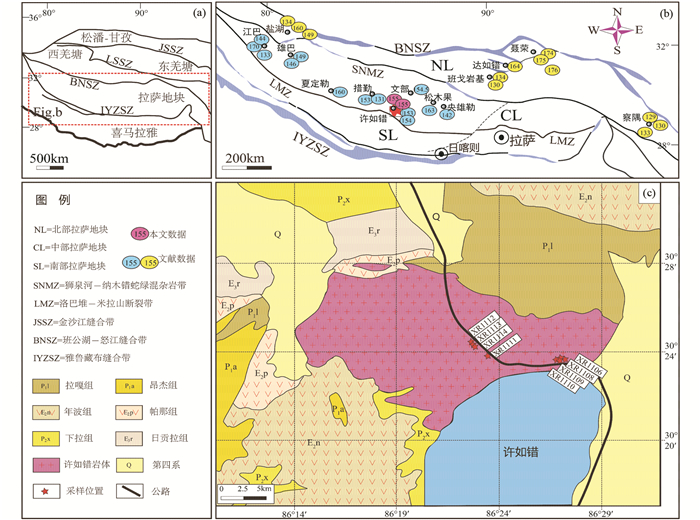
2 地质背景与样品描述青藏高原由金沙江缝合带(JSSZ)、班公湖-怒江缝合带(BNSZ)和印度河-雅鲁藏布缝合带(IYZSZ)划分为四个近东西向延伸的地块,它们由北向南依次是松潘-甘孜复理石杂岩带、羌塘、拉萨地块和喜马拉雅带。本文所涉及的拉萨地块,根据沉积盖层和基底性质的不同,以狮泉河-纳木错蛇绿混杂岩带(SNMZ)和洛巴堆-米拉山断裂带(LMZ)为界,进一步划分为北部拉萨地块、中部拉萨地块和南部拉萨地块(Zhu et al., 2013)(图 1b)。已有研究表明,南、北拉萨地块以新生地壳为特征(莫宣学等, 2005; Mo et al., 2007, 2008; 纪伟强等, 2009; Zhu et al., 2011b),目前并未发现寒武纪结晶基底(Dong et al., 2011; Zhu et al., 2012)。而中部拉萨地块是具有古元古代甚至是太古代结晶基底的条带状微陆块(Zhu et al., 2009a, 2011a, 2013),其基底被广泛的二叠-石炭系变沉积序列、上侏罗统-下白垩统沉积岩石、大量的中生代岩浆岩(Zhu et al., 2009a, 2011b, 2013),以及少量保存很好的奥陶系、志留系、泥盆系和三叠系及前寒武纪变质灰岩(Pan et al., 2004)和寒武纪变火山沉积岩所覆盖(计文化等, 2009; Zhu et al., 2012)。
|
图 1 西藏高原构造单元图及许如错岩体地质图 (a)西藏高原构造单元划分图(据Zhu et al., 2012);(b)中北部拉萨地块中侏罗世-早白垩世岩浆岩的拉萨地块区域构造图及中部、北部中晚侏罗世岩浆岩的部分定年结果(年龄据本文数据及参考文献刘登忠等, 2005①; 谢国刚等, 2002②; 黄俊平等, 2006; 朱弟成等, 2008b; Zhu et al., 2009b, c, 2011a, 2016; Chiu et al., 2009; 姜昕等, 2010; 刘敏等, 2010; 李小波等, 2015);(c)研究区地质图及本文采样位置(据谢国刚等, 2002③) Fig. 1 Tectonic subdivision of the Tibetan Plateau and simplified geological map of the Xuru Tso area |
①刘登忠, 陶晓风, 马润则等. 2005.中华人民共和国1:25万区域地质调查报告赛利普幅
②谢国刚, 邹爱建, 袁建芽等. 2002a.中华人民共和国1:25万区域地质调查报告邦多区幅
③谢国刚, 邹爱建, 袁建芽等. 2002b.中华人民共和国1:25万区域地质调查报告措麦区幅
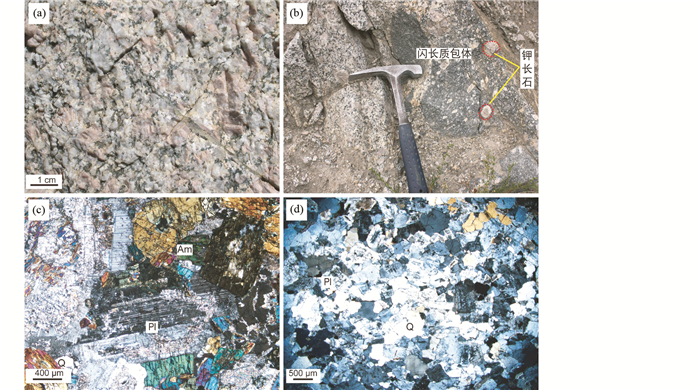
本文研究的许如错岩体位于中部拉萨地块西段靠近南部,岩体侵位于石炭纪永珠组(C2y)、二叠纪拉嘎组(P1l)、昂杰组(P1a)和下拉组(P2x)中(图 1c),岩石之上被林子宗火山岩不整合覆盖。岩体主要由黑云二长花岗岩、似斑状二长花岗岩和二长花岗岩组成,岩体中发育有大量大小不一的闪长质包体,直径从几厘米至几十厘米,形态以椭圆状为主,闪长质包体与寄主岩石之间的接触界线截然或过渡,在包体与寄主岩石的接触带上,发育浅色长英质晕圈。闪长质包体中可见钾长石巨晶及石英斑晶(图 2b)。本文采集了六件寄主花岗岩和两件闪长质包体样品,寄主花岗岩的矿物组成为斜长石,钾长石,石英,黑云母及普通角闪石(图 2a, d),副矿物包括磷灰石、锆石和不透明矿物,斜长石中可观察到嵌晶结构、聚片双晶结构。包体主要由斜长石,黑云母,普通角闪石,钾长石和石英组成(图 2c)。详细的岩石类型和采样位置列于表 1。
|
图 2 许如错岩体寄主花岗岩与闪长质包体的野外及岩相学照片 (a)寄主花岗岩野外露头;(b)寄主花岗岩与闪长质包体以及其中的钾长石巨晶;(c)闪长质包体;(d)寄主花岗岩.Q-石英; Pl-斜长石; Am-角闪石 Fig. 2 Field and petrographical photos of granitoids and dioritic enclaves in the Xuru Tso batholith |
|
表 1 中部拉萨地块许如错岩体样品采样位置及岩石类型汇总表 Table 1 Sample description of the Xuru Tso batholith in central Lhasa Terrane |
在河北省廊坊区域地质矿产调查研究所采用浮选和电磁方法进行锆石的挑选工作,将挑选出的锆石粘贴制成环氧树脂样品靶,经过打磨抛光使锆石露出中心后进行透射光、反射光和阴极发光(CL)显微照相。锆石的阴极发光显微照相是在中国科学院地质与地球物理研究所电子探针实验室采用扫描电镜完成,加速电压为15kV,用于检测每个锆石的内部结构及选择合适的分析点位置。锆石U-Pb同位素定年是在中国地质大学(武汉)地质过程与矿产资源国家重点实验室利用LA-ICP-MS分析完成,激光剥蚀系统为GeoLas 2005,电感耦合等离子质谱(ICP-MS)为Agilent7700x。在等离子体中心气流(Ar+He)中加入少量氮气以提高仪器灵敏度、降低检出限和改善分析精密度。激光斑束直径为32μm。详细的仪器操作条件和数据处理方法见Liu et al.(2008, 2010)。定年过程中采用91500作为内标校正同位素分馏,每隔6个数据点分别用两个91500标样校正。锆石微量元素含量利用多个USGS参考玻璃(BCR-2G,BIR-1G)作为多外标、29Si作为内标进行定量校正。对样品和空白信号的选择、仪器灵敏度漂移校正、元素含量及U-Th-Pb同位素比值和年龄计算均采用软件ICPMSDataCal 9.0进行离线处理(Liu et al., 2008, 2010)。采用Andersen(2002)进行普通铅校正,锆石U-Pb年龄谐和图的绘制和MSWD的计算则采用Isoplot /Ex_ver3(Ludwig, 2003)。锆石定年结果见表 2和图 3。
|
|
表 2 中部拉萨地块许如错岩体LA-ICP-MS锆石U-Pb定年结果 Table 2 Zircon LA-ICPMS U-Pb analysis data of the Xuru Tso granitoid (XR1114) and dioritic enclave (XR1111) of the central Lhasa Terrane |
|
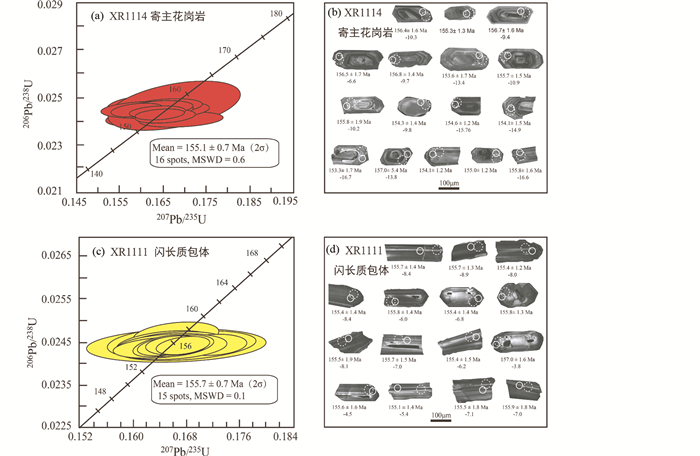
图 3 西藏许如错岩体定年样品中的锆石CL图像和U-Pb年龄谐和图 Fig. 3 Cathodoluminescence (CL) images and concordia plots for zircons from the Xuru Tso batholith |
挑选新鲜样品在无污染环境下粉碎至200目。主量元素在中国地质大学(武汉)地质过程与矿产资源国家重点实验室采用岛津波长扫描型X射线荧光光谱仪(XRF-1800 SHIMADZU SEQUENTIAL)测定,微量元素在中国地质大学(武汉)地质过程与矿产资源国家重点实验室利用Agilent 7500a ICP-MS测定,测试精度优于5%~10%。测试过程中采用内标和外标综合控制测试质量的方法,同时测定空白样(Blank)、USGS国际标准物质AGV-2、BHVO-2、BCR-2和GSR-1以及实验室内标In, 详细的样品处理过程、标样的参考数值、分析精密度和准确度见Liu et al.(2008)。岩石主、微量元素测试结果见表 3。
|
|
表 3 许如错岩体主量(wt%)和微量元素(×10-6)地球化学数据 Table 3 Bulk-rock major (wt%) and trace (×10-6) elements of the Xuru Tso batholith |
锆石原位锆石Hf同位素的测定是在天津地质矿产研究所使用NEW WAVE 193nm FX氟化氩准分子激光器和NEPTUNE型多接收器等离子体质谱仪进行,分析点位于锆石U-Pb同位素分析点附近,激光剥蚀束斑直径44μm,激光脉冲频率为8Hz。具体实验条件和流程见参考文献(Yuan et al., 2008)。使用GJ-1作为标准锆石检测实验数据,本次分析过程中GJ-1的Hf同位素含量为0.282020±0.000016(2σ,N=11),与文献报道的参考值在误差范围内一致。εHf(t)值是根据测点的锆石U-Pb年龄计算的,采用176Lu衰变常数为1.876×10⁻¹¹year-1(Söderlund et al., 2004),球粒陨石176Hf/177Hf比值为0.282785,176Lu/177Hf比值为0.0336(Bouvier et al., 2008)。亏损地幔模式年龄(tDM)的计算参考现今亏损地幔176Hf/177Hf比值0.28325,176Lu/177Hf比值为0.0384(Griffin et al., 2000)。假设每颗锆石的母岩浆来自平均大陆地壳,采用176Lu/177Hf比值为0.015(Griffin et al., 2002)计算锆石Hf同位素的地壳模式年龄(tDMC)。选择不同衰变常数不会影响实验结果。锆石Lu-Hf同位素数据见表 4。
|
|
表 4 许如错岩体花岗岩和闪长岩的锆石Hf同位素数据 Table 4 Zircon Hf isotopic data of the Xuru Tso granitoid (XR1114) and dioritic enclave (XR1111) |
本文对1件二长花岗岩岩石样品及1件闪长岩包体进行了锆石U-Pb定年。锆石阴极发光图像和年龄谐和图分别见图(3a, b)。从锆石CL图像(3b)可以看出,寄主二长花岗岩样品中的锆石自形程度较好,呈长柱形或棱柱形,长为50~200μm,长宽比为1.5:1~3:1,具有发育明显的振荡环带结构。闪长岩包体样品中的锆石多为自形棱柱状,长为100~250μm,长宽比为1.5:1~2:1,具有弱同心振荡环带,有的锆石颗粒发育不封闭条带状环带(图 3d)。寄主岩石与包体的锆石中均可见振荡环带结构,为典型的岩浆锆石特征。寄主二长花岗岩锆石Th/U比值为0.53~0.92,闪长质包体锆石Th/U比值为0.59~1.88,也表明它们为岩浆成因(Hoskin and Black, 2000)。
二长花岗岩(样品XR1114) 的18个测点中,除去2个不谐合测点外,其他16个测点的206Ph/238U年龄较集中,变化于153~156Ma之间,加权平均年龄为155.1±0.7Ma(MSWD=0.6, 2σ),闪长质包体(样品XR1111) 的18个测点中,剔除3个不谐和测点,其他15个测点的206Ph/238U的年龄变化于155~157Ma之间,加权平均年龄为155.7±0.7Ma(MSWD=0.1, 2σ),定年结果表明闪长质包体与寄主二长花岗岩的结晶年龄非常一致。
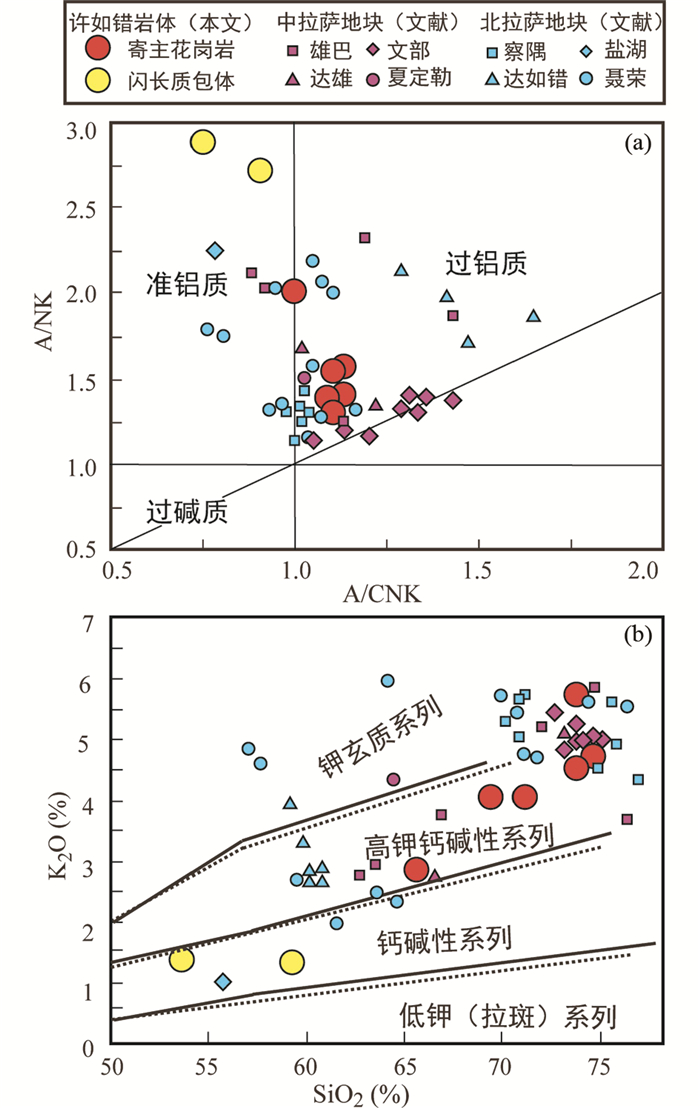
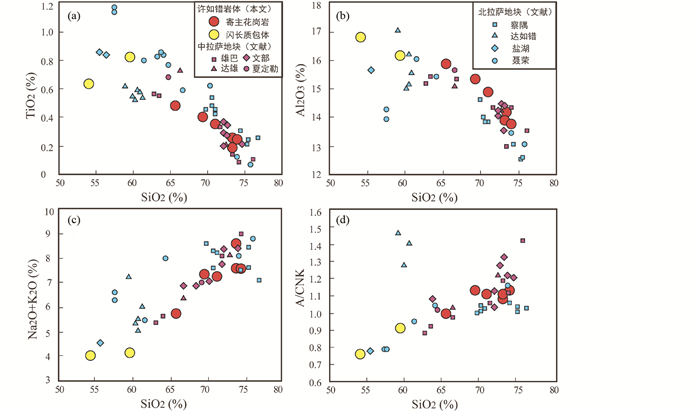
4.2 元素地球化学寄主二长花岗岩包括6件样品,SiO2含量65.17%~74.24%,TiO2含量0.19%~0.48%,Al2O3含量13.76%~15.89%,Fe2O3T含量1.44%~4.06%,CaO含量0.97%~4.44%,K2O含量为2.84%~5.73%、Na2O+K2O为5.74%~8.58%、Na2O/K2O为0.50~1.03,Mg#为31~51,A/CNK为0.99~1.14,刚玉分子数为0.23~2.17,在成分上属于弱过铝质高钾钙碱性系列(图 4a, b)。闪长质包体包括2件样品,SiO2含量为59.52%和54.07%,与寄主二长花岗岩相比,表现出较高的TiO2(0.82%~0.63%)、CaO(6.47%~8.87%)和Mg#(49~65);岩石的总碱含量(Na2O+K2O=4.01%~4.10%)低于寄主二长花岗岩,Al2O3含量为16.16%和19.79%、Fe2O3T含量为6.82%、6.41%,A/CNK为0.91和0.77,属于准铝质钙碱性系列(图 4a, b)。在哈克图解上(图 5),寄主二长花岗岩和闪长质包体表现出相似的演化趋势,随着SiO2含量增加,Al2O3和TiO2含量降低,而A/CNK、Na2O+K2O含量增加,总体都表现出线性的成分变化趋势。
|
图 4 许如错岩体和中部、北部拉萨地块其他岩体样品的地球化学图解 其他数据据刘登忠等, 2005; 谢国刚等, 2002a; 黄俊平等, 2006; 朱弟成等, 2008b; Zhu et al., 2009b, c, 2011a, 2016; Chiu et al., 2009; 姜昕等, 2010; 刘敏等, 2010; 李小波等, 2015.图 5、图 8-图 10同此图 Fig. 4 Geochemical plots of granitiods and diroritic enclaves in the Xuru Tso batholith and other areas of the central and northern Lhasa Terrane |
|
图 5 许如错岩体和中部及北部拉萨地块其他地区岩浆岩的哈克图解 Fig. 5 Harker diagrams of granitoids and dioritic enclaves in the Xuru Tso bstholith and magmatic rocks of other areas of the central and northern Lhasa Terrane |
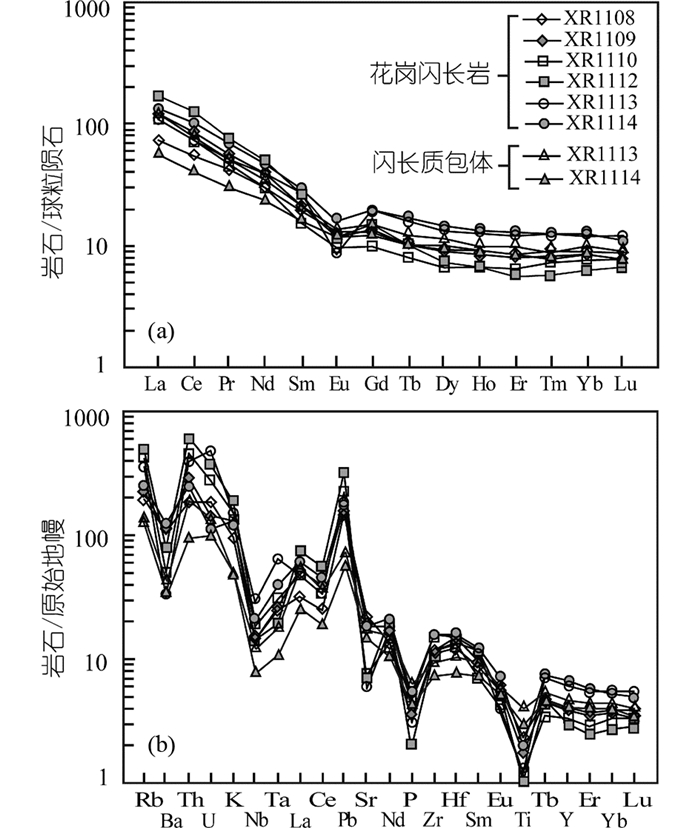
在球粒陨石标准化稀土元素配分模式图中(图 6a),寄主二长花岗岩与闪长质包体具有富集轻稀土元素,相对亏损重稀土元素以及轻度亏损中稀土元素的特征,显示出负δEu异常(寄主二长花岗岩δEu=0.38~0.81、闪长质包体δEu=0.78~0.84);在原始地幔标准化的微量元素成分图中(图 6b),寄主二长花岗岩和闪长质包体表现出相似的微量元素特征,富集Rb、K等大离子亲石元素,亏损Nb、Ta、P、Ti等高场强元素。
|
图 6 许如错岩体样品的球粒陨石标准化稀土元素配分图(a,标准化值据Boynton, 1984)和原始地幔标准化微量元素蜘蛛图(b, 标准化值据Sun and McDonough, 1989) Fig. 6 Chondrite-normalized REE patterns (a, normalization values after Boynton, 1984) and primitive mantle normalized trace-element diagrams (b, normalization values after Sun and McDonough, 1989) for the Xuru Tso batholith samples |
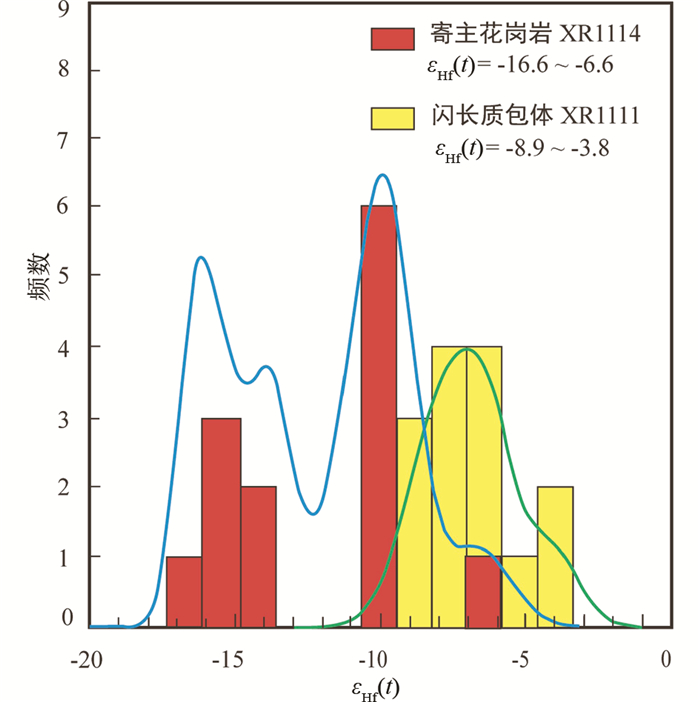
寄主二长花岗岩样品XR1114的16个Hf同位素数据点的锆石的176Yb/177Hf比值为0.024775~ 0.078369,176Lu/177Hf比值为0.000821~0.001810(除分析点XR1114-02、XR1114-16、XR1114-17外),均小于0.002,表明锆石形成后基本没有明显的放射性成因Hf的积累,因而可以使用所测定的176Hf/177Hf比值代表其形成时Hf同位素的组成(吴福元等, 2007);而分析点XR1114-02、XR1114-16、XR1114-17的176Lu/177Hf比值分别为0.002293、0.002576和0.002076,表明它们形成后有放射性成因Hf的积累,故后文使用和讨论锆石Hf同位素数据时均排除以上3个点。16个样品点的176Hf/177Hf(t)比值为0.282206~0.282488,对应εHf(t)值为-16.6~-6.6,具有2个偏老的峰值,地壳模式年龄(tDMC)为1626~2258Ma(图 7a),具有不均一的锆石Hf同位素组成。
|
图 7 许如错岩体寄主花岗质岩和包体的εHf(t)值变化频数图 Fig. 7 Histograms of zircon εHf(t) of granitiods and diroritic enclaves in the Xuru Tso batholith |
闪长质包体样品XR1111的15个数据点的176Yb/177Hf比值为0.016755~0.056678,176Lu/177Hf比值为0.000568~0.001950(除分析点XR1111-8外),均小于0.002,测定的176Hf/177Hf比值代表其形成时Hf同位素的组成(吴福元等, 2007);分析点XR1111-8的176Lu/177Hf比值为0.002155,表明形成后有放射性成因Hf的积累,故后文使用和讨论予以排除。XR1111样品的锆石的176Hf/177Hf(t)比值为0.282424~0.282566,对应εHf(t)值为-8.9~-3.8,地幔模式年龄(tDM)为965~1778Ma,地壳模式年龄(tDMC)为1451~1771Ma(图 7b),也显示锆石Hf同位素的不均一性。
5 讨论 5.1 中部和北部拉萨地块侏罗纪中晚期岩浆活动本文锆石U-Pb年代学研究表明,许如错岩体的侵位时代为155Ma左右,与前人在许如错岩体其他采样点获得的年龄在误差范围内一致(154.2±3.8Ma; 黄俊平等, 2006),表明许如错岩体为晚侏罗世岩浆活动的产物。在中部及北部拉萨地块的其他地区,近年来也发现了与许如错岩体近于同期的晚侏罗世岩浆活动记录(表 5),中部拉萨地块包括央雄勒岩体(142Ma; 卢书炜等, 2006)、文部岩体(154.5Ma±8.4Ma; 谢国刚等, 2002a)、夏定勒岩体(153.1Ma±0.6Ma; 刘登忠等, 2005)、松木果岩体(163Ma; 卢书炜等, 2006)、雄巴岩体(149±3Ma; 姜昕等, 2010)和江巴岩体(170±3Ma; 姜昕等, 2010)、则弄群火山岩(129Ma, 131Ma; 朱弟成等, 2008b)、措勤花岗岩类(152Ma; Zhu et al., 2011a)、盐湖地区的流纹岩等(146 Ma; Zhu et al., 2011a)。在北部拉萨地块,近年来也有同期的岩浆作用记录的报道,如被认为是中北部拉萨地块东延部分的察隅、萨玛、然乌等地的花岗岩类及安山岩等(130Ma左右; Chiu et al., 2009; Zhu et al., 2009c),聂荣地区的花岗岩类(175Ma; 刘敏等, 2010; 185Ma; 刘敏等, 2011),达如错地区的高镁安山岩(165Ma; 李小波等, 2015),盐湖安山岩(131Ma; Zhu et al., 2011a)、班戈岩基的花岗岩类(132Ma左右; Zhu et al., 2016),显示出较一致的同时性。值得一提的是,在措勤、聂荣、许如错等岩体中,均发育有大量的暗色微粒包体。这些数据表明北部拉萨地块在中侏罗纪世-早白垩世早期,也发生了与中部拉萨地块在时间上可比的同期岩浆活动事件。
|
|
表 5 青藏高原中部、北部拉萨地块中侏罗世-早白垩世岩浆岩的年龄数据汇总 Table 5 Summary of the age data of the Middle Jurassic-Early Cretaceous magmatic rocks in the central and northern Lhasa subterrane |
关于暗色微粒包体的成因及其与侵入岩的关系目前还存在一些争议:(1) 认为包体来源于深部地壳或古老基底中的基性岩石的捕获和混染(Maas et al., 1997);(2) 认为包体是加入酸性岩浆房的基性成分中未与酸性岩浆完全混合的残余物(Chappell et al., 1987);(3) 认为包体是与酸性岩浆混合的来自幔源的基性岩浆组分(Bonin, 2004; Lan et al., 2011)。许如错岩体中的包体具有典型的岩浆包体的岩石学、矿物学特征,并没有见到固态条件下的热变质或接触变质成分分带,包体与寄主二长花岗岩同期侵位,也排除了闪长质包体为源区残留物或围岩捕掳体的可能(Didier, 1987; Vernon, 1990; 秦江锋, 2010)。闪长质包体的铝饱和指数(A/CNK=0.91~0.77) 明显低于寄主二长花岗岩(A/CNK=0.99~1.14),闪长质包体的εHf(t)值(-8.9~-3.8) 变化范围较大,达到5个ε单位,高于分析过程中所引起的数据变化范围,而这可能是由于岩石的源区物质组成不均一或是岩浆在上升过程中和其它来源的岩浆发生明显的岩浆混合作用所导致的(Yang et al., 2007; Zheng et al., 2006, 2007)。在哈克图解上(图 5),闪长质包体与寄主二长花岗岩具有很好的线性演化趋势,进一步表明在许如错岩体中存在明显、充分的岩浆混合作用。此外,闪长质包体中发育钾长石巨晶的不平衡矿物(图 2b),表明在镁铁质岩浆和长英质岩浆冷却之前已经发生了物质和能量交换作用(Vernon, 1990; Holden et al., 1991; Neves and Vauchez, 1995; 莫宣学等, 2007; Karsli et al., 2007, 2010),并且两种岩浆的流动性非常好,允许寄主二长花岗岩中的钾长石斑晶运移到闪长质包体中。因此,本文包体并非基性成分的未混合残余,而是代表了加入酸性源区并与之发生混合的基性成分本身。
闪长质包体具有较低的SiO2含量(59.52%~54.07%),属于中性岩浆,而且岩石的Mg#(49~65) 较高,显示富集大离子亲石元素(Rb、K),亏损高场强元素(Nb、Ta、Ti)的地球化学特征,εHf(t)值为-8.9~-3.8,闪长质包体中最亏损的端员显示了幔源物质的贡献,地幔模式年龄(tDM)为1.0~1.8Ga,这些特征指示其可能来源于古老的富集岩石圈地幔物质的部分熔融或亏损地幔经地壳物质强烈混染作用的产物。
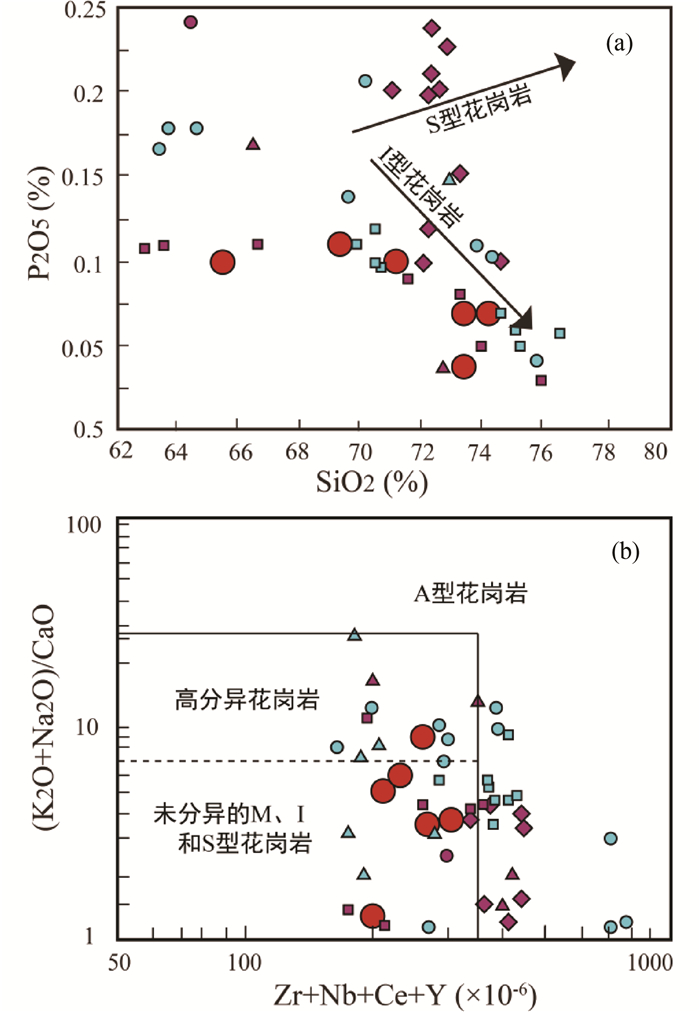
5.3 寄主二长花岗岩的成因与源区性质实验研究表明,磷灰石在准铝质到弱过铝质岩浆中溶解度较低,在岩浆分异过程中随SiO2增加而降低,在强过铝质岩浆中,磷灰石溶解度变化趋势则相反。因此,磷灰石的这种地球化学行为被用于区分Ⅰ型和S型花岗岩(Chappell, 1999; Wu et al., 2003; Li et al., 2007; 朱弟成等, 2009)。在SiO2-P2O5图解中(图 8a),本文样品与中部、北部拉萨地块同期岩浆岩样品的P2O5含量主体显示出随SiO2含量的增加而降低的趋势,与Ⅰ型花岗岩的演化趋势较一致,此外,本文获得的寄主二长花岗岩富集Rb、K等大离子亲石元素,亏损Nb、Ta、P、Ti等高场强元素,为弱过铝质,无堇青石和碱性暗色矿物,显示出典型的Ⅰ型花岗岩的特征。在(K2O+Na2O)/CaO-(Zr+Nb+Ce+Y)图解中(图 8b),本文样品位于未分异花岗岩区域,其他同期样品也主要以未分异的Ⅰ型花岗岩为主,北部拉萨地块的部分样品显示出高分异型花岗岩的特征。
|
图 8 许如错岩体和中部及北部拉萨地块其他地区岩浆岩的岩石成因判别图解 (a) P2O5-SiO2散点图;(b) (K2O+Na2O)/CaO-(Zr+Nb+Ce+Y)散点图 Fig. 8 Discrimination diagrams of petrogenetic types for granitoids in Xuru Tso bstholith and magmatic rocks in other areas of the central and northern Lhasa Terrane |
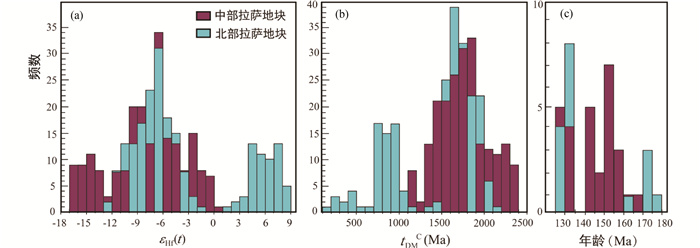
前人研究表明,Ⅰ型花岗岩可由壳内中基性火成岩或变质岩部分熔融而来(Chappell and Stephens, 1988; 张旗等, 2008),或地壳重熔过程中幔源物质的加入而形成(Kemp et al., 2007; Collins and Richards, 2008; 李献华等, 2009; Zhu et al., 2009b, c; Niu, 2015)。近年来,通过对拉萨地块系统的岩石学和地球化学研究发现,大量的中拉萨地块样品显示出非常富集的εHf(t)值特征(图 9a),从而表明尽管整个拉萨地块的地表没有出露与元古代对应的古老地层,但是中拉萨地块确实存在古老的地壳基底,且该地壳基底在东西方向上大规模延伸, 并从侏罗世以来在岩浆作用中表现了地壳再循环作用,因此,中部拉萨地块很可能为具有古老基底的微陆块(Zhu et al., 2009a, 2011a, 2013, 姜昕等, 2010)。
|
图 9 北部和中部拉萨地块锆石εHf(t)值(a)、tDMC值(b)和U-Pb年龄(c)直方图 Fig. 9 Histograms of εHf(t) values (a), zircon tDMC results (b) and compiled crystallization ages (c) of the central and northern Lhasa Terrane |
本文寄主二长花岗岩以较负的、变化范围大的锆石εHf(t)值为特征(-16.6~-6.6,集中于-16~-10),地壳模式年龄(tDMC)为1.6~2.3Ga,这种变化范围大的锆石Hf同位素组成可能是由于长英质岩浆和镁铁质岩浆发生岩浆混合的产物或是表明岩石的源区物质组成的不均一性。结合中拉萨地块具有古老基底的特征,因此,这套偏铝质Ⅰ型花岗岩,可能来源于中部拉萨地块古老下地壳物质的重熔,并可能有幔源物质的加入。
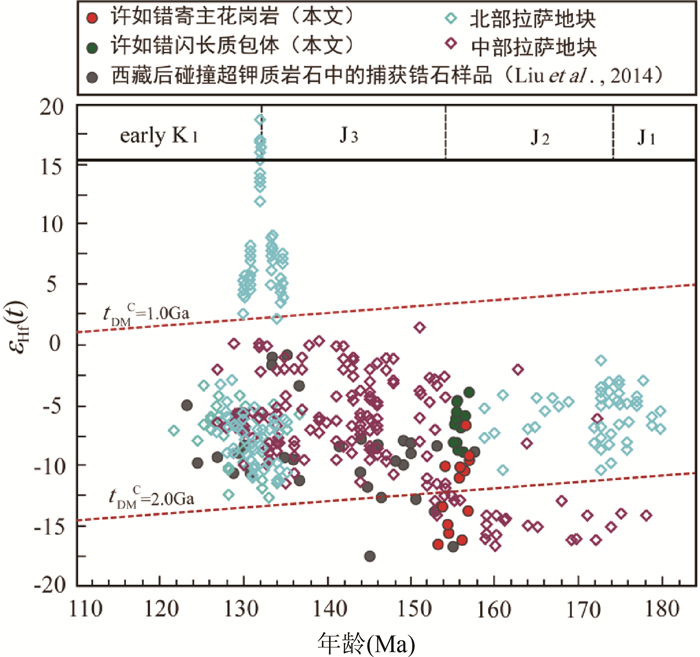
5.4 地球动力学意义目前关于拉萨地块侏罗纪中晚期-白垩世早期岩浆作用存在两种可能的动力学解释:(1) 新特提斯洋壳向北低角度或平板俯冲(Chu et al., 2006; Kapp et al., 2007; Leier et al., 2007; 纪伟强等, 2009); (2) 与班公湖-怒江特提斯洋的洋壳向南俯冲及随后板片断离作用有关(潘桂棠等, 2006; 张晓倩等, 2010, 2012; 张亮亮等, 2011; Zhu et al., 2009b, 2011a, 2016)。通过对中部和北部拉萨地块已发表的年代学和地球化学数据的综合归纳,结合本文数据,表明在中侏罗世-早白垩世早期(180Ma~130Ma)期间,中北部拉萨地块有连续的岩浆作用记录(图 9c、图 10),岩石类型从偏铝质到过铝质均有出现,主要为Ⅰ型花岗岩且大部分A/CNK<1.1,小部分A/CNK>1.1(图 5d)。北部拉萨地块产出的岩性较多样,有安山岩、英安岩、流纹岩以及花岗岩,而中部拉萨地块主要为酸性岩(SiO2含量62%~78%)。在εHf(t)-年龄图解中(图 10),北部拉萨地块有一部分岩石样品的εHf(t)>0,相对于北部拉萨地块,中部拉萨地块的εHf(t)值明显偏负,εHf(t)值基本都为负值(图 9a)。西藏后碰撞超钾质岩石中的锆石捕虏晶记录了拉萨地块深部地壳岩浆活动过程(Liu et al., 2014),本文中北部的εHf(t)随年龄的演化和后碰撞超钾质岩石中的锆石捕虏晶的记录具有一致的演化趋势(图 10)。中部拉萨地块样品的地壳模式年龄为古元古代-中元古代,北部拉萨地块样品的地壳模式年龄除了有中元古代外,还显示出较年轻的地壳模式年龄(<1000Ma)(图 9b),由此表明北部拉萨地块既发生了新生地壳的重熔,也包含有古老基地或者是卷入的中部拉萨地块古老基底的重熔或者深熔。从中部和北部拉萨地块看,从180Ma到130Ma产出的中酸性岩浆作用,在南部拉萨地块也同时产出了(纪伟强等, 2009; 朱弟成等, 2008a),因此应用侏罗纪到白垩纪拉萨地块南缘的雅鲁藏布洋板片向北俯冲,同时形成南部和中、北部拉萨地块的岩浆作用是无法实现的。
|
图 10 中部拉萨地块、北部拉萨地块中侏罗世-早白垩世早期岩浆活动的锆石εHf(t)-年龄图解 Fig. 10 Zircon εHf(t) vs. ages plots for the Mid Jurassic-Early Cretaceous magmatic activity in central and northern Lhasa terrane |
以上分析对比表明,中部以及北部拉萨地块中侏罗世-早白垩早期岩浆活动是班公怒江洋南向俯冲至拉萨地块之下的产物,而非沿着拉萨地块南缘发育的新特提斯洋壳的向北俯冲导致的。
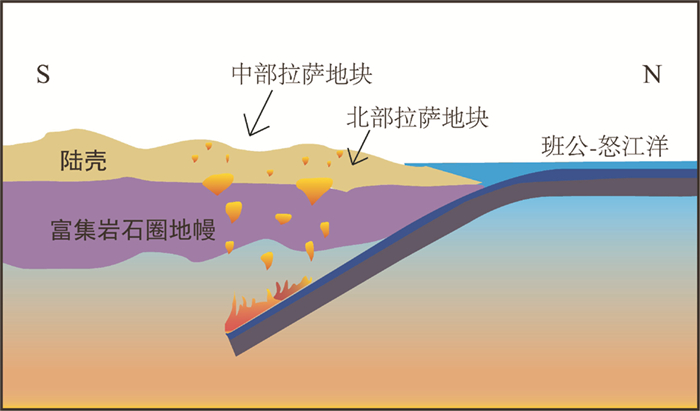
因此根据本文结果,参考拉萨地块同时代岩浆作用已有研究(朱弟成等, 2008a; Wang et al., 2014; Li et al., 2015),认为中部和北部拉萨地块中侏罗世-早白垩世早期的岩浆活动,是在班怒洋洋壳南向俯冲的地球动力学背景之下(图 11),由俯冲带之上的幔源岩浆提供热量诱发中部拉萨地块古老地壳物质以及北部拉萨地块新生地壳和卷入的部分中部拉萨地块古老基底重熔产生的熔体(占大比例)与岩石圈地幔来源的幔源岩浆之间发生的岩浆混合作用所导致的。
|
图 11 中北部拉萨地块中晚侏罗世岩浆活动的动力学模型(据Zhu et al., 2011a修改) Fig. 11 Schematic illustration of the tectonnmagmatic evolution of the central and northern Lhasa subterrane during Mid Jurassic-Early Cretaceous time (modified after Zhu et al., 2011a) |
(1) 锆石LA-ICP-MS U-Pb定年结果表明许如错岩体寄主二长花岗岩为155.1±0.7Ma,闪长质包体为155.7±0.7Ma,表明闪长质包体与寄主花岗岩为同期岩浆作用的产物。
(2) 寄主二长花岗岩为偏铝质-弱过铝质高钾钙碱性未分异的Ⅰ型花岗岩,岩石富集大离子亲石元素和轻稀土,亏损高场强元素,具有较负且变化范围大的锆石εHf(t)值(-16.6~-6.6),地壳模式年龄(tDMC)为1.6~2.3Ga,指示其可能来源于古老下地壳物质的重熔。闪长质包体为偏铝质钙碱性系列,具有负的锆石εHf(t)值(-8.9~-3.8),地幔模式年龄(tDM)为1.5~1.8Ga。可能起源于富集岩石圈地幔的部分熔融作用。
(3) 班公湖-怒江特提斯洋洋壳在中晚侏罗世向南俯冲于拉萨地块之下,引起幔源物质与中部和北部拉萨地块新生地壳和基底重熔所产生的酸性岩浆发生岩浆混合作用,是许如错岩体及同时代中、北部拉萨地块岩浆活动最合理的解释。
致谢 在野外工作中得到了魏友卿、石卿尚、雷杭山、栾炅雨、马倩的帮助;在实验中得到了刘佳宜、孙义伟的帮助;在成文初期得到了孟繁一的帮助和支持;曾令森老师和董昕老师审阅论文并提出了宝贵的意见和建议;在此一并表示感谢。| [] | Andersen T. 2002. Correction of common lead in U-Pb analyses that do not report 204Pb. Chemical Geology, 192(1-2): 59–79. DOI:10.1016/S0009-2541(02)00195-X |
| [] | BlichertToft J, Albarède F. 1997. The Lu-Hf isotope geochemistry of chondrites and the evolution of the mantle-crust system. Earth and Planetary Science Letters, 148(1-2): 243–258. DOI:10.1016/S0012-821X(97)00040-X |
| [] | Allègre CJ, Courtillot V, Tapponnier P, et al. 1984. Structure and evolution of the Himalaya-Tibet orogenic belt. Nature, 307(5946): 17–22. DOI:10.1038/307017a0 |
| [] | Bouvier A, Vervort JD, Patchett PJ. 2008. The Lu-Hf and Sm-Nd isotopic composition of CHUR:Constraints from unequilibrated chondrites and implications for the bulk composition of terrestrial planets. Earth and Planetary Science Letters, 273(1-2): 48–57. DOI:10.1016/j.epsl.2008.06.010 |
| [] | Barbarin B. 1999. A review of the relationships between granitoid types, their origins and their geodynamic environments. Lithos, 46(3): 605–626. DOI:10.1016/S0024-4937(98)00085-1 |
| [] | Chappell BW, Stephens WE. 1988. Origin of infracrustal (Ⅰ-type) granite magmas. Transactions of the Royal Society of Edinburgh:Earth Sciences, 79(2-3): 71–86. DOI:10.1017/S0263593300014139 |
| [] | Chappell BW and White ARJ. 1991. Restite enclaves and the restite model. In:Didier J and Barbarin B (eds.). Enclaves and Granite Petrology. Amsterdam:Elsevier, 375-381 |
| [] | Chappell BW. 1999. Aluminium saturation in Ⅰ-and S-type granites and the characterization of fractionated haplogranites. Lithos, 46(3): 535–551. DOI:10.1016/S0024-4937(98)00086-3 |
| [] | Chiu HY, Chung SL, Wu FY, Liu DY, Liang YH, Lin IJ, Iizuk Y, Xie LW, Wang YB, Chu MF. 2009. Zircon U-Pb and Hf isotopic constraints from eastern Transhimalayan batholiths on the precollisional magmatic and tectonic evolution in southern Tibet. Tectonophysics, 477(1-2): 3–19. DOI:10.1016/j.tecto.2009.02.034 |
| [] | Chu MF, Chung SL, Song B, Liu DY, O'Reilly SY, Pearson NJ, Ji JQ, Wen DJ. 2006. Zircon U-Pb and Hf isotope constraints on the Mesozoic tectonics and crustal evolution of southern Tibet. Geology, 34(9): 745–748. DOI:10.1130/G22725.1 |
| [] | Chung SL, Chu MF, Zhang YQ, Xie YW, Lo CH, Lee TY, Land CY, Li XH, Zhang Q, Wang YZ. 2005. Tibetan tectonic evolution inferred from spatial and temporal variations in post-collisional magmatism. Earth-Science Reviews, 68(3-4): 173–196. |
| [] | Copeland P, Harrison TM, Pan Y, Kidd WSF, Roden M, Zhang YQ. 1995. Thermal evolution of the Gangdese batholith, southern Tibet:A history of episodic unroofing. Tectonics, 14(2): 223–236. DOI:10.1029/94TC01676 |
| [] | Collins WJ. 1996. Lachlan Fold Belt granitoids:Products of three component mixing. Transactions of the Royal Society of Edinburgh:Earth Sciences, 87(1-2): 171–181. DOI:10.1017/S0263593300006581 |
| [] | Collins WJ, Richards SW. 2008. Geodynamic significance of S-type granites in circum-Pacific orogens. Geology, 36(7): 559–562. DOI:10.1130/G24658A.1 |
| [] | Dong X, Zhang ZM, Liu F, Wang W, Yu F, Shen K. 2011. Zircon U-Pb geochronology of the Nyainqêntanglha Group from the Lhasa terrane:New constraints on the Triassic orogeny of the south Tibet. Journal of Asian Earth Sciences, 42(4): 732–739. |
| [] | Deng J, Yang LQ, Wang CM. 2011. Research advances of superimposed orogenesis and metallogenesis in the Sanjiang Tethys. Acta Petrologica Sinica, 27(9): 2501–2509. |
| [] | Didier J. 1987. Contribution of enclaves studies to understanding of origin and evolution of granitic magma. Geologische Rundschau, 76(1): 41–50. DOI:10.1007/BF01820572 |
| [] | Didier J, Barbarin B. 1991. Macroscopic Features of Mafic Microgranular Enclaves. Amsterdam:Elsevier: 235–262. |
| [] | Griffin WL, Pearson NJ, Belousova E, Jackson SE, van Achterbergh E, O'Reilly SY, Shee SR. 2000. The Hf isotope composition of cratonic mantle:LAM-MC-ICPMS analysis of zircon megcrysts in kimberlites. Geochimica et Cosmochimica Acta, 64(1): 133–147. DOI:10.1016/S0016-7037(99)00343-9 |
| [] | Griffin WL, Wang X, Jackson SE, Pearson NJ, O'Reilly SY, Xu XS, Zhou XM. 2002. Zircon chemistry and magma mixing, SE China:In-situ analysis of Hf isotopes, Tonglu and Pingtan igneous complexes. Lithos, 61(3-4): 237–269. DOI:10.1016/S0024-4937(02)00082-8 |
| [] | Guan Q, Zhu DC, Zhao ZD, Dong GC, Zhang LL, Li XW, Liu M, Mo XX, Liu YS, Yuan HL. 2012. Crustal thickening prior to 38Ma in southern Tibet:Evidence from lower crust-derived adakitic magmatism in the Gangdese Batholith. Gondwana Research, 21(1): 88–99. DOI:10.1016/j.gr.2011.07.004 |
| [] | Gou LL, Zhang CL, Wang Q. 2015. Petrological evidence for isobaric cooling of ultrahigh-temperature pelitic granulites from the Khondalite Belt, North China Craton. Science Bulletin, 60(17): 1535–1542. DOI:10.1007/s11434-015-0872-2 |
| [] | Holden P, Halliday AN, Stephens WE. 1987. Neodymium and strontium isotope content of microdiorite enclaves poits to mantle input to granitoids production. Nature, 330(6143): 53–56. DOI:10.1038/330053a0 |
| [] | Holden P, Halliday AN, Ed Stephens W, Hermey PJ. 1991. Chemical and isotopic evidence for major mass transfer between mafic enclaves and felsic magma. Chemical Geology, 92(1-3): 135–152. DOI:10.1016/0009-2541(91)90053-T |
| [] | Hoskin PWO, Black LP. 2000. Metamorphic zircon formation by solid-state recrystallization of protolith igneous zircon. Journal of Metamorphic Geology, 18(4): 423–439. |
| [] | Huang JP, Cao SH, Chen ZH, Liao LG. 2006. Geological characteristics and tectonic significance for Late Jurassic-Early Cretaceous granite in middle Gangdise, Tibet. Resources survey & environment, 27(4): 277–285. |
| [] | Kapp P, DeCelles PG, Gehrels GE, Heizler M, Ding L. 2007. Geological records of the Lhasa-Qiangtang and Indo-Asian collisions in the Nima area of central Tibet. Geological Society of America Bulletin, 119(7-8): 917–932. DOI:10.1130/B26033.1 |
| [] | Kapp P, Yin A, Harrison TM, Ding L. 2005. Cretaceous-Tertiary shortening, basin development, and volcanism in central Tibet. Geological Society of America Bulletin, 117(7): 865–878. DOI:10.1130/B25595.1 |
| [] | Karsli O, Chen B, Aydin F, Sen C. 2007. Geochemical and Sr-Nd-Pb isotopic compositions of the Eocene D lek and Sariçiçek plutons, Eastern Turkey:Implications for magma interactions in the genesis of high-K calc-alkaline granitoids in a post-collision extensional setting. Lithos, 98(1-4): 67–96. DOI:10.1016/j.lithos.2007.03.005 |
| [] | Karsli O, Dokuz A, Uysal I, Aydin F, Chen B, Kandemir R, Wijbrans J. 2010. Relative contributions of crust and mantle to generation of Campanian high-K calc-alkaline Ⅰ-type granitoids in a subduction setting, with special reference to the Harsit Pluton, Eastern Turkey. Contributions to Mineralogy and Petrology, 160(4): 467–487. DOI:10.1007/s00410-010-0489-z |
| [] | Kemp AIS, Hawkesworth CJ, Foster GL, Paterson BA, Woodhead JD, Hergt JM, Gray CM, Whitehouse MJ. 2007. Magmatic and crustal differentiation history of granitic rocks from Hf-O isotopes in zircon. Science, 315(5814): 980–983. DOI:10.1126/science.1136154 |
| [] | Ji WH, Chen SJ, Zhao ZM, Li RS, He SP, Wang C. 2009. Discovery of the Cambrian volcanic rocks in the Xianza area, gandese orogenic belt, Tibet, China and its significance. Geological of China, 28(9): 1350–1354. |
| [] | Ji WQ, Wu FY, Chung SL, Li JX, Liu CZ. 2009. Zircon U-Pb geochronology and Hf isotopic constraints on petrogenesis of the Gangdese batholith, southern Tibet. Chemical Geology, 262(3-4): 229–245. DOI:10.1016/j.chemgeo.2009.01.020 |
| [] | Ji WQ, Wu FY, Chong SL, Liu CZ. 2009. Geochronology and petrogenesis of granitic rocks in Gangdese batholith, southern Tibet. Science in China (Series D), 52(9): 1240–1261. DOI:10.1007/s11430-009-0131-y |
| [] | Jia XL, Zhu XY, Zhai MG, Zhao Y, Zhang H, Wu JL, Liu T. 2016. Late Mesoarchean crust growth event:Evidence from the ca. 2.8Ga granodioritic gneisses of the Xiaoqinling area, southern North China Craton. Science Bulletin, 61(12): 974–990. |
| [] | Jiang X, Zhao ZD, Zhu DC, Zhang FQ, Dong GC, Mo XX, Guo TY. 2010. Zircon U-Pb geochronology and Hf isotopic geochemistry of Jiangba, Bangba, and Xiongba granitoids in western Gangdese, Tibet. Acta Petrologica Sinica, 26(7): 2155–2164. |
| [] | Leier AL, Kapp P, Gehrels GE, DeCelles Peter G. 2007. Detrital zircon geochronology of Carboniferous-Cretaceous strata in the Lhasa Terrane, Southern Tibet. Basin Research, 19(3): 361–378. DOI:10.1111/bre.2007.19.issue-3 |
| [] | Lesher CE. 1990. Decoupling of chemical and isotopic exchange during magma mixing. Nature, 344(6263): 235–237. DOI:10.1038/344235a0 |
| [] | Liu D, Zhao ZD, Zhu DC, Niu YL, Harrison TM. 2014a. Zircon xenocrysts in Tibetan ultrapotassic magmas:Imaging the deep crust through time. Geology, 42(1): 43–46. DOI:10.1130/G34902.1 |
| [] | Liu DL, Huang QS, Fan SQ, Zhang LY, Shi RD, Ding L. 2014b. Subduction of the Bangong-Nujiang Ocean:Constraints from granites in the Bangong Co area, Tibet. Geological Journal, 49(2): 188–206. DOI:10.1002/gj.v49.2 |
| [] | Li XH, Li ZX, Li WX, Liu Y, Yuan C, Wei GG, Qi CS. 2007. U-Pb zircon, geochemical and Sr-Nd-Hf isotopic constraints on age and origin of Jurassic Ⅰ-and A-type granites from central Guangdong, SE China:A major igneous event in response to foundering of a subducted flat-slab?. Lithos, 96(1-2): 186–204. DOI:10.1016/j.lithos.2006.09.018 |
| [] | Li SM, Zhu DC, Wang Q, Zhao ZD, Sui QL, Liu SA, Liu D, Mo XX. 2015. Northward subduction of Bangong-Nujiang Tethys:Insight from Late Jurassic intrusive rocks from Bangong Tso in western Tibet. Lithos, 205: 284–297. |
| [] | Li XB, Wang BD, Liu H, Wang LQ, Chen L. 2015. The Late Jurassic high-Mg andesites in the Daru Tso area, Tibet:Evidence for the subduction of the Bangong Co-Nujiang River oceanic lithosphere. Geological Bulletin of China, 34(2-3): 251–261. |
| [] | Liu M, Zhu DC, Zhao ZD, Mo XX, Guan Q, Zhang LL, Yu F, Liu MH. 2010. Magma mixing of late Early Jurassic age from Nyainrong, northern Tibet and its tectonic significance. Acta Petrologica Sinica, 26(10): 3117–3130. |
| [] | Liu M, Zhao ZD, Guan Q, Dong GC, Mo XX, Liu YS, Hu ZC. 2011. Tracing magma mixing genesis of the middle Early-Jurassic host granites and enclaves in Nyainrong microcontinent, Tibet from zircon LA-ICP-MS U-Pb dating and Hf isotopes. Acta Petrologica Sinica, 27(7): 1931–1937. |
| [] | Liu Y, Gao S, Hu Z, Gao C, Zong K, Wang D. 2010. Continental and oceanic crust recycling-induced melt-peridotite interactions in the Trans-North China Orogen:U-Pb dating, Hf isotopes and trace elements in zircons from mantle xenoliths. Journal of Petrology, 51(1-2): 537–571. DOI:10.1093/petrology/egp082 |
| [] | Liu YS, Hu ZC, Gao S, Günther D, Xu J, Gao CG, Chen HH. 2008. In situ analysis of major and trace elements of anhydrous minerals by LA-ICP-MS without applying an internal standard. Chemical Geology, 257(1-2): 34–43. DOI:10.1016/j.chemgeo.2008.08.004 |
| [] | Lu SW, Ren JD, Bai GD, Yang JF, Lv JG. 2006. Discovery of the Mid-Late Jurassic Songmuguo strongly peraluminous granite belt in the southern part of Nyima County, Tibet, and its significance. Geology in China, 34(2): 332–339. |
| [] | Ludwig KR. 2003. Isoplot 3.00:A Geochronological Toolkit for Microsoft Excel. Berkeley:Berkeley Geochronology Center |
| [] | Maluski H, Proust F, Xiao XC. 1982. 39Ar/40Ar dating of the trans-Himalayan calc-alkaline magmatism of southern Tibet. Nature, 298(5870): 152–154. DOI:10.1038/298152a0 |
| [] | Mo XX, Dong GC, Zhao ZD, Zhou S, Wang LL, Qiu RZ, Zhang FQ. 2005. Spatial and temporal distribution and characteristics of granitoids in the Gangdese, Tibet and implication for crustal growth and evolution. Geological Journal of China Universities, 11(3): 281–290. |
| [] | Mo XX, Hou ZQ, Niu YL, Dong GC, Qu XM, Zhao ZD, Yang ZM. 2007. Mantle contributions to crustal thickening during continental collision:Evidence from Cenozoic igneous rocks in southern Tibet. Lithos, 96(1-2): 225–242. DOI:10.1016/j.lithos.2006.10.005 |
| [] | Mo XX, Luo ZH, Deng JF, Yu XH, Liu CD, Chen HW, Yuan WM, Liu YH. 2007. Granitoids and crustal growth in the East-Kunlun orogenic belt. Geological Journal of China Universities, 13(3): 403–414. |
| [] | Mo XX, Niu YL, Dong GC, Zhao ZD, Hou ZQ, Zhou S, Ke S. 2008. Contribution of syncollisional felsic magmatism to continental crust growth:A case study of the Paleogene Linzizong volcanic succession in southern Tibet. Chemical Geology, 250(1-4): 49–67. DOI:10.1016/j.chemgeo.2008.02.003 |
| [] | Niu YL. 2015. Experimental demonstrations on the sources and conditions of mantle melting. Science Bulletin, 60(22): 1871–1872. DOI:10.1007/s11434-015-0931-8 |
| [] | Neves SP, Vauchez A. 1995. Successive mixing and mingling of magmas in a plutonic complex of Northeast Brazil. Lithos, 34(4): 275–299. DOI:10.1016/0024-4937(94)00012-Q |
| [] | Pan GT, Ding J, Yao DS, Wang LQ. 2004. Guidebook of 1:1500000 Geological Map of the Qinghai-Xizang (Tibet) Plateau and Adjacent Areas. Chengdu: Chengdu Cartographic Publishing House. |
| [] | Pan GT, Mo XX, Hou ZQ, Zhu DC, Wang LQ, Li GM, Zhao ZD, Geng QR, Liao ZL. 2006. Spatial-temporal framework of the Gangdese Orogenic Belt and its evolution. Acta Petrologica Sinica, 22(3): 521–533. |
| [] | Qin JF. 2010. Petrogenesis and geodynamic implications of the Late-Triassic granitoids from the Qinling Orogenic Belt. Ph. D. Dissertation. Xi'an:Northwest University (in Chinese with English summary) |
| [] | Schärer U, Xu RH, Allègre CJ. 1984. U-Pb geochronology of Gangdese (Transhimalaya) plutonism in the Lhasa-Xigaxe region, Tibet. Earth and Planetary Science Letters, 69(2): 311–320. DOI:10.1016/0012-821X(84)90190-0 |
| [] | Celal Sengör AM. 1987. Tectonics of the Tethysides:Orogenic collage development in a collisional setting. Annual Review of Earth and Planetary Sciences, 15(1): 213–244. DOI:10.1146/annurev.ea.15.050187.001241 |
| [] | Söderlund U, Patchett PJ, Vervoort JD, Isachsen CE. 2004. The 176Lu decay constant determined by Lu-Hf and U-Pb isotope systematics of Precambrian manfic intrusions. Earth and Planetary Science Letters, 219(3-4): 311–324. DOI:10.1016/S0012-821X(04)00012-3 |
| [] | Tapponnier P, Mercier JL, Armijo R, Han TL, Zhou J. 1981. Field evidence for active normal faulting in Tibet. Nature, 294(5840): 410–414. DOI:10.1038/294410a0 |
| [] | Vernon RH. 1984. Microgranitoid enclaves:Globules of hybrid magma quenched in aplutonic environment. Nature, 309(5967): 438–439. DOI:10.1038/309438a0 |
| [] | Vernon RH. 1990. Crystallization and hybridism in microgranitoid enclave magma-microstructural evidence. Journal of Geophysical Research, 95(B11): 17849–17859. DOI:10.1029/JB095iB11p17849 |
| [] | Wang CS, Li XH, Hu XM, Jansa LF. 2002. Latest marine horizon north of Qomolangma (Mt. Everest):Implications for closure of Tethys seaway and collision tectonics. Terra Nova, 14(2): 114–120. |
| [] | Wang Q, Zhu DC, Zhao ZD, Liu SA, Chuang SL, Li SM, Liu D, Dai JG, Wang LQ, Mo XX. 2014. Origin of the ca. 90Ma magnesia-rich volcanic rocks in SE Nyima, central Tibet:Products of lithospheric delamination underneath the Lhasa-Qiangtang collision zone. Lithos, 198-199: 24–37. |
| [] | Wu FY, Jahn BM, Wilder SA, Lo CH, Yu TF, Lin Q, Ge WC, Sun DY. 2003. Highly fractionated Ⅰ-type granites in NE China (Ⅰ):Geochronology and petrogenesis. Lithos, 66(3-4): 241–273. DOI:10.1016/S0024-4937(02)00222-0 |
| [] | Wu FY, Li XH, Zheng YF, Gao S. 2007. Lu-Hf isotopic systematics and their applications in petrology. Acta Petrologica Sinica, 23(2): 185–220. |
| [] | Wyllie PJ. 1977. Crustal anatexis:An experimental review. Tectonophysics, 43(1-2): 41–71. DOI:10.1016/0040-1951(77)90005-1 |
| [] | Xu RH, Schärer U, Allègre CJ. 1985. Magmatism and metamorphism in the Lhasa block (Tibet):A geochronological study. The Journal of Geology, 93(1): 41–57. DOI:10.1086/628918 |
| [] | Yang JH, Wu FY, Wilde SA, Xie LW, Yang YH, Liu XM. 2007. Tracing magma mixing in granite genesis:In situ U-Pb dating and Hf-isotopes analysis of zircons. Contributions to Mineralogy and Petrology, 153(2): 177–190. |
| [] | Yin A, Harrison TM. 2000. Geologic evolution of the Himalayan-Tibetan orogen. Annual Review of Earth and Planetary Sciences, 28(1): 211–280. DOI:10.1146/annurev.earth.28.1.211 |
| [] | Yuan HL, Gao S, Dai MN, Zong CL, Gunther D, Fontaine GH, Liu XM, Diwu CR. 2008. Simultaneous determinations of U-Pb age, Hf isotopes and trace element compositions of zircon by excimer laserablation quadrupole and multiple-collector ICP-MS. Chemical Geology, 247(1-2): 100–118. DOI:10.1016/j.chemgeo.2007.10.003 |
| [] | Zhang KJ, Zhang YX, Li B, Zhong LF. 2007. Nd isotopes of siliciclastic rocks from Tibet, western China:Constraints on provenance and pre-Cenozoic tectonic evolution. Earth and Planetary Science Letters, 256(3-4): 604–616. DOI:10.1016/j.epsl.2007.02.014 |
| [] | Zhang LL, Zhu DC, Zhao ZD, Liao ZL, Wang LQ, Mo XX. 2011. Early Cretaceous granitoids in Xainza, Tibet:Evidence of slab break-off. Acta Petrologica Sinica, 27(7): 1938–1948. |
| [] | Zhang Q, Wang Y, Pan GQ, Li CD, Jin WJ. 2008. Source of granites:Some crucial questions on granite study. Acta Petrologica Sinica, 24(6): 1193–1204. |
| [] | Zhang XQ, Zhu DC, Zhao ZD, Sui QL, Wang Q, Yuan SH, Hu ZC, Mo XX. 2012. Geochemistry, zircon U-Pb geochronology and in-situ Hf isotope of the Maiga batholith in Coqen, Tibet:Constraints on the petrogenesis of the Early Cretaceous granitoids in the central Lhasa Terrane. Acta Petrologica Sinica, 28(5): 1615–1634. |
| [] | Zhao ZD, Mo XX, Dilek Y, et al. 2009. Geochemical and Sr-Nd-Pb-O isotopic compositions of the post-collisional ultrapotassic magmatism in SW Tibet:Petrogenesis and implications for India intra-continental subduction beneath southern Tibet. Lithos, 113(1-2): 190–212. DOI:10.1016/j.lithos.2009.02.004 |
| [] | Zheng YF, Zhao ZF, Wu YB, Zhang SB, Liu XM, Wu FY. 2006. Zircon U-Pb age, Hf and O isotope constraints on protolith origin of ultrahigh-pressure eclogite and gneiss in the Dabie orogen. Chemical Geology, 231(1-2): 135–158. DOI:10.1016/j.chemgeo.2006.01.005 |
| [] | Zheng YF, Zhang SB, Zhao ZF, Wu YB, Li X, Li Z, Wu FY. 2007. Contrasting zircon Hf and O isotopes in the two episodes of Neoproterozoic granitoids in South China:Implications for growth and reworking of continental crust. Lithos, 96(1-2): 127–150. DOI:10.1016/j.lithos.2006.10.003 |
| [] | Zhu JC, Zhang PH, Xie CF, Zhang H, Yang C. 2006. Magma mixing origin of the mafic enclaves in Lisong granite, NE Guangxi, western Nanling Mountains. Geochimica, 35(5): 506–516. |
| [] | Zhu DC, Pan GT, Chung SL, Liao ZL, Wang LQ, Li GM. 2008. SHRIMP Zircon age and geochemical constraints on the origin of Lower Jurassic volcanic rocks from the Yeba Formation, southern Gangdese, South Tibet. International Geology Review, 50(5): 442–471. DOI:10.2747/0020-6814.50.5.442 |
| [] | Zhu DC, Pan GT, Wang LQ, Mo XX, Zhao ZD, Zhou CY, Liao ZL, Dong GC, Yuan SH. 2008a. Tempo-spatial variations of Mesozoicmagmatic rocks in the Gangdese belt, Tibet, China, with a discussion of geodynamic setting-related issues. Geological Bulletin of China, 27(9): 1535–1550. |
| [] | Zhu DC, Mo XX, Zhao ZD, Xu JF, Zhou CY, Sun CG, Wang LQ, Chen HH, Dong GC, Zhou S. 2008b. Zircon U-Pb geochronology of Zenong Group volcanic rocks in Coqen area of the Gangdese, Tibet and tectonic significance. Acta Petrologica Sinica, 24(3): 401–412. |
| [] | Zhu DC, Pan GT, Zhao ZD, Lee HY, Kang ZQ, Liao ZL, Wang LQ, Li GM, Dong GC, Liu B. 2009a. Early Cretaceous subduction-related adakite-like rocks in the Gangdese belt, South Tibet:Products of slab melting and subsequent melt-peridotite interaction?. Journal of Asian Earth Sciences, 34(3): 298–309. DOI:10.1016/j.jseaes.2008.05.003 |
| [] | Zhu DC, Mo XX, Niu YL, Zhao ZD, Wang LQ, Liu YS, Wu FY. 2009b. Geochemical investigation of Early Cretaceous igneous rocks along an east-west traverse throughout the central Lhasa Terrane, Tibet. Chemical Geology, 268(3-4): 298–312. DOI:10.1016/j.chemgeo.2009.09.008 |
| [] | Zhu DC, Mo XX, Wang LQ, Zhao ZD, Niu YL, Zhou CY, Yang YH. 2009c. Petrogenesis of highly fractionated Ⅰ-type granites in the Zayu area of eastern Gangdese, Tibet:Constraints from zircon U-Pb geochronology, geochemistry and Sr-Nd-Hf isotopes. Science in China (Series D), 52(9): 1223–1239. DOI:10.1007/s11430-009-0132-x |
| [] | Zhu DC, Zhao ZD, Niu YL, Mo XX, Chung SL, Hou ZQ, Wang LQ, Wu FY. 2011a. The Lhasa Terrane:Record of a microcontinent and its histories of drift and growth. Earth and Planetary Science Letters, 301(1-2): 241–255. DOI:10.1016/j.epsl.2010.11.005 |
| [] | Zhu DC, Zhao ZD, Niu YL, Dilek Y, Mo XX. 2011b. Lhasa Terrane in southern Tibet came from Australia. Geology, 39(8): 727–730. DOI:10.1130/G31895.1 |
| [] | Zhu DC, Zhao ZD, Niu YL, Dilek Y, Wang Q, Ji WH, Dong GC, Sui QL, Liu YS, Yuan HL, Mo XX. 2012. Cambrian bimodal volcanism in the Lhasa Terrane, southern Tibet:Record of an Early Paleozoic Andean-type magmatic arc in the Australian proto-Tethyan margin. Chemical Geology, 328: 290–308. DOI:10.1016/j.chemgeo.2011.12.024 |
| [] | Zhu DC, Zhao ZD, Niu YL, Dilek Y, Hou ZQ, Mo XX. 2013. The origin and pre-Cenozoic evolution of the Tibetan Plateau. Gondwana Research, 23(4): 1429–1454. DOI:10.1016/j.gr.2012.02.002 |
| [] | Zhu DC, Li SM, Peter A, Wang Q, Zhao ZD, Liu SA, Wang LQ. 2016. Assembly of the Lhasa and Qiangtang terranes in central Tibet by divergent double subduction. Lithos, 245: 7–17. DOI:10.1016/j.lithos.2015.06.023 |
| [] | 邓军, 杨立强, 王长明. 2011. 三江特提斯复合造山与成矿作用研究进展. 岩石学报, 27(9): 2501–2509. |
| [] | 黄俊平, 曹圣华, 陈振华, 廖六根. 2006. 西藏冈底斯中段晚侏罗-早白垩世花岗岩特征. 资源调查与环境, 27(4): 277–285. |
| [] | 计文化, 陈守建, 赵振明, 李荣社, 何世平, 王超. 2009. 西藏冈底斯构造带申扎一带寒武系火山岩的发现及其地质意义. 地质通报, 28(9): 1350–1354. |
| [] | 纪伟强, 吴福元, 锺孙霖, 刘传周. 2009. 西藏南部冈底斯岩基花岗岩时代与岩石成因. 中国科学(D辑), 39(7): 849–871. |
| [] | 姜昕, 赵志丹, 朱弟成, 张凤琴, 董国臣, 莫宣学, 郭铁鹰. 2010. 西藏冈底斯西部江巴、邦巴和雄巴岩体的锆石U-Pb年代学与Hf同位素地球化学. 岩石学报, 26(7): 2155–2164. |
| [] | 李小波, 王保弟, 刘函, 王立全, 陈莉. 2015. 西藏达如错地区晚侏罗世高镁安山岩——班公湖-怒江洋壳俯冲消减的证据. 地质通报, 34: 251–261. DOI:10.3969/j.issn.1671-2552.2015.02.003 |
| [] | 刘敏, 朱弟成, 赵志丹, 莫宣学, 管琪, 张亮亮, 于枫, 刘美华. 2010. 藏北聂荣地区早侏罗世末期的岩浆混合作用及构造意义. 岩石学报, 26(10): 3117–3130. |
| [] | 刘敏, 赵志丹, 管琪, 董国臣, 莫宣学, 刘勇胜, 胡兆初. 2011. 西藏聂荣微陆块早侏罗世中期花岗岩及其包体的岩浆混合成因:锆石LA-ICP-MS U-Pb定年和Hf同位素证据. 岩石学报, 27(7): 1931–1937. |
| [] | 卢书炜, 任建德, 白国典, 等. 2006. 西藏尼玛县南部中晚侏罗世松木果强过铝质花岗岩带的发现及其意义. 中国地质, 34(2): 332–339. |
| [] | 莫宣学, 董国臣, 赵志丹, 周肃, 王亮亮, 邱瑞照, 张风琴. 2005. 西藏冈底斯带花岗岩的时空分布特征及地壳生长演化信息. 高校地质学报, 11(3): 281–290. |
| [] | 莫宣学, 罗照华, 邓晋福, 喻学惠, 刘成东, 谌宏伟, 袁万明, 刘云华. 2007. 东昆仑造山带花岗岩及地壳生长. 高校地质学报, 13(3): 403–414. |
| [] | 潘桂棠, 莫宣学, 侯增谦, 朱弟成, 王立全, 李光明, 赵志丹, 耿全如, 廖忠礼. 2006. 冈底斯造山带的时空结构及演化. 岩石学报, 22(3): 521–533. |
| [] | 秦江锋. 2010. 秦岭造山带晚三叠世花岗岩类成因机制及深部动力学背景. 博士学位论文. 西安: 西北大学 http://cdmd.cnki.com.cn/Article/CDMD-10697-2010115961.htm |
| [] | 吴福元, 李献华, 郑永飞, 高山. 2007. Lu-Hf同位素体系及其岩石学应用. 岩石学报, 23(2): 185–220. |
| [] | 张亮亮, 朱弟成, 赵志丹, 廖忠礼, 王立全, 莫宣学. 2011. 西藏申扎早白垩世花岗岩类:板片断离的证据. 岩石学报, 27(7): 1938–1948. |
| [] | 张旗, 王焰, 潘国强, 李承东, 金惟俊. 2008. 花岗岩源岩问题——关于花岗岩研究的思考之四. 岩石学报, 24(6): 1193–1204. |
| [] | 张晓倩, 朱弟成, 赵志丹, 隋清霖, 王青, 袁四化, 胡兆初, 莫宣学. 2012. 西藏措勤麦嘎岩基的锆石U-Pb年代学、地球化学和锆石Hf同位素:对中部拉萨地块早白垩世花岗岩类岩石成因的约束. 岩石学报, 28(5): 1615–1634. |
| [] | 朱金初, 张佩华, 谢才富, 张辉, 杨策. 2006. 桂东北里松花岗岩中暗色包体的岩浆混合成因. 地球化学, 35(5): 506–516. |
| [] | 朱弟成, 潘桂堂, 王立全, 莫宣学, 赵志丹, 周长勇, 廖忠礼, 董国臣, 袁四化. 2008a. 西藏冈底斯带中生代岩浆岩的时空分布和相关问题的讨论. 地质通报, 27(9): 1535–1550. |
| [] | 朱弟成, 莫宣学, 赵志丹, 许继峰, 周长勇, 孙晨光, 王立全, 陈海红, 董国臣, 周肃. 2008b. 西藏冈底斯带措勤地区则弄群火山岩锆石U-Pb年代学格架及构造意义. 岩石学报, 24(3): 401–412. |
| [] | 朱弟成, 莫宣学, 赵志丹, 牛耀龄, 潘桂棠, 王立全, 廖忠礼. 2009. 西藏南部二叠纪和早白垩世构造岩浆作用与特提斯演化:新观点. 地学前缘, 16(2): 1–20. |