 2017, Vol. 33


磷灰石是地壳中分布很广的一种磷酸盐矿物,作为副矿物几乎存在于所有的岩浆岩中,同时可在多样的地质环境与过程中保持稳定(Watson, 1980)。磷灰石是全岩P、部分稀土元素和卤素的重要载体(Pan et al., 2016; Ayers and Watson, 1993; Henderson, 1980)。实验表明,对于大范围的熔体组成、压力和温度,磷灰石在岩浆中的溶解度会随着温度的降低和聚合作用的增加而减少(Harrison and Watson, 1984; London et al., 1999)。因此,磷灰石可以在非过铝质岩浆的液相线处出现(Harrison and Watson, 1984)。再者,磷灰石不易受热液蚀变和变质作用的影响(Ayers and Watson, 1991; Creaser and Gray, 1992)。故而磷灰石可以保存和记录初始岩浆的信息。
前人研究表明,磷灰石的卤素组成可以被用来估算液体和熔体中的F、Cl和H2O含量(Boyce and Hervig, 2009; Boyce et al., 2010; Elkins-Tanton and Grove, 2011; Schisa et al., 2015)。磷灰石的微量元素组成如Mn、Sr、LREE、Th、Y、Eu和Ce可以被用来指示岩浆组成和氧化状态(Sha and Chappell, 1999; Belousova et al., 2001, 2002; Piccoli and Candela, 2002; Cao et al., 2012)。另外,磷灰石经常被用于U-Th-Pb的定年(Chew et al., 2011; Gaweda et al., 2014)。因此,磷灰石可以作为一种比较可靠的成岩成矿指示器(Treloar and Colley, 1996; Boudreau, 1993; Belousova et al., 2002)。
西南三江地区的金沙江-红河富碱侵入岩带是我国最长的富碱侵入岩带之一(涂光炽, 1989; 张玉泉和谢应雯, 1997),也是重要的铜、金、铅、锌等金属资源产区(邓军等, 2011, 2012, 2016; 杨立强等, 2010, 2011, 2015; Deng et al., 2014a, b, c, 2015, 2016, 2017; Deng and Wang, 2016; Yang et al., 2015b, c, 2016c, d, e, f, 2017a)。北衙金多金属矿田即处于该带的中南段,其已探明的金储量超过320t,伴生的铜、铅锌、铁、银、硫也达到大-中型规模(He et al., 2015),是我国已发现的规模最大的新生代富碱斑岩型金多金属矿床(和文言等, 2012; 和文言, 2014; Deng et al., 2015)。前人针对该矿床的地质特征、岩石地球化学特征、矿床流体包裹体、找矿前景评价等方面做了不同程度的研究(葛良胜等, 2002; 徐兴旺等, 2006, 2007; 肖晓牛等, 2009, 2011; Deng et al., 2015),但对于富碱斑岩与成岩成矿作用的关系还存在较大的争议,为此,本文以磷灰石为研究对象,比较北衙金多金属矿床的成矿岩体和不成矿岩体的差异,探讨磷灰石所记录的成岩成矿信息。
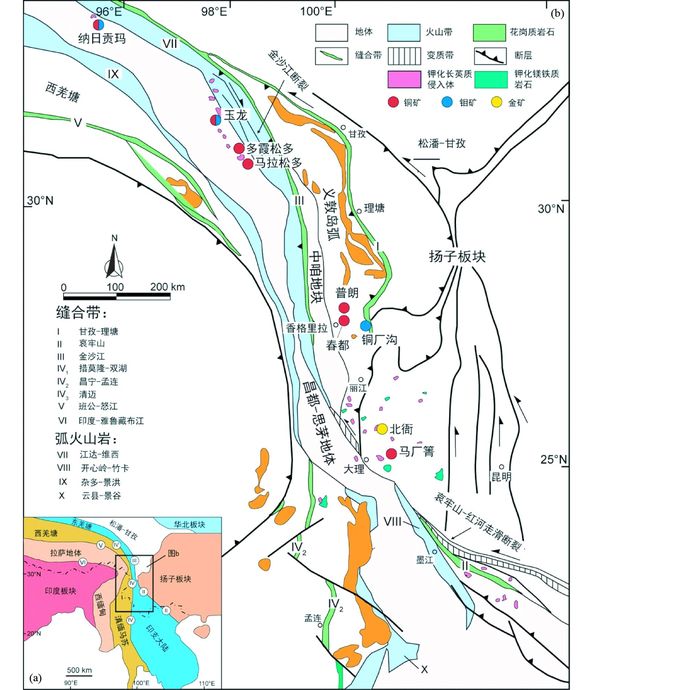
2 地质背景北衙富碱斑岩金矿床位于扬子板块、昌都-思茅陆块弧形结合部位的东侧(图 1b),被北西向金沙江-红河断裂、南北向宾川-程海断裂和北东向丽江-木里断裂,三个断裂所夹持(和中华等, 2013)。该矿床是金沙江-哀牢山富碱斑岩带内已发现规模最大的新生代富碱斑岩型金多金属矿床,也是云南最大的金多金属矿床和黄金矿山(和文言, 2014)。
|
图 1 西南三江地区区域构造及矿床分布简图(据Deng et al., 2014a; Zhu et al., 2015) Fig. 1 Regional tectonics and deposits in the Sanjiang area of southwestern China (after Deng et al., 2014a; Zhu et al., 2015) |
矿床在区域上属于三江特提斯成矿域,该区域先后经历了古生代古特提斯洋的消减闭合、中-新代新特提斯洋的开启-闭合以及新生代印度大陆的俯冲碰撞过程和陆内汇聚和隆升造山的强烈改造(邓军等, 2010a, b, 2013; 侯增谦, 2004; 邱昆峰和杨立强, 2011; 和文言, 2014; Yang et al., 2016a, b)。在新生代(65Ma以来),印度与欧亚大陆碰撞引发强烈的陆内变形,研究区作为印度-亚洲陆陆碰撞形成的青藏高原东缘地区,是吸纳和调节印-亚大陆碰撞应力的构造转换带,经历了大规模的陆内变形,先后形成了一系列NNW-NW走向的褶皱带和走滑断裂,如金沙江-红河断裂带(张玉泉等, 1987; 和文言, 2014; He et al., 2015; Yang et al., 2015a, 2017b)。沿该断裂带发育有大量的富碱斑岩侵入体,其中部分岩体与斑岩型Cu、Au、Mo矿床形成有关,如玉龙超大型Cu-Mo矿床、马厂箐Cu-Mo-Au矿床。
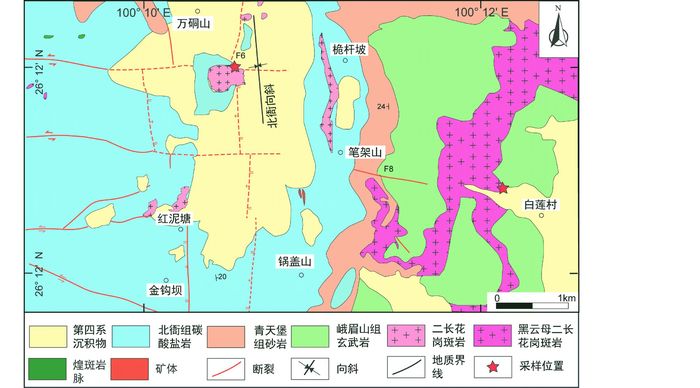
北衙矿床南北长约6000m,东西宽约400~3000m。大致以北衙向斜轴部为界分为东西两个矿带:东带包括桅杆坡、笔架山、锅盖山矿段;西带包括万硐山、红泥塘、金沟坝矿段。矿区出露的地层主要为上二叠统峨眉山组(P2β)玄武岩、三叠系下统(T1q)黄绿色、灰绿色、灰黑色砂泥岩及含玄武质火山碎屑岩的砂砾岩:中统北衙组(T2b)白云岩、白云质灰岩、铁质灰岩、蠕虫状生物碎屑灰岩及泥质灰岩,该组为矿区的主要赋矿地层和围岩;第四系(Q)更新统与全新统的紫红色,黄褐色残坡积砂砾石及粘土。矿区岩浆活动频繁,区内主要发育喜马拉雅山期富碱斑岩,边部及外围出露海西期峨眉山组玄武岩(图 2)。北衙矿区喜马拉雅山期岩体的岩性主要有二长花岗斑岩、黑云二长花岗斑岩和少量煌斑岩(图 2)。其中,煌斑岩脉体穿切二长花岗斑岩体及北衙组碳酸盐岩(图 2)。二长花岗斑岩是本区最主要的岩石类型,前人针对该矿床的成矿地球动力学背景、年代学、岩相学和地球化学、成矿流体及物质来源做了大量工作,认为其与新生代富碱斑岩有密切成因关系(徐兴旺等,2007;和文言, 2014; 和中华等, 2013; Xu et al., 2007a; Deng et al., 2015; He et al., 2016a, b)。
|
图 2 滇西北衙金多金属矿区地质简图(据He et al., 2015) Fig. 2 Geological map of the Beiya gold-polymetallic ore deposit (after He et al., 2015) |
北衙矿区内,总共有9个斑岩体,除红泥塘东岩体是隐伏岩体外,其他的岩体都有所出露,出露总面积达0.34km2。岩体主要分布于北衙向斜两翼,其展布主要受向斜两翼的NNE、NNW及EW向三组断层所控制;平面上呈脉状,剖面上呈钟状、脉状,局部透镜状,向深部有相连趋势(和文言, 2014)。
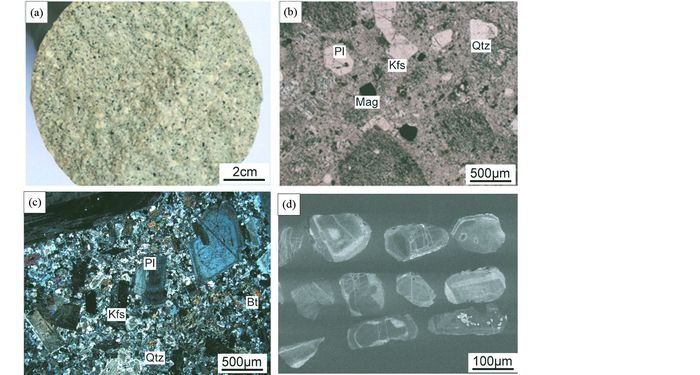
二长花岗斑岩呈岩株状于万硐山出露。岩石呈灰色,斑状、似斑状结构,斑晶含量为50%~60%,主要矿物组成为钾长石、斜长石和石英,含有少量的暗色矿物黑云母、角闪石斑晶,钾长石斑晶呈板柱状结构,可见卡式双晶;斜长石呈自形条状;石英斑晶表面干净,多溶蚀为似圆状和港湾状。基质以钾长石和石英为主,具微粒-细粒结构(图 3)。副矿物有磷灰石、榍石、锆石、磁铁矿等。
|
图 3 北衙二长花岗斑岩手标本及镜下照片 二长花岗斑岩手标本照片(a)和镜下照片(b、c);(d)岩体中磷灰石的CL照片 Fig. 3 The hand specimen and microscopic characteristics of the Beiya monzogranite porphyry |
本次研究所选样品为采自万硐山矿段和白莲村地区中较为新鲜的二长花岗斑岩(包括出露地表的岩体和钻孔岩芯),然后挑取岩体中的磷灰石,其中万硐山8件与白莲村8件。
磷灰石电子探针分析在中国地质科学院矿产资源研究所电子探针实验室完成,电子探针仪仪器型号为JXA-8230。分析的条件包括:测试加速电压15kV,束电流20nA,束斑大小为10μm,各项元素测试精度>0.001%。
磷灰石的微量元素分析在中国科学技术大学壳幔物质与环境重点实验室完成,使用LA-ICP-MS及Tu et al. (2011)的分析流程和方法。采用美国Resonetics公司生产的RESOlution M-50激光剥蚀系统和Agilent 7500a型的ICP-MS联机,测试时使用Ar和He作为载气,激光能量为80mJ,剥蚀斑束直径使用31μm,频率使用8Hz。使用NIST SRM610和612作外标,使用43Ca作为微量的内标,分析精度估计<10%。
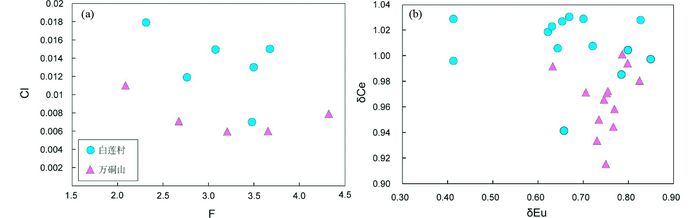
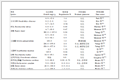
4.2 磷灰石化学组成 4.2.1 磷灰石的卤素组成测试结果显示(表 1),从两个地区岩体中所选取的磷灰石,其中的F-Cl含量有近似的负相关性(图 4a)。F-Cl之间的这种负相关性会受到H2O对F、Cl替换的影响。结果还显示出所有的磷灰石晶体都富F(>2%)、贫Cl(<0.02%),白莲村岩体的磷灰石F含量为2.3%~3.6%,Cl含量为0.007%~0.018%;万硐山矿段岩体的磷灰石F含量为2.0%~3.6%,Cl含量为0.006%~0.11%。同时,与不成矿岩体的磷灰石相比,成矿岩体的磷灰石具有较低的Cl含量(图 4a)。
|
图 4 成矿岩体(万硐山)与不成矿岩体(白莲村)磷灰石的Cl-F关系图解(a)及北衙二长花岗斑岩磷灰石的δCe-δEu图解(b) Fig. 4 The diagram of apatite Cl vs. F relationship between ore-bearing porphyries and barren porphyries (a) and the apatite δCe vs. δEu diagram of Beiya monzogranite porphyries (b) |
|
表 1 磷灰石电子探针分析结果(wt%) Table 1 The electron microprobe analysis results of apatites (wt%) |
除了卤素之外,磷灰石还明显富集Sr、Y、REE这些微量元素,微量元素和稀土元素数据详见电子版附表 1。在此次研究所选的岩体中,磷灰石以副矿物的形式存在,被硅酸盐矿物所包裹。根据这种结构关系,同时磷灰石的饱和温度高于850℃,表明这些岩石中,磷灰石会在液相线处以早期结晶相的形式出现。因此,微量元素的浓度如磷灰石的REE含量,主要由它们在初始熔体及它们在磷灰石和熔体中的分配系数所控制。
|
|
1 北衙地区成矿岩体与不成矿岩体磷灰石的微量(×10-6)元素组成 Appendix1 The trace elements content (×10-6) of Beiya apatites of ore-bearing and barren porphyry rocks |
Sr在磷灰石中以替代Ca2+的形式出现(Pan and Fleet, 2002)。结果表明,含矿岩体的磷灰石中Sr含量的分布范围是1149×10-6~3444×10-6,平均值达到1930×10-6。不含矿岩体的磷灰石具有相近的Sr含量,分布范围是927×10-6~4191×10-6,平均值达到1594×10-6。
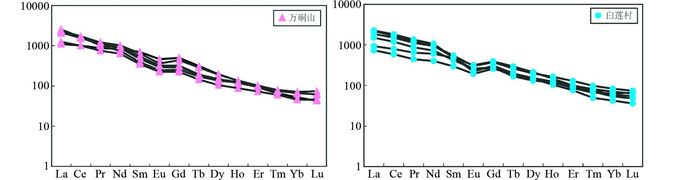
单个REE通过复杂的替代过程进入磷灰石,如2REE3++[V]=3Ca2+,REE3++Na+=2Ca2+和REE3++Si4+=Ca2++P5+(Sha and Chappell, 1999; Pan and Fleet, 2002)。分析结果表明,不成矿岩体(白莲村)磷灰石的稀土总量为937×10-6~2873×10-6,平均为2173×10-6;成矿岩体(万硐山矿段)磷灰石的稀土总量为1446×10-6~3706×10-6,平均为2199×10-6。在球粒陨石标准化的稀土元素配分图中(图 5),成矿与不成矿岩体的磷灰石一致为右倾平滑曲线,轻稀土相对富集,而重稀土相对亏损,有微弱的负的Eu异常。与不成矿岩体的磷灰石((La/Sm)N值和(La/Yb)N值分别为3.6×10-6和25×10-6)相比,成矿岩体的磷灰石具有明显较高的(La/Sm)N值和(La/Yb)N值,平均值分别为4.58×10-6和32×10-6。
|
图 5 成矿岩体(万硐山)与不成矿岩体(白莲村)磷灰石的球粒陨石标准化稀土元素配分图 Fig. 5 Chondrite-normalized REE diagrams of apatite from ore-bearing porphyries and barren porphyries |
因为长英质岩浆具有较高的岩浆黏度,它的结晶分异程度并不明显,故而常用花岗岩类的全岩组成代替初始熔体的组成。实验表明,与LREE如La和HREE如Yb相比,MREE如Sm在磷灰石-熔体的分配系数较高(Fujimaki, 1986; Watson, 1980)。那么,花岗质岩石中的磷灰石应比岩体具有更低的(La/Sm)N和(Yb/Sm)N比值。根据前人的研究成果(和文言, 2014),进行比较可知,北衙矿区二长花岗斑岩的平均(La/Sm)N和(Yb/Sm)N比值确实比岩体中磷灰石的值要高。
5 讨论 5.1 岩浆的氧化状态磷灰石的Mn、Eu、S和Ce可用来判别岩浆的氧化状态(Drake, 1975; Sha and Chappell, 1999; Streck and Dilles, 1998; Imai, 2002, 2004; Cao et al., 2012)。氧化程度较高的岩浆将熔体中的Mn2+、Eu2+、Ce3+氧化为Mn4+、Eu3+、Ce4+。而Mn2+、Eu3+、Ce3+更倾向于进入磷灰石,因为它们可以直接或间接替代磷灰石中的Ca2+(Belousova et al., 2002; Sha and Chappell, 1999)。因此,如果这些元素在岩浆中的浓度是相同的,那么从氧化程度高的岩浆中结晶的磷灰石与氧化程度低的岩浆相比,具有较高的Eu含量和较低的Mn和Ce含量。
然而,磷灰石中单一元素含量的变化并不能用来说明岩浆氧化还原状态的变化,因为这种变化可能是由其他因素所引起的。例如,岩浆中的Mn含量在结晶过程中会发生变化(Belousova et al., 2002; Chu et al., 2009),而岩浆中的Eu含量由于长石的分离,也会降低(Ballard et al., 2002; Bi et al., 2002; Buick et al., 2007)。然而,Eu和Ce这两种差异较大元素,它们在氧化状态发生变化的过程中,在磷灰石中具有相反的分配特征,所以对于判别岩浆的氧化状态具有重要的意义。测试结果显示,根据Ce异常,可知磷灰石记录了岩浆两种不同的氧化状态(图 4b)。与白莲村的不成矿岩体相比,万硐山矿区成矿岩体的磷灰石中δEu值相对较高,而δCe值则明显较低(图 4b)。这说明,在北衙地区的岩浆演化过程中,与不成矿的岩浆相比,成矿岩浆的氧化程度更高一些。这对于岩浆成矿是非常有利的。首先,在较高的氧化条件下,部分熔融时额外的硫以硫酸盐的形式熔出,在源区释放更多的Cu、Au和其他亲硫元素(Sun et al., 2004)。再者,因为在含矿流体从岩浆中出溶之前,含Fe硫化物可以从岩浆中带走金属元素,而在较高的氧化条件下,大量的硫以硫酸盐的形式存在,从而减少这种硫化物的结晶,有利于成矿(Carroll and Rutherford, 1987; Candela and Bouton, 1990; Hedenqulst and Lowenstern, 1994; Mungall, 2002; Sillitoe, 2010)。
5.2 岩浆演化过程由于其他矿物的结晶,磷灰石中微量元素的变化可以反映岩浆组成的变化。例如,长英质岩浆中长石的结晶,可以降低残余熔体中Sr的含量。在这个过程中,与结晶较早的磷灰石相比,结晶较晚的磷灰石有较低的Sr含量。因此,岩体磷灰石中Sr含量的变化或许可以用来示踪岩浆的演化过程。岩浆中富含REE矿物如磷灰石,它的结晶将会分离岩浆中的这些元素。因此,结合磷灰石中的REE比值如(La/Sm)N、(La/Yb)N、(Sm/Yb)N和Sr含量,可以了解岩体的结晶历史。
如图 6a所示,从两个岩体所分析的磷灰石可以看出,(Sm/Yb)N与Sr含量呈现明显的正相关关系。这种关系表明,在单一的岩体中,早期的长石结晶对岩浆的分异具有重要的意义。岩浆分离过程中的褐帘石会导致(Sm/Yb)N值的降低,但是北衙矿区岩体中磷灰石的(Sm/Yb)N比值的减小可能并不是由这个原因所导致的,因为在该区所采的岩石样品中并没发现褐帘石。除此之外,磷灰石的(Sm/Yb)N比值的快速减小,也可能是由含Cl热液的出溶所导致的。前人实验(Flynn and Burnham, 1978; Keppler et al., 1996)表明,与MREE和HREE相比,含Cl热液的出溶可以从熔体中带走更多的LREE。从这样的熔体中结晶出的磷灰石就含有降低的(Sm/Yb)N比值。这种猜测是有证据支持的,如图 6b所示,磷灰石中的F/Cl和(La/Yb)N值呈现负相关关系。

|
图 6 磷灰石的(Sm/Yb)N-Sr图解(a)和F/Cl-(La/Yb)N图解(b) Fig. 6 The diagrams of (Sm/Yb)N vs. Sr (a) in apatite and F/Cl vs. (La/Yb)N (b) in apatite |
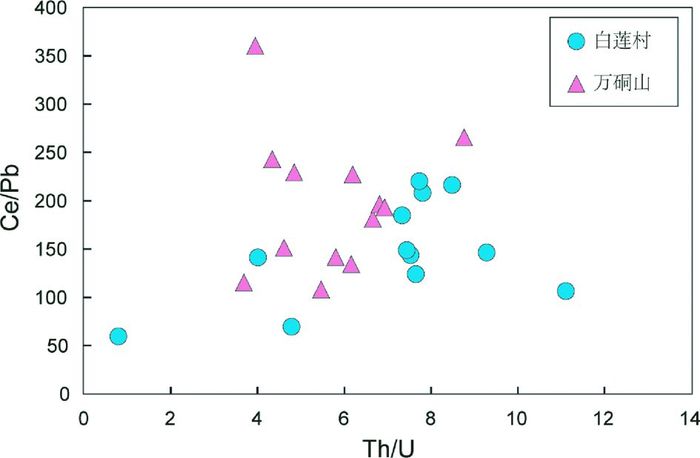
从磷灰石Ce/Pb和Th/U图解上(图 7)可以看出,在岩浆演化过程中,成矿岩体与不成矿岩体表现出一些不同的演化趋势,与成矿岩体相比,不成矿岩体的Th/U值变化范围较大,而Ce/Pb值则相对较小。成矿岩体和不成矿岩体磷灰石的Th/U值为4和6,而Ce/Pb平均值则分别为205和140。Pb、Ce、Th和U在俯冲带的活动性不同,依次为85%、51%、38%、29%(Kogiso et al., 1997; 张红, 2011),而在洋岛玄武岩中的不相容性依次顺序为Th>U≈Nb=Ta≈K>La>Ce≈Pb(Sun and McDonough, 1989),北衙成矿岩体磷灰石的Ce/Pb的值越高,反映在岩浆演化过程中,流体的活动性越强,与之相对应,不成矿岩体磷灰石的低Ce/Pb和高的Th/U的值,反映了岩浆形成过程中不成矿岩体的流体活动性较弱,岩浆的分异不明显。
|
图 7 北衙二长花岗斑岩磷灰石的Ce/Pb-Th/U图解 Fig. 7 The Ce/Pb vs. Th/U diagram of apatite from ore-bearing porphyries and barren porphyries |
本文将北衙矿床与三江地区其他矿床(铜厂沟、春都、普朗)的成矿岩体磷灰石的元素特征进行了对比,发现磷灰石的Cl/F值从北衙(0.0016~0.0052, 平均为0.00265)、普朗(0.003~0.044, 平均为0.015)、铜厂沟(0.026~0.087, 平均值为0.067),再到春都(0.37~0.60, 平均为0.50),有一个逐渐增加的趋势(图 8a)。众所周知,磷灰石是不易受亚固相线卤素交换的影响(Piccoli and Candela, 1994)。磷灰石中的Cl/F值在很大程度上可以反映初始结晶环境的Cl/F值。因此,与不同矿化类型有关的花岗岩体的母岩浆具有不同的Cl/F值,本次研究结果为此提供了间接证据。我们通过对比普朗、春都、铜厂沟岩体磷灰石的Cl/F值,发现北衙地区成矿岩体的母岩浆的Cl/F值是最低的。对于这种不同的原因,可能是多样的,但其中的一种可能性就是岩浆来源的问题。北衙矿区成矿岩体(二长花岗斑岩)的母岩浆可能形成于加厚下地壳的部分熔融(和文言, 2014; 蒋成竹, 2014),这种来源会产生极低的Cl/F值。与之不同的是,板片来源的流体具有较高的Cl/F值,而与普朗、春都、铜厂沟有关成矿岩体的母岩浆都直接或间接地有板片来源流体的加入,故而具有较高的Cl/F值。虽然也有研究表明,岩浆的脱气作用也会导致Cl和F的分配差异(Boudreau and Kruger, 1990; Warner et al., 1998),但北衙矿区磷灰石的Cl/F比较稳定,均小于0.01,所以在岩浆脱气作用的过程中,该地区的岩体并没有发生系统性的改变。

|
图 8 成矿岩体磷灰石的Cl/F-F关系图解(a)和不同成矿岩体中磷灰石的F/Cl-Cl关系图解(b) Fig. 8 The Cl/F vs. F diagram of apatite from different ore-bearing porphyries (a) and the F/Cl vs. Cl diagram of apatite from different ore-bearing porphyries (b) |
我们还收集了前人对于与玉龙斑岩铜矿有关的成矿岩体中磷灰石的卤素数据(表 2)(王蝶等, 2013),通过对比春都与玉龙成矿岩体中磷灰石的卤素特征,我们发现,北衙和玉龙成矿岩体中磷灰石的F/Cl值明显高于普朗、春都和铜厂沟的成矿岩体,但Cl含量却明显低于后三者的成矿岩体(图 8b)。而普朗、春都和铜厂沟矿床都直接或间接地与板片俯冲有关。根据F、Cl的分配特征可知,F多数在晚期的热液矿物中富集,而Cl则残留在流体中,是俯冲带流体的主要组成部分。故而相对于普朗、春都和铜厂沟斑岩矿床,北衙和玉龙斑岩矿床中成矿岩体磷灰石的F/Cl值比较大,反映了典型的陆内碰撞环境。而普朗、春都和铜厂沟矿床成矿岩体中磷灰石的F/Cl较小,则说明普朗、春都和铜厂沟矿床可能形成于板片俯冲环境。
|
|
表 2 其他矿区成矿斑岩磷灰石的部分电子探针数据 Table 2 Part of the apatite electron probe data of other ore-bearing pophyries |
(1) 北衙矿区不同岩体的磷灰石研究显示,万硐山二长花岗斑岩具有相对较高的δEu值和明显较低的δCe值,说明成矿岩浆比不成矿岩浆的氧化程度更高。
(2) 北衙矿区岩体磷灰石的(Sm/Yb)N与Sr含量呈现正相关关系。这表明,早期的长石结晶对岩浆的分异具有重要的意义。而磷灰石的(Sm/Yb)N比值的减小则可能是由含Cl热液的出溶所导致的。
(3) 通过对比北衙矿区与其他矿区岩体磷灰石的F/Cl值可知,与形成于典型俯冲带环境的矿床不同,北衙斑岩金矿床可能形成于陆内碰撞环境。
致谢 感谢云南黄金集团北衙矿业公司杨锐、王从明、吕永增、赵禹工程师对野外工作的帮助,以及中国地质科学院矿产资源研究所陈振宇老师和中国科学技术大学壳幔物质与环境重点实验室侯振辉老师对实验及数据处理的帮助。感谢研究生高雪、杨镇、解世雄在做实验、数据处理和论文写作过程中给予的帮助。| [] | Ayers JC, Watson EB. 1991. Solubility of apatite, monazite, zircon, and rutile in supercritical aqueous fluids with implications for subduction zone geochemistry. Philosophical Transactions of the Royal Society, 335A(1638): 365–375. |
| [] | Ayers JC, Watson EB. 1993. Apatite/fluid partitioning of rare-earth elements and strontium:Experimental results at 1.0GPa and 1000℃ and application to models of fluid-rock interaction. Chemical Geology, 110(1-3): 299–314. DOI:10.1016/0009-2541(93)90259-L |
| [] | Ballard JR, Palin JM, Campbell IH. 2002. Relative oxidation states of magmas inferred from Ce(Ⅳ)/Ce(Ⅲ) in zircon:Application to porphyry copper deposits of Northern Chile. Contributions to Mineralogy and Petrology, 1404(3): 347–364. |
| [] | Belousova EA, Walters S, Griffin WL, O'Reilly SY. 2001. Trace-element signatures of apatites in granitoids from the Mt Isa Inlier, northwestern Queensland Australian. Journal of Earth Sciences, 48(4): 603–619. |
| [] | Belousova EA, Griffin WL, O'Reilly SY, Fisher NI. 2002. Apatite as an indicator mineral for mineral exploration:Trace-element composition and their relationship to host rock type. Journal of Geochemical Exploration, 76(1): 45–69. DOI:10.1016/S0375-6742(02)00204-2 |
| [] | Bi XW, Cornell DH, Hu RZ. 2002. REE composition of primary and altered feldspar from the mineralized alteration zone of alkaline intrusive rocks, western Yunnan Province, China. Ore Geology Reviews, 19(1-2): 69–78. DOI:10.1016/S0169-1368(01)00034-8 |
| [] | Boudreau AE, Kruger FJ. 1990. Variation in the composition of apatite through the Merensky cyclic unit in the Western Bushveld Complex. Economic Geology, 85(4): 737–745. DOI:10.2113/gsecongeo.85.4.737 |
| [] | Boudreau AE. 1993. Chlorine as an exploration guide for the platinum-group elements in layered intrusions. Journal of Geochemical Exploration, 48(1): 21–37. DOI:10.1016/0375-6742(93)90080-6 |
| [] | Boyce JW, Hervig RL. 2009. Apatite as a monitor of late-stage magmatic processes at Volcán Irazú, Costa Rica. Contributions to Mineralogy and Petrology, 157(2): 135–145. DOI:10.1007/s00410-008-0325-x |
| [] | Boyce JW, Liu Y, Rossman GR, Guan YB, Eiler JM, Stolper EM, Taylor LA. 2010. Lunar apatite with terrestrial volatile abundances. Nature, 466(7305): 466–469. DOI:10.1038/nature09274 |
| [] | Buick IS, Hermann J, Maas R, Gibson RL. 2007. The timing of subsolidus hydrothermal alteration in the central zone, Limpopo Belt (South Africa):constraints from titanite U-Pb geochronology and REE partitioning. Lithos, 98(1-4): 97–117. DOI:10.1016/j.lithos.2007.02.002 |
| [] | Candela PA, Bouton SL. 1990. The influence of oxygen fugacity on tungsten and molybdenum partitioning between silicate melts and ilmenite. Economic Geology, 85(3): 633–640. DOI:10.2113/gsecongeo.85.3.633 |
| [] | Cao MJ, Li GM, Qin KZ, Seitmuratova EY, Liu YS. 2012. Major and trace element characteristics of apatites in granitoids from Central Kazakhstan:implications for petrogenesis and mineralization. Resource Geology, 62(1): 63–83. DOI:10.1111/rge.2012.62.issue-1 |
| [] | Carroll MR, Rutherford MJ. 1987. The stability of igneous anhydrite:Experimental results and implications for sulfur behavior in the 1982 El Chichon trachyandesite and other evolved magmas. Journal of Petrology, 28(5): 781–801. DOI:10.1093/petrology/28.5.781 |
| [] | Chew DM, Sylvester PJ, Tubrett MN. 2011. U-Pb and Th-Pb dating of apatite by LA-ICPMS. Chemical Geology, 280(1-2): 200–216. DOI:10.1016/j.chemgeo.2010.11.010 |
| [] | Chu MF, Wang KL, Griffin WL, Chung SL. O'Reilly SY, Norman JP and Ⅱzuka Y. 2009. Apatite composition:tracing petrogenetic processes in Transhimalayan granitoids. Journal of Petrology, 50(10): 1829–1855. DOI:10.1093/petrology/egp054 |
| [] | Creaser RA, Gray CM. 1992. Preserved initial 87Sr86Sr in apatite from altered felsic igneous rocks:a case study from the Middle Proterozoic of South Australia. Geochimica et Cosmochimica Acta, 56(7): 2789–2795. DOI:10.1016/0016-7037(92)90359-Q |
| [] | Deng J, Yang LQ, Ge LS, Yuan SS, Wang QF, Zhang J, Gong QJ, Wang CM. 2010a. Character and post-ore changes, modifications and preservation of Cenozoic alkali-rich porphyry gold metallogenic system in western Yunnan, China. Acta Petrologica Sinica, 26(6): 1633–1645. |
| [] | Deng J, Hou ZQ, Mo XX, Yang LQ, Wang QF, Wang CM. 2010b. Superimposed orogenesis and metallogenesis in Sanjiang Tethys. Mineral Deposits, 29(1): 37–42. |
| [] | Deng J, Yang LQ, Wang CM. 2011. Research advances of superimposed orogenesis and metallogenesis in the Sanjiang Tethys. Acta Petrologica Sinica, 27(9): 2501–2509. |
| [] | Deng J, Wang CM, Li GJ. 2012. Style and process of the superimposed mineralization in the Sanjiang Tethys. Acta Petrologica Sinica, 28(5): 1349–1361. |
| [] | Deng J, Ge LS, Yang LQ. 2013. Tectonic dynamic system and compound orogeny:Additionally discussing the temporal-spatial evolution of Sanjiang orogeny, Southwest China. Acta Petrologica Sinica, 29(4): 1099–1114. |
| [] | Deng J, Wang QF, Li GJ, Santosh M. 2014a. Cenozoic tectono-magmatic and metallogenic processes in the Sanjiang region, southwestern China. Earth-Science Reviews, 138: 268–299. DOI:10.1016/j.earscirev.2014.05.015 |
| [] | Deng J, Wang QF, Li GJ, Li CS, Wang CM. 2014b. Tethys tectonic evolution and its bearing on the distribution of important mineral deposits in the Sanjiang region, SW China. Gondwana Research, 26(2): 419–437. DOI:10.1016/j.gr.2013.08.002 |
| [] | Deng J, Yuan WM, Carranza EJM, Yang LQ, Wang CM, Yang LY, Hao NN. 2014c. Geochronology and Thermochronometry of the Jiapigou Gold Belt, northeastern China:New evidence for multiple episodes of mineralization. Journal of Asian Earth Sciences, 89: 10–27. DOI:10.1016/j.jseaes.2014.03.013 |
| [] | Deng J, Wang QF, Li GJ, Hou ZQ, Jiang CZ, Danyushevsky L. 2015. Geology and genesis of the giant Beiya porphyry-skarn gold deposit northwestern Yangtze Block China. Ore Geology Reviews, 70: 457–485. DOI:10.1016/j.oregeorev.2015.02.015 |
| [] | Deng J, Wang QF. 2016. Gold mineralization in China:Metallogenic provinces, deposit types and tectonic framework. Gondwana Research, 36: 219–274. DOI:10.1016/j.gr.2015.10.003 |
| [] | Deng J, Wang QF, Li GJ, Hou ZQ, Jiang CZ, Danyushevsky L. 2016. Geology and genesis of the giant Beiya porphyry-skarn gold deposit, northwestern Yangtze Block, China. Ore Geology Reviews 70, 457: 457–485. |
| [] | Deng J, Wang QF, Li GJ. 2016. Superimposed orogeny and composite metallogenic system:Case study from the Sanjiang Tethyan belt, SW China. Acta Petrologica Sinica, 32(8): 2225–2247. |
| [] | Deng J, Wang QF and Li GJ. 2017. Tectonic evolution, superimposed orogeny, and composite metallogenic system in China. Gondwana Research, http://dx.doi.org/10.1016/j.gr.2017.02.005 |
| [] | Drake MJ. 1975. The oxidation state of europium as an indicator of oxygen fugacity. Geochimica et Cosmochimica Acta, 39(1): 55–64. DOI:10.1016/0016-7037(75)90184-2 |
| [] | Elkins-Tanton LT, Grove TL. 2011. Water (hydrogen) in the lunar mantle:Results from petrology and magma ocean modeling. Earth and Planetary Science Letters, 307(1-2): 173–179. DOI:10.1016/j.epsl.2011.04.027 |
| [] | Flynn RT, Burnham CW. 1978. An experimental determination of rare earth partition coefficients between a chloride containing vapor phase and silicate melts. Geochimica et Cosmochimica Acta, 42(6): 685–701. DOI:10.1016/0016-7037(78)90087-X |
| [] | Fujimaki H. 1986. Partition coefficients of Hf, Zr, and REE between zircon, apatite and liquid. Contributions to Mineralogy and Petrology, 94(1): 42–45. DOI:10.1007/BF00371224 |
| [] | Gaweda A, Szopa K, Chew DM. 2014. LA-ICP-MS U-Pb dating and REE patterns of apatite from the Tatra Mountains, Poland as a monitor of the regional tectonomagmatic activity. Geochronometria, 41(4): 306–314. |
| [] | Ge LS, Guo XD, Zou YL, Li ZH, Zhang XH. 2002. Geological characteristics and genesis of Beiya gold deposit, Yunnan Province. Contributions to Geology and Mineral Resources Research, 17(1): 32–40, 46. |
| [] | Harrison TM, Watson EB. 1984. The behavior of apatite during crustal anatexis:Equilibrium and kinetic consideration. Geochimica et Cosmochimica Acta, 48(7): 1467–1477. DOI:10.1016/0016-7037(84)90403-4 |
| [] | He WY, Yu XH, Mo XX, He ZH, Li Y, Huang XK, Su GS. 2012. Genetic types and the relationship between alkali-rich intrusion and mineralization of Beiya gold-polymetallic ore field, western Yunnan Province, China. Acta Petrologica Sinica, 28(5): 1401–1412. |
| [] | He WY. 2014. The Beiya giant gold-polymetallic deposit:Magmatism and metallogenic model. Ph. D. Dissertation. Beijing:China University of Geosciences (in Chinese with English summary) |
| [] | He WY, Mo XX, He ZH, White NC, Chen JB, Yang KH, Yu XH, Dong GC, Huang XF. 2015. The geology and mineralogy of the Beiya skarn gold deposit in Yunnan, Southwest China. Economic Geology, 110(6): 1625–1641. DOI:10.2113/econgeo.110.6.1625 |
| [] | He WY, Mo XX, Yang LQ, Xing YL, Dong GC, Yang Z, Gao X, Bao XS. 2016a. Origin of the Eocene porphyries and mafic microgranular enclaves from the Beiya porphyry Au polymetallic deposit, western Yunnan, China:Implications for magma mixing/mingling and mineralization. Gondwana Research, 40: 230–248. DOI:10.1016/j.gr.2016.09.004 |
| [] | He WY, Yang LQ, Brugger J, McCuaig TC, Lu YJ, Bao XS, Gao XQ, Lu YG and Xing YL. 2016b. Hydrothermal evolution and ore genesis of the Beiya giant Au polymetallic deposit, western Yunnan, China:Evidence from fluid inclusions and H-O-S-Pb isotopes. Ore Geology Reviews, doi:10.1016/j.oregeorev.2016.10.035 |
| [] | He ZH, Zhou YM, He WY, Li WH, Yang SW. 2013. The Beiya giant gold-polymetallic deposit:Genetic type and metallogenic regularity. Mineral Deposit, 32(2): 244–258. |
| [] | Hedenquist JW, Lowenstern JB. 1994. The role of magmas in the formation of hydrothermal ore deposits. Nature, 370(6490): 519–527. DOI:10.1038/370519a0 |
| [] | Henderson P. 1980. Rare earth element partition between sphene, apatite and other coexisting minerals of the Kangerdlugssuaq intrusion, E. Greenland. Contributions to Mineralogy and Petrology, 72(1): 81–85. DOI:10.1007/BF00375570 |
| [] | Hou ZQ, Yang YQ, Qu XM, Huang DH, Lu QH, Wang HP, Yu JJ, Tang SH. 2004. Tectonic evolution and mineralization systems of the Yidun arc orogen in Sanjiang Region, China. Acta Geologica Sinica, 78(1): 109–120. |
| [] | Imai A. 2002. Metallogenesis of porphyry Cu deposits of the western Luzon arc, Philippines:K-Ar ages, SO3 contents of microphenocrystic apatite and significance of intrusive rocks. Resource Geology, 52(2): 147–161. DOI:10.1111/rge.2002.52.issue-2 |
| [] | Imai A. 2004. Variation of Cl and SO3 contents of microphenocrystic apatite in intermediate to silicic igneous rocks of Cenozoic Japanese island arcs:implications for porphyry Cu metallogenesis in the Western Pacific Island arcs. Resource Geology, 54(3): 357–372. DOI:10.1111/rge.2004.54.issue-3 |
| [] | Jiang CZ. 2014. Potassic magmatism and ore-forming processes of Beiya gold deposit in western Yunnan. Ph. D. Dissertation. Beijing:China University of Geosciences (in Chinese with English summary) |
| [] | Keppler H. 1996. Constraints from partitioning experiments on the composition of subduction-zone fluid. Nature, 380(6571): 237–240. DOI:10.1038/380237a0 |
| [] | Kogiso T, Tatsumi Y, Nakano S. 1997. Trace element transport during dehydration processes in the subducted oceanic crust:1. Experiments and implications for the origin of ocean island basalts. Earth and Planetary Science Letters, 148(1-2): 193–205. |
| [] | London D, Wolf MB, Morgan VI GB, Garrido MG. 1999. Experimental silicatephosphate equilibria in peraluminous granitic magmas, with a case study of the Albuquerque batholith at Tres Arroyos, Badajoz, Spain. Journal of Petrology, 40(1): 215–240. DOI:10.1093/petroj/40.1.215 |
| [] | Mungall JE. 2002. Roasting the mantle:Slab melting and the genesis of major Au and Au-rich Cu deposits. Geology, 30(10): 915–918. DOI:10.1130/0091-7613(2002)030<0915:RTMSMA>2.0.CO;2 |
| [] | Pan LC, Hu RZ, Wang XS, Bi XW, Zhu JJ, Li CS. 2016. Apatite trace element and halogen compositions as petrogenetic-metallogenic indicators:Examples from four granite plutons in the Sanjiang region, SW China. Lithos, 254-255: 118–130. DOI:10.1016/j.lithos.2016.03.010 |
| [] | Pan YM, Fleet ME. 2002. Compositions of the apatite-group minerals:substitution mechanisms and controlling factors. Reviews in Mineralogy and Geochemistry, 48(1): 13–49. DOI:10.2138/rmg.2002.48.2 |
| [] | Piccoli P, Candela P. 1994. Apatite in felsic rocks:a model for the estimation of initial halogen concentrations in the Bishop tuff (long valley) and Tuolumne intrusive suite (Sierra Nevada batholith) magmas. American Journal of Science, 294(1): 92–135. DOI:10.2475/ajs.294.1.92 |
| [] | Piccoli PM, Candela PA. 2002. Apatite in igneous systems. Reviews in Mineralogy and Geochemistry, 48(1): 255–292. DOI:10.2138/rmg.2002.48.6 |
| [] | Qiu KF, Yang LQ. 2011. Genetic feature of monazite and its U-Th-Pb dating:Critical considerations on the tectonic evolution of Sanjiang Tethys. Acta Petrologica Sinica, 27(9): 2721–2732. |
| [] | Schisa P, Boudreau A, Djon L, Tchalikian A, Corkery J. 2015. The Lac Des Iles Palladium deposit, Ontario, Canada. Part Ⅱ. Halogen variations in apatite. Mineralium Deposita, 50(3): 339–355. |
| [] | Sha LK, Chappell BW. 1999. Apatite chemical composition, determined by electron microprobe and laser-ablation inductively coupled plasma mass spectrometry, as a probe into granite petrogenesis. Geochimica et Cosmochimica Acta, 63(22): 3861–3881. DOI:10.1016/S0016-7037(99)00210-0 |
| [] | Sillitoet RH. 2010. Porphyry copper system. Economic Geology, 105(1): 3–41. DOI:10.2113/gsecongeo.105.1.3 |
| [] | Streck MJ, Dilles JH. 1998. Sulfur evolution of oxidized arc magmas as recorded in apatite from a porphyry copper batholith. Geology, 26(6): 523–526. DOI:10.1130/0091-7613(1998)026<0523:SEOOAM>2.3.CO;2 |
| [] | Sun SS, McDonough WF. 1989. Chemical and isotopic systematics of oceanic basalts:Implications for mantle composition and processes. In:Saunders AD and Norry MJ (eds.). Magmatism in the Ocean Basins. London, Special Publication, 42(1): 313–345. |
| [] | Sun WD, Arculus RJ, Kamenetsky VS, Binns RA. 2004. Release of gold-bearing fluids in convergent margin magmas prompted by magnetite crystallization. Nature, 431(7011): 975–978. DOI:10.1038/nature02972 |
| [] | Treloar PJ, Colley H. 1996. Variations in F and Cl content in apatites from magnetiteapatite ores in Northern Chile, and their ore-genetic implication. Mineralogical Magazine, 60(399): 285–301. DOI:10.1180/minmag |
| [] | Tu GC. 1989. The alkali-rich intrusive rock. Mineral Resources and Geology, 13(3): 1–4, 16. |
| [] | Tu XL, Zhang H, Deng WF, Ling MX, Liang HY, Liu Y, Sun WD. 2011. Application for RESOlution in-situ laser ablation ICP-MS in trace element analyses. Geochimica, 40(1): 308–313. |
| [] | Wang D, Bi XW, Zhou T, Zhang WL, Wang XS, Xu LL. 2013. Volatile abundances in apatite from alkaline magma in the Jinshajiang-Honghe in continental tectonic aetting. Acta Mineralogica Sinica, 33(2): 231–238. |
| [] | Warner S, Martin RF, Abdel-Rahman AFM, Doig R. 1998. Apatite as a monitor of fractionation, degassing, and metamorphism in the Sudbury igneous complex, Ontario. Canadian Mineralogist, 36(4): 981–999. |
| [] | Watson EB. 1980. Apatite and phosphorus in mantle source regions:An experimental study of apatite/melt equilibria at pressures to 25kbar. Earth and Planetary Science Letters, 51(2): 322–335. DOI:10.1016/0012-821X(80)90214-9 |
| [] | Xiao XN, Yu XH, Mo XX, Yang GL, Li Y, Huang XK. 2009. A study of fluid inclusions from Beiya gold-polymetallic deposit in western Yunnan. Earth Science Frontiers, 16(2): 250–261. |
| [] | Xiao XN, Yu XH, Mo XX, Li Y, Huang XK. 2011. Geochemical characteristics of metallogenesis in the gold-polymetallic deposit in Beiya, western Yunnan Province. Geology and Prospecting, 47(2): 170–179. |
| [] | Xu XW, Cai XP, Song BC, Zhang BL, Ying HL, Xiao QB, Wang J. 2006. Petrologic, chronological and geochemistry characteristics and formation mechanism of alkaline porphyries in the Beiya gold district, western Yunnan. Acta Petrologica Sinica, 22(3): 631–642. |
| [] | Xu XW, Cai XP, Xiao QB, Peters SG. 2007a. Porphyry Cu-Au and associated polymetallic Fe-Cu-Au deposits in the Beiya area, western Yunnan Province, South China. Ore Geology Reviews, 31(1-4): 224–246. DOI:10.1016/j.oregeorev.2005.03.015 |
| [] | Xu XW, Cai XP, Zhong JY, Song BC, Peters SG. 2007b. Formation of tectonic peperites from alkaline magmas intruded into wet sediments in the Beiya area, western Yunnan, China. Journal of Structural Geology, 29(8): 1400–1413. DOI:10.1016/j.jsg.2007.04.007 |
| [] | Xu XW, Cai XP, Zhang BL, Liang GH, Du SJ, Wang J. 2007. Genetic types and framework model of Beiya gold ore district in western Yunnan. Mineral Deposits, 26(3): 249–264. |
| [] | Yang LQ, Liu JT, Zhang C, Wang QF, Ge LS, Wang ZL, Zhang J, Gong JJ. 2010. Superimposed orogenesis and metallogenesis:An example from the orogenic gold deposits in Ailaoshan gold belt, Southwest China. Acta Petrologica Sinica, 26(6): 1723–1739. |
| [] | Yang LQ, Deng J, Zhao K, Liu JT. 2011. Tectono-thermochronology and gold mineralization events of orogenic gold deposits in Ailaoshan orogenic belt, Southwest China:Geochronological constraints. Acta Petrologica Sinica, 27(9): 2519–2532. |
| [] | Yang LQ, Deng J, Dilek Y, Meng JY, Gao X, Santosh M, Wang D, Yan H. 2015a. Melt source and evolution of Ⅰ-type granitoids in the SE Tibetan Plateau:Late Cretaceous magmatism and mineralization driven by collision-induced transtensional tectonics. Lithos, 245: 258–273. |
| [] | Yang LQ, Deng J, Qiu KF, Ji XZ, Santosh M, Song KR, Song YH, Geng JZ, Zhang C, Hua B. 2015b. Magma mixing and crust-mantle interaction in the Triassic monzogranites of Bikou Terrane, central China:Constraints from petrology, geochemistry, and zircon U-Pb-Hf isotopic systematics. Journal of Asian Earth Sciences, 98: 320–341. DOI:10.1016/j.jseaes.2014.11.023 |
| [] | Yang LQ, Deng J, Qiu KF, Ji XZ, Santosh M, Song KR, Song YH, Geng JZ, Zhang C, Hua B. 2015c. Magma mixing and crust-mantle interaction in the Triassic monzogranites of Bikou Terrane, central China:Constraints from petrology, geochemistry, and zircon U-Pb-Hf isotopic systematics. Journal of Asian Earth Sciences, 98: 320–341. DOI:10.1016/j.jseaes.2014.11.023 |
| [] | Yang LQ, Gao X, He WY. 2015. Late Cretaceous porphyry metallogenic system of the Yidun arc, SW China. Acta Petrologica Sinica, 31(11): 3155–3170. |
| [] | Yang LQ, Deng J, Dilek Y, Meng JY, Gao X, Santosh M., Wang D, Yan H. 2016a. Melt source and evolution of Ⅰ-type granitoids in the SE Tibetan Plateau:Late Cretaceous magmatism and mineralization driven by collision-induced transtensional tectonics. Lithos, 245: 258–273. DOI:10.1016/j.lithos.2015.10.005 |
| [] | Yang LQ, Deng J, Wang ZL, Guo LN, Li RH, Groves DI, Danyushevsky L, Zhang C, Zheng XL, Zhao H. 2016b. Relationships between gold and pyrite at the Xincheng gold deposit, Jiaodong Peninsula, China:Implications for gold source and deposition in a brittle epizonal environment. Economic Geology, 111: 105–126. DOI:10.2113/econgeo.111.1.105 |
| [] | Yang LQ, Deng J, Li N, Zhang C, Yu JY. 2016c. Isotopic constraints on sources and ore genesis of gold deposits in the Yangshan Gold Belt, West Qinling, central China. Journal of Geochemical Exploration, 168: 103–118. DOI:10.1016/j.gexplo.2016.06.006 |
| [] | Yang LQ, Deng J, Guo LN, Wang ZL, Li XZ, Li JL. 2016d. Origin and evolution of ore fluid, and gold deposition processes at the giant Taishang gold deposit, Jiaodong Peninsula, eastern China. Ore Geology Reviews, 72: 585–602. DOI:10.1016/j.oregeorev.2015.08.021 |
| [] | Yang LQ, Deng J, Guo RP, Guo LL, Wang ZL, Chen BH, Wang XD. 2016e. World-class Xincheng gold deposit:An example from the giant Jiaodong gold province. Geoscience Frontiers, 7(3): 419–430. DOI:10.1016/j.gsf.2015.08.006 |
| [] | Yang LQ, Deng J, Wang ZL, Zhang L, Goldfarb RJ, Yuan WM, Weinberg RF, Zhang RZ. 2016f. Thermochronologic constraints on evolution of the Linglong Metamorphic Core Complex and implications for gold mineralization:a case study from the Xiadian gold deposit, Jiaodong Peninsula, eastern China. Ore Geology Reviews, 72: 165–178. DOI:10.1016/j.oregeorev.2015.07.006 |
| [] | Yang LQ, Deng J, Gao X, He WY, Meng JY, Santosh M, Yu HJ, Yang Z, Wang D. 2017a. Timing of formation and origin of the Tongchanggou porphyry-skarn deposit:Implications for Late Cretaceous Mo-Cu metallogenesis in the southern Yidun Terrane, SE Tibetan Plateau. Ore Geology Reviews, 81: 1015–1032. DOI:10.1016/j.oregeorev.2016.03.015 |
| [] | Yang LQ, Gao X and Shu QH, 2017b. Multiple Mesozoic porphyry-skarn Cu (Mo-W) systems in Yidun Terrane, east Tethys:constraints from zircon U-Pb and molybdenite Re-Os geochronology. Ore Geology Reviews, http://dx.doi.org/10.1016/j.oregeorev.2017.01.030 |
| [] | Zhang H. 2011. Study on trace elements of zircon and apatite:Implications for porphyry ore-forming processes. Ph. D. Dissertation. Guangzhou:Guangzhou Institute of Geochemistry, Chinese Academy of Sciences (in Chinese with English summary) |
| [] | Zhang YQ, Xie YW, Tu GZ. 1987. Preliminary studies of the alkali-rich intrusive rocks in the Ailaoshan-Jinshajiang Belt and their bearing on rift tectonics. Acta Petrologica Sinica, 3(1): 17–26. |
| [] | Zhang YQ, Xie YW. 1997. The chronology and Nd, Sr isotopic characteristics of Ailaoshan-Jinshajiang alkali-rich intrusive rock. Science in China (Series D), 27(4): 289–293. |
| [] | Zhu JJ, Hu RZ, Richards JP, Bi XW, Zhong H. 2015. Genesis and magmatic-hydrothermal evolution of the Yangla skarn Cu deposit, Southwest China. Economic Geology, 110(3): 631–652. DOI:10.2113/econgeo.110.3.631 |
| [] | 邓军, 杨立强, 葛良胜, 袁士松, 王庆飞, 张静, 龚庆杰, 王长明. 2010a. 滇西富碱斑岩型金成矿系统特征与变化保存. 岩石学报, 26(6): 1633–1645. |
| [] | 邓军, 侯增谦, 莫宣学, 杨立强, 王庆飞, 王长明. 2010b. 三江特提斯复合造山与成矿作用. 矿床地质, 29(1): 37–42. |
| [] | 邓军, 杨立强, 王长明. 2011. 三江特提斯复合造山与成矿作用研究进展. 岩石学报, 27(9): 2501–2509. |
| [] | 邓军, 王长明, 李龚健. 2012. 三江特提斯叠加成矿作用样式及过程. 岩石学报, 28(5): 1349–1361. |
| [] | 邓军, 葛良胜, 杨立强. 2013. 构造动力体制与复合造山作用:兼论三江复合造山带时空演化. 岩石学报, 29(4): 1099–1114. |
| [] | 邓军, 王庆飞, 李龚健. 2016. 复合造山和复合成矿系统:三江特提斯例析. 岩石学报, 32(8): 2225–2247. |
| [] | 葛良胜, 郭晓东, 邹依林, 李振华, 张晓辉. 2002. 云南北衙金矿床地质特征及成因研究. 地质找矿论丛, 17(1): 32–40, 46. |
| [] | 和文言, 喻学惠, 莫宣学, 和中华, 李勇, 黄行凯, 苏纲生. 2012. 滇西北衙多金属矿田矿床成因类型及其与富碱斑岩关系初探. 岩石学报, 28(5): 1401–1412. |
| [] | 和文言. 2014. 滇西北衙超大型金多金属矿床岩浆作用与成矿模式. 博士学位论文. 北京: 中国地质大学 http://cdmd.cnki.com.cn/article/cdmd-11415-1014234004.htm |
| [] | 和中华, 周云满, 和文言, 苏纲生, 李万华, 杨绍文. 2013. 滇西北衙超大型金多金属矿床成因类型及成矿规律. 矿床地质, 32(2): 244–258. |
| [] | 侯增谦, 杨岳清, 曲晓明, 黄典豪, 吕庆田, 王海平, 余金杰, 唐绍华. 2004. 三江地区义敦岛弧造山带演化和成矿系统. 地质学报, 78(1): 109–120. |
| [] | 蒋成竹. 2014. 滇西北衙金多金属矿床钾质岩浆活动与成矿作用. 博士学位论文. 北京: 中国地质大学 http://cdmd.cnki.com.cn/Article/CDMD-11415-1014234009.htm |
| [] | 邱昆峰, 杨立强. 2011. 独居石成因特征与U-Th-Pb定年及三江特提斯构造演化研究例析. 岩石学报, 27(9): 2721–2732. |
| [] | 涂光炽. 1989. 关于富碱侵入岩. 矿产与地质, 13(3): 1–4, 16. |
| [] | 王蝶, 毕献武, 周汀, 张文兰, 王新松, 胥磊落. 2013. 金沙江-红河富碱侵入岩磷灰石挥发分组成特征及其地质意义. 矿物学报, 33(2): 231–238. |
| [] | 肖晓牛, 喻学惠, 莫宣学, 杨贵来, 李勇, 黄行凯. 2009. 滇西北衙金多金属矿床流体包裹体研究. 地学前缘, 16(2): 250–261. |
| [] | 肖晓牛, 喻学惠, 莫宣学, 李勇, 黄行凯. 2011. 滇西北衙金多金属矿床成矿地球化学特征. 地质与勘探, 47(2): 170–179. |
| [] | 徐兴旺, 蔡新平, 宋宝昌, 张宝林, 应汉龙, 肖骑彬, 王杰. 2006. 滇西北衙金矿区碱性斑岩岩石学、年代学和地球化学特征及成因机制. 岩石学报, 22(3): 631–642. |
| [] | 徐兴旺, 蔡新平, 张宝林, 梁光河, 杜世俊, 王杰. 2007. 滇西北衙金矿矿床类型与结构模型. 矿床地质, 26(3): 249–264. |
| [] | 杨立强, 刘江涛, 张闯, 王庆飞, 葛良胜, 王中亮, 张静, 龚庆杰. 2010. 哀牢山造山型金成矿系统:复合造山构造演化与成矿作用初探. 岩石学报, 26(6): 1723–1739. |
| [] | 杨立强, 邓军, 赵凯, 刘江涛. 2011. 哀牢山造山带金矿成矿时序及其动力学背景探讨. 岩石学报, 27(9): 2519–2532. |
| [] | 杨立强, 高雪, 和文言. 2015. 义敦岛弧晚白垩世斑岩成矿系统. 岩石学报, 31(11): 3155–3170. |
| [] | 张红. 2011. 锆石和磷灰石微量元素对斑岩矿床的指示意义研究. 博士学位论文. 广州: 中国科学院广州地球化学研究所 |
| [] | 张玉泉, 谢应雯, 涂光炽. 1987. 哀牢山-金沙江富碱侵入岩及其与裂谷构造关系初步研究. 岩石学报, 3(1): 17–26. |
| [] | 张玉泉, 谢应雯. 1997. 哀牢山-金沙江富碱侵入岩年代学和Nd, Sr同位素特征. 中国科学(D辑), 27(4): 289–293. |