 2017, Vol. 33


2. 云南省腾冲县金山地矿科技服务有限责任公司, 腾冲 679100;
3. 青海大学地质工程系, 西宁 810016
2. Jinshan Geological and Technological Services Limited Company, Tengchong County, Yunnan Province, Tengchong 679100, China;
3. Department of Geological Engineering, Qinghai University, Xining 810016, China
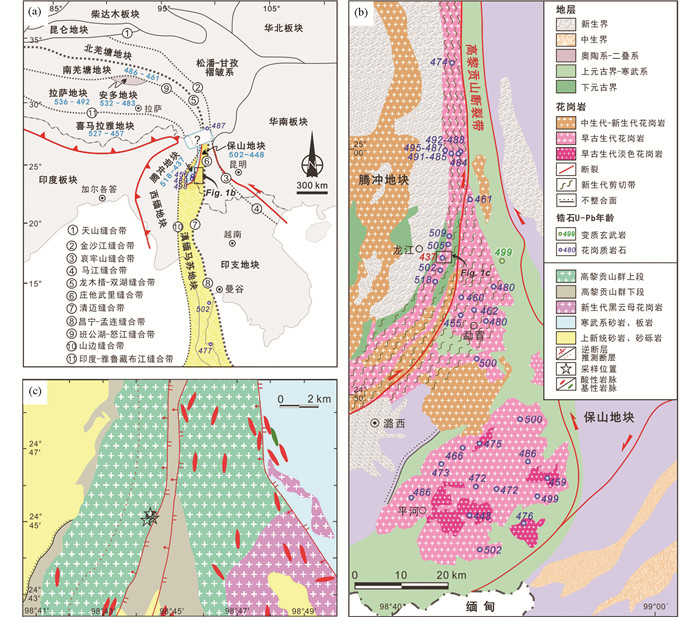
新元古代晚期-早古生代是冈瓦纳超大陆发展演化的重要时期,期间东冈瓦纳大陆同时受南面原太平洋和北面原特提斯洋的俯冲,在其大陆边缘形成了早古生代安第斯型增生造山带(Meert, 2003; Collins and Pisarevsky, 2005; Cawood and Buchan, 2007; Cawood et al., 2007; Li et al., 2008a, b; Murphy et al., 2011, 蔡志慧等, 2013)。近年来,在东冈瓦纳大陆北缘,即现今东南亚地区发现大量的早古生代岩浆岩广泛分布于腾冲地块(518~456Ma)、保山地块(502~448Ma)、滇缅马苏地块(502~477Ma)、拉萨地块(536~492Ma), 西羌塘(486~461Ma)和安多地块(532~483Ma)、喜马拉雅地块(527~457Ma)等(蔡志慧等, 2013; Ding et al., 2015; Hu et al., 2015; Li et al., 2016)(图 1a)。各地早古生代岩浆岩的研究,对进一步明确早古生代原特提斯洋增生造山过程的性质、范围、时限、造山阶段以及动力学机制具有重要意义(蔡志慧等, 2013)。
|
图 1 研究区地质背景图 (a)东南亚地区板块分布图(据Deng and Wang, 2016; Deng et al., 2017; Li et al., 2016; Metcalfe, 2013; Zhu et al., 2012; Wang et al., 2014); (b)腾冲-保山地块早古生代岩浆分布图(据蔡志慧等, 2013; Deng et al., 2014b; Li et al., 2016; Zhao et al., 2016); (c)研究区采样位置图(据云南省地质局区域地质调查队, 1982①) Fig. 1 Geological background of the study area (a) tectonic subdivision of mainland Southeast Asia (after Deng and Wang, 2016; Deng et al., 2017; Li et al., 2016; Metcalfe, 2013; Zhu et al., 2012; Wang et al., 2014); (b) Early Paleozoic granitoids distribution of Tengchong-Baoshan block (after Cai et al., 2013; Deng et al., 2014b; Li et al., 2016; Zhao et al., 2016); (c) sampling locations in the study area |
① 云南省地质局区域地质调查队.1982.中华人民共和国矿产图腾冲幅(G-47-ⅩⅩⅦ)
腾冲地块是西南三江特提斯造山带的重要组成部分,其早古生代变质花岗岩作为原特提斯洋在腾冲地块发展演化的历史记录,一直是研究热点。本文对出露于高黎贡山群的粗粒片麻状花岗岩进行了LA-ICP-MS锆石U-Pb定年分析,结果为437.0±0.7Ma,形成时代为早志留世,这是目前青藏高原东南部地块中发现的最年轻的早古生代岩体,表明原特提斯洋构造岩浆活动可能一直持续到早志留世。本文拟结合其全岩地球化学分析及锆石Hf同位素,明确其原岩岩性,探讨其熔浆源区,推测其产生的构造环境,进一步制约原特提斯洋的构造演化过程。
2 地质背景和样品腾冲地块位于西南三江特提斯造山带的西南端,东隔高黎贡山剪切带与保山地块毗邻,西隔密支那缝合带与西缅地块相接(Hou et al., 2007; Searle et al., 2007; Xu et al., 2012; 邓军等, 2011, 2016a, b; Deng et al., 2014a, b; Chen et al., 2016)(图 1a)。腾冲地块存在早元古宙变质基底——高黎贡山群,受后期剪切走滑作用的影响,高黎贡山群发生强烈的变质变形,形成一套绿片岩相角闪岩相变质岩系,局部变质程度可达麻粒岩相。其下段以黑云斜长变粒岩为主,夹角闪片岩、片麻岩、花岗片麻岩、混合岩;上段主要为变质沉积岩,包括云英片岩、变粒岩、大理岩及板岩(钟大赉, 1998; Cong et al., 2011; Li et al., 2014),后期有花岗岩脉及辉绿岩脉侵入。上覆古生界地层,主要有下泥盆统、石炭系、二叠系,地表被第四纪沉积物覆盖。区域广泛发育白垩纪及新生代中酸性侵入岩(陈吉琛等, 1991; Xu et al., 2012; Deng et al., 2014b)(图 1b)。
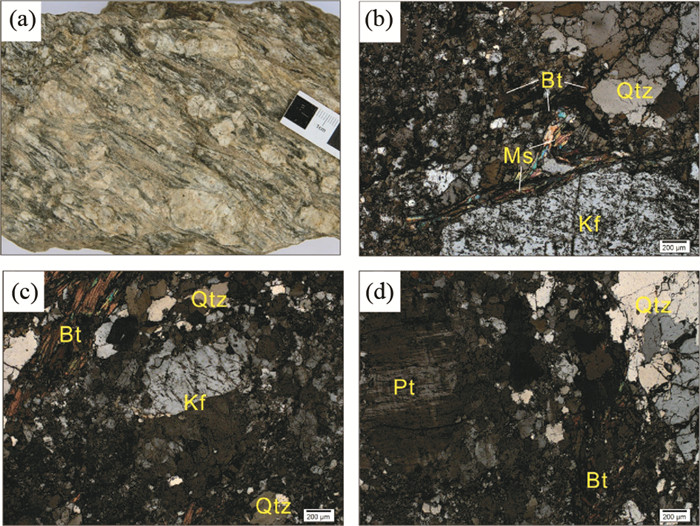
本次研究区位于腾冲地块东缘龙江地区(图 1c),受区域断裂及韧性剪切作用的影响,高黎贡山群被分割成南北走向的条带状,其中上段岩体和下段岩体相间分布,露头良好,沿公路可见片麻状花岗岩与云英片岩夹变粒岩成渐变过渡关系,岩石普遍发育糜棱面理、片麻理以及眼球状构造、条带状构造。本次研究的3件样品采样位置见图 1c,其中LL15-07-1的坐标为:N24°45′24″、E98°43′42″;样品LL15-07-2、LL15-07-4A分别位于样品LL15-07-1北西130m、西100m。样品整体呈灰白色,具有眼球构造和片麻状构造,眼球成分为长石残斑或花岗岩小岩块,部分钾长石“眼球”可达2cm, 受强烈剪切作用的影响,岩石具有糜棱结构(图 2a)。镜下可见细小的石英、长石颗粒和鳞片状黑云母、白云母呈定向排列,呈流线状的黑云母包围着颗粒较大的石英和长石(图 2b, c)。钾长石中常见卡式双晶,受变质作用的影响,双晶界面发生弯曲变形呈波状(图 2c),斜长石含量少且颗粒细小,表面有轻微泥化浑浊不清,另有条纹长石,可见灰白相间条带状结构(图 2d)。主要造岩矿物为石英(35%~45%)、钾长石(30%~40%)、斜长石(10%~15%)、黑云母(5%~10%)及少量白云母(2%~3%)。根据镜下鉴定特征,判断其原岩应为黑云母正长花岗岩。
|
图 2 样品(a)及正交偏光镜下照片(b-d) Fig. 2 Sample (a) and its microscopic photographs under cross-polarized light (b-d) |
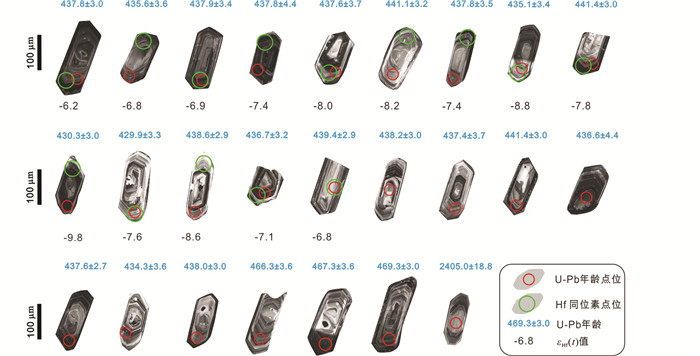
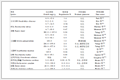
锆石单矿物分选通过重选和磁选技术在河北省廊坊市地科勘探技术服务公司完成。锆石制靶及阴极发光照片在北京锆年领航科技有限公司完成。锆石U-Pb同位素定年测点选在无裂隙、无包体且环带发育的边缘部分(图 3)。锆石U-Pb同位素定年测试在中国地质大学(武汉)地质过程与矿产资源国家重点实验室利用多接收器电感耦合等离子质谱仪(LA-ICP-MS)分析完成,测试仪器型号为Agilent 7500a,激光剥蚀系统为GeoLas 2005。激光剥蚀斑束直径为32μm,激光剥蚀深度为20~40μm,详细的仪器操作条件和数据处理方法见Liu et al.(2008, 2010),锆石U-Pb年龄协和图绘制使用Isoplot 3.0(Ludwig, 2003),分析结果见表 1。
|
图 3 腾冲地块片麻状花岗岩锆石阴极发光图像 Fig. 3 Cathodoluminescence (CL) images of zircon grains from the gneissic granite in Tengchong Block |
|
表 1 腾冲片麻状花岗岩锆石LA-ICP-MS U-Pb分析结果 Table 1 LA-ICP-MS zircon U-Pb analytical data of the gneissic granite in Tengchong Block |
锆石Hf同位素分析在中国地质大学(武汉)地质过程与矿产资源国家重点实验室完成,所用仪器为Neptune型LA-ICP-MS,利用Geolas 2005激光器对锆石进行剥蚀,激光剥蚀的束斑直径为44μm,能量密度为5.3J/cm2,锆石Hf同位素分析点位根据锆石U-Pb年龄和阴极发光(CL)图像圈定(图 3)。详细的分析技术和实验条件见Hu et al. (2012),分析结果见表 2。
|
|
表 2 腾冲地块片麻状花岗岩体锆石Hf同位素数据 Table 2 Zircon Hf isotopic data of the gneissic granite in Tengchong Block |


样品主量元素在核工业北京地质研究院采用XRF法在6735仪器上分析完成,分析精度优于5%。微量元素在长安大学国土资源部成矿作用及其动力学开放实验室利用ICP-MS(Element Ⅱ)完成测试,仪器型号为thermo X7 ICP-MS,测试检测限1×10-12,Rsd小于3%,分析结果见表 3。
|
|
表 3 腾冲地块片麻状花岗岩体全岩主量元素(wt%)、微量元素(×10-6)分析结果 Table 3 Whole-rock major (wt%) and trace (×10-6) element data of the gneissic granite in Tengchong Block |
本文对研究区的1件片麻状花岗岩样品(LL15-07-2) 进行了锆石LA-ICP-MS U-Pb定年。样品(LL15-07-2) 中锆石颗粒自形程度高,多为长柱状晶体,部分短柱状,长约80~150μm,长宽比为1.5:1~3:1,锆石阴极发光图像可见清晰的生长环带(图 3),锆石的Th/U比值基本大于0.1(Th/U=0.07~0.85),为典型的岩浆成因锆石(Hoskin and Schaltegger, 2003)。锆石年龄分析点位基本选在锆石环带边部,共测试25个分析点。21个测点206Pb/238U年龄值在429.9~441.4Ma,3个测点206Pb/238U年龄值在463.9~467.3Ma之间,另有1个测点207Pb/235U年龄为2405.0Ma,该锆石具有典型的核幔结构,测点位于继承性锆石核部。此前,在保山地块早古生代花岗岩锆石中发现过中太古代的继承锆石,结合锆石Hf同位素数据表明保山地块存在冥古宙-中太古代的古老地壳物质(Li et al., 2015),此2405.0Ma的继承锆石暗示腾冲地块可能存在古元古代的地壳物质。
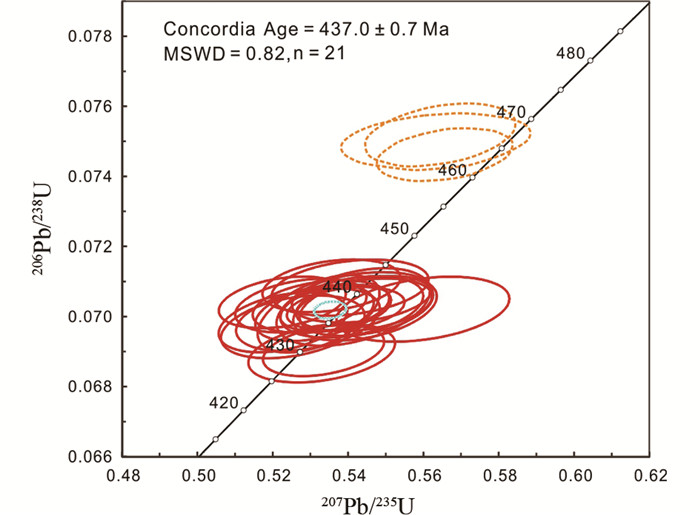
在剔除4个捕获锆石年龄数据后得到样品LL15-07-2中21个测点206Pb/238U谐和年龄值为437.0±0.7Ma(MSWD=0.82)(图 4),在U-Pb年龄谐和图上分析点均分布在谐和线上或其附近,显示良好的谐和性,表明锆石形成后U-Pb同位素体系是基本封闭的,没有U或Pb同位素的明显丢失或加入,测试结果真实可信。本次测定的年龄结果均在允许误差范围内,认为437Ma代表了高黎贡山群片麻状花岗岩体的侵位年龄,属早志留世。
|
图 4 腾冲地块片麻状花岗岩锆石U-Pb年龄谐和图 Fig. 4 Zircon U-Pb age concordia plots of gneissic granite in Tengchong Block |
本文在样品(LL15-07-2) 锆石中选取14个点进行了锆石Hf同位素分析,其中176Yb/177Hf和176Lu/177Hf比值范围分别为0.0503~0.0900和0.0014~0.0029(表 2),大部分176Lu/177Hf比值小于0.002,表明这些锆石在形成以后,具有较少的放射成因Hf的积累,因而可以用初始176Hf/177Hf比值代表锆石形成时的176Hf/177Hf比值(吴福元等, 2007)。样品中fLu/Hf的平均值为-0.94,明显小于镁铁质地壳的fLu/Hf(-0.34)(Amelin et al., 2000)和硅铝质地壳的fLu/Hf(-0.72)(Vervoort et al., 1996),故二阶段模式年龄更能反映其源区物质从亏损地幔被抽取的时间(或其源区物质在地壳的平均存留年龄)。根据Hf同位素相关计算公式(吴福元等, 2007),采用硅铝质大陆地壳的fLu/Hf,计算得出岩体的初始εHf(t)、tDM1和tDM2(表 2)。
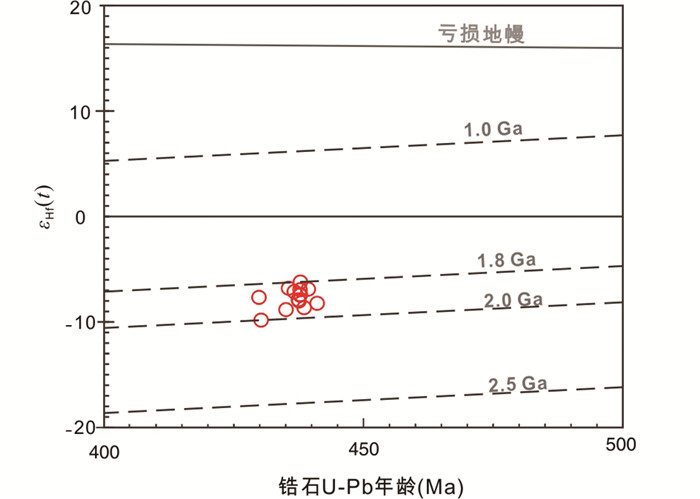
岩体锆石U-Pb年龄在429.9~441.1Ma之间,对应的176Hf/177Hf的变化范围在0.282252~0.282340之间,Hf同位素成分比较均一,εHf(t)值范围在-9.8~-6.2之间,二阶段模式年龄tDM2范围在2.0~1.8Ga之间(图 5)。
|
图 5 腾冲地块片麻状花岗岩εHf(t)值-U-Pb年龄图 Fig. 5 εHf(t) values vs. U-Pb ages plot of the gneissic granite in Tengchong Block |
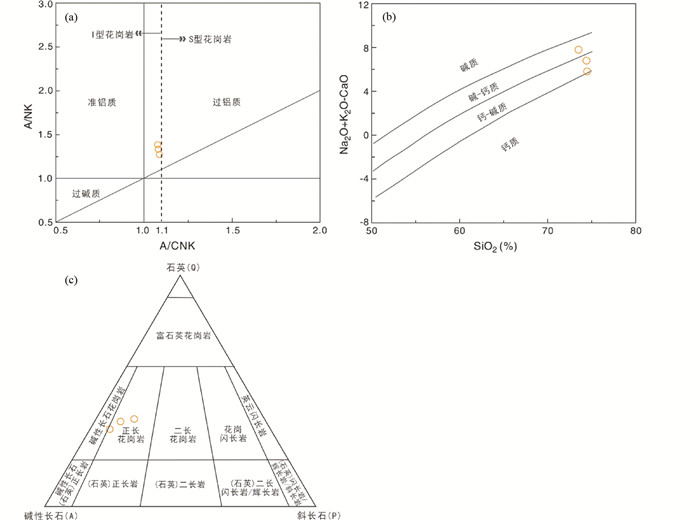
岩石地球化学分析结果(表 3)显示,主量元素中SiO2(72.78%~73.69%)、Al2O3(13.36%~13.85%)、K2O+Na2O(7.23%~8.70%)含量较高,TiO2(0.23%~0.27%)和MgO(0.35%~0.43%)含量较低,具有高硅富铝富碱贫镁钛的特征。铝饱和指数(A/CNK)为1.08~1.12,为过铝质岩体(图 6a)。在K2O+Na2O-CaO-SiO2图中,样品投在碱-钙质-钙-碱质岩体范围内,表明碱含量较高(图 6b)。根据CIPW标准矿物计算结果所得的石英(Q)碱性长石(A),斜长石(P)含量利用QAP图解(图 6c)进行岩石分类,得出其岩石类型主要为正长花岗岩。综合主量元素数据来看,岩体为高硅富碱的过铝质正长花岗岩。
|
图 6 腾冲地块片麻状花岗岩A/CNK-A/NK图(a, 据Maniar and Piccoli, 1989)、(K2O+Na2O-CaO)-SiO2图解(b, 据Frost et al., 2001)和QAP分类图(c, 据Streckeisen, 1976) Fig. 6 A/CNK vs. A/NK plot (a, after Maniar and Piccoli, 1989), (K2O+Na2O-CaO) vs. SiO2 plot (b, after Frost et al., 2001) and QAP classification diagram (c, after Streckeisen, 1976) for the gneissic granite in Tengchong Block |
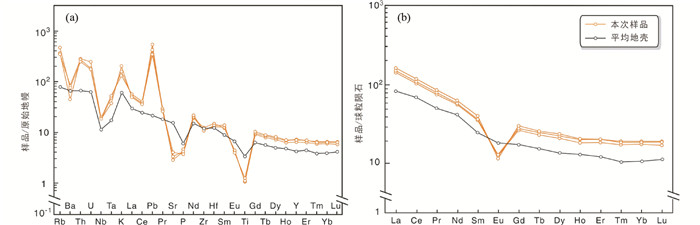
样品微量元素具有相似的配分模式,亏损Ba、Nb、Ta、Sr、P、Eu、Ti,相对富集Rb、Th、U、K、Pb等元素(图 7a)。稀土元素标准化模式图均呈右倾的V字形曲线,具有明显的负铕异常(δEu=0.33~0.40)(图 7b),稀土元素总量(∑REE)为155.8×10⁻⁶~177.1×10⁻⁶,(La/Yb)N为7.94~8.86,轻、重稀土元素分异程度较高。综合微量元素数据来看,岩石样品整体显示出富集轻稀土元素、大离子亲石元素(K、Rb)和Pb,亏损高场强元素(Nb、Ta、P、Zr、Ti)以及Ba、Sr、Eu的特征。
|
图 7 腾冲地块片麻状花岗岩原始地幔标准化微量元素蛛网图(a)和球粒陨石标准化稀土元素配分图(b) (标准化数值据Sun and McDonough, 1989) Fig. 7 Primitive mantle-normalized trace element patterns (a) and chondrite-normalized REE patterns (b) for the gneissic granite in Tengchong Block (normalization values after Sun and McDonough, 1989) |
腾冲地块早古生代变质花岗岩是原特提斯洋发展演化的历史记录,其侵位年龄一直广受关注,前人报导的腾冲地块早古生代变质花岗岩体的形成年代在518~456Ma之间。位于高黎贡山群最北部的古当河片麻状花岗岩锆石SHRIMP U-Pb定年结果为487±11Ma(宋述光等, 2007)(图 1a);向南延伸至高黎贡山南段,刘琦胜等(2012)对此地两个片麻状二长花岗岩样品进行SHRIMP锆石U-Pb测年,结果分别为473.5±2.9Ma和461.5±7.3Ma(图 1b);大蒿坪地区和龙江地区的眼球状片麻花岗岩年龄分别在495~484Ma之间(Wang et al., 2013; Zhao et al., 2016)和518~502Ma之间(蔡志慧等, 2013)(图 1b);李再会等(2012)、林仕良等(2012)、丛峰等(2009)对潞西市附近的片麻状黑云母二长花岗岩进行LA-ICP-MS U-Pb定年得出其年龄分别为497.8±7.2Ma、489Ma±16Ma和456Ma(两颗锆石)(图 1a)。
本次研究对龙江地区附近片麻状花岗岩进行锆石LA-ICP-MS U-Pb定年并获得其侵位年龄为437.0±0.7Ma,数据谐和度高(n=21, MSWD=0.82),结果准确可靠,这是腾冲地块乃至青藏高原东南部地块中测得的最年轻的早古生代岩体的侵位年龄,表明腾冲地区早古生代岩浆活动可能一直持续到早志留世,这进一步限定了原特提斯洋的构造演化时间。
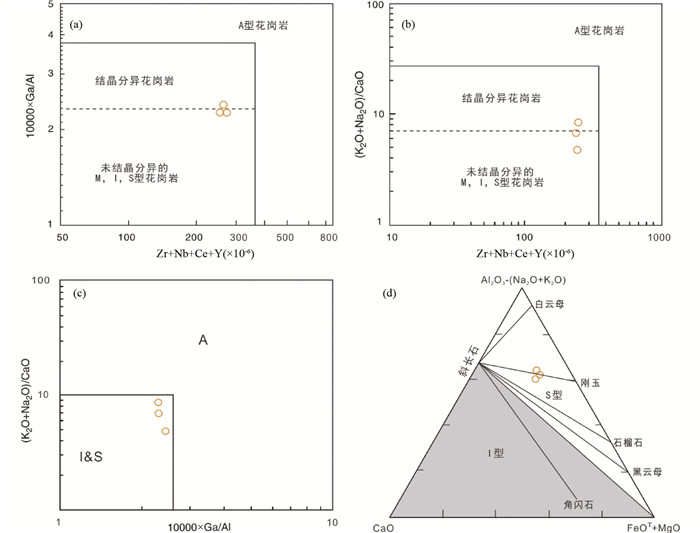
5.2 岩石成因类型花岗岩按其成因可分为S型、I型、M型和A型花岗岩(Chappell and White, 1974, 1992; Bonin, 2007),M型花岗岩具有低K2O(通常 < 1%)的显著特征(Bonin, 2007),而I型花岗岩通常为准铝质,且矿物组成中常见角闪石(Chappell and White, 1974, 1992),本次3件岩石样品K2O(3.92%~6.05%)含量较高,铝饱和指数(A/CNK)为1.08~1.12,显示过铝质特征,且矿物中暗色矿物主要为黑云母,未见角闪石,因此不可能是M型或I型花岗岩;岩石样品中10000×Ga/Al(2.29~2.43)、HFSE(Zr+Nb+Ce+Y)(248.4×10-6~256.8×10-6)、FeOT/MgO(2.56~2.82) 以及(K2O+Na2O)/CaO(4.85~8.61) 都较低,在花岗岩成因类型判别图(图 8a-c)中,3件样品全部落入I型或S型花岗岩区域,且3件样品中有2件落入未结晶分异的花岗岩范围内(图 8a, b),表明岩体的结晶分异程度较低。此外,A型花岗岩的结晶锆石中通常不含继承核,而本次样品锆石中普遍含有继承锆石核(图 3),这些证据都表明本次研究的变质花岗岩体不属于A型花岗岩。
|
图 8 腾冲地块片麻状花岗岩成因类型判别图 Fig. 8 Discrimination diagrams for the genetic types of the gneissic granite in Tengchong Block (a) 10000×Ga/Al vs. Zr+Nb+Ce+Y diagram; (b) (Na2O+K2O)/CaO vs. Zr+Nb+Ce+Y diagram; (c) (Na2O+K2O)/CaO vs. Zr+Nb+Ce+Y diagram (a-c, after Whalen et al., 1987); (d) the ACF diagram (after White and Chappell, 1977) |
S型花岗岩通常为过铝质,且矿物中常含有白云母、堇青石、刚玉等过铝质矿物,本次岩石样品的铝饱和指数(A/CNK)为1.08~1.12,显示过铝质特征,且矿物中含有少量白云母,在ACF判别图中(图 8d),样品全部落在S型岩体区域,进一步证明本次研究的变质花岗岩体为S型花岗岩。
5.3 源区性质S型花岗岩主要源于变质泥岩、变质砂岩等地壳沉积物的部分熔融(Sylvester, 1998)。通常具砂质源区的过铝质花岗岩CaO/Na2O比值(>0.3) 较高,而具泥质源区的过铝质花岗岩CaO/Na2O比值( < 0.3) 较低,若岩浆形成过程中有基性岩浆的混染,则具泥质源区的过铝质花岗岩也可能出现较高的CaO/Na2O比值。
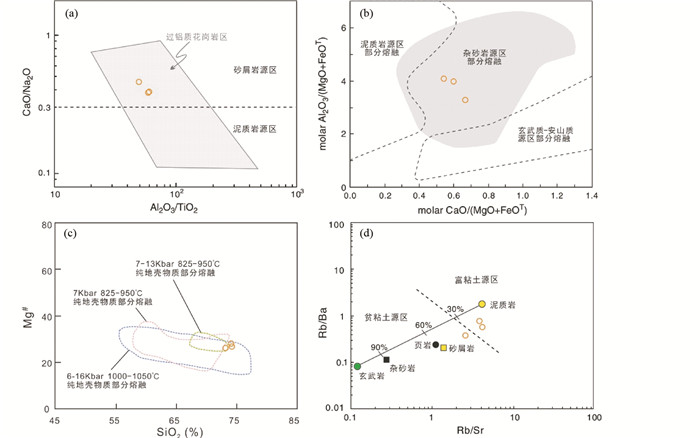
本次样品CaO/Na2O比值(0.37~0.45) 均大于0.3,在CaO/Na2O-Al2O3/TiO2图解(图 9a)中全部落在变质砂屑岩源区范围内;岩石样品中锆石εHf(t)值较低且集中在-9.8~-6.2之间,对应的二阶段模式年龄tDM2范围在2.0~1.8Ga之间,在εHf(t)值-U-Pb年龄图中(图 5),样品点均落在球粒陨石演化线以下的下地壳区域,表明其岩浆来源于古老地壳沉积物的重熔且源区几乎没有幔源物质的注入;此外岩石样品CaO/(MgO+FeOT)的值在0.54~0.67之间,Al2O3/(MgO+FeOT)的值在3.29~4.09之间,在Al2O3/(MgO+FeOT)-CaO/(MgO+FeOT)图(图 9b)中全部投在变质杂砂岩源区范围内(Altherr et al., 2000);样品的Mg#值在26~28之间,在Mg#-SiO2图解(图 9c)中全部落入纯地壳物质部分熔融范围内(Jiang et al., 2013),均证明成岩岩浆完全来源于地壳物质的重熔,没有基性岩浆的混染。因此,研究样品CaO/Na2O比值(>0.3) 较高不是基性岩浆混染造成的,而是因为岩体本身源于变质砂岩的部分熔融。
|
图 9 腾冲地块片麻状花岗岩岩浆源区判别图 Fig. 9 Discrimination diagrams for the potential magma source of the gneissic granite in Tengchong Block (a) CaO/Na2O vs. Al2O3/TiO2 (Sylvester, 1998); (b) molar Al2O3/(MgO+FeOT) vs. CaO/(MgO+FeOT) (Altherr et al., 2000); (c) the SiO2 vs. Mg# [=Mg/(Mg+FeT)] diagram. The fields of pure crustal partial melts determined in experimental studies were from Jiang et al. (2013) and the references therein; (d) the Rb/Sr vs. Rb/Ba diagram (Sylvester, 1998) |
过铝质花岗岩的Rb/Sr和Rb/Ba比值常用于判别其源区特征。通常泥质源区的花岗岩比砂屑岩源区的花岗岩具有更高的Rb/Sr和Rb/Ba比值(Sylvester, 1998)。样品微量元素显示,此变质花岗岩体具有较高的Rb (220.6×10⁻⁶~298.1×10⁻⁶)含量和较低的Sr (60.19×10⁻⁶~85.26×10⁻⁶), Ba (306.5×10⁻⁶~526.8×10⁻⁶)含量,在Rb/Sr-Rb/Ba图中均落在砂屑岩源区的右上方的区域(图 9d)。但这与上文结论"岩体源于变质砂岩的部分熔融"并不矛盾。和其他微量元素不同,花岗质岩石中Rb、Sr、Ba的含量仅与云母和长石有关,Sr和Ba在长石中是相容元素,Rb在长石中是不相容元素(Harris and Inger, 1992),而泥质源区的长石含量远小于砂屑岩源区,因此泥质源区的花岗岩比砂屑岩源区的花岗岩具有更高的Rb/Sr和Rb/Ba比值。然而过铝质花岗岩的Rb/Sr、Rb/Ba比值不仅受源区长石含量的控制,源区部分熔融后残留相的矿物组成对其也有重要影响。通常,砂屑岩部分熔融后的残留相大部分为斜长石(Patiño Douce and Beard, 1995; Skjerlie and Johnston, 1996),因此若砂屑岩熔融源区存在残留相,那么其部分熔融产生的熔体就会比其源区具有更高的Rb/Sr和Rb/Ba比值(Patiño Douce and Johnston, 1991)。由于本次岩体形成过程中发生结晶分异的程度较低,结晶分异过程对花岗岩体中元素含量的变化影响较小。所以推测此变质花岗岩体具有比其砂屑岩源区更高的Rb/Sr、Rb/Ba比值,是由于其源区含有大量斜长石的残留。
根据全岩锆饱和温度计(Watson and Harrison, 1983)得出其源区发生部分熔融的上限温度为788~803℃,平均为794℃(表 3),此外利用锆石Ti温度计(Ferry and Watson, 2007)根据样品LL15-07-2中锆石的Ti含量(表 4),计算得出锆石的结晶温度范围为635~838℃(21点),主要集中在760~780℃(6点),平均754℃,因此从源区发生部分熔融到岩浆固结,温度范围从794℃左右下降到约754℃,表明岩浆形成温度较高,推测源区可能有地幔热的供给。
|
|
表 4 腾冲片麻状花岗岩锆石Ti温度计分析结果 Table 4 Analysis of Ti-in-zircon thermometer of the gneissic granite in Tengchong Block |
综上所述,腾冲地块早志留世片麻状花岗岩可能是在地幔热源的烘烤下,以砂屑岩为主的沉积岩发生部分熔融的产物,源区可能有大量斜长石的残留,但没有地幔物质或基性岩浆的混染。
5.4 构造背景本次研究的腾冲地块片麻状花岗岩形成于~437Ma,且具有S型花岗岩的特征,而S型花岗岩在陆缘弧,弧后盆地,同碰撞或碰撞后的多种构造背景下都可以产生,因此对其构造环境的推测应基于其所处的区域地质背景和构造演化过程(Hu et al., 2015)。
前人通过对冈瓦纳大陆边缘拉萨地块(Ding et al., 2015; Hu et al., 2013; Zhu et al., 2012)、南羌塘地块(Hu et al., 2015)、安多地块(Zhang et al., 2012)、喜马拉雅地块(Cawood et al., 2007; Wang et al., 2012)、保山地块(Dong et al., 2013; Wang et al., 2013)、腾冲地块(蔡志慧等, 2013)和滇缅马苏地块(Lin et al., 2013)早古生代岩浆活动的研究(图 1a),普遍认为早古生代时期,冈瓦纳大陆边缘地块在原特提斯洋俯冲作用下经历了安第斯型造山运动。Zhu et al. (2012)通过对拉萨地块早古生代岩浆活动的研究提出了板片俯冲-弧后伸展、板片断离的演化模型,即冈瓦纳大陆边缘的岩浆活动始于530Ma左右,随着原特提斯洋壳俯冲深度的增加,洋板片在重力作用下发生下沉,进而在510Ma左右发生回撤,随后弧后盆地伸展并伴有软流圈上涌,引发了陆壳的深熔作用,从而产生大量的岩浆活动,此后约492Ma洋板片断离,上涌的软流圈引发了大规模的岩浆活动,同时也标志着陆-陆及弧-陆碰撞造山作用的开始;之后,Li et al. (2016)针对保山地块较年轻的早古生代花岗岩体(502~448Ma)(图 1b)的地球化学特征提出,在原特提斯洋发生板片断离后(~492Ma),岩石圈在陆-陆碰撞过程中不断挤压增厚(490~475Ma),最终在重力作用下发生拆沉,导致软流圈上涌和岩石圈地幔的部分熔融,从而形成了保山地块475~460Ma间大规模的岩浆活动。岩石圈地幔拆沉后,大陆岩石圈发生减薄及随后的持续伸展(Bird, 1978, 1979),在此过程中仍会产生部分岩浆活动,保山地块~448Ma的二长花岗岩体(Dong et al., 2013)及本次研究中~437Ma的片麻状花岗岩体可能就是在原特提斯洋演化晚期阶段,岩石圈地幔发生拆沉后,大陆岩石圈持续伸展的背景下,古老地壳沉积物在地幔热的供给下发生部分熔融的产物。
6 结论(1) 腾冲地块东缘高黎贡山群中首次发现早志留世(~437Ma)变质花岗岩体,这是目前东冈瓦纳大陆北缘地块中出露的最年轻的早古生代岩体,证明原特提斯洋演化过程中产生的岩浆活动可能一直持续到早志留世。
(2) 此早志留世变质花岗岩体具有高硅富碱的S型花岗岩特征,是以砂屑岩为主的古老地壳沉积物在较高温度下部分熔融的产物,源区有斜长石的残留和地幔热供给,但无地幔物质混染。
(3) 腾冲地块侵位于~437Ma的花岗质岩体可能产自原特提斯洋演化晚期阶段岩石圈地幔拆沉后,大陆岩石圈持续伸展的构造背景下。
致谢 本次研究的野外工作得到了云南省腾冲县金山地矿科技服务有限责任公司陈国相总经理、黄体庄工程师、严大炳书记、舒家良经理以及其他工作人员的支持和帮助;实验室测试分析得到中国地质大学(武汉)地质过程与矿产资源国家重点实验室和长安大学国土资源部成矿作用及其动力学开放实验室工作人员的帮助;论文成文过程中得到中国地质大学(北京)王庆飞教授、李龚健老师的指导,以及赵睿博士、黄钰涵博士、李华健博士、张鹏飞博士、刘金宇博士以及于华之博士的帮助;在此对各位的关怀表示衷心的感谢。| [] | Altherr R, Holl A, Hegner E, Langer C, Kreuzer H. 2000. High-potassium, calc-alkaline I-type plutonism in the European Variscides:Northern Vosges (France) and northern Schwarzwald (Germany). Lithos, 50(1-3): 51–73. DOI:10.1016/S0024-4937(99)00052-3 |
| [] | Amelin Y, Lee DC, Halliday AN. 2000. Early-middle Archaean crustal evolution deduced from Lu-Hf and U-Pb isotopic studies of single zircon grains. Geochimica et Cosmochimica Acta, 64(24): 4205–4225. DOI:10.1016/S0016-7037(00)00493-2 |
| [] | Bird P. 1978. Initiation of intracontinental subduction in the Himalaya. Journal of Geophysical Research, 83(B10): 4975–4987. DOI:10.1029/JB083iB10p04975 |
| [] | Bird P. 1979. Continental delamination and the Colorado Plateau. Journal of Geophysical Research, 84(B13): 7561–7571. DOI:10.1029/JB084iB13p07561 |
| [] | Blichert-Toft J, Albarède F. 1997. The Lu-Hf isotope geochemistry of chondrites and the evolution of the mantle-crust system. Earth and Planetary Science Letters, 148(1-2): 243–258. DOI:10.1016/S0012-821X(97)00040-X |
| [] | Bonin B. 2007. A-type granites and related rocks:Evolution of a concept, problems and prospects. Lithos, 97(1-2): 1–29. DOI:10.1016/j.lithos.2006.12.007 |
| [] | Cai ZH, Xu ZQ, Duan XD, Li HQ, Cao H, Huang XM. 2013. Early stage of Early Paleozoic orogenic event in western Yunnan Province, southeastern margin of Tibet Plateau. Acta Petrologica Sinica, 29(6): 2123–2140. |
| [] | Cawood PA, Buchan C. 2007. Linking accretionary orogenesis with supercontinent assembly. Earth-Science Reviews, 82(3-4): 217–256. DOI:10.1016/j.earscirev.2007.03.003 |
| [] | Cawood PA, Johnson MRW, Nemchin AA. 2007. Early Palaeozoic orogenesis along the Indian margin of Gondwana:Tectonic response to Gondwana assembly. Earth and Planetary Science Letters, 255(1-2): 70–84. DOI:10.1016/j.epsl.2006.12.006 |
| [] | Chappell BW, White AJR. 1974. Two contrasting granite types. Pacific Geology, 8: 173–174. |
| [] | Chappell BW, White AJR. 1992. I-and S-type granites in the Lachlan Fold Belt. Transactions of the Royal Society of Edinburgh, 83(1-2): 1–26. DOI:10.1017/S0263593300007720 |
| [] | Chen FC, Deng J, Shu QH, Li GJ, Cui XL, Zhao F and Wang QF. 2016. Geology, fluid inclusion and stable isotopes (O, S) of the Hetaoping distal skarn Zn-Pb deposit, northern Baoshan Block, SW China. Ore Geology Reviews, doi:10.1016/j.oregeorev.2016.10.013 |
| [] | Chen JC, Lin WX, Chen LZ. 1991. Series and unit research on tin-bearing granites of Tengchong-Lianghe area. Yunnan Geology, 10(3): 241–289. |
| [] | Collins AS, Pisarevsky SA. 2005. Amalgamating eastern Gondwana:The evolution of the circum-Indian orogens. Earth-Science Reviews, 71(3-4): 229–270. DOI:10.1016/j.earscirev.2005.02.004 |
| [] | Cong F, Lin SL, Li ZH, Zou GF, Geng RQ. 2009. Ziron U-Pb age of gneissic granites in the Tengchong block, western Yunnan. Acta Geologica Sinica, 83(5): 651–658. |
| [] | Cong F, Lin SL, Zou GF, Xie T, Li ZH, Tang FW, Feng ZM. 2011. Geochronology and petrogenesis for the protolith of biotite plagioclase gneiss at Lianghe, western Yunnan. Acta Geologica Sinica, 85(4): 870–880. DOI:10.1111/acgs.2011.85.issue-4 |
| [] | Deng J, Yang LQ, Wang CM. 2011. Research advances of superimposed orogenesis and metallogenesis in the Sanjiang Tethys. Acta Petrologica Sinica, 27(9): 2501–2509. |
| [] | Deng J, Wang QF, Li GJ, Li CS, Wang CM. 2014a. Tethys tectonic evolution and its bearing on the distribution of important mineral deposits in the Sanjiang region, SW China. Gondwana Research, 26(2): 419–437. DOI:10.1016/j.gr.2013.08.002 |
| [] | Deng J, Wang QF, Li GJ, Santosh M. 2014b. Cenozoic tectono-magmatic and metallogenic processes in the Sanjiang region, southwestern China. Earth-Science Reviews, 138: 268–299. DOI:10.1016/j.earscirev.2014.05.015 |
| [] | Deng J, Wang QF. 2016. Gold mineralization in China:Metallogenic provinces, deposit types and tectonic framework. Gondwana Research, 36: 219–274. DOI:10.1016/j.gr.2015.10.003 |
| [] | Deng J, Wang QF, Li GJ. 2016a. Superimposed orogeny and composite metallogenic system:Case study from the Sanjiang Tethyan belt, SW China. Acta Petrologicca Sinica, 32(8): 2225–2247. |
| [] | Deng J, Hou ZQ, Mo XX, et al. 2016b. Superimposed orogenesis and metallogenesis in the Sanjiang Tethys. Beijing: Science Press: 1-640. |
| [] | Deng J, Wang QF and Li GJ. 2017. Tectonic evolution, superimposed orogeny, and composite metallogenic system in China. Gondwana Research, doi:10.1016/j.gr.2017.02.005 https://link.springer.com/article/10.1007/s00126-017-0752-6 |
| [] | Ding HX, Zhang ZM, Dong X, Yan R, Lin YH, Jiang HY. 2015. Cambrian ultrapotassic rhyolites from the Lhasa terrane, south Tibet:Evidence for Andean-type magmatism along the northern active margin of Gondwana. Gondwana Research, 27(4): 1616–1629. DOI:10.1016/j.gr.2014.02.003 |
| [] | Dong ML, Dong GC, Mo XX, Santosh M, Zhu DC, Yu JC, Nie F, Hu ZC. 2013. Geochemistry, zircon U-Pb geochronology and Hf isotopes of granites in the Baoshan Block, Western Yunnan:Implications for Early Paleozoic evolution along the Gondwana margin. Lithos, 179: 36–47. DOI:10.1016/j.lithos.2013.05.011 |
| [] | Ferry JM, Watson EB. 2007. New thermodynamic models and revised calibrations for the Ti-in-zircon and Zr-in-rutile thermometers. Contributions to Mineralogy and Petrology, 154(4): 429–437. DOI:10.1007/s00410-007-0201-0 |
| [] | Frost BR, Barnes CG, Collins WJ, Arculus RJ, Ellis DJ, Frost CD. 2001. A geochemical classification for granitic rocks. Journal of Petrology, 42: 2033–2048. DOI:10.1093/petrology/42.11.2033 |
| [] | Griffin WL, Pearson NJ, Belousova E, Jackson SE, van Achterbergh E, O'Reilly SY, Shee SR. 2000. The Hf isotope composition of cratonic mantle:LAM-MC-ICPMS analysis of zircon megacrysts in kimberlites. Geochimica et Cosmochimica Acta, 64(1): 133–147. DOI:10.1016/S0016-7037(99)00343-9 |
| [] | Harris NBW, Inger S. 1992. Trace element modelling of pelite-derived granites. Contributions to Mineralogy and Petrology, 110(1): 46–56. DOI:10.1007/BF00310881 |
| [] | Hoskin PWO, Schaltegger U. 2003. The composition of zircon and igneous and metamorphic petrogenesis. Reviews in Mineralogy and Geochemistry, 53(1): 27–62. DOI:10.2113/0530027 |
| [] | Hou ZQ, Zaw K, Pan GT, Mo XX, Xu Q, Hu YZ, Li XZ. 2007. Sanjiang Tethyan metallogenesis in S.W. China:Tectonic setting, metallogenic epochs and deposit types. Ore Geology Reviews, 31(1-4): 48–87. DOI:10.1016/j.oregeorev.2004.12.007 |
| [] | Hu PY, Li C, Wang M, Xie CM, Wu YW. 2013. Cambrian volcanism in the Lhasa terrane, southern Tibet:Record of an early Paleozoic Andean-type magmatic arc along the Gondwana proto-Tethyan margin. Journal of Asian Earth Sciences, 77: 91–107. DOI:10.1016/j.jseaes.2013.08.015 |
| [] | Hu PY, Zhai QG, Jahn BM, Wang J, Li C, Lee HY, Tang SH. 2015. Early Ordovician granites from the South Qiangtang terrane, northern Tibet:Implications for the Early Paleozoic tectonic evolution along the Gondwanan proto-Tethyan margin. Lithos, 220-223: 318–338. DOI:10.1016/j.lithos.2014.12.020 |
| [] | Hu ZC, Liu YS, Gao S, Liu WQ, Zhang W, Tong XR, Lin L, Zong KQ, Li M, Chen HH, Zhou L, Yang L. 2012. Improved in situ Hf isotope ratio analysis of zircon using newly designed x skimmer cone and jet sample cone in combination with the addition of nitrogen by laser ablation multiple collector ICP-MS. Journal of Analytical Atomic Spectrometry, 27(9): 1391–1399. DOI:10.1039/c2ja30078h |
| [] | Jiang YH, Jia RY, Liu Z, Liao SY, Zhao P, Zhou Q. 2013. Origin of Middle Triassic high-K calc-alkaline granitoids and their potassic microgranular enclaves from the western Kunlun orogen, northwest China:A record of the closure of Paleo-Tethys. Lithos, 156-159: 13–30. DOI:10.1016/j.lithos.2012.10.004 |
| [] | Li DP, Luo ZH, Chen YL, Liu JQ, Jin Y. 2014. Deciphering the origin of the Tengchong block, West Yunnan:Evidence from detrital zircon U-Pb ages and Hf isotopes of Carboniferous strata. Tectonophysics, 614: 66–77. DOI:10.1016/j.tecto.2013.12.023 |
| [] | Li GJ, Wang QF, Huang YH, Chen FC, Dong P. 2015. Discovery of Hadean-Mesoarchean crustal materials in the northern Sibumasu block and its significance for Gondwana reconstruction. Precambrian Research, 271: 118–137. DOI:10.1016/j.precamres.2015.10.003 |
| [] | Li GJ, Wang QF, Huang YH, Gao L, Yu L. 2016. Petrogenesis of Middle Ordovician peraluminous granites in the Baoshan block:Implications for the Early Paleozoic tectonic evolution along east gondwana. Lithos, 245: 76–92. DOI:10.1016/j.lithos.2015.10.012 |
| [] | Li XH, Li WX, Li ZX, Liu Y. 2008a. 850~790Ma bimodal volcanic and intrusive rocks in northern Zhejiang, South China:A major episode of continental rift magmatism during the breakup of Rodinia. Lithos, 102(1-2): 341–357. DOI:10.1016/j.lithos.2007.04.007 |
| [] | Li ZH, Lin SL, Cong F, Xie T, Zou GF. 2012. U-Pb ages of zircon from metamorphic rocks of the Gaoligongshan Group in western Yunnan and its tectonic significance. Acta Petrologica Sinica, 28(5): 1529–1541. |
| [] | Li ZX, Bogdanova SV, Collins AS, Davidson A, Waele BD, Ernst RE, Fitzsimons ICW, Fuck RA, Gladkochub DP, Jacobs J, Karlstrom KE, Lu S, Natapov LM, Pease V, Pisarevsky SA, Thrane K, Vernikovsky V. 2008b. Assembly, configuration, and break-up history of Rodinia:A synthesis. Precambrian Research, 160(1-2): 179–210. DOI:10.1016/j.precamres.2007.04.021 |
| [] | Lin SL, Cong F, Gao YJ, Zou GF. 2012. LA-ICP-MS zircon U-Pb age of gneiss from Gaoligong Mountain Group on the southeastern margin of Tengchong block in western Yunnan Province. Geological Bulletin of China, 31(2-3): 258–263. |
| [] | Lin YL, Yeh MW, Lee TY, Chung SL, Iizuka Y, Charusiri P. 2013. First evidence of the Cambrian basement in Upper Peninsula of Thailand and its implication for crustal and tectonic evolution of the Sibumasu terrane. Gondwana Research, 24(3-4): 1031–1037. DOI:10.1016/j.gr.2013.05.014 |
| [] | Liu QS, Ye PS, Wu ZH. 2012. SHRIMP zircon U-Pb dating and petrogeochemistry of Ordovician granite bodies in the southern segment of Gaoligong Mountain, western Yunnan Province. Geological Bulletin of China, 31(2-3): 250–257. |
| [] | Liu YS, Hu ZC, Gao S, Günther D, Xu J, Gao CG, Chen HH. 2008. In situ analysis of major and trace elements of anhydrous minerals by LA-ICP-MS without applying an internal standard. Chemical Geology, 257(1-2): 34–43. DOI:10.1016/j.chemgeo.2008.08.004 |
| [] | Liu YS, Hu ZC, Zong KQ, Gao CG, Gao S, Xu J, Chen HH. 2010. Reappraisement and refinement of zircon U-Pb isotope and trace element analyses by LA-ICP-MS. Chinese Science Bulletin, 55(15): 1535–1546. DOI:10.1007/s11434-010-3052-4 |
| [] | Ludwig KR. 2003. User's Manual for Isoplot 3.00:A Geochronological Toolkit for Microsoft Excel. Berkeley:Berkeley Geochronology Center, 25-32 http://bgc.org/isoplot_etc/isoplot/Isoplot3_75-4_15manual.pdf |
| [] | Maniar PD, Piccoli PM. 1989. Tectonic discrimination of granitoids. GSA Bulletin, 101(5): 635–643. DOI:10.1130/0016-7606(1989)101<0635:TDOG>2.3.CO;2 |
| [] | Meert JG. 2003. A synopsis of events related to the assembly of eastern Gondwana. Tectonophysics, 362(1-4): 1–40. DOI:10.1016/S0040-1951(02)00629-7 |
| [] | Metcalfe I. 2013. Gondwana dispersion and Asian accretion:Tectonic and palaeogeographic evolution of eastern Tethys. Journal of Asian Earth Sciences, 66: 1–33. DOI:10.1016/j.jseaes.2012.12.020 |
| [] | Murphy JB, van Staal CR, Collins WJ. 2011. A comparison of the evolution of arc complexes in Paleozoic interior and peripheral orogens:Speculations on geodynamic correlations. Gondwana Research, 19(3): 812–827. DOI:10.1016/j.gr.2010.11.019 |
| [] | Patiño Douce AE, Johnston AD. 1991. Phase equilibria and melt productivity in the pelitic system:Implications for the origin of peraluminous granitoids and aluminous granulites. Contributions to Mineralogy and Petrology, 107(2): 202–218. DOI:10.1007/BF00310707 |
| [] | Patiño Douce AE, Beard JS. 1995. Dehydration-melting of biotite gneiss and quartz amphibolite from 3 to 15kbar. Journal of Petrology, 36(3): 707–738. DOI:10.1093/petrology/36.3.707 |
| [] | Searle MP, Noble SR, Cottle JM, Waters DJ, Mitchell AHG, Hlaing T, Horstwood MSA. 2007. Tectonic evolution of the Mogok metamorphic belt, Burma (Myanmar) constrained by U-Th-Pb dating of metamorphic and magmatic rocks. Tectonics, 26(3). DOI:10.1029/2006TC002083 |
| [] | Skjerlie KP, Johnston AD. 1996. Vapour-absent melting from 10 to 20kbar of crustal rocks that contain multiple hydrous phases:Implications for anatexis in the deep to very deep continental crust and active continental margins. Journal of Petrology, 37(3): 661–691. DOI:10.1093/petrology/37.3.661 |
| [] | Song SG, Ji JQ, Wei CJ, Su L, Zheng YD, Song B, Zhang LF. 2007. Early Paleozoic granite in Nujiang River of Northwest Yunnan in southwestern China and its tectonic implications. Chinese Science Bulletin, 52(17): 2402–2406. DOI:10.1007/s11434-007-0301-2 |
| [] | Streckeisen AL. 1976. Classification of the common igneous rocks by means of their chemical composition:A provisional attempt. Neues Jahrbuch für Mineralogie, Monatshefte, 1: 1–15. |
| [] | Sun SS and McDonough WF. 1989. Chemical and isotopic systematic of oceanic basalts:Implications for mantle composition and processes. In:Saunders AD and Norry MJ. (eds.). Magmatism in the Ocean Basins. Geological Society, London, Special Publications, 42(1):313-345 http://link.springer.com/chapter/10.1007%2F978-90-481-9600-5_12 |
| [] | Sylvester PJ. 1998. Post-collisional strongly peraluminous granites. Lithos, 45(1-4): 29–44. DOI:10.1016/S0024-4937(98)00024-3 |
| [] | Vervoort JD, Patchett PJ, Gehrels GE, Nutman AP. 1996. Constraints on early Earth differentiation from hafnium and neodymium isotopes. Nature, 379(6566): 624–627. DOI:10.1038/379624a0 |
| [] | Wang CM, Deng J, Carranza EJM, Santosh M. 2014. Tin metallogenesis associated with granitoids in the southwestern sanjiang tethyan domain:Nature, deposit types, and tectonic setting. Gondwana Research, 26(2): 576–593. DOI:10.1016/j.gr.2013.05.005 |
| [] | Wang XX, Zhang JJ, Santosh M, Liu J, Yan SY, Guo L. 2012. Andean-type orogeny in the Himalayas of south Tibet:Implications for early Paleozoic tectonics along the Indian margin of Gondwana. Lithos, 154: 248–262. DOI:10.1016/j.lithos.2012.07.011 |
| [] | Wang YJ, Xing XW, Cawood PA, Lai SC, Xia XP, Fan WM, Liu HC, Zhang FF. 2013. Petrogenesis of Early Paleozoic peraluminous granite in the Sibumasu Block of SW Yunnan and diachronous accretionary orogenesis along the northern margin of Gondwana. Lithos, 182-183: 67–85. DOI:10.1016/j.lithos.2013.09.010 |
| [] | Watson EB, Harrison TM. 1983. Zircon saturation revisited:Temperature and composition effects in a variety of crustal magma types. Earth and Planetary Science Letters, 64(2): 295–304. DOI:10.1016/0012-821X(83)90211-X |
| [] | Whalen JB, Currie KL, Chappell BW. 1987. A-type granites:Geochemical characteristics, discrimination and petrogenesis. Contributions to Mineralogy and Petrology, 95: 407–419. DOI:10.1007/BF00402202 |
| [] | White AJR, Chappell BW. 1977. Ultrametamorphism and granitoid genesis. Tectonophysics, 1-2: 7–22. |
| [] | Wu FY, Li XH, Zheng YF, Gao S. 2007. Lu-Hf isotopic systematics and their applications in petrology. Acta Petrologica Sinica, 23(2): 185–220. |
| [] | Xu YG, Yang QJ, Lan JB, Luo ZY, Huang XL, Shi YR, Xie LW. 2012. Temporal-spatial distribution and tectonic implications of the batholiths in the Gaoligong-Tengliang-Yingjiang area, western Yunnan:Constraints from zircon U-Pb ages and Hf isotopes. Journal of Asian Earth Sciences, 53: 151–175. DOI:10.1016/j.jseaes.2011.06.018 |
| [] | Zhang ZM, Dong X, Liu F, Lin YH, Yan R, Santosh M. 2012. Tectonic evolution of the Amdo Terrane, Central Tibet:Petrochemistry and zircon U-Pb geochronology. The Journal of Geology, 120(4): 431–451. DOI:10.1086/665799 |
| [] | Zhao SW, Lai SC, Qin JF, Zhu RZ. 2016. Tectono-magmatic evolution of the Gaoligong belt, southeastern margin of the Tibetan Plateau:Constraints from granitic gneisses and granitoid intrusions. Gondwana Research, 35: 238–256. DOI:10.1016/j.gr.2015.05.007 |
| [] | Zhong DL. 1998. Paleo-Tethyan Orogenic Belt in the Western Parts of the Sichuan and Yunnan Provinces. Beijing: Science Press: 1-231. |
| [] | Zhu DC, Zhao ZD, Niu YL, Dilek Y, Wang Q, Ji WH, Dong GC, Sui QL, Liu YS, Yuan HL, Mo XX. 2012. Cambrian bimodal volcanism in the Lhasa Terrane, southern Tibet:Record of an Early Paleozoic Andean-type magmatic arc in the Australian proto-Tethyan margin. Chemical Geology, 328: 290–308. DOI:10.1016/j.chemgeo.2011.12.024 |
| [] | 蔡志慧, 许志琴, 段向东, 李化启, 曹汇, 黄学猛. 2013. 青藏高原东南缘滇西早古生代早期造山事件. 岩石学报, 29(6): 2123–2140. |
| [] | 陈吉琛, 林文信, 陈良忠. 1991. 腾冲-梁河地区含锡花岗岩序列-单元研究. 云南地质, 10(3): 241–289. |
| [] | 丛峰, 林仕良, 李再会, 邹光富, 耿全如. 2009. 滇西腾冲地块片麻状花岗岩的锆石U-Pb年龄. 地质学报, 83(5): 651–658. |
| [] | 邓军, 杨立强, 王长明. 2011. 三江特提斯复合造山与成矿作用研究进展. 岩石学报, 27(9): 2501–2509. |
| [] | 邓军, 王庆飞, 李龚健. 2016a. 复合造山和复合成矿系统:三江特提斯例析. 岩石学报, 32(8): 2225–2247. |
| [] | 邓军, 侯增谦, 莫宣学, 等. 2016b. 三江特提斯复合造山与成矿作用. 北京: 科学出版社: 1-640. |
| [] | 李再会, 林仕良, 丛峰, 谢韬, 邹光富. 2012. 滇西高黎贡山群变质岩的锆石年龄及其构造意义. 岩石学报, 28(5): 1529–1541. |
| [] | 林仕良, 丛峰, 高永娟, 邹光富. 2012. 滇西腾冲地块东南缘高黎贡山群片麻岩LA-ICP-MS锆石U-Pb年龄及其地质意义. 地质通报, 31(2-3): 258–263. |
| [] | 刘琦胜, 叶培盛, 吴中海. 2012. 滇西高黎贡山南段奥陶纪花岗岩SHRIMP锆石U-Pb测年和地球化学特征. 地质通报, 31(2-3): 250–257. |
| [] | 宋述光, 季建清, 魏春景, 苏犁, 郑亚东, 宋彪, 张立飞. 2007. 滇西北怒江早古生代片麻状花岗岩的确定及其构造意义. 科学通报, 52(8): 927–930. |
| [] | 吴福元, 李献华, 郑永飞, 高山. 2007. Lu-Hf同位素体系及其岩石学应用. 岩石学报, 23(2): 185–220. |
| [] | 钟大赉. 1998. 滇川西部古特提斯造山带. 北京: 科学出版社: 1-231. |