 2017, Vol. 33


2. 国土资源部岩浆作用成矿与找矿重点实验室, 西安 710054;
3. 贵州省地质矿产开发局贵州省地质调查院, 贵阳 550005;
4. 陕西省地矿局综合地质大队, 渭南 714099
2. Key Laboratory for the Study of Focused Magmatism and Giant Ore Deposits, MLR, Xi'an 710054, China;
3. Guizhou Geological Survey, Bureau of Geology and Mineral Exploration and Development of Guizhou Province, Guiyang 550005, China;
4. Geological Brigade of Shaanxi Exploration and Development Corporation of Geology and Mineral Resources, Weinan 714099, China
Sanukite (赞岐岩)最早由Weinschenk (1891)发现于日本中新世(11~14Ma) Setouchi火山岩带,最初按其矿物成分定名为“古铜辉石安山岩”,后又依其发现地Sanuki取名Sanukite (译“赞岐岩”),主要由玻璃、斜方辉石、磁铁矿和斜长石组成,可含少量橄榄石、斜方辉石或单斜辉石斑晶。岩石化学成分以富SiO2(>52%)、MgO (通常>5%,Mg#为45~75)和高的Cr (>100×10-6)、Ni (>100×10-6)及K/Na (0.33~0.52)为特征,富集LILE和LREE,亏损高场强元素,通常具弱的负Eu异常,主要产于与俯冲作用有关的岛弧环境(Tatsumi, 1981, 1982; 张旗等, 2004, 2005)。
赞岐岩是一种极为独特和少见的新岩石类型,受到国内外众多地球化学家们的广泛关注。国外很早就开始对赞岐岩进行研究(Tatsumi, 1981, 1982, 2008; Tatsumi and Ishizaka, 1981, 1982; Shirey and Hanson, 1984; Stern et al., 1989; Tatsumi et al., 2003; Kamei et al., 2004; Martin et al., 2005),而国内相关报道少而滞后。张旗等(2004, 2005)首先对赞岐岩概念及其在地壳早期演化中的意义进行阐述,随后在内蒙古固阳晚太古代英云闪长岩(简平等, 2005)、吉林珲春三叠纪高镁闪长岩(付长亮等, 2010)和大兴安岭富西里新元古代侵入岩(边红业等, 2014)中有赞岐岩的发现。近期报导的赞岐岩时代均为晚古生代,产地也全在新疆境内。北天山一处,为早石炭世火山岩,分布于果子沟-阿希一线(王强等, 2006; Wang et al., 2007);西准噶尔有三处, 分别是:1)谢米斯台山中志留世火山岩(孙勇等, 2015);2)哈图早二叠世基性岩墙群(尹继元等, 2012; Yin et al., 2015);3)克拉玛依后山晚石炭世基性岩墙群(Yin et al., 2010; Ma et al., 2012)。
赞岐岩一名目前被广泛冠名于具有相似特征的火山岩和侵入岩(Tatsumi and Ishizaka, 1982),而在西准噶尔地区前人报道的晚石炭世-早二叠世赞岐岩均为中基性岩墙(Yin et al., 2010, 2015; 尹继元等, 2012; Ma et al., 2012),未见赞岐岩类火山岩的报道。笔者等在西准噶尔哈拉阿拉特山一带进行1:5万区域地质调查时,首次发现区内晚石炭世火山岩同样具有与日本Setouchi火山岩带中赞岐岩类似的特征。这一重要发现,为研究西准噶尔甚至是中亚造山带晚古生代的构造演化历史提供了新的思路,丰富了我国赞岐岩的产地与层位,同时也为研究该特殊岩类的地球化学特征提供了更多信息。
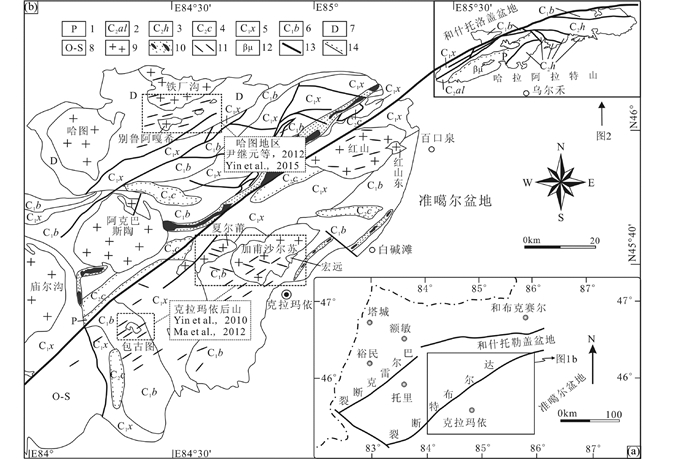
1 地质概况与岩石学特征西准噶尔包古图-哈拉阿拉特山一带石炭纪地层极为发育,早石炭世地层主要出露于包古图-哈图一带,以包古图组和希贝库拉斯组为代表,形成于弧后盆地,研究程度较高(王瑞和朱永峰, 2007; 安芳和朱永峰, 2009; 佟丽莉等, 2009, 2014; 李永军等, 2010; 郭丽爽等, 2010; Geng et al., 2011; 孙羽等, 2014a, b);晚石炭世主要出露于乌尔禾北哈拉阿拉特山一带,地层单位有成吉思汗山组、哈拉阿拉特组及阿腊德依克赛组(图 1),对其形成构造环境研究较少。在哈拉阿拉特山一带,早二叠世佳木河组陆相磨拉石建造角度不整合于哈拉阿拉特组及阿腊德依克赛组之上,因此,长期以来,区内主流观点认为晚石炭世已完成了洋盆的关闭并进入陆内造山阶段(沈远超, 1993; 金成伟和张秀棋, 1993; 何国琦等, 2001; 韩宝福等, 2006; 王京彬和徐新, 2006; 苏玉平等, 2006; 徐新等, 2010; 高睿等, 2013)。
|
图 1 西准噶尔地区大地构造示意图(a, 据Chen et al., 2010; Xu et al., 2012; 王金荣等, 2013)及西准噶尔包古图-哈拉阿拉特山一带地质简图(b, 据孙羽等, 2014b修改) 1-二叠系;2-阿腊德依克赛组;3-哈拉阿拉特组;4-成吉思汗山组;5-希贝库拉斯组;6-包古图组;7-泥盆系;8-奥陶系-志留系;9-花岗岩基;10-蛇绿构造混杂岩带;11-基性岩脉;12-辉绿岩;13-断层;14-角度不整合 Fig. 1 Schematic tectonic map showing main tectonic units of the West Junggar (a, after Chen et al., 2010; Xu et al., 2012; Wang et al., 2013) and geological map of Baogutu-Hala'alate Mountain area (b, after Sun et al., 2014b) 1-Permian; 2-Aladeyikesai Fm.; 3-Hala'alate Fm.; 4-Chengjisihanshan Fm.; 5-Xibeikulasi Fm.; 6-Baogutu Fm.; 7-Devonian; 8-Ordovician-Silurian; 9-granite; 10-ophiolite tectonic melange belt; 11-mafic dikes; 12-diabase; 13-fault; 14-unconformity |
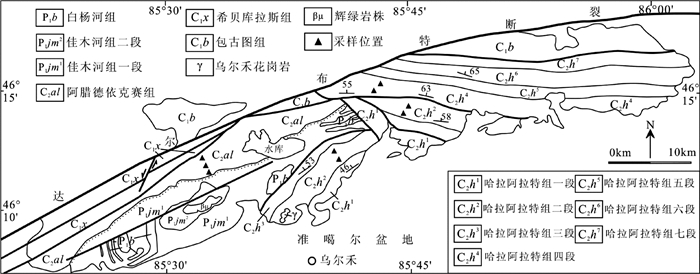
本文报道火山岩见于哈拉阿拉特山晚石炭世哈拉阿拉特组与阿腊德依克赛组中(图 2),哈拉阿拉特组为一套滨-浅海相火山-沉积岩建造,岩性以深灰色安山岩、灰黑色玄武岩、深灰色辉石安山岩、灰褐色火山角砾岩、灰色杏仁状安山岩为主,夹薄层状中粗砂岩、细砾岩,可见少量流纹岩,总体显示为一套浅海相钙碱性火山岩组合,火山岩中获得的锆石U-Pb年龄为304.5~306.9Ma (李甘雨等, 2015),与前人在本组中发现的化石所示地质时代吻合;而阿腊德依克赛组以陆源碎屑岩为主,火山岩呈夹层状,岩性以玄武岩、玄武安山岩、安山岩以及火山碎屑岩为主,本组灰岩夹层中产珊瑚类Bradyphyllum sp.和Zaphrentites sp.、腕足类Balakhonia cf.silimica,Brachythyrina pingusiformis等化石(卡西莫夫期),玄武岩LA-ICP-MS锆石U-Pb年龄为303.8±2.4Ma (向坤鹏等, 2015)。
|
图 2 西准噶尔哈拉阿拉特山一带区域地质图 Fig. 2 Geological map of Hala'alate Mountain area, West Junggar |
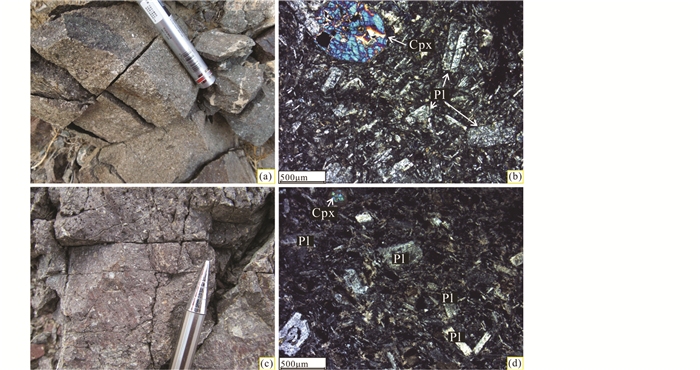
用于本研究的样品采自哈拉阿拉特组与阿腊德依克赛组基岩露头,采样位置见图 2。采集时尽量避开接触带、蚀变带和断裂破碎带等,以保证样品新鲜且具有代表性。用于地球化学分析的样品岩性主要为辉石安山岩和玄武安山岩:辉石安山岩具斑状结构,块状构造(图 3a),岩石由斑晶(10%~15%)和基质(85%~90%)组成,斑晶主要为斜长石(8%~10%)和普通辉石(2%~5%),斜长石呈半自形板状,粒径0.5×0.15~1.7×0.8mm,聚片双晶发育,普通辉石呈柱状、粒状,粒径0.3~1.2mm,淡绿色,具辉石式解理,基质具交织结构,斜长石之间分布玻璃质和暗色矿物,可见少量磁铁矿(图 3b);玄武安山岩具斑状结构,块状构造(图 3c),斑晶主要为半自形板状斜长石(10%~15%)、粒状橄榄石(3%~5%)及少量普通辉石,基质由斜长石(55%~60%)、玻璃质(10%~12%)、暗色矿物(5%~10%)及少量磁铁矿组成,其中斜长石长径0.03~0.1mm,可见聚片双晶(图 3d)。
|
图 3 哈拉阿拉特山地区晚石炭世火山岩宏观露头及镜下照片 Cpx-单斜辉石;Pl-斜长石 Fig. 3 Macroscopic and microscopic photos of the volcanic rocks of Late Carboniferous in Hala'alate Mountain area Cpx-clinopyroxene; Pl-plagioclase |
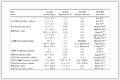
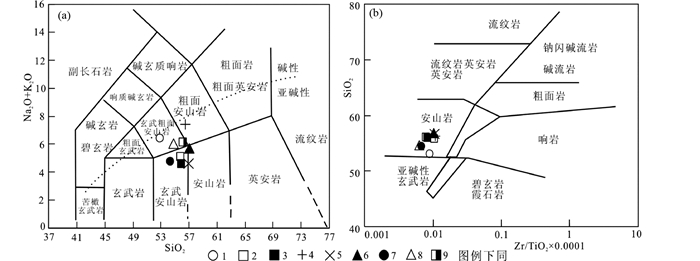
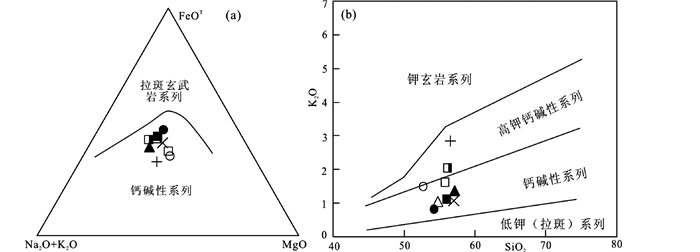
火山岩样品主量与微量元素由长安大学教育部重点实验分别用XRF和ICP-MS方法进行测定,元素含量及有关参数见表 1。SiO2含量为52.88%~56.89%,平均为55.5%;TiO2含量为0.96%~1.33%,变化范围较大,平均为1.05%,明显低于MORB平均值1.5%;具有较高的MgO (3.47%~6.88%,Mg#为48.5~63.7)、Al2O3(16.25%~18.97%)和P2O5(0.18%~0.52%)。在TAS硅碱图中所有样品均落入亚碱性岩区(图 4a),考虑到由于该地区火山岩经历了蚀变作用和构造变形,易发生K、Na等活动性元素的迁移,因而,进一步利用不活泼元素SiO2-Zr/TiO2×0.0001图解,样品均落入安山岩区域(图 4b),与TAS图基本一致。样品的全碱含量(K2O+Na2O=4.51%~7.39%)较高,相对富钠(Na2O的含量为3.42%~4.96%,平均值为4.13%),K2O含量为0.79%~2.84%,平均为1.47%,属钙碱性系列(图 5)。
|
表 1 哈拉阿拉特山一带晚石炭世火山岩主量元素(wt%)和微量元素(×10-6)及有关参数 Table 1 The concentration of major elements (wt%) and trace elements (×10-6) and their parameters for volcanic rocks from Late Carboniferous in Hala'alate Mountain area |
|
图 4 西准噶尔哈拉阿拉特山地区晚石炭世火山岩TAS图(a, 据Le Bas et al., 1986)及SiO2-Zr/TiO2×0.0001图解(b, 据Winchester and Floyd, 1977) Fig. 4 TAS (a, after Le Bas et al., 1986) and SiO2 vs. Zr/TiO2×0.0001 (b, after Winchester and Floyd, 1977) diagrams of the volcanic rocks of Late Carboniferous in Hala'alate Mountain area, West Junggar |
|
图 5 西准噶尔哈拉阿拉特山一带晚石炭世火山岩AFM图(a, 据Irvine and Baragar, 1971)及SiO2-K2O图解(b, 据Miller et al., 1999) Fig. 5 AFM (a, after Irvine and Baragar, 1971) and SiO2 vs. K2O (b, after Miller et al., 1999) diagrams of the volcanic rocks of Late Carboniferous in Hala'alate Mountain area, West Junggar |
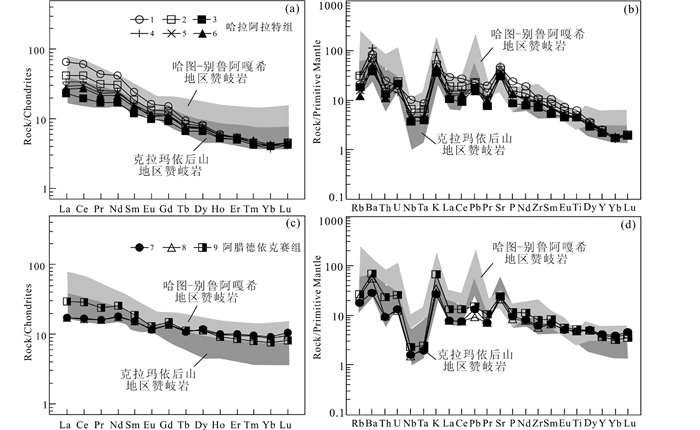
在球粒陨石标准化稀土元素(REE)配分曲线图上火山岩均表现出轻稀土元素富集而重稀土相对亏损的右倾型特征,其中哈拉阿拉特组火山岩轻稀土元素富集尤为显著(图 6a, c、表 1)。样品具有较高的稀土总量(∑REE=48.02×10⁻⁶~127.5×10⁻⁶),且轻重稀土元素分异明显((La/Yb)N=1.88~15.9),与岛弧钙碱性火山岩的(La/Yb)N值相似。(La/Sm)N值均大于1(1.12~2.68),反映轻稀土之间分馏程度较好,而未发生明显的重稀土分馏((Gd/Yb)N=1.48~3.72),具有弱的Eu负异常(δEu=0.77~0.94),无明显Ce异常(δCe=0.99~1.16),表明原始岩浆演化过程中可能经历了斜长石的分离结晶作用。
|
图 6 哈拉阿拉特山地区晚石炭世火山岩球粒陨石标准化稀土元素配分图(a、c, 标准化值据Boynton, 1984)及原始地幔标准化多元素蛛网图(b、d, 标准化值据Sun and McDonough, 1989) 图中西准噶尔哈图地区赞岐岩数据尹继元等(2012),Yin et al. (2015);西准噶尔克拉玛依后山地区赞岐岩数据引自Yin et al. (2010),Ma et al. (2012) Fig. 6 Chondrite-normalized REE patterns (a, c, normalization values after Boynton, 1984) and primitive mantle-normalized trace element spider diagram (b, d, normalization values after Sun and McDonough, 1989) for volcanic rocks of Late Carboniferous in Hala'alate Mountain area The data of the Hatu area from Yin et al.(2012, 2015); Data of the northwestern Karamay from Yin et al. (2010), Ma et al. (2012) |
样品均表现出亏损Nb (1.09×10⁻⁶~7.32×10⁻⁶)、Ta (0.08×10⁻⁶~0.35×10⁻⁶)、Th (0.79× 10⁻⁶~2.09×10⁻⁶)、Hf (1.70×10⁻⁶~2.48×10⁻⁶)、等高场强元素(HFSE)和相对富集Ba (199×10-6~796×10-6)、Rb (7.54×10⁻⁶~21.0×10⁻⁶)、Sr (442×10-6~970×10-6)等大离子亲石元素(LILE)的地球化学性质,而本区Cr (12.11×10⁻⁶~206.9×10⁻⁶)、Ni (10.38×10⁻⁶~115.8×10⁻⁶)含量则相对略低,所有样品在图中有较明显的Nb-Ta槽,具有岛弧火山岩的地球化学特征(图 6b, d)。样品中Nb/Ta比值均集中在12.1~20.9,Zr/Hf比值为37.6~49.4,略高于原始地幔值(Nb/Ta=17, Zr/Hf=37, Sun and McDonough, 1989)。哈拉阿拉特山晚石炭世火山岩样品具有相似的元素分布模式,表明两者可能来自相似源区以及成岩过程。
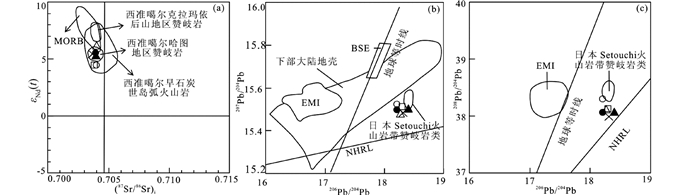
哈拉阿拉特组与阿腊德依克赛组火山岩具有相似的Sr-Nd-Pb同位素组成(表 2)。测试获得87Sr/86Sr为0.703832~0.70447,143Nd/144Nd为0.512699~0.512900,计算(87Sr/86Sr)i变化范围为0.70366~0.70409,具有正的εNd(t)(4.41~6.19),将其与岛弧玄武岩(IAB)作对比,表明其可能来源于亏损地幔。在Sr、Nd图上的投点较集中,与西准噶尔哈图地区赞岐岩分布范围相吻合,均落入西准噶尔早石炭世岛弧火山岩区域(图 7a)。206Pb/204Pb为18.220~18.405,207Pb/204Pb为15.482~15.522,208Pb/204Pb为37.991~38.296,计算得(206Pb/204Pb)i变化范围为17.7558~17.8977,(207Pb/204Pb)i为15.4549~15.5038,(208Pb/204Pb)i为37.6086~37.7536,与日本Setouchi火山岩带新生代赞岐岩类一致(Tatsumi et al., 2003),均落入地球等时线右侧(图 7b, c)。6件样品的Sr、Nd、Pb初始比值变化范围较小,暗示其指示同一岩浆源区。
|
|
表 2 哈拉阿拉特山地区晚石炭世火山岩的Sr-Nd-Pb同位素组成 Table 2 Sr-Nd-Pb isotopic compositions for volcanic rocks of Late Carboniferous in Hala'alate Mountain area |
|
图 7 哈拉阿拉特山地区晚石炭世火山岩εNd(t)-(87Sr/86Sr)i图解(a)及206Pb/204Pb与207Pb/204Pb (b, 据Zindler and Hart, 1986)、208Pb/204Pb相关图(c, 据Allègre et al., 1988) 西准噶尔早石炭世岛弧火山岩数据引自Geng et al. (2011);西准噶尔哈图地区赞岐岩数据尹继元等(2012),Yin et al. (2015);西准噶尔克拉玛依后山地区赞岐岩数据引自Yin et al. (2010),Ma et al. (2012);日本Setouchi火山岩带新生代赞岐岩数据引自Tatsumi et al. (2003) Fig. 7 εNd(t) vs. (87Sr/86Sr)i diagram (a) and correlogram of 206Pb/204Pb vs. 207Pb/204Pb (b, Zindler and Hart, 1986), 206Pb/204Pb vs. 208Pb/204Pb (c, after Allègre et al., 1988) for volcanic rocks of Late Carboniferous in Hala'alate Mountain area Early Carboniferous volcanic rocks value from West Junggar after Geng et al. (2011); data of the Hatu area from Yin et al.(2012, 2015); data of the northwestern Karamay from Yin et al. (2010), Ma et al. (2012); Sanukitoid data of Setouchi volcanic belt are from Tatsumi et al. (2003) |
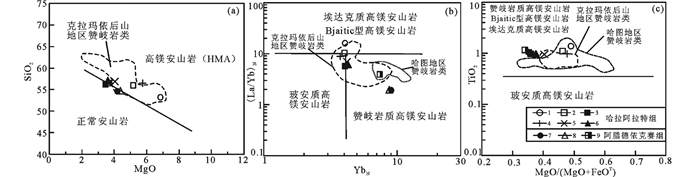
哈拉阿拉特山一带晚石炭世火山岩样品具有较高的MgO含量(3.47%~6.88%,Mg#=48.5~63.7),且K/Na值为0.22~0.70,富集大离子亲石元素(LILE)和轻稀土元素(LREE),亏损高场强元素(HFSE),弱负铕异常,正的εNd(t)(4.41~6.19)与较低(87Sr/86Sr)i值(0.70366~0.70409),206Pb/204Pb=18.220~18.405,207Pb/204Pb=15.482~15.522,208Pb/204Pb=37.991~38.296,与赞岐质高Mg安山岩地球化学特征类似(表 3)。然而值得说明的是,哈拉阿拉特组火山岩具有高Sr (634×10-6~970×10-6),Ba (269×10-6~796×10-6)及Sr/Y (61.3~84.3)比值等特征,极易与埃达克岩混淆,而典型的埃达克岩SiO2≥56%,MgO一般 < 3%(很少超过6%),通常表现出正铕异常,与该套火山岩特征不符,综合对比后认为其与克拉玛依后山地区赞岐岩类极为相似(图 8, Yin et al., 2010; Ma et al., 2012);而阿腊德依克赛组火山岩则表现为较低的Sr (442×10-6~509×10-6),Ba (199×10-6~485×10-6)及Sr/Y (25.0~30.3)比值,与日本Setouchi火山岩带和哈图地区(尹继元等, 2012; Yin et al., 2015)赞岐岩地球化学特征基本一致(图 8)。
|
|
表 3 哈拉阿拉特山地区火山岩与典型赞岐岩及区内前人报道赞岐岩对比表 Table 3 The comparison among volcanic rocks in Hala'alate Mountain area, typical Sanukitoid and Sanukitoid reported by predecessor in this area |
|
图 8 哈拉阿拉特山晚石炭世火山岩的SiO2-MgO图解(a, 底图据Mccarron and Smellie, 1998)、(La/Yb)N-YbN图解(b, 底图据Kamei et al., 2004)及TiO2-MgO/(MgO+FeOT)图解(c, 底图据Kamei et al., 2004) 克拉玛依后山地区赞岐岩数据引自Yin et al. (2010),Ma et al. (2012);哈图地区赞岐岩数据据尹继元等(2012);Yin et al. (2015) Fig. 8 SiO2 vs. MgO (a, after Mccarron and Smellie, 1998), (La/Yb)N vs. YbN (b, after Kamei et al., 2004) and TiO2 vs. MgO/(MgO+FeOT) (c, after Kamei et al., 2004) diagrams for volcanic rocks of Late Carboniferous in Hala'alate Mountain area Data of the northwestern Karamay from Yin et al. (2010), Ma et al. (2012); data of the Hatu area from Yin et al.(2012, 2015) |
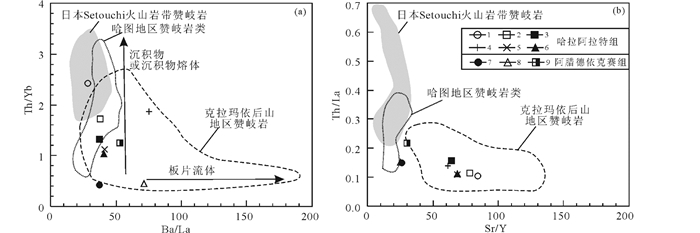
哈拉阿拉特组与阿腊德伊克赛组由陆源细碎屑岩和火山岩组成,含有较多生物碎屑灰岩条带,产大量腕足、珊瑚、双壳等化石,整体为滨海相沉积。火山岩主要由玄武岩、玄武安山岩和安山岩组成,代表了区内海相沉积相关最晚火山活动的产物。同时,较高的Mg#值(48.5~63.7)、Al2O3含量(16.25%~18.97%),Nb、Ta呈现明显的亏损,正的εNd(t)值(4.41~6.19)等特征表明,其源区可能与俯冲相关。其中,哈拉阿拉特组赞岐岩具有与埃达克岩类似的地球化学特征,且与克拉玛依后山地区赞岐岩类极为相似,通常被认为是形成于受埃达克质板片熔体交代的地幔楔的部分熔融(图 9, Ma et al., 2012; Tang et al., 2012a; Yin et al., 2013);而阿腊德依克赛组赞岐岩以高的Th/La和Th/Yb值为特征类似于日本Setouchi火山岩带和哈图地区赞岐岩,被认为是形成于富集俯冲大洋沉积物的地幔橄榄岩的部分熔融(Tatsumi, 2001, 2008; Yin et al., 2015)。总之,区内晚石炭世火山岩均表现出与俯冲环境相关的特征。
|
图 9 哈拉阿拉特山晚石炭世赞岐岩Th/Yb-Ba/La (a)及Th/La-Sr/Y (b)图解 西准噶尔哈图地区赞岐岩数据尹继元等(2012),Yin et al. (2015);西准噶尔克拉玛依后山地区赞岐岩数据引自Yin et al. (2010),Ma et al. (2012);日本Setouchi火山岩带新生代赞岐岩数据引自Tatsumi et al. (2003) Fig. 9 Th/Yb vs. Ba/La diagram (a) and Th/La vs. Sr/Y diagram (b) for volcanic rocks of Late Carboniferous in Hala'alate Mountain area Data of Hatu area are from Yin et al.(2012, 2015a). Data of northwestern Karamay area are from Yin et al. (2010) and Ma et al. (2012). Data of Setouchi Volcanic Belt are from Tatsumi et al. (2003) |
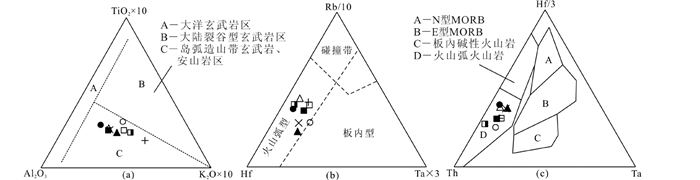
西准噶尔在古生代表现为洋内弧的俯冲体系(Xiao et al., 2010),到了晚石炭世其构造环境却存在较大争议:一是形成于岛弧环境(肖文交等, 2006, 2008; Xiao et al., 2008; 唐功建等, 2009),一是形成于后碰撞环境(Chen and Arakawa, 2005; 苏玉平等, 2006; 韩宝福等, 2006)。最新研究结果显示,西准噶尔地区存在石炭纪的埃达克岩-高镁安山岩-富Nb玄武质岩组合:西准噶尔西部巴尔努克山一带早石炭世黑山头组中的玄武质岩具有富Nb岛弧玄武岩的地球化学特征(李永军等, 2014);埃达克岩则分布于西准噶尔中部达尔布特断裂以南的包古图地区,主要为中酸性小斑岩体,与铜金矿化关系密切(张连昌等, 2006; 唐功建等, 2009);此外,在西准噶尔东部可见高镁安山岩分布,样品地球化学特征类似于日本Setouchi火山岩带中的赞岐岩类。这一特殊岩石组合特征指示,西准噶尔地区在整个石炭纪可能为岛弧环境(图 10)。
|
图 10 哈拉阿拉特山晚石炭世赞岐岩构造环境判别图 (a) TiO2×10-Al2O3-K2O×10图解(赵崇贺, 1989);(b) Rb/10-Hf-Ta×3(Pearce, 1982);(c) Hf/3-Th-Ta图解(Wood, 1980) Fig. 10 Tectonic discrimination diagrams of Late Carboniferous Sanukitoids in in Hala'alate Mountain area (a) TiO2×10-Al2O3-K2O×10 diagram (Zhao, 1989); (b) Rb/10-Hf-Ta×3 diagram (Pearce, 1982); (c) Hf/3-Th-Ta diagram (Wood, 1980) |
前人报道西准噶尔石炭纪的俯冲作用多位于西准噶尔西部,时代均为早石炭世(赵振华等, 2006; Shen et al., 2008; 田陟贤等, 2013; 李永军等, 2014)。有学者认为,准噶尔洋在385Ma之前向博什库尔-成吉思岩浆弧及准噶尔板块之下形成双向俯冲,而在358~342Ma哈萨克斯坦板块和准噶尔板块可能发生碰撞,最终导致准噶尔洋的完全闭合(陈博和朱永峰, 2011; Zhu et al., 2013, 2015)。然而,越来越多的学者通过对西准噶尔蛇绿构造混杂岩、埃达克岩及A型花岗岩的研究,认为西准噶尔乃至整个中亚造山带从泥盆纪到晚石炭世存在一个俯冲的过程(Geng et al., 2009; Tang et al., 2012a, b, c),与本文所述晚石炭世赞岐岩形成于岛弧环境这一结论相一致。更为重要的是,近年来多位学者在西准噶尔包古图-哈图地区的中基性岩墙群和深成小岩体中发现和报道了赞岐岩的存在,均分布于达尔布特断裂两侧,时代多集中于晚石炭世-早二叠世(Yin et al., 2010, 2015; Ma et al., 2012; 尹继元等, 2012),与本文报道的赞岐岩类火山岩在产出位置与形成时间上一致,显示二者之间存在着密切的成因联系。最有可能的解释是西准早石炭世与晚石炭世-早二叠世地质体是两次由南向北的俯冲增生体,当早石炭世完成俯冲增生拼贴后,已进入陆内后碰撞造山,而其南的晚石炭世仍处在岛弧环境,持续进行沉积和俯冲过程,形成赞岐质岛弧火山岩,同时,向北部地区在已进入陆内后碰撞造山的早石炭世地层内,在形成后造山花岗质岩浆的过程中,与赞岐质岛弧火山岩同源的赞岐质侵入岩沿达尔布特大断裂上侵,一部分形成独立的小侵入体,另一部分与同期的壳源后碰撞花岗质岩浆相遇,形成岩浆混合花岗岩或是成为浆混岩中的幔源包体及基性岩墙群。
西准噶尔位于中亚造山带西南缘,具有复杂造山演化历史(Kwon et al., 1989; Yang et al., 2012a, b, c, 2013, 2015; Chen et al., 2014; Zhu et al., 2015)。然而,该区大陆地壳增生机制仍存在较大争议(Şengör et al., 1993; Windley et al., 2007; Xiao et al., 2010, 2015; Wilhem et al., 2012; Kröner et al., 2014; Xiao and Santosh, 2014)。研究认为,岛弧环境不仅可以产生本文所述赞岐岩,同时也能生成大量的年轻的大陆地壳。因此,综合前人研究成果表明,多期次的俯冲增生作用在西准噶尔乃至中亚造山带的构造演化及地壳增长过程中可能发挥着至关重要的作用。
4 结论(1)晚石炭世哈拉阿拉特组与阿腊德依克赛组火山岩岩石地球化学特征、Sr-Nd-Pb同位素组成与经典赞岐岩总体有较好的可比性,可以判定其为赞岐岩类。
(2)哈拉阿拉特组赞岐岩形成于受埃达克质板片熔体交代的地幔楔的部分熔融,而阿腊德依克赛组赞岐岩则形成于富集俯冲大洋沉积物的地幔橄榄岩的部分熔融。
(3)哈拉阿拉特山地区晚石炭世赞岐质火山岩的发现和报道在区内尚属首次,这为确认西准噶尔石炭纪存在赞岐质火山岩提供了详实的地质资料,为研究西准噶尔俯冲增生机制提供了重要的地球化学信息。
致谢 主量元素和稀土微量元素分析得到长安大学王柱命和何克老师的支持和帮助; 三位审稿专家对本文进行认真修改并提出建设性意见; 在此一并表示感谢。| [] | Allègre CJ, Lewin E, Dupré B. 1988. A coherent crust-mantle model for the uranium-thorium-lead isotopic system. Chemical Geology , 70 (3) :211–234. DOI:10.1016/0009-2541(88)90094-0 |
| [] | An F, Zhu YF. 2009. SHRIMP U-Pb zircon ages of tuff in Baogutu Formation and their geological significances. Acta Petrologica Sinica , 25 (6) :1437–1445. |
| [] | Bian HY, Ji F, Biao SH. 2014. LA-ICP-MS zircon U-Pb dating of sanuklite-(quartz) monzodiorite in Fuxili area, Daxing'anling and its geological siganificance. Global Geology , 33 (4) :768–779. |
| [] | Boynton WV. 1984. Geochemistry of the rare earth elements:Meteorite studies. In:Henderson P (ed.). Rare Earth Element Geochemistry. Amsterdam, Netherlands:Elsevier, 63-114 |
| [] | Chen B, Arakawa Y. 2005. Elemental and Nd-Sr isotopic geochemistry of granitoids from the West Junggar foldbelt (NW China), with implications for Phanerozoic continental growth. Geochimica et Cosmochimica Acta , 69 (5) :1307–1320. DOI:10.1016/j.gca.2004.09.019 |
| [] | Chen B, Zhu YF. 2011. Petrology, geochemistry and zircon U-Pb chronology of gabbro in Darbut ophiolitic mélange, Xinjiang. Acta Petrologica Sinica , 27 (6) :1746–1758. |
| [] | Chen JF, Han BF, Ji JQ, Zhang L, Xu Z, He GQ, Wang T. 2010. Zircon U-Pb ages and tectonic implications of Paleozoic plutons in northern West Junggar, North Xinjiang, China. Lithos , 115 (1-4) :137–152. DOI:10.1016/j.lithos.2009.11.014 |
| [] | Chen S, Pe-Piper G, Piper DJW, Guo ZJ. 2014. Ophiolitic mélanges in crustal-scale fault zones:Implications for the Late Palaeozoic tectonic evolution in West Junggar, China. Tectonics , 33 (12) :2419–2443. DOI:10.1002/2013TC003488 |
| [] | Fu CL, Sun DY, Zhang XZ, Wei HY, Gou J. 2010. Discovery and geological significance of the Triassic high-Mg diorites in Hunchu area, Jilin Province. Acta Petrologica Sinica , 26 (4) :1089–1102. |
| [] | Gao R, Xiao L, Wang GC, He XX, Yang G, Yan SW. 2013. Paleozoic magmatism and tectonic setting in West Junggar. Acta Petrologica Sinica , 29 (10) :3413–3434. |
| [] | Geng HY, Sun M, Yuan C, Xiao WJ, Zhao GC, Zhang LF, Wong K, Wu FY. 2009. Geochemical, Sr-Nd and zircon U-Pb-Hf isotopic studies of Late Carboniferous magmatism in the West Junggar, Xinjiang:Implications for ridge subduction. Chemical Geology , 266 (3-4) :364–389. DOI:10.1016/j.chemgeo.2009.07.001 |
| [] | Geng HY, Sun M, Yuan C, Zhao GC, Xiao WJ. 2011. Geochemical and geochronological study of Early Carboniferous volcanic rocks from the West Junggar:Petrogenesis and tectonic implications. Journal of Asian Earth Sciences , 42 (5) :854–866. DOI:10.1016/j.jseaes.2011.01.006 |
| [] | Guo LS, Liu YL, Wang ZH, Song D, Xu FJ, Su L. 2010. The zircon U-Pb LA-ICP-MS geochronology of volcanic rocks in Baogutu areas, western Junggar. Acta Petrologica Sinica , 26 (2) :471–477. |
| [] | Han BF, Ji JQ, Song B, Chen LH, Zhang L. 2006. Late Paleozoic vertical growth of continental crust around the Junggar Basin, Xinjiang, China (Part Ⅰ):Timing of post-collisional plutonism. Acta Petrologica Sinica , 22 (5) :1077–1086. |
| [] | He GQ, Li MS, Han BF. 2001. Geotectonic research of Southwest Tianshan and its western adjacent area, China. Xinjiang Geology , 19 (1) :7–11. |
| [] | Irvine TN, Baragar WR. 1971. A guide to the chemical classification of the common volcanic rocks. Canadian Journal of Earth Sciences , 8 (5) :523–548. DOI:10.1139/e71-055 |
| [] | Jian P, Zhang Q, Liu DY, Jin WJ, Jia XQ, Qian Q. 2005. SHRIMP dating and geological significance of Late Achaean high-Mg diorite (sanukite) and hornblende-granite at Guyang of Inner Mongolia. Acta Petrologica Sinica , 21 (1) :151–157. |
| [] | Jin CW, Zhang XQ. 1993. A geochronology and geneses of the western Junggar granitoids, Xinjiang, China. Scientia Geologica Sinica , 28 (1) :28–36. |
| [] | Kamei A, Owada M, Nagao T, Shiraki K. 2004. High-Mg diorites derived from sanukitic HMA magmas, Kyushu Island, Southwest Japan arc:Evidence from clinopyroxene and whole rock compositions. Lithos , 75 (3-4) :359–371. DOI:10.1016/j.lithos.2004.03.006 |
| [] | Kröner A, Kovach V, Belousova E, Hegner E, Armstrong R, Dolgopolova A, Seltmann R, Alexeiev DV, Hoffmann JE, Wong J, Sun M, Cai K, Wang T, Tong Y, Wilde SA, Degtyarev KE, Rytsk E. 2014. Reassessment of continental growth during the accretionary history of the Central Asian Orogenic Belt. Gondwana Research , 25 (1) :103–125. DOI:10.1016/j.gr.2012.12.023 |
| [] | Kwon ST, Tilton GR, Coleman RG, Feng Y. 1989. Isotopic studies bearing on the tectonics of the West Junggar region, Xinjiang, China. Tectonics , 8 (4) :719–727. DOI:10.1029/TC008i004p00719 |
| [] | Le Bas MJ, Le Maitre RW, Streckeisen A, Zanettin B. 1986. A chemical classification of volcanic rocks based on the total alkali-silica diagram. Journal of Petrology , 27 (3) :745–750. DOI:10.1093/petrology/27.3.745 |
| [] | Li GY, Li YJ, Wang R, Yang GX, Xiang KP, Liu J, Li Z. 2015. Zircon LA-ICP-MS U-Pb dating of the Hala'alate Formation volcanics in western Junggar. Northwestern Geology , 48 (3) :12–21. |
| [] | Li YJ, Tong LL, Zhang B, Liu J, Zhang TJ, Wang JN. 2010. On the old and new relationship between Xibeikulasi Formation and Baogutu Formation of the Carboniferous System, West Junggar. Xinjiang Geology , 28 (2) :130–136. |
| [] | Li YJ, Shen R, Wang R, Guo ST, Tong LL, Yang GX. 2014. Discovery and significance of Early Carboniferous Nb-enriched basalts in Barnuke, West Junggar, Xinjiang. Acta Petrologica Sinica , 30 (12) :3501–3511. |
| [] | Ma C, Xiao WJ, Windley BF, Zhao GP, Han CM, Zhang JE, Luo J, Li C. 2012. Tracing a subducted ridge-transform system in a Late Carboniferous accretionary prism of the southern Altaids:Orthogonal sanukitoid dyke swarms in western Junggar, NW China. Lithos , 140-141 :152–165. DOI:10.1016/j.lithos.2012.02.005 |
| [] | Martin H, Smithies RH, Rapp R, Moyen JF, Champion D. 2005. An overview of adakite, tonalite-trondhjemite-granodiorite (TTG), and sanukitoid:Relationships and some implications for crustal evolution. Lithos , 79 (1-2) :1–24. DOI:10.1016/j.lithos.2004.04.048 |
| [] | McCarron JJ, Smellie JL. 1998. Tectonic implications of fore-arc magmatism and generation of high-magnesian andesites:Alexander Island, Antarctica. Journal of the Geological Society , 155 (2) :269–280. DOI:10.1144/gsjgs.155.2.0269 |
| [] | Miller C, Schuster R, Klötzli U, Frank W, Purtscheller F. 1999. Post-collisional potassic and ultra-potassic magmatism in SW Tibet:Geochemical and Sr-Nd-Pb-O isotopic constraints for mantle source characteristics and petrogenesis. Journal of Petrology , 40 (9) :1399–1424. DOI:10.1093/petroj/40.9.1399 |
| [] | Pearce JA. 1982. Trace element characteristics of lavas from destructive plate boundaries. In:Thorpe RS (ed.). Andesites:Orogenic Andesites and Related Rocks. Chichester, England:Wiley, 525-548 |
| [] | Şengör AMC, Natal'in BA, Burtman VS. 1993. Evolution of the Altaid tectonic collage and Palaeozoic crustal growth in Eurasia. Nature , 364 (6435) :299–307. DOI:10.1038/364299a0 |
| [] | Shen P, Shen YC, Liu TB, Li GM, Zeng QD. 2008. Geology and geochemistry of the Early Carboniferous eastern Sawur caldera complex and associated gold epithermal mineralization, Sawur Mountains, Xinjiang, China. Journal of Asian Earth Sciences , 32 (2-4) :259–279. DOI:10.1016/j.jseaes.2007.10.004 |
| [] | Shen YC.1993. Magmation and Gold Mineralization in West Junggar, Xinjiang. Beijing: Science Press . |
| [] | Shirey SB, Hanson GN. 1984. Mantle-derived Archaean monozodiorites and trachyandesites. Nature , 310 (5974) :222–224. DOI:10.1038/310222a0 |
| [] | Stern RA, Hanson GN, Shirey SB. 1989. Petrogenesis of mantle-derived, LILE-enriched Archean monzodiorites and trachyandesites (sanukitoids) in southwestern Superior Province. Canadian Journal of Earth Sciences , 26 (9) :1688–1712. DOI:10.1139/e89-145 |
| [] | Su YP, Tang HF, Hou GS, Liu CQ. 2006. Geochemistry of aluminous A-type granites along Darabut tectonic belt in West Junggar, Xinjiang. Geochimica , 35 (1) :55–67. |
| [] | Sun SS, McDonough WF. 1989. Chemical and isotopic systematics of oceanic basalts:Implications for mantle composition and processes. In:Sauders AD and Norry MJ (eds.). Magmatism in the Ocean Basins. Geological Society, London, Special Publications , 42 :313–345. DOI:10.1144/GSL.SP.1989.042.01.19 |
| [] | Sun Y, Li YJ, Tong LL, Yang GX, Xiang KP, Jiao GL, Yi SX, Sun Y. 2014a. The affirmance of Xibeikulasi Formation conformable above Baogutu Formation in West Junggar. Xinjiang Geology , 32 (2) :153–157. |
| [] | Sun Y, Zhao CH, Li YJ, Tong LL, Yang GX, Yan J, Jiao GL, Yi SX. 2014b. Detrital zircon LA-ICP-MS U-Pb dating of the Carboniferous Xibeikulasi Formation sandstone in the Baogutu area, western Junggar, and its geological significance. Journal of Stratigraphy , 38 (1) :42–50. |
| [] | Sun Y, Li YJ, Yang GX, Wang R, Zhang SL, Yi SX, Sun Y, Wang JN. 2015. Geochemical and geological significance of the volcanic rocks in the west of the Xiemisitai Mountain, West Junggar. Bulletin of Mineralogy, Petrology and Geochemistry , 34 (2) :387–394. |
| [] | Tang GJ, Wang Q, Zhao ZH, Wyman DA, Chen HH, Jia XH, Jiang ZQ. 2009. Geochronology and geochemistry of the ore-bearing porphyries in the Baogutu area (western Junggar):Petrogenesis and their implications for tectonics and Cu-Au mineralization. Earth Science , 34 (1) :56–74. |
| [] | Tang GJ, Wang Q, Wyman DA, Li ZX, Zhao ZH, Yang YH. 2012a. Late Carboniferous high εNd(t)-εHf(t) granitoids, enclaves and dikes in western Junggar, NW China:Ridge-subduction-related magmatism and crustal growth. Lithos , 140-141 :86–102. DOI:10.1016/j.lithos.2012.01.025 |
| [] | Tang GJ, Wyman DA, Wang Q, Li J, Li ZX, Zhao ZH, Sun WD. 2012b. Asthenosphere-lithosphere interaction triggered by a slab window during ridge subduction:Trace element and Sr-Nd-Hf-Os isotopic evidence from Late Carboniferous tholeiites in the western Junggar area (NW China). Earth and Planetary Science Letters , 329-330 :84–96. DOI:10.1016/j.epsl.2012.02.009 |
| [] | Tang GJ, Wang Q, Wyman DA, Li ZX, Xu YG, Zhao ZH. 2012c. Recycling oceanic crust for continental crustal growth:Sr-Nd-Hf isotope evidence from granitoids in the western Junggar region, NW China. Lithos , 128-131 :73–83. DOI:10.1016/j.lithos.2011.11.003 |
| [] | Tatsumi Y. 1981. Melting experiments on a high-magnesian andesite. Earth and Planetary Science Letters , 54 (2) :357–365. DOI:10.1016/0012-821X(81)90017-0 |
| [] | Tatsumi Y, Ishizaka K. 1981. Existence of andesitic primary magma:An example from Southwest Japan. Earth and Planetary Science Letters , 53 (1) :124–130. DOI:10.1016/0012-821X(81)90033-9 |
| [] | Tatsumi Y. 1982. Origin of high-magnesian andesites in the Setouchi volcanic belt, Southwest Japan, Ⅱ. Melting phase relations at high pressures. Earth and Planetary Science Letters , 60 (2) :305–317. DOI:10.1016/0012-821X(82)90009-7 |
| [] | Tatsumi Y, Ishizaka K. 1982. Origin of high-magnesian andesites in the Setouchi volcanic belt, Southwest Japan, Ⅰ. Petrographical and chemical characteristics. Earth and Planetary Science Letters , 60 (2) :293–304. DOI:10.1016/0012-821X(82)90008-5 |
| [] | Tatsumi Y. 2001. Geochemical modeling of partial melting of subducting sediments and subsequent melt-mantle interaction:Generation of high-Mg andesites in the Setouchi volcanic belt, Southwest Japan. Geology , 29 (4) :323–326. DOI:10.1130/0091-7613(2001)029<0323:GMOPMO>2.0.CO;2 |
| [] | Tatsumi Y, Shukuno H, Sato K, Shibata T, Yoshikawa M. 2003. The petrology and geochemistry of high-magnesium andesites at the western tip of the Setouchi Volcanic Belt, SW Japan. Journal of Petrology , 44 (9) :1561–1578. DOI:10.1093/petrology/egg049 |
| [] | Tatsumi Y. 2008. Making continental crust:The sanukitoid connection. Chinese Science Bulletin , 53 (11) :1620–1633. |
| [] | Tian ZX, Yan J, Li YJ, Yang GX, Tian M, Tong LL, Yan J. 2013. LA-ICP-MS Zircon U-Pb age, geochemistry and tectonic setting of the volcanic rocks in the Heishantou Formation from the area of Barleik, West Junggar. Acta Geologica Sinica , 87 (3) :343–352. |
| [] | Tong LL, Li YJ, Zhang B, Liu J, Pang ZJ, Wang JN. 2009. Zircon LA-ICP-MS U-Pb dating and geologic age of the Baogutu Formation andesite in the south of Daerbute faulted zone, western Junggar. Xinjiang Geology , 27 (3) :226–230. |
| [] | Tong LL, Li YJ, Tian R, Zhang HW, Wang JN, Wang R. 2014. Geochemical characteristics and tectonic setting of volcanic rocks from Carboniferous Baogutu Formation, West Junggar. Xinjiang Geology , 32 (2) :147–152. |
| [] | Wang JB, Xu X. 2006. Post-collisional tectonic evolution and metallogenesis in northern Xinjiang, China. Acta Geologica Sinica , 80 (1) :23–31. |
| [] | Wang JR, Jia ZL, Li TD, Ma JL, Zhao L, He YB, Zhang W, Liu KX. 2013. Discovery of early devonian adakite in West Junggar, Xinjiang:Implications for geotectonics and Cu mineralization. Acta Petrologica Sinica , 29 (3) :840–852. |
| [] | Wang Q, Zhao ZH, Xu JF, Wyman DA, Xiong XL, Zi F, Bai ZH. 2006. Carboniferous adakite-high-Mg andesite-Nb-enriched basaltic rock suites in the Northern Tianshan area:Implications for Phanerozoic crustal growth in the Central Asia Orogenic Belt and Cu-Au mineralization. Acta Petrologica Sinica , 22 (1) :11–30. |
| [] | Wang Q, Wyman DA, Zhao ZH, Xu JF, Bai ZH, Xiong XL, Dai TM, Li CF, Chu ZY. 2007. Petrogenesis of Carboniferous adakites and Nb-enriched arc basalts in the Alataw area, northern Tianshan Range (western China):Implications for Phanerozoic crustal growth in the Central Asia orogenic belt. Chemical Geology , 236 (1-2) :42–64. DOI:10.1016/j.chemgeo.2006.08.013 |
| [] | Wang R, Zhu YF. 2007. Geology of the Baobei gold deposit in western Junggar and zircon SHRIMP age of its wall-rocks, western Junggar (Xinjiang, NW China). Geological Journal of China Universities , 13 (3) :590–602. |
| [] | Weinschenk E. 1891. Beiträge zur Petrographie Japans. Neues Jahrbuch für Mineralogie, Geologie und Paläontologie , 7 :133–151. |
| [] | Wilhem C, Windley BF, Stampfli GM. 2012. The Altaids of Central Asia:A tectonic and evolutionary innovative review. Earth-Science Reviews , 113 (3-4) :303–341. DOI:10.1016/j.earscirev.2012.04.001 |
| [] | Winchester JA, Floyd PA. 1977. Geochemical discrimination of different magma series and their differentiation products using immobile elements. Chemical Geology , 20 :325–343. DOI:10.1016/0009-2541(77)90057-2 |
| [] | Windley BF, Alexeiev D, Xiao WJ, Kroner A, Badarch G. 2007. Tectonic models for accretion of the Central Asian Orogenic Belt. Journal of the Geological Society , 164 (1) :31–47. DOI:10.1144/0016-76492006-022 |
| [] | Wood DA. 1980. The application of a Th-Hf-Ta diagram to problems of tectonomagmatic classification and to establishing the nature of crustal contamination of basaltic lavas of the British Tertiary volcanic province. Earth and Planetary Science Letters , 50 (1) :11–30. DOI:10.1016/0012-821X(80)90116-8 |
| [] | Xiang KP, Li YJ, Li Z, Wang R, Yang GX, Duan FH, Li GY. 2015. LA ICP-MS zircon age and geochemistry of the Aladeyikesai Formation volcanic rocks in the Hala'alate Mountain of West Junggar, Xinjiang, and their tectonic significance. Acta Geologica Sinica , 89 (5) :843–855. |
| [] | Xiao WJ, Han CM, Yuan C, Chen HL, Sun M, Lin SF, Li ZL, Mao QG, Zhang JE, Sun S, Li JL. 2006. Unique carboniferous-Permian tectonic-metallogenic framework of Northern Xinjiang (NW China):Constraints for the tectonics of the southern Paleoasian Domain. Acta Petrologica Sinica , 22 (5) :1062–1076. |
| [] | Xiao WJ, Han CM, Yuan C, Sun M, Lin SF, Chen HL, Li ZL, Li JL, Sun S. 2008. Middle Cambrian to Permian subduction-related accretionary orogenesis of northern Xinjiang, NW China:Implications for the tectonic evolution of central Asia. Journal of Asian Earth Sciences , 32 (2-4) :102–117. DOI:10.1016/j.jseaes.2007.10.008 |
| [] | Xiao WJ, Shu LS, Gao J, Xiong XL, Wang JB, Guo ZJ, Li JY, Sun M. 2008. Continental dynamics of the Central Asian Orogenic Belt and its metallogeny. Xinjiang Geology , 26 (1) :4–8. |
| [] | Xiao WJ, Huang BC, Han CM, Sun S, Li JL. 2010. A review of the western part of the Altaids:A key to understanding the architecture of accretionary orogens. Gondwana Research , 18 (2-3) :253–273. DOI:10.1016/j.gr.2010.01.007 |
| [] | Xiao WJ, Santosh M. 2014. The western Central Asian Orogenic Belt:A window to accretionary orogenesis and continental growth. Gondwana Research , 25 (4) :1429–1444. DOI:10.1016/j.gr.2014.01.008 |
| [] | Xiao WJ, Windley BF, Sun S, Li JL, Huang BC, Han CM, Yuan C, Sun M, Chen HL. 2015. A tale of amalgamation of three Permo-Triassic collage systems in Central Asia:Oroclines, sutures, and terminal accretion. Annual Review of Earth and Planetary Sciences , 43 (1) :477–507. DOI:10.1146/annurev-earth-060614-105254 |
| [] | Xu X, Zhou KF, Wang Y. 2010. Study on extinction of the remnant oceanic basin and tectonic setting of West Junggar during Late Paleozoic. Acta Petrologica Sinica , 26 (11) :3206–3214. |
| [] | Xu Z, Han BF, Ren R, Zhou YZ, Zhang L, Chen JF, Su L, Li XH, Liu DY. 2012. Ultramafic-mafic mélange, island arc and post-collisional intrusions in the Mayile Mountain, West Junggar, China:Implications for Paleozoic intra-oceanic subduction-accretion process. Lithos , 132-133 :141–161. DOI:10.1016/j.lithos.2011.11.016 |
| [] | Yang GX, Li YJ, Santosh M, Gu PY, Yang BK, Zhang B, Wang HB, Zhong X, Tong LL. 2012a. A Neoproterozoic seamount in the Paleoasian Ocean:Evidence from zircon U-Pb geochronology and geochemistry of the Mayile ophiolitic mélange in West Junggar, NW China. Lithos , 140-141 :53–65. DOI:10.1016/j.lithos.2012.01.026 |
| [] | Yang GX, Li YJ, Santosh M, Yang BK, Yan J, Zhang B, Tong LL. 2012b. Geochronology and geochemistry of basaltic rocks from the Sartuohai ophiolitic mélange, NW China:Implications for a Devonian mantle plume within the Junggar Ocean. Journal of Asian Earth Sciences , 59 :141–155. DOI:10.1016/j.jseaes.2012.07.020 |
| [] | Yang GX, Li YJ, Gu PY, Yang BK, Tong LL, Zhang HW. 2012c. Geochronological and geochemical study of the Darbut ophiolitic complex in the West Junggar (NW China):Implications for petrogenesis and tectonic evolution. Gondwana Research , 21 (4) :1037–1049. DOI:10.1016/j.gr.2011.07.029 |
| [] | Yang GX, Li YJ, Santosh M, Yang BK, Zhang B, Tong LL. 2013. Geochronology and geochemistry of basalts from the Karamay ophiolitic mélange in West Junggar (NW China):Implications for Devonian-Carboniferous intra-oceanic accretionary tectonics of the southern Altaids. Geological Society of America Bulletin , 125 (3-4) :401–419. DOI:10.1130/B30650.1 |
| [] | Yang GX, Li YJ, Santosh M, Xiao WJ, Yang BK, Tong LL, Zhang SL. 2015. Alkaline basalts in the Karamay ophiolitic mélange, NW China:A geological, geochemical and geochronological study and implications for geodynamic setting. Journal of Asian Earth Sciences , 113 :110–125. DOI:10.1016/j.jseaes.2014.08.017 |
| [] | Yin JY, Yuan C, Sun M, Long XP, Zhao GC, Wong KP, Geng HY, Cai KD. 2010. Late Carboniferous high-Mg dioritic dikes in western Junggar, NW China:Geochemical features, petrogenesis and tectonic implications. Gondwana Research , 17 (1) :145–152. DOI:10.1016/j.gr.2009.05.011 |
| [] | Yin JY, Yuan C, Sun M, Long XP, Qiu HN, Wang YJ, Ren JB, Guan YL. 2012. Age, geochemical features and possible petrogenesis mechanism of Early Permian magnesian diorite in Hatu, Xinjiang. Acta Petrologica Sinica , 28 (7) :2171–2182. |
| [] | Yin JY, Long XP, Yuan C, Sun M, Zhao GC, Geng HY. 2013. A Late Carboniferous-Early Permian slab window in the West Junggar of NW China:Geochronological and geochemical evidence from mafic to intermediate dikes. Lithos , 175-176 :146–162. DOI:10.1016/j.lithos.2013.04.005 |
| [] | Yin JY, Chen W, Xiao WJ, Yuan C, Sun M, Tang GJ, Yu S, Long XP, Cai KD, Geng HY, Zhang Y, Liu XY. 2015. Petrogenesis of Early-Permian sanukitoids from West Junggar, Northwest China:Implications for Late Paleozoic crustal growth in Central Asia. Tectonophysics , 662 :385–397. DOI:10.1016/j.tecto.2015.01.005 |
| [] | Zhang LC, Wan B, Jiao XJ, Zhang R. 2006. Characteristics and geological significance of adakitic rocks in copper-bearing porphyry in Baogutu, western Junggar. Geology in China , 33 (3) :626–631. |
| [] | Zhang Q, Wang Y, Qian Q, Zhai MG, Jin WJ, Wang YL, Jian P. 2004. Sanukite of Late Archaean and early Earth evolution. Acta Petrologica Sinica , 20 (6) :1355–1362. |
| [] | Zhang Q, Qian Q, Zhai MG, Jin WJ, Wang Y, Jian P, Wang YL. 2005. Geochemistry, petrogenesis and geodynamic implications of sanukite. Acta Petrologica et Mineralogica , 24 (2) :117–125. |
| [] | Zhao CH. 1989. The ATK diagram of basic-intermediate volcanic rocks and tectonic environment. Geological Science and Technology Information , 8 (4) :1–5. |
| [] | Zhao ZH, Wang Q, Xiong XL, Zhang HX, Niu HC, Xu JF, Bai ZH, Qiao YL. 2006. Two types of adakites in North Xinjiang, China. Acta Petrologica Sinica , 22 (5) :1249–1265. |
| [] | Zhu YF, Chen B, Xu X, Qiu T, An F. 2013. A new geological map of the western Junggar, North Xinjiang (NW China):Implications for Paleoenvironmental reconstruction. Episodes , 36 (3) :205–220. |
| [] | Zhu YF, Chen B, Qiu T. 2015. Geology and geochemistry of the Baijiantan-Baikouquan ophiolitic mélanges:Implications for geological evolution of West Junggar, Xinjiang, NW China. Geological Magazine , 152 (1) :41–69. DOI:10.1017/S0016756814000168 |
| [] | Zindler A, Hart S. 1986. Chemical geodynamics. Annual Review of Earth and Planetary Sciences , 14 (1) :493–571. DOI:10.1146/annurev.ea.14.050186.002425 |
| [] | 安芳, 朱永峰.2009. 新疆西准噶尔包古图组凝灰岩锆石SHRIMP年龄及其地质意义. 岩石学报 , 25 (6) :1437–1445. |
| [] | 边红业, 吉峰, 表尚虎.2014. 大兴安岭富西里地区赞岐岩-(石英)二长闪长岩LA-ICP-MS锆石U-Pb定年及其地质意义. 世界地质 , 33 (4) :768–779. |
| [] | 陈博, 朱永峰.2011. 新疆达拉布特蛇绿混杂岩中辉长岩岩石学、微量元素地球化学和锆石U-Pb年代学研究. 岩石学报 , 27 (6) :1746–1758. |
| [] | 付长亮, 孙德有, 张兴洲, 魏红艳, 苟军.2010. 吉林珲春三叠纪高镁闪长岩的发现及地质意义. 岩石学报 , 26 (4) :1089–1102. |
| [] | 高睿, 肖龙, 王国灿, 贺新星, 杨刚, 鄢圣武.2013. 西准噶尔晚古生代岩浆活动和构造背景. 岩石学报 , 29 (10) :3413–3434. |
| [] | 郭丽爽, 刘玉琳, 王政华, 宋达, 许发军, 苏犁.2010. 西准噶尔包古图地区地层火山岩锆石LA-ICP-MS U-Pb年代学研究. 岩石学报 , 26 (2) :471–477. |
| [] | 韩宝福, 季建清, 宋彪, 陈立辉, 张磊.2006. 新疆准噶尔晚古生代陆壳垂向生长(I)-后碰撞深成岩浆活动的时限. 岩石学报 , 22 (5) :1077–1086. |
| [] | 何国琦, 李茂松, 韩宝福.2001. 中国西南天山及邻区大地构造研究. 新疆地质 , 19 (1) :7–11. |
| [] | 简平, 张旗, 刘敦一, 金维浚, 贾秀勤, 钱青.2005. 内蒙古固阳晚太古代赞岐岩(sanukite)-角闪花岗岩的SHRIMP定年及其意义. 岩石学报 , 21 (1) :151–157. |
| [] | 金成伟, 张秀棋.1993. 新疆西准噶尔花岗岩类的时代及其成因. 地质科学 , 28 (1) :28–36. |
| [] | 李甘雨, 李永军, 王冉, 杨高学, 向坤鹏, 刘佳, 李钊.2015. 西准噶尔哈拉阿拉特组火山岩LA-ICP-MS锆石U-Pb年龄. 西北地质 , 48 (3) :12–21. |
| [] | 李永军, 佟丽莉, 张兵, 刘静, 张天继, 王军年.2010. 论西准噶尔石炭系希贝库拉斯组与包古图组的新老关系. 新疆地质 , 28 (2) :130–136. |
| [] | 李永军, 沈锐, 王冉, 郭少婷, 佟丽莉, 杨高学.2014. 新疆西准噶尔巴尔努克早石炭世富Nb岛弧玄武岩的发现及其地质意义. 岩石学报 , 30 (12) :3501–3511. |
| [] | 沈远超. 1993. 西准噶尔地区岩浆活动与金矿化作用. 北京: 科学出版社 . |
| [] | 苏玉平, 唐红峰, 候广顺, 刘丛强.2006. 新疆西准噶尔达拉布特构造带铝质A型花岗岩的地球化学研究. 地球化学 , 35 (1) :55–67. |
| [] | 孙羽, 李永军, 佟丽莉, 杨高学, 向坤鹏, 焦光磊, 易善鑫, 孙勇.2014a. 西准噶尔希贝库拉斯组整合于包古图组之上的确认. 新疆地质 , 32 (2) :153–157. |
| [] | 孙羽, 赵春环, 李永军, 佟丽莉, 杨高学, 严境, 焦光磊, 易善鑫.2014b. 西准噶尔包古图地区石炭系希贝库拉斯组碎屑锆石LA-ICP-MS U-Pb年代学及其地质意义. 地层学杂志 , 38 (1) :42–50. |
| [] | 孙勇, 李永军, 杨高学, 王冉, 张胜龙, 易善鑫, 孙羽, 王军年.2015. 西准噶尔谢米斯台山西缘火山岩岩石地球化学特征及其地质意义. 矿物岩石地球化学通报 , 34 (2) :387–394. |
| [] | 唐功建, 王强, 赵振华, WymanDA, 陈海红, 贾小辉, 姜子琦.2009. 西准噶尔包古图成矿斑岩年代学与地球化学:岩石成因与构造、铜金成矿意义. 地球科学 , 34 (1) :56–74. |
| [] | 田陟贤, 阎军, 李永军, 杨高学, 田猛, 佟丽莉, 严镜.2013. 西准噶尔巴尔雷克-带石炭系黑山头组火山岩LA-ICP-MS锆石U-Pb年龄、地球化学特征及构造环境. 地质学报 , 87 (3) :343–352. |
| [] | 佟丽莉, 李永军, 张兵, 刘静, 庞振甲, 王军年.2009. 新疆西准噶尔达尔布特断裂带南包古图组安山岩LA-ICP-MS锆石U-Pb测年及地质时代. 新疆地质 , 27 (3) :226–230. |
| [] | 佟丽莉, 李永军, 田荣, 张洪伟, 王军年, 王冉.2014. 西准噶尔石炭纪包古图组火山岩岩石地球化学特征及构造意义. 新疆地质 , 32 (2) :147–152. |
| [] | 王京彬, 徐新.2006. 新疆北部后碰撞构造演化与成矿. 地质学报 , 80 (1) :23–31. |
| [] | 王金荣, 贾志磊, 李泰德, 马锦龙, 赵磊, 何彦彬, 张伟, 刘昆鑫.2013. 新疆西准噶尔发现早泥盆世埃达克岩:大地构造及成矿意义. 岩石学报 , 29 (3) :840–852. |
| [] | 王强, 赵振华, 许继峰, WymanDA, 熊小林, 资峰, 白正华.2006. 天山北部石炭纪埃达克岩-高镁安山岩-富Nb岛弧玄武质岩:对中亚造山带显生宙地壳增生与铜金成矿的意义. 岩石学报 , 22 (1) :11–30. |
| [] | 王瑞, 朱永峰.2007. 西准噶尔宝贝金矿地质与容矿火山岩的锆石SHRIMP年龄. 高校地质学报 , 13 (3) :590–602. |
| [] | 向坤鹏, 李永军, 李钊, 王冉, 杨高学, 段丰浩, 李甘雨.2015. 新疆西准噶尔哈拉阿拉特山火山岩LA ICP-MS锆石U-Pb年龄、地球化学特征及意义. 地质学报 , 89 (5) :843–855. |
| [] | 肖文交, 韩春明, 袁超, 陈汉林, 孙敏, 林寿发, 厉子龙, 毛启贵, 张继恩, 孙枢, 李继亮.2006. 新疆北部石炭纪-二叠纪独特的构造-成矿作用:对古亚洲洋构造域南部大地构造演化的制约. 岩石学报 , 22 (5) :1062–1076. |
| [] | 肖文交, 舒良树, 高俊, 熊小林, 王京彬, 郭召杰, 李锦轶, 孙敏.2008. 中亚造山带大陆动力学过程与成矿作用. 新疆地质 , 26 (1) :4–8. |
| [] | 徐新, 周可法, 王煜.2010. 西准噶尔晚古生代残余洋盆消亡时间与构造背景研究. 岩石学报 , 26 (11) :3206–3214. |
| [] | 尹继元, 袁超, 孙敏, 龙晓平, 邱华宁, 王毓婧, 任江波, 关义立.2012. 新疆哈图早二叠世富镁闪长岩的时代、地球化学特征和可能的成因机制. 岩石学报 , 28 (7) :2171–2182. |
| [] | 张连昌, 万博, 焦学军, 张锐.2006. 西准包古图含铜斑岩的埃达克岩特征及其地质意义. 中国地质 , 33 (3) :626–631. |
| [] | 张旗, 王焰, 钱青, 翟明国, 金惟浚, 王元龙, 简平.2004. 晚太古代Sanukite (赞岐岩)与地球早期演化. 岩石学报 , 20 (6) :1355–1362. |
| [] | 张旗, 钱青, 翟明国, 金惟浚, 王焰, 简平, 王元龙.2005. Sanukite (赞岐岩)的地球化学特征、成因及其地球动力学意义. 岩石矿物学杂志 , 24 (2) :117–125. |
| [] | 赵崇贺.1989. 中基性火山岩成分的ATK图解与构造环境. 地质科技情报 , 8 (4) :1–5. |
| [] | 赵振华, 王强, 熊小林, 张海祥, 牛贺才, 许继峰, 白正华, 乔玉楼.2006. 新疆北部的两类埃达克岩. 岩石学报 , 22 (5) :1249–1265. |