 2016, Vol. 32


2. 中国地质大学, 北京 100083 ;
3. 中国地质科学院地球物理地球化学勘查研究所, 廊坊 065000 ;
4. 中国地质大学地球科学学院, 武汉 430074
2. China University of Geosciences, Beijing 100083 ;
3. Institute of Geophysical and Geochemical Exploration, Chinese Academy of Geological Sciences, Langfang 065000, China ;
4. Faculty of Earth Sciences, China University of Geosciences, Wuhan 430074, China
蛇绿岩套作为古大洋岩石圈的残余保存在各个时期的造山带中,是一套具有构造意义的岩石组合。开展蛇绿岩套中洋壳岩石和地幔橄榄岩的岩石、矿物及地球化学特征的研究,可以为重建古大洋的形成和演化提供重要证据。多年来,蛇绿岩套的成因和构造环境的研究一直是造山带研究的重点。
西藏南部的雅鲁藏布江缝合带(YZSZ)被认为是欧亚板块和印度板块的分界线,沿该缝合带广布的晚侏罗世-早白垩世蛇绿岩块,代表着新特提斯洋壳消亡的遗迹(Miller et al.,2003; Dubois-Côté et al.,2005)。雅鲁藏布江缝合带中发现了我国规模最大的蛇绿岩以及我国规模最大的铬铁矿矿床(罗布莎铬铁矿矿床),同时也是寻找新的铬铁矿的远景区之一。近年来在雅鲁藏布江缝合带的铬铁矿和地幔橄榄岩中发现了金刚石、碳硅石、斯石英假象的柯石英及自然铁、镍等异常地幔矿物(Yang et al.,2007; 杨经绥等,2011,2013,2014),指示地幔橄榄岩和铬铁矿很可能来自地幔深部(>300km),改变了前人提出的蛇绿岩铬铁矿浅部成因的观点(Neary and Brown,1979; Cassard et al.,1981; Arai and Matsukage,1998; Pearce et al.,1984),引起了国际地质学界的广泛关注。
雅鲁藏布江蛇绿岩是近些年研究的热点,对其成因一直有较大的争议,尤其对雅江蛇绿岩形成的构造环境及带中不同蛇绿岩的成因关系不清楚。雅鲁藏布江缝合带西段的蛇绿岩分为南、北两个亚带,但两者的成因关系存在很大争议。由于自然环境的因素,阿里地区的研究程度相对低于雅鲁藏布江缝合带中的其他地区。
南公珠错蛇绿岩就产在这样一个研究薄弱区,其位于阿里地区公珠错的南侧,与产在其东边的休古嘎布蛇绿岩和西边的普兰蛇绿岩同属南亚带的蛇绿岩。但至今未见有关于该蛇绿岩的文章报道。该蛇绿岩形成的构造环境,与雅鲁藏布江缝合带西段其他蛇绿岩之间的联系,是本研究关注的问题。
本文在对南公珠错蛇绿岩地幔橄榄岩开展了野外构造及岩性填图基础上,进行了详细的室内岩石学、矿物学和地球化学研究,探讨了南公珠错蛇绿岩的成因和构造环境,为雅鲁藏布江缝合带蛇绿岩研究提供了新的资料,为雅鲁藏布江缝合带的性质和演化提供了新的制约。
2 区域地质背景青藏高原是“造山的高原”(许志琴等,2006),其由多个向北增生的地块组成,它们之间由板块缝合带相隔(Nicolas and Prinzhofer,1983)。雅鲁藏布江缝合带是印度板块和欧亚板块碰撞而形成的缝合带,代表了新特提斯洋岩石圈的残余(Miller et al.,2003; Dubois-Côté et al.,2005)。缝合带北侧为冈底斯岛弧,形成于新特提斯洋壳向拉萨地体的俯冲(Zhang et al.,2010; Guo et al.,2011; Zhu et al.,2013; Liu et al.,2015; Xu et al.,2015)。雅鲁藏布江缝合带南侧为喜马拉雅地体,被认为是印度板块的被动大陆边缘(Brookfield,1993; Rowley,1996; McDermid et al.,2002; Bédard et al.,2009; Dai et al.,2011),该区出露大面积的前震旦纪中高级变质岩系,可见震旦-寒武系-泥盆系的浅海相碳酸盐岩、碎屑岩等沉积地层;部分地区还可见上石炭统和下二叠统的滨海相沉积,以及广泛分布的中生代海相碳酸盐岩和碎屑岩沉积(黄圭成等,2006)。雅鲁藏布江缝合带与冈底斯岛弧之间发育日喀则群弧前盆地,主要为晚白垩世-古新世的复理石沉积(Einsele et al.,1994; Liu et al.,1996; Wang et al.,2012; Nicolas et al.,1981; Dai et al.,2012)。
|
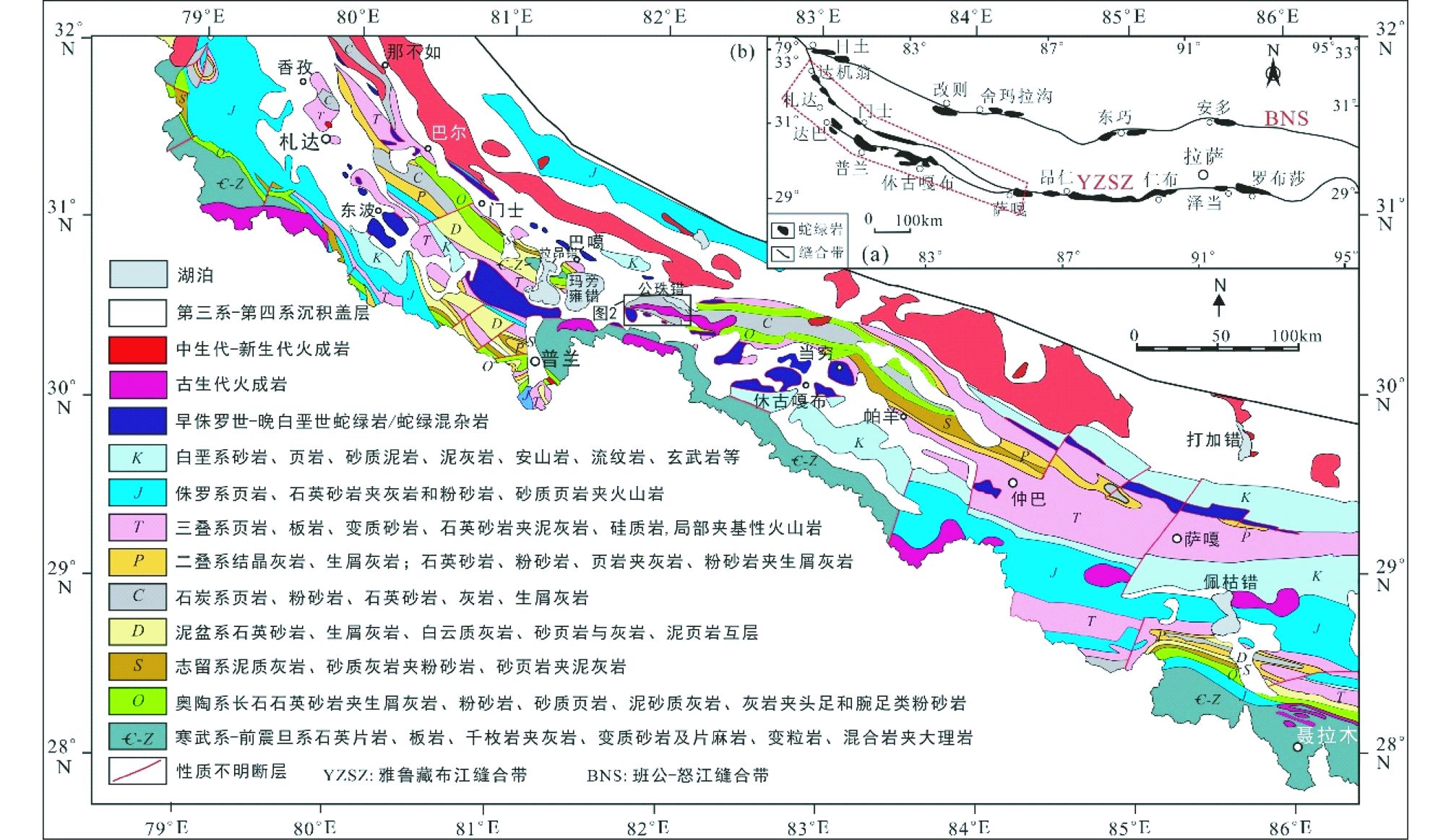
图 1 西藏雅鲁藏布江缝合带地质简图 (a)雅鲁藏布江缝合带和班公湖怒江缝合带主要蛇绿岩分布图;(b)雅鲁藏布江缝合带西段地质简图(据刘飞等,2015修改) Fig. 1 Simplified geological map of Yarlung-Zangbo Suture Zone,Tibet (a)the main ophiolites of YZSZ and Bangong-Nujiang suture zone;(b)the sketch map of western part of YZSZ(after Liu et al.,2015) |
前人根据雅鲁藏布江缝合带中蛇绿岩分布的不连续性,自东向西将其分为3段:东段自曲水至墨脱,中段自昂仁至仁布,西段从萨嘎以西至中印边境(图 1a)。其中西段又进一步分为南亚带(达巴-休古嘎布蛇绿岩带)和北亚带(达机翁-萨嘎蛇绿岩带)(潘桂棠,1997)。北亚带的蛇绿岩或蛇绿混杂岩,面积一般较小;而南亚带蛇绿岩出露面积相对较大,南北两个亚带之间被约60km宽的NNW向札达-仲巴微陆块分隔。仲巴微陆块由震旦-白垩系地层组成,空间分布大体中间老,两侧新(徐德明等,2007)。但最新碎屑锆石和构造研究表明札达-仲巴微陆块并非是独立的陆块,而可能是特提斯喜马拉雅地块的一部分(Xu et al.,2015; 孙高远和胡修棉,2012)(图 1b)。
|
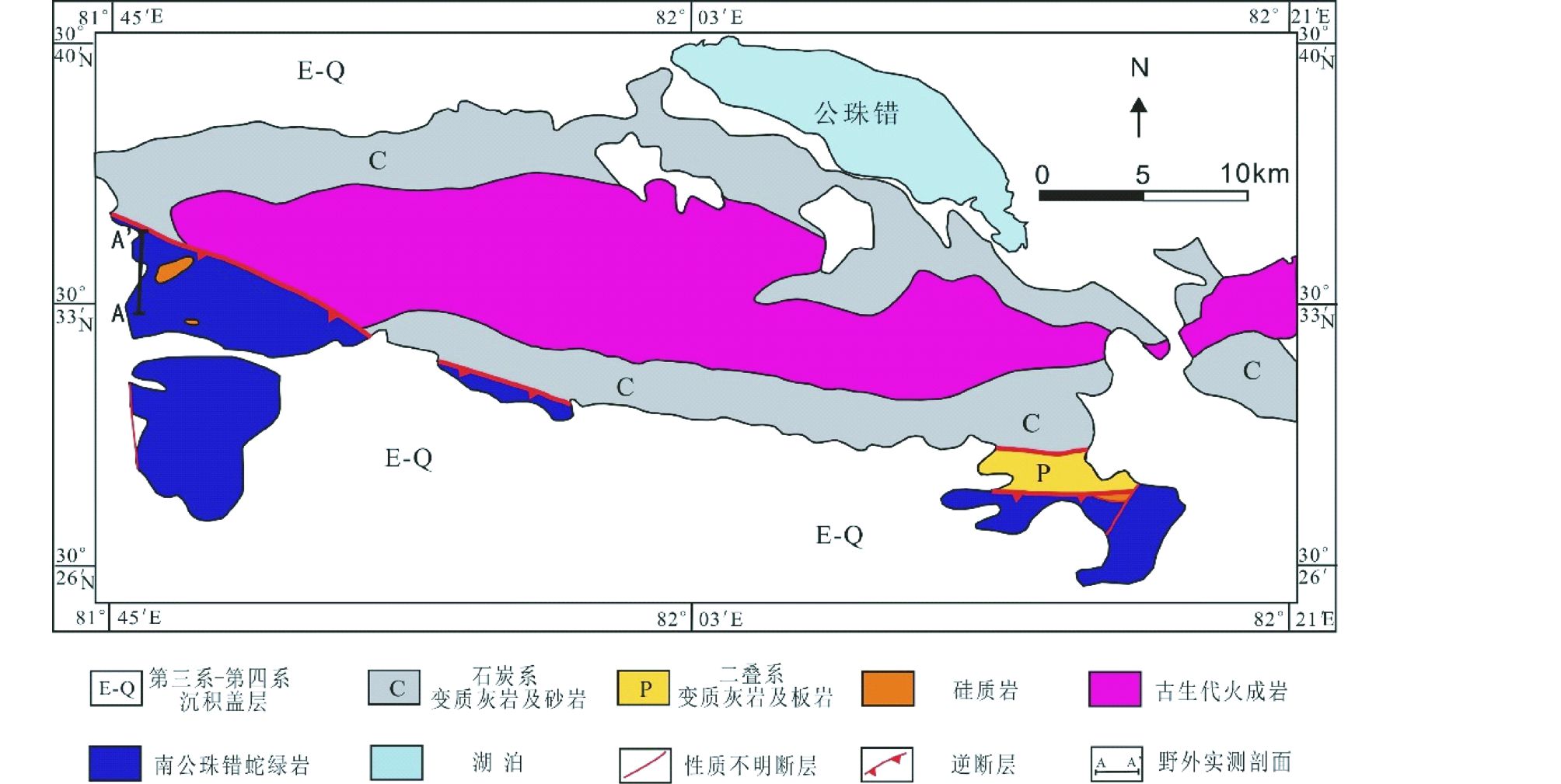
图 2 雅鲁藏布江西段南公珠错蛇绿岩地质简图(据河北省地质调查院,2005①简化) Fig. 2 Simplified geological map of the South Gongzhucuo ophiolite in the western part of YZSZ |
①河北省地质调查院. 2005. 1:25万普兰县幅地质图
|
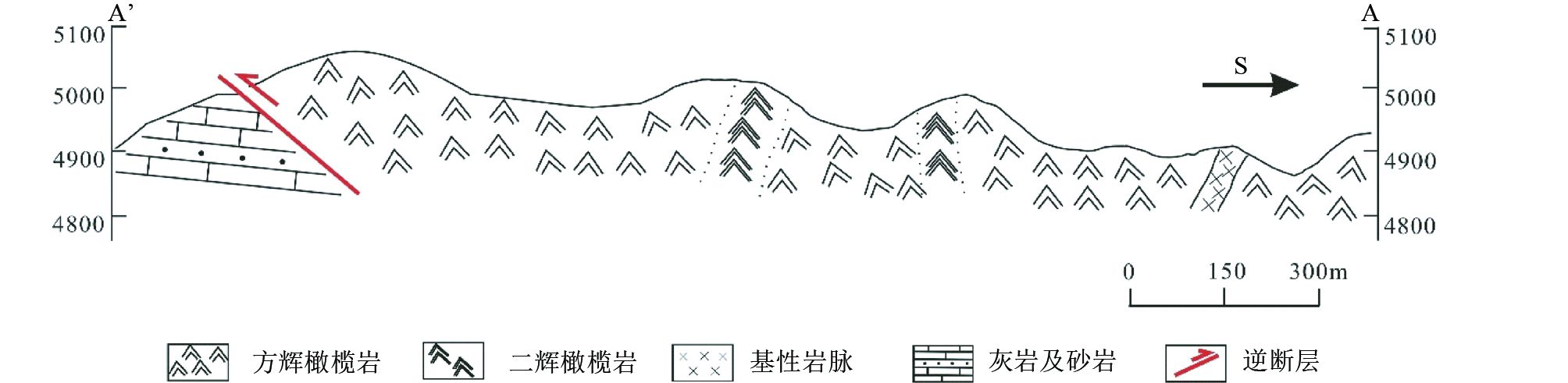
图 3 雅鲁藏布江西段南公珠错蛇绿岩剖面图 Fig. 3 Profile of South Gongzhucuo ophiolite in the western part of YZSZ |
|
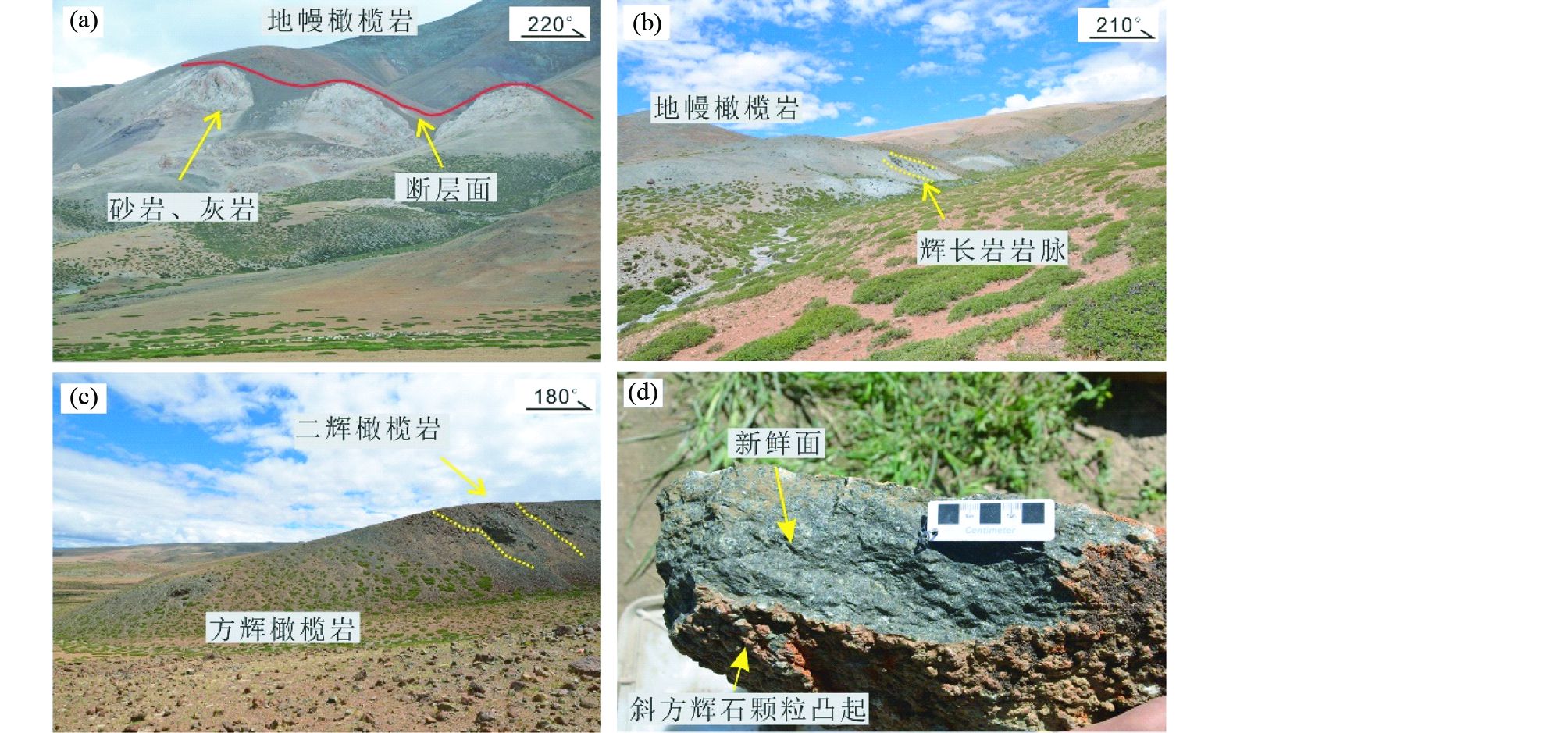
图 4 雅鲁藏布江西段南公珠错蛇绿岩野外产出 (a)南公珠错地幔橄榄岩逆冲于石炭系灰岩、砂岩之上;(b)地幔橄榄岩中有辉长岩岩脉穿插;(c)二辉橄榄岩和方辉橄榄岩接触关系;(d)二辉橄榄岩的风化面与新鲜面 Fig. 4 Field photos of the South Gongzhucuo ophiolite in the western part of YZSZ (a)mantle peridotites thrusted above Carboniferous malmstones and limestones;(b)the mantle peridotites inserted by mafic dikes;(c)contact relationship between harzburgite and lherzolite;(d)freshed and weathered face of lherzolite |

|
图 5 南公珠错地幔橄榄岩显微照片及背散射图像 (a)方辉橄榄岩中橄榄石的波状消光;(b)方辉橄榄岩中斜方辉石扭折变形并有波状消光;(c)方辉橄榄岩粗粒斜方辉石中包裹细粒的斜方辉石;(d)方辉橄榄岩中的粗粒单斜辉石;(e)二辉橄榄岩斜方辉石中的单斜辉石出溶体;(f)二辉橄榄岩中斜方辉石、单斜辉石和橄榄石的嵌晶结构;(g)方辉橄榄岩斜方辉石中的单斜辉石出溶微晶;(h)方辉橄榄岩中尖晶石和斜方辉石蠕虫状交生;(i)二辉橄榄岩单斜辉石中包裹细粒的斜方辉石. Ol-橄榄石;Cpx-单斜辉石;Opx-斜方辉石;Sp-尖晶石 Fig. 5 Microphotographs and back-scattered electron(BSE)images of South Gongzhucuo mantle peridotite (a)undulatory of olivine in harzburgites;(b)undulatory of deformed orthopyroxene in harzburgites;(c)fine-grained orthopyroxene enclosed in coarse-grained orthopyroxene in harzburgites;(d)coarse-grained clinopyroxene in harzburgites;(e)andexsolution lamella of clinopyroxene within orthopyroxene in lherzolites;(f)orthopyroxene clinopyroxene and olivine poikilitic texture in lherzolites;(g)andexsolution lamella of clinopyroxene within orthopyroxene in harzburgites;(h)spinel and orthopyroxene show vermiculate intergrowth in harzburgites;(i)fine-grained orthopyroxene enclosed in clinopyroxene in lherzolites. Ol-olivine; Cpx-clinopyroxene; Opx-orthopyroxene; Sp-spinel |
南公珠错蛇绿岩位于西藏阿里地区普兰县霍尔乡境内,公珠错南侧,地理坐标为81°45′~82°21′E、30°27′~30°36′N,地理位置上属南亚带。岩体呈北西向展布,因中部被第三系-第四系沉积物覆盖而分为西、中、东三部分,岩体北缘逆冲于石炭-二叠纪变质灰岩、砂岩、板岩之上。石炭系地层中有大面积古生代花岗岩出露(图 2)。
3 地幔橄榄岩岩石学特征本次采样选取该岩体最西端的一条剖面AA’进行,剖面位置见(图 2),剖面图见(图 3)。该岩体主体为地幔橄榄岩,地幔橄榄岩中常见有辉长岩等基性岩脉穿插(图 4b),岩体北侧可见地幔橄榄岩逆冲于石炭系灰岩、砂岩之上(图 3、图 4a)。
南公珠错地幔橄榄岩可再细分为方辉橄榄岩和二辉橄榄岩,其中方辉橄榄岩约占80%,二辉橄榄岩约占20%,二辉橄榄岩与方辉橄榄岩为岩相渐变关系(图 3、图 4c),纯橄岩出露较少。地幔橄榄岩风化面呈土黄色或者褐色,风化面上常可见斜方辉石颗粒凸起,系差异风化的结果;地幔橄榄岩新鲜面为暗绿色,蛇纹石化程度较弱(图 4d)。
3.1 方辉橄榄岩方辉橄榄岩在该岩体中大面积连续出露。方辉橄榄岩风化面呈土黄色,新鲜面呈绿色、暗绿色,岩石质地坚硬较为新鲜,蛇纹石化轻微,常具块状构造,粒状结构、残斑结构、熔融残余结构,主要由橄榄石,斜方辉石,以及少量单斜辉石和铬尖晶石组成。
橄榄石含量75%~80%,可见其发生蛇纹石化而呈网格状、孤岛状。橄榄石可分为粗粒(粒径1~4mm)和细粒两类。粗粒橄榄石常显示应力形变痕迹,如重结晶、扭折带、波状消光等现象(图 5a);细粒橄榄石呈填隙状产于不同矿物颗粒间或者呈包裹体产于斜方辉石之中(图 5b)。
斜方辉石含量10%~20%,主要为粗粒(粒径1~4mm),由于受应力形变,可见解理缝弯曲、晶体挠曲、波状消光(图 5b)。粗粒斜方辉石的边部常呈港湾状,可见有细粒的橄榄石、斜方辉石、单斜辉石颗粒产于粗粒斜方辉石的港湾中(图 5b)。也可见少量早期斜方辉石颗粒包裹于后期粗粒斜方辉石中(图 5c)。
单斜辉石含量1%~4%,粒径0.2~2mm不等。呈他形-半自形单独产出(图 5d)或呈细粒填隙状分布于粗粒斜方辉石边部或在斜方辉石中以固溶体出溶微晶形式存在(图 5g)。
尖晶石含量1%~2%,粒径在0.2~1mm之间。多呈蠕虫状、他形晶产于蛇纹石化的橄榄石中(图 5d),也可见尖晶石与粗粒斜方辉石呈蠕虫状交互存在(图 5h)。
3.2 二辉橄榄岩二辉橄榄岩呈窄带分布于方辉橄榄岩中,宽度约为5~10m,岩石新鲜,蛇纹石化较弱,风化面为土黄色,新鲜面呈暗绿色,多具块状构造、网状结构、粒状结构。岩石主要由橄榄石,斜方辉石,单斜辉石以及少量的铬尖晶石组成。
橄榄石含量70%~80%,可以识别出两类或可能为两个世代的橄榄石。一类橄榄石粒径较粗,约1~4mm,普遍发育扭折带,显示了明显的塑性变形;另一类为细粒橄榄石存在于其他矿物间,可能系早期橄榄石受动力作用发生碎裂化或重结晶形成(图 5e)。另可见橄榄石呈不等粒结构、他形粒状等包裹在斜方辉石中(图 5e)。
斜方辉石含量10%~20%,也同样存在两个粒级。斜方辉石粒度普遍比较粗,可达4mm,易发生扭折变形、波状消光,常呈斑状晶体或浑圆粒状在橄榄石间产出(图 5e)。另可见一些细粒的斜方辉石包裹于粗粒斜方辉石和单斜辉石颗粒中(图 5f,i)。
单斜辉石含量5%~7%,粒径0.2~2mm不等。颗粒较粗的单斜辉石为主,分布在橄榄石间隙之间(图 5f),少量单斜辉石以出溶体形式存在于斜方辉石中(图 5e)。
尖晶石含量1%~2%,粒径在0.2~1mm之间,以他形为主,呈不均匀零星分布于蛇纹石化的橄榄石中(图 5e)或与斜方辉石共生。
4 分析方法电子探针测试在中国地质科学院地质研究所大陆构造与动力学实验室完成,使用仪器为日本电子公司JXA-8100和INCA能谱仪;实验使用探针束流20nA,加速电压15.0kV,电子束斑5μm。
全岩样品测试分析在中国地质科学院国家地质实验测试中心完成。主量元素采用熔片X射线荧光光谱法测定,并采用等离子光谱和化学法测定互相检测。微量元素中的V、Cr、Co、Ni、Sr、Zr、Nb、Ta、Hf、Ba、Th、U等元素用熔片X射线荧光光谱(XRF)和酸溶等离子质谱(ICP-MS)法测定;稀土元素用ICP-MS法测定,其中的Nb、Ta、Zr、Hf是用碱溶法、沉淀酸提取、等离子质谱法测定。为保证分析质量,同时分析了3个平行样品和2个国家标准样(GSR3和GSR5)。铂族元素采用锍镍火试金-碲共沉淀法。具体分析过程是将10g样品(200目)与2g Ni2O3、1.25g硫磺粉、15g Na2CO3、20g Na2B4O7、1g SiO2以及1g面粉均匀混合后,转入粘土坩埚中,然后加入适量的由美国橡树岭国家实验室出品Os190稀释剂,将坩埚置于1200℃的试金炉中加热熔融1.5h后,冷却后将锍镍扣取出,将其粉碎溶解于浓HCl中并加入碲共沉淀剂,加热使其凝聚后再转入Teflon密闭溶样器中,加入1mL王水,于100℃加热溶解1h后用H2O稀释至10mL最后用ICP-MS(TJAPQ-EXCELL)直接测量。本实验的全流程空白为:Ru、Ir、Pd、Os小于0.3×10⁻⁹,Pt、Rh小于0.06×10⁻⁹。本文所列的结果是测定值扣除全流程空白后的结果。实验所测定的标准参考物(GPT24和GPT27)的分析结果与推荐值吻合较好。
5 南公珠错地幔橄榄岩矿物化学岩石在不同的条件和环境下所形成的矿物特征会有所差异,这种差异是岩石形成和演化历史的印记,地幔橄榄岩的矿物组合及其化学成分的研究对认识地幔橄榄岩的成因及恢复其形成构造环境具有重要意义。本文对南公珠错地幔橄榄岩中的橄榄石、斜方辉石、单斜辉石以及尖晶石等矿物的主量元素进行了测试分析与研究,以通过不同岩相及不同矿物的成分差异来分析其地质意义。
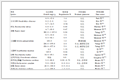
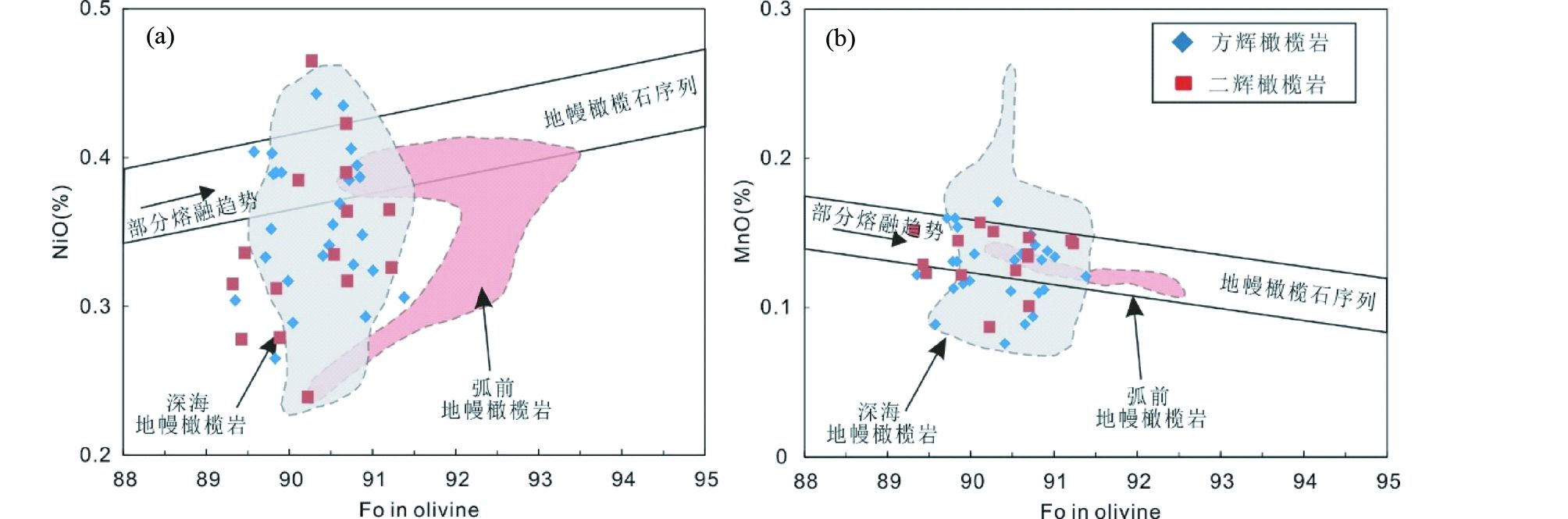
5.1 橄榄石本研究共分析了10件样品的41颗橄榄石的电子探针成分,其中方辉橄榄岩中26颗,二辉橄榄岩中15颗,代表性分析结果列于表 1,并作成分图解(图 6)。橄榄石Fo值变化于89.3~91.4之间,平均值90.3,均属于镁橄榄石。NiO含量变化于0.24%~0.47%,平均值为0.35%。Cr2O3含量变化于0.001%~0.10%,平均值为0.02%。
|
表 1 南公珠错蛇绿岩地幔橄榄岩中代表性橄榄石电子探针分析结果(wt%) Table 1 Representative microprobe analyses of olivine in mantle peridotites from the South Gongzhucuo ophiolite(wt%) |
方辉橄榄岩的Fo值介于89.3~91.4之间,平均值90.3;二辉橄榄岩的Fo值介于89.3~91.2之间,平均值90.3,变化幅度接近。Dick等认为的橄榄石的Fo值越大其形成深度和熔融程度越高(Dick and Natland,1996),但在该橄榄岩中表现的并不明显。
|
图 6 南公珠错地幔橄榄岩橄榄石成分图解 地幔橄榄岩序列据Takahashi,1986;部分熔融趋势线据Ozawa,1994;深海地幔橄榄岩及弧前地幔橄榄岩据Pagé et al.,2008 Fig. 6 Compositional variations of olivines in peridotites of the South Gongzhucuo ophiolite The mantle olivine array after Takahashi,1986; partial melting trends after Ozawa,1994; abyssal peridotite and Fore-arc peridotite after Pagé et al.,2008 |
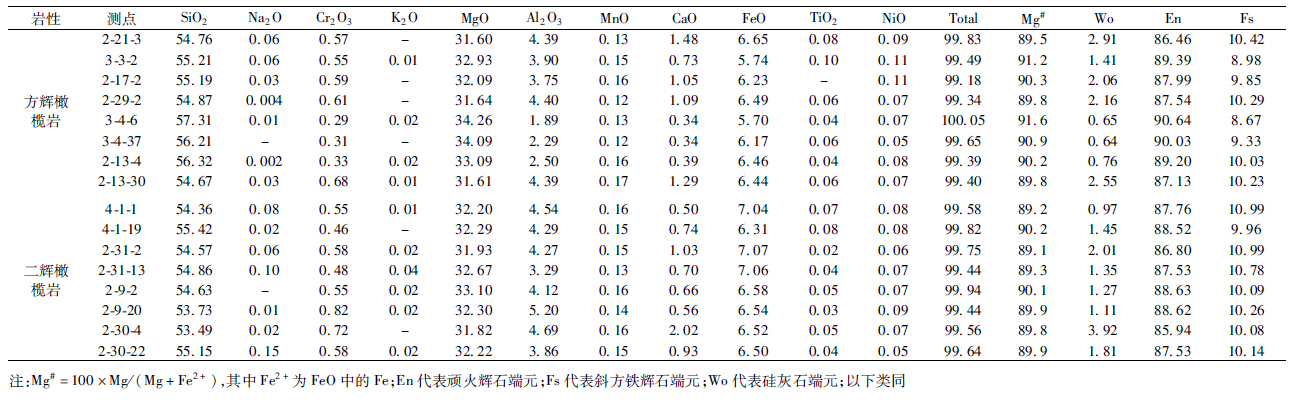
本研究共分析了10件样品的81颗斜方辉石的电子探针成分,其中方辉橄榄岩中51颗,二辉橄榄岩中30颗,代表性分析结果列于表 2,并作成分图解(图 7)。二辉橄榄岩中斜方辉石的En端员组分介于84.6~89.6之间,平均值87.5;方辉橄榄岩中斜方辉石的En端员组分介于85.2~90.6之间,平均值88.3,均为顽火辉石。
|
|
表 2 南公珠错蛇绿岩地幔橄榄岩中代表性斜方辉石电子探针分析结果(wt%) Table 2 Representative microprobe analyses of orthopyroxene in mantle peridotites from the South Gongzhucuo opiolite(wt%) |
|
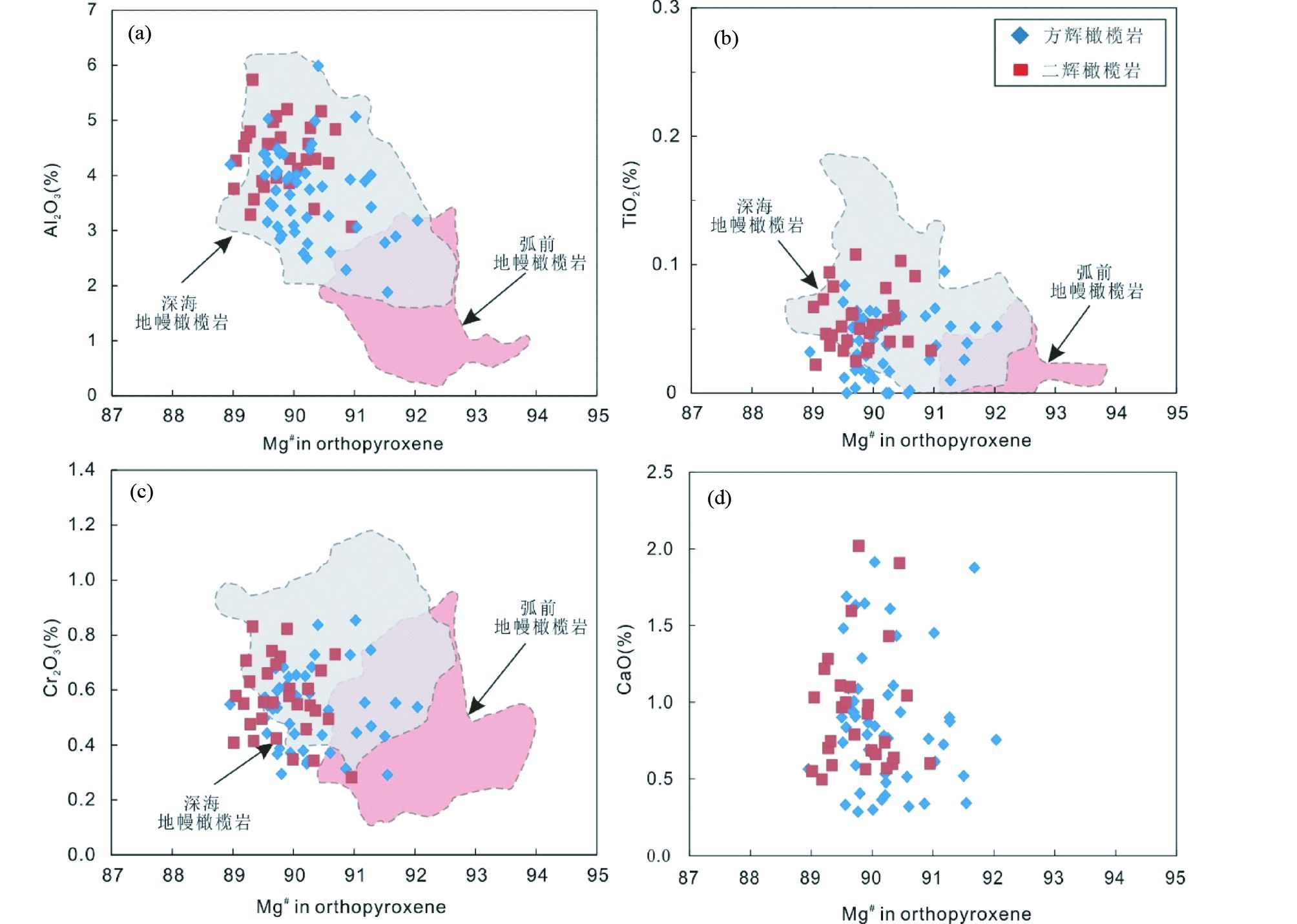
图 7 南公珠错地幔橄榄岩斜方辉石成分图解(据Lian et al.,2016) Fig. 7 Compositional variations of orthopyroxenes in peridotites of the South Gongzhucuo ophiolite(after Lian et al.,2016) |
二辉橄榄岩中斜方辉石Mg#值为89.0~91.0,平均值为89.8。Al2O3含量为3.07%~5.74%,平均值为4.35%。Cr2O3含量为0.28%~0.83%,平均值为0.57%。NiO含量为0.03%~0.14%,平均值为0.07%。CaO含量为0.50%~2.81%,平均值为1.07%。
方辉橄榄岩中斜方辉石Mg#值为87.5~92.0,平均值为90.2,较二辉橄榄岩中高。Al2O3含量为1.89%~5.99%,平均值为3.93%。Cr2O3含量为0.29%~0.85%,平均值为0.53%。NiO含量为0.02%~0.15%,平均值为0.07%。CaO含量为0.29%~1.91%,平均值为0.88%。
一般认为斜方辉石中的Al2O3含量越高,其形成深度越大且部分熔融程度越低(Dick and Natland,1996; Dick,1977),因此Al2O3含量的多少可作为部分熔融程度的标志。图 7显示方辉橄榄岩Al2O3含量较二辉橄榄中低,证明方辉橄榄岩的部分熔融程度高于二辉橄榄岩。南公珠错地幔橄榄岩中斜方辉石的Mg#值与Al2O3含量呈现明显的负相关线性变化规律,而CaO、Cr2O3、TiO2含量显示出较宽的变化范围。
5.3 单斜辉石本研究共分析了10件样品的75颗单斜辉石的电子探针成分,其中方辉橄榄岩中43颗,二辉橄榄岩中32颗,代表性分析结果列于表 3,并作成分图解(图 8)。二辉橄榄岩中单斜辉石的En端员组分介于43.8~51.2,平均值46.4;方辉橄榄岩中单斜辉石的En端员组分介于44.1~49.6,平均值45.9,均主要为透辉石。
|
|
表 3 南公珠错蛇绿岩地幔橄榄岩中代表性单斜辉石电子探针分析结果(wt%) Table 3 Representative microprobe analyses of clinopyroxene in mantle peridotites from the South Gongzhucuo opiolite(wt%) |
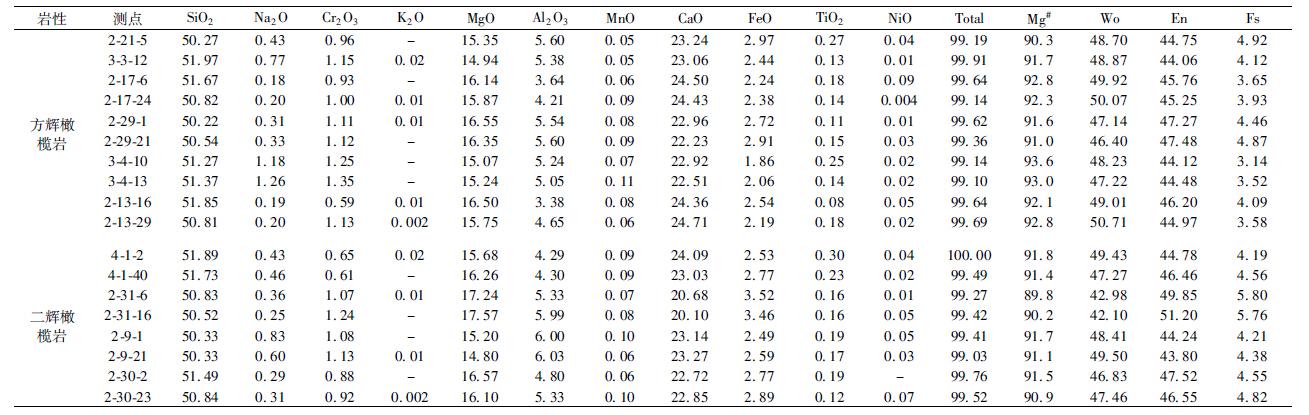
二辉橄榄岩中单斜辉石Mg#值为89.8~92.5,平均值为91.2。Al2O3含量为3.86%~6.06%,平均值为5.23%。Cr2O3含量为0.61%~1.64%,平均值为0.93%。TiO2含量为0.08~0.34%,平均值为0.21%。NiO含量为0.008%~0.11%,平均值为0.05%。CaO含量为20.10%~24.09%,平均值为22.62%。
方辉橄榄岩中单斜辉石Mg#值为90.3~93.6,平均值为92.0,较二辉橄榄岩中高。Al2O3含量为2.12%~5.82%,平均值为4.76%。Cr2O3含量为0.41%~1.53%,平均值为1.05%。TiO2含量为0.08%~0.27%,平均值为0.16%。NiO含量为0.004%~0.09%,平均值为0.04%。CaO含量为20.06%~24.71%,平均值为20.11%。
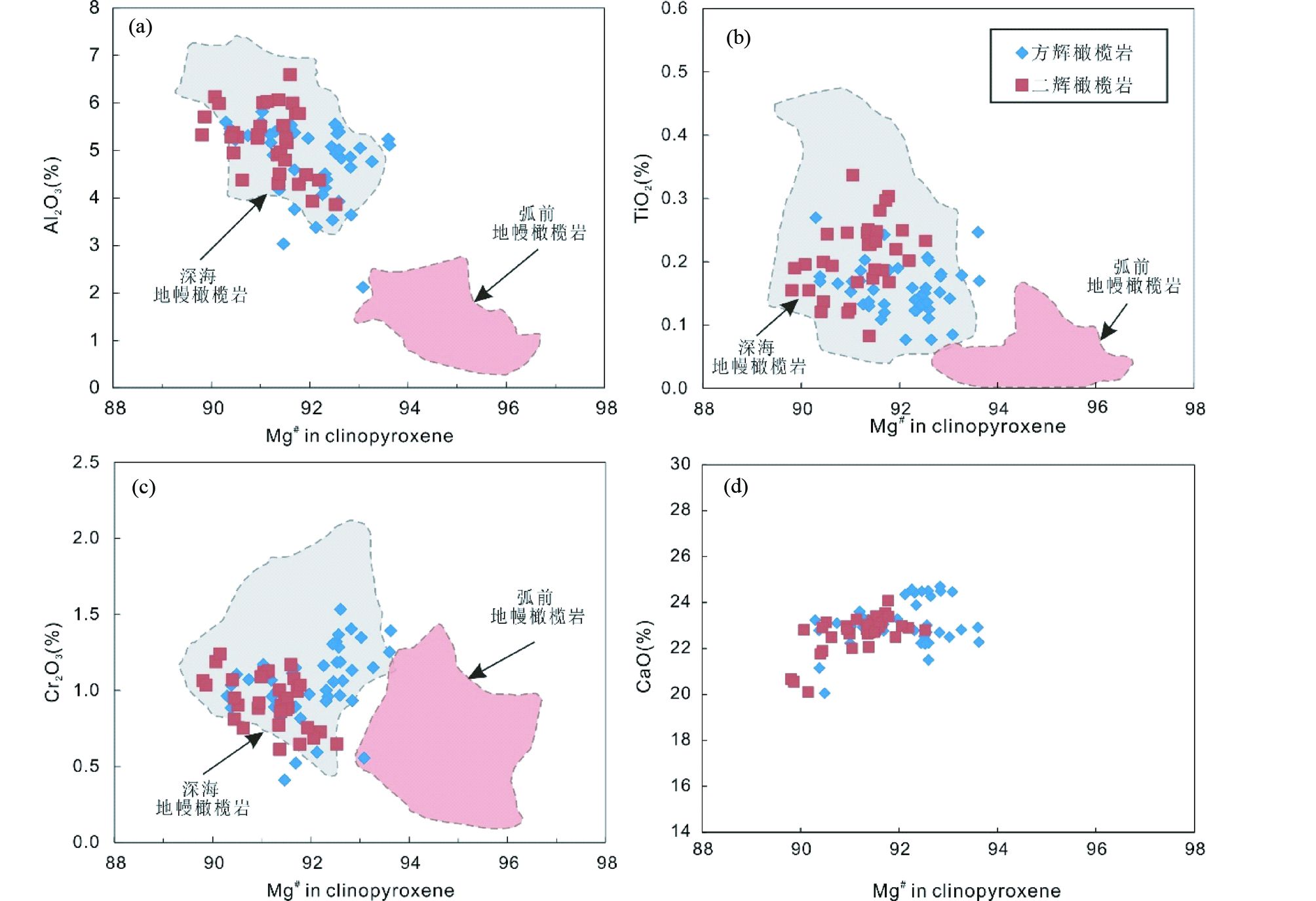
由图 8可知,南公珠错地幔橄榄岩中单斜辉石的Mg#值与Al2O3、TiO2呈现明显的负相关变化特征,但二者的CaO和Cr2O3变化范围较宽。
|
图 8 南公珠错地幔橄榄岩单斜辉石成分图解(据Lian et al.,2016) Fig. 8 Compositional variations of clinopyroxenes in peridotites of the South Gongzhucuo ophiolite(after Lian et al.,2016) |
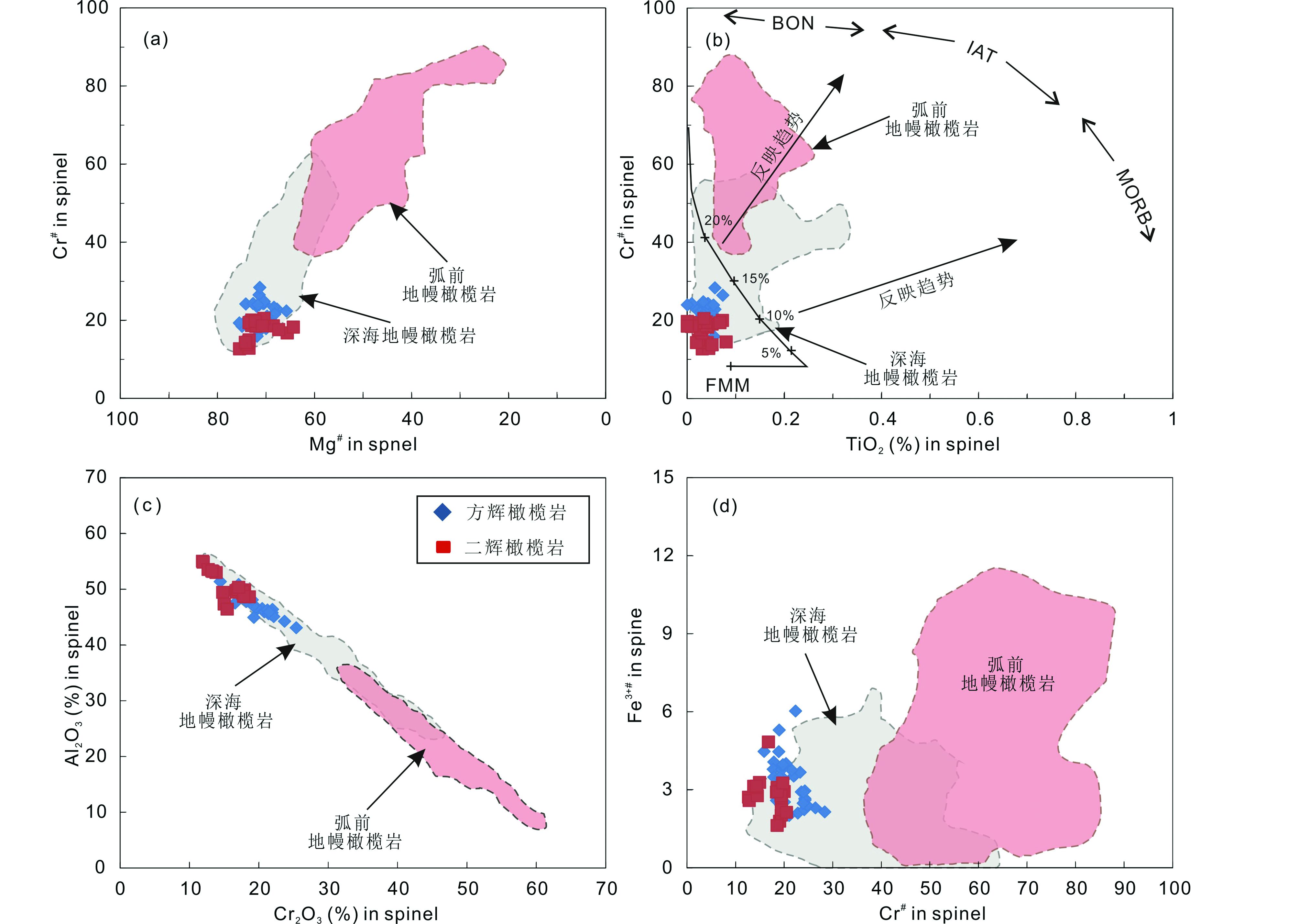
本研究共分析了10件样品的63颗尖晶石的电子探针成分,其中方辉橄榄岩中39颗,二辉橄榄岩中24颗,代表性分析结果列于表 4,并作成分图解(图 9)。
|
|
表 4 南公珠错蛇绿岩地幔橄榄岩中代表性尖晶石电子探针分析结果(wt%) Table 4 Representative microprobe analyses of spinel in mantle peridotites from the South Gongzhucuo ophiolite(wt%) |
|
图 9 南公珠错地幔橄榄岩尖晶石成分图解(据Tamura and Arai,2006; Lian et al.,2016) MORB-大洋中脊型玄武岩;BON-玻安岩;FMM-富集的大洋中脊型地幔;IAT-岛弧拉斑质玄武岩 Fig. 9 Compositional variations of spinels in peridotites of the South Gongzhucuo ophiolite(after Tamura and Arai,2006; Lian et al.,2016) MORB-Mid-ocean ridge basalt; BON-Boninite; FMM-Fertile MOR mantle; IAT-Island arc tholeiite |
二辉橄榄岩中尖晶石Cr#值介于12.7~20.4之间,平均值为17.4。Mg#为64.4~75.4,平均值为71.6。Al2O3含量为46.78%~55.08%,平均值为50.53%。TiO2含量为~0.08%,平均值为0.03%。NiO含量为0.20%~0.35%,平均值为0.26%。
方辉橄榄岩中尖晶石Cr#值介于15.9~28.3之间,平均值为21.0。Mg#为65.8~75.5,平均值为71.0。Al2O3含量为43.11%~51.40%,平均值为47.78%。TiO2含量为~0.07%,平均值为0.03%。NiO含量为0.13%~0.35%,平均值为0.24%。
由图 9可知,从二辉橄榄岩到方辉橄榄岩铬尖晶石的Cr#逐渐增加。南公珠错地幔橄榄岩与世界上大多数阿尔卑斯型超镁铁岩特征相似,Cr#与Mg#呈负相关关系(Leblanc,1980)。不同岩相之间尖晶石的Al2O3含量差别明显,与尖晶石Cr#值呈现明显的负相关。
6 南公珠错地幔橄榄岩全岩地球化学本研究对10件样品进行了全岩地球化学分析,分析结果见表 5。其中包括5件二辉橄榄岩样品和5件方辉橄榄岩样品。
|
|
表 5 南公珠错蛇绿岩地幔橄榄岩全岩地球化学分析结果(主量元素:wt%;微量元素和稀土元素:×10-6) Table 5 Whole rock composition of South Gongzhucuo peridotite(Major elements: wt%; Rare Earth Elements and trace element: ×10-6) |
由于岩石遭受了不同程度的蛇纹石化,因此将这些样品的主量元素分析结果扣除烧失量之后再进行归一化,以消除岩石蚀变对原成分的影响。
方辉橄榄岩5个样品的烧失量(LOI)介于1.85%~3.68%之间。SiO2含量为43.89%~45.52%,平均值为44.34%。MgO含量为42.22%~44.38%,平均为43.13%。Al2O3含量为1.49%~1.82%,平均为1.64%。MnO含量为 0.12%~0.14%,平均为0.13%。TiO2含量为0.02%~0.04%,平均为0.03%。CaO含量为1.09%~1.97%,平均为1.60%。
二辉橄榄岩5个样品的烧失量(LOI)介于2.10%~4.05%之间。SiO2含量为44.31%~45.33%,平均值为44.79%。MgO含量为40.84%~42.20%,平均值为41.40%,较方辉橄榄岩中低。Al2O3含量为1.89%~2.46%,平均为2.16%,较方辉橄榄岩中高,这与镜下观察二辉橄榄岩中辉石含量较高是一致的。MnO含量为0.12%~0.14%,平均值为0.13%。TiO2含量为0.03%~0.05%,平均值为0.04%。CaO含量为2.17%~2.46%,平均为2.29%。
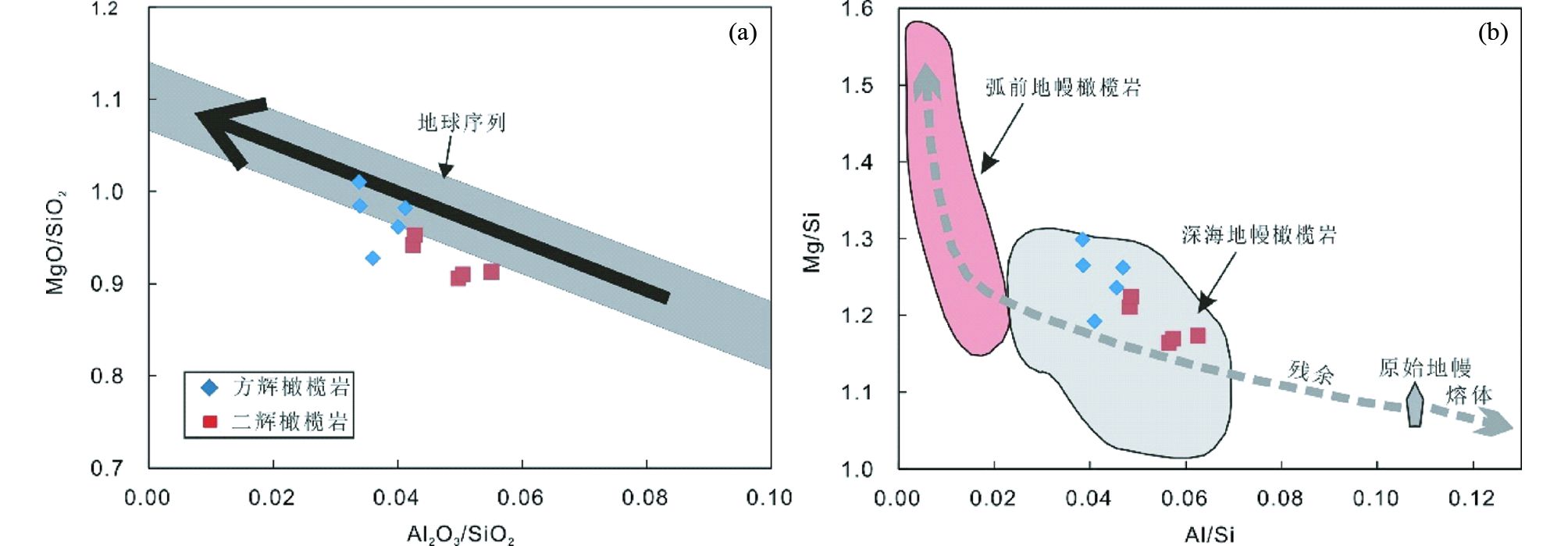
在MgO/SiO2对Al2O3/SiO2图解中(图 10a),南公珠错地幔橄榄岩位于地球序列(熔融趋势)线(Jagoutz et al.,1979; Zindler and Hart,1986)附近,斜率大致相同,MgO/SiO2略低于趋势线。橄榄岩中MgO/SiO2偏低通被常认为是海底风化作用使MgO缺失而Al2O3/SiO2不受影响(Snow and Dick,1995; Niu,2004)。同时对南公珠错地幔橄榄岩全岩地球化学数据作Al/Si-Mg/Si图解并与深海地幔橄榄岩数据和弧前地幔橄榄岩数据对比(图 10b),发现南公珠错地幔橄榄岩完全落入深海地幔橄榄岩中。
|
图 10 南公珠错地幔橄榄岩全岩Al2O3/SiO2-MgO/SiO2(a)及全岩Al/Si-Mg/Si(b)图解 地球序列据Jagoutz et al.,1979;深海地幔橄榄岩和弧前地幔橄榄岩据Hattori and Guillot,2007;原始地幔据McDonough and Sun,1995 Fig. 10 Whole rock weight ratios of Al2O3/SiO2 vs. MgO/SiO2 diagram(a)and Al/Si vs. Mg/Si diagram(b)of mantle peridotites from South Gongzhucuo ophiolite Terresterial array after Jagoutz et al.,1979; abyssal peridotite and fore-arc peridotite after Hattori and Guillot,2007; primitive mantle after McDonough and Sun,1995 |
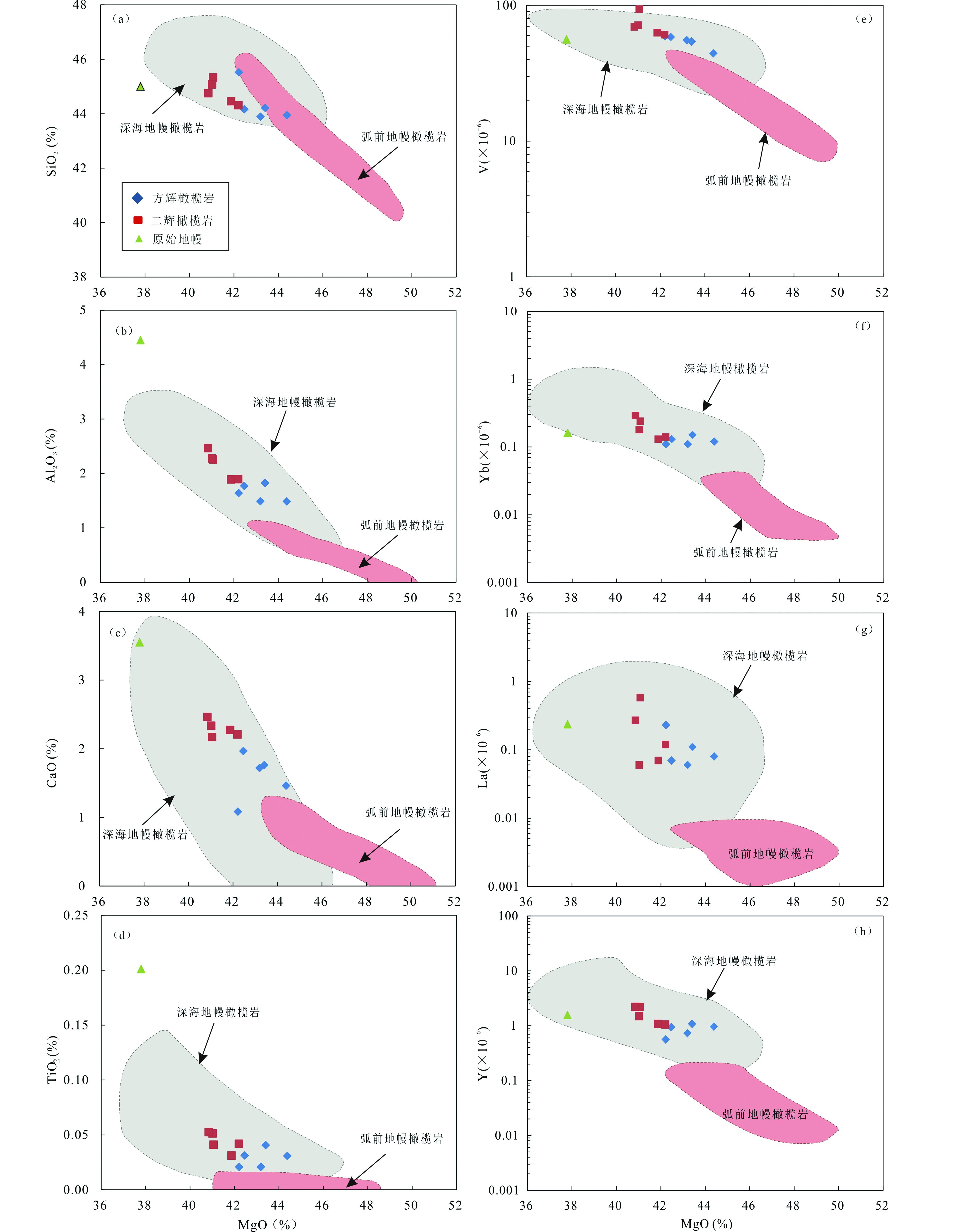
Frey et al.(1985) 指出MgO含量随岩石中橄榄石含量的增加而增加,MgO含量越高岩石越亏损。因此MgO含量可作为亏损指标,来反映地幔橄榄岩的亏损程度。为方便反映地幔橄榄岩全岩化学成分的变化及其相对亏损程度,本文对南公珠错地幔橄榄岩的MgO的含量和主量元素含量进行投图,并与原始地幔(McDonough and Sun,1995)进行比较(图 11a-d)。南公珠错地幔橄榄岩中的MgO含量明显高于原始地幔,易熔元素CaO、TiO2、Al2O3的含量均明显低于原始地幔的含量,CaO、Al2O3、SiO2等不相容元素与MgO含量之间表现出较好的负相关关系,其三者在二辉橄榄岩中的含量稍高于方辉橄榄岩中含量,说明南公珠错地幔橄榄岩相对于原始地幔亏损,且方辉橄榄岩亏损程度高于二辉橄榄岩。与深海地幔橄榄岩及弧前地幔橄榄岩全岩化学成分(Niu,1997; Parkinson and Pearce,1998)对比发现南公珠错地幔橄榄岩与深海地幔橄榄岩表现出相似的化学特征。
|
图 11 南公珠错地幔橄榄岩主量元素及微量元素-MgO图解 原始地幔值据McDonough and Sun,1995;深海地幔橄榄岩据Niu,1997,2004;弧前地幔橄榄岩据Parkinson and Pearce,1998 Fig. 11 Variation diagrams of oxides and trace elements vs. MgO of the mantle peridotites of the South Gongzhucuo ophiolite Primitive mantle value after McDonough and Sun,1995; abyssal peridotite after Niu,1997,2004; fore-arc peridotite after Parkinson and Pearce,1998 |
本次分析的10件样品∑REE介于0.66×10⁻⁶~3.78×10⁻⁶之间,平均值为1.42×10⁻⁶(方辉橄榄岩中介于0.66×10⁻⁶~1.10×10⁻⁶,平均值为0.92×10⁻⁶;二辉橄榄岩中介于0.90×10⁻⁶~3.78×10⁻⁶之,平均值为1.91×10⁻⁶),低于原始地幔(∑REE=7.43×10⁻⁶)和亏损地幔(∑REE=4.25×10⁻⁶)的含量,指示了南公珠错地幔橄榄岩相对于原始地幔经历了一定程度的部分熔融作用(Sun and McDonough,1989; Salters and Stracke,2004)。LREE/HREE介于0.40×10-6~2.09×10-6之间,平均值为0.95×10-6。(La/Yb)N介于0.24×10-6~1.73×10-6之间,平均值为0.69×10-6。(La/Sm)N介于0.65×10-6~8.19×10-6之间,平均值为2.28×10-6。(Eu/Yb)N介于0.18×10-6~0.73×10-6之间,平均值为0.35×10-6。
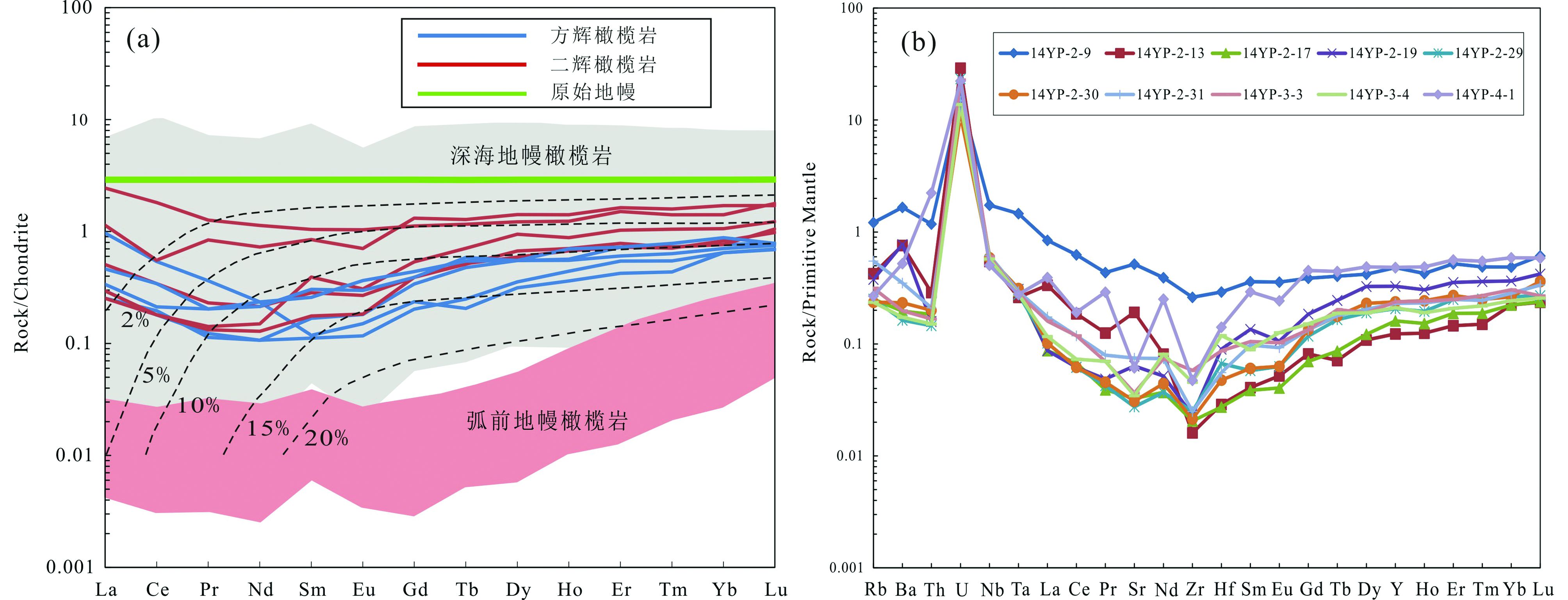
尽管南公珠错地幔橄榄岩的稀土元素含量有一定变化,但其配分模式基本一致:均表现为LREE轻微富集(图 12a)。与太平洋洋中脊、印度洋洋中脊深海地幔橄榄岩(Niu,2004)以及马里亚纳弧前地幔橄榄岩(Parkinson and Pearce,1998)稀土元素特征进行对比发现:南公珠错地幔橄榄岩稀土元素含量特征和深海地幔橄榄岩一致,均未落入弧前地幔橄榄岩区域(图 12a)。
|
图 12 南公珠错蛇绿岩地幔橄榄岩球粒陨石标准化稀土元素配分图(a,标准化值据Sun and McDonough,1989)和原始地幔标准化微量元素蛛网图(b,标准化值据McDonough and Sun,1995) (a)图中灰色区域代表深海地幔橄榄岩变化范围(据Niu,2004);粉色区域代表Izu-Bonin-Mariana弧前的地幔橄榄岩的变化范围(据Parkinson and Pearce,1998);图中黑线代表尖晶石相地幔源区在近分离熔融模型经过2%~20%熔体提取后的熔融残余(据Krishnakanta Krishnakanta Singh,2013) Fig. 12 Chondrite-normalized REE patterns(a,normalization values after Sun and McDonough,1989)and primitive mantle-normalized trace elements patterns(b,normalization values after McDonough and Sun,1995)for the peridotites from South Gongzhucuo ophiolite (a)the gray region represents compositional variations of abyssal peridotites(after Niu,2004); the pink region represents compositional variations for-arc peridotites from Izu-Bonin-Mariana(after Parkinson and Pearce,1998); The dash lines are the range of model residual mantle compositions calculated using the modelling of near-fractional melting for different amounts of melt extraction(2%~20%)melting within the spinel stability field,(after Krishnakanta Singh,2013) |
南公珠错地幔橄榄岩原始地幔标准化微量元素蜘蛛图(图 12b)显示:南公珠错地幔橄榄岩的U具有强烈的正异常,Nd轻微正异常,强不相容元素Zr显示负异常,大离子亲石元素Sr既有正又有负异常。
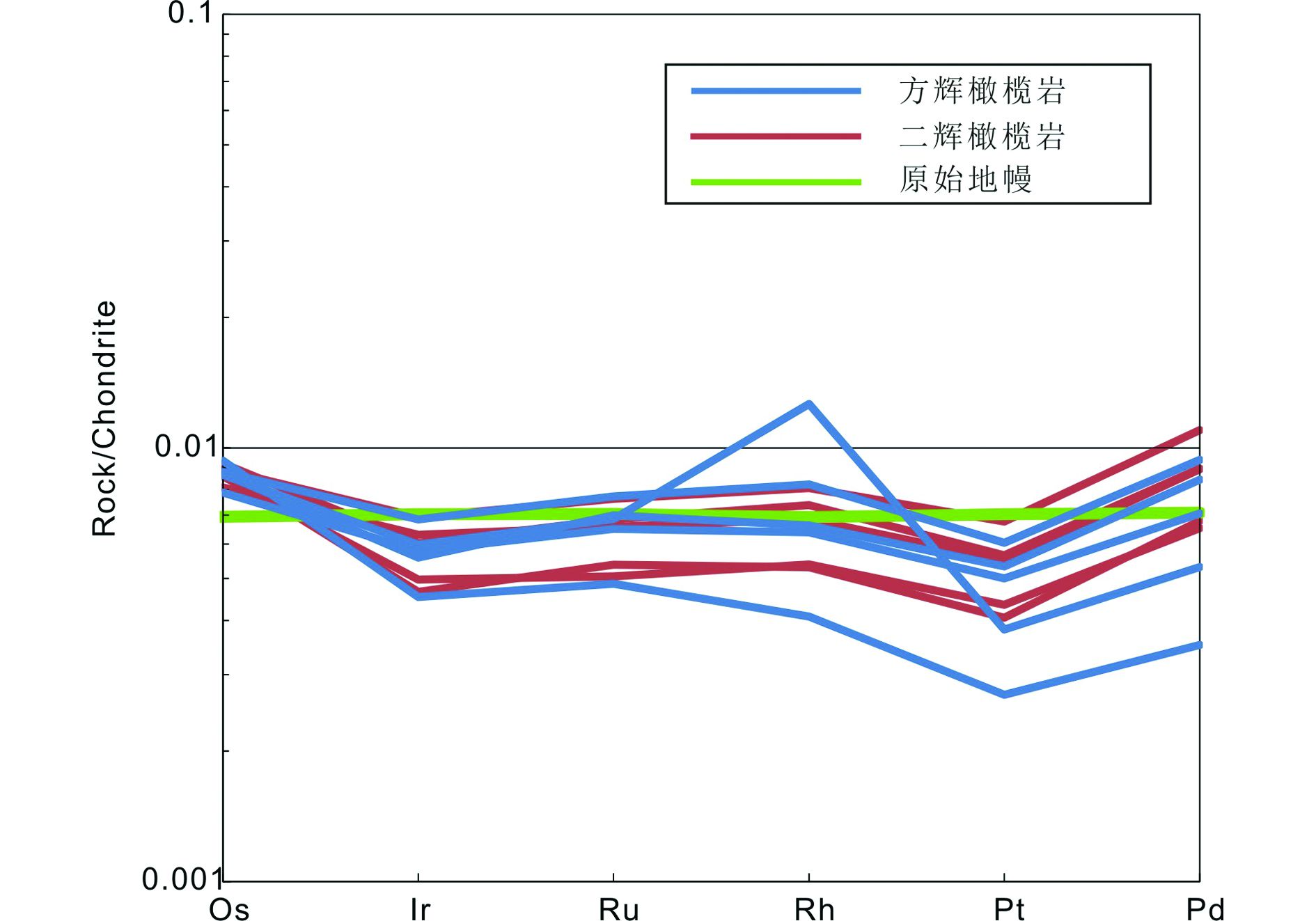
6.3 铂族元素特征南公珠错地幔橄榄岩铂族元素(PGEs)分析结果(表 6)及其球粒陨石标准化图解(图 13)显示:其PGEs总量介于15.26×10⁻⁹~26.86×10⁻⁹之间(其中方辉橄榄岩中介于15.26×10⁻⁹~25.23×10⁻⁹,平均值为20.85×10⁻⁹;二辉橄榄岩中介于18.74×10⁻⁹~26.86×10⁻⁹,平均值为22.20×10⁻⁹),平均值21.52×10⁻⁹,变化较小。方辉橄榄岩和二辉橄榄岩球粒陨石标准化的铂族元素配分图解基本一致,为接近于原始地幔的“平坦型”,表现出原始地幔部分熔融残余的特征。
|
图 13 南公珠错蛇绿岩地幔橄榄岩球粒陨石标准化铂族元素(PGEs)分配模式图(原始地幔和球粒陨石值据Sun and McDonough,1989) Fig. 13 Chondrite-normalized PGEs patterns for the peridotites from South Gongzhucuo ophiolite(chondrite and primitive mantle value after Sun and McDonough,1989) |
|
|
表 6 南公珠错蛇绿岩地幔橄榄岩全岩铂族元素分析结果(×10-9) Table 6 Platinum-group elements compositions of mantle peridotites from South Gongzhucuo ophiolite(×10-9) |
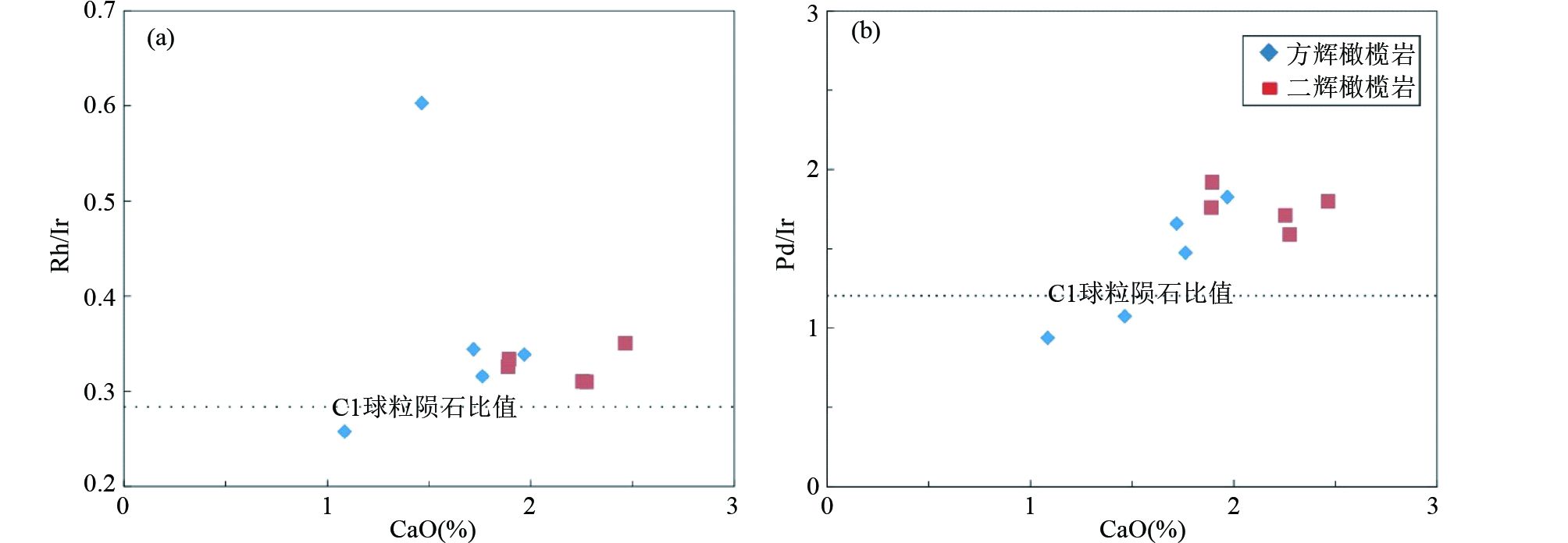
南公珠错地幔橄榄岩表现为Os,Ru和Rh,Pd分别相对于Ir和Pt的富集特征(图 13)。Pd/Ir变化于0.94~1.92之间,平均值1.58,多数大于C1球粒陨石Pd/Ir比值(1.21)。Rh/Ir介于0.26~0.60之间,平均值0.35,同样多数大于C1球粒陨石Pd/Ir比值(0.29)(图 14)。
|
图 14 南公珠错蛇绿岩地幔橄榄岩CaO-Rh/Ir(a)和CaO-Pd/Ir(b)图解(球粒陨石值据Sun and McDonough,1989) Fig. 14 CaO vs. Rh/Ir(a)and CaO vs. Pd/Ir(b)diagrams for the peridotites from South Gongzhucuo ophiolite(chondrite value after Sun and McDonough,1989) |
通常地幔橄榄岩的矿物含量特征、矿物的化学特征和全岩化学组成特征可以为地幔橄榄岩的部分熔融特征提供证据(Dick and Bullen,1984; Parkinson and Pearce,1998; Uysal et al.,2007)。
一般认为上地幔由二辉橄榄岩组成,在尖晶石相二辉橄榄岩部分熔融过程中单斜辉石被认为是最先消耗的矿物(Mysen and Kushiro,1977; Jaques and Green,1980),在无水条件下地幔橄榄岩在经历大于25%的部分熔融后其单斜辉石含量可由约15%(相当于部分熔融程度为0%的富集地幔橄榄岩)降低为0%;如果为石榴子石相的地幔源区,单斜辉石可以保存至较高的部分熔融程度(Parkinson and Pearce,1998)。因此地幔橄榄岩中单斜辉石含量可反映地幔橄榄岩的亏损及相对部分熔融程度。南公珠错地幔橄榄岩中二辉橄榄岩单斜辉石含量≤7%,方辉橄榄岩单斜辉石含量≤4%,低于原始地幔,反映南公珠错地幔橄榄岩经历了一定程度的熔融亏损。
南公珠错地幔橄榄岩(方辉橄榄岩和二辉橄榄岩)中所含橄榄石均为镁橄榄石,镁橄榄石的含量可反映岩石总的部 分熔融程度(Gaetani and Grove,1998)。南公珠错地幔橄榄岩橄榄石Fo值为89.3~91.4,高于原始地幔,反映南公珠错地幔橄榄岩经历了一定程度的部分熔融。其中方辉橄榄岩的Fo值与二辉橄榄岩的Fo值虽重合较多且变化幅度接近,但仔细观察发现方辉橄榄岩的Fo略高于二辉橄榄岩的Fo值(图 6)。一般认为的橄榄石Fo值越大其部分熔融程度越高(Dick and Natland,1996),在南公珠错地幔橄榄岩中表现不明显原因可能是因整体部分熔融程度较低所致。
在地幔橄榄岩中,尖晶石含量虽低但非常稳定,在后期地质作用过程中不容易发生蚀变,是一种非常重要的副矿物,其成分变化受地幔橄榄岩部分熔融程度以及环境压力的控制,尖晶石的Cr#值可作为地幔橄榄岩部分熔融程度的良好指标(Arai,1994; Barnes and Roeder,2001)。南公珠错地幔橄榄岩从二辉橄榄岩到方辉橄榄岩铬尖晶石的Cr#逐渐增加,反应其部分熔融程度的增高。根据Cr#-TiO2图解(图 9b)对南公珠错地幔橄榄岩部分熔融程度进行估算:其部分熔融程度约为8%~16%(其中二辉橄榄岩8%~14%,方辉橄榄岩10%~16%)。
在上地幔发生部分熔融熔出玄武质岩浆过程中,SiO2、CaO、Al2O3等不相容元素随熔浆被提取,而MgO保留在熔融残余的地幔橄榄岩中,根据南公珠错地幔橄榄岩的主量元素含量-MgO含量图解(图 11a-d):南公珠错地幔橄榄岩中的MgO含量高于原始地幔,易熔元素CaO、Al2O3、TiO2的含量均低于原始地幔的含量,指示岩石发生了熔融亏损。南公珠错地幔橄榄岩CaO、Al2O3、SiO2等不相容元素与MgO含量之间表现出较好的负相关关系,且MgO含量在方辉橄榄岩中高于二辉橄榄岩,CaO、Al2O3、SiO2等不相容元素含量低于二辉橄榄岩中含量,这反映了不同岩相部分熔融程度的不同(Frey et al.,1985; Parkinson and Pearce,1998)。
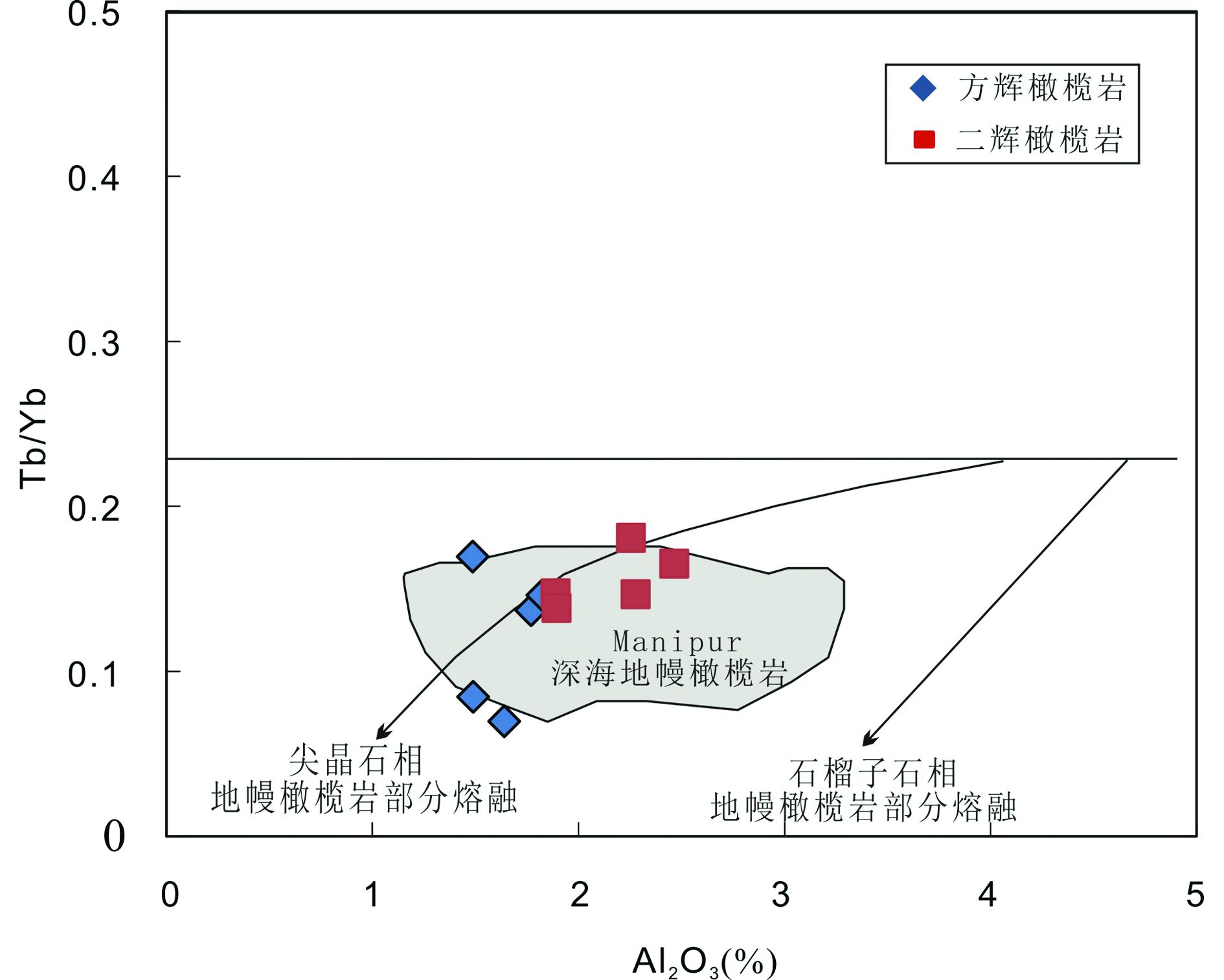
为确定南公珠错地幔橄榄岩部分熔融的源区,作其全岩Tb/Yb-Al2O3双变量图解(图 15):其熔融趋势与尖晶石相地幔源区熔融趋势线一致,且在南公珠错地幔橄榄岩中并未发现有斜长石存在,因此我们推断南公珠错地幔橄榄岩为来源于尖晶石相二辉橄榄岩地幔源区的熔融残余;同时该图解显示南公珠错地幔橄榄岩与Manipur蛇绿岩中的深海地幔橄榄岩落入大致相同区域,表明其与Manipur深海地幔橄榄岩具有相近的熔融程度( Krishnakanta Singh,2013)。
|
图 15 南公珠错蛇绿岩地幔橄榄岩Tb/Yb-Al2O3图解(据Krishnakanta Singh,2013) Fig. 15 Plots of Tb/Yb vs. Al2O3 for peridotites from South Gongzhucuo ophiolite(after Krishnakanta Singh,2013) |
重稀土元素受交代过程影响较小(Hellebrand et al.,2002),为估算南公珠错地幔橄榄岩的部分熔融程度,将南公珠错地幔橄榄岩球粒陨石标准化的稀土元素配分模式与Krishnakanta建立的以(Niu,2004)提出的尖晶石相地幔源区的近分离熔融(Krishnakanta Singh,2013)模式曲线进行对比估算:南公珠错地幔橄榄岩熔融程度约为3%~12%(其中二辉橄榄岩3%~8%,方辉橄榄岩10%~12%)(图 12a),与Manipur深海地幔橄榄岩2%~12%的熔融程度接近( Krishnakanta Singh,2013)。
地幔橄榄岩中的铂族元素同样能够为地幔部分熔融和熔体抽取、地幔交代作用以及熔-岩反应等提供重要信息(Edwards and Malpas,1995; Tatsumi et al.,2000; Gueddari et al.,1996; Büchl et al.,2002; Lorand et al.,2003; Zhou et al.,1998,2005)。铂族元素根据其熔融温度通常可分为两组:Ir组(IPGE,包括:Os、Ir、Ru)和Pd组(PPGE,包括:Rh、Pt、Pd)(Woodland et al.,2002)。Ir组元素表现出相容元素的性质,在地幔岩中常呈合金相和高温硫化物相存在,地幔部分熔融时,残留在地幔橄榄岩的残余体中;而Pd组元素为不相容元素,在地幔岩中存在于低温硫化物相中,在地幔部分熔融时,优先进入熔体中。根据IPGE和PPGE的性质差异我们可以推测:当部分熔融程度较低时IPGE和PPGE之间的组分含量并不会明显分异,PGE的分配模式应是平坦型;而强烈亏损的地幔橄榄岩,应该具有较低的PGE总量,高IPGE和较低PPGE含量,其铂族元素分配模式应表现为负斜率型。南公珠错地幔橄榄岩铂族元素球粒陨石标准化图解(图 13)为接近于原始地幔的“平坦型”,表现出原始地幔较低程度部分熔融残余的特征。
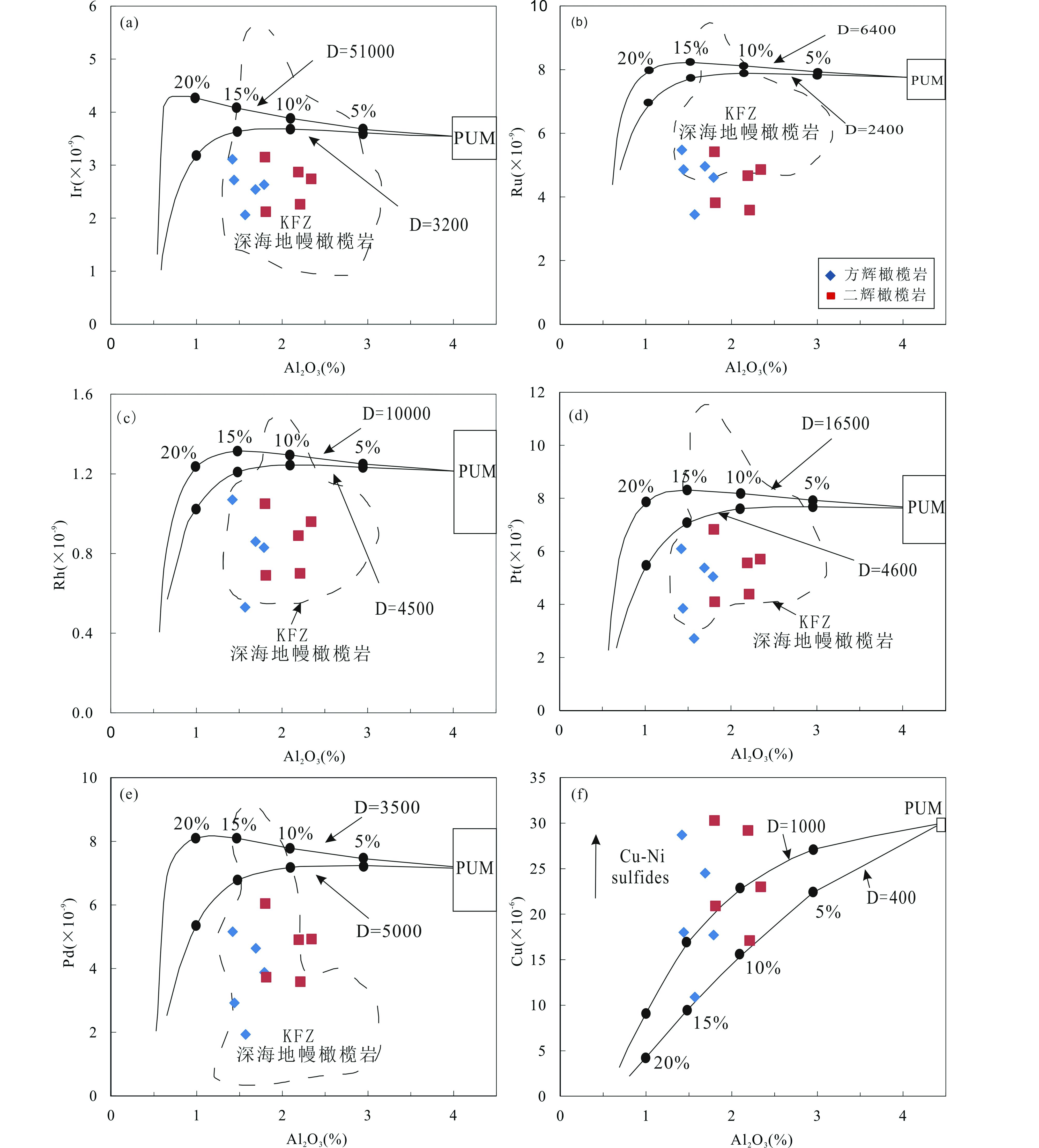
以原始上地幔作为部分熔融的源区,Marchesi et al.(2013) 对部分熔融过程中Al2O3与铂族元素和Cu的含量变化进行了模拟。为定量描述南公珠错地幔橄榄岩的部分熔融特征,同样作铂族元素、Cu与Al2O3的成分图解并与Marchesi et al.(2013) 的模拟进行对比(图 16),我们发现所有样品均反映南公珠错地幔橄榄岩经历了约8%~16%的部分熔融程度(其中二辉橄榄岩8%~12%,方辉橄榄岩12%~16%)。但南公珠错地幔橄榄岩的铂族元素和Cu元素的含量较为分散,偏离部分熔融曲线,表明南公珠错地幔橄榄岩可能还遭受了其他地质作用的改造。
|
图 16 南公珠错地幔橄榄岩PGEs和Cu-Al2O3图解(据Marchesi et al.,2013) KFZ深海地幔橄榄岩-Kane破碎带深海地幔橄榄岩(据Luguet et al.,2003);PUM-原始上地幔(据McDonough and Sun,1995) Fig. 16 Plots of PGEs and Cu vs. Al2O3 for South Gongzhucuo peridotites(after Marchesi et al.,2013) KFZ abyssal peridotite-abyssal peridotite from the Kane Fracture Zone(after Luguet et al.,2003); PUM-primitive upper mantle(after McDonough and Sun,1995) |
通过以上不同方法模拟估算的南公珠错地幔橄榄岩部分熔融程度稍有差异,但总体一致,由于部分熔融源区的不确定性及分配系数的差异,估算结果差异尚在接受范围之内,均反映了较低的部分熔融程度,为最多不超过16%的部分熔融的残余。
7.2 南公珠错地幔橄榄岩岩石-熔体反应通常情况下,蛇绿岩中地幔橄榄岩被认为是地幔经历了不同程度部分熔融亏损后的残余(Himmelberg and Loney,1973)。但南公珠错地幔橄榄岩的岩石矿物结构和全岩地球化学组成显示它们并非简单的部熔融的残余。
在南公珠错地幔橄榄岩稀土元素球粒陨石标准化图解(图 12a)中,表现出LREE的轻微富集。前人讨论这种LREE富集的稀土元素配分模式时一般将其解释为经历了俯冲带熔体/流体的改造,其依据是俯冲带的玻安质熔体通常具有具有LREE、Zr和Sr富集的特征(Kelemen et al.,1992; Crawford et al.,1981)。但南公珠错地幔橄榄岩形成构造环境与深海地幔橄榄岩类似,并无SSZ类型迹象,且微量元素配分图解并无Zr的富集,而是表现为强烈亏损。Niu(2004) 发现太平洋洋中脊和印度洋洋中脊的深海地幔橄榄岩同样可表现出轻稀土元素富集的配分模式,并解释其为熔融残余的地幔在热力学边界层与后期上升的熔体渗透与交代的结果。因此,南公珠错地幔橄榄岩轻稀土元素轻微富集配分模式可能是洋中脊环境产生的低融岩浆与部分熔融残余地幔发生交代作用的结果,这与周文达等最新研究普兰地幔橄榄岩得到的稀土元素特征一致(周文达等,2015)。
通常简单的部分熔融可以引起CaO和Pd/Ir、Rh/Ir之间的相关性,但通过简单部分熔融形成的地幔橄榄岩的Pd/Ir、Rh/Ir比值总是低于而不应该高于球粒陨石(Lorand et al.,2000),但南公珠错地幔橄榄岩的Rh/Ir和Pd/Ir的比值多数较CI球粒陨石中高(图 14)。因此南公珠错地幔橄榄岩较高的Rh/Ir和Pd/Ir比值不能简单地用部分熔融过程来解释,通常认为这是由于后期岩石-熔体反应的结果(Luguet et al.,2003,2007; Chen and Xia,2008),其既可以通过硫化物熔体过滤,也可以通过硅酸盐熔体再注入来对原始地幔部分熔融的残余进行改造(Luguet et al.,2003; Becker et al.,2006; Fischer-Gödde et al.,2010)。
7.3 南公珠错地幔橄榄岩构造背景区分蛇绿岩的形成构造环境是十分重要的科学问题,但通常又存在较大争议。世界上大多数保存较好的蛇绿岩的地幔与地壳部分与大洋中脊(MOR)和上俯冲带(SSZ)具有亲缘性(Pearce et al.,1984; Stern,2004)。这两种构造环境的蛇绿岩已在阿尔巴尼亚蛇绿岩、平都斯山蛇绿岩和希腊蛇绿岩(Bortolotti et al.,2002; Saccani and Photiades,2004),阿曼蛇绿岩(Tamura and Arai,2006),土耳其西南的利西亚和安塔利亚蛇绿岩(Aldanmaz et al.,2009),特罗多斯蛇绿岩(Batanova and Sobolev,2000)和加利福尼亚的海岸蛇绿岩(Jean et al.,2010)中报道。但多数对于蛇绿岩构造背景的研究都是针对于洋壳岩石的研究,而对其下部的地幔橄榄岩研究较少。一般认为如果其形成于大洋盆中则与深海地幔橄榄岩类似,如果形成于弧环境则与弧前地幔橄榄岩类似。
区分深海地幔橄榄岩和弧前地幔橄榄岩为我们通过洋壳之下的地幔橄榄岩研究蛇绿岩的形成构造环境提供了新的方法。Dick等人研究发现深海橄榄岩通常由二辉橄榄岩和含单辉方辉橄榄岩组成,在无水条件下为经历5%~15%的MORB型熔体提取后的部分熔融的残余(Dick,1989; Johnson et al.,1990; Dick and Bullen,1984; Johnson and Dick,1992)。由富集地幔低-中程度部分熔融形成的熔体通常有较高的TiO2含量,与之相应的亏损地幔具有较低的TiO2含量和富铬的尖晶石。深海地幔橄榄岩尖晶石Cr#值通常在10~40之间,很少超过60。而SSZ型地幔橄榄岩,则是俯冲板片上的上地幔经过较高程度的部分熔融的残留,其尖晶石具有比深海地幔橄榄岩具有较高的Cr#值,通常为38~80,少数情况下会超过90。由于SSZ型地幔橄榄岩相对于深海地幔橄榄岩较高的部分熔融程度,其辉石通常含有很低的Al、Ti、Na等元素,以及相对较高的Mg#值,其橄榄石具有较高的Fo值。与矿物化学特征一致的是与深海地幔橄榄岩相比SSZ型地幔橄榄岩更亏损不相容元素(Pearce et al.,2000; Parkinson and Pearce,1998; Uysal et al.,2007,2012)。
地幔橄榄岩矿物化学特征的研究对认识地幔橄榄岩的成因及其构造环境至关重要(Dick and Bullen,1984; Parkinson and Pearce,1998; Uysal et al.,2007)。
蛇绿岩中地幔橄榄岩的铬尖晶石成分存在着的广泛Cr和Al互相替换(Dick and Bullen,1984),铬尖晶石类型在很大程度上取决于这两项化学成分的比例。尖晶石的Cr#值不仅是地幔橄榄岩部分熔融程度的良好指标,而且还可用于橄榄岩形成构造背景的判别(Parkinson and Pearce,1998; Arai,1994)。Dick and Bullen根据铬尖晶石的成分将阿尔卑斯型地幔橄榄岩分为三种类型(Dick and Bullen,1984):Ⅰ型,铬尖晶石的Cr#<60;Ⅲ型,铬尖晶石的Cr#>60;Ⅱ型,为一种过渡类型。其中Ⅰ型地幔橄榄岩可能反映了洋中脊大洋岩石圈的环境,具有较低的部分熔融程度,与深海橄榄岩类似;Ⅲ型地幔橄榄岩,可能形成于岛弧环境,具有较高的部分熔融程度;Ⅱ型地幔橄榄岩,则反映了复合成因特征。南公珠错地幔橄榄岩铬尖晶石Cr#变化于12.7~28.3之间,在铬尖晶石成分图解中(图 9)南公珠错地幔橄榄岩全部落入深海地幔橄榄岩区域,表明其属于第Ⅰ种类型,可能形成于大洋脊环境。
根据橄榄石NiO-Fo和MnO-Fo图解(图 6),斜方辉石Al2O3-Mg#、TiO2-Mg#和Cr2O3-Mg#图解(图 7)以及单斜辉石的Al2O3-Mg#、TiO2-Mg#和Cr2O3-Mg#图解(图 8),我们发现:南公珠错地幔橄榄岩均落入深海地幔橄榄岩范围内,指示了其具有深海地幔橄榄岩的特征,可能形成于大洋脊环境。
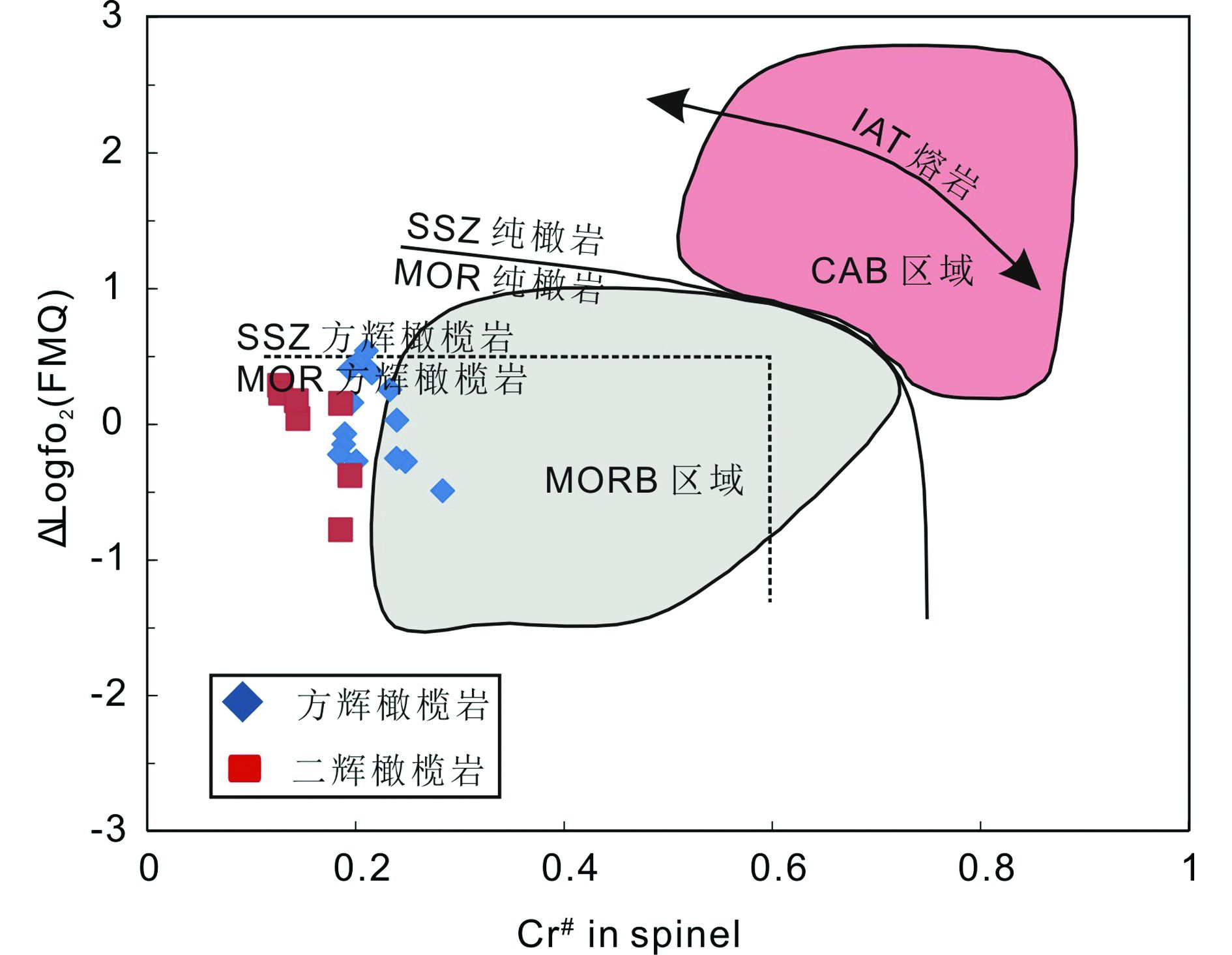
MOR和SSZ两种不同构造背景的地幔橄榄岩中的铬尖晶石的Cr#与Δlog(fO2)FMQ呈现明显不同的构造区间(Pearce et al.,2000; Dare et al.,2009)。为估算南公珠错地幔橄榄岩的氧逸度,对成对共生的橄榄石-尖晶石的化学成分进行测试,并采用Ballhaus等人的计算方法(Ballhaus et al.,1991)计算,基于橄榄石-尖晶石矿物成分估算的氧逸度值见表 7。通过对南公珠错地幔橄榄岩的氧逸度与尖晶石Cr#投图(图 17)结果表明南公珠错地幔橄榄岩落入洋中脊型方辉橄榄岩区域内,并未表现出SSZ型特征。
|
图 17 与橄榄石共生的尖晶石Cr#-氧逸度图解(据Dare et al.,2009) Fig. 17 Spinels Cr# vs. Δlog(fO2)FMQ diagram,the spinels coexisted with olivines(after Dare et al.,2009) |
|
|
表 7 南公珠错蛇绿岩地幔橄榄岩氧逸度估算表 Table 7 Oxygen fugacity of mantle peridotites from South Gongzhucuo ophiolite |
对南公珠错地幔橄榄岩全岩主量元素数据与深海地幔橄榄岩数据和弧前地幔橄榄岩数据进行比较(图 11a-d),发现南公珠错地幔橄榄岩完全落入深海地幔橄榄岩中。本文对南公珠错地幔橄榄岩全岩中含量相对较高的微量元素V、Yb、La和Y等对MgO作图(图 11e-h),并与Izu-Bonin-Mariana弧前地幔橄榄岩(Parkinson and Pearce,1998)和太平洋和印度洋大洋中脊深海地幔橄榄岩(Niu,2004)对比,南公珠错地幔橄榄岩数据完全落入太平洋和印度洋大洋中脊深海地幔橄榄岩区域内,表明其具有深海地幔橄榄岩特征,可能形成于大洋脊环境。 在稀土元素球粒陨石标准化图解中,南公珠错地幔橄榄岩同样落入深海地幔橄榄岩范围内, 表现为深海地幔橄榄岩的特征(图 12a)。
通过以上多方面的对比论证,我们发现南公珠错地幔橄榄岩具有与深海地幔橄榄岩相似的化学特征,并不具弧前地幔橄榄岩的特点,因此认为南公珠错地幔橄榄岩形成于大洋脊环境,为MOR型地幔橄榄岩。
7.4 南公珠错蛇绿岩在雅鲁藏布江缝合带中的意义蛇绿岩套被认为是古大洋岩石圈在造山带中的残留,且可以与现代大洋岩石圈进行对比的镁铁-超镁铁质岩石组合,并被广泛应用于全球板块构造系统的研究(Kelemen et al.,1992; Gass,1968; Dewey and Bird,1971; Coleman,1977; Moores and Vine,1971)。Pearce et al.(1984) 将蛇绿岩分为MOR型和SSZ型。这是目前普遍为各研究者所接受的分类方案。但造山带的蛇绿岩往往很复杂,并非单一的的MOR型或SSZ型的某种形式(Dick and Bullen,1984; 王希斌和鲍佩声,1996)。
目前关于雅鲁藏布江蛇绿岩形成的构造环境各研究者还没有达成一致的认识。综合前人对雅鲁藏布江缝合带地幔橄榄岩的研究,雅鲁藏布江缝合带主要分布两种类型蛇绿岩:其一以日喀则蛇绿岩(Dupuis et al.,2005; Guilmette et al.,2008)、萨嘎和桑桑蛇绿岩(Bédard et al.,2009)为代表,为典型的形成于SSZ型环境的蛇绿岩,主要分布于雅鲁藏布江蛇绿岩带中段;其二以罗布莎蛇绿岩(Yang et al.,2007; Yamamoto et al.,2007),普兰蛇绿岩(Liu et al.,2010; 徐向珍等,2011),休古噶布蛇绿岩(徐德明等,2007),巴尔蛇绿岩(李源等,2012)达机翁蛇绿岩(连东洋等,2014)为代表,为主体形成于MOR环境,但受到了后期不同程度SSZ环境的改造,主要分布于雅鲁藏布江蛇绿岩带东段和西段。
南公珠错蛇绿岩产出于雅鲁藏布江缝合带西段南亚带,其地幔橄榄岩的矿物化学和全岩地球化学特征表明其形成于大洋脊的环境。但南公珠错地幔橄榄岩LREE轻微富集(图 12a)、PGEs和Cu元素的含量较为分散,明显偏离部分熔融曲线(图 16)以及Pd/Ir、Rh/Ir比值多数大于球粒陨石之值(图 14),表明南公珠错地幔橄榄岩后期经历了洋脊环境下的岩石-熔体反应作用。这与位于其西侧和东侧的主体形成于MOR环境但受到后期不同程度SSZ环境改造的普兰蛇绿岩和休古嘎布蛇绿岩相比具有不同的构造环境(徐向珍等,2011; 徐德明等,2007)。为何在如此近的距离之间夹杂另一种构造环境的蛇绿岩是非常值得思考的。有学者认为雅鲁藏布江蛇绿岩带可能是由形成于不同构造环境的块体拼贴而成(Dupuis et al.,2005; 张旗和周国庆,2001)。由于大洋演化的多阶段性和造山带构造环境的复杂性,蛇绿岩作为古大洋岩石圈的残余保存在各个时期的造山带中注定将是残缺不全的,这使蛇绿岩的构造环境的恢复增加了困难。周文达等最近研究发现普兰地幔橄榄岩可能形成于洋中脊(MOR)环境,并没有俯冲带(SSZ)环境的印记(周文达等,2015),这与前人研究的普兰地幔橄榄岩经历了MOR→SSZ两阶段演化模式不一致,同样表明造山带构造环境的复杂性。
近年来雅鲁藏布江缝合带的铬铁矿和地幔橄榄岩中金刚石、碳硅石、斯石英假象的柯石英及自然铁、镍等异常地幔矿物的发现(白文吉等,2001; Yang et al.,2007; 徐向珍等,2008; 杨经绥等,2011,2013,2014)指示地幔橄榄岩和铬铁矿可能形成于地幔深部(>300km)。这对蛇绿岩形成的构造环境和形成过程提供了新的思路、方法和挑战。因此重新审视蛇绿岩的形成构造环境和形成过程十分重要。
8 结论本文对南公珠错蛇绿岩地幔橄榄岩开展野外构造及岩性填图基础上,进行了详细的室内岩石学、矿物学和地球化学研究,分析探讨了南公珠错地幔橄榄岩部分熔融程度、岩石-熔体反应、可能的成因及构造环境。主要获得以下成果和认识:
(1) 南公珠错蛇绿岩产出于雅鲁藏布江蛇绿岩带西段公珠湖南侧,空间上属于南亚带蛇绿岩,该蛇绿岩主要由地幔橄榄岩和辉长岩等基性岩类组成。地幔橄榄岩中方辉橄榄岩占主体,二辉橄榄岩与方辉橄榄岩常为岩相渐变关系,纯橄岩出露较少。
(2) 南公珠错地幔橄榄岩来源于尖晶石相二辉橄榄岩地幔源区,系经历了至多16%部分熔融的残余,但可能经历了后期岩石-熔体反应的改造。
(3) 矿物化学和全岩地球化学分析表明,南公珠错地幔橄榄岩化学组成特征与深海地幔橄榄岩类似,可能形成于大洋脊环境,为MOR型地幔橄榄岩。
致谢 本文电子探针分析得到了中国地质科学院地质研究所戎合老师的悉心帮助和指导;论文撰写过程中与中国地质科学院地质研究所熊发挥博士进行了有益讨论;论文投稿过程得到了中国地质科学院地质研究所曹汇副研究员的建议与帮助;审稿人刘焰研究员和牛晓露副研究员对本文提出了宝贵的修改意见;在此一并致以诚挚的谢意!| [] | Aldanmaz E, Schmidt MW, Gourgaud A, Meisel T. 2009. Mid-ocean ridge and supra-subduction geochemical signatures in spinel-peridotites from the Neotethyan ophiolites in SW Turkey: Implications for upper mantle melting processes. Lithos , 113 (3-4) :691–708. DOI:10.1016/j.lithos.2009.03.010 |
| [] | Arai S. 1994. Characterization of spinel peridotites by olivine-spinel compositional relationships: Review and interpretation. Chemical Geology , 113 (3-4) :191–204. DOI:10.1016/0009-2541(94)90066-3 |
| [] | Arai S, Matsukage K. 1998. Petrology of a chromitite micropod from Hess Deep, equatorial Pacific: A comparison between abyssal and Alpine-type podiform chromitites. Lithos , 43 (1) :1–14. DOI:10.1016/S0024-4937(98)00003-6 |
| [] | Bai WJ, Yang JS, Robinson PT, Fang QS, Zhang ZM, Yan BG, Hu XF. 2001. Study of diamonds from chromitites in the Luobusa ophiolite, Tibet. Acta Geologica Sinica , 75 (3) :404–409. |
| [] | Ballhaus C, Berry RF, Green DH. 1991. High pressure experimental calibration of the olivine-orthopyroxene-spinel oxygen geobarometer: Implications for the oxidation state of the upper mantle. Contributions to Mineralogy and Petrology , 107 (1) :27–40. DOI:10.1007/BF00311183 |
| [] | Barnes SJ, Roeder PL. 2001. The range of spinel compositions in terrestrial mafic and ultramafic rocks. Journal of Petrology , 42 (12) :2279–2302. DOI:10.1093/petrology/42.12.2279 |
| [] | Batanova VG, Sobolev AV. 2000. Compositional heterogeneity in subduction-related mantle peridotites, Troodos massif, Cyprus. Geology , 28 (1) :55–58. DOI:10.1130/0091-7613(2000)28<55:CHISMP>2.0.CO;2 |
| [] | Bédard é, Hébert R, Guilmette C, Lesage G, Wang CS, Dostal J. 2009. Petrology and geochemistry of the Saga and Sangsang ophiolitic massifs, Yarlung Zangbo Suture Zone, Southern Tibet: Evidence for an arc-back-arc origin. Lithos , 113 (1-2) :48–67. DOI:10.1016/j.lithos.2009.01.011 |
| [] | Becker H, Horan MF, Walker RJ, Gao S, Lorand JP, Rudnick RL. 2006. Highly siderophile element composition of the Earth's primitive upper mantle: Constraints from new data on peridotite massifs and xenoliths. Geochimica et Cosmochimica Acta , 70 (17) :4528–4550. DOI:10.1016/j.gca.2006.06.004 |
| [] | Bortolotti V, Marroni M, Pandolfi L, Principi G, Saccani E. 2002. Interaction between mid-ocean ridge and subduction magmatism in Albanian ophiolites. The Journal of Geology , 110 (5) :561–576. DOI:10.1086/341758 |
| [] | Brookfield ME. 1993. The Himalayan passive margin from Precambrian to Cretaceous times. Sedimentary Geology , 84 (1-4) :1–35. DOI:10.1016/0037-0738(93)90042-4 |
| [] | Büchl A, Brügmann G, Batanova VG, Münker C, Hofmann AW. 2002. Melt percolation monitored by Os isotopes and HSE abundances: A case study from the mantle section of the Troodos ophiolite. Earth and Planetary Science Letters , 204 (3-4) :385–402. DOI:10.1016/S0012-821X(02)00977-9 |
| [] | Cassard D, Nicolas A, Rabinovitch M, Moutte J, Leblanc M, Prinzhofer A. 1981. Structural classification of chromite pods in southern New Caledonia. Economic Geology , 76 (4) :805–831. DOI:10.2113/gsecongeo.76.4.805 |
| [] | Chen GW, Xia B. 2008. Platinum-group elemental geochemistry of mafic and ultramafic rocks from the Xigaze ophiolite, southern Tibet. Journal of Asian Earth Sciences , 32 (5-6) :406–422. DOI:10.1016/j.jseaes.2007.11.009 |
| [] | Coleman RG. 1977. Ophiolites. Berlin Heidelberg: Springer http://cn.bing.com/academic/profile?id=2370840447&encoded=0&v=paper_preview&mkt=zh-cn |
| [] | Crawford AJ, Beccaluva L, Serri G. 1981. Tectono-magmatic evolution of the West Philippine-Mariana region and the origin of boninites. Earth and Planetary Science Letters , 54 (2) :346–356. DOI:10.1016/0012-821X(81)90016-9 |
| [] | Dai JG, Wang CS, Hébert R, Santosh M, Li YL, Xu JY. 2011. Petrology and geochemistry of peridotites in the Zhongba ophiolite, Yarlung Zangbo Suture Zone: Implications for the Early Cretaceous intra-oceanic subduction zone within the Neo-Tethys. Chemical Geology , 288 (3-4) :133–148. DOI:10.1016/j.chemgeo.2011.07.011 |
| [] | Dai JG, Wang CS, Li YL. 2012. Relicts of the Early Cretaceous seamounts in the central-western Yarlung Zangbo Suture Zone, southern Tibet. Journal of Asian Earth Sciences , 53 :25–37. DOI:10.1016/j.jseaes.2011.12.024 |
| [] | Dare SAS, Pearce JA, McDonald I, Styles MT. 2009. Tectonic discrimination of peridotites using fO2-Cr# and Ga-Ti-FeⅢ systematics in chrome-spinel. Chemical Geology , 261 (3-4) :199–216. DOI:10.1016/j.chemgeo.2008.08.002 |
| [] | Dewey JF, Bird JM. 1971. Origin and emplacement of the ophiolite suite: Appalachian ophiolites in Newfoundland. Journal of Geophysical Research , 76 (14) :3179–3206. DOI:10.1029/JB076i014p03179 |
| [] | Dick HJB. 1977. Partial melting in the Josephine Peridotite; Ⅰ, The effect on mineral composition and its consequence for geobarometry and geothermometry. American Journal of Science , 277 (7) :801–832. DOI:10.2475/ajs.277.7.801 |
| [] | Dick HJB, Bullen T. 1984. Chromian spinel as a petrogenetic indicator in abyssal and alpine-type peridotites and spatially associated lavas. Contributions to Mineralogy and Petrology , 86 (1) :54–76. DOI:10.1007/BF00373711 |
| [] | Dick HJB. 1989. Abyssal peridotites, very slow spreading ridges and ocean ridge magmatism. In: Saunders AE and Norris MJ (eds.). Magmatism in the Ocean Basins. Geological Society, London, Special Publications , 42 :71–105. DOI:10.1144/GSL.SP.1989.042.01.06 |
| [] | Dick HJB and Natland JH. 1996. Late-stage melt evolution and transport in the shallow mantle beneath the East Pacific Rise. In: Proceedings of the Ocean Drilling Program Scientific Results. College Station, TX: Ocean Drilling Program |
| [] | Dubois-Côté V, Hebert R, Dupuis C, Wang CS, Li YL, Dostal J. 2005. Petrological and geochemical evidence for the origin of the Yarlung Zangbo ophiolites, southern Tibet. Chemical Geology , 214 (3-4) :265–286. DOI:10.1016/j.chemgeo.2004.10.004 |
| [] | Dupuis C, Hébert R, Dubois-Côté V, Wang CS, Li YL, Li ZJ. 2005. Petrology and geochemistry of mafic rocks from mélange and flysch units adjacent to the Yarlung Zangbo Suture Zone, southern Tibet. Chemical Geology , 214 (3-4) :287–308. DOI:10.1016/j.chemgeo.2004.10.005 |
| [] | Edwards SJ, Malpas J. 1995. Multiple origins for mantle harzburgites: Examples from the Lewis Hills, Bay of Islands ophiolite, Newfoundland. Canadian Journal of Earth Sciences , 32 (7) :1046–1057. DOI:10.1139/e95-086 |
| [] | Einsele G, Liu B, Dürr S, Frisch W, Liu G, Luterbacher HP, Ratschbacher L, Ricken W, Wendt J, Wetzel A, Yu G, Zheng H. 1994. The Xigaze forearc basin: Evolution and facies architecture (Cretaceous, Tibet). Sedimentary Geology , 90 (1-2) :1–32. DOI:10.1016/0037-0738(94)90014-0 |
| [] | Fischer-Gödde M, Becker H, Wombacher F. 2010. Rhodium, gold and other highly siderophile element abundances in chondritic meteorites. Geochimica et Cosmochimica Acta , 74 (1) :356–379. DOI:10.1016/j.gca.2009.09.024 |
| [] | Frey FA, John Suen C, Stockman HW. 1985. The Ronda high temperature peridotite: Geochemistry and petrogenesis. Geochimica et Cosmochimica Acta , 49 (11) :2469–2491. DOI:10.1016/0016-7037(85)90247-9 |
| [] | Gaetani GA, Grove TL. 1998. The influence of water on melting of mantle peridotite. Contributions to Mineralogy and Petrology , 131 (4) :323–346. DOI:10.1007/s004100050396 |
| [] | Gass IG. 1968. Is the Troodos massif of Cyprus a fragment of Mesozoic ocean floor?. Nature , 220 (5162) :39–42. DOI:10.1038/220039a0 |
| [] | Gueddari K, Piboule M, Amossé J. 1996. Differentiation of platinum-group elements (PGE) and of gold during partial melting of peridotites in the lherzolitic massifs of the Betico-Rifean range (Ronda and Beni Bousera). Chemical Geology , 134 (1-3) :181–197. DOI:10.1016/S0009-2541(96)00085-X |
| [] | Guilmette C, Hébert R, Dupuis C, Wang CS, Li ZJ. 2008. Metamorphic history and geodynamic significance of high-grade metabasites from the ophiolitic mélange beneath the Yarlung Zangbo ophiolites, Xigaze area, Tibet. Journal of Asian Earth Sciences , 32 (5-6) :423–437. DOI:10.1016/j.jseaes.2007.11.013 |
| [] | Guo L, Zhang HF, Harris N, Pan FB, Xu WC. 2011. Origin and evolution of multi-stage felsic melts in eastern Gangdese belt: Constraints from U-Pb zircon dating and Hf isotopic composition. Lithos , 127 (1-2) :54–67. DOI:10.1016/j.lithos.2011.08.005 |
| [] | Hattori KH and Guillot S. 2007. Geochemical character of serpentinites associated with high-to ultrahigh-pressure metamorphic rocks in the Alps, Cuba, and the Himalayas: Recycling of elements in subduction zones. Geochemistry, Geophysics, Geosystems, 8(9), doi: 10.1029/2007GC001594 http://cn.bing.com/academic/profile?id=2168683075&encoded=0&v=paper_preview&mkt=zh-cn |
| [] | Hellebrand E, Snow JE, Hoppe P, Hofmann AW. 2002. Garnet-field melting and late-stage refertilization in 'residual' abyssal peridotites from the Central Indian Ridge. Journal of Petrology , 43 (12) :2305–2338. DOI:10.1093/petrology/43.12.2305 |
| [] | Himmelberg GR, Loney RA. 1973. Petrology of the Vulcan Peak Alpine-type peridotite, southwestern Oregon. Geological Society of America Bulletin , 84 (5) :1585–1600. DOI:10.1130/0016-7606(1973)84<1585:POTVPA>2.0.CO;2 |
| [] | Huang GC, Mo XX, Xu DM, Lei YJ, Li LJ. 2006. Origination and evolution of Daba-Xiugugabu ophiolite belt in the southwestern Tibet. Geology and Mineral Resources of South China (3) :1–9. |
| [] | Jagoutz E, Palme H, Baddenhausen H, Blum K, Cendales M, Dreibus G, Spettel B, Waenke H, Lorenz V.1979. The abundances of major, minor and trace elements in the earth's mantle as derived from primitive ultramafic nodules. In: Proceedings of the 10th Lunar and Planetary Science Conference. New York: Pergamon Press : 2031 -2050. |
| [] | Jaques AL, Green DH. 1980. Anhydrous melting of peridotite at 0~15kb pressure and the genesis of tholeiitic basalts. Contributions to Mineralogy and Petrology , 73 (3) :287–310. DOI:10.1007/BF00381447 |
| [] | Jean MM, Shervais JW, Choi SH, Mukasa SB. 2010. Melt extraction and melt refertilization in mantle peridotite of the Coast Range ophiolite: An LA-ICP-MS study. Contributions to Mineralogy and Petrology , 159 (1) :113–136. DOI:10.1007/s00410-009-0419-0 |
| [] | Johnson KTM, Dick HJB, Shimizu N. 1990. Melting in the oceanic upper mantle: An ion microprobe study of diopsides in abyssal peridotites. Journal of Geophysical Research: Atmospheres , 95 (B3) :2661–2678. DOI:10.1029/JB095iB03p02661 |
| [] | Johnson KTM, Dick HJB. 1992. Open system melting and temporal and spatial variation of peridotite and basalt at the Atlantis II Fracture Zone. Journal of Geophysical Research , 97 (B6) :9219–9241. DOI:10.1029/92JB00701 |
| [] | Kelemen PB, Dick HJ, Quick JE. 1992. Formation of harzburgite by pervasive melt/rock reaction in the upper mantle. Nature , 358 (6388) :635–641. DOI:10.1038/358635a0 |
| [] | Krishnakanta Singh A. 2013. Petrology and geochemistry of abyssal peridotites from the Manipur ophiolite complex, Indo-Myanmar Orogenic Belt, Northeast India: Implication for melt generation in mid-oceanic ridge environment. Journal of Asian Earth Sciences , 66 :258–276. DOI:10.1016/j.jseaes.2013.02.004 |
| [] | Leblanc M. 1980. Chromite growth, dissolution and deformation from a morphological view point: SEM investigations. Mineralium Deposita , 15 (2) :201–210. |
| [] | Li Y, Yang JS, Liu Z, Jia Y, Xu XZ. 2012. The origins of baer ophiolitic peridotite and its implication in the Yarlung Zangbo suture zone, southern Tibet. Acta Petrologica Sinica , 27 (11) :3239–3254. |
| [] | Lian DY, Yang JS, Xiong FH, Liu F, Wang YP, Zhou WD, Zhao YJ. 2014. Composition characteristics and tectonic setting of the Dajiweng peridotite in the western Yarlung-Zangbo ophiolitic belt. Acta Petrologica Sinica , 30 (8) :2164–2184. |
| [] | Lian DY, Yang JS, Robinson PT, Liu F, Xiong FH, Zhang L, Gao J, Wu WW. 2016. Tectonic evolution of the western Yarlung Zangbo ophiolitic belt, Tibet: Implications from the petrology, mineralogy, and geochemistry of the peridotites. The Journal of Geology , 124 (3) :353–376. DOI:10.1086/685510 |
| [] | Liu CZ, Wu FY, Wilde SA, Yu LJ, Li JL. 2010. Anorthitic plagioclase and pargasitic amphibole in mantle peridotites from the Yungbwa ophiolite (southwestern Tibetan Plateau) formed by hydrous melt metasomatism. Lithos , 114 (3-4) :413–422. DOI:10.1016/j.lithos.2009.10.008 |
| [] | Liu F, Yang JS, Dilek Y, Xu ZQ, Xu XZ, Liang FH, Chen SY, Lian DY. 2015. Geochronology and geochemistry of basaltic lavas in the Dongbo and Purang ophiolites of the Yarlung-Zangbo suture zone: Plume-influenced continental margin-type oceanic lithosphere in southern Tibet. Gondwana Research , 27 (2) :701–718. DOI:10.1016/j.gr.2014.08.002 |
| [] | Liu F, Yang JS, Lian DY, Zhao H, Zhang L, Zhang L, Huang J. 2015. Genesis and characteristics of the western part of the Yarlung Zangbo ophiolites, Tibet. Acta Petrologica Sinica , 31 (12) :3609–3628. |
| [] | Liu GH, Einsele G. 1996. Various types of olistostromes in a closing ocean basin, Tethyan Himalaya (Cretaceous, Tibet). Sedimentary Geology , 104 (1-4) :203–226. DOI:10.1016/0037-0738(95)00129-8 |
| [] | Lorand JP, Schmidt G, Palme H, Kratz KL. 2000. Highly siderophile element geochemistry of the Earth's mantle: New data for the Lanzo (Italy) and Ronda (Spain) orogenic peridotite bodies. Lithos , 53 (2) :149–164. DOI:10.1016/S0024-4937(00)00017-7 |
| [] | Lorand JP, Reisberg L, Bedini RM. 2003. Platinum-group elements and melt percolation processes in Sidamo spinel peridotite xenoliths, Ethiopia, East African Rift. Chemical Geology , 196 (1-4) :57–75. DOI:10.1016/S0009-2541(02)00407-2 |
| [] | Luguet A, Lorand JP, Seyler M. 2003. Sulfide petrology and highly siderophile element geochemistry of abyssal peridotites: A coupled study of samples from the Kane Fracture Zone (45°W 23°20N, MARK area, Atlantic Ocean). Geochimica et Cosmochimica Acta , 67 (8) :1553–1570. DOI:10.1016/S0016-7037(02)01133-X |
| [] | Luguet A, Shirey SB, Lorand JP, Horan MF, Carlson RW. 2007. Residual platinum-group minerals from highly depleted harzburgites of the Lherz massif (France) and their role in HSE fractionation of the mantle. Geochimica et Cosmochimica Acta , 71 (12) :3082–3097. DOI:10.1016/j.gca.2007.04.011 |
| [] | Marchesi C, Garrido CJ, Harvey J, González-Jiménez JM, Hidas K, Lorand JP, Gervilla F. 2013. Platinum-group elements, S, Se and Cu in highly depleted abyssal peridotites from the Mid-Atlantic Ocean Ridge (ODP Hole 1274A): Influence of hydrothermal and magmatic processes. Contributions to Mineralogy and Petrology , 166 (5) :1521–1538. DOI:10.1007/s00410-013-0942-x |
| [] | McDermid IRC, Aitchison JC, Davis AM, Harrison TM, Grove M. 2002. The Zedong terrane: A Late Jurassic intra-oceanic magmatic arc within the Yarlung-Tsangpo suture zone, southeastern Tibet. Chemical Geology , 187 (3-4) :267–277. DOI:10.1016/S0009-2541(02)00040-2 |
| [] | McDonough WF, Sun SS. 1995. The composition of the Earth. Chemical Geology , 120 (3-4) :223–253. DOI:10.1016/0009-2541(94)00140-4 |
| [] | Miller C, Thöni M, Frank W, Schusterb R, Melcherc F, Meiseld T, Zanettie A. 2003. Geochemistry and tectonomagmatic affinity of the Yungbwa ophiolite, SW Tibet. Lithos , 66 (3-4) :155–172. DOI:10.1016/S0024-4937(02)00217-7 |
| [] | Moores EM, Vine FJ. 1971. The troodos massif, cyprus and other ophiolites as oceanic crust: Evaluation and implications. Philosophical Transactions of the Royal Society A: Mathematical, Physical and Engineering Sciences , 268 (1192) :443–467. DOI:10.1098/rsta.1971.0006 |
| [] | Mysen BO, Kushiro I. 1977. Compositional variations of coexisting phases with degree of melting of peridotite in the upper mantle. American Mineralogist , 62 (9-10) :843–865. |
| [] | Neary CR, Brown MA. 1979. Chromites from the Al'Ays complex, Saudi Arabia, and the Semail complex, Oman. In: Al-Shanti AMS (ed.). Evolution and Mineralization of the Arabian-Nubian Shield. Kingdom of Saudi Arabia: Institute of Applied Geology :193–205. |
| [] | Nicolas A, Girardeau J, Marcoux J, Dupre B, Wang XB, Gao YG, Zheng HX, Xiao XC. 1981. The Xigaze ophiolite (Tibet): A peculiar oceanic lithosphere. Nature , 294 (5840) :414–417. DOI:10.1038/294414a0 |
| [] | Nicolas A, Prinzhofer A. 1983. Cumulative or residual origin for the transition zone in ophiolites: Structural evidence. Journal of Petrology , 24 (2) :188–206. DOI:10.1093/petrology/24.2.188 |
| [] | Niu YL. 1997. Mantle melting and melt extraction processes beneath ocean ridges: Evidence from abyssal peridotites. Journal of Petrology , 38 (8) :1047–1074. DOI:10.1093/petroj/38.8.1047 |
| [] | Niu YL. 2004. Bulk-rock major and trace element compositions of abyssal peridotites: Implications for mantle melting, melt extraction and post-melting processes beneath mid-ocean ridges. Journal of Petrology , 45 (12) :2423–2458. DOI:10.1093/petrology/egh068 |
| [] | Ozawa K. 1994. Melting and melt segregation in the mantle wedge above a subduction zone: Evidence from the chromite-bearing peridotites of the Miyamori ophiolite complex, northeastern Japan. Journal of Petrology , 35 (3) :647–678. DOI:10.1093/petrology/35.3.647 |
| [] | Pagé P, Bédard JH, Schroetter JM, Tremblay A. 2008. Mantle petrology and mineralogy of the Thetford Mines ophiolite complex. Lithos , 100 (1-4) :255–292. DOI:10.1016/j.lithos.2007.06.017 |
| [] | Pan GT. 1997. Geological Tectonic Evolution in the Eastern Tethys. Beijing: Geological Publishing House (in Chinese) |
| [] | Parkinson IJ, Pearce JA. 1998. Peridotites from the Izu-Bonin-Mariana forearc (ODP Leg 125): Evidence for mantle melting and melt-mantle interaction in a supra-subduction zone setting. Journal of Petrology , 39 (9) :1577–1618. DOI:10.1093/petroj/39.9.1577 |
| [] | Pearce JA, Lippard SJ, Roberts S. 1984. Characteristics and tectonic significance of supra-subduction zone ophiolites. In: Kokelaar BP and Howells MF (eds.). Marginal Basin Geology. Geological Society, London, Special Publications , 16 :77–94. |
| [] | Pearce JA, Barker PF, Edwards SJ, Parkinson IJ, Leat PT. 2000. Geochemistry and tectonic significance of peridotites from the South Sandwich arc-basin system, South Atlantic. Contributions to Mineralogy and Petrology , 139 (1) :36–53. DOI:10.1007/s004100050572 |
| [] | Rowley DB. 1996. Age of initiation of collision between India and Asia: A review of stratigraphic data. Earth and Planetary Science Letters , 145 (1-4) :1–13. DOI:10.1016/S0012-821X(96)00201-4 |
| [] | Saccani E, Photiades A. 2004. Mid-ocean ridge and supra-subduction affinities in the Pindos ophiolites (Greece): Implications for magma genesis in a forearc setting. Lithos , 73 (3-4) :229–253. DOI:10.1016/j.lithos.2003.12.002 |
| [] | Salters VJM, Stracke A. 2004. Composition of the depleted mantle. Geochemistry, Geophysics, Geosystems , 5 (5) . DOI:10.1029/2003GC000597 |
| [] | Snow JE, Dick HJB. 1995. Pervasive magnesium loss by marine weathering of peridotite. Geochimica et Cosmochimica Acta , 59 (20) :4219–4235. DOI:10.1016/0016-7037(95)00239-V |
| [] | Stern RJ. 2004. Subduction initiation: Spontaneous and induced. Earth and Planetary Science Letters , 226 (3-4) :275–292. DOI:10.1016/S0012-821X(04)00498-4 |
| [] | Sun GY, Hu XM. 2012. Tectonic affinity of Zhongba terrane: Evidences from the detrital zircon geochronology and Hf isotopes. Acta Petrologica Sinica , 28 (5) :1635–1646. |
| [] | Sun SS, McDonough WF. 1989. Chemical and isotopic systematics of oceanic basalts: Implications for mantle composition and processes. In: Saunders AD and Norry MJ (eds.). Magmatism in the Ocean Basins. Geological Society, London, Special Publications , 42 (1) :313–345. DOI:10.1144/GSL.SP.1989.042.01.19 |
| [] | Takahashi E. 1986. Origin of basaltic magmas: Implications from peridotite melting experiments and an olivine fractionation model. Bulletin of the Volcanological Society of Japan , 30 :S17–S40. |
| [] | Tamura A, Arai S. 2006. Harzburgite-dunite-orthopyroxenite suite as a record of supra-subduction zone setting for the Oman ophiolite mantle. Lithos , 90 (1-2) :43–56. DOI:10.1016/j.lithos.2005.12.012 |
| [] | Tatsumi Y, Oguri K, Shimoda G, Kogiso T, Barsczus HG. 2000. Contrasting behavior of noble-metal elements during magmatic differentiation in basalts from the Cook Islands, Polynesia. Geology , 28 (2) :131–134. DOI:10.1130/0091-7613(2000)28<131:CBONED>2.0.CO;2 |
| [] | Uysal I, Kaliwoda M, Karsli O, Tarkian M, Sadiklar MB, Ottley CJ. 2007. Compositional variations as a result of partial melting and melt-peridotite interaction in an upper mantle section from the ortaca area, southwestern turkey. The Canadian Mineralogist , 45 (6) :1471–1493. DOI:10.3749/canmin.45.6.1471 |
| [] | Uysal I, Ersoy EY, Karslı O, Dilek Y, Sadıklar MB, Ottley CJ, Tiepolof M, Meiselg T. 2012. Coexistence of abyssal and ultra-depleted SSZ type mantle peridotites in a Neo-Tethyan ophiolite in SW Turkey: Constraints from mineral composition, whole-rock geochemistry (major-trace-REE-PGE), and Re-Os isotope systematics. Lithos , 132-133 :50–69. DOI:10.1016/j.lithos.2011.11.009 |
| [] | Wang CS, Li XH, Liu ZF, Li YL, Jansa L, Dai JG, Wei YH. 2012. Revision of the Cretaceous-Paleogene stratigraphic framework, facies architecture and provenance of the Xigaze forearc basin along the Yarlung Zangbo suture zone. Gondwana Research , 22 (2) :415–433. DOI:10.1016/j.gr.2011.09.014 |
| [] | Wang XB and Bao PS. 1996. Genetic types of Chinese ophiolites and their metallogenetic specialization. In: Study on Ophiolites and Geodynamics. Beijing: Geological Publishing House, 69-74 (in Chinese) |
| [] | Woodland SJ, Pearson DG, Thirlwall MF. 2002. A platinum group element and Re-Os isotope investigation of siderophile element recycling in subduction zones: Comparison of Grenada, Lesser Antilles Arc, and the Izu-Bonin Arc. Journal of Petrology , 43 (1) :171–198. DOI:10.1093/petrology/43.1.171 |
| [] | Xu DM, Huang GC, Lei YJ. 2007. Origin of the Xiugugabu ophiolite massif, SW Tibet: Evidence from petrology and geochemistry. Geotectonica et Metallogenia , 31 (4) :490–501. |
| [] | Xu XZ, Yang JS, Ba DZ, Chen SY, Fang QS, Bai WJ. 2008. Diamond discovered from the Kangjinla chromitite in the Yarlung Zangbo ophiolite belt, Tibet. Acta Petrologica Sinica , 24 (7) :1453–1462. |
| [] | Xu XZ, Yang JS, Guo GL, Li JY. 2011. Lithological research on the Purang mantle peridotite in western Yarlung-Zangbo suture zone in Tibet. Acta Petrologica Sinica , 27 (11) :3179–3196. |
| [] | Xu ZQ, Li HB, Yang JS. 2006. An orogenic plateau: The orogenic collage and orogenic types of the Qinghai-Tibet Plateau. Earth Science Frontiers , 13 (4) :1–17. |
| [] | Xu ZQ, Dilek Y, Yang JS, Liang FH, Liu F, Ba DZ, Cai ZH, Li GW, Dong HW, Ji SC. 2015. Crustal structure of the Indus-Tsangpo Suture Zone and its ophiolites in Southern Tibet. Gondwana Research , 27 (2) :507–524. DOI:10.1016/j.gr.2014.08.001 |
| [] | Yamamoto H, Yamamoto S, Terabayashi M, Kaneko T, Katayama I, Iizuka T. 2007. Imbricate structure of the Luobusa ophiolite and surrounding rock units, southern Tibet. Journal of Asian Earth Sciences , 29 (2-3) :296–304. DOI:10.1016/j.jseaes.2006.04.004 |
| [] | Yang JS, Dobrzhinetskaya L, Bai WJ, Fang QS, Robinson PT, Zhang JF, Green HW. 2007. Diamond-and coesite-bearing chromitites from the Luobusa ophiolite, Tibet. Geology , 35 (10) :875–878. DOI:10.1130/G23766A.1 |
| [] | Yang JS, Xu XZ, Li Y, Li JY, Ba DZ, Rong H, Zhang ZM. 2011. Diamonds recovered from peridotite of the Purang ophiolite in the Yarlung-Zangbo suture of Tibet: A proposal for a new type of diamond occurrence. Acta Petrologica Sinica , 27 (11) :3171–3178. |
| [] | Yang JS, Xu XZ, Rong H, Niu XL. 2013a. Deep minerals in ophiolitic mantle peridotites: Discovery and progress. Bulletin of Mineralogy, Petrology and Geochemistry , 32 (2) :159–170. |
| [] | Yang JS, Xu XZ, Zhang ZM, Rong H, Li Y, Xiong FH, Liang FH, Liu Z, Liu F, Li JY, Li ZL, Chen SY, Guo GL, Robinson P. 2013b. Ophiolite-type diamond and deep genesis of chromitite. Acta Geoscientica Sinica , 34 (6) :643–653. |
| [] | Yang JS, Xu XZ, Bai WJ, Zhang ZM, Rong H. 2014. Features of diamond in ophiolite. Acta Petrologica Sinica , 30 (8) :2113–2124. |
| [] | Zhang Q, Zhou GQ.2001. Chinese Ophiolite. Chinese Ophiolite. Beijing: Science Press . |
| [] | Zhang ZM, Zhao GC, Santosh M, Wang JL, Dong X, Shen K. 2010. Late Cretaceous charnockite with adakitic affinities from the Gangdese batholith, southeastern Tibet: Evidence for Neo-Tethyan mid-ocean ridge subduction. Gondwana Research , 17 (4) :615–631. DOI:10.1016/j.gr.2009.10.007 |
| [] | Zhou MF, Sun M, Keays RR, Kerrich RW. 1998. Controls on platinum-group elemental distributions of podiform chromitites: A case study of high-Cr and high-Al chromitites from Chinese orogenic belts. Geochimica et Cosmochimica Acta , 62 (4) :677–688. DOI:10.1016/S0016-7037(97)00382-7 |
| [] | Zhou MF, Robinson PT, Malpas J, Edwards SJ, Qi L. 2005. REE and PGE geochemical constraints on the formation of dunites in the Luobusa ophiolite, Southern Tibet. Journal of Petrology , 46 (3) :615–639. |
| [] | Zhou WD, Yang JS, Zhao JH, Ma CQ, Xiong FH, Xu XZ, Chen YH, Tian YZ. 2015. Petrogenesis of Peridotites from the Purang ophiolite in western part of Yarlung-Zangbo suture zone, southern Tibet: A new perspective. Geology in China , 42 (5) :1354–1378. |
| [] | Zhu DC, Zhao ZD, Niu YL, Dilek Y, Hou ZQ, Mo XX. 2013. The origin and Pre-Cenozoic evolution of the Tibetan Plateau. Gondwana Research , 23 (4) :1429–1454. DOI:10.1016/j.gr.2012.02.002 |
| [] | Zindler A, Hart S. 1986. Chemical geodynamics. Annual Review of Earth and Planetary Sciences , 14 (1) :493–571. DOI:10.1146/annurev.ea.14.050186.002425 |
| [] | 白文吉, 杨经绥, RobinsonPT, 方青松, 张仲明, 颜秉刚, 胡旭峰.2001. 西藏罗布莎蛇绿岩铬铁矿中金刚石的研究. 地质学报 , 75 (3) :404–409. |
| [] | 黄圭成, 莫宣学, 徐德明, 雷义均, 李丽娟.2006. 西藏西南部达巴-休古嘎布蛇绿岩带的形成与演化. 华南地质与矿产 (3) :1–9. |
| [] | 李源, 杨经绥, 刘钊, 贾毅, 徐向珍.2012. 西藏雅鲁藏布江缝合带西段巴尔地幔橄榄岩成因及构造意义. 岩石学报 , 27 (11) :3239–3254. |
| [] | 连东洋, 杨经绥, 熊发挥, 刘飞, 王云鹏, 周文达, 赵一珏.2014. 雅鲁藏布江蛇绿岩带西段达机翁地幔橄榄岩组成特征及其形成环境分析. 岩石学报 , 30 (8) :2164–2184. |
| [] | 刘飞, 杨经绥, 连东洋, 赵慧, 张岚, 张利, 黄健.2015. 西藏雅鲁藏布江缝合带西段南北亚带蛇绿岩的成因探讨. 岩石学报 , 31 (12) :3609–3628. |
| [] | 潘桂棠. 1997. 东特提斯地质构造形成演化. 北京: 地质出版社 . |
| [] | 孙高远, 胡修棉.2012. 仲巴地体的板块亲缘性:来自碎屑锆石U-Pb年代学和Hf同位素的证据. 岩石学报 , 28 (5) :1635–1646. |
| [] | 王希斌, 鲍佩声. 1996. 试论中国蛇绿岩成因类型及其成矿专属性. 见: 蛇绿岩与地球动力学研讨会. 北京: 地质出版社, 69-74 |
| [] | 徐德明, 黄圭成, 雷义均.2007. 西藏西南部休古嘎布蛇绿岩的成因:岩石学和地球化学证据. 大地构造与成矿学 , 31 (4) :490–501. |
| [] | 徐向珍, 杨经绥, 巴登珠, 陈松永, 方青松, 白文吉.2008. 雅鲁藏布江蛇绿岩带的康金拉铬铁矿中发现金刚石. 岩石学报 , 24 (7) :1453–1462. |
| [] | 徐向珍, 杨经绥, 郭国林, 李金阳.2011. 雅鲁藏布江缝合带西段普兰蛇绿岩中地幔橄榄岩的岩石学研究. 岩石学报 , 27 (11) :3179–3196. |
| [] | 许志琴, 李海兵, 杨经绥.2006. 造山的高原-青藏高原巨型造山拼贴体和造山类型. 地学前缘 , 13 (4) :1–17. |
| [] | 杨经绥, 徐向珍, 李源, 李金阳, 巴登珠, 戎合, 张仲明.2011. 西藏雅鲁藏布江缝合带的普兰地幔橄榄岩中发现金刚石:蛇绿岩型金刚石分类的提出. 岩石学报 , 27 (11) :3171–3178. |
| [] | 杨经绥, 徐向珍, 戎合, 牛晓露.2013a. 蛇绿岩地幔橄榄岩中的深部矿物:发现与研究进展. 矿物岩石地球化学通报 , 32 (2) :159–170. |
| [] | 杨经绥, 徐向珍, 张仲明, 戎合, 李源, 熊发挥, 梁风华, 刘钊, 刘飞, 李金阳, 李兆丽, 陈松永, 郭国林, RobinsonP.2013b. 蛇绿岩型金刚石和铬铁矿深部成因. 地球学报 , 34 (6) :643–653. |
| [] | 杨经绥, 徐向珍, 白文吉, 张仲明, 戎合.2014. 蛇绿岩型金刚石的特征. 岩石学报 , 30 (8) :2113–2124. |
| [] | 张旗, 周国庆. 2001. 中国蛇绿岩. 北京: 科学出版社 . |
| [] | 周文达, 杨经绥, 赵军红, 马昌前, 熊发挥, 徐向珍, 陈艳虹, 田亚洲.2015. 西藏雅江缝合带西段普兰蛇绿岩地幔橄榄岩成因:一种新认识. 中国地质 , 42 (5) :1354–1378. |