 2016, Vol. 32


2. 中国科学技术大学地球与空间科学学院, 合肥 230026 ;
3. 中国地质科学院矿产资源研究所, 北京 100037 ;
4. 中国地质科学院国家地质实验测试中心, 北京 100037
 , GAO LiE1, ZENG LingSen1, CHEN FuKun2, HOU KeJun3, WANG Qian3, ZHAO LingHao4, GAO JiaHao1
2. School of Earth and Space Sciences, University of Science and Technology of China, Hefei 230026, China ;
3. Institute of Mineral Resources, Chinese Academy of Geological Sciences, Beijing 100037, China ;
4. National Research Center for Geoanalysis, Chinese Academy of Geological Sciences, Beijing 100037, China
伴随着大陆裂解、大洋洋盆的扩张和洋陆转换,大洋和大陆地幔都可能发生部分熔融,形成地球化学性质各异的基性岩浆岩,为重塑大型造山带深部构造岩浆过程提供最直接的岩石记录和时间坐标。特提斯喜马拉雅带以广泛发育古生代-新生代沉积岩和断续分布、长达上千公里的片麻岩(花岗岩)穹窿为主要特征,同时广泛发育形成时间和地球化学特征各异的基性岩体或基性岩墙群(Bhat,1984; Vannay and Spring,1993; Garzanti,1993,1999; Williams et al.,2001; Chauvet et al.,2008; Zhu et al.,2008a,b,2009; 曾令森等,2012a,b; 朱弟成等,2013; Liu et al.,2013,2015; Ji et al.,2016)。部分基性岩经历了喜马拉雅期的变质作用(de Sigoyer et al.,2000; Zeng et al.,2011,2016; Gao et al.,2012; 曾令森等,2015),见证了与新特提斯洋的形成、扩张、消亡及最终陆陆碰撞全过程相关的构造、岩浆和变质作用,为解译被动大陆边缘构造动力学过程提供了重要记录。
在特提斯喜马拉雅带东部的错美、措那和隆子等地区,除了始新世闪长岩外(边千韬和丁林,2006),还发育出露于特提斯沉积岩系、间隔分布的大规模早白垩世基性岩墙群和岩体(Zhu et al.,2007,2008a,b),Zhu et al.(2009) 将其与澳大利亚西部班布里(Bunbury)溢流玄武岩联系在一起,命名为错美-班布里大火成岩省,并认为该大火成岩省为Kerguelen地幔柱岩浆作用产物(图 1a),并且与东冈瓦纳大陆的裂解作用相关。但该区仍发育大量的形成于其他时代的基性岩浆岩(曾令森等,2012b),例如错那北部形成于二叠纪晚期(~273Ma,锆石U-Pb年龄)的打拉辉绿岩体,地球化学特征指示其成因与冈瓦纳大陆北缘裂解和新特提斯洋初始张开时的深部岩浆作用有关(曾令森等,2012)。Ji et al.(2016) 报道了江孜东部一套~45Ma(榍石U-Pb年龄)的辉长岩,认为其可能与陆陆碰撞早期板片断离引发的软流圈上涌相关。因此这些产出于特提斯喜马拉雅带东部的基性岩,在岩石组成和产状上都表现出较大的变化,它们是否均形成于早白垩世?是否均代表了Kerguelen地幔柱的活动?这些问题仍有待进一步的深入研究。
在特提斯喜马拉雅带内,沿江孜-康马一线,发育了大量侵入到特提斯沉积岩系(页岩和细砂岩),年龄未知、规模较大的辉绿岩体和岩墙(图 1b)。在野外观测和系统采样的基础上,从北到南对四个代表性岩体开展了锆石U-Pb地质年代学测试,结合全岩主、微量元素和放射性同位素(Sr和Nd)地球化学数据,限定这些岩体的形成时代和地球化学特征,探讨其构造动力学意义。
1 地质背景和样品描述特提斯喜马拉雅带位于雅鲁藏布江缝合带以南,高喜马拉雅结晶岩系以北,区内出露的地层包括前震旦纪变质岩和古生代-新生代沉积岩,其中中生代地层最为发育,主要岩石类型为泥质砂岩、砂页岩、石英砂岩、碳质板岩和泥灰岩,具有典型的被动陆缘沉积特征(Brookfield,1993; Liu and Einsele,1994; 钟华明等,2004; 江思宏等,2007; Dai et al.,2008)。在特提斯喜马拉雅造山带,发育大量东西向展布的基性岩浆岩,主要为玄武质熔岩、辉绿岩床/墙、辉长岩侵入体以及少量超镁铁质岩石,侵入到三叠系、侏罗系和下白垩统沉积地层中。前人认为该区东部措那、错美一带的基性岩浆活动的成因与~132Ma的错美-班布里大火成岩省相关(Zhu et al.,2009; 朱弟成等,2013)。在错美以西的江孜-康马地区,出露类似的辉绿岩墙/床和侵入体(图 1b),呈近EW向产出,主要侵位于早白垩世以前的地层中(钟华明等,2004,2005)。

|
图 1 Kerguelen热点作用产物(a,据Zhu et al.,2008a及其相关文献)和江孜-康马地区地质简图(b,据Ding et al.,2005; Yin,2006修改) Fig. 1 Products created by Kerguelen hot spot acitivity(a,after Zhu et al.,2008a and the references)and simplified geological map of the Gyangze-Kangma area(b,modified after Ding et al.,2005; Yin,2006) |
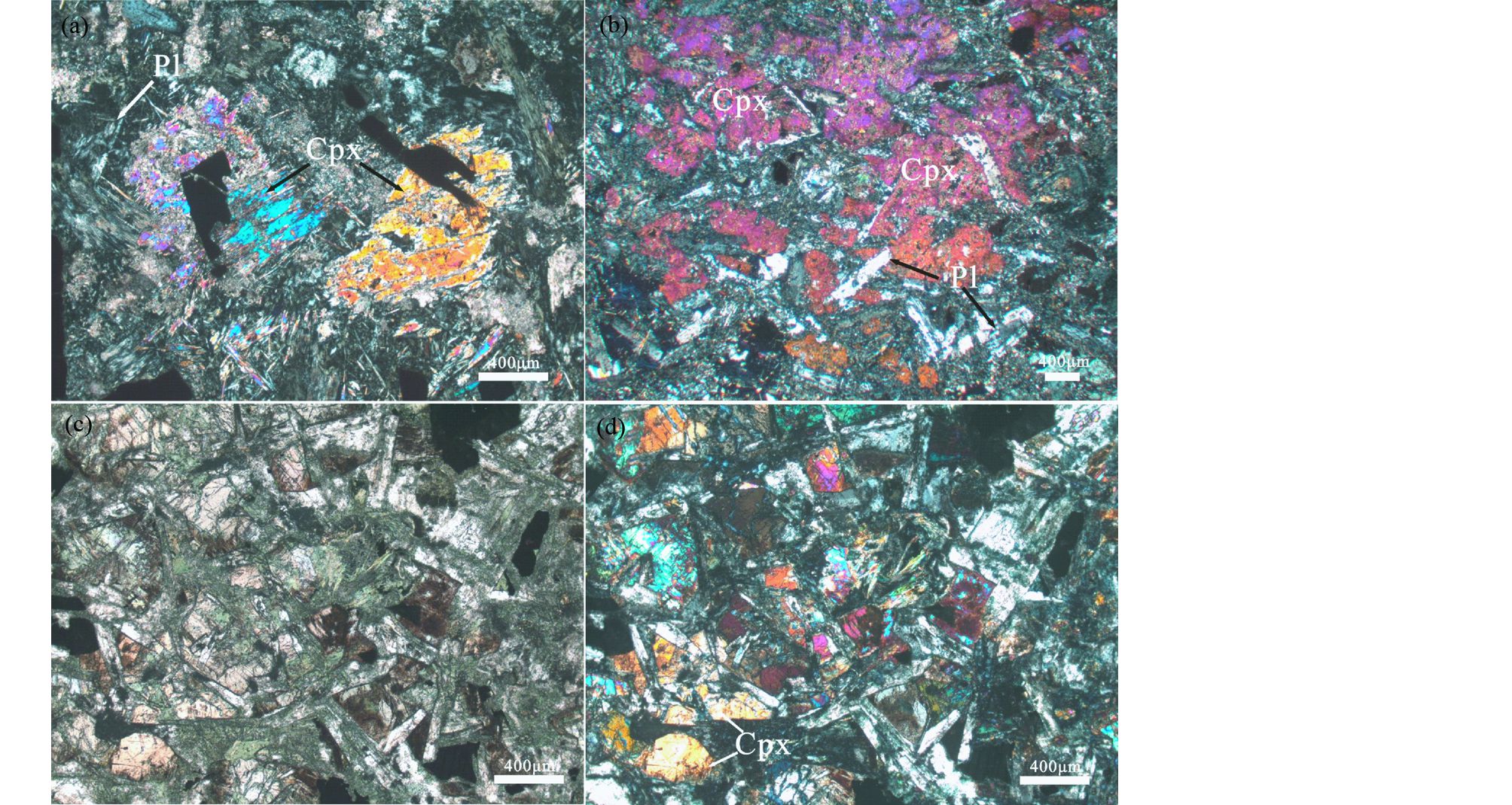
本文研究的江孜-康马一带辉绿岩体,由北至南包括日喀则重孜乡玉堆村附近T0901岩体,江孜札德日附近T0902岩体,康马县南尼乡T0907岩体及色休村T0904岩体,岩体T0901侵位于雅鲁藏布江缝合带南部的混杂堆积带内(ML,Ding et al.,2005),其余岩体均侵位于白垩系或之前的地层中(图 1b)。对上述四处辉绿岩体分别进行了系统采样,下述一个系列代表一个辉绿岩体的全部样品。各系列样品呈典型的辉长或辉绿结构,矿物组成相似(图 2),主要矿物包括斜长石(40%~50%)和单斜辉石(45%~55%):斜长石多呈自形长板状,部分发生绢云母化,如T0902系列(图 2a);单斜辉石多呈粒状,多数发生绿泥石化,或蚀变为角闪石和黑云母,在T0901系列样品中出现少量斜方辉石。副矿物包括榍石、钛铁矿、黄铁矿、磷灰石、锆石等。除T0904系列样品较新鲜外(图 2c,d),其余样品普遍发生碳酸盐化,出现大颗粒方解石,并受后期流体作用影响,穿插石英和方解石组成的细脉。
|
图 2 江孜-康马地区辉绿岩显微照片 (a)T0902(+);(b)T0907(+);(c)T0904(-);(d)T0904(+). Pl-斜长石;Cpx-单斜辉石 Fig. 2 Microphotographs of diabasas from the Gyangze-Kangma area Pl-plagioclase; Cpx-clinopyroxene |
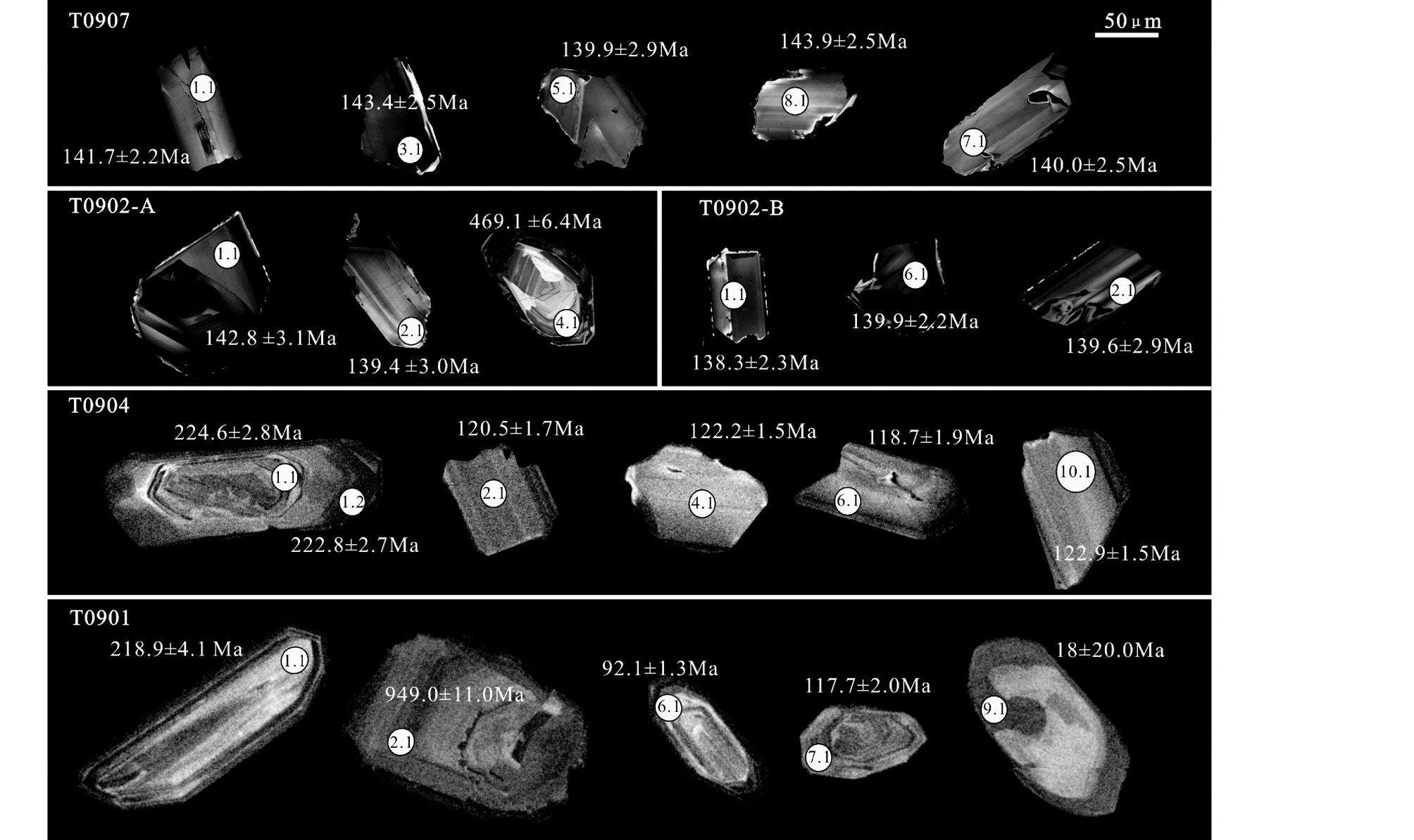
从上述四个辉绿岩体的样品中分别选出锆石,经手工挑选、制靶和抛光后,进行阴极发光(CL)和扫描电镜背散射(BSE)成像观察,揭示锆石的内部结构。阴极发光成像在中国地质科学院地质研究所北京离子探针中心进行。在中国地质科学院地质研究所大陆构造与动力学实验室进行BSE图像和锆石内部包裹体的成分测试。通过对照阴极发光(图 3)和BSE图像,鉴别锆石不同生长域差异特征,选取锆石U-Pb测试点。
|
图 3 江孜-康马地区辉绿岩锆石阴极发光(CL)图像 Fig. 3 Cathodoluminescence(CL)images showing the texture and respective spots for U-Pb analysis on zircon grains from Gyangze-Kangma diabases |
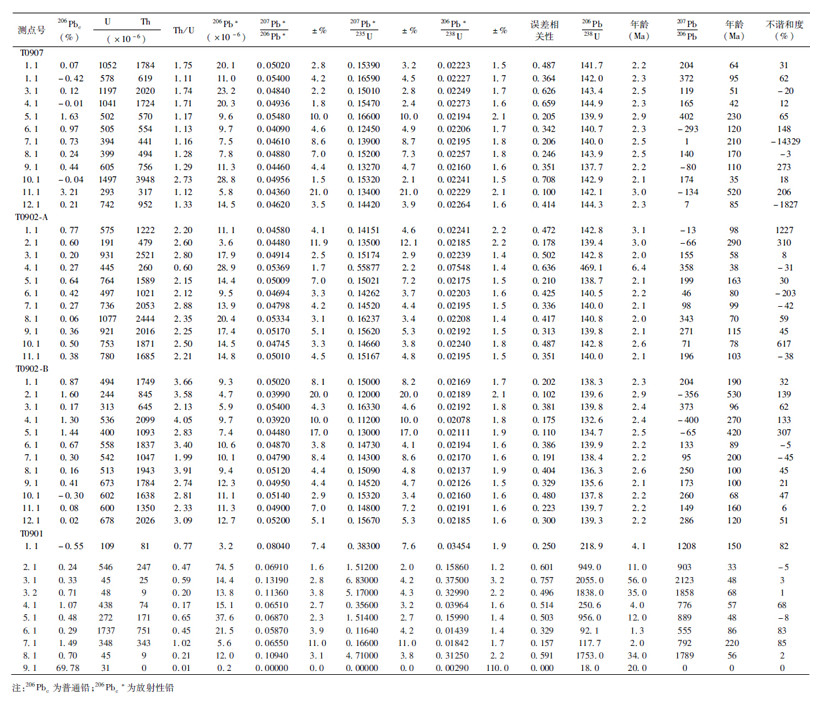
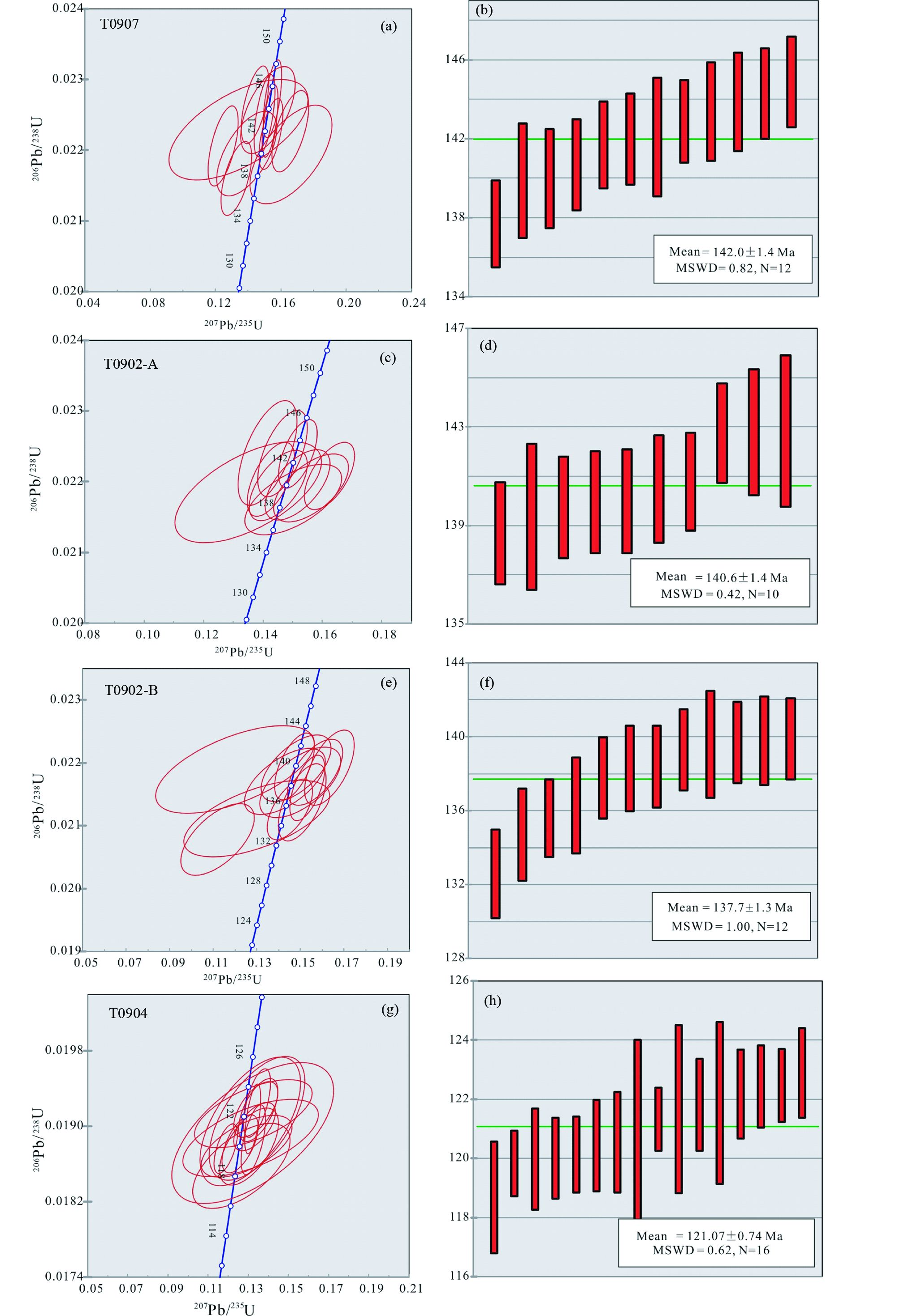
辉绿岩体T0901、T0902和T0907的锆石U-Pb同位素定年测试在北京离子探针中心进行,所用仪器为高分辨率、高灵敏度离子探针SHRIMP Ⅱ,分析流程和原理详见Williams(1998) 。测定时仪器质量分辨率约为5000(1%峰高);一次离子流O2-强度约为3nA,一次离子流束斑直径约为30μm;样品点清洗时间为180s;应用标准锆石M257(年龄为561.3Ma、U含量为840×10-6)标定所测锆石的U含量,应用标准锆石TEMORA(年龄为417Ma)进行样品年龄校正,每测定3个未知点,插入一次TEM标样测定,均采用5组扫描。数据处理采用Squid软件和ISOPLOT软件(Ludwig,2003)。测点年龄值采用204Pb校正的206Pb/238U年龄,单个数据点的误差类型为1σ,加权平均年龄为95%置信度。测试结果见表 1和图 4。
|
表 1 江孜-康马地区辉绿岩SHRMP锆石U-Pb定年数据 Table 1 SHRMP U-Pb analycal results for zircons from diabase in the Gyangze-Kangma area |
|
图 4 江孜-康马辉绿岩样品锆石U-Pb定年谐和图和年龄分布图 Fig. 4 U-Pb concordia and age distribution diagrams for SHRIMP(Sample T0907,T0902-A,T0902-B)and LA-ICP-MS(Sample T0904)analytical results of Gyangze-Kangma diabases |
辉绿岩体T0904的锆石U-Pb同位素定年测试在中国地质科学院矿产资源研究所成矿作用与资源评价重点实验室进行。所用仪器为德国Finnigan公司生产的Neptune型激光多接受等离子体质谱(LA-MC-ICPMS),并结合美国New Wave公司生产的UP123 nm激光剥蚀系统,激光剥蚀所用束斑直径为25μm,频率为10Hz,能量密度约为2.5J/cm2,以He为载气。U和Th含量以锆石标样M 127(U:923×10-6;Th:438×10-6;Th/U:0.475)为外标进行校正。在测试过程中,每测定10个样品点前后重复测量两次锆石标样GJ-1和一次锆石标样Plesovice。分析数据的离线处理(包括对样品和空白信号的选择、仪器灵敏度漂移校正、元素含量及U-Th-Pb同位素比值和年龄计算)采用软件ICPMSDateCal完成(Liu et al.,2010),锆石年龄谐和图用Isoplot 3.0程序获得。测试结果见表 2和图 4。
|
|
表 2 江孜-康马地区辉绿岩(T0904)的LA-MC-ICP-MS锆石U-Pb定年数据 Table 2 U-Pb isotopic data for the Kangma diabase(T0904 suite) |

为精确限定江孜-康马地区辉绿岩的地球化学特征,在国土资源部国家地质实验测试中心分析了它们的全岩主量和微量元素组成。采用XRF(X荧光光谱仪3080E)方法分析岩石主量元素,分析精度为5%。采用等离子质谱仪(ICP-MS-Excell)分析微量元素和稀土元素(REE),含量大于10×10-6的元素测试精度为5%,而小于10×10-6的元素精度为10%,个别含量低的元素测试误差大于10%。分析结果列在表 3中。
|
|
表 3 藏南江孜-康马地区辉绿岩主量元素(wt %)和微量元素(× 10-6)数据 Table 3 Whole-rock major (wt%) and trace element (× 10-6) data of diabases in the Gtangze-Kangma area,southern Tibet |

Rb-Sr和Sm-Nd同位素比值采用同位素稀释法测定,在中国科学技术大学放射性同位素地球化学实验室热电离质谱计MAT-262上进行。样品的化学分离纯化在净化实验室完成。Sr和Nd同位素比值测定分别采用86Sr/87Sr=0.1194和146Nd/149Nd=0.7219进行质量分馏标准化校正,化学流程和同位素比值测定参见Chen et al.(2002,2007)。根据各个辉绿岩体锆石U/Pb定年结果,分别计算各组样品的初始Sr-Nd同位素比值,分析结果见表 4。
|
|
表 4 藏南江孜-康马地区辉绿岩Sr-Nd同位素数据 Table 4 Sr-Nd isotopic data of diabases in Gyangze-Kangma area,southern Tibet |
在以下数据描述中,锆石测点年龄大于900Ma的采用207Pb/206Pb年龄,小于900Ma的采用206Pb/238U年龄。
T0907辉绿岩体中锆石呈长柱状或板片状,长约100μm,发育宽板状韵律环带(图 3)。12个分析点的U和Th含量分别为293×10-6~1497×10-6和317×10-6~3948×10-6,Th/U比值为1.1~2.7。锆石测点年龄在137.7Ma到144.9Ma之间变化,集中在谐和线的~142.0Ma附近,加权平均年龄为142.0±1.4Ma(MSWD=0.82)(图 4a,b)。典型的生长韵律环带和较高的Th/U比值均显示该年龄为辉绿岩体T0907的结晶年龄。
辉绿岩体T0902共挑选了2件锆石样品(A和B)分别开展U-Pb年龄测试。2件样品中锆石均呈柱状,长50~100μm,发育均匀生长的韵律环带,T0902-A中出现少数具有核-边结构的锆石,边部为紧密的韵律环带(图 3)。2件样品中锆石测点的U含量分别为191×10-6~1077×10-6和244×10-6~678×10-6,Th含量分别为479×10-6~2521×10-6和645×10-6~2099×10-6,Th/U比值分别为2.1~2.9和2.0~4.0,均较为相近。T0902-A中10个测点年龄介于138.7Ma和142.8Ma之间,加权平均年龄为140.6±1.4Ma(MSWD=0.42)(图 4c,d);T0902-B中12个测点年龄介于132.6Ma到139.9Ma之间,加权平均年龄为137.7±1.3Ma(MSWD=1.00)(图 4e,f),2件样品给出相近的年龄,表明辉绿岩体T0902的结晶年龄为140.6~137.7Ma。T0902-A中具有核-边结构的锆石核部测点4.1具有较低的Th/U比值(0.60),年龄为469.1±6.4Ma,应该为辉绿岩浆侵位过程中捕获的围岩锆石。
T0904岩体中锆石多呈长柱状,约100~150μm,发育均匀的韵律环带(图 3),少数锆石发育核-幔-边结构。两种锆石给出两组不同年龄:16个发育韵律环带的锆石测点的U和Th含量分别为122×10-6~950×10-6和188×10-6~2613×10-6,Th/U比值为1.5~3.4,年龄介于118.7Ma和122.9Ma之间,集中在谐和线的~121.1Ma附近,加权平均年龄为121.1±0.7Ma(MSWD=0.62)(图 4g,h),典型的生长韵律环带和较高的Th/U比值均显示该年龄为辉绿岩T0904的结晶年龄;发育核-幔-边结构的锆石核部及幔部的3个测点具有较低的Th/U比值(0.4~1.7),年龄分别为222.8Ma、224.6Ma和280.9Ma,可能来源于围岩捕获。
T0901系列样品中锆石较少,呈长柱状至浑圆状,长50~150μm,多数锆石发育核-边结构,核部具有韵律环带,边部狭窄呈模糊的灰黑色,少数锆石发育均匀韵律环带(图 3)。发育核-边结构锆石的9个核部测点U、Th含量均具有较大差别,分别为31×10-6~1737×10-6和1×10⁻⁶~247×10-6,Th/U比值变化于0.01~0.8,核部年龄在2123±48Ma至218.9±4.1Ma之间变化,代表捕获锆石或者源区中古老锆石的年龄;1个边部测点9.1年龄为18.0Ma,与喜马拉雅造山带变质与深熔作用年龄相似(Harrison et al.,1997; Zhang et al.,2004; Xu et al.,2013; 高利娥等,2013; Gao and Zeng,2014; 吴福元等,2015),代表该辉绿岩体后期经历的变质事件时间。具有均匀韵律环带的测点(6.1及7.1)年龄分别为92.1±1.3Ma和117.7±2.0Ma,表明该辉绿岩的形成时代应等于或晚于92.1Ma,明显晚于上述其他辉绿岩的形成时代。
综上,江孜-康马地区特提斯沉积岩系中发育至少三期基性岩浆作用,分别为~140Ma(T0907系列和T0902系列),~120Ma(T0904系列)和~90Ma(T0901系列)。这三期基性岩在南北方向上形成中间老、两边新的分布特征(图 1b)。
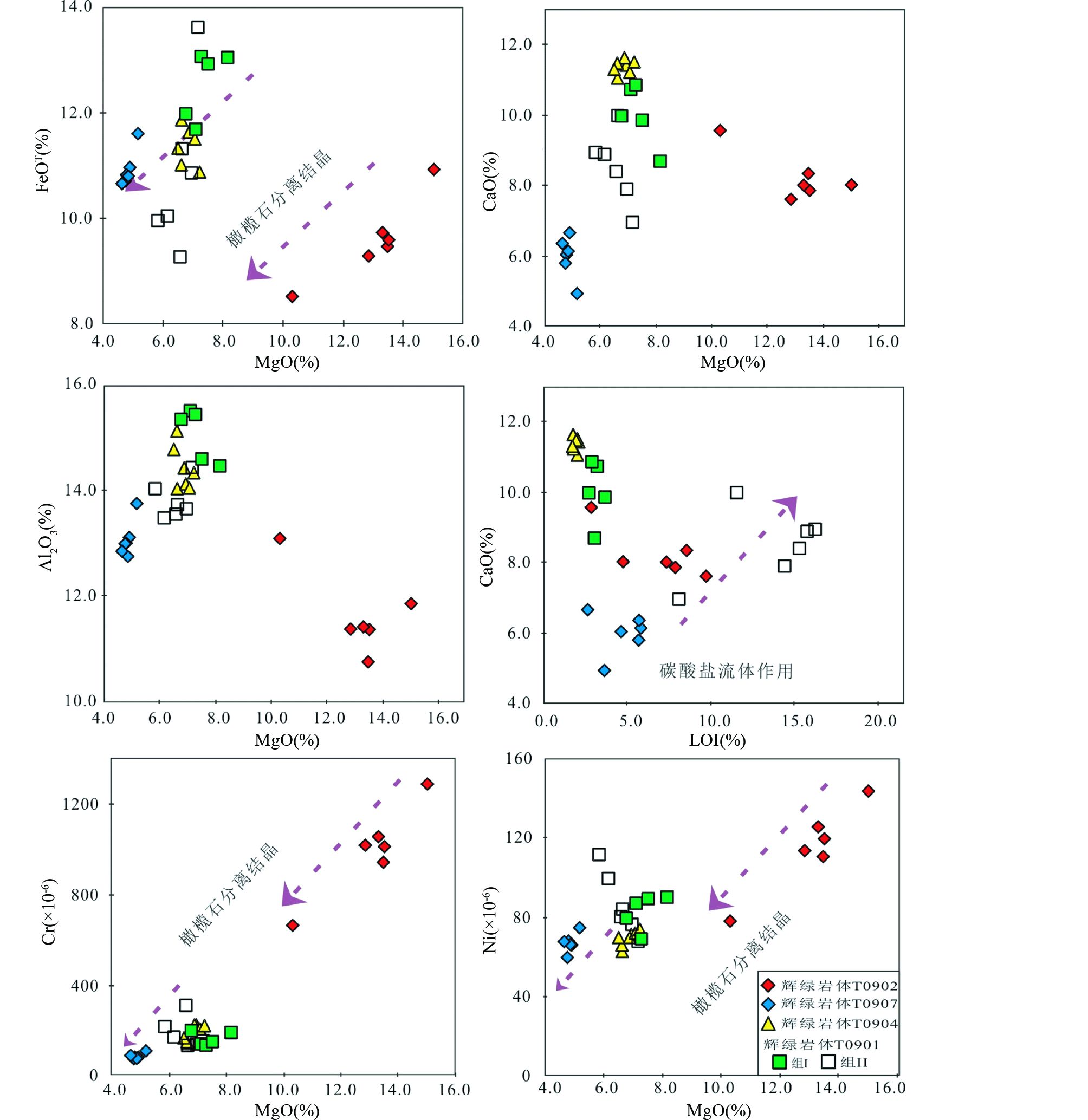
3.2 全岩元素地球化学特征根据烧失量LOI值可将~90Ma的T0901系列样品分为两组:组Ⅰ样品LOI值低(2.7%~3.6%);组Ⅱ具有高LOI值(8.1%~16.2%),同时LOI值与CaO含量呈正相关(图 5),在薄片中观察到大量方解石产于造岩矿物颗粒之间,推测其为受后期碳酸质流体交代所致,应去除LOI后重新计算主量元素组成。三期基性岩样品具有如下主量元素特征:(1) ~140Ma的T0902系列样品Mg#值(68.2~71.7)和MgO含量较高(10.3%~15.0%),SiO2含量低(44.3%~45.1%),最接近原始岩浆。其余系列辉绿岩主量元素组成相似,均具有较低的MgO含量(4.6%~8.1%)和Mg#值(43.6~55.7);(2) 各系列辉绿岩的K2O(<1.6%)和Na2O(<4.0%)含量均较低。
|
图 5 江孜-康马辉绿岩主量及微量元素与MgO和LOI相关图 图 7-图 11、图 13图例同此图 Fig. 5 Covariation diagram of selected major oxides and trace elements of FeOT,CaO,Al2O3,Cr,Ni vs. MgO and CaO vs. LOI in Gyangze-Kangma diabases The legends in Fig. 7-Fig. 11 and in Fig. 13 are same as those in this figure |
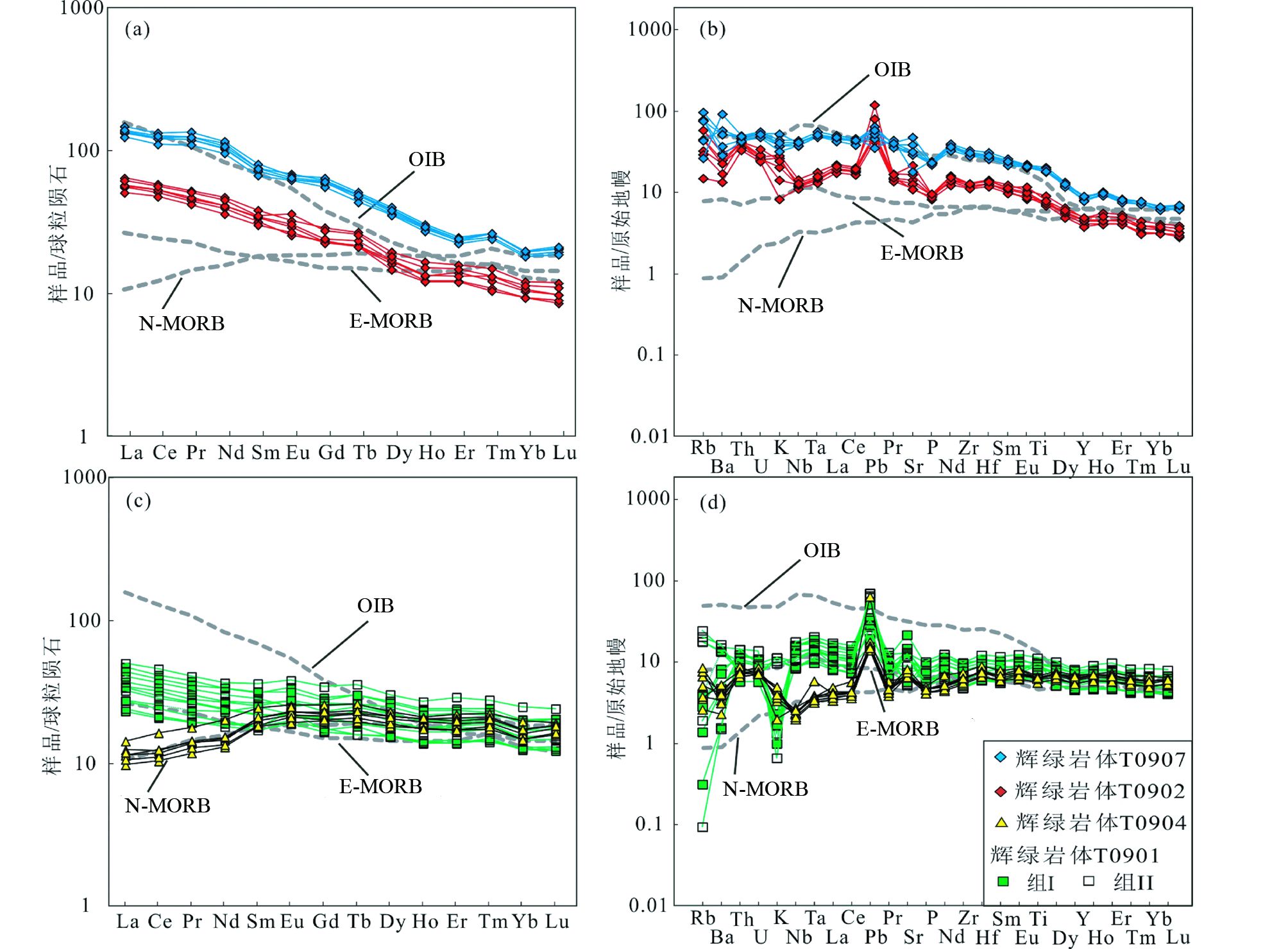
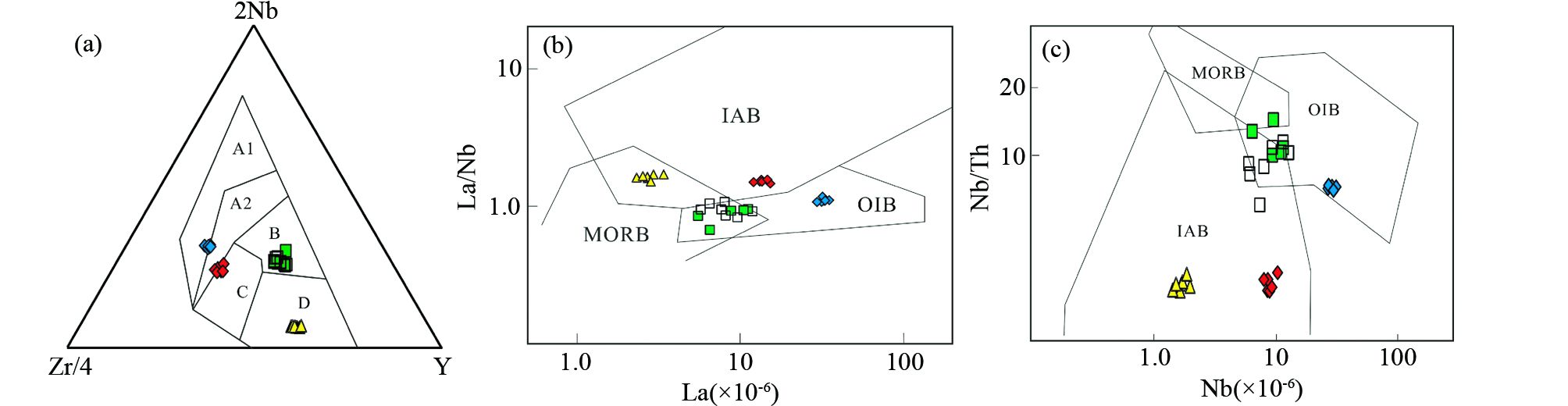
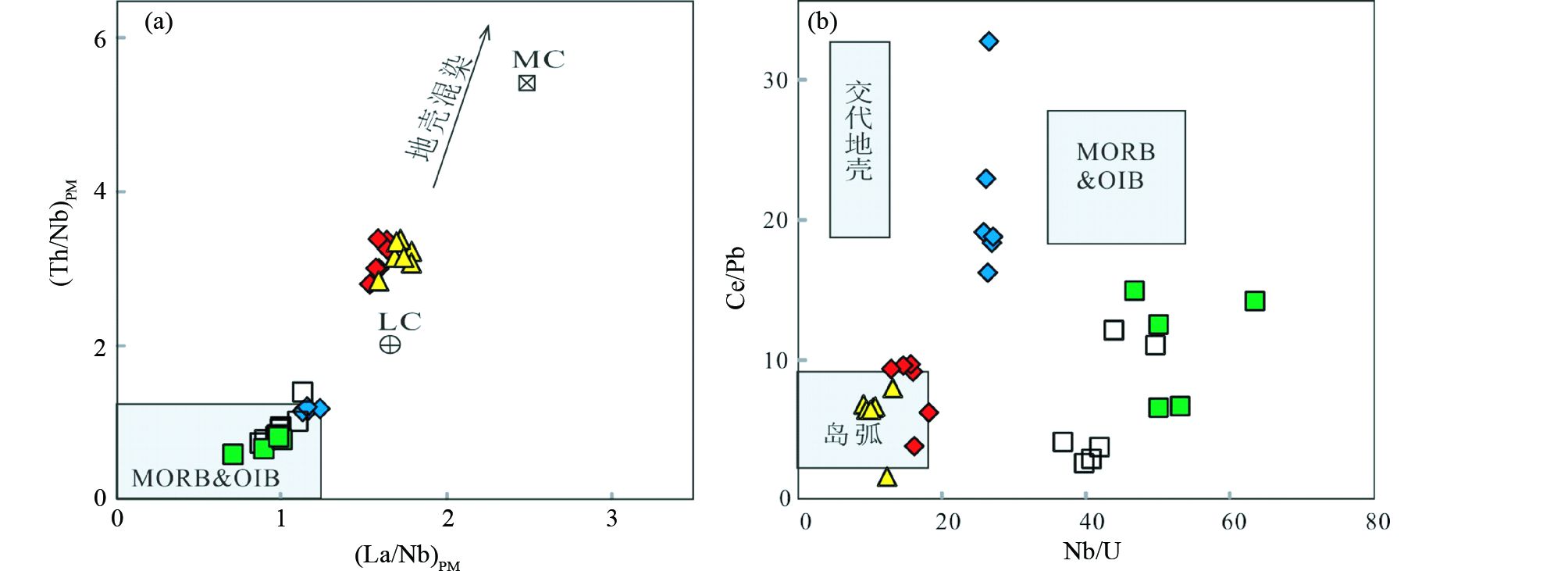
三期基性岩具有完全不同的微量元素特征:(1) ~140Ma基性岩(T0907系列和T0902系列):T0907系列样品富集轻稀土元素,亏损重稀土元素,(La/Yb)N为6.85~7.53,无显著铕异常(Eu/Eu*=0.92~1.02)(图 6a),富集LILEs和HFSEs(图 6b),与标准OIB类似。在构造环境判别图中,T0907系列样品均位于OIB区域(图 7)。Nb/U(25.7~27.0)和Ce/Pb(16.3~32.8)值接近大洋玄武岩(OIB和MORB)(图 8b,Hofmann et al.,1986);T0902系列总体上与T0907系列特征相似,但具有显著的Nb、Ta和微弱的Ti负异常及Pb正异常(图 6a,b)。在构造环境判别图中,样品因具有Nb、Ta负异常而位于岛弧玄武岩区域(图 7)。Nb/U(12.9~18.1)和Ce/Pb(3.9~9.7)明显较低,显示岛弧特征(图 8b)。上述两套岩石的Nb/Ta比值(13.4~14.1和14.1~14.7,均低于球粒陨石)和Zr/Hf比值(38.5~39.6和32.1~34.3)均接近OIB值(Nb/Ta=14.6~17.6,Zr/Hf=35.5~45.5; Weaver,1991; Pfänder et al.,2007);(2) ~120Ma基性岩(T0904系列):稀土元素特征与N-MORB一致(图 6c),亏损轻稀土元素,(La/Yb)N为0.66~0.73,显示微弱正铕异常(Eu/Eu*=1.01~1.13),微量元素与标准N-MORB相比具有显著的LILE(Rb、Ba、Th、U、K)和Pb的正异常(图 6d)。在构造环境判别图解7a和b中,样品位于N-MORB区域,但在Nb-Nb/Th图解中(图 7c),因Th元素的正异常,位于岛弧玄武岩范围内。Nb/U(9.0~13.1)和Ce/Pb(1.69~8.02)值较大洋玄武岩低(图 8b);(3) ~90Ma基性岩(T0901系列):略富集轻稀土元素,亏损重稀土元素,轻、重稀土元素分馏程度低,(La/Yb)N=1.81~2.35,具微弱负铕至正铕异常(Eu/Eu*=0.90~1.32),所有样品稀土元素特征均与标准E-MORB岩石相似。在微量元素蛛网图中(图 6d),与标准E-MORB相比具有Pb正异常,同时组II样品因后期流体作用而显示Rb、Ba、K、Sr等流体活动性元素含量高度变化。在构造环境判别图解中所有样品均位于E-MORB区域及其附近(图 7)。Nb/U(36.7~63.4)与大洋玄武岩相当,但Ce/Pb(2.65~14.96)较低(图 8b),与样品具有Pb正异常有关。
|
图 6 江孜-康马地区辉绿岩球粒陨石标准化稀土元素配分图(a、c)和原始地幔标准化微量元素蛛网图(b、d) 球粒陨石、原始地幔、OIB、E-MORB和N-MORB值据Sun and McDonough,1989 Fig. 6 Rare earth element distribution diagrams(a,c)and trace element distribution diagrams(b,d)for diabases in the Gyangze-Kangma area Data of chondrite,primitive mantle,OIB,E-MORB,and N-MORB are from Sun and McDonough,1989 |
|
图 7 江孜-康马地区辉绿岩微量元素构造环境判别图 (a)据Meschede,1986:A1-板内碱性玄武岩;A2-板内碱性玄武岩+板内拉斑玄武岩;B-E-MORB;C-板内拉斑玄武岩+火山弧玄武岩;D-火山弧玄武岩+N-MORB.(b、c)据李曙光,1993:IAB-岛弧玄武岩;MORB-洋中脊玄武岩;OIB-洋岛玄武岩 Fig. 7 Tectonic discrimination diagrams of immobile trace elements for diabases in the Gyangze-Kangma area (a)after Meschede,1986: A1-Within plate alkaline basalts; A2-Within plate alkaline and tholeiitic basalts; B-E-MORB; C-Within plate tholeiitic basalts+volcanic arc basalts; D-Volcanic arc basalts +N-MORB.(b,c)after Li,1993: IAB-island arc basalts; MORB-mid-ocean ridge basalts; OIB-ocean island basalts |
|
图 8 判别地壳混染的(Th/Nb)PM-(La/Nb)PM(a)和Nb/U-Ce/Pb图解(b)(据Neal et al.,2002; Klein and Karsten,1995) MC-中地壳值和LC-下地壳值引自Rudnick and Gao,2003 Fig. 8 (Th/Nb)PM vs.(La/Nb)PM(a)and Nb/U vs. Ce/Pb(b)diagrams to show the effects of crustal contamination on the trace element characteristics in the Gyangze-Kangma diabases(after Neal et al.,2002; Klein and Karsten,1995) MC-middle crust and LC-lower crust are from Rudnick and Gao,2003 |
上述数据表明,江孜-康马地区形成于~140Ma、~120Ma和~90Ma的基性岩均具有低钾含量,但分别显示OIB型、N-MORB型和E-MORB型的稀土和微量元素特征。
3.3 全岩Sr-Nd同位素地球化学特征江孜-康马地区22件辉绿岩样品的Sr-Nd同位素数据见表 4和图 9。三期基性岩Sr-Nd同位素组成具有显著差别。
|
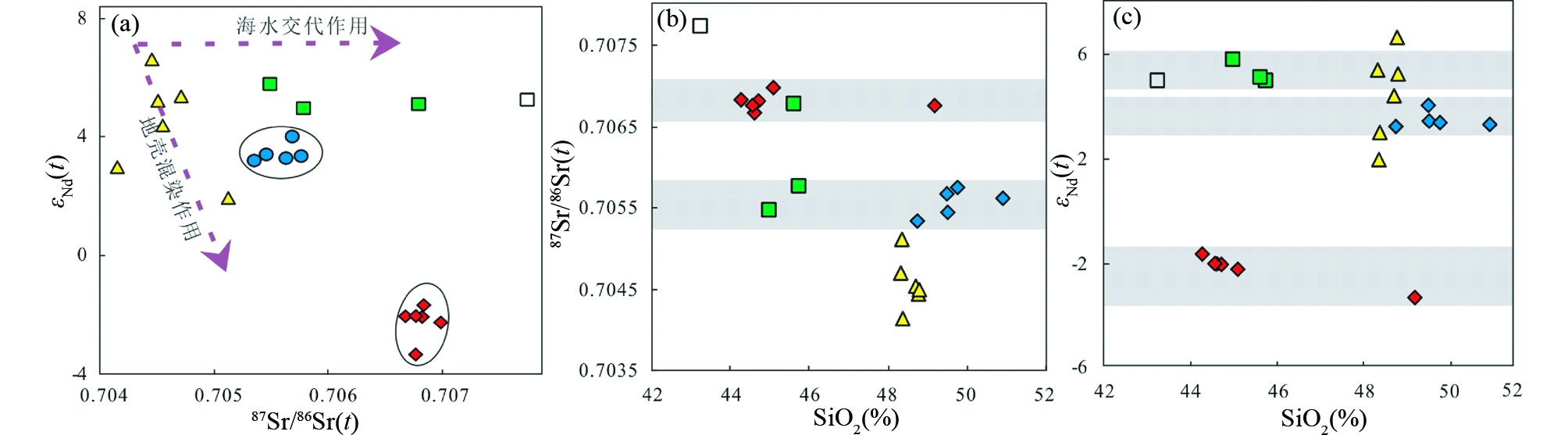
图 9 江孜-康马地区辉绿岩Sr、Nd同位素及SiO2相关图解 阴影代表各岩体同位素变化范围 Fig. 9 Covariation diagrams of 87Sr/86Sr(t)vs. εNd(t)(a),87Sr/86Sr(t)vs. SiO2(b),and εNd(t)vs. SiO2(c)of Gyangze-Kangma diabases The shade represents the range of isotopic value for each suite |
两套形成于~140Ma的辉绿岩在Rb-Sr和Sm-Nd同位素组成上表现出较大的差别:(1) T0907系列岩石具有较低的Rb/Sr(0.0274~0.0809)和Sm/Nd(0.2084~0.2175),较低的87Sr/86Sr(t)值(0.7054~0.7058)和较高的εNd(t)值(+3.3~+4.1);(2) T0902系列岩石则具有较高的Rb/Sr(0.0409~0.1235)和Sm/Nd(0.2410~0.2621),较高的87Sr/86Sr(t)(0.7067~0.7070)和较低的εNd(t)值(-3.3~-1.6)。
形成于~120Ma的T0904系列岩石Rb/Sr较低(0.0119~0.0353),但Sm/Nd较高(0.3772~0.4448),87Sr/86Sr(t)较低,为0.7041到0.7051,εNd(t)较高,从+2.0到+6.7。
形成于~90Ma的T0901系列岩石Rb/Sr(0.0004~0.0812)和87Sr/86Sr(t)(0.7055~0.7077)均表现出较大的变化,但εNd(t)均一(+4.9~+5.6)(图 9a),可能受海水交代作用影响(Staudigel et al.,1995)。
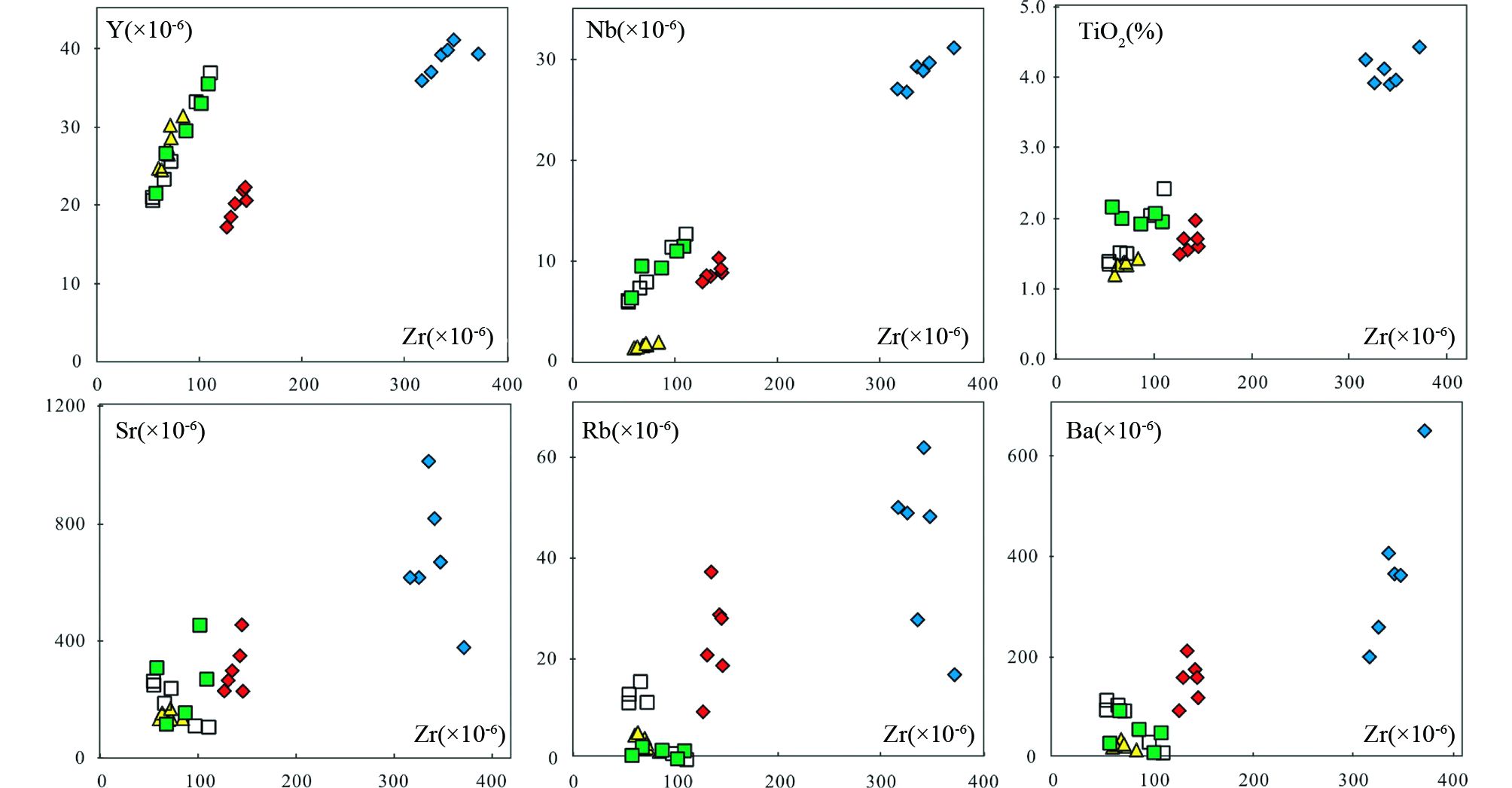
4 讨论 4.1 后期交代及地壳混染为了探讨各系列辉绿岩经历的岩浆过程及其源区,需排除受后期交代及低级变质作用影响的样品。由镜下观察可知,研究样品普遍遭受不同程度的碳酸盐化作用。在低温热液交代及低级变质作用中,基性岩的LILE(如K、Rb、Ba、Sr等)具有较大活动性,易受后期流体作用的影响,但HFSE、REE和过渡族元素(Cr、Ni)等为相对不活动的元素。从上述的数据描述可知,尽管蚀变程度不同,但同一系列的样品中HFSE和REE分配型式平行(图 6),指示这些蚀变基性岩仍保持原始的REE和HFSE元素特征。在图 10中,Nb,Y和TiO2等流体不活动元素与Zr具有较好的线性相关,表明这些元素受流体交代的影响较小,不同系列样品间斜率的微小差异代表了不同的部分熔融程度或者地幔源区(Kerr et al.,1997),而Ba,Sr和Rb等活动元素与Zr相关性差,表明这些元素的地球化学特征已经被后期流体作用改造。故下文仅采用HFSE(Ti、Zr、Y、Nb、Ta、Hf)、Th和REE等不活动元素探讨岩浆源区特征及岩石成因。
|
图 10 江孜-康马地区辉绿岩微量元素(×10-6)和主量元素(%)与Zr相关图解 Fig. 10 Covariation diagram of selected trace elements(×10-6)and major oxides(%)versus Zr for diabases in Gyangze-Kangma areas |
在幔源岩浆形成和就位过程中,很可能受到地壳或岩石圈地幔物质的混染。受地壳组分混染的幔源岩浆通常显示Nb、Ta、Ti的负异常(Thompson et al.,1984; Wilson,1989),因此可采用(La/Nb)PM-(Th/Nb)PM图解来甄别壳源物质混染作用(Neal et al.,2002)。图 8a中,T0907系列和T0901系列均落入大洋玄武岩区域(MORB & OIB)而远离地壳区域,T0902系列与T0904系列因具有明显的Nb和Ta异常,远离大洋玄武岩区域,显示被地壳组分混染的趋势。Nb/U和Ce/Pb比值是判断大洋玄武岩源区地球化学性质敏感而有效的示踪工具(Campbell,2002; Miller et al.,1994; Hofmann et al.,1986)。图 8b中,T0907系列最接近MORB和OIB区域,其余样品因具有Pb正异常,全部靠近岛弧区域。因此除T0907系列外,其余系列样品均具有壳源混染的特征,其形成机制可能包括:在岩浆上侵过程中受地壳物质混染或地幔源区含有壳源物质。如果为前者,则在岩浆上侵过程中,随着SiO2含量的升高,应伴随87Sr/86Sr(t)逐渐增高和εNd(t)逐渐减小,但T0902系列和T0907系列样品随着SiO2升高,Sr和Nd同位素比值均保持稳定(图 9b,c),T0904系列87Sr/86Sr(t)和εNd(t)组成显示受地壳混染的趋势(图 9a),但SiO2变化范围小(图 9b,c)。各系列辉绿岩地球化学特征均与岩浆上侵过程中的混染作用不一致,更有可能是岩浆源区含有壳源物质。
|
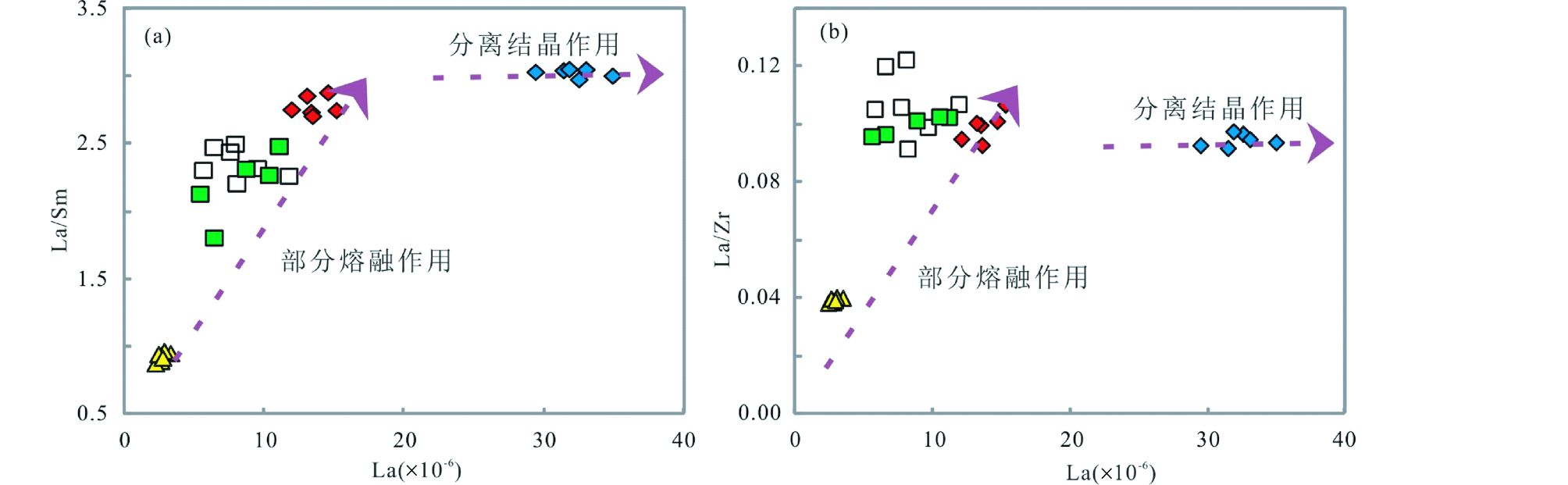
图 11 江孜-康马地区辉绿岩La-La/Sm(a)及La-La/Zr(b)关系图 Fig. 11 La vs. La/Sm(a)and La vs. La/Zr(b)diagrams of Gyangze-Kangma diabases |
|
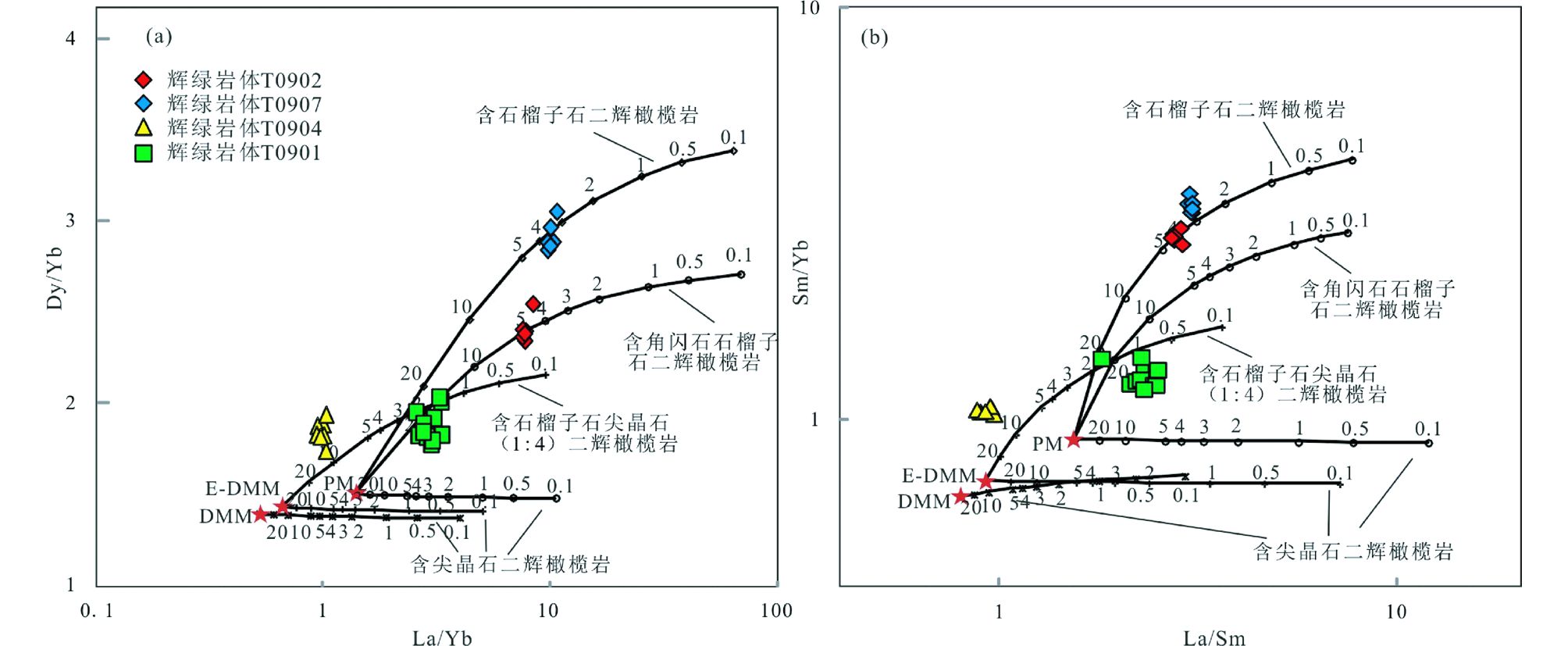
图 12 La/Yb-Dy/Yb(a)和La/Sm-Sm/Yb(b)图解 图中熔融曲线运用Shaw(1970) 批式熔融模型计算得到(Aldanmaz et al.,2000);每条曲线上的数字对应给定源区部分熔融的程度(%).采用的地幔源区组成分别为:含尖晶石二辉橄榄岩(50%橄榄石+35%斜方辉石+10%单斜辉石+5%尖晶石);含石榴子石二辉橄榄岩(50%橄榄石+30%斜方辉石+15%单斜辉石+5%石榴子石);含角闪石石榴子石二辉橄榄岩(50%橄榄石+22%斜方辉石+20%单斜辉石+5%石榴子石+3%角闪石);含石榴子石尖晶石(14)二辉橄榄岩(50%橄榄石+35%斜方辉石+10%单斜辉石+1%石榴子石+4%尖晶石);分配系数引自Mckenzie and O’Nions(1991) ,亏损的MORB地幔(DMM),富集的DMM(E-DMM)引自Workman and Hart(2005) ,原始地幔组成引自Sun and McDonough(1989) Fig. 12 Fig. 12 La/Yb vs. Dy/Yb(a)and La/Sm vs. Sm/Yb(b)diagrams showing the partial melting curves obtained using the nonmodal batch melting equations of Shaw(1970) following the approach of Aldanmaz et al.(2000) Tick marks on each curve correspond to degrees of partial melting(%)for a given mantle source; Mineral assemblage for spinel-lherzolite source: Ol 50%+Opx 35%+Cpx 10%+Sp 5%; for garnet-lherzolite source: Ol 50%+Opx 30%+Cpx 15%+Gt 5%; for hornblende garnet-lherzolite source: Ol 50%+Opx 22%+Cpx 20%+ Gt 5%+Hbl 3%; for garnet spinel(14)-lherzolite source: Ol 50%+Opx 35%+Cpx 10%+ Gt 1%+Hbl 4%; Mineral/matrix coefficients are from Mckenzie and O’Nions(1991) ,Depleted MORB Mantle(DMM)compositions and Enriched depleted mantle MORB Mantle(E-DMM)compositions are from Workman and Hart(2005) ,primitive mantle compositions are from Sun and McDonough(1989) |
部分熔融和分离结晶是两种主要的岩浆作用和演化机制,超岩浆元素(如La、Ce、Th)与亲岩浆元素(如HREE、Zr、Hf等)的浓度比值对亲岩浆元素浓度作图时,可区别分离结晶作用与部分熔融作用(Allègre and Minster,1978)。在La-La/Sm和La-La/Zr判别图解中(图 11),T0907系列样品形成水平的直线分布,指示分离结晶作用,而其他系列样品则呈斜线分布,指示部分熔融作用。在哈克图解中(图 5),随着MgO含量的降低,所有系列样品FeOT、Cr、Ni含量均降低,指示基性矿物(如橄榄石,单斜辉石等)的分离结晶作用。斜长石为所有系列样品中的主要组成矿物,但是随着MgO含量的降低,研究样品CaO和Al2O3升高或不变(图 5),并且无Eu负异常,因此可排除斜长石分离结晶作用。
除了分离结晶作用外,地幔源区部分熔融作用的差异是控制各系列样品在微量元素特征上具有明显差异的主要因素。La/Sm-Sm/Yb和La/Yb-Dy/Yb图解可以用于反演幔源样品的源区特征和部分熔融程度(Aldanmaz et al.,2000)。在地幔岩石部分熔融过程中,因配分系数的不同,含石榴子石或含尖晶石橄榄岩的部分熔融产生的熔体会先富集LREE(如La),同时相对亏损MREE(如Sm和Dy)。HREE在石榴子石中为相容元素,在其他地幔矿物相中为不相容元素(Mysen,1979; Irving and Frey,1984),因此HREE(如Yb)的富集程度取决于石榴子石是否存在。在含尖晶石地幔橄榄岩稳定域内,随着熔融程度的升高,熔体La/Sm和La/Yb值逐渐降低,Sm/Yb和Dy/Yb值变化不大;相反在含石榴子石地幔橄榄岩稳定域内,随着熔融程度的升高,熔体La/Sm和La/Yb值逐渐降低,Sm/Yb和Dy/Yb值显著降低。在图 12中,选择了DMM(depleted-MORB mantle,对流软流圈亏损地幔),E-DMM(富集的软流圈地幔)(Workman and Hart,2005)和PM(primitive mantle,代表下地幔成分)作为可能的地幔源区,通过模拟稀土元素比值的变化来限定江孜-康马地区辉绿岩的源区矿物组成和部分熔融程度。模拟结果见La/Sm-Sm/Yb图解和La/Yb-Dy/Yb图解,具体表现为:(1) 具有OIB特征的T0907系列样品均位于初始地幔(PM)石榴子石二辉橄榄岩3%部分熔融区域,指示源区位于石榴子石稳定域;(2) T0902系列样品陡峭的HREE分布及较大的(La/Yb)N比值(5.30~5.91)均指示其源区位于石榴子石稳定区,该系列的壳源特征表明其源区可能经历过交代混染作用。金云母与角闪石为岩石圈地幔中两种常见的富水矿物,控制着地幔源区流体活动元素(Rb、K、Ba、Sr)的地球化学行为。与金云母平衡的熔体常具有高Rb/Sr(>0.1)和低Ba/Rb(<20),相反含角闪石源区的部分熔融体具有较高的Ba含量(Furman and Graham,1999)。T0902系列样品Rb/Sr含量低(0.04~0.12),Ba含量高(94~213),可能指示这些岩石来自含角闪石的地幔源区。在La/Sm-Sm/Yb图解中,T0902系列位于初始地幔(PM)石榴子石二辉橄榄岩和含角闪石石榴子石二辉橄榄岩部分熔融曲线之间,而在La/Yb-Dy/Yb图解中则更加明显地位于初始地幔(PM)含角闪石石榴子石的二辉橄榄岩5%的部分熔融曲线上,因此T0902系列岩石可能是含角闪石石榴子石二辉橄榄岩部分熔融形成;(3) 具有N-MORB特征的T0904系列岩石远离DMM含尖晶石二辉橄榄岩部分熔融曲线,表明正常的对流软流圈地幔源区单阶段熔融不能解释T0904系列的成因,需要一个富集的事件,这与上述讨论的其源区显示壳源混染的特征相符;(4) 具有E-MORB特征的T0901系列岩石位于含尖晶石二辉橄榄岩和含石榴子石二辉橄榄岩按41的比例混合的E-DMM部分熔融曲线上,部分熔融程度约为1%~2%,故较富集的软流圈地幔(E-DDM)在以尖晶石为主要稳定相的深度下约1%~2%的部分熔融可以解释T0901系列岩石的成因。
综上所述,江孜-康马地区基性岩浆作用由不同地幔源区经历不同程度的部分熔融作用及其后的橄榄石、辉石分离结晶作用形成。
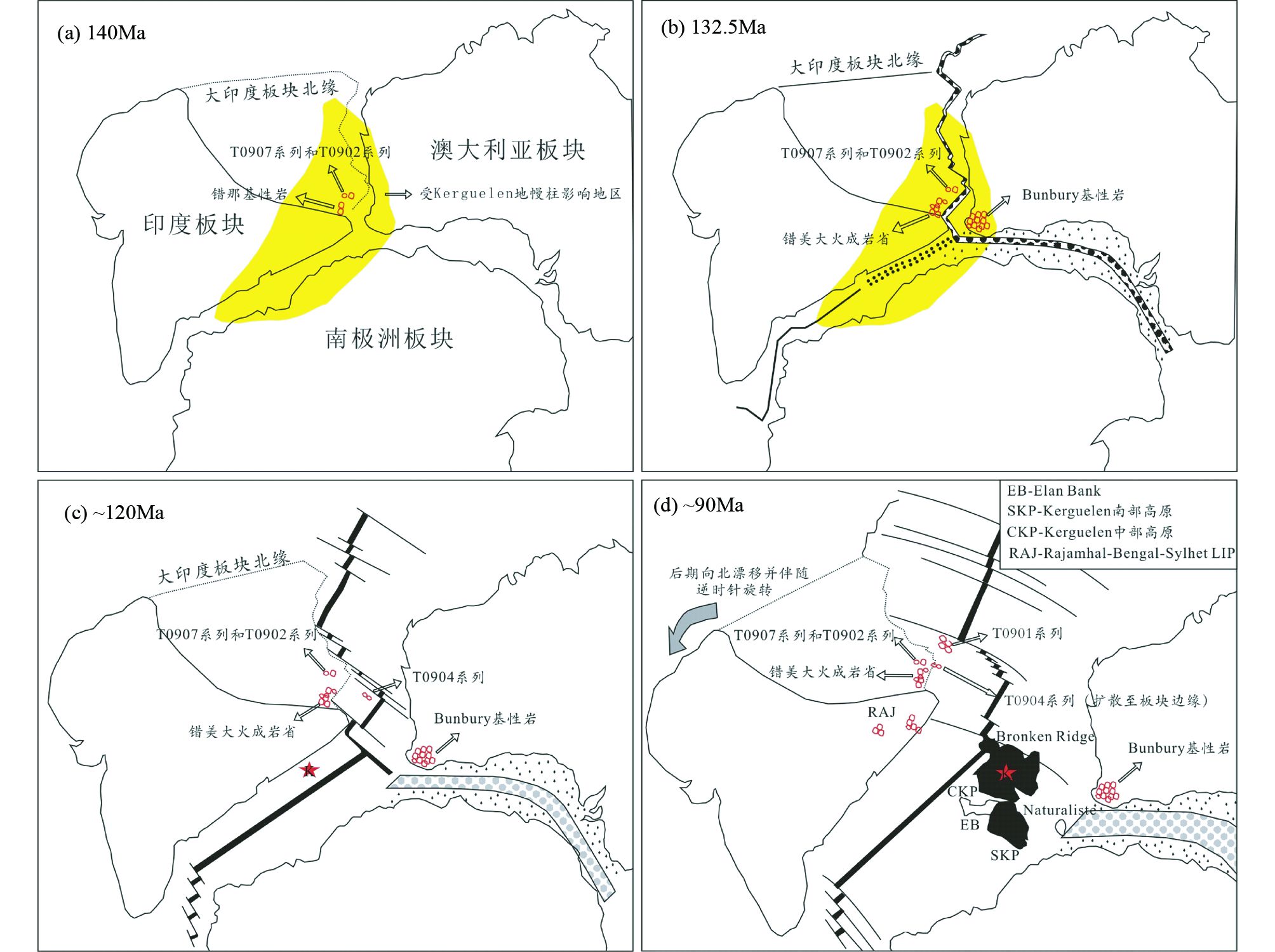
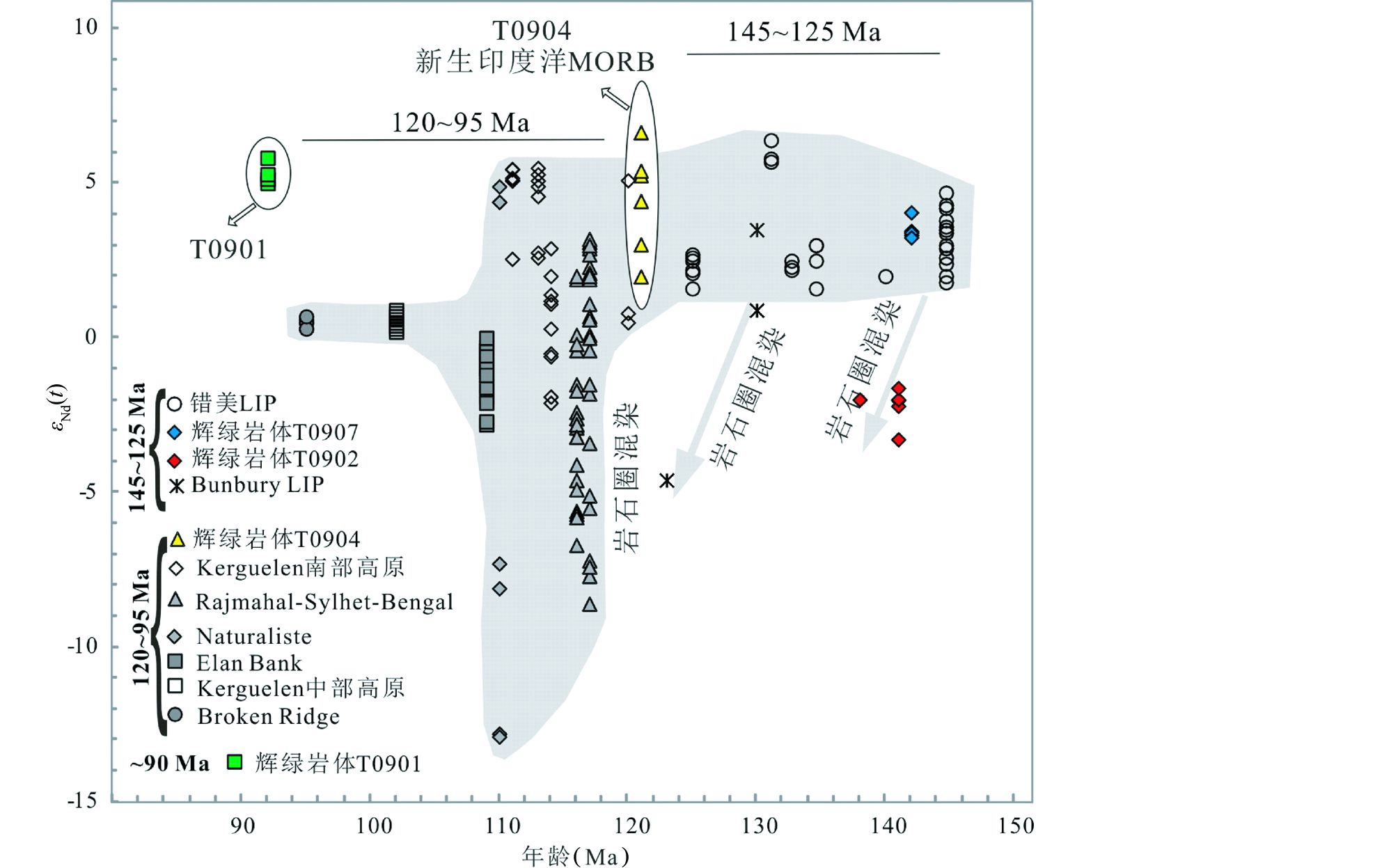
4.3 构造动力学背景位于南印度洋的Kerguelen地幔柱从早白垩世(~140Ma)活跃至今,与该地幔柱相关的岩浆产物分布见图 1a(Coffin et al.,2002及其文中参考文献)。地幔柱活动常形成大火成岩省,并导致超大陆裂解(Courtillot et al.,1999),早白垩世以来Kerguelen地幔柱活动与东冈瓦纳大陆裂解事件密切相关(Zhu et al.,2007,2009),两者时空关系详见东冈瓦纳大陆板块重建图(图 13,据Powell et al.,1988; Frey et al.,2000; Zhu et al.,2008a修改)。本文在前人研究基础上总结出145~85Ma,Kerguelen地幔柱岩浆产物εNd(t)值随时间变化趋势图(图 14),该时期相关岩浆活动主要集中在以下两个时间段:(1) ca.145~125Ma,Kerguelen地幔柱位于东冈瓦纳超大陆下,岩浆活动范围包括属于原大印度板块东北部的特提斯喜马拉雅带东部地区和澳大利亚西部Bunbury地区,以~132Ma的错美-班布里大火成岩省为代表(Frey et al.,1996; Zhu et al.,2009; 图 13a,b)。岩浆产物εNd(t)值介于+1.0~+6.0,少数样品εNd(t)<0,呈现出受上覆岩石圈物质混染的趋势(图 14);(2) ca.120~95Ma,随着大印度板块、澳大利亚板块和南极板块逐渐裂解(Powell et al.,1988; Heine and Müller,2005),Kerguelen地幔柱处于大印度板块和南极洲板块之间(图 13c,d)。在120~110Ma,岩浆产物激增,εNd(t)值范围急剧扩大(-14.0~+5.0),负值代表受富集的岩石圈物质混染。~110Ma之后,岩浆产物εNd(t)值恢复至0左右。本文将研究样品与同时期Kerguelen地幔柱产物εNd(t)值进行比较(图 14),并结合相关构造事件限定研究区基性岩浆源区.
|
图 13 东冈瓦纳大陆板块重建图(据Powell et al.,1988) 印度板块北部虚线代表推测的碰撞前板块北部边缘(Powell et al.,1988);黄色阴影地区代表受Kerguelen地幔柱影响区域(Zhu et al.,2008a);五角星代表Kerguelen地幔柱所在位置(Frey et al.,2000) Fig. 13 Generalized plate tectonic reconstruction(after Powell et al.,1988) The dotted line in the north of Indian plate is the supposed north margin before India-Eurasia collision(Powell et al.,1988); yellow shadow parts are area influenced by Kerguelen igneous and tectonic activity(Zhu et al.,2008a); five-point star is the location of Kerguelen plume(Frey et al.,2000) |
|
图 14 Kerguelen地幔柱产物及江孜-康马地区辉绿岩样品的εNd(t)-年龄相关图解 1 45~125Ma间Kerguelen地幔柱产物:错美LIP引自(Zhu et al.,2008a; Xia et al.,2014; Liu et al.,2015),Bunbury LIP引自(Frey et al.,1996);125~95Ma间Kerguelen地幔柱产物:印度Rajmahal-Sylhet-Bengal LIPs引自(Baksi,1995; Kent et al.,1997; Ghatak and Basu,2011; Kumar et al.,2003),Kerguelen南部高原引自(Frey et al.,2002; Neal et al.,2002; Davies et al.,1989; Weis et al.,1989),Elan Bank引自(Ingle et al.,2002b),Naturaliste引自(Mahoney et al.,1995),Kerguelen中部高原和Broken Ridge引自(Neal et al.,2002) Fig. 14 εNd(t)vs. age diagram about products by Kerguelen plume and Gyangze-Kangma diabases 145~125Ma products by Kerguelen plume include: mafic rocks in Comei LIP after Zhu et al.,2008a; Xia et al.,2014; Liu et al.,2015 and Bunbury LIP after Frey et al.,1996; 125~95Ma products by Kerguelen plume include: Rajmahal-Sylhet-Bengal LIPs in Indian Plate after Baksi,1995; Kent et al.,1997; Ghatak and Basu,2011; Kumar et al.,2003,South Kerguelen Plateau after Frey et al.,2002; Neal et al.,2002; Davies et al.,1989; Weis et al.,1989,Elan Bank after Ingle et al.,2002b,Naturaliste after Mahoney et al.,1995,Central Kerguelen Plateau and Broken Ridge after Neal et al.,2002 |
(1) ~140Ma基性岩浆作用:该时期发育的两类基性岩(T0907系列和T0902系列)均具有OIB型特征。T0907系列与错美大火成岩省中基性岩(CNⅠ组,Zhu et al.,2008a)的Sr-Nd同位素组成接近(图 14、图 15),为Kerguelen地幔柱低程度部分熔融产物。高Mg的T0902系列样品εNd(t)<0,与Kerguelen地幔柱岩浆产物中受富集岩石圈混染的岩石相近(图 14、图 15),有以下两种成因:(1) 地幔柱本身携带类似地壳物质的富集组分(White,2015),但~140Ma时Kerguelen地幔柱大部分产物εNd(t)值均大于0(图 14),可以排除这种可能性;(2) 更可能为Kerguelen地幔柱底侵于东冈瓦纳大陆富集岩石圈地幔底部,两者发生相互作用,如同时期澳大利亚Bunbury Gosselin玄武岩(Ingle et al.,2004),这也与前述关于T0902系列样品的微量元素比值模拟结果一致(图 12)。
|
|
图 15 江孜-康马地区辉绿岩样品的87Sr/86Sr(t)-εNd(t)相关图解 灰色阴影部分代表Kerguelen地幔柱相关岩浆产物:CN Ⅰ,Ⅱ-措那地区玄武岩(Zhu et al.,2008a);BB-G-澳大利亚东北部Bunbury Gosselin玄武岩(Frey et al.,1996);RJ Ⅱ-印度板块Rajmahal组Ⅱ玄武岩(Kent et al.,1997);747-Kerguelen高原中部深钻(Frey et al.,2002);1137L-Kerguelen高原西部Elan Bank中深钻(Ingle et al.,2002a,b) Fig. 15 87Sr/86Sr(t)vs. εNd(t)diagram for Gyangze-Kangma diabases The gray shadow represents magmatic products related to Kerguelen plume: CN Ⅰ,Ⅱ-Cona basalts(Zhu et al.,2008a); BB-G-Bunbury Gosselin basalts from Northeast Australia(Frey et al.,1996); RJ Ⅱ-Rajmahal group Ⅱ basalts from Indian plate(Kent et al.,1997); 747-Deep drillings in Central Kerguelen Plateau(Frey et al.,2002); 1137L-Deep drillings in Elan Bank from Western Kerguelen Plateau(Ingle et al.,2002a,b) |
T0907系列和T0902系列位于~132Ma错美大火成岩省西部,将Kerguelen地幔柱影响的范围从错美向西拓展了约200km,并指示与该地幔柱有关的岩浆活动于~140Ma就已经开始。虽然古大陆重建研究结果指示东冈瓦纳大陆在该时期未发生明显裂解(图 13a),但Powell等(1988) 指出ca.160~133Ma东冈瓦纳大陆内部已发生广泛的伸展作用。因此Kerguelen地幔柱可能长期潜伏在东冈瓦纳大陆下,与东冈瓦纳大陆岩石圈相互作用使其持续减薄进而发生裂解。
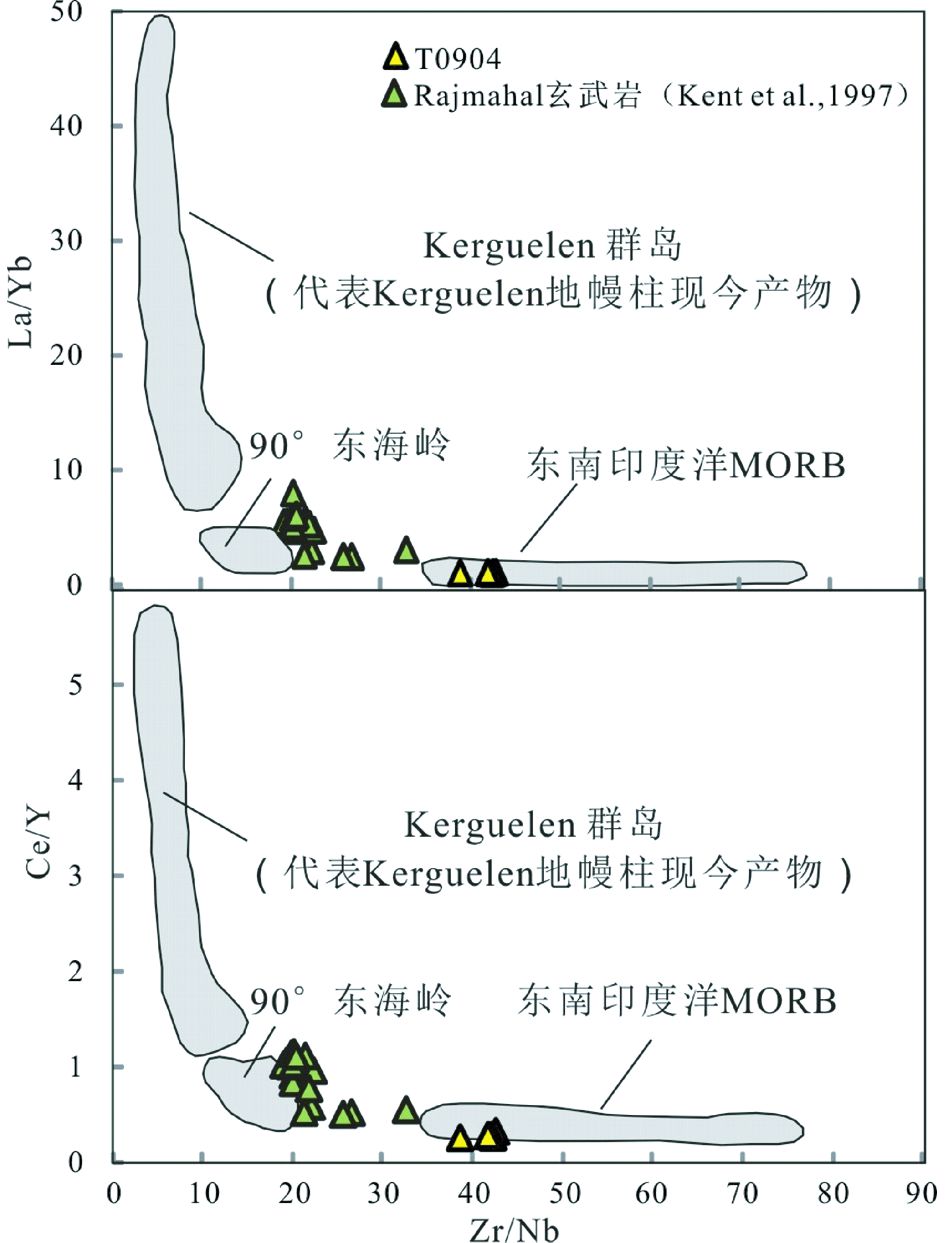
(2) ~120Ma基性岩浆作用:该时期基性岩浆作用(T0904系列)具有N-MORB特征和亏损的Sr-Nd同位素组成,εNd(t)值(+2.0~+6.7)落入印度洋MORB区间内,也与同时期部分Kerguelen地幔柱产物相近(印度板块Rajmahal Ⅰ玄武岩(RJ Ⅰ),见图 14、图 15),但微量元素特征指示其更靠近印度洋MORB(图 16)。该时期大印度板块、澳大利亚板块和南极板块逐渐裂解(Powell et al.,1988; Heine and Müller,2005),Kerguelen地幔柱处于大印度板块和南极洲板块之间,远离研究区所在位置(图 13c),并且该期岩浆活动晚于~132Ma的错美-班布里大火成岩省~12Myr,明显大于大火成岩省持续时间(普遍为1~5Myr)(Bryan and Ernst,2008),因此该期岩浆作用与Kerguelen地幔柱关系不大。
|
图 16 Zr/Nb-Ce/Y和Zr/Nb-La/Yb相关图(引自Weis and Frey,1996) Fig. 16 Zr/Nb-Ce/Y and Zr/Nb-La/Yb diagrams(after Weis and Frey,1996) |
古地磁证据表明~120Ma时,澳大利亚板块和大印度板块已相互分离并发生新生印度洋脊的扩张作用(Mihut and Müller,1998),T0904系列基性岩更有可能为新生印度洋软流圈部分熔融产物(图 13c)。该期岩浆作用还表现出源区受壳源混染的特征,如具有比大洋玄武岩低的Ce/Pb和Nb/U值,Rb,Ba,Th,U,K和Pb都表现出正异常及显示地壳混染趋势的Sr和Nd同位素组成。类似的例子也存在于东太平洋智利洋脊(Klein and Karsten,1995; Karsten et al.,1996)和中印度洋的Carlsburg 洋中脊中(Rehkämper and Hofmann,1997),它们与标准N-MORB不同,具有岛弧玄武岩的特征,可能是MORB源区经历俯冲洋壳或大洋沉积物等壳源物质混染所致。结合该时期构造背景,T0904系列可能为新生的印度洋软流圈地幔受到冈瓦纳大陆裂解时进入其中的岩石圈碎片混染所致(Frey et al.,2002)。
(3) ~90Ma基性岩浆作用:该期岩浆岩(T0901系列)位于研究区最北部,侵入雅鲁藏布江缝合带南部的混杂堆积带内(图 1b),锆石测年数据也表明其含有不同时代的捕获锆石(2055~117Ma),可能为岩浆就位过程中捕获的围岩锆石。87Sr/86Sr(t)值变化范围较大,显示受海水交代影响,但εNd(t)值位于印度洋MORB区域(图 15),远离同时期Kerguelen地幔柱产物(图 14)。该期岩浆具有E-MORB型微量及稀土元素特征,与N-MORB相比,显著富集不相容元素,结合微量元素比值模拟结果(图 12),其可能为印度洋内略富集的(Schilling et al.,1985)软流圈地幔部分熔融形成。
下文结合东冈瓦纳大陆板块重建图(图 13),探讨江孜-康马地区三期基性岩浆作用所反映的早白垩世以来东特提斯喜马拉雅地区构造演化和岩浆成因。~140Ma时,现今东特提斯喜马拉雅地区位于原大印度板块北部(图 13a),该期T0907系列和T0902系列基性岩与Kerguelen地幔柱相关,与同时期措那基性岩(Zhu et al.,2008a)共同表明Kerguelen地幔柱最晚于~140Ma时已潜伏于东冈瓦纳超大陆之下(图 13a),同时将Kerguelen地幔柱影响的范围从错美向西拓展了约200km。在Kerguelen地幔柱持续作用下,~132Ma时错美-班布里大火成岩省形成(图 13b),之后东冈瓦纳超大陆逐渐裂解,南极洲板块,印度板块和澳大利亚板块相互分离,印度洋开始扩张(图 13b)。~120Ma时Kerguelen地幔柱位于南极洲和印度板块之间,已经远离特提斯喜马拉雅带,T0904系列基性岩是新生印度洋软流圈部分熔融产物(图 13c),代表了与新生印度洋扩张相关的基性岩浆作用。至~90Ma(图 13d),印度洋内略富集的软流圈源区部分熔融形成T0901系列基性岩,后扩散至大印度板块边缘,并最终在印度向欧亚板块碰撞过程中就位于雅鲁藏布江南部的混杂堆积带中。
5 结论位于特提斯喜马拉雅带的江孜-康马地区发育大量近东西向展布的辉绿岩体/墙,本文在该区共识别出三期(~140Ma、~120Ma和~90Ma)基性岩浆活动。
(1) 最早一期(~140Ma)基性岩浆作用产物具有OIB型微量元素地球化学特征,与东部~132Ma错美-班布里大火成岩省中基性岩类似,代表了Kerguelen地幔柱与东冈瓦纳大陆岩石圈相互作用产物,将Kerguelen地幔柱影响的范围从错美向西拓展了约200km,同时也是Kerguelen地幔柱长期潜伏于东冈瓦纳大陆下的证据。
(2) 随着冈瓦纳大陆裂解,印度板块北移并逐渐远离Kerguelen地幔柱,研究区后两期~120Ma和~90Ma基性岩浆作用与Kerguelen地幔柱无关。发生于~120Ma的基性岩浆作用形成类似N-MORB地球化学特征的辉绿岩,同时具有显著的LILEs和Pb的正异常,可能为东冈瓦纳大陆裂解后新生的印度洋中脊玄武岩,其源区受到东冈瓦纳大陆岩石圈物质混染;最晚一期(~90Ma)基性岩浆产物发育在雅鲁藏布江蛇绿岩带以南的混杂堆积带中,具有E-MORB型地球化学特征,是印度洋内略富集的软流圈地幔部分熔融产物。
本文在研究区识别出的三期基性岩浆活动共同表明:特提斯喜马拉雅带的东部在白垩纪共经历了与东冈瓦纳大陆裂解、印度洋的开启和扩张相关的多期基性岩浆活动。这些基性岩为深入了解和限定特提斯喜马拉雅带自140Ma以来的古地理位置和构造演化过程提供了新的时间坐标。
致谢 感谢刘焰研究员和郭春丽研究员仔细审阅稿件,提出众多建设性修改意见。| [] | Aldanmaz E, Pearce JA, Thirlwall MF, Mitchell JG. 2000. Petrogenetic evolution of Late Cenozoic, post-collision volcanism in western Anatolia, Turkey. Journal of Volcanology and Geothermal Research , 102 (1-2) :67–95. DOI:10.1016/S0377-0273(00)00182-7 |
| [] | Allègre CJ, Minster JF. 1978. Quantitative models of trace element behavior in magmatic process. Earth and Planetary Science Letters , 38 (1) :1–25. DOI:10.1016/0012-821X(78)90123-1 |
| [] | Baksi AK. 1995. Petrogenesis and timing of volcanism in the Rajmahal flood basalt province, northeastern India. Chemical Geology , 121 (1-4) :73–90. DOI:10.1016/0009-2541(94)00124-Q |
| [] | Bhat MI. 1984. Abor volcanics: Further evidence for the birth of the Tethys Ocean in the Himalayan segment. Journal of the Geological Society , 141 (4) :763–775. DOI:10.1144/gsjgs.141.4.0763 |
| [] | Bian QT, Ding L. 2006. Discovery of the Zhegucuo Au (As)-bearing fine granular quartz diorite in the eastern Tethyan Himalayan Belt and its significance. Acta Petrologica Sinica , 22 (4) :977–988. |
| [] | Brookfield ME. 1993. The Himalayan passive margin from Precambrian to Cretaceous times. Sedimentary Geology , 84 (1-4) :1–35. DOI:10.1016/0037-0738(93)90042-4 |
| [] | Bryan SE, Ernst RE. 2008. Revised definition of large igneous provinces (LIPs). Earth-Science Reviews , 86 (1-4) :175–202. DOI:10.1016/j.earscirev.2007.08.008 |
| [] | Campbell IH. 2002. Implications of Nb/U, Th/U and Sm/Nd in plume magmas for the relationship between continental and oceanic crust formation and the development of the depleted mantle. Geochimica et Cosmochimica Acta , 66 (9) :1651–1661. DOI:10.1016/S0016-7037(01)00856-0 |
| [] | Chauvet F, Lapierre H, Bosch D, Guillot S, Mascle G, Vannay JC, Cotten J, Brunet P, Keller F. 2008. Geochemistry of the Panjal Traps basalts (NW Himalaya): Records of the Pangea Permian break-up. Bulletin de la Societe Geologique de France , 179 (4) :383–395. DOI:10.2113/gssgfbull.179.4.383 |
| [] | Chen FK, Siebel W, Satir M, Terzioğlu M, Saka K. 2002. Geochronology of the Karadere basement (NW Turkey) and implications for the geological evolution of the Istanbul zone. International Journal of Earth Sciences , 91 (3) :469–481. DOI:10.1007/s00531-001-0239-6 |
| [] | Chen FK, Li XH, Wang XL, Li QL, Siebel W. 2007. Zircon age and Nd-Hf isotopic composition of the Yunnan Tethyan belt, southwestern China. International Journal of Earth Sciences , 96 (6) :1179–1194. DOI:10.1007/s00531-006-0146-y |
| [] | Coffin MF, Pringle MS, Duncan RA, Gladczenko TP, Storey M, Müller RD, Gahagan LA. 2002. Kerguelen hotspot magma output since 130Ma. Journal of Petrology , 43 (7) :1121–1137. DOI:10.1093/petrology/43.7.1121 |
| [] | Courtillot V, Jaupart C, Manighetti I, Tapponnier P, Besse J. 1999. On causal links between flood basalts and continental breakup. Earth and Planetary Science Letters , 166 (3-4) :177–195. DOI:10.1016/S0012-821X(98)00282-9 |
| [] | Dai JG, Yin A, Liu WC, Wang CS. 2008. Nd isotopic compositions of the Tethyan Himalayan Sequence in southeastern Tibet. Science in China (Series D) , 51 (9) :1306–1316. DOI:10.1007/s11430-008-0103-7 |
| [] | Davies HL, Sun SS, Frey FA, Gautier I, McCulloch MT, Price RC, Bassias Y, Klootwijk CT, Leclaire L. 1989. Basalt basement from the Kerguelen Plateau and the trail of a Dupal plume. Contributions to Mineralogy and Petrology , 103 (4) :457–469. DOI:10.1007/BF01041753 |
| [] | de Sigoyer J, Chavagnac V, Blichert-Toft J, Villa IM, Luais B, Guillot S, Cosca M, Mascle G. 2000. Dating the Indian continental subduction and collisional thickening in the northwest Himalaya: Multichronology of the Tso Morari eclogites. Geology , 28 (6) :487–490. DOI:10.1130/0091-7613(2000)28<487:DTICSA>2.0.CO;2 |
| [] | Ding L, Kapp P, Wan XQ. 2005. Paleocene-Eocene record of ophiolite obduction and initial India-Asia collision, south central Tibet. Tectonics , 24 (3) :TC3001. DOI:10.1029/2004TC001729 |
| [] | Frey FA, McNaughton NJ, Nelson DR, deLaeter JR, Duncan RA. 1996. Petrogenesis of the Bunbury Basalt, Western Australia: Interaction between the Kerguelen plume and Gondwana lithosphere?. Earth and Planetary Science Letters , 144 (1-2) :163–183. DOI:10.1016/0012-821X(96)00150-1 |
| [] | Frey FA, Coffin MF, Wallace PJ, Weis D, Zhao X, Wise Jr SW, Wähnert V, Teagle DAH, Saccocia PJ, Reusch DN, Pringle MS, Nicolaysen KE, Neal CR, Müller RD, Moore CL, Mahoney JJ, Keszthelyi L, Inokuchi H, Duncan RA, Delius H, Damuth JE, Damasceno D, Coxall HK, Borre MK, Boehm F, Barling J, Arndt NT, Antretter M. 2000. Origin and evolution of a submarine large igneous province: The Kerguelen Plateau and Broken Ridge, southern Indian Ocean. Earth and Planetary Science Letters , 176 (1) :73–89. DOI:10.1016/S0012-821X(99)00315-5 |
| [] | Frey FA, Weis D, Borisova AY, Xu G. 2002. Involvement of continental crust in the formation of the Cretaceous Kerguelen Plateau: New Perspectives from ODP Leg 120 Sites. Journal of Petrology , 43 (7) :1207–1239. DOI:10.1093/petrology/43.7.1207 |
| [] | Furman T, Graham D. 1999. Erosion of lithospheric mantle beneath the East African Rift system: Geochemical evidence from the Kivu volcanic province. Lithos , 48 (1-4) :237–262. DOI:10.1016/S0024-4937(99)00031-6 |
| [] | Gao LE, Zeng LS, Xie KJ. 2012. Eocene high grade metamorphism and crustal anatexis in the North Himalaya Gneiss Domes, Southern Tibet. Chinese Science Bulletin , 57 (6) :639–650. DOI:10.1007/s11434-011-4805-4 |
| [] | Gao LE, Zeng LS, Hou KJ, Guo CL, Tang SH, Xie KJ, Hu GY, Wang L. 2013. Episodic crustal anatexis and the formation of Paiku composite leucogranitic pluton in the Malashan Gneiss Dome, Southern Tibet. China Science Bulletin , 58 (28-29) :3546–3563. DOI:10.1007/s11434-013-5792-4 |
| [] | Gao LE, Zeng LS. 2014. Fluxed melting of metapelite and the formation of Miocene high-CaO two-mica granites in the Malashan gneiss dome, southern Tibet. Geochimica et Cosmochimica Acta , 130 :136–155. DOI:10.1016/j.gca.2014.01.003 |
| [] | Garzanti E. 1993. Himalayan ironstones, "superplumes", and the breakup of Gondwana. Geology , 21 (2) :105–108. DOI:10.1130/0091-7613(1993)021<0105:HISATB>2.3.CO;2 |
| [] | Garzanti E. 1999. Stratigraphy and sedimentary history of the Nepal Tethys Himalaya passive margin. Journal of Asian Earth Sciences , 17 (5-6) :805–827. DOI:10.1016/S1367-9120(99)00017-6 |
| [] | Ghatak A, Basu AR. 2011. Vestiges of the Kerguelen plume in the Sylhet Traps, northeastern India. Earth and Planetary Science Letters , 308 (1-2) :52–64. DOI:10.1016/j.epsl.2011.05.023 |
| [] | Harrison TM, Lovera OM, Grove M. 1997. New insights into the origin of two contrasting Himalayan granite belts. Geology , 25 (10) :899–902. DOI:10.1130/0091-7613(1997)025<0899:NIITOO>2.3.CO;2 |
| [] | Heine C, Müller RD. 2005. Late Jurassic rifting along the Australian North West Shelf: Margin geometry and spreading ridge configuration. Australian Journal of Earth Sciences , 52 (1) :27–39. DOI:10.1080/08120090500100077 |
| [] | Hofmann AW, Jochum KP, Seufert M, White WM. 1986. Nb and Pb in oceanic basalts: New constraints on mantle evolution. Earth and Planetary Science Letters , 79 (1-2) :33–45. DOI:10.1016/0012-821X(86)90038-5 |
| [] | Ingle S, Weis D, Scoates JS, Frey FA. 2002a. Relationship between the early Kerguelen plume and continental flood basalts of the paleo-Eastern Gondwanan margins. Earth and Planetary Science Letters , 197 (1-2) :35–50. DOI:10.1016/S0012-821X(02)00473-9 |
| [] | Ingle S, Weis D, Frey FA. 2002b. Indian continental crust recovered from elan bank, Kerguelen Plateau (ODP Leg 183, Site 1137). Journal of Petrology , 43 (7) :1241–1257. DOI:10.1093/petrology/43.7.1241 |
| [] | Ingle S, Scoates JS, Weis D, Brügmann G, Kent RW. 2004. Origin of Cretaceous continental tholeiites in southwestern Australia and eastern India: Insights from Os and Hf isotopes. Chemical Geology , 209 (1-2) :83–106. DOI:10.1016/j.chemgeo.2004.04.023 |
| [] | Irving AJ, Frey FA. 1984. Trace element abundances in megacrysts and their host basalts: Constraints on partition coefficients and megacryst genesis. Geochimica et Cosmochimica Acta , 48 (6) :1201–1221. DOI:10.1016/0016-7037(84)90056-5 |
| [] | Ji WQ, Wu FY, Chung SL, Wang XC, Liu CZ, Li QL, Liu ZC, Liu XC, Wang JG. 2016. Eocene Neo-Tethyan slab breakoff constrained by 45Ma oceanic island basalt-type magmatism in southern Tibet. Geology , 44 (4) :283–286. DOI:10.1130/G37612.1 |
| [] | Jiang SH, Nie FJ, Hu P, Liu Y, Lai XR. 2007. Geochemical characteristics of the mafic dyke swarms in South Tibet. Acta Geologica Sinica , 81 (1) :60–71. |
| [] | Karsten JL, Klein EM, Sherman SB. 1996. Subduction zone geochemical characteristics in ocean ridge basalts from the southern Chile Ridge: Implications of modern ridge subduction systems for the Archean. Lithos , 37 (2-3) :143–161. DOI:10.1016/0024-4937(95)00034-8 |
| [] | Kent W, Saunders AD, Kempton PD, Ghose NC.1997. Rajmahal basalts, Eastern India: Mantle sources and melt distribution at a volcanic rifted margin. In: Mahoney J (ed.). Large Igneous Provinces: Continental, Oceanic, and Planetary Flood Volcanism. Washington, DC: American Geophysical Union : 145 -182. |
| [] | Kerr AC, Marriner GF, Tarney J, Nivia A, Saunders AD, Thirlwall MF, Sinton CW. 1997. Cretaceous basaltic terranes in Western Columbia: Elemental, chronological and Sr-Nd isotopic constraints on petrogenesis. Journal of Petrology , 38 (6) :677–702. DOI:10.1093/petroj/38.6.677 |
| [] | Klein EM, Karsten JL. 1995. Ocean-ridge basalts with convergent-margin geochemical affinities from the Chile Ridge. Nature , 374 (6517) :52–57. DOI:10.1038/374052a0 |
| [] | Kumar A, Dayal AM, Padmakumari VM. 2003. Kimberlite from Rajmahal magmatic province: Sr-Nd-Pb isotopic evidence for Kerguelen plume derived magmas. Geophysical Research Letters , 30 (20) . DOI:10.1029/2003GL018462 |
| [] | Li SG. 1993. Ba-Nb-Th-La diagrams used to identify tectonic environments of ophiolite. Acta Petrologica Sinica , 9 (2) :146–157. |
| [] | Liu GH, Einsele G. 1994. Sedimentary history of the Tethyan basin in the TIbetan Himalayas. Geologische Rundschau , 83 (1) :32–61. DOI:10.1007/BF00211893 |
| [] | Liu YQ, Qiang J, Jiang XJ, Kuang HW, Ji SA, Gao LF, Zhang ZG, Peng N, Yuan CX, Wang XR, Xu H. 2013. U-Pb zircon ages of Early Cretaceous volcanic rocks in the Tethyan Himalaya at Yangzuoyong Co Lake, Nagarze, Southern Tibet, and implications for the Jurassic/Cretaceous Boundary. Cretaceous Research , 40 :90–101. DOI:10.1016/j.cretres.2012.05.010 |
| [] | Liu YS, Gao S, Hu ZC, Gao CG, Zong KQ, Wang DB. 2010. Continental and oceanic crust recycling-induced melt-peridotite interactions in the Trans-North China Orogen: U-Pb dating, Hf isotopes and trace elements in zircons from mantle xenoliths. Journal of Petrology , 51 (1-2) :537–571. DOI:10.1093/petrology/egp082 |
| [] | Liu Z, Zhou Q, Lai Y, Qing CS, Li YX, Wu JY, Xia XB. 2015. Petrogenesis of the Early Cretaceous Laguila bimodal intrusive rocks from the Tethyan Himalaya: Implications for the break-up of Eastern Gondwana. Lithos , 236-237 :190–202. DOI:10.1016/j.lithos.2015.09.006 |
| [] | Ludwig KR. 2003. User's manual for ISOPLOT 3. 00: A geochronological toolkit for Microsoft excel. Berkeley: Berkeley Geochronology Center , 4 :71. |
| [] | Mahoney JJ, Jones WB, Frey FA, Salters VJM, Pyle DG, Davies HL. 1995. Geochemical characteristics of lavas from Broken Ridge, the Naturaliste Plateau and southernmost Kerguelen Plateau: Cretaceous plateau volcanism in the southeast Indian Ocean. Chemical Geology , 120 (3-4) :315–345. DOI:10.1016/0009-2541(94)00144-W |
| [] | McKenzie D, O'Nions RK. 1991. Partial melt distributions from inversion of rare earth element concentrations. Journal of Petrology , 32 (5) :1021–1091. DOI:10.1093/petrology/32.5.1021 |
| [] | Meschede M. 1986. A method of discriminating between different types of mid-ocean ridge basalts and continental tholeiites with the Nb-Zr-Y diagram. Chemical Geology , 56 (3-4) :207–218. DOI:10.1016/0009-2541(86)90004-5 |
| [] | Mihut D, Müller RD. 1998. Volcanic margin formation and Mesozoic rift propagators in the Cuvier Abyssal Plain off Western Australia. Journal of Geophysical Research , 103 (B11) :27135–27149. DOI:10.1029/97JB02672 |
| [] | Miller DM, Goldstein SL, Langmuir CH. 1994. Cerium/lead and lead isotope ratios in arc magmas and the enrichment of lead in the continents. Nature , 368 (6471) :514–520. DOI:10.1038/368514a0 |
| [] | Mysen BO. 1979. Trace-element partitioning between garnet peridotite minerals and water-rich vapor: Experimental data from 5 to 30 kbar. American Mineralogist , 64 (3-4) :274–287. |
| [] | Neal CR, Mahoney JJ, Chazey WJ. 2002. Mantle sources and the highly variable role of continental lithosphere in basalt petrogenesis of the Kerguelen Plateau and Broken Ridge LIP: Results from ODP Leg 183. Journal of Petrology , 43 (7) :1177–1205. DOI:10.1093/petrology/43.7.1177 |
| [] | Pfänder JA, Münker C, Stracker A, Mezger K. 2007. Nb/Ta and Zr/Hf in ocean island basalts-implications for crust-mantle differentiation and the fate of Niobium. Earth and Planetary Science Letters , 254 (1-2) :158–172. DOI:10.1016/j.epsl.2006.11.027 |
| [] | Powell CM, Roots SR, Veevers JJ. 1988. Pre-breakup continental extension in East Gondwanaland and the early opening of the eastern Indian Ocean. Tectonophysics , 155 (1-4) :261–283. DOI:10.1016/0040-1951(88)90269-7 |
| [] | Rehkämper M, Hofmann AW. 1997. Recycled ocean crust and sediment in Indian Ocean MORB. Earth and Planet Science Letters , 147 (1-4) :93–106. DOI:10.1016/S0012-821X(97)00009-5 |
| [] | Rudnick RL, Gao S.2003. The composition of the continental crust, Vol. 3. In: Holland HD and Turekian KK (eds.). Treatise on Geochemistry. Oxford: Elsevier : 1 -64. |
| [] | Schilling JG, Thompsom G, Kingsley R, Humphris S. 1985. Hotspot-migrating ridge interaction in the South Atlantic. Nature , 313 (5999) :187–191. DOI:10.1038/313187a0 |
| [] | Shaw DM. 1970. Trace element fractionation during anatexis. Geochimica et Cosmochimica Acta , 34 (2) :237–243. DOI:10.1016/0016-7037(70)90009-8 |
| [] | Staudigel H, Davies GR, Hart SR, Marchant KM, Smith BM. 1995. Large scale isotopic Sr, Nd and O isotopic anatomy of altered oceanic crust: DSDP/ODP sites 417/418. Earth and Planetary Science Letters , 130 (1-4) :169–185. DOI:10.1016/0012-821X(94)00263-X |
| [] | Sun SS, McDonough WF. 1989. Chemical and isotopic systematics of oceanic basalts: Implications for mantle composition and processes. In: Saunders AD and Norry MJ (eds.). Magmatism in the Ocean Basins. Geological Society, London, Special Publications , 42 (1) :313–345. DOI:10.1144/GSL.SP.1989.042.01.19 |
| [] | Thompson RN, Morrison MA, Hendry GL, Parry SJ, Simpson PR, Hutchison R, O'Hara MJ. 1984. An assessment of the relative roles of crust and mantle in magma genesis: An elemental approach. Philosophical Transactions of the Royal Society A , 310 (1514) :549–590. DOI:10.1098/rsta.1984.0008 |
| [] | Vannay JC, Spring L. 1993. Geochemistry of the continental basalts within the Tethyan Himalaya of Lahul-Spiti and SE Zanskar, northwest India. In: Treloar PJ and Searle MP (eds.). Himalayan Tectonics. Geological Society, London, Special Publication , 74 :237–249. |
| [] | Weaver BL. 1991. The origin of ocean island basalt end-member compositions: Trace element and isotopic constraints. Earth and Planetary Science Letters , 104 (2-4) :381–397. DOI:10.1016/0012-821X(91)90217-6 |
| [] | Weis D, Bassias Y, Gautier I, Mennessier JP. 1989. Dupal anomaly in existence 115Ma ago: Evidence from isotopic study of the Kerguelen Plateau (South Indian Ocean). Geochimica et Cosmochimica Acta , 53 (8) :2125–2131. DOI:10.1016/0016-7037(89)90331-1 |
| [] | Weis D, Frey FA. 1996. Role of the Kerguelen Plume in generating the eastern Indian Ocean seafloor. Journal of Geophysical Research , 101 (B6) :13831–13849. DOI:10.1029/96JB00410 |
| [] | White WM. 2015. Isotopes, Dupal, LLSVPs, and Anekantavada. Chemical Geology , 419 :10–28. DOI:10.1016/j.chemgeo.2015.09.026 |
| [] | Williams H, Turner S, Kelley S, Harris N. 2001. Age and composition of dikes in Southern Tibet: New constraints on the timing of east-west extension and its relationship to postcollisional volcanism. Geology , 29 (4) :339–342. DOI:10.1130/0091-7613(2001)029<0339:AACODI>2.0.CO;2 |
| [] | Williams IS. 1998. U-Th-Pb geochronology by ion Microprobe. In: Mckibben MA, Shanks III WC and Ridley WI (eds.). Applications of Microanalytical Techniques to Understanding Mineralising Processes. Colorado: Society of Economic Geologists , 7 :1–35. |
| [] | Wilson M.1989. Igneous Petrogenesis. Netherlands: Springer : 1 -464. |
| [] | Workman RK, Hart SR. 2005. Major and trace element composition of the depleted MORB mantle (DMM). Earth and Planetary Science Letters , 231 (1-2) :53–72. DOI:10.1016/j.epsl.2004.12.005 |
| [] | Wu FY, Liu ZC, Liu XC, Ji WQ. 2015. Himalayan leucogranite: Petrogenesis and implications to orogenesis and plateau uplift. Acta Petrologica Sinica , 31 (1) :1–36. |
| [] | Xia Y, Zhu DC, Wang Q, Zhao ZD, Liu D, Wang LQ, Mo XX. 2014. Picritic porphyrites and associated basalts from the remnant Comei Large Igneous Province in SE Tibet: Records of mantle-plume activity. Terra Nova , 26 (6) :487–494. DOI:10.1111/ter.2014.26.issue-6 |
| [] | Xu ZQ, Wang Q, Pêcher A, Liang FH, Qi XX, Cai ZH, Li HQ, Zeng LS, Cao H. 2013. Orogen-parallel ductile extension and extrusion of the Greater Himalaya in the Late Oligocene and Miocene. Tectonics , 32 (2) :191–215. DOI:10.1002/tect.v32.2 |
| [] | Yin A. 2006. Cenozoic tectonic evolution of the Himalayan orogen as constrained by along-strike variation of structural geometry, exhumation history, and foreland sedimentation. Earth-Science Reviews , 76 (1-2) :1–131. DOI:10.1016/j.earscirev.2005.05.004 |
| [] | Zeng LS, Gao LE, Xie KJ, Zeng LJ. 2011. Mid-Eocene high Sr/Y granites in the Northern Himalayan Gneiss Domes: Melting thickened lower continental crust. Earth and Planetary Science Letters , 303 (3-4) :251–266. DOI:10.1016/j.epsl.2011.01.005 |
| [] | Zeng LS, Gao LE, Hou KJ, Tang SH. 2012a. Late Permian mafic magmatism along the Tethyan Himalaya Belt, southern Tibet and tectonic implications. Acta Petrologica Sinica , 28 (6) :1731–1740. |
| [] | Zeng LS, Gao LE, Hou KJ, Tang SH, Guo CL. 2012b. Multiple mafic magmatic events along the Tethyan Himalaya: Tracing the life-time of the neo-Tethyan ocean. Acta Geoscientica Sinica , 33 (Suppl.1) :72–73. |
| [] | Zeng LS, Gao LE, Shang Z, Gao JH, Wang YY. 2015. The metamorphism in mafic dike swarms from Eocene to Oligocene within the Tethyan Himalaya, southern Tibet. Acta Geologica Sinica , 89 (Suppl.1) :309–312. |
| [] | Zeng LS, Wang YH, Gao LE, Wang YY. 2016. Elusive Cenozoic metamorphism in mafic dike swarms within the Tethyan Himalaya, southern Tibet. Acta Geologica Sinica , 90 (Suppl.1) :86–97. |
| [] | Zhang HF, Harris N, Parrish R, Kelley S, Zhang L, Rogers N, Argles T, King J. 2004. Causes and consequences of protracted melting of the mid-crust exposed in the North Himalayan antiform. Earth and Planetary Science Letters , 228 (1-2) :195–212. DOI:10.1016/j.epsl.2004.09.031 |
| [] | Zhong HM, Xia J, Tong JS, Lu RK, Li YH, Xu SF. 2004. New results and major progress in regional geological survey of the Lhozag County sheet. Geological Bulletin of China , 23 (5) :451–457. |
| [] | Zhong HM, Tong JS, Xia J, Lu RK, Qiu JQ. 2005. Characteristics and tectonic setting of volcanic rocks of the Sangxiu Formation in the southern part of Yamzho Yumco, southern Tibet. Geological Bulletin of China , 24 (1) :72–79. |
| [] | Zhu DC, Pan GT, Mo XX, Liao ZL, Jiang XS, Wang LQ, Zhao ZD. 2007. Petrogenesis of volcanic rocks in the Sangxiu Formation, central segment of Tethyan Himalaya: A probable example of plume-lithosphere interaction. Journal of Asian Earth Sciences , 29 (2-3) :320–335. DOI:10.1016/j.jseaes.2005.12.004 |
| [] | Zhu DC, Mo XX, Pan GT, Zhao ZD, Dong GC, Shi YR, Liao ZL, Wang LQ, Zhou CY. 2008a. Petrogenesis of the earliest Early Cretaceous mafic rocks from the Cona area of the eastern Tethyan Himalaya in south Tibet: Interaction between the incubating Kerguelen plume and the eastern Greater India lithosphere?. Lithos , 100 (1-4) :147–173. DOI:10.1016/j.lithos.2007.06.024 |
| [] | Zhu DC, Mo XX, Zhao ZD, Niu YL, Chung SL. 2008b. Whole-rock elemental and zircon Hf isotopic geochemistry of mafic and ultramafic rocks from the Early Cretaceous Comei large igneous province in SE Tibet: Constraints on mantle source characteristics and petrogenesis. Himalayan Journal of Sciences , 5 (7) :178–180. |
| [] | Zhu DC, Chung SL, Mo XX, Zhao ZD, Niu YL, Song B, Yang YH. 2009. The 132Ma Comei-Bunbury large igneous province: Remnants identified in present-day southeastern Tibet and southwestern Australia. Geology , 37 (7) :583–586. DOI:10.1130/G30001A.1 |
| [] | Zhu DC, Xia Y, Qiu BB, Wang Q, Zhao ZD. 2013. Why do we need to propose the Early Cretaceous Comei large igneous province in southeastern Tibet?. Acta Petrologica Sinica , 29 (11) :3659–3670. |
| [] | 边千韬, 丁林.2006. 特提斯喜马拉雅带东段哲古错含金(砷)细粒石英闪长岩的发现及其意义. 岩石学报 , 22 (4) :977–988. |
| [] | 高利娥, 曾令森, 侯可军, 郭春丽, 唐索寒, 谢克家, 胡古月, 王莉.2013. 藏南马拉山穹窿佩枯错复合淡色花岗岩体的多期深熔作用. 科学通报 , 58 (27) :2810–2822. |
| [] | 江思宏, 聂凤军, 胡朋, 刘妍, 赖新荣.2007. 藏南基性岩墙群的地球化学特征. 地质学报 , 81 (1) :60–71. |
| [] | 李曙光.1993. 蛇绿岩生成构造环境的Ba-Th-Nb-La判别图. 岩石学报 , 9 (2) :146–157. |
| [] | 吴福元, 刘志超, 刘小驰, 纪伟强.2015. 喜马拉雅淡色花岗岩. 岩石学报 , 31 (1) :1–36. |
| [] | 曾令森, 高利娥, 侯可军, 唐索寒.2012a. 藏南特提斯喜马拉雅带晚二叠纪基性岩浆作用及其构造地质意义. 岩石学报 , 28 (6) :1731–1740. |
| [] | 曾令森, 高利娥, 侯可军, 唐索寒, 郭春丽.2012b. 特提斯喜马拉雅多重基性岩浆作用:追溯新特提斯洋的生存时限. 地球学报 , 33 (增1) :72–73. |
| [] | 曾令森, 高利娥, 尚振, 高家昊, 王亚莹.2015. 藏南特提斯喜马拉雅带辉绿岩始新世-渐新世变质作用. 地质学报 , 89 (增) :309–312. |
| [] | 钟华明, 夏军, 童劲松, 鲁如魁, 李运怀, 徐生发.2004. 洛扎县幅地质调查新成果及主要进展. 地质通报 , 23 (5) :451–457. |
| [] | 钟华明, 童劲松, 夏军, 鲁如魁, 邱军强.2005. 藏南羊卓雍错南部桑秀组火山岩的特征及构造环境. 地质通报 , 24 (1) :72–79. |
| [] | 朱弟成, 夏瑛, 裘碧波, 王青, 赵志丹.2013. 为什么要提出西藏东南部早白垩世措美大火成岩省. 岩石学报 , 29 (11) :3659–3670. |