 2016, Vol. 32


2. 中国科学院地质与地球物理研究所, 岩石圈演化国家重点实验室, 北京 100029
2. State Key Laboratory of Lithospheric Evolution, Institute of Geology and Geophysics, Chinese Academy of Sciences, Beijing 100029, China
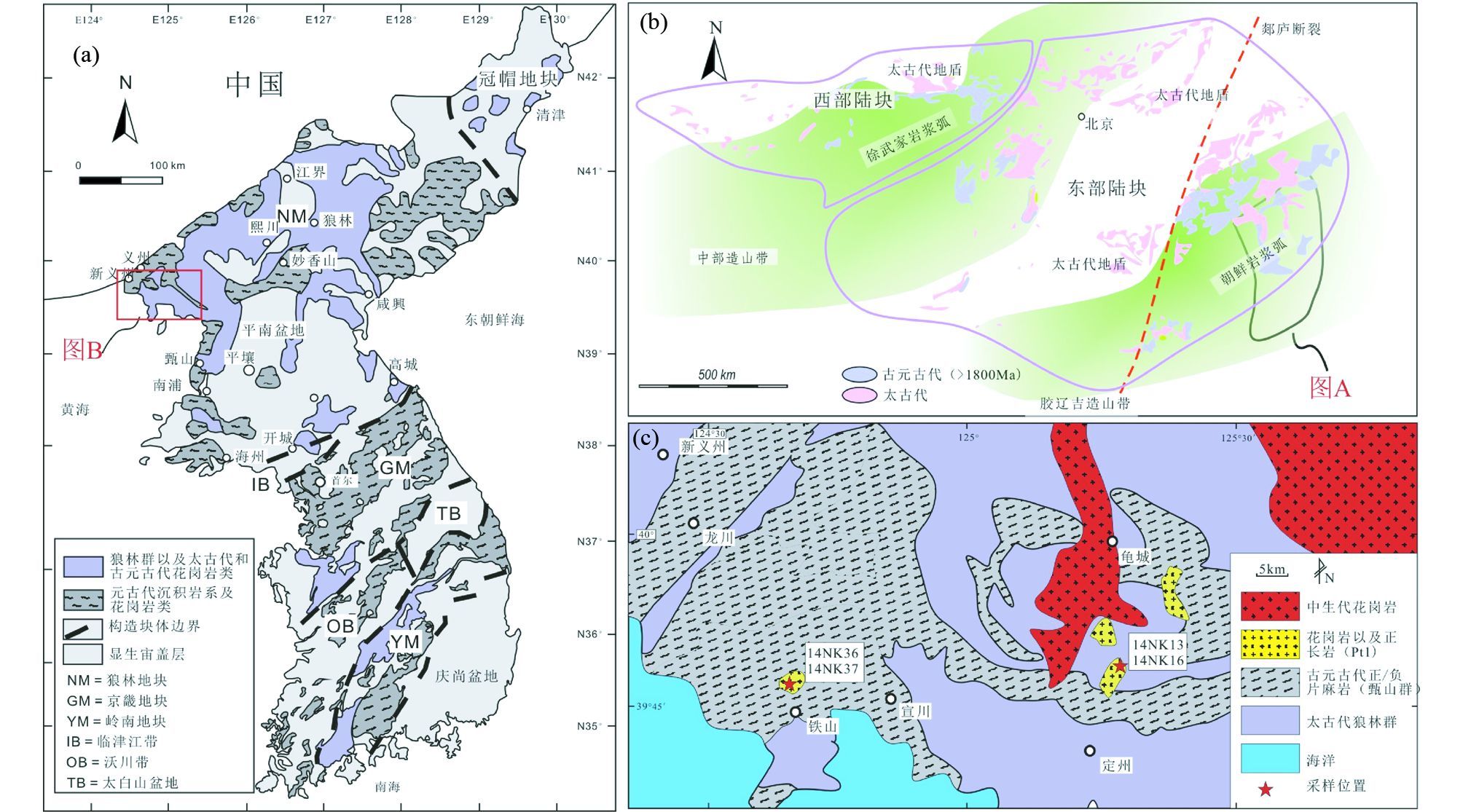
朝鲜半岛是欧亚板块的重要组成部分,其岩石组成、地质演化历史、块体划分以及与中国大陆的对比,是东北亚地区众多重要地质问题的焦点之一(Chang and Zhao,2012; Kim et al.,2011; Lee et al.,2014; Oh et al.,2014,2015; Yu et al.,2012; Zhang et al.,2012)。根据岩石组合、变质变形特征以及地质年代学资料,前人将朝鲜半岛细分为不同的构造单元(图 1),如冠帽(Kwanmo)、狼林(Nangrim或Rangnim)、京畿(Gyeonggi)和岭南(Yeongnam或Ryongnam)等四个地块,平南盆地(Pyongnam)、太白山盆地(Taebaesan)和庆尚盆地(Gyeongsang)等三个主要的沉积盆地,临津江带(Imjinggang或Rimjingang)和沃川带(Ogcheon)等两个构造带(Chang,1996; Chough et al.,2000; Ree et al.,1996; Yin and Nie,1993; Zhai et al.,2007a)。狼林地块、京畿地块和岭南地块等包含有与中国的华北克拉通(以及华南)类似的太古代-元古代基底(Zhai et al.,2007a),而冠帽地块则被认为代表兴-蒙造山带(中亚造山带)的一部分(Peng et al.,2008,2011)。平南盆地属中元古代到古生代,太白山盆地属古生代,而庆尚盆地属中生代,三者分别沉积于狼林地块、京畿地块和岭南地块的基底岩石之上(Chough et al.,2000)。临津江带主要由经历了晚二叠-早三叠变质作用的岩石组成(Zhai et al.,2007a,b),一些研究者认为临津江带是大别-苏鲁造山带在朝鲜半岛的延伸(Chang,1996; Ree et al.,1996)。沃川带则主要由新元古代到古生代的沉积岩和变质火山岩以及中生代花岗岩侵入体组成,新元古代和早古生代岩石记录了古生代中期和三叠纪的多期变质变形作用(Cheong et al.,2003; Min and Cho,1998)。
|
图 1 朝鲜半岛构造单元划分以及前寒武纪岩石分布图(a,据Chough et al.,2000; Zhao et al.,2006; Peng et al.,2008修改)、朝鲜半岛在中朝克拉通的位置(b,据Peng et al.,2014修改)和研究区地质简图(c) Fig. 1 Tectonic units of the Korean Peninsula and distribution of the Precambrian rocks(a,modified after Chough et al.,2000; Zhao et al.,2006; Peng et al.,2008),location of the Korea Peninsula in Sino-Korea Craton(b,after Peng et al.,2014)and geological sketch map of the study area(c) |
虽然目前在朝鲜半岛与欧亚大陆亲缘性方面还存在较大的争议,大多数研究者认为狼林地块属于华北克拉通(又称中朝克拉通)的一部分(Chough et al.,2000; Faure et al.,2004; Zhai et al.,2007a; Zhao et al.,2006; 白瑾,1993; 张秋生,1988)。作为世界上最为古老的克拉通之一(Jahn et al.,1987; Liu et al.,1985,1992,2008; Song et al.,1996; Wan et al.,2005,2012,2015; Wu et al.,2005,2008; 万渝生等,2009),华北克拉通先后经历了太古代的巨量陆壳增生以及第一期克拉通化、古元古代裂解-俯冲-增生-碰撞事件并完成第二次克拉通化、中新元古代的持续-多期次的裂解事件(Guo et al.,2015; Kusky,2011; Peng et al.,2014; Santosh et al.,2013; Zhai,2014; Zhai and Santosh,2013; Zhai et al.,2014,2015; Zhao et al.,2012,2016; Zhao and Zhai,2013),期间伴随着重要的成矿作用事件(Zhai and Santosh,2013)。世界著名的内蒙古白云鄂博特大型稀土-铌-铁(REE-Nb-Fe)矿床,就位于华北克拉通北缘(Fan et al.,2006; Yang et al.,2011a,b; 范宏瑞等,2001; 王凯怡等,2012)。在狼林地块的西北部的定州(Jongju)和铁山(Cholsan)地区,也分布有稀土矿床。其中,定州地区的稀土矿以产出硅铈矿、烧绿石为特征,赋矿岩石为霓辉石正长岩、萤石化霓辉正长岩等;铁山地区的稀土矿以产出独居石为特征,赋矿岩石为含石榴石的二云母花岗岩、似斑状花岗岩以及花岗伟晶岩等。两个地区的稀土矿成矿时代,与岩浆活动同期。
然而,由于相关研究的缺乏,目前尚不明确稀土矿的成矿时代和围岩以及矿石特征,此外,对成矿相关的大地构造背景和区域地质演化等方面的认识,也较为欠缺。本文以在定州和铁山地区采集的岩石、矿石样品为研究对象,将在岩相学和地质年代学方面,展示我们对该地区的初步研究成果,以期深化对稀土矿以及狼林地块区域地质演化的认识。
2 地质背景与样品据早期的地质资料可知,狼林地块早前寒武纪基底岩石组成主要包括太古代狼林群、古元古代甄山群(Jungsan)、摩天岭系(Machollyong System)、黄海群(Hwanghae)以及时代与之相当的一系列遭受强烈变形和混合岩化的中酸性侵入岩(Kim and Jon,1996; Paek and Jon,1996; Ri,1996a,b)。研究区位于狼林地块西北侧的定州-宣川一带,研究区分布的早前寒武纪岩石包括狼林群和甄山群(也称义州群)变质沉积岩和变质中酸性岩侵入体,中生代谭川(Tanchon)花岗岩杂岩体在这一地区也有分布(图 1)。本文所涉及的样品包括定州北部采集的粗粒正长岩(14NK13) 和萤石化霓辉正长岩(14NK16) 以及在铁山北部采集的4件似斑状花岗岩样品(14NK36-1、14NK36-2、14NK37-1和14NK37-2) (图 1)。
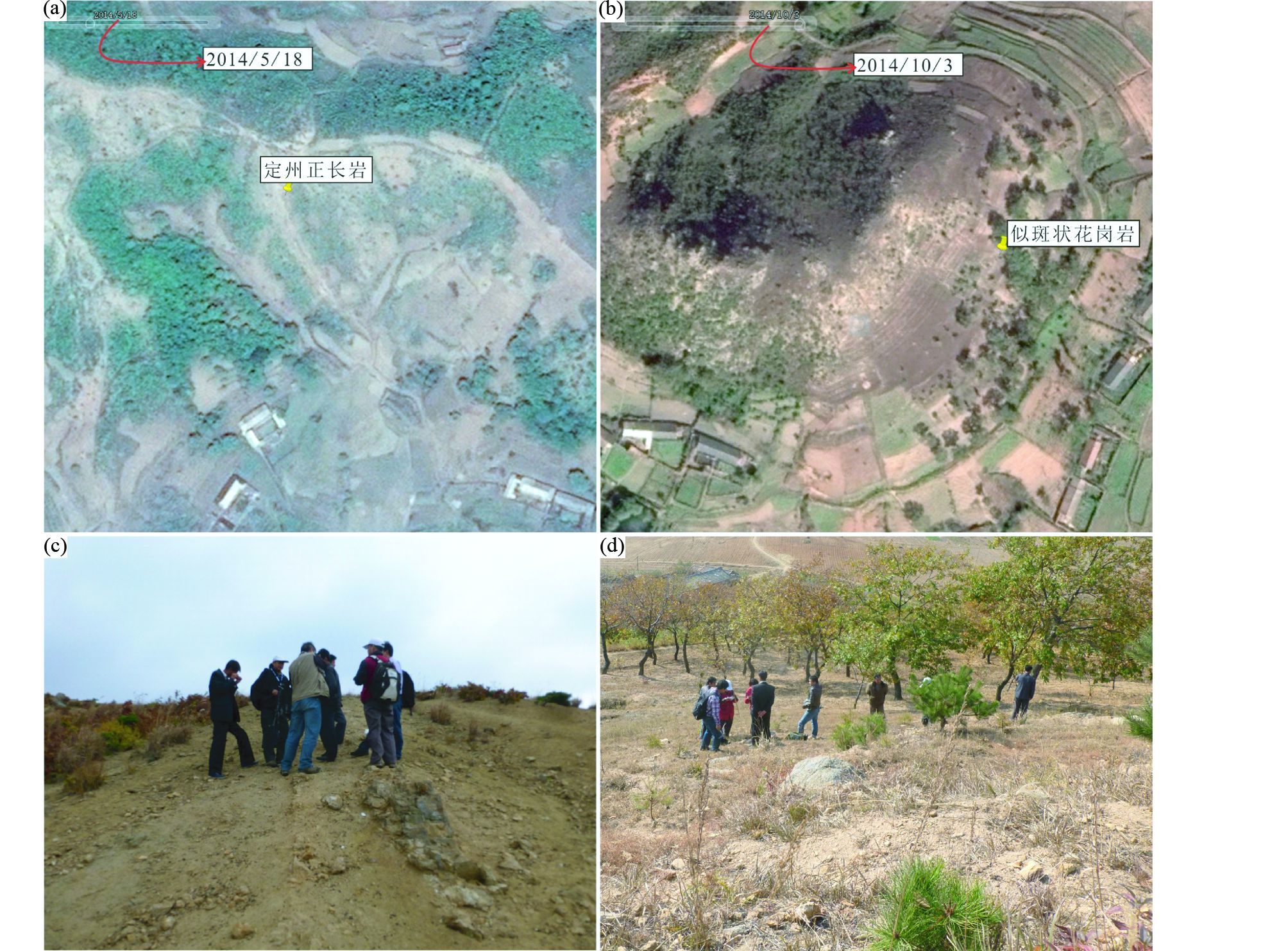
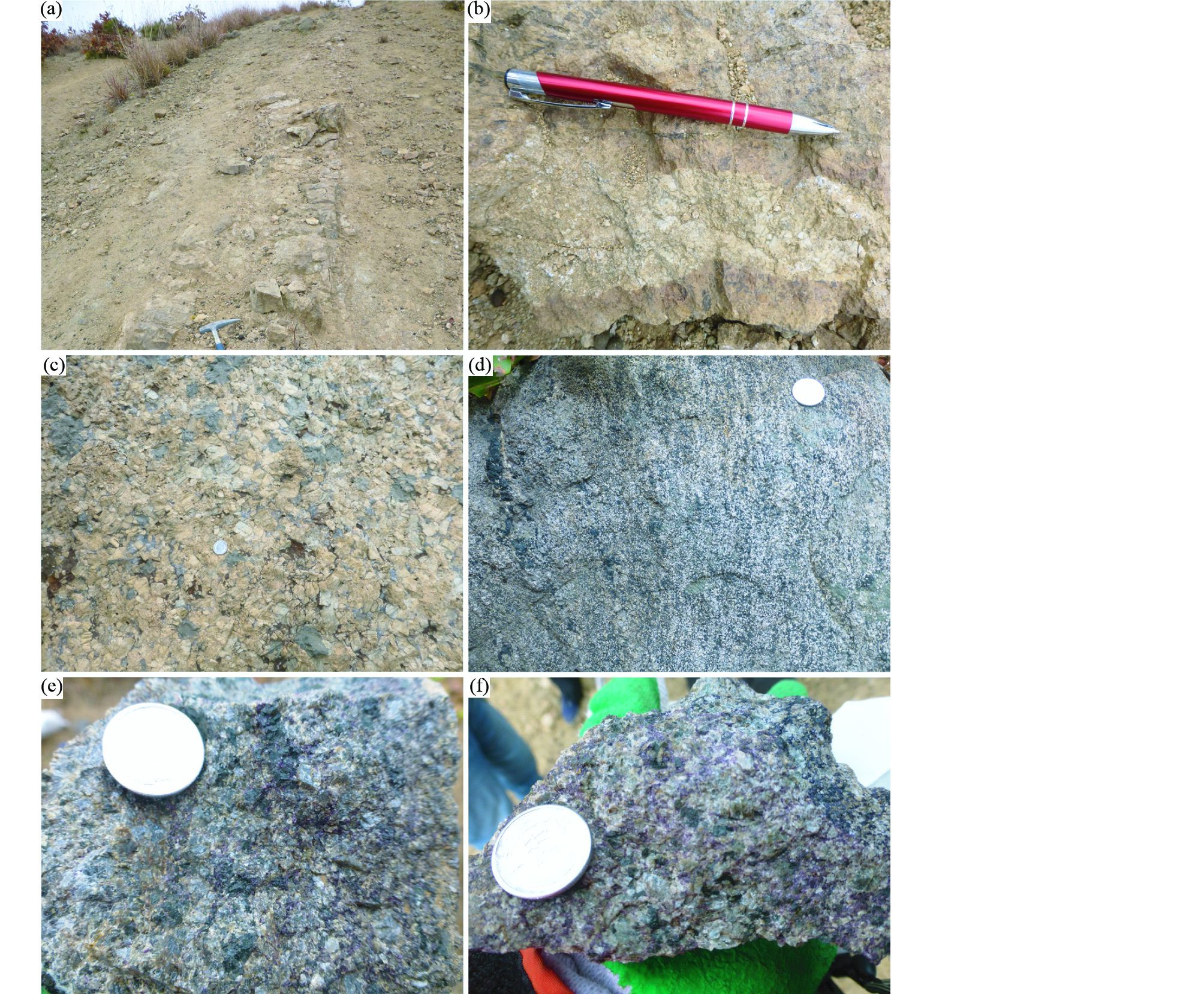
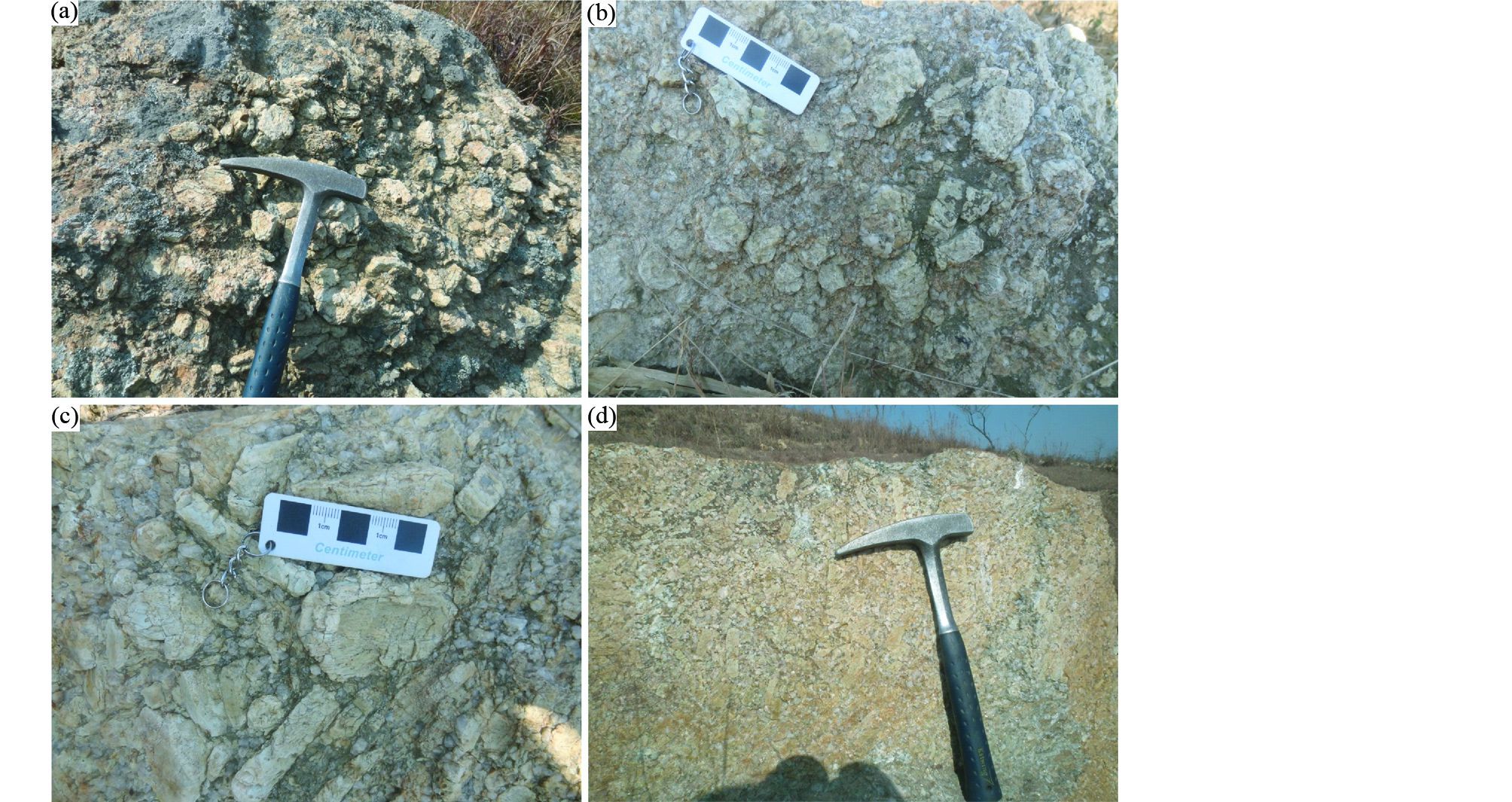
定州地区正长岩以宽度不等的岩墙、岩脉和小侵入体形式,侵入于狼林群变质沉积岩中(图 2c和图 3a)。部分正长岩露头表现出较为明显的风化特征,岩石裂隙中充填后期淋滤的铁氧化物(图 3b)。大部分正长岩不显示蚀变或者风化特征,长石颗粒保存完好(图 3c)。定州地区的萤石化霓辉正长岩露头因风化而表现为灰白色(图 3d),新鲜断面则表现为紫红色(岩石中含有大量的紫红色萤石)(图 3e,f)。铁山地区的似斑状花岗岩中含有大小不等的长石颗粒,有的长石长度可达数厘米,有的长石颗粒较小,但是也基本在厘米级尺度(图 4)。
|
图 2 朝鲜定州和铁山地区的概况 (a、c)定州地区;(b、d)铁山地区;(a)、(b)为两个地区的谷歌卫星图片,图中的黄色点位置为采样点位置,数字代表谷歌卫星图片的拍摄时间 Fig. 2 Field situations of the REE deposits in Jongju and Cholsan regions of northern Korea (a,c)are of the Jongju region while(b,d)are of the Cholsan region.(a),(b)are satellite pictures of the two locations. The numbers in the two pictures represent the date of getting these pictures |
|
图 3 定州正长岩的野外露头照片 (a-c)粗粒正长岩(14NK13) ;(d-f)萤石化霓辉正长岩(10NK16) Fig. 3 Outcrop photos of syenite in Jongju region (a-c)coarse-grained syenite;(d-f)fluorite syenite |
|
图 4 铁山似斑状花岗岩的野外露头照片 Fig. 4 Outcrop photos of porphyraceous granite in Cholsan region |
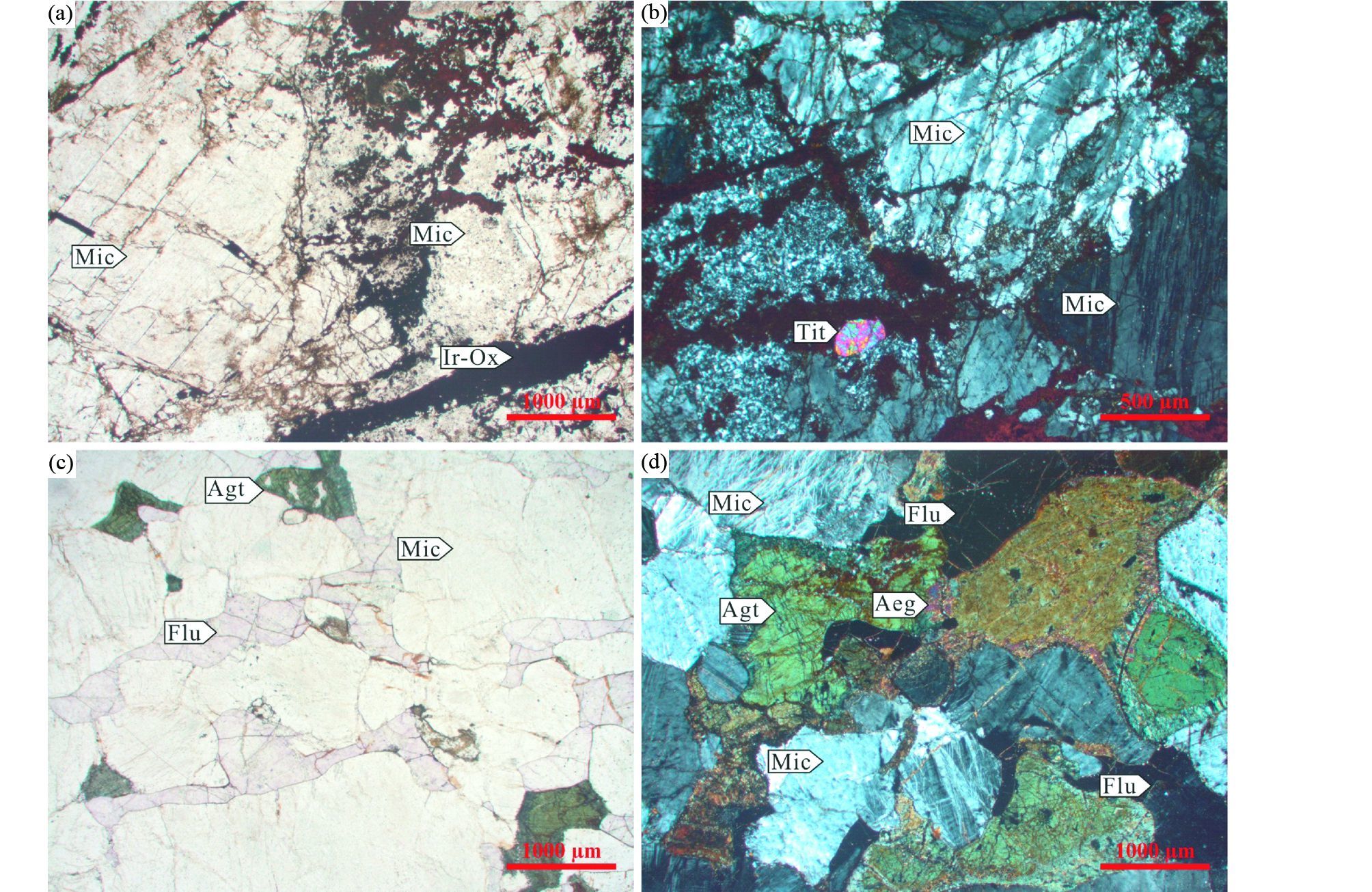
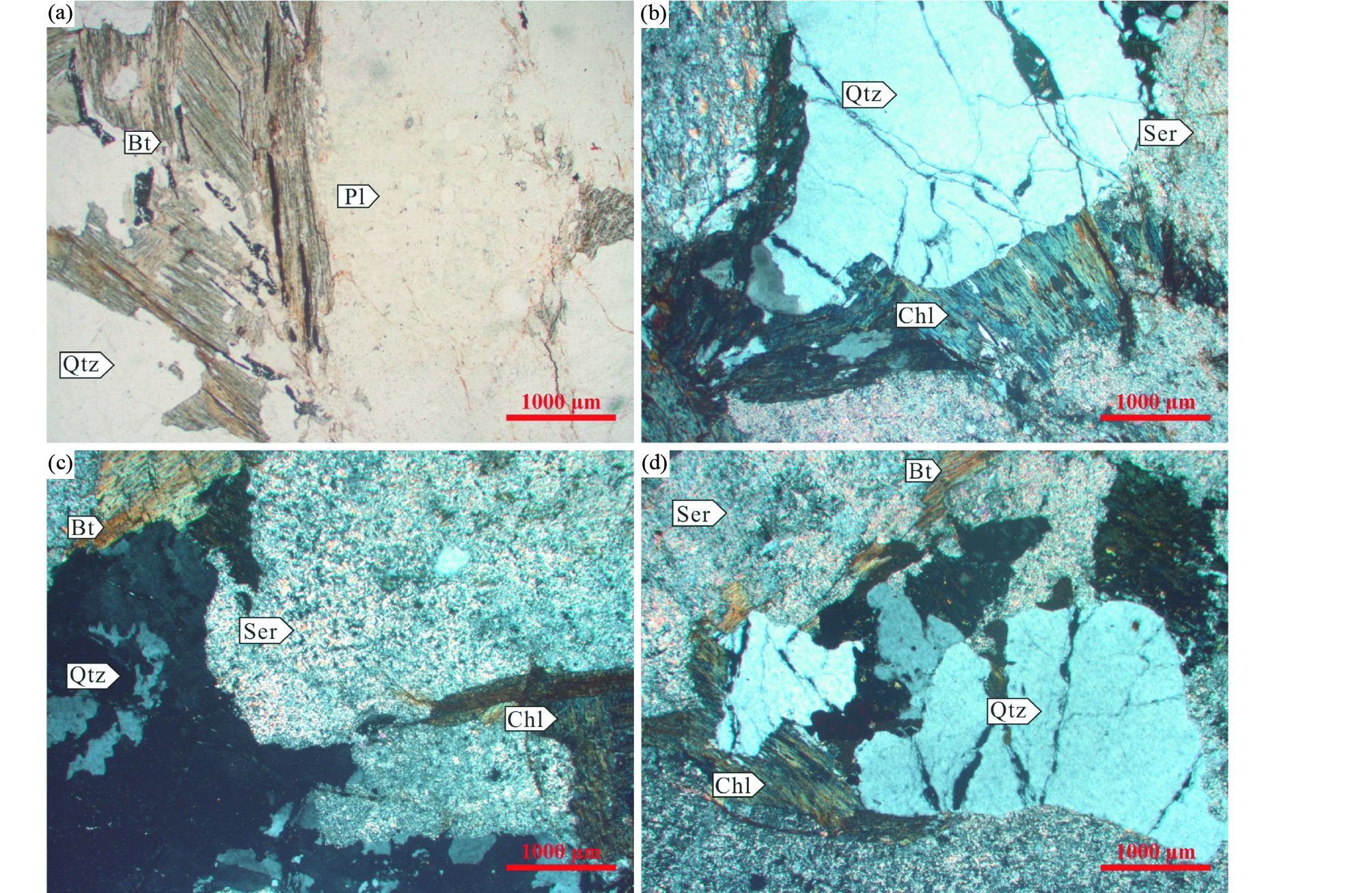
粗粒正长岩(14NK13) 由90%以上的微斜长石组成,矿物颗粒都比较大,颗粒之间以及裂隙中充填灌入的铁氧化物,岩石中的副矿组主要是锆石和榍石,但是含量不多(图 5a,b)。萤石化霓辉正长岩(14NK16) 的主要矿物组成也是微斜长石,这些微斜长石表面都十分干净,不显示明显的蚀变特征。萤石化霓辉正长岩中还含有一定量的萤石和霓辉石,粗粒正长岩(14NK13) 中观察到的大颗粒榍石,在萤石化霓辉正长岩中没有看到(图 5c,d)。值得注意的是,萤石化霓辉正长岩中的萤石可能为岩浆期后热液成因,以填隙矿物的形式充填于大颗粒微斜长石晶体之间,晶形很不规则(图 5c,d)。霓辉石粒度也比较小,而且晶形不规则,部分霓辉石颗粒边部转化为霓石(图 5c,d)。此外,萤石化霓辉正长岩中的矿物颗粒粒度明显小于粗粒正长岩中的矿物粒度。铁山地区的四件似斑状花岗岩样品(14NK36-1、14NK36-2、14NK37-1和14NK37-2) 具有类似的矿物组合:斜长石+黑云母+石英以及蚀变矿物如绿泥石和绢云母等(图 6)。在采自于定州和铁山地区的岩石(“矿石”)中,没有明显观察到稀土矿物,与典型的稀土矿床明显不同(范宏瑞等,2001,2003)。
|
图 5 定州地区蚀变(风化)正长岩(14NK13) (a、b)和萤石化霓辉正长岩(14NK16) (c、d)的岩相照片 矿物简写:Mic-微斜长石;Ir-Ox-铁氧化物;Tit-榍石;Agt-霓辉石;Aeg-霓石;Flu-萤石 Fig. 5 Microphotographs of the coarse-grained syenite(a,b)and the fluorite syenite(c,d)from the Jongju region Mineral abbreviates: Mic-microcline; Ir-Ox-iron-oxide; Tit-titanite; Agt-aegirine-augite; Aeg-aegirine; Flu-fluorite |
|
图 6 铁山地区似斑状花岗岩(14NK36-1、14NK36-2、14NK37-1和14NK37-2) 岩相照片 矿物简写:Pl-斜长石;Chl-绿泥石;Qtz-石英;Bt-黑云母;Ser-绢云母 Fig. 6 Microphotographs of porphyraceous granite from the Cholsan region Mineral abbreviates: Pl-plagioclase; Chl-chlorite; Qtz-quartz; Bt-biotite; Ser-sericite |
对采自于定州和铁山地区的6件样品(14NK13、14NK16、14NK36-1、14NK36-2、14NK37-1和14NK37-2) ,进行了SIMS锆石U-Pb定年。锆石分选采用常规的重选和磁选技术。而后,将分选出来的锆石样品颗粒和锆石标样 Plésovice(Sláma et al.,2008)、Qinghu(Li et al.,2009)等一起粘在环氧树脂靶上,研磨、抛光至露出锆石核部。锆石靶制备完成后,对每个样品的锆石进行透射光和反射光显微照相以及阴极发光图象分析,以检查锆石的内部结构、帮助选择适宜的测试点位。最后,将样品靶在真空下镀金以备分析。
U、Th、Pb的测定在中国科学院地质与地球物理研究所CAMECA IMS-1280二次离子质谱仪(SIMS)上进行,详细分析方法见Li et al.(2009) 。锆石标样与锆石样品以1∶3比例交替测定。U-Th-Pb同位素比值用标准锆石Plésovice(337Ma,Sláma et al.,2008)校正获得,U含量采用标准锆石91500(81×10-6,Wiedenbeck et al.,1995)校正获得,以长期监测标准样品获得的标准偏差(1SD=1.5%,Li et al.,2010)和单点测试内部精度共同传递得到样品单点误差,以标准样品Qinghu(159.5Ma,Li et al.,2009)作为未知样监测数据的精确度。普通Pb校正采用实测204Pb值。由于测得的普通Pb含量大都非常低,假定普通Pb主要来源于制样过程中带入的表面Pb污染,以现代地壳的平均Pb同位素组成(Stacey and Kramers,1975)作为普通Pb组成进行校正。同位素比值及年龄误差均为1σ。数据结果处理采用ISOPLOT软件(Ludwig,2003)。
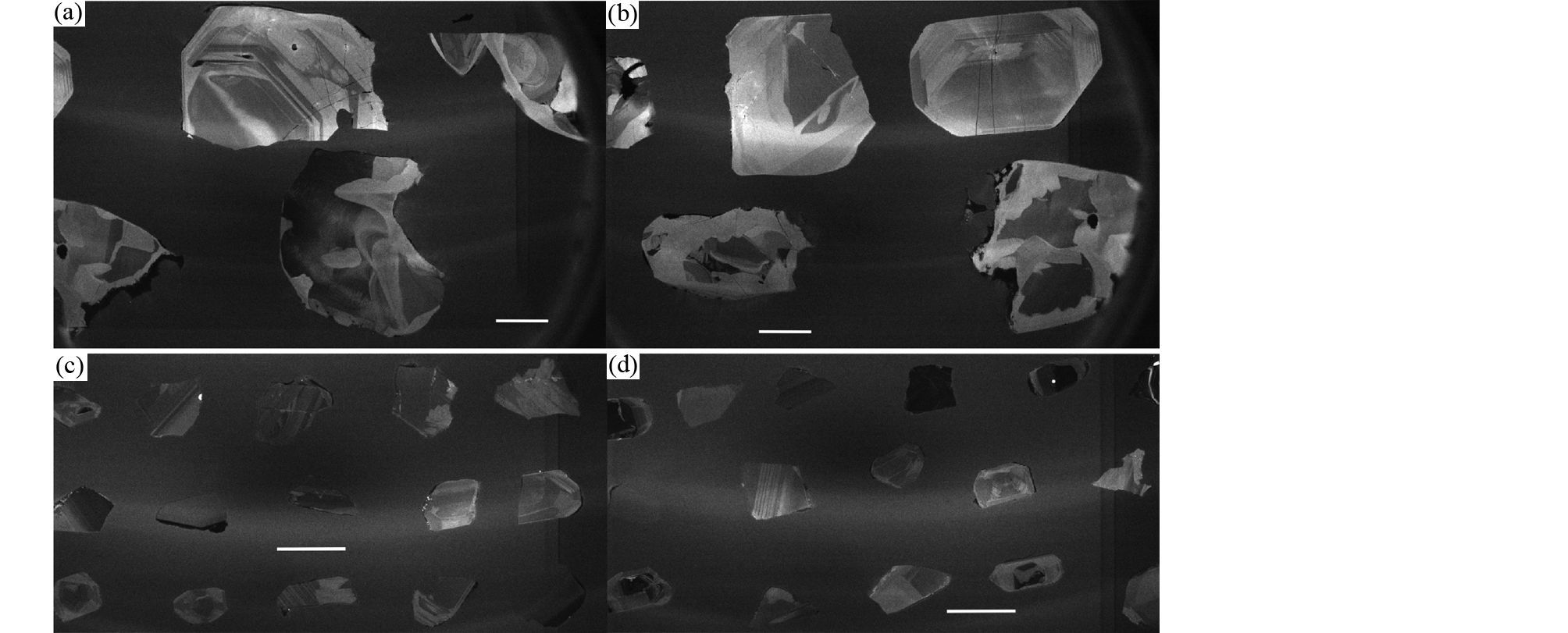
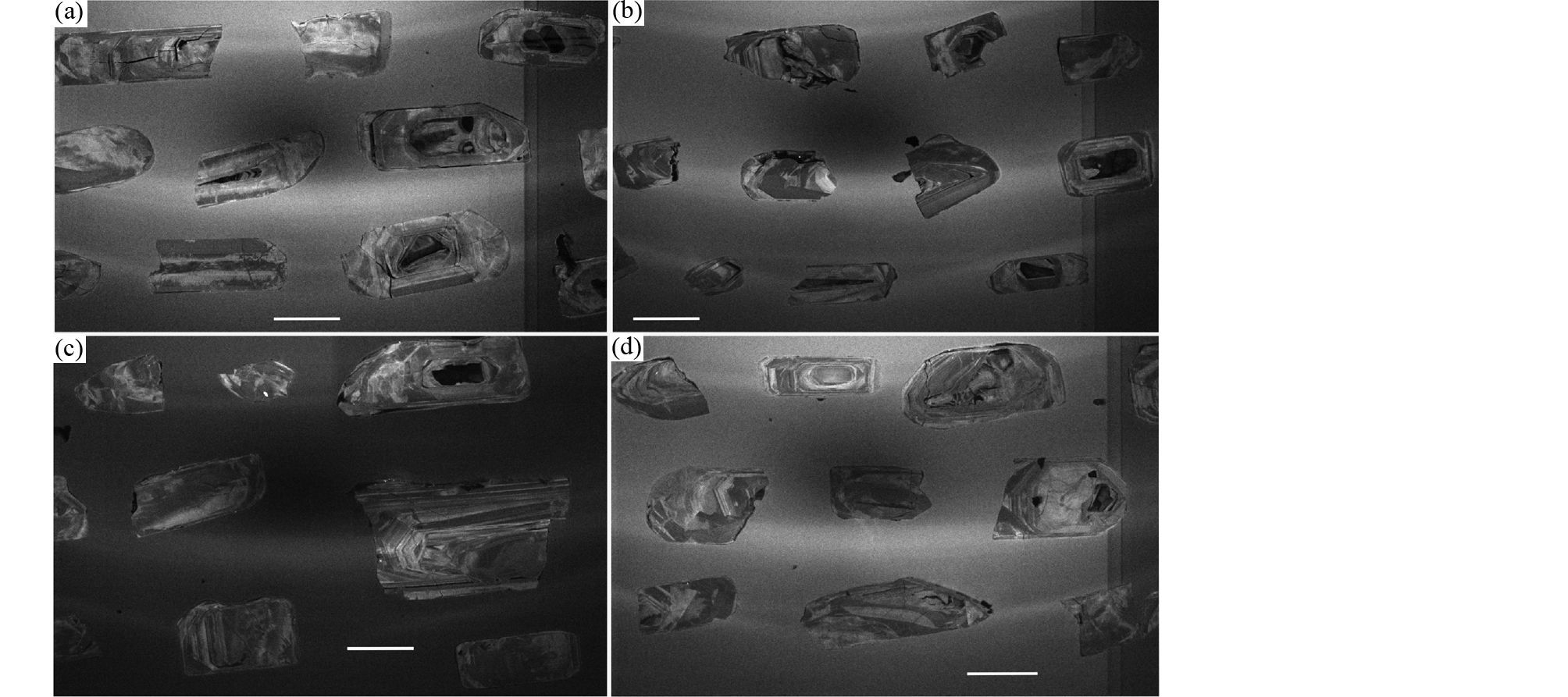
4 测试结果6个样品锆石的阴极发光图像见图 7和图 8,定年结果见图 9和表 1中。从图 7中可以看出,定州地区2件正长岩样品的锆石显示出较大的差异性,矿物粒度较大的粗粒正长岩(14NK13) 中的锆石颗粒也比较大,而矿物粒度稍小的萤石化霓辉正长岩(14NK16) 中的锆石颗粒比较小。但是2个样品中的锆石晶体边界平直,发育典型的岩浆环带,并且不发育核-边结构。在图 8中可以看出,铁山地区4件似斑状花岗岩样品的锆石均显示类似的形态和内部结构特征,都表现为棱柱状锆石、发育岩浆振荡环带、锆石边界平直等。
|
图 7 定州地区粗粒正长岩中(a、b)和萤石化霓辉正长岩(c、d)中锆石的阴极发光图像 图中的比例尺为100μm Fig. 7 CL images of zircons from the weathered syenite(a,b)and from the fluorite syenite(c,d)of the Jongju region The scale bars in the figures are 100μm |
|
图 8 铁山地区似斑状花岗岩(14NK36-1、14NK36-2、14NK37-1和14NK37-2) 中锆石的阴极发光图像 图中的比例尺为100μm Fig. 8 CL images of zircons from the porphyraceous granite samples of the Cholsan region The scale bars in the figures are 100μm |
|
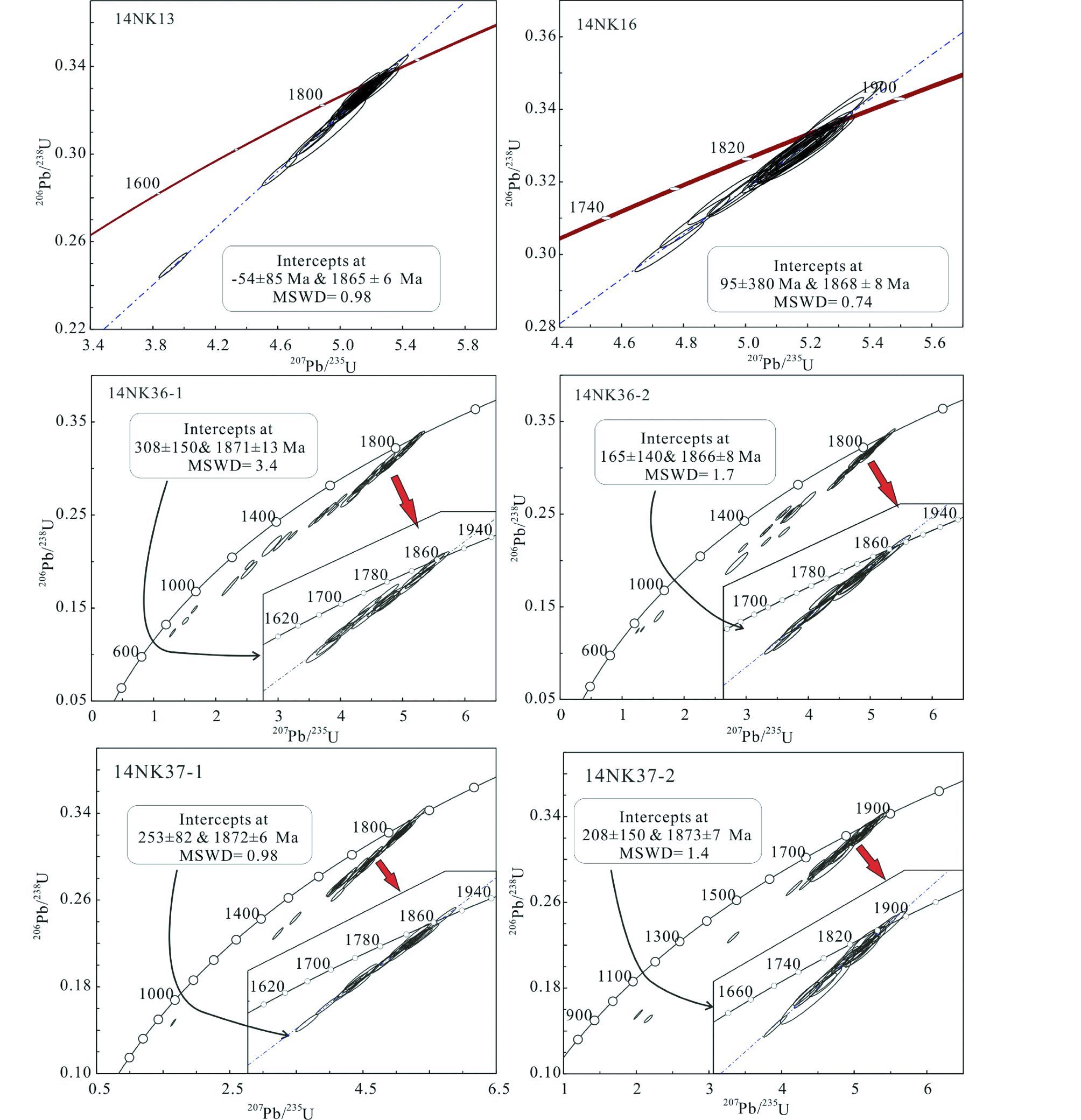
图 9 朝鲜定州和铁山地区岩石样品的锆石U-Pb年龄谐和图 Fig. 9 Zircon U-Pb concordia diagrams of the samples from the Jongju and Cholsan regions of northern Korea |
|
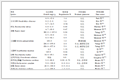
表 1 朝鲜定州和铁山地区样品SIMS锆石U-Pb定年结果 Table 1 SIMS zircon U-Pb results of the samples from the Jongju and Cholsan regions in northern Korea |
对粗粒正长岩(14NK13) 中的40个锆石点进行了U-Pb年代学分析测试,207Pb/206Pb年龄分布在1848Ma到1881Ma之间,Th/U比值在0.07到0.40之间,大部分锆石的Th/U比值在0.1以上(表 1)。40个测试点组成的不一致曲线上交点年龄为1865±6Ma,下交点年龄为-54±85Ma(不具有实际的地质意义)(图 9)。对定州地区萤石化霓辉正长岩中的27个锆石点进行了U-Pb年代学测试,测试结果显示,207Pb/206Pb年龄分布在1827Ma到1877Ma之间,Th/U比值在0.06到0.70之间,大部分大于0.1(表 1)。27个测试点组成的不一致曲线,上交点年龄为1868±8Ma,下交点年龄为95±380Ma,该下交点年龄也不具有实际的地质意义(图 9)。
对铁山地区4件似斑状花岗岩样品中的总计148个锆石点,进行了U-Pb年代学测试,其207Pb/206Pb年龄跨度较大,分布在1012Ma到1884Ma之间,Th/U比值在0.02到1.13之间,大部分大于0.1。4个样品年龄结果分别组成四条不一致曲线,其上交点年龄分别为:1871±13Ma(14NK36-1) 、1866±8Ma(14NK36-2) 、1872±6Ma(14NK37-1) 和1873±7Ma(14NK37-2) (图 9)。下交点年龄误差较大,并且极其分散,不具有实际的地质意义。
5 讨论与结论本文所研究的定州和铁山地区6件岩石样品的锆石,虽然显示出一定的差异性,如不同的颗粒大小等,但是它们大都表现出棱柱状晶形、发育岩浆振荡环带并具有较高的Th/U比值,属于典型的岩浆结晶锆石(Harley and Kelly,2007; Rubatto et al.,1999; Scherer et al.,2007; Vavra,1990)。这些样品的定年结果在1865Ma到1873Ma之间,代表了狼林地块古元古代的岩浆活动时间。这些碱性岩(定州地区的粗粒正长岩和萤石化霓辉正长岩)和似斑状花岗岩样品的岩浆作用时代,与华北克拉通古元古代三条活动带以及狼林地块古元古代高温变质-深熔的时间一致(Kusky,2011; Peng et al.,2014; Santosh et al.,2012; Zhai,2014; Zhai and Santosh,2013; Zhai et al.,2014; Zhao and Zhai,2013; 赵磊等,2016a),表明狼林地块与华北克拉通在古元古代之前可能就是统一的整体。类似的碱性岩在辽南地块也有报道(杨进辉等,2007),这些碱性岩的存在,可能指示狼林地块和辽吉活动带在古元古代都位于一个大的构造带内,并且这个构造带(或者构造带的一部分)在1865~1873Ma是处于伸展的构造背景(Peng et al.,2014; 吴福元等,2016; 杨进辉等,2007)。基于野外观察和前期工作,大致可以认为这一定年结果代表了定州和铁山稀土矿的成矿时代。
中国内蒙古白云鄂博稀土-铌-铁矿床,是目前被证实的世界最大的稀土矿,与白云鄂博相比,朝鲜定州和铁山地区的稀土矿表现出不同的特征。前人的研究表明,白云鄂博稀土矿可能经历了中元古代以及古生代两期成矿作用(Hu et al.,2009; Smith et al.,2015; Zhu et al.,2015),其中与稀土成矿密切相关的火成碳酸岩形成于中元古代(Fan et al.,2014; Yang et al.,2011b; 范宏瑞等,2002,2006; 杨奎锋等,2010)。白云鄂博稀土矿中包含种类繁多的矿物,已查明的矿物种类超过160种(张培善和陶克捷,1986),稀土矿物如氟碳铈矿、氟碳钡铈矿、氟碳钙钡铈矿、黄河矿等,在矿石中大量存在(范宏瑞等,2003)。通过前文的描述可知,与白云鄂博稀土矿相比,本文所研究的朝鲜定州和铁山地区稀土矿相关的岩石中稀土矿物含量较少。但是朝鲜国家科学院地质研究所和其他相关单位的前期工作,确实在定州和铁山地区的稀土矿中分离出了相当比例的稀土矿物,前面已经提到,定州地区稀土矿以含有硅铈矿、烧绿石为特征,铁山地区的稀土矿以含有独居石为特征。然而,我们并没有从铁山地区采集的标本中分选出独居石,这可能与采集到的样品不典型有关。世界上很多地区存在碱性岩与碳酸岩共生的现象,并且火成碳酸岩对于形成世界级稀土矿具有重要作用(范宏瑞等,2001;以及王凯怡等,2012的总结),但是目前尚未在定州或铁山的相关地区发现火成碳酸岩出露。此外,尽管前人研究表明热液流体对于稀土元素的迁移、富集和成矿具有重要的作用(van Dongen et al.,2010; Fan et al.,2004; Li and Zhou,2015; Sheard et al.,2012),朝鲜定州和铁山地区相关的岩石除了经受明显的风化之外,并不表现出明显的元古代岩浆期之后的热液蚀变特征。前面已经提到,位于中朝克拉通北缘的白云鄂博稀土矿,成矿期为中元古代和中生代。而本文研究结果表明朝鲜定州和铁山地区与稀土矿密切相关的碱性岩(也即两类正长岩)和似斑状花岗岩的时代(成矿时代)为古元古代,与华北白云鄂博稀土矿的成矿期差别较大。
基于以上的讨论,可以获得如下的几条结论:
(1) 狼林地块西北部出露有与华北克拉通三条古元古代活动带同期的花岗岩和碱性岩,这些岩浆活动的时代为1865~1873Ma;
(2) 分布于狼林地块、辽南地块和辽吉活动带的这些古元古代岩浆活动,可能表明狼林地块与辽南地块、辽吉活动带在古元古代之前属于一个统一的地体,这个地体(或者地体的一部分)当时处于伸展的构造背景;
(3) 伴随着这些岩浆活动,在定州和铁山地区形成了一些稀土矿,这些稀土矿与华北白云鄂博稀土矿有较大的区别;
(4) 关于定州和铁山地区稀土矿成因、稀土矿物组成、矿床规模等,未来还需要进行大量的工作来解决这些问题。
致谢 翟明国院士、吴福元院士、张晓晖研究员、彭澎研究员、张艳斌副研究员、侯泉林教授、刘富博士帮助完成野外地质工作,并在成文过程中进行了深入的讨论;中国科学院地质与地球物理研究所闫欣在锆石CL照相过程中提供了帮助;李献华研究员、凌潇潇和唐国强在SIMS分析测试过程中提供了帮助;姜能研究员、葛文春教授与杨奎锋副研究员提供的评审意见,使得本文更加完善;在此一并致谢| [1] | Bai J.1993. The Precambrian Geology and Pb-Zn Mineralization in the Northern Margin of North China Platform. Beijing: Geological Publishing House . |
| [2] | Chang EZ. 1996. Collisional orogene between North and South China and its eastern extension in the Korean Peninsula. Journal of Southeast Asian Earth Sciences , 13 (3-5) :267–277. DOI:10.1016/0743-9547(96)00033-5 |
| [3] | Chang KH and Zhao XX. 2012. North and South China suturing in the east end:What happened in Korean Peninsula. Gondwana Research , 22 (2) :493–506. DOI:10.1016/j.gr.2011.12.010 |
| [4] | Cheong CS, Jeong GY, Kim H, Choi MS, Lee SH and Cho M. 2003. Early Permian peak metamorphism recorded in U-Pb system of black slates from the Ogcheon metamorphic belt, South Korea, and its tectonic implication. Chemical Geology , 193 (1-2) :81–92. DOI:10.1016/S0009-2541(02)00227-9 |
| [5] | Chough SK, Kwon ST, Ree JH and Choi DK. 2000. Tectonic and sedimentary evolution of the Korean Peninsula:A review and new view. Earth-Science Reviews , 52 (1-3) :175–235. DOI:10.1016/S0012-8252(00)00029-5 |
| [6] | Fan HR, Xie YH, Wang KY and Yang XM. 2001. Carbonatitic fluids and REE mineralization. Earth Science Frontiers , 8 (4) :289–295. |
| [7] | Fan HR, Chen FK, Wang KY, Xie YH, Wilde S and Satir M. 2002. Zircon U-Pb age of a Carbonatite dyke from Bayan Obo REE-Fe-Nb deposit, Inner Mongolia and its geological significance. Acta Petrologica Sinica , 18 (3) :363–368. |
| [8] | Fan HR, Tao KJ, Xie YH and Wang KY. 2003. Laser Raman spectroscopy of typical rare-earth fluoro-carbonate minerals in Bayan Obo REE-Fe-Nb deposit and identification of rare-earth daughter minerals hosted in fluid inclusions. Acta Petrologica Sinica , 19 (1) :169–172. |
| [9] | Fan HR, Xie YH, Wang KY, Tao KJ and Wilde SA. 2004. REE daughter minerals trapped in fluid inclusions in the giant Bayan Obo REE-Nb-Fe deposit, Inner Mongolia, China. International Geology Review , 46 (7) :638–645. DOI:10.2747/0020-6814.46.7.638 |
| [10] | Fan HR, Hu FF, Yang KF and Wang KY. 2006. Fluid unmixing/immiscibility as an ore-forming process in the giant REE-Nb-Fe deposit, Inner Mongolian, China:Evidence from fluid inclusions. Journal of Geochemical Exploration , 89 (1-3) :104–107. DOI:10.1016/j.gexplo.2005.11.039 |
| [11] | Fan HR, Hu FF, Chen FK, Yang KF and Wang KY. 2006. Intrusive age of No.1 carbonatite dyke from Bayan Obo REE-Nb-Fe deposit, Inner Mongolia:With answers to comment of Dr. Le Bas. Acta Petrologica Sinica , 22 (2) :519–520. |
| [12] | Fan HR, Hu FF, Yang KF, Pirajno F, Liu X and Wang KY. 2014. Integrated U-Pb and Sm-Nd geochronology for a REE-rich carbonatite dyke at the giant Bayan Obo REE deposit, Northern China. Ore Geology Reviews , 63 :510–519. DOI:10.1016/j.oregeorev.2014.03.005 |
| [13] | Faure M, Lin W, Monié P and Bruguier O. 2004. Palaeoproterozoic arc magmatism and collision in Liaodong Peninsula (north-east China). Terra Nova , 16 (2) :75–80. DOI:10.1111/ter.2004.16.issue-2 |
| [14] | Guo JH, Zhai MG, Peng P, Jiao SJ, Zhao L and Wang HZ. 2015. Paleoproterozoic granulites in the North China Craton and their geological implications. In:Zhai MG (ed.). Precambrian Geology of China. Berlin, Heidelberg:Springer, 137-169 http://cn.bing.com/academic/profile?id=2257083185&encoded=0&v=paper_preview&mkt=zh-cn |
| [15] | Harley SL and Kelly NM. 2007. Zircon tiny but timely. Elements , 3 (1) :13–18. DOI:10.2113/gselements.3.1.13 |
| [16] | Hu FF, Fan HR, Liu S, Yang KF and Chen FK. 2009. Samarium-neodymium and rubidium-strontium isotopic dating of veined REE mineralization for the Bayan Obo REE-Nb-Fe deposit, northern China. Resource Geology , 59 (4) :407–414. DOI:10.1111/rge.2009.59.issue-4 |
| [17] | Jahn BM, Auvray B, Cornichet J, Bai YL, Shen QH and Liu DY. 1987. 3. 5Ga old amphibolites from eastern Hebei Province, China:Field occurrence, petrography, Sm-Nd isochron age and REE geochemistry. Precambrian Research , 34 (3-4) :311–346. |
| [18] | Kim RS and Jon GP. 1996. Stratigraphy, section 1:Archean era. In:Institute of Geology, SAOS, DPR of Korea (ed.). Geology of Korea. Pyongyang:Foreign Language Books Publishing House, 15-30 |
| [19] | Kim SW, Kwon S, Santosh M, Williams IS and Yi K. 2011. A Paleozoic subduction complex in Korea:SHRIMP zircon U-Pb ages and tectonic implications. Gondwana Research , 20 (4) :890–903. DOI:10.1016/j.gr.2011.05.004 |
| [20] | Kusky TM. 2011. Geophysical and geological tests of tectonic models of the North China Craton. Gondwana Research , 20 (1) :26–35. DOI:10.1016/j.gr.2011.01.004 |
| [21] | Lee BC, Oh CW, Yengkhom KS and Yi K. 2014. Paleoproterozoic magmatic and metamorphic events in the Hongcheon area, southern margin of the Northern Gyeonggi Massif in the Korean Peninsula, and their links to the Paleoproterozoic orogeny in the North China Craton. Precambrian Research , 248 :17–38. DOI:10.1016/j.precamres.2014.04.003 |
| [22] | Li QL, Li XH, Liu Y, Tang GQ, Yang JH and Zhu WG. 2010. Precise U-Pb and Pb-Pb dating of Phanerozoic baddeleyite by SIMS with oxygen flooding technique. Journal of Analytical Atomic Spectrometry , 25 (7) :1107–1113. DOI:10.1039/b923444f |
| [23] | Li XC and Zhou MF. 2015. Multiple stages of hydrothermal REE remobilization recorded in fluorapatite in the Paleoproterozoic Yinachang Fe-Cu-(REE) deposit, Southwest China. Geochimica et Cosmochimica Acta , 166 :53–73. DOI:10.1016/j.gca.2015.06.008 |
| [24] | Li XH, Liu Y, Li QL, Guo CH and Chamberlain KR. 2009. Precise determination of Phanerozoic zircon Pb/Pb age by multicollector SIMS without external standardization. Geochemistry, Geophysics, Geosystems , 10 (4) . DOI:10.1029/2009GC002400 |
| [25] | Liu DY, Page RW, Compston W and Wu JS. 1985. U-Pb zircon geochronology of late Archaean metamorphic rocks in the Taihangshan-Wutaishan area, North China. Precambrian Research , 27 (1-3) :85–109. DOI:10.1016/0301-9268(85)90007-5 |
| [26] | Liu DY, Nutman AP, Compston W, Wu JS and Shen QH. 1992. Remnants of ≥3800Ma crust in the Chinese part of the Sino-Korean craton. Geology , 20 (4) :339–342. DOI:10.1130/0091-7613(1992)020<0339:ROMCIT>2.3.CO;2 |
| [27] | Liu DY, Wilde SA, Wan YS, Wu JH, Zhou HY, Dong CY and Yin XY. 2008. New U-Pb and Hf isotopic data confirm Anshan as the oldest preserved segment of the North China Craton. American Journal of Science , 308 (3) :200–231. DOI:10.2475/03.2008.02 |
| [28] | Ludwig K.2003. User's Manual for Isoplot/Ex version 3.00:A geochronology toolkit for Microsoft excel.No.4. Berkeley: Berkeley Geochronological Center, Special Publication . |
| [29] | Min K and Cho M. 1998. Metamorphic evolution of the northwestern Ogcheon metamorphic belt, South Korea. Lithos , 43 (1) :31–51. DOI:10.1016/S0024-4937(98)00006-1 |
| [30] | Oh CW, Imayama T, Yi SB, Kim T, Ryu IC, Jeon J and Yi K. 2014. Middle Paleozoic metamorphism in the Hongseong area, South Korea, and tectonic significance for Paleozoic orogeny in Northeast Asia. Journal of Asian Earth Sciences , 95 :203–216. DOI:10.1016/j.jseaes.2014.08.011 |
| [31] | Oh CW, Imayama T, Lee SY, Yi SB, Yi K and Lee BC. 2015. Permo-Triassic and Paleoproterozoic metamorphism related to continental collision in Yangpyeong, South Korea. Lithos , 216-217 :264–284. DOI:10.1016/j.lithos.2014.12.016 |
| [32] | Paek RJ and Jon GP. 1996. Stratigraphy, section 2:Lower Proterozoic era. In:Institute of Geology, SAOS, DPR of Korea (ed.). Geology of Korea. Pyongyang:Foreign Languages Books Publishing House, 31-51 |
| [33] | Peng P, Zhai MG, Guo JH, Zhang HF and Zhang YB. 2008. Petrogenesis of Triassic post-collisional syenite plutons in the Sino-Korean craton:An example from North Korea. Geological Magazine , 145 (5) :637–647. |
| [34] | Peng P, Zhai MG, Li QL, Wu FY, Hou QL, Li Z, Li TS and Zhang YB. 2011. Neoproterozoic (~900Ma) Sariwon sills in North Korea:Geochronology, geochemistry and implications for the evolution of the south-eastern margin of the North China Craton. Gondwana Research , 20 (1) :243–254. DOI:10.1016/j.gr.2010.12.011 |
| [35] | Peng P, Wang XP, Windley BF, Guo JH, Zhai MG and Li Y. 2014. Spatial distribution of ca.1950~1800Ma metamorphic events in the North China Craton:Implications for tectonic subdivision of the craton. Lithos , 202-203 :250–266. DOI:10.1016/j.lithos.2014.05.033 |
| [36] | Ree JH, Cho M, Kwon ST and Nakamura E. 1996. Possible eastward extension of Chinese collision belt in South Korea:The Imjingang belt. Geology , 24 (12) :1071–1074. DOI:10.1130/0091-7613(1996)024<1071:PEEOCC>2.3.CO;2 |
| [37] | Ri UR. 1996a. Magmatism, section 1:Archean-early Lower proterozoic. In:Institute of Geology, SAOS, DPR of Korea (ed.). Geology of Korea. Pyongyang:Foreign Languages Books Publishing House, 226-235 |
| [38] | Ri UR. 1996b. Magmatism, section 2:Late lower Proterozoic. In:Institute of Geology, SAOS, DPR of Korea (ed.). Geology of Korea. Pyongyang:Foreign Languages Books Publishing House, 236-256 |
| [39] | Rubatto D, Gebauer D and Compagnoni R. 1999. Dating of eclogite-facies zircons:The age of Alpine metamorphism in the Sesia-Lanzo Zone (Western Alps). Earth and Planetary Science Letters , 167 (3-4) :141–158. DOI:10.1016/S0012-821X(99)00031-X |
| [40] | Santosh M, Liu SJ, Tsunogae T and Li JH. 2012. Paleoproterozoic ultrahigh-temperature granulites in the North China Craton:Implications for tectonic models on extreme crustal metamorphism. Precambrian Research , 222-223 :77–106. DOI:10.1016/j.precamres.2011.05.003 |
| [41] | Santosh M, Liu DY, Shi YR and Liu SJ. 2013. Paleoproterozoic accretionary orogenesis in the North China Craton:A SHRIMP zircon study. Precambrian Research , 227 :29–54. DOI:10.1016/j.precamres.2011.11.004 |
| [42] | Scherer EE, Whitehouse MJ and Münker C. 2007. Zircon as a monitor of crustal growth. Elements , 3 (1) :19–24. DOI:10.2113/gselements.3.1.19 |
| [43] | Sheard ER, Williams-Jones AE, Heiligmann M, Pederson C and Trueman DL. 2012. Controls on the concentration of zirconium, niobium, and the rare rarth rlements in the Thor Lake rare metal deposit, Northwest Territories, Canada. Economic Geology , 107 (1) :81–104. DOI:10.2113/econgeo.107.1.81 |
| [44] | Sláma J, Košler J, Condon DJ, Crowley JL, Gerdes A, Hanchar JM, Horstwood MSA, Morris GA, Nasdala L, Norberg N, Schaltegger U, Schoene B, Tubrett MN and Whitehouse MJ. 2008. Plešovice zircon:A new natural reference material for U-Pb and Hf isotopic microanalysis. Chemical Geology , 249 (1-2) :1–35. DOI:10.1016/j.chemgeo.2007.11.005 |
| [45] | Smith MP, Campbell LS and Kynicky J. 2015. A review of the genesis of the world class Bayan Obo Fe-REE-Nb deposits, Inner Mongolia, China:Multistage processes and outstanding questions. Ore Geology Reviews , 64 :459–476. DOI:10.1016/j.oregeorev.2014.03.007 |
| [46] | Song B, Nutman AP, Liu DY and Wu JS. 1996. 3800 to 2500Ma crustal evolution in the Anshan area of Liaoning Province, northeastern China. Precambrian Research , 78 (1-3) :79–94. DOI:10.1016/0301-9268(95)00070-4 |
| [47] | Stacey JT and Kramers J. 1975. Approximation of terrestrial lead isotope evolution by a two-stage model. Earth and Planetary Science Letters , 26 (2) :207–221. DOI:10.1016/0012-821X(75)90088-6 |
| [48] | van Dongen M, Weinberg RF and Tomkins AG. 2010. Ree-Y, Ti, and P remobilization in magmatic rocks by hydrothermal alteration during Cu-Au deposit formation. Economic Geology , 105 (4) :763–776. DOI:10.2113/gsecongeo.105.4.763 |
| [49] | Vavra G. 1990. On the kinematics of zircon growth and its petrogenetic significance:A cathodoluminescence study. Contributions to Mineralogy and Petrology , 106 (1) :90–99. DOI:10.1007/BF00306410 |
| [50] | Wan YS, Liu DY, Song B, Wu JH, Yang CH, Zhang ZQ and Geng YS. 2005. Geochemical and Nd isotopic compositions of 3. 8Ga meta-quartz dioritic and trondhjemitic rocks from the Anshan area and their geological significance. Journal of Asian Earth Sciences , 24 (5) :563–575. |
| [51] | Wan YS, Liu DY, Dong CY, Nutman A, Wilde SA, Wang W, Xie HQ, Yin XY and Zhou HY. 2009. The oldest rocks and zircons in China. Acta Petrologica Sinica , 25 (8) :1793–1807. |
| [52] | Wan YS, Liu DY, Nutman A, Zhou HY, Dong CY, Yin XY and Ma MZ. 2012. Multiple 3.8~3.1Ga tectono-magmatic events in a newly discovered area of ancient rocks (the Shengousi Complex), Anshan, North China Craton. Journal of Asian Earth Sciences , 54-55 :18–30. DOI:10.1016/j.jseaes.2012.03.007 |
| [53] | Wan YS, Liu DY, Dong CY, Xie HQ, Kröner A, Ma MZ, Liu SJ, Xie SW and Ren P. 2015. Formation and evolution of Archean continental crust of the North China Craton. In:Zhai MG (ed.). Precambrian Geology of China. Berlin, Heidelberg:Springer, 59-136 |
| [54] | Wang KY, Yang KF, Fan HR, Hu FF and Hu FY. 2012. Addressing some problems on research of the Bayan Obo deposit. Acta Geologica Sinica , 86 (5) :687–699. |
| [55] | Wiedenbeck M, Allé P, Corfu F, Griffin WL, Meier M, Oberli F, Quadt AV, Roddick JC and Spiegel W. 1995. Three natural zircon standards for U-Th-Pb, Lu-Hf, trace element and REE analyses. Geostandards Newsletter , 19 (1) :1–23. DOI:10.1111/ggr.1995.19.issue-1 |
| [56] | Wu FY, Yang JH, Liu XM, Li TS, Xie LW and Yang YH. 2005. Hf isotopes of the 3. 8Ga zircons in eastern Hebei Province, China:Implications for early crustal evolution of the North China Craton. Chinese Science Bulletin , 50 (21) :2473–2480. |
| [57] | Wu FY, Zhang YB, Yang JH, Xie LW and Yang YH. 2008. Zircon U-Pb and Hf isotopic constraints on the Early Archean crustal evolution in Anshan of the North China Craton. Precambrian Research , 167 (3-4) :339–362. DOI:10.1016/j.precamres.2008.10.002 |
| [58] | Wu FY, Li QL, Yang JH, Kim JN and Han RH. 2016. Crustal growth and evolution of the Rangnim Massif, northern Korean Peninsula. Acta Petrologica Sinica , 32 (10) :2933–2947. |
| [59] | Yang JH, Wu FY, Xie LW and Liu XM. 2007. Petrogenesis and tectonic implications of Kuangdonggou syenites in the Liaodong Peninsula, east North China Craton:Constraints from in-situ zircon U-Pb ages and Hf isotopes. Acta Petrologica Sinica , 23 (2) :263–276. |
| [60] | Yang KF, Fan HR, Hu FF and Wang KY. 2010. Intrusion sequence of Carbonatite dykes and REE accumulation mechanism in Bayan Obo district. Acta Petrologica Sinica , 26 (5) :1523–1529. |
| [61] | Yang KF, Fan HR, Santosh M, Hu FF and Wang KY. 2011a. Mesoproterozoic carbonatitic magmatism in the Bayan Obo deposit, Inner Mongolia, North China:Constraints for the mechanism of super accumulation of rare earth elements. Ore Geology Reviews , 40 (1) :122–131. DOI:10.1016/j.oregeorev.2011.05.008 |
| [62] | Yang KF, Fan HR, Santosh M, Hu FF and Wang KY. 2011b. Mesoproterozoic mafic and carbonatitic dykes from the northern margin of the North China Craton:Implications for the final breakup of Columbia supercontinent. Tectonophysics , 498 (1-4) :1–10. DOI:10.1016/j.tecto.2010.11.015 |
| [63] | Yin A and Nie SY. 1993. An indentation model for the North and South China collision and the development of the Tan-Lu and Honam fault systems, eastern Asia. Tectonics , 12 (4) :801–813. DOI:10.1029/93TC00313 |
| [64] | Yu JH, O'Reilly SY, Zhou MF, Griffin WL and Wang LJ. 2012. U-Pb geochronology and Hf-Nd isotopic geochemistry of the Badu Complex, southeastern China:Implications for the Precambrian crustal evolution and paleogeography of the Cathaysia Block. Precambrian Research , 222-223 :242–449. |
| [65] | Zhai MG, Guo JH, Li Z, Chen DZ, Peng P, Li TS, Hou QL and Fan QC. 2007a. Linking the Sulu UHP belt to the Korean Peninsula:Evidence from eclogite, Precambrian basement, and Paleozoic sedimentary basins. Gondwana Research , 12 (4) :388–403. DOI:10.1016/j.gr.2007.02.003 |
| [66] | Zhai MG, Guo JH, Peng P and Hu B. 2007b. U-Pb zircon age dating of a rapakivi granite batholith in Rangnim massif, North Korea. Geological Magazine , 144 (3) :547–552. DOI:10.1017/S0016756807003287 |
| [67] | Zhai MG and Santosh M. 2013. Metallogeny of the North China Craton:Link with secular changes in the evolving Earth. Gondwana Research , 24 (1) :275–297. DOI:10.1016/j.gr.2013.02.007 |
| [68] | Zhai MG. 2014. Multi-stage crustal growth and cratonization of the North China Craton. Geoscience Frontiers , 5 (4) :457–469. DOI:10.1016/j.gsf.2014.01.003 |
| [69] | Zhai MG, Wan YS and Peng P. 2014. Secular changes of mineralization linked with Precambrian major geological events in the North China Craton. Precambrian Research , 255 (Part 2) :511–513. |
| [70] | Zhai MG, Hu B, Zhao TP, Peng P and Meng QR. 2015. Late Paleoproterozoic-Neoproterozoic multi-rifting events in the North China Craton and their geological significance:A study advance and review. Tectonophysics , 662 :153–166. DOI:10.1016/j.tecto.2015.01.019 |
| [71] | Zhang PS and Tao KJ.1986. Mineral Notes of Bayan Obo REE Deposit. Beijing: Science Press : 1 -208. |
| [72] | Zhang QS.1988. Early Crust and Mineral Deposits of Liaodong Peninsula, China. Beijing: Geological Publishing House . |
| [73] | Zhang YB, Zhai MG, Hou QL, Li TS, Liu F and Hu B. 2012. Late Cretaceous volcanic rocks and associated granites in Gyeongsang Basin, SE Korea:Their chronological ages and tectonic implications for cratonic destruction of the North China Craton. Journal of Asian Earth Sciences , 47 :252–264. DOI:10.1016/j.jseaes.2011.12.011 |
| [74] | Zhao GC, Cao L, Wilde SA, Sun M, Choe WJ and Li SZ. 2006. Implications based on the first SHRIMP U-Pb zircon dating on Precambrian granitoid rocks in North Korea. Earth and Planetary Science Letters , 251 (3-4) :365–379. DOI:10.1016/j.epsl.2006.09.021 |
| [75] | Zhao GC, Cawood PA, Li SZ, Wilde SA, Sun M, Zhang J, He YH and Yin CQ. 2012. Amalgamation of the North China Craton:Key issues and discussion. Precambrian Research , 222-223 :55–76. DOI:10.1016/j.precamres.2012.09.016 |
| [76] | Zhao GC and Zhai MG. 2013. Lithotectonic elements of Precambrian basement in the North China Craton:Review and tectonic implications. Gondwana Research , 23 (4) :1207–1240. DOI:10.1016/j.gr.2012.08.016 |
| [77] | Zhao L, Zhu XY and Zhai MG. 2016. Major advances in the study of the Precambrian geology and metallogenesis of the North China craton:A review. Acta Geologica Sinica , 90 (4) :1122–1155. DOI:10.1111/acgs.2016.90.issue-4 |
| [78] | Zhao L, Zhang YB, Wu FY, Li QL, Yang JH, Kim JN and Choi WJ. 2016a. Paleoproterozoic high temperature metamorphism and anatexis in the northwestern Korean Peninsula:Constraints from petrology and zircon U-Pb geochronology. Acta Petrologica Sinica , 32 (10) :3045–3069. |
| [79] | Zhao L, Zhang YB, Yang JH, Han RY and Kim JN. 2016b. Archean rocks at the southeastern margin of the Rangnim massif, northern Korean Peninsula, and their response to Paleoproterozoic tectonothermal events. Acta Petrologica Sinica , 32 (10) :2948–2964. |
| [80] | Zhu XK, Sun J and Pan CX. 2015. Sm-Nd isotopic constraints on rare-earth mineralization in the Bayan Obo ore deposit, Inner Mongolia, China. Ore Geology Reviews , 64 :543–553. DOI:10.1016/j.oregeorev.2014.05.015 |
| [81] | 白瑾. 1993. 华北陆台北缘前寒武纪地质及铅锌成矿作用. 北京: 地质出版社 . |
| [82] | 范宏瑞, 谢奕汉, 王凯怡, 杨学明.2001. 碳酸岩流体及其稀土成矿作用. 地学前缘 , 8 (4) :289–295. |
| [83] | 范宏瑞, 陈福坤, 王凯怡, 谢奕汉, WildeS and Satir M.2002. 白云鄂博REE-Fe-Nb矿床碳酸岩墙锆石U-Pb年龄及其地质意义. 岩石学报 , 18 (3) :363–368. |
| [84] | 范宏瑞, 陶克捷, 谢奕汉, 王凯怡.2003. 白云鄂博REE-Fe-Nb矿床稀土氟碳酸盐矿物激光拉曼光谱特征及流体包裹体内稀土子矿物的鉴定. 岩石学报 , 19 (1) :169–172. |
| [85] | 范宏瑞, 胡芳芳, 陈福坤, 杨奎锋, 王凯怡.2006. 白云鄂博超大型REE-Nb-Fe矿区碳酸岩墙的侵位年龄-兼答Le Bas博士的质疑. 岩石学报 , 22 (2) :519–520. |
| [86] | 万渝生, 刘敦一, 董春艳, NutmanA, WildeSA, 王伟, 颉颃强, 殷小艳, 周红英.2009. 中国最老岩石和锆石. 岩石学报 , 25 (8) :1793–1807. |
| [87] | 王凯怡, 杨奎峰, 范宏瑞, 胡芳芳, 胡辅佑.2012. 白云鄂博矿床研究若干问题的探讨. 地质学报 , 86 (5) :687–699. |
| [88] | 吴福元, 李秋立, 杨正赫, 金正男, 韩龙渊.2016. 朝鲜北部狼林地块构造归属与地壳形成时代. 岩石学报 , 32 (10) :2933–2947. |
| [89] | 杨进辉, 吴福元, 谢烈文, 柳小明.2007. 辽东矿洞沟正长岩成因及其构造意义:锆石原位微区U-Pb年龄和Hf同位素制约. 岩石学报 , 23 (2) :263–276. |
| [90] | 杨奎锋, 范宏瑞, 胡芳芳, 王凯怡.2010. 白云鄂博地区碳酸岩脉侵位序列与稀土元素富集机制. 岩石学报 , 26 (5) :1523–1529. |
| [91] | 张培善, 陶克捷. 1986. 白云鄂博矿物学. 北京: 科学出版社 : 1 -208. |
| [92] | 张秋生. 1988. 辽东半岛早期地壳与矿床. 北京: 地质出版社 . |
| [93] | 赵磊, 张艳斌, 吴福元, 李秋立, 杨正赫, 金正男, 崔元正.2016a. 朝鲜半岛西北部古元古代高温变质-深熔作用:宏观和微观岩石学以及锆石U-Pb年代学制约. 岩石学报 , 32 (10) :3045–3069. |
| [94] | 赵磊, 张艳斌, 杨正赫, 韩龙渊, 金正男.2016b. 朝鲜狼林地块东南缘太古宙岩石及其对古元古代构造热事件的响应. 岩石学报 , 32 (10) :2948–2964. |