 2016, Vol. 32


2. 中国地质大学地质过程与矿产资源国家重点实验室, 武汉 430074;
3. 河南省地质矿产勘查开发局测绘地理信息院, 郑州 450006
2. State Key Laboratory of Geological Processes and Mineral Resources, China University of Geosciences, Wuhan 430074, China;
3. Institute of Surveying Mapping and Geographic of Henan Geology and Mineral Bureau, Zhengzhou 450006, China
在位错蠕变状态下,上地幔橄榄岩的流动变形使得其中的组成矿物(特别是橄榄石)发育显著的结晶学优选方位(crystallographic preferred orientation,CPO)(金振民等,1994; Ben Ismaïl and Mainprice,1998; Tommasi et al.,2004)。由于橄榄石本身对于地震波传播而言是一种强各向异性矿物(橄榄石单晶P波各向异性值达到24.3%),并且橄榄石也是上地幔橄榄岩的主要组成矿物(一般占地幔橄榄岩体积比的~60%)之一,因此其结晶学优选方位一般被认为是造成上地幔地震波各向异性的一种主要原因(Hess,1964; Silver,1996; Mainprice et al.,2000)。这种橄榄石结晶学优选方位与上地幔地震波各向异性之间的关系也成为联接地球动力学和地震学之间的桥梁(金振民等,1990),因此橄榄石的结晶学优选方位具有重要的地球动力学意义。橄榄石在上地幔变形条件下一般会形成[100]轴近平行于流动方向,而[010]轴近垂直于流动面理的结晶学优选方位(A型或D型,见图 1),这也是自然界中最为典型的橄榄石组构(Ben Ismaïl and Mainprice,1998; Tommasi et al.,2000)。但是大量的实验研究(Bystricky et al.,2000; Jung and Karato,2001; Katayama et al.,2004; Ohuchi et al.,2011,2012)表明,在变形条件(温度、压力、应力、应变和水等)改变时,橄榄石会产生不同于经典的A型组构的异常组构类型(B型、C型或E型;图 1)。例如,Jung and Karato(2001)的实验表明,在贫水、低应力条件下,变形橄榄石集合体发育典型的A型组构,而在富水、中等应力条件下则发育B型或C型组构。这些异常的B型或C型橄榄石组构可以解释(Skemer et al.,2006; Wang et al.,2013)地震波快S波方向在靠近海沟处呈近平行于海沟方向分布的地球物理观测结果(Nakajima and Hasegawa,2004)。
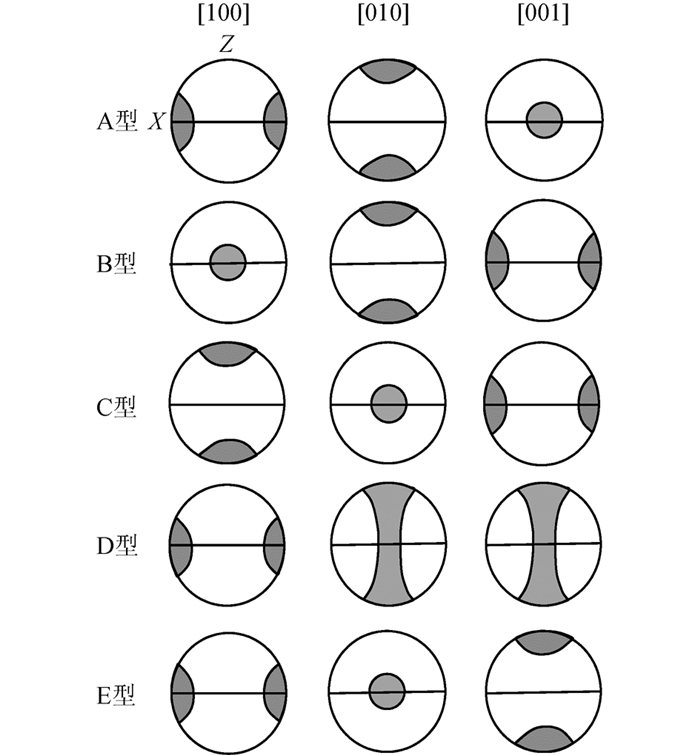 |
图 1 五种橄榄石组构的示意图 Fig. 1 Schematic drawing showing five types of olivine fabrics |
另一方面,作为名义上的无水矿物,橄榄石和辉石中的结构水在近二十年来一直受到广泛关注(Bell and Rossman,1992; Kohlstedt et al.,1996; Zhao et al.,2004; Peslier et al.,2010)。研究表明,这些矿物中的结构水,尽管微量,但可以显著影响地幔岩石的部分熔融(Hirth and Kohlstedt,1996)、力学强度(Mei and Kohlstedt,2000a,b)、电导率(Wang et al.,2014)、以及矿物的结晶学优选方位(Jung and Karato,2001; Ohuchi et al.,2012)等。然而,目前对橄榄石中结构水的研究主要集中在由玄武岩或金伯利岩携带到地表的地幔橄榄岩包体或构造侵位的造山带橄榄岩中(夏群科等,2000; 郝艳涛等,2006,2007; Li et al.,2008; Peslier et al.,2008; 朱蓓蓓等,2009; Wang,2010; Xia et al.,2010,2013; Wang et al.,2013; Warren and Hauri,2014; Hao et al.,2014),这些研究一方面讨论了地幔岩中名义上无水矿物结构水的含量以及保存,另一方面也涉及到了其地球动力学意义,如对岩石圈流变学、克拉通破坏的影响等。对蛇绿岩套地幔橄榄岩中橄榄石和辉石结构水的研究是矿物结构水研究的薄弱环节(Skemer et al.,2013; Warren and Hauri,2014)。蛇绿岩套地幔橄榄岩通常被认为是大洋岩石圈地幔的残片,对其组成矿物进行结构水研究一方面可以让我们了解古大洋岩石圈地幔名义上无水矿物中结构水含量以及其保存情况,另外也为与现今大洋岩石圈地幔(深海橄榄岩)中矿物结构水特征进行对比以及了解古今大洋岩石圈地幔水含量的变化提供了重要前提。
青藏高原南部沿印度-雅鲁藏布缝合带(YZSZ)出露有大规模的蛇绿岩套地幔橄榄岩,为研究地幔岩矿物的显微构造和结构水提供了很好的机会。马攸木蛇绿岩位于该缝合带西段,作为新特提斯洋消亡的遗迹,一直倍受中外地质学家关注。前人对该区及邻近地区蛇绿岩所做的工作主要包括岩石学(Zhou et al.,2005; Liu et al.,2010; 郭国林等,2011; 徐向珍等,2011)、年代学(李建峰等,2008; 孙高远和胡修棉,2012)、地球化学(夏斌和曹佑功,1992; Miller et al.,2003; Dupuis et al.,2005; Dai et al.,2011; 徐向珍等,2011),所探讨的问题主要集中在地幔橄榄岩的岩石成因、构造环境、仲巴地体的板块亲缘性以及结合雅江缝合带东段、中段的资料探讨其开合演化模式等,而对马攸木地区地幔橄榄岩的显微构造、矿物结晶学优选方位以及矿物结构水的研究却鲜有报道。
本文利用光学显微镜、电子背散射衍射(EBSD)和显微傅立叶红外光谱(FTIR)对马攸木地区雅江南带方辉橄榄岩进行初步的显微构造、组构和结构水测试,目的是获取马攸木地幔橄榄岩中橄榄石的变形组构以及橄榄石和辉石中的结构水信息,为了解蛇绿岩套地幔橄榄岩中矿物的结构水含量以及橄榄石组构和结构水之间的关系提供约束资料。
2 区域地质背景马攸木蛇绿岩位于雅江缝合带西段仲巴县霍尔巴乡境内,它被仲巴微陆块分隔为南北两个亚带,均以断层与围岩接触,并共同构成雅江缝合带的西段(图 2)。其中南带中变质超镁铁质岩发育比较完整,总体呈NWW-SEE向带状断续分布,出露面积约481km2。放射虫硅质岩和锆石同位素定年测定南带蛇绿岩形成时间为晚侏罗世至早白垩世(周肃等,2001; Miller et al.,2003)。马攸木蛇绿岩出露保存较好的地幔橄榄岩,主要由方辉橄榄岩和少量纯橄榄岩组成。前人研究表明,以马攸木、仲巴、普兰等为代表的雅鲁藏布江缝合带西段地幔橄榄岩主体形成于MOR环境,后期可能受到了SSZ环境的改造(徐向珍等,2011; 李源等,2011; Dai et al.,2011)。
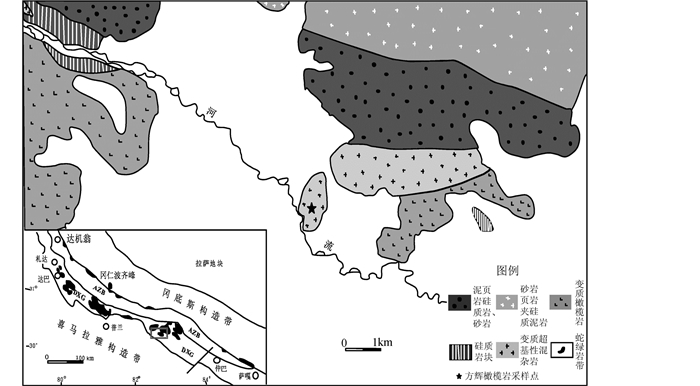 |
图 2 研究区地质简图(据夏斌等,1998修改) Fig. 2 Simplified geological map of the study area(modified after Xia et al.,1998) |
本文样品为采自雅江南带的两块方辉橄榄岩(样品号12SB7-1和12SB8-1)。样品发生轻微蛇纹石化,在其新鲜面上可见拉长的斜方辉石定向排列,据此确定岩石的面理和线理。沿垂直于面理并平行于线理(XZ面)方向切制定向薄片。利用氧化铝悬浮液将样品高度抛光至0.05μm,制成薄片进行光学显微观察和电子背散射衍射测试。
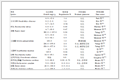
在光学显微镜下观察,马攸木地区雅江南带方辉橄榄岩主要由橄榄石(72%~82%)、斜方辉石(15%~16%)、单斜辉石(1.5%~4%)、尖晶石(1%~2%)和蛇纹石(0.5%~6%)组成(表 1)。岩石发育典型的残斑结构(图 3a,b),残斑大部分为橄榄石和斜方辉石颗粒(图 3a,b),少数为单斜辉石。橄榄石残斑粒径介于0.5~4mm之间,颗粒粗大并拉长变形。样品中部分橄榄石残斑被蛇纹石以网状穿切,根据不同颗粒一致消光可分辨出原始的橄榄石颗粒。橄榄石残斑周围的重结晶新晶粒粒径介于0.1~0.2mm,多呈等轴状。斜方辉石残斑粒径与橄榄石残斑接近,经常由于被熔蚀而显示港湾状、不规则颗粒边界(图 3c)。斜方辉石和单斜辉石残斑中分别出溶单斜辉石和斜方辉石出溶条纹。尖晶石呈棕红色,通常呈蠕虫状、树叶状分散于岩石中(图 3d)。橄榄石和斜方辉石的残斑中通常发育扭折带和波状消光现象(图 3a),反映岩石曾经历了高温塑性变形作用。
 | 表 1 马攸木方辉橄榄岩的结构及矿物组成 Table 1 Texture and mineral mode of the Mayoumu harzburgite |
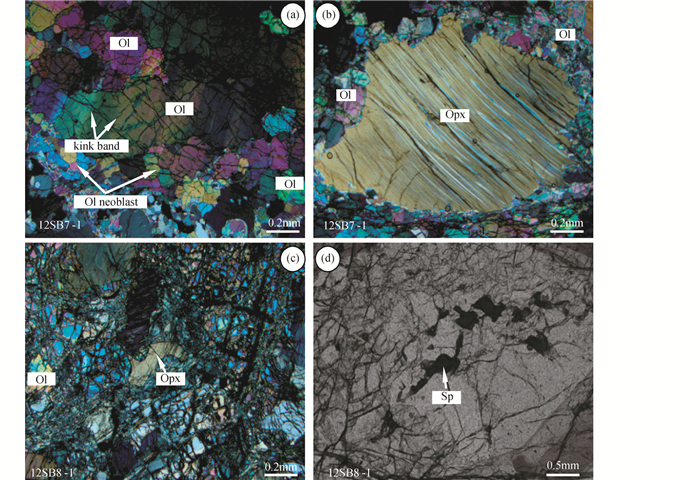 |
图 3 马攸木地区雅江南带方辉橄榄岩的显微构造照片 (a)残斑结构,橄榄石残斑发育扭折带,周围为动态重结晶晶粒(正交偏光);(b)残斑结构,斜方辉石残斑内发育单斜辉石出溶条纹,周围被动态重结晶的橄榄石新晶所包围(正交偏光);(c)斜方辉石由于被橄榄石熔蚀而具有典型的港湾状、不规则状颗粒边界(正交偏光);(d)蠕虫状的尖晶石(单偏光). 矿物缩写:Ol-橄榄石;Opx-斜方辉石;Cpx-单斜辉石;Sp-尖晶石;Serp-蛇纹石 Fig. 3 Photomicrographs showing the typical microstructures in the Mayoumu harzburgite (a) an olivine porphyroclast surrounded by many neoblastic olivine grains. Note the kink bands in the porphyroclastic olivine (cross-polarized); (b) an orthopyroxene porphyroclast showing exsolution lamellae of clinopyroxene and undulose extinction. Note the embayments filled by small olivine grains (cross-polarized); (c) an orthopyroxene grain with embayed grain boundaries (cross-polarized); (d) holy-leaf spinel grains (plane-polarized). Ol-olivine; Opx-orthopyroxene; Cpx-clinopyroxne; Sp-spinel; Serp-serpentine |
我们利用中国地质大学(武汉)地质过程与矿产资源国家重点实验室场发射扫描电子显微镜(型号为FEI Quanta450)下的电子背散射衍射(EBSD)技术测试了样品中橄榄石的结晶学优选方位。该电子背散射衍射系统采用了丹麦HKL技术有限公司提供的Nordlys-Ⅱ探头。EBSD测试工作条件为加速电压20kV,斑束大小为6,工作距离为25mm,样品台倾斜角度为70°。我们采用自动模式对马攸木地幔橄榄岩中橄榄石的晶格优选方位进行了面扫描,扫描步长为50μm。图像处理以及矿物标定利用Channel 5.0软件进行。对于每个样品的面扫测试结果,首先是识别颗粒,即将那些内部取向差 <15°的连续部分认为是一个颗粒。其次,以500μm粒径作为划分残斑和重结晶颗粒的界限,并按照一个颗粒由一个点来代表的方式分别做极图(见图 4),从而避免大的颗粒被过度表示的情况。所有的极图采用等面积下半球投影。为了与宏观岩石变形特征(面理和线理)对应,每个极图的东西直径代表线理,而沿东西直径并垂直纸面的平面代表面理。组构强度用J-index和M-index表示,J-index利用Mainprice博士提供的SuperJctPC.exe软件计算,而M-index则根据Skemer et al.(2005)中介绍的方法进行计算。J-index=1表示随机分布,而J-index无穷大表示单晶体;M-index介于0到1之间,其中0代表随机组构,而1则代表单晶体。
 |
图 4 马攸木方辉橄榄岩中橄榄石的结晶学优选方位 N-颗粒数;M-M指数;J-J指数;S-面理;L-线理 Fig. 4 Crystallographic preferred orientation of olivine in the Mayoumu harzburgite N-number of measured grains; M-the M-index; J-the J-index; S-foliation; L-lineation; Porp-prophyroclast; Neo-neoblast |
由图 4可见,两个样品中橄榄石残斑和重结晶颗粒都具有显著并且一致的结晶学优选方位,表现为[100]轴呈近平行于线理的点极密,[010]轴呈近垂直于面理的点极密,而[001]轴则靠近Y轴分布。分别对比两个样品中残斑与重结晶颗粒的组构强度可以发现,残斑橄榄石的组构强度要高于重结晶橄榄石的组构强度。例如,对于12SB7-1样品而言,残斑橄榄石的组构强度为M-index值为0.24,J-index值为9.28,而重结晶橄榄石的M-index值为0.18,J-index值为6.43。
5 红外光谱测试结果5.1 样品制备及分析方法对于红外光谱测试,我们将橄榄岩样品切割成长约4~5cm,宽约3cm的岩片,然后进行双面抛光,并将样品厚度控制在0.18~0.25mm之间。在进行红外光谱分析前将样品放入丙酮中浸泡>24h,以去除制样过程中在样品表面残余的热溶胶;取出样品后用无水乙醇和蒸馏水反复清洗样品,然后置于烘箱中,在100℃条件下干燥至少6h,以除去样品表面和裂隙中的吸附水。显微傅里叶红外光谱测试是在中国地质大学(武汉)地质过程与矿产资源国家重点实验室完成。使用仪器为美国热电Nicolet 6700型带显微镜红外光谱仪,分析采用KBr分束器,液氮冷却MCT-A探头。为了避免样品中微裂隙和包裹体对测试结果的干扰,我们小心选取那些透明、干净、没有明显的微裂隙和包裹体的矿物颗粒作为测试对象。分析条件为分辨率4cm-1,测定波数范围500~4500cm-1,扫描次数为128次或256次,采用非偏振光。每分析1次样品扣除1次背景。应用光谱处理软件OMNIC进行红外光谱的数据处理。为了确定斜方辉石是否发生了明显的H扩散丢失,我们选择了一颗干净无包体的斜方辉石进行了线扫描测量。
利用修正的Beer-Lambert公式计算所测试矿物的结构水含量:c=Δ/(I×t),式中Δ是吸收强度,用OH-吸收峰的积分面积(cm-2)表示,I是矿物的吸收系数(ppm-1·cm-2),c是矿物的含水量(wt ppm H2O),t代表样品厚度(cm)。矿物的吸收系数I分别为:橄榄石:5.32ppm-1·cm-2(Bell et al.,2003),斜方辉石:14.84ppm-1·cm-2(Bell et al.,1995)。根据Kovács et al.(2008),我们对橄榄石在3000~3800cm-1和斜方辉石在2800~3800cm-1范围内的吸收条带取积分,并乘以3以获得Δ值。所测含水量的误差主要来自非偏振光的使用所引起的非系统误差(Libowitzky and Rossman,1996),基线校正的误差,样品厚度测量的误差,以及样品化学成分(Bell et al.,1995,2003)与切片方向不同等。基于以上误差来源,我们在磨制薄片时尽量使样品厚度均匀(误差 <10%),在计算同一样品内不同颗粒的水含量时使用多点测量(>20个点,覆盖整个薄片)的厚度的平均值。此外,我们对每种矿物都测试了>20个颗粒,对同一个颗粒分别取三次积分面积并将其平均值作为该颗粒的最终吸收强度。
5.2 红外光谱测试结果所研究的两个样品中单斜辉石由于解理和斜方辉石出溶体发育而无法进行红外光谱测试。此外,12SB8-1样品中橄榄石蛇纹石化作用较为强烈,也无法选取足够大的、干净无包体的颗粒进行红外光谱测试。代表性的橄榄石和斜方辉石红外光谱图见图 5,所有谱图都标准化到1mm厚度。在典型的OH-红外吸收区域(4000~2800cm-1)内,样品12SB7-1中的橄榄石并未显示明显的结构水吸收峰(图 5a),表明橄榄石几乎不含结构水(见表 2):样品12SB7-1中橄榄石结构水含量为0~14wt ppm,平均值为(2±12)wt ppm。而所有的斜方辉石都显示明显的结构水吸收峰(图 5b),吸收峰分别位于3564cm-1、3519cm-1、3413cm-1、和3190cm-1。其中前三组吸收峰在所有的斜方辉石颗粒中均以尖锐峰的形式出现且吸收强度较强,而第四组吸收峰较为宽缓,同时吸收强度较弱。这些吸收峰也常见于天然和合成的斜方辉石中(Bell and Rossman,1992; Stalder and Skogby,2002)。所测试的两个样品中斜方辉石结构水含量接近,平均值分别为(124±67)wt ppm和(148±61)wt ppm。针对斜方辉石进行的线扫描测量结果(图 6)显示,所测量的斜方辉石从边缘到中心并未呈现明显的水含量变化。
| 表 2 马攸木方辉橄榄岩中矿物及全岩水含量 Table 2 Water contents of minerals and the whole rock in the Mayoumu harzburgite |
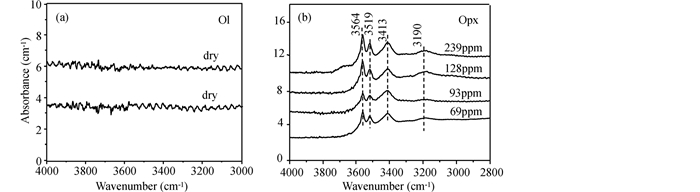 |
图 5 橄榄石(a)和斜方辉石(b)的代表性红外谱图 所有谱图都标准化到1mm并垂向上平移以清楚表示每个谱图. Ol-橄榄石;Opx-斜方辉石 Fig. 5 Representative infrared spectra of olivine (a) and orthopyroxene (b) in the Mayoumu harzburgite All spectra are normalized to a thickness of 1mm and shifted vertically for clarity. Ol-olivine; Opx-orthopyroxene |
显微构造观察表明,马攸木方辉橄榄岩呈残斑结构,橄榄石发生了显著的动态重结晶作用。EBSD测量结果显示,不论是橄榄石残斑或是动态重结晶颗粒均具有显著的结晶学优选方位(CPO),表现为[100]轴在近平行于线理(X)方向形成点极密,而[010]轴极密近垂直于面理(即XY面)方向。此外组构强度计算结果表明,重结晶颗粒的组构强度均弱于残斑橄榄石的组构强度,可能是由于亚颗粒的成核及随机旋转弱化了其组构强度。这些观察结果暗示马攸木橄榄岩中橄榄石的动态重结晶机制为亚颗粒旋转重结晶。类似的现象在Oman蛇绿岩(Michibayashi et al.,2006)及阿尔卑斯Lanzo地体(Kaczmarek and Tommasi,2011)也有报道。
光学显微镜下,马攸木橄榄岩中橄榄石显示波状消光和扭折带现象,指示橄榄石发生了显著的塑性变形。结合橄榄石明显的结晶学优选方位,这些特征表明马攸木橄榄岩中橄榄石的主导变形机制为位错蠕变。
6.2 马攸木方辉橄榄岩原位水含量的保存地幔橄榄岩从大洋上地幔运移到地表的过程中,H的丢失或获得可能会彻底改变结构水的含量。动力学实验数据(Kohlstedt and Mackwell,1998; Hercule and Ingrin,1999; Woods et al.,2000; Stalder and Skogby,2003)显示,H在1000℃毫米级别的橄榄石和辉石中扩散达到完全平衡只需几个小时。研究表明,氢扩散可导致捕虏体中橄榄石的含水量明显改变(Demouchy et al.,2006; Peslier and Luhr,2006),但对斜方辉石和单斜辉石的影响较小(Peslier et al.,2002; Bell et al.,2004; Yang et al.,2008; Warren and Hauri,2014)。对于马攸木橄榄岩,计算所得到的DHOpx/Ol=13.8要比前人实验获得的DHOpx/Ol=7±2(Aubaud et al.,2004; Hauri et al.,2006; Tenner et al.,2009)大,同时考虑到蛇绿岩套地幔橄榄岩的侵位速率要比玄武岩或金伯利岩的喷发速率小,我们认为马攸木方辉橄榄岩中橄榄石经历了明显的H丢失。Warren and Hauri(2014)对不同构造背景(地幔包体、蛇绿岩套以及大洋岩石圈)橄榄岩(共31个样品)组成矿物的结构水研究也表明,尽管低到中等程度的蚀变不会影响岩石的含水量,但橄榄石一般都会在橄榄岩侵位过程中发生扩散丢失。由于马攸木橄榄岩中单斜辉石多发育解理和出溶体而无法获得其结构水含量,因此我们无法通过斜方辉石和单斜辉石之间结构水的分配系数来确定两种辉石是否发生了明显的H的扩散丢失。斜方辉石中未观察到明显的H扩散环带(图 6),说明斜方辉石未发生显著的H扩散,或者已经达到了扩散平衡。若是前者,结合前人针对地幔包体橄榄岩中辉石结构水的研究结果-即斜方辉石较容易保留源区的水含量(Peslier et al.,2002; Bell et al.,2004; Yang et al.,2008; Warren and Hauri,2014),我们认为马攸木橄榄岩中斜方辉石基本保留了地幔源区的含水量。若是后者,则所测得的斜方辉石的结构水含量只能代表原位含水量的下限值。
 |
图 6 斜方辉石红外光谱线扫描结果 (a)线扫描斜方辉石颗粒及测试位置;(b)对应每个测试点的红外谱图及计算的含水量 Fig. 6 FTIR analyses across an orthopyroxene grain (a) photomicrograph showing the measured orthopyroxene grain and the analysis spots; (b) FTIR results for each analysis spot. All spectra are normalized to 1mm thickness |
利用实验数据获得的DHOpx/Ol=7±2和DHCpx/Opx=1.4±0.3(Aubaud et al.,2004; Hauri et al.,2006; Tenner et al.,2009),我们计算了马攸木橄榄岩中橄榄石和单斜辉石中的结构水含量(见表 2)。如上所述,这些数值也代表原位的结构水含量或其下限值。计算获得两个样品中橄榄石平均含水量介于(18~21)wt ppm,而单斜辉石平均含水量介于(173~207)wt ppm。橄榄石的低结构水含量与其发育的A型组构是一致的:据前人研究结果(Jung and Karato,2001),A型组构发育于低含水量(<200wt ppm)、高温和低应力条件下。根据岩石中各矿物的体积百分比,我们计算了全岩的结构水含量(表 2)。需指出的是,从原则上讲,全岩水含量的计算应使用单矿物在全岩中的重量分数而不是体积分数,但由于斜方辉石、单斜辉石、橄榄石密度相差不大(约3.3~3.6g/cm3),所以使用体积分数带来的误差可以忽略。计算结果显示所研究的两个样品的全岩含水量比较接近,分别为36wt ppm和47wt ppm。
6.3 与其他地区橄榄岩的对比由于结构水对地幔矿物诸多物理性质的明显影响,近年来前人对地幔橄榄岩中主要组成矿物(橄榄石和辉石)中的结构水进行了广泛的研究,取得了大量成果(Miller et al.,1987; Kurosawa et al.,1997; Matsyuk and Langer,2004; Katayama et al.,2005; Demouchy et al.,2006; Koch-Müller et al.,2006; Peslier and Luhr,2006; Xu et al.,2006; Aubaud et al.,2007; Grant et al.,2007; 郝艳涛等,2006,2007; Li et al.,2008; Peslier et al.,2008; 朱蓓蓓等,2009; Wang,2010; Xia et al.,2013; Wang et al.,2013; Hao et al.,2014)。然而,这些研究主要集中在包体橄榄岩和造山带橄榄岩上,而对蛇绿岩套地幔橄榄岩的含水量研究非常有限(Skemer et al.,2013)。
Wang(2010)总结了前人对橄榄岩包体和造山带橄榄岩中矿物结构水的研究成果,发现造山带橄榄岩中橄榄石的平均含水量为(13±13)wt ppm,而来自尖晶石橄榄岩包体中的橄榄石含水量更低为(7±11)wt ppm,相比之下,石榴石橄榄岩包体的平均含水量为(16±12)wt ppm。我们的初步研究结果表明,所测的一个样品中橄榄石的结构水平均值为(2±12)wt ppm,低于橄榄岩包体和造山带橄榄岩中橄榄石的平均含水量,与Josephine橄榄岩中橄榄石的结构水含量((7~9)wt ppm,Warren and Hauri,2014)在误差范围内是可以比较的。但考虑到只有一个样品的数据,其代表性有待进一步验证。马攸木橄榄岩中斜方辉石的含水量为(85~209)wt ppm之间,平均值为(136±12)wt ppm,处于包体及造山带橄榄岩矿物结构水的含量范围之内(郝艳涛等,2007; 夏群科等,2000,2010; 王蓉和张保民,2011; 汪洋等,2013),而与Josephine橄榄岩中斜方辉石含水量((123~225)wt ppm,Skemer et al.,2013;(168~306)wt ppm,Warren and Hauri,2014)可以比较。
7 结论通过对马攸木地区雅江南带方辉橄榄岩的显微构造和矿物结构水的初步研究,得到以下几点结论:
(1) 马攸木方辉橄榄岩中橄榄石发育典型的A型组构,结合显微构造特征推断其主导变形机制为位错蠕变。
(2) 马攸木方辉橄榄岩中橄榄石经历了明显的H丢失,而斜方辉石结构水含量则代表地幔源区的含水量或其下限,所测斜方辉石的含水量介于85wt ppm~209wt ppm之间。
(3) 马攸木方辉橄榄岩中斜方辉石结构水含量与前人获得的包体和造山带橄榄岩中斜方辉石的结构水含量可以比较,与其它蛇绿岩套橄榄岩(Josephine橄榄岩)中斜方辉石结构水含量相当。
致谢 刘强副教授、朱耀生高级工程师在野外采样过程中给予了大量的帮助;史锋、刘文龙、张里在EBSD数据处理和红外光谱数据分析方面给予了建议和指导;再此一并表示衷心的感谢!非常感谢夏群科教授和史仁灯研究员对本文初稿提出的若干建设性修改建议。| [1] | Aubaud C, Hauri EH and Hirschmann MM. 2004. Hydrogen partition coefficients between nominally anhydrous minerals and basaltic melts. Geophysical Research Letters, 31(20): L2061, doi: 10.1029/2004GL021341 |
| [2] | Aubaud C, Withers AC, Hirschmann MM, Guan YB, Leshin LA, Mackwell SJ and Bell DR. 2007. Intercalibration of FTIR and SIMS for hydrogen measurements in glasses and nominally anhydrous minerals. American Mineralogist, 92(5-6): 811-828 |
| [3] | Bell DR and Rossman GR. 1992. Water in Earth's mantle: The role of nominally anhydrous minerals. Science, 255(5050): 1391-1397 |
| [4] | Bell DR, Ihinger PD and Rossman GR. 1995. Quantitative analysis of trace OH in garnet and pyroxenes. American Mineralogist, 80(5-6): 465-474 |
| [5] | Bell DR, Rossman GR, Maldener J, Endisch D and Rauch F. 2003. Hydroxide in olivine: A quantitative determination of the absolute amount and calibration of the IR spectrum. Journal of Geophysical Research, 108(B2): 2105, doi: 10.1029/2001JB000679 |
| [6] | Bell DR, Rossman GR and Moore RO. 2004. Abundance and partitioning of OH in a high-pressure magmatic system: Megacrysts from the Monastery kimberlite, South Africa. Journal of Petrology, 45(8): 1539-1564 |
| [7] | Ben Ismaïl W and Mainprice D. 1998. An olivine fabric database: An overview of upper mantle fabrics and seismic anisotropy. Tectonophysics, 296(1-2): 145-157 |
| [8] | Bystricky M, Kunze K, Burlini L and Burg JP. 2000. High shear strain of olivine aggregates: Rheological and seismic consequences. Science, 290(5496): 1564-1567 |
| [9] | Dai JG, Wang CS, Hébert R, Santosh M, Li YL and Xu JY. 2011. Petrology and geochemistry of peridotites in the Zhongba ophiolite, Yarlung Zangbo Suture Zone: Implications for the Early Cretaceous intra-oceanic subduction zone within the Neo-Tethys. Chemical Geology, 288(3-4): 133-148 |
| [10] | Demouchy S, Jacobsen SD, Gaillard F and Stern CR. 2006. Rapid magma ascent recorded by water diffusion profiles in mantle olivine. Geology, 34(6): 429-432 |
| [11] | Dupuis CV, Hèbert R, Dubois-Côté V, Guilmette C, Wang CS, Li YL and Li ZJ. 2005. The Yarlung Zangbo suture zone ophiolitic mélange (southern Tibet): New insights from geochemistry of ultramafic rocks. Journal of Asian Earth Sciences, 25(6): 937-960 |
| [12] | Grant K, Ingrin J, Lorand JP and Dumas P. 2007. Water partitioning between mantle minerals from peridotite xenoliths. Contributions to Mineralogy and Petrology, 154(1): 15-34 |
| [13] | Guo GL, Yang JS, Xu XZ and Li JY. 2011. The character and genesis of anorthite as inclusions in spinel of mantle peridotites from the Purang ophiolite (southwestern Tibetan Plateau). Acta Petrologica Sinica, 27(11): 3197-3206 (in Chinese with English abstract) |
| [14] | Hao YT, Xia QK, Yang XZ and Wang RC. 2006. Water in minerals of peridotite xenoliths from Cenozoic basalts in Nushan volcano, SE China. Acta Petrologica Sinica, 22(6): 1713-1722 (in Chinese with English abstract) |
| [15] | Hao YT, Xia QK and Yang XZ. 2007. Water in minerals from peridotite xenoliths of Hannuoba basalts, Hebei, China: micro-FTIR results. Acta Petrologica et Mineralogica, 26(2): 130-140 (in Chinese with English abstract) |
| [16] | Hao YT, Xia QK, Li QW, Chen H and Feng M. 2014. Partial melting control of water contents in the Cenozoic lithospheric mantle of the Cathaysia block of South China. Chemical Geology, 380: 7-19 |
| [17] | Hauri EH, Gaetani GA and Green TH. 2006. Partitioning of water during melting of the Earth's upper mantle at H2O-undersaturated conditions. Earth and Planetary Science Letters, 248(3-4): 715-734 |
| [18] | Hercule S and Ingrin J. 1999. Hydrogen in diopside; Diffusion, kinetics of extraction-incorporation, and solubility. American Mineralogist, 84(10): 1577-1587 |
| [19] | Hess H. 1964. Seismic anisotropy of the uppermost mantle under oceans. Nature, 203(4945): 629-631 |
| [20] | Hirth G and Kohlstedt DL. 1996. Water in the oceanic upper mantle: Implications for rheology, melt extraction and the evolution of the lithosphere. Earth and Planetary Science Letters, 144(1-2): 93-108 |
| [21] | Jin ZM, Jin SY and Li JB. 1990. The relationship between petrofabrics of deformed rocks and seismic anisotropy links geodynamics and seismology. Advances in Earth Science, (5): 39-42 (in Chinese) |
| [22] | Jin ZM, Ji SC and Jin SY. 1994. Lattice preferred orientation of olivines and seismic anisotropy in the upper mantle. Acta Geophysica Sinica, 37(4): 469-477 (in Chinese with English abstract) |
| [23] | Jung H and Karato S. 2001. Water-induced fabric transitions in olivine. Science, 293(5534): 1460-1463 |
| [24] | Kaczmarek MA and Tommasi A. 2011. Anatomy of an extensional shear zone in the mantle, Lanzo massif, Italy. Geochemistry, Geophysics, Geosystems, 12(8): Q0AG06, doi: 10.1029/2011GC003627 |
| [25] | Katayama I, Jung H and Karato SI. 2004. New type of olivine fabric from deformation experiments at modest water content and low stress. Geology, 32(12): 1045-1048 |
| [26] | Katayama I, Karato SI and Brandon M. 2005. Evidence of high water content in the deep upper mantle inferred from deformation microstructures. Geology, 33(7): 613-616 |
| [27] | Koch-Müller M, Matsyuk SS, Rhede D, Wirth R and Khisina N. 2006. Hydroxyl in mantle olivine xenocrysts from the Udachnaya kimberlite pipe. Physics and Chemistry of Minerals, 33(4): 276-287 |
| [28] | Kohlstedt DL, Keppler H and Rubie DC. 1996. Solubility of water in the α, β and γ phases of (Mg, Fe)2SiO4. Contributions to Mineralogy and Petrology, 123(4): 345-357 |
| [29] | Kohlstedt DL and Mackwell SJ. 1998. Diffusion of hydrogen and intrinsic point defects in olivine. Zeitschrift für Physikalische Chemie, 207(Part 1-2): 147-162 |
| [30] | Kovács I, Hermann J, O'Neill HSC, Gerald JF, Sambridge M and Horváth G. 2008. Quantitative absorbance spectroscopy with unpolarized light: Part Ⅱ. Experimental evaluation and development of a protocol for quantitative analysis of mineral IR spectra. American Mineralogist, 93(5-6): 765-778 |
| [31] | Kurosawa M, Yurimoto H and Sueno S. 1997. Patterns in the hydrogen and trace element compositions of mantle olivines. Physics and Chemistry of Minerals, 24(6): 385-395 |
| [32] | Li JF, Xia B, Liu LW, Xu LF, He GS, Wang H, Zhang YQ and Yang ZQ. 2008. SHRIMP U-Pb zircon dating of diabase in the La'nga Co ophiolite, Burang, Tibet, China and its geological significance. Geological Bulletin of China, 27(10): 1739-1743 (in Chinese with English abstract) |
| [33] | Li Y, Yang JS, Liu Z, Jia Y and Xu XZ. 2011. The origins of Baer ophiolitic peridotite and its implication in the Yarlung Zangbo suture zone, southern Tibet. Acta Petrologica Sinica, 27(11): 3239-3254 (in Chinese with English abstract) |
| [34] | Libowitzky E and Rossman GR. 1996. Principles of quantitative absorbance measurements in anisotropic crystals. Physics and Chemistry of Minerals, 23(6): 319-327 |
| [35] | Liu CZ, Wu FY, Wilde SA, Yu LJ and Li JL. 2010. Anorthitic plagioclase and pargasitic amphibole in mantle peridotites from the Yungbwa ophiolite (southwestern Tibetan Plateau) formed by hydrous melt metasomatism. Lithos, 114(3-4): 413-422 |
| [36] | Mainprice D, Barruol G and Ismaïl WB. 2000. The seismic anisotropy of the Earth's mantle: From single crystal to polycrystal. In: Karato S, Forte A, Liebermann R, Masters G and Stixrude L (eds.). Earth's Deep Interior: Mineral Physics and Seismic Tomography From the Atomic to the Global Scale. Washington, DC: American Geophysical Union, 237-264 |
| [37] | Matsyuk SS and Langer K. 2004. Hydroxyl in olivines from mantle xenoliths in kimberlites of the Siberian platform. Contributions to Mineralogy and Petrology, 147(4): 413-437 |
| [38] | Mei S and Kohlstedt DL. 2000a. Influence of water on plastic deformation of olivine aggregates: 1. Diffusion creep regime. Journal of Geophysical Research: Solid Earth (1978-2012), 105(B9): 21457-21469 |
| [39] | Mei S and Kohlstedt DL. 2000b. Influence of water on plastic deformation of olivine aggregates: 2. Dislocation creep regime. Journal of Geophysical Research: Solid Earth (1978-2012), 105(B9): 21471-21481 |
| [40] | Michibayashi K, Ina T and Kanagawa K. 2006. The effect of dynamic recrystallization on olivine fabric and seismic anisotropy: Insight from a ductile shear zone, Oman ophiolite. Earth and Planetary Science Letters, 244(3-4): 695-708 |
| [41] | Miller C, Thöni M, Frank W, Schuster R, Melcher F, Meisel T and Zanetti A. 2003. Geochemistry and tectonomagmatic affinity of the Yungbwa ophiolite, SW Tibet. Lithos, 66(3-4): 155-172 |
| [42] | Miller GH, Rossman GR and Harlow GE. 1987. The natural occurrence of hydroxide in olivine. Physics and Chemistry of Minerals, 14(5): 461-472 |
| [43] | Nakajima J and Hasegawa A. 2004. Shear-wave polarization anisotropy and subduction-induced flow in the mantle wedge of northeastern Japan. Earth and Planetary Science Letters, 225(3-4): 365-377 |
| [44] | Ohuchi T, Kawazoe T, Nishihara Y, Nishiyama N and Irifune T. 2011. High pressure and temperature fabric transitions in olivine and variations in upper mantle seismic anisotropy. Earth and Planetary Science Letters, 304(1-2): 55-63 |
| [45] | Ohuchi T, Kawazoe T, Nishihara Y and Irifune T. 2012. Change of olivine a-axis alignment induced by water: Origin of seismic anisotropy in subduction zones. Earth and Planetary Science Letters, 317-318: 111-119 |
| [46] | Peslier AH, Luhr JF and Post J. 2002. Low water contents in pyroxenes from spinel-peridotites of the oxidized, sub-arc mantle wedge. Earth and Planetary Science Letters, 201(1): 69-86 |
| [47] | Peslier AH and Luhr JF. 2006. Hydrogen loss from olivines in mantle xenoliths from Simcoe (USA) and Mexico: Mafic alkalic magma ascent rates and water budget of the sub-continental lithosphere. Earth and Planetary Science Letters, 242(3-4): 302-319 |
| [48] | Peslier AH, Woodland AB and Wolff JA. 2008. Fast kimberlite ascent rates estimated from hydrogen diffusion profiles in xenolithic mantle olivines from southern Africa. Geochimica et Cosmochimica Acta, 72(11): 2711-2722 |
| [49] | Peslier AH, Woodland AB, Bell DR and Lazarov M. 2010. Olivine water contents in the continental lithosphere and the longevity of cratons. Nature, 467(7311): 78-81 |
| [50] | Silver PG. 1996. Seismic anisotropy beneath the continents: Probing the depths of geology. Annual Review of Earth and Planetary Sciences, 24(1): 385-432 |
| [51] | Skemer P, Katayama I, Jiang ZT and Karato SI. 2005. The misorientation index: Development of a new method for calculating the strength of lattice-preferred orientation. Tectonophysics, 411(1-4): 157-167 |
| [52] | Skemer P, Katayama I and Karato SI. 2006. Deformation fabrics of the Cima di Gagnone peridotite massif, Central Alps, Switzerland: Evidence of deformation at low temperatures in the presence of water. Contributions to Mineralogy and Petrology, 152(1): 43-51 |
| [53] | Skemer P, Warren JM, Hansen LN, Hirth G and Kelemen PB. 2013. The influence of water and LPO on the initiation and evolution of mantle shear zones. Earth and Planetary Science Letters, 375: 222-233 |
| [54] | Stalder R and Skogby H. 2002. Hydrogen incorporation in enstatite. European Journal of Mineralogy, 14(6): 1139-1144 |
| [55] | Stalder R and Skogby H. 2003. Hydrogen diffusion in natural and synthetic orthopyroxene. Physics and Chemistry of Minerals, 30(1): 12-19 |
| [56] | Sun GY and Hu XM. 2012. Tectonic affinity of Zhongba terrane: Evidences from the detrital zircon geochronology and Hf isotopes. Acta Petrologica Sinica, 28(5): 1635-1646 (in Chinese with English abstract) |
| [57] | Tenner TJ, Hirschmann MM, Withers AC and Hervig RL. 2009. Hydrogen partitioning between nominally anhydrous upper mantle minerals and melt between 3 and 5GPa and applications to hydrous peridotite partial melting. Chemical Geology, 262(1-2): 42-56 |
| [58] | Tommasi A, Mainprice D, Canova G and Chastel Y. 2000. Viscoplastic self-consistent and equilibrium-based modeling of olivine lattice preferred orientations: Implications for the upper mantle seismic anisotropy. Journal of Geophysical Research: Solid Earth (1978-2012), 105(B4): 7893-7908 |
| [59] | Tommasi A, Godard M, Coromina G, Dautria JM and Barsczus H. 2004. Seismic anisotropy and compositionally induced velocity anomalies in the lithosphere above mantle plumes: A petrological and microstructural study of mantle xenoliths from French Polynesia. Earth and Planetary Science Letters, 227(3-4): 539-556 |
| [60] | Wang Q. 2010. A review of water contents and ductile deformation mechanisms of olivine: Implications for the lithosphere-asthenosphere boundary of continents. Lithos, 120(1-2): 30-41 |
| [61] | Wang Q, Xia QK, O'Reilly SY, Griffin WL, Beyer EE and Brueckner HK. 2013. Pressure- and stress-induced fabric transition in olivine from peridotites in the Western Gneiss Region (Norway): Implications for mantle seismic anisotropy. Journal of Metamorphic Geology, 31(1): 93-111 |
| [62] | Wang Q, Bagdassarov N, Xia QK and Zhu BB. 2014. Water contents and electrical conductivity of peridotite xenoliths from the North China Craton: Implications for water distribution in the upper mantle. Lithos, 189: 105-126 |
| [63] | Wang R and Zhang BM. 2011. Water in peridotite xenoliths from Niutoushan, Longhai, Fujian. Earth Science, 36(4): 635-642 (in Chinese with English abstract) |
| [64] | Wang Y, Jin ZM and Shi F. 2013. Characteristics of hydroxyl in lherzolite from different geological setting. Earth Science, 38(3): 489-500 (in Chinese with English abstract) |
| [65] | Warren JM and Hauri EH. 2014. Pyroxenes as tracers of mantle water variations. Journal of Geophysical Research Solid Earth, 119(3): 1851-1881 |
| [66] | Woods SC, Mackwell S and Dyar D. 2000. Hydrogen in diopside: Diffusion profiles. American Mineralogist, 85(3-4): 480-487 |
| [67] | Xia B and Cao YG. 1992. The Gongzhu Co ophiolite in Tibet and its tectonic setting. Tibetan Geology, (2): 11-29 (in Chinese) |
| [68] | Xia B, Guo LZ and Shi YS. 1998. The Ophiolites and Tectostratigraphic Terranes in Southwest Xizang (Tibet). Guangzhou: Zhongshan University Press, 1-83 (in Chinese with English abstract) |
| [69] | Xia QK, Chen DG, Guo LH, Zhi XC, Wu YB and Cheng H. 2000. Water in peridotite xenoliths from Nushan and Panshishan: FTIR study. Scientia Geologica Sinica, 35(2): 219-225 (in Chinese with English abstract) |
| [70] | Xia QK, Hao YT, Li P, Deloule E, Coltorti M, Dallai L, Yang XZ and Feng M. 2010. Low water content of the Cenozoic lithospheric mantle beneath the eastern part of the North China Craton. Journal of Geophysical Research: Solid Earth (1978-2012), 115(B7): B07207, doi: 10.1029/2009JB006694 |
| [71] | Xia QK, Xing LB, Feng M, Liu SC, Yang XZ and Hao YT. 2010. Water content and element geochemistry of peridotite xenoliths hosted by Early-Jurassic basalt in Ningyuan, Hunan Province. Acta Petrologica et Mineralogica, 29(2): 113-124 (in Chinese with English abstract) |
| [72] | Xia QK, Hao YT, Liu SC, Gu XY and Feng M. 2013. Water contents of the Cenozoic lithospheric mantle beneath the western part of the North China Craton: Peridotite xenolith constraints. Gondwana Research, 23(1): 108-118 |
| [73] | Xu XZ, Yang JS, Guo GL and Li JY. 2011. Lithological research on the Purang mantle peridotite in western Yarlung-Zangbo suture zone in Tibet. Acta Petrologica Sinica, 27(11): 3179-3196 (in Chinese with English abstract) |
| [74] | Xu ZQ, Wang Q, Ji SC, Chen J, Zeng LS, Yang JS, Chen FY, Liang FH and Wenk HR. 2006. Petrofabrics and seismic properties of garnet peridotite from the UHP Sulu terrane (China): Implications for olivine deformation mechanism in a cold and dry subducting continental slab. Tectonophysics, 421(1-2): 111-127 |
| [75] | Yang XZ, Xia QK, Deloule E, Dallai L, Fan QC and Feng M. 2008. Water in minerals of the continental lithospheric mantle and overlying lower crust: A comparative study of peridotite and granulite xenoliths from the North China Craton. Chemical Geology, 256(1-2): 33-45 |
| [76] | Zhao YH, Ginsberg SB and Kohlstedt DL. 2004. Solubility of hydrogen in olivine: Dependence on temperature and iron content. Contributions to Mineralogy and Petrology, 147(2): 155-161 |
| [77] | Zhou MF, Robinson PT, Malpas J, Edwards SJ and Qi L. 2005. REE and PGE geochemical constraints on the formation of dunites in the Luobusa ophiolite, Southern Tibet. Journal of Petrology, 46(3): 615-639 |
| [78] | Zhou S, Mo XX, Mahoney JJ, Zhang SQ, Guo TY and Zhao ZD. 2002. Geochronology and Nd and Pb isotope characteristics of gabbro dikes in the Luobusha ophiolite, Tibet. Chinese Science Bulletin, 47(2): 144-147 |
| [79] | Zhu BB, Wang Q, Wang LS, Chen LH and Zhang HF. 2009. Water content of peridotite xenoliths from Cenozoic basalt in Yangyuan, Hebei Province. Geological Journal of China Universities, 15(2): 263-272 (in Chinese with English abstract) |
| [80] | 郭国林, 杨经绥, 徐向珍, 李金阳. 2011. 西藏普兰地幔橄榄岩中尖晶石内的钙长石包裹体及其成因. 岩石学报, 27(11): 3197-3206 |
| [81] | 郝艳涛, 夏群科, 杨晓志, 王汝成. 2006. 安徽女山新生代玄武岩中橄榄岩包体矿物的含水性研究. 岩石学报, 22(6): 1713-1722 |
| [82] | 郝艳涛, 夏群科, 杨晓志. 2007. 河北汉诺坝玄武岩中橄榄岩包体矿物的含水性研究——微区红外光谱分析. 岩石矿物学杂志, 26(2): 130-140 |
| [83] | 金振民, 金淑燕, 李隽波. 1990. 地球动力学和地震学的桥梁——变形岩石组构与波速各向异性关系. 地球科学进展, (5): 39-42 |
| [84] | 金振民, Ji SC, 金淑燕. 1994. 橄榄石晶格优选方位和上地幔地震波速各向异性. 地球物理学报, 37(4): 469-477 |
| [85] | 李建峰, 夏斌, 刘立文, 徐力峰, 何观生, 王洪, 张玉泉, 杨之青. 2008. 西藏普兰地区拉昂错蛇绿岩中辉绿岩的锆石SHRIMP U-Pb年龄及其地质意义. 地质通报, 27(10): 1739-1743 |
| [86] | 李源, 杨经绥, 刘钊, 贾毅, 徐向珍. 2011. 西藏雅鲁藏布江缝合带西段巴尔地幔橄榄岩成因及构造意义. 岩石学报, 27(11): 3239-3254 |
| [87] | 孙高远, 胡修棉. 2012. 仲巴地体的板块亲缘性: 来自碎屑锆石U-Pb年代学和Hf同位素的证据. 岩石学报, 28(5): 1635-1646 |
| [88] | 王蓉, 张保民. 2011. 福建龙海牛头山新生代玄武岩橄榄岩包体的水. 地球科学, 36(4): 635-642 |
| [89] | 汪洋, 金振民, 史峰. 2013. 不同大地构造背景橄榄岩结构水特征. 地球科学, 38(3): 489-500 |
| [90] | 夏斌, 曹佑功. 1992. 西藏公珠错蛇绿岩及其构造环境. 西藏地质,(2): 11-29 |
| [91] | 夏斌,郭令智,施央申.1998.西藏南部蛇绿岩及其地体构造.广州:中山大学出版社, 1-83 |
| [92] | 夏群科, 陈道公, 郭立鹤, 支霞臣, 吴元宝, 程昊. 2000. 女山和盘石山橄榄岩包体中的水: 红外光谱研究. 地质科学, 35(2): 219-225 |
| [93] | 夏群科, 邢凌波, 冯敏, 刘少辰, 杨晓志, 郝艳涛. 2010. 湖南宁远早侏罗世玄武岩中橄榄岩包体的含水性和元素地球化学特征. 岩石矿物学杂志, 29(2): 113-124 |
| [94] | 徐向珍, 杨经绥, 郭国林, 李金阳. 2011. 雅鲁藏布江缝合带西段普兰蛇绿岩中地幔橄榄岩的岩石学研究. 岩石学报, 27(11): 3179-3196 |
| [95] | 周肃, 莫宣学, Mahoney JJ, 张双全, 郭铁鹰, 赵志丹. 2001. 西藏罗布莎蛇绿岩中辉长辉绿岩Sm-Nd定年及Pb, Nd同位素特征. 科学通报, 46(16): 1387-1390 |
| [96] | 朱蓓蓓, 王勤, 王良书, 陈立辉, 张宏福. 2009. 河北阳原新生代玄武岩中橄榄岩捕虏体的含水量研究. 高校地质学报, 15(2): 263-272 |