 2016, Vol. 32


2. 天津地质矿产研究所, 天津 300170;
3. 中国国土资源航空物探遥感中心, 北京 100083
2. Tianjin Institute of Geology and Mineral Resources, Tianjin 300170, China;
3. China Aero Geophysical Survey and Remote Sensing Center for Land and Resources, Beijing 100083, China
世界级的Muruntau金矿床位于西天山巨型成矿带的西端(薛春纪等,2014a)。西天山成矿带西起乌兹别克斯坦,经哈萨克斯坦、塔吉克斯坦、吉尔吉斯斯坦进入中国新疆西部,东西向长度约2500km,是中亚成矿域重要的金铜多金属成矿带(图 1)(薛春纪等,2014a)。乌兹别克斯坦的Muruntau金矿床(Au储量6137t,Frimmel,2008)是西天山成矿带内最为重要而典型的造山型金矿(薛春纪等,2014b,2015),类似的金矿床还有乌兹别克斯坦的Daugyztau(Au 186t,Bierlein and Wilde,2010; Goldfarb et al.,2014),Amantaitau(Au 120t,Pašava et al.,2010; Goldfarb et al.,2014),吉尔吉斯斯坦的Kumtor(Au 1100t,Mao et al.,2004),中国新疆西天山的萨瓦亚尔顿(100t,Liu et al.,2007; Chen et al.,2012),卡特巴阿苏(87t,薛春纪等,2014b,2015; 冯博等,2014; 张祺等,2015)等大型-超大型矿床,构成了世界瞩目的“亚洲金腰带”(薛春纪等,2014b)。

|
图 1 西天山主要金矿床分布地质简图(据Porter,2006修编) Fig. 1 Simplified geological map of the West Tien Shan showing the gold deposits of different styles(modified after Porter,2006) |
前人对Muruntau金矿床地质特征(Drew et al.,1996; Wilde et al.,2001)、成矿地球化学(Kostitsyn,1996; Morelli et al.,2007)、成矿流体性质和来源(Graupner et al.,2006; Wilde et al.,2001)、成矿时代(Kostitsyn,1993; Kempe et al.,2001; Morelli et al.,2007)、构造变形过程(Wall et al.,2004; Drew et al.,1996)和矿床成因(Kostitsyn,1996; Morelli et al.,2007)等开展了较多研究,但伴随矿山大规模露天开采,新的矿床地质事实不断被揭露,有待全面观察和分析,而且Muruntau巨量金成矿物质来源仍存在明显争议。Wilde et al.(2001)发现含金石英脉流体包裹体中含有H2S,认为区域地层是主要的硫源;Kemp et al.(2001)通过研究含金石英脉中白钨矿的Sr、Nd同位素特征,认为成矿流体中Sr、Nd主要由围岩提供;Graupner et al.(2006)通过研究含金石英脉中与金共生的毒砂、白钨矿及石英中流体包裹体的惰性气体、C同位素及卤族元素组成,认为围岩及地幔对于成矿物质均有贡献;Morelli et al.(2007)通过毒砂Re-Os测年得到与区域早二叠世后碰撞花岗岩一致的成矿年龄,结合毒砂Osi和毒砂内流体包裹体的He同位素组成认为地壳及幔源物质的加入对于金成矿具有重要作用,并提出幔源物质可能源自矿区同时代的花岗岩体。本文在理解前人研究成果基础上,结合野外观测,对Muruntau金矿田和矿区地层及其含金性、矿田构造和变形过程、岩浆活动及其成矿意义、热液蚀变和矿化等矿床地质特征进行总结分析,并对不同类型矿石中硫化物和容矿地层岩石开展较系统S-Pb同位素组成分析,试图揭示巨量金成矿地质过程,探索成矿控制因素,理解金成矿物质来源,为“亚洲金腰带”新疆段金矿找矿突破提供新的参考。
1 区域背景
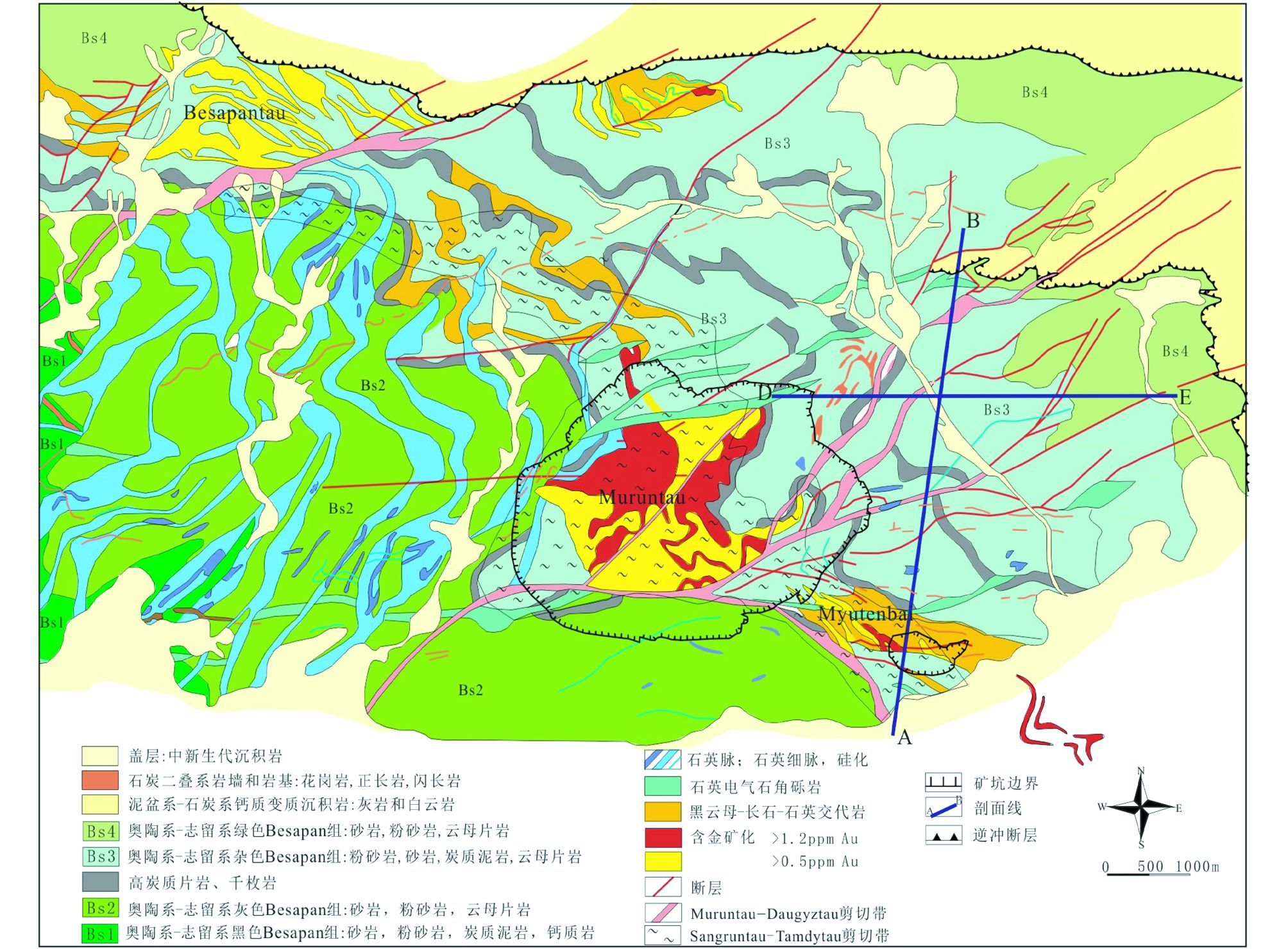
Muruntau金矿床位于南天山北部边缘褶皱冲断带,以南天山(Turkestan)缝合带与北侧中天山相望(图 1)。南天山造山带形成于晚古生代哈萨克斯坦板块与卡拉库姆-塔里木板块的碰撞造山过程中。由弧前增生杂岩和卡拉库姆-塔里木板块北缘沉积的一套碎屑岩组成(Mao et al.,2004; Seltmann et al.,2011; McCann et al.,2013; 薛春纪等,2014a,b,2015)。在卡拉库姆板块北部被动大陆边缘,志留-石炭纪主要为一套深海碳酸盐沉积,夹有少量板内火山岩建造,晚泥盆-早石炭世沉积厚度达到最大;晚石炭-早二叠世为一套厚层浊积岩/磨拉石建造,指示Turkestan洋的最终关闭(Biske and Seltmann,2010; McCann et al.,2013)。Muruntau金矿床位于南天山西段Bukantau-Kokshaal地区,区域地层主要为古生代Taskazgan组与Besapan组,为一套富含炭质的复理石建造,以构造窗的形式不连续分布于区域内,可能为元古代微陆块发展演化的结果(Biske and Seltmann,2010)。随着Turkestan洋在石炭纪末关闭,卡拉库姆板块北部边缘卷入造山,上述沉积建造发生褶皱变形,泥盆-石炭系碳酸盐逆冲于下古生界浊积岩地层之上(图 2),含炭浊积岩地层伴随造山作用发生绿片岩相浅变质作用形成Muruntau金矿床的赋矿地层。
|
图 2 Muruntau金矿床地质图(据Wall et al.,2004; 薛春纪等,2014b修编) Fig. 2 The simplified geological map of the Muruntau gold deposit(modified after Wall et al.,2004; Xue et al.,2014b) |
二叠纪后碰撞花岗岩在南天山造山带大量出露,以富钾的碱性花岗岩为主(Biske and Seltmann,2010; Seltmann et al.,2011),同期发育少量I型或S型花岗岩及少量A型碱性侵入体(Biske and Seltmann,2010)。总体来说,二叠纪后碰撞花岗岩受构造控制,整体呈NE-SW向沿主要的线性构造展布。在Muruntau矿区外围侵入有海西期的侵入体,中性闪长岩至酸性淡色花岗岩均有分布(Kemp et al.,2015)。穆龙套南东方向约7Km处出露的萨尔达林斑状花岗闪长岩Rb-Sr等时线年龄为286.2±1.8Ma(Kostitsyn,1996)。北Tamdinsky含角闪石花岗岩和淡色花岗岩锆石U-Pb年龄分别为287.5±1.4Ma和293.3±2.1Ma(Seltmann et al.,2011),同时地球物理资料显示矿床所在区域地壳中部存在低速体,可能指示岩浆侵入体的存在(Kemp et al.,2015)。
沿南天山造山带自西向东产出大量金矿床,其中不乏巨型乃至世界级金矿。金矿床类型多样,以造山型金矿为主,另外产有浅成低温热液型、矽卡岩型及与侵入体有关金矿,产出环境均位于南天山海西期褶皱变形带。除Muruntau外,造山型金矿以乌兹别克斯坦Amantaitau、Daugyztau、Kokpotas,中国的萨瓦亚尔顿等为代表;与侵入体有关金矿以乌兹别克斯坦Zarmitan,塔吉克斯坦Jilau金矿为代表;浅成低温热液型金矿以塔吉克斯坦Chore为代表;矽卡岩型铜金矿以塔吉克斯坦Taror为代表。造山型金矿床金资源量占90%以上,是最重要的成矿类型,是“亚洲金腰带”的重要组成部分(薛春纪等,2014b,2015)。
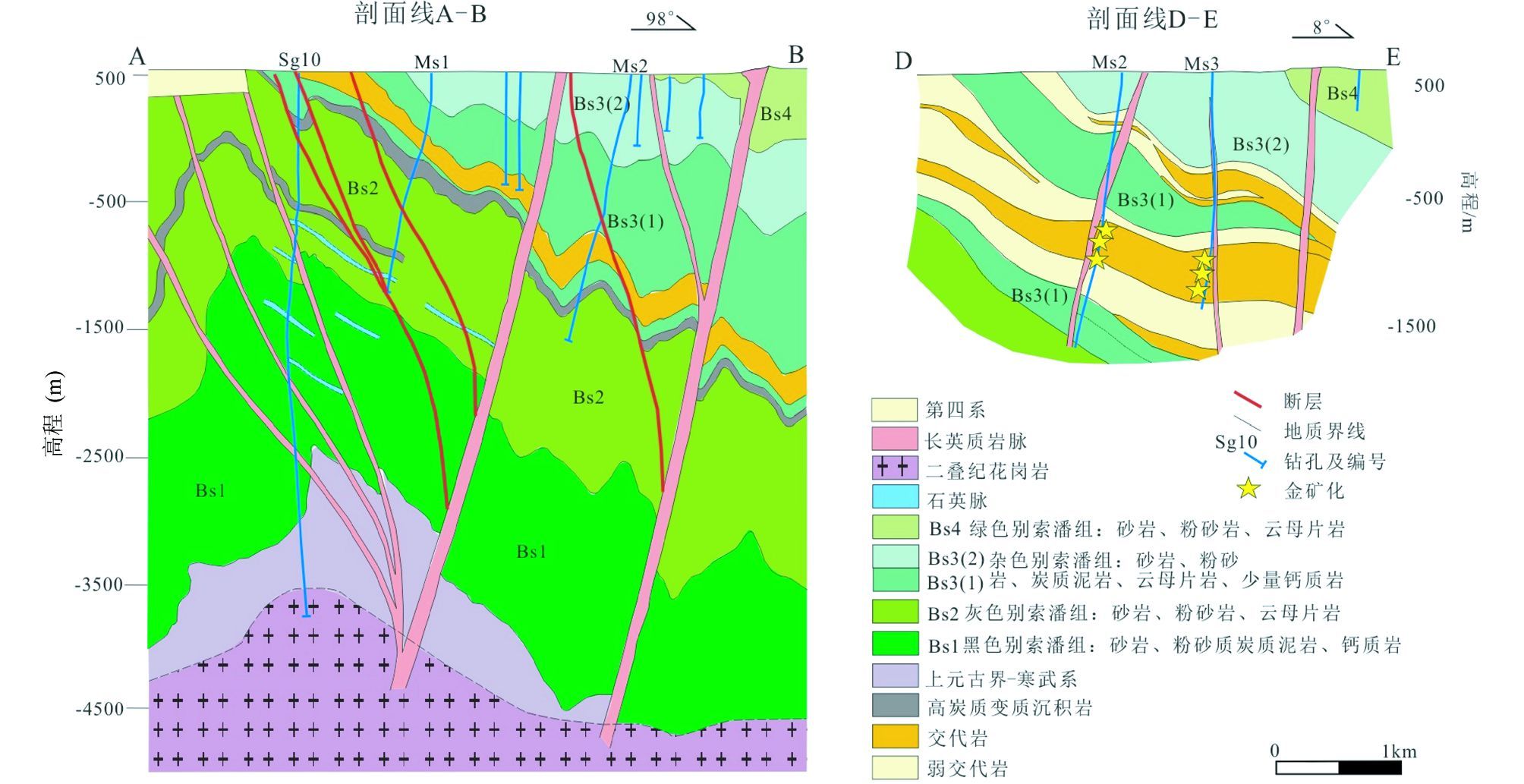
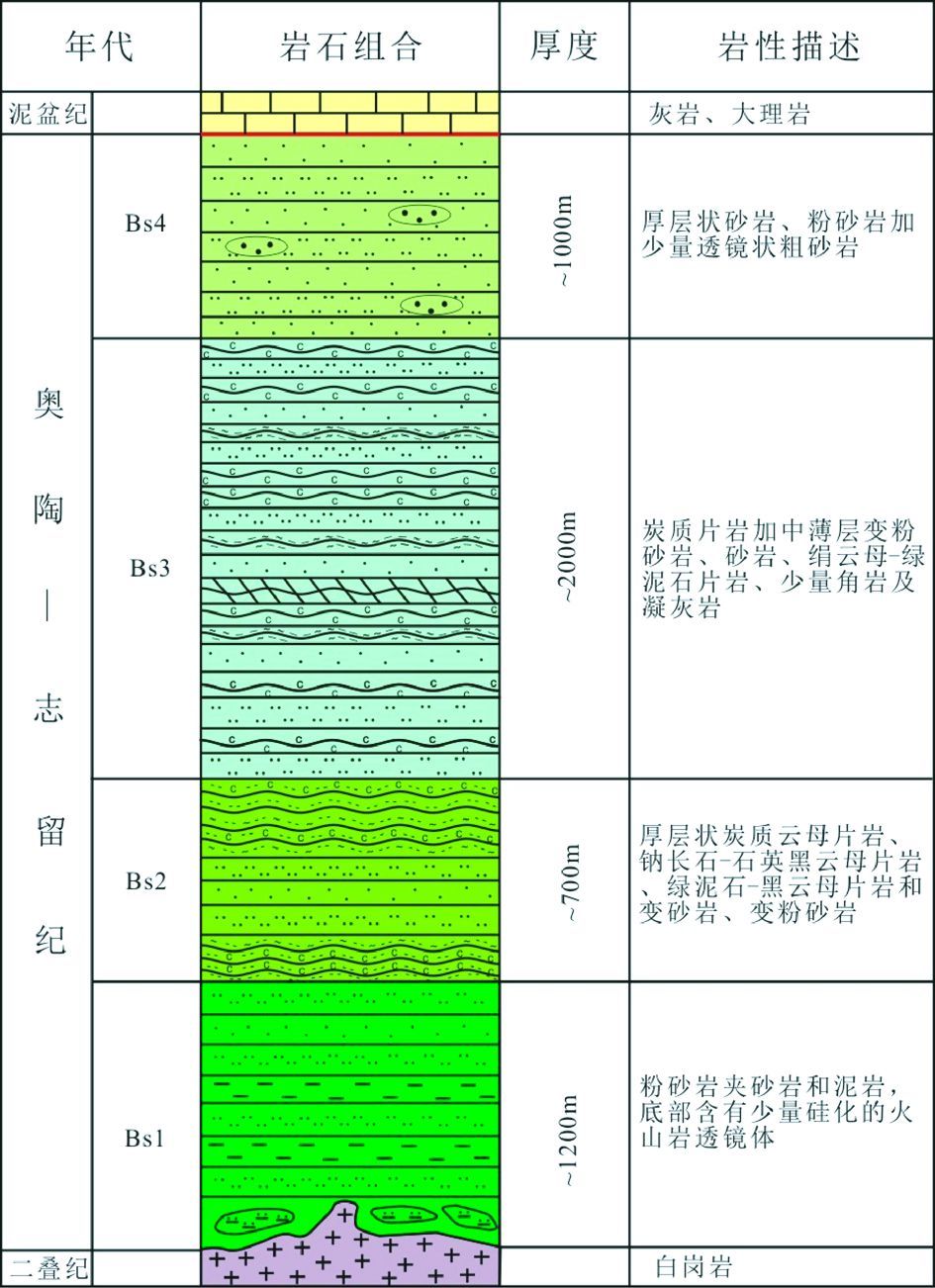
2 矿床地质 2.1 矿区地层Muruntau金矿床赋矿地层由奥陶-志留系Besapan组一套变质的粉砂岩、砂岩和泥岩组成,厚约5km,普遍发生低级绿片岩相变质作用,按其年龄、颜色、粒度由上至下可分为四个岩性段(Drew et al.,1996)(图 2、图 3、图 4):绿色Besapan(Bs4)为厚层状砂岩、粉砂岩夹少量透镜状变质粗砂岩,厚度约1000m;杂色Besapan(Bs3)为炭质片岩夹中薄层变粉砂岩、砂岩、绢云母-绿泥石片岩、少量角岩及凝灰岩,偶夹少量放射虫硅质岩,由于风化作用显示红绿混杂的风化面,厚度约2000m;灰色Besapan(Bs2)主要为厚层状炭质云母片岩、钠长石石英黑云母片岩、绿泥石黑云母片岩和变砂岩、变粉砂岩,夹有少量砾石,以含有大量黑云母与Bs1区别,同时是唯一不含火山岩或硅质岩的岩性段,厚度约700m;黑色Besapan(Bs1)为粉砂岩夹砂岩和泥岩,底部含有少量硅化火山岩透镜体,表面由于蚀变作用形成绢云母-绿泥石片岩,使整体颜色呈现绿色,在深部主要为黑色炭质岩石,厚度约1200m。Besapan组地层含炭及含金性异常高,Besapan组下部含金量为483×10-9,高出外围砂页岩含金量(11.2×10⁻⁹~25.8×10⁻⁹)一个数量级,岩石普遍含炭,炭质云母片岩中炭质高达4.5%,赋矿围岩平均含碳量为0.6%(蔡宏渊等,1993)。Muruntau金矿即赋存于杂色Besapan(Bs3)含炭质陆源碎屑岩组成的浊积岩建造中(Kempe et al.,2001; Wilde et al.,2001)。
|
图 3 Murutau矿区剖面图(据Wall et al.,2004; 薛春纪等,2014b修编) Fig. 3 Sections of the Muruntau gold deposit(modified after Wall et al.,2004; Xue et al.,2014b) |
|
图 4 Besapan组地层柱状图 Fig. 4 The stratigraphic column of the Besapan Formation |
区域上的主要控矿构造为NNW向延伸的Sangruntau-Tamdytau剪切带和NE向延伸的Muruntau-Daugyztau剪切带,Muruntau金矿就位于这两组剪切构造交汇部位(图 2)(Drew et al.,1996; 谭娟娟和朱永峰,2008)。
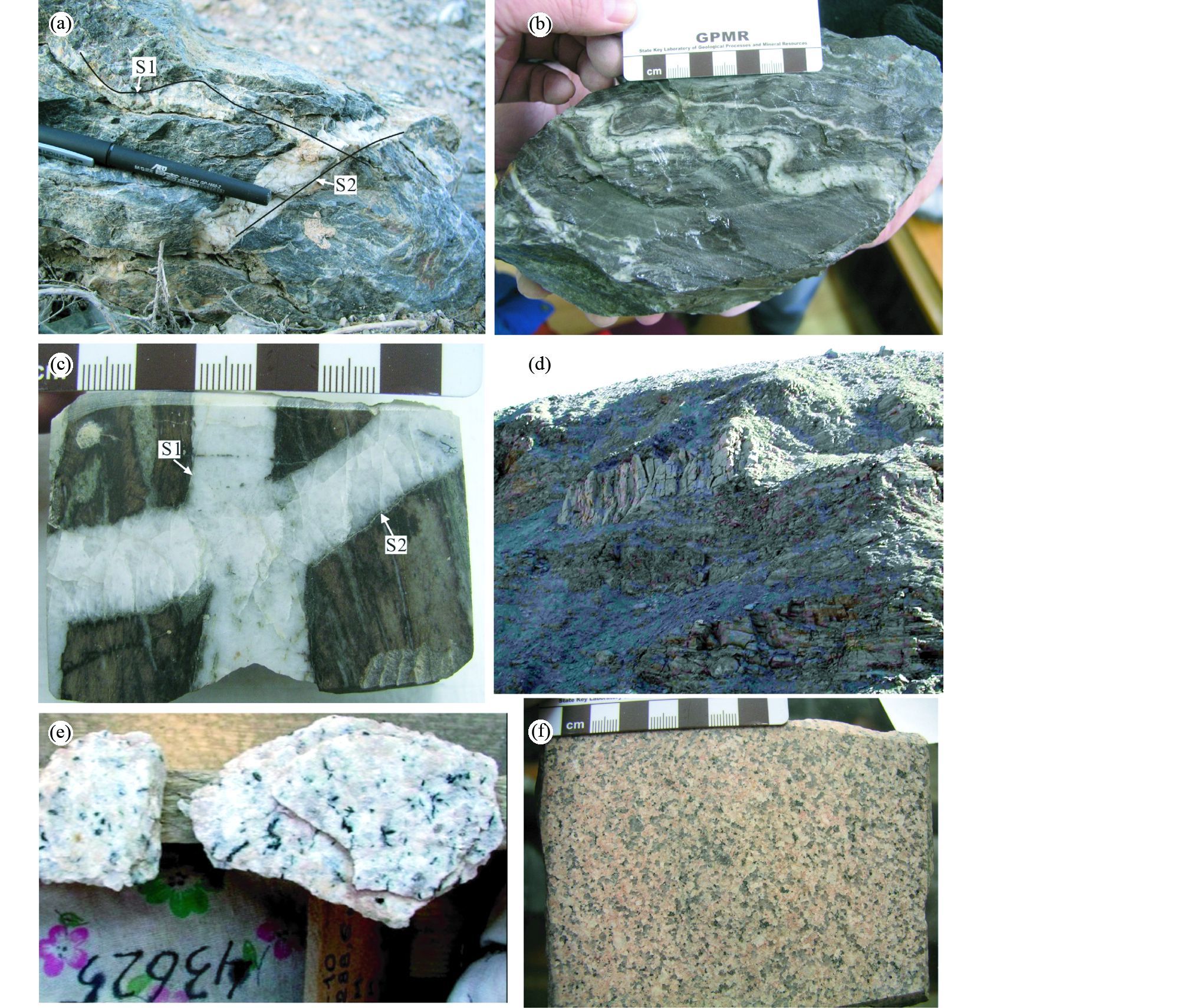
矿区先后经历四期构造变形变质作用(即D1、D2、D3、D4),伴随四期变形,地层发生褶皱、断裂,成矿流体充填交代形成纵横交错的石英脉(Wall et al.,2004)。D1表现为南北向至北北东向的挤压变形,并且影响到区域尺度上逆冲推覆构造的发展。地层发育平行于层理(S0)的片理(S1),同时发育大量顺层石英细脉,网脉(图 5a-c),伴随低品位金矿化(Wall et al.,2004)。D2表现为南北向的强烈挤压,并叠加于D1之上,变质程度为低绿片岩相。伴随D2形成的片理(S2)叠加在S1之上(图 5a,c),片理走向近东西向,石英脉多充填于片理形成的断裂中(Wall et al.,2004)。D3表现为北东向的褶皱,小位移断层,主要表现在北东向的Muruntau-Daugyztau剪切带中,影响了整个Muruntau-Daugyztau区域。尽管北东向褶皱明显叠加在D2形成的东西向褶皱之上,但是D3形成的片理S3与S2在野外并不易区别(Wall et al.,2004)。D4表现为弱的东西向挤压缩短并伴随南北向断层,形成的北北东或北北西向褶皱,对先期形成的褶皱、断裂具有一定改造作用。D2、D3主导了Muruntau矿区“Z字形”矿田构造格局的形成。
2.3 矿区侵入体矿区发育成群成带分布的中酸性岩和正长斑岩岩墙(图 5d)。闪长岩的Rb-Sr年龄286Ma(Kostitsyn,1993),正长岩及煌斑岩的Rb-Sr年龄约为273Ma(Kostitsyn,1996)。钻孔资料显示,Muruntau金矿下部4005m处存在花岗岩体(白岗岩)(图 3、图 5e),Rb-Sr等时线年龄为287.1±4.6Ma(Kostitsyn,1996)。以上年龄数据与区域后碰撞花岗岩年龄一致,表明可能属于同一期岩浆活动。矿区东南出露三叠纪斑岩岩脉(锆石U-Pb年龄236±2Ma)(Seltmann et al.,2011)。
|
图 5 Murunrau矿区岩石构造期次及侵入体 (a)S1片理平行层理S0,同地层一起褶皱,被S2片理中充填的石英脉切穿;(b)S1片理以充填顺层揉皱石英脉为特征;(c)S1片理被S2片理错断;(d)中酸性岩脉侵入地层中;(e)SG-10深钻中打出的白岗岩(引自Wall et al.,2004);(f)矿区发育的二长花岗岩手标本 Fig. 5 Tectonic episodes and intrusions of the Muruntau gold deposit (a)S1 subparallel to S0,folding with the strata,crosscut by quartz vein of S2;(b)S1 is characterized by strongly deformed quartz vein;(c)S1 is crosscut by S2;(d)medium-acid dykes intrude into the strata;(e)alaskite in SG-10(modified after Wall et al.,2004);(f)hand specimen of monzonitic granite |
金矿体规模巨大,形态多样,富矿体(Au>3.5g/t)走向近E-W,长度可达600m,倾向S-SE,倾角60°~70°,垂直厚度可达700m。贫矿体围绕富矿体连续分布,品位变化大,倾向SE,倾角变化大(Wall et al.,2004)。富矿体被NE向断层错开,断层性质为左行走滑断层,断距可达300~500m(图 2)。
伴随金矿化热液蚀变广泛发育,主要沿区域构造线展布。从早到晚分为五个阶段,对应五种蚀变矿物组合:①石英+钠长石+金云母+更长石,Drew et al.(1996)认为本期蚀变对应最早期矿化,同时伴有黄铁矿、毒砂等硫化物的沉淀;②绿泥石+绢云母+钠长石+石英;③石英+钾长石+绢云母+白云石+硫化物,本期蚀变与金矿化最为密切,矿化的中部矿脉及网状脉均发育在石英-钾长石蚀变带中;④钾长石+白云石质碳酸盐+黄铁矿+电气石,本期蚀变切穿中部矿脉,主要发育于与中部矿脉近平行或斜交的脆性断裂之中;⑤石英+方解石,伴随稀少的硫化物出现于整个矿区(Drew et al.,1996)。
2.5 矿石自然类型及组构金矿石可以分为石英脉型及蚀变岩型2个自然类型(图 6),尤以石英脉型为主,由早到晚分成四类不同脉体:早期水平石英脉(Q1)(图 6a)、主成矿期网状脉(Q2)(图 6b)及中部矿脉(Central veins)(Q3)(图 6d)、晚期富银矿脉(Q4),网脉状及中部矿脉是主要的矿化类型,由含金石英细脉、石英-硫化物细脉、方解石-石英细脉、石英-电气石脉交错发育构成(Wilde et al.,2001)。硫化物主要呈浸染状(图 6a,d,e)、细脉状(图 6a-c)、细脉浸染状(图 6a)、斑杂状(图 6d)等矿石构造存在于石英脉及蚀变岩石中,主要金属矿物为自然金、黄铁矿、毒砂、磁黄铁矿、白铁矿、黄铜矿、辉钼矿、方铅矿、闪锌矿、白钨矿。其中黄铁矿、毒砂为主要的载金矿物。脉石矿物主要为石英、长石和黑云母,还有少量电气石、碳酸盐矿物(Wilde et al.,2001)。

|
图 6 Muruntau金矿床主要矿石类型 (a)石英脉型矿石,早期顺片理产出的石英脉被后期细脉、网脉状硫化物脉切穿;(b)石英-钾长石蚀变岩中产出的黄铁矿、毒砂细脉、网脉;(c)顺片理产出的细晶黄铁矿与蚀变角砾岩中的粗粒自形黄铁矿被后期黄铁矿细脉切穿;(d)中部矿脉中产出的稀疏浸染状、团斑状毒砂;(e)蚀变岩型矿石,杂色层中产出的糜棱岩化金矿石;(f)蚀变岩型矿石,粗粒自行-半自形黄铁矿呈浸染状分布 Fig. 6 Ore types of the Muruntau gold deposit (a)quartz-vein ore,early quartz veins sub-paralleling to foliation are crosscut by veinlets and stockwork of sulfide;(b)the veinlets and stockwork of pyrite and arsenpyrite in quart-K-feldspar altered rock;(c)sub-paralleling to foliation fine-grained pyrite and coarse-grained euhedral pyrite in altered breccia crosscut by late stage veinlet of pyrite;(d)sparsely disseminated arsenpyrite in Central veins;(e)altered rock ore,mylonitization gold ore in Bs3;(f)altered rock ore with coarse euhedral-subhedral disseminated pyrite |
本次研究样品均取自Muruntau金矿露天大采坑及矿区外围,样品分别为蚀变岩型矿石(黄铁矿沿黑色页岩S0或S1产出)、含金石英脉(含金量5~15g/t)、含硫化物方解石-石英脉和Besapan组第三岩性段(Bs3)未见明显矿化的黑色页岩。
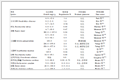
矿石样品经破碎、过筛、挑选出纯度>99%的黄铁矿、毒砂单矿物,在玛瑙钵里研磨至200目以备S、Pb同位素分析;地层岩石样品经清洗、破碎、研磨至200目以下供Pb同位素组成分析。S、Pb同位素分析均在核工业北京地质研究院分析测试中心进行,S同位素测试仪器为Finnigan MAT-251气体同位素质谱仪,以δ34SV-DCT为参考标准,分析精度优于±0.2‰,分析结果见表 1。Pb同位素分析采用ISOPROBE-T热电离质谱仪,先用混合酸(HF+HClO4)溶样,再利用阴离子交换树脂进行铅分离,最后蒸干溶液用质谱仪进行测定,1μg的铅206Pb/204Pb测量精度优于0.05%,208Pb/206Pb测量精度优于0.005%,分析结果见表 2、表 3。
|
表 1 Muruntau、Amantaitau金矿床硫化物同位素组成 Table 1 S isotope compositions of sulfides from the Muruntau and Amantaitau Au deposits,western Tien Shan |
|
|
表 2 西天山Muruntau、Amantaitau、Daugyztau金矿石硫化物铅同位素组成 Table 2 Lead isotope compositions of sulfides from the Muruntau,Amantaitau,Daugyztau Au deposits,western Tien Shan |
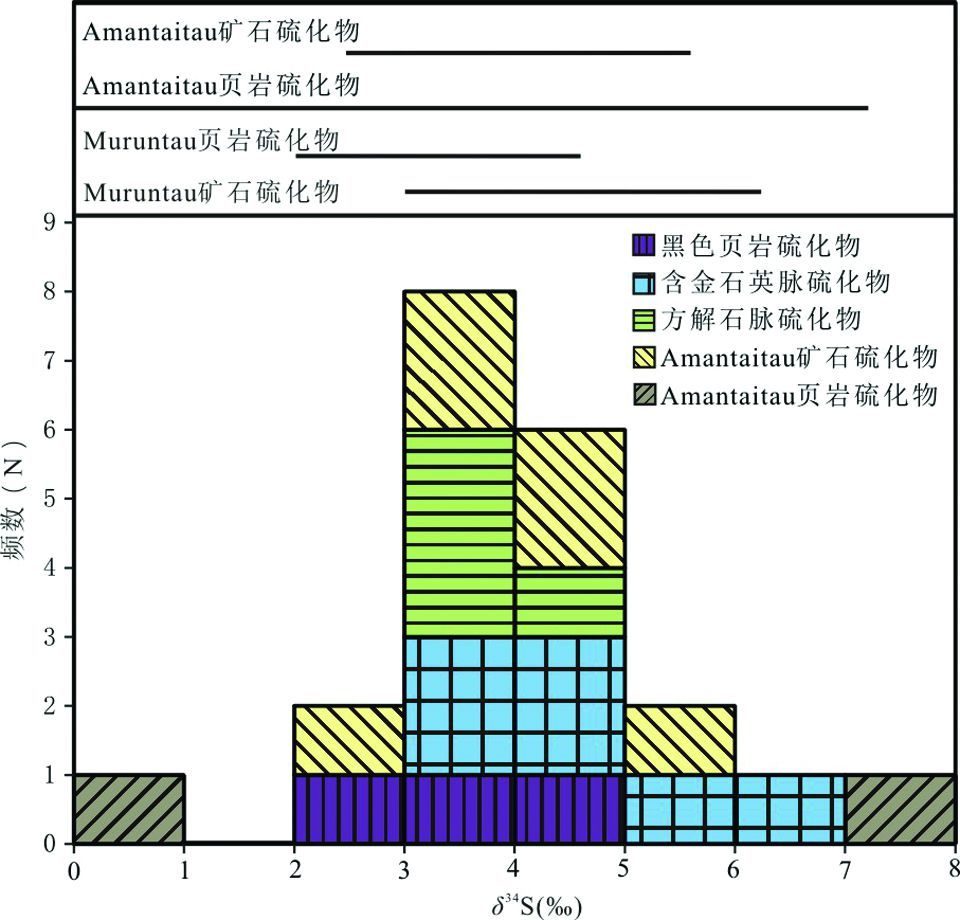
Muruntau金矿石英脉及蚀变岩型矿石中硫化物δ34S的变化范围较大,集中于2.2‰~6.1‰,极差为3.9‰,平均值为4.0‰(表 1)。3件蚀变岩型矿石中毒砂样品δ34S值集中于2.2‰~4.6‰,6件含金石英脉中黄铁矿和毒砂δ34S值介于3.0‰~6.1‰,4件石英-方解石脉中黄铁矿和毒砂δ34S值介于3.5‰~4.0‰(图 7)。
|
图 7 Muruntau金矿床硫化物硫同位素组成(Amantaitau矿床数据来源见表 1) Fig. 7 Histogram of δ34S for the different sulfides of the Muruntau gold deposit(data of Amantaitau deposit are seen Table 1) |
Muruntau金矿石铅同位素组成分别为:2件蚀变岩型矿石中毒砂206Pb/204Pb变化范围19.906~20.378,平均值为20.142;207Pb/204Pb变化范围为15.730~15.750,平均值为15.740;208Pb/204Pb变化范围为38.388~39.894,平均值为39.141。3件石英脉中黄铁矿206Pb/204Pb变化范围18.848~19.431,平均值为19.131;207Pb/204Pb变化范围为15.669~15.736,平均值为15.692; 208Pb/204Pb变化范围为38.346~38.879,平均值为39.578。2件方解石-石英脉中毒砂206Pb/204Pb变化范围18.715~19.563,平均值为19.139;207Pb/204Pb变化范围为15.639~15.740,平均值为15.690;208Pb/204Pb变化范围为38.640~39.295,平均值为38.968(表 2)。
6件Bs3(杂色Besapan)组地层岩石样品铅同位素组成为206Pb/204Pb变化范围19.416~20.600,平均值为19.864;207Pb/204Pb变化范围为15.675~15.746,平均值为15.717;208Pb/204Pb变化范围为38.876~39.431,平均值为39.189(表 3)。
|
|
表 3 西天山Muruntau地层铅同位素组成 Table 3 Lead isotope compositions of wall-rock from the Muruntau Au deposit,western Tien Shan |
将矿石硫化物、地层铅同位素投影在207Pb/204Pb-206Pb/204Pb和208Pb/204Pb-206Pb/204Pb图解中(图 8),硫化物及围岩部分重合,横跨上地壳铅同位素演化曲线,均落于上地壳与造山带之间。

|
图 8 西天山Muruntau金矿硫化物和围岩207Pb/204Pb-206Pb/204Pb(a)和208Pb/204Pb-206Pb/204Pb(b)图解 上地壳、下地壳、造山带和地幔铅同位素演化曲线据Zartman and Doe(1981),Daugyztau和Amantaitau硫化物、Muruntau页岩及钾长石数据数据引自Chiaradia et al.(2006) Fig. 8 207Pb/204Pb vs. 206Pb/204Pb(a)and 208Pb/204Pb vs. 206Pb/204Pb(b)diagrams of sulfides and wall rocks from the Muruntau gold deposit,western Tian Shan The average growth lines from Zartman and Doe(1981),sulfide of Daugyztau and Amantaitau,schist and K-feldspar of Muruntau from Chiaradia et al.(2006) |
黑色岩系Au、S含量普遍高于地壳(Large et al.,2011),Crocket(1991)基于553个炭质页岩样品得到6.7×10⁻⁹金平均含量,Ketris and Yudovich(2009)通过分析全球超过9000个黑色岩系样品得到7.0×10⁻⁹金平均含量,均远高于火成岩(2.5×10⁻⁹)和上地壳(1.8×10⁻⁹)的含量(Taylor and McLennan,1995)。黑色页岩硫含量为地壳平均硫含量的20倍( Reimann and de Caritat,1998),而火成岩尤其是酸性岩的S含量要低于黑色页岩一个数量级(Large et al.,2011)。Muruntau赋矿地层为一套绿片岩相浅变质浊积岩系,富含炭质,Besapan组地层含金量(483×10-9)是外围岩石含金量(11.2×10⁻⁹~25.8×10⁻⁹)的20~40倍,同时含炭量(4.5%)是外围岩石平均含炭量(0.6%)的7倍以上(蔡宏渊等,1993)。地层中的炭质是沉积时在还原条件下厌氧细菌分解有机质形成,在表生条件下对于金等元素具有较强吸附能力(Southam and Saunders,2005; 薛春纪等,2014b)。因此,Besapan组地层应为Muruntau金成矿的初始矿源层。同时流体在运移过程中与炭质地层发生水-岩反应C+H2O=CO2+CH4,形成含有CH4的流体与含金流体发生混合作用,会大大促进硫化物及金的沉淀。不同期次/类型流体包裹体中含有大量CH4,CO2/CH4比值的变化(23.7~344)进一步验证了上述过程的存在(Zairi and Kurbanov,1992)。
4.2 构造变形及其成矿贡献新元古代随着Turkestan洋的打开(Mirkamalov et al.,2012),在卡拉库姆板块北缘被动大陆边缘沉积一套复理石建造的浊积岩系(图 9a)。古生代晚期,随着Turkestan洋的俯冲消减并于早二叠世(~290Ma)完全关闭(Windley et al.,2007; Biske and Seltmann,2010),卡拉库姆板块与哈萨克斯坦-伊犁板块碰撞造山,穆龙套金矿区地层随之发生变形变质,D1、D2、D3、D4先后四期构造变形变质作用被识别出来,D1为同构造变形阶段,以形成顺层且强烈揉皱的石英脉及低品位金矿化为特征(图 9b);D2表现为南北向的强烈挤压,形成的片理S2切穿S1及S0,同时充填了中部矿脉(Central veins),在中部矿脉周围同时发育大量网状脉(图 9c)。D3表现为北西向的挤压,形成北东向褶皱及小位移断层,奠定了Muruntau“Z”字型构造格架,但是形成的S3片理却并不易识别;最终D4表现为东西向挤压,对先期形成的褶皱、断层具有一定的改造作用。

|
图 9 Muruntau金矿床控矿因素及成矿过程简图 Fig. 9 The sketch of ore-controlling factors and ore-forming process of the Muruntau gold deposit |
Muruntau矿区及外围出露早二叠世闪长岩、花岗岩等岩墙、岩脉(Kostitsyn,1993,1996; Seltmann et al.,2011),主要沿北东向成群分布,岩脉由中性至酸性均有发育,形成闪长岩-二长岩-花岗斑岩的岩石组合。一些岩脉切穿D3、D4期构造作用形成的褶皱,部分岩脉切穿矿体,同时少量产于矿体内部,指示岩浆活动晚于构造变形,并部分参与成矿作用(Wall et al.,2004)。Morelli et al.(2007)通过金矿石中含金毒砂Re-Os测年得到287.5±1.7Ma的成矿年龄,与早二叠世岩浆活动时间一致。与金成矿作用密切相关的石英、白钨矿、毒砂等热液矿物的惰性气体、C同位素及卤族元素组成支持幔源物质是成矿作用的部分物质来源(Graupner et al.,2006)。Wall et al.(2004)提出矿石异常的As、Sb、Bi、Mo、W指示了氧化性岩浆热液的存在,氧化性岩浆对于金、硫具有很强的搬运能力,对于金矿后期的叠加富集具有重要作用。因此,早二叠世中-酸性岩浆热液在穆龙套金成矿过程中不只提供了热动力,可能也提供了部分成矿物质(图 9d)。
4.4 成矿物质来源Ohmoto and Rye(1979)对热液系统中硫化物研究发现,在fO2较低的还原环境下,热液中硫化物主要以HS-,S2-形式存在,此时沉淀的硫化物δ34S值与流体的δ34S∑接近;在较高的fO2条件下,H2S转化为SO2发生硫酸盐沉淀使流体中亏损34S,导致硫化物中δ34S低于流体的δ34S∑。考虑到Muruntau金矿的赋矿地层主要为一套炭质板岩、片岩,未见赤铁矿、石膏等反应氧化环境的矿物,同时流体包裹体研究发现成矿流体中含有CH4且LogfO2为-48.5~-31.9(Zairi and Kurbanov,1992)。暗示矿床成矿时为还原环境,因此所测硫化物的δ34S值可以视为整个流体系统的δ34S∑。
S同位素数据显示蚀变岩型矿石中毒砂δ34S值(2.2‰~4.6‰)与石英脉型矿石中硫化物δ34S值(3.0‰~6.1‰)具有部分重叠,反映成矿可能有较多围岩S的加入;整体硫化物δ34S的变化范围较大,集中于2.2‰~6.1‰(图 7),除样品B-1、B-13外均高于幔源或者深源岩浆有关硫化物的δ34S值(0±3‰,Rollinson,1993),更高于生物成因硫化物的负值(Poulson and Ohmoto,1990),却落在沉积岩(δ34S=-40‰~50‰)或者变质岩(δ34S=-20‰~20‰)宽广的范围内(Hoefs,1997)。区域内同一套地层产出的Amantaitau金矿床具有与Muruntau相似的硫同位素组成(矿石δ34S=2.6‰~5.5‰,两个页岩样品硫同位素差别较大,分别为0.1‰和7.3‰)(Pasava et al.,2013)。因此,推测地层提供了成矿的硫源,可能有少量岩浆硫的加入。普遍认为金的沉淀过程与先存含铁矿物的硫化作用有关(Phillips and Groves,1984; Groves et al.,2003; Goldfarb et al.,2005),因此,认为金和硫在流体中是同时搬运的(Chang et al.,2008),硫化物电子探针数据显示硫化物为主要的载金矿物也支持这一观点,地层同时是金的初始矿源层。
铅同位素作为成矿金属来源的有效示踪剂被广泛使用(Macfarlane et al.,1990; Chiaradia et al.,2004)。铅同位素不仅适用于金属硫化物,同时可适用于岩石样品,为探索热液流体与围岩的相互联系提供了有效工具(Chiaradia et al.,2006)。为了进一步确定Muruntau金成矿的铅来源,将Muruntau金矿区矿石硫化物、地层、岩体的铅同位素以及南部产于同一套地层的Amantaitau与Daugyztau矿石硫化物铅同位素进行对比(图 8),Muruntau矿石硫化物铅同位素横跨上地壳铅演化曲线,蚀变岩型矿石中毒砂显示更多壳源铅的组成,石英脉及方解石-石英脉样品点向造山带铅演化曲线靠拢,指示石英脉、方解石-石英脉中硫化物放射性成因铅较少,可能与造山期变质流体含有较少放射性成因铅有关。由蚀变岩型到石英脉型,矿石硫化物铅同位素的跨度可能显示了高放射性端元与低放射性端元的混合,在Muruntau金矿区,推测为造山期变质流体与炭质赋矿地层的水-岩反应所致。地层的铅同位素同样显示了很宽的范围,主体位于上地壳与造山带之间,与矿石硫化物铅同位素的范围部分重合。说明地层对于矿石铅同位素组成具有突出贡献,地层是矿石铅的主要提供者。Amantaitau、Daugyztau矿石铅同位素同样位于上地壳与造山带铅演化曲线之间,与Muruntau金矿相比,放射性铅同位素含量相对较少,与地层的重合程度较小,可能反映区域上Besapan组地层初始铅同位素组成存在差异。三个花岗岩中钾长石样品落在造山带与上地壳之间,与地层铅同位素范围重合,表明岩浆在侵位过程中可能混染了部分地层中的铅,使结晶的钾长石有更多的放射性铅的加入,进一步说明了地层是主要的金属来源。
5 结论石英脉及蚀变岩型矿石中硫化物δ34S的变化范围较大,集中于2.2‰~6.1‰。蚀变岩型矿石中毒砂样品δ34S值集中于2.2‰~4.6‰,含金石英脉中的硫化物样品δ34S值介于3.0‰~6.1‰,方解石-石英脉中硫化物样品δ34S值介于3.5‰~4.0‰,显示地层为主要硫源。
2件蚀变岩型矿石中毒砂206Pb/204Pb为19.906~20.378,207Pb/204Pb为15.730~15.750,208Pb/204Pb为38.388~39.894。3件含金石英脉中黄铁矿206Pb/204Pb为18.848~19.431,207Pb/204Pb变化范围为15.669~15.736,208Pb/204Pb为38.346~38.879。2件方解石-石英脉中毒砂206Pb/204Pb为18.715~19.563,207Pb/204Pb为15.639~15.740,208Pb/204Pb 为38.640~39.295。显示混合铅特征,成矿物质与赋矿黑色岩系及造山期变质流体均显示密切成因联系。
沉积地层的物质准备、多期构造运动驱动变质流体运移和岩浆热液的后期叠加应是Muruntau巨量金属富集的三个关键控制因素。
致谢 本文样品测试工作得到了核工业北京地质研究所刘牧老师的无私帮助;匿名审稿人对于文章的修改完善提出了宝贵的意见;在此一并表示诚挚谢意!
| [1] | Bagdasar'yan AG, Fedyanin AS and Shemetov PA. 2009. Estimate of the formation time and other parameters of a disruption structure in open pit walls in terms of Muruntau open pit. Journal of Mining Science, 45(2): 146-151 |
| [2] | Bierlein FP and Wilde AR. 2010. New constraints on the polychronous nature of the giant Muruntau gold deposit from wall-rock alteration and ore paragenetic studies. Australian Journal of Earth Abzalov M. 2007. Zarmitan granitoid-hosted gold deposit, Tian Shan Belt, Uzbekistan. Economic Geology, 102(3): 519-532 |
| [120] | Biske YS and Seltmann R. 2010. Paleozoic Tian-Shan as a transitional region between the Rheic and Urals-Turkestan oceans. Gondwana Research, 17(2-3): 602-613 |
| [121] | Cai HY, Zhang YP, Li FC, Ma XY, Zhu Y and Pei CJ. 1993. Geological surveying of Muruntau gold deposit. Mineral Resources and Geology, 7(6): 408-413 (in Chinese) |
| [122] | Chang ZS, Large RR and Maslennikov V. 2008. Sulfur isotopes in sediment-hosted orogenic gold deposits: Evidence for an early timing and a seawater sulfur source. Geology, 36(12): 971-974 |
| [123] | Chen HY, Chen YJ and Baker M. 2012. Isotopic geochemistry of the Sawayaerdun orogenic-type gold deposit, Tianshan, Northwest China: Implications for ore genesis and mineral exploration. Chemical Geology, 310-311: 1-11 |
| [124] | Chiaradia M, Fontboté L and Paladines A. 2004. Metal sources in mineral deposits and crustal rocks of Ecuador (1°N-4°S): A lead isotope synthesis. Economic Geology, 99(6): 1085-1106 |
| [125] | Chiaradia M, Konopelko D, Seltmann R and Cliff RA. 2006. Lead isotope variations across terrane boundaries of the Tien Shan and Chinese Altay. Mineralium Deposita, 41(5): 411-428 |
| [126] | Crocket JH. 1991. Distribution of gold in the Earth's crust. In: Foster RP (eds.). Gold Metallogeny and Exploration. Netherlands: Springer, 1-36 |
| [127] | Drew LJ, Berger BR and Kurbanov NK. 1996. Geology and structural evolution of the Muruntau gold deposit, Kyzylkum Desert, Uzbekistan. Ore Geology Reviews, 11(4): 175-196 |
| [128] | Feng B, Xue CJ, Zhao XB, Ding ZX, Zhang Q, Zu B, Yang WZ, Lin ZH and Chen W. 2014. Petrology, geochemistry and zircon U-Pb isotope chronology of monzogranite of the Katbasu Au-Cu deposit, western Tianshan, Xinjiang Province. Earth Science Frontiers, 21(5): 187-195 (in Chinese with English abstract) |
| [129] | Frimmel HE. 2008. Earth's continental crustal gold endowment. Earth and Planetary Science Letters, 267(1-2): 45-55 |
| [130] | Goldfarb RJ, Baker T, Dube B, Groves DI, Hart CJR and Gosselin R. 2005. Distribution, character, and genesis of gold deposits in metamorphic terranes. In: Hedenquist JW, Thompson JFH, Goldfarb RJ and Richards JP (eds.). Economic Geology 100th Anniversary Volume. Littleton, Colorado: Society of Economic Geologists, 407-450 |
| [131] | Goldfarb RJ, Taylor RD, Collins GS, Goryachev NA and Orlandini OF. 2014. Phanerozoic continental growth and gold metallogeny of Asia. Gondwana Research, 25(1): 48-102 |
| [132] | Graupner T, Niedermann S, Kempe U, Klemd R and Bechtel A. 2006. Origin of ore fluids in the Muruntau gold system: Constraints from noble gas, carbon isotope and halogen data. Geochimica et Cosmochimica Acta, 70(21): 5356-5370 |
| [133] | Groves DI, Goldfarb RJ, Robert F and Hart CJR. 2003. Gold deposits in metamorphic belts: Overview of current understanding, outstanding problems, future research, and exploration significance. Economic Geology, 98(1): 1-29 |
| [134] | Hoefs J. 1997. Stable Isotope Geochemistry. 3rd Edition. Berlin Heidelberg: Springer-Verlag, 1-201 |
| [135] | Kempe U, Belyatsky BV, Krymsky R, Kremenetsky A and Ivanov P. 2001. Sm-Nd and Sr isotope systematics of scheelite from the giant Au(-W) deposit Muruntau (Uzbekistan): Implications for the age and sources of Au mineralization. Mineralium Deposita, 36(5): 379-392 |
| [136] | Kempe U, Seltmann R, Graupner T, Rodionov N, Sergeev SA, Matukov DI and Kremenetsky AA. 2015. Concordant U-Pb SHRIMP ages of U-rich zircon in granitoids from the Muruntau gold district (Uzbekistan): Timing of intrusion, alteration ages, or meaningless numbers. Ore Geology Reviews, 65(Part 1): 308-326 |
| [137] | Ketris MP and Yudovich YE. 2009. Estimations of Clarkes for Carbonaceous biolithes: World averages for trace element contents in black shales and coals. International Journal of Coal Geology, 78(2): 135-148 |
| [138] | Kostitsyn YA. 1993. Rb-Sr isotope study of Muruntau Deposit. 1. Ore veins dating by isochrone technique. Geokhimiya, 9: 1308-1319 |
| [139] | Kostitsyn YA. 1996. Rb-Sr isotopic study of the Muruntau deposit: Magmatism, metamorphism and mineralization. Geochemistry International, 34: 1009-1023 |
| [140] | Large RR, Bull SW and Maslennikov VV. 2011. A carbonaceous sedimentary source-rock model for Carlin-type and orogenic gold deposits. Economic Geology, 106(3): 331-358 |
| [141] | Liu JJ, Zheng MH, Cook NJ, Long XR, Deng J and Zhai YS. 2007. Geological and geochemical characteristics of the Sawaya'erdun gold deposit, southwestern Chinese Tianshan. Ore Geology Reviews, 32(1-2): 125-156 |
| [142] | Macfarlane AW, Marcet P, LeHuray AP and Petersen U. 1990. Lead isotope provinces of the Central Andes inferred from ores and crustal rocks. Economic Geology, 85(8): 1857-1880 |
| [143] | Mao JW, Konopelko D, Seltmann R, Lehmann B, Chen W, Wang Y, Eklund O and Usubaliev T. 2004. Postcollisional age of the Kumtor gold deposit and timing of Hercynian events in the Tien Shan, Kyrgyzstan. Economic Geology, 99(8): 1771-1780 |
| [144] | McCann T, Nurtaev B, Kharin V and Valdivia-Manchego M. 2013. Ordovician-Carboniferous tectono-sedimentary evolution of the North Nuratau region, Uzbekistan (westernmost Tien Shan). Tectonophysics, 590: 196-213 |
| [145] | Mirkamalov RK, Isokov MU, Chirikin VV, Kharin VG and Khan RS. 2012. New results of U-Pb (SHRIMP) dating of granitoid and metamorphic complexes of Tien Shan folded belt. Geosciences in Uzbekistan, Special Vol. of 34th IGC: 114-125 |
| [146] | Morelli R, Creaser RA, Seltmann R, Stuart FM, Selby D and Graupner T. 2007. Age and source constraints for the giant Muruntau gold deposit, Uzbekistan, from coupled Re-Os-He isotopes in arsenopyrite. Geology, 35(9): 795-798 |
| [147] | Ohmoto H and Rye RO. 1979. Isotopes of sulfur and carbon. In: Barnes HL (ed.). Geochemistry of Hydrothermal Ore Deposits. New York: John Wiley, 509-567 |
| [148] | Pasava J, Frimmel H, Vymazalová A, Dobes P, Jukov AV and Koneev RI. 2013. A two-stage evolution model for the Amantaytau orogenic-type gold deposit in Uzbekistan. Mineralium Deposita, 48(7): 825-840 |
| [149] | Pašava J, Vymazalová A, Košler J, Koneev RI, Jukov A and Khalmatov RA. 2010. Platinum-group elements in ores from the Kalmakyr porphyry Cu-Au-Mo deposit, Uzbekistan: Bulk geochemical and Laser Ablation ICP-MS data. Mineralium Deposita, 45(5): 411-418 |
| [150] | Phillips GN and Groves DI. 1984. Fluid access and fluid-wall rock interaction in the genesis of the Archean gold-quartz vein deposit at Hunt mine, Western Australia. In: Foster RP (ed.). Gold '82: The Geology, Geochemistry, and Genesis of Gold Deposits. Rotterdam, AA: Balkema, 389-416 |
| [151] | Porter TMM. 2006. The Tien Shan Belt: Golden Heart of Central Asia. Gangue, 88 |
| [152] | Poulson SR and Ohmoto H. 1990. An evaluation of the solubility of sulfide sulfur in silicate melts from experimental data and natural samples. Chemical Geology, 85(1-2): 57-75 |
| [153] | Reimann C and de Caritat P. 1998. Chemical Elements in the Environment: Fact Sheets for the Geochemist and Environmental Scientist. Berlin, Heidelberg: Springer, 1-398 |
| [154] | Rollinson HR. 1993. Using Geochemical Data: Evaluation, Presentation, Interpretation. New York: John Wiley & Sons, 1-352 |
| [155] | Seltmann R, Konopelko D, Biske G, Divaev F and Sergeev S. 2011. Hercynian post-collisional magmatism in the context of Paleozoic magmatic evolution of the Tien Shan orogenic belt. Journal of Asian Earth Sciences, 42(5): 821-838 |
| [156] | Southam G and Saunders JA. 2005. The Geomicrobiology of ore deposits. Economic Geology, 100(6): 1067-1084 |
| [157] | Tan JJ and Zhu YF. 2008. Geology and geochemistry of Muruntau gold deposit. Bulletin of Mineralogy, Petrology and Geochemistry, 27(4): 391-398 (in Chinese with English abstract) |
| [158] | Taylor SR and McLennan SM. 1995. The geochemical evolution of the continental crust. Reviews of Geophysics, 33(2): 241-265 |
| [159] | Wall VJ, Yantzen V and Graupner T. 2004. Muruntau. Uzbekistan Report on CERCAMS Research Project. Spring Hill: Taylor Wall & Associate |
| [160] | Wilde AR, Layer P, Mernagh T and Foster J. 2001. The giant Muruntau gold deposit: Geologic, geochronologic, and fluid inclusion constraints on ore genesis. Economic Geology, 96(3): 633-644 |
| [161] | Windley BF, Alexeiev D, Xiao WJ, Krner A and Badarch G. 2007. Tectonic models for accretion of the Central Asian Orogenic belt. Journal of the Geological Society, 164(12): 31-47 |
| [162] | Xue CJ, Zhao XB, Mo XX, Chen YC, Dong LH, Gu XX, Zhang ZC, Nurtaev B, Pak N, Li ZD, Wang XL, Zhang GZ, Yaxiaer YLK, Feng B, Zu B and Liu JY. 2014a. Tectonic-metallogenic evolution of western Tianshan giant Au-Cu-Zn-Pb metallogenic belt and prospecting orietation. Acta Geologica Sinica, 88(12): 2490-2531 (in Chinese with English abstract) |
| [163] | Xue CJ, Zhao XB, Mo XX, Dong LH, Gu XX, Nurtaev B, Pak N, Zhang ZC, Wang XL, Zu B, Zhang GZ, Feng B and Liu JY. 2014b. Asian Gold Belt in western Tianshan and its dynamic setting, metallogenic control and exploration. Earth Science Frontiers, 21(5): 128-155 (in Chinese with English abstract) |
| [164] | Xue CJ, Zhao XB, Zhang GZ, Mo XX, Gu XX, Dong LH, Zhao SM, Mi DJ, Nurtaev B, Pak N, Li ZD, Wang XL, Zu B, Yaxiaer YLK and Feng B. 2015. Metallogenic environments, ore-forming types and prospecting potential of Au-Cu-Zn-Pb resources in Western Tianshan Mountains. Geology in China, 42(3): 381-410 (in Chinese with English abstract) |
| [165] | Zairi NM and Kurbanov NM. 1992. Isotopic-geochemical model of ore genesis in the muruntau ore field. International Geology Review, 34(1): 88-94 |
| [166] | Zartman RE and Doe BR. 1981. Plumbotectonics: The model. Tectonophysics, 75(1-2): 135-162 |
| [167] | Zhang Q, Xue CJ, Zhao XB, Feng B, Xing H, Mo XX, Zhao SM, Yang WZ and Xing L. 2015. Geology, geochemistry and metallogenic epoch of the katebasu large-sized gold deposit, Western Tianshan Mountains, Xinjiang. Geology in China, 42(3): 411-437 (in Chinese with English abstract) |
| [168] | 蔡宏渊, 郑跃鹏, 李福春,马学玉, 马学玉, 朱渊. 1993. 穆龙套金矿地质考察. 矿产与地质, 7(6): 408-413 |
| [169] | 冯博, 薛春纪, 赵晓波, 丁振信, 张祺, 俎波, 杨维忠, 林泽华, 陈威. 2014. 西天山卡特巴阿苏大型金铜矿赋矿二长花岗岩岩石学、元素组成和时代. 地学前缘, 21(5): 187-195 |
| [170] | 谭娟娟, 朱永峰. 2008. 穆龙套金矿地质和地球化学. 矿物岩石地球化学通报, 27(4): 391-398 |
| [171] | 薛春纪, 赵晓波, 莫宣学, 陈毓川, 董连慧, 顾雪祥, 张招崇, Nurtaev B, Pak N, 李志丹, 王新利, 张国震, 亚夏尔亚力坤, 冯博, 俎波, 刘家瑛. 2014a. 西天山巨型金铜铅锌成矿带构造成矿演化和找矿方向. 地质学报, 88(12): 2490-2531 |
| [172] | 薛春纪, 赵晓波, 莫宣学, 董连慧, 顾雪祥, Nurtaev B, Pak N, 张招崇, 王新利, 俎波, 张国震, 冯博, 刘家瑛. 2014b. 西天山"亚洲金腰带"及其动力背景和成矿控制与找矿. 地学前缘, 21(5): 128-155 |
| [173] | 薛春纪, 赵晓波, 张国震, 莫宣学, 顾雪祥, 董连慧, 赵树铭, 米登江, Nurtaev B, Pak N, 李志丹, 王新利, 俎波, 亚夏尔亚力坤, 冯博. 2015. 西天山金铜多金属重要成矿类型、成矿环境及找矿潜力. 中国地质, 42(3): 381-410 |
| [174] | 张祺, 薛春纪, 赵晓波, 冯博, 邢浩, 莫宣学, 赵树铭, 杨维忠, 邢令. 2015. 新疆西天山卡特巴阿苏大型金矿床地质地球化学和成岩成矿年代. 中国地质, 42(3): 411-437 |