 2016, Vol. 32


敦化-密山断裂带(简称敦密断裂带)位于我国东北地区的抚顺-桦甸-敦化-密山一线,呈NE 60°方向展布,在中国境内全长>1000km,向北延入俄罗斯境内。它由东西两条平行排列的主干断裂带所组成,与四平-哈尔滨断裂和佳木斯-伊通断裂带(简称佳伊断裂带)共同组成了著名的郯庐断裂带北段。地质、地学断面及幔源包体研究表明,敦密断裂带是分布在东亚大陆边缘一条巨型的岩石圈断裂(张宏和王小凤,1995; 林传勇等, 1994,1996; 张贻侠等,1998; 王小凤等,2000; 朱光等,2001; 张庆龙等,2005; 李三忠等,2009)。它和郯庐断裂带北段其它分支断裂共同左旋 错移了华北板块北缘增生带、西拉木伦河-长春-延吉缝合带和黑龙江中小地块群。其中,敦密断裂带左旋走滑量明显大于其它分支断裂,因此,它是郯庐断裂带北段最重要的主干断裂(张贻侠等,1998; 张宏,1993; 赵春荆等,1996; 姚大全,1988; 王小凤等,2000; 孙晓猛等,2008)(图 1)。开展敦密断裂带时空分布特征及成因机制研究,无论对完善郯庐断裂带构造演化史、示踪古太平洋板块对东北地区的影响,还是揭示断裂控盆作用规律等都具有重要意义。
 | 图 1 敦密断裂带构造特征图 (A)密山市裴德镇畅峰选煤厂压扭性断裂带,断层向地堑中逆冲;(B)穆棱市下城子镇西部主干断裂带附近的褶皱带,轴面走向NNE向,卷入褶皱的地层是上白垩统猴石沟组;(C)穆棱市兴源镇西部主干断裂带附近的压扭性断层,断层切割了三叠纪花岗岩;(D)桦甸县四道沟煤矿附近西部主干边界断裂带,中侏罗世二长花岗岩被断层逆冲至地堑中晚侏罗世-早白垩世含煤盆地之上(孙晓猛等,2010);(E)清原县西部主干边界断裂,太古代花岗岩被断层逆冲至地堑中下白垩统小南沟组之上 Fig. 1 Tectonic sketch map of the Dunhua-Mishan Fault Zone (A)a compression-wrench fault zone in Changfeng Coal Preparation Plant of Peide Town of Mishan City,the faults thrust toward the graben;(B)a fault-related fold zone near the west major-border fault in Xiachengzi Town of Muling City,the axial plane strikes NNE and the Upper Cretaceous Houshigou Formation is involved in the folds;(C)a compression-wrench fault near the west major-border fault in Xingyuan Town of Muling City and the fault cuts through the Triassic granite;(D)the west major-border fault near the Sidaogou Coal Mine of Huadian City,along the fault,the Middle Jurassic monzonitic granite thrusts onto the Late Jurassic-Early Cretaceous coal-bearing basin of the graben(Sun et al., 2010);(E)the west major-border fault in Qingyuan County,the Archean granite thrust onto the Middle-Lower Cretaceous Xiaonangou Formation of the graben |
长期以来,众多学者在郯庐断裂带中南段大规模左旋走滑作用的时代和期次、延伸及切割深度、伸展作用及时代、构造演化及古应力场、断裂形成的地球动力学模式等诸方面取得了一系列丰硕的成果(徐嘉炜和马国锋,1992; 徐嘉炜和朱光,1995; Yin and Nie, 1993; Gilder et al., 1999; 万天丰, 1995,1996,2004; 万天丰和朱鸿,1996; Wan,1996; 朱光等, 2003,2004,2005a,b,2006a,b,2009; Zhu et al., 2004,2005; Wang et al., 2006; 王勇生等, 2005,2006; 张岳桥和董树文,2008; 王小凤等,2000; 陈宣华等,2000; Zhang et al., 2003; 牛漫兰,2006; 刘建忠等,2004; 李三忠等,2009)。与此同时,郯庐断裂带北段的敦密断裂带也日益受到地质学家的关注,并有一批成果面世(姚大全,1988; 张宏,1993; Wang and Dou, 1997; 李锦轶等,1999; 王小凤等,2000; 张庆龙等,2005; 孙晓猛等, 2008,2010; 王书琴等,2012)。然而,受植被和第四系覆盖影响,敦密断裂带出露较差,严重制约了对其的深入研究,其研究程度明显低于郯庐断裂带中南段,存在许多悬而未决的问题。例如,目前还缺乏限定走滑或伸展作用的单矿物40Ar/39Ar坪年龄数据,断裂右旋走滑-逆冲活动的证据还比较零散等等,这些基础地质证据的缺乏直接影响到断裂构造属性的确定和演化阶段的划分等基础地质理论问题的深入研究。本文依托近年来野外地质调查的新发现以及获得的新年代学数据,对敦密断裂带白垩纪两期重要的变形事件进行探讨。
2 伸展事件与断裂相关的盆地分析、岩浆岩地球化学特征及形成时代、糜棱岩中单矿物的40Ar/39Ar同位素测年等方法都可以约束断裂所经历的伸展事件。敦密断裂带中的糜棱岩出露于黑龙江省密山市知一镇一带,目前仅有1件糜棱岩单矿物40Ar/39Ar同位素年龄值的报道(孙晓猛等,2008),然而,受当时国内测年技术的限制,仅给出了40Ar/36Ar-39Ar/36Ar等时线年龄,没有获得坪年龄值。近年来,作者在密山市知一镇重新取样测试了糜棱岩中的黑云母样品,旨在获得可靠的40Ar/39Ar坪年龄值。
2.1 糜棱岩变形特征知一镇糜棱岩沿敦密断裂带边缘分布,出露于东部主干边界断裂附近(45°30′21″N,131°59′47″E)。断裂切割了锆石U-Pb年龄为213.7Ma的黑云母二长花岗岩。糜棱岩变形程度不均一,可分为强变形带和弱变形域。强变形带一般宽1~10cm,呈网状分布在弱变形域之中。糜棱面理优势走向为NE 45°,以SE向陡倾为主,倾角多为55°~70°。矿物拉伸线理向SSW缓倾,倾角20°左右。
糜棱岩的变形温度与矿物组合特征及变形现象密切相关,据此可以进行变形温度估计。可靠的变形温度估计不仅是40Ar/39Ar测年的前提,而且能够为揭示韧性剪切带演化环境和过程提供重要依据。筛选出含有较丰富黑云母的样品,显微镜下观察普遍发育新生黑云母(图 2b,c)。石英的变形现象主要受亚晶粒旋转动态重结晶作用(SGR)控制,构成多晶石英条带状构造,集合体一般具有较大长宽比,沿长轴组成S面理(图 2b),局部表现为颗粒边界迁移重结晶作用(GBM),使重结晶颗粒成为不规则形态的颗粒集合体,它们是中温条件下(400~500℃)的产物(Lloyd and Freeman, 1994; Stipp et al., 2002; Passchier and Trouw, 2005; 胡玲等,2009)。钾长石的变形现象主要表现为产于中低级变质条件(400~500℃)下的旋转残斑、应力纹、机械双晶和书斜状构造,以及中级变质条件(450~600℃)下的残斑边缘细粒化和核-幔构造(图 2b,c)(Passchier,1982; Passchier and Trouw, 2005; 胡玲等,2009)。此外,部分样品还可观察到钾长石蠕英结构、肿缩 构造和镶嵌状新晶集合体,它们是高级变质条件下(>600℃)扩散蠕变和SGR的结果(Gower and Simpson, 1992; Passchier and Trouw, 2005; Rosenberg and Stünitz,2003; 胡玲等,2009)。矿物变形组合指示了测年样品的变形温度主要介于400~500℃之间,属于高绿片岩相环境,部分进入角闪岩相环境,超过了糜棱岩中黑云母残斑40Ar/39Ar同位素体系的封闭温度300±50℃(Harrison and McDougall, 1981; Harrison et al., 1985; Hames and Bowring, 1994; McDougall and Harrison, 1999),说明黒云母残斑中40Ar/39Ar体系在糜棱岩化过程中被重置,因此样品适合于40Ar/39Ar测年。
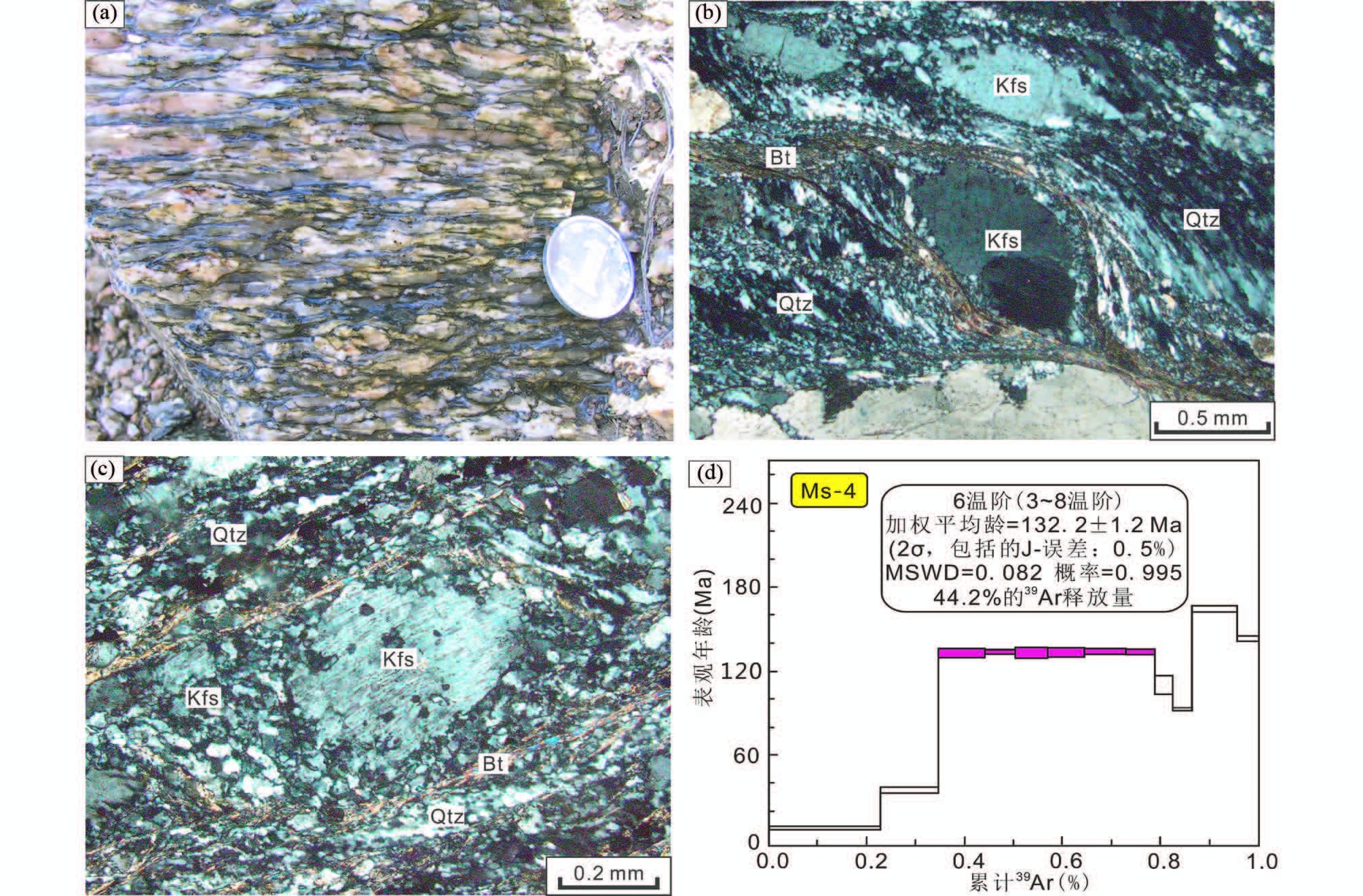 | 图 2 密山市知一镇糜棱岩野外、显微照片以及黒云母40Ar/39Ar年龄谱 (a)糜棱岩野外照片,钾长石形成旋转残斑,强烈剪切拉长的定向石英围绕残斑分布构成S-C组构;(b)钾长石旋转残斑发育边缘细粒化,新生黑云母条带围绕残斑分布,石英表现为亚晶粒旋转动态重结晶作用形成的多晶条带状构造;(c)钾长石旋转残斑发育核-幔构造,新生黑云母围绕残斑分布;(d)样品MS4黒云母40Ar/39Ar年龄谱 Fig. 2 Field photographs,photomicrographs and 40Ar/39Ar age spectrum of biotite from the mylonite in Zhiyi Town of Mishan City (a)field photograph of mylonites,K-feldspars difine rotated porphyroclasts,directed and intensively ductile stretched quartzes wrap around the porphyroclasts and define S-C fabrics;(b)edge alteration of K-feldspar porphyroclasts,syn-deformational biotite ribbons wrap around the porphyroclasts,quartzes show as polycrystalline quartz ribbons which formed by subgrain rotation recrystallization;(c)core-mantle structure of K-feldspar porphyroclast and syn-deformational biotite ribbons wrap around it;(d)40Ar/39Ar age spectrum of biotite from Sample MS4 |
样品MS1、MS3、MS4和MS6经粉碎细磨、分选后挑选出黑云母单矿物,2010年9月置于中国原子能科学研究院49-2反应堆B4孔道中进行中子照射。样品测试在2011年9月进行,由北京大学造山带与地壳演化教育部重点实验室常规40Ar/39Ar定年系统完成,中子照射和40Ar/39Ar测年方法及步骤参见Zheng et al.(2015)。采用40Ar/39Ar Dating 1.2数据处理程序对获得的各组Ar同位素测试数据进行校正计算,再采用Isoplot 3.0计算坪年龄及等时线年龄(Ludwig,2003)。遗憾的是,4个样品都没有获得40Ar/39Ar坪年龄,仅MS4样品获得了40Ar/39Ar加权平均年龄。样品MS4的40Ar/39Ar分析数据见表 1,加权平均年龄及参数见图 2d。
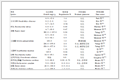 | 表 1 密山市知一镇糜棱岩中黒云母40Ar/39Ar阶段升温分析数据 Table 1 40Ar/39Ar step-heating data of biotite in Zhiyi Town of Mishan City |
对样品MS4进行了12个阶段的加热分析。谱线在3到8阶段较平坦,对应了44.2%的39Ar释放量,因坪温阶39Ar释放量没有达到坪要求,故属于加权平均年龄,年龄值为132.2±1.2Ma。样品40Ar/39Ar初始比值为298±12,在误差范围内与现今大气氩标准值(295.5±5)一致,反映了样品中没有明显的过剩氩的存在(张宏飞和高山,2012)。MSWD为0.082,年龄统计概率为0.995,反映年龄的拟合程度和年龄统计概率较高。样品的坪特征是受到后期部分热挠动的结果,没有完全重置,不属于可靠年龄,因此,年龄值仅作为地质解释参考。132.2±1.2Ma的加权平均年龄大体 上反映出糜棱岩在早白垩世抬升至300℃等温面的时间。由于样品未受到过剩氩的影响,谱线中较高的视年龄163.02±2.33Ma既有可能代表岩体结晶时间,也有可能代表早期动热变质作用的年龄(邹和平等,2000; 江思宏和聂凤军,2006)。但是,213.7Ma的原岩锆石U-Pb年龄已经说明163Ma不可能代表岩体结晶时间,而且该视年龄与以前作者获得的黑云母161±3Ma等时线年龄(孙晓猛等,2008)吻合,因此,该年龄值可能记录了中晚侏罗世之交的构造-热事件。
2.3 40Ar/39Ar年龄的地质意义及其地球动力学背景十余年来,以朱光教授为代表的科研团队在郯庐断裂带南段糜棱岩中获得25个单矿物40Ar/39Ar坪年龄为150~102Ma,其中2个角闪石的年龄分别为143Ma和132Ma,23个白云母和黑云母的年龄介于150~121Ma之间。对这些年龄值的解释存在认识上的不一致(朱光等, 2004,2005a,b,2009; Zhu et al., 2004,2005; 王勇生等, 2005,2006)。最新解释是,根据断裂带上获得的162~150Ma 40Ar/39Ar坪年龄以及结合断裂带附近早白垩世断陷盆地沉积及岩浆活动,认为断裂带在晚侏罗世发生左行走滑,大量介于143~102Ma的单矿物40Ar/39Ar同位素值代表了断裂带伸展活动中的冷却年龄,而不是紧随走滑之后的冷却年龄,断裂带在早白垩世初结束走滑并开始进入伸展作用阶段(Zhu et al., 2005; 王勇生等,2006; 朱光等,2009)。Wang et al.(2006)获得的162~156Ma云母40Ar/39Ar坪年龄也证实了左行走滑发生在晚侏罗世。我们认为,敦密断裂带中132Ma黑云母40Ar/39Ar加权平均年龄也是伸展作用的冷却年龄,其构造-地层-沉积学依据是:①在敦密断裂带通过的黑龙江省东部地区,分布三江盆地、双鸭山盆地、双桦盆地、勃利盆地、虎林盆地和鸡西盆地等一系列NWW向展布的中小盆地(图 1),研究表明,这些中小盆地在早白垩世Hauterivian期(132.9Ma)-Albian期(100.5Ma)(国际地层委员会,2013)是一个统一的大三江原形盆地,接受陆相沉积(张兴洲和马志红,2010; 韩国卿等,2008; 温泉波等,2008;和钟铧等,2009; 贾承造和郑民,2010; Sha,2007; Sha et al., 2008)。大三江盆地在早白垩世沉积期间并没有被长度>200km左旋走滑断距的敦密韧性剪切带错移(张宏,1993; 王小凤等,2000; 张兴洲和马志红,2010),因此,在早白垩世Hauterivian期-Albian期,断裂带并不是以走滑作用为主,而是处于伸展为主的背景之中。这就限定了大规模左旋走滑作用发生在大三江原型盆地沉积之前,即发生Hauterivian期之前;②从更广阔的区域审视,包括我国松辽盆地、黑龙江省东部中小盆地群、俄罗斯中阿穆尔盆地、韩国东南和日本西南等广袤的东北亚大陆边缘地区,广泛存在一个晚中生代不整合界面,界面之上分布早白垩世Hauterivian期-Albian期大中型陆相断陷盆地,这些地区在三叠纪-早白垩世Valanginian期,除了松辽盆地具有小型早中侏罗世含煤盆地外,其它地区均缺失沉积(Sha,2007; Sha et al., 2008,2012; 周建波等,2009; 张兴洲和马志红,2010),说明在三叠纪-早白垩世Valanginian期,东北亚大陆边缘经历了区域挤压隆升作用。研究表明,东北地区三叠纪的挤压隆升受华北板块与黑龙江中小板块拼贴所制约(张贻侠等,1998),而中-晚侏罗世的挤压隆升则可能导致了郯庐断裂带的走滑活动;③现今位于敦密断裂带东北部的完达山地体(图 1)在早中侏罗世快速向北移动并发生强烈的左旋走滑活动,在晚侏罗世与佳木斯地块拼贴(邵济安等, 1990,1991; 水谷伸治郎等,1989; 刘德来和马莉,1997)。显然,完达山地体的拼贴增生以及拼贴之前的快速走滑,与敦密断裂带大规模走滑具有相同的大地构造背景,它们都受到Izanagi板块向东亚大陆边缘斜向俯冲(Maruyama et al., 1997; Maruyama and Seno, 1986)的制约。根据以上证据认为,敦密断裂带左行走滑活动可能发生在中侏罗世的中晚期。
上述敦密断裂带区域构造特征以及郯庐断裂带南段代表左旋走滑冷却时代的162~150Ma的40Ar/39Ar同位素年龄值,约束了东北亚大陆边缘地区左行走滑活动发生在中侏罗世中晚期。在早白垩世Hauterivian期-Albian期,该区发生强烈的区域伸展作用,即郯庐断裂带北段由走滑向伸展活动转换的最主要时间是Hauterivian初期。这与郯庐断裂带中南段代表伸展背景的岩浆活动时限介于136~100Ma之间(谢成龙等, 2007,2008,2009; 牛漫兰等,2008; 朱光等,2009)以及郯庐断裂带由走滑向伸展活动转换的时间介于139~128Ma之间(王勇生等,2006)的结论是吻合的。因此,敦密断裂带中132Ma的黑云母40Ar/39Ar加权平均年龄是伸展活动中的冷却年龄而不是紧随走滑之后的冷却年龄。
敦密断裂带伸展活动的地球动力学背景与我国东部岩石圈减薄密切相关。一些学者认为,中国东部东侧大洋板块的俯冲是导致该区岩石圈减薄的首要构造控制作用(吴福元等,2003; Sun et al., 2007; Zheng,2009)。尽管不同学者对岩石圈减薄的时限存在不同的认识,但是,大部分学者都认为早白垩世对应岩石圈减薄的峰期(吴福元等, 2003,2008; Wu et al., 2005; Xu et al., 2004,2009; 邓晋福等,1994; 张宏福等,2005; Jiang et al., 2005; 周新华,2006),吴福元等(2008)根据华北东部广泛分布的早白垩世断陷盆地、A型花岗岩以及中高级变质岩或中下地壳物质从深部地壳向浅部的折返(Darby et al., 2004; Liu et al., 2005; Yang et al., 2007; 刘俊来等,2006; Wang et al., 2011,2012; 杨进辉等,2008)等特征,认为岩石圈减薄的峰期分布在135~115Ma期间,而且岩石圈减薄不仅局限于华北克拉通,同样可以发生在我国东部的其它地区(Wu et al., 2005; Xu,2007; Zheng et al., 2006,2007)。在岩石圈拆沉减薄过程中,郯庐断裂带成为岩石圈的强减薄带(Zheng et al., 2006,2007; 牛漫兰等,2010; 谢成龙等,2009),沿该带及其两侧地壳厚度最薄,软流圈最浅(许志琴等,1982; 张岳桥和董树文,2008),断裂带中的糜棱岩被强烈伸展抬升,导致了132Ma的黑云母40Ar/39Ar加权平均年龄的形成。
3 走滑-逆冲事件郯庐断裂带北段最醒目的构造特征是广泛发育大型走滑-逆冲断层系、断层相关褶皱和对冲构造。例如,佳伊断裂带中的四平市石岭子镇大型右旋走滑-逆冲断褶带和敦密断裂带中的桦甸市-辉南县的对冲构造等均揭示在晚白垩世发生了强烈的走滑-逆冲事件(孙晓猛等, 2006,2010; 王书琴等,2012)。然而,虽然前人对敦密断裂带桦甸市-黑石镇段对冲构造进行了较为详细研究(张庆龙等,2005; 孙晓猛等,2010; 王书琴等,2012),但是在桦甸市以北和黑石镇以南数百公里长的地段中还缺乏走滑-逆冲事件的详细记载,也缺乏限定变形事件时限的完整证据,不能构成一个相对连续的证据链,因此,需要进一步工作加以证实。近年来,我们对敦密断裂带全段进行了较系统的野外调查,对重要露头实测了构造剖面,为走滑-逆冲事件的确定增加了新证据。
3.1 走滑-逆冲断层的几何学和运动学特征我们从北向南分别选择了黑龙江省密山市裴德镇断裂带、穆棱市兴源镇-下城子镇断褶带、吉林省桦甸县四道沟断层和辽宁省清原县城北及英额门镇断层(图 1)对敦密走滑-逆冲断层的几何学和运动学特征进行研究。
3.1.1 密山市裴德镇断裂带在黑龙江省密山市-鸡东市一带,敦密断裂带由两条NE 55°方向平行排列的主干边界断裂带所组成,边界断裂间距10~15km,中间分布中、新生代盆地。西部边界断裂在裴德镇畅峰选煤厂中出露较好,由一系列压扭性断层所组成,断层产状相近,分布在295°~315°∠50°~67°范围内(图 1A、图 3a),断层中出露一系列构造透镜体带及挤压片理。在剖面上,构造透镜体的最大拉伸轴所在平面与断层面之间的锐夹角指示断层向南东方向逆冲;在平面上,分支断层走向集中分布在NNE方向,与主干断裂呈锐角相交,反映了敦密断裂带具有右旋走滑性质。
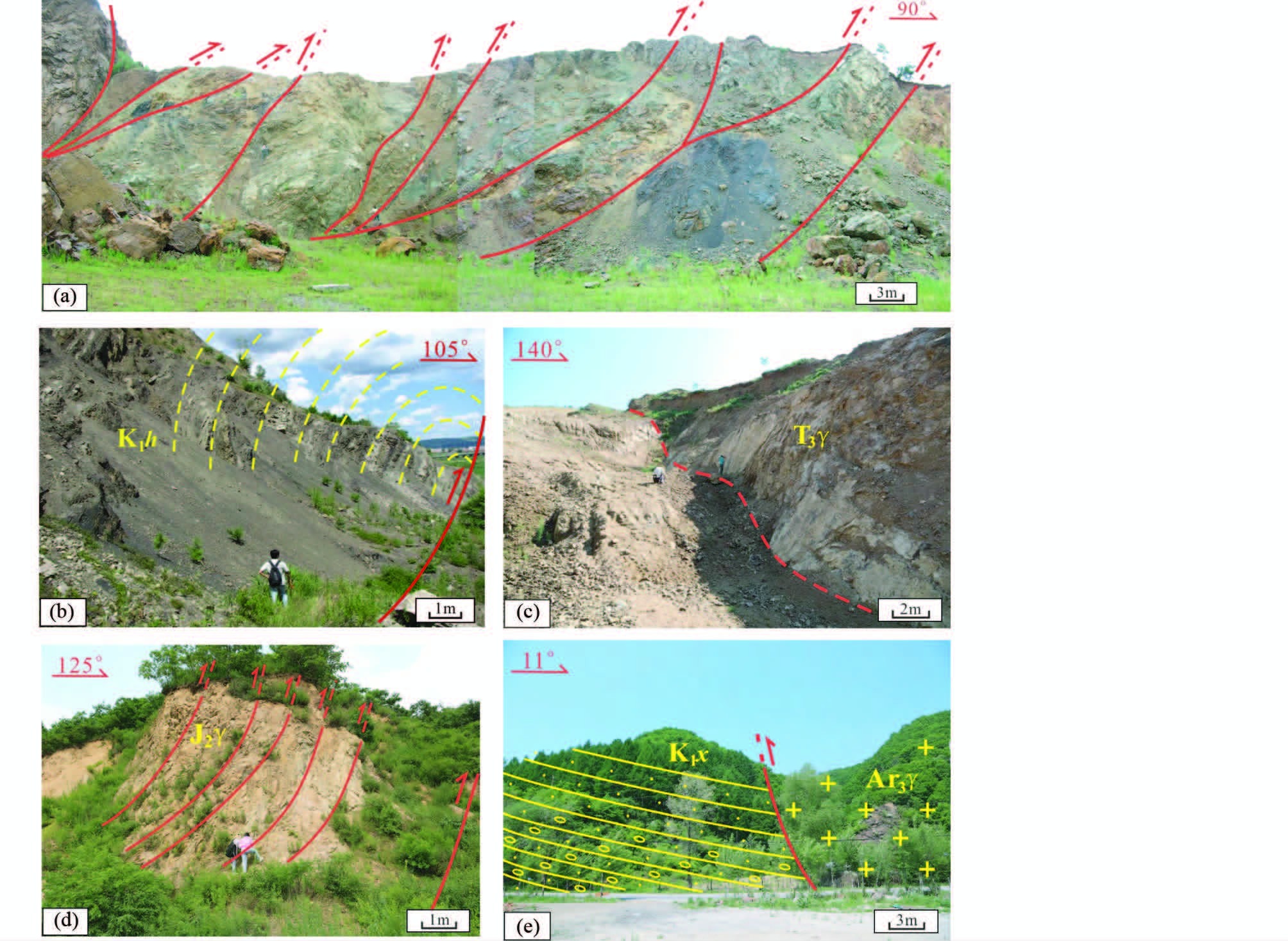 | 图 3 敦密断裂带挤压构造 (a)密山市裴德镇畅峰选煤厂压扭性断裂带,断层向地堑中逆冲;(b)穆棱市下城子镇西部主干断裂带附近大型断层相关褶皱,卷入褶皱的地层是上白垩统猴石沟组;(c)穆棱市兴源镇西部主干断裂带附近的压扭性断层,断层切割了三叠纪花岗岩;(d)桦甸县四道沟煤矿附近西部主干边界断裂带,中侏罗世二长花岗岩被断层逆冲至地堑晚侏罗世-早白垩世含煤盆地之上;(e)清原县西部主干边界断裂,太古代花岗岩被断层逆冲至地堑中下白垩统小南沟组之上 Fig. 3 Compressional structures of Dunhua-Mishan Fault Zone (a)a compression-wrench fault zone in Changfeng Coal Preparation Plant of Peide Town of Mishan City,the faults thrust toward the graben;(b)a fault-related fold zone near the west major-border fault in Xiachengzi Town of Muling City,the Upper Cretaceous Houshigou Formation is involved in the folds;(c)a compression-wrench fault near the west major-border fault in Xingyuan Town of Muling City and the fault cuts through the Triassic granite;(d)the west major-border fault near the Sidaogou Coal Mine of Huadian City,the Middle Jurassic monzonitic granite thrusts onto the Late Jurassic-Early Cretaceous coal-bearing basin of the graben;(e)the west major-border fault in Qingyuan County,the Archean granite thrust onto the Middle-Lower Cretaceous Xiaonangou Formation of the graben |
3.1.2 穆棱市兴源镇-下城子镇断褶带
在穆棱市-穆棱镇之间,敦密断裂带由两条NE 55°方向的平行排列的主干边界断裂带所组成,边界断裂相距10km,向中生代盆地对冲。断裂切割了晚三叠世二长花岗岩、早白垩世花岗斑岩、下白垩统东山组、东大岭组和上白垩统猴石沟组和海浪组,又被中新统船底山组玄武岩不整合覆盖。
沿穆棱市兴源镇-下城子镇对冲构造两侧,可见二十余个褶曲和逆冲断层分布在猴石沟组和三叠纪花岗岩之中(图 1B,C、图 3b,c),它们属于沿敦密断裂带分布的次级褶皱和断层,褶皱轴面和断层面的走向主要分布在10°~30°之间,根据一系列断层面和褶皱轴面与主干边界断裂锐角相交关系,确定敦密断裂带具有右旋挤压-走滑特征。此外,在断褶带中还存在少数走滑断层,这些断层具有断面平直、产状陡倾、断层角砾大小较均匀且圆度较好等特征,其走向分布在110°~130°之间,属于另一组具有走滑性质的次级断裂。
3.1.3 桦甸县四道沟断层在敦化市-梅河口市长度>200km地段中,敦密断裂带由两组平行排列的高角度逆冲断层所组成。两条主干边界断裂走向NE 60°,相距15~20km,中间分布上侏罗统-下白垩统。主干断裂倾向相背,倾角50°~80°,断层上盘花岗岩和太古代地层相向对冲(孙晓猛等,2010)。断裂切割的最新地层是下白垩统小南沟组。在桦甸县兴华煤矿西部,主干断裂出露较为典型,剖面上由数条断层及构造透镜体所组成的构造带宽达百余米,断层产状介于315°~335°∠60°~85°之间,中侏罗统二长花岗岩沿断层逆冲到上侏罗统九大组之上(图 1D、图 3d)。
3.1.4 清原县及英额门镇断层从吉林省辉南县向南,两条主干断裂之间的宽度逐渐变窄,至清原县不足5km,再向南至清原县-抚顺市之间已不足2km。在清原县城西北方向S303线公路事故车辆停放场附近,敦密断裂带西部主干边界断裂向NW方向陡倾,新太古代花岗岩向SE方向逆冲至下白垩统小南沟组砂砾岩之上(图 1E、图 3e),在清原县英额门镇东3km附近,东部主干边界断层使新太古代二长花岗岩向NW方向逆冲于晚侏罗世小东沟组及早白垩世小南沟组之上。
从敦密断裂带由北向南4个典型地点的几何学特征中可以看出,断裂带具有明显的对冲式断裂系统,即断裂带由两条或两组平行排列的高角度逆断层所组成,两条主干边界断裂倾向相背,倾角50°~80°,断层上盘相向对冲,中间分布中、新生代盆地;边界断裂的运动学特征除了显示逆冲特点外,还具有右旋走滑分量,其构造属性属于大型右旋走滑-逆冲型断裂。
3.2 走滑-逆冲事件的时代前人对郯庐断裂带北段白垩纪走滑-逆冲事件时代存在较大的争议,有发生在早白垩世末期(张庆龙等,2005)、早白垩世之后或晚白垩世(张兴洲和马志红,2010; 张凤旭等,2010;和钟铧等,2009)、晚白垩世末期(刘茂强等,1993)、晚白垩世晚期-末期(刘建忠等,2004; Li et al., 2012; 孙晓猛等, 2006,2010; 王书琴等,2012)等不同观点。
地质、地球物理研究(张兴洲和马志红,2010;和钟铧等,2009; 刘财等,2009; 张凤旭等,2010)以及岩相古地理恢复(刘招君等,2008① (①刘招君等,2008. 大庆探区外围中、新生代相关盆地群沉积充填特征及成盆规律) )等一致表明,敦密断裂带切割了黑龙江省东部早白垩世勃利盆地、虎林盆地、鸡西盆地和宁安盆地,因此,这些盆地的构造演化特征以及断裂切割盆地的最新地层时代成为制约敦密断裂带走滑-逆冲时代的重要证据。前人对这些盆地的成因存在不同的认识,刘建忠等(2004)认为,三江、勃利和鸡西盆地属于走滑拉分盆地,李三忠等(2013)认为是断陷盆地。吉林大学在2004~2008年开展的地层、构造及岩相古地理综合研究表明,这些中小盆地并不是孤立存在的,在早白垩世Hauterivian期-Albian期是一个统一的大三江原形盆地,并没有被长度>200km走滑断距的敦密断裂带所错移。在早白垩世末期-晚白垩世早中期,大三江盆地被逆冲断层分割成现今的中小盆地群,所以,一些学者认为敦密走滑-逆冲断裂带是这个时期形成的(张兴洲和马志红,2010; 张凤旭等,2010;和钟铧等,2009)。然而,野外地质调查证实,致使大三江盆地遭受破坏的一系列逆冲断层均呈近EW向或NWW向展布,例如在三江、双鸭山、双桦、勃利和鸡西等盆地的南侧都分布近EW向或NWW向展布的向北逆冲的大型断层,盆地北部边界为沉积超覆接触,形成“南冲北超”的构造样式(图 1)。由于强烈的由南向北的挤压隆升作用,形成了一系列近EW向展布的隆起带,由北向南依次为桦南隆起、密山隆起和恒山隆起,这些隆起带将大三江盆地分隔成一系列近EW向展布的中小盆地群。这种SN向的挤压隆升作用一直持续到晚白垩世中期(韩国卿等,2008; 温泉波等,2008;和钟铧等,2009; 贾承造和郑民,2010)。近EW向为主的区域构造格局反映了晚白垩世早中期构造应力场是SN向挤压,它与郯庐断裂北段NE向构造格 局以及所遭受的NW-SE向挤压应力场(刘茂强等,1993)是完全不同的,因此,早白垩世末期-晚白垩世中期不是敦密断裂带走滑-逆冲事件的主要活动期,走滑-逆冲事件要晚于晚白垩世中期。
在敦密断裂带通过的鸡西盆地和宁安盆地中,断层切割了上白垩统猴石沟组和海浪组(图 1B、图 3b)。虽然不同的研究者将海浪组的顶界面与Santonian阶顶部(83.5Ma)(Sha,2007; 张兴洲和马志红,2010)或Maastrichtian阶顶部(65.5Ma)(Sha et al., 2008)等不同年代地层学界面相对比,但是,海浪组至少置于上白垩统下部-中部的认识是统一的,这就限定了敦密断裂带活动时代的下限是晚白垩世晚期-末期。近年来完成的鸡西盆地和宁安盆地晚白垩世古地理图(刘招君等,2008)也显示了敦密断裂带切割了上白垩统不同的沉积相带,为走滑-逆冲事件发生在晚白垩世晚期-末期提供了重要的地下深部信息。
敦密断裂带走滑-逆冲活动时代上限的证据主要分布在桦甸县-敦化市。在桦甸县,辉桦盆地古近系桦甸组呈角度不整合覆盖于对冲构造之上(图 4);在敦化市,敦化盆地始新统-渐新统珲春组角度不整合覆盖于逆冲断层之上(胡菲等,2012),此外,吉林大学地球探测科学与技术学院在横切佳伊断裂带和敦密断裂带进行了大地电磁测深,结果显示,佳伊和敦密断裂带中都存在着东西两条主干断裂,两条主干断裂相向对冲,古近系呈角度不整合覆盖在对冲构造之上(刘财等,2009),显示了深部探测和地表观察结果的一致性。以上证据限定了断裂右旋走滑-逆冲活动发生在古近纪之前,支持了右旋走滑-逆冲活动发生在晚白垩世晚期-末期的认识。
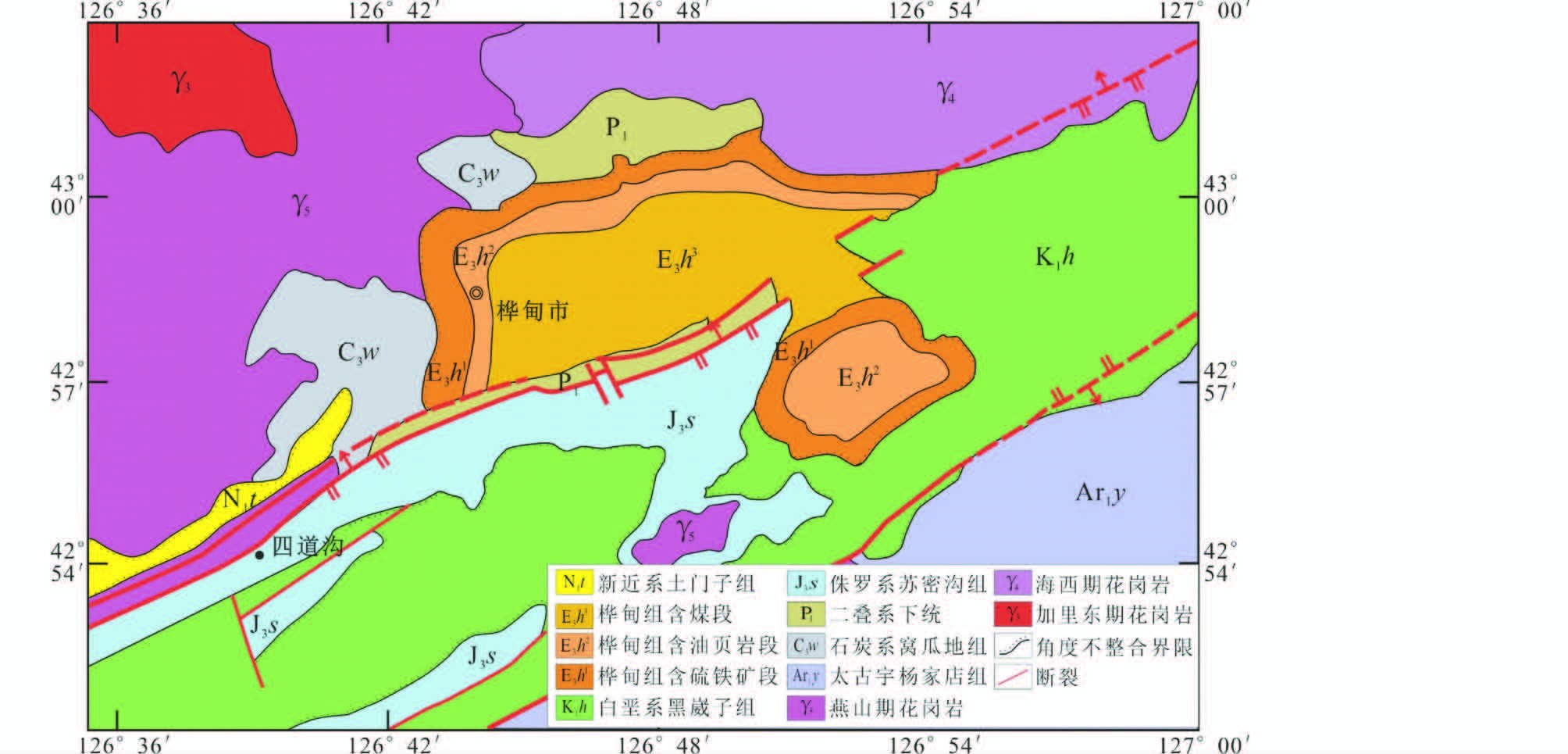 | 图 4 桦甸组与走滑-逆冲断裂间角度不整合关系(据吉林省地质矿产局,1985① (①吉林省地质矿产局,1985. 1:20万磐石县幅地质图 ); 吉林省地质矿产局第二地质调查所,1984② (②吉林省地质矿产局第二地质调查所,1984. 1:2.5万桦甸县油页岩地质图)略改) Fig. 4 Angular unconformity between the Huadian Formation and the strike-slip thrust faults |
在上白垩统上部的嫩江组沉积以后,东北地区依次发生强烈的嫩江运动(约79.1Ma,Wan et al., 2013)和白垩纪末期的地壳运动,前者引起了松辽盆地白垩纪以来最为强烈的构造反转(侯贵廷等,2004),导致黑龙江省东部大三江盆地群的消亡、上白垩统上部大范围缺失、松辽盆地大幅度抬升和大面积萎缩,形成广泛的逆冲断层、褶皱和区域不整合界面;后者叠加在前者之上,导致松辽盆地最终的消亡、东北地区发生白垩纪最为强烈的区域隆升以及在黑龙江东部形成分布广泛的海浪组与古近系之间的区域不整合界面。刘建忠等(2004)和Li et al.(2012)研究也表明,在晚白垩世晚期,东三江盆地东部为冲断褶皱带前缘,郯庐断裂晚白垩世盆地表现为收缩挤压褶皱带。因此,敦密断裂带大型右旋走滑-逆冲断褶带和对冲构造的活动时代应该是嫩江运动和白垩纪末期的地壳运动的综合产物,尤其是晚白垩世末期挤压作用更为强烈和更为重要,这一期构造事件规模大、影响范围广,使整个郯庐断裂带北段遭受到强烈改造(孙晓猛等,2010; 王书琴等,2012)。
3.3 与郯庐断裂带中段挤压构造对比一些学者早在20世纪80~90年代就指出,在郯庐断裂 带的中段存在晚白垩世末期强烈的挤压事件(许志琴等,1982; 山东省地质矿产局,1991),然而,由于近十余年来人们更关注的是韧性走滑和伸展构造,对挤压构造的研究凸显不足,并产生不同认识。众多学者认为,郯庐断裂带在晚白垩世-古近纪是巨型的伸展构造环境(朱光等, 2001,2004; 王勇生等,2005; 牛漫兰,2006; 刘国生等,2006; 万天丰,2004; 张岳桥和董树文,2008)。我们认为,既然郯庐断裂带在晚中生代开始延伸至东北地区,最终形成南北统一的中国东部最长的巨型断裂带(朱光等, 2004,2006a; Zhu et al., 2004),这条断裂带的南段和北段在重要的演化阶段中必然是同步的,其构造属性也应该是相同的,具有统一的地球动力学背景,不会形成同时代南北构造环境的巨大反差。因此,在郯庐断裂带的中南段也必然有晚白垩世末期挤压-逆冲事件的构造响应。
我们对郯庐断裂带中段组成“两堑夹一垒”的鄌郚-葛沟、沂水-汤头、安丘-莒县和昌邑-大店4条主干断裂进行了野外地质调查,结果证实,在断裂带的中段不仅伸展构造明显,挤压构造也十分丰富。例如,在沂水县姚家店镇八宝庄,鄌郚-葛沟断裂使中奥陶统灰岩逆冲至白垩纪紫红色砂岩之上(图 5a),根据两侧次级断裂与主干断裂的关系,确定断层性质为右旋压扭;在沂水县道拖镇花沟村,沂水-汤头断裂带中夹有泰山群、古生界及下白垩统青山组断片,断片中岩层发生强烈褶皱,轴面陡倾(图 5b),断裂使古生界断片逆冲到下白垩统火山岩之上;在莒县长岭镇西岭一带,昌邑-大店断裂由于采石挖掘,各种构造现象十分醒目,其中,A断层呈陡崖状,线状出露>1km,断层面构造现象丰富多彩,断层擦痕,断层角砾、挤压片理、断层相关褶皱等构造迹象比比皆是,揭示出断层经历了先正断后反转的作用过程(图 5c、图 6);B断层主要由构造透镜体及构造片理所组成;断层切割了中上白垩统王氏组(图 5d、图 6)。此外,王氏组中还分布一系列同沉积张性断层,逆冲断层也切割了正断层,反映了挤压活动发生在晚白垩世末期。事实上,郯庐断裂带中段最显著的构造特征是挤压构造,地质工作者最先关注的也是挤压现象,例如,许志琴等(1982)曾经报道了东部裂谷带中由下白垩统-上白垩统所组成的宽达1.5km的挤压褶皱带、下白垩统青山组火山岩逆冲到中上白垩统王氏组砾岩之上,以及中央地垒中太古宙逆冲到裂谷带上白垩统之上等构造现象,认为挤压事件发生在晚白垩世之后,并将受到挤压的地堑称之为“反地堑”。山东省地质工作者野外工作证实,郯庐断裂带中段既有伸展构造特征,又有挤压和走滑构造特征,然而,组成“两堑夹一垒”的4条主干断裂现今所表现的力学性质全部以压扭性为主,断裂的压扭性活动发生在白垩纪末期或古近纪初(山东省地质矿产局,1991)。王小凤等(2000)也较详细的报道了郯庐断裂带中南段白垩纪末期的压扭性断裂。这些构造迹象都约束了郯庐断裂带中段在晚白垩世末期发生强烈的走滑-事件,它与北段的走滑-挤压事件具有相同的构造属性。
 |
图 5 郯庐断裂带中段挤压构造 (a)沂水县姚家店镇八宝庄鄌郚-葛沟断裂使中奥陶统灰岩逆冲至白垩纪紫红色砂岩之上,红线示断层面;(b)沂水县道拖镇沂水-汤头断裂中中奥陶统石灰岩断片,断片中岩层发生强烈褶皱;(c)莒县长岭镇昌邑-大店断裂逆断层及断层相关褶皱;(d)长岭镇由构造透镜体及构造片理所组成逆冲断层,断层切割了王氏组,红色箭头示构造透镜体 Fig. 5 Compressional structures in the middle segment of the Tan-Lu Fault Zone (a)the Middle Ordovician limestones thrusting onto the purplish-red Cretaceous s and stones induced by the Tangwu-Gegou Fault in Babao Village of Yaojiadian Town,Yishui County,the red line indicates the fault plane;(b)the Middle Ordovician limestone fragments of Yishui-Tangtou Fault in Daotuo Town of Yishui County,strata in the fragments are folded intensively;(c)the thrust fault and fault-related fold in the Changyi-Dadian Fault;(d)the thrust fault in Changling Town comprises structural lenticularbodies and schistosities, and it cuts through the Wangshi Formation,the red arrow indicates structural lenticularbodies |
 | 图 6 莒县石井镇西岭构造剖面 Fig. 6 Tectonic profile in Xiling of Shijing Town,Ju County |
敦密断裂走滑-逆冲活动受太平洋构造域和特提斯构造域中板块运动的双重制约。前人对晚白垩世晚期-古近纪太平洋板块的运动方向存在不同认识(Hilde et al., 1977; Maruyama and Seno, 1986; Maruyama et al., 1997; 李三忠等,2013),作者采用Maruyama and Seno(1986)关于在74~53Ma期间太平洋板块俯冲方向为NW向,与NE向的东亚大陆边缘近于直交的认识。在早白垩世末期-白垩纪/古近纪之交,特提斯构造域中班公湖-怒江洋与雅鲁藏布洋相继消亡,拉萨地块与羌塘地块和印度大陆相继碰撞拼合(莫宣学和潘桂堂,2006; 许志琴等,2012),产生向北的远程挤压效应。来自两个不同方向的区域挤压作用,可能是导致郯庐断裂带发生右旋走滑-逆冲活动的根本原因。
4 结论(1)密山市花岗质糜棱岩黑云母40Ar/39Ar加权平均年龄为132.2±1.2Ma,大体上代表了敦密断裂带经历了伸展事件的冷却年龄,它是东北亚大陆边缘地区在早白垩世Hauterivian期-Albian期发生强烈区域伸展的产物,即东北地区郯庐断裂带由走滑向伸展活动转换的最主要时间是Hauterivian初期。
(2)黑龙江省密山市至辽宁省清原县系列大型走滑-逆冲断层和断层相关褶皱揭示出在晚白垩世末期敦密断裂带发生右旋走滑-逆冲事件,该事件规模大,影响范围广,导致整个断裂带遭受到强烈改造,形成对冲构造断裂系统。
(3)将研究区走滑-逆冲断裂与山东省郯庐断裂带中段的挤压构造对比,认为郯庐断裂带的北段和中段在晚白垩世末期都发生了强烈的走滑-逆冲事件,它们具有相同的构造特征和构造属性。
| [1] | Bureau of Geology and Mineral Resources of Shandong Province. 1991. Regional Geology of Shandong Province. Beijing: Geological Publishing House, 1-597 (in Chinese) |
| [2] | Chen XH, Wang XF, Zhang Q, Chen BL, Chen ZL, Harrison TM and Yin A. 2000. Geochronologic study on the formation and evolution of Tan-Lu Fault. Journal of Changchun University of Science and Technology, 30(3): 215-220 (in Chinese with English abstract) |
| [3] | Darby BJ, Davis GA, Zhang XH, Wu FY, Wilde SA and Yang JH. 2004. The newly discovered Waziyu metamorphic core complex, Yiwulu Shan, western Liaoning Province, North China. Earth Science Frontiers, 11(3): 145-156 |
| [4] | Deng JF, Mo XX, Zhao HL, Luo ZH and Du YS. 1994. Lithosphere root/de-rooting and activation of the east China continent. Geoscience, 8(3): 349-356 (in Chinese with English abstract) |
| [5] | Gilder SA, Leloup PH, Courtillot V, Chen Y, Coe RS, Zhao XX, Xiao WJ, Halim N, Cogne JP and Zhu RX. 1999. Tectonic evolution of the Tancheng-Lujiang (Tan-Lu) Fault via Middle Triassic to Early Cenozoic paleomagnetic data. Journal of Geophysical Research, 104(B7): 15365-15390 |
| [6] | Gower RJW and Simpson C. 1992. Phase boundary mobility in naturally deformed, high-grade quartzofeldspathic rocks: Evidence for diffusional creep. J. Struct. Geol., 14(3): 301-313 |
| [7] | Hames WE and Bowring SA. 1994. An empirical evaluation of the argon diffusion geometry in muscovite. Earth and Planetary Science Letters, 124(1-4): 161-169 |
| [8] | Han GQ, Liu YJ, Li JJ, Bai JZ, Sun XM, Wen QB and Wu LN. 2008. Uplifting time of Huanan Uplift in the northeastern Heilongjiang, China. Journal of Jilin University (Earth Science Edition), 38(3): 389-397 (in Chinese with English abstract) |
| [9] | Harrison TM and McDougall I. 1981. Excess 40Ar in metamorphic rocks from Broken Hill, New South Wales: Implications for 40Ar/39Ar age spectra and the thermal history of the region. Earth and Planetary Science Letters, 55(1): 123-149 |
| [10] | Harrison TM, Duncan I and McDougall I. 1985. Diffusion of 40Ar in biotite: Temperature, pressure and compositional effects. Geochimica et Cosmochimica Acta, 49(11): 2461-2468 |
| [11] | He ZH, Liu ZJ, Zhang XD, Chen YC and Dong LS. 2009. Subdivisions of structural layer and tectonic-sedimentary evolution of eastern basins in Heilongjiang in Late Mesozoic. Global Geology, 28(1): 20-27 (in Chinese with English abstract) |
| [12] | Hilde TWC, Uyeda S and Kroenke L. 1977. Evolution of the western Pacific and its margin. Tectonophysics, 38(1-2): 145-152, 155-165 |
| [13] | Hou GT, Feng DC, Wang WM and Yang MH. 2004. Reverse structures and their impacts on hydrocarbon accumulation in Songliao basin. Oil & Gas Geology, 25(1): 49-53 (in Chinese with English abstract) |
| [14] | Hu F, Liu ZJ, Meng QT, Chen YC, Xu JJ and Cheng LJ. 2012. Cenozoic sequence and sedimentary characteristics and its control on source rock in Dunhua Basin, Yanbian area. Journal of Jilin University (Earth Science Edition), 42(S2): 33-42 (in Chinese with English abstract) |
| [15] | Hu L, Liu JL, Ji M, Cao SY, Zhang HY and Zhao ZY. 2009. The Distinguish Manual about Deformation Microstructures. Beijing: Geological Publishing House, 42-44 (in Chinese) |
| [16] | International Commission on Stratigraphy. 2013. International chronostratigraphic chart. Journal of Stratigraphy, 37(3): 257-258 (in Chinese with English abstract) |
| [17] | Jia CZ and Zheng M. 2010. Sedimentary history, tectonic evolution of Cretaceous Dasanjiang Basin in Northeast China and the significance of oil and gas exploration of its residual basins. Journal of Daqing Peroleum Institute, 34(6): 1-12 (in Chinese with English abstract) |
| [18] | Jiang SH and Nie FJ. 2006. 40Ar/39Ar Geochronology of the granitoids in the Beishan mountain, NW China. Acta Petrologica Sinica, 22(11): 2719-2732 (in Chinese with English abstract) |
| [19] | Jiang YH, Jiang SY, Zhao KD, Ni P, Ling HF and Liu DY. 2005. SHRIMP U-Pb zircon dating for lamprophyre from Liaodong Peninsula: Constraints on the initial time of Mesozoic lithosphere thinning beneath eastern China. Chinese Science Bulletin, 50(22): 2612-2620 |
| [20] | Li JY, Niu BG, Song B, Xu WX, Zhang YH and Zhao ZR. 1999. Crustal Formation and Evolution of Northern Changbai Mountains, Northeast China. Beijing: Geological Publishing House, 1-137 (in Chinese) |
| [21] | Li SZ, Liu X, Suo YH, Liu LP, Qian CC, Liu XC, Zhang GW and Zhao GC. 2009. Triassic folding and thrusting in the Eastern Block of the North China Craton and the Dabie-Sulu orogen and its geodynamics. Acta Petrologica Sinica, 25(9): 2031-2049 (in Chinese with English abstract) |
| [22] | Li SZ, Zhao GC, Dai LM, Liu X, Zhou LH, Santosh M and Suo YH. 2012. Mesozoic basins in eastern China and their bearing on the deconstruction of the North China Craton. Journal of Asian Earth Sciences, 47: 64-79 |
| [23] | Li SZ, Yu S, Zhao SJ, Liu X, Gong SY, Suo YH, Dai LM, Ma Y, Xu LQ, Cao XZ, Wang CP, Sun WJ, Yang C and Zhu JJ. 2013. Tectonic transition and plate reconstructions of the East Asian continental margin. Marine Geology & Quaternary Geology, 33(3): 65-94 (in Chinese with English abstract) |
| [24] | Lin CY, Shi LB, He YN and Chen XD. 1994. The deformation features of mantle xenoliths from eastern China and their rheological significance. In: Qian XL (ed.). Extensional Tectonics. Beijing: Geological Publishing House, 87-98 (in Chinese) |
| [25] | Lin CY, Xu YG, Zhang XO, Shi LB and Chen XD. 1996. Deformation of mantle rocks (East China), fluids and asthenosphere. In: Du LT, Liu RX and Deng JF (eds.). Geochemistry of Mantle Fluids and Asthenosphere (Asthenoliths). Beijing: Geological Publishing House, 312-340 (in Chinese) |
| [26] | Liu C, Meng LS, Wu YG et al. 2009. Geological Field and Crustal Evolution in Northeast of China. Beijing: Geological Publishing House, 98-124 (in Chinese with English abstract) |
| [27] | Liu DL and Ma L. 1997. Mesozoic tectonic evolution of continental margin in East Asia. Geoscience, 11(4): 444-451 (in Chinese with English abstract) |
| [28] | Liu GS, Zhu G, Niu ML, Song CZ and Wang DX. 2006. Meso-Cenozoic evolution of the Hefei Basin (eastern part) and its response to activities of the Tan-Lu Fault Zone. Chinese Journal of Geology, 41(2): 256-269 (in Chinese with English abstract) |
| [29] | Liu JL, Davis GA, Lin ZY and Wu FY. 2005. The Liaonan metamorphic core complex, southeastern Liaoning Province, North China: A likely contributor to Cretaceous rotation of eastern Liaoning, Korea and contiguous areas. Tectonophysics, 407(1-2): 65-80 |
| [30] | Liu JL, Guan HM, Ji M and Hu L. 2006. Late Mesozoic metamorphic core complexes: New constraint on lithosphere thinning in North China. Progress in Natural Science, 16(1): 21-26 |
| [31] | Liu JZ, Li SZ, Zhou LH, Gao ZP and Guo XY. 2004. Mesozoic tectonics and basin distribution of in eastern North China plate. Marine Geology & Quaternary Geology, 24(4): 45-54 (in Chinese with English abstract) |
| [32] | Liu MQ, Yang BZ, Deng JG and Zhou YH. 1993. Geological Tectonic Features and Evolution of the Yitong-Shulan Graben. Beijing: Geological Publishing House, 42-103 (in Chinese) |
| [33] | Lloyd GE and Freeman B. 1994. Dynamic recrystallization of quartz under greenschist conditions. Journal of Structural Geology, 16(6): 867-881 |
| [34] | Ludwig KR. 2003. User's Manual for Isoplot/Ex Version 3.00: A Geochronological Toolkit for Microsoft Excel. Berkeley Geochronology Center: Special Publication, 4: 11-70 |
| [35] | Maruyama S and Seno T. 1986. Orogeny and relative plate motions: Example of the Japanese Islands. Tectonophysics, 127(3-4): 305-329 |
| [36] | Maruyama S, Isozaki Y, Kimura G and Terabayashi M. 1997. Paleogeographic maps of the Japanese Islands: Plate tectonic synthesis from 750Ma to the present. Island Arc, 6(1): 121-142 |
| [37] | McDougall I and Harrison TM. 1999. Geochronology and Thermochronology by the 40Ar/39Ar Method. Oxford: Oxford University Press, 1-269 |
| [38] | Mizutani S, Shao JA and Zhang QL. 1989. The Nadanhada Terrane in relation to Mesozoic tectonics on continental margins of East Asia. Acta Geologica Sinica, 63(3): 204-216 (in Chinese with English abstract) |
| [39] | Mo XX and Pan GT. 2006. From the Tethys to formation of the Qinghai-Tibet Plateau: Constrained by tectono-magmatic events. Earth Science Frontiers, 13(6): 43-51 (in Chinese with English abstract) |
| [40] | Niu ML. 2006. 40Ar-39Ar dating of biotite from the Mesozoic intrusions in Zhangbaling area and its geological significance. Chinese Journal of Geology, 41(2): 217-225 (in Chinese with English abstract) |
| [41] | Niu ML, Zhu G, Xie CL, Liu XM, Cao Y and Xie WY. 2008. LA-ICP MS Zircon U-Pb ages of the granites from the southern segment of the Zhangbaling uplift along the Tan-Lu Fault Zone and their tectonic significances. Acta Petrologica Sinica, 24(8): 1839-1847 (in Chinese with English abstract) |
| [42] | Niu ML, Zhu G, Xie CL, Wu Q and Liu GS. 2010. Geochemistry of Late Mesozoic intrusions from the southern segment of Zhangbaling uplift along the Tan-Lu Fault Zone and its implications for the lithospheric thinning. Acta Petrologica Sinica, 26(9): 2783-2804 (in Chinese with English abstract) |
| [43] | Passchier CW. 1982. Pseudotachylyte and the development of ultramylonite bands in the Saint-Barthélemy Massif, French Pyrenees. Journal of Structural Geology, 4(1): 69-79 |
| [44] | Passchier CW and Trouw RAJ. 2005. Microtectonics. 2nd Edition. Berlin: Springer, 57-61 |
| [45] | Rosenberg CL and Stünitz H. 2003. Deformation and recrystallization of plagioclase along a temperature gradient: An example from the Bergell tonalite. Journal of Structural Geology, 25(3): 389-408 |
| [46] | Sha JG. 2007. Cretaceous stratigraphy of Northeast China: Non-marine and marine correlation. Cretaceous Research, 28(2): 146-170 |
| [47] | Sha JG, Hirano H, Yao XG and Pan YH. 2008. Late Mesozoic transgressions of eastern Heilongjiang and their significance in tectonics, and coal and oil accumulation in northeast China. Palaeogeography, Palaeoclimatology, Palaeoecology, 263(3-4): 119-130 |
| [48] | Sha JG, Pan YH, Wang YQ, Zhang XL and Rao X. 2012. Non-marine and marine stratigraphic correlation of Early Cretaceous deposits in NE China, SE Korea and SW Japan, non-marine Molluscan biochronology, and palaeogeographic implications. Journal of Stratigraphy, 36(2): 357-381 |
| [49] | Shao JA, Wang CY, Tang KD and Zhang QY. 1990. The relationship between Nadanhada Range stratums and Terrane. Journal of Stratigraphy, 14(4): 286-291 (in Chinese with English abstract) |
| [50] | Shao JA, Tang KD, Wang CY, Zang QJ and Zhang YP. 1992. Structural features and evolution of the Nadanhada Terrane. Science in China (Series B), 35(5):621-630 |
| [51] | Stipp M, Stunitz H, Heilbronner R and Schmid SM. 2002. The eastern Tonale fault zone: A 'natural laboratory' for crystal plastic deformation of quartz over a temperature range from 250 to 700℃. Journal of Structural Geology, 24(12): 1861-1884 |
| [52] | Sun WD, Ding X, Hu YH and Li XH. 2007. The golden transformation of the Cretaceous plate subduction in the west Pacific. Earth and Planetary Science Letters, 262(3-4): 533-542 |
| [53] | Sun XM, Long SX, Zhang MS, Liu XY and Hao FJ. 2006. Discovery and timing of major thrust belt in Jiamusi-Yitong Fault Zone. Oil & Gas Geology, 27(5): 637-643 (in Chinese with English abstract) |
| [54] | Sun XM, Liu YJ, Sun QC, Han GQ, Wang SQ and Wang YD. 2008. 40Ar/39Ar geochronology evidence of strike-slip movement in Dunhua-Mishan Fault Zone. Journal of Jilin University (Earth Science Edition), 38(6): 965-972 (in Chinese with English abstract) |
| [55] | Sun XM, Wang SQ, Wang YD, Du JY and Xu QW. 2010. The structural feature and evolutionary series in the northern segment of Tancheng-Lujiang Fault Zone. Acta Petrologica Sinica, 26(1): 165-176 (in Chinese with English abstract) |
| [56] | Wan TF. 1995. Evolution of Tancheng-Lujiang Fault Zone and paleostress fields. Earth Science, 20(5): 526-534 (in Chinese with English abstract) |
| [57] | Wan TF. 1996. Formation and evolution of the Tancheng-Lujiang Fault Zone. Beijing: China University of Geosciences Press, 1-11 |
| [58] | Wan TF. 1996. Length and penetration depth of Tancheng-Lujiang Fault Zone in Eastern Asia. Geoscience, 10(4): 518-525 (in Chinese with English abstract) |
| [59] | Wan TF and Zhu H. 1996. The maximum sinistral strike-slip and its forming age of Tancheng-Lujiang Fault Zone. Geological Journal of Universities, 2(1): 14-27 (in Chinese with English abstract) |
| [60] | Wan TF. 2004. Tectonics of China. Beijing: Geological Publishing House, 1-387 (in Chinese) |
| [61] | Wan XQ, Zhao J, Scott RW, Wang PJ, Feng ZH, Huang QH and Xi DP. 2013. Late Cretaceous stratigraphy, Songliao Basin, NE China: SK1 cores. Palaeogeography, Palaeoclimatology, Palaeoecology, 385: 31-43 |
| [62] | Wang PJ, Chen FK, Chen SM, Siebel W and Satir M. 2006. Geochemical and Nd-Sr-Pb isotopic composition of Mesozoic volcanic rocks in the Songliao Basin, NE China. Geochemical Journal, 40(2): 149-159 |
| [63] | Wang SQ, Sun XM, Du JY, Wang YD, Xu QW and Tian JX. 2012. Analysis of structural styles in northern segment of Tancheng-Lujiang fault zone. Geological Review, 58(3): 414-425 (in Chinese with English abstract) |
| [64] | Wang T, Zheng YD, Zhang JJ, Zeng LS, Donskaya T, Guo L and Li JB. 2011. Pattern and kinematic polarity of Late Mesozoic extension in continental NE Asia: Perspectives from metamorphic core complexes. Tectonics, 30(6): TC6007, doi: 10.1029/2011TC002896 |
| [65] | Wang T, Guo L, Zheng YD, Donskaya T, Gladkochub D, Zeng LS, Li JB, Wang YB and Mazukabzov A. 2012. Timing and processes of late Mesozoic mid-lower-crustal extension in continental NE Asia and implications for the tectonic setting of the destruction of the North China Craton: Mainly constrained by zircon U-Pb ages from metamorphic core complexes. Lithos, 154: 315-345 |
| [66] | Wang XF, Li ZJ, Chen BL et al. 2000. On Tan-Lu Fault Zone. Beijing: Geological Publishing House, 1-40, 222-244 (in Chinese) |
| [67] | Wang Y and Dou LR. 1997. Formation time and dynamic characteristics of the northern part of the Tanlu Fault Zone in East China. Seismology and Geology, 19(2): 186-192 |
| [68] | Wang YS, Zhu G, Chen W, Song CZ and Liu GS. 2005. Thermochronologic information from the Tan-Lu Fault Zone and its relationship with the exhumation of the Dabie Mountains. Geochimica, 34(3): 193-214 (in Chinese with English abstract) |
| [69] | Wang YS, Zhu G, Song CZ, Liu GS, Xiang BW, Li CC and Xie CL. 2006. 40Ar-39Ar Geochronology records of transition from strike-slip to extension in the Tan-Lu Fault Zone on eastern terminal of the Dabie Mountains. Chinese Journal of Geology, 41(2): 242-255 (in Chinese with English abstract) |
| [70] | Wen QB, Liu YJ, Li JJ, Bai JZ, Sun XM, Zhao YL and Han GQ. 2008. Provenance analysis and tectonic implications for the Cretaceous sandstones in the Jixi and Boli basins, Heilongjiang. Sedimentary Geology and Tethyan Geology, 28(3): 52-59 (in Chinese with English abstract) |
| [71] | Wu FY, Ge WC, Sun DY and Guo CL. 2003. Discussions on the lithospheric thinning in eastern China. Earth Science Frontiers, 10(3): 51-60 (in Chinese with English abstract) |
| [72] | Wu FY, Yang JH, Wilde SA and Zhang XO. 2005. Geochronology, petrogenesis and tectonic implications of Jurassic granites in the Liaodong Peninsula, NE China. Chemical geology, 221(1-2): 127-156 |
| [73] | Wu FY, Xu YG, Gao S and Zheng JP. 2008. Lithospheric thinning and destruction of the North China Craton. Acta Petrologica Sinica, 24(6): 1145-1174 (in Chinese with English abstract) |
| [74] | Xie CL, Zhu G, Niu ML and Wang YS. 2007. LA-ICP MS zircon U-Pb ages of the Mesozoic volcanic rocks from Chuzhou area and their tectonic significances. Geological Review, 53(5): 642-655 (in Chinese with English abstract) |
| [75] | Xie CL, Zhu G, Niu ML, Wang YS, Xiang BW and Hu ZQ. 2008. Zircon U-Pb geochronology of the Late Mesozoic volcanic rocks from the Chaohu-Lujiang segment of the Tan-Lu Fault Zone. Chinese Journal of Geology, 43(2): 294-308 (in Chinese with English abstract) |
| [76] | Xie CL, Zhu G, Niu ML and Liu XM. 2009. Geochemistry of Late Mesozoic volcanic rocks from Chuzhou area and its implication for the lithospheric thinning beneath the Tan-Lu Fault Zone. Acta Petrologica Sinica, 25(1): 92-108 (in Chinese with English abstract) |
| [77] | Xu JW and Ma GF. 1992. Review of ten years of research on the Tancheng-Lujiang Fault Zone. Geological Review, 38(4): 316-324 (in Chinese with English abstract) |
| [78] | Xu JW and Zhu G. 1995. Discussion on tectonic models for the Tan-Lu Fault Zone, eastern China. J. Geol. Min. Res. North China, 10(2): 121-134 (in Chinese with English abstract) |
| [79] | Xu YG, Huang XL,Ma JL, Wang YB, Lizuka Y, Xu JF, Wang Q and Wu XY. 2004. Crust-mantle interaction during the tectono-thermal reactivation of the North China Craton: Constraints from SHRIMP zircon U-Pb chronology and geochemistry of Mesozoic plutons from western Shandong. Contributions to Mineralogy and Petrology, 147(6): 750-767 |
| [80] | Xu YG. 2007. Diachronous lithospheric thinning of the North China Craton and formation of the Daxin'anling-Taihangshan gravity lineament. Lithos, 96(1-2): 281-298 |
| [81] | Xu YG, Li HY, Pang CJ and He B. 2009. On the timing and duration of destruction of the North China Craton. Chinese Science Bulletin, 54(19): 3379-3396 |
| [82] | Xu ZQ, Zhang QD and Zhao M. 1982. The main characteristics of the paleorift in the middle section of the Tancheng-Lujiang Fracture Zone. Bulletin of the Chinese Academy of Geological Science, (4): 17-44 (in Chinese with English abstract) |
| [83] | Xu ZQ, Yang JS, Li HQ, Wang RR and Cai ZH. 2012. Indosinian collision-orogenic system of Chinese continent and its orogenic mechanism. Acta Petrologica Sinica, 28(6): 1697-1709 (in Chinese with English abstract) |
| [84] | Yang JH, Wu FY, Chung SL, Lo CH, Wilde SA and Davis GA. 2007. Rapid exhumation and cooling of the Liaonan metamorphic core complex: Inferences from 40Ar/39Ar thermochronology and implications for Late Mesozoic extension in the eastern North China Craton. Geological Society of America Bulletin, 119(11-12): 1405-1414 |
| [85] | Yang JH, Wu FY, Chung SL and Lo CH. 2008. The extensional geodynamic setting of Early Cretaceous granitic intrusions in the eastern North China Craton: Evidence from laser ablation 40Ar/39Ar dating of K-bearing minerals. Acta Petrologica Sinica, 24(6): 1175-1184 (in Chinese with English abstract) |
| [86] | Yao DQ. 1988. Southwest Section of the Early and Middle Mesozoic deformation and deformation in Du-Fu Fault Zone. Liaoning Journal of Geology, (1): 16-34 (in Chinese with English abstract) |
| [87] | Yin A and Nie SY. 1993. An indentation model for the North and South China collision and the development of the Tan-Lu and Honam Fault systems, eastern Asia. Tectonics, 12(4): 801-813 |
| [88] | Zhang FX, Zhang XZ, Zhang FQ, Sun JP, Qiu DM and Xue J. 2010. Study on geology and geophysics on structural units of Hulin Basin in Heilongjiang Province. Journal of Jilin University (Earth Science Edition), 40(5): 1170-1176 (in Chinese with English abstract) |
| [89] | Zhang H. 1993. Discussion on the displacement of Dunhua-Mishan Fault Zone. Memoirs of Shenyang Institute of Geology and Mineral Resources, Chinese Academy of Geological Sciences, (2): 35-43 (in Chinese with English abstract) |
| [90] | Zhang H and Wang XF. 1995. The evolution of the northern segment of Tan-Lu Fault system in Mesozoic era. Memoirs of Shenyang Institute of Geology and Mineral Resources, Chinese Academy of Geological Sciences, (4): 50-77 (in Chinese with English abstract) |
| [91] | Zhang HF, Zhou XH, Fan WM, Sun M, Guo F, Ying JF, Tang YJ and Niu LF. 2005. Nature, composition, enrichment processes and its mechanism of the Mesozoic lithospheric mantle beneath the southeastern North China Craton. Aca Petrologica Sinica, 21(4): 1271-1280 (in Chinese with English abstract) |
| [92] | Zhang HF and Gao S. 2012. Geochemistry. Beijing: Geological Publishing House, 176 (in Chinese) |
| [93] | Zhang QL, Wang LS, Xie GA, Du JM, Xu SY and Hu XZ. 2005. Discussion on northward extension of the Tanlu Fault Zone and its tectonic regime transformation. Geological Journal of China Universities, 11(4): 577-584 (in Chinese with English abstract) |
| [94] | Zhang XZ and Ma ZH. 2010. Evolution of Mesozoic-Cenozoic basins in the eastern Heilongjiang Province, Northeast China. Geology and Resources, 19(3): 191-196 (in Chinese with English abstract) |
| [95] | Zhang YQ, Shi W and Dong SW. 2003. Cenozoic deformation history of the Tancheng-Lujiang Fault Zone, North China, and dynamic implications. Island Arc, 12(3): 281-293 |
| [96] | Zhang YQ and Dong SW. 2008. Mesozoic tectonic evolution history of the Tan-Lu Fault Zone, China: Advances and new understanding. Geological Bulletin of China, 27(9): 1371-1390 (in Chinese with English abstract) |
| [97] | Zhang YX, Sun YS, Zhang XZ and Yang BJ. 1998. Manzhouli-Suifenhe Global Geoscience Transect (GGT) of North China. Beijing: Geological Publishing House, 31 (in Chinese) |
| [98] | Zhao CJ, Peng YJ, Dang ZX et al. 1996. Tectonic Framework and Crust Evolution of Eastern Jilin and Heilongjiang Province. Shenyang: Liaoning University Publishing House, 1-186 (in Chinese) |
| [99] | Zheng H, Sun XM, Zhu DF, Tian JX, He S, Wang YD and Zhang XQ. 2015. The structural characteristics, age of origin, and tectonic attribute of the Erguna Fault, NE China. Science China (Earth Sciences), 58(9): 1553-1565 |
| [100] | Zheng JP, Griffin WL, O'Reilly SY, Yang JS, Li TF, Zhang M, Zhang RY and Liou JG. 2006. Mineral chemistry of peridotites from Paleozoic, Mesozoic and Cenozoic lithosphere: Constraints onMantle evolution beneath eastern China. Journal of Petrology, 47(11): 2233-2256 |
| [101] | Zheng JP, Griffin WL, O'Reilly SY, Yu CM, Zhang HF, Pearson N and Zhang M. 2007. Mechanism and timing of lithospheric modification and replacement beneath the eastern North China Craton: Peridotitic xenoliths from the 100Ma Fuxin basalts and a regional synthesis. Geochimica et Cosmochimica Acta, 71(21): 5203-5225 |
| [102] | Zheng JP. 2009. Comparison of mantle-derived matierals from different spatiotemporal settings: Implications for destructive and accretional processes of the North China Craton. Chinese Science Bulletin, 54(19): 3397-3416 |
| [103] | Zhou JB, Zhang XZ,Ma ZH, Liu L, Jin W, Zhang MS, Wang CW and Chi XG. 2009. Tectonic framework and basin evolution in Northeast China. Oil & Geology, 30(5): 530-538 (in Chinese with English abstract) |
| [104] | Zhou XH. 2006. Major transformation of subcontinental lithosphere beneath eastern China in the Cenozoic-Mesozoic: Review and prospect. Earth Science Frontiers, 13(2): 50-64 (in Chinese with English abstract) |
| [105] | Zhu G, Wang DX, Liu GS, Song CZ, Xu JW and Niu ML. 2001. Extensional activities along the Tan-Lu Fault Zone and its geodynamic setting. Chinese Journal of Geology, 36(3): 269-278 (in Chinese with English abstract) |
| [106] | Zhu G, Liu GS, Niu ML, Song CZ and Wang DX. 2003. Transcurrent movement and genesis of the Tan-Lu Fault zone. Geological Bulletin of China, 22(3): 200-207 (in Chinese with English abstract) |
| [107] | Zhu G, Liu GS, Dunlap WJ, Teyssier C, Wang YS and Niu ML. 2004. 40Ar/39Ar geochronological constraints on syn-orogenic strike-slip movement of Tan-Lu Fault Zone. Chinese Science Bulletin, 49(5): 499-508 |
| [108] | Zhu G, Wang DX, Liu GS, Niu ML and Song CZ. 2004. Evolution of the Tan-Lu Fault Zone and its responses to plate movements in west Pacific basin. Chinese Journal of Geology, 39(1): 36-49 (in Chinese with English abstract) |
| [109] | Zhu G, Wang YS, Liu GS, Niu ML, Xie CL and Li CC. 2005. 40Ar/39Ar dating of strike-slip motion on the Tan-Lu Fault Zone, East China. Journal of Structural Geology, 27(8): 1379-1398 |
| [110] | Zhu G, Xie CL, Wang YS, Niu ML and Liu GS. 2005a. Characteristics of the Tan-Lu high-pressure strike-slip ductile shear zone and its 40Ar/39Ar dating. Acta Petrologica Sinica, 21(6): 1687-1702 (in Chinese with English abstract) |
| [111] | Zhu G, Niu ML, Liu GS, Wang YS, Xie CL and Li CC. 2005b. 40Ar/39Ar dating for the strike-slip movement on the Feidong part of the Tan-Lu Fault Belt. Acta Geologica Sinica, 79(3): 303-316 (in Chinese with English abstract) |
| [112] | Zhu G, Wang YS, Wang DX, Niu ML, Liu GS and Xie CL. 2006a. Constraints of foreland sedimentation and deformation on synorogenic motion of the Tan-Lu Fault Zone. Chinese Journal of Geology, 41(1): 102-121 (in Chinese with English abstract) |
| [113] | Zhu G, Xu YD, Liu GS, Wang YS and Xie CL. 2006b. Structural and deformational characteristics of strike-slippings along the middle-southern sector of the Tan-Lu Fault Zone. Chinese Journal of Geology, 41(2): 226-241 (in Chinese with English abstract) |
| [114] | Zhu G, Zhang L, Xie CL, Niu ML and Wang YS. 2009. Geochronological constraints on tectonic evolution of the Tan-Lu Fault Zone. Chinese Journal of Geology, 44(4): 1327-1342 (in Chinese with English abstract) |
| [115] | Zou HP, Wang JH and Qiu YX. 2012. 40Ar/39Ar ages of the Nan'ao shear zone and the Lianhuashan shear zone in Guangdong Province and their geological significance. Acta Geoscientia Sinica, 21(4): 356-364 (in Chinese with English abstract) |
| [116] | 陈宣华, 王小凤, 张青, 陈柏林, 陈正乐, Harrison TM, Yin A. 2000. 郯庐断裂带形成演化的年代学研究. 长春科技大学学报, 30(3): 215-220 |
| [117] | 邓晋福, 莫宣学, 赵海玲, 罗照华, 杜杨松. 1994. 中国东部岩石圈根/去根作用与大陆"活化"-东亚型大陆动力学模式研究计划. 现代地质, 8(3): 349-356 |
| [118] | 国际地层委员会. 2013. 国际年代地层表. 地层学杂志, 37(3): 257-258 |
| [119] | 韩国卿, 刘永江, 李俊杰, 白晶哲, 孙晓猛, 温泉波, 吴琳娜. 2008. 黑龙江省东北部桦南隆起的隆升时期. 吉林大学学报(地球科学版), 38(3): 389-397 |
| [120] | 和钟铧, 刘招君, 张晓冬, 陈永成, 董林森. 2009. 黑龙江东部晚中生代盆地群构造层划分及构造沉积演化. 世界地质, 28(1): 20-27 |
| [121] | 侯贵廷, 冯大晨, 王文明, 杨默涵. 2004. 松辽盆地的反转构造作用及其对油气成藏的影响. 石油与天然气地质, 25(1): 49-53 |
| [122] | 胡菲, 刘招君, 孟庆涛, 陈永成, 徐进军, 程丽娟. 2012. 敦化盆地新生界层序与沉积特征及其对烃源岩发育的控制作用. 吉林大学学报(地球科学版), 42(S2): 33-42 |
| [123] | 胡玲, 刘俊来, 纪沫, 曹淑云, 张宏远, 赵忠岩. 2009. 变形显微构造识别手册. 北京: 地质出版社, 42-44 |
| [124] | 贾承造, 郑民. 2010. 东北白垩纪大三江盆地沉积构造演化及其残留盆地群的油气勘探意义. 大庆石油学院学报, 34(6): 1-12 |
| [125] | 江思宏, 聂凤军. 2006. 北山地区花岗岩40Ar/39Ar同位素年代学研究. 岩石学报, 22(11): 2719-2732 |
| [126] | 李锦轶, 牛宝贵, 宋彪, 徐文喜, 张雨红, 赵子然. 1999. 长白山北段地壳的形成与演化. 北京: 地质出版社, 1-137 |
| [127] | 李三忠, 刘鑫, 索艳慧, 刘丽萍, 钱存超, 刘晓春, 张国伟, 赵国春. 2009. 华北克拉通东部地块和大别-苏鲁造山带印支期褶皱-逆冲构造与动力学背景. 岩石学报, 25(9): 2031-2049 |
| [128] | 李三忠, 余珊, 赵淑娟, 刘鑫, 龚淑云, 索艳慧, 戴黎明, 马云, 许立青, 曹现志, 王鹏程, 孙文君, 杨朝, 朱俊江. 2013. 东亚大陆边缘的板块重建与构造转换. 海洋地质与第四纪地质, 33(3): 65-94 |
| [129] | 林传勇, 史兰斌, 何永年, 陈孝德. 1994. 中国东部幔源包体的变形特征及其上地幔流变学意义. 见: 钱祥麟编. 伸展构造研究. 北京: 北京出版社, 87-98 |
| [130] | 林传勇, 徐义刚, 张小鸥, 史兰斌, 陈孝德. 1996. 中国东部上地幔岩石变形特征、流体的作用及软流层(体)初步探讨. 见: 杜乐天, 刘若新, 邓晋福编. 地幔流体与软流层(体)地球化学. 北京: 地质出版社, 312-340 |
| [131] | 刘财, 孟令顺, 吴燕纲等. 2009. 东北地球物理场与地壳演化. 北京: 地质出版社, 98-124 |
| [132] | 刘德来, 马莉. 1997. 中生代东亚大陆边缘构造演化. 现代地质, 11(4): 444-451 |
| [133] | 刘国生, 朱光, 牛漫兰, 宋传中, 王道轩. 2006. 合肥盆地东部中-新生代的演化及其对郯庐断裂带活动的响应. 地质科学, 41(2): 256-269 |
| [134] | 刘俊来, 关会梅, 纪沫, 胡玲. 2006. 华北晚中生代变质核杂岩构造及其对岩石圈减薄机制的约束. 自然科学进展, 16(1): 21-26 |
| [135] | 刘建忠, 李三忠, 周立宏, 高振平, 郭晓玉. 2004. 华北板块东部中生代构造变形与盆地格局. 海洋地质与第四纪地质, 24(4): 45-54 |
| [136] | 刘茂强, 杨丙中, 邓俊国, 周永辉. 1993. 伊通-舒兰地堑地质构造特征及其演化. 北京: 地质出版社, 42-103 |
| [137] | 莫宣学, 潘桂棠. 2006. 从特提斯到青藏高原形成: 构造-岩浆事件的约束. 地学前缘, 13(6): 43-51 |
| [138] | 牛漫兰. 2006. 张八岭地区中生代岩体中黑云母的40Ar-39Ar 年龄及其地质意义. 地质科学, 41(2): 217-225 |
| [139] | 牛漫兰, 朱光, 谢成龙, 柳小明, 曹洋, 谢文雅. 2008. 郯庐断裂带张八岭隆起南段花岗岩LA-ICP MS锆石U-Pb年龄及其构造意义. 岩石学报, 24(8): 1839-1847 |
| [140] | 牛漫兰, 朱光, 谢成龙, 吴齐, 刘国生. 2010. 郯庐断裂带张八岭隆起南段晚中生代侵入岩地球化学特征及其对岩石圈减薄的指示. 岩石学报, 26(9): 2783-2804 |
| [141] | 山东省地质矿产局. 1991. 山东省区域地质志. 北京: 地质出版社, 1-597 |
| [142] | 邵济安, 王成源, 唐克东, 张勤运. 1990. 那丹哈达岭地层与地体的关系. 地层学杂志, 14(4): 286-291 |
| [143] | 邵济安, 唐克东, 王成源, 臧启家, 张允平. 1991. 那丹哈达地体的构造特征及演化. 中国科学 (B辑), 21(7): 744-751 |
| [144] | 水谷伸治郎, 邵济安, 张庆龙. 1989. 那丹哈达地体与东亚大陆边缘中生代构造的关系. 地质学报, 63(3): 204-216 |
| [145] | 孙晓猛, 龙胜祥, 张梅生, 刘晓燕, 郝福江. 2006. 佳木斯-伊通断裂带大型逆冲构造带的发现及形成时代. 石油与天然气地质, 27(5): 637-643 |
| [146] | 孙晓猛, 刘永江, 孙庆春, 韩国卿, 王书琴, 王英德. 2008. 敦密断裂带走滑运动的40Ar/39Ar年代学证据. 吉林大学学报(地球科学版), 38(6): 965-972 |
| [147] | 孙晓猛, 王书琴, 王英德, 杜继宇, 许强伟. 2010. 郯庐断裂带北段构造特征及构造演化序列. 岩石学报, 26(1): 165-176 |
| [148] | 万天丰. 1995. 郯庐断裂带的演化与古应力场. 地球科学, 20(5): 526-534 |
| [149] | 万天丰. 1996. 郯庐断裂带的延伸与切割深度. 现代地质, 10(4): 518-525 |
| [150] | 万天丰, 朱鸿. 1996. 郯庐断裂带的最大左行走滑断距及其形成时期. 高校地质学报, 2(1): 14-27 |
| [151] | 万天丰. 2004. 中国大地构造学纲要. 北京: 地质出版社, 1-387 |
| [152] | 王书琴, 孙晓猛, 杜继宇, 王英德, 许强伟, 田景雄. 2012. 郯庐断裂带北段构造样式解析. 地质论评, 58(3): 414-425 |
| [153] | 王小凤, 李中坚, 陈柏林等. 2000. 郯庐断裂带. 北京: 地质出版社, 1-40, 222-244 |
| [154] | 王勇生, 朱光, 陈文, 宋传中, 刘国生. 2005. 郯庐断裂带热年代学信息及其与大别造山带折返的关系. 地球化学, 34(3): 193-214 |
| [155] | 王勇生, 朱光, 宋传中, 刘国生, 向必伟, 李长城, 谢成龙. 2006. 大别山东端郯庐断裂带由走滑向伸展运动转换的40Ar-39Ar年代学记录. 地质科学, 41(2): 242-255 |
| [156] | 温泉波, 刘永江, 李俊杰, 白晶哲, 孙晓猛, 赵英利, 韩国卿. 2008. 鸡西、勃利盆地白垩纪砂岩的物源分析及构造意义. 沉积与特提斯地质, 28(3): 52-59 |
| [157] | 吴福元, 葛文春, 孙德有, 郭春丽. 2003. 中国东部岩石圈减薄研究中的几个问题. 地学前缘, 10(3): 51-60 |
| [158] | 吴福元, 徐义刚, 高山, 郑建平. 2008. 华北岩石圈减薄与克拉通破坏研究的主要学术争论. 岩石学报, 24(6): 1145-1174 |
| [159] | 谢成龙, 朱光, 牛漫兰, 王勇生. 2007. 滁州中生代火山岩LA-ICP MS锆石U-Pb年龄及其构造地质学意义. 地质论评, 53(5): 642-655 |
| [160] | 谢成龙, 朱光, 牛漫兰, 王勇生, 向必伟, 胡召齐. 2008. 郯庐断裂带巢湖-庐江段晚中生代火山岩的锆石U-Pb年代学. 地质科学, 43(2): 294-308 |
| [161] | 谢成龙, 朱光, 牛漫兰, 柳小明. 2009. 滁州火山岩地球化学及其对郯庐断裂带内岩石圈减薄的指示. 岩石学报, 25(1): 92-108 |
| [162] | 徐嘉炜, 马国锋. 1992. 郯庐断裂带研究的十年回顾. 地质论评, 38(4): 316-324 |
| [163] | 徐嘉炜, 朱光. 1995. 中国东部郯庐断裂带构造模式讨论. 华北地质矿产杂志, 10(2): 121-134 |
| [164] | 许志琴, 张巧大, 赵民. 1982. 郯庐断裂中段古裂谷的基本特征. 中国地质科学院院报, (4): 17-44 |
| [165] | 许志琴, 杨经绥, 李化启, 王瑞瑞, 蔡志慧. 2012. 中国大陆印支碰撞造山系及其造山机制. 岩石学报, 28(6): 1697-1709 |
| [166] | 杨进辉, 吴福元, 钟孙霖, 罗清华. 2008. 华北东部早白垩世花岗岩侵位的伸展地球动力学背景: 激光40Ar/39Ar年代学证据. 岩石学报, 24(6): 1175-1184 |
| [167] | 姚大全. 1988. 密-抚断裂带西南段中生代早中期变位与变形的研究. 辽宁地质学报, (1): 16-34 |
| [168] | 张凤旭, 张兴洲, 张凤琴, 孙加鹏, 邱殿明, 薛进. 2010. 黑龙江省虎林盆地单元结构的地质-地球物理研究. 吉林大学学报(地球科学版), 40(5): 1170-1176 |
| [169] | 张宏. 1993. 敦化-密山断裂带平移问题讨论. 中国地质科学院沈阳地质矿产研究所集刊, (2): 35-43 |
| [170] | 张宏, 王小凤. 1995. 郯庐断裂系北段地质特征及中生代演化. 中国地质科学院沈阳地质矿产研究所集刊, (4): 50-77 |
| [171] | 张宏福, 周新华, 范蔚茗, 孙敏, 郭锋, 英基丰, 汤艳杰, 牛利锋. 2005. 华北东南部中生代岩石圈地幔性质、组成、富集过程及其形成机理. 岩石学报, 21(4): 1271-1280 |
| [172] | 张宏飞, 高山. 2012. 地球化学. 北京: 地质出版社, 176 |
| [173] | 张庆龙, 王良书, 谢国爱, 杜菊民, 徐士银, 胡旭芝. 2005. 郯庐断裂带北延及中新生代构造体制转换问题的探讨. 高校地质学报, 11(4): 577-584 |
| [174] | 张兴洲, 马志红. 2010. 黑龙江东部中-新生代盆地演化. 地质与资源, 19(3): 191-196 |
| [175] | 张岳桥, 董树文. 2008. 郯庐断裂带中生代构造演化史: 进展与新认识. 地质通报, 27(9): 1371-1390 |
| [176] | 张贻侠, 孙运生, 张兴洲, 杨宝俊. 1998. 中国满洲里-绥芬河地学断面. 北京: 地质出版社, 31 |
| [177] | 赵春荆, 彭玉鲸, 党增欣等. 1996. 吉黑东部构造格架及地壳演化. 沈阳: 辽宁大学出版社, 1-186 |
| [178] | 周建波, 张兴洲, 马志红, 刘立, 金魏, 张梅生, 王成文, 迟效国. 2009. 中国东北地区的构造格局与盆地演化. 石油与天然气地质, 30(5): 530-538 |
| [179] | 周新华. 2006. 中国东部中、新生代岩石圈转型与减薄研究若干问题. 地学前缘, 13(2): 50-64 |
| [180] | 朱光, 王道轩, 刘国生, 宋传中, 徐嘉炜, 牛漫兰. 2001. 郯庐断裂带的伸展活动及其动力学背景. 地质科学, 36(3): 269-278 |
| [181] | 朱光, 刘国生, 牛漫兰, 宋传中, 王道轩. 2003. 郯庐断裂带的平移运动与成因. 地质通报, 22(3): 200-207 |
| [182] | 朱光, 王道轩, 刘国生, 牛漫兰, 宋传中. 2004. 郯庐断裂带的演化及其对西太平洋板块运动的响应. 地质科学, 39(1): 36-49 |
| [183] | 朱光, 谢成龙, 王勇生, 牛漫兰, 刘国生. 2005a. 郯庐高压走滑韧性剪切带特征及其40Ar/39Ar定年. 岩石学报, 21(6): 1687-1702 |
| [184] | 朱光, 牛漫兰, 刘国生, 王勇生, 谢成龙, 李长城. 2005b. 郯庐断裂带肥东段走滑运动的40Ar/39Ar法定年. 地质学报, 79(3): 303-316 |
| [185] | 朱光, 王勇生, 王道轩, 牛漫兰, 刘国生, 谢成龙. 2006a. 前陆沉积与变形对郯庐断裂带同造山运动的制约. 地质科学, 41(1): 102-121 |
| [186] | 朱光, 徐佑德, 刘国生, 王勇生, 谢成龙. 2006b. 郯庐断裂带中-南段走滑构造特征与变形规律. 地质科学, 41(2): 226-241 |
| [187] | 朱光, 张力, 谢成龙, 牛漫兰, 王勇生. 2009. 郯庐断裂带构造演化的同位素年代学制约. 地质科学, 44(4): 1327-1342 |
| [188] | 邹和平, 王建华, 丘元禧. 2000. 广东南澳和莲花山韧性剪切带40Ar/39Ar年龄及其地质意义. 地球学报, 21(4): 356-364 |