 2016, Vol. 32


2. 合肥工业大学资源和环境工程学院, 合肥 230009
2. School of Resource and Environment Engineering, Hefei University of Technology, Hefei 230009, China
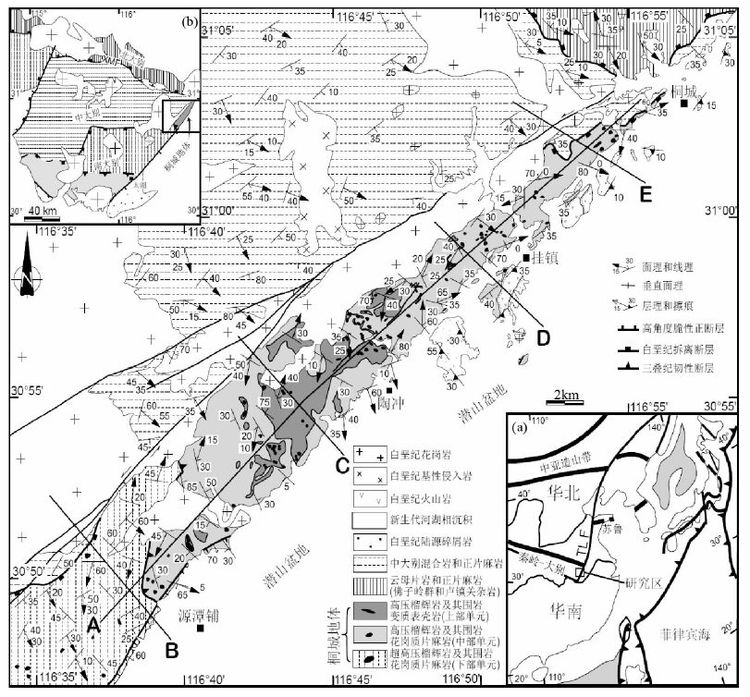
郯庐断裂带是我国东部一条NNE向延伸的巨型断裂体系(图 1a)。长期以来,它的形成和演化过程一直是国内外研究的热点。郯庐断裂带自被发现以来,大量的研究累积了丰富的构造地质学资料和年代学数据(徐嘉炜,1980; Xu et al., 1987; 徐嘉炜和马国锋,1992; Xu and Zhu, 1994; 朱光等, 2001a,b,2004a,b,c,2005a,b,2006a,b,2009; 万天丰和朱鸿,1996; 万天丰等,1996; 陈宣华等,2000; 王小凤等,2000; 汤加富和许卫,2002; 宋传中等,2003; Zhang et al., 2003,2007; 王勇生等, 2005,2006; Zhu et al., 2005,2009,2010; Wang,2006; 侯明金等,2007; 吴根耀等,2007; Mercier et al., 2007; Vergély et al., 2007; 张岳桥和董树文,2008; Wang and Zhou, 2009)。虽然绝大多数学者认为郯庐断裂在中生代存在规模巨大的左行平移活动,但仍然有少数的研究者对此持有不同的看法(Mattauer et al., 1991; 邢历生等,1995; 汤加富和许卫,2002; Faure et al., 1999; 李三忠等,2009; Lin et al., 2005c,2009)。目前的研究倾向于郯庐断裂在早中生代(印支期)和晚中生代(燕山晚期,晚侏罗-早白垩世)发生过两次左旋走滑事件。前者被认为源于三叠纪华北与扬子板块的碰撞拼合过程,不同的学者从不同的角度提出了诸如转换断层(Okay and Şengör,1992; 朱光等, 2004b,c,2005a,2009; Zhu et al., 2009)、碰撞嵌入(Yin and Nie, 1993)、地壳拆离解耦(Li,1994)、枢纽断层(Chang,1996)、旋转拼合或斜向汇聚边界(Lin and Fuller, 1990; Gilder et al., 1999; 肖文交等,2000; Zhang et al., 2007; 赵田等,2014)等模式。作为后者的晚中生代左旋走滑作用最为明显且被人们广泛讨论,其构造背景被认为与古太平洋板块向欧亚大陆之下的俯冲并致使郯庐断裂在斜向挤压应力背景下产生左行压纽性平移运动(Xu et al., 1987; 王小凤等,2000; 朱光等, 2001b,2002,2004a,2005b; Zhu et al., 2005,2010; 吴根耀等,2007)。位于郯庐断裂带南段的桐城地区被认为是郯庐断裂韧性走滑剪切变形发育最明显和典型的地区之一(朱光等, 2001b,2004b,c,2006b; Zhu et al., 2005,2009; Wang,2006; 王勇生等, 2005,2006)。因此,桐城地区的构造学研究是认识郯庐断裂带构造特征及其性质的关键。
|
图 1 桐城地区地质构造图(据Lin et al., 2009修改) Fig. 1 Geological and structural map of the Tongcheng area(modified after Lin et al., 2009) |
桐城地体位于大别山高压-超高压造山带的东北缘,在区域上属于大别山和肥东-张八岭地体的连接地带(图 1b)。通过我们对大别山构造几何学、运动学的研究,总体上大别变质地体可以由北向南分为三个构造单元:北部的北淮阳构造带、中部的大别山变质核杂岩、南部从中三叠世沉积盖层到含金刚石或柯石英榴辉岩的超高压岩石单元(图 1b,Faure et al., 1999; 冀文斌等,2011)。桐城地体位于中大别变质核杂岩的东部,SE倾的脆性正断层、花岗岩侵入体及断续分布的糜棱岩带将二者分开,东部掩于晚白垩世-古近纪伸展成因的潜山盆地之下(图 1)。在挂镇附近,白垩纪的火山岩及向SE缓倾的陆相粗碎屑沉积不整合地覆盖在桐城地体变质岩之上,控制沉积盆地的向NW陡倾的边界正断层位于其东侧(图 1、图 2D)。在空间展布上,桐城地体东缘片麻岩的面理区域走向N或NE,与其西侧中大别穹隆北部总体NW-SE向的片麻理似乎并不十分协调,这被认为是郯庐断裂走滑剪切过程中被动牵引弯曲的结果(朱光等, 2001b,2004b,c; 王勇生等,2005)。自从桐城地区发现榴辉岩以来,最初的研究将桐城地体归属于南大别超高压变质地体的北东分支(Cong et al., 1994)。自魏春景等(1998)报道在桐城南部江岭地区的榴辉岩经历过超高压变质作用,桐城地体的岩石学和构造学研究才随后引起了大家的重视(吴维平等,2000; 石永红等, 2006,2008; Lin et al., 2009)。传统认为桐城地体的成因是郯庐断裂走滑作用将南大别超高压变质岩平移至此,因而大别山东缘也自然成为研究郯庐断裂构造演化的热点靶区(侯明金等,2007; Mercier et al., 2007; Vergély et al., 2007; 朱光等, 2001b,2004b,c,2009; Zhu et al., 2005,2009; 王勇生等, 2005,2006)。然而,在空间展布上,桐城地体区域片麻理主体倾向NE或SW,与其西侧中大别穹隆东部总体具有SE倾向片麻理似乎并不十分协调(图 1)。同时我们通过对桐城地体榴辉岩矿物组成和温压条件的研究表明这些榴辉岩并非全部为超高压榴辉岩,其主体具有从低温高压至中温高压榴辉岩的特点(石永红等, 2006,2008; Lin et al., 2009)。桐城地区的构造解析工作及中大别早白垩世变质核杂岩的确定,使我们对桐城地体西部NE-SW走向面理的成因给出了不同于走滑作用的解释(Lin et al., 2009,2015; 冀文斌等,2011; 林伟等,2013)。本文在前期构造学和相关岩石学研究的基础上,结合近年来详细的野外构造观察和室内相关工作,重新对桐城地体成因的构造背景及其对郯庐断裂的制约进行了探讨。
|
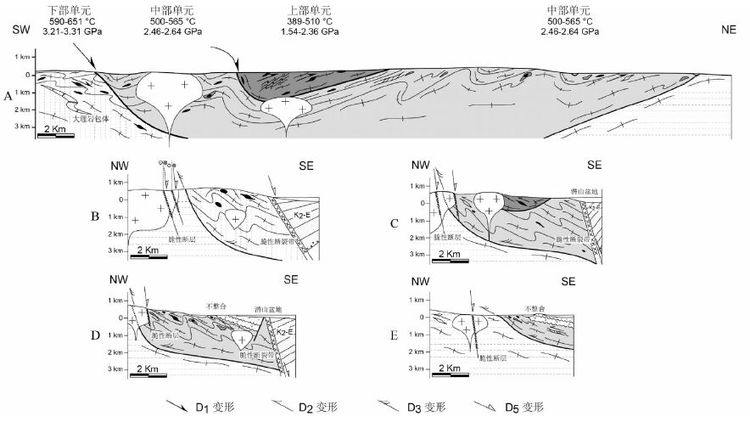
图 2 桐城地体具有不同峰期变质条件的构造岩片剖面图(剖面位置见图 1,据Lin et al., 2009修改) Fig. 2 Cross-sections through the Tongcheng massif containing HP-UHP slices with different peak metamorphic conditions(locations see Fig. 1,modified after Lin et al., 2009) |
桐城地体展布面积约300km2,主要由变质表壳岩以及含绿帘石的石榴二长花岗片麻岩、石榴云母斜长片麻岩组成(图 1)。变质表壳岩主要为石榴黑云母片岩和少量的石榴二云母片岩,其中含有榴辉岩、斜长角闪岩,局部可见些许的混合岩化现象。榴辉岩主要呈透镜状或布丁状,少数呈似层状包含于变质表壳岩及石榴二长花岗片麻岩中。近年来,详细的岩石学和构造学研究工作表明:桐城地体的总体几何形态表现为具有弱NE极性的不对称复式向形构造,其由一系列向E-SE中-低角度(20°~50°)缓倾的面理叠加在早期NW-SE走向面理之上的堆叠岩片构成,并记录了大别山构造演化过程中的多期变形事件。桐城地体次一级构造单元划分具三分性的特点,从空间上可以分为下-中-上三个单元(图 2)。变质条件从下到上依次:超高压变质作用、中温-高压变质作用和低温-高压变质作用。岩石学的研究结果同构造几何形态的匹配十分契合。
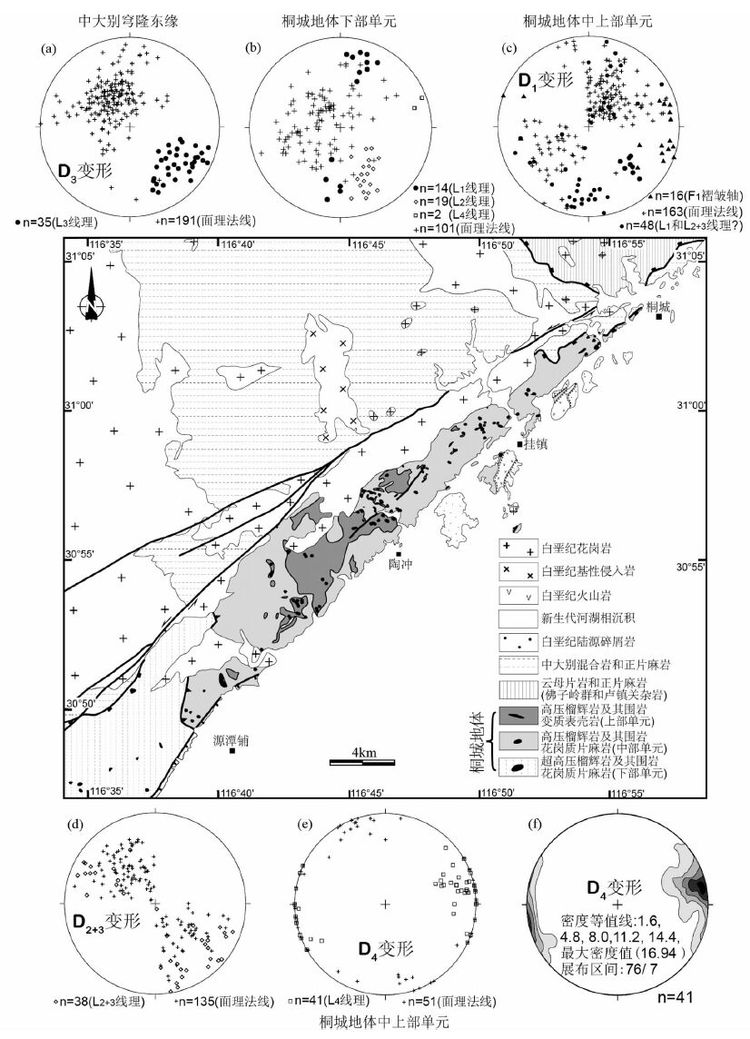
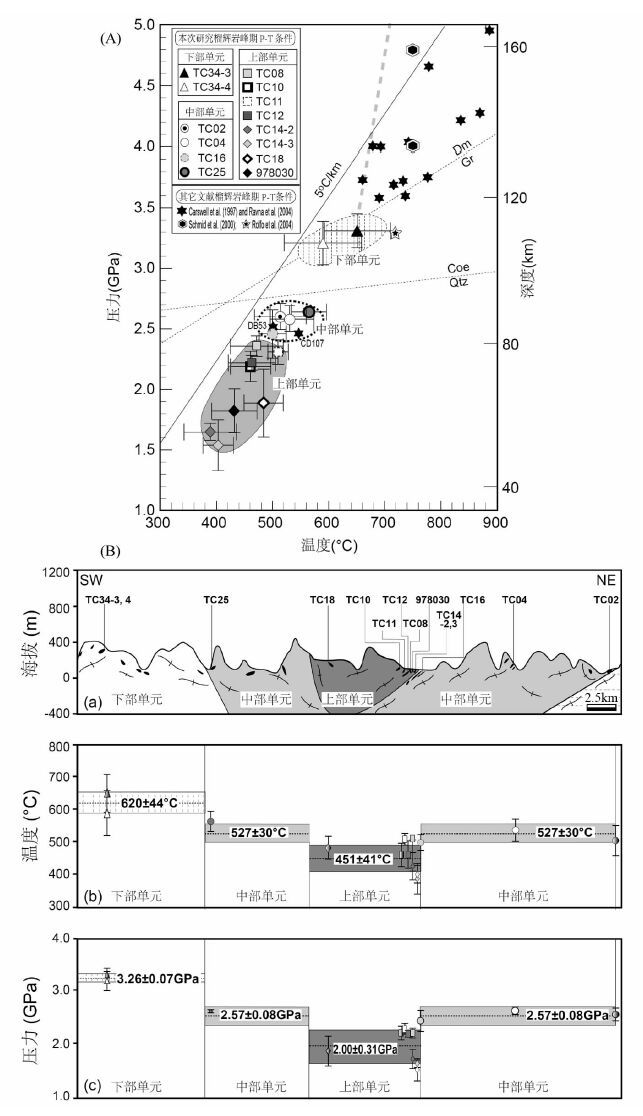
3.1 下部单元下部单元出露在桐城地体南部源潭铺以南地区,总体上由含榴辉岩的花岗片麻岩和副片麻岩组成,其构成南大别超高压变质地体的东北部(图 1)。榴辉岩、硬玉石英岩、超镁铁质岩和大理岩以团块状、透镜状、布丁状和层状展布其中。柯石英及柯石英假象的存在说明了下部单元经历了超高压变质作用(石永红等,2006; Lin et al., 2009)。下部单元的构造几何特征总体上表现为WNW-ESE走向的背形构造(图 2A)。花岗片麻岩和副片麻岩中发育的面理以30°~50°的中等角度倾向SW或NE,区域面理上间或发育定向多硅白云母、石英甚至绿辉石所指示的NNE-SSW向矿物拉伸线理(图 3b)。靠近单元西部更广大的范围内NE-SW走向并向SE中等或缓倾的面理发育,而其线理组成除了高压-超高压稳定矿物外还发育有冻蓝闪石,指示了稍晚一期构造变形的叠加(图 2B、图 3b)。这期稍晚的构造变形在南大别超高压单元广泛存在,被解释为超高压变质岩石折返过程的主期变形记录(Faure et al., 1999,2003; Lin et al., 2007,2009)。本次研究通过从源潭铺以西采集的榴辉岩样品TC34-3和TC34-4进行温压条件的计算。通常这些榴辉岩由30%~50%的石榴石、30%~40%绿辉石、5%多硅白云母、1%~3%的金红石和1%~5%蓝晶石所组成;同时含有或多或少的冻蓝闪石、绿帘石、钠云母、钠长石、透辉石、韭闪石,镁质闪石、黑云母和石英。平衡矿物温压计算表明下部单元经历了超高压变质作用,其变质温压条件为590~651℃和3.21~3.31GPa(图 4A; Lin et al., 2009)。
|
图 3 桐城地体不同构造单元构造要素的统计结果(均为施密特网等面积下半球投影) Fig. 3 Structural elements of the Tongcheng Massif(all diagrams are equiareal Schmidt net,lower hemisphere projection) |
|
图 4 桐城地区三个地质单元的榴辉岩变质峰期温压条件 (A)桐城地区三个不同变质单元榴辉岩的峰期变质P-T条件其及与其它榴辉岩(Carswell et al., 1997; Schmid et al., 2000; Ravna and Terry, 2004; Rolfo et al., 2004)峰期变质P-T条件比较投影图(据Lin et al., 2009修改);(B)桐城地区沿剖面A(见图 2)三个不同变质单元的温度压力图解:(a)地质剖面;(b)温度变化图;(c)压力变化图(据Lin et al., 2009修改) Fig. 4 Peak metamorphic P-T condition of eclogites from the three units of Tongcheng massif (A)peak metamorphic P-T values of eclogites from the three units, and other peak P-T values from different authors(Carswell et al., 1997; Schmid et al., 2000; Ravna and Terry, 2004; Rolfo et al., 2004)for comparison(modified after Lin et al., 2009);(B)peak P-T values of eclogites from the three units projected along the profile A(see Fig. 2):(a)geological profile;(b)variation of peak temperatures;(c)variation of peak pressures(modified after Lin et al., 2009) |
在源潭铺镇西部,下部单元和中部单元被倾向NE倾角30°~50°的强变形带所分隔(图 1、图 2A)。中部单元总体上是由一系列褶皱所形成的向形和背形构造组成;在陶冲镇的西部,上部单元构成了向形构造。野外详细的面理测量表明向N或NE倾的面理产状较陡,而向S或SW倾的面理较缓(图 2A)。在这些具有NE极性的褶皱面理上发育最为明显的是NNE-SSW向矿物拉伸线理(图 3c)。其构成中部单元最为典型的线性构造。如同下部单元,中部单元这期线性构造同样被后期具有SE倾向的面理及NW-SE向线理所改造(图 2C-E、图 3d)。在中部单元,榴辉岩呈条带状、透镜状或布丁状赋存于长英质的片麻岩之中,其矿物组合为石榴石(30%~40%)、绿辉石(20%~30%)、多硅白云母(5%~10%)、金红石(1%~5%)和蓝晶石(1%~5%),同时含有少量的冻蓝闪石、钠云母、绿帘石、钠长石、透辉石、韭闪石,镁质闪石、黑云母和石英。中部单元所采集的四个样品(TC02、TC04、TC16和TC25)在矿物平衡下温压计算表明这些榴辉岩具有中温-高压的特点:温度在500~565℃之间,压力范围为2.46~2.64GPa(图 4A; Lin et al., 2009)。
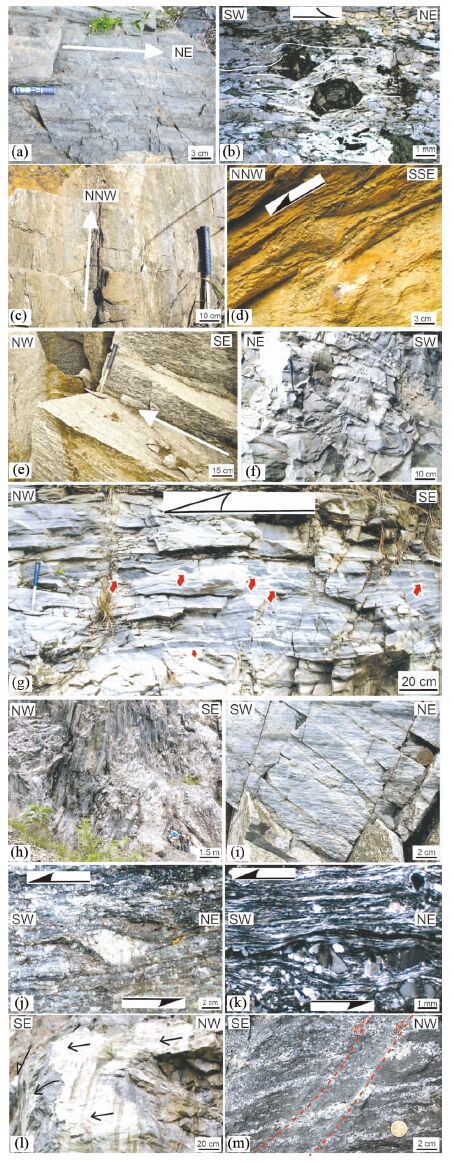
3.3 上部单元在空间展布上,上部单元位于桐城地体向形构造的核部地区。岩石组成为云母片岩、云母石英片岩、长英质片麻岩和角闪岩。榴辉岩呈透镜状或布丁状包含其中,一般与含石榴石的云母片岩和角闪岩共生,其绝大部分发生了强烈的退变质作用和岩石变形(图 5b)。矿物组合通常为石榴石(30%~40%)、绿辉石(40%~50%)、多硅白云母(3%~5%)、金红石(1%~3%)和蓝晶石(1%~3%),含有少量的冻蓝闪石、绿帘石、钠云母、透辉石、钠长石、黑云母和石英。上部单元在野外出露的并不很好,使我们无法直接观察到其与中部单元的接触关系;但靠近接触带的云母片岩和长英质片麻岩多表现出较强的应变特点,甚至局部可以观察到糜棱岩化现象(图 5a)。褶皱面理上最为明显的线性构造为NE-SW向矿物拉伸线理,这也是桐城地体发育最为广泛的线理方向(图 3c、图 5a)。上部单元的矿物拉伸线理多由定向发育的石英、白云母、角闪石和绿帘石所组成。通过石榴石-绿辉石温度计和石榴石-绿辉石-多硅白云母压力计的计算,上部单元中八个榴辉岩样品(TC08、TC10、TC11、TC12、TC14-2、TC14-3、TC18和978030)均指示了其榴辉岩处于低温-高压环境,峰期变质条件为389~510℃和1.54~2.36GPa(图 4A; Lin et al., 2009)。
|
图 5 桐城地区多期变形特征 (a)上部单元退变榴辉岩发育的NNE-SSW向矿物拉伸线理(L1);(b)旋转定向的石榴石及其周缘的石英指示了D1上部向NE的剪切变形;(c)下部单元糜棱岩化的花岗质片麻岩中发育的NNW-SSE向的矿物拉伸线理(L2);(d)下部单元副片麻岩中旋转定向的石榴石及周缘的压力影指示了D2上部向NNW的剪切变形;(e)下部单元同中大别穹隆之间拆离断层中的“L”型构造岩(L3);(f)中大别穹隆东缘发育的同斜褶皱,褶皱轴的方向平行于L3;(g)中大别穹隆东缘靠近桐城地体拆离带发育的角闪岩被剪切成布丁状指示了D3上部向NW的剪切变形;(h)桐城西部与D4变形相关的ENE-WSW走向的近直立面理;(i)D4相关近直立面理上发育的近水平半透入性线理(L4);(j)σ状石英脉指示了D4左行剪切变形;(k)薄片中剪切变形的石英和长石指示了D4左行剪切变形;(l)D5相关断裂带中向SE倾的镜面及擦痕;(m)D5相关的高角度正断层 Fig. 5 Photographs showing polyphase deformation in Tongcheng massif (a)NNE-SSW trending mineral stretching lineation(L1)developed in retrograted eclogite of the upper unit;(b)spin rotated garnet with surrouding quartz indicates a top-to-the-NE shearing related to the D1 deformation;(c)NNW-SSE trending mineral stretching lineation(L2)developed in mylonitc orthogneiss of the lower unit;(d)rotated garnet with pressure shadow in paragneiss of the lower unit indicates a top-to-the-NNW shearing related to the D2 deformation;(e)L-type(L3)tectonite in the detachment fault between the lower unit and the central Dabieshan dome;(f)isoclinal fold with axis parallel to the L3 in the eastern margin of the central Dabieshan dome;(g)amphibolite layer was sheared into boudins by the detachment fault along the eastern margin of the central Dabieshan dome,indicting a top-to-the-NW sense of shear related to the D3 deformation;(h)nearly vertical foliation with ENE-WSW striking related to the D4 deformation in the west of Tongcheng;(i)penetrative lineation(L4)developed on subvertical foliation related to the D4 deformation;(j)Sigmoidal quartz vein indicates sinistral shearing related to the D4 deformation;(k)Sigm-type porphyroclasts in quartz-feldspar mylonite,showing sinistral shearing related to the D4 deformation;(l)slickenside and the fault striae related to D5 deformation;(m)high-angle brittle normal fault related to D5 deformation |
综上所述,桐城地体的榴辉岩主体为高压变质条件,特别是作为我们研究重点的上部和中部单元。我们将三个不同单元榴辉岩的峰期变质条件进行归纳得到如下结果(图 4B; Lin et al., 2009):
1)上部单元:峰期温度为389~510℃,统计平均为451±41℃;峰期压力为1.54~2.36GPa,统计平均为2.00±0.31GPa;
2)中部单元:峰期温度为500~565℃,统计平均为527±30℃;峰期压力为2.46~2.64GPa,统计平均为2.57±0.08GPa;
3)下部单元:峰期温度为590~651℃,统计平均为620±44℃;峰期压力为3.21~3.31GPa,统计平均为3.26±0.07GPa;
桐城地体三个不同单元榴辉岩的峰期变质条件表现出明显的不一致性,表明它们代表了不同的构造岩片(图 4B)。其中下部单元同中部单元的温压条件存在约90℃和0.7GPa的差异;即使考虑到误差的影响,这种差异可以换算成至少15km地壳厚度的差异。中上部单元温压差别却不大,将误差考虑在内,至少0.2GPa的压力差依然可以造成约5km的地壳厚度变化。需要指出的是,不同变质条件的榴辉岩沿NE-SW向的空间分布与构造几何学的研究结果吻合得相当好,即三个不同构造岩片所构成的堆叠体系与三个不同分区榴辉岩的峰期变质条件的空间变化相对应(图 4B)。
4 桐城地体多期构造变形解析
除了白垩纪的花岗岩和沉积岩,桐城地体绝大部分变质岩展现了透入性的面状和线性构造。总体构造行迹表现为一个明显的复式向形构造,两翼则体现了系列的背-向形构造特点,褶曲的面理具有NE或SW的倾向及向NE的褶皱极性(图 2A、3b,c)。上部单元低温-高压榴辉岩及其围岩变质表壳岩构成了向形构造的核部,而由中温-高压榴辉岩及其围岩花岗质片麻岩组成的中部单元则构成了向形的两翼。在地体北部可见SE倾的糜棱岩带分隔了桐城地体的高压变质岩和中大别的混合岩及花岗岩;在地体的南部NE倾的糜棱岩带之下发育的下部单元具有超高压的变质特征(图 1)。正如上一节所述,三个单元中NW-SE走向的面理叠加了晚期枢纽为NE-SW方向的褶皱并向E或SE缓倾(图 3d)。不同尺度的构造观察揭示桐城地体在构造演化过程中记录了与整个大别造山带一致的多期构造变形事件。在研究区及其邻区至少识别出五期构造变形事件,由早到晚分别记为D1至D5。
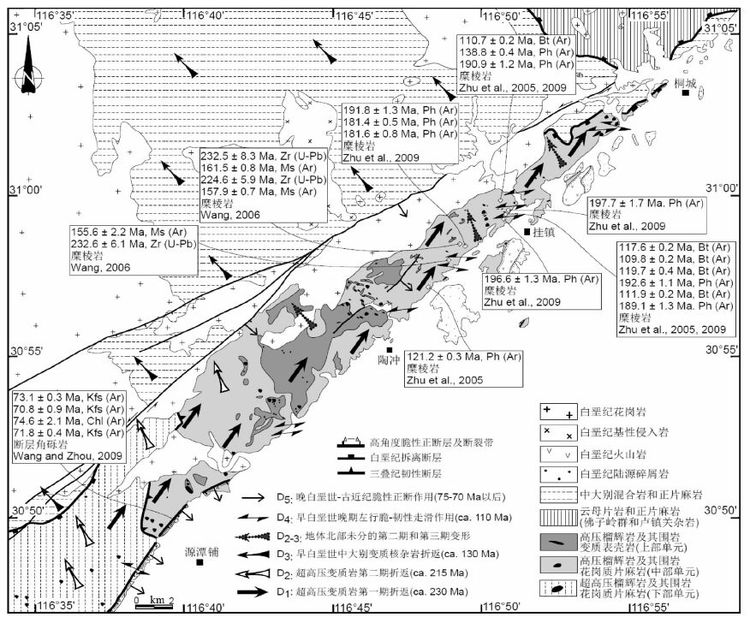
4.1 D1变形的特点及时代D1变形在整个桐城地体三个不同的构造单元中均有明显发育,构成了桐城地体的主期变形。总体上似乎具有上强下弱的特点,地体南部的下部单元D1保留较为微弱,仅在细节处有所体现。D1变形最大的特点是NNE-SSW向的矿物拉伸线理和上部向NNE(top-to-the-NNE)的运动学(Lin et al., 2009)。构造要素的赤平投影显示L1的极值方向在180°~200°(图 3b,c)。无论是代表高压变质的矿物如石榴石、绿辉石和多硅白云母,还是退变质矿物如冻蓝闪石和钠长石以及稳定的石英和绿帘石均构成了这期变形的矿物拉伸线理(图 5a)。前人的野外工作也观察到了沿此线理方向发育的同斜褶皱(吴维平等,2000)。虽然晚期的退变质和构造叠加使D1变形受到了明显的改造,但野外及镜下沿线理方向岩石的剪切变形均给出了上部向NNE的运动学(图 5b、图 6)。此外,野外向NE极性的褶皱也证实了D1主期变形的运动学特点(图 2A)。
|
图 6 桐城地体多期变形的运动学图解及年代学数据(据Lin et al., 2009修改) Fig. 6 Kinematic map for the different tectonic events in Tongcheng area, and available geochronological data are indicated(modified after Lin et al., 2009) |
关于D1变形的年代学研究资料较为丰富,Wang(2006)对作为中温-高压榴辉岩围岩的花岗质岩石进行了SHRIMP锆石U-Pb定年,结果给出了225~233Ma的年龄(图 6)。在红安-大别山地区,这组230Ma左右的锆石年龄代表了高压-超高压变质岩的峰期变质时代(Ames et al., 1993,1996; Rowley et al., 1997; Hacker et al., 1998,2006; Liu and Liou, 2011)。在研究区北部的巢湖地区,可见褶皱的震旦系-中三叠统被未变形的下侏罗统不整合覆盖(安徽省区域地质志,1987)。因此,我们推断D1变形的时间接近中-晚三叠世,它代表了高压-超高压变质岩在同碰撞早期的构造折返(Lin et al., 2009; 林伟等, 2005a,b,2013)。来自桐城地体中剪切带糜棱岩的白云母40Ar/39Ar定年结果给出了181~198Ma的年龄,被解释为与郯庐断裂同碰撞期间左行走滑相关的冷却年龄(Zhu et al., 2009; 朱光等,2009)。但实际上相近的年龄结果并不局限在郯庐断裂附近,在整个红安-大别山高压-超高压造山带中均广泛存在(Eide et al., 1994; Hacker and Wang, 1995; Hacker et al., 1995,2000; Webb et al., 1999; Xu et al., 2000)。从这个角度我们更倾向于将这组早侏罗世的40Ar/39Ar年龄解释为与区域上高压-超高压变质岩折返相关的冷却年龄。
4.2 D2和D3变形的特点及时代
桐城地体不同的单元与D1变形相关的NW-SE向面理受到了后期变形不同程度的叠加改造,在一些地区面理表现为倾向E或SE(图 3b,d)。一般简单地认为这些晚期的透入性面理是中大别穹隆作用产生的结果(Lin et al., 2009)。但实际的构造过程要复杂得多,在地体不同的构造单元表现有所差异。代表桐城地体主期变形的线理L1在地体南部的下部单元中仅有少许表现,相反在与下部单元相连的更大范围的南大别超高压变质地体中,NNW-SSE向线性构造却为我们在野外观察到的非常重要的矿物拉伸线理方向(图 3b,d)。我们将这期NNW-SSE的线性构造称之为L2,它虽不是桐城地体主期变形的结果,但却与南大别高压-超高压变质地体主变形期的构造特点相吻合(Faure et al., 2003; 林伟等, 2003,2005a,2013; Shi et al., 2014)。石英、多硅白云母、绿帘石、绿辉石、石榴石甚至代表退变质的冻蓝闪石的定向排列均指示了L2矿物拉伸线理的展布方向(图 5c)。这说明D2变形不仅发生在高压-超高压的变质条件下,而且在退变质过程中也表现得十分明显。D2变形的运动学特点为上部向NNW(top-to-the-NNW)的剪切变形,无论是野外露头还是镜下薄片的观察均指示了一致的剪切方向(图 5d)。对于研究区D2变形的时间尚缺乏很好的年代学约束,只能通过区域上的对比加以限定。事实上,整个红安-大别山-苏鲁造山带对这一期构造变形具有非常明显的表现和记录,它代表了高压-超高压岩石在同碰撞晚期最主要的构造折返,变形时间大致可以约束在晚三叠世215Ma左右(林伟等, 2003,2005a,b,2013)。高压-超高压变质岩在225~205Ma期间的角闪岩相退变质及其相关部分熔融事件就发生在这一期折返过程中(Zheng et al., 2011; Chen et al., 2013)。
研究区D3变形主要发育在桐城地体西侧拆离断层之下的中大别穹隆中(图 1)。突出的几何学特点是作为穹隆东缘向E或SE中低角度缓倾的面理及向SE倾的矿物拉伸线理L3(图 3a)。区域上L3线性构造的展布方向在中大别穹隆地区从110°到165°分布较散,但总体上以NW-SE向为主(冀文斌等,2011; Wang et al., 2011; Lin et al., 2015)。石英、绿帘石、黑云母、白云母、长石和角闪石为构成线理的主要矿物,指示了岩石变形发生在角闪岩相条件下(图 5e)。野外同样可以观察到沿NW-SE向展布同斜褶皱(图 5f)。与D3相关的岩石剪切变形特征十分鲜明,无论野外露头还是镜下薄片的观察均指示了上部向NW(top-to-the-NW)的运动学(图 5g、图 6)。中大别穹隆的形成与这一期构造事件密切相关,我们将其成因机制解释为伸展背景下的变质核杂岩(冀文斌等,2011; 林伟等,2013; Lin et al., 2015)。关于D3变形的时代研究已经积累了大量的年代学数据,无论是拆离断层还是穹隆核部杂岩的Ar-Ar年代学结果多介于145~120Ma(Eide et al., 1994; Hacker et al., 1995; Hacker and Wang, 1995; Ratschbacher et al., 2000; Wang et al., 2011; 冀文斌等,2011)。我们的最新研究表明,中大别变质核杂岩拆离断层活动的峰期时间在ca.130Ma左右,并且在131~125Ma期间存在一个快速的冷却过程(Lin et al., 2015)。这些结果使我们认识到D3变形所代表的伸展构造发生在早白垩世,与欧亚大陆东部大规模伸展构造发育的时限相吻合(Lin and Wang, 2006)。
如上所述,桐城地体作为中大别变质核杂岩上盘的一部分,发育有NW-SE或NNW-SSE向矿物拉伸线理,同时岩石变形的运动学也表现为上部向NW或NNW的剪切变形。然而由于L2和L3线理的展布方向在一定程度上存在重叠现象(图 3a,b,d),这使我们很难非常明确地从线性构造的角度上(NW-SE或NNW-SSE)将两者精确地加以区分。从整个大别山来看,D2和D3具有不同的构造背景,两者在时代上也存在很大的差异。桐城地体的40Ar/39Ar年代学结果集中在181~198Ma和110~139Ma两个年龄段,一般认为这些年龄代表了不同矿物在其对应封闭温度时的冷却年龄(图 6; Zhu et al., 2005,2009)。在空间分布上这两组年龄往往也重叠在一起,这使我们很难从同位素年代学的角度去判断中-上部单元中上部向NW或NNW的剪切变形为D2还是D3。一种可能的解释是:由于桐城地体中-上部单元的厚度较薄且空间位置靠近中大别穹隆的拆离断层,这在一定程度上造成与早白垩世中大别变质核杂岩相关的构造变形在其上盘有所表现。但目前由于野外出露条件和工作详细程度的限制,我们还很难通过构造几何学的研究从细节上在桐城地体中精确地划分出D2和D3的影响区域。
4.3 D4变形的特点及时代在桐城地体的东缘,详细的野外观察指示了D4变形特点:透入性的ENE-WSW向近直立面理叠加在早期的面理之上,近水平展布的线性构造表现为矿物拉伸线理或半透入性的擦痕(slickenline)(图 3e、图 5h,i)。这些透入性及半透入性的线性构造在统计上主体沿76°/7°的发育于花岗片麻岩、角闪岩和白垩纪二长花岗岩之中(图 3f)。D4变形总体以脆-韧性为特点,构造层次较浅,且在空间上表现出不均一性。在地体北部的桐城以西地区,近E-W走向的糜棱岩或超糜棱岩面理上,黑云母和强烈拉伸定向的石英构成了最为明显的线性构造。在薄片下可见强烈剪切的石英条带,显示了巨大的晶体内塑性形变。关于岩石剪切变形的运动学,无论是野外露头尺度还是薄片尺度均指示了左行剪切的特点(图 5j,k、图 6)。D4左行剪切变形同样具有脆性错断特征,沿剪切带或断裂带发育有微角砾岩、玻化岩、黑色超糜棱岩、熔结碎裂岩等浅层次岩石(张家声等,2003; 刘建民等,2005)。关于D4变形的时代,朱光等(Zhu et al., 2005,2009)开展了大量的同位素年代学工作,糜棱岩中云母类矿物的40Ar/39Ar年龄结果介于110~139Ma较为宽泛的区间(图 6)。而Wang(2006)的白云母40Ar/39Ar定年却获得了156~162Ma的年龄,并认为这期构造事件发生在晚侏罗世(图 6)。然而整个高压-超高压造山带明显缺乏侏罗纪构造变形的记录,结合区域构造演化我们更倾向于认为D4变形发生在朱光等所界定的早白垩世晚期(110Ma左右; Zhu et al., 2005,2009)。
4.4 D5变形的特点及时代这是我们在野外能够识别的最晚一期有区域代表性的构造变形事件。在桐城地体南部源潭铺以西地区,50~500m宽的脆性断裂带分隔了下部单元的片麻岩和晚白垩世-第三纪的陆源碎屑沉积岩,后者构成了潜山半地堑盆地的填充物(图 2B-D)。在高压-超高压变质岩和白垩纪花岗岩中发育的D5脆性变形具有30°~70°走向且高角度(>60°)倾向SE的断层面;断层面上所发育的擦痕沿倾向展布(图 2B-D、图 5l)。断层阶步和错断的标志层均指示了上盘(东部)下滑的正断特点(图 5m、图 6)。正是D5变形SE陡倾的脆性正断作为边界控制了潜山半地堑盆地的形成和发展,以及西部大别山的垂直隆升(安徽省地质矿产局,1987; 朱光等,2001a)。断层岩中钾长石和绿泥石的40Ar/39Ar定年得到了75~70Ma的年龄,可以解释为D5变形的开始时间(Wang and Zhou, 2009)。桐城地区磷灰石裂变径迹的研究结果也揭示了这期伸展构造事件发生在70~40Ma较长的时段内(Grimmer et al., 2002; Hu et al., 2006)。事实上,晚白垩世-第三纪的伸展构造不仅在大别山地区,而且在整个中国东部均有广泛的发育,如邻近的苏北盆地和江西北部的鄱阳盆地(Lin et al., 2000; 陈安定,2001; Ren et al., 2002)。其动力学机制通常被归结为在太平洋俯冲的弧后拉张及叠加其上的印度与欧亚大陆碰撞的远程效应(Ratschbacher et al., 2000; Grimmer et al., 2002)。
5 讨论与结论 5.1 D1变形的动力学背景D1代表了桐城地体的主期变形,特点为NNE-SSW向矿物拉伸线理及上部向NNE的剪切变形。在区域上,D1构造事件在整个红安-大别山均有迹可循:南大别太湖地区高压-超高压地体和宿松杂岩中所残留的早期折返变形(Shi and Wang, 2006; Shi et al., 2014);北淮阳地区浅变质岩中所发育的近N-S向矿物拉伸线理及上部向N的剪切变形(Faure et al., 2003; 林伟等,2005b);在西大别红安地区相似的变形特征分布更为广泛,并构成了红安地体的主期变形(林伟等,2013)。从造山带尺度上,我们将D1构造变形事件解释为高压-超高压变质岩在同碰撞背景下的最早一期构造折返(林伟等,2013)。需要强调的是D1变形时代的同位素年代学在造山带整体上不同区域具有很好的可对比性(Eide et al., 1994; Hacker et al., 2000; Webb et al., 1999; Xu et al., 2000; Faure et al., 2003; Lin et al., 2005c; 林伟等, 2005a,b)。正如我们前面所提及,虽然桐城地体L1矿物拉伸线理方向与区域上郯庐断裂带走向相一致,但是与D1相关的面状构造却表现为NW-SE走向的背-向形及中-低角度倾角,使我们很难将这一构造几何形态同走滑构造联系起来。值得指出的是,D1上部向NE的剪切变形在中大别穹隆形成过程中被改造为产状陡倾时会表现出“左行走滑”的假象,因而在野外观察时需要进行构造的恢复。
5.2 D4变形的动力学背景D4变形表现为透入性的ENE-WSW向近直立面理和近水平线理,运动学指示了左行走滑的特点。D4通常被解释为郯庐断裂大规模左行走滑剪切的表现(朱光等, 2001b,2004b,c,2006b; 王勇生等, 2005,2006; Zhu et al., 2005,2009)。但与区域郯庐断裂延伸方向的不一致使我们觉得这个结论有待商榷(Lin et al., 2009)。Ratschbacher et al.(2000)早先注意到大别山东缘变质岩的面理与郯庐断裂的区域走向呈斜交的特点,并将其解释为郯庐断裂左行走滑过程中的可能分支,而真正的郯庐断裂被推断可能掩于潜山盆地之下。但这种解释似乎与肥东-张八岭地体的构造学研究结果并不匹配;特别是涉及到郯庐断裂向NE方向如何在肥东-张八岭地区延伸及其构造特征的问题(Lin et al., 2005c; Zhang et al., 2007; 赵田等,2014)。张家声等(2003)将这期变形解释为在中-上地壳层次由近N-S向区域挤压应力场控制的沿ENE-NE走向发育的左行走滑构造。野外观察显示D4变形的表现并不均一,其在桐城地体南部地区多表现为浅层次的脆性走滑,而向地体北部韧性变形有增强的趋势。也就是说,D4似乎具有北强南弱的特点。如果我们将其同晓天-磨子潭断裂的构造活动联系起来,D4也许可以理解为D3早白垩世NW-SE近水平伸展作用晚期所伴随的局部NNE-SSW向的收缩构造(Schmid et al., 1999; Ratschbacher et al., 2000; Mercier et al., 2007)。同位素年代学结果所给出的早白垩世晚期年龄也同这个解释相吻合(图 6)。
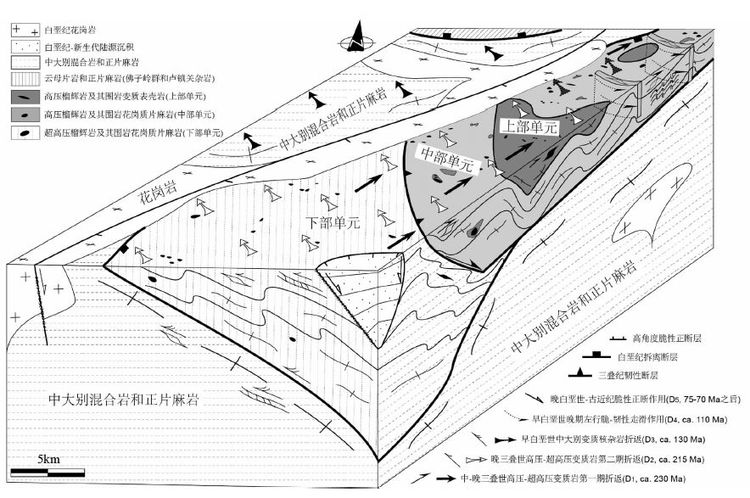
5.3 桐城地区构造演化序列及其对郯庐断裂的制约根据野外观察和室内研究,我们对桐城地区多期构造事件(D1-D5)进行了剖析,得出桐城地体构造几何形态和多期变形的三维图解(图 7):
|
图 7 桐城地体构造几何形态和多期变形的三维图解(据Lin et al., 2009修改) Fig. 7 Synthetic block diagram of the Tongcheng massif showing the bulk geometry and polyphase deformation(modified after Lin et al., 2009) |
1)D1为桐城地体的主期变形,NNE-SSW向矿物拉伸线理及上部向NNE的剪切变形,代表了大别山高压-超高压变质岩同碰撞早期的构造折返,变形时代在中-晚三叠世(230Ma左右);
2)D2为NNW-SSE向矿物拉伸线理及上部向NNW的剪切变形,叠加在D1之上,其构成大别山南部超高压变质岩的主期变形,代表了大别山高压-超高压变质岩同碰撞晚期的构造折返,变形时代在晚三叠世(215Ma左右);
3)D3为NW-SE向矿物拉伸线理及上部向NW的剪切变形,叠加在D1和D2之上,其构成大别山中部穹隆或变质核杂岩的主期变形,响应于中国东部发育的晚中生代大规模伸展构造,变形时代在早白垩世(130Ma左右);
4)D4表现为透入性的ENE-WSW向近直立面理和近水平线理,剪切变形的运动学指示了左行剪切的特点,区域构造背景可能代表着真正的郯庐断裂的走滑作用或早白垩世NW-SE近水平伸展作用晚期所伴随的局部NNE-SSW向的收缩构造及N-S向区域挤压应力场控制的沿ENE-NE走向发育的左行走滑构造有关,变形时代在早白垩世晚期(110Ma左右);
5)D5为脆性变形,走向NE并SE陡倾的脆性正断层控制了晚白垩世-古近纪潜山半地堑盆地的形成和发展。
传统认为桐城地体为超高压变质地体,是郯庐断裂左行平移南大别超高压岩石而形成的分支,但我们的岩石学和构造几何学研究表明桐城地体构造单元具有上-中-下的三分性,其所含榴辉岩主体为低温-中温高压榴辉岩(石永红等, 2006,2008; Lin et al., 2009)。特别是中-上部单元的榴辉岩保留了完好的石榴石进变质环带,其核部所保留的进变质之前的矿物如钙钠质闪石、绿帘石和钠云母包裹体均指示了高压变质条件的特点。桐城地体不同构造岩片榴辉岩温压条件所给出的空间变化规律与其构造几何学十分匹配。这一研究结果很难用郯庐断裂的走滑模式来解释桐城地体的构造属性。多期构造变形解析表明桐城地体完整记录了大别山构造演化的序列:高压-超高压变质岩三叠纪同碰撞早期和晚期两次构造折返,中大别变质核杂岩早白垩世的折返,大别山晚白垩世-古近纪的垂直隆升及相应半地堑盆地的发育过程。目前,大别山东缘的郯庐断裂主要表现为晚白垩世-第三纪伸展成因的正断层(Mattauer et al., 1991; Faure et al., 1999; Ratschbacher et al., 2000)。除早白垩世晚期可能发育的走滑构造外,我们的研究结果并不支持大别山东缘记录了大规模的走滑作用(Xu et al., 1987; Zhu et al., 2005,2009; 万天丰和朱鸿,1996)。
致谢 非常感谢朱光教授的邀请,使我们能够有机会组织这篇文稿与广大同行探讨大别山高压-超高压造山带及郯庐断裂的构造演化。同时感谢李三忠教授及另外一位评审人对文稿提出的建设性修改意见。
| [1] | Ames L, Tilton GR and Zhou GZ. 1993. Timing of the Sino-Korean and Yangtse cratons: U-Pb zircon of coesite-bearing eclogites. Geology, 21(4): 339-342 |
| [2] | Ames L, Zhou GZ and Xiong BC. 1996. Geochronology and isotopic character of ultrahigh pressure metamorphism with implications for collision of the Sino-Korean and Yangtze cartons, central China. Tectonics, 15(2): 472-489 |
| [3] | Bureau of Geology and Mineral Resources of Anhui Province. 1987. Regional Geology of Anhui Province. Beijing: Geological Publishing House (in Chinese) |
| [4] | Carswell DA, O'Brien PJ, Wilson RN and Zhai M. 1997. Thermobarometry of phengite-bearing eclogites in the Dabie Mountains of central China. Journal of Metamorphic Geology, 15(2): 239-252 |
| [5] | Chang EZ. 1996. Collisional orogen between North and South China and its eastern extension in the Korean Peninsula. Journal of Southeastern Asian Sciences, 13(3-5): 267-277 |
| [6] | Chen AD. 2001. Dynamic mechanism of formation of dustpan subsidence, northern Jiangsu. Geological Journal of China Universities, 7(4): 408-418 (in Chinese with English abstract) |
| [7] | Chen XH, Wang XF, Zhang Q, Chen BL, Chen ZL, Harrison TM and Yin A. 2000. Geochronologic study on the formation and evolution of Tan-Lu fault. Journal of Changchun University of Science and Technology, 30(3): 215-220 (in Chinese with English abstract) |
| [8] | Chen YX, Zheng YF and Hu ZC. 2013. Petrological and zircon evidence for anatexis of UHP quartzite during continental collision in the Sulu orogen. Journal of Metamorphic Geology, 31(4): 389-413 |
| [9] | Cong BL, Wang QC, Zhai MG, Zhang RY, Zhao ZY and Ye K. 1994. Ultra-high pressure metamorphic rocks in the Dabie-Su-Lu region, China: Their formation and exhumation. The Island Arc, 3(3): 135-150 |
| [10] | Eide EA, McWilliams MO and Liou JG. 1994. 40Ar/39Ar geochronology and exhumation of high-pressure to ultrahigh-pressure metamorphic rocks in east-central China. Geology, 22(7): 601-604 |
| [11] | Faure M, Lin W, Shu L, Sun Y and Schärer U. 1999. Tectonics of the Dabieshan (eastern China) and possible exhumation mechanism of ultra high-pressure rocks. Terra Nova, 11(6): 251-258 |
| [12] | Faure M, Lin W, Schärer U, Shu LS, Sun Y and Arnaud N. 2003. Continental subduction and exhumation of UHP rocks: Structural and geochronological insights from the Dabieshan (East China). Lithos, 70(3-4): 213-241 |
| [13] | Gilder SA, Leloup PH, Courtillot V, Chen Y, Coe RS, Zhao XX, Xiao WJ, Halim N, Cogné JP and Zhu RX. 1999. Tectonic evolution of the Tancheng-Lujiang (Tan-Lu) fault via Middle Triassic to Early Cenozoic paleomagnetic data. Journal of Geophysical Research, 104(B7): 15365-15390 |
| [14] | Grimmer JC, Jonckheere R, Enkelmann E, Ratschbacher L, Hacker BR, Blythe AE, Wagner GA, Wu Q, Liu S and Dong S. 2002. Cretaceous-Cenozoic history of the southern Tan-Lu fault zone: Apatite fission-track and structural constraints from the Dabie Shan (eastern China). Tectonophysics, 359(3-4): 225-253 |
| [15] | Hacker BR and Wang QC. 1995. Ar/Ar geochronology of ultrahigh-pressure metamorphism in central China. Tectonics, 14(4): 994-1006 |
| [16] | Hacker BR, Ratschbacher L, Webb L and Dong SW. 1995. What brought them up? Exhumation of the Dabie Shan ultrahigh-pressure rocks. Geology, 23(8): 743-746 |
| [17] | Hacker BR, Ratschbacher L, Webb L, Ireland T, Walker D and Dong SW. 1998. U/Pb zircon ages constrain the architecture of the ultrahigh-pressure Qinling-Dabie Orogen, China. Earth and Planetary Science Letters, 161(1): 215-230 |
| [18] | Hacker BR, Ratschbacher L, Webb L, McWilliams MO, Ireland T, Calvert A, Dong SW, Wenk HR and Chateigner D. 2000. Exhumation of the ultrahigh-pressure continental crust in east-central China: Late Triassic-Early Jurassic unroofing. Journal of Geophysical Research, 105(B6): 13339-13364 |
| [19] | Hacker BR, Wallis SR, Ratschbacher L, Grove M and Gehrels G. 2006. High-temperature geochronology constraints on the tectonic history and architecture of the ultrahigh-pressure Dabie-Sulu Orogen. Tectonics, 25(5): TC5006, doi: 10.1029/2005TC001937 |
| [20] | Hou MJ, Mercier J, Vergély P and Wang YM. 2007. Analyzing on geodynamics and regional tectonic evolution of the Tan-Lu fault zone (Anhui segment) and its environs. Chinese Journal of Geology, 42(2): 362-381 (in Chinese with English abstract) |
| [21] | Hu SB, Kohn BP, Raza A, Wang JY and Gleadow AJW. 2006. Cretaceous and Cenozoic cooling history across the ultrahigh pressure Tongbai-Dabie belt, central China, from apatite fission-track thermochronology. Tectonophysics, 420(3-4): 409-429 |
| [22] | Ji WB, Lin W, Shi YH, Wang QC and Chu Y. 2011. Structure and evolution of the Early Cretaceous Dabieshan metamorphic core complex. Chinese Journal of Geology, 46(1): 161-180 (in Chinese with English abstract) |
| [23] | Li SZ, Liu X, Suo YH, Liu LP, Qian CC, Liu XC, Zhang GW and Zhao GC. 2009. Triassic folding and thrusting in the Eastern Block of the North China Craton and the Dabie-Sulu orogen and its geodynamics. Acta Petrologica Sinica, 25(9): 2031-2049 (in Chinese with English abstract) |
| [24] | Li ZX. 1994. Collision between the North and South China blocks: A crustal-detachment model for suturing in the region east of the Tan-Lu fault. Geology, 22(8): 739-742 |
| [25] | Lin JL and Fuller M. 1990. Paleomagnetism, North and South China collision, and the Tan-Lu fault. Philosophical Transactions of the Royal Society of London, 331(1620): 589-598 |
| [26] | Lin W, Faure M, Monié P, Schärer U, Zhang LS and Sun Y. 2000. Tectonic of SE China: New insights from the Lushan massif (Jiangxi Province). Tectonics, 19(5): 852-871 |
| [27] | Lin W, Wang QC, Faure M, Sun Y, Shu LS and Scharer U. 2003. Different deformation stages of the Dabieshan Mountains and UHP rocks exhumation mechanism. Acta Geologica Sinica, 77(1): 44-54 (in Chinese with English abstract) |
| [28] | Lin W, Wang QC and Shi YH. 2005a. Architecture, kinematics and deformation analysis in Dabie-Sulu collision zone. Acta Petrologica Sinica, 21(4): 1195-1214 (in Chinese with English abstract) |
| [29] | Lin W, Faure M, Wang QC and Arnaud N. 2005b. Tectonic evolution of the Dabieshan orogen: In the view from polyphase deformation of the Beihuaiyang metamorphic zone. Science in China (Series D), 48(7): 886-899 |
| [30] | Lin W, Faure M, Wang QC, Monié P and Panis D. 2005c. Triassic polyphase deformation in the Feidong-Zhangbaling Massif (eastern China) and its place in the collision between the North China and South China blocks. Journal of Asian Earth Sciences, 25(1): 121-136 |
| [31] | Lin W and Wang QC. 2006. Late Mesozoic extensional tectonics in the North China Block: A crustal response to the subcontinental mantle removal? Bulletin de la Société Géologique de France, 177(6): 287-297 |
| [32] | Lin W, Enami M, Faure M, Schärer U and Arnaud N. 2007. Survival of eclogite xenolith in a Cretaceous granite intruding the Central Dabieshan migmatite gneiss dome (eastern China) and its tectonic implications. International Journal of Earth Sciences, 96(4): 707-724 |
| [33] | Lin W, Shi YH and Wang QC. 2009. Exhumation tectonics of the HP-UHP orogenic belt in eastern China: New structural-petrological insights from the Tongcheng massif, eastern Dabieshan. Lithos, 109(3): 285-303 |
| [34] | Lin W, Jin WB, Shi YH, Chu Y, Li QL, Chen ZC, Liu F and Wang QC. 2013. Multi-stage exhumation processes of the high-pressure to ultrahigh-pressure metamorphic rocks: In the view from the Tongbai-Hong'an-Dabie orogenic belt. Chinese Science Bulletin, 58(23): 2259-2265 (in Chinese) |
| [35] | Lin W, Ji WB, Faure M, Wu L, Li QL, Shi YH, Scharer U, Wang F and Wang QC. 2015. Early Cretaceous extensional reworking of the Triassic HP-UHP metamorphic orogen in Eastern China. Tectonophysics, 662: 256-270 |
| [36] | Liu FL and Liou JG. 2011. Zircon as the best mineral for P-T-time history of UHP metamorphism: A review on mineral inclusions and U-Pb SHRIMP ages of zircons from the Dabie-Sulu UHP rocks. Journal of Asian Earth Sciences, 40(1): 1-39 |
| [37] | Liu JM, Dong SW, Zhang JS, Liu XC and Chen BL. 2005. Microstructure characteristics of pseudotachylites from the eastern Dabieshan orogenic belt and their tectonic implications. Acta Geoceientica Sinica, 26(3): 229-234 (in Chinese with English abstract) |
| [38] | Mattauer M, Matte P, Maluski H, Xu Z, Zhang QW and Wang YM. 1991. Palaeozoic and Triassic plate boundary between North and South China: New structural and radiometric data on the Dabie-shan (eastern China). Comptes Rendus Académie des Sciénces, 312: 1227-1233 |
| [39] | Mercier JL, Hou MJ, Vergély P and Wang YM. 2007. Structural and stratigraphical constraints on the kinematics history of the southern Tan-Lu Fault Zone during the Mesozoic Anhui Province, China. Tectonophysics, 439(1-4): 33-66 |
| [40] | Okay AI and Şengör AMC. 1992. Evidence for intracontinental thrust related exhumation of the ultra-high-pressure rocks in China. Geology, 20(5): 411-414 |
| [41] | Ratschbacher L, Hacker BR, Webb LE, McWilliams M, Ireland T, Dong SW, Calvert A, Chateigner D and Wenk HR. 2000. Exhumation of ultrahigh-pressure continental crust in east central China: Cretaceous and Cenozoic unroofing and the Tan-Lu fault. Journal of Geophysical Research, 105(B6): 13303-13338 |
| [42] | Ravna EJK and Terry MP. 2004. Geothermobarometry of UHP and HP eclogites and schists: An evaluation of equilibria among garnet-clinopyroxene-kyanite-phengite-coesite/quartz. Journal of Metamorphic Geology, 22(6): 579-592 |
| [43] | Ren JY, Tamaki K, Li ST and Zhang JX. 2002. Late Mesozoic and Cenozoic rifting and its dynamic setting in eastern China and adjacent areas. Tectonophysics, 344(3-4): 175-205 |
| [44] | Rolfo F, Compagnoni R, Wu WP and Xu ST. 2004. A coherent lithostratigraphic unit in the coesite-eclogite complex of Dabie Shan, China: Geologic and petrologic evidence. Lithos, 73(1-2): 71-94 |
| [45] | Rowley DB, Xue F, Tucker RD, Peng ZX, Baker J and Davis A. 1997. Ages of ultrahigh pressure metamorphism and protolith orthogneisses from the eastern Dabie Shan: U/Pb zircon geochronology. Earth and Planetary Science Letters, 151(3-4): 191-203 |
| [46] | Schmid JC, Ratschbacher L, Hacker BR, Gaitzsch I and Dong SW. 1999. How did the foreland react? Yangtze foreland fold-and-thrust belt deformation related to exhumation of the Dabie Shan ultrahigh-pressure continental crust (eastern China). Terra Nova, 11(6): 266-272 |
| [47] | Schmid R, Franz L, Oberhänsli R and Dong SW. 2000. High-Si phengite, mineral chemistry and P-T evolution of ultra-high-pressure eclogites and calc-silicates from the Dabie Shan, eastern China. Geological Journal, 35(3-4): 185-207 |
| [48] | Shi YH and Wang QC. 2006. Changes in the peak P-T conditions across the upper contact of the UHP terrane, Dabie Shan, China: Gradational or abrupt? Journal of Metamorphic Geology 24(9): 803-822 |
| [49] | Shi YH, Lin W and Wang QC. 2006. Peak P-T conditions for eclogites across the Tongcheng-Yuantanpu region and its tectonic setting. Acta Petrologica Sinica, 22(9): 2315-2324 (in Chinese with English abstract) |
| [50] | Shi YH, Lin W and Wang QC. 2008. The P-T path with increasing temperature during retrograde metamorphism for the low-temperature and high-pressure eclogites from Leizhuang across Tongcheng area in Dabie Mountains and its tectonic significance. Acta Petroloica Sinica, 24(8): 1759-1770 (in Chinese with English abstract) |
| [51] | Shi YH, Lin W, Ji WB and Wang QC. 2014. The architecture of the HP-UHP Dabie massif: New insights from geothermobarometry of eclogites, and implication for the continental exhumation processes. Journal of Asian Earth Sciences 86(2): 38-58 |
| [52] | Song CZ, Zhu G, Liu Y, Niu ML and Liu GS. 2003. Deformation features and isotopic ages of the Feidong ductile shear belt in the Tan-Lu fault zone and its tectonic implication. Geological Review, 49(1): 10-16 (in Chinese with English abstract) |
| [53] | Tang JF and Xu W. 2002. No huge strike slip in the southern sector of the Tancheng-Lujiang fault: Tectonic evidence from Anhui Province. Geological Review, 48(5): 449-456 (in Chinese with English abstract) |
| [54] | Vergély P, Hou MJ, Wang YM and Mercier JM. 2007. The kinematics of the Tan-Lu fault zone during the Mesozoic-Palaeocene and its relations with the North China-South China block collision (Anhui Province, China). Bulletin de la Société Géologique de France, 178(5): 353-365 |
| [55] | Wan TF and Zhu H. 1996. The maximum sinistral strike-slip and its forming age of Tancheng-Lujiang fault zone. Geological Journal of Universities, 2(1): 14-27 (in Chinese with English abstract) |
| [56] | Wan TF, Zhu H, Zhao L, Lin JP, Cheng J and Chen J. 1996. Formation and evolution of Tancheng-Lujiang fault zone: A review. Geoscience, 10(2): 159-168 (in Chinese with English abstract) |
| [57] | Wang XF, Li ZJ, Chen BL, Chen XH, Dong SW, Zhang Q et al. 2000. The Tan-Lu Fault Zone. Beijing: Geological Publishing House (in Chinese) |
| [58] | Wang Y. 2006. The onset of the Tan-Lu fault movement in eastern China: Constraints from zircon (SHRIMP) and 40Ar/39Ar dating. Terra Nova, 18(6): 423-431 |
| [59] | Wang Y and Zhou S. 2009. 40Ar/39Ar dating constraints on the high-angle normal faulting along the southern segment of the Tan-Lu fault system: An implication for the onset of eastern China rift-systems. Journal of Asian Earth Sciences 34 (1): 51-60 |
| [60] | Wang YS, Zhu G, Chen W, Song CZ and Liu GS. 2005. Thermochronologic information from the Tan-Lu fault zone and its relationship with the exhumation of the Dabie Mountains. Geochimica, 34(3): 193-215 (in Chinese with English abstract) |
| [61] | Wang YS, Zhu G, Song CZ, Liu GS, Xiang BW, Li CC and Xie CL. 2006. 40Ar-39Ar geochronology records of transition from strike-slip to extension in the Tan-Lu fault zone on eastern terminal of the Dabie Mountains. Chinese Journal of Geology, 41(2): 242-255 (in Chinese with English abstract) |
| [62] | Wang YS, Xiang BW, Zhu G and Jiang DZ. 2011. Structural and geochronological evidence for Early Cretaceous orogen-parallel extension of the ductile lithosphere in the northern Dabie orogenic belt, East China. Journal of Structural Geology, 33(3): 362-380 |
| [63] | Webb L, Hacker BR, Ratschbacher L, McWilliams MO and Dong SW. 1999. Thermochronologic constraints on deformation and cooling history of high- and ultrahigh-pressure rocks in the Qinling-Dabie orogen, eastern China. Tectonics, 18(4): 621-638 |
| [64] | Wei CJ, Wang SG, Zhang LF and Chen J. 1998. Metamorphism of the eclogites and their country rocks from Jiangling area, eastern Dabie Mountains, Anhui Province. Geological Journal of China Universities, 4(3): 262-270 (in Chinese with English abstract) |
| [65] | Wu GY, Liang X and Chen HJ. 2007. An approach to the Tancheng-Lujiang fault zone: Its creation, evolution and character. Chinese Journal of Geology, 42(1): 160-175 (in Chinese with English abstract) |
| [66] | Wu WP, Xu ST, Jiang LL, Yu XJ, Shi YH, Liu YC, Chen GB and Su W. 2000. The deformation history of the ultrahigh pressure metamorphic (UHPM) complex in the Guazhen area, Tongcheng, eastern Dabie Mountains. Geology of Anhui, 10(3): 199-204 (in Chinese with English abstract) |
| [67] | Xiao WJ, Zhou YX, Yang ZY and Zhao XX. 2000. Multiple rotation and amalgamation processes of Dabie-Tanlu-Sulu orogen. Advance in Earth Science, 15(2): 147-153 (in Chinese with English abstract) |
| [68] | Xing LS, Li ZJ, Wang XF, Chen BL, Zhang Q and Chen XH. 1995. Counterclockwise rotation of South China block east of the Tan-Lu fault zone. Journal of Geomechanics, 1(3): 31-37 (in Chinese with English abstract) |
| [69] | Xu B, Grove M, Wang CQ, Zhang JF and Liu SW. 2000. 40Ar/39Ar thermochronology from the Northwest Dabie Shan: Constraints on the evolution of Qinling-Dabie orogenic belt, east-central China. Tectonophysics, 322(3): 279-301 |
| [70] | Xu JW. 1980. The great left-lateral horizontal displacement of Tancheng-Lujiang fault zone, eastern china. Journal of Hefei Polytechnic University, (1): 1-26 (in Chinese with English abstract) |
| [71] | Xu JW, Zhu G, Tong WX, Cui KR and Liu Q. 1987. Formation and evolution of the Tancheng-Lujiang wrench fault system: A major shear system to the northwest of the Pacific Ocean. Tectonophysics, 134(4): 273-310 |
| [72] | Xu JW and Ma GF. 1992. Review of the years (1981-1991) of research on the Tancheng-Lujiang fault zone. Geological Review, 38(4): 316-324 (in Chinese with English abstract) |
| [73] | Xu JW and Zhu G. 1994. Tectonic models of the Tan-Lu fault zone, eastern China. International Geology Review, 36(8): 771-784 |
| [74] | Yin A and Nie SY. 1993. An indentation model for the North and South China collision and the development of the Tan-Lu and Honam fault systems, eastern Asia. Tectonics, 12(4): 801-813 |
| [75] | Zhang JS, Jiang LL and Xu JD. 2003. Progressive deformation of Precambrian adamellitic gneisses response to an uplift-related cooling in eastern Dabie Mountains, central China. Chinese Journal of Geology, 38(1): 114-127 (in Chinese with English abstract) |
| [76] | Zhang Q, Teyssier C, Dunlap J and Zhu G. 2007. Oblique collision between North and South China recorded in Zhangbaling and Fucha Shan (Dabie-Sulu transfer zone). In: Till AB, Roeske SM, Sample JC and Foster DA (eds.). Exhumation Associated with Continental Strike-slip Fault Systems. The Geological Society of America, Special Paper, 434: 167-206 |
| [77] | Zhang YQ, Dong SW and Shi W. 2003. Cretaceous deformation history of the middle Tan-Lu fault zone in Shandong Province, eastern China. Tectonophysics, 363(3-4): 243-258 |
| [78] | Zhang YQ and Dong SW. 2008. Mesozoic tectonic evolution history of the Tan-Lu fault zone, China: Advances and new understanding. Geological Bulletin of China, 27(9): 1371-1390 (in Chinese with English abstract) |
| [79] | Zhao T, Zhu G, Lin SZ, Yan LJ and Jiang QQ. 2014. Protolith ages and deformation mechanism of metamorphic rocks in the Zhangbaling uplift segment of the Tan-Lu Fault Zone. Science China: Earth Sciences, 57(11): 2740-2757 |
| [80] | Zheng YF, Xia QX, Chen RX and Gao XY. 2011. Partial melting, fluid supercriticality and element mobility in ultrahigh-pressure metamorphic rocks during continental collision. Earth-Science Reviews, 107(3-4): 342-374 |
| [81] | Zhu G, Wang DX, Liu GS, Song CZ, Xu JW and Niu ML. 2001a. Extensional activities along the Tan-Lu fault zone and its geodynamic setting. Chinese Journal of Geology, 36(3): 269-278 (in Chinese with English abstract) |
| [82] | Zhu G, Song CZ, Wang DX, Liu GS and Xu JW. 2001b. Studies on 40Ar/39Ar thermochronology of strike-slip time of the Tan-Lu fault zone and their tectonic implications. Science in China (Series D), 44(11): 1002-1009 |
| [83] | Zhu G, Niu ML, Liu GS, Wang DX and Song CZ. 2002. Structural, magmatic and sedimentary events of the Tan-Lu fault belt during its Early Cretaceous strike-slip movement. Acta Geologica Sinica, 76(3): 325-334 (in Chinese with English abstract) |
| [84] | Zhu G, Wang DX, Liu GS, Niu ML and Song CZ. 2004a. Evolution of the Tan-Lu fault zone and its responses to plate movements in West Pacific basin. Chinese Journal of Geology, 39(1): 36-49 (in Chinese with English abstract) |
| [85] | Zhu G, Liu GS, Dunlap WJ, Teyssier C, Wang YS and Niu ML. 2004b. 40Ar/39Ar geochronological constraints on the syn-orogenic strike-slip movement of Tan-Lu fault zone. Chinese Science Bulletin, 49(5), 499-508 |
| [86] | Zhu G, Wang YS, Niu ML, Liu GS and Xie CL. 2004c. Synorogenic movement of the Tan-Lu fault zone. Earth Science Frontiers, 11(3): 169-182 (in Chinese with English abstract) |
| [87] | Zhu G, Wang YS, Liu GS, Niu ML, Xie CL and Li CC. 2005. 40Ar/39Ar dating of strike-slip motion on the Tan-Lu fault zone, East China. Journal of Structural Geology, 27(8): 1379-1398 |
| [88] | Zhu G, Xie CL, Wang YS, Niu ML and Liu GS. 2005a. Characteristics of the Tan-Lu high-pressure strike-slip ductile shear zone and its 40Ar/39Ar dating. Acta Petrologica Sinica, 21(6): 1687-1702 (in Chinese with English abstract) |
| [89] | Zhu G, Niu ML, Liu GS, Wang YS, Xie CL and Li CC. 2005b. 40Ar/39Ar dating for the strike-slip movement on the Feidong part of the Tan-Lu fault belt. Acta Geologica Sinica, 79(3): 303-316 (in Chinese with English abstract) |
| [90] | Zhu G, Wang YS, Wang DX, Niu ML, Liu GS and Xie CL. 2006a. Constraints of foreland sedimentation and deformation on synorogenic motion of the Tan-Lu fault zone. Chinese Journal of Geology, 41(1): 102-121 (in Chinese with English abstract) |
| [91] | Zhu G, Xu YD, Liu GS, Wang YS and Xie CL. 2006b. Structural and deformational characteristics of strike-slippings along the middle-southern sector of the Tan-Lu fault zone. Chinese Journal of Geology, 41(2): 226-241 (in Chinese with English abstract) |
| [92] | Zhu G, Liu GS, Niu ML, Xie CL, Wang YS and Xiang BW. 2009. Syn-collisional transforms faulting of the Tan-Lu fault zone, East China. International Journal of Earth Sciences, 98(1): 135-155 |
| [93] | Zhu G, Zhang L, Xie CL, Niu ML and Wang YS. 2009. Geochronological constraints on tectonic evolution of the Tan-Lu fault zone. Chinese Journal of Geology, 44(4): 1327-1342 (in Chinese with English abstract) |
| [94] | Zhu G, Niu ML, Xie CL and Wang YS. 2010. Sinistral to normal faulting along the Tan-Lu fault zone: Evidence for geodynamic switching of the East China continental margin. The Journal of Geology, 118(3): 277-293 |
| [95] | 安徽省地质矿产局. 1987. 安徽省区域地质志. 北京: 地质出版社 |
| [96] | 陈安定. 2001. 苏北箕状断陷形成的动力学机制. 高校地质学报, 7(4): 408-418 |
| [97] | 陈宣华, 王小凤, 张青, 陈柏林, 陈正乐, Harrison TM, Yin A. 2000. 郯庐断裂带形成演化的年代学研究. 长春科技大学学报, 30(3): 215-220 |
| [98] | 侯明金, 朱光, Mercier J, Vergély P, 王永敏. 2007. 郯庐断裂带(安徽段)及邻区的动力学分析与区域构造演化. 地质科学, 42(2): 362-381 |
| [99] | 冀文斌, 林伟, 石永红, 王清晨, 褚杨. 2011. 大别山早白垩世变质核杂岩的结构与演化. 地质科学, 46(1): 161-180 |
| [100] | 李三忠, 刘鑫, 索艳慧, 刘丽萍, 钱存超, 刘晓春, 张国伟, 赵国春. 2009. 华北克拉通东部地块和大别-苏鲁造山带印支期褶皱-逆冲构造与动力学背景. 岩石学报, 25(9): 2031-2049 |
| [101] | 林伟, 王清晨, Faure M, 孙岩, 舒良树, Scharer U. 2003. 大别山的构造变形期次和超高压岩石折返的动力学. 地质学报, 77(1): 44-54 |
| [102] | 林伟, 王清晨, 石永红. 2005a. 大别山-苏鲁碰撞造山带构造几何学、运动学和岩石变形分析. 岩石学报, 21(4): 1195-1214 |
| [103] | 林伟, 王清晨, Faure M, Arnaud N. 2005b. 从北淮阳构造带的多期变形透视大别山构造演化. 中国科学(D辑), 35(2): 127-139 |
| [104] | 林伟, 冀文斌, 石永红, 褚杨, 李秋立, 陈泽超, 刘飞, 王清晨. 2013. 高压-超高压变质岩石的多期构造折返: 以桐柏-红安-大别造山带为例. 科学通报, 58(23): 2259-2265 |
| [105] | 刘建民, 董树文, 张家声, 刘晓春, 陈柏林. 2005. 大别造山带东部假玄武玻璃的显微构造特征及其意义. 地球学报, 26(3): 229-234 |
| [106] | 石永红, 林伟, 王清晨. 2006. 桐城-源潭铺地区榴辉岩的峰期变质P-T条件及其构造归属. 岩石学报, 22(9): 2315-2324 |
| [107] | 石永红, 林伟, 王清晨. 2008. 大别山桐城地区雷庄低温高压榴辉岩的增温退变P-T轨迹的发现及其构造含义. 岩石学报, 24(8): 1759-1770 |
| [108] | 宋传中, 朱光, 刘洋, 牛漫兰, 刘国生. 2003. 郯庐断裂带肥东韧性剪切带的变形规律、同位素年龄及其构造意义. 地质论评, 49(1): 10-16 |
| [109] | 汤加富, 许卫. 2002. 郯庐断裂带南段并无巨大平移-来自安徽境内的证据. 地质论评, 48(5): 449-456 |
| [110] | 万天丰, 朱鸿. 1996. 郯庐断裂带的最大左行走滑断距及其形成时期. 高校地质学报, 2(1): 14-27 |
| [111] | 万天丰, 朱鸿, 赵磊, 林建平, 程捷, 陈进. 1996. 郯庐断裂带的形成与演化: 综述. 现代地质, 10(2): 159-168 |
| [112] | 王小凤, 李中坚, 陈柏林, 陈宣华, 董树文, 张青等. 2000. 郯庐断裂带. 北京: 地质出版社 |
| [113] | 王勇生, 朱光, 陈文, 宋传中, 刘国生. 2005. 郯庐断裂带热年代学信息及其与大别造山带折返的关系. 地球化学, 34(3): 193-215 |
| [114] | 王勇生, 朱光, 宋传中, 刘国生, 向必伟, 李长城, 谢成龙. 2006. 大别山东端郯庐断裂带由走滑向伸展运动转换的40Ar-39Ar年代学记录. 地质科学, 41(2): 242-255 |
| [115] | 魏春景, 王式光, 张立飞, 陈晶. 1998. 安徽省大别山东段江岭地区榴辉岩及其围岩的变质作用研究. 高校地质学报, 4(3): 262-270 |
| [116] | 吴根耀, 梁兴, 陈焕疆. 2007. 试论郯城-庐江断裂带的形成、演化及其性质. 地质科学, 42(1): 160-175 |
| [117] | 吴维平, 徐树桐, 江来利, 余小俭, 石永红, 刘贻灿, 陈冠宝, 苏文. 2000. 大别山东部桐城挂镇地区超高压变质杂岩的变形历史. 安徽地质, 10(3): 199-204 |
| [118] | 肖文交, 周垗秀, 杨振宇, 赵西西. 2000. 大别-郯庐-苏鲁造山带复合旋转拼贴作用. 地球科学进展, 15(2): 147-153 |
| [119] | 邢历生, 李中坚, 王小凤, 陈柏林, 张青, 陈宣华. 1995. 郯庐断裂带东侧华南地块部分逆时针转动-古地磁新证据. 地质力学学报, 1(3): 31-37 |
| [120] | 徐嘉炜. 1980. 郯-庐断裂带巨大的左行平移运动. 合肥工业大学学报, (1): 1-26 |
| [121] | 徐嘉炜, 马国锋. 1992. 郯庐断裂带研究的十年回顾. 地质论评, 38(4): 316-324 |
| [122] | 张家声, 江来利, 许建东. 2003. 大别山东麓前寒武纪二长花岗质片麻岩抬升冷却过程的递进变形. 地质科学, 38(1): 114-127 |
| [123] | 张岳桥, 董树文. 2008. 郯庐断裂带中生代构造演化史: 进展与新认识. 地质通报, 27(9): 1371-1390 |
| [124] | 赵田, 朱光, 林少泽, 严乐佳, 姜芹芹. 2014. 郯庐断裂带张八岭隆起段变质岩的原岩时代与变形机制. 中国科学: 地球科学, 44(10): 2112-2129 |
| [125] | 朱光, 王道轩, 刘国生, 宋传中, 徐嘉炜, 牛漫兰. 2001a. 郯庐断裂带的伸展活动及其动力学背景. 地质科学, 36(3): 269-278 |
| [126] | 朱光, 宋传中, 王道轩, 刘国生, 徐嘉炜. 2001b. 郯庐断裂带走滑时代的40Ar/39Ar年代学研究及其构造意义. 中国科学(D辑), 31(3): 250-256 |
| [127] | 朱光, 牛漫兰, 刘国生, 王道轩, 宋传中. 2002. 郯庐断裂带早白垩世走滑运动中的构造、岩浆、沉积事件. 地质学报, 76(3): 325-334 |
| [128] | 朱光, 王道轩, 刘国生, 牛漫兰, 宋传中. 2004a. 郯庐断裂带的演化及其对西太平洋板块运动的响应. 地质科学, 39(1): 36-49 |
| [129] | 朱光, 刘国生, Dunlap WJ, Teyssier C, 王勇生, 牛漫兰. 2004b. 郯庐断裂带同造山走滑运动的40Ar/39Ar年代学证据. 科学通报, 49(2): 190-198 |
| [130] | 朱光,王勇生,牛漫兰,刘国生,谢成龙. 2004c. 郯庐断裂带的同造山运动. 地学前缘,11(3): 169-182 |
| [131] | 朱光, 谢成龙, 王勇生, 牛漫兰, 刘国生. 2005a. 郯庐高压走滑韧性剪切带特征及其40Ar/39Ar定年. 岩石学报, 21(6): 1687-1702 |
| [132] | 朱光, 牛漫兰, 刘国生, 王勇生, 谢成龙, 李长城. 2005b. 郯庐断裂带肥东段走滑运动的40Ar/39Ar法定年. 地质学报, 79(3): 303-316 |
| [133] | 朱光, 王勇生, 王道轩, 牛漫兰, 刘国生, 谢成龙. 2006a. 前陆沉积与变形对郯庐断裂带同造山运动的制约. 地质科学, 41(1): 102-121 |
| [134] | 朱光, 徐佑德, 刘国生, 牛漫兰, 谢成龙. 2006b. 郯庐断裂带中-南段走滑构造特征与变形规律. 地质科学, 41(2): 226-241 |
| [135] | 朱光, 张力, 谢成龙, 牛漫兰, 王勇生. 2009. 郯庐断裂带构造演化的同位素年代学制约. 地质科学, 44(4): 1327-1342 |