 2016, Vol. 32


郯庐断裂带是中国东部规模最大的巨型断裂带。该断裂带南起长江北岸的湖北武穴,经安徽庐江、山东郯城、渤海,过沈阳后分为西支的依兰-伊通断裂和东支的敦化-密山断裂(也称为密山-抚顺断裂),总体呈北北东走向,在中国境内长达2400km。断裂带自南向北分别经过扬子板块、大别-苏鲁造山带、华北克拉通与中亚造山带东部的兴蒙造山带。前人的一系列研究表明(Okay and Şengör,1992; Yin and Nie,1993; Li,1994; Lin and Li,1995; Gilder et al.,1999; Wang et al.,2003; Zhang et al.,2007; Zhu et al.,2009),郯庐断裂带起源于印支期华北与华南板块的碰撞造山过程中,当时的断裂带仅出现在现今的渤海湾以南。在晚中生代期间,该断裂带多次活动,向北延伸进入东北地区,并记录了华北克拉通的破坏过程,从而成为理解华北克拉通破坏过程的重要构造之一。然而,由于该断裂带演化的多期性与复杂性,关于其晚中生代演化的诸多方面还存在着不同的认识,因而有必要开展更深入的研究与综合分析。
华北克拉通破坏是指晚中生代期间华北克拉通东部整体稳定性的丧失,表现为早期难熔、冷而刚性的岩石圈地幔转变为富集的、热而软的岩石圈地幔,从而出现了强烈的岩浆活动与广泛的伸展构造。华北克拉通破坏的峰期出现在早白垩世已被广泛接受(朱日祥等,2012)。然而,这一破坏峰期是如何突然出现的,并且又为何在早白垩世末突然中止,长期以来没有明确的认识。本文将通过对中国东部晚中生代(燕山运动)构造活动的综合分析,阐明郯庐断裂带在这一时期的构造表现及相关的动力学机制。结合华北克拉通破坏的研究成果,探讨华北克拉通东部峰期破坏前后的地质演化过程,进一步理解晚中生代郯庐断裂带的构造演化过程。
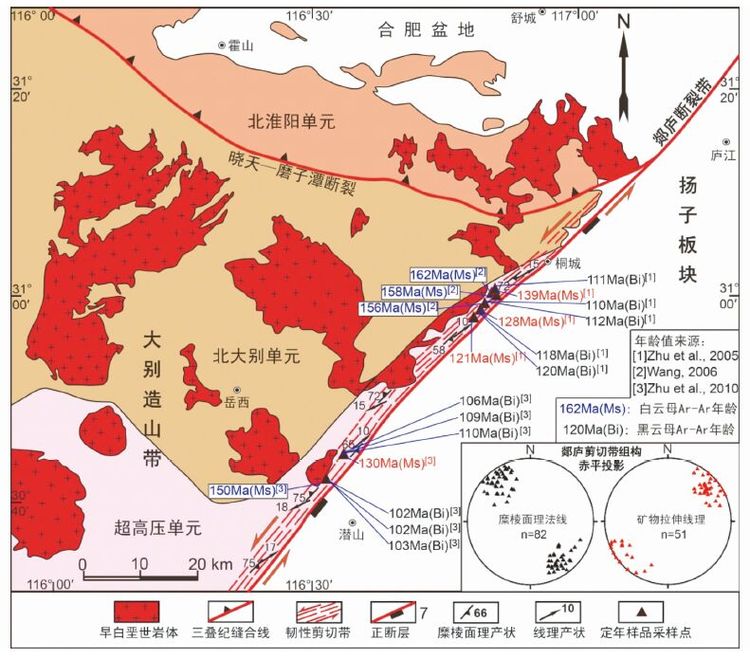
1 中-晚侏罗世地质过程 1.1 郯庐断裂带郯庐断裂带在晚中生代期间呈现为左行平移活动已为一系列构造与年代学研究(Xu et al.,1987; Zhu et al.,2005,2010; Wang,2006)所证实。在大别造山带东缘,郯庐左行走滑韧性剪切带出现在造山带变质岩内(图 1)。该段剪切带产状陡立,矿物拉伸线理平缓,露头及显微构造均指示为左行剪切(Zhu et al.,2005,2010)。该处郯庐走滑剪切带还明显牵引、弯曲超高压变质带与晓天-磨子潭断裂(图 2),也明显指示造山带折返后发生过郯庐断裂带的左行平移活动。Wang(2006)和Zhu et al.(2010)通过对该段走滑韧性剪切带内白云母的40Ar/39Ar定年,获得了162~150Ma年龄值(图 1),并依此认为该断裂带在中侏罗世末至晚侏罗世初发生过一期左行平移活动。值得指出的是,大别造山带内部已有的大量年代学研究显示,并没有这一期的同位素年龄值,也没有这一期岩浆活动,因而大别造山带东缘郯庐剪切带内162~150Ma年龄值应代表了其本身的一期左行平移活动。然而,郯庐断裂带中-南段其它部位目前仍没有发现这期左行平移活动的记录。
|
图 1 大别造山带东缘郯庐韧性剪切带构造图与定年结果 Fig. 1 Structural map for the Tan-Lu ductile shear zone along the eastern margin of the Dabie Orogen and dating results |

|
图 2 华北克拉通中侏罗世末(燕山运动A幕)构造简图 Fig. 2 Sketch map for structures in the North China Craton at the end of Middle Jurassic(episode A of the Yanshan Movement) |
华北克拉通北部的燕山构造带以发生过燕山运动而闻名。燕山运动是指侏罗-白垩纪期间区域挤压中发生的构造运动,最早由翁文灏先生提出(Wong,1926,1927),具体包括晚侏罗世髫髻山组分别与下伏和上覆地层之间两个角度不整合所代表的构造运动。随后,翁文灏先生(Wong,1929)将髫髻山组与下伏地层之间角度不整合、髫髻山组火山喷发期及其与上覆地层之间角度不整合分别命名为燕山运动A幕、中间幕和B幕。
由于后期燕山B幕变形的强烈叠加与改造,目前燕山构造带内被确认的燕山A幕构造较为有限。它们包括北东向的十三陵-红螺寺逆冲断层(Davis et al.,2001)、北东东向的兴隆逆冲断层(张长厚等,2011)、辽西北东向峪耳崖-雹神庙断层、窟 窿山断层以及建昌-朝阳逆冲断层(张长厚等,2004)等。这些燕山A幕构造显示当时阴山-燕山构造带主体上形成了一系列北东至北东东走向的逆冲断层(图 2)。Wang et al.(2011b)对北京西山地区详细的构造与年代学研究表明,该区在燕山运动A幕表现为NWW-SEE向挤压变形,其中的逆冲型韧性剪切带内给出了170~150Ma白云母40Ar/39Ar年龄(中侏罗世晚期至晚侏罗世中期)。前人通过对燕山运动A幕角度不整合上、下层位内火山岩的锆石定年,具体限定这期变形应发生在165Ma左右(赵越等,2004; 刘健等,2006; 李海龙等,2014)。
华北克拉通中部自东向西呈现为北北东走向的太行山冲断带、山西断褶带和吕梁山冲断带(图 2)。山西断褶带内以发育北北东向宽缓褶皱为特征,包括沁水向斜、宁静向斜、大同向斜及其间的一系列背斜构造(图 2)。华北克拉通中部卷入北北东向逆冲断层及褶皱的最新地层为中侏罗统(廖昌珍等,2007; 张岳桥等,2007),上侏罗统普遍缺失,指示这些北北东走向的挤压变形构造形成于中侏罗世末(张岳桥等,2007)。Wang and Li(2008)通过对太行山北北东向逆冲型韧性剪切带内一系列白云母、黑云母及钾长石的40Ar/39Ar定年,获得了170~150Ma的同位素年龄,也指示这期NWW-SEE向挤压变形发生于中-晚侏罗世之交。鄂尔多斯盆地西缘也发育了近南北向的晚中生代褶断带(Liu,1998; Darby and Ritts,2002; 张岳桥等,2007)。该带内出现了一系列北北东向至近南北向逆冲断层及其间的褶皱构造(图 2)。该褶断带卷入的最新地层、侏罗纪物源区的变化及晚侏罗世类前陆盆地的发育,皆指示近东西向的挤压变形发生在中侏罗世末(Liu,1998; Darby and Ritts,2002; 张岳桥等,2007),也属于燕山运动A幕的产物。
大量的资料表明,华北克拉通在晚侏罗世燕山运动中间幕期间(介于A幕与B幕之间)处于广泛的隆起状态,表现为晚侏罗世沉积的广泛缺失(张岳桥等,2007; 陈印等,2009)。上侏罗统在华北克拉通仅存在于鄂尔多斯盆地西缘(芬芳河组)与阴山-燕山构造带上(大青山组/髫髻山组/蓝旗组火山岩及其上覆的土城子组/后城组碎屑岩)。鄂尔多斯盆地西缘上侏罗统芬芳河组为一套砾岩层堆积,与下伏中侏罗统多为不整合接触,代表了一套鄂尔多斯盆地西缘逆冲构造带发育后的类前陆盆地沉积(张岳桥等,2007)。在阴山-燕山构造带上,燕山运动中间幕以大规模中酸性火山喷发为特色,显示了华北地块东部这个时期处于一个构造活跃期。这期岩浆活动同样也出现在辽东、胶北及苏鲁造山带的东北部,发育了一系列中酸性侵入岩,如著名的玲珑岩基。而在华北克拉通东部南缘零星出露了晚侏罗世荆山岩体、涂山岩体、蚂蚁山岩体及信阳火山岩等(宋利宏等,2016)。由此可见,燕山运动中间幕显示了华北克拉通东部区域性隆起与岩浆活动相伴生的现象。前人通过对晚侏罗世火山岩与侵入岩的岩石学与地球化学研究(Gao et al.,2004; Zhang et al.,2008; Jiang et al.,2010; Yang et al.,2010,2012),认为华北克拉通东部在此期间处于弱伸展环境。通过燕山构造带内晚侏罗世盆地构造研究,一些学者(马寅生等,2002a,b; 邵济安等,2003)也认为燕山运动中间幕处于伸展活动而控制发育了局部的断陷盆地。近年来,通过对医巫闾山变质核杂岩(Zhang et al.,2012)、喀喇沁变质核杂岩(林少泽等,2014)及玲珑伸展穹窿(Charles et al.,2011; 林少泽等,2013)的早期构造与年代学的详细研究,也显示了晚侏罗世伸展活动的构造证据。总之,在晚侏罗世燕山运动中间幕期间,华北克拉通在弱伸展背景下呈现为区域性隆升,克拉通东部出现了岩浆活动。
通过对比可见,大别造山带东缘郯庐断裂带在中侏罗世末至晚侏罗世初的左行走滑活动显然与上述燕山运动A幕相吻合,为该断裂带在燕山运动A幕中复活的结果,也进一步验证了燕山运动A幕这一挤压事件的存在。已有的研究成果显示,郯庐断裂带其它部位并没有发现中侏罗世末至晚侏罗世初的活动迹象。华北克拉通上燕山运动A幕构造指示当时为NWW-SEE向挤压。这一挤压方向基本上垂直于郯庐断裂带的走向,不利于走滑活动的发生,从而只是局部呈现为压扭性的左行平移活动。对该断裂带多年研究也没有发现晚中生代的逆冲活动现象及晚侏罗世的伸展活动。另外,在此近垂直的挤压应力作用下,也不利于郯庐断裂带的向北扩展,推断这期活动中该断裂带也没有发生向北的明显延伸。
2 早白垩世初构造事件 2.1 郯庐断裂带左行平移活动郯庐断裂带早白垩世初的左行平移活动已在其渤海湾以南的中、南段被广泛发现(Zhu et al.,2005,2010; 张岳桥和董树文,2008)。在大别造山带东缘,郯庐左行走滑韧性剪切带糜棱岩给出的另一组白云母40Ar/39Ar年龄为139~121Ma(Zhu et al.,2005,2010),其最大值(139Ma)应接近该期左行平移时间(Zhu et al.,2005),而其它较小值应为不均匀的冷却时间。该段走滑韧性剪切带糜棱岩还给出了更年轻的、120~102Ma的黑云母40Ar/39Ar年龄值(Zhu et al.,2005,2010; 图 1),皆属于冷却年龄,并与大别造山带造山后伸展与隆升及强烈岩浆活动时间相吻合(Wang et al.,2011c),也与郯庐断裂带的伸展活动及上盘(造山带一侧)抬升时间相吻合,因而不能代表走滑活动时间。该段剪切带部分被不变形的早白垩世岩体(小于139Ma,Zhu et al.,2010)所侵入(图 1),显示左行韧性剪切活动发生在早白垩世岩浆活动之前的早白垩世初。
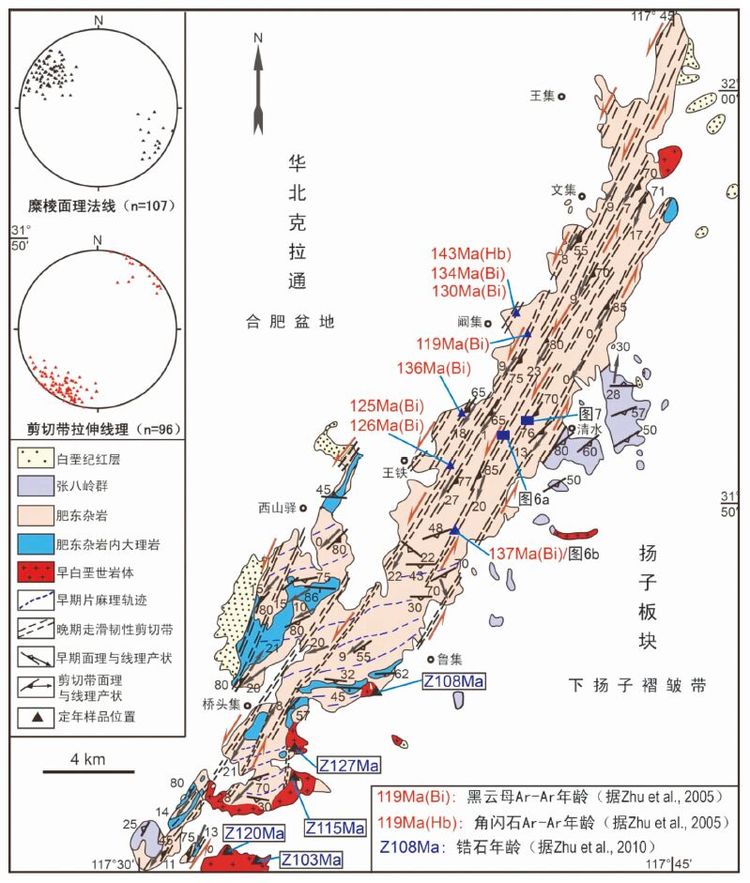
郯庐断裂带张八岭隆起段位于大别与苏鲁造山带之间的扬子板块西缘(图 2),其西侧为华北克拉通上的合肥盆地。张八岭隆起北段出露新元古代绿片岩相变质的张八岭群(赵田等,2014),其中保存着印支期韧性变形构造(Zhang et al.,2007)。张八岭隆起南段主要出露角闪岩相变质的新元古代肥东杂岩(石永红等,2009; 赵田等,2014),经历过印支期的韧性变形与变质(Lin et al.,2005)。张八岭隆起南段肥东杂岩内发育了北东走向的郯庐走滑韧性剪切带(图 3)。该段郯庐韧性剪切带最大出露宽度可达约10km,为多条剪切带构成的复合型剪切带。其北部因出露层次较深而呈现为透入性的韧性走滑组构,而出露层次相对较浅的南部在走滑剪切带之间仍保留有早期韧性组构(图 3)。张八岭隆起南段韧性剪切带主体向南东陡倾,其中的矿物拉伸线理多向南西缓顷(图 3)。露头与显微构造均指示该段剪切带为左行走滑,并具有逆冲分量(Zhu et al.,2005)。其中糜棱岩内角闪石给出了143Ma的40Ar/39Ar年龄,而黑云母给出了137~119Ma的40Ar/39Ar年龄值(Zhu et al.,2005; 图 3)。这些定年结果表明该段郯庐断裂带的左行平移活动发生在约143Ma的早白垩世初(Zhu et al.,2005)。而较年轻的黑云母年龄(137~119Ma)应为冷却年龄,可能分别记录了走滑隆升及随后伸展与岩浆活动导致的隆升时间。由此可见,郯庐断裂带张八岭隆起南段明显记录了早白垩世初的左行平移活动。
|
图 3 郯庐断裂带张八张岭隆起南段构造图 Fig. 3 Structural map for the southern Zhangbaling part of the Tan-Lu Fault Zone |
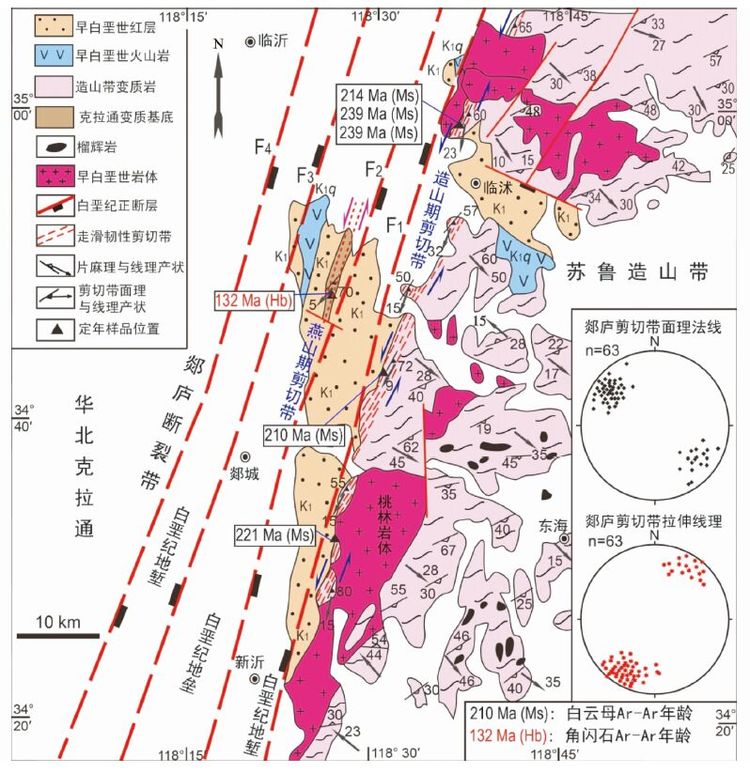
郯庐断裂带山东段(也称为沂沭断裂带)介于华北克拉通与苏鲁造山带之间(图 4)。其在苏鲁造山带西缘的造山带变质岩内发育了造山期(印支期)左行走滑韧性剪切带,其中糜棱岩内白云母给出了239~210Ma的40Ar/39Ar年龄值(Zhu et al.,2009; 图 4)。该段郯庐断裂带在白垩纪时呈现为伸展活动(Zhu et al.,2010,2012),自东向西发育了F1、F2、F3和F4正断层,控制发育了两个地堑与其间的地垒(图 4)。该地垒上变质基底内发育有北北东走向的郯庐走滑韧性剪切带。韧性剪切带向南东陡倾,矿物拉伸线理近水平,各类剪切指向构造均指示为左行剪切。该左行走滑韧性剪切带糜棱岩内角闪石给出了132Ma的40Ar/39Ar冷却年龄(Zhu et al.,2009; 图 4),也指示在早白垩世初发生过左行平移活动。
|
图 4 苏鲁造山带西缘郯庐断裂带构造图(同位素年龄值据Zhu et al.,2009) Fig. 4 Structural map for the Tan-Lu fault Zone along the western margin of the Sulu Orogen(the isotopic ages are from Zhu et al.,2009) |
已有的研究表明(Xu et al.,1987; Xu and Zhu,1994; 张岳桥和董树文,2008),郯庐断裂带北段的依兰-伊通断裂和敦化-密山断裂可能也在早白垩世初发生了左行平移活动。正是该断裂带这期强烈的左行平移活动,使其中、南段向北延伸而扩展进入东北地区(Xu et al.,1987)。中国东部这期间还在郯庐断裂带旁侧出现了一系列NE-NNE向的左行平移断裂(Xu et al.,1987),整体呈现为压扭性活动。
2.2 燕山运动B幕燕山运动B幕是指发生在早白垩世初的一次挤压事件,其标志为华北克拉通北部下白垩统张家口组/义县组与下伏土地城子组/后城组之间的角度不整合(Wong,1927,1929; 孙立新等,2007; 陈印等,2013)。已有的年代学资料显示,张家口组底部火山岩的最老锆石年龄为138Ma(孙立新等,2007; 陈印等,2013; 及其中参考文献),土城子组的最年轻锆石年龄为139Ma(孙立新等,2007; 陈印等,2013; 及其中参考文献),由此可以限定燕山运动B幕发生时间为139~138Ma(早白垩世初期)。
燕山运动B幕所造成的角度不整合在整个阴山-燕山构造带上十分显著,多处可见,指示该期构造事件在华北克拉通北部导致了较强的褶皱变形。燕山构造带内侏罗系普遍卷入了这期褶皱,局部还发生了地层倒转(张长厚等,2011)。其中较大型的褶皱包括承德向斜与马兰峪背斜、西山的北岭向斜、九龙山向斜、妙峰山向斜、长峪沟向斜、老窑沟背斜等。这些褶皱总体为近东西向展布,指示了燕山运动B幕近南北向挤压作用。
阴山-燕山构造带上,燕山运动B幕让所导致的逆冲构造十分发育,主体为近东西走向,以向南逆冲为主,但也发育了一些向北逆冲的反冲断层。燕山构造带上该期较大型的逆冲构造包括丰宁-隆化逆断层、大庙-娘娘庙逆断层、承德县逆断层、尚义-赤城逆断层、古北口-平泉逆断层、兴隆逆断层、冷口逆断层、蓟县逆断层、四合堂逆冲型剪切带等(张长厚等,2011)。这些逆冲断层卷入的最新地层为上侏罗统,局部可见被后期早白垩世岩体所侵入(张长厚等,2011)。其中研究程度最高的四合堂逆冲型剪切带,发育在早白垩初云蒙山岩基(145~141Ma,陈印等,2013; Zhu et al.,2015)北缘,呈现为上盘向南南西的逆冲(Davis et al.,1996; Passchier et al.,2005; Wang et al.,2011b; Zhu et al.,2015)。一系列年代学数据(Davis et al.,1996; Wang et al.,2011b; Zhu et al.,2015)指示该剪切带的逆冲活动发生在140~137Ma(早白垩世初,Zhu et al.,2015),显然属于燕山运动B幕产物。阴山构造带上近东西向的大青山逆冲构造发育于148~140Ma(Guo et al.,2012),也指示了早白垩世初的强烈逆冲活动。
通过对比可见,郯庐断裂带在早白垩世初所发生的压扭性左行平移活动与华北克拉通上燕山运动B幕同期,两者属于同一构造事件,皆是近南北向区域性挤压作用的产物。这期挤压事件在华北克拉通北部的阴山-燕山构造带上以出现近东西向的逆冲断层和褶皱为特征,而在其以南的华北克拉东部则以出现北东向左行平移断裂为特征,显示了同一应力场作用下构造特征上的明显空间变化。
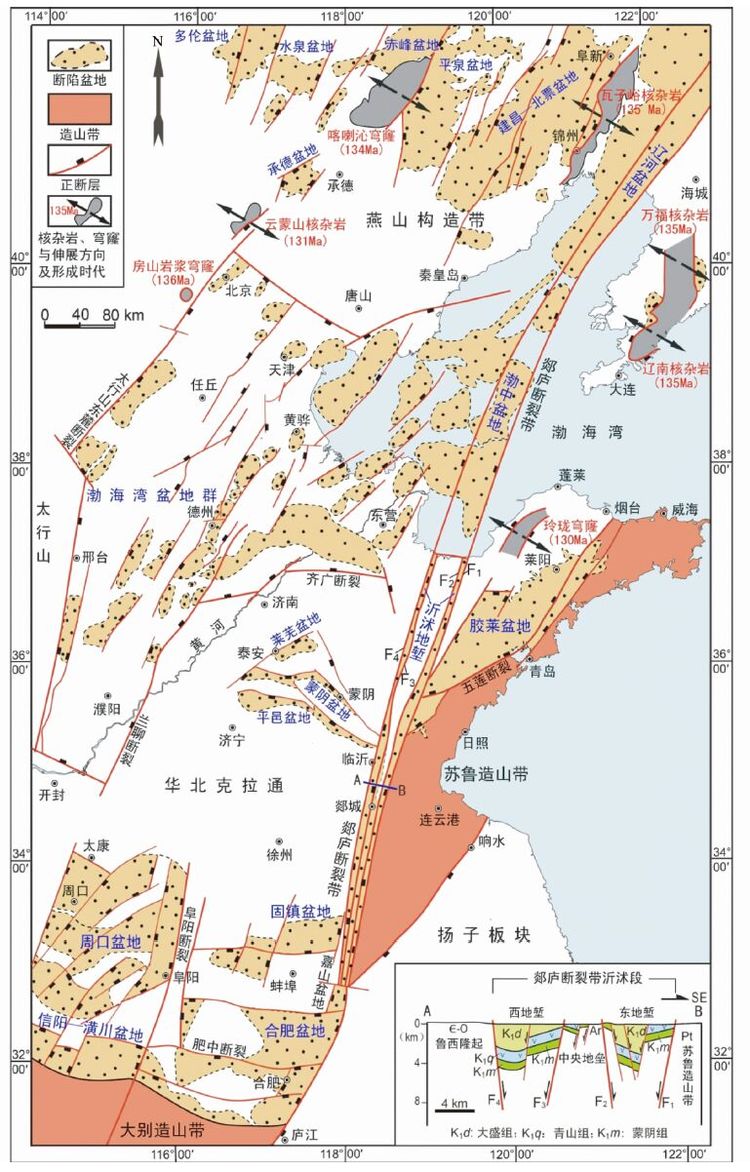
3 早白垩世伸展活动 3.1 郯庐断裂带继早白垩世初强烈的左行平移活动之后,郯庐断裂带在早白垩世期间普遍转变为伸展活动,呈现为巨型的正断层(Zhu et al.,2010,2012)。利用断层擦痕反演应力场显示(Zhu et al.,2012),这期间的应力状态为NWW-SEE向拉张,有利于先存的北东-北北东走向郯庐断裂带的复活与强烈正断层活动。这期间郯庐断裂带的伸展活动控制发育了一系列断陷盆地,在华北克拉通上自南向北分别为合肥盆地、嘉山盆地、沂沭地堑、渤中盆地与辽河盆地(图 5)。除合肥盆地为半地堑式盆地外,其它盆地主要为地堑式。特别是该断裂带山东段在早白垩世期间发育了4条平行的大型正断层,分别控制发育了东、西沂沭地堑(充填下白垩统,Zhu et al.,2012)与其间的地垒(图 4、图 5)。
|
图 5 华北克拉通东部与郯庐断裂带早白垩世伸展构造图 Fig. 5 Map showing extensional structures of Early Cretaceous in the eastern North China Craton and Tan-Lu Fault Zone |
郯庐断裂带在早白垩世伸展活动中也成为强烈的岩浆活动带。在该断裂带所控制的断陷盆地内普通出现了中-酸性火山岩,这些火山岩在山东地区称为青山组,而在安徽地区称为毛坦厂组。这些火山岩的一系列锆石定年数据指示火山喷发时间为136~116Ma(Zhu et al.,2010)。而在这些断陷盆地旁侧的地垒上或上升盘出现了大量的早白垩世中-酸性侵入体与岩脉,局部可见基性岩脉。锆石定年数据显示这些侵入岩的侵位时间为133~103Ma(Zhu et al.,2010)。这些与伸展活动伴生的岩浆活动指示郯庐断裂带这期间的伸展时限应为136~103Ma。
3.2 华北克拉通早白垩世是华北克拉通破坏的峰期(朱日祥等,2012)。这期间在克拉通东部呈现为广泛而强烈的伸展活动,出现了一系列变质核杂岩、伸展穹窿、伸展盆地及面状分布的、中酸性为主的岩浆活动。变质核杂岩与伸展穹窿主要出现在克拉通北部的燕山构造带上及辽南地区,分别有房山岩浆穹窿、云蒙山核杂岩、喀喇沁伸展穹窿、瓦子峪核杂岩及辽南-万神核杂岩、玲珑伸展穹窿等(图 5)。它们的形成时代为135~129Ma(Lin et al.,2008; Wang et al.,2011a; Zhang et al.,2012; Liu et al.,2013; Zhu et al.,2015),指示了135Ma开始的伸展活动。这些早白垩世变质核杂岩与伸展穹窿一致指示了NWW-SEE向的区域伸展方向,与郯庐断裂带所指示的同期伸展方向相吻合,反映整个克拉通东部稳定的区域伸展应力状态。华北克拉通东部早白垩世伸展盆地也是主要受控于北东向正断层的活动,与郯庐断裂带具有类似的活动规律。克拉通东部早白垩世期间广泛而强烈的岩浆活动,一方面导致了这期间火山岩的广泛分布,另一方面也出现了大量的侵入体,并显示岩浆活动的峰期为125Ma(Wu et al.,2005; 朱日祥等,2012)。总之,华北克拉通东部皆显示早白垩世峰期破坏特征,表现为强烈而广泛的伸展与岩浆活动。这一峰期破坏的开始时间应为136~135Ma,岩浆活动峰期为125Ma,持续至早白垩世末。郯庐断裂带在早白垩世期间强烈的伸展活动就是出现在克拉通峰期破坏这一背景下。
4 早白垩世末构造事件 4.1 郯庐断裂带左行平移活动如前文所述,郯庐断裂带张八岭隆起南段肥东杂岩内主体出露早白垩初左行走滑韧性剪切带(图 3; Zhu et al.,2005)。在随后的早白垩世期间,该段转变为强烈的伸展活动(Zhu et al.,2010,2012)。其伸展活动一方面控制发育了西侧的合肥断陷盆地(Zhu et al.,2010,2012),另一方面作为上升盘其中发育了大量的早白垩世岩体与岩脉(Zhu et al.,2010)。该段西侧合肥盆地早白垩世期间的连续断陷与充填(自下而上为朱巷组与响导铺组; 朱光等,2011)及其内部133~103Ma的伸展期岩浆活动(牛漫兰等,2008,2010; 谢成龙等,2009; Zhu et al.,2010)皆指示了早白垩世期间的伸展活动。近年来的详细研究发现(王微等,2015; 韩雨等,2015),郯庐断裂带张八岭隆起南段在早白垩初左行走滑与早白垩世期间伸展与岩浆活动之后又叠加了一期左行走滑活动,属于早白垩世末构造事件的结果。
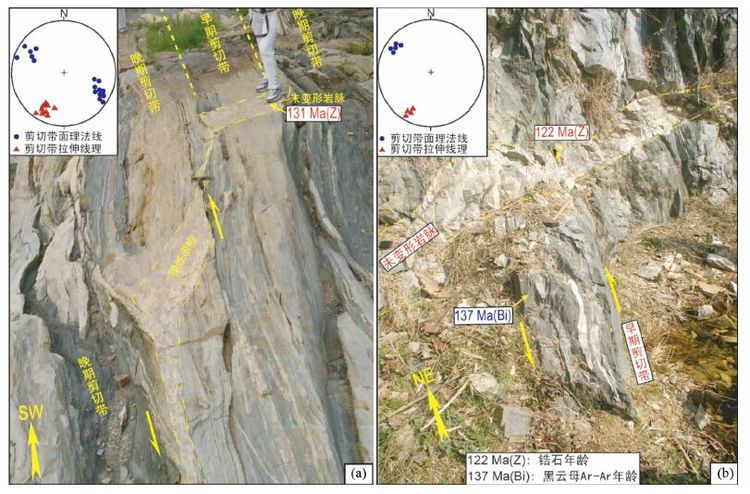
在巢湖桃花源处的张八岭隆起南段,郯庐韧性剪切带出露在花岗质片麻岩与角闪黑云片麻岩内(图 6a)。这些高级变质的肥东杂岩普遍发生糜棱岩化,呈现为陡立的、北东走向糜棱面理与向南西缓倾的矿物拉伸线理。该处可见早白垩初左行走滑韧性剪切带形成之后侵位了花岗岩脉。岩脉的锆石LA-ICP-MS U-Pb定年结果显示侵位时代为131Ma(韩雨等,2015)。这期岩脉侵位之后,该处再次叠加了左行走滑活动,使得岩脉被剪切变形(图 6a),并指示晚期剪切带形成于131Ma之后。由于晚期剪切变形并非透入性的,从而局部可见早期(早白垩世初)剪切带残留,其中的同一岩脉没有发生韧性变形(图 6a),并且指示早期剪切带形成于131Ma之前。另外,王微等(2015)还在该处变形岩脉内分别获得了133Ma和129Ma的变形岩脉锆石年龄,进一步限定晚期剪切带形成于129Ma之后。该处构造一方面指示了两期左行走滑韧性剪切带的存在,另一方面显示晚期剪切带变形并非透入性的。
|
图 6 郯庐断裂带张八岭隆起南段肥东杂岩内走滑韧性剪切带野外照片与变形组构赤平投影 (a)巢湖桃花源两期左行走滑韧性剪切带(岩脉锆石年龄据韩雨等,2015);(b)巢湖西韦早期左行走滑韧性剪切带与未变形岩脉(剪切带黑云母Ar-Ar年龄据Zhu et al.,2005; 岩脉锆石年龄据Zhu et al.,2010). 位置见图 3 Fig. 6 Field photos and fabric stereograms for the strike-slip ductile shear belts in the Feidong Complex in the southern Zhangbaling part of the Tan-Lu Fault Zone (a)two phases of sinistral ductile shear belts at Taohuayuan,Chaohu(the zircon age is from Han et al.,2015);(b)earlier sinistral ductile shear belt and undeformed dike at Xiwei,Chaohu(the biotite Ar-Ar age is from Zhu et al.,2015; the zircon age is from Zhu et al.,2010). Their localities are shown in Fig. 3 |
在巢湖西韦的张八岭隆起南段,郯庐左行走滑韧性剪切带广泛出现在肥东杂岩内。其糜棱岩内黑云母给出了137Ma的40Ar/39Ar同位素年龄(图 6b; Zhu et al.,2005),指示为早白垩世初走滑剪切带。而剪切带内可见未变形的花岗岩脉,其锆石LA-ICP-MS U-Pb定年结果显示侵位时代为122Ma(图 6b; Zhu et al.,2010),并指示早期剪切带形成于该期岩脉侵位之前。最近的研究发现,该处东侧约500m处也出现了晚期北东向左行走滑韧性剪切带,使得133Ma的花岗岩脉被变形成超糜棱岩(韩雨等,2015)。
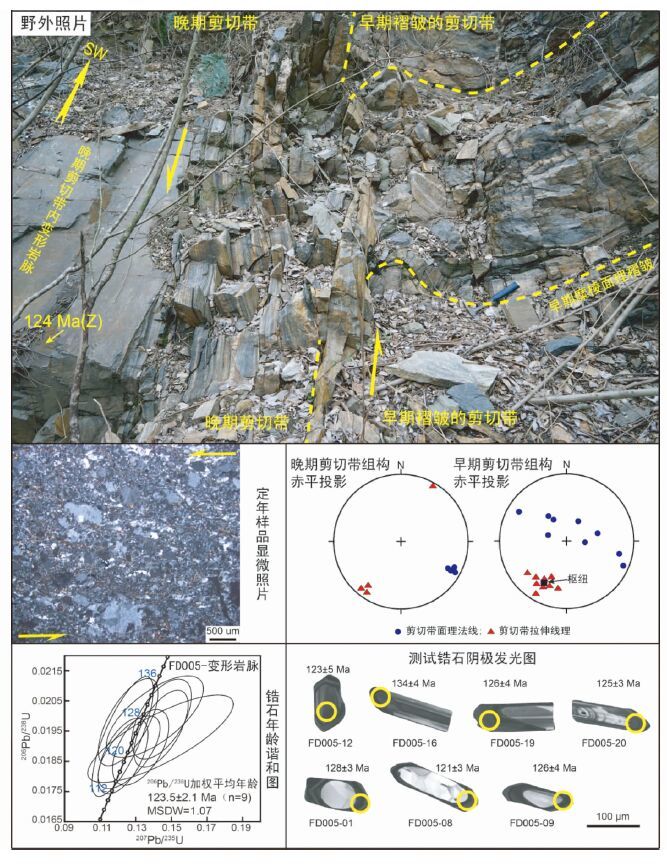
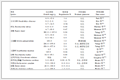
在巢湖寨山,也存在着两期郯庐左行走滑韧性剪切带(图 7)。该处晚期北东向左行走滑韧性剪切带明显切割早期剪切带,并使后者的糜棱面理发生了剪切褶皱(a型褶皱,图 7)。这两期剪切带矿物拉伸线理皆为向南西缓倾,具有相似的左行走滑运动学。其中晚期剪切带内的花岗岩脉被变形成为糜棱岩。通过在合肥工业大学资源与环境工程学院进行锆石LA-ICP-MS U-Pb定年(具体仪器型号与测试方法和过程见王微等,2015),这一变形岩脉内一组(9颗)较年轻锆石谐和数据的206Pb/238U加权平均年龄值为123.5±2.1Ma(MSWD=1.07; 图 7; 表 1)。这些锆石具有振荡环带,Th/U值皆大于0.2(表 1),显示为岩浆锆石。因而,该加权平均年龄值指示了岩脉侵位时间。由此可以限定该处晚期左行走滑韧性剪切带形成于124Ma之后。
|
图 7 巢湖寨山郯庐断裂带张八岭隆起南段两期走滑韧性剪切带野外照片、变形组构赤平投影、变形岩脉显微照片及其中锆石阴极发光图像与U-Pb年龄谐和图 Fig. 7 Field photo,fabric stereograms as well as photomicrograph,zircon CL images and U-Pb concordia plot of deformed dike in the southern Zhangbaling part of the Tan-Lu Fault Zone at Zhaishan,Chaohu |
|
表 1 郯庐断裂带张八岭隆起南段糜棱岩化花岗岩脉(样品FD005)锆石LA-ICP-MS U-Pb年龄测试结果 Table 1 LA-ICP-MS zircon U-Pb dating results for mylonitized granitic dike(Sample FD005)in the Zhangbaling uplift segment of the Tan-Lu Fault Zone |
上述一系列现象显示,郯庐断裂带张八岭隆起南段在早白垩世岩浆活动之后再次发生了左行平移活动,从而出现了两期左行走滑韧性剪切带的叠加现象。这些晚期左行走滑韧性剪切带普遍具有逆冲分量(图 6、图 7),指示为区域性挤压活动中的产物。由于晚期走滑韧性剪切带呈多条变形带相间存在,并没有导致透入性地韧性变形,从而野外一方面可以见到早白垩世伸展期岩脉在此晚期剪切带内被变形(图 6a、图 7),而另一方面又可见到仅发育早期剪切带处伸展期岩脉(如图 6b中122Ma未变形岩脉)没有卷入韧性变形。目前,已发现卷入晚期剪切带变形的最年轻岩脉侵位时代为124Ma(图 7),推断晚期剪切带的活动时间应为早白垩世末。前文所述华北克拉通东部在124Ma至早白垩世末期间皆处于显著的伸展活动(包括持续的断陷盆地与变质核杂岩发育及岩浆活动)也支持这一推断。
多种地质现象显示,郯庐断裂带在早白垩世末经历了一次重要的地质事件。该断裂带所控制的早白垩世断陷盆地在早白垩世末普遍经历了一次抬升、反转与沉积间断(Zhu et al.,2012)。地震剖面显示合肥盆地内上白垩统响导铺组与下白垩统张桥组之间存在着角度不整合(刘伟等,2004)。沂沭地堑内野外可见上白垩统王氏组与下白垩统大盛组之间存在着角度不整合(Zhang et al.,2003)。构造与古应力场研究显示(Zhang et al.,2003; Zhu et al.,2012),郯庐断裂带内部与旁侧伸展盆地早白垩世时期处于NW-SE向拉张中活动,而在晚白垩世时期转变为近南北向拉张,指示早白垩世末盆地反转之后区域应力状态发生了显著的调整。著名的松辽盆地在早白垩世末也经历了相拟的挤压反转,由早白垩世期间的断陷盆地转变为晚白垩世期间的拗陷式盆地(Ren et al.,2002)。进入晚白垩世时期,郯庐断裂带突然转变为岩浆活动的平静期,伸展活动也大为减弱(Zhu et al.,2012)。
4.2 华北克拉通峰期破坏的结束
在华北克拉通东部,上、下白垩统之间存在着角度不整合已被许多学者所认同(黄汲清,1960; 朱大岗等,1999; 马寅生等,2002a,b; 邴志波等,2003; 邓晋福等,2004),并被认为是代表了燕山运动最后一期挤压事件。这一挤压事件代表了重要的构造转折,并标志着华北克拉通东部峰期破坏的结束。此后的晚白垩世,华北克拉通转变为岩浆活动与构造活动的平静期,基本没有发生岩浆活动,陆相盆地仅局部出现。由此可见,华北克拉通东部早白垩世末发生了区域性的挤压事件,郯庐断裂带最后一期左行平移活动正是在此背景下发生的。
5 动力学背景分析
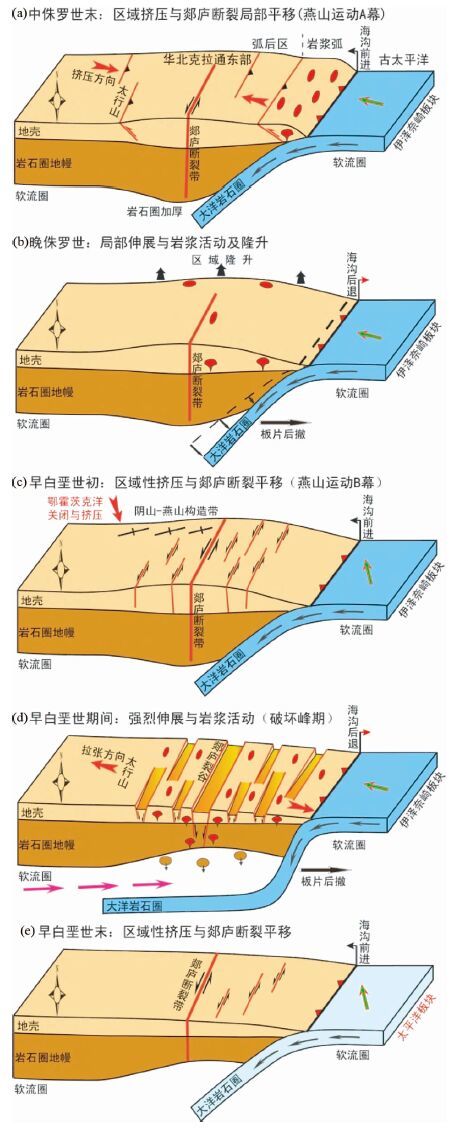
继起源于中三叠世华北克拉通与华南板块碰撞造山之后,郯庐断裂带在中侏罗世末首次复活而局部发生了左行平移活动。这次活动与华北克拉通上北北东走向逆冲与褶皱构造同期形成,是区域性WNW-ESE向挤压的结果,属于燕山A幕构造。这期构造是华北克拉通上首次出现平行于西太平洋俯冲带的构造,叠加在早期近东西向古亚洲与古特提斯构造之上,显然应是当时东部太平洋区伊泽奈崎(Izanagi)板块向华北克拉通下俯冲的结果,属于活动陆缘缩短构造。伊泽奈崎板块的初始活动时间与方式目前并不明确(Engebretson et al.,1985;Maruyama et al.,1997)。然而,华北克拉通这一地质记录指示伊泽奈崎板块向华北克拉通下俯冲的开始时间应为中侏罗世末,应以低角度向北西西方向俯冲(图 8a)。由此可见,华北克拉通上的燕山A幕构造代表了滨太平洋构造的开始。值得注意的是,华北克拉通东部并没有出现中侏罗世末岩浆弧现象,应处于岩浆弧以西的弧后地区。当时的朝鲜半岛及其东侧的日本地区可能处于岩浆弧环境(Maruyama et al.,1997)。
|
图 8 郯庐断裂带晚中生代演化的动力学模式 Fig. 8 Dynamic models for Late Mesozoic evolution of the Tan-Lu Fault Zone |
晚侏罗世期间,郯庐断裂带没有显示明显的活动迹象。华北克拉通东部呈现为局部的伸展与岩浆活动,并以区域性隆升为特征。这一活动陆缘上的特征与弧后弱拉张背景相吻合。推测当时伊泽奈崎板块俯冲角度变陡,导致海沟后退,从而出现了弧后地区的弱拉张与均衡隆升(图 8b)。
早白垩世初,郯庐断裂带再次发生了强烈的左行平移活动,并向北延伸进入东北地区。华北克拉通上也出现了广泛的燕山B幕构造,表现为阴山-燕山构造带上一系列近东西向的逆冲断层与褶皱,及其以南的一系列北东-北北东向左行平移断层。这些构造指示早白垩世初出现了强烈的近南北向挤压作用。近年来的研究表明,中亚造山带内鄂霍茨克洋的最终关闭(斜向碰撞)发生在早白垩世初(Metelkin et al.,2010; Pei et al.,2011; Li et al.,2012),从而可以向华北克拉通施加近南北向的挤压力(Zhu et al.,2015),并与该克拉通北部阴山-燕山构造带上这期挤压构造活动明显加强相吻合。而伊泽奈崎板块同时发生的向北北西高速斜向俯冲(Engebretson et al.,1985;Maruyama et al.,1997),进一步加强了该期的挤压作用。正是在此周边板块的联合作用下,出现了早白垩世初郯庐断裂带的强烈左行平移活动与周边的燕山B幕构造(图 8c)。
华北克拉通东部在早白垩世期间为克拉通破坏的峰期,同期的郯庐断裂带呈现为强烈的伸展活动。已有的大量研究表明(Wu et al.,2005; Zhu et al.,2010,2012; 朱日祥等,2012; Kusky et al.,2014),华北克拉通东部破坏与岩石圈大规模减薄发生在弧后拉张的动力学背景下(图 8d),对应着伊泽奈崎板块俯冲带的后撤与海沟后退。
华北克拉通以东的古太平洋板块在早白垩世末发生了重大的转变,由太平洋板块替代了伊泽奈崎板块(Maruyama et al.,1997; Cottrel and Tarduno,2003)。古地磁研究表明(Sager,2006; Beaman et al.,2007),早白垩世末至晚白垩世初太平洋板块向北斜向俯冲。正是在此新出现太平洋板块的斜向俯冲作用下(图 8d),华北克拉通东部遭受区域性挤压,郯庐断裂带再次发生了左行平移活动,从而结束了华北克拉通的峰期破坏。
6 华北克拉通破坏的地质过程
通过对郯庐断裂带晚中生代演化历史与动力学背景的认识,再结合华北克拉通这期间的地质记录,可以揭示该克拉通破坏的地质过程。由上述分析可见,古太平洋板块向华北克拉通下俯冲而使其东部成为活动陆缘的开始时间为中侏罗世末。当时华北克拉通经历了区域性挤压作用,向西波及最远可能达到鄂尔多斯盆地西缘。然而,当时华北克拉通并没有出现显著的岩浆活动与明显的岩石圈地幔转型与减薄,并不能代表克拉通破坏的开始。
晚侏罗世期间华北克拉通局部的伸展与岩浆活动及区域性隆升指示了弧后弱拉张的动力学背景。这期间的岩浆活动仅发生在克拉通北缘与郯庐断裂带旁侧,显示了大型岩石圈薄弱带的活动,而非整个克拉通东部。因而,当时华北克拉通东部的整体完整性并没有被破坏,也不应代表克拉通破坏的开始,至多可以作为克拉通破坏的前奏。
早白垩世初,在北部鄂霍茨克洋的最终关闭与陆-陆碰撞及东部伊泽奈崎板块俯冲的联合作用下,华北克拉通东部经历了晚中生代最强的一次挤压与剪切变形。至此,华北克拉通东部地壳、甚至岩石圈地幔的结构完整性受到了较大程度的破坏,岩石圈被切割成不同规模的断块。这种断块结构在随后的强拉张中将难以保持克拉通的整体完整性与稳定性 。
由上述地质过程可见,华北克拉通东部在早白垩世期间的峰期破坏(强烈伸展与岩浆活动)紧随在早白垩世初一期短暂的挤压活动之后,发生在西伯利亚克拉通与中亚造山带-华北克拉通最终焊合之后。正是在此背景之下,随着西太平洋伊泽奈崎板块快速后撤而导致的强烈弧后拉张,从而出现了华北克拉通东部的峰期破坏。实际上该峰期破坏的开始就应该对应着克拉通破坏的真正开始,标志着克拉通整体完整性丧失的开始。
华北克拉通在晚白垩世转变为岩浆活动的平静期,断陷盆地仅零星存在(Zhu et al.,2012),构造活动显著减弱,明显指示了克拉通峰期破坏的停止。由前文所述的地质记录可见,华北克拉通峰期破坏的中止发生在早白垩世末,是因为区域性伸展转变为区域性挤压,是一期区域性挤压事件的出现而导致的。而这期挤压事件的出现是因为西太平洋板块发生了重大调整,由太平洋板块替代了伊泽奈崎板块。由此可见,周边大洋板块格局与活动方式的重大调整,决定着华北克拉通的破坏过程,也体现了周缘大洋板块的决定性作用 。
| [1] | Beaman M, Sager WW, Acton GD, Lanci L and Pares J. 2007. Improved Late Cretaceous and Early Cenozoic paleomagnetic apparent polar wander path for the Pacific plate. Earth and Planetary Science Letters, 262(1-2): 1-20 |
| [2] | Bing ZB, Liu WH, Huang ZA and Zhang FS. 2003. Stratigraphic sequence and age of the Upper Cretaceous Daxingzhuang Formation in western Liaoning Province. Geological Bulletin of China, 22(5): 351-555 (in Chinese with English abstract) |
| [3] | Charles N, Gumiaux C, Augier R, Chen Y, Zhu RX and Lin W. 2011. Metamorphic Core Complexes vs. synkinematic plutons in continental extension setting: Insights from key structures (Shandong Province, eastern China). Journal of Asian Earth Sciences, 40(1): 261-278 |
| [4] | Chen Y, Zhu G, Hu ZQ, Zhang BL and Xiang BW. 2009. Temporal-spatial changes of tectonic subsidence for Cretaceous-Paleogene basins in the eastern North China Craton and their relations with the Craton destruction. Chinese Journal of Geology, 44(3): 836-854 (in Chinese with English abstract) |
| [5] | Chen Y, Zhu G, Jiang DZ and Zhang BL. 2013. Time period of Phase B of the Yanshanian orogeny in the east of North China Craton refined from dating of a ductile shear zone in the Yanshan belt northeast of Beijing. Acta Geologica Sinica, 87(3): 295-310 (in Chinese with English abstract) |
| [6] | Cottrel RD and Tarduno JA. 2003. A Late Cretaceous pole for the Pacific plate: Implications for apparent and true polar wander and the drift of hotspots. Tectonophysics, 362(1-4): 321-333 |
| [7] | Darby BJ and Ritts BD. 2002. Mesozoic contractional deformation in the middle of the Asian tectonic collage: The intraplate western Ordos fold-thrust belt, China. Earth and Planetary Science Letters, 205(1-2): 13-24 |
| [8] | Davis GA, Qian XL, Zheng YD, Yu H, Wang C, Tong HM, Gehrels CE, Shafiqullah M and Fryxell JE. 1996. Mesozoic deformation and plutonism in the Yunmeng Shan: A metamorphic core complex north of Beijing, China. In: Yin A and Harrison TM (eds.). The Tectonic Evolution of Asia. New York: Cambridge University Press, 253-280 |
| [9] | Davis GA, Zheng YD, Wang C et al. 2001. Mesozoic tectonics on Hebei and Liaoning provinces, Northern China. GSA Memoir, 194: 171-197 |
| [10] | Deng JF, Su SG, Zhao GC and Liu C. 2004. Structural elements association of Yanshan orogenic belt, North China. Geol. J. China Univ., 10 (3): 315-323 (in Chinese with English abstract) |
| [11] | Engebretson DC, Cox A and Gorden RG. 1985. Relative motions between oceanic and continental plates in the Pacific Basin. Boulder, Colo.: The Geological Society of America, Special Paper, 206: 1-60 |
| [12] | Gao S, Rudnick RL, Yuan HL, Liu XM, Liu YS, Xu WL, Ling WL, Ayers J, Wang XC and Wang QH. 2004. Recycling lower continental crust in the North China Craton. Nature, 432(7019): 892-897 |
| [13] | Gilder SA, Leloup PH, Courtillot V, Chen Y, Coe RS, Zhao XX, Xiao WJ, Halim N, Cogné JP and Zhu RX. 1999. Tectonic evolution of the Tancheng-Lujiang (Tan-Lu) fault via middle Triassic to Early Cenozoic paleomagnetic data. Journal of Geophysical Research, 104(B7): 15365-15390 |
| [14] | Guo L, Wang T, Zhang JJ, Liu J, Qi GW and Li JB. 2012. Evolution and time of formation of the Hohhot metamorphic core complex, North China: New structural and geochronologic evidence. International Geology Review, 54(11): 1309-1331 |
| [15] | Han Y, Niu ML, Zhu G, Wu Q, Li XC and Wang T. 2015. Geochronological evidence for the middle Early Cretaceous strike-slip movement from the Feidong segment of the Tan-Lu Fault Zone. Advances in Earth Science, 30(8): 922-939 (in Chinese with English abstract) |
| [16] | Huang JQ. 1960. Preliminary summary on basic characteristics of China tectonics. Acta Geologica Sinica, 40(1): 1-31 (in Chinese) |
| [17] | Jiang YH, Jiang SY, Ling HF and Ni P. 2010. Petrogenesis and tectonic implications of Late Jurassic shoshonitic lamprophyre dikes from the Liaodong Peninsula, NE China. Mineral. Petrol., 100(3-4): 127-151 |
| [18] | Kusky TM, Windley BF, Wang L, Wang ZS, Li XY and Zhu PM. 2014. Flat slab subduction, trench suction, and craton destruction: Comparison of the North China, Wyoming, and Brazilian cratons. Tectonophysics, 630: 208-221 |
| [19] | Li HL, Zhang HR, Qu HJ, Cai XM and Wang M. 2014. Initiation, the first stage of the Yanshan (Yenshan) Movement in western hills, constraints from zircon U-Pb dating. Geological Review, 60(5): 1026-1042 (in Chinese with English abstract) |
| [20] | Li SQ, Chen FK, Siebel W, Wu JD, Zhu XY, Shan XL and Sun XM. 2012. Late Mesozoic tectonic evolution of the Songliao basin, NE China: Evidence from detrital zircon ages and Sr-Nd isotopes. Gondwana Research, 22(3-4): 943-955 |
| [21] | Li ZX. 1994. Collision between the north and south China blocks: A crustal-detachment model for suturing in the region east of the Tanlu fault. Geology, 22(8): 739-742 |
| [22] | Liao CZ, Zhang YQ and Wen CS. 2007. Structural styles of the eastern boundary zone of the Ordos Basin and its regional tectonic significance. Acta Geologica Sinica, 81(4): 465-474 (in Chinese with English abstract) |
| [23] | Lin SF and Li ZX. 1995. Collision between the North and South China blocks: A crustal-detachment model for suturing in the region east of the Tanlu fault: Comment and reply. Geology, 23(6): 574-575 |
| [24] | Lin SZ, Zhu G, Yan LJ, Jiang QQ and Zhao T. 2013. Discussion on uplifting mechanism of the Linglong batholith in eastern Shandong. Geological Review, 59(5): 832-844 (in Chinese with English abstract) |
| [25] | Lin SZ, Zhu G, Zhao T, Song LH and Liu B. 2014. Structural characteristics and formation mechanism of the Kalaqin metamorphic core complex in the Yanshan area, China. Chinese Science Bulletin, 59(32): 3174-3189 (in Chinese) |
| [26] | Lin W, Faure M, Wang QC et al. 2005. Triassic polyphase deformation in the Feidong-Zhangbaling Massif (eastern China) and its place in the collision between the North China and South China blocks. J. Asian Earth Sci., 25(1): 121-136 |
| [27] | Lin W, Faure M, Monie P, Scharer U and Panis D. 2008. Mesozoic extensional tectonics in eastern Asia: The South Liaodong Peninsula Metamorphic Core Complex (NE China). J. Geol., 116(2): 134-154 |
| [28] | Liu J, Zhao Y and Liu XM. 2006. Age of the Tiaojishan Formation volcanics in the Chengde Basin, northern Hebei Province. Acta Petrologica Sinica, 22(11): 2617-2630 (in Chinese with English abstract) |
| [29] | Liu JL, Shen L, Ji M, Guan HM, Zhang ZC and Zhao ZD. 2013. The Liaonan/Wanfu metamorphic core complexes in the Liaodong Peninsula: Two stages of exhumation and constraints on the destruction of the North China Craton. Tectonics, 32(5): 1211-1141 |
| [30] | Liu SF. 1998. The coupling mechanism of basin and orogen in the western Ordos Basin and adjacent regions of China. Journal of Asian Earth Sciences, 16(4): 369-383 |
| [31] | Liu W, Xu CH, Song MS, Li XT, Lei M, Xu YD, Qiu LG, Jiang LL, Du SG and Chu DR. 2004. The Gucheng episode of Yanshan Movement in Hefei Basin and its petrogeologic significance. Geology of Anhui, 14(1): 1-5 (in Chinese with English abstract) |
| [32] | Ma YS, Wu ML and Zeng QL. 2002a. The Mesozoic-Cenozoic compression and extension transformation process and ore-forming process in Yanshan and adjacent area. Acta Geoscientia Sinica, 23(2): 115-121 (in Chinese with English abstract) |
| [33] | Ma YS, Cui SQ, Zeng QL and Wu ML. 2002b. Yanshanian compression and extension in the Yanshan area. Geological Bulletin of China, 21(4-5): 218-223 (in Chinese with English abstract) |
| [34] | Maruyama S, Isozaki Y, Kimura G and Terabayashi M. 1997. Paleogeographic maps of the Japanese Islands: Plate tectonic synthesis from 750Ma to the present. The Island Arc, 6(1): 121-142 |
| [35] | Metelkin DV, Vernikovsky VA, Kazansky AY and Wingate MTD. 2010. Late Mesozoic tectonics of Central Asia based on paleomagnetic evidence. Gondwana Research, 18(2-3): 400-419 |
| [36] | Niu ML, Zhu G, Xie CL, Liu XM, Cao Y and Xie WY. 2008. LA-ICP MS zircon U-Pb ages of the granites from the southern segment of the Zhangbaling uplift along the Tan-Lu Fault Zone and their tectonic significances. Acta Petrologica Sinica, 24(8): 1839-1847 (in Chinese with English abstract) |
| [37] | Niu ML, Zhu G, Xie CL, Wu Q and Liu GS. 2010. Geochemistry of Late Mesozoic intrusions from the southern segment of the Zhangbaling Uplift along the Tan-Lu Fault Zone and its implications for lithospheric thinning. Acta Petrologica Sinica, 26(9): 2783-2804 (in Chinese with English abstract) |
| [38] | Okay AI and Şengör AMC. 1992. Evidence for intracontinental thrust-related exhumation of the ultra-high-pressure rocks in China. Geology, 20(5): 411-414 |
| [39] | Passchier CW, Zhang JS and Konopásek J. 2005. Geometric aspects of synkinematic granite intrusion into a ductile shear zone: An example from the Yunmengshan core complex, northern China. In: Bruhn D and Burlini L (eds.). High-Strain Zones: Structure and Physical Properties. Geological Society, London, Special Publication, 245: 65-80 |
| [40] | Pei JL, Sun ZM, Liu J, Liu J, Wang XS, Yang ZY, Zhao Y and Li HB. 2011. A paleomagnetic study from the Late Jurassic volcanics (155Ma), North China: Implications for the width of Mongol-Okhotsk Ocean. Tectonophysics, 510(3-4): 370-380 |
| [41] | Ren JY, Tamaki K, Li ST and Zhang JX. 2002. Late Mesozoic and Cenozoic rifting and its dynamic setting in eastern China and adjacent areas. Tectonophysics, 344(3-4): 175-205 |
| [42] | Sager WW. 2006. Cretaceous paleomagnetic apparent polar wander path for the Pacific plate calculated from Deep Sea Drilling Project and Ocean Drilling Program basalt cores. Physics of the Earth and Planetary Interiors, 156(3-4): 329-349 |
| [43] | Shao JA, Meng QR, Wei HQ, Zhang LQ and Wang PY. 2003. Nature and tectonic environment of Late Jurassic volcanic-sedimentary basins in northwestern Hebei Province. Geological Bulletin of China, 22(10): 751-761 (in Chinese with English abstract) |
| [44] | Shi YH, Zhu G and Wang DX. 2009. Metamorphic P-T evolution for the garnet amphibolite from Feidong Group in the south of Zhangbaling uplift across Tan-Lu fault and its influence on tectonics. Acta Petrologica Sinica, 25(12): 3335-3345 (in Chinese with English abstract) |
| [45] | Song LH, Zhu G, Zhao T and Lin SZ. 2016. Deformation records in Late Mesozoic plutons in the Bengbu Uplift in the southeastern North China Craton and their tectonic implications. Geological Review, 62(2): 400-418 (in Chinese with English abstract) |
| [46] | Sun LX, Zhao FQ, Wang HC, Gu YC and Ji SP. 2007. Correlationship of Tuchengzi Formation and implications of the basin tectonic evolution in the intracontinental Yanshan orogenic belt. Acta Geologica Sinica, 81(4): 445-453 (in Chinese with English abstract) |
| [47] | Wang EC, Meng QR, Burchfiel BC and Zhang GW. 2003. Mesozoic large-scale lateral extrusion, rotation, and uplift of the Tongbai-Dabie Shan belt in East China. Geology, 31(4): 307-310 |
| [48] | Wang T, Zheng YD, Zhang JJ, Zeng LS, Donskaya T, Guo L and Li JB. 2011a. Pattern and kinematic polarity of Late Mesozoic extension in continental NE Asia: Perspectives from metamorphic core complexes. Tectonics, 30(6): TC6007, doi: 10.1029/2011TC002896 |
| [49] | Wang W, Song CZ, Li JH et al. 2015. Zircon U-Pb dating for shearing movement on the Feidong segment of the Tan-Lu fault zone. Chinese Journal of Geology, 50(3): 800-809 (in Chinese with English abstract) |
| [50] | Wang Y. 2006. The onset of the Tan-Lu fault movement in eastern China: Constraints from zircon (SHRIMP) and 40Ar/39Ar dating. Terra Nova, 18(6): 423-431 |
| [51] | Wang Y and Li HM. 2008. Initial formation and Mesozoic tectonic exhumation of an intracontinental tectonic belt of the northern part of the Taihang Mountain Belt, eastern Asia. The Journal of Geology, 116(2): 155-172 |
| [52] | Wang Y, Zhou LY and Li JY. 2011b. Intracontinental superimposed tectonics: A case study on the Western Hills of Beijing, eastern China. Geological Society of America Bulletin, 123(5-6): 1033-1055 |
| [53] | Wang YS, Xiang BW, Zhu G and Jiang DZ. 2011c. Structural and geochronological evidence for Early Cretaceous orogen-parallel extension of the ductile lithosphere in the northern Dabie orogenic belt, East China. Journal of Structural Geology, 33(3): 362-380 |
| [54] | Wong WH. 1926. Crustal movement in eastern China. Proceedings of the Third Peri-Pacific Symposium (the First Volume), 462-485 |
| [55] | Wong WH. 1927. Crustal movements and igneous activities in eastern China since Mesozoic time. Bull. Geol. Soc. China, 6(1): 9-36 |
| [56] | Wong WH. 1929. The Mesozoic orogenic movement in eastern China. Bull. Geol. Soc. China, 8(1): 33-44 |
| [57] | Wu FY, Lin JQ, Wilde SA, Zhang XO and Yang JH. 2005. Nature and significance of the Early Cretaceous giant igneous event in eastern China. Earth Planet. Sci. Lett., 233(1-2): 103-119 |
| [58] | Xie CL, Zhu G, Niu ML and Liu XM. 2009. Geochemistry of Late Mesozoic volcanic rocks from Chuzhou area and its implication for the lithospheric thinning beneath the Tan-Lu fault zone. Acta Petrologica Sinica, 25(1): 92-108 (in Chinese with English abstract) |
| [59] | Xu JW, Zhu G, Tong WX, Cui KR and Liu Q. 1987. Formation and evolution of the Tancheng-Lujiang wrench fault system: A major shear system to the northwest of the Pacific Ocean. Tectonophysics, 134(4): 273-310 |
| [60] | Xu JW and Zhu G. 1994. Tectonic models of the Tan-Lu fault zone, eastern China. International Geology Review, 36(8): 771-784 |
| [61] | Yang DB, Xu WL, Wang QH and Pei FP. 2010. Chronology and geochemistry of Mesozoic granitoids in the Bengbu area, central China: Constraints on the tectonic evolution of the eastern North China Craton. Lithos, 114(1-2): 200-216 |
| [62] | Yang DB, Xu WL, Pei FP, Yang CH and Wang QH. 2012. Spatial extent of the influence of the deeply subducted south China Block on the southeastern North China Block: Constraints from Sr-Nd-Pb isotopics in Mesozoic mafic igneous rocks. Lithos, 136-139: 246-260 |
| [63] | Yin A and Nie SY. 1993. An indentation model for the North and South China collision and the development of the Tan-Lu and Honam fault systems, eastern Asia. Tectonics, 12(4): 801-813 |
| [64] | Zhang BL, Zhu G, Jiang DZ, Li CC and Chen Y. 2012. Evolution of the Yiwulushan metamorphic core complex from distributed to localized deformation and its tectonic implications, Tectonics, 31(4): TC4018, doi: 10.1029/2012TC003104 |
| [65] | Zhang CH, Xu DB, Zhang WJ et al. 2004. Syntectonic sedimentation analysis applied to the reconstruction of the thrusting deformation process: An example from the Mesozoic thrust tectonics in eastern Yanshan Orogenic Belt, south of Lingyuan City, western Liaoning Province. Earth Science Frontiers, 11(3): 227-243 (in Chinese with English abstract) |
| [66] | Zhang CH, Li CM, Deng HL et al. 2011. Mesozoic contraction deformation in the Yanshan and northern Taihang mountains and its implications to the destruction of the North China Craton. Science China (Earth Sciences), 54(6): 798-822 |
| [67] | Zhang Q, Teyssier C, Dunlap J and Zhu G. 2007. Oblique collision between North and South China recorded in Zhangbaling and Fucha Shan (Dabie-Sulu transfer zone). In: Till AB, Boeske SM, Sample JC and Foster DA (eds.). Exhumation Associated with Continental Strike-Slip Fault System. The Geological Society of American Special Papers, 434: 167-206 |
| [68] | Zhang XH, Mao Q, Zhang HF and Wilde SA. 2008. A Jurassic peraluminous leucogranite from Yiwulushan, western Liaoning, North China craton: Age, origin and tectonic significance. Geol. Mag., 145(3): 315-320 |
| [69] | Zhang YQ, Dong SW and Shi W. 2003. Cretaceous deformation history of the middle Tan-Lu Fault Zone in Shandong Province, eastern China. Tectonophysics, 363(3-4): 243-258 |
| [70] | Zhang YQ, Dong SW, Zhao Y and Zhang T. 2007. Jurassic tectonics of North China: A synthetic view. Acta Geologica Sinica, 81(11): 1462-1480 (in Chinese with English abstract) |
| [71] | Zhang YQ and Dong SW. 2008. Mesozoic tectonic evolution history of the Tan-Lu fault zone, China: Advances and new understanding. Geological Bulletin of China, 27(9): 1371-1390 (in Chinese with English abstract) |
| [72] | Zhao T, Zhu G, Lin SZ, Yan LJ and Jiang QQ. 2014. Protolith ages and deformation mechanism of metamorphic rocks in the Zhangbaling uplift segment of the Tan-Lu Fault Zone. Science China (Earth Sciences), 57(11): 2740-2757 |
| [73] | Zhao Y, Zhang SH, Xu G, Yang ZY and Hu JM. 2004. The Jurassic major tectonic events of the Yanshan intraplate deformation belt. Geological Bulletin of China, 23(9-10): 854-863 (in Chinese with English abstract) |
| [74] | Zhu DG, Wu ZH and Cui SQ. 1999. Features of Mesozoic magmatic activities in the Yanshan area and their relations to intracontinental orogenesis. Geological Review, 45(2): 163-172 (in Chinese with English abstract) |
| [75] | Zhu G, Wang YS, Liu GS, Niu ML, Xie CL and Li CC. 2005. 40Ar/39Ar dating of strike-slip motion on the Tan-Lu fault zone, East China. Journal of Structural Geology, 27(8): 1379-1398 |
| [76] | Zhu G, Liu GS, Niu ML, Xie CL, Wang YS and Xiang BW. 2009. Syn-collisional transform faulting of the Tan-Lu fault zone, East China. International Journal of Earth Sciences, 98(1): 135-155 |
| [77] | Zhu G, Niu ML, Xie CL and Wang YS. 2010. Sinistral to normal faulting along the Tan-Lu Fault Zone: Evidence for geodynamic switching of the East China continental margin. The Journal of Geology, 118(3): 277-293 |
| [78] | Zhu G, Paio XF, Zhang L, Zhang BL, Chen Y and Hu SQ. 2011. Evolution of extensional direction in the Hefei Basin and its dynamic mechanism. Geological Review, 57(2): 154-166 (in Chinese with English abstract) |
| [79] | Zhu G, Jiang DZ, Zhang BL and Chen Y. 2012. Destruction of the eastern North China Craton in a backarc setting: Evidence from crustal deformation kinematics. Gondwana Research, 22(1): 86-103 |
| [80] | Zhu G, Chen Y, Jiang DZ and Lin SZ. 2015. Rapid change from compression to extension in the North China Craton during the Early Cretaceous: Evidence from the Yunmengshan metamorphic core complex. Tectonophysics, 656: 91-110 |
| [81] | Zhu RX, Xu YG, Zhu G, Zhang HF, Xia QK and Zheng TY. 2012. Destruction of the North China Craton. Science China (Earth Sciences), 55(10): 1565-1587 |
| [82] | 邴志波, 刘文海, 黄志安, 张福生. 2003. 辽西上白垩统大兴庄组地层层序及时代. 地质通报, 22(5): 351-555 |
| [83] | 陈印, 朱光, 胡召齐, 张必龙, 向必伟. 2009. 华北克拉通东部盆地白垩-古近纪构造沉降的时空变化及其与克拉通破坏的关系. 地质科学, 44(3): 836-854 |
| [84] | 陈印, 朱光, 姜大志, 张必龙. 2013. 四合堂剪切带活动时代及其对燕山运动B幕时间的限定. 地质学报, 87(3): 295-310 |
| [85] | 邓晋福, 苏尚国, 赵国春, 刘翠. 2004. 华北燕山造山带结构要素组合. 高校地质学报, 10(3): 315-323 |
| [86] | 韩雨, 牛漫兰, 朱光, 吴齐, 李秀财, 王婷. 2015. 郯庐断裂带肥东段早白垩世中期走滑运动的年代学证据. 地球科学进展, 30(8): 922-939 |
| [87] | 黄汲清. 1960. 中国地质构造基本特征的初步总结. 地质学报, 40(1): 1-31 |
| [88] | 李海龙, 张宏仁, 渠洪杰, 蔡向民, 王猛. 2014. 燕山运动"绪动/A幕"的本意及其锆石U-Pb 年代学制约. 地质论评, 60(5): 1026-1042 |
| [89] | 廖昌珍, 张岳桥, 温长顺. 2007. 鄂尔多斯盆地东缘边界带构造样式及其区域构造意义. 地质学报, 81(4): 465-474 |
| [90] | 林少泽, 朱光, 严乐佳, 姜芹芹, 赵田. 2013. 胶东地区玲珑岩基隆升机制探讨. 地质论评, 59(5): 832-844 |
| [91] | 林少泽, 朱光, 赵田, 宋利宏, 刘备. 2014. 燕山地区喀喇沁变质核杂岩的构造特征与发育机制. 科学通报, 59(32): 3174-3189 |
| [92] | 刘健, 赵越, 柳小明. 2006. 冀北承德盆地髫髻山组火山岩的时代. 岩石学报, 22(11): 2617-2630 |
| [93] | 刘伟, 徐春华, 宋明水, 李学田, 雷敏, 徐佑德, 邱连贵, 江来利, 杜森官, 储东如. 2004. 试论合肥盆地燕山运动古城幕及其石油地质意义. 安徽地质, 14(1): 1-5 |
| [94] | 马寅生, 吴满路, 曾庆利. 2002a. 燕山及邻区中新生代挤压与伸展的转换和成矿作用. 地球学报, 23(2): 115-121 |
| [95] | 马寅生, 崔盛芹, 曾庆利, 吴满路. 2002b. 燕山地区燕山期的挤压与伸展作用. 地质通报, 21(4-5): 218-223 |
| [96] | 牛漫兰, 朱光, 谢成龙, 柳小明, 曹洋, 谢文雅. 2008. 郯庐断裂带张八岭隆起南段花岗岩LA-ICP MS锆石U-Pb年龄及其构造意义. 岩石学报, 24(8): 1839-1847 |
| [97] | 牛漫兰, 朱光, 谢成龙, 吴齐, 刘国生. 2010. 郯庐断裂带张八岭隆起南段晚中生代侵入岩地球化学及其对岩石圈减薄的指示. 岩石学报, 26(9): 2783-2804 |
| [98] | 邵济安, 孟庆任, 魏海泉, 张履桥, 王佩瑛. 2003. 冀西北晚侏罗世火山-沉积盆地的性质及构造环境. 地质通报, 22(10): 751-761 |
| [99] | 石永红, 朱光, 王道轩. 2009. 郯庐断裂带张八岭隆起南段肥东群石榴角闪岩变质P-T演化史对其构造属性的制约. 岩石学报, 25(12): 3319-3345 |
| [100] | 宋利宏, 朱光, 赵田, 林少泽. 2016. 华北克拉通东南部蚌埠隆起晚中生代岩体内变形记录与构造意义. 地质论评,62(2): 400-418 |
| [101] | 孙立新, 赵凤清, 王惠初, 谷永昌, 冀世平. 2007. 燕山地区土城子组划分、时代与盆地性质探讨. 地质学报, 81(4): 445-453 |
| [102] | 王微, 宋传中, 李加好等. 2015. 郯庐断裂带肥东段剪切活动锆石U-Pb测年. 地质科学, 50(3): 800-809 |
| [103] | 谢成龙, 朱光, 牛漫兰, 柳小明. 2009. 滁州火山岩地球化学及其对郯庐断裂带内岩石圈减薄的指示. 岩石学报, 25(1): 92-108 |
| [104] | 张长厚, 徐德斌, 张维杰等. 2004. 同构造沉积分析反演逆冲构造变形过程-燕山东段凌源南部中生代逆冲构造变形过程研究. 地学前缘, 11(3): 227-243 |
| [105] | 张长厚, 李程明, 邓洪菱等. 2011. 燕山-太行山北段中生代收缩变形与华北克拉通破坏. 中国科学(地球科学), 41(5): 593-617 |
| [106] | 张岳桥, 董树文, 赵越, 张田. 2007. 华北侏罗纪大地构造: 综评与新认识. 地质学报, 81(11): 1462-1480 |
| [107] | 张岳桥, 董树文. 2008. 郯庐断裂带中生代构造演化史: 进展与新认识. 地质通报, 27(9): 1371-1390 |
| [108] | 赵田, 朱光, 林少泽, 严乐佳, 姜芹芹. 2014. 郯庐断裂带张八岭隆起段变质岩的原岩时代与变形机制. 中国科学(地球科学), 44(10): 2112-2129 |
| [109] | 赵越, 张拴宏, 徐刚, 杨振宇, 胡健民. 2004. 燕山板内变形带侏罗纪主要构造事件. 地质通报, 23(9-10): 854-863 |
| [110] | 朱大岗, 吴珍汉, 崔盛芹. 1999. 燕山地区中生代岩浆活动特征及其与陆内造山作用关系. 地质论评, 45(2): 163-172 |
| [111] | 朱光, 朴学峰, 张力, 张必龙, 陈印, 胡召齐. 2011. 合肥盆地伸展方向的演变及其动力学机制. 地质论评, 57(2): 154-166 |
| [112] | 朱日祥, 徐义刚, 朱光, 张宏福, 夏群科, 郑天愉. 2012. 华北克拉通破坏. 中国科学(地球科学), 42(8): 1135-1159 |