 2016, Vol. 32


2. 教育部含油气盆地构造研究中心, 杭州 310027;
3. 中国石油长庆油田公司, 西安 710021;
4. 西安西凌地球物理技术开发有限责任公司, 西安 710000;
5. 中国石油长庆油田勘探开发研究院, 西安 710021;
6. 浙江省工程物探勘察院, 杭州 310005
 , FU JinHua3, YANG GaoYin4, XIAO AnCheng1,2
 , SUN LiuYi5, XU Bo6, BAO HongPing5, MAO LiGuang1,2
2. Research Center for Structures in Oil & Gas Bearing Basins, Ministry of Education, Hangzhou 310027, China;
3. PetroChina Changqing Oilfield Company, Xi'an 710021, China;
4. Xiling Geophysical Technology Development Company Ltd., Xi'an 710000, China;
5. Research Institute of Petroleum Exploration & Development, PetroChina Changqing Oilfield Company, Xi'an 710021, China;
6. Zhejiang Engineering Geophysical Prospecting Institute, Hangzhou 310005, China
1 引言
元古代全球先后发生了Columbia超大陆裂解与Rodinia超大陆裂解事件(Zhao et al., 2004; Hou et al., 2008a,b; Ernst et al., 2008; Li et al., 2008; Zhao and Cawood, 2012; Teixeira et al., 2013; Roberts,2013),与之相关的沉积盆地受到学者们的广泛关注(Martins-Neto et al., 2001; Martins-Neto,2009; Wang and Li, 2003; Plink-Björklund et al., 2005; Wang et al., 2014; Frolov et al., 2015)。最近研究人员应用地震、航磁资料研究了上扬子地块内与Rodinia超大陆裂解有关的伸展构造,促进了四川盆地新元古界油气探勘(Gu and Wang, 2014)。本次研究则关注于鄂尔多斯地块内中元古代早期(1.8~1.6Ga)与Columbia超大陆裂解相关的盆地构造格局和沉积地层分布(Zhao et al., 2002; Kusky et al., 2007; Hou et al., 2008a; Lu et al., 2008; Peng et al., 2008; Peng,2010; Cui et al., 2013; 翟明国等,2014),尽管其他学者对与Columbia超大陆形成与裂解相关的构造在华北板块形成时限还存在不同的认识(Zhao et al., 2003,2004,2009; Yakubchuk,2010; Zhang et al., 2012; Liu et al., 2014; Pisarevsky et al., 2014)。本文依据乔秀夫和王彦斌(2014)对华北板块中元古界年龄的研究,将中元古代长城纪的年龄界定于1.8~1.6Ga。
中元古代早期在全球普遍发育坳拉槽的背景下(Goodwin,1996),鄂尔多斯地块南缘出现了临县-彬县和熊耳断陷,这些断陷楔入地块内部,控制长城系的分布(孙枢等, 1985,1993; 汤锡元等,1993①; 陈发景,2004)。但这些断陷的构造性质并不确定,研究人员依据晋豫陕交界处的熊耳群及华北板块内部同期火成岩的地球化学性质,认为地块南缘的构造背景为B型俯冲环境(胡受奚和林潜龙,1988)、安第斯型俯冲环境(贾承造,1988; He et al., 2006,2008,2009,2010a,b; Zhao et al., 2003,2009)、非造山环境(孙枢等,1985; Kusky and Li, 2003; 赵太平等,2007; Hou et al., 2008b; Zhao and Zhou, 2009; Cui et al., 2011)、与Columbia超大陆裂解有关的伸展环境(翟明国和卞爱国,2000; Kusky et al., 2007; Peng et al., 2005,2008; Peng,2010; Cui et al., 2013; 翟明国等,2014)以及活动大陆边缘弧和裂谷并存的环境(陈衍景等,1992)。
① 汤锡元,徐黎明,卢金城. 1993. 陕甘宁盆地及其周缘地区结晶基底及深部地质研究. 长庆石油勘探局勘探开发研究院,105-107区域构造背景的争论以及相同构造背景下构造样式的多样化,致使鄂尔多斯地块内长城纪沉积盆地属性和类型不明确(是边缘裂陷盆地、陆内裂陷盆地,还是克拉通盆地,或者是挠曲相关的盆地)。由于方法手段的限制,很多情况下研究人员通过鄂尔多斯地块周缘长城系露头及地块内少量钻井岩心的构造和沉积特征,并与区域构造背景研究成果结合,以推测鄂尔多斯地块内长城纪构造格局和地层分布(孙枢等,1985; 汤锡元等,1993)。显然,这些研究结论的依据不足,瓶颈在于难以获取鄂尔多斯盆地覆盖区深部的地层分布。本文利用多信息联合反演技术尝试获得盆地中元古界残余地层分布信息,原始资料来源于地块中南部二维深部地震反射、钻井和区域重力资料(图 1),建立了研究区长城系的地层和断裂格架,发现区内长城系发育与伸展相关的箕状断陷和半地堑,同期形成的断裂体系控制了盆地内部二级构造单元,即凸起和凹陷构造的边界,最终提出鄂尔多斯盆地的属性为陆内裂陷盆地。
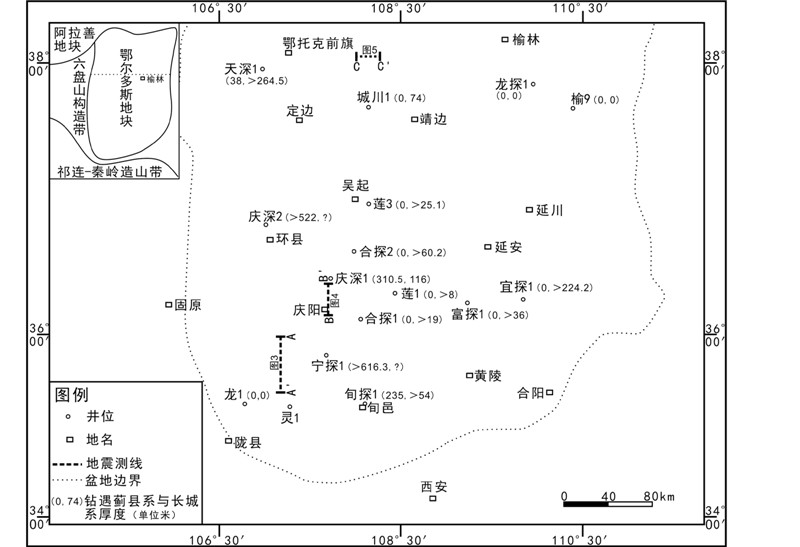 | 图 1 鄂尔多斯盆地块中南部地震测线位置图 Fig. 1 Location map of seismic line in southern-central Ordos block |
我们选取南北向和东西向能反映深部信息,且具有较好分辨率与信噪比的二维地震剖面,并结合钻井数据来揭示中元古界典型构造和厚度分布特征,控制研究区整体的构造格架。由于能反映深部信息的区域性的二维地震测线稀少,信息仅揭示了剖面线附近中元古界的构造与地层信息,无法获得平面上分布。因此在地震剖面构造框架约束下,我们利用区域重力资料反演平面上中元古界构造的展布。
2.1 地震资料解释鄂尔多斯地块南缘野外露头观察发现,长城系内发育三角洲相砂、泥岩,滨、浅海相白云岩、砂岩、泥质岩,在地震剖面上可形成较好的反射界面。同时,将断陷的底面作为长城系的底界。而蓟县系主要为大套的白云岩地层,内部岩层波阻抗差异小,层面反射系数小,地震反射较弱(图 2)。地块内部相比起南缘,普遍缺失寒武系下统灰岩、砂岩,寒武系中统页岩与下伏中元古界蓟县系白云岩或长城系顶部砂岩之间的地质界面能很好的对应地震反射界面。
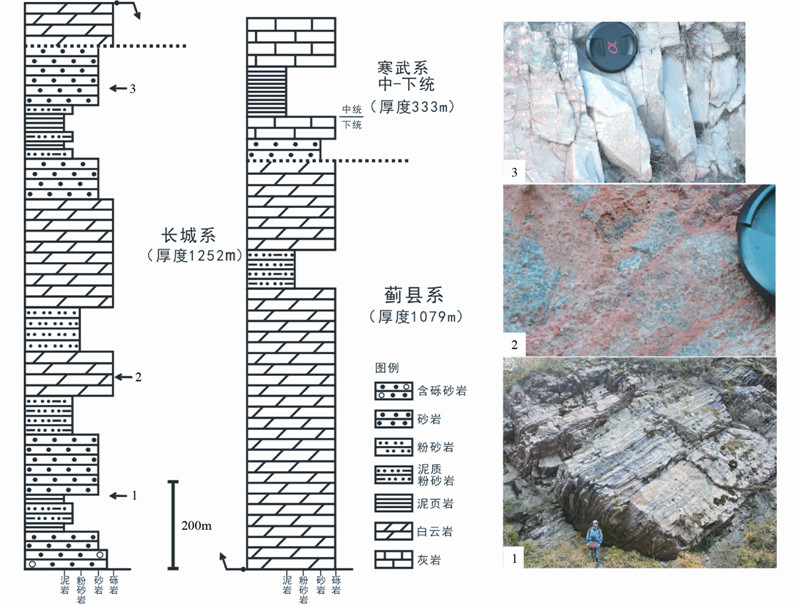 | 图 2 鄂尔多斯盆地南缘中元古界与古生界寒武系地层柱状图 Fig. 2 Stratigraphic column of Mesoproterozoic Erathem and Palaeozoic Cambrian System in the southern margin of Ordos Basin |
从盆地地层厚度变化和起伏情况来看,盆地内部古生界及其上覆地层呈西厚东薄的宽缓斜坡,常引起区域上宽缓的重力异常,而裂陷期长城系凹陷内与凸起上厚度相差大,常引起局部重力异常,因此能够运用重力资料研究平面上中元古界构造格局。
本次研究以鄂尔多斯地块1:20万重力资料为主,结合地震和钻井所反映的地层厚度和平面分布,逐层剥离寒武系底之上的各密度层的重力异常(表 1),此时剩余重力异常为中元古界与古元古界-太古界基底重力效应的叠加。将向上延拓30km所代表的变质结晶基底重力异常从上述剩余重力异常中剥离,即获得中元古界重力异常。
 | 表 1 鄂尔多斯盆地地层密度 Table 1 Formations density in Ordos Basin |
深大断裂在布格重力异常图上一般表现为沿某一方向延伸的重力梯级带,因此我们对中元古界重力异常先进行小子域滤波处理,然后计算重力异常水平总梯度极值来识别研究区长城系主要断裂。
3 典型构造剖面发育特征我们选取鄂尔多斯地块内南北向A-A’、B-B’与东西向C-C’二维地震剖面(图 1),来诠释中元古界构造特征。由于后期构造抬升,研究区北部C-C’地震剖面2.1~2.2s之下为中元古界,而南部A-A’与B-B’地层则埋藏较深,2.4~2.8s之下才为中元古界。
A-A’南北向剖面底部发育长城系箕状断陷,南北宽约43km,主控断裂南倾,倾角上陡下缓,呈铲式(图 3)。长城纪早期(Ptch1),断层活动强烈,上盘地层发生强烈旋转掀斜,沉积地层呈楔状。半地堑内地层的地震反射结构类似于扇三角洲体系,剖面南部“1”区域表现为扇三角洲平原杂乱反射,成层性差,可能反映砾岩沉积;向北过渡到“2”区域扇三角洲前缘,地层连续性较好,中到强振幅、中等至连续反射,呈发散反射结构,可能反映砂泥岩互层;剖面中北部“3”区域前扇三角洲,中等振幅连续平行反射,顶部无反射或反射较弱,可能代表大套的泥岩沉积。长城纪晚期(Ptch2),断层活动减弱,地层产状平缓,厚度变化小(图 3)。长城系地震波双程旅行时约0.5~2.5s,估算地层垂向厚度1000~8000m。
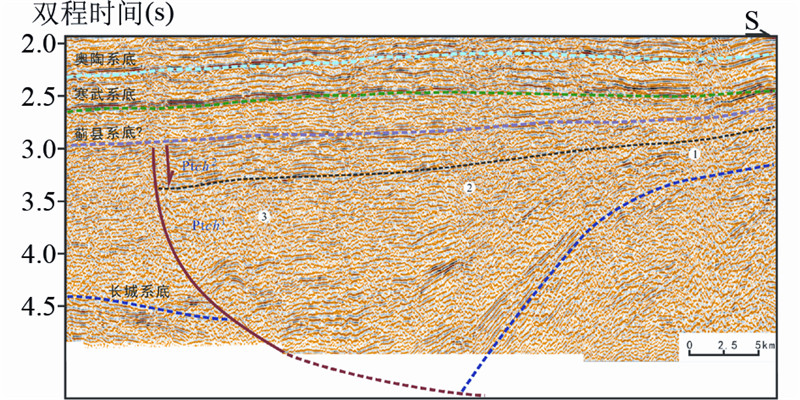 | 图 3 A-A’测线地震解释剖面图
1-扇三角洲平原;2-扇三角洲前缘;3-前扇三角洲 Fig. 3 Interpreted seismic section across A-A’ line 1-f and elta plain; 2-f and elta front; 3-pro-f and elta |
B-B’南北向剖面底部发育长城系半地堑,南北宽约30km,主控断裂北倾,倾角上陡下缓,呈铲式,主控断层生长使得上盘形成滚动背斜(图 4)。长城纪早期(Ptch1),主控断层活动强,上盘地层掀斜抬升,剖面北部地势相对较高,可能为物源区,半地堑内地层的地震反射结构类似于上述扇三角洲体系。长城纪晚期(Ptch2),主控断层活动减弱,地层逐渐超覆。长城系内地震波双程旅行时为0.8~1.5s,地层垂向厚度约1800~3000m(图 4)。
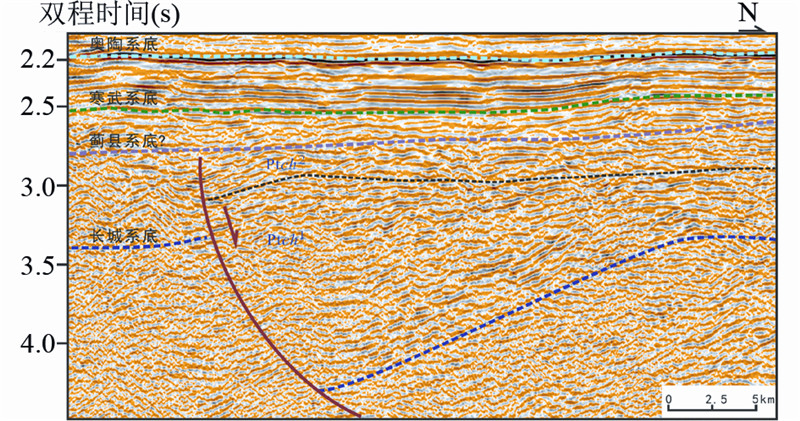 | 图 4 B-B’测线地震解释剖面图 Fig. 4 Interpreted seismic section across B-B’ line |
C-C’东西向剖面底部发育长城系半地堑,东西宽度约20km,主控断裂东倾,视倾角约60°(图 5)。由于该地震剖面附近钻井显示蓟县系缺失或较薄(图 1),因此我们将该套地层定为中元古界长城系。长城纪早期(Ptch1),裂陷伸展强度大,上盘发育次级地堑、半地堑,主控断层附近,上盘底部地层地震剖面上呈杂乱反射,同相轴连续性差,可能代表水下扇沉积,而半地堑东部缓坡带地层的地震反射连续性较好,中至强振幅,地层上超。长城纪晚期(Ptch2),伸展强度减小,断层活动减弱,地层超覆在早期楔形地层之上。长城系内地震波双程旅行时达0.4~0.9s,地层垂向厚度约1000~2000m(图 5)。
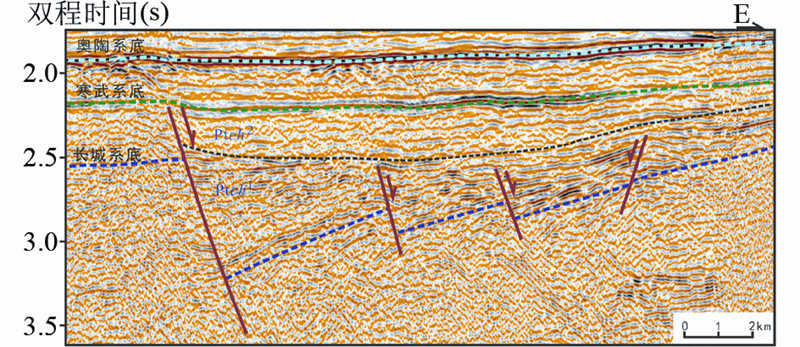 | 图 5 C-C’测线地震解释剖面图 Fig. 5 Interpreted seismic section across C-C’ line |
地块内的凹陷和凸起分别对应于剩余重力异常图中的负异常和正异常区。重力资料反演发现,地块西部环县北-定边凹陷,中元古界剩余布格重力异常为南北向负异常,异常值最小可达-10mgal,向北转变为两个小型凹陷,异常值最小可达-6mgal,总面积约12000km2。地块南部旬邑-黄陵凹陷,存在主体为北东东向的负异常,异常值最小可达-11mgal,向南西过渡为北西向和北东向两个小型凹陷,异常值最小可达-6mgal,总面积约17000km2。地块南部合阳南凹陷以及地块东部绥德东凹陷地区重力负异常最小可达到-10mgal(图 6)。
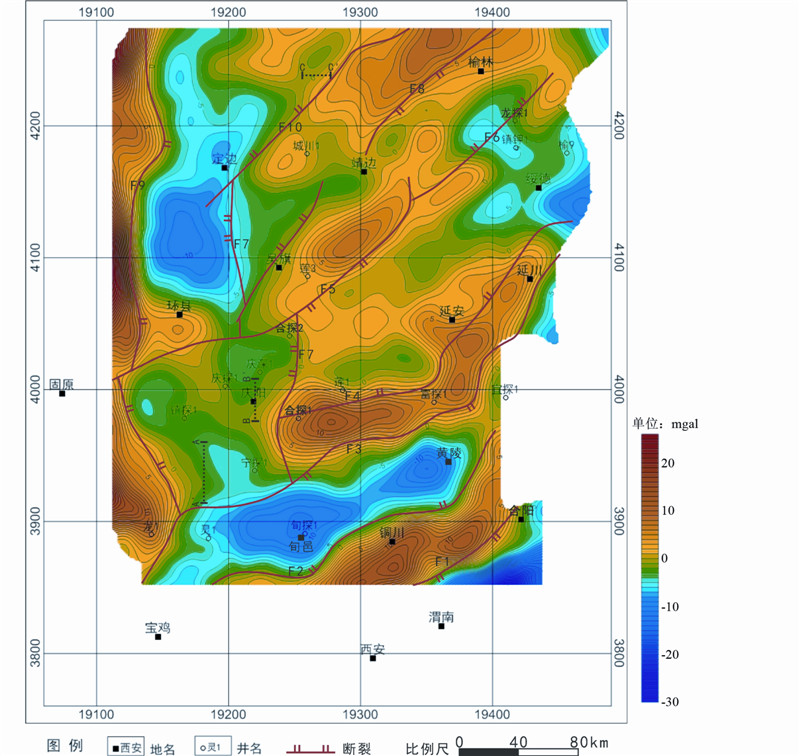 | 图 6 校正后的中元古界剩余重力异常图 Fig. 6 Corrected Mesoproterozoic residual gravity anomaly map |
地块内部榆林-靖边-吴旗凸起呈“S”形,整体走向北东,剩余重力异常值多介于0~8mgal;庆阳-延安-延川凸起呈弧形,走向由北东东向转变为北东向,剩余重力异常值介于2~12mgal;铜川-合阳凸起整体走向北东,剩余重力异常最大值为14mgal。盆地西缘凸起整体南北走向,其形成可能与裂谷肩的均衡翘升有关,剩余重力正异常最高值大于15mgal(图 6)。
由于长城系为华北板块基底之上的第一套沉积盖层,因此地块内长城系地堑、半地堑构造会反映在基底构造上。本次研究中重力与地震资料反演出的凹陷和凸起分布,与近期研究人员应用航磁数据揭示的鄂尔多斯结晶基底的分布特征相似(Wang et al., 2015)。
5 同期断裂系统特征我们通过计算重力异常水平总梯度极大值发现长城系区域性大断裂共10条,除F7、F9南北走向外,其它为北东走向(图 7)。其中F3、F5断裂分别为庆阳-延安-延川凸起、榆林-靖边-吴旗凸起的边界,两侧凹陷与凸起的重力异常差值可达17~23mgal,断层延伸长度300~400km(图 6、图 7)。究其原因,可能长城系裂陷受到基底结构和构造的影响。F3、F5断裂所夹持的区域存在太古代末的绿岩带(Zhai and Santosh, 2011),早元古代的内硅铝地壳裂谷带(汤锡元等,1993),在此构造薄弱带边界发育长城纪主要的控凹断裂。
 | 图 7 鄂尔多斯盆地中南部断裂分布图 Fig. 7 Faults distribution map of the southern-central Ordos Basin |
我们将断裂与校正后的重力异常叠合发现,相邻断层倾向相同,则控制凹陷,如F2与F3、F7与F9分别为旬邑-黄陵凹陷、环县北-定边凹陷。相邻断层倾向相背,则控制凸起,如F1与F2、F3与F4分别控制铜川-合阳凸起、庆阳-延安-延川凸起(图 6)。
6 讨论 6.1 地块内长城系盆地发育特征研究者认为鄂尔多斯地块新元古界仅沿着边缘分布(邸领军,2003),地块内钻井也显示普遍缺失新元古界。因此本次研究所识别的凹陷和凸起,时限为中元古代。而蓟县系地层遭受剥蚀(乔秀夫,1976),仅在西缘、南缘有分布(图 1),因此地块内中元古代凹陷和凸起的分布主要反映长城纪的构造格架。
由地震资料揭示的长城纪早期的半地堑结构可知,主控边界断层伸展强度大,断层上升盘地层厚度小,而下降盘发生旋转掀斜,局部出现箕状断陷、半地堑,同时发育扇三角洲、水下扇沉积,楔状体沉积厚度大,表现为裂陷期构造与沉积充填特征。长城纪晚期断层活动减弱,水体范围扩大,地层超覆在早期楔状地层之上,表现为裂后期的特征。重力资料反演的长城纪凹陷与凸起格局、区域性大断裂分布表明鄂尔多斯地块内长城系广泛分布,大断裂可能与半地堑主控断层性质相似为生长断裂,其演化控制着凹陷和凸起的形成与消亡。
6.2 地块周缘露头地层特征对盆地性质的约束鄂尔多斯盆地边缘晋豫陕交汇处发育中元古界长城系高山河群、汝阳群。高山河群从下自上分为三个亚群,下亚群石英砂岩夹板岩,中亚群砂岩和白云岩,上亚群石英砂岩和板岩。沉积相由河流、三角洲相逐渐过渡到滨、浅海相。如图 2,鄂尔多斯盆地南缘洛南县长城系下亚群“1”处为三角洲相薄层粉砂岩、泥岩;中亚群“2”处发育浅海相豆粒白云岩;上亚群“3”处发育滨岸相砂岩(变质为石英岩)。长城系沉积中心位于洛南县黄龙铺,地层厚度3000多米,向西至蓝田、陇县迅速减少至200~400m,向东至陈耳-卢氏一带100~600m左右(陕西省地质矿产局,1989)。汝阳群自下而上发育云梦山组砂岩,白草坪组泥岩和页岩,北大尖组页岩和石英岩状砂岩,崔庄组页岩,洛峪口组泥晶白云岩。沉积相从三角洲相过渡到滨、浅海相。长城系沉积中心永济市地层厚度为1262m,向西至济源市河口仅数十米,大体上地层向东超覆(山西省地质矿产局,1989)。长城系的地层展布受断陷作用的限制(李仲钦等,1985),向东或西厚度减薄。断陷期早期以陆相三角洲沉积为主,晚期相对海平面上升,以滨、浅海相沉积为特征。地块周缘长城系地层展布特征与地块内部相似。
7 结论地块内部长城系充填结构和周缘长城系露头沉积构造特征表明,长城系厚度和沉积相分布受裂陷作用的影响,裂陷期伸展强度大,生长断层活动强,地层掀斜,发育陆相沉积;裂后期伸展强度小,水体范围扩大,地层超覆,发育滨、浅海相沉积。因此我们认为中元古代长城纪鄂尔多斯地块处于伸展环境,盆地性质为陆内裂陷盆地。至于构造环境是与造山后伸展相关(Zhao and Zhou, 2009),还是受地幔柱热点的影响(Peng et al., 2008; Peng,2010; 翟明国等,2014),从构造形态上难以区分。
本文结合地震、重力、钻井资料,研究了鄂尔多斯地块中南部中元古代长城纪构造和地层分布特征,得出如下结论:①鄂尔多斯地块长城纪盆地性质为陆内裂陷盆地,支持华北板块伸展构造背景的论断;②地震剖面显示长城纪裂陷期断层活动强烈,发育半地堑,沉积水体局限,充填扇三角洲、水下扇等陆相沉积,裂后期断层活动减弱,水体范围扩大,地层厚度变化小,长城系最大厚度可达8000m;③重力资料反演揭示地块内存在多个长城纪凹陷与凸起,它们的分布受大型边界断裂控制。
| [1] | Bureau of Geology and Mineral Resources of Shaanxi Province. 1989. Regional Geology of Shaanxi Province. Beijing:Geological Publishing House, 13-43(in Chinese) |
| [2] | Bureau of Geology and Mineral Resources of Shanxi Province. 1989. Regional Geology of Shanxi Province. Beijing:Geological Publishing House, 95-115(in Chinese) |
| [3] | Chen FJ. 2004. Stretching Fault Basin Analysis. Beijing:Geological Publishing House, 20-31(in Chinese) |
| [4] | Chen YJ, Fu SG and Qiang LZ. 1992. The tectonic environment for the formation of the Xiong'er Group and the Xiyanghe Group. Geological Review, 38(4):325-333(in Chinese with English abstract) |
| [5] | Cui ML, Zhang BL and Zhang LC. 2011. U-Pb dating of baddeleyite and zircon from the Shizhaigou diorite in the southern margin of North China Craton:Constrains on the timing and tectonic setting of the Paleoproterozoic Xiong'er Group. Gondwana Research, 20(1):184-193 |
| [6] | Cui ML, Zhang LC, Zhang BL and Zhu MT. 2013. Geochemistry of 1.78Ga A-type granites along the southern margin of the North China Craton:Implications for Xiong'er magmatism during the break-up of the supercontinent Columbia. International Geology Review, 55(4):496-509 |
| [7] | Di LJ. 2003. Research on related problems of basement evolution and sedimentary cover in Ordos basin. Ph. D. Dissertation. Xi'an:Northwest University, 22-60(in Chinese) |
| [8] | Ernst RE, Wingate MTD, Buchan KL and Li ZX. 2008. Global record of 1600-700Ma Large Igneous Provinces(LIPs):Implications for the reconstruction of the proposed Nuna(Columbia) and Rodinia supercontinents. Precambrian Research, 160(1-2):159-178 |
| [9] | Frolov SV, Akhmanov GG, Bakay EA, Lubnina NV, Korobova NI, Karnyushina EE and Kozlova EV. 2015. Meso-Neoproterozoic petroleum systems of the Eastern Siberian sedimentary basins. Precambrian Research, 259:95-113 |
| [10] | Goodwin AM. 1996. Principles of Precambrian Geology. 2nd Edition. California:Academic Press, 276-277 |
| [11] | Gu ZD and Wang ZC. 2014. The discovery of Neoproterozoic extensional structures and its significance for gas exploration in the Central Sichuan Block, Sichuan Basin, South China. Science China(Earth Sciences), 57(11):2758-2768 |
| [12] | He YH, Zhao GC and Sun M. 2006. Geochemical and isotopic studies on the Xiyanghe volcanics at the southern margin of the North China Craton. In:Proceedings of the 2006 IAGR Annual Convention and International Conference. Hong Kong, 37-38 |
| [13] | He YH, Zhao GC, Sun M and Wilde SA. 2008. Geochemistry, isotope systematics and petrogenesis of the volcanic rocks in the Zhongtiao Mountain:An alternative interpretation for the evolution of the southern margin of the North China Craton. Lithos, 102(1-2):158-178 |
| [14] | He YH, Zhao GC, Sun M and Xia XP. 2009. SHRIMP and LA-ICP-MS zircon geochronology of the Xiong'er volcanic rocks:Implications for the Paleo-Mesoproterozoic evolution of the southern margin of the North China Craton. Precambrian Research, 168(3-4):213-222 |
| [15] | He YH, Zhao GC and Sun M. 2010a. Geochemical and isotopic study of the Xiong'er volcanic rocks at the southern margin of the North China Craton:Petrogenesis and tectonic implications. The Journal of Geology, 118(4):417-433 |
| [16] | He YH, Zhao GC, Sun M and Han YG. 2010b. Petrogenesis and tectonic setting of volcanic rocks in the Xiaoshan and Waifangshan areas along the southern margin of the North China Craton:Constraints from bulk-rock geochemistry and Sr-Nd isotopic composition. Lithos, 114(1-2):186-199 |
| [17] | Hou GT, Li JH, Yang MH, Yao WH, Wang CC and Wang YX. 2008a. Geochemical constraints on the tectonic environment of the Late Paleoproterozoic mafic dyke swarms in the North China Craton. Gondwana Research, 13(1):103-116 |
| [18] | Hou GT, Santosh M, Qian XL, Lister GS and Li JH. 2008b. Tectonic constraints on 1.3-1.2Ga final breakup of Columbia supercontinent from a giant radiating dyke swarm. Gondwana Research, 14(3):561-566 |
| [19] | Hu SX and Lin QL. 1988. Geology and Metallogeny of the collision belt between the South China and North China Plates. Nanjing:Nanjing University Press, 71-107(in Chinese) |
| [20] | Jia CZ. 1988. The Plate Tectonism in East Qinling. Nanjing:Nanjing University Press, 14-30(in Chinese) |
| [21] | Kusky TM and Li JH. 2003. Paleoproterozoic tectonic evolution of the North China Craton. Journal of Asian Earth Sciences, 22(4):383-397 |
| [22] | Kusky TM, Li JH and Santosh M. 2007. The Paleoproterozoic North Hebei Orogen:North China Craton's collisional suture with the Columbia supercontinent. Gondwana Research, 12(1-2):4-28 |
| [23] | Li ZQ, Yang YZ and Jia JC. 1985. The Study of Late Precambrian Strata in the Southern Margin of the North China Platform(Part of Shaanxi Province). Xi'an:Xi'an Jiaotong University Press, 62-87(in Chinese) |
| [24] | Li ZX, Bogdanova SV, Collins AS, Davidson A, de Waele B, Ernst RE, Fitzsimons ICW, Fuck RA, Gladkochub DP, Jacobs J, Karlstrom KE, Lu S, Natapov LM, Pease V, Pisarevsky SA, Thrane K and Vernikovsky V. 2008. Assembly, configuration, and break-up history of Rodinia:A synthesis. Precambrian Research, 160(1-2):179-210 |
| [25] | Liu CH, Zhao GC and Liu FL. 2014. Detrital zircon U-Pb, Hf isotopes, detrital rutile and whole-rock geochemistry of the Huade Group on the northern margin of the North China Craton:Implications on the breakup of the Columbia supercontinent. Precambrian Research, 254:290-305 |
| [26] | Lu SN, Zhao GC, Wang HC and Hao GJ. 2008. Precambrian metamorphic basement and sedimentary cover of the North China Craton:A review. Precambrian Research, 160(1-2):77-93 |
| [27] | Martins-Neto MA, Pedrosa-Soares AC and Lima SAA. 2001. Tectono-sedimentary evolution of sedimentary basins from Late Paleoproterozoic to Late Neoproterozoic in the São Francisco Craton and Araçuaí fold belt, eastern Brazil. Sedimentary Geology, 141-142:343-370 |
| [28] | Martins-Neto MA. 2009. Sequence stratigraphic framework of Proterozoic successions in eastern Brazil. Marine and Petroleum Geology, 26(2):163-176 |
| [29] | Peng P, Zhai MG, Zhang HF and Guo JH. 2005. Geochronological constraints on the Paleoproterozoic evolution of the North China craton:SHRIMP zircon ages of different types of mafic dikes. International Geology Review, 47(5):492-508 |
| [30] | Peng P, Zhai MG, Ernst RE, Guo JH, Liu F and Hu B. 2008. A 1.78Ga large igneous province in the North China craton:The Xiong'er Volcanic Province and the North China dyke swarm. Lithos, 101(3-4):260-280 |
| [31] | Peng P. 2010. Reconstruction and interpretation of giant mafic dyke swarms:A case study of 1.78Ga magmatism in the North China Craton. In:Kusky T, Zhai MG and Xiao WJ(eds.). The Evolving Continents:Understanding Processes of Continental Growth. Geological Society, London, Special Publications, 338:163-178 |
| [32] | Pisarevsky SA, Elming SÅ, Pesonen LJ and Li ZX. 2014. Mesoproterozoic paleogeography:Supercontinent and beyond. Precambrian Research, 244:207-225 |
| [33] | Plink-Björklund P, Björklund L and Loorents KJ. 2005. Sedimentary documentation of the break-up of Rodinia, Offerdal Nappe, Swedish Caledonides. Precambrian Research, 136(1):1-26 |
| [34] | Qiao XF. 1976. Investigation on stratigraphy of the Qingbaikou Group of the Yanshan Mountains, North China. Scientia Geologica Sinica,(3):246-265(in Chinese with English abstract) |
| [35] | Qiao XF and Wang YB. 2014. Discussions on the lower boundary age of the Mesoproterozoic and basin tectonic evolution of the Mesoproterozoic in North China Craton. Acta Geologica Sinica, 88(9):1623-1637(in Chinese with English abstract) |
| [36] | Roberts NMW. 2013. The boring billion? Lid tectonics, continental growth and environmental change associated with the Columbia supercontinent. Geoscience Frontiers, 4(6):681-691 |
| [37] | Sun S, Zhang GW and Chen ZM. 1985. Geological Evolution of the Precambrian Southern Northern China Block. Beijing:Metallurgy Industry Press, 176-184(in Chinese) |
| [38] | Sun S, Li JL and Wang QC. 1993. Continuing to attach importance to aulacogen(rift trough) and the mineralization research. In:Sun ZC and Zhang YC(eds.). Petroliferous Basin Analyses in China. Beijing:Petroleum Industry Press, 55-59(in Chinese) |
| [39] | Teixeira W, D'Agrella-Filho MS, Hamilton MA, Ernst RE, Girardi VAV, Mazzucchelli M and Bettencourt JS. 2013. U-Pb(ID-TIMS) baddeleyite ages and Paleomagnetism of 1.79 and 1.59Ga tholeiitic dyke swarms, and position of the Rio de la Plata Craton within the Columbia supercontinent. Lithos, 174:157-174 |
| [40] | Wang J and Li ZX. 2003. History of Neoproterozoic rift basins in South China:Implications for Rodinia break-up. Precambrian Research, 122(1-4):141-158 |
| [41] | Wang W, Zhou MF, Zhao XF, Chen WT and Yan DP. 2014. Late Paleoproterozoic to Mesoproterozoic rift successions in SW China:Implication for the Yangtze Block-North Australia-Northwest Laurentia connection in the Columbia supercontinent. Sedimentary Geology, 309:33-47 |
| [42] | Wang ZT, Zhou HR, Wang XL and Jing XC. 2015. Characteristics of the crystalline basement beneath the Ordos Basin:Constraint from aeromagnetic data. Geoscience Frontiers, 6(3):465-475 |
| [43] | Yakubchuk A. 2010. Restoring the supercontinent Columbia and tracing its fragments after its breakup:A new configuration and a Super-Horde hypothesis. Journal of Geodynamics, 50(3-4):166-175 |
| [44] | Zhai MG, Bian AG and Zhao TP. 2000. The amalgamation of the supercontinent of North China Craton at the end of Neo-Archaean and its breakup during Late Palaeoproterozoic and Meso-Proterozoic. Science in China(Series D), 43(Suppl.1):219-232 |
| [45] | Zhai MG and Santosh M. 2011. The Early Precambrian odyssey of the North China Craton:A synoptic overview. Gondwana Research, 20(1):6-25 |
| [46] | Zhai MG, Hu B, Peng P and Zhao TP. 2014. Meso-Neoproterozoic magmatic events and multi-stage rifting in the NCC. Earth Science Frontiers, 21(1):100-119(in Chinese with English abstract) |
| [47] | Zhang SH, Zhao Y and Santosh M. 2012. Mid-Mesoproterozoic bimodal magmatic rocks in the northern North China Craton:Implications for magmatism related to breakup of the Columbia supercontinent. Precambrian Research, 222-223:339-367 |
| [48] | Zhao GC, Sun M, Wilde SA and Li SZ. 2003. Assembly, accretion and breakup of the Paleo-Mesoproterozoic Columbia Supercontinent:Records in the North China Craton. Gondwana Research, 6(3):417-434 |
| [49] | Zhao GC, Sun M, Wilde SA and Li SZ. 2004. A Paleo-Mesoproterozoic supercontinent:Assembly, growth and breakup. Earth-Science Reviews, 67(1-2):91-123 |
| [50] | Zhao GC, He YH and Sun M. 2009. The Xiong'er volcanic belt at the southern margin of the North China Craton:Petrographic and geochemical evidence for its outboard position in the Paleo-Mesoproterozoic Columbia Supercontinent. Gondwana Research, 16(2):170-181 |
| [51] | Zhao GC and Cawood PA. 2012. Precambrian geology of China. Precambrian Research, 222-223:13-54 |
| [52] | Zhao TP, Zhou MF, Zhai MG and Xia B. 2002. Paleoproterozoic rift-related volcanism of the Xiong'er Group, North China Craton:Implications for the breakup of Columbia. International Geology Review, 44(4):336-351 |
| [53] | Zhao TP, Xu YH and Zhai MG. 2007. Petrogenesis and tectonic setting of the Paleoproterozoic Xiong'er Group in the southern part of the North China Craton:A review. Geological Journal of China Universities, 13(2):191-206(in Chinese with English abstract) |
| [54] | Zhao TP and Zhou MF. 2009. Geochemical constraints on the tectonic setting of Paleoproterozoic A-type granites in the southern margin of the North China Craton. Journal of Asian Earth Sciences, 36(2-3):183-195 |
| [55] | 陈发景. 2004. 伸展断陷盆地分析. 北京:地质出版社, 20-31 |
| [56] | 陈衍景, 富士谷, 强立志. 1992. 评熊耳群和西洋河群形成的构造背景. 地质论评, 38(4):325-333 |
| [57] | 邸领军. 2003. 鄂尔多斯盆地基底演化及沉积盖层相关问题的探究. 博士学位论文. 西安:西北大学, 22-60 |
| [58] | 胡受奚, 林潜龙. 1988. 华北与华南古板块拼合带地质和成矿. 南京:南京大学出版社, 71-107 |
| [59] | 贾承造. 1988. 东秦岭板块构造. 南京:南京大学出版社, 14-30 |
| [60] | 李仲钦, 杨应章, 贾金昌. 1985. 华北地台南缘(陕西部分)晚前寒武纪地层研究. 西安:西安交通大学出版社, 62-87 |
| [61] | 乔秀夫. 1976. 青白口群地层学研究. 地质科学,(3):246-265 |
| [62] | 乔秀夫, 王彦斌. 2014. 华北克拉通中元古界底界年龄与盆地性质讨论. 地质学报, 88(9):1623-1637 |
| [63] | 陕西省地质矿产局. 1989. 陕西省区域地质志. 北京:地质出版社, 13-43 |
| [64] | 山西省地质矿产局. 1989. 山西省区域地质志. 北京:地质出版社, 95-115 |
| [65] | 孙枢, 张国伟, 陈志明. 1985. 华北断块区南部前寒武纪地质演化. 北京:冶金工业出版社, 176-184 |
| [66] | 孙枢, 李继亮, 王清晨. 1993. 继续重视坳拉槽(裂陷槽)及其成矿作用的研究. 见:孙肇才, 张渝昌主编. 中国油气盆地分析——朱夏学术思想研讨文集. 北京:石油工业出版社, 55-59 |
| [67] | 翟明国, 卞爱国. 2000. 华北克拉通新太古代末超大陆拼合及古元古代末-中元古代裂解. 中国科学(D辑), 30(增刊):129-137 |
| [68] | 翟明国, 胡波, 彭澎, 赵太平. 2014. 华北中-新元古代的岩浆作用与多期裂谷事件. 地学前缘, 21(1):100-119 |
| [69] | 赵太平, 徐勇航, 翟明国. 2007. 华北陆块南部元古宙熊耳群火山岩的成因与构造环境:事实与争议. 高校地质学报, 13(2):191-206 |