 2016, Vol. 32


郯庐断裂带自被发现并研究以来,已经累积了大量的几何学、运动学和年代学数据(Lin and Fuller, 1990; Yin and Nie, 1993; 万天丰等,1996; 王小凤等,1998; 朱光等, 2001,2002,2003,2004a,b,c,2005a,b,2006a; 牛漫兰等,2002; 牛漫兰,2006; 宋传中等,2003; 王勇生和朱光,2005; 王勇生等, 2004,2005b,2006; 刘德良等,2006; 侯明金等,2007; Niu et al., 2015),研究表明,古特提斯洋由晚二 叠世在近NE-SW 向应力作用下开始汇聚,最终碰撞形成位于中国大陆中部近东西向展布的高压-超高压造山带(张国伟等,1996; 林伟等,2003),期间华北与扬子两大板块的东部边缘,受到其汇聚应力的牵引而发生构造变形,从而导致了郯庐断裂带最早期的剪切变形(李开善,1987; 朱光等,2004a; 侯明金等,2007)。早白垩世以来,太平洋板块向欧亚板块斜向俯冲,形成了NW-SE向的应力,使郯庐断裂带产生左行走滑变形(朱光等,2006b; 侯明金等,2006; 吴根耀等,2007)。而位于该两大构造体系之间,并受到二者先后影响的肥东地区,其韧性剪切构造非常发育,而且构造非常复杂(Lin et al., 2005; Zhang et al., 2013)。
虽然前人在郯庐断裂带的运动学和年代学方面取得了很多成果,但是在某些方面仍存在一定的分歧和不足,主要表现在:(1)关于郯庐断裂带的变形变质温压条件、形成深度及其原岩特征等方面。徐嘉炜(1984)研究郯庐断裂带所得形成深度为0~15km,刘德良等(1996)所得数据也在15km以内。朱光等(2005a)首次在苏鲁造山带西缘的郯庐左旋走滑韧性剪切带中发现了高温高压的糜棱岩,从而使郯庐断裂带的剪切深度成为疑问,康涛等(2013)通过研究肥东地块片麻岩样品得出郯庐断裂带肥东地块的变质深度在25km左右,与前人研究结果有较大差别。刘德良等(1996)电子探针测试肥东桴槎山一带糜棱岩残斑得出温压条件为:40MPa,440~490℃,属较低的变质结果;王勇生等(2005a)也曾对郯庐断裂带南段低温糜棱岩进行过地质温度计的实验,证明白云母-绿泥石地质温度计适用于低温糜棱岩的形成温度测定,并得出大别山东缘郯庐断裂带中的韧性剪切带的形成温度范围为350~450℃;朱光等(2006b)研究指示张八岭隆起南段剪切带主要形成于高绿片岩相、低压变质环境;(2)郯庐断裂带以往的年代学数据多是通过40Ar-39Ar法得出的剪切带活动年龄,而对于剪切带所处基底年龄及来源研究相对较少(聂峰等,2014; 赵田等,2014)。而基底岩块的来源问题,对于推演郯庐断裂带的构造演化模式具有非常重要的意义。
本次工作选取大别造山带东界的肥东浮槎山东麓的桃源地区(图 1),郯庐断裂带肥东段桃源韧性剪切带内岩石岩性较多样,左旋剪切运动学特征清晰,强烈的韧性作用使得该区夹杂着大小不一的残块形成一个构造杂岩带。本文对桃源韧性剪切带变质变形特征进行了详细的研究,并采用残斑与基质矿物的斜长-角闪温度计分析温压条件及形成深度。同时对剪切带内岩石进行了锆石U-Pb测年,并通过锆石U-Pb年龄约束韧性剪切带内物质来源及其活动期次,为追踪郯庐断裂带构造演化提供依据。
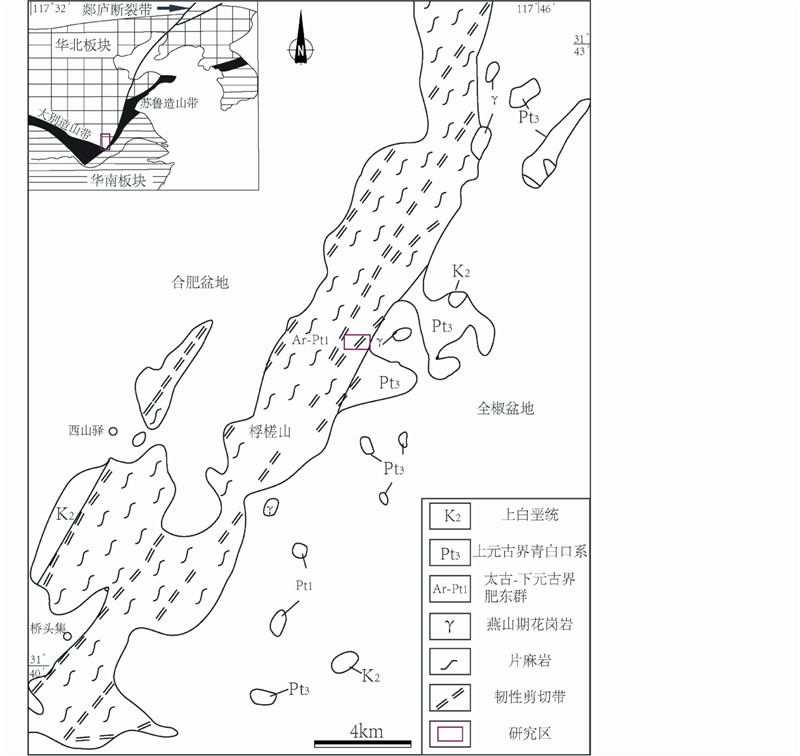 | 图 1 研究区构造位置简图(据宋传中等,2003修改)Fig. 1 Simplified geological sketch map of the Feidong area(modified after Song et al., 2003) |
郯庐断裂带是中国东部的一条巨型断裂带,其在中国境内呈NNE走向,延伸约2400km(朱光等,2005a)。其中位于安徽中部的肥东段韧性剪切带是郯庐断裂带的南段的重要组成部分,也是郯庐断裂带中深层次变形的典型代表。肥东段韧性剪切带总体呈NNE向展布。由若干条规模不等的次级韧性剪切带组合而成(图 1),剪切面理倾向SE,倾角70°~85°;矿物拉伸线理倾伏向NE或SW,倾伏角为8°~15°(许卫等,2001; 宋传中等,2003; Zhang and Teyssier, 2013; Zhang et al., 2013)。桃源韧性剪切带位于肥东县桴槎山东麓,是郯庐断裂带肥东段经典的露头之一。该剪切带发育在肥东群内,区内岩石经历了多期、强烈的构造变形,从而形成一套斜长角闪片麻岩(童劲松和许卫,2000; 石永红等,2009)。剪切带内除了出露上述的斜长角闪片麻岩,同时还出露角闪质糜棱岩、长英质糜棱岩以及伟晶岩脉等岩石,各岩性层呈条带状相间排列,构造形态复杂,塑性变形强烈(图 2),左行走滑运动学指示清晰,同时记录了多期次构造活动,为研究郯庐韧性剪切带提供了一个非常理想的场所。
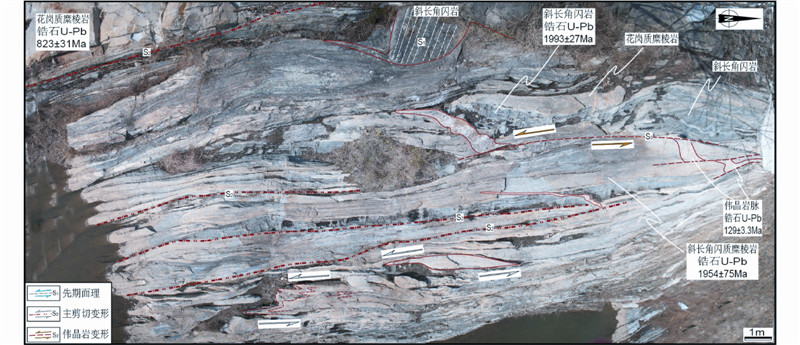 | 图 2 桃源韧性剪切带野外地质特征Fig. 2 Geological features of the Taoyuan shear zone |
剪切带内主要发育有角闪斜长片麻岩、长英质糜棱岩、角闪质糜棱岩及伟晶岩脉等岩石。各岩性层呈条带状相间排列。
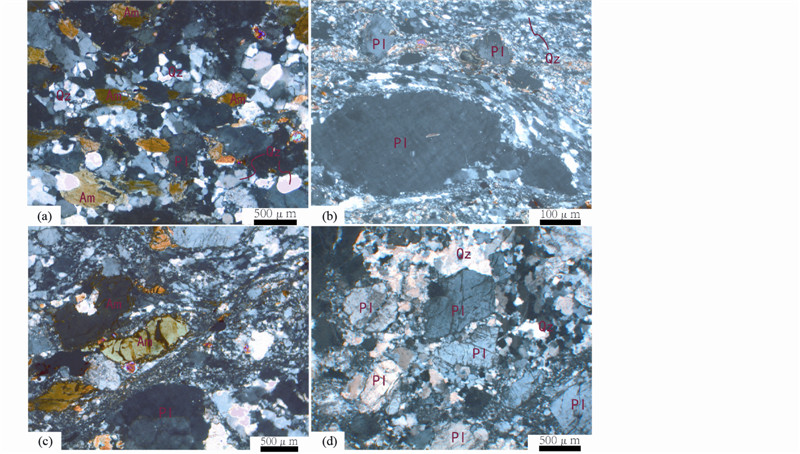
斜长角闪片麻岩(TH14):主要矿物为斜长石(30%~35%)、钾长石(20%)、角闪石(40%)、少量石英和帘石(5%),定向性明显。斜长石为半自形-他形结构,粒径为0.1~1mm;角闪石呈半自形-他形,定向排列,粒径0.2~2mm,颗粒边缘发生轻微绿泥石化;黑云母半自形-他形,粒径大小约0.2mm;石英他形结构,粒径大小0.2~0.5mm;磷灰石他形结构,颗粒大小为0.1~0.3mm(图 3a)。
 | 图 3 桃源韧性剪切带岩相学特征
(a)斜长角闪片麻岩;(b)长英质糜棱岩;(c)角闪质糜棱岩;(d)伟晶岩脉Fig. 3 Petrographic features of the Taoyuan shear zone (a)plagioclase amphibole gneiss;(b)felsic mylonite;(c)amphibolitic mylonite;(d)pegmatite vein |
长英质糜棱岩(TH2、TH12):主要矿物为斜长石(30%~40%)、钾长石(20%~30%)、石英(30%)及少量黑云母等;糜棱结构,流状构造,残斑主要为长石,并发生脆韧性变形,石英绝大部分发生颗粒边界迁移式动态重结晶,呈他形(图 3b)。
角闪质糜棱岩(TH6、TH25):主要矿物为斜长石(30%~40%)、钾长石(20%)、角闪石(25%)、石英(15%)、少量帘石及黑云母(5%)。糜棱结构,流状构造,长石、角闪石多以残斑型式存在,周围环绕很多变质变形亚颗粒,石英大都发生动态重结晶(图 3c)。
伟晶岩脉(TY21):斜长石(40%)、钾长石(30%)、石英(30%)。矿物颗粒较大且未定向,颗粒较大,长石0.2~4mm,多发生脆性破裂,石英0.5~1mm,局部发生BLG-SR型动态重结晶(图 3d)。 3.2 构造变形特征 3.2.1 带状构造
桃源韧性剪切带韧性变形强烈,颜色深浅间隔,呈条带状分布,主要岩石为斜长角闪质糜棱岩、长英质糜棱岩以及贯穿其中的长英质脉体和伟晶岩脉,矿物重结晶发育,并伴有新生矿物形成。长英质体条带:主要矿物为浅色的长石、石英、角闪石和少量帘石,它们均发生了糜棱岩化,岩石的原始结构构造基本上被完全置换,剪切带内面理与剪切带方向近平行。斜长角闪岩条带:主要为深色的斜长角闪质糜棱岩,颜色比浅色岩层构造置换程度弱,仅在剪切作用较强的边界部位发生构造牵引,有比较多小尺度的长英质脉的结晶析出,并形成同构造的“a”型褶皱。黑云角闪斜长岩块:带内出露大量黑云角闪斜长片麻岩,主要以大小不一的透镜体或者残斑状存在于主剪切带内,是早期区域性变质岩被卷入到韧性剪切带的产物。 3.2.2 剪切构造
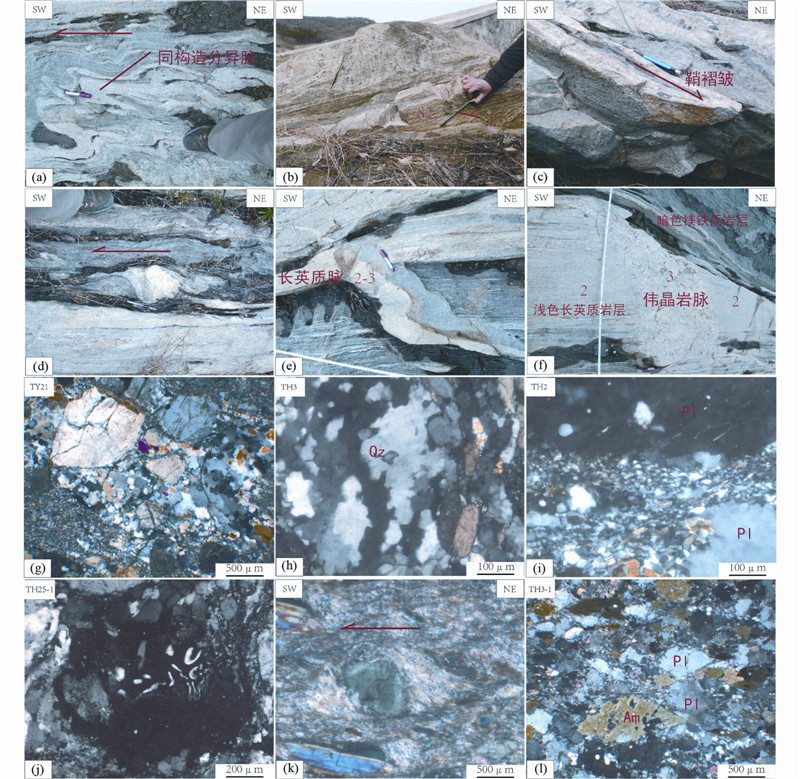
剪切褶皱:褶皱多发育于长英质岩条带内,常以紧闭同斜褶皱、无根褶皱的形式出现。两翼常被拉长、拉断,呈不对称“a”型褶皱。枢纽产状大致为:25°∠30°,轴面NE走向。由枢纽产状及褶皱轴面产状得出的剪切带旋向为左行(图 4a)。矿物拉伸线理及鞘褶皱:矿物拉伸线理(图 4b)多以Pl、Qz、Amp、Bt、Kfs等矿物或集合体表现,产状比较稳定,呈北东-南西向展布,倾角缓,小于10°,与小褶皱枢纽产状一致。鞘褶皱(图 4c)的“尖端”所指方向与剪切方向一致,指示为左行剪切。旋转碎斑:带内残斑多为变形较弱的长石斑晶和变形强烈的石英斑晶,为“σ”型和“δ”型,可见明显拖尾,指示左旋运动特征(图 4d)。
 | 图 4 桃源剪切带内的多种构造变形
(a)不对称褶皱;(b)矿物生长线理;(c)鞘褶皱;(d)变形残斑;(e)长英质脉;(f)伟晶岩脉;(g)伟晶岩脉变形特征;(h)石英GBM重结晶;(i)长石BLG重结晶;(j)蠕英结构;(k、l)变形角闪石Fig. 4 Different ductile deformation styles related the Taoyuan shear zone (a)asymmetrical fold;(b)mineral lineation;(c)sheath fold;(d)deformed porphyroclast;(e)felsicveins;(f)pegmatiteveins;(g)deformation characteristics of pegmatite veins;(h)GBM recrystallized quartz;(i)BLG recrystallized feldspar;(j)worm quartz;(k,l)deformed amphibole |
带内普遍发育伟晶岩脉(图 4e)、长英质脉(图 4f)和石英脉,宽度5~10cm不等。伟晶岩脉呈顺层或者斜切剪切带发育,脉体均发生了同构造的左旋剪切,并与剪切带形成S-C组构呈现,但其内矿物并未发生定向(图 4g),由此判断该伟晶岩脉很可能是同构造后期由 长英质岩中结晶析出或同构造后期侵入的产物;长英质脉发生同构造的褶皱弯曲,且脉内矿物发生同剪切定向,说明长英质脉也为同构造脉体。石英脉多为后期形成。 3.2.4 显微变形机制
在不同温度条件下,长石与石英的变形方式具有阶段性,其变形与动态重结晶型式与温度具有明显的对应关系(Hay and Evans, 1987; Yund and Tullis, 1991; Lafrance et al., 1998; Stipp et al., 2002)。
桃源韧性剪切带中变形矿物主要为石英、长石及角闪石。通过大量镜下观察得出,区内糜棱岩中石英普遍发生动态重结晶,亚颗粒旋转(SR)和颗粒边界迁移式(GBM)动态重结晶均有发育,更多的以GBM型动态重结晶存在(如图 4h);长石多以 残斑型式存在,颗粒边界发生膨突式(BLG)动态重结晶,局部为BLG向SR转化,核幔构造发育(图 4i),局部可见石英出溶、蠕英结构(图 4j);角闪石多以残斑型式存在,脆性破裂,极少数可见塑性拖尾(图 4k,l)。基于矿物组合和重结晶型式定性判断剪切带的变形温度为550~650℃之间(表 1),明显比前人普遍得出的400~550℃要高。
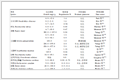
| 表 1 桃源韧性剪切带内长石变形机制及温度估计 Table 1 Deformation mechanism of feldspar and temperature estimation of the Taoyuan shear zone |
矿物变质的温压条件是构造环境恢复的重要参考因素,而且对于韧性剪切带这一特殊构造来说,要得出其确切剪切温压条件,需对韧性剪切带内糜棱岩中基质矿物进行研究,原岩岩石或原岩残斑反应的更多的是剪切作用之前的温压状况(刘德良等,1996)。因此本文在研究中尤其注意到了这一点,对选取的4个糜棱岩样品中的残斑和基质矿物组合进行了详细的成分分析。电子探针片由合肥工业大学磨片室完成;矿物成分分析由合肥工业大学电子探针实验室完成,仪器型号为:JXA-8230,实验条件为电压:15kV,电子速流:20nA,电子束斑:3μm(Ms,Bt: 5μm)。角闪石、长石结构式中O个数分别按23、8来计算。角闪石中Fe2+校正应用Si+Al+Ti+Mg+Fe+Mn=13的方法。
探针分析数据可见(表 2),糜棱岩内基质斜长石基本上均为奥长石,角闪石为镁角闪石及铁镁钙闪石;而通过对糜棱岩中残斑的成分分析得出,斜长石主要为奥长石,角闪石为镁钙闪石及铁镁钙闪石(图 5);将基质与残斑长石、角闪石成分进行对比,可以看出:残斑斜长石比基质斜长石略偏基性,说明残斑温度偏高;高温角闪石中[Al]Ⅳ比低温种属要高,而对比探针数据,残斑中[Al]Ⅳ的含量明显高于基质中的[Al]Ⅳ,说明残斑的形成温度比基质的形成温度要高(光性矿物学),同时也说明该糜棱岩经历了角闪岩相的退变质作用,基质矿物为残斑矿物变质变形的结果。
|
| 表 2 桃源韧性剪切带内糜棱岩中代表矿物性成分(wt%) Table 2 Representative mineral compositions for mylonite from the Taoyuan ductile shear zone(wt%) |
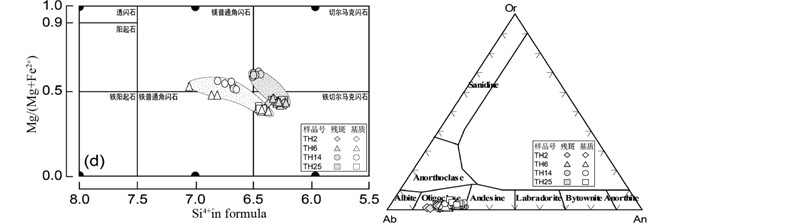 | 图 5 矿物成分图Fig. 5 Composition diagrams of the metamorphic minerals |
依据岩相学和矿物化学分析(图 5),可以判定斜长角闪质岩石内可观察到两期变质矿物组合:①残斑:Pl+Amp+Qzt;②基质:Pl+Amp+Qz+Bt,而且,从选取的成分来看,斜长角闪质岩石中角闪石均为钙质闪石。据此,本文选用了Holl and and Blundy(1994)角闪石-斜长石温压计对剪切带进行了细致的温压评价。在成分选取方面,残斑变质的成分选取残斑角闪石和斜长石的核部到边部;基质变质的成分选取基质角闪石与斜长石矿物的成分进行计算。同时,为保证分析计算的统计意义,本次研究共选取4个样品分别对基质和残斑进行温压估算,并取其平均值作为样品的变质P-T条件。分析结果见表 3和图 6。
|
| 表 3 桃源韧性剪切带剪切形成的温压条件 Table 3 Temperature and pressure of Taoyuan ductile shear zone |
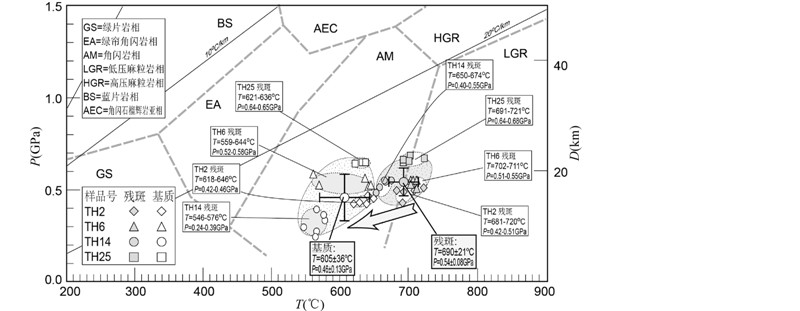 | 图 6 桃源地区斜长角闪岩峰期变质P-T条件Fig. 6 The peak P-T conditions for plagioclase amphibolite from Feidong Taoyuan area |
分析结果表明,基质形成温压条件为:T=605±39℃,P=0.46±0.13GPa;残斑形成温压条件为:T=690±21℃,P=0.54±0.08GPa。两者均对应角闪岩相变质环境(图 6),且二者形成温度有近30℃的绝对差值,近等压降温;而从单个样品中残斑与基质的矿物对比,温度差值在50~100℃之间,说明早期矿物在剪切过程中部分发生了一定程度的退变质,从而形成糜棱岩中的基质,因此基质矿物组合所反映的温压条件代表着该期剪切作用的温压。同时通过变形机制所估算温度与糜棱岩基质内矿物对所测温度吻合,也证实了这一观点。 5 锆石U-Pb年代学
韧性剪切带的温度一般很难达到锆石的封闭温度,所以剪切带内锆石记录更多的是原岩的信息,通过原岩中锆石U-Pb年代学数据,可以帮助追踪构造原岩块体的物质来源以及演化信息(Chung,1999)。本次工作对剪切带内片麻岩、糜棱岩及伟晶岩脉进行了年代学研究。锆石单矿物挑选由河北省地勘局廊坊实验室完成。锆石制靶由合肥工业大学LA-ICPMS洁净实验室完成,阴极发光(CL)照相由合肥工业大学电子探针实验室完成,仪器型号为JXA-8230。锆石U-Pb定年分析由合肥工业大学LA-ICPMS实验室完成,实验条件为:束斑32μm,并用国际标样91500作为外标,元素含量采用NISTSRM 610作为外标,每测试分析5个样品点测两次标准锆石91500。锆石数据的处理采用ICPMSDateCal 9.0软件,所得结果如表 4所示。
|
| 表 4 锆石年龄数据 Table 4 The zircon U-Pb age data |


样品XP1为花岗质糜棱岩,共测试了50个数据点,获得了23个谐和年龄和27个不谐和年龄(表 4)。根据显微镜下的透、反射光研究,锆石多呈长柱状,自形程度较好,粒径50~300μm,长宽比为4:1~1:1。CL图像显示,边部变质重结晶锆石与岩浆锆石共存,弱分带、面状结构(图 7a-c)。锆石U-Pb定年分析显示,23个谐和年龄的锆石Th/U比值为0.3~3.6,年龄范围786~1996Ma,体现为两个极值点:7个较年轻年龄的Th/U比值均大于1.0,CL图像特征也显示岩浆锆石特征环带结构,加权平均年龄为823±31Ma(图 8)。16个较老年龄的Th/U比值均小于1.0,CL图像显示为变质锆石的弱分带及面状分带结构,年龄范围为1739~2188Ma,这些锆石应为花岗岩继承锆石,原岩中变质,少数变质增生前锋(吴元宝和郑永飞,2004; Gebauer et al., 1997; Hacker et al., 1998)可见。
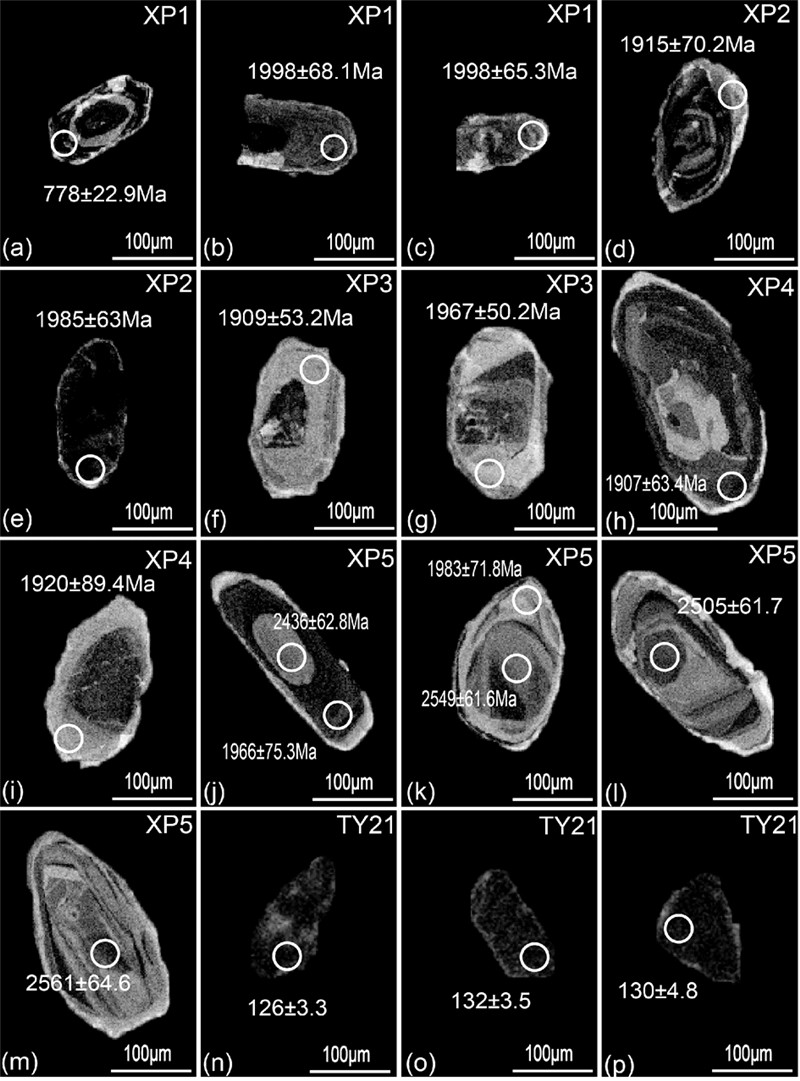 | 图 7 锆石CL图像Fig. 7 Cathodoluminescene images of zircons |
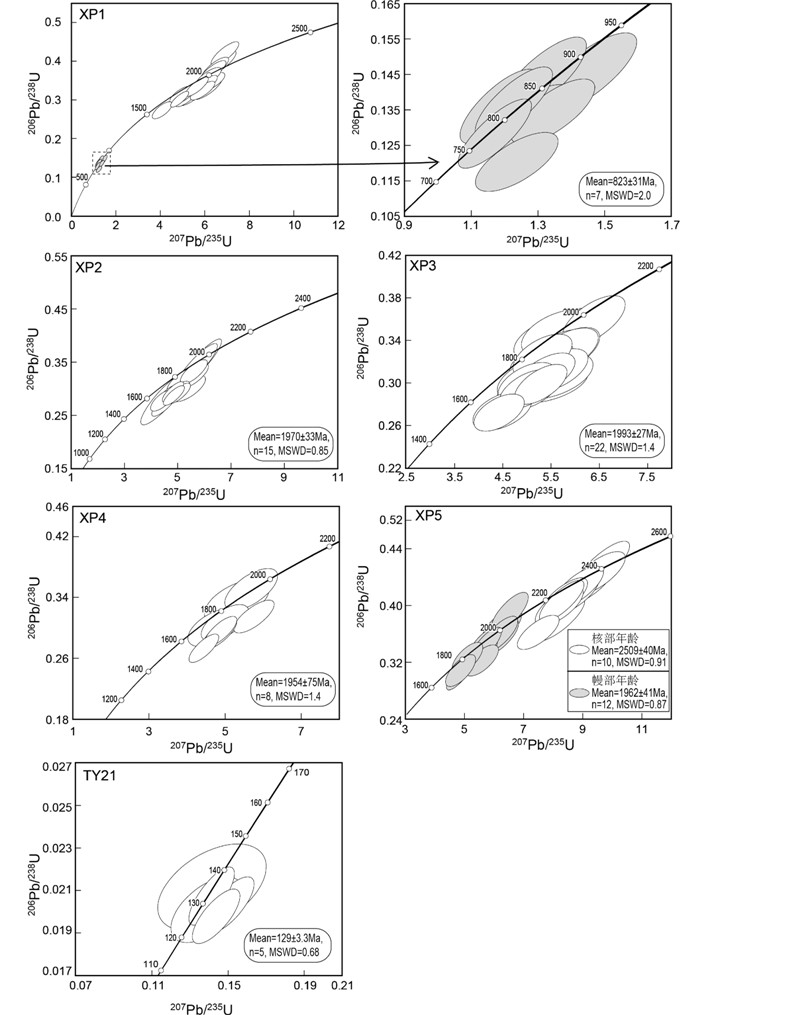 | 图 8 锆石U-Pb定年谐和图Fig. 8 Concordia plots of zircons |
样品XP2为角闪质糜棱岩,50个测试点,获得了15个谐和年龄和35个不谐和年龄(表 4)。锆石多呈柱状,自形,粒径30~150μm,长宽比3:1~1:1。CL图像显示,锆石多呈弱分带、面状分带、斑杂状分带(图 7d,e)。锆石U-Pb定年分 析显示,15个谐和年龄的锆石Th/U比值为0.2~2.5,多数<0.7,结合锆石形态、CL图像特征以及Th/U比值特征,我们认为该样品内锆石为变质锆石(某些变质锆石的Th/U比值可以达到0.7,吴元宝和郑永飞,2004)。其年龄范围为1948~2322Ma,加权平均年龄为1970±33Ma(图 8),记录的应为形成斜长角闪片麻岩这一变质事件年龄 。
样品XP3为角闪斜长片麻岩,50个测试点,得到了22个谐和年龄,和28个不谐和年龄(表 4)。样品内锆石呈柱状,自形、半 自形,粒径50~200μm,长宽比为3:1~1:1。CL图像显示,锆石多为变质重结晶锆石,面状分带、斑杂状分带结构(图 7f,g)。锆石U-Pb定年分析显示,22个谐和年龄的锆石的Th/U比值为0.3~1.6(多数<1.0),年龄范围为1909~2102Ma,加权平均年龄为1993±27Ma(图 8)。该样品与XP2类似,记录的也应为当时的变质年龄。
样品XP4为角闪质糜棱岩,50个测试点,得到了8个谐和年龄,和42个不谐和年龄。根据显微镜下的透、反射光研究,锆石多呈柱状,弱分带、面状分带、斑杂状分带结构(图 7h,i)。锆石U-Pb定年分析显示(表 4),8个谐和年龄的锆石的Th/U比值为0.2~1.4(多数小于0.7),以上信息说明该样品中锆石为变质重结晶锆石。所得年龄范围为1843~2128Ma,加权平均年龄为1954±75Ma(图 8),为变质年龄,与XP3中所得加权平均年龄在误差范围内一致。
样品XP5为角闪质糜棱岩,65个测试点,部分锆石具有典型的核幔结构,共得到了10个核部谐和年龄和12个幔部谐和年龄。样品内锆石多呈柱状,自形、半自形,粒径100~300μm,长宽比为4:1~1:1。CL图像显示,锆石多为变质重结晶锆石,弱分带、面状分带、斑杂状分带结构(图 7j-m)。锆石U-Pb定年分析显示,10个核部年龄和12个幔部年龄的Th/U比值为0.1~1.0,加权平均年龄分别为2509±40Ma和1962±41Ma(图 8)。核部继承锆石很好的记录了一期变质事件,该变质事件的时代为2509±40Ma。而边部锆石年龄与上述XP3、XP4等记录的变质年龄一致。
样品TY21为伟晶岩,30个测试点,共得到5个谐和年龄。样品内锆石多呈短柱状,自形、半自形,粒径50~300μm,长宽比6:1~1:1。CL图像显示,锆石边部具有震荡环带,同时呈弱分带(图 7n-p),锆石U-Pb定年分析显示,5个谐和年龄的Th/U比值为0.02~0.06,这种极低的Th/U比值可能是深熔作用的结果(李基宏等,2004)。综合以上特征推断该伟晶岩脉为片麻岩深熔作用过程中浅色物质迁移、聚集结晶而成。此过程可能为剪切过程中流体的参与,降低了片麻岩的熔点,造成局部熔融的结果。其加权平均年龄为129±3.3Ma(图 8),代表了脉体的形成时代,同时限定了韧性剪切的年限,即在~130Ma以前开始,且在其形成时期衰弱。 6 讨论与结论
(1)利用斜长-角闪温压计对糜棱岩中的残斑和基质矿物组合进行了温压评价,其中残斑矿物组合为早期区域变质产物,而基质矿物组合为糜棱岩剪切过程变质变形产物。结果显示:斜长角闪片麻岩变质峰期条件为:T=660~705℃,P=0.47~0.65GPa,对应埋藏深度约20km左右;剪切带变质变形温压条件为:T=550~630℃、P=0.31~0.65GPa,对应埋藏约15~20km。虽然早期区域变质峰期温压条件稍高于剪切退变质温压条件,但两者差别不大,仍在同一个数量级,这说明在区域变质发生之后到剪切作用发生之前的这段地质时期内,该块体并未发生明显抬升。这与徐嘉炜等(1984)通过构造地层学研究得出的郯庐断裂带的南段在元古代至早中三叠世间没有发生明显的构造变动的结论一致。
(2)从带内野外现象结合锆石U-Pb年龄数据可以看出,桃源地区至少存在四期构造活动证据:1)区域性变质作用形成片麻岩,该片麻岩部分呈透镜体横列在剪切带中,其早期片麻理S1垂直糜棱面理S2,部分在剪切过中被改造,形成角闪质糜棱岩。样品XP1-5中锆石U-Pb数据指示其变质时代为~2.0Ga;2)0.8Ga的岩浆作用。XP1长英质超糜棱岩样品中,8颗岩浆锆石给出加权平均年龄为823±31Ma谐和年龄,指示了该区~0.8Ga岩浆事件的存在,而该事件为扬子板块特征事件(Li et al., 2008,2010a,b);3)郯庐断裂带韧性剪切活动,早期片麻岩卷入该期的剪切活动中,形成大量的NNE-SSW向左旋构造,朱光等研究得出的大量40Ar/39Ar年龄数据显示,肥东地区韧性剪切活动发生在早白垩世,并限制在143.4Ma左右(朱光等,2005b);4)晚期(130Ma左右,本文)伟晶岩脉的形成,该岩脉以小角度斜切早期韧性剪切带岩石,伟晶岩脉内锆石U-Pb年龄为~130Ma,说明肥东地区主期韧性剪切构造形成于130Ma以前。同时伟晶岩脉拖尾与糜棱岩面理方向基本平行,指示了该伟晶岩脉经历了同构造左行剪切作用,而其脆韧性弱变形特点也说明该岩脉在剪切作用晚期形成。以上现象说明桃源韧性剪切带主期变形发生在130Ma之前,但在130Ma左右仍有较弱的左旋剪切作用持续。
(3)华北板块与华南板块的物质主要区分点为年龄。总结前人对华北及华南板块的研究结果可以看出,华北板块基底年龄值主要集中在1.7~2.5Ga内(Pidgeon,1980; Zhang et al., 1985; Wu et al., 1991; Wilde et al., 1997; Kröner et al., 1998; 毛德宝等,1999; 郭敬辉等,1999; Zhao et al., 2000; Zhao and Zhai, 2013; Li et al., 2004,2006; Liu et al., 2009; Chen et al., 2015),而华南板块的年龄值主要集中在2.1~1.85Ga、0.85~0.65Ga、0.48~0.4Ga、0.24~0.2Ga四个年龄峰值上(Hacker et al., 1998; Qiu et al., 2000; 郑永飞和张少兵,2007; Jiao et al., 2009; 彭敏等,2009; Li et al., 2014a)。从XP1-5等这5个样品中得出的100个较老的谐和基底年龄可以看出,桃源地区基底年龄主要集中在三个年龄值上,即~0.8Ga、~2.0Ga、~2.5Ga,其中0.8Ga的年龄值仅在桃源超糜棱岩中岩浆锆石中记录,~2.0Ga的变质年龄在各样品中普遍存在,XP5的核部变质锆石年龄显示为~2.5Ga。0.8Ga的岩浆事件华北板块基本上不发育,而华南板块内则发育较多相近年龄(Li et al., 2010a,b),进而推断该样品原岩来自于华南板块;而~2.0Ga的变质年龄在华南板块崆岭群中较为普遍(Yin et al., 2013; Li et al., 2014b),虽然华北中部带也有类似的变质年龄报道,但其主要集中~1.85Ga(Zhang et al., 1985; 郭敬辉等,1999; Zhao et al., 2000)。因此本文所得的~2.0Ga的变质年龄,其物质来源可能更倾向华南板块。~2.5Ga的变质年龄在华北板块内有所发育(Zhao et al., 1998,1999a,b; Zhao and Zhai, 2013)。但是最近大量的碎屑锆石的研究表明,华南同样存在一个晚太古代的统计峰值,只是地表未见该时段的岩石出露(Li et al., 2014a),所以对于该年龄的确切解释还有待考究。因此本文推断,肥东桃源地区韧性剪切带的原岩很大可能上代表了华南板块的基底岩石,但是同样也不排除其可能有华北板块的物质在剪切作用过程中被卷入郯庐断裂带。
综上,本文认为,桃源韧性剪切带为一构造杂岩带,剪切作用地质体有可能包含了分别来自于华北及华南两个板块的物质。剪切带的剪切深度大致为15~20km,对应中下地壳深度。由同构造弱变形伟晶岩脉体得出的年龄判断,桃源韧性剪切的剪切作用发生在~130Ma之前,且在~130Ma左右发生衰减。这在一定程度上反映了环太平洋俯冲运动的减弱。至于区内伟晶岩脉的发育与燕山期大规模岩浆活动是否有关,还是这些岩脉为同剪切作用形成的?本文观点仍有所保留,还有待进一步研究。
致谢 电子探针分析和锆石U-Pb年代分析得到石永红教授、李全中副教授的细心指导和帮助;岩石学分析及岩矿鉴定等得到王道轩、李振生老师的细心指导;在此谨向他们表示由衷的感谢。同时非常感谢评审人及编辑部老师在文章修改过程中提出的中肯的修改意见和建议。
| [1] | Chen YP, Wei CJ, Zhang JR and Chu H. 2015. Metamorphism and zircon U-Pb dating of garnet amphibolite in the Baoyintu Group, Inner Mongolia. Science Bulletin, 60(19):1698-1707 |
| [2] | Chung SL. 1999. Trace element and isotope characteristics of Cenozoic basalts around the Tanlu fault with implications for the eastern plate boundary between North and South China. The Journal of Geology, 107(3):301-312 |
| [3] | Gebauer D, Schertl HP, Brix M et al. 1997. 35Ma old ultrahigh-pressure metamorphism and evidence for very rapid exhumation in the Dora Maira Massif, Western Alps. Lithos, 41(1-3):5-24 |
| [4] | Guo JH, Shi X, Bian AG, Xu RH, Zhai MG and Li YG. 1999. Pb isotopic composition of feldspar and U-Pb age of zircon from early Proterozoic granite in Sanggan area, North China Craton:Metamorphism, crustal melting and tectono-thermal event. Acta Petrologica Sinica, 15(2):199-207(in Chinese with English abstract) |
| [5] | Hacker BR, Ratschbacher L, Webb L, Ireland T, Walker D and Shuwen D. 1998. U/Pb zircon ages constrain the architecture of the ultrahigh-pressure Qinling-Dabie Orogen, China. Earth and Planetary Science Letters, 161(1-4):215-230 |
| [6] | Hay RS and Evans B. 1987. Chemically induced grain boundary migration in calcite:Temperature dependence, phenomenology, and possible applications to geologic systems. Contributions to Mineralogy and Petrology, 97(1):127-141 |
| [7] | Holland T and Blundy J. 1994. Non-ideal interactions in calcic amphiboles and their bearing on amphibole-plagioclase thermometry. Contributions to Mineralogy and Petrology, 116(4):433-447 |
| [8] | Hou MJ, Mercier J, Vergely P and Wang YM. 2006. Two development stages of the Tanlu fault zone:The stages of the overthrust fault zone sensu lato and the wrench fault zone sensu stricto. Geology in China, 33(6):1267-1275(in Chinese with English abstract) |
| [9] | Hou MJ, Zhu G, Mercier J, Vergely P and Wang YM. 2007. Analyzing on geodynamics and regional tectonic evolution of the Tan-Lu fault zone(Anhui segment) and its environs. Chinese Journal of Geology, 42(2):362-381(in Chinese with English abstract) |
| [10] | Jiao WF, Wu YB, Yang SH, Peng M and Wang J. 2009. The oldest basement rock in the Yangtze Craton revealed by zircon U-Pb age and Hf isotope composition. Science in China(Series D), 52(9):1393-1399 |
| [11] | Kang T, Liu XY, Wang J, Nie F and Shi YH. 2013. Analysis of metamorphic attribution and geochronology for the Feidong terrane in the east of the Tan-Lu Fault. Acta Petrologica Sinica, 29(9):3142-3158(in Chinese with English abstract) |
| [12] | Kröner A, Cui WY, Wang WY, Wang CQ and Nemchin AA. 1998. Single zircon ages from high-grade rocks of the Jianping Complex, Liaoning Province, NE China. Journal of Asian Earth Science, 16(5-6):519-532 |
| [13] | Lafrance B, John BE and Frost BR. 1998. Ultra high-temperature and subsolidus shear zones:Examples from the Poe Mountain anorthosite, Wyoming. Journal of Structural Geology, 20(7):945-955 |
| [14] | Li JH, Yang CH and Du LL. 2004. Zircon SHRIMP U-Pb ages and causes of the deep penetration pegmatite in Pingshan, Hebei. Progress in Natural Science, 14(7):774-781(in Chinese) |
| [15] | Li KS. 1987. A preliminary exploration on the tectonic stress field of Tan-Lu fault zone. Bulletin of the 562 Comprehensive Geological Brigade, Chinese Academy of Geological Sciences,(6):127-137(in Chinese) |
| [16] | Li LM, Lin SF, Davis DW, Xiao WJ, Xing GF and Yin CQ. 2014b. Geochronology and geochemistry of igneous rocks from the Kongling terrane:Implications for Mesoarchean to Paleoproterozoic crustal evolution of the Yangtze Block. Precambrian Research, 255:30-47 |
| [17] | Li SZ, Zhao GC, Sun M, Wu FY, Liu JZ, Hao DF, Han ZZ and Luo Y. 2004. Mesozoic, not Paleoproterozoic SHRIMP U-Pb zircon ages of two Liaoji granites, Eastern Block, North China Craton. International Geology Review, 46(2):162-176 |
| [18] | Li SZ, Zhao GC, Sun M, Han ZZ, Zhao GT and Hao DF. 2006. Are the South and North Liaohe Groups of North China Craton different exotic terranes? Nd isotope constraints. Gondwana Research, 9(1-2):198-208 |
| [19] | Li WX, Li XH and Li ZX. 2010a. Ca.850Ma bimodal volcanic rocks in northeastern Jiangxi Province, South China:Initial extension during the breakup of Rodinia? American Journal of Science, 310(9):951-980 |
| [20] | Li XH, Li WX, Li ZX and Liu Y. 2008. 850-790Ma bimodal volcanic and intrusive rocks in northern Zhejiang, South China:A major episode of continental rift magmatism during the breakup of Rodinia. Lithos, 102(1-2):341-357 |
| [21] | Li XH, Li WX, Li QL, Wang XC, Liu Y and Yang YH. 2010b. Petrogenesis and tectonic significance of the-850Ma Gangbian alkaline complex in South China:Evidence from in situ zircon U-Pb dating, Hf-O isotopes and whole-rock geochemistry. Lithos, 114(1-2):1-15 |
| [22] | Li XH, Li ZX and Li WX. 2014a. Detrital zircon U-Pb age and Hf isotope constrains on the generation and reworking of Precambrian continental crust in the Cathaysia Block, South China:A synthesis. Gondwana Research, 25(3):1202-1215 |
| [23] | Lin JL and Fuller M. 1990. Palaeomagnetism, North China and South China collision, and the Tan-Lu fault. Philosophical Transactions of the Royal Society of London, Series A, 331(1620):589-598 |
| [24] | Lin W, Wang QC, Faure M, Sun Y, Shu LS and Scharer U. 2003. Different deformation stages of the Dabieshan Mountains and UHP rocks exhumation mechanism. Acta Geologica Sinica, 77(1):44-54(in Chinese with English abstract) |
| [25] | Lin W, Faure M, Wang QC, Monie P and Panis D. 2005. Triassic polyphase deformation in the Feidong-Zhangbaling Massif(eastern China) and its place in the collision between the North China and South China blocks. Journal of Asian Earth Sciences, 25(1):121-136 |
| [26] | Liu DL, Yang XY, Yang HT and Yu QN. 1996. The deformational condition and component migration of mylonites in Fuchashan ductile shear zones in the southern Tanchen-Lujiang Fault Belt. Acta Petrologica Sinica, 12(4):573-588(in Chinese with English abstract) |
| [27] | Liu DL, Yang Q, Wu XQ and Li ZS. 2006. Duration of structural deformation of ductile shear zone in Fuchashan Hill, Anhui sector of the Tan-Lu fault. Chinese Journal of Geology, 41(2):333-343(in Chinese with English abstract) |
| [28] | Liu YC, Wang AD, Rolfo F, Groppo C, Gu XF and Song B. 2009. Geochronological and petrological constraints on Palaeoproterozoic granulite facies metamorphism in southeastern margin of the North China Craton. Journal of Metamorphic Geology, 27(2):125-138 |
| [29] | Mao DB, Zhong CT, Chen ZH, Lin YX, Li HM and Hu XD. 1999. The isotope ages and their geological implications of high-pressure basic granulites in north region to Chengde, Hebei Province, China. Acta Petrologica Sinica, 15(4):524-531(in Chinese with English abstract) |
| [30] | Nie F, Shi YH, Wang J, Kang T and Cao S. 2014. Investigation on the metamorphic conditions and geochronology for the magnet garnet amphibole in the Tan-Lu Fault Zone(Anhui segment), and discussion of its tectonic attribution. Acta Petrologica Sinica, 30(6):1718-1730(in Chinese with English abstract) |
| [31] | Niu ML, Zhu G, Liu GS, Wang DX and Song CZ. 2002. Tectonic setting and deep processes of Mesozoic magmatism in middle-south segment of the Tan-Lu fault. Chinese Journal of Geology, 37(4):393-404(in Chinese with English abstract) |
| [32] | Niu ML. 2006. 40Ar/39Ar dating of biotite from the Mesozoic intrusions in Zhangbaling area and its geological significance. Chinese Journal of Geology, 41(2):217-225(in Chinese with English abstract) |
| [33] | Niu YL, Liu Y, Xue QQ, Shao FL, Chen S, Duan M, Guo PY, Gong HM, Hu Y, Hu ZX, Kong JJ, Li JY, Liu JJ, Sun P, Sun WL, Ye L, Xiao YY and Zhang Y. 2015. Exotic origin of the Chinese continental shelf:Nnew insights into the tectonic evolution of the western Pacific and eastern China since the Mesozoic. Science Bulletin, 60(18):1598-1616 |
| [34] | Peng M, Wu YB, Wang J, Jiao WF, Liu XC and Yang SH. 2009. Paleoproterozoic mafic dyke from Kongling terrain in the Yangtze Craton and its implication. Chinese Science Bulletin, 54(6):1098-1104 |
| [35] | Pidgeon RT. 1980. Isotopic ages of the zircons from the Archean granulite facies rocks, eastern Hebei, China. Geological Review, 26(3):198-203(in Chinese) |
| [36] | Qiu YM, Gao S, McNaughton NJ, Groves DI and Ling WL. 2000. First evidence of >3.2Ga continental crust in the Yangtze craton of South China and its implications for Archean crustal evolution and Phanerozoic tectonics. Geology, 28(1):11-14 |
| [37] | Shi YH, Zhu G and Wang DX. 2009. Metamorphic P-T evolution for the garnet amphibolite from Feidong Group in the south of Zhangbaling uplift across Tan-Lu fault and its influence on tectonics. Acta Petrologica Sinica, 25(12):3335-3345(in Chinese with English abstract) |
| [38] | Song CZ, Zhu G, Liu Y, Niu ML and Liu GS. 2003. Deformation features and isotopic ages of the Feidong ductile shear belt in the Tan-Lu Fault Zone and its tectonic implications. Geological Review, 49(1):10-16(in Chinese with English abstract) |
| [39] | Stipp M, Stunitz H, Heilbronner R and Schmid SM. 2002. The eastern Tonale fault zone:A‘natural laboratory’for crystal plastic deformation of quartz over a temperature range from 250 to 700℃. Journal of Structural Geology, 24(12):1861-1884 |
| [40] | Tong JS and Xu W. 2000. On the features, origin and time of the gneiss suite in the Fuchashan area of Anhui. Geology of Anhui, 10(1):9-18(in Chinese with English abstract) |
| [41] | Wan TF, Zhu H, Zhao L, Lin JP, Cheng J and Chen J. 1996. Formation and evolution of Tancheng-Lujiang fault zone:A review. Geoscience, 10(2):159-168(in Chinese with English abstract) |
| [42] | Wang XF, Li ZJ, Chen BL, Zhang Q, Chen XH, Xing LS, Chen ZL, Dong SW and Wu HM. 1998. Formation and evolution of the Tan-Lu strike-slip fault system and its geological significance. In:Zheng YD et al.(eds.). Proceedings of 30th International Geological Congress(14). Beijing:Geological Publishing House, 176-196(in Chinese) |
| [43] | Wang YS, Zhu G, Liu GS and Wang DX. 2004. Evolution of sericite polytype and crystallinity during mylonization:Examples from the southern part Tan-Lu fault zones. Acta Petrologica Sinica, 20(6):1485-1492(in Chinese with English abstract) |
| [44] | Wang YS and Zhu G. 2005. Cooling and deformation ages in 40Ar/39Ar dating. Geological Bulletin of China, 24(3):285-290(in Chinese with English abstract) |
| [45] | Wang YS, Zhu G, Wang DX, Song CZ and Liu GS. 2005a. An attempt to apply three geothermometers in the interpretation of low-temperature mylonites in the southern segment of the Tanlu fault zone. Geology in China, 32(4):625-633(in Chinese with English abstract) |
| [46] | Wang YS, Zhu G, Chen W, Song CZ and Liu GS. 2005b. Thermochronologic information from the Tan-Lu fault zone and its relationship with the exhumation of the Dabie Mountains. Geochimica, 34(3):193-215(in Chinese with English abstract) |
| [47] | Wang YS, Zhu G, Song CZ, Liu GS, Xiang BW, Li CC and Xie CL. 2006. 40Ar-39Ar geochronology records of transition from strike-slip to extension in the Tan-Lu fault zone on eastern terminal of the Dabie Mountains. Chinese Journal of Geology, 41(2):242-255(in Chinese with English abstract) |
| [48] | Whitney DL and Evans BW. 2010. Abbreviations for names of rock-forming minerals. American Mineralogist, 95(1):185-187 |
| [49] | Wilde SA, Cawood P and Wang KY. 1997. The relationship and timing of granitoid evolution with respect to felsic volcanism in the Wutai Complex, North China Craton. In:Proceedings of the 30th IGC. Precambrian Geology and Metamorphic Petrology, 17:75-88 |
| [50] | Wu GY, Liang X and Chen HJ. 2007. An approach to the Tancheng-Lujiang fault zone:Its creation, evolution and character. Chinese Journal of Geology, 42(1):160-175(in Chinese with English abstract) |
| [51] | Wu YB and Zheng YF. 2004. Genesis of zircon and its constraints on interpretation of U-Pb age. Chinese Science Bulletin, 49(15):1554-1569 |
| [52] | Xu JW, Wang P, Qin RG and Ye ZJ. 1984. The plastic deformation characteristics and regional strain field on the southern segment of the Tancheng-Lujiang fault zone. Seismology and Geology, 6(4):1-16(in Chinese with English abstract) |
| [53] | Xu W, Tong JS, Zhu G and Song CZ. 2001. Characteristics of an orogen-related ductile shear zone in the Feidong area, Anhui. Regional Geology of China, 20(3):294-299(in Chinese with English abstract) |
| [54] | Yin A and Nie SY. 1993. An indentation model for the North and South China collision and the development of the Tan-Lu and Honam fault systems, eastern Asia. Tectonics, 12(4):801-813 |
| [55] | Yin CQ, Lin SF, Davis DW, Zhao GC, Xiao WJ, Li LM and He YH. 2013. 2.0-1.85Ga tectonic events in the Yangtze Block, South China:Petrological and geochronological evidence from the Kongling Complex and implications for the reconstruction of supercontinent Columbia. Lithos, 182-183:200-210 |
| [56] | Yund RA and Tullis J. 1991. Compositional changes of minerals associated with dynamic recrystallization. Contributions to Mineralogy and Petrology, 108(3):346-355 |
| [57] | Zhang GW, Bai YB, Sun Y, Guo AL, Zhou DW and Li TH. 1985. Composition and evolution of the Archaean crust in central Henan, China. Precambrian Research, 27(1-3):7-35 |
| [58] | Zhang GW, Meng QR, Yu ZP, Sun Y, Zhou DW and Guo AL. 1996. Orogenic processes and its dynamic characteristics of the Qinling orogenic belt. Science in China(Series D), 26(3):193-200(in Chinese) |
| [59] | Zhang Q and Teyssier C. 2013. Flow vorticity in Zhangbaling transpressional attachment zone, SE China. Journal of Structural Geology, 48:72-84 |
| [60] | Zhang Q, Giorgis S and Teyssier C. 2013. Finite strain analysis of the Zhangbaling metamorphic belt, SE China-Crustal thinning in transpression. Journal of Structural Geology, 49:13-22 |
| [61] | Zhao GC, Wilde SA, Cawood PA and Lu LZ. 1998. Thermal evolution of Archean basement rocks from the eastern part of the North China Craton and its bearing on tectonic setting. International Geology Review, 40(8):706-721 |
| [62] | Zhao GC, Wilde SA, Cawood PA and Lu LZ. 1999a. Tectonothermal history of the basement rocks in the western zone of the North China Craton and its tectonic implications. Tectonophysics, 310(1-4):37-53 |
| [63] | Zhao GC, Cawood PA and Lu LZ. 1999b. Petrology and P-T history of the Wutai amphibolites:Implications for tectonic evolution of the Wutai Complex, China. Precambrian Research, 93(2-3):181-199 |
| [64] | Zhao GC, Cawood PA, Wilde SA, Sun M and Lu LZ. 2000. Metamorphism of basement rocks in the Central Zone of the North China Craton:Implications for Paleoproterozoic tectonic evolution. Precambrian Research, 103(1-2):55-88 |
| [65] | Zhao GC and Zhai MG. 2013. Lithotectonic elements of Precambrian basement in the North China Craton:Review and tectonic implications. Gondwana Research, 23(4):1207-1240 |
| [66] | Zhao T, Zhu G, Lin SZ, Yan LJ and Jiang QQ. 2014. Protolith ages and deformation mechanism of metamorphic rocks in the Zhangbaling uplift segment of the Tan-Lu fault zone. Science China(Earth Sciences), 57(11):2740-2757 |
| [67] | Zheng YF and Zhan SB. 2007. Formation and evolution of Precambrian continental crust in South China. Chinese Science Bulletin, 52(1):1-12 |
| [68] | Zhu G, Wang DX, Liu GS, Song CZ, Xu JW and Niu ML. 2001. Extensional activities along the Tan-Lu fault zone and its geodynamic setting. Chinese Journal of Geology, 36(3):269-278(in Chinese with English abstract) |
| [69] | Zhu G, Niu ML, Liu GS, Wang DX and Song CZ. 2002. Structural, magmatic and sedimentary events of the Tan-Lu fault belt during its Early Cretaceous strike-slip movement. Acta Geologica Sinica, 76(3):325-334(in Chinese with English abstract) |
| [70] | Zhu G, Liu GS, Niu ML, Song CZ and Wang DX. 2003. Transcurrent movement and genesis of the Tan-Lu fault zone. Geological Bulletin of China, 22(3):200-207(in Chinese with English abstract) |
| [71] | Zhu G, Liu GS, Dunlap WJ, Teyssier C, Wang YS and Niu ML. 2004a. 40Ar/39Ar age evidence of synorogenic movement of Tan-Lu fault zone. Chinese Science Bulletin, 49(2):190-198(in Chinese) |
| [72] | Zhu G, Wang DX, Liu GS, Niu ML and Song CZ. 2004b. Evolution of the Tan-Lu fault zone and its responses to plate movements in west Pacific basin. Chinese Journal of Geology, 39(1):36-49(in Chinese with English abstract) |
| [73] | Zhu G, Wang YS, Niu ML, Liu GS and Xie CL. 2004c. Synorogenic movement of the Tan-Lu fault zone. Earth Science Frontiers, 11(3):169-182(in Chinese with English abstract) |
| [74] | Zhu G, Xie CL, Wang YS, Niu ML and Liu GS. 2005a. Characteristics of the Tan-Lu high-pressure strike-slip ductile shear zone and its 40Ar/39Ar dating. Acta Petrologica Sinica, 21(6):1687-1702(in Chinese with English abstract) |
| [75] | Zhu G, Niu ML, Liu GS, Wang YS, Xie CL and Li CC. 2005b. 40Ar/39Ar dating for the strike-slip movement on the Feidong part of the Tan-Lu fault belt. Acta Geologica Sinica, 79(3):303-316(in Chinese with English abstract) |
| [76] | Zhu G, Wang YS, Wang DX, Niu ML, Liu GS and Xie CL. 2006a. Constraints of foreland sedimentation and deformation on synorogenic motion of the Tan-Lu fault zone. Chinese Journal of Geology, 41(1):102-121(in Chinese with English abstract) |
| [77] | Zhu G, Xu YD, Liu GS, Wang YS and Xie CL. 2006b. Structural and deformational characteristics of strike-slippings along the middle-southern sector of the Tan-Lu fault zone. Chinese Journal of Geology, 41(2):226-241(in Chinese with English abstract) |
| [78] | Pidgeon RT. 1980. 冀东太古界麻粒岩相岩石中锆石的同位素年龄. 地质论评, 26(3):198-203 |
| [79] | 郭敬辉, 石昕, 卞爱国, 许荣华, 翟明国, 李永刚. 1999. 桑干地区早元古代花岗岩长石Pb同位素组成和锆石U-Pb年龄:变质与地壳熔融作用及构造-热事件演化. 岩石学报, 15(2):199-207 |
| [80] | 侯明金, Mercier J, Vergely P, 王永敏. 2006. 郯庐断裂带的两大发展阶段——广义的逆冲推覆断裂带和狭义的平移断裂带. 中国地质, 33(6):1267-1275 |
| [81] | 侯明金, 朱光, Mercier J, Vergely P, 王永敏. 2007. 郯庐断裂带(安徽段)及邻区的动力学分析与区域构造演化. 地质科学, 42(2):362-381 |
| [82] | 康涛, 刘晓燕, 王娟, 聂峰, 石永红. 2013. 郯庐断裂东侧肥东地块变质属性及年代学研究. 岩石学报, 29(9):3142-3158 |
| [83] | 李基宏, 杨崇辉, 杜利林. 2004. 河北平山深熔伟晶岩锆石成因及SHRIMP U-Pb年龄. 自然科学进展, 14(7):774-781 |
| [84] | 李开善. 1987. 郯庐断裂带构造应力场初步探讨. 中国地质科学院562综合大队集刊,(6):127-137 |
| [85] | 林伟, 王清晨, Faure M, 孙岩, 舒良树, Scharer U. 2003. 大别山的构造变形期次和超高压岩石折返的动力学. 地质学报, 77(1):44-54 |
| [86] | 刘德良, 杨晓勇, 杨海涛, 余青霓. 1996. 郯庐断裂带南段桴槎山韧性剪切带糜棱岩的变形条件和组分迁移系. 岩石学报, 12(4):573-588 |
| [87] | 刘德良, 杨强, 吴小奇, 李振生. 2006. 郯庐断裂安徽段桴槎山韧性剪切带的形成时限初探. 地质科学, 41(2):333-343 |
| [88] | 毛德宝, 钟长汀, 陈志宏, 林源贤, 李惠民, 胡小蝶. 1999. 承德北部高压基性麻粒岩的同位素年龄及其地质意义. 岩石学报, 15(4):524-531 |
| [89] | 聂峰, 石永红, 王娟, 康涛, 曹晟. 2014. 郯庐断裂带(安徽段)内磁铁石榴角闪岩的形成条件、年代学及构造归属的探究. 岩石学报, 30(6):1718-1730 |
| [90] | 牛漫兰, 朱光, 刘国生, 王道轩, 宋传中. 2002. 郯庐断裂带中-南段中生代岩浆活动的构造背景与深部过程. 地质科学, 37(4):393-404 |
| [91] | 牛漫兰. 2006. 张八岭地区中生代岩体中黑云母的40Ar/39Ar年龄及其地质意义. 地质科学, 41(2):217-225 |
| [92] | 彭敏, 吴元宝, 汪晶, 焦文放, 刘小驰, 杨赛红. 2009. 扬子崆岭高级变质地体古元古代基性岩脉的发现及其意义. 科学通报, 54(5):641-647 |
| [93] | 石永红, 朱光, 王道轩. 2009. 郯庐断裂带张八岭隆起南段肥东群石榴角闪岩变质P-T演化史对其构造属性的制约. 岩石学报, 25(12):3335-3345 |
| [94] | 宋传中, 朱光, 刘洋, 牛漫兰, 刘国生. 2003. 郯庐断裂带肥东韧性剪切带的变形规律、同位素年龄及其构造意义. 地质论评, 49(1):10-16 |
| [95] | 童劲松, 许卫. 2000. 安徽浮槎山地区片麻岩套特征及成因、时代讨论. 安徽地质, 10(1):9-18 |
| [96] | 万天丰, 朱鸿, 赵磊, 林建平, 程捷, 陈进. 1996. 郯庐断裂带的形成与演化:综述. 现代地质, 10(2):159-168 |
| [97] | 王小凤, 李中坚, 陈柏林, 张清, 陈宣华, 邢历生, 陈正乐, 董树文, 邬华梅. 1998. 郯庐走滑断裂系的形成演化及其地质意义. 见:郑亚东等主编. 第30届国际地质大会论文集(14). 北京:地质出版社, 176-196 |
| [98] | 王勇生, 朱光, 刘国生, 王道轩. 2004. 糜棱岩化过程中细粒白云母多型与结晶度的演变——以郯庐断裂带南段为例. 岩石学报, 20(6):1485-1492 |
| [99] | 王勇生, 朱光. 2005. 40Ar/39Ar测年中的冷却年龄和变形年龄. 地质通报, 24(3):285-290 |
| [100] | 王勇生, 朱光, 王道轩, 宋传中, 刘国生. 2005a. 地质温度计在郯庐断裂带南段低温糜棱岩中的尝试. 中国地质, 32(4):625-633 |
| [101] | 王勇生, 朱光, 陈文, 宋传中, 刘国生. 2005b. 郯庐断裂带热年代学信息及其与大别造山带折返的关系. 地球化学, 34(3):193-215 |
| [102] | 王勇生, 朱光, 宋传中, 刘国生, 向必伟, 李长城, 谢成龙. 2006. 大别山东端郯庐断裂带由走滑向伸展运动转换的40Ar-39Ar年代学记录. 地质科学, 41(2):242-255 |
| [103] | 吴根耀, 梁兴, 陈焕疆. 2007. 试论郯城-庐江断裂带的形成、演化及其性质. 地质科学, 42(1):160-175 |
| [104] | 吴元宝, 郑永飞. 2004. 锆石成因矿物学研究及其对U-Pb年龄解释的制约. 科学通报, 49(16):1589-1604 |
| [105] | 徐嘉炜, 王萍, 秦仁高, 叶周节. 1984. 郯-庐断裂带南段深层次的塑性变形特征及区域应变场. 地震地质, 6(4):1-16 |
| [106] | 许卫, 童劲松, 朱光, 宋传中. 2001. 安徽肥东地区造山带的韧性剪切带特征. 中国区域地质, 20(3):294-299 |
| [107] | 张国伟, 孟庆任, 于在平, 孙勇, 周鼎武, 郭安林. 1996. 秦岭造山带的造山过程及其动力学特征. 中国科学(D辑), 26(3):193-200 |
| [108] | 赵田, 朱光, 林少泽, 严乐佳, 姜芹芹. 2014. 郯庐断裂带张八岭隆起段变质岩的原岩时代与变形机制. 中国科学(地球科学), 44(10):2112-2129 |
| [109] | 郑永飞, 张少兵. 2007. 华南前寒武纪大陆地壳的形成和演化. 科学通报, 52(1):1-10 |
| [110] | 朱光, 王道轩, 刘国生, 宋传中, 徐嘉伟, 牛漫兰. 2001. 郯庐断裂带的伸展活动及其动力学背景. 地质科学, 36(3):269-278 |
| [111] | 朱光, 牛漫兰, 刘国生, 王道轩, 宋传中. 2002. 郯庐断裂带早白垩世走滑运动中的构造、岩浆、沉积事件. 地质学报, 76(3):325-334 |
| [112] | 朱光, 刘国生, 牛漫兰, 宋传中, 王道轩. 2003. 郯庐断裂带的平移运动与成因. 地质通报, 22(3):200-207 |
| [113] | 朱光, 刘国生, Dunlap WJ, Teyssier C, 王勇生, 牛漫兰. 2004a. 郯庐断裂带同造山走滑运动的40Ar/39Ar年代学证据. 科学通报, 49(2):190-198 |
| [114] | 朱光, 王道轩, 刘国生, 牛漫兰, 宋传中. 2004b. 郯庐断裂带的演化及其对西太平洋板块运动的响应. 地质科学, 39(1):36-49 |
| [115] | 朱光, 王勇生, 牛漫兰, 刘国生, 谢成龙. 2004c. 郯庐断裂带的同造山运动. 地学前缘, 11(3):169-182 |
| [116] | 朱光, 谢成龙, 王勇生, 牛漫兰, 刘国生. 2005a. 郯庐高压走滑韧性剪切带特征及其40Ar/39Ar定年. 岩石学报, 21(6):1687-1702 |
| [117] | 朱光, 牛漫兰, 刘国生, 王勇生, 谢成龙, 李长城. 2005b. 郯庐断裂带肥东段走滑运动的40Ar/39Ar法定年. 地质学报, 79(3):303-316 |
| [118] | 朱光, 王勇生, 王道轩, 牛漫兰, 刘国生, 谢成龙. 2006a. 前陆沉积与变形对郯庐断裂带同造山运动的制约. 地质科学, 41(1):102-121 |
| [119] | 朱光, 徐佑德, 刘国生, 王勇生, 谢成龙. 2006b. 郯庐断裂带中-南段走滑构造特征与变形规律. 地质科学, 41(2):226-241 |