 2016, Vol. 32


2. 西北大学地质学系, 西安 710069;
3. 中陕核工业集团公司, 西安 710100
2. Department of Geology, Northwest University, Xi'an 710069, China;
3. Zhongshan Nuclear Industry Group Company, Xi'an 710100, China
华北克拉通是在显生宙被强烈改造的古老克拉通之一(Menzies et al., 1993; 邓晋福等,1996; Griffin et al., 1998)。奥陶纪含金刚石金伯利岩(蒙阴地区)中的古生代亏损地幔包体(Gao et al., 2002)和新生代碱性玄武岩(汉诺坝、阳原等地区)中富集地幔包体(吴福元等,2000; Gao et al., 2002)的研究成果显示古老亏损的岩石圈地幔已被新的富集地幔所替代,并且约120km厚的岩石圈地幔在显生宙被置换为富集地幔,称为岩石圈减薄(Gao et al., 2002,2004,2008; Menzies et al., 1993,2007; Zheng et al., 2007; Wu et al., 2003,2005,2006; Xu,2001; Griffin et al., 1998)。华北克拉通岩石圈破坏的机制、时间和范围一直是众多国科学家研究的重点(Menzies et al., 2007; 翟明国等,2005; 吴福元等,2008; Lee and Anderson, 2015)。其中,对燕山期岩浆岩的研究是探讨华北克拉通岩石圈地幔性质改变和破坏过程的一个重要方面(Yang et al., 2004; 张海东等,2014; Chen and Zhai, 2003; Qian and Hrmann, 2010)。可是,对于具有高Sr/Y、低Y地球化学特征的燕山期岩浆岩的成因认识却一直存在较大分歧。第一种观点认为是俯冲板片的部分熔融交代上覆地幔的产物(Defant and Drummond, 1990);第二种观点认为形成于加厚基性下地壳或拆沉下地壳的部分熔融作用(Wang et al., 2006a);第三种观点认为是拆沉基性下地壳部分熔融的富Si流体/熔体交代上覆亏损地幔的产物(Gao et al., 2004; Xu et al., 2010a,b);第四种观点认为是基性下地壳部分熔融壳源岩浆交代早先进入下地壳的亏损地幔形成(Qian and Hrmann, 2010);第五种观点认识是起源于地幔或基性下地壳岩浆经复杂的AFC过程的产物(Richards et al., 2006; Richards and Kerrich, 2007; Gao et al., 2012);第六种观点认为埃达克质岩石可形成于“非加厚”地壳环境(<33km),其“埃达克岩”的地球化学特征继承于母岩(Ma et al., 2015)。存在上述争议其主要原因是:①缺少对中生代岩石圈地幔性质的了解(吴福元等,2008; Qian et al., 2010);②高Sr/Y岩石成因的多解性(Richards et al., 2006; Richards and Kerrich, 2007; Gao et al., 2012; Hou et al., 2013; Ma et al., 2015)。基于此,笔者通过对太行山北段王安镇杂岩体岩石学、年代学、地球化学和Sr-Nb-Pb同位素组成的研究,结合太行山地区中生代地幔包体和似埃达克岩现有的研究成果,探讨王安镇杂岩体成因,为揭示华北克拉通破坏过程和机制提供依据。
2 区域地质背景及岩石学特征华北克拉通由众多古老微陆块和新太古代绿岩带组成(Zhai et al., 2011)(图 1a)。华北克拉通最早的地壳形成于3.8~4.0Ga,并广泛发育2.5Ga岩浆与变质作用。发生在约1.8~1.9Ga的构造-变质作用被称为滹沱运动,最终完成华北的克拉通化(Zhai et al., 2011)。此后,华北进入稳定的盖层演化阶段,形成了以碳酸盐岩为主的沉积盖层。中奥陶世在蒙阴和复县两地形成了含金刚石的金伯利岩(Zhao et al., 2001);晚古生代末期-中生代初期,南部扬子陆块与华北克拉通碰撞,形成大别-苏鲁造山带,北部西伯利亚板块与华北拼合,形成兴蒙造山带(中亚造山带(CAOB)东段),但该时期华北克拉通内部的 岩浆活动仍然相对有限,仅在华北北缘发育一些碱性岩浆带(Xu et al., 2006);侏罗纪-早白垩世期间,太平洋板块向西俯冲,华北东缘发育有大量的钙碱性岩浆活动,成为东亚活动大陆边缘的一部分(吴福元等,2008)。
 | 图 1 北太行山王安镇地区地质简图(据Gao et al., 2012)
DTGL-大兴安岭-太行山重力梯度带;TFLZ-郯庐断裂带 Fig. 1 Sketch regional geological map of Wang’anzhen area in northern Taihang Mountains(after Gao et al., 2012) DTGL-Daxing’anling-Taihang Mountains gravity lineament; TFLZ-Tan-Lu fault |
太行山北段位于华北克拉通中部重力梯度带(图 1a),区内出露的地层主要为太古代结晶基底、元古-古生代沉积盖层和中生代火山岩(Gao et al., 2012)。区内中生代岩浆活动强烈,呈北东向分布,主要有麻棚、次瓦屋、司各庄、王安镇、大河南、小五台、大海坨、四海和云雾山岩体等(图 1b),在岩体外侧有众多小岩株呈卫星状分布(蔡剑辉等,2003)。这些岩体主要岩石类型为花岗岩、花岗闪长岩、石英闪长岩、二长花岗岩、花岗斑岩、二长闪长岩等。
王安镇杂岩体为同期多阶段侵入的复式岩体,受紫荆关深大断裂带控制,并被长期活动的黄旗-乌龙沟深大断裂和紫荆关-灵山深大断裂错动,主要组成的岩石类型有花岗闪长岩、二长花岗岩、花岗岩、石英闪长岩、流纹斑岩、辉长岩、闪长玢岩、二长闪长岩等(图 1c)。野外观察各类岩体间接触关系如图 2所示:花岗闪长岩在与二长花岗岩接触的部位发育烘烤边(图 2a,b)、二长花岗岩侵入于花岗闪长岩中(图 2c)、花岗岩常侵入于到花岗闪长岩(图 2d)、二长花岗岩(图 2e)和石英闪长岩(图 2f)中。据此,可初步确定王安镇杂岩体中各类岩体形成的相对早晚关系为:花岗闪长岩→二长花岗岩→(石英闪长岩、花岗岩、石英正长岩)→花岗岩。
 | 图 2 王安镇杂岩体中各类岩体相互接触关系
(a、b)花岗闪长岩与二长花岗岩接触关系;(c)二长花岗岩侵入花岗闪长岩体中;(d-f)花岗岩分别侵入花岗闪长岩、二长花岗岩和石英闪长岩体中 Fig. 2 The interrelationship between different magma rocks in Wang’anzhen complex (a, b)the relationship between granodiorite and monzogranite;(c)ganodiorite were intruded by monzogranite;(d-f)granodiorite,monzogranite and quartz diorite was intruded by granite,respectively |
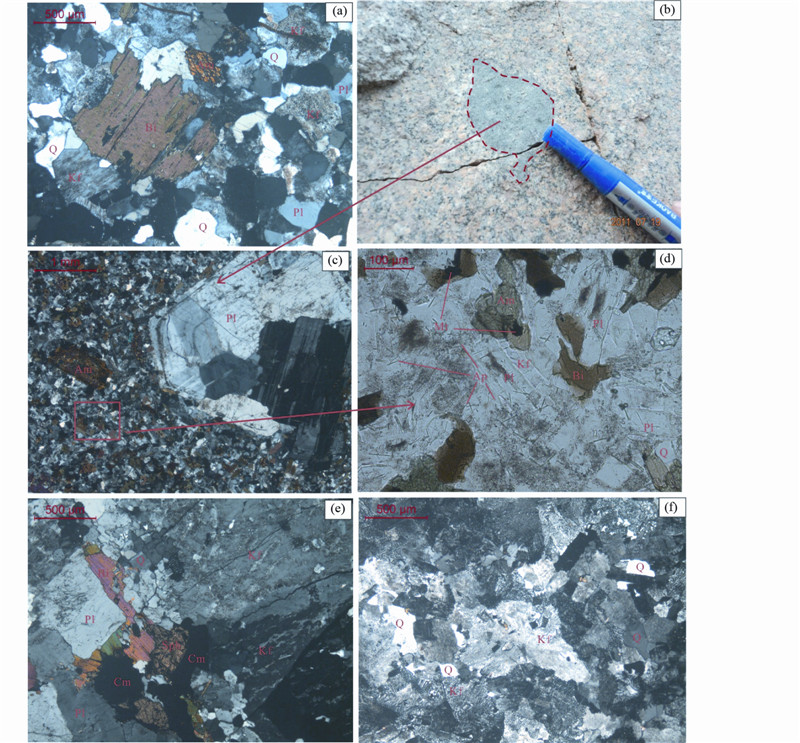
花岗闪长岩出露于东团堡、烟煤洞等地区,呈环状,组成王安镇岩体外带,发育水滴状、椭圆状暗色包体。岩石呈灰白色,半自形粒状结构,块状构造。主要组成矿物为斜长石(30%~40%)、钾长石(20%~35%)、石英(10%~25%)、角闪石(5%~15%)、黑云母(15%),副矿物有榍石、锆石、磁铁矿等(图 3a)。
 | 图 3 王安镇杂岩体典型显微照片
(a)花岗闪长岩,半自形粒状结构;(b)石英闪长岩中水滴状暗色包体;(c)暗色包体,似斑状结构;(d)暗色包体中含大量不定向、针状磷灰石(单偏光);(e)二长花岗岩似斑状结构;(f)石英正长岩斑状-花岗结构.Am-角闪石;Kf-钾长石;Pl-斜长石;Q-石英;Bi-黑云母;Ap-磷灰石;Cm-铬铁矿;Sph-榍石 Fig. 3 Photomicrographs showing typical textures of the Wang’anzhen massif (a)granodiorite with hypidiomorphic granular structure;(b)teardrop mafic enclaves in the quartz diorite;(c)mafic enclaves with porphyritic-like texture;(d)mafic enclaves contain a large number of non-directional acicular apatites(plane polarized light);(e)monzogranite with porphyritic texture;(f)quartz syenite with porphytitic granitic texture. Am-amphibole; Kf-k-feldspar; Pl-plagioclase; Q-quartz; Bi-biotite; Ap-apatite; Cm-chromite; Sph-sphene |
石英闪长岩侵位比较复杂,多以小岩柱产出,含水滴状暗色包体(图 3b)。岩石呈浅灰色,中粒结构,块状构造(图 3b)。主要组成矿物有斜长石(40%~60%)、钾长石(10%~25%)、角闪石(10%~20%)、黑云母(5%~15%)和石英(3%~10%),副矿物有磁铁矿、锆石、磷灰石等。暗色包体呈似斑状结构、块状构造,主要斜长石(45%~55%)、钾长石(10%~25%)、角闪石(10%~15%)、黑云母(15%)、磷灰石(25%)、石英(3%)组成,副矿物有磁铁矿、锆石等(图 3c),岩性为二长闪长岩。斑晶主要为斜长石和角闪石,基质为黑云母、角闪石、斜长石、钾长石和磷灰石等。其中,针状磷灰石呈不定向、密集排列,显示快速冷却淬火结构(图 3d)。
二长花岗岩分布广泛,呈浅肉红色,似斑状结构,粗粒结构,块状构造,发育暗色包体。主要组成矿物有钾长石(30%~45%)、斜长石(20%~25%)、石英(15%~20%)、角闪石(5%)、黑云母(5%~15%)、榍石(5%),副矿物有钛铁矿、锆石等(图 3e)。钾长石呈半自形板状,发育文象结构(图 3e)。
花岗岩主要分布小盘石一带,岩石呈浅肉红色,花岗结构,细粒结构,块状构造。主要组成矿物为斜长石(40%~45%)、石英(35%~40%)和钾长石(20%~30%),副矿物有榍石、锆石、磁铁矿等。
石英正长岩主要分布在紫荆关一带。岩石呈浅肉红色,斑状-花岗结构或中粗粒他形-半自形粒状结构(图 3f),块状构造。主要组成矿物为钾长石(50%~60%)、斜长石(20%~25%)、石英(5%~15%),及少量的角闪石(5%)和黑云母(5%)(图 3f),副矿物以磁铁矿(3%)为多,磷灰石、榍石、锆石含量较少,总含量不超过1%。
二长闪长岩出露较少,只在局部可见。岩石呈灰白色,半自形粒状结构,块状构造,主要组成矿物为普通角闪石(30%~35%)、斜长石(35%~40%)、钾长石(25%~30%),以及少量石英(5%)和黑云母(5%),副矿物主要磷灰石、锆石、磁铁矿等。
3 样品采集及分析方法为了尽可能避免风化和矿化蚀变作用对岩石样品地球化学数据的影响,本文所分析的所有岩石样品均采自于杂岩体内部,远离矿化蚀变带。
通过人工重砂法从新鲜岩石样品中分选出锆石,然后在双目镜下挑选无裂隙、无包体、透明干净自形的锆石颗粒,并与标样锆石TEM一起镶嵌于树脂中,打磨抛光并镀金。阴极发光在西北大学大陆动力学国家重点实验室扫描电镜加载阴极发光仪上完场。锆石U-Pb同位素组成分析在西北大学大陆动力学国家重点实验室激光剥蚀电感耦合等离子体质谱(LA-ICP-MS)仪上完成。分析仪器由Geo-Las200M型(Microlas Gottingen Germany)激光剥蚀系统和Elan6100DRC型四极杆质谱仪组成。分析采用激光剥蚀孔径30μm,剥蚀深度20~40μm,激光脉冲为10Hz,能量为32~36mJ。测试中用人工合成的硅酸盐玻璃标准参考物质NIST610进行仪器最佳化。锆石年龄计算采用国际标准锆石91500作为外标校正,每测定5个分析点后插入一次标样测定,以确保标样和样品的仪器条件完全一致。在所测锆石样品分析前后各测一次NIST610,同时以29Si作为内标测定锆石的U、Th、Pb含量。用锆石91500进行外标校正同位素组成。LA-ICP-MS分析的详细方法和流程见Yuan et al.(2004)描述。
主量元素和Pb同位素含量测试在中国科学院广州地球化学研究所完成,主量元素采用XRF测试,Pb同位素采用MAT262 TIMS测试。微量元素和稀土元素在长安大学地质测试中心采用ICP-MS(USA Thermo Electron Co. X7型)测试。Sr-Nd同位素在西北大学大陆动力学国家重点实验室采用AG50W-8测试,Sr同位素测试结果用86Sr/88Sr=0.1194的内检样品进行校正,Nd同位素测试结果用146Nd/144Nd=0.7219的内检样品进行校正,直到误差在测试精度范围之内为止。
4 测试结果 4.1 LA-ICP-MS锆石U-Pb定年分别选择王安镇岩体中未发生蚀变的石英闪长岩(LY083-1)和花岗闪长岩(LY083-2)开展LA-ICP-MS锆石U-Pb年龄测试,测试结果见表 1。
 | 表 1 王安镇杂岩体石英闪长岩和花岗闪长岩LA-ICP-MS锆石U-Pb测年结果 Table 1 LA-ICP-MS zircon U-Pb dating results of quartz diorite and granodiorite from Wang’anzhen complex |
2件岩石样品挑选出的锆石多为透明无色-浅黄色,呈长柱状、短柱状自形-半自形,晶粒大小介于100~300μm之间。在锆石阴极发光图像上(图 4a,b),锆石长宽比值变化于1.2:1~3:1,发育典型岩浆锆石的韵律环带。锆石的Th/U比值(LY083-1:Th/U=0.58~2.35,平均为1.09,24个点;LY083-2:Th/U=0.52~1.58,平均为0.85,25个点)和较好的Th-U线性正相关性特征(未示),显示其岩浆成因的特点。所以,锆石形成的时间可以代表岩体的形成年龄。
在U-Pb图解(图 4c,d)中,LY083-1样品共分析了24个点,206Pb/238U年龄变化于140~122Ma,在谐和曲线图上数据呈群分布,给出了128.3±1.9Ma(MSWD=3.3)的206Pb/238U年龄的加权平均值(图 4c),代表了石英闪长岩的形成时代。LY083-2样品共分析了25个点,LY083-2-1分析点206Pb/238U年龄为2298Ma,显示早元古代继承锆石的特点,LY083-2-13分析点206Pb/238U年龄为118Ma。其它23个分析点206Pb/238U年龄介于125~137Ma,在谐和曲线图上数据呈群分布,给出了129.8±2.7Ma(MSWD=1.7)的206Pb/238U年龄的加权平均值(图 4d),代表了花岗闪长岩的形成时代。
 | 图 4 王安镇地区石英闪长岩(LY083-1)和花岗闪长岩(LY083-2)中锆石阴极发光图(a、b)和LA-ICP-MS锆石U-Pb年龄谐和曲线图(c、d) Fig. 4 CL images(a, b) and LA-ICP-MS zircon U-Pb concordia diagrams(c, d)for the selected zircons from the quartz diorite(LY083-1) and granodiorite(LY083-2)in the Wang’anzhen area |
王安镇杂岩体化学组成变化较大,SiO2=54.18%~74.20%,K2O+Na2O=6.77%~10.45%,K2O/Na2O=0.59~1.37,大部分岩石样品属于高K钙碱性系列,个别样品落入橄榄粗玄岩范围内(表 2、图 5a,b)。杂岩体Al2O3=13.50%~18.47%,MgO=0.34%~4.57%,Fe2O3=1.84%~7.93%,CaO=0.50%~6.58%,P2O5=0.05%~0.60%,TiO2=0.33%~1.26%,Cr=2.40×10⁻⁶~133×10-6和Ni=2.00×10⁻⁶~42.237×10⁻⁶(表 2)。在主、微量元素哈克图解(图 6)上,随着SiO2含量的增加,主量元素CaO、Fe2O3、MgO、P2O5、TiO2和CaO/Al2O3比值表现为迅速减小的趋势(图 6b-f,h);Al2O3、Yb、Cr、Ni减小趋势明显变缓(图 6a,j-l);微量元素Sr含量整体变化不明显(图 6i),但当SiO2>62%,却表现出较好的负相关;主量元素K2O表现为明显的正相关(图 6g)。
 | 图 5 太行山北段王安镇杂岩体(K2O+Na2O)-SiO2(a,据Le Maitre,2002)和K2O-SiO2(b,据Peccerillo and Taylor, 1976)图解 Fig. 5(K2O+Na2O)vs. SiO2(a,after Le Maitre,2002) and K2O vs. SiO2(b,after Peccerillo and Taylor, 1976)diagrams for the Wang’anzhen complex in the northern Taihang Mountains |
 | 图 6 王安镇杂岩体主量元素、微量元素与SiO2含量变化曲线图 Fig. 6 Abundance of major and trace element plotted against SiO2 for the Wang’anzhen complex |
王安镇杂岩体REE元素总量为148×10-6~787×10-6,在球粒陨石标准化图解上(图 7b,d,f,h,j,l),大部分样品都表现出相似的LREE富集,HREE和Y亏损(LREE/HREE=4.92~11.16,(La/Yb)N=13.52~41.88),轻稀土和重稀土分异程度不明显((La/Sm)N:(Gd/Yb)N=(4.04~7.54):(2.21~4.29)),以及微弱Eu负异常(δEu=0.62~1.02,平均为0.84)等特征(表 2)。Ly039-3样品较其它样品具有明显高REE和Eu负异常(δEu=0.23),WA-28#样品具有较明显负Eu异常(δEu=0.40)和略高LREE(La,Ce)和MREE(Gd,Tb,Dy)。在微量元素蛛网图中(图 7a,c,e,g,i,k),该杂岩体大多数样品表现出相似的富集大离子亲石元素(Rb、Sr、Ba、K)和LREE,及亏损高场强元素(Nb、Ta、U、Ti、Y)的特征,但他们之间也存在个别差异,具体表现为Th、U元素的亏损(例如样品WA-7#)和富集(样品Ly025-3),Zr、Hf元素的富集(例如样品LY040-1和Ly039-2)。然而,Ly039-3样品表现为明显富集La、Ce、Zr、Hf和强烈亏损Ba、Sr、P的特征;WA-28#样品具有较明显亏损Ba、Sr、P和富集Rb和Th的特征。值得注意的是,王安镇杂岩体整体具有低Y(7.36×10⁻⁶~22.2×10⁻⁶)和Yb(0.95×10⁻⁶~1.27×10⁻⁶),高Sr(141×10-6~1364×10-6)和Sr/Y比值(3.63~136.4)的特征,这与埃达克岩地球化学指标相近(图 8;Defant and Drummond, 1990; Richards and Kerrich, 2007;表 2)。
 | 图 7 王安镇杂岩体稀土元素球粒陨石标准化配分图(标准化值据Taylor and Mclennan, 1985)和微量元素原始地幔标准化蛛网图(标准化值据Sun and McDonough, 1989) Fig. 7 Chondrite-normalized REE patterns(normalization values after Taylor and Mclennan, 1985) and primitive mantle-normalized spidergrams(normalization values after Sun and McDonough, 1989)for the Wang’anzhen complex |
 | 图 8 王安镇杂岩体Sr/Y-Y(a,据Defant and Drummond, 1990)和La/Yb-Yb(b,据Castillo et al., 1999)图解 Fig. 8 Sr/Y vs. Y(a,after Defant and Drummond, 1993) and La/Yb vs. Yb(b,after Castillo et al., 1999)diagram for Wang’anzhen complex |
| 表 2 王安镇杂岩体主量元素(wt%)、微量元素和稀土元素(×10-6)含量分析表 Table 2 Major element(wt%),trace element and rare earth element compositions(×10-6)of the Wang’anzhen complex |
分布在王安镇杂岩体中的暗色包体SiO2(58.80%~59.98%)含量变化范围较小,K2O变化于2.99%~4.46%,属于高钾钙碱性岩系列(图 5b)。在主、微量元素哈克图解中(图 6),这些暗色包体呈群分布,变化趋势不明显,这可能与其主量元素、微量元素含量变化范围小有关。在图 7中,暗色包体整体与寄主岩体(王安镇杂岩体)具有相似的变化曲线,表现为LREE、LILE富集,HREE、HFSE和Y亏损,及明显负Eu异常(0.62~0.98,平均值0.74)。在图 8中,暗色包体也表现出高Sr/Y(34.29~54.93)和低Y(10.25×10-6~13.65×10-6)的特征,分布在埃达克岩的范围内。
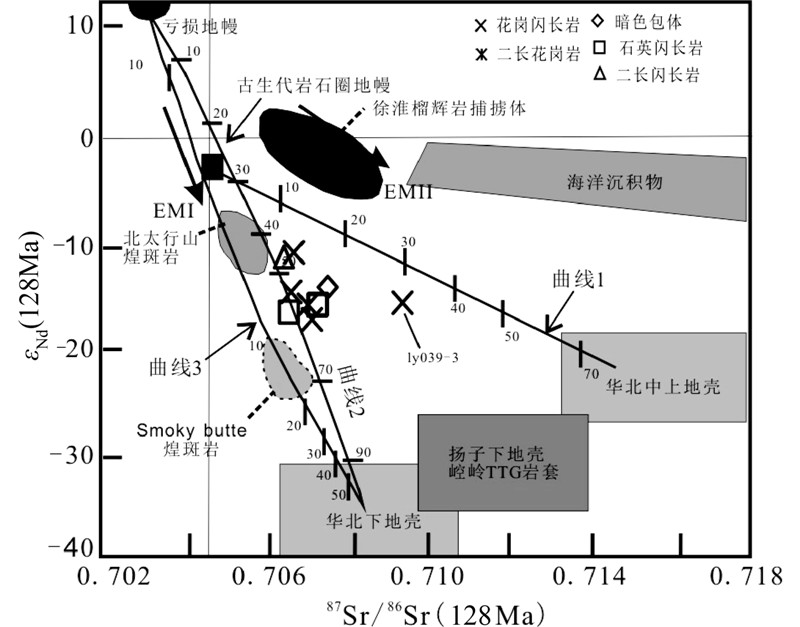
4.3 Sr-Nd-Pb同位素王安镇杂岩体ISr(128Ma)=0.7062~0.7073、87Sr/86Sr=0.7065~0.7095、εNd(128Ma)=-18.4~-12.4;(206Pb/204Pb)i=17.190~17.832,(207Pb/204Pb)i=15.393~15.614,(208Pb/204Pb)i=37.513~38.180(表 3)。在图87Sr/86Sr-εNd(128Ma)中(图 9),大部分样品分布在亏损地幔和华北下地壳之间,靠近EMⅠ范围,较北太行山煌斑岩具有略高87Sr/86Sr比值和略低的εNd值(Chen and Zhai, 2003),其中,样品ly039-3较其它样品具有较高的87Sr/86Sr比值,靠近华北中上地壳(Fan et al., 2001)。在Pb同位素图解中,王安镇杂岩体和暗色包体具有相近的Pb同位素组成,在图 10a上样品均分布在地幔和上地壳之间,并靠近地幔,在图 10b中岩石样品分布在下地壳和上地幔之间,并靠近地幔。其中,样品ly036-3具有较高的206Pb/204Pb、207Pb/204Pb比值,在图 10a中分布靠近上地壳位置。
| 表 3 王安镇杂岩体样品Sr-Nd-Pb同位素分析结果 Table 3 Sr-Nd-Pb isotoptic data of the Wang’anzhen complex |
 | 图 9 王安镇杂岩体Nd-Sr同位素图解
图中端员EMⅠ、EMⅡ、LCC据DePaolo(1981). 白垩纪北太行山煌斑岩数据引自Chen and Zhai(2003);崆岭TTG岩套、徐淮榴辉岩数据引自Gao et al.(2004);华北下地壳和中上地壳数据分别引自Jahn et al.(1999)和Fan et al.(2001);亏损地幔和海洋沉积物数据分别引自Zindler and Hart(1986). 曲线1表示古生代岩石圈地幔岩浆与华北中上地壳混染趋势线,2表示亏损地幔与华北下地壳混合的趋势线,3表示起源于亏损地幔和华北下地壳的岩浆混合趋势线 Fig. 9 Initial εNd(t=128Ma)vs. 87Sr/86Sr diagram for the Wang’anzhen complex from the northern Taihang mountains The field of the EMⅠ,EMⅡ and LCC are after DaPaolo,1981. Isotopic data of Early Cretaceous northern Taihangshan lamprophyres(Chen and Zhai, 2003)are given for comparison. The field of the Kongling TTG rocks and Xu-Huai eclogite xenoliths are after Gao et al.(2004). Lower crust and upper-middle crust of the NCC are after Jahn et al.(1999) and Fan et al.(2001),respectively. Data of depleted mantle and marine sediment are after Zindler and Hart(1986). Curve 1 notes trend of crustal contamination between the Paleozoic lithospheric mantle-derived magma and the NCC upper-middle crust. Curve 2 notes trend of crustal contamination between the depleted mantle-derived magma and the NCC lower crust. Curve 3 notes trend of the crustal contamination between the depleted mantle-derived magma and the NCC lower crust-derived magma |
 | 图 10 王安镇杂岩体Pb同位素相关图解(据Zartman and Doe, 1981) Fig. 10 Pb isotopic compositions of the Wang’anzhen complex(after Zartman and Doe, 1981) |
王安镇杂岩体年代学研究程度相对较高,获得了一批单矿物K-Ar、全岩Rb-Sr和锆石U-Pb年龄数据(Gao et al., 2012; 陈斌等,2005; Chen et al., 2009)。本文获得王安镇杂岩体中花岗闪长岩和石英闪长岩的LA-ICP-MS锆石U-Pb年龄分别为129±2.7Ma和128.3±1.9Ma,与前人获得的锆石U-Pb年龄相近。结合该杂岩体各类岩体间相互接触关系(图 2),说明该杂岩体形成于早白垩世,且形成的时间间隔较短(~1Myr)。
太行山北段王安镇地区同时代流纹斑岩形成于~139Ma(Rb-Sr年龄,未发表数据)、辉长岩形成于~138Ma(陈斌等,2005)、暗色包体形成于~127Ma(Chen et al., 2009)、石英正长岩形成于~126Ma,结合本次获得高精度花岗闪长岩和石英闪长岩测年结果,表明太行山北段中生代岩浆活动时间可能为126~138Ma。相类似的太行山南段武安和平顺地区杂岩体形成时代介于123~138Ma(陈斌等,2005; 彭头平等,2004; 王春光等,2011; 张海东等,2014; Xu et al., 2010b; Wang et al., 2006b),这说明王安镇杂岩体形成年龄(~129Ma)与太行山其它地区、乃至整个华北地区的岩浆活动的年龄相近,都发生在早白垩世,显示它们可能是同一次大地构造岩浆活动事件的产物。
5.2 暗色包体的成因王安镇中酸性杂岩体中暗色包体的成因可能包括:①捕获的同源基性岩;②围岩捕掳体;③壳-幔岩浆混合的残留(Hou et al., 2013)。如果暗色包为起源于地球深部基性(超基性)岩浆的堆晶岩,后被王安镇中酸性岩浆捕获带至上地壳部的话,那么堆晶岩中形成于高压环境中的橄榄石、辉石将势必会发生矿物分解(Core et al., 2006),然而这种现象在暗色包体中是不存在的(图 3c,d),由此可以排除暗色包体形成的第一种的可能。另外,暗色包体呈似斑状结构,发育具有环带结构的斜长石斑晶和细小针状磷灰石(图 3c,d),这些特征显示典型岩浆成因的特征,可排除暗色包体形成于第二种的可能。
如果暗色包体形成于壳-幔岩浆的混合作用,那么暗色包体应该与寄主岩体在接触带存在成分间的交换。王安镇杂岩体中暗色包体与寄主岩在接触带附近发育大量不规则细小针状磷灰石,显示暗色包体经历了快速冷却结晶作用(图 3d,Wyllie et al., 1962),且在接触带发育2~3mm反应边(图 3c),主要由长英质矿物(石英、长石)组成,显示中-基性岩浆与酸性岩浆间成分交换的特征。Chen et al.(2009)在王安镇杂岩体中暗色包体内发现了具有不平衡结构的斜长石,其具有低An值(30~36)内核(呈港湾状结构)和高An值外核(50~58)以及An值逐渐降低的幔部(38~41→22~25→16);同样在寄主岩体中发现了具有高An值(53~54)核和低An值(35→16)的幔部,这些地质现象显示在寄主岩体与暗色包体接触带附近存在双向矿物迁移,形成于酸性岩浆的斜长石随后进入中-基性岩浆内,由于温度偏大,使其发生溶蚀形成港湾状结构,随着温度的降低,之后在港湾状基性斜长石基础上形成了An值逐渐降低的斜长石幔部;形成于中-基性岩浆的高An值斜长石进入酸性岩浆后,又在原有基础上形成了An值较低幔部,这是中-基性-酸性岩浆混合的直接证据。
王安镇杂岩体中暗色包体的锆石U-Pb年龄为127.9~128.7Ma(Chen et al., 2009),这与本文获得王安镇杂岩体锆石U-Pb年龄(128.3~129Ma)接近,显示暗色包体和杂岩体是同时形成的,前期岩浆还没有固结,后期岩浆就已经再次侵位,随后二者进一步发生混合,这可以很好地解释为什么花岗闪长岩、石英闪长岩和花岗岩中分布有大量水滴状、椭圆状暗色包体的现象。
王安镇杂岩体中暗色包体的Nb/Ta比值变化于15.72~22.72(平均值17.89),寄主岩体Nb/Ta比值变化于10.00~23.23(平均值14.64),可见暗色包体Nb/Ta比值略大于寄主岩体,更接近富集地幔Nb/Ta比值(平均值为17.7,Sun and McDonough, 1989)范围,这说明暗色包体比寄主岩含更多的幔源物质成分。暗色包体与寄主岩体具有相似的微量元素变化曲线(图 7)和相近的Sr-Nd-Pb同位素组成(图 9、图 10),这些特征显示暗色包体与寄主岩体存在密切的成因联系。
王安镇杂岩体中暗色包体具有相对低MgO(2.99%~3.91%)、Ni(25.87×10⁻⁶~42.23×10⁻⁶)、Cr(72×10-6~133×10-6)(Gao et al., 2004)含量和较明显Eu负异常(图 7b),显示经历了镁铁质矿物(橄榄石-辉石-角闪石)和斜长石的结晶分异过程。这些暗色包体高Sr/Y比值和低Y、Yb含量,显示埃达克岩地球化学的特征(图 8,Defant and Drummond, 1990)。在图 11中,暗色包体分布在与加厚下地壳部分熔融形成的埃达克岩范围内,其Nd模式年龄(TDM)为1090Ma,这说明暗色包体形成与加厚下地壳有关,不太可能形成于俯冲板片熔融,因为太行山地区可能存在的板块俯冲-碰撞作用完成时间为~1850Ma(Zhao et al., 2000,2001),其远大于暗色包体的Nd模式年龄(~1090Ma)。
 | 图 11 王安镇杂岩体MgO-SiO2 (a)、Mg#-SiO2 (b)和Th/Ce-SiO2 (c)图解(据Wang et al., 2006a) Fig. 11 MgO vs. SiO2 (a),Mg# vs. SiO2(b) and Th/Ce vs. SiO2(c)diagrams for Wang’anzhen complex(after Wang et al., 2006a) |
基于以上分析,我们认为王安镇杂岩体中暗色包体可能起源于加厚基性下地壳,在注入酸性岩浆房或与酸性岩浆发生混合之前,经历了镁铁质矿物和斜长石的结晶分异过程。
5.3 王安镇杂岩体成因 王安镇杂岩体SiO2含量变化范围较大(54.18%~74.20%),由二长闪长岩、二长岩、石英闪长岩、花岗闪长岩和花岗岩组成,属于高K钙碱性岩石系列。王安镇杂岩体Fe2O3和MgO与SiO2含量呈明显的线性负相关(图 6c,d)可能指示存在橄榄石、辉石和角闪石的结晶分异;CaO含量和CaO/Al2O3比值与SiO2含量间的关系(图 6e,h),指示存在单斜辉石的结晶分异;TiO2和P2O5与SiO2呈较明显线性负相关(图 6b),指示含钛氧化物和磷灰石发生了结晶分异。Sr主要存在于斜长石内,Sr与SiO2微弱的负相关(图 6i)指示斜长石结晶分异作用不明显,这与Al2O3与SiO2弱负相关以及Eu微弱负异常相吻合(图 5a、图 6)。Y主要分布于石榴子石和磷灰石中,王安镇杂岩体中Y与SiO2含量呈明显的负相关(图 6j),指示可能存在石榴子石和磷灰石的结晶分异作用(Richards and Kerrich, 2007),但Yb(主要分布于石榴子石中)随着SiO2增加变化不明显(未示),这可以排除石榴子石的结晶分异作用。
微量元素Cr、Ni随着SiO2增加呈减小趋势(图 6k,l),显示存在橄榄石、辉石结晶分异作用,这与主量元素获得的认识一致。该杂岩体整体具有LREE富集,HREE和Y亏损的特征(图 7),说明经历较高程度的结晶分异作用。在图 12中,随着SiO2含量的不断增加,(Dy/Y)N比值不断变大,而(La/Sm)N比值变化不大,这说明随着岩浆的演化(SiO2不断增大),轻-重稀土分异程度不断增加,而中-重稀土分异不明显,这说明角闪石发生了较明显的结晶分异作用,而石榴子石没有发生结晶分异作用或结晶分异作用不明显。Ly039-3和WA-28#较其它样品整体具有较高的稀土含量,和明显富集La、Ce、Zr、Hf和强烈亏损Ba、Sr、P的特征,这指示它们发生了高程度的结晶分异作用,主要体现为斜长石结晶分异作用。另外,Ly039-3和WA-28#两样品具有明显高的87Sr/86Sr比值(图 9),再次证明其发生了高程度的结晶分异作用(焦守涛等,2013; Hou et al., 2013)。
 | 图 12 王安镇杂岩体C1(Dy/Y,La/Sm)与SiO2变化曲线 Fig. 12 C1 chondrite-normalized(La/Sm)CN and (Dy/Yb)CN ratios vs. SiO2 diagram for Wang’anzhen complex |
王安镇杂岩体中样品Ly038-1-1、Ly038-2-1具有较高的MgO含量(3.56%~4.57%)、Sr/Y比值(25.95~26.38),和低Y(19.79×10-6~21.39×10-6)的特征(表 2),这与兴隆沟高Mg安山岩地球化学特征(MgO=2.31%~5.68%,Sr/Y=33~135,Y=11×10-6~19×10-6)相近(Gao et al., 2004),显示其具有与兴隆沟高Mg安山岩相似的成因:岩石起源于古老拆沉基性下地壳部分熔融,之后熔体又与上覆地幔发生交代(Gao et al., 2004)。而其它岩石样品MgO(0.34%~2.79%)、Ni(2.00×10⁻⁶~16.90×10⁻⁶)、Cr(2.40×10⁻⁶~61.49×10⁻⁶)含量整体偏低,可排除形成于基性下地壳部分熔融熔体交代上覆地幔的可能(Gao et al., 2004),并与起源于基性下地壳岩石地球化学特征相似(Chung et al., 2003)。另外,许文良等(2009)认为太行山南段符山高Mg闪长岩(含橄榄岩包体,高Sr=689×10-6~1011×10-6,Sr/Y=42~64,低Y=14.3×10-6~17.1×10-6)形成于拆沉下地壳交代上覆亏损地幔形成。因此,我们认为太行山地区在中生代应具有厚的地壳。
王安镇杂岩体岩石样品具有高Sr、Sr/Y,和低HREE和Y的特征,这说明它们形成于在加厚(石榴石稳定域,>50km)基性下地壳部分熔融(Defant and Drummond, 1990; 张海东等,2014; Hou et al., 2013)或角闪石的结晶分异作用(斜长石结晶分异不明显)(Richards et al., 2006; Richards and Kerrich, 2007)。在图 11中,王安镇杂岩体岩石样品大部分(除Ly038-1-1、Ly038-2-1)都落入了加厚下地壳部分熔融形成的埃达克岩范围内,这说明其很有可能形成于加厚下地壳的部分熔融作用。另外,王安镇杂岩体Nd模式年龄(1.62~1.89Ga)也证实了这一点。王安镇杂岩体样品随着SiO2含量的不断增加,(Dy/Y)N比值呈逐渐变大的趋势,这说明在岩浆演化的过程中存在较明显的角闪石结晶分异作用。以上分析可能说明王安镇杂岩体不可能形成于简单的基性下地壳的部分熔融作用或角闪石的结晶分异作用,而是起源于加厚基性下地壳部分熔融,并在上升定位过程中发生一些列矿物(例如:橄榄石、单斜辉石、角闪石、斜长石、磷灰石、榍石)的结晶分异的结果。
王安镇杂岩体Sr-Nb-Pb同位素比值明显高于华北克拉通上部地壳物质的平均值(Rudniek and Fountain, 1995),且在图 9中样品均分布在地幔与华北下地壳演化趋势线及附近,并远离华北中上地壳,这些可排除岩浆起源于上地壳或受到上地壳物质混染的可能性。在图 7中,大多数岩石样品(除ly039-3)分布在地幔岩浆与下地壳的演化趋势线内,显示可能有>40%的下地壳物质加入地幔岩浆或可能有>30%的地幔物质加入壳源岩浆(图 9中趋势线2)。在Pb同位素图解中(图 10),岩石样品全部分布在地幔和下地壳之间,并靠近地幔。这些特征显示王安镇杂岩体具有壳幔双重属性(Chen et al., 2003),这与太行山地区同时代岩浆岩特征相似(许文良等,2009; Xu et al., 2010a,b; 张海东等,2014),被认为是由壳幔岩浆混合或拆沉下地壳交代上覆地幔而形成。在太行山地区,不论是中生代中-基性岩,还是具有低Mg、Cr、Ni特征的酸性岩,都具有相近的Sr-Nd-Pb同位素组成,这很难由壳幔岩浆混合、拆沉下地壳交代上覆地幔等模式解释,其更应该反应的源区属性的特征,即加厚基性下地壳。
在ISr(128Ma)-SiO2图解中(图 13),王安镇杂岩体整体显示随着SiO2含量增高ISr(128Ma)值变化不大的特征,这可以排除岩浆在演化过程中存在地壳物质混染的过程,因为地壳物质的加入可以极大增加ISr(128Ma)值。
 | 图 13 王安镇杂岩体ISr(128Ma)与SiO2变化曲线 Fig. 13 ISr(128Ma) vs. SiO2 diagram for Wang’anzhen complex |
王安镇杂岩体中暗色包体与二长闪长岩具有相近的主量、微量、稀土和Sr-Nd-Pb同位素组成,且Th/Ce、Nb/Ta比值相近,可能指示暗色包体和二长闪长岩是同一期次岩浆产物,只不过是存在形式不同而已。假如这一认识成立,那么呈水滴状、椭圆状分布在其它岩体中的二长闪长岩包体(发育淬火边结构)则是两种岩浆混合的直接证据(Chen et al., 2009),说明太行山地区不同岩浆混合是广泛存在的,这也进一步佐证了上面观点。
近年来在太行山多处地区(西安里、符山和龙门沟)的中生代辉长岩和高Mg#闪长岩中发现了受(富Si)流体强烈改造的亏损地幔包体,具有富集LREE、LILE,亏损HFSE,εNd(t)=-23.6~-15.4的特征,指示可能存在大规模岩石圈拆沉作用(Xu et al., 2010a,b)。另外,王安镇杂岩体Sr-Nd-Pb同位素组成与亏损地幔包体的寄主岩体相似,这可能说明王安镇杂岩体与这些寄主岩体在成因方面存在密切联系。王春光等(2011)、张海东等(2014)、Gao et al.(2004)和Xu et al.(2010a,b)通过详细的岩石学、地球化学研究认为捕掳有亏损地幔包体的中基性岩体是拆沉下地壳部分熔融熔体交代上覆亏损地幔的产物。因此,笔者更倾向认为王安镇杂岩体形成过程为:①早白垩世,古太平洋板块向欧亚大陆发生斜向俯冲,在太行山地区形成伸展环境(Xu,2014),使冷的、刚性加厚下地壳拆沉进入软流圈内;②拆沉下来的下地壳进一步诱发软流圈上涌,其所携带的热使加厚基性下地壳物质发生部分熔融,形成低Mg似埃达克岩浆(例如:王安镇杂岩体);另一方面高温、富挥发份的软流圈使拆沉下来的下地壳物质发生部分熔融,形成富硅流体/熔体,并交代上覆亏损地幔橄榄岩使其发生部分熔融形成高Mg似埃达克岩浆(例如:兴龙沟高Mg安山岩)(Gao et al., 2004; Xu et al., 2010b)。
6 结论王安镇杂岩体花岗闪长岩和石英闪长岩LA-ICP-MS锆石U-Pb年龄分别为129±2.7Ma和128.3±1.9Ma,表明该杂岩体形成于早白垩世,这与华北克拉通东部大规模岩浆活动时代相近。王安镇杂岩体具有高Sr/Y比值,低Y,富集LREE,亏损HREE,及弱负Eu异常,这些特征与埃达克岩相似。该杂岩体相对低的87Sr/86Sr初始比值和明显偏低的εNd(t)值,结合太行山中生代中基性岩中地幔包体已有的研究成果,认为王安镇杂岩体形成于下地壳发生大规模拆沉的基础上,随后上涌的软流圈所携带的热促使加厚基性下地壳发生部分熔融,熔融岩浆在上升的过程中发生了角闪石的结晶分异作用。
| [1] | Cai JH, Yan GH, Chang ZS, Wang XF, Shao HX and Chu ZY. 2003. Petrological and geochemical characteristics of the Wanganzhen complex and discussion on its genesis. Acta Petrologica Sinica, 19(1):81-92(in Chinese with English abstract) |
| [2] | Castillo PR, Janney PE and Solidum RU. 1999. Petrology and geochemistry of Camiguin Island, southern Philippines:Insights to the source of adakites and other lavas in a complex arc setting. Contributions to Mineralogy and Petrology, 134(1):33-51 |
| [3] | Chen B and Zhai MG. 2003. Geochemistry of Late Mesozoic lamprophyre dykes from the Taihang Mountains, North China, and implications for the sub-continental lithospheric mantle. Geological Magazine, 140(1):87-93 |
| [4] | Chen B, Tian W, Zhai MG and Arakawa Y. 2005. Zircon U-Pb geochronology and geochemistry of the Mesozoic magmatism in the Taihang Mountains and other places of the North China craton, with implications for petrogenesis and geodynamic setting. Acta Petrologica Sinica, 21(1):13-24(in Chinese with English abstract) |
| [5] | Chen B, Chen ZC and Jahn BM. 2009. Origin of mafic enclaves from the Taihang Mesozoic orogen, North China craton. Lithos, 110(1-4):343-358 |
| [6] | Chung SL, Liu DY, Ji JQ, Chu MF, Lee HY, Wen DJ, Lo CH, Lee TY, Qian Q and Zhang LQ. 2003. Adakites from continental collision zones:Melting of thickened lower crust beneath southern Tibet. Geology, 31(11):1021-1024 |
| [7] | Core DP, Kesler SE and Essene EJ. 2006. Unusually Cu-rich magmas associated with giant porphyry copper deposits:Evidence from Bingham, Utah. Geology, 34(1):41-44 |
| [8] | Defant MJ and Drummond MS. 1990. Derivation of some modern arc magmas by melting of young subducted lithosphere. Nature, 347(6294):662-655 |
| [9] | Deng JF, Zhao HL, Mo XX and Luo ZH. 1996. Continental Roots-plume Tectonics of China:Key to the Continental Dynamics. Beijing:Geological Publishing House(in Chinese) |
| [10] | DePaolo DJ. 1981. Trace element and isotopic effects of combined wall rock assimilation and fractional crystallization. Earth and Planetary Science Letters, 53(2):189-202 |
| [11] | Fan WM, Guo F, Wang YJ, Lin G and Zhang M. 2001. Post-orogenic bimodal volcanism along the Sulu Orogenic Belt in eastern China. Physics and Chemistry of the Earth, Part A:Solid Earth and Geodesy, 26(9-10):733-746 |
| [12] | Gao S, Rudnick RL, Carlson RW, McDonough WF and Liu YS. 2002. Re-Os evidence for replacement of ancient mantle lithosphere beneath the North China craton. Earth and Planetary Science Letters, 198(3-4):307-322 |
| [13] | Gao S, Rudnick RL, Yuan HL, Liu XM, Liu YS, Xu WL, Ling WL, Ayers J, Wang XC and Wang QH. 2004. Recycling lower continental crust in the North China craton. Nature, 432(7019):892-897 |
| [14] | Gao S, Rudnick RL, Xu WL et al. 2008. Recycling deep cratonic lithosphere and generation of intraplate magmatism in the North China Craton. Earth and Planetary Science Letters, 270(1-2):41-53 |
| [15] | Gao YF, Santosh M, Hou ZQ, Wei RH, Ma GX, Chen ZK and Wu JL. 2012. High Sr/Y magmas generated through crystal fractionation:Evidence from Mesozoic volcanic rocks in the northern Taihang orogeny, North China Craton. Gondwana Research, 22(1):152-168 |
| [16] | Griffin WL, Zhang AD, O'Reilly SY and Ryan CG. 1998. Phanerozoic evolution of the lithosphere beneath the Sino-Korean craton. In:Flower MFJ, Chung SL, Lo CH and Lee TY(eds.). Mantle Dynamics and Plate Interactions in East Asia. Washington, DC:American Geophysical Union, 27:107-126 |
| [17] | Hou ZQ, Pan XF, Li QY, Yang ZM and Song YC. 2013. The giant Dexing porphyry Cu-Mo-Au deposit in East China:Product of melting of juvenile lower crust in an intracontinental setting. Mineralium Deposita, 48(8):1019-1045 |
| [18] | Jahn BM, Wu FY, Lo CH and Tsai CH. 1999. Crust-mantle interaction induced by deep subduction of the continental crust:Geochemical and Sr-Nd isotopic evidence from post-collisional mafic-ultramafic intrusions of the northern Dabie complex, central China. Chemical Geology, 157(1-2):119-146 |
| [19] | Jiao ST, Yan DP, Zhang Q, Li CD, Wan B and Tian ZH. 2013. Zircon U-Pb age, geochemistry characteristics of Badaling granitoid complex and their geological significance. Acta Petrologica Sinica, 29(3):769-780(in Chinese with English abstract) |
| [20] | Le Maitre RW, Streckeisen A, Zanettin B, Le Bas MJ, Bonin B, Bateman P, Bellieni G, Dudek A, Efremova S, Keller J, Lameyre J, Sabine PA, Schmid R, Sørensen H and Woollry AR. 2002. Igneous Rocks:A Classification and Glossary of Terms. Cambridge:Cambridge University Press, 125-236 |
| [21] | Lee C-TA and Anderson DL. 2015. Continental crust formation at arcs, the arclogite "delamination" cycle, and one origin for fertile melting anomalies in the mantle. Science Bulletin, 60(13):1141-1156 |
| [22] | Ma Q, Zheng JP, Xu YG, Griffin WL and Zhang RS. 2015. Are continental "adakites" derived from thickened or foundered lower crust? Earth and Planetary Science Letters, 419:125-133 |
| [23] | Menzies MA, Fan WM and Zhang M. 1993. Palaeozoic and Cenozoic lithoprobes and the loss of >120km of Archaean lithosphere, Sino-Korean craton, China. Geological Society, London, Special Publication, 76:71-78 |
| [24] | Menzies MA, Xu YG, Zhang HF and Fan WM. 2007. Integration of geology, geophysics and geochemistry:A key to understanding the North China craton. Lithos, 96(1-2):1-21 |
| [25] | Peccerillo A and Taylor SR. 1976. Geochemistry of Eocene calc-alkaline volcanic rocks from the Kastamonu area, Northern Turkey. Contributions to Mineralogy and Petrology, 58(1):63-81 |
| [26] | Peng TP, Wang YJ, Fan WM, Guo F and Peng BX. 2004. SHRIMP zircon U-Pb geochronology of the diorites for southern Taihang Mountains in the North China interior and its petrogenesis. Acta Petrologica Sinica, 20(5):1253-1262(in Chinese with English abstract) |
| [27] | Qian Q and Hermann J. 2010. Formation of high-Mg diorites through assimilation of peridotite by monzodiorite magma at crustal depths. Journal of Petrology, 51(7):1381-1416 |
| [28] | Qian Q, O'Neill HSC and Hermann J. 2010. Comparative diffusion coefficients of major and trace elements in olivine at-950℃ from a xenocryst included in dioritic magma. Geology, 38(4):331-334 |
| [29] | Richards JP, Ullrich T and Kerrich R. 2006. The Late Miocene-Quaternary antofalla volcanic complex, southern Puna, NW Argentina:Protracted history, diverse petrology, and economic potential. Journal of Volcanology and Geothermal Research, 152(3-4):197-239 |
| [30] | Richards JP and Kerrich R. 2007. Adakite-like rocks:Their diverse origins and questionable role in metallogenesis. Economic Geology, 102(4):537-576 |
| [31] | Rudnick RL and Fountain DM. 1995. Nature and composition of the continental crust:A lower crustal perspective. Reviews of Geophysics, 33(3):267-309 |
| [32] | Sun SS and McDonough WF. 1989. Chemical and isotopic systematics of oceanic basalts:Implication for mantle compositions and processes. In:Sauders AD and Norry MJ(eds.). Magmatism in the Ocean Basins. Geological Society, London, Special Publication, 42(1):313-345 |
| [33] | Taylor SR and McLennan SM. 1985. The Continental Crust:Its Composition and Evolution:An Examination of the Geochemical Record Preserved in Sedimentary Rocks. Oxford:Oxford Press Blackwell, 1-312 |
| [34] | Wang CG, Xu WL, Wang F and Yang DB. 2011. Petrogenesis of the Early Cretaceous Xi'anli hornblende-gabbros from the southern Taihang Mountains:Evidence from Zircon U-Pb geochronology, Hf isotope and whole-rock geochemistry. Earth Science, 36(3):471-482(in Chinese with English abstract) |
| [35] | Wang Q, Xu JF, Jian P, Bao ZW, Zhao ZH, Li CF, Xiong XL and Ma JL. 2006a. Petrogenesis of adakitic porphyries in an extensional tectonic setting, Dexing, South China:Implications for the genesis of porphyry copper mineralization. Journal of Petrology, 47(1):119-144 |
| [36] | Wang YJ, Fan WM, Zhang HF and Peng TP. 2006b. Early Cretaceous gabbroic rocks from the Taihang Mountains:Implications for a paleosubduction-related lithospheric mantle beneath the central North China craton. Lithos, 86(3-4):281-302 |
| [37] | Wu FY, Sun DY, Zhang GL and Ren XW. 2000. Deep geodynamics of Yanshain Movement. Geological journal of China Universities, 6(3):379-388(in Chinese with English abstract) |
| [38] | Wu FY, Walker RJ, Ren XW, Sun DY and Zhou XH. 2003. Osmium isotopic constraints on the age of lithospheric mantle beneath northeastern China. Chemical Geology, 196(1-4):107-129 |
| [39] | Wu FY, Lin JQ, Wilde SA, Zhang XO and Yang JH. 2005. Nature and significance of the Early Cretaceous giant igneous event in eastern China. Earth and Planetary Science Letters, 233(1-2):103-119 |
| [40] | Wu FY, Walker RJ, Yang YH, Yuan HL and Yang JH. 2006. The chemical-temporal evolution of lithospheric mantle underlying the North China Craton. Geochimica et Cosmochimica Acta, 70(19):5013-5034 |
| [41] | Wu FY, Xu YG, Gao S and Zheng JP. 2008. Lithospheric thinning and destruction of the North China craton. Acta Petrologica Sinica, 24(6):1145-1174(in Chinese with English abstract) |
| [42] | Wyllie PL, Cox KG and Biggar GM. 1962. The habit of apatite in synthetic systems and igneous rocks. Journal of Petrology, 3(2):238-243 |
| [43] | Xu WL, Gao S, Wang QH, Wang DY and Liu YS. 2006. Mesozoic crustal thickening of the eastern North China craton:Evidence from eclogite xenoliths and petrologic implications. Geology, 34(9):721-724 |
| [44] | Xu WL, Yang DB, Pei RF and Yu Y. 2009. Petrogenesis of Fushan high-Mg# diorites from the southern Taihang Mts. in the central North China craton:Resulting from interaction of peridotite-melt derived from partial melting of delaminated lower continental crust. Acta Petrologica Sinica, 25(8):1947-1961(in Chinese with English abstract) |
| [45] | Xu WL, Wang CG, Yang DB, Wang F and Pei FP. 2010a. Dunite xenoliths and olivine xenocrysts in gabbro from Taihang Mountains:Characteristics of Mesozoic lithospheric mantle in central China. Journal of Earth Science, 21(5):692-710 |
| [46] | Xu WL, Yang DB, Gao S, Pei FP and Yu Y. 2010b. Geochemistry of peridotite xenoliths in Early Cretaceous high-Mg# diorites from the central orogenic block of the North China craton:The nature of Mesozoic lithospheric mantle and constraints on lithospheric thinning. Chemical Geology, 270(1-4):257-273 |
| [47] | Xu YG. 2001. Thermo-tectonic destruction of the Archaean lithospheric keel beneath the Sino-Korean craton in China:Evidence, timing and mechanism. Physics and Chemistry of the Earth, Part A:Solid Earth and Geodesy, 26(9-10):747-757 |
| [48] | Xu YG. 2014. Recycled oceanic crust in the source of 90-40Ma basalts in North and Northeast China:Evidence, provenance and significance. Geochimica et Cosmochimica Acta, 143:49-67 |
| [49] | Yang JH, Chung SL, Zhai MG and Zhou XH. 2004. Geochemical and Sr-Nd-Pb isotopic compositions of mafic dikes from the Jiaodong Peninsula, China:Evidence for vein-plus-peridotite melting in the lithospheric mantle. Lithos, 73(3-4):145-160 |
| [50] | Yuan HL, Gao S, Liu XM, Li HM, Günther D and Wu FY. 2004. Accurate U-Pb age and trace element determinations of zircon by laser ablation-inductively coupled plasma-mass spectrometry. Geostandards and Geoanalytical Research, 28(3):357-370 |
| [51] | Zartman RE and Doe BR. 1981. Plumbotectonics-the model. Tectonophysics, 75(1-2):135-162 |
| [52] | Zhai MG, Fan QC, Zhang HF and Sui JL. 2005. Lower crust processes during the lithosphere thinning in eastern China:Magma underplating, replacement and delamination. Acta Petrologica Sinica, 21(6):1509-1526(in Chinese with English abstract) |
| [53] | Zhai MG. 2011. Cratonization and the ancient North China continent:A summary and review. Science China(Earth Sciences), 54:1110-1120 |
| [54] | Zhang HD, Liu JC, Chen ZL, Chen BL, Peng SX and Men WH. 2014. Petrogensis of the Pingshun complexes in the southern Taihang Mountains:Petrology, geochronology and geochemistry. Geotectonica et Metallogenia, 38(2):454-471(in Chinese with English abstract) |
| [55] | Zhao GC, Cawood PA, Wilde SA, Sun M and Lu LZ. 2000. Metamorphism of basement rocks in the central zone of the North China craton:Implications for Paleoproterozoic tectonic evolution. Precambrian Research, 103(1-2):55-88 |
| [56] | Zhao GC, Wilde S A, Cawood PA and Sun M. 2001. Archean blocks and their boundaries in the North China craton:Lithological, geochemical, structural and P-T path constraints and tectonic evolution. Precambrian Research, 107(1-2):45-73 |
| [57] | Zheng JP, Griffin WL, O'Reilly SY, Yu CM, Zhang HF, Pearson N and Zhang M. 2007. Mechanism and timing of lithospheric modification and replacement beneath the eastern North China craton:Peridotitic xenoliths from the 100Ma Fuxin basalts and a regional synthesis. Geochimica et Cosmochimica Acta, 71(21):5203-5225 |
| [58] | Zindler A and Hart S. 1986. Chemical geodynamics. Annual Review of Earth and Planetary Sciences, 14(1):493-571 |
| [59] | 蔡剑辉, 阎国翰, 常兆山, 邵宏翔, 储著银. 2003. 王安镇岩体岩石地球化学特征及成因探讨. 岩石学报, 19(1):81-92 |
| [60] | 陈斌, 田伟, 翟明国, 荒川洋二. 2005. 太行山和华北其它地区中生代岩浆作用的锆石U-Pb年代学和地球化学特征及其岩浆成因和地球动力学意义. 岩石学报, 21(1):13-24 |
| [61] | 邓晋福, 赵海玲, 莫宣学, 罗照华. 1996. 中国大陆根-柱构造:大陆动力学的钥匙. 北京:地质出版社 |
| [62] | 焦守涛, 颜丹平, 张旗, 李承东, 万博, 田忠华. 2013. 八达岭花岗岩的年龄、地球化学特征及其地质意义. 岩石学报, 29(3):769-780 |
| [63] | 彭头平, 王岳军, 范蔚茗, 郭锋, 彭冰霞. 2004. 南太行山闪长岩的SHRIMP锆石U-Pb年龄及岩石成因研究. 岩石学报, 20(5):1253-1262 |
| [64] | 王春光, 许文良, 王枫, 杨德彬. 2011. 太行山南段西安里早白垩世角闪辉长岩的成因:锆石U-Pb年龄、Hf同位素和岩石地球化学证据. 地球科学, 36(3):471-482 |
| [65] | 吴福元, 孙德有, 张广良, 任向文. 2000. 论燕山运动的深部地球动力学本质. 高校地质学报, 6(3):379-388 |
| [66] | 吴福元, 徐义刚, 高山, 郑建平. 2008. 华北岩石圈减薄与克拉通破坏研究的主要学术争论. 岩石学报, 24(6):1145-1174 |
| [67] | 许文良, 杨德彬, 裴福萍, 于洋. 2009. 太行山南段符山高镁闪长岩的成岩——拆沉陆壳物质熔融的熔体与地幔橄榄岩反应的结果. 岩石学报, 25(8):1947-1961 |
| [68] | 翟明国, 樊祺诚, 张宏福, 隋建立. 2005. 华北东部岩石圈减薄中的下地壳过程:岩浆底侵、置换与拆沉作用. 岩石学报, 21(6):1509-1526 |
| [69] | 张海东, 刘建朝, 陈正乐, 陈柏林, 彭素霞, 门文辉. 2014. 太行山南段平顺杂岩体成因:岩石学、年代学和地球化学证据. 大地构造与成矿学, 38(2):454-471 |