 2016, Vol. 32


华北克拉通是全球最古老的克拉通之一,并残存有38亿年的古老陆壳(Liu et al., 1992,2008; 吴春明等,2008; Zhai and Santosh, 2011; Zhang et al., 2014)。该克拉通以其早前寒武纪复杂的多阶段构造演化和显生宙以来频受后期改造强烈破坏而倍受国内外众多学者广泛关注。对华北克拉通早前寒武纪地质演化,目前主要的共识是其前寒武基底是由一些古老的微陆块拼合而成,广泛发育有岩浆活动与变质作用,紧接着克拉通化后,进入了相对稳定的盖层形成阶段(Zhao et al., 1999a,b,2000a,b,2005; Zhai et al., 2000; Kusky and Li, 2003)。关于华北克拉通基底的微陆块划分、聚合机制还存在不同的观点:(1)根据岩性、地球化学和地质年代学等差异,划分为东部陆块、西部陆块和中部造山带(如图 1a),中部造山带为1.95~1.85Ga东西部陆块陆-陆碰撞拼合而成(Zhao et al., 2000,2001,2002a,b,2010; Wilde et al., 2002; Kröner et al., 2005a,b; Liu et al., 2006);(2)一些学者认同上述碰撞模型,但他们认为碰撞事件可能更早,约2.5Ga(Kusky et al., 2007);(3)而另一些学者认为太古代时期经历过一系列的裂解、俯冲、增厚及碰撞,紧接着2.0~1.82Ga发生麻粒岩相变质和花岗质岩浆作用最终形成了中部造山带(Zhai and Santosh, 2011);(4)还有人认为五台弧和东部陆块在2.1Ga拼合,紧接着于1.85Ga二者一起与西部陆块碰撞拼合(Faure et al., 2007; Trap et al., 2007,2009a,b)。为了进一步探讨上述科学问题,我们选择了华北南缘前寒武纪变质基性岩墙进行研究。这些基性岩墙侵入到早期地壳中,并可能代表了前寒武纪的重要地质事件,为研究前寒武时期构造环境和微陆块的划分有重要意义。
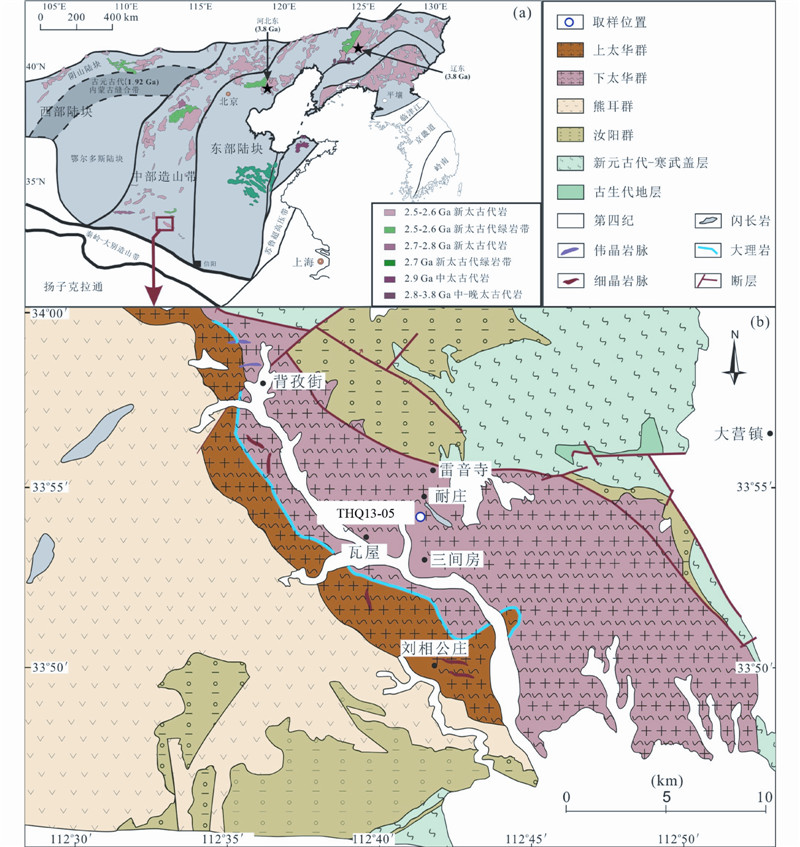 | 图 1 华北克拉通构造格架(东部陆块、西部陆块及中部造山带)及出露的太古代-古元古代基底(a,据Zhao et al., 2005)和华北南缘鲁山地区太华群变质杂岩的地质简图(b,据河南省地质矿产局,1965①修改) 图中采样位置用空心圆圈表示Fig. 1 Tectonic framework of the North China Craton(NCC)with an emphasis on the three tectonic subdivisions of the Eastern Block,Western Block,Trans-North China Orogen and the exposed Archean to Paleoproterozoic basements(a,after Zhao et al., 2005) and geological sketch of the metamorphic complexes of the Taihua Group in the Lushan region,southern NCC(b) Sample locations are marked with open circles |
①河南省地质矿产局. 1965. 河南省地质图. 图I-49-XXIII(1:200000鲁山幅)
锆石具有富U、Th放射性元素、普通Pb含量低、离子扩散速度低以及较高的封闭温度(高达900℃)等特点(Lee et al., 1997; Cherniak and Watson, 2001; 吴元保和郑永飞,2004),因此可以通过测定U-Th-Pb含量并结合放射性元素衰变规律进行U-Pb定年。而锆石中相对高的Hf和低的Lu含量,表明锆石自形成后具有极低含量放射成因Hf积累,使得通过测定176Hf/177Hf比值便可得到形成时体系中的Hf同位素组成,且Lu-Hf体系具有较Sm-Nd高的封闭温度和强的抗后期流体活动干扰能力,因而Lu-Hf成为了研究太古代地壳的理想对象。高温条件锆石和岩浆的同位素分馏很小,锆石中的O同位素组成基本反映了锆石形成时的氧同位素特征,鉴于地壳与地幔物质明显的O同位素差异,因此O同位素的测定有助于示踪壳幔的相互作用(钟玉芳等,2006)。此外锆石内部会保留有结晶、变质、热液蚀变等地质过程的环带(吴元保和郑永飞,2004; 李长民,2009)。本次研究选取与下太华群早期TTG/斜长角闪岩呈侵入关系的太古代基性岩墙,采用二次离子质谱仪(SIMS)和多接收电感耦合等离子体质谱(MC-ICPMS)原位微区分析不同类型锆石的O同位素、U-Th-Pb以及Hf同位素组成,来研究该太古代脉体的形成时代、岩浆来源及后期的改造,从而揭示华北中部造山带南缘地壳的构造演化过程和可能的抬升历史。 1 地质背景
华北克拉通太华群分布于其南缘三大地块:华熊地块、嵩箕地块和中条地块中的华熊地块中。华熊地块由太华麻粒岩地体和崤山花岗岩-绿岩地体构成(陈衍景,1996)。其中鲁山地体是出露最好且保存最完整的太古代太华群地体(如图 1b),是研究太古代地壳演化的最理想地区。太华群由一系列早前寒武纪变质岩且变质级别从角闪岩相、高角闪岩相至麻粒岩相的变质杂岩构成(Zhang et al., 1985; Sun et al., 1994; Wilde et al., 2002; Zhao et al., 2002a,b; 卢俊生,2014)。总体呈北西-南东向展布,其西南被未变质的中元古熊耳火山岩不整合覆盖,东北与中元古代汝阳群相毗邻,且都被震旦-寒武纪沉积盖层覆盖。
根据太华群构造特征和岩石组合,前人以荡泽河出露的大理岩为界将其划分为上太华和下太华两个亚群(Zhang et al., 1985; 薛良伟等,1995; 涂绍雄,1996; Wan et al., 2006)。上太华主要由含石墨片麻岩、黑云母片麻岩、大理岩、条带状含铁建造(BIF)和斜长角闪岩组成,已有的研究表明这组表壳岩的形成于21~23亿年,紧接着18.4~20亿年发生了变质作用(Wan et al., 2006; 林慈銮,2006; 杨长秀,2008; 第五春荣等,2010)。下太华被上太华不整合覆盖,由TTG片麻岩和透镜状斜长角闪岩构成。大量锆石年代学和Hf同位素地球化学研究表明下太华群原岩形成于27~30亿年(薛良伟等,1995; 林慈銮,2006; Liu et al., 2009; 第五春荣等,2010; Huang et al., 2010),同样经历了古元古代变质作用。
本次采集到的麻粒岩样品不仅纪录了新太古代基性岩浆侵入作用、古元古代变质作用、而且还纪录了华北克拉通最年轻的渐新世岩浆事件。 2 岩相学特征
样品采自河南鲁山地区下太华群,为与花岗质片麻岩呈侵入接触关系的变质基性岩脉(THQ13-05)(图 1、图 2)。岩石具中粗粒不等粒变晶结构和块状构造,主要组成矿物为斜长石(40%)、角闪石(40%)、石榴子石(10%)、石英(5%)、单斜辉石(4%)以及少量的副矿物榍石(<1%)。结合后续的变质年代学工作,这种矿物组合Pl+Grt+Cpx+Amp+Q应该为典型的高压麻粒岩相矿物组合,因此该样品为石榴石麻粒岩。其中长石呈长板状半自形,聚片双晶发育,主要为中长石(An=42~50),粒度变化于0.2~1.6mm,且部分大颗粒的斜长石有明显的增生边结构(图 2d,e)。石榴石主要是铁铝榴石,呈粒状(粒径约为0.2~0.8mm),且裂纹发育,内部常因含石英包裹体而呈筛状变晶结构。值得注意的是在镜下还观察到粉红色的石榴石+石英以冠状环围绕着早期浅色矿物相如斜长石、石英等生长(图 2b,c),类似的反应结构在华北古老的变质地体中也很常见,并被形象的称作“红眼圈”结构(马军和王仁民,1994),这种结构代表了一种未达到平衡的进变质反应;而角闪石颗粒普遍较小,其间存在有不规则的单斜辉石残留(图 2b,c),二者具有明显的反应边结构,即反映单斜辉石不同程度地被退变质矿物(角闪石)所替代。上述这些矿物组成和结构特征说明该样品最初为基性脉岩,并经历过麻粒岩相变质作用形成石榴石麻粒岩,后期又发生过角闪岩相退变质作用,单斜辉石退变为角闪石,斜长石出现增生边。
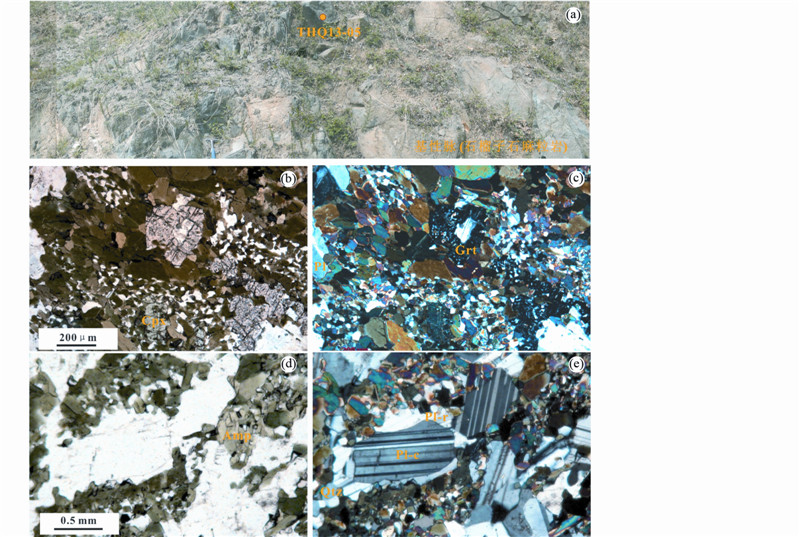 | 图 2 侵入于太华群片麻岩的基性脉野外照片(a)和石榴子石麻粒岩脉的显微镜下照片(b-e) (b、d)为单偏光下,(c、e)为正交偏光下.文中所用矿物代号,除角闪石采用Amp外,其它矿物代号引自Kretz(1983)Fig. 2 Field photographs showing mafic dyke occurrences,which intruded into the gneisses of Taihua Group(a) and microphotographs of the garnet granulites dyke(b-e) (b,d)are taken by microscope with plane polarized light while(c,e)with cross polarized light. Mineral abbreviations quotations from Kretz(1983)except Amp-amphibole: Pl-plagioclase; Px-pyroxene; Opx-orthopyroxene; Cpx-clinopyxene; Grt-garnet; Qtz-quartz; Ttn-titanite |
将采自华北南缘下太华群耐庄村附近的基性麻粒岩一分为二,小份磨成光薄片便于开展岩相学工作;另一份进行常规的重力、磁分选,最终在双目镜下挑选出锆石颗粒。为了进行锆石微区原位的年代学和同位素测试,需将样品锆石与标准锆石 Penglai(Li et al., 2010a)和内标Qinghu(李献华等,2013)一起嵌入环氧树脂样品座中,然后打磨抛光直至露出锆石颗粒的核心部分而制成样品靶。除CL图像在西北大学大陆动力学国家重点实验室完成外,其余测试均在中国科学院地质与地球物理研究所离子探针实验室(U-Pb定年和O同位素)和多接收电感耦合等离子体质谱实验室(Lu-Hf同位素)完成。 3.1 锆石CL图像
为了便于观察锆石内部结构以及选出目标点,因而在进行氧同位素、U-Pb定年和Lu-Hf同位素测试之前,先将锆石靶镀碳,用装载有Gatan CL3+检测器和Oxford能量色散光谱系统的FEI Quanta 400 FEG型扫描电镜拍摄阴极发光(CL)图像。 3.2 锆石O同位素
样品重新抛光,并镀高纯金膜,然后使用Cameca IMS-1280进行氧同位素测定。详细分析步骤见Li et al.(2010a,b)。实验工作条件:用强度为~2nA的133Cs+离子源,通过10kV的加速电压轰击样品,离子束束斑直径约20μm,氧同位素采用两个法拉第杯接受16O和18O,标样Penglai(δ18O=5.31,Li et al., 2010a)用来标定仪器的质量分馏,本次研究通过重复测量标样Penglai的外精度为0.34(2SE,n=16)。每十个测试样品加一个标样Qinghu来监测样品数据的可靠性,四组Qinghu标样的δ18O加权平均值为5.35±0.39,与李献华等(2013)报道的Qinghu的δ18O(5.41±0.44)在误差范围内相一致。 3.3 锆石U-Pb年代学
锆石的U、Th、Pb同位素也是在同一台Cameca IMS-1280上测试的。详细分析方法参见Li et al.(2009)和李献华等(2009)。与测试氧同位素不同的是离子源为O2-,用强度为~10nA的一次离子源通过13kV的加速电压轰击样品,离子束为20μm×30μm大小的椭圆形束斑,二次离子束采用60eV的能量窗和~5400的质量分辨率将Pb+分离出来而不受谱峰干扰,用单接受器电子倍增器记录二次离子束峰的强度,每次测量扫描7次,分析用时12min。每10个样品加入内标Qinghu来监测U-Pb测试的稳定性,本次实验的Qinghu谐和年龄为159.9±2.5Ma(n=4),这与李献华等(2013)报道的值相一致。普通Pb选用现代地壳的平均Pb同位素组成(Stacey and Kramers, 1975)进行校正。数据处理采用Isoplot/Ex rev. 2.49软件(Ludwig,2003)。 3.4 锆石Lu-Hf同位素
在相应的测年点位置上进行锆石原位Lu-Hf同位素分析,采用Neptune型MC-ICPMS与Geolas-193型紫外激光剥蚀系统联用测试。实验工作条件:激光剥蚀的脉冲速率为8Hz,束斑直径为40μm,能量密度为10J/cm2,剥蚀时间约为40s,详细的分析过程见Wu et al.(2006)。测定的176Hf/177Hf比值用179Hf/177Hf=0.7325校正,用标准锆石GJ-1(176Hf/177Hf=0.282020±0.000030)、Mud Tank(176Hf/177Hf=0.282500±0.000030)与样品交叉分析对仪器进行外部监控,实验过程中这些标样与Woodhead and Hergt(2005)报道值相一致。 4 分析结果
鲁山太华群基性麻粒岩中锆石的CL图像见图 3,锆石的O同位素和U-Pb年代学数据列于表 1,而LA-ICPMS Hf同位素数据见表 2。
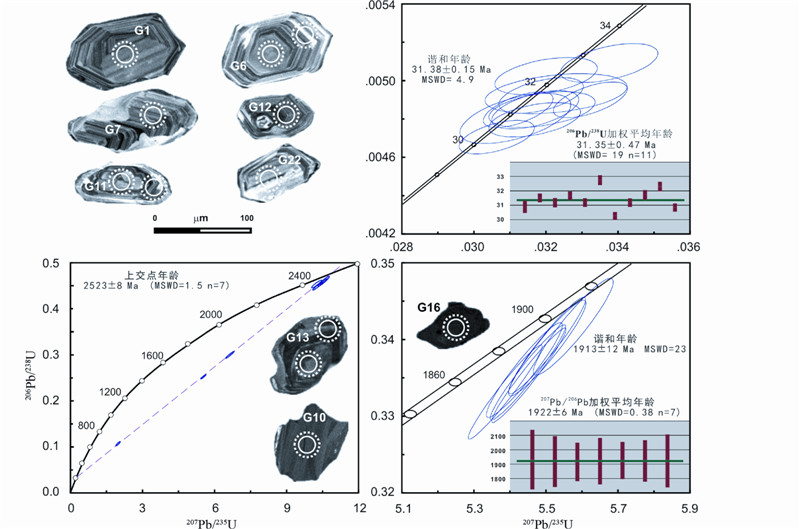 | 图 3 鲁山太华群基性脉中代表性锆石的阴极发光(CL)图像 图中颗粒G的序号与表 1、表 2相对应,实线圈代表了利用Cameca ims-1280测试U-Pb和O同位素组成的位置,而虚线圈指示了用LA-MC-ICPMS测试Hf同位素的分析点,以及该基性脉的锆石U-Pb定年的207Pb/235U-206Pb/238U谐和图,图中分析点的误差椭圆表示1σFig. 3 Cathodoluminescence(CL)images of representative zircons for the Taihua Group mafic dyke in the Lushan area Grain(G)numbers correspond to those in supplementary Table 1 and Table 2. The solid circle shows the location of the Cameca ims-1280 U-Pb age and oxygen isotope. The dashed circle indicates the location of LA-MC-ICPMS Hf isotopic analysis spot. The 207Pb/235U-206Pb/238U concordia diagrams of zircon U-Pb dating for the mafic dyke from the Taihua Group,data point error ellipses are 1σ |
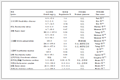
| 表 1 锆石U-Pb年龄和O同位素组成 Table 1 Zircon U-Pb age and O isotopic data |


|
| 表 2 激光多接收ICPMS获得的Lu-Hf同位素组成 Table 2 Zircon Lu-Hf isotopic data determined by laser MC-ICPMS |
CL图像显示该麻粒岩中锆石成因复杂,按锆石的内部结构可将其分为三类:①第一类锆石形态多为卵圆形,粒径变化于60~100μm之间,阴极发光性较弱,具有不太清楚的振荡环带(图 3G10和G13),部分锆石有核边结构,其核部有明显的岩浆锆石特征的振荡环带,而边部出现较窄(<20μm)的灰白色亮边;②第二类锆石形态很不规则,阴极发光性很差,呈黑色且看不出任何环带(如图 3G16),颗粒大小为50~80μm;③第三类锆石具有特征的振荡环带(图 3G1、G6、G7、G11、G12和G22),且自形程度较好,晶形以短柱状(长宽比<3)为主,粒径60~130μm。针对上述锆石的不同CL图像,我们对不同类型的锆石颗粒进行了SIMS U-Pb年代学测定。
样品中第一类5颗锆石的7个点测试,除G13-r具有很高的U含量(1225×10-6)和较低Th/U比(0.22)外,其余测试点的Th、U含量均较低,分别介于97×10-6~478×10-6和118×10-6~710×10-6之间,其Th/U比值为0.45~1.50(表 1),为典型的岩浆锆石(图 4a)(Belousova et al., 2002; Hoskin and Schaltegger, 2003)。多数数据点沿不一致曲线分布(图 3),表明锆石经历了后期变质作用的扰动,造成放射成因Pb不同程度丢失,而上交点年龄为2523±8Ma(MSWD=1.5)。因此,我们认为2523±8Ma的上交点年龄代表了基性岩脉的侵位年龄。
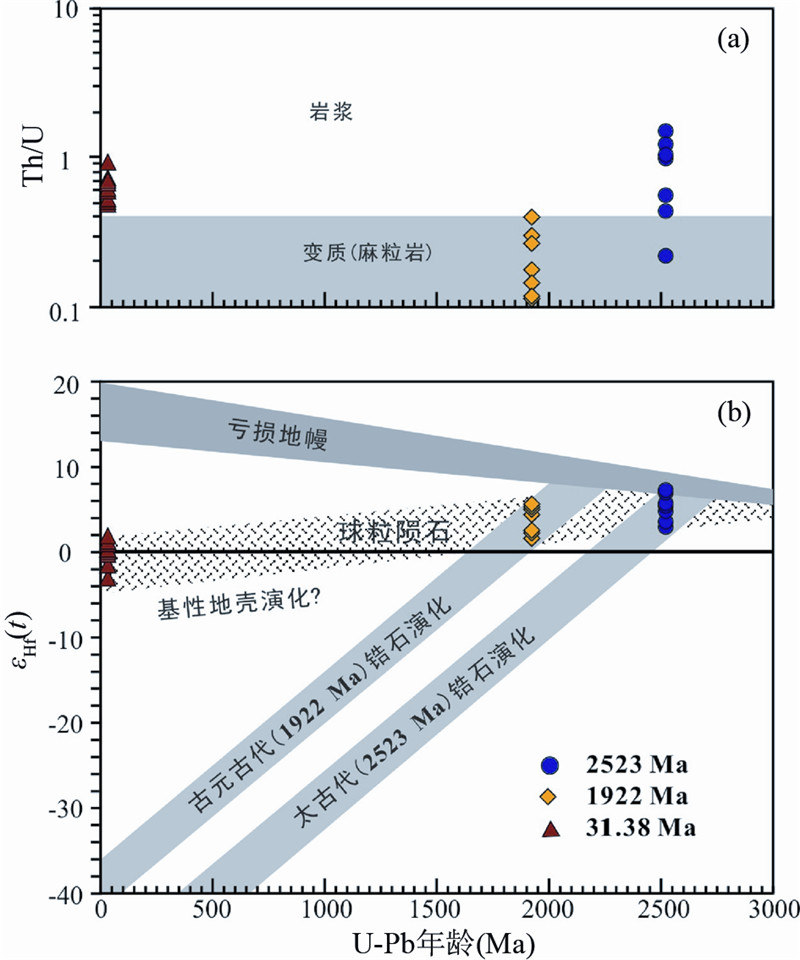 | 图 4 锆石U-Pb年龄与U/Th比关系图(a)和U-Pb年龄与εHf(t)关系图(b)
亏损地幔的演化线是依据现今地幔176Hf/177Hf=0.28325和176Lu/177Hf=0.0384(Griffin et al., 2000)绘制的,而球粒陨石Lu/Hf均一的岩浆库(CHUR)代表原始地幔岩浆库,其演化线是根据现今176Hf/177Hf=0.282772和176Lu/177Hf=0.0332(Blichert-Toft and Albarède,1997)绘制的,其衰变常数λ=1.865×10⁻¹¹/y(Söderlund et al., 2004)Fig. 4 Plot of zircon U-Pb ages vs. U/Th ratios(a) and plot of zircon 207Pb/206Pb ages vs. εHf(t)(b) The evolution of depleted mantle(DM)is drawn by using a present-day 176Hf/177Hf=0.28325 and 176Lu/177Hf=0.0384(Griffin et al., 2000), and the evolution of chondritic uniform reservoir(CHUR)is drawn by using a present-day 176Hf/177Hf=0.282772 and 176Lu/177Hf=0.0332(Blichert-Toft and Albarède,1997). The value of λ=1.865×10⁻¹¹/y(Söderlund et al., 2004)was used in calculations |
9颗第三类锆石的11个测试点皆具有很高的Th和U含量,分别为454×10-6~1910×10-6和484×10-6~2697×10-6,Th/U比值也很高为0.50~0.90,属于典型的岩浆成因锆石(图 4a),所有的数据点皆落在谐和曲线上(图 3),且206Pb/238U年龄分布在30.3~32.7Ma,谐和年龄为31.38±0.15Ma(MSWD=4.9)。这些岩浆锆石纪录了渐新世时期的岩浆事件。 4.2 O和Hf同位素地球化学
三类锆石点Hf同位素分析结果显示所有锆石的176Lu/177Hf比值均小于0.0014,表明这些锆石在形成后具有极低量的放射成因Hf的积累,因而测定的176Hf/177Hf比值是可以代表形成时体系的Hf同位素组成(Patchett et al., 1982; Knudsen et al., 2001; Kinny and Mass, 2003)。
新太古代锆石的176Hf/177Hf比值变化范围是0.281260~0.281402(表 2),明显低于球粒陨石的176Hf/177Hf比值(0.282772)(Blichert-Toft and Albarède,1997),以单个分析点的207Pb/206Pb年龄计算相应的εHf(t)值,其εHf(t)值均为正值,为2.88~7.16(表 2、图 4),相应的单阶段模式年龄tDM变化范围为2.56~2.72Ga和二阶段模式年龄tDM2变化范围为2.88~2.95Ga,锆石正的εHf(t)值表明形成该基性岩脉的岩浆来自于亏损地幔。同时,这些新太古代锆石具有较高的δ18O值,为6.12‰~7.47‰,明显高于原始地幔的δ18O(5.3±0.6‰)(Taylor,1980; Valley et al., 2005),但仍然属于基性岩δ18O范围(5.3‰~7.4‰),也就是说侵位过程中遭受到的地壳混染作用不强。
古元古代锆石的176Hf/177Hf比值为0.281614~0.281725(表 2),基本上与新太古代锆石的176Hf/177Hf值接近,其对应的εHf(t)值均为正值(1.61~5.52),但略低于新太古代锆石的εHf(t),模式年龄tDM为2.10~2.25Ga和模式年龄tDM2为2.46~2.47Ga。这一类锆石的δ18O值为4.85‰~5.76‰,与原始地幔值一致。
形成于渐新世的锆石的176Hf/177Hf比值明显高于前两类锆石,为0.282667~0.282801(表 2),与球粒陨石的176Hf/177Hf比值(0.282772)接近,其εHf(t)值变化于-3.03~1.69之间,接近于原始地幔均一岩浆库(图 4),模式年龄tDM为640~820Ma和模式年龄tDM2为920Ma。其δ18O值为5.78‰~6.62‰。 5 讨论 5.1 锆石纪录的多期构造-岩浆-变质事件
锆石的U-Pb年代学显示该岩石含有三类锆石:第一类具有新太古-古元古代207Pb/206Pb年龄(2448~2525Ma),并给出很好的上交点年龄为2523±8Ma(图 3)。CL图像和较高的Th/U比值说明这些锆石为岩浆锆石,是从基性岩浆中结晶出来的。该年龄与华北克拉通太古代广泛分布的TTG片麻岩、超基性-基性火山岩以及花岗岩等岩浆锆石的峰值一致(2.60~2.45Ga,彭澎和翟明国,2002; Zhai et al., 2005; 耿元生等,2010; Wan et al., 2012; Zhang et al., 2012; Zhao and Cawood, 2012; Zhao and Zhai, 2013)。
第二类7颗锆石均落于谐和曲线附近(图 3),并给出很好的加权平均年龄为1922±6Ma。类似的年龄在太华群中已被识别出来(时毓等,2011)。该年龄与华北南缘TTG片麻岩所反映的华北中部带的俯冲碰撞作用时限接近(1.95~1.75Ga,Guo and Zhai, 2001; Zhao et al., 2002a; Kröner et al., 2005a,b; Wan et al., 2006; Faure et al., 2007; Wang et al., 2010; Trap et al., 2011,2012)。
第三类9颗锆石的11个点皆具有很高的U和Th含量和Th/U比值,属于典型的岩浆成因锆石(图 4a),所有的数据点皆落在谐和曲线上(图 3),其谐和年龄为31.38±0.15Ma。该年龄为华北克拉通太古代最年轻的岩浆事件纪录,如此年轻的年龄尚未见报道。
由此可见,麻粒岩中锆石记录了新太古代、古元古代和渐新世三期构造-岩浆-变质事件。 5.2 新太古代基性岩浆侵入古老地壳
前寒武纪地壳演化一直是固体地球科学关注的重要课题,华北南缘是研究这一问题的理想地区之一。最近对华北南缘古元古代嵩山石英岩中碎屑锆石的U-Pb年代学和O-Hf同位素地球化学研究获得如下重要发现(Zhang et al., 2014):①华北克拉通初始陆壳很可能形成于40亿年前的冥古宙,类似于西澳的Yilgarn克拉通和加拿大Slave克拉通。该冥古宙地壳在始太古-古太古(38亿年、36亿年、34亿年)期间存在多期地壳再造事件;②中太古-新太古早期(30~26亿年,峰期为27亿年)是华北克拉通最重要的地壳增生期,类似于全球其它克拉通(Condie, 1998,2000; O’Neill et al., 2007);③新太古晚期(25亿年)是华北克拉通重要的地壳再造时期,尽管也有少量地壳增生。该地壳再造事件导致大约27亿年左右形成的年轻地壳发生大规模熔融,从而形成大量TTG;④正是从太古宙多期大规模的地壳增生和再造事件导致冥古宙地壳物质难以保存,这也许就是冥古宙地壳物质很难被发现的主要原因。
Kröner et al.(1988)和Sun et al.(1994)最早报道了英云闪长岩中单颗粒锆石蒸发法207Pb/206Pb年龄为2806~2841Ma;随后薛良伟等(1995)对斜长角闪岩用全岩Sm-Nd等时线获得的年龄为2766±29Ma;Liu et al.(2009)和Lu et al.(2013)分别对该地区的斜长角闪岩测得的207Pb/206Pb加权平均年龄为2845~2829Ma和2730~2712Ma;第五春荣等(2010)利用LA-ICPMS锆石U-Pb测得TTG质片麻岩及斜长角闪岩原岩形成于为2794~2752Ma;Huang et al.(2010)运用SHRIMP对TTG片麻岩和似TTG岩石测得U-Pb年龄分别为2723±9Ma和2765±13Ma。也就是说不论是运用何种方法,太华群鲁山地体的TTG片麻岩和透镜状的斜长角闪岩原岩主要形成于2.71~2.84Ga。结合锆石Hf同位素及全岩Nd同位素数据(εHf(t)和εNd(t)>0为主)(Liu et al., 2009; Huang et al., 2010; 第五春荣等,2010),即2.71~2.84Ga的地质事件被认为是华北南缘新太古代地壳的主要形成时期,这也与全球其他主要克拉通的地壳增生、造山带形成以及超大陆循环事件在时间上有较好的一致性(Condie and Aster, 2010)。
麻粒岩中第一类锆石获得了很好的新太古代上交点年龄(图 3),该年龄与锆石Hf同位素单阶段模式年龄tDM的最小值接近。锆石较暗的CL图像和较高的Th/U比值说明是基性岩浆结晶的产物。结合其以脉状产出的野外产状和残留有辉长/辉绿结构的岩相学特征,我们认为2523±8Ma为基性岩浆侵入到古老地壳的时间。锆石正的εHf(t)值说明形成新太古基性脉岩的岩浆来自于亏损地幔。 5.3 古元古代麻粒岩相变质作用及其意义
整个华北克拉通中部造山带从北至南皆存在前寒武结晶基底,主要由形成于晚太古代的TTG片麻岩、斜长角闪岩透镜体和麻粒岩(郭敬辉等,2005)、形成于早元古代的表壳岩以及侵位于早期形成的古老地壳岩石的TTG质(Zhao et al., 2008)和镁铁质脉体构成(彭澎和翟明国,2002; Peng et al., 2012)。尽管它们的原岩形成年龄差别很大,但多数基底岩石均经历了高角闪岩相-麻粒岩相的变质作用(Zhang et al., 1985; 卢良兆等,1996; 沈其韩和吉成林,1992; Chen et al., 2015a),且明显于1.95~1.75Ga间发生变质作用。如TTG片麻岩(Wilde et al., 2002; Zhao et al., 2002a)、麻粒岩(王仁民等,1991; Zhai et al., 1993; 翟明国等,1996; 郭敬辉等, 1993,2002,2005; 李江海等, 1998,2000; 魏春景等,2001; Zhao et al., 2001; O’Brien et al., 2005)和变质基性岩脉(彭澎和翟明国,2002; Peng et al., 2012)等。
麻粒岩中的第二类锆石给出了1922±6Ma的加权平均年龄(图 3),结合该岩脉的野外产状、镜下岩相学以及锆石年代学(较低的Th/U比)等研究,我们认为该类锆石为变质锆石,也就是说1922±6Ma代表了该基性岩脉新太古代形成后与太华群基底在早古元古代一起遭受了强烈的变质作用。那么Lu-Hf体系中锆石的Hf同位素单阶段模式年龄tDM对第二类锆石并没有任何地质意义,然而εHf(t)值与其原岩并无太大差别(均大于0),即仍然记录了来自于原岩基性脉岩的特征。此外,锆石对氧同位素组成具有较好的保存性,即便是在高温条件下甚至麻粒岩相变质条件下,锆石也能在干的岩石中保留岩浆氧同位素的初始δ18O值(King et al., 1997)。尽管早元古代经历了麻粒岩相变质,该基性脉仍应具有与其原岩一致的δ18O值,而恰恰相反的是变质锆石的δ18O值明显低于其原岩,表明在变质或随后的退变质作用过程中有贫δ18O的流体参与,这可能是由于在变质作用过程中接触到大气降水而发生了高温热液蚀变(Gilliam and Valley, 1997),从而导致变质增生锆石具有低δ18O的特征。 5.4 渐新世岩浆事件
华北克拉通基底形成后,在相当的一长段时间内处于稳定的构造环境,但这种稳定的构造环境仅仅是相对的,期间仍时有岩浆活动发生。华北克拉通中部陆续发现的2.2~2.1Ga的岩浆活动(第五春荣等,2013);翟明国和彭澎(2007)认为~1.9Ga的辉长岩墙群代表了来自地幔的岩浆上涌底侵于下地壳深度,而1.70~1.85Ga期间岩浆岩代表了华北克拉通进入伸展构造阶段,导致产生裂陷、基性岩墙群以及非造山岩浆活动;Zhang et al.(2009)发现华北于1.35Ga有一期基性岩墙群事件,这与哥伦比亚超大陆的裂解事件相对应;此后还有更多期的岩浆活动:400~360Ma的碱性岩、基性-超基性岩和碱性花岗岩;330~265Ma的闪长岩、花岗岩以及辉长岩;250~200Ma的花岗岩、基性-超基性岩及少量中酸性火山岩(张拴宏等,2007; Zhang et al., 2009; 赵越等,2010),然而目前还没有发现更年轻的新生代岩浆活动的锆石记录。
本次研究发现基性岩脉中锆石尚存在31.38±0.15Ma的谐和年龄。这些锆石的CL图像以及较高的U和Th含量和Th/U比值(图 3、图 4)说明其为岩浆锆石(吴元保和郑永飞,2004; 李长民,2009)。而锆石的Hf同位素具有非常接近0的εHf(t)值(表 2),在εHf(t)-Age图上表现为集中分布于CHUR演化线附近(图 4),反映了岩浆锆石来源于具有球粒陨石型的岩浆源。结合5.78‰~6.62‰的δ18O值(属于原始地幔的δ18O范围)(图 5),表明了此次岩浆的确来源于地幔岩浆库。综上所述,由该基性岩脉所记录的~31Ma岩浆锆石指示了渐新世发生了地幔岩浆上涌事件。
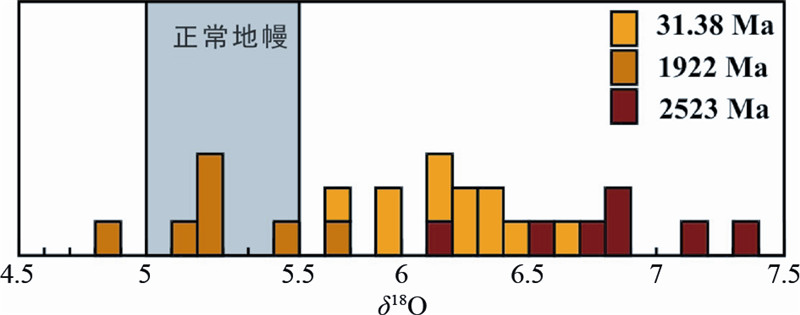 | 图 5 鲁山太华群基性脉中锆石的氧同位素直方图
图中原始地幔的阴影区δ18O=5.3±0.6‰取自Taylor(1980)和Valley et al.(2005)Fig. 5 Oxygen isotope histograms of the zircons for the Taihua Group mafic dyke in the Lushan area The shaded eld in this diagram for the primitive mantle(δ18O=5.3±0.6‰)is taken from Taylor(1980) and Valley et al.(2005) |
随着国内外学者对华北南缘早前寒武纪时期的逐渐深入研究,在一定程度上为华北南缘乃至整个华北中部造山带的构造属性及演化提供了更多的依据。早先人们认为华北克拉通具有统一的结晶基底;20世纪80年代以来,人们逐渐意识到华北克拉通是由多个彼此独立的地块拼合而成(陈衍景,1996; Zhai et al., 2000),这些独立的地块为不同性质不同时代具有沟-弧-盆构造体系的构造单元(李江海等,2000),Zhao et al.(2001)将华北克拉通基底分为东部陆块、西部陆块以及中部造山带。结合变质杂岩的主、微量地球化学特征的研究,林慈銮(2006)、第五春荣等(2010)和Wang et al.(2013)等人认为华北南缘晚太古代处于类似于现代大陆边缘岛弧环境,也有人提出中太古代-晚太古代处于类似于板块构造体制下的俯冲作用而发生了陆核拼贴(杨长秀,2008),到古元古代地壳抬升裂解转变为大陆伸展构造,进一步形成拉张性小洋盆,随后华北南缘同中部造山带中其他地区变质杂岩一致,普遍经历了~1.85Ga的高角闪岩相-麻粒岩相变质作用(李江海等,1998; 郭敬辉等, 2002,2005; Zhao et al., 2002a,2008,2010; Kröner et al., 2005a,b; O’Brien et al., 2005; Liu et al., 2006;刘树文等, 2007,2009,2011; Trap et al., 2007,2008,2009a,b; Wang,2009; Zhang et al., 2009; 肖玲玲和王国栋,2011; 肖玲玲等,2011),这可能是较小的块体拼贴使洋盆闭合而发生了类似碰撞挤压的强烈变形变质。通过对华北南缘中条(梅华林,1994)、鲁山(吴春明等,2008; Lu et al., 2015)以及洛宁(蒋宗胜等,2011; Chen et al., 2015b)等地区矿物温压估算并结合年代学反演了变质杂岩在古元古代经历了升温升压、峰期变质、快速降压的变质过程,具有近等温降压ITD型顺 时针演化特征的P-T-t轨迹,这与华北克拉通造山带中段和北段的P-T-t轨迹类型相似(郭敬辉等, 1998,1999; 刘福来和沈其韩,1999; Zhao et al., 1999b,2001; Xiao et al., 2011;肖玲玲等,2011; Kröner et al., 2005a,b),赵国春(2009)认为这是华北克拉通东部、西部陆块俯冲-碰撞-快速隆升造山的结果。自华北克拉通各块体碰撞拼合发生古元古代的构造-变质事件之后,便结束了华北早前寒武纪基底的地壳演化,形成统一的华北克拉通结晶基底。
本文对太华群中呈脉状产出的麻粒岩中锆石U-Pb年代学和O、Hf同位素地球化学特征的研究结果说明该脉体由幔源岩浆上侵并于新太古代晚期就位形成。结合其野外与花岗片麻岩的侵入接触关系以及镜下变余辉长/辉绿结构的观察证明该脉体为侵位于太古代基底的基性岩脉,且并未遭受到太古代地壳物质的明显混染。另外该脉体还记录了古元古代末期的变质事件,结合镜下岩石学矿物组合、“红眼圈”结构和前人对华北中部造山带1.95~1.75Ga期间变质作用的研究(Zhang et al., 1985; 沈其韩和吉成林,1992; Zhai et al., 1993; 翟明国等,1996; 郭敬辉等, 1993,2002,2005; 卢良兆等,1996; 李江海等, 1998,2000; Wilde et al., 2002; Zhao et al., 2001,2002a; 魏春景等,2001; 彭澎和翟明国,2002; O’Brien et al., 2005; Peng et al., 2012),我们认为该脉体侵位后随同古老基底一起俯冲至下地壳深度并发生了麻粒岩相的变质作用,锆石记录的1.92Ga为其峰期变质年龄。 6 结论
通过上述分析可以得出以下结论:
(1)华北克拉通南缘太华群鲁山地区基性麻粒岩脉中存在有三类锆石,至少记录了三期地质事件:2523±8Ma、1922±6Ma以及31.38±0.15Ma,说明华北南缘存在有多期的构造-岩浆-变质事件。
(2)基性岩脉于2523±8Ma侵位,随后于1922±6Ma发生峰期变质,同时记录了31.38±0.15Ma的岩浆事件。
(3)基性脉研究进一步证实了华北南缘经历了俯冲-碰撞-多阶段隆升的过程,且在古元古代时期华北克拉通中部造山带普遍存在一次复杂的构造-变质演化过程。
致谢 野外工作得到了西北大学周鼎武教授和张娟老师的指导和帮助,锆石的U-Pb年代学和O同位素分析得到了中国科学院地质与地球物理研究所离子探针实验室唐国强工程师和凌潇潇博士的帮助,锆石的Hf同位素分析得到了中国科学院地质与地球物理研究所多接收电感耦合等离子体质谱实验室杨岳衡研究员的帮助,在此一并表示感谢。同时,感谢吴春明副主编和评审人王伟博士、肖玲玲博士、卢俊生博士对本文进行的认真和富有建设性的评审。| [1] | Belousova EA, Griffin WL, O'Reilly SY and Fisher NI. 2002. Igneous zircon:Trace element composition as an indicator of source rock type. Contributions to Mineralogy and Petrology, 143(5):602-622 |
| [2] | Blichert-Toft J and Albarède F. 1997. The Lu-Hf isotope geochemistry of chondrites and the evolution of the mantle-crust system. Earth and Planetary Science Letters, 148(1-2):243-258 |
| [3] | Cherniak DJ and Watson EB. 2001. Pb diffusion in zircon. Chemical Geology, 172(1-2):5-24 |
| [4] | Chen HX, Wang J, Wang H, Wang GD, Peng T, Shi YH, Zhang Q and Wu CM. 2015b. Metamorphism and geochronology of the Luoning metamorphic terrane, southern terminal of the Palaeoproterozoic Trans-North China Orogen, North China Craton. Precambrian Research, 264:156-178 |
| [5] | Chen YJ. 1996. Progresses and problems on the study of Taihua granulitic terrain in the southern margin of North China Craton. Jour. Geol. & Min. Res. North China, 11(1):127-130(in Chinese) |
| [6] | Chen YP, Wei CJ, Zhang JR and Chu H. 2015a. Metamorphism and zircon U-Pb dating of garnet amphibolite in the Baoyintu Group, Inner Mongolia. Science Bulletin, 60(19):1698-1707 |
| [7] | Condie KC. 1998. Episodic continental growth and supercontinents:A mantle avalanche connection? Earth and Planetary Science Letters, 163(1-4):97-108 |
| [8] | Condie KC. 2000. Episodic continental growth models:After thoughts and extensions. Tectonophysics, 322(1-2):153-162 |
| [9] | Condie KC and Aster RC. 2010. Episodic zircon age spectra of orogenic granitoids:The supercontinent connection and continental growth. Precambrian Research, 180(3-4):227-236 |
| [10] | Diwu CR, Sun Y, Lin CL and Wang HL. 2010. LA-(MC)-ICPMS U-Pb zircon geochronology and Lu-Hf isotope compositions of the Taihua Complex on the southern margin of the North China Craton. Chinese Science Bulletin, 55(23):2557-2571 |
| [11] | Diwu CR, Sun Y, Gao JF and Fan LG. 2013. Early Precambrian tectonothermal events of the North China Craton:Constraints from in situ detrital zircon U-Pb, Hf and O isotopic compositions in Tietonggou Formation. Chinese Science Bulletin, 58(31):3760-3770 |
| [12] | Faure M, Trap P, Lin W, Monié P and Bruguier O. 2007. Polyorogenic evolution of the Paleoproterozoic Trans-North China Belt, new insights from the Lüliangshan-Hengshan-Wutaishan and Fuping massifs. Episodes, 30(2):95-106 |
| [13] | Geng YS, Shen QH and Ren LD. 2010. Late Neoarchean to Early Paleoproterozoic magmatic events and tectonothermal systems in the North China craton. Acta Petrologica Sinica, 26(7):1945-1966(in Chinese with English abstract) |
| [14] | Gilliam CE and Valley JW. 1997. Low δ18O magma, Isle of Skye, Scotland:Evidence from zircons. Geochimica et Cosmochimica Acta, 61(23):4975-4981 |
| [15] | Griffin WL, Pearson NJ, Belousova E, Jackson SE, van Achterbergh E, O'Reilly SY and Shee SR. 2000. The Hf isotope composition of cratonic mantle:LAM-MC-ICPMS analysis of zircon megacrysts in kimberlites. Geochimica et Cosmochimica Acta, 64(1):133-147 |
| [16] | Guo JH, Zhai MG, Zhang YG, Li YG, Yan YH and Zhang WH. 1993. Early Precambrian Manjinggou high pressure granulite melange belt on the south edge of the Huaian complex, North China craton:Geological features, petrology and isotopic geochronology. Acta Petrologica Sinica, 9(4):329-341(in Chinese with English abstract) |
| [17] | Guo JH, Zhai MG, Li YG and Yan YH. 1998. Contrasting metamorphic P-T paths of Archaean high-pressure granulites from the North China Craton:Metamorphism and tectonic significance. Acta Petrologica Sinica, 14(4):430-448(in Chinese with English abstract) |
| [18] | Guo JH, Zhai MG, Li YG and Li JH. 1999. Metamorphism, P-T paths and tectonic significance of garnet amphibolite and granulite from Hengshan, North China craton. Scientia Geologica Sinica, 34(3):311-325(in Chinese with English abstract) |
| [19] | Guo JH and Zhai MG. 2001. Sm-Nd age dating of high-pressure granulites and amphibolite from Sanggan area, North China craton. Chinese Science Bulletin, 46(2):106-111 |
| [20] | Guo JH, Zhai MG and Xu RH. 2001. Timing of the granulite facies metamorphism in the Sanggan area, North China Craton:Zircon U-Pb geochronology. Science in China(Series D), 44(11):1010-1018 |
| [21] | Guo JH, Chen FK, Zhang XM, Sisbel W and Zhai MG. 2005. Evolution of syn-to post-collisional magmatism from North Sulu UHP belt, eastern China:Zircon U-Pb geochronology. Acta Petrologica Sinica, 21(4):1281-1301(in Chinese with English abstract) |
| [22] | Hoskin PWO and Schaltegger U. 2003. The composition of zircon and igneous and metamorphic petrogenesis. Reviews in Mineralogy and Geochemistry, 53(1):27-62 |
| [23] | Huang XL, Niu YL, Xu YG, Yang QJ and Zhong JW. 2010. Geochemistry of TTG and TTG-like gneisses from Lushan-Taihua complex in the southern North China Craton:Implications for Late Archean crustal accretion. Precambrian Research, 182(1-2):43-56 |
| [24] | Jiang ZS, Wang GD, Xiao LL, Diwu CR, Lu JS and Wu CM. 2011. Paleoproterozoic metamorphic P-T-t path and tectonic significance of the Luoning metamorphic complex at the southern terminal of the Trans-North China Orogen, Henan Province. Acta Petrologica Sinica, 27(12):3701-3717(in Chinese with English abstract) |
| [25] | King EM, Barrie CT and Valley JW. 1997. Hydrothermal alteration of oxygen isotope ratios in quartz phenocrysts, Kidd Creek Mine, Ontario:Magmatic values are preserved in zircon. Geology, 25(12):1079-1082 |
| [26] | Kinny PD and Mass R. 2003. Lu-Hf and Sm-Nd isotope systems in zircon. Reviews in Mineralogy & Geochemistry, 53(1):327-341 |
| [27] | Knudsen TL, Griffin WL, Hartz EH, Andresen A and Jackson SE. 2001. In-situ hafnium and lead isotope analyses of detrital zircons from the Devonian sedimentary basin of NE Greenland:A record of repeated crustal reworking. Contributions to Mineralogy and Petrology, 141(1):83-94 |
| [28] | Kretz R. 1983. Symbols for rock-forming minerals. American Mineralogist, 68:277-279 |
| [29] | Kröner A, Compston W, Zhang GW, Guo AL and Todt W. 1988. Age and tectonic setting of Late Archean greenstone-gneiss terrain in Henan Province, China, as revealed by single-grain zircon dating. Geology, 16(3):211-215 |
| [30] | Kröner A, Wilde SA, Li JH and Wang KY. 2005a. Age and evolution of a Late Archean to Paleoproterozoic upper to lower crustal section in the Wutaishan/Hengshan/Fuping terrain of northern China. Journal of Asian Earth Sciences, 24(5):577-595 |
| [31] | Kröner A, Wilde SA, O'Brien PJ, Li JH, Passchier CW, Walte NP and Liu DY. 2005b. Field relationships, geochemistry, zircon ages and evolution of a Late Archaean to Palaeoproterozoic lower crustal section in the Hengshan Terrain of northern China. Acta Geologica Sinica, 79(5):605-629 |
| [32] | Kusky TM and Li JH. 2003. Paleoproterozoic tectonic evolution of the North China Craton. Journal of Asian Earth Sciences, 22(4):383-397 |
| [33] | Kusky TM, Li JH and Santosh M. 2007. The Paleoproterozoic North Hebei Orogen:North China craton's collisional suture with the columbia supercontinent. Gondwana Research, 12(1-2):4-28 |
| [34] | Lee JKW, Williams IS and Ellis DJ. 1997. Pb, U and Th diffusion in natural zircon. Nature, 390(6656):159-162 |
| [35] | Li CM. 2009. A review on the minerageny and situ microanalytical dating techniques of zircons. Geological Survey and Research, 32(3):161-174(in Chinese with English abstract) |
| [36] | Li JH, Qian XL and Gu YC. 1998. Outline of Paleoproterozoic tectonic division and plate tectonic evolution of North China craton. Earth Science, 23(3):230-235(in Chinese with English abstract) |
| [37] | Li JH, Qian XL, Huang XN and Liu SW. 2000. Tectonic framework of North China Block and its cratonization in the Early Precambrian. Acta Petrologica Sinica, 16(1):1-10(in Chinese with English abstract) |
| [38] | Li XH, Liu Y, Li QL, Guo CH and Chamberlain KR. 2009. Precise determination of Phanerozoic zircon Pb/Pb age by multicollector SIMS without external standardization. Geochemistry, Geophysics, Geosystems, 10(4):doi:10.1029/2009GC002400 |
| [39] | Li XH, Li WX, Wang XC, Li QL, Liu Y and Tang GQ. 2009. Role of mantle-derived magma in genesis of Early Yanshanian granites in the Nanling Range, South China:In situ zircon Hf-O isotopic constraints. Science in China(Series D), 52(9):1262-1278 |
| [40] | Li XH, Long WG, Li QL, Liu Y, Zheng YF, Yang YG, Chamberlain KR, Wan DF, Guo CH, Wang XC and Tao H. 2010a. Penglai zircon megacrysts:A potential new working reference material for microbeam determination of Hf-O Isotopes and U-Pb age. Geostandards and Geoanalytical Research, 34(2):117-134 |
| [41] | Li XH, Li WX, Li QL, Wang XC, Liu Y and Yang YH. 2010b. Petrogenesis and tectonic significance of the 850Ma Gangbian alkaline complex in South China:Evidence from in situ zircon U-Pb dating, Hf-O isotopes and whole-rock geochemistry. Lithos, 114(1-2):1-15 |
| [42] | Li XH, Tang GQ, Gong B, Yang YH, Hou KJ, Hu ZC, Li QL, Liu Y and Li XW. 2013. Qinghu zircon:A working reference for microbeam analysis of U-Pb age and Hf and O isotopes. Chinese Science Bulletin, 58(36):4647-4654 |
| [43] | Lin CL. 2006. Geochemistry, geochronology and tectonic settings of Archean gneisses in Lushan, Henan Province. Master Degree Thesis. Xi'an:Northwest University, 1-82(in Chinese with English summary) |
| [44] | Liu DY, Nutman AP, Compston W, Wu JS and Shen QH. 1992. Remnants of ≥3800Ma crust in the Chinese part of the Sino-Korean craton. Geology, 20(4):339-342 |
| [45] | Liu DY, Wilde SA, Wan YS, Wu JS, Zhou HY, Dong CY and Yin XY. 2008. New U-Pb and Hf isotopic data confirm Anshan as the oldest preserved segment of the North China Craton. American Journal of Science, 308(3):200-231 |
| [46] | Liu DY, Wilde SA, Wan YS, Wang SY, Valley JW, Kita N, Dong CY, Xie HQ, Yang CX, Zhang YX and Gao LZ. 2009. Combined U-Pb, hafnium and oxygen isotope analysis of zircons from meta-igneous rocks in the southern North China Craton reveal multiple events in the Late Mesoarchean-Early Neoarchean. Chemical Geology, 261(1-2):140-154 |
| [47] | Liu FL and Shen QH. 1999. Retrogressive textures and metamorphic reaction features of Al-rich gneisses in the granulite facies belt from northwestern Hebei Province. Acta Petrologica Sinica, 15(4):505-517(in Chinese with English abstract) |
| [48] | Liu SW, Zhao GC, Wilde SA, Shu GM, Sun M, Li QG, Tian W and Zhang J. 2006. Th-U-Pb monazite geochronology of the Lüliang and Wutai complexes:Constraints on the tectonothermal evolution of the Trans-North China Orogen. Precambrain Research, 148(3-4):205-224 |
| [49] | Liu SW, Lü YJ, Feng YG, Zhang C, Tian W, Yan QR and Liu XM. 2007. Geology and zircon U-Pb isotopic chronology of Dantazi complex, northern Hebei Province. Geological Journal of China Universities, 13(3):484-497(in Chinese with English abstract) |
| [50] | Liu SW, Li QG and Zhang LF. 2009. Geology, geochemistry of metamorphic volcanic rock suite in Precambrian Yejishan Group, Lüliang Mountains and its tectonic implications. Acta Petrologica Sinica, 25(3):547-560(in Chinese with English abstract) |
| [51] | Liu SW, Lü YJ, Wang W, Yang PT, Bai X and Feng YG. 2011. Petrogenesis of the Neoarchean granitoid gneisses in northern Hebei Province. Acta Petrologica Sinica, 27(4):909-921(in Chinese with English abstract) |
| [52] | Lu JS, Wang GD, Wang H, Chen HX and Wu CM. 2013. Metamorphic P-T-t paths retrieved from the amphibolites, Lushan terrane, Henan Province and reappraisal of the Paleoproterozoic tectonic evolution of the Trans-North China Orogen. Precambrian Research, 238:61-77 |
| [53] | Lu JS. 2014. Precambrian metamorphic evolution and geochronology of the Lushan and Wugang terranes, Taihua Metamorphic Complex, Henan Provience. Ph. D. Dissertation. Beijing:University of Chinese Academy of Sciences(in Chinese with English summary) |
| [54] | Lu JS, Wang GD, Wang H, Chen HX, Peng T and Wu CM. 2015. Zircon SIMS U-Pb geochronology of the Lushan terrane:Dating metamorphism of the southwestern terminal of the Palaeoproterozoic Trans-North China Orogen. Geological Magazine, 152:367-377 |
| [55] | Lu LZ, Xu XC and Liu FL. 1996. The Precambrain Hondalite Series in the North of China. Changchun:Changchun Publishing House, 39-58(in Chinese) |
| [56] | Ludwig KR. 2003. User's Manual for Isoplot 3.00:A geochronological toolkit for Microsoft Excel. Berkeley Geochronology Center, Special Publication, 4:70 |
| [57] | Ma J and Wang RM. 1994. Reviews in Garnet-clinopyroxene geothermometers and geobarometers with their application to granulites:The comparison of P-T evolution of the Miyun(Zunhua) and Xuanhua granulites. In:Qian XL and Wang RM(eds.). Geological Evolution of the Granulite Terrain in North Part of the North China Craton. Beijing:Seismological Press, 71-88(in Chinese) |
| [58] | Mei HL. 1994. P-T-t paths and tectonic evolution of Early Proterozoic rocks from the Zhongtiao Mountains, southern Shanxi. Geological Review, 40(1):36-47(in Chinese with English abstract) |
| [59] | O'Brien PJ, Walte N and Li JH. 2005. The petrology of two distinct granulite types in the Hengshan Mts., China, and tectonic implications. Journal of Asian Earth Sciences, 24(5):615-627 |
| [60] | O'Neill C, Lenardic A, Moresi L, Torsvik TH and Lee CTA. 2007. Episodic Precambrian subduction. Earth and Planetary Science Letters, 262(3-4):552-562 |
| [61] | Patchett PJ, Kouvo O, Hedge CE and Tatsumoto M. 1982. Evolution of continental crust and mantle heterogeneity:Evidence from Hf isotopes. Contributions to Mineralogy and Petrology, 78(3):279-297 |
| [62] | Peng P and Zhai MG. 2002. Two major Precambrian geological events of North China block(NCB):Characteristics and property. Advance in Earth Sciences, 17(6):818-825(in Chinese with English abstract) |
| [63] | Peng P, Guo JH, Windley BF, Liu F, Zhu Z and Zhai MG. 2012. Petrogenesis of Late Paleoproterozoic Liangcheng charnockites and S-type granites in the central-northern margin of the North China Craton:Implications for ridge subduction. Precambrian Research, 222-223:107-123 |
| [64] | Shen QH and Ji CL. 1992. Basic characteristics of the Precambrian charnockites in North China. Acta Petrologica Sinica, 8(1):61-73(in Chinese with English abstract) |
| [65] | Shi Y, Yu JH, Xu XX, Tang HF, Qiu JS and Chen LH. 2011. U-Pb ages and Hf isotopic compositions of zircons of Taihua Group in the Xiaoqinling area, Shaanxi Province. Acta Petrologica Sinica, 27(10):3095-3108(in Chinese with English abstract) |
| [66] | Söderlund U, Patchett PJ, Vervoort JD and Isachsen CE. 2004. The 176Lu decay constant determined by Lu-Hf and U-Pb isotope systematics of Precambrian mafic intrusions. Earth and Planetary Science Letters, 219(3-4):311-324 |
| [67] | Stacey JS and Kramers JD. 1975. Approximation of terrestrial lead isotope evolution by a two-stage model. Earth and Planetary Science Letters, 26(2):207-221 |
| [68] | Sun Y, Yu ZP and Kröner A. 1994. Geochemistry and single zircon geochronology of Archaean TTG gneisses in the Taihua high-grade terrain, Lushan area, central China. Journal of Southeast Asian Earth Sciences, 10(3-4):227-233 |
| [69] | Taylor HP Jr. 1980. The effects of assimilation of country rocks by magmas on 18O/16O and 87Sr/86Sr systematics in igneous rocks. Earth and Planetary Science Letters, 47(2):243-254 |
| [70] | Trap P, Faure M, Lin W and Monié P. 2007. Late Paleoproterozoic(1900-1800Ma) nappe stacking and polyphase deformation in the Hengshan-Wutaishan area:Implications for the understanding of the Trans-North-China Belt, North China Craton. Precambrian Research, 156(1-2):85-106 |
| [71] | Trap P, Faure M, Lin W, Monié P and Bruguier O. 2008. Contrasted tectonic styles for the Paleoproterozoic evolution of the North China Craton. Evidence for a-2.1Ga thermal and tectonic event in the Fuping Massif. Journal of Structural Geology, 30(9):1109-1125 |
| [72] | Trap P, Faure M, Lin W and Meffre S. 2009a. The Lüliang Massif:A key area for the understanding of the Palaeoproterozoic Trans-North China Belt, North China Craton. Geological Society, London, Special Publications, 323:99-125 |
| [73] | Trap P, Faure M, Lin W, Monié P, Meffre S and Melletton J. 2009b. The Zanhuang Massif, the second and eastern suture zone of the Paleoproterozoic Trans-North China Orogen. Precambrian Research, 172(1-2):80-98 |
| [74] | Trap P, Faure M, Lin W, Augier R and Fouassier A. 2011. Syn-collisional channel flow and exhumation of Paleoproterozoic high pressure rocks in the Trans-North China Orogen:The critical role of partial-melting and orogenic bending. Gondwana Research, 20(2-3):498-515 |
| [75] | Trap P, Faure M, Lin W, Le Breton N and Monié P. 2012. Paleoproterozoic tectonic evolution of the Trans-North China Orogen:Toward a comprehensive model. Precambrian Research, 222-223:191-211 |
| [76] | Tu SX. 1996. A new idea on the protolith formations and the dismembering into two eras of Taihua metamorphic complex in Lushan region, He'nan Province. Geology and Mineral Resources of South China, 12(4):22-31(in Chinese with English abstract) |
| [77] | Valley JW, Lackey JS, Cavosie AJ, Clechenko CC, Spicuzza MJ, BaseiMa S, Bindeman IN, Ferreira VP, Sial AN, King EM, Peck WH, Sinha AK and Wei CS. 2005. 4.4billion years of crustal maturation:Oxygen isotope ratios of magmatic zircon. Contributions to Mineralogy and Petrology, 150(6):561-580 |
| [78] | Vavra G, Schmid R and Gebauer D. 1999. Internal morphology, habit and U-Th-Pb microanalysis of amphibolite-to-granulite facies zircons:Geochronology of the Ivrea zone(Southern Alps). Contributions to Mineralogy and Petrology, 134(4):380-404 |
| [79] | Wan YS, Wilde SA, Liu DY, Yang CX, Song B and Yin XY. 2006. Further evidence for -1.85Ga metamorphism in the central Zone of the North China Craton:SHRIMP U-Pb dating of zircon from metamorphic rocks in the Lushan area, Henan Province. Gondwana Research, 9(1-2):189-197 |
| [80] | Wan YS, Dong CY, Liu DY, Kröner A, Yang CH, Wang W, Du LL, Xie HQ and Ma MZ. 2012. Zircon ages and geochemistry of Late Neoarchean syenogranites in the North China Craton:A review. Precambrian Research, 222-223:265-289 |
| [81] | Wang AD, Liu YC, Santosh M and Gu XF. 2013. Zircon U-Pb geochronology, geochemistry and Sr-Nd-Pb isotopes from the metamorphic basement in the Wuhe Complex:Implications for Neoarchean active continental margin along the southeastern North China Craton and constraints on the petrogenesis of Mesozoic granitoids. Geoscience Frontiers, 4(1):57-71 |
| [82] | Wang J, Wu YB, Gao S, Peng M, Liu XC, Zhao LS, Zhou L, Hu ZC, Gong HJ and Liu YS. 2010. Zircon U-Pb and trace element data from rocks of the Huai'an Complex:New insights into the Late Paleoproterozoic collision between the Eastern and Western blocks of the North China Craton. Precambrian Research, 178(1-4):59-71 |
| [83] | Wang RM, Chen ZZ and Chen F. 1991. Grey tonalitic gneiss and high-pressure granulite inclusions in Hengshan, Shanxi Province, and their geological significance. Acta Petrologica Sinica, 7(4):36-45(in Chinese with English abstract) |
| [84] | Wang ZH. 2009. Tectonic evolution of the Hengshan-Wutai-Fuping complexes and its implication for the Trans-North China Orogen. Precambrian Research, 170(1-2):73-87 |
| [85] | Wei CJ, Zhang CG, Zhang AL, Wu TH and Li JH. 2001. Metamorphic P-T conditions and geological significance of high-pressure granulite from the Jianping complex, western Liaoning Province. Acta Petrologica Sinica, 17(2):269-282(in Chinese with English abstract) |
| [86] | Wilde SA, Zhao GC and Sun M. 2002. Development of the North China craton during the Late Archaean and its final amalgamation at 1.8Ga:Some speculations on its position within a global Palaeoproterozoic supercontinent. Gondwana Research, 5(1):85-94 |
| [87] | Woodhead JD and Hergt JM. 2005. A preliminary appraisal of seven natural zircon reference materials for in situ Hf isotope determination. Geostandards and Geoanalytical Research, 29(2):183-195 |
| [88] | Wu CM, Xiao LL, Zhao GC and Guo JH. 2008. Preliminary metamorphic study of the Lushan amphibolites, He'nan Province. Bulletin of Mineralogy, Petrology and Geochemistry, 27(Suppl.):181(in Chinese) |
| [89] | Wu FY, Yang YH, Xie LW, Yang JH and Xu P. 2006. Hf isotopic compositions of the standard zircons and baddeleyites used in U-Pb geochronology. Chemical Geology, 234(1-2):105-126 |
| [90] | Wu YB and Zheng YF. 2004. Genesis of zircon and its constraints on interpretation of U-Pb age. Chinese Science Bulletin, 49(15):1554-1569 |
| [91] | Xiao LL and Wang GD. 2011. Zircon U-Pb dating of metabasic rocks in the Zanhuang metamorphic complex and its geological significance. Acta Petrologica et Mineralogica, 30(5):781-794(in Chinese with English abstract) |
| [92] | Xiao LL, Wu CM, Zhao GC, Guo JH and Ren LD. 2011. Metamorphic P-T paths of the Zanhuang amphibolites and metapelites:Constraints on the tectonic evolution of the Paleoproterozoic Trans-North China Orogen. International Journal of Earth Sciences, 100:717-739 |
| [93] | Xiao LL, Jiang ZS, Wang GD, Wan YS, Wang T and Wu CM. 2011. Metamorphic reaction textures and metamorphic P-T-t loops of the Precambrian Zanhuang metamorphic complex, Hebei, North China. Acta Petrologica Sinica, 27(4):980-1002(in Chinese with English abstract) |
| [94] | Xue LW, Yuan ZL, Zhang YS and Qiang LZ. 1995. The Sm-Nd isotope age of Taihua Group in Lushan area and their implications. Geochimica, 24(S1):92-97(in Chinese with English abstract) |
| [95] | Yang CX. 2008. Zircon SHRIMP U-Pb ages, geochemical characteristics and environmental evolution of the Early Precambrian metamorphic series in the Lushan area, Henan, China. Geological Bulletin of China, 27(4):517-533(in Chinese with English abstract) |
| [96] | Zhai MG, Guo JH, Yan YH, Li YG and Han XL. 1993. Discovery of high-pressure basic granulite terrain in north China Archaean Craton and preliminary study. Science in China(Series B), 36(11):1402-1408 |
| [97] | Zhai MG, Guo JH, Yan YH, Li YG, Li JH and Zhang WH. 1996. An oblique cross section of Archaean continental crust in Shanxi-Hebei-Nei Mongol juncture area, North China Craton. Acta Petrologica Sinica, 12(2):222-238(in Chinese with English abstract) |
| [98] | Zhai MG, Bian AG and Zhao TP. 2000. The amalgamation of the supercontinent of North China Craton at the end of Neo-Archaean and its breakup during Late Palaeoproterozoic and Meso-Proterozoic. Science in China(Series D), 43(S1):219-232 |
| [99] | Zhai MG, Guo JH and Liu WJ. 2005. Neoarchean to Paleoproterozoic continental evolution and tectonic history of the North China Craton:A review. Journal of Asian Earth Sciences, 24(5):547-561 |
| [100] | Zhai MG and Peng P. 2007. Paleoproterozoic events in the North China Craton. Acta Petrologica Sinica, 23(11):2665-2682(in Chinese with English abstract) |
| [101] | Zhai MG and Santosh M. 2011. The Early Precambrian odyssey of the North China Craton:A synoptic overview. Gondwana Research, 20(1):6-25 |
| [102] | Zhang GW, Bai YB, Sun Y, Guo AL, Zhou DW and Li TH. 1985. Composition and evolution of the Archaean crust in central Henan, China. Precambrian Research, 27(1-3):7-35 |
| [103] | Zhang HF, Ying JF, Santosh M and Zhao GC. 2012. Episodic growth of Precambrian lower crust beneath the North China Craton:A synthesis. Precambrian Research, 222-223:255-264 |
| [104] | Zhang HF, Wang JL, Zhou DW, Yang YH, Zhang GW, Santosh M, Yu H and Zhang J. 2014. Hadean to Neoarchean episodic crustal growth:Detrital zircon records in Paleoproterozoic quartzites from the southern North China Craton. Precambrian Research, 254:245-257 |
| [105] | Zhang SH, Zhao Y, Liu J, Hu JM, Chen ZL, Li M, Pei JL, Chen ZY and Zhou JX. 2007. Emplacement depths of the Late Paleozoic-Mesozoic Granitoid intrusions from the northern North China block and their tectonic implications. Acta Petrologica Sinica, 23(3):625-638(in Chinese with English abstract) |
| [106] | Zhang SH, Zhao Y, Yang ZY, He ZF and Wu H. 2009. The 1.35Ga diabase sills from the northern North China Craton:Implications for breakup of the Columbia(Nuna) supercontinent. Earth and Planetary Science Letters, 288(3-4):588-600 |
| [107] | Zhao GC, Wilde SA, Cawood PA and Lu LZ. 1999a. Tectonothermal history of the basement rocks in the western zone of the North China Craton and its tectonic implications. Tectonophysics, 310(1-4):37-53 |
| [108] | Zhao GC, Cawood P and Lu LZ. 1999b. Petrology and P-T history of the Wutai amphibolites:Implications for tectonic evolution of the Wutai Complex, China. Precambrian Research, 93(2-3):181-199 |
| [109] | Zhao GC, Cawood PA, Wilde SA, Sun M and Lu LZ. 2000. Metamorphism of basement rocks in the Central Zone of the North China Craton:Implications for Paleoproterozoic tectonic evolution. Precambrian Research, 103(1-2):55-88 |
| [110] | Zhao GC, Hu JM and Gao DS. 2000. Geochemistry of the sheet-like basic swarm in Wudang block and its tectonics significance. Geology and Prospecting, 36(3):18-21(in Chinese with English abstract) |
| [111] | Zhao GC, Wilde SA, Cawood PA and Sun M. 2001. Archean blocks and their boundaries in the North China Craton:Lithological, geochemical, structural and P-T path constraints and tectonic evolution. Precambrian Research, 107(1-2):45-73 |
| [112] | Zhao GC, Cawood PA, Wilde SA and Sun M. 2002a. Review of global 2.1-1.8Ga orogens:Implications for a pre-Rodinia supercontinent. Earth-Science Reviews, 59(1-4):125-162 |
| [113] | Zhao GC, Wilde SA, Cawood PA and Sun M. 2002b. SHRIMP U-Pb zircon ages of the Fuping Complex:Implications for Late Archean to Paleoproterozoic accretion and assembly of the North China Craton. American Journal of Science, 302(3):191-226 |
| [114] | Zhao GC, Sun M, Wilde SA and Li SZ. 2005. Late Archean to Paleoproterozoic evolution of the North China Craton:Key issues revisited. Precambrian Research, 136(2):177-202 |
| [115] | Zhao GC, Wilde SA, Sun M, Li SZ, Li XP and Zhang J. 2008. SHRIMP U-Pb zircon ages of granitoid rocks in the Lüliang Complex:Implications for the accretion and evolution of the Trans-North China Orogen. Precambrian Research, 160(3-4):213-226 |
| [116] | Zhao GC. 2009. Metamorphic evolution of major tectonic units in the basement of the North China Craton:Key issues and discussion. Acta Petrologica Sinica, 25(8):1772-1792(in Chinese with English abstract) |
| [117] | Zhao GC, Wilde SA, Guo JH, Cawood PA, Sun M and Li XP. 2010. Single zircon grains record two Paleoproterozoic collisional events in the North China Craton. Precambrian Research, 177(3-4):266-276 |
| [118] | Zhao GC and Cawood PA. 2012. Precambrian geology of China. Precambrian Research, 222-223:13-54 |
| [119] | Zhao GC and Zhai MG. 2013. Lithotectonic elements of Precambrian basement in the North China Craton:Review and tectonic implications. Gondwana Research, 23(4):1207-1240 |
| [120] | Zhao Y, Chen B, Zhang SH, Liu JM, Hu JM, Liu J and Pei JL. 2010. Pre-Yanshanian geological events in the northern margin of the North China Craton and its adjacent areas. Geology in China, 37(4):900-915(in Chinese with English abstract) |
| [121] | Zhong YF, Ma CQ and Yu ZB. 2006. Geochemical characteristics of zircon and its applications in geosciences. Geological Science and Technology Information, 25(1):27-34, 40(in Chinese with English abstract) |
| [122] | 陈衍景. 1996. 华北克拉通南缘太华麻粒岩地体的研究进展和问题. 华北地质矿产杂志, 11(1):127-130 |
| [123] | 第五春荣, 孙勇, 林慈銮, 王洪亮. 2010. 河南鲁山地区太华杂岩LA-(MC)-ICPMS锆石U-Pb年代学及Hf同位素组成. 科学通报, 55(21):2112-2123 |
| [124] | 第五春荣, 孙勇, 高剑锋, 樊龙刚. 2013. 华北克拉通早前寒武纪构造-热事件性质探索:铁铜沟组石英岩中碎屑锆石U-Pb-Hf-O同位素组成. 科学通报, 58(28-29):2946-2957 |
| [125] | 耿元生, 沈其韩, 任留东. 2010. 华北克拉通晚太古代末-古元古代初的岩浆事件及构造热体制. 岩石学报, 26(7):1945-1966 |
| [126] | 郭敬辉, 翟明国, 张毅刚, 李永刚, 阎月华, 张雯华. 1993. 怀安蔓菁沟早前寒武纪高压麻粒岩混杂岩带地质特征、岩石学和同位素年代学. 岩石学报, 9(4):329-341 |
| [127] | 郭敬辉, 翟明国, 李永刚, 阎月华. 1998. 华北太古宙高压基性麻粒岩的两类PT轨迹及其构造意义:矿物化学和变质作用研究. 岩石学报, 14(4):430-448 |
| [128] | 郭敬辉, 翟明国, 李永刚, 李江海. 1999. 恒山西段石榴石角闪岩和麻粒岩的变质作用、PT轨迹及构造意义. 地质科学, 34(3):311-325 |
| [129] | 郭敬辉, 翟明国, 许荣华. 2002. 华北桑干地区大规模麻粒岩相变质作用的时代:锆石U-Pb年代学. 中国科学(D辑), 32(1):10-18 |
| [130] | 郭敬辉, 陈福坤, 张晓曼, Sisbel W, 翟明国. 2005. 苏鲁超高压带北部中生代岩浆侵入活动与同碰撞-碰撞后构造过程:锆石U-Pb年代学. 岩石学报, 21(4):1281-1301 |
| [131] | 蒋宗胜, 王国栋, 肖玲玲, 第五春荣, 卢俊生, 吴春明. 2011. 河南洛宁太华变质杂岩区早元古代变质作用P-T-t轨迹及其大地构造意义. 岩石学报, 27(12):3701-3717 |
| [132] | 李长民. 2009. 锆石成因矿物学与锆石微区定年综述. 地质调查与研究, 32(3):161-174 |
| [133] | 李江海, 钱祥麟, 谷永昌. 1998. 华北克拉通古元古代区域构造格架及其板块构造演化探讨. 地球科学, 23(3):230-235 |
| [134] | 李江海, 钱祥麟, 黄雄南, 刘树文. 2000. 华北陆块基底构造格局及早期大陆克拉通化过程. 岩石学报, 16(1):1-10 |
| [135] | 李献华, 李武显, 王选策, 李秋立, 刘宇, 唐国强. 2009. 幔源岩浆在南岭燕山早期花岗岩形成中的作用:锆石原位Hf-O同位素制约. 中国科学(D辑), 39(7):872-887 |
| [136] | 李献华, 唐国强, 龚冰, 杨岳衡, 侯可军, 胡兆初, 李秋立, 刘宇, 李武显. 2013. Qinghu(清湖)锆石:一个新的U-Pb年龄和O、Hf同位素微区分析工作标样. 科学通报, 58(2):1954-1961 |
| [137] | 林慈銮. 2006. 河南鲁山地区太古代片麻岩系的地球化学、锆石年代学及其构造环境. 硕士学位论文. 西安:西北大学, 1-82 |
| [138] | 刘福来, 沈其韩. 1999. 冀西北麻粒岩相带富铝片麻岩的退变结构及其变质反应性质. 岩石学报, 5(4):505-517 |
| [139] | 刘树文, 吕勇军, 凤永刚, 张臣, 田伟, 闫全人, 柳小明. 2007. 冀北单塔子杂岩的地质学和锆石U-Pb年代学. 高校地质学报, 13(3):484-497 |
| [140] | 刘树文, 李秋根, 张立飞. 2009. 吕梁山前寒武纪野鸡山群火山岩的地质学、地球化学及其构造意义. 岩石学报, 25(3):547-560 |
| [141] | 刘树文, 吕勇军, 王伟, 杨朋涛, 白翔, 凤永刚. 2011. 冀北太古代花岗质片麻岩的成因. 岩石学报, 27(4):909-921 |
| [142] | 卢良兆, 徐学纯, 刘福来. 1996. 中国北方早前寒武纪孔兹岩系. 长春:长春出版社, 39-58 |
| [143] | 卢俊生. 2014. 河南鲁山-舞钢地区前寒武纪变质作用演化及变质过程年代学研究. 博士学位论文. 北京:中国科学院大学 |
| [144] | 马军, 王仁民. 1994. 石榴子石-辉石温度计、压力计综述及应用:密云(遵化)、宣化两地麻粒岩形成条件对比. 见:钱祥麟, 王仁民主编. 华北北部麻粒岩带地质演化. 北京:地震出版社, 71-78 |
| [145] | 梅华林. 1994. 中条山早元古代变质岩石的PTt轨迹和构造演化. 地质论评, 40(1):36-47 |
| [146] | 彭澎, 翟明国. 2002. 华北陆块前寒武纪两次重大地质事件的特征和性质. 地球科学进展, 17(6):818-825 |
| [147] | 沈其韩, 吉成林. 1992. 华北前寒武纪紫苏花岗岩的基本特征和成因. 岩石学报, 8(1):61-73 |
| [148] | 时毓, 于津海, 徐夕生, 唐红峰, 邱检生, 陈立辉. 2011. 陕西小秦岭地区太华群的锆石U-Pb年龄和Hf同位素组成. 岩石学报, 27(10):3095-3108 |
| [149] | 涂绍雄. 1996. 河南鲁山太华变质杂岩原岩建造及时代二分的新认识. 华南地质与矿产, 12(4):22-31 |
| [150] | 王仁民, 陈珍珍, 陈飞. 1991. 恒山灰色片麻岩和高压麻粒岩包体及其地质意义. 岩石学报, 7(4):36-45 |
| [151] | 魏春景, 张翠光, 张阿利, 伍天洪, 李江海. 2001. 辽西建平杂岩高压麻粒岩相变质作用的P-T条件及其地质意义. 岩石学报, 17(2):269-282 |
| [152] | 吴春明, 肖玲玲, 赵国春, 郭敬辉. 2008. 河南鲁山太华变质杂岩角闪岩类变质作用初步研究. 矿物岩石地球化学通报, 27(增刊):181 |
| [153] | 吴元保, 郑永飞. 2004. 锆石成因矿物学研究及其对U-Pb年龄解释的制约. 科学通报, 49(16):1589-1604 |
| [154] | 肖玲玲, 王国栋. 2011. 赞皇变基性岩中锆石的U-Pb定年及其地质意义. 岩石矿物学杂志, 30(5):781-794 |
| [155] | 肖玲玲, 蒋宗胜, 王国栋, 万渝生, 王涛, 吴春明. 2011. 赞皇前寒武纪变质杂岩区变质反应结构与变质作用P-T-t轨迹. 岩石学报, 27(4):980-1002 |
| [156] | 薛良伟, 原振雷, 张荫树, 强立志. 1995. 鲁山太华群Sm-Nd同位素年龄及其意义. 地球化学, 24(S1):92-97 |
| [157] | 杨长秀. 2008. 河南鲁山地区早前寒武纪变质岩系的锆石SHRIMP U-Pb年龄、地球化学特征及环境演化. 地质通报, 27(4):517-533 |
| [158] | 翟明国, 郭敬辉, 阎月华, 李永刚, 李江海, 张雯华. 1996. 太古宙克拉通型下地壳剖面:华北怀安-丰镇-尚义的麻粒岩-角闪岩系. 岩石学报, 12(2):222-238 |
| [159] | 翟明国, 彭澎. 2007. 华北克拉通古元古代构造事件. 岩石学报, 23(11):2665-2682 |
| [160] | 张拴宏, 赵越, 刘健, 胡健民, 陈正乐, 李淼, 裴军令, 陈振宇, 周剑雄. 2007. 华北地块北缘晚古生代-中生代花岗岩体侵位深度及其构造意义. 岩石学报, 23(3):625-638 |
| [161] | 赵国春, 胡健民, 高殿松. 2000. 武当地块基性岩席群岩石地球化学特征及其大地构造意义. 地质与勘探, 36(3):18-21 |
| [162] | 赵国春. 2009. 华北克拉通基底主要构造单元变质作用演化及其若干问题讨论. 岩石学报, 25(8):1772-1792 |
| [163] | 赵越, 陈斌, 张拴宏, 刘建民, 胡健民, 刘健, 裴军令. 2010. 华北克拉通北缘及邻区前燕山期主要地质事件. 中国地质, 37(4):900-915 |
| [164] | 钟玉芳, 马昌前, 余振兵. 2006. 锆石地球化学特征及地质应用研究综述. 地质科技情报, 25(1):27-34, 40 |