 2016, Vol. 32


2. 中国科学院大学地球科学学院, 北京 100049
2. College of Earth Sciences, University of Chinese Academy of Sciences, Beijing 100049, China
大型基性岩墙群是前寒武纪超大陆对比和重建的重要地质依据之一;其中,对基性岩墙群进行精确的定年非常关键(Ernst and Buchan, 2001; Bleeker and Ernst, 2006)。参考放射性衰变系数及目前成熟的测年方法及仪器,古老的地体通常使用二次离子质谱或热电离质谱对含U副矿物(通常是锆石、斜锆石和独居石)进行U-Pb定年。然而,基性岩浆结晶过程中难于形成锆石,从中分选出的锆石往往可能为继承成因(Black et al., 1991),通常不代表岩石结晶时代。而斜锆石有较高的U含量(可高达3000×10-6),其初始普通Pb基本可以忽略,和锆石相比很少受Pb丢失的影响,基本不存在捕获成因,是基性岩U-Pb定年的理想矿物(Heaman and LeCheminant, 1993)。
斜锆石主要化学成分为ZrO2(一般>92%)、HfO2(约0.9%~2.0%),含少量的FeO、TiO2、UO2等(Heaman and LeCheminant, 1993; Bayanova,2006),存在于基性岩、超基性岩、碱性岩、碳酸岩、金伯利岩、斜长岩等岩石中,月球岩石中也有报道(Arai et al., 2010; Wang et al., 2012)。斜锆石在年代学中得到了广泛的应用,但对其在岩浆演化中的结晶行为尚不明确。本文以华北太行基性岩墙群丰镇岩墙斜锆石为研究对象,初步探讨斜锆石与岩浆演化的关系,并探讨岩浆演化阶段和岩浆活动持续时间。
1 地质背景
基性岩墙群通常被认为是大陆地壳伸展背景下,地幔基性岩浆侵入的产物。其一般具有相似的产状,成群产出,活动时限短,是克拉通内重要的时间标尺和构造标志(Halls and Palmer, 1990)。华北克拉通中部发育有巨型基性岩墙群,前人将形成于1780Ma前后的岩墙称为太行岩墙群或太行-吕梁岩墙群(Peng et al., 2011; Peng,2015),它们主要分布于中条山-嵩山、吕梁山、太行山、五台山地区及北部晋冀蒙地区(图 1a)。前人对该期岩墙群的产状、几何形态、产出规模、年代学、古地磁、流动构造、侵位机制及地球化学特征等进行了较为详细的研究(Qian and Chen, 1987; 侯贵廷等, 2003,2009,2010; 彭澎等,2004; Peng et al., 2006,2007; 韩宝福等,2007; Wang et al., 2004,2008,2014; 胡国辉等,2010; Xu et al., 2014);一种解释认为岩墙源于俯冲相关的岩石圈地幔,或被俯冲流体交代变质,或富铁,或有一定比例的N-MORB的加入,或俯冲过程与大量辉长质成分混合(Wang et al., 2004,2008,2014);另一种解释认为,岩墙部分来自富集地幔,并经历了结晶分异过程;部分来自地幔柱(Peng et al., 2007)。上述两种岩墙成因解释分别对应碰撞后伸展模式和地幔柱模式。根据相关岩墙的成分差异进行分组,可以将其分为高分异组和低分异组。低分异组MgO一般>6%,TiO2约为1%;高分异组MgO一般<6%,TiO2>1%;低分异组主要分布于从凉城经应县、繁峙、五台山到盂县的带状区域,而高分异岩墙则广泛出露,并认为两者来自相同的母岩浆(Peng et al., 2007,2008)。前人对高分异岩墙形成时代进行了很好的限定,主要形成于1780~1770Ma(Peng et al., 2006; Wang et al., 2014),但对低分异组缺少制约。
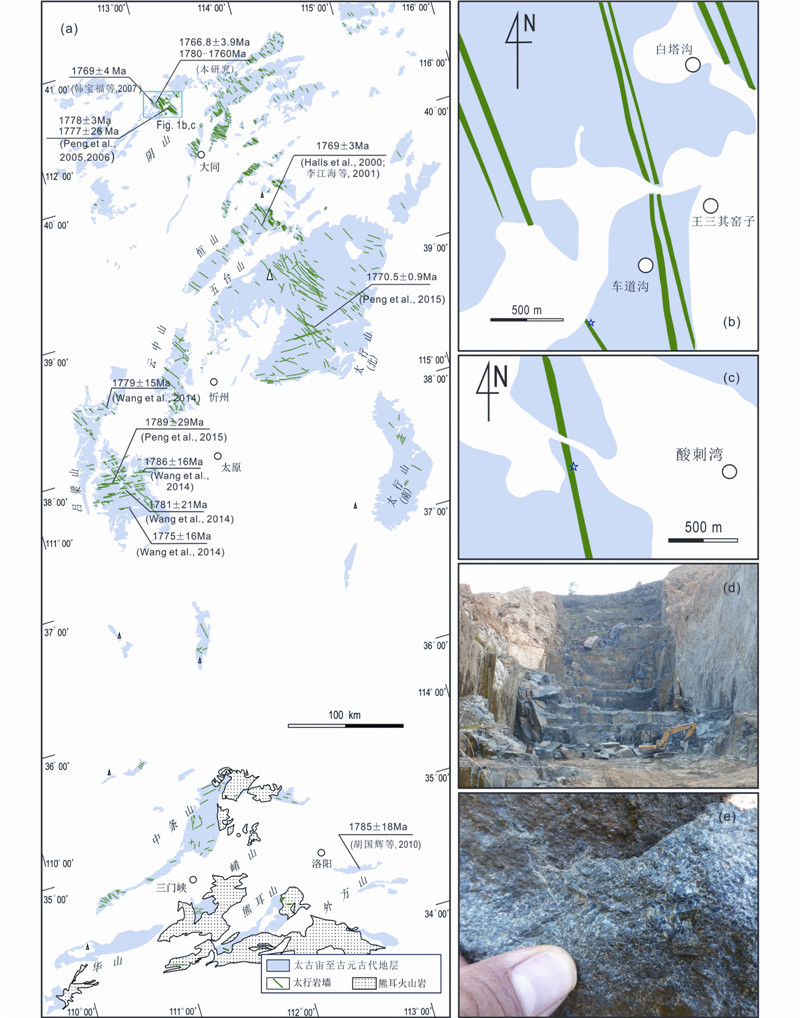 | 图 1 研究区地质简图及岩墙野外照片 (a)华北克拉通太行岩墙群分布图(简化修改自Peng et al., 2008; Xu et al., 2014);(b)车道沟岩墙;(c、d)酸刺湾岩墙;(e)车道沟岩墙手标本. 星号为采样点Fig. 1 Geological map of the study area and representative field photos (a)distribution of the Taihang mafic dykes in the North China Craton(modified after Peng et al., 2008; Xu et al., 2014);(b)Chedaogou dyke;(c,d)Suanciwan dyke;(e)a h and specimen of the Chedaogou dyke. The stars show the localities for samples |
本文以丰镇为工作区(图 1a-c),该区岩墙规模较大,出露较好,有很好的工作基础。我们进行了详细的野外观察,并分别从低分异组和高分异组岩墙样品中分选出斜锆石。采样点位于内蒙丰镇西北的酸刺湾和车道沟区域,车道沟岩墙的采样坐标为40°35′28″ N,113°02′40″ E;酸刺湾岩墙的采样坐标为40°35′23.5″ N,112°58′56″ E(图 1a-c)。车道沟岩墙走向约为335°,岩石具有典型的辉绿结构,含有斜长石巨晶(图 1b,e)。斜长石长可达2mm,约占65vol%,但表面混浊,呈土灰色,黝帘石化(图 2a);简单双晶发育,环带隐约可见。单斜辉石粒径0.5~1.2mm,约占30vol%(图 2a),此外还有少量磁铁矿(5vol%)及极少量的黑云母。酸刺湾岩墙宽度约为45m(图 1d),长度数千米;走向约为350°。相比于车道沟岩墙,其斜长石环带更为发育(图 2b);可见磁铁矿的黑云母反应边及单斜辉石的角闪石反应边(图 2c,d)和纤闪石化(图 2e,f);斜长石和单斜辉石粒径与车道沟岩墙相当,分别占58vol%、34vol%,磁铁矿占6vol%。
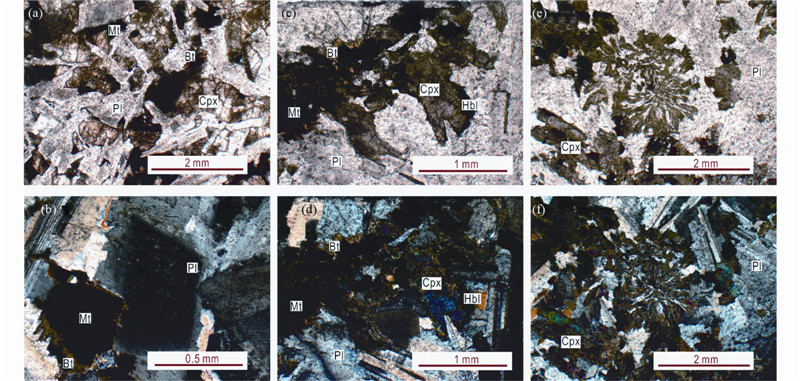 | 图 2 车道沟岩墙(a)和酸刺湾岩墙(b-f)镜下照片 Pl-斜长石;Cpx-单斜辉石;Bt-黑云母;Hbl-角闪石;Mt-磁铁矿Fig. 2 Microscope images of Chedaogou dyke(a) and Suanciwan dyke(b-f) Pl-plagioclase; Cpx-clinopyroxene; Bt-biotite; Hbl-hornblende; Mt-magnetite |
在岩墙中部采集结晶粒度粗大的的样品,这样的样品矿物生长充分,有利于斜锆石的结晶。经过重力分选,在样品174CDG01C、625SCW01C中分选出了斜锆石。 3 分析方法
本研究所进行的分析都完成于岩石圈演化国家重点实验室。斜锆石主要分选流程为:先将岩石破碎,磨至80目粉末,然后在Wilfley 800型摇床中进行浮选,最后在双目镜下观察并转移斜锆石。斜锆石分选详细流程参考Söderlund and Johansson(2002)。将分选出的斜锆石固定到环氧树脂靶上,待年代学测试,使用德国LEO1450VP扫描电镜拍摄样品的背散射图像。.
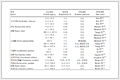
斜锆石U-Pb测年使用Cameca IMS-1280二次离子质谱仪。O2-离子束通过13kV加速电压,使用常规束斑(20×30μm)轰击样品表面。采用吹氧技术使斜锆石二次离子Pb+的灵敏度增加七倍以上,质量分辨率采用7000(50%峰高)(Li et al., 2010)。因斜锆石离子探针U-Pb定年中可能出现晶体光轴效应,而Pb-Pb年龄不受影响(Wingate and Compston, 2000),本研究样品年龄分布在中元古代,适宜于采用Pb-Pb年龄,故本次分析选择Pb同位素测试,以Phalaborwa斜锆石标准监测Pb同位素分馏(Li et al., 2010; Heaman,2009)。样品普通Pb一般包括体系封闭时的初始Pb及微包裹体、微裂隙中的Pb及后期制备时污染Pb(杨亚楠等,2014),用测量的204Pb进行校正,普通Pb同位素组成采用地球平均Pb演化模型计算(Stacey and Kramers, 1975)。分析结果见表 1。
| 表 1 酸刺湾和车道沟岩墙斜锆石离子探针Pb-Pb测试数据 Table 1 Baddeleyites SIMS Pb-Pb data of Chedaogou and Suanciwan dykes |
斜锆石成分分析使用JXA-8100电子探针。测试过程中,加速电压为20kV。对于1%以上元素,精度好于2.0%。分析结果如表 2。
|
| 表 2 酸刺湾岩墙斜锆石电子探针数据(wt%) Table 2 EPMA data for the baddeleyites from the Suanciwan dyke(wt%) |
全岩主量元素分析中采用湿化学滴定法测定FeO含量。称取0.5g样品放入陶瓷坩埚中高温1000℃灼烧至恒重,测定烧失量;然后将样品制成玻璃片。使用X-射线荧光光谱仪XRF-1500分析,分析方法采用标准曲线法(经验系数法),基体效应采用数学模型校正。采用中国国家标准参考物质标样GSR1和GSR3,含量>10%,分析精度优于1%;含量<10%则精度好于5%。对于全岩微量元素分析,首先称取40mg岩石粉末进行前期熔样处理,之后将定容的样品溶液在ICP-MS(ElementⅠ)上分析。使用标样GSR1和GSR3,微量元素含量>10×10-6的精度优于5%,<10×10-6的元素精度优于10%。全岩主量和微量元素分析结果见表 3。
|
| 表 3 酸刺湾和车道沟岩墙主量元素(wt%)和微量元素(×10-6)数据 Table 3 Major(wt%) and trace(×10-6)elements data of the Chedaogou and Suanciwan dykes |
全岩主量元素数据表明,两条岩墙有较为相近的SiO2含量(50%~52%),酸刺湾岩墙有较高的Fe2O3T含量(~17%)和TiO2含 量(~2.7%)以及相对低的MgO含量(~3%),而车道沟岩墙Fe2O3T、TiO2、MgO含量分别为12.8%、1.0%、6.9%(表 3)。车道沟岩墙固结指数(SI=MgO×100/(MgO+FeO+Fe2O3+Na2O+K2O))为30,分异指数(DI=Qtz+Or+Ab+Ne+Lc+Kp,CIPW值)为25;酸刺湾岩墙两指数分别为12、~43(表 3)。另外,酸刺湾岩墙镁值(Mg#=Mg/(Mg+Fe2+),摩尔比)为28,车道沟岩墙为54(表 3)。
酸刺湾岩墙轻稀土富集明显((La/Yb)N=9.83~10.0),稀土总量较高(346×10-6~360×10-6),正Eu异常(Eu/Eu*=EuN/(SmN×GdN)1/2=1.11);而车道沟岩墙轻稀土轻度富集((La/Yb)N=3.51),稀土总量相对较低(表 3、图 3)。两条岩墙亏损Nb、Ta、Zr、Hf、Ti;酸刺湾岩墙富集Nd,亏损Sr,而车道沟岩墙富集Sr(图 3)。稀土配分图与蛛网图显示,酸刺湾岩墙地球化学特征落入Peng et al.(2007)的高分异组范围,而车道沟岩墙特征近平行于低分异岩墙范围(图 3)。
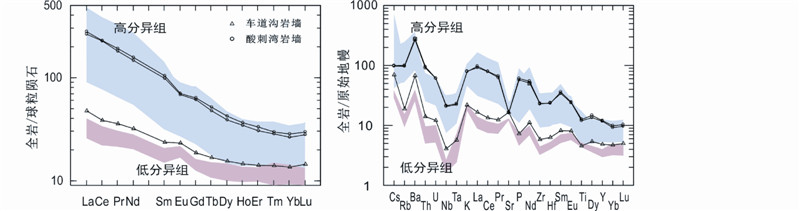 | 图 3 岩墙稀土配分图及蛛网图(标准化值据Sun and McDonough, 1989) 高分异组与低分异组岩墙区域参考Peng et al.(2007)Fig. 3 Chondrite-normalized REE patterns and primitive mantle-normalized multi-element spidergrams for the dykes(normalized values after Sun and McDonough, 1989) The areas of low-differentiated and high-differentiated dykes are from Peng et al.(2007) |
为衡量数据质量,本研究通过对离子探针初始分析数据与对矿物的分析区域的观察,考虑以下三个方面对数据进行有效取舍:①单点年龄分析偏差较大的点;②206Pb/204Pb<10000的点;③离子束分析区域混入其他物质的点。采用地球平均Pb演化模型计算普通Pb同位素组成(Stacey and Kramers, 1975),斜锆石分析区域内的杂质、包裹的矿物,包括分析中打穿斜锆石,均对普通Pb校正产生影响,使表面年龄与实际年龄有一定的偏差。而斜锆石206Pb/204Pb越高,代表放射性成因Pb比例越高及可忽略的初始普通Pb,对普通Pb校正造成的影响亦越小,与锆石相比207Pb/206Pb基本不受Pb丢失影响(Heaman and LeCheminant, 1993; Wingate and Compston, 2000; Li et al., 2010)。
对车道沟岩墙样品20颗斜锆石进行了离子探针测试,基于以上判断,04、09、11、13、15及20号点为206Pb/204Pb<10000的点,这些点也是204Pb相对较高(>4cps.,所测标样Phalaborwa的204Pb为0.04~0.07cps.)的样品(表 1)。另外,背散射图像显示,02号点分析区域包裹有其他矿物,08、10、16和19号点分析区域内有其他物质(如图 4c,d)。剩下9个束斑点(01、03、05、06、07、12、14、17和18,图 4a,g,h),使用Isoplot 4作图,软件使用参考Ludwig(2003),显示加权平均年龄为1768.2±4.3Ma(图 5a)。本研究认为1768.2±4.3Ma代表车道沟岩墙的侵位时间(图 5a)。
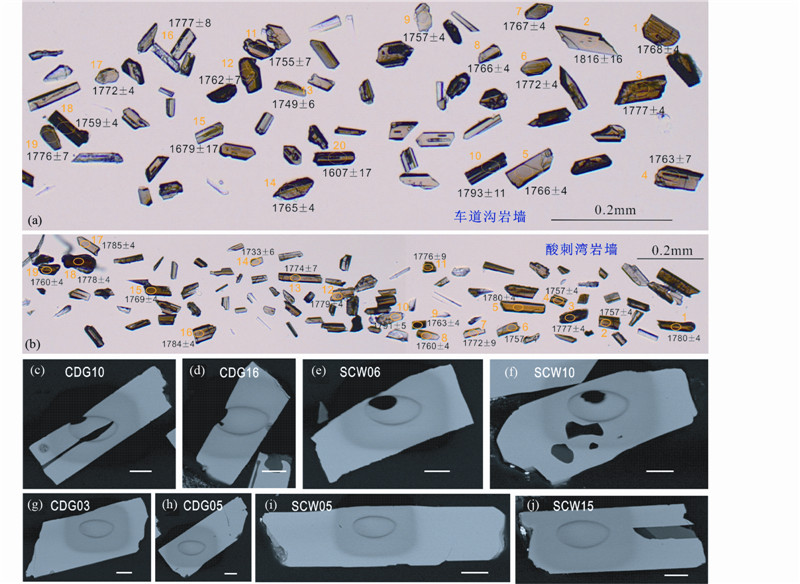 | 图 4 岩墙斜锆石透射光照片(a、b)及背散射照片(c-j) 图c-j中线段比例尺为10μmFig. 4 Transmitted-light images(a,b) and BSE images(c-j)of baddeleyites from dykes The scale bars in Fig. 4c-j are 10μm in length |
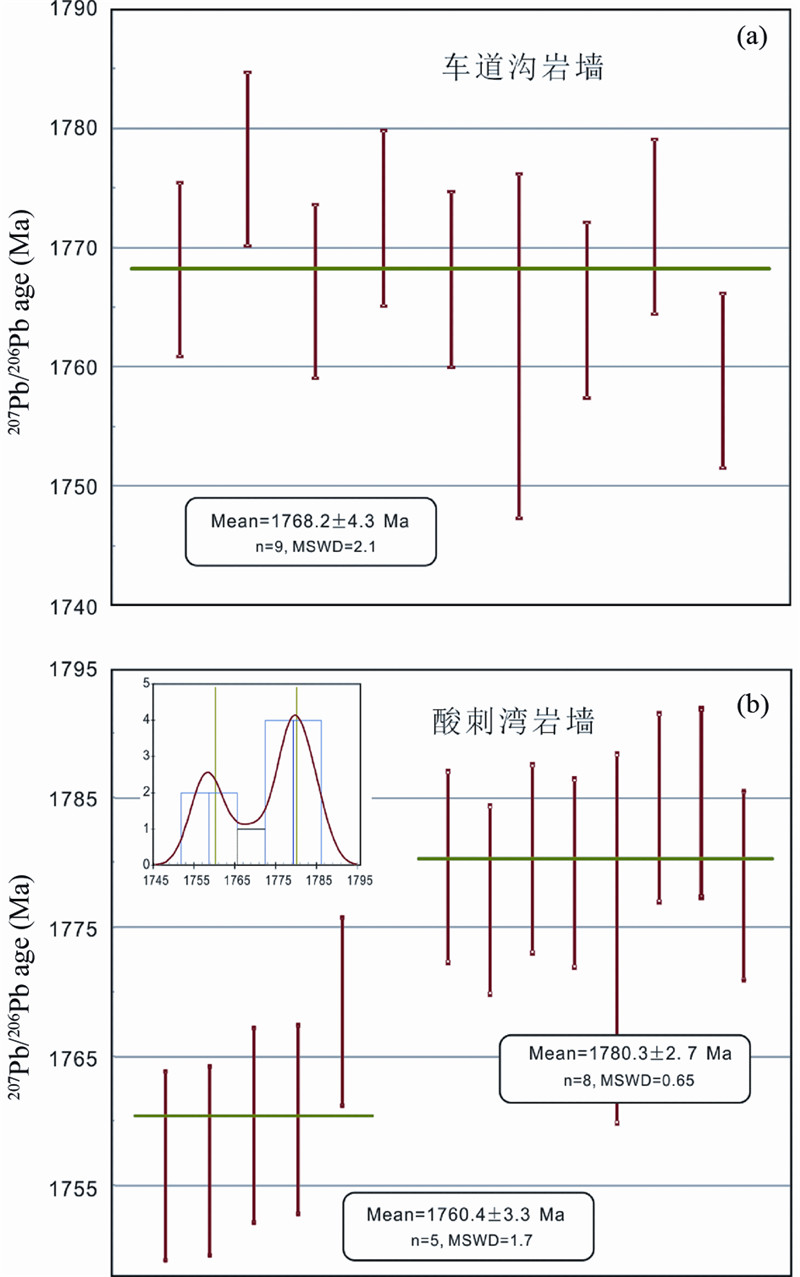 | 图 5 车道沟岩墙(a)和酸刺湾岩墙(b)斜锆石207Pb/206Pb加权平均年龄Fig. 5 Baddeleyite 207Pb/206Pb weighted average ages of the Chedaogou dyke(a) and the Suanciwan dyke(b) |
同样分析酸刺湾岩墙束斑点,09、11和14号点206Pb/204Pb<10000(表 1);背散射图像显示06、07和10号点离子束分析区域内有其他物质(如图 4e,f)。最后剩得13个束斑点,其加权平均年龄为1772±7Ma,极大的MSWD(值为8)表明并非单一组分。概率密度频谱图显示,这些年龄可以统计为两个峰值,其中02、04、08、15和19号点得出加权平均年龄为1760.4±3.3Ma,另外8个测试点显示平均年龄为1780.3±2.7Ma(图 4b,i,j、图 5b)。 4.3 斜锆石成分
电子探针分析出了斜锆石的UO2、PbO、ZrO2、HfO2和TiO2含量,酸刺湾岩墙斜锆石主要成分为ZrO2(96%~99%)和HfO2(1.5%~2.3%),含少量TiO2(0.2%~0.8%)及UO2、PbO,Zr/Hf值为36~58(表 2)。 5 讨论 5.1 斜锆石U-Pb年龄和生长世代
由上述斜锆石年代学分析结果,本研究得出太行岩墙群低分异车道沟岩墙形成于1768±4Ma,高分异车道沟岩墙分为早期1780±3Ma和晚期1760±3Ma两组年龄(图 5)。
我们认为酸刺湾岩墙数学统计意义上的两组年龄不是由分析过程中的系统变化造成。原因如下:①所获得的数据点不存在规律性变化;②年代学分析过程中穿插测试标样Phalaborwa(表 1),标样分析结果反映仪器运行状态较好,不存在系统变化。相反,这两组数据成分上显示差异(图 6)。
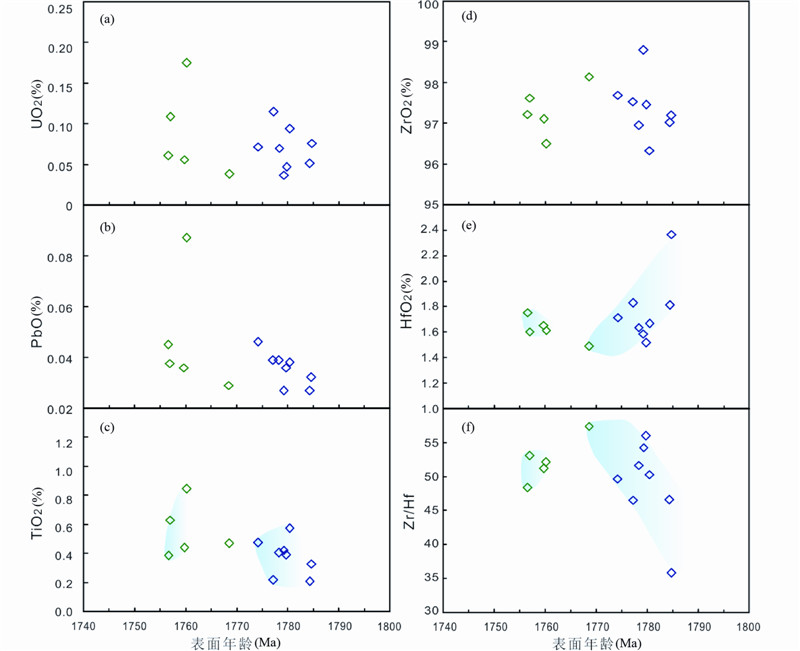 | 图 6 酸刺湾岩墙斜锆石元素含量与表面年龄(207Pb/206Pb年龄)相关图解Fig. 6 Major elements vs. apparent baddeleyite 207Pb/206Pb ages of the Suanciwan dyke |
Gudmundsson(1984)讨论了单条岩墙的多脉冲侵入,早先的岩墙脉冲侵入凝固(假设凝固温度为1200~800℃),当岩墙中部未完全固结时,后一脉冲沿岩墙前一脉冲中部侵入,以此类推;单次脉冲形成岩墙宽度大约为2m,一期岩墙事件可有多次脉冲侵入。另外,鉴于前后脉冲温度差异可能较小,不同脉冲侵入的冷凝边并不明显,如冰岛东部及西北部岩墙。模拟计算一次脉冲凝固时间约为267天(Gudmundsson,1984),假设形成一条宽度为30m的大型岩墙,约有15次脉冲,则单条岩墙侵入时间跨度为4005天,说明岩墙侵入时间短暂。因此,酸刺湾岩墙实验得出的两个年龄峰值(相差约20Ma)不可能为多脉次侵入的结果。
据报道,所罗门群岛Auluta碱性岩里锆石的206Pb/238U年龄分为五组,最小和最大的平均年龄分别为34.9Ma和45.1Ma;Faufaumela巨晶锆石五组206Pb/238U年龄在38.1~51.9Ma之间;且Auluta锆石的206Pb/238U年龄与Zr/Hf及稀土总量有一定的线性相关性,表现为,随着锆石单点测试年龄的变小,Zr/Hf值升高,稀土总量升高(Simonetti and Neal, 2010);这和玄武岩浆系统单斜辉石/熔体中Zr与Hf的分配系数研究(Green,1994; Lemarch and et al., 1987; Johnson,1994; Skulski et al., 1994; Fujinawa and Green, 1997; Green and Falloon, 2015)一致,锆石年代学与地球化学的线性关系可能与单斜辉石的结晶分异有关(Neal and Davidson, 1989)。但超过10Ma的熔体抽离也可能使锆石已部分或完全均一化(Simonetti and Neal, 2010)。低程度碳酸岩熔体中,斜锆石的分异能引起更高的Zr/Hf值(Klemme and Meyer, 2003)。研究认为,花岗岩早期锆石在Zr/Hf值为39时Hf变化范围小,和相对稳定高温时一致;而后期及热液锆石有更高的Hf及更低的Zr/Hf,是因为结晶温度的降低使晶体结构变小,从而使更小的Hf离子也能进入晶体(Wang et al., 2010)。如上所述,同一岩石单元的年代学可能分几组,跨度可为10Myr;锆石或斜锆石中Zr/Hf值随年龄变化的幅度及大小可能与岩浆的部分熔融程度、岩石的结晶相、结晶早晚(温度)或交代流体的存在与否有关。
电子探针分析显示,酸刺湾岩墙斜锆石束斑点年龄与Zr/Hf值可能存在一定的关系,表现为晚期斜锆石Zr/Hf值变化范围相对较小,主要集中在48到54之间;早期的斜锆石Zr/Hf值变化范围相对较大(35~56),并随着年龄的升高,Zr/Hf值整体有变小的趋势(图 6f)。且所有样品点的ZrO2变化范围基本一致,与年龄无相关性(图 6d);HfO2的特征恰好与Zr/Hf相反(图 6e),由此看出Zr/Hf与年龄的变化主要是HfO2含量变化的影响。
本区岩墙单斜辉石在岩浆作用的什么阶段结晶,结晶影响有多大依然不清楚。结合本地区及本研究的实际情况,推测酸刺湾岩墙斜锆石束斑点年龄与Zr/Hf值的负相关趋势可能是由于单斜辉石的结晶而使Zr与Hf发生了分馏。实验结果显示,玄武岩浆中相对于Zr,Hf的单斜辉石/熔体分配系数更高(DHf=0.2~0.25,DZr=0.1~0.14,Green,1994; Lemarch and et al., 1987; Johnson,1994; Skulski et al., 1994; Fujinawa and Green, 1997)。单斜辉石的结晶早晚与多少决定了Zr/Hf值的变化,即可能在1770Ma前后发生了单斜辉石结晶的转折;结晶相的变化可能与地幔不连续的部分熔融有关,也可能在演化过程中体系温度发生变化,使Hf的分配产生变化。
酸刺湾岩墙早期形成的斜锆石(~1780Ma)可能代表矿物在地幔岩浆房中的结晶,而1760Ma可能为矿物在岩浆房或在上部岩浆通道中的形成时间。岩浆通道中的结晶分异过程比较复杂,在岩墙的边缘Zr元素亦会高度富集,也可能引起锆石或斜锆石的结晶(Chistyakova and Latypov, 2012)。若1760Ma同样为斜锆石在岩浆房中的结晶时间,则岩浆房中的岩浆演化至少持续了20Ma,相似的实例出现在Eger裂谷西部,锆石在上地幔特别环境中存在了20~60Ma而未被破坏(Siebel et al., 2009)。该捕获锆石在颜色上分为四类,不同颜色的锆石Ti及稀土总量存在差异,暗示锆石形成于不同的温度及地球化学环境中(Siebel et al., 2009)。通过锆石中的Ti含量可以估算环境的温度和压力(Ferry and Watson, 2007; Ferriss et al., 2008),但斜锆石中的Ti能否指示温度和压力尚不明确;酸刺湾岩墙早期斜锆石Ti含量为0.21%~0.57%,晚期为0.39%~0.85%,整体上晚期斜锆石更富集Ti(表 2、图 6c),这至少说明该岩墙两期斜锆石形成环境的差异。 5.2 对太行岩墙群岩浆演化的启示
以上得出太行岩墙群车道沟岩墙结晶时间为~1768Ma,酸刺湾岩墙岩浆演化于1780~1760Ma,最终形成于~1760Ma。车道沟岩墙和已报道丰镇红旗沟岩墙及恒山浑源中庄村岩墙具有较为相近的年龄(韩宝福等,2007; Halls et al., 2000; 李江海等,2001)。太行岩墙群近十年已报道了丰富的U-Pb年龄(图 1、表 4),包括:丰镇地区东十八台1778±3Ma(Peng et al., 2005,2006)、红旗沟的1769±4Ma(韩宝福等,2007);恒山浑源中庄村1769.1±2.5Ma(Halls et al., 2000; 李江海等,2001)、五台上盘松1770.5±0.9Ma(Peng,2015);吕梁地区庞泉1786±16Ma、寨上村1779±15Ma、山水村1781±21Ma和市庄村1775±16Ma(Wang et al., 2014)及娄烦小楼寨1789±29Ma(Peng,2015);嵩山地区登封黄岭1785±18Ma(胡国辉等,2010)。这些年龄集中于1785~1760Ma,除小楼寨年龄外,平均年龄~1770Ma(图 7),暗示岩浆可能经历了较长时间的演化。
|
| 表 4 太行岩墙群已报道的U-Pb年龄 Table 4 Reported U-Pb ages for the Taihang dyke swarm |
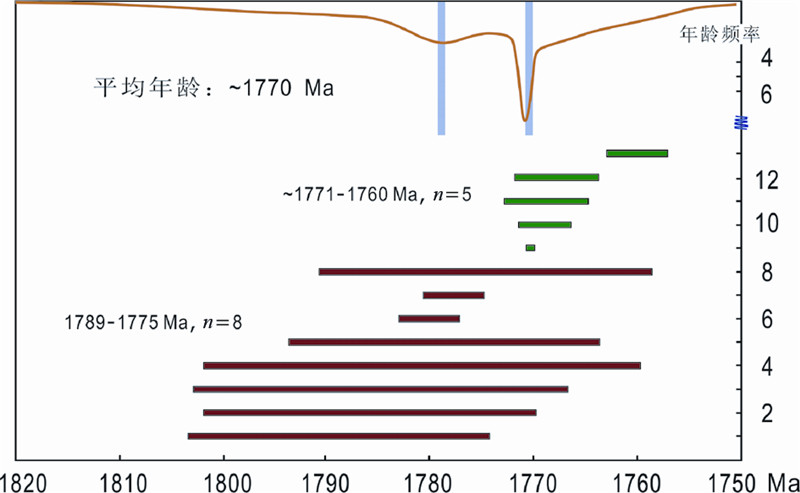 | 图 7 太行岩墙群年龄分布图 数据及参考文献见表 4Fig. 7 Age distribution of the Taihang dykes See data and references in Table 4 |
基性岩斜锆石与角闪石、黑云母、绿泥石、磷灰石及石英等作为晚期结晶相出现在矿物间隙中,且有可能与石英直接接触而不发生反应(Heaman and LeCheminant, 1993)。太行岩墙群岩浆演化起于约1785~1780Ma,研究报道酸刺湾岩墙早期斜锆石形成于1780Ma,侧面反映了岩浆演化的早期亦能结晶出斜锆石。该期岩墙群同一岩浆房中分别获得了1780Ma、1768Ma和1760Ma的斜锆石年龄(图 5),而后两者又分别代表相对低分异、高分异岩墙的最终侵位时间。酸刺湾岩墙早期斜锆石结晶时(~1780Ma)岩浆可能偏基性分异较低,但早期斜锆石直到晚期岩墙侵位时才被带至上部,并以高分异酸刺湾岩墙的形式出露于地表。
对该期岩墙群年代学的研究,前人报道的几乎均为锆石年龄(Halls et al., 2000; Peng et al., 2005; Wang et al., 2014),并且得到的早期年龄较多。锆石可结晶于岩浆作用的不同阶段,其饱和温度可作为参考,早期锆石一般较为自形,长宽比可达2:1~4:1,晚期锆石多为他形(Hoskin and Schaltegger, 2003; Scoates and Chamberlain, 1995)。之前的研究多对锆石的岩浆成因进行了探讨(Halls et al., 2000; 李江海等,2001; Peng et al., 2005; 韩宝福等,2007; 胡国辉等,2010; Wang et al., 2014; Peng,2015),但很少对其矿物颜色、形态、自形程度等进行详述,尤其是与年代学的对应,没有讨论锆石的形成阶段。分析已报道的锆石单点年龄与形态关系,发现较自形锆石可能形成于早期,而他形锆石可能结晶于晚期(Peng et al., 2005)。Wang et al.(2014)报道的单点锆石年龄误差较大,部分锆石为破碎残留,上述规律不明显。总体上,锆石单点年龄既有较大的又有较小的,较大的年龄居多,可能是因为基性岩后期岩浆冷却迅速,无法结晶出相对较多的含U副矿物。
本期岩墙群岩浆演化持续时间较长,对于获得的早期年龄,测年矿物的结晶时代不一定与岩浆侵位时间一致,即早期~1780Ma结晶出的锆石或斜锆石可能略早于岩墙的最终形成,该测年时间也难于准确耦合侵位时的岩浆分异情况。而在相同定年手段、相同定年矿物下,测得的近于岩浆晚期的年龄,可能能够耦合岩浆分异情况,即本文1768Ma代表低分异车道沟岩墙的侵位,1760Ma代表高分异酸刺湾岩墙的最终形成,低分异组和髙分异组岩墙基本形成于同一个年龄区间(1785~1760Ma)。斜锆石有较高的U-Pb体系封闭温度(Nebel et al., 2011),而~1780Ma的年龄可能代表斜锆石在岩浆房形成的时代。 6 结论
(1)斜锆石SIMS 207Pb/206Pb年龄显示丰镇地区低分异车道沟岩墙结晶时间为1768±4Ma;高分异酸刺湾岩墙年代学数据统计显示存在两个年龄峰值,加权平均年龄分别为1780±3Ma和1760±3Ma,岩墙岩石最终结晶时间为1760Ma。
(2)酸刺湾岩墙早期斜锆石,可能结晶于岩浆房中,并且随单点年龄的减小,Zr/Hf值有微弱的增大趋势,这可能是由于单斜辉石的结晶使Zr与Hf发生了分馏;晚期斜锆石可能结晶于岩浆通道,或岩浆房,Zr/Hf值变化范围较小。晚期斜锆石TiO2含量更高,暗示矿物形成环境的差异。
(3)已报道的该期岩墙U-Pb年龄多集中于1785~1760Ma。本文从同一条岩墙中获得了~1780Ma和~1760Ma两组年龄,可能分别代表了岩浆房中斜锆石结晶时代和岩墙就位后结晶时代,这说明岩浆过程可能持续~20Myr。
致谢 感谢中国科学技术大学陈福坤教授的指导;感谢岩石圈演化国家重点实验室李献华研究员,以及毛骞、马玉光、凌潇潇、唐国强、马红霞、闫欣、杨赛红、王红月、刘艳红、李文君、高炳宇、郭倩和郭巨杰等技术人员在实验过程中给予的帮助;感谢李云和杨亚楠给予的帮助。
| [1] | Arai T, Yoshitake M, Tomiyama T, Niihara T, Yokoyama T, Kaiden H, Misawa K and Irving AJ. 2010. Support for a prolonged KREEP magmatism:U-Pb age dating of zircon and baddeleyite in Lunar meteorite NWA 4485. In:Proceedings of the 41st Lunar and Planetary Science Conference. Texas:The Woodlands, 2379 |
| [2] | Bayanova TB. 2006. Baddeleyite:A promising geochronometer for alkaline and basic magmatism. Petrology, 14(2):187-200 |
| [3] | Black LP, Kinny PD and Sheraton JW. 1991. The difficulties of dating mafic dykes:An Antarctic example. Contributions to Mineralogy and Petrology, 109(2):183-194 |
| [4] | Bleeker W and Ernst RE. 2006. Short-lived mantle generated magmatic events and their dyke swarms:The key unlocking Earth's palaeogeographic record back to 2.6Ga. In:Hanski E, Vuollo J, Rämö T and Mertanen S(eds.). Dyke Swarms:Time Markers of Crustal Evolution. London:Taylor and Francis Group, 3-26 |
| [5] | Chistyakova S and Latypov R. 2012. Magma differentiation and crystallization in basaltic conduits by two competing petrogenetic processes. Lithos, 148:142-161 |
| [6] | Ernst RE and Buchan KL. 2001. Large mafic magmatic events through time and links to mantle-plume heads. In:Ernst RE and Buchan KL(eds.). Mantle Plumes:Their Identification through Time. GSA Special Papers, 352:483-575 |
| [7] | Ferriss EDA, Essene EJ and Becker U. 2008. Computational study of the effect of pressure on the Ti-in-zircon geothermometer. European Journal of Mineralogy, 20(5):745-755 |
| [8] | Ferry JM and Watson EB. 2007. New thermodynamic models and revised calibrations for the Ti-in-zircon and Zr-in-rutile thermometers. Contributions to Mineralogy and Petrology, 154(4):429-437 |
| [9] | Fujinawa A and Green TH. 1997. Partitioning behaviour of Hf and Zr between amphibole, clinopyroxene, garnet and silicate melts at high pressure. European Journal of Mineralogy, 9(2):379-392 |
| [10] | Green DH and Falloon TJ. 2015. Mantle-derived magmas:Intraplate, hot-spots and mid-ocean ridges. Science Bulletin, 60(22):1873-1900 |
| [11] | Green TH. 1994. Experimental studies of trace-element partitioning applicable to igneous petrogenesis-Sedona 16 years later. Chemical Geology, 117(1-4):1-36 |
| [12] | Gudmundsson A. 1984. Formation of dykes, feeder-dykes, and the intrusion of dykes from magma chambers. Bulletin Volcanologique, 47(3):537-550 |
| [13] | Halls HC and Palmer HC. 1990. The tectonic relationship of two Early Proterozoic dyke swarms to the Kapuskasing structural zone:A paleomagnetic and petrographic study. Canadian Journal of Earth Sciences, 27(1):87-103 |
| [14] | Halls HC, Li JH, Davis D, Hou GT, Zhang BX and Qian XL. 2000. A precisely dated Proterozoic palaeomagnetic pole from the North China Craton, and its relevance to palaeocontinental reconstruction. Geophysical Journal International, 143(1):185-203 |
| [15] | Han BF, Zhang L, Wang YM and Song B. 2007. Enriched mantle source for Paleoproterozoic high Mg and low Ti-P mafic dykes in central part of the North China craton:Constraints from zircon Hf isotopic compositions. Acta Petrologica Sinica, 23(2):277-284(in Chinese with English abstract) |
| [16] | Heaman LM and LeCheminant AN. 1993. Paragenesis and U-Pb systematics of baddeleyite(ZrO2). Chemical Geology, 110(1-3):95-126 |
| [17] | Heaman LM. 2009. The application of U-Pb geochronology to mafic, ultramafic and alkaline rocks:An evaluation of three mineral standards. Chemical Geology, 261(1-2):43-52 |
| [18] | Hoskin PWO and Schaltegger U. 2003. The composition of zircon and igneous and metamorphic petrogenesis. Reviews in Mineralogy and Geochemistry, 53(1):27-62 |
| [19] | Hou GT, Li JH, Halls HC and Qian XL. 2003. The flow structures and mechanics of Late Precambrian mafic dyke swarms in North China Craton. Acta Geologica Sinica, 77(2):210-216(in Chinese with English abstract) |
| [20] | Hou GT, Halls H, Davis D, Huang BL, Yang MH and Wang CC. 2009. Paleomagnetic poles of mafic dyke swarms from the North China craton and their relevance to the reconstruction of the supercontinent Columbia. Acta Petrologica Sinica, 25(3):650-658(in Chinese with English abstract) |
| [21] | Hou GT, Wang CC and Li L. 2010. Magnetic fabric evidences for the late paleoproterozoic mafic dyke swarm emplacement, southern margin of the North China craton. Acta Petrologica Sinica, 26(1):318-324(in Chinese with English abstract) |
| [22] | Hu GH, Hu JL, Chen W and Zhao TP. 2010. Geochemistry and tectonic setting of the 1.78Ga mafic dyke swarms in the Mt. Zhongtiao and Mt. Song areas, the southern margin of the North China Craton. Acta Petrologica Sinica, 26(5):1563-1576(in Chinese with English abstract) |
| [23] | Johnson KTM. 1994. Experimental cpx/and garnet/melt partitioning of REE and other trace elements at high pressures:Petrogenetic implications. Mineralogical Magazine, 58A:454-455 |
| [24] | Klemme S and Meyer HP. 2003. Trace element partitioning between baddeleyite and carbonatite melt at high pressures and high temperatures. Chemical Geology, 199(3-4):233-242 |
| [25] | Lemarchand F, Villemant B and Calas G. 1987. Trace element distribution coefficients in alkaline series. Geochimica et Cosmochimica Acta, 51(5):1071-1081 |
| [26] | Li JH, Hou GT, Qian XL, Halls HC and Davis D. 2001. Single-zircon U-Pb age of the initial Mesoproterozoic basic dike swarms in Hengshan mountain and its implication for the tectonic evolution of the North China Craton. Geological Review, 47(3):234-238(in Chinese with English abstract) |
| [27] | Li QL, Li XH, Liu Y, Tang GQ, Yang JH and Zhu WG. 2010. Precise U-Pb and Pb-Pb dating of Phanerozoic baddeleyite by SIMS with oxygen flooding technique. Journal of Analytical Atomic Spectrometry, 25(7):1107-1113 |
| [28] | Ludwig KR. 2003. Users manual for Isoplot/Ex, version 3.0:A geochronological toolkit for Microsoft Excel. Berkeley Geochronology Center, Special Publication, vol.4 |
| [29] | Neal CR and Davidson JP. 1989. An unmetasomatized source for the Malaitan alnöite(Solomon Islands):Petrogenesis involving zone refining, megacryst fractionation, and assimilation of oceanic lithosphere. Geochimica et Cosmochimica Acta, 53(8):1975-1990 |
| [30] | Nebel O, Scherer EE and Mezger K. 2011. Evaluation of the 87Rb decay constant by age comparison against the U-Pb system. Earth and Planetary Science Letters, 301(1-2):1-8 |
| [31] | Peng P, Zhai MG, Zhang HF, Zhao TP and Ni ZY. 2004. Geochemistry and geological significance of the 1.8Ga mafic dyke swarms in the North China Craton:An example from the juncture of Shanxi, Hebei and Inner Mongolia. Acta Petrologica Sinica, 20(3):439-456(in Chinese with English abstract) |
| [32] | Peng P, Zhai MG, Zhang HF and Guo JH. 2005. Geochronological constraints on the Paleoproterozoic evolution of the North China Craton:SHRIMP zircon ages of different types of mafic dikes, International Geology Review, 47(5):492-508 |
| [33] | Peng P, Zhai MG and Guo JH. 2006. 1.80-1.75Ga mafic dyke swarms in the central North China Craton:Implications for a plume-related break-up event. In:Hanski E, Mertanen S, Ramö T and Vuollo J(eds.). Dyke swarms:Time Markers of Crustal Evolution. London:Taylor and Francis Group, 99-112 |
| [34] | Peng P, Zhai MG, Guo JH, Kusky T and Zhao TP. 2007. Nature of mantle source contributions and crystal differentiation in the petrogenesis of the 1.78Ga mafic dykes in the central North China craton. Gondwana Research, 12(1-2):29-46 |
| [35] | Peng P, Zhai MG, Ernst RE, Guo JH, Liu F and Hu B. 2008. A 1.78Ga large igneous province in the North China craton:The Xiong'er Volcanic Province and the North China dyke swarm. Lithos, 101(3-4):260-280 |
| [36] | Peng P, Bleeker W, Ernst RE, Söderlund U and McNicoll V. 2011. U-Pb baddeleyite ages, distribution and geochemistry of 925Ma mafic dykes and 900Ma sills in the North China craton:Evidence for a Neoproterozoic mantle plume. Lithos, 127(1-2):210-221 |
| [37] | Peng P. 2015. Precambrian mafic dyke swarms in the North China Craton and their geological implications. Science China(Earth Sciences), 58(5):649-675 |
| [38] | Qian XL and Chen YP. 1987. Late Precambrian mafic dyke swarms of the North China craton. In:Halls HC and Fahrig WF(eds.). Mafic Dyke Swarms. Geology Association of Canada Special Paper, 34:385-391 |
| [39] | Scoates JS and Chamberlain KR. 1995. Baddeleyite(ZrO2) and zircon(ZrSiO4) from anorthositic rocks of the Laramie anorthosite complex, Wyoming:Petrologic consequences and U-Pb ages. American Mineralogist, 80(11-12):1317-1327 |
| [40] | Siebel W, Schmitt AK, Danišík M, Chen FK, Meier S, Weiß S and Eroğlu S. 2009. Prolonged mantle residence of zircon xenocrysts from the western Eger rift. Nature Geoscience, 2(12):886-890 |
| [41] | Simonetti A and Neal CR. 2010. In-situ chemical, U-Pb dating, and Hf isotope investigation of megacrystic zircons, Malaita(Solomon Islands):Evidence for multi-stage alkaline magmatic activity beneath the Ontong Java Plateau. Earth and Planetary Science Letters, 295(1-2):251-261 |
| [42] | Skulski T, Minarik W and Watson EB. 1994. High-pressure experimental trace-element partitioning between clinopyroxene and basaltic melts. Chemical Geology, 117(1-4):127-147 |
| [43] | Stacey JS and Kramers JD. 1975. Approximation of terrestrial lead isotope evolution by a two-stage model. Earth and Planetary Science Letters, 26(2):207-221 |
| [44] | Sun SS and McDonough WF. 1989. Chemical and isotopic systematics of oceanic basalts:Implications for mantle composition and processes. In:Saunders AD and Nony MJ(eds.). Magmatism in the Ocean Basins. Geological Society, London, Special Publications, 42(1):313-345 |
| [45] | Söderlund U and Johansson L. 2002. A simple way to extract baddeleyite(ZrO2). Geochemistry, Geophysics, Geosystems, 3(2):doi:10.1029/2001GC000212 |
| [46] | Wang X, Griffin WL and Chen J. 2010. Hf contents and Zr/Hf ratios in granitic zircons. Geochemical Journal, 44(1):65-72 |
| [47] | Wang X, Zhu WB, Luo M, Ren XM and Cui X. 2014. Approximately 1.78Ga mafic dykes in the Lüliang Complex, North China Craton:Zircon ages and Lu-Hf isotopes, geochemistry, and implications. Geochemistry, Geophysics, Geosystems, 15(8):3123-3144 |
| [48] | Wang Y, Hsu WB, Guan YB, Li XH, Li QL, Liu Y and Tang GQ. 2012. Petrogenesis of the Northwest Africa 4734 basaltic lunar meteorite. Geochimica et Cosmochimica Acta, 92:329-344 |
| [49] | Wang YJ, Fan WM, Zhang YH, Guo F, Zhang HF and Peng TP. 2004. Geochemical, 40Ar/39Ar geochronological and Sr-Nd isotopic constraints on the origin of Paleoproterozoic mafic dikes from the southern Taihang Mountains and implications for the ca.1800Ma event of the North China Craton. Precambrian Research, 135(1-2):55-77 |
| [50] | Wang YJ, Zhao GC, Cawood PA, Fan WM, Peng TP and Sun LH. 2008. Geochemistry of Paleoproterozoic(-1770Ma) mafic dikes from the Trans-North China Orogen and tectonic implications. Journal of Asian Earth Science, 33(1-2):61-77 |
| [51] | Wingate MYD and Compston W. 2000. Crystal orientation effects during ion microprobe U-Pb analysis of baddeleyite. Chemical Geology, 168(1-2):75-97 |
| [52] | Xu HR, Yang ZY, Peng P, Meerte JG and Zhu RX. 2014. Paleo-position of the North China craton within the supercontinent Columbia:Constraints from new paleomagnetic results. Precambrian Research, 255:276-293 |
| [53] | Yang YN, Li QL, Liu Y, Tang GQ, Ling XX and Li XH. 2014. Zircon U-Pb dating by secondary ion mass spectrometry. Earth Science Frontiers, 21(2):81-92(in Chinese with English abstract) |
| [54] | 韩宝福, 张磊, 王亚妹, 宋彪. 2007. 华北克拉通中部古元古代高Mg低Ti-P镁铁质岩墙的富集地幔源区——锆石Hf同位素的制约. 岩石学报, 23(2):277-284 |
| [55] | 侯贵廷, 李江海, Halls HC, 钱祥麟. 2003. 华北晚前寒武纪镁铁质岩墙群的流动构造及侵位机制. 地质学报, 77(2):210-216 |
| [56] | 侯贵廷, Halls H, Davis D, 黄宝玲, 杨默函, 王传成. 2009. 华北基性岩墙群的古地磁极及其哥伦比亚超大陆重建意义. 岩石学报, 25(3):650-658 |
| [57] | 侯贵廷, 王传成, 李乐. 2010. 华北南缘古元古代末岩墙群侵位的磁组构证据. 岩石学报, 26(1):318-324 |
| [58] | 胡国辉, 胡俊良, 陈伟, 赵太平. 2010. 华北克拉通南缘中条山-嵩山地区1.78Ga基性岩墙群的地球化学特征及构造环境. 岩石学报, 26(5):1563-1576 |
| [59] | 李江海, 侯贵廷, 钱祥麟, Halls HC, Davis D. 2001. 恒山中元古代早期基性岩墙群的单颗粒锆石U-Pb年龄及其克拉通构造演化意义. 地质论评, 47(3):234-238 |
| [60] | 彭澎, 翟明国, 张华锋, 赵太平, 倪志耀. 2004. 华北克拉通1.8Ga镁铁质岩墙群的地球化学特征及其地质意义:以晋冀蒙交界地区为例. 岩石学报, 20(3):439-456 |
| [61] | 杨亚楠, 李秋立, 刘宇, 唐国强, 凌潇潇, 李献华. 2014. 离子探针锆石U-Pb定年. 地学前缘, 21(2):81-82 |