 2016, Vol. 32


2. 中国地质调查局发展研究中心, 北京 100037;
3. 中国地质大学信息工程学院, 北京 100083
2. Development and Research Center, China Geological Survey, Beijing 100037, China;
3. School of Information Engineering, China University of Geosciences, Beijing 100083, China
月球岩石是伴随月球岩浆洋时代、大撞击灾变期、玄武岩喷发、后期零散撞击的见证者与产物。真实的采集是了解月球终极手段。迄今为止,世界上成功实现月球样品采集与返回的只有美国的“Apollo计划”和前苏联在发射的Luna计划,Carr et al.(1984)认为月陆区域主要有斜长岩(长石)、苏长岩(长石和辉石)、橄长岩(橄榄石和长石),此外还有镁含量高的月岩,通常与橄长岩、苏长岩及纯橄榄岩相似的化学成分以及角砾岩(撞击形成)。月海区域主要由玄武岩和钛铁矿、克里普岩组成。对美国阿波罗系列带回的样品的研究结果表明组成月球的矿物主要有辉石、斜长石(主要是钙长石)、橄榄石、钛铁矿四种矿物,此外还有一些火山碎屑玻璃(Meyer,1987; Hartmann,2003)。美国的阿波罗15、16号首次利用γ谱仪和X射线荧光对月球赤道附近小区域内的Fe、Ti含量进行了估算。
Warner(1976)认为月球高地以古老的亚铁斜长岩、纯橄榄岩、橄榄岩、苏长岩、辉长苏长岩等。Pieters(1978)指出如果准确的分析来源于UV-VIS光谱与矿物组分之间的关系,那么样品点所代表的区域地质以及非样品来源的岩石类型可能被推算。根据Heiken et al.(1991)关于岩石分类的研究,月球样品岩石类型可分为:火成岩、晶质撞击熔融岩和撞击玻璃、热变质岩(麻粒质岩性)、多元碎屑基质角岩。Taylor et al.(1974)认为月球分为古老的亚铁斜长岩(Ferroan Anorthosite,FAN,>4.4Ga)和稍年轻的富镁结晶岩套(magnesian suite rock,4.43~4.17Ga)。富镁岩石有诸如纯橄榄岩(dunite)、橄长岩(troctolite)、苏长岩(norite)、辉长苏长岩(gabbronorite)等。
进入21世纪以来,探月工程飞速发展,欧阳自远等(2010)初次探索研究了“嫦娥一号”探月卫星所获取的数据,并取得到了丰硕的科学成果,为进一步研究认识月球打下重要基础,在遥感分析方面,自从Clementine和Lunar Prospector对月球进行全球性遥感勘测之后,利用遥感数据进行月球表面玄武岩的划分成为人们关注的热点(范恩等,2009; 刘剑等,2006)。刘建忠等(2012)、凌宗成等(2013)把月球岩石划分为月海玄武岩、高地斜长岩、KREEP岩和可能的其他岩石以及次类岩石划分方案。王翔等(2012b)利用嫦娥数对据月球虹湾区域TiO2、MgO元素反演。凌宗成等(2014)基于“嫦娥一号”干涉成像光谱仪数据完成月球岩雨海-冷海地区(LQ-4)岩石类型填图。Pieters et al.(2011,2013)在月球背面完成月表莫斯科海内部发现了斜方辉石、橄榄石和富镁尖晶石(Mg-rich spinel)的分布(被称为OOS岩石)。Liu et al.(2012)把高地岩石分为亚铁斜长岩、富镁岩石、碱性岩石、KREEP岩(丁孝忠等,2014; 刘建军和李春来,1999)。
本文依据以往月球不同岩石类型划分方案为研究基础,不去选择矿物类别与岩石分类关系,采用月球实际样品岩石鉴定类别结果,直接解析Apollo登月点6个区域(图 1)285个岩石样品,91类岩性数据,利用嫦娥二号CCD影像与印度M3高光谱数据,利用岩石光谱全特征分析方式,建立不同岩石类型遥感影像光谱特征(焦中虎,2012)。完成Apollo 16登月点周围领域岩石分布图,建立月球典型岩石影像标准光谱库与研究方法。
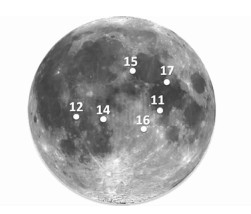 | 图 1 Apollo登月点位图(底图为嫦娥二号CCD影像) Apollo 11为静海区域;Apollo 12为风暴洋区域;Apollo 14为弗拉摩洛建造;Apollo 15为哈德利亚平宁山脉;Apollo 16为笛卡尔区域;Apollo 17为陶拉斯·利特罗山脉Fig. 1Apollo lunar landing point figure (base image is Chang’E 2 CCD) Apollo 11-Mare Tranquilitatis; Apollo 12-Oceanus Procellarum; Apollo14-Fra Mauro; Apollo 15-Hadley-Apennines; Apollo 16-Descartes; Apollo 17-Taurus-Littrow |
嫦娥二号采用时间延时积分电荷耦合元件(TDI、CCD),以两条线阵连续推扫的方式对月表进行立体成像(刘建军,2013),赵葆常(2013)全面分析嫦娥二号CCD数据。本次采用100km的圆轨道上,分辨10m CCD影像(以M3分辨率为参考),运用IDL技术提作用嫦娥二号数据地理控制点信息,对数据进行筛选、 排查,挑选其中数据质量较高的17轨拼接成Apollo登月点6个区域图影像,经IDL编译程序对嫦娥二号数据进行筛选,经条带、杂点剔除,几何校正;采用基于子空间最大特征值法进行均一校正,使影像结果符合均一辐亮度(王翔等,2012a)。
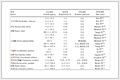
1.2 M3数据近年来,M3数据由于具有较高的空间和光谱分辨率,得到了广泛应用并取得了诸多成果。孙灵芝等(2014)通过M3反射数据在东海盆地发现了尖晶石、辉石、结晶斜长石、橄榄石等矿物。乔乐等(2013)利用M3高光谱数据对虹湾地区的物质成分进行了较为系统的解译和分析,认为该区域经历了四次岩浆活动,不同期次岩浆活动充填的玄武岩成分差别较大,越往后期钛含量越高。Gilmore et al.(2011)通过M3所获得的高光谱数据描述了Ryder弹坑中OH/H2O的探测和铁镁质矿物的吸收特点。Gross et al.(2011)通过M3高光谱数据发现了一种富(镁铁)铝尖晶石和缺乏大量的橄榄石、辉石的新的岩石类型。Zhang and Bowles(2013)通过M3所获得的数据研究了月球表面的矿物学特征。Whitten and Head(2015)等通过M3高光谱数据,认为东海盆地的月海充填物中的主要矿物为辉石,矿物成分(Fe2+和Ca2+)变化主要来源于横向或者侧向的高地物质混合,月海玄武岩的TiO2含量范围在3%~7%(Elphic et al. 1998)。M3(月球矿物质绘图仪)是0.7~3.0μm工作等级的高产量成像频谱仪,它使用二维汞镉碲(HgCdTe)探测器阵列测量太阳光反射能量。具体参数如表 1。
 | 表 1 月球M3数据参数 Table 1 Lunar M3 data parameters |
依据M3数据特点及定标点处物质组成及其地理环境特点,选取Applo16-62231样品点为高地区(Petro and Pieters, 2006)相对物质为长石、成熟的土壤和新鲜的大小不一的撞击坑,物质分布相对均一,有利于对月光谱定标。Apollo 15定标点位于月海区域Hadley Rille北部接近亚平宁山脉(Scott,1972)这个点的演化记录了基础地质过程的差异,是最好的多样和完整的数据,样品包括两种不同的的月海玄武岩类型,还有一组高地岩石包括斜长石,镁质火山岩,撞击熔化物、粒变岩和角闪石,为月球遥感数据定标提供了数据基础。采用MAP(后验概率)融合嫦娥二号与M3数据,遥感高光谱数据与高分辨率数据离散MAP(后验概率)匹配,得到满足空间与光谱分辨率双重优势,两种数据都具有时效性、及时性,针对性、有效性,数据之间具有互补优势,通过MAP后验概率加强方法使得嫦娥二号数据弥补M3数据低空间分辨率缺点,计算实验矩阵、结算点位残差,配合使用对于岩石提取准确性、分布性、全局性有着良好效果(薛彬等,2004; 于艳梅等,2009)。两种数据都经过与几何校正、大气校正、辐射校正、光度校正,连续统去除(周贤锋,2014)(图 2)。
 | 图 2 Apollo 15采样点位置(左)和Apollo 16采样点位置(右) 背景影像M3 1/2/3波段RGB 组合Fig. 2 Apollo 15 sample locations (left) and Apollo 16 sample locations (right) Base map is a RGB combination of band 1/2/3 |
Apollo 11、12号对月球样品采集是依据登月舱(LM)下,Apollo 14利用阿波罗简单仪进行测量,并收集更多的样本。从Apollo 15号的宇航员进行了科学的操作使用月球车(LRV)舱外活动,采样站分为11站并记录着陆地点的地质背景。阿波罗16号的宇航员进行了科学的操作使用月球车(LRV)穿越共27km在3个独立的舱外活动采样分为10站。阿波罗17号的宇航员进行了科学的操作使用月球车(LRV)穿越共35km在3个独立的舱外活动采样分为11站。宇航员聚集的岩石和土壤的样本,不离轻轨站点采样,采集路线见图 3。本次整理涵盖Apollo 计划登月获取的36个基站岩性87种、285件岩石样品(Apollo 16 Preliminary Examination Team. 1973),见表 2。
 | 图 3 Apollo 16样品采集路线图(底图据融合后M3数据)Fig. 3 Apollo 16 Sample collection road map (base map after fusion of M3 data) |
| 表 2 Apollo采样点岩石样品分类一览表 Table 2 Apollo rock sample classification list |
利用NASA行星数据系统提供Apollo计划登月点采样线路影像数据,通过与嫦娥二号CCD数据、印度M3数据空间校正获得采样路线坐标。首先统计Apollo采样点处的各类岩石样本,并进行岩性分类(表 2),在定标后M3的上提取与之对应的光谱信息,形成遥感影像背景下的Apollo采样岩石光谱库(杜劲松等,2010; 乔乐等, 2012,2013)。
通过观察发现相同岩性样本光谱特征具有很高的相似性,所以要进行聚类分析,选出月球典型岩性特征光谱,去除相似性,得到稳定光谱。钛铁矿玄武岩聚类图见图 4。
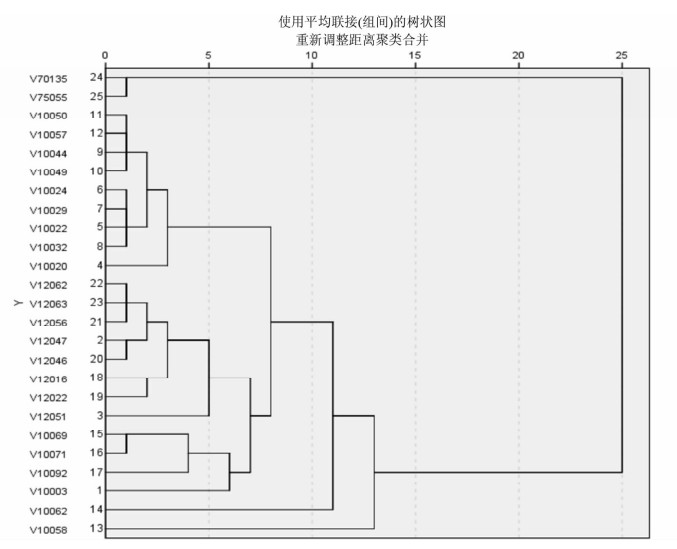 | 图 4 钛铁矿玄武岩样品聚类分析图Fig. 4 Clustering analysis diagram of ilmenite basalt samples |
从图 4的聚类可知,钛铁矿玄武岩岩石标本分为52种,对这52标本进行聚类分析,从已知样本可结果看知,同种岩性的光谱98.9%都聚类在一类中,说明了所提取的光谱的可靠性的同时,也充分证明了聚类方法的可行性,做完连续统剔除后,样品间的差距被拉大了,采用二次偏最小二乘均一去冗余,在总体上还是可以归为一类,说明同类岩性的样品虽然有一定的差异,但总体上表现趋于一致,以此类推得到87种岩性标准光谱影像光谱(Bogard et al., 1973; Cirlin and Housley, 1982)。例如10046样品在580.76nm、730.48nm、970.02nm、2177.72nm处存在较强的吸收谷,在660.61nm、790.37nm、1449.11nm、1698.63nm处存在较强的反射峰;14303样品在500.92nm、580.76nm、730.48nm、989.98nm、1389.22nm、1658.71nm、1978.10nm处存在较强吸收谷,在540.84nm、1369.26nm、1698.53nm处有较强的反射峰;15546样品在540.84nm、970.02nm、1938.18nm、2057.95nm处存在较强吸收谷,在1449.11nm、1618.79nm处存在较强反射峰;15529样品在970.02nm、2057.95nm处存在较强吸收谷;65325样品存在500~2500nm间基本呈等间距形成多个吸收谷与多个反射峰;67936样品最强的吸收谷在950.06nm处,67955样品在660.61nm、970.02nm、1429.15nm、2177.72nm处存在较强的吸收谷(Lim et al., 2013)。七种典型岩石影像光谱曲线图见图 5。
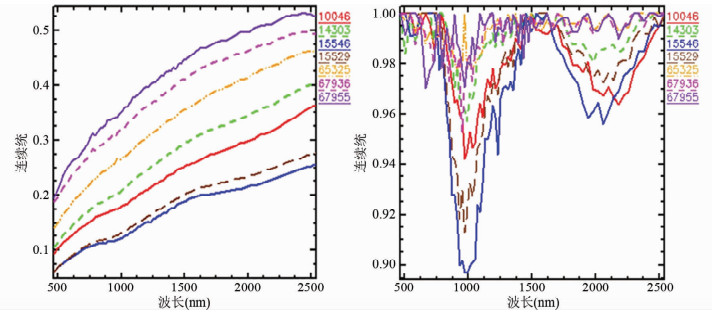 | 图 5 七种典型岩石影像光谱曲线Fig. 5 Seven typical rock's image spectrum curve |
Apollo 16的登录点选择在两个高地区域——笛卡尔建造和凯里建造,在任务之前,人们认为这两个区域都是火山起源的,后来返回的样品推翻了这个认识,这些区域是撞击产生的地质单元。这两个区域的面积占了月球的11%,因此对于认识月球的历史具有很重要的意义,另一方面,笛卡尔建造和其它登陆点的距离远,有助于组成更好的地球物理观测网。
这次任务中宇航员穿越了26.7km,在11个点共采集到95.7kg样品。Apollo 16共计取样151个,其中20个为碎裂斜长岩,8个为火成岩,其余为部分熔融或重结晶角砾岩(李力等,2012; 连懿等,2014)。8个火成岩样品中包括一个尖晶石橄长岩,6个熔融岩以及在60639角砾岩中的一个大的月海玄武岩玻璃。Dowty et al.(1974)通过对阿波罗16中7个由全晶质的长石构成的岩石和1个月海玄武岩玻璃的研究,认为很少或者可能只有一种岩石可能是初级的地壳岩石。这些样品的岩石学和矿物学研究可能帮助人们更好的理解原始岩石地壳的修改进程(张明皓等,2007; 张薛伟等,2014; 吴昀昭,2014; 刘菁华等,2014)。
Haber et al.(2014)将Apollo 16的一套不同的撞击熔融岩石作为研究对象,通过此次研究计算岩石年龄,分析元素组成,放射性同位素数据,进行岩相学观察。Krahenbuhl et al.(1973)通过中子活化分析了阿波罗16的42个样品,研究了月球上的挥发性元素和亲铁元素,这些数据与Ganapathy et al.(1974)、Morgan et al.(1973)研究阿波罗15样品数据相似,这些结果对全球范围内的两个主题:挥发性元素在月球上的损耗、从盆地形成时代开始的古老的陨石组分的存在以及阿波罗16场地的岩石学特征有一定的启示(Wilshire et al., 1973)。
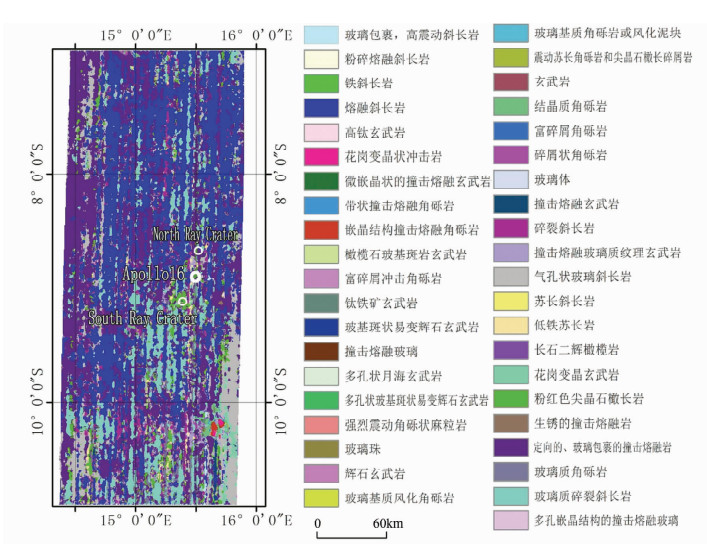
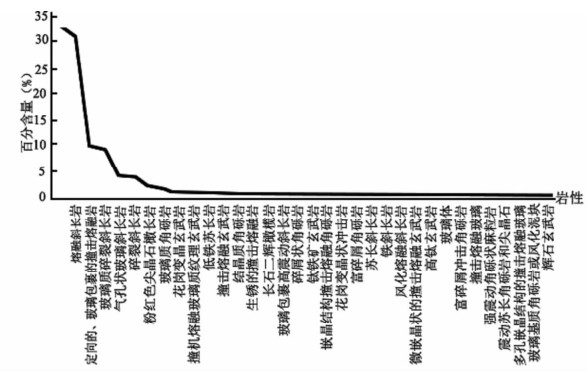
本次选择区域为Apollo 16登月采样点外围纬度:10°50′48″~6°55′8″S、经度:14°20′14″~15°54′5″E。区域包含Apollo登月点、采样区域以及外围约60万平方千米区域,与登月区域距离沿相同距离延展。使用M3可见-近红外数据,利用全谱段特征方法建立,把每条典型岩石光谱按照自左至右波长延展方向,按照波峰、波谷、半高峰、斜率在研究区逐像素进行全波段匹配,填图结果见图 6;区域共填出41类岩性(图 7),其中熔融斜长岩、定向的、玻璃包裹的撞击熔融岩、玻璃质碎裂斜长岩、气孔状玻璃斜长岩、粉红色尖晶石橄长岩、花岗变晶玄武岩占据整个区域95%(凌宗成等,2013)。
 | 图 6 Apollo16区域岩性分布图Fig. 6 Apollo 16 regional lithology profile |
 | 图 7 Apollo 16区域岩性含量曲线图Fig. 7 Apollo 16 graph of regional lithology content |
研究区岩性图(图 6)表明,以笛卡尔撞击坑为界,熔融质斜长岩占据近55%区域,北部分布明显高于南部;角砾岩在登月点以南逐渐增多,粉红色尖晶石橄长岩在Apollo 16南部登月点与顶北部、南部较多;花岗质玄武岩自北向南呈带状分布与此同时撞击熔融质岩石遍布整个区域。
岩浆洋演化认为当岩浆洋结晶程度达到80%左右的时候,斜长石开始结晶,由于其密度较小,在月球表面形成一个厚的斜长岩月壳。因重力作用而堆积在月幔的下部,由纯橄岩和方辉橄榄岩组成。通过分析整个在Apollo 16收集的样品以及反演区域岩性结果,Apollo 16北部分布大量月海,此区域可能主要由月海溅射物和大量的原生物质覆盖,区域大面积斜长岩也验证该区域来自于岩浆洋而不是火山起源,不计其数的次级撞击造成深部尖晶石等物质上涌以及再次熔融Spudis(1984)综合针对Apollo 16高地位置的多种地质演化成因推测并结合个人研究得出:Apollo 16登月点区域地质演化结论及过程与其地质演化相关的地质事件(Nectaris笛卡尔构造的沉积、Imbrium的凯里构造沉积和诸多次级坑撞击事件)密切相关。Hodges and Kushiro(1973)利用电子显微探针和光学原理研究了Apollo 16采集的4个月球高地样品(碎裂斜长岩60025,132、长石玄武岩68416,78、尖晶石橄长岩,62295,68、重结晶角砾岩,60315,62)的岩石学特征。本文认为此区域由周围酒海盆地、静海盆地等盆地撞击溅射沉积——盆地内月海物质被后期撞击溅射出来沉积——本区域撞击改造以及撞击造成内部物质出露。
由此可知该区域可能发生过溅射物堆积阶段、熔融阶段、次生再撞击阶段。此方法对于月球大面积精细岩性填图起到很好的效果,对于验证月幔不均一性,以月球典型岩石为研究对象,通过岩性细致分析,寻找其中蕴含的源区岩浆信息,从而探讨月海岩浆洋结晶分异的规律,加深对月幔随深部的组成变化特征的认识。
| [1] | Apollo 16 Preliminary Examination Team. 1973. The Apollo 16 lunar samples: Petrographic and chemical description. Science, 179(4068): 23-34 |
| [2] | Bogard DD, Nyquist LE, Hirsch WC et al. 1973. Trapped solar and cosmogenic noble gas abundances in Apollo 15 and 16 deep drill samples. Earth and Planetary Science Letters, 21(1): 52-69 |
| [3] | Carr LP and Pillinger CT. 1984. Nitrogen isotopic composition of osbornite from the Bustee meteorite. Lunar. Planet. Sci 03/1984; 15:129-130 |
| [4] | Cirlin EH and Housley RM. 1982. Distribution and evolution of Zn, Cd, and Pb in Apollo 16 regolith samples and the average U-Pb ages of the parent rocks. In: Proceedings of the 12th Lunar and Planetary Science Conference. New York and Oxford: Pergamon Press, 529-540 |
| [5] | Ding XZ, Wang L, Han KY et al. 2014. The lunar digital geological mapping based on ArcGIS: Taking the Arctic region as an example. Earth Science Frontiers, 21(6): 19-30 (in Chinese with English abstract) |
| [6] | Dowty E, Keil K and Prinz M. 1974. Lunar pyroxene-phyric basalts: Crystallization under supercooled conditions. Journal of Petrology, 15(3): 419-453 |
| [7] | Du JS, Chen C, Liang Q et al. 2010. The characteristics of rock-density distributions on the surface and in the crust of the Moon. Chinese Journal of Geophysics, 53(9): 2059-2067 (in Chinese with English abstract) |
| [8] | Elphic RC, Lawrence DJ, Feldman WC et al. 1998. Lunar Fe and Ti abundances: Comparison of Lunar Prospector and Clementine data. Science, 281(5382): 1493-1496 |
| [9] | Fan E, Chu J and Wang L. 2009. Review of studies about methods on optimal bands selection of multispectrum datasets of lunar surface. Computer and Modernizatio, (4):39-43, 47 (in Chinese with English abstract) |
| [10] | Ganapathy R, Morgan JW, Higuchi H et al. 1974. Meteoritic and volatile elements in Apollo 16 rocks and in separated phases from 14306. In: Proceedings of the 5th Lunar Science Conference. New York: Pergamon Press, 1659-1683 |
| [11] | Gilmore MS, Thompson DR, Anderson LJ et al. 2011. Superpixel segmentation for analysis of hyperspectral data sets, with application to Compact Reconnaissance Imaging Spectrometer for Mars data, Moon Mineralogy Mapper data, and Ariadnes Chaos, Mars. Journal of Geophysical Research: Planets, 116(E7): E07001 |
| [12] | Gross J, Treiman AH, Filiberto J et al. 2011. Primitive olivine-phyric shergottite NWA 5789: Petrography, mineral chemistry, and cooling history imply a magma similar to Yamato-980459. Meteoritics & Planetary Science, 46(1): 116-133 |
| [13] | Haber T, Norman MD, Bennett VC et al. 2014. Formation ages, cogenetic relations and formation processes of a set of Apollo 16 impact melt rocks. In: Proceedings of the 45th Lunar and Planetary Science Conference. New York: Pergamon Press, 1693 |
| [14] | Hartmann WK. 2003. Megaregolith evolution and cratering cataclysm models: Lunar cataclysm as a misconception (28 years later). Meteoritics & Planetary Science, 38(4): 579-593 |
| [15] | Heiken GH, Vaniman DT and French BM. 1991. Lunar Sourcebook: A User's Guide to the Moon. London: Cambridge University Press |
| [16] | Hodges FN and Kushiro I. 1973. Petrology of Apollo 16 lunar highland rocks. 5th Lunar and Planetary Science Conference Proceedings, 1033 |
| [17] | Isaacson PJ, Pieters CM, Besse S et al. 2011. Remote compositional analysis of lunar olivine-rich lithologies with Moon Mineralogy Mapper (M3) spectra. Journal of Geophysical Research: Planets, 116(E6): E00G11 |
| [18] | Jiao ZH. 2012. Lunar surface material information extraction from visible and near-infrared remote sensing: The cases study in Aristarchus and the South Pole-Aitken Basin. Master Degree Thesis. Beijing: China University of Geosciences (in Chinese) |
| [19] | Kaydash V, Pieters C, Shkuratov Y et al. 2013. Lunar opposition effect as inferred from Chandrayaan-1?M3 data. Journal of Geophysical Research: Planets, 118(6): 1221-1232 |
| [20] | Krahenbuhl U, Ganapathy R, Morgan JW and Anders E. 1973. Volatile elements in Apollo 16 samples: Possible evidence for outgassing of the moon. Science, 180(4088):858-61 |
| [21] | Li L, Liu SF, Wei W et al. 2012. Interpretation of landform of sinuous rilles on the moon based on multi-data of remote sensing. Remote Sensing for Land & Resources, (3): 16-21 (in Chinese with English abstract) |
| [22] | Lian Y, Chen SB, Meng ZG et al. 2014. Geological analysis of lunar middle and low latitude brightness temperature anomaly area based on Chang'E-2 MRM data. Acta Geoscientica Sinica, 35(5): 643-647 (in Chinese with English abstract) |
| [23] | Lim YM, Choi YJ, Jo YS et al. 2013. Hyper-spectral imager of the visible band for lunar observations. Journal of the Korean Physical Society, 62(11): 1587-1590 |
| [24] | Ling ZC, Zhang J, Wu ZC et al. 2013. The compositional distribution and rock types of the Aristarchus region on the Moon. Scientia Sinica (Physica, Mechanica & Astronomica), 43(11): 1403-1410 (in Chinese) |
| [25] | Ling ZC, Liu JZ, Zhang J et al. 2014. The lunar rock types as determined by Chang'E-1 IIM data: A case study of Mare Imbrium-Mare Frigoris region (LQ-4). Earth Science Frontiers, 21(6): 107-120 (in Chinese with English abstract) |
| [26] | Liu DY, Jolliff BL, Zeigler RA et al. 2012. Comparative zircon U-Pb geochronology of impact melt breccias from Apollo 12 and lunar meteorite SaU 169, and implications for the age of the Imbrium impact. Earth and Planetary Science Letters, 319-320: 277-286 |
| [27] | Liu J, Ouyang ZY, Li CL et al. 2006. Applications of mid-infrared spectra in the lunar exploration. Acta Mineralogica Sinica, 26(4): 435-440 (in Chinese with English abstract) |
| [28] | Liu JH, Wang ZW, Chen SB et al. 2014. Spectrum characteristics analysis of four lunar rocks based on the CE-1 Gamma-ray spectrometry data. Earth Science Frontiers, 21(6): 121-128 (in Chinese with English abstract) |
| [29] | Liu JJ and Li CL. 1999. Research progress of the spectral characteristics of the lunar material. Bulletin of Mineralogy, Petrology and Geochemistry, 18(2): 45-50 (in Chinese) |
| [30] | Liu JJ, Ren X, Tan X and Li CL. 2013. Lunar image data preprocessing and quality evaluation of CCD Stereo Camera on Chang'E-2. Geomatics and Information Science of Wuhan University, 38(2): 186-190 (in Chinese with English abstract) |
| [31] | Liu JZ and Ling ZC. 2012. Division of lunar rock types in Sinus Iridum area as an example. In: Proceedings of the 10th National Conference on the National Lunar Science and Comparative Planetary Astronomy and Astrophysics. Guilin: CSSR (in Chinese) |
| [32] | Meyer C. 1987. The Lunar Petrographic Thin Section Set. Houston, Texas: NASA JSC Curatorial Branch Publishing |
| [33] | Morgan JW, Ganapathy R, Laul JC et al. 1973. Lunar crater Copernicus: Search for debris of impacting body at Apollo 12 site. Geochimica et Cosmochimica Acta, 37(1): 141-154 |
| [34] | Ouyang ZY, Li CL, Zou YL et al. 2010. The primary science result from the Chang'E-1 probe. Scientia Sinica (Terrae), 40(3): 261-280 (in Chinese) |
| [35] | Petro NE and Pieters CM. 2006. Modeling the provenance of the Apollo 16 regolith. Journal of Geophysical Research: Planets, 111(E9): E09005 |
| [36] | Pieters CM. 1978. Mare basalt types on the front side of the moon: A summary of spectral reflectance data. In: Proceedings of the 9th Lunar and Planetary Science Conference. New York: Pergamon Press, 2825-2849 |
| [37] | Pieters CM, Besse S, Boardman J et al. 2011. Mg-spinel lithology: A new rock type on the lunar farside. Journal of Geophysical Research: Planets, 116(E6): E00G08 |
| [38] | Qiao L, Xiao L and Zhao JN. 2012. The diversity of geological features of the lunar Sinus Iridum Area. In: Proceedings of the 10th National Conference on the National Lunar Science and Comparative Planetary Astronomy and Astrophysics. Guilin: CSSR (in Chinese) |
| [39] | Qiao L, Xiao L, Zhao JN and Huang Q. 2013. Geological features and magmatic activities history of sinus Iridum, the moon. Scientia Sinica (Physica, Mechanica & Astronomica), 43(11): 1370-1386 (in Chinese) |
| [40] | Schaber GG, Scott DR and Irwin JB. 1972. Glass in the bottom of Small Lunar Craters: An observation from Apollo 15. Geological Society of America Bulletin, 83(1972):1573-1577 |
| [41] | Spudis PD. 1984. Apollo-16 site geology and impact melts: Implications for the geologic history of the lunar highlands. Journal of Geophysical Research, 89(Suppl.1): C95-C107 |
| [42] | Sun LZ, Ling ZC and Liu JZ. 2014. The spectral characteristics and remote detection of minerals in lunar Orientale Basin. Earth Science Frontiers, 21(6): 188-203 (in Chinese with English abstract) |
| [43] | Taylor LA, Mao HK and Bell PM. 1974. Identification of the hydrated iron oxide mineral akaganéite in Apollo 16 lunar rocks. Geology, 2(9): 429-432 |
| [44] | Wang X, Chen JP, Xu YB et al. 2012a. Inversion of contents of TiO2 and MgO in Sinus Iridum area of lunar surface based on Chang'E data. Earth Science Frontiers, 19(6): 28-36 (in Chinese with English abstract) |
| [45] | Wang X, Chen JP, Li JF, Shi R and Wu Z. 2012b. Information extraction of the Chang'E-1 Interference Imaging Spectrometer (IIM) 2C data. Spectroscopy and Spectral Analysis, 32(4): 1145-1150 (in Chinese with English abstract) |
| [46] | Warner JL, Simonds CH and Phinney WC. 1976. Genetic distinction between anorthosites and Mg-rich plutonic rocks: New Data from 76255. Lunar Sci. VII 02/1976; 7:915 |
| [47] | Whitten J and Head JW. 2015. Lunar cryptomaria: Mineralogy and composition of ancient volcanic deposits. Planetary and Space Science, 106: 67-81 |
| [48] | Wilshire HG, Stuart-Alexander DE and Jackson ED. 1973. Apollo 16 rocks: Petrology and classification. Journal of Geophysical Research, 78(14): 2379-2392 |
| [49] | Wu YZ. 2014. Reflectance spectroscopy of the Moon and its application. Earth Science Frontiers, 21(6): 74-87 (in Chinese with English abstract) |
| [50] | Xue B, Yang JF and Zhao BC. 2004. The study of spectral feature of major minerals on the lunar surface. Progress in Geophysics, 19(3): 717-720 (in Chinese with English abstract) |
| [51] | Yu YM, Gan FP, Zhou P et al. 2009. A comparison of spectral features between lunar and Earth's rocks and minerals and a brief introduction to the information extraction methods. Remote Sensing for Land & Resources, (4): 45-48, 52 (in Chinese with English abstract) |
| [52] | Zhang MH, Chen C, Lan RP and Chen HH. 2007. A preliminary analysis the distribution of metallic elements on the lunar surface. Earth Science Frontiers, 14(5): 277-284 (in Chinese with English abstract) |
| [53] | Zhang W and Bowles NE. 2013. Mapping lunar TiO2 and FeO with M3 data. In: Proceedings of European Planetary Science Congress. London: EPSC, 8: EPSC2013-374 |
| [54] | Zhang XW, Jiang Y, Liu H et al. 2014. Spectrometric study of lunar pyroclastic deposits. Earth Science Frontiers, 21(6): 137-149 (in Chinese with English abstract) |
| [55] | Zhao BC, Tang Q and Xue B. 2013. Key technologies of CE-2 CCD stereo camera. Spacecraft Recovery & Remote Sensing, 34(4): 43-51 (in Chinese with English abstract) |
| [56] | Zhou XF. 2014. Compositional study of Mare Imbrium basalts of the Moon based on remote sensing data. Master Degree Thesis. Nanjing: Nanjing University (in Chinese) |
| [57] | 丁孝忠, 王梁, 韩坤英等. 2014. 基于ArcGIS的月球数字地质填图: 以月球北极地区为例. 地学前缘, 21(6): 19-30 |
| [58] | 杜劲松, 陈超, 梁青等. 2010. 月球表层及月壳物质密度分布特征. 地球物理学报, 53(9): 2059-2067 |
| [59] | 范恩, 储珺, 王璐. 2009. 月球表面多光谱数据最佳波段选择研究. 计算机与现代化, (4): 39-43, 47 |
| [60] | 焦中虎. 2012. 可见光-近红外遥感在月表物质信息提取的应用——以Aristarchus和南极-艾肯盆地为例. 硕士学位论文. 北京: 中国地质大学 |
| [61] | 李力, 刘少峰, 韦蔚等. 2012. 基于多源遥感数据的弯曲月溪形貌特征解译. 国土资源遥感, (3): 16-21 |
| [62] | 连懿, 陈圣波, 孟治国等. 2014. 基于嫦娥二号微波辐射计数据月球中低纬度亮温异常区地质分析研究. 地球学报, 35(5): 643-647 |
| [63] | 凌宗成, 张江, 武中臣等. 2013. 月球Aristarchus地区的物质成分与岩石类型分布. 中国科学(物理学 力学 天文学), 43(11): 1403-1410 |
| [64] | 凌宗成, 刘建忠, 张江等. 2014. 基于"嫦娥一号"干涉成像光谱仪数据的月球岩石类型填图: 以月球雨海-冷海地区(LQ-4)为例. 地学前缘, 21(6): 107-120 |
| [65] | 刘剑, 欧阳自远, 李春来等. 2006. 中红外光谱在月球探测中的应用. 矿物学报, 26(4): 435-440 |
| [66] | 刘菁华, 王祝文, 陈圣波等. 2014. CE-1伽马能谱测量中4种月球岩石的能谱特征分析. 地学前缘, 21(6): 121-128 |
| [67] | 刘建军, 李春来. 1999. 月球物质波谱特征研究进展. 矿物岩石地球化学通报, 18(2): 45-50 |
| [68] | 刘建军, 任鑫, 谭旭, 李春来. 2013. 嫦娥二号CCD立体相机数据预处理与数据质量评价. 武汉大学学报(信息科学版), 38(2): 186-190 |
| [69] | 刘建忠, 凌宗成. 2012. 月面岩石类型的划分——以虹湾地区为例. 见: 第十届全国月球科学与比较行星学陨石学与天体化学学术研讨会会议论文集. 桂林: 中国空间科学学会 |
| [70] | 欧阳自远, 李春来, 邹永廖等. 2010. 绕月探测工程的初步科学成果. 中国科学(地球科学),40(3): 261-280 |
| [71] | 乔乐, 肖龙, 赵健楠. 2012. 月球虹湾地区地质特征多样性解译. 见: 第十届全国月球科学与比较行星学陨石学与天体化学学术研讨会会议论文集. 桂林: 中国空间科学学会 |
| [72] | 乔乐, 肖龙, 赵健楠, 黄倩. 2013. 月球虹湾地区地质特征解译及岩浆活动历史研究. 中国科学(物理学 力学 天文学), 43(11): 1370-1386 |
| [73] | 王翔, 陈建平, 许延波等. 2012a. 基于嫦娥数据的月球虹湾区域TiO2、MgO含量反演. 地学前缘, 19(6): 28-36 文中引用没有区别2012a还是b? |
| [74] | 王翔, 陈建平, 李剑锋, 史蕊, 伍曌. 2012b. 嫦娥一号干涉成像光谱仪(IIM)2C级数据信息提取. 光谱学与光谱分析, 32(4): 1145-1150 |
| [75] | 孙灵芝, 凌宗成, 刘建忠. 2014. 月球东海盆地的矿物光谱特征及遥感探测. 地学前缘, 21(6): 188-203 |
| [76] | 吴昀昭. 2014. 月球反射光谱学及应用. 地学前缘, 21(6): 74-87 |
| [77] | 薛彬, 杨建峰, 赵葆常. 2004. 月球表面主要矿物反射光谱特性研究. 地球物理学进展, 19(3): 717-720 |
| [78] | 于艳梅, 甘甫平, 周萍等. 2009. 月地岩矿光谱特征对比及月表信息提取方法简介. 国土资源遥感, (4): 45-48, 52 |
| [79] | 张明皓, 陈超, 兰瑞平, 陈欢欢. 2007. 月球表面多种金属元素的分布特征初探. 地学前缘, 14(5): 277-284 |
| [80] | 张薛伟, 蒋云, 刘寒等. 2014. 月球火山碎屑堆积物光谱研究. 地学前缘, 21(6): 137-149 |
| [81] | 赵葆常, 唐茜, 薛彬. 2013. "嫦娥二号"卫星CCD立体相机的关键技术. 航天返回与遥感, 34(4): 43-51 |
| [82] | 周贤锋. 2014. 月球雨海玄武岩物质成分遥感研究. 硕士学位论文. 南京: 南京大学 |