 2015, Vol. 31


2. 中国科学院矿产资源研究重点实验室, 中国科学院地质与地球物理研究所, 北京 100029;
3. 中国科学院大学, 北京 100049;
4. 新疆有色地质勘查局, 乌鲁木齐 830000;
5. 新疆有色地质勘查局706队, 阿勒泰 836500
 , QIN KeZhang1,2
 , TANG DongMei2, ZHOU QiFeng2, SHEN MaoDe4, GUO ZhengLin4, GUO XuJi5
2. Key Laboratory of Mineral Resources, Institute of Geology and Geophysics, Chinese Academy of Sciences, Beijing 100029, China;
3. University of Chinese Academy of Sciences, Beijing 100049, China;
4. Xinjiang Geoexploration Bureau for Nonferrous Metals, Urumuqi 830000, China;
5. No. 706 Geological Team of Xinjiang Geoexploration Bureau for Nonferrous Metals, Aletai 836500, China
新疆阿尔泰地区发育有10万余条伟晶岩脉,是我国重要的稀有金属、宝石、工业白云母成矿带。该成矿带包括2个稀有金属成矿亚带,分别为哈龙-青河成矿亚带和加曼哈巴-大喀拉苏成矿亚带,分为9个伟晶岩区(图 1),由北西向南东依次为加曼哈巴、海流滩-也留曼、小喀拉苏-切别林、大喀拉苏-可可西尔、喀拉额尔齐斯、柯鲁木特-吉得克、库威-结别特、可可托海和青河伟晶岩区(邹天人和李庆昌,2006)。
阿斯喀尔特Be-Nb-Mo矿床位于阿尔泰东段可可托海伟晶岩矿集区内,西距可可托海超大型伟晶岩型稀有金属矿床约40km,是一个以稀有元素Be为主、产出宝石(海蓝、金绿宝石)、伴生有Nb、Mo及分散元素Ga的矿床。该矿床最初发现于上世纪50年代末,截至2007年BeO开采量达2600吨,保有储量约7500吨,属于大型矿床(新疆维吾尔自治区有色地质勘查局706队,2007①)。该矿床的独特之处在于同时发育花岗岩型及伟晶岩型两类稀有金属矿化,晚阶段发育有辉钼矿及黄铁矿等硫化物。前人对该矿床的矿床地质、矿物学、地球化学及成矿流体特征进行了研究(冯荫林和江晓波,1987; 邹天人,1996; 邹天人和李庆昌,2006),通过野外观察及全岩Rb-Sr法确定了英云闪长岩、二云母碱长花岗岩及白云母钠长花岗岩的侵位序列和形成时代(邹天人,1996; 邹天人和李庆昌,2006)。但前人工作没有限定两类Be矿化的时间及伟晶岩的形成时代,且受限于技术方法,未能获得高精度的年龄。本文以详细的野外地质观察为基础,运用锆石LA-ICP-MS U-Pb定年和辉钼矿Re-Os定年,首次限定了白云母钠长花岗岩与伟晶岩的形成时代、成矿时代及演化时限;通过对白云母钠长花岗岩与伟晶岩中锆石的Hf同位素分析,讨论了成岩物质源区;结合区域地质演化,探讨了区域上同时期稀有金属伟晶岩及相关花岗岩形成的构造动力学背景;提出了伟晶岩的成因类型,并确立了白云母钠长花岗岩与伟晶岩的成因联系。
① 新疆维吾尔自治区有色地质勘查局706队. 2007. 新疆青河县阿斯喀尔特铍矿普查设计书
1 区域地质背景
阿尔泰地区位于中亚造山带(CAOB)中段、西伯利亚板块西南缘与哈萨克斯坦-准噶尔板块北缘之间,其演化与古亚洲洋以及CAOB显生宙大规模的增生造山作用密切相关(Şengör et al., 1993; Jahn et al., 2000a,2004; Buslov et al., 2001; Xiao et al., 2004,2010; Qin et al., 2005; Kröner et al., 2007)。区域构造演化大致可分为早-中古生代增生造山阶段、晚古生代-中生代增生向碰撞转换阶段以及中-新生代构造体系转换与盆山耦合阶段(Allen et al., 1995; Windley et al., 2002,2007; Kovalenko et al., 2004; Yakubchuk,2004; Xiao et al., 2009; Glorie et al., 2012)。增生造山主要发育于古生代,经历早古生代洋盆形成、俯冲消减、洋内块体拼贴增生以及中-晚古生代大规模多岛弧拼贴增生过程(秦克章,2000; Buslov et al., 2004; Xiao et al., 2004; Yakubchuk,2004; Briggs et al., 2007)。目前CAOB演化有单一岛弧的弧前增生、后期发育大型同俯冲走滑断层的叠覆造山模式(Şengör et al., 1993; Şengör et al., 1993; Şengör and Natal’In,1996)与多岛弧-微陆块碰撞造山模式(Dobretsov et al., 1995; 秦克章等,1999; Qin et al., 2002; Yakubchuk,2002,2004; Briggs et al., 2009)的争议,陆块的最终聚合时间有泥盆纪(Windley et al., 2002)、晚泥盆世至早石炭世(Allen et al., 1993; Gao et al., 1995; Buslov et al., 2003,2004)、晚石炭世(Han et al., 2010,2011)以及二叠至三叠纪(Sun et al., 1991; 肖文交等,2006; Xiao et al., 2009)等不同观点。阿尔泰地区伟晶岩形成于造山带演化的各个阶段,从加里东期到燕山期构成一个完整的稀有金属矿床成矿谱系,总体趋势为矿化元素和矿物组合越来越多、伟晶岩分带越来越完善、矿床规模越来越大、矿种由单一向综合演化(吴柏青和邹天人,1989; 王登红等,2003,2004; 郭正林等,2013; 秦克章等,2013)。
以区域断裂为界阿尔泰地区可分为六个构造单元(图 1),即阿尔泰山地体、北西阿尔泰山地体、中阿尔泰山地体、群库尔-阿巴宫地体、额尔齐斯地体及布尔津-二台地体(何国琦等,1990,1994; Windley et al., 2002)。阿斯喀尔特矿区位于中阿尔泰山地体东南部,该地体为阿尔泰微陆块的重要组成单元,主要地层为中-上奥陶统哈巴河群及志留系库鲁木提群变质沉积岩,变质程度达绿片岩至角闪岩相;卡拉先格尔与红山嘴-库热克特两条区域断裂贯穿全区,亦构成与其它构造单元的边界;花岗岩出露广泛,发育大量的稀有金属矿化伟晶岩与若干基性-超基性岩株(邹天人等,1988; 何国琦等,1990)。
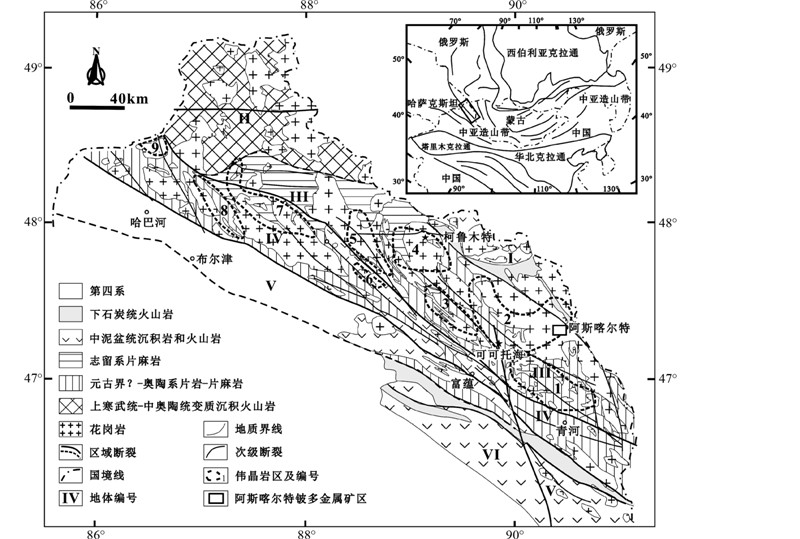 | 图 1 阿尔泰造山带地质简图及伟晶岩区分布图(据何国琦,1990,1994; Windley et al., 2002;邹天人和李庆昌,2006综合修改) Ⅰ-北阿尔泰山地体;Ⅱ-北西阿尔泰山地体;Ⅲ-中阿尔泰山地体;Ⅳ-琼库尔-阿巴宫地体;Ⅴ-额尔齐斯地体;Ⅵ-布尔津-二台地体.1-青河伟晶岩区;2-可可托海伟晶岩区;3-库威-结别特伟晶岩区;4-柯鲁木特-吉得克伟晶岩区;5-喀拉额尔齐斯伟晶岩区;6-大喀拉苏-可可西尔伟晶岩区;7-小喀拉苏-切别林伟晶岩区;8-海流滩-也留曼伟晶岩区;9-加曼哈巴伟晶岩区Fig. 1 Geological sketch map of the Chinese Altai orogeny belt and distribution of pegmatite field(modified after He et al., 1990,1994; Windley et al., 2002; Zou and Li,2006) Ⅰ-Altaishan terrain; Ⅱ-NW Altaishan terrain; Ⅲ-Central Altaishan terrain; Ⅳ-Qiongkuer-Abagong terrain; Ⅴ-Irtysh terrain; Ⅵ-Perkin-Ertai terrain. 1-Qinghe pegmatite field; 2-Keketohay pegmatite field; 3-Kuwei-Jiebiete pegmatite field; 4-Kelumute-jideke pegmatite field; 5-Kala-Irtysh pegmatite field; 6-Dakalasu-Kekexier pegmatite field; 7-Xiaokalasu-Qiebielin pegmatite field; 8-Hailiutan-Yeliuman pegmatite field; 9-Jiamanhaba pegmatite field |
阿斯喀尔特矿区内地层出露较少,零星发育于东南及西南侧(图 2),主要为中-上奥陶统哈巴河群(O2-3hb)以及第四系松散堆积物(Q)。哈巴河群岩性包括石英-云母片岩、黑云母片麻岩和混和岩,第四系包括冰碛岩、冲积-洪积物以及分布广泛的残-坡积物。矿区内断裂构造按走向可分为NW向与近N-S向两组,NW向断裂与区域构造方向一致,发育于海西期,活动具多期性,为主要控岩控矿构造;近N-S向的断裂主要活动于第四纪,阿拉尔河的形成演化可能受其控制。矿区各类侵入岩广泛发育,约总面积的80%。主体为形成于加里东晚期的大青格里河英云闪长岩基(393.4~408Ma),内部发育3类不同的花岗岩,分别为黑云母花岗岩、二云母碱长花岗岩与白云母钠长花岗岩,形成时代依次为254~279Ma、263Ma、234Ma(邹天人,1996; 邹天人和李庆昌,2006)。其它侵入岩包括矿区东南及西南隅零星发育的辉长岩,以及200余条伟晶岩脉。
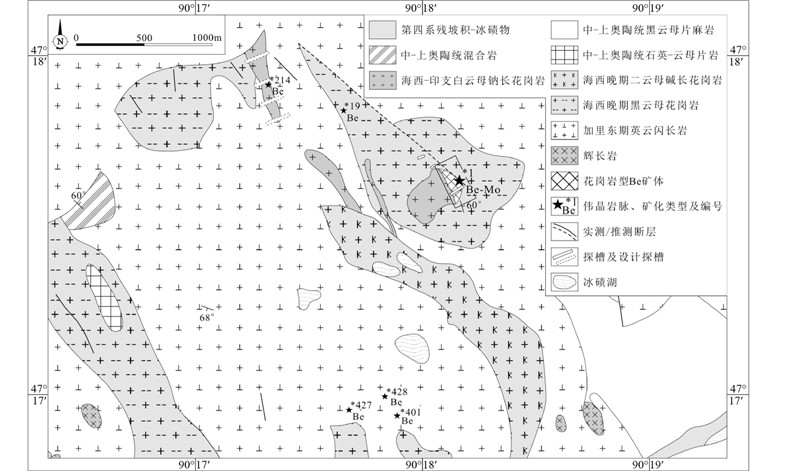 | 图 2 阿斯喀尔特矿区地质图(据新疆维吾尔自治区有色地质勘查局七○六队,2007)Fig. 2 Geological map of Arskartor ore district |
阿斯喀尔特Be-Nb-Mo矿床由原生矿和砂矿两部分组成。原生矿化分为花岗岩型与伟晶岩型两种类型(图 3),是主要的矿石来源,为本文的研究对象。砂矿形成于原生矿遭受风化及冰川刨蚀作用,堆积于原生矿脉边部。
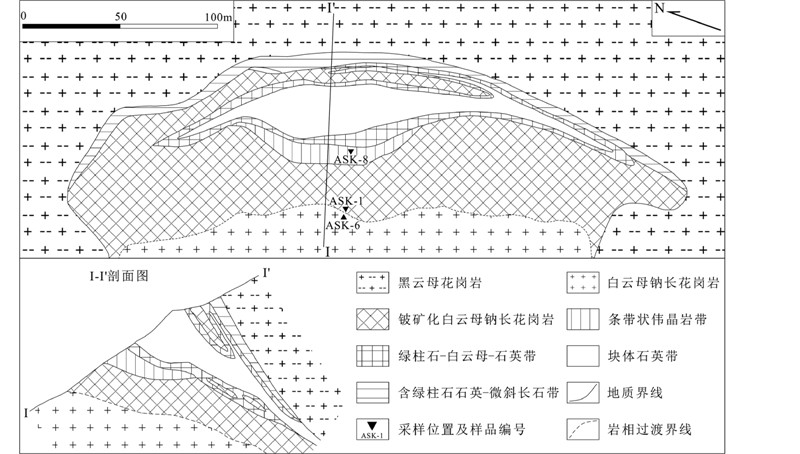 | 图 3 阿斯喀尔特矿床地质图(据邹天人,1996; 邹天人和李庆昌,2006改绘)Fig. 3 Geological sketchmap of the Arskartor Be-Nb-Mo deposit(modified after Zou,1996; Zou and Li,2006) |
花岗岩型Be矿产于白云母钠长花岗岩株顶部。岩株呈等轴状,矿化带宽20~50m,矿石矿物以绿柱石为主,发育少量的辉钼矿与铌铁矿。绿柱石包括两种产状,一种镶嵌分布于微斜长石晶体内部或其他造岩矿物晶间(图 4a),呈浅绿-翠绿色,粒径3~5mm,部分晶形较好;另一种呈皮壳状、脉状(图 4b),为花岗岩中最主要的矿化类型,绿柱石呈浅蓝绿色,晶体粒度较大但自形程度差。
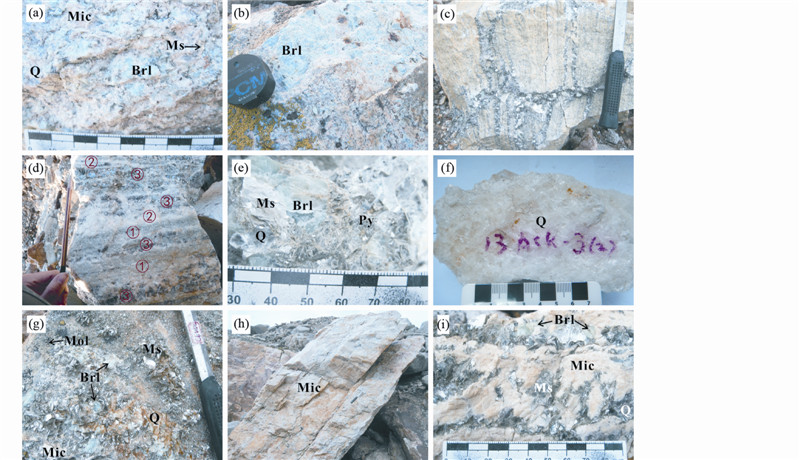 | 图 4 阿斯喀尔特花岗伟晶岩各相带照片 (a)花岗岩中分布于造岩矿物粒间的绿柱石;(b)花岗岩中的皮壳状Be矿化;(c、d)条带状白云母-石英-钠长石伟晶岩;(e)下盘绿柱石-白云母-石英伟晶岩;(f)石英块体;(g)上盘绿柱石-白云母-石英伟晶岩;(h)石英-微斜长石带中的微斜长石块体;(i)块体微斜长石中的绿柱石-白云母-石英集合体.①-细粒石英-白云母-钠长石条带;②-细粒钠长石条带;③-辉钼矿-绿柱石-白云母-石英条带.矿物缩写:Ab-钠长石;Brl-绿柱石;Mic-微斜长石;Mol-辉钼矿;Ms-白云母;Q-石英Fig. 4 Photographs of different zones in the Arskartor granitic pegmatite (a)beryl in rock forming minerals in granite;(b)crusty beryl in granite;(c,d)stripped muscovite-quartz-albite pegmatite;(e)beryl-quartz-muscovite pegamatite in lower side;(f)blocked quartz;(g)beryl-quartz-muscovite pegamatite in upper side;(h)blocked microline in quartz-microcline pegmatite;(i)aggregation of beryl-muscovite-quartz in blocked microline. ① fine quartz-muscovite-albite stripe; ② fine albite stripe; ③ molybdenite-beryl-muscovite-quartz stripe. Abbreviations: Ab-albite; Brl-beryl; Mic-microline; Mol-molybdenite; Ms-muscovite; Q-quartz |
伟晶岩型Be矿以发育于花岗岩株顶部的1号脉最为典型,周围也有几个规模较小的Be矿化点(19、214、401等,图 2)。1号脉厚度大且分带性好(图 3),富集粗粒绿柱石,产海蓝及金绿宝石。岩脉走向325°,倾向NE,倾角 变化于30°~60°,形态为中间宽、向两端逐渐尖灭的半月形,长265m,最宽处55m。从下到上依次为条带状伟晶带、下盘绿柱石-白云母-石英带、石英核、上盘绿柱石-白云母-石英带与含绿柱石石英-微斜长石带(冯荫林和江晓波,1987),各带主要特征如下。
Ⅰ. 条带状伟晶岩带:为伟晶岩脉的下盘边缘带,长110m,宽4~5m,向两端逐渐尖灭,与白云母钠长石花岗岩呈渐变过渡,上部与下盘绿柱石-白云母-石英带呈截然接触。呈条带状构造,条带宽0.2~2cm,长10~200cm,变形构造发育(图 4c)。主要由以下3类条带组成(图 4d):①细粒石英-白云母-钠长石条带,主体为细粒钠长石,微片状白云母较为均匀的散布其中,石英呈细粒状;②细粒钠长石条带,与①呈渐变过渡,含少量微斜长石;③辉钼矿-绿柱石-白云母-石英条带,主要由烟灰色石英组成,辉钼矿与白云母主要分布于边部,二者密切共生,绿柱石呈浅蓝或浅绿色,粒径0.5×1cm~1×1cm,部分晶形较好。
Ⅱ. 下盘绿柱石-白云母-石英带:该带长265m,厚0.1~5m。主要组成矿物为绿柱石、白云母、石英,局部含直径1m左右的微斜长石块体,发育辉钼矿、黄铁矿等硫化物(图 4e)。该带为最主要的Be矿化带,发育不同粒度的绿柱石晶体,个别达宝石级。
Ⅲ. 石英核:产于伟晶岩脉核部,形态与岩脉协调分布,长264m,最宽30m,由于长期开采未能见到原生露头。石英呈乳白、土黄与淡灰等色(图 4f),一般为半透明。
Ⅳ. 上盘绿柱石-白云母-石英带:该带长265m,厚0.1~1.1m,产状较为稳定。主要矿物组成同下盘绿柱石-白云母-石英带(图 4g),但绿柱石的产状有所变化,呈长柱状且体积较小,含量亦有所降低。
Ⅴ. 含绿柱石石英-微斜长石伟晶岩带,位于伟晶岩脉最上部,厚2~10m,主要由石英和微斜长石块体组成,矿化相对较弱,微斜长石呈肉红色块体(图 4h),含量随深度增加,含少量绿柱石-白云母-石英集合体(图 4i)。
综上花岗岩型Be矿化主要发育于白云母钠长花岗岩与伟晶岩接触部位及附近,伟晶岩型Be矿化主要产于上、下盘两个绿柱石-白云母-石英带以及条带状伟晶岩带。条带状伟晶岩与白云母钠长石花岗岩呈渐变过渡,二者具基本一致的矿物组成,表明其为花岗质熔体较早分异出的伟晶岩相。辉钼矿与黄铁矿充填于硅酸盐矿物粒间或呈脉状穿插分布其中,表明其形成于伟晶岩演化晚阶段。 3 样品及分析方法 3.1 样品采集与处理
用作锆石U-Pb定年的3件样品采自地表露头,包括白云母钠长花岗岩(ASK-6)、Be矿化白云母钠长花岗岩(ASK-1)与条带状伟晶岩(ASK-8)。
白云母钠长花岗岩(图 5a)呈黄白色,花岗结构,块状构造,主要组成矿物为白云母(3%~5%)、石英(30%)、钠长石(10%)及微斜长石(55%~60%),钠长石呈较为自形的板状晶形,部分发育卡氏双晶,微斜长石呈自形粒状,发育格子双晶,边部受其他矿物熔蚀交代(图 5b)。
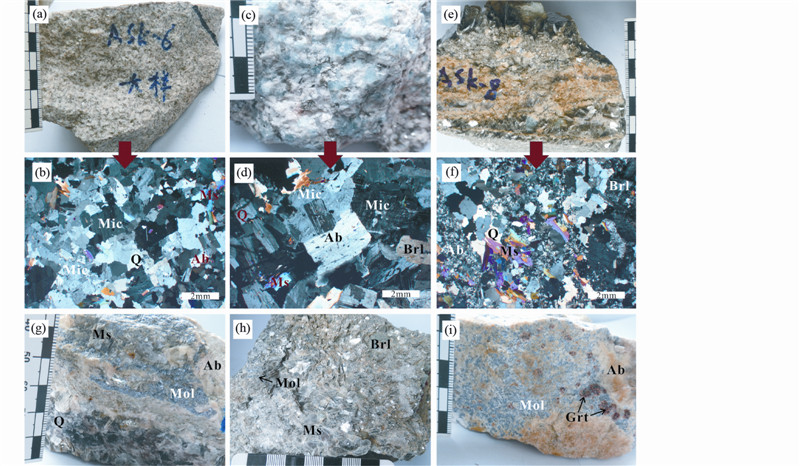 | 图 5 阿斯喀尔特矿区测试样品手标本及镜下照片 (a)白云母钠长花岗岩;(b)白云母、石英、钠长石与微斜长石构成的花岗结构(+);(c)含绿柱石的白云母钠长花岗岩;(d)呈嵌晶结构的造岩矿物与绿柱石(+);(e)条带状白云母-石英-钠长石伟晶岩;(f)细粒钠长石、中粗粒石英及半自形粒状绿柱石(+);(g、h)条带状伟晶岩中的细脉状与浸染状辉钼矿;(i)花岗岩中的细脉-浸染状辉钼矿化.矿物缩写:Ab-钠长石;Brl-绿柱石;Grt-石榴石;Mic-微斜长石;Mol-辉钼矿;Ms-白云母;Q-石英Fig. 5 Photographs of samples of the Arskartor ore district (a)muscovite-albite granite;(b)muscovite,quartz,albite and microline in granite(+);(c)beryl bearing muscovite-albite granite;(d)embayed beryl crystal in rock forming minerals(+);(e)striped muscovite-quartz-albite pegmatite;(f)fine grained albite,middle to coarse grained quartz and half-euhedral beryl;(g,h)veinlet and contaminated molybdenite in striped muscovite-quartz-albite pegmatite;(i)-veinlet and contaminated molybdenite in granite. Abbreviations: Ab-albite; Brl-beryl; Grt-garnet; Mic-microline; Mol-molybdenite; Ms-muscovite; Q-quartz |
Be矿化白云母钠长花岗岩(ASK-1)呈纯白色(图 5c),块状构造,相对于无矿化的花岗岩矿物粒度有所增大(图 5d),白云母呈浅绿色、微鳞片状;石英呈无色透明的自形晶,粒径0.5~1mm;钠长石发育简单聚片双晶,部分从边部或中部交代微斜长石;微斜长石微带粉色调,呈自形-半自形粒状,集中分布的部位呈团块状,发育格子双晶;绿柱石呈浅绿-翠绿色,粒径1~3mm,部分晶形较好,呈嵌晶结构分布于微斜长石晶体内部或其他造岩矿物晶间。
条带状伟晶岩由细粒石英-白云母-钠长石条带、细粒钠长石条带以及辉钼矿-白云母-绿柱石-石英条带组成(图 5e),各成分条带宽约2cm,条带间呈渐变过渡接触(图 5f),辉钼矿、白云母及绿柱石主要分布于不同条带之间的过渡部位,石英呈半自形-他形粒状,局部发育波状消光,钠长石主要呈细粒结构。
Re-Os同位素定年的6件辉钼矿样品采自矿区地表,4件样品为采自不同部位的条带状伟晶岩,其中ASK-10、ASK-10-2中的辉钼矿呈细脉状(图 5g),ASK-11、ASK-11-2中的辉钼矿包括细脉状及浸染状两种产状(图 5h),另外2件样品(ASK-17-1、ASK-17-2)采于条带状伟晶岩与上部绿柱石-白云母-石英带的接触部位,辉钼矿呈细脉状或浸染状(图 5i)。
锆石与辉钼矿的分选工作在河北省区域地质矿产调查研究所实验室完成。用常规方法将岩石样品粉碎至300μm左右,经淘洗、重选富集,再经磁选和密度分选,在双目镜下进一步分离提纯锆石单矿物。从6件样品中分选出质纯、无氧化、无污染的辉钼矿单矿物,进一步提纯使其纯度达到99%以上。 3.2 锆石LA-ICP-MS定年
用于进行LA-ICP-MS U-Pb定年的锆石样品用环氧树脂固定于样品靶上,再经打磨和抛光,直至露出锆石新鲜截面。显微镜下对靶上锆石发育的微裂隙与包裹体进行观察和显微照相标记后镀碳,之后在中国科学院地质与地球物理研究所进行阴极发光(CL)照相。锆石U-Pb年龄测定在中国地质大学(武汉)地质过程与矿产资源国家重点实验室的电感耦和等离子质谱仪(Agilent 7500a)与准分子剥蚀系统(Geolas 2005)组成的LA-ICP-MS系统完成。激光剥蚀束斑直径为60μm,激光剥蚀深度为20~40μm。详细的实验流程参见Liu et al.(2008)。锆石年龄计算采用国际标准锆石91500作为外标,元素含量采用美国国家标准物质局人工合成硅酸盐玻璃NISTSRM 610作为外标,29Si作为内标元素进行校正。样品的同位素数据处理采用ICPMSDataCal(8.3版)软件,同时采用Andersen(2002)软件对测试数据进行普通铅校正,年龄计算及谐和图绘制采用Isoplot(3.23版)软件(Ludwig,2003)完成进行。 3.3 锆石Hf同位素
锆石Hf同位素测试在中国地质大学(武汉)地质过程与矿产资源重点实验室Neptune Plus多接受电感耦合等离子质谱仪(MC-ICPMS)和193nm ArF准分子激光器系统上完成,分析时激光束斑直径为44μm,频率为8Hz,激光剥蚀时间约70s。每次分析包含20s背景采集和50s激光剥蚀。测试过程中,每10个分析点之后测试一个91500、GJ-1和TEM。测试过程中,176Yb和176Lu对176Hf的干扰分别采用176Yb/173Yb =0.79381(Segal et al., 2003)和176Lu/175Lu=0.02655(Blichert-Toft and Albarède,1997)校正,Lu质量分馏采用Yb质量偏移(βYb)计算。详细的仪器设置和分析流程请见Liu et al.(2010)和Hu et al.(2012)。 3.4 辉钼矿Re-Os定年
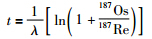
Re-Os同位素分析测试工作在国家地质实验测试中心完成,采用Carius管封闭溶样分解样品,Re和Os的分离等化学处理过程及质谱测试过程参见文献(Shirey and Walker,1995; 杜安道等,2001; 屈文俊和杜安道,2003; Du et al., 2004)。质谱测定采用美国TJA公司生产的TJA X-series ICPMS测定同位素比值,对于Re-Os含量很低的样品采用美国热电公司(Thermo Fisher Scientific)生产的高分辨电感耦合等离子体质谱仪HR-ICP-MS Element2进行测量。对于Re:选择质量数185、187,用190监测Os。对于Os:选择质量数为186、187、188、189、190、192,用185监测Re。本次实验标准物质为GBW04435(HLP)。模式年龄t按下式计算:
花岗岩中的锆石呈自形-半自形柱状,多呈不透明晶体,少数透明锆石晶体内部可观察到矿物包体,粒径100μm左右。锆石的CL阴极发光照片(图 6)多呈明暗略有差异的灰黑色,仅有少量保留岩浆环带。伟晶岩中锆石多为半自形-他形不透明晶体,也有少量自形晶(如ASK-8-9),粒径50~100μm,CL图像显示其多呈黑色模糊海绵状或多孔状。花岗岩与伟晶岩中锆石的上述特征表明其经历了蜕晶化作用,本文选取结构相对均一、透明度较高、孔隙及包体不发育的锆石进行测试分析,来探讨花岗岩与伟晶岩的形成时代。
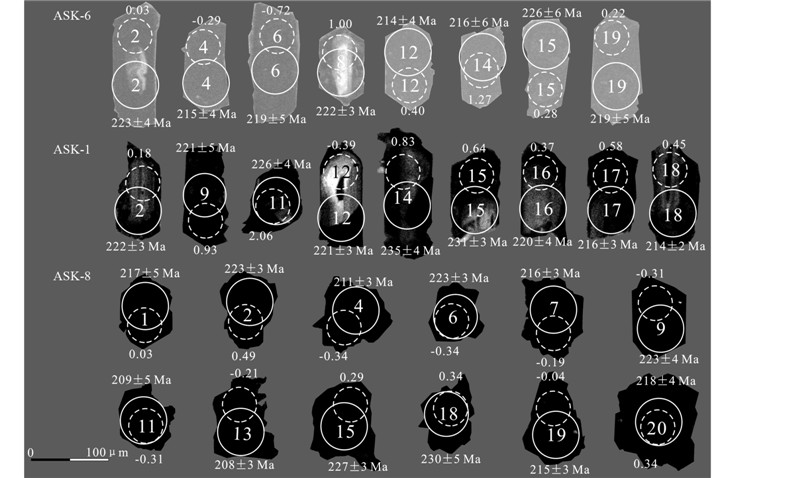 | 图 6 阿斯喀尔特矿区花岗岩(ASK-6、ASK-1)与伟晶岩(ASK-8)锆石阴极发光图像及分析点位、εHf(t)与206Pb/238U年龄值Fig. 6 Cathodoluminescence(CL)image showing the laser analytic spots,εHf(t)values and 206Pb/238U ages of zircon grains of granite(ASK-6,ASK-1) and pegmatite(ASK-8)from the Arskartor ore district |
白云母钠长花岗岩(ASK-6)中8个锆石颗粒的U-Pb测试结果列于表 1,锆石U含量为17742×10-6~96586×10-6,Th含量2264×10-6~10925×10-6,Th/U比值0.02~0.30。由于Th、U含量高,锆石207Pb/235U年龄值变化范围较大,导致部分测点偏离谐和线(图 7a)。但锆石206Pb/238U年龄值仍较为集中(214~226Ma),获得了219.2±2.9Ma(MSWD=3.5)的加权平均年龄。
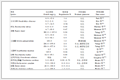 | 表 1 阿斯喀尔特矿区花岗岩与伟晶岩锆石U-Pb同位素数据表Table 1 Zircon U-Pb isotopic data for granite and pegmatite from Arskartor ore district |


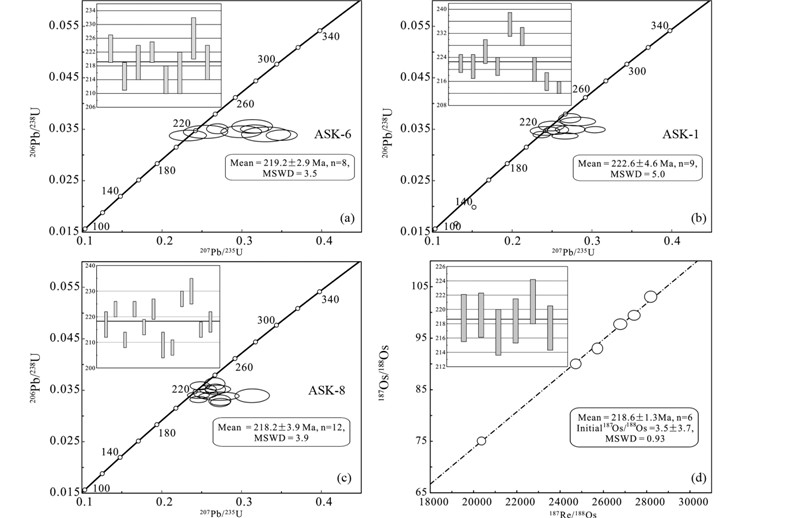 | 图 7 阿斯喀尔特矿区锆石U-Pb年龄与辉钼矿Re-Os年龄图Fig. 7 Diagram of zircon U-Pb ages and molybdenite Re-Os age in the Arskartor ore district |
对Be矿化白云母钠长花岗岩(ASK-1)中9个锆石颗粒进行测试,获得了类似的结果(图 7b)。锆石U含量为1393×10-6~18729×10-6,Th含量720×10-6~15700×10-6,Th/U比值0.05~5.31。锆石206Pb/238U年龄范围为214~235Ma,加权平均年龄为222.6±4.6Ma(MSWD=5.0)。
对条带状伟晶岩(ASK-8)中12个锆石颗粒进行测试,获得的数据点较为集中(图 7c)。锆石U含量为7081×10-6~21190×10-6,Th含量942×10-6~5144×10-6,Th/U比值0.08~0.38。锆石206Pb/238U年龄范围为208~230Ma,加权平均年龄为218.2±3.9Ma,MSWD为3.9(图 7c)。
4.2 锆石Hf同位素结果
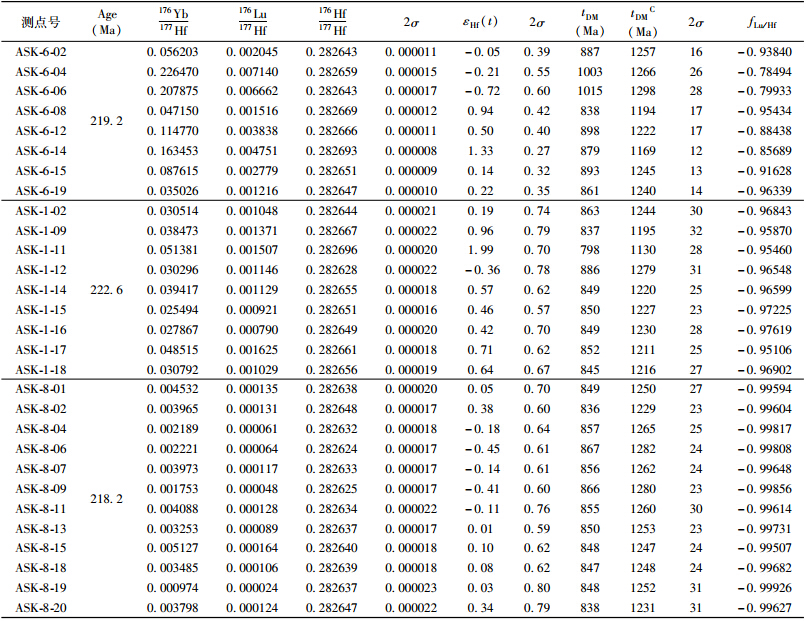
本次研究通过MC-ICPMS获得锆石Hf同位素结果列于表 2,所选点位均在已做测年分析的锆石颗粒之上(图 6)。对白云母钠长花岗岩(ASK-6)中的8粒锆石进行了Hf 同位素分析测试,176Hf/177Hf值范围为0.282643~0.282693,计算的εHf(t)值范围为-0.72~+1.33,tDMC模式年龄为1169~1298Ma; 对Be矿化白云母钠长花岗岩(ASK-1)中的9粒锆石进行了Hf同位素分析测试,176Hf/177Hf 值范围为0.282628~0.282696,计算的εHf(t)值范围为-0.36~+1.99,tDMC模式年龄为1130~1279Ma;对条带状伟晶岩(ASK-8)中的12粒锆石进行Hf同位素分析测试,176Hf/177Hf值0.282624~0.282648,计算的εHf(t)值范围为-0.45~+0.38,tDMC模式年龄为1229~1282Ma。
| 表 2 阿斯喀尔特矿区花岗岩与伟晶岩锆石Hf同位素结果Table 2 Hf isotope data of zircons of granite and pegmatite from the Arskartor ore district |
6件辉钼矿样品的Re-Os同位素测试结果见表 3。辉钼矿中Re含量变化于32.40×10⁻⁶~44.84×10-6,6件样品的模式年龄介于216.8~221.1Ma。用Isoplot软件(Ludwig,2003)对获得的6个数据进行年龄计算,获得的加权平均年龄值为218.6±1.3Ma,MSWD=0.93(图 7d)。
| 表 3 阿斯喀尔特矿区辉钼矿Re-Os同位素数据Table 3 Re-Os data for Molybdenum from the Arskartor ore district |
如前所述,阿斯喀尔特矿区花岗岩与伟晶岩中的锆石由于高的U、Th含量,经历了蜕晶化甚至重结晶作用,并可能在高温熔-流体阶段遭受热液蚀变作用(Nemchin and Pidgeon,1997; Tomaschek et al., 2003; Rayner et al., 2005)。一般认为这类锆石的年龄值由于分布不集中而无法获得谐和年龄,因此不适合进行年代学研究。但是锆石的封闭温度高,不易受晚期热事件影响(Lee et al., 1997; Cherniak and Watson,2001),因此选取结构均一、透明度高、孔隙及包体不发育的锆石进行分析仍具重要的地质意义(Wang et al., 2007; Lupulescu et al., 2011)。尤其是将锆石U-Pb年龄与其他同位素定年体系获得的年龄值相结合,能够限定伟晶岩形成时代和演化时限。以阿尔泰地区研究程度最高的可可托海3号脉为例,获得不同相带的锆石U-Pb年龄、白云母及全岩Rb-Sr年龄、辉钼矿Re-Os年龄分别为212~220Ma、218.4±5.8Ma、209.9±1.3Ma(Zhu et al., 2006; Wang et al., 2007; 陈剑锋,2011; Liu et al., 2014),表明各相带的形成时间介于209~220Ma,演化时限约为10Myr。
本次工作获得的阿斯喀尔特矿区白云母钠长花岗岩与Be矿化白云母钠长花岗岩的锆石U-Pb年龄分别为219.2±3.2Ma与222.6±4.6Ma,比前人获得的全岩Rb-Sr年龄稍晚(234±12Ma; 邹天人与李庆昌,2006),但仍在误差范围内。条带状伟晶岩的锆石U-Pb年龄为218.2±3.9Ma,辉钼矿Re-Os年龄为218.6±1.3Ma。由于条带状伟晶岩为形成最早的伟晶岩相,辉钼矿等硫化物形成于伟晶岩演化的晚阶段,因此其年龄分别代表了伟晶岩演化时间的上、下限。两个年龄值基本一致,表明伟晶岩的演化时间并不长,这与近年来提出的伟晶岩快速冷却结晶模型一致(Chakoumakos and Lumpkin,1990; Morgan and London,1999)。综上伟晶岩的形成时间稍晚于白云母钠长花岗岩,花岗-伟晶岩系统的演化时间较短。 5.2 成岩物质来源
阿斯喀尔特矿区白云母钠长花岗岩与条带状伟晶岩具有相近的成岩时代与176Hf/177Hf值范围,εHf(t)值与tDMC模式年龄范围也基本一致,表明二者具有相同的成岩源区。与区域上可能为可可托海成矿母岩的中生代阿拉尔花岗岩(Wang et al., 2007; 陈剑锋,2011; Liu et al., 2014),以及形成时代相近的可可托海、柯鲁木特稀有金属伟晶岩(陈剑锋,2011; Lü et al.,2012)的Hf同位素组成进行对比,发现εHf(t)及tDMC分布范围相近。在εHf(t)-t图解中,所有样品都分布于球粒陨石演化线附近,明显偏离亏损地幔线(图 8),表明阿尔泰地区中晚印支期稀有金属伟晶岩及相关花岗岩成岩源区类似,幔源物质的贡献相对较少。
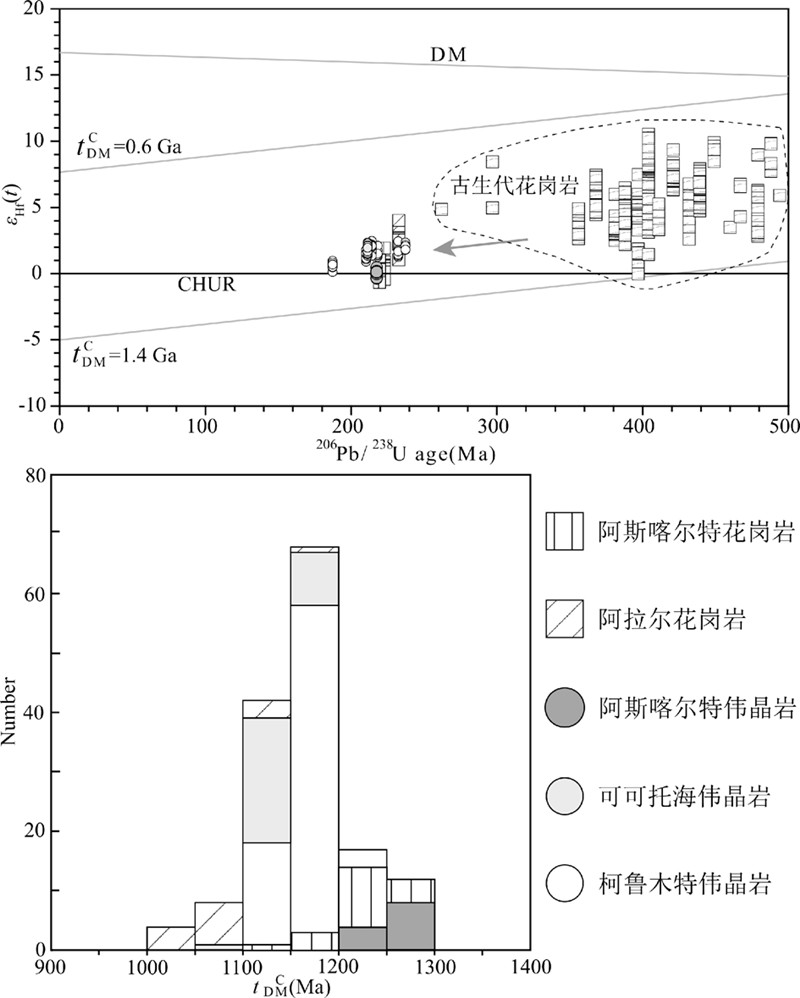 | 图 8 阿尔泰地区花岗岩及中生代伟晶岩锆石Hf同位素对比图 古生代花岗岩据Cai et al.(2011a,b),可可托海伟晶岩及阿拉尔花岗岩据陈剑锋(2011),柯鲁木特伟晶岩据Lü et al.(2012)Fig. 8 Comparison of zircon Hf isotopic compositions of granites and Mesozoic pegmatites in the Altay data of Paleozoic granite from Cai et al.(2011a,b),Koktokay pegmatite and Aral granite from Chen(2011),Kelumute pegmatite from Lü et al.(2012) |
阿尔泰地区花岗岩主要发育于古生代,年龄值峰期为400Ma左右,集中于360~460Ma与280~340Ma两个区间(邹天人等,1988; Han et al., 1997; Cai et al., 2011a,b; 董连慧等,2012),分别对应于增生造山及造山后演化阶段(Yakubchuk,2004; Windley et al., 2007; Xiao et al., 2009)。中生代岩浆活动明显减弱,但稀有金属伟晶岩及相关花岗岩主要形成于该时期(Wang et al., 2007; 韩宝福,2008; Lü et al.,2012 Zhou et al., 2015a)。古生代花岗岩具有相对较高的锆石εHf(t)值,集中分布区间为+2~+10(Cai et al., 2011a,b),tDMC值集中于900~1200Ma。结合其Sr-Nd同位素特征,认为增生造山阶段随着地壳侧向及垂向的生长,其源区既有来自图瓦-蒙古前寒武纪微陆块的壳源物质(Sun et al., 2008; Long et al., 2010; Jiang et al., 2011; Liu et al., 2012),也有新生幔源物质的贡献(王涛等,2005; 童英等,2006; Yuan et al., 2007; Wang et al., 2009; Cai et al., 2011a,b)。中生代花岗岩及伟晶岩的锆石εHf(t)值总体呈现下降的趋势(图 8),可能与造山后构造稳定阶段壳幔相互作用减弱有关(Jahn et al., 2000b; Wang et al., 2009; Lü et al.,2012)。因此阿尔泰地区中生代稀有金属伟晶岩及相关花岗岩的源区主要为前寒武纪微陆块的壳源物质。 5.3 矿床成因类型与成矿动力学背景
Černý(1991a)在前人深度分类的基础上,提出了伟晶岩的岩石成因分类,将伟晶岩分为LCT型(富集Li、Cs、Ta、Be、Ga、Sn等)、NYF型(富集Nb、Y、F、Zr、Th、U及REE)与NYF+LCT复合型。此后该方案得到进一步的完善和深化,前人根据矿物学、地球化学及形成条件进一步划分了亚类和亚型(Wise,1999; Černý and Ercit,2005; Ercit,2005),建立了与花岗岩的联系并应用至花岗岩分类(London,1995,2005),提出了相关的岩浆形成机制及大地构造背景(Simmons et al., 2003; Martin and de Vito,2005),因而该分类方案能够指示伟晶岩的成因。
全球LCT型伟晶岩一般产于造山带中,形成时代对应于全球造山带演化及超大陆聚合的时间(Černý,1991b; Tkachev,2011; Bradley and McCauley,2013),通常与后碰撞构造背景下加厚地壳重熔形成的过铝质花岗岩有关(Sylvester,1998; Martin and de Vito,2005)。前人对阿尔泰各伟晶岩区的稀有金属伟晶岩进行了大量年代学研究工作,表明稀有金属成矿主要发育于中生代(表 4),集中于印支期-燕山早期。普遍认为阿尔泰地区在晚古生代晚期至中生代早期已演化至造山后阶段,出现挤压-伸展-走滑并存的构造格局(Allen et al., 1995; Laurent-Charvet et al., 2003; Chikov et al., 2008; Briggs et al., 2009),该时期形成若干碱性花岗岩,并有基性-超基性岩浆活动(Han et al., 1997; 王涛等,2005; 童英等,2006; Cai et al., 2010),此后进入后造山板内演化阶段(Yakubchuk,2004; Glorie et al., 2012),加厚地壳熔融形成过铝质花岗岩与相关稀有金属伟晶岩(刘伟,1990; 康旭和王淑珍,1992; 王登红等,2003,2004; 韩宝福,2008)。
| 表 4 阿尔泰地区稀有金属伟晶岩形成时代Table 4 Ages of rare-mental pegmatites in Altay |
本文根据阿斯喀尔特伟晶岩的地质特征及矿化组合,结合其源区特征及大地构造背景,提出阿斯喀尔特伟晶岩为LCT型,与阿尔泰地区可可托海、柯鲁木特等规模较大的稀有金属伟晶岩一致(王登红等,2004; Lü et al.,2012 周起凤等,2013; Zhou et al., 2015b)。LCT型伟晶岩的成因通常可以与花岗岩建立联系,这种亲缘性已经得到岩石学、矿物学、同位素地球化学及年代学等多方面的证实
(Černý,1991a,b; Tomascak et al., 1998; Pezzotta,2000)。阿斯喀尔特矿区白云母钠长花岗岩与条带状伟晶岩带呈渐变过渡,且具基本一致的矿物组合,另外几个相带也以白云母钠长花岗岩为中心分布;白云母钠长花岗岩的LREE/HREE值范围为5.24~9.79,δEu值为0.72~0.91,δ18O范围为+11.2‰~+12.0‰(邹天人与李庆昌,2006),与典型LCT伟晶岩母岩体的地化特征一致(Černý and Meintzer,1988; Černý,1991a)。
综合上文对花岗岩与伟晶岩的形成时代及源区特征的认识,认为阿斯喀尔特矿区白云母钠长花岗岩为伟晶岩的成矿母岩。 6 结论
(1)阿斯喀尔特矿区同时发育花岗岩型与伟晶岩型两类稀有金属矿化。花岗岩型稀有金属矿化发育于白云母钠长花岗岩中,伟晶岩位于白云母钠长花岗岩株顶部,可分为5个相带,晚阶段有硫化物发育。
(2)矿区白云母钠长花岗岩、Be矿化白云母钠长花岗岩及条带状伟晶岩的锆石U-Pb年龄分别为219.2±2.9Ma、222.6±4.6Ma与218.2±3.9Ma,伟晶岩的辉钼矿Re-Os年龄为218.6±1.3Ma。伟晶岩的形成时间稍晚于白云母钠长花岗岩,花岗-伟晶岩系统的演化时间较短。
(3)白云母钠长花岗岩与条带状伟晶岩具有基本一致的εHf(t)及tDMC范围,表明二者具有相同的成岩源区,且与区域上中生代花岗岩及稀有金属伟晶岩的源区类似,以前寒武纪微陆块的壳源物质为主。
(4)白云母钠长花岗岩与伟晶岩形成于后造山板内演化阶段,与加厚地壳的熔融作用有关。
(5)阿斯喀尔特伟晶岩属于LCT型,白云母钠长花岗岩为伟晶岩的成矿母岩。
致谢 野外工作中得到了新疆有色金属地质勘查局吴宏恩高级工程师、701队盛华高级工程师以及706队樊俊利助工等人的支持和帮助;文章选题及写作得到了肖文交研究员的悉心指导;锆石U-Pb定年和Hf同位素测试分析得到了中国地质大学(武汉)刘勇胜教授和胡兆初教授的大力帮助;辉钼矿Re-Os测试得到了国家地质测试中心屈文俊研究员和博士生李超的帮助;成文过程中宋国学博士、赵俊兴博士和曹明坚博士提供了有益参考意见;刘伟研究员和王登红研究员悉心审阅并提出宝贵意见与建议;在此一并谨致谢忱!| [1] | Allen MB, Windley BF and Zhang C. 1993. Palaeozoic collisional tectonics and magmatism of the Chinese Tien Shan, central Asia. Tectonophysics, 220(1-4): 89-115 |
| [2] | Allen MB, Şengör AMC and Natal'In BA. 1995. Junggar, Turfan and Alakol basins as Late Permian to? Early Triassic extensional structures in a sinistral shear zone in the Altaid orogenic collage, Central Asia. Journal of the Geological Society, 152(2): 327-338 |
| [3] | Andersen T. 2002. Correction of common lead in U-Pb analyses that do not report 204Pb. Chemical Geology, 192(1-2): 59-79 |
| [4] | Blichert-Toft J and Albarède F. 1997. The Lu-Hf isotope geochemistry of chondrites and the evolution of the mantle-crust system. Earth and Planetary Science Letters, 148(1-2): 243-258 |
| [5] | Bradley D and McCauley A. 2013. A preliminary deposit model for lithium-cesium-tantalum (LCT) pegmatites. U. S. Geological Survey: 1-7 |
| [6] | Briggs SM, Yin A, Manning CE, Chen ZL, Wang XF and Grove M. 2007. Late Paleozoic tectonic history of the Ertix Fault in the Chinese Altai and its implications for the development of the Central Asian Orogenic System. Geological Society of America Bulletin, 119(7-8): 944-960 |
| [7] | Briggs SM, Yin A, Manning CE, Chen ZL and Wang XF. 2009. Tectonic development of the southern Chinese Altai Range as determined by structural geology, thermobarometry, 40Ar/39Ar thermochronology, and Th/Pb ion-microprobe monazite geochronology. Geological Society of America Bulletin, 121(9-10): 1381-1393 |
| [8] | Buslov MM, Saphonova IY, Watanabe T, Obut OT, Fujiwara Y, Iwata K, Semakov NN, Sugai Y, Smirnova LÜ and Kazansky AY. 2001. Evolution of the Paleo-Asian Ocean (Altai-Sayan Region, Central Asia) and collision of possible Gondwana-derived terranes with the southern marginal part of the Siberian continent. Geosciences Journal, 5(3): 203-224 |
| [9] | Buslov MM, Watanabe T, Smirnova LÜ, Fujiwara I, Iwata K, de Grave J, Semakov NN, Travin AV, Kir'yanova AP and Kokh DA. 2003. Role of strike-slip faults in Late Paleozoic-Early Mesozoic tectonics and geodynamics of the Altai-Sayan and East Kazakhstan folded zone. Russian Geology and Geophysics, 44(1-2): 49-75 |
| [10] | Buslov MM, Fujiwara Y, Iwata K and Semakov NN. 2004. Late Paleozoic-Early Mesozoic geodynamics of Central Asia. Gondwana Research, 7(3): 791-808 |
| [11] | Cai KD, Sun M, Yuan C, Zhao GC, Xiao WJ, Long XP and Wu FY. 2010. Geochronological and geochemical study of mafic dykes from the Northwest Chinese Altai: Implications for petrogenesis and tectonic evolution. Gondwana Research, 18(4): 638-652 |
| [12] | Cai KD, Sun M, Yuan C, Long XP and Xiao WJ. 2011a. Geological framework and Paleozoic tectonic history of the Chinese Altai, NW China: A review. Russian Geology and Geophysics, 52(12): 1619-1633 |
| [13] | Cai KD, Sun M, Yuan C, Zhao GC, Xiao WJ, Long XP and Wu FY. 2011b. Prolonged magmatism, juvenile nature and tectonic evolution of the Chinese Altai, NW China: Evidence from zircon U-Pb and Hf isotopic study of Paleozoic granitoids. Journal of Asian Earth Sciences, 42(5): 949-968 |
| [14] | Černý P and Meintzer RE. 1988. Fertile granites in the Archean and Proterozoic fields of rare-element pegmatites: Crustal environment, geochemistry and petrogenic relationships. In: Taylor RP and Strong DF (eds.). Recent Advances in the Geology of Granite-Related Mineral Deposits. Canadian Institute of Mining and Metallurgy Special Volume, 39: 170-207 |
| [15] | Černý P. 1991a. Rare-element granitic pegmatites. Part Ⅰ. Anatomy and internal evolution of pegmatite deposits. Geoscience Canada, 18: 49-67 |
| [16] | Černý P. 1991b. Rare-element granitic pegmatites. Part Ⅱ. Regional to global environments and petrogenesis. Geoscience Canada, 18: 68-81 |
| [17] | Černý P and Ercit TS. 2005. The classification of granitic pegmatites revisited. The Canadian Mineralogist, 43(6): 2005-2026 |
| [18] | Chakoumakos BC and Lumpkin GR. 1990. Pressure-temperature constraints on the crystallization of the Harding pegmatite, Taos County, New Mexico. Canadian Mineralogist, 28: 287-298 |
| [19] | Chen JF. 2011. Geochemistry of the plate part in Altai No.3 pegmatite and its formation and evolution. Master Degree Thesis. Beijing: University of Chinese Academy of Sciences, 1-86 (in Chinese) |
| [20] | Cherniak DJ and Watson EB. 2001. Pb diffusion in zircon. Chemical Geology, 172(1-2): 5-24 |
| [21] | Chikov BM, Zinoviev SV and Deyev EV. 2008. Mesozoic and Cenozoic collisional structures of the southern Great Altai. Russian Geology and Geophysics, 49(5): 323-331 |
| [22] | Dobretsov NL, Berzin NA and Buslov MM. 1995. Opening and tectonic evolution of the Paleo-Asian Ocean. International Geology Review, 37(4): 335-360 |
| [23] | Dong LH, Qu X, Zhao TY, Xu SQ, Zhou RH, Wang KZ and Zhu ZX. 2012. Magmatic sequence of Early Palaeozoic granitic intrusions and its tectonic implications in North Altay orogen, Xinjiang. Acta Petrologica Sinica, 28(8): 2307-2316 (in Chinese with English abstract) |
| [24] | Du AD, Zhao DM, Wang SX, Sun DZ and Liu DY. 2001. Precise Re-Os dating for molybdenite by ID-NTIMS with carius tube sample preparation. Rock and Mineral Analysis, 20(4): 247-252 (in Chinese with English abstract) |
| [25] | Du AD, Wu SQ, Sun DZ, Wang SX, Qu WJ, Markey R, Stein H, Morgan J and Malinovskiy D. 2004. Preparation and certification of Re-Os dating reference materials: Molybdenites HLP and JDC. Geostandards and Geoanalytical Research, 28(1): 41-52 |
| [26] | Ercit TS. 2005. REE-enriched granitic pegmatites. In: Linnen RL and Sampson IM (eds.). Rare-Element Geochemistry and Mineral Deposits. St. Catharines: Geological Society of Canada, 17: 175-199 |
| [27] | Feng YL and Jiang XB. 1987. A study of the pegmatitic-pneumatolytic-hypothermal beryls and aquamarines from the Arskartor mine in Xinjiang. Acta Petrologica et Mineralogica, 6(4): 344-351 (in Chinese with English abstract) |
| [28] | Gao J, He GQ, Li MS, Xiao XC, Tang YQ, Wang J and Zhao M. 1995. The mineralogy, petrology, metamorphic PTDt trajectory and exhumation mechanism of blueschists, South Tianshan, northwestern China. Tectonophysics, 250(1-3): 151-168 |
| [29] | Glorie S, De Grave J, Buslov MM, Zhimulev FI, Elburg MA and Van den haute P. 2012. Structural control on Meso-Cenozoic tectonic reactivation and denudation in the Siberian Altai: Insights from multi-method thermochronometry. Tectonophysics, 544-545: 75-92 |
| [30] | Guo ZL, Shen MD, Guo XJ, Hu ZD, Tang DM, Zhou QF and Li BQ. 2013. Analysis of prospecting and metallogenisis of rare metal in granitic pegmatite from Altai. Xinjiang Geology, 31(Suppl.1): 77-83 (in Chinese with English abstract) |
| [31] | Han BF, Wang SG, Jahn BM, Hong DW, Kagami H and Sun YL. 1997. Depleted-mantle source for the Ulungur River A-type granites from North Xinjiang, China: Geochemistry and Nd-Sr isotopic evidence, and implications for Phanerozoic crustal growth. Chemical Geology, 138(3-4): 135-159 |
| [32] | Han BF. 2008. A preliminary comparison of Mesozoic granitoids and rare metal deposits in Chinese and Russian Altai Mountains. Acta Petrologica Sinica, 24(4): 655-660 (in Chinese with English abstract) |
| [33] | Han BF, Guo ZJ, Zhang ZC, Zhang L, Chen JF and Song B. 2010. Age, geochemistry, and tectonic implications of a Late Paleozoic stitching pluton in the North Tian Shan suture zone, western China. Geological Society of American Bulletin, 122(3-4): 627-640 |
| [34] | Han BF, He GQ, Wang XC and Guo ZJ. 2011. Late Carboniferous collision between the Tarim and Kazakhstan-Yili terranes in the western segment of the South Tian Shan Orogen, Central Asia, and implications for the northern Xinjiang, western China. Earth-Science Reviews, 109(3-4): 74-93 |
| [35] | He GQ, Han BF, Yue YJ and Wang JH. 1990. Tectonic division and crustal evolution of Altay orogenic belt in China. Geosciences of Xinjiang. Beijing: Geological Publishing House, 9-20(in Chinese) |
| [36] | He GQ, Li MS, Liu DQ, Tang YL and Zhou RH. 1994. Paleozoic Crustal Evolution and Mineralization in Xinjiang of China. Urumuqi: Xinjiang People's Publishing House; Hongkong: Educational and Cultural Press, 1-437 (in Chinese with English abstract) |
| [37] | Hu ZC, Liu YS, Gao S, Liu WG, Yang L, Zhang W, Tong XR, Lin L, Zong KQ, Li M, Chen HH, Zhou L and Yang L. 2012. Improved in situ Hf isotope ratio analysis of zircon using newly designed X skimmer cone and Jet sample cone in combination with the addition of nitrogen by laser ablation multiple collector ICP-MS. Journal of Analytical Atomic Spectrometry, 27(9): 1391-1399 |
| [38] | Jahn BM, Griffin WL and Windley B. 2000a. Continental growth in the Phanerozoic: Evidence from Central Asia. Tectonophysics, 328(1-2): vii-x |
| [39] | Jahn BM, Wu FY and Chen B. 2000b. Granitoids of the Central Asian Orogenic Belt and continental growth in the Phanerozoic. Transactions of the Royal Society of Edinburgh: Earth Sciences, 91(1-2): 181-193 |
| [40] | Jahn BM, Windley B, Natal'In B and Dobretsov N. 2004. Phanerozoic continental growth in Central Asia. Journal of Asian Earth Sciences, 23(5): 599-603 |
| [41] | Jiang YD, Sun M, Zhao GC, Yuan C, Xiao WJ, Xia XP, Long XP and Wu FY. 2011. Precambrian detrital zircons in the Early Paleozoic Chinese Altai: Their provenance and implications for the crustal growth of central Asia. Precambrian Research, 189(1-2): 140-154 |
| [42] | Kang X and Wang SZ. 1992. Characteristics of granites in Koktokay region, Xinjiang. Acta Petrologica Sinica, 8(4): 399-404 (in Chinese with English abstract) |
| [43] | Kovalenko VI, Yarmolyuk VV, Kovach VP, Kotov AB, Kozakov IK, Salnikova EB and Larin AM. 2004. Isotope provinces, mechanisms of generation and sources of the continental crust in the Central Asian mobile belt: Geological and isotopic evidence. Journal of Asian Earth Sciences, 23(5): 605-627 |
| [44] | Kröner A, Windley BF, Badarch G, Tomurtogoo O, Hegner E, Jahn BM, Gruschka S, Khain EV, Demoux A and Wingate MTD. 2007. Accretionary growth and crust formation in the Central Asian Orogenic Belt and comparison with the Arabian-Nubian shield. GSA Memoirs, 200: 181-209 |
| [45] | Laurent-Charvet S, Charvet J, Monié P and Shu LS. 2003. Late Paleozoic strike-slip shear zones in eastern central Asia (NW China): New structural and geochronological data. Tectonics, 22(2): doi: 10.1029/2001TC901047 |
| [46] | Lee JKW, Williams IS and Ellis DJ. 1997. Pb, U and Th diffusion in natural zircon. Nature, 390(6656): 159-162 |
| [47] | Liu F, Zhang ZX, Li Q, Zhang C and Li C. 2014. New precise timing constraint for the Keketuohai No.3 pegmatite in Xinjiang, China, and identification of its parental pluton. Ore Geology Reviews, 56: 209-219 |
| [48] | Liu W. 1990. Petrogenetic epoches and peculiarities of genetic types of granitoids in the Altai Mts., Xinjiang Uygur Autonomous Region, China. Geotectonica et Metallogenia, 14(1): 43-56 (in Chinese with English abstract) |
| [49] | Liu W, Liu XJ and Xiao WJ. 2012. Massive granitoid production without massive continental-crust growth in the Chinese Altay: Insight into the source rock of granitoids using integrated zircon U-Pb age, Hf-Nd-Sr isotopes and geochemistry. American Journal of Science, 312(6): 629-684 |
| [50] | Liu YS, Hu ZC, Gao S, Gunther D, Xu J, Gao CG and Chen HH. 2008. In situ analysis of major and trace elements of anhydrous minerals by LA-ICP-MS without applying an internal standard. Chemical Geology, 257(1-2): 34-43 |
| [51] | Liu YS, Gao S, Hu ZC, Gao CG, Zong KQ and Wang DB. 2010. Continental and oceanic crust recycling-induced melt-peridotite interactions in the Trans-North China Orogen: U-Pb dating, Hf isotopes and trace elements in zircons from mantle xenoliths. Journal of Petrology, 51(1-2): 537-571 |
| [52] | London D. 1995. Geochemical features of peraluminous granites, pegmatites, and rhyolites as sources of lithophile metal deposits. In: Thompson JFH (ed.). Magmas, Fluids, and Ore Deposits. Mineral Association Canada. Short Course Handbook, 23: 175-202 |
| [53] | London D. 2005. Geochemistry of alkali and alkaline earth elements in ore-forming granites, pegmatites, and rhyolites. In: Linnen RL and Sampson IM (eds.). Rare-Element Geochemistry and Mineral Deposits. Geological Society of Canada. Short Course Notes. St. Catharines, 17: 175-199 |
| [54] | Long XP, Yuan C, Sun M, Xiao WJ, Zhao GC, Wang YJ, Cai KD, Xia XP and Xie LW. 2010. Detrital zircon ages and Hf isotopes of the Early Paleozoic flysch sequence in the Chinese Altai, NW China: New constrains on depositional age, provenance and tectonic evolution. Tectonophysics, 480(1-4): 213-231 |
| [55] | Ludwig KR. 2003. Isoplo 3.00: A Geochronological Toolkit for Microsoft Excel. Berkeley: Geochronology Center Special Publication, 1-70 |
| [56] | Lupulescu MV, Chiarenzelli JR, Pullen AT and Price JD. 2011. Using pegmatite geochronology to constrain temporal events in the Adirondack Mountains. Geosphere, 7(1): 23-39 |
| [57] | Lü ZH, Zhang H, Tang Y and Guan SJ. 2012. Petrogenesis and magmatic-hydrothermal evolution time limitation of Kelumute No.112 pegmatite in Altay, northwestern China: Evidence from zircon U-Pb and Hf isotopes. Lithos, 154: 374-391 |
| [58] | Martin RF and de Vito C. 2005. The patterns of enrichment in felsic pegmatites ultimately depend on tectonic setting. The Canadina Mineralogist, 43(6): 2027-2048 |
| [59] | Morgan GB VI and London D. 1999. Crystallization of the Little Three layered pegmatite-aplite dike, Ramona District, California. Contributions to Mineralogy and Petrology, 136(4): 310-330 |
| [60] | Nemchin AA and Pidgeon RT. 1997. Evolution of the Darling range batholith, Yilgarn craton, western Australia: A SHRIMP zircon study. Journal of Petrology, 38(5): 625-649 |
| [61] | Pezzotta F. 2000. Internal structures, parageneses and classification of the miarolitic (Li-bearing) complex pegmatites of Elba Island (Italy). In: Pezzotta F (ed.). Mineralogy and Petrology of Shallow Depth Pegmatites. Memorie della Società Italiana di Scienze Naturali e del Museo Civico di Storia Naturale di Milano, XXX(I): 29-43 |
| [62] | Qin KZ, Sun S, Chen HH and Hao J. 1999. Temporal-spatial distribution framework of metal deposits in northern Xinjiang: Guides of Paleozoic archipelago-style collision orogenic belts. In: Chen HH, Hou QL and Xiao WJ (eds.). Collision Orogenic Belts of China. Beijing: China Ocean Press, 183-196 (in Chinese) |
| [63] | Qin KZ. 2000. Metellogeneses in relation to Central-Asia style orogeny of Northern Xinjiang. Post-Doetor Research Report. Beijing: Institute of Geology and Geophysics, China Academy of Science, 1-195 (in Chinese with English summary) |
| [64] | Qin KZ, Sun S, Li JL, Fang TH, Wang SL and Liu W. 2002. Paleozoic epithermal Au and porphyry Cu deposits in North Xinjiang, China: Epochs, features, tectonic linkage and exploration significance. Resource Geology, 52(4): 291-300 |
| [65] | Qin KZ, Xiao WJ, Zhang CL, Xu XW, Hao J, Sun S, Li JL and Tosdal RM. 2005. Eight stages of major ore deposits in northern Xinjiang, NW-China: Clues and constraints on the tectonic evolution and continental growth of central Asia. In: Mineral Deposit Research: Meeting the Global Challenge. Berlin Heidelberg: Springer, 1327-1330 |
| [66] | Qin KZ, Shen MD, Tang DM, Guo ZL, Zhou QF, Wang CL, Guo XJ, Tian Y and Ding JG. 2013. Types, intrusive and mineralization ages of pegmatite rare-element deposits in Chinese Altay. Xinjiang Geology, 31(Suppl.1): 1-7 (in Chinese with English abstract) |
| [67] | Qu WJ and Du AD. 2003. Highly precise Re-Os dating of molybdenite by ICP-MS with carius tube sample digestion. Rock and Mineral Analysis, 22(4): 254-257, 262 (in Chinese with English abstract) |
| [68] | Rayner N, Stern RA and Carr SD. 2005. Grain-scale variations in trace element composition of fluid-altered zircon, Acasta Gneiss Complex, northwestern Canada. Contributions to Mineralogy and Petrology, 148(6): 721-734 |
| [69] | Ren BQ, Zhang H, Tang Y and Lü ZH. 2011. LA-ICPMS U-Pb zircon geochronology of the Altai pegmatites and its geological significance. Acta Mineralogica Sinica, 31(3): 587-596 (in Chinese with English abstract) |
| [70] | Segal I, Halicz L and Platzner IT. 2003. Accurate isotope ratio measurements of ytterbium by multiple collection inductively coupled plasma mass spectrometry applying erbium and hafnium in an improved double external normalization procedure. Journal of Analytical Atomic Spectrometry, 18(10): 1217-1223 |
| [71] | Şengör AMC, Natal'In BA and Burtman VS. 1993. Evolution of the Altaid tectonic collage and Palaeozoic crustal growth in Eurasia. Nature, 364(6435): 299-307 |
| [72] | Şengör AMC and Natal'In BA. 1996. Turkic-type orogeny and its role in the making of the continental crust. Annual Review of Earth and Planetary Sciences, 24: 263-337 |
| [73] | Shirey SB and Walker RJ. 1995. Carius tube digestion for low-blank rhenium-osmium analysis. Analytical Chemistry, 67(13): 2136-2141 |
| [74] | Simmons WB, Webber KL, Falster AU and Nizamoff JW. 2003. Pegmatology: Pegmatite Mineralogy, Petrology and Petrogenesis. New Orleans, LA: Rubellite Press, 1-176 |
| [75] | Smoliar MI, Walker BJ and Morgan JW. 1996. Re-Os ages of group ⅡA, ⅢA, IVA and ⅣB iron meteorites. Science, 271(5252): 1099-1102 |
| [76] | Sun M, Yuan C, Xiao WJ, Long XP, Xia XP, Zhao GC, Lin SF, Wu FY and Kröner A. 2008. Zircon U-Pb and Hf isotopic study of gneissic rocks from the Chinese Altai: Progressive accretionary history in the early to middle Palaeozoic. Chemical Geology, 247(3-4): 352-383 |
| [77] | Sun S, Li JL, Lin JL, Wang QC and Chen HH. 1991. Indosinides in China and the consumption of eastern paleotethys. In: Muller DW, McKenzie JA and Weissert H (eds.). Controversies in Modern Geology. London: Academic Press, 363-384 |
| [78] | Sylvester PJ. 1998. Post-collisional strongly peraluminous granites. Lithos, 45(1-4): 29-44 |
| [79] | Tkachev AV. 2011. Evolution of metallogeny of granitic pegmatites associated with orogens throughout geological time. Geological Society, London, Special Publications, 350(1): 7-23 |
| [80] | Tomascak PB, Krogstad EJ and Walker RJ. 1998. Sm-Nd isotope systematics and the derivation of granitic pegmatites in southwestern Maine. Canadian Mineralogist, 36(2): 327-337 |
| [81] | Tomaschek F, Kennedy AK, Villa IM, Lagos M and Ballhaus C. 2003. Zircons from Syros, Cyclades, Greece-recrystallization and mobilization of zircon during high-pressure metamorphism. Journal of Petrology, 44(11): 1977-2002 |
| [82] | Tong Y, Wang T, Kovach VP, Hong DW and Han BF. 2006. Age and origin of the Takeshiken postorogenic alkali-rich intrusive rocks in southern Altai, near the Mongolian border in China and its implications for continental growth. Acta Petrologica Sinica, 22(5): 1267-1278 (in Chinese with English abstract) |
| [83] | Wang DH, Chen YC, Zou TR, Xu ZG, Li HQ, Chen W, Chen FW and Tian F. 2000. 40Ar/39Ar dating for the Azubai rare metal-gem deposit in Altay, Xinjiang: New evidence for Yanshanian mineralization of rare metals. Geological Review, 46(3): 307-311 (in Chinese with English abstract) |
| [84] | Wang DH, Chen YC and Xu ZG. 2003. 40Ar/39Ar isotope dating on muscovites from Indosinian rare metal deposits in Central Altay, northwestern China. Bulletin of Mineralogy, Petrology and Geochemistry, 22(1): 14-17 (in Chinese with English abstract) |
| [85] | Wang DH, Zou TR, Xu ZG, Yu JJ and Fu XF. 2004. Advance in the study of using pegmatite deposits as the tracer of orogenic process. Advances in Earth Science, 19(4): 614-620 (in Chinese with English abstract) |
| [86] | Wang T, Hong DW, Tong Y, Han BF and Shi YR. 2005. Zircon U-Pb SHRIMP age and origin of post-orogenic Lamazhao granitic pluton from Altai orogen: Its implications for vertical continental growth. Acta Petrologica Sinica, 21(3): 640-650 (in Chinese with English abstract) |
| [87] | Wang T, Tong Y, Jahn BM, Zou TR, Wang YB, Hong DW and Han BF. 2007. SHRIMP U-Pb Zircon geochronology of the Altai No.3 pegmatite, NW China, and its implications for the origin and tectonic setting of the pegmatite. Ore Geology Reviews, 32(1-2): 325-336 |
| [88] | Wang T, Jahn BM, Kovach VP, Tong Y, Hong DW and Han BF. 2009. Nd-Sr isotopic mapping of the Chinese Altai and implications for continental growth in the Central Asian Orogenic Belt. Lithos, 110(1-4): 359-372 |
| [89] | Windley BF, Kröner A, Guo JH, Qu GS, Li YY and Zhang C. 2002. Neoproterozoic to Paleozoic geology of the Altai orogen, NW China: New zircon age data and tectonic evolution. The Journal of Geology, 110(6): 719-737 |
| [90] | Windley BF, Alexeiev D, Xiao WJ, Kröner A and Badarch G. 2007. Tectonic models for accretion of the Central Asian Orogenic Belt. Journal of the Geological Society, 164(1): 31-47 |
| [91] | Wise MA. 1999. Characterization and classification of NYF-type pegmatites. In: The Eugene E. Foord Memorial Symp. on NYF-type Pegmatites (Denver). Canadian Mineralogist, 37: 802-803 |
| [92] | Wu BQ and Zou TR. 1989. The genesis of granitic pegmatites in Xinjiang Altai. Mineral and Geology of Xinjiang, (1): 60-70 (in Chinese with English abstract) |
| [93] | Xiao WJ, Windley BF, Badarch G, Sun S, Li JL, Qin KZ and Wang ZH. 2004. Palaeozoic accretionary and convergent tectonics of the southern Altaids: Implications for the growth of Central Asia. Journal of the Geological Society, 161(3): 339-342 |
| [94] | Xiao WJ, Han CM, Yuan C, Chen HL, Sun M, Lin SF, Li ZL, Mao QG, Zhang JE, Sun S and Li JL. 2006. Unique Carboniferous-Permian tectonic-metallogenic framework of northern Xinjiang (NW China): Constraints for the tectonics of the southern Paleoasian Domain. Acta Petrologica Sinica, 22(5): 1362-1376 (in Chinese with English abstract) |
| [95] | Xiao WJ, Windley BF, Yuan C, Sun M, Han CM, Lin SF, Chen HL, Yan QR, Liu DY, Qin KZ, Li JL and Sun S. 2009. Paleozoic multiple subduction-accretion processes of the southern Altaids. American Journal of Science, 309(3): 221-270 |
| [96] | Xiao WJ, Huang BC, Han CM, Sun S and Li JM. 2010. A review of the western part of the Altaids: A key to understanding the architecture of accretionary orogens. Gondwana Research, 18(2-3): 253-273 |
| [97] | Yakubchuk A. 2002. The Baikalide-Altaid, Transbaikal-Mongolian and North Pacific orogenic collages: Similarity and diversity of structural patterns and metallogenic zoning. Geological Society, London, Special Publications, 204(1): 273-297 |
| [98] | Yakubchuk A. 2004. Architecture and mineral deposit settings of the Altaid orogenic collage: A revised model. Journal of Asian Earth Sciences, 23(5): 761-779 |
| [99] | Yuan C, Sun M, Xiao WJ, Li XH, Chen HL, Lin SF, Xia XP and Long XP. 2007. Accretionary orogenesis of the Chinese Altai: Insights from Paleozoic granitoids. Chemical Geology, 242(1-2): 22-39 |
| [100] | Zhou QF, Qin KZ, Tang DM, Ding JG and Guo ZL. 2013. Mineralogy and significance of micas and feldspars from the Koktokay No.3 pegmatitic rare-element deposit, Altai. Acta Petrologica Sinica, 29(9): 3004-3022 (in Chinese with English abstract) |
| [101] | Zhou QF, Qin KZ, Tang DM, Tian Y, Cao MJ and Wang CL. 2015a. Formation age and evolution time span of the Koktokay No.3 pegmatite, Altai, NW China: Evidence from U-Pb zrcon and Ar40-Ar39 muscovite ages. Resource Geology, 65(3): 210-231 |
| [102] | Zhou QF, Qin KZ, Tang DM, Wang CL, Tian Y and Sakyi PA. 2015b. Mineralogy of the Koktokay No. 3 pegmatite, Altai, NW China: Implications for evolution and melt-fluid processes of rare-metal pegmatites. European Journal of Mineralogy, 27: 433-457 |
| [103] | Zhu YF, Zeng YS and Gu LB. 2006. Geochemistry of the rare metal-bearing pegmatite No.3 vein and related granites in the Keketuohai region, Altay Mountains, Northwest China. Journal of Asian Earth Sciences, 27(1): 61-77 |
| [104] | Zou TR, Cao HZ and Wu BQ. 1988. Orogenic and anorogenic granitoids of the Altay Mountains, Xinjiang and their discrimination criteria. Acta Geologica Sinica, (3): 228-245 (in Chinese with English abstract) |
| [105] | Zou TR. 1996. Arskartor aquamarine-beryl deposit in Xinjiang. Mineral Deposit, 15(Suppl.): 38-40(in Chinese) |
| [106] | Zou TR and Li QC. 2006. Rare-elements and REE Deposits in Xinjiang, China. Beijing: Geological Publishing House, 1-264(in Chinese) |
| [107] | 陈剑锋. 2011. 阿尔泰3号伟晶岩脉缓倾斜部分岩浆的形成与演化. 硕士学位论文. 北京: 中国科学院研究生院, 1-86 |
| [108] | 董连慧, 屈迅, 赵同阳, 徐仕琪, 周汝洪, 王克卓, 朱志新. 2012. 新疆北阿尔泰造山带早古生代花岗岩类侵入序列及其构造意义. 岩石学报, 28(8): 2307-2316 |
| [109] | 杜安道, 赵敦敏, 王淑贤, 孙德忠, 刘敦一. 2001. Carius管溶样和负离子热表面电离质谱准确测定辉钼矿铼-锇同位素地质年龄. 岩矿测试, 20(4): 247-252 |
| [110] | 冯荫林, 江晓波. 1987. 新疆阿斯喀尔特伟晶-气成-热液型绿柱石及海蓝宝石的研究. 岩石矿物学杂志, 6(4): 344-351 |
| [111] | 郭正林, 申茂德, 郭旭吉, 胡忠德, 唐冬梅, 周起凤, 李博泉. 2013. 阿尔泰地区花岗伟晶岩稀有金属成矿机理及找矿标志浅析. 新疆地质, 31(Z1): 77-83 |
| [112] | 韩宝福. 2008. 中俄阿尔泰山中生代花岗岩与稀有金属矿床的初步对比分析. 岩石学报, 24(4): 655-660 |
| [113] | 何国琦, 韩宝福, 岳永军, 王嘉桁. 1990. 中国阿尔泰造山带的构造分区和地区演化. 见: 305项目《新疆地质科学》编委会编. 新疆地质科学(第2辑). 北京: 地质出版社, 9-20 |
| [114] | 何国琦, 李茂松, 刘德权, 唐延龄, 周汝洪. 1994. 中国新疆古生代地壳演化及成矿. 乌鲁木齐: 新疆人民出版社; 香港: 香港文化教育出版社, 1-437 |
| [115] | 康旭, 王淑珍. 1992. 新疆可可托海地区花岗岩的特征. 岩石学报, 8(4): 399-404 |
| [116] | 刘伟. 1990. 中国新疆阿尔泰花岗岩的时代及成因类型特征. 大地构造与成矿学, 14(1): 43-56 |
| [117] | 秦克章, 孙枢, 陈海泓, 郝杰. 1999. 新疆北部金属矿床时空分布格局——古生代多岛海型碰撞造山带的标志. 见: 陈海泓, 侯泉林, 肖文交主编. 中国碰撞造山带研究. 北京: 海洋出版社, 183-196 |
| [118] | 秦克章. 2000. 新疆北部中亚型造山与成矿作用. 博士后科研工作报告. 北京: 中国科学院地质与地球物理所, 1-195 |
| [119] | 秦克章, 申茂德, 唐冬梅, 郭正林, 周起凤, 王春龙, 郭旭吉, 田野, 丁建刚. 2013. 阿尔泰造山带伟晶岩型稀有金属矿化类型与成岩成矿时代. 新疆地质, 31(Z1): 1-7 |
| [120] | 屈文俊, 杜安道. 2003. 高温密闭溶样电感耦合等离子体质谱准确测定辉钼矿铼-锇地质年龄. 岩矿测试, 22(4): 254-257, 262 |
| [121] | 任宝琴, 张辉, 唐勇, 吕正航. 2011. 阿尔泰造山带伟晶岩年代学及其地质意义. 矿物学报, 31(3): 587-596 |
| [122] | 童英, 王涛, Kovach VP, 洪大卫, 韩宝福. 2006. 阿尔泰中蒙边界塔克什肯口岸后造山富碱侵入岩体的形成时代、成因及其地壳生长意义. 岩石学报, 22(5): 1267-1278 |
| [123] | 王登红, 陈毓川, 邹天人, 徐志刚, 李华芹, 陈文, 陈富文, 田锋. 2000. 新疆阿尔泰阿祖拜稀有金属-宝石矿床的成矿时代——燕山期稀有金属成矿的新证据. 地质论评, 46(3): 307-311 |
| [124] | 王登红, 陈毓川, 徐志刚. 2003. 新疆阿尔泰印支期伟晶岩的成矿年代学研究. 矿物岩石地球化学通报, 22(1): 14-17 |
| [125] | 王登红, 邹天人, 徐志刚, 余金杰, 付小方. 2004. 伟晶岩矿床示踪造山过程的研究进展. 地球科学进展, 19(4): 614-620 |
| [126] | 王涛, 洪大卫, 童英, 韩宝福, 石玉若. 2005. 中国阿尔泰造山带后造山喇嘛昭花岗岩体锆石SHRIMP年龄、成因及陆壳垂向生长意义. 岩石学报, 21(3): 640-650 |
| [127] | 吴柏青, 邹天人. 1989. 试论新疆阿尔寨花岗伟晶岩的成因. 新疆矿产地质, (1): 60-70 |
| [128] | 肖文交, 韩春明, 袁超, 陈汉林, 孙敏, 林寿发, 厉子龙, 毛启贵, 张继恩, 孙枢, 李继亮. 2006. 新疆北部石炭纪-二叠纪独特的构造-成矿作用: 对古亚洲洋构造域南部大地构造演化的制约. 岩石学报, 22(5): 1362-1376 |
| [129] | 周起凤, 秦克章, 唐冬梅, 丁建刚, 郭正林. 2013. 阿尔泰可可托海3号脉伟晶岩型稀有金属矿床云母和长石的矿物学研究及意义. 岩石学报, 29(9): 3004-3022 |
| [130] | 邹天人, 曹惠志, 吴柏青. 1988. 新疆阿尔泰造山花岗岩和非造山花岗岩及其判别标志. 地质学报, (3): 228-245 |
| [131] | 邹天人. 1996. 新疆阿斯喀尔特似伟晶岩型海蓝宝石-绿柱石矿床. 矿床地质, 15(增刊): 38-40 |
| [132] | 邹天人, 李庆昌. 2006. 中国新疆稀有及稀土金属矿床. 北京: 地质出版社, 1-264 |