 2015, Vol. 31


2. 中国科学院青藏高原地球科学卓越创新中心, 北京 100085;
3. 中国科学院大学, 北京 100049;
4. 西藏金龙矿业股份有限公司, 阿里 859000;
5. 中国科学院青藏高原研究所, 北京 100085
 , ZHANG XiaNan1,3, QIN KeZhang1,2, SUN XingGuo4, ZHAO JunXing1, YIN XianBo4, LI JinXiang2,5, YUAN HuaShan4
2. CAS Center for Excellence in Tibetan Plateau Earth Sciences, Beijing 100085, China;
3. University of Chinese Academy of Sciences, Beijing 100049, China;
4. Tibet Jinlong Mining Co., Ltd., Ali 859000, China;
5. Institute of Tibetan Plateau Research, Chinese Academy of Sciences, Beijing 100085, China
高温的斑岩Cu-Au矿床和高硫型浅成低温Cu-Au-Ag矿床主要发育于板块汇聚边缘与俯冲作用相关的火山-岩浆弧以及陆缘弧中,与钙碱性含水岩浆有关(Gustafson and Hunt,1975; Hedenquist and Lowenstern,1994; Sillitoe,1997,2000; Qin and Ishihara,1998; Tosdal and Richards,2001; Qin et al., 2002; Sillitoe and Hedenquist,2003),主要分布于南美洲的智利、秘鲁及太平洋西南缘的东南亚地区(Sillitoe,2000; Singer et al., 2005)。这两类矿床地质上是有区别的,但具有部分相同的特征:一致的Cu、Au元素组合、丰富的硫、存在硫化物和硫酸盐。这两类Cu-Au矿床在空间上常构成上下叠置关系。Sillitoe(1989)提出它们具有一定的内在成因联系,可能属于同一个岩浆-热液成矿系统,并在其他矿区的勘查和研究中得到证实,如菲律宾的Mankayan矿区(Arribas et al., 1995; Hedenquist et al., 1998; Chang et al., 2011; Deyell and Hedenquist,2011)、阿根廷的Nevados del Famatina(Losada-Calderon and McPhail,1996; Pudack et al., 2009)、Agua Rica矿区(Franchini et al., 2011)、智利的Maricunga(Muntean and Einaudi,2001)、菲律宾的Baguio矿区(Cooke et al., 2011)、美国Red Mountain(Lecumberri-Sanchez et al., 2013)、保加利亚的Chelopech矿区(Chambefort and Moritz,2006)、我国福建紫金山浅成低温热液-斑岩Cu-Au矿床(So et al., 1998; 张德全等,2003; Liu and Hua,2007)、蒙古欧玉托勒盖(Perelló et al.,2001)等。秦克章等(2006)从斑岩- 浅成低温铜金成矿系统的角度,分析了西藏浅成低温金-银矿的成矿条件与可能产出区,提出班公湖带多龙矿集区为最有条件与潜力的浅成低温金矿-斑岩铜矿远景区。产于羌塘南缘多龙矿集区内的荣那矿床即是斑岩型矿化与高硫型浅成低温热液矿化空间上呈上下叠置关系的典型实例。
荣那(也称铁格隆南)斑岩-高硫型浅成低温热液Cu(Au)矿床位于班公湖-怒江缝合带北侧、改则县北西100km、羌塘南缘的多龙矿集区(图 1)。该矿床经2年来的勘查。其资源量已达超大型规模(大于800万吨,Cu平均品位0.6%),与多龙矿集区其它斑岩型Cu-Au矿床相比较,无论是围岩条件、蚀变或是矿化形式均有较大差别,并且富铜贫金。对该矿床的研究较为薄弱,只有唐菊兴等(2014)报道了该矿床为浅成低温热液型铜(金银)矿床,孙兴国等(2014)报道了该矿床的勘查突破,并定型为斑岩型Cu(Au)矿床,因此该矿床的成因类型仍存在争议。我们对该矿床进行了两年的野外工作,详细观察了一条勘探线剖面(24线)和一条纵剖面(04线)约13500m的钻孔岩芯,结合光学显微镜、扫描电镜观察、硫化物的电子探针分析,详细描述了该矿床的基本地质特征、热液蚀变及其分带、金属矿物组合及其分布,根据上述初步工作认为该矿床为斑岩-高硫型浅成低温热液Cu-(Au)套合成矿的典型实例,初步构建了该矿床的形成模式。
 | 图 1 青藏构造图(a)和多龙矿集区地质图(b)(据西藏地质五队,2014①修改)Fig. 1 The tectonic geological map of Tibet(a) and Geological map of Duolong ore cluster(b) |
① 西藏地质五队.2014.西藏自治区改则县铁格隆南矿区荣那矿段铜(金)矿详查报告 2 矿床勘查史
西藏地质五队于2006~2009年就开展了铁格隆南金铜矿预查地质工作,在荣那矿段发现了较好的找矿线索。在对取得的初步地质成果进行检查、对该矿区进行了详细的实地踏勘,并与多龙矿集区成矿规律、找矿标志等对比研究后,确认该处找矿前景较好,有必要布设少量的钻探工程,了解深部成矿前景。2010年,西藏班公湖-怒江成矿带地质矿产调查项目在荣那矿区施工了4个钻探工程,进尺1763.78m,4个钻孔均见矿,2012年施工了1个孔,见到五层铜矿体,最厚26m,Cu平均品位为0.38%,初步确定该矿有较大找矿前景。
2013~2014年,在“部、区(省)、企”合作的联合推动下,由中铝资源公司出资和西藏地质五队联合勘查,使得该矿床的勘查工作取得重大突破,施工48个钻孔,控制矿体东西长约2000m、南北宽约800~1200m、厚200~900m不等的矿体,获得333以上级别铜资源量大于800万吨,已达超大型铜矿规模,而且深边部未控制(ZK4804至1293m终孔时尚未穿透矿体),具有形成世界级巨型矿床的潜力。 3 多龙矿集区地质背景
多龙矿集区位于改则县北西约100km、班公湖-怒江缝合带北约60km、南羌唐地体南缘的中生代构造岩浆弧中(图 1a)。而分隔南羌塘和拉萨地体的班公湖-怒江缝合带主要由侏罗-早白垩的复理石沉积、蛇绿混杂岩等组成。该缝合带呈狭长带状近东西向展布,南北宽30~90km,东西向长达2000km。根据蛇绿岩及放射虫的年龄,班公湖-怒江洋至少从石炭到早侏罗就已存在(Pan et al., 2012; Shi,2007; Shi et al., 2008)。前人研究认为班公湖-怒江洋的闭合于晚侏罗-早白垩(Kapp et al., 2005; 秦克章等,2006; 曲晓明和辛洪波,2006),而最新的蛇绿岩及放射虫的年龄显示南羌塘和拉萨地体的碰撞大约发生在100Ma(Baxter et al., 2009; Liu et al., 2014; Zhang et al., 2012)。南羌塘地体主要由石炭系到侏罗系地层组成,而中晚侏罗世到早白垩世的火山岩、花岗岩侵位于上述地层中,构成了南羌塘南缘中生代岩浆弧,系班公湖-怒江洋向北俯冲的结果(Li et al., 2014),而多龙矿集区即产于该中生代岩浆弧中。
多龙矿集区走向近东西、长约30km,南北宽约10km(图 1b)。其边缘被北西向、北东向及近东西向断裂围限。区内东北部出露上三叠统日干配错群(T3r)的白云石大理岩化灰岩、结晶灰岩,其间不同程度夹有角砾状灰岩,而区内大面积出露地层主要是下侏罗统曲色组(J1q)的次深海陆棚-盆地斜坡复陆碎屑岩-类复理石沉积,进一步分为两段:曲色组一岩性段(J1q1)分布矿集区南部,主要为一套碎屑岩夹粉砂质板岩、条带灰岩及灰岩透镜体,曲色组二岩性段(J1q2)主要分布于矿集区中部,由粉砂质板岩、绢云母板岩夹薄层细粒石英砂岩、长石石英砂岩组成。中下侏罗统色哇组(J1-2s)主要分布矿集区东北部,分为两个岩性段,第一岩性段(J1-2s1)为长石石英粉砂岩及粉砂质板岩,第二岩性段(J1-2s2)为石英砂岩、长石石英砂岩夹粉砂质板岩。在上述地层之上上覆下白垩统美日切错组(K1m)的一套杂色安山岩为主为陆相火山岩沉积,由玄武质安山岩-安山质-安山质角砾岩、凝灰岩-流纹安山岩、英安岩等组成,总厚度约1200m,在矿集区的北西、北东部又被上第三系康托组(N1k)的陆相山间断陷盆地沉积的紫红色砂砾岩覆盖。
多龙矿集区内中酸性岩浆活动和火山活动强烈,发育大小不等的三十余个岩体,主要岩性为闪长岩到花岗闪长岩以及隐伏或出露的花岗闪长斑岩体,其年龄集中在120Ma左右(李金祥等,2008; Li et al., 2011)。而早白垩世的火山岩主要沿矿集区的北西部和北东部分布,其火山活动的时间限定在118.1±1.6Ma~105.7±1.7Ma之间(李金祥等,2008)。自西藏地勘局地质五队发现2000年发现了多不杂大型斑岩Cu-Au矿床以来,随着工作的展开,在多不杂外围新发现10余处矿床(点),从而构成多龙矿集区。成矿类型有斑岩型Cu-Au矿、高硫型浅成低温铜-金矿(如拿顿等)、斑岩-高硫型浅成低温热液型Cu矿及与角砾岩筒有关的Au-Cu矿床(如色那等),主要矿床特征见表 1。
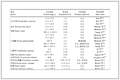 | 表 1 羌塘南缘多龙矿集区主要矿床基本特征Table 1 Basic charateristics of mian deposits in the Duolong ore cluster,Central Tibet |

矿区地层出露较为简单,主要为中下侏罗统色哇组(J1-2s)、下白垩统美日切错组(K1m)、渐新统康托组、第四系(图 2a)。色哇组出露于矿区东部,为一套长石石英砂岩、岩屑砂岩夹深灰色至深黑色粉砂质板岩。美日切错组主要分布在矿区中部,呈北东-南西向展布,为一套中基性的火山喷溢-爆发相熔岩,以安山岩为主,间夹火山碎屑岩。24线钻孔2428揭露的美日切组(K1m)由4层组成(图 2b),从下向上依次为安山质晶屑岩屑凝灰岩(图 3e,f)、含角砾安山岩(图 3d)、安山质角砾凝灰岩(图 3b,c)和上部的多斑安山岩(图 3a),与下伏色哇组、上覆康托组均为角度不整合接触关系。康托组分布在矿区西北部,岩性主要为紫红色砂砾岩。
 | 图 2 荣那矿床平面地质图(a)和24勘探线剖面图(b)(据西藏地质五队,2014修改)Fig. 2 Geological map of Rongna ore deposit(a) and Geologic cross section map of No.24 prospecting line(b) |
 | 图 3 矿区火山岩和斑岩显微照片 (a)多斑安山岩;(b、c)安山质角砾凝灰岩;(d)安山岩;(e、f)安山质晶屑岩屑凝灰岩;(g)花岗闪长斑岩;(h、i)-花岗闪长斑岩;(j)花岗闪长斑岩脉;(k、l)成矿后的长石斑岩,其中见地层捕掳体Fig. 3 The photos and micrographs of volcanic rocks and porphyries (a)plesiophyric and esite;(b,c) and esitic breccia tuff;(d) and esite;(e,f) and esitic crystal-lithic tuff;(g)granodiorite porphyry;(h,i)granodiorite porphyry;(j)granodiorite porphyry vein;(k,l)post-ore feldspar porphyry,wall rock occurs as xenolith |
与成矿有关为浅成-超浅成花岗闪长斑岩,矿区内未出露于地表,为隐伏岩体,通过钻孔揭露,呈岩枝、岩脉、岩株状侵位于24线的2412-2405钻孔之间(图 2b)。另外在钻孔2428和2436还揭露出厚几米的花岗闪长斑岩脉和长石斑岩脉。成矿的花岗闪长斑岩具斑状结构,斑晶约40%。石英,长石,暗色矿物(角闪石、黑云母等)。大小1~5mm,斑晶主要为石英(15%)、斜长石(23%)、角闪石和黑云母(2%),其中只保留石英斑晶,而斜长石角闪石黑云母只见其假象,已完全蚀变,基质主要石英、长石及铁镁矿物,为显晶质,大小0.04~0.05mm,长石斑晶发生粘土化、伊利石-绢云母,角闪石和黑云母绿泥石化等(图 3g-j)。而弱矿化的长石斑岩呈岩脉产出,其中见地层的捕掳体,岩石具斑状结构,斑晶主要为斜长石,已基本粘土化(图 3k,l)。 4.2.2 热液角砾岩
矿区热液角砾岩发育,在24线,热液角砾岩主要分布于2412、2404、2428和2436等钻孔中,宽一般0.2~41m不等,根据角砾成分、形态及含量及其支撑形式,该矿床的热液角砾岩主要为单成分(角砾主要为粉砂岩)的热液角砾岩,根据支撑形式可分为两类:角砾支撑热液角砾岩(图 4a,b)和杂基支撑热液角砾岩(图 4c)。角砾支撑热液角砾岩分布于2428和2436两个钻孔中,厚约大约30~40m,少量为0.5~1m,角砾成分较单一,主要为围岩角砾,大小0.5~5cm、棱角状到次棱角,胶结物主要为有石英、叶腊石、高岭石、黄铁矿、电气石,少量绿泥石、辉铜矿、砷黝铜矿等。贫胶结物富角砾的角砾支撑热液角砾岩形成于岩浆流体与天水的间接反应,系岩浆加热导致水蒸发为水蒸汽导致围岩角砾岩化(Seedorff et al., 2005)。杂基支撑热液角砾岩主要在2404和2412钻孔中发育,厚约大约0.5~1m,角砾成分也较单一,主要为围岩角砾,大小5~15mm,次棱角到磁圆状,为杂基支撑,胶结物主要为叶腊石、高岭石、黄铁矿,少量明矾石、辉铜矿及赤铁矿等,这类角砾岩系岩浆水与外来水直接反应的结果(Seedorff et al., 2005)。由上述所描述的热液角砾岩中普遍存在与高级泥化相关的粘土矿物,推测热液角砾岩即是形成高硫型蚀变矿化的流体通道。
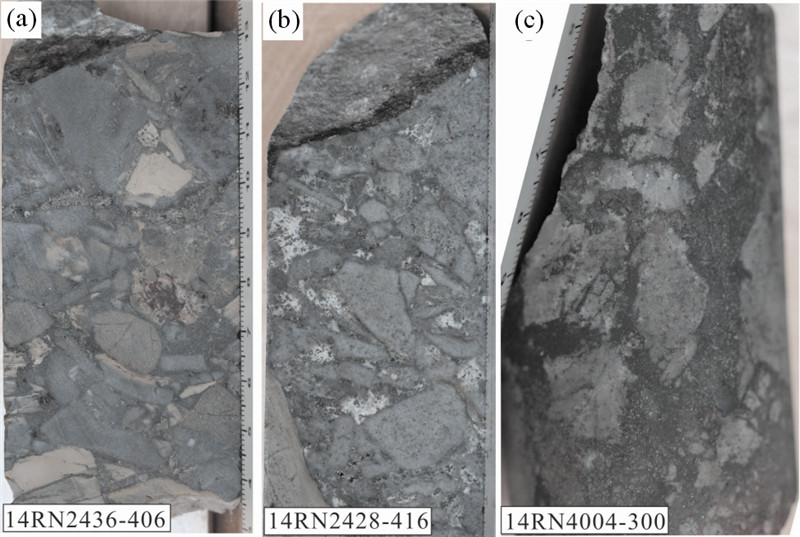 | 图 4 热液角砾岩标本照片 (a)角砾支撑热液角砾岩;(b)角砾支撑热液角砾岩;(c)杂基支撑热液角砾岩 Fig. 4 The photos of hydrothermal breccias (a)breccia-supported hydrothermal breccia;(b)breccia-supported hydrothermal breccia;(c)matrix-supported breccias |
区内主要发育北东向和北西西向两组断裂构造,区域内已知矿体多产于两组断裂的交汇部位(图 2a)。 5 热液蚀变
通过地表观察和钻孔揭露,该矿床发育两阶段的热液蚀变:下部与斑岩成矿有关的蚀变和上部与高硫型浅成低温矿化有关的高级泥化蚀变。尽管表现为强烈的红褐色褐铁矿化、黄钾铁矾及高岭土化的地表蚀变只局限于07线-32线的低洼负地形区,大致呈北东向展布(图 2a)。但钻孔揭露的深部蚀变范围较大,目前已控制的2.2km×1.2km范围热液蚀变未封闭。 5.1 与斑岩有关蚀变 目前识别出与斑岩矿化有关的蚀变类型主要有黑云母化、硅化绢云母化及角岩化。 5.1.1 热液蚀变
早期黑云母化主要发育在矿床深部的成矿花岗闪长斑岩中(图 5a)(如ZK 4804—1171),表现为黑云母交代角闪石,仅保留了角闪石的假像(图 5b),同时在斑岩的基质中发生黑云母化(图 5c),这些蚀变的黑云母呈细小(0.1~0.5mm)。而在花岗闪长斑岩的边部或上部发育黑云母角岩,分布较为局限,主要表现为为黑云母沿长石石英粉砂岩的粒间产出,大小约0.1~0.2mm,为鳞片状集合体(图 5d,e)。而硅化-绢云母化在该矿床中分布较广,在成矿斑岩和围岩粉砂岩中均有分布,但部分被后期的高级泥化叠加改造。主要表现为板岩的石英的次生加大和斜长石斑晶蚀变分解为绢云母(图 5g)发育石英-硫化物细脉,并且在石英黄铁矿细脉的边部构成蚀变晕(图 5f),在长石石英砂岩中长石基本绢云母化,而其中的石英次生加大(图 5h),而在矿床边部发育硅化-伊利石-绿泥石化为主的中级泥化蚀变,并且其中含有电气石(图 5i,j),而绿泥石或构成绿泥石-黄铁矿细脉、石英-黄铁矿细脉边部的蚀变晕以及绿泥石细脉(图 5k)。
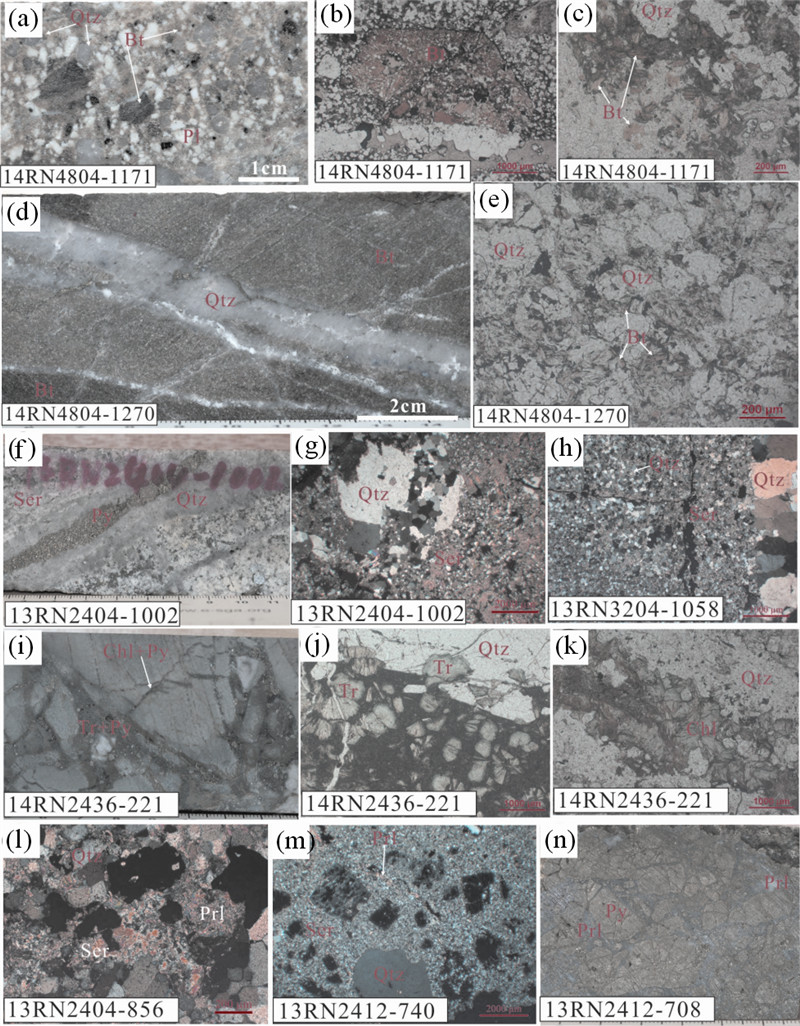 | 图 5 与斑岩有关的蚀变及其过渡蚀变照片 (a)成矿斑岩基质和角闪石黑云母化(手标本);(b)角闪石黑云母化后仍保留角闪石晶形(单偏光);(c)基质中发育的弥散状黑云母化(单偏光);(d)长石石英粉砂岩黑云母角岩化后被石英细脉穿插(手标本);(e)发育弥散状黑云母的角岩(单偏光);(f)B型脉边部发育硅化绢云母化(手标本);(g)成矿斑岩发育硅化绢云母化(正交光);(h)长石石英粉砂岩中发育弥散状硅化绢云母化并被石英细脉穿插(正交光);(i)在热液角砾岩的角砾中发育黄铁矿-绿泥石细脉、胶结物中发育黄铁矿、电气石(手标本);(j)热液角砾岩胶结物中发育的电气石(单偏光);(k)热液角砾岩的角砾中发育的绿泥石细脉(单偏光);(l)长石石英粉砂岩中发育硅化绢云母后叠加叶腊石化(正交光);(m)成矿斑岩硅化绢云母化穿插叶腊石细脉(正交光);(n)块状黄铁矿-叶腊石脉(手标本).Qtz-石英;Bt-黑云母;Pl-斜长石;Ser-绢云母;Tr-电气石;Chl-绿泥石;Prl-叶腊石;Py-黄铁矿Fig. 5 The photos of alteration concerning porphyry and transition (a)ore-forming porphyry,with biotitization in matrix and amphibole(h and specimen);(b)amphibole,replaced by biotite,retaining its shape(PPL);(c)disseminated biotitizaion in matrix(PPL);(d)biotite hornfelsic felspathic quartz siltstone,cut by quartz veinlet(h and specimen);(e)hornfels,with pervasive biotite(PPL);(f)B-type veinlet,with silica-sericite veinlet selvage(h and specimen);(g)ore-forming porphyry,with silicifacation and sericitization(CPL);(h)felspathic quartz siltstone,with disseminated silicifacation and sericitization,cut by quartz veinlet(CPL);(i)hydrothermal breccias,with pyrite-chlorite vein in breccias and pyrite,tourmaline in cement(h and specimen);(j)hydrothermal breccias,with tourmaline in cement(PPL);(k)hydrothermal breccia,with chlorite veinlet in breccias(PPL);(l)felspathic quartz siltstone,with silicifacation,sericitization and telescoped with pyrophyllitization(CPL);(m)ore-forming porphyry,with silicifacation and sericitization,cut by pyrophyllite veinlet(CPL);(n)massive pyrite-pyrophyllite vein(h and specimen) |
伴随着上述热液蚀变,发育一系列斑岩矿床特征的细脉。根据野外钻孔岩芯编录和室内显微镜观察,识别出6种不同类型的脉系(Gustafson and Hunt,1975; Dilles and Einaudi,1992; Gustafson and Quiroga,1995),其特征见表 2。
| 表 2 荣那矿床斑岩矿化和高硫型浅成低温矿化脉系特征Table 2 Characteristics of the veins from the Rongna porphyry-high sulfidation epithermal Cu-(Au)deposit(in a relative age sequence,older at the top) |
EB型细脉:主要发育在矿床深部的具黑云母化花岗闪长斑岩中,呈不规则,厚度一般小于1mm(表 2,图 6a),其穿切斜长石斑晶。脉中少见黄铜矿、黄铁矿,该类型的细脉一般被后期细脉穿切,发育于钾化带。
 | 图 6 与斑岩型蚀变矿化有关脉系照片 (a)成矿斑岩中发育黑云母细脉(EB)和A型细脉(包括A1和A2);(b)成矿斑岩中发育的A型细脉被B型细脉穿切;(c)A1型细脉被B型细脉穿切;(d)由绿泥石黄铁矿以及石英电气石组成的C型细脉;(e)主要由石英-黄铁矿-黄铜矿组成的D型细脉;(f)主要由黄铁矿、少量石英组成的D型细脉;(g)主要由石英、黄铁矿、少量硬石膏组成的晚阶段细脉.A1-A1型细脉;A2-A2型细脉;B-B型细脉;Chl-绿泥石;Q-石英;Tr-电气石;Py-黄铁矿;Anh-硬石膏;D-D型细脉Fig. 6 The photos of veins concerning porphyritic alteration and mineralization (a)ore-forming porphyry,with biotite veinlet(EB) and A-type veinlets(including A1 and A2);(b)ore-forming porphyry,with A-type veinlet cut by B-type veinlet;(c)A1-type veinle cut by B-type veinlet;(d)chlorite-pyrite-quartz-tourmaline veinlet(C-type);(e)quartz-pyrite-chalcopyrite veinlet(D-type);(f)pyrite-quartz veinlet(D-type);(g)quartz-pyrite-anhydrite veinlet in late stage. A1-A1-type veinlet; A2-A2-type veinlet; B-B-type veinlet; Chl-chlorite; Q-quartz; Tr-tourmaline; Py-pyrite; Anh-anhydrite; D-D-type veinlet |
A型细脉:主要由钾长石和石英组成,常呈不规则状不连续的细脉,脉厚一般1~5mm,细脉边部常见钾长石或黑云母蚀变晕(表 2,图 6a-c),细脉中金属矿物主要为黄铜矿、斑铜矿及黄铁矿呈浸染状分布,根据石英和钾长石的比例、细脉厚度不同分为A1(钾长石大于石英,1~3mm)和A2(石英大于钾长石,3~5mm)两个亚类,这类细脉被B型细脉所穿切(图 6b,c)。这类细脉主要分布于钻孔4004和4804深部斑岩中,发育于钾化带。
B型细脉:主要分布于矿床中下部的硅化绢云母化带中,其它蚀变带中也有保留。呈规则的细脉,脉厚3~10mm,主要由石英、黄铁矿、黄铜矿、斑铜矿及辉钼矿等组成,偶见石膏、硬石膏,细脉边部缺少蚀变晕。该类细脉常穿切早期的A型细脉(图 6b,c)。
C型细脉:分布于矿床边部的硅化-伊利石-绿泥石化带中,平直到不规则细脉,1~10mm,脉中主要由绿泥石、石英、电气石、黄铁矿等组成,同时见少量黄铜矿、斑铜矿及赤铁矿,细脉边部见伊利石绿泥石蚀变晕。
D型细脉:在矿床中分布广泛,规则平直的细脉,脉厚2~50mm,脉中主要由黄铁矿、黄铜矿、斑铜矿等组成,细脉边部见绢云母及黄铁矿的蚀变晕(图 6e,f)。
晚阶段脉系主要石英-硬石膏-黄铁矿细脉,主要分布于矿床中下部,规则细脉,主要由石英、黄铁矿、少量硬石膏组成,偶见斑铜矿、黄铜矿及辉钼矿(图 6g)。 5.2 硅化-绢云母化-高级泥化的过渡阶段蚀变
在矿床深部的硅化绢云母化与上部的高级泥化蚀变之间发育过渡蚀变,表现为在面状的硅化绢云母化之上叠加叶腊石化以及高岭土化等蚀变,在围岩粉砂岩(图 5l)及斑岩(图 5m)中均有分布,叶腊石呈弥散状或细脉状,尽管还证实如其他矿区(Lipske and Dilles,2000; Watanabe and Hedenquist,2001; Seedorff et al., 2005)有过渡蚀变的特征矿物红柱石的存在,但叶腊石及其他粘土矿物与硅化绢云母化的叠加关系可以初步认为荣那矿床存在这类过渡蚀变。在该类蚀变中还发育块状黄铁矿-叶腊石细脉(图 5n),以及D型细脉被其他细脉如石英-粘土矿物-硫化物细脉、粘土矿物-硫化物细脉等穿切,细脉中粘土矿物主要为叶腊石、少量高岭石等组成,金属硫化物黄铁矿、斑铜矿、铜蓝、少量辉钼矿组成。 5.3 高级泥化蚀变 5.3.1 高级泥化蚀变特征
在荣那矿床范围内,目前所识别出与高级泥化有关的蚀变主要有高岭土化、叶腊石化、明矾石化等。高岭石呈细小粒状交代安山质凝灰岩(图 7a,b),其中还发育赤铁矿(图 7c)或褐铁矿,或呈石英-高岭石细脉穿插石英长石粉砂岩,一般高岭石主要充填于细脉中心部位而石英位于边部(图 7d),该类蚀变主要位于矿床的顶部,但在矿床的中下部也有分布。叶腊石化与硫化物、石英构成细脉状产出(图 7e),叶腊石还与绢云母交生(图 7f),而明矾石以细脉和浸染状的形式产出,并常与其它粘土矿物、黄铁矿、砷黝铜矿、蓝辉铜矿、硫砷铜矿等构成细脉,形成条带状构造(图 7g,h),另外在矿床的上部还见有重晶石分布呈浸染状(图 7i)或细脉状,在矿床范围内在细脉中或蚀变岩中呈浸染状分布的铝磷硫酸盐(APS)(图 7j-l),并具有环带结构。
 | 图 7 高级泥化蚀变照片 (a)高岭土化(手标本);(b)高岭土化的镜下特征(正交光);(c)硅化石英边部发育的赤铁矿(反光);(d)硅化绢云母化粉砂岩中穿插的石英-高岭石细脉(正交光);(e)叶腊石与硅化石英-硫化物共生(正交光);(f)叶腊石与绢云母交生(正交光);(g)明矾石-黄铁矿-砷黝铜矿组成细脉,具有条带状构造(手标本);(h)条带状状明矾石(正交光);(i)发育星点状重晶石(BSE);(j)具环带结构的铝磷硫酸盐(BSE);(k)细脉状的铝磷硫酸盐(BSE);(l)具环带状结构并与硫化物共生的铝磷硫酸盐(BSE).Alun-明矾石;APS-铝磷硫酸盐;Bar-重晶石;Kao-高岭石;Prl-叶腊石;Qzt-石英;Hm-赤铁矿;Py-黄铁矿;Tn-砷黝铜矿Fig. 7 The photos of advanced argillic alteration (a)kaolinization(h and specimen);(b)micrographs of kaolinization(CPL);(c)quartz-hematite vein(RPL);(d)Siltstone,with silicifacation and sericitization,cut by quartz-kaolinite veinlet(CPL);(e)pyrophyllite-quartz-sulfide vein(CPL);(f)the paragenesis of pyrophyllite and muscovite(CPL);(g)alunite-pyrite-tennantite veinlet,with b and ed structure(h and specimen);(h)b and ed alunite(CPL);(i)disseminated barite(BSE);(j)zoned APS(BSE);(k)APS veinlet(BSE);(l)intergrowth of zoned APS and sulfide(BSE). Alun-alunite; APS-Al phosphate-sulfate minerals; Bar-barite; Kao-kaolinite; Prl-prophyllite; Qzt-quartz; Hm-hematite; Py-pyrite; Tn-tennatite |
伴随着上述高级泥化蚀变的发育,穿插一系列与高硫型上部矿化有关的特征细脉。根据野外钻孔岩芯编录和室内显微镜观察,识别5种脉系,其特征总结于表 2中。
高岭石±石英±赤铁矿细脉:主要分布于矿床顶部的美日切组安山质凝灰岩及蚀变粉砂岩中,不规则到平直的细脉,厚一般0.5~20mm,主要由高岭石、石英及褐铁矿、赤铁矿组成(图 8a,b),无含铜矿物分布。
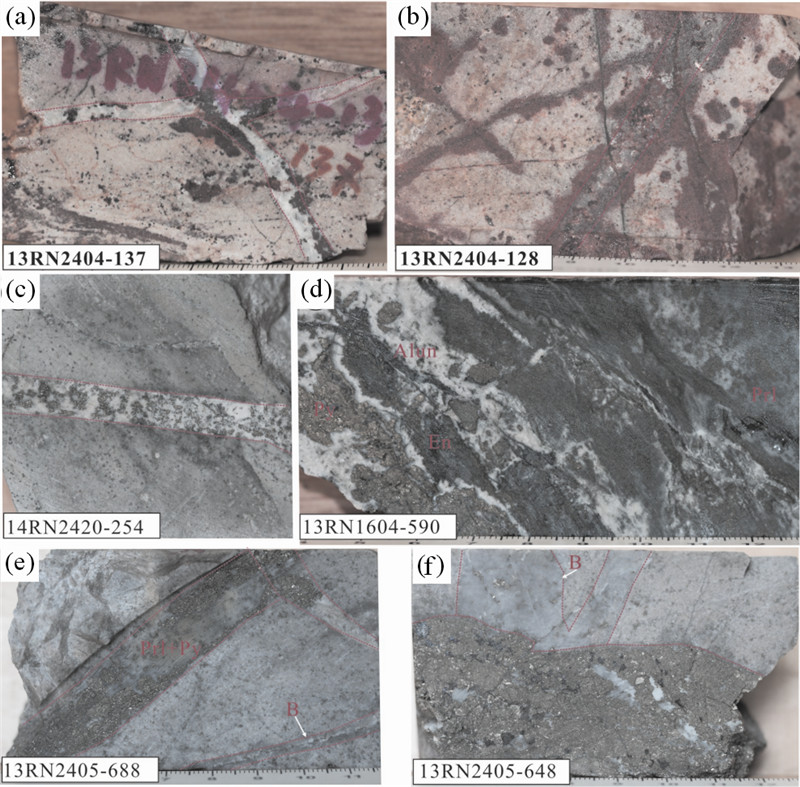 | 图 8 与高硫型浅成低温热液蚀变矿化有关的脉系照片 (a)高岭石-褐铁矿细脉;(b)高岭石-石英-褐铁矿细脉;(c)硅化绢云母粉砂岩中穿插的粘土矿物-黄铁矿细脉;(d)明矾石-叶腊石-黄铁矿-硫砷铜矿细脉;(e)叶腊石-黄铁矿细脉被粘土矿物-黄铁矿细脉穿切;(f)B型细脉被晚期的块状黄铁矿-砷黝铜矿-叶腊石穿切. Alun-明矾石;Prl-叶腊石;Py-黄铁矿;En-硫砷铜矿;B-B型细脉Fig. 8 The photos of veins concerning high sulfidation epithermal alteration and mineralization (a)kaolinite-limonite veinlet;(b)kaolinite-quartz-limonite veinlet;(c)siltstone,with silicifacation and sericitization,cut by clay minerals-pyrite veinlet;(d)alunite-pyrophyllite-pyrite-enargite veinlet;(e)pyrophyllite-pyrite veinlet cut by clay minerals-sulfide veinlet;(f)B-type veinlet cut by massive pyrite-tennatite-pyrophyllite vein in late stage. Alun-alunite; Prl-pyrophyllite; Py-pyrite; En-enargite; B-B-type veinlet |
石英-粘土矿物-硫化物细脉:主要分布于矿床的中上部,规则平直的细脉,厚一般2~10mm,主要由石英、叶腊石、高岭石、地开石等粘土矿物及黄铁矿、辉铜矿、蓝辉铜矿等组成(图 8c),脉中普遍分布星点状金红石,在细脉边部常见有浸染状的黄铁矿,该类细脉一般穿切早期的B型和D型细脉。
石英-明矾石±粘土矿物-硫化物细脉:主要分布于矿床中部,不规则到平直的细脉,厚一般2~70mm,也有少数脉厚达0.2~0.5m,主要由石英、明矾石、叶腊石以及黄铁矿、砷黝铜矿、硫砷铜矿、少量铜蓝、辉铜矿组成(图 8d),脉边部见有高岭石、石英、金红石及黄铁矿的蚀变晕。
叶腊石±明矾石-硫化物细脉:主要分布于矿床中下部,平直的细脉(图 8e),2~50mm,主要由叶腊石、少量明矾石、石英及黄铁矿、辉铜矿、蓝辉铜矿、砷黝铜矿、金红石,边部具有石英、明矾石、黄铁矿蚀变晕,该类细脉常穿切早期的B型细脉。
硫化物细脉:在矿床的中上部广泛分布。平直的细脉,1~50mm,主要由黄铁矿、黄铁矿、蓝辉铜矿、砷黝铜矿等组成(图 8f),含有少量石英及粘土矿物,穿切早期的B、D型细脉。 5.4 蚀变分带
根据详细的野外地表观察、钻孔岩芯编录结合室内显微镜及扫面电镜观察,按蚀变矿物组合对荣那矿床的蚀变分带进行了初步划分。在平面上,蚀变范围较局限,蚀变类型单一,主要表现为褐铁矿化、粘土化(图 2a),而在剖面上(24线剖面)(图 9)可以划分为7个蚀变带(从下向上)。
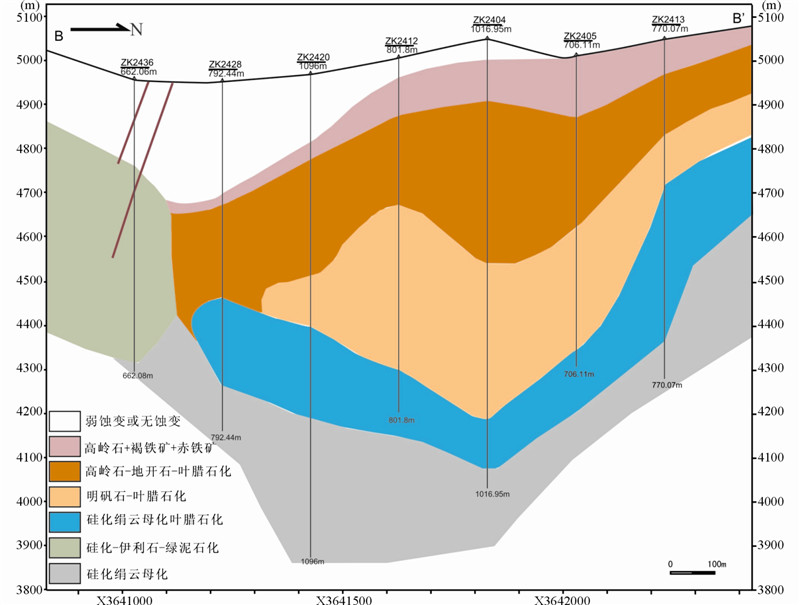 | 图 9 荣那矿床24勘探线剖面热液蚀变分带Fig. 9 Alteration zones of No.24 prospecting line section of Rongna deposit |
钾化带:主要分布于40-48线深部,目前所揭露的厚度只有数十米,但24线并未保留。主要表现为黑云母化,并发育EB型、A型及B型细脉。
硅化绢云母化带:主要位于24线剖面的深部,主要表现为长石石英粉砂岩中石英次生加大、长石绢云母化和斑岩中长石完全绢云母化,并被石英-硫化物细脉穿插(包括B型和D型细脉)。
硅化-伊利石(绢云母)-绿泥石化带:主要分布于矿床的边部,如24线南部和64-72线以东。其特征是主要发育有黄铁矿-绿泥石细脉及绿泥石细脉、另外还发育电气石。
另外还在成矿斑岩体附近发育黑云母角岩化,上述蚀变带代表了与斑岩型矿化有关的蚀变分带。
硅化-绢云母化-叶腊石化带:主要分布于硅化绢云母化带和明矾石-叶腊石化带之间的矿床中下部,在24线剖面上均有分布,厚约100~150m。主要表现在叶腊石化叠加与早阶段的硅化绢云母化之上,主要发育石英-粘土矿物-硫化物细脉、粘土矿物-硫化物细脉和硫化物细脉。该蚀变带可能属斑岩-高硫型浅成低温热液作用的过渡蚀变。
明矾石-叶腊石化带:主要分布于硅化-绢云母化-叶腊石化带和高岭石-地开石-叶腊石化带之间的矿床中部,在24线剖面上主要分布于钻孔2420到2413,厚约100~400m不等。主要表现为特征的明矾石化、叶腊石化,发育石英-明矾石±粘土矿物-硫化物细脉、石英-粘土矿物-硫化物细脉和硫化物细脉。
高岭石-地开石-叶腊石化带:主要分布于矿床上部,在24线剖面上主要分布于钻孔2428到2413,厚约100~300m不等。主要表现为高岭石、地开石、叶腊石的蚀变组合,石英-粘土矿物±明矾石-硫化物细脉、粘土矿物-硫化物细脉、叶腊石±明矾石-硫化物细脉及硫化物细脉。
高岭石-褐铁矿-赤铁矿蚀变带:主要发育于矿床顶部的美日切组安山质凝灰岩及蚀变粉砂岩中,部分出露地表,厚度较小,从十余米到130m不等,主要表现为强高岭土化及褐铁矿、赤铁矿化,高岭石±石英±赤铁矿细脉及赤铁矿细脉,该带不具铜矿化。
上述三个蚀变带为特征的高硫型浅成低温热液蚀变。在该矿床中最大延深可达900m。说明深部仍有较大的找矿前景。 6 Cu-(Au)矿化
根据目前控制情况,荣那矿床的铜矿体为一隐伏的呈巨厚板状,目前已控制长约2000米、南北宽约1200m,垂深达到1298m,现有钻探工程显示矿体近东西向展布,向南、向倾斜的巨厚板状体,矿体向边部有分支趋势,埋深约150~200m(图 9)。金属矿化以铜为主,伴有金、银矿化,偶见钼矿化,其中Cu资源量已达超大型规模。矿体产于花岗闪长斑岩体内及其围岩中。根据矿化形式、蚀变与金属矿物组合,表现为两阶段矿化特征,斑岩型矿化和高硫型浅成低温热液型矿化,因此,该矿床的铜矿化是斑岩阶段和浅成低温阶段相互叠加的结果。 6.1 斑岩阶段矿化
主要为发育在黑云母化、黑云母角岩化、硅化绢云母化带中的细脉状和浸染状黄铁矿、黄铜矿、斑铜矿、辉钼矿化。在黑云母化带中主要为浸染状黄铜矿化(图 10a),见少量黄铁矿,并且发育A型石英细脉。而在黑云母角岩中见黄铜矿交代黄铁矿,并伴有金红石(图 10b),而在硅化绢云母花带中主要见斑铜矿沿边部交代黄铁矿和充填黄铁矿裂隙(图 10c),或者斑铜矿产于黄铁矿粒间并被蓝辉铜矿、铜蓝交代(图 10d),在成矿斑岩中见黄铁矿、黄铜矿、斑铜矿交代角闪石(图 10e),在该中还可见到辉钼矿与黄铜矿、黄铁矿共生(图 10f),在黄铜矿细脉中具有闪锌矿出溶体(图 10g),局部见方铅矿与斑铜矿、重晶石构成细脉(图 10j)穿插黄铁矿。该带中还以发育A型脉、B型脉及D型细脉为特征。斑岩矿化阶段一般同品位在0.4%~0.5%。而金品位在0.1~0.2g/t之间。
 | 图 10 荣那矿床矿化特征镜下照片 (a)矿床深部发育浸染状黄铜矿及少量黄铁矿;(b)黄铜矿交代黄铁矿并见金红石;(c)斑铜矿沿黄铁矿边缘交代或充填于黄铁矿的裂隙中;(d)斑铜矿被蓝辉铜矿和铜蓝交代,并且斑铜矿中具黄铜矿固溶体出熔,另外黄铁矿中还见斑铜矿的包体;(e)蚀变角闪石中具浸染状黄铁矿、黄铜矿、斑铜矿及金红石;(f)辉钼矿、黄铜矿、黄铁矿与石英细脉中共生;(g)细脉状黄铜矿中具闪锌矿的固溶体;(h)斑铜矿被铜蓝、砷黝铜矿、蓝辉铜矿沿边部交代;(i)细脉中黄铁矿具有环带结构,见两个世代黄铁矿;(j)黄铁矿裂隙中充填重晶石-斑铜矿-方铅矿细脉(BSE);(k)斑铜矿交代黄铁矿后被铜蓝、蓝辉铜矿交代;(l)硫砷铜矿交代环带状黄铁矿,在硫砷铜矿边部见锡-等轴硫砷铜矿固溶体;(m)粘土矿物细脉中浸染状黄铁矿和辉铜矿-砷黝铜矿-硫铋铜矿细脉;(n)砷黝铜矿和蓝辉铜矿共生,并见环带状黄铁矿;(o)粘土矿物细脉中黄铁矿被辉铜矿、蓝辉铜矿交代.Bar-重晶石;Prl-叶腊石;Rt-金红石;Bn-斑铜矿;Cc-辉铜矿;Cls-锡-等轴硫砷铜矿;Cpy-黄铜矿;Cv-铜蓝;Dg-蓝辉铜矿;En-硫砷铜矿;Gal-方铅矿;Mo-辉钼矿;Py-黄铁矿;Sp-闪锌矿;Tn-砷黝铜矿;Wt-硫铋铜矿Fig. 10 Characteristic micrographs of mineralization in Rongna deposit (a)disseminated chalcopyrite and minor pyrite in depth;(b)pyrite replaced by chalcopyrite,with rutile coexisted;(c)pyrite replaced by bornite along its margins,with its fractures filled by bornite;(d)bornite replaced by digenite and covellite,with chalcopyrite as solid solution in bornite and bornite inclusion in pyrite;(e)altered amphibole,with disseminated pyrite,chalcopyrite,bornite and rutile;(f)the paragenesis of molybdenite,chalcopyrite and pyrite in quartz veinlet;(g)veinlet chalcopyrite,with sphalerite as solid solution;(h)bornite replaced by covellite,tennatite,digenite along its margins;(i)vein pyrite,with zoned texture,belonged to two generations;(j)the fractures of pyrite filled with barite,bornite,galena(BSE);(k)pyrite replaced by bornite,then replaced by covellite and digenite;(l)zoned pyrite replaced by enargite,with Colusite coexisted as solid solution;(m)disseminated pyrite in clay minerals veinlet and chalcocite-tennatite-wittichenite veinlet;(n)the paragenesis of tennatite,digenite and zoned pyrite;(o)pyrite replaced by chalcocite,digenite in clay minerals veinlet. Bar-barite; Prl-prophyllite; Rt-rutile; Bn-bornite; Cc-chalcocite; Cls-colusite; Cpy-chalcopyrite; Cv-covellite; Dg-digenite; En-enargite; Gal-galena; Mo-molybdenite; Py-pyrite; Sp-sphalerite; Tn-tennatite; Wt-wittichenite |
伴随着高级泥化蚀变的叠加,发育黄铁矿、辉铜矿、蓝辉铜矿、砷黝铜矿、铜蓝、硫砷铜矿等,呈浸染状或细脉状产出,其中铜蓝、蓝辉铜矿、砷黝铜矿常交代斑铜矿(图 10j,k),该阶段产出黄铁矿常呈粗粒的浸染状和细脉中自形黄铁矿,并常具有环带结构(图 10i,l,n),常被硫砷铜矿交代(图 10l),在粘土矿物-硫化物细脉中见黄铁矿与细脉状的辉铜矿-砷黝铜矿、硫铋铜矿(图 10l),以及砷黝铜矿与蓝辉铜矿构成的细脉(图 10n),在矿床上部见辉铜矿和蓝辉铜矿交代黄铁矿(图 10o)。在该矿化阶段常发育石英-粘土矿物-硫化物细脉、石英-明矾石±粘土矿物-硫化物细脉、叶腊石±明矾石-硫化物细脉以及硫化物细脉。由于高硫型矿化的叠加使矿床铜品位增加(0.5%~1%),局部脉发育地段铜品位可达2%~4%。 7 金属矿物组合分带及矿物化学
根据光学显微镜、扫描电镜观察,对该矿床的金属硫化物、特别是含铜硫化物的空间分布进行了系统总结,并与Cu、Au品位进行对比,显示在图 11上,各主要蚀变带中代表性硫化物的电子探针结果总结于表 3。
 | 图 11 荣那斑岩-高硫型浅成低温热液Cu(Au)矿床24勘探线Cu-Au品位分布及主要含铜矿物分带图Fig. 11 Cu-Au distribution and dominated Cu-bearing mineral assemblage zones of No.24 prospecting line section of Rongna telescoped porphyry-high sulfidation epithermal Cu(-Au)deposit |
| 表 3 荣那斑岩-高硫型浅成低温热液Cu(Au)矿床代表性硫化物电子探针结果(wt%)Table 3 EMPA analysis results of representative sulphides from the Rongna porphyry-high sulfidation epithermal Cu-(Au)deposit(wt%) |
在矿床中,黄铁矿广泛分布,而黄铜矿、斑铜矿、辉钼矿、铜蓝、蓝辉铜矿、辉铜矿、砷黝铜矿、硫砷铜矿等在剖面上具有分带性,含铜硫化物主要分为4个带,大致与蚀变分带相对应,下部主要为斑铜矿-黄铜矿,以含一定量的Ag、Bi、Zn、Pb为特征(表 3),而过渡带以斑铜矿-铜蓝组合为特征,另外有少量的蓝辉铜矿、砷黝铜矿,斑铜矿以含微量As(0.03%)、铜蓝以含Fe(0.39%)、Au(0.16%)、Ag(0.03%)、Pb(0.28%)为特征,砷黝铜矿富Zn(6.93%)。而矿床中上部为蓝辉铜矿-砷黝铜矿-硫砷铜矿组合,蓝辉铜矿以富Fe(3.04%)、硫砷铜矿以含一定量的Ag(0.04%)、Te(0.05%)、Bi(0.14%)、Zn(0.17%)、铜蓝以含Fe(0.69%)、Zn(0.14%)、砷黝铜矿以含Fe(1.64%)、Zn(0.37%)、Au(0.08%)为特征。顶部100~300m主要由辉铜矿-蓝辉铜矿组成,以及少量的砷黝铜矿、微量的硫铋铜矿,但分布不均匀,主要集中在2412-2405钻孔之间。辉铜矿以含Zn(0.17%)、蓝辉铜矿以含Pb(0.11%)、Zn(0.09%)、Au(0.13%)、砷黝铜矿以富Bi(14.56%)、Zn(2.34%)为特征,而硫铋铜矿中以富Zn(0.12%)、Sb(0.12%)为特征。
根据上述含铜硫化物的分布,总体上,矿床上部以辉铜矿-蓝辉铜矿为主的Cu-S体系,而下部以斑铜矿、黄铜矿为主的Cu-Fe-S体系,具有明显的双层结构的特点。 8 讨论 8.1 斑岩型与高硫型浅成低温热液蚀变矿化的空间关系
目前的研究已初步建立了从斑岩到浅成低温热液过渡的蚀变类型(Perelló,1994; Hedenquist et al., 1998; Sillitoe,1999; Milu et al., 2004; Lecumberri-Sanchez et al., 2013; Brathwaite et al., 2001; Perelló et al.,2001; Khashgerel et al., 2008; Pudack et al., 2009; Crane and Kavalieris,2012; Hedenquist and Taran,2013; Voudouris et al., 2013):从斑岩型网脉状矿化到高级泥化蚀变和高硫型浅成低温矿化的过渡在剖面上表现为连续过渡(从下到上):(1)钾硅酸盐蚀变;(2)青磐岩化;(3)中级泥化(绢云母-绿泥石-黄铁矿);(4)绢英岩化(石英-绢云母-黄铁矿);(5)绢云母-高岭石蚀变和高级泥化蚀变(高岭石-明矾石叶腊石)。而高级泥化内部也有一定的分带:中心部位的残余石英(多孔石英),向外为石英-明矾石、石英-高岭石带和绿泥石带。
根据目前的研究,荣那斑岩-浅成低温热液系统具有上述连续的蚀变分带(图 9),但高级泥化蚀变中特征的多孔石英不发育。其矿化形式也表现为下部斑岩型网脉状矿化到上部的高硫型浅成低温热液矿化形式,具有明显的矿物分带(图 11),显示矿床上部以辉铜矿-蓝辉铜矿为主的Cu-S体系,而下部以斑铜矿、黄铜矿为主的Cu-Fe-S体系,具有明显的双层结构的特点。
总体上,荣那矿床具有典型的斑岩型和高硫型浅成低温矿床叠加或套合的蚀变矿化模式,与其他类似矿床一样(Vila and Sillitoe,1991),斑岩型Cu-Au矿化发育在岩浆活动的早阶段,目前已获得的斑岩阶段矿化的辉钼矿Re-Os同位素年龄为119.2±2.5Ma(作者未刊数据),而形成的高硫型浅成低温热液矿化较晚并处更高位,但未获得具体的年龄数据,因此这种体系的叠加时限未得到很好的限定。而根据精确的放射性同位素定年,其它同类矿床中这两类矿化几乎是同时形成的(<0.3Ma,Arribas et al., 1995)或浅成矿床形成略晚于斑岩矿床(~1Ma)(如Charchaflié et al.,2007; Bendezú et al.,2008)。 8.2 与其他斑岩-高硫型浅成低温热液矿床的比较
在荣那矿床中,上部叠加的高级泥化和高硫型矿化可能是同时形成的,在所充填的细脉中粘土矿物与硫化物共生,与其它的斑岩-高硫型浅成低温热液矿床如阿根廷的Nevados del Famatina(Losada-Calderon and McPhail,1996; Pudack et al., 2009)、智利的Maricunga(Muntean and Einaudi,2001)、菲律宾的Baguio 矿区(Cooke et al., 2011)、阿根廷的Agua Rica矿区(Franchini et al., 2011)、Agua Rica Cu-Au 矿床(Maydagán et al., 2013)相比较,荣那矿床高级泥化蚀变发育较厚(达800余米)、分带较好(图 9),但与蒙古欧玉托勒盖矿区的Hugo Dummett矿床相似(Khashgerel et al., 2008),多孔石英不发育,表明其成矿流体的pH>2(Stoffregen,1987)。在荣那矿区还发育较好的含铜硫化物分带,即上部为以辉铜矿-蓝辉铜矿为主的Cu-S体系,而下部以斑铜矿、黄铜矿为主的Cu-Fe-S体系,具有明显的双层结构的特点。与其他的高硫型浅成低温热液矿床比较(如Hedenquist et al., 1998; Jannas et al., 1999),与高级泥化相关矿化富金,而荣那矿床上部叠加的高硫型矿化是贫金的,而且与多龙矿集区的其他斑岩型Cu-Au矿床如多不杂比较,也是贫金的(Li et al., 2012),但荣那矿床硫化物中却是以富Zn和Fe为特征,但闪锌矿贫Fe(表 3),表明其形成于高硫化态成矿流体。与Agua Rica矿区一致,该矿床的铜蓝可能为内生成因的(Franchini et al., 2011),在硅化绢云母化叶腊石化带,铜蓝交代斑铜矿。同时该矿床形成后保存较好,还未遭受剥蚀,因此,该矿床向深部应有较大的成矿潜力。 8.3 斑岩型矿化与浅成低温热液矿化之间的成因联系
对多龙矿集区成岩成矿年代学及地球化学研究表明,成矿岩体年龄主要集中在118Ma,系早白垩世班公湖-怒江洋闭合时向北俯冲作用形成的产物(李金祥等,2008; Li et al., 2013),该地区成矿斑岩体的侵位对应于挤压应力体制和快速抬升剥蚀。根据上述初步的地质、热液蚀变、金属矿物组合及其分带研究,荣那矿床的形成可能经历了两个主要的成矿阶段:深部的斑岩型深部矿化阶段和与高级泥化相关的高硫型浅成低温热液阶段。与多龙矿集区的其他斑岩型Cu-Au矿床一致,在约119Ma,成矿斑岩体为花岗闪长斑岩呈岩株、岩脉侵位中下侏罗统色哇组长石石英粉砂岩中,形成斑岩矿床典型的钾化、硅化绢云母化、角岩化及硅化-伊利石-绿泥石蚀变,由于流体活动伴随EB型、A型、B型、C型和D型细脉的发育浸染状矿化以及热液角砾岩的形成,构成典型的斑岩型蚀变矿化,由于长石石英砂岩良好的渗透性,有利于流体活动,大部分的矿化发育于围岩中,而斑岩体则全岩矿化(图 12a)。随后由于该地区早白垩世的火山活动,部分火山岩及火山碎屑岩覆盖在斑岩阶段形成的矿体之上,并伴随流体上升、大规模岩浆去气,使含SO2和HCl的岩浆气相沿早期形成的角砾岩带上升浓缩形成于浅成环境或SO2与天水发生水解反应(Sillitoe,1999; Hedenquist and Taran,2013; Kouzmanov and Pokrovski,2012),产生的强酸淋滤部分火山岩碎屑岩及早中侏罗统的色哇组粉砂岩产生高级泥化蚀变并伴随高硫型矿化,形成一系列的粘土矿物、明矾石-硫化物细脉,形成范围更大的蚀变矿化,使矿床的铜品位增高,但该矿床贫金的原因仍不清楚。在矿区8线钻孔0804附近地表所见到的高岭土化褐铁矿蚀变可能是该阶段沿热液排气孔蒸汽加热形成的(图 12b)。在荣那矿床形成之后又被早白垩世美日切组(K1m)安山岩所覆盖(图 12c),然后经过后期的隆升剥蚀,该矿床上部的火山岩至少被剥蚀1000m,使部分蚀变带(7-8线)出露地表,但整个矿床仍被完整保留(图 12d)。
 | 图 12 荣那斑岩-高硫型浅成低温热液Cu(Au)矿床成矿模式图Fig. 12 Ore-forming model of Rongna telescoped porphyry-high sulfidation epithermal Cu(-Au)deposit |
根据上述初步研究得到下述结论:
(1)矿床产于羌唐南缘中生代火山-岩浆弧中,成矿与侵入于中下侏罗统色哇组中的隐伏花岗闪长斑岩有关,矿体为隐伏矿。成矿花岗闪长斑岩呈岩枝、岩脉状,全岩矿化;
(2)矿床蚀变分带发育,地表蚀变表现为强烈的褐铁矿化、黄钾铁矾及粘土化,范围较局限;矿床上部发育特征的高级泥化蚀变,以明矾石、高岭石、地开石及叶腊石为特征,但多孔石英不发育,上部的高级泥化发育在粉砂岩及花岗闪长斑岩上部,在下中侏罗统色哇组长石石英粉砂岩中主要发育硅化-伊利石化-绢云母化或绿泥石化,而花岗闪长斑岩中主要的蚀变为硅化-伊利石化-绢云母化,深部发育黑云母化和黑云母角岩化。
(3)矿床具有明显矿物分带特征,上部以辉铜矿-蓝辉铜矿为主的Cu-S体系,而下部以斑铜矿、黄铜矿为主的Cu-Fe-S体系,具有明显的双层结构的特点。
(4)与多龙矿集区的其他矿床相比,荣那矿床贫金且缺乏磁铁矿而出现赤铁矿和金红石;
(5)荣那矿床的蚀变-矿化特征垂向上具有双层结构:即上部为高硫型浅成低温热液矿化、下部为斑岩矿化,表明该矿床具有斑岩-高硫型浅成低温热液Cu(Au)套合成矿的特点。该矿床的勘查突破为羌塘南缘火山岩区及覆盖区的找矿打开了一扇窗口。
致谢 在研究工作中得到西藏地矿局多吉院士、中铝西藏矿业有限公司冯道永总经理、粟登奎总地质师、侯俊富副总经理的大力支持和帮助;在野外工作中得到中铝金龙矿业有限公司全体工作人员、西藏地勘局第五地质大队陈红旗、李彦波、卫鲁杰、李玉彬等同志的协助;研究工作中与中国地质科学院矿产资源研究所唐菊兴研究员进行了有益的讨论;承蒙曾庆栋研究员、李晓峰研究员悉心审阅;在此一并表示感谢!| [1] | Arribas A, Hedenquist JW, Itaya T, Okada T, Concepcion RA and Garcia JS. 1995. Contemporaneous formation of adjacent porphyry and epithermal Cu-Au deposits over 300Ka in northern Luzon, Philippines. Geology, 23(4): 337-340 |
| [2] | Baxter AT, Aitchison JC and Zyabrev SV. 2009. Radiolarian age constraints on Mesotethyan ocean evolution, and their implications for development of the Bangong-Nujiang suture, Tibet. Journal of the Geological Society 166(7): 689-694 |
| [3] | Bendezú R, Page L, Spikings R, Pecskay Z and Fontboté L. 2008. New 40Ar/39Ar alunite ages from the Colquijirca district, Peru: Evidence of a long period of magmatic SO2 degassing during formation of epithermal Au-Ag and Cordilleran polymetallic ores. Mineralium Deposita, 43(7): 777-789 |
| [4] | Brathwaite RL, Simpson MP, Faure K and Skinner D. 2001. Telescoped porphyry Cu-Mo-Au mineralizatuon, advanced argillic alteration and quartz-suphide-gold-anhydrite veins in the Thames District, New Zealand. Mineralium Deposita, 36(7): 623-640 |
| [5] | Chambefort I and Moritz R. 2006. Late Cretaceous structural control and Alpine overprint of the high-sulfidation Cu-Au epithermal Chelopech deposit, Srednogorie belt, Bulgaria. Mineralium Deposita, 41(3): 259-280 |
| [6] | Chang ZS, Hedenquist JW, White NC, Cooke DR, Roach M, Deyell CL, Garcia J Jr, Gemmell JB, Mcknight S and Cuison AL. 2011. Exploration tools for linked porphyry and epithermal deposits: Example from the Mankayan intrusion-centered Cu-Au district, Luzon, Philippines. Economic Geology, 106(8): 1365-1398 |
| [7] | Charchaflié D, Tosdal RM and Mortensen JK. 2007. Geologic framework of the Veladero high-sulfidation epithermal deposit area, Cordillera Frontal, Argentina. Economic Geology, 102(2): 171-192 |
| [8] | Cooke DR, Deyell CL, Waters PJ, Gonzales RI and Zaw K. 2011. Evidence for magmatic-hydrothermal fluids and ore-forming processes in epithermal and porphyry deposits of the Baguio district, Philippines. Economic Geology, 106(8): 1399-1424 |
| [9] | Crane D and Kavalieris I. 2012. Geologic overview of the Oyu Tolgoi porphyry Cu-Au-Mo deposits, Mongolia. Society of Economic Geologists, Inc. Special Publication, 16: 187-213 |
| [10] | Deyell CL and Hedenquist JW. 2011. Trace element geochemistry of enargite in the Mankayan district, Philippines. Economic Geology, 106(8): 1465-1478 |
| [11] | Dilles JH and Einaudi MT. 1992. Wall-rock alteration and hydrothermal flow paths about the Ann-Mason porphyry copper deposit, Nevada: A 6-km vertical reconstruction. Economic Geology, 87(8): 1963-2001 |
| [12] | Franchini M, Impiccini A, Lentz D, Ríos FJ, O'Leary S, Pons J and Schalamuk AI. 2011. Porphyry to epithermal transition in the Agua Rica polymetallic deposit, Catamarca, Argentina: An integrated petrologic analysis of ore and alteration parageneses. Ore Geology Reviews, 41(1): 49-74 |
| [13] | Gustafson LB and Hunt JP. 1975. The porphyry copper deposit at El Salvador, Chile. Economic Geology, 70(5): 857-912 |
| [14] | Gustafson LB and Quiroga J. 1995. Patterns of mineralization and alteration below the porphyry copper orebody at El Salvador, Chile. Economic Geology, 90(1): 2-16 |
| [15] | Hedenquist JW and Lowenstern JB. 1994. The role of magmas in the formation of hydrothermal ore deposits. Nature, 370(6490): 519-527 |
| [16] | Hedenquist JW, Arribas A Jr and Reynolds TJ. 1998. Evolution of an intrusion-centered hydrothermal system: Far Southeast-Lepanto porphyry and epithermal Cu-Au deposits, Philippines. Economic Geology, 93(4): 373-404 |
| [17] | Hedenquist JW and Taran YA. 2013. Modeling the formation of advanced argillic lithocaps: Volcanic vapor condensation above porphyry intrusions. Economic Geology, 108(7): 1523-1540 |
| [18] | Jannas RR, Bowers TS, Petersen U and Beane RE. 1999. High-sulfidation deposit types in the El Indio district, Chile. In: Skinner BJ (ed.). Geology and Ore Deposits of the Central Andes. Society of Economic Geologists, Special Publication, 7: 219-266 |
| [19] | Kapp P, Yin A, Harrison TM and Ding L. 2005. Cretaceous-Tertiary shortening, basin development, and volcanism in central Tibet. Geological Society of America Bulletin, 117(7-8): 865-878 |
| [20] | Khashgerel BE, Kavalieris I and Hayashi KI. 2008. Mineralogy, textures, and whole-rock geochemistry of advanced argillic alteration: Hugo Dummett porphyry Cu-Au deposit, Oyu Tolgoi mineral district, Mongolia. Mineralium Deposita, 43(8): 913-932 |
| [21] | Kouzmanov K and Pokrovski GS. 2012. Hydrothermal controls on metal distribution in porphyry Cu (-Mo-Au) systems. Special Publication of the Society of Economic Geologists, 16(22): 573-618 |
| [22] | Lecumberri-Sanchez P, Newton III MC, Westman EC, Kamilli RJ, Canby VM and Bodnar RJ. 2013. Temporal and spatial distribution of alteration, mineralization and fluid inclusions in the transitional high-sulfidation epithermal-porphyry copper system at Red Mountain, Arizona. Journal of Geochemical Exploration, 125: 80-93 |
| [23] | Li GM, Li JX, Qin KZ, Duo J, Zhang TP, Xiao B and Zhao JX. 2012. Geology and hydrothermal alteration of the Duobuza gold-rich porphyry copper district in the Bangongco metallogenetic belt, northwestern Tibet. Resource Geology, 62(1): 99-118 |
| [24] | Li JX, Li GM, Qin KZ and Xiao B. 2008. Geochemistry of porphyries and volcanic rocks and ore-forming geochronology of Duobuza gold-rich porphyry copper deposit in Bangonghu belt, Tibet: Constraints on metallogenic tectonic settings. Acta Petrologica Sinica, 24(3): 531-543 (in Chinese with English abstract) |
| [25] | Li JX, Qin KZ, Li GM, Xiao B, Zhao JX and Chen L. 2011. Magmatic-hydrothermal evolution of the Cretaceous Duolong gold-rich porphyry copper deposit in the Bangongco metallogenic belt, Tibet: Evidence from U-Pb and 40Ar/39Ar geochronology. Journal of Asian Earth Sciences 41(6): 525-536 |
| [26] | Li JX, Qin KZ, Li GM, Xiao B, Zhao JX, Cao MJ and Chen L. 2013. Petrogenesis of ore-bearing porphyries from the Duolong porphyry Cu-Au deposit, central Tibet: Evidence from U-Pb geochronology, petrochemistry and Sr-Nd-Hf-O isotope characteristics. Lithos, 160-161: 216-227 |
| [27] | Li JX, Qin KZ, Li GM, Richards JP, Zhao JX and Cao MJ. 2014. Geochronology, geochemistry, and zircon Hf isotopic compositions of Mesozoic intermediate-felsic intrusions in central Tibet: Petrogenetic and tectonic implications. Lithos, 198-199: 77-91 |
| [28] | Lipske JL and Dilles JH. 2000. Advanced argillic and sericitic alteration in the subvolcanic environment of the Yerington porphyry copper system, Buckskin Range, Nevada. Society of Economic Geologists Guidebook Series, 32: 91-99 |
| [29] | Liu WL, Xia B, Zhong Y, Cai JX, Li JF, Liu HF, Cai ZR and Sun ZL. 2014. Age and composition of the Rebang Co and Julu ophiolites, central Tibet: Implications for the evolution of the Bangong Meso-Tethys. International Geology Review, 56(4): 430-447 |
| [30] | Liu X and Hua R. 2007. Fluid system of porphyry-epithermal Cu-Au mineralization and its evolution in Zijinshan area, Fujian Province, China. In: Wang YX and Bullen TD (eds.). Proceedings of the 12th International Symposium on Water-Rock Interaction. Kunming, 127-130 |
| [31] | Losada-Calderon AJ and McPhail DC. 1996. Porphyry and high-sulfidation epithermal mineralization in the Nevados del Famitina mining district, Argentina. Society of Economic Geologists Special Publication, 5: 91-117 |
| [32] | Maydagán L, Franchini M, Lentz D, Pons J and McFarlane C. 2013. Sulfide composition and isotopic signature of the altar Cu-Au deposit, Argentina: Constraints on the evolution of the porphyry-epithermal system. The Canadian Mineralogist, 51(6): 813-840 |
| [33] | Milu V, Milesi JP and Leroy JL. 2004. Rosia Poieni copper deposit, Apuseni Mountains, Romania: Advanced argillic overprint of a porphyry system. Mineralium Deposita, 39(2): 173-188 |
| [34] | Muntean JL and Einaudi MT. 2001. Porphyry-epithermal transition: Maricunga belt, northern Chile. Economic Geology, 96(4): 743-772 |
| [35] | Pan GT, Wang LQ, Li RS, Yuan SH, Ji WH, Yin FG, Zhang WP and Wang BD. 2012. Tectonic evolution of the Qinghai-Tibet Plateau. Journal of Asian Earth Sciences, 53: 3-14 |
| [36] | Perelló J. 1994. Geology, porphyry Cu-Au and epithermal Cu-Au-Ag mineralization of the Tombulilato district, North Sulawesi, Indonesia. Journal of Geochemical Exploration, 50(1-3): 221-256 |
| [37] | Perelló J, Cox D, Garamjav D, Sanjdorj S, Diakov S, Schissel D, Munkhbat T and Oyun G. 2001. Oyu Tolgoi, Mongolia: Siluro-Devonian porphyry Cu-Au-(Mo) and high-sulfidation Cu mineralization with a Cretaceous chalcocite blanket. Economic Geology, 96(6): 1407-1428 |
| [38] | Pudack C, Halter WE, Heinrich CA and Pettke T. 2009. Evolution of magmatic vapor to gold-rich epithermal liquid: The porphyry to epithermal transition at nevados de famatina, Northwest Argentina. Economic Geology, 104(4): 449-477 |
| [39] | Qin KZ and Ishihara S. 1998. On the possibility of porphyry copper mineralization in Japanese Islands. International Geology Review, 40(6): 539-551 |
| [40] | Qin KZ, Sun S, Li JL, Fang TH, Wang SL and Liu W. 2002. Paleozoic epithermal Au and porphyry Cu Deposits in North Xinjiang, China: Epochs, features, tectonic linkage and exploration significance. Resource Geology, 52(4): 291-300 |
| [41] | Qin KZ, Lu Y, Li GM, Zhang Q, Li JX, Miao Y, Xiao B, Zhang TP, Duo J and Li JG. 2006. Metallogenic conditions and possible occurrences for epithermal gold mineralizations in Gangdese and Bangonghu belts, Tibet: In view of porphyry-epithermal Cu-Au metallogenetic systematics. In: Chen YC, Mao JW and Xue CJ (eds.). Proceedings of the Eighth National Conference of Mineral Deposit. Beijing: Geological Publishing House, 666-670 (in Chinese) |
| [42] | Qu XM and Xin HB. 2006. Ages and tectonic environment of the Bangong Co porphyry copper belt in western Tibet, China. Geological Bulletin of China, 25(7): 792-799 (in Chinese with English abstract) |
| [43] | Seedorff E, Dilles JH, Proffett JM, Einaudi M, Zurcher L, Stavast WJA, Johnsson DA and Barton MD. 2005. Porphyry deposits: Characteristics and origin of hypogene features. Econ. Geol. 100th Anniversary Volume: 251-298 |
| [44] | Shi RD. 2007. SHRIMP dating of the Bangong Lake SSZ-type ophiolite: Constraints on the closure time of ocean in the Bangong Lake-Nujiang River, northwestern Tibet. Chinese Science Bulletin, 52(7): 936-941 |
| [45] | Shi RD, Yang JS, Xu ZQ and Qi XX. 2008. The Bangong Lake ophiolite (NW Tibet) and its bearing on the tectonic evolution of the Bangong-Nujiang suture zone. Journal of Asian Earth Sciences, 32(5-6): 438-457 |
| [46] | Sillitoe RH. 1989. Gold deposits in Western Pacific island arcs: The magmatic connection. Economic Geology Monographs 6: 274-291 |
| [47] | Sillitoe RH. 1997. Characteristics and controls of the largest porphyry copper-gold and epithermal gold deposits in the circum-Pacific region. Australian Journal of Earth Sciences, 44(3): 373-388 |
| [48] | Sillitoe RH. 1999. Styles of High-Sulphidation Gold, Silver and Copper Mineralisation in Porphyry and Epithermal Environments. Publication Series-Australasian Institute of Mining and Metallurgy, 4-99: 29-44 |
| [49] | Sillitoe RH. 2000. Gold-rich porphyry copper deposits: Descriptive and genetic models and their role in exploration and discovery. In: Hagemann SG and Brown PE (eds.). Gold in 2000. Society of Economic Geologists Reviews in Economic Geology, 13: 315-345 |
| [50] | Sillitoe RH and Hedenquist JW. 2003. Linkages between volcanotectonic settings, ore-fluid compositions, and epithermal precious metal deposits. Society of Economic Geologists, Special Publication, 10: 315-343 |
| [51] | Singer DA, Berger VI, Menzie WD and Berger BR. 2005. Porphyry copper deposit density. Economic Geology, 100(3): 491-514 |
| [52] | So CS, Zhang DQ, Yun ST and Li DX. 1998. Alteration-mineralization zoning and fluid inclusions of the high sulfidation epithermal Cu-Au mineralization at Zijinshan, Fujian Province, China. Economic Geology, 93(7): 961-980 |
| [53] | Stoffregen RE. 1987. Genesis of acid-sulfate alteration and Au-Cu-Ag mineralization at Summitville, Colorado. Economic Geology, 82(6): 1575-1591 |
| [54] | Sun XG, Feng DY, Su DK, Wang SD, Hou JF, Yin XB, Yuan HS and Jiang SQ. 2014. The exploration breakthrough of the Tiegelongnan superlarge porphyry Cu(Au) deposit, Bangong Lake arc, Tibet, and its significance. Geology in China, 41(4): 1314-1327 (in Chinese with English abstract) |
| [55] | Tang JX, Sun XG, Ding S, Wang Q, Wang YY, Yang C, Chen HQ, Li YB, Li YB, Wei LJ, Zhang Z, Song JL, Yang HH, Duan JL, Gao K, Fang X and Tan JY. 2014. Discovery of the epithermal deposit of Cu (Au-Ag) in the Duolong ore concentrating area, Tibet. Acta Geoscientica Sinica, 35(1): 6-10 (in Chinese with English abstract) |
| [56] | Tosdal RM and Richards JP. 2001. Magmatic and structural controls on the development of porphyry Cu±Mo±Au deposits. Society of Economic Geologists Reviews, 14: 157-181 |
| [57] | Vila T and Sillitoe RH. 1991. Gold-rich porphyry systems in the Maricunga Belt, Northern Chile. Economic Geology, 86(6): 1238-1260 |
| [58] | Voudouris PC, Melfos V, Spry PG, Kartal T, Schleicher H, Moritz R and Ortelli M. 2013. The Pagoni Rachi/Kirki Cu-Mo±Re±Au deposit, Northern Greece: Mineralogical and fluid inclusion constraints on the evolution of a telescoped porphyry-epithermal system. The Canadian Mineralogist, 51(2): 253-284 |
| [59] | Watanabe Y and Hedenquist JW. 2001. Mineralogic and stable isotopic zonation at the surface over the El Salvador porphyry copper deposit, Chile. Economic Geology, 96: 1775-1797 |
| [60] | Zhang DQ, She HQ, Li DX and Feng CY. 2003. The porphyry-epithermal metallogenic system in the Zijinshan region, Fujian Province. Acta Geologica Sinica, 77(2): 253-261 (in Chinese with English abstract) |
| [61] | Zhang KJ, Zhang YX, Tang XC and Xia B. 2012. Late Mesozoic tectonic evolution and growth of the Tibetan plateau prior to the Indo-Asian collision. Earth-Science Reviews, 114(3-4): 236-249 |
| [62] | 李金祥, 李光明, 秦克章, 肖波. 2008. 班公湖带多不杂富金斑岩铜矿床斑岩-火山岩的地球化学特征与时代: 对成矿构造背景的制约. 岩石学报, 24(3): 531-543 |
| [63] | 秦克章, 陆彦, 李光明, 张旗, 李金祥, 缪宇, 肖波, 张天平, 多吉, 李金高. 2006. 西藏浅成低温金-银矿的成矿条件与可能产出区分析——从斑岩-浅成低温铜金成矿系统的角度. 见: 陈毓川, 毛景文, 薛春纪主编. 第八届全国矿床会议论文集. 北京: 地质出版社, 666-670 |
| [64] | 曲晓明, 辛洪波. 2006. 藏西班公湖斑岩铜矿带的形成时代与成矿构造环境. 地质通报, 25(7): 792-799 |
| [65] | 孙兴国, 冯道永, 粟登逵, 王思德, 侯俊富, 印贤波, 袁华山, 江少卿. 2014. 西藏班公湖带铁格隆南超大型斑岩铜(金)矿床的勘查突破及区域找矿意义. 中国地质, 41(4): 1314-1327 |
| [66] | 唐菊兴, 孙兴国, 丁帅, 王勤, 王艺云, 杨超, 陈红旗, 李彦波, 李玉彬, 卫鲁杰, 张志, 宋俊龙, 杨欢欢, 段吉琳, 高轲, 方向, 谭江云. 2014. 西藏多龙矿集区发现浅成低温热液型铜(金银)矿床. 地球学报, 35(1): 6-10 |
| [67] | 张德全, 佘宏全, 李大新, 丰成友. 2003. 紫金山地区的斑岩-浅成热液成矿系统. 地质学报, 77(2): 253-261 |