 2015, Vol. 31


近年来,关于扬子地块西缘川西泸定-康定地区出露的新元古代浅变质火山-侵入杂岩系的成因及其形成大地构造环境在学术界存在重大争议,并引起了地学界广泛的关注和重视(陈岳龙等,2001,2004; 李献华等,2002,2005,2012; 沈渭洲等,2000,2002; 颜丹平等,2002; 李志红等,2005; 林广春等,2006; 刘树文等,2009; Li et al., 2002,2003a; Liu and Zhao,2012; Zhao and Cawood,2012; Zhao and Zhou,2009; Zhao et al., 2010,2011; Zhou et al., 2002a,2006,2014)。泸定-康定地区处于中国大陆构造的主要地块与造山带聚集交接转换部位,是NE向龙门山造山系与NW向鲜水河构造带交汇区,该区构造活动强烈、地震活跃,是地学研究的重点地区。川西地区新元古代岩浆作用记录了华南Rodinia超大陆演化历史(Li et al., 1995; 廖宗廷等,2005; 王江海,1998)。
泸定-康定地区的新元古代火山-侵入杂岩系在区域上有较广泛的分布,这套杂岩系在川西E 102°,呈北微偏东及南微偏西方向自康定-泸定-雅安一带向南经四川西昌、会理和云南元谋、易门,一直延伸到云南中部,呈带状展布,长约800km,宽约50~100km,从大地构造观点上看,黄汲清称之为“康滇地轴”(黄汲清,1960; 李春昱,1963)。长期以来,这套火山-侵入杂岩系被认为是扬子地台结晶基底的代表性变质杂岩组合。袁海华等(1987)根据这套变质杂岩具有比较典型的TTG组合特征,其变质程度为角闪岩相和麻粒岩相,因此认为其应形成于太古代-古元古代。然而,近年来研究结果(陈岳龙等,2001,2004; 李献华等,2002,2005,2012; 沈渭洲等,2000,2002; 颜丹平等,2002; 李志红等,2005; 林广春等,2006; 刘树文等,2009; Li et al., 2002,2003b; Liu and Zhao,2012; Sun et al., 2008; Xiao et al., 2007; Zhao and Cawood,2012; Zhao and Zhou,2009; Zhao et al., 2010; Zhou et al., 2002b,2006,2014)表明,其形成年龄应该在753~828Ma。这套岩石的大地构造环境一直以来存在较大争议:(1)裂谷环境(李献华等,2002,2005; Li et al., 2002,2003a),是由于地幔柱的活动驱动了Rodinia超级大陆的裂解,从而在大陆裂谷环境中形成这套岩石组合;(2)岛弧环境(陈岳龙等,2001,2004; 沈渭洲等,2000,2002; 刘树文等,2009; Zhao and Cawood,2012; Zhao and Zhou,2009; Zhao et al., 2010; Zhou et al., 2002a,2006)。显然,对于该套岩石组合的精细解析将有助于对该区地质构造演化历史及其深部动力学过程的重新认识。本文选择泸定北东侧出露的天全新元古代花岗岩体进行了岩石学、地球化学、锆石U-Pb年代学及全岩Sr-Nd-Pb同位素地球化学分析,并探讨其岩石成因和物质来源,为扬子地块西北缘新元古代的构造背景以及在Rodinia超大陆的聚合-裂解演化中的作用提供了新的约束。 1 岩体地质概况及岩石学特征
研究区位于扬子地块西缘,“康滇地轴”的北段,四川省雅安地区天全县境内(图 1)。区内深大断裂纵贯全区,形成以南北向和北东向为主体的断裂构造体系。已有研究结果表明(陈岳龙等,2001,2004; 颜丹平等,2002; 李志红等,2005; 林广春等,2006; 刘树文等,2009; 胡建等,2007),这些侵入岩体的岩石类型主要为花岗岩、花岗闪长岩、正长花岗岩、二长花岗岩、英云闪长岩、石英闪长岩和辉长岩,其中又以中酸性岩为主。这些侵入岩体大多呈岩基、岩株或岩枝状产出,它们侵入前震旦系,并被上震旦系及显生宙地层沉积覆盖。
天全花岗岩体是“康滇地轴”北段东侧的主要花岗岩体之一,分布在天全以西以及泸定以北区域(图 1)。岩体侵位于前震旦系地层之中,主体岩性为花岗岩和花岗闪长岩类。岩体东部暗色矿物含量略高,以花岗闪长岩为主,而岩体西部暗色矿物含量略低,岩性以花岗岩为主体。岩体内部局部发育有规模不等的几米到几十米宽伟晶质和细晶花岗岩脉体,伟晶岩脉和细晶岩脉常常紧密共生。
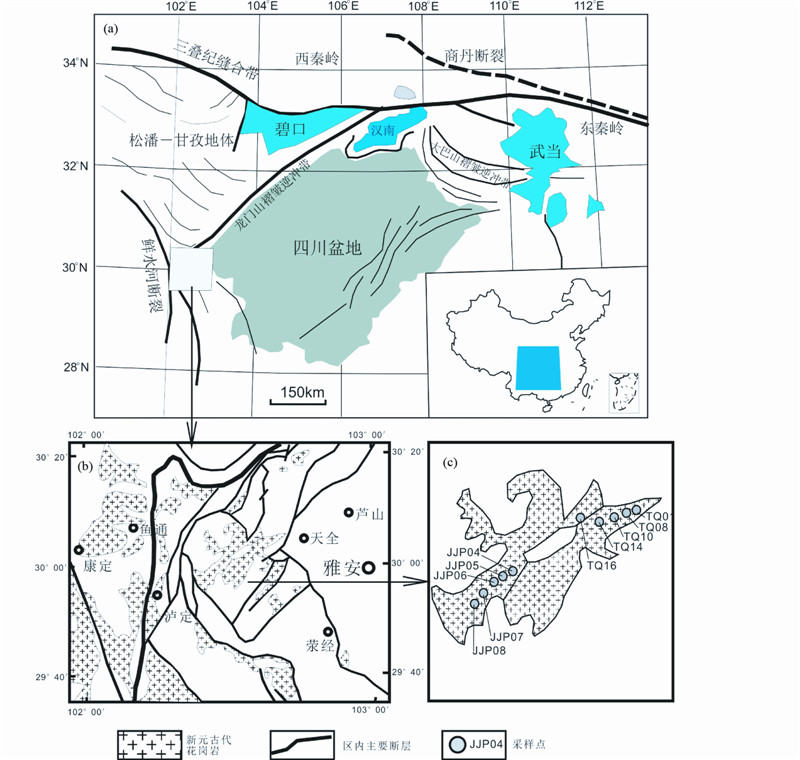 | 图 1 扬子地块大地构造略图(a)、康定杂岩地质简图(b)及川西天全地区新元古代花岗岩类地质简图(c)Fig. 1 Geologic sketch map of the Yangtze Block(a),distributions patterns of the Kangding Complex(b) and the Neoproterozoic granites in the Tianquan area,western Sichuan Province(c) |
花岗闪长岩 主要分布在岩体东部,呈浅灰色-灰白色,块状构造,中细粒-中粗粒花岗结构,局部见有显微文像结构。岩石主要由斜长石(40%~50%)、钾长石(20%~30%)、石英(10%~20%)组成,暗色矿物以角闪石为主,含量可达10%,黑云母含量较少。副矿物有:榍石、磷灰石、锆石、磁铁矿等。斜长石为岩石的主要矿物成分,主要为酸性斜长石,可见其呈较自形的柱状、板柱状晶形,柱面解理发育。斜长石有比较明显的钠黝帘石化蚀变现象,可见聚片双晶及卡钠复合连晶(图 2d)。钾长石自形程度略差于斜长石,为半自形状,颗粒大小与斜长石相当,可见比较明显的高岭土化现象(图 2d),卡氏双晶发育,部分颗粒可见格子双晶。石英在岩石中呈他形粒状分布于长石颗粒之间,表面裂纹较为发育,裂纹呈不规则状,有时可见石英具波状消光现象。岩石中暗色矿物以角闪石为主,柱状晶形,柱面解理发育,显著绿泥石化(图 2c)。黑云母含量不高,零散分布于岩石中。
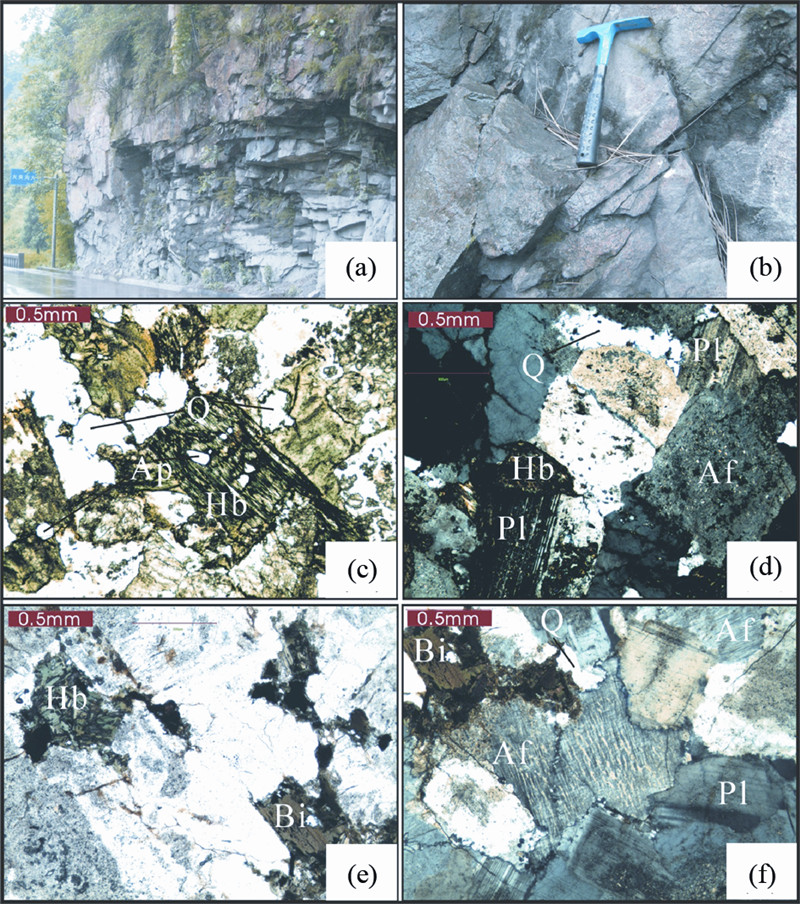 | 图 2 川西天全新元古代花岗岩的野外(a、b)及镜下(c-f)照片 Af-钾长石;Pl-斜长石;Q-石英;Hb-角闪石;Bi-黑云母;Ap-磷灰石Fig. 2 Field(a,b) and microscopic(c-f)photos of the Neoproterozoic granite from the Tianquan area,western Sichuan Province |
花岗岩 岩石呈灰白色-浅肉红色(图 2a,b),块状构造,局部可见似片麻状构造,中粒-中粗粒自形-半自形粒状结构;主要矿物为钾长石(40%~50%)+酸性斜长石(20%~25%)+石英(20%~25%)+黑云母(5%)+角闪石(1%~2%),副矿物有榍石、磷灰石、锆石、磁铁矿等。钾长石以条纹长石和微斜长石为主(图 2e,f),明显高岭土化。酸性斜长石呈半自形短柱状,轻微钠黝帘石化蚀变,可见聚片双晶,双晶纹细密,在斜长石和条纹长石的接触边界上可见蠕英结构。石英呈他形粒状。黑云母黑褐色,自形-半自形晶,一组极完全解理,颗粒边缘有轻微的氧化蚀变和铁质物分解析出现象(图 2e,f)。角闪石含量较低,柱状晶形,有绿泥石化现象(图 2e)。 2 样品分析方法
分析测试样品是在岩石薄片鉴定的基础上精心挑选出来的。首先经镜下观察,选取新鲜的、无后期交代脉体贯入的样品,然后用牛皮纸包裹击碎成直径约5~10mm的细小新鲜岩石小颗粒,蒸溜水洗净烘干,最后在振动盒式碎样机(日本理学公司生产)内粉碎至200目。
主量和微量元素在西北大学大陆动力学国家重点实验室完成。主量元素采用XRF法完成,微量元素用ICP-MS测定。微量元素样品在高压溶样弹中用HNO3和HF混合酸溶解两天后,用VG Plasma-Quad Excell ICP-MS方法完成测试,对国际标准参考物质BHVO-1(玄武岩)、BCR-2(玄武岩)和AGV-1(安山岩)的同步分析结果表明,微量元素分析的精度和准确度一般优于10%,详细的分析流程见文献(刘晔等,2007)。Sr-Nd-Pb同位素分析在西北大学大陆动力学国家重点实验室完成。Sr、Nd同位素分别采用AG50W-X8(200~400mesh),HDEHP(自制)和AG1-X8(200~400mesh)离子交换树脂进行分离,同位素的测试则在该实验室的多接收电感耦合等离子体质谱仪(MC-ICP MS,Nu Plasma HR,Nu Instruments,Wrexham,UK)上采用静态模式(Static mode)进行。
全岩Pb同位素是通过HCl-Br塔器进行阴离子交换分离,Pb同位素的分离校正值205Tl/203Tl=2.3875。在分析期间,NBS981的30个测量值得出206Pb/204Pb=16.937±1(2σ),207Pb/204Pb=15.491±1(2σ),和208Pb/204Pb=36.696±1(2σ)的平均值。BCR-2标样给出了值是206Pb/204Pb=18.742±1(2σ),207Pb/204Pb=15.620±1(2σ),和208Pb/204Pb=38.705±1(2σ)。所有程序中Pb空白样的范围在0.1~0.3ng之间。
锆石按常规重力和磁选方法分选,最后在双目镜下挑纯,将锆石样品置于环氧树脂中,然后磨至约一半,使锆石内部暴露,锆石样品在测定之前用浓度为3%的稀HNO3清洗样品表面,以除去样品表面的污染。锆石的CL图象分析是在西北大学大陆动力学国家重点实验室的电子显微扫描电镜上完成。锆石U-Pb同位素组成分析在西北大学大陆动力学国家重点实验室激光剥蚀电感藕合等离子体质谱(LA-ICP-MS)仪上完成。激光剥蚀系统为配备有193nm ArF-excimer激光器的Geolas200M(Microlas Gottingen Germany),分析采用激光剥蚀孔径30μm,激光脉冲为10Hz,能量为32~36mJ,同位素组成用锆石91500进行外标校正。LA-ICP-MS分析的详细方法和流程见(Yuan et al., 2004)。 3 锆石LA-ICP-MS U-Pb定年结果
在角脚坪花岗岩中采集1个花岗岩样品(JJP-02)用于锆石LA-ICP-MS 微区U-Pb定年分析,分析结果(表 1)及锆石的CL图象如图 3所示。锆石颗粒为无色透明,长柱状半自形-自形晶,粒径介于100~300μm之间,长宽比2:1~3:1。在CL图像上,大部分锆石有岩浆韵律环带,个别锆石显示核边结构。共选取36颗锆石进行了36个数据点分析。其中#9、10、14、27、28、33和35等7个点为不谐和的年龄信息,因此其地质意义不予讨论;#3、7、16和23的206Pb/238U年龄明显偏年轻,介于的获得比较新的206Pb/238U年龄零散的分布在606±7Ma到779±9Ma之间,在U-Pb谐和图上落于谐和线的下方,代表Pb丢失作用的结果;其余25个测试点都表现出谐和的年龄信息,其Th=56×10-6~359×10-6,U=95×10-6~388×10-6,Th/U比值介于0.3到1.09之间,代表岩浆成因的锆石;这25个点得到的206Pb/238U加权平均年龄为851±15Ma(MSWD=0.7,2σ)(图 3),应该代表天全新元古代花岗岩结晶年龄。
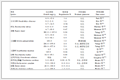 | 表 1 川西天全地区角脚坪新元古代花岗岩锆石LA-ICP MS U-Th-Pb同位素分析结果Table 1 Zircom LA-ICP MS U-Th-Pb isotopic analysis results of the Neoproterozoic Jiaojiaoping granites from the Tianquan area,western Sichuan Provinces |

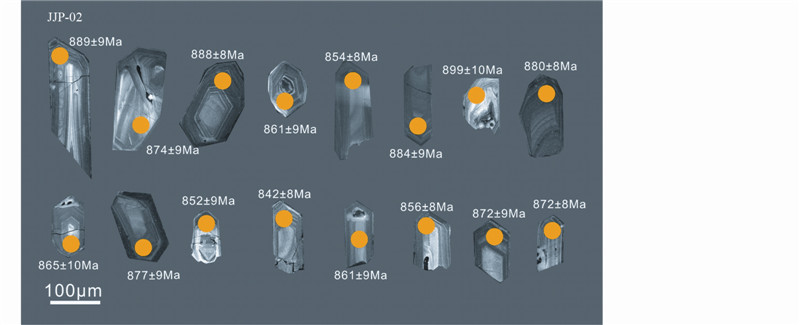 | 图 3 川西角脚坪新元古代花岗岩锆石阴极发光(CL)图像Fig. 3 Zircons cathodoluminescene(CL)images for the Neoproterozoic granites from the western Sichuan Province |
本区花岗岩的主-微量元素分析结果列于表 2中。从表 2中可以看到,取自火夹沟的4个花岗闪长岩SiO2含量在64.48%~65.82%之间,TiO2=0.46%~0.56%,在An-Ab-Or岩石类型划分图解中(图 4a)均位于花岗岩与花岗闪长岩的分界线附近;岩石CaO含量变化较大,在1.72%~3.68%之间;富铝(Al2O3=15.73%~16.20%,平均为15.95%),铝饱和指数A/CNK=0.96~1.18,属于准铝质-过铝质系列(图 4c)。岩石的K2O=2.42%~3.05%,Na2O=4.29%~5.65%,Na2O/K2O=1.40~1.96。岩石σ=2.11~3.37,在SiO2-K2O图解上位于高钾钙碱性系列岩石范围内(图 4b)。岩石MgO=2.26%~2.78%,Mg#值(48.1~52.9)略高。
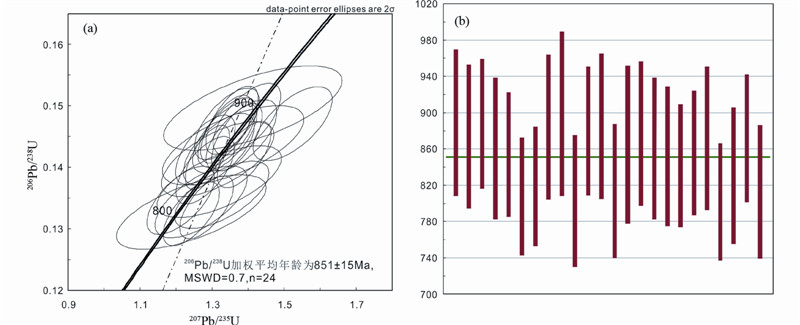 | 图 4 川西角脚坪新元古代花岗岩锆石U-Pb年龄谐和图Fig. 4 Zircon U-Pb concordia diagram for the Neoproterozoic granites from the western Sichuan Provinc |
取自角脚坪的6个花岗岩样品SiO2=73.31%~74.93%,在An-Ab-Or图解中(图 5a)位于花岗岩区内;岩石CaO=0.33%~1.02%,岩石TiO2含量也明显低于花岗闪长岩类(TiO2=0.20%~0.33%),Al2O3=13.34%~14.28%,A/CNK=1.01~1.07,除了1个样品的值是1.33之外,同样属于过铝质系列(图 5c)。岩石的K2O=2.02%~3.13%,Na2O=4.78%~5.38%,Na2O/K2O=1.54~2.40。在SiO2-K2O图解上位于钙碱性系列岩石范围内(图 5b)。
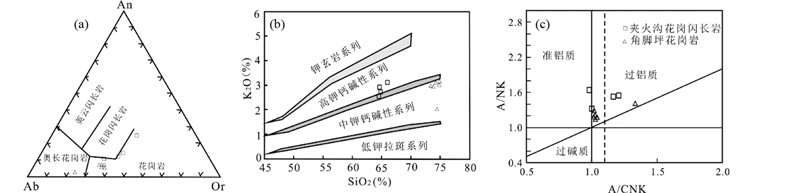 | 图 5 川西新元古代天全花岗岩An-Ab-Or(a)、SiO2-K2O(b)和A/NK-A/CNK(c)图解(据Barker,1979; Rollinson,1993; Maniar and Piccoli,1989)Fig. 5 An-Ab-Or(a),SiO2-K2O(b) and A/NK-A/CNK(c)diagrams for the Neoproterozoic Tianquan granites from the western Sichuan Province(after Barker,1979; Rollinson,1993; Maniar and Piccoli,1989) |
本区岩石10个样品的稀土及微量元素分析结果列于表 2中。从表中可以看到,火夹沟花岗闪长岩稀土总量在68.05×10⁻⁶~144.0×10⁻⁶之间,平均为99.43×10⁻⁶,∑LREE/∑HREE较为稳定,在2.49~3.99之间变化,平均为3.08,岩石(La/Yb)N介于6.78~13.0之间,平均为9.51,(Ce/Yb)N介于5.28~9.10之间,平均为6.81;δEu变化在0.71~0.90之间,平均0.81,表明岩石有轻度的Eu亏损。角脚坪花岗岩稀土总量在96.4×10-6~113.2×10-6之间,平均为103.5×10-6,∑LREE/∑HREE在2.34~2.86之间变化,岩石(La/Yb)N介于5.45~7.20之间,平均为6.02,(Ce/Yb)N大多介于4.27~5.50之间,平均为4.65;δEu变化在0.56~0.77之间,平均0.64。
| 表 2 川西天全地区新元古代花岗岩常量(wt%)及微量元素分析结果(×10-6)Table 2 Analytical results of major(wt%) and trace element(×10-6)of the granite from the Tianquan area |
本区岩石10个样品的球粒陨石标准化稀土元素配分图解(图 6)和原始地幔标准化微量元素蛛网图(图 7)显示,花岗岩和花岗闪长岩具有完全一致的配分型式,配分曲线均显示为右倾负斜率富集型配分型式。Nb和Ta元素呈现显著的负异常,岩石Rb/Sr(0.19~0.71)、Rb/Ba(0.07~0.13)、K/Rb(245.78~392.99)以及在配分曲线上Nb、Ta、Sr、P的明显亏损,说明斜长石作为熔融残留相或结晶分离相存在,即在熔融过程中斜长石相没有被耗尽(Patiño Douce and Johnston,1991; Patiño Douce and Beard,1995; Patiño Douce and Harris,1998; Patiño Douce,1999)。岩石中Zr的富集和Nb、Ta的亏损表明源区岩石中可能以陆壳组分为主(Green and Pearson,1987; Green,1995; Barth et al., 2000)。Nb、P的亏损和Ba的富集显示了I型花岗岩的特征。Ti在岩浆岩中易形成独立矿物相,主要是钛铁氧化物类(刘英俊等,1984; Lai et al., 2001,2003,2007,2011; 赖绍聪和刘池阳,2001; 赖绍聪等,2007)。
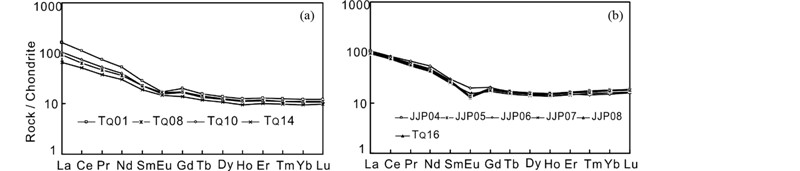 | 图 6 川西新元古代天全花岗岩球粒陨石标准化稀土元素配分图解(标准化值据Sun and McDonough,1989) (a)火夹沟花岗闪长岩;(b)脚角坪花岗岩Fig. 6 Chondrite-normalized REE patterns for the Neoproterozoic Tianquan granites from the western Sichuan Province(normalization values after Sun and McDonough,1989) |
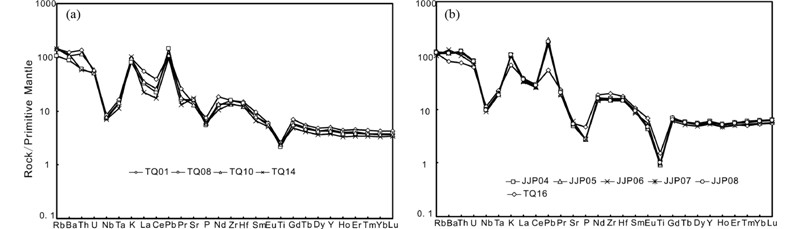 | 图 7 川西新元古代天全花岗岩原始地幔标准化微量元素蛛网图(标准化值据Wood et al., 1979) (a)火夹沟花岗闪长岩;(b)脚角坪花岗岩Fig. 7 Primitive mantle-normalized trace element spider diagrams for the Neoproterozoic Tianquan granites from the western Sichuan Province(normalization values after Wood et al., 1979) |
本区花岗岩和花岗闪长岩4个样品的Sr-Nd-Pb同位素分析结果列于表 3和表 4中。从表 3和4中可以看到岩石的同位素地球化学特征显示花岗闪长岩初始87Sr/86Sr分别为0.704857和0.710471,花岗岩具有相对较低的初始87Sr/86Sr分别为0.701597和0.702408。花岗闪长岩εNd(t)分别为+0.6和+0.9,花岗岩的εNd(t)比较高,分别为+4.4和+8.3。根据εNd(t)-87Sr/86Sr相关图解(图 8),本区花岗闪长岩具有稍高的初始Sr及低εNd(t)的特征,εNd(t)稍微高于BSE成分,而花岗岩具有低初始Sr和高εNd(t),εNd(t)值介于MORB和初始地幔端元水平。
| 表 3 川西天全新元古代花岗岩类全岩Sr-Nd同位素分析结果Table 3 Whole-rock Sr-Nd isotopic compositions of the Neoproterozoic granitoids from the western Sichuan Province |


| 表 4 川西天全新元古代花岗岩类全岩Pb同位素分析结果Table 4 Whole-rock Pb isotopic compositions of the Neoproterozoic granitoids from the western Sichuan Province |


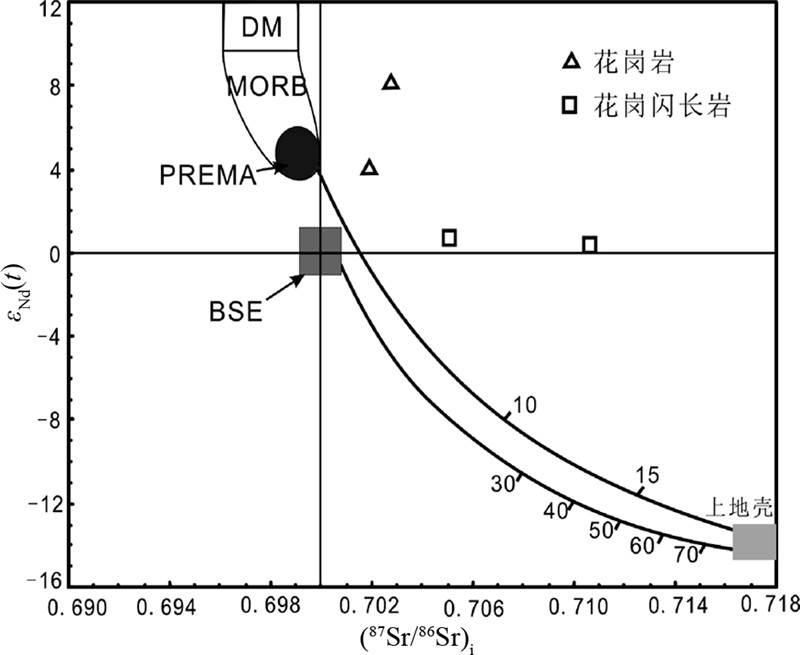 | 图 8 川西新元古代天全花岗岩类岩石(87Sr/86Sr)i-εNd(t)图解 DM-亏损地幔;PREMA-原始地幔;BSE-地球总成分;MORB-洋中脊玄武岩Fig. 8(87Sr/86Sr)i-εNd(t)diagrams for the Neoproterozoic granitoids from the western Sichuan Province |
本区花岗闪长岩的初始206Pb/204Pb=17.181~17.353,207Pb/204Pb=15.551~15.566,208Pb/204Pb=36.649~36.950;本区花岗岩具有相对较低初始206Pb/204Pb=17.128~17.142,207Pb/204Pb=15.519~15.524,208Pb/204Pb=35.857~35.927;在Pb同位素成分系统变化图中(图 9),本区花岗质岩石无论是在207Pb/204Pb-206Pb/204Pb图解上,还是208Pb/204Pb-206Pb/204Pb图解上,均位于Th/U=4.0的北半球参考线(NHRL)之上,并在208Pb/204Pb-206Pb/204Pb图解上具有与MORB接近的同位素组成,而在207Pb/204Pb-206Pb/204Pb图解上则接近于下地壳的区域内,而且花岗岩有相对接近EMI的趋势。本区花岗闪长岩模式年龄tDM(Ga)值为1.5Ga和1.51Ga,而花岗岩的tDM(Ga)值为1.17Ga和0.86Ga。
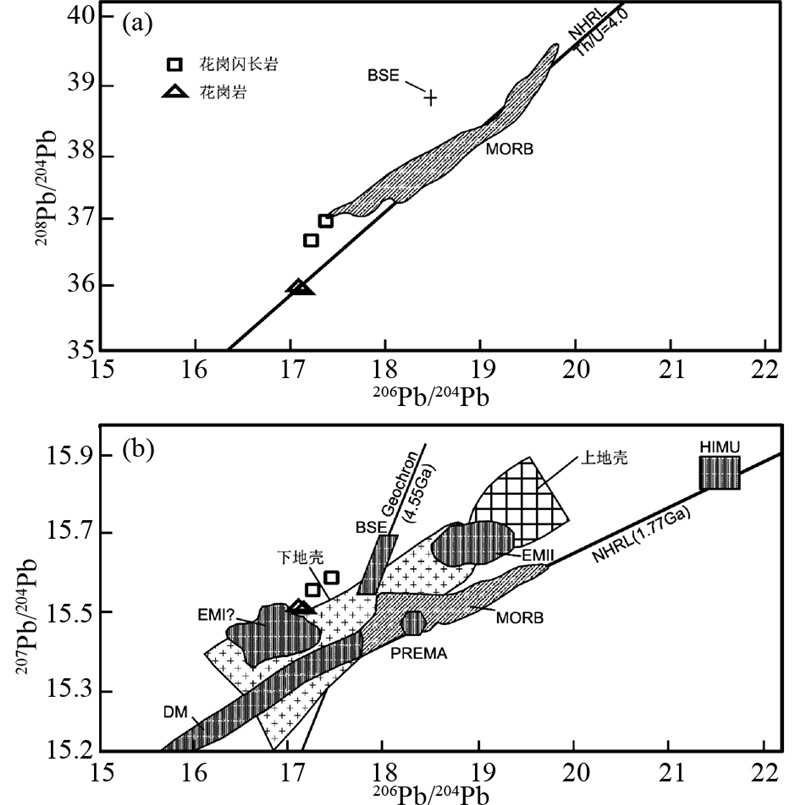 | 图 9 川西新元古代天全花岗岩类岩石206Pb/204Pb-208Pb/204Pb(a)和206Pb/204Pb-207Pb/204Pb(b)图解(据Hugh,1993) DM-亏损地幔;PREMA-原始地幔;BSE-地球总成分;MORB-洋中脊玄武岩;EMI-I型富集地幔;EMII-Ⅱ型富集地幔;HIMU-异常高238U/204Pb地幔Fig. 9 206Pb/204Pb-208Pb/204Pb(a) and 206Pb/204Pb-207Pb/204Pb(b)diagrams for the Neoproterozoic granitoids from the western Sichuan Province(after Hugh,1993) |
天全地区新元古代花岗岩及花岗闪长岩都表现出过铝质的特性,大多数样品的铝饱和指数A/CNK都高于1.1,属于强过铝质花岗岩类,铝饱和指数曾被认为是判别I型和S型花岗岩的标志(Chappell and White,1974,2001; 吴福元等,2007; 王德滋等,1993)。一般认为,如果形成强过铝花岗岩的源岩是泥质的,即富粘土、贫长石(<5%),则形成于成熟的大陆克拉通环境;如果形成强过铝花岗岩的源岩是贫粘土、富长石的(>5%),则形成于未成熟的板块边缘(岛弧和大陆弧)的海沟俯冲带环境(钟长汀等,2007)。因此判别强过铝花岗岩源岩性质成为判别强过铝花岗岩形成构造环境的关键。火夹沟花岗闪长岩具有高的CaO/Na2O比值(0.30到0.85)、低的Rb/Sr(0.19~0.33)和Rb/Ba(0.10~0.12)比值,这表明这类岩石的源区主要为贫粘土的杂砂岩(图 10a,b)。岩石具有低的SiO2含量(64.48%~65.82%)及低的Al2O3/TiO2(28.7~34.2),这表明岩石的源区可能有幔源镁铁质熔体的混入,这些特征类似于澳大利亚Lachlan造山带强过铝质花岗岩(Chappell and White,2001)及华北中元古代强过铝质花岗岩(钟长汀等,2007),表明火夹沟花岗闪长岩形成于高地温梯度、成熟度较低的杂砂岩部分熔融。
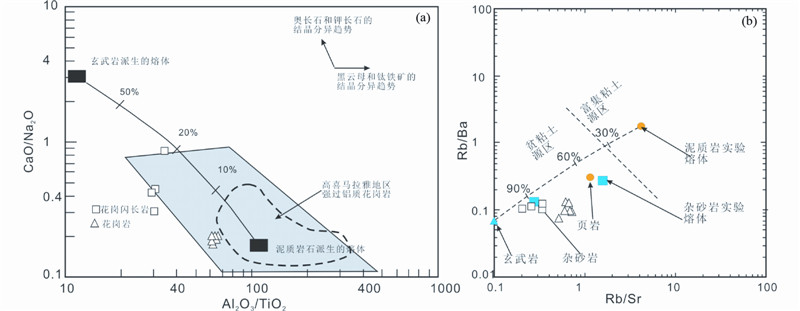 | 图 10 川西新元古代天全花岗岩类岩石Al2O3/TiO2-CaO/Na2O(a)及Rb/Sr-Rb/Ba(b)源区判别图解(据Sylvester,1998)Fig. 10 Al2O3/TiO2-CaO/Na2O(a) and Rb/Sr-Rb/Ba(b)diagrams for the Neoproterozoic granitoids from the western Sichuan Province(after Sylvester,1998) |
角脚坪花岗岩具有较高的SiO2含量及低的TiO2含量,岩石同时也表现出过铝质的地球化学特性,多数样品的A/CNK指数大于1.1,但是这些地球化学特征并不能作为其是S型花岗岩的标志,在K2O-Na2O图解(图 11b)上,岩石表现出富Na的地球化学属性,所有样品均位于I型花岗岩区域内。在Al2O3/TiO2-CaO/Na2O岩石源区判别图解上(图 10a),角脚坪花岗岩具有较高的Al2O3/TiO2比值及高的CaO/Na2O比值,表明岩石的源区有大量泥质岩的加入,但是在Rb/Sr-Rb/Ba判别图解上,岩石具有低的Rb/Sr和Rb/Ba比值(图 10b),表明其起源于贫粘土的杂砂岩的部分熔融。结合岩石具有极度亏损的Sr-Nd同位素组成,Sr同位素初始比值(87Sr/86Sr)i=0.701597~0.702408,εNd(t)=+4.4~+8.3,接近于亏损地幔的Sr-Nd同位素组成(图 8),岩石的单阶段同位素Nd模式年龄介0.86~1.17Ga,十分接近于岩石的锆石U-Pb年龄(851Ma),这表明岩石应起源于亏损的源区,但是亏损地幔直接部分熔融不可能形成高Si的花岗质熔体(Wilson,1989),因此岩石的源区应该是亏损的玄武质岩石,这种玄武质岩石有可能是源于亏损地幔的洋壳或是源区软流圈地幔的玄武岩。实验岩石学研究表明玄武质岩石在H2O饱和条件下发生低程度部分熔融可以形成过铝质、高Si的Na质花岗岩(Rapp and Watson,1995; Petford and Atherton,1996; DePaolo and Daley,2000)。因此我们认为角脚坪花岗岩应该是亏损的玄武质岩石(有可能是洋壳或是亏损的地幔柱来源的玄武岩)在高温、H2O饱和条件下形成的过铝质、Na质花岗岩。
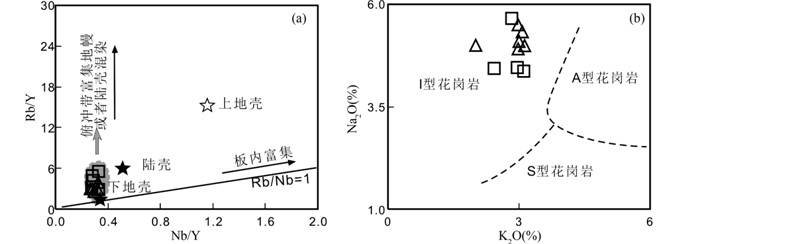 | 图 11 川西新元古代天全花岗岩类岩石Nb/Y-Rb/Y(a,据Jahn et al., 1999)及K2O-Na2O(b,据Collins et al., 1982)图解Fig. 11 Nb/Y-Rb/Y(a,after Jahn et al., 1999) and K2O-Na2O(b,after Collins et al., 1982)diagrams for the Neoproterozoic granitoids from the western Sichuan Province |
沿着扬子地块的西缘出露了大量包括本区研究的花岗岩在内的新元古代花岗岩,大多数以I和S型为主,并有少量的A型花岗岩体(胡建等,2007; Li et al., 2008; Zhao et al., 2008)。这些新元古代中酸性火成岩组合形成的构造环境存在极大的争议,部分学者认为是形成于活动大陆边缘(Zhou et al., 2002b;Wang et al., 2006; Wang and Zhou,2012; Yan et al., 2004; Yu et al., 2008)的岛弧岩浆杂岩,或是在地幔柱背景下岛弧地壳发生重熔作用形成的(Li et al., 2003a,b)。但是单单根据花岗岩的地球化学属性难以确定其形成的构造环境,花岗岩类的构造环境判别图解也存在多解性(Pearce,1983,1996; Pearce et al., 1984; Whalen et al., 1987),只有在系统分析岩石源区属性及部分熔融条件的基础上,结合区域构造资料,才能逐步分析和厘定岩石形成的构造环境。
扬子地块西缘分布大量新元古代钠质石英闪长岩-奥长花岗岩-花岗闪长岩(TTG)类岩石和富K的花岗岩(Zhao et al., 2008),这些岩石的形成年龄为(800~650Ma),而且这些岩石具有相对亏损的Sr-Nd同位素组成,被认为是由于地幔楔深部板片脱水生成的玄武质岩浆上涌导致下地壳的部分熔融所产生的。Li et al.(2003a)通过对华南新元古代花岗岩类及伴生的镁铁质岩石系统的年代学和地球化学分析,提出扬子地块存在两期双峰式岩浆作用:830~795Ma及780~745Ma,作者认为这种双峰式岩浆作用在Roninia超大陆的其它地块,如Australia,India,Madagascar,Seychelles,southern Africa及Laurentia等地块也广泛发育,作者认为如此大规模的双峰式岩浆作用只能用地幔柱上涌导致的超大陆裂解模式来解释。
本文通过对川西天全地区的新元古代花岗闪长岩及花岗岩系统的成因分析认为,火夹沟地区的花岗闪长岩为过铝质,应该是在高地温梯度条件下,由杂砂岩组成的中元古代地壳发生部分熔融形成的过铝质熔体,而且岩石的SiO2含量偏低,应该是这种过铝质熔体同化了部分幔源镁铁质熔体所致;而角脚坪地区的过铝质花岗岩具有极度亏损的Sr-Nd同位素组成;但是在俯冲带环境下,普通俯冲洋壳由于地温梯度较低,无法直接发生部分熔融,受俯冲洋壳流体交代富集的地幔楔发生部分熔融将形成SiO2含量相对较低的安山质岩浆(Wilson,1989),而如果是年轻俯冲洋壳(地温梯度较高)直接发生部分熔融将形成高Sr/Y比值的埃达克岩(Defant and Drummond,1990; Castillo,2008; Martin,1999; Martin et al., 2005),而角脚坪花岗岩明显不具有高Sr低Y的埃达克岩地球化学属性,因此角脚坪花岗岩不可能是俯冲洋壳直接发生部分熔融的产物。在Rb-(Yb+Ta)和Rb/30-Hf-3Ta图解(图 12)中,本区花岗岩和花岗闪长岩数据点全部位于火山弧花岗岩区域内。
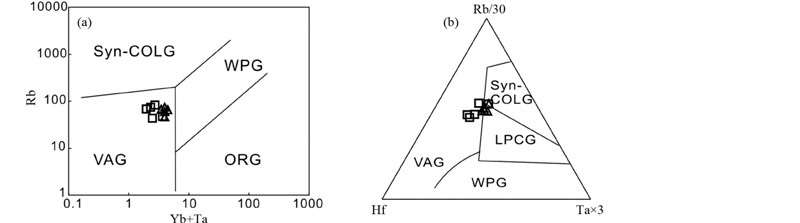 | 图 12 川西新元古代天全花岗岩类岩石Y+Ta-Rb(a,据Pearce et al., 1984)和Rb/30-Hf-Ta×3(b,据Harris et al., 1986)构造环境判别图解Fig. 12 Y+Ta-Rb(a,after Pearce et al., 1984) and Rb/30-Hf-Ta×3(b,after Harris et al., 1986)tectonic discrimination diagrams for the Neoproterozoic granitoids from the western Sichuan Province |
本文通过对扬子地块西缘天全地区花岗闪长岩及花岗岩系统的锆石U-Pb年代学、岩石地球化学及Sr-Nd-Pb同位素地球化学研究,得到如下结论:
(1)天全花岗岩体的LA-ICP-MS锆石U-Pb测年结果表明其形成于851±15Ma(MSWD=0.7,2σ),其形成时代为新元古代,与扬子板块西缘和北缘大量的中酸性侵入体和火山岩具有相近的形成年龄。
(2)火夹沟花岗闪长岩为过铝质、低SiO2、具有相对亏损的Sr-Nd-Pb同位素地球化学组成,结合岩石低的Al2O3/TiO2和高的CaO/Na2O比值,本文认为火夹沟花岗闪长岩的成因机制为:在镁铁质岩浆底侵的条件下,成熟度较低的杂砂岩部分熔融形成的过铝质熔体,岩石降低的SiO2含量表明其同化了部分镁铁质熔体。
(3)角脚坪花岗岩具有高的SiO2含量,为过铝质、富Na的熔体,而且具有极度亏损的Sr-Nd同位素组成,表明其应是亏损的玄武质岩石在H2O饱和条件下发生低程度部分熔融形成的过铝质熔体。
致谢 感谢周美夫教授和另一位审稿专家提出的中肯意见与建议。| [1] | Barker F. 1979. Trondhjemite: Definition, environment and hypotheses of origin. In: Barker F (ed.). Trondhjemites, Dacites, and Related Rocks. Amsterdam: Elsevier, 1-12 |
| [2] | Barth MG, McDonough WF and Rudnick RL. 2000. Tracking the budget of Nb and Ta in the continental crust. Chemical Geology, 165(3-4): 197-213 |
| [3] | Castillo PR. 2008. Origin of the adakite high-Nb basalt association and its implications for postsubduction magmatism in Baja California, Mexico. Geol. Soc. Am. Bull., 120(3-4): 451-462 |
| [4] | Chappell BW and White AJR. 1974. Two contrasting granite types. Pacific Geology, 8(2): 173-174 |
| [5] | Chappell BW and White AJR. 2001. Two contrasting granite types: 25 years later. Australian Journal of Earth Sciences, 48(4): 489-499 |
| [6] | Chen YL, Luo ZH and Liu C. 2001. New recognition of Kangding-Mianning metamorphic complexes from Sichuan, western Yangtze Craton: Evidence from Nd isotopic composition. Earth Science, 26(3): 279-285 (in Chinese with English abstract) |
| [7] | Chen YL, Luo ZH, Zhao JX et al. 2004. Petrogenesis of Kangding complex: Evidence from zircon SHRIMP U-Pb age and lithogeochemistry. Science in China (Series D), 34(8): 687-697 (in Chinese) |
| [8] | Collins WJ, Beams SD, White AJR et al. 1982. Nature and origin of A-type granites with particular reference to Southeastern Australia. Contributions to Mineralogy and Petrology, 80(2): 189-200 |
| [9] | Defant MJ and Drummond MS. 1990. Derivation of some modern arc magmas by melting of young subducted lithosphere. Nature, 347(6294): 662-665 |
| [10] | DePaolo DJ and Daley EE. 2000. Neodymium isotopes in basalts of the southwest basin and range and lithospheric thinning during continental extension. Chemical Geology, 169(1-2): 157-185 |
| [11] | Green TH and Pearson NJ. 1987. An experimental study of Nb and Ta partitioning between Ti-rich minerals and silicate liquids at high pressure and temperature. Geochimica et Cosmochimica Acta, 51(1): 55-62 |
| [12] | Green TH. 1995. Significance of Nb/Ta as an indicator of geochemical processes in the crust-mantle system. Chemical Geology, 120(3-4): 347-359 |
| [13] | Harris NBW, Pearce JA and Tindle AG. 1986. Geochemical characteristics of collision-zone magmatism. In: Coward MP and Reis AC (eds.). Collision Tectonics. Geological Society, London, Special Publications, 19(1): 67-81 |
| [14] | Hu J, Qiu JS, Wang RC, Jiang SY, Yu JH and Ni P. 2007. Earliest response of the Neoproterozoic Rodinia break-up in the northeastern Yangtze craton: Constraints from zircon U-Pb geochronology and Nd isotopes of the gneissic alkaline granites in Donghai area. Acta Petrologica Sinica, 23(6): 1321-1333 (in Chinese with English abstract) |
| [15] | Huang JQ. 1960. Review on the basic geological and tectonic feature of China. Acta Geologica Sinica, 40(1): 1-31 (in Chinese) |
| [16] | Hugh RR. 1993. Using Geochemical Data. Singapore: Longman Singapore Publishers, 234-240 |
| [17] | Jahn BM, Wu FY, Lo CH et al. 1999. Crust-mantle interaction induced by deep subduction of the continental crust: Geochemical and Sr-Nd isotopic evidence from post-collisional mafic-ultramafic intrusions of the northern Dabie complex, central China. Chemical Geology, 157(1-2): 119-146 |
| [18] | Lai SC and Liu CY. 2001. Enriched upper mantle and eclogitic lower crust in north Qiangtang, Qinghai-Tibet Plateau: Petrological and geochemical evidence from the Cenozoic volcanic rocks. Acta Petrologica Sinica, 17(3): 459-468 (in Chinese with English abstract) |
| [19] | Lai SC, Liu CY and O'Reilly SY. 2001. Petrogenesis and its significance to continental dynamics of the Neogene high-potassium calc-alkaline volcanic rock association from north Qiangtang, Tibetan plateau. Science in China (Series D), 44(Suppl. 1): 45-55 |
| [20] | Lai SC, Liu CY and Yi HS. 2003. Geochemistry and petrogenesis of Cenozoic andesite-dacite association from the Hoh Xil region, Tibetan Plateau. International Geology Review, 45(11): 998-1019 |
| [21] | Lai SC, Qin JF and Li YF. 2007. Partial melting of thickened Tibetan crust: Geochemical evidence from Cenozoic adakitic volcanic rocks. International Geology Review, 49(4): 357-373 |
| [22] | Lai SC, Qin JF, Li YF and Long P. 2007. Geochemistry and petrogenesis of the alkaline and calc-alkaline series Cenozoic volcanic rocks from Huochetou mountain, Tibetan Plateau. Acta Petrologica Sinica, 23(4): 709-718 (in Chinese with English abstract) |
| [23] | Lai SC, Qin JF and Grapes R. 2011. Petrochemistry of granulite xenoliths from the Cenozoic Qiangtang volcanic field, northern Tibetan Plateau: Implications for lower crust composition and genesis of the volcanism. International Geology Review, 53(8): 926-945 |
| [24] | Li CY. 1963. A preliminary study of the tectonic development of the "Kangdian" axis. Acta Geologica Sinica, 43(3): 214-229 (in Chinese with English abstract) |
| [25] | Li XH, Li ZX, Zhou H et al. 2002. U-Pb zircon geochronology, geochemistry and Nd isotopic study of Neoproterozoic bimodal volcanic rocks in the Kangdian Rift of South China: Implications for the initial rifting of Rodinia. Precambrian Research, 113(1-2): 135-154 |
| [26] | Li XH, Li ZX, Zhou HW et al. 2002. U-Pb zircon geochronological, geochemical and Nd isotopic study of Neoproterozoic basaltic magmatism in western Sichuan: Petrogenesis and geodynamic implications. Earth Science Frontiers, 9(4): 329-338 (in Chinese with English abstract) |
| [27] | Li XH, Li ZX, Ge WC et al. 2003a. Neoproterozoic granitoids in South China: Crustal melting above a mantle plume at ca. 825Ma? Precambrian Research, 122(1-4): 45-83 |
| [28] | Li XH, Qi CS, Liu Y et al. 2005. Petrogenesis of the Neoproterozoic bimodal volcanic rocks along the western margin of the Yangtze Block: New constraints from Hf isotopes and Fe/Mn ratios. Chinese Science Bulletin, 50(21): 2481-2486 |
| [29] | Li XH, Li WX, Li ZX and Liu Y. 2008. 850-790Ma bimodal volcanic and intrusive rocks in northern Zhejiang, South China: A major episode of continental rift magmatism during the breakup of Rodinia. Lithos, 102(1-2): 341-357 |
| [30] | Li XH, Li WX and He B. 2012. Building of the South China block and its relevance to assembly and breakup of Rodinia supercontinent: Observations, interpretations and tests. Bulletin of Mineralogy, Petrology and Geochemistry, 31(6): 543-559 (in Chinese with English abstract) |
| [31] | Li ZH, Luo ZH, Chen YL et al. 2005. Geochronological and geochemical characteristics of Kangding metamorphosed intrusions. Acta Geoscientica Sinica, 26(Suppl.): 87-89 (in Chinese with English abstract) |
| [32] | Li ZX, Zhang LH and Powell CM. 1995. South China in Rodinia: Part of the missing link between Australia-East Antarctica and Laurentia. Geology, 23(5): 407-410 |
| [33] | Li ZX, Li XH, Kinny PD, Wang J, Zhang S and Zhou H. 2003b. Geochronology of Neoproterozoic syn-rift magmatism in the Yangtze Craton, South China and correlations with other continents: Evidence for a mantle superplume that broke up Rodinia. Precambrian Research, 122(1-4): 85-109 |
| [34] | Liao ZT, Ma TT, Zhou ZY et al. 2005. Review on Rodinia and tectonics in South China. Journal of Tongji University (Natural Science), 33(9): 1182-1191 (in Chinese with English abstract) |
| [35] | Lin GC, Li XH and Li WX. 2006. SHRIMP U-Pb zircon age, geochemistry and Nd-Hf isotope of Neoproterozoic mafic dyke swarms in western Sichuan: Petrogenesis and tectonic significance. Science in China (Series D), 36(7): 630-645 (in Chinese) |
| [36] | Liu SW, Yan QR, Li QG et al. 2009. Petrogenesis of granitoid rocks in the Kangding Complex, western margin of the Yangtze Craton and its tectonic significance. Acta Petrologica Sinaca, 25(8): 1883-1896 (in Chinese with English abstract) |
| [37] | Liu Y, Liu XM, Hu ZC et al. 2007. Evaluation of accuracy and long-term stability of determination of 37 trace elements in geological samples by ICP-MS. Acta Petrologica Sinica, 23(5): 1203-1210 (in Chinese with English abstract) |
| [38] | Liu YJ, Cao LM, Li ZL et al. 1984. Element Geochemistry. Beijing: Science Press, 50-372 (in Chinese) |
| [39] | Liu ZR and Zhao JH. 2012. Mineralogical constraints on the origin of Neoproterozoic felsic intrusions, NW margin of the Yangtze Block, South China. International Geology Review, 55(5): 590-607 |
| [40] | Maniar PD and Piccoli PM. 1989. Tectonic discrimination of granitoids. Geological Society of American Bulletin, 101(5): 635-643 |
| [41] | Martin H. 1999. Adakitic magmas: Modern analogues of Archaean granitoids. Lithos, 46(3): 411-429 |
| [42] | Martin H, Smithies RH, Rapp R et al. 2005. Anoverview of adakite, tonalite-trondhjemite-granodiorite (TTG), and sanukitoid: Relationships and some implications for crust evolution. Lithos, 79(1-2): 1-24 |
| [43] | Patiño Douce AE and Johnston AD. 1991. Phase equilibria and melt productivity in the pelitic system: Implications for the origin of peraluminous granitoids and aluminous granulites. Contributions to Mineralogy and Petrology, 107(2): 202-218 |
| [44] | Patiño Douce AE and Beard JS. 1995. Dehydration-melting of biotite gneiss and quartz amphibolite from 3 to 15kbar. Journal of Petrology, 36(3): 707-738 |
| [45] | Patiño Douce AE and Harris N. 1998. Experimental constraints on Himalayan anatexis. Journal of Petrology, 39(4): 689-710 |
| [46] | Patiño Douce AE. 1999. What do experiments tell us about the relative contributions of crust and mantle to the origin of granitic magmas? In: Castro A, Fernandez C and Vigneresse J (eds.). Understanding Granites: Integrating New and Classical Techniques. Geological Society, London, Special Publications, 168(1): 55-75 |
| [47] | Pearce JA. 1983. The role of sub-continental lithosphere in magma genesis at destructive plate margins. In: Hawkesworth CJ and Norry MJ (eds.). Continental Basalts and Mantle Xenoliths. London: Nantwich Shiva Press, 230-249 |
| [48] | Pearce JA, Harris NBW and Tindle AG. 1984. Trace element discrimination diagrams for the tectonic interpretation of granitic rocks. Journal of Petrology, 25(4): 956-983 |
| [49] | Pearce JA. 1996. Sources and setting of granitic rocks. Episodes, 19(4): 120-125 |
| [50] | Petford N and Atherton M. 1996. Na-rich partial melts from newly underplated basaltic crust: The Cordillera Blanca batholith, Peru. Journal of Petrology, 37(6): 1491-1521 |
| [51] | Rapp RP and Watson EB.1995. Dehydration melting of metabasalt at 8-32kbar: Implications for continental growth and crust-mantle recycling. Journal of Petrology, 36: 891-931 |
| [52] | Rollinson HR. 1993. Using Geochemical Data: Evalution, Presentation, Interpretation. London: Person Education Limited, 1-284 |
| [53] | Shen WZ, Li HM, Xu SJ et al. 2000. U-Pb chronological study of zircons from the Huangcaoshan and Xiasuozi granites in the western margin of Yangtze plate. Geological Journal of China Universities, 6(3): 412-416 (in Chinese with English abstract) |
| [54] | Shen WZ, Gao JF, Xu SJ et al. 2002. Geochemical characteristics and genesis of the Qiaotou basic complex, Luding County, western Yangtze Block. Geological Journal of China Universities, 8(4): 380-389 (in Chinese with English abstract) |
| [55] | Sun SS and McDonough WF. 1989. Chemical and isotopic systematics of oceanic basalts: Implications for mantle composition and processes. In: Saunders AD and Norry MJ (eds.). Magmatism in the Ocean Basins. Geological Society, London, Special Publications, 42(1): 313-345 |
| [56] | Sun WH, Zhou MF, Yan DP, Li JW and Ma YX. 2008. Provenance and tectonic setting of the Neoproterozoic Yanbian Group, western Yangtze Block (SW China). Precambrian Research, 167(1-2): 213-236 |
| [57] | Sylvester PJ.1998.Post-collisional strongly peraluminous granites. Lithos 45:29-44 |
| [58] | Wang DZ, Liu CS, Shen WZ et al. 1993. The contrast between Tonglu I-type and Xiangshan S-type clastoporphyritic lava. Acta Petrologica Sinica, 9(1): 44-53 (in Chinese with English abstract) |
| [59] | Wang JH. 1998. New advances in reconstruction of the Proterozoic Rodinia supercontinent. Earth Science Frontiers, 5(4): 235-242 (in Chinese with English abstract) |
| [60] | Wang W and Zhou MF. 2012. Sedimentary records of the Yangtze Block (South China) and their correlation with equivalent Neoproterozoic sequences on adjacent continents. Sediment. Geol., 265-266: 126-142 |
| [61] | Wang XL, Zhou JC, Qiu JS, Zhang WL, Liu XM and Zhang GL. 2006. LA-ICP-MS U-Pb zircon geochronology of the Neoproterozoic igneous rocks from northern Guangxi, South China: Implications for tectonic evolution. Precambrian Research, 145(1-2): 111-130 |
| [62] | Whalen JB, Currie KL and Chappell BW. 1987. A-type granites: Geochemical characteristics, discrimination and petrogenesis. Contributions to Mineralogy and Petrology, 95(4): 407-419 |
| [63] | Wilson M. 1989. Igneous Petrogenesis. London: Unwin Hyman Press, 295-323 |
| [64] | Wood DA, Joron JL, Treuil M et al. 1979. Elemental and Sr isotope variations in basic lavas from Iceland and the surrounding sea floor. Contrib. Mineral. Petrol., 70(3): 319-339 |
| [65] | Wu FY, Li XH, Yang JH and Zheng YF. 2007. Discussions on the petrogenesis of granites. Acta Petrologica Sinica, 23(6):1217-1238 (in Chinese with English abstract) |
| [66] | Xiao L, Zhang HF, Ni PZ, Xiang H and Liu XM. 2007. LA-ICP-MS U-Pb zircon geochronology of Early Neoproterozoic mafic-intermediate intrusions from NW margin of the Yangtze Block, South China: Implication for tectonic evolution. Precambrian Research, 154(3-4): 221-235 |
| [67] | Yan DP, Zhou MF, Song HL et al. 2002. Where was South China located in the reconstruction of Rodinia? Earth Science Frontiers, 9(4): 249-256 (in Chinese with English abstract) |
| [68] | Yan QR, Hanson AD, Wang ZQ, Druschke PA, Yan Z, Wang T, Liu DY, Song B, Pan P, Zhou H and Jiang CF. 2004. Neoproterozoic subduction and rifting on the northern margin of the Yangtze Plate, China: Implications for Rodinia reconstruction. International Geology Review, 46(9): 817-832 |
| [69] | Yu JH, O'Reilly SY, Wang LJ, Griffin WL, Zhang M, Wang RC, Jiang SY and Shu LS. 2008. Where was South China in the Rodinia supercontinent? Evidence from U-Pb geochronology and Hf isotopes of detrital zircons. Precambrian Research, 164(1-2): 1-15 |
| [70] | Yuan HH, Zhang SF, Zhang P et al. 1987. A preliminary study on the formation age of the basement of the "Kangdian" axis. In: Zhang YX and Liu BG (eds.). Letters about the Panxi Continental Rift Valley, China (2). Beijing: Geological Publishing House, 51-60 (in Chinese with English abstract) |
| [71] | Yuan HL, Gao S, Liu XM et al. 2004. Accurate U-Pb age and trace element determinations of zircon by laser ablation-Inductively coupled plasma mass spectrometry. Geostandards and Geoanalytical Research, 28(3): 353-370 |
| [72] | Zhao GC and Cawood PA. 2012. Precambrian geology of China. Precambrian Research, 222-223: 13-54 |
| [73] | Zhao JH and Zhou MF. 2009. Secular evolution of the Neoproterozoic lithospheric mantle underneath the northern margin of the Yangtze Block, South China. Lithos, 107(3-4): 152-168 |
| [74] | Zhao JH, Zhou MF, Zheng JP et al. 2010. Neoproterozoic crustal growth and reworking of the Northwestern Yangtze Block: Constraints from the Xixiang dioritic intrusion, South China. Lithos, 120(3-4): 439-452 |
| [75] | Zhao JH, Zhou MF, Yan DP, Zheng JP and Li JW. 2011. Reappraisal of the ages of Neoproterozoic strata in South China: No connection with the Grenvillian orogeny. Geology, 39(4): 299-302 |
| [76] | Zhao XF, Zhou MF, Li JW and Wu FY. 2008. Association of Neoproterozoic A- and I-type granites in South China: Implications for generation of A-type granites in a subduction-related environment. Chemical Geology, 257(1-2): 1-15 |
| [77] | Zhong CT, Deng JF, Wan YS, Mao DB and Li HM. 2007. Magma recording of Paleoproterozoic orogeny in central segment of northern margin of North China Craton: Geochemical characteristics and zircon SHRIMP dating of S-type granitoids. Geochimica, 36(6):585-600 (in Chinese with English abstract) |
| [78] | Zhou MF, Kennedy AK, Sun M, Malpas J and Lesher CM. 2002a. Neoproterozoic arcrelated mafic intrusions along the northern margin of South China: Implications for the accretion of Rodinia. The Journal of Geology, 110(5): 611-618 |
| [79] | Zhou MF, Yan DP, Kennedy AK et al. 2002b. SHRIMP U-Pb zircon geochronological and geochemical evidence for Neoproterozoic arc-magmatism along the western margin of the Yangtze Block, South China. Earth and Planetary Science Letters, 196(1-2): 51-67 |
| [80] | Zhou MF, Yan DP, Wang CL et al. 2006. Subduction-related origin of the 750Ma Xuelongbao adakitic complex (Sichuan Province, China): Implications for the tectonic setting of the giant Neoproterozoic magmatic event in South China. Earth and Planetary Science Letters, 248(1-2): 286-300 |
| [81] | Zhou MF, Zhao XF, Chen WT, Li XC, Wang W, Yan DP and Qiu HN. 2014. Proterozoic Fe-Cu metallogeny and supercontinental cycles of the southwestern Yangtze Block, southern China and northern Vietnam. Earth-Science Reviews, 139: 59-82 |
| [82] | 陈岳龙, 罗照华, 刘翠. 2001. 对扬子克拉通西缘四川康定-冕宁变质基底的新认识——来自Nb同位素的证据. 地球科学, 26(3): 279-285 |
| [83] | 陈岳龙, 罗照华, 赵俊香等. 2004. 从锆石SHRIMP 年龄及岩石地球化学特征论四川冕宁康定杂岩的成因. 中国科学(D辑), 34(8): 687-697 |
| [84] | 胡建, 邱检生, 王汝成, 蒋少涌, 于津海, 倪培. 2007. 新元古代Rodinia超大陆裂解事件在扬子北东缘的最初响应: 东海片麻状碱性花岗岩的锆石U-Pb年代学及Nd同位素制约. 岩石学报, 23(6): 1321-1333 |
| [85] | 黄汲清. 1960. 中国地质构造基本特征的初步总结. 地质学报, 40(1): 1-31 |
| [86] | 赖绍聪, 刘池阳. 2001. 青藏高原北羌塘榴辉岩质下地壳及富集型地幔源区——来自新生代火山岩的岩石地球化学约束. 岩石学报, 17(3): 459-468 |
| [87] | 赖绍聪, 秦江锋, 李永飞, 隆平. 2007. 青藏高原新生代火车头山碱性及钙碱性两套火山岩的地球化学特征及其物源讨论. 岩石学报, 23(4): 709-718 |
| [88] | 李春昱. 1963. "康滇地轴"地质构造发展历史的初步研究. 地质学报, 43(3): 214-229 |
| [89] | 李献华, 李正祥, 周汉文等. 2002. 川西新元古代玄武质岩浆岩的锆石U-Pb年代学、元素和Nd同位素研究: 岩石成因与地球动力学意义. 地学前缘, 9(4): 329-338 |
| [90] | 李献华, 祁昌实, 刘颖等. 2005. 扬子块体西缘新元古代双峰式火山岩成因: Hf同位素和Fe/Mn新制约. 科学通报, 50(19): 2155-2160 |
| [91] | 李献华, 李武显, 何斌. 2012. 华南陆块的形成与Rodinia超大陆聚合-裂解-观察、解释与检验. 矿物岩石地球化学通报, 31(6): 543-559 |
| [92] | 李志红, 罗照华, 陈岳龙等. 2005. 康定变质侵入岩的年代学及岩石地球化学特征. 地球学报, 26(增): 87-89 |
| [93] | 廖宗廷, 马婷婷, 周征宇等. 2005. Rodinia裂解与华南微板块形成和演化. 同济大学学报(自然科学板), 33(9): 1182-1191 |
| [94] | 林广春, 李献华, 李武显. 2006. 川西新元古代基性岩墙群的SHRIMP锆石U-Pb年龄、元素和Nd-Hf同位素地球化学: 岩石成因与构造意义. 中国科学(D辑), 36(7): 630-645 |
| [95] | 刘树文, 闰全人, 李秋根等. 2009. 扬子克拉通西缘康定杂岩中花岗质岩石的成因及其构造意义. 岩石学报, 25(8): 1883-1896 |
| [96] | 刘晔, 柳小明, 胡兆初等. 2007. ICP-MS测定地质样品中37个元素的准确度和长期稳定性分析. 岩石学报, 23(5): 1203-1210 |
| [97] | 刘英俊, 曹励明, 李兆麟等. 1984. 元素地球化学. 北京: 科学出版社, 50-372 |
| [98] | 沈渭洲, 李惠民, 徐士进等. 2000. 扬子板块西缘黄草山和下索子花岗岩体锆石U-Pb年代学研究. 高校地质学报, 6(3): 412-416 |
| [99] | 沈渭洲, 高剑峰, 徐士进等. 2002. 扬子板块西缘泸定桥头基性杂岩体的地球化学特征和成因. 高校地质学报, 8(4): 380-389 |
| [100] | 王德滋, 刘昌实, 沈渭洲等. 1993. 桐庐I型和相山S型两类碎斑熔岩对比. 岩石学报, 9(1): 44-53 |
| [101] | 王江海. 1998. 元古宙罗迪尼亚(Rodinia)泛大陆的重建研究. 地学前缘, 5(4): 235-242 |
| [102] | 吴福元, 李献华, 杨进辉, 郑永飞. 2007. 花岗岩成因研究的若干问题. 岩石学报, 23(6): 1217-1238 |
| [103] | 颜丹平, 周美夫, 宋鸿林等. 2002. 华南在Rodinia古陆中位置的讨论——扬子地块西缘变质-岩浆杂岩证据及其与Seychelles地块的对比. 地学前缘, 9(4): 249-256 |
| [104] | 袁海华, 张树发, 张平等. 1987. 康滇地轴基底时代的初步轮廓. 见: 张云湘, 刘秉光主编. 中国攀西裂谷文集(2). 北京: 地质出版社, 51-60 |
| [105] | 钟长汀, 邓晋福, 万渝生, 毛德宝, 李惠民. 2007. 华北克拉通北缘中段古元古代造山作用的岩浆记录: S型花岗岩地球化学特征及锆石SHRIMP年龄. 地球化学, 36(6): 585-600 |