 2015, Vol. 31


2. 中国科学院青藏高原地球科学卓越创新中心, 北京 100101;
3. 中国科学院广州地球化学研究所, 同位素地球化学国家重点实验室, 广州 510640
2. CAS Center for Excellence in Tibetan Plateau Earth Sciences, Beijing 100101, China;
3. State Key Laboratory of Isotope Geochemistry, Guangzhou Institute of Geochemistry, Chinese Academy of Sciences, Guangzhou 510640, China
全球斑岩铜矿床分布很不均匀,大部分的大型、超大型斑岩铜、金矿床分布在环太平洋带,铜储量最大的25个超大型斑岩铜矿床中,有20个位于环太平洋带;根据金储量划分的全球最大的25个斑岩铜金矿床中,也有20个位于环太平洋带(Cooke et al., 2005),它们在时间和空间分布上与洋脊或海山链的俯冲具有密切联系(Sun et al., 2010),如秘鲁E1 Teniente、Rio Blanco-Los Bronces、Los Pelambres-El Pachón等与Juan Fern and ez洋脊的俯冲一致;Chuquicamata、La Escondida等与Iquique洋脊对应;Cerro Colorado超大型斑岩铜金矿床与Cocos洋脊的俯冲对应;La Granja、Minas Conga斑岩铜金矿床形成于10~20Ma期间,与Nazca洋脊位置对应。环太平洋带上的洋脊有无震洋脊和扩张洋脊两种类型,南美洲西部沿岸的斑岩铜矿床主要与无震洋脊的俯冲相关,北美洲有部分斑岩铜矿床与扩张洋脊的俯冲相关。已有研究表明,扩张洋脊在俯冲过程中可能撕裂形成板片窗(Breitsprecher et al., 2003; Dickinson and Snyder, 1979; Thorkelson and Taylor, 1989),并且,板片窗构造对斑岩铜矿成矿、岩浆活动和火山活动都具有重要影响(Breitsprecher et al., 2003; Hole et al., 1991; Sun et al., 2015; 李三忠等,2004)。
位于太平洋西岸的菲律宾有4个根据金含量排名全球前25的超大型斑岩铜金矿床,包括Lepanto-Far South East,Tampakan,Atlas,Sipilay(Cooke et al., 2005; Hedenquist et al., 1998; Sillitoe,1997)。其中最大Lepanto-Far South East斑岩铜金矿床位于吕宋岛北部,在时空分布上与黄岩海山链的俯冲一致。此外,Santo Tomas II、Clifton、Dizon等斑岩铜金矿床同样在时空分布上与黄岩海山链俯冲相对应。本文根据前人对区域构造演化的研究,结合地震资料的统计,来研究黄岩海山链俯冲过程及特征,结合位于俯冲带之上的吕宋岛北部同一时代形成的斑岩铜金矿床、埃达克岩、富铌玄武岩等的分布特征,讨论斑岩铜金矿床与黄岩海山链俯冲之间的成因关系。
1 构造背景 1.1 黄岩海山链及其邻域构造环境黄岩海山链位于南海海盆的东部次海盆中,分布在14°49′N~15°42′N、116°12′E~118°42′E海域内,呈长条状东西向分布,东西长约240km,南北宽约40~60km,山体相对海底高度在200~4000km之间。海山链所在的南海板块形成于晚渐新世-早中新世(Taylor and Hayes, 1983),在中新世开始沿马尼拉海沟向东俯冲于菲律宾吕宋岛北部之下( De Boer et al., 1980; Hollings et al., 2011)。许多学者认为在15°N~16°N附近的黄岩海山链是南海古扩张脊的残余部分(Hayes and Lewis, 1984; Pautot and Rangin, 1989; Taylor and Hayes, 1983),南海古扩张脊近乎垂直马尼拉海沟俯冲于吕宋岛之下(Pautot et al., 1986; Taylor and Hayes, 1983; 李三忠等,2012)。20世纪80年代,Taylor and Hayes(1983)根据磁异常,提出南海扩张期在32~17Ma之间,随后,大多数学者认为南海在15.5Ma停止扩张(Briais et al., 1993; 李家彪,2011; 李三忠等,2012; 石学法和鄢全树,2011)。此外,南海海盆发育平行于洋中脊的海山链,已发表的数据中,来自这些海山的玄武岩样品的全岩K-Ar、Ar-Ar年龄范围为13.9~3.8Ma(Yan et al., 2008; 王贤觉等,1984; 鄢全树等,2008),表明这些火山活动发生在南海海盆停止扩张后,且在空间上受南海古扩张脊控制。南海古扩张脊到达马尼拉海沟后,年轻的、热的洋脊增生到上覆板块中,以现今16°N~18°N为界,将弧前盆地分割为西吕宋海槽和北吕宋海槽两个子盆地(图 1a)(Lewis and Hayes, 1983; Pautot and Rangin, 1989; Yang et al., 1996),由此可推论,南海古扩张脊到达马尼拉海沟时的位置位于现今的16°N~18°N范围内。
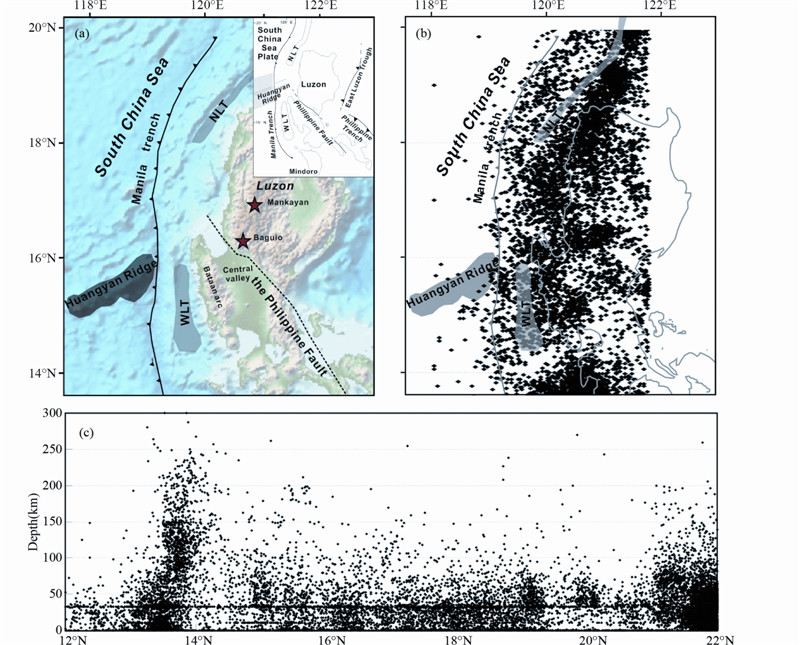 | 图 1 菲律宾吕宋岛北部和中部主要构造(a,据Iaffaldano,2012; Sella et al., 2002; Yang et al., 1996)、1907~2013年间菲律宾(12°N~20°N,118°E~121.7°E)地震活动空间分布(b)和震源深度分布(c)WLT-西吕宋海槽;NLT-北吕宋海槽Fig. 1 Tectonic setting in northern and middle Luzon,Phillippines(a,after Iaffaldano,2012; Sella et al., 2002; Yang et al., 1996),spatial distribution of seismic activities in Philippines between 1907 and 2013(12°N~20°N,118°E~121.7°E)(b) and focal depth(c) WLT-west Luzon trough; NLT-north Luzon trough |
吕宋岛位于黄岩海山链的东面,其东北面是NW向移动的菲律宾海板块,西边是欧亚板块。菲律宾海板块沿菲律宾海沟俯冲于菲律宾之下,在约5Ma以前是向东北方向运动的(Hall,2002; Müller et al., 2008; Torsvik et al., 2010),而在5Ma左右,突然转向西北方向运动,开始顺时针旋转。Iaffaldano(2012)计算得出,自5Ma以来,菲律宾海板块的平均速率为约70mm/a。基于NUVEL-1模型,欧亚板块以约1mm/a的速率在与菲律宾相似的方向上移动。Sella et al.(2002)根据GPS数据,得到现代菲律宾海板块以相对于欧亚板块以约80mm/a的迁移速率,向NW方向汇聚。这两个板块的汇聚导致了吕宋岛东西两侧的两个相反的俯冲带的形成。此外,Michel et al.(2001)结合晚第三系和第四系沉积盖层的形变、新生代的主要断裂类型和GPS测量等资料,提出南海板块相对于欧亚大陆以12±3mm/a的速率向东俯冲,而黄岩海山链呈NEE走向,与汇聚方向并不平行,因此南海古扩张脊的俯冲产生向南的横向迁移。吕宋岛中部(16°N附近),NW向的菲律宾大断裂横穿而过,在吕宋岛上是一个左旋走滑断裂带(图 1a)。
1.2 “板片窗”的形成基于地球物理数据、岩石地球化学、年代学数据和地形地貌特征等的统计和分析,对黄岩海山链俯冲过程及其邻近区域的构造演化,许多学者提出了俯冲模型(Bautista et al., 2001; Yang et al., 1996; 刘再峰等,2007)。Yang et al.(1996)根据台湾-吕宋岛弧上东西火山链火山岩的全岩K-Ar年龄结果,提出西火山链的岩浆活动在4~2Ma期间停止,而东火山链的活动几乎只发生在第四纪,他们认为,该地区火山活动的不连续性是南海古扩张脊在5~4Ma左右开始俯冲于马尼拉海沟之下造成的,较热的古扩张脊俯冲导致板块的俯冲倾角变缓,岩浆活动向东迁移,形成台湾-吕宋岛弧上较年轻的东火山链。刘再峰等(2007)在统计的1964~2006年菲律宾地区的地震数据基础上,引入了“板片窗”概念,提出在17°N~19°N之间震源深度大于150km的地震数目明显减少,在14°N~15°N之间存在由西向东逐渐变宽的喇叭状地震稀疏带,认为很可能是对板片窗的反映(刘再峰等,2007)。1907~2013年间发生在吕宋岛及其邻域内(12°N~22°N,118°E~121.7°E之间)的地震数据显示(数据来自国家数字地震台网分中心的中国地震台网(CSN)和国际地震台网(ISC)地震目录),发现在14°N~15°N和19.5°N~21°N分别出现明显的地震稀疏带,在16°N附近的地震数量也相对较少(图 1b,c),这些地震稀疏带在空间上将区域内的地震活动分割成块状(图 1b)。此外,从图 1c震源深度沿纬度的分布图可以看出,在13°N~14°N和21°N~22°N处震源深度突然变大,而15°N~20°N之间震源深度大部分小于100km。根据台湾-吕宋岛弧上东西火山链火山岩的地球化学特征、定年数据和地震数据的研究,Yang et al.(1996)提出19.5°N~21°N之间的地震稀疏带表明了板片撕裂的存在。刘再峰等(2007)在Yang et al.(1996)和Bautista et al.(2001)的研究基础上,结合地震数据,提出14°N~15°N存在俯冲板块撕裂形成的板片窗。因此,16°N附近的地震稀疏带可能与板片窗有关。南海古扩张脊俯冲位置位于16°N~18°N之间,且沿马尼拉海沟向南迁移(Michel et al., 2001),菲律宾大断裂正好与现今黄岩海山链可能俯冲区域相交,并且,朱俊江等(2005)曾通过对马尼拉海沟俯冲带内应力场的分析,以菲律宾大断裂为界,认为北部主要以挤压为特征,南部则表现为顺时针旋转,这可能是导致已经停止扩张的南海古扩张脊撕裂的原因。
通过以上研究结果表明,南海古扩张脊可能在俯冲过程中形成板片窗,然而,16°N附近的地震稀疏带并不明显,且相对另外两个地震稀疏带要小得多,这可能与南海古扩张脊在俯冲前已经停止扩张有关,其形成的板片窗规模相对较小,板片窗两侧板块俯冲倾角不存在较大差异。在板片窗构造环境下,对应的岩浆活动、成矿活动和火山活动也会发生相应的变化(Hole et al., 1991; 李三忠等,2004),因此,我们可以通过对该区域内的岩浆活动、成矿作用和火山活动等特征的统计分析,探讨该板片窗是否存在,如果存在,对该区域内的斑岩铜成矿活动有什么影响。
2 斑岩铜金矿、埃达克岩、富铌玄武岩及第四纪活动火山的分布特征近几十年来的研究表明,板片窗对上覆板块岩浆的地球化学特征具有控制作用(Benoit et al., 2002; Bradley et al., 2003; Breitsprecher et al., 2003; Cole et al., 2006; Gorring and Kay, 2001; Gutiérrez et al., 2005; Hamilton and Dostal, 2001; Kinoshita,2002; Madsen et al., 2006)。板片窗的形成,导致俯冲板片之下的地幔通过这个窗口上涌,同时,通过板片窗的高热流体可能导致上覆岩石圈地幔的熔融,从而形成中性到酸性岩浆(如阿拉斯加南部的Sanak-Baranof岩浆带)(Bradley et al., 2003; Cole et al., 2006)。更重要的是,板片窗的洋壳边缘发生部分熔融形成埃达克岩(Kinoshita,2002; Thorkelson and Breitsprecher, 2005; Yogodzinski et al., 2001),而且,洋壳的辉长岩层中,斜长石是主要矿物之一,撕裂的洋壳边缘部分熔融,产生的岩浆中具有更高的Sr含量 。因此,与洋壳部分熔融有关的斑岩铜金矿床和岩浆活动,在时空分布上可能受板片窗的控制。
2.1 斑岩铜金矿床全球大多数的大型、超大型斑岩铜金矿床与洋脊俯冲有关,这是因为洋脊俯冲有利于洋壳部分熔融,而洋壳中Cu的平均丰度在70×10-6~150×10-6(Hofmann,1988; Sun et al., 2003),远高于陆壳平均丰度(27×10-6)(Rudnick and Gao, 2003),因此,在相同条件下,洋壳部分熔融形成的岩浆具有较高的铜含量,有利于斑岩铜矿形成(Sun et al., 2011,2012,2013)。在吕宋岛,铜金矿床沿着近南北向的岛弧分布,从吕宋岛北部的成矿省(Mankayan和Baguio地区)到南部Bataan arc的Dizon(图 2)。研究区域内的岩浆组分出现岛弧拉斑到钙碱性和高K钙碱性变化(Sajona and Maury, 1998)。研究区域内上新世以来发育许多大型的斑岩铜金矿(表 1),这些矿床主要集中在吕宋岛北部(约17°N附近)的Baguio和Mankayan地区,其中包括全球金储量排第4位的Lepanto-Far South East斑岩铜金矿床,而在研究区域南部只发育少数斑岩矿床(图 2)。Mankayan地区的斑岩铜金矿床形成于约3.5~1.4Ma之间(Cooke et al., 2011),其中最大的Lepanto-Far South East斑岩铜金矿床成矿年龄为1.41±0.05Ma(Arribas et al., 1995),矿石量为685Mt,Cu的品位为0.80%,Au的品位为1.42g/t(Cooke et al., 2005)。最老的矿床为Guinaoang斑岩铜金矿,形成于3.5±0.5Ma(Sillitoe and Angeles, 1985)。Baguio地区的斑岩铜金矿床成矿时代在约3.1~0.5Ma之间(Cooke et al., 2011),最年轻的Ampucao斑岩铜金矿成矿年龄为0.51±0.26Ma(Waters et al., 2011)。吕宋岛北部上新世以来的斑岩铜金矿在空间上存在由北向南变年轻的趋势,南部的斑岩铜矿床成矿时代在约2.1~2.7Ma,形成时代晚于北部的斑岩铜矿床,这与黄岩海山链俯冲位置由北向南移动相对应,且成矿年龄与黄岩海山链在5~4Ma开始俯冲的时间吻合。此外,研究区域已知的5Ma以来的斑岩铜金矿床在空间分布上存在空白区域(约15°N~17°N之间)(图 2)。
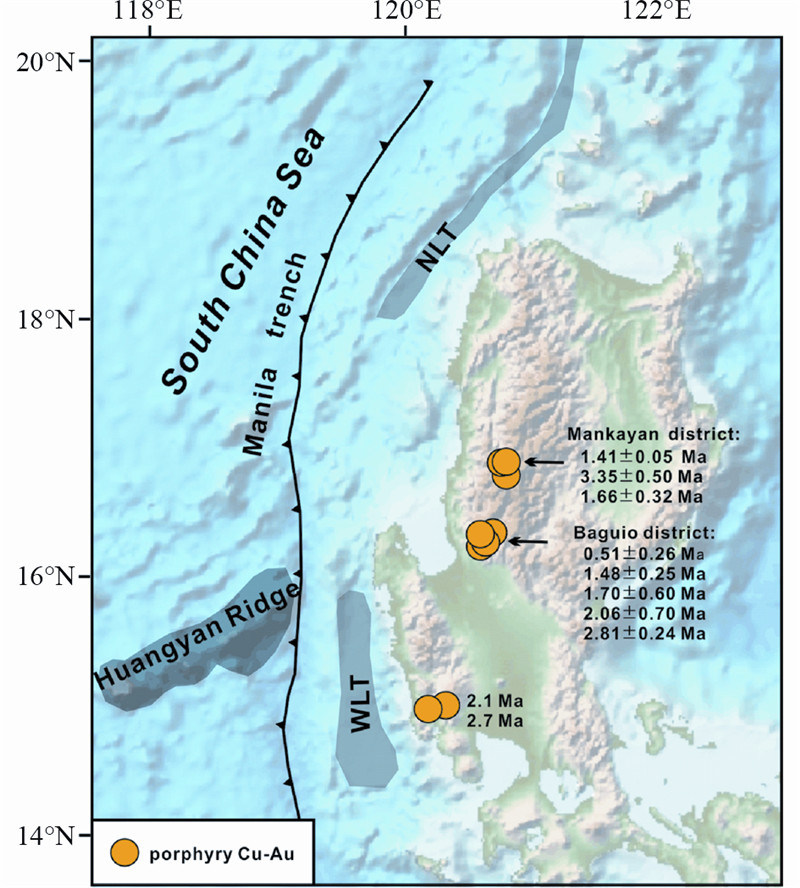 | 图 2 上新世以来吕宋岛北部斑岩铜金矿床的时空分布(据Abratis and Worner, 2001; Chang et al., 2011; Sillitoe and Angeles, 1985)
斑岩铜金矿床年龄数据来自USGS(http://www.usgs.gov/)Fig. 2 Spatial and temporary distribution of the porphyry Cu-Au deposits in north Luzon since Pliocene(after Abratis and Worner, 2001; Chang et al., 2011; Sillitoe and Angeles, 1985) The porphyry Cu-Au deposits data from USGS |
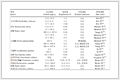 | 表 1 吕宋岛晚中新世以来斑岩铜金矿床 Table 1 The porphyry Cu-Au deposits in Luzon since the Late Miocene |
埃达克岩最初是指Defant and Drummond(1990)提出的与俯冲洋壳熔融有关的一类具有特定地球化学性质的中酸性侵入岩或火山岩(Defant and Drummond, 1990)。这类岩石具有较高的Sr(≥400×10-6)、低Y(≤18×10-6)、Yb(≤1.9×10⁻⁶)含量。随着埃达克岩概念的提出,二十几年以来,关于埃达克岩的研究一直是国际地学界关注的前沿课题,地质学家们提出了埃达克岩源区的多样性。有学者提出底侵的玄武岩和加厚下地壳(>40km)基性岩熔融的埃达克岩形成模式,例如,张旗等(2001a,b)将中国的埃达克岩分为O型埃达克岩和C型埃达克岩,认为O型埃达克岩的形成与板块俯冲相关,而C型埃达克岩是板块碰撞后地壳加厚引起地壳中基性岩部分熔融产生的。也有学者认为,俯冲带之上的软流圈地幔楔经过交代作用和对斑晶结合体的分异作用也可以产生类埃达克质或埃达克质岩浆(Richards and Kerrich, 2007)。
在环太平洋带上,许多学者提出认为洋脊俯冲相关的埃达克岩大部分与斑岩Cu-Au矿床在成因上存在密切联系(Defant et al., 2001; Ling et al., 2009; Mungall,2002; Oyarzun et al., 2001;Peacock et al., 1994; Sajona and Maury,1998; Sun et al., 2011; Thiéblemont et al., 1997)。其中,Thiéblemont et al.(1997)发现其研究的43个矿床和成矿区中,有38个产出与埃达克岩有关,或在时空上与埃达克岩有关。位于环太平洋西岸的菲律宾,大多数斑岩铜金矿在时空分布上也与埃达克岩具有密切联系(Sajona and Maury, 1998),图 3显示了上新世以来的吕宋岛上的埃达克岩(表 2),这些样品中,位于吕宋岛北部的Cervantes、Lepanto和Baguio地区的埃达克岩大部分为侵入岩,吕宋岛中部Central Valley和Bataan arc上基本是埃达克质火山岩,南部有少量为侵入岩。如图 3所示,这些埃达克岩与斑岩铜金矿床形成于同一时代,其空间分布由北向南依次是Cervantes和Lepanto,Baguio以及吕宋岛中部地区,形成时代有变年轻的趋势,Cervantes和Lepanto地区最老的埃达克岩年龄为3.66±0.18Ma,Baguio最老埃达克岩年龄为2.40±0.18Ma(Sajona and Maury, 1998),大部分为侵入岩(Bellon and Yumul, 2000; Yumul et al., 2000),在空间上与斑岩铜金矿床有关;吕宋岛中部的埃达克质火山岩形成于1Ma以后(Bellon and Yumul, 2000; Yumul et al., 2000),这些埃达克岩在时空上与斑岩铜金矿床无关;吕宋岛中部Bataan弧上的埃达克岩样品年龄均在5Ma左右(Bellon and Yumul, 2000; Yumul et al., 2000),均为熔岩,与南海古扩张脊开始俯冲的时间非常接近,并且在空间分布上更靠近马尼拉海沟;Bataan弧南部存在约5Ma的埃达克质火山岩,最南端的埃达克岩形成于晚中新世之后,部分为侵入岩,空间上与斑岩铜金矿床有关(Sajona and Maury, 1998; Bellon and Yumul, 2000; Yumul et al., 2000)。实验结果表明,埃达克质岩浆形成于75~85km深度范围内(Defant and Drummond, 1990),而洋脊的俯冲很可能导致俯冲倾角变缓,因此,Bataan弧上的埃达克岩更可能是在南海古扩张脊刚开始俯冲时形成的。
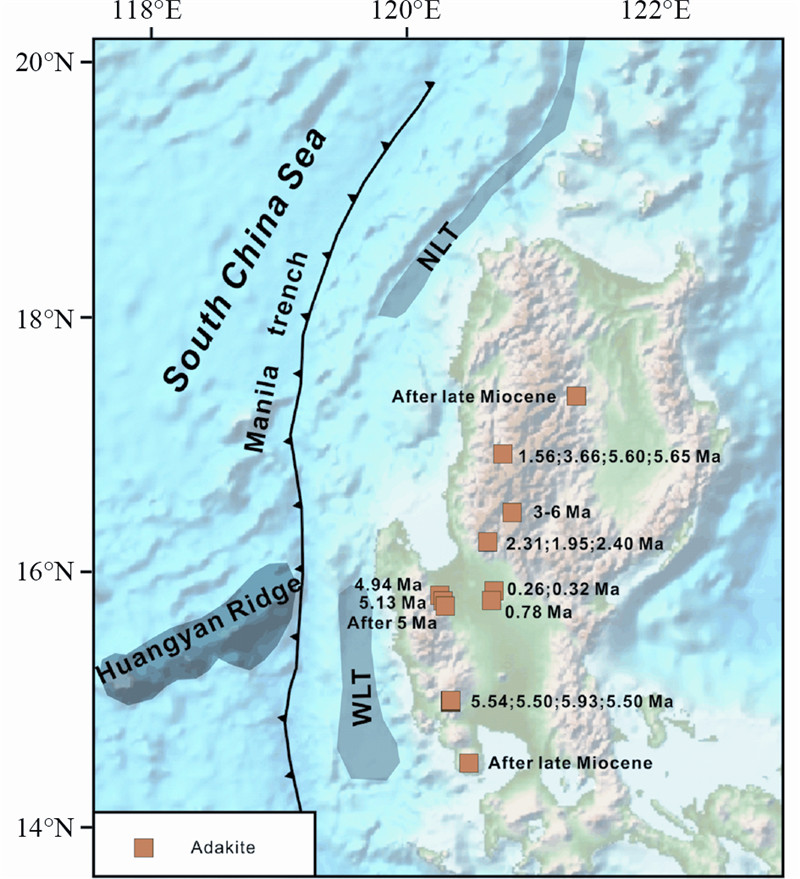 | 图 3 吕宋岛晚中新世以来的埃达克岩时空分布
数据来自Bellon and Yumul, 2000; Sajona and Maury, 1998; Yumul et al., 2000Fig. 3 Spatial and temporary distribution of adakites in Luzon since Miocene Data from Bellon and Yumul, 2000; Sajona and Maury, 1998; Yumul et al., 2000 |
| 表 2 吕宋岛晚中新世以来埃达克岩 Table 2 Adakites in Luzon since the Late Miocene |
然而,Yumul et al.(2000)认为位于吕宋岛中部弧后区域中的Balungao、Cuyapo和Amorong山脉中具有埃达克岩地球化学特征的熔岩不可能是板块熔融形成的,他们根据这些埃达克岩的地球化学证据,提出这些具有高Sr/Y比值的弧后熔岩很可能是下地壳部分熔融形成的。的确,近几十年来的研究表明,板片熔融并非形成高Sr/Y和La/Yb比值岩浆的唯一来源。Richards(2011)认为,俯冲带中水的加入,促使地幔楔中角闪石和石榴石的高度分异,是形成埃达克质岩浆的主要因素。但是,这不能解释与斑岩铜矿有关的埃达克岩中Cu的来源。有学者发现下地壳部分熔融也能形成高Sr/Y和La/Yb比值的岩浆(Atherton and Petford, 1993; Chung et al., 2003; Huang et al., 2008; Petford and Gallagher, 2001; Wang et al., 2007)。Sun et al.(2012)提出,板片熔融具有比下地壳部分熔融相对较低的Sr/Y比值。然而,下地壳部分熔融的Sr/Y比值还受斜长石的影响,因此,除非特别高的Sr/Y比值样品,例如,大别造山带父子岭中下地壳部分熔融形成的埃达克岩(Huang et al., 2008; Wang et al., 2007),单靠Sr/Y比值本身并不能区分板片部分熔融和下地壳部分熔融。除了Sr/Y比值,埃达克岩中的La/Yb比值范围也能区分这两个不同的来源。下地壳的La/Yb比值大约为10,是MORB的15倍(Sajona et al., 1996; Sun and McDonough, 1989)。Yb在石榴石中高度相容,而La不是(Rapp and Watson, 1995),因此,埃达克岩的La/Yb比值对石榴石特别敏感,但不会明显受到斜长石的影响。此外,石榴石是作为下地壳组成榴辉岩和麻粒岩的主要矿物,因此在石榴石存在的情况下,下地壳部分熔融形成的埃达克岩总体上呈现较高的La/Yb比值,能更好地区分板片部分熔融和下地壳部分熔融(图 4)。
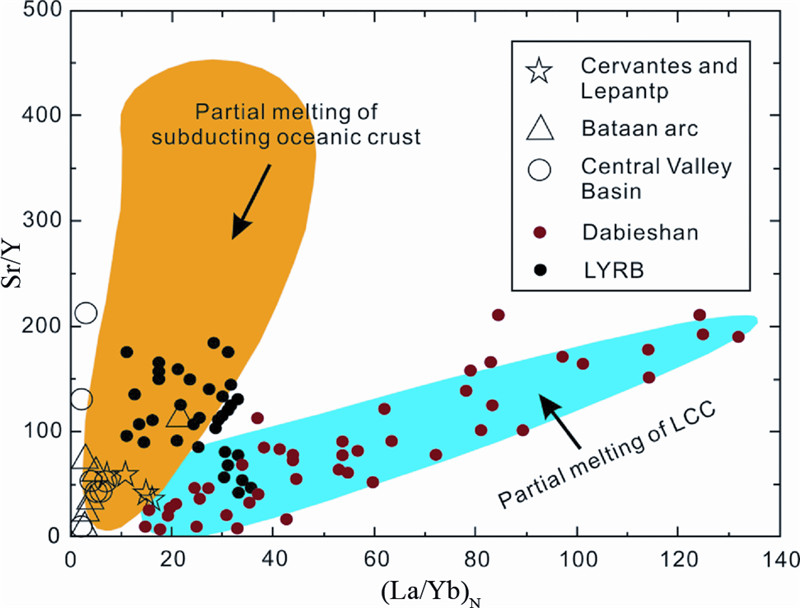 | 图 4 吕宋岛、中国东部大别造山带和长江中下游埃达克岩的 Sr/Y-(La/Yb)N图解
图中吕宋岛埃达克岩数据引自USGS;大别造山带和长江中下游数据来自文献(Huang et al., 2008; Ling et al., 2009,2011,2013; Wang et al., 2007; Xu et al., 2007)及其中文献.LYRB指长江中下游Fig. 4 The Sr/Y-(La/Yb)N diagram for adakites in Luzon,Dabie orogenic belt and Lower Yangtze River belt in eastern China Data in Luzon from USGS; data in Dabie orogenic belt and Lower Yangtze River belt from(Huang et al., 2008; Ling et al., 2009,2011,2013; Wang et al., 2007; Xu et al., 2007). LYRB-Lower Yangtze River belt |
图 5和图 6分别为吕宋岛上新世以来埃达克岩与中国东部大别造山带和长江中下游地区埃达克岩的Sr/Y-Y图解、Sr/Y-Sr图解和La/Yb图解。吕宋岛的埃达克岩大部分都落入由国际岩石学数据库(GEOROC,http://georoc.mpch-mainz.gwdg.de/georoc/)的埃达克岩区域(GEOROC,2009)。在Sr/Y-Sr图解中,这些埃达克岩的Sr含量具有明显差异,吕宋岛北部(Cervantes,Lepanto and Baguio)的13个样品中,有12个的Sr含量介于476×10-6~592×10-6之间,只有1个为1010×10-6,但这些样品的Sr/Y值均在31~60范围内;来自Central Valley Basin的10个埃达克岩样品中,Sr含量均>800×10-6,其中,有6个样品的Sr/Y值大于100;Bataan arc中的样品共有15个,其中4个来自吕宋岛中部16°N附近的Mt. Malobago、Mt. Poelis和Mt. Tarlac的样品的Sr含量>800×10-6,这4个中只有1个样品的Sr/Y值大于100(图 5a)。此外,Bataan arc 其余11个样品中,只有位于Mt. Manggahan的2个样品的Sr/Y值大于100。对于Sr含量大于800×10-6的样品,在Sr/Y-Y图解中,Sr/Y值越大,Y含量越小(图 5b)。起源上有争议的位于弧后地区的Central Valley Basin的6个埃达克岩样品中,位于Mt. Balungao和Mt. Arayat的4个样品相对其他地区具有较高的La/Yb比值,但它们的比值远小于父子岭中下地壳熔融形成的埃达克岩,而邻近Mt. Balungao的Mt. Cuyapo中的2个样品的La/Yb比值相对较小(图 6)。由La/Yb-Yb图解可以看到,吕宋岛上这些埃达克岩与中国大别造山带(除父子岭外)和长江中下游地区的埃达克岩具有相似的La/Yb比值。并且,Yumul et al.(2000)根据报道过的吕宋岛中部地壳厚度(约30~33km之间(Listanco et al., 1997)),曾提出在该区域下地壳中石榴石是稳定的。结合上述中吕宋岛北部和中部的19个样品的地球化学特征和定年数据,这些埃达克岩源自南海古扩张脊俯冲导致的洋壳部分熔融。中部弧后地区Central Valley Basin内的10个样品相对吕宋岛北部埃达克岩样品具有较高的Sr含量(>800×10-6),在空间上位于推测的板片窗之上,并且,Mt. Cuyapo的2个埃达克岩样品的地球化学特征表明,它们的形成可能与洋脊撕裂导致洋壳剖面上的富含斜长石的辉长岩层的部分熔融有关。此外,Bataan arc中Mt. Malobago、Mt. Poelis和Mt. Tarlac的4个样品同样具有较高的Sr含量(>800×10-6),可能与南海古扩张脊最初的俯冲撕裂有关,这需要进一步的研究。
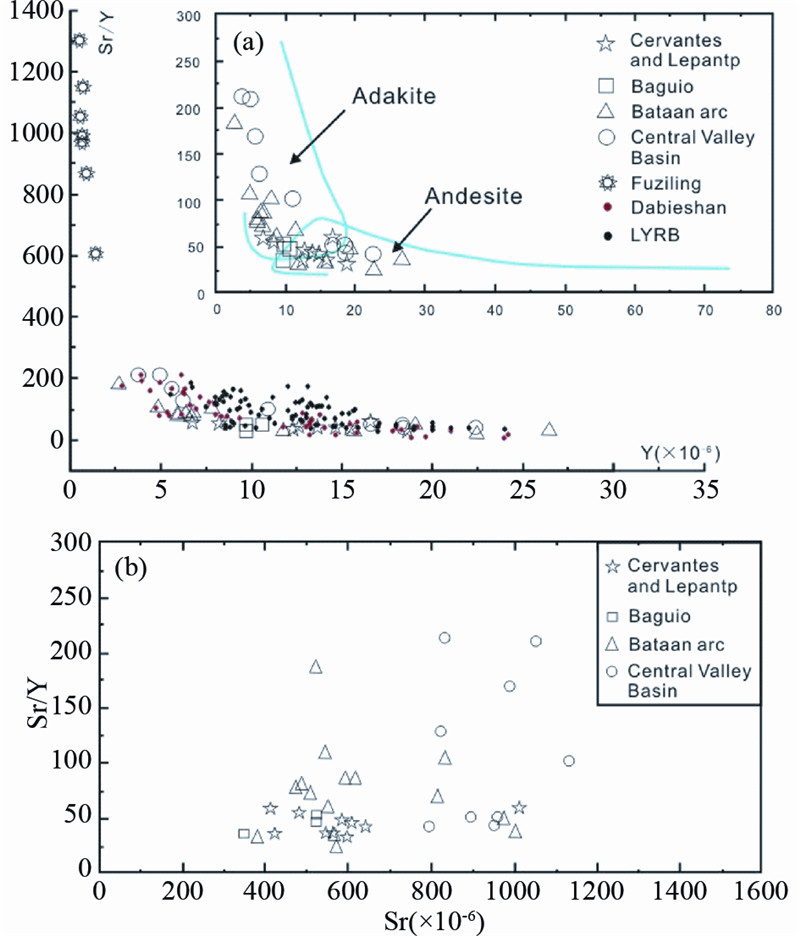 | 图 5 吕宋岛与中国大别造山带父子岭埃达克岩的Sr/Y-Y图解(a)和吕宋岛埃达克岩Sr/Y-Sr图解(b)
图中吕宋岛埃达克岩数据引自USGS;大别造山带和长江中下游数据来自文献(Huang et al., 2008; Ling et al., 2009,2011; Wang et al., 2007; Xu et al., 2007)及其中文献Fig. 5 The Sr/Y-Y diagram for adakites in Luzon and Dabie orogenic belt(a) and the Sr/Y-Y diagram for adakites in Luzon(b) Data in Luzon from USGS; data in Dabie orogenic belt and Lower Yangtze River belt from(Huang et al., 2008; Ling et al., 2009,2011; Wang et al., 2007; Xu et al., 2007) |
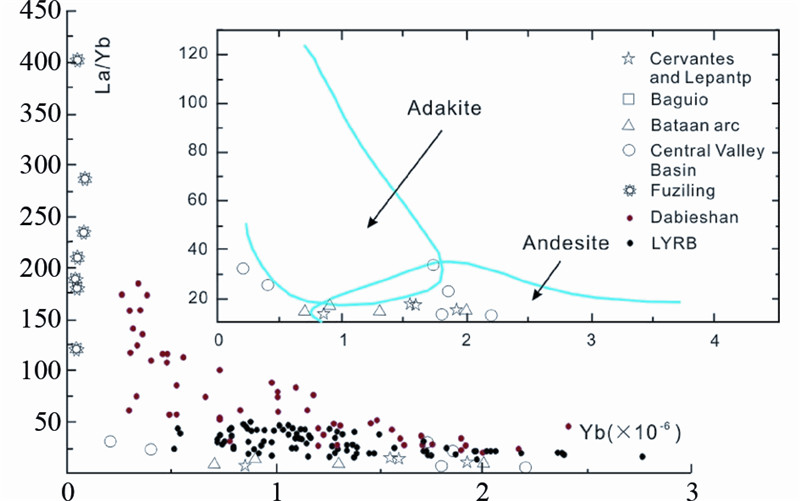 | 图 6 吕宋岛、中国东部大别造山带和长江中下游地区埃达克岩的 La/Yb-Yb 图解
图中吕宋岛埃达克岩数据引自USGS及其中的文献;大别造山带和下扬子地区来自文献(Huang et al., 2008; Ling et al., 2009,2011; Wang et al., 2007; Xu et al., 2007)及其中文献Fig. 6 The La/Yb-Yb diagram for adakites in Luzon,Dabie orogenic belt and Lower Yangtze River belt in eastern China Data in Luzon from USGS; data in Dabie orogenic belt and Lower Yangtze River belt from(Huang et al., 2008; Ling et al., 2009,2011; Wang et al., 2007; Xu et al., 2007) |
富铌玄武岩最早是在Sajona et al.(1993)在研究菲律宾Mindanao的岛弧玄武岩时提出的,其地球化学特征是:Nb含量在7×10⁻⁶~16×10-6,富Si、Na,具有高Na2O/K2O比值,Ti含量相对较高(>1%),低LREE/HFSE(高场强元素),其在球粒陨石或原始地幔标准化图解上,Nb通常呈正异常或弱的负异常,Ta呈负异常(Sajona et al., 1993,1996; 张海祥等,2005; 赵振华等,2004)。
富铌玄武岩的成因主要存在三种观点,一种观点认为在岛弧环境中,富铌玄武岩是埃达克质熔体交代地幔橄榄岩后发生部分熔融的产物(Benoit et al., 2002; Kepezhinskas et al., 1996; Sajona et al., 1993; Escuder Viruete et al., 2007; 张海祥等,2005; 赵振华等,2004)。但是洋壳部分熔融形成的埃达克质熔体,此过程中金红石是常见的残留相,导致Nb的亏损(Ding et al., 2009,2013; Liang et al., 2009; Xiao et al., 2006; Xiong,2006),且下地壳中的Nb也是非常亏损的(Rudnick and Gao, 2003),因此亏损Nb的埃达克质岩浆交代地幔橄榄岩很难形成富铌玄武岩。第二种观点认为富铌玄武岩是俯冲板片部分熔融后的残片被软流圈携带上涌,发生部分熔融所致(Thorkelson and Breitsprecher, 2005)。但是板片发生部分熔融过程中存在金红石,使得Nb/Ta会发生分异,残留相具有比源区更低的Nb/Ta,而富铌玄武岩中具有较高的Nb/Ta。同时,部分熔融后的残片能不能熔融还有待验证。第三种观点认为,洋壳俯冲早期在浅部脱水释放的富Nb流体储存在地幔楔中,在板片窗环境中,高的热流使得上述含水地幔楔发生部分熔融,形成富铌玄武岩(Ling et al., 2009; Sun et al., 2010)。
由图 7所示,吕宋岛上存在该区域中中新世以来的富铌玄武岩和类埃达克安山岩,Sajona and Maury(1998)认为它们与南海板片俯冲有关。由于缺乏该区域内富铌玄武岩和类埃达克安山岩的测年数据,我们无法知道这两类岩石的具体形成年代。结合该区域的构造演化过程,以及它们所在区域与我们推测的板片窗位置具有很好一致性,我们认为,这些富铌玄武岩和类埃达克安山岩在成因上与南海古扩张脊撕裂形成的板片窗构造有关。因此,对于富铌玄武岩的形成,我们更趋向于上述的第三种观点,即与板片窗环境中的高热流有关,这需要我们进一步的研究证明。
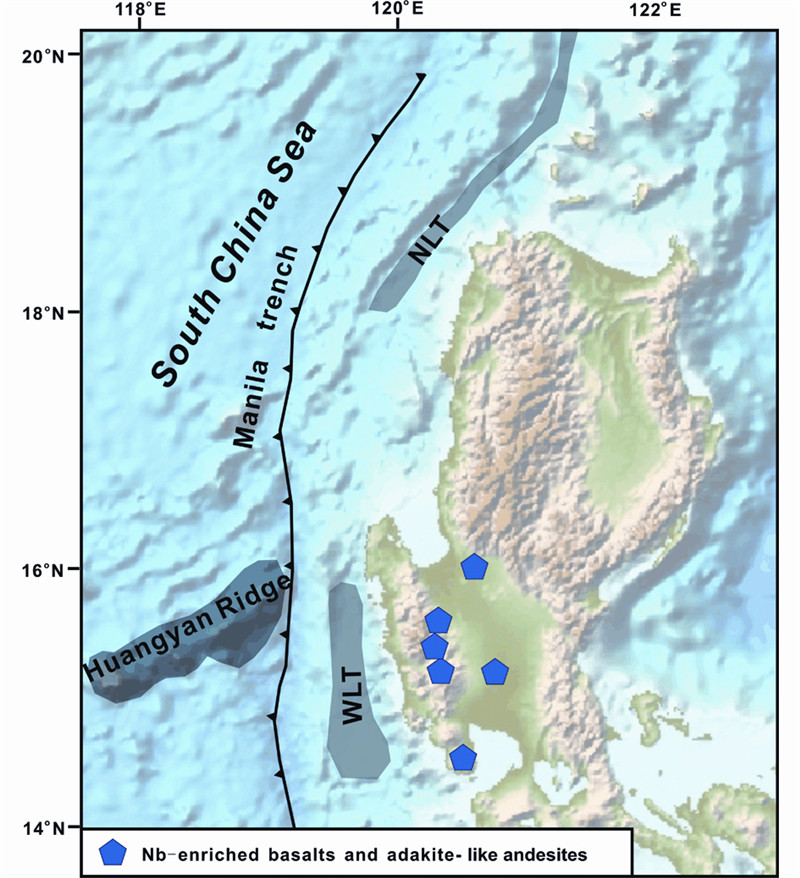 | 图 7 吕宋岛富铌玄武岩和类埃达克安山岩
数据来自参考文献(Sajona and Maury, 1998)Fig. 7 Nb-enriched basalts and adakite-like and esites in Luzon Data from Sajona and Maury(1998) |
已有研究表明,年轻的、热的洋脊俯冲会导致俯冲倾角逐渐减缓,从而形成平俯冲,同时,在这一过程中,俯冲板片之上区域的火山活动会大幅度减少或停止,并随着俯冲倾角的变缓向陆方向逐渐迁移(Bourdon et al., 2003; James and Sacks, 1999; Kay and Mpodozis, 2002; Ramos et al., 2002)。根据地震数据,南美西部俯冲带中现今存在两个平俯冲,最大的平板位于秘鲁中部和北部之下(3°S~15°S之间),第二大的平板位于28°S~33°S之间,在智利中部和阿根廷之下,由已知的弧火山活动的年龄数据,它们分别是Nazca洋脊和Juan Fern and ez洋脊俯冲导致的(Espurt et al., 2008; Martinod et al., 2010)。这两个现今存在的平板正好位于活动火山空隙中(Espurt et al., 2008; Mcgeary et al., 1985; Nur and Benavraham, 1981; Pilger,1981),并且,与Nazca洋脊和Juan Fern and ez洋脊俯冲有关的斑岩铜矿床集中分布在对应的空隙中(Rosenbaum et al., 2005)。由此可见,平俯冲过程、火山活动和斑岩铜矿床三者之间的时空分布存在密切联系。
根据已知的火山活动年龄数据,吕宋岛北部Mt. Cagua到Baguio之间存在一个延伸了220km的第四纪火山活动的空隙,该区域大部分火山已经在中新世停止活动(图 8)。该火山空隙在空间上与同一时代形成斑岩铜金矿床相对应,成因上与南海古扩张脊俯冲导致的俯冲倾角变缓有关。而在南部,则主要分布第四纪火山,且存在至今仍然活动的火山。根据地震数据,已有学者证实吕宋岛北部之下的俯冲倾角较小(Bautista et al., 2001; Yang et al., 1996; 刘再峰等,2007)。由此可以推测,南海古扩张脊的俯冲使得俯冲倾角逐渐变小,火山活动向西迁移,且在洋脊俯冲区域之上的板块中,火山活动大幅度减少,形成第四纪火山作用空隙(图 8)。因此,考虑到南美平板俯冲的形成过程,以及该区域内地震震源深度的分布图(图 1c),我们推测,该区域内正在逐渐形成flat slab,在这过程中,形成斑岩铜矿。
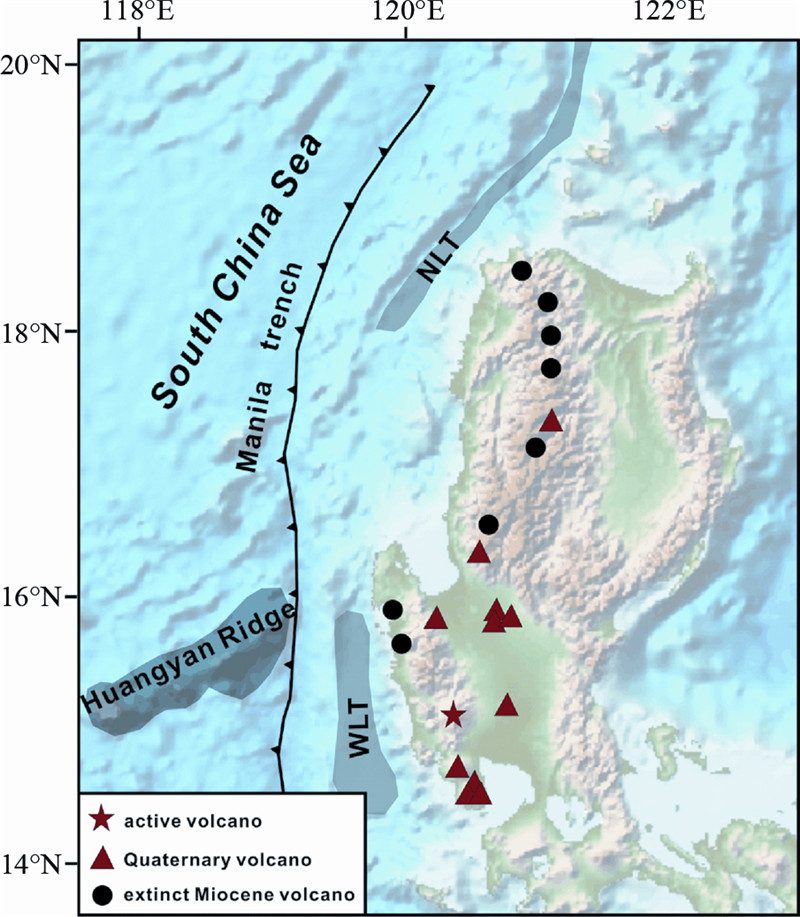 | 图 8 吕宋岛火山活动
第四纪及活动火山数据来自USGS;extinct Miocene volcano数据来自参考文献(Yang et al., 1996)Fig. 8 Volcanic activities in Luzon Quaternary volcanoes data from USGS; extinct Miocene volcano data from Yang et al. (1996) |
20世纪70年代开始,就已经有学者认识到俯冲洋脊和它们的板片窗是汇聚板块边界的岩浆和构造演化的重要构造控制因素(Bourgois and Michaud, 2002; Dickinson,1997; Dickinson and Snyder, 1979; Thorkelson,1996)。例如,南美洲的Nazca-Cocos板片窗通过俯冲板片边缘部分熔融和介入其中的软流圈物质,在火山弧产生了碱性火山岩和埃达克岩(Johnston and Thorkelson, 1997);白垩纪中国东部长江中下游地区太平洋和依泽纳吉板块的俯冲过程中,形成了板片窗,通过洋壳部分熔融,以及软流圈地幔通过板片窗上涌熔融,形成该地区埃达克岩、A型花岗岩和富Nb玄武岩的成带分布(Ling et al., 2009; Sun et al., 2007)。基于环太平洋俯冲带斑岩铜金矿、埃达克岩与洋壳部分熔融之间密切联系,黄岩海山链在马尼拉海沟俯冲引起的板片窗构造同样控制着同一时期形成的斑岩铜金矿床和埃达克岩在菲律宾北部的分布。
根据以上描述的吕宋岛北部及其邻域的地质背景和黄岩海山链俯冲的构造演化过程,综合考虑研究区域上新世以来的斑岩铜金矿床分布、岩浆岩的地球化学特征和时空分布以及震源深度空间分布等证据,我们提出板片窗构造环境下的斑岩铜金成矿模型(图 9),可以更好地解释菲律宾吕宋岛北部和中部地区上新世以来的岩浆岩和矿床的成因。
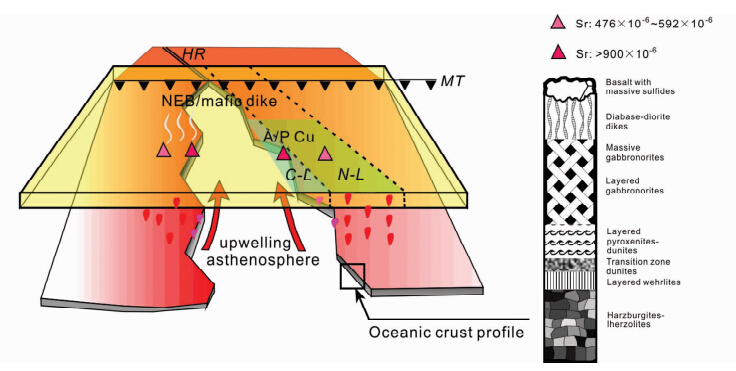 | 图 9 黄岩海山链俯冲成矿模型
HR-黄岩海山链;MT-马尼拉海沟;N-L-吕宋岛北部;C-L-吕宋岛中部;NEB-富铌玄武岩;A-埃达克岩;P Cu-Au-斑岩铜金矿床.洋壳剖面据文献(Yumul et al., 1998)Fig. 9 Metallogenic model of the subduction of Huangyan ridge HR-Huangyan ridge; MT-Manila trench; N-L-north Luzon; C-L-center Luzon; NEB-Nb-enriched basalt; A-adakite; P Cu-Au-porphyry Cu-Au deposit. Oceanic crust profile after (Yumul et al., 1998) |
(1)在约15.5Ma南海古扩张脊停止扩张(Briais et al., 1993; Hsu and Sibuet, 2004; Hsu et al., 2004; Taylor and Hayes, 1983; 李家彪,2011),约5~4Ma开始俯冲于吕宋岛北部之下,洋脊的俯冲使得俯冲倾角的变缓(Bautista et al., 2001; Yang et al., 1996; 刘再峰等,2007),正在形成平俯冲,火山活动开始大幅度减少。年轻的、热的洋壳部分熔融形成上新世以来的埃达克岩和相关的斑岩铜矿床,这些矿床和埃达克岩位于正在形成的平俯冲之上。
(2)随后,由于吕宋岛南北部所受应力场的差异,扩张洋脊撕裂在吕宋岛中部(16°N附近)形成板片窗。在板片窗之上位置形成斑岩铜金矿床的空白区域。
(3)南海古扩张脊撕裂使得俯冲洋壳剖面中的辉长岩层上涌的软流圈地幔接触,并发生部分熔融,导致板片窗两侧之上位置的埃达克岩Sr含量较高。
(4)在南海板片俯冲的早期,板片脱水作用释放富Nb的流体到地幔楔中,而之后板片窗的形成产生高的热流,促使含水地幔楔发生部分熔融,产生富铌玄武岩浆。
4 结论及存在问题由上述菲律宾吕宋岛已知的约5Ma以来斑岩铜金矿床、埃达克岩、富铌玄武岩及火山活动时空分布以及埃达克岩微量元素特征的统计分析,我们得出,这些斑岩铜金矿床的形成与同时期南海古扩张脊俯冲密切相关。南海古扩张脊的俯冲形成平俯冲,其上火山活动减少或停止,从而产生这一时期的火山空隙,同时,导致吕宋岛之上同时期的斑岩铜金矿床和埃达克岩的产生。这些斑岩铜金矿床和埃达克岩位于这一火山空隙之中。洋脊俯冲之后形成的板片窗构造,导致同时期斑岩铜金矿床和埃达克岩出现空隙,并且,板片窗两侧洋壳辉长岩层的出露,使得其部分熔融产生的岩浆具有较高的Sr含量,导致板片窗两侧之上的埃达克岩具有较高的Sr含量。
这个模型结合构造演化过程,可以很好地解释上新世以来吕宋岛北部和中部斑岩铜金矿床、埃达克岩、富铌玄武岩和火山活动的时空分布特征。当然,对构造环境的研究本身存在很多的局限和不确定性。我们在地震震源深度数据统计和分析基础上,结合研究区域岩浆活动、火山活动和斑岩铜矿床时空分布特征,得出板片窗构造存在的结论以及其所在位置,但这很大程度上是一种推测,因此,需要进一步的深部地球物理数据以及该区域火山岩的地球化学和定年数据的补充和验证。
致谢 感谢杨晓勇教授、邓江洪博士及一位匿名评审专家对本文提出的建设性意见和建议。| [1] | Abratis M and Worner G. 2001. Ridge collision, slab-window formation, and the flux of Pacific asthenosphere into the Caribbean realm. Geology, 29(2): 127-130 |
| [2] | Arribas A, Hedenquist JW, Itaya T, Okada T, Concepcion RA and Garcia JS. 1995. Contemporaneous formation of adjacent porphyry and epithermal Cu-Au deposits over 300Ka in northern Luzon, Philippines. Geology, 23(4): 337-340 |
| [3] | Atherton MP and Petford N. 1993. Generation of sodium-rich magmas from newly underplated basaltic crust. Nature, 362(6416): 144-146 |
| [4] | Bautista BC, Bautista MLP, Oike K, Wu FT and Punongbayan RS. 2001. A new insight on the geometry of subducting slabs in northern Luzon, Philippines. Tectonophysics, 339(3-4): 279-310 |
| [5] | Bellon H and Yumul GP. 2000. Mio-Pliocene magmatism in the Baguio mining district (Luzon, Philippines): Age clues to its geodynamic setting. Comptes Rendus De L' Académie Des Sciences-Series IIA-Earth and Planetary Science, 331(4): 295-302 |
| [6] | Benoit M, Aguillon-Robles A, Calmus T, Maury RC, Bellon H, Cotten J, Bourgois J and Michaud F. 2002. Geochemical diversity of Late Miocene volcanism in southern Baja California, Mexico: Implication of mantle and crustal sources during the opening of an asthenospheric window. Journal of Geology, 110(6): 627-648 |
| [7] | Bourdon B, Turner S and Dosseto A. 2003. Dehydration and partial melting in subduction zones: Constraints from U-series disequilibria. Journal of Geophysical Research-Solid Earth, 108(B6), doi: 10.1029/2002JB001839 |
| [8] | BourgoisJ and Michaud F. 2002. Comparison between the Chile and Mexico triple junction areas substantiates slab window development beneath northwestern Mexico during the past 12-10Myr. Earth and Planetary Science Letters, 201: 35-44 |
| [9] | Bradley D, Kusky T, Haeussler P, Goldfarb R, Miller M, Dumoulin J, Nelson SW and Karl S. 2003. Geologic signature of early Tertiary ridge subduction in Alaska. In: Sisson VB, Roeske SM and Pavlis TL (eds.). Geology of A Transpressional Orogen Developed During Ridge-trench Interaction along the North Pacific Margin. London: Geological Society of America Special Paper, 19-49 |
| [10] | Breitsprecher K, Thorkelson DJ, Groome WG and Dostal J. 2003. Geochemical confirmation of the Kula-Farallon slab window beneath the Pacific Northwest in Eocene time. Geology, 31(4): 351-354 |
| [11] | Briais A, Patriat P and Tapponnier P. 1993. Updated interpretation of magnetic-anomalies and sea-floor spreading stages in the South China Sea:Implications for the Tertiary tectonics of Southeast-Asia. Journal of Geophysical Research-Solid Earth, 98(B4): 6299-6328 |
| [12] | Chang ZS, Hedenquist JW, White NC, Cooke DR, Roach M, Deyell CL, Garcia J, Gemmell JB, McKnight S and Cuison AL. 2011. Exploration tools for linked porphyry and epithermal deposits: Example from the Mankayan intrusion-centered Cu-Au district, Luzon, Philippines. Economic Geology, 106(8): 1365-1398 |
| [13] | Chung SL, Liu DY, Ji JQ, Chu MF, Lee HY, Wen DJ, Lo CH, Lee TY, Qian Q and Zhang Q. 2003. Adakites from continental collision zones: Melting of thickened lower crust beneath southern Tibet. Geology, 31(11): 1021-1024 |
| [14] | Cole RB, Nelson SW, Layer PW and Oswald PJ. 2006. Eocene volcanism above a depleted mantle slab window in southern Alaska. Geological Society of America Bulletin, 118(1-2): 140-158 |
| [15] | Cooke DR, Hollings P and Walsh JL. 2005. Giant porphyry deposits: Characteristics, distribution, and tectonic controls. Economic Geology, 100(5): 801-818 |
| [16] | Cooke DR, Deyell CL, Waters PJ, Gonzales RI and Zaw K. 2011. Evidence for magmatic-hydrothermal fluids and ore-forming processes in epithermal and porphyry deposits of the Baguio district, Philippines. Economic Geology, 106(8): 1399-1424 |
| [17] | De boer J, Odom LA, Ragland PC, Snider FG and Tilford NR. 1980. The Bataan orogene: Eastward subduction, tectonic rotations, and volcanism in the Western Pacific (Philippines). Tectonophysics, 67(3-4): 251-282 |
| [18] | Defant MJ and Drummond MS. 1990. Derivation of some modern arc magmas by melting of young subducted lithosphere. Nature, 347(6294): 662-665 |
| [19] | Defant MJ, Sherman S, Maury RC, Bellon H, de Boer J, Davidson J and Kepezhinskas P. 2001. The geology, petrology, and petrogenesis of Saba Island, Lesser Antilles. Journal of Volcanology and Geothermal Research, 107(1-3): 87-111 |
| [20] | Dickinson WR and Snyder WS. 1979. Geometry of subducted slabs related to San-andreas transform. Journal of Geology, 87(6): 609-627 |
| [21] | Dickinson WR. 1997. Tectonic implications of Cenozoic volcanism in coastal California. Geological Society of America Bulletin, 109(8): 936-954 |
| [22] | Ding X, Lundstrom C, Huang F, Li J, Zhang ZM, Sun XM, Liang JL and Sun WD. 2009. Natural and experimental constraints on formation of the continental crust based on niobium-tantalum fractionation. International Geology Review, 51(6): 473-501 |
| [23] | Ding X, Hu YH, Zhang H, Li CY, Ling MX and Sun WD. 2013. Major Nb/Ta fractionation recorded in garnet amphibolite facies metagabbro. Journal of Geology, 121(3): 255-274 |
| [24] | Escuder Viruete J, Contreras F, Stein G, Urien P, Joubert M, Pérez-Estaún A, Friedman R and Ullrich T. 2007. Magmatic relationships and ages between adakites, magnesian andesites and Nb-enriched basalt-andesites from Hispaniola: Record of a major change in the Caribbean island arc magma sources. Lithos, 99(3-4): 151-177 |
| [25] | Espurt N, Funiciello F, Martinod J, Guillaume B, Regard V, Faccenna C and Brusset S. 2008. Flat subduction dynamics and deformation of the South American plate: Insights from analog modeling. Tectonics, 27(3):1-19 |
| [26] | Gorring ML and Kay SM. 2001. Mantle processes and sources of neogene slab window magmas from southern Patagonia, Argentina. Journal of Petrology, 42(6): 1067-1094 |
| [27] | Gutiérrez F, Gioncada A, González Ferran G, Lahsen A and Mazzuoli R. 2005. The Hudson Volcano and surrounding monogenetic centres (Chilean Patagonia): An example of volcanism associated with ridge-trench collision environment. Journal of Volcanology and Geothermal Research, 145(3-4): 207-233 |
| [28] | Hall R. 2002. Cenozoic geological and plate tectonic evolution of SE Asia and the SW Pacific: Computer-based reconstructions, model and animations. Journal of Asian Earth Sciences, 20(4): 353-431 |
| [29] | Hamilton TS and Dostal J. 2001. Melting of heterogeneous mantle in a slab window environment: Examples from the Middle Tertiary Masset basalts, Queen Charlotte Islands, British Columbia. Canadian Journal of Earth Sciences, 38(5): 825-838 |
| [30] | Hayes DE and Lewis SD. 1984. A Geophysical-study of the Manila trench, Luzon, Philippines. 1. Crustal structure, gravity, and regional tectonic evolution. Journal of Geophysical Research, 89(NB11): 9171-9195 |
| [31] | Hedenquist JW, Arribas A and Reynolds TJ. 1998. Evolution of an intrusion-centered hydrothermal system: Far Southeast-Lepanto porphyry and epithermal Cu-Au deposits, Philippines. Economic Geology and the Bulletin of the Society of Economic Geologists, 93(4): 373-404 |
| [32] | Hofmann AW. 1988. Chemical differentiation of the earth: The relationship between mantle, continental-crust, and oceanic-crust. Earth and Planetary Science Letters, 90(3): 297-314 |
| [33] | Hole MJ, Rogers G, Saunders AD and Storey M. 1991. Relation between alkalic volcanism and slab-window formation. Geology, 19(6): 657-660 |
| [34] | Hollings P, Wolfe R, Cooke DR and Waters PJ. 2011. Geochemistry of Tertiary igneous rocks of northern Luzon, Philippines: Evidence for a back-rrc setting for alkalic porphyry copper-gold deposits and a case for slab roll-back? Economic Geology, 106(8): 1257-1277 |
| [35] | Hsu SK and Sibuet JC. 2004. Continent-ocean transition of the northern South China Sea and off southwestern Taiwan. Marine Geophysical Researches, 25(1-2): 1-4 |
| [36] | Hsu SK, Yeh YC, Doo WB and Tsai CH. 2004. New bathymetry and magnetic lineations identifications in the northernmost South China Sea and their tectonic implications. Marine Geophysical Researches, 25(1-2): 29-44 |
| [37] | Huang F, Li SG, Dong F, He YS and Chen FK. 2008. High-Mg adakitic rocks in the Dabie orogen, central China: Implications for foundering mechanism of lower continental crust. Chemical Geology, 255(1-2): 1-13 |
| [38] | Iaffaldano G. 2012. The strength of large-scale plate boundaries: Constraints from the dynamics of the Philippine Sea plate since similar to 5Ma. Earth and Planetary Science Letters, 357: 21-30 |
| [39] | James DE and Sacks IS. 1999. Cenozoic formation of the central Andes: A geophysical perspective. In: Skinner B (ed.). Geology and Ore Deposits of the Central Andes, 7. Society of Economic Geologists, Special Publication |
| [40] | Johnston ST and Thorkelson DJ. 1997. Cocos-Nazca slab window beneath Central America. Earth and Planetary Science Letters, 146(3-4): 465-474 |
| [41] | Kay SM and Mpodozis C. 2002. Magmatism as a probe to the Neogene shallowing of the Nazca plate beneath the modern Chilean flat-slab. Journal of South American Earth Sciences, 15(1): 39-57 |
| [42] | Kepezhinskas P, Defant MJ and Drummond MS. 1996. Progressive enrichment of island arc mantle by melt-peridotite interaction inferred from Kamchatka xenoliths. Geochimica et Cosmochimica Acta, 60(7): 1217-1229 |
| [43] | Kinoshita O. 2002. Possible manifestations of slab window magmatisms in Cretaceous Southwest Japan. Tectonophysics, 344(1-2): 1-13 |
| [44] | Lewis SD and Hayes DE. 1983. The tectonics of northward propagating subduction along East Luzon. Philippine island. The tectonic and Geologic Evolution of Southeast Asian Seas and Islands: Part 2, 27. The American Geophysical Union as Part of the Geophysical Monograph Series, 57-78 |
| [45] | Liang JL, Ding X, Sun XM, Zhang ZM, Zhang H and Sun WD. 2009. Nb/Ta fractionation observed in eclogites from the Chinese continental scientific drilling project. Chemical Geology, 268(1-2): 27-40 |
| [46] | Ling MX, Wang FY, Ding X, Hu YH, Zhou JB, Zartman RE, Yang XY and Sun WD. 2009. Cretaceous ridge subduction along the Lower Yangtze River belt, eastern China. Economic Geology, 104(2): 303-321 |
| [47] | Ling MX, Wang FY, Ding X, Zhou JB and Sun WD. 2011. Different origins of adakites from the Dabie Mountains and the Lower Yangtze River Belt, eastern China: Geochemical constraints. International Geology Review, 53(5-6): 727-740 |
| [48] | Ling MX, Li Y, Ding X, Teng FZ, Yang XY, Fan WM, Xu YG and Sun WD. 2013. Destruction of the North China craton induced by ridge subductions. The Journal of Geology, 121(2): 197-213 |
| [49] | Li JB. 2011. Dynamics of the continental margins of South China Sea: Scientific experiments and research progresses Chinese Journal of Geophysics, 54(12): 2993-3003 (in Chinese with English abstract) |
| [50] | Listanco EL, Yumul GPJ and Datuin RT. 1997. On the thickness of the Phillipine crust: Application of the Plank-Langmuir systematics. Geological Society of the Phillippines, 52: 20-24 |
| [51] | Li SZ, Guo XY, Hou FH, Lü HQ, Jin C and Liu BH. 2004. Slab windows in the active continental margin. Marine Geology Letters, 20(11): 6-18 (in Chinese with English abstract) |
| [52] | Li SZ, Suo YH, Liu X, Dai LM, Yu S, Zhao SJ, Ma Y, Wang XF, Cheng SX, Xue YC, Xiong LJ and An HT. 2012. Basic structure pattern and tectonic models of the South China Sea: Problems, advances and controversies. Marine Geology & Quaternary Geology, 32(6): 35-53 (in Chinese with English abstract) |
| [53] | Liu ZF, Zhan WH and Zhang ZQ. 2007. The tectonic significances of double island arc between Taiwan and Luzon. Geotectonica et Metallogenia, 31(2): 145-150 (in Chinese with English abstract) |
| [54] | Madsen JK, Thorkelson DJ, Friedman RM and Marshall DD. 2006. Cenozoic to recent plate configurations in the Pacific Basin: Ridge subduction and slab window magmatism in western North America. Geosphere, 2(1): 11-34 |
| [55] | Martinod J, Husson L, Roperch P, Guillaume B and Espurt N. 2010. Horizontal subduction zones, convergence velocity and the building of the Andes. Earth and Planetary Science Letters, 299(3-4): 299-309 |
| [56] | Mcgeary S, Nur A and Ben-avraham Z. 1985. Spatial gaps in arc volcanism: The effect of collision or subduction of oceanic plateaus. Tectonophysics, 119(1-4): 195-221 |
| [57] | Michel GW, Yu YQ, Zhu SY, Reigber C, Becker M, Reinhart E, Simons W, Ambrosius B, Vigny C, Chamotrooke N, Le Pichon X, Morgan P and Matheussen S. 2001. Crustal motion and block behaviour in SE-Asia from GPS measurements. Earth and Planetary Science Letters, 187(3-4): 239-244 |
| [58] | Müller RD, Sdrolias M, Gaina C and Roest WR. 2008. Age, spreading rates, and spreading asymmetry of the world's ocean crust. Geochemistry, Geophysics, Geosystems, 9(4), doi: 10.1029/2007GC001743 |
| [59] | Mungall JE. 2002. Roasting the mantle: Slab melting and the genesis of major Au and Au-rich Cu deposits. Geology, 30(10): 915-918 |
| [60] | Nur A and Benavraham Z. 1981. Volcanic gas and the consumption of aseismic ridges in South America. In: Kulm LD, Dymond J, Dasch EJ, Hussong DM and Roderick R (eds.). Nazca Plate: Crustal Formation and Andean Convergence. London: Geological Society of America Memoir, 729-740 |
| [61] | Oyarzun R, Márquez A, Lillo J, López I and Rivera S. 2001. Giant versus small porphyry copper deposits of Cenozoic age in northern Chile: Adakitic versus normal calc-alkaline magmatism. Mineralium Deposita, 36(8): 794-798 |
| [62] | Pautot G, Rangin C, Briais A, Tapponnier P, Beuzart P, Lericolais G, Mathieu X, Wu JL, Han SQ, Li HX, Lu YX and Zhao JC. 1986. Spreading direction in the central South China Sea. Nature, 321(6066): 150-154 |
| [63] | Pautot G and Rangin C. 1989. Subduction of the South China Sea axial ridge below Luzon (Philippines). Earth and Planetary Science Letters, 92(1): 57-69 |
| [64] | Peacock SM, Rushmer T and Thompson AB. 1994. Partial melting of subducting oceanic crust. Earth and Planetary Science Letters, 121(1-2): 227-244 |
| [65] | Petford N and Gallagher K. 2001. Partial melting of mafic (amphibolitic) lower crust by periodic influx of basaltic magma. Earth and Planetary Science Letters, 193(3-4): 483-499 |
| [66] | Pilger RH. 1981. Plate reconstructions, aseismic ridges, and low-angle subduction beneath the Andes. Geological Society of America Bulletin, 92(7): 448-456 |
| [67] | Ramos VA, Cristallini EO and Pérez DJ. 2002. The Pampean flat-slab of the Central Andes. Journal of South American Earth Sciences, 15(1): 59-78 |
| [68] | Rapp RP and Watson EB. 1995. Dehydration melting of metabasalt at 8-32kbar: Implications for continental growth and crust-mantle recycling. Journal of Petrology, 36(4): 891-931 |
| [69] | Richards JP and Kerrich R. 2007. Adakite-like rocks: Their diverse origins and questionable role in metallogenesis. Economic Geology, 102(4): 537-576 |
| [70] | Richards JP. 2011. High Sr/Y arc magmas and porphyry Cu +/- Mo +/- Au deposits: Just add water. Economic Geology, 106(7): 1075-1081 |
| [71] | Rosenbaum G, Giles D, Saxon M, Betts PG, Weinberg RF and Duboz C. 2005. Subduction of the Nazca Ridge and the Inca Plateau: Insights into the fonnation of ore deposits in Peru. Earth and Planetary Science Letters, 239(1-2): 18-32 |
| [72] | Rudnick RL and Gao S. 2003. Composition of the Continental Crust. In: Holland HD and Turekian KK (eds.). Treatise on Geochemistry. Oxford: Pergamon, 1-64 |
| [73] | Sajona FG, Maury RC, Bellon H, Cotten J, Defant MJ and Pubellier M. 1993. Initiation of subduction and the generation of slab melts in western and eastern Mindanao, Philippines. Geology, 21(11): 1007-1010 |
| [74] | Sajona FG, Maury RC, Bellon H, Cotten J and Defant M. 1996. High field strength element enrichment of Pliocene-Pleistocene Island arc basalts, Zamboanga Peninsula, western Mindanao (Philippines). Journal of Petrology, 37(3): 693-726 |
| [75] | Sajona FG and Maury RC. 1998. Association of adakites with gold and copper mineralization in the Philippines. Comptes Rendus De L'Académie Des Sciences-Series IIA-Earth and Planetary Science, 326(1): 27-34 |
| [76] | Sella GF, Dixon TH and Mao AL. 2002. REVEL: A model for Recent plate velocities from space geodesy. Journal of Geophysical Research-Solid Earth, 107(B4): ETG 11-1-ETG 11-30, doi: 10.1029/2000JB000033 |
| [77] | Shi XF and Yan QS. 2011. Geochemistry of Cenozoic magmatism in the South China Sea and its tectonic implications. Marine Geology & Quaternary Geology, 31(2): 59-72 (in Chinese) |
| [78] | Singer DA, Berger VI and Moring BC. 2008. Porphyry Copper Deposits of the World: Database and Grade and Tonnage Models. Open-File Report, 2008-1155 |
| [79] | Sillitoe RH and Angeles CAJ. 1985. Geological characteristics and evolution of a gold-rich porphyry copper deposit at Guinaoang, Luzon, Philippines, Asian Mining '85, Manila, Philippines. Institute of Mining and Metallurgy, London, 15-26 |
| [80] | Sillitoe RH. 1997. Characteristics and controls of the largest porphyry copper-gold and epithermal gold deposits in the circum-Pacific region. Australian Journal of Earth Sciences, 44(3): 373-388 |
| [81] | Sun SS and McDonough WF. 1989. Chemical and isotopic systematic of oceanic basalts: Implication for mantle composition and processes. In: Saunders AD and Norry MJ (eds.). Magmatism in the Ocean Basins. Geological Society, London, Special Publications, 42(1): 313-345 |
| [82] | Sun WD, Bennett VC, Eggins SM, Arculus RJ and Perfit MR. 2003. Rhenium systematics in submarine MORB and back-arc basin glasses: Laser ablation ICP-MS results. Chemical Geology, 196(1-4): 259-281 |
| [83] | Sun WD, Binns RA, Fan AC, Kamenetsky VS, Wysoczanski R, Wei GJ, Hu YH and Arculus RJ. 2007. Chlorine in submarine volcanic glasses from the eastern Manus basin. Geochimica et Cosmochimica Acta, 71(6): 1542-1552 |
| [84] | Sun WD, Ling MX, Yang XY, Fan WM, Ding X and Liang HY. 2010. Ridge subduction and porphyry copper-gold mineralization: An overview. Science China Earth Sciences, 53(4): 475-484 |
| [85] | Sun WD, Zhang H, Ling MX, Ding X, Chung SL, Zhou JB, Yang XY and Fan WM. 2011. The genetic association of adakites and Cu-Au ore deposits. International Geology Review, 53(5-6): 691-703 |
| [86] | Sun WD, Ling MX, Chung SL, Ding X, Yang XY, Liang HY, Fan WM, Goldfarb R and Yin QZ. 2012. Geochemical constraints on adakites of different origins and copper mineralization. Journal of Geology, 120(1): 105-120 |
| [87] | Sun WD, Liang HY, Ling MX, Zhan MZ, Ding X, Zhang H, Yang XY, Li YL, Ireland TR, Wei QR and Fan WM. 2013. The link between reduced porphyry copper deposits and oxidized magmas. Geochimica et Cosmochimica Acta, 103: 263-275 |
| [88] | Sun WD, Huang RF, Li H, Hu YB, Zhang CC, Sun SJ, Zhang LP, Ding X, Li CY, Zartman RE and Ling MX. 2015. Porphyry deposits and oxidized magmas. Ore Geology Reviews, 65(Part 1): 97-131 |
| [89] | Taylor B and Hayes DE. 1983. Origin and history of the South China Sea basin. In: Hayes DE (ed.). The Tectonic and Geologic Evolution of Southeast Asian Seas Islands: Part 2. Geophysical Monograph. Washington, DC.: American Geophysical Union, 23-56 |
| [90] | Thiéblemont D, Stein G and Lescuyer JL. 1997. Epithermal and porphyry deposits: The adakite connection. Comptes Rendus De L' Académie Des Sciences Serie IIA Earth and Planetary Science, 325(2): 103-109 |
| [91] | Thorkelson DJ and Taylor RP. 1989. Cordilleran slab windows. Geology, 17(9): 833-836 |
| [92] | Thorkelson DJ. 1996. Subduction of diverging plates and the principles of slab window formation. Tectonophysics, 255(1-2): 47-63 |
| [93] | Thorkelson DJ and Breitsprecher K. 2005. Partial melting of slab window margins: Genesis of adakitic and non-adakitic magmas. Lithos, 79(1-2): 25-41 |
| [94] | Torsvik TH, Steinberger B, Gurnis M and Gaina C. 2010. Plate tectonics and net lithosphere rotation over the past 150My. Earth and Planetary Science Letters, 291(1-4): 106-112 |
| [95] | Wang Q, Wyman DA, Xu JF, Jian P, Zhao ZH, Li CF, Xu W, Ma JL and He B. 2007. Early Cretaceous adakitic granites in the Northern Dabie Complex, Central China: Implications for partial melting and delamination of thickened lower crust. Geochimica et Cosmochimica Acta, 71(10): 2609-2636 |
| [96] | Wang XJ, Wu MQ, Liang DH and Yin AW. 1984. Some geochemical characteristic of the basalts in the South China Sea. Geochimica, (4): 332-340 (in Chinese with English abstract) |
| [97] | Waters PJ, Cooke DR, Gonzales RI and Phillips D. 2011. Porphyry and epithermal deposits and Ar-40/Ar-39 geochronology of the Baguio district, Philippines. Economic Geology, 106(8): 1335-1363 |
| [98] | Xiao YL, Sun WD, Hoefs J, Simon K, Zhang ZM, Li SG and Hofmann AW. 2006. Making continental crust through slab melting: Constraints from niobium-tantalum fractionation in UHP metamorphic rutile. Geochimica et Cosmochimica Acta, 70(18): 4770-4782 |
| [99] | Xiong XL. 2006. Trace element evidence for growth of early continental crust by melting of rutile-bearing hydrous eclogite. Geology, 34(11): 945-948 |
| [100] | Xu HJ, Ma CQ and Ye K. 2007. Early cretaceous granitoids and their implications for the collapse of the Dabie orogen, eastern China: SHRIMP zircon U-Pb dating and geochemistry. Chemical Geology, 240(3-4): 238-259 |
| [101] | Yan QS, Shi XF, Wang KS, Bu WR and Xiao L. 2008. Major elements, trace elements, and Sr, Nd and Pb isotopic studies of Cenozoic basalts from the South China Sea. Science in China (Series D), 51(4): 550-566 |
| [102] | Yan QS, Shi XF, Yang YM and Wang KS. 2008. Potassium-argon/argon-40-argon-39 geochronology of Cenozoic alkali basalts from the South China Sea. Acta Oceanologica Sinica, 27(6): 115-123 |
| [103] | Yang TF, Lee T, Chen CH, Cheng SN, Knittel U, Punongbayan RS and Rasdas AR. 1996. A double island arc between Taiwan and Luzon: Consequence of ridge subduction. Tectonophysics, 258(1-4): 85-101 |
| [104] | Yogodzinski GM, Lees JM, Churikova TG, Dorendorf F, Woerner G and Volynets ON. 2001. Geochemical evidence for the melting of subducting oceanic lithosphere at plate edges. Nature, 409(6819): 500-504 |
| [105] | Yumul GP, Dimalanta CB, Faustino DV and DeJesus JV. 1998. Upper mantle-lower crust dikes of the Zambales ophiolite complex (Philippines): Distinct short-lived, subduction-related magmatism. Journal of Volcanology and Geothermal Research, 84(3-4): 287-309 |
| [106] | Yumul GP, Dimalanta CB, Bellon H, Faustino DV, de Jesus JV, Tamayo RA and Jumawan FT. 2000. Adakitic lavas in the Central Luzon back-arc region, Philippines: Lower crust partial melting products? Island Arc, 9(4): 499-512 |
| [107] | Zhang HX, Zhang YB and Niu HC. 2005. Nb-enriched basalts: The product of the partial melting of the slab-derived melt metasomatized mantle peridotite. Advance in Earth Sciences, 20(11): 1234-1242 (in Chinese) |
| [108] | Zhang Q, Qian Q, Wang EQ, Wang Y, Zhao TP, Hao J and Guo GJ. 2001a. An East China plateau in Mid-Late Yanshanian Period: Implication from adakites. Chinese Journal of Geology, 36(2): 248-255 (in Chinese with English abstract) |
| [109] | Zhang Q, Wang Y, Qian Q, Yang JH, Wang YL, Zhao TP and Guo GJ. 2001b. The characteristics and tectonic-metallogenic significances of the adakites in Yanshan Period from eastern China. Acta Petrologica Sinica, 17(2): 236-244 (in Chinese with English abstract) |
| [110] | Zhao ZH, Wang Q and Xiong XL. 2004. Complex mantle-crust interaction in subduction zone. Bulletin of Mineralogy, Petrology and Geochemistry, 23(4): 277-284 (in Chinese with English abstract) |
| [111] | Zhu JJ, Qiu XL, Zhan WH, Xu HL and Sun WT. 2005. Focal mechanism solutions and its tectonic significance in the trench of the eastern South China Sea. Acta Seismologica Sinica, 27(3): 260-268 (in Chinese with English abstract) |
| [112] | 李家彪. 2011. 南海大陆边缘动力学: 科学实验与研究进展. 地球物理学报, 54(12): 2993-3003 |
| [113] | 李三忠, 郭晓玉, 侯方辉, 吕海青, 金宠, 刘保华. 2004. 活动大陆边缘的板片窗构造. 海洋地质动态, 20(11): 6-18 |
| [114] | 李三忠, 索艳慧, 刘鑫, 戴黎明, 余珊, 赵淑娟, 马云, 王霄飞, 程世秀, 薛友辰, 熊莉娟, 安慧婷. 2012. 南海的基本构造特征与成因模型:问题与进展及论争. 海洋地质与第四纪地质, 32(6): 35-53 |
| [115] | 刘再峰, 詹文欢, 张志强. 2007. 台湾-吕宋岛双火山弧的构造意义. 大地构造与成矿学, 31(2): 145-150 |
| [116] | 石学法, 鄢全树. 2011. 南海新生代岩浆活动的地球化学特征及其构造意义. 海洋地质与第四纪地质, 31(2): 59-72 |
| [117] | 王贤觉, 吴明清, 梁德华, 印爱武. 1984. 南海玄武岩的某些地球化学特征. 地球化学, (4): 332-340 |
| [118] | 鄢全树, 石学法, 王昆山, 卜文瑞, 肖龙. 2008. 南海新生代碱性玄武岩的主量、微量元素及Sr-Nd-Pb同位素研究. 中国科学(D辑), 38(1): 56-71 |
| [119] | 张海祥, 张友伯, 牛贺才. 2005. 富铌玄武岩: 板片熔体交代的地幔楔橄榄岩部分熔融产物. 地球科学进展, 20(11): 1234-1242 |
| [120] | 张旗, 钱青, 王二七, 王焰,赵太平,郝杰,郭光军. 2001a. 燕山中晚期的"中国东部高原": 埃达克岩的启示. 地质科学, 36(2): 248-255 |
| [121] | 张旗, 王焰, 钱青, 杨进辉, 王元龙, 赵太平, 郭光军. 2001b. 中国东部燕山期埃达克岩的特征及其构造-成矿意义. 岩石学报, 17(2): 236-244 |
| [122] | 赵振华, 王强, 熊小林. 2004. 俯冲带复杂的壳幔相互作用. 矿物岩石地球化学通报, 23(4): 277-284 |
| [123] | 朱俊江, 邱学林, 詹文欢, 徐辉龙,孙龙涛. 2005. 南海东部海沟的震源机制解及其构造意义. 地震学报, 27(3): 260-268 |