 2015, Vol. 31


2. 中国科学院大学, 北京 100049;
3. 广西大学资源与冶金学院, 南宁 530004
2. University of Chinese Academy of Sciences, Beijing 100049, China;
3. College of Resources and Metallurgy of Guangxi University, Nanning 530004, China
冈底斯带记录了特提斯洋的打开消亡及欧亚大陆碰撞的重要地质事件(Chung et al., 2005,2009; Mo et al., 2005,2007; Royden et al., 2008; Zhu et al., 2013),同时是我国重要的斑岩铜矿产出地带(侯增谦等, 2001,2004; Yang et al., 2009)。因此,冈底斯带南缘岩浆及矿床形成引起地质学家的重视。现有研究表明,冈底斯带南缘斑岩铜钼矿床主要形成于碰撞后(<65Ma)的造山环境。雄村铜金矿床位于日喀则地区谢通门县,探明铜储量大于100万吨,金大于100吨(郎兴海等,2012),是冈底斯南缘发现的首个俯冲期与中酸性岩浆作用有关的矿床。雄村铜金矿床的发现引起了人们广泛关注,开展了大量工作(Qin et al., 2005; Tafti,2006; Tafti et al., 2009; 徐文艺等, 2006a,b; 郎兴海等, 2010b,2011,2013; 应丽娟等,2012; 曲晓明等,2007a; 唐菊兴等, 2009a,b,2010; Lang et al., 2014)。郎兴海等(2012)获得矿床辉钼矿Re-Os同位素模式年龄在160~163Ma,提出矿床形成于俯冲构造环境;郎兴海等(2011)、应立娟等(2012)分析了矿床蚀变-物化探元素分布地质特征,此外对矿区内各地质体的年代学及地球化学特征(曲晓明等,2007a; 唐菊兴等, 2009a,b,2010; Tafti,2006; Tafti et al., 2009; 郎兴海等, 2010b,2013)及成矿流体特征也开展了较多的研究工作(徐文艺等,2006b)。雄村铜金矿床主要为浸染状产于强硅化蚀变中酸性火成岩中,矿体为厚板状,具有斑岩型矿床的矿化特征,又和典型斑岩矿床的不同。由于赋矿岩石发生强烈蚀变,原岩特征及成因类型不易识别,因而对赋矿岩石类型及矿床成因类型有不同看法。主要有赋矿岩石为白垩纪海底火山碎屑岩,矿床为火山块状硫化物矿床(Qin et al., 2005);赋矿岩石为新生代火山岩,矿床为新生代未发育成熟的斑岩矿化与浅成低温热液矿床(徐文艺等,2006a);破碎带蚀变岩型铜金矿床(曲晓明等,2007b);赋矿岩石为侏罗纪闪长玢岩,矿床为斑岩型矿床(Lang et al., 2014; 唐菊兴等,2010)等。因此,分析蚀变赋矿岩石成因类型,对了解本矿床形成过程及成因类型有着重要的意义。本文在详细观察分析雄村矿区赋矿岩石显微特征的基础上,分析赋矿岩石成因类型、岩浆特征、锆石LA-ICP-MS U-Pb年龄及蚀变黑云母Ar-Ar年龄,借此讨论矿床的成因类型及形成背景。
1 矿区地质概况及矿床地质特征雄村斑岩铜金矿床位于西藏日喀则地区谢通门县荣玛乡雄村,大地构造位置为西藏冈底斯成矿带中段南缘,南侧紧邻日喀则弧前盆地(图 1)(徐文艺等,2006b; 唐菊兴等,2009b)。
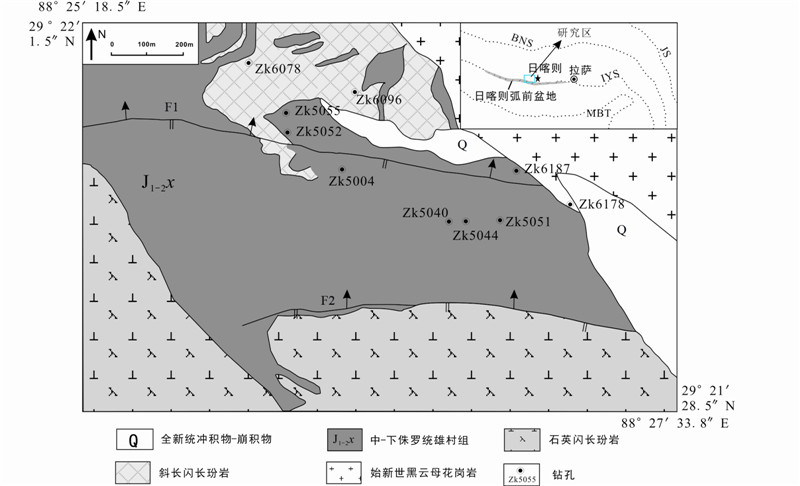 | 图 1 雄村斑岩铜金矿床矿区地质图(据郎兴海等,2010a修编) Fig. 1 Geological map of Xiongcun porphyry Cu-Au deposit(modified after Lang et al., 2010a) |
矿区出露的地层主要为一套酸性-安山质凝灰岩、凝灰质砂岩及泥页岩和全新统崩积物-冲积物(唐菊兴等,2009a; 应立娟等,2012)。过去认为其为白垩纪海相火山岩(Qin et al., 2005),近年来随着凝灰岩锆石U-Pb年龄(176~195Ma)测定(唐菊兴等,2010; 曲晓明等,2007a),现多认为其为中下侏罗统凝灰质火山沉积岩。
矿区岩浆活动强烈,主要有出露于矿区东部的始新世黑云母钾长花岗岩及矿区西部及南部的中晚侏罗世(角闪)石英闪长玢岩(图 1)。矿区东部黑云母钾长花岗岩为区域上的花岗岩大岩基,岩体新鲜无矿化,为白垩纪-古近纪南冈底斯岩基的组成部分,常呈岩脉状侵入其西部的侏罗纪地质体和雄村铜金矿体中(唐菊兴等,2010)。
矿区断裂构造发育,主要呈北西向、北西西向或北北西向展布,沿断层普遍分布有断层角砾岩和构造蚀变岩。次级断层呈北西或北北西走向,大多具有陡倾特点,倾向北东或东,均为成矿后断层(郎兴海等, 2010a,b)。
雄村铜金矿床探明Cu储量>100Mt,平均品位为0.45%,Au >100t,平均品位0.61g/t。矿体为厚板状,长轴北西向,长约1200多米,宽约600m,平均厚度大于200m(唐菊兴等,2009b)。主要金属矿物为:黄铜矿、黄铁矿、闪锌矿、磁铁矿及自然金等。非金属矿物主要为石英、红柱石、钾长石、斜长石、绢云母、黑云母等(郎兴海,2012)。
矿体经历了很强的热液蚀变作用,主要有钾化、硅化、绢云母化、泥化、绿泥石-绿帘石化、堇青石化及红柱石化等。赋矿岩石硅化较强,多处见强硅化形成的硅化岩。
2 雄村矿化岩石特征及成因类型分析为了分析雄村铜金矿床赋矿岩石类型,我们对雄村铜金矿床多个钻孔矿化岩体作了详细的光薄片观察鉴定。由于雄村铜金矿床赋矿岩石发生了强烈蚀变,多数原岩被蚀变破坏,因而只能通过蚀变岩石局部蚀变较弱部位矿物组成分析岩石类型。我们在雄村矿区ZK5004、ZK5040、ZK5042、ZK5044、ZK5052、ZK5055、ZK6178(图 1)7个钻孔不同深度采样,对矿化岩石作了系统的光薄片观察鉴定,多数样品已发生强烈硅化而形成硅化岩,少数局部蚀变较弱部位显微特征见图 2。
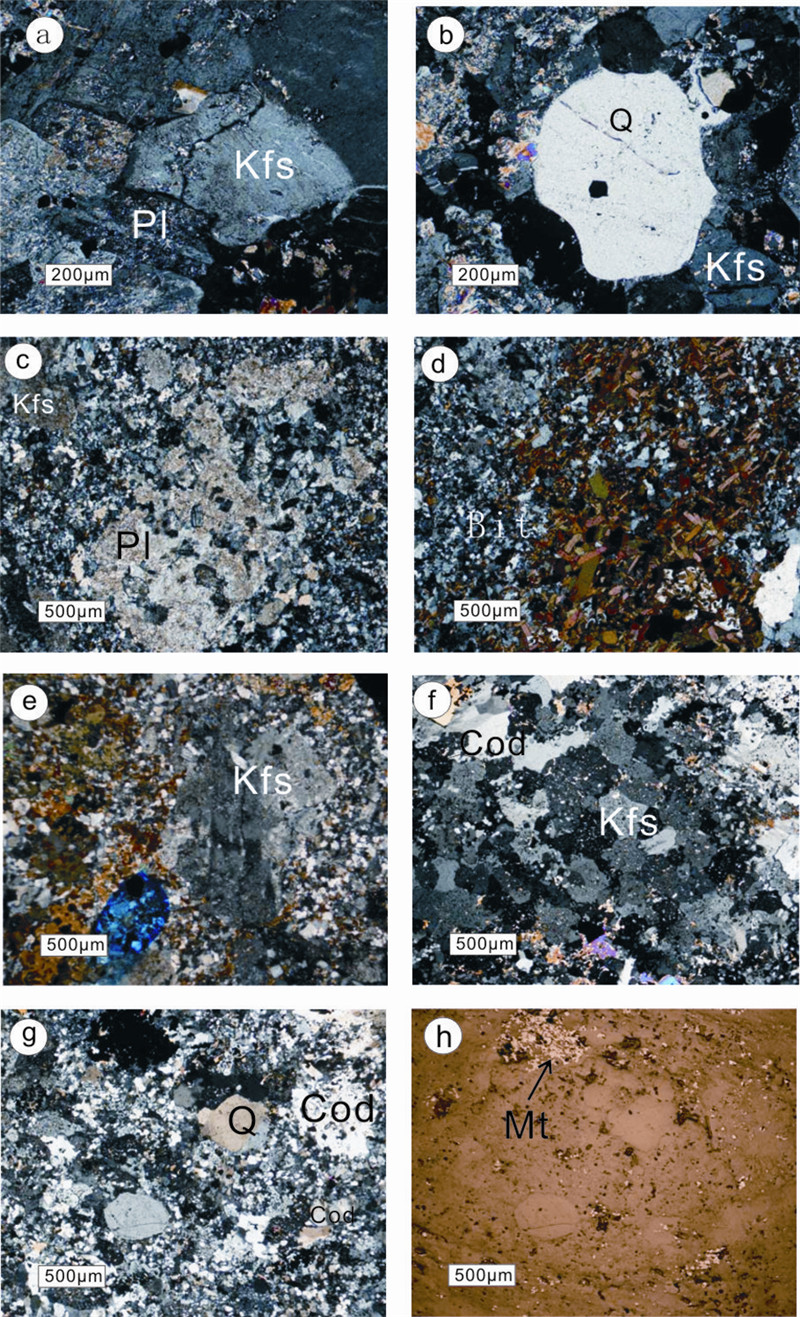 | 图 2 雄村铜金矿床赋矿岩石显微特征图
Pl-斜长石;Kfs-钾长石;Cod-堇青石;Mt-磁铁矿;Bit-黑云母
Fig. 2 Microphotographs of ore-bearing porphyry of Xiongcun Cu-Au deposit
Pl-plagioclase; Kfs-K-feldspar; Cod-cordierite; Mt-magnetite; Bit-biotite |
在ZK6178孔169.4m处,岩石具斑状结构,斑晶主要由斜长石,牌号An=12~21之间,为更长石(已绢云母化)和钾长石组成(图 2a),见浑圆状石英斑晶(图 2b),基质主要由钾长石、斜长石组成;该岩石结构及矿物组成特征表明其为二长斑岩。其余ZK5004、ZK5040、ZK5042、ZK5044、ZK5052、ZK5055 6个钻孔的赋矿蚀变岩石具斑状结构,斑晶主要由斜长石(An为2~3,为钠长石)、钾长石(图 2c,e)及较少石英组成(图 2g),基质主要为钾长石(图 2f),粒度多在2mm左右,显示石英正长斑岩的特征。上述赋矿蚀变岩石矿物组成及结构特征表明其主要为石英正长斑岩-石英二长斑岩。石英正长斑岩和石英二长斑岩矿化蚀变特征一致可能属同一岩石系列。雄村铜金矿床部分矿化还产于火山岩中,因此,雄村铜金矿床赋矿岩石主要为石英正长斑岩、二长斑岩及火山岩。
石英正长斑岩中普遍见斑岩型铜金矿床成矿早期常见的钾硅化及磁铁矿化蚀变,局部见钾化形成的细粒状黑云母(图 2d,e)和浸染状铜矿化共生及浸染状磁铁矿(图 3h)。雄村铜金矿床正长斑岩中见堇青石(图 2f,g)。正长斑岩中堇青石应该是岩浆上升至浅部地壳过程中捕获的铝质泥岩(围岩)形成的。
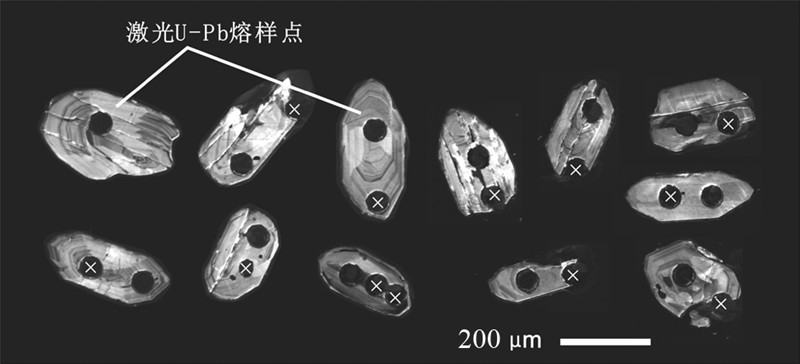 | 图 3 雄村斑岩矿床赋矿石英正长斑岩锆石CL图 Fig. 3 CL images of the analyzed zircon grains from the ore-bearing quartz syenite porphyry,Xiongcun porphyry deposit |
样品采自ZK5005孔312m处,矿化石英正长斑岩(XC7-12)用常规方法粉碎至60目,用水初步淘选之后经过磁选精选,在双目镜下手工挑选出自形的晶型较好的锆石。将待测锆石置于环氧树脂中制成靶、磨至约一半使锆石中心部位暴露并抛光,然后进行反射光、透射光照相。利用阴极发光(CL)扫描电镜进行图像分析确定单颗粒锆石的形态、结构,以选择颗粒大、较自形清晰无包体的锆石进行分析。
阴极发光(CL)图像在西北大学大陆动力学国家重点实验室拍摄完成。锆石原位微区LA-ICP-MS U-Pb 定年及锆石微量元素分析在广州地球化学研究所同位素地球化学国家重点实验室进行。分析使用Resolution M-50 激光剥蚀系统和Agilent 7500a 型的ICP-MS 联机的LA-ICP-MS。使用标准锆石TEMORA及微量元素标样 NIST 610。微量元素含量计算以Si为内标、NIST610为外标。具体仪器组成和实验参数参考文献(Li et al., 2012; Ding et al., 2013)。对分析数据的离线处理,包括对样品的信号选择、仪器灵敏度漂移校正、元素含量及U-Th-Pb同位素比值和年龄计算采用 ICPMSDataCal 7.2 软件(Liu et al., 2010),锆石样品的U-Pb年龄谐和图绘制和年龄加权平均年龄计算采用ISOPLOT(Ludwig,2003)。
锆石Ce4+/Ce3+比值通过测定锆石及岩石稀土元素含量计算(Ballard et al., 2002)。为了排除锆石中磷灰石包体及其它地质事件对锆石Ce4+/Ce3+比值影响,只计算具有效锆石年龄的Ce4+/Ce3+比值。
3.2 黑云母Ar-Ar同位素分析在详细光薄片观察的基础上,选取Xc7-09(石英正长斑岩)样品黑云母作Ar-Ar年龄分析。黑云母与磁铁矿共生(图 2d),偶见星点黄铜矿,表明其为斑岩矿床成矿早期钾硅化及磁铁矿化阶段形成的。样品经破碎至20目,在双目显微镜下挑选0.2g左右的云母,挑纯至99%。用纯铝铂纸将样品包裹成直径约6mm的球形,与标样ZBH-25一同封闭于玻璃瓶中,送至中国原子能科学研究院49-2反应堆B4孔道进行中子照射,照射时间为24h,中子通量为(6.0~6.5)×1012/cm2·s。用于中子通量监测的样品是我国周口店K-Ar标准黑云母(ZBH-25,年龄为132.7Ma)。照射后的样品冷置后,装入圣诞树状的样品架中,密封去气之后,装入系统。
样品测试40Ar/39Ar同位素年代分析在中国科学院广州地球化学研究所同位素地球化学国家重点实验室进行,具体的分析技术规格见(Qiu et al., 2010; Yun et al., 2010)。40Ar/39Ar定年结果的计算和投点采用ArArCALC计算软件(Koppers,2002; 张凡等,2009)。
4 分析结果 实验分析了石英正长斑岩的锆石U-Pb同位素组成、锆石Ce4+/Ce3+比值以及黑云母的Ar-Ar同位素组成(表 1、表 2)。含矿石英正长斑岩LA-ICP-MS U-Pb 年龄在157~198Ma之间,4个分析点谐和度< 90%,锆石Th/U比值在0.49~1.10之间。黑云母主要加热阶段的Ar-Ar表观年龄为38.9~48.8Ma之间。 | 表 1 含矿石英正长斑岩锆石LA-ICP-MS分析结果 Table 1 Zircon LA-ICP-MS data of ore-bearing quartz syenite porphyry |
| 表 2 雄村斑岩矿床石英正长斑岩黑云母40Ar/39Ar测年结果 Table 2 40Ar/39Ar isotopic age analyses of biotite from Xiongcun ore bearing quartz syenite porphyry |
与斑岩铜金矿化有关的岩浆多具有较高的氧逸度。高氧逸度岩浆中的硫为氧化硫,而氧化态硫在岩浆中的溶解度较大,使岩浆中的硫在岩浆形成演化过程中处于不饱和状态,有利于亲铜元素在岩浆形成演化过程中富集形成矿床(Sillitoe,1997; Mungall,2002; Ballard et al., 2002; Sun et al., 2004,2010,2013,2014; Liang et al., 2006,2009)。锆石Ce4+/Ce3+比值可反映成矿岩浆氧逸度相对高低,斑岩铜金矿床的成矿岩体锆石多具较高的Ce4+/Ce3+比值(Ballard et al., 2002; Liang et al., 2006)。西藏玉龙铜矿的成矿岩体锆石的Ce4+/Ce3+一般大于200,而非成矿岩体则一般小于120,智利斑岩铜金矿床成矿岩体锆石Ce4+/Ce3+值大于300。雄村赋矿石英正长斑岩的锆石Ce4+/Ce3+值大,变化大,在334至3084之间(表 1),平均1169,显示石英正长斑岩具高氧逸度特征,和世界斑岩铜金矿床成矿岩体的值相似。这初步显示石英正长斑岩和矿化有内在成因联系。
斑岩矿床成矿岩体多发育成矿早期钾硅化及磁铁矿化(Liang et al., 2009),雄村铜金矿床赋矿石英正长斑岩发育斑岩铜(金)矿床早期常见的钾硅化(图 2d,e)及磁铁矿化-硅化(图 2h)等蚀变。这也表明石英正长斑岩与铜金矿化有成因联系。
雄村赋矿石英正长斑岩高氧逸度岩浆特征及蚀变特征表明石英正长斑岩与铜金矿化具有内在成因关系,雄村铜金矿床为与石英正长斑岩有关的斑岩型矿床。
5.2 石英正长斑岩形成时代锆石阴极发光图像(图 3)显示,测试样品锆石多为自形-半自形柱状,晶体为无色-淡褐色,长轴方向200~300μm,长宽比在1~3之间,振荡环带发育,锆石Th/U值大于0.5(表 1),表明测定的锆石为岩浆结晶成因锆石(Hoskin and Black, 2000)。
本次实验共测定20颗锆石样品的T-U-Pb同位素组成,其中4个点谐和度在90%以下,不参与计算。其余16颗锆石238U/206Pb年龄在157~198Ma之间。为减少继承铅、铅丢失对年龄的影响,我们用累计概率统计图处理锆石206Pb/238U年龄数据(图 4内插图)。在累积概率统计图上,岩体主群锆石多为直线分布,直线上方分布点视作继承Pb,直线下方分布点视作Pb丢失(Harris et al., 2004)。雄村斑岩铜金矿床石英正长斑岩锆石16个分析点中,3个较大年龄点和1个较小年龄点明显不在直线上,分别视作继承铅和铅丢失,其余12个点获得主群锆石加权平均年龄为173.7±2.1Ma,MSWD=0.23。锆石U-Pb同位素封闭温度较高,主群锆石年龄代表岩体的结晶年龄(Harris et al., 2004)。因此,雄村石英正长斑岩形成时代为173.7±2.1Ma。
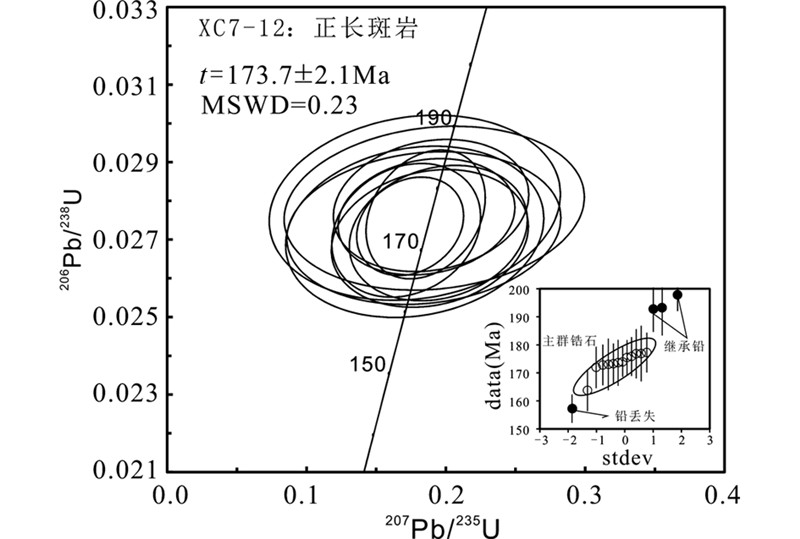 | 图 4 雄村斑岩矿床赋矿石英正长斑岩锆石206Pb/238U-207Pb/235U年龄谐和图(内插图为累计概率统计图) Fig. 4 Concordia plot showing the zircon U-Pb analyses of the ore-bearing quartz-syenite porphyry of the Xiongcun porphyry deposit(the insert is probability plot) |
矿区东部大面积出露新生代钾长花岗岩,而矿区钻孔中也见大量晚期脉岩。前人据绢云母Ar-Ar年龄约为38Ma左右,提出矿床是新生代形成的浅成低温矿床(徐文艺等, 2006a,b)。为了分析后期岩浆热事件对该区成矿的影响,我们分析了斑岩铜金矿床钾化阶段形成的黑云母(图 2d)Ar-Ar年龄(表 2)。黑云母样品共进行了16个阶段的激光加热阶段,年龄谱及坪年龄见图 5a,所有数据点对应的正反等时线年龄图见图 5b,c。分析结果显示,表观年龄呈阶梯状递增,变化范围从8.4~48.8Ma,总气体年龄36.2±1.6Ma。在激光加热前6个阶段表面年龄由8.4Ma增至33.7Ma(图 5a),39Ar仅为析出量的28%,后十个加热阶段表观年龄在38.9~48.8Ma,并在激光加热第13~16阶段取得了似坪年龄为48.3±0.9Ma(图 5a)。所有数据点对应的正反等时线年龄分别为51.4±11.7Ma,51.2±11.6Ma(图 5b,c),其初始40Ar/36Ar为247.4±177(图 5b),略小于大气40Ar/36Ar(295.5)。在本文中用坪年龄代表黑云母Ar-Ar同位素记录的时代。
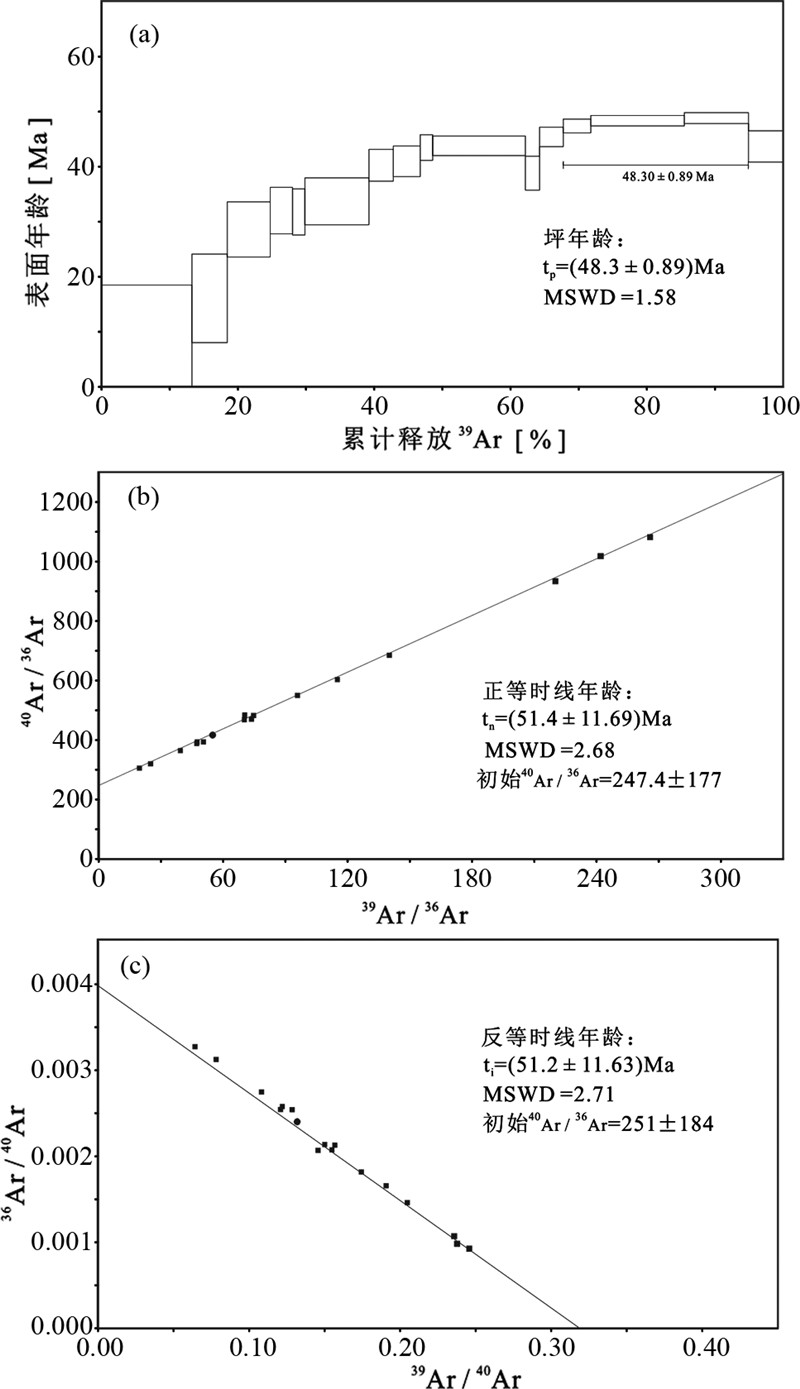 | 图 5 正长斑岩中蚀变黑云母40Ar-39Ar坪年龄和等时线年龄 Fig. 5 The 40Ar-39Ar age plateaus and isochrones for biotite from ore-bearing rock of Xiongcun porphyry deposit |
本文获得的斑岩矿床钾化阶段黑云母Ar-Ar坪年龄(48.3±0.9Ma)远远小于石英正长斑岩锆石U-Pb同位素年龄(173.7±2.1Ma),而和矿区东部始新世花岗岩大岩基(46.5±1.1Ma)、穿插矿体黑云母花岗闪长岩岩脉(46.9±0.4Ma)及云煌岩脉(49.6± 0.6Ma)(唐菊兴等, 2009a,2010)等一致。这表明雄村斑岩型铜金矿床受后期强烈地质热事件的干扰,斑岩矿床钾化阶段形成黑云母Ar-Ar同位素体系由于受到后期地质热事件的影响而发生重置,仅记录后期地质热事件而不能反映其形成时代。
现有研究成果表明,斑岩铜矿床成岩成矿系统时间跨度约1Myr左右(Cathles et al., 1997;梁华英等, 2008,2009)。雄村斑岩型矿床成矿岩体锆石U-Pb年龄(173.7±2.1Ma)和郎兴海等(2012)辉钼矿Re-Os模式年龄(161.5±2.7Ma)存在较大的差异,相差约12Ma。石英正长斑岩蚀变特征及高氧逸度岩浆特征表明其为成矿岩体,那么为什么辉钼矿模式年龄和岩体存在约12Ma时差?我们认为雄村斑岩铜金矿床两种同位素体系年龄差异较大,可能主要是下列两个原因所致:
其一是辉钼矿后受到后期地质热事件的影响,导致Re-Os年龄变小。前人研究表明辉钼矿中的Re在中低温流体或表生条件下易发生迁移丢失或在辉钼矿中微粒K-Si矿物如伊利石中富集,导致辉钼矿Re-Os年龄异常大或变小,前者如美国内华达州Gold Acres 矽卡岩型Cu-Mo矿床,后者如纳米比亚Lorelei斑岩Cu-Mo矿床(McCandless et al., 1993)。雄村斑岩矿床受后期地质事件强烈影响,发生强烈硅化及泥化蚀变,斑岩矿床钾化阶段黑云母Ar-Ar同位素体系也由于受后期地质事件扰动而发生重置;Os一般比较稳定(McCandless et al., 1993),因此,雄村斑岩型铜金矿床辉钼矿Re-Os年龄远小于成矿岩体锆石U-Pb年龄可能是辉钼矿在后期蚀变作用下,辉钼矿中微粒粘土矿物获得外来Re所致。其二可能是辉钼矿分析点较少,4个点在等时线上主要集于2区域(朗兴海等,2012),等时线年龄误差较大。
5.4 矿床形成的构造背景及过程分析冈底斯带为班-怒缝合带与雅江缝合带之间的巨型构造岩浆岩带,记录了新特提斯洋的打开与消亡的构造演化(Chung et al., 2005; Zhu et al., 2013; Royden et al., 2008)以及陆陆碰撞造山作用等主要地质事件(Mo et al., 2005,2007; Chung et al., 2009)。已有资料表明,新特提斯洋打开时间不晚于晚三叠世(Mo et al., 2007,2008),现已发现的冈底斯南缘桑日群火山岩年龄最老为195Ma,显示典型的岛弧火山岩的地球化学特征(Kang et al., 2014),表明新特提斯洋开始俯冲的时间不晚于早侏罗世。目前在冈底斯南缘发现了一系列形成于早中侏罗世,与洋壳俯冲有关的火成岩(Harrison et al., 1992; Chu et al., 2006; Ji et al., 2009; 董彦辉等,2006; 张宏飞等,2007; Tafti et al., 2009; 唐菊兴等,2010; 曲晓明等,2007a),表明新特提斯洋壳至少在早侏罗世开始向北俯冲,在冈底斯南缘引发了强烈的火山岩浆活动,形成冈底斯岩浆弧及日喀则弧前盆地。一般认为,特提斯洋于65Ma闭合,两个大陆开始碰撞(Mo et al., 2007,2008; Ding et al., 2005)。因此,冈底斯南缘形成时代大于65Ma小于195Ma的岩浆岩及有关矿床多与新特提斯洋壳俯冲背景有关。雄村斑岩铜金矿床位于冈底斯南缘日喀则弧前盆地,成矿岩体石英正长斑岩锆石LA-ICP-MS U-Pb年龄为173.7±2.1Ma,MSWD=0.23,因此,雄村斑岩型铜金矿床的形成与新特提斯洋向北俯冲有关。锆石Hf同位素组成表明(将在另文中发表),石英正长斑岩εHf(t)在11~15之间,显新生地壳特征。据冈底斯南缘中生代构造背景,初步认为雄村斑岩铜金矿床形成过程可概括为,新特提斯洋壳在晚三叠纪或早中侏罗纪向北俯冲,俯冲洋壳脱水,交代上覆地幔楔,诱发其部分熔融形成富水高氧逸度钾质岩浆,富水高氧化岩浆分解地幔源区中硫化物,形成富铜金富水高氧化岩浆。成矿岩浆在173Ma左右发生侵入岩浆活动,成矿岩浆在上升过程中出溶挥发相,成矿元素Cu、Au等由于在流体和熔体中之间分配系数较大,进入岩浆出溶挥发相中;当岩浆上升定位到地壳浅部时,岩浆热液在斑岩体顶部及其围岩接触带附近交代岩体及围岩形成斑岩矿床(Sillitoe,1972)。
斑岩矿床形成深度一般较浅,多在1~3km左右(Cooke et al., 2004),冈底斯带由于后期碰撞引起的地壳加厚、抬升剥蚀等,较先形成的斑岩型矿床遭受破坏而不利于保存。冈底斯南缘大面积出露白垩纪以后岩基,多数斑岩已被剥蚀破坏,因此,冈底斯南缘俯冲型斑岩铜金矿床重点找矿靶区应集中在冈底斯南缘中生代以后凹陷盆地如侏罗纪火山岩分布区。
6 结论(1)雄村铜金矿床强蚀变赋矿岩石为正长斑岩、火山岩及少量二长斑岩;
(2)石英正长斑岩发育典型的钾化及磁铁矿化蚀变,且具高氧逸度岩浆特征,为成矿岩体;雄村铜金矿床为与石英正长斑岩有关斑岩型矿床;
(3)石英正长斑岩的锆石LA-ICP-MS U-Pb年龄为173.7±2.1Ma,MSWD=0.23,斑岩矿床钾硅化蚀变黑云母Ar-Ar坪年龄年龄为48.3±0.9Ma;雄村斑岩矿床形成与早中侏罗世新特提斯洋北向俯冲诱发岩浆活动有关,云母Ar-Ar年龄受后期热事件影响,不能记录矿床形成时代。
| [1] | Ballard JR, Palin JM and Campbell IH. 2002. Relative oxidation states of magmas inferred from Ce(IV)/Ce(III) in zircon: Application to porphyry copper deposits of northern Chile. Contributions to Mineralogy and Petrology, 144(3): 347-364 |
| [2] | Cathles LM, Erendi AHJ and Barrie T. 1997. How long can a hydrothermal system be sustained by a single intrusive event? Economic Geology, 92(7-8): 766-771 |
| [3] | Chu MF, Chung SL, Song B, Liu DY, Suzanne YOR, Norman JP, JJ and Wen DJ. 2006. Zircon U-Pb and Hf isotope constraints on the Mesozoic tectonics and crustal evolution of southern Tibet. Geology, 34(9): 745-748 |
| [4] | Chung SL, Chu MF, Zhang YQ, Xie YW, Lo CH, Lee TY, Lan CY, Li XH, Zhang Q and Wang YZ. 2005. Tibetan tectonic evolution inferred from spatial and temporal variations in post-collisional magmatism. Earth-Science Reviews, 68(3-4): 173-196 |
| [5] | Chung SL, Chu MF, Ji JQ, O'Reilly SY, Pearson NJ, Liu DY, Lee TY and Lo TH. 2009. The nature and timing of crustal thickening in Southern Tibet: Geochemical and zircon Hf isotopic constraints from post-collisional adakites. Tectonophysics, 477(1-2): 36-48 |
| [6] | Cooke DR, Wilson AJ and Davies AGS. 2004. Characteristics and genesis of porphyry copper-gold deposits. University of Tasmania, Centre for Ore Deposit Research Special Publication, 5: 17-34 |
| [7] | Dong YH, Xu JF, Zeng QG, Wang Q, Mao GZ and Li J. 2006. Is ther a Neo-tethys'subduction record earlier than arc volcanic rocks in the Sangri Group? Acta Petrologica Sinica, 22(3): 661-668(in Chinese with English abstract) |
| [8] | Ding L, Kapp P and Wan XQ. 2005. Paleocene-Eocene record of ophiolite obduction and initial India-Asia collision, southcentral Tibet. Tectonics, 24(3): 1-18 |
| [9] | Ding X, Hu YH, Zhang H, Li CY, Ling MX and Sun WD. 2013. Major Nb/Ta fractionation recorded in garnet amphibolite facies metagabbro. The Journal of Geology, 121(3): 255-274 |
| [10] | Harris AC, Allen CM, Bryan SE, Campbell IH, Holcombe RJ and Plain MJ. 2004. ELA-ICP-MS U-Pb zircon geochronology of regional volcanism hosting the Bajo de la Alumbrera Cu-Au deposit: Implications for porphyry-related mineralization. Mineralium Deposita, 39(1): 46-67 |
| [11] | Harrison TM, Copeland Peter, Kidd WSF and Yin A. 1992. Raising Tibet. Science, 255(5052): 1663-1670 |
| [12] | Hou ZQ, Qu XM, Huang W and Gao YF. 2001. Gangdise porphyry copper metallogenic belt: The possible second "Yulong" copper belt. Geology in China, 28(10): 27-30 (in Chinese with English abstract) |
| [13] | Hou ZQ, Gao YF, Meng XJ, Qu XM and Huang W. 2004. Genesis of adakitic porphyry and tectonic controls on the Gangdese Miocene porphyry copper belt in the Tibetan orogen. Acta Petrologica Sinica, 20(2): 239-248 (in Chinese with English abstract) |
| [14] | Hoskin PWO and Black LP. 2010. Metamorphic zircon formation by solid-state recrystallization of protolith igneous zircon. Journal of Metamorphic Geology, 18(4): 423-439 |
| [15] | Ji WQ, Wu FY, Chung SL, Li JX and Liu CZ. 2009. Zircon U-Pb geochronology and Hf isotopic constraints on petrogenesis of the Gangdese batholith, southern Tibet. Chemical Geology, 262(3-4): 229-245 |
| [16] | Koppers AAP. 2002. ArArCALC-software for 40Ar/39Ar age calculations. Computers & Geosciences, 28(5): 605-619 |
| [17] | Kang ZQ, Xu JF, Simo AW, Feng ZH, Chen JL, Wang BD, Fu WC and Pan HB. 2014. Geochronology and geochemistry of the Sangri Group volcanic rocks, Southern Lhasa terrane: Implications for the early subduction history of the Neo-Tethys and Gangdese magmatic arc. Lithos, 200-201: 157-168 |
| [18] | Lang XH, Chen YC, Tang JX, Li ZJ, Deng Q, Huang Y, Chen Y and Zhang L. 2010a. A discussion on genesis of Xiongcun porphyry copper-gold deposit, Xietongmen, Tibet: Evidences from elements spatial distribution characteristics. Geological Review, 56(3): 384-402 (in Chinese with English abstract) |
| [19] | Lang XH, Chen YC, Tang JX, Li ZJ, Huang Y, Wang CH, Chen Y and Zhang L. 2010b. Characteristics of rock geochemistry of orebody No. I in the Xiongcun porphyry copper-gold metallogenic district Xietongmen County, Tibet: Constraints on metallogenic tectonic settings. Geology and Exploration, 46(5): 887-898 (in Chinese with English abstract) |
| [20] | Lang XH, Tang JX, Li ZD, Huang Y, Chen Y and Zhang L. 2011. Alteration and mineralization of No.I orebody in Xiongcun porphyry copper-gold metallogenic ore district, Xietongmen County, Tibet. Mineral Deposits, 30(2): 327-338 (in Chinese with English abstract) |
| [21] | Lang XH. 2012. Metallogenesis and metallogenic prediction for Xiongcun porphyry copper-gold district, Tibet. Ph. D. Dissertation. Chengdu: Chengdu University of Technology, 53-73(in Chinese with English summary) |
| [22] | Lang XH, Tang JX, Chen YC, Li ZD, Huang Y, Wang CH, Chen Y, Zhang L and Zhou Y. 2012. Neo-Tethys mineralization on the southern margin of the Gangdise metallogenic belt, Tibet, China: Evidence from Re-Os ages of Xiongcun orebody No.I. Earth Science, 37(3): 515-525(in Chinese with English abstract) |
| [23] | Lang XH, Tang JX, Li ZJ, Xie FW and Huang Y. 2013. Jurassic metallogenic event of Gangdese porphyry copper belt in Xiongcun deposit, Tibet: Evidences of geochronology by zircon U-Pb and molybdenite Re-Os isotope. Acta Mineralogica Sinica, 33(Suppl.2): 328-329 (in Chinese) |
| [24] | Lang XH, Tang JX, Li ZJ, Huang Y, Ding F, Yang HH, Xie FW, Zhang L, Wang Q and Zhou Y. 2014. U-Pb and Re-Os geochronological evidence for the Jurassic porphyry metallogenic event of the Xiongcun district in the Gangdese porphyry copper belt, southern Tibet, PRC, Journal of Asian Earth Sciences, 79: 608-622 |
| [25] | Li H, Ling MX, Li CY, Zhang H, Ding X, Yang XY, Fan WM, Li YL and Sun WD. 2012. A-type granite belts of two chemical subgroups in central eastern China: Indication of ridge subduction. Lithos, 150: 26-36 |
| [26] | Liang HY, Campbell IH, Allen C, Sun WD, Liu CQ, Yu HX, Xie YW and Zhang YQ. 2006. Zircon Ce4+/Ce3+ ratios and ages for Yulong ore-bearing porphyries in eastern Tibet. Mineralium Deposita, 41(2): 152-159 |
| [27] | Liang HY, Mo JH, Sun WD, Yu HX, Zhang YQ and Allen CM. 2008. Study on the duration of the ore-forming system of the Yulong giant porphyry copper deposit in eastern Tibet, China. Acta Petrologica Sinica, 24(10): 2352-2358 (in Chinese with English abstract) |
| [28] | Liang HY, Sun WD, Su WC and Zartman RE. 2009. Porphyry copper-gold mineralization at Yulong, China, promoted by decreasing redox potential during magnetite alteration. Economic Geology, 104(4): 587-596 |
| [29] | Liang HY, Mo JH, Sun WD, Zhang YQ, Zeng T, Hu GQ and Allen CM. 2009. Study on geochemical composition and isotope ages of the Malasongduo porphyry associated with Cu-Mo mineralization. Acta Petrologica Sinica, 25(2): 385-392 (in Chinese with English abstract) |
| [30] | Liu YS, HU ZC, Zong KQ, Gao CG, Gao S, Xu J and Chen HH. 2010. Reappraisement and refinement of zircon U-Pb isotope and trace element analyses by LA-ICP-MS. Chinese Science Bulletin, 55(15): 1535-1546 |
| [31] | Ludwig KR. 2003. ISOPLOT 3.0: A geochronological toolkit for Microsoft excel. Berkeley: Berkeley Geochronology Center, California |
| [32] | Mungall JE. 2002. Roasting the mantle: Slab melting and the genesis of major Au and Au-rich Cu deposits. Geology, 30(10): 915-918 |
| [33] | McCandless TE, Ruiz J and Campbell AR. 1993. Rhenium behavior in molybdenite in hypogene and near surface environments: Implications for Re-Os geochronometry. Geochimica et Cosmochimica Acta, 57(4): 889-905 |
| [34] | Mo XX, Dong GC, Zhao ZD, Guo TY, Wang LL and Chen T. 2005. Timing of magma mixing in the Gangdisêmagmatic belt during the India-Asia collision: Zircon SHIRMP U-Pb dating. Acta Geologica Sinica, 79(1): 66-76 |
| [35] | Mo XX, Hou ZQ, Niu YL, Dong GC, Qu XM, Zhao ZD and Yang ZM. 2007. Mantle contributions to crustal thickening during continental collision: Evidence from Cenozoic igneous rocks in southern Tibet. Lithos, 96(1-2): 225-242 |
| [36] | Mo XX, Niu YL, Dong GC, Zhao ZD, Hou ZQ, Zhou S and Ke S. 2008. Contribution of syncollisional felsic magmatism to continental crust growth: A case study of the Paleogene Linzizong volcanic succession in southern Tibet. Chemical Geology, 250(1-4): 49-67 |
| [37] | Qin KZ, Li GM, Li JX, Ding KS and Xie YH. 2005. The Xiongcun Cu-Zn-Au deposit in the western segment of the Gangdese, Tibet: A Mesozoic VHMS-type deposit cut by late veins. Mineral Deposit Research: Meeting the Global Challenge, 1255-1258 |
| [38] | Qiu HN, Wijbrans JR, Brouwer FM, Yun JB, Zhao LH and Xu YG. 2010. Amphibolite facies retrograde metamorphism of the Zhujiachong eclogite, SE Dabieshan: 40Ar/39Ar age constraints from argon extraction using UV-laser microprobe, in vacuo crushing and stepwise heating. Journal of Metamorphic Geology, 28(5): 477-487 |
| [39] | Qu XM, Xin HB and Xu WY. 2007a. Collation of age of ore-hosting volcanics in Xiongcun superlarge Cu-Au deposit on basis of three zircon U-Pb SHRIMP ages. Mineral Deposits, 26(5): 512-518 (in Chinese with English abstract) |
| [40] | Qu XM, Xin HB and Xu WY. 2007b. Petrogenesis of the ore-hosting volcanic rocks and their contribution to mineralization in Xiongcun superlarge Cu-Au deposit, Tibet. Acta Geologica Sinica, 81(7): 965-971 (in Chinese with English abstract) |
| [41] | Royden LH, Burchfiel BC and Robert DH. 2008. The geological evolution of the Tibetan Plateau. Science, 321(5892): 1054-1058 |
| [42] | Sillitoe RH. 1972. A plate tectonic model for the origin of porphyry copper deposits. Economic Geology, 67(2): 184-197 |
| [43] | Sillitoe RH. 1997. Characteristics and controls of the largest porphyry copper-gold and epithermal gold deposits in the circum-Pacific region. Australian Journal of Earth Sciences, 44(3): 373-388 |
| [44] | Sun WD, Arculus RJ, Kamenetsky VS and Binns RA. 2004. Release of gold-bearing fluids in convergent margin magmas prompted by magnetite crystallization. Nature, 431(7011): 975-978 |
| [45] | Sun WD, Ling MX, Yang XY, Fan WM, Ding X and Liang HY. 2010. Ridge subduction and porphyry copper-gold mineralization: An overview. Science China (Earth Sciences), 53(4): 475-484 |
| [46] | Sun WD, Liang HY, Ling MX, Zhan MZ, Ding, X, Zhang H, Yang XY, Li YL, Ireland TR, Wei QR and Fan WM. 2013. The link between reduced porphyry copper deposits and oxidized magmas. Geochimica et Cosmochimica Acta, 103: 263-275 |
| [47] | Sun WD, Huang RF, Liang HY, Ling MX, Li CY, Ding X, Zhang H, Yang XY, Trevor I and Fan WM. 2014. Magnetite-hematite, oxygen fugacity, adakite and porphyry copper deposits: Reply to Richards. Geochimica et Cosmochimica Acta, 126: 646-649 |
| [48] | Tafti R. 2006. Preliminary geochronology report for the Xietongmen deposit area. Tibet, China. Private Report to Continental Minerals Corp. |
| [49] | Tafti R, Mortensen JK, Lang JR, Rebaglitim M and Oliver JL. 2009. Jurassic U-Pb and Re-Os ages for the newly discovered Xietongmen Cu-Au porphyry district, Tibet, PRC: Implications for metalogenic epochs in the southern Gangdese belt. Economic Geology, 104(1): 127-136 |
| [50] | Tang JX, Zhang L, Huang Y, Wang CH, Li ZJ, Deng Q, Lang XH and Wang Y. 2009a. 40Ar-39Ar isotope ages of main geological bodies in Xiongcun copper-gold deposit, Xietongmen County, Tibet, and their geological significance. Mineral Deposits, 28(6): 759-769 (in Chinese with English abstract) |
| [51] | Tang JX, Huang Y, Li ZJ, Deng Q, Lang XH, Chen Y and Zhang L. 2009b. Element geochemical characteristics of Xiongcun Cu-Au deposit in Xietongmoin County, Tibet. Mineral Deposits, 28(1): 15-28 (in Chinese with English abstract) |
| [52] | Tang JX, Li FJ, Li ZJ, Zhang L, Tang XQ, Deng Q, Lang XH, Huang Y, Yao XF and Wang Y. 2010. Time limit for formation of main geological bodies in Xiongcun copper-gold deposit, Xietongmen County, Tibet: Evidence from zircon U-Pb ages and Re-Os age of molybdenite. Mineral Deposits, 29(3): 461-475 (in Chinese with English abstract) |
| [53] | Xu WY, Qu XM, Hou ZQ, Yang ZS, Pan FZ, Cui YH, Chen WS, Yang D and Lian Y. 2006a. The Xiongcun copper-gold deposit in Tibet: Characteristics, genesis, and geodynamic application. Acta Geologica Sinica, 80(9): 1392-1407 (in Chinese with English abstract) |
| [54] | Xu WY, Qu XM, Hou ZQ, Yang D, Yang ZS, Cui YH and Chen WS. 2006b. Ore-forming fluid characteristics and genesis of Xiongcun copper-gold deposit in central Gangdese, Tibet. Mineral Deposits, 25(3): 243-251 (in Chinese with English abstract) |
| [55] | Yun JB, Shi HS, Zhu JZ, Zhao LH and Qiu HN. 2010. Dating petroleum emplacement by illite 40Ar/39Ar laser stepwise heating. AAPG Bulletin, 94(6): 759-771 |
| [56] | Yang ZM, Hou ZQ, White NC, Chang ZS, Li ZQ and Song YC. 2009. Geology of the post-collisional porphyry copper-molybdenum deposit at Qulong, Tibet. Ore Geology Reviews, 36(1-3): 133-159 |
| [57] | Ying LJ, Tang JX and Huang Y. 2012. Hornfels comparative study of Jiama and Xiongcun copper deposits, Tibet. Mineral Deposits, 31(2): 380-390 (in Chinese with English abstract) |
| [58] | Zhang F, Qiu HN, He HY, Yang LK, Su F, Wang Y and Wu L. 2009. Brief introduction to ArArCALC-software for data reduction in 40Ar/39Ar geochronology. Geochimica, 38(1): 53-56 (in Chinese with English abstract) |
| [59] | Zhang HF, Xu WC, Guo JQ, Zong KQ, Cai HM and Yuan HL. 2007. Zircon U-Pb and Hf isotopic composition of deformed granite in the southern margin of the Gangdese belt, Tibet: Evidence for early Jurassic subduction of Neo-Tethyan oceanic slab. Acta Petrologica Sinica, 23(6): 1347-1353(in Chinese with English abstract) |
| [60] | Zhu DC, Zhao ZD, Niu YL, Dilek Y, Hou ZQ and Mo XX. 2013. The origin and pre-Cenozoic evolution of the Tibetan Plateau. Gondwana Research, 23(4): 1429-1454 |
| [61] | 董彦辉, 许继峰, 曾庆高, 王强, 毛国政, 李杰. 2006. 存在比桑日群弧火山岩更早的新特提斯洋俯冲记录么? 岩石学报, 22(3): 661-668 |
| [62] | 侯增谦, 曲晓明, 黄卫, 高永丰. 2001. 冈底斯斑岩铜矿成矿带有望成为西藏第二条"玉龙"铜矿带. 中国地质, 28(10): 27-30 |
| [63] | 侯增谦, 高永丰, 孟祥金, 曲晓明, 黄卫. 2004. 西藏冈底斯中新世斑岩铜矿带: 埃达克质斑岩成因与构造控制. 岩石学报, 20(2): 239-248 |
| [64] | 郎兴海, 陈毓川, 唐菊兴, 李志军, 邓起, 黄勇, 陈渊, 张丽. 2010a. 西藏谢通门县雄村斑岩型铜金矿床成因讨论——来自元素的空间分布特征的证据. 地质论评, 56(3): 384-402 |
| [65] | 郎兴海, 陈毓川, 唐菊兴, 李志军, 黄勇, 王成辉, 陈渊, 张丽. 2010b. 西藏谢通门县雄村斑岩型铜金矿集区I号矿体的岩石地球化学特征: 对成矿构造背景的约束. 地质与勘探, 46(5): 887-898 |
| [66] | 郎兴海, 唐菊兴, 李志军, 黄勇, 陈渊, 张丽. 2011. 西藏谢通门县雄村斑岩型铜金矿集区Ⅰ号矿体的蚀变与矿化特征. 矿床地质, 30(2): 327-338 |
| [67] | 郎兴海. 2012. 西藏雄村斑岩型铜金矿集区成矿作用与成矿预测. 博士学位论文. 成都: 成都理工大学, 53-73 |
| [68] | 郎兴海, 唐菊兴, 陈毓川, 李志军, 黄勇, 王成辉, 陈渊, 张丽, 周云. 2012. 西藏冈底斯成矿带南缘新特提斯洋俯冲期成矿作用: 来自雄村矿集区Ⅰ号矿体的Re-Os同位素年龄证据. 地球科学, 37(3): 515-525 |
| [69] | 郎兴海, 唐菊兴, 李志军, 谢富伟, 黄勇. 2013. 西藏冈底斯斑岩铜矿带雄村矿区侏罗纪成矿作用:来自锆石U-Pb和辉钼矿Re-Os年龄的证据. 矿物学报, 33(S2): 328-329 |
| [70] | 梁华英, 莫济海, 孙卫东, 喻亨祥, 张玉泉, Allen CM. 2008. 藏东玉龙超大型斑岩铜矿床成岩成矿系统时间跨度分析. 岩石学报, 24(10): 2352-2358 |
| [71] | 梁华英, 莫济海, 孙卫东, 张玉泉, 曾提, 胡光黔, Allen CM. 2009. 玉龙铜矿带马拉松多斑岩体岩石学及成岩成矿系统年代学分析. 岩石学报, 25(2): 385-392 |
| [72] | 曲晓明, 辛洪波, 徐文艺. 2007a. 三个锆石U-Pb SHRIMP 年龄对雄村特大型铜金矿床容矿火成岩时代的重新厘定. 矿床地质, 26(5): 512-518 |
| [73] | 曲晓明, 辛洪波, 徐文艺. 2007b. 西藏雄村特大型铜金矿床容矿火山岩的成因及其对成矿的贡献. 地质学报, 81(7): 965-971 |
| [74] | 唐菊兴, 张丽, 黄勇, 王成辉, 李志军, 邓起, 郎兴海, 王友. 2009a. 西藏谢通门县雄村铜金矿主要地质体的40Ar/39Ar年龄及地质意义. 矿床地质, 28(6): 759-769 |
| [75] | 唐菊兴, 黄勇, 李志军, 邓起, 郎兴海, 陈渊, 张丽. 2009b. 西藏谢通门县雄村铜金矿床元素地球化学特征. 矿床地质, 28(1): 15-28 |
| [76] | 唐菊兴, 黎风佶, 李志军, 张丽, 唐晓倩, 邓起, 郎兴海, 黄勇, 姚晓峰, 王友. 2010. 西藏谢通门县雄村铜金矿主要地质体形成的时限:锆石U-Pb、辉钼矿Re-Os年龄的证据. 矿床地质, 29(3): 461-475 |
| [77] | 徐文艺, 曲晓明, 侯增谦, 杨竹森, 潘凤雏, 崔艳合, 陈伟十, 杨丹, 连玉. 2006a. 西藏雄村大型铜金矿床的特征、成因和动力学背景. 地质学报, 80(9): 1392-1407 |
| [78] | 徐文艺, 曲晓明, 侯增谦, 杨丹, 杨竹森, 崔艳合, 陈伟十. 2006b. 西藏冈底斯中段雄村铜金矿床成矿流体特征与成因探讨. 矿床地质, 25(3): 243-251 |
| [79] | 应立娟, 唐菊兴, 黄勇. 2012. 西藏甲玛和雄村铜矿区角岩的对比研究. 矿床地质, 31(2): 380-390 |
| [80] | 张凡, 邱华宁, 贺怀宇, 杨列坤, 苏菲, 王英, 吴林. 2009. 40Ar/39Ar年代学数据处理软件ArArCALC简介. 地球化学, 38(1): 53-56 |
| [81] | 张宏飞, 徐旺春, 郭建秋, 宗克清, 蔡宏明, 袁洪林. 2007. 冈底斯南缘变形花岗岩锆石U-Pb年龄和Hf同位素组成:新特提斯洋早侏罗世俯冲作用的证据. 岩石学报, 23(6): 1347-1353 |