 2015, Vol. 31


2. 合肥工业大学资源与环境工程学院, 合肥 230009
2. School of Resources and Environmental Engineering, Hefei University of Technology, Hefei 230009, China
华北克拉通的形成和演化一直是前寒武纪研究的热点(白瑾,1993; Li et al., 1997,1998,2001,2005; Zhai and Santosh, 2013; Zhao et al., 2002,2005,2012; Santosh et al., 2006,2007a,b; Guo et al., 2005; 杨进辉等,2007)。华北克拉通被中央造山带划分为东部陆块和西部陆块(图 1a)(Zhao et al., 2005),其中西部陆块由北部的阴山地块和南部的鄂尔多斯地块于~1.92Ga拼合形成(图 1a)(Zhao et al., 2005; Luo et al., 2008),二者中间的孔兹岩带被认为是缝合带(Zhao et al., 2005; Xia et al., 2006; Wan et al., 2006; Santosh et al., 2006,2007a,b)。胶辽古元古活动带位于东部陆块,其南北两侧分别是太古代狼林陆块和龙岗陆块(图 1a; 李三忠等,1997; Li et al., 1998; Zhao et al., 2002; Zhai et al., 2013)。
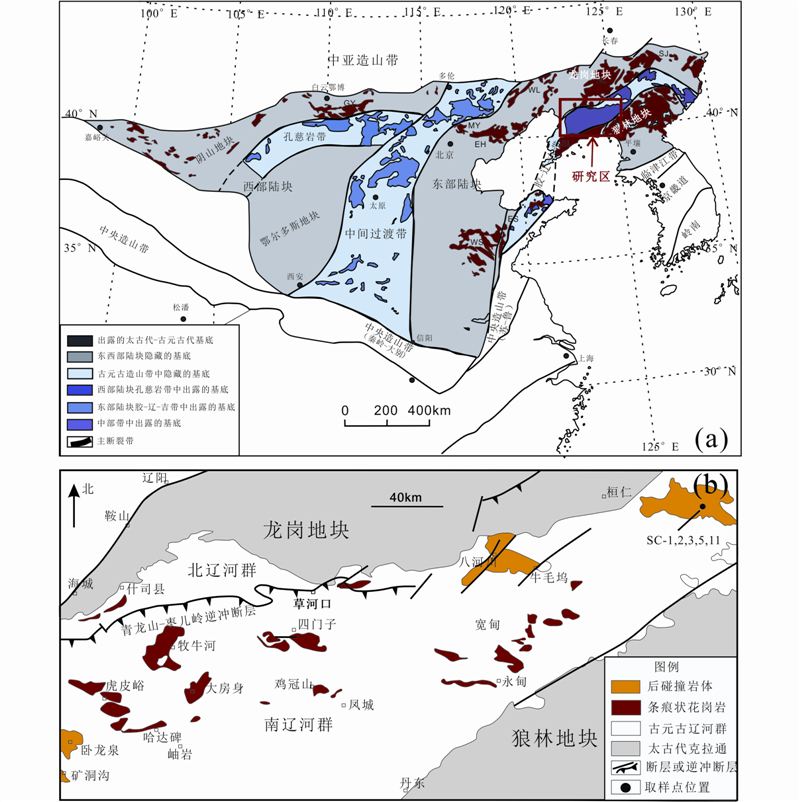 | 图 1 华北克拉通构造分区(a,据 Zhao et al., 2005)和胶辽吉带古元古花岗岩分布及取样位置图(b,据郝德峰等,2004) Fig. 1 The tectonic subdivision of the North China Craton(a,after Zhao et al., 2005) and distribution diagram of Paleoproterozoic granites in Jiao-Liao-Ji Belt and sampling location(b,after Hao et al., 2004) |
辽吉带内发育一套绿片岩相到低角闪岩相的火山-沉积序列,在辽东地区称为辽河群(姜春潮,1984),并伴随有大量的古元古代花岗质岩石(即辽吉花岗岩; 张秋生和杨振声,1988; Zhao et al., 2012)。辽吉花岗岩包括两种类型的岩石,其一是经历变形作用的、侵位于~2.2Ga的条痕状花岗岩(李三忠等,2003; 路孝平,2004),有人认为其属于A型花岗岩(刘永江和李三忠,1996; 李三忠等,1997);其二是未变形的、形成于~1.85Ga的花岗岩-正长岩类(蔡剑辉等,2002; 李三忠等,2003; 路孝平,2004; 杨进辉等,2007),代表性岩体为双岔花岗岩岩体、卧龙泉花岗岩岩体和矿洞沟正长岩岩体(图 1b)。关于1.85Ga花岗岩-正长岩的构造环境问题,目前主要有两种观点:一种观点认为华北克拉通在18.5亿年处于拉伸状态,产生的岩浆是板内拉张地幔上涌的产物,与地幔柱活动有关,是哥伦比亚超大陆裂解在华北克拉通的响应(侯贵廷等,2005; 阎国翰等,2007; 任康绪等,2006)。另一种观点则认为18.5亿年的碱性岩和花岗岩是碰撞后伸展阶段岩浆作用的产物(杨进辉等,2007; 路孝平,2004; 路孝平等,2005; 秦亚,2013)。另外,辽吉活动带的基底性质也是令人困惑的问题,这些问题的回答对了解辽吉活动带的形成演化和构造环境是至关重要的。
辽吉活动带碰撞后花岗岩包括I型花岗岩(卧龙泉岩体)和S型花岗岩(双岔岩体)。辽吉活动带S型花岗岩的特征是普遍含富铝矿物石榴石和夕线石(路孝平,2004),S型花岗岩的形成通常与大陆碰撞造山带作用密切相关(Sylvester,1998; Clemens,2003; Heal et al., 2004; Villaros et al., 2006; 钟长汀等,2007; 贺元凯等,2010),它是造山作用由汇聚向伸展过渡的标志(邓晋福等,2004)。另外,这些S型花岗岩有的具有比较典型的环斑结构(图 2b),而环斑花岗岩的出现是造山 事件结束的标志(Happala and Ramo, 1992,1999; Eby,1992; 王晓霞等,2005)。鉴于此,本文选取吉林南部双岔巨斑状花岗岩(S型,局部有环斑结构)进行详细的岩相学、锆石U-Pb年代学、地球化学、锆石Hf同位素和Sr-Nd同位素研究,以期揭示其源区、成因及其形成时的大地构造背景,为更准确地认识辽吉活动带构造演化提供依据。
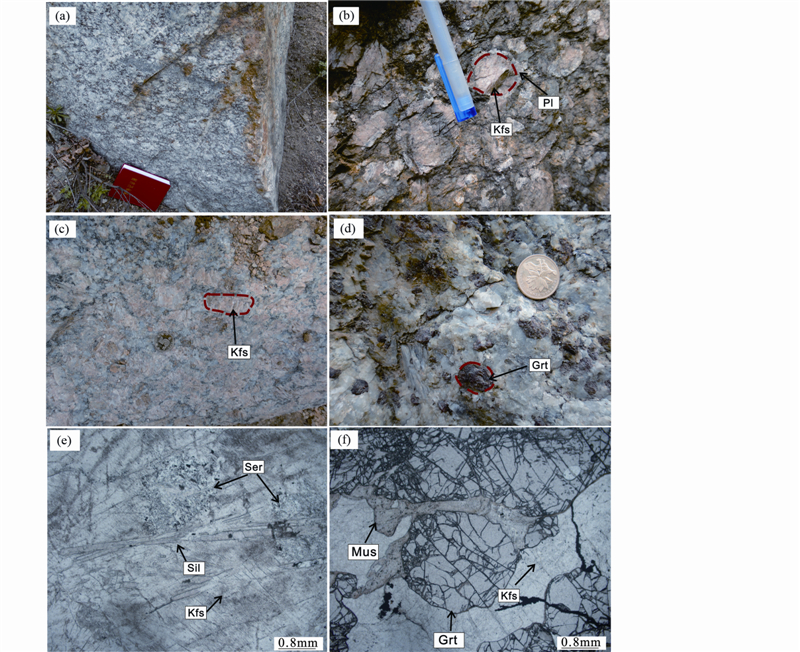 | 图 2 花岗岩典型照片
(a、c、d)双岔岩体巨斑状花岗岩野外露头;(b)双岔岩体环斑花岗岩野外露头;(e)显微岩相学特征,可见夕线石;(f)显微岩相学特征,发育大量石榴石. Ser-绢云母;Sil-夕线石;Kfs-钾长石;Mus-白云母;Grt-石榴石 Fig. 2 Typical photos of these granites (a,c,d)the field outcrop of the megaporphyritic granite;(b)the field outcrop of the rapakiwi granite;(c)petrographic thin section,sillimanite is visable;(d)petrographic thin section,garnet is visable. Ser-sericite; Sil-sillimanite; Kfs-K-feldspar; Mus-muscovite; Grt-garnet |
辽吉古元古活动带的岩石组成包括绿片岩相到低角闪岩相变质的沉积岩和变质火山岩、花岗岩(辽吉花岗岩)和少量镁铁质侵入体。辽河群变质火山-沉积岩从下向上被分为5个组:浪子山组,主要为陆源碎屑岩;里尔峪组,主要为富硼变质岩系,原岩为酸性火山岩、基性火山岩、凝灰岩及碳酸盐岩,变质形成浅粒岩、变粒岩、斜长角闪岩和镁橄榄白云石大理岩(白瑾,1993; 卢良兆等,1996; 白瑾和戴凤岩,1998);高家峪组,主要为石墨透闪石岩、黑云母变粒岩夹大理岩;大石桥组,主要为高Mg白云岩 或白云石大理岩,与少量炭质板岩和云母片岩互层;盖县组,主要为泥质片岩,含有少量石英岩和大理岩。辽河群总厚度可达万米(张秋生和杨振声,1988; Li et al., 2005; 任康绪等,2006),内部发育大量金属和非金属矿床。里尔峪组赋存世界级超大型硼矿床(Peng and Palmer, 1995),高家峪组内则赋存有许多Pb-Zn矿床和Cu-Au矿床(Zhai and Santosh, 2013),大石桥组发育超大型菱镁矿床。辽河群又被青龙山-枣儿岭韧性剪切带分成南北两部分(南辽河群和北辽河群,如图 1b所示),北辽河群原岩建造为陆源碎屑岩-碳酸盐岩建造,而南辽河群缺失底部浪子山组,原岩为火山岩-陆源碎屑-碳酸盐岩建造(路孝平等,2005)。南辽河群具有更多的火山岩,而北辽河群有更多的碎屑岩和碳酸盐岩(张秋生和杨振声,1988; 白瑾,1993; 白瑾和戴凤岩,1998; 卢良兆等,1996)。关于辽河群的沉积时限问题,前人做了大量的工作。张秋生和杨振声(1988)认为辽河群沉积下限为2500~2300Ma,上限可能为1700Ma;路孝平(2004)认为辽河群的沉积时限为2160~1850Ma;孟恩等(2012)认为南辽河群的沉积作用发生于2035~1885Ma之间;秦亚(2013)提出辽河群火山沉积作用发生于2189~1883Ma之 间。
辽吉花岗岩包括两个岩石系列,经历变质的条痕状花岗岩、未经历变质变形的巨斑状花岗岩和正长岩(杨进辉等,2007)。其中条痕状花岗岩属于造山前花岗岩,主要岩性为条痕状角闪二长花岗岩,以角闪石、磁铁矿等暗色矿物组成的条痕状构造为主要特征(郝德峰等,2004),在南辽河群中广泛分布(如图 1b所示),总体呈东西或北东东方向出露于古元古代叠加褶皱的核部(郝德峰等,2004)。变质火山岩主要是变粒岩/浅粒岩(变质中酸性火山岩)和斜长角闪岩(变质玄武岩)。前人大量的年代学研究表明,区内条痕状花岗岩和变粒岩、浅粒岩的形成年龄多数集中于2.17Ga,如路孝平(2004)报道虎皮峪条痕状花岗岩和钱桌沟条痕状花岗岩的年龄为分别2160Ma和2173±20Ma,郝德峰(2004)测得八里镇花峪条痕状花岗岩的年龄为2169±67Ma,秦亚(2013)测得里尔峪组角闪变粒岩的年龄为2165±10Ma,Li and Chen(2014)测得里尔峪组变质玄武岩和浅粒岩的原岩年龄为2.2~2.14Ga。由于条痕状花岗岩和浅粒岩的年龄、主微量元素特征及同位素特征都比较相似,因此二者可能是同源岩浆侵位在不同深度的产物,张秋生和杨振声(1988)也提出过此观点,但此推断仍需进一步验证。
这些岩石都经历了区域变质,关于变质年龄,前人也做了不少研究(Luo et al., 2004,2008; Lu et al., 2006; Li et al., 2005; Li and Zhao, 2007; Tam et al., 2011)。Luo et al.(2004)获得辽河群岩石中锆石变质增生边的年龄为1.93Ga,与Yin and Nie(1996)获得的辽河群岩石黑云母Ar/Ar年龄(~1896Ma)接近,代表辽河群峰期变质年龄;Luo et al.(2004)还获得辽河群角闪岩相片岩的锆石207Pb/206Pb年龄为1929±38Ma,因此作者认为辽河群峰期变质发生于~1.9Ga;Li and Zhao(2007)测得条痕状磁铁矿二长花岗岩中锆石变质增生边的207Pb/206Pb加权平均年龄为1914±13Ma,与Luo et al.(2004)获得的变质年龄一致;刘建辉等(2011)对胶北太古代片麻岩变质锆石进行测试,得出1863±41Ma的变质年龄,暗示胶北地体在古元古代的确存在碰撞造山事件;Zhao et al.(2005)认为胶辽吉带峰期变质发生在~1.9Ga;Tam et al.(2011)认为峰期变质事件年龄为1.93~1.90Ga;Li et al.(2012)指出角闪岩相变质作用发生于1914~1875Ma。Li and Chen(2014)测得里尔峪组变质玄武岩中变质锆石的年龄为1.9Ga;Yang and Chen(未发表数据)也测得条痕状花岗岩锆石变质增生边的年龄为1.9Ga。综上所述,辽吉带经历了~1.9Ga的峰期变质作用,暗示华北克拉通东部陆块在~1.9Ga时期发生碰撞造山事件。
未变质变形的斑状花岗岩和碱性正长岩主要分布于吉林集安、辽宁宽甸八河川镇-牛毛坞镇和桓仁东下四平西街-芦家堡子一带,及辽宁盖州卧龙泉镇-矿洞沟镇一带(图 1b)。其形成年龄略晚于带内主变质事件,蔡剑辉等(2002)测得矿洞沟碱性正长岩岩体的年龄为1857±20Ma;路孝平(2004)、路孝平等(2005)测得卧龙泉I型花岗岩、吉林集安的双岔岩体和矿洞沟碱性正长岩岩体的年龄分别为1853±12Ma、1867±13Ma和1853±26Ma;许保良等(1998)用Rb-Sr等时线法测得矿洞沟碱性正长岩的年龄为1866±115Ma,该岩体侵入接触于辽河群浅变质岩系中,作者认为它是拉张构造体制的产物。任康绪等(2006)测得辽宁建平簸箕山-断石洼石英正长岩的锆石U-Pb年龄为1835±27Ma。Zhao et al.(2006)测得斑状二长岩和斑状花岗岩的年龄为分别为1851±10Ma和1842±16Ma,与侵位于南辽河群上部的碱性正长岩年龄一致;杨进辉等(2007)测得矿洞沟粗粒正长岩、细粒正长岩和闪长岩的年龄分别为1879±17Ma、1874±18Ma和1870±18Ma;秦亚(2013)测得双岔岩体的年龄为1877±15Ma。综上所述,华北克拉通胶辽吉带经历了~1.85Ga的岩浆事件。形成大量未变形的斑状花岗岩和碱性正长岩。其中的巨斑状花岗岩包括石榴石黑云母二长花岗岩和巨斑状黑云母钾长花岗岩,前者以双岔岩体为代表,后者以卧龙泉岩体为代表(路孝平,2004; 路孝平等,2005),本文将以双岔岩体(位于南辽河群)为研究对象进行重点描述。
双岔岩体位于桓仁东部桓仁-集安双岔镇一带,东西向展布,出露面积约600km2(图 1b),岩性主要为巨斑状石榴石黑云母二长花岗岩(图 2a)。岩石以灰白色为主,局部肉红色,两 者互为过渡,没有明显界线,具交代条纹结构、蠕英结构、净边结构、斑状结构,局部岩石具有环斑结构(图 2b)。斑晶为钾长石和石榴石,其中钾长石主要为微斜长石,呈长板状,半自形,具格子双晶,个别为交代条纹长石,局部发育有文象结构,斑晶可达5cm左右,分布不均,含量30%~60%;基质由斜长石、钾长石、黑云母、石英组成。斜长石表面强烈绢云母化,可见聚片双晶,粒度0.5~3mm,占基质含量的30%;钾长石:他形,粒度2mm左右,占基质含量30%;石英:他形粒状,含量25%;黑云母:黄绿色、黄褐色,片状,片径1mm,部分绿泥石化,局部呈团块状,含量占基质的10%;此外,岩石中普遍含白云母、石榴石,局部含夕线石等富铝矿物,其中石榴石呈浑圆状,局部边界呈溶蚀港湾状(图 2f),夕线石以矿物包裹体的形式存在于钾长石中(图 2e)。由于局部可见环斑结构,有人称之为环斑花岗岩(侯贵廷等,2005; 任康绪等,2006; 阎国翰等,2007)。但路孝平(2004)建议称之为球斑或巨斑花岗岩,因双岔岩体含有大量富铝矿物,具有典型的S型花岗岩特征,与典型的环斑花岗岩矿物组成差别较大。 3 分析方法
全岩的主量和微量元素含量分析均在中国地质大学(北京)科学研究院地学实验中心完成。全岩主量元素使用Leeman ICP-OES进行测定,除TiO2(~1.5%)和P2O5(~2.0%)外,其他元素的测量误差小于1%。烧失量是根据1g粉末在1000℃的烘干箱恒温放置4~5h后取出测得。微量元素利用Agilent-7500a型ICP-MS进行测定,样品的溶解、测试流程、分析精度和标样等见文献Song et al.(2010)中的详细描述。
锆石U-Pb定年方法:测试样品经人工破碎后,按常规重力和磁选方法分选出锆石,最后在双目镜下挑选。将待测样品锆石颗粒、数粒锆石标准M257和TEM置于环氧树脂制靶,然后磨至一半,用于透射、反射、阴极发光CL和U-Pb定年和Hf同位素分析。锆石CL图像在北京大学拍摄,LA-ICP-MS U-Pb年代学分析在中国地质科学院矿产资源研究所MC-ICP-MS实验室完成,所用仪器为Finnigan Neptune型MC-ICP-MS及与之配套的New wave UP 213激光剥蚀系统。测试点束斑直径25μm,频率10Hz,能量密度约为2.5J/cm2,以He为载气。年龄校准选用标准锆石GJ-1和Plesovice进行年龄校正,数据处理采用ICPMS DataCal程序。
锆石Hf同位素测试方法:锆石Lu-Hf同位素分析在中国地质科 学院矿产资源研究所MC-ICP-MS实验室完成。分析仪器为配备有Newwave UP213激光剥蚀系统的Neptune多接收电感耦合等离子体质谱仪。分析时,激光束斑直径为55~60μm,激光频率为20Hz,信号采集时间为26s。在本次测试中,GJ-1锆石作为参考标准锆石,6个GJ-1标准锆石的176Hf/177Hf平均值为0.282012±0.000021,与Elhlou et al.(2006)的分析结果0.282013±0.000019在误差范围内一致。
全岩Rb-Sr及Sm-Nd同位素分析:Rb-Sr,Sm-Nd同位素的分离在北京大学超净实验室完成。通过传统的阳离子交换柱法分离和纯化Rb、Sr、Sm和Nd元素。同位素的测试在天津地质调查中心的新型热电离质谱仪TRITON上完成。90°扇形磁分析器的有效半径为81cm,加速电压10kV时分析质量数范围为3~320amu,分辨率:≥450(10%峰谷定义);灵敏度:≥3ion/100μmol或1/500;丰度灵敏度:不带过滤器≤2×10-6,带过滤器≤10×10-9。在样品测试的整个过程中,所测定的JNDI Nd标样和NBS-987 Sr标样的Nd-Sr同位素比值分别为143Nd/144Nd=0.512104±0.000003(2σ)和87Sr/86Sr=0.710264±0.000004(2σ)。以同样化学流程处理的BCR-2标样给出:Sm为3.675×10-6,Nd为16.30×10-6,147Sm/144Nd=0.1365,143Nd/144Nd=0.512626±0.000006(2σ),Rb为36.57×10-6,Sr为239.1×10-6,87Rb/86Sr=0.4449,87Sr/86Sr=0.705631±0.000008(2σ)。 4 分析结果 4.1 锆石U-Pb年代学
本次研究选取样品SC-1进行了LA-ICP-MS锆石U-Pb测年分析,分析结果见表 1。样品的锆石为自形晶,具有明显的振荡环带(图 3),Th/U比值为0.04~1.29,绝大多数大于0.2,指示其为岩浆成因锆石(Pupin,1980; 吴元保和郑永飞,2004)。30个测试点中,1个测点的207Pb/206Pb年龄为2003±9Ma,可能为捕获锆石。另外29个测点的207Pb/206Pb年龄值介于1880±5Ma~1910±12Ma之间,由于年龄值稍微分散且都位于谐和曲线上(图 4),因此上交点年龄,即1890±21Ma可很好地代表双岔岩体的结晶年龄。
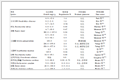 | 表 1 双岔巨斑状花岗岩锆石U-Pb定年数据 Table 1 In situ zircon U-Pb isotopic dating for the Shuangcha megaporphyritic monzogranite |
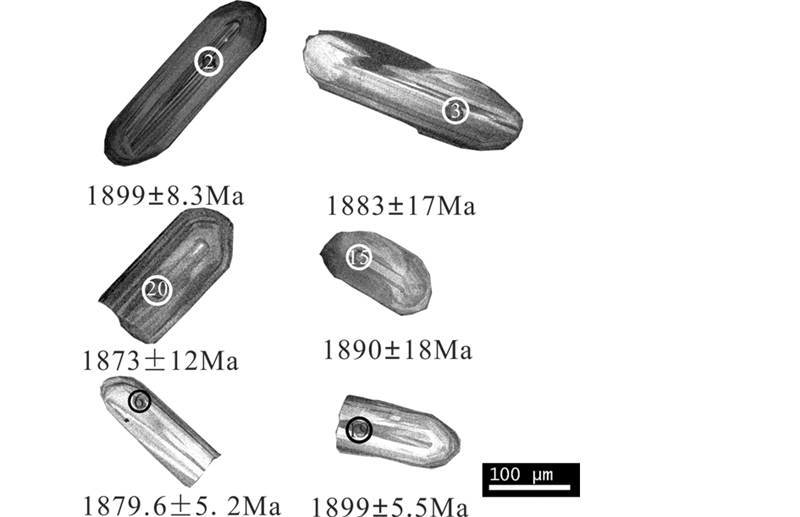 | 图 3 双岔岩体样品锆石CL图像 Fig. 3 CL images of representative zircons |
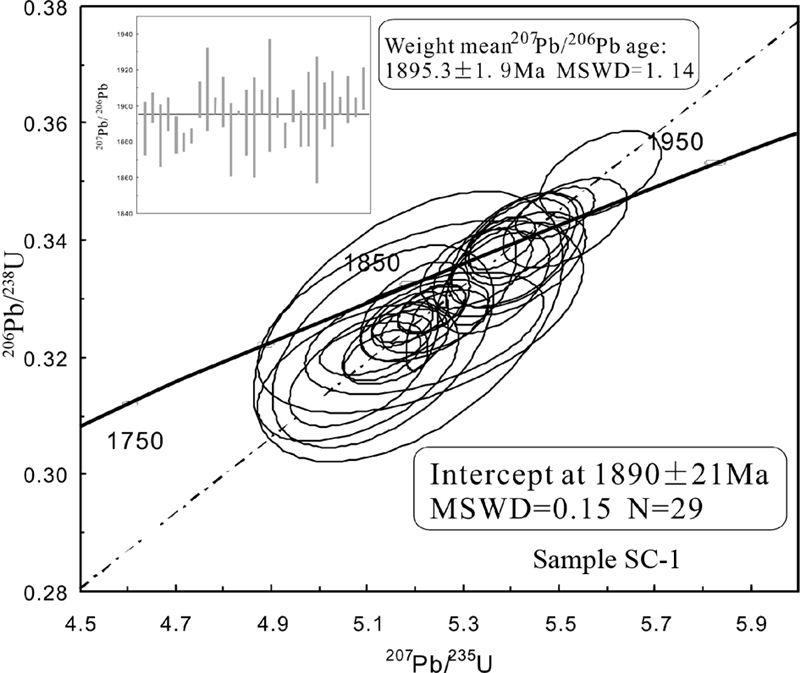 | 图 4 锆石谐和曲线图 Fig. 4 Concordia diagram showing the LA-ICP-MS zircon U-Pb ages of the granite |
双岔岩体花岗岩的主量元素分析结果见表 2,5个样品SiO2含量为62.4%~70.8%,均具有较高的Al2O3(14.1%~17.0%)和K2O(4.4%~5.9%),其A/CNK均大于1.1(1.2~1.4),A/NK为1.5~1.8,属于强过铝质花岗岩(图 5b)。K2O含量明显高于Na2O,K2O/Na2O为1.9~3.1。TAS图解(图 5c)中5个样品均落入亚碱性系列和石英二长岩、花岗闪长岩和花岗岩的区域中;在K2O-SiO2图解(图 5a)中,样品均落入高钾钙碱性系列中,岩石具有低的MgO(0.71%~1.91%)。样品Al2O3/TiO2比值均小于100,CaO/Na2O比值均大于0.3(表 2)。
| 表 2 双岔巨斑状花岗岩主微量元素数据(主量元素:wt%;稀土和微量元素:×10-6) Table 2 Whole rock chemical compositions of the Shuangcha megaporphyritic monzogranite(major elements: wt%; trace elements: ×10-6) |
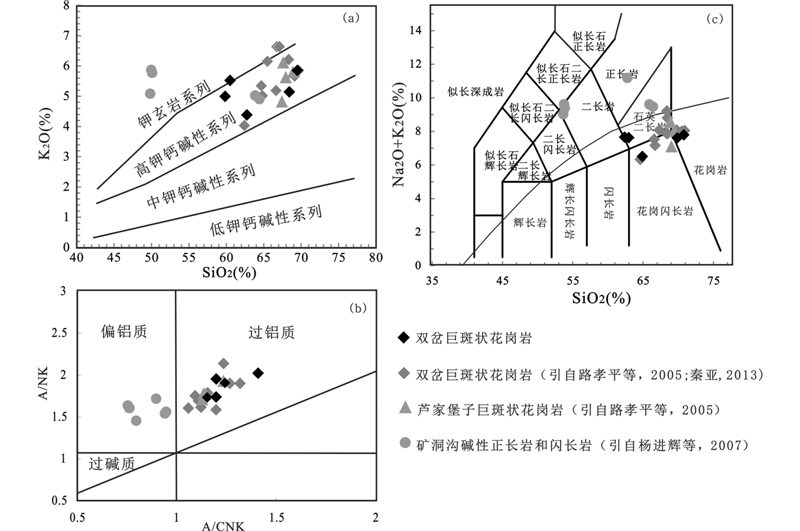 | 图 5 岩性投图及TAS图解 Fig. 5 The lithology figure and TAS diagram |
岩石样品稀土元素总量较高(∑REE=234.1×10⁻⁶~418.8×10⁻⁶),样品具有相似的稀土分配模式(图 6b),轻稀土元素(LREE)相对富集,重稀土元素(HREE)相对亏损,(La/Yb)N为13.0~23.6,具有中等Eu负异常(Eu/Eu*为0.3~0.7)。原始地幔标准化的蛛网图(图 6a)显示Nb,Ta,Zr,Hf,Ti等高场强元素相对亏损,另有一些大离子亲石元素也相对亏损,如Ba,Sr等,而Th,U,Pb等元素相对富集。
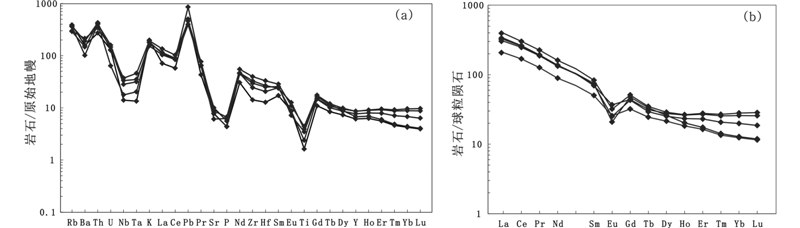 | 图 6 双岔巨斑状花岗岩的微量元素特征(标准化值据Sun and McDonough, 1989) Fig. 6 Trace element characteristics of the megagranite(normalization values after Sun and McDonough, 1989) |
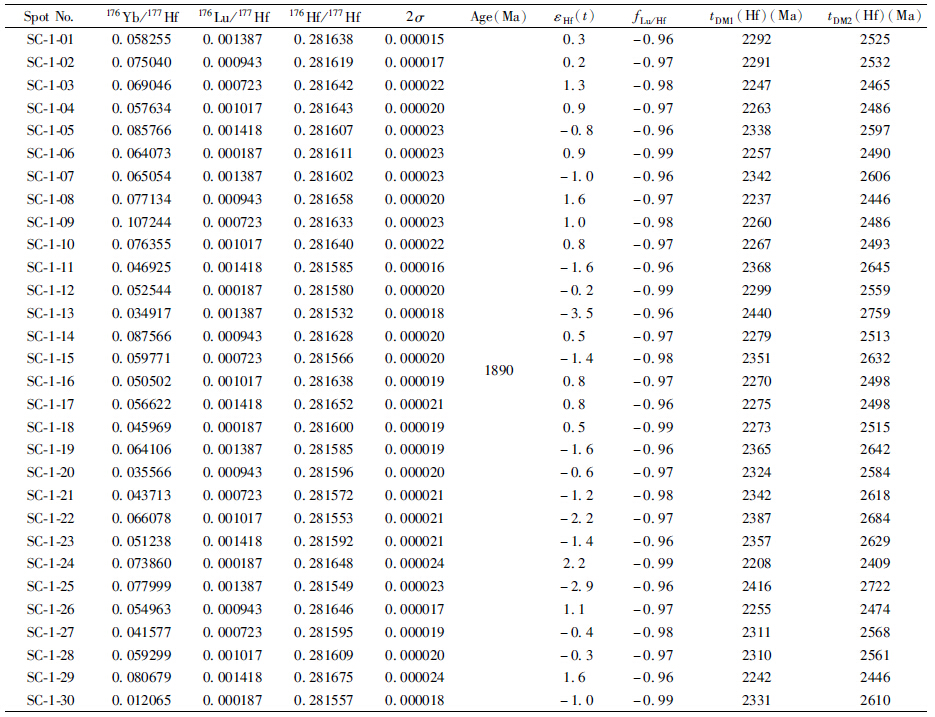
双岔岩体花岗岩的锆石176Hf/177Hf初始比值变化范围比较小,为0.281532~0.281675(表 3),取t=1890Ma计算得出岩石的εHf(t)值变化范围为-3.46~2.20,二阶段模式年龄为2409~2759Ma,主要集中于2400~2600Ma之间。这些样品的Hf同位素组成符合~2.17Ga条痕状花岗岩和~2.15Ga斜长角闪岩的同位素演化趋势。
| 表 3 双岔斑状花岗岩锆石原位Hf同位素数据 Table 3 In-situ Hf isotopic data for zircons of the Shuangcha megaporphyritic monzogranite |
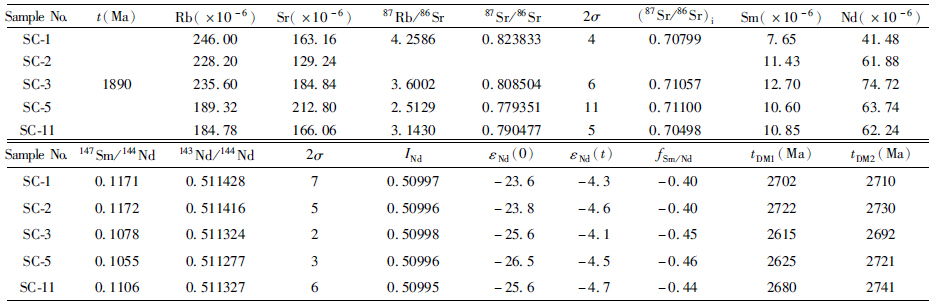
双岔岩体巨斑状花岗岩的Rb-Sr,Sm-Nd同位素数据见表 4。样品的ISr值介于0.7050~0.7110,εNd(t)介于-4.7~-4.1,对应的Nd模式年龄为2692~2741Ma,fSm/Nd值均为负值,变化范围较小(-0.463~-0.404),表明源区的Sm、Nd分馏不明显,Nd模式年龄是有意义的(Jahn et al., 2000)。
| 表 4 双岔巨斑状花岗岩全岩Sr-Nd同位素数据 Table 4 Sm-Nd isotopic data of the Shuangcha megaporphyritic monzogranite |
双岔岩体巨斑状石榴石黑云母二长花岗岩是强过铝质岩石(A/CNK>1.1,表 2、图 5b),岩石中含有典型的过铝质矿物,如石榴石,白云母和夕线石(图 2e,f)。岩石的K2O含量明显高于Na2O含量,且钾长石普遍发育,稀土元素总量较高,轻稀土(LREE)相对富集,Ba、Sr等大离子亲石元素元素相对亏损,而Th、U、Pb等元素相对富集,具有明显的S型花岗岩特征。
该岩体局部出现环斑结构(图 2b),即球形钾长石斑晶外围包裹着环状斜长石,部分学者也称该岩体为环斑花岗岩(路孝平,2004; 路孝平等,2005; 任康绪等,2006; 阎国翰等,2007)。路孝平(2004)认为在宽甸和通化地区的所谓环斑花岗岩中常见石榴石、夕线石、堇青石等富铝矿物,具有明显的S型花岗岩特征,而与典型的环斑花岗岩(Happala and Ramo, 1992,1999)的矿物组成差别较大,建议称之为球斑或巨斑花岗岩。环斑花岗岩以其独特的结构和岩石组合及其形成的特殊构造背景而备受学者关注(Ramo and Happala, 1996; 赵寒冬等,2009)。环斑花岗岩本以环斑结构命名(Vorma,1976),之后,Happala and Ramo(1992)增加了其地球化学内容,即具有环斑结构的非造山A型花岗岩才是环斑花岗岩,Ramo and Happala(1996)也提出具有环斑结构的S、I型花岗岩不属于环斑花岗岩的范畴。本文研究的双岔岩体巨斑状花岗岩在岩石学和地球化学上都具有明显的S型花岗岩特征,属于巨斑状S型花岗岩。
前人关于强过铝质花岗岩做了大量研究,早期学者认为强过铝质花岗岩属于同碰撞花岗岩,形成于碰撞早期的地壳收缩和堆叠加厚的过程中(Pitcher,1982; Pearce,1982; Harris et al., 1986)。然而,之后更多的研究认为强过铝质花岗岩是后碰撞花岗岩,是在地壳加厚峰期之后形成的(Strong and Hanmer, 1981; Wickham,1987; Finger et al., 1997; Altherr et al., 1995; Hall,1972; Harmon et al., 1984; O’Brien et al., 1985; Sweetman,1987; Turner et al., 1996; Sylvester,1998),并且时空上常与钙碱性花岗岩(Emmermann,1977; Frasl and Finger, 1991; Pamic et al., 1996; Visona and Zirpoli, 1984; von Blanckenburg,1992; Bellieni et al., 1996)和与伸展有关的钾玄岩/富钾质岩浆(Venturelli et al., 1984)密切相关。本区双岔巨斑状S型花岗岩与区内卧龙泉钙碱性花岗岩和矿洞沟碱性岩同时产出,指示其可能产出于后碰撞环境。 5.2 源区特征
双岔岩体花岗岩样品的CaO/Na2O比值介于0.602~0.916之间,均大于0.3。实验研究表明,强过铝质花岗岩熔体中的CaO/Na2O比值取决于源岩成分、熔融温度、压力和水活度(Holtz and Johannes, 1991; Skjerlie and Johnston, 1996),由于CaO主要存在于斜长石中,Na2O存在于斜长石和粘土矿物中,因此岩石CaO/Na2O比值最主要的控制因素是源岩中的斜长石和粘土质矿物的相对含量。在无挥发分存在的熔融条件下,如果源岩主要为粘土岩,其中少量的斜长石会与白云母反应生成中间产物铝硅酸盐,铝硅酸盐又与黑云母反应生成石榴石和熔体,即:Pl+Mus+Bi=Grt+Melt,反应中Na2O进入熔体。当熔融温度达到800℃左右时,斜长石被消耗殆尽,之后随着温度的升高,熔体CaO/Na2O比值不断降低(<0.3),直到温度达到975℃以上,石榴石开始熔融,熔体CaO/Na2O比值才会升高(Patiño Douce and Johnston, 1991)。反之,如果源岩为变质岩屑砂岩,则其中的斜长石含量较高而不会被完全转化为石榴石,在熔融过程中CaO和Na2O基本完全进入熔体,而使得熔体的CaO/Na2O比值较高(>0.3,Skjerlie and Johnston, 1996)。本文中,双岔花岗岩的CaO/Na2O比值大于0.3,说明源区并非是泥质岩石为主,而是以成熟度比较低的变质岩屑砂岩(或与之相当的变质中酸性火山岩、花岗岩等)为主。
其次,岩屑砂岩熔出的强过铝质花岗岩往往具有较低的Rb/Sr和Rb/Ba比值,而泥质岩熔融的熔体则具有较高的Rb/Sr和Rb/Ba比值。这是因为对于长石而言,Sr、Ba是相容元素,而Rb是不相容元素,岩屑砂岩中长石含量较高,因此熔体具有较低的Rb/Sr、Rb/Ba比值。而泥质岩的斜长石含量极低甚至不含斜长石,因此熔体具有较高的Rb/Sr、Rb/Ba比值。如图 7所示,双岔巨斑状花岗岩样品在Rb/Sr-Rb/Ba图解中大部分投在贫粘土的源岩区域,少数样品投在富粘土源岩区域,也说明其源岩主要为变质岩屑砂岩或成分相当的岩石(变质中酸性火山岩),并含有少量的泥质岩。另外,双岔花岗岩的SiO2都比较低(<71%,表 2),FeOT+MgO+TiO2含量比较高(除SC-1外都大于4%,表 2),说明源岩可能有部分变质玄武岩卷入。
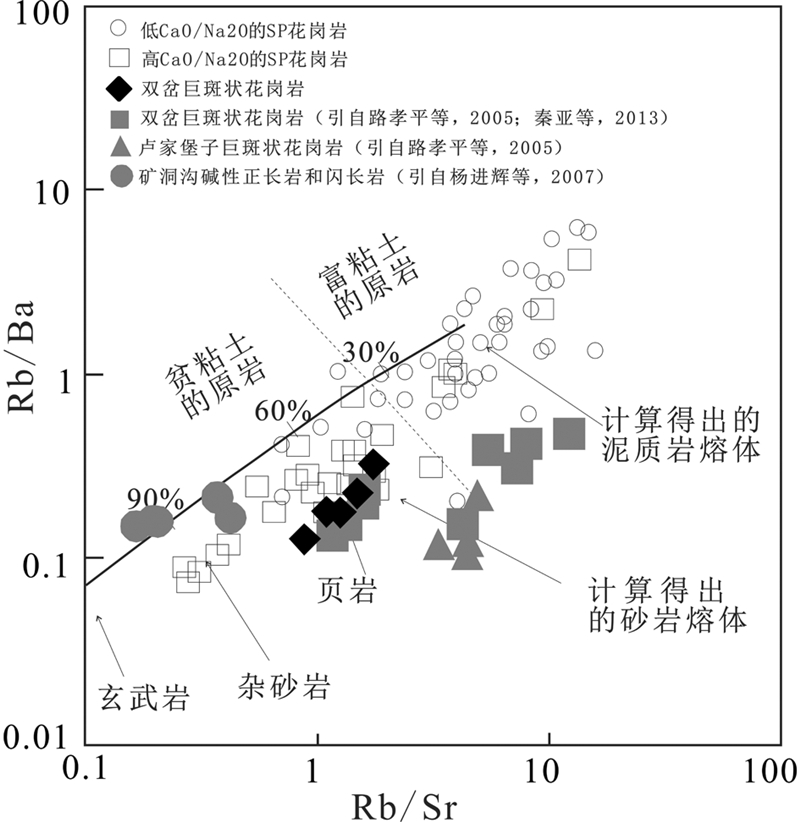 | 图 7 源岩性质判别图(底图据Sylvester,1998) Fig. 7 Discrimination diagram of protolith(after Sylvester,1998) |
所以,双岔巨斑状花岗岩的源区可能主要为成熟度较低的岩屑砂岩(长英质为主),并含有少量变质泥质岩和变质基性岩。这样的岩石性质与辽吉古元古活动带辽河群的底部和下部岩系很接近,后者即底部的变质碎屑岩和下部的变质中酸性火山岩夹少量变质玄武岩/泥质岩等。我们因此认为双岔岩体可能是辽河群底部和下部变质岩系的部分熔融的结果。该结论还得到以下证据支持:
(1)双岔巨斑状花岗岩的锆石εHf(t)值变化范围为-3.46~2.20,与条痕状花岗岩演化到1890Ma时的εHf(t)值范围一致,也与变质玄武岩(斜长角闪岩,如图 8a所示)在1890Ma时的εHf(t)值(-2.5~3.9,根据Lu/Hf比值计算所得)有重叠部分。
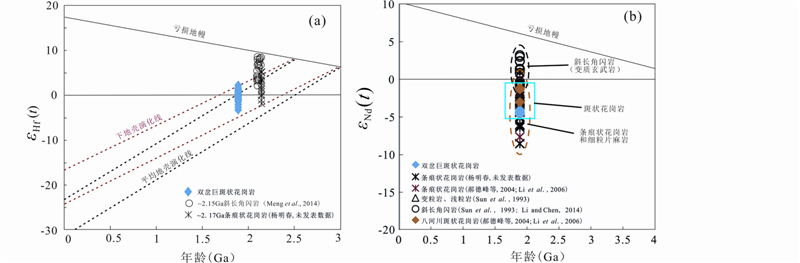 | 图 8 双岔巨斑状花岗岩同位素特征
(a)锆石Hf同位素特征图(据杨进辉等,2007);(b)Nd同位素特征图 Fig. 8 Isotopic characteristics diagram of the Shuangcha megaporphyritic granite (a)zircon Hf isotope characteristics of the porphyritic granite(after Yang et al., 2007);(b)Nd isotopic diagram |
(2)变粒岩-浅粒岩和条痕状花岗岩的Nd同位素成分演化到1890Ma时为εNd(t)=-8.6~0.9,主要集中在-6~-3之间,与双岔花岗岩的εNd(t)值(-4.7~-4.1)大致吻合,说明变粒岩-浅粒岩和条痕状花岗岩可能是双岔花岗岩的主要源区,这得到郝德峰(2004)发现双岔环斑花岗岩中有少量2174Ma的继承锆石的支持。
(3)从图 8b可见,部分巨斑状花岗岩样品的εNd(t)值稍高于变粒岩-浅粒岩和条痕状花岗岩的εNd(t)值,且与变质玄武岩演化到1890Ma时的εNd(t)值有部分重合,说明巨斑状花岗岩的源区可能有少量变质玄武岩。这得到双岔花岗岩普遍具有比较低的SiO2(62.4%~70.8%)的支持,因为长英质下地壳岩石部分熔融通常产生SiO2>72%~74%的花岗质熔体(Litvinovsky et al., 2000; Chen et al., 2004)。区内里尔峪组大量发育的变质玄武岩(斜长角闪岩)也支持此结论。简单的Nd同位素二端元混合模拟(据Langmuir et al., 1978)计算表明,双岔巨斑状花岗岩的源岩中可有20%~30%的变质玄武岩。其中,条痕状花岗岩端元的Nd含量为43×10-6,εNd(1890Ma)为-5.16(Yang and Chen,待发表),玄武岩端元的Nd含量为14.1×10⁻⁶,εNd(1890Ma)=2.38。
(4)双岔岩体巨斑状花岗岩总体显示Nb、Ta、Sr、Ti、P的亏损(表 2、图 6a),显示出与弧岩浆的亲缘性,而该区广泛存在的~2.2Ga的变粒岩-浅粒岩、条痕状花岗岩和变质玄武岩都具有明显的弧岩浆特征(Faure et al., 2004; Lu et al., 2006; Li and Chen, 2014),两者吻合。 5.3 温压条件
双岔岩体花岗岩的Al2O3/TiO2比值较低(18.3~44.3,均小于100)。研究表明,在泥质岩石和岩屑砂岩的熔融过程中,由于富Al2O3矿物(石榴石等富铝硅酸盐,斜长石)的稳定性,随着温度的升高,Al2O3在熔体中的浓度变化不大。而富TiO2的矿物,如黑云母和钛铁矿,会随温度的升高而加速分解,导致熔体中的TiO2浓度迅速上升。因此,高温环境下熔体的Al2O3/TiO2比值会偏低(Patiño Douce and Johnston, 1991; Patiño Douce and Beard, 1995; Skjerlie and Johnston, 1996)。本文中双岔花岗岩的Al2O3/TiO2比值接近于拉克伦褶皱带中的高温强过铝质花岗岩(图 9,Chappell and White, 1992),而与喜马拉雅造山带中的高压低温强过铝质花岗岩相差甚远(Ayres and Harris, 1997)。由此可见,双岔花岗岩熔体的形成温度较高。这一结论也与锆饱和温度计的计算结果相吻合(801~898℃,表 2; Watson and Harrison, 1983),也得到该花岗岩中可见夕线石的支持(见下文讨论)。
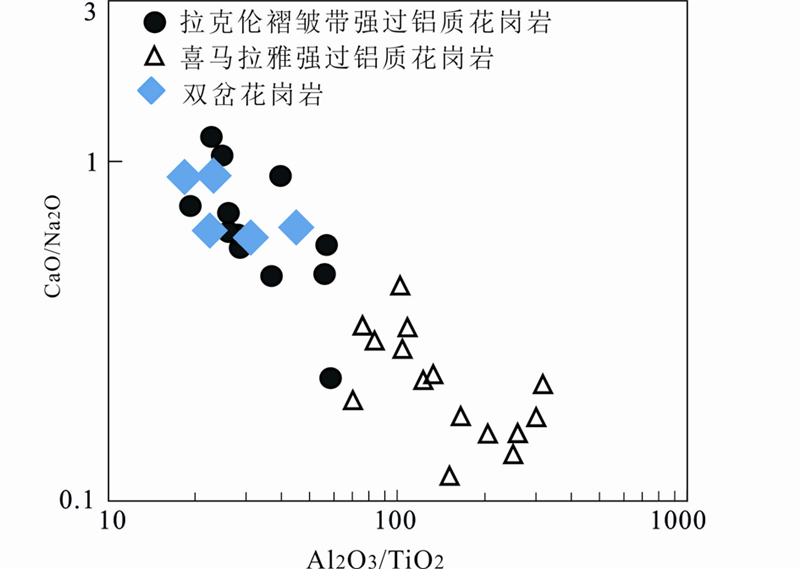 | 图 9 双岔巨斑状花岗岩CaO/Na2O-Al2O3/TiO2图解(据Sylvester,1998) Fig. 9 CaO/Na2O-Al2O3/TiO2 diagram for the Shuangcha megaporphyritic monzogranite(after Sylvester,1998) |
如图 2f所示,巨斑状花岗岩中石榴石大多为浑圆状,或者边界呈溶蚀港湾状,指示石榴石可能是源区变质深熔的残余物质,之后被熔体裹挟到较浅处就位。石榴石在岩石中的含量也证明了这一点,一般岩浆结晶出的石榴石含量较低(<10%),而双岔岩体巨斑状花岗岩中石榴石在局部可达到30%(图 2a),也说明石榴石可能是变质熔融残余的产物。此外,石榴石的含量分布极不均匀,局部可高达30%(图 2a),而有些部位则几乎不含石榴石(图 2c),也说明石榴石是变质深熔残余的产物。另外,岩石中的夕线石以包裹体形式存在于钾长石中(图 2e),说明夕线石也可能是变质熔融残余物质。在源区,泥质岩和碎屑岩发生变质深熔产生石榴石、夕线石和熔体,石榴石和夕线石被岩浆裹挟以类似“晶粥”的状态向上迁移到较浅部位结晶,从而形成上述特征的斑状花岗岩。根据变质相图(周喜文和魏春景,2005)可以得出,在875℃条件下,岩石变质形成石榴石+夕线石+熔体的压力条件应为0.7GPa左右。因此,双岔巨斑状花岗岩形成于中压下,压力为~0.7GPa。
综上所述,双岔巨斑状花岗岩形成于高温中压环境。 5.4 构造意义
花岗岩对于其形成时的构造背景具有一定的指示意义(钟长汀等,2007)。Maniar and Piccoli(1989)将花岗岩划分为造山和非造山两大类,前者包括岛弧、大陆弧、陆陆碰撞和造山后四类花岗岩,而后者包括裂谷带花岗岩、陆壳上升花岗岩和大洋斜长花岗岩。前人的研究结果已经证实强过铝质花岗岩的形成与造山作用中的碰撞有关(Strong and Hanmer, 1981; Pitcher,1982; Pearce,1982; Harris et al., 1986; Wickham,1987; Finger et al., 1997; Turner et al., 1996; Sylvester,1998)。Sylvester(1998)对强过铝质花岗岩进行了系统的总结,认为其可以形成于两种构造环境,一种是高压环境,如阿尔卑斯造山带和喜马拉雅造山带(Schärer et al., 1986; von Blanckenburg,1992),此种环境是由于碰撞过程中地壳的堆叠加厚(厚度大于50km,西藏地区厚度可达70km)而产生,由于地壳太厚,使得来自软流圈地幔的热量无法通过传导到达浅部地壳而对其进行加热,而K、Th、U等元素的放射性衰变产生的热量成为浅部地壳岩石熔融的主要热源,因此温度较低,一般小于875℃。另一种是高温环境,如海西造山带和拉克伦褶皱带,碰撞造山过程中地壳加厚不明显,一般小于50km,由于俯冲板片的拆沉而扰动软流圈,或者是由于地壳加厚而导致部分岩石圈重力不稳定而沉入软流圈,软流圈上涌导致岩石圈地幔发生部分熔融,热的玄武质熔体加热地壳而导致下地壳熔融而产生这种高温中压的后碰撞花岗岩,且可能有部分地幔物质贡献。当拆沉块体与上部岩石圈完全断离时,造山带完成了从挤压构造到伸展构造的转化过程。 6 结论
(1)华北克拉通辽吉古元古活动带双岔巨斑状石榴石黑云母二长花岗岩属于巨斑状S型花岗岩,形成于1890±21Ma。
(2)双岔巨斑状花岗岩的源区可能主要为成熟度较低的岩屑砂岩(长英质为主,条痕状花岗岩和变粒岩、浅粒岩风化沉积的产物),并含有20%~30%里尔峪组变质玄武岩和少量变质泥质岩。
(3)双岔巨斑状花岗岩低的Al2O3/TiO2比值和矿物组成及结构特征说明岩浆形成于高温中压环境,是辽吉带构造体制由挤压向伸展转换的产物,标志着辽吉带造山作用的结束。
致谢北京大学超净实验室的朱文萍老师对Sr-Nd同位素分离提供了大力支持和帮助;北京大学魏春景教授和宋述光教授在研究中给予了重要指导;三位评审专家提出了宝贵的意见,对论文质量的提升起到了关键的作用;谨此一并表示衷心感谢!
| [1] | Altherr R, Lugovic' B, Meyer HP and Majer V. 1995. Early Miocene post-collisional calc-alkaline magmatism along the easternmost segment of the Periadriatic fault system (Slovenia and Croatia). Mineralogy and Petrology, 54(3-4): 225-247 |
| [2] | Ayres M and Harris N. 1997. REE fractionation and Nd-isotope disequilibrium during crustal anatexis: Constraints from Himalayan leucogranites. Chemical Geology, 139(1-4): 249-269 |
| [3] | Bai J. 1993. The Precambrian Geology and Pb-Zn Mineralization in the Northern Margin of North China Plateform. Beijing: Geological Publishing House, 47-89 (in Chinese) |
| [4] | Bai J and Dai FY. 1998. Precambrian Crustal Evolution of China. Beijing: Geological Publishing House, 15-86 (in Chinese) |
| [5] | Bellieni G, Cavazzini G, Fioretti AM, Peccerillo A and Zant-Edeschi P. 1996. The Cima di Vila (Zinsnock) intrusion, Eastern Alps: Evidence for crustal melting, acid-mafic magma mingling and wall-rock fluid effects. Mineralogy and Petrology, 56(1-2): 125-146 |
| [6] | Cai JH, Yan GH, Mu BL, Xu BL, Shao HX and Xu RH. 2002. U-Pb and Sm-Nd isotopic ages of an alkaline syenite complex body in Liangtun-Kuangdongguo, Gai County, Liaoning Province, China and their geological significance. Acta Petrologica Sinica, 18(3): 349-354 (in Chinese with English abstract) |
| [7] | Chappell BW and White AJR. 1992. I- and S-type granites in the Lachlan fold belt. Earth Sciences, 83(1-2): 1-26 |
| [8] | Chen B, John BM, Arakawa Y and Zhai MG. 2004. Petrogenesis of the Mesozoic intrusive complexes from the southern Taihang Orogen, North China Craton: Elemental and Sr-Nd-Pb isotopic constrains. Contributions to Mineralogy and Petrology, 148(4): 489-501 |
| [9] | Clemens JD. 2003. S-type granitic magmas-petrogenetic issues, models and evidence. Earth-Science Reviews, 61(1-2): 1-18 |
| [10] | Deng JF, Luo ZH, Su SG et al. 2004. Petrogenesis, Tectonic Environment and Mineralization. Beijing: Geological Publishing House, 85-122 (in Chinese) |
| [11] | Eby GN. 1992. The chemical subdivion of the A-type granitoids: Petrogenesis and tectonic implications. Geology, 20(7): 641-644 |
| [12] | Elhlou S, Belousova E, Griffin WL et al. 2006. Trace element and isotopic composition of GJ-red zircon standard by laser ablation. Geochim. Cosmochim. Acta, 70(18): A158 |
| [13] | Emmermann R. 1977. A petrogenetic model for the origin and evolution of the Hercynian granite series of the Schwarzwald. Neues Jahrbuch für Mineralogie-Abhandlungen, 128: 219-253 |
| [14] | Faure MW, Lin W, Monié P and Bruguier O. 2004. Palaeoproterozoic arc magmatism and collision in Liaodong Peninsula (Northeast China). Terra Nova, 16(2): 75-80 |
| [15] | Finger F, Roberts MP, Haunschmid B, Schermaier A and Steyrer HP. 1997. Variscan granitoids of central Europe: Their typology, potential sources and tectonothermal relations. Mineralogy and Petrology, 61(1-4): 67-96 |
| [16] | Frasl G and Finger F. 1991. Geologisch-petrographische excursion in denosterreichischen teil des sudbohmischen batholiths. European Journal of Mineralogy, 3: 23-40 |
| [17] | Guo JH, Sun M, Chen FK and Zhai MG. 2005. Sm-Nd and SHRIMP U-Pb zircon geochronology of high-pressure granulites in the Sanggan area, North China craton: Timing of Paleoproterozoic continental collision. Journal of Asian Earth Sciences, 24(5): 629-642 |
| [18] | Hall A. 1972. New data on the composition of Caledonian granites. Mineralogical Magazine, 38: 847-862 |
| [19] | Happala I and Ramo OT. 1992. Tectonic setting and origin of the Proterozoic rapakivi granite of southern Fennoscandia. Transactions of the Royal Society of Edinburgh: Earth Sciences, 83(1-2): 165-171 |
| [20] | Happala I and Ramo OT. 1999. Rapakivi granite and rocks: An introduction. Precambrian Research, 95(1-2): 1-7 |
| [21] | Harmon RS, Halliday AN, Clayburn JAP and Stephens WE. 1984. Chemical and isotopic systematics of the Caledonian intrusions of Scotland and Northern England: A guide to magma source region and magma-crust interaction. Philosophical Transactions of the Royal Society, 310(1514): 709-742 |
| [22] | Hao DF. 2004. Petrogenesis of the Paleoproterozoic granite in Liao-Ji area and the crustal evolution. Master Degree Thesis. Qingdao: Ocean University of China, 20-37 (in Chinese with English summary) |
| [23] | Hao DF, Li SZ, Zhao GC, Sun M, Han ZZ and Zhao GT. 2004. Origin and its constrain to tectonic evolution of Paleoterozoic granitoids in the eastern Liaoning and Jilin Province, North China. Acta Petrologica Sinica, 20(6): 1409-1416 (in Chinese with English abstract) |
| [24] | Harris NBW, Pearce JA and Tindle AG. 1986. Geochemical characteristics of collision-zone magmatism. London: Geological Society, London, Special Publications, 19(1): 67-81 |
| [25] | He YK, Wu TR, Luo HL and Zhang W. 2010. Late Archean continent-continent collision event of middle segment of north margin of North China Plate: Evidence from S-type granite of Hejiao area. Acta Scientiarum Naturalium Universitatis Pekinensis, 46(4): 571-580 (in Chinese with English abstract) |
| [26] | Heal YB, Collins WJ and Richards SW. 2004. A hybrid origin for Lachlan S-type granites: The Murrumbidgee batholith example. Lithos, 78(1-2): 197-216 |
| [27] | Holtz F and Johannes W. 1991. Genesis of peraluminous granites: I. Experimental investigation of melt compositions at 3 and 5kb and various H2O activities. Journal of Petrology, 32(5): 935-958 |
| [28] | Hou GT, Li JH, Liu YL and Qian XL. 2005. Paleoproterozoic stretch event of North China Craton: Aulacogen and dike swarm. Progress in Natural Science, 15(11): 1366-1373 (in Chinese with English) |
| [29] | Jahn BM, Wu FY and Hong DW. 2000. Important crustal growth in the Phanerozoic: Isotopic evidence of granitoids from the east-central Asia. Journal of Earth System Science, 109(1): 5-20 |
| [30] | Jiang CC. 1984. A review of the precambrian stratigraphic division and correlation of eastern parts of Liaoning and Jilin. Bulletin of the Chinese Academy of Geological Sciences, (9): 157-167 (in Chinese with English abstract) |
| [31] | Langmuir CH, Vocke RD, Hanson GN and Hart SR. 1978. A general mixing equation with applications to Icelandic basalts. Earth and Planetary Science Letters, 37(3): 380-392 |
| [32] | Li SZ, Yang ZS, Liu YJ and Liu JL. 1997. Emplacement model of Palaeoproterozoic early-granite in the Jiao-Liao-Ji area and its relation to the uplift bedding delamination structural series. Acta Petrologica Sinica, 13(2): 189-202 (in Chinese with English abstract) |
| [33] | Li SZ, Yang ZS and Liu YJ. 1998. Stratification of metamorphic belts and its genesis in the Liaohe Group. Chinese Science Bulletin, 43(5): 430-434 |
| [34] | Li SZ, Han ZZ, Liu YJ, Yang ZS and Ma R. 2001. Regional metamorphism of the Liaohe Group: Implications for continental dynamics. Geological Review, 47(1): 9-18 (in Chinese with English abstract) |
| [35] | Li SZ, Hao DF, Han ZZ, Zhao GC and Sun M. 2003. Paleoproterozoic deep processes and tectono-thermal evolution in Jiao-Liao Massif. Acta Geologica Sinica, 77(3): 328-340 (in Chinese with English abstract) |
| [36] | Li SZ, Zhao GC, Sun M, Han ZZ, Hao DF, Luo Y and Xia XP. 2005. Deformation history of the Paleoproterozoic Liaohe Group in the Eastern Block of the North China Craton. Journal of Asian Earth Sciences, 24(5): 659-674 |
| [37] | Li SZ, Zhao GC, Sun M, Han ZZ, Zhao GT and Hao DF. 2006. Are the South and North Liaohe Groups of North China Craton different exotic terranes? Nd isotope constraints. Gondwana Research, 9: 198-208 |
| [38] | Li SZ and Zhao GC. 2007. SHRIMP U-Pb zircon geochronology of the Liaoji granitoids: Constraints on the evolution of the Paleoproterozoic Jiao-Liao-Ji belt in the Eastern Block of the North China Craton. Precambrian Research, 158(1-2): 1-16 |
| [39] | Li SZ, Zhao GC, Santosh M, Liu X, Lai LM, Suo YH, Song MC and Wang PC. 2012. Structural evolution of the Jiaobei Massif in the southern segment of the Jiao-Liao-Ji Belt, North China Craton. Precambrian Research, 200-203: 59-73 |
| [40] | Li Z and Chen B. 2014. Geochronology and geochemistry of the Paleoproterozoicmeta-basalts from the Jiao-Liao-Ji Belt, North China Craton: Implications for petrogenesis and tectonic setting. Precambrian Research, 255: 653-667 |
| [41] | Litvinovsky BA, Steele IM and Wickhan SM. 2000. Silicic magmaformation in overthickened crust: Melting of charnockite and leucogranite at 15, 20 and 25kbar. Journal of Petrology, 41(5): 717-737 |
| [42] | Liu JH, Liu FL, Liu PH, Wang F and Ding ZJ. 2011. Polyphase magmatic and metamorphic events from Early Precambrian metamorphic basement in Jiaobei area: Evidences from the zircon U-Pb dating of TTG and granitic gneisses. Acta Petrologica Sinica, 27(4): 943-960 (in Chinese with English abstract) |
| [43] | Liu YJ and Li SZ. 1996. Paleoproterozoic granite in Haicheng-Dashiqiao-Jidong, Liaoning Province. Liaoning Geology, 13(1): 10-18 (in Chinese) |
| [44] | Lu LZ, Xu XC and Liu FL. 1996. Early Precambrian Khondalites Series in North China. Changchun: Changchun Press, 1-276 (in Chinese) |
| [45] | Lu XP. 2004. Paleoproterozoic Tectonic and magmatic events in Tonghua area. Ph. D. Dissertation. Changchun: Jilin University, 29-94 (in Chinese) |
| [46] | Lu XP, Wu FY, Guo JH and Yin CJ. 2005. Late Paleoproterozoic granitc magmatism and crustal evolution in the Tonghua region, Northeast China. Acta Petrologica Sinica, 21(3): 721-736 (in Chinese with English abstract) |
| [47] | Lu XP, Wu FY, Guo JH, Wilde SA, Yang JH, Liu XM and Zhang XO. 2006. Zircon U-Pb geochronological constraint on the Paleoproterozoic crustal evolution of the Eastern Block of the North China Craton. Precambrian Research, 146(3-4): 138-164 |
| [48] | Luo Y, Sun M, Zhao GC, Li SZ, Ye K and Xia XP. 2004. LA-ICP-MS U-Pb zircon ages of the Liaohe Group in the Eastern Block of the North China Craton: Constraints on the evolution of the Jiao-Liao-Ji Belt. Precambrian Research, 134(3-4): 349-371 |
| [49] | Luo Y, Sun M, Zhao GC, Ayers JC, Li SZ, Xia XP and Zhang JH. 2008. A comparison of U-Pb and Hf isotopic compositions of detrital zircons from the North and South Liaohe Group: Constraints on the evolution of the Jiao-Liao-Ji Belt, North China Craton. Precambrian Research, 163(3-4): 279-306 |
| [50] | Maniar PD and Piccoli PM. 1989. Tectonic discrimination of granitoids. Geological Society of America Bulletin, 101(5): 635-643 |
| [51] | Meng E, Liu FL, Liu JH and Shi JR. 2012. Geochemical characteristics of the Changhai granitic gneisses in Southeast Liaoning Province, NE China: Implications for its protolith property and formed tectonic setting. Acta Petrologica Sinica, 28(9): 2793-2806 (in Chinese with English abstract) |
| [52] | Meng E, Liu FL, Liu PH, Liu CH, Yang H, Wang F, Shi JR and Cai J. 2014. Petrogenesis and tectonic significance of Paleoproterozoic meta-maficrocks from central Liaodong Peninsula, Northeast China: Evidence from zircon U-Pb dating and in situ Lu-Hf isotopes, and whole-rock geochemistry. Precambrian Research, 247: 92-109 |
| [53] | O'Brien C, Plant JA, Simpson PR and Tarney J. 1985. The geochemistry, metasomatism and petrogenesis of the granites of the English Lake District. Journal of the Geological Society, 142(6): 1139-1157 |
| [54] | Pamic J, Lanphere M and Belak M. 1996. Hercynian I-type and S-type granitoids from the Slavonian Mountains (southern Pannonian Basin, northern Croatia). Neues Jahrbuch für Mineralogie-Abhandlungen, 171: 155-186 |
| [55] | Patiño Douce AE and Johnston AD. 1991. Phase equilibria and melt productivity in the pelitic system: Implications for the origin of peraluminous granitoids and aluminous granulites. Contributions to Mineralogy and Petrology, 107(2): 202-218 |
| [56] | Patiño Douce AE and Beard JS. 1995. Dehydration-melting of biotite gneiss and quartz amphibolite from 3 to 15kbar. Journal of Petrology, 36(3): 707-738 |
| [57] | Pearce JA. 1982. Trace element characteristics of lavas from destructive plate boundaries. In: Thorpe RS (ed.). Orogenic Andesites and Related Rocks. Chichester, England: John Wiley and Sons, 525-548 |
| [58] | Peng QM and Palmer MR. 1995. The Palaeoproterozoic boron deposits in eastern Liaoning, China: A metamorphosed evaporite. Precambrian Research, 72(3-4): 185-197 |
| [59] | Pitcher WS. 1982. Granite type and tectonic environment. In: Hus KJ (ed.). Mountain Building Processes. London: Academic Press, 19-40 |
| [60] | Pupin JP. 1980. Zircon and granite petrology. Contributions to Mineralogy and Petrology, 73(3): 207-220 |
| [61] | Qin Y. 2013. Geochronology constrains on the tectonic evolution of Jiao-Liao-Ji Paloeproterozoic rift belt. Ph. D. Dissertation. Changchun: Jilin University, 23-132 (in Chinese) |
| [62] | Ramo OT and Haapala I. 1996. Rapakivi granite magmatism: A globle review with emphasis on petrogenesis. In: Demaiffe D (ed.). Petrology and Geo-chemistry of Magmatic Suites of Rock in the Continental and Oceanic Crusts. A volume dedicated to Professor Jean Michot. University Libre de Bruxelles, Royal Museum for Central Africa (Tervuren), 177-200 |
| [63] | Ren KX, Yan GH, Cai JH, Mu BL, Li FT, Wang YB and Chu ZY. 2006. Chronology and geological implication of the Paleo-Mesoproterozoic alkaline-rich intrusions belt from the northern part in the North China Craton. Acta Petrologica Sinica, 22(2): 377-386 (in Chinese with English abstract) |
| [64] | Santosh M, Sajeev K and Li JH. 2006. Extreme crustal metamorphism during Columbia supercontinent assembly: Evidence from North China Craton. Gondwana Research, 10(3-4): 256-266 |
| [65] | Santosh M, Tsunogae T, Li JH and Liu LJ. 2007a. Discovery of sapphirinebearing Mg-Al granulites in the North China Craton: Implications for Paleoproterozoic ultrahigh temperature metamorphism. Gondwana Research, 11(3): 263-285 |
| [66] | Santosh M, Wilde SA and Li JH. 2007b. Timing of Paleoproterozoic ultrahigh temperature metamorphism in the North China Craton: Evidence from SHRIMP U-Pb zircon geochronology. Precambrian Research, 159(3-4): 178-196 |
| [67] | Schärer U, Xu RH and Allègre CJ. 1986. U-Th-Pb systematics and ages of Himalayan leucogranites, South Tibet. Earth and Planetary Science Letters, 77(1): 35-48 |
| [68] | Skjerlie KP and Johnston AD. 1996. Vapour-absent melting from 10 to 20kbar of crustal rocks that contain multiple hydrous phases: Implications for anatexis in the deep to very deep continental crust and active continental margins. J. Petrol., 37(3): 661-691 |
| [69] | Song SG, Su L, Li XH, Zhang GB, Niu YL and Zhang LF. 2010. Tracing the 850Ma continental flood basalts from a piece of subducted continental crust in the North Qaidam UHPM belt, NW China. Precambrian Research, 183(4): 805-816 |
| [70] | Strong DF and Hanmer SK. 1981. The leucogranites of southern Brittany: Origin by faulting, frictional heating, fluid flux and fractional melting. The Canadian Mineralogist, 19: 163-176 |
| [71] | Sun SS and McDonough WF. 1989. Chemical and isotopic systematics of oceanic basalts: Implications for mantle composition and processes. In: Saunders AD and Norry MJ (eds.). Magmatism in the Ocean Basins. Geological Society, London, Special Publication, 42(1): 313-345 |
| [72] | Sun M, Armstrong RL, Lambert RSJ et al. 1993. Petrochemistry and Sr, Pb and Nd isotopic geochemistry of the Paleoproterozoic Kuandian Complex, the eastern Liaoning Province, China. Precambrian Research, 62(1-2): 171-190 |
| [73] | Sweetman TM. 1987. The geochemistry of the Blackstairs unit of the Leinster granite, Ireland. Journal of the Geological Society, 144(6): 971-984 |
| [74] | Sylvester PJ. 1998. Post-collisional strongly peraluminous granites. Lithos, 45(1-4): 29-44 |
| [75] | Tam PY, Zhao GC, Liu FL, Zhou XW, Sun M and Li SZ. 2011. SHRIMP U-Pb zircon ages of high-pressure mafic and pelitic granulites and associated rocks in the Jiaobei massif: Constraints on the metamorphic ages of the Paleoproterozoic Jiao-Liao-Ji Belt in the North China Craton. Gondwana Research, 19(1): 150-162 |
| [76] | Turner S, Arnaud N, Liu J, Rogers N, Hawkesworth C, Harris N, Kelley S, Van Calsteren P and Deng W. 1996. Post-collision, shoshonitic volcanism on the Tibetan Plateau: Implications for convective thinning of the lithosphere and the source of ocean island basalts. Journal of Petrology, 37(1): 45-71 |
| [77] | Venturelli G, Thorpe RS, Dal Piaz GV, Del Moro A and Potts PJ. 1984. Petrogenesis of calc-alkaline, shoshonitic and associated ultrapotassic Oligocene volcanic rocks from the Northwestern Alps, Italy. Contributions to Mineralogy and Petrology, 86(3): 209-220 |
| [78] | Villaros A, Stevens G and Buick IS. 2006. Origins of the S-type cape granites (South Africa). Geochimica et Cosmochimica Acta, 70(S18): A673 |
| [79] | Visona D and Zirpoli G. 1984. The Moschumandl acidic body (Iseltal, Austria). Neues Jahrbuch für Mineralogie-Abhandlungen, 9: 413-423 |
| [80] | von Blanckenburg F. 1992. Combined high-precision chronometry and geochemical tracing using accessory minerals: Applied to the Central-Alpine Bergell intrusion (central Europe). Chemical Geology, 100(1-2): 19-40 |
| [81] | Vorma A. 1976. On the petrochemistry of rapakivi granite with special reference to the Laitila massif, southwestern Finland. Geological Survey of Finland Bulletin, 285: 98 |
| [82] | Wan YS, Song B, Liu DY, Wilde SA, Wu JS, Shi YR, Yin XY and Zhou HY. 2006. SHRIMP U-Pb zircon geochronology of Palaeoproterozoic metasedimentary rocks in the North China Craton: Evidence for a major Late Palaeoproterozoic tectonothermal event. Precambrian Research, 149(3-4): 249-271 |
| [83] | Wang XX, Wang T, Happala I and Lu XX. 2005. Genesis of mafic enclaves from rapakivi-textured granites in the Qinling and its petrological significance: Evidence of elements and Nd, Sr isotopes. Acta Petrologica Sinca, 21(3): 935-946 (in Chinese with English abstract) |
| [84] | Watson EB and Harrison TM. 1983. Zircon saturation revisited: Temperature and composition effects in a variety of crustal magma types. Earth and Planetary Science Letters, 64(2): 295-304 |
| [85] | Wickham SM. 1987. Crustal anatexis and granite petrogenesis during low-pressure regional metamorphism: The Trois Seigneurs Massif, Pyrenees, France. Journal of Petrology, 28(1): 127-169 |
| [86] | Wu YB and Zheng YF. 2004. Zircon genetic mineralogy research and interpretation of U-Pb age restriction. Chinese Science Bulletin, 49(16): 1589-1604 (in Chinese) |
| [87] | Xia XP, Sun M, Zhao GC and Luo Y. 2006. LA-ICP-MS U-Pb geochronology of detrital zircons from the Jining Complex, North China Craton and its tectonic significance. Precambrian Research, 144(3-4): 199-212 |
| [88] | Xu BL, Yan GH, Mou BL, Tan LK, He ZF, Qiao GS and Zhang RH. 1998. Rb-Sr age and it's tectonic significance of the Kuangdonggou alkali-syenite in Gaixian, Liaoning Province. Chinese Science Bulletin, 43(17): 1885-1887 (in Chinese) |
| [89] | Yan GH, Cai JH, Ren KX, He GQ, Mu BL, Xu BL, Li FT and Yang B. 2007. Intraplate extensional magmatism of North China Craton and break-up of three supercontinents and their deep dynamics. Geological Journal of China Universities, 13(2): 161-174 (in Chinese with English abstract) |
| [90] | Yang JH, Wu FY, Xie LW and Liu XM. 2007. Petrogenesis and tectonic implications of Kuangdonggou syenites in the Liaodong Peninsula, east North China Craton: Constrains from in-situ zircon U-Pb ages and Hf isotopes. Acta Petrologica Sinica, 23(2): 263-276 (in Chinese with English abstract) |
| [91] | Yin A and Nie SY. 1996. A phanerozoic palinspastic reconstruction of China and its neighboring regions. In: Yin A and Harrison TM (eds.). The Tectonic Evolution of Asia. New York: Cambridge University Press, 285-442 |
| [92] | Zhai MG and Santosh M. 2013. Metallogeny of the North China Craton: Link withsecular changes in the evolving Earth. Gondwana Research, 24(1): 275-297 |
| [93] | Zhang QS and Yang ZS. 1988. Early Crust and Mineral Deposits of Liaodong Peninsula, China. Beijing: Geological Publishing House, 218-450 (in Chinese) |
| [94] | Zhao GC, Wilde SA, Cawood PA and Sun M. 2002. SHRIMP U-Pb zircon ages of the Fuping complex: Implications for Late Archean to Paleoproterozoic accretion and assembly of the North China Craton. American Journal of Science, 302(3): 191-226 |
| [95] | Zhao GC, Sun M, Wilde SA and Li SZ. 2005. Late Archean to Paleoproterozoic evolution of the North China Craton: Key issues revisited. Precambrian Research, 136(2): 177-202 |
| [96] | Zhao GC, Cao L, Simon SW, Sun M, Choe WJ and Li SZ. 2006. Implications based on the first SHRIMP U-Pb zircon dating on Precambrian granitoid rocks in North Korea. Earth and Planetary Science Letters, 251(3-4): 365-379 |
| [97] | Zhao GC, Cawood PA, Li SZ, Wilde SA, Sun M, Zhang J, He YH and Yin CQ. 2012. Amalgamation of the North China Craton: Key issues and discussion. Precambrian Research, 222-223: 55-76 |
| [98] | Zhao HD, Liu Y, Deng JF, Xiao QH, Ma LL and Yang YJ. 2009. Characteristics and significances of rapakivi in Yichun area of Xiaoxinganling, Heilongjiang Province. Geology in China, 36(3): 658-668 (in Chinese with English abstract) |
| [99] | Zhong CT, Deng JF, Wan YS, Mao DB and Li HM. 2007. Magma recording of Paleoproterozoic orogeny in central segment of northern margin of North China Craton: Geochemical characteristics and zircon SHRIMP dating of S-type granitoids. Geochimica, 36(6): 585-600 (in Chinese with English abstract) |
| [100] | Zhou XW and Wei CJ. 2005. Denotative significance of in-situ composition of garnet and biotite in the high-temperature metamorphic pelitic rocks. Progress in Natural Science, 15(11): 1389-1395 (in Chinese) |
| [101] | 白瑾. 1993. 华北陆台北缘前寒武纪地质及铅锌成矿作用. 北京: 地质出版社, 47-89 |
| [102] | 白瑾, 戴凤岩. 1998. 中国前寒武纪地壳演化. 北京: 地质出版社, 15-86 |
| [103] | 蔡剑辉, 阎国翰, 牟保磊, 许保良, 邵宏翔, 许荣华. 2002. 辽宁盖县梁屯-矿洞沟碱性正长岩杂岩体的U-Pb和Sm-Nd年龄及其地质意义. 岩石学报, 18(3): 349-354 |
| [104] | 邓晋福, 罗照华, 苏尚国等. 2004. 岩石成因、构造环境与成矿作用. 北京: 地质出版社, 85-122 |
| [105] | 郝德峰. 2004. 辽吉地区古元古代花岗岩的成因与地壳演化. 硕士学位论文. 青岛: 中国海洋大学, 20-37 |
| [106] | 郝德峰, 李三忠, 赵国春, 孙敏, 韩宗珠, 赵广涛. 2004. 辽吉地区古元古代花岗岩成因及对构造演化的制约. 岩石学报, 20(6): 1409-1416 |
| [107] | 贺元凯, 吴泰然, 罗红玲, 张文. 2010. 华北板块北缘中段新太古代的陆-陆碰撞事件: 来自合教S 型花岗岩的证据. 北京大学学报(自然科学版), 46(4): 571-580 |
| [108] | 侯贵廷, 李江海, 刘玉琳, 钱祥麟. 2005. 华北克拉通古元古代末的伸展事件: 坳拉谷与岩墙群. 自然科学进展, 15(11): 1366-1373 |
| [109] | 姜春潮. 1984. 再论辽东前寒武纪地层的划分和对比——"辽河群"一词使用的商榷. 中国地质科学院院报, (9): 157-167 |
| [110] | 李三忠, 杨振声, 刘永江, 刘俊来. 1997. 胶辽吉地区古元古代早期花岗岩的侵位模式及其与隆滑构造的关系. 岩石学报, 13(2): 189-202 |
| [111] | 李三忠,韩宗珠,刘永江,杨振升,马瑞. 2001. 辽河群区域变质特征及其大陆动力学意义. 地质论评,47(1): 9-18 |
| [112] | 李三忠, 郝德峰, 韩宗珠, 赵国春, 孙敏. 2003. 胶辽地块古元古代构造-热演化与深部过程. 地质学报, 77(3): 328-340 |
| [113] | 刘建辉, 刘福来, 刘平华, 王舫, 丁正江. 2011. 胶北早前寒武纪变质基底多期岩浆-变质热事件: 来自TTG片麻岩和花岗质片麻岩中锆石U-Pb 定年的证据. 岩石学报, 27(4): 943-960 |
| [114] | 刘永江, 李三忠. 1996. 辽宁海城-大石桥-吉洞地区早元古代花岗岩. 辽宁地质, 13(1): 10-18 |
| [115] | 卢良兆, 徐学纯, 刘福来. 1996. 中国北方早前寒武纪孔慈岩系. 长春: 长春出版社, 1-276 |
| [116] | 路孝平. 2004. 通化地区古元古代构造岩浆事件. 博士学位论文. 长春: 吉林大学, 29-94 |
| [117] | 路孝平, 吴福元, 郭敬辉, 殷长建. 2005. 通化地区古元古代晚期花岗质岩浆作用与地壳演化. 岩石学报, 21(3): 721-736 |
| [118] | 孟恩, 刘福来, 刘建辉, 施建荣. 2012. 辽东南长海地区花岗质片麻岩类的地球化学特征: 对其原岩性质及形成环境的制约. 岩石学报, 28(9): 2793-2806 |
| [119] | 秦亚. 2013. 辽吉古元古裂谷带构造演化的年代学制约. 博士学位论文. 长春: 吉林大学, 23-132 |
| [120] | 任康绪, 阎国翰, 蔡剑辉, 牟保磊, 李凤棠, 王彦斌, 储著银. 2006. 华北克拉通北部地区古-中元古代富碱侵入岩年代学及意义. 岩石学报, 22(2): 377-386 |
| [121] | 王晓霞, 王涛, Happala I, 卢欣祥. 2005. 秦岭环斑结构花岗岩中暗色包体的岩浆混合成因及岩石学意义——元素和Nd、Sr同位素地球化学证据. 岩石学报, 21(3): 935-946 |
| [122] | 吴元保, 郑永飞. 2004. 锆石成因矿物学研究及其对U-Pb年龄解释的制约. 科学通报, 49(16): 1589-1604 |
| [123] | 许保良, 阎国翰, 牟保磊, 谭林坤, 何中甫, 乔广生, 张任祜. 1998. 辽宁盖县梁屯-矿洞沟碱性正长岩Rb-Sr年龄及其意义. 科学通报, 43(17): 1885-1887 |
| [124] | 阎国翰, 蔡剑辉, 任康绪, 何国琦, 牟保磊, 许保良, 李凤棠, 杨斌. 2007. 华北克拉通板内拉张性岩浆作用与三个超大陆裂解及深部地球动力学. 高校地质学报, 13(2): 161-174 |
| [125] | 杨进辉, 吴福元, 谢烈文, 柳小明. 2007. 辽东矿洞沟正长岩成因及其构造意义: 锆石原位微区U-Pb年龄和Hf同位素制约. 岩石学报, 23(2): 263-276 |
| [126] | 张秋生, 杨振声. 1988. 辽东半岛早期地壳与矿床. 北京: 地质出版社, 218-450 |
| [127] | 赵寒冬, 刘勇, 邓晋福, 肖庆辉, 马丽玲, 杨元江. 2009. 小兴安岭伊春地区环斑花岗岩组合特征及其地质意义. 中国地质, 36(3): 658-668 |
| [128] | 钟长汀, 邓晋福, 万渝生, 毛德宝, 李惠民. 2007. 华北克拉通北缘中段古元古代造山作用的岩浆记录: S型花岗岩地球化学特征及锆石SHRIMP年龄. 地球化学, 36(6): 585-600 |
| [129] | 周喜文, 魏春景. 2005. 高温变泥质岩石中石榴石、黑云母微区成分的指示意义. 自然科学进展, 15(11): 1389-1395 |