 2015, Vol. 31


2. 中国科学院地球化学研究所, 贵阳 550002;
3. 中国科学院广州地球化学研究所, 广州 510640
2. Institute of Geochemistry, Chinese academy of Sciences, Guiyang 550002, China;
3. Guangzhou Institute of Geochemistry, Chinese academy of Sciences, Guangzhou 510640, China
成矿流体是指形成矿床的流体。在自然界中有各种各样的矿床,因此也有各种各样的成矿流体。尽管其矿床的不同,但均是从成矿流体中形成的。流体包裹体是地质时期的成矿流体的样品。成矿流体研究是一个很大的领域,也是目前国际上最关注的一个方向。对于金属矿床来说,成矿流体中金属含量是多少?换句话来说,流体中含多少金属就可称为金属矿床的成矿流体?这是一个热门的研究课题。
1 成矿流体的定义和分类
自然界中的成矿流体,按其主要成分,可分为(1)岩浆,即形成岩浆矿床的岩浆,有人称之谓矿浆;(2)以H2O为主的流体(含NaCl);(3)以CO2为主的成矿流体。地壳中的流体类型很多,只有含一定金属元素含量的,并且达到一定浓度时才称为金属矿床的成矿流体。所以金属矿床的成矿流体主要述及到其中的金属元素含量。关于成矿流体的研究已有很长的历史,Graton(1940)首先提出了成矿流体的概念,随后许多学者(Robert and Kelly, 1987; Heinrich et al., 1992; Hedenquist and Lowenstern, 1994; Barnes,1997; 卢焕章, 1997,2011; Appold et al., 2002; Baker et al., 2003; Stoffell et al., 2004; Kesler,2005; 薛春纪等,2007; Wang et al., 2010; Lerchbaumer and Audétat,2012; Prokof’ev et al., 2011; Rusk et al., 2008; Seo et al., 2011; 卢焕章等,1995)作了许多研究,首先在显微镜下在流体包裹体中发现了金属子矿物,其次对流体包裹体中成分的分析,包括用LA-ICP-MS方法对金属矿床中单个流体包裹体中金属含量的分析,表明成矿流体中含有一定量的金属(李晓春等,2010)。
2 一些金属矿床成矿流体的成分
表 1是一些金属矿床的最低工业品位,从表中可知其品位相差很大,从最高的铝土矿的40%到最低的金矿的1×10⁻⁶~5×10⁻⁶。不同金属矿床的成矿流体中的金属含量是否象其品位那样也有很大的变化,是否品位相对高的,其成矿流体中的金属含量也高?这也是需要研究的问题。
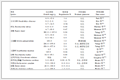
| 表 1 金属矿床最低工业品位 Table 1 Pay grade of some metal deposits |
最近对斑岩铜矿的流体包裹体研究,发现有含不透明的金属矿物的流体包裹体存在,这些不透明的金属矿物包括黄铜矿、赤铁矿、黄铁矿和磁铁矿(图 1)。说明捕获于包裹体中的流体中含有Cu、Fe等金属离子,当温度下降时沉淀出金属硫化物(卢焕章,2000)。其次,在自然界中有许多天然的成矿流体,如大洋中脊喷出的热液,Salton Sea,Cheleken的热液和油田水均可沉淀出金属硫化物(图 2、表 2)。
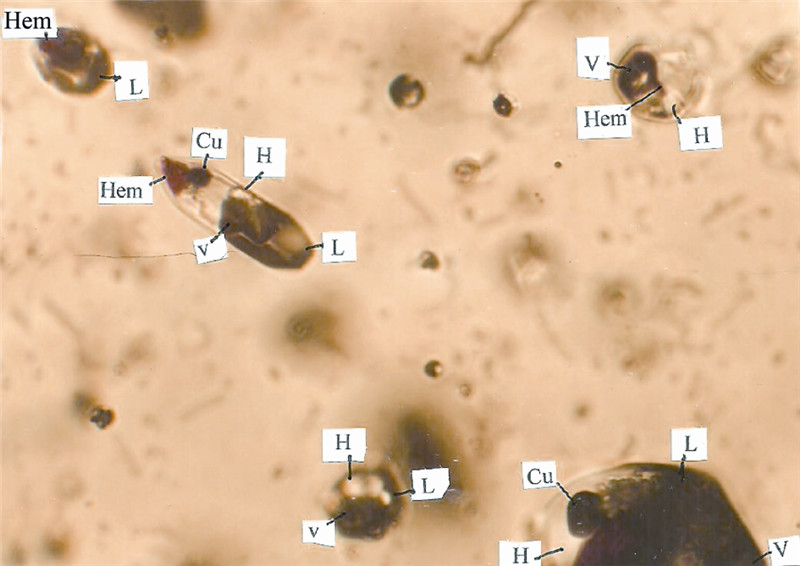 | 图 1 斑岩铜矿的含不透明的金属矿物的流体包裹体 V-气相;L-液相;Hem-赤铁矿;Cu-黄铜矿;H-石盐;Any-硬石膏;K-钾盐Fig. 1 Metal daughter minerals bearing fluid inclusions in porphyry Cu deposit |
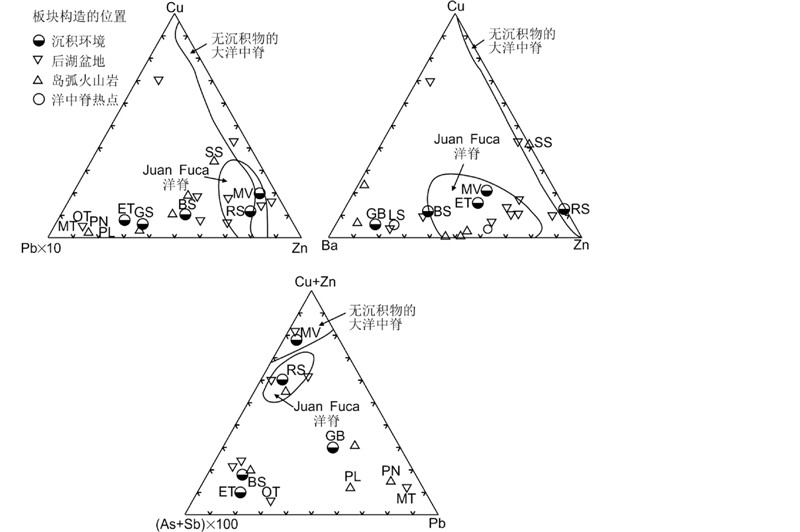 | 图 2 大洋中脊的成矿热液和各种火山岩矿床中的Cu,Pb,Zn含量(据卢焕章,2011) 图中的ET、PN、MT等均为地名,详见文献Fig. 2 Cu,Pb and Zn contents in Mid Ocean ridge fluid and ore deposits in volcanic rocks(after Lu,2011) |
怎样来确定成矿流体,我们通过对各种矿床的流体包裹体成分分析,对加拿大地盾的深部卤水,沉积盆地中的卤水,地热卤水,以及在花岗岩和变质岩中热液的研究,最后通过Cu、Pb、Zn和Fe等金属元素在热液流体中的含量来确定成矿流体的成分。
2.1 成矿流体的主成分
细心的读者可能已经想到,这些金属元素的含量很低,而成矿流体的主成分应为岩浆、H2O(含NaCl)和CO2等。另外在自然界的矿床,除了这些金属元素和金属矿物外,还有许多脉石矿物,这包括石英、方解石、萤石、长石、辉石等矿物。因此这些脉石矿物的成分即SiO2、CaCO3、CaF2等在流体中的含量也值得引起我们的关注,因为他们是成矿流体的重要组成部分。综上所述,从成分上来讲金属矿床的成矿流体的组成应包括岩浆、H2O、CO2、SiO2、F、Cl以及金属离子。
2.2 成矿流体中金属元素含量
图 2示在大洋中脊喷出的成矿流体中Cu、Pb、Zn、Ba、As和Sb的含量。以Cu、Pb、Zn为例,他们在四种板块构造和地质环境(沉积环境、后弧盆地、岛弧火山岩和洋中脊)的流体中均有产出。
不同金属元素在成矿流体中的最低或最小含量大致可分为五组(图 3; Barnes,1997)。第一组为Fe,其含量为2×10-6~35000×10-6左右。有时Al也在这一组(5×10-6~4000×10-6);第二组为Zn、Cu、Pb、Ni和Co,这五种元素的含量范围为4×10⁻⁶~71×10-6。其中Zn为4×10⁻⁶~71×10-6,Cu为5×10⁻⁶~25×10-6,Pb为6×10⁻⁶~20×10-6,Ni为7×10⁻⁶~20×10-6,Co为8×10⁻⁶~10×10-6;第三组为Sn、U、W和Mo,其含量为1.5×10⁻⁶~13×10-6。其中Sn为5.5×10⁻⁶~10×10-6,U为2.8×10⁻⁶~11×10-6,W为2×10⁻⁶~12×10-6,Mo为1.5×10⁻⁶~13×10-6;第四组为Bi、Cd、Hg和Ag,其含量为0.05×10⁻⁶到18×10-6。其中Bi为0.13×10⁻⁶~15×10-6,Cd为0.1×10⁻⁶~16×10-6,Hg为0.6×10⁻⁶~17×10-6,Ag为0.05×10⁻⁶~18×10-6;第五组为Au和Pt(铂族元素),其含量从0.001×10⁻⁶到21×10-6。其中Au从0.0018×10⁻⁶到20×10-6,Pt族从0.001×10-6到21×10-6。这五组含量的主要差别在于其下限,从第一组到第五组其下限越来越低。
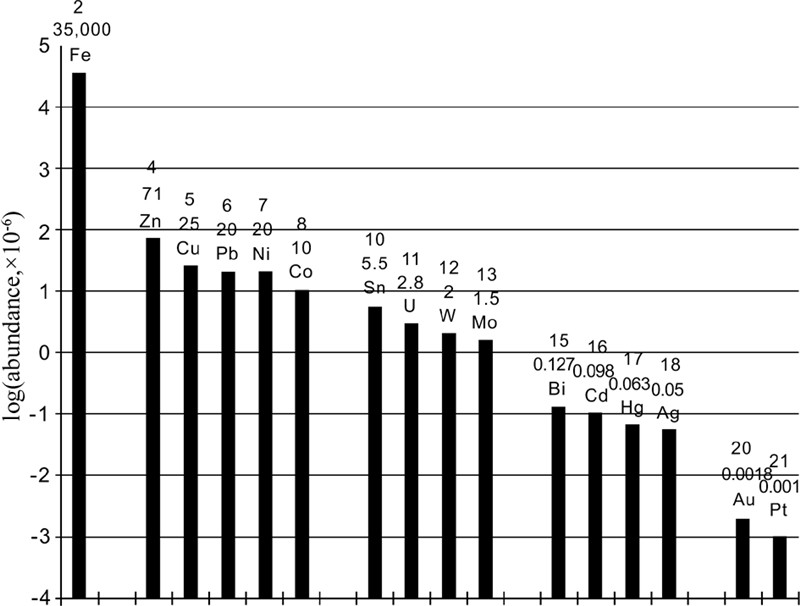 | 图 3 一些金属矿床成矿流体中金属含量和分组(据Barnes,1997)Fig. 3 Five groups metal amounts of ore-forming fluids(after Barnes,1997) |
2.3 流体包裹体中的金属含量
图 4列出了Cu、Pb、Zn金属矿床中流体包裹体中的金属含量,这些包裹体的金属含量可以用来代表成矿流体中这种金属的含量。在矽卡岩型金属矿床中,Cu、Pb、Zn的含量在740×10-6~7700×10-6之间,在斑岩型矿床中在80×10-6~4600×10-6之间,在密西西比型铅锌矿中的含量在131×10-6~10900×10-6,而在不含矿的MVT矿石中的流体包裹体中金属含量为1.3×10⁻⁶~1.9×10⁻⁶,两者相差甚大。在脉状的Cu-Zn-Pb矿床中,其含量变化较大,从3.5×10⁻⁶到2200×10-6,大多数在10×10-6~1000×10-6之间。在火山块状硫化物矿床中Cu、Pb、Zn的含量从1.2×10⁻⁶到55×10-6。可以看出从矽卡岩型矿床到块状硫化物矿床,其金属元素(Cu、Pb、Zn)的含量是逐渐降低的,大洋中脊的成矿流体和各种火山块状硫化物中流体包裹体中的Cu、Pb、Zn相比,二者均含有Cu、Pb、Zn外,大洋中脊的成矿流体中还有Ba、As和Sb等元素。
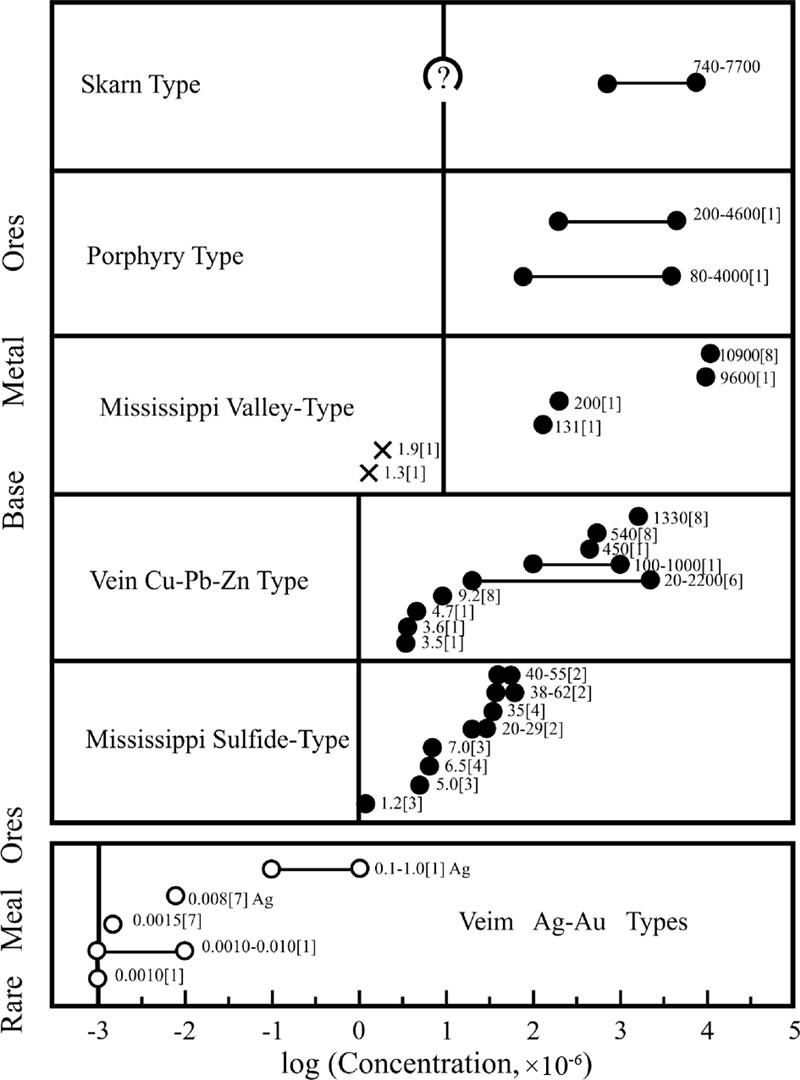 | 图 4 六种金属矿床的流体包裹体的金属含量(据Barnes,1997)Fig. 4 Metal contents of fluid inclusions of six types ore deposits(after Barnes,1997) |
六种主要金属矿床中流体包裹体的金属含量代表了成矿流体中这些金属的含量。石英大脉的金银矿床流体包裹体中,Au的含量从0.001×10⁻⁶到0.010×10⁻⁶,Ag的含量从0.008×10⁻⁶到1.0×10⁻⁶。块状硫化物矿床流体包裹体中Cu、Pb、Zn含量的总和为15×10-6~116×10-6,略低于矽卡岩型、斑岩型、密西西比型和大脉型矿床中流体包裹体中Cu、Pb、Zn的含量。
最近,许多研究者用LA-ICP-MS方法对密西西比河谷型 (MVT)Pb-Zn矿和斑岩铜-钼矿等矿床中的单个流体包裹体进行了测定(Seo et al., 2011; Ulrich et al., 2001; Rusk et al., 2008; Stoffell et al., 2004; Appold and Wenz, 2011; Lerchbaumer and Audétat,2012; Baker et al., 2003; Heinrich et al., 1992)。在密西西比河谷型(MVT)Pb-Zn矿中,用LA-ICP-MS方法测得在白云石、石英中的单个流体包裹体的Pb为295×10-6,Zn为86×10-6(Stoffell et al., 2004)。Appold and Wenz(2011)得出Pb<100×10-6、Zn<100×10-6、Cu<10×10-6,但在闪锌矿的单个流体包裹体中测得Pb=1500×10-6。除Cu、Pb、Zn外还检出Cl、Br、S、Na、K、Ca、Ba和Sr等元素。
|
| 表 3 用LA-ICP-MS方法对Bajo de la Alumbrera斑岩Cu-Mo矿床中单个流体包裹体分析的结果(据Ulrich et al., 2001资料整理综合) Table 3 Metal amounts in single fluid inclusion by LA-ICP-MS method,Bajo de la Alumbrera porphyry deposit(after Ulrich et al., 2001) |
在斑岩铜-钼矿等矿床单个流体包裹体研究中,Lerchbaumer and Audétat(2012)用LA-ICP-MS方法测得,Na 3%、K 1.8%、S 0.5%、Fe 0.4%、Mo 40×10-6、Cu 0.3%、Mn 0.02%、Zn 800×10-6、Rb 600×10-6、Cs 300×10-6、Pb 180×10-6、As 150×10-6、W 40×10-6和Bi 15×10-6。Baker et al.(2003)的研究表明Cu主要存在于气相中,且与HS成配合物,Heinrich et al.(1992)也认为Cu、As和Au相对富集于气相,而Na、K、Fe、Mn、Zn、Rb、Cs、Ag、Pb和Tl富集于液相。
流体中主要的阴离子为Cl-、HS-、NH3-、OH-、CH3COO-,其次有F、SO42-、HCO3-、CO32-等。离子在流体中居留时间长的停留在流体中的时间也越长。Al3+和Cr3+的居留时间最长,而Cu2+则较短。在大多数的成矿流体中,Cl是很重要的。图 5是用LA-ICP-MS方法对MVT矿床中的单个流体包裹体分析得出的主要阴、阳离子的结果,由图 5可知阳离子主要是Na、Ca、K和Mg,阴离子主要为Cl。这三个矿区分析的范围大约为4000km2,各个矿区相距大约为450~500km,但从图中可知三个矿区的Na、Ca、K、Sr、Ba、Mg和Cl基本相似,这就为形成MVT矿床的大规模层间热卤水的假说提供了依据。
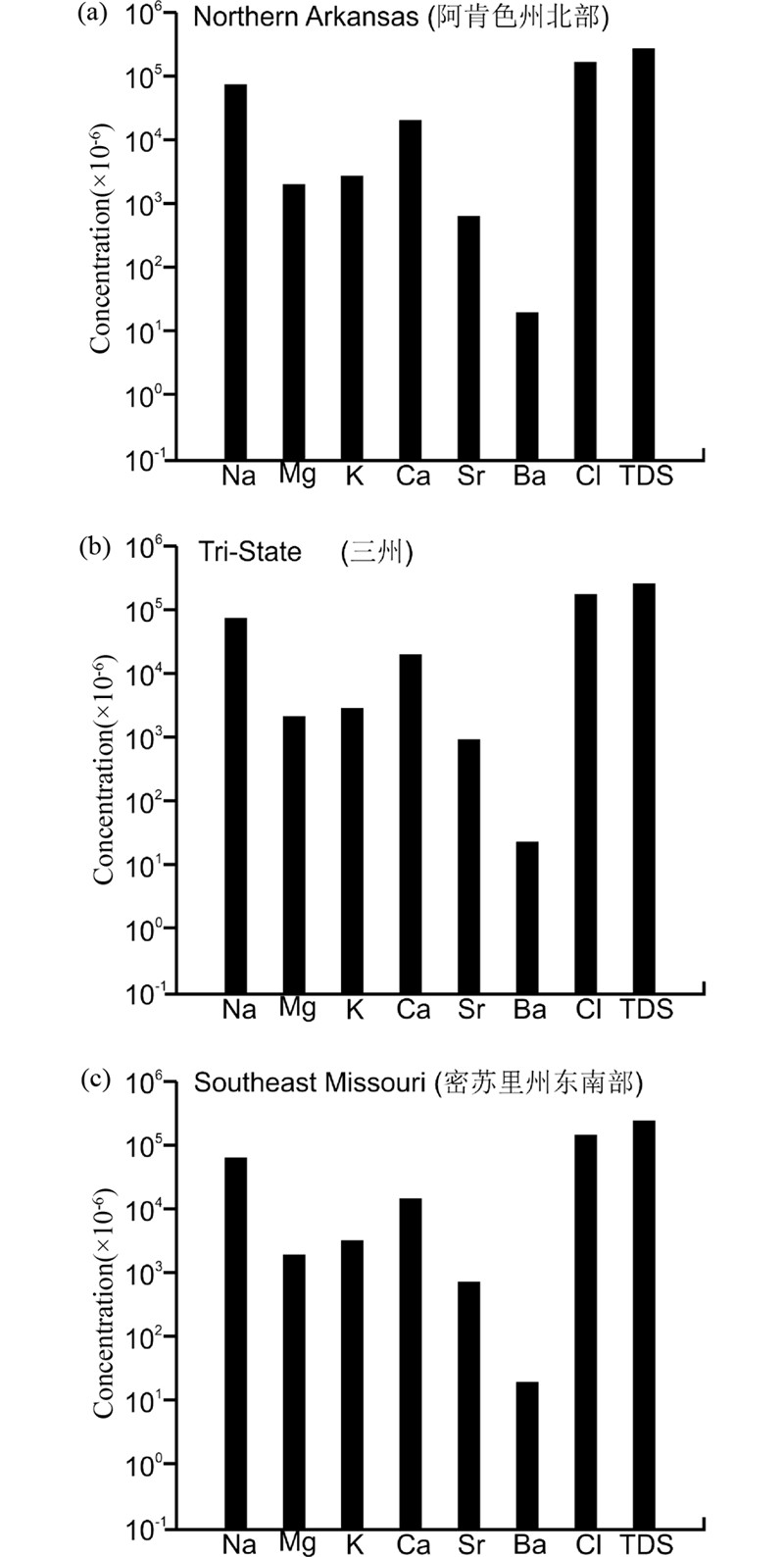 | 图 5 用LA-ICP-MS方法分析MVT Pb-Zn矿中单个流体包裹体中的主要阳离子和阴离子含量(据Appold and Wenz, 2011)Fig. 5 Metal contents of fluid inclusions of MVT Pb-Zn deposits by LA-ICP-MS method(after Appold and Wenz, 2011) |
表 3是墨西哥Bajo de la Alumbrera斑岩Cu-Mo矿床中单个流体包裹体分析的综合结果,其成矿流体的主要阳离子为Na、K,主要金属离子为Fe、Cu、Au、Mo和Ag等,它们的含量与图 3中所示的它们的含量相近。图 6是一浅成Au-Ag矿床用LA-ICP-MS方法分析单个流体包裹体中的Au和Ag含量,Au的含量在0.0到0.4×10⁻⁶的范围,Ag的合量在0.0到53.5×10⁻⁶之间,与图 3列出的也十分相近。
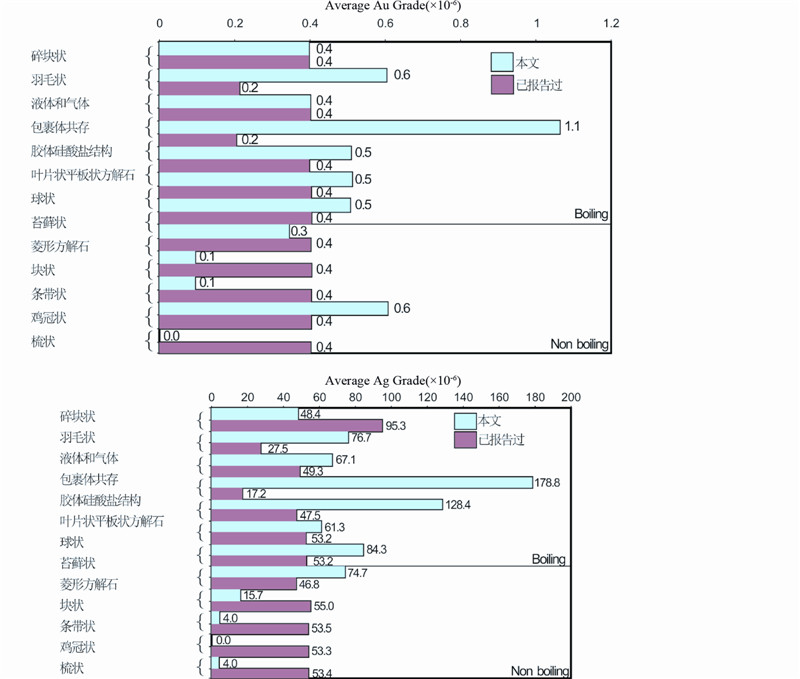 | 图 6 用LA-ICP-MS方法分析Guanajuato Au-Ag浅成热液矿床中单个流体包裹体中的Au和Ag含量(据Moncada et al., 2012)Fig. 6 Au and Ag amounts in single fluid inclusion by LA-ICP-MS method,Guanajuato epithermal deposit(after Moncada et al., 2012) |
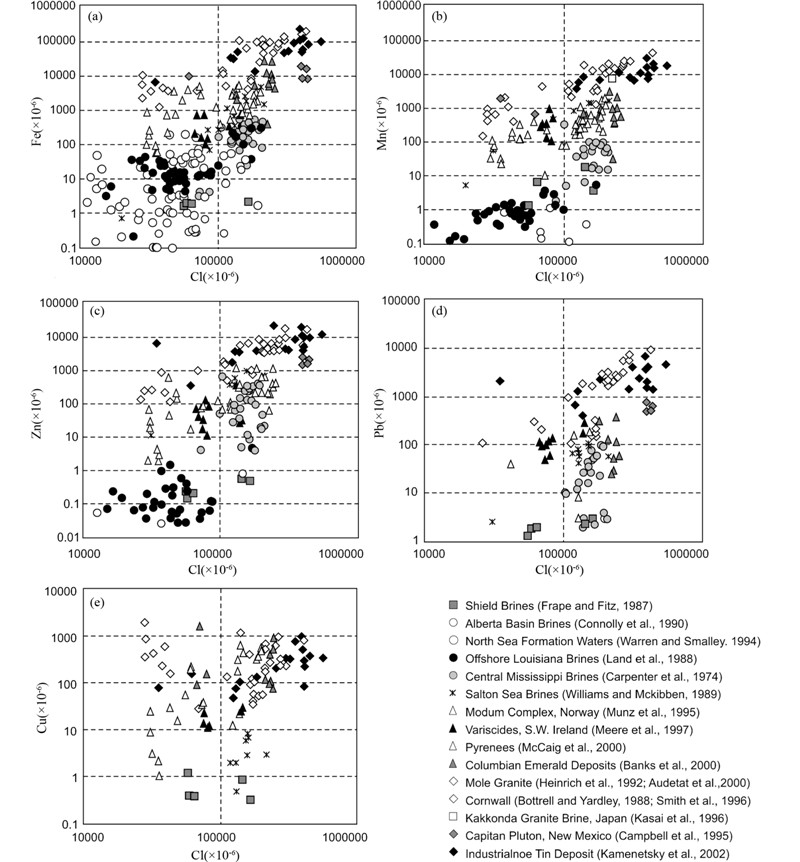
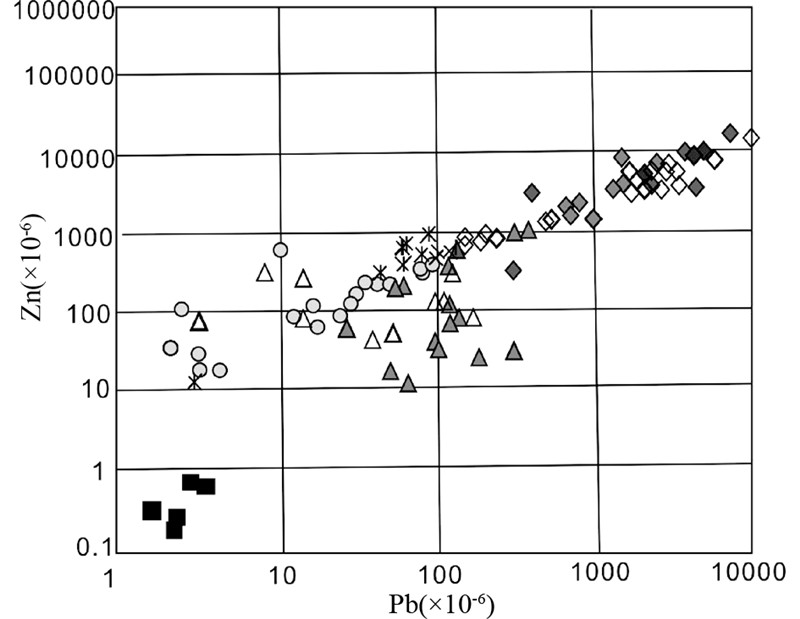
除金属元素外,流体中主要阳离子为Na、K、Ca、Si等。流体中主要的阴离子为Cl-、HS-、NH3、OH-和CH3COO2-,其次有F、SO42-、HCO3-和CO32-等。在大多数的成矿流体中,Cl是很重要的,含量较髙并且常与Cu、Pb、Zn、Fe和Mn等金属元素形成各种配合物而存在于成矿流体中(Yardley,2005),但在气相中Cu可能呈CuHS配合物存在。Pb氯化物的溶解度,当pH=4.96时,铅氯化物的浓度随Cl浓度的增长而增长,同时铅氯化物在与白云母、钾长石、钠长石和石英共存时的浓度随Cl浓度的增大而陡然上升。换句话来说当含有铅氯化物的成矿流体沿含有白云母、钾长石、钠长石、石英和钙硅酸盐的岩石上升时,铅氯化物的浓度增髙。Cu、Pb、Zn、Mn、Fe等元素在流体中的含量与温度成正比(图 7),其中Cu氯化物与温度的关系不如上述元素与温度的关系那样明显。Cu、Pb、Zn、Mn和Fe等金属的含量与流体中Cl的浓度呈正比(图 8),而铜与氯的关系不如其他金属元素那样明显,Zn氯化物有好几个如ZnCl、ZnCl2等。同样Pb、Fe、Mn、Cu也有好几个氯化物,但主要是MeCl和MeCl2(Me=Cu,Zn,Pb,Fe,Mn)。Cl在成矿流体中的含量从1000×10-6到500000×10-6,这个范围与这些矿床中的流体包裹体的成分分析得出的Cl的含量范围十分接近。大洋中脊的成矿流体中Cu、Pb、Zn含量为1×10⁻⁶到1500×10-6,图 9显示Pb和Zn呈线性相关,Au的配合物可能与CO2和HS有关,Cu可能与HS有关(Zajacz et al., 2011)。
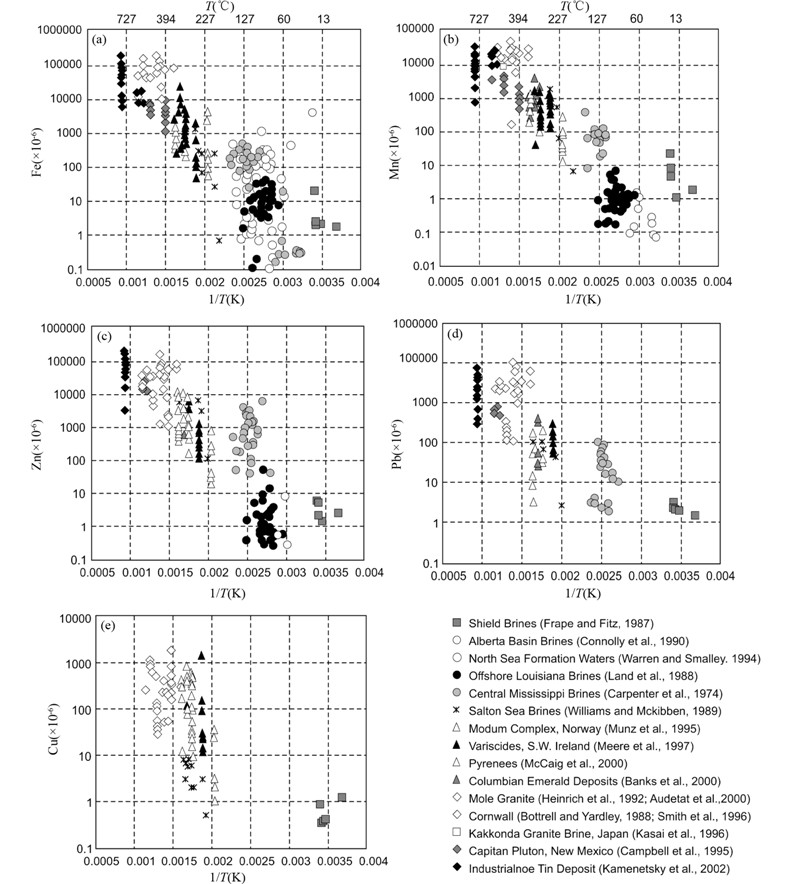 | 图 7 成矿流体中Cu、Pb、Zn、Fe、Mn含量与温度的关系(据Yardley,2005)Fig. 7 The relationship between temperature and Cu,Pb,Zn,Fe,Mn amounts in ore-forming fluids(after Yardley,2005) |
 | 图 8 成矿流体中Cu、Pb、Zn、Fe、Mn含量与Cl的关系(据Yardley,2005)Fig. 8 The relationship between the amounts of Cu,Pb,Zn,Fe,Mn and Cl in ore-forming fluids(after Yardley,2005) |
 | 图 9 成矿流体中Pb和Zn的关系(据Yardley,2005)Fig. 9 The relationship between Pb and Zn in ore-forming fluids(after Yardley,2005)References |
根据上述,可以得出以下几点看法:
(1)金属矿床的成矿流体从主成分上来说,应包括岩浆、SiO2、H2O、CO2、Cl、F和各种金属。
(2)金属矿床成矿流体中的金属含量,与它们的工业品位一样,其含量从×10-2到×10-6级。按其含量和其地球化学性质一般来说可分为五组,第一组为Fe,有时Al也在这一组;第二组为Zn、Cu、Pb、Ni和Co;第三组为Sn、U、W和Mo;第四组为Bi、Cd、Hg和Ag;第五组为Au和Pt(铂族元素)。
(3)金属矿床成矿流体的成分是根据天然成矿流体、地热水、油田水、大洋中脊喷出的热液、层间卤水,最重要的是来自各种金属矿床的流体包裹体成分分析的结果。
(4)金属矿床成矿流体的主要成分中阳离子为Si、Na、Ca、K等,主要阴离子为Cl、F、HS、O、S等。对Cu、Pb、Zn矿床来说,Cu、Pb、Zn在流体中的含量与温度成正比,Pb、Zn、Fe、Mn在流体中的含量与Cl成正比,它们与Cl构成了配合物。
(5)Cu在流体中的含量与气相有关,且与HS呈配合物,Au的配合物可能与CO2和HS有关。
(6)用LA-ICP-MS方法对单个流体包裹体的成分进行分析,结果表明与原先获得的结果相似,表明金属矿床的成矿流体中的确含有金属。
致谢 作者感谢范宏瑞教授和另一位审稿人提的意见,使作者得益匪浅,特致谢意!
| [1] | Appold MS, Numelin TJ, Shepherd TJ and Chenery SR. 2002. Limits on the metal content of fluid inclusions in gangue minerals from the Viburnum trend, SE Missouri determined by LA-ICP-MS. GSA Annual Meeting, Denver (Oct. 27-30, 2002), Abstract Volume |
| [2] | Appold MS and Wenz ZJ. 2011. Composition of ore fluid inclusions from the Viburnum trend. Economic Geology, 106(1): 55-78 |
| [3] | Audetat A,Gunter D and Heinrich CA. 2000. Causes for large-scale metal zonation around mineralized plutons: Fluid inclusion La-ICP-MS evidence from the Mile Granite, Australia. Econ. Geol., 95: 1563-1581 |
| [4] | Baker T, van Achterberg E, Ryan CG and Lang JR. 2003. Composition and evolution of ore fluids in a magmatic-hydrothermal skarn deposit. Geology, 32(2): 117-120 |
| [5] | Banks DA, Guiliani G, Yardley BWD and Cheilletz A. 2000. Emerald mineralisation in Columbia: Fluid chemistry and the role of brine mixing. Mineralium Deposita, 35: 699-713 |
| [6] | Barnes HL. 1997. Geochemistry of Hydrothermal Ore Deposits. 3rd Edition. John Wiley & Sons Inc |
| [7] | Bottrell SH, Yardley BWD and Buckley F. 1988. A modified crush-leach method for the analysis of fluid inclusion electrolytes. Bulletin de Mineralogie, 111: 279-290 |
| [8] | Campbell AR, Banks DA, Phillips RS and Yardley BWD. 1995. Geochemistry of Th-U-REE mineralizing magmatic fluids, Capitan Mountains, New Mexico. Econ. Geol., 90: 1271-1287 |
| [9] | Carpenter AB, Trout ML and Pickett EE. 1974. Preliminary report on the origin and chemical evolution of lead and zinc rich oil-field brines in Central Mississippi. Econ. Geol., 69: 1191-1206 |
| [10] | Connolly CA, Walter LM, Baadsgaard H and Longstaffe FJ. 1990. Origin and evolution of formation waters, Alberta basin, western Canada sedimentary basin I. Chemistry, Applied Geochemistry, 5: 373-395 |
| [11] | Frape SK and Fritz P. 1987. Geochemical trends from groundwaters from the Canadian Shield. Geological Association of Canada Special Paper, 33: 19-38 |
| [12] | Graton LC. 1940. Nature of the ore-forming fluid. Economic Geology, 35(Suppl. 2): 197-358 |
| [13] | Hedenquist JW and Lowenstern JB. 1994. The role of magmas in the formation of hydrothermal ore deposits. Nature, 370(6490): 519-527 |
| [14] | Heinrich CA, Ryan CG, Mernagh TP and Eadington PJ. 1992. Segregation of ore metals between magmatic brine and vapor: A fluid inclusion study using PIXE microanalysis. Economic Geology, 87(6): 1566-1583 |
| [15] | Kamenetsky VS, Achterbergh EA, Ryan CG et al. 2002. Extreme heterogeneity of granite derived hydrothermal fluids: An example from inclusions in a single crystal of miarolitic quartz. Geology, 30: 459-462 |
| [16] | Kasai K, Sakagawa Y, Miyazaki S et al. 1996. Supersaline brine obtained from Quaternary Kakkonda granite by the Nedos deep geothermal well WD-1A in the Kakkonda geothermal field, Japan. Geothermal Resources Council Transactions, 20: 623-629 |
| [17] | Kesler SE. 2005. Ore-forming fluids. Elements, 1(1): 13-18 |
| [18] | Land LS, Macpherson GL and Mack LE. 1988. The geochemistry of saline formation waters, Miocene, offshore Louisiana, Gulf Cost. Association of Geological Societies, Transactions, 38: 503-511 |
| [19] | Lerchbaumer L and Audétat A. 2012. The metal content of molybdenum-mineralizing fluids. EGU General Assembly 2012, held 22-27 Apirl, 2012 in Vienna, Austria, P11889 |
| [20] | Li XC, Fan HR, Hu FF and Yang KF. 2010. Single fluid inclusion analysis by LA-ICP-MS and their application to mineral deposits. Mineral Deposits, 29(6): 1017-1028 (in Chinese with English abstract) |
| [21] | Lu HZ, Chi GX and Wang ZG. 1995. The Origin and Tectonic Environment of Typical Metal Deposits. Beijing: Geological Publishing House, 1-275 (in Chinese with English abstract) |
| [22] | Lu HZ. 1997. Ore-Forming Fluids. Beijing: Science and Technology Press, 1-210 (in Chinese with English abstract) |
| [23] | Lu HZ. 2000. High temperature, salinity and high concentrated ore metal magmatic fluids: An example from Grasberg Cu-Au porphyry deposit. Acta Petrologica Sinica, 16(4): 465-472 (in Chinese with English abstract) |
| [24] | Lu HZ. 2011. Fluid in the Earth. Beijing: High Education Press, 1-354 (in Chinese with English abstract) |
| [25] | McCaig AM, Tritlla J and Banks DA. 2000. Fluid mixing and recycling during Pyrenean thrusting: Evidence from fluid inclusion halogen ratios. Geochimica et Cosmochimica Acta, 64: 3395-3412 |
| [26] | Meere PA and Banks DA. 1997. Upper crustal fluid migration: An example from the Variscides of SW Ireland. Journal of the Geological Society of London, 154: 975-985 |
| [27] | Moncada D, Mutchler S, Nieto A, Reynolds TJ, Rimstidt JD and Bodnar RJ. 2012. Mineral textures and fluid inclusion petrography of the epithermal Ag-Au deposits at Guanajuato, Mexico: Application to exploration. Journal of Geochemical Exploration, 114: 20-35 |
| [28] | Mutz IA, Yardley BWD, Banks DA and Wayne D. 1995. Deep penetration of sedimentary fluids in basement rocks from southern Norway: Evidence from hydrocarbon and brine inclusions in quartz veins. Geochimica et Cosmochimica Acta, 59: 239-254 |
| [29] | Prokof'ev VY, Kovalenker VA, Jien S, Borisenko AS and Borovikiv AA. 2011. Determination of metal concentrations in fluid inclusions formed during the magmatic and hydrothermal stages of formation of the epithermal Au-Ag polymetallic deposit of Banska Stiavnica (western Carpathians) with the LA-ICP-MS method. Doklady Earth Sciences, 440(1): 1249-1252 |
| [30] | Robert F and Kelly WC. 1987. Ore-forming fluids in Archean gold-bearing quartz veins at the Sigma mine, Abitibi greenstone belt, Quebec, Canada. Economic Geology, 82(6): 1464-1482 |
| [31] | Rusk BG, Reed MH and Dilles JH. 2008. Fluid inclusion evidence for magmatic-hydrothermal fluid volution in the porphyry copper-molybdenym deposit at butte, Montana. Economic Geology, 103(2): 307-334 |
| [32] | Seo JH, Guillong M, Aerts M, Zajacz Z and Heinrich CA. 2011. Microanalysis of S, Cl, and Br in fluid inclusions by LA-ICP-MS. Chemical Geology, 284(1-2): 35-44 |
| [33] | Smith MP, Baks DA, Yardley BWD and Boyce A. 1996. Fluid inclusion and stable isotope constrains on the genesis of the Clgga Head Sn-W deposit, SW. England. European Journal of Mineralogy, 8: 961-974 |
| [34] | Stoffell B, Wilkinson JJ and Jeffries TE. 2004. Metal transport and deposition in hydrothermal veins revealed by 213nm UV Laser Ablation microanalysis of single fluid inclusions. American Journal of Science, 304(6): 533-557 |
| [35] | Ulrich T, Günther D and Heinrich CA. 2001. The evolution of a porphyry Cu-Au deposit, based on LA-ICP-MS analysis of fluid inclusions: Bajo de la Alumbrera, Argentina. Economic Geology, 96(8): 1719-1742 |
| [36] | Wang XD, Ni P, Jiang SY, Zhao KD and Wang TG. 2010. Origin of ore-forming fluid in the Piaotang tungsten deposit in Jiangxi Province: Evidence from helium and argon isotopes. Chinese Science Bulletin, 55(7): 628-634 |
| [37] | Warren EA and Smalley PC. 1994. North Sea Formation Waters Atlas. Geological Society Memoir, 15: 1-208 |
| [38] | Williams AE and Mckibben MA. 1989. A brine interface in the Salton Sea geothermal system, California: Fluid geochemical and isotopic characteristics. Geochimica et Cosmochimica Acta, 53: 1905-1920 |
| [39] | Xue CJ, Hao SJ and Wei HM. 2007. Principle of Mineral Deposits. Beijing: Geological Publishing House (in Chinese with English abstract) |
| [40] | Yardley BWD. 2005. 100th anniversary special paper: Metal concentrations in crustal fluids and their relationship to ore formation. Economic Geology, 100(4): 613-632 |
| [41] | Zajacz Z, Seo JH, Candela PA, Piccoli PM and Tossell JA. 2011. The solubility of copper in high-temperature magmatic vapors: A quest for the significance of various chloride and sulfide complexes. Geochimica et Cosmochimic Acta, 75(10): 2811-2827 |
| [42] | 李晓春, 范宏瑞, 胡芳芳, 杨奎峰. 2010. 单个流体包裹体LA-ICP-MS成分分析及在矿床学中的应用. 矿床地质, 29(6): 1017-1028 |
| [43] | 卢焕章, 池国祥, 王中刚. 1995. 典型金属矿床的成因及其构造环境. 北京: 地质出版社, 1-275 |
| [44] | 卢焕章. 1997. 成矿流体. 北京: 北京科学技术出版社, 1-210 |
| [45] | 卢焕章. 2000. 高盐度、高温和高成矿金属的岩浆成矿流体——以格拉斯伯格Cu-Au矿为例. 岩石学报, 16(4): 465-472 |
| [46] | 卢焕章. 2011. 地球中的流体. 北京: 高等教育出版社, 1-354 |
| [47] | 薛春纪, 祁思敬, 隗合明. 2007. 基础矿床学. 北京: 地质出版社 |