 2015, Vol. 31


2. 中国科学院边缘海地质重点实验室, 中国科学院南海海洋研究所, 广州 510301;
3. 中国科学院青藏高原地球科学卓越创新中心, 北京 100101;
4. 同位素地球化学国家重点实验室, 中国科学院广州地球化学研究所, 广州 510640
2. Key Laboratory of Marginal Sea Geology, South China Sea Institute of Oceanology, Chinese Academy of Sciences, Guangzhou 510301, China;
3. CAS Center for Excellence in Tibetan Plateau Earth Sciences, Beijing 100101, China;
4. State Key Laboratory of Isotope Geochemistry, Guangzhou Institute of Geochemistry, Chinese Academy of Sciences, Guangzhou 510640, China
铁在蛇纹石化过程中的行为较为复杂。橄榄岩发生蛇纹石化反应时,橄榄石和辉石中的Fe2+被水氧化形成Fe3+,同时水中的氢被还原为氢气。二价铁主要富集在流体、蛇纹石和未反应的橄榄石与辉石中;三价铁则主要富集在蛇纹石、磁铁矿或赤铁矿中。当Fe3+几乎全部富集在蛇纹石中时,例如,蛇纹石的Fe3+/ΣFe高达0.7,不形成磁铁矿或赤铁矿(Evans et al., 2009)。研究蛇纹石化过程中铁的活动性意义重大:铁为变价元素,其矿物存在形式可以反映出体系氧逸度的高低,例如,铁镍合金常表示体系较为还原,而赤铁矿则表明体系相对氧化(Frost,1985);铁氧化物往往和氢气同时形成,且两者的含量成正相关,氢气、甲烷、甲酸和乙酸等可能对地球早期生命起源和演化有重要启示(Marcaillou et al., 2011; Schrenk et al., 2013);铁氧化物尤其是磁铁矿的结晶使得蛇纹石化超基性岩有磁性异常(Toft et al., 1990; Oufi et al., 2002; Szitkar et al., 2014);铁氧化物和氢气可能影响俯冲板片地幔楔的氧逸度,但其过程较为复杂且机理尚不清楚。
近40年来,有大量实验工作探讨蛇纹石化过程中气体的生成(Berndt et al., 1996; McCollom and Seewald, 2001; Allen and Seyfried, 2003; Marcaillou et al., 2011; Lazar et al., 2012)、流体的组成(Seyfried and Dibble, 1980; Allen and Seyfried, 2003; Seyfried et al., 2007; Okamoto et al., 2011)、蛇纹石化蚀变速率(Martin and Fyfe, 1970; Malvoisin et al., 2012a,b; Lafay et al., 2012)和蛇纹石化过程中铁氧化物的形成(Moody,1976; Malvoisin et al., 2012a,b)。关于蛇纹石化过程中铁氧化物的形成,前人研究了是否有铁氧化物的形成,或者测定磁铁矿的含量(Moody,1976; Seyfried et al., 2007; Marcaillou et al., 2011),但是对橄榄岩蛇纹石化过程中铁的活动性仍缺乏实验方面的研究。橄榄石、斜方辉石和单斜辉石蚀变形成蛇纹石,其铁含量是否和原生矿物相似?蚀变后是否有磁铁矿的结晶?初始流体组成和酸碱性是否影响铁的活动性?基于以上问题,本研究报道了80~200℃、饱和蒸气压下橄榄岩蛇纹石化过程中铁的活动性。 1 实验和测试条件
实验初始物采用尖晶二辉橄榄岩,为江苏盘石山碱性玄武岩中的地幔捕掳体(Sun et al., 1998; Zhi et al., 2001; 杨雪英等,2008; Xu et al., 2008)。样品较新鲜,几乎没有发生蚀变。尖晶二辉橄榄岩的矿物组合为:60%~65%橄榄石、20%斜方辉石、10%~15%单斜辉石、1%~2%尖晶石和少量的硫化物(陈道公等,1994)。大多数硫化物发育在矿物的交界处,少量以包裹体形式发育在矿物中(杨雪英等,2008; Xu et al., 2008),初始矿物成分较均匀(表 1)。用地质锤把样品敲成小块,挑选岩石内部的碎块,先用蒸馏水清洗,然后放于玛瑙研钵中细碎,过筛,分别选出60 目、80~140目、140~180目和>180目的矿物颗粒。
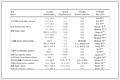 | 表 1 初始矿物组成(wt%) Table 1 Compositions of starting minerals(wt%) |
实验在中国科学院广州地球化学研究所高温高压水热实验室完成(表 2)。温度为80℃的实验在水浴锅中进行,水浴锅最高能承受的温度为90℃。将岩石粉末和初始溶液放于离心管中(Corning,材料为聚丙烯),水岩比为1.0~21.7。温度为120~200℃的实验在高压釜中进行,内有聚四氟乙烯衬套。这种高压釜最高能承受的温度是300℃。实验过程中离心管和不锈钢釜都是密封状态。实验结束时,放于冰水中淬火。
| 表 2 实验条件 Table 2 Experimental run conditions |
淬火后,用移液腔取20μL溶液,用0.3% HNO3稀释至~4mL到ICP-AES上样分析。工作时高频发生器功率为1.0kW,等离子冷却气体流量15.0L/min,辅助气体流量1.50L/min,积分时间5s,测定重复次数8次。标准溶液为GSR、SARM-4、SY4、Alfa 0.5μg/mL和Alfa 1μg/mL。ICP-AES可以很好的测定溶液中的主量元素,Ca、Mg、Fe的检测限分别为15×10-6、9×10-6和1×10-6(李献华等,2002)。
固体样品放于干燥箱中~60℃加热蒸干。部分固体粉末涂在单晶Si片上,上面镀有~20nm的金,在香港大学电镜中心用扫描电镜LEO 1530、Hatachi S-4800进行表面观察。一部分的样品用环氧树脂固定,并单面抛光,在华南理工大学用扫描电镜 Hatachi S-3700进行产物分析。
蛇纹石的主量元素分析在中国冶金地质总局山东测试中心用JOEL JXA 8230型电子探针完成。选用15kV加速电压,20nA电子束电流,10~15μm电子束直径。标准样品选用硬玉(Si、Na)、橄榄石(Mg)、铁铝榴石(Fe、Al)、透辉石(Ca)、钾长石(K)、氧化铬(Cr)、 金红石(Ti)、硅化镍(Ni)、金属钴(Co)、 蔷薇辉石(Mn)、硅铍铝钠石(Cl)。Ni、Co、Cl、Mn的测试时间为30s,其他元素的测试时间为10s。初始物的成分 是在中国科学院广州地球化学研究所同位素地球化学重点实验室JOEL JXA8100型电子探针分析完成。测试条件为20kV加速电压,20nA电子束电流,5μm电子束直径。标准和以上选择相似。 2 实验结果 2.1 蛇纹石化反应后流体的组成
蛇纹石化流体的铁含量为0.0~0.7mmol/kg,远低于初始矿物的铁(表 3)。改变初始流体组成和酸碱性后,蛇纹石化流体的铁含量仍然很低。蛇纹石化流体的pH为5~9,即便是当初始流体为酸性的NaCl(aq)(0.5mol/L,pH=2.6)时,也不能产生强酸性流体(pH=1~3)。
| 表 3 流体组成 Table 3 Compositions of fluids |
反应后流体的Ca含量较低。当初始流体为NaCl+CaCl2(aq)时,蛇纹石化流体的Ca含量较高。同样地,流体的Mg含量也较低。 2.2 橄榄石和辉石的蚀变
常温常压下、反应时间为7个月时,只有极少量的橄榄石、辉石蚀变形成利蛇纹石,大多数的矿物没有发生蚀变。扫描电镜的观察显示,没有磁铁矿或赤铁矿的生成。蛇纹石的铁含量为4.5~9.3% FeO。80℃、饱和蒸气压下,利蛇纹石是主要的蚀变产物(图 1a);200℃、饱和蒸气压下,蚀变产物主要为利蛇纹石(图 1 b)。而没有形成铁氧化物和水镁石(图 1c,d),这可能是因为反应后没有形成水镁石或者形成的水镁石和蛇纹石长在一起,无法分辨。电子探针成分分析表明,橄榄石和斜方辉石蚀变形成的蛇纹石成分差异显著(表 4)。橄榄石蚀变后蛇纹石的铝含量为0.05%~5.5% Al2O3,平均值为1.4%,远高于橄榄石的铝含量(0.01% Al2O3);其铁含量为5.4%~10.0% FeO,平均值为8.3%,低于橄榄石的铁含量(9.84% FeO)(图 2a、表 4)。斜方辉石蚀变后蛇纹石的铝含量为2.6%~5.7% Al2O3,平均值为5.7%;铁含量为3.8%~10.0% FeO,平均值为6.3%(图 2b、表 4)。由此可以看出,橄榄石蚀变后形成的蛇纹石富铁而贫铝,而斜方辉石蚀变形成的蛇纹石贫铁而富铝(图 3)。但是,当初始流体为0.5mol/L NaCl(aq)(pH=12)时,两种蛇纹石的Al2O3和FeO含量相差不大(图 4)。单斜辉石蚀变形成的蛇纹石铝含量为0.3%~3.6% Al2O3,平均值为1.4%;铁含量为8.1%~10.2% FeO,平均铁含量为9.2%。和未蚀变的单斜辉石相比,蛇纹石的铁含量增加,铝含量降低(图 2c)。蛇纹石的Al2O3和SiO2含量呈反相关(图 3b),这表明Al和Si一样,在蛇纹石的晶格中占据四面体位置。由斜方辉石蚀变形成的蛇纹石的SiO2含量低,这可能是因为其Al2O3含量高的缘故。
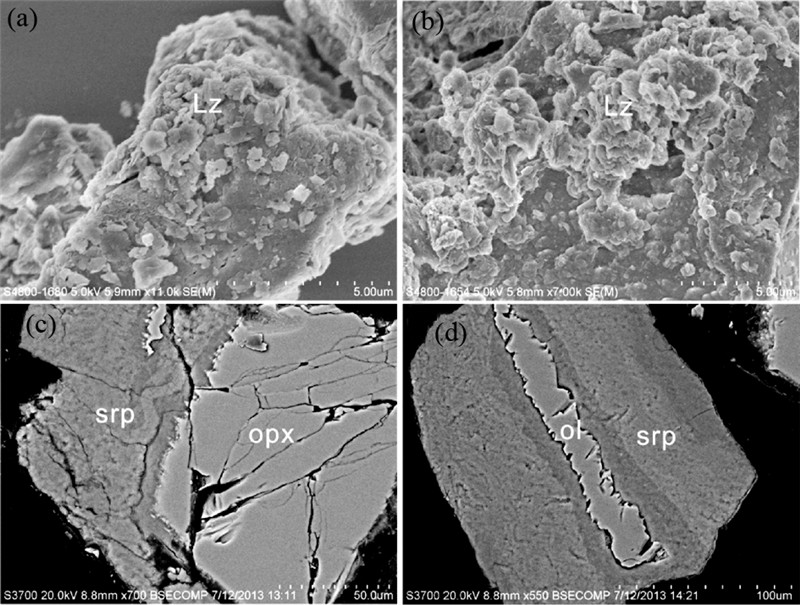 |
图 1 扫描电镜下产物的形貌特征 (a)FeL-20,二次电子成像图,矿物边部蚀变形成利蛇纹石(Lz);(b)FeL-24,二次电子成像图,矿物蚀变后形成利蛇纹石;(c)FeL-26,背散射图,斜方辉石(opx)蚀变后形成蛇纹石(srp);(d)FeL-26,背散射图,橄榄石(ol)蚀变后形成蛇纹石 Fig. 1 Scanning electron microscope imaging of the experimental products (a)FeL-20,secondary electron image. Lizardite(Lz)forms after alteration of primary minerals;(b)FeL-24,secondary electron image. Lizardite crystallizes after alteration of primary minerals;(c)FeL-26,backscattered electron image. Orthopyroxene(opx)is altered to produce serpentine(srp);(d)FeL-26,backscattered electron image. Olivine(ol)is serpentinized to serpentine |
| 表 4 蛇纹石的化学组成(wt%) Table 4 Chemical compositions of serpentine(wt%) |
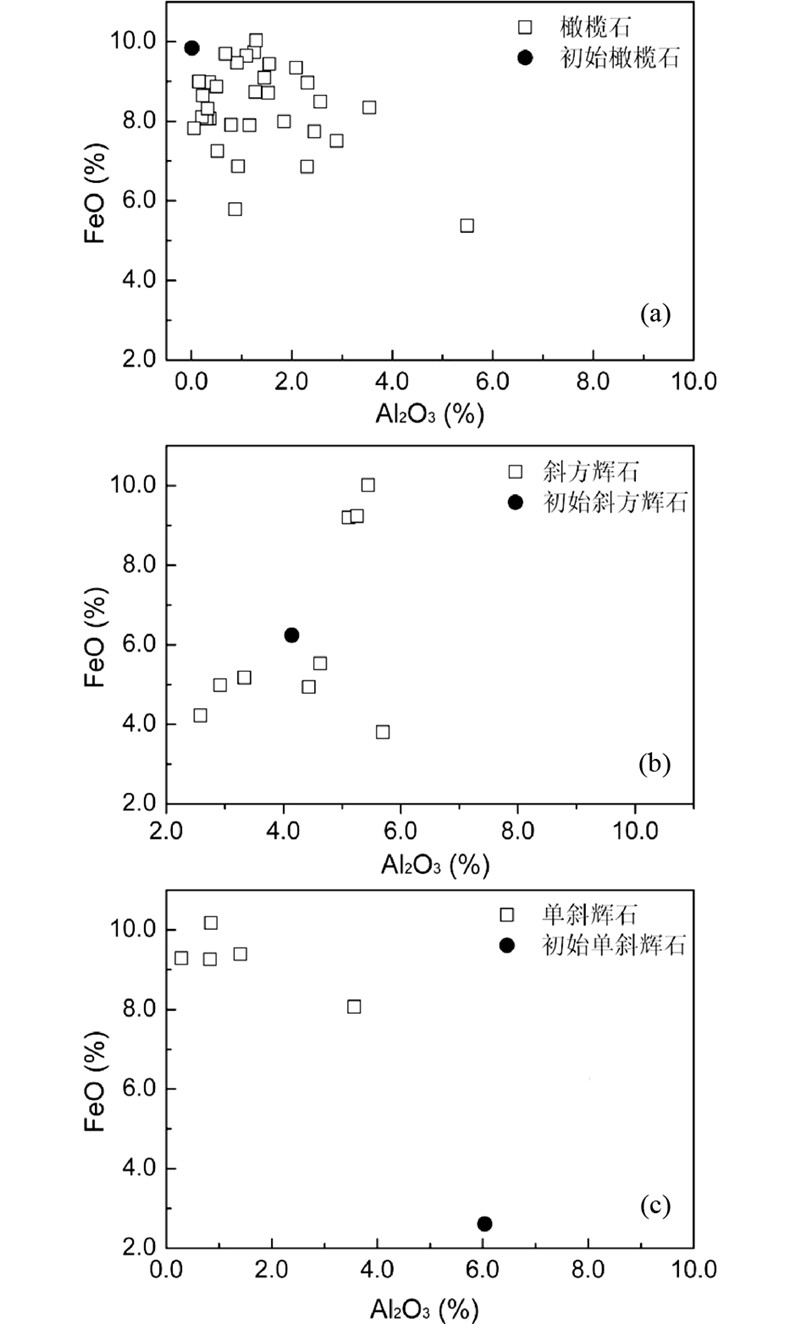 |
图 2 蛇纹石的FeO-Al2O3含量相关关系图 (a)原生矿物为橄榄石;(b)原生矿物为斜方辉石;(c)原生矿物为单斜辉石.空心方框表示由原生矿物(橄榄石、斜方辉石或单斜辉石)蚀变形成的蛇纹石,实心圆表示初始矿物 Fig. 2 Correlation of FeO vs. Al2O3 contents in serpentine (a)primary mineral is olivine;(b)primary mineral is orthopyroxene;(c)primary mineral is clinopyroxene. Empty rectangles represent serpentine, and solid circles st and for starting minerals(olivine,orthopyroxene and clinopyroxene) |
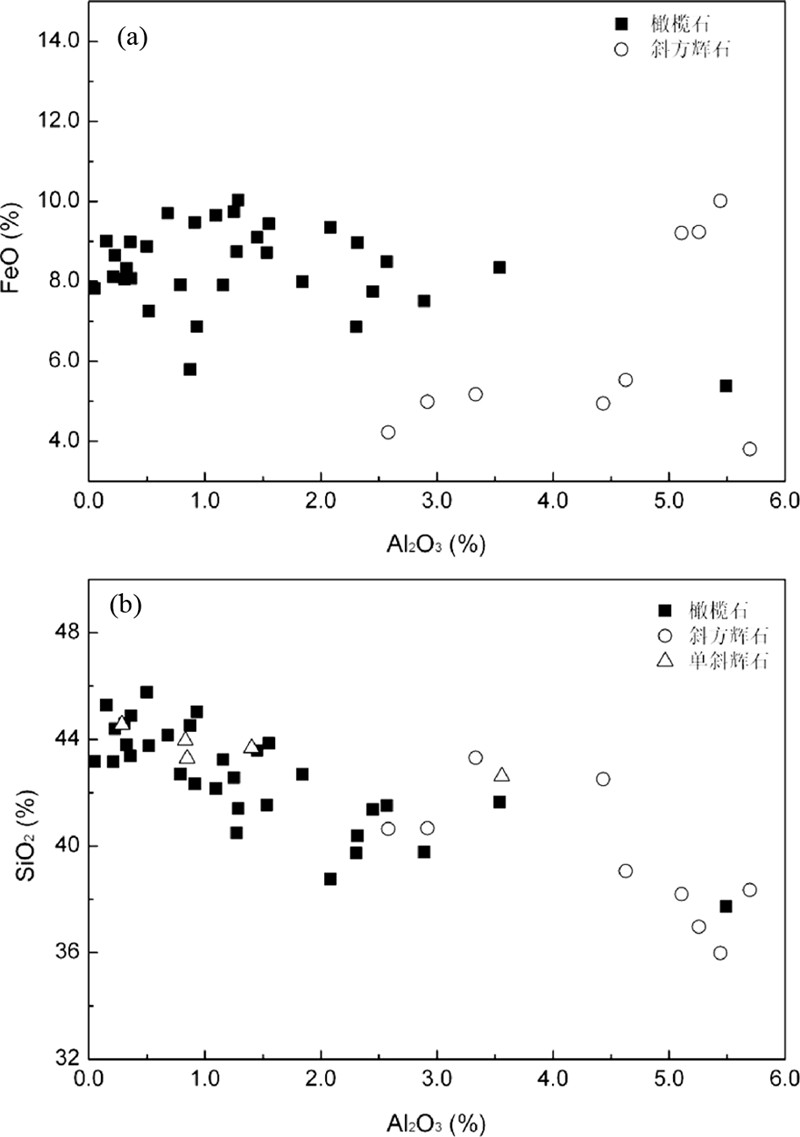 |
图 3 200℃压力为饱和蒸气压下蛇纹石的FeO-Al2O3(a)和SiO2-Al2O3(b)相关关系图 实心方框表示原生矿物为橄榄石,空心圆表示原生矿物为斜方辉石,空心三角表示原生矿物为单斜辉石 Fig. 3 Geochemical characteristic of serpentine in experiments at 80~200℃ and vapor saturated pressures (a)FeO vs. Al2O3 of serpentine;(b)SiO2 vs. Al2O3 of serpentine. Solid rectangles represent olivine as the host mineral of serpentine,empty circles st and for orthopyroxene as the primary mineral, and empty triangles for clinopyroxene |
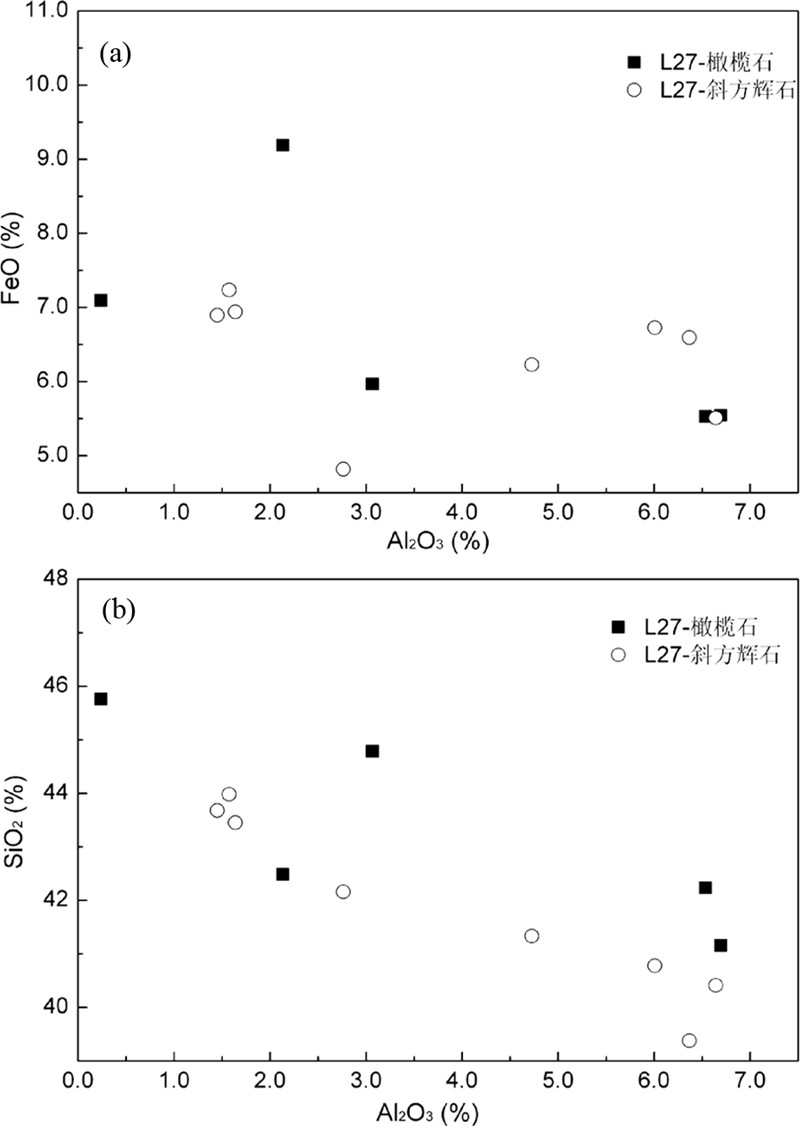 |
图 4 80℃、饱和蒸气压、初始流体为碱性的NaCl溶液(0.5mol/L,pH=12时),蛇纹石的化学组成 (a)FeO-Al2O3 ;(b)SiO2-Al2O3 .相关关系图实心方框表示由橄榄石蚀变形成的蛇纹石,空心圆表示由斜方辉石蚀变形成的蛇纹石 Fig. 4 Geochemical characteristic of serpentine in experiment at 80℃ and vapor saturated pressure with alkaline NaCl solution(0.5mol/L,pH=12)as the starting fluid (a)FeO vs. Al2O3;(b)SiO2 vs. Al2O3. Solid rectangles represent olivine as the host mineral of serpentine, and empty circles for orthopyroxene as the primary mineral of serpentine |
本研究表明,80~200℃、饱和蒸气压下,橄榄岩蛇纹石化后形成富铁蛇纹石,而没有生成铁氧化物。这与前人的实验结果一致(Seyfried et al., 2007; Lafay et al., 2012,2014)。Lafay et al.(2012)探讨了150~200℃、饱和蒸气压下,橄榄石和NaOH(aq)的蛇纹石化反应,其研究结果表明,即便当橄榄石全部蚀变时,也没有形成铁氧化物或铁氢氧化物。这表明,高的蚀变程度可能不是生成铁氧化物的关键。同样地,Lafay et al.(2014)研究了200℃、饱和蒸气压下,橄榄石和1mol/L NaHCO3(aq)的蛇纹石化反应,其结果表明无铁氧化物的形成,铁主要富集在蛇纹石(Fe2+、Fe3+)和碳酸镁(Fe2+)中。Seyfried et al.(2007)研究了200℃、500bar时橄榄岩的蛇纹石化反应(反应时间为328天),光学显微镜和扫描电镜下没有观察到磁铁矿,但磁性测定表明有<0.014%的磁铁矿。这可能是由初始橄榄岩中的磁性矿物包裹体引起的。Seyfried et al.(2007)认为流体的pH较高(pH=12)时,铁主要富集在水镁石中,使得磁铁矿的量降低,而地质过程中流体的pH为5~9,水镁石在低pH的流体中分解形成磁铁矿。同样地,Foustoukos et al.(2008)的计算则表明富铁的水镁石在温度≤250℃是稳定的,低温时蛇纹石化过程中磁铁矿的量较低。但是,当水岩比大于6时,流体的pH降低至~6,富铁的水镁石会分解形成磁铁矿(Foustoukos et al., 2008)。此外,McCollom and Bach(2009)通过热力学计算表明,低温时(例如,80℃),如果有足够长的反应时间,水镁石将分解形成铁氧化物。实际上,水镁石在pH为5~9的流体中是稳定的(Wang et al., 1998)。
尽管大量的实验观察均表明低温时橄榄石或橄榄岩蛇纹石化不产生铁氧化物,但Okamoto et al.(2011)和Malvoisin et al.(2012a,b)仍在200℃、500bar时橄榄石的蛇纹石化反应产物中观察到铁氧化物。其原因可能是Okamoto et al.(2011)和Malvoisin et al.(2012a,b)将反应初始物直接放于不锈钢高压釜中,反应过程中高压釜的铁可能被溶解形成磁铁矿。不锈钢和镍基合金高压釜是不稳定的,高温高压实验中常通过镍基合金和水反应产生氢气来控制金管或铂管中样品的氧逸度。此外,实验过程中常用到的镍基合金填塞柱,实验后常有溶解现象。和镍基合金相比,不锈钢更容易溶解。Okamoto et al.(2011)的实验产物中甚至有Fe-Cr-Ni合金,而初始橄榄石的Cr含量极低,这进一步表明了反应过程中不锈钢高压釜的不稳定性。纯钛的高压釜很稳定,更适合温度≤400℃、饱和蒸气压下的水热实验。 3.2 蛇纹石化过程中铁的活动性
铁在蛇纹石化过程中的活动性备受争议。一些学者通过测定蛇纹岩和橄榄岩的主量元素发现蛇纹石化过程中只有H2O从流体相进入蛇纹岩,只有CaO从固体相进入流体相,而其他主量元素(例如,Al2O3、FeOT和MgO)的变化较小(Coleman and Keith, 1971; Mével,2003)。但是,Costa et al.(2008)报道了蚀变后橄榄岩的Fe2O3T含量变化很大,5.21%~19.77%,可能是由于磁铁矿在蛇纹石化橄榄岩中分布不均匀所致,这表明铁在蛇纹石化过程中是活动的。铁在橄榄岩蛇纹石化过程中可富集在流体、蛇纹石、水镁石和磁铁矿中。流体的铁含量主要受pH影响,酸性流体的铁含量较高,而中性或弱碱性流体的铁含量较低。例如,Rainbow热液区流体的pH为3.3,流体的铁含量为24mmol/kg;Lost City热液区流体的pH为8.0,流体的铁含量低于检测限(Kelley et al., 2001; Douville et al., 2002)。这是由于Fe2+或Fe3+在酸性流体中稳定,而在中性或弱碱性流体中会水解形成磁铁矿或赤铁矿。蛇纹石化流体的pH主要和温度、橄榄石和辉石的蚀变和反应时间有关。热力学计算表明,蛇纹石化流体的pH随着温度的升高而降低,例如,50℃时反应流体的pH为11,400℃时降低至6(McCollom and Bach, 2009)。尽管如此,流体的pH仍没有达到2~3,400℃时流体的铁含量仅为1mmol/kg,远低于橄榄岩的铁含量(McCollom and Bach, 2009)。这里需要指出的是,50℃时蛇纹石化反应需要至少1年的时间才能使得反应流体的pH达到11(初始物的粒径大小为50~100 μm),反应初始时期流体的pH也是接近中性的,这和本研究结果并不矛盾。橄榄石和辉石蚀变会释放Mg、Ca、Al和Si到流体中,这些离子的水解作用会影响流体的pH。其中,MgCl2°和CaCl2°在80~200℃水解后呈弱碱性,而在300~400℃水解后呈弱酸性(Allen and Seyfried, 2003)。Al和Si呈两性,起到缓冲流体pH的作用。而NaCl水解后呈碱性(王玉荣等,1981)。由于本研究未发现磁铁矿和水镁石,且流体中的铁较低,故铁主要富集在蛇纹石和未反应的硅酸盐矿物(橄榄石、辉石和尖晶石)中。通过测定各矿物反应后生成的蛇纹石成分可知,由单斜辉石蚀变形成的蛇纹石铁含量远高于未蚀变的单斜辉石(8.1%~10.2% FeO,平均铁含量为9.2%),这些铁主要来自于橄榄石或斜方辉石蚀变过程中释放的铁。这表明铁在蛇纹石化过程中是活动的。
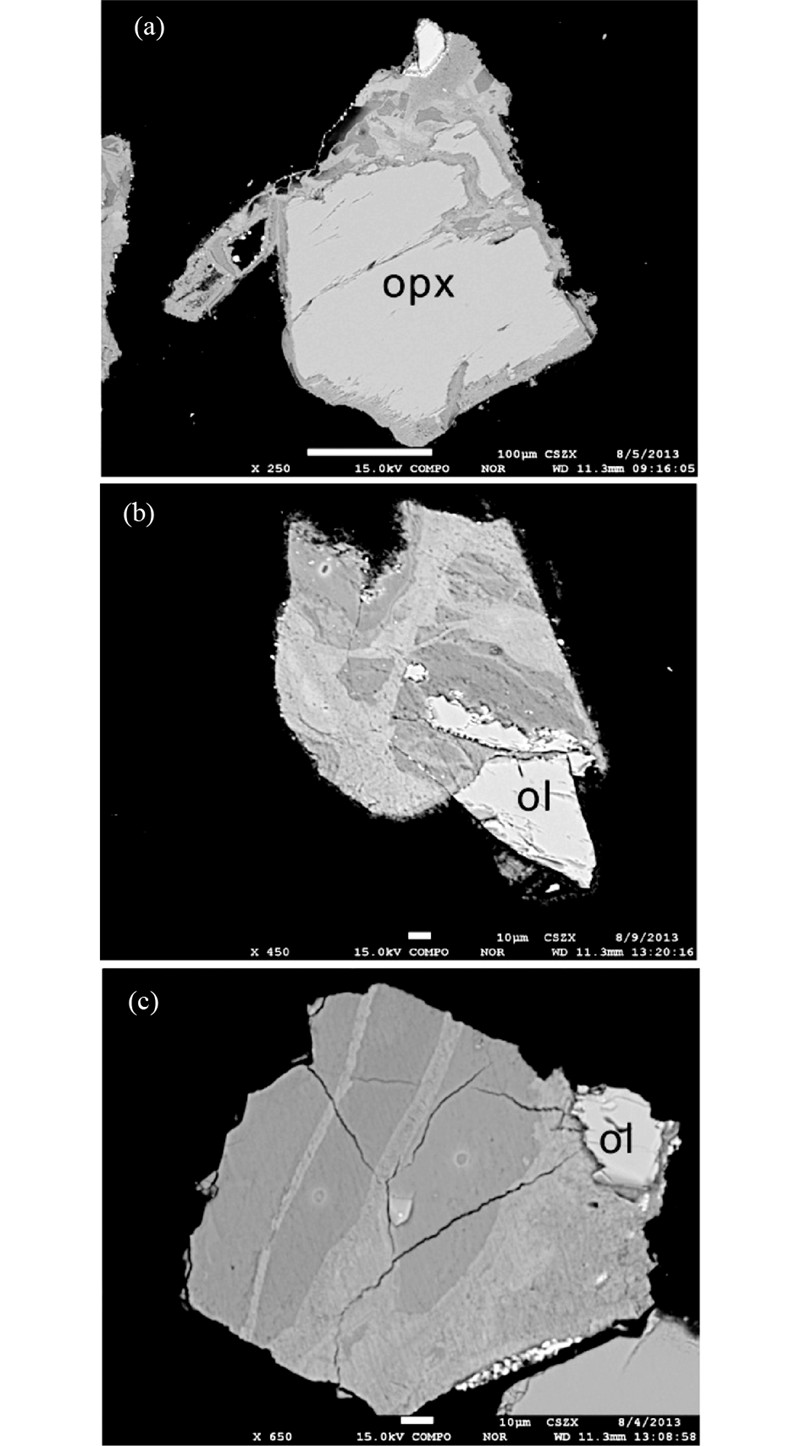 |
图 5 铁在蛇纹石中的不均匀分布 (a)FeL-25,200℃,斜方辉石蚀变形成蛇纹石,暗色部分的蛇纹石含~5% FeO,亮色部分的蛇纹石含~9% FeO;(b)FeL-27,80℃,橄榄石强烈蚀变形成蛇纹石,亮色部分的蛇纹石含9.1% FeO,暗色部分蛇纹石含~6% FeO;(c)FeL-32,80℃,橄榄石发生强烈蚀变,形成亮色和暗色的蛇纹石带 Fig. 5 The heterogeneity of iron in serpentine (a)FeL-25,200℃ and vapor saturated pressure. Orthopyroxene is altered to serpentine with dark(~5% FeO) and bright b and s(~9% FeO).(b)FeL-27,80℃ and vapor saturated pressure. Olivine is extensively altered forming serpentine with dark(~6% FeO) and bright domains(9.1% FeO).(c)FeL-32,80℃ and vapor saturated pressure. Dark and bright b and s form after extensive alteration of olivine |
橄榄石或辉石蚀变后形成的蛇纹石常有暗色和亮色部分(图 5)。暗色蛇纹石的铁含量通常比亮色蛇纹石低2%~4%,这表明蛇纹石形成时体系中铁的分布是不均匀的。有的样品中,亮色与暗色蛇纹石交替出现;而有些样品中,亮色蛇纹石呈波动状(图 5)。这可能是由于橄榄石蚀变形成的蛇纹石与周围其他矿物蚀变形成的蛇纹石竞争的结果。例如,一个橄榄石颗粒周围有橄榄石、斜方辉石和单斜辉石,当周围的橄榄石蚀变而辉石几乎不蚀变时,蛇纹石的铁主要来自于橄榄石,此时形成亮色蛇纹石,而当周围的辉石尤其是单斜辉石蚀变时,这个橄榄石蚀变后形成暗色蛇纹石。这主要是因为单斜辉石蚀变时会“吸收”周围其他矿物释放的铁。这也说明铁在蛇纹石化过程中是活动的。 3.3 初始流体和水岩比对蛇纹石化过程中铁活动性的影响
本研究表明,80~200℃、饱和蒸气压下,橄榄岩和不同的初始流体反应后(例如,0.5mol/L NaCl、0.5mol/L NaCl(pH=12)、0.5mol/L NaCl(pH=2)、纯水和NaCl+CaCl2),均没有生成铁氧化物。但是初始流体的成分会影响蛇纹石的成分,例如,初始流体为NaCl+CaCl2时,蛇纹石的钙含量为0.66%~0.91% CaO,远高于不含Ca的初始流体蚀变橄榄岩所产生的蛇纹石,0.04%~0.25% CaO。初始流体的酸碱性影响蛇纹石的铝含量,例如,当初始流体是0.5mol/L NaCl(pH=12)时,蛇纹石的铝含量较高,3.73±2.24% Al2O3;当初始流体是0.5mol/L NaCl(pH=2)时,蛇纹石的铝含量较低,2.1±1.8% Al2O3。另外,初始流体的酸碱性会影响铁的活动性,例如,当初始流体是0.5mol/L NaCl(pH=12)时,由橄榄石蚀变生成的蛇纹石的铁含量和由斜方辉石蚀变形成蛇纹石铁含量几乎一样,但对于其他类型的流体而言,由橄榄石蚀变生成的蛇纹石铁含量高于由斜方辉石蚀变形成蛇纹石的铁含量。这表明,碱性流体使得铁的活动性增强。尽管如此,初始流体的组成对蛇纹石化流体中铁的含量影响较小。本研究中反应过程中流体的铁含量和前人的一致(Janecky and Seyfried, 1986; Seyfried et al., 2007; Okamoto et al., 2011),而Janecky and Seyfried(1986)和Seyfried et al.(2007)以海水为初始流体,Okamoto et al.(2011)则采用纯水为初始流体,这表明初始流体的组成对反应过程中流体的铁含量影响较小。此外,本研究中反应流体的铁含量和Lost City热液区的一致。Lost City热液区以橄榄岩为基底岩石,其温度为40~75℃,流体中铁的含量低于检测限(Kelley et al., 2001)。这进一步表明本研究结果可以反映天然的蛇纹石化过程 。
80~200℃、饱和蒸气压下,相同的初始流体组成而水岩比为2.5~20.3时,均没有生成铁氧化物。并且,不同水岩比时生成蛇纹石的铁含量几乎一样。这表明,水岩比对蛇纹石化过程中铁的活动性影响较小。 4 结论
本研究通过一系列水热实验探讨橄榄岩蛇纹石化过程中铁的活动性。实验表明,80~200℃、饱和蒸气压下,蛇纹石化流体的铁含量极低,蚀变后没有产生铁氧化物,铁主要富集在蛇纹石中。铁和铝在蛇纹石化过程中活动性较弱,橄榄石和斜方辉石蚀变后形成蛇纹石的铁和铝含量和其原生矿物相似,橄榄石蚀变后产生的蛇纹石富铁而贫铝,斜方辉石蚀变后形成的蛇纹石贫铁而富铝。但是,单斜辉石蚀变形成蛇纹石的铁含量远高于单斜辉石,而其铝含量低于单斜辉石。这表明,铁和铝在蛇纹石化过程中是活动的,单斜辉石蚀变过程中“吸收”体系中的铁。铁和铝的活动性受初始流体酸碱性的影响,碱性的流体增强铁和铝的活动性,使得橄榄石和斜方辉石蚀变形成蛇纹石的铁和铝含量相当。但是,初始流体组成和水岩比对蛇纹石化过程中铁和铝的活动性影响较小 。
致谢 感谢中国冶金地质总局山东局测试中心林培军工程师和中国科学院广州地球化学研究所陈林丽工程师在电子探针测试中的帮助;本文修改过程中得到了彭少邦的帮助,在此表示诚挚的感谢。| [1] | Allen DE and Seyfried WE Jr. 2003. Compositional controls on vent fluids from ultramafic-hosted hydrothermal systems at mid-ocean ridges: An experimental study at 400℃, 500bars. Geochimica et Cosmochimica Acta, 67(8): 1531-1542 |
| [2] | Berndt ME, Allen DE and Seyfried WE. 1996. Reduction of CO2 during serpentinization of olivine at 300℃ and 500bar. Geology, 24(4): 351-354 |
| [3] | Chen DG, Li BX and Zhi XC. 1994. Genetic geochemistry of mantle-derived peridotite xenolith from Panshishan, Jiangsu. Geochimica, 23(1): 13-24 (in Chinese with English abstract) |
| [4] | Coleman RG and Keith TE. 1971. A chemical study of serpentinization-Burro Mountain, California. Journal of Petrology, 12(2): 311-328 |
| [5] | Costa IRD, Barriga FJAS, Viti C, Mellini M and Wicks FJ. 2008. Antigorite in deformed serpentinites from the Mid-Atlantic Ridge. European Journal of Mineralogy, 20: 563-572 |
| [6] | Douville E, Charlou JL, Oelkers EH, Bienvenu P, Jove Colon CF, Donval JP, Fouquet Y, Prieur D and Appriou P. 2002. The rainbow vent fluids (36°N14'N, MAR): The influence of ultramafic rocks and phase separation on trace metal content in Mid-Atlantic Ridge hydrothermal fluids. Chemical Geology, 184: 37-48 |
| [7] | Evans BW, Kuehner SM and Chopelas A. 2009. Magnetite-free, yellow lizardite serpentinization of olivine websterite, Canyon Mountain complex, N. E. Oregon. American Mineralogist, 94(11-12): 1731-1734 |
| [8] | Foustoukos DI, Savov IP and Janecky DR. 2008. Chemical and isotopic constraints on water/rock interactions at the Lost City hydrothermal field, 30 °N Mid-Atlantic Ridge. Geochimica et Cosmochimica Acta, 72(22): 5457-5474 |
| [9] | Frost BR. 1985. On the stability of sulfides, oxides, and native metals in serpentinite. Journal of Petrology, 26(1): 31-63 |
| [10] | Janecky DR and Seyfried WE Jr. 1986. Hydrothermal serpentinization of peridotite within the oceanic crust: Experimental investigations of mineralogy and major element chemistry. Geochimica et Cosmochimica Acta, 50(7): 1357-1378 |
| [11] | Kelley DS, Karson JA, Blackman DK, Früh-Green GL, Butterfield DA, Lilley MD, Olson EJ, Schrenk MO, Roe KK, Lebon GT, Rivizzigno P and the AT3-60 Shipboard Party. 2001. An off-axis hydrothermal vent fluid near the Mid-Atlantic Ridge at 30 °N. Nature, 412: 145-149 |
| [12] | Lafay R, Montes-Hernandez G, Janots E, Chiriac R, Findling N and Toche F. 2012. Mineral replacement rate of olivine by chrysotile and brucite under high alkaline conditions. Journal of Crystal Growth, 347(1): 62-72 |
| [13] | Lafay R, Montes-Hernandez G, Janots E, Chiriac R, Findling N and Toche F. 2014. Simultaneous precipitation of magnesite and lizardite from hydrothermal alteration of olivine under high-carbonate alkalinity. Chemical Geology, 368: 63-75 |
| [14] | Lazar C, McCollom TM and Manning CE. 2012. Abiogenic methanogenesis during experimental komatiite serpentinization: Implications for the evolution of the Early Precambrian atmosphere. Chemical Geology, 326-327: 102-112 |
| [15] | Li XH, Liu Y, Tu XL, Hu GQ and Zeng W. 2002. Precise determination of chemical compositions in silicate rocks using ICP AES and ICP MS: A comparative study of sample digestion techniques of alkali fusion and acid dissolution. Geochimica, 31(3): 289-294(in Chinese with English abstract) |
| [16] | Malvoisin B, Carlut J and Brunet F. 2012a. Serpentinization of oceanic peridotites: 1. A high-sensitivity method to monitor magnetite production in hydrothermal experiments. Journal of Geophysical Research: Solid Earth, 117(B1): B01104 |
| [17] | Malvoisin B, Brunet F, Carlut J, Rouméjon S and Cannat M. 2012b. Serpentinization of oceanic peridotites: 2. Kinetics and progresses of San Carlos olivine hydrothermal alteration. Journal of Geophysical Research: Solid Earth, 117(B4): B04102 |
| [18] | Marcaillou C, Muoz M, Vidal O, Parra T and Harfouche M. 2011. Mineralogical evidence for H2 degassing during serpentinization at 300℃/300bar. Earth and Planetary Science Letters, 303(3-4): 281-290 |
| [19] | Martin B and Fyfe WS. 1970. Some experimental and theoretical observations on the kinetics of hydration reactions with particular reference to serpentinization. Chemical Geology, 6: 185-202 |
| [20] | McCollom TM and Seewald JS. 2001. A reassessment of the potential for reduction of dissolved CO2 to hydrocarbons during serpentinization of olivine. Geochimica et Cosmochimica Acta, 65: 3769-3778 |
| [21] | McCollom TM and Bach W. 2009. Thermodynamic constraints on hydrogen generation during serpentinization of ultramafic rocks. Geochimica et Cosmochimica Acta, 73(3): 865-875 |
| [22] | Mével C. 2003. Serpentinization of abyssal peridotites at mid-ocean ridges. Comptes Rendus Geoscience, 335: 825-852 |
| [23] | Moody JB. 1976. An experimental study on the serpentinization of iron-bearing olivines. Canadian Mineralogist, 14: 462-478 |
| [24] | Okamoto A, Ogasawara Y, Ogawa Y and Tsuchiya N. 2011. Progress of hydration reactions in olivine-H2O and orthopyroxenite-H2O systems at 250℃ and vapor-saturated pressure. Chemical Geology, 289(3-4): 245-255 |
| [25] | Oufi O, Cannat M and Horen H. 2002. Magnetic properties of variably serpentinized abyssal peridotites. Journal of Geophysical Research: Solid Earth, 107(B5): EPM3-1-EPM3-19 |
| [26] | Schrenk MO, Brazelton WJ and Lang SQ. 2013. Serpentinization, carbon, and deep life. Review in Mineralogy and Geochemistry, 75(1): 575-606 |
| [27] | Seyfried WE Jr and Dibble WE Jr. 1980. Seawater-peridotite interaction at 300℃ and 500bars: Implications for the origin of oceanic serpentinites. Geochimica et Cosmochimica Acta, 44(2): 309-321 |
| [28] | Seyfried WE Jr, Foustoukos DI and Fu Q. 2007. Redox evolution and mass transfer during serpentinization: An experimental and theoretical study at 200℃, 500bar with implications for ultramafic-hosted hydrothermal systems at mid-ocean ridges. Geochimica et Cosmochimica Acta, 71(15): 3872-3886 |
| [29] | Sun WD, Peng ZC, Zhi XC, Chen DG, Wang ZR and Zhou XH. 1998. Osmium isotope determination on mantle-derived peridotite xenoliths from Panshishan with N-TIMS. Chinese Science Bulletin, 43(7): 573-575 |
| [30] | Szitkar F, Dyment J, Fouquet Y, Honsho C and Horen H. 2014. The magnetic signature of ultramafic-hosted hydrothermal sites. Geology, 42(8): 715-718 |
| [31] | Toft PB, Arkani-Hamed J and Haggerty SE. 1990. The effects of serpentinization on density and magnetic susceptibility: A petrophysical model. Physics of the Earth and Planetary Interiors, 65(1-2): 137-157 |
| [32] | Wang JA, Novaro O, Bokhimi X, López T, Gómez R, Navarrete J, Llanos ME and López-Salinas E. 1998. Characterizations of the thermal decomposition of brucite prepared by sol-gel technique for synthesis of nanocrystalline MgO. Materials Letters, 35(5-6): 317-323 |
| [33] | Wang YR, Fan WL and Yu YM. 1981. Geochemical mechanism of alkali metasomatism and the formation of iron deposits. Geochimica, (1): 95-102 (in Chinese with English abstract) |
| [34] | Xu XS, Griffin WL, O'Reilly SY, Pearson NJ, Geng HY and Zheng JP. 2008. Re-Os isotopes of sulfides in mantle xenoliths from eastern China: Progressive modification of lithospheric mantle. Lithos, 102(1-2): 43-64 |
| [35] | Yang XY, Sun YL, Sun WD and Xu XS. 2008. Platinum group elements in mantle derived peridotitic xenoliths from North Jiangsu Province. Geochimica, 37(3): 197-205 (in Chinese with English abstract) |
| [36] | Zhi XC, Peng ZC, Chen DG, Yu CJ, Sun WD and Reisberg L. 2001. The longevity of subcontinental lithospheric mantle beneath Jiangsu-Anhui region: The Os isotope model age of mantle derived peridotite xenoliths. Science in China (Series D), 44(12): 1110-1118 |
| [37] | 陈道公, 李彬贤, 支霞臣. 1994. 江苏盘石山幔源橄榄岩包体成因的地球化学. 地球化学, 23(1): 13-24 |
| [38] | 李献华, 刘颖, 涂湘林, 胡光黔, 曾文. 2002. 硅酸盐岩石化学组成的ICP-AES和ICP-MS准确测定: 酸溶与碱熔分解样品方法的对比. 地球化学, 31(3): 289-294 |
| [39] | 王玉荣,樊文苓,郁云妹. 1981. 碱交代与铁矿形成的地球化学机理探讨. 地球化学, (1): 95-102 |
| [40] | 杨雪英, 孙亚莉, 孙卫东, 徐夕生. 2008. 苏北盘石山、练山地幔捕虏体的PGE地球化学. 地球化学, 37(3): 197-205 |