 2015, Vol. 31


2. 中国科学院大学, 北京 100049;
3. 中国科学院广州地球化学研究所同位素地球化学国家重点实验室, 广州 510640;
4. 中国科学院青藏高原地球科学卓越创新中心, 北京 100101
2. University of Chinese Academy of Sciences, Beijing 100049, China;
3. State Key Laboratory of Isotope Geochemistry, Guangzhou Institute of Geochemistry, Chinese Academy of Sciences, Guangzhou 510640, China;
4. CAS Center for Excellence in Tibetan Plateau Earth Sciences, Beijing 100101, China
在地壳中,钛的元素丰度在金属元素中排行第七,在所有元素中排行第九,占地壳总质量的0.7%(Rudnick and Fountain, 1995)。钛的主要赋存矿物有金红石、榍石、钛铁矿和钛磁铁矿等及其同质异象体(Hanaor and Sorrell, 2011; 肖益林等,2011),其中金红石的分布最为广泛(肖益林等,2011)。由于金红石是深部地质过程中Ti、Nb、 Ta等高场强元素(HFSE)的主要载体,通常认为金红石在流体中的溶解限定了HFSE的活动和循环(Ayers and Watson, 1991,1993; Manning et al., 2008; Rapp et al., 2010; Huang et al., 2012; Ding et al., 2013),并决定了弧岩浆中HFSE的相对亏损(Ryerson and Watson, 1987; Ayers and Watson, 1991,1993; Brenan et al., 1994; Tropper and Manning, 2005; Gaetani et al., 2008)。
Ti通常被认为是最不活泼的元素之一,因而被广泛应用于岩石成因分类和构造判别中(Winchester and Floyd, 1977; Mullen,1983; Pearce and Peate, 1995)。大量的金红石溶解度实验也支持Ti的不活泼性质,比如,纯水中金红石的溶解度非常低(<100μg/mL)(Audétat and Keppler, 2005; Tropper and Manning, 2005; Antignano and Manning, 2008),即使在NaCl和/或硅酸盐存在的条件下金红石溶解度最大也不过5000μg/mL(Audétat and Keppler, 2005; Antignano and Manning, 2008; Manning et al., 2008; Hayden and Manning, 2011)。因此,通常认为金红石基本不溶于地幔或俯冲流体,金红石及Ti等HFSE会残留在源区,从而导致地幔或俯冲流体亏损HFSE,继而将这种亏损信息传递给弧岩浆(Brenan et al., 1994; Tropper and Manning, 2005; Zack and John, 2007; Gaetani et al., 2008)。然而,越来越多的地质证据显示Ti在一些情况下是活动的(Ayers and Watson, 1993; Rubin et al., 1993; Van Baalen,1993; Jiang,2000; Salvi et al., 2000; Jiang et al., 2003; Gao et al., 2007; Ding et al., 2009,2013; Huang et al., 2012; Li et al., 2014)。典型的例子是,比如在一些岩浆岩富F的流体包裹体中存在富La、Ce、Zr、Ti和Nb的子晶矿物(Salvi et al., 2000);而在自然界高压脉体中常见金红石颗粒且经常与富F矿物(如富氟磷灰石、萤石等)共生(Gao et al., 2007)。这些现象一方面说明无论在浅部热液体系还是深部超临界流体体系中Ti都能大量溶解进入流体,另一方面也暗示Ti可能与F形成了酸基络合物发生了迁移(Gao et al., 2007; Rapp et al., 2010; 肖益林等,2011)。溶解实验也证实,金红石在含F流体中的溶解度远远高于在其他水热体系中的溶解度(Barsukova et al., 1979; Bright and Readey, 1987; Rapp et al., 2010),其中Ti的溶出最高可达45739μg/mL(Rapp et al., 2010)。金红石较易溶解于富F流体的机理可能是Ti与流体中的F形成了易溶络合物(Barsukova et al., 1979; Ryzhenko et al., 2006; Lee et al., 2009; Rapp et al., 2010),大大促进了金红石的溶解。而伴随着金红石的溶解,金红石中富含的HFSE也随之进入流体。
然而,元素从溶解进入流体相,到稳定于流体中迁移,再到从流体中沉淀出来,是一个动态的、漫长的过程(Van Baalen,1993)。虽然富F流体能显著促进金红石的溶解并能形成易溶的氟钛络合物,但他们能否在迁移过程保持稳定并作长距离迁移?而且,在没有金红石存在的体系中,Ti又是适合在何种温压条件下稳定于富F流体中迁移?这些问题仍 缺乏相关的基础实验证据去回答。因此,本文运用实验合成的氟钛络合物K2TiF6开展了热液条件下的稳定性研究,首次获得了氟钛络合物在高温高压下的水解规律及水解反应常数,并据此对Ti在地质流体中的迁移情况进行了评估。 1 实验及分析方法 1.1 实验策略
在富水热液中,Ti4+会跟水中的OH-发生络合并以[TiO]2+、[TiO(OH)]+、[Ti(OH)3]+、[Ti(OH)4]0、[Ti(OH)5]-、[Ti(OH)6]2-等形式存在(Antignano and Manning, 2008; Hayden and Manning, 2011; Mysen,2012);而当水中存在F-时,F-将会取代部分OH-形成Ti的含氟羟基络合物,如[Ti(OH)4F]-、[Ti(OH)3F]0、[Ti(OH)2F2]0等(Ryzhenko et al., 2006),随着F浓度增大,F-完全取代OH-直至形成Ti的氟酸基络合物[TiF5]-、[TiF6]2-等(Lee et al., 2009; Banerjee,2011)。相关的络合反应见如下:


在一定条件下反应(1)~(6)中的多种络合物稳定共存。作为这些反应的逆过程,络合物的水解同样平衡存在,其中氟钛络合物水解的终极产物是沉淀物质(TiO2和/或TiO2·xH2O)(Banerjee,2011)。然而,本文并不关心在特定温度和压力下Ti主要以哪种氟钛络合物形式存在,主要原因在于这些络合物在稳定存在的pH和温压区间内对Ti的迁移效果是一致的,当一部分Ti以沉淀形式脱离出流体体系,与之相对应的络合物组分仍然存在于流体中。因此我们只关心这些氟钛络合物水解的程度(以沉淀量来体现),而这才是决定热液中Ti迁移量和迁移距离的关键因素。因此,本文在实验室中合成出了稳定的氟钛络合物K2TiF6。该络合物溶于水后,其中的[TiF6]2-会依照反应(6)的逆反应发生电离形成[TiF5]-,同时也会与H2O发生水解形成[Ti(OH)F5]2-;然后这两种络合离子再依照(1)~(5)的逆反应发生逐级电离和水解,从而在溶液中形成一系列氟钛络合物。在常温常压环境,K2TiF6溶液未见明显沉淀或絮状物,说明该条件下[TiF6]2-水解程度很低,还未或极少达到反应(1)的阶段,这为本文研究高温高压环境下氟钛络合物的水解规律奠定了基础。
1.2 实验流程 实验所用的K2TiF6粉晶在中国科学院广州地球化学研究所高温高压实验平台水热实验室自行制备。将分析纯度的TiO2粉末和KHF2按1 : 4.5的比例在铂金坩埚中充分混合,放置在加热板上以30℃/min的速率加热至350℃并保温熔融15min,反应可用方程(7)表示:

冷却后使用5%氢氟酸将混合物溶解,过滤重结晶后制得K2TiF6粉晶,洗涤干燥后经粉晶X射线衍射分析(XRD),获得的XRD图谱与参考K2TiF6图谱一致。所获得粉晶溶于水后形成的溶液的成分以K和Ti为主,其他阳离子微乎其微(表 1),说明合成的K2TiF6较为纯净。
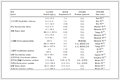 | 表 1 使用ICP-AES获得的初始溶液组分(μg/mL) Table 1 Initial solution composition analyzed by ICP-AES |
实验采用的高压装置为快速淬火高压釜(王玉荣和周义明,1986),把K2TiF6溶解到去离子水中制成不同浓度的K2TiF6水溶液,然后把溶液装进直径4mm金管中焊封,并把焊封好的金管置于110℃烘箱保温2h,之后称量无重量损失,说明金管焊封良好。再将装载溶液的金管放进快速淬火高压釜中密封后进行升温升压(Ar气为传压介质),保温反应16h。按照之前的实验结果显示,络合物的水解反应数小时已足够达到平衡(Wang and Chou, 1987)。反应结束之时,采取快速淬火处理,即使用毛巾把冰碎包裹在高压釜的冷封端,待冷封端冰凉后把高压釜抽出、倒置,此时轻敲高压釜尾部使反应金管在重力作用下从热端垂直掉入冷封端,反应金管因此在瞬间从反应温度区掉入低温区,并在1~3s内迅速降温至室温以下。然后迅速打开高压釜取出反应金管,采用一次性小型针管刺破金管提取溶液,置于离心机离心20min后提取上层清液待测。由于高价元素氧化物沉淀往往容易发生陈化作用,难于返溶(王玉荣等,1995; Knauss et al., 2001),同时在淬火过程中采用了快速淬火技术,因此离心后提取的上层清液能代表高温高压环境下反应达到平衡的流体成分。实验样品初始Ti浓度分别为240、480、960和1920μg/mL(表 1),反应温度依次为200、250、300、400、500℃,反应压力均为100MPa。 1.3 分析方法
本文对提取溶液中Ti浓度的分析在中国科学院广州地球化学研究所水热实验室完成。使用的分析设备是上海菁华7600-1CRT型双光束紫外可见光分光光度计(UV-Vis),波长范围为190~1100nm,准确度为0.3nm,重复度为0.1nm,光谱带宽1nm。显色剂采用二安替比林甲烷(DAPM),它会取代[TiF6]2-中的F-与Ti形成更稳定的络合物并使溶液呈特征黄绿色,且在385nm处出现最大吸收。通过标准曲线法进行定量测试就可准确获得溶液中的Ti浓度。测试过程中使用的标准Ti溶液浓度分别为0.1、0.2、0.4、0.6、0.8、1.0μg/mL,拟合的标准曲线的相关系数为0.99981。
另外对Ti浓度为240、480和960μg/mL的实验初始溶液及部分实验后提取的溶液在Vista Pro型全谱直读电感耦合等离子体原子发射光谱仪(ICP-AES)上进行了成分测试。该测试在中国科学院广州地球化学研究所同位素地球化学国家重点实验室完成。对于大部分元素检测限为μg/L,少部分元素检测限为μg/mL。相对标准偏差一般优于3%;对于超低浓度的相对标准偏差优于10%。测试结果显示两种方法获得的数据在误差范围内基本一致(图 1)。
 | 图 1 UV-Vis与ICP-AES方法对比 Fig. 1 Method contrasting between UV-Vis and ICP-AES |
高温高压环境下,K2TiF6发生逐级水解,可以用以下总的理想反应方程式表示:

反应结束后金管壁上出现大量白色沉淀(TiO2),说明K2TiF6水溶液在高温高压下强烈水解,实验结果见表 2。其中,初始Ti浓度为240、480μg/mL的K2TiF6水溶液在部分高温下水解程度过高,导致提取的溶液中Ti浓度太低,以致无法测准,故在下文数据讨论中不予考虑。
| 表 2 在100MPa和不同初始浓度、温度下K2TiF6水解实验的结果 Table 2 Hydrolysis Results of K2TiF6 for various initial concentration and temperature at 100MPa |
从表 2可以看出,相同浓度的K2TiF6水解程度随温度增加而增加。比如Ti初始浓度为960μg/mL的溶液,在温度为200℃时,其水解率为61.5%;250℃时,其水解率为78.5%;300℃时,其水解率为83.1%;400℃时,其水解率为96.8%;500℃时,其水解率为99.1%。Ti初始浓度为480μg/mL的溶液,温度从200℃变化到300℃时,水解率从90.0%上升到99.0%;而Ti初始浓度为1920μg/mL的溶液,温度从200℃变化到500℃时,水解率从27.1%上升到88.2%。这说明温度的增加能明显促进K2TiF6的水解(图 2),即K2TiF6在高温条件下稳定性降低,溶液中的Ti含量逐渐减少。
 | 图 2 在100MPa和不同初始浓度、温度下K2TiF6水解反应曲线 Fig. 2 Hydrolysis curve of K2TiF6 for various initial concentration and temperature at 100MPa |
从表 2也可以看出,K2TiF6的初始浓度对于其水解程度也有明显影响,即初始浓度低,其水解率大;而初始浓度高,则水解率相对就小。在相同温度下,这种趋势更为显著(图 2)。比如,同样在300℃下,Ti初始浓度为480μg/mL的溶液水解率达99.0%,Ti初始浓度为960μg/mL的溶液水解率为83.1%,而Ti初始浓度为1920μg/mL的溶液水解率则降为70.8%。 2.2 表观水解常数
对于一种络合物而言,其水解率会受温度、压力、初始浓度、溶液酸碱度和成分等多因素影响(Baes and Mesmer, 1976; 王玉荣和周义明,1986; Wang et al., 1993; 王玉荣等,1995; Kumar,1999),因而不利于用作评估络合物稳定的参数。而对于任一平衡反应而言,其平衡常数通常只受温度和压力两个因素的影响,络合物水解反应的水解常数同样如此(Baes and Mesmer, 1976,1981; 王玉荣和周义明,1986)。因此,水解常数是可用来表征络合物稳定性的理想参数。由于水解反应中各物质浓度都比较低且缺乏高温下的活度系数数据,因此本文将使用物质浓度代替物质活度。根据反应方程式(8)可知水解反应平衡常数表达式为:

根据TiO2的沉淀量和K2TiF6的初始浓度可计算出反应平衡时TiF62-、HF和KF的浓度,从而根据(9)计算出该反应的平衡常数,计算结果见表 2。由于反应(8)是K2TiF6电离和水解后形成的多种氟钛络合物水解的综合反应式,因此这里计算出的平衡常数称之为表观水解常数。
反应(8)的表观水解常数K只受温度和压力控制,其中温度起到了决定性的作用(Baes and Mesmer, 1981)。之前对K2SnF6、K2NbOF5、K2TaF7的水解实验研究已经发现,压力对这些络合物水解常数的影响微乎其微(Wang and Zhou, 1987; Wang et al., 1993)。因此,温度对表观水解常数K的影响可用Van’t Hoff方程(10)表示:

其中ΔrHΘm 为各物质均处于标准状态下反应进度为1mol时的焓变值,在这里近似认为其独立于温度为一常数。将(10)进行积分可得:

其中C为积分常数项,R为理想气体常数约为8.314J/(mol·K)。另外由于吉布斯自由能表达式为:

整理得:

即积分常数项 ,所以ΔrSΘ也近似认为是独立于温度的常数。从(13)可看出-lnK与1/T呈线性关系,使用该方程对本文实验结果进行拟合结果可获得以下关系式:

其中ΔrHΘm/R=8972±788,ΔrHΘm=74.59±6.55kJ/mol,C=-4.16428±1.40362,ΔrSΘ=34.62±11.67J/(mol·K),拟合系数R2=0.9147,拟合结果如图 3所示。
 | 图 3 K2TiF6表观水解常数与温度之间的拟合关系 Fig. 3 Fitting curve between K2TiF6 apparent hydrolysis constant and temperature |
本文中实验设置的温度为200℃到500℃,跨越水的超临界点(温度大于374℃,压力大于22.1MPa),而从图 3中各数据点始终呈线性相关可以看出,在水的超临界前后K2TiF6的水解规律并无明显变化,所以有理由相信在没有发生相变的更高温度区间内K2TiF6的水解依然遵循低温规律。因此,将拟合方程(14)在高温区间进行外推可得到更高温度下的K2TiF6表观水解常数。 3 讨论 3.1 Ti的迁移量
之前的高温高压实验获得了不少金红石溶解度数据(Antignano and Manning, 2008; Audétat and Keppler, 2005; Rapp et al., 2010; Tropper and Manning, 2005),然而金红石的溶解量并不能简单代表Ti的迁移量。金红石的溶解只说明有多少的Ti进入了附近平衡的区域流体中;而流体中Ti的迁移量及迁移尺度需由Ti迁移形式的稳定性决定(Baes and Mesmer, 1976; Van Baalen,1993)。如图 4所示,由于Ti的富F络合物在形成及迁移过程中会发生水解,当金红石的溶解度少于1000μg/mL时,有效迁移的Ti浓度将小于1μg/mL,流体中大部分的Ti重新发生原位或半原位沉淀,这时可迁移Ti的量微乎其微。而当金红石溶解度大于1000μg/mL时,有效迁移的Ti浓度大于1μg/mL,而且随着金红石溶解度的增加,Ti的有效迁移百分比也逐渐增大。900℃温度下,当金红石溶解度为2400μg/mL时,有效迁移百分比为1%,Ti的最大迁移量可达24μg/mL;当溶解度为3500μg/mL时有效迁移百分比上升至5%,Ti的最大迁移量可达175μg/mL;而当溶解度达到4800μg/mL时有效迁移百分比达13.8%,Ti的最大迁移量可达662μg/mL。而对于目前在富F流体(45240μg/mL)中获得的金红石最大的溶解度而言(Rapp et al. 2010),如在778℃,溶解度为11912μg/mL,有效迁移比为55.9%,Ti的最大迁移量为6659μg/mL;在1005℃,溶解度最高可达45739μg/mL,其有效迁移百分比为80.4%,Ti的最大迁移量则可以达到36774μg/mL(图 5)。不过,对于自然界流体而言,温度超过900℃的情况并不常见,因此,如果流体中的Ti起源于金红石的溶解,比如俯冲流体,就目前实验获得的信息而言,Ti的最大迁移量可能不超过6700μg/mL。
 | 图 4 金红石溶解度和流体中可迁移的Ti的关系图 图中黑色直线代表有效迁移Ti浓度为1μg/mL,直线之上的点有效迁移浓度大于1μg/mL,直线之下的点有效迁移量小于1μg/mL;图中灰色直线代表有效迁移百分率为1%,直线之上的点有效迁移百分率大于1%,直线之下的点有效迁移百分率小于1%。为了评估流体中Ti的最大迁移情况,这里假设所有自金红石溶解的Ti全转化为氟钛络合物,再由该温度下的表观水解常数确定流体中可迁移的Ti.金红石溶解度数据引自Audétat and Keppler(2005),Antignano and Manning(2008),Manning et al.(2008),Rapp et al.(2010),Hayden and Manning(2011) Fig. 4 Quantitative relationship between rutile solubility and migrant Ti in fluids Black straight line st and s for 1μg/mL migrant titanium,where spots beyond it are more than 1μg/mL and ones below it are less than 1μg/mL. Gray straight line st and s for 1% migrant titanium percentage. In order to evaluate the most Ti concentration in fluid,all soluble Ti from rutile converted to Ti-F complexes has been assumed. Migrant Ti in fluid,then,was calculated by apparent hydrolysis constants. Data of soluble Ti from rutile are from Audétat and Keppler(2005),Antignano and Manning(2008),Manning et al.(2008),Rapp et al.(2010), and Hayden and Manning(2011) |
 | 图 5 不同温度和流体体系下Ti的迁移量 H2O体系数据引自Audétat and Keppler(2005),Antignano and Manning(2008) and Rapp et al.(2010);H2O-Silicate数据引自Audetat and Keppler(2005),Antignano and Manning(2008),Manning et al.(2008) and Hayden and Manning(2011);H2O-NaCl数据引自Audetat and Keppler(2005) and Rapp et al.(2010);H2O-NaF体系数据引自Rapp et al.(2010) Fig. 5 Migrant Ti under different temperatures and fluid systems H2O data are from Audétat and Keppler(2005),Antignano and Manning(2008) and Rapp et al.(2010); H2O-Silicate data are from Audetat and Keppler(2005),Antignano and Manning(2008),Manning et al.(2008) and Hayden and Manning(2011); H2O-NaCl data are from Audetat and Keppler(2005) and Rapp et al.(2010); H2O-NaF data are from Rapp et al.(2010) |
另外,图 4中数据点呈近似线性的现象说明Ti的最终可迁移浓度与源区金红石溶解度呈密切正相关关系。相同金红石溶解度在不同温度下的Ti迁移浓度最多可达2个数量级,而不同金红石溶解度下Ti迁移浓度相差高达16个数量级,因此影响Ti迁移量的主要因素为源区金红石溶解度而非迁移流体的温度。然而源区金红石溶解度的大小主要取决于源区温度高低,因此溶解源区温度对Ti迁移能力的影响比迁移流体的温度的影响更大。 3.2 F的来源及富集
由于硫酸盐、碳酸盐和氯化物对于Ti的活化和迁移有很少的作用(Van Baalen,1993; Rapp et al., 2010),且自然界大多数流体,如成矿流体、岩浆期后热液、地幔流体和俯冲流体多以含Cl、C或S溶剂为主(Philippot,1996; Manning,2004; Sun et al., 2004,2013; Jiang et al., 2005; Zhao et al., 2013; Deng et al., 2013; Wang et al., 2014; Yardley and Bodnar, 2014),这可以解释为什么在大多情况下Ti显示不活泼。
然而,自然观察和高温高压实验均指出F能最大程度活化并迁移Ti(Jiang et al., 2003; Jiang et al., 2005; Rubin et al., 1993; Salvi et al., 2000; Van Baalen,1993)。按照氟钛络合物最高配位离子团[TiF6]2-来说,Ti和F存在1 : 6的摩尔浓度关系,换算成质量浓度即F/Ti≈2.4。若流体中F/Ti浓度比低于2.4,说明氟钛络合物将主要不会以最高配位形式存在,Ti的迁移并不能达到最大化;若流体中F/Ti浓度比高于2.4,则氟钛络合物将主要以最高配位形式存在,且流体中过量的F将抑制反应(8)向正方向进行,能够将水解最小化,从而最大化Ti的迁移。按照Ti的最大迁移量6700μg/mL来计算的话,那么所需的最小F含量约为16000μg/mL。而对于自然界中含有金红石的高压脉体而言,已有的数据显示通常含0.20%~0.25% TiO2(Zhang et al., 2008),这暗示形成这些脉体的流体中至少含有1200μg/mL可迁移的Ti,相应所需的最小F含量约为2800μg/mL。
低浓度(≤1%)的F主要溶于硅酸盐熔体(Dfluid/melt<0.4),而不相容于流体相和大多矿物相(London et al., 1988; Dolejö and Baker,2007);高浓度(≥7%)的F则优先进入流体相(Dfluid/melt>1)(Webster,1990; Carroll and Webster, 1994)。在岩浆-热液体系中,F主要逐步富集在熔体里,这又能降低熔体的固溶线,使得熔体缓慢结晶(Manning,1981)。当熔体演化到高演化阶段,熔体中的F浓度才增加至足够高,此时F转向于在流体中富集,从而为岩浆热液提供了大量的F。Thomas et al.(2005)通过对高演化岩石中的熔体和流体包裹体研究发现,熔体中的F含量最高可达6.4%,而流体中的F也可以达到2.0%左右。这说明岩浆演化到高演化程度时,热液中的F浓度可以富集到完全满足HFSE的活化、迁移的需求。而大量伟晶岩和成矿的高演化花岗岩中富集HFSE也证实了这一点(Dostal and Chatterjee, 2000; Hanson et al., 1998; 李洁和黄小龙,2013)。
然而,对于俯冲带而言,通常情况下俯冲流体中的F很难达到富集。因为F-与OH-有相同的离子半径,在浅部的俯冲板片中的F通常进入角闪石、云母和磷灰石等含水矿物的OH配位保存(Aoki et al., 1981)。Straub and Layne(2003)通过研究玄武质-流纹质岛弧火山玻璃及包裹体里的挥发组分,发现这些火山熔体里的F含量主要在70~400μg/mL范围内,由此推算弧前深度的俯冲流体含F量不超过1000μg/mL。这暗示角闪石、黑云母等富F矿物的脱水并不能给俯冲流体提供多少F(Schmidt and Poli, 1998),F更多倾向于富集进入多硅白云母而被俯冲至更深部。这也进一步暗示,在多硅白云母脱水分解之前,俯冲板片内的HFSE的活动是受限制的。而多硅白云母的分解存在两种方式:一是多硅白云母俯冲至约300km深度(~10GPa)发生脱水分解(Schmidt and Poli, 1998);或者俯冲板片温度升温至620℃以上使得多硅白云母发生热解(Franz et al., 1986; Hermann,2002; Li et al., 2012)。随着多硅白云母的分解,大量的F进入流体/超临界流体,富F的流体/超临界流体一方面将有力地促进金红石的溶解,另一方面形成F的酸基络合物对HFSE进行显著地迁移。 4 结论
本文对不同浓度的氟钛络合物(K2TiF6)在100MPa压力和200~500℃温度下的稳定性进行了研究,得到以下主要结论:
(1)K2TiF6在热液条件下发生显著水解,且趋势为反应温度越高、初始浓度越低,其水解程度越剧烈;
(2)首次获得了高温高压条件下K2TiF6的表观水解常数,其与温度的拟合关系式为:-lnK=(8972±788)/T-(4.16428±1.40362),其中获得的热力学参数为:ΔrHΘ=74.59±6.55kJ/mol,ΔrSΘ=34.62±11.67J/(mol·K)。
(3)地质深部过程中金红石的溶解度并不能简单代表流体中Ti的迁移,因为部分溶解的Ti在络合物形成及迁移过程中会发生水解而沉淀下来。运用实验获得的氟钛络合物表观水解常数计算了金红石溶解度和流体中Ti的最大迁移量之间的关系。结果显示,当金红石的溶解度大于1000μg/mL时,有效迁移的Ti浓度大于1μg/mL,而且金红石溶解度的增加,Ti的有效迁移百分比也逐渐增大。俯冲流体中Ti的迁移量之前被高估,其最大迁移量可能不超过6700μg/mL。
(4)F能最大程度活化并迁移Ti等HFSE。对于岩浆-热液体系而言,F通过在岩浆中预富集,然后再大量分配进入晚阶段流体中而形成富F流体;对于俯冲带而言,富F流体/超临界流体是由于多硅白云母的脱水或热解而形成。
致谢 感谢中国科学院广州地球化学研究所所同位素地球化学国家重点实验室刘颖高工在ICP-AES分析过程中给予的帮助。| [1] | Antignano A and Manning CE. 2008. Rutile solubility in H2O, H2O-SiO2, and H2O-NaAlSi3O8 fluids at 0.7-2.0GPa and 700-1000 degrees C: Implications for mobility of nominally insoluble elements. Chemical Geology, 255(1-2): 283-293 |
| [2] | Aoki K, Ishiwaka K and Kanisawa S. 1981. Fluorine geochemistry of basaltic rocks from continental and oceanic regions and petrogenetic application. Contributions to Mineralogy and Petrology, 76(1): 53-59 |
| [3] | Audétat A and Keppler H. 2005. Solubility of rutile in subduction zone fluids, as determined by experiments in the hydrothermal diamond anvil cell. Earth and Planetary Science Letters, 232(3-4): 393-402 |
| [4] | Ayers JC and Watson EB. 1991. Solubility of apatite, monazite, zircon, and rutile in supercritical aqueous fluids with implications for subduction zone geochemistry. Philosophical Transactions of the Royal Society A, Mathematical Physical and Engineering Sciences, 335: 365-375 |
| [5] | Ayers JC and Watson EB. 1993. Rutile solubility and mobility in supercritical aqueous fluids. Contributions to Mineralogy and Petrology, 114(3): 321-330 |
| [6] | Baes CF and Mesmer RE. 1976. The Hydrolysis of Cations. New York: Wiley |
| [7] | Baea CF and Mesmer RE. 1981. The thermodynamics of cation hydrolysis. American Journal of Science, 281(7): 935-962 |
| [8] | Banerjee AN. 2011. The design, fabrication, and photocatalytic utility of nanostructured semiconductors: Focus on TiO2-based nanostructures. Nanotechnology, Science and Applications, 4: 35-65 |
| [9] | Barsukova ML, Kuznetsov VA, Dorofeeva VA and Khodokovsky IL. 1979. Experimental: Study of solubility of rutile-TiO2 in fluoride solutions under high-temperature. Geokhimiya, (7): 1017-1027 |
| [10] | Brenan JM, Shaw HF, Phinney DL and Ryerson FJ. 1994. Rutile-aqueous fluid partitioning of Nb, Ta, Hf, Zr, U and Th: Implications for high-field strength element depletions in island-arc basalts. Earth and Planetary Science Letters, 128(3-4): 327-339 |
| [11] | Bright E and Readey DW. 1987. Dissolution kinetics of TiO2 in HF-HCl solutions. Journal of the American Ceramic Society, 70(12): 900-906 |
| [12] | Carroll MR and Webster JD. 1994. Solubilities of sulfur, noble-gases, nitrogen, chlorine, and fluorine in magmas. Reviews in Mineralogy and Geochemistry, 30(1): 231-279 |
| [13] | Deng BP, Liu XF, Zhang M, Lu QX, Zhao FF, Li CH, Chu YT, Xu YY, Tian XM and Li H. 2013. The petrographical and isotope geochemical tracers for deep ore-forming fluids from the Laowangzhai gold depoist in the northern part of the Ailao Mountains. Chinese Journal of Geochemistry, 32(3): 281-294 |
| [14] | Ding X, Lundstrom C, Huang F, Li J, Zhang ZM, Sun XM, Liang JL and Sun WD. 2009. Nature and experimental constraints on formation of the continental crust based on niobium-tantalum fractionation. International Geology Review, 51(6): 473-501 |
| [15] | Ding X, Hu YH, Zhang H, Li CY, Ling MX and Sun WD. 2013. Major Nb/Ta fractionation recorded in garnet amphibolite facies metagabbro. Journal of Geology, 121(3): 255-274 |
| [16] | Dolejö D and Baker DR. 2007. Liquidus equilibria in the system K2O-Na2O-Al2O3-SiO2-F2O-1-H2O to 100MPa: II. Differentiation paths of fluorosilicic magmas in hydrous systems. Journal of Petrology, 48(4): 807-828 |
| [17] | Dostal J and Chatterjee AK. 2000. Contrasting behaviour of Nb/Ta and Zr/Hf ratios in a peraluminous granitic pluton (Nova Scotia, Canada). Chemical Geology, 163(1-4): 207-218 |
| [18] | Franz G, Thomas S and Smith DC. 1986. High-pressure phengite decomposition in the Weissenstein eclogite, Munchberger Gneiss Massif, Germany. Contributions to Mineralogy and Petrology, 92(1): 71-85 |
| [19] | Gaetani GA, Asimov PD and Stolper EM. 2008. A model for rutile saturation in silicate melts with applications to eclogite partial melting in subduction zones and mantle plumes. Earth and Planetary Science Letters, 272(3-4): 720-729 |
| [20] | Gao J, John T, Klemd R and Xiong XM. 2007. Mobilization of Ti-Nb-Ta during subduction: Evidence from rutile-bearing dehydration segregations and veins hosted in eclogite, Tianshan, NW China. Geochimica et Cosmochimica Acta, 71(20): 4974-4996 |
| [21] | Hanaor DAH and Sorrell CC. 2011. Review of the anatase to rutile phase transformation. J. Mater. Sci., 46(4): 855-874 |
| [22] | Hanson SL, Simmons WB and Falster AU. 1998. Nb-Ta-Ti oxides in granitic pegmatites from the Topsham pegmatite district, Southern Maine. The Canadian Mineralogist, 36(2): 601-608 |
| [23] | Hayden LA and Manning CE. 2011. Rutile solubility in supercritical NaAlSi3O8-H2O fluids. Chemical Geology, 284(1-2): 74-81 |
| [24] | Hermann J. 2002. Experimental constraints on phase relations in subducted continental crust. Contributions to Mineralogy and Petrology, 143(2): 219-235 |
| [25] | Huang J, Xiao Y, Gao Y, Hou Z and Wu W. 2012. Nb-Ta fractionation induced by fluid-rock interaction in subduction-zones: Constraints from UHP eclogite- and vein-hosted rutile from the Dabie orogen, Central-Eastern China. Journal of Metamorphic Geology, 30(8): 821-842 |
| [26] | Jiang N, Sun SH, Chu XL, Mizuta T and Ishiyama D. 2003. Mobilization and enrichment of high-field strength elements during late- and post-magmatic processes in the Shuiquangou syenitic complex, northern China. Chemical Geology, 200(1-2): 117-128 |
| [27] | Jiang SY. 2000. Controls on the mobility of high field strength elements (HFSE), U, and Th in an ancient submarine hydrothermal system of the Proterozoic Sullivan Pb-Zn-Ag deposit, British Columbia, Canada. Geochemical Journal, 34(5): 341-348 |
| [28] | Jiang SY, Wang RC, Xu XS and Zhao KD. 2005. Mobility of high field strength elements (HFSE) in magmatic-, metamorphic-, and submarine-hydrothermal systems. Physics and Chemistry of the Earth, 30(17-18): 1020-1029 |
| [29] | Knauss KG, Dibley MJ, Bourcier WL and Shaw HF. 2001. Ti(IV) hydrolysis constants derived from rutile solubility measurements made from 100 to 300℃. Applied Geochemistry, 16(9-10): 1115-1128 |
| [30] | Kumar MD. 1999. The effect of pressure and temperature on aluminium hydrolysis: Implications to trace metal scavenging in natural waters. Indian Journal of Marine Sciences, 28(1): 1-4 |
| [31] | Lee BG, Choi JW, Lee SE, Jeong YS, Oh HJ and Chi CS. 2009. Formation behavior of anodic TiO2 nanotubes in fluoride containing electrolytes. Transactions of Nonferrous Metals Society of China, 19(4): 842-845 |
| [32] | Li CY, Zhang H, Wang FY, Liu JQ, Sun YL, Hao XL, Li YL and Sun WD. 2012. The formation of the Dabaoshan porphyry molybdenum deposit induced by slab rollback. Lithos, 150: 101-110 |
| [33] | Li J and Huang XL. 2013. Mechanism of Ta-Nb enrichment and magmatic evolution in the Yashan granites, Jiangxi Province, South China. Acta Petrologica Sinica, 29(12): 4311-4322 (in Chinese with English abstract) |
| [34] | Li JW, Zhang GL and Gong ZT. 2014. Mobilization and redistribution of elements in soils developed from extreme weathering basalt on Hainan Island. Chinese Journal of Geochemistry, 33(3): 262-271 |
| [35] | London D, Hervig RL and Morgan GB. 1988. Melt-vapor solubilities and elemental partitioning in peraluminous granite-pegmatite systems: Experimental results with macusani glass at 200Mpa. Contributions to Mineralogy and Petrology, 99(3): 360-373 |
| [36] | Manning CE. 2004. The chemistry of subduction-zone fluids. Earth and Planetary Science Letters, 223(1): 1-16 |
| [37] | Manning CE, Wilke M, Schmidt C and Cauzid J. 2008. Rutile solubility in albite-H2O and Na2Si3O7-H2O at high temperatures and pressures by in-situ synchrotron radiation micro-XRF. Earth and Planetary Science Letters, 272(3-4): 730-737 |
| [38] | Manning DAC. 1981. The effect of fluorine on liquidus phase: Relationships in the system Qz-Ab-Or with excess water at 1kb. Contributions to Mineralogy and Petrology, 76(2): 206-215 |
| [39] | Mullen ED. 1983. MnO/TiO2/P2O5: A minor element discriminant for basaltic rocks of oceanic environments and its implications for petrogenesis. Earth and Planetary Science Letters, 62(1): 53-62 |
| [40] | Mysen B. 2012. High-pressure and high-temperature titanium solution mechanisms in silicate-saturated aqueous fluids and hydrous silicate melts. American Mineralogist, 97(7): 1241-1251 |
| [41] | Pearce JA and Peate DW. 1995. Tectonic implications of the composition of volcanic arc magmas. Annual Review of Earth and Planetary Sciences, 23(1): 251-285 |
| [42] | Philippot P. 1996. The chemistry of high-pressure fluids (1 to 3 GPa): Natural observations vs. experimental constraints. Earth Science Frontiers, 3(3-4): 39-52 |
| [43] | Rapp JF, Klemme S, Butler IB and Harley SL. 2010. Extremely high solubility of rutile in chloride and fluoride-bearing metamorphic fluids: An experimental investigation. Geology, 38(4): 323-326 |
| [44] | Rubin JN, Henry CD and Price JG. 1993. The mobility of zirconium and other "immobile" elements during hydrothermal alteration. Chemical Geology, 110(1-3): 29-47 |
| [45] | Rudnick RL and Fountain DM. 1995. Nature and composition of the continental-crust: A lower crustal perspective. Reviews of Geophysics, 33(3): 267-309 |
| [46] | Ryerson FJ and Watson EB. 1987. Rutile saturation in magmas: Implications for Ti-Nb-Ta depletion in island-arc basalts. Earth and Planetary Science Letters, 86(2-4): 225-239 |
| [47] | Ryzhenko BN, Kovalenko NI and Prisyagina NI. 2006. Titanium complexation in hydrothermal systems. Geochemistry International, 44(9): 879-895 |
| [48] | Salvi S, Fontan F, Monchoux P, Williams-Jones AE and Moine B. 2000. Hydrothermal mobilization of high field strength elements in alkaline igneous systems: Evidence from the Tamazeght Complex (Morocco). Economic Geology and the Bulletin of the Society of Economic Geologists, 95(3): 559-576 |
| [49] | Schmidt MW and Poli S. 1998. Experimentally based water budgets for dehydrating slabs and consequences for arc magma generation. Earth and Planetary Science Letters, 163(1-4): 361-379 |
| [50] | Straub SM and Layne GD. 2003. The systematics of chlorine, fluorine, and water in Izu arc front volcanic rocks: Implications for volatile recycling in subduction zones. Geochimica et Cosmochimica Acta, 67(21): 4179-4203 |
| [51] | Sun WD, Arculus RJ, Kamenetsky VS and Binns RA. 2004. Release of gold-bearing fluids in convergent margin magmas prompted by magnetite crystallization. Nature, 431(7011): 975-978 |
| [52] | Sun WD, Liang HY, Ling MX, Zhan MZ, Ding X, Zhang H, Yang XY, Li YL, Ireland TR, Wei QR and Fan WM. 2013. The link between reduced porphyry copper deposits and oxidized magmas. Geochimica et Cosmochimica Acta, 103: 263-275 |
| [53] | Thomas R, Forster HJ, Rickers K and Webster JD. 2005. Formation of extremely F-rich hydrous melt fractions and hydrothermal fluids during differentiation of highly evolved tin-granite magmas: A melt/fluid-inclusion study. Contributions to Mineralogy and Petrology, 148(5): 582-601 |
| [54] | Tropper P and Manning CE. 2005. Very low solubility of rutile in H2O at high pressure and temperature, and its implications for Ti mobility in subduction zones. American Mineralogist, 90(2-3): 502-505 |
| [55] | Van Baalen MR. 1993. Titanium mobility in metamorphic systems: A review. Chemical Geology, 110(1-3): 233-249 |
| [56] | Wang MF, Zheng YY, Xu RK, Liu YG, Xiao F, Cheng SW and Sun XM. 2014. Fluid inclusion, siliceous rock geochemistry of Shewushan lateritic gold deposit, Hubei Province, eastern China: Implication for the genesis of primary orebody. Chinese Journal of Geochemistry, 33(1): 65-76 |
| [57] | Wang YR and Zhou YM. 1986. Characteristics of hydrolysis of the complex Na2SnF6 in hydrothermal solutions: An experimental study. Geochimica, (3): 281-285 (in Chinese with English abstract) |
| [58] | Wang YR and Chou IM. 1987. Characteristics of hydrolysis of the complex Na2SnF6 in hydrothermal solutions: An experimental study. Chinese Journal of Geochemistry, 6(4): 372-381 |
| [59] | Wang YR, Gu F and Yuan ZQ. 1993. Partitioning and hydrolysis of Nb and Ta and their implications with regard to mineralization. Chinese Journal of Geochemistry, 12(1): 84-91 |
| [60] | Wang YR, Chen WH and Zhang HX. 1995. Experimental study of irreversible hydrolysis reactions of Sn-, Nb- and Ta-fluorine complex at high temperature and high pressure. Geochimica, 24(Suppl.1): 183-190 (in Chinese with English abstract) |
| [61] | Webster JD. 1990. Partitioning of F between H2O and CO2 fluids and topaz rhyolite melt. Contributions to Mineralogy and Petrology, 104(4): 424-438 |
| [62] | Winchester JA and Floyd PA. 1977. Geochemical discrimination of different magma series and their differentiation products using immobile elements. Chemical Geology, 20: 325-343 |
| [63] | Xiao YL, Huang J, Liu L and Li DY. 2011. Rutile: An important "reservoir" for geochemical information. Acta Petrologica Sinica, 29(2): 398-416 (in Chinese with English abstract) |
| [64] | Yardley BWD and Bodnar RJ. 2014. Fluids in the continental crust. Geochemical Perspectives, 3(1): 1-127 |
| [65] | Zack T and John T. 2007. An evaluation of reactive fluid flow and trace element mobility in subducting slabs. Chemical Geology, 239(3-4): 199-216 |
| [66] | Zhang ZM, Shen K, Sun WD, Liu YS, Liou JG, Shi C and Wang JL. 2008. Fluids in deeply subducted continental crust: Petrology, mineral chemistry and fluid inclusion of UHP metamorphic veins from the Sulu orogen, eastern China. Geochimica et Cosmochimica Acta, 72(13): 3200-3228 |
| [67] | Zhao C, Ni P, Wang GG, Ding JY, Chen H, Zhao KD, Cai YT and Xu YF. 2013. Geology, fluid inclusion, and isotope constraints on ore genesis of the Neoproterozoic Jinshan orogenic gold deposit, South China. Geofluids, 13(4): 506-527 |
| [68] | 李洁, 黄小龙. 2013. 江西雅山花岗岩岩浆演化及其Ta-Nb富集机制. 岩石学报, 29(12): 4311-4322 |
| [69] | 王玉荣, 周义明. 1986. Na2SnF6在水热溶液中水解特征的实验研究. 地球化学, (3): 281-285 |
| [70] | 王玉荣, 陈文华, 张海祥. 1995. Sn、Nb、Ta氟配合物高温水解不可逆反应实验研究. 地球化学, 24(S1): 183-190 |
| [71] | 肖益林, 黄建, 刘磊, 李东永. 2011. 金红石: 重要的地球化学"信息库". 岩石学报, 27(2): 398-416 |