 2015, Vol. 31


2. 中国科学院矿产资源研究重点实验室, 中国科学院地质与地球物理研究所, 北京 100029;
3. 中国科学院大学, 北京 100049;
4. 新疆维吾尔自治区地质矿产勘查局, 乌鲁木齐 830000
2. Key Laboratory of Mineral Resources, Institute of Geology and Geophysics, Chinese Academy of Sciences, Beijing 100029, China;
3. University of Chinese Academy of Sciences, Beijing 100049, China;
4. Xinjiang Bureau of Geology and Mineral Resources, Uramuqi 830000, China
斑岩型Cu矿床指大规模、低品位、与地壳浅部具斑状结构中酸性侵入体有关的岩浆热液型矿床(Lowell and Guilbert, 1970),其以发育浸染状、网脉状、细脉状和角砾岩矿化为主要特征(Seedorff et al., 2005)。斑岩型Cu矿为世界提供了75%以上的金属Cu资源,同时满足了90%的Mo和20%的Au需求,以及大部分的Re和少量的其它金属(如Ag、Pd、Te、Se、Bi、Zn和Pb; 王之田等,1994; Sillitoe,2010)。
自Schwartz(1947)首次使用“斑岩型Cu矿(porphyry copper deposit)”术语、Lowell and Guilbert(1970)对斑岩型Cu矿进行定义以来,经历了近一个世纪,地质学家对斑岩型Cu矿的特征与形成机制开展系统研究,并取得了一系列进展与共识。例如,斑岩型Cu矿的成矿流体为源于斑岩岩浆或斑岩下伏岩浆房的岩浆流体(Cline and Bodnar, 1991; Hedenquist and Lowenstern, 1994; Lowenstern and Sinclair, 1996; Shinohara and Hedenquist, 1997; Hedenquist et al., 1998; Audétat et al., 2000; Cloos,2001; Halter et al., 2002; Harris and Golding, 2002; Harris et al., 2003; Redmond et al., 2004; Pettke et al., 2010; Sillitoe,2010; Richards,2011)。不论是形成于俯冲期或后碰撞的大型-巨型斑岩型Cu矿,其在空间上和成因上均与高氧化性、磁铁矿系列I-型花岗岩相关(Gustafson and Hunt, 1975; Ishihara, 1977,1998; Hedenquist and Lowenstern, 1994; Audétat et al., 2004; Sillitoe,2010),表现为发育大量高氧化特征的矿物,如硬石膏、赤铁矿、磁铁矿。例如,形成于俯冲期的Chile El Teniente(Stern et al., 2007)、New Mexico的Santa Rita(Audétat et al., 2004)与Northwest Argentina的Nevados de Famatina(Pudack et al., 2009)斑岩型Cu矿的包裹体中含大量赤铁矿,形成于碰撞造山期的西藏多不杂斑岩型Cu-Au矿发育大量的热液赤铁矿(李光明等,2007; Li et al., 2011a),形成于后碰撞的西藏驱龙斑岩型Cu-Mo矿发育大量的硬石膏与赤铁矿(Xiao et al., 2012)。源区岩浆的高氧化特征保证了源区S以SO42-的形式存在(Carroll and Rutherford, 1988; Sun et al., 2004; Jugo,2009),并促使富集亲铜元素(如Cu、Au)的硫化物变得不稳定(Jugo et al., 2005),释放出其中的亲铜元素并表现出不相容特征,在熔融过程中这些亲铜元素优先从地幔中分离进入熔体相。这种具有高氧逸度(fO2)、富含亲铜元素(Cu、Au)的原始弧岩浆在后期分异演化过程中,形成富Cu成矿流体和斑岩岩浆,并形成大型-超大型的斑岩型Cu矿。
Burnham and Ohmoto(1980)在研究岩体类型与成矿类型关系时指出:岩浆的氧化程度将影响花岗岩伴生矿床的类型,斑岩型Cu与Mo矿床与氧化性的花岗岩伴生,而Sn与W矿床与还原性的花岗岩伴生。近年来,Rowins(2000)在总结斑岩型Cu矿伴生矿物时发现有些斑岩型Cu矿缺少磁铁矿,不发育赤铁矿和硫酸盐矿物(如石膏等),但含丰富的原生磁黄铁矿,成矿流体为富含CH4的还原性流体,成因与还原性的、钛铁矿系列I型花岗岩有关。Rowins(2000)将这些矿床称为还原性斑岩型Cu矿,且多为斑岩型Cu-Au矿。这种富含磁黄铁矿、成矿流体富含CH4的斑岩型Cu矿被不断被发现并引起研究者注意,例如,我国西准噶尔的包古图斑岩型Cu矿(宋会侠等,2007)和罕哲尕能斑岩型Cu矿(郭正林等,2010)中富含磁黄铁矿;西天山喇嘛苏Cu矿(石海岗等,2010; Zhu et al., 2012)、内蒙古太平川Cu-Mo矿(黄世武等,2010)、布敦化Cu矿(武新丽等,2014)、西藏冈底斯雄村I号Cu-Au矿(徐文艺等,2005)和云南中甸的普朗Cu矿(刘江涛等,2013)等斑岩型Cu矿的成矿流体中富含CH4。目前,仅加拿大的Catface斑岩型Cu-Mo-Au矿(Smith et al., 2012)、普朗斑岩型Cu矿(刘江涛等,2013)和包古图斑岩型Cu矿(Cao et al., 2014a)已被确认为还原性矿床,其它矿床为潜在的还原性斑岩型矿床。本文在总结还原性斑岩型Cu矿特征基础上,讨论其形成机制,旨在引起更多同行对还原性斑岩型Cu矿的关注与兴趣。 2 还原性斑岩型Cu矿的基本特征
Rowins(2000)认为还原性斑岩型Cu矿相对于氧化性斑岩型Cu矿表现出明显不同的特征:(1)发育大量的原生磁黄铁矿;(2)成矿流体富含还原性气体CH4;(3)岩浆与流体均表现低氧逸度(fO2<ΔFMQ)特征;(4)蚀变较弱和矿床规模较小,且相对富Au。 2.1 矿床学特征 2.1.1 还原性斑岩型Cu矿与氧化性斑岩型Cu矿特征对比
还原性斑岩型Cu矿与氧化性斑岩型Cu矿具相似的矿化蚀变与成矿学特征(表 1),均发育浸染状、细脉状和网脉状矿化,具备明显的斑岩型蚀变,包括钾硅酸盐化、石英绢云母化以及青磐岩化,相关的岩浆岩类型也多为钙碱性系列,并且都经历岩浆熔体-挥发份流体分离和液相-气相流体不混溶过程,在成矿热液演化晚期出现明显的流体不混溶导致金属硫化物的沉淀和富集,形成大型的斑岩型矿化体(Rowins,2000; Sillitoe,2010; Redmond and Einaudi, 2010)。不同点主要为成矿岩体类型不同、矿物组合不同和成矿流体成分不同。曹明坚(2013)进一步总结了还原性斑岩型Cu矿的三个特点:(1)成因上与还原性的、钛铁矿系列I型花岗岩有关,表现为发育大量的原生磁黄铁矿,缺少高氧化特征的矿物,如硬石膏、赤铁矿、磁铁矿等,例如,西澳大利亚的17 Mile Hill斑岩型Cu-Au矿和墨西哥的San Anton斑岩型Au-Cu矿(Rowins,2000);(2)成矿流体为H2O-NaCl-CH4-CO2流体,表现为发育大量的还原性气体CH4,如西准噶尔的包古图斑岩型Cu-Au矿(Shen et al., 2010a; Cao et al., 2014a)和云南中甸的普朗斑岩型Cu矿(刘江涛等,2013);(3)矿床的矿化和蚀变规模较氧化性斑岩型Cu矿小。在矿床类型方面,还原性斑岩型Cu矿也有Cu、Cu-Au、Cu-Mo与Cu-Mo-Au亚类。 2.1.2 还原性斑岩型Cu矿的分布
世界三大成矿域内均有还原性斑岩型Cu矿产出,在环太平洋成矿带东北缘和中亚造山带南缘分布较为集中,而常见大型-巨型斑岩型Cu矿的环太平洋成矿带东南缘、中亚造山带中部及特提斯成矿域中-西部均没有还原性斑岩型Cu矿的报道(图 1、表 2)。
 | 图 1 世界还原性斑岩型Cu矿分布图
(a)环太平洋成矿带中的还原性斑岩型Cu矿;(b)中亚造山域中的还原性斑岩型Cu矿 Fig. 1 Distribution of reduced porphyry Cu deposits in the world (a)reduced porphyry Cu deposits domain in Circum-Pacific Metallogenic Belt;(b)reduced porphyry Cu deposits domain in the Central Asian Orogenic Belt |
Rowins(2000)认为还原性斑岩型Cu矿的成矿作用与还原性的、钛铁矿系列I型花岗岩有关。Ishihara(1977)早先发现花岗岩的岩浆氧化状态与热液矿床之间有一定的成因联系,并通过不透明矿物的种类和数量将日本岛弧的花岗岩分为磁铁矿系列和钛铁矿系列,其中钛铁矿系列花岗岩既可以是I型花岗岩,也可以是S型花岗岩。过去认为还原性的、钛铁矿系列I型或者S型花岗岩多与W-Sn矿床相关(Ishihara, 1977,1981; Blevin and Chappell, 1992),而大部分的还原性斑岩型Cu矿的成矿母岩也是还原性的I型花岗岩。
斑岩型矿床根据斑岩岩体中全碱和硅的含量可以分为钙碱性、高钾钙碱性、硅饱和碱性和硅不饱和碱性(Barr et al., 1976; Lang et al., 1995),大多数的斑岩型Cu矿属于钙碱性系列或高钾钙碱性系列(芮宗瑶等,2006)。普朗、包古图、Catface斑岩型Cu矿及部分潜在的还原性斑岩型Cu矿(太平川、罕哲尕能)的地球化学数据统计结果显示,大部分还原性斑岩型Cu矿的成矿母岩类型与氧化性斑岩型Cu矿相似,具有准铝质、钙碱性-高钾钙碱性、中性-中酸性I型花岗岩的特征(图 2a-d)。与其他还原性斑岩型Cu矿相比,普朗斑岩型Cu矿属于较为特殊的一类还原性斑岩型Cu矿,由于受到多期次岩浆活动影响及来自地层或者深部岩浆的混染作用,岩浆成分发生改变,其成矿岩体具有氧化性特征(刘学龙等,2013; 刘江涛等,2013)。在Y-Sr/Y和YbN-(La/Yb)N图解(图 3)中,这些还原性斑岩型Cu矿的花岗岩,投点位置多位于正常岛弧岩浆岩与埃达克岩的过渡区域。
 | 图 2 还原性斑岩型Cu矿的TAS图解(a,据 Le Bas et al., 1986)、SiO2-K2O图解(b,据Middlemost,1985)、A/CNK-A/NK图解(c,据Maniar and Piccoli, 1989)和K2O-Na2O图解(d,据Collins et al., 1982)
普朗数据来自冷成彪等(2007)、庞振山等(2009)与刘学龙等(2013);包古图数据来自Shen and Pan(2013);Catface数据来自Smith et al.(2012);潜在的还原性斑岩型Cu矿数据来自陈志广等(2010)与郭正林等(2010);部分氧化性斑岩型Cu矿数据来自Lewis and John(1975)(智利El Salvador斑岩型Cu矿)、张连昌等(2004)(土屋-延东斑岩型Cu矿)、姚春亮(2006)(德兴斑岩型Cu矿)与Wainwrighta et al.(2011)(蒙古Oyu Tolgoi斑岩型Cu矿) Fig. 2 TAS diagram(a,after Le Bas et al., 1986),SiO2 vs. K2O diagram(b,after Middlemost,1985),A/CNK vs. A/NK diagram(c,after Maniar and Piccoli, 1989) and K2O vs. Na2O diagram(d,after Collins et al., 1982)of typical reduced porphyry Cu deposits in the world Data source for Pulang Cu deposit after Leng et al.(2007),Pang et al.(2009) and Liu et al.(2013); for Baogutu Cu deposit after Shen and Pan(2013); for Catface Cu deposit after Smith et al.(2012); for some potential reduced porphyry Cu deposits after Chen et al.(2010) and Guo et al.(2010); and some oxidized porphyry Cu deposits after Lewis and John(1975)(El Salvador,Chile),Zhang et al.(2004)(Tuwu-Y and ong in East Tianshan,China),Yao(2006)(Dexing in Jiangxi,China) and Wainwrighta et al.(2011)(Oyu Tolgoi,Mongolia) |
 | 图 3 还原性斑岩型Cu矿Y-Sr/Y图解(a,据Defant and Drummond, 1993)和YbN-(La/Yb)N图解(b,据Defant and Drummond, 1990)
普朗数据来自冷成彪等(2007)、庞振山等(2009)与刘学龙等(2013);包古图数据来自Shen and Pan(2013);Catface数据来自Smith et al.(2012);潜在的还原性斑岩型Cu矿数据来自陈志广等(2010)与郭正林等(2010);部分氧化性斑岩型Cu矿数据来自张连昌等(2004)(土屋-延东斑岩型Cu矿)、姚春亮(2006)(德兴斑岩型Cu矿)与Wainwrighta et al.(2011)(蒙古Oyu Tolgoi斑岩型Cu矿) Fig. 3 Y-Sr/Y diagram(a,after Defant and Drummond, 1993) and YbN-(La/Yb)N diagram(b,after Defant and Drummond, 1990)of reduced porphyry Cu deposits Data source for Pulang Cu deposit after Leng et al.(2007),Pang et al.(2009) and Liu et al.(2013); for Baogutu Cu deposit after Shen and Pan(2013); for Catface Cu deposit after Smith et al.(2012); for some potential reduced porphyry Cu deposits after Chen et al.(2010) and Guo et al.(2010); and some oxidized porphyry Cu deposits after Zhang et al.(2004)(Tuwu-Y and ong in East Tianshan,China),Yao(2006)(Dexing in Jiangxi,China) and Wainwrighta et al.(2011)(Oyu Tolgoi,Mongolia) |
与还原性斑岩型Cu矿相关的钙碱性I花岗岩主要形成于板块俯冲背景下的岛弧环境,高钾钙碱性I花岗岩可以形成于板块俯冲背景下的大陆岛弧环境或者后碰撞环境(Roberts and Clemens, 1993)。在板块深俯冲体制下,俯冲大洋板片脱水产生的流体交代地幔楔并使其发生部分熔融形成玄武质岩浆,由于浮力作用其侵位地壳底部造成下地壳部分熔融、并产生酸性地壳岩浆与基性岩浆混染,其储存与均一化的结果可形成从玄武岩到英安岩的系列岩浆,这一过程被称为MASH过程(Hildreth and Moorbath, 1988; Richards,2003)。富H2O流体交代地幔楔形成的玄武质岩浆可能是氧化的,而经MASH过程形成的中酸性岩浆的氧化还原性还取决于发生部分熔融的下地壳的物质组成及岩浆的混合比率。在后碰撞环境中由于碰撞作用的进行不断加厚地壳,此时软流圈的上涌会加热和弱化加厚的下地壳,使得保存俯冲期原始镁铁质岩浆的下地壳发生部分熔融,或者加厚的下地壳发生拆沉作用进入热的软流圈,被热的软流圈加热发生部分熔融,这种部分熔融的熔体沿地壳薄弱带上涌,同样可以形成富Cu斑岩岩浆(Hou et al., 2003,2006,2009; Li et al., 2011b)。
还原性斑岩型Cu矿成矿系统中S以及Cu、Mo、Au等成矿金属元素是由岩浆携带的(Ague and Brimhall, 1988b; Rowins,2000),但是前人对岩浆中还原性物质的来源存在不同的认识。Ague and Brimhall(1987,1988a,b)最早指出还原性的I型花岗岩(I-SCR)的成因主要有两种:正常I型花岗岩浆侵入了还原性上覆地层,上覆泥质沉积物地层、含石墨沉积物地层或者是基性岩浆地层中的还原性物质进入岩浆;或者是这些还原性的地层直接熔融形成还原性的I型花岗岩浆;Rowins(2000)认为还原性的、钛铁矿系列I型花岗岩由氧化性、磁铁矿系列I型花岗岩浆经含碳变质沉积岩同化混染形成,所以在部分还原性斑岩型Cu矿中,成矿斑岩的初始岩浆具有氧化性特征,但形成的斑岩岩体及成矿流体具有还原性特征;Takagi(2004)在对日本岛弧磁铁矿和钛铁矿系列花岗岩进行研究时发现,岩体的初始87Sr/86Sr比值与俯冲速率呈正相关关系,而岩体的氧化还原状态与俯冲速率呈负相关关系,这种不同的相关关系正好说明俯冲沉积物加入的量对形成何种特征的花岗岩起重要作用,当具有磁铁矿系列特征的花岗质岩浆遭受超过15%的俯冲沉积物混染时会转变成钛铁矿系列花岗岩;徐文刚和张德会(2012)认为正常的氧化性I型花岗岩在演化过程中经历了S型花岗岩的混染,使其成矿流体中的还原性组分含量明显的增加,形成还原性的岩浆和流体;而Cao et al.(2013)认为在洋脊俯冲形成的板片窗环境中,深部软流圈还原性挥发组分通过撕裂的洋壳窗口直接上升,与原始较氧化的楔形地幔作用,导致氧逸度降低形成还原性的玄武质岩浆,最终上侵形成钛铁矿系列I型花岗岩,说明岩浆自始至终均为还原性岩浆。由此可见,还原性的、钛铁矿系列I型花岗岩可能存在多种成因机制。 2.3 成矿学特征 2.3.1 还原性成矿流体的来源
斑岩型Cu矿的成矿流体为岩浆流体,主要来自于斑岩岩浆的出溶(Sheppard et al., 1971; Burnham and Ohmoto, 1980; Ulrich et al., 2001; Harris and Golding, 2002; Harris et al., 2005; Calagari,2003; 侯增谦,2004; Davidson et al., 2005; 姚春亮等,2007; Sillitoe,2010; Richards,2011)。相较于氧化性斑岩型Cu矿,还原性斑岩型Cu矿成矿流体中富含气相CH4。CH4作为主要还原性物质,控制了成矿流体的氧化还原状态,所以成矿流体中CH4的来源尤为重要。还原性斑岩型Cu矿成矿流体中CH4的来源主要存在以下4种认识:(1)直接来自地幔(Gold,1979; Abrajano et al., 1988; Sugisaki and Mimura, 1994; Beeskow et al., 2006; Liu and Pan, 2006)。例如,在对西准噶尔包古图斑岩型Cu矿的研究过程中,Shen et al.(2010a)最早发现其成矿流体中CH4的存在,并且指出在晚期岩浆阶段,来源于深部地幔的CH4被氧化成CO2,成矿流体组成由NaCl-Η2Ο-CΗ4转变为NaCl-Η2Ο-CΗ4-CO2,而不完全的氧化导致了CH4的残余;(2)岩浆期后形成于费托反应(FTT)(Sherwood Lollar et al., 1993,2002; Berndt et al., 1996a; Salvi and Williams-Jones, 1997; Potter et al., 1998,2004; Horita and Berndt, 1999; Konnerup-Madsen,2001; Nivin et al., 2005; Fiebig et al., 2009)。例如,Cao et al.(2014a)对包古图Cu矿各阶段流体进行流体包裹体激光拉曼研究,发现晚期岩浆流体除含有大量的CH4还有一定量的CO2,而热液阶段流体基本上只含有CH4或者只有极少量的CO2,表明CH4并未转化成CO2,而极有可能是CO2转变成了CH4。同时流体包裹体H-O同位素及硫化物S同位素证据一致指示成矿流体和成矿物质来自深部岩浆(张志欣等,2010; Shen et al., 2012)。基于以上特征,Cao et al.(2013)认为CH4可能是由幔源CO2经费托反应(CO2+4Η2→CΗ4+2Η2Ο)形成,同时成矿作用晚期可能加入了少量的外来流体;(3)含碳地层的热解也可以形成成矿流体中的CH4(Rowins,2000),包括有机物的热解作用或微生物过程(Des Marais et al., 1988; Andersen and Burke, 1996; Whiticar,1999; Ueno et al., 2006);(4)在俯冲带下行洋壳与下地壳的脱水过程中,海洋沉积物中的C和H2O反应同样可以生成CH4和CO2(Ballhaus,1993; Takagi,2004),岩浆中CO2流体与暗色矿物蚀变(如橄榄石蛇纹石化)过程中产生的H2反应继续形成CH4。 2.3.2 还原性斑岩型Cu矿形成时代和构造环境
已知的还原性斑岩Cu矿较集中的形成于新太古代时期或者泥盆纪至新生代期间(图 4)。其中,环太平洋成矿域东北缘还原性斑岩型Cu矿的成矿时代为中-新生代,中亚造山带南缘还原性斑岩型Cu矿形成于古-中生代,特提斯成矿域东部的普朗和雄村还原性斑岩Cu矿形成于中生代,北美洲及澳大利亚Bodding、Clark Lake和Lac-Troilus还原性斑岩型Cu矿形成于太古宙。
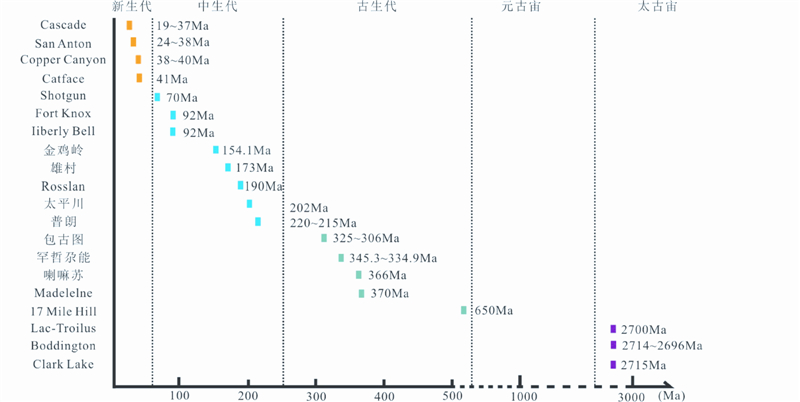 | 图 4 世界还原性斑岩型Cu矿形成时代统计图 Fig. 4 Age statistical chart of reduced porphyry Cu deposits in the word |
前人对斑岩型Cu矿产出的构造环境进行了系统的总结(Sillitoe, 1980,1997,2010; 侯增谦,2004; Cooke et al., 2005; 芮宗瑶等,2006; 曾普胜等,2006),认为斑岩型Cu矿形成于汇聚板块的俯冲环境、碰撞环境以及后碰撞伸展环境。世界上25个大型-超大型斑岩型Cu矿绝大多数位于汇聚板块的边缘(Cooke et al., 2005)。侯增谦(2004)将汇聚板块环境下的斑岩型Cu矿分为弧(岛弧和陆缘弧)造山型斑岩型Cu矿和碰撞造山型斑岩型Cu矿,例如环太平洋成矿域菲律宾成矿省岛弧环境中的Far South East-Lepanto、Tampakan、Atlas、Sipilay斑岩型Cu矿;环太平洋成矿域智利成矿省陆缘弧环境中的El Teniente、Río Blanco-Los Bronces、Los Pelambres、La Escondida、Radomiro Tomic、Rosario、El Abra斑岩型Cu矿(Cooke et al., 2005);特提斯成矿域碰撞造山环境中的驱龙、朱诺、冲江、吉如等斑岩型Cu矿(郑有业等,2007)。Sillitoe(1980)认为张性环境中形成的斑岩型Cu矿较少,强烈伸张的构造背景会形成双峰式的火山岩组合,不利于斑岩型Cu矿的形成(Tosdal and Richards, 2001),如日本岛弧迄今尚未发现一处斑岩型Cu矿(Ishihara,1981; Qin and Ishihara, 1998)。但是,当成矿域内上地壳处于经过长时期挤压状态后的应力松驰时期,则是形成斑岩型Cu矿的有利条件(Richards et al., 2001),斑岩型Cu矿可以形成于板块汇聚大背景下(造山带或活化带)的松弛(岛弧)阶段(芮宗瑶等,2006),大部分还原性斑岩型Cu矿正是形成于这个阶段。除Bodding、Clark Lake和Lac-Troilus斑岩型Cu矿位于克拉通盆地的裂陷槽内,可能形成于构造变形伸展环境外,其它已知的还原性斑岩型Cu矿形成于板块俯冲或者后碰撞拉张的构造环境。 3 还原性斑岩型Cu矿形成机制
还原性斑岩型Cu矿形成机制的研究还处于初期阶段,仍有许多问题待讨论与研究,下面就一些关键问题的研究进展进行概述。 3.1 岩浆-流体的氧化还原性及其对成矿的影响
S是控制亲铜性元素(Cu、Au)在岩浆-流体中行为的最重要的元素(Sun et al., 2013),其存在形式包括S2-、SO2、SO3及S(g)(King and White, 2004; Wallace and Edmonds, 2011)。岩浆中S的赋存状态与氧逸度(fO2)密切相关,当岩浆氧逸度(fO2)高于NNO+1时,岩浆中大多数的硫都呈高价态(S6+)(Carroll and Rutherford, 1985),只有当岩浆的氧逸度(fO2)≥NNO+1.0~1.5时,硬石膏可以作为稳定的斑晶存在于硫饱和的硅酸盐熔体中(Carroll and Rutherford, 1987; Br and on and Draper, 1996; Mungall,2002);而硫化物在(fO2)
对于还原性斑岩型矿床而言,在成矿流体析出前,岩浆已是还原性岩浆。还原性岩浆可以是氧化岩浆被还原后形成的,也可能直接源于还原性的幔源岩浆。围岩沉积物中还原剂的加入是岩浆还原的主要机制,这种还原作用可发生在岩浆源区、岩浆上升过程的通道以及岩浆房。在还原性岩浆与流体中,硫主要以S2-型式存在,硫的过饱和导致金属硫化物形成与沉淀。由于金属Cu、Ag和Au是亲铜元素,被强烈的分配进入硫化物相(C and ela, 1989; Halter et al., 2002),导致岩浆中成矿元素的贫化。还原性的、钛铁矿花岗岩岩浆中SO2的含量较低(<250×10-6)(Takagi and Tsukimura, 1997; 王奖臻等,2001),同时CH4作为还原剂抑制了SO2的歧化反应,使硬石膏等矿物难以形成(徐文刚等,2011),并且阻止了Cl气相出溶所造成的岩浆自氧化过程,从而无法形成磁铁矿等氧化性矿物。当流体相出现后,Cu和Au在熔体相和流体相(气相和/或卤水相)之间的分配,主要取决于岩浆中Cl的初始含量及其在这两个相中的分配系数,当由岩浆进入成矿流体的Cl越多,则相应进入到成矿流体的Cu也越多(王奖臻等,2001)。
3.2 还原性成矿流体中各组分对成矿的影响
还原性斑岩型Cu矿的成矿流体成分为H2O-NaCl-CO2-CH4组合,这些挥发组分保证了成矿流体的还原性,并且在还原性斑岩型Cu矿成矿金属的迁移和沉淀过程中起到了至关重要的作用。
3.2.1 成矿流体中的H2O
早期建立的斑岩型Cu矿成矿模型显示,成矿流体中的H2O来源于岩浆水和大气水两部分,大气水的加入主要表现为与岩浆卤水相互作用形成矿化蚀变带(Sheppard et al., 1971; Henley and McNabb, 1978; Sheets et al., 1996),但氢同位素结果显示矿化蚀变带中的H2O也可能完全来源于初始岩浆流体(Harris and Golding, 2002)。还原性斑岩型Cu矿中金属矿化与云母化蚀变密切相关,证明成矿过程中H2O的存在。斑岩型Cu矿成矿斑岩岩浆中H2O的含量普遍较高(Lowenstern,1994; Richards, 2003,2011),其溶解度主要受压力影响(Kadik and Khitarov, 1970; Moore et al., 1998)。岩浆中的H2O可以改变Fe3+/Fe2+值与氧逸度(Gaillard et al., 2001; Botcharnikov et al., 2005),富水的初始岩浆有利于形成赋矿的岛弧岩浆(Richards,2011)。H2O在高温的硅酸岩浆中以OH-存在(Behrens and Gaillard, 2006),可以与Cu、Mo等成矿元素形成络合物迁移(Williams-Jones and Heinrich, 2005),随着压力的降低,岩浆结晶形成斑岩,成矿金属物质与H2O分配进入成矿流体。在成矿过程中,低S条件下气相成矿流体中的金属元素溶解度随着水逸度(fH2O)升高迅速增加,并且与HCl逸度(fHCl)呈正相关关系(Williams-Jones and Heinrich, 2005),晚期大气降水的加入,将导致成矿流体温度和盐度降低,金属矿物析出沉淀,形成矿床(申萍,2004)。
3.2.2 成矿流体中的CH4和CO2
还原性斑岩型Cu矿石英流体包裹体中均发现CH4及CO2(徐文艺等,2005; 黄世武等,2010; 石海岗等,2010; Shen et al., 2010a,2012; 刘江涛等,2013; 武新丽等,2014; Cao et al., 2014a),CH4作为主要还原性物质,控制了成矿流体的氧化还原状态,使成矿流体中的S始终保持低价态,同时CH4被氧化形成CO2。在成矿过程中,金属成矿元素由于环境压力和温度的下降,由岩浆进入高温成矿流体,最后与S2-作用形成磁黄铁矿、黄铜矿、黄铁矿等析出沉淀。不论这些CH4是来自于地层或者深部岩浆,其演化过程总是与CO2密切相关,可能暗示岩浆中富CO2,并具有还原性特征。
3.2.3 成矿流体中的Cl
实验结果显示:Cu不仅在硫化物结晶体与硅酸盐熔体间的分配系数非常高(Rajamani and Naldrett, 1978),Cu也可强烈的分配进入卤水相(C and ela and Holl and ,1984; Williams et al., 1995)及气相(Williams-Jones and Heinrich, 2005),Cu在超盐度液体与气体中的富集最大可达4.5%~10.0%(Harris et al., 2003)。含Cl的成矿流体出溶能带走硅酸盐岩浆中的大量Cu(C and ela and Holl and ,1984; 管申进等,2011),并增强了流体相(气相和/或卤水相)的出溶能力(Webster,1997; Webster and Rebbert, 1998)。Cu的氯化物形式多样并受流体温压条件的影响(Webster,1992; Webster and Holloway, 1988),包括[CuCl2]1-或[CuCl(H2O)](400℃)、[CuCl2]1-(200℃)、[Cu(H2O)6]2+(25℃)形式存在(Mavrogenes et al., 2002),随着成矿流体温度的下降,黄铜矿逐渐析出沉淀。而Mo更倾向于以羟基或氯络合物形式存在于液相流体中,在成矿流体出溶过程中Mo可能与S2-较早反应,形成辉钼矿沉淀(徐文刚和张德会,2012)。但是斑岩型矿床附近并没有大量盐(NaCl,KCl)存在的证据(徐兴旺等,2012),可能意味着伴随成矿过程中大气水的不断加入,成矿流体中的H+与Cl-反应,形成HCl(g)后释放。
3.3 磁黄铁矿的形成机制
还原性斑岩型Cu矿中存在岩浆阶段和热液阶段形成的磁黄铁矿。磁黄铁矿的形成主要受岩浆及成矿流体中S含量的制约,且形成温度相对较高。实验表明,在热硫化条件下,Fe/S的值越高,形成的磁黄铁矿越多,而充足的S有利于形成黄铁矿(高文元等,2013)。大部分还原性斑岩型Cu矿中Fe的矿化由磁黄铁矿向黄铁矿转变,成矿流体中Fe的含量逐渐下降而S的比例逐渐增加。当初始的钛铁矿系列花岗岩岩浆中的S不足,而岩浆和成矿流体中的硫逸度(fS2)相对较高,这可能意味着后期岩浆或者流体阶段有S的补充。
值得指出的是,虽然夕卡岩型矿床中含磁黄铁矿且成矿流体中可能存在少量的CH4(王巧云等,2007; Rossetti and Tecce, 2008; Sánchez et al., 2009; Williams-Jones et al., 2010; Liao et al., 2014),但这些磁黄铁矿均形成于热液阶段,而CH4来源于成矿流体对含碳围岩的萃取。成矿流体在与围岩相互作用过程中被逐渐还原,与其相关的斑岩岩浆并不具备还原性特征,主要矿体也不产于岩体之中,因此这一类岩浆-热液矿床不属于还原性斑岩型Cu矿的范畴。
3.4 还原性斑岩型Cu矿成矿作用
简单的质量平衡计算表明,巨型斑岩型Cu矿的形成需要深部巨型岩浆房向浅部岩浆提供充足的成矿金属(Ulrich et al., 1999),或者存在异常富Cu的初始岩浆(Core et al., 2006),或者由两者共同形成。Core et al.(2006)对Bingham巨型斑岩型Cu矿成矿岩石中镁铁质包体进行研究,发现镁铁质包体来自于寄主成矿岩体,且富含大量的斑铜矿和黄铜矿,表明初始岩浆熔体异常富Cu,这种异常富Cu的熔体可能是通过岩浆强烈的分异结晶作用形成,或者来源于富Cu的源区(壳幔边界处的富硫化物堆积体或者深埋的变质地体中的现存Cu矿)。但是无论哪种成因,都要求岩浆具有较高的氧化条件,因为在氧逸度较低的条件下磁黄铁矿大量结晶,同时带走大量的成矿金属元素,造成岩浆中Cu、Au等元素的亏损(Lynton et al., 1993; C and ela et al., 1997; Jugo et al., 1999),而高氧逸度则抑制磁黄铁矿的结晶,保证岩浆中S以SO42-的形成存在,便于成矿元素迁移至上地壳直至沉淀。由于硫化物的分离结晶作用,可能造成加厚的下地壳含有大量的Cu-Fe硫化物堆积(Lee et al., 2012)。近来研究表明,冈底斯后碰撞阶段形成的巨型氧化性斑岩Cu矿成矿岩浆起源于加厚新生下地壳部分熔融(Hou et al., 2011; Li et al., 2011a,b),而还原性岩浆伴随磁黄铁矿的结晶会带走大量的Cu、Au等成矿元素,造成还原性岩浆亏损成矿元素。
如前所述,还原性斑岩型Cu矿中大量磁黄铁矿的产出表明岩浆与流体是还原的,这种岩浆-流体系统不利于Cu、Au等成矿元素高度富集流体的形成,也不利于大型-超大型斑岩型Cu矿的形成。对于大型还原性斑岩型Cu矿的形成,岩浆的脉动补给与多阶段成矿是其必要条件。Cao et al.(2014b)通过对包古图还原性斑岩型Cu矿中斜长石进行结构、剖面主微量及Sr同位素研究,发现斜长石具有明显的An和FeO正相关关系,复杂的韵律性An,FeO和Sr同位素组成,显著的热侵蚀引起的溶蚀边,表明岩浆房可能受到周期性基性岩浆的补给。我们的野外考察也发现,包古图矿区Zk205孔150m厚(550~700m)具浸染状状-海绵陨铁状结构的富矿体(Cu 0.5%)的含矿岩石为基性岩(包括辉石岩、辉长岩、辉石闪长岩)。
4 还原性斑岩矿床新类型-还原性斑岩型Mo-Cu矿
基于还原性斑岩型Cu矿的基本特征与定义,西准噶尔宏远斑岩型Mo-Cu矿岩体中存在大量浸染状磁黄铁矿,且其成矿流体中富含气相CH4,表明宏远斑岩型Mo-Cu矿可能为还原性矿床。
4.1 矿区地质概况
宏远Mo-Cu矿产出于新疆西准噶尔克拉玛依西北的加浦沙尔苏岩体东南端的斑岩体中,斑岩体侵位于下石炭统包古图组凝灰岩中,北部与克拉玛依岩体中的二长花岗岩相邻(图 5a)。斑岩体内均发生不同程度的Mo、Cu矿化,其中南部矿化蚀变程度较强,地表可见辉钼矿、斑铜矿、黄铁矿、黄铜矿、磁黄铁矿和毒砂矿化,主要蚀变为绢云母化、白云母化、绿泥石化及孔雀石化等。宏远Mo-Cu矿推断的内蕴经济Mo金属资源量为1.35万吨(新疆地矿局第七地质大队,2014①),为中型斑岩型Mo-Cu矿(鄢瑜宏等,2014)。
斑岩体类型包括花岗闪长斑岩与花岗斑岩,其中花岗斑岩先于花岗闪长斑岩侵位,位于花岗闪长斑岩的顶部与外侧,或作为残留体位于花岗闪长斑岩中(图 5b)。花岗闪长斑岩中发现富含黄铜矿与磁黄铁矿的文象花岗岩囊体(图 6a)。文象花岗岩中的石英与钾长石呈梳状与树枝状产出,其与花岗闪长斑岩间界线截然,部分梳状构造的石英与钾长石垂直界面生长;黄铜矿、磁黄铁矿与白云母集合体呈不规则管状分布于囊体中心、其占囊体体积的10%左右,其中黄铜矿、磁黄铁矿与白云母的含量约分别为4.5vol%、4vol%与1.5vol%。文象花岗岩与白云母的发育意味着该囊体是含水岩浆结晶的产物(Fenn,1986; 郭顺等,2013)。这表明富含黄铜矿与磁黄铁矿的含水岩浆是还原性的,其花岗闪长质母岩浆也具有还原性。
前人的岩石化学分析结果显示矿区岩体为花岗闪长质-花岗质(图 7a),具过铝质(图 7b)、高钾钙碱性(图 7c)特征。花岗闪长斑岩的锆石U-Pb年龄为300.8±2.1Ma,MSWD=2.7(李永军等,2012; Wang et al., 2013);辉钼矿的Re-Os等时线年龄为294.6±4.6Ma,MSWD=2.0(李永军等,2012; 李卫东,2013)。李卫东(2013)认为成矿岩体与加浦沙尔苏岩体相同,均为A型花岗岩,形成于后碰撞环境。但宏远成矿岩体的K2O、Na2O的含量较加浦沙尔苏岩体偏低(图 7d),部分样品可能为I型花岗岩,宏远岩体的A型花岗岩可能是由深俯冲环境下的I型花岗岩岩浆经过后期改造而形成的,具有富K、Na、Ga和低Eu的特点。
在宏远矿区地表矿化主要位于花岗闪长斑岩中,围岩地层中未见矿化。在斑岩体西南部分发现大量以脉状和浸染状构造分布的辉钼矿、黄铁矿、黄铜矿及斑铜矿矿化,并见少量毒砂矿化。矿床中不仅发育含磁黄铁矿的辉钼矿石英脉(图 6c),还发现与辉钼矿、黄铜矿、黄铁矿共生的浸染状磁黄铁矿(图 6d,e),辉钼矿矿化石英脉两侧常常发育绢云母化和绿泥石化蚀变(图 6b),成矿流体具有富水特征。矿体富Mo而贫Cu,为典型的斑岩型Mo-Cu矿床。
近南北向的zk302、zk402、zk201和zk401钻孔连线剖面显示(图 8),宏远Mo-Cu矿金属矿物的垂向分带明显。zk302孔浅部地层中未见矿化,深部花岗闪长斑岩中见浸染状、脉状矿化的辉钼矿、黄铁矿、黄铜矿及磁黄铁矿;zk402孔见大量浸染状磁黄铁矿、辉钼矿、黄铁矿及黄铜矿;zk201孔浅部见少量毒砂矿化,深部为黄铁矿、黄铜矿及辉钼矿矿化,磁黄铁矿矿化在深部间断出现;zk401孔浅-中部以辉钼矿、黄铁矿及黄铜矿矿化为主,脉状磁黄铁矿间断出现,深部矿化逐渐减少,底部未见明显矿化。由此可见,zk402孔富集磁黄铁矿,可能为岩浆与成矿中心;磁黄铁矿分布向斑岩体北部以树枝状伸展,辉钼矿、黄铜矿及黄铁矿矿化分布于磁黄铁矿附近,而毒砂矿化位于主要矿化区域外围。鄢瑜宏等(2014)对宏远Mo-Cu矿的成矿流体进行研究,结果表明成矿流体中存在气相的CH4,流体组成为H2O-NaCI-CO2-CH4组合,主成矿期流体盐度较高,随着成矿过程的进行流体盐度逐渐而降低,成矿过程中有大气降水的加入。
与斑岩相关的Mo矿可以分为斑岩型的Cu-Mo矿、Mo矿及斑岩-矽卡岩型的W-Mo矿(Smirnov et al., 1983)。绝大部分斑岩型Mo矿的成矿斑岩显示为正常或较高氧逸度(fO2)特征(Blevin,2004),成矿流体中极少出现CH4等还原性成分,仅少数矿床成矿流体中存在来源于地层的CH4(王莉娟等,2011),其均为氧化性斑岩型Mo矿,例如:秦岭地区金堆城斑岩型Mo矿(杨永飞等,2009)和黑龙江岔路口斑岩型Mo矿(刘军等,2013)的成矿流体富含CO2,不含CH4;内蒙古车户沟斑岩型Mo-Cu矿的成矿流体中含有少量气相CH4(褚少雄等,2010)。
宏远斑岩型Mo-Cu矿中含磁黄铁矿与黄铜矿的文象花岗岩囊体、斑岩体中浸染状磁黄铁矿以及石英脉中磁黄铁矿说明磁黄铁矿在岩浆阶段和流体阶段均有形成,证明岩浆和流体均具有还原性特征。徐文刚和张德会(2012)认为在还原性条件下,从晚期岩浆中出溶的Mo与液相流体中的H2S作用形成辉钼矿,在成矿流体早期就已经沉淀,形成一个矿化的核心区域,Cu、Au等成矿元素可以随气相成矿流体迁移至较远的外围,进而形成一个由岩体内部向外围依次过度的Mo-Cu-Au矿化带。在宏远矿区,Mo、Cu等成矿金属元素随磁黄铁矿的形成在斑岩体内部发生集中沉淀,As随气相成矿流体迁移至斑岩体顶部沉淀矿化。
斑岩型Mo矿形成的构造背景可概括为有两类(Sillitoe,1980; Westra and Keith, 1981; Carten et al., 1993):1)与裂谷伸展作用有关,包括过渡型、Climax型和与碱性岩浆有关的类型,分别对应于汇聚板块边缘的弧后扩张、板内裂谷和与洋盆扩张有关的裂谷环境,这类通常与富F、高度分异流纹质岩株有关,矿床品位较高;2)与板块汇聚的俯冲作用有关,如大陆边缘和岛弧环境,这类通常与贫F的钙碱性岩浆有关,矿床品位较低。宏远Mo-Cu矿成矿岩体具有钙碱性特征,矿床中未见萤石等高F矿物,但具有富K、Na、Ga,低Eu的特点,可能形成于不成熟岛弧环境或者后碰撞环境(李卫东,2013; 鄢瑜宏,2014)。
4.5 还原性斑岩型Mo-Cu矿的提出
西准噶尔宏远斑岩型Mo-Cu的成矿流体中富含CH4,斑岩体中发育大量岩浆-热液阶段的磁黄铁矿,说明岩浆和成矿流体均具有还原性特征,其形成环境可能为不成熟岛弧环境或者后碰撞环境。参照还原性斑岩型Cu矿的定义,我们认为宏远Mo-Cu矿床为还原性斑岩型矿床。相较于大量氧化性斑岩型Mo-Cu矿,宏远Mo-Cu矿可能是斑岩型Mo-Cu矿的新类型。宏远Mo-Cu矿床还原性岩浆与流体的形成机制、成矿温压条件与元素富集机理等待进一步研究与查明。
5 结语与展望
5.1 结语
相较于氧化性斑岩型Cu矿,还原型斑岩型Cu矿的实例仍偏少。已有的资料显示,还原性斑岩型Cu矿的主要特征可概括为:1)发育大量岩浆阶段磁黄铁矿,缺少高氧化特征的矿物,含大量的还原性气体CH4;2)成矿流体主要来自于岩浆流体的出溶,成矿流体的组成为H2O-NaCl-CH4-CO2;3)成因上与还原性的、钛铁矿系列I型中性-中酸性花岗岩有关,形成于俯冲环境或者后碰撞环境。
新近发现的宏远斑岩型Mo-Cu矿中发育岩浆阶段磁黄铁矿,成矿岩浆具有明显还原性特征,成矿流体中富含气相CH4,形成于不成熟岛弧环境或者后碰撞环境,其可能为还原性斑岩型矿床新类型。
5.2 展望
相较于近百年对斑岩型Cu矿的研究,对还原性斑岩型Cu矿的研究程度较浅,仍有较多问题待深入研究与探讨。
(1)还原性的、钛铁矿系列I型花岗岩成因
Rowins(2000)认为还原性斑岩型Cu矿其母岩浆具较低的氧逸度(fO2<ΔFMQ),其可形成于俯冲弧背景与后碰撞环境。然而,现今对不同构造背景岩浆岩的氧逸度特征研究结果显示(Carmichael,1991; Behrens and Gaillard, 2006; Wallace and Edmonds, 2011; Tomkins et al., 2012):弧岩浆普遍具有高氧逸度的特征(fO2>ΔFMQ+1),而洋中脊玄武岩的氧逸度偏低(fO2<ΔFMQ)。这意味着在弧背景下形成高氧逸度(fO2)岩浆与还原性斑岩型Cu矿是一种歧异现象。如前所述,还原性的、钛铁矿系列I型花岗岩可以由正常的I型花岗岩岩浆与围岩混染形成,俯冲板块中的还原性地层热解形成,或者直接由地幔岩浆演化而来。然而岩浆中还原性成分的来源、含量、演化机制及对岩浆氧逸度的控制行为仍不清楚,形成这种歧异岩浆的机理待进一步研究。
(2)还原性成矿流体的形成机制
还原性斑岩型Cu矿成矿流体中的CH4可能直接来自地幔,或者岩浆期后形成于费托反应,但研究者对CH4在成矿流体中与其他组分的混合比例,以及CH4与CO2相互转化的过程均存在不同认识。同时磁黄铁矿的形成可能说明S的不足,成矿流体中的S是否受到了后期的补充还有待研究。
(3)还原性斑岩型Cu矿成矿过程
对于成矿金属在岩浆中的贫化与富集过程有待深化研究。在晚期岩浆阶段,大量的Cu、Mo、Au等成矿金属随着磁黄铁矿的析出而过早结晶沉淀,导致后期岩浆和成矿流体中的成矿金属发生贫化。如果后期基性岩浆带来的成矿金属使岩浆中的成矿金属元素重新富集,其在岩浆房中的化学行为并不清楚,特别当是基性岩浆注入酸性岩浆的岩浆房,发生岩浆混合的过程中为何没有形成超大规模的磁黄铁矿矿化?整个过程中是否有大量的矿物沉淀,进而形成岩浆阶段的还原性斑岩型Cu矿?
(4)大地构造背景对还原性斑岩型Cu矿的制约。
还原性斑岩型Cu矿形成可能受特殊的构造背景控制,例如:包古图Cu矿可能形成于洋脊俯冲条件下的板片窗构造背景(Cao et al., 2013)。还原性斑岩型Cu矿的分布规律显示,产出于晚期岛弧环境的还原性斑岩型Cu矿富Au,而后碰撞环境中的斑岩型Cu矿富Mo,或者形成还原性斑岩型Mo-Cu矿。但由于典型矿床较少,其成矿规律待进一步研究。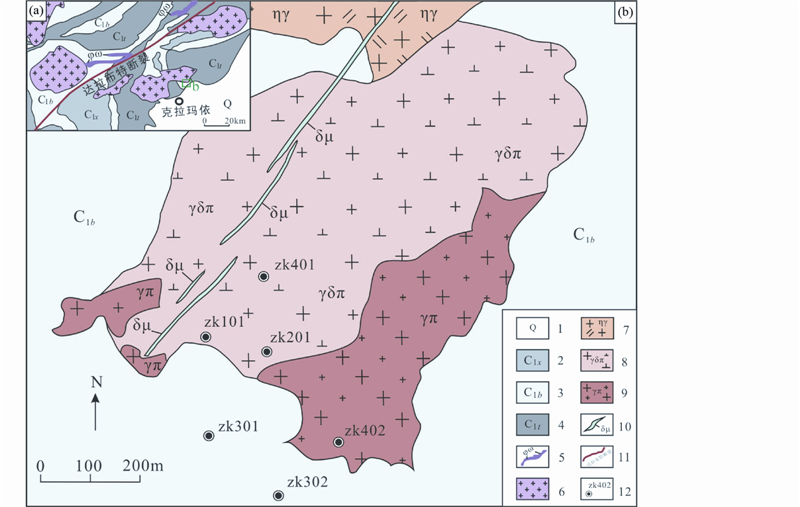
图 5 西准噶尔宏远斑岩Mo-Cu矿区地质简图
1-第四系;2-下石炭统希贝库拉斯组;3-下石炭统包古图组;4-下石炭统太勒古拉组;5-达拉布特蛇绿岩带;6-花岗岩;7-二长花岗岩;8-花岗闪长斑岩;9-花岗斑岩;10-闪长玢岩脉;11-达拉布特断裂;12-钻孔位置及编号
Fig. 5 Geological map of the Hongyuan porphyry Mo-Cu deposit
1-Quaternary; 2-volcanic-sedimentary rocks of Lower Carboniferous Xibeikulasi Formation; 3-volcanic-sedimentary rocks of Lower Carboniferous Baogutu Formation; 4-volcanic-sedimentary rocks of Lower Carboniferous Tailegula Formation; 5-Darbut ophiolite belt; 6-granite; 7-monzonitic-granite; 8-granodiorite-porphyry; 9-granite-porphyry; 10-diorite-porphyrite; 11-Darbut fault; 12-location and number of drilling

图 6 宏远斑岩Mo-Cu矿床典型矿石照片
(a)花岗闪长斑岩中富硫化物的文象花岗岩囊体;(b)辉钼矿石英脉两侧的绢云母-绿泥石化蚀变晕;(c)辉钼矿磁黄铁石英脉;(d)花岗闪长斑岩中磁黄铁矿、黄铜矿与黄铁矿呈浸染状共生产出;(e)花岗闪长斑岩中浸染状磁黄铁矿与辉钼矿.γδπ-花岗闪长斑岩;GG-文象花岗岩;Ccp-黄铜矿;Mo-辉钼矿;Po-磁黄铁矿;Py-黄铁矿;Chl-绿泥石;Kf-钾长石;Ser-绢云母;Mus-白云母
Fig. 6 Images of typical ores from the Hongyuan porphyry Mo-Cu deposit
(a)sulfide-rich graphic granite pocket in the granodiorite-Porphyry;(b)molybdenite-quartz vein associated with sericite-chlorite alteration halos;(c)molybdenite-pyrrhotite-quartz vein;(d)disseminated pyrrhotite,chalcopyrite and pyrite in granodioritic porphyry;(e)disseminated pyrrhotite and molybdenite in granodioritic porphyry. γδπ-granodiorite-porphyry; GG-graphic granite; Ccp-chalcopyrite; Mo-molybdenite; Po-pyrrhotite; Py-pyrite; Chl-chlorite; Kf-K-feldspar; Ser-sericite; Mus-muscovite
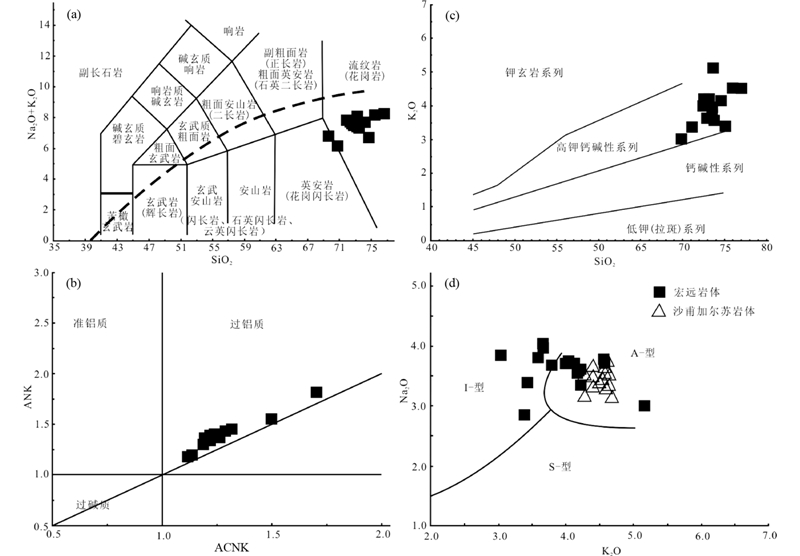
图 7 宏远Mo-Cu矿区含矿斑岩TAS图解(a,据Le Bas et al., 1986)、SiO2-K2O图解(b,实线据Middlemost,1985)、A/CNK-A/NK图解(c,据Maniar and Piccoli, 1989)和宏远Mo-Cu矿含矿斑岩与沙甫加尔苏岩体K2O-Na2O图解(d,据Collins et al., 1982)
数据来自李卫东(2013)
Fig. 7 TAS diagram(a,after Le Bas et al., 1986)SiO2 vs. K2O diagram(b,real-lines after Middlemost,1985),A/CNK vs. A/NK diagram(c,after Maniar and Piccoli, 1989) and K2O vs. Na2O diagram(d,after Collins et al., 1982)of porphyries form the Hongyuan porphyry Mo-Cu deposit
Data after Li(2013)

图 8 西准噶尔宏远Mo-Cu矿床钻孔剖面图
1-下石炭统包古图组;2-花岗闪长斑岩;3-花岗斑岩;4-辉钼矿-黄铜矿-磁黄铁矿矿化带;5-辉钼矿-黄铜矿矿化带;6-毒砂矿化带
Fig. 8 Drilling profile of the Hongyuan porphyry Mo-Cu deposit
1-volcanic-sedimentary rock of the Lower Carboniferous Baogutu Formation; 2-granodiorite-porphyry; 3-granite-porphyry; 4-chalcopyrite-molybdenite-pyrrhotite mineralization zone; 5-chalcopyrite-molybdenite mineralization zone; 6-arsenopyrite mineralization zone
| [1] | Abrajano TA, Sturchio NC, Bohlke JK, Lyon GL, Poreda RJ and Stevens CM. 1988. Methane-hydrogen gas seeps, Zambales Ophiolite, Philippines: Deep or shallow origin? Chemical Geology, 71(1-3): 211-222 |
| [2] | Ague JJ and Brimhall GH. 1987. Granites of the batholiths of California: Products of local assimilation and regional-scale crustal contamination. Geology, 15(1): 63-66 |
| [3] | Ague JJ and Brimhall GH. 1988a. Regional variations in bulk chemistry, mineralogy, and the compositions of mafic and accessory minerals in the batholiths of California. The Geological Society of America Bulletin, 100(6): 891-911 |
| [4] | Ague JJ and Brimhall GH. 1988b. Magmatic arc asymmetry and distribution of anomalous plutonic belts in the batholiths of California: Effects of assimilation, crustal thickness, and depth of crystallization. The Geological Society of America Bulletin, 100(6): 912-927 |
| [5] | Andersen T and Burke EAJ. 1996. Methane inclusions in shocked quartz from the Gardnos impact breccia, South Norway. European Journal of Mineralogy, 8(5): 927-936 |
| [6] | Audétat A, Günther D and Heinrich AC. 2000. Causes for large-scale metal zonation around mineralized plutons: Fluid inclusion LA-ICP-MS evidence from the mole granite, Australia. Economic Geology, 95(8): 1563-1581 |
| [7] | Audétat A, Pettke T and Dolejš D. 2004. Magmatic anhydrite and calcite in the ore-forming quartz-monzodiorite magma at Santa Rita, New Mexico (USA): Genetic constraints on porphyry-Cu mineralization. Lithos, 72(3-4): 147-161 |
| [8] | Bacon CR. 1989. Crystallization of accessory phases in magmas by local saturation adjacent to phenocrysts. Geochimica et Cosmochimica Acta, 53(5): 1055-1066 |
| [9] | Baker DR and Moretti R. 2011. Modeling the solubility of sulfur in magmas: A 50-year old geochemical challenge. Reviews in Mineralogy and Geochemistry, 73(1): 167-213 |
| [10] | Ballhaus C, Berry RF and Green DH. 1990. Oxygen fugacity controls in the Earth's upper mantle. Nature, 348(6300): 437-440 |
| [11] | Ballhaus C. 1993. Redox states of lithospheric and asthenospheric upper mantle. Contributions to Mineralogy and Petrology, 114(3): 331-348 |
| [12] | Barr DA, Fox PE, Northcote KE and Preto VA. 1976. The alkaline suite porphyry deposits: A summary. In: Sutherland Brown A (ed.). Porphyry Deposits of the Canadian Cordillera. Canadian Institute of Mining Metallurgy and Petroleum Special Volume, 15: 359-367 |
| [13] | Beeskow B, Treloar PJ, Rankin AH, Vennemann TW and Spangenberg J. 2006. A reassessment of models for hydrocarbon generation in the Khibiny nepheline syenite complex, Kola Peninsula, Russia. Lithos, 91(1-4): 1-18 |
| [14] | Behrens H and Gaillard F. 2006. Geochemical aspects of melts: Volatiles and redox behavior. Elements, 2(5): 275-280 |
| [15] | Berndt ME, Allen DE and Seyfried WE. 1996a. Reduction of CO2 during serpentinization of olivine at 300℃ and 500bar. Geology, 24(4): 351-354 |
| [16] | Blevin PL and Chappell BW. 1992. The role of magma sources, oxidation states and fractionation in determining the granite metallogeny of eastern Australia. Geological Society of America Special Paper, 272: 305-316 |
| [17] | Blevin PL. 2004. Redox and compositional parameters for interpreting the granitoid metallogeny of Eastern Australia: Implications for gold-rich ore systems. Resource Geology, 54(3): 241-252 |
| [18] | Bornhorst TJ and Rose WI Jr. 1986. Partitioning of gold in young calc-alkalic volcanic rocks from Guatemala. The Journal of Geology, 94(3): 412-418 |
| [19] | Botcharnikov RE, Koepke J, Holtz F, McCammon C and Wilke M. 2005. The effect of water activity on the oxidation and structural state of Fe in a ferro-basaltic melt. Geochimica et Cosmochimica Acta, 69(21): 5071-5085 |
| [20] | Brandon AD and Draper DS. 1996. Constraints on the origin of the oxidation state of mantle overlying subduction zones: An example from Simcoe, Washington, USA. Geochimica et Cosmochimica Acta, 60(10): 1739-1749 |
| [21] | Burnham CW and Ohmoto H. 1980. Late-stage processes of felsic magmatism. Mining Geology, Special Issue, (8): 1-11 |
| [22] | Calagari AA. 2003. Stable isotope (S, O, H and C) studies of the phyllic and potassic-phyllic alteration zones of the porphyry copper deposit at Sungun, East Azarbaidjan, Iran. Journal of Asian Earth Sciences, 21(7): 767-780 |
| [23] | Candela PA and Holland HD. 1984. The partitioning of copper and molybdenum between silicate melts and aqueous fluids. Geochimica et Cosmochimica Acta, 48(2): 373-380 |
| [24] | Candela PA. 1989. Felsic magmas, volatiles and metallogenesis. In: Whitney JA and Naldrett AJ (eds.). Ore Deposits Associated with Magmas. Society of Economic Geology. Reviews in Economic Geology, 4: 223-233 |
| [25] | Candela PA. 1997. A review of shallow, ore-related granites: Textures, volatiles, and ore metals. Journal of Petrology, 38(12): 1619-1633 |
| [26] | Cao MJ. 2013. Petrogenesis and metallogenesis of Baogutu reduced porphyry copper deposit, West Junggar, and its comparison with porphyry deposits from Balkhash. Ph. D. Dissertation. Beijing: Institute of Geology and Geophysics, Chinese Academy of Sciences, 1-234 (in Chinese) |
| [27] | Cao MJ, Qin KZ, Li GM, Evans NJ and Jin LY. 2013. Abiogenic fischer-tropsch synthesis of methane at the Baogutu reduced porphyry Cu deposit, western Junggar, NW-China. Mineralogical Magazine, 77: 821 |
| [28] | Cao MJ, Qin KZ, Li GM, Jin LY, Evans NJ and Yang XR. 2014a. Baogutu: An example of reduced porphyry Cu deposit in western Junggar. Ore Geology Reviews, 56: 159-180 |
| [29] | Cao MJ, Qin KZ, Li GM, Yang YH, Evans NJ, Zhang R and Jin LY. 2014b. Magmatic process recorded in plagioclase at the Baogutu reduced porphyry Cu deposit, western Junggar, NW-China. Journal of Asian Earth Sciences, 82: 136-150 |
| [30] | Carmichael ISE and Nicholls J. 1967. Iron-titanium oxides and oxygen fugacities in volcanic rocks. Journal of Geophysical Research, 72(18): 4665-4687 |
| [31] | Carmichael ISE and Ghiorso MS. 1986. Oxidation-reduction relations in basic magma: A case for homogeneous equilibria. Earth and Planetary Science Letters, 78(2-3): 200-210 |
| [32] | Carmichael ISE. 1991. The redox states of basic and silicic magmas: A reflection of their source regions? Contributions to Mineralogy and Petrology, 106(2): 129-141 |
| [33] | Carroll MR and Rutherford MJ. 1985. Sulfide and sulfate saturation in hydrous silicate melts. Journal of Geophysical Research, 90(S02): C601-C612 |
| [34] | Carroll MR and Rutherford MJ. 1987. The stability of igneous anhydrite: Experimental results and implications for sulfur behavior in the 1982 El Chichon Trachyandesite and other evolved magmas. Journal of Petrology, 28(5): 781-801 |
| [35] | Carroll MR and Rutherford MJ. 1988. Sulfur speciation in hydrous experimental glasses of varying oxidation state: Results from measured wavelength shifts of sulfur X-rays. The American Mineralogist, 73(7-8): 845-849 |
| [36] | Carten RB, White WH and Stein HJ. 1993. High-grade granite-related molybdenum systems: Classification and origin. In: Kirkham RV, Sinclair WD, Thorpe RI and Duke JM (eds.). Mineral Deposit Modeling. Geological Association of Canada Special Paper, 40: 521-554 |
| [37] | Chen ZG, Zhang LC, Wan B, Zhang YT and Wu HY. 2008. Geochemistry and geological significances of ore-forming porphyry with low Sr and Yb value in Wunugetushan copper-molybdenum deposit, Inner Mongolia. Acta Petrologica Sinica, 24(1): 115-128 (in Chinese with English abstract) |
| [38] | Chen ZG, Zhang LC, Lu BZ, Li ZL, Wu HY, Xiang P and Huang SW. 2010. Geochronology and geochemistry of the Taipingchuan copper-molybdenum deposit in Inner Mongolia, and its geological significances. Acta Petrologica Sinica, 26(5): 1437-1449 (in Chinese with English abstract) |
| [39] | Chu SX, Zeng QD, Liu JM, Zhang WQ, Zhang ZL, Zhang S and Wang ZC. 2010. Characteristics and its geological significance of fluid inclusions in Chehugou porphyry Mo-Cu deposit, Xilamulun molybdenum metallogenic belt. Acta Petrologica Sinica, 26(8): 2465-2481 (in Chinese with English abstract) |
| [40] | Cline JS and Bodnar RJ. 1991. Can economic porphyry copper mineralization be generated by a typical calc-alkaline melt? Journal of Geophysical Research, 96(B5): 8113-8126 |
| [41] | Cloos M. 2001. Bubbling magma chambers, cupolas, and porphyry copper deposits. International Geology Review, 43(4): 285-311 |
| [42] | Collins WJ, Beams SD, White AJR and Chappell BW. 1982. Nature and origin of A-type granites with particular reference to southeastern Australia. Contributions to Mineralogy and Petrology, 80(2): 189-200 |
| [43] | Cooke DR, Hollings P and Walshe JL. 2005. Giant porphyry deposits: Characteristics, distribution, and tectonic controls. Economic Geology, 100(5): 801-818 |
| [44] | Core DP, Kesler SE and Essene EJ. 2006. Unusually Cu-rich magmas associated with giant porphyry copper deposits: Evidence from Bingham, Utah. Geology, 34(1): 41-44 |
| [45] | Davidson P, Kamenetsky V, Cooke DR, Frikken P, Hollings P, Ryan C, Van Achterbergh E, Mernagh TP, Skarmeta J, Serrano L and Vargas R. 2005. Magmatic precursors of hydrothermal fluids at the Rio Blanco Cu-Mo deposit, Chile: Links to silicate magmas and metal transport. Economic Geology, 100(5): 963-978 |
| [46] | Defant MJ and Drummond MS. 1990. Derivation of some modern arc magmas by melting of young subducted lithosphere. Nature, 347(6294): 662-665 |
| [47] | Defant MJ and Drummond MS. 1993. Mount St. Helens: Potential example of the partial melting of the subducted lithosphere in a volcanic arc. Geology, 21(6): 547-550 |
| [48] | Des Marais DJ, Stallard ML, Nehring NL and Truesdell AH. 1988. Carbon isotope geochemistry of hydrocarbons in the Cerro Prieto geothermal field, Baja California Norte, Mexico. Chemical Geology, 71(1-3): 159-167 |
| [49] | Dickenson MP and Hess PC. 1986. The structural role and homogeneous redox equilibria of iron in peraluminous, metaluminous and peralkaline silicate melts. Contributions to Mineralogy and Petrology, 92(2): 207-217 |
| [50] | Douglas RW, Nath P and Paul A. 1965. Oxygen ion activity and its influence on the redox equilibrium in glasses. Physics and Chemistry of Glasses, 6(6): 216-223 |
| [51] | du Bray EA and John DA. 2011. Petrologic, tectonic, and metallogenic evolution of the Ancestral Cascades magmatic arc, Washington, Oregon, and northern California. Geosphere, 7(5): 1102-1133 |
| [52] | du Bray EA, John DA and Cousens BL. 2014. Petrologic, tectonic, and metallogenic evolution of the southern segment of the ancestral Cascades magmatic arc, California and Nevada. Geosphere, 10(1): 1-39 |
| [53] | Feng XF. 2010. Studies on geological-geochemical characteristics of the Budunhua copper deposit in Xinganmeng, Inner Mongolia. Master Degree Thesis. Beijing: Chinese Academy of Geological Sciences, 1-73 (in Chinese with English summary) |
| [54] | Fiebig J, Woodland AB, D'Alessandro W and Püttmann W. 2009. Excess methane in continental hydrothermal emissions is abiogenic. Geology, 37(6): 495-498 |
| [55] | Gaillard F, Scaillet B, Pichavant M and Bény JM. 2001. The effect of water and fO2 on the ferric-ferrous ratio of silicic melts. Chemical Geology, 174(1-3): 255-273 |
| [56] | Gao WY, Huang F, Li GL, Duan TX, Zeng M, Liu ZY, Liu R, Liu J and Gao S. 2013. The influence of different iron-sulfur ratios on pyrite formation under thermal sulfurization condition. Earth Science Frontiers, 20(3): 131-137 (in Chinese with English abstract) |
| [57] | Gold T. 1979. Terrestrial sources of carbon and earthquake outgassing. Journal of Petroleum Geology, 1(3): 3-19 |
| [58] | Guan SJ, Zhang H, Tang Y and Zhang JX. 2011. An experimental study on the partitioning of molybdenum and tungsten between granitic melt and coexisting aqueous fluid at 100MPa and 800℃. Geochimica, 40(6): 516-524 (in Chinese with English abstract) |
| [59] | Guo S, Ye K, Chen Y, Liu JB and Mao Q. 2013. Ultrahigh-pressure lawsonite breakdown in the Dabieshan eclogite: Constrains on the fluid actions in deep subduction zone. Chinese Science Bulletin, 58(22): 2186-2191 (in Chinese) |
| [60] | Guo ZL, Li JX, Qin KZ, Dong LH, Guo XJ, Tang DM and Du XW. 2010. Zircon U-Pb geochronology and geochemistry of Hanzheganeng Cu-Au deposit in West Junggar, Xinjiang: Implications for magma source and metallogenic tectonic setting. Acta Petrologica Sinica, 26(12): 3563-3578 (in Chinese with English abstract) |
| [61] | Gustafson LB and Hunt JP. 1975. The porphyry copper deposit at El Salvador, Chile. Economic Geology, 70(5): 857-912 |
| [62] | Halter WE, Pettke T and Heinrich CA. 2002. The origin of Cu/Au ratios in porphyry-Type ore deposits. Science, 296(5574): 1844-1846 |
| [63] | Hamlyn PR, Keays RR, Cameron WE, Crawford AJ and Waldron HM. 1985. Precious metals in magnesian low-Ti lavas: Implications for metallogenesis and sulfur saturation in primary magmas. Geochimica et Cosmochimica Acta, 49(8): 1797-1811 |
| [64] | Harris AC and Golding SD. 2002. New evidence of magmatic-fluid-related phyllic alteration: Implications for the genesis of porphyry Cu deposits. Geology, 30(4): 335-338 |
| [65] | Harris AC, Kamenetsky VS, White NC, Achterbergh EV and Ryan CG. 2003. Melt inclusions in veins: Linking magmas and porphyry Cu deposits. Science, 302(5653): 2109-2111 |
| [66] | Harris AC, Golding SD and White NC. 2005. Bajo de la Alumbrera copper-gold deposit: Stable isotope evidence for a porphyry-related hydrothermal system dominated by magmatic aqueous fluids. Economic Geology, 100(5): 863-886 |
| [67] | Hedenquist JW and Lowenstern JB. 1994. The role of magmas in the formation of hydrothermal ore deposits. Nature, 370(6490): 519-527 |
| [68] | Hedenquist JW, Arribas A and Reynolds TJ. 1998. Evolution of an intrusion-centered hydrothermal system: Far Southeast-Lepanto porphyry and epithermal Cu-Au deposits, Philippines. Economic Geology, 93(4): 373-404 |
| [69] | Henley RW and McNabb A. 1978. Magmatic vapor plumes and ground-water interaction in porphyry copper emplacement. Economic Geology, 73(1): 1-20 |
| [70] | Hildreth W and Moorbath S. 1988. Crustal contributions to arc magmatism in the Andes of Central Chile. Contributions to Mineralogy and Petrology, 98(4): 455-489 |
| [71] | Horita J and Berndt ME. 1999. Abiogenic methane formation and isotopic fractionation under hydrothermal conditions. Science, 285(5430): 1055-1057 |
| [72] | Hou ZQ, Ma HW, Zaw K, Zhang YQ, Wang MJ, Wang Z, Pan GT and Tang RL. 2003. The Himalayan Yulong porphyry copper belt: Product of large-scale strike-slip faulting in Eastern Tibet. Economic Geology, 98(1): 125-145 |
| [73] | Hou ZQ. 2004. Porphyry Cu-Mo-Au deposits: Some new insights and advances. Earth Science Frontiers, 11(1): 131-143 (in Chinese with English abstract) |
| [74] | Hou ZQ, Zeng PS, Gao YF, Du AD and Fu DM. 2006. Himalayan Cu-Mo-Au mineralization in the eastern Indo-Asian collision zone: Constraints from Re-Os dating of molybdenite. Mineralium Deposita, 41(1): 33-45 |
| [75] | Hou ZQ, Yang ZM, Qu XM, Meng XJ, Li ZQ, Beaudoin G, Rui ZY, Gao YF and Zaw K. 2009. The Miocene Gangdese porphyry copper belt generated during post-collisional extension in the Tibetan Orogen. Ore Geology Reviews, 36(1-3): 25-51 |
| [76] | Hou ZQ, Zhang HR, Pan XF and Yang ZM. 2011. Porphyry Cu (-Mo-Au) deposits related to melting of thickened mafic lower crust: Examples from the eastern Tethyan metallogenic domain. Ore Geology Reviews, 39(1-2): 21-45 |
| [77] | Huang SW, Zhang LC, Li KQ, Chen ZG, Wu HY, Xiang P and Zhang XJ. 2010. CH4-containing fluid inclusion study of the Taipingchuan porphyry Cu-Mo deposit, Inner Mongolia. Acta Petrologica Sinica, 26(5): 1386-1396 (in Chinese with English abstract) |
| [78] | Ishihara S. 1977. The magnetite-series and ilmenite-series granitic rocks. Mining Geology, 27(145): 293-305 |
| [79] | Ishihara S. 1981. The granitoid series and mineralization. Economic Geology, 75: 458-484 |
| [80] | Ishihara S. 1998. Granitoid series and mineralization in the Circum-Pacific Phanerozoic granitic belts. Resource Geology, 48(4): 219-224 |
| [81] | Jugo PJ, Candela PA and Piccoli PM. 1999. Magmatic sulfides and Au: Cu ratios in porphyry deposits: An experimental study of copper and gold partitioning at 850℃, 100MPa in a haplogranitic melt-pyrrhotite-intermediate solid solution-gold metal assemblage, at gas saturation. Lithos, 46(3): 573-589 |
| [82] | Jugo PJ, Luth RW and Richards JP. 2005. Experimental data on the speciation of sulfur as a function of oxygen fugacity in basaltic melts. Geochimica et Cosmochimica Acta, 69(2): 497-503 |
| [83] | Jugo PJ. 2009. Sulfur content at sulfide saturation in oxidized magmas. Geology, 37(5): 415-418 |
| [84] | Kadik AA and Khitarov NI. 1970. Influence of water on melting of silicates at high pressure. Physics of the Earth and Planetary Interiors, 3: 343-347 |
| [85] | Kelley KA and Cottrell E. 2009. Water and the oxidation state of subduction zone magmas. Science, 325(5940): 605-607 |
| [86] | King PL and White AJR. 2004. Granites, volatile solubility & tracking the formation of magmatic fluids. Geoscience Australia, 85-88 |
| [87] | Konnerup-Madsen J. 2001. A review of the composition and evolution of hydrocarbon gases during solidification of the Ilímaussaq alkaline complex, South Greenland. Geology of Greenland Survey Bulletin, 190: 159-166 |
| [88] | Lang JR, Lueck B, Mortensen JK, Kelly Russell J, Stanley CR and Thompson JFH. 1995. Triassic-Jurassic silica-undersaturated and silica-saturated alkalic intrusions in the Cordillera of British Columbia: Implications for arc magmatism. Geology, 23(5): 451-454 |
| [89] | Le Bas MJ, Le Maitre RW, Streckeisen A and Zanettin B. 1986. A chemical classification of volcanic rocks based on the total alkali-silica diagram. Journal of Petrology, 27(3): 745-750 |
| [90] | Lee CTA, Leeman WP, Canil D and Li ZX. 2005. Similar V/Sc systematics in MORB and arc basalts: Implications for the oxygen fugacities of their mantle source regions. Journal of Petrology, 46(11): 2313-2336 |
| [91] | Lee CTA, Luffi P, Le Roux V, Dasgupta R, Albaréde F and Leeman WP. 2010. The redox state of arc mantle using Zn/Fe systematics. Nature, 468(7324): 681-685 |
| [92] | Lee CTA, Luffi P, Chin EJ, Bouchet R, Dasgupta R, Morton DM, Le Roux V, Yin QZ and Jin D. 2012. Copper systematics in arc magmas and implications for Crust-Mantle differentiation. Science, 336(6077): 64-68 |
| [93] | Leng CB, Zhang XC, Wang SX, Qin CJ and Gou TZ. 2007. Geochemical characteristics of porphyry copper deposits in the Zhongdian area, Yunnan as exemplified by the Xuejiping and Pulang porphyry copper deposits. Acta Mineralogica Sinica, 27(3-4): 414-422 (in Chinese with English abstract) |
| [94] | Lewis BG and John PH. 1975. The porphyry copper deposit at E1 Salvador, Chile. Economic Geology, 70(5): 857-912 |
| [95] | Li GM, Li JX, Qin KZ, Zhang TP and Xiao B. 2007. High temperature, salinity and strong oxidation ore-forming fluid at Duobuza gold-rich porphyry copper deposit in the Bangonghu tectonic belt, Tibet: Evidence from fluid inclusions. Acta Petrologica Sinica, 23(5): 935-952 (in Chinese with English abstract) |
| [96] | Li HQ and Chen FW. 2004. Isotopic Geochronology of Regional Mineralization in Xinjiang, China. Beijing: Geological Publishing House, 1-391 (in Chinese with English abstract) |
| [97] | Li JX, Li GM, Qin KZ and Xiao B. 2011a. High-temperature magmatic fluid exsolved from magma at the Duobuza porphyry copper-gold deposit, Northern Tibet. Geofluids, 11(2): 134-143 |
| [98] | Li JX, Qin KZ, Li GM, Xiao B, Chen L and Zhao JX. 2011b. Post-collisional ore-bearing adakitic porphyries from Gangdese porphyry copper belt, southern Tibet: Melting of thickened juvenile arc lower crust. Lithos, 126(3-4): 265-277 |
| [99] | Li WC and Zeng PS. 2007. Characteristics and metallogenic model of the Pulang superlarge porphyry copper deposit in Yunnan, China. Journal of Chengdu University of Technology (Science & Technology Edition), 34(4): 436-446 (in Chinese with English abstract) |
| [100] | Li WD. 2013. The geological characteristics and genesis of the Hongyuan porphyry Mo(Cu) deposit from West Junggar. Ph. D. Dissertation. Beijing: China University of Geosciences, 1-113 (in Chinese) |
| [101] | Li YJ, Wang R, Li WD, Tong LL, Zhang B, Yang XG, Wang JN and Zhao YM. 2012. Discovery of the porphyry copper-molybdenum deposits and prospecting reflections in southern Darbut teoctonic magmatic belts, West Junggar, China. Acta Petrologica Sinica, 28(7): 2009-2014 (in Chinese with English abstract) |
| [102] | Liao SL, Chen SY, Deng XH, Li P, Zhao JG and Liao RYZ. 2014. Fluid inclusion characteristics and geological significance of the Xi'ao copper-tin polymetallic deposit in Gejiu, Yunnan Province. Journal of Asian Earth Sciences, 79(Part A): 455-467 |
| [103] | Liu J, Wu G, Wang F, Luo DF, Hu YQ and Li TG. 2013. Fluid inclusions and stable isotope characteristics of the Chalukou porphyry Mo deposit in Heilongjiang Province. Geology in China, 40(4): 1231-1251 (in Chinese with English abstract) |
| [104] | Liu JT, Yang LQ and Lü L. 2013. Pulang reduced porphyry copper deposit in the Zhongdian area, Southwest China: Constrains by the mineral assemblages and the ore-forming fluid compositions. Acta Petrologica Sinica, 29(11): 3914-3924 (in Chinese with English abstract) |
| [105] | Liu W and Pan XF. 2006. Methane-rich fluid inclusions from ophiolitic dunite and post-collisional mafic-ultramafic intrusion: The mantle dynamics underneath the Palaeo-Asian Ocean through to the post-collisional period. Earth and Planetary Science Letters, 242(3-4): 286-301 |
| [106] | Liu XL, Li WC, Yin GH and Zhang N. 2013. The geochronology, mineralogy and geochemistry study of the Pulang porphyry copper deposits in Geza arc of Yunnan Province. Acta Petrologica Sinica, 29(9): 3049-3064 (in Chinese with English abstract) |
| [107] | Lowell JD and Guilbert JM. 1970. Lateral and vertical alteration-mineralization zoning in porphyry ore deposits. Economic Geology, 65(4): 373-408 |
| [108] | Lowenstern JB. 1994. Dissolved volatile concentrations in an ore-forming magma. Geology, 22(10): 893-896 |
| [109] | Lowenstern JB and Sinclair WD. 1996. Exsolved magmatic fluid and its role in the formation of comb-layered quartz at the Cretaceous Logtung W-Mo deposit, Yukon Territory, Canada. Transactions of the Royal Society of Edinburgh: Earth Sciences, 87(1-2): 291-303 |
| [110] | Luhr JF. 1990. Experimental phase relations of water- and sulfur-saturated arc magmas and the 1982 eruptions of El Chichón volcano. Journal of Petrology, 31(5): 1071-1114 |
| [111] | Lynton SJ, Candela PA and Piccoli PM. 1993. An experimental study of the partitioning of copper between pyrrhotite and a high silica rhyolitic melt. Economic Geology, 88(4): 901-915 |
| [112] | Maniar PD and Piccoli PM. 1989. Tectonic discrimination of granitoids. The Geological Society of America Bulletin, 101(5): 635-643 |
| [113] | Mavrogenes AJ, Berry JA, Newville M and Sutton RS. 2002. Copper speciation in vapor-phase fluid inclusions from the Mole granite, Australia. American Mineralogist, 87(10): 1360-1364 |
| [114] | Middlemost EAK. 1985. Magmas and Magmatic Rocks: An Introduction to Igneous Petrology. London: Longman Group United Kingdom |
| [115] | Moore G, Vennemann T and Carmichael ISE. 1998. An empirical model for the solubility of H2O in magmas to 3kilobars. American Mineralogist, 83(1-2): 36-42 |
| [116] | Mungall JE. 2002. Roasting the mantle: Slab melting and the genesis of major Au and Au-rich Cu deposits. Geology, 30(10): 915-918 |
| [117] | Nivin VA, Treloar PJ, Konopleva NG and Ikorsky SV. 2005. A review of the occurrence, form and origin of C-bearing species in the Khibiny alkaline igneous complex, Kola Peninsula, NW Russia. Lithos, 85(1-4): 93-112 |
| [118] | Pang ZS, Du YS, Wang GW, Guo X, Cao Y and Li Q. 2009. Single-grain zircon U-Pb isotopic ages, geochemistry and its implication of the Pulang complex in Yunnan Province, China. Acta Petrologica Sinica, 25(1): 159-165 (in Chinese with English abstract) |
| [119] | Paul A and Douglas RW. 1965. Ferrous-ferric equilibrium in binary alkali silicate glasses. Physics and Chemistry of Glasses, 6(6): 207-211 |
| [120] | Pettke T, Oberli F and Heinrich CA. 2010. The magma and metal source of giant porphyry-type ore deposits, based on lead isotope microanalysis of individual fluid inclusions. Earth and Planetary Science Letters, 296(3-4): 267-277 |
| [121] | Fenn PM. 1986. On the origin of graphic granite. American Mineralogist, 71(3-4): 325-330 |
| [122] | Potter J, Rankin AH, Treloar PJ, Nivin VA, Ting WP and Ni P. 1998. A preliminary study of methane inclusions in alkaline igneous rocks of the Kola igneous province, Russia: Implications for the origin of methane in igneous rocks. European Journal of Mineralogy, 10(6): 1167-1180 |
| [123] | Potter J, Rankin AH and Treloar PJ. 2004. Abiogenic Fischer-Tropsch synthesis of hydrocarbons in alkaline igneous rocks: Fluid inclusion, textural and isotopic evidence from the Lovozero complex, N. W. Russia. Lithos, 75(3-4): 311-330 |
| [124] | Pudack C, Halter WE, Heinrich CA and Pettke T. 2009. Evolution of magmatic vapor to gold-rich epithermal liquid: The porphyry to epithermal transition at Nevados de Famatina, Northwest Argentina. Economic Geology, 104(4) 449-477 |
| [125] | Qin KZ and Ishihara S. 1998. On the possibility of porphyry copper mineralization in Japan. International Geology Review, 40(6): 539-551 |
| [126] | Rajamani V and Naldrett AJ. 1978. Partitioning of Fe, Co, Ni, and Cu between sulfide liquid and basaltic melts and the composition of Ni-Cu sulfide deposits. Economic Geology, 73(1): 82-93 |
| [127] | Redmond PB, Einaudi MT, Inan EE, Landtwing MR and Heinrich CA. 2004. Copper deposition by fluid cooling in intrusion-centered systems: New insights from the Bingham porphyry ore deposit, Utah. Geology, 32(3): 217-220 |
| [128] | Redmond PB and Einaudi MT. 2010. The Bingham Canyon porphyry Cu-Mo-Au deposit. I. Sequence of intrusions, vein formation, and sulfide deposition. Economic Geology, 105(1): 43-68 |
| [129] | Richards JP, Boyce AJ and Pringle MS. 2001. Geologic evolution of the Escondida area, northern Chile: A model for spatial and temporal localization of porphyry Cu mineralization. Economic Geology, 96(2): 271-305 |
| [130] | Richards JP. 2003. Tectono-magmatic precursors for porphyry Cu-(Mo-Au) deposit formation. Economic Geology, 98(8): 1515-1533 |
| [131] | Richards JP. 2011. High Sr/Y arc magmas and porphyry Cu-Mo-Au deposits: Just add water. Economic Geology, 106(7): 1075-1081 |
| [132] | Roberts MP and Clemens JD. 1993. Origin of high-potassium, talc-alkaline, I-type granitoids. Geology, 21(9): 825-828 |
| [133] | Rombach CS and Newberry RJ. 2001. Shotgun deposit: Granite porphyry-hosted gold-arsenic mineralization in southwestern Alaska, USA. Mineralium Deposita, 36(6): 607-621 |
| [134] | Rossetti F and Tecce F. 2008. Composition and evolution of fluids during skarn development in the Monte Capanne thermal aureole, Elba Island, central Italy. Geofluids, 8(3): 167-180 |
| [135] | Rowins SM. 2000. Reduced porphyry copper-gold deposits: A new variation on an old theme. Geology, 28(6): 491-494 |
| [136] | Rui ZY, Zhang HT, Chen RY, Wang ZL, Wang LS and Wang YT. 2006. An approach to some problems of porphyry copper deposits. Mineral Deposits, 25(4): 491-500 (in Chinese with English abstract) |
| [137] | Salvi S and Williams-Jones AE. 1997. Fischer-Tropsch synthesis of hydrocarbons during sub-solidus alteration of the Strange Lake peralkaline granite, Quebec/Labrador, Canada. Geochimica et Cosmochimica Acta, 61(1): 83-99 |
| [138] | Sánchez SMT, Benito MCM and Pérez MLC. 2009. Mineralogical and physiochemical evolution of the Los Santos Scheelite skarn, Salamanca, NW Spain. Economic Geology, 104(7): 961-995 |
| [139] | Schreiber HD, McManus KK and Settle SA. 1987. Oxidation-reduction chemistry in diopside-albite melts. Abstracts of the Lunar and Planetary Science Conference, 18: 882-883 |
| [140] | Schwartz GM. 1947. Hydrothermal alteration in the "porphyry copper" deposits. Economic Geology, 42(4): 319-352 |
| [141] | Seedorff E, Dilles HJ, Proffett MJ Jr, Einaudi TM, Zurcher L, Stavast JAW, Johnson AD and Barton DM. 2005. Porphyry deposits; characteristics and origin of hypogene features. Economic Geology, 100(5): 251-298 |
| [142] | Sheets RW, Nesbitt BE and Muehlenbachs K. 1996. Meteoric water component in magmatic fluids from porphyry copper mineralization, Babine Lake area, British Columbia. Geology, 24(12): 1091-1094 |
| [143] | Shen P. 2004. Metallogeneses and structure-fluid geochemistry in Sawuer gold belt, Xinjiang. Ph. D. Dissertation. Beijing: Institute of Geology and Geophysics, Chinese Academy of Sciences, 1-171 (in Chinese with English summary) |
| [144] | Shen P, Shen YC, Wang JB, Zhu HP, Wang LJ and Meng L. 2010a. Methane-rich fluid evolution of the Baogutu porphyry Cu-Mo-Au deposit, Xinjiang, NW China. Chemical Geology, 275(1-2): 78-98 |
| [145] | Shen P, Shen YC, Pan HD, Wang JB, Zhang R and Zhang YX. 2010b. Baogutu porphyry Cu-Mo-Au deposit, West Junggar, Northwest China: Petrology, alteration, and mineralization. Economic Geology, 105(5): 947-970 |
| [146] | Shen P, Shen YC, Pan HD, Li XH, Dong LH, Wang JB, Zhu HP, Dai HW and Guan WN. 2012. Geochronology and isotope geochemistry of the Baogutu porphyry copper deposit in the West Junggar region, Xinjiang, China. Journal of Asian Earth Sciences, 49: 99-115 |
| [147] | Shen P and Pan HD. 2013. Country-rock contamination of magmas associated with the Baogutu porphyry Cu deposit, Xinjiang, China. Lithos, 177: 451-469 |
| [148] | Sheppard SMF, Nielsen RL and Taylor HP. 1971. Hydrogen and oxygen isotope ratios in minerals from porphyry copper deposits. Economic Geology, 66(4): 515-542 |
| [149] | Sherwood Lollar B, Frape SK, Weise SM, Fritz P, Macko SA and Welhan JA. 1993. Abiogenic methanogenesis in crystalline rocks. Geochimica et Cosmochimica Acta, 57(23-24): 5087-5097 |
| [150] | Sherwood Lollar B, Westgate TD, Ward JA, Slater GF and Lacrampe-Couloume G. 2002. Abiogenic formation of alkanes in the Earth's crust as a minor source for global hydrocarbon reservoirs. Nature, 416(6880): 522-524 |
| [151] | Shi HG, Xue CJ, Duan SG and Li ZD. 2010. Metallogenic fluid study of Lamasu Cu deposit. Mineral Deposits, 29(Suppl.1): 599-600 (in Chinese) |
| [152] | Shinohara H and Hedenquis JW. 1997. Constraints on magma degassing beneath the Far Southeast porphyry Cu-Au deposit, Philippines. Journal of Petrology, 38(12): 1741-1752 |
| [153] | Sillitoe RH. 1980. Are porphyry copper and Kuroko-type massive sulfide deposits incompatible? Geology, 8(1): 11-14 |
| [154] | Sillitoe RH. 1997. Characteristics and controls of the largest porphyry copper-gold and epithermal gold deposits in the circum-Pacific region. Australian Journal of Earth Sciences: An International Geoscience Journal of the Geological Society of Australia, 44(3): 373-388 |
| [155] | Sillitoe RH. 2010. Porphyry copper systems. Economic Geology, 105(1): 3-41 |
| [156] | Simon AC and Ripley EM. 2011. The role of magmatic sulfur in the formation of ore dDeposits. Reviews in Mineralogy and Geochemistry, 73(1): 513-578 |
| [157] | Smirnov VI, Ginzburg AI, Grigoriev VM and Yakovlev GF. 1983. Studies of Mineral Deposits. Moscow: Mir Publishers: 148-158 |
| [158] | Smith CM, Canil D, Rowins SM and Friedman R. 2012. Reduced granitic magmas in an arc setting: The Catface porphyry Cu-Mo deposit of the Paleogene Cascade Arc. Lithos, 154: 361-373 |
| [159] | Song HX, Liu YL, Qu WJ, Song B, Zhang R and Chen Y. 2007. Geological characters of Baogutu porphyry copper deposit in Xinjiang, NW China. Acta Petrologica Sinica, 23(8): 1981-1988 (in Chinese with English abstract) |
| [160] | Spooner E. 1993. Magmatic sulphide/volatile interaction as a mechanism for producing chalcophile element enriched, Archean Au-quartz, epithermal Au-Ag and Au skarn hydrothermal ore fluids. Ore Geology Reviews, 7(5): 359-379 |
| [161] | Stern CR, Funk JA, Skewes MA and Arevalo A. 2007. Magmatic anhydrite in plutonic rocks at the El Teniente Cu-Mo deposit, chile, and the role of sulfur- and copper-rich magmas in its formation. Economic Geology, 102(7): 1335-1344 |
| [162] | Sugisaki R and Mimura K. 1994. Mantle hydrocarbons: Abiotic or biotic? Geochimica et Cosmochimica Acta, 58(11): 2527-2542 |
| [163] | Sun WD, Arculus JR, Kamenetsky SV and Binns AR. 2004. Release of gold-bearing fluids in convergent margin magmas prompted by magnetite crystallization. Nature, 431(7011): 975-978 |
| [164] | Sun WD, Liang HY, Ling MX, Zhan MZ, Ding X, Zhang H, Yang XY, Li YL, Ireland TR, Wei QR and Fan WM. 2013. The link between reduced porphyry copper deposits and oxidized magmas. Geochimica et Cosmochimica Acta, 103: 263-275 |
| [165] | Takagi T and Tsukimura K. 1997. Genesis of oxidized- and reduced-type granites. Economic Geology, 92(1): 81-86 |
| [166] | Takagi T. 2004. Origin of magnetite- and ilmenite-series granitic rocks in the Japan arc. American Journal of Science, 304(2): 169-202 |
| [167] | Tang GJ, Wang Q, Zhao ZH, Wyman DA, Chen HH, Jia XH and Jiang ZQ. 2009. Geochronology and geochemistry of the ore-bearing porphyries in the Baogutu area (western Junggar): Petrogenesis and their implications for tectonics and Cu-Au mineralization. Earth Science, 34(1): 56-74 (in Chinese with English abstract) |
| [168] | Tang JX, Li FJ, Li ZJ, Zhang L, Tang XQ, Deng Q, Lang XH, Huang Y, Yao XF and Wang Y. 2010. Time limit for formation of main geological bodies in Xiongcun copper-gold deposit, Xietongmen County, Tibet: Evidence from zircon U-Pb ages and Re-Os age of molybdenite. Mineral Deposits, 29(3): 461-475 (in Chinese with English abstract) |
| [169] | Tangeman JA, Lange R and Forman L. 2001. Ferric-ferrous equilibria in K2O-FeO-Fe2O3-SiO2 melts. Geochimica et Cosmochimica Acta, 65(11): 1809-1819 |
| [170] | Tomkins AG, Rebryna KC, Weinberg RF and Schaefery BF. 2012. Magmatic sulfide formation by reduction of oxidized arc basalt. Journal of Petrology, 53(8): 1537-1567 |
| [171] | Tosdal RM and Richards JP. 2001. Magmatic and structural controls on the development of porphyry Cu-Mo-Au deposits. In: Richards JP and Tosdal RM (eds.). Structural Controls on Ore Genesis. Reviews in Economic Geology, 14: 157-181 |
| [172] | Ueno Y, Yamada K, Yoshida N, Maruyama S and Isozaki Y. 2006. Evidence from fluid inclusions for microbial methanogenesis in the Early Archaean era. Nature, 440(7083): 516-519 |
| [173] | Ulrich T, Günther D and Heinrich CA. 1999. Gold concentrations of magmatic brines and the metal budget of porphyry copper deposits. Nature, 399(6737): 676-679 |
| [174] | Ulrich T, Günther D and Heinrich CA. 2001. The evolution of a porphyry Cu-Au deposit, based on LA-ICP-MS analysis of fluid inclusions: Bajo de la Alumbrera, Argentina. Economic Geology, 97(8): 1889-1920 |
| [175] | Wainwrighta AJ, Tosdala RM, Woodenb JL, Mazdabb FK and Friedman RM. 2011. U-Pb (zircon) and geochemical constraints on the age, origin, and evolution of Paleozoic arc magmas in the Oyu Tolgoi porphyry Cu-Au district, southern Mongolia. Gondwana Research, 19(3): 764-787 |
| [176] | Wallace PJ and Carmichael ISE. 1994. S-speciation in submarine basaltic glasses as determined by measurements of SK-alpha X-ray wavelength shifts. The American Mineralogist, 79(1-2): 161-167 |
| [177] | Wallace PJ and Edmonds M. 2011. The sulfur budget in magmas: Evidence from melt inclusions, submarine glasses, and volcanic gas emissions. Reviews in Mineralogy and Geochemistry, 73(1): 215-246 |
| [178] | Wang JZ, Li CY and Hu RZ. 2001. Research progress in porphyry copper deposit. Advance in Earth Sciences, 16(4): 514-519 (in Chinese with English abstract) |
| [179] | Wang LJ, Wang JB, Wang YW, Wang JS and Liao Z. 2011. The characteristics of porphyry Cu, Mo, W ore-forming fluid in different tectonic setting. Mineral Exploration, 2(6): 704-713 (in Chinese with English abstract) |
| [180] | Wang QY, Hu RZ, Peng JT, Bi XW, Wu LY, Liu H and Su BX. 2007. Characteristics and significance of the fluid inclusions from Yaogangxian tungsten deposit in south of Hunan. Acta Petrologica Sinica, 23(9): 2263-2273 (in Chinese with English abstract) |
| [181] | Wang R, Li YJ, Han X, Wang JN, Yan J and Zhao YM. 2013. U-Pb and Re-Os geochronology of karamay porphyry Mo-Cu deposit in western Junggar, NW China. Resource Geology, 63(4): 412-420 |
| [182] | Wang ZT, Qin KZ and Zhang SL. 1994. Geology and Exploration of Large Copper Deposits. Beijing: Metallurgical Industry Press, 1-162 (in Chinese with English abstract) |
| [183] | Webster DJ and Holloway JR. 1988. Experimental constraints on the partitioning of Cl between topaz rhyolite melt and H2O and H2O+CO2 fluids: New implications for granitic differentiation and ore deposition. Geochimica et Cosmochimica Acta, 52(8): 2091-2105 |
| [184] | Webster DJ. 1992. Water solubility and chlorine partitioning in Cl-rich granitic systems: Effects of melt composition at 2kbar and 800℃. Geochimica et Cosmochimica Acta, 56(2): 679-687 |
| [185] | Webster DJ. 1997. Exsolution of Cl-bearing fluids from chlorine-enriched mineralizing granitic magmas and implications for ore metal transport. Geochimica et Cosmochimica Acta, 61(5): 1017-1029 |
| [186] | Webster JD and Rebbert CR. 1998. Geochemical evidence of fluid saturation in felsic magma determined through experimental investigation of H2O and Cl solubilities in F-enriched rhyolite melts. Contributions to Mineralogy and Petrology, 132(2): 198-207 |
| [187] | Webster JD, Goldoff B and Shimizu N. 2011. C-O-H-S fluids and granitic magma: How S partitions and modifies CO2 concentrations of fluid-saturated felsic melt at 200MPa. Contributions to Mineralogy and Petrology, 162(4): 849-865 |
| [188] | Westra G and Keith SB. 1981. Classification and genesis of stockwork molybdenum deposits. Economic Geology, 76(4): 844-873 |
| [189] | Whiticar MJ. 1999. Carbon and hydrogen isotope systematics of bacterial formation and oxidation of methane. Chemical Geology, 161(1-3): 291-314 |
| [190] | Williams TJ, Candela PA and Piccoli PM. 1995. The partitioning of copper between silicate melts and two-phase aqueous fluids: An experimental investigation at 1kbar, 800℃ and 0.5kbar, 850℃. Contributions to Mineralogy and Petrology, 121(4): 388-399 |
| [191] | Williams-Jones AE and Heinrich CA. 2005. Vapor transport of metals and the formation of magmatic-hydrothermal ore deposits. Economic Geology, 100(7): 1287-1312 |
| [192] | Williams-Jones AE, Samson IM, Ault KM, Gagnon JE and Fryer BJ. 2010. The genesis of distal zinc skarns: Evidence from the Mochito deposit, Honduras. Economic Geology, 105(8): 1411-1440 |
| [193] | Wu XL, Mao JW and Zhou ZH. 2014. Fluid inclusion study of Jinjiling ore block in budunhua Cu deposit along middle-south section of Da Hinggan Mountains. Mineral Deposits, 33(1): 210-222 (in Chinese with English abstract) |
| [194] | Xiao B, Qin KZ, Li GM, Li JX, Xia DX, Chen L and Zhao JX. 2012. Highly oxidized magma and fluid evolution of Miocene Qulong giant porphyry Cu-Mo Deposit, Southern Tibet, China. Resource Geology, 62(1): 4-18 |
| [195] | Xu WG, Fan HR, Hu FF and Yang KF. 2011. Ore-forming fluids of the oxidized and reduced porphyry deposits. Earth Science Frontiers, 18(5): 103-120 (in Chinese with English abstract) |
| [196] | Xu WG and Zhang DH. 2012. An interpretation of the role of reduced fluid in porphyry metallogenesis. Acta Geologica Sinica, 86(3): 495-502 (in Chinese with English abstract) |
| [197] | Xu WY, Qu XM, Hou ZQ, Chen WS, Yang ZS and Cui YH. 2005. Fluid inclusion studies of the Xiongcun copper-gold deposit in central Gangdese, Tibet. Acta Petrologica et Mineralogica, 24(4): 301-310 (in Chinese with English abstract) |
| [198] | Xu XW, Wu Q, Huang XF, Liu J and Zhang Y. 2012. Formation mechanism and evolution process of copper-rich porphyry magma. Acta Petrologica Sinica, 28(2): 421-432 (in Chinese with English abstract) |
| [199] | Yan YH. 2014. Geology and geochemistry of Hongyuan porphyry Mo deposit in West Junggar, Xinjiang. Master Degree Thesis. Beijing: Institute of Geology and Geophysics, Chinese Academy of Sciences, 1-122 (in Chinese) |
| [200] | Yan YH, Shen P, Pan HD, Wang JN, Zhong SH and Liu XG. 2014. Research on the fluid inclusion and Re-Os dating of Hongyuan (Cu) Mo deposit and Tuketuke Mo-Cu deposit, West Junggar, Xinjiang. Chinese Journal of Geology, 49(1): 287-304 (in Chinese with English abstract) |
| [201] | Yang YF, Li N and Ni ZY. 2009. Fluid inclusion study of the Jinduicheng porphyry Mo deposit, Hua County, Shaanxi Province. Acta Petrologica Sinica, 25(11): 2983-2993 (in Chinese with English abstract) |
| [202] | Yao CL. 2006. Characteristics of ore-bearing porphyry and mineralization mechanism of Dexing porphyry copper deposit. Ph. D. Dissertation. Nanjing: Nanjing University, 1-90 (in Chinese) |
| [203] | Yao CL, Lu JJ, Guo WM, Yuan L and Li W. 2007. The latest advances in researches on porphyry copper deposits. Mineral Deposits, 26(2): 221-228 (in Chinese with English abstract) |
| [204] | Zeng PS, Li WC, Wang HP and Li H. 2006. The Indosinian Pulang superlarge porphyry copper deposit in Yunnan, China: Petrology and chronology. Acta Petrologica Sinica, 22(4): 989-1000 (in Chinese with English abstract) |
| [205] | Zhang LC, Qin KZ, Ying JF, Xia B and Shu JS. 2004. The relationship between ore-forming processes and adakitic rock in Tuwu-Yandong porphyry copper metallogenic belt, eastern Tianshan Mountains. Acta Petrologica Sinica, 20(2): 259-268 (in Chinese with English abstract) |
| [206] | Zhang ZX, Yang FQ, Yan SH, Zhang R, Chai FM, Liu F and Geng XX. 2010. Sources of ore-forming fluids and materials of the Baogutu porphyry copper deposit in Xinjiang: Constraints from sulfur-hydrogen-oxygen isotopes geochemistry. Acta Petrologica Sinica, 26(3): 707-716 (in Chinese with English abstract) |
| [207] | Zheng YY, Duo J, Wang RJ, Cheng SB, Zhang GY, Fang ZH, Gao SB and Dai FH. 2007. New advances in the study of the gigantic Gangdise porphyry copper metallogenic zone, Tibet. Geology in China, 34(2): 324-334 (in Chinese with English abstract) |
| [208] | Zhu MT, Wu G, Xie HJ, Liu J and Mei M. 2012. Geochronology and fluid inclusion studies of the Lailisigaoer and Lamasu porphyry-skarn Cu-Mo deposits in northwestern Tianshan, China. Journal of Asian Earth Sciences, 49: 116-130 |
| [209] | 曹明坚. 2013. 西准包古图还原性斑岩铜矿成岩成矿过程及与巴尔喀什斑岩矿带对比. 博士学位论文. 北京: 中国科学院地质与地球物理研究所, 1-234 |
| [210] | 陈志广, 张连昌, 万博, 张玉涛, 吴华英. 2008. 内蒙古乌奴格吐山斑岩铜钼矿床低Sr-Yb型成矿斑岩地球化学特征及地质意义. 岩石学报, 24(1): 115-128 |
| [211] | 陈志广, 张连昌, 卢百志, 李占龙, 吴华英, 相鹏, 黄世武. 2010. 内蒙古太平川铜钼矿成矿斑岩时代、地球化学及地质意义. 岩石学报, 26(5): 1437-1449 |
| [212] | 褚少雄, 曾庆栋, 刘建明, 张伟庆, 张作伦, 张松, 汪在聪. 2010. 西拉沐伦钼矿带车户沟斑岩型钼-铜矿床成矿流体特征及其地质意义. 岩石学报, 26(8): 2465-2481 |
| [213] | 冯祥发. 2010. 内蒙古兴安盟布敦化铜矿地质与地球化学特征研究. 硕士学位论文. 北京: 中国地质科学院, 1-73 |
| [214] | 高文元, 黄菲, 李光禄, 段天绪, 曾明, 刘子一, 刘锐, 刘佳, 高尚. 2013. 热硫化条件下铁硫比值对黄铁矿形成的影响. 地学前缘, 20(3): 131-137 |
| [215] | 管申进, 张辉, 唐勇, 张锦煦. 2011. 100MPa、800℃下Mo和W在流体/花岗质熔体相间分配的实验研究. 地球化学, 40(6): 516-524 |
| [216] | 郭顺, 叶凯, 陈意, 刘景波, 毛骞. 2013. 大别山榴辉岩中超高压硬柱石脱水分解及其对俯冲带深部流体活动的制约. 科学通报, 58(22): 2186-2191 |
| [217] | 郭正林, 李金祥, 秦克章, 董连慧, 郭旭吉, 唐冬梅, 杜兴旺. 2010. 新疆西准噶尔罕哲尕能Cu-Au矿床的锆石U-Pb年代学和岩石地球化学特征: 对源区和成矿构造背景的指示. 岩石学报, 26(12): 3563-3578 |
| [218] | 侯增谦. 2004. 斑岩Cu-Mo-Au矿床: 新认识与新进展. 地学前缘, 11(1): 131-143 |
| [219] | 黄世武, 张连昌, 李克庆, 陈志广, 吴华英, 相鹏, 张晓静. 2010. 得尔布干成矿带太平川铜钼矿床含CH4流体包裹体研究. 岩石学报, 26(5): 1386-1396 |
| [220] | 冷成彪, 张兴春, 王守旭, 秦朝建, 苟体忠. 2007. 云南中甸地区两个斑岩铜矿容矿斑岩的地球化学特征——以雪鸡坪和普朗斑岩矿床为例. 矿物学报, 27(3-4): 414-422 |
| [221] | 李光明, 李金祥, 秦克章, 张天平, 肖波. 2007. 西藏班公湖带多不杂超大型富金斑岩铜矿的高温高盐高氧化成矿流体: 流体包裹体证据. 岩石学报, 23(5): 935-952 |
| [222] | 李华芹, 陈富文. 2004. 中国新疆区域成矿作用年代学. 北京: 地质出版社, 1-391 |
| [223] | 李文昌, 曾普胜. 2007. 云南普朗超大型斑岩铜矿特征及成矿模型. 成都理工大学学报(自然科学版), 34(4): 436-446 |
| [224] | 李卫东. 2013. 西准噶尔宏远斑岩型钼(铜)矿地质特征及成因. 博士学位论文. 北京: 中国地质大学, 1-113 |
| [225] | 李永军, 王冉, 李卫东, 佟丽莉, 张兵, 杨高学, 王军年, 赵玉梅. 2012. 西准噶尔达尔布特南构造-岩浆岩带斑岩型铜-钼矿新发现及找矿思路. 岩石学报, 28(7): 2009-2014 |
| [226] | 刘军, 武广, 王峰, 罗大锋, 胡妍青, 李铁刚. 2013. 黑龙江省岔路口斑岩钼矿床流体包裹体和稳定同位素特征. 中国地质, 40(4): 1231-1251 |
| [227] | 刘江涛, 杨立强, 吕亮. 2013. 中甸普朗还原性斑岩型铜矿床: 矿物组合与流体组成约束. 岩石学报, 29(11): 3914-3924 |
| [228] | 刘学龙, 李文昌, 尹光侯, 张娜. 2013. 云南格咱岛弧普朗斑岩型铜矿年代学、岩石矿物学及地球化学研究. 岩石学报, 29(9): 3049-3064 |
| [229] | 庞振山, 杜杨松, 王功文, 郭欣, 曹毅, 李青. 2009. 云南普朗复式岩体锆石U-Pb年龄和地球化学特征及其地质意义. 岩石学报, 25(1): 159-165 |
| [230] | 芮宗瑶, 张洪涛, 陈仁义, 王志良, 王龙生, 王义天. 2006. 斑岩铜矿研究中若干问题探讨. 矿床地质, 25(4): 491-500 |
| [231] | 申萍. 2004. 新疆萨吾尔金矿带构造-流体地球化学及成矿作用. 博士学位论文. 北京: 中国科学院地质与地球物理研究所, 1-171 |
| [232] | 石海岗, 薛春纪, 段士刚, 李志丹. 2010. 喇嘛苏铜矿成矿流体研究. 矿床地质, 29(S1): 599-600 |
| [233] | 宋会侠, 刘玉琳, 屈文俊, 宋彪, 张锐, 成勇. 2007. 新疆包古图斑岩铜矿矿床地质特征. 岩石学报, 23(8): 1981-1988 |
| [234] | 唐功建, 王强, 赵振华, Wyman DA, 陈海红, 贾小辉, 姜子琦. 2009. 西准噶尔包古图成矿斑岩年代学与地球化学: 岩石成因与构造、铜金成矿意义. 地球科学, 34(1): 56-74 |
| [235] | 唐菊兴, 黎风佶, 李志军, 张丽, 唐晓倩, 邓起, 郎兴海, 黄勇, 姚晓峰, 王友. 2010. 西藏谢通门县雄村铜金矿主要地质体形成的时限: 锆石U-Pb、辉钼矿Re-Os年龄的证据. 矿床地质, 29(3): 461-475 |
| [236] | 王奖臻, 李朝阳, 胡瑞忠. 2001. 斑岩铜矿研究的若干进展. 地球科学进展, 16(4): 514-519 |
| [237] | 王莉娟, 王京彬, 王玉往, 王军升, 廖震. 2011. 不同构造环境中的斑岩铜、钼、钨等矿床成矿流体特征. 矿产勘查, 2(6): 704-713 |
| [238] | 王巧云, 胡瑞忠, 彭建堂, 毕献武, 武丽艳, 刘华, 苏本勋. 2007. 湖南瑶岗仙钨矿床流体包裹体特征及其意义. 岩石学报, 23(9): 2263-2273 |
| [239] | 王之田, 秦克章, 张守林. 1994. 大型铜矿地质与找矿. 北京: 冶金工业出版社, 1-162 |
| [240] | 武新丽, 毛景文, 周振华. 2014. 大兴安岭中南段布敦化铜矿床金鸡岭矿段流体包裹体研究. 矿床地质, 33(1): 210-222 |
| [241] | 徐文刚, 范宏瑞, 胡芳芳, 杨奎锋. 2011. 氧化性和还原性斑岩型矿床流体成矿特征分析. 地学前缘, 18(5): 103-120 |
| [242] | 徐文刚, 张德会. 2012. 还原性流体与斑岩型矿床成矿机制探讨. 地质学报, 86(3): 495-502 |
| [243] | 徐文艺, 曲晓明, 侯增谦, 陈伟十, 杨竹森, 崔艳合. 2005. 西藏冈底斯中段雄村铜金矿床流体包裹体研究. 岩石矿物学杂志, 24(4): 301-310 |
| [244] | 徐兴旺, 吴琪, 黄雪飞, 刘杰, 张永. 2012. 富铜斑岩岩浆形成机制与演化过程. 岩石学报, 28(2): 421-432 |
| [245] | 鄢瑜宏. 2014. 新疆西准噶尔宏远斑岩钼矿床地质地球化学特征. 硕士学位论文. 北京: 中国科学院地质与地球物理研究所, 1-122 |
| [246] | 鄢瑜宏, 申萍, 潘鸿迪, 王军年, 钟世华, 刘晓刚. 2014. 新疆西准噶尔宏远钼矿床和吐克吐克钼铜矿床流体包裹体特征及成矿时代. 地质科学, 49(1): 287-304 |
| [247] | 杨永飞, 李诺, 倪智勇. 2009. 陕西省华县金堆城斑岩型钼矿床流体包裹体研究. 岩石学报, 25(11): 2983-2993 |
| [248] | 姚春亮. 2006. 德兴斑岩铜矿含矿岩体特征和矿化机制. 博士学位论文. 南京: 南京大学, 1-90 |
| [249] | 姚春亮, 陆建军, 郭维民, 袁林, 李伟. 2007. 斑岩铜矿若干问题的最新研究进展. 矿床地质, 26(2): 221-228 |
| [250] | 曾普胜, 李文昌, 王海平, 李红. 2006. 云南普朗印支期超大型斑岩铜矿床: 岩石学及年代学特征. 岩石学报, 22(4): 989-1000 |
| [251] | 张连昌, 秦克章, 英基丰, 夏斌, 舒建生. 2004. 东天山土屋-延东斑岩铜矿带埃达克岩及其与成矿作用的关系. 岩石学报, 20(2): 259-268 |
| [252] | 张志欣, 杨富全, 闫升好, 张锐, 柴凤梅, 刘锋, 耿新霞. 2010. 新疆包古图斑岩铜矿床成矿流体及成矿物质来源-来自硫、氢和氧同位素证据. 岩石学报, 26(3): 707-716 |
| [253] | 郑有业, 多吉, 王瑞江, 程顺波, 张刚阳, 樊子珲, 高顺宝, 代芳华. 2007. 西藏冈底斯巨型斑岩铜矿带勘查研究最新进展. 中国地质, 34(2): 324-334 |