 2015, Vol. 31


2. 新疆有色地质勘查局706队, 阿勒泰 836500
2. No.706 Geological Party, Xinjiang Geoexploration Bureau for Nonferrous Metals, Altay 836500, China
镁铁-超镁铁岩体可以形成于不同的构造环境中,如蛇绿岩套岩石常形成于大洋或者弧后盆地环境中,阿拉斯加型岩体常形成于俯冲环境中,而大型层状岩体常分布于非造山带陆内环境中。由于不同构造环境形成的镁铁-超镁铁岩具有不同的地球化学特征,因此它们可以限制岩石地幔源区特征以及判别岩石形成的构造背景(Naldrett and Cabri, 1976; Wilson,1989)。在新疆北部发育有较多的镁铁-超镁铁岩体,但是对这些岩体形成机制存在不同的观点。由于岩体呈带状沿区域断裂分布,形成的时间较短,部分学者认为岩体是碰撞后或者同碰撞环境中板片断离形成(Song et al., 2011,2013; Xie et al., 2012; Deng et al., 2014),根据地球化学特征部分学者认为其形成于洋脊俯冲环境(Han et al., 2010a; Yang et al., 2012a),由于早二叠纪镁铁-超镁铁岩体形成年龄与塔里木大火成岩省岩浆岩相似,部分学者认为这些岩体的形成与塔里木地幔柱活动有关(Qin et al., 2011; Su et al., 2012; Tang et al., 2013),另外,Yang et al.(2012b,2013)发现西准噶尔地区部分蛇绿岩套碱性玄武岩地球化学特征与洋岛玄武岩(OIB)相似,认为玄武岩为泥盆纪地幔柱活动的产物,地幔柱活动在中亚造山带地壳增生过程中起到重要作用。
西准噶尔萨吾尔地区位于哈萨克斯坦-准噶尔板块北缘(图 1a),广泛发育晚古生代中酸性侵入岩和火山岩以及少量镁铁-超镁铁岩体(图 1b),通过对这些岩浆岩的深入研究,对于深入了解西准噶尔地区构造环境以及增生造山过程具有重要的意义。Deng et al.(in press)对该地区晚泥盆世吐尔库班套岩体进行了研究,认为该岩体为形成于岛弧环境中的阿拉斯加型岩体,而并非蛇绿岩套岩石(Wang et al., 2012)。虽然前人已经对萨吾尔地区中酸性侵入岩和火山岩做了大量的研究工作,但是对该地区镁铁-超镁铁岩构造背景以及成因机制的研究还比较薄弱(周涛发等, 2006a,b,c; Zhou et al., 2008; 袁峰等,2006a; 范裕等,2007; Shen et al., 2007,2008; 邓宇峰等,2014)。科克托别岩体是萨吾尔地区最近发现的基性侵入岩体,本文通过研究该岩体的岩相学特征、锆石SHRIMP U-Pb年龄以及地球化学特征,并与该地区阔尔真阔腊金矿区内岛弧火山岩进行对比,分析两者之间的异同及其成因,探讨该岩体成因机制,为进一步论证西准噶尔地区构造演化提供佐证。
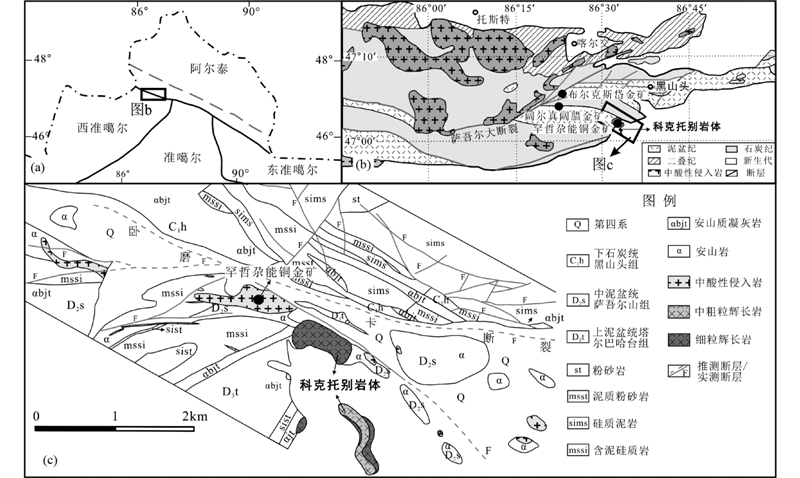 | 图 1 新疆北部构造分区图(a,据何国琦等,1995)、萨乌尔地区地质简图(b,据新疆地矿局区调大队第十分队,1981①)和科克托别岩体地质简图(c,据郭正林等,2010)Fig. 1 Tectonic zoning map of northern Xinjiang(a,after He et al., 1995),sketch geologic map of Sawuer region(b) and simplified geological map of the Keketuobie intrusion(c,after Guo et al., 2010) |
① 新疆地矿局区调大队第十分队. 1981. 1:20万区域地质调查报告,吉木乃幅、布尔津幅
2 地质背景
萨吾尔地区主要出露泥盆系至二叠系的地层,最老的地层为中泥盆统萨吾尔山组,分布于萨吾尔山东段,为一套海相中、基性火山碎屑岩建造,由陆源碎屑岩、安山质晶屑凝灰岩、角砾熔岩夹安山玢岩、粉砂岩、灰岩组成,发育有中泥盆统标准珊瑚以及植物化石。上泥盆统塔尔巴哈台组出露于萨吾尔山南缘及东段,为岛弧型火山复理石建造,上亚组为一套浅海相碎屑岩、火山碎屑岩夹少量火山岩,下亚组为一套火山岩夹有少量火山碎屑岩。下石炭统黑山头组仅见于萨吾尔山东段,属岛弧型沉积-火山-火山碎屑岩建造,主要由凝灰质砂岩、含碳泥质粉砂岩、玄武岩、安山岩、安山质角砾熔岩夹少量硅质粉砂岩透镜体组成,含有大量的早石炭世珊瑚和腕足化石。下石炭统萨尔布拉克组仅出露于萨吾尔山北侧的局部地段。那林卡拉组和吉木乃组出露于萨吾尔山北侧,那林卡拉组为一套海相、海陆交互相含煤复理石建造,吉木乃组为砂岩、晶屑凝灰岩夹安山岩和玄武岩薄层。二叠系哈尔加乌组和卡拉岗组陆相火山-沉积岩系主要分布于萨吾尔山北侧(新疆地质矿产局,1993)(图 1b)。
区内褶皱构造主要为萨吾尔复式向斜和哈拉巴依复式背斜,在科克森套地区发育科克森套复背斜,其组成科克森套山的主体。断裂依据变性特征、空间组合以及相互切割顺序可分为近东西向逆冲断裂和走滑剪切断裂,主要断裂为分布于研究区中部的萨吾尔大断裂(图 1b)。区内侵入岩和火山岩较发育,侵入岩以中酸性岩为主,其次有少量镁铁-超镁铁岩分布,加里东及海西中期侵入岩和火山岩主要分布于萨吾尔山附近岩浆弧上,石炭纪中酸性岩从早到晚具有从钙碱性往碱性过渡的特征,可能形成于碰撞造山后环境(袁峰等,2006a; 范裕等,2007)。早二叠世是大陆板内火成活动阶段,发育双峰式火山岩和A型花岗岩(周涛发等, 2006b,c; Zhou et al., 2007,2008; 谭绿贵等,2007)。该地区属于扎尔玛-萨吾尔金铜成矿带,已发现有罕哲尕能斑岩铜金矿床、阔尔真阔腊浅成低温热液金矿床、布尔克斯岱浅成低温热液金矿床、塔斯特铜矿等矿产。
3 岩体的岩石学特征科克托别岩体位于萨吾尔东南部,岩体附近出露中泥盆统萨吾尔山组和上泥盆统塔尔巴哈台组地层,中泥盆统萨吾尔山组为安山玄武质集块角砾熔岩夹辉石安山岩、玄武岩、安山质凝灰岩及泥质粉砂岩,上泥盆统塔尔巴哈台组为泥质粉砂岩夹少量生物碎屑灰岩。岩体长约1.4km,宽300~400m,出露面积约0.5km2。根据岩相学特征岩体包括中粗粒辉长岩、细粒辉长岩和闪长岩(图 1c)。在野外露头显示中粗粒辉长岩和细粒辉长岩明显呈侵入接触关系,细粒辉长岩以脉状侵入中粗粒辉长岩中(图 2a),脉状细粒辉长岩中包裹有中粗粒辉长岩包体(图 2b),说明它们是两次不同的岩浆侵入形成,而且细粒辉长岩要晚于中粗粒辉长岩形成。在中粗粒辉长岩和细粒辉长岩中都含有磁铁矿,在细粒辉长岩底部可以见到20cm厚的块状磁铁矿(图 2c)。钻孔中可见闪长岩与中粗粒辉长岩呈渐变过渡接触关系,而与细粒辉长岩呈侵入接触关系,在细粒辉长岩中可见闪长岩包体(图 2d)。
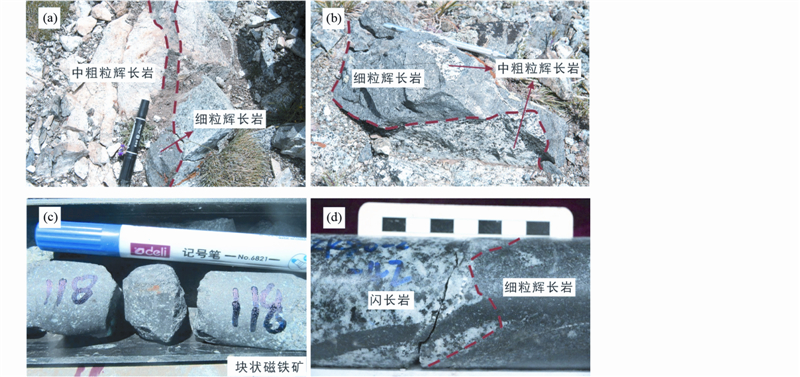 | 图 2 科克托别岩体野外照片 (a)细粒辉长岩呈脉状侵入中粗粒辉长岩中;(b)细粒辉长岩内包裹中粗粒辉长岩包体;(c)细粒辉长岩底部的块状磁铁矿;(d)细粒辉长岩与闪长岩呈侵入接触关系Fig. 2 The contact exposure of the medium-coarse grained gabbro and fine grained gabbro from the Keketuobie intrusion (a)the veined fine grained gabbro intruded in the medium-coarse grained gabbro;(b)medium-coarse grained gabbro inclusion occurred in the fine grained gabbro;(c)the massive magnetite at the bottom of the fine grained gabbro;(d)the intrusive contact relationship between the fine grained gabbro and diorite |
中粗粒辉长岩为中粗粒辉长结构,块状构造。主要矿物有斜长石(60%~70%)、辉石(8%~15%)和普通角闪石(10%~15%),次要矿物有磁铁矿(2%~8%)。辉石矿物粒度在0.2~1mm之间,斜长石矿物粒度在0.1~0.8mm之间。普通角闪石呈半自形-他形分布于自形-半自形的辉石和斜长石边缘,磁铁矿呈他形分布于其他硅酸盐矿物颗粒之间,部分磁铁矿包裹在辉石颗粒中(图 3a)。
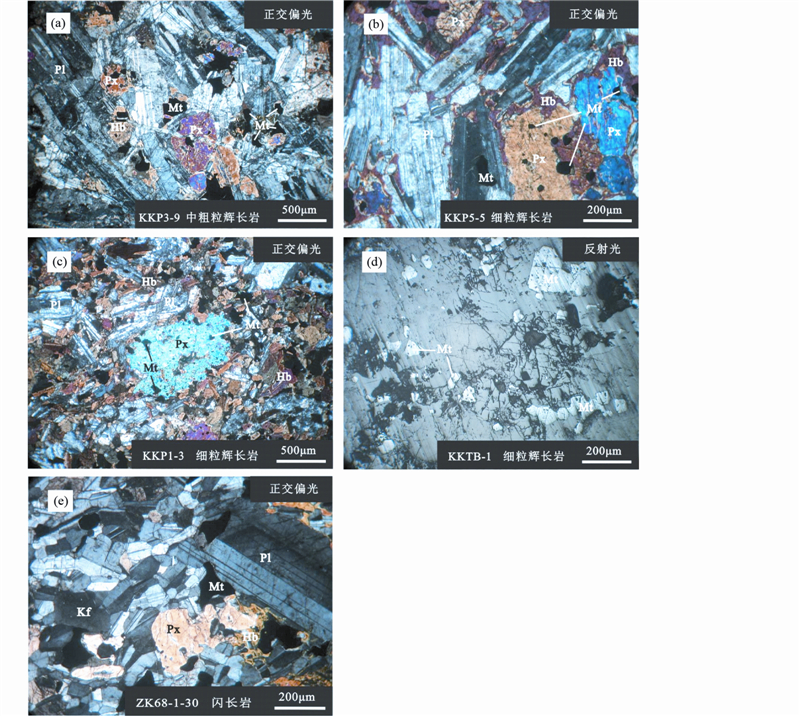 | 图 3 科克托别岩体岩石学特征 (a)中粗粒辉长岩的辉长结构;(b)细粒辉长岩辉石中的磁铁矿;(c)细粒辉长岩;(d)细粒辉长岩中磁铁矿;(e)闪长岩. Px-辉石;Pl-斜长石;Hb-角闪石;Kf-钾长石;Mt-磁铁矿Fig. 3 Texture photos of the rocks from Keketuobie intrusion(cross-polarized) (a)gabbro texture of the medium to coarse grained gabbro;(b)the magnetite in the pyroxene of the fine grained gabbro;(c)fine grained gabbro;(d)the magnetite in the fine grained gabbro;(e)diorite. Px-pyroxene; Pl-plagiclase; Hb-hornblende; Kf-potassium feldspar; Mt-magnetite |
细粒辉长岩为细粒辉长结构,块状构造。主要矿物有斜长石(45%~55%)、辉石(10%~20%)和普通角闪石(10%~20%)(图 3b,c),次要矿物有磁铁矿(5%~20%)(图 3d)。其中暗色矿物含量明显多于中粗粒辉长岩。辉石矿物粒度在0.1~0.8mm之间,斜长石矿物粒度在0.05~0.4mm之间。斜长石呈自形,部分绢云母化,部分普通角闪石分布在辉石和斜长石的周围(图 3b),部分呈自形-半自形与辉石和斜长石共生(图 3c),已发生绿泥石化。磁铁矿呈分布于其他硅酸盐矿物颗粒之间或者包裹在辉石颗粒中(图 3b,c)。
闪长岩为细粒粒状结构,块状构造。主要矿物有斜长石(45%~55%)、 普通角闪石(10%~20%)、 钾长石(5%~15%)和辉石(5%~10%),次要矿物有磁铁矿(0%~5%)(图 3e)。普通角闪石分布在辉石的周围,并发生绿泥石化,可见钾长石的卡斯巴双晶。
4 样品采集及分析方法测年样品为科克托别岩体地表的新鲜细粒辉长岩(坐标:N47°02′27.3″,E86°32′43.1″)。样品经重液分离和磁选后,挑选代表性的锆石在西澳大学(The University of Western Australia)制作样品靶并对锆石进行了背散射图像及阴极发光(CL)分析,上机测试在科廷科技大学(Curtin University of Technology)利用SHRIMPⅡ完成。测试过程中,利用BR266和NBS610玻璃来标定U含量和调校ZrO峰和206Pb峰,用TEM作为年龄标样(417Ma)。一次离子流调整为1.5nA,离子束直径约为25μm,测试详细流程参见Williams(1998)。测试所得数据利用Ludwig SQUID 2.22及ISOPLOT程序进行处理,由于年轻样品锆石中204Pb丰度较低,数据处理时采用实测208Pb校正普通铅。
对样品进行光薄片切制,根据显微岩相学观察,选择蚀变弱的代表性样品5件,在无污染的条件下破碎用于分析测试。主量元素和微量元素测试分析在广州澳实矿物实验室中心完成,其中主量元素用X-射线荧光光谱法(XRF)测定,氧化物总量分析误差为1%~3%。其大致过程为:首先称取0.7g样品,然后加入适量硼酸高温熔融成玻璃片,最后在XRF上用外标法测定氧化物含量。微量元素测定采用等离子质谱(ICP-MS)法:首先称取50mg样品,用酸溶样制成溶液,然后在ICP-MS上用内标法进行测定,分析精度优于10%。
5 分析结果 5.1 辉长岩锆石SHRIMP U-Pb年代学阴极发光图像(图 4)显示,锆石外形特征主要呈长柱状或短柱状,较典型的岩浆振荡环带结构,应为岩浆成因。对细粒辉长岩中锆石分别进行了17个点的SHRIMP U-Pb年龄测试,分析结果见表 1。样品锆石SHRIMP U-Pb年龄谐和图见图 4,得到的206Pb/238U加权平均年龄细粒辉长岩为323.2±6.2Ma。因此,科克托别岩体细粒辉长岩成岩时代应为早石炭世。
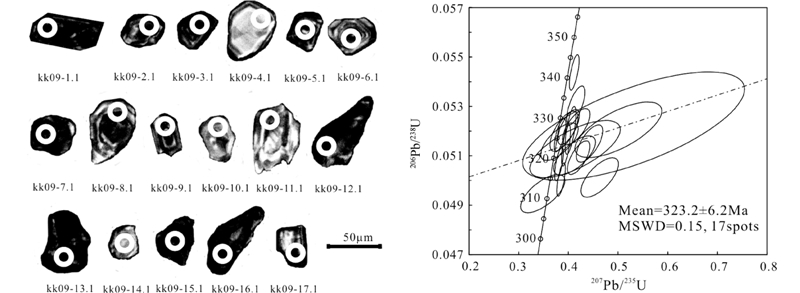 | 图 4 科克托别岩体细粒辉长岩锆石阴极发光图像和SHRIMP U-Pb年龄协和图Fig. 4 Cathodoluminescence(CL)images and SHRIMP concordia U-Pb diagrams of zircon from the fine grained gabbro in the Keketuobie intrusion |
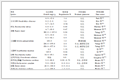 | 表 1 科克托别岩体细粒辉长岩锆石SHRIMP U-Pb年龄分析结果Table 1 SHRIMP U-Pb data for zircon of the fine grained gabbro from the Keketuobie intrusion |


科克托别岩体中粗粒辉长岩和细粒辉长岩的主量元素和微量元素分析数据如表 2所示。在Middlemost et al.(1994)岩浆/火成岩全碱-硅岩石化学分类图解中(图 5),中粗粒辉长岩投影在辉长岩范围内,有1个样品投影在二长辉长岩范围内,为辉长岩向闪长岩的过渡岩石样品。大部分细粒辉长岩由于SiO2较低不投影在辉长岩范围内,闪长岩投点在二长闪长岩范围内。中粗粒辉长岩的SiO2含量为46.5%~49.3%,MgO含量在3.16%~5.26%之间;细粒辉长岩SiO2含量为38.6%~47.0%,MgO含量在5.06%~7.43%之间;闪长岩中SiO2含量为51.5%~54.0%,MgO含量在2.99%~3.24%之间。从细粒辉长岩、中粗粒辉长岩到闪长岩,样品中MgO、Fe2O3T、CaO含量依次升高,而SiO2含量依次降低(图 6),MgO与Fe2O3T、CaO、Al2O3呈正相关关系,而与SiO2呈反相关关系,与岩浆中辉石和斜长石的结晶分异有关。细粒辉长岩较低的SiO2和较高的Fe2O3T与岩石中辉石、角闪石、磁铁矿的堆晶作用有关,这与岩体岩相学特征一致。萨吾尔地区的阔尔真阔腊地区玄武岩主量元素与科克托别岩体中粗粒辉长岩相似,但相对于细粒辉长岩具有更低的CaO和Fe2O3T,更高含量的SiO2。
| 表 2 科克托别岩体主量元素(wt%)和微量元素(×10-6)分析测试结果Table 2 Contents of major oxides(wt%) and trace elements(×10-6)of the Keketuobie intrusion |
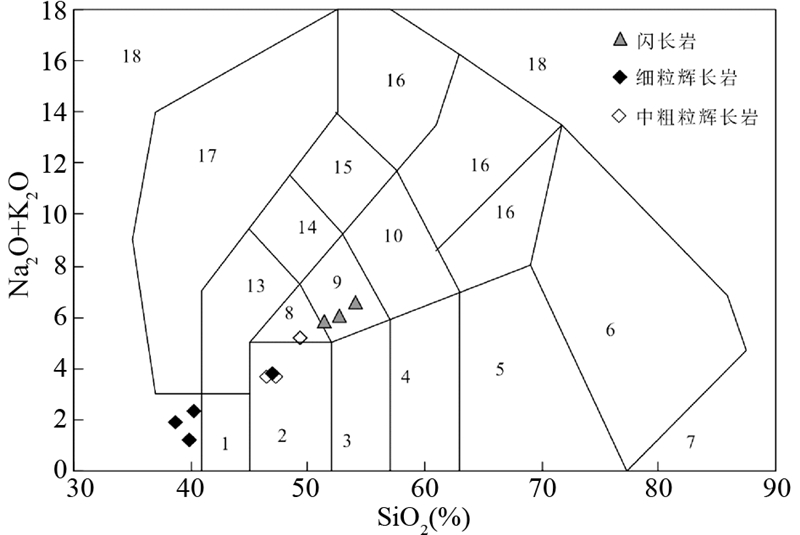 | 图 5 科克托别岩体岩浆/火成岩全碱-硅(TAS)岩石分类图(据Middlemost,1994) 1-橄榄辉长岩;2a-碱性辉长岩;2b-亚碱性辉长岩;3-辉长闪长岩;4-闪长岩;5-花岗闪长岩;6-花岗岩;7-硅英岩;8-二长辉长岩;9-二长闪长岩;10-二长岩;11-石英二长岩;12-正长岩;13-副长石辉长岩;14-副长石二长闪长岩;15-副长石二长正长岩;16-副长正长岩;17-副长深成岩;18-霓方钠岩/磷霞岩/粗白榴岩Fig. 5 Total alkali vs. silica classification diagram for the Keketuobie intrusive rocks(after Middlemost,1994) |
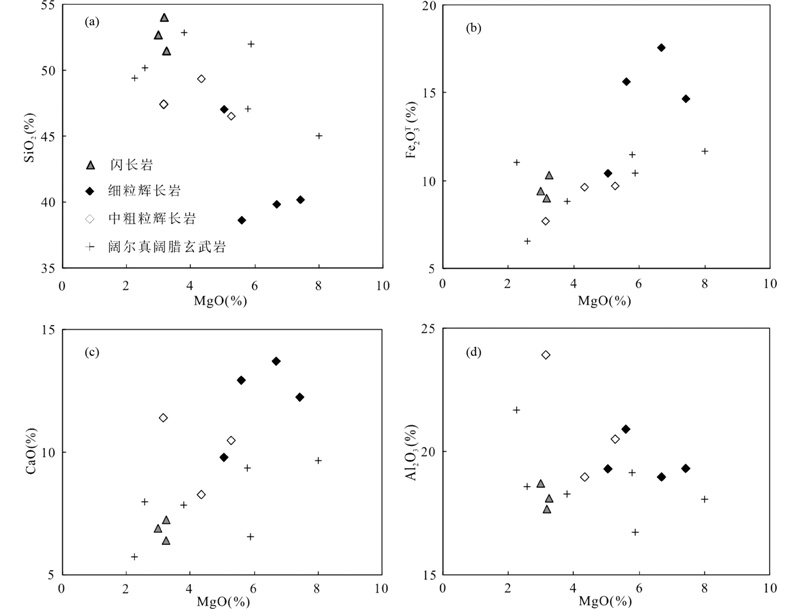 | 图 6 科克托别岩体哈克图解 阔尔真阔腊玄武岩数据来自Shen et al.(2008),图 7、图 8同Fig. 6 Haker diagrams of the Keketuobie intrusive rocks The data of the Kuoerzhenkuola basalts in this figure and Fig. 7 and Fig. 8 are from Shen et al.(2008) |
在大洋中脊玄武岩(N-MORB)标准化的微量元素蛛网图中,科克托别岩体岩石明显富集大离子亲石元素(Sr、Ba、U),而高场强元素(Nb、Ta)和重稀土元素(Yb、Y)相对亏损(图 7a)。中粗粒辉长岩微量元素含量与细粒辉长岩相似,但都低于闪长岩微量元素含量,所有辉长岩样品都具有Sr的正异常,可能是由于样品中含有较多的斜长石堆晶有关。样品中稀土元素总含量(∑REE)较低,为19.5×10⁻⁶~159×10-6,其中细粒辉长岩稀土元素含量最低,闪长岩最高,中粗粒辉长岩介于两者之间。(La/Yb)N介于1.43~6.49之间,轻重稀土元素分馏明显(图 7b)。由于Pr、Nd、Sm、Eu在角闪石中为相容元素(杨学明等,2000),部分细粒辉长岩样品中Pr、Nd、Sm、Eu相对于相邻的元素富集可能与这些样品中含有较多的角闪石有关。δEu介于0.76~1.12之间,其中大多数细粒辉长岩和中粗粒辉长岩都具有正Eu异常,而闪长岩具有负Eu异常。阔尔真阔腊玄武岩富集大离子亲石元素,微量元素含量与科克托别岩体中粗粒辉长岩相似,而高于部分细粒辉长岩样品。
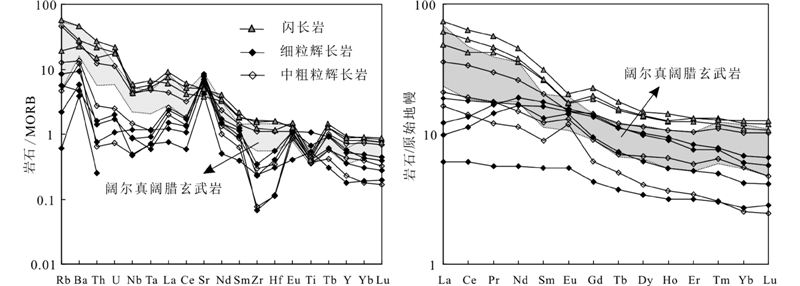 | 图 7 科克托别岩体MORB标准化微量元素蛛网图(a,标准化值据Pearce,1982)和球粒陨石标准化稀土元素配分型式图(b,标准化值据Sun and McDonough, 1989)Fig. 7 MORB-normalized spider diagrams(a,normalization values after Pearce,1982) and chondrite-normalized REE patterns(b,normalization values after Sun and McDonough, 1989)of the intermediate-acid rocks in the Kuoerzhenkuola deposit |
本文对科克托别岩体细粒辉长岩进行锆石SHRIMP U-Pb精确测年,得出成岩年龄为323.2±6.2Ma,因此,科克托别岩体细粒辉长岩成岩时代应为早石炭世。中粗粒辉长岩、细粒辉长岩与闪长岩在空间上紧密共生,三者之间主量元素之间的相关关系以及微量元素配分型式相似性说明它们为同源岩浆结晶分异的产物,因此,细粒辉长岩能代表科克托别岩体的形成年龄。萨吾尔地区发育有较多的早石炭世中酸性侵入岩以及火山岩,然而,对于该地区石炭纪构造环境仍存在争议。部分学者认为340~275Ma是西准噶尔地区重要的后碰撞岩浆活动时期(韩宝福等,2006; 周涛发等,2006c; 袁峰等,2006a; 范裕等,2007; Zhou et al., 2007,2008);而另一部分学者认为早石炭世处于洋内俯冲的岛弧(Shen et al., 2009,2013a,b; Geng et al., 2009; 唐功建等,2009; Yin et al., 2010)或弧后盆地环境中(金成伟和张秀棋,1993; 沈远超和金成伟,1993)。因此,研究科克托别岩体对 探讨西准噶尔早石炭世构造环境以及古亚洲洋闭合的时限具有重要意义。
6.2 结晶分异过程科克托别岩体中粗粒辉长岩与细粒辉长岩呈侵入接触关系,说明两者是不同期次岩浆侵位形成。中粗粒辉长岩与闪长岩之间呈渐变过渡接触关系,指示闪长岩岩浆为基性的中粗粒辉长岩岩浆经历结晶演化而形成的,因此两者之间主量元素(如SiO2)以及稀土元素含量呈逐渐增加的趋势。细粒辉长岩中由于含有较多的辉石、角闪石以及磁铁矿堆晶,因此显示出较低的SiO2和较高的Fe2O3(图 5、图 6),尤其在细粒辉长岩底部由于重力分异作用堆积大量的磁铁矿而形成了块状磁铁矿矿石。大多数细粒辉长岩和中粗粒辉长岩都具有正Eu异常,而闪长岩具有负Eu异常,可能与细粒辉长岩和中粗粒辉长岩中斜长石的堆晶作用有关,斜长石的结晶分异导致演化的残余岩浆中亏损Eu,这些残余岩浆结晶形成的闪长岩中发育负Eu异常,这也说明他们之间可能存在结晶演化关系。因此,科克托别岩体为两期基性程度不同的岩浆侵位形成,早期基性岩浆侵位并发生分异作用形成中粗粒辉长岩和闪长岩,晚期较为基性的岩浆上侵就位于中粗粒辉长岩与闪长岩的构造裂隙中形成细粒辉长岩。
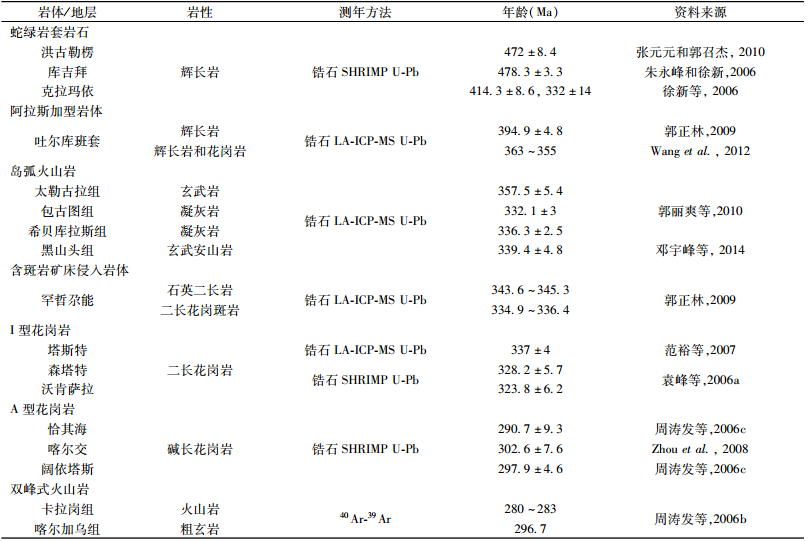
6.3 构造背景已有的年代学证据显示,西准噶尔地区蛇绿岩套岩石年龄为478~332Ma(徐新等,2006; 朱永峰和徐新,2006; 张元元和郭召杰,2010),指示在早石炭世古亚洲洋并没有闭合。另外,在扎尔玛-萨吾尔岩浆弧北侧的额尔齐斯-斋桑缝合带内,察尔斯克蛇绿岩中硅质岩含大量晚泥盆世-早石炭世放射虫和牙形石化石(Iwata et al., 1994,1997),说明早石炭世古亚洲洋依然存在(Windley et al., 2007; Vladimirov et al., 2008; Han et al., 2010b)。克拉玛依蛇绿岩之上被一套晚石炭-早二叠世的陆缘火山磨拉石沉积不整合覆盖(徐新等,2010),指示在晚石炭世-早二叠世该地区大洋已经闭合。该地区已发现的早石炭世火山岩年龄为332~357Ma(郭丽爽等,2010; 邓宇峰等,2014),并且该套火山岩地层中含有浅海相沉积岩和化石,而二叠纪没有分布有海相沉积岩和火山岩(李菊英和晋慧娟,1989; 新疆地质矿产局,1993);另一方面,萨吾尔地区含斑岩矿床侵入岩年龄为334.9~345.3Ma(郭正林等,2010),这些岩浆岩及其相关的矿床指示了在早石炭世萨吾尔地区还处于岛弧环境中。西准噶尔已识别出的I型花岗岩主要分布于萨吾尔地区,岩体呈带状分布,形成年龄为324~337Ma(袁峰等, 2006a,b; 范裕等,2007; Zhou et al., 2008; Chen et al., 2010)(表 3),部分岩体的年龄与岛弧岩浆岩的年龄发生重叠。西准噶尔地区A型花岗岩和双峰式火山岩形成于早二叠世,A型花岗岩分布广泛,呈面状分布,地球化学特征表明其形成于碰撞后伸展环境中(Han et al., 1997; Chen and Arakawa, 2005; 周涛发等,2006c; 谭绿贵等,2007)。锆石U-Pb年代学分析结果表明科克托别岩体形成于早石炭世晚期,这一年龄晚于蛇绿岩年龄以及岛弧火山岩年龄,指示该地区大洋可能已经闭合,但是明显早于碰撞后伸展环境中形成的A型花岗岩和双峰式火山岩。另外,区域地质特征以及岩浆岩年代学特征表明西准噶尔地区弧-陆碰撞时间在320Ma左右(Han et al., 2010b; 徐新等,2010)。在晚石炭世,由于该地区处于碰撞造山挤压环境中,岩浆活动明显减弱(表 3)。综上所述,科克托别岩体可能形成于板块俯冲阶段之后碰撞造山后之前的同碰撞时期。
| 表 3 西准噶尔地区古生代岩浆岩同位素定年资料Table 3 Isotopic ages of the Paleozoic magmatic rocks in western Junggar |
由于西准噶尔地区未发现碰撞造山形成的岩浆岩和超高压矿物,因此对古亚洲洋在该地区的闭合时间存在争议(Zhou et al., 2008; Shen et al., 2008,2013a; Geng et al., 2009; 唐功建等,2009; Yin et al., 2010)。本文研究认为科克托别岩体形成于同碰撞环境中,指示西准噶尔地区古亚洲洋在早石炭晚期就已经闭合,并开始进入板块碰撞阶段。在世界上其他造山带同碰撞环境中也发育有基性-超基性岩(如阿尔卑斯造山带和苏鲁-大别造山带)(von Blanckenburg and Davies, 1995; Li et al., 1998),但不同的是这些碰撞造山带中都发育有与基性-超基性岩同时期的超高压变质岩。在增生造山过程中,造山的能量较弱,碰撞作用表现不强烈,地壳变形和变质程度都比较弱(任纪舜等,1999; 梁云海等,2004; 徐新等,2010),西准噶尔地区只有少量低温高压矿物蓝片岩的报道(张立飞,1997),没有见到典型的S型花岗岩以及大尺度的低角度推覆构造。世界范围内,碰撞后岩浆岩的年龄通常晚于板块碰撞20Myr左右(Chung et al., 2005; Dilek and Altunkaynak, 2009; Dilek et al., 2010),以科克托别岩体作为同碰撞岩浆岩的时限,萨吾尔地区碰撞后A型花岗岩以及双峰世火山岩形成的年龄晚于该地区板块碰撞时间~40Ma,说明不同的造山带中碰撞后与同碰撞岩浆岩之间的间隔时间是不同的。
6.4 科克托别岩体成因机制 由于科克托别岩体形成年龄晚于蛇绿岩,因此萨吾尔地区此时不存在洋脊俯冲,科克托别岩体难以用洋脊俯冲模式来解释。另外,科克托别岩体形成的年龄明显不同于早二叠世塔里木地幔柱以及晚泥盆世地幔柱活动的年龄(Zhang et al., 2008; Yang et al., 2013)。该岩体岩石富集大离子亲石元素,亏损高场强元素,微量元素配分型式与该地区阔尔真阔腊岛弧火山岩相似,明显不同于OIB,因此该岩体并非地幔柱活动的产物。科克托别岩体辉石颗粒包裹有磁铁矿(图 3a-c),说明磁铁矿结晶早于单斜辉石,由于辉长岩中辉石为早期结晶矿物,磁铁矿为高氧逸度条件下结晶矿物,这一现象指示岩体母岩浆中具有较高的氧逸度。科克托别岩体岩石中含有较多的角闪石(10%~20%),在细粒辉长岩中角闪石呈半自形-自形结构与辉石呈共结关系,说明角闪石为岩浆成因,岩石由高氧逸度含水的玄武岩浆结晶分异形成。岩石微量元素配分型式与岛弧岩浆岩相似表明岩浆来源于俯冲流体交代地幔。在Th-Nb/16-Hf/3以及Nb/Yb-Th/Yb图解中(图 8),科克托别岩体部分岩石投点在火山弧玄武岩和板内玄武岩过渡区域,部分样品投点在板内玄武岩和N-MORB区域范围内,与阔尔真阔腊岛弧火山岩明显区别,说明科克托别岩体并非形成于典型的俯冲带岛弧环境,而有可能形成于岛弧与板内过渡的同碰撞环境中(Harris et al., 1986; Atherton and Ghani, 2002; Han et al., 2010b)。由于N-MORB常被认为来源于亏损的软流圈地幔,因此,科克托别岩体岩石学以及地球化学特征指示岩体地幔源区中不仅有俯冲流体交代地幔,而且也有亏损软流圈地幔的参与,该岩体岩浆可能为软流圈地幔与上覆交代地幔相互作用形成。在同碰撞作用过程中,大洋岩石圈地幔已经全部俯冲到地幔楔之下,此时大陆岩石圈地幔开始发生俯冲。由于大陆岩石圈地幔相对较轻具有往上的浮力作用,而大洋岩石圈地幔较重会继续往深部俯冲,因此在大洋岩石圈地幔与大陆岩石圈地幔之间连接的部位发生板片断离(Davies and von Blanckenburg,1995; von Blanckenburg and Davies, 1995; Atherton and Ghani, 2002; Sun et al., 2002)。当大洋岩石圈地幔完全断离进入软流圈地幔以后引起软流圈地幔上涌,促使上覆交代地幔发生部分熔融形成玄武质岩浆,这些岩浆侵位至地壳浅部形成科克托别岩体。
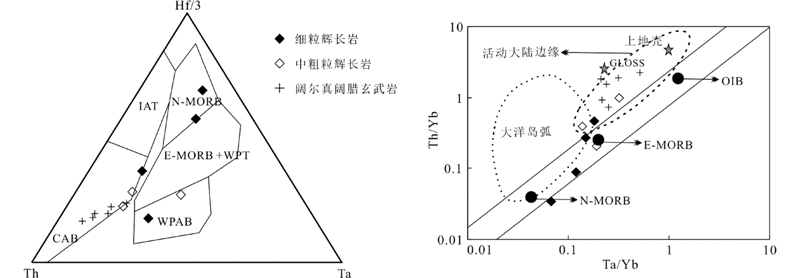 | 图 8 Hf/3-Th-Ta构造环境判别图(a,据Wood,1980)和Ta/Yb-Th/Yb相关图(b,据Pearce,1983) N-MORB-亏损型洋脊玄武岩;E-MORB-富集型洋脊玄武岩;CAB-火山弧钙碱性玄武岩;IAT-火山弧拉斑玄武岩;WPT-板内拉斑玄武岩;WPAB-板内碱性玄武岩Fig. 8 The Hf/3-Th-Nb/16 tectonic setting discrimination diagram(a,after Wood,1980) and diagram of Ta/Yb vs. Th/Yb(b,after Pearce,1983) N-MORB-normal-type oceanic ridge basalt; E-MORB-enriched oceanic ridge basalt; CAB-calc-alkali basalts; IAT-isl and -arc tholeiites; WPT-within-plate tholeiites; WPAB-within-plate alkaline basalts |
科克托别岩体由中粗粒辉长岩、细粒辉长岩和闪长岩组成,其中细粒辉长岩形成时间晚于中粗粒辉长岩,三者之间为同源岩浆结晶分异的产物;细粒辉长岩锆石U-Pb年龄为323.2±6.2Ma,表明科克托别岩体形成于早石炭世晚期。区域岩浆岩年代学及地质特征说明科克托别岩体可能形成于同碰撞环境中。由于早石炭时期板片断离导致软流圈地幔上涌,软流圈地幔与上覆交代地幔相互作用形成科克托别岩体的初始岩浆。
致谢 野外工作得到了新疆有色地质勘查局706队张斌以及其他工程技术人员的大力协助;审稿人对本文提出了建设性修改意见;在此谨致谢意。| [1] | Atherton MP and Ghani AA. 2002. Slab breakoff: A model for Caledonian, Late granite syn-collisional magmatism in the orthotectonic (metamorphic) zone of Scotland and Donegal, Ireland. Lithos, 62(3-4): 65-85 |
| [2] | Bureau of Geology and Mineral Resources of Xinjiang Uygur Autonomous Region. 1993. Regional Geology of Xinjiang Uygur Autonomous Region. Beijing: Geological Publishing House, 1-841 (in Chinese) |
| [3] | Chen B and Arakawa Y. 2005. Elemental and Nd-Sr isotopic geochemistry of granitoids from the West Junggar fold belt (NW China), with implications for Phanerozoic continental growth. Geochimica et Cosmochimica Acta, 69(5): 1307-1320 |
| [4] | Chen JF, Han BF, Ji JQ, Zhang L, Xu Z, He GQ and Wang T. 2010. Zircon U-Pb ages and tectonic implications of Paleozoic plutons in northern West Junggar, North Xinjiang, China. Lithos, 115(1-4): 137-152 |
| [5] | Chung SL, Chu MF, Zhang YQ, Xie YW, Lo CH, Lee TY, Lan CY, Li XH, Zhang Q and Wang YZ. 2005. Tibetan tectonic evolution inferred from spatial and temporal variations in post-collisional magmatism. Earth Science Reviews, 68(3-4): 173-196 |
| [6] | Davies JH and von Blanckenburg F. 1995. Slab break-off: A model of lithospheric detachment and its test in the magmatism and deformation of collisional orogens. Earth and Planetary Science Letters, 129(1-4): 85-102 |
| [7] | Deng YF, Yuan F, Zhou TF, Xu C, Zhang DY and Guo XJ. 2013. Geochemical characteristics and tectonic setting of the Tuerkubantao mafic-ultramafic intrusion in West Junggar, Xinjiang, China. Geoscience Frontiers, doi: 10.1016/j.gsf.2013.10.003 |
| [8] | Deng YF, Song XY, Chen LM, Zhou TF, Pirajno F, Yuan F, Xie W and Zhang DY. 2014. Geochemistry of the Huangshandong Ni-Cu deposit in northwestern China: Implications for the formation of magmatic sulfide mineralization in orogenic belts. Ore Geology Reviews, 56: 181-198 |
| [9] | Deng YF, Zhou TF, Yuan F, Guo XJ, Zhang DY, Xu C and Li P. 2014. LA-ICP-MS U-Pb zircon age of basaltic andesite in the Kuoerzhenkuola gold deposit and its geological significance. Acta Geologica Sinica, 88(5): 883-894 (in Chinese with English abstract) |
| [10] | Dilek Y and Altunkaynak S. 2009. Geochemical and temporal evolution of Cenozoic magmatism in western Turkey: Mantle response to collision, slab break-off, and lithospheric tearing in an orogenic belt. Geological Society, London, Special Publications, 311(1): 213-233 |
| [11] | Dilek Y, Imamverdiyev N and Altunkaynak Ş. 2010. Geochemistry and tectonics of Cenozoic volcanism in the Lesser Caucasus (Azerbaijan) and the peri-Arabian region: Collision-induced mantle dynamics and its magmatic fingerprint. International Geology Review, 52(4-6): 536-578 |
| [12] | Fan Y, Zhou TF, Tan LG, Cooke D, Meffre S, Yang WP and He LX. 2007. LA-ICP-MS zircon age of Tasite pluton in Sawuer region of West Junggar, Xinjiang. Acta Petrologica Sinica, 23(8): 1901-1908 (in Chinese with English abstract) |
| [13] | Geng HY, Sun M, Yuan C, Xiao WJ, Xian WS, Zhao GC, Zhang LF, Wong KP and Wu FY. 2009. Geochemical, Sr-Nd and zircon U-Pb-Hf isotopic studies of Late Carboniferous magmatism in the West Junggar, Xinjiang: Implications for ridge subduction? Chemical Geology, 266(3-4): 364-389 |
| [14] | Guo LS, Liu YL, Wang ZH, Song D, Xu FJ and Su L. 2010. The ziron U-Pb LA-ICP-MS geochronology of volcanic rocks in Baogutu areas, western Junggar. Acta Petrologica Sinica, 26(2): 471-477 (in Chinese with English abstract) |
| [15] | Guo ZL. 2009. Tectonic-metallogenic division, regional metallogenic regularity and exploration potential analysis in northwestern margin of Junggar, NW-China. Ph. D. Dissertation. Beijing: Institute of Geology and Geophysics, Chinese Academy of Sciences, 1-152 (in Chinese with English summary) |
| [16] | Guo ZL, Li JX, Qin KZ, Dong LH, Guo XJ, Tang DM and Du XW. 2010. Zircon U-Pb geochronology and geochemistry of Hanzheganeng Cu-Au deposit in West Junggar, Xinjiang: Implications for magma source and metallogenic tectonic setting. Acta Petrologica Sinica, 26(12): 3563-3578 (in Chinese with English abstract) |
| [17] | Han BF, Wang SG, Jahn BM, Hong DW, Kagami H and Sun YL. 1997. Depleted-mantle source for the Ulungur River A-type granites from North Xinjiang, China: Geochemistry and Nd-Sr isotopic evidence, and implications for Phanerozoic crustal growth. Chemical Geology, 138(3-4): 135-159 |
| [18] | Han BF, Ji JQ, Song B, Chen LH and Zhang L. 2006. Late Paleozoic vertical growth of continental crust around the Junggar Basin, Xinjiang, China (Part Ⅰ): Timing of post-collosional plutonism. Acta Petrologica Sinica, 22(5): 1077-1086 (in Chinese with English abstract) |
| [19] | Han BF, Guo ZJ, Zhang ZC, Zhang L, Chen JF and Song B. 2010b. Age, geochemistry, and tectonic implications of a Late Paleozoicstitching pluton in the North Tian Shan suture zone, western China. Geological Society of America Bulletin, 122(3-4): 627-640 |
| [20] | Han CM, Xiao WJ, Zhao GC, Ao SJ, Zhang JE, Qu WJ and Du AD. 2010a. In-situ U-Pb, Hf and Re-Os isotopic analyses of the Xiangshan Ni-Cu-Co deposit in Eastern Tianshan (Xinjiang), Central Asia Orogenic Belt: Constraints on the timing and genesis of the mineralization. Lithos, 120(3-4): 547-562 |
| [21] | Harris NBW, Pearce JA and Tindle AG. 1986. Geochemical characteristics of collision zone magmatism. Geological Society, London, Special Publications, 19(1): 67-81 |
| [22] | He GQ, Liu DQ, Li MS, Tang YL and Zhou RH. 1995. Five phases pattern and ore-forming of main orogenic belt crust evolution in Xinjiang. Xinjiang Geology, 13(2): 99-194 (in Chinese with English abstract) |
| [23] | Iwata K, Watanabe T, Akiyama M, Dobretsov NL and Belyaev SY. 1994. Paleozoic microfossils from the Chara Belt (Eastern Kazakhstan). Russian Geology and Geophysics, 35: 145-151 (in Russian) |
| [24] | Iwata K, Obut OT and Buslov MM. 1997. Devonian and Lower Carboniferous radiolaria from the Chara ophiolite belt, East Kazakhstan. News of Osaka Micropaleontologist, 10: 27-32 |
| [25] | Jin CW and Zhang XQ. 1993. A geochronology and geneses of the western Junggar granitoids, Xinjiang, China. Scientia Geologica Sinica, 28(1): 28-36 (in Chinese with English abstract) |
| [26] | Li JY and Jin HJ. 1989. The trace fossils discovery and its environment significance in Carboniferous turbidite series, the northwest border of Zhunga'er basin Xinjiang. Scientia Geologica Sinica, (1): 9-15 (in Chinese with English abstract) |
| [27] | Li SG, Nie YH, Hart SR and Zhang ZQ. 1998. Interaction between subducted continental crust and the mantle Ⅱ. Sr and Nd isotopic geochemistry of the syncollisional mafic-ultramafic intrusions in Dabie Mountains. Science in China (Series D), 41(6): 632-638 |
| [28] | Liang YH, Li WQ and Li WD. 2004. Characteristics of polycyclic opening-closing tectonics in the Junggar orogenic belt, Xinjiang. Geological Bulletin of China, 23(3): 279-285 (in Chinese with English abstract) |
| [29] | Middlemost EAK. 1994. Naming materials in the magma/igneous rock system. Earth-Science Reviews, 37: 215-224 |
| [30] | Naldrett AJ and Cabri LJ. 1976. Ultramafic and related mafic rocks: Their classification and genesis with special reference to the concentration of nickel sulfides and platinum-group elements. Economic Geology, 71(7): 1131-1158 |
| [31] | Pearce JA. 1982. Trace elements characteristics of lavas from destructive plate boundaries. In: Thorpe RS (ed.). Andesites: Orogenic Andesites and Related Rocks. New York: Wiley, 525-548 |
| [32] | Pearce JA. 1983. The role of sub-continental lithosphere in magma genesis at destructive plate margins. In: Hawkesworth CJ and Norry MJ (eds.). Continental Basalts and Mantle Xenoliths. Nantwich: Shiva, 230-249 |
| [33] | Qin KZ, Su BX, Sakyi PA, Tang DM, Li XH, Sun H, Xiao QH and Liu PP. 2011. SIMS zircon U-Pb geochronology and Sr-Nd isotopes of Ni-Cu-bearing mafic-ultrafic intrusions in Eastern Tianshan and Beishan in correlation with flood basalts in Tarim basin (NW China): Constraints on a ca.280Ma mantle plume. American Journal of Science, 311(3): 237-260 |
| [34] | Ren JS, Niu BG and Liu ZG. 1999. Soft collision, superposition orogeny and polycyclic suturing. Earth Science Frontiers, 6(3): 85-93 (in Chinese with English abstract) |
| [35] | Shen P, Shen YC, Liu TB, Li GM and Zeng QD. 2007. Genesis of volcanic-hosted gold deposits in the Sawur gold belt, northern Xinjiang, China: Evidence from REE, stable isotopes, and noble gas isotopes. Ore Geology Reviews, 32(1-2): 207-226 |
| [36] | Shen P, Shen YC, Liu TB, Li GM and Zeng QD. 2008. Geology and geochemistry of the Early Carboniferous Eastern Sawur caldera complex and associated gold epithermal mineralization, Sawur Mountains, Xinjiang, China. Journal of Asian Earth Sciences, 32(2-4): 259-279 |
| [37] | Shen P, Shen YC, Liu TB, Meng L, Dai HW and Yang YH. 2009. Geochemical signature of porphyries in the Baogutu porphyry copper belt, western Junggar, NW China. Gondwana Research, 16(2): 227-242 |
| [38] | Shen P, Pan HD, Xiao WJ, Li XH, Dai HW and Zhu HP. 2013a. Early Carboniferous intra-oceanic arc and back-arc basin system in the West Junggar, NW China. International Geology Review, 55(16): 1991-2007 |
| [39] | Shen P, Pan HD, Xiao WJ, Chen XH, Eleonorad S and Shen YC. 2013b. Two geodynamic-metallogenic events in the Balkhash (Kazakhstan) and the West Junggar (China): Carboniferous porphyry Cu and Permian greisen W-Mo mineralization. International Geology Review, 55(13): 1660-1687 |
| [40] | Shen YC and Jin CW. 1993. Ore-forming Model and Mechanism of Gold Mineralization Area in West Junggar. Beijing: Science Press, 217-236 (in Chinese) |
| [41] | Song XY, Xie W, Deng YF, Crawford AJ, Zheng WQ, Zhou GF, Deng G, Chen SL and Li J. 2011. Slab break-off and the formation of Permian mafic-ultramafic intrusions in southern margin of Central Asian Orogenic Belt, Xinjiang, NW China. Lithos, 127(1-2): 128-143 |
| [42] | Song XY, Chen LM, Deng YF and Xie W. 2013. Syncollisional tholeiitic magmatism induced by asthenosphere upwelling owing to slab detachment at the southern margin of the Central Asian Orogenic Belt. Journal of the Geological Society, London, 170(6): 941-950 |
| [43] | Su BX, Qin KZ, Sun H, Tang DM, Sakyi PA, Chu ZY, Liu PP and Xiao QH. 2012. Subduction-induced mantle heterogeneity beneath Eastern Tianshan and Beishan: Insights from Nd-Sr-Hf-O isotopic mapping of Late Paleozoic mafic-ultramafic complexes. Lithos, 134-135: 41-51 |
| [44] | Sun SS and McDonough W. 1989. Chemical and isotopic systematics of oceanic basalts: Implications for mantle composition and processes. In: Saunders AD and Norry MJ (eds.). Magmatism in the Ocean Basins. Geological Society, London, Special Publications, 42(1): 313-345 |
| [45] | Sun WD, Li SG, Chen YD and Li YJ. 2002. Timing of synorogenic granitoids in the South Qinling, Central China: Constraints on the evolution of the Qinling-Dabie orogenic belt. The Journal of Geology, 110(4): 457-468 |
| [46] | Tan LG, Zhou TF, Yuan F, Fan Y and Yue SC. 2007. 40Ar-39Ar age of the Kalagang formation volcanic rocks in western Junggar, Xinjiang. Chinese Journal of Geology, 42(3): 579-586 (in Chinese with English abstract) |
| [47] | Tang DM, Qin KZ, Su BX, Sakyi PA, Liu YS, Mao Q, Santosh M and Ma YG. 2013. Magma source and tectonics of the Xiangshanzhong mafic-ultramafic intrusion in the Central Asian Orogenic Belt, NW China, traced from geochemical and isotopic signatures. Lithos, 170-171: 144-163 |
| [48] | Tang GJ, Wang Q, Zhao ZH, Wyman DA, Chen HH, Jia XH and Jiang ZQ. 2009. Geochronology and geochemistry of the ore-bearing porphyries in the Baogutu area (western Junggar): Petrogenesis and their implications for tectonics and Cu-Au Mineralization. Earth Science, 34(1): 56-74 (in Chinese with English abstract) |
| [49] | Vladimirov AG, Kruk NN, Khromykh SV, Polyansky OP, Chervov VV, Vladimirov VG, Travin AV, Babin GA, Kuibida ML and Homyakov VD. 2008. Permian magmatism and lithospheric deformation in the Altai caused by crustal and mantle thermal processes. Russian Geology and Geophysics, 49(7): 468-479 (in Russian) |
| [50] | von Blanckenburg F and Davies JH. 1995. Slab breakoff: A model for syncollisional magmatism and tectonics in the Alps. Tectonics, 14(1): 120-131 |
| [51] | Wang YW, Wang JB, Wang LJ, Long LL, Tang PZ, Liao Z, Zhang HQ and Shi Y. 2012. The Tuerkubantao ophiolite mélange in Xinjiang, NW China: New evidence for the Erqis suture zone. Geoscience Frontiers, 3(5): 587-602 |
| [52] | Williams IS. 1998. U-Th-Pb geochronology by ion microprobe. In: McKibben MA, Shanks WC Ⅲ and Ridley WI (eds.). Applications of Microanalytical Techniques to Understanding Mineralizing Processes. Reviews in Economic Geology, 1-35 |
| [53] | Wilson M. 1989. Igneous Petrogenesis. London: Unwin Hyman, 1-466 |
| [54] | Windley BF, Alexeiev D, Xiao WJ, Kroner A and Badarch G. 2007. Tectonic models for accretion of the Central Asian Orogenic Belt. Journal of the Geological Society of London, 164(1): 31-47 |
| [55] | Wood DA. 1980. The application of a Th-Hf-Ta diagram to problems of tectonomagmatic classification and to establishing the nature of crustal contamination of basaltic lavas of the British Tertiary volcanic province. Earth and Planetary Science Letters, 50(1): 11-30 |
| [56] | Xie W, Song XY, Deng YF, Wang S, Ba DH, Zheng WQ and Li XB. 2012. Geochemistry and petrogenetic implications of a Late Devonian mafic-ultramafic intrusion at the southern margin of the Central Asian Orogenic Belt. Lithos, 144-145: 209-230 |
| [57] | Xu X, He GQ, Li HQ, Ding TF, Liu XY and Mei SW. 2006. Basic characteristics of the Karamay ophiolitic mélange, Xinjiang, and its zircon SHRIMP dating geology in China. Geology in China, 33(3): 470-475 (in Chinese with English abstract) |
| [58] | Xu X, Zhou KF and Wang Y. 2010. Study on extinction of the remnant oceanic basin and tectonic setting of West Junggar during Late Paleozoic. Acta Petrologica Sinica, 26(11): 3206-3214 (in Chinese with English abstract) |
| [59] | Yang GX, Li YJ, Gu PY, Yang BK, Tong LL and Zhang HW. 2012a. Geochronological and geochemical study of the Darbut ophiolitic complex in the West Junggar (NW China): Implications for petrogenesis and tectonic evolution. Gondwana Research, 21(4): 1037-1049 |
| [60] | Yang GX, Li YJ, Santosh M, Yang BK, Yan J, Zhang B and Tong LL. 2012b. Geochronology and geochemistry of basaltic rocks from the Sartuohai ophiolitic mélange, NW China: Implications for a Devonian mantle plume within the Junggar Ocean. Journal of Asian Earth Sciences, 59: 141-155 |
| [61] | Yang GX, Li YJ, Santosh M, Yang BK, Yan J, Zhang B and Tong LL. 2013. Geochronology and geochemistry of basalts from the Karamay ophiolitic mélange in West Junggar (NW China): Implications for Devonian-Carboniferous intra-oceanic accretionary tectonics of the southern Altaids. Geological Society of America Bulletin, 125(3-4): 401-419 |
| [62] | Yang XM, Yang XY and Chen SX. 2000. Petrogeochemistry. In: Rollison RH (ed.). Hefei: Press of University of Science and Technology of China, 1-243 (in Chinese) |
| [63] | Yin JY, Yuan C, Sun M, Long XP, Zhao GC, Wong KP, Geng HY and Cai KD. 2010. Late Carboniferous high-Mg dioritic dikes in Western Junggar, NW China: Geochemical features, petrogenesis and tectonic implications. Gondwana Research, 17(1): 145-152 |
| [64] | Yuan F, Zhou TF, Tan LG, Fan Y, Yang WP, He LX and Yue SC. 2006a. Isotopic ages of the I-type granites in West Junggar Sawuer region. Acta Petrologica Sinica, 22(5): 1238-1248 (in Chinese with English abstract) |
| [65] | Yuan F, Zhou TF, Yang WP, He LX, Fan Y, Tan LG and Yue SC. 2006b. Nd, Sr, Pb, O isotope characteristics of two types granites in the Sawuer region, Xinjiang. Acta Geologica Sinica, 80(2): 264-272 (in Chinese with English abstract) |
| [66] | Zhang C, Li X, Li Z, Ye H and Li C. 2008. A Permian layered intrusive complex in the western Tarim Block, northwestern China: Product of a ca.275Ma mantle plume? The Journal of Geology, 116(3): 269-287 |
| [67] | Zhang LF. 1997. The 40Ar/39Ar metamorphic ages of Tangbale blueschists and their geological significance in West Junggar of Xinjiang. Chinese Science Bulletin, 42(22): 1902-1904 |
| [68] | Zhang YY and Guo ZJ. 2010. New constraints on formation ages of ophiolites in northern Junggar and comparative study on their connection. Acta Petrologica Sinica, 26(2): 421-430 (in Chinese with English abstract) |
| [69] | Zhou TF, Yuan F, Tan LG, Fan Y, Yang WP, He LX and Yue SC. 2006a. Time limit, geochemical characteristics and tectonic setting of Late Paleozoic magmatism in Sawuer region, Xinjiang. Acta Petrologica Sinica, 22(5): 1225-1237 (in Chinese with English abstract) |
| [70] | Zhou TF, Yuan F, Yang WP, He LX, Tan LG, Fan Y and Yue SC. 2006b. Permian volcanism in the Sawu'er area, western Junggar. Geology in China, 33(3): 553-558 (in Chinese with English abstract) |
| [71] | Zhou TF, Yuan F, Fan Y, Tan LG and Yue SC. 2006c. Geodynamic significance of the A-type granites in the Sawuer region in West Junggar, Xinjiang: Rock geochemistry and SHRIMP zircon age evidence. Science in China (Series D), 49(2): 113-123 |
| [72] | Zhou TF, Tan LG, Fan Y, Yuan F, Yang WP, He LX and Yue SC. 2007. SHRIMP U-Pb zircon age of the Kaerjiao intrusion in the Sawuer region in West Junggar, Xinjiang. Acta Geologica Sinica, 81(2): 322-329 |
| [73] | Zhou TF, Yuan F, Fan Y, Zhang DY, Cooke D and Zhao GC. 2008. Granites in the Sawuer region of the West Junggar, Xinjiang Province, China: Geochronological and geochemical characteristics and their geodynamic significance. Lithos, 106(3-4):191-206 |
| [74] | Zhu YF and Xu X. 2006. The discovery of Early Ordovician ophiolite mélange in Taerbahataimts, Xinjiang, NW China. Acta Petrologica Sinica, 22(12): 2833-2842 (in Chinese with English abstract) |
| [75] | 邓宇峰, 周涛发, 袁峰, 郭旭吉, 张达玉, 许超, 李鹏. 2014. 西准噶尔阔尔真阔腊金矿区玄武安山岩锆石U-Pb年龄及其地质意义. 地质学报, 88(5): 883-894 |
| [76] | 范裕, 周涛发, 袁峰, 谭绿贵, Cooke D, Meffre S, 杨文平, 何立新. 2007. 新疆西准噶尔地区塔斯特岩体锆石LA-ICPMS年龄及其意义. 岩石学报, 23(8): 1901-1908 |
| [77] | 郭丽爽, 刘玉琳, 王政华, 宋达, 许发军, 苏犁. 2010. 西准噶尔包古图地区地层火山岩锆石LA-ICP-MS U-Pb年代学研究. 岩石学报, 26(2): 471-477 |
| [78] | 郭正林. 2009. 准噶尔西北缘构造-成矿分区、区域成矿规律及找矿潜力分析. 博士学位论文. 北京: 中国科学院地质与地球物理研究所, 1-152 |
| [79] | 郭正林, 李金祥, 秦克章, 董连慧, 郭旭吉, 唐冬梅, 杜兴旺. 2010. 新疆西准噶尔罕哲尕能Cu-Au矿床的锆石U-Pb年代学和岩石地球化学特征: 对源区和成矿构造背景的指示. 岩石学报, 26(12): 3563-3578 |
| [80] | 韩宝福, 季建清, 宋彪, 陈立辉, 张磊. 2006. 新疆准噶尔晚古生代陆壳垂向生长(Ⅰ)--后碰撞深成岩浆活动的时限. 岩石学报, 22(5): 1077-1086 |
| [81] | 何国琦, 刘德权, 李茂松, 唐延龄, 周汝洪. 1995. 新疆主要造山带地壳发展的五阶段模式及成矿系列. 新疆地质, 13(2): 99-194 |
| [82] | 金成伟, 张秀棋. 1993. 新疆西准噶尔花岗岩类的时代及其成因. 地质科学, 28(1): 28-36 |
| [83] | 李菊英, 晋慧娟. 1989. 新疆准噶尔盆地西北缘石炭纪浊积岩系中遗迹化石的发现及其意义. 地质科学, (1): 9-15 |
| [84] | 梁云海, 李文铅, 李卫东. 2004. 新疆准噶尔造山带多旋回开合构造特征. 地质通报, 23(3): 279-285 |
| [85] | 任纪舜, 牛宝贵, 刘志刚. 1999. 软碰撞、叠覆造山和多旋回缝合作用. 地学前缘, 6(3): 85-93 |
| [86] | 沈远超, 金成伟. 1993. 西准噶尔地区岩浆活动与金矿化作用. 北京: 科学出版社, 217-236 |
| [87] | 谭绿贵, 周涛发, 袁峰, 范裕, 岳书仓. 2007. 新疆西准噶尔卡拉岗组火山岩40Ar-39Ar年龄. 地质科学, 42(3): 579-586 |
| [88] | 唐功建, 王强, 赵振华, Derek AW, 陈海红, 贾小辉, 姜子琦. 2009. 西准噶尔包古图成矿斑岩年代学与地球化学: 岩石成因与构造、铜金成矿意义. 地球科学, 34(1): 56-74 |
| [89] | 新疆地质矿产局. 1993. 新疆维吾尔自治区区域地质志. 北京: 地质出版社, 1-841 |
| [90] | 徐新, 何国琦, 李华芹, 丁天府, 刘兴义, 梅绍武. 2006. 克拉玛依蛇绿混杂岩带的基本特征和锆石SHRIMP年龄信息. 中国地质, 33(3): 470-475 |
| [91] | 徐新, 周可法, 王煜. 2010. 西准噶尔晚古生代残余洋盆消亡时间与构造背景研究. 岩石学报, 26(11): 3206-3214 |
| [92] | 杨学明, 杨晓勇, 陈双喜. 2000. 岩石地球化学. 合肥: 中国科学技术大学出版社, 1-243 |
| [93] | 袁峰, 周涛发, 谭绿贵, 范裕, 杨文平, 何立新, 岳书仓. 2006a. 西准噶尔萨吾尔地区I型花岗岩同位素精确定年及其意义. 岩石学报, 22(5): 1238-1248 |
| [94] | 袁峰, 周涛发, 杨文平, 何立新, 范裕, 谭绿贵, 岳书仓. 2006b. 新疆萨吾尔地区两类花岗岩Nd、Sr、Pb、O同位素特征. 地质学报, 80(2): 264-272 |
| [95] | 张立飞. 1997. 新疆西准噶尔唐巴勒蓝片岩40Ar/39Ar年龄及其地质意义. 科学通报, 42(20): 2178-2181 |
| [96] | 张元元, 郭召杰. 2010. 准噶尔北部蛇绿岩形成时限新证据及其东、西准噶尔蛇绿岩的对比研究. 岩石学报, 26(2): 421-430 |
| [97] | 周涛发, 袁峰, 谭绿贵, 范裕, 杨文平, 何立新, 岳书仓. 2006a. 新疆萨吾尔地区晚古生代岩浆作用的时限、地球化学特征及地球动力学背景. 岩石学报, 22(5): 1225-1237 |
| [98] | 周涛发, 袁峰, 杨文平, 何立新, 谭绿贵, 范裕, 岳书仓. 2006b. 西准噶尔萨吾尔地区二叠纪火山活动规律. 中国地质, 33(3): 553-558 |
| [99] | 周涛发, 袁峰, 范裕, 谭绿贵, 岳书仓. 2006c. 西准噶尔萨吾尔地区A型花岗岩的地球动力学意义:来自岩石地球化学和锆石SHRIMP定年的证据. 中国科学(D辑), 36(1): 39-48 |
| [100] | 朱永峰, 徐新. 2006. 新疆塔尔巴哈台山发现早奥陶世蛇绿混杂岩. 岩石学报, 22(12): 2833-2842 |