 2015, Vol. 31


2. 中国地质大学青藏高原地质研究中心, 北京 100083
2. Research Center for Tibetan Plateau Geology, China University of Geosciences, Beijing 100083, China
喜马拉雅地体位于西藏高原南缘(图 1a),是55±10Ma以来印度板块与欧亚板块碰撞形成的增生地体(Hodges,2000),由于碰撞导致的喜马拉雅造山带的隆起已被广泛关注并发表大量研究成果(Le Fort et al., 1983; Harrison et al., 1997; Hodges,2000; Yin and Harrison, 2000; Yin,2006)。喜马拉雅地体不同构造-地层单元中寒武纪地层的同位素年代学证据表明:在印度板块与欧亚板块碰撞之前,喜马拉雅地体被认为是印度板块北部被动大陆边缘的典型代表,随后在新生代与欧亚板块碰撞中发生强烈变形而分成低喜马拉雅、高喜马拉雅及特提斯喜马拉雅由南向北依次展布(Myrow et al., 2003)。
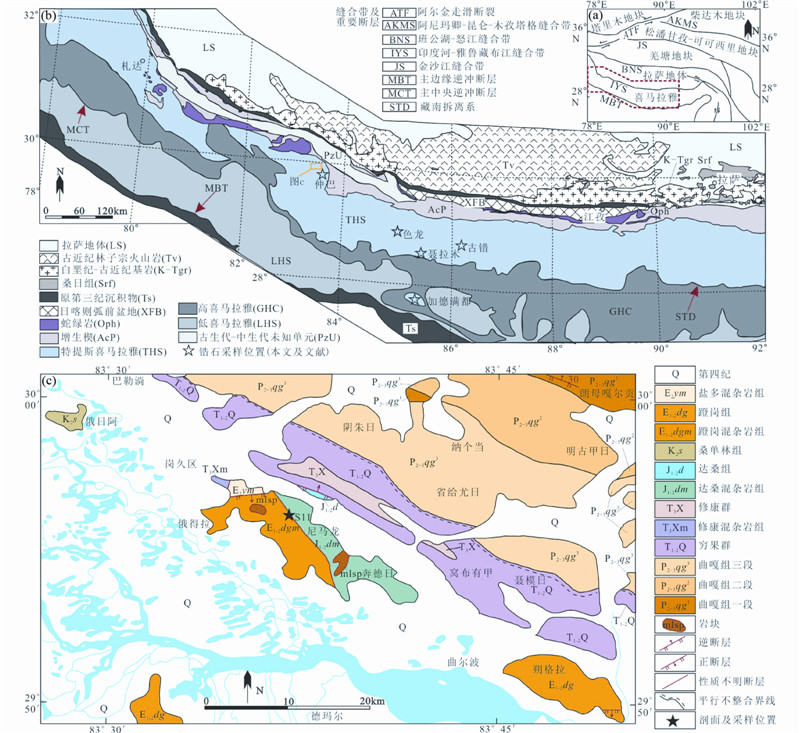 | 图 1 喜马拉雅位置(a)、藏南构造分区图(b,据Wang et al., 2012修改)和研究区地质简图及剖面位置(c,据河北地质调查院区域地质调查所,2006①修改)Fig. 1 Location of the Himalaya(a),simplified tectonic map of southern Tibet(b,modified after Wang et al., 2012) and geological sketch map of studying area and measured profile spot(c) |
① 河北省地质调查院区域地质调查所. 2006. 西藏 1:25 万霍尔巴幅与巴巴扎东幅区域地质调查报告
沉积岩的物源分析是认识盆-山演化的重要途径,利用物源分析不仅能确定物源区的母岩类型、构造背景,还能解释盆山耦合关系,并可以对物源区的构造演化历史提供制约(Bhatia,1983; 王成善和李祥辉,2003; Weltje and Von Eynatten,2004)。野外地质调查过程中,在藏南仲巴地区发现一套位于特提斯喜马拉雅北亚带的白垩纪地层,整体为黄绿色火山岩屑砂岩,局部层位可见页岩与灰岩,为一套深海海底扇沉积组合,根据野外露头、剖面实测、室内镜下观察、锆石定年、岩石组合特征、沉积环境分析、构造单元归属确定及区域地层对比将其确定为日朗组(K1r),本文地层仍采用Hu et al.(2008)年根据江孜地区床得剖面所建立的地层格架,该套地层在1:25万区域地质调查中(河北地质调查院区域地质调查所,2006)被划入达桑混杂岩组(J1-2dm)和蹬岗混杂岩组(E1-2dgm)中(图 1c)。本文试图通过对该套地层进行重新厘定和仲巴地区日朗组进行沉积特征研究及物源分析,为印度大陆北缘早白垩世火山事件提供证据。
1 地质背景喜马拉雅地体位于喜马拉雅前陆盆地以北,雅鲁藏布江缝合带以南,为典型的陆陆碰撞形成的增生地体(Yin,2006; Dai et al., 2008),被北倾的主中央逆冲断层(MCT)和藏南拆离系(STD)由南向北分为低喜马拉雅、高喜马拉雅和特提斯喜马拉雅三个构造带(图 1b)。低喜马拉雅带南部以主边缘逆冲断层(MBT)为界与喜马拉雅前陆盆地相邻,主体由中元古代至寒武纪地层组成,被认为直接沉积于太古代和早元古代印度板块基底之上。高喜马拉雅带主体由古元古代至奥陶纪变质结晶岩系组成(Yin,2006),变质程度在边界较低,而在中央地带较高(Le Fort,1996)。特提斯喜马拉雅记录了印度被动大陆北缘从寒武纪至始新世的连续海相沉积,以岗巴-定日逆冲断层为界分为南北两个亚带。南带由一套奥陶纪至始新世的连续海相地层组成,主要岩石组合为一套海相碳酸盐岩和碎屑岩(Willems et al., 1996; 万晓樵和丁林,2002; Wan et al., 2005),是一套浅水相陆棚碳酸盐和钙质陆源碎屑沉积(Gaetani and Garzanti, 1991);北带主要出露中生代地层,主要岩石组合为泥岩和砂岩为主的碎屑岩夹薄层硅质岩和灰岩(王成善等,2000; Ding et al., 2005; Li et al., 2005),是一套较深水外陆架沉积,被认为形成于被动大陆边缘盆地到残余洋盆环境(Liu and Einsele, 1994; Jadoul et al., 1998; 万晓樵等,2000; 陈曦等,2008)。本文所研究仲巴地区日朗组属于特提斯喜马拉雅北亚带,主体岩性为黄绿色火山岩屑砂岩。
2 分析方法砂岩碎屑组分分析是物源区分析的重要途径,其中Dickson图解是最为有效的方法之一,可以直接反映物源区母岩性质及构造背景(Dickinson and Suczek, 1979; Dickinson et al., 1983; Dickinson,1985; 王成善和李祥辉,2003; Garzanti et al., 2007)。本次研究对仲巴地区日朗组12件样品进行碎屑颗粒统计,样品变质程度低,改造较小。用于碎屑颗粒统计的样品均为中细粒砂岩,杂基含量小于5%。碎屑颗粒统计采用Gazzi-Dickson计点法(Ingersoll et al., 1984),每个样品统计颗粒数不少于300颗(表 1)。
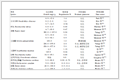 | 表 1 日朗组砂岩碎屑组分Table 1 Detrital components of s and stone from Rilang Formation |
砂岩中的各种沉积构造,如槽模构造、交错层理等,是判断物源方向、进行物源分析的有效方法(Kuenen,1953; 李祥辉等,2003; Weislogel et al., 2006)。本次在西藏仲巴地区对日朗组地层进行了实测剖面(S11)控制,剖面起点坐标29°56′39.2″N,83°35′46.8″E,海拔4860m,剖面方向149°。在剖面第8层发现槽模构造,形态为一系列规则但不连续的舌状突起。本文以野外直接测取的数据,进行校正并投影出玫瑰花图,依此指示物源区方位。
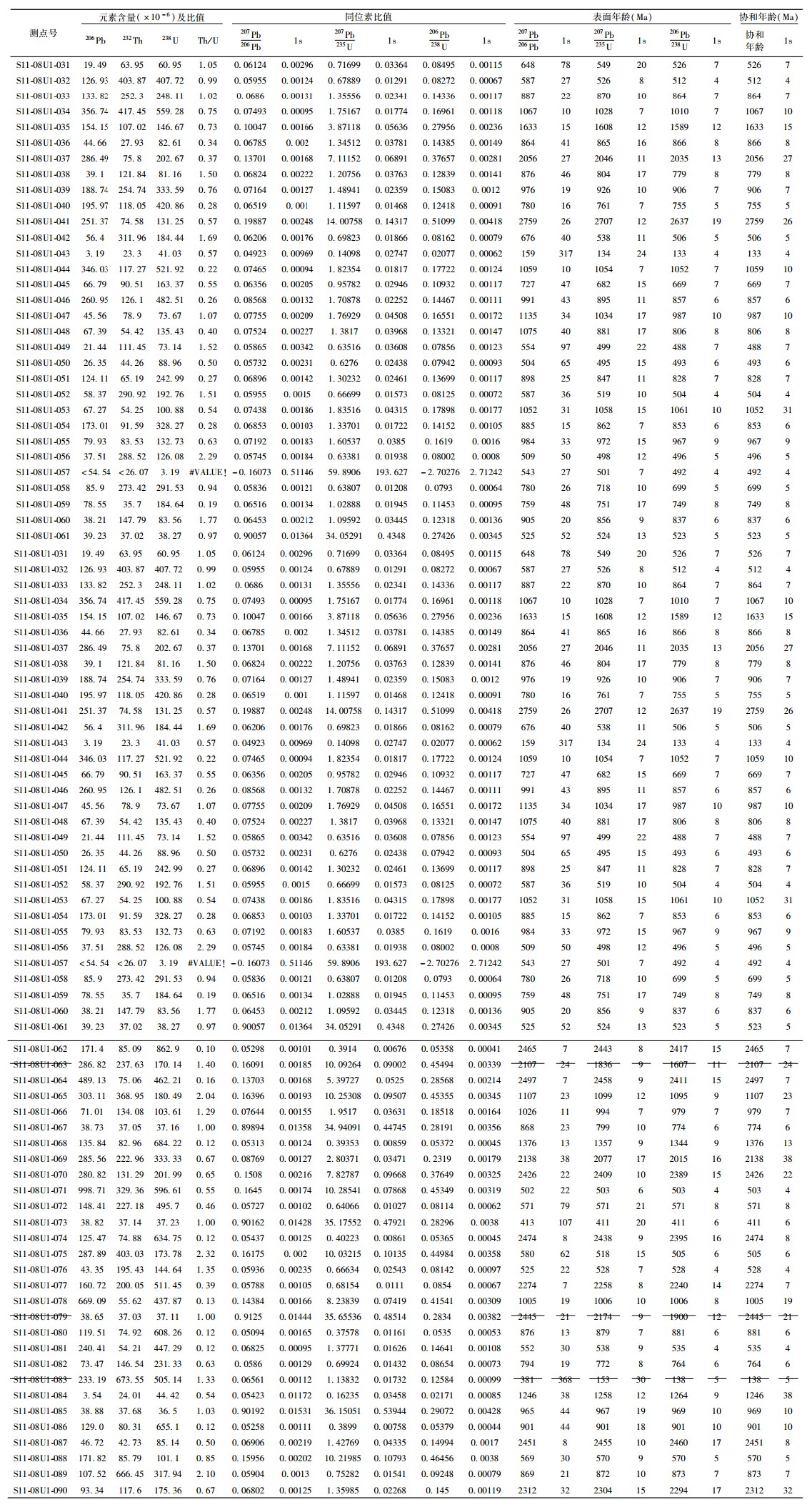
锆石U-Pb法为物源分析提供母岩的地层年代信息,并通过结合周围构造单元年龄特征、出露情况及构造演化特征判断物源区(Cai et al., 2011; Nie et al., 2012; Mohanty,2012)。本次在S11剖面第8层中采集了岩屑石英砂砾岩锆石样(S11-08U1),用电感耦合等离子质谱仪(ICP-MS)进行碎屑锆石分析。锆石U-Pb年龄测试在中国科学院青藏高原研究所环境变化与地表过程重点实验室完成,激光束直径为35μm,激光脉冲频率为8Hz。仪器分析条件和数据获取方法见文献(Yuan et al., 2004; Jackson et al., 2004; Yang et al., 2006; He et al., 2009)。锆石U-Pb定年数据除年龄校正外,还根据碎屑锆石定量化界限进行选取(对于年龄>1000Ma的样品,由于放射性成因铅的含量高,采用207Pb/206Pb的表面年龄;对于年龄<1000Ma的样品,由于放射性成因铅的含量低,采用206Pb/238U的表面年龄;Griffin et al., 2004)。
3 研究结果 3.1 地层本次对藏南仲巴县岗久地区日朗组进行了剖面测制(图 1c),日朗组(K1r)为剖面的2~15层,厚度为181.4m,出露于背斜构造的西北翼,地层未发生倒转。剖面实测显示日朗组与上覆地层加不拉组整合接触,与下伏地层维美组整合接触(图 2)。
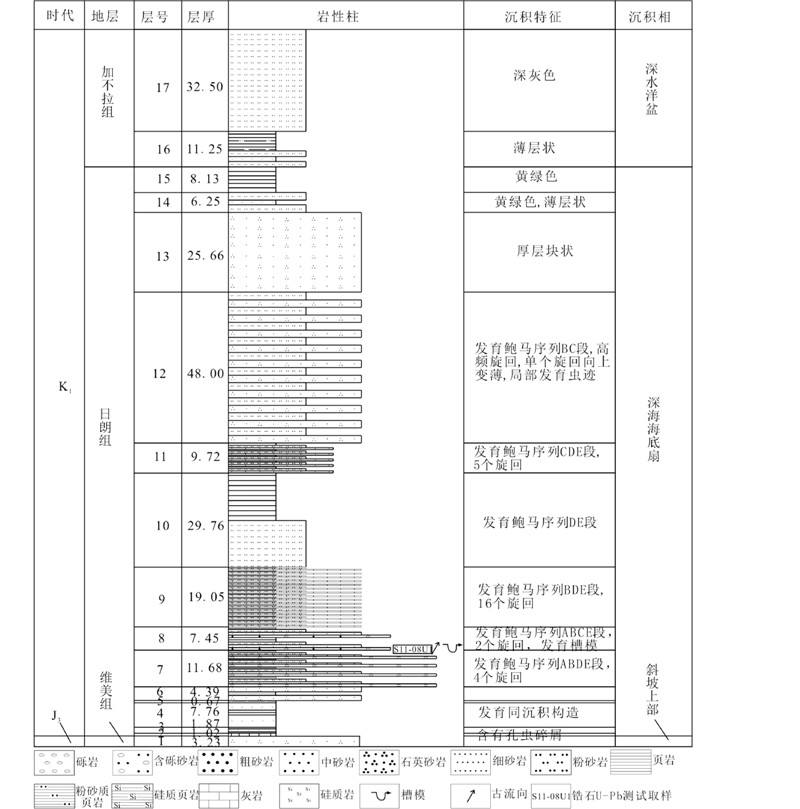 | 图 2 藏南仲巴地区日朗组实测剖面综合地层柱状图(维美组与加不拉组沉积环境参考陈曦等,2008)Fig. 2 Histogram of Rilang Formation section in Zhongba area,southern Tibet(sedimentary environment of Weimei Formation and Gyabula Formation is according to Chen et al., 2008) |
加不拉组:主体为一套灰岩夹硅质岩、页岩。以紫红-蓝灰色中到薄层含有孔虫灰岩、硅质-钙质页岩为主,偶见岩屑杂砂岩。与下伏地层呈整合接触。
日朗组:以黄绿色火山岩屑砂岩为特征,野外露头发育球形风化,局部层位可见薄层硅质岩、页岩及灰岩。可见鲍马序列(图 3a)、槽模等沉积构造,单层厚度较小。与下伏地层整合接触。
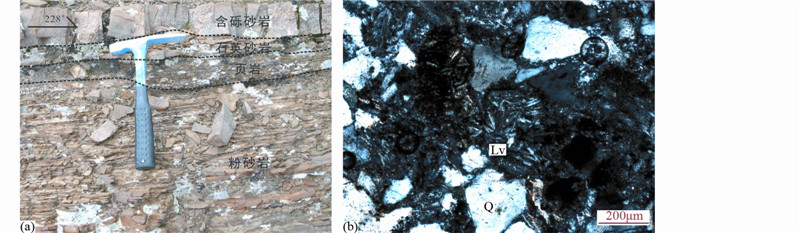 | 图 3 日朗组野外露头(a)及镜下照片(b) (a)剖面第7层出现的鲍马序列ABDE段(含砾砂岩、石英砂岩、粉砂岩及页岩);(b)样品S11-08b1,取自剖面第8层Fig. 3 Field picture(a) and photomicrograph(b) (a)Bouma sequences appear in the 7th layer of the measured section;(b)Sample S11-08b1 from the 8th layer of the measured section |
维美组二段:以浅灰色厚层-块状中粗粒(长石)石英砂岩、含砾石英砂岩为特征。风化面土黄色或红褐色,新鲜面浅灰黄色,中-厚层状,单层厚度在40~70cm之间。
3.2 岩性日朗组主要由砂岩、粉砂岩和页岩组成,可见少量硅质岩和泥岩夹层及灰岩岩块。
粉砂岩和砂岩可占80%以上,粉砂岩的岩石学特征与砂岩相似。
砂岩:主要为岩屑石英砂岩(图 3b)、石英砂岩、含砾砂岩。岩屑砂岩一般为黄绿色,主要包括矿物碎屑石英(平均含量60%)、长石(以更长石和正长石为主,平均含量5%)、绢云母、绿泥石、电气石、褐铁矿(后四者总含量小于5%),岩石碎屑蚀变火山岩(平均含量25%),填隙物为硅质胶结物(平均含量5%);分选差至中等,颗粒多为次棱角状;砂质结构。
页岩:灰绿色或红褐色,以硅质页岩为主,少量粉砂质页岩。
硅质岩:红褐色,富含放射虫,隐晶结构,内部发育小褶皱,为同沉积构造。
泥岩:灰黑色,与页岩互层,发育水平层理。
灰岩:深灰色,风化面呈土黄色,呈岩块产出于砂岩中,为生物碎屑灰岩,生物碎屑砂屑结构,生物类型多为有孔虫,含量25%,充填胶结物以亮晶方解石为主。
3.3 沉积环境分析日朗组剖面7~12层发育大量鲍马序列,并具有旋回性,在第8层两个旋回的交界处发育槽模构造(图 4)。下部层位中鲍马序列发育较完整,上部以C、D段为主,岩性为粉砂岩和泥页岩,各个旋回中层厚向上有变厚的趋势。日朗组内部出现泥岩、硅质岩和生物碎屑灰岩,生物碎屑主要为有孔虫,指示日朗组为深海沉积。日朗组的整体沉积特征与Shanmugam and Moiola(1988)提出的海底扇相模式一致,因此,本文认为仲巴地区日朗组为一套深海海底扇沉积组合,该结果与陈曦等(2008)提出的江孜地区日朗组为斜坡下部重力流沉积成因一致。
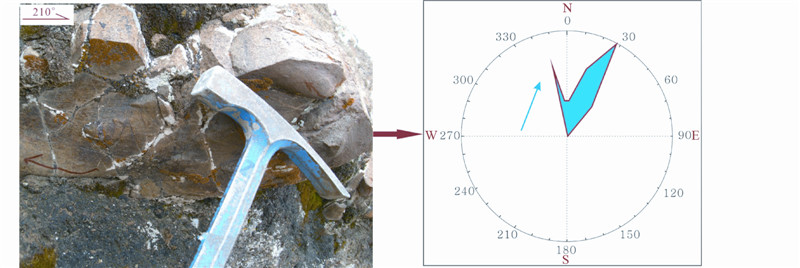 | 图 4 日朗组中含砾粗砂岩与页岩交界处发育的舌状槽模构造及其古流向玫瑰花图(n=10)Fig. 4 The tongue-shaped trough model structure developed between the junction of pebbly coarse s and stone and shale in Rilang Formation and its paleocurrent directionrose diagram(n=10) |
本次研究的12件样品中S11-02b1至S11-13b1等10件样品来源于日朗组主干剖面S11,PM011-11b1和PM011-12b1二件样品来源于辅助剖面PM011(GPS:29°41′09.7″N,84°11′09.1″E,H=4805±11m)。按照统计数据进行投点,绘制出QmFLt(图 5; Dickinson et al., 1983)三角图解。从QmFLt图解来看,日朗组样品点集中于克拉通内部及石英再旋回区,少数落入过渡再旋回区,没有样品落入岩屑再旋回区,说明日朗组砂岩碎屑组分主要来源于克拉通内部及石英再旋回区。
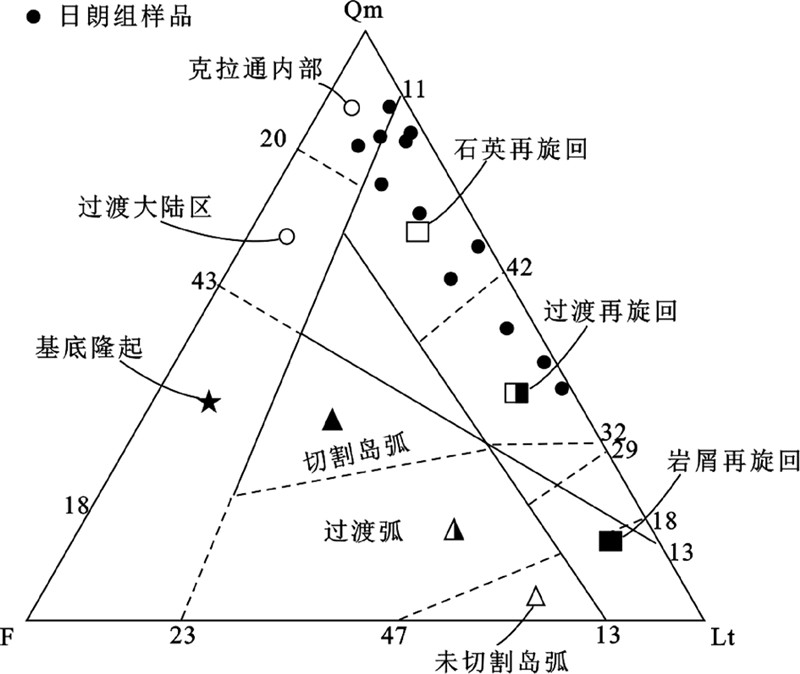 | 图 5 藏南仲巴地区日朗组砂岩碎屑成分QmFLt三角图解(据Dickinson et al., 1983) Qm-单晶石英;F-单晶长石;L-不稳定岩屑;Lt-多晶质岩屑(L+多晶石英)Fig. 5 QmFLt triplot of s and stone clastic compostion from Rilang Formation of Zhongba area,southern Tibet(after Dickinson et al., 1983) |
古流向数据采集于剖面第8层槽模构造,数据在346°~40°范围内。根据野外所采集的古流向数据进行数字投影得古流向玫瑰花图,日朗组显示出向北发散的古流向,从北北西到北北东方向均有,以北北东方向为主(图 4)。
3.6 碎屑锆石U-Pb年龄本次所采碎屑锆石U-Pb样(S11-08U1)重4kg,从5000余粒锆石中随机选择500粒进行制靶并对其中90粒进行了U-Pb年龄测试,年龄测试结果(见电子版附表 1)中有4个年龄不协和点,其余86颗锆石均得协和年龄值,由年龄分布频率图可见剩余86个点位的碎屑锆石年龄特点。本文所用锆石中Th/U比值大于0.4的锆石数量占73.3%,且其稀土元素模式也表现出明显的Ce正异常和Eu负异常,代表为岩浆成因锆石(Vavra et al., 1996,1999; Belousova et al., 2002)。U-Pb年龄值变化于133±4Ma~2759±26Ma,锆石有效年龄集中分布于411~1246Ma、2056~2312Ma和2408~2497Ma 三个区间,总体锆石年龄峰值分布在~500Ma(~30颗)、~770Ma(~13颗)、~870Ma(~18颗)和~2470Ma(~8颗)(图 6h)。碎屑锆石最年轻年龄为133±4Ma,最老年龄为2759±26Ma。
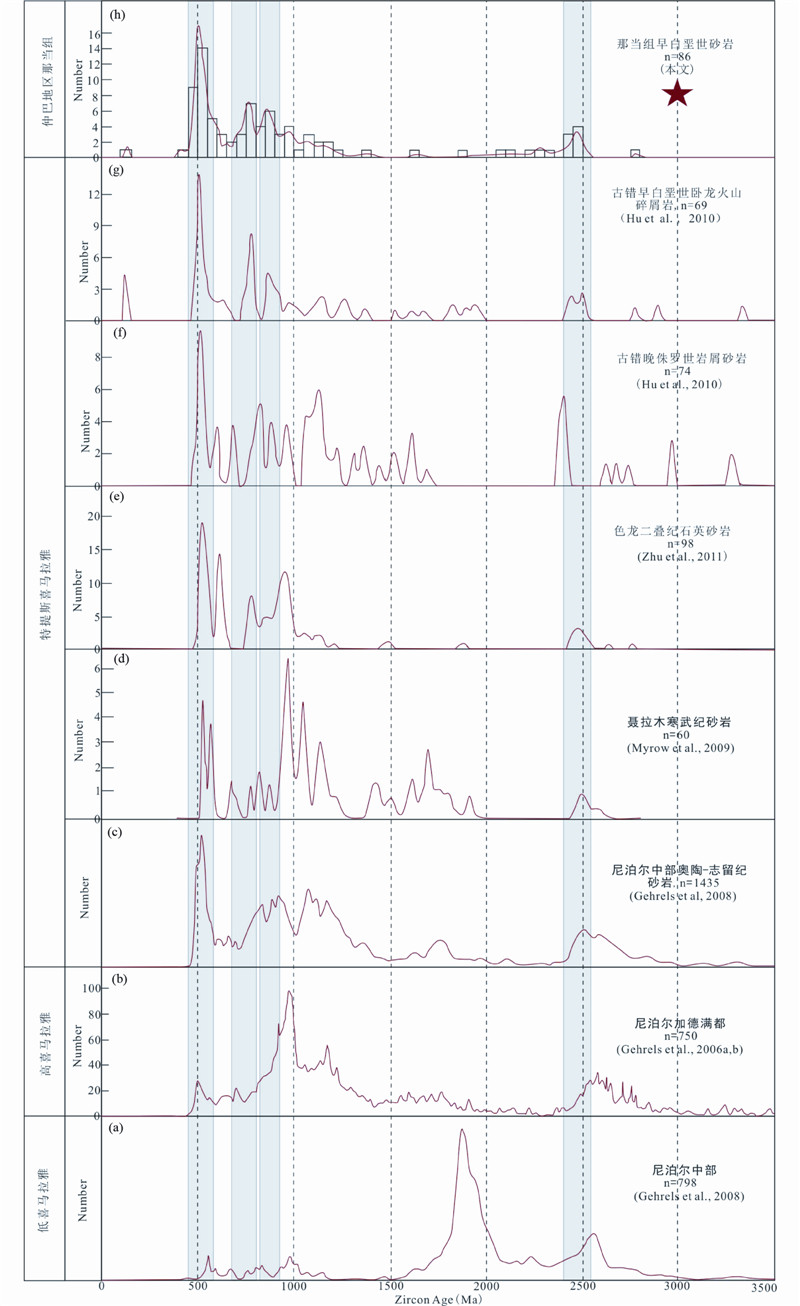 | 图 6 碎屑锆石年龄对比图 (a)低喜马拉雅碎屑锆石(Gehrels et al., 2008);(b)高喜马拉雅碎屑锆石(Gehrels et al., 2006a,b);(c-g)特提斯喜马拉雅碎屑锆石(Hu et al., 2010; Zhu et al., 2011; Myrow et al., 2009; Gehrels et al., 2008);(h)-日朗组碎屑锆石(本文)Fig. 6 Relaitve U-Pb age probability for detrital zircons from different area (a)Lesser Himalaya(Gehrels et al., 2008);(b)High Himalaya(Gehrels et al., 2006a,b);(c-g)Tethyan Himalaya(Hu et al., 2010; Zhu et al., 2011; Myrow et al., 2009; Gehrels et al., 2008);(h)Rilang Formation(this text) |
日朗组砂岩岩屑母岩主要为火山岩(具有蚀变特征),沉积岩和变质岩含量较少(可见粉砂岩、硅质岩、石英岩及板岩),体现了日朗组砂岩的火山岩继承性及近源物源特点。日朗组砂岩长石含量极少(≤5%),含有大量的外来岩屑,成分成熟度低,说明日朗组物质成分在沉积前经历了较弱的风化作用及短距离的搬运过程。此外,碎屑颗粒多为次棱角状,分选较差,结构成熟度低,同样说明日朗组碎屑颗粒具有短距离搬运的特点,表明日朗组具有近源物质供给特点。
从古流向分析结果来看,槽模构造显示日朗组的古流向以北北东方向为主,不考虑强烈的构造短缩和变形情况下,物源区应位于仲巴南南西方向。冈瓦纳古陆的古地理重建结果显示早白垩世印度大陆从澳大利亚-南极大陆裂解,印度被动大陆边缘处于海相环境,陆向海方向由印度克拉通依次过度为陆棚和大陆斜坡环境,外侧毗邻开放的特提斯洋盆(Ali and Aitchison, 2008)。早白垩世印度大陆北缘陆棚(即特提斯喜马拉雅南亚带)和大陆斜坡(即特提斯喜马拉雅北亚带)均为沉积区,均沉积了这套早白垩世火山碎屑砂岩:南亚带如Zanskar地区Pingdon La组(Garzanti,1991),Kumaon地区Glumal S and stone(Sinha,1989),Thakkhola地区Tangbe组(Gradstein et al., 1989; Gibling et al., 1994),卧龙地区、古错地区卧龙火山碎屑砂岩(Jadoul et al., 1998; Hu et al., 2010);北亚带如江孜地区日朗组(Hu et al., 2008; 陈曦等,2008)。因此,综合近源物源供给特点、古流向证据及古地理重建结果,本文认为仲巴地区日朗组物源区为印度稳定大陆边缘,加上一套火山碎屑物质的输入。
4.2 碎屑锆石年龄对比对物源区的约束基于碎屑锆石U-Pb年代学方法在物源分析方面的成熟性及前人在喜马拉雅地区开展的大量研究工作,为进一步验证本次分析结果的正确性及更为精确地定位物源区,我们认为有必要在本区域内进行物源分析对比。基于日朗组地层出露位置,本文从低喜马拉雅、高喜马拉雅和特提斯喜马拉雅进行具体对比分析(图 6)。
仲巴地区日朗组的碎屑锆石年龄分布范围为133~2759Ma,特征年龄区间为450~600Ma、700~900Ma和2400~2500Ma,年龄峰值为500Ma、770Ma、870Ma和2470Ma,主峰值为500Ma(图 6h)。
低喜马拉雅的碎屑锆石年龄(图 6a)总体都较老(Gehrels et al., 2008),显示在1870Ma和2550Ma出现明显峰值,特征年龄峰值出现在1870Ma。对比高喜马拉雅的碎屑锆石年龄谱图(图 6b),明显缺失1170Ma及1000Ma之前的年龄峰值;与特提斯喜马拉雅诸多地层的碎屑锆石年龄(图 6c-g)对比,发现其缺失特提斯喜马拉雅~500Ma典型的年龄峰值。
高喜马拉雅的碎屑锆石年龄谱图(图 6b)显示在530Ma、950Ma、1170Ma和~2500Ma(Gehrels et al., 2006a,b)均出现了明显的峰值,主峰值出现在950Ma。Decelles et al.(2000)通过锆石U-Pb测试尼泊尔高喜马拉雅地层岩石,同样显示在~500Ma和956Ma出现明显年龄峰值,特征年龄峰值出现在956Ma,指示高喜马拉雅原岩起源于晚元古代泛非造山时期的东非造山带北部端元,岩石增生至冈瓦纳大陆北部,并被寒武-奥陶期间的地壳熔融所侵位。
与特提斯喜马拉雅对比发现,日朗组碎屑锆石年龄谱线特征与尼泊尔中部奥陶-志留纪砂岩(图 6c)、聂拉木寒武纪砂岩(图 6d)、色龙二叠纪石英砂岩(图 6e)、古错地区古错组石英砂岩(图 6f)及古错地区早白垩世卧龙火山碎屑砂岩(图 6g)相似,均存在~500Ma的特征峰值,Gehrels et al.(2006a)及Myrow et al.(2009)将寒武-奥陶这一碎屑锆石群归因于沿冈瓦纳大陆印度板块边缘的早古生代造山运动,指示具有相同的物源特征。此外,日朗组峰值500Ma、770Ma、870Ma、2470Ma(图 6h)与藏南古错地区早白垩世卧龙火山碎屑砂岩(图 6g)四个年龄峰值505Ma、760Ma、870Ma、2490Ma(Hu et al., 2010)一一对应,且均具有向北的古流向特征(Hu et al., 2010),所以推测二者具有相同的物源区。已有研究结果显示古错组物源区为印度克拉通,而卧龙火山碎屑砂岩的物源区为稳定大陆边缘,加之一套火山碎屑物质的加入(Hu et al., 2010),所以本文认为仲巴地区日朗组的物源区为印度大陆北部稳定大陆边缘,外加一套早白垩世火山碎屑物质的加入,该结果与Dickinson图解构造背景分析结果一致。
4.3 构造意义根据仲巴地区日朗组砂岩中槽模构造的古水流指向标志,物质来源于南侧印度大陆。岩屑砂岩含有不稳定的长石矿物及大量的火山岩屑,说明火山物质的物源区较近。并且这套火山碎屑物质是早白垩世时期的,因为下部地层(如维美组)中并没有出现这套火山碎屑物质。仲巴地区日朗组中出现大量的火山碎屑物质说明早白垩世(大致与日朗组沉积同期)仲巴以南地区发生了一次强烈的火山活动,形成的火山岩经历快速的风化剥蚀、短距离搬运沉积于仲巴地区。
印度被动大陆北缘早白垩世火山事件在特提斯喜马拉雅构造带有大量的沉积记录,自西向东依次出现在印度Zanskar地区Pingdon La组(Garzanti,1991)和Kumaon地区Glumal砂岩(Sinha,1989)、尼泊尔中部Thakkhola地区Tangbe组(Gradstein et al., 1989; Gibling et al., 1994)、藏南古错地区和卧龙地区卧龙火山碎屑砂岩(Jadoul et al., 1998; 陈蕾等,2007; Hu et al., 2008,2010)及江孜地区日朗组(Hu et al., 2008; 陈曦等,2008),且这些沉积记录和早白垩世这次火山事件是同期的。新发现的仲巴地区日朗组同样含有大量的早白垩世火山岩屑,为其增加了新的证据。
对印度大陆北缘早白垩世火山事件主要有以下3种成因假说:裂谷作用成因(Gaetani et al., 1986; Gradstein et al., 1991; Garzanti,1993; Dürr and Gibling, 1994)、地幔热柱成因(Zhu et al., 2007; 朱弟成等,2008)和深部断裂成因(Hu et al., 2010)。本文支持Hu et al.(2010)提出的深部断裂成因模型,理由如下:(1)深部断裂成因模型是基于古错地区卧龙火山碎屑岩物源区研究及特提斯喜马拉雅构造带自西向东呈线状分布的早白垩世火山碎屑岩提出的,碎屑锆石U-Pb年龄谱线显示仲巴地区日朗组与古错地区卧龙火山碎屑砂岩具有相同的物源区特征,因此深部断裂构造模型解释仲巴地区日朗组火山碎屑物质成因也应该是合理的;(2)早白垩世古地理重建结果(Ali and Aitchison, 2008)显示特提斯喜马拉雅构造带在早白垩世紧邻印度板块稳定大陆边缘,深部断裂模型指出早白垩世印度大陆从澳大利亚-南极洲大陆裂解导致印度大陆北缘区域应力场方向改变,伴随微弱的逆时针旋转,沿稳定大陆边缘伸展产生一条切穿地壳的深部断裂,可以解释仲巴地区日朗组的近源物源供给特点;(3)物源区研究结果显示日朗组物源区为印度稳定大陆边缘,加上一套火山碎屑物质的输入,深部断裂模型可以很好地解释这一物源区特征:来自深部断裂喷发的火山碎屑及稳定大陆边缘物质成分共同组成了日朗组的物质来源;(4)早白垩世仲巴地区古地理位置为印度板块北东缘斜坡地带,深部断裂模型指出深部断裂发育于印度大陆北东缘,可以解释日朗组北北东的古流向特征;(5)深部断裂模型指出深部断裂发育于板内构造环境,可以解释日朗组物源区的克拉通内部构造背景。因此,本文认为仲巴地区日朗组物源特征及火山碎屑组分反映了印度大陆北缘早白垩世由深部断裂引起的一次强烈的火山作用,与印度大陆从澳大利亚-南极大陆裂解有关。
5 结论(1)日朗组为一套深海海底扇沉积的岩石组合,其砂岩的成分成熟度和结构成熟度均不高,为近源物源沉积结果;
(2)砂岩碎屑组分统计结果表明日朗组的物源区构造背景属于克拉通内部及石英再旋回区;
(3)对日朗组槽模构造的古流向分析表明其物质组分来源于仲巴以南地区;
(4)日朗组碎屑锆石U-Pb年龄出现峰值500Ma、770Ma、870Ma和2470Ma,特征年龄峰值500Ma,其频谱图与特提斯喜马拉构造带诸多地层相似,尤其与古错地区卧龙火山碎屑砂岩契合,二者显示出相同的物源特征。物源区综合研究表明仲巴地区日朗组的物源区为印度大陆北部稳定大陆边缘,外加一套早白垩世火山碎屑物质的输入。仲巴地区日朗组物源特征及火山碎屑组分反映了印度大陆北缘早白垩世由深部断裂引起的一次强烈的火山作用,可能与印度大陆从澳大利亚-南极大陆裂解有关。
致谢 野外工作得到南京大学李祥辉教授、中国地质大学(北京)李亚林教授的帮助;锆石U-Pb年龄测试得到中国科学院青藏高原研究所环境变化与地表过程重点实验室岳雅慧老师的支持与帮助;在成文过程中,李祥辉教授和夏瑛博士提供了非常中肯的建议;在此一并表示感谢。 | 附表 1 藏南仲巴县岗久地区(早白垩世)日朗组粗砂岩样品(S11-08U1)中碎屑锆石LA-ICP-MS U-Pb年龄测试结果Appendix Table 1 The test results of U-Pb detrital zircons in coarsegrained sandstone samples (S11-08U1) by LA-ICP-MS of Rilang Formation (Early Cretaceous) in Gangjiu area of Zhongba County, southern Tibet |
| [1] | Ali JR and Aitchison JC. 2008. Gondwana to Asia: Plate tectonics, paleogeography and the biological connectivity of the Indian sub-continent from the Middle Jurassic through Latest Eocene (166-35Ma). Earth-Science Reviews, 88(3-4): 145-166 |
| [2] | Belousova E, Griffin WL, O'Reilly SY and Fisher N. 2002. Igneous zircon: Trace element composition as an indicator of source rock type. Contributions to Mineralogy and Petrology, 143(5): 602-622 |
| [3] | Bhatia MR. 1983. Plate tectonics and geochemical composition of sandstones. The Journal of Geology, 91(6): 611-627 |
| [4] | Cai FL, Ding L and Yue YH. 2011. Provenance analysis of Upper Cretaceous strata in the Tethys Himalaya, southern Tibet: Implications for timing of India-Asia collision. Earth and Planetary Science Letters, 305(1-2): 195-206 |
| [5] | Chen L, Hu XM and Huang ZC. 2007. Constrains from Early Cretaceous volcaniclastic sandstones in southern Tibet on a volcanic event in the northern margin of the Indian Continent. Acta Geologica Sinica, 81(4): 501-510 (in Chinese with English abstract) |
| [6] | Chen X, Wang CS, Hu XM, Huang YJ, Wei YS and Wang PK. 2008. Petrology and evolution history from Late Jurassic to Paleogene of Gyangze basin, Southern Tibet. Acta Petrologica Sinica, 24(3): 616-624 (in Chinese with English abstract) |
| [7] | Dai JG, Yin A, Liu WC and Wang CS. 2008. Nd isotopic compositions of the Tethyan Himalayan Sequence in southeastern Tibet. Science in China (Series D), 51(9): 1306-1316 |
| [8] | DeCelles PG, Gehrels GE, Quade J, LaReau B and Spurlin M. 2000. Tectonic implications of U-Pb zircon ages of the Himalayan orogenic belt in Nepal. Science, 288(5465): 497-499 |
| [9] | Dickinson WR and Suczek CA. 1979. Plate tectonics and sandstone compositions. AAPG Bulletin, 63(12): 2164-2182 |
| [10] | Dickinson WR, Beard LS, Brakenridge GR, Erjavec JL, Ferguson RC, Inman KF, Knepp RA, Lindberg FA and Ryberg PT. 1983. Provenance of North American Phanerozoic sandstones in relation to tectonic setting. Geological Society of America Bulletin, 94(2): 222-235 |
| [11] | Dickinson WR. 1985. Interpreting provenance relations from detrital modes of sandstones. Provenance of Arenites, 148: 333-361 |
| [12] | Ding L, Kapp P and Wan XQ. 2005. Paleocene-Eocene record of ophiolite obduction and initial India-Asia collision, south central Tibet. Tectonics, 24(3), doi:10.1029/2004TC001729 |
| [13] | Dürr SB and Gibling MR. 1994. Early Cretaceous volcaniclastic and quartzose sandstones from north central Nepal: Composition, sedimentology and geotectonic significance. Geologische Rundschau, 83(1): 62-75 |
| [14] | Gaetani M, Casnedi R, Fois E, Garzanti E, Jadoul F, Nicora A and Tintori A. 1986. Stratigraphy of the Tethys Himalaya in Zanskar, Ladakh. Riv. It. Paleont. Strat., 91(4): 443-478 |
| [15] | Gaetani M and Garzanti E. 1991. Multicyclic history of the Northern India continental margin (northwestern Himalaya). AAPG Bulletin, 75(9): 1427-1446 |
| [16] | Garzanti E. 1991. Stratigraphy of the Early Cretaceous Giumal Group (Zanskar Range, northern India). Rivista Italiana di Paleontologiae Stratigrafia, 97(3-4): 485-510 |
| [17] | Garzanti E. 1993. Sedimentary evolution and drowning of a passive margin shelf (Giumal Group; Zanskar Tethys Himalaya, India): Palaeoenvironmental changes during final break-up of Gondwanaland. Geological Society of London, Special Publications, 74: 277-298 |
| [18] | Garzanti E, Doglioni C, Vezzoli G and Ando S. 2007. Orogenic belts and orogenic sediment provenance. The Journal of Geology, 115(3): 315-334 |
| [19] | Gehrels GE, DeCelles PG, Ojha TP and Upreti BN. 2006a. Geologic and U-Th-Pb geochronologic evidence for early Paleozoic tectonism in the Kathmandu thrust sheet, central Nepal Himalaya. Geological Society of America Bulletin, 118(1-2): 185-198 |
| [20] | Gehrels GE, DeCelles PG, Ojha TP and Upreti BN. 2006b. Geologic and U-Pb geochronologic evidence for Early Paleozoic tectonism in the Dadeldhura thrust sheet, far-west Nepal Himalaya. Journal of Asian Earth Sciences, 28(4-6): 385-408 |
| [21] | Gehrels GE, Valencia VA and Ruiz J. 2008. Enhanced precision, accuracy, efficiency, and spatial resolution of U-Pb ages by laser ablation-multicollector-inductively coupled plasma-mass spectrometry. Geochemistry, Geophysics, Geosystems, 9(3), doi:10.1029/2007GC001805 |
| [22] | Gibling MR, Gradstein FM, Kristiansen IL, Nagy J, Sarti M and Wiedmann J. 1994. Early Cretaceous strata of the Nepal Himalayas: Conjugate margins and rift volcanism during Gondwanan breakup. Journal of the Geological Society, 151(2): 269-290 |
| [23] | Gradstein FM, Gibling MR, Jansa LF, Kaminski MA, Ogg JG, Sarti M, Thurow J, VonRad U and Westermann G. 1989. Mesozoic Stratigraphy of Thakkhola, Central Nepal. Dalhousie: Spec. Rep. Cent. Marine Geol. Dalhousie Univ., 1-115 |
| [24] | Gradstein FM, Gibling M, Sarti M, VonRad U, Thurow J, Ogg JG, Jansa LF, Kaminski M and Westermann G. 1991. Mesozoic Tethyan strata of Thakkhola, Nepal: Evidence for the drift and breakup of Gondwana. Palaeogeography, Palaeoclimatology, Palaeoecology, 88(3-4): 193-218 |
| [25] | Griffin WL, Belousova EA, Shee SR, Pearson NJ and O'reilly SY. 2004. Archean crustal evolution in the northern Yilgarn Craton: U-Pb and Hf-isotope evidence from detrital zircons. Precambrian Research, 131(3-4): 231-282 |
| [26] | Harrison TM, Ryerson FJ, Le Fort P, Yin A, Lovera OM and Catlos EJ. 1997. A Late Miocene-Pliocene origin for the central Himalayan inverted metamorphism. Earth and Planetary Science Letters, 146(1-2): E1-E7 |
| [27] | He ZY, Xu XS, Yu Y and Zou HB. 2009. Origin of the Late Cretaceous syenite from Yandangshan, SE China, constrained by zircon U-Pb and Hf isotopes and geochemical data. International Geology Review, 51(6): 556-582 |
| [28] | Hodges KV. 2000. Tectonics of the Himalaya and southern Tibet from two perspectives. Geological Society of America Bulletin, 112(3): 324-350 |
| [29] | Hu XM, Jansa L and Wang CS. 2008. Upper Jurassic-Lower Cretaceous stratigraphy in south-eastern Tibet: A comparison with the western Himalayas. Cretaceous Research, 29(2): 301-315 |
| [30] | Hu XM, Jansa L, Chen L, Griffin WL, O'Reilly SY and Wang JG. 2010. Provenance of Lower Cretaceous Wölong volcaniclastics in the Tibetan Tethyan Himalaya: Implications for the final breakup of eastern Gondwana. Sedimentary Geology, 223(3-4): 193-205 |
| [31] | Ingersoll RV, Fullard TF, Ford RL, Grimm JP, Pickle JD and Sares SW. 1984. The effect of grain size on detrital modes: A test of the Gazzi-Dickinson point-counting method. Journal of Sedimentary Research, 54(1): 103-116 |
| [32] | Jackson SE, Pearson NJ, Griffin WL and Belousova EA. 2004. The application of laser ablation-inductively coupled plasma-mass spectrometry to in situ U-Pb zircon geochronology. Chemical Geology, 211(1-2): 47-69 |
| [33] | Jadoul F, Berra F and Garzanti E. 1998. The Tethys Himalayan passive margin from Late Triassic to Early Cretaceous (South Tibet). Journal of Asian Earth Sciences, 16(2-3): 173-194 |
| [34] | Kuenen PH. 1953. Significant features of graded bedding. AAPG Bulletin, 37(5): 1044-1066 |
| [35] | Le Fort P, Debon F and Sonet J. 1983. The Lower Paleozoic ""Lesser Himalayan"" granitic belt: Emphasis on the Simchar pluton of central Nepal. Granites of the Himalayas, Karakorum, and Hindu Kush: Lahore, Punjab University, 235-256 |
| [36] | Le Fort P. 1996. Evolution of the Himalaya. World and Regional Geology, 95-109 |
| [37] | Li GB, Wan XQ, Liu WC, Liang DY and Hyesu Y. 2005. Discovery of Paleogene marine stratum along the southern side of Yarlung-Zangbo suture zone and its implications in tectonics. Science in China (Series D), 48(5): 647-661 |
| [38] | Li XH, Zeng QG and Wang CS. 2003. Palaeocurrent data: Evidence for the source of the Langjiexue Group in southern Tibet. Geological Review, 49(2): 132-137 (in Chinese with English abstract) |
| [39] | Liu GH and Einsele G. 1994. Sedimentary history of the Tethyan basin in the Tibetan Himalayas. Geologische Rundschau, 83(1): 32-61 |
| [40] | Mohanty S. 2012. Spatio-temporal evolution of the Satpura Mountain Belt of India: A comparison with the Capricorn Orogen of Western Australia and implication for evolution of the supercontinent Columbia. Geoscience Frontiers, 3(3): 241-267 |
| [41] | Myrow PM, Hughes NC, Paulsen TS, Williams IS, Parcha SK, Thompson KR, Bowring SA, Peng SC and Ahluwalia AD. 2003. Integrated tectonostratigraphic analysis of the Himalaya and implications for its tectonic reconstruction. Earth and Planetary Science Letters, 212(3-4): 433-441 |
| [42] | Myrow PM, Hughes NC, Searle MP, Fanning CM, Peng SC and Parcha SK. 2009. Stratigraphic correlation of Cambrian-Ordovician deposits along the Himalaya: Implications for the age and nature of rocks in the Mount Everest region. The Geological Society of America Bulletin, 121(3-4): 323-332 |
| [43] | Nie JS, Horton BK, Saylor JE, Mora A, Mange M, Garzione CN, Basu A, Moreno CJ, Caballero V and Parra M. 2012. Integrated provenance analysis of a convergent retroarc foreland system: U-Pb ages, heavy minerals, Nd isotopes, and sandstone compositions of the Middle Magdalena Valley basin, northern Andes, Colombia. Earth-Science Reviews, 110(1-4): 111-126 |
| [44] | Shanmugam G and Moiola RJ. 1988. Submarine fans: Characteristics, models, classification, and reservoir potential. Earth-Science Reviews, 24(6): 383-428 |
| [45] | Sinha AK. 1989. Geology of the Higher Central Himalaya. New York: Wiley, 219 |
| [46] | Vavra G, Gebauer D, Schmid R and Compston W. 1996. Multiple zircon growth and recrystallization during polyphase Late Carboniferous to Triassic metamorphism in granulites of the Ivrea Zone (Southern Alps): An ion microprobe (SHRIMP) study. Contributions to Mineralogy and Petrology, 122(4): 337-358 |
| [47] | Vavra G, Schmid R and Gebauer D. 1999. Internal morphology, habit and U-Th-Pb microanalysis of amphibolite-to-granulite facies zircons: Geochronology of the Ivrea Zone (Southern Alps). Contributions to Mineralogy and Petrology, 134(4): 380-404 |
| [48] | Wan XQ, Zhao WJ and Li GB. 2000. Restudy of the Upper Cretaceous in Gamba, Tibet. Geoscience, 14(3): 281-285 (in Chinese with English abstract) |
| [49] | Wan XQ and Ding L. 2002. Discovery of the Latest Cretaceous planktonic foraminifera from Gyirong of southern Tibet and its chronostratigraphic significance. Acta Palaeontologica Sinica, 41(1): 89-95 (in Chinese with English abstract) |
| [50] | Wan XQ, Lamolda MA, Si JL and Li GB. 2005. Foraminiferal stratigraphy of Late Cretaceous red beds in southern Tibet. Cretaceous Research, 26(1): 43-48 |
| [51] | Wang CS, Li XH, Wan XQ and Tao R. 2000. The Cretaceous in Gyangze, southern Xizang (Tibet): Redefined. Acta Geologica Sinica, 74 (2): 97-107 (in Chinese with English abstract) |
| [52] | Wang CS and Li XH. 2003. Sedimentary Basin: From Principles to Analyses. Beijing: China Higher Education Press, 86-111 (in Chinese with English abstract) |
| [53] | Wang CS, Li XH, Liu ZF, Li YL, Jansa L, Dai JG and Wei YS. 2012. Revision of the Cretaceous-Paleogene stratigraphic framework, facies architecture and provenance of the Xigaze forearc basin along the Yarlung Zangbo suture zone. Gondwana Research, 22(2): 415-433 |
| [54] | Weislogel AL, Graham SA, Chang EZ, Wooden JL, Gehrels GE and Yang H. 2006. Detrital zircon provenance of the Late Triassic Songpan-Ganzi complex: Sedimentary record of collision of the North and South China blocks. Geology, 34(2): 97-100 |
| [55] | Weltje GJ and Von Eynatten H. 2004. Quantitative provenance analysis of sediments: Review and outlook. Sedimentary Geology, 171(1-4): 1-11 |
| [56] | Willems H, Zhou Z, Zhang B and Grfe KU. 1996. Stratigraphy of the Upper Cretaceous and Lower Tertiary strata in the Tethyan Himalayas of Tibet (Tingri area, China). Geologische Rundschau, 85(4): 723-754 |
| [57] | Yang JH, Wu FY, Shao JA, Wilde SA, Xie LW and Liu XM. 2006. Constraints on the timing of uplift of the Yanshan Fold and Thrust Belt, North China. Earth and Planetary Science Letters, 246(3-4): 336-352 |
| [58] | Yin A and Harrison TM. 2000. Geologic evolution of the Himalayan-Tibetan orogen. Annual Review of Earth and Planetary Sciences, 28(1): 211-280 |
| [59] | Yin A. 2006. Cenozoic tectonic evolution of the Himalayan orogen as constrained by along-strike variation of structural geometry, exhumation history, and foreland sedimentation. Earth-Science Reviews, 76(1-2): 1-131 |
| [60] | Yuan HL, Gao S, Liu XM, Li HM, Günther D and Wu FY. 2004. Accurate U-Pb age and trace element determinations of zircon by laser ablation-inductively coupled plasma-mass spectrometry. Geostandards and Geoanalytical Research, 28(3): 353-370 |
| [61] | Zhu DC, Pan GT, Mo XX, Liao ZL, Jiang XS, Wang LQ and Zhao ZD. 2007. Petrogenesis of volcanic rocks in the Sangxiu Formation, central segment of Tethyan Himalaya: A probable example of plume-lithosphere interaction. Journal of Asian Earth Sciences, 29(2-3): 320-335 |
| [62] | Zhu DC, Mo XX, Wang LQ, Zhao ZD and Liao ZL. 2008. Hotspot-ridge interaction for the evolution of Neo-Tethys: Insights from the Late Jurassic-Early Cretaceous magmatism in southern Tibet. Acta Petrologica Sinica, 24(2): 225-237 (in Chinese with English abstract) |
| [63] | Zhu DC, Zhao ZD, Niu Y, Dilek Y and Mo XX. 2011. Lhasa terrane in southern Tibet came from Australia. Geology, 39(8): 727-730 |
| [64] | 陈蕾, 胡修棉, 黄志诚. 2007. 藏南早白垩世火山岩屑砂岩对印度大陆北缘火山事件的约束. 地质学报, 81(4): 501-510 |
| [65] | 陈曦, 王成善, 胡修棉, 黄永建, 魏玉帅, 王平康. 2008. 西藏南部江孜盆地上侏罗统至古近系沉积岩石学特征与盆地演化. 岩石学报, 24(3): 616-624 |
| [66] | 李祥辉, 曾庆高, 王成善. 2003. 西藏南部郎杰学群碎屑物质来源的古水流证据. 地质论评, 49(2): 132-137 |
| [67] | 万晓樵, 赵文金, 李国彪. 2000. 对西藏岗巴上白垩统的新认识. 现代地质, 14(3): 281-285 |
| [68] | 万晓樵, 丁林. 2002. 西藏吉隆白垩纪末期浮游有孔虫的发现及其年代意义. 古生物学报, 41(1): 89-95 |
| [69] | 王成善, 李祥辉, 万晓樵, 陶然. 2000. 西藏南部江孜地区白垩系的厘定. 地质学报, 74(2): 97-107 |
| [70] | 王成善, 李祥辉. 2003. 沉积盆地分析原理与方法. 北京: 高等教育出版社, 86-111 |
| [71] | 朱弟成, 莫宣学, 王立全, 赵志丹, 廖忠礼. 2008. 新特提斯演化的热点与洋脊相互作用: 西藏南部晚侏罗世-早白垩世岩浆作用推论. 岩石学报, 24(2): 225-237 |