 2014, Vol. 30


2. 中国冶金地质总局西北地质勘查院, 西安 710119
2. The Northwest Geo-exploration Institute, China Metallurgical Geology Bureau, Xi'an 710119, China
秦岭造山带是华北地块与扬子地块长期汇聚形成的复合造山带(Mattauer et al., 1985; Kröner and Zhang, 1993; Meng and Zhang, 1999; 张国伟等,2001; Lai et al., 2000,2004a,b,2008; Lai,2007; Mao et al., 2010),至少经历了新元古代、古生代和中生代构造岩浆热事件和造山作用。古生代花岗岩主要分布在北秦岭(王涛等,2009;陈岳龙等,1995;张成立等,2013),中生代时期构造岩浆热事件在整个秦岭造山带特别是西、南秦岭地区强烈发育(Sun et al., 2002; 张成立等,2008; 雷敏,2010; 李雷等,2012; 秦江峰等,2005),而晚中生代花岗岩主要发育于华北地块南缘和北秦岭(王晓霞等,2011;李磊等,2013)。目前虽然对秦岭晚中生代花岗岩开展了多方面的研究,取得很多进展(王晓霞等,2011; Wang et al., 2013; 秦海鹏等, 2012a,b; 丁丽雪等,2010;卢欣祥等,2002),但是对于其构造机制、时空演化及其物源特征深入系统研究不足,一些岩体(如太白岩体)还缺乏可靠的年龄资料。
太白岩体位于东西秦岭转换部位,具有多期次复合侵位的特征,前人对其进行的研究较少,对它们的岩石地球化学特征及其成因研究相对薄弱,其形成时代存在不同认识,如Rb-Sr等时线年龄454.8Ma(周鼎武等,1994),锆石U-Pb年龄1741±12Ma(王洪亮等,2006)以及锆石单颗粒等时线年龄100~116Ma(张宗清等,2006)等。
本文对太白岩体北部正长花岗岩进行了详细的岩石学、地球化学、锆石LA-ICP-MS U-Pb年代学和Sr-Nd-Pb同位素组成分析研究,并结合前人的研究成果,探讨其成因机制及地质意义,为研究北秦岭造山带演化过程中晚中生代造山过程和岩浆作用提供基础科学依据。 1 地质背景及岩相学特征
秦岭造山带由两条古板块缝合带(商丹和勉略古缝合带)为界划分为3个部分,即北秦岭构造带(华北板块南缘构造带)、南秦岭构造带(秦岭微板块)和扬子板块北缘(张国伟等,2001; Meng and Zhang, 2000)。北秦岭构造带是指秦岭商丹断裂带与洛南-栾川-方城断裂带之间的秦岭北部区域,由北向南主要包括宽坪岩群、二郎坪岩群、秦岭岩群以及丹凤岩群。宽坪岩群由绿片岩、云母石英片岩和石英大理岩组成;二郎坪岩群为一套经绿片岩-低角闪岩相变质的弧后盆地型火山-沉积岩建造;秦岭群为一套中深变质杂岩系,主体以各种片麻岩、石英片岩、石英岩、大理岩和变粒岩等组成,形成时代可能为新元古代或中元古代至新元古代;丹凤群由低角闪岩相变质的岛弧火山-沉积岩系组成(刘良等,2013;时毓等,2009;万渝生等,2011)。
太白岩体位于商丹带北侧,陕西省太白县-周至县厚畛子一带,是北秦岭构造带中规模较大的复式深成岩体之一。出露面积约1200km2,平面形态为东西向的长透镜状,长轴方向与区域构造线一致(校培喜等,2000)。该岩体分为南部二长花岗岩和北部正长花岗岩两个部分,南部与新元古代-早古生代丹凤岩群(Pt3-Pz1d)呈侵入接触关系,北部与古元古代秦岭岩群(Pt1q)以脆韧性剪切带相接,局部为侵入关系,东、西两端均被北东向脆性断层破坏(图 1)。
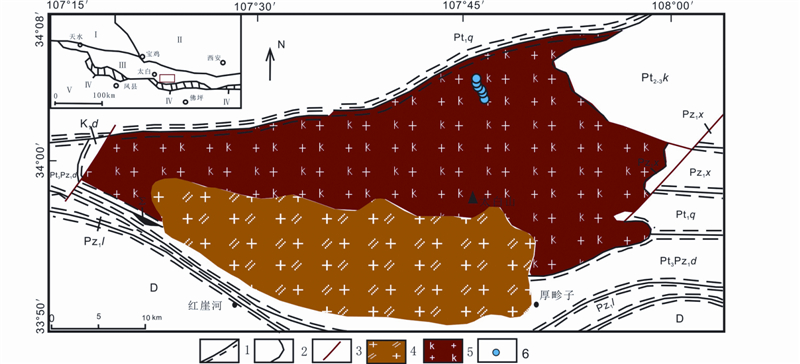 | 图 1 太白岩体区域地质简图(据王洪亮等,2006) Ⅰ-祁连造山带;Ⅱ-华北陆块;Ⅲ-北秦岭造山带;Ⅳ-商丹构造带(缝合带);Ⅴ-中南秦岭造山带;D-泥盆系;K1d-白垩系东河群;Pz1l-早古生代罗汉寺岩群;Pz1x-早古生代斜峪关岩群;Pt3-Pz1d-新元古代-早古生代丹凤岩群;Pt2-3k-中-新元古代宽坪岩群;Pt1q-古元古代秦岭岩群;1-不整合界线;2-侵入接触界线;3-断层;4-二长花岗岩;5-正长花岗岩;6-采样位置 Fig. 1 Sketch regional geological map of Taibai pluton(after Wang et al., 2006) |
本次采样位置主要位于太白岩体北部(图 1),野外可见花岗岩中局部有条带状构造(图 2a,b)。岩石呈灰白色-浅肉红色,镜下鉴定岩性为正长花岗岩,中粒-中粗粒自形-半自形粒状结构,块状构造,局部可见似片麻状构造;主要矿物为钾长石(50%)+斜长石(20%)+石英(20%)+黑云母(4%)+角闪石(4%),副矿物有榍石、磁铁矿、锆石等。钾长石以条纹长石和微斜长石为主,在斜长石和条纹长石的接触边界上可见蠕英结构,石英呈他形粒状(图 2c,d)。
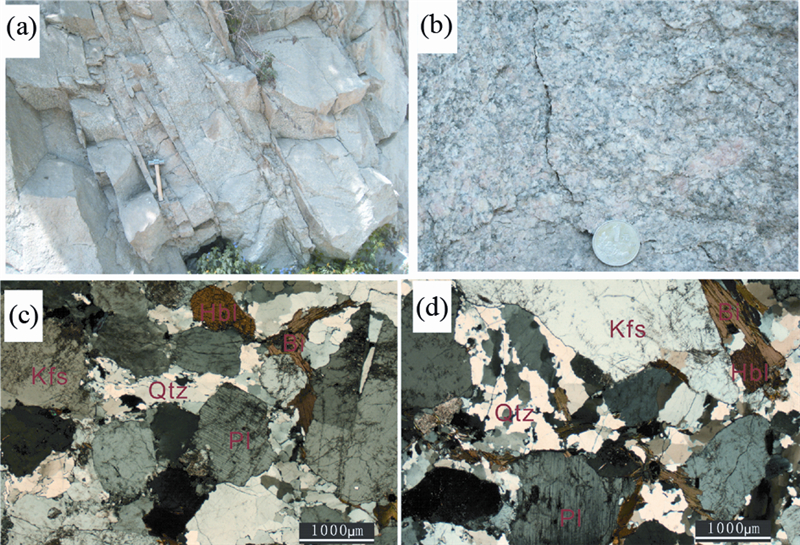 | 图 2 正长花岗岩野外(a、b)及显微(c、d)照片 Kfs-钾长石;Pl-斜长石;Qtz-石英;Bi-黑云母;Hbl-角闪石 Fig. 2 Filed photos(a,b) and microphotographs(c,d)of the syengranite |
在详细岩相学观察基础上,选择新鲜没有脉体贯入的样品进行主量、微量元素分析。岩石主量元素测试在西北大学大陆动力学国家重点实验室采用XRF方法测定完成,分析精度一般优于5%。微量及稀土元素在中国科学院贵阳地球化学研究所完成,使用仪器为Bruker Aurora M90 ICP-MS,分析精度优于5%,具体操作参照(Qi et al., 2000)。在对元素进行地球化学实验之前,首先将岩石样品洗净、烘干,用小型颚式破碎机破碎至粒度为5.0mm左右,然后用玛瑙研钵托盘在振动式碎样机中碎至200目以下,将碎后的粉末用二分之一均一缩分法分为2份,其中1份作为副样,另1份用来进行化学成分分析测试。
锆石按常规重力和磁选方法分选,最后在双目镜下挑纯,将锆石样品置于环氧树脂中,然后磨至约一半,使锆石内部暴露,锆石样品在测定之前用浓度为3%的稀HNO3清洗样品表面,以除去样品表面的污染。锆石的CL图像分析是在西北大学大陆动力学国家重点实验室的电子显微扫描电镜上完成。锆石U-Pb同位素组成分析在西北大学大陆动力学国家重点实验室激光剥蚀电感藕合等离子体质谱(LA-ICP-MS)仪上完成。激光剥蚀系统为配备有193nm ArF-excimer激光器的Geolas200M(Microlas Gottingen Germany),分析采用激光剥蚀孔径30μm,剥蚀深度20~40μm,激光脉冲为10Hz,能量为32~36mJ,同位素组成用锆石91500进行外标校正。LA-ICP-MS分析的详细方法和流程见(Yuan et al., 2004)。
Sr-Nd-Pb同位素分析在中国科学院贵阳地球化学研究所完成,利用Neptune Plus多接受器电感耦合等离子体质谱仪(MC-ICPMS)测定,Sr、Nd同位素分析采用具体方法参照(Chu et al., 2009)。Pb同位素用AG1-8(200~400目)阴离子交换树脂方法分离,Pb测试分析采用外部加入NBS 997TI至分离后的样品中,并利用205TI/203TI=2.3872来校正仪器的质量分馏,同时用NBS 981进行外部校正。 3 分析结果 3.1 主量和微量元素
本区正长花岗岩的主微量元素分析结果列于表 1中。从表 1中可以看到,正长花岗岩的SiO2=68.49%~72.84%,平均为70.72%,CaO=1.27%~2.83%;岩石相对低钛(TiO2=0.20%~0.32%),富铝(Al2O3=14.13%~16.48%,平均为15.25%),铝饱和指数A/CNK=0.97~1.05,属于准铝质-弱过铝质系列(图 3a)。岩石K2O=2.53%~5.33%,Na2O=3.38%~5.61%,K2O/Na2O=0.45~1.57(大多数样品的K2O/Na2O大于1),K2O+Na2O介于7.86%~8.93%之间。岩石σ=2.40~3.07,在SiO2-K2O图解上位于钾玄-高钾钙碱性系列岩石范围内(图 3b)。岩石 MgO=0.33%~0.63%,Mg#值较低,在28.1~43.7之间变化。
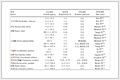 | 表 1 太白正长花岗岩的主量(wt%)和微量元素(×10-6)分析结果 Table 1 The analytical results of major(wt%) and trace element(×10-6)for the Taibai syengranite |
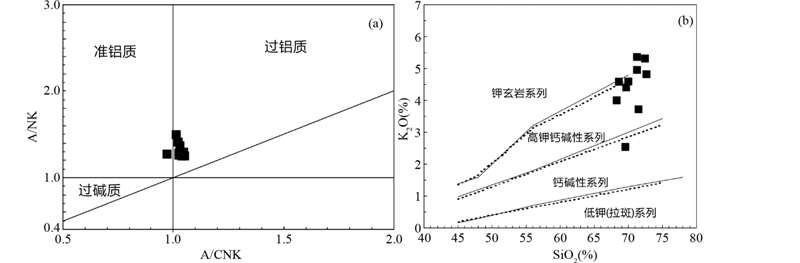 | 图 3 正长花岗岩的A/CNK-A/NK图(a,据Maniar and Piccoli, 1989)以及SiO2-K2O图解(b,据Peccerillo and Taylor, 1976) Fig. 3 Diagrams of A/CNK vs. A/NK(a,after Maniar and Piccoli, 1989) and SiO2 vs. K2O(b,after Peccerillo and Taylor, 1976)for the Taibai syengranite |
本区正长花岗岩的稀土元素总量变化范围较大,ΣREE=68.19×10⁻⁶~396.7×10⁻⁶(平均为199.5×10⁻⁶)。10个样品具有基本一致的稀土配分曲线,配分曲线总体呈轻稀土富集的右倾型(图 4b),轻重稀土分异明显,(La/Yb)N=13.2~159;具弱的负Eu异常(δEu=0.58~0.89)。岩石具有较高的Sr(309×10-6~588×10-6)、Ba(515×10-6~1758×10-6)、La(15.3×10-6~97.7×10-6)含量,低Y(6.04×10-6~24.6×10-6)和Yb(0.44×10-6~1.96×10-6),暗示岩浆源区可能有石榴石残留。在原始地幔标准化微量元素蛛网图中(图 4a),岩石富集大离子亲石元素(LILE)Rb、K、Pb、Nd等,显示明显的Pb正异常,亏损高场强元素(HFSE)Nb、P、Ti等。
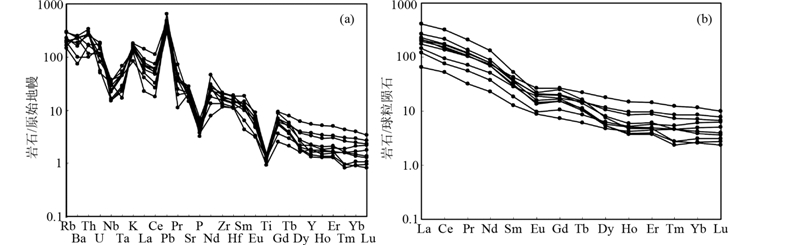 | 图 4 微量元素原始地幔标准化图解(a)和稀土元素球粒陨石标准化配分型式图(b)(标准化值据Sun and McDonough, 1989) Fig. 4 Primitive mantle-normalized trace element diagram(a) and Chondrite-normalized rare earth element distribution patterns(b)of the Taibai syengranite(normalization values after Sun and McDonough, 1989) |
选取代表性的2个正长花岗岩样品用于LA-ICP-MS微区锆石U-Pb定年分析,分析结果列于表 2中,锆石的CL图像如图 5所示。
| 表 2 太白正长花岗岩锆石LA-ICP-MS U-Pb测年结果(样品ZG237和ZG249)Table 2 Zircon LA-ICP-MS U-Pb analytical data of the Taibai syengranite (sample ZG237 and ZG249) |
 | 图 5 锆石阴极发光(CL)图像 Fig. 5 Cathodoluminescene(CL)images of typical zircon grains form the syengranite |
正长花岗岩(ZG237),锆石颗粒为无色透明,长柱状半自形-自形晶,粒径介于100~200μm之间,长宽比21~41。在锆石CL图像上,锆石一般呈暗灰色,岩浆型韵律环带清晰。共选取34颗锆石进行了36个数据点分析。有5个测点给出较小的206Pb/238U年龄值(134~139Ma),其U(1662×10-6~2473×10-6)较高,Th/U值为0.02~0.12,可能是受后期流体改造,Pb丢失的结果。其它分析点的206Pb/238U年龄集中于150~159Ma,Th、U含量分别为36×10-6~574×10-6和531×10-6~2828×10-6,Th/U值为0.02~0.45,所得206Pb/238U的加权平均年龄为153.17±0.89Ma(MSWD=2.3,2σ)(图 6a),代表岩浆结晶年龄。
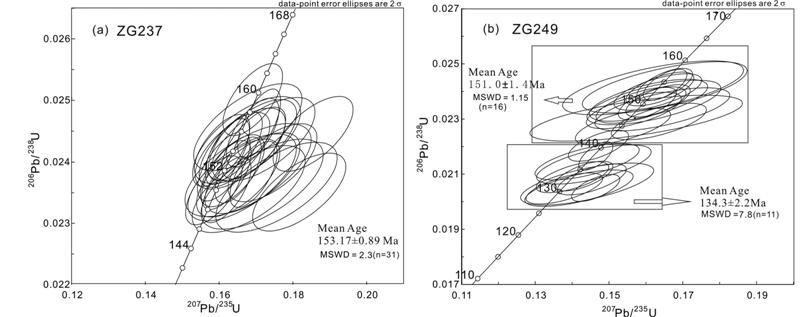 | 图 6 正长花岗岩锆石U-Pb谐和图 Fig. 6 Zircon concordia diagram showing zircon analyses for the syengranite |
正长花岗岩(ZG249),锆石颗粒为无色透明,长柱状半自形-自形晶,粒径介于100~200μm之间,长宽比21~41。在CL图像上,锆石一般呈黑色和灰白相间,大部分锆石有岩浆韵律环带,部分锆石显示核边结构。共选取24颗锆石进行了36个数据点分析,对12粒锆石在其核部与边部进行了对应的分析。其中一个点的206Pb/238U年龄为424Ma和五个点的206Pb/238U年龄为164~166Ma,可能为捕获锆石,另有三个点为不和谐年龄点,不予讨论。其他年龄值可分为两组,分别代表了核、边部年龄,核部年龄在145~154Ma之间,Th、U含量分别为36×10-6~1021×10-6、236×10-6~1994×10-6,Th/U为0.04~1.18,多数大于0.3,属岩浆锆石,206Pb/238U的加权平均年龄为151.0±1.4Ma(MSWD=1.15,2σ)(图 6b),代表岩浆结晶年龄。边部年龄值范围为131~137Ma,206Pb/238U的加权平均年龄为134.2±2.2Ma(MSWD=7.8,2σ)(图 6b),这些锆石所测Th含量为32×10-6~1176×10-6,U含量为401×10-6~2934×10-6,Th/U多数小于0.3,可能为后期热液交代作用。 3.3 Sr-Nd-Pb同位素特征
本区正长花岗岩3个样品的Sr-Nd-Pb同位素分析结果列于表 3、表 4中。从表中分析数据可以看到,岩石具有较高的Rb(103×10-6~186×10-6)和Sr(365×10-6~578×10-6)含量,岩石87Sr/86Sr=0.7068~0.7138,143Nd/144Nd=0.5116~0.5125,初始比值ISr=0.7053~0.7112,εNd(t)=-18.6~-0.1(平均为-9.2),具中高ISr和低εNd(t)的特征。二阶段模式年龄t2DM值为0.83Ga、1.44Ga、2.11Ga,变化较大,表明其源区应主要为古老的壳源物质。
| 表 3 正长花岗岩Sr-Nd同位素分析数据Table 3 Sr-Nd isotopic data of the syengranite |
| 表 4 正长花岗岩Pb同位素分析数据Table 4 Pb isotopic data of the syengranite |


本区正长花岗岩铅同位素比值为206Pb/204Pb=17.574~17.652(平均17.611),207Pb/204Pb=15.474~15.493(平均15.483),208Pb/204Pb=38.116~38.403(平均38.278)。以t=150Ma对岩石初始铅同位素比值进行统一计算,得到初始铅同位素比值(206Pb/204Pb)i=17.492~17.524(平均17.512),(207Pb/204Pb)i=15.47~15.485(平均15.478),(208Pb/204Pb)i=37.75~38.097(平均37.938)。其铅同位素变化范围与南秦岭元古宙基底岩石的对应值(206Pb/204Pb=17.823,207Pb/204Pb=15.486,208Pb/204Pb=38.319)基本一致(陈岳龙等,1996;张本仁等,2002),表明本区正长花岗岩体可能为南秦岭元古宙基底岩石源区部分熔融的产物。 4 讨论 4.1 岩石成因类型
本区正长花岗岩中出现了I型花岗岩的典型矿物学标志-角闪石,副矿物组合中普遍出现榍石、磁铁矿,而未见富铝矿物。
岩石的SiO2=68.49%~72.84%,Al2O3=14.13%~16.48%,K2O/Na2O=0.45~1.57(平均1.12),σ<3.3,Na2O>3.2%,A/CNK<1.1。同时,SiO2含量与P2O5含量和Pb含量分别呈负相关性和正相关性(图 7),均显示具I型花岗岩特征(李献华等,2007)。王德滋等(1993)认为Rb和K有相似的地球化学性质,随着壳幔的分熔和陆壳的逐渐演化,Rb富集于成熟度高的地壳中;Sr和Ca有相似的地球化学行为,Sr富集于成熟度低、演化不充分的地壳中。因此,Rb/Sr比值能灵敏地记录源区物质的性质,当Rb/Sr>0.9时,为S型花岗岩;Rb/Sr<0.9时,为 I 型花岗岩。本区正长花岗岩Rb/Sr在0.18~0.51之间,以上证据均表明该岩体属准铝或弱过铝质高钾钙碱性I型花岗岩类。
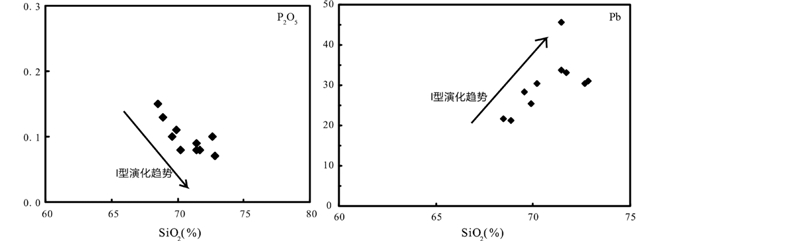 | 图 7 正长花岗岩成因判别图 Fig. 7 Genesis diagrams for the syengranite |
在微量元素蛛网图中,显示P、Ti、Nb的负异常及Pb正异常,轻稀土和大离子亲石元素(如U、Th、Rb)含量高,曲线整体上表现为右倾型式。富集大离子亲石元素(LILE),以及明显的Pb正异常,说明源岩可能以壳源成分为主(Roberts and Clemens, 1993; Hofmann,1997)。Rb/Sr比值平均值0.32,远小于0.9,接近大陆壳的平均值(0.24)。大部分样品表现出高Sr低Y、Yb的特点,并且Y/Yb=9.62~16.61,平均为12.52;(Ho/Yb)N值介于0.87~1.84之间,平均为1.26;这暗示正长花岗岩源区残留相可能为石榴石。本区正长花岗岩的εNd(t)变化较大,从-18.6到-0.1,平均-9.2,表明源岩以古老的地壳物质为主。 4.2 岩浆源区性质
本区正长花岗岩具有非常负的εNd(t)=-18.6~-0.1和古老的模式年龄(0.83Ga、1.44Ga、2.11Ga),说明古老的地壳物质对岩浆物源的贡献显著。从ISr-εNd(t)图解可以看出,投影点大部分落入BC区(图 8),暗示岩浆中可能有幔源物质的加入。208Pb-206Pb的投点均落入下地壳和造山带之间(图 9),表明形成岩体的岩浆中应该有幔源物质的混入。铅同位素组成与南秦岭东段及扬子北缘东段基底岩系十分相近(图 10)。
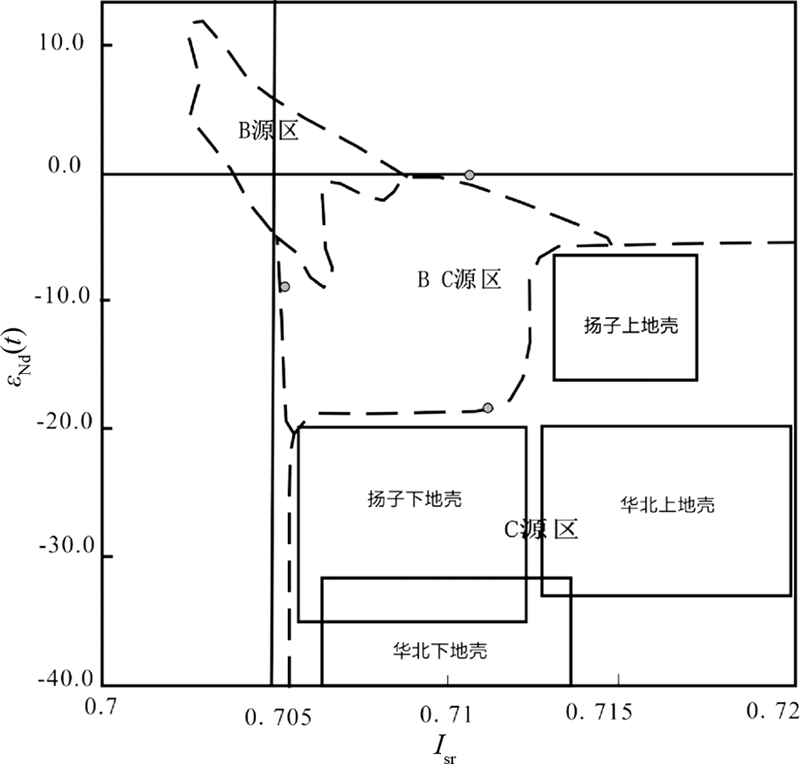 | 图 8 正长花岗岩ISr-εNd(t)图解(据张旗等,2008) Fig. 8 Diagram of ISr-εNd(t)for the syengranite(after Zhang et al., 2008) |
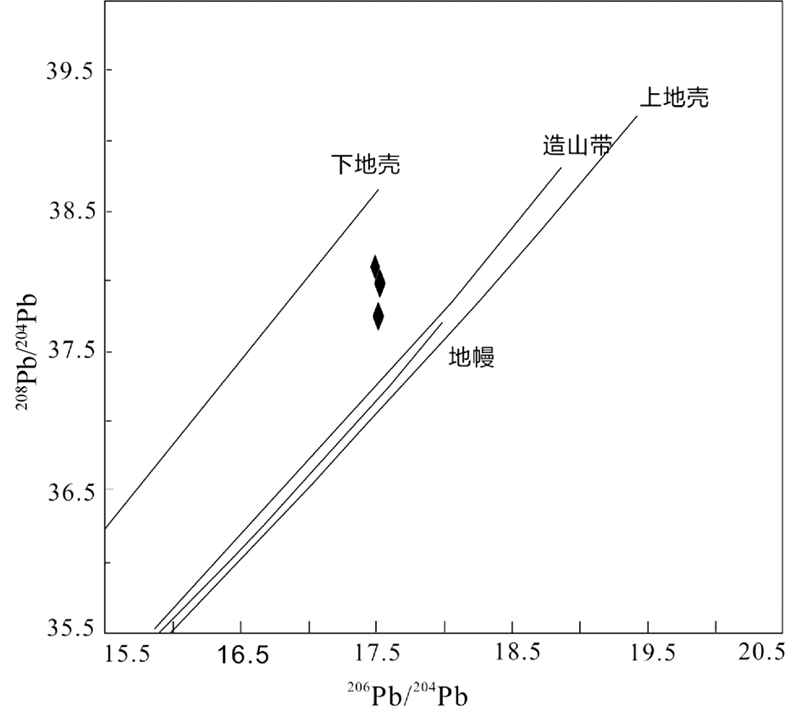 | 图 9 铅同位素206Pb/204Pb-208Pb/204Pb图(据Zartman and Doe, 1981) Fig. 9 Pb isotope ratios 206Pb/204Pb-208Pb/204Pb for the syengranite(after Zartman and Doe, 1981) |
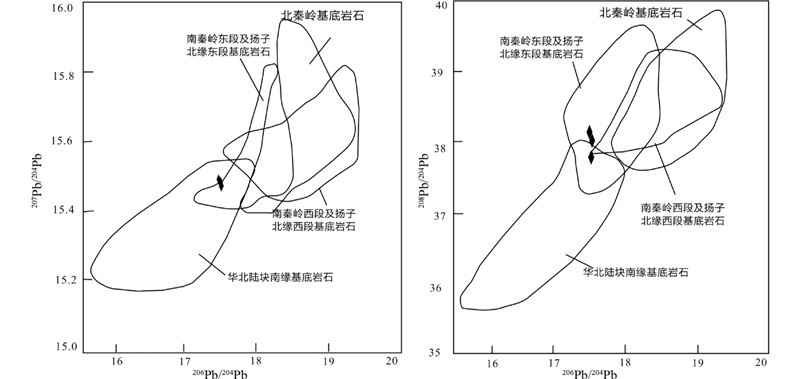 | 图 10 206Pb/204Pb-207Pb/204Pb和206Pb/204Pb-208Pb/204Pb图解(据张本仁等,1996) Fig. 10 Diagram of 206Pb/204Pb-207Pb/204Pb and 206Pb/204Pb-208Pb/204Pb(after Zhang et al., 1996) |
太白岩体南部与丹凤岩群呈侵入接触关系,北部与秦岭岩群以脆韧性剪切带相接。秦岭群形成时代大约在1.2~1.9Ga,丹凤群形成于827~517Ma之间的新元古代晚期-早古生代早期(张成立等,2013)。上述分析表明,本区花岗岩应该以古老的壳源岩石(如秦岭群)为主,还加入了部分幔源组分。 4.3 岩体形式时代及地质意义
秦岭-大别造山带经历了新元古代、古生代、中生代构造岩浆热事件和造山作用,于早中生代完成碰撞,在晚中生代进入了陆内环境(Mattauer et al., 1985; Krner and Zhang, 1993; Meng and Zhang, 1999; 张国伟等,2001; Lai et al., 2000,2004a,b,2008; Lai,2007; Mao et al., 2010)。晚侏罗世-早白垩世,随着太平洋板块向欧亚板块的俯冲,区域构造体制发生转换(洪大卫等,2003; 毛景文等,2005; 丁丽雪等,2010),秦岭造山带南北向外部挤压作用消失,从而转为强烈的伸展,导致秦岭乃至中国东部地区岩石圏强烈的抬升和拆沉,引发幔源岩浆活动,产生大量的中酸性岩浆作用并形成大规模花岗岩类(吴发富,2013)。王晓霞等(2011)将秦岭晚中生代花岗岩分为两期,早期(158~130Ma),中酸性侵入岩形成于挤压向伸展转换的动力学背景;晚期(120~100Ma)花岗岩发育于陆内伸展环境,增厚地壳开始全面减薄。本文获得太白正长花岗岩年龄分别为153.17±0.89Ma和151.0±1.4Ma,在误差范围内年龄一致。与北秦岭构造带中牧护关花岗岩的锆石U-Pb年龄150±1Ma,以及蟒岭花岗岩的锆石U-Pb年龄149±2Ma相近(王晓霞等,2011),均形成于大陆造山带碰撞后岩石圈由会聚挤压向离散转折阶段。结合区域构造演化,太白正长花岗岩的形成机制可概括为:秦岭造山带于中生代初期完成全面的陆陆碰撞闭合,扬子板块携秦岭微板块向华北板块之下作陆内俯冲,太平洋板块向欧亚板块的俯冲作用使区域应力场发生改变,导致由挤压环境向伸展环境转换,引起岩石圈减薄和软流圈上涌(高山等,1999;丁丽雪等,2010),软流圈不断底侵增厚下地壳,引发下地壳岩石的熔融,随后部分熔融的地幔物质混入、上侵和持久的MASH过程(熔融-混染-储存-均一化)(Hildreth and Moorbath, 1988; 罗照华等,2008),形成壳/幔混源的花岗岩浆。 5 结论
(1)太白正长花岗岩具有高硅、碱,A/CNK=0.97~1.05的特征,总体属于高钾钙碱性系列,具有I型花岗岩的特征,岩石富集大离子亲石元素,亏损高场强元素,具弱负Eu异常。ISr=0.7053~0.7112,εNd(t)=-18.6~-0.1,二阶段模式年龄t2DM值为0.83~2.11Ga。初始铅同位素比值206Pb/204Pb(平均17.512),207Pb/204Pb(平均15.478),208Pb/204Pb(平均37.938)。指示岩浆源区以古老地壳部分熔融物质为主,并有部分幔源物质的加入。
(2)正长花岗岩年龄为153.17±0.89Ma和151.0±1.4Ma,形成于晚中生代,与牧护关、蟒岭花岗岩相近,均形成于挤压向伸展转换的构造环境。
| [1] | Chen YL, Zhang BR and Abdukader P. 1995. Geochemical characteristics of Pb, Sr and Nd isotopes on Early Palaeozoic granites in the Danfeng region, northern Qinling belt. Scientia Geologica Sinica, 30(3): 247-258 (in Chinese with English abstract) |
| [2] | Chen YL, Yang ZF, Zhang HF et al. 1996. Geochemical characteristics of Sr, Nd and Pb isotopes of Late Paleozoic-Mesozoic granitoids from northern Qinling belt. Earth Science, 21(5): 481-485 (in Chinese with English abstract) |
| [3] | Chu ZY, Chen FK, Yang YH et al. 2009. Precise determination of Sm, Nd concentrations and Nd isotopic compositions at the nanogram level in geological samples by thermal ionization mass spectrometry. Journal of Analytical Atomic Spectrometry, 24(11): 1534-1544 |
| [4] | Deng JF, Su SG, Niu YL et al. 2007. A possible model for the lithospheric thinning of North China Craton: Evidence from the Yanshannian (Jera-Cretaceous) magmatism and tectonism. Lithos, 96(1-2): 22-25 |
| [5] | Ding LX, Ma CQ, Li JW et al. 2010. LA-ICP-MS zircon U-Pb ages of the Lantian and Muhuguan granitoid plutons, southern margin of the North China craton: Implications for tectonic setting. Geochimica, 39(5): 401-413 (in Chinese with English abstract) |
| [6] | Gao S, Zhang BR, Jin ZM et al. 1999. The delamination of lower crust in Qinling-Dabie orogen. Science in China (Series D), 29(6): 532-540 (in Chinese) |
| [7] | Hildreth W and Moorbath S. 1988. Crustal contributions to arc magmatism in the Andes of central Chile. Contributions to Mineralogy and Petrology, 98(4): 455-489 |
| [8] | Hong DW, Wang T, Tong Y et al. 2003. Mesozoic granitoids from North China block and Qinling-Dabie-Sulu orogenic belt and their deep dynamic process. Earth Science Frontiers, 10(3): 231-256 (in Chinese with English abstract) |
| [9] | Hofmann AW. 1997. Mantle geochemistry: The message from oceanic volcanism. Nature, 385(6613): 219-229 |
| [10] | Kröner A and Zhang GW. 1993. Granulites in the Tongbai area, Qinling belt, China: Geochemistry, petrology, single zircon geochronology, and implications for the tectonic evolution of Eastern Asia. Tectonics, 12(1): 245-255 |
| [11] | Lai SC, Zhang GW and Yang RY. 2000. Identification of the island-arc magmatic zone in the Lianghe-Raofeng-Wuliba area, South Qinling and its tectonic significance. Science in China (Series D), 43(S1): 69-81 |
| [12] | Lai SC, Zhang GW, Pei XZ et al. 2004a. Geochemistry of the ophiolite and oceanic island basalt in the Kangxian-Pipasi-Nanping tectonic mélange zone, southern Qinling and their tectonic significance. Science in China (Series D), 47(2): 128-137 |
| [13] | Lai SC, Zhang GW, Dong YP et al. 2004b. Geochemistry and regional distribution of the ophiolites and associated volcanics in Mianlue suture, Qinling-Dabie Mountains. Science in China (Series D), 47(4): 289-299 |
| [14] | Lai SC. 2007. Geochemistry and tectonic significance of the ophiolite and associated volcanics in the Mianlue Suture, Qinling Orogenic Belt. Journal of the Geological Society of India, 70(2): 217-234 |
| [15] | Lai SC, Qin JF, Chen L et al. 2008. Geochemistry of ophiolites from the Mian-Lue suture zone: Implications for the tectonic evolution of the Qinling orogen, central China. International Geology Review, 50(7): 650-664 |
| [16] | Lei M. 2010. Petrogenesis of granites and their relation to tectonic evolution of orogen in the east part of Qinling orogenic belt. Ph. D. Dissertation. Beijing: China University of Geosciences (in Chinese) |
| [17] | Li L, Zhang CL, Zhou Y et al. 2012. Early Mesozoic crust- and mantle-derived magmatic mixing in the Qinling Orogeny: Evidence from geochemistry of mafic microgranular enclaves in the Dongjiangkou pluton. Geological Journal of China Universities, 18(2): 291-306 (in Chinese with English abstract) |
| [18] | Li L, Sun WZ, Meng XF et al. 2013. Geochemical and Sr-Nd-Pb isotopic characteristics of the granitoids of Xiaoshan Mountain area on the southern margin of North China Block and its geological significance. Acta Petrologica Sinica, 29(8): 2635-2652 (in Chinese with English abstract) |
| [19] | Li XH, Li WX and Li ZX. 2007. On the genetic classification and tectonic implications of the Early Yanshanian granitoids in the Nanling Range, South China. Chinese Science Bulletin, 52(9): 981-991 (in Chinese) |
| [20] | Liu L, Liao XY, Zhang CL et al. 2013. Multi-matemorphic timings of HP-UHP rocks in the North Qinling and their geological implications. Acta Petrologica Sinica, 29(5): 1634-1656 (in Chinese with English abstract) |
| [21] | Lu XX, Yu ZP, Feng YL et al. 2002. Mineralization and tectonic setting of deep-hypabyssal granites in East Qinling Mountain. Mineral Deposits, 21(2): 168-178 (in Chinese with English abstract) |
| [22] | Luo ZH, Lu XX, Guo SF et al. 2008. Metallogenic systems on the transmagmatic fluid theory. Acta Petrologica Sinica, 24(12): 2669-2678 (in Chinese with English abstract) |
| [23] | Maniar PD and Piccoli PM. 1989. Tectonic discrimination of granitoids. Geol. Soc. Am. Bull., 101(5): 635-643 |
| [24] | Mao JW, Xie GQ, Zhang ZH et al. 2005. Mesozoic large-scale metallogenic pulses in North China and corresponding geodynamic settings. Acta Petrologica Sinica, 21(1): 169-188 (in Chinese with English abstract) |
| [25] | Mao JW, Xie GQ, Pirajno F et al. 2010. Late Jurassic-Early Cretaceous granitoid magmatism in eastern Qinling, central-eastern China: SHRIMP zircon U-Pb ages and tectonic implications. Aust. J. Earth Sci., 57(1): 51-78 |
| [26] | Mattauer M, Matte P, Malavielle J et al. 1985. Tectonics of the Qinling belt: Build up and evolution of eastern Asia. Nature, 317(6037): 496-500 |
| [27] | Meng QR and Zhang GW. 1999. Timing of collision of the North and South China blocks: Controversy and reconciliation. Geology, 27(2): 123-126 |
| [28] | Meng QR and Zhang GW. 2000. Geologic framework and tectonic evolution of the Qinling orogen, Central China. Tectonophysics, 323(3-4): 183-196 |
| [29] | Peccerillo A and Taylor SR. 1976. Geochemistry of Eocene calc-alkaline volcanic rocks from the Kastamonu area, northern Turkey. Contrib. Mineral. Petrol., 58(1): 63-81 |
| [30] | Qi L, Hu J and Gregoire DC. 2000. Determination of trace elements in granites by inductively coupled plasma mass spectrometry. Talanta, 51(3): 507-513 |
| [31] | Qin HP, Wu CL, Wu XP et al. 2012a. LA-ICP-MS Zircon U-Pb ages and implications for tectonic setting of the Mangling granitoid plutons in Qinling Orogen Belt. Geological Review, 58(4): 783-793 (in Chinese with English abstract) |
| [32] | Qin HP, Wu CL, Wu XP et al. 2012b. Zircon Lu-Hf isotopic compositions and petrogenesis of strontium-rich granite from Mangling, Qinling Orogen Belt. Journal of Jilin University (Earth Science Edition), 42(1): 254-267 (in Chinese with English abstract) |
| [33] | Qin JF, Lai SC and Li YF. 2005. Petrogenesis and geological significance of Yangba granodiorites from Bikou area, northern margin of Yangtze Plate. Acta Petrologica Sinica, 21(3): 697-710 (in Chinese with English abstract) |
| [34] | Roberts MP and Clemens JD. 1993. Origin of high-potassium, calc-alkaline, I-type granitoids. Geology, 21(9): 825-828 |
| [35] | Shi Y, Yu JH, Xu XS et al. 2009. Geochronology and geochemistry of the Qinling Group in the eastern Qinling Orogen. Acta Petrologica Sinica, 25(10): 2651-2670 (in Chinese with English abstract) |
| [36] | Sun SS and McDonough WF. 1989. Chemical and isotopic systematics of oceanic basalts: Implications for mantle composition and processes. In: Saunders AD and Norry MJ (eds.). Magmatism in the Ocean Basins. Geological Society, London, Special Publications, 42(1): 313-345 |
| [37] | Sun WD, Li SG, Chen YD et al. 2002. Timing of syn-orogenic granitoids in the South Qinling, Central China: Constraints on the evolution of the Qinling-Dabie orogenic belt. The Journal of Geology, 110(4): 457-468 |
| [38] | Wan YS, Liu DY, Dong CY et al. 2011. SHRIMP zircon dating of meta-sedimentary rock from the Qinling Group in the north of Xixia, North Qinling Orogenic Belt: Constraints on complex histories of source region and timing of deposition and metamorphism. Acta Petrologica Sinica, 27(4): 1172-1178 (in Chinese with English abstract) |
| [39] | Wang DZ, Liu CS, Shen WZ et al. 1993. The contrast between Tonglu I-type and Xiangshan S-type clastoporphyritic lave. Acta Petrologica Sinica, 9(1): 44-54 (in Chinese with English abstract) |
| [40] | Wang HL, He SP, Chen JL et al. 2006. LA-ICPMS dating of zircon U-Pb and tectonic significance of Gongjiangou deformation intrusions of Taibai Rock Mass, Shaanxi Province: The primary study on the response in North Qinling Orogenic Belt to Lüliang Movement. Acta Geologica Sinica, 80(11): 1660-1667 (in Chinese with English abstract) |
| [41] | Wang T, Wang XX, Tian W et al. 2009. North Qinling Paleozoic granite associations and their variation in space and time: Implications for orogenic processes in the orogens of Central China. Science in China (Series D), 39(7): 949-971 (in Chinese) |
| [42] | Wang XX, Wang T, Qi QJ et al. 2011. Temporal-spatial variations, origin and their tectonic significance of the Late Mesozoic granites in the Qinling, Central China. Acta Petrologica Sinica, 27(6): 1573-1593 (in Chinese with English abstract) |
| [43] | Wang XX, Wang T and Zhang CL. 2013. Neoproterozoic, Paleozoic, and Mesozoic granitoid magmatism in the Qinling Orogen, China: Constraints on orogenic process. Journal of Asian Earth Sciences, 72: 129-151 |
| [44] | Wu FF. 2013. Research on the magmatite and its metallogenic tectonic setting in the Shanyang-Zhashui area, Middle Qinling Orogenic Belt. Ph. D. Dissertation. Beijing: Chinese Academy of Geological Sciences (in Chinese) |
| [45] | Xiao PX, Zhang JY and Wang HL. 2000. Subdivision of rock series units and determination of intrusion age of Taibai rock mass in North Qinling. Northwest Geoscience, 21(2): 37-45 (in Chinese with English abstract) |
| [46] | Yuan HL, Gao S, Liu XM et al. 2004. Accurate U-Pb age and trace element determinations of zircon by laser ablation-inductively coupled plasma mass spectrometry. Geo-standard Newsletters, 28(3): 353-370 |
| [47] | Zartman RE and Doe BR. 1981. Plumbotectonics: The model. Tectonophysics, 75(1-2): 135-162 |
| [48] | Zhang BR, Zhang HF, Zhao ZD et al. 1996. Geochemical subdivision and evolution of the lithosphere in East Qinling and adjacent regions-Implications for tectonics. Science in China (Series D), 26(3): 201-208 (in Chinese) |
| [49] | Zhang BR, Gao S, Zhang HF et al. 2002. Geochemistry of Qinling Orogenic Belt. Beijing: Science Press, 1-187 (in Chinese) |
| [50] | Zhang CL, Wang T and Wang XX. 2008. Origin and tectonic setting of the Early Mesozoic granitoids in Qinling orogenic belt. Geological Journal of China Universities, 14(3): 304-316 (in Chinese with English abstract) |
| [51] | Zhang CL, Liu L, Wang T et al. 2013. Granitic magmatism related to Early Paleozoic continental collision in the North Qinling belt. Chinese Science Bulletin, 58(23): 2323-2329 (in Chinese) |
| [52] | Zhang GW, Zhang BR, Yuan XC et al. 2001. Qinling Orogenic Belt and Continental Dynamics. Beijing: Science Press, 1-855 (in Chinese) |
| [53] | Zhang Q, Wang Y, Xiong XL et al. 2008. Adakite and Granite: Challenge and Opportunity. Beijing: China Land Press, 107-129 (in Chinese with English abstract) |
| [54] | Zhang ZQ, Zhang GW, Liu DY et al. 2006. Isotopic Geochronology and Geochemistry of Ophiolites, Granites and Clastic Sedimentary Rocks in the Qinling Orogenic Belt. Beijing: Geological Publishing House, 1-339 (in Chinese) |
| [55] | Zhou DW, Zhao ZY and Li YD. 1994. Geological Features along the Southwest Margin of the Ordos Basin and the Relations to the Evolution of the Qinling Orogen. Beijing: Geological Publishing House, 1-177 (in Chinese) |
| [56] | 陈岳龙, 张本仁, 帕拉提·阿布都卡得尔. 1995. 北秦岭丹凤地区早古生代花岗岩的Pb、Sr、Nd同位素地球化学特征. 地质科学, 30(3): 247-258 |
| [57] | 陈岳龙, 杨忠芳, 张宏飞等. 1996. 北秦岭晚古生代-中生代花岗岩类的Nd-Sr-Pb同位素地球化学特征及Nd-Sr同位素演化. 地球科学, 21(5): 481-485 |
| [58] | 丁丽雪, 马昌前, 李建威等. 2010. 华北克拉通南缘蓝田和牧护关花岗岩体: LA-ICP-MS锆石U-Pb年龄及其构造意义. 地球化学, 39(5): 401-413 |
| [59] | 高山, 张本仁, 金振民等. 1999. 秦岭-大别造山带下地壳拆沉作用. 中国科学(D辑), 29(6): 532-540 |
| [60] | 洪大卫, 王涛, 童英等. 2003. 华北地台和秦岭-大别-苏鲁造山带的中生代花岗岩与深部地球动力学过程. 地学前缘, 10(3): 231-256 |
| [61] | 雷敏. 2010. 秦岭造山带东部花岗岩成因及其与造山带构造演化的关系. 博士学位论文. 北京: 中国地质大学 |
| [62] | 李雷, 张成立, 周莹等. 2012. 秦岭早中生代壳幔岩浆混合作用——来自东江口花岗岩体闪长质包体的地球化学证据. 高校地质学报, 18(2): 291-306 |
| [63] | 李磊, 孙卫志, 孟宪锋等. 2013. 华北陆块南缘崤山地区燕山期花岗岩类地球化学、Sr-Nd-Pb同位素特征及其地质意义. 岩石学报, 29(8): 2635-2652 |
| [64] | 李献华, 李武显, 李正祥. 2007. 再论南岭燕山早期花岗岩的成因类型与构造意义. 科学通报, 52(9): 981-991 |
| [65] | 刘良, 廖小莹, 张成立等. 2013. 北秦岭高压-超高压岩石的多期变质时代及其地质意义. 岩石学报, 29(5): 1634-1656 |
| [66] | 卢欣祥, 于在平, 冯有利等. 2002. 东秦岭深源浅成型花岗岩的成矿作用及地质构造背景. 矿床地质, 21(2): 168-178 |
| [67] | 罗照华, 卢欣祥, 郭少丰等. 2008. 透岩浆流体成矿体系. 岩石学报, 24(12): 2669-2678 |
| [68] | 毛景文, 谢桂青, 张作衡等. 2005. 中国北方中生代大规模成矿作用的期次及其地球动力学背景. 岩石学报, 21(1): 169-188 |
| [69] | 秦海鹏, 吴才来, 吴秀萍等. 2012a. 秦岭造山带蟒岭花岗岩锆石LA-ICP-MS U-Pb年龄及其地质意义. 地质评论, 58(4): 783-793 |
| [70] | 秦海鹏, 吴才来, 吴秀萍等. 2012b. 秦岭蟒岭高Sr花岗岩的锆石Lu-Hf同位素特征及其成因. 吉林大学学报(地球科学版), 42(1): 254-267 |
| [71] | 秦江锋, 赖绍聪, 李永飞. 2005. 扬子板块北缘碧口地区阳坝花岗闪长岩体成因研究及其地质意义. 岩石学报, 21(3): 697-710 |
| [72] | 时毓, 于津海, 徐夕生等. 2009. 秦岭造山带东段秦岭岩群的年代学和地球化学研究. 岩石学报, 25(10): 2651-2670 |
| [73] | 万渝生, 刘敦一, 董春艳等. 2011. 西峡北部秦岭群变质沉积岩锆石SHRIMP定年: 物源区复杂演化历史和沉积、变质时代确定. 岩石学报, 27(4): 1172-1178 |
| [74] | 王德滋, 刘昌实, 沈渭洲等. 1993. 桐庐I型和相山S型两类碎斑熔岩对比. 岩石学报, 9(1): 44-54 |
| [75] | 王洪亮, 何世平, 陈隽璐等. 2006. 太白岩基巩坚沟变形侵入体LA-ICPMS锆石U-Pb测年及大地构造意义——吕梁运动在北秦岭造山带的表现初探. 地质学报, 80(11): 1660-1667 |
| [76] | 王涛, 王晓霞, 田伟等. 2009. 北秦岭古生代花岗岩组合、岩浆时空演变及其对造山作用的启示. 中国科学(D辑) , 39(7): 949-971 |
| [77] | 王晓霞, 王涛, 齐秋菊等. 2011. 秦岭晚中生代花岗岩时空分布、成因演变及构造意义. 岩石学报, 27(6): 1573-1593 |
| [78] | 吴发富. 2013. 中秦岭山阳-柞水地区岩浆岩及其成矿构造环境研究. 博士学位论文. 北京:中国地质科学院 |
| [79] | 校培喜, 张俊雅, 王洪亮等. 2000. 北秦岭太白岩体岩石谱系单位划分及侵位时代确定. 西北地质科学, 21(2): 37-45 |
| [80] | 张本仁, 张宏飞, 赵志丹等. 1996. 东秦岭及邻区壳、幔地球化学分区和演化及其大地构造意义. 中国科学(D辑), 26(3): 201-208 |
| [81] | 张本仁, 高山, 张宏飞等. 2002. 秦岭造山带地球化学. 北京: 科学出版社, 1-187 |
| [82] | 张成立, 王涛, 王晓霞. 2008. 秦岭造山带早中生代花岗岩成因及其构造环境. 高校地质学报, 14(3): 304-316 |
| [83] | 张成立, 刘良, 王涛, 王晓霞, 李雷, 龚齐福, 李小菲. 2013. 北秦岭早古生代大陆碰撞过程中的花岗岩浆作用. 科学通报, 58(23): 2323-2329 |
| [84] | 张国伟, 张本仁, 袁学诚等. 2001. 秦岭造山带与大陆动力学. 北京: 科学出版社, 1-855 |
| [85] | 张旗, 王焰, 熊小林等. 2008. 埃达克岩和花岗岩: 挑战与机遇. 北京: 中国大地出版社, 107-129 |
| [86] | 张宗清, 张国伟, 刘敦一等. 2006. 秦岭造山带蛇绿岩、花岗岩和碎屑沉积岩同位素年代学和地球化学. 北京: 地质出版社,1-339 |
| [87] | 周鼎武,赵重远,李银德等. 1994. 鄂尔多斯盆地西南缘地质特征及其与秦岭造山带的关系. 北京: 地质出版社, 1-177 |