 2014, Vol. 30


2. 中国地质科学院, 北京 100037
2. Chinese Academy of Geological Sciences, Beijing 100037, China
白云鄂博REE-Nb-Fe矿床产于白云鄂博群中,尽管其成因有不同的认识(刘淑春等,1999; 章雨旭等,2009),但其成矿时代不早于白云鄂博群是无疑的。然而,一方面,白云鄂博矿床成矿时代的同位素测定结果大多数是中元古代(张宗清等, 1991,1994,1997,2001,2003; 范宏瑞等, 2002,2006; 刘玉龙等, 2001,2006);仅有少数为早古生代,且被解释为后期成矿作用的叠加(刘兰笙等,1996; Liu et al., 2005);另一方面,孙淑芬(1992)、张鹏远等(1993)、谭励可和石铁铮(2000)根据微古植物化石和小壳化石证据,认为白云鄂博群形成于早古生代。乔秀夫等(1997a,b)依据腮林忽洞群具有与白云鄂博群相同的微古植物组合及发现的三叶虫碎片等证据,认为腮林忽洞群与白云鄂博群的下部相当,二者均为早古生代。根据化石发现、底部与变质岩不整合接触、内部存在震动液化脉和滑塌岩块等,吕洪波等(2006)、章雨旭和柳建勇(2010)、章雨旭等(2009,2012)和张星等(2013)也认为白云鄂博群与腮林忽洞群相当,两者沉积时具有相似的构造背景,是早古生代华北克拉通北缘被动大陆边缘沉积,而不是一些学者认为的中元古代裂谷(王辑和李双庆,1987; 陈辉和邵济安,1987; 陈辉,1993)。
碎屑锆石具有较强的抗风化能力且物源广泛。利用单颗粒碎屑锆石U-Pb定年及Hf同位素分析不仅可确定碎屑沉积岩的物质来源、沉积时代下限,还能探讨物源区的沉积环境和地壳演化(第五春荣等,2011; 万渝生等,2011; 任荣等,2011; Howard et al., 2009; Morton et al., 2009; Wan et al., 2010,2011; Xia et al., 2009)。华北克拉通早前寒武纪变质基底以新太古代晚期和古元古代晚期构造岩浆热事件为特征,除变质基底本身外,长城系、蓟县系和青白口系等中-新元古代沉积盖层碎屑锆石年龄谱(万渝生等,2003;和政军等,2011; 第五春荣等,2011; 任荣等,2011; Wan et al., 2011)也反映了这一特点。白云鄂博群和腮林忽洞群是白云鄂博地区古元古代之后的主要沉积盖层,它们的碎屑锆石年龄分布是否也能反映早前寒武纪变质基底的时代组成特征?
本文对白云鄂博群和腮林忽洞群底部的中-粗粒砂岩进行了碎屑锆石SHRIMP定年和LA-ICPMS Hf同位素分析,为了解其物源区时代和组成特征以及白云鄂博群与腮林忽洞群时代对比提供新的信息。 2 地质背景与样品
白云鄂博群位于华北克拉通北缘(图 1、图 2),命名于白云鄂博地区,向东可达集宁以东的商都地区(章雨旭等,2008; 谭励可和石铁铮,2000),在锡林郭勒盟南部化德地区的化德群可与之对比(胡波等,2009)。在白云鄂博地区,白云鄂博群自下而上被划分为15个层(H1-H15),主要由碎屑沉积岩和碳酸盐岩组成。其中赋矿白云岩传统上认为相当于H8,而张鹏远等(1993)认为其相当于H52。底部H1由砾岩和中-粗粒砂岩组成(图 3a,b),不整合于太古宙-古元古代变质基底之上(图 3c)。白云鄂博群仅遭受轻微的变质。有关白云鄂博群的地质特征,详见张鹏远等(1993)。腮林忽洞群位于白云鄂博矿区南东20余千米处,分布局限。在1:20万区域地质报告(内蒙古自治区地质局,1971a① ,b② )中称为什那干群,与区域上的什那干群对比。在北侧与白云鄂博群呈断层接触(图 1)。腮林忽洞群的岩石组合与白云鄂博群类似,下部以碎屑沉积岩为主,中、上部为碳酸盐岩(图 4)。底部由砾岩和中-粗粒砂岩组成(图 3d,e),并可呈互层产出(图 3f)。它们不整合于早前寒武纪变质基底之上。与白云鄂博群一样,腮林忽洞群仅遭受轻微的变质。有关腮林忽洞群的地质特征及与白云鄂博群的关系,详见乔秀夫等(1997a,b)。
①内蒙古自治区地质局. 1971a. 白云鄂博幅1:20000区域地质测量报告
②内蒙古自治区地质局. 1971b. 达尔罕茂明安联合旗幅1:20000区域地质测量报告
 | 图 1 白云鄂博及邻区地质简图(据章雨旭等,2012;插图据矫德阳等,2011修改) N2-上新统; Oby-寒武系-奥陶系白云鄂博群; Osl-寒武系-奥陶系腮林忽洞群;Ar-Pt1-早前寒武纪变质基底;γ4-华力西期花岗岩;★-样品位置 Fig. 1 Geological sketch map of Bayan Obo and adjacent area(after Zhang et al., 2012; inset map after Jiao et al., 2011) N2-Pliocene; Oby-Cambrian-Ordovician Bayan Obo Group; Osl-Cambrian-Ordovician Sailinhudong Group; Ar-Pt1-Early Precambrian metamorphic basement; γ4-Variscan granite; ★-sample location |
 | 图 2 白云鄂博地区地质简图(据张鹏远等,1993) Q-第四系;N2-上新统;上石炭统宝力格庙组:C2b2-上段,C2b1-下段;白云鄂博群:H13、H14、H15-呼吉尔图组;H11、H12-白音宝拉格组;H9、H10-比鲁特组;H6、H7、H8-哈拉霍疙特组;H4、H5-尖山组(H15-尖山组下部板岩;H25-尖山组中部白云岩、稀土、铌矿层;H35-尖山组上部富钾板岩);H1、H2、H3-都拉哈拉组;Ar-Pt1-太古宇-古元古界;Fe1-主矿铁矿体;Fe2-东矿铁矿体;δ-闪长岩;q-石英脉;Σ3-加里东期超基性岩;γ4-海西期花岗岩;γ24-海西中期花岗岩;γ34-海西晚期花岗岩;γδ24-海西中期花岗闪长岩;★-样品位置 Fig. 2 Sketch geological map of the Bayan Obo area(after Zhang et al., 1993) Q-Quaternary; N2-Neogene; the Baoligemiao Formation,Upper Carboniferous: C2b2-Upper Member,C2b1-Lower Member; the Bayan Obo Group: H13,H14 and H15-the Huji’ertu Formation; H11 and H12-the Baiyinbaolage Formation; H9 and H10-the Bilute Formation; H6,H7 and H8-the Halahuogete Formation; H4 and H5-the Jianshan Formation(H15-lower part of H5,slate; H25-middle part of H5,ore-bearing dolostone,rare earth and Nb ore beds; H35-upper part of H5,potash-rich slate); H1,H2 and H3-the Dulahala Formation; Ar-Pt1-Archean-Paleoproterozoic; Fe1-iron ore bodies of Main Mine; Fe2-iron ore bodies of Eastern Mine; δ-diorite; q-quartz veins; Σ3-Caledonian ultrabasic rock; γ4-Hercynian granite; γ24-Middle Hercynian granite; γδ24-Middle Hercynian granodiorite; γ34-Late Hercynian granite; ★-sample location |
 | 图 3 白云鄂博群(a-c)和腮林忽洞群(d-f)底部碎屑沉积岩野外照片 Fig. 3 Field Photos of sedimentary rocks in the lower parts of the Bayan Obo Group(a-c) and Sailinhudong Group(d-f) |
 | 图 4 黑脑包腮林忽洞群中-下部剖面示意图(据吕洪波等,2006) 剖面位置见图 1 Fig. 4 Profile of the Lower-Middle part of the Sailinhudong Group in the Heinaobao area(after Lü et al., 2006) See Fig. 1 for profile location |
不整合于白云鄂博群和腮林忽洞群之下的早前寒武纪变质基底类似,主要由正长岩、花岗片麻岩、花岗闪长岩、英云闪长岩和含石榴石蓝晶石花岗片麻岩等组成(王凯怡等,2001;范宏瑞等,2010;刘健等,2011)。
2个重砂样品分别采自白云鄂博地区宽沟背斜北翼和南翼白云鄂博群近底部和黑脑包地区腮林忽洞群近底部位置,岩性为中-粗粒砂岩,由层位大致相当,走向长二十余米范围的露头上采集的十余块鸭蛋至鹅蛋大小的岩块组成。具体如下。
样品10912-1:宽沟背斜东段的南侧,白云鄂博群底部H1,不整合面之上十余米。GPS值为:N41°49.4′,E110°01.1′,H1599m。
样品10991:黑脑包地区腮林忽洞群底部,距不整合面几米至十几米。底部不整合面的GPS值为:N41°37.8′,E110°09.7′,H1567m。 3 分析方法
锆石SHRIMP U-Pb定年在中国地质科学院地质研究所北京离子探针中心SHRIMP II上完成。将分选出来的锆石与标准锆石TEM一起制靶并进行透、反射光和阴极发光(CL)照像,分析流程见Williams(1998)。一次离子流O2-强度为2.5nA,束斑大小为25~30μm。标准锆石M257(U=840×10-6)和TEM(年龄=417Ma)分别用于待测样品的U、Th含量和206Pb/238U年龄校正。根据实测204Pb进行普通铅年龄校正(Cumming and Richarda, 1975)。由于为碎屑锆石定年,待测样品采用3~4组扫描,但标准锆石仍采用5组扫描。标准样TEM和待测样之比为1:5。数据处理采用SQUID 1.02和ISOPLOT 2.49程序(Ludwig, 2001a,b)。由于所测样品较老,故采用207Pb/206Pb年龄。单个数据误差为1σ。
锆石Hf同位素分析在中国地质调查局天津地质矿产研究所同位素实验室LA-MC-ICPMS上完成。使用仪器为Thermo Fisher Neptune型多接收电感耦合等离子体质谱仪(MC-ICP-MS)和193nm氟化氩准分子激光器(NEW WAVE 193nm FX)。分析方法见耿建珍等(2011)。采用静态信号采集模式,背景采集时间30s,积分时间为0.131s,采集200组数据,总计约0.5min。激光能量密度为10~11J/cm2,频率为8~10Hz,束斑直径为55μm。采用179Hf/177Hf=0.7325(Patchett and Tatsumoto, 1980)对Hf同位素比值进行指数归一化质量歧视校正,采用173Yb/172Yb=1.35274(Chu et al., 2002)对Yb同位素比值进行指数归一化质量歧视校正。计算参数如下:176Lu衰变常数为1.867×10⁻¹¹a-1(Söderlund et al., 2004),球粒陨石的176Hf/177Hf和176Lu/177Hf比值分别为0.0332和0.282772(Blichert-Toft and Albarède,1997),现今亏损地幔的176Hf/177Hf为0.28325(Nowell et al., 1998)。 4 测试结果 4.1 锆石定年
在双目镜下,2个样品(10912-1和10991)锆石的形态类似,绝大多数(>99.5%)锆石呈紫红色、椭圆-圆形、半透明,粒径一般为100~250μm,锆石表面发育搬运过程中形成的撞击坑;少量锆石为无色透明、浅黄色、长柱状,个别还有较高的自形程度。
本文对1个白云鄂博群样品(10912-1)和1个腮林忽洞群样品(10991)进行了锆石定年。锆石内部结构变化很大(图 5)。有的结构均一,有的具有核-边结构。一些锆石发育振荡环带(图 5a中的颗粒10,图 5b中的颗粒16和19,图 5c中的颗粒26和48,图 5d中的颗粒2和3,图 5e中的颗粒12、17和28,图 5f中的颗粒29和41)或板状环带(图 5a中的颗粒5和8,图 5b中的颗粒15,图 5c中的颗粒25),原为岩浆成因,但其中一些已发生不同程度的重结晶作用。一些岩浆锆石包裹核部锆石,从形态和结构上与岩浆锆石存在明显区别(图 5d中的颗粒7,图 5e中的颗粒25),为继承或捕获锆石。一些锆石具扇形结构(图 5a中的颗粒11,图 5b中的颗粒21,图 5c中的颗粒22,图 5d中的颗粒10,图 5f中的颗粒37),具有高角闪岩相-麻粒岩相变质锆石的结构特征。一些锆石边部显示出不同于核部锆石的结构特征(图 5a中的颗粒11,图 5d中的颗粒7,图 5f中的颗粒37),为变质增生成因。一些锆石的边部呈微弱的封闭环带(图 5d中的颗粒2,图 5e中的颗粒17和25),Th/U比值低,具深熔成因锆石的结构和组成特征。根据结构特征,本文将锆石划分为继承或捕获锆石(I)、岩浆锆石(MA)、变质锆石(ME)和不完全重结晶锆石(RC),其中变质锆石包括完全重结晶锆石、增生锆石和深熔成因锆石。
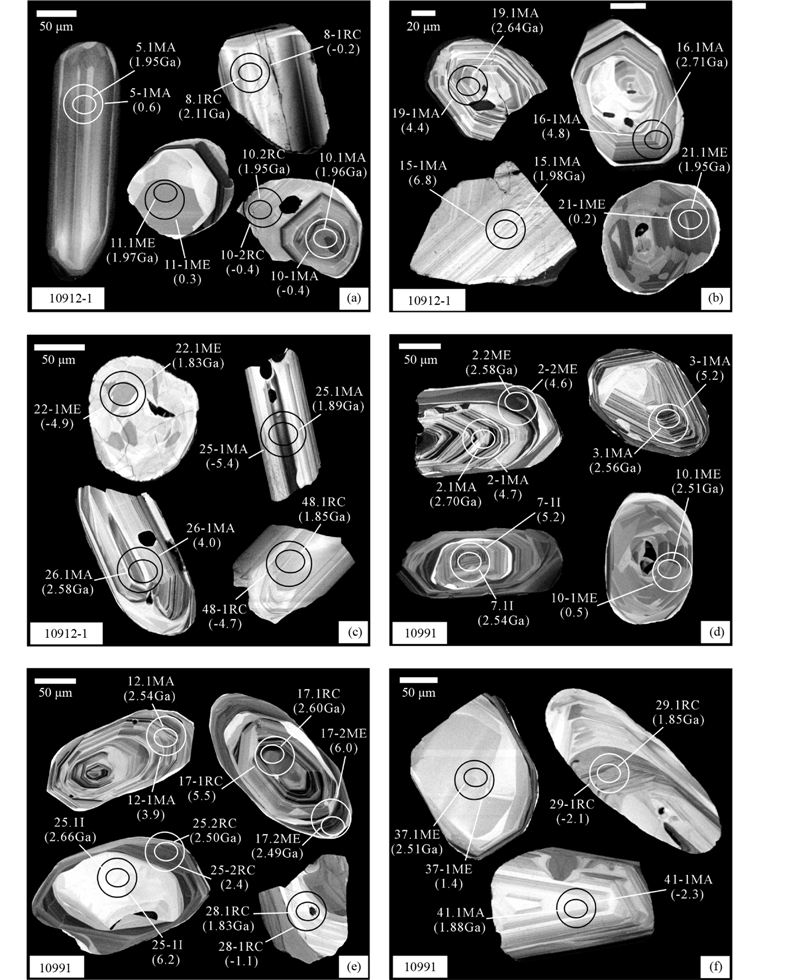 | 图 5 白云鄂博群(a-c)和腮林忽洞群(d-f)中-粗粒砂岩的碎屑锆石阴极发光图像 I-继承或捕获锆石;MA-岩浆锆石;ME-变质锆石;RC-不完全变质重结晶锆石 Fig. 5 Cathodoluminescence images of detrital zircons from medium- to coarse-grained s and stones of the Bayan Obo Group(a-c) and Sailinhudong(d-f)Group I-inherited or captured zircon; MA-magmatic zircon; ME-metamorphic zircon; RC-incompletely recrystallized zircon |
在白云鄂博群中-粗粒砂岩样品(10912-1)的51颗锆石上共获得51个分析数据(表 1),Th、U含量变化及相互关系见图 6a。数据点大多数沿着或靠近谐和线分布(图 7a)。12个岩浆锆石的U含量和Th/U比值分别为33×10-6~170×10-6和0.37~1.64,年龄值范围为1887~2711Ma,主要分布在1.9~2.1Ga之间和2.5~2.7Ga之间;21个变质锆石的U含量和Th/U比值分别为38×10-6~198×10-6和0.44~1.68,年龄值范围为1827~2494Ma,主要分布在1.8~2.0Ga之间和~2.5Ga;18个不完全变质重结晶锆石的U含量和Th/U比值分别为23×10-6~162×10-6和0.25~0.87,年龄值范围为1851~3083Ma,主要分布在1.85~2.1Ga之间和2.5~2.7Ga之间。在年龄直方图中,岩浆锆石和变质锆石年龄峰值都为~1.95Ga,在~2.5Ga和~2.65Ga也有分布(图 7b)。样品中存在较多古元古代晚期高级变质作用形成的变质锆石。
 | 表 1 白云鄂博群和腮林忽洞群中-粗粒砂岩的碎屑锆石SHRIMP U-Pb年龄 Table 1 SHRIMP U-Pb data for detrital zircons from medium- to coarse-grained s and stones of the Bayan Obo Group and Sailinhudong Group |
 | 图 6 白云鄂博群(a)和腮林忽洞群(b)中-粗粒砂岩中的碎屑锆石Th-U图 Fig. 6 Th-U diagrams of detrital zircons from medium- to coarse-grained s and stones of the Bayan Obo Group(a) and Sailinhudong Group(b) |
 | 图 7 白云鄂博群(a、b)和腮林忽洞群(c、d)中-粗粒砂岩的碎屑锆石SHRIMP U-Pb谐和图和年龄直方图 Fig. 7 Concordia diagrams and histograms of SHRIMP U-Pb data of detrital zircons from medium- to coarse-grained s and stones of the Bayan Obo Group(a,b) and Sailinhudong Group(c,d) |
在腮林忽洞群中-粗粒砂岩样品(10991)的41颗锆石上共进行了46个数据点分析(表 1),Th、U含量变化及相互关系见图 6b。数据点也大多沿着或靠近谐和线分布(图 7c)。5个继承或捕获锆石的U含量和Th/U比值分别为5×10-6~150×10-6和0.39~1.35,年龄范围为2539~2663Ma,都为新太古代年龄值;11个岩浆锆石的U含量和Th/U比值分别为28×10-6~375×10-6和0.41~0.90,年龄范围为1864~2701Ma,主要分布在1.85Ga和2.5~2.7Ga之间;13个变质锆石的U含量和Th/U比值分别为27×10-6~244×10-6和0.19~2.08,年龄范围为1752~2577Ma,主要分布在1.85~2.1Ga之间和2.45~2.6Ga之间;17个不完全变质重结晶锆石的U含量和Th/U比值分别为33×10-6~238×10-6和0.41~1.23,年龄范围为1828~2596Ma,主要分布在1.8~1.85Ga之间和2.4~2.6Ga之间。在年龄直方图中,岩浆锆石和变质锆石年龄峰值都为~2.5Ga,在~1.9Ga也有分布(图 7d)。样品中存在较多新太古代晚期高级变质作用形成的变质锆石。 4.2 锆石Hf同位素组成
对2个定年样品锆石进行了Hf同位素测试,分析点位置与SHRIMP U-Pb定年位置相同。Hf同位素分析数据见表 2及图 8、图 9。白云鄂博群中-粗粒砂岩(10912-1)的12个岩浆锆石εHf(t)、tDM1(Hf)和tDM2(Hf)分别为-5.4~+6.8、2106~2811Ma和2178~2873Ma;21个变质锆石的εHf(t)、tDM1(Hf)和tDM2(Hf)分别为-5.9~+3.1、2311~2690Ma和2539~2888Ma;除7-1RC外,16个不完全变质重结晶锆石的εHf(t)、tDM1(Hf)和tDM2(Hf)分别为-4.7~+6.4、2258~2779Ma和2331~2872Ma。7-1RC是该样品中U-Pb年龄、Hf模式年龄最大的锆石(图 8a),应来自更古老的陆壳物质。15-1MA、19-1RC、33-1MA和49-1RC位于古元古代晚期锆石上,具有高的εHf(t)值(图 8a),而不同于其它古元古代晚期锆石。
| 表 2 白云鄂博群和腮林忽洞群中-粗粒砂岩的碎屑锆石Hf同位素组成 Table 2 Hf isotopic compositions of detrital zircons from medium- to coarse-grained s and stones of the Bayan Obo Group and Sailinhudong Group |
 | 图 8 白云鄂博群(a)和腮林忽洞群(b)的中-粗粒砂岩的碎屑锆石年龄-εHf图 Fig. 8 Age vs. εHf diagrams of detrital zircons from medium- to coarse-grained s and stones of the Bayan Obo Group(a) and Sailinhudong Group(b) |
 | 图 9 白云鄂博群和腮林忽洞群中-粗粒砂岩的碎屑锆石Hf同位素二阶段模式年龄直方图 Fig. 9 Two-stage Hf isotope model age histograms for detrital zircons from medium- to coarse-grained s and stones of the Bayan Obo Group and Sailinhudong Group |
腮林忽洞群中-粗粒砂岩(10991)的5个继承或捕获锆石的εHf(t)、tDM1(Hf)和tDM2(Hf)分别为+3.5~+6.2、2648~2741Ma和2714~2825Ma;11个岩浆锆石的εHf(t)、tDM1(Hf)和tDM2(Hf)分别为-2.3~+5.6、2277~2807Ma和2531~2936Ma;13个变质锆石的εHf(t)、tDM1(Hf)和tDM2(Hf)分别为-6.1~+6.0、2360~2797Ma和2628~2977Ma;16个不完全变质重结晶锆石的εHf(t)、tDM1(Hf)和tDM2(Hf)分别为-8.8~+5.5、2279~2759Ma和2555~3033Ma。不存在εHf(t)为正值的古元古代晚期锆石。 5 讨论
近年来,Zhang et al.(2009,2012)在燕辽-商都-化德地区获得了~1.33Ga的双峰式岩浆岩的形成年龄,Shi et al.(2012)在集宁地区发现了~1.32Ga的A型花岗岩,但总体上,华北克拉通北缘,特别是白云鄂博周边地区缺少中、新元古代岩浆作用。白云鄂博群和腮林忽洞群碎屑沉积岩中不存在这些时代的碎屑锆石,不能制约白云鄂博群和腮林忽洞群的形成时代。这与我们在开展这项研究时所预测的一致。
白云鄂博群和腮林忽洞群碎屑沉积岩的碎屑锆石内部结构多种多样,年龄不同,表明其物源区时代组成和地质演化历史复杂。白云鄂博群碎屑沉积岩(10912-1)物源区的岩浆锆石年龄为1.89~1.98Ga和2.53~2.71Ga,变质锆石年龄为1.83~1.98Ga和2.48~2.49Ga;腮林忽洞群碎屑沉积岩(10991)物源区的岩浆锆石年龄为1.86~1.88Ga和2.49~2.70Ga,变质锆石年龄为1.75~1.90Ga和2.46~2.58Ga,两者物源区岩浆锆石和变质锆石的年龄分布范围大致相同,既有新太古代晚期的物质也有古元古代晚期的物质,部分岩石遭受了新太古代晚期-古元古代早期以及古元古代晚期的变质作用。变质锆石的Th/U比值大多大于0.5,个别甚至大于1.5。结合锆石结构特征,这些不同时代的变质锆石看来形成于高角闪岩相-麻粒岩相高级变质作用。推测白云鄂博群和腮林忽洞群碎屑沉积物至少部分来自于高级变质物源区。此外,无论是新太古代晚期或是古元古代晚期锆石,其Hf同位素组成类似,多数为新太古代早期大陆地壳再循环的产物。所有这些,都显示出与华北克拉通早前寒武纪变质基底的类似性。两个样品的碎屑锆石年龄分布峰值存在一些差别,白云鄂博群碎屑沉积岩以古元古代晚期碎屑锆石为主,腮林忽洞群碎屑沉积物以新太古代晚期碎屑锆石为主。白云鄂博群碎屑沉积岩中还存在Hf同位素组成亏损的古元古代岩浆锆石。这些差别表明两者的物源区不同时代岩石的比例有所不同。尽管如此,两者的物源区都以新太古代晚期和古元古代晚期岩石为主,不存在本质的区别。需要指出的是,由于物源区遭受新太古代晚期和古元古代晚期高级变质作用叠加改造,一些锆石年龄数据点沿谐和线连续分布,看来并非是物源区岩浆作用和变质作用事件的真实记录。但是,根据问题的性质,这不影响以上对白云鄂博群和腮林忽洞群碎屑沉积物物源区的总体认识。
白云鄂博群和腮林忽洞群均直接覆盖在早前寒武纪变质基底之上,与早前寒武纪变质基底为不整合接触。白云鄂博群和腮林忽洞群底部均为砾岩和中-粗粒砂岩互层产出,斜层理发育,为河流相沉积。白云鄂博附近的大青山-固阳-武川一带,~2.7Ga、~2.55Ga、~2.45Ga、~2.3Ga、~1.95Ga、~1.85Ga岩石广泛存在,但不同地区不同时代岩石的比例存在变化,新太古代晚期岩石主要分布于固阳-武川地区(阴山地块),古元古代晚期岩石主要分布于大青山地区(孔兹岩带)。它们都主要为2.7~2.8Ga古老陆壳物质壳内再循环产物,大青山地区还存在2.2~2.5Ga的地幔添加作用。它们普遍经历了新太古代晚期-古元古代早期(2.5~2.4Ga)以及古元古代晚期(1.97~1.82Ga)的高级变质作用(董春艳等, 2009,2012; 董晓杰等,2012; 简平等,2005; 刘建辉等,2013; 马铭株等, 2012,2013; Dong et al., 2012,2013; Jian et al., 2012; Liu et al., 2013; Ma et al., 2012; Wan et al., 2009,2013)。本文所研究的白云鄂博群和腮林忽洞群与大青山-固阳-武川地区变质基底岩石的锆石特征、年龄构成和Hf同位素组成相似,推测大青山-固阳-武川地区早前寒武纪变质基底是白云鄂博群和腮林忽洞群碎屑沉积物的主要物源区。河流相中-粗粒碎屑沉积物搬运距离不远,受河流所经流域的基底岩石类型和分布的制约,这可能是白云鄂博群和腮林忽洞群碎屑沉积岩的碎屑锆石年龄分布存在某些差异的主要原因。白云鄂博群和腮林忽洞群碎屑沉积岩的碎屑锆石定年和Hf同位素研究结果,与它们形成时代相同的认识不矛盾。 6 结论
(1)两个群的碎屑锆石年龄主要分布在1.8~2.1Ga之间和2.4~2.7Ga之间,但年龄峰值存在一定区别。碎屑锆石Hf同位素组成类似,εHf(t)和tDM2(Hf)变化范围分别主要在-6.0~6.0之间和2550~2950Ma之间。
(2)与华北克拉通其它地区中元古代-早古生代沉积盖层类似,白云鄂博群和腮林忽洞群碎屑沉积岩物源区主要由新太古代晚期和古元古代晚期岩浆岩和变质岩组成。两个群的碎屑物质很可能来自华北克拉通北缘早前寒武纪变质基底。两者形成环境类似,来自类似的物源区,与它们形成时代相同的认识不矛盾。
致谢 样品靶由杨淳、甘伟林制作,周丽芹、李宁帮助进行锆石阴极发光照相,张玉海、杨之青和刘建辉保障SHRIMP仪器正常工作;锆石标准由Ian Williams和Lance Black博士提供;两位评审人对论文质量提高起了重要作用;在此一并深表谢意。| [1] | Blichert-Toft J and Albarède F. 1997. The Lu-Hf isotope geochemistry of chondrites and the evolution of the mantle-crust system. Earth and Planetary Science Letters, 148(1-2): 243-258 |
| [2] | Chen H and Shao JA. 1987. The forming mode and tectonic setting of the carbonatite in Bayan Obo area. In: Shenyang Institute of Geology and Mineral Resources, Ministry of Geology and Mineral Resources (ed.). Contributions to Plate Tectonics of Northern China (No.2), Beijing: Geological Publishing House, 73-79 (in Chinese) |
| [3] | Chen H. 1993. Hydrogen and oxygen isotopic characteristics of the Bayan Obo deposits and their genetic significance. In: Contributions to the Fifth National Conference on Mineral Deposits. Beijing: Geological Publishing House, 561-562 (in Chinese) |
| [4] | Chu NC, Taylor RN, Chavagnac V, Nesbitt RW, Boella RM, Milton JA, German CR, Bayon G and Burton K. 2002. Hf isotope ratio analysis using multi-collector inductively coupled plasma mass spectrometry: An evaluation of isobaric interference corrections. Journal of Analytical Atomic Spectrometry, 17(12): 1567-1574 |
| [5] | Cumming GL and Richarda JR. 1975. Ore lead isotope ratios in a continuously changing earth. Earth and Planetary Science Letters, 28(2): 155-171 |
| [6] | Diwu CR, Sun Y, Liu YJ, Han W, Dai MN, and Li YX. 2011. The protolith nature of quartz sandstone from Changlongshan Formation in Liujiang area, Qinhuangdao City: Evidence of U-Pb and Hf-isotope from detrital zircons. Acta Petrologica et Mineralogica, 31(1): 1-12 (in Chinese with English abstract) |
| [7] | Dong CY, Liu DY, Wan YS, Xu ZY, Wang W and Xie HQ. 2009. Hf isotope composition and REE pattern of zircons from Early Precambrian metamorphic rocks in the Daqing Mountains, Inner Mongolia. Geological Review, 55(4): 509-520 (in Chinese with English abstract) |
| [8] | Dong CY, Wan YS, Xu ZY, Liu DY, Yang ZS, Ma MZ and Xie HQ. 2012. Khondalites of the Late Paleoproterozoic in the Daqingshan area, North China Craton: SHRIMP zircon U-Pb dating. Scientia Sinica (Terrae), 42(12): 1851-1862 (in Chinese) |
| [9] | Dong CY, Wan YS, Wilde SA, Xu ZY, Ma MZ, Xie HQ and Liu DY. 2013. Earliest Paleoproterozoic supracrustal rocks in the North China Craton recognized from the Daqingshan area of the Khondalite Belt: Constraints on craton evolution. Gondwana Research, 25(4): 1535-1553 |
| [10] | Dong XJ, Xu ZY, Liu ZH and Sha Q. 2012. 2.7Ga granitic gneiss in the Nnorthern foot of Daqingshan Mountain, Central Inner Mongolia, and its geological implications. Earth Science, 37(Suppl.): 45-52 (in Chinese with English abstract) |
| [11] | Dong XJ, Xu ZY, Liu ZH and Sha Q. 2012. Zircon U-Pb geochronology of Archean high-grade metamorphic rocks from Xi Ulanbulang area, central Inner Mongolia. Science China (Earth Science), 55(2): 204-212 |
| [12] | Fan HR, Chen FK, Wang KY, Xie YH, Wilde SA and Stair M. 2002. Zircon U-Pb age of a carbonatite dyke from Bayan Obo REE-Fe-Nb deposit, Inner Mongolia and its geological significance. Acta Petrologica Sinica, 18(3): 363-368 (in Chinese with English abstract) |
| [13] | Fan HR, Hu FF, Chen FK, Yang KF and Wang KY. 2006. Intrusive age of No.1 carbonatite dyke from Bayan Obo REE-Nb-Fe deposit, Inner Mongolia: With answers to comment of Dr. Le Bas. Acta Petrologica Sinica, 22(2): 519-520 (in Chinese with English abstract) |
| [14] | Fan HR, Yang KF, Hu FF, Wang KY and Zhai MG. 2010. Zircon geochronology of basement rocks from the Bayan Obo area, Inner Mongolia, and tectonic implications. Acta Petrologica Sinica, 26(5): 1342-1350 (in Chinese with English abstract) |
| [15] | Geng JZ, Li HK, Zhang J, Zhou HY and Li HM. 2011. Zircon Hf isotope analysis by means of LA-MC-ICP-MS. Geological Bulletin of China, 30(10): 1508-1513 (in Chinese with English abstract) |
| [16] | He ZJ, Zhang XY, Niu BG, Liu RY and Zhao L. 2011. The paleo-weathering mantle of the Proterozoic rapakivi granite in Miyun County, Beijing and the relationship with the Changzhougou Formation of Changchengian System. Earth Science Frontiers, 18(4): 123-130 (in Chinese with English abstract) |
| [17] | Howard KE, Hand M, Barovich KM, Reid A, Wade BP and Belousova EA. 2009. Detrital zircon ages: Improving interpretation via Nd and Hf isotopic data. Chemical Geology, 262(3-4): 277-292 |
| [18] | Hu B, Zhai MG, Guo JH, Peng P, Liu F and Liu S. 2009. LA-ICP-MS U-Pb geochronology of detrital zircons from the Huade Group in the northern margin of the North China Craton and its tectonic significance. Acta Petrologica Sinica, 25(1): 193-211 (in Chinese with English abstract) |
| [19] | Jian P, Zhang Q, Liu DY, Jin WJ, Jia XQ and Qian Q. 2005. SHRIMP dating and geological significance of Late Achaean high-Mg diorite (sanukite) and hornblende-granite at Guyang of Inner Mongolia. Acta Petrologica Sinica, 21(1): 151-157 (in Chinese with English abstract) |
| [20] | Jian P, Kröner A, Windley BF, Zhang Q, Zhang W and Zhang LQ. 2012. Episodic mantle melting-crustal reworking in the Late Neoarchean of the northwestern North China Craton: Zircon ages of magmatic and metamorphic rocks from the Yinshan Block. Precambrian Research, 222-223: 230-254 |
| [21] | Jiao DY, Cui XH and Su HW. 2011. Seismites from Bayan Obo Group in the Bainaimiao area of Inner Mongolia and their tectonic implications. Geoscience, 25(3): 503-509 (in Chinese with English abstract) |
| [22] | Liu J, Li Y, Ling MX and Sun WD. 2011. Chronology and geological significance of the basement rock of the giant Bayan Obo REE-Nb-Fe ore deposit. Geochimica, 40(3): 209-222 (in Chinese with English abstract) |
| [23] | Liu JH, Liu FL, Ding ZJ, Chen JQ, Liu PH, Shi JR, Cai J and Wang F. 2013. Zircon U-Pb chronology, geochemistry and their petrogenesis of Early Paleoproterozoic granitoid gneisses in Ulashan area, North China Craton. Acta Petrologica Sinica, 29(2): 485-500 (in Chinese with English abstract) |
| [24] | Liu LS, Gao X, Du AD and Sun YL. 1996. The Re-Os isotopic age of molybdenite from Bayan Obo REE ore deposit. Mineral Deposits, 15(2): 188-192 (in Chinese with English Abstract) |
| [25] | Liu SC, Zhang YX, Hao ZG and Peng Y. 1999. A genetic study of the ore-hosted dolostone in the Bayan Obo deposit: History, problems and new progress. Geological Review, 45(5): 477-486 (in Chinese with English abstract) |
| [26] | Liu SJ, Dong CY, Xu ZY, Santosh M, Ma MZ, Xie HQ, Liu DY and Wan YS. 2013. Palaeoproterozoic episodic magmatism and high-grade metamorphism in the North China Craton: Evidence from SHRIMP zircon dating of magmatic suites in the Daqingshan area. Geological Journal, 48(5): 429-455 |
| [27] | Liu YL, Peng GY, Zhang X, Li HM and Chen JF. 2001. U-Pb and Pb-Pb dating of the host rock-H8 dolomite in Bayan Obo ore deposit. Bulletin of Mineralogy Petrology and Geochemistry, 20(4): 274-277 (in Chinese with English abstract) |
| [28] | Liu YL, Yang G, Chen JF, Du AD and Xie Z. 2005. Re-Os dating of pyrite from Giant Bayan Obo REE-Nb-Fe deposit. Chinese Science Bulletin, 49(24): 2627-2631 |
| [29] | Liu YL, Chen JF, Li HM, Xiao GW and Zhang TR. 2006. Geochronology of the carbonatite dykes in the Bayan Obo ore field: Revisit. Geological Review, 52(3): 415-422 (in Chinese with English abstract) |
| [30] | Ludwig KR. 2001a. SQUID 1.02, A User's Manual. Berkeley: Berkeley Geochronology Center Special Publication, 2: 1-19 |
| [31] | Ludwig KR. 2001b. User's Manual for Isoplot /Ex rev. 2.49: A Geochronological Toolkit for Microsoft Excel. Berkeley: Berkeley Geochronology Center Special Publication, 1:1-58 |
| [32] | Lü HB, Zhang YX, Xiao GW and Zhang QL. 2006. Earthquake slump blocks discovered in lower part of the Sailinhudong Group, Heinaobao, southeast Bayan Obo, Inner Mongolia. Geological Review, 52(3): 163-171 (in Chinese with English abstract) |
| [33] | Ma MZ, Wan YS, Santosh M, Xu ZY, Xie HQ, Dong CY, Liu DY and Guo CL. 2012. Decoding multiple tectonothermal events in zircons from single rock samples: SHRIMP zircon U-Pb data from the Late Neoarchean rocks of Daqingshan, North China Craton. Gondwana Research, 22(3-4): 810-827 |
| [34] | Ma MZ, Wan YS, Xu ZY, Liu SJ, Xie HQ, Dong CY and Liu DY. 2012. Late Paleoproterozoic K-feldspar pegmatite veins in Daqingshan area, North China Craton: SHRIMP age and Hf composition of zircons. Geological Bulletin of China, 31(6): 825-833 (in Chinese with English abstract) |
| [35] | Ma MZ, Xu ZY, Zhang LC, Dong CY, Dong XJ, Liu SJ, Liu DY and Wan YS. 2013. SHRIMP dating and Hf isotope analysis of zircons from the Early Precambrian basement in the Xi Ulanbulang area, Wuchuan, Inner Mongolia. Acta Petrologica Sinica, 29(2): 501-516 (in Chinese with English abstract) |
| [36] | Morton AC, Hitchen K, Fanning CM, Yaxley G, Johnson H and Ritchie JD. 2009. Detrital zircon age constraints on the provenance of sandstones on Hatton Bank and Edoras Bank, NE Atlantic. Journal of the Geological Society, London, 166(1): 137-146 |
| [37] | Nowell GM, Kempton PD, Noble SR, Fitton JG, Saunders AD, Mahoney JJ and Taylor RN. 1998. High precision Hf isotope measurements of MORB and OIB by thermal ionization mass spectrometry: Insights into the depleted mantle. Chemical Geology, 149(3-4): 211-233 |
| [38] | Patchett PJ and Tatsumoto M. 1980. A routine high-precision method for Lu-Hf isotope geochemistry and chronology. Contributions to Mineralogy and Petrology, 75(3): 263-267 |
| [39] | Qiao XF, Gao LZ, Peng Y and Zhang YX. 1997a. New considerations on the Sailinhudong Group, Bayan Obo Group and the ore-bearing dolostone in Bayan Obo deposit. Geological Review, 43(2): 147 (in Chinese) |
| [40] | Qiao XF, Gao LZ, Peng Y and Zhang YX. 1997b. Composite stratigraphy of the Sailinhudong Group and ore-bearing micrite mound in the Bayan Obo deposit, Inner Mongolia, China. Acta Geologica Sinica, 71(3): 202-211 (in Chinese with English abstract) |
| [41] | Ren R, Han BF, Zhang ZC, Li JF, Yang YH and Zhang YB. 2011. Zircon U-Pb and Hf isotopic studies of basement gneiss and overlying Meso-Neoproterozoic sedimentary rocks from the Changping area, Beijing, and their geological implications. Acta Petrologica Sinica, 27(6): 1721-1745 (in Chinese with English abstract) |
| [42] | Shi YR, Liu DY, Kröner A, Jian P, Miao LC and Zhang FQ. 2012. Ca. 1318Ma A-type granite on the northern margin of the North China Craton: Implications for intraplate extension of the Columbia supercontinent. Lithos, 148(1): 1-9 |
| [43] | Söderlund U, Patchett PJ, Vervoort JD and Isachsen CE. 2004. The 176Lu decay constant determined by Lu-Hf and U-Pb isotope systematics of Precambrian mafic intrusions. Earth and Planetary Science Letters, 219(3-4): 311-324 |
| [44] | Sun SF. 1992. The new discovery of fossil microplants in the Jianshan Formation of the Bayan Obo Group, Inner Mongolia. Geological Review, 38(5): 474-480 (in Chinese with English abstract) |
| [45] | Tan LK and Shi TZ. 2000. Discovery and significance of small shelly fossils in the Bayan Obo Group in Shangdu, Inner Mongolia. Geological Review, 46(6): 573-584 (in Chinese with English abstract) |
| [46] | Wan YS, Zhang QD and Song TR. 2003. SHRIMP ages of detrital zircons from the Changcheng System in the Ming Tombs area, Beijing: Constraints on the protolith nature and maximum depositional age of the Mesoproterozoic cover of the North China Craton. Chinese Science Bulletin, 48(22): 2500-2506 |
| [47] | Wan YS, Liu DY, Dong CY, Xu ZY, Wang ZJ, Wilde SA, Yang YH, Liu ZH, and Zhou HY. 2009. The Precambrian khondalite belt in the Daqingshan area, North China Craton: Evidence for multiple metamorphic events in the Palaeoproterozoic era. Geological Society, London, Special Publications, 323(1): 73-97 |
| [48] | Wan YS, Miao PS, Liu DY, Yang CH, Wang W, Wang HC, Wang ZJ, Dong CY, Du LL and Zhou HY. 2010. Formation ages and source regions of the Palaeoproterozoic Gaofan, Hutuo and Dongjiao groups in the Wutai and Dongjiao areas of the North China Craton from SHRIMP U-Pb dating of detrital zircons: Resolution of debates over their stratigraphic relationships. Chinese Science Bulletin, 55(13): 1278-1284 |
| [49] | Wan YS, Liu DY, Wang W, Song TR, Kröner A, Dong CY, Zhou HY and Yin XY. 2011. Provenance of Meso-to Neoproterozoic cover sediments at the Ming Tombs, Beijing, North China Craton: An integrated study of U-Pb dating and Hf isotopic measurement of detrital zircons and whole-rock geochemistry. Gondwana Research, 20(1): 219-242 |
| [50] | Wan YS, Liu DY, Dong CY and Yin XY. 2011. SHRIMP zircon dating of meta-sedimentary rock from the Qinling Group in the north of Xixia, North Qinling Orogenic Belt: Constraints on complex histories of source region and timing of deposition and metamorphism. Acta Petrologica Sinica, 27(4): 1172-1178 (in Chinese with English abstract) |
| [51] | Wan YS, Xu ZY, Dong CY, Nutman A, Ma MZ, Xie HQ, Liu SJ, Liu DY, Wang HC and Cu H. 2013. Episodic Paleoproterozoic (-2.45, -1.95 and -1.85Ga) mafic magmatism and associated high temperature metamorphism in the Daqingshan area, North China Craton: SHRIMP zircon U-Pb dating and whole-rock geochemistry. Precambrian Research, 224: 71-93 |
| [52] | Wang J and Li SQ. 1987. Langshan-Bayan Obo rift system and its metallogenic characteristics. In: Shenyang Institute of Geology and Mineral Resources, Ministry of Geology and Mineral Resources (ed.). Contributions to Plate Tectonics of Northern China (No.2). Beijing: Geological Publishing House (in Chinese) |
| [53] | Wang KY, Fan HR, Xie YH and Li HM. 2001. Zircon U-Pb dating of basement gneisses of the super-large REE-Fe-Nb deposit in the Bayan Obo region, Inner Mongolia. Chinese Science Bulletin, 46(16): 1390-1394 (in Chinese) |
| [54] | Williams IS. 1998. U-Th-Pb Geochronology by Ion Microprobe. In: McKibben MA, Shanks WC III and Ridley WI (eds.). Applications of Microanalytical Techniques to Understanding Mineralizing Processes. Reviews in Economic Geology, Society of Economic Geologists, 7: 1-35 |
| [55] | Xia XP, Sun M, Zhao GC, Wu FY and Xie LW. 2009. U-Pb and Hf isotopic study of detrital zircons from the Lüliang khondalite, North China Craton, and their tectonic implications. Geological Magazine, 146(5): 701-716 |
| [56] | Zhang PY, Li SQ, Wang CY, Niu CW, Sun SF, Guan AL and Liang W. 1993. The geologico-tectonic characteristics of the Bayan Obo region. In: Bulletin of the Tianjin Institute of Geology and Mineral Resources, CAGS. Beijing: Geological Publishing House, 28: 1-86 (in Chinese) |
| [57] | Zhang SH, Zhao Y, Yang ZY, He ZF and Wu H. 2009. The 1.35Ga diabase sills from the northern North China Craton: Implications for breakup of the Columbia (Nuna) supercontinent. Earth and Planetary Science Letters, 288(3-4): 588-600 |
| [58] | Zhang SH, Zhao Y and Santosh M. 2012. Mid-Mesoproterozoic bimodal magmatic rocks in the northern North China Craton: Implications for magmatism related to breakup of the Columbia supercontinent. Precambrian Research, 222-223: 339-367 |
| [59] | Zhang X, Lü HB, Dong XP, Sun C, Chen L, Liu JY, Zhang YX and Wang J. 2013. Olistostromes discovered in the Halahuogete Formation, Bayan Obo Group and its geological significance. Geological Review, 59(6): 1199-1206 (in Chinese with English abstract) |
| [60] | Zhang YX, Jiang SQ, Zhang QL, Lai XD, Peng Y and Yang XY. 2008. A discussion on forming time of the Bayan Obo Group and ore-forming time of the Bayan Obo giant REE-Nb-Fe deposit, Inner Mongolia. Geology in China, 35(6): 1129-1137 (in Chinese with English abstract) |
| [61] | Zhang YX, Yang ZF, Zhang QL et al. 2009. Geological and Geochemical Study on Bayan Obo Deposit and the Mudmound in Western Hills, Beijing. Beijing: Geological Publishing House, 1-112 (in Chinese) |
| [62] | Zhang YX and Liu JY. 2010. Macrofossils discovered in the Sailinhudong Group in Heinaobao, Darhan-Maoming'an Qi, Inner Mongolia. Geological Review, 56(1): 123-124 (in Chinese) |
| [63] | Zhang YX, Lü HB, Wang J, Liu JY, Meng QW and Huang M. 2012. Analysis of ore-forming tectonic settings of the Bayan Obo REE deposit. Acta Geologica Sinica, 86(5): 767-774 (in Chinese with English abstract) |
| [64] | Zhang ZQ, Ye XJ, Yuan ZX, Bai G and Wu CY. 1991. Age of the Bayan Obo Nb-REE-Fe deposits in Inner Mongolia: The Sm-Nd Isotopic data. Acta Petrologica et Mineralogica, 10(1): 80-83 (in Chinese with English abstract) |
| [65] | Zhang ZQ, Tang SH, Wang JH, Yuan ZX and Bai G. 1994. New data for ore-forming age of the Bayan Obo REE deposit, Inner Mongolia. Acta Geoscientia Sinica, 15(1-2): 85-94 (in Chinese with English abstract) |
| [66] | Zhang ZQ, Tang SH, Chen QT, Wang JH, Yuan ZX and Bai G. 1997. Sm-Nd ages and origins of metamorphic rocks for the H9 Formation in the Bayan Obo ore district, and relationship with the ore forming event. Acta Geosicientia Sinica, 18(3): 267-274 (in Chinese with English abstract) |
| [67] | Zhang ZQ, Tang SH, Yuan ZX, Bai G and Wang JH. 2001. The Sm-Nd and Rb-Sr isotopic systems of the dolomites in the Bayan Obo ore deposit, Inner Mongolia, China. Acta Petrologica Sinica, 17(4): 637-642 (in Chinese with English abstract) |
| [68] | Zhang ZQ, Tang SH, Wang JH, Yuan ZX and Bai G. 2003. Information about ore deposit formation in different epochs: Age of the west orebodies of the Bayan Obo deposit with a discussion. Geology in China, 30(2): 130-137 (in Chinese with English abstract) |
| [69] | 陈辉, 邵济安. 1987. 白云鄂博地区碳酸岩的形成方式及构造背景. 见: 地质矿产部沈阳地质矿产研究所主编. 中国北方板块构造论文集, 第2集. 北京: 地质出版社, 73-79 |
| [70] | 陈辉. 1993. 白云鄂博矿床氢、氧同位素特征及其成因意义. 第五届全国矿床会议论文集. 北京: 地质出版社, 561-562 |
| [71] | 第五春荣, 孙勇, 刘养杰, 韩伟, 戴梦宁, 李永项. 2011. 秦皇岛柳江地区长龙山组石英砂岩物质源区组成——来自碎屑锆石U-Pb-Hf同位素的证据. 岩石矿物学杂志, 30(1): 1-12 |
| [72] | 董春艳, 刘敦一, 万渝生, 徐仲元, 王伟, 颉颃强. 2009. 内蒙古大青山地区早前寒武纪变质岩的锆石Hf同位素组成和稀土模式. 地质论评, 55(4): 509-520 |
| [73] | 董春艳, 万渝生, 徐仲元, 刘敦一, 杨振升, 马铭株, 颉颃强. 2012. 华北克拉通大青山地区古元古代晚期孔兹岩系: 锆石SHRIMP U-Pb定年. 中国科学(地球科学), 42(12): 1851-1862 |
| [74] | 董晓杰, 徐仲元, 刘正宏, 沙茜. 2012. 内蒙古大青山北麓2.7Ga花岗质片麻岩的发现及其地质意义. 地球科学, 37(增刊): 45-52 |
| [75] | 范宏瑞, 陈福坤, 王凯怡, 谢奕汉, Wilde SA, Satir M. 2002. 白云鄂博REE-Fe-Nb矿床碳酸岩墙锆石U-Pb年龄及其地质意义. 岩石学报, 18(3): 363-368 |
| [76] | 范宏瑞, 胡芳芳, 陈福坤, 杨奎峰, 王凯怡. 2006. 白云鄂博超大型REE-Nb-Fe矿区碳酸岩墙的侵位年龄——兼答Le Bas博士的质疑. 岩石学报, 22(2): 519-520 |
| [77] | 范宏瑞, 杨奎锋, 胡芳芳, 王凯怡, 翟明国. 2010. 内蒙古白云鄂博地区基底岩石锆石年及对构造背景的指示. 岩石学报, 26(5): 1342-1350 |
| [78] | 耿建珍, 李怀坤, 张健, 周红英, 李惠民. 2011. 锆石Hf同位素组成的LA-MC-ICP-MS测定. 地质通报, 30(10): 1508-1513 |
| [79] | 和政军, 张新元, 牛宝贵, 刘仁燕, 赵磊. 2011. 北京密云元古宙环斑花岗岩古风化壳及其与长城系常州沟组的关系. 地学前缘, 18(4): 123-130 |
| [80] | 胡波, 翟明国, 郭敬辉, 彭澎, 刘富, 刘爽. 2009. 华北克拉通北缘化德群中碎屑锆石的LA-ICP-MS U-Pb年龄及其构造意义. 岩石学报, 25(1): 193-211 |
| [81] | 简平, 张旗, 刘敦一, 金维浚, 贾秀勤, 钱青. 2005. 内蒙古固阳晚太古代赞岐岩(sanukite)——角闪花岗岩的SHRIMP定年及其意义. 岩石学报, 21(1): 151-157 |
| [82] | 矫德阳, 崔晓寰, 苏宏伟. 2011. 内蒙古白乃庙地区白云鄂博群震积岩的发现及其构造意义. 现代地质, 25(3): 503-509 |
| [83] | 刘健, 李印, 凌明星, 孙卫东. 2011. 白云鄂博矿床基底岩石的年代学研究及其地质意义. 地球化学, 40(3): 209-222 |
| [84] | 刘建辉, 刘福来, 丁正江, 陈军强, 刘平华, 施建荣, 蔡佳, 王舫. 2013. 乌拉山地区早古元古代花岗质片麻岩的锆石U-Pb年代学、地球化学及成因. 岩石学报, 29(2): 485-500 |
| [85] | 刘兰笙, 高翎, 杜安道, 孙亚莉. 1996. 白云鄂博稀土矿床中辉钼矿的铼-锇同位素年龄. 矿床地质, 15(2): 188-192 |
| [86] | 刘淑春, 章雨旭, 郝梓国, 彭阳. 1999. 白云鄂博赋矿白云岩成因研究历史、问题及新进展. 地质论评, 45(5): 477-486 |
| [87] | 刘玉龙, 彭谷洋, 张巽, 李惠民, 陈江峰. 2001. 白云鄂博赋矿地层H8白云岩的U-Pb和Pb-Pb定年. 矿物岩石地球化学通报, 20(4): 274-277 |
| [88] | 刘玉龙, 杨刚, 陈江峰, 杜安道, 谢智. 2005. 白云鄂博超大型稀土-铌-铁矿床黄铁矿Re-Os定年. 科学通报, 50(2): 172-175 |
| [89] | 刘玉龙, 陈江峰, 李惠民, 肖国望, 张台荣. 2006. 白云鄂博矿田碳酸岩墙年代学再研究. 地质论评, 52(3): 415-422 |
| [90] | 吕洪波, 章雨旭, 肖国望, 张绮玲. 2006. 内蒙古白云鄂博南东黑脑包腮林忽洞群下部发现地震滑塌岩块. 地质论评, 52(3): 163-171 |
| [91] | 马铭株, 万渝生, 徐仲元, 刘守偈, 颉颃强, 董春艳, 刘敦一. 2012. 华北克拉通大青山地区古元古代晚期钾长伟晶岩脉SHRIMP锆石U-Pb定年和Hf同位素组成. 地质通报, 31(6): 825-833 |
| [92] | 马铭株, 徐仲元, 张连昌, 董春艳, 董晓杰, 刘守偈, 刘敦一, 万渝生. 2013. 内蒙古武川西乌兰不浪地区早前寒武纪变质基底锆石SHRIMP定年及Hf同位素组成. 岩石学报, 29(2): 501-516 |
| [93] | 乔秀夫, 高林志, 彭阳, 章雨旭. 1997a. 对内蒙古腮林忽洞群、白云鄂博群及白云鄂博铁矿赋矿白云岩的新认识. 地质论评, 43(2): 147 |
| [94] | 乔秀夫, 高林志, 彭阳, 章雨旭. 1997b. 内蒙古腮林忽洞群综合地层和白云鄂博矿床赋矿微晶丘. 地质学报, 71(3): 202-211 |
| [95] | 任荣, 韩宝福, 张志诚, 李建锋, 杨岳衡, 张艳斌. 2011. 北京昌平地区基底片麻岩和中-新元古代盖层锆石U-Pb年龄和Hf 同位素研究及其地质意义. 岩石学报, 27(6): 1721-1745 |
| [96] | 孙淑芬. 1992. 内蒙古白云鄂博群尖山组微古植物新发现. 地质论评, 38(5): 474-480 |
| [97] | 谭励可, 石铁铮. 2000. 内蒙古商都白云鄂博群小壳化石的发现及其意义. 地质论评, 46(6): 573-584 |
| [98] | 万渝生, 张巧大, 宋天锐. 2003. 北京十三陵长城系常州沟组碎屑锆石SHRIMP年龄: 华北克拉通盖层物源区及最大沉积年龄的限定. 科学通报, 48(18): 1970-1975 |
| [99] | 万渝生, 刘敦一, 董春艳, 殷小艳. 2011. 西峡北部秦岭群变质沉积岩锆石SHRIMP定年: 物源区复杂演化历史和沉积、变质时代确定. 岩石学报, 27(4): 1172-1178 |
| [100] | 王辑, 李双庆. 1987. 狼山-白云鄂博裂谷系及其成矿特征. 见: 地质矿产部沈阳地质矿产研究所主编. 中国北方板块构造论文集, 第2集. 北京: 地质出版社 |
| [101] | 王凯怡, 范宏瑞, 谢奕汉, 李惠民. 2001. 白云鄂博超大型REE-Fe-Nb矿床基底杂岩的锆石U-Pb年龄. 科学通报, 46(16): 1390-1394 |
| [102] | 张鹏远, 李双庆, 王长尧, 牛绍武, 孙淑芬, 管爱莲, 梁伟. 1993. 白云鄂博地区地质构造特征. 中国地质科学院天津地质矿产研究所所刊. 北京: 地质出版社, 28: 1-86 |
| [103] | 张星, 吕洪波, 董晓朋, 孙闯, 陈林, 柳建勇, 章雨旭, 王俊. 2013. 白云鄂博群哈拉霍疙特组滑塌堆积的发现及其地质意义. 地质论评, 59(6): 1199-1206 |
| [104] | 章雨旭, 江少卿, 张绮玲, 赖晓东, 彭阳, 杨晓勇. 2008. 论内蒙古白云鄂博群和白云鄂博超大型稀土-铌-铁矿床成矿的年代. 中国地质, 35(6): 1129-1137 |
| [105] | 章雨旭, 杨占峰, 张绮玲等. 2009. 白云鄂博矿床及北京西山微晶丘地质地球化学研究. 北京: 地质出版社, 1-112 |
| [106] | 章雨旭, 柳建勇. 2010. 内蒙古达茂旗黑脑包腮林忽洞群中发现宏体化石. 地质论评, 6(1): 123-124 |
| [107] | 章雨旭, 吕洪波, 王俊, 柳建勇, 孟庆伟, 黄敏. 2012. 白云鄂博矿床成矿构造环境分析. 地质学报, 86(5): 767-774 |
| [108] | 张宗清, 叶笑江, 袁忠信, 白鸽, 吴澄宇. 1991. 白云鄂博稀土矿床的形成年代: Sm-Nd同位素数据. 岩石矿物学杂志, 10(1): 80-83 |
| [109] | 张宗清, 唐索寒, 王进辉, 袁忠信, 白鸽. 1994. 白云鄂博稀土矿床形成年龄的新数据. 地球学报, 15(1-2): 85-94 |
| [110] | 张宗清, 唐索寒, 陈启桐, 王进辉, 袁忠信, 白鸽. 1997. 白云鄂博矿区H9变质岩的Sm-Nd年龄、成因及与成矿关系. 地球学报, 18(3): 267-274 |
| [111] | 张宗清, 唐索寒, 袁忠信, 白鸽, 王进辉. 2001. 白云鄂博矿床白云岩的Sm-Nd、Rb-Sr同位素体系. 岩石学报, 17(4): 637-642 |
| [112] | 张宗清, 唐索寒, 王进辉, 袁忠信, 白鸽. 2003. 白云鄂博矿床形成于不同时代的信息——矿床西矿体的年龄和讨论. 中国地质, 30(2): 130-137 |